


Highlights
What are the main findings?
- The RadarsBEV framework introduces a scalable, modular architecture that decouples per-sensor feature extraction from the central fusion process, enabling permutation-invariant multi-radar perception.
- A novel physics-aware Gaussian cross-attention mechanism explicitly models radar target spatial uncertainty, effectively decoupling feature sampling from high-intensity environmental clutter.
What are the implications of the main findings?
- The decoupled architectural design inherently guarantees graceful degradation, allowing the system to maintain continuous, high-accuracy target detection even during abrupt sensor dropouts.
- By relying on physical signal priors rather than rigid network topologies, the model achieves robust zero-shot generalization across entirely unseen sensor layouts and degraded operational environments without any retraining.
Abstract
Multi-radar fusion is fundamental for robust, all-weather perception for diverse applications. However, current fusion paradigms face structural and computational bottlenecks. Traditional statistical frameworks suffer from an explosion of dimensional calculation, where computational complexity scales with the number of active sensor nodes. Concurrently, existing statistical and deep learning fusion models exhibit systemic brittleness; their rigid topological binding to predefined sensor counts leads to a drop in performance during sensor dropouts. Furthermore, generic attention mechanisms suffer a phenomenological mismatch with radar signals, neglecting the spatial features of radar targets and leading to false alarms. To overcome these limitations, we propose RadarsBEV, a scalable end-to-end multi-radar detection framework. By decoupling per-sensor feature extraction from the central spatial fusion process, RadarsBEV achieves permutation invariance. This design breaks the scalability limit and enables graceful degradation utilizing residual nodes without system downtime. Crucially, we introduce a physics-aware Gaussian cross-attention mechanism. By guiding sparse feature sampling through predicted two-dimensional Gaussian target geometry, this mechanism decouples attention weights from clutter signal. Extensive experiments on high-fidelity simulations and real-world datasets demonstrate that RadarsBEV achieves better detection performance. Notably, the framework exhibits robust configuration zero-shot generalization, adapting to entirely unseen spatial layouts and degraded operational environments without fine-tuning.
1. Introduction
Radar systems provide essential all-weather perception capabilities for diverse applications, including aerospace monitoring [1,2,3,4], traffic control, and autonomous navigation [5,6,7,8]. However, individual sensors face inherent physical limitations, such as restricted fields of view (FoV), low angular resolution, and susceptibility to target radar cross-section fluctuations. To overcome these constraints, networking multiple spatially distributed radars has become the prevailing paradigm [9,10,11]. Multi-radar systems (MRS) exploit spatial diversity to mitigate signal fading and eliminate blind spots. This spatial aggregation directly improves the accuracy and robustness of target detection and parameter estimation.
Early multi-radar architectures predominantly employ data-level fusion [12], where each sensor independently performs local detection before aggregating the results via rules, such as M/N logic or cluster methods [13,14]. While straightforward, this paradigm discards raw signal energy during the initial thresholding stage, limiting the detection of weak targets in low signal-to-noise ratio environments.
Consequently, signal-level fusion has emerged as a better alternative, such as direct localization models [15,16], the generalized likelihood ratio test (GLRT) [17,18], and the maximum likelihood estimation (MLE) [19]. Conceptually, signal-level fusion bypasses local decision-making by directly transmitting unthresholded radar measurements to the fusion center [20]. By jointly aggregating amplitude and phase information across multiple vantage points prior to thresholding, this paradigm physically accumulates raw signal energy. This centralized integration maximizes the joint signal-to-noise ratio, allowing the system to extract weak target signatures that individual sensors would otherwise filter out as background noise.
While mathematically rigorous, classical signal-level statistical frameworks [21,22,23] face critical operational bottlenecks due to an explosion in computational dimensionality. Evaluating a joint objective function necessitates searching a concatenated state space of all potential targets. If the single-target spatial domain is discretized into K grid points, evaluating G targets requires exhaustive searches. Consequently, the computational complexity scales polynomially with the active sensor count N for data fusion operations, but exponentially with the target quantity G [9]. Second, these methods are highly susceptible to model mismatch. They rely on strict parametric assumptions regarding target fluctuation models, background noise distributions, and perfect sensor synchronization. In physical environments, heterogeneous clutter, multipath effects, and hardware variances violate these idealized priors, causing severe detection degradation. Consequently, the reliance on intractable computations and rigid statistical models heavily restricts their deployment in complex sensor topologies.
To overcome the computational barriers and model mismatch of traditional statistical frameworks, data-driven paradigms have emerged [24,25,26,27,28]. Unlike model-based detection, deep learning models extract hierarchical features directly from raw measurements, bypassing rigid parametric assumptions and adapting robustly to complex clutter. In single-radar perception, neural networks effectively process spatial-temporal tensors to identify targets even under severe signal degradation [29].
Extending this capability to multi-sensor networks, recent architectures project sensor measurements into a unified bird’s-eye-view (BEV) representation [30,31,32,33,34,35,36]. This spatial mapping acts as a highly efficient fusion center. Theoretically, BEV architectures can map variable-length inputs into a global spatial grid through a single forward pass. This fundamentally decouples the inference latency from the active sensor count N, offering a scalable solution to the dimensional explosion plaguing classical methods.
Despite these theoretical advantages, contemporary deep learning fusion architectures [37,38,39] exhibit structural brittleness in dynamic operational environments. They typically employ rigid, concatenation-based feature aggregation, strictly binding network parameters to a predefined sensor count [40]. In scenarios involving physical sensor destruction or severe communication jamming, the network scale frequently degrades from N to or fewer. Under such topological discontinuities, this rigid design induces tensor dimension mismatches. Although zero-padding can maintain the tensor shape for execution, it introduces invalid empty data that degrades the detection performance. Consequently, both classical and existing deep learning frameworks critically lack the capacity for graceful degradation, the ability to sustain continuous radar perception using residual nodes without manual intervention or model retraining.
Furthermore, even when dynamic aggregation modules, such as deformable attention (DA) [41,42], are incorporated in a deep learning architecture to process variable inputs, they suffer from a phenomenological mismatch with radar signals. Standard DA is optimized for dense optical imagery, utilizing unconstrained sampling offsets that rely on feature content similarity to delineate visual boundaries. In contrast, radar measurements manifest as sparse, localized energy peaks governed by the sensor’s point spread function [29]. Due to inherent measurement noise, a radar target’s true spatial probability decays stochastically from its centroid, mathematically resembling an anisotropic two-dimensional (2D) Gaussian distribution. Applying generic, unconstrained attention offsets completely neglects this geometric prior, causing the sampling process to physically misalign with the target’s spatial uncertainty ellipsoid. Consequently, such content-driven aggregation is highly susceptible to clutter, yielding suboptimal feature representations with elevated false alarm rates.
To systematically address these bottlenecks, we propose RadarsBEV, an end-to-end framework that redesigns multi-radar perception for arbitrary sensor configurations. By decoupling per-sensor feature extraction from the central fusion process, our architecture actively overcomes computational explosions and demonstrates configuration zero-shot adaptability, achieving graceful degradation under sensor failure. Crucially, we introduce a physics-aware Gaussian cross-attention mechanism that explicitly guides sparse feature sampling using the predicted 2D Gaussian geometry of targets, decoupling attention weights from deceptive clutter intensity.
Our primary contributions are summarized as follows:
- 1.
- Scalable and Fault-Tolerant Architecture: We introduce a modular frontend that processes variable input sets independently, breaking the strict coupling between network scale and computational complexity. This design inherently supports configuration zero-shot generalization and ensures graceful degradation during abrupt sensor dropouts without retraining or system downtime.
- 2.
- Physics-Aware Gaussian Cross-Attention: We propose a fusion engine that explicitly integrates radar geometric priors by modeling target spatial uncertainty as an anisotropic 2D Gaussian distribution. Utilizing Gaussian-guided adaptive sampling and geometry-generated weighting, this mechanism decouples attention from raw signal intensity.
- 3.
- Empirical Validation of Zero-Shot Transferability: Extensive experiments on both physics-based simulations and real-world multi-radar datasets demonstrate that RadarsBEV achieves improved detection accuracy. Notably, the framework maintains robust performance across entirely unseen spatial layouts and degraded operational conditions without any fine-tuning.
2. Materials and Methods
2.1. Problem Formulation
To systematically address the limitations of centralized fusion, we formalize the multi-radar perception task. Let a multi-radar system be defined by an active sensor set . Each sensor provides an observation tuple , where represents the raw Range-Azimuth (RA) measurement map, and denote the number of range (r) and azimuth () bins, and denotes the transformation matrix from the sensor’s local frame to the world coordinate system. The fundamental objective of multi-radar perception is to learn a mapping function that projects the variable-length observation set to the target detection result :
Given this mathematical formulation, we identify two core bottlenecks in existing spatial mapping paradigms.
2.1.1. Challenge I: Computational Coupling and Systemic Brittleness
Traditional statistical frameworks and contemporary deep learning architectures both fail to robustly approximate under dynamic topological conditions. In classical multi-sensor estimation frameworks, the spatial mapping is typically formulated as a joint maximum-likelihood (ML) parameter estimation problem. Let denote the concatenated state space of G potential targets. The objective function seeks to maximize the joint likelihood given all unthresholded observations:
Optimizing this joint objective function introduces severe computational bottlenecks. First, evaluating the joint probability generally requires constructing and inverting a joint covariance matrix, with complexity scaling as for N sensors. Second, finding the global maximum necessitates searching a high-dimensional state space. If the single-target state space is discretized into K grid points, the joint search space requires evaluations. This exponential scaling with respect to the target quantity G renders the exact ML estimator computationally intractable. Furthermore, if G is unknown a priori, the system must evaluate all possible target number hypotheses, which further exacerbates the computational overhead and systemic brittleness.
Additionally, conventional deep fusion models approximate by implicitly stacking or concatenating multi-sensor features into a fixed-size tensor. Let be a feature extractor and a spatial warping function. The rigid fusion operation is typically formulated as:
where is the detection head, ‖ denotes channel-wise concatenation, and is a predetermined, constant sensor count. This formulation imposes a strict cardinality constraint . This structural binding yields two fatal engineering flaws:
- Scalability Limits: is mathematically undefined for any input set where , strictly precluding configuration zero-shot deployment across varied platforms.
- Zero-Fault Tolerance: In the event of abrupt node failures (), the concatenated input tensor dimensions mismatch. To execute the forward pass, the system must use zero-padding for the missing inputs. However, this operation corrupts the feature space and causes a drop in performance, rendering the system incapable of graceful degradation.
To achieve computational decoupling and fault tolerance, must be formulated as a permutation-invariant set function:
where extracts per sensor embeddings and ⨁ represents a variable-length aggregation operator (e.g., attention), allowing N to vary dynamically.
2.1.2. Challenge II: Phenomenological Mismatch in Attention
The second bottleneck is the mismatch between radar phenomenology and generic attention mechanisms designed for optical imagery. Unlike cameras, radar measures sparse energy peaks subject to stochastic noise rather than dense textures. A target measurement in polar coordinates follows a noise distribution characterized by zero-mean Gaussian noise , where denotes the range and azimuth measurement variances.
Upon projection to the Cartesian BEV space via the non-linear transformation , the true spatial distribution of the measurement becomes strictly non-Gaussian. However, by applying a first-order Taylor series expansion to linearize this transformation [43], we can approximate the target’s spatial probability density function (PDF) as an anisotropic 2D Gaussian:
where the Cartesian covariance is approximated via the Jacobian matrix as . Consequently, valid features are confined to a specific ellipsoidal region oriented towards the sensor, accurately reflecting the physical spatial uncertainty.
However, current deep learning-based information fusion module DA [41] aggregates features from map for query at reference point :
where are learned offsets and are attention weights. We identify two limitations when applying Equation (6) to radar:
- Geometric Misalignment: In visual perception, learned offsets are unconstrained to adapt to arbitrary target boundaries [41]. However, radar signals are strictly confined within a stochastic uncertainty ellipsoid. Applying unconstrained offsets fails to align with the structured, anisotropic density (Equation (5)), resulting in inefficient noise sampling.
- Feature Dependency Risk: Generic standard DA weights depend on content similarity. Since radar heatmaps often contain high-intensity clutter resembling targets, content-based attention is susceptible to hallucinations. Robust fusion requires decoupling attention from feature values, utilizing target geometry to guide aggregation.
This motivates our Gaussian attention, which explicitly injects the parametric prior into the sampling process. The remainder of this section introduces RadarsBEV, an end-to-end and modular framework tailored for scalable multi-radar perception. Integrated with the Gaussian attention mechanism, RadarsBEV decouples feature extraction from the fusion process to inherently support arbitrary sensor configurations, and bridges the existing gaps through theoretically grounded, physics-aware fusion [44].
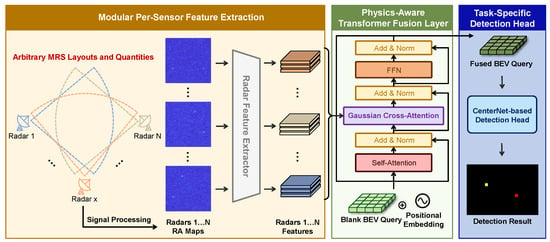
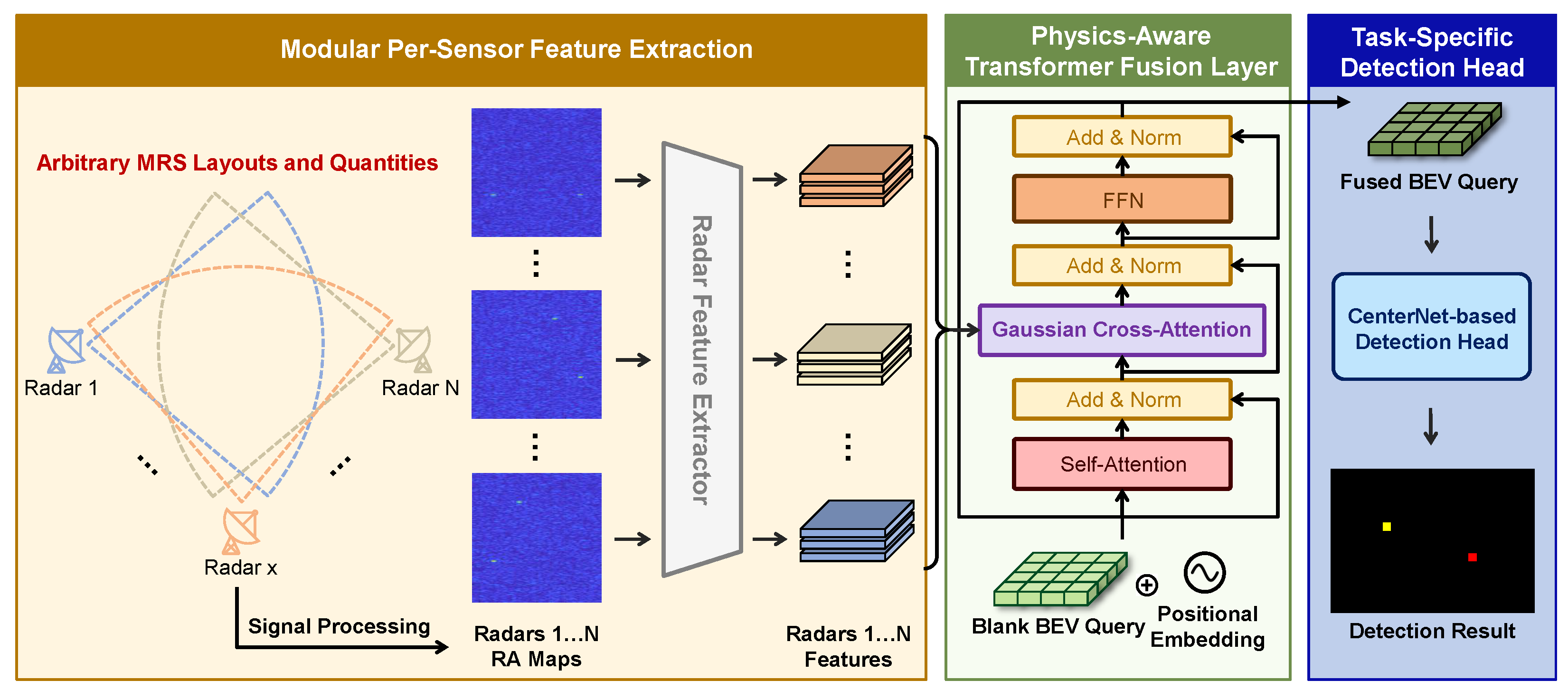
As illustrated in Figure 1, the pipeline consists of three tightly integrated stages, which correspond directly to the subsequent subsections: (1) Section 2.2: Modular per sensor feature extraction module that transforms raw sensor data into canonical BEV feature maps for permutation-invariant processing; (2) Section 2.3 and Section 2.4: Physics-aware transformer fusion layer that employs our proposed Gaussian cross-attention mechanism to aggregate features based on radar spatial uncertainty; (3) Section 2.5: Task-specific detection head and loss function for accurate target localization. This structured approach ensures both robust feature representation and effective fusion.
Figure 1.
The end-to-end architecture of our RadarsBEV framework, with per sensor feature extractor, transformer fusion layers, and final detection head.
2.2. Modular per Sensor Feature Extraction
To address the challenge of architectural rigidity, we design the frontend as a modular pipeline that processes the variable input set in a parallel, sensor-independent manner. This stage transforms heterogeneous sensor views into a unified feature space .
2.2.1. Unified Spatial Alignment
Raw radar data is natively represented in the polar RA domain. Let denote the raw intensity heatmap of the i-th sensor, and be its extrinsic pose transforming points from the sensor frame to the global frame. To facilitate fusion, we project all observations onto a canonical Cartesian BEV grid defined by dimensions and resolution .
For a target pixel coordinate in the BEV grid, its corresponding spatial position is recovered via the inverse projection . The alignment to the i-th sensor’s polar coordinate system is formulated as:
Converting to polar coordinates yields and . The unified BEV input map is then constructed via bilinear interpolation (warping) :
This process creates a spatially synchronized representation where the i-th map contains radar information if the location is within its FoV, and zeros otherwise.
2.2.2. Permutation-Invariant Feature Encoding
Following spatial alignment, we employ a learnable function to extract high-level semantics. To ensure the fusion function remains valid for any cardinality N, we utilize a shared-weight convolutional neural network (CNN) [45] backbone applied identically to each element of the aligned set.
We adopt a ResNet-18 [46,47] architecture as , which hierarchically downsamples the input. The operation produces a feature map for each sensor, where the spatial stride is :
The resulting output is a feature set . This two-step process, spatial alignment followed by feature encoding, concretely implements the abstract per sensor embedding function proposed in Equation (3):
This mapping process, defined by , strictly maintains the independence of individual sensor streams. By executing a parallel, sensor permutation-invariant forward pass, this modular design provides a critical structural advantage: it fundamentally decouples the learned network parameters from the active sensor count N. Unlike rigid concatenation-based architectures, this permutation-invariant formulation intrinsically prevents tensor dimension collapse. Consequently, it mathematically guarantees that the perception system can seamlessly execute a graceful degradation when the active sensor count abruptly drops (e.g., ), maintaining continuous multi-radar fusion without system downtime or algorithmic reconfiguration.
2.3. Physics-Aware Transformer Fusion Layer
Following the modular feature extraction, we employ a specialized fusion engine to address the limitations of generic attention mechanisms in radar perception. This engine is designed to handle a variable number of input feature maps and aggregate information based on the physical properties of radar signals. The process relies on a unified BEV query space processed through a stack of transformer layers [48,49].
2.3.1. BEV Query Space and Positional Context
To enable scalable fusion, we adopt a canonical BEV query space formulation [30]. This unified representation abstracts the variable input sensor configurations, allowing the model to aggregate features from an arbitrary number of radar inputs into a fixed spatial reference frame.
The BEV space is initialized with a fixed set of learnable queries, , where corresponds to the resolution of the target BEV grid. Each query is a -dimensional embedding. To incorporate spatial information, we add 2D sinusoidal positional encodings, , derived from the normalized coordinates of the corresponding grid cells. The query dimension is aligned with the radar feature dimension . The final query tensor, , serves as the input to the transformer fusion engine.
Additionally, to preserve spatial and sensor-specific context, we augment the radar feature maps with a composite positional embedding . This embedding sums a fixed sinusoidal encoding for spatial coordinates and a learnable embedding for the sensor index i. This design enables the model to distinguish features based on both their local position and their source sensor, facilitating the learning of sensor-specific characteristics.
2.3.2. Fusion Layer Architecture
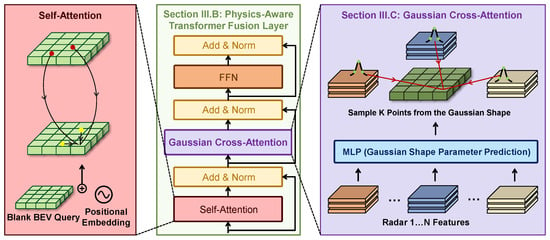
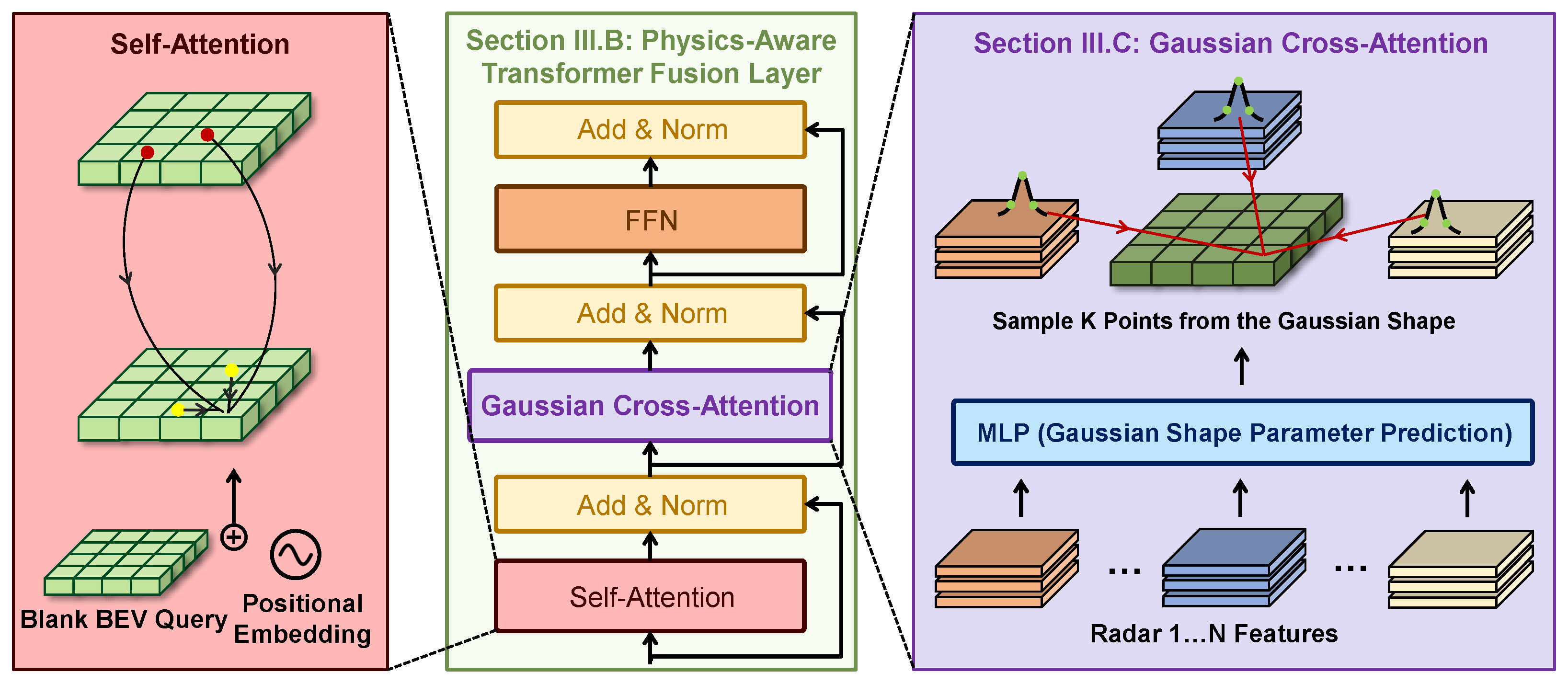
The fusion engine comprises a stack of identical transformer fusion layers. Each layer iteratively refines the BEV queries by aggregating information from the variable set of multi-radar feature maps . As shown in Figure 2, each layer consists of a multi-head self-attention (MHSA) block, our proposed Gaussian cross-attention (GCA) block, and a feed-forward network (FFN).
Figure 2.
The architecture of a single transformer fusion layer. BEV queries are processed sequentially by self-attention, Gaussian cross-attention, and a feed-forward network (FFN) with residual connections and layer normalization.
Processing within each layer follows a standard transformer structure with specific modifications. First, the MHSA block enables interaction among BEV queries to capture global scene context. Next, the GCA block integrates features from the multi-radar inputs into the BEV queries. Unlike standard DA, GCA leverages the physical properties of radar signals to guide feature aggregation, as detailed in Section 2.4. Finally, an FFN applies non-linear transformations to the updated queries. Residual connections [46] and layer normalization are employed after each block to facilitate training stability. This hierarchical refinement over L layers progressively enriches the BEV representation with multi-sensor spatial information.
2.4. Gaussian Cross-Attention Mechanism
This section details the GCA mechanism, designed to address the challenges outlined in Section 2.1. Unlike standard attention, which relies on feature content similarity and is susceptible to high-intensity radar clutter, GCA employs a physics-aware approach. It consists of two components: Gaussian-guided sampling, which aligns feature extraction with target geometry, and geometry-generated weighting, which decouples attention weights from noisy feature content.
2.4.1. Gaussian-Guided Sampling
As discussed in Section 2.1, the spatial probability of a radar target follows an anisotropic ellipsoidal distribution defined by the covariance . Standard sampling mechanisms with unconstrained offsets often fail to align with this distribution, potentially sampling background noise rather than signal energy along the resolution axes.
To incorporate physical priors, we parametrize the sampling pattern based on the target’s estimated covariance. For a BEV query at location , a prediction head estimates the parameters of a local Gaussian distribution . Specifically, the prediction head is implemented as a 3-layer multi-layer perceptron with ReLU activations, which maps the query embeddings to the geometric parameters. The covariance matrix is decomposed into physically interpretable components:
where represents the target orientation, and captures the uncertainty spread along the principal axes.
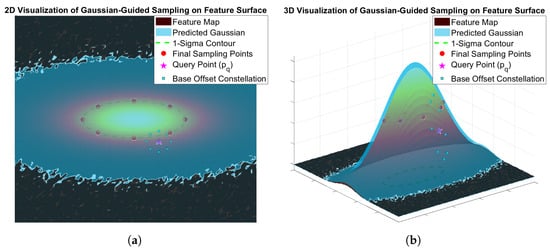
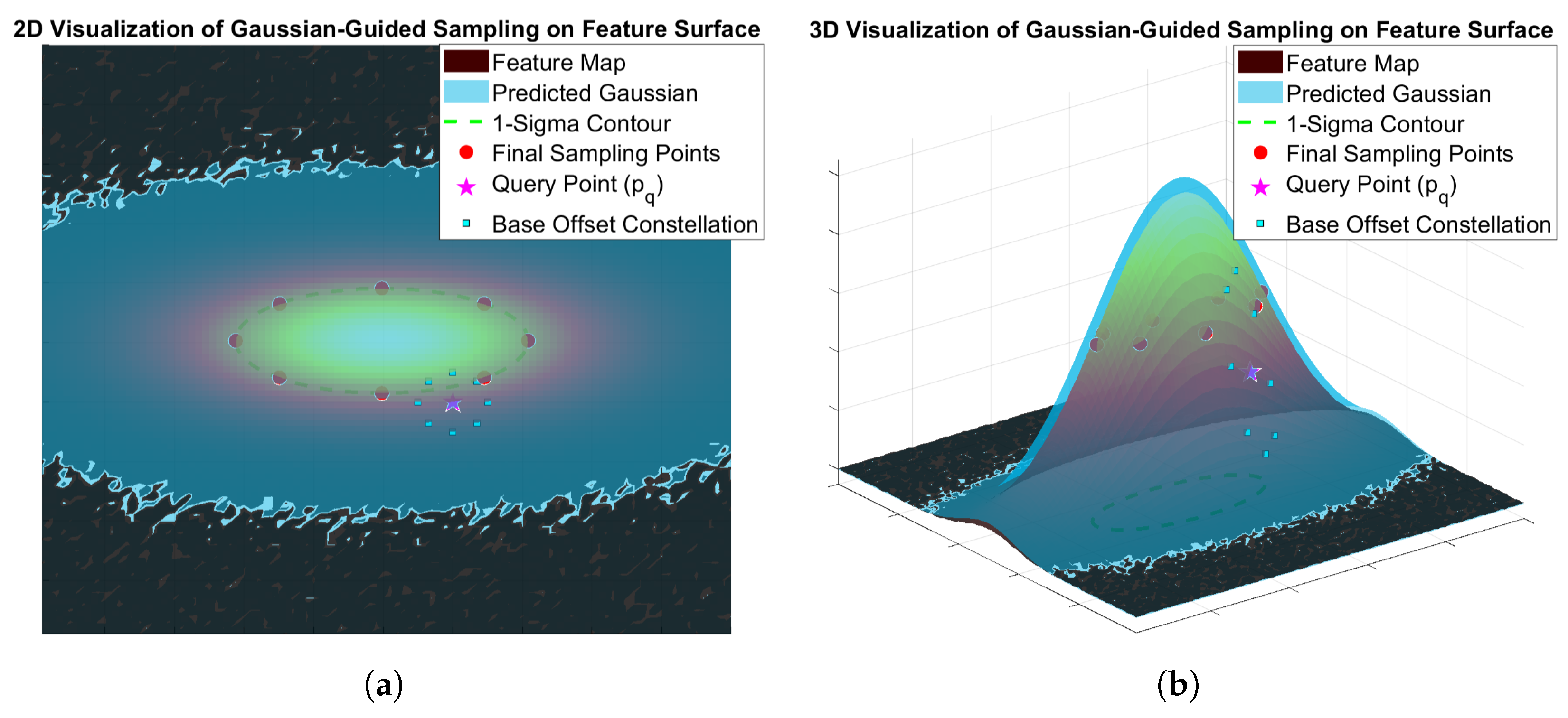
Sampling points are generated by aligning the receptive field with this uncertainty ellipse, as visually illustrated in Figure 3. Let be a set of learnable canonical offsets. The adaptive sampling locations are obtained by transforming these canonical offsets via the predicted geometry:
Figure 3.
Visualization of the proposed Gaussian-Guided Sampling mechanism. (a) 2D top-down, and (b) 3D perspective views show BEV query feature sampling.
By strictly constraining the adaptive sampling points within the predicted uncertainty ellipsoid defined by , this mechanism fundamentally corrects the geometric misalignment inherent in generic DA. It ensures that the feature extraction process actively adheres to the physical probability density function of radar signals, preventing the model from attending to stochastic background noise.
2.4.2. Geometry-Generated Weighting
As analyzed in Section 2.1, relying on content similarity for attention weights presents challenges in radar perception. Multipath reflections often manifest as high-intensity clutter that resembles valid targets. Consequently, content-based weighting can lead to false positives by inadvertently attending to these artifacts.
To address this, we adopt a geometry-driven approach that decouples attention weight generation from feature values. Weights are derived from the spatial relationship between the sampling points and the predicted target geometry.
For a query , a prediction head outputs a scalar modulation factor via a sigmoid activation. This scalar acts as a learnable temperature parameter controlling the sharpness of the attention distribution. The geometric score for the k-th sampling point is calculated based on its proximity to the query center, modulated by the predicted Gaussian spread and the temperature :
where is the average standard deviation predicted by the Gaussian head, and is a constant for numerical stability. The final attention weights are obtained by normalizing these geometric scores across the K sampling points:
This formulation establishes a feature-agnostic attention mechanism. The learnable temperature enables the model to dynamically adjust its receptive field: a higher yields a sharper distribution focusing on the center, while a lower allows for a flatter distribution to aggregate context. By excluding feature intensity from the weight calculation, the model reduces susceptibility to high-intensity clutter, utilizing physical priors of the target’s shape to guide feature extraction.
The final aggregated feature is the weighted sum of sampled values across all active sensors in the input set :
The complete computational procedure for a single query, which integrates the Gaussian parameter prediction, adaptive sampling, and geometry-based weighting, is outlined in Algorithm 1. This aggregation process is governed by the learned geometric understanding of the scene, mitigating noise interference through shape-constrained sampling.
| Algorithm 1 Gaussian Cross-Attention within a Fusion Layer |
| Require:
Query , Query Position , Keys feature map , Values feature map , Base offsets Ensure : Refined Query // Predict Gaussian parameters and geometry from query
|
2.5. Task-Specific Detection Head and Loss Function
2.5.1. Task-Specific Detection Head
After processing through the transformer fusion layers, the output BEV query features are reshaped into a 2D grid, forming a dense feature map . To decode this representation into target detections, we employ an anchor-free detection head based on CenterNet [50].
This head consists of convolutional layers that predict a multi-class heatmap , where denotes the number of target categories. The output resolution is downsampled from the query grid by a stride S (e.g., ). In this heatmap, local maxima correspond to the estimated centers of detected targets.
2.5.2. Loss Function
The model is trained using a pixel-wise heatmap loss , a variant of the focal loss [51]. The ground truth heatmap, , is generated by rendering 2D Gaussian kernels at the ground truth target locations. The loss is formulated as:
where is the number of targets, and are hyperparameters controlling the penalty reduction. In our experiments, we empirically set these hyperparameters to and , following standard configuration practices to optimally penalize easy examples. This loss addresses the class imbalance between target centers and the background.
In summary, we have presented RadarsBEV, an end-to-end framework for multi-radar perception. The architecture integrates a modular, per sensor frontend to handle variable sensor configurations, addressing the issue of architectural rigidity. Furthermore, the GCA mechanism incorporates physical priors into the fusion process, mitigating the impact of clutter. Section 3 will evaluate the model’s performance and robustness across diverse scenarios.
3. Results
This section evaluates the proposed RadarsBEV framework. Based on the experimental setup, the evaluations are structured to address four primary aspects: (1) Robustness Analysis: How does the framework maintain detection capabilities under dynamic operational conditions, specifically regarding scalability to varying sensor counts and adaptability to signal degradation? (2) Zero-Shot Generalization: Can the architecture effectively transfer without retraining to unseen topological layouts, real-world physical domains, and diverse radar configurations? (3) Computational Efficiency: Does the proposed method meet real-time processing requirements when compared against existing multi-radar fusion baselines? (4) Qualitative Analysis: How does the physics-aware attention mechanism internally process spatial features and maintain robustness against severe environmental clutter?
3.1. Experimental Setup
3.1.1. Simulation Dataset
To mitigate the scarcity of public multi-radar datasets featuring synchronized RA heatmaps, we constructed a large-scale dataset utilizing a high-fidelity physics-based simulator. The dataset comprises over 18,000 frames capturing diverse scenarios. To evaluate the system’s capability in handling complex overlapping FoV, we designed a convergent five-radar constellation. The layout consists of a central unit at the origin m facing north, two lateral units at m facing east and west, and two opposing units at m facing south. This configuration simulates a dense surveillance environment with raw RA heatmap outputs and precise ground truth annotations for target dimensions and trajectories. For experimentation, the dataset is partitioned into training and validation subsets with an 80/20 split.
3.1.2. Real-World Dataset
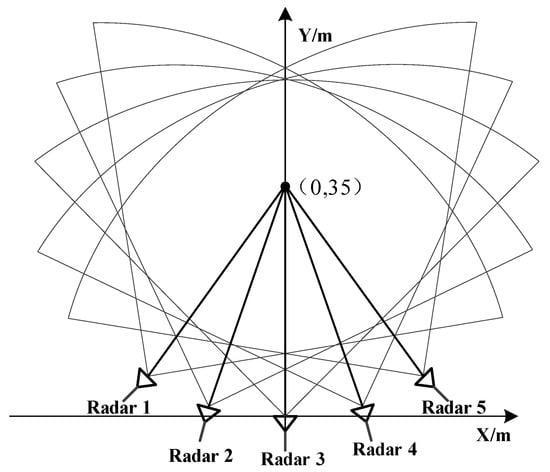
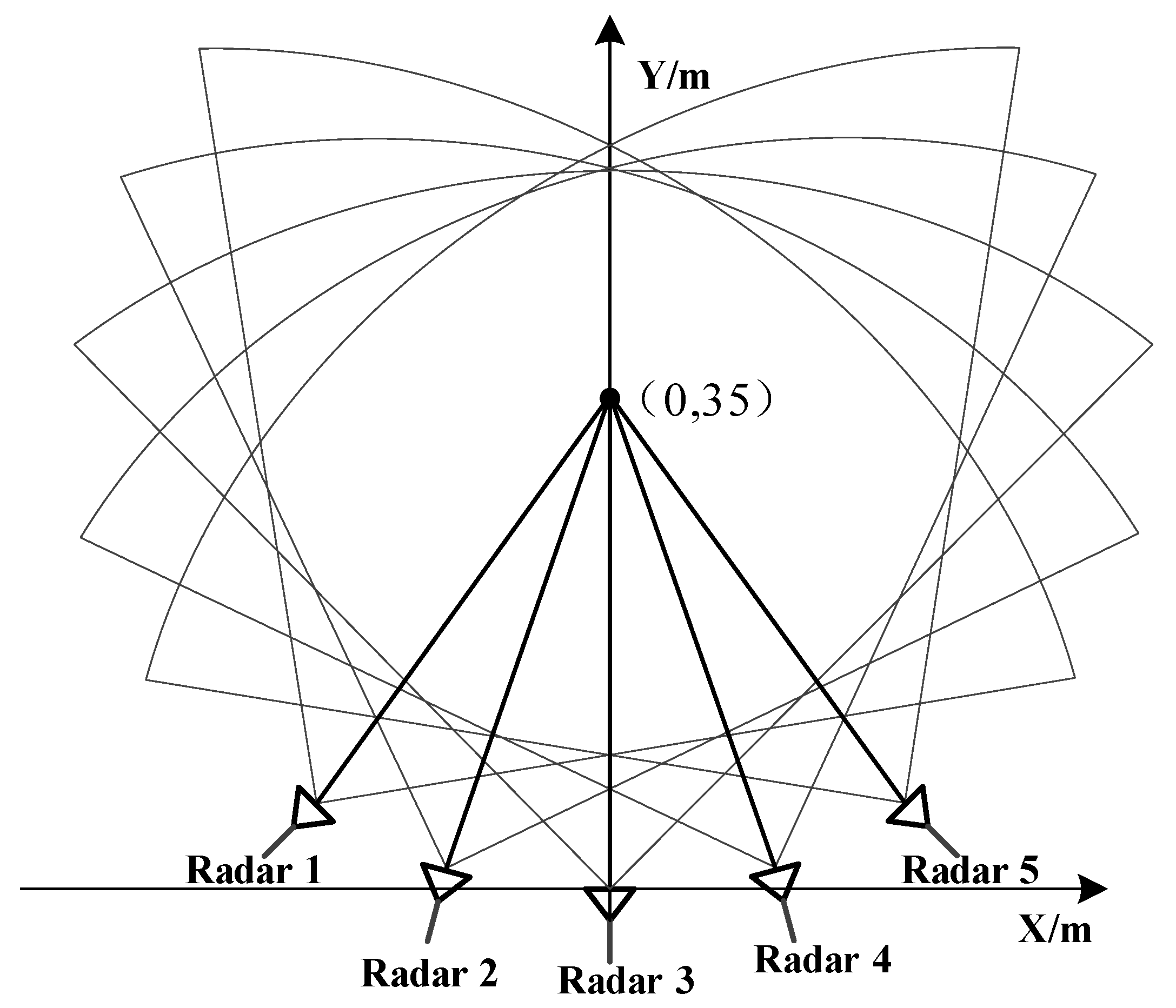
To further validate the proposed framework in real-world environments, we evaluate RadarsBEV on a dataset collected on a football field, focusing on human target detection. The data acquisition system comprises a constellation of five identical Texas Instruments 77 GHz frequency-modulated continuous wave (FMCW) radars [52]. As illustrated in Figure 4, the sensors are spatially distributed at m, m, m, m, and m, with all boresights oriented towards a common look-at point m. While our framework supports arbitrary topologies, this classic semi-circular layout maximizes angular diversity and serves as a comprehensive baseline from which sensor subsets can be sampled to evaluate zero-shot generalization. Note that to strictly isolate spatial adaptability, our current scope utilizes homogeneous radar configurations and assumes temporal synchronization, leaving asynchronous or heterogeneous fusion for future work.
Figure 4.
Real-world five-radar constellation used in our experiments. The figure illustrates the sensor positions and their common look-at direction towards m in the world coordinate system.
3.1.3. Evaluation Metrics
Mean distance error (MDE) calculates the average Euclidean distance between matched predictions and their corresponding ground truth targets, quantifying localization precision. Detection rate () and false alarm rate () [53] are used to analyze detection characteristics. These are defined as:
where G and P represent the ground truth and prediction sets, respectively. denotes the Euclidean distance in BEV space, and is set to 1m.
3.1.4. Implementation Details
The framework is implemented in PyTorch of version 2.4.1. We utilize an ImageNet-pretrained ResNet-18 backbone for feature extraction. The BEV perception range is defined as (−50 m, 50 m) along the lateral axis and (0 m, 100 m) along the longitudinal axis, with a grid resolution of 1 m. The transformer fusion module comprises layers. For the Gaussian attention mechanism, we employ attention heads with sampling points per head. The model is trained end-to-end for 50 epochs using the AdamW optimizer, with an initial learning rate of decay via a cosine annealing schedule. All experiments are implemented on one NVIDIA RTX 4090 GPU with 24 GB video memory, accompanied by 32 GB RAM for adequate computing resources.
3.1.5. Baselines for Comparison
Since deep learning-based variable multi-radar signal-level fusion and detection remains an underexplored area, direct state-of-the-art benchmarks are unavailable. To evaluate the proposed method, we compare it against three baselines representing distinct paradigms:
- CFAR + DBSCAN: A traditional non-learning approach where detections are generated per sensor using a Constant false alarm rate detector (CFAR) [54] and fused via density-based spatial clustering (DBSCAN) [55]. This baseline serves as a reference for standard signal processing performance.
- SIC: A GLRT approach where multi-target detections are generated sequentially by iteratively eliminating the interference of previously extracted targets from the objective function [9]. This baseline serves as a reference for a traditional signal-level multi-radar detection algorithm.
- Direct Fusion: A rigid deep learning architecture where multi-radar BEV heatmaps are concatenated prior to processing by a CNN detector. This baseline represents conventional fixed-topology fusion models, which require a constant number of input sensors. When evaluating this method with missing sensors, zero-padding is applied to maintain the fixed input dimensions.
- RadarsBEV-DCA: An ablation variant of our model where the Gaussian cross-attention is replaced by standard deformable cross-attention (DCA) [41]. This comparison isolates the performance gains attributable specifically to the proposed Gaussian-guided sampling strategy.
3.2. Robustness Analysis
This section evaluates the robustness of RadarsBEV under dynamic operational conditions, focusing on scalability to sensor counts and adaptability to signal degradation.
3.2.1. Scalability to Varying Sensor Counts
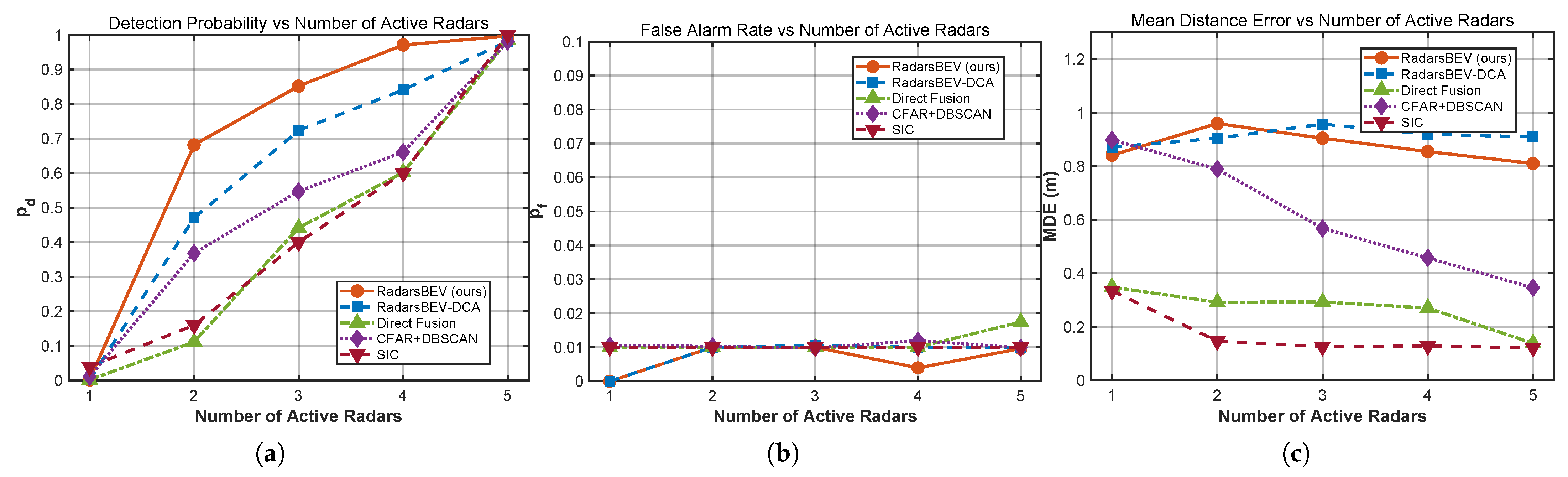
To evaluate the architectural resilience of the proposed framework, Figure 5 illustrates the model performance when the active sensor count is dynamically reduced from five to one during inference. This process simulates hardware failure or severe signal occlusion. In this evaluation, we align the of all methods to approximately 0.01 to provide a fair comparison of detection capabilities.
Figure 5.
Scalability analysis. Performance trends as the number of active radars is dynamically reduced. Metrics evaluated are (a) , (b) , and (c) MDE.
Under these constant conditions, the baseline methods show clear vulnerabilities to sensor loss. As the number of active radars decreases, direct fusion, CFAR + DBSCAN, and SIC exhibit a monotonic degradation in . direct fusion, which relies on a fixed network structure, struggles when input sensors are missing. Furthermore, while the RadarsBEV-DCA variant can structurally accept varying inputs, its functional performance drops rapidly. Because the unconstrained attention mechanism lacks physical priors, it cannot effectively extract targets when overlapping sensor views are removed, leading to a sharp decline in .
In contrast, RadarsBEV demonstrates robust fault tolerance. As depicted in Figure 5a, our proposed model sustains a consistently higher compared to all baselines across every sparsity level. Even when the system is constrained to only one or two active radar nodes, RadarsBEV maintains a reliable detection capability. Regarding localization accuracy, Figure 5c shows the MDE trends. While fewer sensors reduce overall spatial information, RadarsBEV maintains stable localization precision. It successfully achieves sub-grid error bounds, maintaining an MDE below the 1 m spatial quantization of the BEV grid across varying sensor counts. This stability highlights the advantage of the Gaussian-guided sampling mechanism, which accurately extracts spatial features regardless of sensor density.
These results confirm the effectiveness of our architecture. The modular, per sensor feature extraction frontend effectively decouples the network structure from a fixed spatial topology. This design inherently guarantees graceful degradation, ensuring continuous multi-radar perception without necessitating system downtime or model retraining.
3.2.2. Adaptability to Signal Degradation
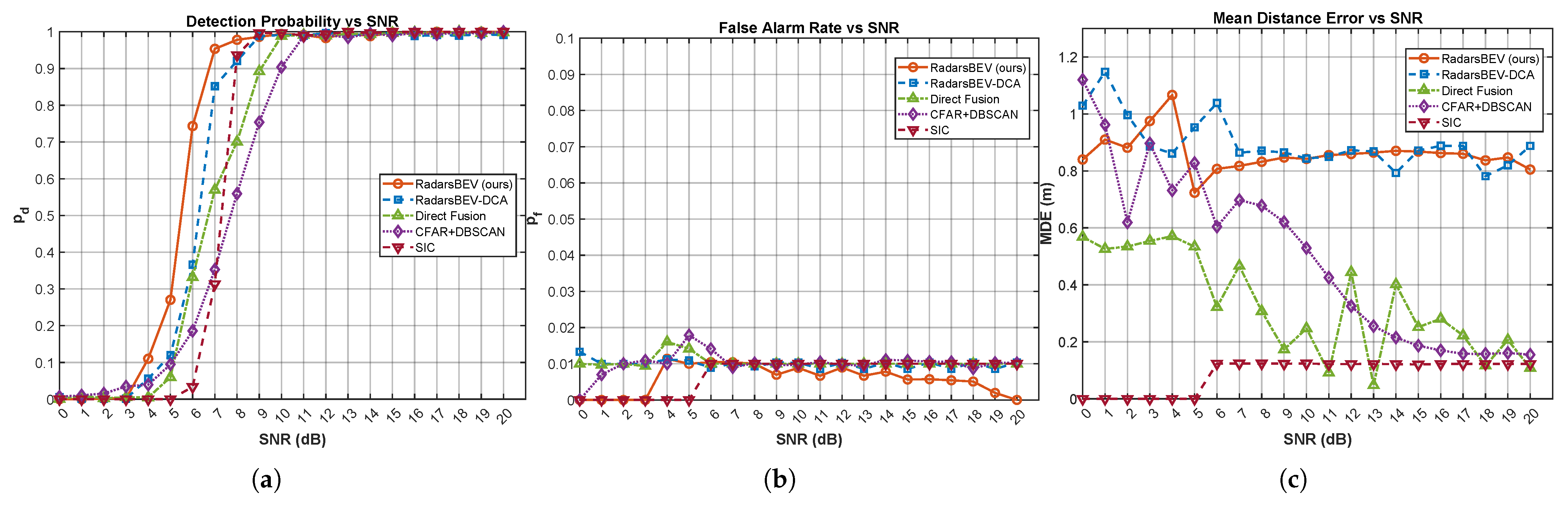
To properly evaluate how well the models handle noise interference, we assess target detection performance across different SNR levels ranging from 0 to 20 dB. Specifically, varying degrees of additive white Gaussian noise were synthetically injected into the raw RA measurements prior to the feature extraction stage, thereby simulating real-world signal attenuation and environmental interference. The results are presented in Figure 6. In this evaluation, all methods are tested under the condition.
Figure 6.
Adaptability to signal degradation. Performance comparisons of RadarsBEV versus baseline methods across varying Signal-to-Noise Ratios (SNR). The evaluation metrics include (a) , (b) , and (c) MDE.
Under this constant constraint, traditional methods like CFAR + DBSCAN and SIC show high sensitivity to signal degradation. When the SNR decreases, their drops rapidly. Conventional deep learning baselines, including direct fusion and RadarsBEV-DCA, show only minor improvements. They remain vulnerable to high noise levels. Specifically, the generic DCA mechanism relies on unconstrained feature similarity. Because it easily confuses noise peaks with real targets, it cannot maintain a high when forced to keep the bounded. To prevent false alarms in low-SNR environments, these baseline models end up missing many valid targets.
In contrast, the proposed RadarsBEV framework shows robust performance. Even under severe signal degradation at a 10 dB SNR, RadarsBEV sustains a high while adhering to the constant requirement. This sustained performance proves the advantage of the GCA mechanism. Instead of relying on raw signal amplitude, the GCA restricts the feature sampling process using a physical geometric prior. This design effectively separates true target features from strong clutter and random noise. Because of this, RadarsBEV detects targets in harsh environments where other methods fail.
3.3. Zero-Shot Generalization Analysis
In this section, we evaluate the architectural robustness of RadarsBEV by testing its zero-shot generalization capabilities across two distinct dimensions: adaptability to unseen topological layouts, different radar configurations, and transferability from simulation to the real world.
3.3.1. Generalization to Unseen Topological Layouts
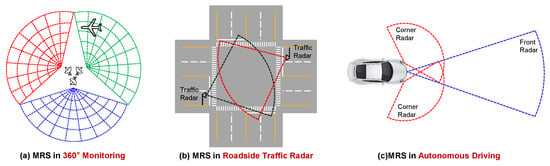
To evaluate the architectural flexibility, we test the model’s ability to generalize to unseen MRS without retraining. We apply the model trained exclusively on the 5-radar dataset directly to three distinct, unseen domains, as depicted in Figure 7:
Figure 7.
Examples of diverse multi-radar constellations on different platforms. (a) A three long-range radars for near-360° radar coverage. (b) A roadside surveillance utilizing two traffic radars with overlapping fields of view. (c) A common automotive radar setup with one forward long-range radar and two corner short-range radars.
- 360° Monitoring: Illustrated in Figure 7a, utilizing three 120° long-range radars for panoramic coverage.
- Roadside Traffic Surveillance: As shown in Figure 7b, utilizing two wide-baseline sensors with overlapping fields of view.
- Autonomous Driving: Depicted in Figure 7c, featuring a heterogeneous and asymmetric constellation.
The quantitative results in Table 1 reveal the structural limitations of rigid fusion methods when tested on new sensor layouts. In this evaluation, we align the to approximately 0.01 of all methods.
Table 1.
Unseen topological layouts zero-shot generalization performance. RadarsBEV robustly transfers to entirely unseen topological layouts (360° monitoring, roadside, and autonomous driving) without retraining. The down arrow indicates that lower values are better, and the up arrow indicates that higher values are better.
Under this constant condition, direct fusion overfits to the training layout. Because it relies on a fixed spatial structure, its drops heavily to 21.46% in the monitoring domain, 17.34% in the roadside scenario, and 13.24% in the autonomous driving layout. Similarly, the traditional CFAR + DBSCAN pipeline struggles to adapt. Its stays below 50% across all novel layouts, showing that it cannot effectively merge complex, multi-view data. While the SIC estimator achieves a higher , its practical use remains limited by high computational costs. Furthermore, the generic RadarsBEV-DCA variant also fails to generalize. Although it can accept different inputs, its unconstrained attention mechanism cannot locate targets reliably under a strict constraint, resulting in a low ranging from 26.35% to 36.40%.
In contrast, our proposed RadarsBEV demonstrates zero-shot generalization. Without any retraining, RadarsBEV achieves a of 74.98% in the monitoring and 72.22% in the roadside scenario. Even in the highly asymmetric autonomous driving layout, RadarsBEV maintains a of 69.24%. This creates a large performance gap between our method and the baseline models.
These findings prove that the modular frontend separates feature extraction from fixed sensor geometries. Because RadarsBEV relies on the GCA mechanism to apply physical priors, it learns the actual spatial properties of radar signals rather than memorizing specific training layouts. This design ensures that the model can transfer directly to completely unseen configurations while maintaining high detection accuracy and bounding false alarms.
3.3.2. Generalization to Real-World Domains
To evaluate the framework’s robustness against domain shifts, a zero-shot transfer experiment was conducted by testing the simulation-trained models directly on the real-world multi-radar dataset. Table 2 shows the impact of the sim-to-real gap on detection performance under .
Table 2.
Zero-shot transfer performance on the real-world dataset, highlighting the critical sim-to-real gap. The down arrow indicates that lower values are better, and the up arrow indicates that higher values are better.
The domain shift heavily impacts standard fusion methods. Under the constant constraint, the direct fusion architecture experiences a severe performance drop, yielding a of only 24.95%. This shows its structural vulnerability to real-world clutter and ambient noise. The generic attention variant, RadarsBEV-DCA, also performs poorly with a of 29.95%. Traditional CFAR + DBSCAN processing shows a restricted of 48.09% in the physical domain. While the SIC estimator reaches a higher of 61.57%, its practical application remains limited by high computational costs.
In contrast, RadarsBEV effectively handles the domain shift. Without any fine-tuning, it achieves the highest of 64.90% while meeting the 0.01 requirement. This result proves that RadarsBEV can accurately detect targets in complex real-world environments without generating excessive false positives.
3.3.3. Generalization to Radar Configurations
To further evaluate the architectural flexibility of RadarsBEV, we test its zero-shot generalization across varying radar hardware specifications, specifically different angular resolutions. We directly apply the model, which is trained on a fixed baseline resolution, to unseen angular resolutions of 1.1581°, 2.3163°, 4.6326°, and 9.2652° without any retraining or fine-tuning.
Table 3 presents the quantitative results. For a fair comparison, the is aligned to approximately 0.01 across all methods. Under this constraint, conventional learning-based methods exhibit severe degradation. direct fusion completely fails to detect targets, with its dropping to 0 at lower resolutions. This demonstrates its heavy overfitting to the specific tensor dimensions and grid structure of the training data. Similarly, the RadarsBEV-DCA variant experiences a sharp decline in , dropping from 78.49% to 19.62%. This indicates that unconstrained generic attention mechanisms cannot adapt to the changing sparsity and spatial distribution inherent to lower-resolution radar signals.
Table 3.
Different radar configuration zero-shot generalization performance. RadarsBEV robustly transfers to radars of different angular resolutions without retraining. The down arrow indicates that lower values are better, and the up arrow indicates that higher values are better. (Note: N/A indicates that the metric cannot be computed because the model failed to output any valid detections).
Traditional signal processing pipelines, such as CFAR + DBSCAN and the SIC estimator, show more stable degradation trends across resolutions. However, they consistently yield lower detection rates compared to the proposed method at higher resolutions.
In contrast, RadarsBEV demonstrates robust zero-shot transferability. It achieves the highest detection probability across all tested resolutions, reaching 91.74% at 1.1581°. Even at the lowest resolution of 9.2652°, RadarsBEV maintains a of 53.18%. This performance advantage is directly attributed to the proposed Gaussian cross-attention mechanism. By explicitly modeling target spatial uncertainty using geometric priors, the sampling process adapts to the physical signal spread regardless of the underlying hardware resolution. This ensures consistent feature extraction and reliable target detection across diverse radar configurations.
3.4. Inference Speed Comparison
Table 4 compares the inference speed of different multi-radar fusion methods to assess their practical deployability. To ensure a fair and rigorous evaluation of real-time processing capabilities, the inference speed (FPS) for all evaluated models was measured using a batch size of 2 on a single NVIDIA RTX 4090 GPU.
Table 4.
Inference speed comparison of different multi-radar fusion methods. RadarsBEV meets real-time processing requirements while incorporating physics-aware attention. The up arrow indicates that higher values are better.
Traditional signal processing methods, such as CFAR + DBSCAN (0.41 FPS) and SIC (0.13 FPS), are computationally heavy. Their iterative searches and clustering processes make them too slow for dynamic, real-time environments.
In contrast, deep learning models generally offer faster execution. The direct fusion baseline operates at a very high speed of 145.37 FPS, but this method relies on a rigid architecture that sacrifices spatial flexibility and detection accuracy. The generic RadarsBEV-DCA variant achieves 56.49 FPS.
Our proposed RadarsBEV framework operates at 26.88 FPS. Although the physics-aware Gaussian parameter prediction adds some computational overhead compared to simpler deep learning baselines, 26.88 FPS fully satisfies standard real-time perception requirements for radar sensors. These results show that RadarsBEV provides a practical balance, maintaining real-time computational efficiency while delivering high-accuracy target detection.
3.5. Qualitative Analysis
To provide deeper insights into the internal mechanisms of RadarsBEV, this section presents qualitative visualizations across three aspects: the end-to-end inference pipeline, the model’s feature-level robustness against severe environmental interference, and its zero-shot adaptability to unseen radar configurations.
3.5.1. Inference Pipeline and Localization Precision
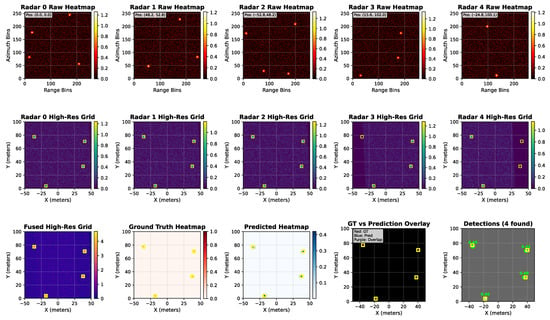
Figure 8 visualizes the end-to-end feature processing pipeline within a sparse multi-target scenario. The initial stages demonstrate the efficacy of the modular frontend in transforming heterogeneous, sensor-specific polar observations (Row 1) into a unified Cartesian BEV representation (Row 2). Despite the inherent sparsity of the targets and the distinct vantage points of the distributed sensors, the fused BEV feature grid (Row 3) aggregates these discrete measurements into coherent spatial energy peaks.
Figure 8.
Qualitative visualization of the RadarsBEV inference pipeline in a multi-target scenario. The top two rows display the raw Range-Azimuth heatmaps and their corresponding projected BEV feature maps from the five-radar constellation. The bottom row illustrates the fusion results: the fused BEV feature grid, the ground truth heatmap, and the predicted detection heatmap. The final overlay (bottom right) highlights the precise alignment between model detections (green circles) and ground truth (yellow squares).
The overlay of predictions and ground truth confirms strict localization precision. Notably, the framework reliably detects distant targets that typically suffer from severe signal attenuation and are frequently missed by baseline algorithms. This visual evidence confirms that the Gaussian-guided sampling mechanism effectively concentrates representational capacity within physically valid uncertainty ellipses, preventing the diffusion of attention across empty or irrelevant spatial regions.
3.5.2. Robustness to Clutter and Signal Degradation
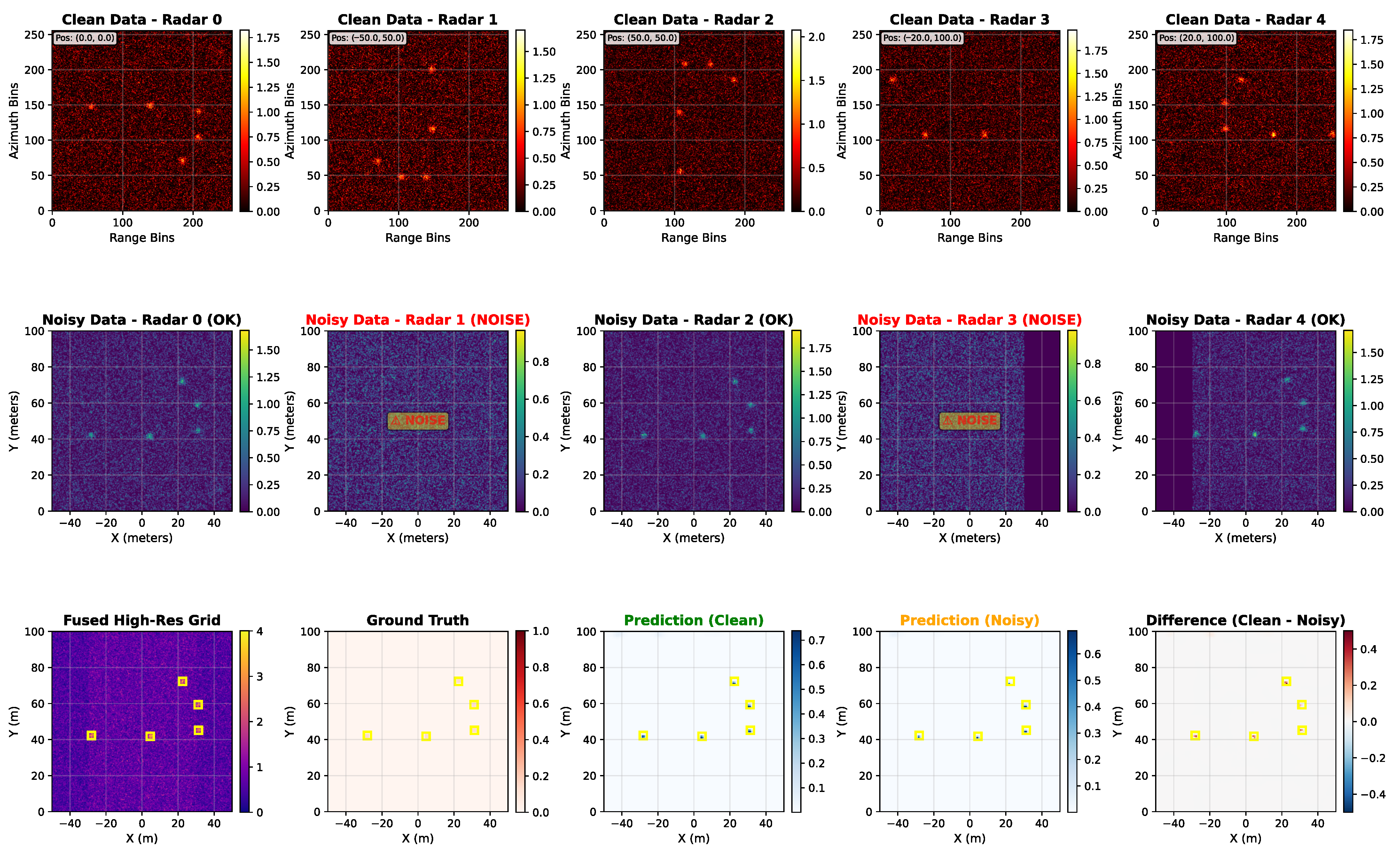
A core theoretical advantage of the proposed GCA is the systematic decoupling of attention weights from raw feature intensity. To visually validate this property, Figure 9 demonstrates the predictions under severely degraded conditions. In the noisy scenario, high-intensity interference artifacts are intentionally injected into Radar 1 and Radar 3, simulating adverse hardware degradation.
Figure 9.
Visualization of robustness under severe signal degradation, where Radar 1 and Radar 3 are subjected to significant noise interference (labeled NOISE). The bottom row displays the prediction results for both scenarios and a difference heatmap. The yellow squares highlight ground truth.
Conventional dot-product attention mechanisms inherently over-attend to such amplitude spikes due to their reliance on content similarity, frequently generating false positives. However, the predicted heatmaps for both the clean and noisy inputs in RadarsBEV remain highly consistent. As illustrated in the bottom panel, the corresponding Difference map exhibits negligible variance, confirming the absolute suppression of noise-induced target hallucination. This substantiates the efficacy of the geometry-generated weighting scheme: by modulating attention strictly through a geometric fit to a parameterized physical prior rather than raw signal amplitude, the framework guarantees exceptional fault tolerance and clutter suppression in adversarial sensing environments.
3.5.3. Generalization to Lower Angular Resolutions
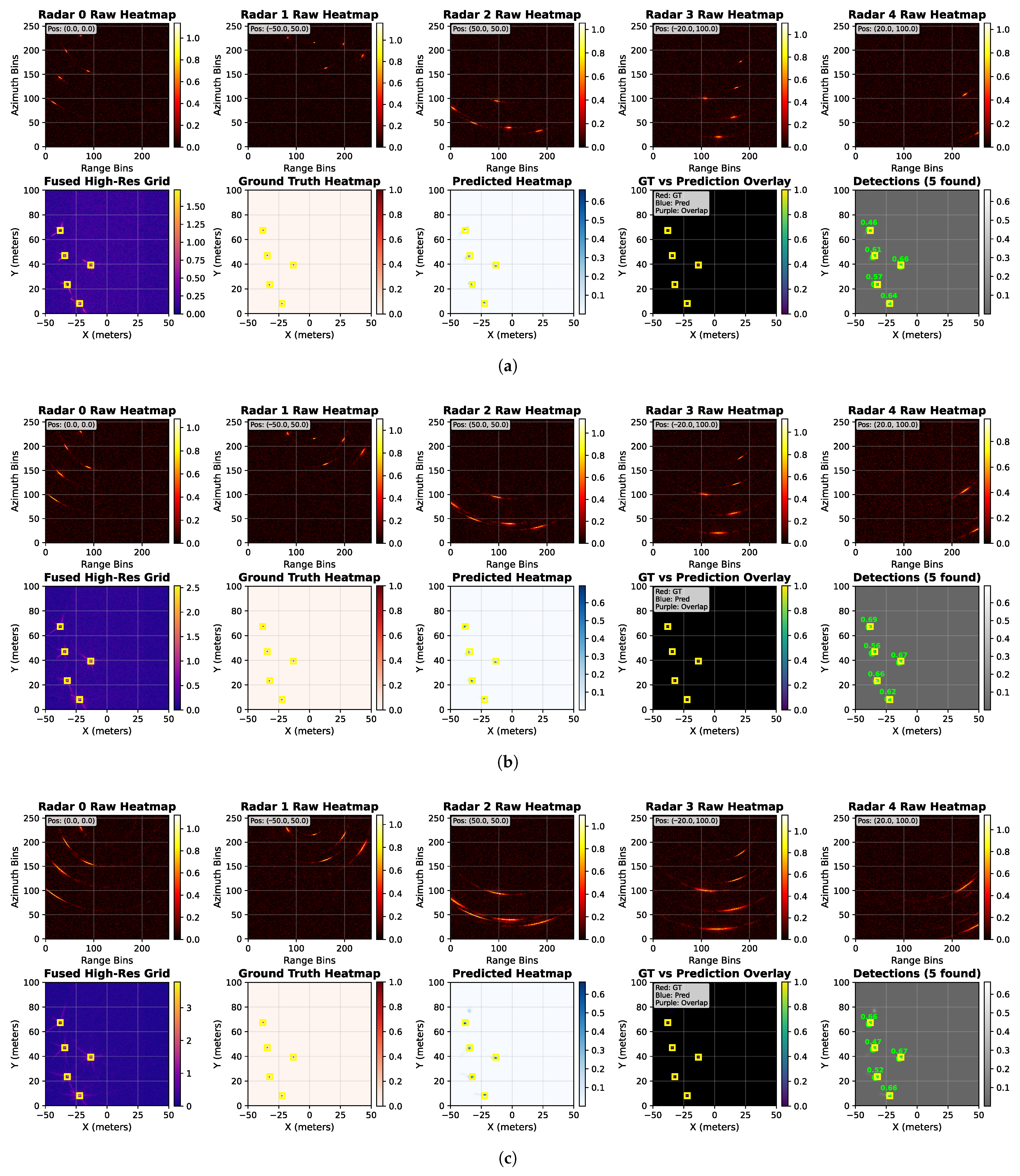
To provide deeper insights into the zero-shot transferability evaluated in Section 3.3.3, Figure 10 visualizes the internal inference pipeline across unseen, lower angular resolutions: 2.3163°, 4.6326°, and 9.2652°.
Figure 10.
Qualitative visualization of RadarsBEV zero-shot generalization to unseen angular resolutions: (a) 2.3163°, (b) 4.6326°, and (c) 9.2652°. As the angular resolution decreases, the raw RA heatmaps exhibit significant spatial blurring.The green circles and yellow squares highlight the model detections and ground truth.
As the hardware angular resolution decreases from Figure 10a–c, the raw RA heatmaps exhibit severe spatial blurring. The discrete target energy peaks disperse across wider azimuthal bins, significantly reducing signal fidelity and increasing the potential for overlapping target signatures.
Despite this input degradation, the fused BEV feature grids demonstrate that RadarsBEV consistently aggregates coherent spatial peaks. The final detection overlays confirm that the predicted centers remain tightly aligned with the ground truth. This visual evidence supports the theoretical advantage of the proposed Gaussian cross-attention mechanism. As the physical signal spread expands due to lower resolution, the model dynamically adapts the predicted uncertainty covariance. Consequently, the adaptive sampling pattern stretches to encapsulate the enlarged target geometry, extracting valid spatial features and maintaining precise localization without any retraining.
4. Discussion
4.1. Theoretical Implications of Physics-Aware Fusion
The empirical evaluations demonstrate that incorporating physical priors into the attention mechanism provides an advantage over purely data-driven fusion architectures. Generic attention mechanisms, such as standard DCA, optimize sampling offsets based on feature content similarity. However, this creates a phenomenological mismatch in radar perception. Radar measurements are characterized by sparse energy peaks and stochastic noise, where high-intensity reflections frequently originate from environmental clutter rather than valid targets. Consequently, unconstrained, content-driven sampling is highly susceptible to extracting noise, leading to elevated false alarm rates or a degraded when the is strictly constrained.
The proposed GCA mechanism mitigates this mismatch by embedding the physical probability density function of radar signals into the spatial aggregation process. By modeling target spatial uncertainty as an anisotropic 2D Gaussian distribution, GCA constrains the adaptive sampling offsets within a physically valid uncertainty ellipsoid. This constraint explicitly prevents the model from attending to stochastic background noise dispersed outside the predicted geometry.
Furthermore, the geometry-generated weighting scheme represents a theoretical shift. By deriving attention weights from the spatial relationship between sampling points and the predicted Gaussian spread, the GCA mathematically decouples the aggregation weights from raw feature intensity. Theoretically, this design transitions the multi-radar fusion paradigm from unconstrained visual feature matching to probabilistically bounded spatial sampling. As evidenced by the framework’s sustained performance under severe signal degradation (Section 3.2.2) and high-clutter environments (Section 3.5.2), aligning the receptive field with the radar signal’s physical geometry effectively suppresses high-intensity clutter, thereby preserving the representational integrity of the fused features without relying on rigid network topologies.
4.2. Advantages of Topological Decoupling in Dynamic Networks
Conventional deep learning architectures for multi-radar fusion typically employ concatenation-based aggregation, which intrinsically binds the network parameters to a predefined sensor count. In dynamic operational environments where sensors may fail, experience communication jamming, or suffer physical occlusion, this structural rigidity results in tensor dimension mismatches. As evidenced by the direct fusion baseline in our evaluations, relying on zero-padding to maintain fixed tensor dimensions leads to a rapid collapse in detection performance under partial sensor loss.
The RadarsBEV framework addresses this structural vulnerability by introducing a modular, permutation-invariant frontend. By decoupling per sensor feature extraction from the global spatial aggregation process, the architecture naturally accommodates variable input sizes. The robustness analysis (Section 3.2.1) validates that this decoupling inherently guarantees graceful degradation. When the active sensor count is dynamically reduced from five to one, the framework sustains a continuous and stable detection probability without requiring algorithmic reconfiguration or system downtime. The model continues to process the residual active nodes effectively, demonstrating that the computational pipeline is not constrained by a rigid topological graph.
Furthermore, this topological decoupling facilitates zero-shot configuration generalization. Empirical results (Section 3.3.1) demonstrate that the model, trained exclusively on a specific five-radar constellation, can be directly deployed to completely unseen spatial layouts, such as monitoring, roadside surveillance, and asymmetric automotive configurations, without fine-tuning. Because the modular frontend projects independent observations into a canonical BEV space before physics-aware fusion, the network learns the generalized spatial mapping of radar signals rather than overfitting to a specific training layout. This structural flexibility eliminates the necessity for repetitive data collection and model retraining for each new hardware setup, providing a scalable and deployment-ready solution for heterogeneous multi-sensor platforms.
4.3. Deployment Trade-Offs: Sim-to-Real Gap and Computational Efficiency
Deploying deep learning-based multi-radar fusion models in physical environments necessitates practical trade-offs, particularly concerning the sim-to-real gap and computational latency.
Regarding domain transfer, as evaluated in the real-world dataset experiments (Section 3.3.2), the framework exhibits a performance reduction when transitioning from high-fidelity simulations to physical sensor deployments. This degradation is primarily attributed to unmodeled real-world phenomena, such as hardware thermal noise and heterogeneous environmental clutter, that are difficult to perfectly replicate in simulation. Although the physics-aware attention mechanism mitigates these adverse effects more effectively than generic baseline methods, bridging this domain gap remains a persistent challenge for data-driven radar perception.
Furthermore, the integration of the GCA mechanism and the dynamic modular frontend introduces additional computational overhead compared to rigid, concatenation-based deep learning models. However, the inference speed analysis (Section 3.4) indicates that this overhead represents a practical engineering compromise. The proposed framework maintains a processing rate that satisfies standard real-time operational requirements, while entirely circumventing the exponential computational complexity that prevents traditional signal-level statistical estimators from real-time deployment. This balance between algorithmic latency, topological flexibility, and detection robustness is critical for a feasible industrial application.
4.4. Limitations of the Current Framework
While RadarsBEV demonstrates robustness across various spatial topologies, several underlying assumptions restrict its immediate deployment in completely unconstrained environments.
First, the current framework assumes strict temporal synchronization among all active sensor nodes. In practical distributed systems, variable communication latencies and asynchronous sampling rates inevitably induce temporal misalignment, a factor not explicitly modeled in the current spatial fusion engine. Second, the empirical evaluation primarily utilizes homogeneous radar configurations. Although the framework structurally supports varying angular resolutions (Section 3.3.3), its functional capacity to aggregate heterogeneous radar streams, such as fusing signals from short-range and long-range radars with fundamentally different frequency bands and modulation schemes, requires further empirical validation. Finally, the spatial alignment module strictly relies on precise extrinsic calibration priors. In dynamic deployment scenarios, mechanical vibrations or mounting shifts can introduce calibration errors. Because the GCA mechanism depends on accurate spatial mapping, uncompensated extrinsic drift would propagate through the pipeline, potentially degrading the geometric alignment of the sampling process.
4.5. Future Directions
Addressing the aforementioned limitations defines the primary trajectory for future research. To mitigate the reliance on strict temporal synchronization, future efforts will focus on extending the physics-aware fusion engine into the spatiotemporal domain. By incorporating temporal cross-attention mechanisms, the architecture could be adapted to process asynchronous multi-radar streams, compensating for temporal offsets through predictive kinematic modeling.
Furthermore, integrating an online self-calibration module represents a critical next step for physical deployment. Developing an auxiliary regression head to dynamically estimate and correct extrinsic pose variations during inference would significantly enhance the system’s resilience to mechanical misalignments. Finally, the permutation-invariant architecture provides a scalable foundation for broad multi-sensor integration. Extending the RadarsBEV framework to incorporate complementary modalities, particularly vision or LiDAR, under a unified physics-aware attention paradigm offers a promising avenue for achieving highly resilient, all-weather autonomous perception.
5. Conclusions
In this paper, we have presented RadarsBEV, an end-to-end multi-radar perception framework designed to overcome the computational bottlenecks and systemic brittleness in contemporary centralized fusion paradigms. By decoupling per-sensor feature extraction from global spatial aggregation, our architecture achieves permutation invariance. This design mathematically breaks the explosion of dimensional calculation and enables graceful degradation during sensor failures, eliminating the need for system downtime or algorithmic reconfiguration. Furthermore, we resolved the phenomenological mismatch of generic attention mechanisms by introducing a physics-aware Gaussian cross-attention engine. By guiding sparse feature sampling through predicted 2D Gaussian target geometry, this mechanism decouples attention weights from clutter signal intensities. Extensive empirical evaluations demonstrate that RadarsBEV not only delivers better detection performance but also exhibits configuration zero-shot adaptability across unseen spatial topologies and highly degraded real-world environments. Future work will explore extending this physics-grounded paradigm to asynchronous and heterogeneous multi-sensor networks. Addressing these challenges is a crucial next step, as practical real-world deployments inevitably face diverse sensor hardware configurations and unpredictable communication latencies that disrupt perfect spatial-temporal synchronization.
Author Contributions
Conceptualization, Z.G.; Methodology, Z.G.; Software, Z.G.; Validation, Z.G., H.L. and J.H.; Investigation, Z.G., H.L. and J.H.; Resources, W.L. and W.Y.; Data curation, Z.G., W.L., G.Z. and J.H.; Writing—original draft, Z.G.; Writing—review & editing, W.L., G.Z., K.C.T. and W.Y.; Visualization, Z.G. and H.L.; Supervision, W.L., G.Z., K.C.T. and W.Y.; Project administration, W.L. and W.Y.; Funding acquisition, W.L. and W.Y. All authors have read and agreed to the published version of the manuscript.
Funding
This research was funded in part by the National Natural Science Foundation of China under Grant 62231008 and Grant 62401126, in part by the Natural Science Foundation of Sichuan Province under Grant 2026NSFSCZY0130, in part by China Postdoctoral Science Foundation (CPSF) under Grant 2024M750355 and Grant 2025T180956, and in part by the Postdoctoral Fellowship Program of CPSF under Grant ZB20230112.
Data Availability Statement
The data presented in this study are available on request from the corresponding author due to privacy and proprietary restrictions. The dataset involves proprietary multi-sensor calibration parameters and specific real-world testing environments developed under confidentiality agreements. Therefore, the raw data cannot be made fully public, but can be shared upon reasonable request for academic verification.
Conflicts of Interest
The authors declare no conflicts of interest.
References
- Gui, S.; Song, S.; Qin, R.; Tang, Y. Remote sensing object detection in the deep learning era—A review. Remote Sens. 2024, 16, 327. [Google Scholar] [CrossRef] [Scilit]
- Wu, Q.; Wang, Y.; Liu, X.; Gu, Z.; Xu, Z.; Xiao, S. ISAR image transform via joint intrapulse and interpulse periodic-coded phase modulation. IEEE Sens. J. 2025, 25, 28788–28799. [Google Scholar] [CrossRef] [Scilit]
- Xu, Z.; Zheng, Y.; Zeng, Y.; Yang, Z.; Zhang, Y.; Wu, Q.; Ai, X. Measurement and calibration methods for full-polarization characteristics of radar targets at subterahertz frequencies. IEEE Trans. Antennas Propag. 2026, 74, 3471–3479. [Google Scholar] [CrossRef] [Scilit]
- Li, W.; Yan, M.; Tian, Y.; Yi, W.; Liu, J.; Mao, Y.; Kong, L. Information geometry-based multi-frame detector for extended targets in radar systems. IEEE Sens. J. 2026; early access. [CrossRef] [Scilit]
- Pandharipande, A.; Cheng, C.H.; Dauwels, J.; Gurbuz, S.Z.; Ibanez-Guzman, J.; Li, G.; Piazzoni, A.; Wang, P.; Santra, A. Sensing and machine learning for automotive perception: A review. IEEE Sens. J. 2023, 23, 11097–11115. [Google Scholar] [CrossRef] [Scilit]
- Yao, S.; Guan, R.; Peng, Z.; Xu, C.; Shi, Y.; Ding, W.; Lim, E.G.; Yue, Y.; Seo, H.; Man, K.L.; et al. Exploring radar data representations in autonomous driving: A comprehensive review. IEEE Trans. Intell. Transp. Syst. 2025, 26, 7401–7425. [Google Scholar] [CrossRef] [Scilit]
- Li, W.; Miao, Q.; Yuan, Y.; Tian, Y.; Yi, W.; Teh, K.C. Automotive radar multi-frame track-before-detect algorithm considering self-positioning errors. IEEE Trans. Intell. Transp. Syst. 2025, 26, 13506–13521. [Google Scholar] [CrossRef] [Scilit]
- Kong, H.; Huang, C.; Yu, J.; Shen, X. A survey of mmwave radar-based sensing in autonomous vehicles, smart homes and industry. IEEE Commun. Surv. Tutor. 2024, 27, 463–508. [Google Scholar] [CrossRef] [Scilit]
- Yi, W.; Zhou, T.; Ai, Y.; Blum, R.S. Suboptimal low complexity joint multi-target detection and localization for non-Coherent MIMO radar with widely separated antennas. IEEE Trans. Signal Process. 2020, 68, 901–916. [Google Scholar] [CrossRef] [Scilit]
- Zhang, G.; Yi, W.; Varshney, P.K.; Kong, L. Direct target localization with quantized measurements in noncoherent distributed MIMO radar systems. IEEE Trans. Geosci. Remote Sens. 2023, 61, 5103618. [Google Scholar] [CrossRef] [Scilit]
- Yan, B.; Paolini, E.; Xu, L.; Lu, H. A target detection and tracking method for multiple radar systems. IEEE Trans. Geosci. Remote Sens. 2022, 60, 5114721. [Google Scholar] [CrossRef] [Scilit]
- Baker, C.; Hume, A. Netted radar sensing. IEEE Aerosp. Electron. Syst. Mag. 2003, 18, 3–6. [Google Scholar] [CrossRef]
- Sedehi, M.; Lombardo, P.; Farina, A. A modified M/N logic for track initiation of low observable targets using amplitude information. In Proceedings of the 2006 International Radar Symposium, Krakow, Poland, 24–26 May 2006; pp. 1–4. [Google Scholar] [CrossRef] [Scilit]
- Maresca, S.; Malacarne, A.; Amir, M.M.H.; Ahmad, F.; Pandey, G.; Bogoni, A.; Scaffardi, M. Radar detection in coherent multi-sensor multi-frequency systems. In Proceedings of the 2024 International Workshop on the Theory of Computational Sensing and its Applications to Radar, Multimodal Sensing and Imaging, Santiago de Compostela, Spain, 18–20 September 2024; pp. 96–100. [Google Scholar] [CrossRef] [Scilit]
- Zhou, Q.; Yuan, Y.; Venturino, L.; Yi, W. Direct target localization for distributed passive radars with direct-path interference suppression. IEEE Trans. Signal Process. 2024, 72, 3611–3625. [Google Scholar] [CrossRef] [Scilit]
- Zhou, Q.; Yuan, Y.; Li, H.; Lai, Y.; Greco, M.S.; Gini, F.; Yi, W. Target localization for distributed hybrid active–passive radars. IEEE Trans. Aerosp. Electron. Syst. 2025, 61, 8953–8971. [Google Scholar] [CrossRef] [Scilit]
- Yang, S.; Yi, W.; Jakobsson, A. Multitarget detection strategy for distributed MIMO radar with widely separated antennas. IEEE Trans. Geosci. Remote Sens. 2022, 60, 5113516. [Google Scholar] [CrossRef] [Scilit]
- Jing, X.; Su, H.; Yang, R.; Zhu, Y.; Ma, X. Parametric adaptive target detection in colocated MIMO radar. IEEE Trans. Aerosp. Electron. Syst. 2025, 61, 4421–4434. [Google Scholar] [CrossRef] [Scilit]
- Jing, X.; Su, H.; Li, Z.; Yang, R.; Zhu, Y. Weak moving target detection in distributed MIMO radar with hybrid data. IEEE Trans. Aerosp. Electron. Syst. 2024, 60, 9291–9306. [Google Scholar] [CrossRef] [Scilit]
- Zhou, D.; Yang, M.; Wu, X.; Greco, M.S.; Gini, F. Collaborative design for moving target detection in distributed radar networks. IEEE Trans. Aerosp. Electron. Syst. 2026, 62, 3107–3122. [Google Scholar] [CrossRef] [Scilit]
- Bai, X.; Song, H.; Fan, C.; Hao, L.; Yang, Y. A system error self-correction target-positioning method in video satellite observation. Remote Sens. 2025, 17, 2935. [Google Scholar] [CrossRef] [Scilit]
- Miao, Z.W.; Wang, J. Incoherent detection performance analysis of the distributed multiple-input multiple-output radar for rice fluctuating targets. Remote Sens. 2024, 16, 3240. [Google Scholar] [CrossRef] [Scilit]
- Zhang, S.; Zhou, Y.; Sha, M.; Zhang, L.; Du, L. Moving multitarget detection using a multisite radar system with widely separated stations. Remote Sens. 2022, 14, 2660. [Google Scholar] [CrossRef] [Scilit]
- Gao, X.; Xing, G.; Roy, S.; Liu, H. RAMP-CNN: A novel neural network for enhanced automotive radar object recognition. IEEE Sens. J. 2020, 21, 5119–5132. [Google Scholar] [CrossRef] [Scilit]
- Wang, Y.; Jiang, Z.; Li, Y.; Hwang, J.; Xing, G.; Liu, H. RODNet: A real-time radar object detection network cross-supervised by camera-radar fused object 3D localization. IEEE J. Sel. Top. Signal Process. 2021, 15, 954–967. [Google Scholar] [CrossRef] [Scilit]
- Zhang, A.; Nowruzi, F.E.; Laganiere, R. RADDet: Range-Azimuth-Doppler based radar object detection for dynamic road users. In Proceedings of the 2021 18th Conference on Robots and Vision, Burnaby, BC, Canada, 26–28 May 2021; pp. 95–102. [Google Scholar] [CrossRef] [Scilit]
- Luo, H.; Zhu, Z.; Jiang, M.; Guo, S.; Cui, G. An effective multipath ghost recognition method for sparse MIMO radar. IEEE Trans. Geosci. Remote Sens. 2023, 61, 5111611. [Google Scholar] [CrossRef] [Scilit]
- Zhou, Y.; Zhu, Y.; Ren, H.; Kang, J.; Wang, X. Refined multi-modal feature learning framework for marine target detection using radar sensor. Digit. Signal Process. 2026, 170, 105816. [Google Scholar] [CrossRef] [Scilit]
- Guo, Z.; Li, W.; Li, H.; Yi, W.; Teh, K.C. JDTFormer: A hybrid-scale spatio-temporal transformer network for automotive radar extended target joint detection and tracking. IEEE Internet Things J. 2025, 12, 26882–26897. [Google Scholar] [CrossRef] [Scilit]
- Li, Z.; Wang, W.; Li, H.; Xie, E.; Sima, C.; Lu, T.; Yu, Q.; Dai, J. BEVFormer: Learning bird’s-eye-view representation from lidar-camera via spatiotemporal transformers. IEEE Trans. Pattern Anal. Mach. Intell. 2024, 47, 2020–2036. [Google Scholar] [CrossRef] [Scilit] [PubMed]
- Liu, Z.; Tang, H.; Amini, A.; Yang, X.; Mao, H.; Rus, D.L.; Han, S. BEVFusion: Multi-task multi-sensor fusion with unified bird’s-eye view representation. In Proceedings of the 2023 IEEE International Conference on Robotics and Automation; IEEE: Piscataway, NJ, USA, 2023; pp. 2774–2781. [Google Scholar] [CrossRef] [Scilit]
- Wang, M.; Wang, H.; Li, Y.; Chen, L.; Cai, Y.; Shao, Z. MSAFusion: Object detection based on multi-sensor adaptive fusion under BEV. IEEE Trans. Instrum. Meas. 2025, 74, 9509212. [Google Scholar] [CrossRef] [Scilit]
- Lin, Z.; Liu, Z.; Xia, Z.; Wang, X.; Wang, Y.; Qi, S.; Dong, Y.; Dong, N.; Zhang, L.; Zhu, C. Rcbevdet: Radar-camera fusion in bird’s eye view for 3D object detection. In Proceedings of the IEEE/CVF Conference on Computer Vision and Pattern Recognition, Seattle, WA, USA, 16–22 June 2024; pp. 14928–14937. [Google Scholar] [CrossRef] [Scilit]
- Liu, H.; Liu, J.; Jiang, G.; Jin, X. MSSF: A 4D radar and camera fusion framework with multi-stage sampling for 3D object detection in autonomous driving. IEEE Trans. Intell. Transp. Syst. 2025, 26, 8641–8656. [Google Scholar] [CrossRef] [Scilit]
- Yang, Y.; Liu, J.; Huang, T.; Han, Q.L.; Ma, G.; Zhu, B. RaLiBEV: Radar and LiDAR BEV fusion learning for anchor box free object detection systems. IEEE Trans. Circuits Syst. Video Technol. 2024, 35, 4130–4143. [Google Scholar] [CrossRef] [Scilit]
- Wu, Y.; Xiao, L.; Liu, J.; Jiang, G.; Xia, X. MLF-4DRCNet: Multi-level fusion with 4D radar and camera for 3D object detection in autonomous driving. arXiv 2025, arXiv:2509.18613. [Google Scholar] [CrossRef] [Scilit]
- Ibrahim, A.; Khan, M.Z.; Imran, M.; Larijani, H.; Abbasi, Q.H.; Usman, M. RadSpecFusion: Dynamic attention weighting for multi-radar human activity recognition. Internet Things 2025, 33, 101682. [Google Scholar] [CrossRef] [Scilit]
- Li, Y.; Xiao, X. Deep learning-based fusion of optical, radar, and liDAR data for advancing land monitoring. Sensors 2025, 25, 4991. [Google Scholar] [CrossRef] [Scilit]
- Wu, Y. Fusion-based modeling of an intelligent algorithm for enhanced object detection using a Deep Learning Approach on radar and camera data. Inf. Fusion 2025, 113, 102647. [Google Scholar] [CrossRef] [Scilit]
- Li, H.; Ling, J.; Guo, Z.; Huang, X.; Yi, W. Proposal-guided multi-scale radar and vision fusion for 3D object detection. IEEE Trans. Intell. Transp. Syst. 2025, 26, 22232–22245. [Google Scholar] [CrossRef] [Scilit]
- Zhu, X.; Su, W.; Lu, L.; Li, B.; Wang, X.; Dai, J. Deformable DETR: Deformable transformers for end-to-end object detection. arXiv 2020, arXiv:2010.04159. [Google Scholar] [CrossRef] [Scilit]
- Xia, Z.; Pan, X.; Song, S.; Li, L.E.; Huang, G. Vision transformer with deformable attention. In Proceedings of the 2022 IEEE/CVF Conference on Computer Vision and Pattern Recognition (CVPR), New Orleans, LA, USA, 18–24 June 2022; pp. 4784–4793. [Google Scholar] [CrossRef] [Scilit]
- Bar-Shalom, Y.; Li, X.R.; Kirubarajan, T. Estimation with Applications to Tracking and Navigation: Theory Algorithms and Software; John Wiley & Sons: Hoboken, NJ, USA, 2001. [Google Scholar]
- Camps-Valls, G.; Svendsen, D.H.; Cortés-Andrés, J.; Mareno-Martínez, Á.; Pérez-Suay, A.; Adsuara, J.; Martín, I.; Piles, M.; Muñoz-Marí, J.; Martino, L. Physics-aware machine learning for geosciences and remote sensing. In Proceedings of the 2021 IEEE International Geoscience and Remote Sensing Symposium; IEEE: Piscataway, NJ, USA, 2021; pp. 2086–2089. [Google Scholar] [CrossRef] [Scilit]
- Li, Z.; Liu, F.; Yang, W.; Peng, S.; Zhou, J. A survey of convolutional neural networks: Analysis, applications, and prospects. IEEE Trans. Neural Netw. Learn. Syst. 2021, 33, 6999–7019. [Google Scholar] [CrossRef] [Scilit]
- He, K.; Zhang, X.; Ren, S.; Sun, J. Deep residual learning for image recognition. In Proceedings of the IEEE Conference on Computer Vision and Pattern Recognition, Las Vegas, NV, USA, 27–30 June 2016; pp. 770–778. [Google Scholar] [CrossRef] [Scilit]
- He, K.; Zhang, X.; Ren, S.; Sun, J. Identity mappings in deep residual networks. In Proceedings of the European Conference on Computer Vision; Springer: Berlin/Heidelberg, Germany, 2016; pp. 630–645. [Google Scholar] [CrossRef] [Scilit]
- Vaswani, A.; Shazeer, N.; Parmar, N.; Uszkoreit, J.; Jones, L.; Gomez, A.N.; Kaiser, Ł.; Polosukhin, I. Attention is all you need. arXiv 2017, arXiv:1706.03762. [Google Scholar] [CrossRef] [Scilit]
- Saini, L.; Su, Y.; Tercan, H.; Meisen, T. Centerpoint transformer for bev object detection with automotive radar. In Proceedings of the IEEE/CVF Conference on Computer Vision and Pattern Recognition, Seattle, WA, USA, 16–22 June 2024; pp. 4451–4460. [Google Scholar] [CrossRef] [Scilit]
- Zhou, X.; Wang, D.; Krähenbühl, P. Objects as points. arXiv 2019, arXiv:1904.07850. [Google Scholar] [CrossRef] [Scilit]
- Lin, T.Y.; Goyal, P.; Girshick, R.; He, K.; Dollár, P. Focal loss for dense object detection. In Proceedings of the IEEE International Conference on Computer Vision, Venice, Italy, 22–29 October 2017; pp. 2980–2988. [Google Scholar] [CrossRef] [Scilit]
- Stove, A.G. Linear FMCW radar techniques. In Proceedings of the IEE Proceedings F-Radar and Signal Processing; IET: Hertfordshire, UK, 1992; Volume 139, pp. 343–350. [Google Scholar] [CrossRef] [Scilit]
- Wang, C.; Tian, J.; Cao, J.; Wang, X. Deep learning-based UAV detection in pulse-Doppler radar. IEEE Trans. Geosci. Remote Sens. 2021, 60, 5105612. [Google Scholar] [CrossRef] [Scilit]
- Weiss, M. Analysis of some modified cell-averaging CFAR processors in multiple-target situations. IEEE Trans. Aerosp. Electron. Syst. 1982, AES-18, 102–114. [Google Scholar] [CrossRef] [Scilit]
- Khan, K.; Rehman, S.U.; Aziz, K.; Fong, S.; Sarasvady, S. DBSCAN: Past, present and future. In Proceedings of the The Fifth International Conference on the Applications of Digital Information and Web Technologies, Chennai, India, 17–19 February 2014; pp. 232–238. [Google Scholar] [CrossRef] [Scilit]

Disclaimer/Publisher’s Note: The statements, opinions and data contained in all publications are solely those of the individual author(s) and contributor(s) and not of MDPI and/or the editor(s). MDPI and/or the editor(s) disclaim responsibility for any injury to people or property resulting from any ideas, methods, instructions or products referred to in the content. |
© 2026 by the authors. Licensee MDPI, Basel, Switzerland. This article is an open access article distributed under the terms and conditions of the Creative Commons Attribution (CC BY) license.