


Highlights
What are the main findings?
- A novel virtual full-polarization sparse stepped-frequency waveform (VFP-SSFW) is proposed to eliminate transmission channel crosstalk for fully polarimetric measurements.
- A polarimetric atomic norm minimization (P-ANM)-based gridless imaging framework is formulated to produce high-quality polarimetric high-resolution range profiles (HRRPs), and an efficient alternating direction method of multipliers (ADMM)-based solver is tailored for its implementation.
What are the implications of the main findings?
- The proposed VFP-SSFW theoretically eliminates transmission channel crosstalk, and offers the by-products of halved instantaneous transmission power and reduced sampling echoes. These features have promising potential, particularly for energy-limited orbital remote sensing platforms.
- The method efficiently produces refined, interpretable polarimetric HRRPs represented by scattering centers (SCs) co-registered across all channels, without requiring inter-channel SC matching, while maintaining robustness under low sampling rates (SRs) and low signal-to-noise ratios (SNRs).
Abstract
Polarimetric high-resolution range profiles (HRRPs) contain rich amplitude and phase information scattered from targets, making them essential for radar remote sensing applications. However, current HRRP imaging methods still face challenges in achieving precise full-polarization measurements. In addition, they are either affected by off-grid errors thus introducing spurious scattering centers (SCs), fail to utilize polarimetric priors from the channels, or encounter high computational complexity. Some of these issues limit the quality of polarimetric HRRPs, while others result in excessive computational load, hindering their application on orbital remote sensing platforms. This paper proposes a fast gridless polarimetric HRRP imaging method. First, we introduce the novel virtual full polarization sparse stepped-frequency waveforms (VFP-SSFW) to improve channel isolation, in which each pulse is transmitted with either horizontal (H) or vertical (V) polarization, selected uniformly at random. Then, we propose a polarimetric atomic norm minimization (P-ANM)-based imaging framework formulated within distributed compressed sensing (DCS), which fully exploits the joint sparsity across polarization channels while inherently eliminating off-grid errors. Additionally, we develop a fast algorithm based on alternating direction method of multipliers (ADMM) to enable efficient implementation. The proposed method can circumvent transmission channel crosstalk and can efficiently yield high-quality polarimetric HRRPs with co-registered SCs. The validity of the proposed method is demonstrated through simulated, electromagnetic, and measured experimental results.
1. Introduction
Polarimetric high-resolution range profiles (HRRPs) characterize the backscattered distribution of targets along the radar line-of-sight (LOS) across different polarization states [1]. By capturing both amplitude and phase information across multiple polarization channels, polarimetric HRRPs provide rich structural and electromagnetic signatures of targets. Owing to these advantages, they have been successfully applied in radar remote sensing to a wide range of tasks. These include scattering mechanism identification [2], geometrical structure classification [3], full-polarimetric target recognition via Cameron decomposition and RKELM [4], and interpretable deep learning (DL)-based recognition using a vision transformer with attention loss [5]. Consequently, generating high-quality polarimetric HRRPs has become a fundamental objective within the field.
However, achieving precise fully polarimetric measurements remains challenging. Two primary measurement schemes are commonly employed: alternate polarimetric measurements (APMs) and simultaneous polarimetric measurements (SPMs) [6]. APMs utilize time-division switching between polarizations but inevitably introduce motion-induced errors due to target movement between pulses [7]. In contrast, SPMs transmit both horizontal (H) and vertical (V) polarizations simultaneously using orthogonal waveforms [8]. While this approach avoids errors caused by target movement, it suffers from low channel isolation due to channel crosstalk. It also requires high instantaneous radar transmission power, which is unfavorable for energy-limited orbital remote sensing platforms. These limitations motivate the exploration of novel polarimetric measurement strategies.
Conventional HRRP imaging methods typically employ stepped-frequency waveforms (SFW) or linear frequency modulation (LFM) signals. HRRPs are generated by applying an inverse fast Fourier transform (IFFT) to the synthesized wideband response from SFW echoes [9], or by applying matched filtering (MF) or dechirp to wideband LFM echoes [10], respectively. However, these methods operate under the Nyquist sampling framework, which requires dense sampling in the frequency domain. For fully polarimetric radars, the data volume is quadrupled compared to single-polarization, intensifying the demands on radar hardware for sampling, transmission, and processing, posing additional challenges for orbital remote sensing platforms. Moreover, the resulting HRRPs often exhibit wide main lobes and high sidelobes due to limited bandwidth, and may even experience pronounced grating lobes when partial frequency samples are polluted or missing [11].
In contrast, classic spectral estimation techniques, such as the multiple signal classification (MUSIC) [12], estimation of signal parameters via rotational invariance techniques (ESPRIT) [13], and the matrix pencil method (MPM) [14], offer an alternative. These methods can overcome the Rayleigh resolution limit inherent in IFFT, MF, dechirp, even when the available bandwidth is limited [15,16,17]. Nevertheless, these techniques typically rely on uniform sampling because they require a complete set of frequency-domain measurements to construct a reliable sampling covariance matrix [18], from which signal and noise subspaces can be separated. Consequently, they are also ineffective in scenarios involving polluted or missing echoes, which may result from equipment failure, radar interference, or limited resources.
Simultaneously, DL techniques have also been explored for single-channel HRRP reconstruction. Representative works include sparse autoencoders for denoising [19], model-driven deep unfolding networks [20], conditional generative adversarial networks (CGANs) [21], and scattering-center-embedded networks such as the HRRP-modelled neural network (HNN) [22], among others. For polarimetric HRRP, existing DL-based methods focus on target classification and recognition [23,24,25]. They use conventionally reconstructed HRRPs (via IFFT/MF/dechirp) as input and rely on implicit feature extraction, but these methods were not originally intended for polarimetric HRRP reconstruction, nor did they consider incomplete frequency-domain data scenarios. Moreover, most existing DL-based methods for HRRP processing, including both single-channel reconstruction and polarimetric classification and recognition, require large amounts of labeled training data and lack physical interpretability due to acting as black boxes, and assume full frequency sampling. Consequently, as discussed above, neither the spectral estimation methods nor existing DL-based approaches are directly applicable to polarimetric HRRP reconstruction under missing frequency-domain echoes.
To cope with high data rates and scenarios involving polluted or missing echoes, compressive sensing (CS) theory has been introduced into radar imaging [26]. CS enables accurate signal recovery from far fewer frequency samples by exploiting the sparsity of scattering centers (SCs). This advancement has driven the development of various CS-based HRRP imaging methods. However, most existing methods, such as those in [27,28,29,30], were originally developed for single-polarization echo. Although they can be used to generate polarimetric HRRPs by processing each polarization channel separately, this independent processing has inherent drawbacks. It risks losing polarization-sensitive SCs that may appear exclusively in specific channels, requires additional cross-channel registration for SCs, and performs poorly under challenging conditions, such as low sampling rates (SRs) or low signal-to-noise ratios (SNRs).
Differently, Wu et al. [31] proposed the fully polarization-simultaneous orthogonal matching pursuit (FP-SOMP) method to exploit the row-sparsity of different polarization channels. It enforces that all polarization channels share the same support set by selecting identical dictionary columns, thereby guaranteeing consistent SC positions while permitting channel-dependent intensity variations. Though FP-SOMP represents an important advancement in processing joint polarization channels, it remains a grid-based CS technique. Grid-based CS methods discretize the continuous digital Doppler frequency space into a finite set of grid points and assume that SCs lie exactly on these predefined grids. In practice, however, SCs can occur at arbitrary continuous locations. This mismatch leads to off-grid errors [32]. As a result, true SCs that deviate from grid points are split into multiple spurious SCs with moderate intensities around neighboring grid points, thereby compromising the physical interpretability of HRRPs.
Recently, a gridless CS technique known as atomic norm minimization (ANM) [33] has emerged as a powerful alternative. By operating directly in a continuous parameter space, ANM eliminates the need for a redundant dictionary and inherently avoids the off-grid errors that plague traditional grid-based CS methods. Hu et al. [34] and Zhou et al. [35] applied it to single-polarization HRRP reconstruction. Although Liu et al. [36] extended ANM to polarimetric settings, their approach does not address the challenges associated with full-polarization measurements and the problem of missing echoes. Furthermore, their method relies on interior-point method (IPM)-based solvers within the CVX toolbox, such as SDPT3 or SeDuMi, which incur high computational costs on the order of [37], where N is the signal dimension and L is the number of polarization channels. This severely limits its practical applicability on radar platforms with constrained computing power, particularly for orbital remote sensing applications when N is large.
To address the aforementioned challenges in achieving high-quality polarimetric HRRP imaging at energy-limited orbital remote sensing platforms, this paper proposes a fast gridless polarimetric HRRP imaging framework using virtual full polarization (VFP). The main contributions are summarized as follows:
- Virtual full-polarization sparse SFW (VFP-SSFW): To improve channel isolation in SPMs, we introduce a novel waveform that transmits either horizontal (H) or vertical (V) polarization for each frequency pulse, selected uniformly at random, while simultaneously receiving both polarization components. This design theoretically eliminates channel crosstalk, with halved instantaneous transmission power and low sampling echoes as beneficial by-products, thereby providing a tailored measurement basis for the following polarimetric HRRP imaging framework.
- Polarimetric atomic norm minimization (P-ANM)-based polarimetric HRRP imaging framework: We formulate the polarimetric HRRP imaging problem as a distributed CS (DCS) problem [38] by introducing P-ANM, which utilizes the priors that locations of SCs are the same at each channel, while the intensities varies. This formulation jointly reconstructs all polarization channels by minimizing the total intensity of SCs across channels in a gridless manner. Consequently, it inherently co-registers SCs across channels, maintains its robustness under low SR and low SNR conditions, and eliminates spurious SCs resulting from off-grid errors.
- Fast ADMM-based solver: To overcome the computational bottleneck of IPM-based solvers, we develop a customized alternating direction method of multipliers (ADMM) algorithm [39] that features closed-form updates for all variables. The proposed algorithm achieves a per-iteration complexity on the order of when coupled with efficient eigenvalue decomposition (ED), making it substantially faster than standard IPM-based implementations.
- Comprehensive validation: Extensive experiments using simulated data, electromagnetic calculations, and measured radar data demonstrate the effectiveness and superior performance of the proposed method in terms of imaging accuracy and computational efficiency, indicating its promising potential for orbital remote sensing applications.
The remainder of this paper is organized as follows. Section 2 introduces the VFP-SSFW signal model, presents the P-ANM-based gridless HRRP imaging framework, and develops the ADMM-based fast algorithm. Section 3 provides experimental results and analysis. Section 4 discusses relevant issues, and Section 5 concludes the paper.
Notations: Boldface letters are reserved for matrices and vectors. ⊤ and denote transpose and conjugate transpose, respectively. and denote the sets of integers and complex numbers, respectively. returns the trace of a matrix. denotes a diagonal matrix formed from a vector. denotes the matrix is positive-semiDefinite (PSD). and compute the -norm and Frobenius norm, respectively.
2. Materials and Methods
2.1. VFP-SSFW Signal Model
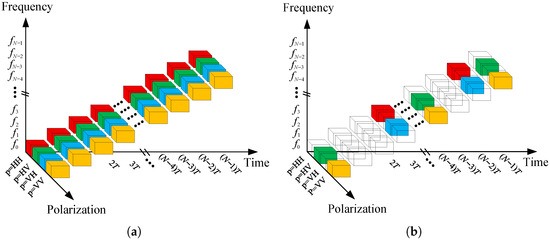
When illuminated by high frequency signals, the backscattered echo of a target can be approximately represented through a certain number of dominant sparsely distributed SCs. Figure 1a illustrates the transmission schematic of the full polarization SFW (FP-SFW) using SPMs. In this context, the received FP-SFW echoes from the target in the p polarization channel can be expressed as
where is the scattering intensity of the qth SC in the p (, with the first letter indicating reception and the second denoting transmission) polarization channel, corresponding to an element of the polarization scattering matrix (PSM): . is the distance from the qth SC to the radar reference location at time with T denoting the pulse repetition period. c is the speed of light, and represents the frequency of the nth stepped frequency point, with being the initial frequency, the frequency step size, and indexing N frequency points that synthesize a bandwidth . represents additive Gaussian white noise (AWGN) in the p channel, modeled as a complex Gaussian random variable, i.e., , where denotes the noise power.
Figure 1.
Transmission schematic for N possible stepped-frequencies: (a) FP-SFW. (b) VFP-SSFW.
Without loss of generality, within a short coherent processing interval (CPI), the target is assumed to have constant radial velocity v [9,40]. Then, the instantaneous range of the qth SC changes to . Substituting and into (1), the echo can be written as
where the first phase term is constant, causing a fixed phase offset. The second phase term is linear in n, resulting in a uniform shift of the target’s HRRP. The third phase term represents the Doppler effect generated by , which is essential for achieving HRRP imaging. The final phase term is proportional to the square of n, i.e., the quadratic term, which leads to defocusing of the HRRP and can be generally neglected.
After compensating for the phase offset induced by the target’s motion [29], (2) can be further expressed as
where for notational simplicity.
As illustrated in Figure 1b, unlike the FP-SFW, which employs SPMs, the proposed VFP-SSFW transmits only stepped frequency points in practice, which are uniformly randomly selected within the synthesis bandwidth, thereby covering more information and maximizing measurement incoherence. Importantly, at each transmitted frequency pulse, it emits either H or V polarization in a mutually exclusive manner, selected uniformly at random with probability 0.5 (without replacement), while simultaneously receiving both H- and V-polarized components from the target. It should be noted that, since a general polarimetric radar has two transmit channels (two fixed-polarization antennas), VFP-SSFW activates only one channel per pulse via software selection, requiring no high-speed switching. In other words, it does not impose additional hardware requirements.
Thanks to the mutually exclusive single-polarization transmission, the proposed VFP-SSFW theoretically eliminates channel crosstalk caused by the simultaneous transmission of H and V polarized pulses, under the ideal assumption that non-ideal hardware factors such as switching delay, finite isolation, and transient responses are neglected. As a by-product, it reduces the required instantaneous transmission power by half compared to traditional SPM-based waveforms such as FP-SFW, and requires fewer sampled echoes than conventional methods. This advantage is particularly attractive for applications with limited resources, as it lowers signal transmission and processing requirements, especially on orbital remote sensing platforms.
In this sense, the received echoes of VFP-SSFW after channel calibration can be expressed in matrix form as follows:
where , with representing the echoes in the p channel, which are measured by a DCS system consisting of channels. The mask matrix consists of binary elements (0 or 1), where an entry of 1 indicates the presence of a valid received echo at a specific frequency point, and 0 indicates a missing echo. Obviously, this matrix is jointly defined by the chosen frequency–polarization pairs. In particular, the following criterion holds for VFP-SSFW radars:
where * denotes either H or V, and ∘ represents the Hadamard product (i.e., element-wise multiplication) of matrices or vectors. The matrix represents the fully polarimetric noise-free scattered echoes from the target, and denotes the AWGN across the four polarization channels. Specifically, can be expressed as
where is the steering matrix exhibiting Vandermende structure, with and denoting the steering vector and digital Doppler frequency, respectively. collects the intensities of Q SCs in the four channels, with .
Critically, (6) demonstrates that for any given SC, its location is exactly the same in every polarization channel, while the corresponding intensities are channel-dependent.
2.2. P-ANM-Based Polarimetric HRRP Imaging Framework
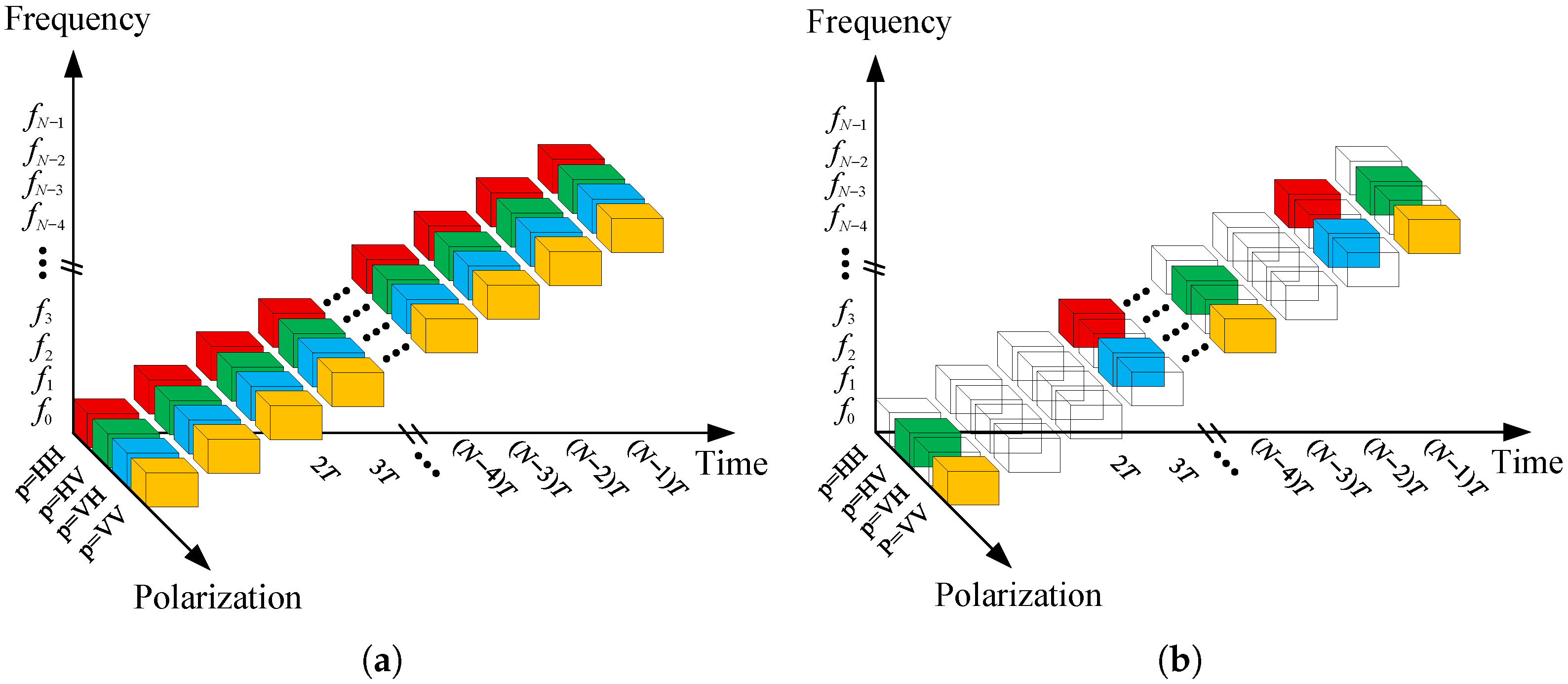
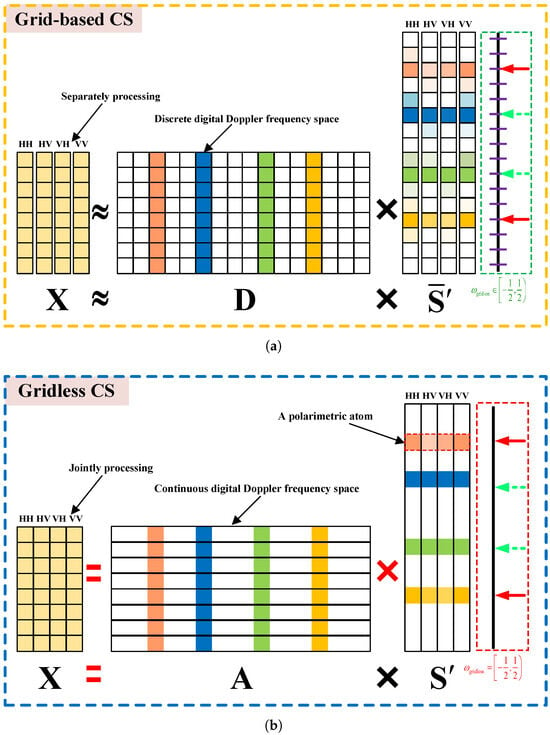
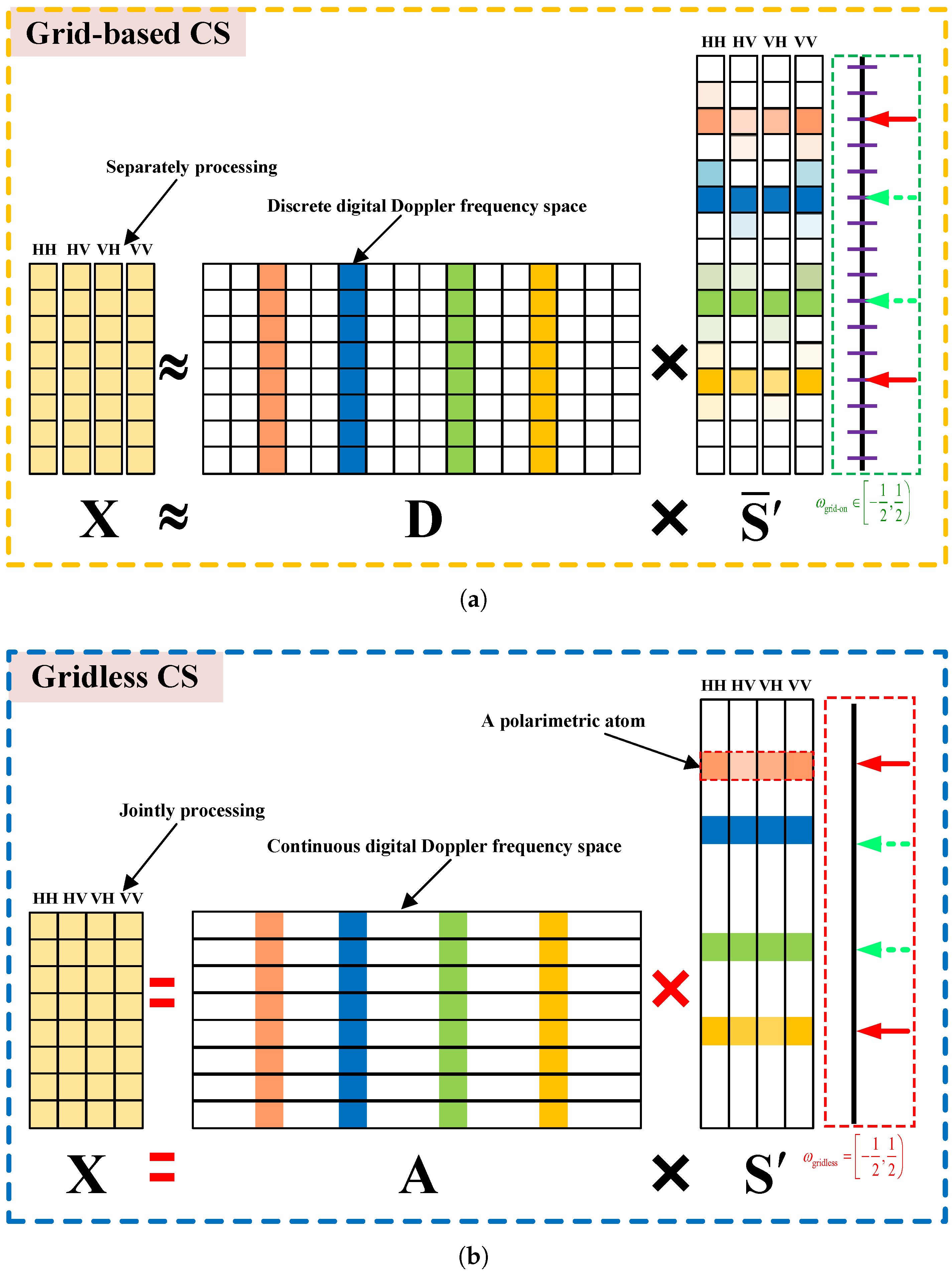
As illustrated in Figure 2a, conventional grid-based CS methods for polarimetric HRRP imaging typically discretize the continuous digital Doppler frequency space into a finite set of grid points using a redundant dictionary matrix . These approaches implicitly assume that the SCs to be estimated lie exactly on the predefined grids. However, in practice, the true SCs of a target may be located arbitrary locations within the continuous imaging range. Consequently, grid-based methods inevitably suffer from off-grid errors, causing SCs that deviate from the grid points to split into multiple spurious SCs with moderate intensities around neighboring grid points. Moreover, these methods typically handle each polarization channel separately, thereby failing to exploit the inherent joint sparsity among polarization channels. As a result, the quality of the obtained polarimetric HRRPs is limited.
Figure 2.
Schematic comparison of polarimetric HRRP imaging: (a) grid-based CS and (b) gridless CS.
In contrast, the proposed method reformulates the polarimetric HRRP imaging problem as a gridless CS problem, as illustrated in Figure 2b. Specifically, we propose the concept of “polarimetric atom” to represent fully polarimetric echoes in a gridless manner. Each atom corresponds to a SC that shares a common location across polarization channels but exhibits channel-dependent intensities, thereby fully exploiting the inherent joint sparsity priors among the channels. For instance, as shown in Figure 2b, the digital Doppler frequency of each polarimetric atom can take any value in the continuous interval , while the corresponding intensities across the four polarization channels vary independently. Building on this, we reformulate the task of polarimetric HRRP imaging using VFP-SSFW echoes as a P-ANM-based DCS problem, thus generating high-quality polarimetric HRRPs free from off-grid errors.
To facilitate understanding, we reformulate the noise-free scattered echoes in (6) as
where is the qth row vector of , and is defined as .
Then, we define the polarimetric atom set, where the digital Doppler frequency of each atom can take any value within as
Intuitively, minimizing the number of atoms can be used to synthesize , which is defined as the polarimetric atom- norm minimization:
However, the problem in (9) is ill-posed, which admits infinitely many solutions. Inspired by [41,42], we perform a convex relaxation on it and define the P-ANM as
It is notable that the P-ANM in (10) promotes sparsity among the SCs by minimizing the total sum of their intensities, i.e., the total energy, across all polarization channels, expressed as .
In the presence of noise, X can be recovered from VFP-SSFW echoes in (4) by solving the following P-ANM-based DCS problem:
where is a regularized parameter, which can be fine-tuned around the criterion in [33,43], with the unknown noise power estimated by the hyperparameter-free SPICE algorithm [44].
To prevent infinite programming, (11) can be reformulated as the following SemiDefinite Programming (SDP) problem [41,42]:
where is a low-rank, PSD, and Hermitian Toeplitz matrix with being an auxiliary variable, and is an auxiliary matrix. Particularly, is expected to be .
Since HRRP imaging aims to estimate the locations and intensities of target SCs, which are encoded in and , respectively, we solve problem (12) to obtain the optimal estimates and . Then, parameterized polarimetric HRRPs are obtained by estimating the locations and intensities of SCs from these estimates. and . Specifically, the number of SCs, i.e., , and the digital Doppler frequencies of SCs, i.e., , are determined from through classic model order estimation techniques and subspace spectral estimation methods, respectively. Here, the second-order statistic of the eigenvalues (SORTE) algorithm, which is superior to other model order selection methods [43,45], and the MPM, which is computationally efficient, are adopted. Further details can be found in [46,47]. Then, the locations of SCs, i.e., , follow from
Finally, the intensities of SCs across all polarization channels are determined via least squares estimation (LSE):
where .
It should be noted that, even when SORTE occasionally overestimates the number of SCs due to low SNR, such overestimation of the model order does not appreciably affect the LSE results [48]. Consequently, any spurious SCs that appear have negligibly small intensity and often fall below the display dynamic range [49].
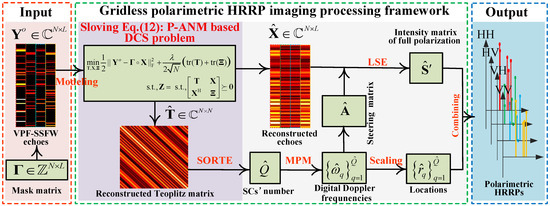
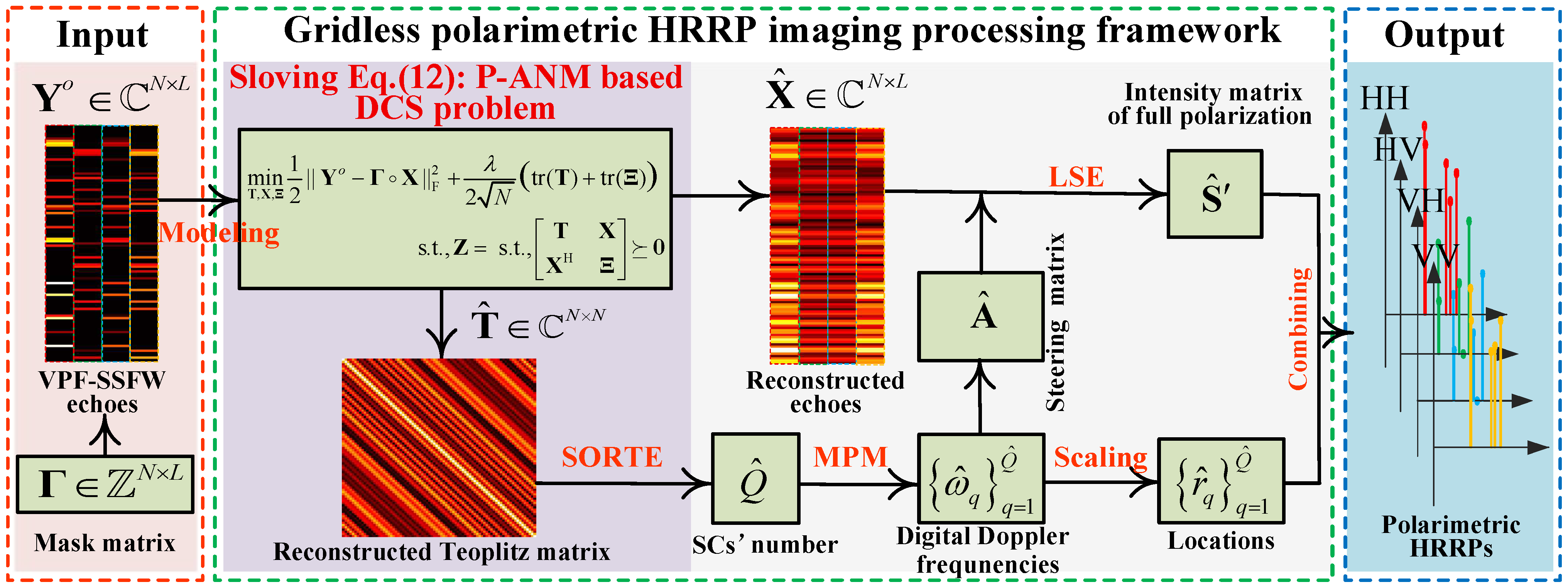
For clarity, Figure 3 outlines the process of the proposed P-ANM-based polarimetric HRRP imaging framework. First, stepped-frequency pulses are transmitted according to the mask matrix to acquire VFP-SSFW echoes from the target. These echoes are then formulated as a P-ANM-based DCS problem, as shown in (12), and solved to obtain the optimal and . Finally, the locations of the SCs are determined via MPM, and their intensities are estimated via LSE, thereby producing polarimetric HRRPs represented by co-registered SCs.
Figure 3.
Overall process of the gridless polarimetric HRRP imaging framework.
2.3. Fast Algorithm Based on ADMM for Solving (12)
Rather than relying on IPM-based solvers within the off-the-shelf CVX toolbox, we introduce a fast algorithm based on the ADMM [39] efficiently solve the polarimetric HRRP imaging problem. First, the augmented Lagrangian corresponding to (12) is formulated as follows:
where and denote the auxiliary variable and the Lagrangian multiplier, respecively, and is the penalty parameter. For simplicity, let and , where the size of the submatrices are as , , , , , and .
Subsequently, (15) is decomposed into a sequence of tractable subproblems for the variables . Closed-form solutions for updating , , and are readily obtained by setting the gradients of (15) with respect to each variable to zero. After performing these calculations, the updates are given as follows:
where , and is the Toeplitz adjoint operator that maps a matrix to a vector whose k-th component of () equals to the average of the elements on the k-th diagonal of . and ( and ) denote the updates of the entries of corresponding to the presence and absence of VFP-SSFW echoes, respectively. Detailed derivations are provided in Appendix A.
The update of is obtained by solving the subproblem that minimizes (15) subject to the PSD constant, i.e., . Specifically, with , this subproblem is given by
The Wirtinger derivative of (17) with respect to is . Setting this gradient to zero yields . The PSD constraint is enforced by projecting this point onto the PSD cone, i.e., . This projection can be implemented via ED. Specifically, letting with , the update of is
where is the diagonal matrix obtained by setting the negative eigenvalues of to zero, i.e., ().
Then, the Lagrangian multiplier is updated using a gradient ascent on the dual problem, which is given by
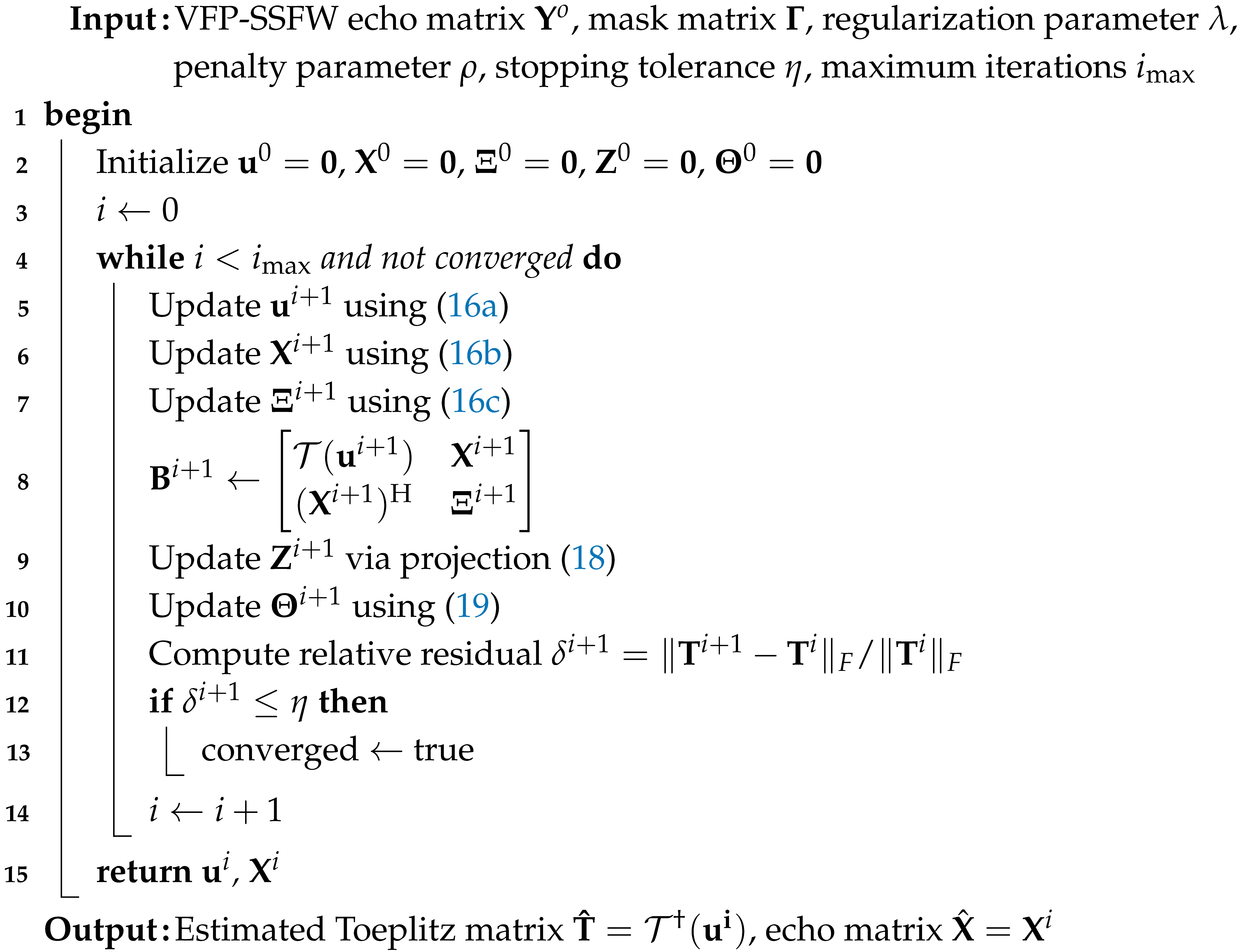
Finally, by alternating among the updates in (16a)–(16c), (18) and (19), the objective in (15) converges to a fixed point when the primal and dual residuals fall below their respective tolerances. In practice, since (12) is strictly convex, we adopt a simpler criterion based on the relative residual of : . The algorithm starts with and , and terminates when or the maximum iteration number is reached. For clarity, the Algorithm 1 summarizes the pseudocode of the proposed ADMM-based fast solver.
| Algorithm 1: ADMM for solving the P-ANM-Based DCS Problem in (12) |
 |
2.4. Computational Complexity Analysis
Within the proposed gridless polarimetric HRRP imaging framework, the primary computational burden lies in solving the P-ANM-based DCS problem formulated in (12). When employing the fast ADMM-based algorithm to solve (12) (hereafter referred to as P-ANM-ADMM), the most computationally expensive operation at each iteration is the update of via the ED involving (18). This decomposition can be performed with a complexity of using the efficient ED algorithm [50]. Consequently, the per-iteration computational complexity of the P-ANM-ADMM scales as .
In contrast, when using off-the-shelf CVX tool based on the IPM for solving (12), the computational cost is , where denotes the solution accuracy. Furthermore, applying the standard ANM separately to each polarization channel results in a total complexity of . Thus, the proposed method demonstrates significant computational efficiency, especially for large values of N.
3. Results
In this section, simulation data, electromagnetic calculation data, and measurement data are used to verify the effectiveness of the proposed method. The tested full-polarimetric data are obtained without crosstalk: the simulated and electromagnetic calculation data come from independent channel simulations, and the anechoic chamber data come from APMs. Here, the SR is defined as , and the SNR is defined as , i.e., the average raw single-pulse SNR per frequency point and per polarization channel, excluding IFFT processing gain. The experimental platform used in this work is a laptop with an Intel Core i7-12700H processor at 2.70 GHz. The imaging results are displayed with a dynamic range of –35 dB.
3.1. Simulated Data Results
3.1.1. Feasibility Study
The simulated target is assumed to consist of four SCs, each representing distinct scattering structures. For clarity, the detailed polarimetric scattering parameters and the specifications of the radar system are provided in Table 1 and Table 2, respectively.
Table 1.
Polarimetric parameters of the simulated target.
Table 2.
Parameters of the radar system for the simulated target.
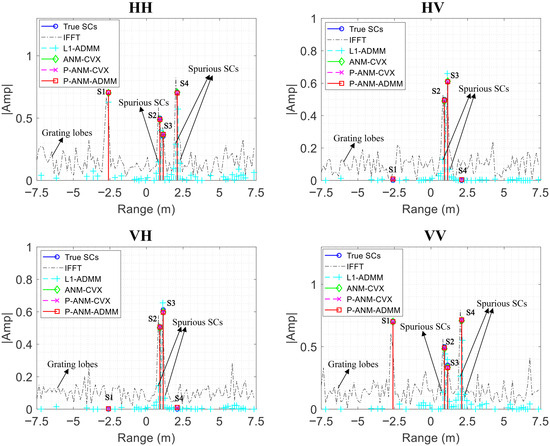
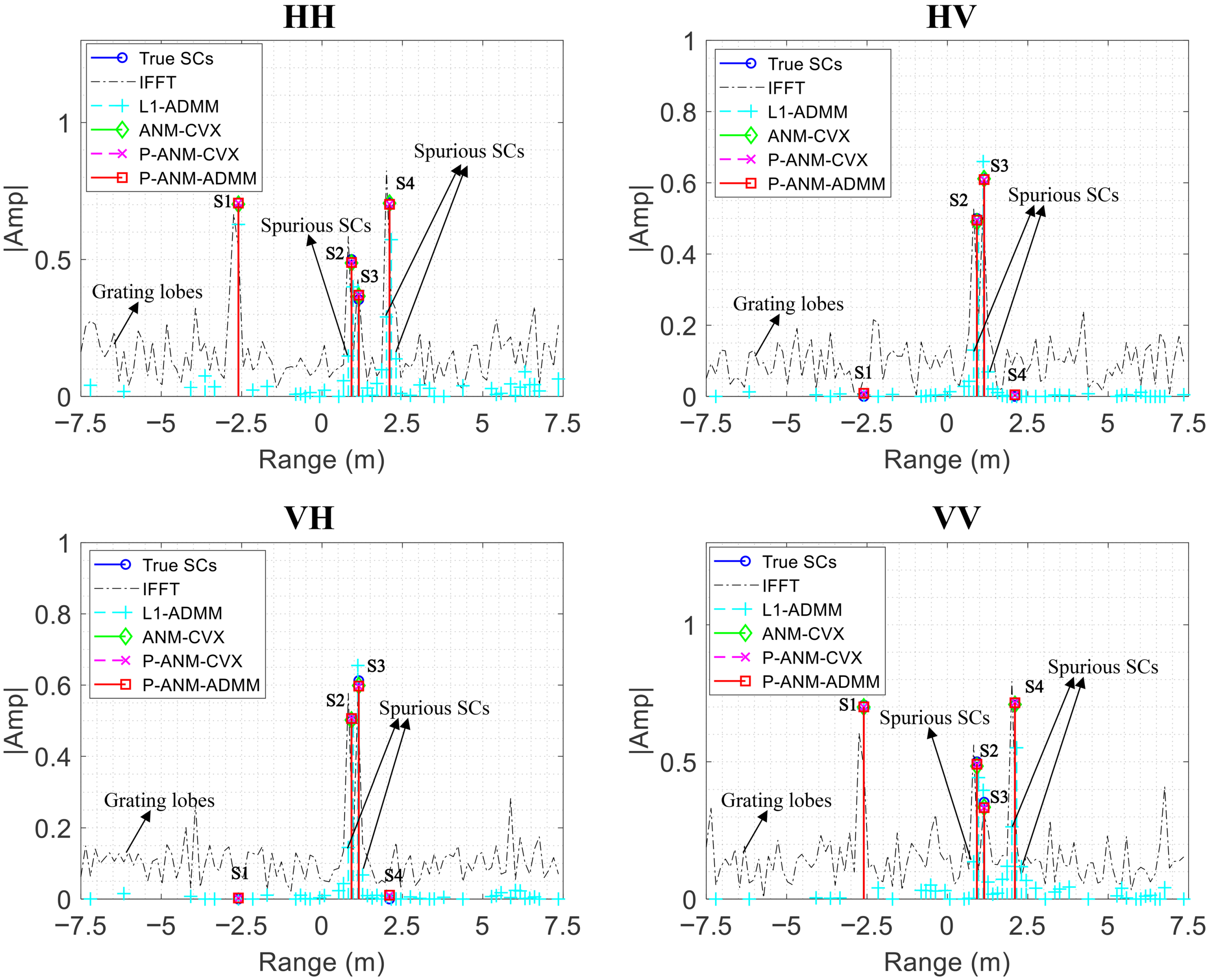
We generate the complete fully polarimetric echoes, i.e., the FP-SFW echoes, according to the parameters listed in Table 1 and Table 2. The VFP-SSFW echoes are then simulated by performing uniform random undersampling in a polarization-mutually-exclusive manner, as described in (5). Subsequently, several methods are applied to generate polarimetric HRRPs for comparison: IFFT, L1 regularization solved via ADMM (L1-ADMM) [51], ANM solved via CVX (ANM-CVX) [35], P-ANM solved via CVX (P-ANM-CVX) [36], and our proposed P-ANM-ADMM algorithm. Unless otherwise stated, the default parameters used throughout this work are as follows. The number of IFFT points equals the total number of frequency points, i.e., N. The redundant dictionary matrix for L1-ADMM is an Fourier matrix. The regularization parameters for the four CS-based algorithms are fine-tuned to ensure a fair comparison. For both L1-ADMM and P-ANM-ADMM, the penalty parameter, solution precision, and maximum number of iterations are set to , , and , respectively. Figure 4 illustrates the polarimetric HRRP imaging results obtained for the simulated target at an SR of 40% and an SNR of 25 dB.
Figure 4.
Polarimetric HRRP imaging results of the simulated target (SR = 40% and SNR = 25 dB).
It is can be observed from Figure 4 that, due to missing echoes in VFP-SSFW, IFFT exhibits pronounced grating lobes, high sidelobes, and wide main lobes, resulting in only an approximate representation of the scattering distribution of the four SCs. Moreover, the polarization-sensitive SCs, namely S1 and S4, are not discernible in the HV and VH channels. While L1-ADMM mitigates the severe issues of grating lobes, sidelobes, and main lobes, it introduces a certain number of spurious SCs surrounding the true SCs with moderate intensity due to off-grid errors. Consequently, it inaccurately represents the four SCs, exhibiting varying degrees of intensity deviation. Also, the two polarization-sensitive SCs, S1 and S4, remain absent in HV and VH channels. In contrast, all three gridless algorithms not only eliminate the aforementioned interference (such as grating lobes, sidelobes, and main lobes) but also avoid introducing spurious SCs. Specifically, ANM-CVX successfully extracts S2 and S3 across all four polarimetric channels, yet fails to recover S1 and S4 in the HV and VH channels. By comparison, both P-ANM-ADMM and P-ANM-CVX accurately extract all four SCs across every polarimetric channel, with their locations naturally co-registered. These results confirm the feasibility of the proposed method.
3.1.2. Numerical Performance Analysis
To further compare the performance of the last four algorithms (i.e., L1-ADMM, ANM-CVX, P-ANM-CVX, and P-ANM-ADMM), we conduct Monte Carlo simulations at varying SRs and SNRs using the simulation echoes. Additionally, the runtime of the four algorithms for polarimetric HRRP imaging is recorded as a function of the total number of stepped frequency points N.
To quantitatively assess the polarimetric HRRP imaging quality, we define the root mean square error (RMSE) of locations and intensities of SCs across all polarimetric channels as follows:
and
respectively. To ensure a fair evaluation, the error components are handled as follows. For a true SC with zero intensity in some specific polarization channels, the corresponding squared errors, i.e., for location and for intensity, are set to zero. If a true SC exists but is not extracted by an algorithm, its location error component is set to , where denotes the range Rayleigh resolution, and its intensity error component is set to . The final metrics, and , are computed by averaging the RMSEs over 50 independent Monte Carlo runs.
- (1)
- Performance versus SR
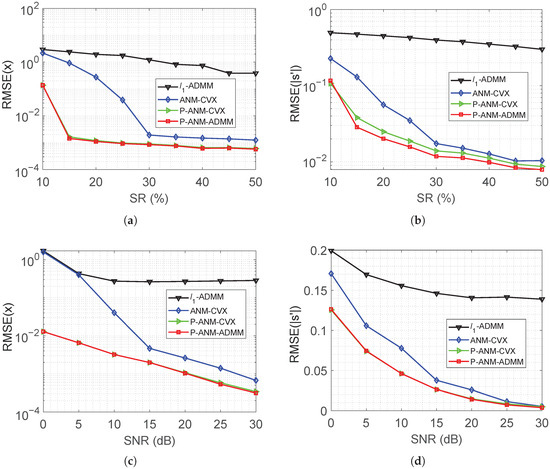
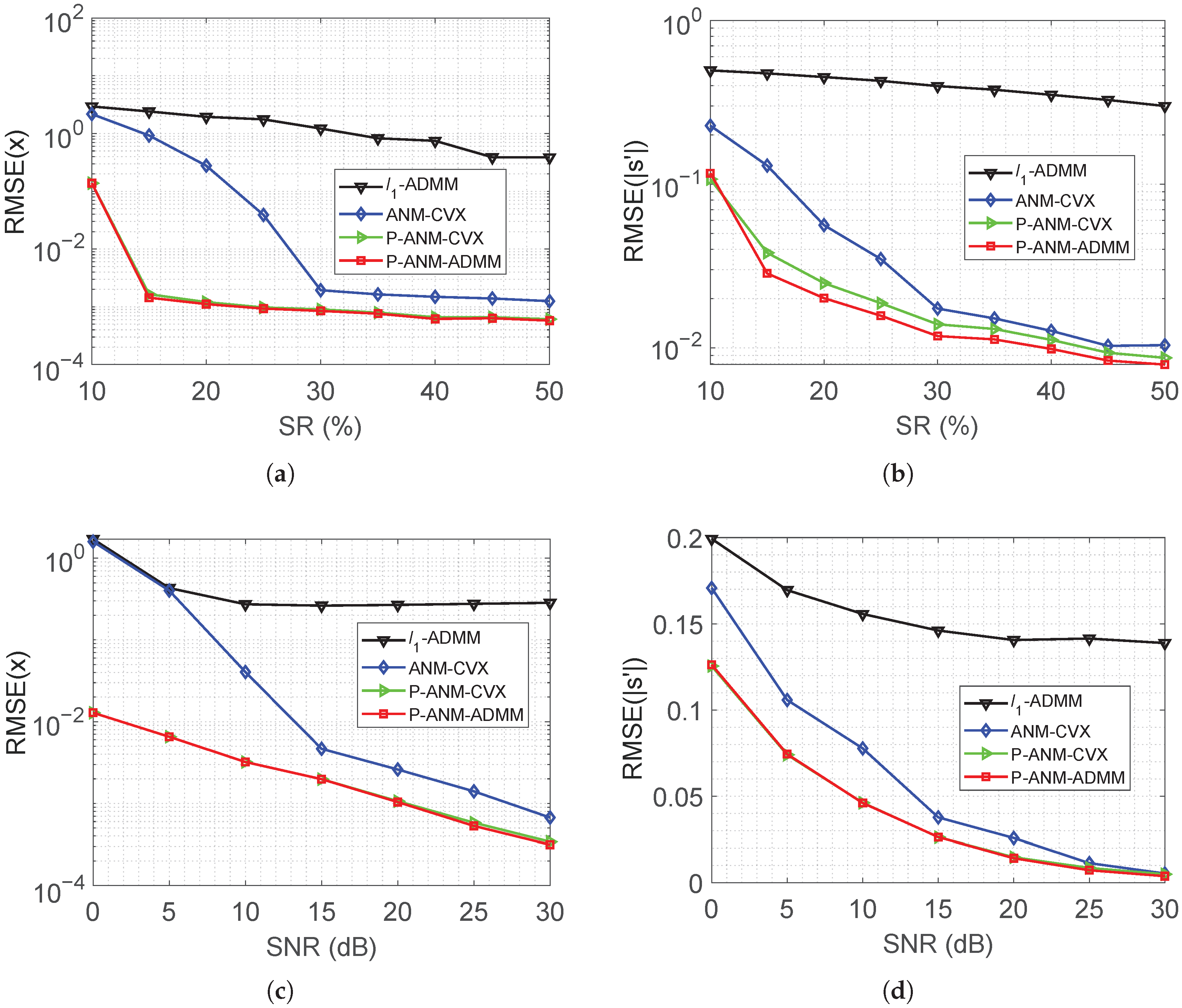
We first evaluate the performance of the compared methods under different SRs. The SR is varied from 10% to 50% in increments of 5%, while the SNR is fixed at 25 dB. Figure 5a and Figure 5b show the and curves for the four algorithms, respectively. As observed, all three gridless algorithms consistently achieve significantly lower and values than L1-ADMM. Specifically, P-ANM-ADMM achieves a comparable to P-ANM-CVX and a slightly lower , while outperforming ANM-CVX in both metrics. Notably, when the SR falls below 30%, the RMSE values of both P-ANM-CVX and P-ANM-ADMM are substantially lower than those of ANM-CVX, highlighting the advantage of joint polarization processing for VFP-SSFW under limited data conditions.
Figure 5.
RMSE curves of L1-ADMM, ANM-CVX, P-ANM-CVX, and P-ANM-ADMM algorithms with respect to SR and SNR: (a) versus SR. (b) versus SR. (c) versus SNR. (d) versus SNR.
- (2)
- Performance versus SNR
We next assess the robustness of the algorithms to noise by adding AWGN to the fully polarimetric echoes. The SNR is increased from 0 dB to 30 dB in 5 dB steps, with the SR fixed at 40%. Figure 5c,d present the and curves across all SNRs. As expected, the results exhibit a similar trend to those observed under varying SR conditions. L1-ADMM consistently yields the highest RMSE values across all SNRs. For SNR below 5 dB, ANM-CVX achieves slightly lower and considerably lower than L1-ADMM. When SNR exceeds 5 dB, the RMSE values of ANM-CVX decrease rapidly and gradually approach those of P-ANM-CVX and P-ANM-ADMM. In contrast, both P-ANM-CVX and P-ANM-ADMM achieve the lowest RMSE values among all algorithms, with comparable performance to each other. Remarkably, when SNR is below 15 dB, their RMSE values are substantially lower than those of ANM-CVX, further demonstrating the benefits of joint polarization processing for VFP-SSFW under low SNR conditions.
- (3)
- Runtime versus N
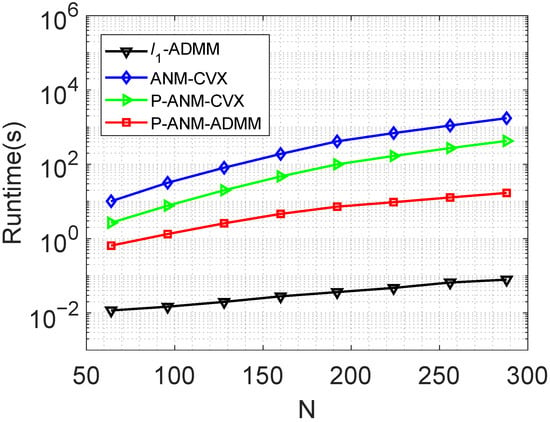
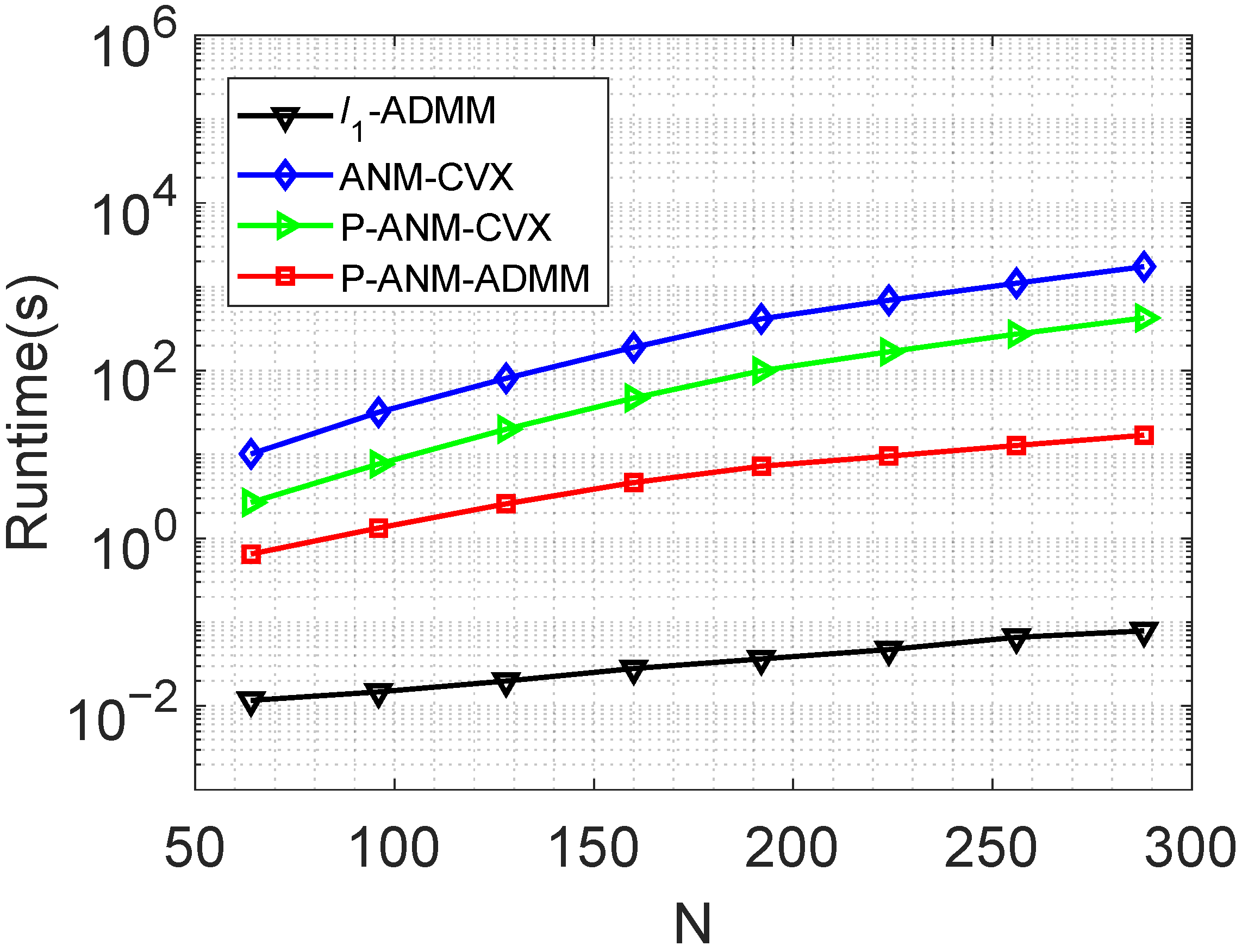
We also compare the runtime of the four algorithms as a function of the total number of stepped frequency points N, which is varied from 64 to 288 in steps of 32 while keeping other parameters in Table 1 and Table 2 fixed. Figure 6 shows the runtime of the four algorithms versus N. For a given N, L1-ADMM is the fastest, followed by the proposed P-ANM-ADMM, then P-ANM-CVX, with ANM-CVX being the slowest. Specifically, P-ANM-ADMM runs significantly faster than P-ANM-CVX, while ANM-CVX is slower by a substantial margin. Moreover, as N increases, the runtime of P-ANM-ADMM grows more slowly than those of P-ANM-CVX and ANM-CVX, which exhibit similar slopes, confirming its lower asymptotic complexity. Nevertheless, the slope of P-ANM-ADMM is slightly steeper than that of L1-ADMM, whose per-iteration complexity is [51] when accelerated by fast Fourier transform (FFT) or IFFT. These runtime results align well with the complexity analysis in Section 2.4, demonstrating the computational advantages of the proposed method over existing gridless approaches.
Figure 6.
Runtime of L1-ADMM, ANM-CVX, P-ANM-CVX, and P-ANM-ADMM algorithms for polarimetric HRRP imaging versus N.
By combining the results in Figure 5 and Figure 6, we can conclude that the three gridless algorithms consistently outperform L1-ADMM in accurately representing the SCs across all tested SR and SNR conditions, although the advantage of ANM-CVX diminishes remarkably under low SR and SNR conditions. This is because the gridless algorithms operate without relying on predefined grids, thereby eliminating off-grid errors, whereas L1-ADMM depends on fixed grids and is inherently susceptible to such errors. In addition, both P-ANM-ADMM and P-ANM-CVX exhibit comparable performance and surpass ANM-CVX, particularly under challenging conditions such as low SRs and low SNRs. This performance gap arises because ANM-CVX processes each polarization channel separately, failing to exploit the joint sparsity inherent in the polarization dimension. In contrast, both P-ANM-ADMM and P-ANM-CVX jointly recover and by leveraging the priors from all four channels, leading to superior estimation accuracy. Given the computational efficiency of the P-ANM-ADMM compared to existing gridless approaches, we conclude that P-ANM-ADMM offers an optimal balance between polarimetric HRRP imaging quality and runtime efficiency.
3.2. Electromagnetic Calculation Data Results
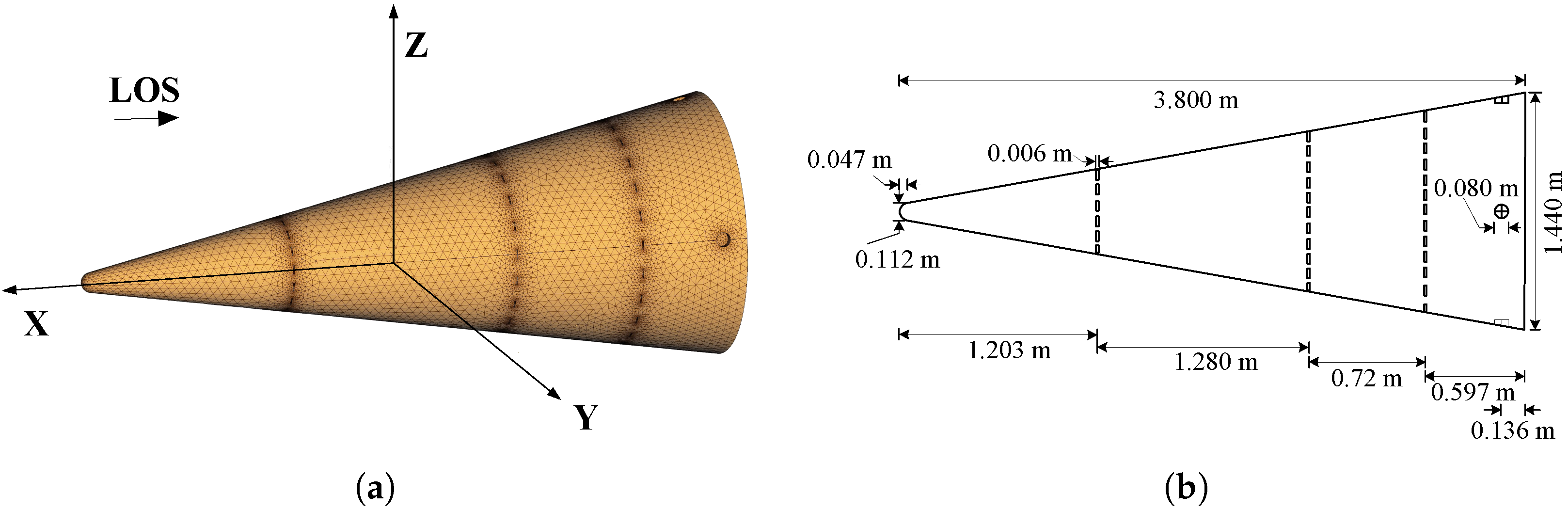
We further validate the proposed method using electromagnetic calculation data of a cone target. The CAD model of the target after facet meshing is shown in Figure 7a, with the radar LOS directed toward the nose of the cone. The geometry and dimensions of the target are illustrated in Figure 7b. The fully polarimetric echoes are simulated using the physical optics (PO) method within FEKO, with the same radar system parameters as in Table 2.
Figure 7.
Illustration of the cone target: (a) CAD model after facet meshing. (b) geometry and dimensions.
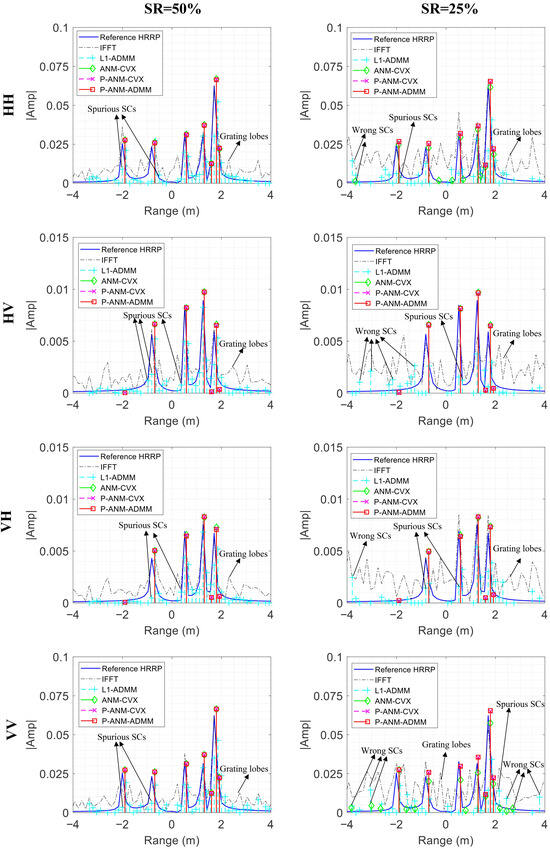
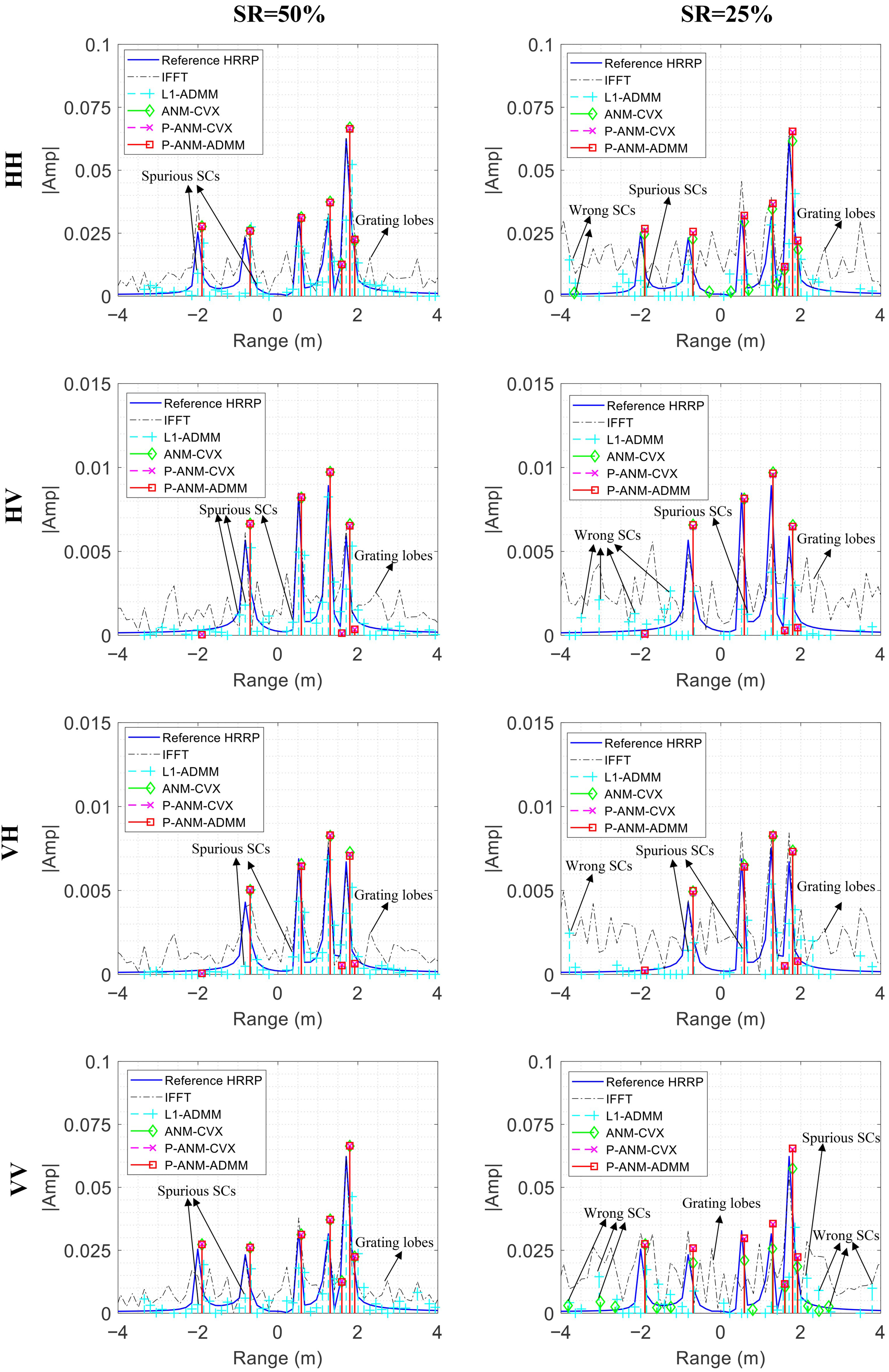
We perform uniform random under sampling as described in (5) to generate the VPF-SSFW echoes at SRs of 50% and 25%. The polarimetric HRRPs are then obtained using IFFT, L1-ADMM, ANM-CVX, P-ANM-CVX, and the proposed P-ANM-ADMM algorithm. Since the true SCs of actual targets are unknown, the polarimetric HRRPs produced by performing IFFT to the complete fully polarimetric echoes serve as the reference baseline. Figure 8 presents the imaging results of the cone target using the five algorithms at different SRs.
Figure 8.
Polarimetric HRRP imaging results of the cone target from electromagnetic calculation data at different SRs.
At an SR of 50%, IFFT suffers from moderate grating lobes across all four polarimetric channels and fails to accurately represent the shape of the target. L1-ADMM effectively eliminates the grating lobes but introduces spurious SCs due to off-grid errors; moreover, the dominant polarization-sensitive SCs at the nose and tail are not discernible in the HV and VH channels. ANM-CVX eliminates both grating lobes and spurious SCs, and the extracted dominant SCs correspond well with the reference profiles. However, it also fails to recover the three dominant polarization-sensitive SCs at the nose and tail. In contrast, both P-ANM-ADMM and P-ANM-CVX consistently extract seven dominant SCs at identical locations across all four channels. The extracted locations closely match the structural features of the target shown in Figure 7b, and the corresponding intensities are in good agreement with those of the reference HRRPs. Notably, the intensities of the SC extracted at the nose across the four channels align well with the specular reflection mechanism expected from a spherical structure.
At an SR of 25%, the imaging results of all five algorithms exhibit varying degrees of degradation. IFFT is severely corrupted by pronounced grating lobes and can hardly outline the target shape. L1-ADMM introduces some wrong SCs with high intensity across the four channels and fails to capture the target’s structural features. ANM-CVX shows severe degradation in the HH and VV channels, introducing both weak wrong SCs and weak spurious SCs, while also exhibiting intensity deviations exceeding 0.01 for the seven dominant SCs in the VV channel compared to those at an SR of 50%. Moreover, the extracted SCs exhibit inconsistent locations and varying numbers across polarization channels. By contrast, both P-ANM-ADMM and P-ANM-CVX still effectively recover the seven dominant SCs across all four channels, with only negligible intensity deviations compared to those at an SR of 50%.
Since the ground-truth SC parameters are unknown, we assess the imaging quality indirectly by reconstructing the fully polarimetric echoes from the extracted SCs and computing the mean squared error (MSE) between the reconstructed echoes and the noise-free true echoes , denoted as . A lower MSE theoretically indicates higher fidelity of the extracted SCs. Runtime is also recorded for comparison. Table 3 reports the MSEs and runtime of the last four algorithms (i.e., L1-ADMM, ANM-CVX, P-ANM-CVX, and P-ANM-ADMM) for the results shown in Figure 8.
Table 3.
MSEs and runtime results of the cone target from electromagnetic calculation data at different SRs.
It is clear from Table 3 that, at an SR of 50%, all three gridless algorithms achieve MSEs orders of magnitude lower than that of L1-ADMM. Among them, P-ANM-ADMM and P-ANM-CVX perform slightly better than ANM-CVX, although all three yield MSEs that are relatively close. At an SR of 25%, the MSEs of all algorithms increase. Notably, ANM-CVX exhibits the most severe degradation, with its error increasing by two orders of magnitude and becoming significantly larger than those of P-ANM-ADMM and P-ANM-CVX. In contrast, P-ANM-ADMM and P-ANM-CVX maintain low and nearly identical MSEs, remaining orders of magnitude lower than L1-ADMM and substantially lower than ANM-CVX. In terms of runtime, P-ANM-ADMM is the fastest among the three gridless algorithms, substantially outperforming P-ANM-CVX and ANM-CVX (with ANM-CVX approximately four times slower than P-ANM-CVX), while L1-ADMM remains the fastest overall.
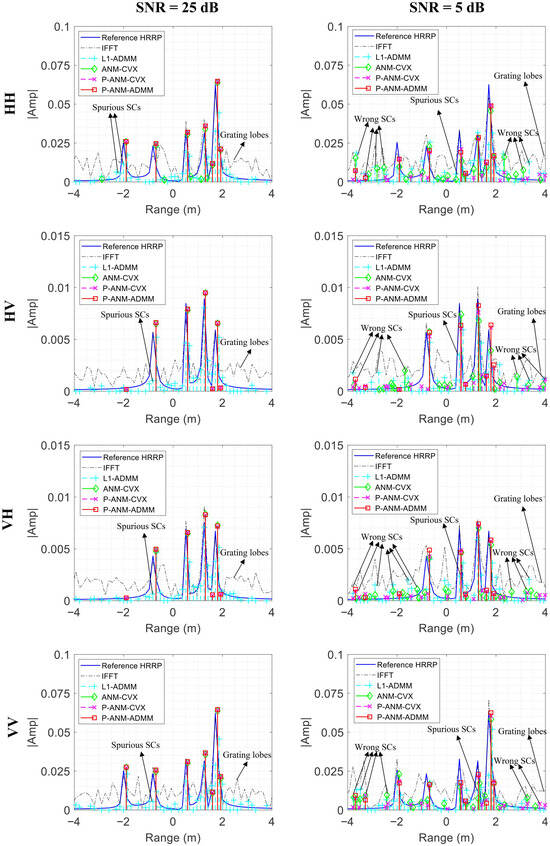
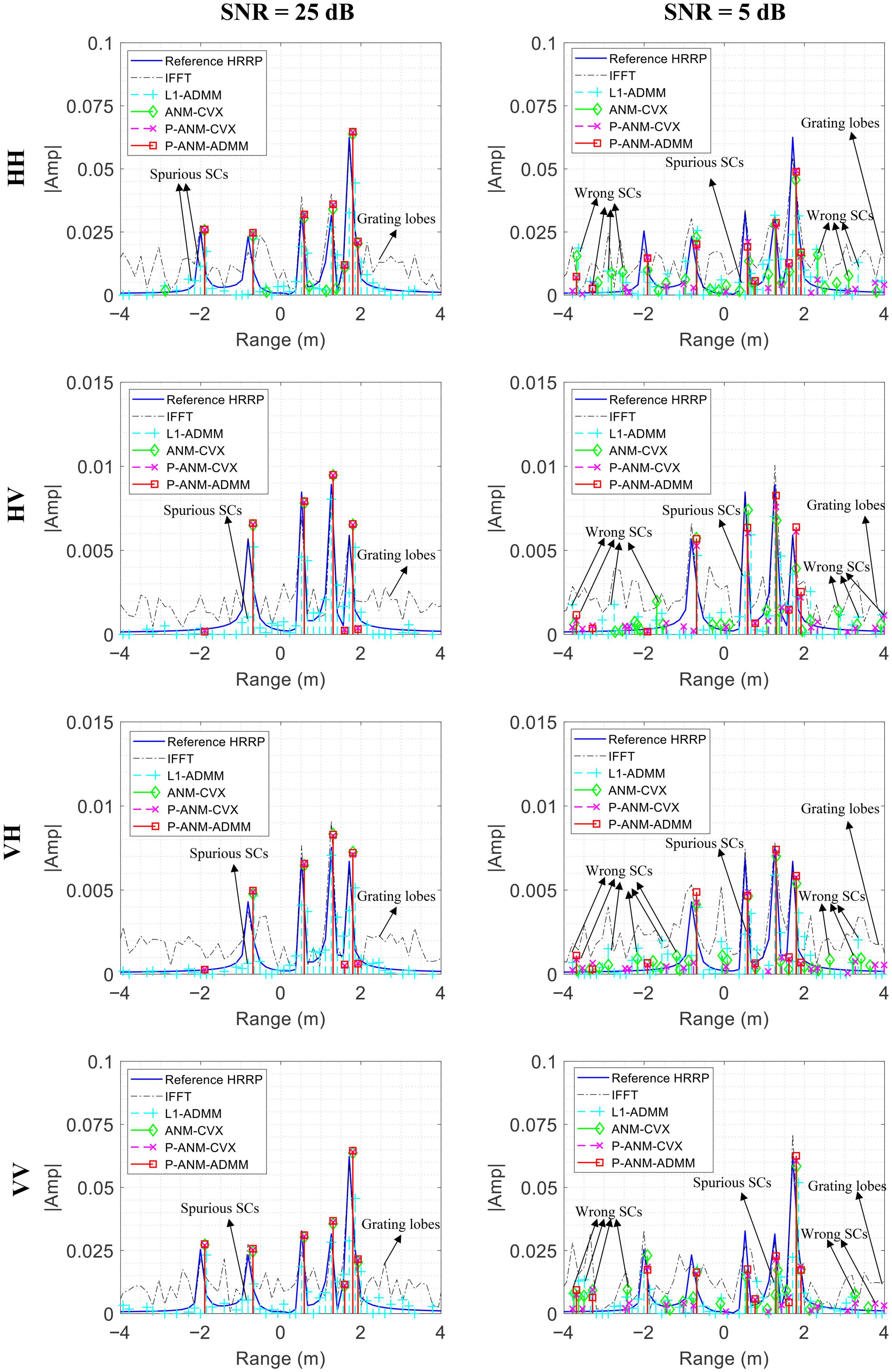
To further evaluate robustness, we add AWGN to the fully polarimetric echoes while fixing the SR at 40%. Figure 9 shows the imaging results at SNRs of 25 dB and 5 dB.
Figure 9.
Polarimetric HRRP imaging results of the cone target from electromagnetic calculation data at different SNRs (SR = 40%).
At an SNR = 25 dB, IFFT exhibits moderate grating lobes, which inaccurately represent the shape of the target. L1-ADMM corresponds well with the reference polarimetric HRRPs by effectively suppressing grating lobes, albeit with the introduction of some spurious SCs. ANM-CVX effectively extracts the seven dominant SCs in the HH and VV channels but fails to recover the three dominant polarization-sensitive SCs at the nose and tail in the HV and VH channels. It also introduces several weak spurious SCs in the HH channel, demonstrating inconsistent locations and varying numbers across different polarization channels. In contrast, both P-ANM-ADMM and P-ANM-CVX successfully extract all seven dominant SCs in all channels, with good alignment to the reference HRRPs and the structural features of the target shown in Figure 7b.
At an SNR = 5 dB, all algorithms degrade significantly. IFFT experiences severe grating lobes that can hardly outline the shape of the target. L1-ADMM also produces a few wrong SCs with high intensity across all channels, thus failing to accurately capture the target’s structural features. ANM-CVX fails to accurately recover the seven dominant SCs, exhibiting significant intensity deviations across all four channels. Moreover, it introduces numerous both wrong SCs and spurious SCs, with high intensity in the HH and HV channels and moderate intensity in the VH and VV channels, resulting in a distorted representation of the target. In contrast, both P-ANM-ADMM and P-ANM-CVX still extract the seven dominant SCs, albeit with moderate intensity deviations. Nevertheless, due to strong noise, both methods are affected by some wrong SCs and spurious SCs with moderate intensity, with P-ANM-CVX exhibiting slightly more such artifacts than P-ANM-ADMM.
Table 4 reports the MSEs and runtime of the four algorithms for the results shown in Figure 9. As expected, the MSEs of all methods increase as the SNR decreases. At an SNR of 25 dB, the three gridless methods achieve comparable MSEs, all lower than that of L1-ADMM, with P-ANM-ADMM attaining the lowest error, closely followed by P-ANM-CVX and ANM-CVX. At an SNR of 5 dB, ANM-CVX degrades severely, its MSE rising by two orders of magnitude to a level comparable to L1-ADMM. In contrast, both P-ANM-ADMM and P-ANM-CVX maintain significantly lower MSEs, outperforming the other two by a factor of about three. Runtime trends remain consistent with the SR experiments: P-ANM-ADMM is the fastest among the gridless algorithms, while L1-ADMM remains the fastest overall. These results further confirm the robustness of the proposed method.
Table 4.
MSEs and runtime results of the cone target from electromagnetic calculation data at different SNRs (SR = 40%).
3.3. Measured Data Results
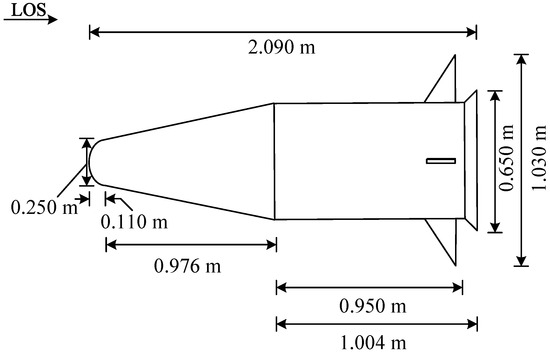
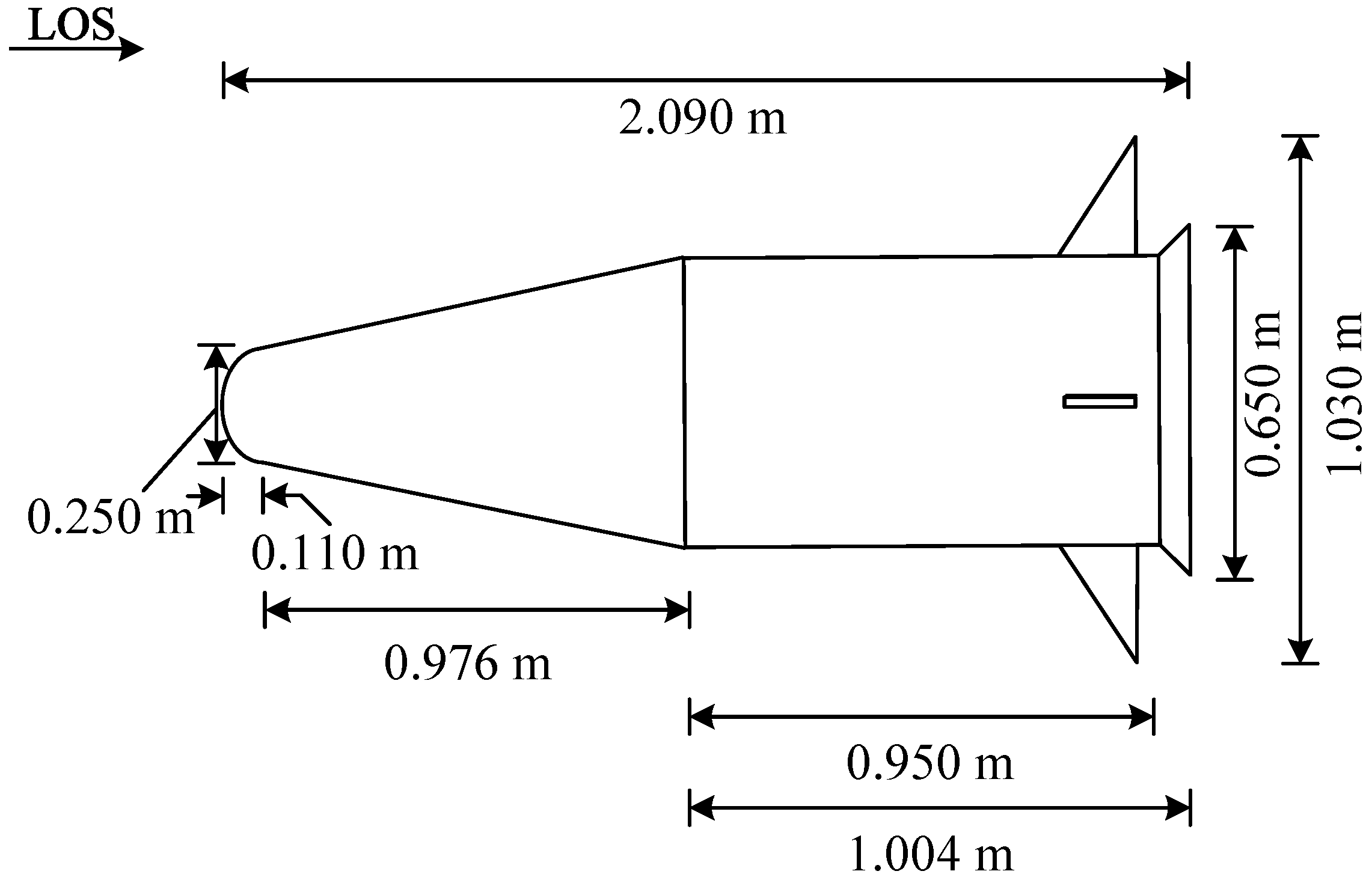
We further validate the proposed method using measured data of a cone assembly target acquired in an anechoic chamber. The geometry and dimensions of the target are shown in Figure 10, and the radar system parameters are listed in Table 5. The radar LOS is directed toward the nose of the target.
Figure 10.
Geometry and dimensions of the cone assembly target.
Table 5.
Parameters of the radar system for the cone assembly target.
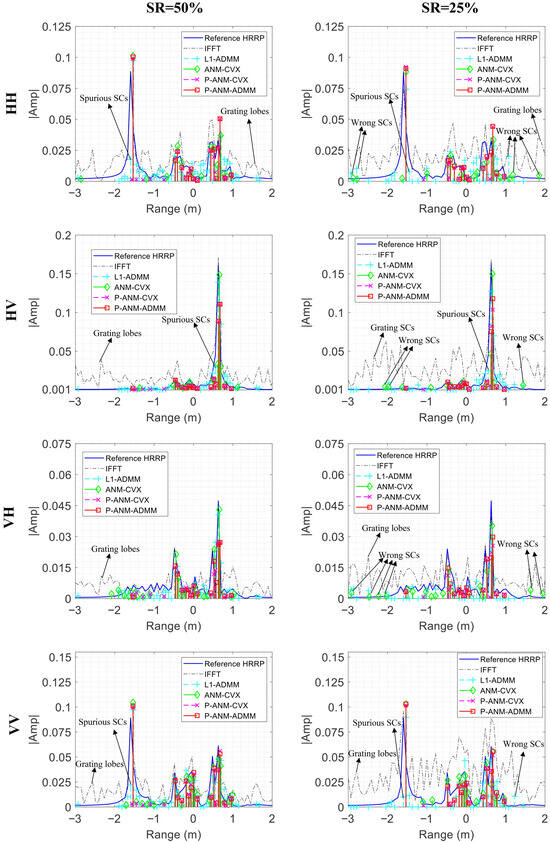
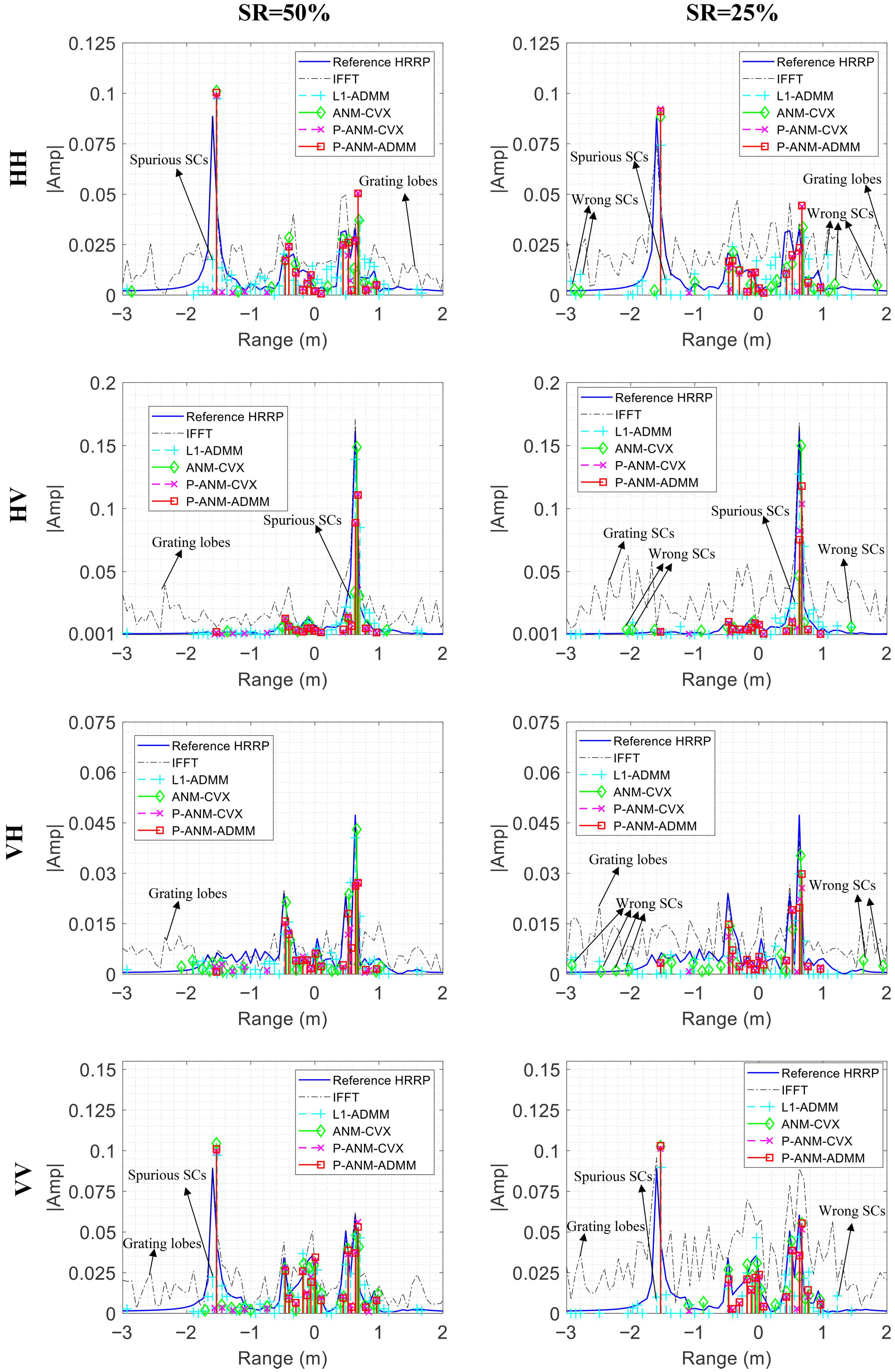
Similarly, VFP-SSFW echoes are generated at SRs of 50% and 25% using the same uniform random undersampling scheme as in (5). Figure 11 presents the polarimetric HRRP imaging results of the five algorithms, with the IFFT results on the complete fully polarimetric echoes serving as the reference baseline.
Figure 11.
Polarimetric HRRP imaging results of the cone assembly target from anechoic chamber measurement data at different SRs.
It is clear from Figure 11 that, at an SR of 50%, IFFT produces polarimetric HRRPs with moderate grating lobes, which inaccurately represent the shape of the cone assembly target. L1-ADMM effectively suppresses grating lobes and yields profiles that match the reference HRRPs well, but it introduces spurious SCs due to off-grid errors. ANM-CVX extracts the dominant SCs with locations and intensities corresponding well to the reference HRRPs; however, it introduces numerous weak SCs and fails to co-register SCs across channels, particularly the dominant polarization-sensitive SCs at the nose, middle, and tail. In contrast, both P-ANM-ADMM and P-ANM-CVX produce nearly identical results: the SCs exhibit consistent locations across all four channels, and the corresponding intensities are in good agreement with the reference HRRPs, with extracted dominant SCs matching the structural features of the target shown in Figure 10. Nevertheless, both methods are also affected by several weak spurious SCs likely due to measurement noise or channel calibration errors, with P-ANM-CVX exhibiting slightly more such artifacts.
At an SR of 25%, the results exhibit varying degrees of degradation. IFFT is severely corrupted by grating lobes and can hardly outline the target. L1-ADMM introduces several wrong SCs with moderate intensity across all four channels, thus failing to accurately represent the structural features of the target. ANM-CVX also introduces multiple weak wrong SCs in the HH, HV, and VH channels, and the extracted dominant SCs at the middle and tail in the VH channel show intensity deviations of approximately 0.0075 compared to those at an SR of 50%. By contrast, both P-ANM-ADMM and P-ANM-CVX produce similar results, with extracted SCs maintaining good location alignment and only moderate intensity deviations in the HV and VH channels.
Table 6 reports the corresponding MSEs and runtime of the four algorithms for the results shown in Figure 11. Among them, P-ANM-ADMM and P-ANM-CVX achieve comparable and the lowest MSEs among all methods at both SRs. Specifically, at an SR of 50%, the three gridless methods yield comparable MSEs substantially lower than L1-ADMM, with P-ANM-CVX attaining the lowest error, closely followed by P-ANM-ADMM and ANM-CVX. At an SR of 25%, all methods exhibit increased errors, but the P-ANM-ADMM and ANM-CVX maintain MSEs below , remaining notably lower than ANM-CVX (0.0013) and L1-ADMM (0.0039). In terms of runtime, P-ANM-ADMM offers the fastest computation among gridless methods, significantly outperforming P-ANM-CVX and ANM-CVX, although it remains slower than L1-ADMM. The results are consistent with those provided in Table 3 and Table 4, further validating the superior performance of the proposed method.
Table 6.
MSEs and runtime results of the cone assembly target from anechoic chamber measurement data at different SRs.
Based on the results from simulated, electromagnetic calculation, and measured data, we conclude that the proposed P-ANM-ADMM method consistently performs well on VFP-SSFW echoes across all tested conditions. Moreover, it achieves imaging quality comparable to P-ANM-CVX and outperforms IFFT, L1-ADMM, and ANM-CVX in accurately recovering SCs. This superiority stems from the exploitation of joint polarization priors across all four channels, as well as the gridless formulation that avoids spurious SCs resulting from off-grid errors. Additionally, the method demonstrates substantial computational efficiency compared to existing IPM-based gridless HRRP imaging approaches, although it remains significantly slower than the grid-based L1-ADMM. Thus, the proposed method achieves an optimal trade-off between polarimetric HRRP imaging quality and runtime. Overall, thanks to the theoretical halving of instantaneous transmission power, significantly fewer sampling echoes, high-quality refined and interpretable polarimetric HRRPs, and fast imaging processing (seconds-order processing on a laptop), our method demonstrates strong attractiveness for radar-resource-limited platforms, especially for orbital remote sensing.
4. Discussion
This study introduces an effective method for obtaining high-quality polarimetric HRRPs via compressed sampling, without introducing transmission polarization channel crosstalk. Although the effectiveness and superior performance of the proposed method have been comprehensively validated, several limitations remain that warrant further discussion and in-depth investigation.
First, the claim that VFP-SSFW eliminates transmission channel crosstalk is derived from its mutual-exclusivity property and is therefore valid only theoretically, i.e., when non-ideal hardware factors are ideally neglected. Owing to limited hardware equipment, we have not yet acquired real radar echoes from a true VFP-SSFW radar system, and thus cannot evaluate the actual channel crosstalk results. Consequently, the conclusion that VFP-SSFW eliminates transmission channel crosstalk cannot be physically proved, but is theoretically valid. Whether practical non-ideal effects introduce residual crosstalk is an open question that requires further hardware investigation.
Second, the proposed method assumes that polarization channel calibration and motion phase correction have been properly performed beforehand. We acknowledge that this assumption serves as an idealized premise for the validation of the imaging model. However, in orbital remote sensing, this challenge is widely recognized for spaceborne polarimetric calibration [52,53], as well as in the broader context of fully polarimetric calibration and processing techniques [54]. Furthermore, under compressed sampling scenarios, both polarization channel calibration and motion phase correction remain even more challenging problems. Future work could focus on jointly achieving polarimetric HRRP imaging, polarization channel calibration, and motion phase correction.
Third, in the VFP-SSFW scheme, polarization states are selected uniformly at random in a mutually exclusive manner, and frequencies are also randomly chosen but transmitted in ascending order. This relatively simple design makes the system susceptible to active radar jamming. When polarization or frequency interference occurs, the current strategy cannot adaptively avoid the affected bands or polarization modes, resulting in limited survivability in complex electromagnetic environments. Future work could employ cognitive radar techniques [55] that combine frequency agility with polarization agility to adaptively design the mask matrix , thereby enhancing its anti-jamming capability in challenging environments.
Finally, the proposed method achieves better computational efficiency than existing gridless approaches, with a per-iteration complexity of . However, it remains slower than grid-based CS methods such as L1-ADMM (). As the runtime curves illustrated in Figure 6, on a laptop (Intel Core i7-12700H) with and , the proposed algorithm runs in less than 10 s. For resource-limited orbital platforms, although traditional radiation-hardened CPUs are slower, modern space-grade FPGAs/SoCs can offer high parallel efficiency for the ED involved in (18). With appropriate hardware acceleration, near-real-time performance is achievable for moderate problem sizes. Future work could explore more efficient algorithmic approaches or develop faster hardware solvers to further reduce runtime.
5. Conclusions
This paper presents a fast gridless polarimetric HRRP imaging method using a novel VFP-SSFW that is theoretically free from transmission crosstalk. As beneficial by-products, this waveform can halve the instantaneous radar transmission power and reduce the sampling echoes. These advantages are particularly attractive for energy-limited orbital remote sensing platforms. By formulating a P-ANM-based DCS problem, the proposed method avoids spurious SCs from off-grid errors and overcomes the limitations inherent to per-channel processing. Particularly, it extracts polarization-sensitive SCs across all polarization channels without requiring inter-channel matching of SCs, while maintaining robustness under low SR and low SNR conditions. Additionally, the method also achieves an optimal balance between imaging accuracy and computational efficiency. Extensive validation through simulations, electromagnetic calculations, and measurement data confirms the effectiveness and superiority of the proposed method, showing promising prospects for orbital remote sensing platform applications.
Author Contributions
Conceptualization, Y.L. and W.Z.; methodology, Y.L., W.Z. and W.Y.; formal analysis, Y.L., W.Z. and W.Y.; validation, Y.L., W.Z. and W.Y.; resources, S.Z. and Y.F.; data curation, Y.F. and Y.L.; writing—original draft preparation, Y.L.; writing—review and editing, Y.L., W.Z. and W.Y.; visualization, Y.L.; supervision, S.Z. and Y.F.; project administration, Y.F. and S.Z.; funding acquisition, S.Z. and W.Z. All authors have read and agreed to the published version of the manuscript.
Funding
This work was supported in part by the Fundamental and Interdisciplinary Disciplines Breakthrough Plan of the Ministry of Education of China under Grant JYB2025XDXM110 and the Science and Technology Innovation Program of Hunan Province under Grant 2025RC3139.
Data Availability Statement
The simulation data used in this study are available from the author upon reasonable request (via email: handsomelee23@163.com).
Acknowledgments
The authors would like to thank Jianxiong Zhou from the College of Electronic Science and Technology, National University of Defense Technology, for providing the anechoic chamber measurement data.
Conflicts of Interest
The authors declare no conflicts of interest.
Appendix A. Detailed Derivations of ADMM Updates
In this appendix, we provide the complete derivation of the update Formulas (16a)–(16c) by setting the gradients of the augmented Lagrangian (15) to zero with respect to each variable.
Appendix A.1. Update of u in (16a)
At th iteration, with fixed, the part of (15) depending on is
Completing the square with respect to , (A1) reduces to
Given is a linear function of , the derivative with respect to is obtained by first computing the derivative with respect to the matrix , and then applying the Toeplitz adjoint operator to map the result back to the vector space. Setting the derivative of (A2) to zero yields
Appendix A.2. Update of X in (16b)
This problem is separable elementwise. For , the objective becomes
Differentiating (A7) with respect to and setting it to zero gives
which simplifies to . Hence
Appendix A.3. Update of Ξ in (16c)
The terms in (15) involving are
References
- Steedly, W.M.; Moses, R.L. High resolution exponential modeling of fully polarized radar returns. IEEE Trans. Aerosp. Electron. Syst. 2002, 27, 459–469. [Google Scholar] [CrossRef] [Scilit]
- Wu, J.; Chen, Y.G.; Dai, D.H.; Pang, B.; Wang, X.S. Scattering mechanism identification based on polarimetric HRRP of manmade target. J. Radars 2016, 5, 174–181. [Google Scholar]
- Long, T.; Zhang, L.; Li, Y.; Wang, Y.H. Geometrical structure classification of target HRRP scattering centers based on dual polarimetric H/α features. IEEE Access 2019, 7, 141679–141688. [Google Scholar] [CrossRef] [Scilit]
- Wang, J.J.; Liu, Z.; Xie, R.; Ran, L. HRRP target recognition method for full polarimetric radars by combining Cameron decomposition and fusing RKELM. J. Radars 2021, 10, 944–955. [Google Scholar]
- Gao, F.; Lang, P.; Yeh, C.; Li, Z.; Ren, D.; Yang, J. An Interpretable Target-Aware Vision Transformer for Polarimetric HRRP Target Recognition with a Novel Attention Loss. Remote Sens. 2024, 16, 3135. [Google Scholar] [CrossRef] [Scilit]
- Santalla, V.; Antar, Y.M.M. A comparison between different polarimetric measurement schemes. IEEE Trans. Geosci. Remote Sens. 2002, 40, 1007–1017. [Google Scholar] [CrossRef]
- Li, C.; Yang, Y.; Pang, C.; Li, Y.-Z.; Wang, X.-S. A Simultaneous Polarimetric Measurement Scheme Using One Amplitude Modulation Waveform. IEEE Geosci. Remote Sens. Lett. 2020, 17, 72–76. [Google Scholar] [CrossRef] [Scilit]
- Wang, Z.; Tigrek, F.; Krasnov, O.; Van Der Zwan, F.; Van Genderen, P.; Yarovoy, A. Interleaved OFDM radar signals for simultaneous polarimetric measurements. IEEE Trans. Aerosp. Electron. Syst. 2012, 48, 2085–2099. [Google Scholar] [CrossRef] [Scilit]
- Wehner, D.R. High Resolution Radar; Artech House: Norwood, MA, USA, 1987. [Google Scholar]
- Xu, J.; Peng, Y.N.; Xia, X.G.; Long, T.; Mao, E.K.; Farina, A. Focus-before-detection radar signal processing: Part I—Challenges and methods. IEEE Aerosp. Electron. Syst. Mag. 2017, 32, 48–59. [Google Scholar] [CrossRef] [Scilit]
- Liu, S.; Cao, Y.; Yeo, T.-S.; Wang, F.; Han, J. Range sidelobe suppression for randomized stepped-frequency chirp radar. IEEE Trans. Aerosp. Electron. Syst. 2021, 57, 3874–3885. [Google Scholar] [CrossRef] [Scilit]
- Schmidt, R.O. Multiple emitter location and signal parameter estimation. IEEE Trans. Antennas Propag. 1986, 34, 276–280. [Google Scholar] [CrossRef] [Scilit]
- Roy, R.; Kailath, T. ESPRIT—Estimation of signal parameters via rotational invariance techniques. IEEE Trans. Acoust. Speech Signal Process. 1989, 37, 984–995. [Google Scholar] [CrossRef] [Scilit]
- Hua, Y.; Sarkar, T.K. Matrix pencil method for estimating parameters of exponentially damped/undamped sinusoids in noise. IEEE Trans. Acoust. Speech Signal Process. 1990, 38, 814–824. [Google Scholar] [CrossRef] [Scilit]
- Li, J.; Stoica, P. Efficient mixed-spectrum estimation with applications to target feature extraction. IEEE Trans. Signal Process. 1997, 44, 281–295. [Google Scholar] [CrossRef] [Scilit]
- Zhang, R.; Zhang, M.; Wang, X.; Cai, Z. Reconstructed target range profile via unitary ESPRIT superresolution algorithm. Int. J. Antennas Propag. 2017, 2017, 8127150. [Google Scholar] [CrossRef] [Scilit]
- Zou, Y.; Gao, X.; Li, X.; Liu, Y. A matrix pencil algorithm based multiband iterative fusion imaging method. Sci. Rep. 2016, 6, 19440. [Google Scholar] [CrossRef] [Scilit]
- Elsener, A.; van de Geer, S. Sparse spectral estimation with missing and corrupted measurements. Stat 2019, 8, e229. [Google Scholar] [CrossRef] [Scilit]
- Guo, C.; Wang, H.; Jian, T.; Xu, C.; Sun, S. Method for denoising and reconstructing radar HRRP using modified sparse auto-encoder. Chin. J. Aeronaut. 2020, 33, 1026–1036. [Google Scholar] [CrossRef] [Scilit]
- Dong, H.; Dai, F.; Zhang, J. High-Speed Target HRRP Reconstruction Based on Fast Mean-Field Sparse Bayesian Unrolled Network. Remote Sens. 2025, 17, 8. [Google Scholar] [CrossRef] [Scilit]
- Hu, P.; Chen, L.; Zhang, Z.; Liu, Z. Feature fusion CGAN based HRRP denoising and reconstruction method. Chin. J. Electron. 2026, 35, 243–256. [Google Scholar] [CrossRef] [Scilit]
- Zhang, Y.; Zhou, N.; Wang, Y.; Zhang, L. HRRP scattering center estimation based on modelled neural network. In IET Conference Proceedings 2023, Chongqing, China, 3–5 December 2023; The Institution of Engineering and Technology: Stevenage, UK, 2023; pp. 3105–3109. [Google Scholar]
- Yang, W.; Zhou, Q.; Yuan, M.; Li, Y.; Wang, Y.; Zhang, L. Dual-band polarimetric HRRP recognition via a brain-inspired multi-channel fusion feature extraction network. Front. Neurosci. 2023, 17, 1252179. [Google Scholar] [CrossRef] [Scilit] [PubMed]
- Zhang, L.; Han, C.; Wang, Y.; Li, Y.; Long, T. Polarimetric HRRP recognition based on feature-guided Transformer model. Electron. Lett. 2021, 57, 705–707. [Google Scholar] [CrossRef] [Scilit]
- Liu, Q.; Zhang, X.; Liu, Y. SCNet: Scattering center neural network for radar target recognition with incomplete target-aspects. Signal Process. 2024, 219, 109409. [Google Scholar] [CrossRef] [Scilit]
- Potter, L.C.; Ertin, E.; Parker, J.T.; Cetin, M. Sparsity and compressed sensing in radar imaging. Proc. IEEE 2010, 98, 1006–1020. [Google Scholar] [CrossRef] [Scilit]
- Pan, X.-Y.; Wang, W.; Wang, G.-Y. Sub-Nyquist sampling jamming against ISAR with CS-based HRRP reconstruction. IEEE Sens. J. 2016, 16, 1597–1602. [Google Scholar] [CrossRef] [Scilit]
- Liu, X.; Liu, J.; Zhao, F.; Ai, X.; Wang, G. A Novel Strategy for Pulse Radar HRRP Reconstruction Based on Randomly Interrupted Transmitting and Receiving in Radio Frequency Simulation. IEEE Trans. Antennas Propag. 2018, 66, 2569–2580. [Google Scholar] [CrossRef] [Scilit]
- Zhang, S.; Liu, Y.; Li, X.; Bi, G. Bayesian High Resolution Range Profile Reconstruction of High-Speed Moving Target from Under-Sampled Data. IEEE Trans. Image Process. 2020, 29, 5110–5120. [Google Scholar] [CrossRef]
- Wang, Y.; Li, Y.; Song, J.; Zhao, G. Randomized stepped frequency radar extended target HRRP-velocity joint estimation based on SBL-DGAMP-Net. IEEE Geosci. Remote Sens. Lett. 2024, 21, 3507005. [Google Scholar]
- Wu, Q.; Zhao, F.; Ai, X.; Ai, X.F.; Liu, J.; Xiao, S. Compressive-Sensing-Based Simultaneous Polarimetric HRRP Reconstruction With Random OFDM Pair Radar Signal. IEEE Access 2018, 6, 37837–37849. [Google Scholar]
- Chi, Y.; Scharf, L.L.; Pezeshki, A.; Calderbank, A.R. Sensitivity to Basis Mismatch in Compressed Sensing. IEEE Trans. Signal Process. 2011, 59, 2182–2195. [Google Scholar] [CrossRef] [Scilit]
- Bhaskar, B.N.; Tang, G.; Recht, B. Atomic Norm Denoising with Applications to Line Spectral Estimation. IEEE Trans. Signal Process. 2013, 61, 5987–5999. [Google Scholar] [CrossRef] [Scilit]
- Hu, X.; Tong, N.; Zhang, Y.; He, X.; Wang, Y. Moving Target’s HRRP Synthesis With Sparse Frequency-Stepped Chirp Signal via Atomic Norm Minimization. IEEE Signal Process. Lett. 2016, 23, 1212–1215. [Google Scholar] [CrossRef] [Scilit]
- Zhou, N.; Zhang, Y.-a.; Wang, Y.; Zhang, L. Dual band HRRP scattering center estimation via atomic norm minimization. In IET International Radar Conference 2023, Chongqing, China, 3–5 December 2023; The Institution of Engineering and Technology: Stevenage, UK, 2023; pp. 2096–2100. [Google Scholar]
- Liu, H.; Xi, Y.; Wang, Y.; Li, Y.; Zhao, T. Polarised HRRP Scattering Centre Estimation via Atomic Norm Minimisation. J. Eng. 2019, 2019, 7847–7850. [Google Scholar] [CrossRef] [Scilit]
- Nesterov, Y.; Nemirovskii, A. Interior-Point Polynomial Algorithms in Convex Programming; SIAM: Philadelphia, PA, USA, 1994. [Google Scholar]
- Coluccia, G.; Ravazzi, C.; Magli, E. Compressed Sensing for Distributed Systems; Springer: New York, NY, USA, 2015. [Google Scholar]
- Parikh, N.; Chu, E.; Peleato, B.; Eckstein, J. Distributed Optimization and Statistical Learning via the Alternating Direction Method of Multipliers. Found. Trends Mach. Learn. 2011, 3, 1–122. [Google Scholar]
- Berizzi, F.; Martorella, M.; Cacciamano, A.; Capria, A. A Contrast-Based Algorithm For Synthetic Range-Profile Motion Compensation. IEEE Trans. Geosci. Remote Sens. 2008, 46, 3053–3062. [Google Scholar] [CrossRef]
- Li, Y.; Chi, Y. Off-the-Grid Line Spectrum Denoising and Estimation with Multiple Measurement Vectors. IEEE Trans. Signal Process. 2016, 64, 1257–1269. [Google Scholar] [CrossRef] [Scilit]
- Yang, Z.; Li, J.; Stoica, P.; Xie, L. Sparse Methods for Direction-of-Arrival Estimation. In Academic Press Library in Signal Processing; Elsevier: Cambridge, MA, USA, 2018; Volume 7. [Google Scholar]
- Yang, Z.; Xie, L. On gridless sparse methods for line spectral estimation from complete and incomplete data. IEEE Trans. Signal Process. 2015, 63, 3139–3153. [Google Scholar] [CrossRef] [Scilit]
- Stoica, P.; Babu, P.; Li, J. SPICE: A sparse covariance-based estimation method for array processing. IEEE Trans. Signal Process. 2011, 59, 629–638. [Google Scholar] [CrossRef] [Scilit]
- Han, K.; Nehorai, A. Improved source number detection and direction estimation with nested arrays and ULAs using jackknifing. IEEE Trans. Signal Process. 2013, 61, 6118–6128. [Google Scholar] [CrossRef] [Scilit]
- He, Z.; Cichocki, A.; Xie, S.; Choi, K. Detecting the number of clusters in n-way probabilistic clustering. IEEE Trans. Pattern Anal. Mach. Intell. 2010, 32, 2006–2021. [Google Scholar] [CrossRef] [Scilit]
- Yang, Z.; Xie, L. Frequency-selective Vandermonde decomposition of Toeplitz matrices with applications. Signal Process. 2018, 142, 157–167. [Google Scholar] [CrossRef] [Scilit]
- Sakaguchi, K.; Takada, J.; Araki, K. Influence of the model order estimation error in the ESPRIT based high resolution techniques. IEICE Trans. Commun. 1999, 82, 561–563. [Google Scholar]
- Liu, Q.; Liu, A.; Wang, Y.; Li, H. A Super-Resolution Sparse Aperture ISAR Sensors Imaging Algorithm via the MUSIC Technique. IEEE Trans. Geosci. Remote Sens. 2019, 57, 7119–7134. [Google Scholar] [CrossRef] [Scilit]
- Gu, M.; Eisenstat, S.C. A divide-and-conquer algorithm for the symmetric tridiagonal eigenproblem. SIAM J. Matrix Anal. Appl. 1995, 16, 172–191. [Google Scholar] [CrossRef] [Scilit]
- Wang, Y.; Wang, Y.; Shi, Q. Optimized signal distortion for PAPR reduction of OFDM signals with IFFT/FFT complexity via ADMM approaches. IEEE Trans. Signal Process. 2018, 67, 399–414. [Google Scholar] [CrossRef] [Scilit]
- Yuan, J.; Jiao, Y.; Yue, H.; Zhang, H.; Zhao, F. C-SAR/02 Satellite Polarimetric Calibration and Validation Based on Active Radar Calibrators. Remote Sens. 2025, 17, 282. [Google Scholar]
- Li, T.; Qu, S. Brief Review on Polarimetric SAR Systems and Polarimetric Calibration Accuracies. Remote Sens. Technol. Appl. 2024, 39, 269–279. [Google Scholar]
- Xu, X.; Yang, K.; Liu, T. Emerging Trends in Radar: Fully Polarimetric Calibration and Processing. IEEE Aerosp. Electron. Syst. Mag. 2025, 40, 36–41. [Google Scholar] [CrossRef] [Scilit]
- Gurbuz, S.Z.; Griffiths, H.D.; Charlish, A.; Rangaswamy, M.; Greco, M.S.; Bell, K. An overview of cognitive radar: Past, present, and future. IEEE Aerosp. Electron. Syst. Mag. 2020, 34, 6–18. [Google Scholar] [CrossRef] [Scilit]

Disclaimer/Publisher’s Note: The statements, opinions and data contained in all publications are solely those of the individual author(s) and contributor(s) and not of MDPI and/or the editor(s). MDPI and/or the editor(s) disclaim responsibility for any injury to people or property resulting from any ideas, methods, instructions or products referred to in the content. |
© 2026 by the authors. Licensee MDPI, Basel, Switzerland. This article is an open access article distributed under the terms and conditions of the Creative Commons Attribution (CC BY) license.