Article

Comparative Study of Low-Level Wind Fields Characteristics at Two Critical Locations in the Terminal Area of Plateau Mountain Airports During the Dry-Season Using Coherent Doppler Wind Lidars
1
College of Aviation Meteorology, Civil Aviation Flight University of China, Jianyang 641419, China
2
Sichuan Provincial Engineering Research Center of Smart Operation and Maintenance of Civil Aviation Airports, Jianyang 641419, China
*
Author to whom correspondence should be addressed.
Remote Sens. 2026, 18(8), 1224; https://doi.org/10.3390/rs18081224
Submission received: 4 March 2026 / Revised: 16 April 2026 / Accepted: 17 April 2026 / Published: 18 April 2026
(This article belongs to the Special Issue New Insights from Wind Remote Sensing)

Abstract

The Qinghai–Tibet Plateau is characterized by highly complex terrain, and civil aviation serves as a primary mode of transportation for regional mobility. A comprehensive understanding of wind field characteristics within the terminal areas of plateau mountain airports, as well as the formation mechanisms of wind shear during different flight phases, is of considerable importance for flight risk assessment, improvement of transport efficiency, and refined meteorological support services. However, studies focusing on wind field structures within the terminal areas of plateau mountain airports remain limited. In this study, dry-season observations from Coherent Doppler Wind Lidars at two critical locations in the terminal area of Lhasa Airport are analyzed. A comparative analysis is conducted on the vertical structure, diurnal variation, and the characteristics of turbulence and wind shear under different terrain conditions. The results show that above the valley height, both sites are dominated by stable westerly winds. Below the valley height, the wind field is strongly influenced by terrain complexity. At the Lhasa Airport site (LS), the valley is regular in shape and has a stable orientation. The prevailing wind direction is aligned with the valley, and easterly winds dominate the entire valley, especially in the middle and lower layers. In contrast, the Qushui site (QS) is located at the confluence of two valleys, where the terrain is more open and complex. The prevailing wind shifts clockwise with height, from northeasterly in the lower layers to easterly aloft. The wind direction is less concentrated than at LS. In terms of diurnal variation, a stable easterly layer forms within the valley at LS in the morning. A transition layer of about 200–300 m exists between this layer and the westerlies aloft. Within the transition layer, wind speed is relatively weak and wind direction stability is low. At QS, morning winds are weaker and more variable within the valley. Wind direction stability increases with height. In the afternoon, both sites are influenced by the downward transport of westerly momentum. However, the effect is more pronounced at QS, where low-level wind speed is higher and wind direction is more stable. Turbulence at both sites peaks between 14:00 and 17:00 and is mainly driven by thermally induced updrafts. Turbulence intensity at QS is stronger, with a vertical extent exceeding 1500 m, indicating a stronger response to thermal forcing. Wind shear at both sites mainly occurs between 12:00 and 18:00, with peak frequency from 13:00 to 17:00. This period is consistent with peak turbulence activity. Wind shear at LS occurs more frequently and lasts longer. At QS, momentum transport from above 1500 m enhances wind shear occurrence at 800–1000 m. The causes of wind shear differ under different prevailing wind conditions. Under prevailing westerlies, wind shear is mainly caused by rapid changes in wind direction with height. Under prevailing easterlies, it is primarily associated with an enhanced vertical gradient of wind speed. These results reveal the significant influence of complex terrain on low-level wind structures and causes of wind shear. The findings provide a scientific basis for operational decision-making at plateau mountain airports.

1. Introduction

The Qinghai–Tibet Plateau (QTP) is the highest, largest, and most topographically complex plateau in the world, where transportation systems are strongly constrained by the natural environment. As the most important and efficient means of access to and from the region, air transportation has long played an indispensable role in personnel mobility, cargo transport, and emergency rescue, serving as a critical conduit for socioeconomic development and external connectivity across the plateau. However, all airports on the QTP are classified as high-altitude airports (elevations ≥ 2438 m), where the low-pressure and hypoxic conditions inherent to high elevations substantially degrade aircraft performance and reduce operational safety margins [1,2]. Owing to aircraft performance limitations, most airports on the QTP are located within river valleys, resulting in restricted obstacle clearance and highly complex operating environments in terminal area. During approach and departure, aircraft traverse narrow valleys at low speeds and in relatively unstable configurations, making them highly susceptible to adverse meteorological conditions such as wind shear and turbulence, which may trigger go-arounds or even lead to aviation safety incidents [3,4,5]. In this context, a detailed investigation of wind field characteristics in the terminal areas of mountainous airports on the QTP is essential for improving operational safety, optimizing flight scheduling, and enhancing airport emergency response capabilities.
In complex terrain, mesoscale and submesoscale local circulations driven by the combined effects of thermal and dynamical processes exhibit strong coupling with regional-scale flows. On the one hand, terrain-induced variations in elevation produce heterogeneous distributions of surface solar radiation, giving rise to localized ascending and descending motions in the atmosphere [6,7]. On the other hand, differences in terrain height and exert a strong control on near-surface airflow direction and speed [8]. These circulations typically exhibit pronounced diurnal variability, with substantial contrasts in wind direction and wind speed between daytime and nighttime, and are most evident under weak synoptic forcing. As a key component of mesoscale circulation systems, valley winds in complex terrain not only influence local weather processes but can also modulate larger-scale atmospheric circulation [9]. The formation and evolution of valley winds are governed by multiple factors. In addition to thermal forcing [10,11], they are strongly affected by atmospheric stability [12,13], boundary-layer structure [14,15], underlying surface characteristics [16,17,18], and solar radiation [19,20,21]. Under specific topographic configurations, valley winds may further interact with sea–land breeze circulations [22,23] or urban heat island circulations [24,25], thereby altering the characteristics of local airflow. When lakes or reservoirs are present in complex terrain, the superposition of valley winds and lake–land breezes can further enhance the complexity of local weather processes [26,27,28]. Moreover, valley winds are closely linked to the overlying flow, including geostrophic and background winds, and can interact with in-valley winds through multiple mechanisms, such as thermal forcing, downward momentum transport, topographic forcing, and pressure-gradient forcing [29,30].
QTP is one of the regions in China with the highest frequency of strong winds [31,32,33,34]. Owing to its extensive and elevated topography, the QTP exerts pronounced thermal and dynamical influences on atmospheric circulation, affecting weather and climate over East Asia, South Asia, and even the entire Northern Hemisphere [35,36,37,38]. However, the pronounced terrain variability induces substantial spatial and temporal heterogeneity in radiative forcing, surface energy balance, and thermal structure across the region, resulting in strong regionalization and diversity of local circulation characteristics [39,40,41,42]. Because boundary-layer processes at small spatial scales exhibit strong temporal variability and are difficult to capture using a single observational technique, comprehensive investigations generally require the integration of multiple observational platforms. Previous studies have conducted extensive field observations and numerical simulations over plains and mountainous regions of China [9,43,44]. In contrast, observational studies over the QTP remain relatively limited due to its harsh environmental conditions and the logistical challenges associated with instrument deployment and maintenance. In recent years, with the advancement of the Second Tibetan Plateau Scientific Expedition, significant progress has been made in understanding boundary-layer structures over different land-surface types and representative regions of the QTP. Nevertheless, most existing studies have primarily focused on regional energy exchange processes, whereas investigations of local circulations, particularly the complex wind fields within the terminal areas of plateau mountainous airports, remain insufficient. For high-altitude airports, conventional observational methods such as radiosondes and meteorological towers are often impractical due to strict obstacle-clearance requirements for aircraft operations. In recent years, the gradual deployment of Doppler Wind Lidars (DWLs) at airports has provided a powerful new tool for probing low-level wind structures in complex terrain, owing to their high spatial and temporal resolution and non-intrusive measurement capabilities [30,45,46,47]. DWL has been operationally applied at several major airports in China. Based on its observations, wind shear alert algorithms have been developed [48], enabling fine-scale detection of microscale meteorological phenomena along aircraft glide paths [49]. At some airports with complex terrain, lidar observations have also been used in case studies of wind shear [50,51,52], gusts [53,54], and downbursts [55,56]. However, statistical studies indicate that wind shear alert systems at such airports tend to have a relatively high false alarm rate, mainly due to the complexity of the wind field [57,58]. Therefore, a systematic analysis of the weather background associated with wind shear and turbulence is essential. It provides important guidance for improving wind shear identification capability and optimizing alert algorithms at airports with complex terrain. In this study, high-resolution continuous dry-season observations from two DWLs deployed in the terminal area of Lhasa Airport are used. The low-level wind characteristics at a plateau mountainous airport are analyzed. The results provide scientific support for flight safety and meteorological services under complex terrain conditions.
The remainder of this paper is organized as follows. Section 2 describes the study area, instruments, measurements, and methods. Section 3 presents detailed analyses of wind-field characteristics, the underlying mechanisms of turbulence generation, the diurnal variations, and mechanisms of wind shear. Section 4 gives a comparison and discussion between our findings and counterparts from other areas, and their practical applications. Section 5 summarizes the main conclusions.

2. Airport, Instrument and Methods

2.1. Experimental Sites

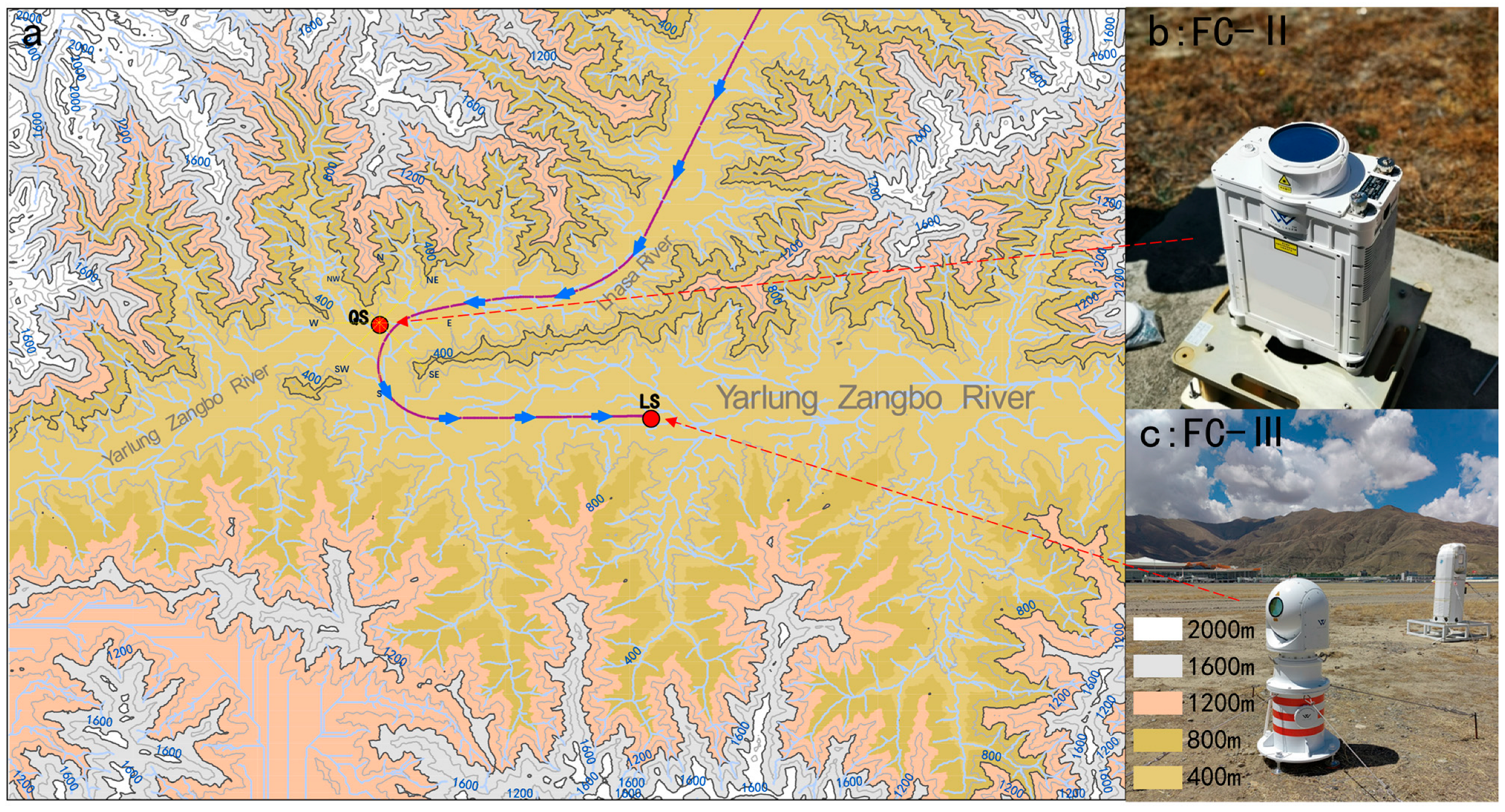
Lhasa Airport (International Civil Aviation Organization code: ZULS) is one of the highest airports in the world and the largest aviation hub in the Tibet Autonomous Region. The airport is located in the southeastern part of the QTP at an altitude of 3567 m. It lies within an east–west oriented valley of the Yarlung Zangbo River, where the terrain is higher in the west and lower in the east. The runway is aligned parallel to the valley. Runway 09 is predominantly used, with landings mainly conducted from west to east. During the final approach, aircraft first follow the Lhasa River valley from northeast to southwest. After passing the Y-shaped confluence of the Lhasa River and the Yarlung Zangbo River, aircraft perform consecutive turns, then proceed eastward, and finally align with the runway for landing, as shown in Figure 1. The final approach alignment point is approximately 15 km from the airport, at a height of about 1300 m above ground level. The terminal area is characterized by complex terrain, with interlaced mountains and valleys. The topography shows a step-like pattern, with higher elevations in the south and lower elevations in the north. Mountains south of the Yarlung Zangbo River reach elevations up to 4800 m, while those to the north range between 4000 and 4500 m. The ridges between the Lhasa River valley and the Yarlung Zangbo River valley are relatively lower, rising about 500 m above the valley floor. Since aircraft traverse the Lhasa River valley segment within a confined mountain corridor, maneuvering space is limited. Complex airflow and frequent wind shear further pose significant hazards to flight safety during takeoff and landing.
The terminal area is generally defined as the airspace within a radius of about 50 km centered on the airport. However, due to the highly fragmented terrain and strong airflow disturbances in the terminal area of Lhasa Airport, wind field characteristics vary significantly across different subregions. A single observation location cannot represent the overall wind field. Therefore, this study does not aim to characterize the wind field of the entire terminal area. Instead, it focuses on two locations that are most critical for flight safety, the turning point at Qushui (QS) and the touchdown zone of Runway 09 (LS), these locations correspond to areas where wind shear events are most frequently reported by flight crews and are highly sensitive for safe operations. Starting in May 2023, the project team deployed two DWLs, FC-II (QS, 90.75°E, 29.34°N) and FC-III (LS, 90.89°E, 29.29°N). The distance between the two observation sites is approximately 14.3 km, with an elevation difference of less than 10 m. Although they are relatively close, the surrounding terrain differs markedly. LS is close to the runway touchdown zone and is more strongly constrained by valley orientation. In contrast, QS is located in relatively open terrain with more complex topographic features. Observations at these two locations capture key processes of wind field disturbances in the terminal area. They also allow a comparative analysis of wind responses under different terrain conditions. This design ensures both representativeness and strong relevance to operational safety.

2.2. Instrumentation

2.2.1. Coherent Doppler Wind Lidar

The Coherent Doppler Wind Lidar (CDWL) used in this study was manufactured by the No. 209 Institute of China North Industries Group Corporation Limited. It retrieves radial wind velocity by emitting laser pulses and receiving the backscattered signals from aerosol particles, based on the Doppler frequency shift. The system shows clear advantages for wind field detection under clear-air conditions [45,59,60]. In this study, data from FC-II and FC-III CDWLs operating in the Doppler Beam Swinging (DBS) scanning mode were used. In this mode, the lidar measures radial wind velocities sequentially at eight equally spaced azimuth angles with a fixed elevation angle of 75°. These measurements are used to retrieve the horizontal wind components (u, v) and vertical wind (w) at different heights. The main technical specifications and performance parameters are listed in Table 1.
Due to the operational requirements for airport wind shear monitoring, the FC-III operates with a combination of Plan Position Indication (PPI), Range Height Indication (RHI), and DBS scan modes. Consequently, the temporal resolution of the FC-III DBS data is about 8 min. In contrast, the FC-II system operates only in DBS mode, with a temporal resolution of less than 3 s [46,53,54]. Previous validation studies indicate that these lidars achieve high measurement accuracy below 3000 m. They have also been widely applied in multiple wind field studies [53,61,62,63,64].

2.2.2. Automated Weather Observing System

Three Automated Weather Observing Systems (AWOSs), compliant with civil aviation observation standards, are deployed along the runway at Lhasa Airport. In this study, data from the AWOS located approximately 20 m from the LS CDWL were used. The AWOS provides wind speed and wind direction measurements at a temporal resolution of 15 s, as well as air temperature (°C), relative humidity (%), station pressure (hPa), and visibility (m) at a 1 min resolution. The dataset also includes hourly accumulated precipitation (mm) and cloud base height (m) measured by a ceilometer. The elevation of the AWOS is approximately 3570 m above sea level.

2.2.3. Study Period Selection

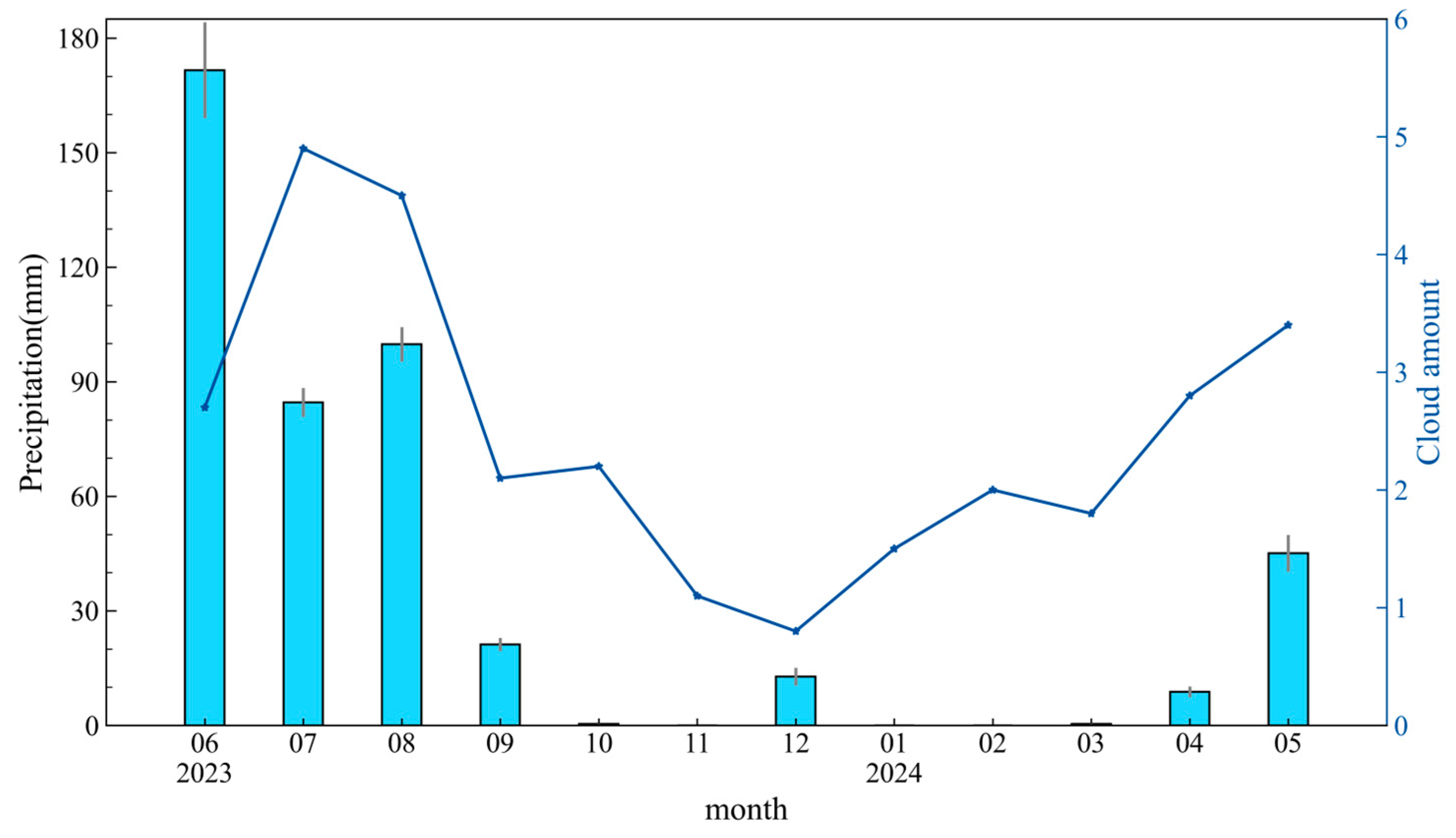
Influenced by the plateau monsoon system [65,66,67], ZULS exhibits a pronounced contrast between dry and wet seasons. As indicated by AWOS observations (Figure 2), precipitation during the period from June 2023 to May 2024 was mainly concentrated in June–August 2023, with monthly totals exceeding 80 mm. In contrast, precipitation was scarce in the remaining months. In particular, from October 2023 to April 2024, only a few months recorded precipitation amounts of less than 20 mm, while precipitation began to increase again in May 2024. The annual variation in cloud cover closely corresponds to the precipitation pattern. These characteristics are consistent with the climatological classification of typical dry and wet seasons and their transition periods at ZULS based on long-term statistics [68]. Considering the data gaps in the FC-III CDWL caused by power system failures, as well as the substantial degradation of CDWL data quality during precipitation events, this study focuses on the period from October 2023 to May 2024. This interval includes the dry season (November 2023–April 2024) and partially covers the transitional phases associated with the onset (May 2024) and withdrawal (October 2023) of the plateau monsoon. According to airport operational statistics, these months also correspond to periods with a high occurrence of wind shear events.

2.3. CDWL Detection Performance Evaluation

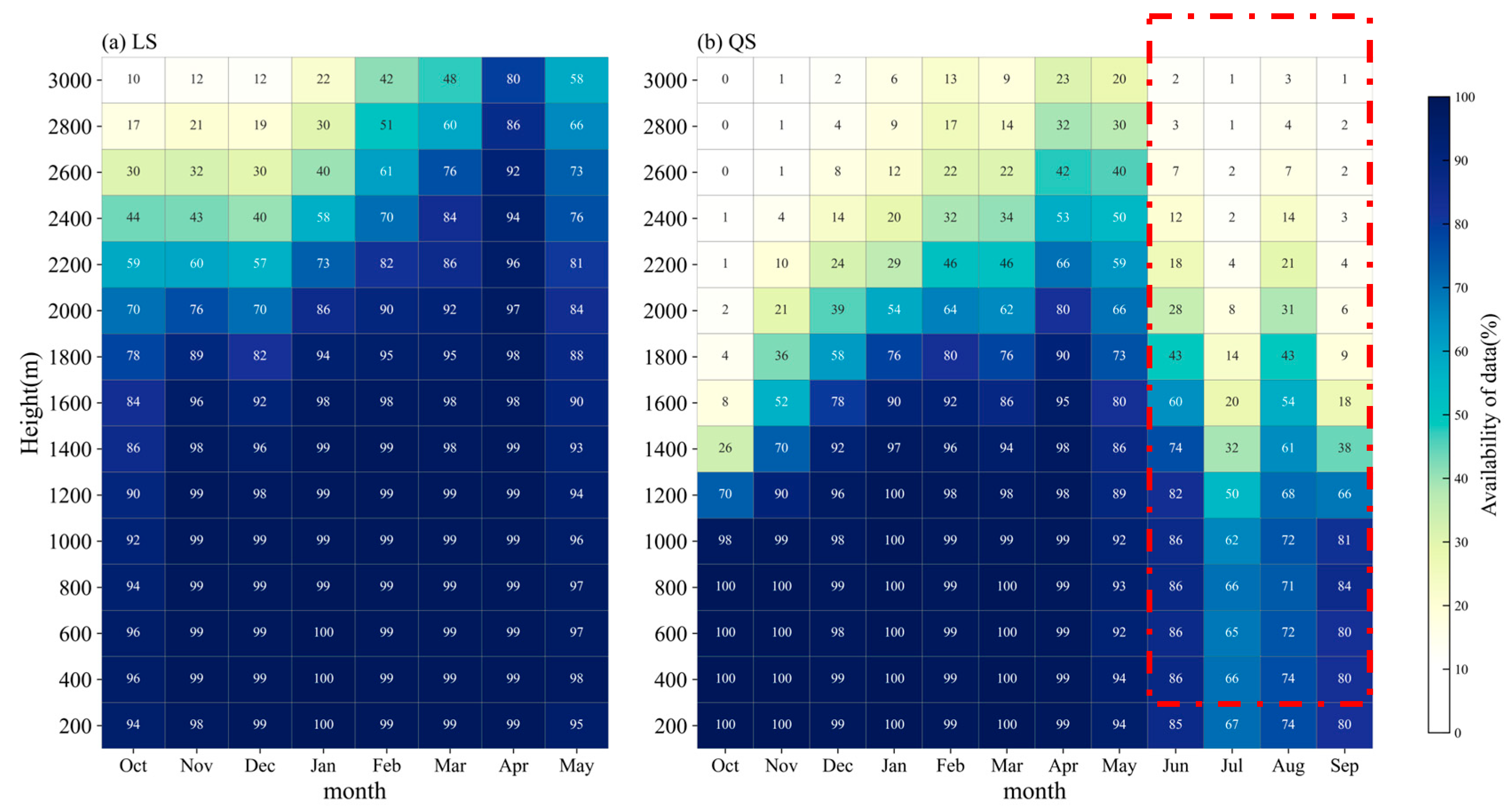
In addition to the direct degradation of CDWL data quality by precipitation, the carrier-to-noise ratio of CDWL is influenced by multiple factors, including PM2.5 concentration, relative humidity, and turbulence intensity [69]. As a result, the effective detection range of CDWL exhibits pronounced seasonal variability [46]. Given the marked seasonal adjustment of the large-scale circulation over the QTP, these influencing factors also vary accordingly and may introduce biases into the analysis. Therefore, it is necessary to evaluate the monthly data availability ratio (MDAR), defined as the ratio of valid data at a given height to the total number of CDWL scans. As shown in Figure 3, the MDAR profiles exhibit relatively small variability in the lower layers across different months but decrease rapidly above a certain height. Using an MDAR threshold of 60% to define the effective detection height of the CDWL, the seasonal variations in detection height at the two sites show broadly consistent patterns during the dry season, with both reaching their maximum values around May, corresponding to the dry-to-wet transition period. Based on the one-year observations at the QS, the effective detection height during the dry season is clearly higher than that during the wet season, showing an overall increasing tendency before dropping sharply after the onset of the wet season. Considering airport flight operations, which primarily focus on the height range below 1500 m, the MDAR values of both CDWLs generally exceed 60% at these heights in all months, indicating that the observational data are sufficiently reliable for the purposes of this study.

2.4. Methods

To characterize turbulence properties, the vertical velocity variance ( σ w 2 ) and skewness (s) are employed to quantify turbulence intensity and structural characteristics, respectively. They are calculated as follows [70]:
σ w 2 = w 2 ¯
s = w 3 ¯ w 2 ¯ 3 / 2
where w denotes the observed vertical velocity, w is the hourly mean vertical velocity, and w = w w represents the vertical velocity fluctuation. The magnitude of σ w 2 reflects the strength of turbulent kinetic energy, while skewness (s) characterizes the asymmetry of vertical motions and their dominant contributions. Positive values indicate predominance of upward motions during the averaging period, whereas negative values indicate dominance of downward motions.
The Wind Consistency Index (WCI) is defined as the ratio of the vector-mean wind speed to the scalar-mean wind speed within a given temporal or spatial interval, representing the directional concentration of the wind field [71,72]. Its formulation is expressed as
C j n = u ¯ 2 + v ¯ 2 S ¯ = 1 N i = 1 N u i 2 + 1 N i = 1 N v i 2 1 N i = 1 N u i 2 + v i 2
The value of C j n ranges from 0 to 1. When C j n approaches 1, the wind direction is highly concentrated and predominantly originates from a single direction; when it approaches 0, wind directions are uniformly distributed or exhibit a bimodal (180° opposing) distribution.
The vertical wind shear intensity, I strength , is used to quantify the vertical variation in horizontal wind and is defined as
I s t r e n g t h = u 1 u 2 2 + v 1 v 2 2 z 1 z 2
where z 1 and z 2 denote two different heights, and u 1 , u 2 and v 1 , v 2 represent the zonal and meridional wind components at the corresponding levels, respectively. According to the International Civil Aviation Organization (ICAO) recommendations, horizontal wind shear intensity is classified into four categories—light, moderate, strong, and severe (Table 2). This study focuses primarily on wind shear events of moderate intensity and above. To further investigate the mechanisms of wind shear formation, a wind speed shear index ( I shear ) and a wind veer index ( I veer ) are introduced:
I s h e a r = log V 2 / V 1 log z 2 / z 1 = log V 2 log V 1 log z 2 log z 1
I v e e r = M O D D 2 D 1 + 180,360 180 z 2 z 1
where V 1 and V 2 denote the total wind speeds at two different heights, and D 1 and D 2 represent the corresponding wind directions. The sign of I shear indicates whether wind speed increases or decreases with height, while the sign of I veer represents clockwise or counterclockwise rotation of wind direction with height. The absolute values of these indices reflect the magnitude of the vertical variation [73].

3. Results

3.1. Wind Field Comparison at Multiple Heights

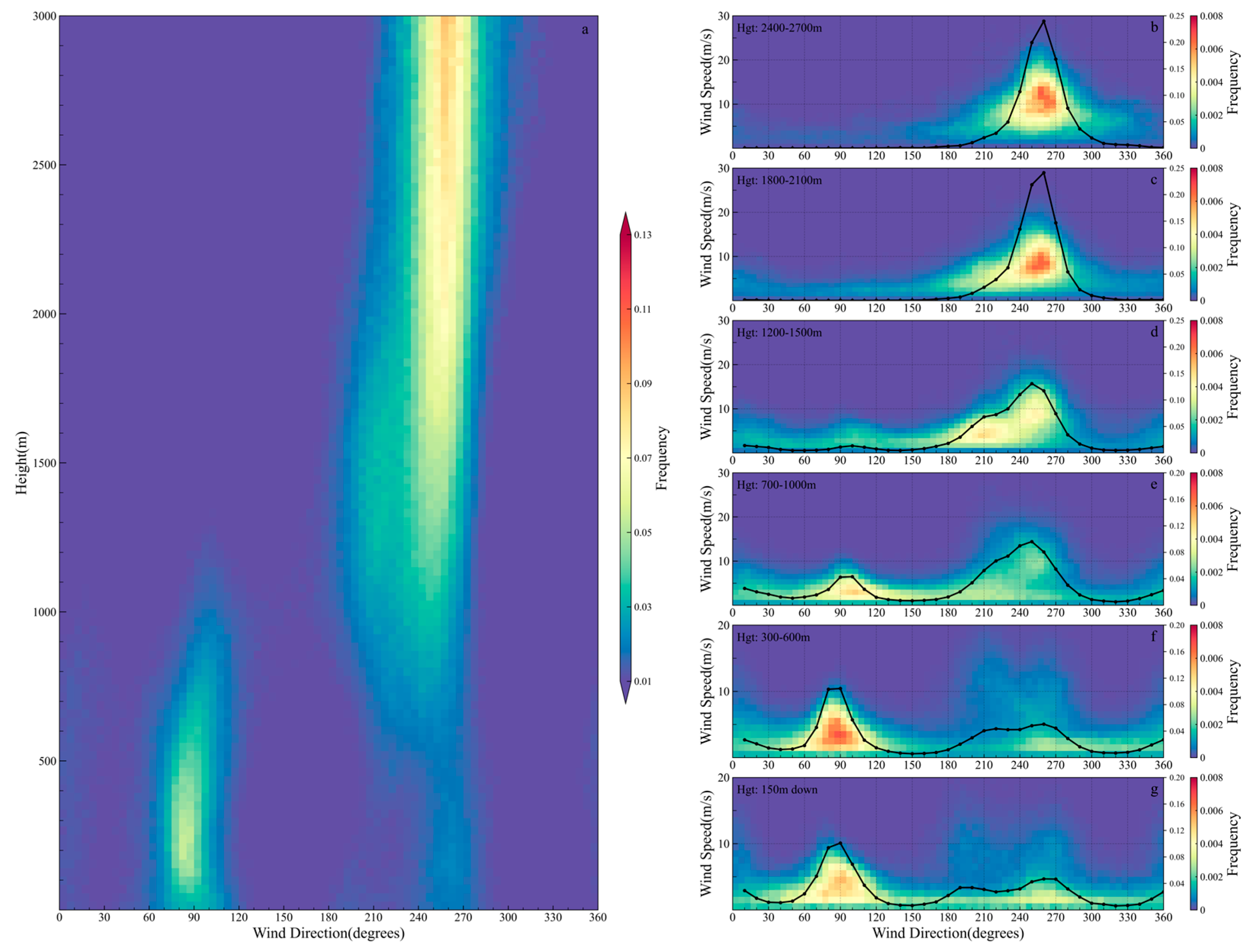
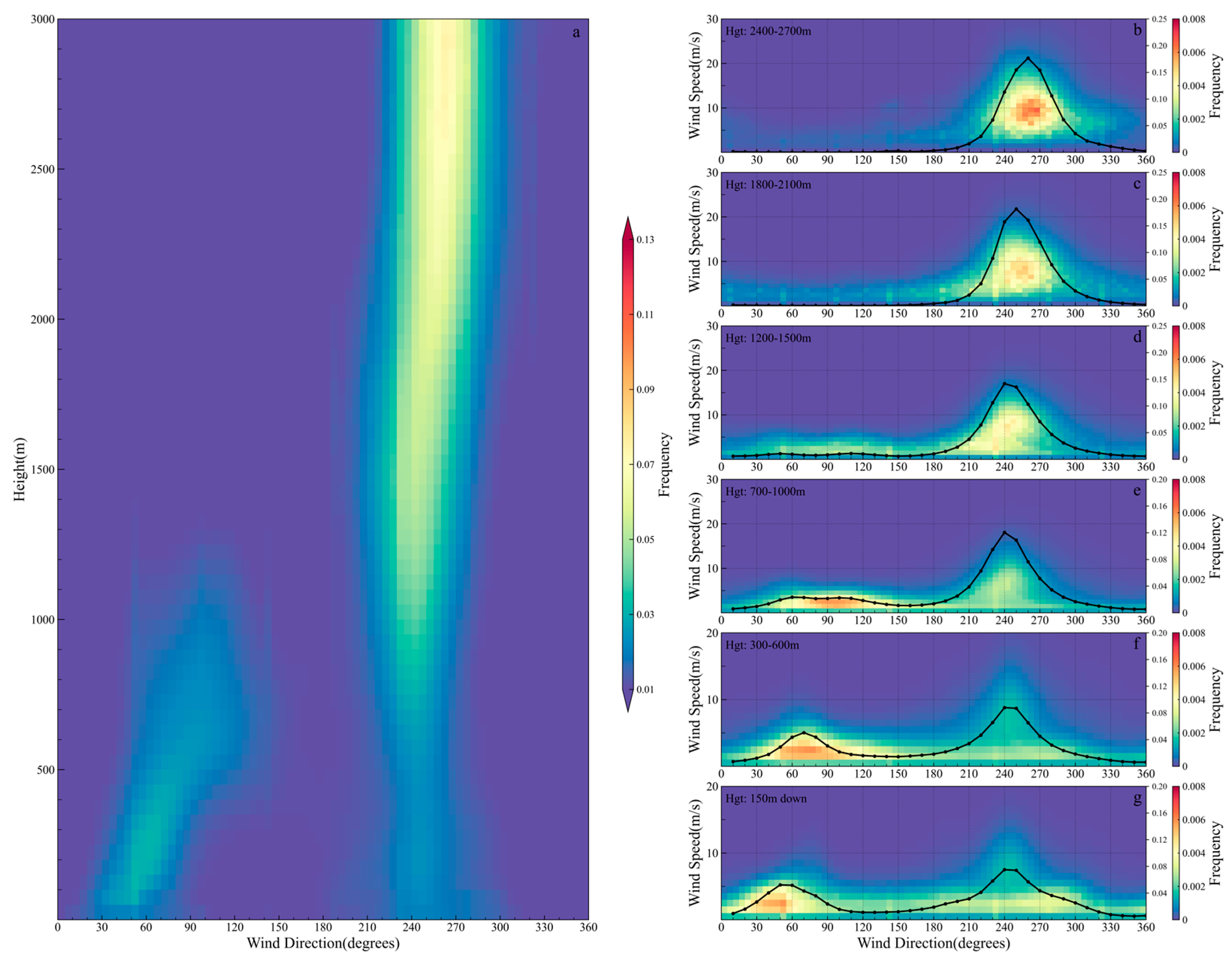
The horizontal wind field at the two sites within the Yarlung Zangbo River valley is strongly influenced by terrain, and the impact of upper-level winds is substantially weakened within the valley. As shown in Figure 4 and Figure 5, above the valley both sites are primarily controlled by the large-scale circulation, exhibiting consistent prevailing westerlies. In particular, above 2100 m, the frequency of westerly winds exceeds 50%, with wind directions mainly concentrated within the 210–270° sector. In contrast, the prevailing wind direction within the valley is nearly opposite to that aloft. Below 1300 m at the LS site, the prevailing wind direction within the valley aligns with the valley axis (Figure 4a). Up-valley winds (UV) occur most frequently, with directions concentrated between 70° and 110°, accounting for up to 31.1% of occurrences. The second most frequent component is the down-valley wind (DV), with wind directions concentrated around 270°, generally consistent with the upper-level prevailing flow. It accounts for 15.1% of the total occurrences, which is less than half that of the UV. In addition, winds approximately perpendicular to the valley axis (around 210° and 10°) are also observed, although with relatively low occurrence frequencies. Notably, the UV frequency peaks at approximately 300 m above the valley floor (about one-quarter of the valley depth) and decreases markedly toward both the valley bottom and the upper slope [74,75], indicating a pronounced channeling effect in the mid-valley layer.
Further analysis of prevailing wind directions and their corresponding wind speed frequencies at different heights reveals that above the surrounding mountains (2400–2700 m), dominant wind directions range from 240° to 270°, with wind speeds primarily between 10 and 15 m/s (Figure 4b). As wind speed increases, the wind direction stabilizes near 260°, and maximum wind speeds can reach 25 m/s. Considering the relatively low MDAR at these higher levels, the representativeness of the statistics may be limited. Therefore, the 1800–2100 m layer, characterized by higher MDAR values, is selected for comparison (Figure 4c). The wind direction distribution at this level is similar to that aloft, but the most frequent wind speeds decrease to 5–12 m/s, confirming the stability of the upper-level southwesterly flow. Within the elevation range corresponding to the southern ridge (1200–1500 m; Figure 4d), the wind field begins to show clear topographic modulation. The dominant wind directions are concentrated in four sectors. The influence of upper-level flow remains evident, as winds exceeding 10 m/s predominantly originate from around 260°. The second most frequent flow occurs near 210°, approximately perpendicular to the valley axis, with wind speeds generally around 5 m/s. Terrain analysis suggests that this flow results from southwesterly air currents bypassing the undulating terrain south of the valley. In addition, winds stronger than 10 m/s are occasionally observed from approximately 10° and 100°, although with relatively low frequency. These features indicate that this layer represents a transition zone where the large-scale circulation interacts with thermally driven valley circulations. Below the ridge level (Figure 4e–f), the prevailing wind direction rapidly shifts to easterly, with wind speeds primarily around 4 m/s. As wind speed increases, the direction becomes more tightly clustered near 90°. Notably, winds stronger than 4 m/s from 270°, 210°, and 10° also occur, with frequencies second only to those from 90°. The occurrence frequency and associated dominant wind speeds of the 270° winds decrease toward the valley floor, whereas those of the 210° winds show little variation with height. In contrast, the maximum wind speed associated with the 10° direction increases as height decreases. These characteristics suggest that different wind directions within the valley are governed by distinct formation mechanisms.
At the QS site, the prevailing wind direction in the upper layers is consistent with that at LS (Figure 5a), and the wind speed distribution is also comparable (Figure 5b,c). In contrast, at ridge level and below, the wind direction becomes more dispersed. Within the 1200–1500 m layer (Figure 5d), southwesterlies dominate, and winds exceeding 10 m/s are primarily concentrated around 240°, showing slight differences from the prevailing wind direction at LS. Below 1000 m, the wind field at QS is influenced by more complex terrain, and the prevailing wind direction shifts from east-southeasterly to northeasterly (Figure 5a). Specifically, in the upper valley (Figure 5e), the dominant wind direction ranges from 80° to 120°, although wind speeds are generally below 8 m/s. In conjunction with the local topography, this flow is clearly influenced by the up-valley wind (UV) in the Yarlung Zangbo River valley, but its intensity is notably weaker than that at LS. In the mid-valley layer (Figure 5f), the prevailing wind gradually veers toward the northeast, accompanied by an increase in maximum wind speed to above 10 m/s. In the lower valley (Figure 5g), the prevailing wind stabilizes around 50°, aligned with the orientation of the Lhasa River valley. Notably, below 1000 m, the extreme wind speed remains relatively stable with height, while the maximum wind speed increases markedly.
The wind field above QS is strongly modulated by the Y-shaped terrain configuration. Within the valley, wind directions are relatively dispersed, with northeasterlies dominating and primarily concentrated within the 40–80° sector. The dominant wind direction gradually rotates clockwise along the orientation of the surrounding mountain ranges. Above 500 m, easterly flow is able to surmount the ridge separating the two valleys, and its frequency increases sharply to 25.9%, becoming the dominant component at QS. As height increases, the topographic constraint weakens, leading to a more dispersed directional distribution. Meanwhile, southwesterlies gradually increase in frequency and become comparable to easterlies at approximately 900 m. Overall, although the vertical variation in the wind field above the valley is similar at the two sites, notable differences exist in directional distribution. For example, the frequency of west-southwesterly flow aloft is significantly higher at QS than at LS. Furthermore, the transition of the dominant wind direction occurs at approximately 600–800 m above the valley at LS, whereas at QS it occurs at around 300 m.
Above 2000 m within the terminal area, strong winds are concentrated within the 240–270° sector. The maximum wind speed at LS reaches up to 30 m/s, which is substantially higher than that at QS (Figure 4b–c and Figure 5b–c). In the lower half of the valley (approximately below mid-valley height) at LS, strong winds are concentrated within the 70–100° sector. Below 150 m, due to near-surface friction, UV wind speeds are generally 2–6 m/s; with increasing height, the frictional effect weakens while the canyon channeling effect intensifies, resulting in UV wind speeds increasing to 3–8 m/s. Below 600 m, strong south–southwesterly winds and strong DV events are also observed, with maximum wind speeds reaching 20 m/s (Figure 4f–g). In the upper valley and above, the dominant strong-wind direction gradually shifts from 90–120° to 240–270°, and the maximum wind speed associated with south–southwesterlies reaches 15 m/s (Figure 4d–e).
In comparison, strong-wind directions within the QS valley are more dispersed. Near the surface (below 150 m), strong winds are mainly concentrated within the 30–60° sector, with maximum wind speeds of approximately 12 m/s. Within the 300–600 m layer, the strong-wind direction rotates clockwise to 50–100°. Between 700 and 1000 m, it further rotates to 80–120°, while wind speeds gradually decrease to around 10 m/s (Figure 5e–g). From above the valley to below 2000 m, strong-wind directions are primarily confined to the 240–270° sector, indicating that the strong-wind structure at QS is relatively simple compared with that at LS.

3.2. Diurnal Variations in Wind Fields and Driving Mechanisms

The above analysis indicates that complex terrain exerts a significant modulating effect on the wind field, leading to pronounced differences between the flow within the valley and that above the valley. Considering that terrain-induced thermal effects and boundary-layer processes exhibit strong diurnal variability, it is necessary to further investigate the temporal evolution of the wind field.
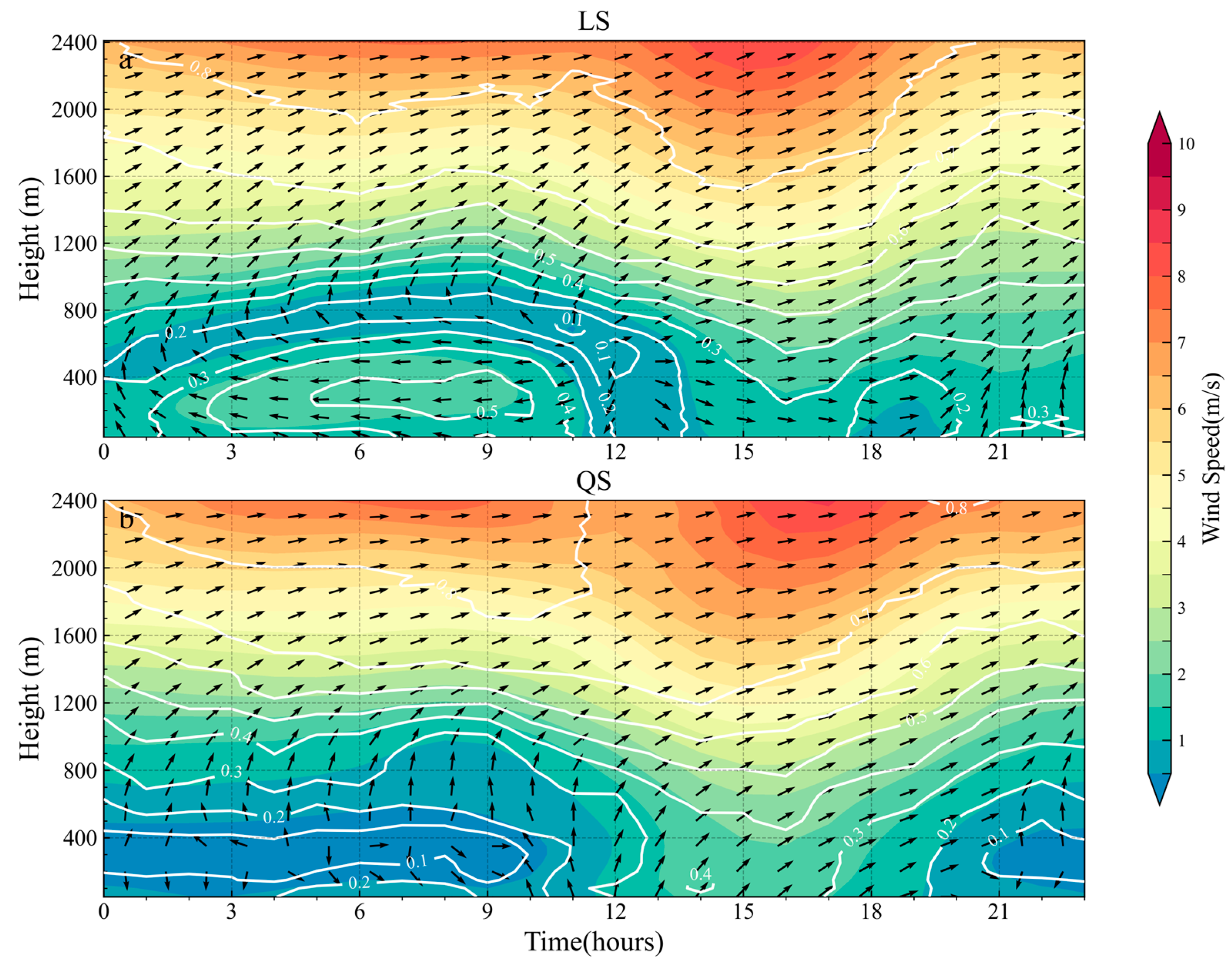
During the entire dry season, each wind profile is first decomposed into its vector components and then averaged. As shown in Figure 6a, above 1200 m at the LS site, wind direction remains relatively stable throughout the day, characterized by persistent southwesterly flow, with the Wind Consistency Index (WCI) consistently exceeding 0.5. In contrast, below 1200 m, the wind field exhibits a pronounced diurnal cycle.
From 01:00 to 05:00 Beijing Time (BJT), the up-valley wind (easterly) within the valley progressively deepens and intensifies. Taking the 0.3 WCI contour as a reference, the easterly layer develops from approximately 200 m at 01:00 to about 600 m by 05:00. Between 06:00 and 10:00 BJT, the up-valley wind reaches its daily maximum. The WCI in the mid-valley reaches up to 0.5, indicating that this period corresponds to the most stable valley-wind regime of the day. Notably, a quasi-calm transition layer with a thickness of approximately 200–300 m exists between the easterly flow within the valley and the overlying westerlies. This layer corresponds to a low-WCI region (<0.2). From 11:00 BJT onward, the quasi-calm transition layer rapidly descends to the surface, forming a near-calm condition extending from the ground to about 800 m, which persists until approximately 14:00 BJT.
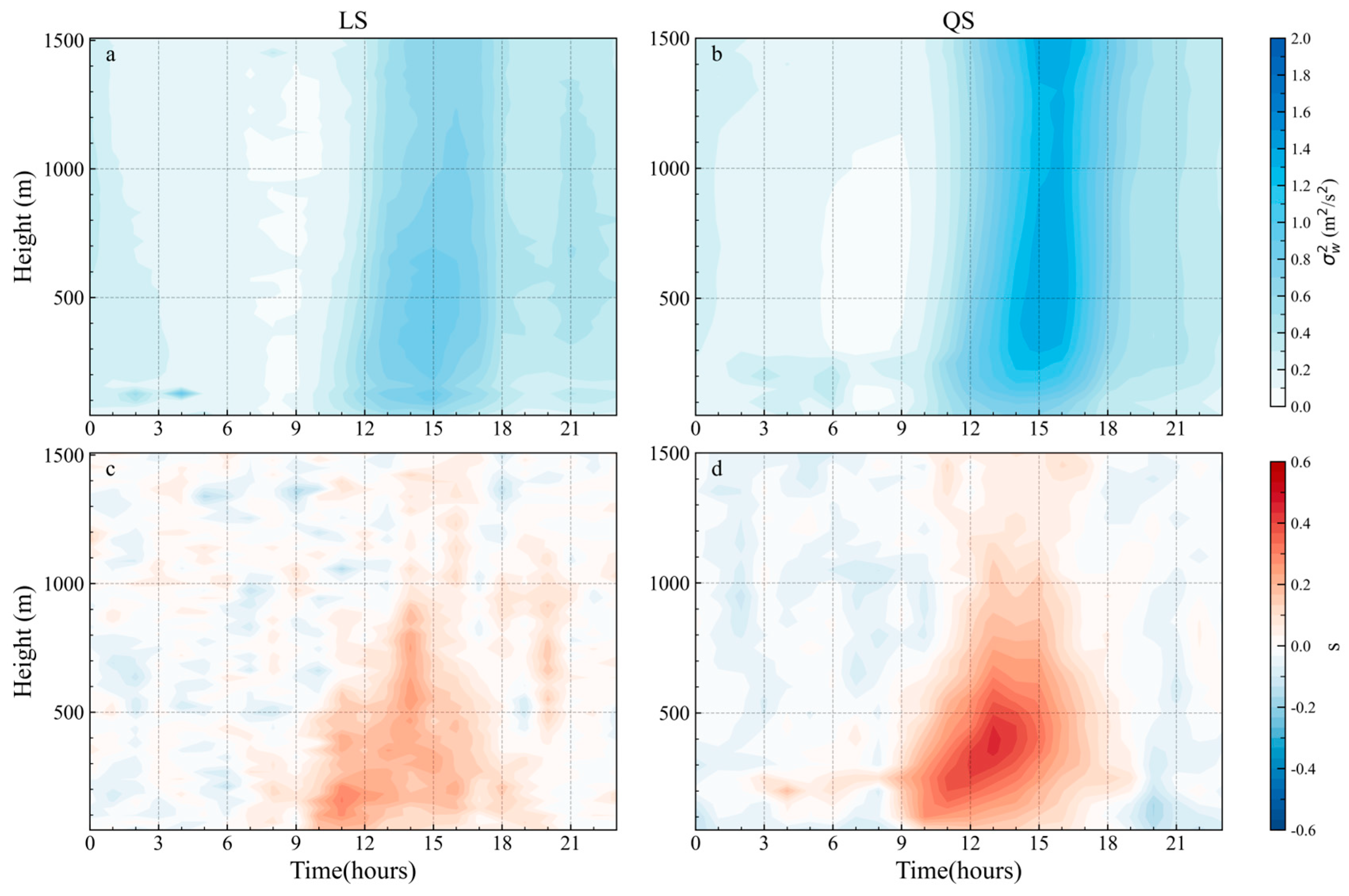
After 10:00 BJT, the southwesterly flow aloft gradually extends downward. By around 16:00, it reaches a height of approximately 500 m. This leads to an increase in low-level wind speed and improved directional stability. However, the downward penetration is limited and does not reach the valley floor. In terms of turbulence (Figure 7a), the strongest activity at LS occurs between 14:00 and 17:00 BJT, with a peak around 15:00 BJT. The core of strong turbulence is located near 500 m and extends upward above the valley height. It is mainly driven by surface heating in the afternoon. However, despite the notable turbulence, the narrow terrain restricts vertical mixing. As a result, the downward transport of momentum from aloft is suppressed at LS and its effect on near-surface wind enhancement remains limited.
In contrast, the upper-level winds at QS are similar to those at LS. They are dominated by strong southwesterly flow, with the WCI generally exceeding 0.7, indicating a stable wind structure aloft. However, the diurnal variation in the valley wind at QS differs markedly from that at LS. Before 12:00 BJT, the mean wind speed below 400 m is less than 1 m/s, and the WCI is below 0.2. Above 400 m, wind speed increases with height. The mean wind direction gradually shifts from southerly to southwesterly aloft. Accordingly, the WCI increases steadily with height. This pattern indicates that QS is influenced by a different local circulation from LS during the morning.
After 10:00 BJT, the southwesterly flow aloft gradually extends downward. The WCI = 0.3 contour descends toward the surface. It reaches the ground around 12:00 BJT and persists until about 17:00 BJT. Surface wind speed and WCI both peak around 16:00 BJT. Compared with LS, the valley winds at QS in the afternoon are stronger and more stable under southwesterly flow. This suggests a more pronounced downward transport of momentum at QS.
Considering that the maximum detection altitude range (MDAR) of the CDWL is limited at higher levels, additional analysis is conducted to evaluate the influence of background winds. Wind speed at 1800 m from the Lhasa radiosonde station at 08:00 BJT is selected. It is correlated with lidar-derived wind speeds at 500 m in the valley at both LS and QS (Table 3). The results show that the periods of high correlation are consistent with the timing of momentum transport identified in Figure 6, with a maximum around 16:00. The correlation coefficients at QS are significantly higher than those at LS. This further confirms that the depth of momentum transport differs between the two sites.
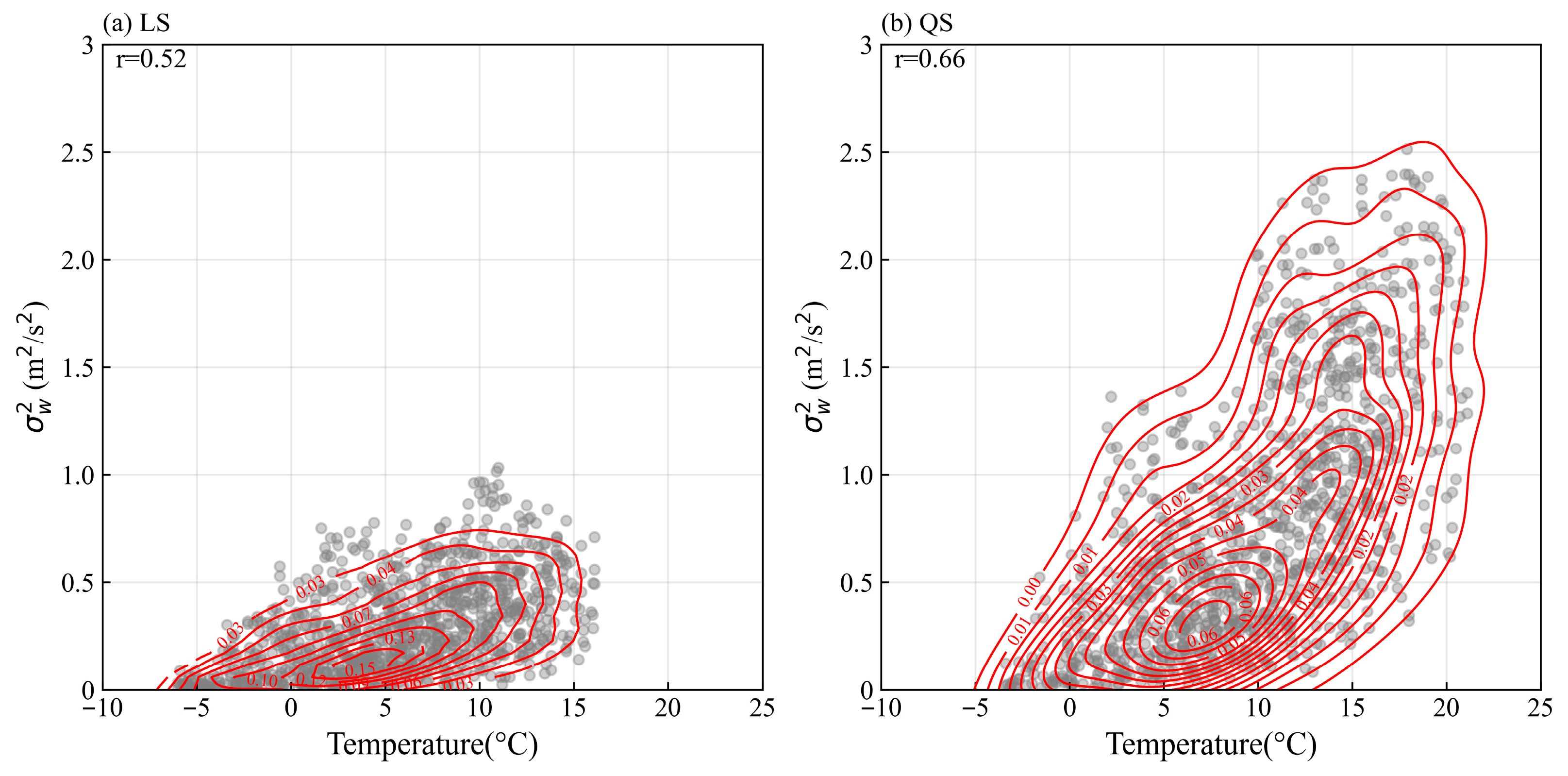
In terms of turbulence (Figure 7a,b), the most active period occurs between 14:00 and 17:00 BJT, with a peak around 15:00 BJT. At LS, the core of strong turbulence is located near 500 m in the middle of the valley and weakens with height. In contrast, turbulence at QS is stronger. The core of strong turbulence extends from the lower valley to above the valley height. The timing of turbulence is closely related to strong surface heating in the afternoon. As shown in Figure 8, turbulence intensity at both sites increases with temperature. When temperature exceeds 5 °C, turbulence intensity increases approximately linearly with further warming. The temperature at QS is generally higher than at LS. Accordingly, turbulence at QS is more intense and more closely related to temperature. These results indicate that thermally driven turbulence in the afternoon plays a key role in the downward transport of momentum. The skewness coefficient (Figure 7c,d) shows that upward motion is also most active in the afternoon. Unlike turbulence intensity, the skewness at both sites begins to increase significantly around 11:00 BJT. The region of large values then ascends and reaches its maximum height around 14:00 BJT. A comparison of vertical velocity skewness and turbulence intensity suggests that upward motion precedes the development of low-level turbulence at both sites, indicating its potential as an early signal of turbulence evolution.

3.3. Wind Shear Charateristics and Cause Analysis

The above comparison indicates that wind fields at different locations within the valley are significantly influenced by both thermal forcing and terrain constraints. As a result, wind shear exhibits distinct differences in both temporal and vertical distributions.
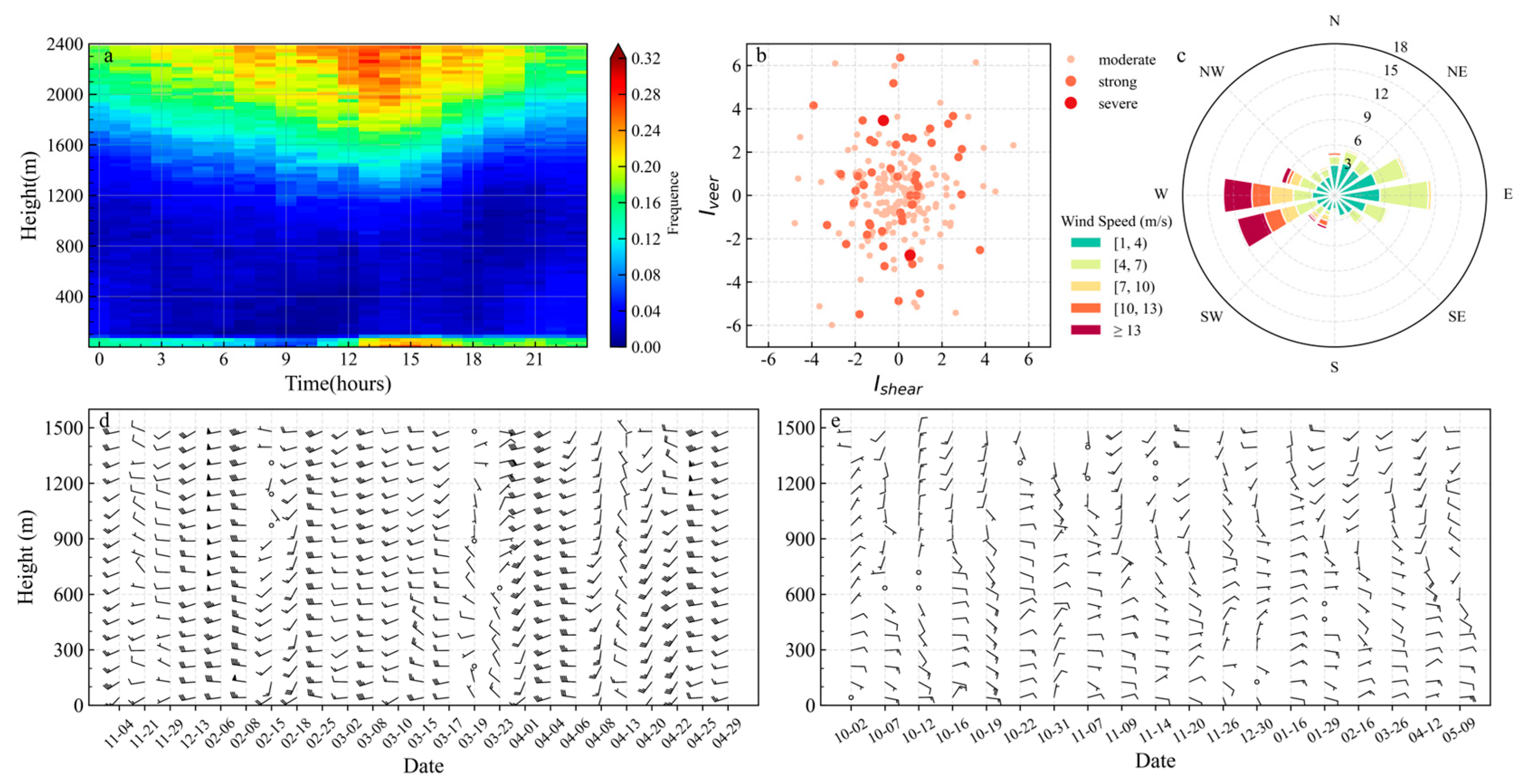
At LS, wind shear is mainly concentrated above 1500 m and in the near-surface layer. It shows a persistent high-frequency occurrence above 1800 m and reaches a peak of about 32% at 15:00 BJT (Figure 9a). Under the influence of strong momentum transport from upper-level winds in the afternoon, wind shear gradually extends downward. By 14:00 BJT, it can reach as low as approximately 1200 m. The occurrence frequency increases with height. In the near-surface layer, wind shear frequency decreases gradually from early morning and reaches a minimum around 09:00 BJT (about 5%). It then increases rapidly after 13:00 BJT and remains above 20% until 17:00 BJT, with a peak of about 25%. This period is generally consistent with enhanced turbulence activity. It indicates that thermally induced turbulence and the associated vertical mixing are important contributors to the increased near-surface wind shear frequency at LS [51].
The shear index at 15:00 BJT, when near-surface wind shear is most frequent at LS (Figure 9b), shows that both wind speed and wind direction vary with height. The variation in wind direction is slightly stronger than that of wind speed. The wind rose at 15:00 BJT (Figure 9c) shows that the prevailing winds at LS are westerly, west-southwesterly, and easterly. Westerly winds exhibit the highest wind speeds, mostly exceeding 10 m/s, while easterly winds are mainly within 4–7 m/s. This indicates strong vertical variation in both wind speed and direction in the near-surface layer. Further analysis of vertical profiles under different wind regimes shows that when westerly winds dominate near the surface (Figure 9d), the vertical wind speed gradient is more pronounced. The maximum wind speed change reaches about 0.4 m/s per meter of height. However, wind direction changes are relatively weak. When easterly winds dominate (Figure 9e), the maximum wind speed shear index (Ishear) is only about 0.14 s−1, while the maximum wind direction shear index (Iveer) reaches 0.9°/m, which is significantly stronger than Ishear. Therefore, near-surface wind shear at LS around 15:00 BJT is strongly dependent on wind direction. Under westerly conditions, afternoon surface heating enhances vertical wind speed gradients, leading to wind shear. Under easterly conditions, wind shear is mainly caused by rapid wind direction veering with height.
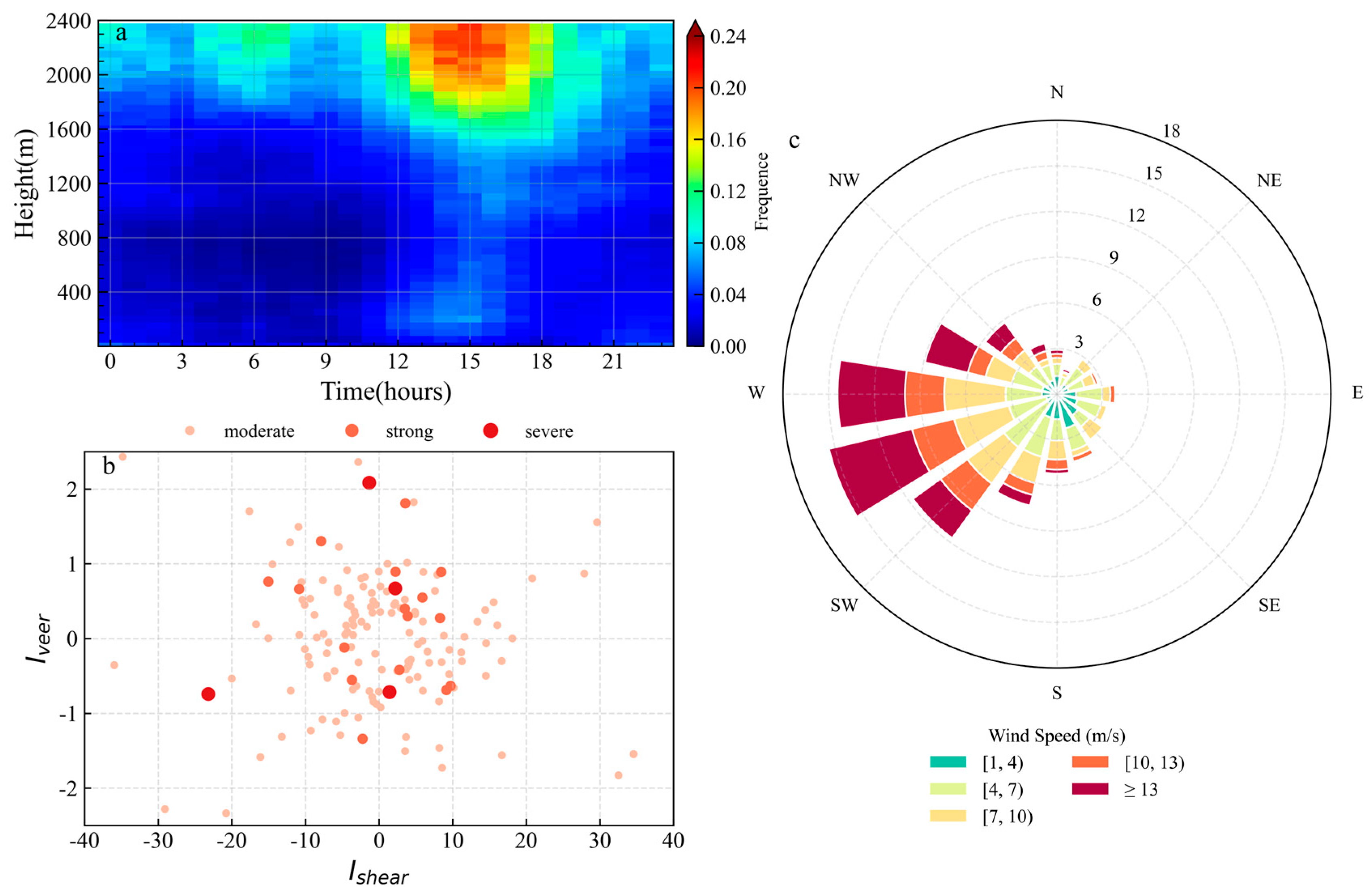
In contrast, the frequency of wind shear at QS is lower than at LS, and its duration is shorter. However, the vertical extent of high-frequency wind shear is larger (Figure 10a). Above 1500 m, the diurnal variation is similar to that at LS, with a high-frequency period from 13:00 to 17:00 BJT and a peak of about 24%. This high-frequency region also extends downward, leading to significantly enhanced wind shear around 1000 m compared to other time periods. In the middle and lower valley, wind shear frequency is relatively higher (about 7%) during 13:00–16:00 BJT, which is in clear contrast to the near-surface characteristics at LS. After 13:00 BJT, the high-frequency wind shear region expands upward. From 15:00 to 16:00 BJT, it becomes nearly vertically continuous.
When aircraft pass over QS during the turning phase, they are at an altitude of about 1000 m above ground level. Wind shear frequency reaches its maximum at 16:00 BJT, with a value of about 10%. The shear indices at 1000 m at QS (Figure 10b) differ significantly from those in the near-surface layer at LS. The wind speed shear index (Ishear) generally exceeds 5 s−1, while the wind direction shear index (Iveer) remains below 3°/m. This indicates strong vertical wind speed variation with height. The wind rose at 16:00 BJT (Figure 10c) shows that winds at QS are concentrated in the westerly sector, indicating that strong winds mainly originate from the west. Combined with the strongest momentum transport and turbulence activity occurring around 16:00 BJT, it is inferred that continuous downward momentum transport and enhanced turbulence jointly provide favorable dynamic conditions for strong vertical wind speed gradients, promoting wind shear formation.
In summary, wind shear formation in the Yarlung Zangbo River valley is closely related to thermal processes and prevailing wind directions. For operational flight safety at Lhasa Airport, special attention should be paid to wind shear associated with enhanced wind speed gradients under westerly conditions when aircraft pass over QS or approach landing during 13:00–16:00 BJT.

4. Discussion

Lhasa Airport is located on the QTP. The surface is characterized by strong radiative heating, which favors the formation of thermally driven valley-mountain wind circulations. Valley winds typically exhibit upslope flow during the daytime and downslope flow at night. In valleys oriented northwest–southeast, a clear diurnal cycle of upslope flow during the day and downslope flow at night has been observed. In the Donghe River valley, thermally driven upslope winds often reverse to downslope winds around 10:00 local time [29,30]. In contrast, in the Yarlung Zangbo River valley (LS), a stable upslope easterly flow mainly occurs before 10:00 BJT (which is the same as local time), and it shifts to a downslope westerly flow after 13:00 BJT. The transition time of the valley wind is significantly delayed. This difference suggests that the diurnal cycle of solar radiation may vary with valley orientation. As a result, asymmetric heating occurs, leading to changes in local circulation structures. In the afternoon, downward transport of upper-level momentum in the Yarlung Zangbo River valley may also differ from that in northwest–southeast oriented valleys. Therefore, a quantitative assessment of the relative contributions of thermal and dynamical processes in the Yarlung Zangbo River valley is required.
Due to the complex terrain of the Yarlung Zangbo River valley, airflow at LS and QS is constrained by different topographic conditions. Their local circulations and momentum transport characteristics show significant differences. This indicates that valley orientation, width, depth, and slope all influence local circulation structures. This observation supports the conclusions of Whiteman [76].
In addition, the maximum wind speed at LS occurs at approximately one-half to two-thirds of the valley depth. This is consistent with results from studies in the east–west oriented wide valley of the Kunlun Mountain [77]. It indicates that surface friction has a strong weakening effect on near-surface airflow. From the perspective of flight operations, attention should be paid to strong easterly winds at LS in the morning and westerly winds in the afternoon. In the valley confluence region, special attention should be given to wind shear induced by downward momentum transport during the afternoon.

5. Conclusions

This study utilized dry season datasets obtained from two CDWLs deployed over different terrain types to comparatively investigate the vertical structure of the wind field and turbulence characteristics within the terminal area of ZULS in the southeastern QTP. The formation mechanisms of wind shear under different aircraft operational conditions were also analyzed. The main findings can be summarized as follows.
(1)
The vertical structure of wind fields inside and above the Yarlung Zangbo River valley is significantly influenced by terrain, showing pronounced spatial differences. Above the valley, the wind field is dominated by large-scale circulation, with both sites exhibiting westerly prevailing winds. Strong winds are concentrated between 240° and 270°, and upper-level wind speeds at LS are generally higher than those at QS. Below the valley, the prevailing wind directions are almost opposite to those aloft, indicating a clear terrain modulation effect. At LS, the canyon channeling effect is significant, with strong winds primarily concentrated around 90°, and additional contributions from winds around 270°, 210°, and 10° are also observed. At QS, the Y-shaped terrain structure leads to a more dispersed wind direction distribution, with the valley dominated by northeasterly winds, and the prevailing wind direction rotates clockwise along the mountain ridges. The heights at which prevailing wind directions shift differ significantly between the two sites, occurring at approximately 600–800 m at LS and around 300 m at QS, indicating that terrain exerts a decisive influence on the vertical structure and distribution of strong winds within the valley.
(2)
The overall wind field in the terminal area exhibits a structure characterized by stable upper-level southwesterly flow throughout the day and pronounced diurnal variations in the lower levels. However, the depth of upper-level momentum penetration and the response of the low-level wind field differ significantly between the two locations. At LS, the wind field below 1200 m shows significant diurnal variation. A stable easterly layer dominates in the morning. Wind direction is most stable and wind speed is highest from 06:00 to 10:00 BJT. A transition layer with a thickness of about 200–300 m exists between the easterly flow and the southwesterly flow aloft. Below 400 m at QS, wind direction is highly variable and wind speed is weak. A shallow relatively stable layer appears from 04:00 to 09:00 BJT. In the afternoon (14:00–17:00 BJT), under enhanced surface heating, downward transport of southwesterly momentum from aloft leads to a significant increase in wind speed within the valley and an increase in directional stability. The flow also shows a more pronounced westerly component. At LS, the narrow valley terrain limits the downward transport of momentum. The influence does not reach the valley floor. In contrast, at QS, the relatively open terrain allows upper-level momentum to reach the surface directly. This results in a marked increase in near-surface wind speed and a modification of wind direction structure. Turbulence characteristics further indicate that strong turbulence at both sites mainly occurs between 14:00 and 17:00 BJT. It is closely related to enhanced surface heating in the afternoon. This reflects a clear thermally driven process. The turbulence intensity at QS is stronger, indicating a more pronounced response to thermal forcing.
(3)
The frequency of wind shear at LS is significantly higher than at QS. Above 1500 m, wind shear occurs frequently between 13:00 and 17:00 BJT. At LS, the maximum occurrence frequency reaches about 32% at 15:00 BJT, while at QS it is about 24%. Wind shear at QS can extend downward from upper levels. At 16:00 BJT, high-level wind shear descends to around 1000 m, while low-level wind shear extends upward. The two layers become vertically connected between 15:00 and 16:00 BJT, and the frequency at 1000 m reaches a peak of about 10%. Near-surface wind shear at LS is also pronounced, with a maximum frequency at 15:00 BJT. Its formation is closely related to the prevailing wind direction. Under prevailing westerly conditions, afternoon surface heating enhances the vertical wind speed gradient. Under easterly conditions, wind shear is mainly caused by rapid wind direction rotation with height. In practical operations at Lhasa Airport, when aircraft pass over QS or approach landing around 16:00, attention should be paid to downward momentum transport and strong turbulence, which may lead to wind shear.

Author Contributions

Conceptualization, J.W.; methodology, J.W. and Z.S.; software, Z.S.; validation, J.W. and Z.S.; formal analysis, J.W. and Z.S.; investigation, Z.S.; resources, J.W.; data curation, Z.S.; writing—original draft preparation, Z.S.; writing—review and editing, J.W.; visualization, Z.S. and M.L.; supervision, J.W.; project administration, J.W., T.Z. and W.L.; funding acquisition, X.L. All authors have read and agreed to the published version of the manuscript.

Funding

This research was supported by “the Fundamental Research Funds for the Central Universities” (25CAFUC01005, JCZX2024ZZ15, TD2025CZ08).

Data Availability Statement

The data used in this study are available upon request from the corresponding author due to privacy restrictions.

Acknowledgments

We would like to express our special thanks to Wang Qinggui and Zhao Xiwei from the Civil Aviation Administration of China Xizang Air Traffic Center for their support in instrument maintenance and data collection. We also thank the reviewers for their thorough comments that helped to improve the manuscript.

Conflicts of Interest

The authors declare no conflicts of interest.

References

  1. Filippone, A. Flight Performance of Fixed and Rotary Wing Aircraft; Elsevier Ltd.: Oxford, UK, 2006; pp. 77–108. [Google Scholar]
  2. Sadraey, M. Aircraft Performance: An Engineering Approach; CRC Press: Boca Raton, FL, USA, 2016; pp. 109–155. [Google Scholar]
  3. Huang, Y. Aeronautical Meteorology; Southwest Jiaotong University Publishing House: Chengdu, China, 2011; pp. 1–348. ISBN 9787564312510. (In Chinese) [Google Scholar]
  4. Liu, X. Based on Airborne Radar Microburst Wind Shear Signal Processing and Simulation. Sci. Technol. Eng. 2015, 15, 221–224. (In Chinese) [Google Scholar]
  5. Pan, J.; Chen, B.; Hua, X. Calculation and Analysis of Landing Performance of Plateau Airport. Sci. Technol. Eng. 2020, 20, 2093–2098. (In Chinese) [Google Scholar]
  6. Jentsch, H.; Weidinger, J. Spatiotemporal Analysis of Valley Wind Systems in the Complex Mountain Topography of the Rolwaling Himal, Nepal. Atmosphere 2022, 13, 1138. [Google Scholar] [CrossRef]
  7. Cohn, S.A. Flow in complex terrain: Observations by radar wind profilers and anemometers near Juneau, Alaska. J. Appl. Meteorol. Clim. 2004, 43, 437–448. [Google Scholar] [CrossRef]
  8. Zou, Y.; Yue, P.; Liu, Q.; He, X.; Wang, Z. Wind Field Characteristics of Complex Terrain Based on Experimental and Numerical Investigation. Appl. Sci. 2022, 12, 5124. [Google Scholar] [CrossRef]
  9. Wang, J.; Zhang, L.; Wang, T.J.; Bao, J.; Cao, X.J.; Zhang, B.D.; Zhou, Z.Y. Comparative Analysis of Mountain–Valley Wind Circulation Characteristics over Semi-Arid Areas Nearby Lanzhou. J. Arid Meteorol. 2012, 30, 169–177. (In Chinese) [Google Scholar]
  10. Hawkes, H.B. Mountain and Valley Winds with Special Reference to the Diurnal Mountain Winds of the Great Salt Lake Region. Ph.D. Thesis, Ohio State University, Columbus, OH, USA, 1947. [Google Scholar]
  11. Whiteman, C.D.; Barr, S. Atmospheric Mass Transport by Along-Valley Wind Systems in a Deep Colorado Valley. J. Appl. Meteorol. Climatol. 1986, 25, 1205–1212. [Google Scholar] [CrossRef]
  12. Leukauf, D.; Gohm, A.; Rotach, M.W.; Wagner, J.S. The Impact of the Temperature Inversion Breakup on the Exchange of Heat and Mass in an Idealized Valley: Sensitivity to the Radiative Forcing. J. Appl. Meteorol. Climatol. 2015, 54, 2199–2216. [Google Scholar] [CrossRef]
  13. Largeron, Y.; Staquet, C. Persistent Inversion Dynamics and Wintertime PM10 Air Pollution in Alpine Valleys. Atmos. Environ. 2016, 135, 92–108. [Google Scholar] [CrossRef]
  14. Kossmann, M.; Vögtlin, R.; Corsmeier, U.; Vogel, B.; Fiedler, F.; Binder, H.J.; Kalthoff, N.; Beyrich, F. Aspects of the convective boundary layer structure over complex terrain. Atmos. Environ. 1998, 32, 1323–1348. [Google Scholar] [CrossRef]
  15. Alexa, A. Atmospheric Boundary Layer Structure at the Head of a Small Alpine Tributary Valley Detected with Uncrewed Aerial Systems (UAS). Ph.D. Thesis, University of Innsbruck, Innsbruck, Austria, 2023. [Google Scholar]
  16. Wu, B.; Miao, J.; Feng, W. Impact of Land Cover Change on Mountain Circulation over the Hainan Island, China. Sustainability 2022, 14, 11794. [Google Scholar] [CrossRef]
  17. Zhu, C.; Ullah, W.; Wang, G.; Lu, J.; Li, S.; Feng, A.; Hagan, D.F.T.; Jiang, T.; Su, B. Diagnosing Potential Impacts of Tibetan Plateau Spring Soil Moisture Anomalies on Summer Precipitation and Floods in the Yangtze River Basin. J. Geophys. Res. Atmos. 2023, 128, e2022JD037671. [Google Scholar] [CrossRef]
  18. Yu, Y.; Chen, S.H.; Huang, C.C.; Paw U, K.T.; Schmitt, C.; Zhao, Z.; Suvočarev, K.; Kisekka, I.; Pyles, R.D.; Avise, J. A Numerical Study of the Agricultural Irrigation Effects on Summer Soil Moisture and Near-Surface Meteorology in California’s Central Valley. J. Hydrometeorol. 2025, 26, 641–659. [Google Scholar] [CrossRef]
  19. Naranjo-Mendoza, C.; Wright, A.J.; Oyinlola, M.A.; Greenough, R.M. A Comparison of Analytical and Numerical Model Predictions of Shallow Soil Temperature Variation with Experimental Measurements. Geothermics 2018, 76, 38–49. [Google Scholar] [CrossRef]
  20. Zhong, L.; Ma, Y.; Xue, Y.; Piao, S. Climate Change Trends and Impacts on Vegetation Greening over the Tibetan Plateau. J. Geophys. Res. Atmos. 2019, 124, 7540–7552. [Google Scholar] [CrossRef]
  21. Rosales, A.G.; Junquas, C.; da Rocha, R.P.; Condom, T.; Espinoza, J.C. Valley–Mountain Circulation Associated with the Diurnal Cycle of Precipitation in the Tropical Andes (Santa River Basin, Peru). Atmosphere 2022, 13, 344. [Google Scholar] [CrossRef]
  22. De Wekker, S.F.J.; Godwin, K.S.; Emmitt, G.D.; Greco, S. Airborne Doppler Lidar Measurements of Valley Flows in Complex Coastal Terrain. J. Appl. Meteorol. Climatol. 2012, 51, 1558–1574. [Google Scholar] [CrossRef]
  23. Wang, K.; Lyu, X.; Huang, J.; Luo, M.; Xu, F. Influence of Topography and the Underlying Surface of the Bohai Sea on Wind and Gust Forecasts. Earth Space Sci. 2023, 10, e2022EA002705. [Google Scholar] [CrossRef]
  24. Yu, B.; Zhu, B.; Miao, S.; Kang, H.; He, X.; Liu, H.; Liang, Z.; Chen, F. Observational Signal of the Interaction Between Mountain–Plain Wind and Urban Breeze under Weak Synoptic Systems. J. Geophys. Res. Atmos. 2021, 126, e2020JD032809. [Google Scholar] [CrossRef]
  25. Shi, T.; Yang, Y.; Qi, P.; Lolli, S. Diurnal Variation in an Amplified Canopy Urban Heat Island During Heat Wave Periods in the Megacity of Beijing: Roles of Mountain–Valley Breeze and Urban Morphology. Atmos. Chem. Phys. 2024, 24, 12807–12822. [Google Scholar] [CrossRef]
  26. Bischoff-Gauß, I.; Kalthoff, N.; Fiebig-Wittmaack, M. The Influence of a Storage Lake in the Arid Elqui Valley in Chile on Local Climate. Theor. Appl. Climatol. 2006, 85, 227–241. [Google Scholar] [CrossRef]
  27. Laiti, L.; Zardi, D.; De Franceschi, M.; Rampanelli, G. Atmospheric Boundary Layer Structures Associated with the Ora del Garda Wind in the Alps as Revealed from Airborne and Surface Measurements. Atmos. Res. 2013, 132, 473–489. [Google Scholar] [CrossRef]
  28. Yang, X.; Lü, Y.; Ma, Y.; Wen, J. Summertime Thermally-Induced Circulations over the Lake Nam Co Region of the Tibetan Plateau. J. Meteorol. Res. 2015, 29, 305–314. [Google Scholar] [CrossRef]
  29. Whiteman, C.D.; Doran, J.C. The Relationship Between Overlying Synoptic-Scale Flows and Winds within a Valley. J. Appl. Meteorol. 1993, 32, 1669–1682. [Google Scholar] [CrossRef]
  30. Adler, B.; Caicedo, V.; Butterworth, B.J.; Bianco, L.; Cox, C.J.; de Boer, G.; Gutman, E.; Intrieri, J.M.; Meyers, T.; Sedlar, J. The Short Life of Upvalley Wind in a High-Altitude Valley in the Colorado Rocky Mountains. J. Geophys. Res. Atmos. 2025, 130, e2025JD043455. [Google Scholar] [CrossRef]
  31. Ye, D.Z.; Gao, Y.X. Meteorology of the Qinghai-Xizang Plateau; Science Press: Beijing, China, 1979; ISBN 130311072. (In Chinese) [Google Scholar]
  32. Bai, H.Z.; Dong, A.X.; Li, D.L.; Fang, F. Temporal and Spatial Characteristics of Strong Wind and Dust Days in Qinghai-Xizang Plateau and along Qingzang Railway. Plateau Meteor. 2005, 24, 311–315. (In Chinese) [Google Scholar]
  33. Zhou, W.; Lou, W.; Huang, M.; Liu, J.; Liang, M. Two-Year Wind Field Measurements near the Ground at a Site of the Tibetan Plateau. J. Wind Eng. Ind. Aerodyn. 2024, 245, 105636. [Google Scholar] [CrossRef]
  34. Gao, Y.; Tang, M.; Luo, S.; Shen, Z.; Li, C. Some Aspects of Recent Research on the Qinghai–Xizang Plateau Meteorology. Bull. Am. Meteorol. Soc. 1981, 62, 31–35. [Google Scholar] [CrossRef]
  35. Wu, G.; Duan, A.; Liu, Y.; Mao, J.; Ren, R.; Bao, Q.; He, B.; Liu, B.; Hu, W. Tibetan Plateau Climate Dynamics: Recent Research Progress and Outlook. Natl. Sci. Rev. 2015, 2, 100–116. [Google Scholar] [CrossRef]
  36. Wu, G.; Liu, Y. Impacts of the Tibetan Plateau on Asian Climate. Meteorol. Monogr. 2016, 56, 7.1–7.29. [Google Scholar] [CrossRef]
  37. He, B.; Liu, Y.; Wu, G.; Wang, Z.; Bao, Q. The Role of Air–Sea Interactions in Regulating the Thermal Effect of the Tibetan–Iranian Plateau on the Asian Summer Monsoon. Clim. Dyn. 2019, 52, 4227–4245. [Google Scholar] [CrossRef]
  38. Wu, G.; Zhou, X.; Xu, X.; Huang, J.; Duan, A.; Yang, S.; Hu, W.; Ma, Y.; Liu, Y.; Bian, J. An Integrated Research Plan for the Tibetan Plateau Land–Air Coupled System and Its Impacts on the Global Climate. Bull. Am. Meteorol. Soc. 2023, 104, E158–E177. [Google Scholar] [CrossRef]
  39. Ma, Y.M.; Zhong, L.; Su, Z.B.; Ishikawa, H.; Menenti, M.; Koike, T. Determination of regional distributions and seasonal variations of land surface heat fluxes from Landsat-7 enhanced Thematic Mapper data over the central Tibetan Plateau area. J. Geophys. Res. Atmos. 2006, 111, D10. [Google Scholar] [CrossRef]
  40. Liu, X.; Chen, B. Climatic warming in the Tibetan Plateau during recent decades. Int. J. Climatol. 2000, 20, 1729–1742. [Google Scholar] [CrossRef]
  41. Yang, K.; Guo, X.F.; Wu, B.Y. Recent trends in surface sensible heat flux on the Tibetan Plateau. Sci. China Earth Sci. 2011, 54, 19–28. [Google Scholar] [CrossRef]
  42. Lai, Y.; Chen, X.; Ma, Y.M.; Chen, D.L.; Zhaxi, S.L. Impacts of the westerlies on planetary boundary layer growth over a valley on the north side of the central Himalayas. J. Geophys. Res. Atmos. 2021, 126, e2020JD033928. [Google Scholar] [CrossRef]
  43. Cao, Y.; He, W.; Shi, H.; Wang, P. Analysis of Wind Field Characteristics within the Lower Atmosphere in Urban and Suburban Areas of Beijing in 2018. Clim. Environ. Res. 2021, 26, 403–412. (In Chinese) [Google Scholar] [CrossRef]
  44. Xu, J.; Song, L.; Chen, J.; Yang, L.; Chen, M.; Han, L. Comparative Study on Fine Characteristics of Surface Wind Field in Winter and Early Spring over Yanqing Complex Terrain during the Beijing Winter Olympics. Plateau Meteorol. 2025, 44, 378–392. (In Chinese) [Google Scholar]
  45. Zheng, J.; Liu, Y.; Peng, T.; Wan, X.; Huang, X.; Wang, Y.; Che, Y.; Xu, D. Investigating Wind Characteristics and Temporal Variations in the Lower Troposphere over the Northeastern Qinghai–Tibet Plateau Using a Doppler LiDAR. Remote Sens. 2024, 16, 1840. [Google Scholar] [CrossRef]
  46. Wu, J.J.; Du, H.Y.; Xia, C.J.; Huang, X.Y. Assessment of Doppler Wind Lidar Detection Efficiency and Influencing Factors at Plateau Airport: A Case Study of Lhasa Gonggar Airport. Atmosphere 2024, 15, 1530. [Google Scholar] [CrossRef]
  47. Huang, X.; Zheng, J.; Shao, A.; Xu, D.; Tian, W.; Li, J. Study of Low-Level Wind Shear at a Qinghai–Tibetan Plateau Airport. Atmos. Res. 2024, 311, 107680. [Google Scholar] [CrossRef]
  48. Chan, P.W. Application of LIDAR-based F-factor in windshear alerting. Meteorol. Z. 2012, 21, 193–204. [Google Scholar] [CrossRef] [PubMed]
  49. Zhang, H.W.; Wu, S.H.; Wang, Q.C.; Liu, B.; Yin, B.; Zhai, X. Airport low-level wind shear lidar observation at Beijing Capital International Airport. Infrared Phys. Technol. 2019, 96, 113–122. [Google Scholar] [CrossRef]
  50. Huang, X.; Zheng, J.F.; Zhang, X.; Ma, X.; Tian, W.; Hua, Z. Study on the structure and characteristic of a low-level wind shear process that happened over Xining Airport. Laser Technol. 2022, 46, 206–212. (In Chinese) [Google Scholar]
  51. Chen, J.F.; Xie, C.B.; Ji, J.; Lu, J. Multi-scale wind shear at a plateau airport: Insights from lidar and radiosonde observations. Remote Sens. 2025, 17, 2762. [Google Scholar] [CrossRef]
  52. Gu, J.; Qiu, Y.; Zhang, S.; Yang, X.; Luo, S.; Zheng, J. Study on characteristics and numerical simulation of a convective low-level wind shear event at Xining Airport. Atmosphere 2025, 16, 1137. [Google Scholar] [CrossRef]
  53. Zhou, X.; Zhang, C.; Li, Y.; Zhang, Z. Comparison of Spring Wind Gusts in the Eastern Part of the Tibetan Plateau and along the Coast: The Role of Turbulence. Remote Sens. 2023, 15, 3655. [Google Scholar] [CrossRef]
  54. Zhou, X.; Zhang, C.; Li, Y.; Chen, Z.; Zhang, J.; Ding, X. Wind Gust Parameters in the Lower Troposphere Based on Doppler Lidar Data. J. Geophys. Res. Atmos. 2023, 128, e2022JD038156. [Google Scholar] [CrossRef]
  55. Huang, X.; Zheng, J.; Che, Y.; Wang, G.; Ren, T.; Hua, Z.; Tian, W.; Su, Z.; Su, L. Evolution and Structure of a Dry Microburst Line Observed by Multiple Remote Sensors in a Plateau Airport. Remote Sens. 2022, 14, 3841. [Google Scholar] [CrossRef]
  56. Niu, X.H.; Huang, X.; Zhu, W.H.; Zheng, J.F.; Tang, S.X.; Ren, T.; Chen, Z. Application research of 1.55 μm wind LiDAR in detecting downburst on a plateau airport. Laser Technol. 2024, 48, 318–326. (In Chinese) [Google Scholar]
  57. Zhao, G.; Huang, X.; Hua, Z.Q. Research and analysis of low-level wind shear warning algorithm in LiDAR. Laser Technol. 2025, 49, 203–209. (In Chinese) [Google Scholar]
  58. Fan, Q.; Zheng, J.F.; Zhou, D.F.; Zhu, K.; Zhang, J.; Tong, W.; Luo, X. Research on airport low-level wind shear identification algorithm based on laser wind radar. J. Infrared Millim. Waves 2020, 39, 462–472. [Google Scholar]
  59. Song, M.Q.; Wang, Y.; Mamtimin, A.; Gao, J.C.; Aihaiti, A.; Zhou, C.L.; Yang, F.; Huo, W.; Wen, C.; Wang, B. Applicability Assessment of Coherent Doppler Wind LiDAR for Monitoring during Dusty Weather at the Northern Edge of the Tibetan Plateau. Remote Sens. 2022, 14, 5264. [Google Scholar] [CrossRef]
  60. Wang, L.; Yuan, J.; Xia, H.; Zhao, L.J.; Wu, Y.B. Marine Mixed Layer Height Detection Using Ship-Borne Coherent Doppler Wind Lidar Based on Constant Turbulence Threshold. Remote Sens. 2022, 14, 745. [Google Scholar] [CrossRef]
  61. Wang, Q.Q.; Zhang, X.Z.; Wang, S.K. Comparison between Windcube laser radar and wind tower data. Meteorol. Sci. Technol. 2013, 41, 20–26. (In Chinese) [Google Scholar]
  62. Chen, W.C.; Song, L.L.; Wang, Z.C.; Liu, A.J. The wind measuring performance of WINDCUBEV2 pulse laser wind profiler under different weather conditions. J. Appl. Meteorol. Sci. 2017, 28, 327–339. (In Chinese) [Google Scholar]
  63. Shi, W.H.; Tang, J.; Chen, Y.H. Study on the accuracy of Doppler wind lidar in measuring the boundary layer wind field of typhoon Lekima. J. Trop. Meteorol. 2020, 36, 577–589. (In Chinese) [Google Scholar]
  64. Fan, Q.; Zhu, K.; Zheng, J.; Zhang, J.; Zhou, D.; Zhang, F. Detection performance analysis of all-fiber coherent wind lidar under different weather types. Chin. J. Lasers 2017, 44, 10. (In Chinese) [Google Scholar] [CrossRef]
  65. Bothe, O.; Fraedrich, K.F.; Zhu, X. The Large-Scale Circulations and Summer Drought and Wetness on the Tibetan Plateau. Int. J. Climatol. 2010, 30, 844–855. [Google Scholar] [CrossRef]
  66. Lai, H.W.; Chen, H.W.; Kukulies, J.; Ou, T.; Chen, D. Regionalization of Seasonal Precipitation over the Tibetan Plateau and Associated Large-Scale Atmospheric Systems. J. Clim. 2021, 34, 2635–2651. [Google Scholar] [CrossRef]
  67. Ding, J.; Cuo, L.; Zhang, Y.; Zhang, C.; Liang, L.; Liu, Z. Annual and Seasonal Precipitation and Their Extremes over the Tibetan Plateau and Its Surroundings in 1963–2015. Atmosphere 2021, 12, 620. [Google Scholar] [CrossRef]
  68. Wang, K.; Zhou, L.; Lu, X.; Ding, M.L.; Qimei, W.Z. Application of Wind LiDAR in Wind Turning Forecast at Lhasa Gongga Airport. Laser Technol. 2025, 49, 437–443. (In Chinese) [Google Scholar]
  69. Aitken, M.L.; Rhodes, M.E.; Lundquist, J.K. Performance of a Wind-Profiling Lidar in the Region of Wind Turbine Rotor Disks. J. Atmos. Ocean. Technol. 2012, 29, 347–355. [Google Scholar] [CrossRef]
  70. Hogan, R.J.; Grant, A.L.M.; Illingworth, A.J.; Pearson, G.N.; O’Connor, E.J. Vertical Velocity Variance and Skewness in Clear and Cloud-Topped Boundary Layers as Revealed by Doppler Lidar. Q. J. R. Meteorol. Soc. 2009, 135, 635–643. [Google Scholar] [CrossRef]
  71. Stewart, J.Q.; Whiteman, C.D.; Steenburgh, W.J.; Bian, X. A climatological study of thermally driven wind systems of the US Intermountain West. Bull. Am. Meteorol. Soc. 2002, 83, 699–708. [Google Scholar] [CrossRef]
  72. Zhong, S.; Whiteman, C.D.; Bian, X. Diurnal evolution of three-dimensional wind and temperature structure in California’s Central Valley. J. Appl. Meteorol. Clim. 2004, 43, 1679–1699. [Google Scholar] [CrossRef]
  73. Murphy, P.; Lundquist, J.K.; Fleming, P. How wind speed shear and directional veer affect the power production of a megawatt-scale operational wind turbine. Wind Energy Sci. Discuss. 2019, 5, 1169–1190. [Google Scholar] [CrossRef]
  74. Mikkola, J.; Bister, M.; Sinclair, V.A.; Bianchi, F. Daytime along-valley winds in the Himalayas as simulated by the Weather Research and Forecasting (WRF) model. Atmos. Chem. Phys. 2023, 23, 821–842. [Google Scholar] [CrossRef]
  75. Schmid, F.; Schmidli, J.; Hervo, M.; Haefele, A. Diurnal Valley Winds in a Deep Alpine Valley: Observations. Atmosphere 2020, 11, 54. [Google Scholar] [CrossRef]
  76. Whiteman, C.D. Mountain Meteorology: Fundamentals and Applications; Oxford University Press: New York, NY, USA, 2000. [Google Scholar]
  77. Chen, W.L. Analysis of Wind Conditions in Canyon. J. Nanjing Inst. Meteorol. 1979, 1, 28–33. (In Chinese) [Google Scholar] [CrossRef]
Figure 1. Topography of the terminal area of Lhasa Airport and the deployment of DWLs (a). Red circles indicate the locations of the FC-II (b) and FC-III (c). In panel (a), the Lhasa River, Yarlung Zangbo River, LS and QS are labeled. The purple curve denotes the aircraft flight trajectory, the blue arrows indicate the direction of aircraft motion, and the color shading represents terrain height relative to the airport elevation of 3567 m.
Remotesensing 18 01224 g001
Figure 2. Monthly precipitation (bars) and low-level cloud cover (line) at LS from June 2023 to May 2024. The gray vertical lines within the bars indicate the variance of monthly precipitation.
Remotesensing 18 01224 g002
Figure 3. Vertical profiles of the monthly data availability ratio at the LS (a) and the QS (b). Due to power system failures, continuous observations at LS are available only from October 2023 to May 2024, whereas continuous observations at QS are available from June to September 2024. The red box in panel (b) highlights the period during which continuous observations are available exclusively at QS.
Remotesensing 18 01224 g003
Figure 4. Probability distribution of wind direction at the LS site (left: (a)) and wind rose histograms for six height ranges (right: (bg)). The color scale of the wind roses represents frequency. In panels (b,c), the black solid lines (from top to bottom) denote the total proportion of wind speeds exceeding 10 m/s within each 10° directional sector. In panels (dg), the black solid lines indicate the total proportion of wind speeds exceeding 4 m/s within each 10° directional sector. Following meteorological convention, wind direction is measured clockwise from true north.
Remotesensing 18 01224 g004
Figure 5. Probability distribution of wind direction at the QS site (left: (a)) and wind rose histograms for six height ranges (right: (bg)). All others are the same as Figure 4.
Remotesensing 18 01224 g005
Figure 6. Diurnal variation in wind direction (arrows), wind speed (shaded; units: m/s), and Wind Consistency Index (WCI; contours) at LS (a) and QS (b). Time is given in Beijing Time (BJT).
Remotesensing 18 01224 g006
Figure 7. Diurnal variations in vertical velocity variance at LS (a) and QS (b), vertical velocity skewness at LS (c) and QS (d). Time is given in BJT.
Remotesensing 18 01224 g007
Figure 8. Scatter plots and kernel density curves of temperature versus vertical velocity variance during the afternoon period (14:00–16:00 BJT) at LS (a) and QS (b).
Remotesensing 18 01224 g008
Figure 9. Daily variation in wind shear frequency at LS (a), scatter plot of shear indices at near-surface level during 15:00 BJT (b) and wind rose diagram (c). In the scatter plot, the size and color of the markers represent the vertical shear intensity standards recommended by ICAO. Vertical wind profiles during wind shear events at 15:00 under westerly dominant (d) and easterly dominant (e) conditions are also shown. The short and long lines of the horizontal vane represent 2 m/s and 4 m/s, respectively, the triangle represents 20 m/s, and the circle indicates missing data.
Remotesensing 18 01224 g009
Figure 10. Daily variation in wind shear frequency at QS (a), scatter plot of shear indices at 1000 m at 16:00 BJT (b) and wind rose diagram (c). In the scatter plot, the size and color of the markers represent the vertical shear intensity standards recommended by ICAO.
Remotesensing 18 01224 g010
Table 1. Technical Parameters and Performance of the Coherent Doppler Wind Lidars (CDWL).
ParameterTechnical Specifications
FC-II (QS)FC-III (LS)
Wavelength1.55 μm
Elevation angle75°
Azimuth range0°\45°\90°\135°\180°\225°\270°\315°\360°
Maximum detection range≥3 km
<3 km (lack of aerosols)
Range resolution50 m28 m
Vertical minimum detection height50 m100 m
temporal resolution<3 s8 min
Table 2. Classification criteria for vertical wind shear intensity recommended by ICAO.
IntensityNumerical Standards
(m·s−1)/30 m1/s
light0~20~0.07
moderate2.1~40.08~0.13
strong4.1~60.14~0.20
severe>6>0.20
Table 3. Correlation coefficient between CDWL 500 m wind speed observations and radiosonde wind speed at 1800 m.
SitesLSQS
hour (BJT)140.400.41
150.410.44
160.400.46
170.410.46
180.390.42
Disclaimer/Publisher’s Note: The statements, opinions and data contained in all publications are solely those of the individual author(s) and contributor(s) and not of MDPI and/or the editor(s). MDPI and/or the editor(s) disclaim responsibility for any injury to people or property resulting from any ideas, methods, instructions or products referred to in the content.