


Highlights
What are the main findings?
- This study proposed a dual-band dual-polarization weak-target fusion framework, termed DFDP-QuadDiff, for GNSS-based bistatic synthetic aperture radar, enabling unified modeling and collaborative processing of B1/B3 × HH/VV four-channel observations.
- The proposed framework increased the median SCR from 6.51 dB to 9.04 dB, improved the P10 SCR from −1.76 dB to 3.05 dB, raised the track continuity from 0.85 to 0.97, and reduced the segment-wise delay-drift standard deviation from 0.97 bin to 0.29 bin.
What are the implications of the main findings?
- The results showed that weak-target detection in GNSS-based bistatic SAR can be advanced from unstable single-channel sensing to a dual-band dual-polarization collaborative detection paradigm with improved continuity, robustness, and long-time integrability.
- The study established a physically interpretable and implementation-ready route for maritime weak-target sensing by progressively suppressing polarization inconsistency, cross-frequency mismatch, and long-sequence drift without relying on expensive external calibration.
Abstract
Weak-echo ship target detection in GNSS-based bistatic synthetic aperture radar is severely limited by the coupled effects of burst-type strong windows and polarization mismatch, cross-frequency mis-registration, and long-sequence chain drift in dual-frequency dual-polarization observations. To address these issues, this paper proposes DFDP-QuadDiff, a dual-frequency dual-polarization quad-differential framework for weak-echo ship target detection using B1/B3 × horizontal–horizontal (HH)/vertical–vertical (VV) four-channel complex range-time data. The proposed framework integrates polarization-consistency-driven strong-window suppression, intra-band adaptive polarimetric synthesis, joint delay–Doppler–phase cross-frequency registration, segment-wise Jones drift calibration, and quality-aware final fusion in a unified hierarchical processing chain. In this way, multi-source inconsistencies are progressively constrained and suppressed from the polarization level to the segment level before final accumulation and detection are performed. Experimental results on self-developed four-channel GNSS-S demonstrate that, relative to the best raw single-channel result, the proposed framework increases the median SCR from 6.51 dB to 9.04 dB (+2.53 dB), improves the P10 SCR from −1.76 dB to 3.05 dB (+4.81 dB), and raises the track continuity from 0.85 to 0.97. In addition, the standard deviation of segment-wise delay drift is reduced from 0.97 bin to 0.29 bin, and positive multi-scale accumulation gains are maintained up to the second-long integration range. These results indicate that the proposed framework not only substantially enhances the stability, continuity, and long-time integrability of weak-target responses under low-SNR maritime conditions, but also maintains robust gains under weak-visibility, interference-dominant, and mismatch-sensitive local conditions in the stratified evaluation, thereby establishing a physically interpretable and implementation-ready solution for collaborative weak-target detection in dual-band dual-polarization GNSS-S.
1. Introduction
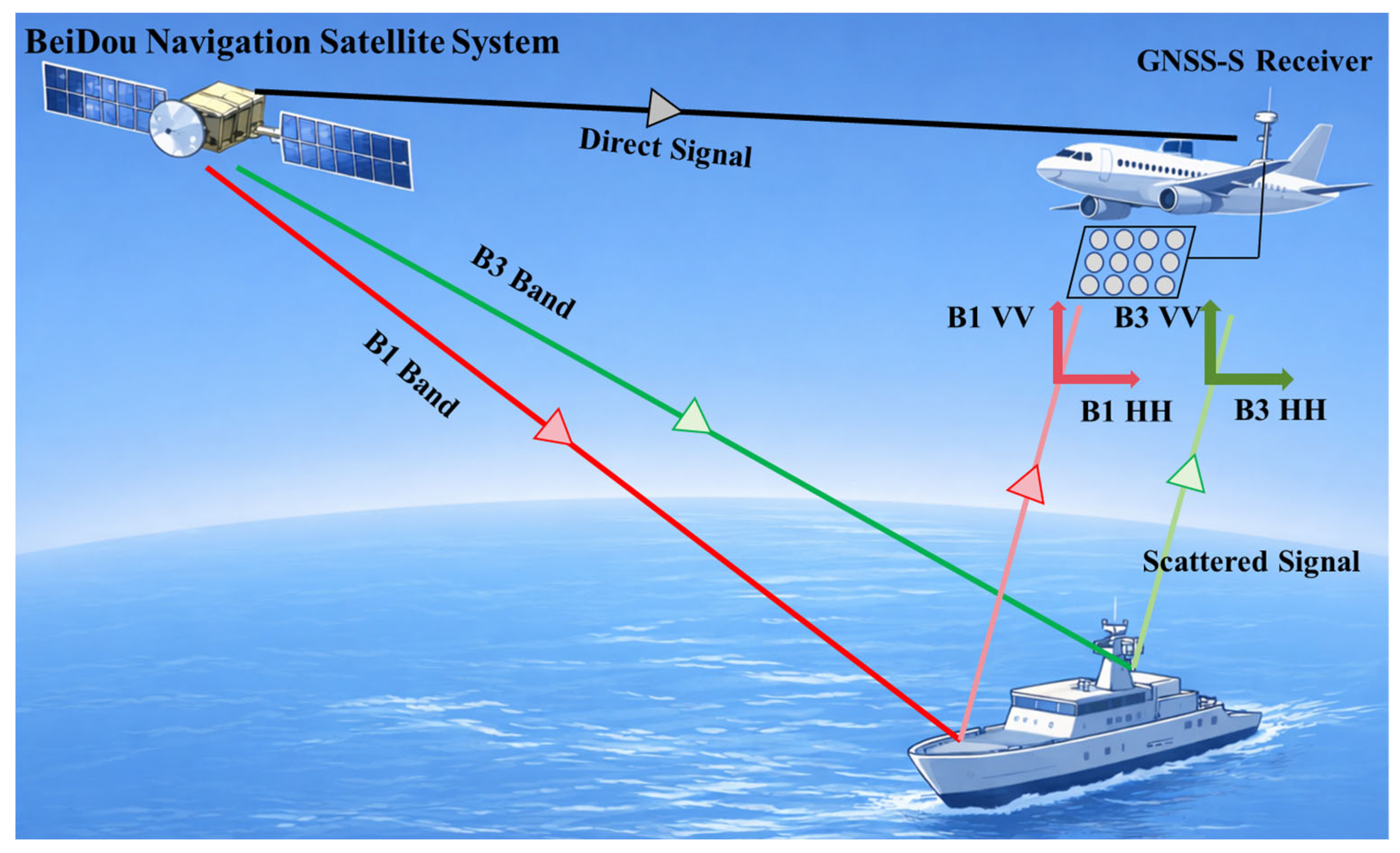
Global Navigation Satellite System reflectometry (GNSS-R) was predicated on exploiting spaceborne GNSS transmissions that were specularly and diffusely scattered by the Earth’s surface and oceans, whose delay–Doppler (DD) signatures were then acquired by passive receivers to retrieve key geophysical variables [1]. Compared with active microwave radars, GNSS-R has been characterized by a low transmitter cost, multi-constellation high revisit, and all-weather day–night availability, and it has already demonstrated distinctive value for low-cost constellations, disaster response, and long time-series monitoring [2,3]. In a broader radar sensing sense, GNSS scattering (GNSS-S) [4,5] can be regarded as a passive GNSS-based bistatic radar modality in which GNSS signals are used as signals of opportunity and the transmitter and receiver are naturally separated in space. Compared with the traditional geophysical emphasis of GNSS-R, GNSS-S places greater emphasis on the spectral characteristics of the scattering field and on target kinematics. In particular, multi-frequency observations, such as BeiDou B1/B3 [6], together with multi-polarization measurements, such as horizontal–horizontal (HH)/vertical–vertical (VV) polarizations [6], were leveraged to characterize depolarization effects, surface-to-volume scattering ratios, and their temporal evolution, thereby enhancing sensitivity to weak dynamic scatterers and fine-scale environmental processes (Figure 1). From the perspective of passive weak-target sensing, such a dual-frequency dual-polarization GNSS-S architecture was therefore considered capable of providing more robust passive microwave observations [7,8].
Figure 1.
Schematic of the observation geometry and signal paths for a BeiDou-based dual-frequency dual-polarization airborne GNSS-S system.
The central challenge in GNSS-S has consistently concerned the reliable acquisition and interpretable processing of extremely weak echoes. Three representative lines of research have been pursued. (i) Integration gain and robust detection [9,10,11]: Long-time coherent integration combined with motion compensation and multistatic fusion was shown to reveal weak targets that were invisible under short integrations; representative paradigms included single-stage joint detection and localization on long-time range–Doppler (RD) maps, as well as radon/fractional Fourier transform (FRFT)-based coherent accumulation for maneuvering targets. (ii) Adaptive beamforming and polarimetric fusion [12,13,14]: Because oceanic reflections are highly sensitive to geometry and receive polarization, both measurements and models indicated that polarization and geometry configurations directly affected detectability; accordingly, polarimetric synthesis and adaptive filtering were employed to suppress sidelobes and clutter while preserving phase and amplitude coherence, thereby supporting subsequent polarimetric-consistency tests and optimized acquisition strategies. (iii) Multidimensional calibration and joint estimation [8,15,16]: Dual-frequency observations were used for ionospheric correction and cross-frequency registration, while reference synchronization and imaging remapping were introduced to preserve coherence at very low signal-to-noise ratios (SNRs); more recent studies further employed amplitude–phase self-calibration and dual-frequency enhancement to improve weak-trace detectability, reflecting a common strategy of decomposing and compensating for hardware-, geometry-, and medium-induced errors. In parallel, recent image-domain SAR ship studies have further highlighted the importance of knowledge-guided fusion, open-world/incremental recognition, and multi-granularity feature interaction for robust target interpretation under complex backgrounds and category uncertainty [17,18,19].
Despite these advances, substantial challenges for ship detection [20,21] have remained as the observation modality expanded from single-frequency, single-polarization sensing to four-channel B1/B3 × HH/VV processing in the complex range-time domain.
- (1)
- Polarization mismatch coupled with burst-type strong windows: Ocean reflections were highly sensitive to receiving polarization and geometry, and polarization mismatch under bursty strong returns tended to induce spurious peaks and phase biases in the correlation domain. A recent study provided experimental evidence that HH/VV level differences varied markedly with incidence, underscoring this sensitivity [14]. Two-scale ocean-scattering models and spaceborne GNSS-R ship-detection studies further showed that geometry and polarization jointly governed detectability [12,13]. In passive bistatic radar, Colone et al. demonstrated that multistage direct/clutter cancellation combined with constant false-alarm rate (CFAR) detection effectively suppressed sidelobe masking [22].
- (2)
- Cross-frequency spectral-shape and dispersive mismatches leading to mis-registration: Differences in B1/B3 spectral shapes, channel dispersion, and residual ionospheric delay introduced systematic peak and phase biases, thereby degrading weak-peak alignment under long integrations. Katzberg et al. showed that dual-frequency differencing effectively separated ionospheric dispersion, providing the physical basis for cross-frequency alignment [15]. A dual-frequency enhancement scheme demonstrated that dual-frequency amplitude/phase combinations significantly improved long-time coherent gain and SNR [7], while Pastina et al. emphasized that robust cross-frequency and cross-link synchronization and registration were prerequisites for stable imaging [16].
- (3)
- Chain-drift-induced leakage–bias–mismatch cascade: Over long sequences and multi-constellation or multistatic settings, slow drift in channel amplitude, phase, and sub-chip delay broke cross-segment consistency and limited both coherent and noncoherent long-time integration. Santi et al. demonstrated the gains of long-time multibaseline fusion and highlighted the need for cross-segment consistency [11]. Recent studies indicated that amplitude–phase self-calibration under weak priors substantially restored coherence [8], whereas Gao et al. identified cross-channel calibration and synchronization as an engineering bottleneck [4].
To address these issues, a DFDP-QuadDiff (dual-frequency and dual-polarization quad-differential processing) framework was developed for weak-echo GNSS-S ship-target detection using four-channel B1/B3 × HH/VV complex data. The framework imposed a hierarchical sequence of constraints, namely polarization-consistency suppression, intra-band adaptive synthesis, joint delay–Doppler–phase cross-frequency registration, segment-wise chain calibration and drift smoothing, and quality-aware final fusion, so that multi-source inconsistencies could be progressively decomposed and compensated from the polarization level to the segment level. In this way, physically interpretable weak-target fusion was enabled without relying on expensive external calibration, while the stability, continuity, and long-time integrability of weak-target responses were improved.
2. Data and Methodology
2.1. Experimental Data and Overall Processing Framework
The GNSS-S data used in this study were acquired by a self-developed receiver and processed by time synchronization and matched filtering to form B1/B3 × HH/VV four-channel complex range-time data [4,7,14]. Let denote the complex sample at slow time t and delay bin τ, where f ∈ {B1, B3} indexes the frequency band and p ∈ {HH, VV} indexes the polarization channel.
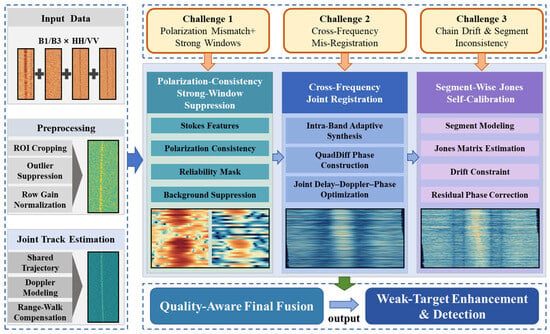
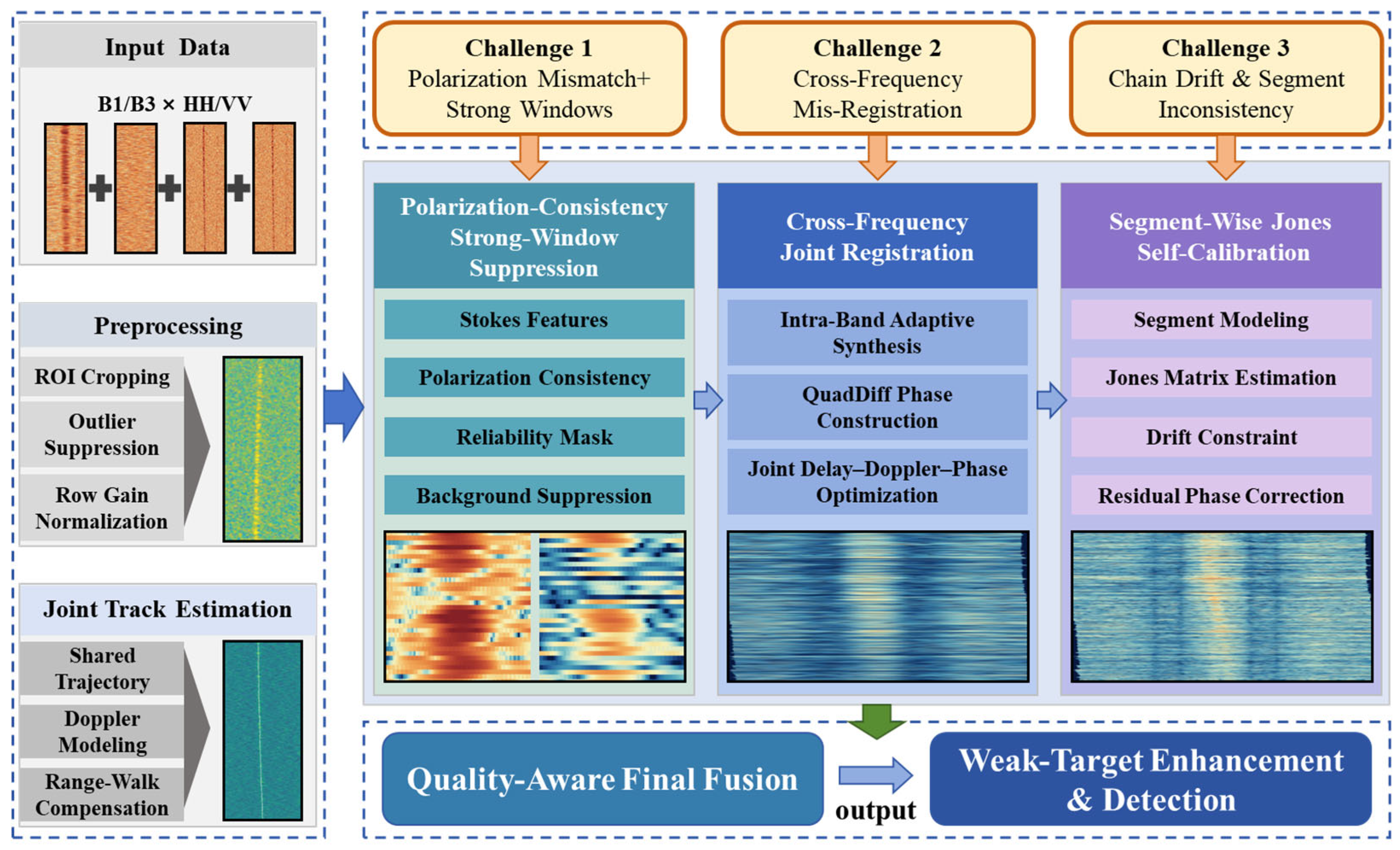
Under low-SNR maritime conditions, weak-target detection was found to be jointly degraded by three coupled factors. First, polarization mismatch was easily amplified by burst-type strong windows, resulting in spurious local enhancement and unreliable short-time correlation peaks. Second, cross-frequency spectral-shape differences and dispersive residuals introduced systematic delay and phase inconsistency between B1 and B3, thereby reducing the reliability of direct inter-band registration. Third, slowly varying chain drift accumulated over long observation durations, causing cross-segment leakage, phase bias, and residual delay mismatch, which further limited long-time integration gain. To address these issues, a hierarchical processing framework (Figure 2) was established in the order of polarization-consistency-driven strong-window suppression, intra-band adaptive synthesis, joint cross-frequency registration, segment-level chain calibration and drift smoothing, and quality-aware final fusion.
Figure 2.
Flowchart of the proposed DFDP-QuadDiff framework for dual-frequency dual-polarization weak-target detection in GNSS-S.
Instead of performing fusion directly on intensity RTI maps, the proposed method was formulated in the complex range-time domain. A trajectory-centered processing strategy was adopted. A common target trajectory was first estimated from the joint four-channel response, and the local region of interest was subsequently aligned to the target trajectory so that residual motion-induced mismatch could be more effectively compensated. On this basis, the full processing chain was implemented through three major modules: (1) polarization-consistency-driven strong-window suppression, (2) intra-band adaptive synthesis and delay–Doppler–phase joint cross-frequency registration, and (3) Jones self-calibration with segment-level drift smoothing and quality-aware consistency control. By progressively removing inconsistency terms from the polarization level to the segment level, the weak-target response was stabilized before final fusion and detection were performed. The proposed framework is organized according to the physical propagation path of the dominant inconsistency terms, from polarization-level contamination to cross-frequency mismatch and then to segment-level drift, so that these coupled impairments can be progressively decoupled before final fusion and detection.
2.2. Joint Trajectory Estimation and Trajectory-Aligned RTI Representation
Because the target echo exhibited continuous range migration over the observation interval, direct processing on a fixed delay gate would lead to target energy spreading and reduced integration efficiency. Therefore, a joint trajectory was first estimated from the four-channel observations, and a trajectory-aligned RTI representation was then constructed, following the general idea of long-time weak-target integration and track-before-detect processing in passive radar and GNSS-based passive sensing [23,24,25].
For each slow-time instant t, a joint score map was formed from the four-channel amplitudes as
where denotes a non-negative channel weight. A globally consistent target trajectory was then obtained by maximizing the cumulative score under temporal smoothness constraints, which was consistent with standard trajectory-search and long-time integration formulations for weak-target detection [23,25,26].
where denotes the trajectory smoothness penalty.
After had been estimated, a trajectory-centered local coordinate was introduced [9,25] by
The original RTI observations were then resampled into a trajectory-aligned form:
In this representation, the dominant target range walk was absorbed by the coordinate transformation, while the remaining misalignment was treated as residual range migration. Such residual mismatch was later estimated and compensated during the cross-frequency registration stage. By constructing the subsequent processing chain on the trajectory-aligned RTI domain, local consistency analysis, polarimetric suppression, and long-time fusion were made more stable and physically meaningful.
2.3. Polarization-Consistency-Driven Strong-Window Suppression
The first difficulty arises from the coupling between polarization mismatch and burst-type strong windows. In practical maritime GNSS-S observations, the polarization response is highly sensitive to geometry and sea-surface scattering conditions. As a result, short-time strong returns or interference windows may not correspond to physically consistent weak targets; instead, they may trigger spurious peaks and phase bias in the correlation domain. Therefore, the first stage of the proposed method aims to suppress strong-but-inconsistent windows while preserving weak-but-consistent target responses. A polarization-consistency-driven suppression strategy was constructed on the basis of polarimetric covariance analysis and Stokes parameter characterization [27,28].
For each band, the local polarimetric scattering vector and its second-order statistics were first constructed, following standard polarimetric covariance and Stokes vector representations [27,28].
Within a local neighborhood W(t,Δτ), the sample covariance matrix was estimated by
Based on , the corresponding Stokes vector is written as
and a polarization-consistency index [9] is defined as
where ε is a small positive constant introduced for numerical stability. The local energy is defined as
and the residual inter-polarization phase [8] is given by
True weak-target echoes were expected to exhibit relatively stable polarization structure and along-track continuity, whereas burst-type strong windows and structured interference often appeared as high-energy but low-consistency responses with unstable residual phase. Motivated by the above polarimetric consistency measures and local background selectivity, a local reliability score and a shared suppression mask were further constructed for the two bands.
where denotes an along-track continuity term evaluated in the trajectory-aligned RTI domain, and Ψ(⋅) denotes a robust nonlinear weighting function.
A shared strong-window suppression mask was then formed from the two bands:
where (⋅) denotes a fusion operator such as minimum, product, or confidence-weighted averaging. Windows that were energetically strong but polarimetrically inconsistent were thus down-weighted, whereas weak responses with stable polarization and temporal persistence were retained for subsequent processing.
Through this step, the influence of polarization mismatch and burst-type strong-window coupling was reduced before band-level synthesis and cross-frequency registration were carried out.
2.4. Intra-Band Adaptive Polarimetric Synthesis
After strong-window suppression, the two polarimetric channels within each band were adaptively synthesized using a minimum-variance constrained formulation, following the general principle of adaptive beamforming and polarimetric synthesis [29,30]. For each band f, the synthesized output was formed as
where denotes the local synthesis weight vector. The synthesis weight was determined from a constrained background-suppression criterion,
where denotes the background covariance matrix and denotes the desired polarimetric response vector. The resulting closed-form solution was
The optimization form was analogous to the classical minimum-variance distortionless response (MVDR) or Capon beamforming criterion, here adapted to the intra-band dual-polarization synthesis problem [29,30,31]. In practice, the local weighting process was carried out under the guidance of the reliability mask , so that unstable strong windows contributed less to covariance estimation and synthesis. In this manner, the original dual-polarization observation within each band was converted into a more coherent single-band complex response while preserving the useful polarimetric information needed for later inter-band registration.
2.5. Delay–Doppler–Phase Joint Cross-Frequency Registration
The second challenge was addressed by a joint cross-frequency registration procedure in which residual range migration, local Doppler evolution, and quad-differential phase consistency were simultaneously considered. Direct delay-only matching between B1 and B3 was avoided because the weak-target response could be distorted by band-dependent spectral shape, dispersive residuals, and local motion-induced phase variation.
2.5.1. Residual Range-Walk Compensation
Although the dominant target trajectory had already been removed through the trajectory-aligned RTI representation, residual range migration could still remain because of local model mismatch, sub-bin displacement, and band-dependent alignment error [32]. Therefore, a residual delay correction was first estimated from the local synthesized responses:
where and denote the reference and moving band responses, respectively, and denotes a local confidence weight derived from the suppression mask and synthesis reliability.
The moving-band response was then resampled by fractional-delay interpolation:
2.5.2. Quad-Differential Phase Construction
To suppress common-mode phase terms and highlight band-dependent residual mismatch, the intra-band polarimetric phase was first computed as
The quad-differential phase was then constructed by
Because the weak-target region could contain low-amplitude and phase-discontinuous samples, confidence-modulated phase unwrapping was performed [7,15]. A phase confidence weight was introduced as
where Ω(⋅) is a monotone weighting function.
2.5.3. Joint Estimation of Delay, Doppler, and Phase Offsets
After residual range-walk correction, local Doppler inconsistency between bands was estimated from short-time phase evolution. Let denote the residual inter-band Doppler offset and denote the residual phase offset. The final joint registration was then formulated as
After optimization, the registered B1 response was obtained as
Through this procedure, cross-frequency alignment was not reduced to simple peak matching. Instead, delay residuals, Doppler inconsistency, and quad-differential phase stability were jointly exploited so that registration remained robust under weak-echo conditions [7,8]. In this way, the effects of cross-frequency spectral-shape difference and dispersive mismatch were significantly reduced before long-time fusion was performed.
2.6. Segment-Level Jones Self-Calibration and Drift Smoothing
The third challenge was addressed through segment-level chain calibration with slowly varying drift modeling. To recover long-sequence consistency, segment-level self-calibration was performed on the two bands using a Jones-matrix-based distortion model and a slowly varying drift assumption [33].
The observation sequence was partitioned into K overlapping segments. For the k-th segment and the f-th band, the local observation model was expressed as
where denotes the segment-wise Jones matrix, denotes the residual segment delay term, denotes the latent calibrated scattering vector, and denotes residual noise.
Rather than estimating each segment independently, the segment-wise chain parameters were constrained to vary smoothly over time. Let denote the parameter vector associated with phase bias and residual delay. A slow-drift model was imposed as
where denotes a low-variance process perturbation. The segment-level calibration parameters were estimated by minimizing
where (⋅) denotes a robust loss and controls the drift smoothness constraint. To prevent corrupted segments from dominating the global estimate, a segment quality score was defined as
where and denote the segment-level energy, average polarization consistency, quad-differential phase stability, and along-track continuity, respectively. After drift-smoothed calibration had been obtained, the corrected segment response was written as
Through this process, slow chain drift was prevented from propagating into large-scale cross-segment inconsistency. As a result, segment leakage, long-time phase bias, and residual delay mismatch were jointly alleviated before final accumulation.
2.7. Quality-Aware Dual-Band Fusion and Final Detection
After segment-level correction, the two bands were fused according to their local quality and consistency, following the general idea of quality-aware weak-target accumulation and hybrid coherent/noncoherent integration [34]. Let and denote the final synthesized and calibrated band responses. The fused weak-echo response was defined as
where the adaptive fusion coefficients and were derived from the segment quality and local consistency measures. The corresponding detection statistic is then given by
For long-time integration, quality-aware accumulation was performed so that high-quality segments contributed coherently whenever reliable phase consistency was available, whereas low-quality segments were conservatively down-weighted or accumulated in a weaker form. In this way, the final detection output was generated from responses that had already been stabilized at the polarization level, aligned at the cross-frequency level, and regularized at the segment level. The principal hyperparameters, together with their adopted values and meaning, are summarized in Appendix A (Table A1).
3. Results
3.1. Overall Improvement in Detection Performance
An overall improvement in weak-echo target detectability was achieved by the proposed DFDP-QuadDiff framework. As shown in Table 1, a clear performance gain was obtained when the full model was compared with the best raw single-channel result. The median SCR was increased from 6.51 dB to 9.04 dB, corresponding to a gain of 2.53 dB. The P10 SCR was improved from −1.76 dB to 3.05 dB, yielding an increase of 4.81 dB. Meanwhile, the track continuity was raised from 0.85 to 0.97. These results indicated that the enhancement was not confined to a limited number of high-response samples but was instead extended to the weakest and least stable target segments, thereby improving the detectability and temporal continuity of the target as a whole.
Table 1.
Overall performance comparison of representative detection modes.
Three classical weak-target baselines, namely track-before-detect [25], radon accumulation [10], and FRFT accumulation [26], were further included in Table 1 for external comparison. Although FRFT accumulation provided the strongest baseline result, it still remained below the full DFDP-QuadDiff output by 1.27 dB in median SCR and 2.83 dB in P10 SCR. In contrast, both the track-before-detect and radon baselines underperformed the best raw single-channel result, indicating that conventional long-time accumulation alone was insufficient to overcome the polarization mismatch, cross-frequency mis-registration, and segment inconsistency encountered in the present four-channel GNSS-S setting.
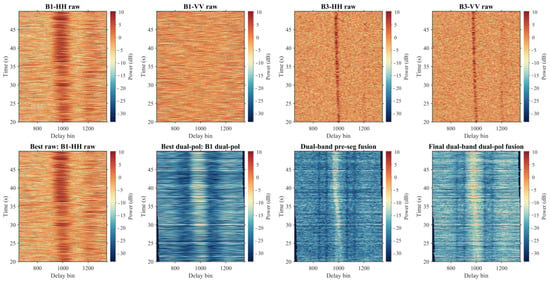
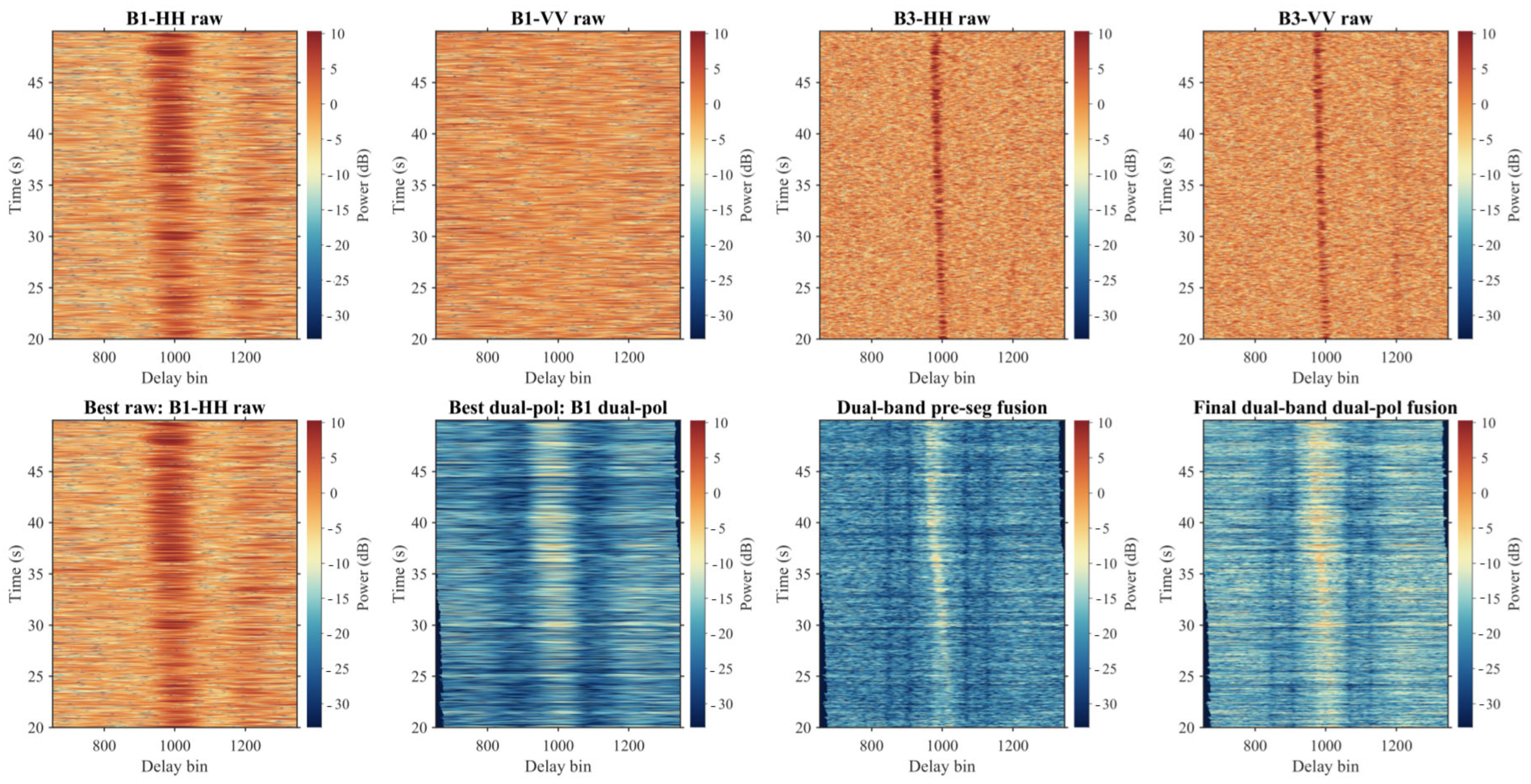
A pronounced imbalance was also observed among the four raw channels. The best raw channel yielded a median SCR of 6.51 dB, whereas the weakest channel produced only −0.26 dB. This difference demonstrated that, under low-SNR maritime conditions, the target response was highly sensitive to both frequency band and polarization state, and thus could not be stably characterized by any single channel alone. The qualitative comparison in Figure 3 is consistent with this conclusion. Considerable variations in target visibility were observed among the four raw channels, whereas in the final fused result the target ridge was rendered more compact and more continuous, and the surrounding striped background structures were substantially attenuated. A more localized target-centered comparison is further provided in Figure A1, where the local fusion gain can be more clearly observed under the same dynamic range and identical zoom window. It was therefore indicated that the joint exploitation of dual-frequency and dual-polarization information had effectively mitigated the instability inherent in single-channel observations.
Figure 3.
Overall visual comparison of weak-target responses under the proposed DFDP-QuadDiff framework. The first row presents the four raw RTI responses from the B1-HH, B1-VV, B3-HH, and B3-VV channels, respectively. The second row presents the best raw single-channel result, the best single-band dual-polarization result, the dual-band pre-segmentation fusion result, and the final DFDP-QuadDiff output.
It should be emphasized that the increase in P10 SCR was substantially larger than that in median SCR. This result suggested that the main benefit of the proposed framework was not merely obtained from the reinforcement of already-visible target segments but was primarily derived from the recovery of the weakest and most degraded portions of the trajectory. Since weak-target detection performance was typically limited by the lowest-quality segments rather than by a few strong peaks, this behavior was regarded as particularly significant.
3.2. Stage-Wise Ablation and Module Contribution
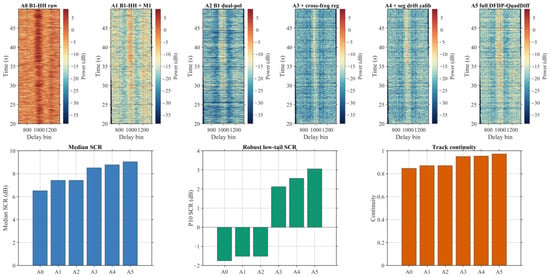
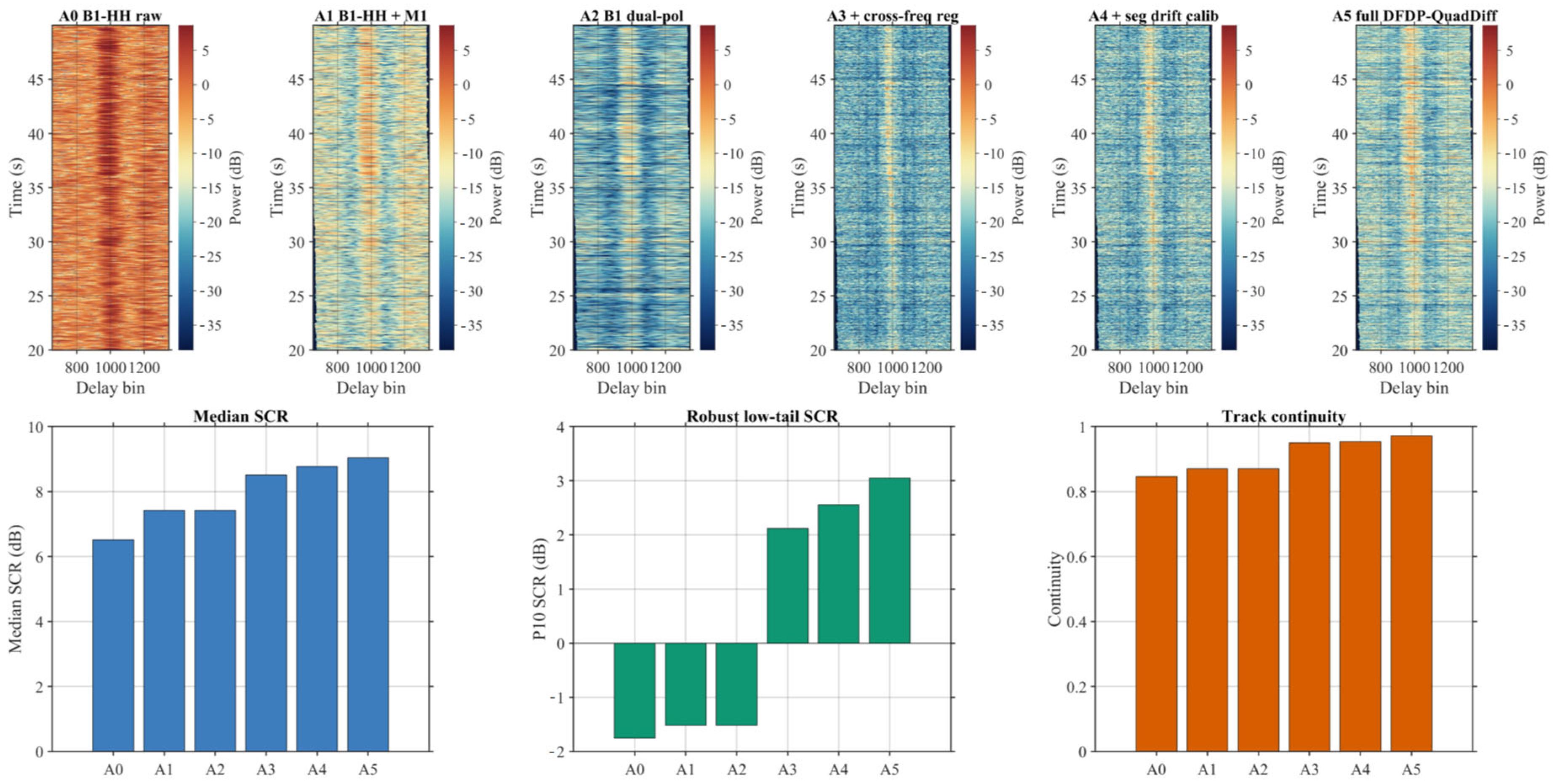
The stage-wise ablation results shown in Figure 4 and Table 2 revealed that the performance gain had been accumulated progressively rather than produced by a single dominant operation (A0: Best Raw Single-Channel; A1: +Polarization-Consistency Suppression; A2: +Intra-Band Dual-Polarization Synthesis; A3: +Cross-Frequency Registration; A4: +Segment Drift Calibration; A5: Full DFDP-QuadDiff). All stages were compared under the same background-tail operating setting. Therefore, the false-alarm proxy was treated as a fixed evaluation condition rather than as a discriminative stage-wise metric and was not tabulated separately. Starting from A0 as the best raw single-channel baseline, the median SCR was increased to 7.42 dB at A1, which indicated that the front-end suppression stage had already improved the input quality. Almost no difference was observed between A1 and A2 in this data segment. This was not caused by tabulation rounding. Instead, it indicates that, after polarization-consistency suppression, the dominant informative response remained concentrated in one polarization branch, so that the adaptive intra-band dual-polarization synthesis effectively degenerated to the dominant single-polarization solution. Therefore, the contribution of A2 in this dataset was mainly to provide a more stable single-band complex representation for the subsequent cross-frequency registration, rather than to deliver an isolated stage-wise gain in SCR or continuity.
Figure 4.
Stage-wise visual ablation and quantitative performance comparison of the DFDP-QuadDiff framework. The upper panel shows the RTI outputs corresponding to the six processing stages from A0 to A5, including the best raw single-channel result, the output after polarization-consistency suppression, the intra-band dual-polarization synthesis result, the output after cross-frequency registration, the result after segment-drift calibration, and the final DFDP-QuadDiff output. The lower panel summarizes the corresponding median SCR, P10 SCR and track continuity across the six processing stages.
Table 2.
Stage-wise ablation results of the proposed DFDP-QuadDiff framework.
The most pronounced improvement was observed from A2 to A3. The median SCR was raised from 7.42 dB to 8.51 dB, the P10 SCR was increased from −1.52 dB to 2.12 dB, and the track continuity was improved from 0.87 to 0.95. This result demonstrated that cross-frequency inconsistency had constituted one of the primary bottlenecks in the overall processing chain. Once the residual delay, Doppler, and phase mismatches between B1 and B3 had been effectively corrected, a substantial recovery of the weakest target segments was obtained.
A further but smaller gain was achieved from A3 to A4. The median SCR was increased from 8.51 dB to 8.77 dB, and the P10 SCR was improved from 2.12 dB to 2.56 dB. This behavior indicated that, even after inter-band alignment had been restored, long-sequence segment inconsistency still limited the available integration gain. The final transition from A4 to A5 led to an additional increase in the median SCR to 9.04 dB, the P10 SCR to 3.05 dB, and the track continuity to 0.97. It was particularly noteworthy that A5 remained superior to A4, which indicated that the optimized final fusion strategy no longer introduced the over-conservative degradation that had previously been observed.
Taken together, the ablation results suggested that complementary functions had been played by different modules. The early-stage suppression reduced the dominance of abnormal background structures, the joint cross-frequency registration restored local inter-band consistency, the segment-level calibration recovered long-sequence coherence, and the final fusion stage converted these improvements into a more stable detection output. The results therefore supported the necessity of the full hierarchical framework.
3.3. Mitigation of Strong-Window and Polarization-Mismatch Coupling
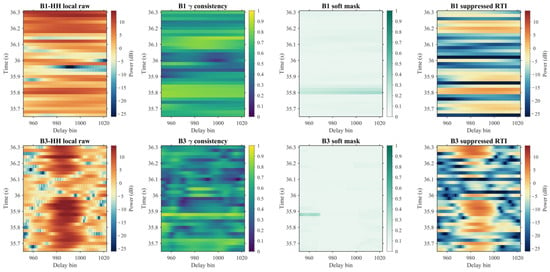
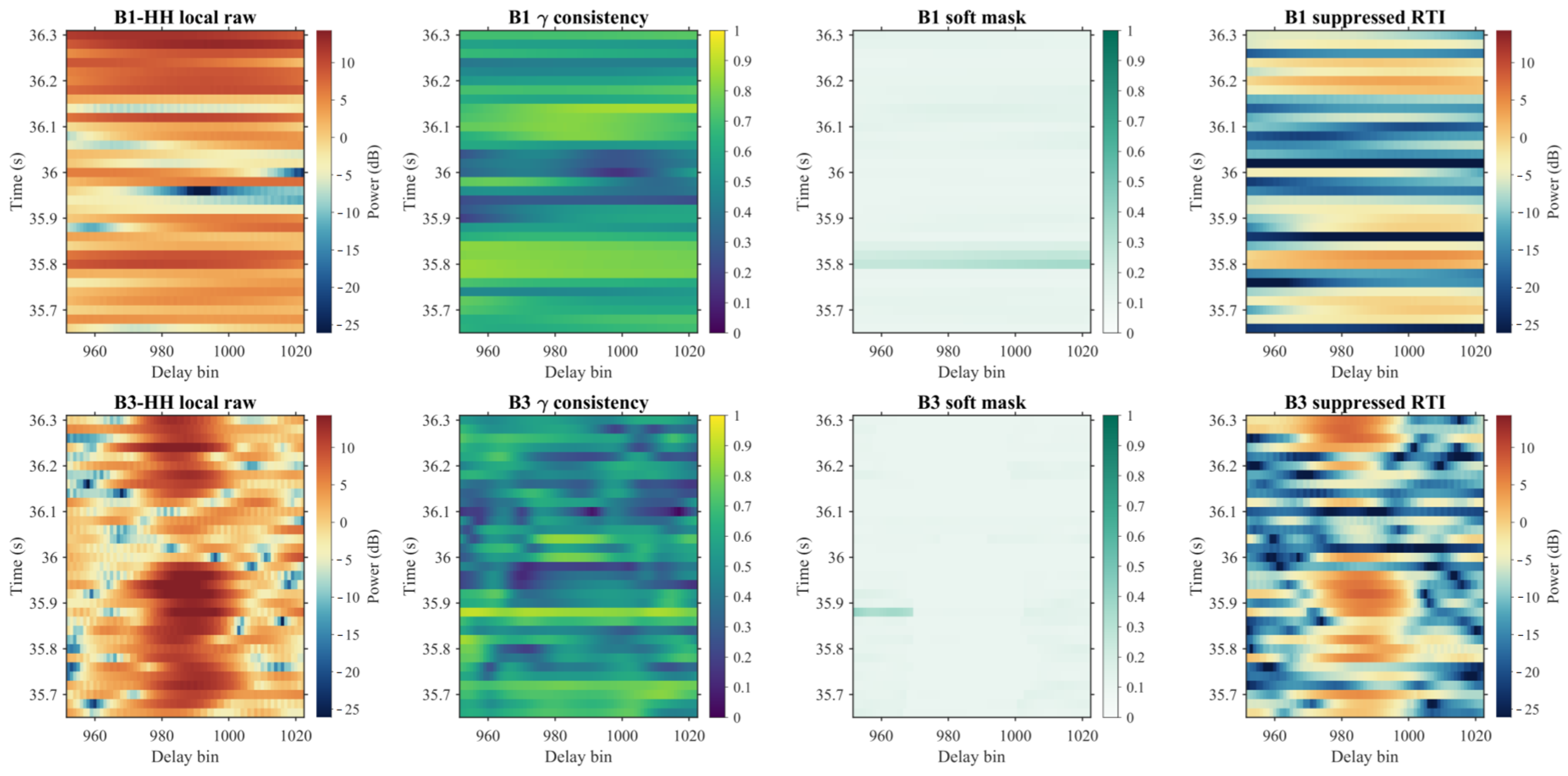
The results associated with the first challenge are primarily presented in Figure 5 and Table 3, while their downstream impact is further reflected in the subsequent cross-frequency registration results. It was observed from the local RTI maps that strong striped structures and burst-like bright patches existed around the target neighborhood in the raw domain. Although these structures were locally energetic, they were not accompanied by stable polarimetric behavior and therefore tended to generate unreliable peaks and false enhancement during subsequent registration and fusion. After the proposed polarization-consistency-driven suppression had been applied, these striped anomalies were clearly attenuated, while the target response near the trajectory gate was largely preserved. This observation indicated that the proposed masking strategy had not simply darkened all high-energy regions but had acted selectively on strong yet inconsistent background structures.
Figure 5.
Evidence of polarization-consistency-driven suppression for strong-window and polarization-mismatch coupling. For each band, the local raw RTI, the polarization consistency map, the soft suppression mask, and the suppressed RTI are shown from left to right. The same target-centered local window was used for both B1 and B3.
Table 3.
Quantitative evidence for the three proposed modules.
The quantitative evidence in Table 3 further clarified the effect of the first module. The first diagnostic, , decreased from 0.63 to 0.56, indicating that the local polarimetric structure within the target-centered gate was reconfigured after the proposed suppression. The second diagnostic, SSW, increased from 0.48 to 1.04, indicating that stronger selective down-weighting was imposed on high-energy but polarization-inconsistent windows. These two quantities characterize different aspects of the same process and therefore should be interpreted jointly rather than as a single monotonic score. Specifically, the decrease in reflects the reshaping of the local anomalous polarimetric pattern, whereas the increase in SSW reflects the strengthened suppression applied to strong-window interference. Taken together, these results show that the proposed module did not merely reduce background energy uniformly; instead, it selectively suppressed structurally inconsistent strong responses while preserving the target-centered echo needed for the subsequent registration and fusion stages.
From a physical perspective, the first challenge was not resolved by a simple reduction in background energy, but rather by increasing the separability between the weak-target response and the anomalous background structures. Genuine weak echoes tended to exhibit stronger temporal continuity around the trajectory gate, whereas burst-type clutter was more often manifested as row-wise or segment-wise striped enhancement. The results indicated that this structural distinction had been effectively exploited by the proposed suppression mechanism. Therefore, the coupling between strong-window interference and polarization mismatch was considered to have been substantially alleviated, although not entirely eliminated, since a limited number of residual bright structures could still be observed in the local maps.
3.4. Improvement in Cross-Frequency Registration Through Joint Delay–Doppler–Phase Modeling
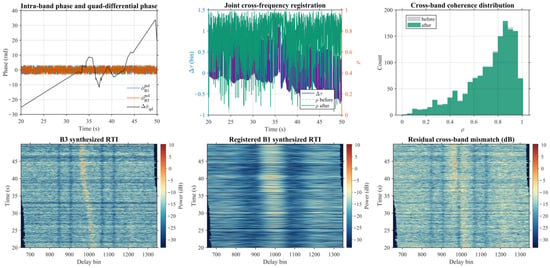
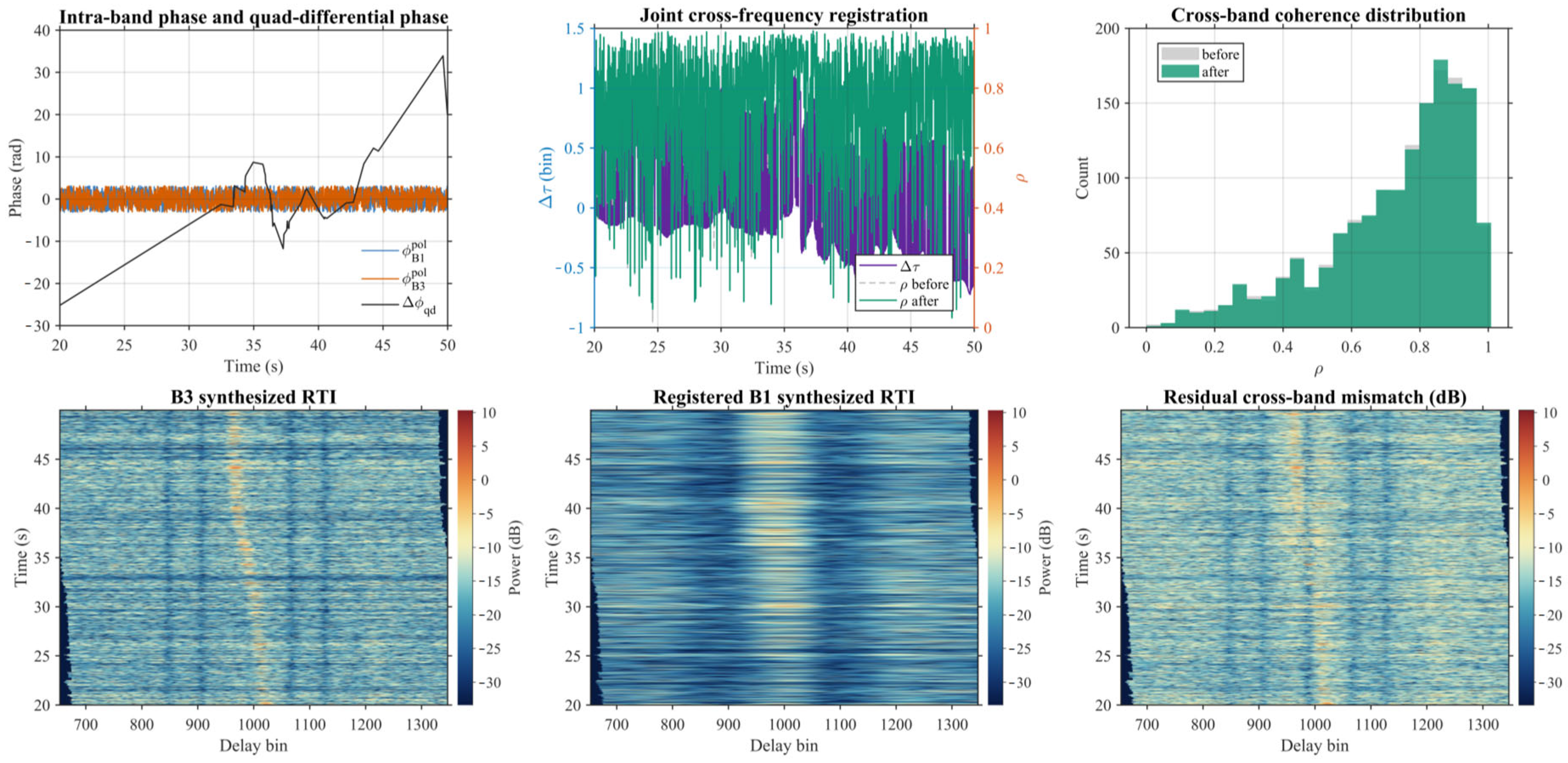
The results related to the second challenge are summarized in Figure 6. After the proposed joint delay–Doppler–phase registration had been introduced, the estimated inter-band trajectories became smoother over time, the synthesized B1 and B3 target ridges became more coincident, and the residual mismatch energy was concentrated within a narrower neighborhood. These observations indicated that the inter-band inconsistency had not been limited to a delay offset alone but had also involved local Doppler discrepancy and phase deviation, and thus could not have been adequately corrected by a simple peak-shift strategy. Additional evidence of the trajectory-centering and residual range-walk reduction is provided in Figure A2, which shows that the large-scale delay migration was effectively compressed before the subsequent cross-frequency registration stage.
Figure 6.
Joint delay–Doppler–phase cross-frequency registration and the resulting improvement in inter-band consistency. The figure presents the intra-band polarization phases and quad-differential phase, the estimated cross-frequency delay trajectory and correlation evolution, the synthesized B3 RTI, the registered B1 RTI, and the residual mismatch map after registration.
According to Table 3, the median cross-band coherence coefficient increased only slightly, from 0.7877 to 0.7886. At first glance, this numerical change appears modest. However, the residual inter-band delay-mismatch dispersion, measured by MAD(Δτ), converged to approximately 0.52 bin after registration, which indicates that a stable and usable delay-correction trajectory had been established. More importantly, Table 2 shows that the transition from A2 to A3 produced the largest stage-wise improvement in weak-target detectability, with the P10 SCR increasing by 3.64 dB and the track continuity increasing by 0.08. This discrepancy indicates that the principal benefit of the proposed quad-differential registration was not a large increase in the global average coherence itself but the correction of a limited number of severely mismatched windows that had previously dominated the low-tail performance. Once those windows were corrected, the weakest target segments could again contribute to coherent accumulation, and the cross-frequency information became reliably exploitable for the final fusion stage.
3.5. Segment Drift Correction and Recovery of Long-Sequence Consistency
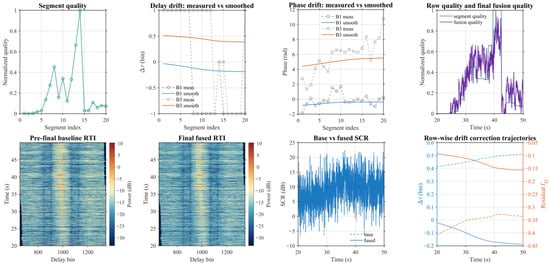
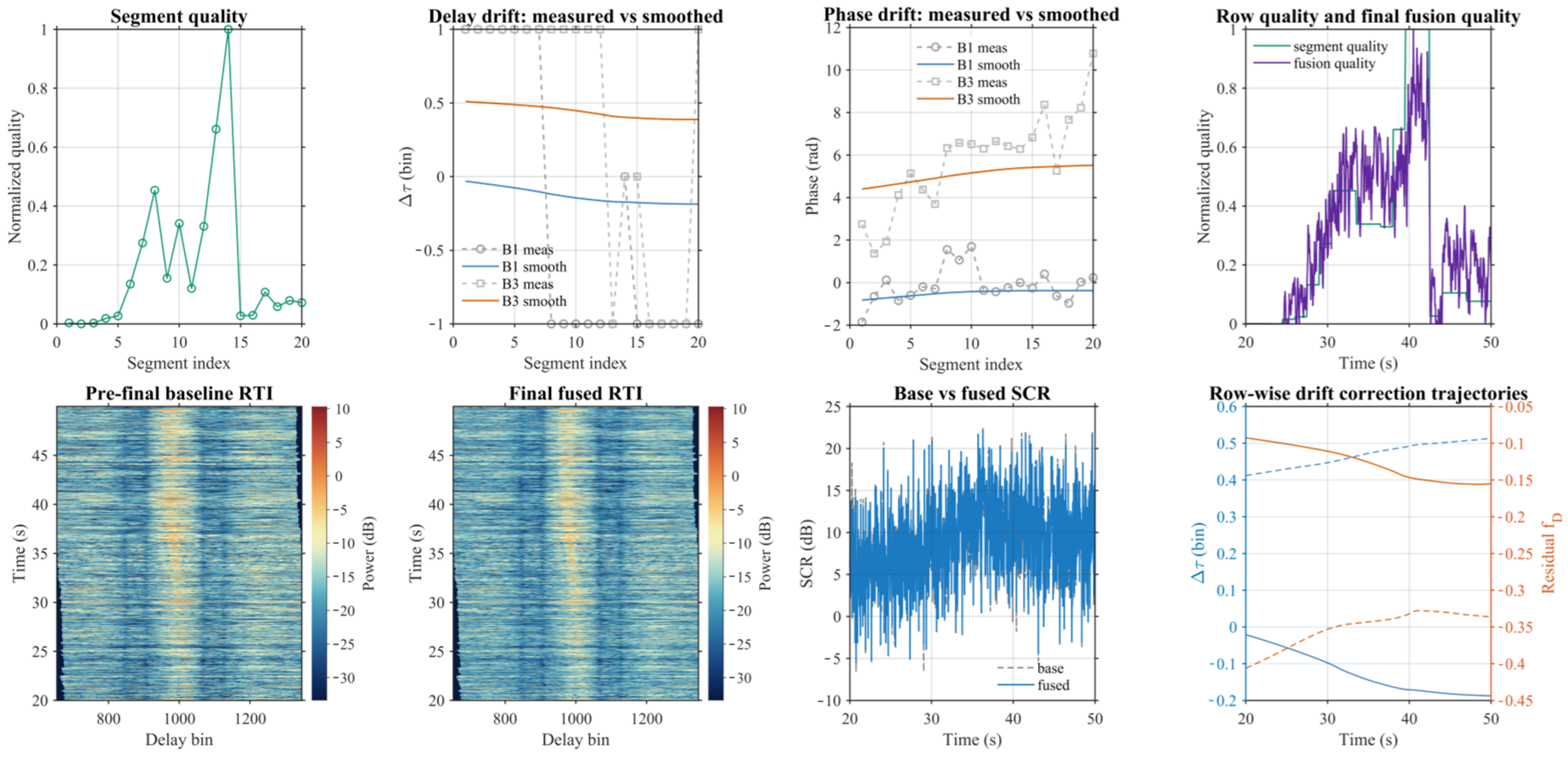
The third challenge was examined through the results shown in Figure 7. Considerable fluctuation was observed in the segment-wise delay and phase correction terms before smoothing, whereas the corresponding trajectories became substantially more continuous after the proposed segment-level regularization had been applied. In parallel, the fused RTI after drift correction exhibited a more continuous target stripe with fewer interruptions and fewer local energy voids. These observations suggested that slowly varying chain drift had indeed degraded long-sequence consistency, and that the proposed segment-wise correction had effectively restored it.
Figure 7.
Segment-wise drift correction, consistency recovery, and final fusion result. The figure shows the segment-quality distribution, the estimated segment-wise delay and phase correction terms, the comparison between baseline and final fused SCR curves, and the RTI images before and after segment-wise consistency recovery.
The quantitative evidence in Table 3 further confirmed this effect. The standard deviation of the segment-wise delay drift was reduced from 0.97 bin to 0.29 bin, corresponding to a decrease of 0.68 bin. The standard deviation of the segment-wise phase drift was reduced from 3.43 rad to 2.84 rad, corresponding to a decrease of 0.59 rad. In addition, a long-accumulation gain of +0.28 dB was reported. These results demonstrated that the segment-level calibration had not merely smoothed local fluctuations but had directly improved the phase and delay stability required for long-time integration.
This interpretation was also consistent with the ablation results. From A3 to A4, the median SCR and P10 SCR continued to improve, indicating that the benefits of the previous cross-frequency registration could be more fully realized once the inter-segment drift had been corrected. In other words, even when satisfactory local alignment had already been obtained, the accumulated effect of slowly varying segment drift would still have undermined long-sequence integration if it had not been explicitly compensated.
The physical implication of this result was clear. The third challenge was fundamentally associated with slowly evolving system inconsistency rather than abrupt mismatch. Its influence therefore became increasingly pronounced as the observation duration was extended. The present results indicated that this effect had been effectively suppressed by the segment-wise calibration strategy, and that the recovered consistency had been successfully transformed into measurable long-time detection gain. Among the three challenges, the evidence supporting the resolution of this issue was the most direct and the most complete.
3.6. Multi-Scale Accumulation Performance
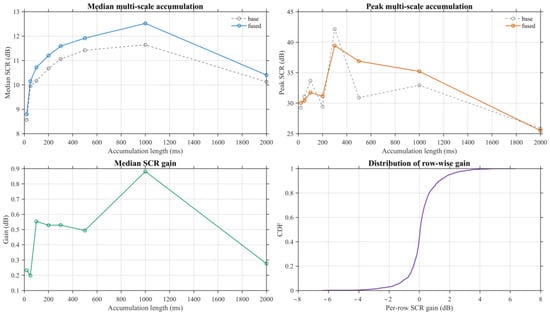
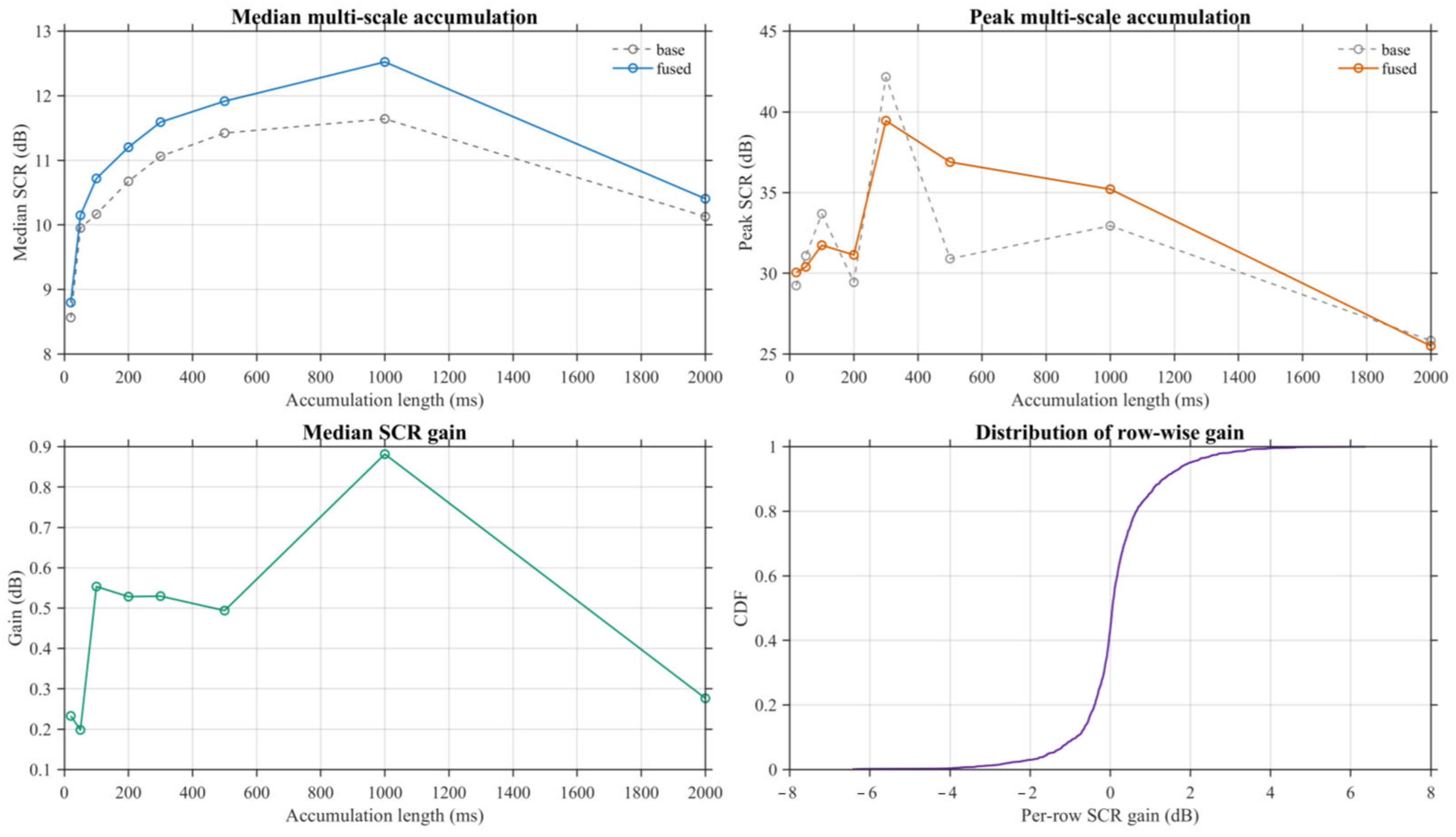
The multi-scale accumulation results shown in Figure 8 demonstrated that the gain delivered by the proposed method was not restricted to a single accumulation length but was maintained over a broad temporal range. At an accumulation length of 1 s, the fused result yielded a median SCR of approximately 12.53 dB, whereas the baseline remained near 11.64 dB, corresponding to a gain of about 0.88 dB. Even at 2 s, a positive gain of approximately 0.30 dB was still preserved. These results indicated that the useful information retained by the proposed framework remained sufficiently coherent to be converted into additional detection gain at longer temporal scales.
Figure 8.
Multi-scale detection gain and row-wise gain distribution under different accumulation lengths. The figure compares the baseline and final fused results in terms of median SCR and peak SCR over a range of accumulation lengths and further presents the corresponding gain curve and the cumulative distribution function of row-wise SCR gain.
The gain distribution in Figure 8 further revealed that the improvement had followed a “many small gains plus a few large gains” pattern. This tendency was fully consistent with the strong improvement observed in P10 SCR. This suggested that the method had been particularly effective in recovering the weakest target segments, while still preserving stable performance over the majority of windows. At the same time, a limited number of negative-gain windows could still be identified, which implied that further refinement remained possible in the final fusion and local gating strategy. Thus, although a stable overall improvement had clearly been achieved, a perfectly uniform gain over all windows had not yet been reached.
3.7. Stratified Robustness Validation Under Representative Local Observation Conditions
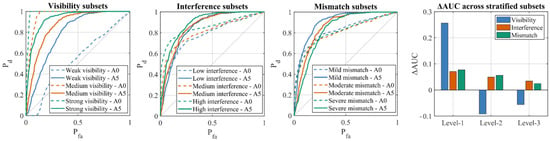
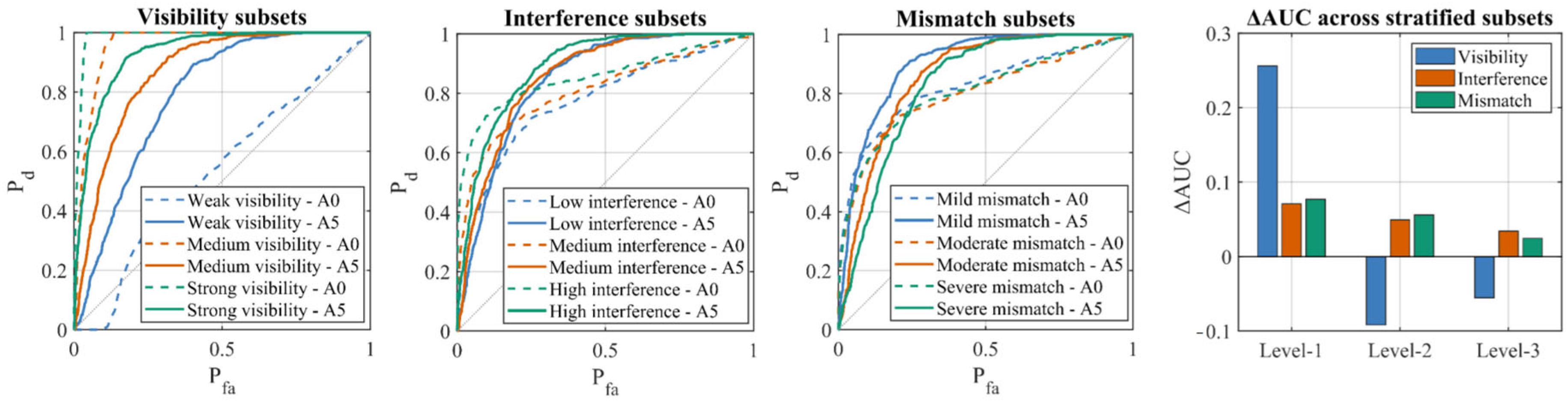
In this subsection, the area under the receiver operating characteristic (ROC) curve (AUC), the probability of detection (Pd), and the false-alarm probability (Pfa) were adopted as standard detection metrics. Here, Pd was defined as the fraction of correctly detected target-present samples, whereas Pfa was defined as the fraction of falsely detected target-absent samples. A fixed operating point of Pfa = 0.01 was used for the reported fixed-point Pd. The visibility, interference, and mismatch subsets were each partitioned into three equal-count levels according to their pre-fusion scores, i.e., the lower, middle, and upper third, denoted as Level-1, Level-2, and Level-3, respectively. These levels corresponded to weak/medium/relatively strong visibility, low/medium/high interference, and mild/moderate/severe mismatch for the three subset groups.
As shown in Figure 9 and Table 4, the gain of the proposed DFDP-QuadDiff framework was concentrated in the most difficult local conditions rather than uniformly distributed across all subsets. In the weak-visibility subset, Pd increased from 0.000 to 0.061, the AUC increased from 0.052 to 0.211 (+0.159), the P10 SCR increased by +7.85 dB, and the continuity increased by +0.408. These results indicate that the principal contribution of the proposed framework was provided by the recovery of the weakest and most unstable target segments. By contrast, in the medium and relatively strong visibility subsets, the gains became limited, and slight negative changes were observed in several metrics. This behavior suggests that, once the target had already been relatively visible in the raw channel, the proposed fusion was mainly operated as a stabilizing and controlled-enhancement mechanism rather than as a means of further amplifying already-strong responses.
Figure 9.
AUC-based stratified robustness evaluation under visibility, interference, and cross-frequency mismatch conditions.
Table 4.
Quantitative stratified robustness evaluation under representative local observation conditions.
For the interference and cross-frequency mismatch subsets, Figure 9 shows more consistent improvements in overall detectability, which are also quantified in Table 4. In the interference subsets, the AUC gains were +0.001, +0.082, and +0.110, with corresponding P10 SCR gains of +4.07, +4.50, and +6.14 dB, and continuity gains of +0.126, +0.104, and +0.146. In the mismatch subsets, the AUC gains remained positive at +0.070, +0.092, and +0.032, while the P10 SCR gains were +3.82, +7.93, and +3.24 dB, and the continuity gains were +0.138, +0.176, and +0.062, respectively. Although the fixed-point Pd still exhibited local fluctuations in several subsets, the consistently positive AUC, P10 SCR, and continuity gains indicate that the proposed framework effectively improved overall detectability, low-tail recovery, and long-time accumulation stability under interference-dominant and mismatch-sensitive conditions. Therefore, the stratified results support the conclusion that the proposed method was particularly effective in the difficult local scenarios where inconsistency coupling was most harmful. This tendency is consistent with recent studies emphasizing robust target interpretation under difficult observation conditions [35,36].
When the evidence from Figure 3, Figure 4, Figure 5, Figure 6, Figure 7, Figure 8 and Figure 9 and Table 1, Table 2, Table 3 and Table 4 was considered together, a coherent picture emerged. The abnormal background structures associated with strong-window and polarization-mismatch coupling were first attenuated, the most harmful inter-band mismatches were then suppressed by joint registration, the long-sequence drift was subsequently corrected at the segment level, and the final fusion stage consolidated these improvements into a more robust detection output. It was therefore demonstrated that the three previously identified challenges had been addressed in a coordinated and hierarchical manner. In this sense, the proposed framework was considered to have advanced dual-frequency dual-polarization GNSS-S weak-echo ship detection from a condition of limited local visibility toward one of stable sequence-level detectability.
4. Discussions and Limitations
The reported results indicate that weak-target degradation in dual-frequency dual-polarization GNSS-S is mainly governed by the coupled effect of three inconsistency sources, namely polarization-dependent strong-window contamination, cross-frequency mis-registration, and long-sequence segment drift. These effects are physically linked rather than independent. Polarization-inconsistent strong windows first distort the local target-centered structure, cross-frequency spectral-shape and dispersive differences then introduce systematic delay–Doppler–phase mismatch between B1 and B3, and the remaining mismatch is further accumulated into segment-level leakage and coherence loss during long-time integration. This interpretation is consistent with the overall results in Section 3.1, where the full DFDP-QuadDiff framework improves both low-tail detectability and track continuity relative to the best raw single-channel result, indicating that the main bottleneck lies in the weakest and least stable target segments rather than in the lack of a few strong responses.
From this perspective, the proposed framework should be understood as a consistency-oriented hierarchical compensation chain. The first module reduces the dominance of strong but structurally inconsistent background responses and thereby improves the local structural support for subsequent processing. The second module restores cross-frequency consistency in delay, Doppler, and phase, and the stage-wise ablation in Section 3.2 shows that the largest gain appears after cross-frequency registration, indicating that the key benefit lies in correcting a limited number of severely mismatched windows that previously dominated the low-tail failure. The third module further suppresses the residual temporal inconsistency at the segment level, and the results in Section 3.5 show that this process reduces segment-wise drift and converts the recovered consistency into additional accumulation gain. Together with the multi-scale accumulation results in Section 3.6 and the stratified robustness analysis in Section 3.7, these observations indicate that the proposed framework is particularly effective in weak-visibility, interference-dominant, and mismatch-sensitive conditions, where inconsistency coupling is most harmful.
Accordingly, the significance of the proposed framework lies in three aspects. First, weak-target detection in dual-frequency dual-polarization GNSS-S is reformulated as a multi-source inconsistency-coupling problem, through which locally constrained visibility is converted into stable sequence-level detectability. Second, a polarization-consistency-driven strong-window suppression and joint cross-frequency consistency-recovery strategy is established, by which difficult-to-exploit complementary information is transformed into cross-frequency dual-polarization cooperative usability. Third, a segment-wise self-calibration and drift-smoothing mechanism is introduced, through which unstable long-time accumulation is converted into continuous accumulability of weak segments. On this basis, a consistency-oriented compensation path with hierarchical decoupling is constructed across the polarization, frequency, and temporal-segment dimensions. From a broader sensing perspective, this consistency-oriented treatment is also in line with recent studies on multi-source fusion and multilevel target perception [37,38].
The main limitation of the present study is that the validation is still based on one measured campaign from a single experimental platform. Although the newly added stratified robustness analysis extends the original single-sequence evaluation into multiple representative local observation conditions and therefore provides a physically meaningful intermediate validation, broader measurement-based verification under more diverse sea states, acquisition geometries, and target types is still required in future work.
5. Conclusions
A DFDP-QuadDiff fusion framework was proposed for weak-echo ship target detection in dual-frequency dual-polarization GNSS-S, where three key difficulties, namely the coupling between strong windows and polarization mismatch, cross-frequency inconsistency, and long-sequence inter-segment drift, were jointly addressed through a hierarchical chain consisting of polarization-consistency-driven suppression, joint delay–Doppler–phase cross-frequency registration, and segment-wise drift correction with quality-aware fusion. The experimental results showed that, relative to the best raw single-channel result, the full framework increased the median SCR from 6.51 dB to 9.04 dB, yielding a gain of 2.53 dB, improved the P10 SCR from −1.76 dB to 3.05 dB, corresponding to a gain of 4.81 dB, raised the track continuity from 0.85 to 0.97, and reduced the standard deviation of segment-wise delay drift from 0.97 bin to 0.29 bin. These results indicated that the proposed framework effectively enhanced the stability, continuity, and long-time integrability of weak-target responses, and that a physically interpretable and practically promising solution was established for collaborative weak-target detection under complex maritime clutter conditions. In addition, the stratified robustness evaluation showed that the most pronounced gains were concentrated in weak-visibility, interference-dominant, and mismatch-sensitive conditions, indicating that the proposed framework improves not only overall signal quality but also standard detection behavior under the most difficult local observation conditions. More broadly, the reported results suggested that unified consistency modeling across polarization, frequency, and temporal segments constituted an effective direction for improving weak-target sensing capability in GNSS-based bistatic radar systems.
Author Contributions
Conceptualization, G.Y. and T.Z.; Methodology, G.Y. and T.Z.; Software, G.Y.; Validation, G.Y., Z.C. and B.Y.; Formal Analysis, G.Y. and Z.C.; Investigation, G.Y., B.Y. and Y.H.; Resources, T.Z., D.H. and T.W.; Data Curation, G.Y. and B.Y.; Writing—Original Draft Preparation, G.Y.; Writing—Review and Editing, T.Z., Z.C., D.H., T.W. and Q.H.; Visualization, G.Y. and B.Y.; Supervision, T.Z.; Project Administration, T.Z.; Funding Acquisition, T.Z. All authors have read and agreed to the published version of the manuscript.
Funding
This work was supported by the Fundamental Research Funds for the Central Universities under Grant XJ2025022601; in part by the National Natural Science Foundation of China under Grant U24A20589; in part by the National Key Research and Development Program of China under Project 2023YFB3905504; in part by the Innovation Team of the Ministry of Education of China under Project 8091B042227; and in part by the Innovation Group of Sichuan Natural Science Foundation under Grant 2023NSFSC1974.
Data Availability Statement
Data are available on request due to restrictions. The data presented in this study are available from the corresponding author upon reasonable request. The data are not publicly available because they involve proprietary experimental datasets and are subject to institutional data-sharing restrictions.
Conflicts of Interest
The authors declare no conflicts of interest.
Appendix A
Figure A1.
Target-centered local zoom comparison for visual assessment of fusion gain. The figure presents target-centered local zoom views of the best raw single-channel result, the intermediate fusion result, and the final dual-band dual-polarization fusion output under the same dynamic range and identical local window. Compared with the raw and intermediate results, the final fusion image exhibited a more concentrated target response and a clearer target ridge, while the surrounding background streaks and spurious enhancement were further suppressed. This figure provided a more intuitive visualization of the local gain achieved by the proposed framework.
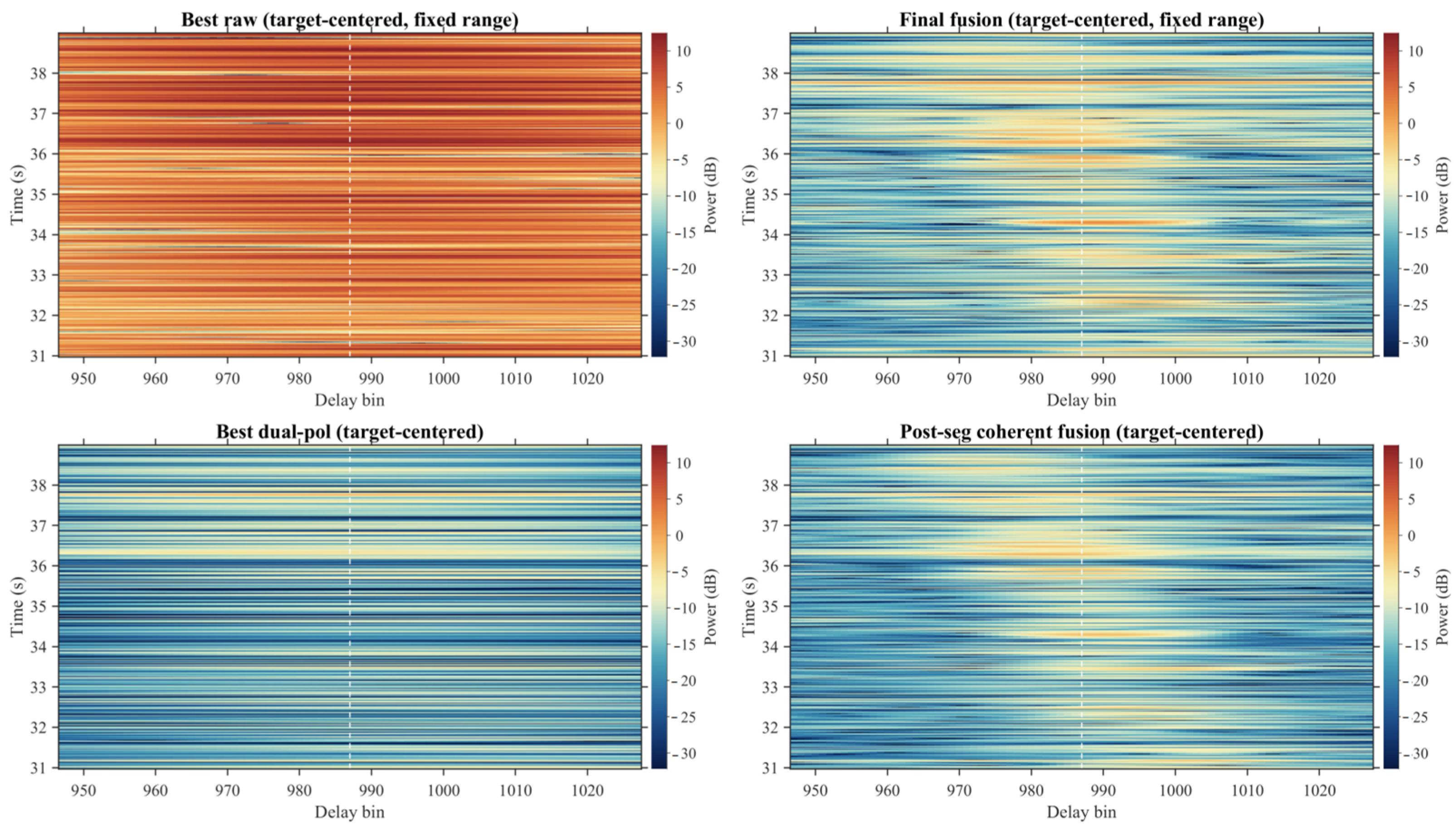
Figure A2.
Supplementary results of trajectory centering and residual range-walk compensation. The figure compares the raw trajectory and the centered processing trajectory, and further illustrates the evolution of the initial shift, the refined shift, and the residual range-walk after compensation. The results show that the large-scale delay migration of the target was effectively reduced after trajectory centering and residual range-walk correction, thereby providing a more stable local coordinate system for subsequent polarization analysis and cross-frequency registration.
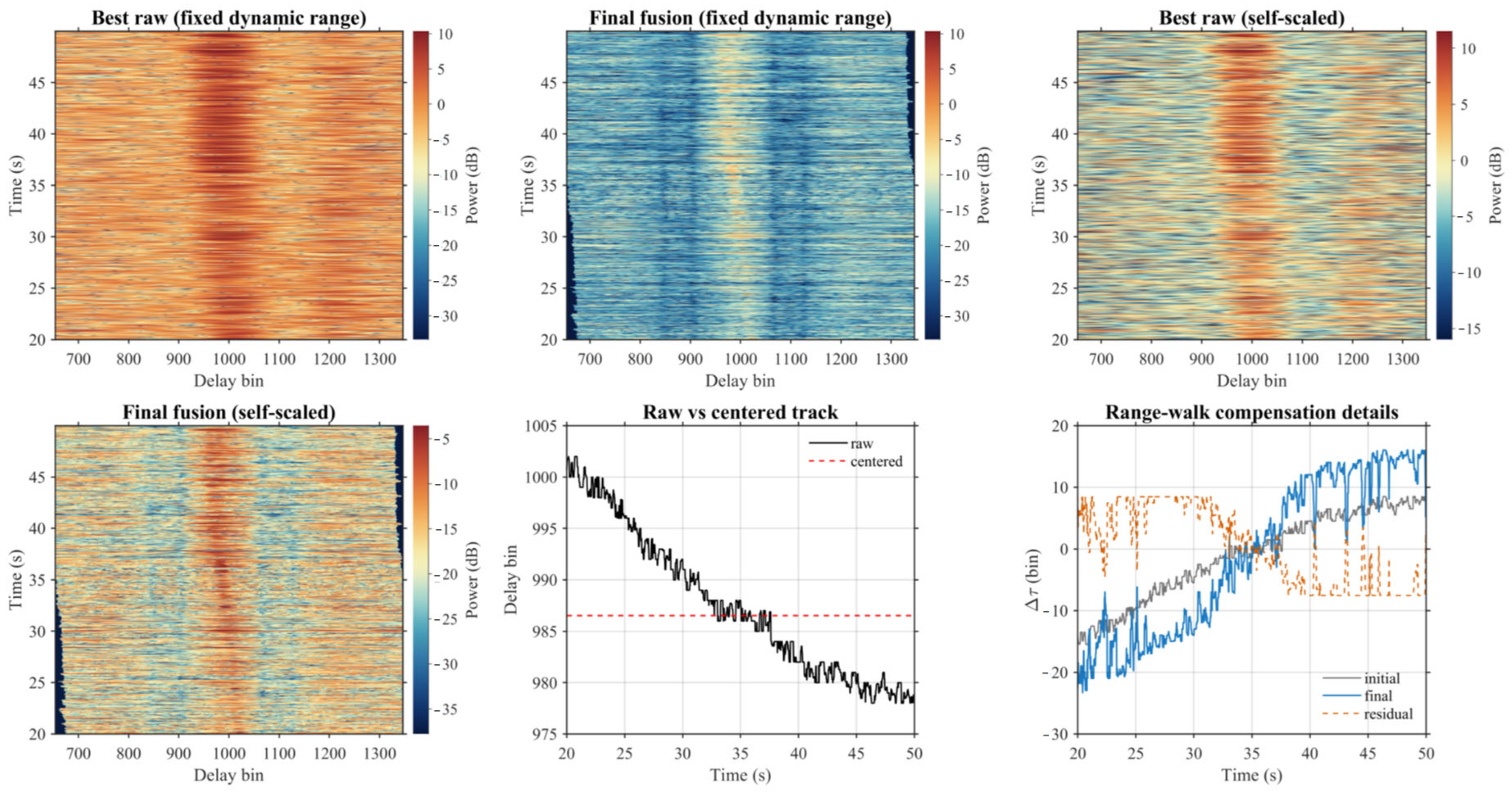
Table A1.
Core hyperparameters, adopted values, and meaning.
References
- Jin, S.; Camps, A.; Jia, Y.; Wang, F.; Neira, M.M.; Huang, F. Remote sensing and its applications using GNSS reflected signals: Advances and prospects. Satell. Navig. 2024, 5, 19. [Google Scholar] [CrossRef] [Scilit]
- Bai, W.; Wang, G.; Huang, F.; Sun, Y.; Du, Q.; Xia, J.; Wang, X.; Meng, X.; Hu, P.; Yin, C.; et al. Review of Assimilating Spaceborne Global Navigation Satellite System Remote Sensing Data for Tropical Cyclone Forecasting. Remote Sens. 2025, 17, 118. [Google Scholar] [CrossRef] [Scilit]
- Xie, J.; Bu, J.; Li, H.; Wang, Q. Spaceborne GNSS Reflectometry for Vegetation and Inland Water Monitoring: Progress, Challenges, Opportunities, and Potential. Remote Sens. 2025, 17, 1199. [Google Scholar] [CrossRef] [Scilit]
- Gao, W.; Yue, F.; Xia, Z.; Xue, C.; Liu, Z.; Zhao, Z.; Zhang, C.; Zhang, Y.; Cui, Z. Multistatic Collaborative Imaging for Shipborne GNSS-S Radar: Method and Experimental Verification. IEEE Geosci. Remote Sens. Lett. 2024, 21, 1–5. [Google Scholar] [CrossRef] [Scilit]
- Antoniou, M.; Hong, Z.; Zhangfan, Z.; Zuo, R.; Zhang, Q.; Cherniakov, M. Passive bistatic synthetic aperture radar imaging with galileo transmitters and a moving receiver: Experimental demonstration. IET Radar Sonar Navig. 2013, 7, 985–993. [Google Scholar] [CrossRef] [Scilit]
- Zhang, C.; Mu, Y.; Xia, Z.; Jin, S.; Yue, F.; Liu, X.; Zhang, L.; Tian, Z.; Liu, Z.; Zhang, Y.; et al. Feature Extraction for Moving Targets Based on the Statistical Characteristics of Echo Amplitude with the L-Band Fully Polarimetric Radar. Remote Sens. 2023, 15, 80. [Google Scholar] [CrossRef] [Scilit]
- Gao, W.; Yue, F.; Xia, Z.; Liu, X.; Zhao, Z.; Zhang, Y.; Liu, Z. Dual-Frequency Signal Enhancement Method of Moving Target Echoes for GNSS-S Radar. Remote Sens. 2023, 15, 4519. [Google Scholar] [CrossRef] [Scilit]
- Gao, W.; Yue, F.; Xia, Z.; Liu, X.; Zhang, C.; Liu, Z.; Jin, S.; Zhang, Y.; Zhao, Z.; Zhang, T.; et al. Weak Signal Processing Method for Moving Target of GNSS-S Radar Based on Amplitude and Phase Self-Correction. Remote Sens. 2023, 15, 969. [Google Scholar] [CrossRef] [Scilit]
- Pastina, D.; Santi, F.; Pieralice, F.; Bucciarelli, M.; Ma, H.; Tzagkas, D.; Antoniou, M.; Cherniakov, M. Maritime Moving Target Long Time Integration for GNSS-Based Passive Bistatic Radar. IEEE Trans. Aerosp. Electron. Syst. 2018, 54, 3060–3083. [Google Scholar] [CrossRef] [Scilit]
- Chen, X.; Guan, J.; Liu, N.; He, Y. Maneuvering target detection via radon-fractional fourier transform-based long-time coherent integration. IEEE Trans. Signal Process. 2014, 62, 939–953. [Google Scholar] [CrossRef] [Scilit]
- Santi, F.; Pieralice, F.; Pastina, D. Joint Detection and Localization of Vessels at Sea with a GNSS-Based Multistatic Radar. IEEE Trans. Geosci. Remote Sens. 2019, 57, 5894–5913. [Google Scholar] [CrossRef] [Scilit]
- Di Bisceglie, M.; Di Martino, G.; Di Simone, A.; Galdi, C.; Iodice, A.; Riccio, D.; Ruello, G. Two-scale model for the evaluation of sea-surface scattering in GNSS-R ship-detection applications. In Proceedings of the IGARSS 2018—2018 IEEE International Geoscience and Remote Sensing Symposium, Valencia, Spain, 22–27 July 2018; pp. 3181–3184. [Google Scholar] [CrossRef] [Scilit]
- Di Simone, A.; Millefiori, L.M.; Di Martino, G.; Iodice, A.; Riccio, D.; Ruello, G.; Braca, P.; Willett, P. Spaceborne GNSS-Reflectometry for Ship-Detection Applications: Impact of Acquisition Geometry and Polarization. In Proceedings of the IGARSS 2018—2018 IEEE International Geoscience and Remote Sensing Symposium, Valencia, Spain, 22–27 July 2018; pp. 1071–1074. [Google Scholar] [CrossRef] [Scilit]
- Yan, J.; Yue, F.; Xia, Z.; Jin, S.; Liu, X.; Zhang, C.; Xing, K.; Cui, Z.; Zhao, Z.; Liu, Z.; et al. Trajectory Association for Moving Targets of GNSS-S Radar Based on Statistical and Polarimetric Characteristics Under Low SNR Conditions. Remote Sens. 2026, 18, 367. [Google Scholar] [CrossRef] [Scilit]
- Katzberg, S.J.; Garrison, J.L., Jr. Utilizing GPS to Determine Ionospheric Delay over the Ocean; NASA Technical Memorandum TM-4750; National Aeronautics and Space Administration: Hampton, VA, USA, 1996. [Google Scholar]
- Pastina, D.; Santi, F.; Pieralice, F.; Antoniou, M.; Cherniakov, M. Passive Radar Imaging of Ship Targets with GNSS Signals of Opportunity. IEEE Trans. Geosci. Remote Sens. 2021, 59, 2627–2642. [Google Scholar] [CrossRef] [Scilit]
- Yasir, M.; Liu, S.; Xu, M.; Aguilar, F.J.; Wan, J.; Wei, S.; Pirasteh, S.; Fan, H.; Ul Islam, Q. TFST: Two-Frame Ship Tracking for SAR Using YOLOv12 and Feature-Based Matching. IEEE J. Sel. Top. Appl. Earth Obs. Remote Sens. 2026, 19, 3175–3189. [Google Scholar] [CrossRef] [Scilit]
- Yang, Z.; Xia, J.; Zhang, S.; Liu, L.; Fu, Y.; Liu, Y. A Learning-Aided Unsupervised Method for Sparse Aperture ISAR Imaging and Autofocusing. IEEE Trans. Aerosp. Electron. Syst. 2026, 62, 350–367. [Google Scholar] [CrossRef] [Scilit]
- Li, Y.; Bao, G.; Hu, J.; Zhi, X.; Hu, T.; Wang, J.; Wu, W. A Ship Incremental Recognition Framework via Unknown Extraction and Joint Optimization Learning. Remote Sens. 2026, 18, 149. [Google Scholar] [CrossRef] [Scilit]
- Zhang, T.; Gao, G.; Zhang, X. Glance-Focus-Gaze: A novel Eagle-Eye Vision-Inspired Panorama-Population-Individual progressive screening paradigm to capture ships in SAR images. ISPRS J. Photogramm. Remote Sens. 2026, 235, 241–260. [Google Scholar] [CrossRef] [Scilit]
- Zhang, T.; Gao, G.; Ke, X.; Zhang, X. Swarm Learning: Perception-Retrieval-Localization for Ship Detection from Synthetic Aperture Radar Remote Sensing Imagery. IEEE J. Sel. Top. Appl. Earth Obs. Remote Sens. 2026, 1–11. [Google Scholar] [CrossRef] [Scilit]
- Colone, F.; O’Hagan, D.W.; Lombardo, P.; Baker, C.J. A multistage processing algorithm for disturbance removal and target detection in passive bistatic radar. IEEE Trans. Aerosp. Electron. Syst. 2009, 45, 698–722. [Google Scholar] [CrossRef] [Scilit]
- Lan, X.; Wang, L.; Li, J.; Jiang, W.; Zhang, M. Maritime multiple moving target detection using multiple-BDS-based radar: Doppler phase compensation and resolution improvement. Remote Sens. 2021, 13, 4963. [Google Scholar] [CrossRef] [Scilit]
- Cheng, Z.; Wang, J.; Zhao, T.; Sui, J.; Huang, Z.; Ma, H.; Zuo, L. Multi-weak targets detection and measurement from range-Doppler maps in GNSS-based passive bistatic radar. Digit. Signal Process. 2026, 168, 105566. [Google Scholar] [CrossRef] [Scilit]
- Santi, F.; Pastina, D.; Bucciarelli, M. Experimental demonstration of ship target detection in GNSS-based passive radar combining target motion compensation and track-before-detect strategies. Sensors 2020, 20, 599. [Google Scholar] [CrossRef] [Scilit]
- Li, Z.; Santi, F.; Pastina, D.; Lombardo, P. Passive Radar Array with Low-Power Satellite Illuminators Based on Fractional Fourier Transform. IEEE Sens. J. 2017, 17, 8378–8394. [Google Scholar] [CrossRef] [Scilit]
- Van Zyl, J.; Kim, Y. Synthetic Aperture Radar Polarimetry; John Wiley & Sons: Hoboken, NJ, USA, 2011. [Google Scholar] [CrossRef] [Scilit]
- Lee, J.S.; Pottier, E. Polarimetric Radar Imaging: From Basics to Applications; CRC Press: Boca Raton, FL, USA, 2009. [Google Scholar]
- Capon, J. High-resolution frequency-wavenumber spectrum analysis. Proc. IEEE 1969, 57, 1408–1418. [Google Scholar] [CrossRef] [Scilit]
- Chen, S.W.; Li, Y.Z.; Wang, X.S.; Xiao, S.P.; Sato, M. Modeling and interpretation of scattering mechanisms in polarimetric synthetic aperture radar: Advances and perspectives. IEEE Signal Process. Mag. 2014, 31, 79–89. [Google Scholar] [CrossRef] [Scilit]
- Yoon, Y.S.; Amin, M.G.; Ahmad, F. MVDR beamforming for through-the-wall radar imaging. IEEE Trans. Aerosp. Electron. Syst. 2011, 47, 347–366. [Google Scholar] [CrossRef] [Scilit]
- Zhang, H.; Xu, W.; Li, L.; Liao, H. Doppler ambiguity compensation within the batch for weak moving target detection in passive bistatic radar. IEICE Trans. Fundam. Electron. Commun. Comput. Sci. 2024, 107, 1663–1668. [Google Scholar] [CrossRef] [Scilit]
- Geng, X.; Wang, J.; Yang, B.; Sun, J. An optimized diffuse Kalman filter for frequency and phase synchronization in distributed radar networks. Remote Sens. 2025, 17, 497. [Google Scholar] [CrossRef] [Scilit]
- He, Z.; Yang, Y.; Chen, W.; Cao, N.; Guo, Y. A multi-frame hybrid integration method combined with differential evolution for maneuvering target detection with GNSS-based passive radar. Adv. Space Res. 2025, 76, 110–127. [Google Scholar] [CrossRef] [Scilit]
- Duan, H.; Shi, F.; Gao, B.; Zhou, Y.; Cui, Q. A novel real-time intelligent detector for monitoring UAVs in live-line operation on 10 kV distribution networks. Intell. Robot. 2025, 5, 70–87. [Google Scholar] [CrossRef] [Scilit]
- Chen, X.; Yang, R.; Wu, Y.; Zhang, H.; Ranjitkar, P.; Postolache, O.; Zheng, Y.; Wang, Z. Towards intelligent shipping: Image-enhanced ship detection and situation analysis in low-light scenes. Intell. Robot. 2025, 5, 662–678. [Google Scholar] [CrossRef]
- Wu, D.; Liang, Z.; Chen, G. Deep learning for LiDAR-only and LiDAR-fusion 3D perception: A survey. Intell. Robot. 2022, 2, 105–129. [Google Scholar] [CrossRef] [Scilit]
- Zhang, T.; Gao, G.; Zhang, X. Triple-Level Sparsity Awareness for Marine Ship Surveillance Using Satellite Synthetic Aperture Radar. IEEE Trans. Autom. Sci. Eng. 2026, 23, 5155–5166. [Google Scholar] [CrossRef] [Scilit]

Disclaimer/Publisher’s Note: The statements, opinions and data contained in all publications are solely those of the individual author(s) and contributor(s) and not of MDPI and/or the editor(s). MDPI and/or the editor(s) disclaim responsibility for any injury to people or property resulting from any ideas, methods, instructions or products referred to in the content. |
© 2026 by the authors. Licensee MDPI, Basel, Switzerland. This article is an open access article distributed under the terms and conditions of the Creative Commons Attribution (CC BY) license.