


Highlights
What are the main findings?
- An end-to-end multi-scale spatiotemporal vision transformer (ST-VT) network is proposed for infrared moving maritime vessel segmentation by integrating multi-scale feature extraction, deformable spatial–temporal encoding, coarse-to-fine prompt decoder and multi-scale mask decoder.
- The proposed method achieves state-of-the-art segmentation performance on the benchmark dataset IPATCH and the self-labeled dataset LAS-MassMIND, which suggests the prominent advantages for segmenting the vessels with varying sizes in complex backgrounds.f
What are the implications of the main findings?
- The integration of multi-scale and spatiotemporal Transformer-based models effectively may be used to address the core challenges of infrared maritime vessel segmentation, including low contrast, cluttered backgrounds and variation in vessel size.
- The self-labeled dataset LAS-MassMIND, with high scene complexity and targets with varying sizes, provides a valuable benchmark for evaluating the infrared moving maritime vessel segmentation algorithms.
Abstract
Infrared moving maritime vessel segmentation is a crucial image processing task for maritime security, which is a challenging problem due to the complex backgrounds and targets with varying sizes. To address these issues, we propose an end-to-end segmentation network based on a multi-scale spatiotemporal vision transformer (ST-VT) for segmenting the moving maritime vessels in the infrared image sequence. Specifically, in the feature extraction module, we introduce a multi-scale feature encoding structure that combines a multi-scale backbone and Feature Pyramid Network technology. Then, the multi-scale deformable encoder structure and a cross-scale fusion module with the pixel decoder are proposed to generate the multi-scale spatiotemporal features. Subsequently, we employ the improved attention blocks that are the core blocks of the coarse-to-fine framework (across scales) of the prompt decoder to obtain the prompts. Finally, a multi-scale mask decoder is applied to achieve the final target segmentation. The experiments are conducted on the benchmark dataset IPATCH and our labeled dataset LAS-MassMIND. The results demonstrate that the proposed method achieves state-of-the-art performance, especially within complex backgrounds and targets of varying sizes.
1. Introduction
Automatic ship segmentation in infrared video is a key and challenging task related to maritime security. Its importance stems from the unique ability of infrared sensors to provide all-weather and all-day surveillance, which is indispensable for maritime safety and traffic management [1]. However, the inherent complexity of infrared maritime scenes, such as low signal-to-noise ratio, low contrast and cluttered background, and different target sizes, poses a huge obstacle to achieving accurate and robust segmentation [2]. Therefore, in recent years, many related ship detection methods and video segmentation methods have been proposed, which makes it possible to achieve a more robust and accurate moving infrared ship segmentation in the image sequences.
The segmentation of moving ships in infrared video commonly employs traditional methods [3,4,5,6,7,8]. A comprehensive review and analysis of these traditional methods on infrared image moving ship segmentation is presented in [3]. These approaches primarily encompass basic background subtraction (BS) methods, statistical background modeling techniques, multi-feature fusion strategies, non-parametric methods, and other machine learning-based techniques. However, these traditional methods often yield a high false alarm rate due to environmental challenges such as wave motion, sea clutter, and ship wakes, leading to erroneous identification of non-target elements as moving ships. To mitigate the high false alarm rate inherent in traditional infrared ship segmentation, a new background subtraction (BS) method was introduced [4]. This method combines heterogeneous BS methods with ensemble learning theory, which improves segmentation precision. However, the issue of false foreground segmentation persists, primarily due to target–background similarity in complicated infrared scenes, or the limitations of distinguishing targets from the ship wake. In recent years, the emergence of deep learning has led to many infrared ship detection methods [2,9,10,11,12,13,14,15,16,17,18,19]. These deep learning-based approaches offer significant promise in overcoming the limitations of traditional methods, such as their reliance on handcrafted features and susceptibility to diverse environmental conditions.
Deep learning-based algorithms for infrared ship detection have leveraged various strategies to enhance recognition capabilities. Attention mechanisms [9,10,11] are commonly employed to focus on global features during target extraction, thereby facilitating detection. However, a significant and persistent challenge lies in effectively addressing varying target scales, which requires the segmentation scheme to deal with the moving maritime vessels in a wide range of sizes. Multi-scale feature fusion methods [12,13,14] have been progressively developed to enhance the detection of infrared ship targets across a wide range of scales by aggregating information from different resolutions. Nevertheless, while some algorithms [15,16,17] are specifically tailored for small infrared target extraction, their optimized features or architectures often struggle to generalize effectively to the distinct characteristics of larger vessels, exhibiting limitations in simultaneous multi-scale identification. Furthermore, many of these aforementioned approaches generally lack dedicated research on the precise segmentation of infrared moving targets that exhibit significant scale variations resulting from diverse vessel types and varying imaging distances.
With the development of deep learning, the vision transformer structure has been gradually introduced in visual tasks. Its inherent capability for global context modeling, achieved through attention mechanisms, offers significant advantages over traditional Convolutional Neural Networks (CNNs) by extracting more robust features and capturing long-range dependencies [20,21,22,23,24,25]. This intrinsic strength is particularly beneficial for effectively capturing spatiotemporal information in video object detection and segmentation tasks. Moreover, integrating multi-scale processing with Transformer architectures holds substantial promise, enhancing their learning capabilities through cross-scale feature integration [20,24], which is crucial for handling the diverse target scales. To overcome this crucial limitation and provide robust segmentation for infrared moving ship targets of diverse sizes, we propose a novel multi-scale spatial–temporal Transformer. Our approach not only leverages the inherent power of spatial–temporal information but also systematically integrates a multi-scale structure at critical architectural stages. This includes a multi-scale feature extraction backbone, an innovative multi-scale object prompt query generation mechanism for locating various target instances, and a multi-scale mask decoder designed for refining segmentation predictions across different resolutions. This comprehensive multi-scale integration significantly enhances the model’s capability for precise segmentation of moving infrared ship targets of different sizes. The main contributions of our work are as follows:
- This paper introduces a novel end-to-end infrared moving ship segmentation network architecture, which integrates both multi-scale and spatial–temporal feature information to achieve robust segmentation of moving infrared ships of varying sizes within complex scenes.
- A spatiotemporal encoder module is designed, which incorporates the deformable attention mechanism to replace standard Transformer attention. This design reduces redundancy by focusing on key spatiotemporal features. Furthermore, the resulting spatiotemporal representations and multi-scale features are progressively fused via a Pixel Decoder to enhance motion-aware representations.
- A coarse-to-fine prompt decoding strategy is proposed to enhance segmentation accuracy. Specifically, self-attention and cross-attention blocks are utilized to generate prompts, which are subsequently combined with a multi-scale mask decoder structure.
- In addition, this paper constructs a new dataset, LAS-MassMIND. The dataset has higher scene complexity and target scale diversity, which provides an evaluation benchmark dataset for infrared moving maritime vessel segmentation.
This paper is organized as follows. The first section briefly reviews the moving infrared ships segmentation and detection methods and the application of vision Transformers in vision tasks. Section 2 reviews related works on the Vision Transformer-based feature representation of moving infrared maritime vessels. The proposed network model is presented in Section 3. In the fourth section, we conduct the experiments and analyze the segmentation results. Finally, our method is summarized in the last section.
2. Related Work
Automatic Video Object Segmentation. Automatic Video Object Segmentation (AVOS) is to separate the target from the background, in which the pixel-level accurate segmentation is primarily accomplished by using the end-to-end segmentation model and fusing temporal and spatial information. AVOS is further categorized into Semi-Automatic Video Object Segmentation and Fully Automatic Video Object Segmentation. Semi-automatic systems require initial annotation and then automatically segment the target in the following frames. By leveraging initial annotations as target priors and integrating temporal propagation mechanisms [20,21,26], these systems achieve tracking and segmentation. The introduction of the Segment Anything Model (SAM) [21] interactive image segmentation has led to the development of methods that integrate segmentation capabilities of SAM with tracking techniques [27,28] to achieve semi-automatic supervised video segmentation. Subsequent methods have also been developed for the interactive automatic video segmentation [20,26]. However, such methods typically still require manual participation. Furthermore, if the target disappears in the video, its re-identification or segmentation becomes a difficult task. In contrast, Fully Automatic Video Object Segmentation [24,29] is operated without any manual annotation or initialization. The system autonomously identifies and segments the objects of specified semantic categories by understanding the video content and integrating the appearance features and motion cues for target segmentation.
Vision Transformer. Since the introduction of Vision Transformers (ViTs), various schemes for improving the feature representations with the ViTs have been developed from diverse perspectives [20,21,22,23,24,25,30,31,32,33]. To further enhance the feature extraction ability of networks, the ViTs-based backbone network architectures have been introduced by combining with Feature Pyramid Networks (FPNs) [20,34,35,36]. Among them, Hiera [33] is a simplified hierarchical vision transformer that eliminates the need for complex components like masked autoencoding during pre-training, offering a better efficiency–accuracy trade-off. This architecture serves as the backbone for the recent Segment Anything Model 2 [20], demonstrating strong performance in video segmentation tasks.
In the work “Attention is All You Need” [37], the self-attention mechanism is first introduced to capture intra-sequence dependencies within the encoder, while its variant (implicit cross-attention between encoder and decoder outputs) is employed in the decoder to model inter-sequence interactions. This work establishes the foundational Transformer architecture, which forms the basis for Carion et al. [38] to propose DETR, the first fully end-to-end object detection framework based on Transformers. However, directly applying a standard Transformer encoder often introduces significant computational redundancy [25,39]. This redundancy arises because adjacent features in video sequences typically exhibit high appearance similarity. To address this, Deformable DETR [39] introduces a deformable attention module that selectively focuses on a sparse set of sampled positions, acting as a pre-filter to highlight key elements across the feature map. This innovation demonstrates superior performance in detection tasks, particularly for small objects. Building upon this, TransVoD [25] leverages Deformable DETR by integrating spatiotemporal context to enhance object detection in video sequences.
Multi-scale processing is critical for enhancing Transformer learning, particularly through cross-scale feature integration [24,40,41,42]. While recent research has focused on multi-scale Transformer encoders [20,40,41] and decoders [42] for static image tasks, Rezaul et al. [24] have introduced the Multi-scale Encoder–Decoder Transformer (MED-VT) for Video segmentation, which utilizes intra-scale and inter-scale attention mechanisms to extract spatiotemporal information. However, the limitation of MED-VT lies in its lack of a multi-scale mask decoder, which can lead to suboptimal segmentation performance for objects exhibiting significant size variations.
In computer vision segmentation tasks, the evolution of the mask decoder has also played a crucial role. Following the success of Vision Transformer (ViT) [22] in image classification, various decoder designs have been explored for dense prediction tasks. Early approaches like SETR [43] and TransUNet [44] adopt upsampling or CNN-based upsampling structures to restore feature resolution. Subsequently, Segmenter [45] introduces a more puristic mask Transformer design, which directly interacts with learnable class queries through a cross-attention mechanism to predict patch-wise classification results. Later, Swin Transformer [23] proposes a shifted window mechanism to construct hierarchical feature representations, enabling the decoder to adopt a symmetrical hierarchical structure that progressively upsamples to recover spatial resolution while fusing features from different encoder stages via skip connections. Subsequently, Mask2Former [42] proposes a masked attention mechanism that restricts each query to focus only on features within the predicted mask region, significantly reducing computational complexity. Following this, the decoder of SAM [21] was proposed based on the design philosophy of a “heavy encoder, light decoder”. Its core is an extremely lightweight two-way Transformer decoder based on Mask2Former, designed to efficiently combine embedding information from the image encoder and inputs from the prompt encoder to rapidly predict target masks, achieving promising results. However, the original SAM decoder is inherently single-scale, processing information primarily at a single feature level and lacking a multi-scale fusion mechanism.
Motivated by the above works, we propose a fully Automatic Video Object Segmentation method. This method takes the minimum parameter configuration of the Hiera image encoder structure (Hiera-Tiny) as the backbone, uses Deformable DETR to construct a spatial–temporal feature encoder component, and introduces a new multi-scale mask decoder module. It is designed specifically for the complexity of infrared maritime video segmentation, aiming to achieve effective segmentation of infrared ships with varying sizes.
The dataset. The advancement of the moving ship segmentation in the infrared scene relies heavily on high-quality datasets. Existing public datasets [46,47,48,49,50] have significantly contributed to the field of infrared detection and classification. However, most of these datasets focus on single-frame detection tasks [47,50] or contain targets of limited size variations [48,49]. They often lack pixel-level ground truth for segmentation, and more critically, they rarely provide sufficient samples for moving ships under diverse maritime conditions, particularly for small-scale vessels with low signal-to-clutter ratios. The MIT Sea Grant Marine Perception Dataset [51] was developed by the team in the Autonomous Underwater Vehicles Laboratory for autonomous surface vessels. It consists of multiple scenes to show the diverse complexity that one might expect when operating a marine vessel in a coastal region, but it also lacks pixel-level ground truth. To address these limitations, this study utilizes the IPATCH [49] for general validation. Furthermore, we selected several representative video sequences from the MIT Sea Grant Marine Perception Dataset to construct a new dataset termed LAS-MassMIND with the X-AnyLabeling tool [52], which provides pixel-level annotations for moving ships across complex scenes. This dataset is specifically designed to fill the gap in small-target benchmarks, offering a rigorous testbed for evaluating algorithms’ capability to handle significant scale variations.
3. Proposed Method
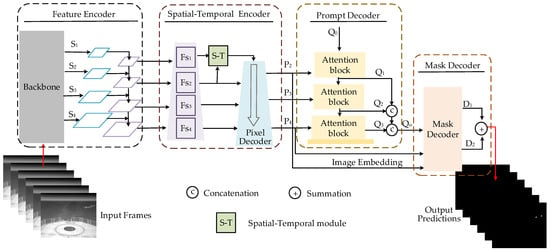
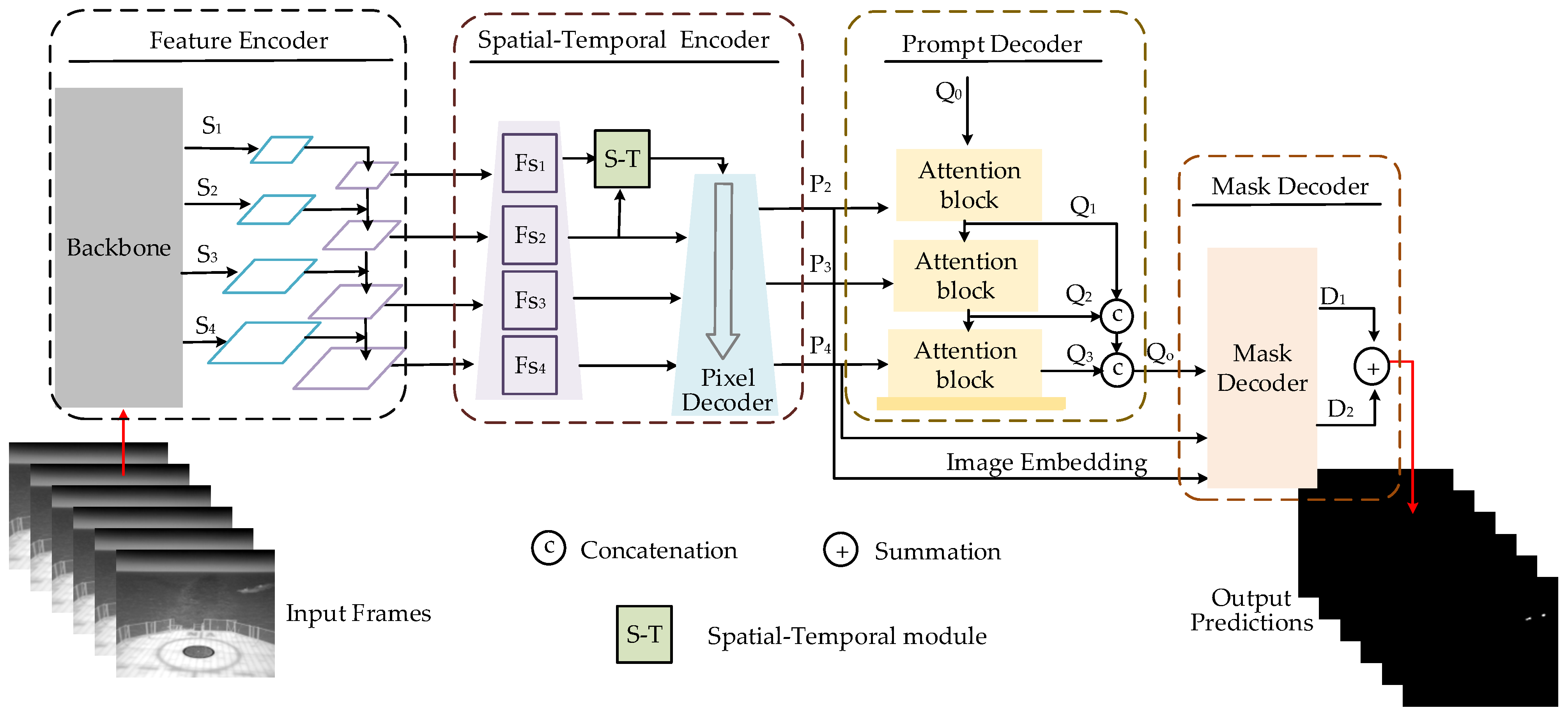
In this section, we present the proposed multi-scale spatiotemporal Transformer network, which is an end-to-end architecture designed for segmenting moving ships in the infrared video. As illustrated in Figure 1, the network comprises four primary components. In the Feature Encoder, the multi-scale features are initially extracted via a backbone network and subsequently fused by using an FPN, whose outputs are the integrated multi-scale features. The Spatiotemporal Encoder module firstly extracts spatiotemporal features using a multi-scale deformable encoder structure [39]. Then, a Pixel Decoder [24] is utilized to refine multi-scale spatiotemporal features by combining these spatiotemporal features with the multi-scale features (outputs of Feature Encoder). The Prompt Decoder employs an attention module that integrates both self-attention and cross-attention mechanisms across these coarse-to-fine scale features, so as to generate the prompt query . In the Mask Decoder module, we make use of the lightweight mask decoder of SAM [21]. The integrated masks from different scales are the final segmentation results.
Figure 1.
The proposed multi-scale spatial–temporal vision transformer ST-VT network. It contains four modules: Feature Encoder, Spatiotemporal Encoder, Prompt Decoder and Mask Decoder. represents the output multi-scale feature representations of the Hiera backbone; represents the fused features of the FPN structure; represents the multi-scale spatiotemporal features; represents the prompt query; denotes mask predictions.
3.1. Feature Encoder
The Feature Encoder in our network is adapted from the design proposed by Hiera [33] and a Feature Pyramid Network. It is well known that when a maritime vessel is captured with an infrared sensor from a long distance, the target is small in the infrared video. Meanwhile, when captured from a relatively short range, the size of the maritime vessel object is large. In order to effectively address the inherent challenge of moving maritime vessel segmentation with object size variations in infrared videos, a multi-scale feature representation is indispensable. Therefore, a hierarchical vision transformer Hiera-Tiny [33] is employed as the feature extraction backbone in our Feature Encoder, due to its computation efficiency and better contextual information representation.
To achieve segmentation of small-scale maritime vessels in long-range infrared video sequences, where targets exhibit sub-pixel occupancy due to extreme sensor-to-object distances, each video frame is uniformly resized to 1024 × 1024 pixels. This resolution serves as the input to the Hiera-Tiny backbone in our proposed framework. The output of the Hiera backbone is the multi-scale feature representations , where represents a feature tensor and is the scale index stage, and . Here, is the number of frames of the input image clip, and is the channel number. The height and width are the spatial resolution, as shown in Table 1.
Table 1.
The resolution of multi-scale features.
In general, the features at the coarsest-scale provide the semantic information from deeper layers; meanwhile, the fine-scale features preserve the fine-grained spatial details from shallower layers. In order to integrate the global semantic information and the local spatial information, a pyramid structure is applied to combine these cross-scale features. It constructs a top–down pathway with lateral connections, propagating rich semantic context from the coarsest features down to the finer scales while incorporating detailed spatial information. Then, we can obtain the fusion FPN feature:
where represents the comprehensive set of fused features, and is the feature map at scale . Here, all these fused feature maps share a consistent channel dimension (set to 256) across all scales, ensuring channel uniformity for subsequent processing while maintaining their original spatial resolutions (, ). is the process of the Feature Pyramid Network. Therefore, the integrated multi-scale representation effectively bridges the gap between global context and local details, so as to provide a robust foundation for accurate ship segmentation.
3.2. Spatial–Temporal Encoder
The Spatial–Temporal Encoder is built upon the multi-scale deformable encoder [39] and the Pixel Decoder [24]. Segmentation of moving maritime vessels in infrared imagery is often adversely affected by wakes and sea clutter. To mitigate this issue and enhance segmentation performance, we leverage spatial–temporal information across different scales. Accordingly, we propose a Spatiotemporal Encoder module to extract multi-scale spatiotemporal features. This module employs a Spatial–Temporal (S-T) module to generate coarse-scale spatiotemporal features, which are then progressively fused with multi-scale features via a Pixel Decoder.
3.2.1. Spatial–Temporal Module
Our design extends the original multi-scale deformable attention [39] from single-image processing to spatiotemporal feature extraction without modifying the core operator. Instead of altering the attention mechanism itself, we achieve this through three key adaptations in data organization and representation.
First, we reorganize the input by concatenating features from multiple frames along the batch dimension, effectively presenting the encoder with a larger set of feature maps that correspond to different spatial scales across different time steps. Second, we introduce temporal position encoding that assigns unique embeddings to each frame, enabling the model to distinguish temporal identities even though the operator itself is agnostic to the video structure. Third, we extend the definition of reference points from 2D spatial coordinates to 3D spatiotemporal coordinates , allowing the network to predict temporal offsets alongside spatial offsets .
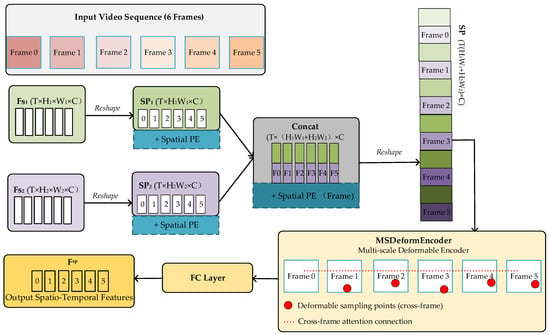
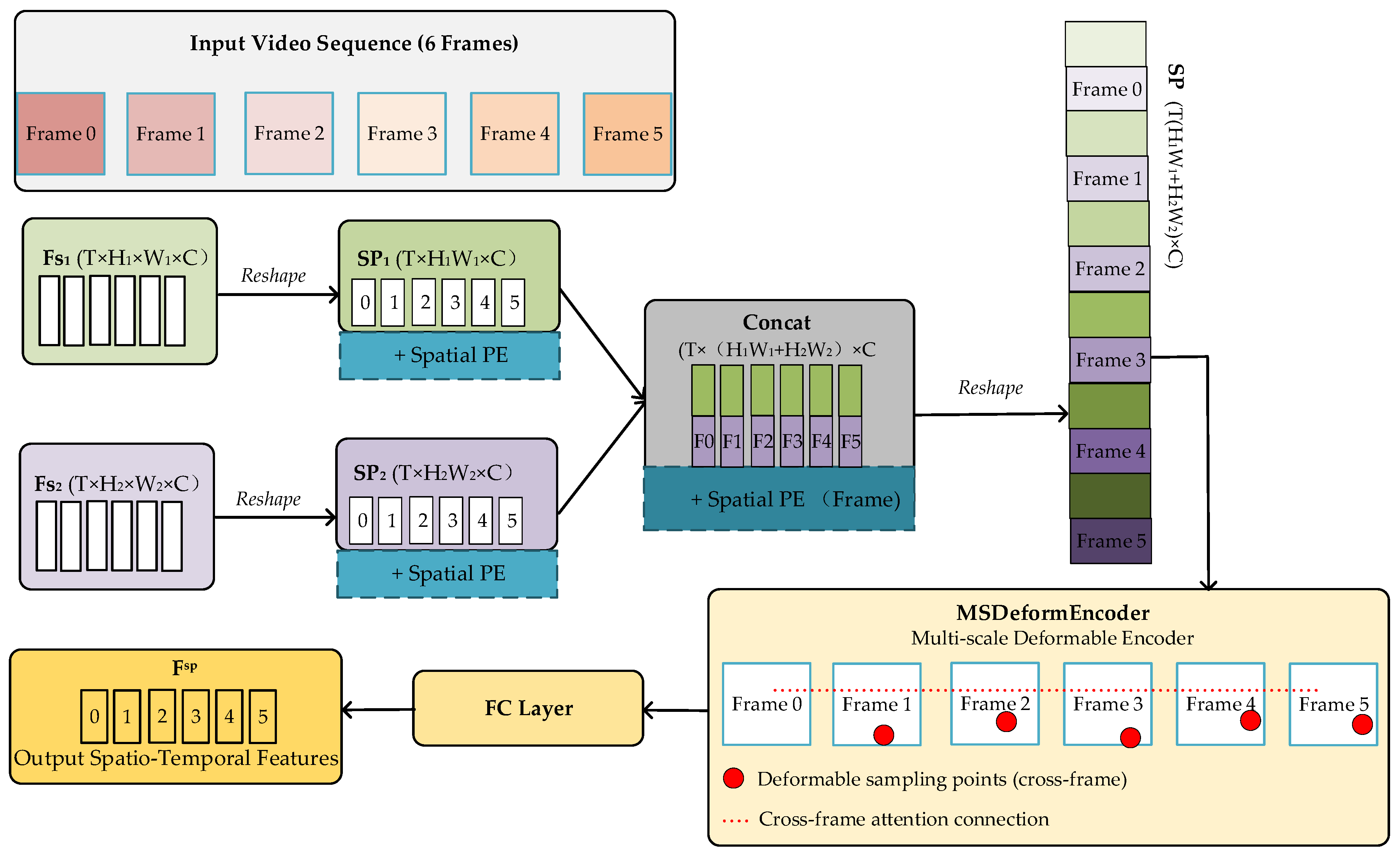
Crucially, the multi-scale deformable encoder operator remains unchanged, it perceives the input merely as a collection of feature maps from multiple levels. However, guided by the temporal position encodings and the expanded reference point definition, it learns to attend to relevant features across both space and time. Specifically, the structure is illustrated in Figure 2. The coarsest-scale features and contain the global semantic information and spatial local information. In order to extract feature representation from them and the cross-scale information, we firstly concatenate them as follows:
where . and () are transformed from and , respectively, the is the feature positional embeddings of and the is the temporal feature positional embeddings of . Then, the Transformer encoder is used to extract the spatiotemporal features. As stated in the work [39], the deformable attention mechanisms efficiently sample critical information by learning offset fields, which have been demonstrated to provide better detection performance, especially for the small object detection. Thus, the two-layer multi-scale deformable Transformer encoder is utilized in this module. The output is refined with a fully connected layer as Equation (3), which produces the final spatiotemporal feature representation.
where is the spatiotemporal features, stands for the fully connected layer, and denotes the multi-scale deformable encoder.
Figure 2.
The structure of Spatial–Temporal module. represents the fused features of FPN structure; denotes the transformed from ; represents the feature reshape from the concatenated feature of and ; is the spatiotemporal features.
3.2.2. Pixel Decoder
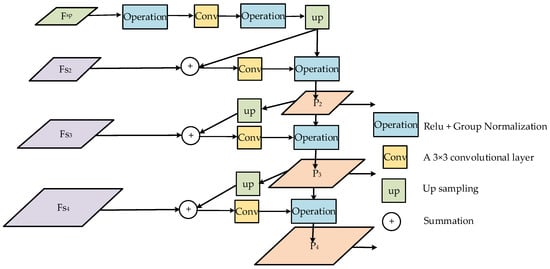
The Pixel Decoder fuses the spatiotemporal feature with the multi-scale features , and , with the specific fusion process illustrated in Figure 3. Specifically, is treated as the feature at the coarsest-scale and fed into the Pixel Decoder structure, by which the spatiotemporal information is progressively incorporated with the feature from coarsest to fine scale, so as to generate the final multi-scale spatiotemporal feature representation.
Figure 3.
The Pixel Decoder. represents the fused features of FPN structure; denotes the spatiotemporal features; is the spatiotemporal features at .
For clarity of exposition, we formally define the composite operation as follows:
where denotes Group Normalization [53], and is the activation function Rectified Linear Unit. Given the input features , , and , the multi-scale features are computed recursively as follows:
Here, the operator denotes nearest-neighbor linear interpolation for up-sampling, and the operation denotes a 3 × 3 convolution that takes the same input and output channels. The final output is the set of multi-scale spatiotemporal features .
3.3. Prompt Decoder
Inspired by the MED-VT method [24], we use the intra-scale and inter-scale attention mechanisms to extract spatiotemporal information to obtain the prompt query. Transformer encoders based on attention mechanisms are capable of capturing long-range dependencies among object representations across spatial and temporal dimensions. However, coarse-scale feature maps lack fine-grained information that is critical for accurate segmentation of small objects. To address this challenge, particularly in small object localization, we propose a Prompt Decoder module, which performs both intra-scale and cross-scale attention operations on multi-scale spatiotemporal feature layers. This design enables the model to effectively integrate contextual information across different scales while preserving detailed spatial information essential for precise localization.
The multi-scale features obtained from the Spatiotemporal Encoder are first transformed into a flattened representation . To obtain the prompts, we process with three sequential blocks, operating from coarse to fine scales. Each block consists of a self-attention module and a cross-attention module. All attention mechanisms use the standard multi-head attention , which is defined as follows:
where represents the attention output of the h-th head. , and are the corresponding learned weight matrices for the head of , , and , which denote the query, key and value, respectively.
For each block at scale in our architecture, we define the self-attention operation as follows:
where stands for the query, is the learnable query positional embeddings. And cross-attention is defined as follows:
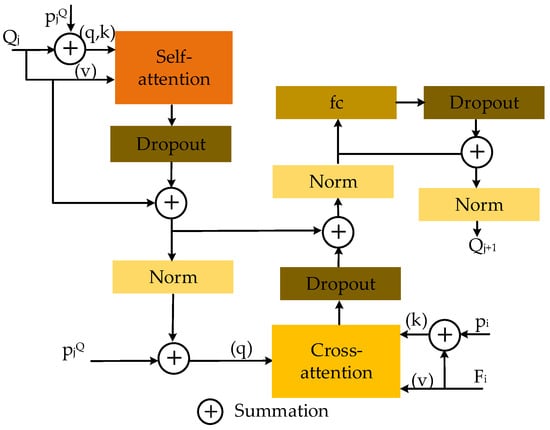
where is the feature positional embeddings. The detailed structure of the block is illustrated in Figure 4. The output of each Attention block can be obtained:
Figure 4.
The structure of Attention block. Norm represents the layer norm; denotes the fully connected layer.
Finally, we obtain the query set . The final prompt query is then derived by concatenating the last three queries :
where is the final output of the prompt.
3.4. Mask Decoder
The single-scale decoder structure in SAM [21] is a lightweight mask decoder, which has demonstrated excellent performance in image segmentation tasks [20,21]. However, the single-scale decoding struggles to accurately segment targets with significant size variations. To overcome this limitation, we propose a multi-scale fusion decoder to handle objects of different sizes by leveraging different resolution information.
Specifically, we use the prompt obtained from the Prompt Decoder as the prompt tokens, and take and from multi-scale spatiotemporal features as the coarsest and finest scale image embeddings (Let and ). The multi-scale features and are fed into two distinct pathways of the single-scale lightweight mask decoder, respectively, to generate multi-scale mask predictions. These predictions are then aggregated as Equation (13) to produce the final segmentation mask.
where , are the feature positional embeddings, and denotes an upsampling operation to align spatial dimensions.
3.5. Loss Function
In numerous maritime surveillance scenarios, the moving maritime vessel objects are captured from varying distances. In most cases, the sizes of the infrared ship targets of interest are variable and small, resulting in severe class imbalance in the infrared image sequences. Moreover, the presence of video frames that contain no target objects further exacerbates the foreground–background imbalance. To address this challenge robustly, we integrate the Dice loss [54] and an extended form of Focal loss [55] into our loss function.
Dice loss [54] is a metric that measures the overlap between predicted and true foreground regions. It has been demonstrated that the Dice loss is particularly effective in data-imbalanced scenarios because its formulation inherently focuses on the foreground. The Dice loss is formally defined as follows:
where denotes the GT label of the j-th pixel, represents the predicted probability, is the total number of pixels, and is a small constant that is added to ensure numerical stability. By including both the predicted and ground-truth (GT) values in its denominator, the Dice loss becomes less sensitive to class imbalance. Thus, it is used to improve the moving infrared maritime vessel segmentation performance.
The extended variant of Focal loss [55] is designed to mitigate challenges posed by severe foreground–background imbalance and the presence of hard samples in detection or segmentation tasks. It is defined for an image frame as follows:
Here is the GT label. And represents the predicted probability, is the predicted probability for the true class label. The weight and the balancing factor jointly address the foreground and background sample imbalance.
where is the class balancing factor, and are the weight factors of foreground and background, respectively. The focusing parameter reduces the loss for well-classified pixels, and derive the model to focus on difficult-to-classify pixels.
In order to improve the segmentation performance of the infrared maritime vessel with small and varying size. We combine the Dice loss and the extended focal loss as the loss function of our segmentation network:
where is the extended focal loss of the j-th pixel, and are the loss weighting coefficients that balance the contributions between the dice loss and the focal loss, respectively.
4. Experimental Results
4.1. Experimental Dataset and Setting
We evaluate the performance of the proposed network on the IPATCH dataset [49] and the self-labeled dataset LAS-MassMIND, in which the infrared image sequences are selected from the unlabeled dataset MIT Sea Grant Marine Perception Dataset [51]. For both datasets, one-tenth of the target video frames are randomly selected at the video level for the training set. To enhance generalization robustness under diverse conditions, frames without any target are also included in the training set, with four clips (24 frames) randomly selected from each video sequence.
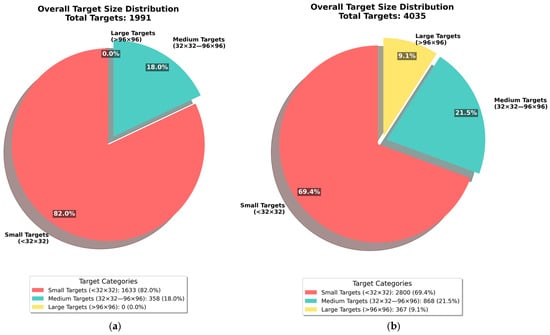
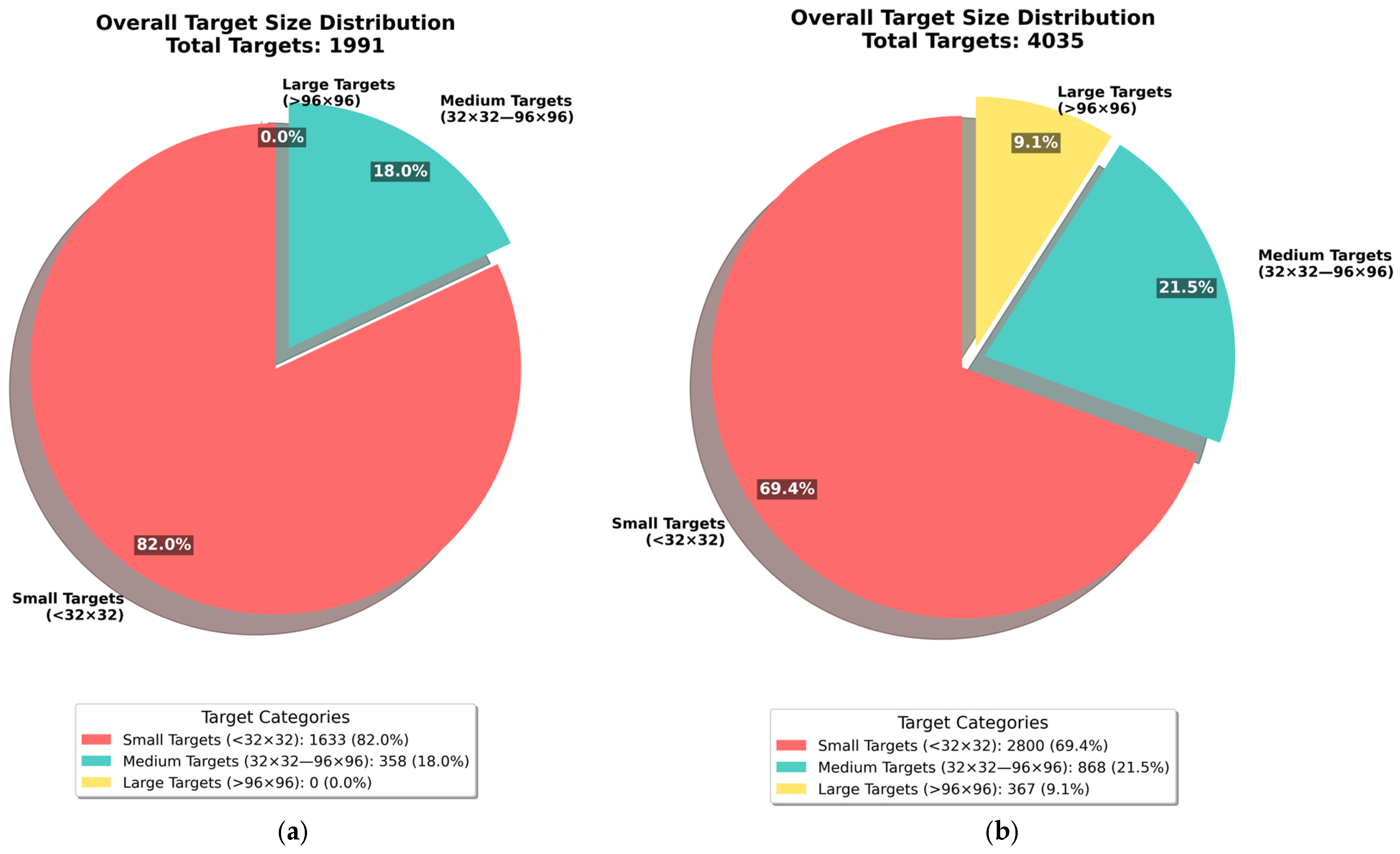
The infrared ship videos of the IPATCH dataset are collected from an infrared sensor mounted on the high tower of a tugboat [49]. A key characteristic of this dataset is the inclusion of ships with considerable scale variation and fast-moving vessels that are frequently affected by ship wakes. A further segmentation challenge arises from the coexistence of both bright and dark infrared targets. The detailed statistical overview of the IPATCH dataset is provided in Table 2, which also shows the number of frames we chose for the test and train sets. Following the common practice in object detection [56], we define a target as ‘small’ if its pixel area is less than 32 × 32. And the overall target size distribution of IPATCH is shown in Figure 5a.
Table 2.
The details of the dataset IPATCH.
Figure 5.
(a) and (b) are the overall target size distribution of IPATCH and LAS-MassMIND, respectably.
The unlabeled dataset MIT Sea Grant Marine Perception Dataset are released by the MIT Autonomous Underwater Vehicle Laboratory team [51]. The infrared videos are collected from different environments, encompassing multiple ports and regions beneath arch bridges. The moving vessels exhibit pronounced size variations due to dynamic sensor-to-object distances. However, as the original video is unlabeled for moving infrared object segmentation, we select six representative image sequences from this dataset and label them to address this limitation. These sequences encompass a variety of challenging scenarios, including the movement of both small and large targets, the dynamic process of targets approaching from a distance (i.e., transitioning from small to large in the frame), and complex backgrounds such as urban settings and arch bridges. The resulting dataset was constructed by manually annotating six video sequences captured in the Massachusetts Bay area. Three annotators with backgrounds in computer vision independently annotated each frame. To ensure annotation quality, we computed the Inter-annotator Intersection over Union (IoU), achieving a mean IoU of 0.85, which indicates a high level of consistency. Any discrepancies were subsequently reviewed and resolved by a senior researcher. Detailed statistics of this self-labeled dataset, referred to as LAS-MassMIND, including the number of frames in the training and test sets, are provided in Table 3. In this work, we focus on improving detection performance across all object scales, addressing the inherent challenges of multi-scale object detection in video sequences. Small objects (<32 × 32 pixels) suffer from limited spatial resolution and are easily overwhelmed by complex backgrounds, whereas large objects exhibit significant intra-class variation. The LAS-MassMIND dataset comprises a total of 4035 frames containing target objects. As illustrated in Figure 5b, the majority of these targets are small, accounting for 69.4% of the total (defined as having an area of less than 32 × 32 pixels).
Table 3.
The details of the dataset LAS-MassMIND.
All experiments are implemented using Python 3.12.3 and the PyTorch 2.5.1 + cu124 deep learning framework. The experimental environment consists of Ubuntu 22.04 and a Tesla V100S-PCIE-32GB GPU. All video frames are resized to a resolution of 1024 × 1024 before being fed into the network. In our experimental setup, six consecutive frames are selected as the input video clip. For the loss function, the class balancing factor α is set to be 0.25, the foreground weight factor is set to be 3, the background weight factor is set to be 1, the focusing parameter is set to be 2, the dice loss weight is set to be 0.5, and the focal loss is set to be 0.75. The optimizer we used is AdamW [57], with the learning rate lr set to 1 × 10⁻⁴. The network is trained for 70 epochs with a batch size of 1 per GPU using the AdamW optimizer [57]. The initial learning rate is set to 1 × 10⁻⁴ for newly added layers and 1 × 10⁻⁵ for the pre-trained backbone. We employ a polynomial learning rate decay schedule with a power of 0.9, decreasing from the initial rate to 1 × 10⁻⁶ over the course of training. Gradient clipping with a maximum norm of 0.1 is applied to stabilize training. All random seeds are fixed to 120 to ensure reproducibility. The backbone network is initialized with weights pre-trained on the SAM2 dataset, while all newly added layers use PyTorch’s default initialization. And the network comprises 40.6 million parameters, occupying 154.7 MB of storage. For processing six-frame video clips at 1024 × 1024 resolution, the model achieves an inference latency of 834.7 milliseconds on a Tesla V100S GPU, corresponding to 1.2 frames per second. The computational cost is estimated at 1.0 GFLOPs for a complete six-frame sequence.
To evaluate the performance of our method, we use the ground-truth (GT) and the segmentation results to calculate the evaluation metrics Intersection over Union (IoU), mean Intersection over Union (mIoU), recall (Re), precision (Pre) and F-measure (FM) [58].
where , , and are the number of true positives, the number of false negatives, the number of false positives and the number of true negative of the v-th video, respectively. is the number of videos in dataset.
4.2. Experimental Results and Analysis
4.2.1. Experimental Results on the Dataset IPATCH
The performance of our method is evaluated on the IPATCH dataset and compared with traditional and state-of-the-art deep learning approaches. The results are summarized in Table 4. Specifically, the “Basic BS Methods” category comprises 10 traditional methods, the “Statistical Background Model Methods” category includes six methods, the “Multiple Features Methods” category consists of seven methods, the “Non-parametric Methods” category contains six methods, and the “Other Machine Learning-based Methods” category encompasses eight methods. Detailed descriptions of all individual methods within these categories are provided in reference [3]. The traditional methods generally achieve high recall but suffer from extremely low precision. Non-parametric Methods and Other Machine Learning-based Methods also show similar trends, which have been demonstrated by the recall rates exceeding 0.92 and the precisions falling below 0.2. This indicates a severe false segmentation issue, where backgrounds are frequently misclassified as foregrounds. As a result, despite their relatively high recall, the overall performance of these methods, as measured by the FM, is lower than 0.33. In contrast, the proposed method achieves a superior trade-off between the segmentation recall, precision, IoU, and mIoU that reaches 81.57%, 79.69%, 0.6683, and 0.8340, respectively. A similar balanced performance is also achieved by the method M-MELD [4] and the deep learning-based methods MED-VT(SwinB) [24], SAM2 [20] and Xmen+SAM [27]. However, their measures, Pre, FM and IoU, are much lower than those of our method. Our method achieves superior performance on all metrics, with a particularly notable mIoU of 0.8340. This represents a significant improvement of 8.03 percentage points over the second-best method, MED-VT (SwinB). Furthermore, for the moving infrared maritime vessel segmentation on this dataset, the model MED-VT (SwinB) shows better performance than the deep learning-based methods SAM2 and Xmen+SAM. Its recall rate reaches 0.7315, which is still lower than that of our model, at 0.815. It is suggested that our proposed model achieves the best performance among those compared methods.
Table 4.
Comparison results on the dataset IPATCH.
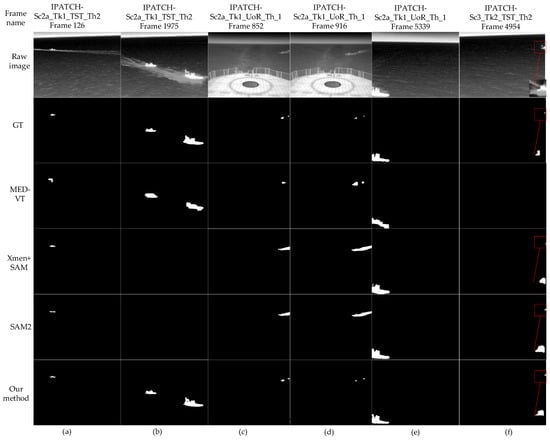
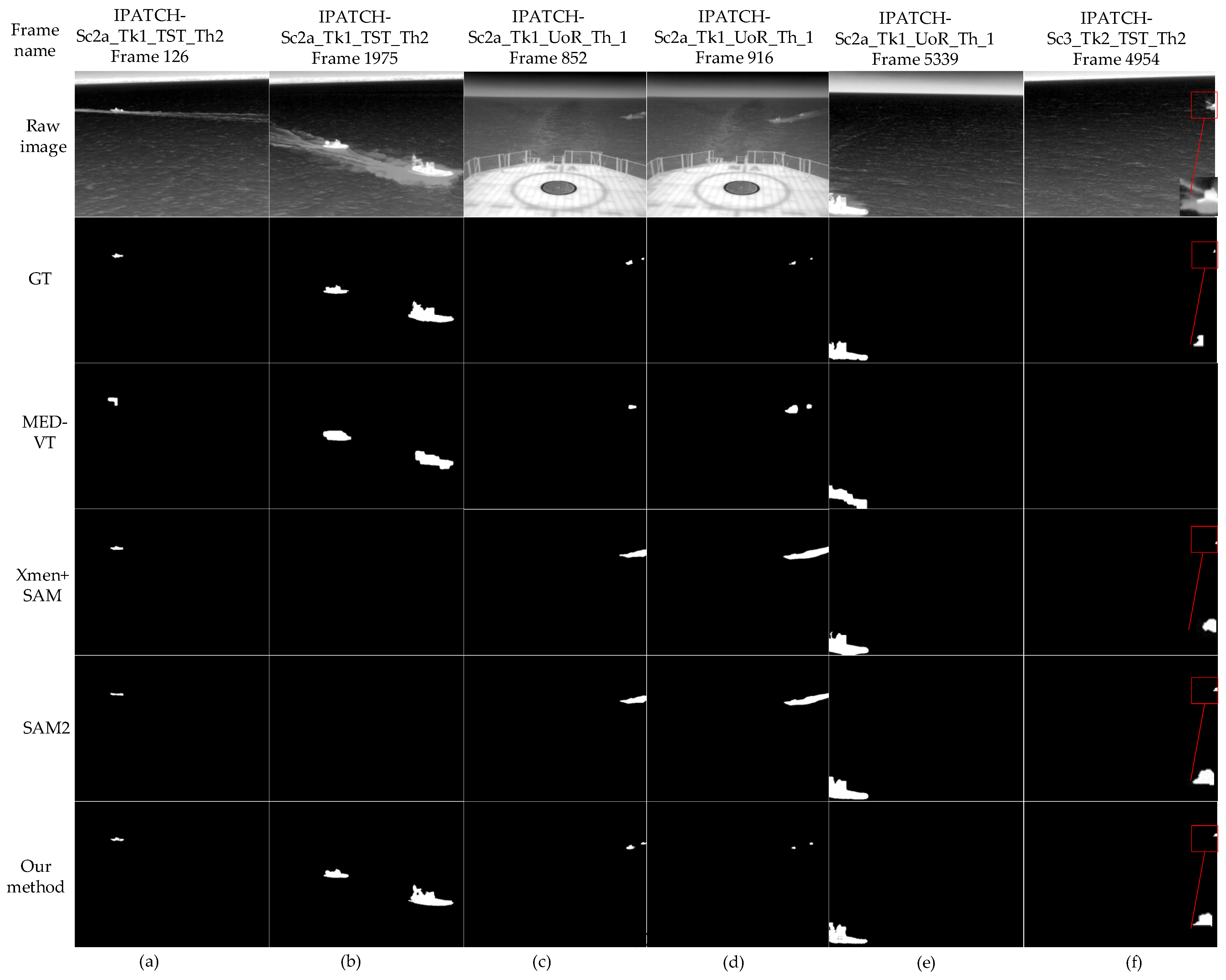
In order to further evaluate the segmentation performance, we show the results of four typical scenarios in Figure 6. The first one (Figure 6a,b) is that the vessel moves over the wake. The second scenarios, as shown in Figure 6c,d, involve vessels approaching from a distance. In the third scenario, the target vessel initially appears in the field of view with a relatively large scale, as shown in Figure 6e. In contrast, in the fourth scenario, it enters the view at a notably smaller size (Figure 6f). As observed in Figure 6a, all methods successfully localize the vessel target. The segmentation outputs of our method and the Xmen+SAM align more closely with the GT compared to other approaches. However, in Figure 6b, both Xmen+SAM and SAM2 incorrectly segment the moving vessels as background. Additionally, our method yields more accurate segmentation than MED-VT in this case. For the case of distant, small approaching vessels (Figure 6c,d), Xmen+SAM and SAM2 misclassify portions of the wake as moving objects, while MED-VT detects only one of the two vessel targets, missing the smaller one in Figure 6d. In the third scenario (Figure 6e), all models produce visually similar results. Nevertheless, when small vessels are in motion within the field of view (Figure 6f), MED-VT fails to separate them from the background. Overall, the results demonstrate that our method obtains better segmentation results on the four scenarios.
Figure 6.
Representative frames and the corresponding segmentation results of the infrared image sequences of the dataset IPATCH. In the last column, the segmentation results in the red boxes are magnified by a factor of 4 for better viewing. (a,b) show the vessel moving over the wake; (c,d) show vessels approaching from a distance; (e) shows the target vessel initially appearing in the field of view with a relatively large scale; (f) shows the vessel entering the view at a notably smaller size.
4.2.2. Experimental Results on the Dataset LAS-MassMIND
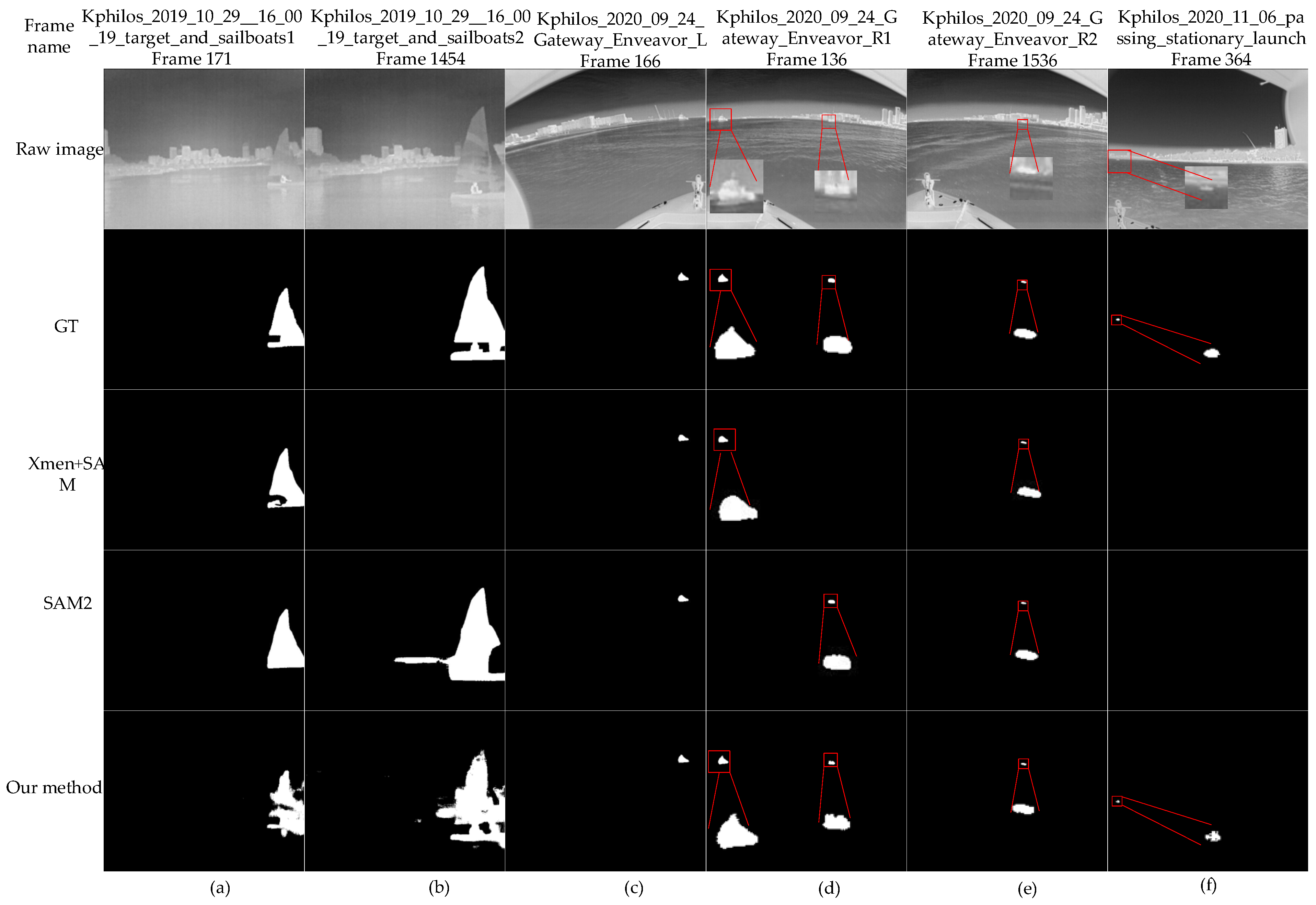
To evaluate the effectiveness of our method, we conduct a comparison with SAM2 [20] and Xmen+SAM [27] on the dataset LAS-MassMIND. As shown in Table 5, our method achieves an IoU of 0.6559 and an mIoU of 0.8267, outperforming both SAM2 (0.6486 IoU, 0.8237 mIoU) and Xmen+SAM (0.5698 IoU, 0.7834 mIoU). Notably, our method exhibits the smallest gap between IoU and mIoU (0.1708), indicating more consistent performance across different categories compared to the baselines. The metric recall of our method reaches 0.7188, which is better than the models Xmen+SAM and SAM2 by 12.41% and 2.62%, respectively. For the metric F-measure, our method is better than SAM2 and Xmen+SAM by 5.96% and 13.89%, respectively. However, the precision of the proposed method is lower than that of SAM2 by 6.93%, which may largely be attributed to the supervised video segmentation of the compared methods. In the experiments of the method SAM2, we provide 11 informative prompt points on the initial frames in the first two video sequences as prior knowledge to obtain a higher-quality initial segmentation mask. Similarly, for the model Xmen+SAM, the ground truth of the first frame is used as the initial mask. This manual participation strategies result in better segmentation results in sequences such as Sequence Kphilos_2019_10_29__16_00_19_target_and_sailboats1 and Kphilos_2019_10_29__16_00_19_target_and_sailboats2, where targets exhibit continuous, stable motion without occlusion or reappearance.
Table 5.
Comparison results on the dataset LAS-MassMIND.
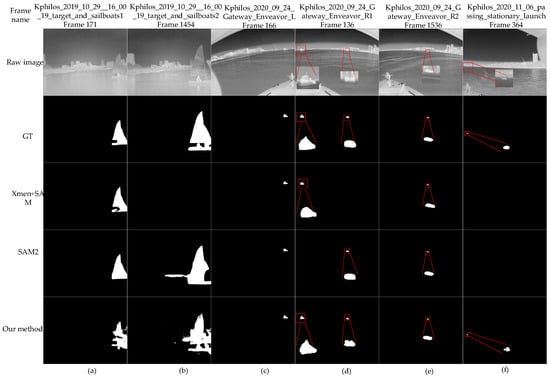
The representative frame of each video sequence and the corresponding segmentation results of all compared methods are shown in Figure 7. It is observed that all three methods achieve excellent performance in the sequences Kphilos_2020_09_24_Gateway_Enveavor_L and Kphilos_2020_09_24_Gateway_Enveavor_R2, as illustrated in Figure 6c,e. In the sailboat segmentation (Figure 6a), the model SAM2 Xmen+SAM yields favorable results. However, our proposed method exhibits incomplete segmentation in this frame. For the sailboat segmentation as shown in Figure 6b, our result is similar to that in Figure 6a. The model Xmen+SAM fails to segment the sailboat object. Although our proposed method occasionally exhibits incomplete segmentation in the delineation of precise object boundaries, it can consistently achieve accurate target localization and effectively capture the overall contour of the target. Such limitations in boundary refinement are generally attributed to the blurry edges of the target itself and the complex background, which pose great challenges for recovering fine-grained contour details in fully automatic motion segmentation tasks. However, in the image sequence Kphilos_2020_09_24_Gateway_Enveavor_R1, and Kphilos_2020_11_06_passing_stationary_launch (Figure 7d,f), both SAM2 and Xmen+SAM fail to segment the small target vessel. In contrast, our proposed method successfully accomplishes the segmentation task for the two sequences. For the complex scenario involving the segmentation of small targets with frequent appearance and disappearance, our method can achieve satisfactory segmentation performance.
Figure 7.
Segmentation results on the dataset LAS-MassMIND. The segmentation results in the red boxes are magnified by a factor of 4 for better viewing. (a–f) show the representative frames of each video sequence and the corresponding segmentation results.
To better demonstrate the performance of our method with different scales and scenarios, the segmentation evaluation results for each video in the dataset LAS-MassMIND are listed in Table 6. The metrics of the sequences Kphilos_2019_10_29__16_00_19_target_and_sailboats1 and Kphilos_2019_10_29__16_00_19_target_and_sailboats2 are consistent with the results in Figure 7a,b, which are attributed to the blurry boundaries and low target brightness that make it difficult to distinguish the targets from the background. However, the segmentation boundaries generated by our method tend to converge toward the target center, while this characteristic can effectively distinguish the sea surface and ship wakes from infrared ship targets. In the video sequences Kphilos_2020_09_24_Gateway_Enveavor_L and Kphilos_2020_09_24_Gateway_Enveavor_R1, the targets featured as bright objects increase in size from small to large, so that our method achieves better segmentation performance with a recall of over 85%, a precision of over 90%, an IoU of over 79%, and the mIoU over 89%. Both the sequences Kphilos_2020_09_24_Gateway_Enveavor_R1 and Kphilos_2020_09_24_Gateway_Enveavor_R2 contain small targets. Although the recall decreases slightly, the precision still reaches over 91%. For the video sequence Kphilos_2020_11_06_passing_stationary_launch, which includes the small targets with relatively complex motion trajectories, the recall of our method decreases to 64%. The relatively low recall is partly due to the tendency of the segmentation boundaries generated by our method converging toward the target center (see Figure 6a,b,d and Figure 7a,b,f). However, the precision still reaches nearly 90%. In summary, the proposed method exhibits strong generalization ability and robustness across all six test sequences, achieving an average recall, precision and F-measure (FM) of 0.7188, 0.8712 and 0.7846, respectively, which suggests our method achieves a favorable balance between recall and precision.
Table 6.
The results for each video of the dataset LAS-MassMIND.
4.3. Ablation Study
4.3.1. Ablation Study of Multi-Scale Mask Decoder
To evaluate the effectiveness of the multi-scale mask decoder, we conduct comparative experiments between single-scale mask decoders and multi-scale fused mask decoder methods on the datasets IPATCH and LAS-MassMIND. The ST-VT-S2 method uses only a single coarse-scale with an input feature resolution of , while ST-VT-S4 employs only a single fine-scale with an input resolution of . The ST-VT-S2S4 refers to the multi-scale mask decoder that integrates features from both scales. The results are shown in Table 7.
Table 7.
The results of our method with different scales.
It is found from the segmentation results on two datasets that the model ST-VT-S2 achieves higher recall than the method of ST-VT-S4, which means that the coarse-scale model is useful in finding the moving object. Meanwhile, the model ST-VT-S4 has higher precision than ST-VT-S2, which implies the fine-scale model is beneficial for accurately partitioning the maritime vessel from the background. The multi-scale model ST-VT-S2S4 can combine the advantages of the different scale models. In addition, the multi-scale fusion method may process the object with varying sizes. Therefore, the model ST-VT-S2S4 provides better segmentation results. Specifically, on the dataset IPATCH, the F-measure of the method ST-VT-S2S4 is higher than ST-VT-S2 and ST-VT-S4 by 5.45% and 7.86%, respectively. Furthermore, it attains an IoU of 0.6683 and an mIoU of 0.8340, surpassing the two baselines by substantial margins of 6.75 and 3.37 percentage points. On the second dataset, its F-measure is 0.7846, which is better than the other two methods by 7.80% and 7.47%, respectively. Similarly, it attains an IoU of 0.6559 and an mIoU of 0.8267, marking significant improvements of 9.74 and 4.89 percentage points over ST-VT-S2. These consistent gains across different datasets validate the necessity of the multi-scale fused model for segmenting the infrared moving maritime vessel with significant size variations under the complex background.
4.3.2. Further Ablation Analysis on Network Components
The proposed network architecture comprises four modules: the Feature Encoder, Spatial–Temporal Encoder, Prompt Decoder, and Mask Decoder. Apart from the multi-scale Mask Decoder discussed in the previous section, we designed three comparative experiments to elucidate the individual contribution of the remaining components to the overall performance. Specifically, these experiments include the following variations: In the Feature Encoder, we substituted Hiera-Tiny with ResNet as the backbone for feature extraction. Regarding the Spatial–Temporal Encoder, we removed this module, allowing the output FPN features to interact directly with the Prompt Decoder for the Mask Decoder. Finally, in terms of frame selection, we conducted experiments utilizing four frames. We report the results in Table 8 as the mean values calculated from four independent experimental trials.
Table 8.
The results of our method on different architectures.
The Hiera-Tiny backbone network significantly outperforms ResNet-50. Under the full configuration, Hiera-Tiny achieves mIoU scores of 0.8340 on IPATCH and 0.8267 on LAS-MassMIND, representing improvements of 11.6% and 26.9% over ResNet-50 [59], respectively. This validates the advantage of the hierarchical architecture in multi-scale feature extraction. On LAS-MassMIND, introducing the Spatial–Temporal Encoder module substantially increases mIoU from 0.6954 to 0.8267 (a relative improvement of 18.9%) and boosts the F-measure from 0.4908 to 0.7846. Stable improvements are also observed on IPATCH. A six-frame input yields optimal performance on both datasets, with gains of 6.2% on IPATCH and 8.7% on LAS-MassMIND compared to a four-frame input, indicating that an appropriate temporal context can effectively capture motion information.
5. Discussion
This paper presents a video object segmentation framework based on a multi-scale spatiotemporal encoder, aimed at addressing the challenges of multi-scale ship segmentation in complex maritime backgrounds. Through systematic experiments conducted on two datasets with distinct target distribution properties, we derive the following key findings: (1) the efficacy of the multi-scale feature fusion strategy on mask decoder; (2) efficient spatiotemporal modeling via cross-scale deformable attention and early multi-scale fusion; (3) compact unified multi-scale query via concatenative fusion; (4) advanced backbone networks exert an important influence on multi-scale feature extraction.
Unlike SAM [21] and SAM2 [20], which rely on single-scale feature decoding, our method incorporates a multi-scale fusion strategy within the mask decoder, which enables the simultaneous capture of fine-grained details from high-resolution features and robust semantic context from low-resolution features. The dual-scale configuration ST-VT-S2S4 consistently outperforms single-scale variants across both datasets, achieving FM scores of 0.7975 on IPATCH and 0.7846 on LAS-MassMIND. Therefore, the dual-scale configuration resolves this trade-off by leveraging both low-resolution features to provide fine-grained localization cues, while high-resolution features suppress false positives through broader contextual information. This cooperative mechanism is particularly advantageous in complex scenes where target scales vary widely.
The ablation results suggest that temporal context becomes critically important when scenes involve complex backgrounds and highly variable target scales, a finding that aligns with the intrinsic difficulty of establishing scale consistency across frames in such scenarios. As compared with two representative video Transformer architectures: MED-VT [24] and TransVoD [25]. Unlike TransVoD’s single-scale deformable attention, our method applies deformable attention across multiple scales simultaneously, enabling efficient cross-scale spatiotemporal modeling. While MED-VT achieves cross-scale interaction through separate cross-attention layers, we integrate cross-scale interaction directly within the deformable attention mechanism—each scale’s attention can sample from adjacent scales, unifying cross-scale and spatiotemporal modeling. In both MED-VT and TransVOD, the feature extraction and decoding are separate. We integrate a pixel decoder immediately after spatiotemporal feature extraction, enabling early multi-scale feature fusion before mask prediction. This combination enables our spatiotemporal feature extraction module to deliver both efficiency and representational power for video object segmentation in complex multi-scale scenes.
The existing query-based methods can be categorized into three paradigms: Multi-scale Independent Queries (Category A) [24,60], Single-scale Queries with Multi-scale Feature Sampling (Category B) [25], and Adaptive/Dynamic Queries (Category C) [61,62,63]. Our approach is based on Fused Multi-scale Queries. Similar to Category A, we employ within-scale attention for intra-scale spatiotemporal modeling and between-scale attention for cross-scale interaction. However, unlike Category A, which maintains separate outputs, we concatenate the three scale outputs after attention operations to form a single, unified multi-scale prompt representation. Our concatenation provides explicit physical fusion, ensuring subsequent modules directly access a holistic multi-scale representation. By consolidating three query streams into one, we reduce parameter count and computational overhead compared to Category A, while avoiding the need for additional cross-scale interaction mechanisms required by Category B. Therefore, our method uniquely combines the architectural strengths of multi-scale attention (shared with Category A) with a compact fusion strategy that produces a unified multi-scale prompt. This places our approach in a distinct category (Category C) that balances representational power with computational efficiency, while providing a simplified interface for downstream modules. To our knowledge, this specific design—within-scale and between-scale attention followed by concatenative fusion into a single prompt set—has not been explored in existing video object segmentation literature.
As for backbone networks, the cross-dataset comparison reveals an intrinsic relationship between backbone selection and target scale distribution. On IPATCH, where small targets are extremely dominant, Hiera-Tiny already demonstrates clear superiority. On LAS-MassMIND, which features broader scale distribution and more complex backgrounds, Hiera-Tiny’s advantage is further amplified performance gain increasing from (0.18 to 0.35). This phenomenon indicates that the hierarchical Transformer architecture of Hiera-Tiny constructs richer multi-scale feature pyramids, thereby better supporting multi-scale object segmentation tasks in complex scenarios.
Nevertheless, the computational complexity of our method scales linearly with the number of input frames due to multi-frame processing. This may constrain real-time deployment in resource-constrained scenarios. The problem may be addressed by using efficient temporal modeling through sparse sampling or temporal pooling to reduce computational overhead; meanwhile, the long-term memory mechanisms could be utilized to extend temporal context without linearly increasing computational cost.
6. Conclusions
This paper proposes an end-to-end video segmentation network based on a multi-scale spatiotemporal transformer for infrared moving vessel segmentation in complex maritime environments. The core issues to be addressed are the cluttered backgrounds and significant size variations in targets. Therefore, the multi-scale features are extracted with the feature encoder. Then, the coarse-scale spatial–temporal features obtained from the Spatial–Temporal module are progressively fused by using the Pixel Decoder. The intra-scale and cross-scale attention innovations are utilized to generate the segmentation prompts, and a multi-scale mask decoder is applied to achieve the final segmentation. The proposed method is evaluated on the benchmark dataset IPATCH and our labeled dataset LAS-MassMIND. On the first dataset, our method achieved state-of-the-art performance with a recall of 0.8157, precision of 0.7969, and F-measure of 0.7975. For the dataset LAS-MassMIND, including image sequences with a more complex background and significant size variations in targets, the proposed model demonstrates superior robustness and generalization, reaching a competitive F-measure score of 0.7846. Therefore, our method provides a promising framework for the infrared moving maritime vessel segmentation.
Author Contributions
Conceptualization, W.L.; methodology, W.L. and Y.Q.; software, W.L.; validation, W.L.; formal analysis, W.L. and Y.Q.; data curation, W.L., Y.Q., Y.Z. and Z.X.; writing—original draft, W.L.; writing—review & editing, W.L., Y.Q., Y.Z. and Z.X.; visualization, W.L.; supervision, Y.Q.; funding acquisition, Y.Q. All authors have read and agreed to the published version of the manuscript.
Funding
This research received no external funding.
Data Availability Statement
For the dataset and code, please contact our corresponding author if needed.
Conflicts of Interest
The authors declare no conflicts of interest.
References
- Tanaka, K.; Ikeya, N.; Takatani, T.; Kubo, H.; Funatomi, T.; Ravi, V.; Kadambi, A.; Mukaigawa, Y. Time-resolved far infrared light transport decomposition for thermal photometric stereo. IEEE Trans. Pattern Anal. Mach. Intell. 2019, 43, 2075–2085. [Google Scholar] [CrossRef]
- Zhou, W.; Ben, T. IRMultiFuseNet: Ghost hunter for infrared ship detection. Displays 2024, 81, 102606. [Google Scholar] [CrossRef] [Scilit]
- Chan, Y.T. Comprehensive comparative evaluation of background subtraction algorithms in open sea environments. Comput. Vis. Image Underst. 2021, 202, 103101. [Google Scholar] [CrossRef] [Scilit]
- Chan, Y.T. Ensemble learning-based method for maritime background subtraction in open sea environments. Comput. Vis. Image Underst. 2024, 238, 103859. [Google Scholar] [CrossRef] [Scilit]
- Zhou, A.; Xie, W.; Pei, J. Maritime infrared target detection using a dual-mode background model. Remote Sens. 2023, 15, 2354. [Google Scholar] [CrossRef] [Scilit]
- Yang, P.; Dong, L.; Xu, W. Infrared small maritime target detection based on integrated target saliency measure. IEEE J. Sel. Top. Appl. Earth Obs. Remote Sens. 2021, 14, 2369–2386. [Google Scholar] [CrossRef] [Scilit]
- Tian, X.; Li, S.; Yang, X.; Zhang, L.; Li, C. Joint spatio-temporal features and sea background prior for infrared dim and small target detection. Infrared Phys. Technol. 2023, 130, 104612. [Google Scholar] [CrossRef] [Scilit]
- Zhou, A.; Xie, W.; Pei, J. Background modeling combined with multiple features in the Fourier domain for maritime infrared target detection. IEEE Trans. Geosci. Remote Sens. 2021, 60, 1–15. [Google Scholar] [CrossRef] [Scilit]
- Zhao, E.; Dong, L.; Chu, X.; Wang, M. Infrared maritime small target detection network based on attention and partial learning convolution. Infrared Phys. Technol. 2025, 146, 105748. [Google Scholar] [CrossRef] [Scilit]
- Liu, C.; Zhang, Y.; Shen, J.; Liu, F. Improved RT-DETR for infrared ship detection based on multi-attention and feature fusion. J. Mar. Sci. Eng. 2024, 12, 2130. [Google Scholar] [CrossRef] [Scilit]
- Guo, L.; Wang, Y.; Guo, M.; Zhou, X. YOLO-IRS: Infrared Ship Detection Algorithm Based on Self-Attention Mechanism and KAN in Complex Marine Background. Remote Sens. 2024, 17, 20. [Google Scholar] [CrossRef] [Scilit]
- Chen, X.; Qiu, C.; Zhang, Z. A multiscale method for infrared ship detection based on morphological reconstruction and two-branch compensation strategy. Sensors 2023, 23, 7309. [Google Scholar] [CrossRef] [Scilit] [PubMed]
- Xu, H.; Yu, Y.; Zhang, X.; He, J. Cross-Granularity Infrared Image Segmentation Network for Nighttime Marine Observations. J. Mar. Sci. Eng. 2024, 12, 2082. [Google Scholar] [CrossRef] [Scilit]
- Zhang, M.; Dong, L.; Gao, Y.; Wang, Y. Infrared maritime object detection network with feature enhancement and adjacent fusion. IEEE J. Sel. Top. Appl. Earth Obs. Remote Sens. 2024, 17, 5750–5760. [Google Scholar] [CrossRef] [Scilit]
- Song, Z.; Yang, J.; Zhang, D.; Wang, S.; Li, Z. Semi-supervised dim and small infrared ship detection network based on haar wavelet. IEEE Access 2021, 9, 29686–29695. [Google Scholar] [CrossRef] [Scilit]
- Yao, J.; Xiao, S.; Deng, Q.; Wen, G.; Tao, H.; Du, J. An infrared maritime small target detection algorithm based on semantic, detail, and edge multidimensional information fusion. Remote Sens. 2023, 15, 4909. [Google Scholar] [CrossRef] [Scilit]
- Zheng, Y.; Ao, X.; Xie, W.; Lv, X.; Gao, Z.; Liu, X.; Fang, Z. IRS-DETR: Lightweight real-time transformer for infrared ship detection in maritime surveillance. Ocean. Eng. 2026, 343, 123319. [Google Scholar] [CrossRef] [Scilit]
- Gao, Z.; Liu, Z.; Zhang, T. Infrared ship target segmentation based on adversarial domain adaptation. Data Acquis. Process. 2023, 38, 598–607. [Google Scholar]
- Ibrahim, I.A.; Namoun, A.; Ullah, S.; Alasmary, H.; Waqas, M.; Ahmad, I. Infrared ship segmentation based on weakly-supervised and semi-supervised learning. IEEE Access 2024, 12, 117908–117920. [Google Scholar] [CrossRef] [Scilit]
- Ravi, N.; Gabeur, V.; Hu, Y.T.; Hu, R.; Ryali, C.; Ma, T.; Khedr, H.; Rädle, R.; Rolland, C.; Gustafson, L.; et al. Sam 2: Segment anything in images and videos. arXiv 2024, arXiv:2408.00714. [Google Scholar]
- Kirillov, A.; Mintun, E.; Ravi, N.; Mao, H.; Rolland, C.; Gustafson, L.; Xiao, T.; Whitehead, S.; Berg, A.; Lo, W.Y.; et al. Segment anything. In Proceedings of the IEEE/CVF International Conference on Computer Vision, Paris, France, 1–6 October 2023; pp. 4015–4026. [Google Scholar]
- Dosovitskiy, A. An image is worth 16x16 words: Transformers for image recognition at scale. arXiv 2020, arXiv:2010.11929. [Google Scholar]
- Liu, Z.; Lin, Y.; Cao, Y.; Hu, H.; Wei, Y.; Zhang, Z.; Lin, S.; Guo, B. Swin transformer: Hierarchical vision transformer using shifted windows. In Proceedings of the IEEE/CVF International Conference on Computer Vision, Montreal, QC, Canada, 10–17 October 2021; pp. 10012–10022. [Google Scholar]
- Karim, R.; Zhao, H.; Wildes, R.P.; Siam, M. MED-VT: Multiscale encoder-decoder video transformer with application to object segmentation. In Proceedings of the IEEE/CVF Conference on Computer Vision and Pattern Recognition, Vancouver, BC, Canada, 17–24 June 2023; pp. 6323–6333. [Google Scholar]
- Zhou, Q.; Li, X.; He, L.; Yang, Y.; Cheng, G.; Tong, Y.; Ma, L.; Tao, D. TransVOD: End-to-end video object detection with spatial-temporal transformers. IEEE Trans. Pattern Anal. Mach. Intell. 2022, 45, 7853–7869. [Google Scholar] [CrossRef] [Scilit] [PubMed]
- Li, X.; Yuan, H.; Li, W.; Ding, H.; Wu, S.; Zhang, W.; Li, Y.; Chen, K.; Loy, C.C. Omg-seg: Is one model good enough for all segmentation? In Proceedings of the IEEE/CVF Conference on Computer Vision and Pattern Recognition, Seattle, WA, USA, 16–22 June 2024; pp. 27948–27959. [Google Scholar]
- Cheng, Y.; Li, L.; Xu, Y.; Li, X.; Yang, Z.; Wang, W.; Yang, Y. Segment and track anything. arXiv 2023, arXiv:2305.06558. [Google Scholar]
- Yang, J.; Gao, M.; Li, Z.; Gao, S.; Wang, F.; Zheng, F. Track anything: Segment anything meets videos. arXiv 2023, arXiv:2304.11968. [Google Scholar] [CrossRef] [Scilit]
- Zhou, T.; Porikli, F.; Crandall, D.J.; Van Gool, L.; Wang, W. A survey on deep learning technique for video segmentation. IEEE Trans. Pattern Anal. Mach. Intell. 2022, 45, 7099–7122. [Google Scholar] [CrossRef] [PubMed]
- Hatamizadeh, A.; Kautz, J. Mambavision: A hybrid mamba-transformer vision backbone. In Proceedings of the Computer Vision and Pattern Recognition Conference, Nashville, TN, USA, 10–17 June 2025; pp. 25261–25270. [Google Scholar]
- Liu, Z.; Ning, J.; Cao, Y.; Wei, Y.; Zhang, Z.; Lin, S.; Hu, H. Video swin transformer. In Proceedings of the IEEE/CVF Conference on Computer Vision and Pattern Recognition, New Orleans, LA, USA, 18–24 June 2022; pp. 3202–3211. [Google Scholar]
- Chen, P.; Zhang, Y.; Cheng, Y.; Shu, Y.; Wang, Y.; Wen, Q.; Yang, B.; Guo, C. Pathformer: Multi-scale transformers with adaptive pathways for time series forecasting. arXiv 2024, arXiv:2402.05956. [Google Scholar] [CrossRef] [Scilit]
- Ryali, C.; Hu, Y.T.; Bolya, D.; Wei, C.; Fan, H.; Huang, P.Y.; Aggarwal, V.; Chowdhury, A.; Poursaeed, O.; Hoffman, J.; et al. Hiera: A hierarchical vision transformer without the bells-and-whistles. In Proceedings of the International Conference on Machine Learning, PMLR, Honolulu, HI, USA, 23–29 July 2023; pp. 29441–29454. [Google Scholar]
- Wang, W.; Xie, E.; Li, X.; Fan, D.P.; Song, K.; Liang, D.; Lu, T.; Luo, P.; Shao, L. Pyramid vision transformer: A versatile backbone for dense prediction without convolutions. In Proceedings of the IEEE/CVF International Conference on Computer Vision, Montreal, QC, Canada, 10–17 October 2021; pp. 568–578. [Google Scholar]
- Wang, W.; Xie, E.; Li, X.; Fan, D.P.; Song, K.; Liang, D.; Lu, T.; Luo, P.; Shao, L. Pvt v2: Improved baselines with pyramid vision transformer. Comput. Vis. Media 2022, 8, 415–424. [Google Scholar] [CrossRef] [Scilit]
- Qiu, Z.; Rong, S.; Ye, L. YOLF-ShipPnet: Improved RetinaNet with pyramid vision transformer. Int. J. Comput. Intell. Syst. 2023, 16, 58. [Google Scholar] [CrossRef] [Scilit]
- Vaswani, A.; Shazeer, N.; Parmar, N.; Uszkoreit, J.; Jones, L.; Gomez, A.N.; Kaiser, L.; Polosukhin, I. Attention is all you need. In Proceedings of the Advances in Neural Information Processing Systems 30: Annual Conference on Neural Information Processing Systems 2017, Long Beach, CA, USA, 4–9 December 2017; Volume 30. [Google Scholar]
- Carion, N.; Massa, F.; Synnaeve, G.; Usunier, N.; Kirillov, A.; Zagoruyko, S. End-to-end object detection with transformers. In Proceedings of the European Conference on Computer Vision; Springer International Publishing: Cham, Switzerland, 2020; pp. 213–229. [Google Scholar]
- Zhu, X.; Su, W.; Lu, L.; Li, B.; Wang, X.; Dai, J. Deformable detr: Deformable transformers for end-to-end object detection. arXiv 2020, arXiv:2010.04159. [Google Scholar]
- Li, Y.; Wu, C.Y.; Fan, H.; Mangalam, K.; Xiong, B.; Malik, J.; Feichtenhofer, C. Mvitv2: Improved multiscale vision transformers for classification and detection. In Proceedings of the IEEE/CVF Conference on Computer Vision and Pattern Recognition, New Orleans, LA, USA, 18–24 June 2022; pp. 4804–4814. [Google Scholar]
- Fan, H.; Xiong, B.; Mangalam, K.; Li, Y.; Yan, Z.; Malik, J.; Feichtenhofer, C. Multiscale vision transformers. In Proceedings of the IEEE/CVF International Conference on Computer Vision, Montreal, QC, Canada, 10–17 October 2021; pp. 6824–6835. [Google Scholar]
- Cheng, B.; Misra, I.; Schwing, A.G.; Kirillov, A.; Girdhar, R. Masked-attention mask transformer for universal image segmentation. In Proceedings of the IEEE/CVF Conference on Computer Vision and Pattern Recognition, New Orleans, LA, USA, 18–24 June 2022; pp. 1290–1299. [Google Scholar]
- Zheng, S.; Lu, J.; Zhao, H.; Zhu, X.; Luo, Z.; Wang, Y.; Fu, Y.; Feng, J.; Xiang, T.; Torr, P.H.S.; et al. Rethinking semantic segmentation from a sequence-to-sequence perspective with transform-ers. In Proceedings of the IEEE/CVF Conference on Computer Vision and Pattern Recognition, Nashville, TN, USA, 21–25 June 2021; pp. 6881–6890. [Google Scholar]
- Chen, J.; Lu, Y.; Yu, Q.; Luo, X.; Adeli, E.; Wang, Y.; Lu, L.; Yuille, A.L.; Zhou, Y. Transunet: Transformers make strong encoders for medical image segmentation. arXiv 2021, arXiv:2102.04306. [Google Scholar] [CrossRef] [Scilit]
- Strudel, R.; Garcia, R.; Laptev, I.; Schmid, C. Segmenter: Transformer for semantic segmentation. In Proceedings of the IEEE/CVF International Conference on Computer Vision, Montreal, QC, Canada, 10–17 October 2021; pp. 7262–7272. [Google Scholar]
- Zhang, M.M.; Choi, J.; Daniilidis, K.; Wolf, M.T.; Kanan, C. VAIS: A dataset for recognizing maritime imagery in the visible and infrared spec-trums. In Proceedings of the IEEE Conference on Computer Vision and Pattern Recognition Workshops, Boston, MA, USA, 7–12 June 2015; pp. 10–16. [Google Scholar]
- Gundogdu, E.; Ozkan, H.; Seckin Demir, H.; Ergezer, H.; Akagunduz, E.; Kubilay Pakin, S. Comparison of infrared and visible imagery for object tracking: Toward trackers with superior ir performance. In Proceedings of the IEEE Conference on Computer Vision and Pattern Recognition Workshops, Boston, MA, USA, 7–12 June 2015; pp. 1–9. [Google Scholar]
- Liu, Y.; Zhao, G.; Fan, S.; Fei, C.; Liu, J.; Zhang, Z.; Wang, L.; Li, Y.; Zhao, X.; Liu, Z. Tri-band vehicle and vessel dataset for artificial intelligence research. Sci. Data 2025, 12, 592. [Google Scholar] [CrossRef] [Scilit]
- Patino, L.; Cane, T.; Vallee, A.; Ferryman, J. Pets 2016: Dataset and challenge. In Proceedings of the IEEE Conference on Computer Vision and Pattern Recognition Workshops, Las Vegas, NV, USA, 27–30 June 2016; pp. 1–8. [Google Scholar]
- Nirgudkar, S.; DeFilippo, M.; Sacarny, M.; Benjamin, M.; Robinette, P. Massmind: Massachusetts maritime infrared dataset. Int. J. Robot. Res. 2023, 42, 21–32. [Google Scholar] [CrossRef] [Scilit]
- AUVLab. MIT Sea Grant, Autonomous Underwater Vehicles Lab. 1989. Available online: https://seagrant.mit.edu/auv-lab/ (accessed on 16 March 2026).
- CVHub520. X-AnyLabeling. Available online: https://github.com/CVHub520/X-AnyLabeling/tree/main?tab=contributing-ov-file (accessed on 28 January 2026).
- Wu, Y.; He, K. Group normalization. In Proceedings of the European Conference on Computer Vision (ECCV), Munich, Germany, 8–14 September 2018; pp. 3–19. [Google Scholar]
- Milletari, F.; Navab, N.; Ahmadi, S.A. V-net: Fully convolutional neural networks for volumetric medical image segmentation. In 2016 Fourth International Conference on 3D Vision (3DV); IEEE: Piscataway, NJ, USA, 2016; pp. 565–571. [Google Scholar]
- Li, X.; Wang, W.; Wu, L.; Chen, S.; Hu, X.; Li, J.; Tang, J.; Yang, J. Generalized focal loss: Learning qualified and distributed bounding boxes for dense object detection. Adv. Neural Inf. Process. Syst. 2020, 33, 21002–21012. [Google Scholar]
- Lin, T.Y.; Maire, M.; Belongie, S.; Bourdev, L.; Girshick, R.; Hays, J.; Perona, P.; Ramanan, D.; Zitnick, C.L.; Dollar, P. Microsoft coco: Common objects in context. In European Conference on Computer Vision; Springer International Publishing: Cham, Switzerland, 2014; pp. 740–755. [Google Scholar]
- Loshchilov, I.; Hutter, F. Decoupled weight decay regularization. arXiv 2017, arXiv:1711.05101. [Google Scholar]
- Goyette, N.; Jodoin, P.M.; Porikli, F.; Konrad, J.; Ishwar, P. Changedetection. net: A new change detection benchmark dataset. In 2012 IEEE Computer Society Conference on Computer Vision and Pattern Recognition Workshops; IEEE: Piscataway, NJ, USA, 2012; pp. 1–8. [Google Scholar]
- He, K.; Zhang, X.; Ren, S.; Sun, J. Deep residual learning for image recognition. In Proceedings of the IEEE Conference on Computer Vision and Pattern Recognition, Las Vegas, NV, USA, 27–30 June 2016; pp. 770–778. [Google Scholar]
- Cavagnero, N.; Rosi, G.; Cuttano, C.; Pistilli, F.; Ciccone, M.; Averta, G.; Cermelli, F. Pem: Prototype-based efficient maskformer for image segmentation. In Proceedings of the IEEE/CVF Conference on Computer Vision and Pattern Recognition, Seattle, WA, USA, 16–22 June 2024; pp. 15804–15813. [Google Scholar]
- Athar, A.; Hermans, A.; Luiten, J.; Ramanan, D.; Leibe, B. Tarvis: A unified approach for target-based video segmentation. In Proceedings of the IEEE/CVF Conference on Computer Vision and Pattern Recognition, Vancouver, BC, Canada, 17–24 June 2023; pp. 18738–18748. [Google Scholar]
- Koner, R.; Wang, Z.; Parthasarathy, S.; Chen, C. Local2Global query Alignment for Video Instance Segmentation. In Proceedings of the IEEE/CVF International Conference on Computer Vision, Honolulu, HI, USA, 19–20 October 2025; pp. 3836–3845. [Google Scholar]
- Xu, Z.; Vivet, D. Instance sequence queries for video instance segmentation with transformers. Sensors 2021, 21, 4507. [Google Scholar] [CrossRef] [Scilit]

Disclaimer/Publisher’s Note: The statements, opinions and data contained in all publications are solely those of the individual author(s) and contributor(s) and not of MDPI and/or the editor(s). MDPI and/or the editor(s) disclaim responsibility for any injury to people or property resulting from any ideas, methods, instructions or products referred to in the content. |
© 2026 by the authors. Licensee MDPI, Basel, Switzerland. This article is an open access article distributed under the terms and conditions of the Creative Commons Attribution (CC BY) license.