1. Introduction
Multi-object tracking (MOT) is one of the core problems in computer vision, aiming to localize and recognize multiple categories of objects in continuous video sequences while maintaining identity consistency over time. In recent years, driven by advances in sensor miniaturization, efficient energy systems, autonomous trajectory planning, and visual perception technologies, unmanned aerial vehicles (UAVs) have demonstrated broad application potential in areas such as geographic surveying [
1], logistics delivery [
2], urban inspection [
3], emergency response [
4], and agricultural monitoring [
5]. Owing to their controllable deployment cost, flexible coverage, and high operational mobility, UAVs offer irreplaceable advantages in reducing labor dependence, shortening operational cycles, and enhancing operational safety. Despite the substantial progress achieved by deep learning based tracking frameworks, applying MOT techniques to UAV aerial videos remains highly challenging [
6,
7]. Compared with ground-view scenes, UAV imagery typically contains extremely small objects due to the long shooting distance and wide field of view. These objects often occupy only a few pixels and lack clear structural details, making it difficult for generic detection models to learn discriminative representations [
8]. In addition, UAV platforms frequently undergo viewpoint changes and capture large-scale scenes with complex terrain structures. The resulting imagery is often affected by motion blur, scale variation, illumination fluctuation, and cluttered backgrounds, which can easily confuse the model’s decision-making process and degrade both detection accuracy and identity consistency [
9]. These characteristics jointly make robust small-object detection (SOD) and reliable identity association particularly difficult in UAV-based MOT scenarios.
To alleviate the challenges brought by small objects, a large body of research has focused on feature enhancement strategies for small object detection. Attention mechanisms have become a widely adopted solution to improve detection and tracking performance by emphasizing informative spatial regions or feature channels [
10,
11]. However, most attention-based approaches learn attention weights mainly according to feature response magnitudes or statistical correlations among feature vectors [
12,
13,
14]. Such mechanisms are essentially saliency-driven and rely on implicit feature correlations, making it difficult to explicitly capture the structural relationships between small objects and complex backgrounds. In UAV aerial scenes, where objects are extremely small and background structures are highly complex, weak object responses can be easily overwhelmed by surrounding textures, resulting in insufficient feature discriminability. To address these limitations, we propose an Edge-Guided Gaussian Enhancement Module (EGGEM), which models edge relationships from a global perspective and generates a global edge vector to guide the selective enhancement of Gaussian features. Through this design, it overcomes the limitations of conventional attention mechanisms that rely on implicit feature correlations and effectively strengthens the key edges and salient features of small objects in complex UAV aerial scenes.
As a core component of one-step trackers, the re-identification (ReID) branch is responsible for extracting embedding representations for identity association [
15,
16]. Existing studies often introduce context modeling to enhance embedding learning for small objects [
17]. These approaches typically focus on capturing the relationship between an object and its surrounding environment, which can provide auxiliary semantic cues. However, most context modeling strategies are implicitly constructed and primarily describe object–background interactions [
18], while overlooking the structural relationships among different objects. In complex UAV tracking scenarios where multiple small objects frequently appear with similar appearances and dynamic motion patterns, the lack of explicit modeling of inter-object relationships restricts the propagation of contextual identity information across objects, thereby limiting the discriminability and robustness of embedding representations. To address these limitations, we propose a Graph-Guided Embedding Enhancement Module (GGEEM), which explicitly models ReID embeddings as a graph structure composed of nodes and edges. By jointly modeling and updating nodes and their neighborhood relationships, inter-object association information is effectively encoded into the embedding representations. In challenging UAV tracking scenarios, such as occlusions, appearance similarity, and dynamic motion patterns, GGEEM fully exploits identity cues of small objects, thereby ensuring tracking accuracy and robustness.
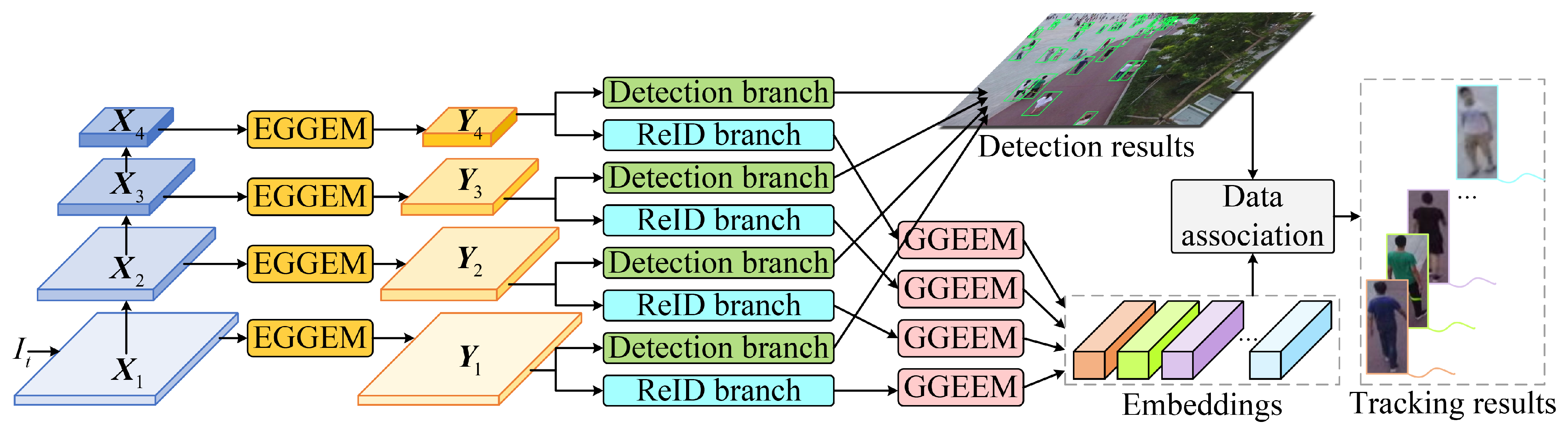
To achieve accurate and robust MOT in complex UAV tracking scenarios, we propose an Edge-Graph Enhanced Network (EGEN). The framework consists of three components: object detection, embedding feature extraction, and data association. First, in the object detection component, an EGGEM is designed. This module models the edge relationships between objects and background from a global perspective and leverages edge information to guide the selective enhancement of Gaussian features. As a result, key structural characteristics of small objects are effectively strengthened while background interference is suppressed, thereby improving the detection discriminability of small objects in complex backgrounds. Second, in the embedding feature extraction component, a GGEEM is proposed. By explicitly representing ReID embeddings as a graph composed of nodes and edges, and jointly modeling and iteratively updating nodes and their neighborhood relationships, inter-object association information is effectively encoded into the embedding space. This design significantly enhances the identity discriminability of the embeddings. Finally, a two-stage data association strategy is introduced. In the first stage, high confidence objects are jointly matched by integrating positional consistency and appearance similarity. In the second stage, low confidence objects are associated in a complementary manner based on positional constraints. Through this hierarchical association strategy, objects with different confidence levels are stably maintained, further improving the accuracy and robustness of MOT in complex UAV scenarios.
We conduct a systematic evaluation of the proposed method on three datasets, namely VisDrone [
19], UAVDT [
20], and self-constructed WildDrone. Experimental results demonstrate that EGEN significantly outperforms existing mainstream methods in both SOD and MOT performance. The main contributions of this work are summarized as follows:
An Edge-Graph Enhanced Network (EGEN) is proposed to address the two core challenges in UAV-based MOT: insufficient discriminability in SOD and unstable identity association. This framework integrates edge-guided feature enhancement and graph-based embedding modeling to systematically tackle these challenges.
An Edge-Guided Gaussian Enhancement Module (EGGEM) is designed. By modeling the edge relationships between objects and background from a global perspective and leveraging edge information to guide feature enhancement, EGGEM effectively strengthens the structural characteristics of small objects, improving their discriminability in complex UAV scenes.
A Graph-Guided Embedding Enhancement Module (GGEEM) is proposed. This module explicitly represents ReID embeddings as a graph structure and jointly models nodes and their neighborhood relationships, fully exploiting inter-object associations to enhance the identity discriminability of embeddings and the reliability of data association.
To improve the generality and practicality of MOT methods in complex UAV visual scenarios, a UAV-based small-object tracking dataset, termed WildDrone, is constructed. The dataset focuses on diverse and unstructured wild environments, providing a challenging benchmark for related research.
3. Methods
3.1. Overview of EGEN
The proposed EGEN follows a one-step tracking paradigm that aims to determine the categories and locations of all objects of interest in video streams and assign consistent identities to them over time. As illustrated in
Figure 1, the current frame image
is first fed into backbone to obtain multi-level feature representations
, where
,
, and
denote the channel number, height, and width of the
i-th feature map, respectively.
is then input into EGGEM, where global edge relationships are extracted and used to guide selective Gaussian feature enhancement, thereby strengthening the key edge and saliency features of small objects while suppressing irrelevant background responses, resulting in the enhanced feature representation
. Then,
is processed by a detection branch with two
convolutional layers to generate the object detection results, and by an embedding branch composed of a
convolution and a
convolution to obtain the initial embeddings
. Subsequently,
is input into the GGEEM, where graph modeling and aggregation of nodes and their neighboring edges are performed to enhance the discriminability and associativity of the embeddings, yielding more discriminative embeddings
,
.
Finally, data association is performed by constructing a matching cost matrix between the detection results and historical trajectories, jointly considering spatial cues and the discriminative embedding features. The data association strategy adopts a two-stage scheme, where the first stage handles high-confidence objects and the second stage focuses on low-confidence objects. In these two stages, the construction of the cost matrices and the handling of unmatched detections and tracklets differ accordingly. Through this strategy, accurate matching of both high- and low-confidence objects is achieved, ensuring robust and stable tracking performance.
3.2. Edge-Guided Gaussian Enhancement Module
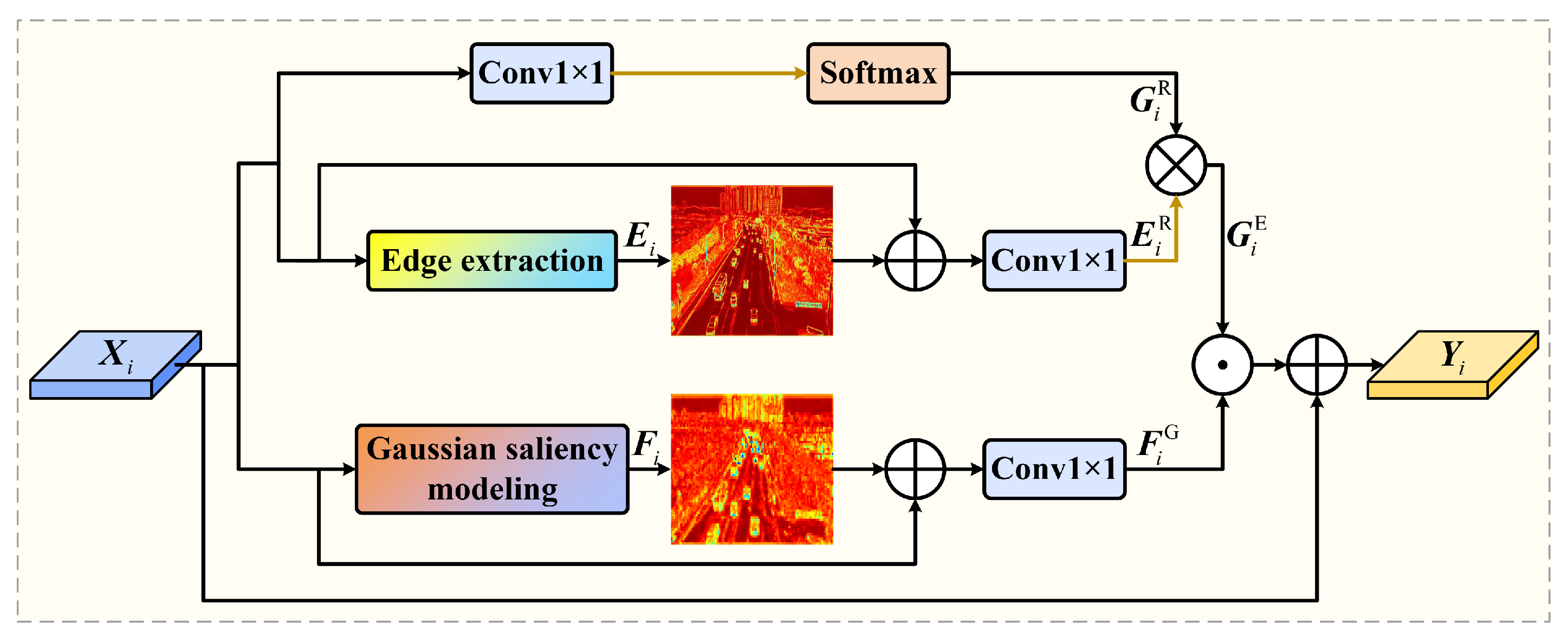
Most existing small-object feature enhancement methods typically rely on local convolutions or attention mechanisms to improve representation capability. However, these approaches often neglect the edge interaction between small objects and their surrounding environment, making small-object features susceptible to background interference or attenuation, which in turn limits further improvements in detection accuracy. To address this issue, we propose an EGGEM, as shown in
Figure 2. Specifically, the proposed module first extracts edge relationships from a global perspective to generate a global edge vector, which is then used to guide the selective enhancement of Gaussian features. Through this mechanism, the key edge and salient features of small objects are effectively strengthened, while irrelevant background responses are suppressed, thereby significantly improving the discriminability of small objects in complex backgrounds.
First, global relationship extraction is performed on
. Specifically,
is sequentially processed by convolution, tensor transformation, and Softmax function to obtain the global relation feature
:
where
denotes a convolution with kernel size
, which is consistently followed by a SiLU activation function;
represents the Softmax function; and
denotes tensor transformation.
Meanwhile, a Sobel filter is employed to extract robust edge information from
. The horizontal and vertical Sobel kernels are defined as
These kernels are fixed in two
convolution layers
and
, respectively. The resulting outputs are then combined using the L1 norm to obtain the edge feature
:
Subsequently, a residual structure is introduced to ensure training stability, followed by
convolution and tensor transformation to extract edge relationships, yielding the edge relation feature
:
Next,
and
are combined via matrix multiplication and reshaped to construct the global edge vector
, which is used to describe the global edge relationship between foreground small objects and their surrounding environment:
where ⊗ denotes matrix multiplication.
To more effectively capture small-object features, a Gaussian convolution kernel based on a Gaussian spatial prior is introduced to enhance salient responses while suppressing irrelevant background. Specifically, a depth-wise separable convolution configured with a
Gaussian kernel is applied to the feature map to perform Gaussian saliency modeling, thereby emphasizing key information and producing the Gaussian-modulated feature
:
where
denotes a depth-wise separable convolution with a two-dimensional Gaussian kernel of size
and a standard deviation of 1. The two-dimensional Gaussian kernel function is defined as
where
denotes the standard deviation,
k denotes the Gaussian kernel size, and
. By discretely sampling and normalizing the above continuous Gaussian function, a discrete Gaussian kernel is obtained for the depth-wise separable convolution. Subsequently, the Gaussian-enhanced feature
is obtained through a residual structure and a
convolution:
To further enhance the saliency and discriminability of small objects under the guidance of the global edge vector
, the Gaussian-enhanced feature
is weighted by
in a broadcast element-wise manner, and a residual structure is introduced to ensure training stability, resulting in the final output
:
where ⊙ denotes broadcast element-wise multiplication.
3.3. Graph-Guided Embedding Enhancement Module
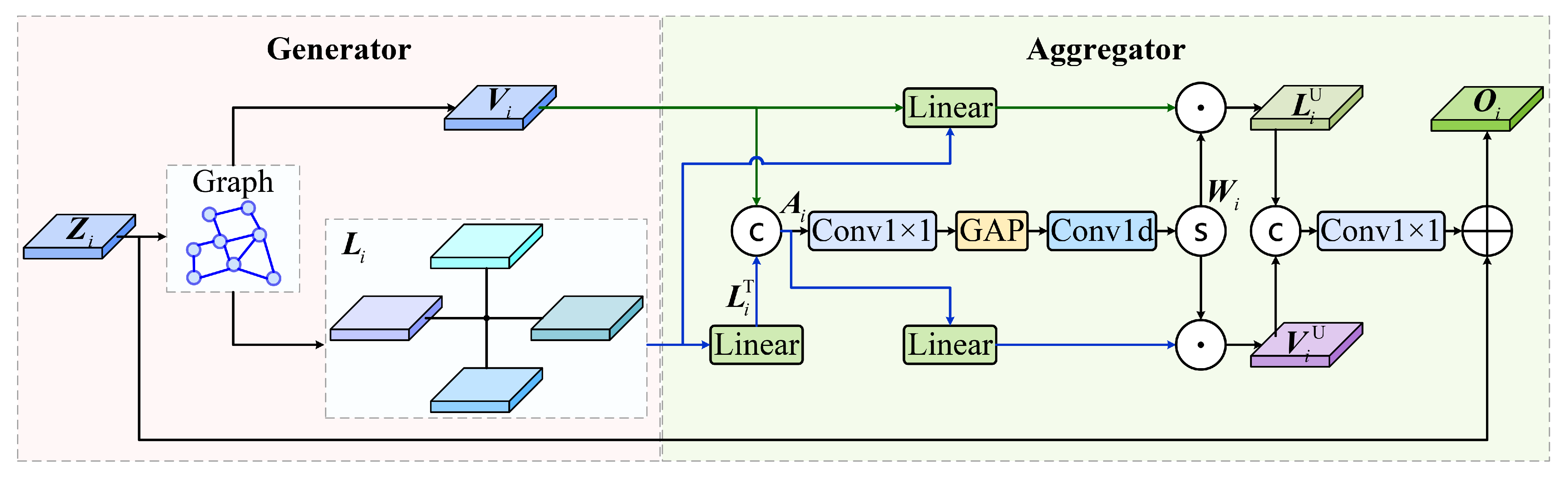
Existing ReID methods are typically built upon the assumption that object appearance information is sufficiently discriminative, and they enhance feature representations through single-object feature learning or local region modeling. However, for small objects under UAV viewpoints, appearance cues are often incomplete and easily affected by complex background interference, making it difficult to achieve stable and reliable data association by relying solely on object-specific features, which in turn limits further improvements in tracking performance. To address this challenge, we propose a GGEEM. This module explicitly models ReID embeddings as a graph composed of nodes and edges, and jointly models and updates nodes and their neighborhood relationships through a generator and an aggregator, enabling the ReID branch to learn more discriminative embedding representations that support effective object matching. Through this mechanism, graph-structured modeling adaptively strengthens node and edge features associated with regions of interest and fully exploits inter-object relational information, significantly improving the discriminability of different small objects in UAV tracking scenarios.
As illustrated in
Figure 3, GGEEM is composed of a generator and an aggregator. The generator takes the initial embeddings output by ReID branch as input and aims to construct them into a graph consisting of nodes and edges. Specifically, the input
is treated as nodes, and the node set
is defined as
The generator constructs edges based on each node and its four nearest neighboring nodes, and the edge set
is expressed as
where
denotes the operation that shifts the feature map downward by one row while replicating the top row, thereby aligning each pixel with its upper neighbor and ensuring that the spatial dimensions of the feature map remain unchanged. Similarly,
,
, and
denote operations that align each pixel with its lower, left, and right neighbors, respectively.
denotes the stacking operation.
The aggregator is designed to aggregate neighborhood information and update both nodes and edges. First,
is passed through tensor transformation and linear transformation to obtain
:
where
denotes a linear transformation implemented by a fully connected layer. Subsequently,
and
are concatenated along the channel dimension to obtain the aggregated feature
:
where
denotes the concatenation operation.
During the node and edge update process, in order to assign higher activation values to nodes and edges associated with regions of interest, a joint weight is introduced. Specifically,
is first passed through a
convolution to reduce the number of channels from
to
, followed by global average pooling, one-dimensional convolution, tensor transformation, and Sigmoid function to generate the joint weight
:
where
denotes global average pooling,
denotes a one-dimensional convolution with a kernel size of 5, and
denotes the Sigmoid activation function.
For node updating,
is first processed by tensor transformation and linear transformation, and then weighted by the joint weight
to obtain the updated nodes
:
For edge updating, the nodes are stacked and concatenated with the edges, followed by tensor transformation and linear transformation. The resulting features are then weighted by the joint weight
to obtain the updated edges
:
Finally,
and
are fused through concatenation and
convolution, and the input
is modulated based on the fused features. In this way, graph-structured information is effectively injected into the embedding features, making small-object representations more discriminative. The final output
is expressed as
3.4. Data Association Strategy
Our method adopts a two-stage data association strategy to handle high-confidence and low-confidence objects separately. In these two stages, the calculation of the cost matrix and the handling of unmatched detections and tracklets differ.
In the first stage, for high-confidence objects, we construct the cost matrix by jointly considering the Intersection over Union (IoU) and ReID similarity. First, the Kalman filter is used to predict the position of each track, and the IoU between predictions and detections are computed as the position matching criterion. Then, we compute the similarity between objects using their ReID embeddings for appearance matching. Finally, the IoU and ReID similarity metrics are fused with pre-defined weights (ReID weight: 1.0, IoU weight: 0.55) to form the final cost matrix. The matching process is carried out using the Hungarian algorithm, and the computed cost matrix is used to determine the optimal match between tracks and detections. For unmatched detections and tracklets in the first stage, the following strategies are applied: unmatched high-confidence detections are initialized as new tracklets and added to the tracking list; existing tracklets that fail to match any detection in the current frame are marked as unconfirmed and await association in subsequent frames.
In the second stage, for low-confidence objects, the calculation of the cost matrix relies on IoU. Since the appearance information of low-confidence objects is relatively unstable, ReID similarity is not considered in this stage. The matching of low-confidence objects is still performed using the Hungarian algorithm. For unmatched detections and tracklets in the second stage, the following strategies are applied: unmatched low-confidence detections are initialized as new tracklets; unmatched tracklets are retained for up to 30 frames to handle potential occlusions, after which they are removed.
The above two-stage data association strategy enables precise matching of high-confidence and low-confidence objects, ensuring the robustness and stability of MOT.
3.5. Loss Function
The overall loss function of the proposed method consists of a classification loss, a bounding box loss, and an embedding loss, defined as
where
denotes the classification loss,
denotes the bounding box loss,
denotes the embedding loss, and
,
, and
are the weighting coefficients for the corresponding loss terms.
The bounding box loss is defined as
where
denotes the sum of soft-label confidence scores for the
i-th positive sample,
S denotes the sum of
over all positive samples,
represents the predicted bounding box of the
i-th object,
represents the corresponding ground-truth bounding box, and
denotes the Complete-IoU (CIoU) loss, whose details can be found in [
56].
The classification loss is defined as
where
denotes the predicted probability of the
i-th object for class
c,
denotes the corresponding ground-truth of the
i-th object for class
c,
C denotes the total number of classes, and
N denotes the number of positive samples.
The embedding loss aims to make embeddings of objects with the same identity more similar while pushing embeddings of different identities further apart. It is defined as
where
denotes the embedding of the
j-th anchor sample,
denotes the embedding of a hard positive sample sharing the same identity as
,
denotes the embedding of a semi-hard negative sample with a different identity from
,
denotes the Euclidean distance between embeddings, and
m is a predefined margin that controls the minimum separation between positive and negative samples.
4. Results
4.1. Datasets
To validate the effectiveness of the proposed method in UAV aerial scenarios, we conducted comprehensive experiments on three UAV-based datasets: VisDrone, UAVDT and WildDrone.
Table 1 provides an overview of the datasets used in our experiments, listing task type, the number of sequences, the number of images or frames, and the number of total annotated instances.
4.1.1. VisDrone
The dataset is collected by multiple UAV platforms in real-world environments, covering a wide range of application scenarios, as well as diverse weather conditions and illumination variations, thereby providing strong support for research on object detection and MOT from the UAV perspective. In terms of category definition, the dataset includes 12 object classes: ignored regions, pedestrian, people, bicycle, car, van, truck, tricycle, awning-tricycle, bus, motor, and others. The VisDrone-MOT subset is specifically constructed for MOT tasks and is organized into training, validation, and test sets, containing 56, 7, and 33 video sequences, respectively. During the annotation process, each object is assigned a unique tracking ID, along with corresponding category labels and high-precision bounding box annotations. Under the MOT evaluation setting, this study strictly follows the official evaluation protocol and focuses on five key object categories, namely pedestrian, car, van, bus, and truck. In addition, the dataset incorporates numerous complex and representative scenarios, such as viewpoint changes caused by UAV motion, pronounced motion blur, dense object distributions, and frequent occlusions, making it a reliable testbed for validating the performance of UAV-based MOT methods.
4.1.2. UAVDT
The dataset is constructed from the UAV observation perspective and is primarily designed to support research on vehicle detection and tracking, while covering three key visual tasks: object detection, single-object tracking, and MOT. In terms of object definition, the dataset focuses exclusively on vehicles and further categorizes them into cars, trucks, and buses; in this work, all categories are unified into a single “vehicle” class. For the MOT setting, the UAVDT dataset provides 30 video sequences for training and 20 video sequences for performance evaluation. All sequences are captured at a frame rate of 30 FPS with a consistent resolution of . In addition, the data collection spans a variety of typical and complex scenarios, including urban squares, major roads, toll stations, highway segments, and different types of intersections, thereby reflecting the visual challenges encountered by UAV platforms in practical application environments.
4.1.3. WildDrone
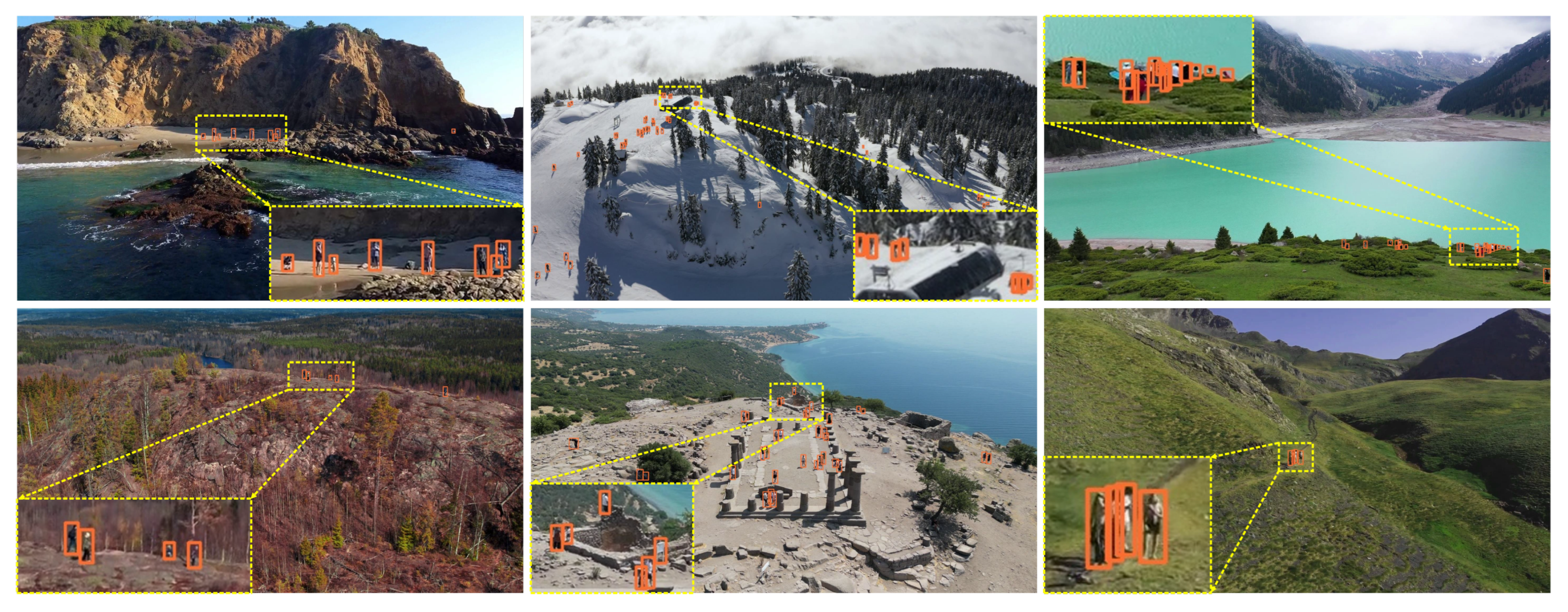
At present, most UAV aerial datasets cover relatively limited application scenarios, primarily focusing on urban environments, where small objects are typically surrounded by simple backgrounds such as roads and squares. This lack of background diversity significantly constrains the robustness and generalization capability of deep learning-based detection and tracking methods when deployed in UAV aerial scenarios characterized by complex and highly variable backgrounds, thereby restricting their practical applicability to a certain extent. To address this limitation, we constructs a UAV-view dataset for SOD and tracking in complex outdoor environments, named WildDrone. The dataset spans a wide range of natural terrains, including forests, plains, mountainous regions, canyons, marine areas, and snow-covered landscapes. In these scenes, small objects are often sparsely distributed or heavily camouflaged within cluttered backgrounds, which substantially increases the difficulty of both detection and tracking tasks.
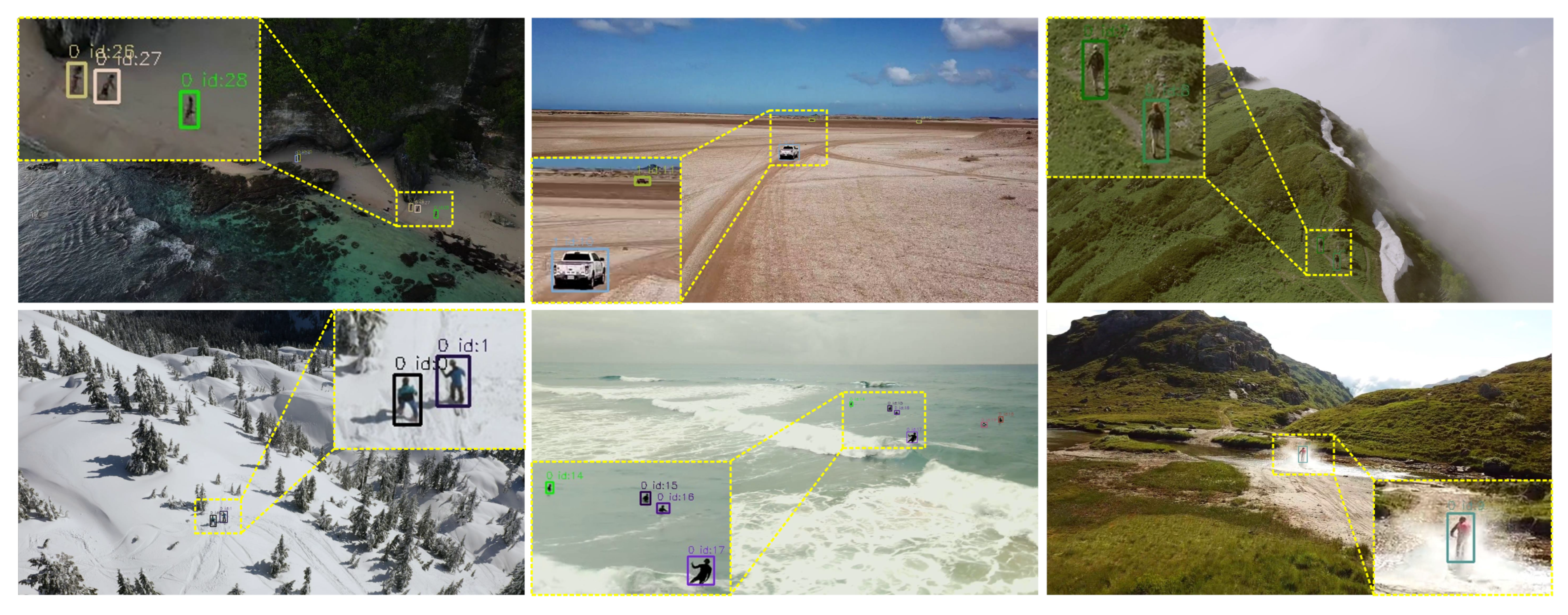
All image and video materials in the WildDrone dataset are collected and curated from publicly available Internet resources containing real-world UAV aerial scenes. These materials are carefully screened to ensure scene diversity and data quality, and are subsequently annotated to support both detection and tracking tasks. Specifically, WildDrone-DET is designed for SOD and consists of 1950 images, with 1260 images used for training and 690 images used for testing, containing 23,567 annotated object instances in total. In contrast, WildDrone-MOT focuses on MOT and includes 22 UAV video sequences with 7820 frames. The video frames are divided into training and testing sets at a ratio of 7:3, with a total of 14,794 annotated instances. Regarding annotation categories, all objects in the WildDrone dataset are uniformly classified into two classes: person and vehicle. Representative samples of WildDrone-DET and WildDrone-MOT are shown in
Figure 4 and
Figure 5, respectively, illustrating both the diversity of environments and the difficulty of the tasks involved.
To facilitate further research, a representative subset of the WildDrone dataset together with the corresponding data processing algorithms has been publicly released. The code and partial dataset are available at
https://github.com/mubiaogenzong2019/WildDrone (accessed on 9 March 2026). Due to usage and redistribution restrictions of some original online materials, the complete dataset cannot be fully released at the current stage.
4.2. Implementation Details
All models are trained and evaluated on a machine equipped with a 24-core CPU, 64 GB of RAM, and an RTX 4090 GPU. The proposed EGEN adopts YOLO11 [
57] as the baseline object detector and uses its first 19 layers as the backbone of the model. The data augmentation strategies used during training are kept consistent with those of the baseline. Training is conducted using the SGD optimizer with a batch size of 4. The initial learning rate is set to 0.01 and decayed according to a cosine scheduling strategy. Before being fed into the network, all images are uniformly resized to a resolution of
pixels. The weighting coefficients of the loss terms,
,
, and
, are set to 7.5, 0.5, and 0.5, respectively. During inference, the thresholds for high- and low-confidence detections are set to 0.7 and 0.3, respectively. In the object association stage, disappeared tracks are allowed to be reactivated and recovered within a maximum of 30 frames.
4.3. Evaluation Metrics
To systematically evaluate detection performance, average precision (AP) and mean average precision (mAP) are adopted as the primary evaluation metrics. For datasets involving a single object category, performance is measured using AP, whereas mAP is employed as the evaluation criterion for multi-class datasets. The conventional MS COCO [
58] evaluation protocol characterizes SOD performance using APs for objects with areas smaller than
. However, in UAV aerial scenarios where a large proportion of objects are extremely small, this metric is insufficient to fully capture performance differences among competing methods. To address this limitation, a finer-grained evaluation scheme is introduced, in which small objects are further divided into multiple scale intervals, including mAPs1 (
), mAPs2 (
), mAPs3 (
), and mAPs4 (
). In addition, the overall small-object metric mAPs (
) and the AP over all objects are also reported. In the experiments, mAP is computed with a fixed IoU threshold of 0.5.
In addition to evaluating SOD performance, a comprehensive analysis of the tracking capability of the proposed method is conducted by following the standardized evaluation protocol for MOT tasks. Multiple performance metrics are adopted to provide a holistic assessment, including MOT Accuracy (MOTA), MOT Precision (MOTP), High-Order Tracking Accuracy (HOTA), Detection Accuracy (DetA), Association Accuracy (AssA), Identity F1 Score (IDF1), and frames per second (FPS).
Among these metrics, MOTA reflects the combined impact of false positives (FP), false negatives (FN), and identity switches (IDSW) on overall tracking performance, calculated as
where
is the number of ground-truth objects at frame
t.
MOTP measures the alignment accuracy between predicted and ground-truth object positions:
where
is the bounding box IoU of the
i-th matched pair in frame
t, and
is the number of matches in frame
t.
HOTA balances detection and association quality, defined as
with DetA and AssA computed as
where
denotes true positives.
IDF1 quantifies the proportion of correctly matched identities:
where
,
, and
are identity true positives, false positives, and false negatives, respectively.
In addition, the computational efficiency of the model is analyzed using the number of parameters (Params) and floating-point operations (GFLOPs), which reflect the model complexity and computation cost in practical application scenarios.
Among these metrics, MOTA reflects the combined impact of detection errors, missed detections, and identity switches on overall tracking performance, with an emphasis on the joint accuracy of detection and association stages. HOTA measures the balance between detection quality and association quality, thereby characterizing the overall effectiveness of the tracker from a holistic perspective. IDF1 quantifies the proportion of correctly matched identities and evaluates the model’s ability to maintain identity consistency over long-term sequences. In addition, the runtime efficiency of the tracker is analyzed using FPS, which represents the overall processing speed of the system in practical application scenarios.
4.4. Ablation Studies
To evaluate the effectiveness of the two primary modules (EGGEM and GGEEM) within the overall tracking system, ablation experiments are conducted. Specifically, EGGEM is designed to enhance SOD capability, while GGEEM focuses on improving the association accuracy of multiple objects. The experimental results are summarized in
Table 2 and
Table 3.
4.4.1. Effectiveness of EGGEM
From the first two rows of
Table 2, it is evident that introducing the EGGEM into the baseline leads to improvements of 8.4%, 0.6%, and 1.9% in MOTA, MOTP, and HOTA, respectively, indicating that the proposed EGGEM can effectively enhance the overall performance of a MOT system. Notably, the DetA metric shows a significant increase, rising from 33.9% to 36.7%, which demonstrates that EGGEM, through its edge-guided feature enhancement mechanism, can substantially strengthen the discriminability and localization precision of small objects in UAV aerial scenes, thereby effectively improving detection quality. In addition, both AssA and IDF1 exhibit moderate improvements, indicating that while EGGEM enhances detection performance, it does not disrupt the temporal association structure of the objects and also contributes to maintaining identity consistency and stability during the data association process.
To further demonstrate the unique advantages of EGGEM in SOD, ablation experiments are conducted on the VisDrone-DET test set. As shown in
Table 3, with the assistance of EGGEM, the baseline achieves improvements of 5.4%, 6.8%, 6.3%, 5.1%, and 5.4% on mAPs1, mAPs2, mAPs3, mAPs4, and mAPs, respectively, indicating that EGGEM provides significant performance gains in SOD tasks. Notably, the improvement on mAPs1, which corresponds to the smallest object scale, demonstrates that EGGEM is particularly effective for extremely small objects. This can be attributed to the edge-guided enhancement mechanism, which explicitly strengthens structural edge cues and suppresses background interference. Such enhancement helps preserve the limited visual information of tiny objects in UAV imagery, making them more distinguishable from complex backgrounds. Moreover, the overall AP increases by 4.5%, further validating its effectiveness in UAV aerial scenarios with complex backgrounds. These results demonstrate that EGGEM can effectively enhance the critical structures and discriminative features of small objects, thereby significantly improving detection accuracy in UAV-based SOD tasks.
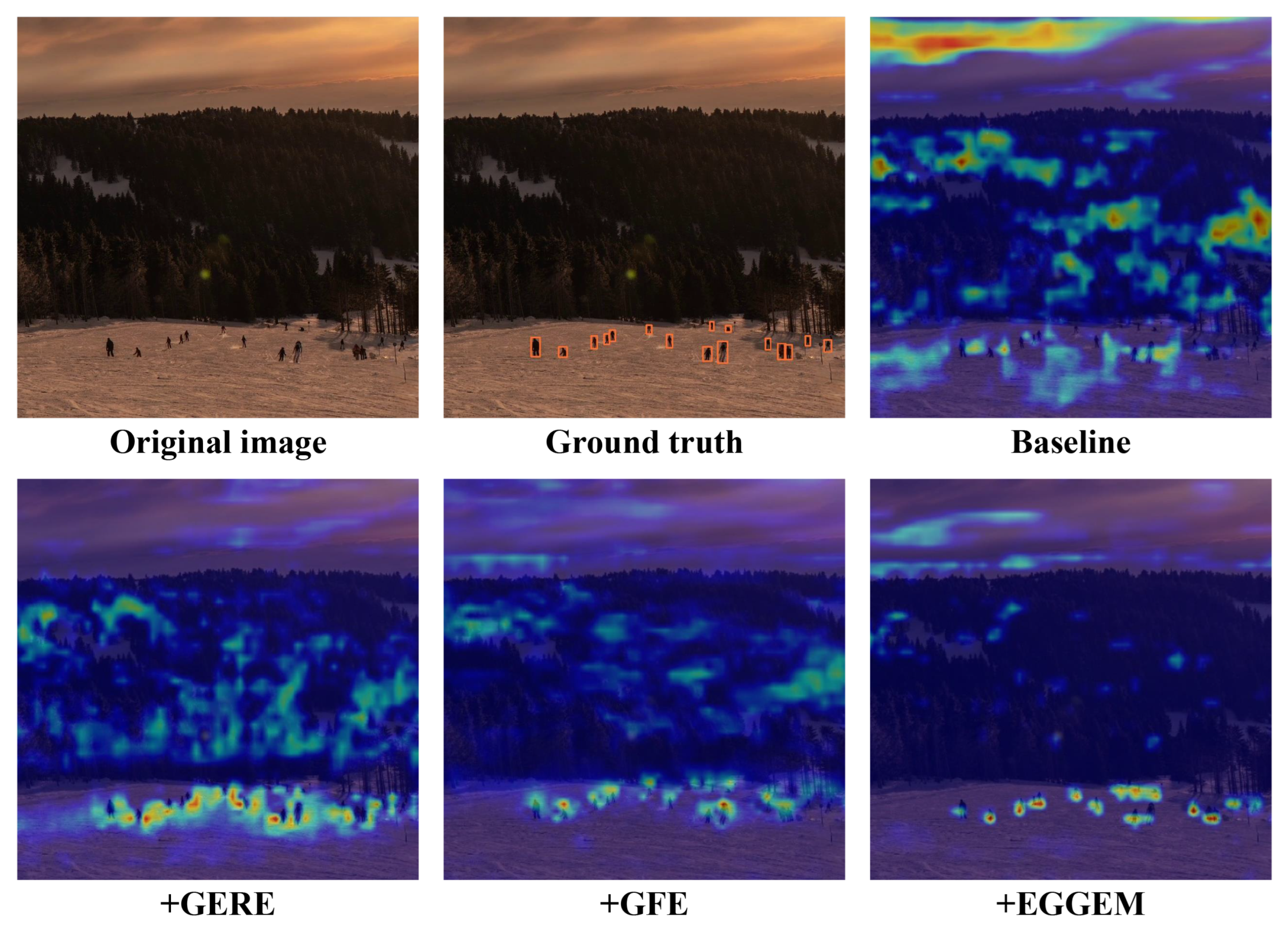
To analyze the contributions of the two core components of EGGEM, ablation experiments are conducted on global edge relationship extraction (GERE) and Gaussian-based feature enhancement (GFE) separately. As shown in
Table 3, introducing GERE alone increases mAPs from 17.5% to 20.8%, indicating that modeling global edge relationships effectively captures structural cues of small objects and enhances their discriminability in complex backgrounds. When only GFE is applied, the mAPs rises to 19.2%, demonstrating that Gaussian-based feature enhancement emphasizes salient local responses while suppressing irrelevant background noise. Compared with the individual components, the complete EGGEM further improves mAPs to 22.9%, verifying that GERE and GFE work cooperatively rather than independently. This confirms that the edge-guided enhancement mechanism not only strengthens structural edges but also effectively integrates local saliency information, thereby enhancing the detection performance of small objects in UAV imagery.
In addition, to intuitively demonstrate the mechanism of EGGEM, we visualize the intermediate feature responses of the network, as shown in the
Figure 6. From the feature responses of baseline, it can be observed that the attention distribution is relatively scattered, with a large amount of activation concentrated in complex background regions, while the responses in the object regions are relatively weak. This indicates that in UAV aerial scenes, the features of small objects can be easily overwhelmed by complex background textures, resulting in insufficient discriminability in the object regions. After introducing GERE, the feature responses become more concentrated on the boundary regions of small objects where clear structural variations exist. This indicates that GERE can model edge relationship information from a global perspective and enhance the network’s perception of structural features. However, since this process mainly focuses on edge relationships, some background structural regions still produce certain responses. After incorporating GFE, the feature responses are observed to concentrate more clearly toward the central regions of the small objects, indicating that the Gaussian feature enhancement mechanism can effectively strengthen the feature representation of object regions, making the responses of small objects more concentrated in the feature map. When the complete EGGEM integrates both GERE and GFE, the feature responses are primarily concentrated at the true object locations, while the interference from background regions is significantly reduced. Compared with other results, EGGEM can highlight small object regions more accurately while suppressing noise interference caused by complex backgrounds. This demonstrates that the Gaussian feature enhancement guided by global edge relationships enables the network to more effectively strengthen the key structural and salient features of small objects.
4.4.2. Effectiveness of GGEEM
As shown in the first and third rows of
Table 2, introducing GGEEM into the baseline increases IDF1 from 56.8% to 59.2% and AssA from 58.4% to 60.0%, indicating that GGEEM can effectively improve object identity association, reduce identity switches, and thereby enhance overall tracking stability. This result validates the effectiveness of explicitly modeling inter-object relationships for improving the discriminative capability of embeddings.
Furthermore, combining EGGEM with GGEEM provides complementary enhancements at both the detection and association levels. As shown in the fourth row of
Table 2, the complete model achieves 46.6%, 80.3%, and 47.8% on MOTA, MOTP, and HOTA, respectively, representing further improvements compared with configurations using only a single module. This demonstrates that the high-quality detection results provided by EGGEM and the identity association enhancement of GGEEM can act synergistically, significantly boosting MOT performance.
4.5. Hyperparameter Sensitivity Analysis
4.5.1. Effect of ReID and IoU Weights
To evaluate the influence of key hyperparameters in the association stage, we conduct a sensitivity analysis on the weights of ReID similarity and IoU similarity.
Specifically, the ReID weight and IoU weight are varied while keeping other parameters unchanged. The results are reported in
Table 4. When the IoU weight is fixed at 0.55, increasing the ReID weight from 0.5 to 1.0 consistently improves the tracking performance. Specifically, MOTA increases from 44.8% to 51.7%, HOTA rises from 49.2% to 55.5%, and IDF1 improves from 66.3% to 68.8%. This indicates that appearance similarity plays a crucial role in maintaining identity consistency in UAV aerial scenes. However, further increasing the ReID weight to 1.2 leads to a slight performance drop (MOTA decreases to 50.6%), suggesting that excessively emphasizing appearance information may weaken the contribution of spatial cues.
We further analyze the effect of the IoU weight while fixing the ReID weight at 1.0. As shown in
Table 4, setting the IoU weight to 0.55 achieves the best overall performance. Reducing the IoU weight to 0.50 decreases MOTA, HOTA, and IDF1 to 49.8%, 53.6%, and 68.1%, respectively, while increasing it to 0.60 results in slightly lower performance (MOTA = 51.1%, HOTA = 54.9%, IDF1 = 68.5%). These results indicate that an appropriate balance between appearance similarity and spatial overlap is essential for robust data association. Overall, the results demonstrate that the proposed tracking framework remains stable under moderate variations in these hyperparameters, and the empirical setting of ReID weight = 1.0 and IoU weight = 0.55 achieves the best trade-off among the evaluated metrics.
4.5.2. Effect of Confidence Thresholds
To investigate the influence of the high and low confidence thresholds in the association stage, we conduct a sensitivity analysis on the WildDrone-MOT dataset.
Table 5 reports the MOT performance under different combinations of high and low confidence thresholds.
From the results, we observe that the overall performance in terms of MOTA, HOTA, and IDF1 varies slightly with different threshold settings. The highest performance is achieved when the high and low thresholds are set to 0.7 and 0.35, respectively (MOTA = 52.6%, HOTA = 55.9%, IDF1 = 70.0%). Our chosen thresholds (0.7 for high and 0.3 for low) yield MOTA = 51.7%, HOTA = 55.5%, and IDF1 = 68.8%, which is not the absolute optimum but aligns with the baseline configuration. This choice ensures a fair comparison with other methods while keeping the experimental setup consistent. Although the impact of confidence thresholds on the overall performance is minor compared to the substantial improvements brought by our method, we acknowledge its potential influence. In future work, more extensive experiments will be conducted to explore and select more optimal hyperparameters for further performance gains.
4.6. Small Object Detection Experiments
4.6.1. Quantitative Experiments
Table 6 provides a systematic comparison of the detection performance of our EGEN’s detector against several representative mainstream methods on the WildDrone-DET test set. Owing to the inclusion of more complex and diverse natural backgrounds, along with a substantially higher proportion of small objects, this dataset poses greater detection difficulty than conventional UAV benchmarks and places higher demands on the SOD capability of detection models. Under this more challenging evaluation setting, our method demonstrates consistent superiority across all evaluation metrics, outperforming other state-of-the-art approaches. In particular, with respect to SOD metrics, our method surpasses the second-best method PConv by 2.3%, 2.7%, 2.4%, 2.4%, and 2.6% on mAPs1, mAPs2, mAPs3, mAPs4, and mAPs, respectively, clearly highlighting its effectiveness in SOD. From an overall performance perspective, our method achieves an mAP of 60.1%, ranking second among all compared methods. Notably, this improvement in SOD is achieved without compromising overall detection accuracy. These results collectively indicate that EGEN’s detector is capable of substantially enhancing SOD in complex UAV scenarios while maintaining competitive overall detection performance.
In addition to its detection performance, EGEN’s detector maintains a moderate model complexity, with only 18.8 M parameters, and requires 31.8 GFLOPs for inference. Considering all 22 compared methods, the parameters and computational cost of EGEN’s detector both rank within the top 20%, significantly lower than those of most high-performance methods, thereby achieving efficient computation while maintaining high SOD accuracy.
4.6.2. Qualitative Experiments
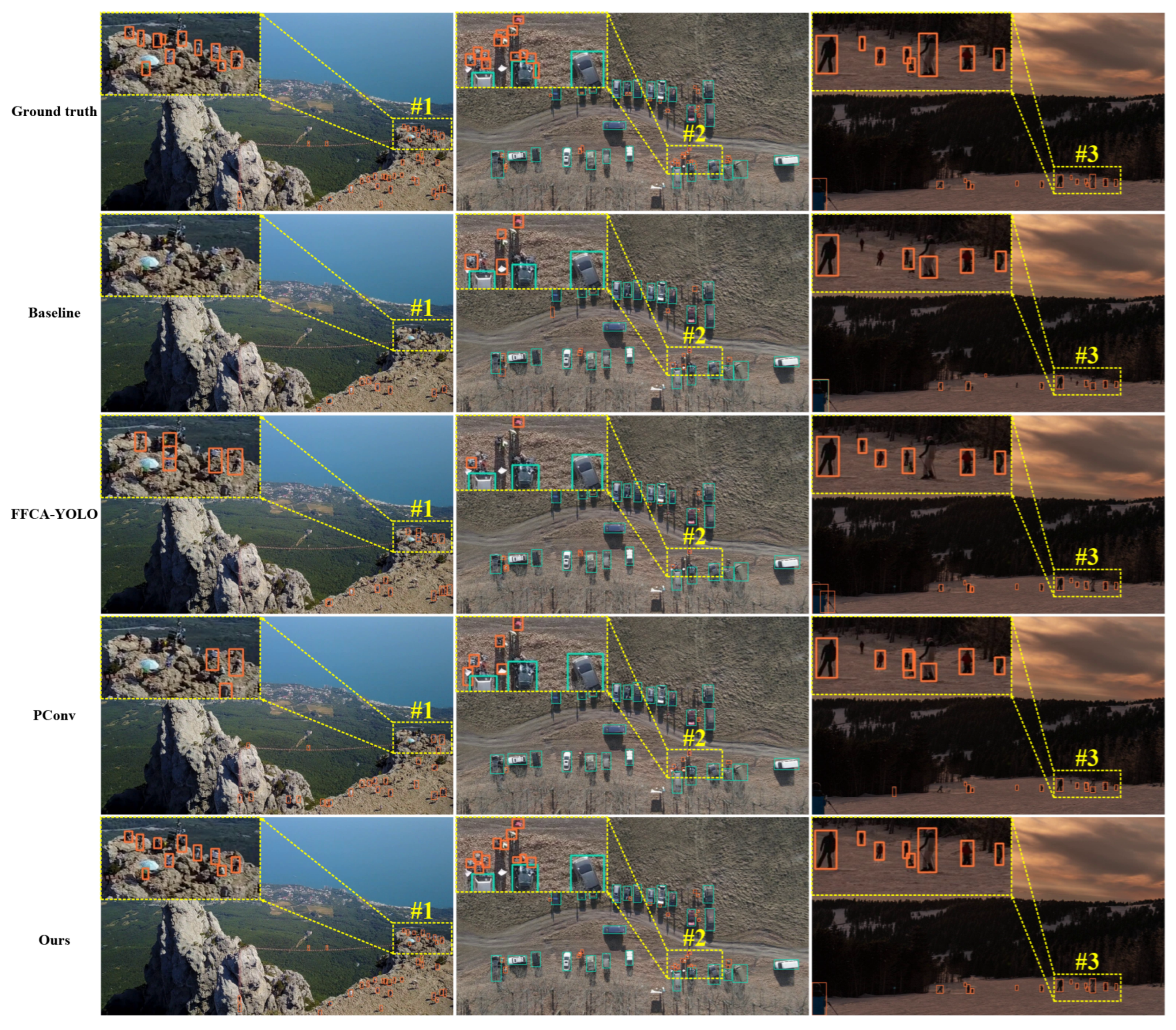
We further conduct qualitative comparative experiments on the WildDrone-DET test set, where several representative methods are selected for comparison, including the strong single-stage small-object detector FFCA-YOLO and the recently proposed PConv designed specifically for SOD. The qualitative results are shown in
Figure 7.
In region #1, the baseline, FFCA-YOLO, and PConv suffer from severe missed detections of weakly salient small objects in complex backgrounds, whereas our method accurately detects these objects, demonstrating a clear performance advantage over other advanced detectors. In Region #2, the baseline, FFCA-YOLO, and PConv show limited performance in densely distributed small-object scenarios, where object adhesion and missing detections frequently occur. In contrast, our method adapts well to crowded scenes, owing to the EGGEM, which strengthens the boundary structures between adjacent small objects through global edge relationship modeling, thereby enhancing object discriminability. In region #3, even under poor illumination conditions and low object contrast, our method still achieves superior detection performance compared with other methods. This benefit mainly stems from the EGGEM, which captures stable global edge priors and performs edge-guided selective enhancement of Gaussian features, effectively highlighting the key structural information of small objects while suppressing background noise responses. Overall, the results in regions #1, #2, and #3 demonstrate that the proposed method exhibits strong adaptability to complex backgrounds and high-density object scenarios, effectively alleviating the severe missed-detection problem of small objects.
4.7. Multi-Object Tracking Experiments
4.7.1. Quantitative Experiments
To facilitate a comprehensive comparison, we conduct a series of experiments on the VisDrone-MOT and WildDrone-MOT datasets and compare the results with those of other state-of-the-art methods. The detailed experimental results are reported in
Table 7 and
Table 8. As shown in
Table 7, our EGEN exhibits superior performance across multiple evaluation metrics. Specifically, EGEN achieves a MOTA of 29.3%, ranking first among all compared methods, which demonstrates its significant advantage in overall MOT accuracy. Meanwhile, MOTP reaches 78.5%, further validating the reliability of the proposed method in terms of object localization precision. With respect to the HOTA metric, which jointly evaluates detection and association performance, EGEN attains a score of 38.7%, markedly outperforming existing mainstream approaches, indicating a more balanced and effective synergy between detection quality and trajectory association. In addition, EGEN also achieves leading performance on the DetA (27.3%) and AssA (56.0%) sub-metrics, suggesting that the proposed method not only improves detection quality but also enhances the stability and consistency of cross-frame object association. Furthermore, the IDF1 score is improved to 45.2%, providing further evidence of EGEN’s superiority in identity preservation and trajectory integrity. This improvement also implies a reduction in identity switches, as the proposed GGEEM explicitly models ReID embeddings as a graph structure and captures neighborhood relationships between objects, thereby enhancing identity discriminability and maintaining more stable identity associations across frames. Notably, EGEN also demonstrates excellent real-time performance, achieving a processing speed of 75.5 FPS, which is higher than the median of the compared methods. Overall, these results clearly indicate that EGEN can maintain both high detection accuracy and robust association performance in complex UAV scenarios, while also providing efficient computation suitable for real-time UAV applications.
The WildDrone-MOT dataset covers a wide range of highly challenging UAV aerial scenarios, placing stringent demands on both the detection and association capabilities of MOT algorithms. The experimental results in
Table 8 show that our EGEN achieves the best overall performance among all compared approaches. Specifically, it attains a MOTA of 51.7%, a HOTA of 55.5%, and an IDF1 of 68.8%, indicating improved overall tracking accuracy and stronger identity preservation ability. Compared with mainstream online tracking methods, the advantages of our approach are clearly observed. For example, EGEN improves MOTA by 10.9% and 10.1% over ByteTrack and JDE, respectively, while achieving corresponding IDF1 gains of 10.3% and 10.7%. These improvements suggest that the proposed method more effectively mitigates identity drift and maintains stable object association in complex UAV scenarios. BoTSORT, which has been widely adopted in recent years, exhibits stable performance on the HOTA and AssA metrics, whereas its HOTA score remains lower than the 55.5% achieved by our method. In addition, compared with UAVMoT, which is specifically designed for UAV-based tracking, our EGEN achieves substantial improvements on both HOTA and IDF1, increasing them from 43.2% and 49.8% to 55.5% and 68.8%, respectively. This further validates the effectiveness of the proposed method in enhancing detection reliability and cross-frame association consistency under UAV viewpoints. Overall, while maintaining high detection accuracy, our EGEN significantly improves the stability of object identity association, leading to superior overall performance in complex UAV-based MOT tasks. In addition, EGEN achieves a processing speed of 74.6 FPS on the WildDrone-MOT dataset, ranking above the majority of the compared methods, which demonstrates that it provides high-quality tracking results while maintaining efficient real-time computation.
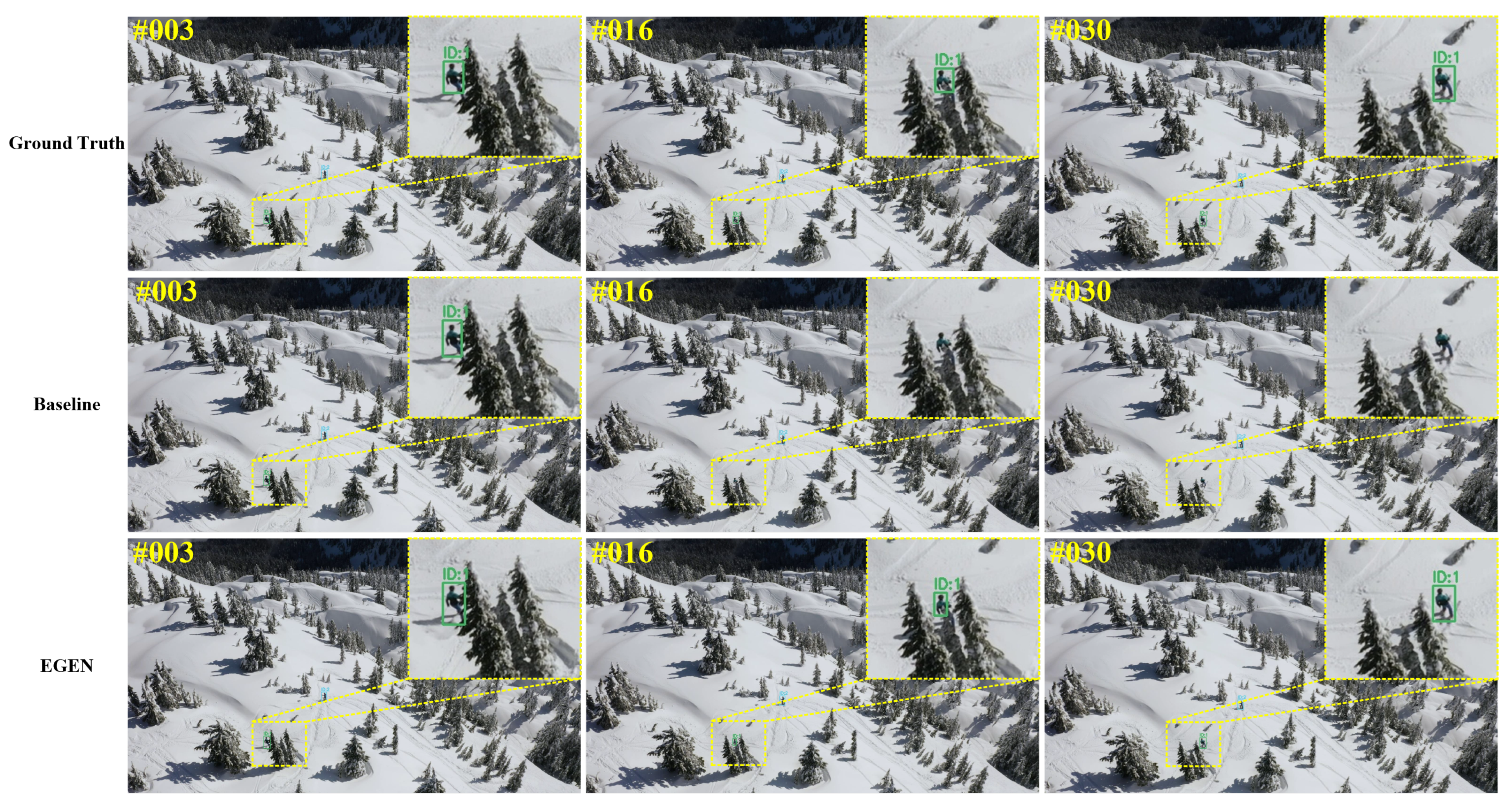
4.7.2. Qualitative Experiments
Figure 8 illustrates qualitative comparisons between EGEN and the baseline on the WildDrone-MOT dataset. As indicated by the yellow dashed boxes, at frame 3, when the small object is not occluded by background clutter, both methods deliver reliable detection and tracking performance. However, as scene complexity increases, at frame 16, the small object becomes partially occluded and gradually blends into the surrounding tree background. Under this condition, the baseline, which mainly relies on local appearance features, exhibits pronounced vulnerability when key information is missing and fails to maintain consistent identification and tracking of the object. In contrast, at frame 30, when the small object reappears after complete occlusion, EGEN is still able to successfully re-establish identity association and maintain continuous tracking, whereas the baseline fails to recover effective associations, ultimately leading to tracking failure. This phenomenon indicates that the local appearance features exploited by the baseline are insufficient to sustain stable identity discrimination under occlusion or information loss. By comparison, the proposed method jointly models and dynamically updates object neighborhood relationships through the GGEEM, enabling effective utilization of topological structural information to preserve coherent identity representations during occlusion. As a result, stable and continuous tracking is achieved, and object identity consistency is maintained throughout the entire sequence.
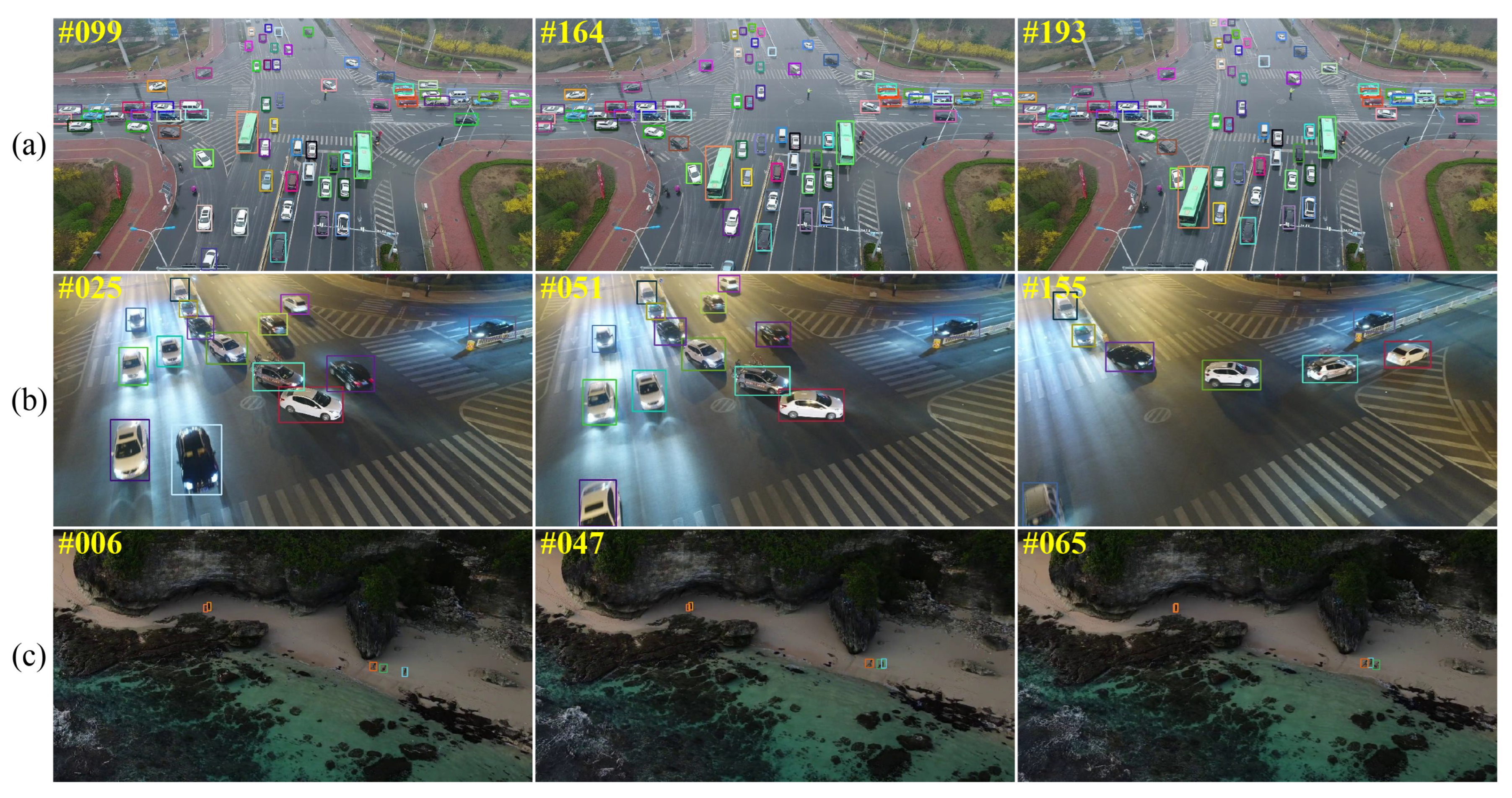
Figure 9 presents qualitative results demonstrating EGEN’s robustness in three representative challenging UAV scenarios. In scenario (a), under conditions of highly dense small-object distributions, EGEN is able to effectively distinguish adjacent objects without noticeable identity confusion. In scenario (b), under low-light nighttime conditions where object appearance information is severely degraded, EGEN consistently maintains identity consistency and achieves reliable MOT. In scenario (c), where small objects with highly similar features intersect, EGEN correctly preserves identity associations during object overlap and separation. These results demonstrate that EGEN exhibits strong robustness and stability across a variety of complex and extreme conditions, highlighting its ability to handle diverse and challenging UAV tracking scenarios.
6. Conclusions
This paper presents an EGEN for MOT in complex UAV aerial scenarios, addressing challenges such as the limited appearance information of small objects and background interference. The network incorporates an EGGEM and a GGEEM, combined with a hierarchical two-stage data association strategy, to achieve accurate and robust MOT. EGGEM explicitly models object–background edge relationships, effectively strengthening the structural features of small objects while suppressing background interference, thereby enhancing detection discriminability. GGEEM explicitly represents inter-object relationships as a graph, enabling identity information to propagate across objects and thereby improving MOT robustness. Experimental results on VisDrone, UAVDT, and self-constructed WildDrone datasets demonstrate that EGEN significantly outperforms existing state-of-the-art methods in SOD and MOT performance. Overall, EGEN provides a systematic solution that integrates edge information with graph-based relational modeling, offering new theoretical and practical insights for UAV-based SOD and MOT. Future work may focus on real-time optimization in multi-UAV scenarios, cross-scene generalization, and multimodal integration to further advance intelligent UAV perception in complex environments.