


Highlights
What are the main findings?
- A novel unsupervised SAR image enhancement framework based on DualGAN is proposed, addressing the domain shift problem between low- and high-quality SAR images.
- Introduces a segmentation-guided recognition-oriented constraint (ROC) and a semantic preservation constraint (SPC) to enhance task-relevant feature preservation and reduce semantic drift during unpaired translation.
What are the implication of the main finding?
- The proposed framework improves both image quality and target recognition accuracy in SAR applications, achieving an over 10% improvement in recognition accuracy across multiple networks.
- Highlights the importance of task-aware image enhancement in SAR applications, especially under conditions where paired high-quality reference data is unavailable.
Abstract
Synthetic aperture radar (SAR) images often suffer from coupled degradations such as speckle noise, background clutter, and system disturbances, which distort target structure and reduce feature discriminability for target recognition. Most existing enhancement methods typically optimize perceptual quality and may produce visually appealing yet recognition-inconsistent results, especially when paired supervision is unavailable. To address this, an unsupervised SAR image quality enhancement framework is proposed in this study, formulating the degradation as a domain shift problem between low- and high-quality SAR data. A DualGAN-based architecture is adopted to learn bidirectional mappings with reconstruction regularization, enabling enhancement without paired samples. To explicitly preserve task-relevant features and enforce structural consistency, a segmentation-guided recognition-oriented constraint is introduced to embed task awareness into the enhancement process. Furthermore, to mitigate semantic drift during unpaired translation, a semantic preservation constraint based on contrastive learning is proposed to align the enhanced, original, and smoothed images, which can maintain semantic fidelity and reinforce structural cues. Experimental results demonstrate that the proposed framework effectively bridges the domain gap between low- and high-quality SAR images, producing semantically consistent enhancement and improving robustness in target recognition. Evaluations on the GMVT dataset show that the proposed method achieves an average recognition accuracy improvement of over 10% across six recognition networks and four imaging conditions.
1. Introduction
Synthetic Aperture Radar (SAR) is an active microwave remote sensing technology capable of all-weather, day-and-night observation, making it widely applicable in military reconnaissance, topographic mapping, agricultural monitoring, and disaster management [1]. However, the quality of SAR images often suffers from various degradations introduced during the imaging process [2]. Speckle noise, caused by the coherent superposition of backscattered echoes, obscures fine structural details in SAR images [3]. Phase errors caused by platform trajectory deviations or target motion result in image defocusing and geometric distortions [4]. Sidelobes generated by strong scatterers may obscure nearby weak scatterers and reduce local contrast [5]. System noise, atmospheric disturbances, and algorithmic imperfections further compromise image clarity and resolution [6]. These factors jointly cause structural blurring, loss of discriminative information, and reduced contrast, thereby degrading subsequent interpretation performance [7].
Deep neural networks (DNNs) have achieved remarkable success in SAR target recognition [8]. However, their performance degrades considerably on low-quality SAR images [7,9,10], as the mismatch in feature distributions severely reduces recognition accuracy. To mitigate this issue, many studies have focused on the image preprocessing stage [4,5,11], aiming to enhance the input quality and thus improve subsequent recognition performance. Representative techniques include despeckling [11,12,13,14], contrast enhancement [15], and super-resolution [16]. Traditional methods rely on physical assumptions and mathematical models, offering strong interpretability but limited performance in restoring fine details. In contrast, deep learning-based approaches leverage powerful feature representations to achieve superior enhancement performance [15].
Despite these advances, most enhancement approaches rely on paired datasets containing matched low- and high-quality SAR images for supervised training. However, the scattering characteristics of SAR targets are highly sensitive to factors such as imaging geometry, sensor configuration, and environmental conditions [2]. As a result, constructing large-scale paired datasets that comprehensively capture various degradation types with corresponding high-quality references remains infeasible. Therefore, most studies rely on artificially degraded data generated through theoretical models or statistical assumptions to simulate mappings from low- to high-quality images [9,17,18]. These simulated samples typically represent isolated degradation types [16], failing to capture the coupled effects of multiple interferences in real-world scenarios. The problem becomes even more severe when only low-quality SAR data are available. Without corresponding high-quality references, networks struggle to learn reliable mappings and fail to preserve essential structural and scattering information. Consequently, the enhancement processes often compromise target integrity and reduce recognition accuracy in downstream tasks.
Facing the limitation above, generative adversarial networks (GANs) [19] provide an effective solution for SAR image enhancement. GANs learn data distributions through adversarial training between a generator and a discriminator, enabling the generation of realistic images. Among various architectures, CycleGAN [20] and DualGAN [21] introduce bidirectional mappings with cycle-consistency or reconstruction constraints, thereby achieving unpaired and unsupervised cross-domain translation without explicit pixel-level supervision. Based on these frameworks, numerous studies have explored unsupervised domain adaptation at the input level, such as simulated-to-measured SAR translation [22], cross-sensor adaptation [23], and background translation [24].
Motivated by these observations, the quality disparity between high- and low-quality SAR images can be regarded as a domain shift problem [25]. Accordingly, a recognition-oriented SAR image quality enhancement framework is proposed in this work based on DualGAN, which learns to enhance low-quality SAR images using unpaired high-quality samples as guidance. Nevertheless, the baseline model may overlook recognition-relevant information and produce visually plausible but semantically inconsistent results [26,27]. To address these issues, two additional constraints are introduced: a recognition-oriented constraint (ROC) and a semantic preservation constraint (SPC). The ROC incorporates a segmentation-guided network to embed task awareness into the enhancement process, guiding the encoder to learn recognition-relevant representations and ensuring consistency with downstream tasks. The SPC employs contrastive learning to maintain feature consistency between enhanced and original images within the same semantic category. Together, these constraints balance visual enhancement with the preservation of physically consistent features, ensuring both perceptual fidelity and downstream utility under complex SAR imaging conditions.
The main contributions of this work can be summarized as follows:
- SAR image quality enhancement is formulated as a domain shift problem between the low- and high-quality domains in this study. Accordingly, an unsupervised enhancement framework is developed to learn the cross-domain mapping without relying on paired reference data.
- A recognition-oriented constraint is introduced via a segmentation-guided subnetwork to embed task awareness into the enhancement process. This constraint encourages the encoder to learn recognition-relevant representations, ensuring that the enhanced images contribute effectively to SAR interpretation tasks.
- A semantic preservation constraint based on contrastive learning is developed to maintain scattering characteristics and semantic consistency during enhancement. By enforcing feature similarity between enhanced and original images within the same semantic category, this mechanism mitigates semantic distortion and preserves the intrinsic information of SAR targets.
The remainder of this paper is organized as follows: Section 1 reviews the related work. Section 2 details the proposed method. Section 3 presents the experimental setup and results. Section 4 provides discussions on the framework’s effectiveness, limitations, and future research directions. Finally, Section 5 concludes the paper.
2. Materials and Methods
2.1. Related Works
2.1.1. Task-Oriented Image Quality Enhancement
In recent years, deep learning has significantly advanced high-level vision tasks such as object detection, semantic segmentation, and image classification [28]. However, the performance of these tasks degrades severely when input images are corrupted by noise, blur, or other degradations [29]. Although numerous image quality enhancement methods have been proposed for image restoration, most focus purely on visual quality rather than downstream task performance [30].
These limitations have motivated task-oriented enhancement frameworks that jointly optimize image quality improvement and high-level vision tasks. Liu et al. [28,29] pioneered a denoising framework that couples image denoising with a well-trained high-level model to improve task robustness under noisy conditions. URIE [31] recovers recognition-friendly images by coupling the restoration module with a classification network and optimizing it through classification loss. DeblurGAN-CNN [32] integrates DeblurGAN with a convolutional neural network (CNN)-based recognizer to synthesize clean handwritten characters and improve recognition accuracy under diverse noise conditions. IDCN [33] enhances hyperspectral image classification (HSIC) robustness through joint denoising–classification optimization with hierarchical sparse modeling and mixed-noise priors. Yu et al. [34] proposed a task-friendly underwater image enhancement (TFUIE) framework that disentangles latent representations into task-friendly content and task-unfriendly distortion at both feature and image levels, and introduced a semantic-aware contrastive module to mitigate information loss in high-level vision tasks. IRVR [30] further improves cross-task generalization through dynamic gradient calibration and intrinsic consistency constraints. These studies collectively verify the effectiveness of task-oriented enhancement in improving task robustness under various degradation conditions.
In parallel, task-oriented enhancement has also been explored in the SAR domain. Wang et al. [9] proposed a despeckling and classification coupled CNNs (DCC-CNNs). J-CNN [17] achieved joint optimization of despeckling and classification. DCC-DRAN [18] incorporated multi-scale dilated convolutions and attention mechanisms to enhance robustness. Wavelet-SRNet [35] integrated wavelet-domain denoising with deep learning to enhance recognition under speckle noise. LGM-RNet [36] introduced a large-margin Gaussian mixture with ring loss for imbalanced datasets, while incorporating a denoising module to mitigate speckle effects. Suo et al. [37] proposed a novel multi-channel collaborative method that integrates unsupervised speckle suppression with feature enhancement, resulting in the generation of pseudo-color images that improve both image quality and target detection performance. Some studies have explored the effect of different techniques on SAR recognition. Tang et al. [38] systematically examined the impact of several despeckling methods on recognition accuracy and found that better despeckling performance does not necessarily lead to improved recognition. Similarly, Li et al. [39] analyzed the influence of various quantization methods on SAR ATR performance. These approaches demonstrate the potential of task-oriented enhancement for SAR image interpretation. However, most existing methods rely on simulated paired data and address only isolated degradation types [16], limiting their applicability to real-world scenarios where corresponding high-quality references are unavailable, and interferences are complex and coupled.
2.1.2. Generative Adversarial Network (GAN)
GANs have emerged as a prominent framework for image generation [40]. A typical GAN consists of a generator G and a discriminator D, which are trained adversarially through the following objective:
where is the real data distribution and is a latent prior. Through this minimax game, GANs learn complex data distributions and generate high-quality, realistic images for various vision tasks.
GANs have been widely applied to SAR image generation. Early studies employed standard GANs [40] to synthesize SAR images. However, relying solely on GANs remains insufficient to capture the geometric structures and scattering characteristics of SAR targets [26,27]. To overcome this limitation, subsequent research explored conditional GANs (CGANs) [41], which incorporate auxiliary information to achieve results with higher quality. Zhang et al. [42] embedded azimuth mappings into a DCGAN [43] to generate multi-angle SAR images. Cao et al. [44] proposed the LDGAN model, introducing label information to produce class-labeled SAR images. Song et al. [45] further incorporated both target azimuth and class information to generate abundant directional samples from limited data. Mao et al. [46] combined LSGAN with pix2pix to improve stability in low signal-to-clutter-noise-ratio (SCNR) environments.
Subsequent works introduced stronger physical and semantic constraints. The multi-constraint GAN (MCGAN) [47] incorporated encoder-based feature learning, category supervision, and an improved Wasserstein loss to generate more diverse and physically consistent samples. Zeng et al. [48] proposed the angle transformation GAN (ATGAN), which learns azimuth transformations directly in feature space to enable flexible multi-angle extrapolation. Xiang et al. [49] adopted coarse-to-fine generation strategies that utilize structured 2-D azimuth–angle features (AAFs) and jointly optimize pixel-level, structural, and adversarial losses to enhance scattering fidelity and geometric consistency. More recently, StyleGAN2-based conditional framework [50] integrates sinusoidal angle encoding and attention mechanisms to enable high-fidelity, angle-controllable SAR image generation across multiple target categories. Collectively, these developments demonstrate that properly constrained GAN-based frameworks can generate high-quality, physically and semantically consistent SAR images, thereby enhancing the interpretability and robustness of SAR automatic target recognition (ATR) models.
2.1.3. Unsupervised Domain Adaptation for SAR-ATR
In SAR-ATR, unsupervised domain adaptation (UDA) is employed to mitigate distribution discrepancies across heterogeneous data sources, including cross-band, simulated-to-measured, and optical-to-SAR scenarios. For instance, Lv et al. [51] employed a shared encoder with specific decoders to reconstruct images and align similar targets across domains, thereby enhancing recognition accuracy under domain variation; Wang et al. [52] proposed a dual-invariant intervention framework that enhances intra-class consistency by filtering outliers and minimizes invariant risk to suppress domain-specific perturbations; Shi et al. [53] proposed a prototype-based UDA framework that employs a gradient-weighted adversarial alignment and dual pseudo-label filtering for joint feature- and class-level alignment.
In contrast to feature-level alignment techniques, generative models offer an image-level adaptation paradigm that synthesizes target-style representations. Leveraging their strong capacity for modeling data distributions, GAN-based translation frameworks have been widely adopted to align source and target domains by learning cross-domain mappings. Bao et al. [54] incorporated class and azimuth information to achieve cross-modal translation from rendered optical imagery to SAR images while preserving structural content. Liu et al. [55] translated simulated samples into real-style images to enhance recognition performance. Chen et al. [23] developed a two-stage adaptation framework that first generated intermediate-domain data for pixel-level alignment, followed by adversarial feature-level alignment between the intermediate and real domains. Luan et al. [22] introduced a multilevel alignment framework that progressively aligns input, feature, and output spaces. Li et al. [56] adopted a similar multi-level strategy, reducing discrepancies at pixel-, domain-, and class-levels between simulated and real SAR data.
Within generative adaptation frameworks, subsequent studies extended these methods to handle more diverse domain discrepancies. Luan et al. [24] proposed the background conversion network (BCNet), which formulates background conversion as an image style transfer task and integrates an image fusion module (IFM) and a novel BysLoss to preserve target integrity and contextual realism. From a domain adaptation perspective, variations in SAR image quality can also be regarded as a form of domain shift. Accordingly, Pu et al. [25] simulated low-quality SAR images with realistic interference from high-quality data and leveraged the inherited annotations to improve detector generalization and robustness. Conversely, Guo et al. [10] employed a DualGAN-based approach to perform low-to-high SNR SAR image conversion, jointly optimizing the translation and classification networks with reconstruction and label constraints to preserve target information.
While these methods provide valuable insights, they generally require corresponding high-quality annotated data to supervise the translation, which is rarely available in real SAR enhancement scenarios. Motivated by this gap, an unsupervised enhancement framework that operates without paired data is proposed. By integrating task-oriented and semantic constraints, the method preserves critical scattering characteristics while improving image quality, thereby enhancing downstream SAR-ATR performance.
2.2. Methodology
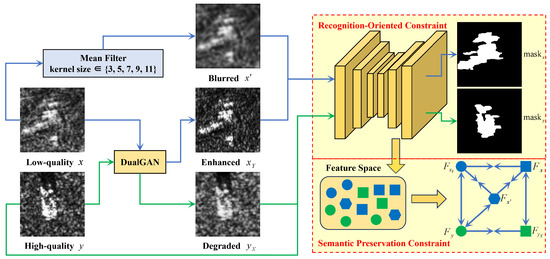
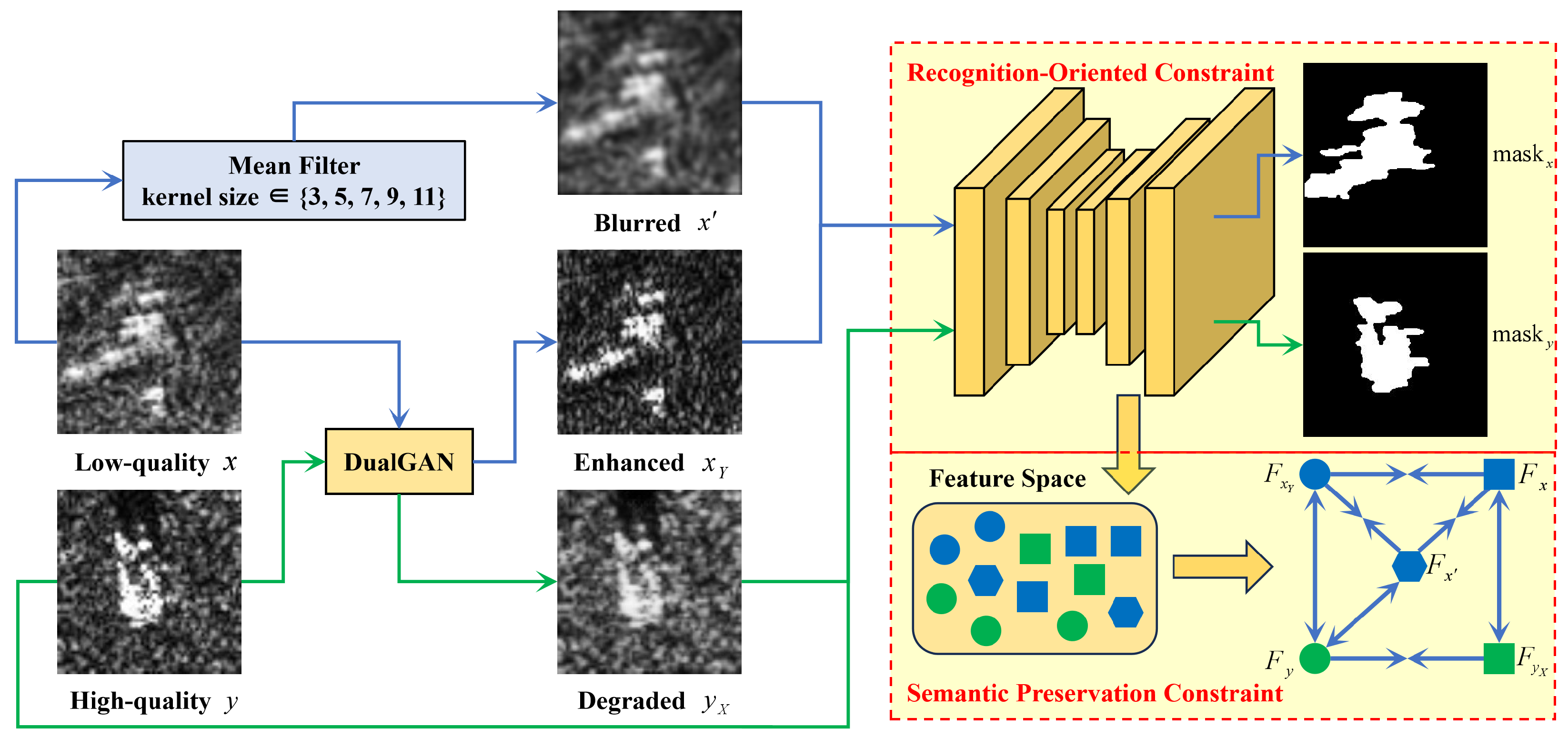
As illustrated in Figure 1, the proposed recognition-oriented SAR image enhancement framework consists of three main modules. The first module is built upon an unpaired I2I translation architecture derived from DualGAN, which employs two coupled generators and reconstruction loss to achieve style transfer between the source and target domains. The second module introduces a recognition-oriented constraint that guides the enhancement process toward preserving task-relevant features, thereby improving the robustness of subsequent recognition models. The third module incorporates a semantic preservation constraint to maintain the intrinsic scattering and structural characteristics of the original SAR images. The integration of these three modules effectively overcomes the limitations of the original DualGAN framework, enabling high-quality visual enhancement while maintaining semantic consistency and recognition performance.
Figure 1.
Framework of the proposed method. The SAR image enhancement process is built upon a DualGAN architecture, optimized under two primary constraints. The recognition-oriented constraint ensures structural integrity and task-specific performance based on segmentation tasks. Simultaneously, the semantic preservation constraint maintains semantic consistency between the original and enhanced images by aligning features in a shared latent space. Additionally, multi-scale mean filtering is integrated to provide further guidance during the enhancement process. Here, blue arrows indicate low-quality data flow, green arrows indicate high-quality data flow, circles represent high-quality/enhanced features, squares represent low-quality/degraded features, and hexagons represent smoothed features.
2.2.1. Unsupervised Enhancement Based on DualGAN
SAR image quality enhancement can be regarded as a specialized form of domain adaptation, where the goal is to translate a low-quality SAR image into its high-quality counterpart. Due to the lack of corresponding high-quality ground truth, real unpaired high-quality SAR images are used in this work as conditional references for unsupervised enhancement. In this context, a DualGAN-based framework is adopted to enable unpaired translation between the low-quality domain X and the high-quality domain Y. Here, denotes a low-quality SAR image while represents a real high-quality image acquired under favorable conditions.
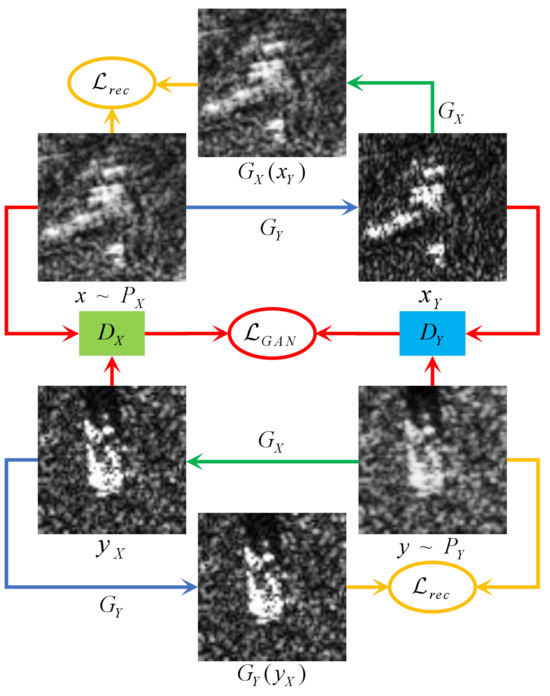
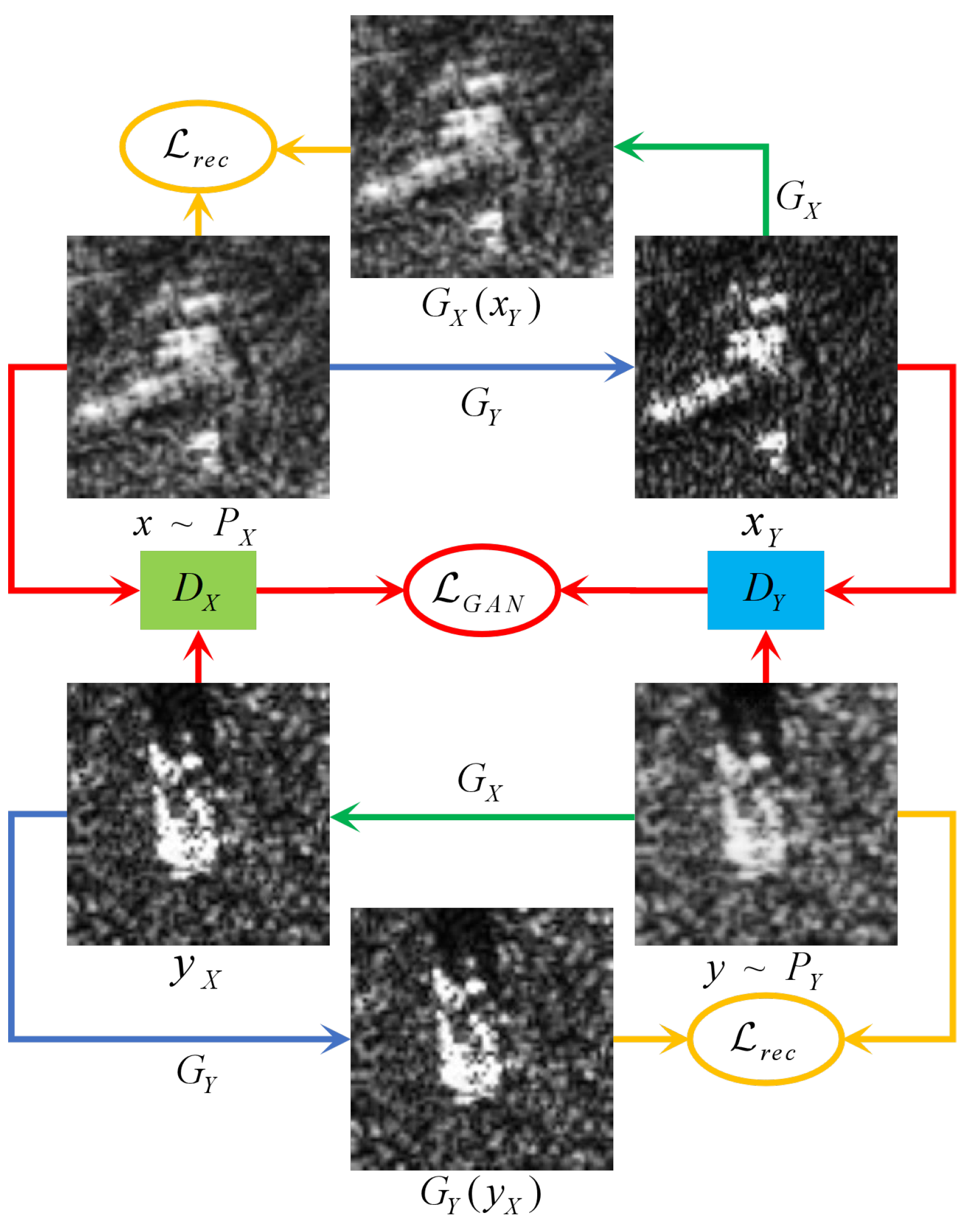
As shown in Figure 2, the framework consists of two generators () and two discriminators (), which jointly learn bidirectional mappings between the two domains. The discriminators ensure that the generated samples are indistinguishable from real ones in each domain.
Figure 2.
Illustration of DualGAN, where samples and are drawn from the low-quality and high-quality SAR image distributions, respectively.
The adversarial objective for the mapping is defined as:
A symmetric term is used for the inverse mapping , and the total adversarial loss is the sum of the two directions:
To maintain geometric and semantic consistency, DualGAN incorporates a reconstruction loss:
This loss constrains the translation to prevent excessive distortion or information loss.
However, DualGAN alone does not explicitly ensure that the enhanced images retain task-relevant semantics required for target recognition. To address this limitation, recognition-oriented and semantic preservation constraints are incorporated in the proposed framework, guiding the enhancement toward both visual fidelity and recognition accuracy.
2.2.2. Recognition-Oriented Constraint
SAR image quality enhancement is typically optimized separately from target recognition, leading to limited performance in downstream tasks due to the lack of recognition-aware guidance. Previous approaches attempted to address this by incorporating classifiers pre-trained on high-quality images to guide enhancement. However, when only low-quality observations are available, classifiers tend to overfit noise patterns or degradation-specific artifacts, providing unreliable semantic guidance.
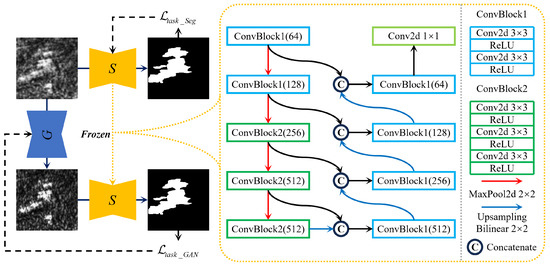
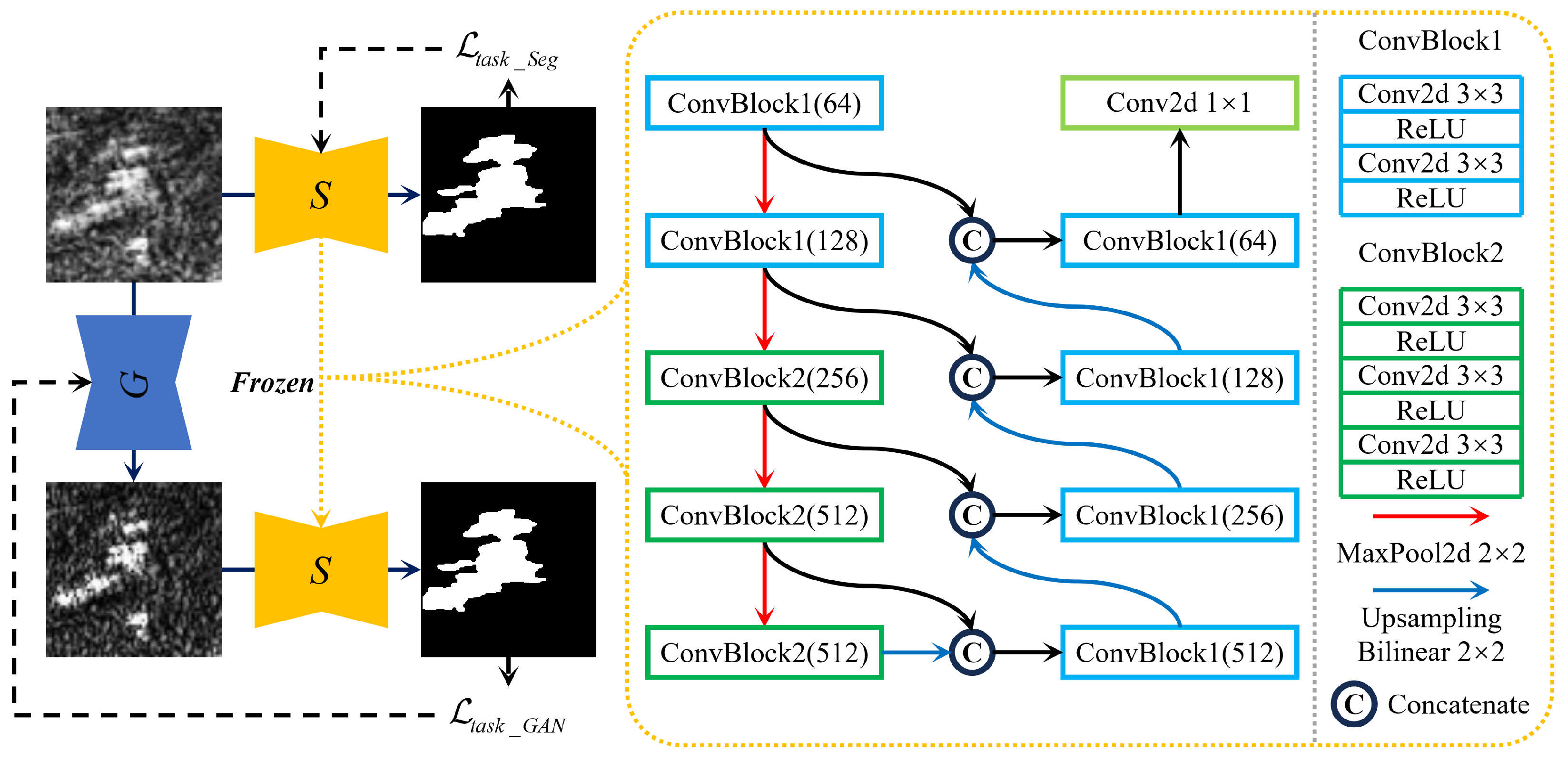
To overcome this limitation, another high-level semantic segmentation task is employed as an auxiliary objective to guide the enhancement process. Unlike classification providing only image-level supervision that may overlook critical local details, segmentation offers dense pixel-wise supervision that explicitly preserves spatial structures such as object boundaries and shapes. In addition, segmentation labels are more robust to quality variations, as they depend primarily on global structural contours rather than localized texture patterns, thereby reducing susceptibility to noise-induced overfitting. Furthermore, high-level semantic representations have demonstrated strong transferability across vision tasks [57], and features learned for segmentation inherently capture discriminative characteristics that benefit recognition [29].
As illustrated in Figure 3, the segmentation network is integrated into the enhancement framework to provide high-level semantic constraints. Binary segmentation masks are produced through intensity thresholding, connected-component filtering, and morphological refinement according to Ref. [58]. The training adopts an alternating optimization strategy in which the segmentation network and the generators are updated in separate steps within each iteration.
Figure 3.
Structure of the recognition-oriented constraint. The segmentation network is trained on original images and then frozen, while the generator is updated using enhanced/degraded images. Here, the segmentation network is denoted as S while the generator is denoted as G. The segmentation architecture is shown on the right.
The segmentation network is trained with real SAR images and their corresponding masks to ensure predictions consistent with the ground-truth structures. Then the segmentation parameters are frozen, and the generators are optimized using the segmentation loss computed on the translated images. During this process, the segmentation network serves as a fixed supervisory module that guides the generators to preserve structural integrity and spatial consistency throughout the enhancement.
The recognition-oriented constraint consists of two losses: the first supervises the segmentation network on real samples, and the second constrains the generators through the fixed segmentation model. These losses are formulated as:
where denotes the segmentation network, is cross-entropy loss, and represent the corresponding masks.
This bidirectional constraint ensures the enhancement process preserves task-relevant semantics, ultimately generating SAR images that better support downstream recognition tasks through improved feature discriminability and structural integrity.
2.2.3. Semantic Preservation Constraint
While enhancement operations can improve visual quality, they may inadvertently distort or discard fine-grained semantic details essential for recognition. Although the previously introduced recognition-oriented constraint provides supervision, the masks are derived from traditional threshold-based procedures and may introduce additional errors. To mitigate this risk, a semantic-preservation constraint is introduced into the framework. Specifically, this approach guides the feature extractor to retain stable and category-consistent representations through a contrastive learning strategy, ensuring that the enhanced image remains semantically coherent with its original counterpart.
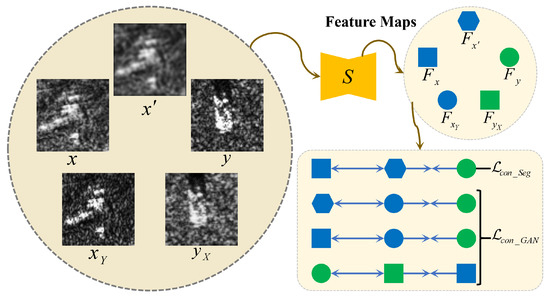
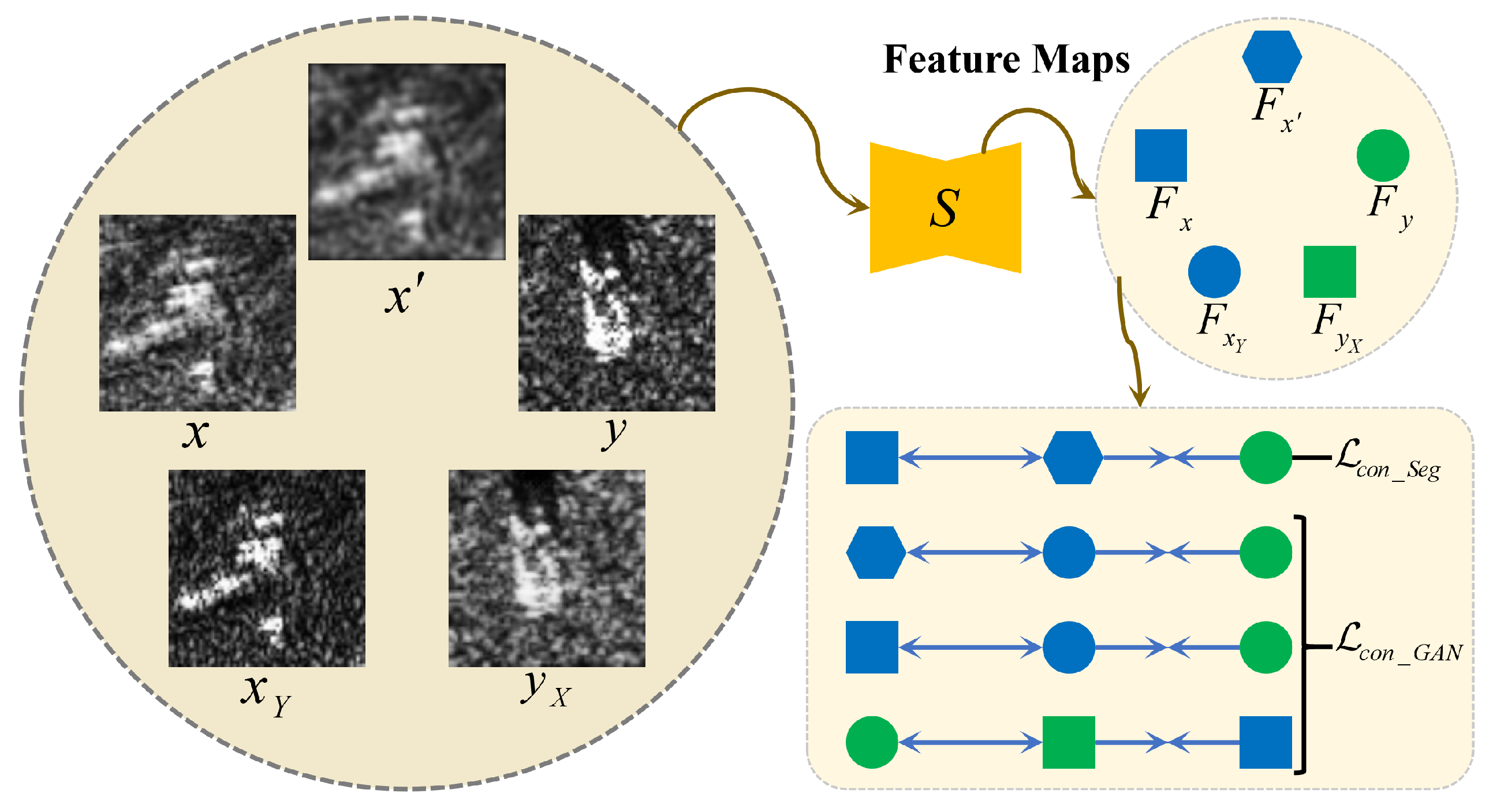
As illustrated in Figure 4, the original low-quality inputs, original high-quality samples, enhanced outputs, and degraded results are projected into a unified feature space using the previously introduced segmentation network. To preserve spatial fidelity, the feature maps extracted from the final decoder stage are adopted. Owing to skip connections, this layer not only contains high-level semantic abstractions but also provides high-resolution representations that retain fine structural details, including object boundaries and local geometric patterns, which are often attenuated in deeper encoder layers.
Figure 4.
Structure of the semantic preservation constraint. Feature maps from the final decoder stage are used to maintain spatial fidelity. Features with the same semantics are pulled together, while those with different semantics are pushed apart.
Building on this, the principle of contrastive learning is incorporated into the framework to minimize the loss of original details. Specifically, within this shared representation space, enhanced features are set as anchor points, being pulled toward positive samples with similar content and pushed away from negative samples with different content. This ensures that the enhancement process does not discard intrinsic information valuable for subsequent tasks. A symmetric alignment is applied to the degraded samples as well. This bidirectional regulation suppresses domain-inconsistent distortions and ensures that the transformations between the two domains preserve intrinsic scattering characteristics and class-relevant structural attributes of the original image.
The consistent loss function is formulated as follows:
where and denote the feature embeddings of the original low-quality and high-quality samples, respectively, while and denote the embeddings of the enhanced and degraded images. The operator computes the pixel-wise mean squared error on the corresponding feature maps. In this formulation, is derived from the despeckling gain (DG) introduced in [59] and adapted for feature-level alignment. It characterizes the relative suppression of multiplicative speckle and provides a stable ratio-based measure for comparing feature distances across domains. The logarithmic mapping compresses the dynamic range, improves gradient stability, and enhances sensitivity to fine structural variations during optimization.
However, although containing semantic content, the raw low-quality inputs are severely corrupted by interference, making direct feature alignment unreliable. More critically, directly aligning the enhanced features with these noisy counterparts may inadvertently drive the generator toward a trivial solution [60]. In particular, the identity mapping can emerge as a potential minimizer of Equation (6), which may destabilize GAN training by providing misleading signals to the discriminator. Such feedback weakens the adversarial learning dynamics and ultimately degrades the quality of the generated outputs.
To mitigate this issue, a multi-scale mean filtering strategy is introduced to construct a structurally consistent yet noise-suppressed reference. Specifically, the low-quality input is processed with a mean filter whose kernel size is randomly sampled from , producing a smoothed variant . This operation effectively suppresses high-frequency disturbances while preserving the global structural layout essential for recognition [61]. The resulting smoothed image serves as a more reliable structural reference, alleviating the risk of trivial identity mapping while maintaining the beneficial denoising effect. Both the original input x and its filtered counterpart are then forwarded to the segmentation network to extract feature representations. The dual inputs encourage the network to learn features that are less sensitive to noise yet consistent in semantic structure, thereby providing more stable and informative supervision for subsequent recognition-oriented learning. The recognition-oriented loss used to update the segmentation network is further defined as:
and the corresponding consist loss is formulated as
where denotes the feature representation extracted from the filtered low-quality input.
For generator optimization, the modified consistent loss is defined as:
The overall training objectives for the segmentation network and the generators are expressed as:
where the loss weights are fixed as , , , and , allowing each term to contribute proportionally to the optimization process. With these settings, serves exclusively to update the segmentation network, while governs the optimization of the dual-generator structure.
3. Results
3.1. Datasets and Settings
In the absence of paired training samples, two SAR datasets with distinct imaging qualities, MSTAR and GMVT, are utilized to construct the high- and low-quality domains. As summarized in Table 1, the MSTAR dataset [8], released by Sandia National Laboratories, contains X-band SAR images of ten military ground targets with a spatial resolution of . The GMVT dataset [62], collected by the MiniSAR system developed at Nanjing University of Aeronautics and Astronautics, includes nine target categories. The GMVT dataset provides training samples acquired in July at depression angles of , , , and , and testing samples collected in March at , , and .
Table 1.
Categories and quantities of two datasets.
As the MSTAR dataset provides high-quality images with distinct target structures and clean backgrounds, whereas GMVT images exhibit stronger background clutter and less distinct target contours, making recognition more challenging [62]. Accordingly, MSTAR and GMVT are regarded as high- and low-quality datasets, respectively.
To maintain consistent spatial resolution, MSTAR images are center-cropped to pixels and resized to pixels, while GMVT images are directly resized to the same size. For depression angles alignment, MSTAR samples at , , and are matched with GMVT samples at , , and , respectively. All MSTAR samples are used to train the enhancement networks, while only the July subset of GMVT is used for training. The trained model is subsequently applied to the entire GMVT dataset for evaluation using recognition models.
To evaluate generalization across different depression angles, four experimental scenarios are designed. Scene I evaluates recognition performance at and Scene II at , where training and testing angles are identical. Scene III uses data at for training and for testing, while Scene IV employs for training and for testing. These configurations assess the robustness of the proposed method under varying depression angles.
The effectiveness of the proposed method is assessed in terms of recognition performance, which directly reflects its capability to enhance task-relevant features. Six representative recognition networks are used for evaluation, including AConvNet, ResNet-18, ResNet-50, VGG-16, ConvNeXt-Tiny, and EfficientNetV2. The recognition accuracies obtained on enhanced SAR images serve as a practical measure of the improvement in semantic consistency and discriminative feature representation achieved by the proposed enhancement model.
The proposed enhancement network is trained for 100 epochs using the Adam optimizer with a learning rate of and a batch size of 4. The recognition models are trained for 400 epochs using the AdamW with a batch size of 64, where the learning rate decreases from to . All experiments are conducted on a single NVIDIA RTX 4090 GPU.
3.2. Comparison with Despeckling Methods
To validate the effectiveness of the proposed enhancement approach, several representative despeckling algorithms are compared in this section. Comparative methods include three conventional approaches, namely Lee, PPB, and SAR-BM3D, as well as two deep learning-based methods, SAR-CAM and SAR-Trans. In addition, the original SAR images are used as a baseline for performance evaluation.
3.2.1. Evaluation on Recognition Performance
As shown in Table 2, the proposed method consistently improves recognition accuracy across all networks under identical depression angles, with average improvements of 13.21% in Scene I and 12.04% in Scene II compared to the original images. In contrast, SAR-BM3D and SAR-CAM yield only marginal improvements, indicating that their despeckling processes are insufficient to enhance discriminative representations for recognition tasks. The Lee and PPB filters provide limited performance gains, while SAR-Trans achieves more noticeable improvements of 7.00% and 7.17% in Scenes I and II, respectively, yet still remains inferior to the proposed method.
Table 2.
Comparison of recognition performance between the proposed method and despeckling methods under the same depression angle (%).
The recognition results under different depression angles are summarized in Table 3. Compared with the original images, the proposed method improves the average recognition accuracy by 9.32% in Scene III and 12.83% in Scene IV. Again, SAR-BM3D shows negligible improvement, and Lee and PPB maintain minor improvements. In contrast to the previous scenes, SAR-CAM achieves a slight performance improvement, which may be attributed to the fact that deep learning-based despeckling methods tend to generate outputs that are more compatible with the subsequent recognition networks in more complex scenes. SAR-Trans further provides notable increases of 5.64% and 9.84%, respectively.
Table 3.
Comparison of recognition performance between the proposed method and despeckling methods under different depression angles (%).
Notably, methods with substantial recognition performance gains exhibit reduced improvements in Scene III. This indicates that larger depression angle variations significantly increase recognition difficulty, and the resulting geometric discrepancies cannot be fully mitigated by enhancement or despeckling methods.
In addition, the proposed method yields more significant improvements on relatively complex architectures, such as ConvNeXt-Tiny and EfficientNetV2. This indicates that the enhancement produces more structured and discriminative representations, which can be more effectively exploited by networks with stronger feature modeling capacity. In contrast, SAR-Trans tends to perform comparatively better on shallower architectures, such as AConvNet and ResNet18, suggesting that its enhancement strategy may be more compatible with models of limited representation capacity, leading to its slight advantage on AConvNet in Scene IV.
Overall, the proposed method consistently achieves superior recognition performance when the depression angles are identical or moderately different. As the angular disparity increases, the performance gains remain evident but become less pronounced.
3.2.2. Qualitative and Feature-Level Analysis
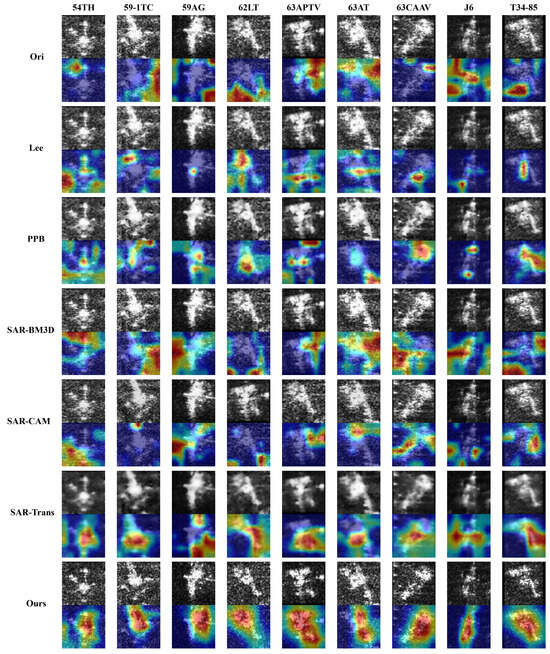
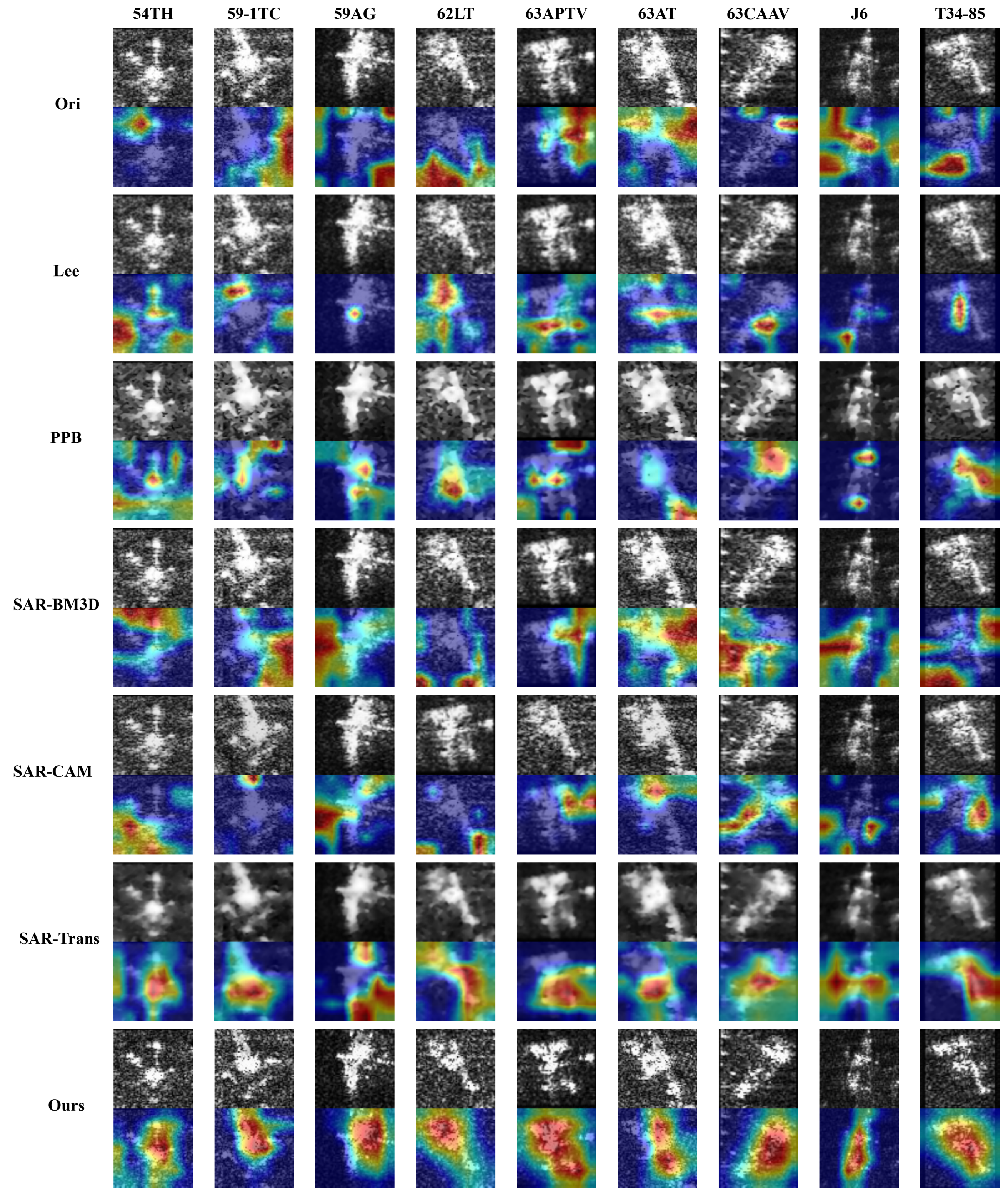
To further interpret the recognition results reported above, Figure 5 presents the visual results of despeckling and proposed methods together with the corresponding Grad-CAM [63] visualizations. For Grad-CAM generation, the feature maps from the last convolutional stage of the ConvNeXt-Tiny backbone are used as the target layer. The proposed method produces target regions with clearer structural details and well-preserved geometric shapes, resulting in attention maps that align closely with the actual target areas. This indicates that the enhanced images enable the recognition model to focus more accurately and consistently on the target region. In comparison, SAR-BM3D and SAR-CAM yield visually natural outputs that remain close to the original images but often retain noticeable residual speckle noise. Consequently, the corresponding attention maps are frequently distracted by background clutter rather than concentrated on the target. Lee, PPB, and SAR-Trans generate increasingly smoother outputs, which effectively suppress background noise and retain coarse target geometry. However, their attention responses tend to focus on limited target regions, suggesting that excessive smoothing may reduce irrelevant information while also weakening fine-grained structural cues.
Figure 5.
Visualization results of the proposed method and despeckling methods on nine military targets, along with Grad-CAM visualizations obtained from the last convolutional stage of ConvNeXt-Tiny. In the Grad-CAM visualizations, red regions indicate areas most relevant to the model’s decision, yellow/green regions indicate moderately important areas, and blue regions indicate least important areas.
To characterize these observations, four metrics, including DISTS, LPIPS, TEN, and EME, are involved. DISTS and LPIPS measure perceptual similarity in deep feature space, whereas TEN and EME reflect image sharpness and local contrast [64], respectively. As summarized in Table 4 and Table 5, SAR-BM3D achieves relatively high perceptual similarity scores, while Lee, PPB, and SAR-Trans exhibit progressively degraded similarity as the images become smoother. Notably, higher perceptual similarity does not correspond to better recognition performance, indicating that preserving low-quality original characteristics may be detrimental to target discrimination. In contrast, appropriate smoothing that suppresses background clutter can facilitate recognition even when perceptual similarity is reduced. Compared with despeckling approaches, the proposed method intentionally maintains a limited degree of target semantic consistency. By balancing semantic preservation, selective enhancement of recognition-relevant features, and suppression of degraded information, the proposed method produces representations that are more effective for recognition.
Table 4.
Quantitative image quality results of the proposed method and despeckling methods under the same depression angle.
Table 5.
Quantitative image quality results of the proposed method and despeckling methods under different depression angles.
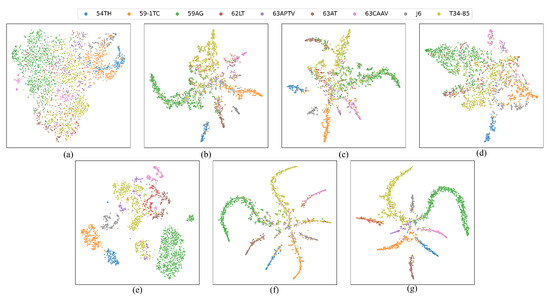
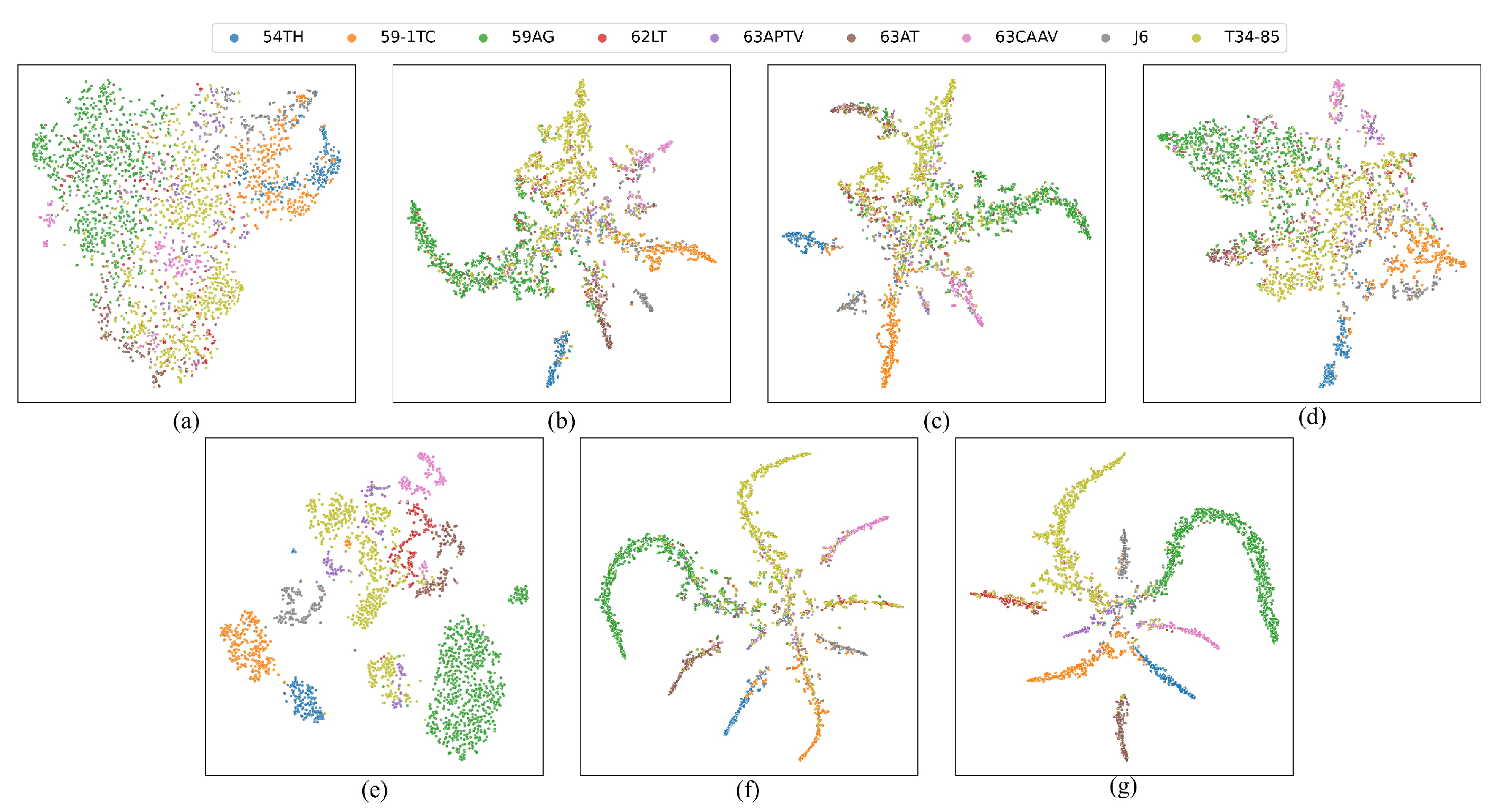
The influence of quality enhancement on feature representations is illustrated using t-SNE [65] projections in Figure 6. The original images exhibit scattered distributions with severe class overlap, while SAR-BM3D provides only marginal improvement. SAR-CAM shows better clustering for some targets, but other targets remain mixed, highlighting limitations in feature separation. Lee, PPB, and SAR-Trans produce increasingly compact feature clusters, confirming that smoothing promotes feature aggregation. However, overly compact distributions may still suffer from class confusion. The proposed method achieves both compact intra-class clustering and improved inter-class separability, indicating enhanced discriminative representations while retaining essential target semantics.
Figure 6.
T-SNE visualization of feature representations extracted by ConvNeXt-Tiny for Scene I using the proposed method and despeckling techniques. (a) Original image, (b) Lee, (c) PPB, (d) SAR-BM3D, (e) SAR-CAM, (f) SAR-Trans, (g) proposed method.
In summary, these analyses demonstrate that the proposed method benefits target recognition from suppressing background clutter and reinforcing discriminative target structures, rather than maximizing perceptual similarity to the original images.
3.3. Comparison with Unsupervised Enhancement Methods
To further assess the effectiveness of the proposed approach, comparisons are conducted with representative unsupervised enhancement methods, including CycleGAN, DualGAN, and TFUIE. CycleGAN and DualGAN are classical unpaired image translation frameworks that learn domain mappings without pixel-level supervision. TFUIE, on the other hand, is a task-friendly unsupervised enhancement model that explicitly considers the impact of enhancement on downstream vision tasks.
3.3.1. Evaluation on Recognition Performance
As shown in Table 6 and Table 7, the proposed method consistently outperforms all competing methods in terms of recognition accuracy across all scenes. CycleGAN is generally detrimental to recognition performance. DualGAN achieves moderate accuracy improvements when the depression angles are the same. However, its generalization capability degrades noticeably as the depression angle discrepancy increases. These results highlight that unconstrained unsupervised enhancement methods, lacking task-specific constraints, thereby undermine recognition reliability. TFUIE explicitly accounts for the impact of enhancement on downstream vision tasks. As a result, it achieves accuracy gains of 9.88%, 9.72%, and 9.81% in Scene I, Scene II, and Scene IV, respectively, where the depression angles are consistent or only mildly varying. In contrast, its performance gain drops significantly to 7.06% in Scene III, which involves large depression angle variations. This trend is consistent with that of the proposed method, although the proposed method yields larger and more stable improvements across all scenes.
Table 6.
Comparison of recognition performance between the proposed method and unsupervised enhancement methods under the same depression angle (%).
Table 7.
Comparison of recognition performance between the proposed method and unsupervised enhancement methods under different depression angles (%).
Overall, direct image enhancement methods without task-related constraints exert an unstable influence on recognition performance. In comparison, task-friendly approaches, including TFUIE and the proposed method, demonstrate more consistent improvements but remain sensitive to large depression angle variations. By further incorporating multi-scale mean filters to preserve structural consistency while suppressing noise, the proposed method achieves superior robustness.
3.3.2. Qualitative and Feature-Level Analysis
To further investigate the influence of different unsupervised enhancement strategies on recognition performance, qualitative visual comparisons and Grad-CAM visualizations are jointly considered.
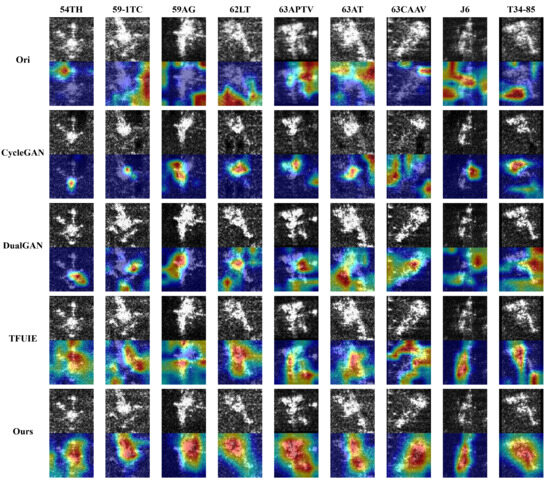
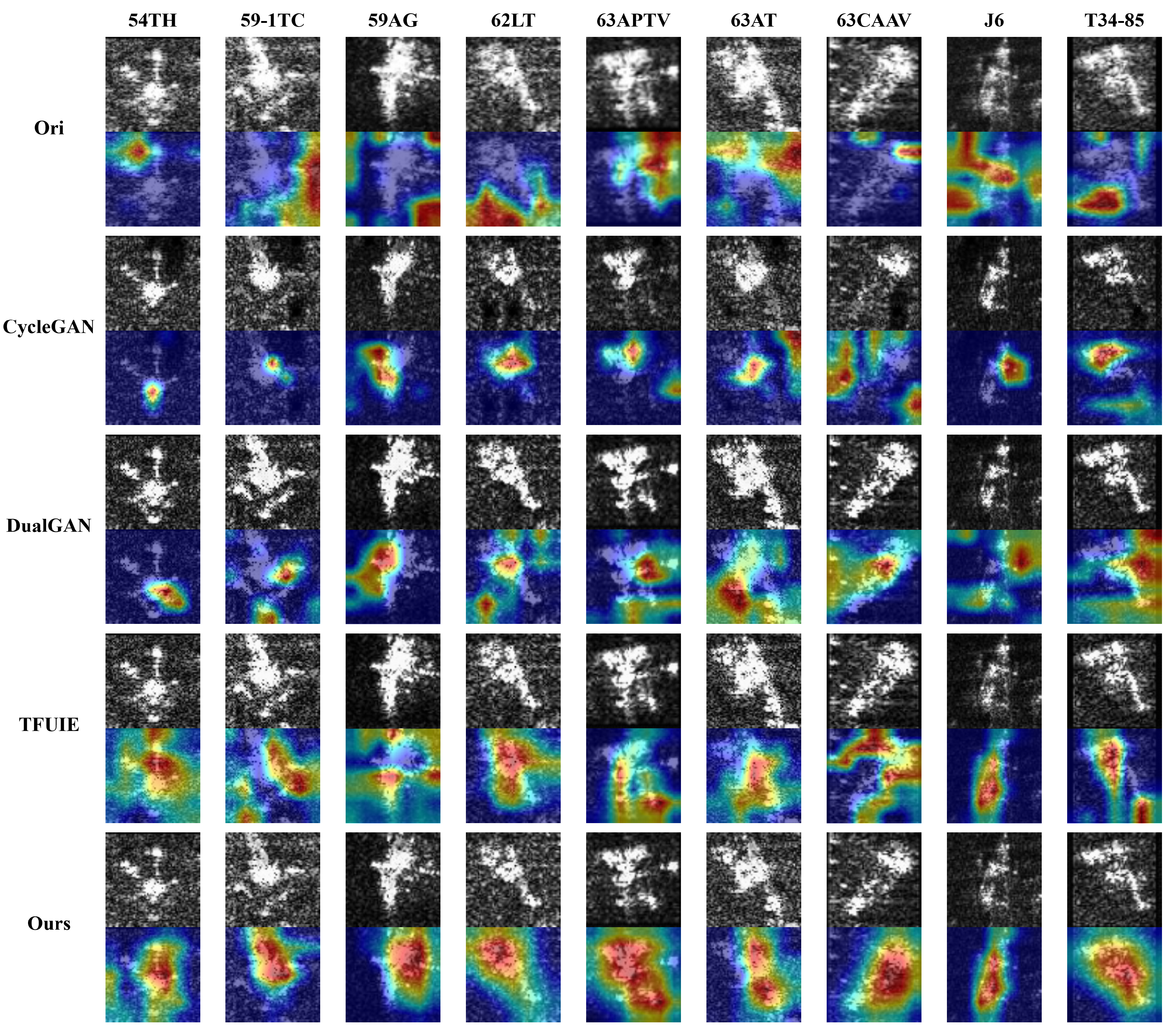
As illustrated in Figure 7, although unsupervised enhancement methods generally encourage the recognition network to attend to target regions, their effectiveness varies significantly depending on the structural fidelity of the enhanced results. CycleGAN enhances texture contrast and brightness but frequently introduces geometric deformation and alters target scattering characteristics, which degrades classification performance despite apparent target-focused attention. DualGAN better preserves the global structure of targets. However, local inconsistencies and artifacts remain, leading to unstable or spatially misaligned attention responses. TFUIE, by incorporating task-friendly feature guidance, produces more natural enhancements that preserve fine target details and background context. Consequently, its Grad-CAM responses are more consistently concentrated on the target region, yielding improved recognition reliability. In contrast, the proposed method generates images with richer and more coherent textures while avoiding excessive semantic distortion. This can be attributed to the alignment between generated features and those of smoothed images, which allows beneficial smoothing characteristics to be integrated without compromising discriminative structures. As a result, the model exhibits a higher spatial overlap between attention regions and true target areas, leading to more accurate target recognition.
Figure 7.
Visualization results of the proposed method and unsupervised enhancement methods on nine military targets, along with Grad-CAM visualizations obtained from the last convolutional stage of ConvNeXt-Tiny. In the Grad-CAM visualizations, red regions indicate areas most relevant to the model’s decision, yellow/green regions indicate moderately important areas, and blue regions indicate least important areas.
Quantitative visual quality evaluation results across four scenes are reported in Table 8 and Table 9. Except for CycleGAN, most methods achieve favorable perceptual scores, indicating visually coherent enhancements. TFUIE attains the best perceptual metrics, whereas the proposed method yields slightly lower perceptual scores. Nevertheless, the proposed method achieves lower TEN and EME values, reflecting the learning of recognition-favorable smoothing features rather than aggressive perceptual enhancement, which is more conducive to downstream recognition tasks.
Table 8.
Quantitative image quality results of the proposed unsupervised enhancement methods under the same depression angle.
Table 9.
Quantitative image quality results of the proposed method unsupervised enhancement methods under different depression angles.
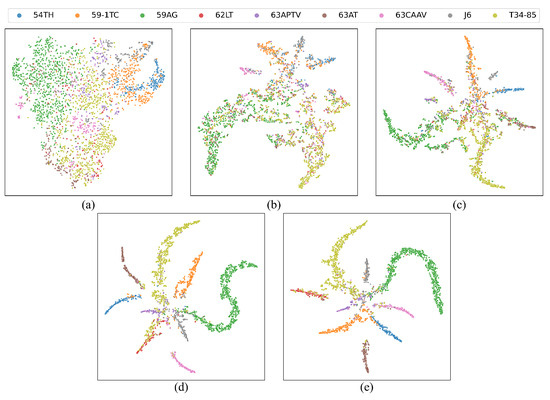
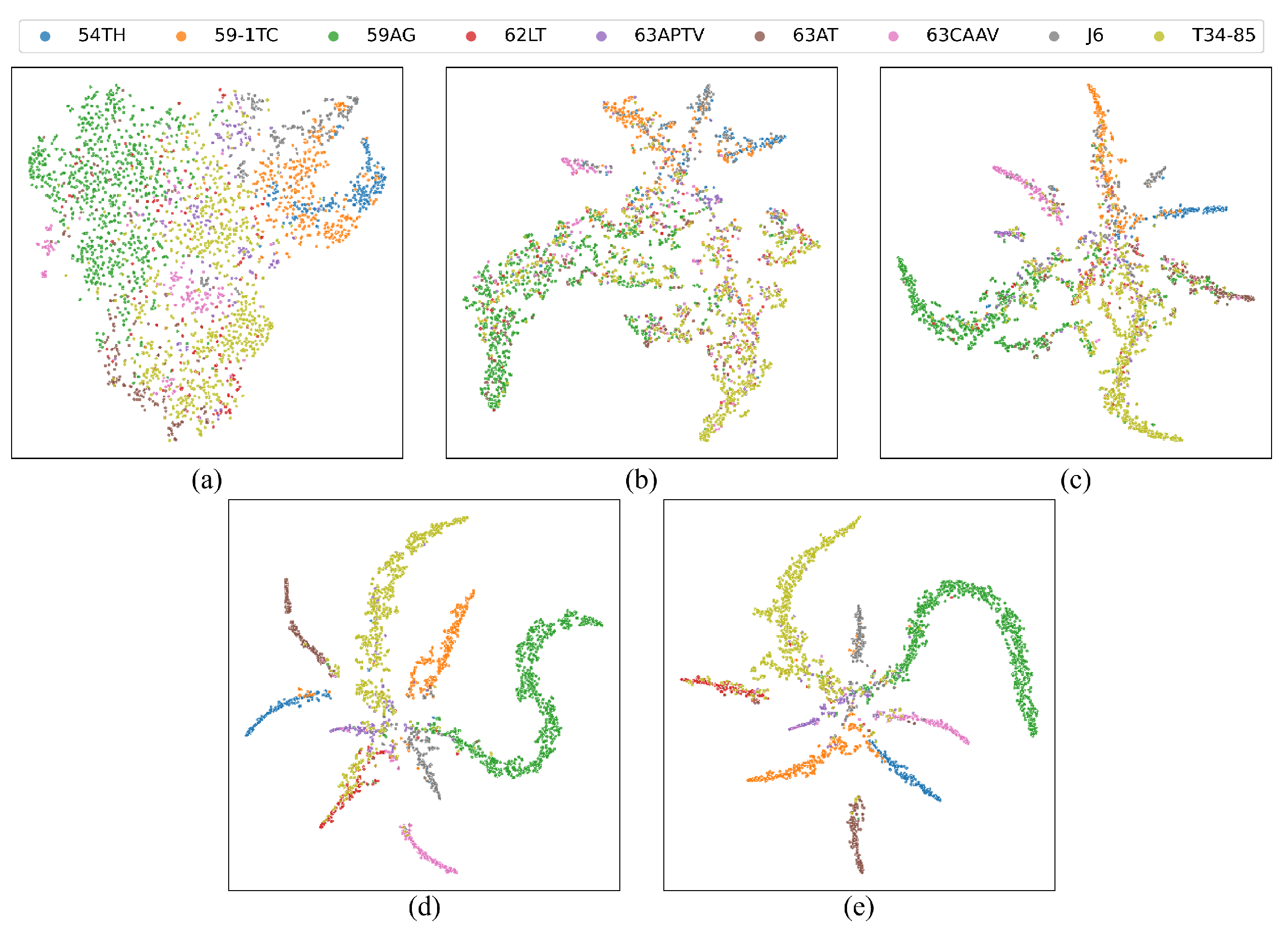
The t-SNE visualizations shown in Figure 8 further support these observations. CycleGAN exhibits coarse clustering with substantial feature mixing, while DualGAN shows marginal improvement. TFUIE produces more compact clusters, whereas the proposed method achieves the clearest inter-class separation, indicating superior feature discriminability.
Figure 8.
T-SNE visualization of feature representations extracted by ConvNeXt-Tiny for Scene I using the proposed method and unsupervised enhancement techniques. (a) Original image, (b) CycleGAN, (c) DualGAN, (d) TFUIE, (e) proposed method.
Overall, unlike despeckling approaches that explicitly preserve geometric structure, most unsupervised generative enhancement methods learn high-quality domain-representative features without strict structural constraints. In this context, moderate improvements in perceptual metrics indicate effective preservation of semantic content. However, excessively high perceptual scores do not necessarily correlate with improved recognition, as they often result from residual noise of the original low-quality input. The proposed method achieves a favorable balance between enhancing perceptual quality and recognition performance.
3.4. Ablation Study
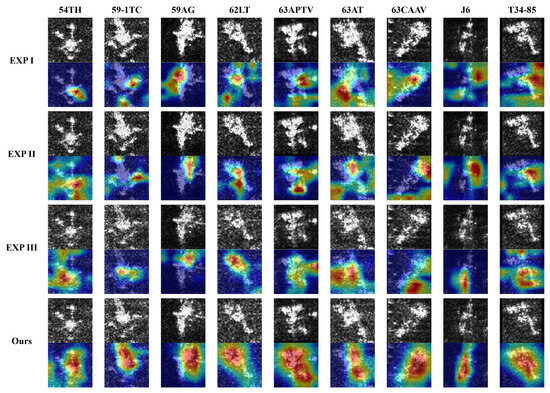
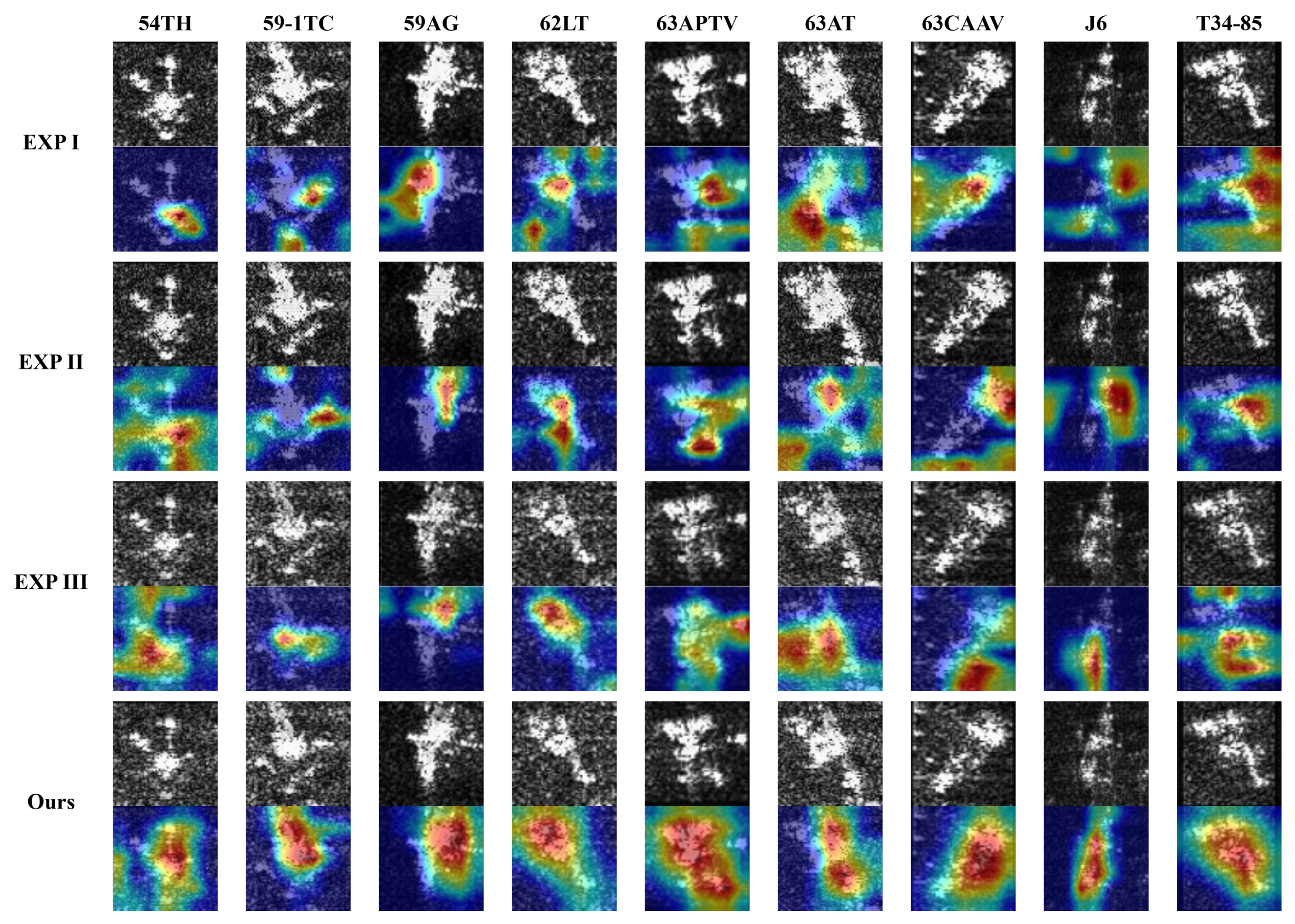
To evaluate the contribution of each constraint, three configurations were evaluated. EXP I denotes the baseline DualGAN, EXP II adds the ROC, and EXP III further includes the SPC while using the original low-quality image without applying multi-scale mean filters.
As reported in Table 10 and Table 11, introducing ROC consistently improves recognition performance over the baseline. This indicates that segmentation-guided enhancement encourages the network to focus on target-related regions and generates features more relevant to recognition. However, the segmentation labels used in ROC are obtained from conventional segmentation methods, whose reliability degrades as the depression angle increases. As a result, the recognition improvement becomes less stable. By further incorporating SPC, the feature consistency between the enhanced image and the original input is strengthened, leading to improved recognition accuracy. With the integration of the multi-scale mean filter, the proposed method achieves the best overall recognition performance. The improvement is most pronounced when the depression angle difference is small or moderate, where smoothing helps preserve geometric structure and suppress background clutter. When the angular difference becomes large, the benefit of smoothing diminishes, resulting in performance trends similar to despeckling approaches.
Table 10.
Ablation experiments on recognition performance under the same depression angle (%).
Table 11.
Ablation experiments on recognition performance under different depression angles (%).
The corresponding visual and quantitative results are shown in Figure 9, Table 12 and Table 13. Compared with the baseline, incorporating ROC produces enhancement results that are more concentrated on target regions, which is also reflected in the activation maps of the recognition model. This comes at the cost of a slight reduction in perceptual similarity, mainly due to inaccuracies in the segmentation labels that may introduce local inconsistencies. When SPC is further applied, the enhanced images exhibit stronger semantic correspondence with the original inputs. Although this may partially reintroduce residual noise and attract attention to non-ideal regions, it effectively preserves structural integrity and yields more coherent representations for recognition. Incorporating the multi-scale mean filter aligns the enhanced results with both the original and smoothed images. This slightly reduces sharpness and local contrast, but improves perceptual similarity by providing stable structural guidance. The joint use of detailed and smoothed representations enables more consistent feature generation across varying imaging conditions, encouraging the recognition model to focus more reliably on target regions.
Figure 9.
Visualization results of the ablation experiments, along with Grad-CAM visualizations obtained from the last convolutional stage of ConvNeXt-Tiny. In the Grad-CAM visualizations, red regions indicate areas most relevant to the model’s decision, yellow/green regions indicate moderately important areas, and blue regions indicate least important areas.
Table 12.
Ablation experiments on image quality under the same depression angle.
Table 13.
Ablation experiments on image quality under different depression angles.
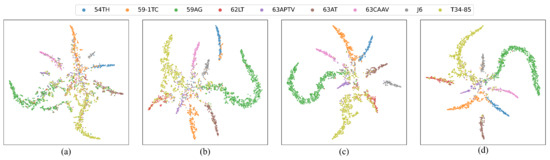
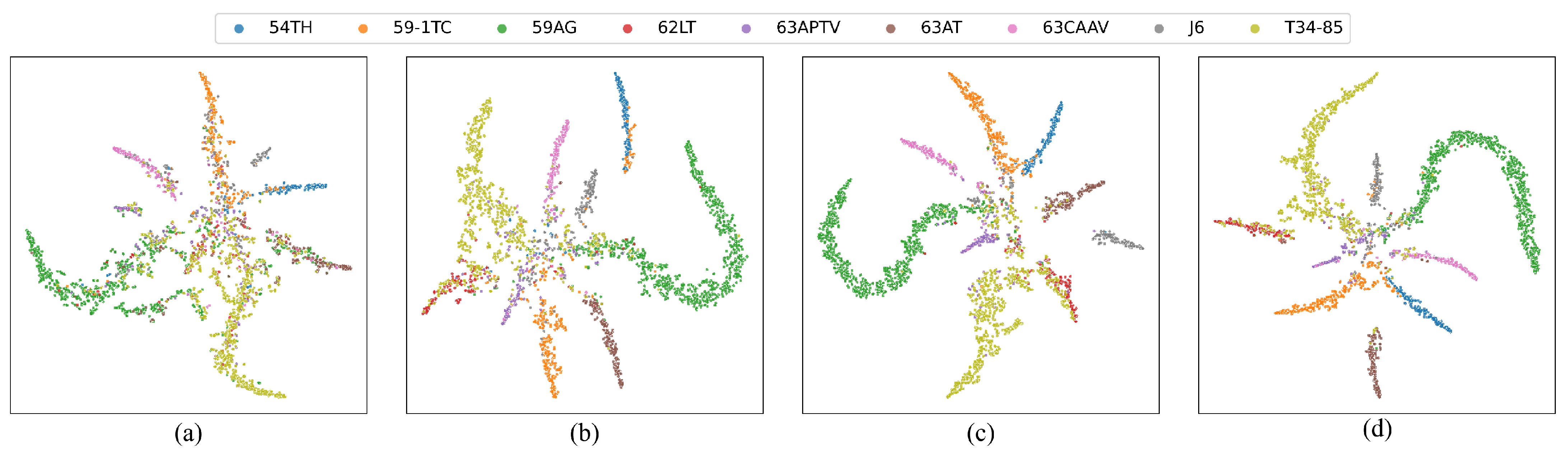
The t-SNE visualizations shown in Figure 10 further support these observations. After introducing ROC, feature embeddings begin to form distinguishable clusters, although they remain relatively dispersed. Adding SPC reduces mis-clustering and improves class separability. With the full model, the feature clusters become more compact and better separated, demonstrating that the proposed combination of constraints and smoothing leads to more discriminative and robust feature representations.
Figure 10.
T-SNE visualization of feature representations extracted by ConvNeXt-Tiny for Scene I in ablation experiments. (a) EXP I, (b) EXP II, (c) EXP III, (d) proposed method.
To investigate the influence of more advanced backbone architectures, the generator structure is replaced with the dense-block-based architecture proposed in [34]. The experimental results are summarized in Table 14.
Table 14.
Ablation experiments with different backbones on recognition performance (%). The symbol † denotes the use of the advanced backbone.
It can be observed that introducing a more complex backbone improves the feature representation capability of the enhancement network and results in an overall improvement in downstream recognition performance. When the enhanced images are fed into subsequent recognition models, most models achieve better performance. Nevertheless, a slight performance degradation is observed for a few lightweight recognition networks. This may be because lightweight models have limited feature extraction capacity. In contrast, more powerful recognition networks can better exploit the richer semantic cues provided by the enhanced images. Overall, these results demonstrate that while the present framework is effective, it also offers clear opportunities for further refinement. Future efforts toward adopting more advanced network designs are likely to unlock additional performance gains, showing that the proposed method has considerable potential for continued improvement.
4. Discussion
The proposed method enhances SAR image quality from low-quality to high-quality representations at the input level, thereby improving the robustness of subsequent recognition tasks. By introducing recognition-oriented and semantic preservation constraints, the framework maintains discriminative structural information while improving perceptual image quality. This ensures that the enhancement process contributes directly to interpretation tasks rather than merely producing visually refined outputs.
Although the proposed approach achieves promising results, several limitations remain. The high- and low-quality datasets used in this study mainly contain vehicle targets, which restricts the diversity of learned representations. To align data with different resolutions, a simple resizing operation was applied, which may introduce geometric distortions and reduce spatial correspondence between domains. Additionally, the segmentation labels used for recognition-oriented supervision are generated by conventional threshold-based methods, which can introduce labeling noise and compromise the stability of semantic constraints and the interpretability of enhanced features.
Future work can focus on enhancing physical and semantic consistency across imaging conditions. The generative process will incorporate prior information, such as resolution, azimuth, and depression angle, to improve model generalization and interpretability. Additionally, integrating physics-informed regularization will further strengthen robustness, making the model more adaptable to diverse real-world SAR scenarios.
5. Conclusions
An unsupervised SAR image quality enhancement framework is proposed in this work that enhances low-quality SAR images without paired supervision while improving downstream recognition. By formulating quality disparity as a domain shift, the proposed DualGAN-based translator learns low-to-high quality mappings using only unpaired samples. The proposed method effectively maintains task-relevant semantic features and structural integrity through recognition-oriented and semantic preservation constraints. Experiments verified that the proposed method yields consistent improvements in both perceptual quality and recognition accuracy across multiple recognition networks and depression-angle configurations. Future work can be explored by integrating physics-informed priors and multi-modal constraints to further improve interpretability and adaptability across broader SAR scenarios.
Author Contributions
Conceptualization, C.W.; methodology, C.W.; software C.W.; validation, C.W.; writing—original draft preparation, C.W.; supervision, S.Z. and G.K.; project administration, S.Z.; visualization, S.Z. and C.W.; investigation, L.Z. and T.T. All authors have read and agreed to the published version of the manuscript.
Funding
This research received no external funding.
Data Availability Statement
The publicly available MSTAR dataset can be obtained at: https://www.sdms.afrl.af.mil/index.php?collection=mstar, (accessed on 10 February 2023). For other experimental data, please contact Siqian Zhang (zhangsiqian@nudt.edu.cn) for access.
Acknowledgments
The authors would like to thank the reviewers and editors who provided valuable comments and suggestions for this article.
Conflicts of Interest
The authors declare no conflicts of interest.
References
- Wang, J.; Quan, S.; Cai, Z.; Xing, S.; Li, Y.; Meng, W. Translation Difference Characterization for PolSAR Ship Extraction. IEEE Trans. Geosci. Remote Sens. 2026, 64, 5202415. [Google Scholar] [CrossRef] [Scilit]
- Li, W.; Yang, W.; Zhang, W.; Liu, T.; Liu, Y.; Liu, L. Hierarchical Disentanglement-Alignment Network for Robust SAR Vehicle Recognition. IEEE J. Sel. Topics Appl. Earth Observ. Remote Sens. 2023, 16, 9661–9679. [Google Scholar] [CrossRef] [Scilit]
- Goodman, J.W. Some fundamental properties of speckle. J. Opt. Soc. Am. 1976, 66, 1145–1150. [Google Scholar] [CrossRef] [Scilit]
- Wang, J.; Leng, X.; Sun, Z.; Zhang, X.; Ji, K. Fast and Accurate Refocusing for Moving Ships in SAR Imagery Based on FrFT. Remote Sens. 2023, 15, 3656. [Google Scholar] [CrossRef] [Scilit]
- Xiang, D.; Li, W.; Sun, X.; Wang, H.; Su, Y. Sidelobe Suppression for High-Resolution SAR Imagery Based on Spectral Reshaping and Feature Statistical Difference. IEEE Trans. Geosci. Remote Sens. 2024, 62, 5211314. [Google Scholar] [CrossRef] [Scilit]
- Ding, B.; Wen, G. Target recognition of SAR images based on multi-resolution representation. Remote Sens. Lett. 2017, 8, 1006–1014. [Google Scholar] [CrossRef] [Scilit]
- Wan, C.; Zhou, X.; Tang, T.; He, Q.; Zhang, S. Evidential Uncertainty in SAR Target Recognition for Reliable Prediction. In 2024 IEEE 17th International Conference on Signal Processing (ICSP); IEEE: Piscataway, NJ, USA, 2024; pp. 553–557. [Google Scholar] [CrossRef] [Scilit]
- Chen, S.; Wang, H.; Xu, F.; Jin, Y.-Q. Target Classification Using the Deep Convolutional Networks for SAR Images. IEEE Trans. Geosci. Remote Sens. 2016, 54, 4806–4817. [Google Scholar] [CrossRef] [Scilit]
- Wang, J.; Zheng, T.; Lei, P.; Bai, X. Ground Target Classification in Noisy SAR Images Using Convolutional Neural Networks. IEEE J. Sel. Topics Appl. Earth Observ. Remote Sens. 2018, 11, 4180–4192. [Google Scholar] [CrossRef] [Scilit]
- Guo, Y.; Du, L.; Wei, D.; Li, C. Robust SAR Automatic Target Recognition Via Adversarial Learning. IEEE J. Sel. Topics Appl. Earth Observ. Remote Sens. 2021, 14, 716–729. [Google Scholar] [CrossRef] [Scilit]
- Lee, J.-S. Speckle analysis and smoothing of synthetic aperture radar images. Comput. Graph. Image Process. 1981, 17, 24–32. [Google Scholar] [CrossRef] [Scilit]
- Deledalle, C.-A.; Denis, L.; Tupin, F. Iterative Weighted Maximum Likelihood Denoising with Probabilistic Patch-Based Weights. IEEE Trans. Image Process. 2009, 18, 2661–2672. [Google Scholar] [CrossRef] [Scilit]
- Parrilli, S.; Poderico, M.; Angelino, C.V.; Verdoliva, L. A Nonlocal SAR Image Denoising Algorithm Based on LLMMSE Wavelet Shrinkage. IEEE Trans. Geosci. Remote Sens. 2012, 50, 606–616. [Google Scholar] [CrossRef] [Scilit]
- Perera, M.V.; Bandara, W.G.C.; Valanarasu, J.M.J.; Patel, V.M. Transformer-Based SAR Image Despeckling. In IGARSS 2022—2022 IEEE International Geoscience and Remote Sensing Symposium; IEEE: Piscataway, NJ, USA, 2022; pp. 751–754. [Google Scholar] [CrossRef] [Scilit]
- Shi, H.; Sheng, Q.; Wang, Y.; Yue, B.; Chen, L. Dynamic Range Compression Self-Adaption Method for SAR Image Based on Deep Learning. Remote Sens. 2022, 14, 2338. [Google Scholar] [CrossRef] [Scilit]
- Chen, Z.; Zhang, C.; Wan, C.; Zhang, S.; Xiong, B. DADSR: Degradation-Aware Diffusion Super-Resolution Model for Object-Level SAR Image. IEEE J. Sel. Topics Appl. Earth Observ. Remote Sens. 2025, 18, 19496–19510. [Google Scholar] [CrossRef] [Scilit]
- Lei, P.; Zheng, T.; Wang, J.; Bai, X. A Joint Convolutional Neural Network for Simultaneous Despeckling and Classification of SAR Targets. IEEE Geosci. Remote Sens. Lett. 2021, 18, 1610–1614. [Google Scholar] [CrossRef] [Scilit]
- Wang, X.; Yu, X.; Ren, H.; Zou, L.; Zhou, Y.; Wang, X. Target Recognition in Noisy SAR Images Based on Dual Network. In 2021 4th International Conference on Information Communication and Signal Processing (ICICSP); IEEE: Piscataway, NJ, USA, 2021; pp. 384–388. [Google Scholar] [CrossRef] [Scilit]
- Goodfellow, I.J.; Pouget-Abadie, J.; Mirza, M.; Xu, B.; Warde-Farley, D.; Ozair, S.; Courville, A.; Bengio, Y. Generative Adversarial Nets. Proc. Int. Conf. Neural Inf. Process. Syst. 2014, 27, 2672–2680. [Google Scholar]
- Zhu, J.-Y.; Park, T.; Isola, P.; Efros, A.A. Unpaired Image-to-Image Translation Using Cycle-Consistent Adversarial Networks. In 2017 IEEE International Conference on Computer Vision (ICCV); IEEE: Piscataway, NJ, USA, 2017; pp. 2242–2251. [Google Scholar] [CrossRef] [Scilit]
- Yi, Z.; Zhang, H.; Tan, P.; Gong, M. DualGAN: Unsupervised Dual Learning for Image-to-Image Translation. IEEE Int. Conf. Comput. Vis. 2017, 2868–2876. [Google Scholar] [CrossRef] [Scilit]
- Luan, J.; Ding, J.; Zhang, Y. Unsupervised Cross-Domain Radar Target Recognition Using Multilevel Alignment. IEEE Trans. Radar Syst. 2025, 3, 630–644. [Google Scholar] [CrossRef] [Scilit]
- Chen, Z.; Zhao, L.; He, Q.; Kuang, G. Pixel-Level and Feature-Level Domain Adaptation for Heterogeneous SAR Target Recognition. IEEE Geosci. Remote Sens. Lett. 2022, 19, 4515205. [Google Scholar] [CrossRef] [Scilit]
- Luan, J.; Xu, Z.; Li, B.; Ding, J. BCNet: Background Conversion Network for SAR Data Generation. IEEE J. Sel. Topics Appl. Earth Observ. Remote Sens. 2024, 17, 3211–3225. [Google Scholar] [CrossRef] [Scilit]
- Pu, X.; Jia, H.; Xin, Y.; Wang, F.; Wang, H. Ship Detection in Low-Quality SAR Images via an Unsupervised Domain Adaption Method. Remote Sens. 2023, 15, 3326. [Google Scholar] [CrossRef] [Scilit]
- Deng, J.; Wang, W.; Zhang, H.; Zhang, T.; Zhang, J. PolSAR Ship Detection Based on Superpixel-Level Contrast Enhancement. IEEE Geosci. Remote Sens. Lett. 2024, 21, 4008805. [Google Scholar] [CrossRef] [Scilit]
- Qin, Y.; Xu, W.; Yao, Y.; Huang, X. SAR-3DTR: A Novel Feature Hybrid Transformer Network for End-to-End 3-D Target Reconstruction from SAR Images. IEEE Geosci. Remote Sens. Lett. 2024, 21, 4017905. [Google Scholar] [CrossRef] [Scilit]
- Liu, D.; Wen, B.; Liu, X.; Wang, Z.; Huang, T.S. When image denoising meets high-level vision tasks: A deep learning approach. In Proceedings of the 27th International Joint Conference on Artificial Intelligence; AAAI Press: Washington, DC, USA, 2026; pp. 842–848. [Google Scholar]
- Liu, D.; Wen, B.; Jiao, J.; Liu, X.; Wang, Z.; Huang, T.S. Connecting Image Denoising and High-Level Vision Tasks via Deep Learning. IEEE Trans. Image Process. 2020, 29, 3695–3706. [Google Scholar] [CrossRef] [Scilit]
- Yang, Z.; Huang, J.; Zhou, M.; Zheng, N.; Zhao, F. IRVR: A General Image Restoration Framework for Visual Recognition. IEEE Trans. Multimedia 2024, 26, 7012–7026. [Google Scholar] [CrossRef] [Scilit]
- Son, T.; Kang, J.; Kim, N.; Cho, S.; Kwak, S. URIE: Universal Image Enhancement for Visual Recognition in the Wild. Proc. Eur. Conf. Comput. Vis. (ECCV) 2020, 64, 749–765. [Google Scholar]
- Gonwirat, S.; Surinta, O. DeblurGAN-CNN: Effective Image Denoising and Recognition for Noisy Handwritten Characters. IEEE Access 2022, 10, 90133–90148. [Google Scholar] [CrossRef] [Scilit]
- Li, X.; Ding, M.; Gu, Y.; Pižurica, A. An End-to-End Framework for Joint Denoising and Classification of Hyperspectral Images. IEEE Trans. Neural Netw. Learn. Syst. 2023, 34, 3269–3283. [Google Scholar] [CrossRef] [Scilit]
- Yu, M.; Shen, L.; Wang, Z.; Hua, X. Task-Friendly Underwater Image Enhancement for Machine Vision Applications. IEEE Trans. Geosci. Remote Sens. 2024, 62, 5601014. [Google Scholar] [CrossRef] [Scilit]
- Qin, R.; Fu, X.; Chang, J.; Lang, P. Multilevel Wavelet-SRNet for SAR Target Recognition. IEEE Geosci. Remote Sens. Lett. 2022, 19, 4009005. [Google Scholar] [CrossRef] [Scilit]
- Li, R.; Liu, M.; Chen, S.; Wei, J.; Tao, M. LGM-RNet: Large Margin Gaussian Mixture with Ring Loss Network for Imbalanced SAR Images Target Recognition. IEEE Geosci. Remote Sens. Lett. 2024, 21, 4019005. [Google Scholar] [CrossRef] [Scilit]
- Suo, Y.; Wu, Y.; Miao, T.; Diao, W.; Sun, X.; Fu, K. Adaptive SAR Image Enhancement for Aircraft Detection via Speckle Suppression and Channel Combination. IEEE Trans. Geosci. Remote Sens. 2024, 62, 5219415. [Google Scholar] [CrossRef] [Scilit]
- Tang, J.; Zhang, F.; Ma, F.; Gao, F.; Yin, Q.; Zhou, Y. How SAR Image Denoise Affects the Performance of DCNN-Based Target Recognition Method. In 2021 IEEE International Geoscience and Remote Sensing Symposium IGARSS; IEEE: Piscataway, NJ, USA, 2021; pp. 3609–3612. [Google Scholar] [CrossRef] [Scilit]
- Li, K.; Wang, D.; An, D. Impact of SAR Image Quantization Method on Target Recognition with Neural Networks. IEEE J. Sel. Topics Appl. Earth Observ. Remote Sens. 2025, 18, 308–320. [Google Scholar] [CrossRef] [Scilit]
- Guo, J.; Lei, B.; Ding, C.; Zhang, Y. Synthetic Aperture Radar Image Synthesis by Using Generative Adversarial Nets. IEEE Geosci. Remote Sens. Lett. 2017, 14, 1111–1115. [Google Scholar] [CrossRef] [Scilit]
- Mirza, M.; Osindero, S. Conditional Generative Adversarial Nets. arXiv 2014, arXiv:1411.1784. [Google Scholar] [CrossRef] [Scilit]
- Zhang, M.; Cui, Z.; Wang, X.; Cao, Z. Data Augmentation Method of SAR Image Dataset. In IGARSS 2018—2018 IEEE International Geoscience and Remote Sensing Symposium; IEEE: Piscataway, NJ, USA, 2018; pp. 5292–5295. [Google Scholar] [CrossRef] [Scilit]
- Radford, A.; Metz, L.; Chintala, S. Unsupervised representation learning with deep convolutional generative adversarial networks. arXiv 2015, arXiv:1511.06434. [Google Scholar]
- Cao, C.; Cao, Z.; Cui, Z. LDGAN: A Synthetic Aperture Radar Image Generation Method for Automatic Target Recognition. IEEE Trans. Geosci. Remote Sens. 2020, 58, 3495–3508. [Google Scholar] [CrossRef] [Scilit]
- Song, Q.; Xu, F.; Zhu, X.X.; Jin, Y.-Q. Learning to Generate SAR Images with Adversarial Autoencoder. IEEE Trans. Geosci. Remote Sens. 2022, 60, 5210015. [Google Scholar] [CrossRef] [Scilit]
- Mao, C.; Huang, L.; Xiao, Y.; He, F.; Liu, Y. Target Recognition of SAR Image Based on CN-GAN and CNN in Complex Environment. IEEE Access 2021, 9, 39608–39617. [Google Scholar] [CrossRef] [Scilit]
- Du, S.; Hong, J.; Wang, Y.; Qi, Y. A High-Quality Multicategory SAR Images Generation Method with Multiconstraint GAN for ATR. IEEE Geosci. Remote Sens. Lett. 2022, 19, 4011005. [Google Scholar] [CrossRef] [Scilit]
- Zeng, Z.; Tan, X.; Zhang, X.; Huang, Y.; Wan, J.; Chen, Z. ATGAN: A SAR Target Image Generation Method for Automatic Target Recognition. IEEE J. Sel. Topics Appl. Earth Observ. Remote Sens. 2024, 17, 6290–6307. [Google Scholar] [CrossRef] [Scilit]
- Xiang, D.; Liu, Y.; Cheng, J.; Lu, X.; Xie, Y.; Guan, D. SAR Target Recognition with Image Generation and Azimuth Angle Feature Constraints. IEEE J. Sel. Topics Appl. Earth Observ. Remote Sens. 2025, 18, 18561–18580. [Google Scholar] [CrossRef] [Scilit]
- Yang, R.; Wang, B.; Lai, T.; Huang, H. Angle-Controllable SAR Image Generation and Target Recognition via StyleGAN2. Remote Sens. 2025, 17, 3478. [Google Scholar] [CrossRef] [Scilit]
- Lv, X.; Qiu, X.; Yu, W.; Xu, F. Simulation-Aided SAR Target Classification via Dual-Branch Reconstruction and Subdomain Alignment. IEEE Trans. Geosci. Remote Sens. 2023, 61, 5214414. [Google Scholar] [CrossRef] [Scilit]
- Wang, C.; Xu, R.; Huang, Y.; Pei, J.; Huang, C.; Zhu, W.; Yang, J. Limited-Data SAR ATR Causal Method via Dual-Invariance Intervention. IEEE Trans. Geosci. Remote Sens. 2025, 63, 5203319. [Google Scholar] [CrossRef] [Scilit]
- Shi, Y.; Du, L.; Li, C.; Guo, Y.; Du, Y. Unsupervised domain adaptation for SAR target classification based on domain- and class-level alignment: From simulated to real data. ISPRS J. Photogramm. Remote Sens. 2024, 207, 1–13. [Google Scholar] [CrossRef] [Scilit]
- Bao, J.; Yu, W.M.; Yang, K.; Liu, C.; Cui, T.J. Improved Few-Shot SAR Image Generation by Enhancing Diversity. IEEE J. Sel. Topics Appl. Earth Observ. Remote Sens. 2024, 17, 3394–3408. [Google Scholar] [CrossRef] [Scilit]
- Liu, L.; Pan, Z.; Qiu, X.; Peng, L. SAR Target Classification with CycleGAN Transferred Simulated Samples. In IGARSS 2018—2018 IEEE International Geoscience and Remote Sensing Symposium; IEEE: Piscataway, NJ, USA, 2018; pp. 4411–4414. [Google Scholar] [CrossRef] [Scilit]
- Li, Y.; Balz, T. A Multiple-Level Unsupervised Domain Adaptation Network for SAR Automatic Target Recognition. IEEE J. Sel. Topics Appl. Earth Observ. Remote Sens. 2025, 18, 27857–27871. [Google Scholar] [CrossRef] [Scilit]
- Huang, Z.; Pan, Z.; Lei, B. What, Where, and How to Transfer in SAR Target Recognition Based on Deep CNNs. IEEE Trans. Geosci. Remote Sens. 2020, 58, 2324–2336. [Google Scholar] [CrossRef] [Scilit]
- Zhao, Z.; Xue, X.; Mariam, I.; Zhou, X. Integrating Target and Shadow Features for SAR Target Recognition. Sensors 2023, 23, 8031. [Google Scholar] [CrossRef] [Scilit]
- Ko, J.; Lee, S. SAR Image Despeckling Using Continuous Attention Module. IEEE J. Sel. Topics Appl. Earth Observ. Remote Sens. 2022, 15, 3–19. [Google Scholar] [CrossRef] [Scilit]
- Lin, H.; Zhuang, Y.; Huang, Y.; Ding, X. Self-Supervised SAR Despeckling Powered by Implicit Deep Denoiser Prior. IEEE Geosci. Remote Sens. Lett. 2022, 19, 4514705. [Google Scholar] [CrossRef] [Scilit]
- Hasnaouy, H.E.; Kasapoğlu, N.G. Comparison of Feature Extraction Methods for Automated Target Recognition by Reducing Speckle Noise in SAR Data. In 2023 10th International Conference on Recent Advances in Air and Space Technologies (RAST); IEEE: Piscataway, NJ, USA, 2023; pp. 1–6. [Google Scholar] [CrossRef] [Scilit]
- Lv, J.; Zhu, D.; Geng, Z.; Han, S.; Wang, Y.; Yang, W.; Ye, Z.; Zhou, T. Recognition of Deformation Military Targets in the Complex Scenes via MiniSAR Submeter Images with FASAR-Net. IEEE Trans. Geosci. Remote Sens. 2023, 61, 5209219. [Google Scholar] [CrossRef] [Scilit]
- Selvaraju, R.R.; Cogswell, M.; Das, A.; Vedantam, R.; Parikh, D.; Batra, D. Grad-CAM: Visual Explanations from Deep Networks via Gradient-Based Localization. In 2017 IEEE International Conference on Computer Vision (ICCV); IEEE: Piscataway, NJ, USA, 2017; pp. 618–626. [Google Scholar] [CrossRef] [Scilit]
- Chen, J.; Zhang, E.; Jin, Y.; Wang, D.; Wang, K. Synthetic Aperture Radar Image Quality Assessment with Inaccurate Imaging Parameters. In 2024 IEEE 67th International Midwest Symposium on Circuits and Systems (MWSCAS); IEEE: Piscataway, NJ, USA, 2024; pp. 703–706. [Google Scholar] [CrossRef] [Scilit]
- van der Maaten, L.; Hinton, G. Visualizing Data using t-SNE. J. Mach. Learn. Res. 2008, 9, 2579–2605. [Google Scholar]

Disclaimer/Publisher’s Note: The statements, opinions and data contained in all publications are solely those of the individual author(s) and contributor(s) and not of MDPI and/or the editor(s). MDPI and/or the editor(s) disclaim responsibility for any injury to people or property resulting from any ideas, methods, instructions or products referred to in the content. |
© 2026 by the authors. Licensee MDPI, Basel, Switzerland. This article is an open access article distributed under the terms and conditions of the Creative Commons Attribution (CC BY) license.