

Quantitative Stability Assessment of Landslides Following the 2024 Zixing Rainstorm Using Time-Series InSAR
 ,
, 
 , ,
, ,
Highlights
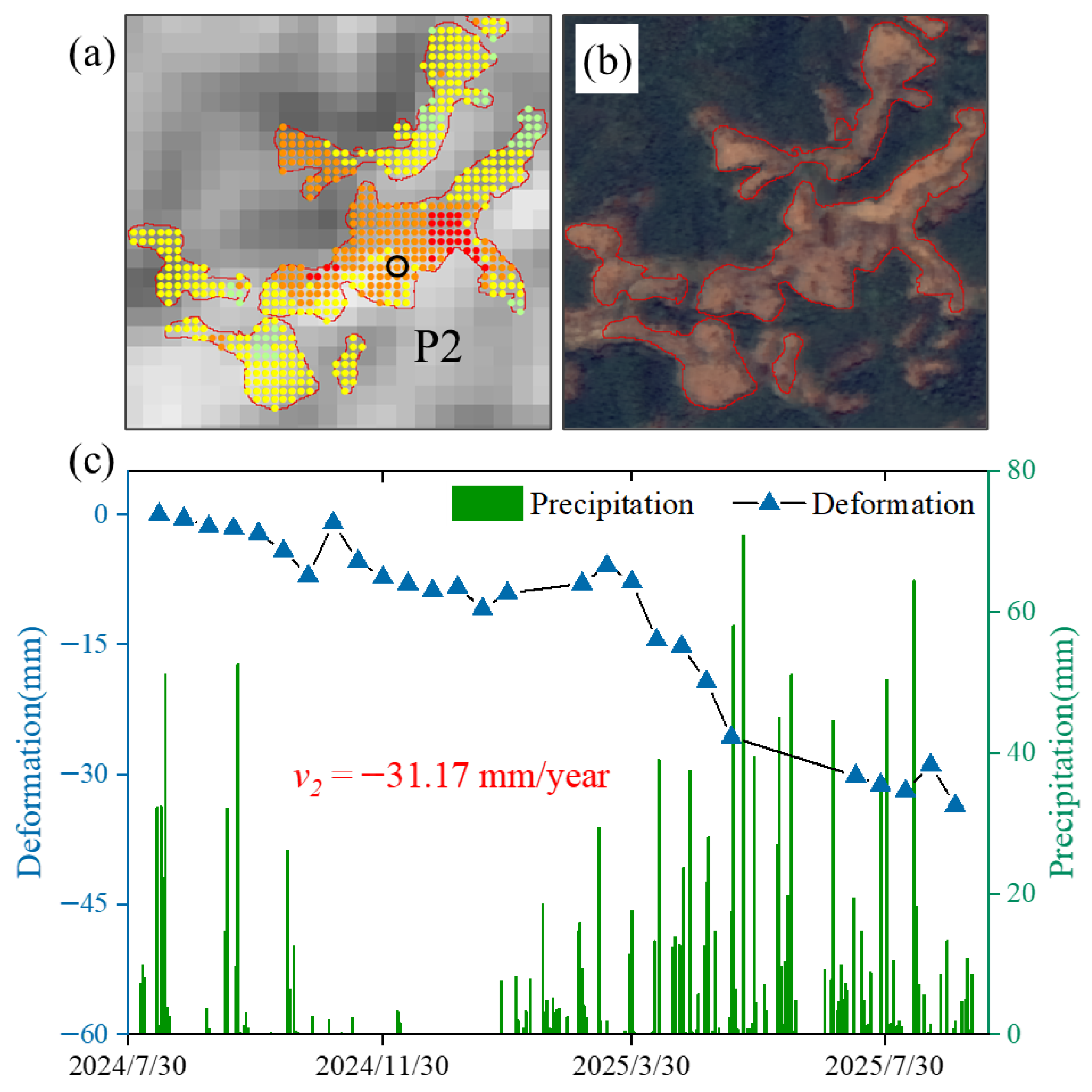
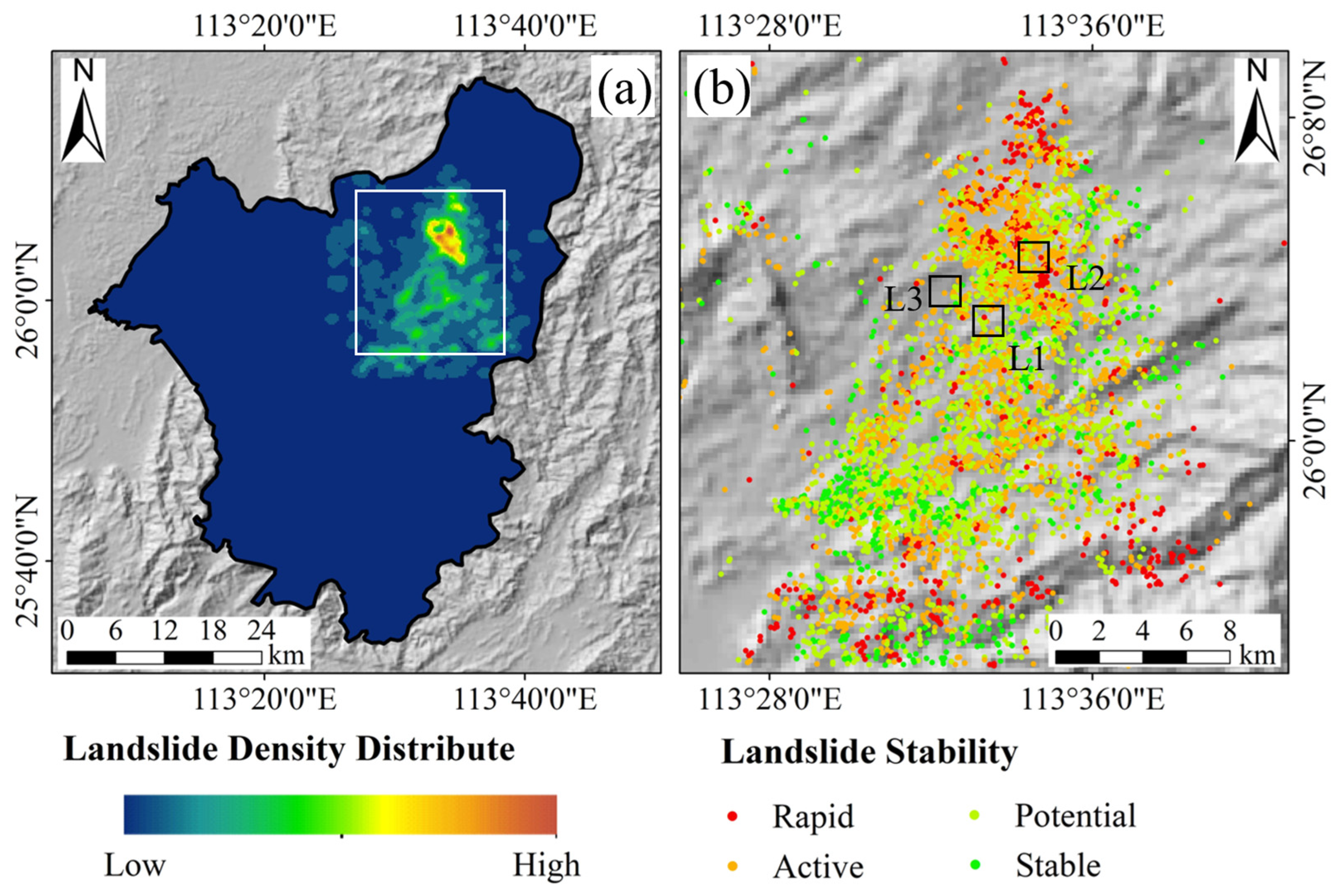
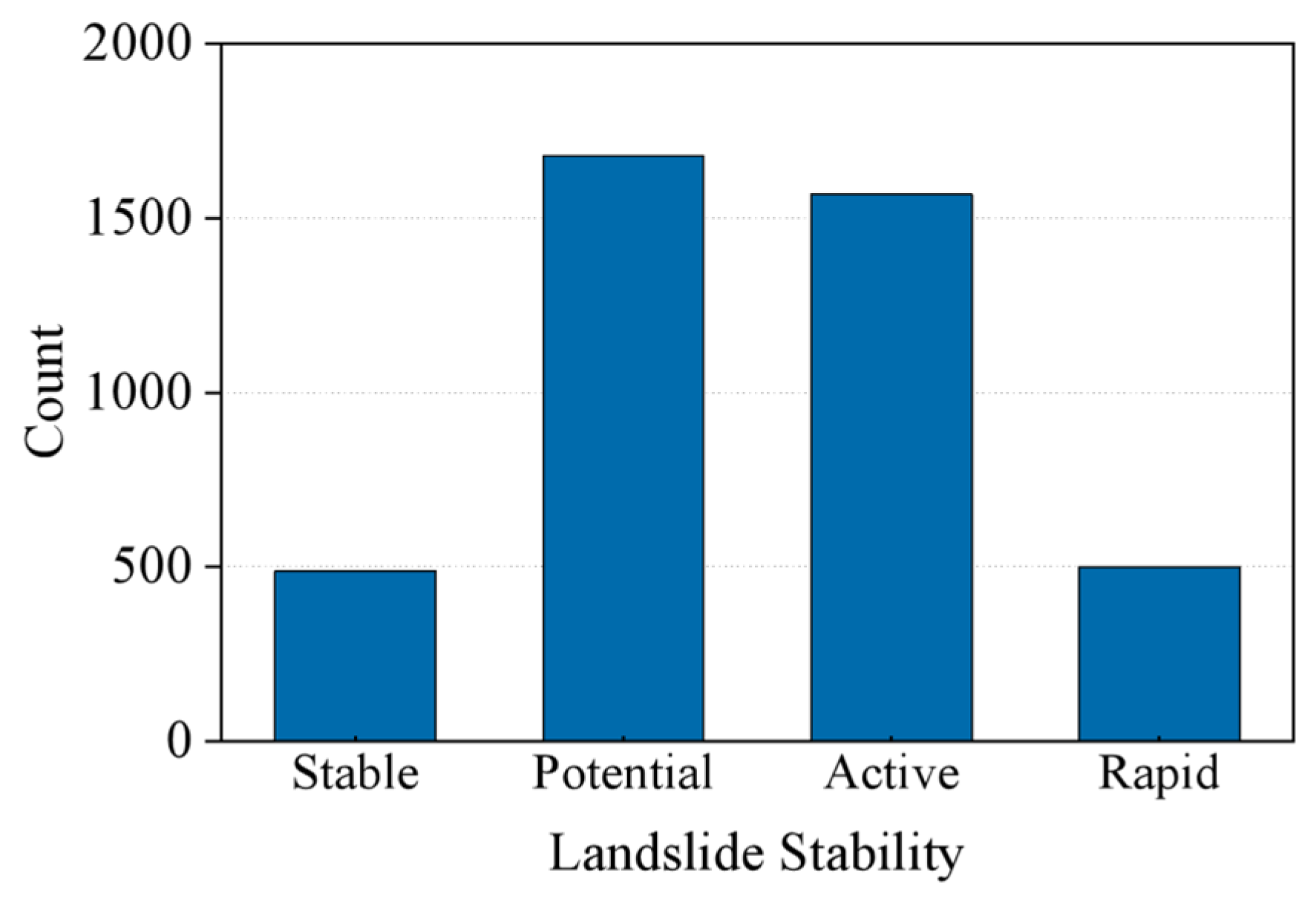
- Comprehensive InSAR monitoring revealed that nearly half (over 48%) of the rainfall-induced landslides in Zixing remained active or rapidly active during the year following the major disaster, with localized ground displacement rate exceeding 40 mm/year.
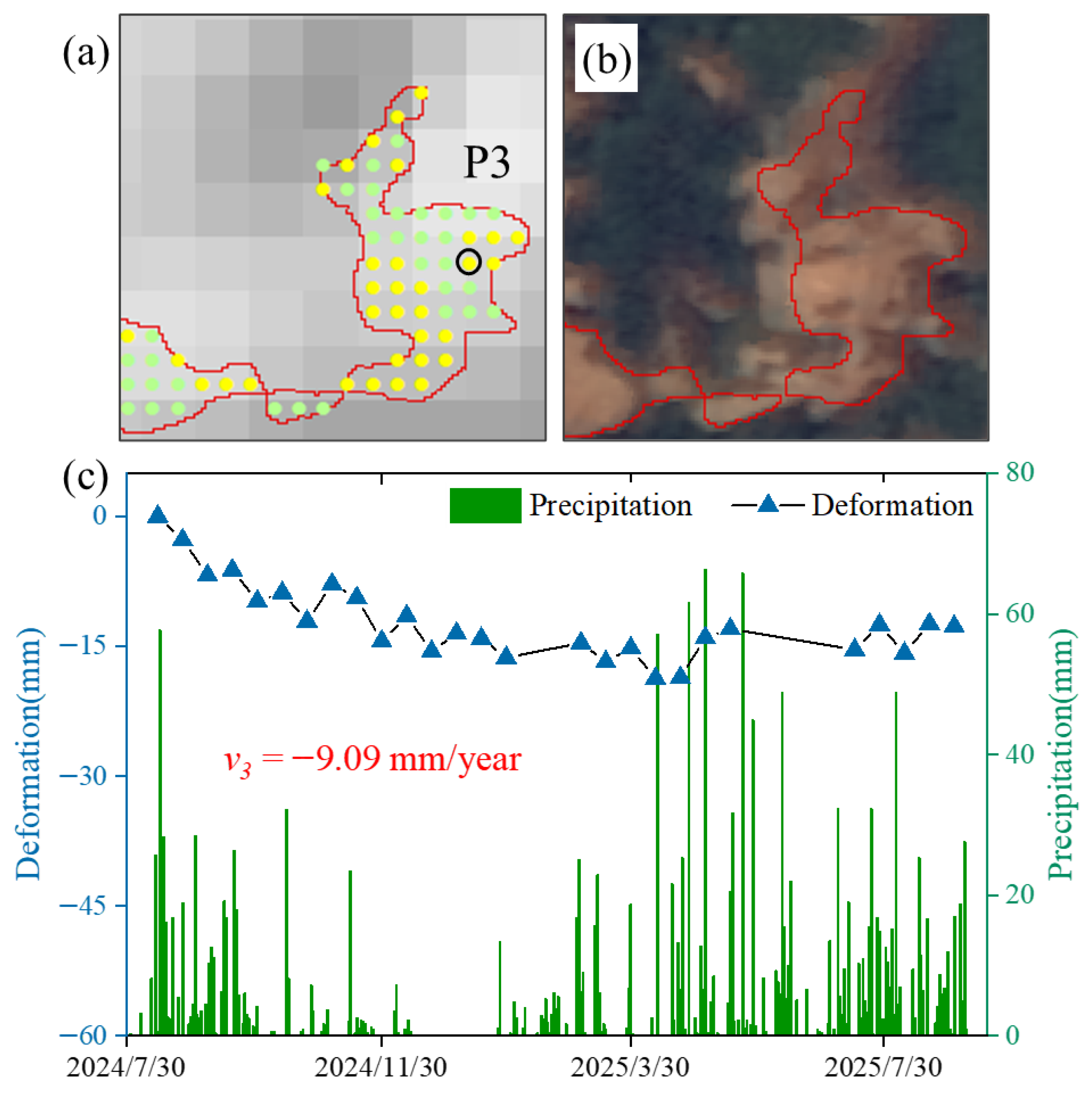
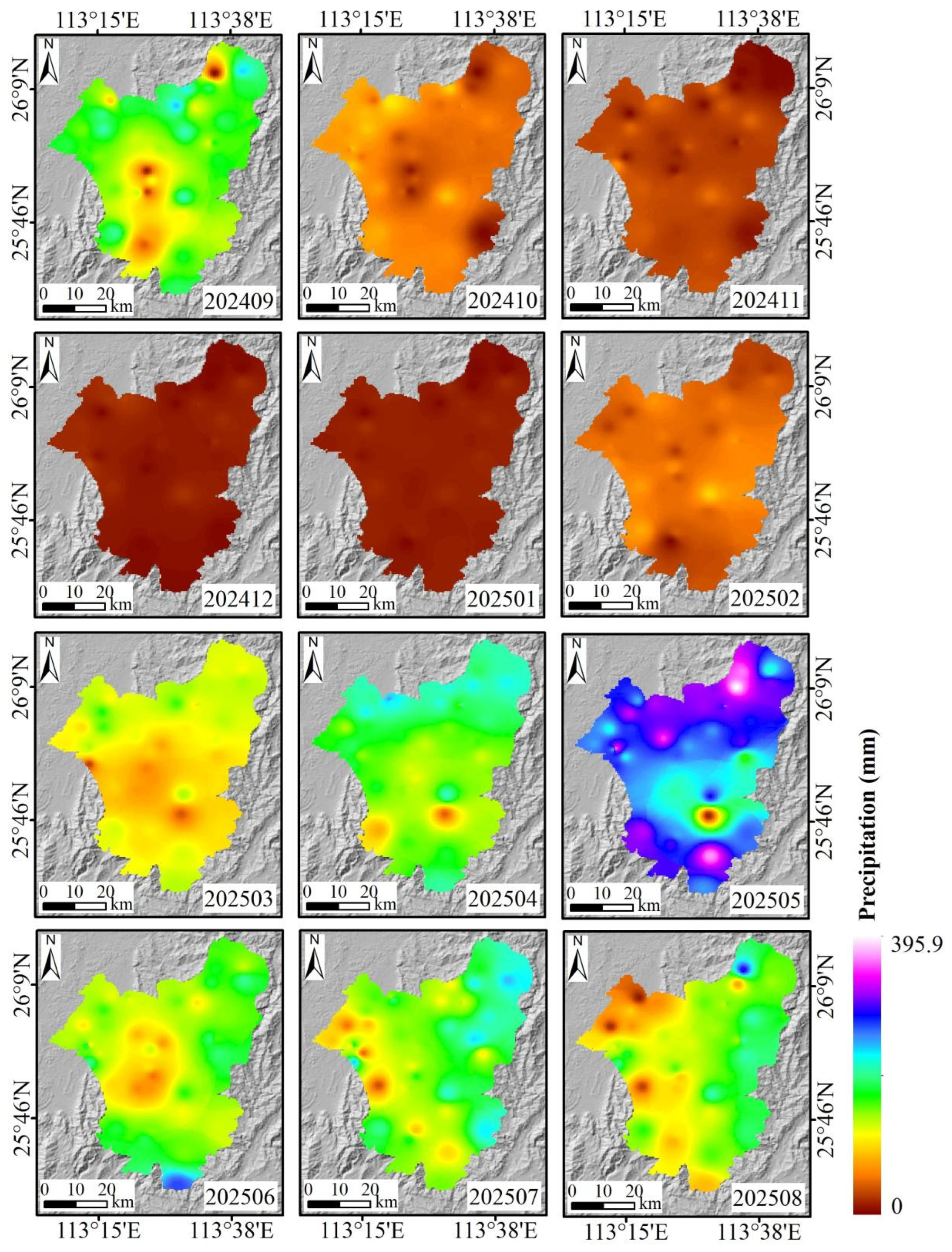
- The study successfully integrates the InSAR-derived displacement result with rainfall, geological, and optical imagery to assess the post-failure stability of a large landslide population, highlighting a correlation between accelerated landslide movement and precipitation.
- The high proportion of active landslides one year after the initial event underscores the prolonged hazard and significant risk to local communities, emphasizing the critical need for continuous assessment to inform early warning and disaster mitigation.
- The findings demonstrate the vital role of InSAR technology in moving beyond mere landslide inventory mapping to practical stability assessment.
Abstract
1. Introduction
2. Study Area and Dataset
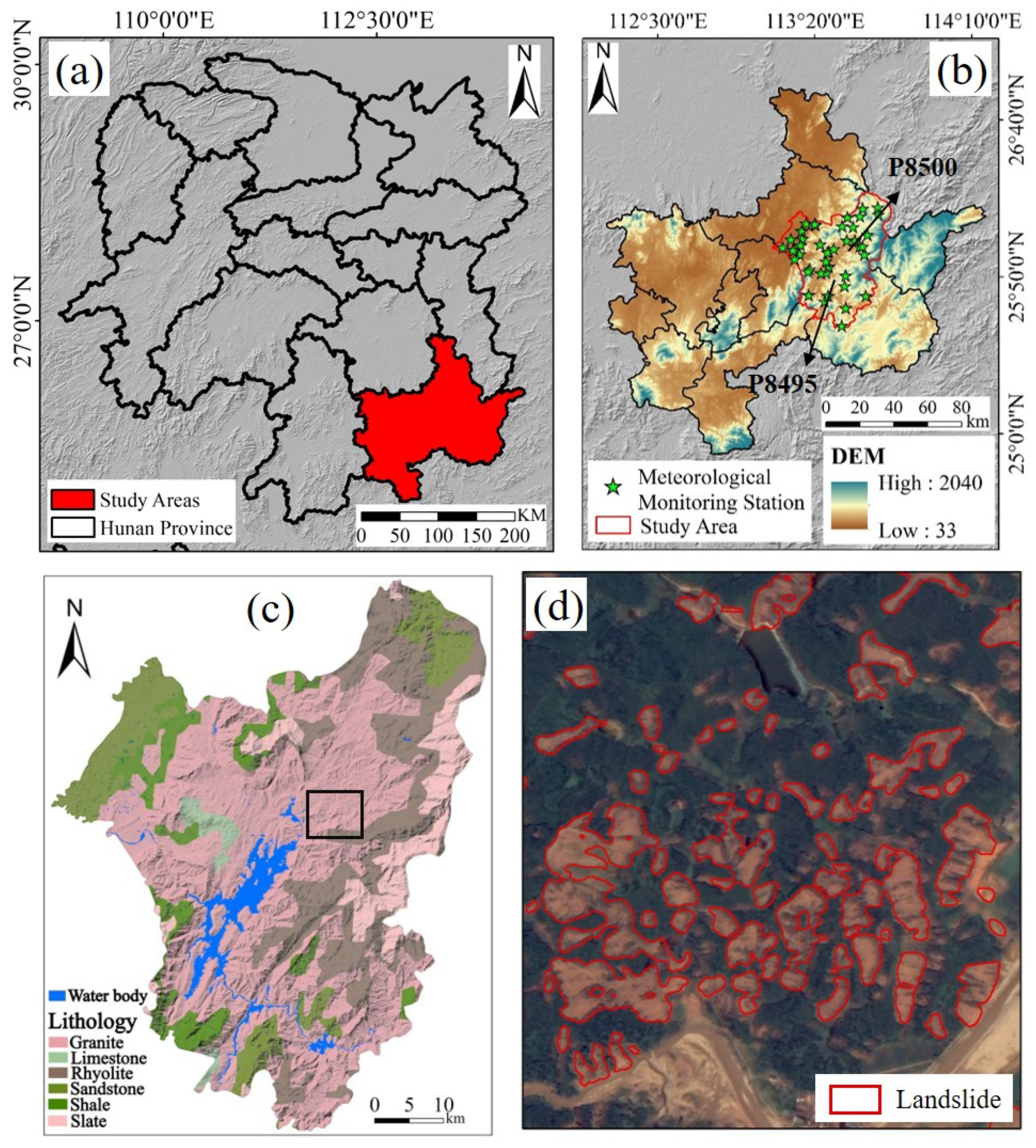
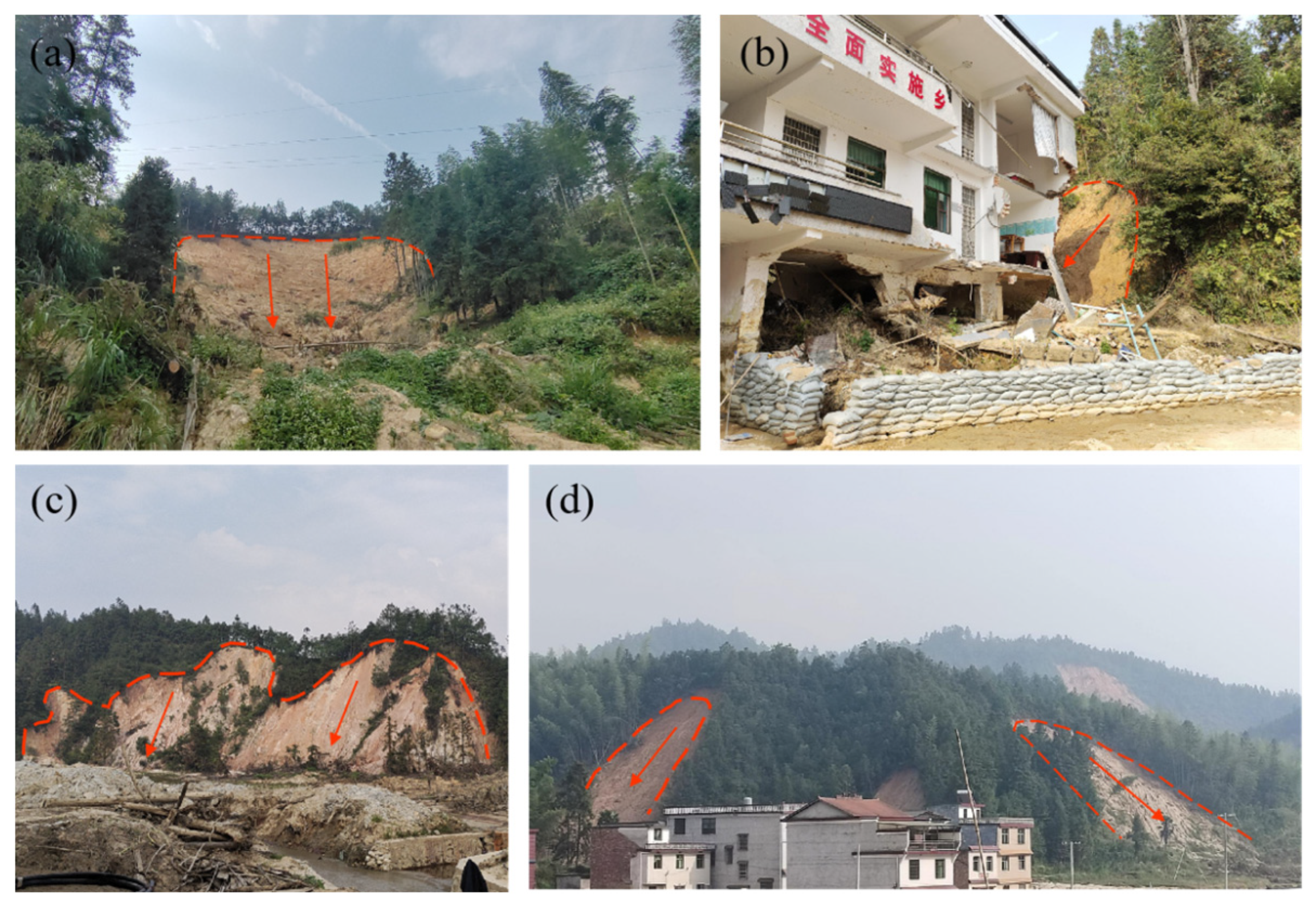
2.1. Study Area
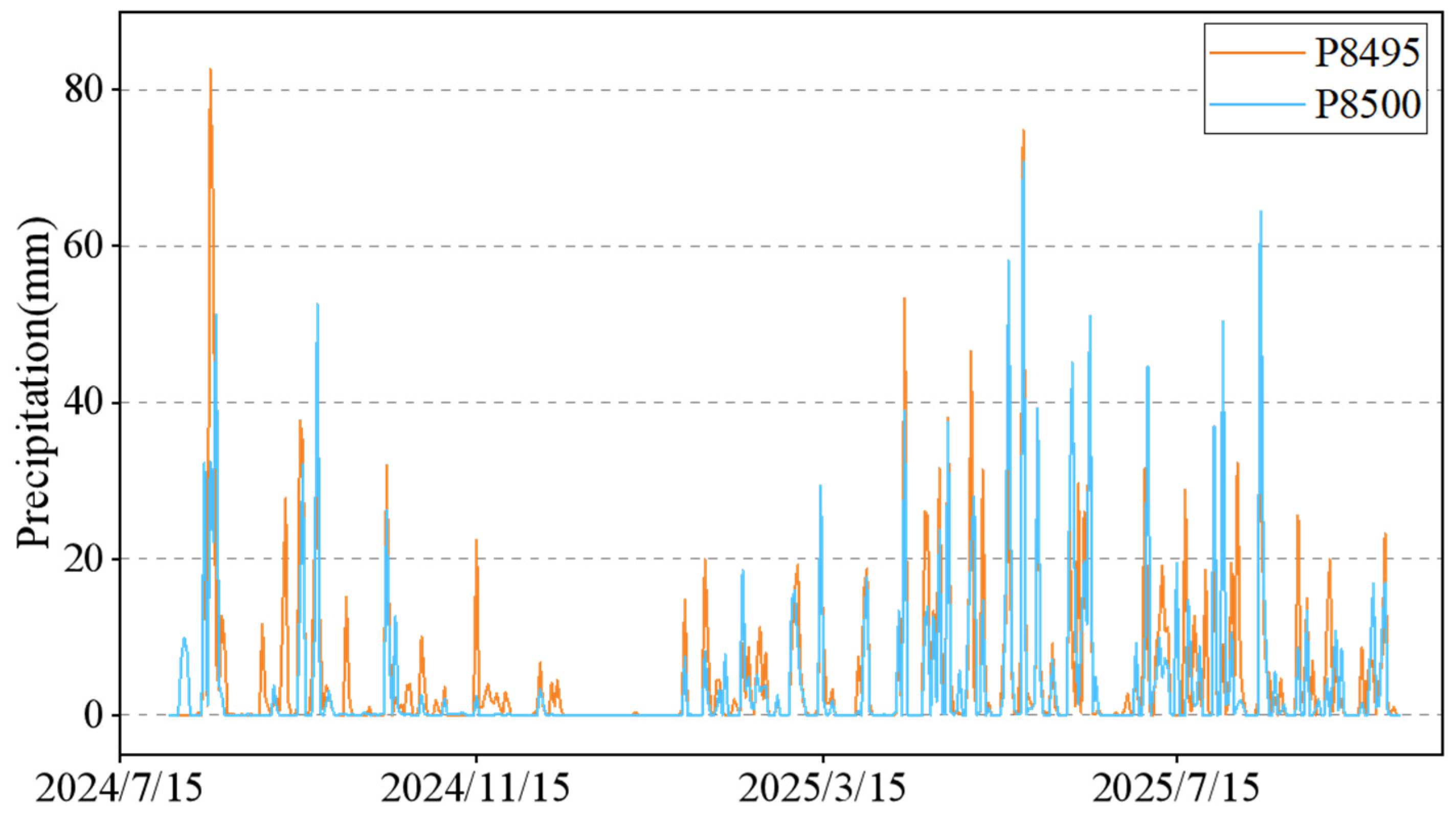
2.2. Dataset
3. Method
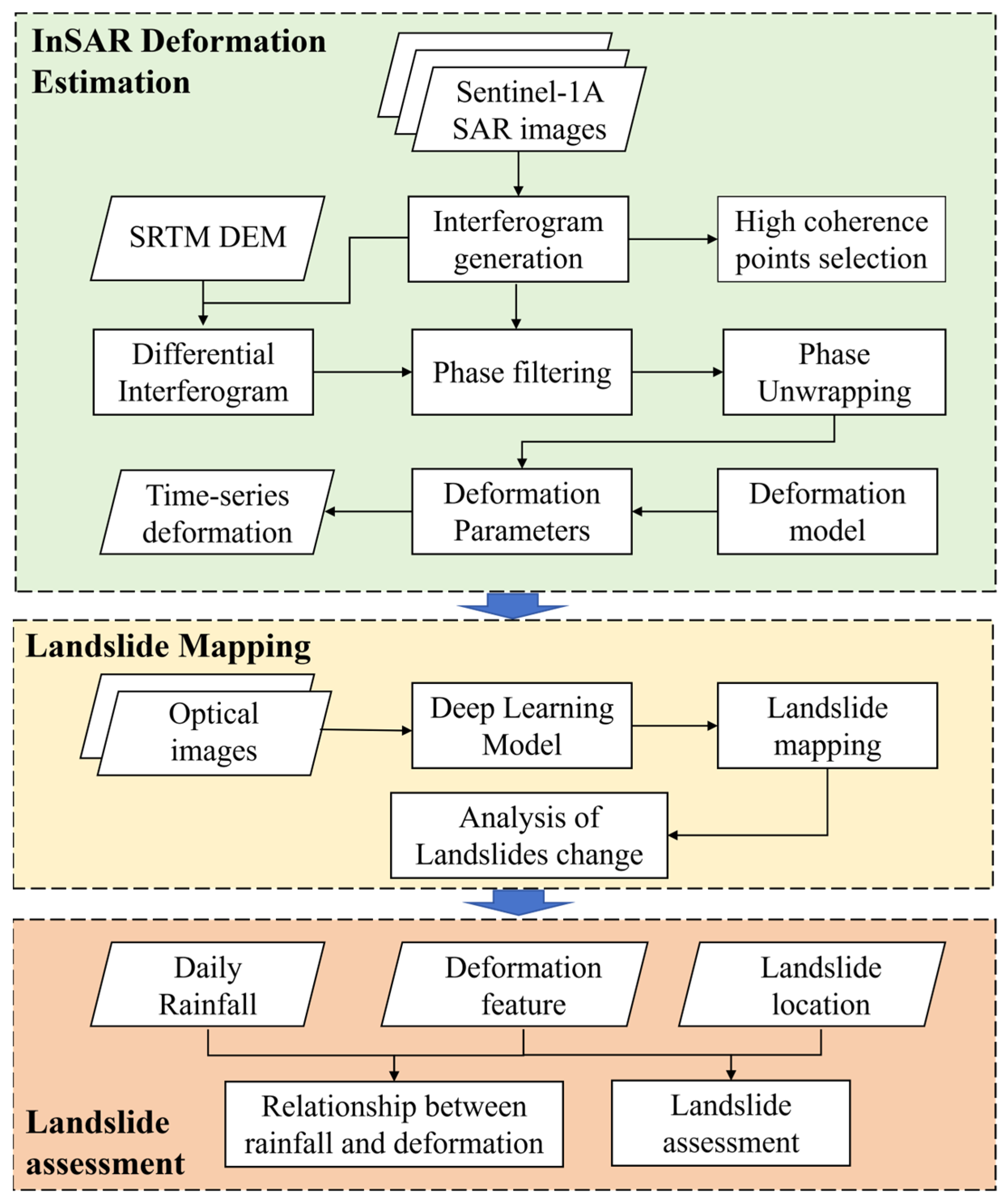
3.1. InSAR Displacement Result Estimation
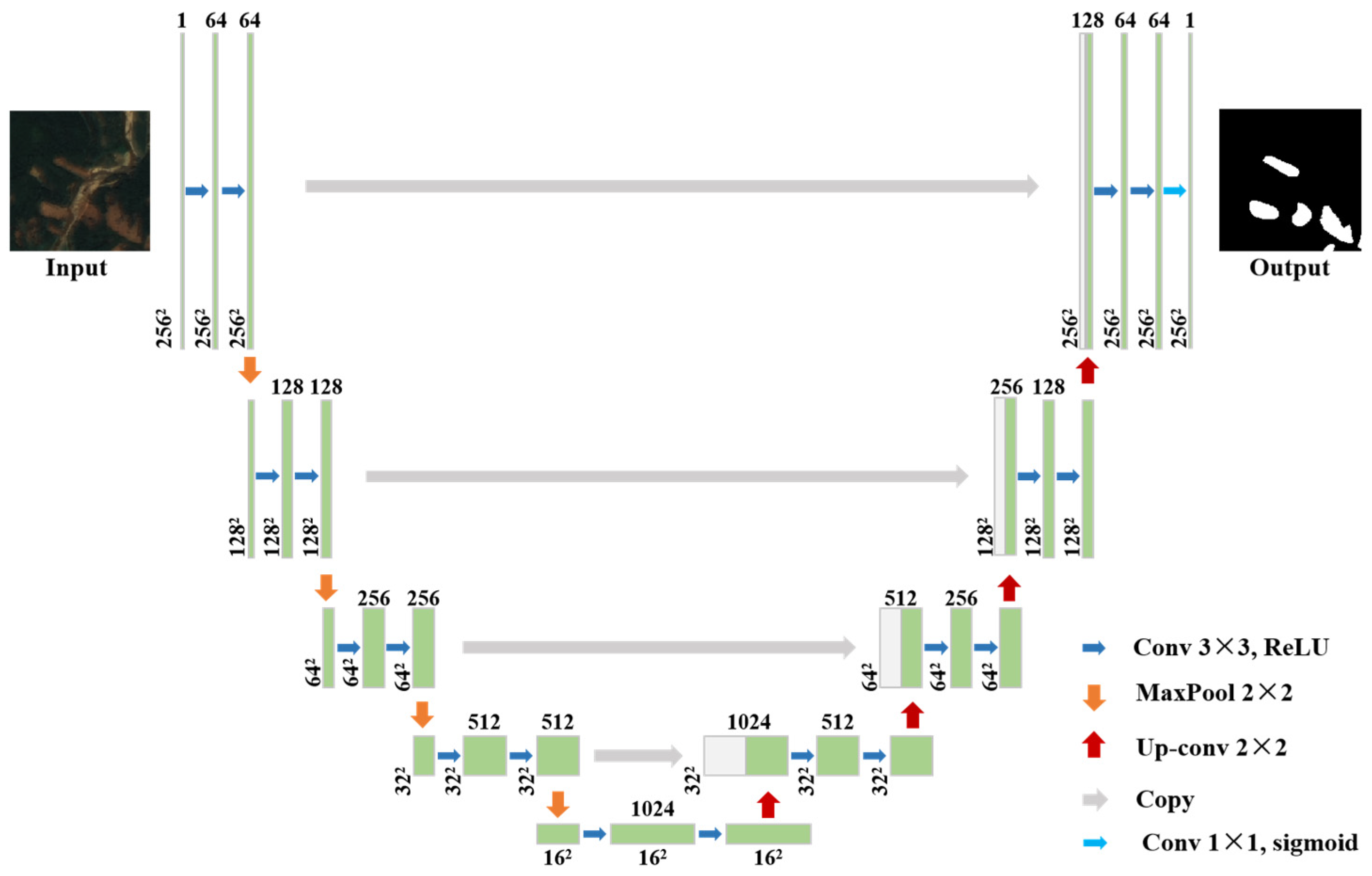
3.2. Landslide Mapping
3.3. Landslide Assessment Using InSAR Results
4. Experimental Results
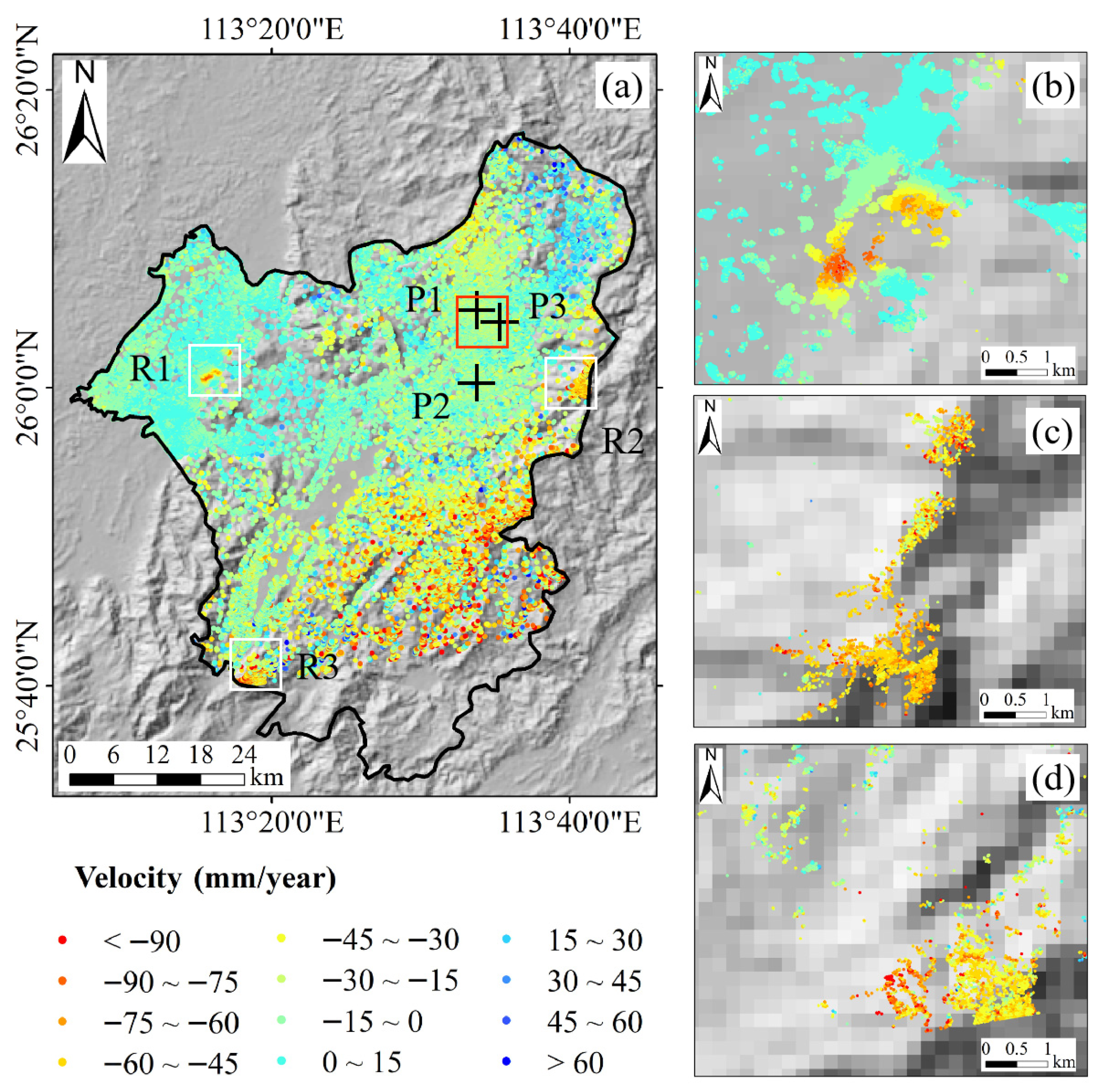
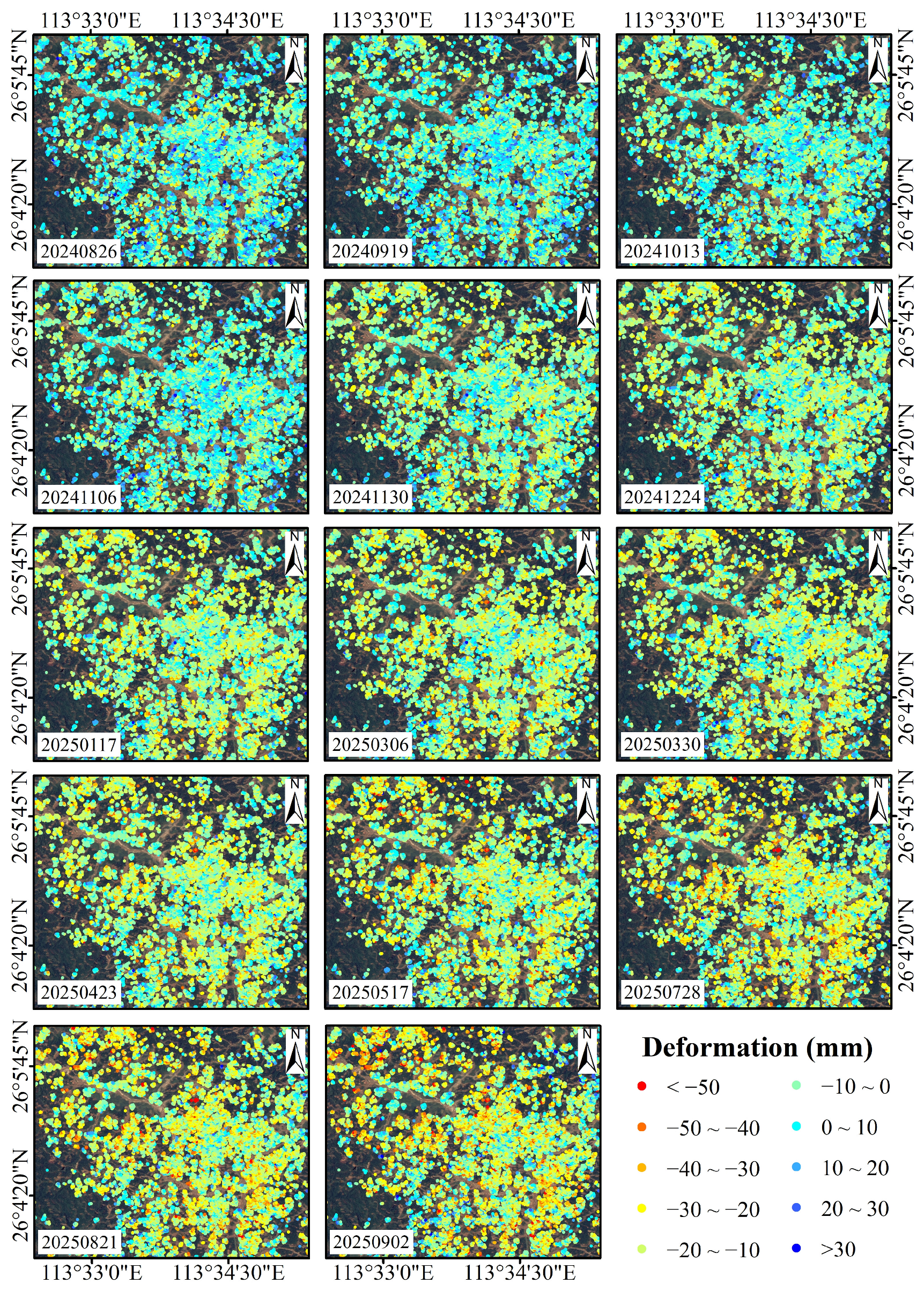
4.1. InSAR Displacement Results
4.2. Landslide Detection with Optical Images
4.3. Landslide Assessment
5. Discussion
5.1. Characteristics of the Landslides
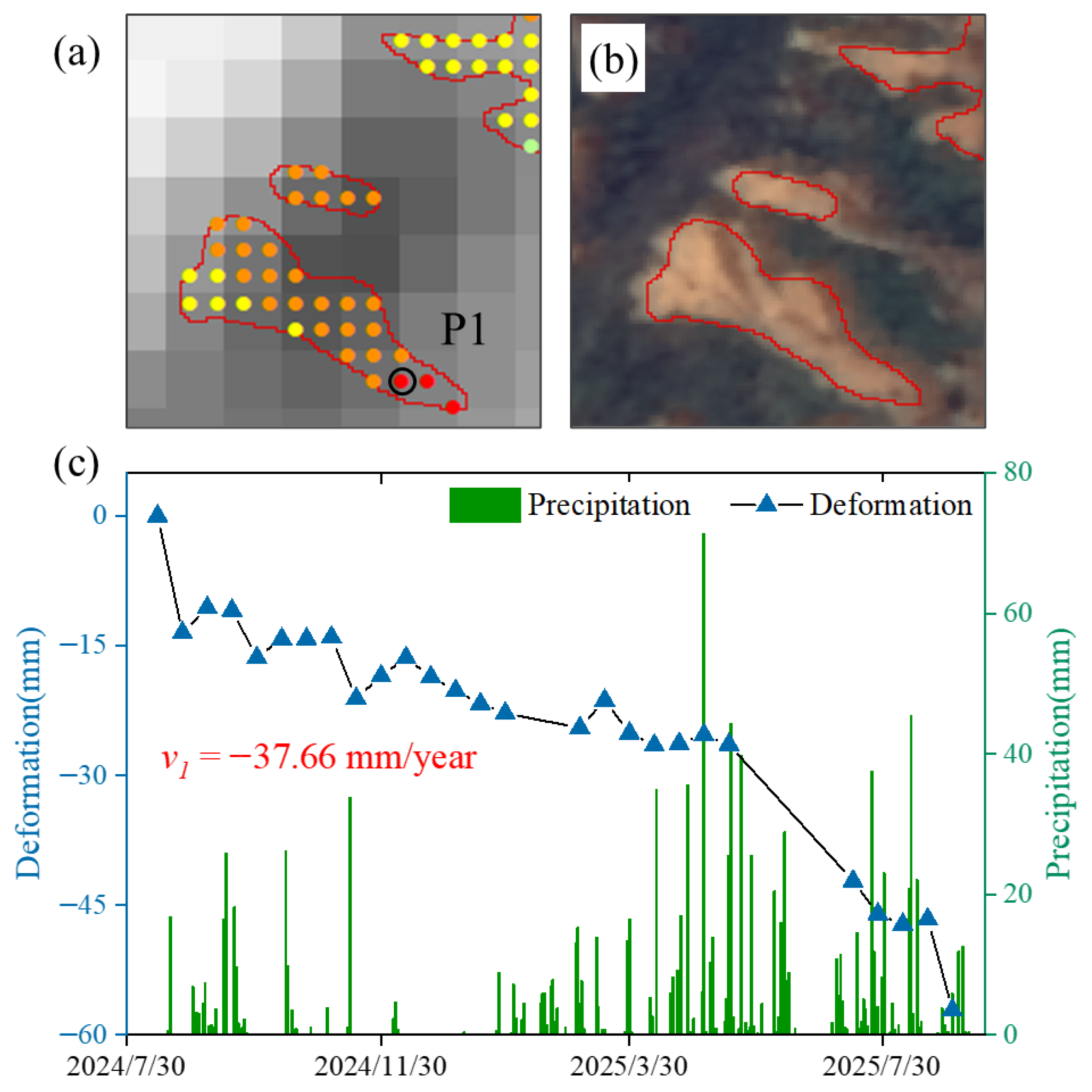
5.2. Impacts of Rainfall
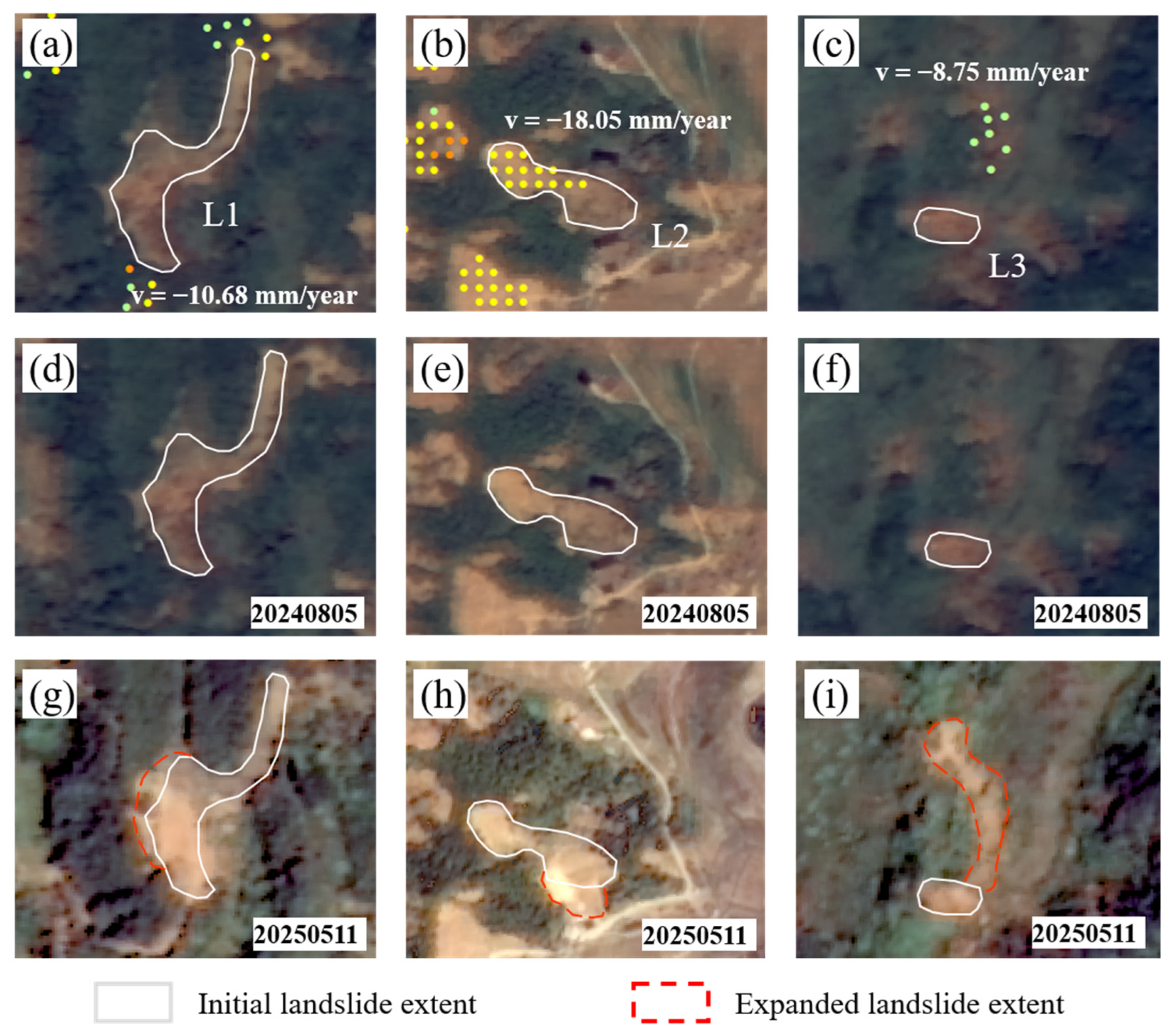
5.3. Comparison with Optical Images
5.4. Limitation and Future Work
6. Conclusions
Author Contributions
Funding
Data Availability Statement
Acknowledgments
Conflicts of Interest
References
- Froude, M.J.; Petley, D.N. Global fatal landslide occurrence from 2004 to 2016. Nat. Hazards Earth Syst. Sci. 2018, 18, 2161–2181. [Google Scholar] [CrossRef]
- Wu, H.; Trigg, M.A.; Murphy, W.; Fuentes, R. A new global landslide dam database (RAGLAD) and analysis utilizing auxiliary global fluvial datasets. Landslides 2022, 19, 555–572. [Google Scholar] [CrossRef]
- Sun, L.; Ma, B.; Pei, L.; Zhang, X.; Zhou, J.L. The relationship of human activities and rainfall-induced landslide and debris flow hazards in Central China. Nat. Hazards 2021, 107, 147–169. [Google Scholar] [CrossRef]
- Fang, Z.; Morales, A.B.; Wang, Y.; Lombardo, L. Climate change has increased rainfall-induced landslide damages in central china. Int. J. Disaster Risk Reduct. 2025, 119, 105320. [Google Scholar] [CrossRef]
- Ma, H.; Wang, F.; Fu, Z.; Feng, Y.; You, Q.; Li, S. Characterizing the clustered landslides triggered by extreme rainfall during the 2024 typhoon Gaemi in Zixing City, Hunan Province, China. Landslides 2025, 22, 2311–2329. [Google Scholar] [CrossRef]
- Huang, Y.; Xu, C. A comprehensive inventory of landslides triggered by Typhoon Gaemi (July 2024) in Zixing, Hunan, China. Nat. Hazards Res. 2025; in press. [Google Scholar] [CrossRef]
- Wei, R.; Shan, Y.; Wang, L.; Peng, D.; Qu, G.; Qin, J.; He, G.; Fan, L.; Li, W. Clustered Rainfall-Induced Landslides in Jiangwan Town, Guangdong, China During April 2024: Characteristics and Controlling Factors. Remote Sens. 2025, 17, 2635. [Google Scholar] [CrossRef]
- Xiao, W.; Yao, G.; Xiao, Z.; Luo, L.; Cao, Y.; Yin, W. From typhoon rainfall to slope failure: Optimizing susceptibility models and dynamic thresholds for landslide warnings in Zixing City, China. EGUsphere 2025, 2025, 1–40. [Google Scholar] [CrossRef]
- Zhao, J.; Feng, W.; Yi, X.; Zhao, Y.; Ding, Z.; Wang, Y. Clustered shallow landslides caused by extreme typhoon rainstorms in Zixing County, Hunan Province, China, from July 26 to 28, 2024. Landslides 2025, 22, 2141–2147. [Google Scholar] [CrossRef]
- Huang, G.; Du, S.; Wang, D. GNSS techniques for real-time monitoring of landslides: A review. Satell. Navig. 2023, 4, 5. [Google Scholar] [CrossRef]
- Hamza, V.; Stopar, B.; Sterle, O.; Pavlovčič-Prešeren, P. A cost-effective GNSS solution for continuous monitoring of landslides. Remote Sens. 2023, 15, 2287. [Google Scholar] [CrossRef]
- Jing, C.; Huang, G.; Zhang, Q.; Li, X.; Bai, Z.; Du, Y. GNSS/accelerometer adaptive coupled landslide deformation monitoring technology. Remote Sens. 2022, 14, 3537. [Google Scholar] [CrossRef]
- Han, L.; Duan, P.; Liu, J.; Li, J. Research on landslide trace recognition by fusing UAV-based LiDAR DEM multi-feature information. Remote Sens. 2023, 15, 4755. [Google Scholar]
- Casagli, N.; Intrieri, E.; Tofani, V.; Gigli, G.; Raspini, F. Landslide detection, monitoring and prediction with remote-sensing techniques. Nat. Rev. Earth Environ. 2023, 4, 51–64. [Google Scholar] [CrossRef]
- Hong, Y.; Adler, R.; Huffman, G. Use of satellite remote sensing data in the mapping of global landslide susceptibility. Nat. Hazards 2007, 43, 245–256. [Google Scholar] [CrossRef]
- Hilley, G.E.; Burgmann, R.; Ferretti, A.; Novali, F.; Rocca, F. Dynamics of slow-moving landslides from permanent scatterer analysis. Science 2004, 304, 1952–1955. [Google Scholar] [CrossRef]
- Zhang, Z.; Jin, Q.; Liu, L.; Wang, M.; Zhang, X. Improved ALT retrieval in the Yellow River source region using time-series InSAR and multilayer soil moisture modeling. J. Hydrol. 2025, 654, 132847. [Google Scholar] [CrossRef]
- Li, J.; Fan, C.; Zhao, K.; Zhang, Z.; Duan, P. Landslide displacement prediction using time series InSAR with combined LSTM and TCN: Application to the Xiao Andong landslide, Yunnan Province, China. Nat. Hazards 2025, 121, 3857–3884. [Google Scholar] [CrossRef]
- Ma, P.; Wu, Z.; Zhang, Z.; Au, F.T. SAR-Transformer-based decomposition and geophysical interpretation of InSAR time-series deformations for the Hong Kong-Zhuhai-Macao Bridge. Remote Sens. Environ. 2024, 302, 113962. [Google Scholar] [CrossRef]
- Zhang, Z.; Lin, H.; Wang, M.; Liu, X.; Chen, Q.; Wang, C.; Zhang, H. A review of satellite synthetic aperture radar interferometry applications in permafrost regions: Current status, challenges, and trends. IEEE Geosci. Remote Sens. Mag. 2022, 10, 93–114. [Google Scholar] [CrossRef]
- Zheng, W.; Hu, J.; Lu, Z.; Hu, X.; Sun, Q.; Liu, J.; Huang, B. Enhancing 4-D landslide monitoring and block interaction analysis with a Novel Kalman-filter-based InSAR approach. J. Geophys. Res. Earth Surf. 2024, 129, e2024JF007923. [Google Scholar] [CrossRef]
- Miao, F.; Ruan, Q.; Wu, Y.; Qian, Z.; Kong, Z.; Qin, Z. Landslide Dynamic Susceptibility Mapping Base on Machine Learning and the PS-InSAR Coupling Model. Remote Sens. 2023, 15, 5427. [Google Scholar] [CrossRef]
- Guo, J.; Zhang, Z.; Ma, P.; Wang, M.; Zhang, X.; Li, D.; Sui, B. SFD-YOLO: A novel framework for subsidence funnels detection in China based on large-scale SAR interferograms. Int. J. Appl. Earth Obs. Geoinf. 2025, 140, 104605. [Google Scholar] [CrossRef]
- Feng, X.; Zhang, Z.; Chen, Q.; Guo, Z.; Zhang, H.; Wang, M.; Gao, W.; Liu, X. Integrating remote sensing, GIS, and multi-criteria decision making for assessing PV potential in mountainous regions. Renew. Energy 2025, 241, 122340. [Google Scholar] [CrossRef]
- Ma, P.; Cui, Y.; Wang, W.; Lin, H.; Zhang, Y. Coupling InSAR and numerical modeling for characterizing landslide movements under complex loads in urbanized hillslopes. Landslides 2021, 18, 1611–1623. [Google Scholar] [CrossRef]
- Chen, F.; Guo, H.; Ma, P.; Lin, H.; Wang, C.; Ishwaran, N.; Hang, P. Radar interferometry offers new insights into threats to the Angkor site. Sci. Adv. 2017, 3, e1601284. [Google Scholar] [CrossRef]
- Zhou, C.; Cao, Y.; Gan, L.; Wang, Y.; Motagh, M.; Roessner, S.; Hu, X.; Yin, K. A novel framework for landslide displacement prediction using MT-InSAR and machine learning techniques. Eng. Geol. 2024, 334, 107497. [Google Scholar] [CrossRef]
- Shi, X.; Chen, D.; Wang, J.; Wang, P.; Wu, Y.; Zhang, S.; Zhang, Y.; Yang, C.; Wang, L. Refined landslide inventory and susceptibility of Weining County, China, inferred from machine learning and Sentinel-1 InSAR analysis. Trans. GIS 2024, 28, 1594–1616. [Google Scholar] [CrossRef]
- Hussain, M.A.; Chen, Z.; Wang, R.; Shoaib, M. PS-InSAR-based validated landslide susceptibility mapping along Karakorum Highway, Pakistan. Remote Sens. 2021, 13, 4129. [Google Scholar] [CrossRef]
- Liu, R.; Xu, Q.; Pu, C.; Xu, F.; Wang, X.; Zhao, H.; Zhu, X.; He, N. Characteristics of Landslides Induced by Typhoon ‘Gaemi’ in Zixing, Hunan, July 2024, and Their Geological Control. Geomat. Inf. Sci. Wuhan Univ. 2025, 1–22. [Google Scholar] [CrossRef]
- Fu, Z.; Wang, F.; Ma, H.; You, Q.; Feng, Y. Records of shallow landslides triggered by extreme rainfall in July 2024 in Zixing, China. Sci. Data 2025, 12, 1364. [Google Scholar] [CrossRef]
- Chen, F.; Guo, H.; Tapete, D.; Cigna, F.; Piro, S.; Lasaponara, R.; Masini, N. The role of imaging radar in cultural heritage: From technologies to applications. Int. J. Appl. Earth Obs. Geoinf. 2022, 112, 102907. [Google Scholar] [CrossRef]
- Xie, M.; Zhao, W.; Ju, N.; He, C.; Huang, H.; Cui, Q. Landslide evolution assessment based on InSAR and real-time monitoring of a large reactivated landslide, Wenchuan, China. Eng. Geol. 2020, 277, 105781. [Google Scholar] [CrossRef]
- Liu, Y.; Qiu, H.; Yang, D.; Liu, Z.; Ma, S.; Pei, Y.; Zhang, J.; Tang, B. Deformation responses of landslides to seasonal rainfall based on InSAR and wavelet analysis. Landslides 2022, 19, 199–210. [Google Scholar] [CrossRef]
- Shi, X.; Wang, J.; Jiang, M.; Zhang, S.; Wu, Y.; Zhong, Y. Extreme rainfall-related accelerations in landslides in Danba County, Sichuan Province, as detected by InSAR. Int. J. Appl. Earth Obs. Geoinf. 2022, 115, 103109. [Google Scholar] [CrossRef]
- Xu, X.; Su, F.; Zhuang, D.; Jiang, D. Remote sensing monitoring of impacts of southern ice and snow process on eco-environment in 2008: A case study in Zixing County, Hunan Province. J. Geo-Inf. Sci. 2009, 11, 237–243. [Google Scholar] [CrossRef]
- Salvi, S.; Stramondo, S.; Funning, G.J.; Ferretti, A.; Sarti, F.; Mouratidis, A. The Sentinel-1 mission for the improvement of the scientific understanding and the operational monitoring of the seismic cycle. Remote Sens. Environ. 2012, 120, 164–174. [Google Scholar] [CrossRef]
- Yang, L.; Meng, X.; Zhang, X. SRTM DEM and its application advances. Int. J. Remote Sens. 2011, 32, 3875–3896. [Google Scholar] [CrossRef]
- Chen, F.; Lin, H.; Zhou, W.; Hong, T.; Wang, G. Surface deformation detected by ALOS PALSAR small baseline SAR interferometry over permafrost environment of Beiluhe section, Tibet Plateau, China. Remote Sens. Environ. 2013, 138, 10–18. [Google Scholar] [CrossRef]
- Berardino, P.; Fornaro, G.; Lanari, R.; Sansosti, E. A new algorithm for surface deformation monitoring based on small baseline differential SAR interferograms. IEEE Trans. Geosci. Remote Sens. 2003, 40, 2375–2383. [Google Scholar] [CrossRef]
- Zhao, L.; Liang, R.; Shi, X.; Dai, K.; Cheng, J.; Cao, J. Detecting and analyzing the displacement of a small-magnitude earthquake cluster in Rong County, China by the GACOS based inSAR technology. Remote Sens. 2021, 13, 4137. [Google Scholar] [CrossRef]
- Zhang, Z.; Wang, C.; Tang, Y.; Zhang, H.; Fu, Q. Analysis of ground subsidence at a coal-mining area in Huainan using time-series InSAR. Int. J. Remote Sens. 2015, 36, 5790–5810. [Google Scholar] [CrossRef]
- Chen, N.; Li, B.; Wang, Y.; Ying, X.; Wang, L.; Zhang, C.; Guo, Y.; Li, M.; An, W. Motion and appearance decoupling representation for event cameras. IEEE Trans. Image Process. 2025, 34, 5964–5977. [Google Scholar] [CrossRef] [PubMed]
- Zhang, K.; Luo, W.; Zhong, Y.; Ma, L.; Liu, W.; Li, H. Adversarial spatio-temporal learning for video deblurring. IEEE Trans. Image Process. 2018, 28, 291–301. [Google Scholar] [CrossRef]
- Wen, Y.; Gao, T.; Li, Z.; Zhang, J.; Zhang, K.; Chen, T. All-in-one Weather-degraded Image Restoration via Adaptive Degradation-aware Self-prompting Model. IEEE Trans. Multimed. 2025, 27, 3343–3355. [Google Scholar]
- Zhang, J.; Zhang, Y.; Yao, E. A New Framework for Traffic Conflict Identification by Incorporating Predicted High-Resolution Trajectory and Vehicle Profiles in a CAV Context. Transp. Res. Rec. 2025, 2679, 445–462. [Google Scholar] [CrossRef]
- Deng, C.; Li, Y.; Xiong, F.; Liu, H.; Li, X.; Zeng, Y. Detection of Rupture Damage Degree in Laminated Rubber Bearings Using a Piezoelectric-Based Active Sensing Method and Hybrid Machine Learning Algorithms. Struct. Control Health Monit. 2025, 2025, 6694610. [Google Scholar] [CrossRef]
- Zhang, J.; Chen, W.; Zhang, J. UAV-based quantitative crack measurement for bridges integrating four-point laser metric calibration and mamba segmentation. Autom. Constr. 2026, 182, 106774. [Google Scholar] [CrossRef]
- Lv, C.; Lv, X.-L.; Wang, Z.; Zhao, T.; Tian, W.; Zhou, Q.; Zeng, L.; Wan, M.; Liu, C. A Focal Quotient Gradient System Method for Deep Neural Network Training. Appl. Soft Comput. 2025, 184, 113704. [Google Scholar] [CrossRef]
- Hussain, S.; Pan, B.; Afzal, Z.; Ali, M.; Zhang, X.; Shi, X.; Ali, M. Landslide detection and inventory updating using the time-series InSAR approach along the Karakoram Highway, Northern Pakistan. Sci. Rep. 2023, 13, 7485. [Google Scholar] [CrossRef]



| Reference | Data | Method | Result |
|---|---|---|---|
| [5] | Gao Fen, Aerial images | Remote sensing analysis and field surveys | Three primary landslide clusters were identified, revealing the relationship between landslide distribution and environmental factors. |
| [6] | Planet Scope | Manual visual interpretation | Compiled an inventory of 23,513 landslides. |
| [9] | Gao Fen | Visual interpretation | A total of 19,764 landslides were identified. |
| [30] | Planet Scope | Deep Learning, machine Learning | A total of 16,120 landslides were identified. |
| [31] | Gao Fen, Sentinel-2 L2A | Visual interpretation, field investigations and UAV, deep learning | A database containing 19,403 shallow landslide was constructed. |
| Data Type | Acquisition Date | Resolution | Source |
|---|---|---|---|
| GF-6 | 5 August 2024 | 2 m, 8 m | https://data.cresda.cn/ |
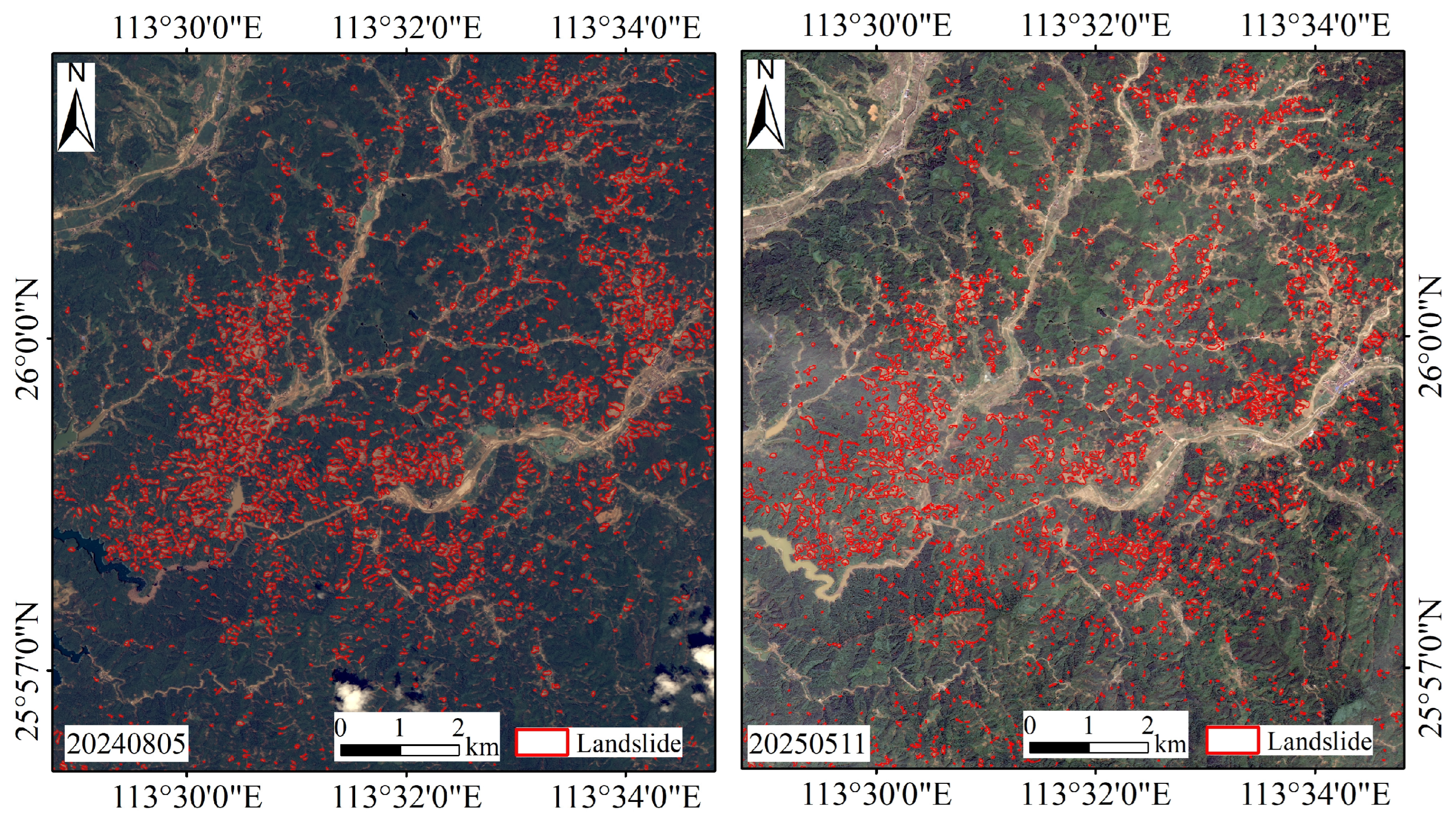
| GF-6 | 11 May 2025 | 2 m, 8 m | https://data.cresda.cn/ |
| Classification | Rapidly Moving | Active | Potentially Unstable | Stable |
|---|---|---|---|---|
| InSAR velocity (mm/year) | ≤−20 | (−20, −10) | (−10, −5) | (−5, 0) |
Disclaimer/Publisher’s Note: The statements, opinions and data contained in all publications are solely those of the individual author(s) and contributor(s) and not of MDPI and/or the editor(s). MDPI and/or the editor(s) disclaim responsibility for any injury to people or property resulting from any ideas, methods, instructions or products referred to in the content. |
© 2026 by the authors. Licensee MDPI, Basel, Switzerland. This article is an open access article distributed under the terms and conditions of the Creative Commons Attribution (CC BY) license.
Share and Cite
Sui, B.; Fang, Y.; Li, D.; Zhang, Z.; Chen, L.; Du, D.; Wang, T. Quantitative Stability Assessment of Landslides Following the 2024 Zixing Rainstorm Using Time-Series InSAR. Remote Sens. 2026, 18, 929. https://doi.org/10.3390/rs18060929
Sui B, Fang Y, Li D, Zhang Z, Chen L, Du D, Wang T. Quantitative Stability Assessment of Landslides Following the 2024 Zixing Rainstorm Using Time-Series InSAR. Remote Sensing. 2026; 18(6):929. https://doi.org/10.3390/rs18060929
Chicago/Turabian StyleSui, Bing, Yu Fang, Dongdong Li, Zhengjia Zhang, Leishi Chen, Dongsheng Du, and Tianying Wang. 2026. "Quantitative Stability Assessment of Landslides Following the 2024 Zixing Rainstorm Using Time-Series InSAR" Remote Sensing 18, no. 6: 929. https://doi.org/10.3390/rs18060929
APA StyleSui, B., Fang, Y., Li, D., Zhang, Z., Chen, L., Du, D., & Wang, T. (2026). Quantitative Stability Assessment of Landslides Following the 2024 Zixing Rainstorm Using Time-Series InSAR. Remote Sensing, 18(6), 929. https://doi.org/10.3390/rs18060929