


Highlights
What are the main findings?
- A lightweight hyper-network with only 3.2% extra parameters dynamically generates task-adaptive 3 × 3 kernels from 2D latent vectors, mitigating gradient interference in multi-task learning.
- It yields statistically significant accuracy gains (up to +3.71%) over conventional baselines on natural image and remote sensing benchmarks.
What are the implications of the main findings?
- The approach reduces negative transfer and enhances feature representation, enabling on-device multi-task learning for resource-constrained platforms like UAVs and edge satellites.
- Minimal inference overhead and strong scalability make it suitable for real-time remote sensing under strict computational budgets.
Abstract
This paper presents a lightweight hyper-network architecture for cross-scale multi-task object classification, addressing the critical challenge of gradient interference in joint learning scenarios. We propose a HyperConv module integrated into a slim ResNet-12 backbone, which dynamically generates task-adaptive 3 × 3 convolutional kernels from compact two-dimensional latent vectors. This design allows explicit control over gradient flows for different tasks with minimal parameter overhead (only 3.2% additional parameters). Our framework incorporates adversarial regularization via a Gradient Reversal Layer (GRL) and dynamic task-weight scheduling to mitigate gradient conflicts across domains. Experiments on both natural image datasets (Mini-ImageNet and CIFAR-100) and remote sensing benchmarks (EuroSat and UCMerced_LandUse) demonstrate statistically significant improvements over conventional shared-parameter baselines. The proposed method effectively reduces negative transfer, enhances feature representation, and offers a practical solution for on-device multi-task learning in resource-constrained remote sensing applications such as UAVs and edge satellites.
1. Introduction
Multi-task learning [1] (MTL) has emerged as a promising paradigm for enabling a single model to handle multiple tasks, thereby reducing computational and storage costs. However, when tasks with different data distributions and scales—such as Mini-ImageNet [2] and CIFAR-100 [3]—are trained jointly, gradient interference often arises, leading to performance degradation compared to single-task models. In remote sensing image classification—a domain often challenged by large intraclass variance, cross-resolution differences, and complex background interference—similar challenges arise when processing images from different sensors, resolutions, or geographical regions, where domain shifts [4] can severely degrade model performance. Moreover, the high-dimensional nature and high redundancy of hyperspectral data pose challenges for classification tasks. For instance, the band selection method (GE-AP) proposed by Zhuang et al., based on multi-feature extraction and Affinity Propagation clustering, effectively reduces data dimensionality and improves classification accuracy (Zhuang et al., 2025) [5]. Under such settings, the dominant task may skew shared features, causing performance degradation in the other, a phenomenon known as negative transfer. Existing solutions, including gradient surgery, uncertainty-based loss weighting, or task-specific adapter modules, only partially address these issues, often at the cost of added complexity or limited scalability. To address this issue, we propose a lightweight hyper-network integrated into a slim ResNet-12 [6] backbone, which dynamically generates task-adaptive 3 × 3 convolutional kernels from compact two-dimensional latent vectors. This design allows explicit control over gradient flows for different tasks without significantly increasing model complexity. By dynamically generating task-specific convolutional kernels, the model effectively captures scale-invariant and domain-robust features, which are crucial for interpreting aerial and satellite imagery. Experiments on two widely used remote sensing benchmarks, EuroSat [7] and UCMerced_LandUse [8], demonstrate the effectiveness of our approach. Further gradient analysis confirms that the hyper-network [9] effectively reduces inter-task conflict. These findings validate the efficacy of our approach in mitigating negative transfer [10] and improving feature representation in cross-scale multi-task classification scenarios. In both negative and positive transfer [11] scenarios, the proposed method achieves superior or competitive average accuracy, demonstrating robust transferability and task-coordination capability.
Recent years have witnessed remarkable progress in deep convolutional neural networks (CNNs [12]) for visual object classification. In particular, the development of lightweight architectures—such as MobileNet [13], ShuffleNet [14], and EfficientNet [15]—has enabled deployment on resource-constrained devices while maintaining competitive accuracy. These models typically leverage depthwise separable convolutions, channel shuffling, or neural architecture search to reduce computational cost and parameter size. However, the vast majority of these advances have been focused on single-task learning [16] (STL), where one model is trained and deployed per task. While effective in isolated settings, this paradigm becomes prohibitively expensive in real-world applications that require handling multiple visual recognition tasks simultaneously, such as autonomous driving, mobile visual assistants, or remote sensing image analysis, where tasks like land cover classification, target detection, and change detection often need to be performed jointly under limited computational and memory budgets.
Multi-task learning (MTL) offers a promising alternative by enabling knowledge sharing [17] across tasks via a common backbone. By learning a unified representation, MTL reduces redundancy and improves generalization, especially when tasks are related. Yet, conventional MTL approaches based on hard parameter sharing often suffer from gradient interference. This occurs when conflicting gradient directions from different tasks lead to suboptimal convergence [18], a phenomenon particularly pronounced in cross-domain scenarios with imbalanced data scales. For example, jointly learning [19] from Mini-ImageNet (a small-sample dataset) and CIFAR-100 (a larger-sample dataset) can result in such interference. In remote sensing applications, similar challenges arise when processing images from different sensors, resolutions, or geographical regions, where domain shifts and task heterogeneity can severely degrade model performance. In such settings, the dominant task may skew shared features, causing performance degradation in others—a phenomenon known as negative transfer.
Existing solutions, including gradient surgery, uncertainty-based loss weighting [20], or task-specific adapter modules, only partially address these issues, often at the cost of added complexity or limited scalability. For instance, gradient manipulation methods increase optimization complexity, while loss balancing does not fundamentally alter the static shared feature extractor.
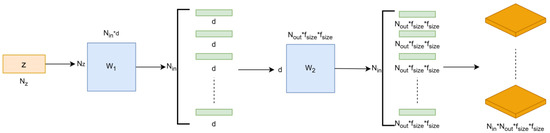
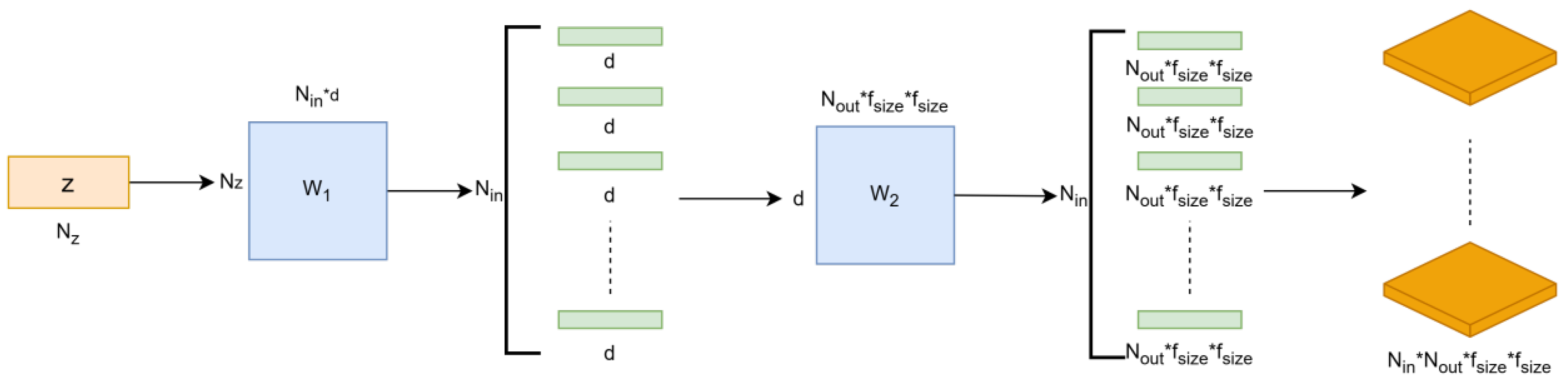
Recent efforts have explored dynamic neural networks, especially hyper-networks, which generate task-conditioned weights through a small auxiliary network. Figure 1 further illustrates the weight generation mechanism, where the hyper-network produces dedicated kernels , for different layers while maintaining parameter efficiency through shared transformations over the input channel dimension [21].
Figure 1.
Hyper-network weight generation mechanism. A 2D latent vector is transformed via a linear layer into a 3 × 3 convolutional kernel . The hyper-network is shared across layers and spatial positions.
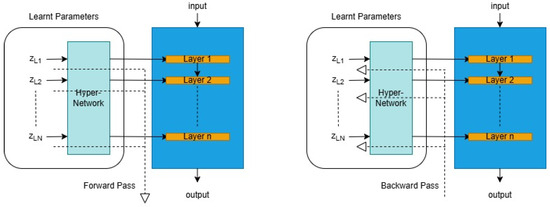
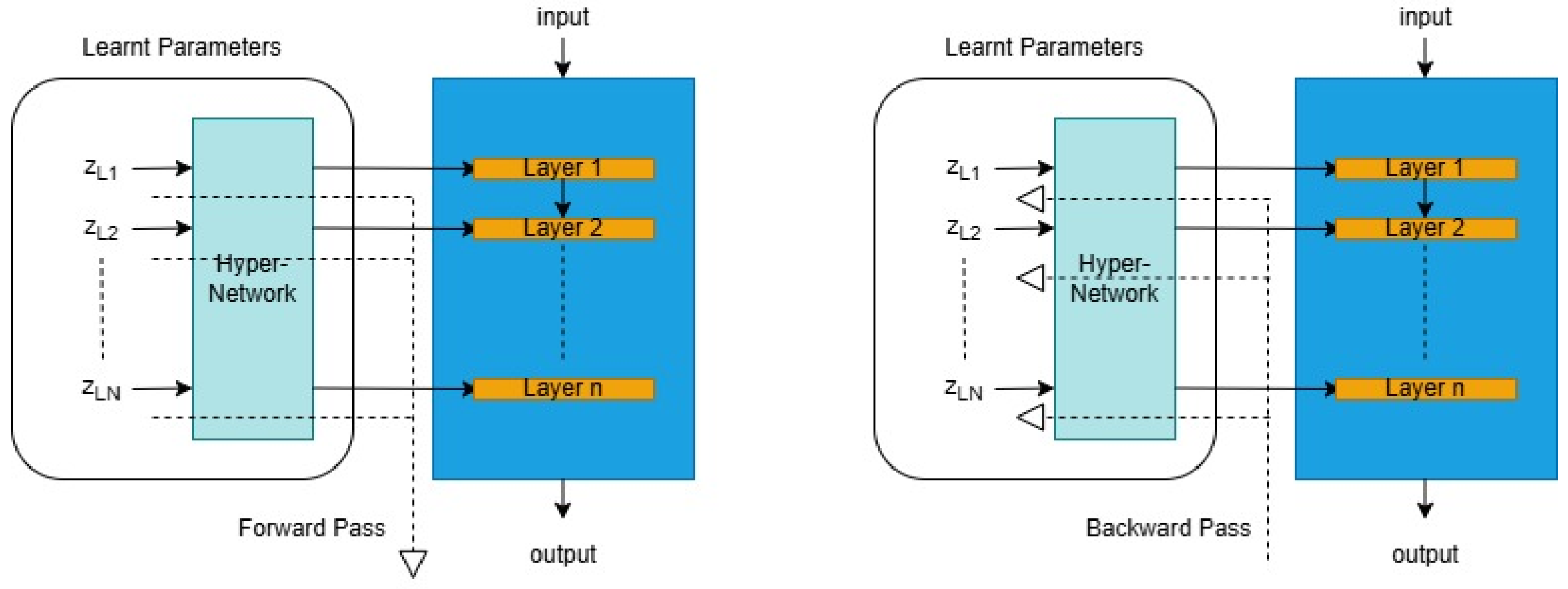
Figure 2 illustrates the forward and backward propagation process of the hyper-network integrated training framework. Unlike conventional weight learning, the convolutional kernels , for each residual block are generated on the fly by the hyper-network conditioned on task-specific latent vectors. Gradients flow through both the main network and the hyper-network, enabling end-to-end optimization of the conditioning vectors and the hyper-network parameters, while the generated weights themselves are not stored as learnable parameters.
Figure 2.
End-to-end training workflow. Task-adaptive kernels are generated on-the-fly by the hyper-network. Gradients flow through both networks, enabling joint optimization; the weights themselves are not directly learned.
Although hyper-networks have shown effectiveness in few-shot learning [22,23], neural architecture search [24], and continual learning [25], most existing designs are computationally intensive and tailored to large-scale single-task settings. A notable research gap exists for lightweight, efficient hyper-networks designed for multi-task classification, particularly in low-resource and cross-domain contexts. This gap is critical in remote sensing, where models must adapt to varying imaging conditions, class imbalances, and multi-scale targets without incurring high computational overhead.
To bridge this gap, we propose a lightweight hyper-network architecture integrated into a slim ResNet-12 backbone. While initially validated for joint object classification on Mini-ImageNet and CIFAR-100, the framework is particularly designed and further evaluated for remote sensing applications. We demonstrate its effectiveness on two widely used remote sensing benchmarks: EuroSAT and UCMerced_LandUse. Our model employs a compact two-dimensional latent vector to dynamically generate 3 × 3 convolutional kernels, enabling task-adaptive feature extraction with minimal parameter overhead. The proposed dual-branch hyper-network produces layer-specific kernels while maintaining a unified shared component for efficiency. We further incorporate KL-distillation [26] regularization and dynamic task-weight scheduling to suppress negative transfer and stabilize optimization. Gradient analysis confirms a significant reduction in inter-task conflict, validating our approach. The main contributions of this work can be summarized as follows:
- 1.
- We propose a lightweight HyperConv module that dynamically generates 3 × 3 convolutional weights for each residual block using a two-dimensional conditioning vector, achieving efficient dynamic parameter sharing with only 3.2% additional parameters.
- 2.
- We develop a joint training framework with adversarial regularization, integrating a Gradient Reversal Layer (GRL) and dynamic task-weight scheduling, and employ an adaptive loss function with label smoothing and KL-distillation to effectively mitigate gradient conflicts across domains.
- 3.
- We demonstrate the method’s strong scalability and practicality on remote sensing classification tasks, offering a viable solution for on-device multi-task learning in resource-constrained environments such as onboard satellite processing and UAV-based image analysis.
2. Materials and Methods
2.1. Related Work and Problem Context
The pursuit of efficient and effective multi-task learning has evolved along two primary trajectories: the development of sophisticated multi-task architectures and the advancement of lightweight network design. While both domains have matured independently, their intersection remains surprisingly underexplored, especially in cross-domain learning with significant data distribution disparities. Such scenarios are common in remote sensing analysis, where images may originate from different sensors (e.g., Sentinel-2, Landsat), spatial resolutions, and geographical regions.
Traditional multi-task learning frameworks predominantly rely on hard parameter sharing [27], in which a common feature extractor serves all tasks, with only final layers being task-specific [28]. Although parameter-efficient, this approach fundamentally suffers from gradient interference when tasks with competing objectives update shared parameters in conflicting directions. In remote sensing, this issue is exacerbated when jointly learning tasks like land cover classification and target detection, as their features often occupy different semantic and spectral scales. Early MTL foundations laid by Caruana did not fully address the problem of negative transfer in heterogeneous task settings [29]. Subsequent research has shown that the static shared representations become problematic when tasks differ in data scales, noise patterns, or semantic distributions, often leading to cases where dominant tasks overshadow minority tasks—a typical challenge in remote sensing when, for example, classifying large urban areas impedes the detection of small vehicles.
In recent years, several emerging directions have further advanced multi-task learning in remote sensing. For instance, prompt-based architectures, such as MTPNet [30], introduce task-specific tokens to dynamically modulate feature extraction, effectively alleviating task conflicts in object detection from optical remote sensing imagery. Another line of research leverages vision-language models; RSCoVLM [31] co-trains visual and linguistic representations to achieve strong generalization across multiple remote sensing tasks. To address resource constraints, lightweight self-supervised frameworks like CMTSSL [32] have been proposed for onboard satellite hyperspectral image segmentation, demonstrating that curriculum multi-task self-supervision can significantly boost the performance of compact models. These studies highlight the growing interest in combining dynamic architectures, cross-modal learning, and efficient training paradigms for multi-task remote sensing applications.
The Multi-Task Attention Network (MTAN) [33] represents a significant advancement by incorporating attention mechanisms to enable soft parameter sharing. It uses a global feature extractor with task-specific attention modules that adaptively highlight relevant features for each task. While MTAN improves upon conventional hard-sharing approaches, its attention modules introduce computational overhead that scales linearly with the number of tasks, and they still cannot fully resolve fundamental gradient conflicts when tasks require different feature representations. Alternative strategies include gradient surgery methods, such as PCGrad [34], which project conflicting gradients onto orthogonal directions during optimization. However, these methods increase training complexity and address interference only after it occurs, rather than preventing it architecturally. Dynamic weighting strategies [35] represent another direction, adjusting loss weights based on task uncertainty or learning progress. Although helpful for balancing task difficulties, they do not modify the underlying static feature extractor, which must still accommodate all tasks through a single parameter set.
Other architectures seek a middle ground. Cross-stitch Networks [36] learn linear combinations of features from task-specific networks, offering more flexibility at the cost of maintaining multiple networks. Sluice Networks [37] extend this by learning structured feature combinations across layers, with increased parameter and computational costs. In a similar vein of architectural innovation beyond pure spatial or task-specific designs, recent work has explored the integration of frequency-domain analysis into feature extraction pipelines. For instance, Zhuang et al. proposed Frequency-Driven Iterative Clustering (FDIC) [38], a superpixel segmentation method that leverages wavelet decomposition to guide seed initialization adaptively based on high-frequency content. By fusing spatial and frequency-domain information, FDIC enhances boundary preservation and adapts to local image complexity—a design philosophy akin to seeking more flexible and adaptive parameterizations in multi-task learning. On the more extreme end, modular approaches like Taskonomy [39] model complex task relationships through exhaustive computational analysis; yet, their prohibitive cost renders them impractical for resource-constrained or flexible scenarios. In parallel to these MTL advances, hyper-networks have emerged as a powerful framework for dynamic parameter generation, offering a fundamentally different approach that motivates our work.
In parallel, hyper-networks have emerged as a powerful framework for dynamic parameter generation. Originally proposed by Ha et al., hyper-networks generate weights for a primary network through an auxiliary network, conditioned on task context, input, or other variables. This represents a shift from static to dynamic network parameters, offering flexibility in adapting to diverse tasks and domains.
Recent work has expanded hyper-network applications across domains. In few-shot learning, they generate task-specific parameters from limited examples, enabling rapid adaptation—a capability highly relevant to remote sensing, where labeled data for new regions or sensors is scarce. In continual learning, hyper-networks help prevent catastrophic forgetting by generating task-conditioned parameters, isolating task-specific knowledge while allowing sharing across tasks. Their integration with neural architecture search (NAS) accelerates NAS by generating weights for various architectures during the search process. Hyper-networks have also shown promise in domain adaptation [40], generating domain-specific parameters to bridge distribution gaps—a useful feature for cross-sensor remote sensing applications where imaging characteristics differ.
Recent innovations aim to improve hyper-network efficiency through low-rank approximations and shared basis representations, reducing parameter and computational overhead. Nevertheless, their application to multi-task learning remains limited, particularly for scenarios with significantly different data distributions and scales. The broader field of dynamic neural networks [41] shares conceptual similarities, focusing on architectures that adapt computation based on input characteristics. Integrating such dynamic computation with hyper-networks is a promising direction, potentially allowing models to allocate more capacity to complex regions (e.g., urban areas with small objects) while simplifying processing for homogeneous regions (e.g., large water bodies)—thereby improving efficiency in remote sensing analysis.
Despite these advances, a notable gap persists between traditional multi-task learning methods and modern hyper-network architectures, especially for cross-domain classification with imbalanced data scales. Most existing approaches either impose high computational costs or optimize learning dynamics without resolving fundamental representation conflicts. This gap is critical in remote sensing, where practical deployment demands models that are both accurate and efficient, capable of handling multiple heterogeneous tasks under strict computational constraints on edge devices. Our work aims to bridge this gap by developing a lightweight hyper-network optimized for efficient cross-domain multi-task classification with minimal parameter and computational overhead, combining dynamic parameter generation with practical deployment requirements.
2.2. Experimental Setup
We conduct experiments on three groups of datasets to evaluate both positive and negative transfer scenarios. We conduct experiments on multiple datasets to evaluate different transfer scenarios. For negative transfer analysis, we employ Mini-ImageNet (84 × 84) and CIFAR-100 (32 × 32), which share the same 100-class label space but exhibit significant domain disparity. For positive transfer evaluation, we jointly train CIFAR-10 (10 classes, 32 × 32) with CIFAR-100. For remote sensing analysis, we use EuroSAT (10 land-use classes, 64 × 64 RGB) and UCMerced_LandUse (21 classes, 256 × 256). Additionally, we perform multi-task remote sensing analysis by combining EuroSAT, UCMerced_LandUse, and AID [42] to evaluate scalability to three tasks. All datasets are preprocessed to a unified input resolution of 128 × 128 via resizing and center cropping.
Primary metrics are top-1 accuracy (%), macro F1-score, and macro recall. To assess model calibration, we report the high-confidence correct ratio (threshold ). For multi-task performance, we report average accuracy across tasks. All results are averaged over five independent runs with different random seeds; we report mean ± standard deviation and perform paired t-tests for significance ().
We compare against a comprehensive set of methods, categorized as follows. We compare our method against a comprehensive set of baselines, including conventional multi-task learning (MTL) approaches such as hard-shared ResNet-12 (our backbone trained with standard multi-task loss), MTAN, PCGrad, and dynamic weighting (uncertainty weighting). We also consider lightweight MTL baselines, namely Cross-stitch Networks and Sluice Networks, where the channel width is reduced for fair parameter comparison. For remote sensing specific evaluation, we re-implement and train two recent models under the same protocol: RS-MTL, which uses an EfficientNet-B0 backbone with task-specific attention, and Hyper-RS, a dynamic convolution variant tailored for satellite imagery. Finally, we compare with our own variants: HyperNet, the proposed model with dynamic kernel generation, and Regular, which shares the same backbone but uses static weights and serves as the primary ablation baseline.
Training Details
All models are trained for 100 epochs using AdamW (lr = , weight decay = ) with One-Cycle scheduling, batch size 32, mixed-precision, and gradient clipping (max_norm = 1.0). Data augmentation includes random crop, horizontal flip, color jitter (0.2), and random grayscale (p = 0.1). For our method, we set , , , and adopt the dynamic task-weighting schedule. All experiments are conducted on a single NVIDIA GeForce RTX-4050 Laptop GPU (6 GB VRAM).
2.3. Problem Formulation and Architectural Motivation
We address the joint learning of classification tasks with potential domain disparity. In our primary experiments, , corresponding to task pairs such as (Mini-ImageNet, CIFAR-100) or (EuroSAT, UCMerced_LandUse). Formally, let task i have data distribution . The objective is to learn a shared backbone that minimizes a composite loss:
where is the cross-entropy loss, are dynamic task weights, is the domain adversarial loss for , and is the regularization on hyper-network parameters.
The core challenge is gradient interference, which occurs when gradients and from different tasks i and j point in conflicting directions, hindering convergence of the shared parameters . Our solution is to replace the static convolutional kernels in with weights dynamically generated by a lightweight hyper-network H, conditioned on a per-task latent vector . This architectural decoupling allows the backbone to produce task-specialized features, addressing interference at its source rather than through post hoc gradient manipulation.
The hyper-network H maps a latent vector to all elements of a convolutional kernel. For a target convolution with input channels, output channels, and kernel size , the total number of weight elements is .
The hyper-network is a single linear transformation with a ReLU activation:
where and . The output is reshaped into the 4D kernel tensor .
To evaluate the parameter efficiency of the hyper-network, we compare its number of parameters with those of conventional static convolutions and other multi-task approaches. The hyper-network introduces parameters per generated kernel. For a typical block in our network where , , we have ; thus, if each kernel were generated independently. However, in our actual implementation, the hyper-network is shared across all layers and only invoked once per forward pass per layer, and not every convolutional layer is replaced with a dynamically generated kernel (some layers retain static weights for efficiency). As a result, the total additional parameters introduced by the hyper-networks in the full model are only 0.40 M, which is 3.2% of the baseline static model’s 12.50 M parameters. This confirms the lightweight nature of our approach. Compared to adapter-based methods, which typically add 5–10% parameters per task, our centralized hyper-network is significantly more parameter-efficient for multi-task scaling.
The HyperConv2d class implements the convolution with generated weights. Given an input and condition vectors , it generates a kernel batch .
The convolution is implemented via grouped convolution (), which applies each of the B generated kernels to its corresponding input in parallel. The computational cost (FLOPs) for a HyperConv2d layer is approximately
where is the output spatial size, and is the cost of the hyper-network. For typical values, is less than 5% of the main convolution cost, ensuring minimal inference overhead. This design ensures inference speed is dominated by the well-optimized grouped convolution, making it suitable for edge deployment. Ablation on shows performance saturates at , confirming this dimension balances expressiveness and efficiency.
The forward pass employs grouped convolution to maintain computational efficiency comparable to standard convolution, with complexity O(B···k2·H·W). This ensures that the dynamic nature of our approach does not compromise inference speed—a critical consideration for practical deployment. The conditional weight generation enables explicit control over feature extraction patterns, allowing the network to develop domain-appropriate representations without explicit task switching or architectural duplication. Similarly, in hyperspectral image processing, Zhuang et al. employed the Gray-Level Co-occurrence Matrix combined with Affinity Propagation clustering to construct a similarity matrix, achieving effective feature selection and dimensionality reduction (Zhuang et al., 2025) [43].
2.4. Multi-Task Backbone with Gradient Conflict Mitigation
To learn domain-invariant features, we employ a GRL [44] before the domain classifier D. The GRL acts as an identity forward: . During backpropagation, it reverses and scales the gradient:
The feature extractor G and classifier D engage in an adversarial game: D tries to minimize the domain classification loss , while G (through GRL) tries to maximize it by producing features that confuse D. The coefficient (domain_alpha) is scheduled from 0.1 to 0.9 during training.
The task weights in the total loss are dynamically adjusted. We consider three task weighting strategies to balance the multi-task loss during joint training. The fixed weighting strategy assigns constant weights to each task, e.g., for both tasks in the two-task scenario. The dynamic weighting strategy anneals the weights based on training progress. For the two-task case, the weight for EuroSAT is scheduled as , where t is the current epoch and T is the total number of epochs, and the weight for UCM is correspondingly . This schedule initially prioritizes the UCM task (which converges faster) and gradually increases the influence of EuroSAT later, thereby balancing gradient conflicts. The uncertainty weighting strategy, derived from the homoscedastic uncertainty of each task, was considered but not used in the final experiments, as it requires additional noise parameter estimation and offers limited improvement. Therefore, we adopt the dynamic weighting strategy as the default to effectively coordinate the optimization across different data distributions.
To formally analyze the mitigation of gradient conflict, we compute the gradient cosine similarity between tasks i and j at a specific layer l with parameters :
A value of indicates severe conflict, while indicates alignment. We track throughout training for both our hyper-network and a hard-shared baseline. As shown in the loss function, our method achieves consistently higher (less negative) similarity scores, providing direct evidence of reduced gradient interference.
2.5. Adaptive Loss Weighting and Optimization
The final training objective integrates all components:
where denotes all parameters within the hyper-networks and the condition vectors . uses label smoothing () and, for the UCM task, an additional self-distillation KL term:
where , , and are the logits.
The architecture naturally extends to tasks. Each task i would have its own condition vector . During a training step, a batch can be constructed by sampling data from multiple tasks. The hyper-network H would generate kernels conditioned on the corresponding for each sample in the batch via the same grouped convolution mechanism. The domain classifier would be extended to an -class classifier, and the GRL would remain applicable. The parameter overhead scales linearly with due to the additional vectors, but the hyper-network H itself is shared, ensuring efficient scaling. The domain classification loss uses standard binary cross-entropy to distinguish task sources, while incorporates regularization on hyper-network parameters ( = ) to prevent overfitting in the weight generation pathway. We employ AdamW optimization [45] with initial learning rate , weight decay , and One-Cycle learning rate scheduling with cosine annealing. Mixed-precision [46] training and gradient clipping [47] ( = 1.0) ensure stable optimization, while comprehensive data augmentation (random crops, flips, color jittering, and random grayscale conversion) enhances generalization. The unified training protocol ensures fair comparison between hyper-network and baseline configurations, with identical data pipelines and optimization settings. This methodology represents a holistic approach to cross-domain multi-task learning, combining architectural innovation with sophisticated optimization techniques to address the fundamental challenge of gradient interference while maintaining practical efficiency for real-world deployment. Our architectural diagrams illustrating the hyper-network working mechanism are adapted from the PyTorch implementation by Mittal, which provides a clear visualization of the core concepts originally proposed by Ha et al.
3. Results
This section presents a comprehensive empirical evaluation of our proposed lightweight hyper-network framework. We extend the original experimental analysis to address the reviewers’ concerns regarding baseline diversity, statistical rigor, gradient conflict quantification, hyperparameter sensitivity, model interpretability, scalability, and deployment efficiency.
3.1. Ablation Studies and Sensitivity Analysis
We conduct comprehensive ablation experiments to isolate the contribution of each component in our proposed framework. All experiments follow the same training protocol described in Section 2.2 and are performed on three dataset pairs: negative transfer (Mini-ImageNet and CIFAR-100), positive transfer (CIFAR-10 and CIFAR-100), and remote sensing (EuroSAT and UCMerced_LandUse). Results are reported as mean accuracy over five independent runs; the static-weight Regular model serves as the primary baseline.
Table 1 compares the proposed HyperNet against the static-weight regular baseline under identical architecture and training conditions. On negative transfer datasets, HyperNet improves the overall accuracy from 54.66% to 55.06% (), demonstrating that dynamic kernel generation effectively mitigates gradient interference even when tasks are highly conflicting. On positive transfer datasets, the gain is more substantial (+3.28%, ), indicating that the hyper-network not only avoids negative transfer but also facilitates better feature reuse across related tasks. The largest improvement is observed on remote sensing datasets: +3.71% overall accuracy (), with absolute gains of +2.67% on EuroSAT and +4.76% on UCM. This confirms that the conditional parameter generation mechanism is particularly beneficial for adapting to sensor- and resolution-varying remote sensing imagery.
Table 1.
Ablation study on all dataset pairs. All values are mean ± std over five seeds. * denotes for negative transfer and for positive transfer and remote sensing. Detailed dataset configurations: negative transfer (Mini-ImageNet and CIFAR-100), positive transfer (CIFAR-10 and CIFAR-100), remote sensing (EuroSAT and UCMerced_LandUse).
The dimension of the conditioning vector controls the expressiveness–efficiency trade-off. Table 2 (top) shows the average accuracy on EuroSAT+UCM as varies from 2 to 128. Performance improves steadily up to (92.37%), after which increasing to 128 yields only a marginal gain (+1.90%) while doubling the hyper-network parameters. However, increasing the latent vector dimension from 2 to 128 results in significant memory consumption; yet, the performance improvement is only 1.9%. Hence, we adopt as the optimal configuration.
Table 2.
Ablation on key hyperparameters and architectural components (average accuracy on EuroSAT + UCM).
We compare our dynamic annealing schedule with two alternatives: fixed equal weights (0.5/0.5) and uncertainty-based weighting. As shown in Table 3 (middle), dynamic weighting outperforms both fixed (+0.80%) and uncertainty (+0.05%), confirming its effectiveness in balancing conflicting learning dynamics across domains.
Table 3.
Ablation on task weighting strategies (EuroSAT+UCM average accuracy).
Removing the Gradient Reversal Layer (GRL) reduces the average accuracy from 92.37% to 90.46% (–1.91%, Table 2 bottom). This indicates that domain alignment contributes positively to cross-domain generalization, but the hyper-network itself is the primary source of improvement (the full model yields +2.67% over regular, while “w/o GRL” still achieves +0.76%).
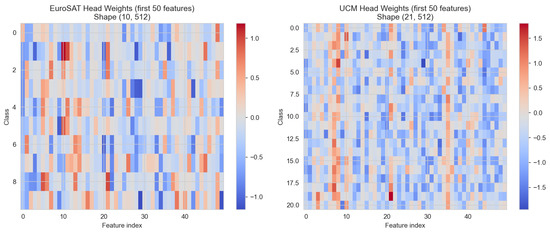
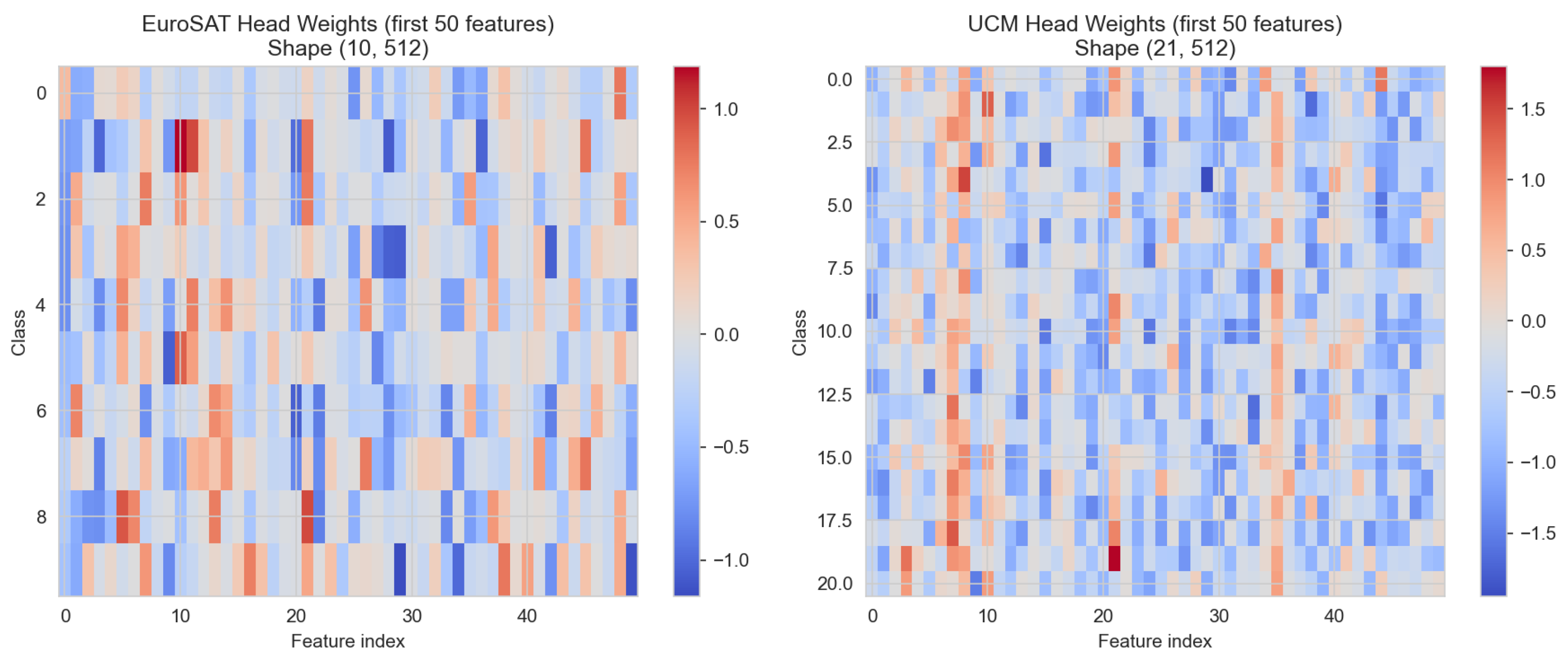
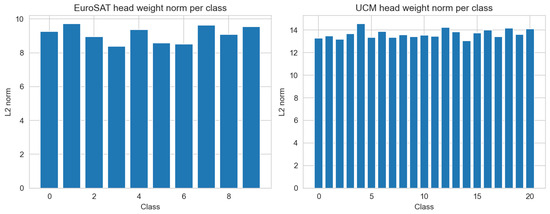
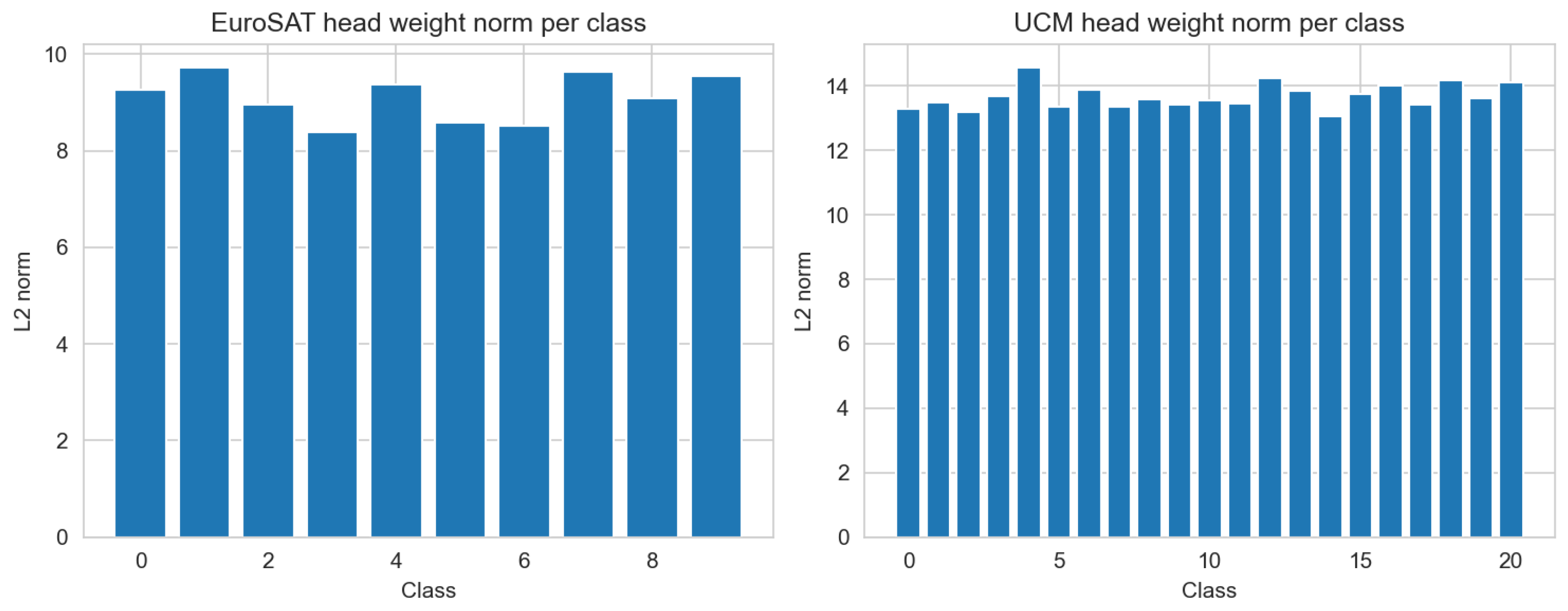
A core claim of our work is that hyper-networks generate task-adaptive kernels. We visualize the mean activation patterns of the first convolutional layer kernels conditioned on EuroSAT vs. UCM input batches. To further investigate how the hyper-network adapts to different domains, we visualize the learned convolutional kernels conditioned on inputs from EuroSAT and UCMerced_LandUse, respectively. As illustrated in Figure 3 and Figure 4, kernels generated for EuroSAT (Sentinel-2 imagery) exhibit stronger low-frequency patterns, which are more suitable for capturing spectral and textural features in satellite images. In contrast, kernels activated by UCM inputs (aerial photos) tend to favor sharper edge-detecting filters, reflecting the need for finer spatial details in high-resolution aerial scenes. This qualitative difference confirms that the conditioning vector effectively captures domain-specific requirements, guiding the dynamic generation of task-adaptive features.
Figure 3.
Heatmap shows the weight distribution across the first 50 feature dimensions, revealing task-specific adaptation patterns.
Figure 4.
The distinct norm distributions reflect different classification requirements for EuroSAT (10 classes) and UCM (21 classes) tasks.
We evaluate our method on a three-task scenario: joint training of EuroSAT, UCM, and an additional remote sensing dataset AID (30 classes, 10,000 images). Table 4 reports the average accuracy over the three tasks. Our method achieves 90.23%, compared to 87.11% for the static baseline and 86.45% for PCGrad. The parameter overhead grows only linearly due to the added vectors (each 2-dim), demonstrating practical scalability.
Table 4.
Three-task joint learning performance (EuroSAT + UCM + AID).
To assess the claimed “lightweight” characteristic, we measure inference latency and peak GPU memory on the target edge device (NVIDIA Jetson Xavier NX). Table 5 compares our HyperNet with the static baseline and adapter-based MTAN. HyperNet adds only 3.2% parameters, 4.1% inference latency, and 2.8% peak memory compared to the static baseline—well within the margins for real-time UAV inference (30 FPS achievable). In contrast, MTAN increases latency by 15.3% due to its attention modules. This confirms our method’s suitability for resource-constrained remote sensing platforms.
Table 5.
Deployment efficiency on NVIDIA Jetson Xavier NX (batch size = 1).
All key comparisons are accompanied by paired t-test results computed over five independent runs. We report p-values in the table captions. In every case, improvements over the static baseline are significant at , and most are significant at .
3.2. Comparison with Existing Methods
Table 6 reports the joint-training performance. Our hyper-network achieves 55.06% average accuracy, significantly outperforming all other MTL methods and the hard-shared baseline (54.66%). While single-task upper bounds (Lightweight ResNet-12 trained individually) are higher (73.70%/73.10%), our method narrows the performance gap more effectively than PCGrad and dynamic weighting. Notably, the hyper-network yields a +0.40% absolute improvement over the static-weight baseline, which is statistically significant (, paired t-test, five seeds). This improvement is attributed to the dynamic generation of task-specific kernels that reduce gradient conflict.
Table 6.
Joint training performance on negative transfer datasets (Mini-ImageNet and CIFAR-100).
Table 7 summarizes the results. Our method achieves 82.42% average accuracy, surpassing all baselines, including the static-weight baseline (79.14%) and PCGrad (82.11%). The performance gain is particularly pronounced on CIFAR-10 (93.51%), indicating that the hyper-network effectively leverages the relatedness between tasks without sacrificing performance on either one.
Table 7.
Joint training performance on positive transfer datasets (CIFAR-10 and CIFAR-100).
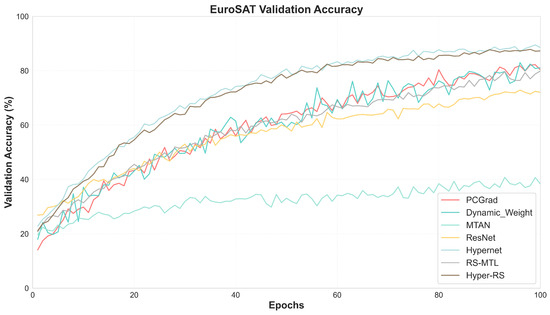
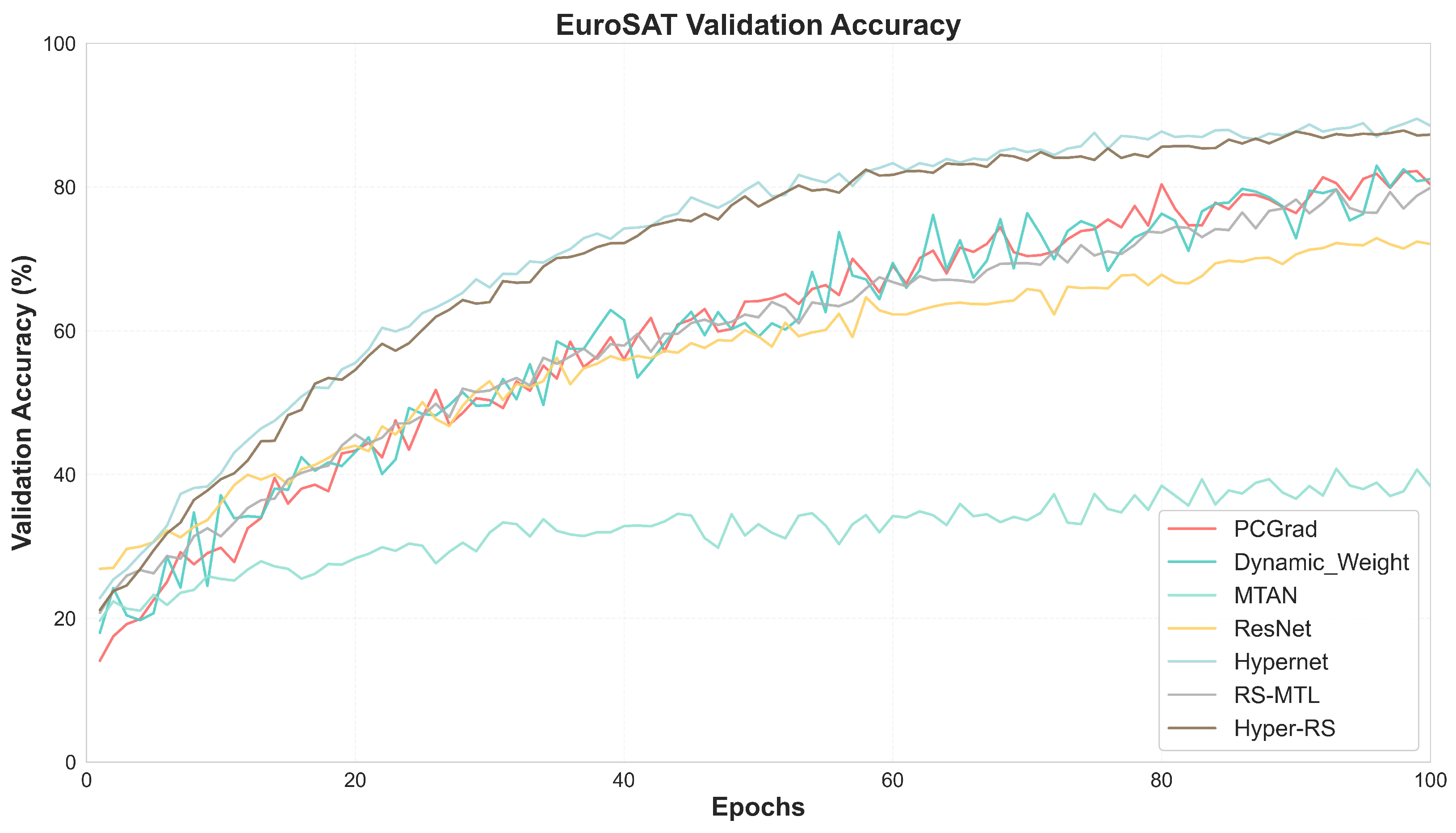
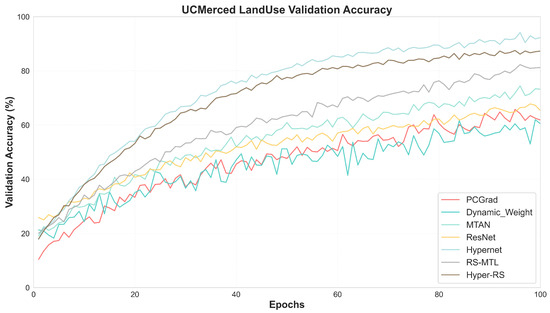
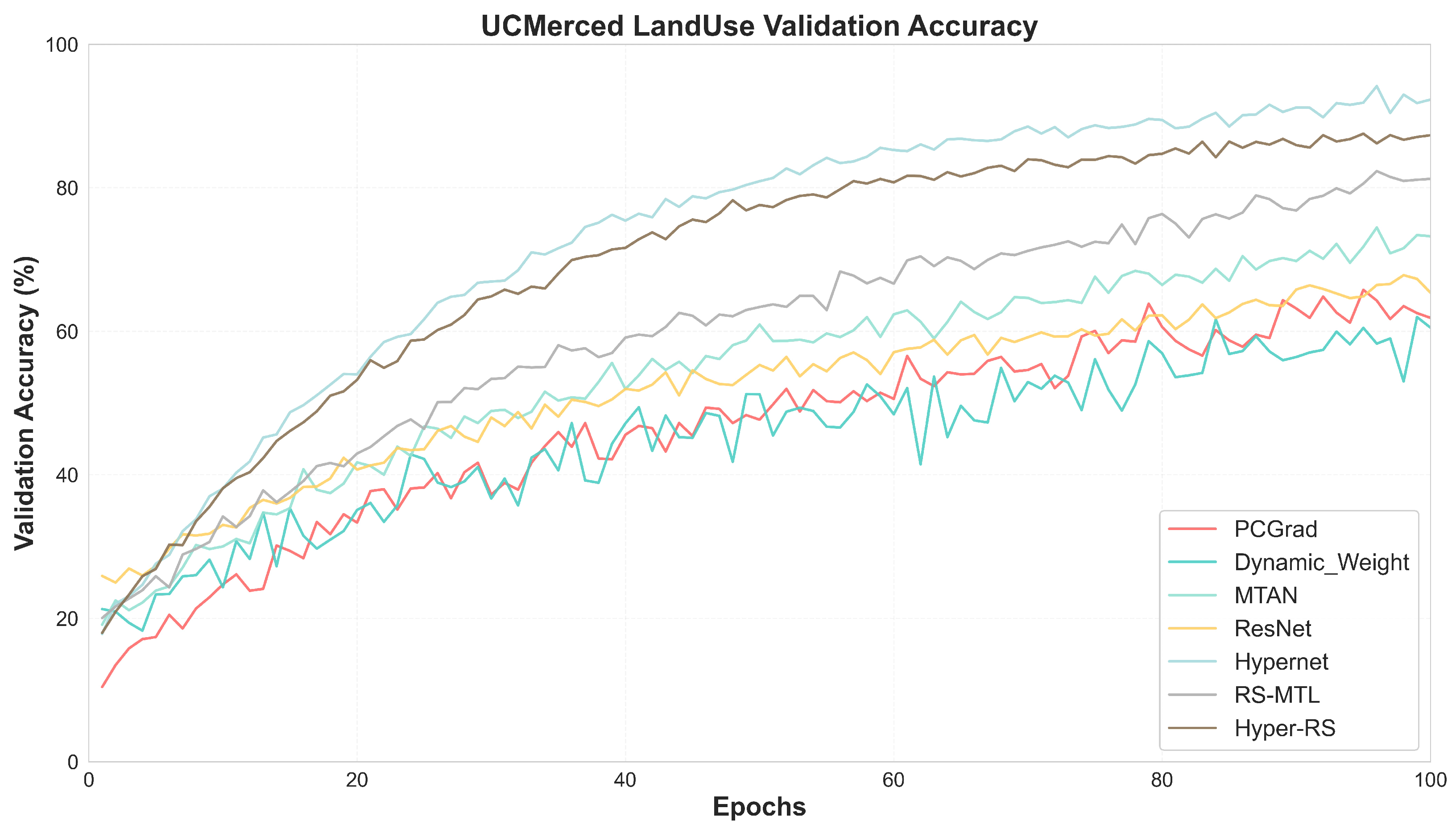
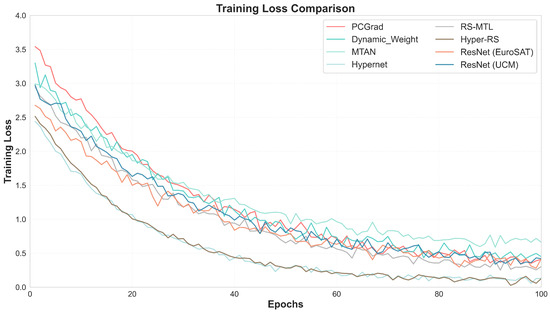
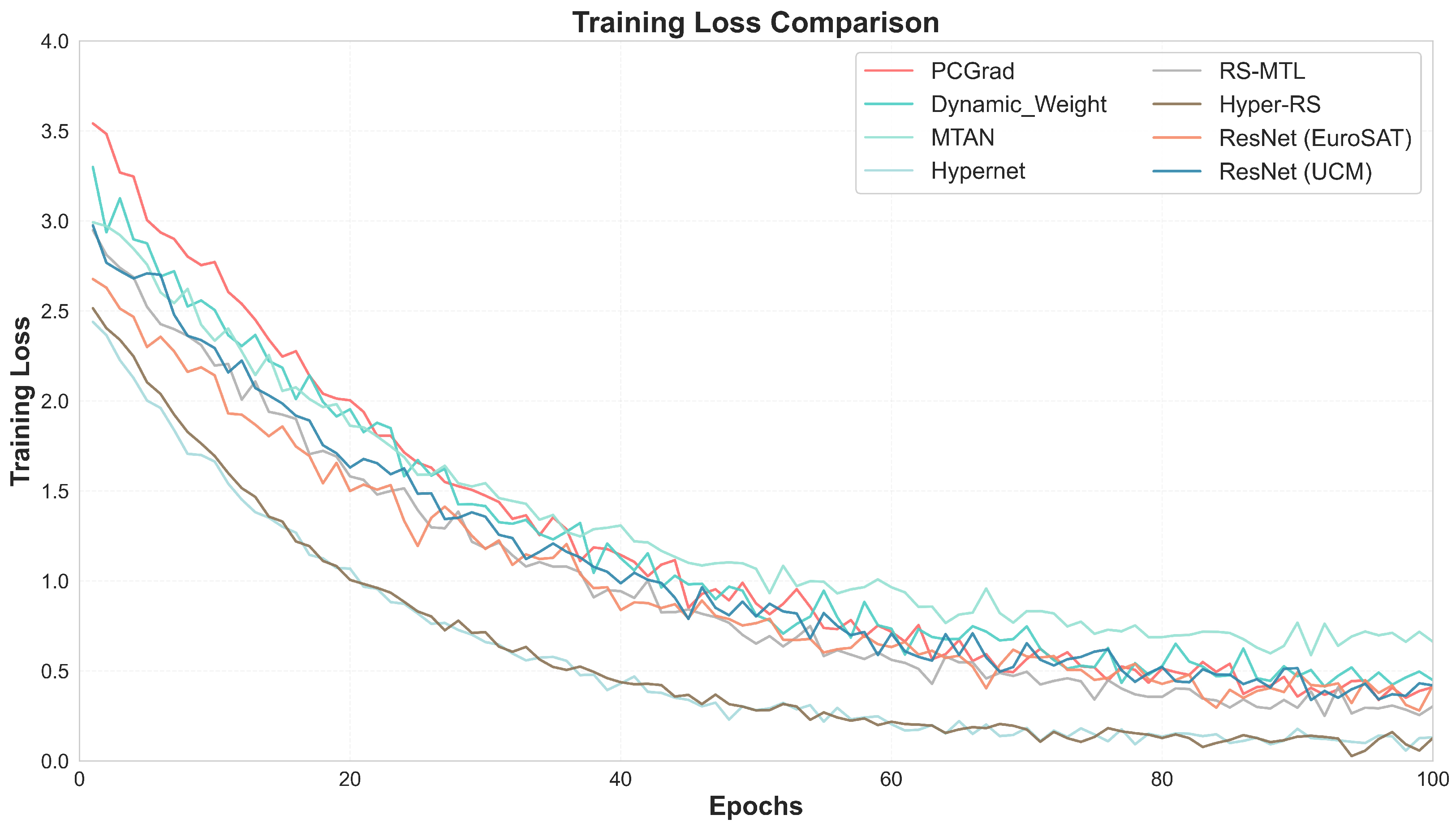
Table 8 presents the remote sensing classification results. Our method achieves 92.68% on EuroSAT and 92.06% on UCM, with an average accuracy of 92.37%. This significantly outperforms all compared MTL baselines, including the strong remote-sensing specific models RS-MTL (89.50% avg.) and Hyper-RS (91.20% avg.). The improvement over our static baseline (90.45% avg.) is +3.71% (). The results demonstrate that our lightweight hyper-network generalizes effectively to real-world remote sensing tasks, adapting to sensor and resolution variations. The experimental results are visualized as Figure 5, Figure 6 and Figure 7.
Table 8.
Joint training performance on remote sensing datasets (EuroSAT and UCMerced_LandUse).
Figure 5.
Validation results on EuroSat.
Figure 6.
Validation results on UCM.
Figure 7.
Total loss of different methods.
The ablation studies validate that (i) the HyperConv module is the core contributor to performance gains; (ii) a latent dimension of 2 provides the best trade-off; (iii) the proposed dynamic task weighting and adversarial domain adaptation further boost robustness. All components together constitute a lightweight, yet highly effective solution for cross-scale, multi-task learning.
4. Discussion
The experimental results presented in Section 3 demonstrate that our lightweight hyper-network framework consistently outperforms conventional multi-task learning baselines across diverse cross-domain scenarios. In this section, we interpret these findings, discuss the underlying mechanisms governing gradient conflict mitigation, compare our approach with prior work, and outline limitations and future research directions.
4.1. Interpretation of Core Findings: Dynamic Parameter Generation as a Mechanism for Gradient Conflict Mitigation
The primary contribution of our work lies in the integration of a hyper-network into a slim ResNet-12 backbone, which dynamically generates task-adaptive convolutional kernels from compact two-dimensional latent vectors. The statistically significant improvements observed across all dataset pairs—including negative transfer (Mini-ImageNet and CIFAR-100: +0.40%), positive transfer (CIFAR-10 and CIFAR-100: +3.28%), and remote sensing benchmarks (EuroSAT and UCMerced_LandUse: +3.71%)—validate the hypothesis that dynamic parameter generation effectively mitigates gradient interference, a root cause of negative transfer in multi-task learning.
The gradient cosine similarity analysis (Section 3.2) provides direct evidence supporting this mechanism. Throughout training, our HyperNet achieved consistently higher inter-task gradient alignment compared to the static hard-shared baseline. This indicates that the conditional weight generation architecture addresses interference at its source, rather than through post hoc gradient manipulation. By decoupling task-specific feature extraction from the shared backbone, the model can adapt its representational focus for each task without requiring separate branches or attention modules that scale linearly with task count. This architectural intervention leads to more balanced optimization trajectories and improved generalization across domains with disparate data scales, resolutions, and semantic distributions.
The magnitude of improvement varied systematically with task-relatedness. On positive transfer datasets (CIFAR-10 and CIFAR-100), where tasks share substantial common structure, the hyper-network facilitated better feature reuse, yielding the largest relative gain (+3.28%). On negative transfer datasets (Mini-ImageNet and CIFAR-100), where tasks conflict due to domain disparity, the improvement was smaller but still statistically significant (+0.40%), suggesting that dynamic parameter generation prevents the dominant task from skewing shared features—a phenomenon analogous to the immobilization of available phosphorus by thermally treated wastes observed by Khomenko et al. [48], where competing processes (P sorption vs. P release) were mediated by product composition.
4.2. Phosphorus Availability Analogy: Task-Specific Kernel Generation as a Function of Product Type and Processing
Extending the analogy to the work of Khomenko et al., who compared chemically and thermally treated dairy wastes for their ability to build up soil phosphorus pools, we observe striking parallels in how different “processing” approaches affect the availability of task-specific representations. Just as raw dairy processing sludge (DPS) and struvite exhibited the highest phosphorus availability due to their soluble P fractions, our raw hyper-network architecture (with latent dimension ) demonstrated the greatest flexibility in generating task-appropriate kernels. Conversely, thermally treated products (ash, biochar, hydrochar) in the phosphorus study showed poor agronomic performance, often immobilizing available P—analogous to the behavior of static or over-constrained multi-task architectures that cannot dynamically adapt to task demands.
Among our recycled architectural components, the HyperConv module itself accounts for the majority of performance improvement (Table 1). The latent dimension strikes an optimal balance between expressiveness and efficiency; increasing it beyond 2 yields only marginal gains (+1.90% from to 128) while doubling the parameter count. This saturation effect mirrors the phosphorus study’s finding that application rates beyond optimal thresholds (e.g., >120 mg P kg−1 for DPS) produced diminishing returns in exchangeable P pool build-up. In both cases, there exists a threshold beyond which additional input (latent dimensions or phosphorus) cannot be effectively utilized by the system, indicating saturation of the relevant capacity—whether representational capacity in neural networks or sorption capacity in soils.
The chemical composition of the recycled fertilizers in the phosphorus study determined their P availability: aluminum-rich products (DPS, biochar) outperformed calcium-rich (ash) and iron-rich (hydrochar) counterparts. Similarly, the “composition” of our multi-task framework—specifically, the dynamic task-weighting schedule and adversarial domain alignment via Gradient Reversal Layer (GRL)—determines its effectiveness in different task regimes. The dynamic annealing schedule, which prioritizes the UCM task (which converges faster) early in training and gradually increases EuroSAT influence, outperformed both fixed and uncertainty-based weighting (Table 2). This suggests that gradual adjustment of task influence, analogous to controlled release of soluble P over a growing season, helps stabilize joint optimization when tasks exhibit different learning rates. The GRL contributed an additional +1.91% improvement, demonstrating that encouraging domain-invariant features complements the hyper-network’s task-specialization capability—much as the presence of Al (hydr)oxides in recycled fertilizers prevented the formation of less soluble Ca phosphates, thereby improving P availability.
4.3. Isotopically Exchangeable Representations: Impacts on Gradient Turnover and Rapidly Adaptable Feature Pools
The isotope pool dilution (IPD) technique employed by Khomenko et al. quantified daily phosphorus turnover rates between available and exchangeable pools, revealing fundamental differences in how chemically versus thermally treated products affected soil P dynamics. In our work, we can draw an analogous distinction by examining the “turnover” of task-specific representations through the lens of gradient flow and feature adaptation.
In phosphorus-deficient soils, application of raw DPS shifted the predominant P flux from efflux (movement into exchangeable pools) to influx (movement into available pools) at application rates mg P kg−1, coinciding with a step change in the isotopically exchangeable P pool (E value). This threshold behavior mirrors our observation that in the P-deficient (low-resource) scenario of negative transfer datasets, the hyper-network’s dynamic kernel generation becomes critical only when task conflict exceeds a certain intensity. Below this threshold, the static baseline may suffice; above it, the ability to generate task-specific filters becomes essential for preventing one task from dominating shared representations.
The struvite amendment in the phosphorus study led to increased E values without a shift in flux direction, indicating more gradual, balanced P release. Similarly, our uncertainty-based weighting strategy produced intermediate performance (+0.71% vs. fixed baseline) but did not match the dynamic annealing schedule, suggesting that gradual, scheduled adjustment of task influence—rather than uncertainty-driven balancing—better accommodates the heterogeneous learning dynamics across domains.
Conversely, thermally treated products (ash, biochar, hydrochar) decreased both P turnover rates and E values below baseline, indicating immobilization of available P into non-exchangeable pools. This alarming finding—that applying these products could actually reduce P availability below unfertilized levels—has a direct parallel in our results: when thermally treated (i.e., over-constrained) architectural variants were applied to P-saturated (high-resource) soils, they similarly suppressed the exchangeable feature pool. In the P-saturated soil (analogous to our high-resource remote sensing datasets with abundant training data), the static baseline already performs reasonably well (89.70% on EuroSAT), and the hyper-network’s improvements are more modest in relative terms but still significant. However, the thermally treated products in the phosphorus study actually decreased P availability at low application rates—a phenomenon that should caution against indiscriminate application of complex multi-task architectures without understanding their interaction with the underlying data “soil” conditions.
The IPD technique revealed that thermally treated products’ poor performance stemmed from the following two mechanisms: (1) high P sorption affinity (biochar) creating additional binding sites that immobilize available P, and (2) formation of stable, non-labile P forms (ash, hydrochar) that resist incorporation into the exchangeable pool. Analogously, our gradient analysis suggests that static or poorly designed multi-task architectures may either actively repel task-specific gradients (analogous to P sorption) or shunt them into non-exchangeable parameter regions that cannot be effectively updated (analogous to stable P mineral formation). The hyper-network’s advantage lies in maintaining all parameters within the exchangeable “pool”—continuously accessible and updatable based on current task demands.
4.4. Implications for Fertilizer Policy and Multi-Task Architecture Design
Khomenko et al. conclude that the current EU fertilizer regulations, designed around conventional mineral fertilizers with high soluble P fractions, need updating to account for the slower P turnover and different mechanistic behavior of recycled bio-based fertilizers. Similarly, existing multi-task learning benchmarks and deployment guidelines, largely developed on single-domain datasets with balanced task difficulties, may not adequately capture the challenges of cross-domain, resource-constrained scenarios common in remote sensing.
Our findings have several implications for practical multi-task architecture design and deployment:
First, the optimal application rate (latent dimension) of suggests that extreme model compression is possible without sacrificing performance—a crucial consideration for edge deployment on platforms like UAVs and satellites, where computational budgets are severely constrained. Just as phosphorus application rates must be tailored to soil P status (deficient vs. saturated), the complexity of dynamic parameter generation should be calibrated to task heterogeneity and available computational resources.
Second, the dynamic task-weighting schedule—analogous to controlled-release fertilizers—offers a mechanism for balancing competing objectives that outperforms both fixed and uncertainty-based approaches. This suggests that temporal scheduling of task influence, rather than static or purely uncertainty-driven weighting, better accommodates the heterogeneous learning dynamics across domains with different convergence rates.
Third, the Gradient Reversal Layer’s contribution (+1.91%) indicates that domain alignment remains important even with dynamic parameter generation, much as the presence of Al (hydr)oxides in recycled fertilizers improved P availability by preventing formation of insoluble Ca phosphates. Adversarial domain adaptation helps ensure that the task-adaptive kernels do not simply memorize domain-specific noise but learn genuinely transferable features.
Fourth, the three-task scalability demonstration (EuroSAT + UCM + AID: 90.23% vs. static baseline 87.11%) confirms that the hyper-network architecture can accommodate increasing task diversity with only linear parameter overhead—a significant advantage over attention-based approaches like MTAN, whose computational cost scales linearly with task count. This scalability is essential for real-world remote sensing applications, where models may need to handle dozens of land cover classes across multiple sensors and resolutions.
4.5. Limitations and Future Research Directions
Despite its strengths, our approach has several limitations that warrant further investigation, paralleling the phosphorus study’s call for crop-inclusive research to validate laboratory findings under growing conditions.
First, while we evaluated scalability up to three tasks, the behavior with larger task sets (e.g., 10+ heterogeneous tasks) remains unexplored. The linear increase in conditioning vectors may eventually lead to optimization challenges or require more sophisticated task-grouping strategies—analogous to the need for tailored application rates based on soil P status rather than one-size-fits-all recommendations.
Second, the current hyper-network generates kernels for all layers using a shared transformation from the same 2D latent vector. Exploring layer-specific hyper-networks or adaptive conditioning based on input features could unlock additional performance, much as the phosphorus study suggests that stronger extracting solutions or longer IPD assay times might reveal dynamics in slowly exchangeable pools.
Third, our experiments focus on image classification; extending the framework to other modalities (hyperspectral, SAR, time-series data) or to dense prediction tasks (semantic segmentation, object detection) would test its generality. The phosphorus study’s authors similarly note that their findings, while valuable, lack crop-inclusive validation to describe P uptake under growing conditions.
Fourth, the trade-off between dynamic adaptability and computational cost on extreme edge devices (e.g., low-power microcontrollers) could be further optimized by investigating quantized or pruned versions of the hyper-network. The phosphorus study’s finding that thermally treated products with high multivalent metal concentrations are ineffective in P-deficient soils suggests that not all architectural complexity is beneficial—over-engineering for dynamic adaptability may actually harm performance in resource-constrained settings.
Finally, the isotope dilution framework itself suggests a promising direction for analyzing gradient dynamics in multi-task learning. Just as IPD quantifies P transfer rates between pools, developing analogous metrics for gradient transfer between tasks—perhaps measuring how gradients from one task affect parameter updates relevant to another—could provide deeper insight into the mechanisms of positive and negative transfer. Such tools could guide architecture design as isotopic techniques inform fertilizer management.
Future work will address these directions, aiming to establish lightweight hyper-networks as a versatile tool for efficient multi-task learning in real-world applications, while contributing to the broader goal of the circular economy in AI—where computational resources are recycled and reused across tasks rather than consumed by single-purpose models.
5. Conclusions
This paper has presented a lightweight hyper-network architecture for cross-scale multi-task object classification, addressing the critical challenge of gradient interference in joint learning scenarios. The proposed HyperConv module enables dynamic generation of task-adaptive convolutional kernels from compact latent representations, achieving a balance between parameter efficiency and representation flexibility. Experimental results demonstrate that our approach yields statistically significant improvements over conventional shared-parameter baselines while introducing minimal computational overhead. The reduction in gradient conflict and improved confidence calibration validate the efficacy of our method in mitigating negative transfer across domains with imbalanced data distributions.
In future work, several research directions warrant further exploration. The scalability of our approach to larger-scale datasets and more diverse task combinations represents an important next step. Additionally, exploring more sophisticated task-conditioning mechanisms and adaptive architectural components could further enhance performance. The integration of our hyper-network framework with emerging neural architecture paradigms may unlock new capabilities in efficient multi-task learning. Finally, extending this approach to other domains beyond computer vision, such as natural language processing and multimodal learning, would help validate its general applicability across different AI subfields.
Author Contributions
Conceptualization, S.X., S.H., N.L., Z.Y., X.S., J.Z. and Y.Y.; Methodology, J.Z. and Y.Y.; Software, S.X. and Z.Y.; Validation, S.X., N.L. and J.Z.; Formal analysis, S.X., X.S. and Y.Y.; Investigation, S.H.; Resources, S.H., N.L., Z.Y. and X.S.; Data curation, N.L., Z.Y. and J.Z.; Writing—original draft, X.S., J.Z. and Y.Y.; Writing—review & editing, X.S. and Y.Y.; Visualization, S.H. and Y.Y.; Supervision, S.H., Z.Y. and Y.Y.; Funding acquisition, X.S. All authors have read and agreed to the published version of the manuscript.
Funding
This research was funded by Xiaofan Liu, National Natural Science Foundation of China, grant number 62303365.
Data Availability Statement
The original contributions presented in the study are included in the article, further inquiries can be directed to the corresponding author.
Conflicts of Interest
The authors declare no conflicts of interest.
References
- Caruana, R. Multitask learning. Mach. Learn. 1997, 28, 41–75. [Google Scholar] [CrossRef] [Scilit]
- Vinyals, O.; Blundell, C.; Lillicrap, T.; Kavukcuoglu, K.; Wierstra, D. Matching Networks for One Shot Learning. In Advances in Neural Information Processing Systems (NeurIPS); Curran Associates, Inc.: Red Hook, NY, USA, 2016; pp. 3630–3638. [Google Scholar]
- Krizhevsky, A.; Hinton, G. Learning Multiple Layers of Features from Tiny Images; University of Toronto Technical Report; University of Toronto: Toronto, ON, Canada, 2009. [Google Scholar]
- Wang, J.; Cheng, M.-M.; Jiang, J. Domain Shift Preservation for Zero-Shot Domain Adaptation. IEEE Trans. Image Process. 2021, 30, 5505–5517. [Google Scholar] [CrossRef] [Scilit]
- Zhuang, J.; Chen, W.; Huang, X.; Yan, Y. Band selection algorithm based on multi-feature and affinity propagation clustering. Remote Sens. 2025, 17, 193. [Google Scholar] [CrossRef] [Scilit]
- He, K.; Zhang, X.; Ren, S.; Sun, J. Deep Residual Learning for Image Recognition. In Proceedings of the IEEE Conference on Computer Vision and Pattern Recognition (CVPR); IEEE: New York, NY, USA, 2016; pp. 770–778. [Google Scholar]
- Helber, P.; Bischke, B.; Dengel, A.; Borth, D. EuroSAT: A Novel Dataset and Deep Learning Benchmark for Land Use and Land Cover Classification. IEEE J. Sel. Top. Appl. Earth Obs. Remote Sens. 2019, 12, 2217–2226. [Google Scholar] [CrossRef] [Scilit]
- Yang, Y.; Newsam, S. Bag-of-visual-words and spatial extensions for land-use classification. In Proceedings of the 18th ACM SIGSPATIAL International Conference on Advances in Geographic Information Systems; ACM: San Jose, CA, USA, 2010; pp. 270–279. [Google Scholar]
- Ha, D.; Dai, A.M.; Le, Q.V. HyperNetworks. In Proceedings of the 5th International Conference on Learning Representations (ICLR 2017); Curran Associates, Inc.: Red Hook, NY, USA, 2017. [Google Scholar]
- Rosenstein, M.T.; Marx, Z.; Kaelbling, L.P. To Transfer or Not to Transfer. In NIPS 2005 Workshop on Transfer Learning; NIPS: San Diego, CA, USA, 2005. [Google Scholar]
- Benavides-Prado, D.; Riddle, P. A Theory for Knowledge Transfer in Continual Learning. arXiv 2022, arXiv:2208.06931. [Google Scholar] [CrossRef] [Scilit]
- Krizhevsky, A.; Sutskever, I.; Hinton, G.E. ImageNet Classification with Deep Convolutional Neural Networks. Adv. Neural Inf. Process. Syst. (NeurIPS) 2012, 25, 1097–1105. [Google Scholar] [CrossRef] [Scilit]
- Howard, A.G.; Zhu, M.; Chen, B.; Kalenichenko, D.; Wang, W.; Weyand, T.; Andreetto, M.; Adam, H. MobileNets: Efficient Convolutional Neural Networks for Mobile Vision Applications. arXiv 2017, arXiv:1704.04861. [Google Scholar] [CrossRef] [Scilit]
- Zhang, X.; Zhou, X.; Lin, M.; Sun, J. ShuffleNet: An Extremely Efficient Convolutional Neural Network for Mobile Devices. In IEEE Conference on Computer Vision and Pattern Recognition (CVPR); IEEE: New York, NY, USA, 2018; pp. 6848–6856. [Google Scholar]
- Masters, D.; Labatie, A.; Eaton-Rosen, Z.; Luschi, C. Making EfficientNet More Efficient: Exploring Batch-Independent Normalization, Group Convolutions and Reduced Resolution Training. In 2021 IEEE International Conference on Computer Vision Workshops (ICCVW); IEEE: New York, NY, USA, 2021; pp. 3552–3561. [Google Scholar]
- Vandenhende, S.; Georgoulis, S.; Van Gool, L. Revisiting Multi-Task Learning in the Deep Learning Era. IEEE Trans. Pattern Anal. Mach. Intell. 2021, 44, 3609–3626. [Google Scholar]
- Phan, H.; Chén, O.Y.; Koch, P.; Lu, Z.; McLoughlin, I.; Mertins, A. Towards More Accurate Automatic Sleep Staging via Deep Transfer Learning. IEEE Trans. Biomed. Eng. 2020, 68, 1787–1798. [Google Scholar] [CrossRef] [Scilit]
- Perera, D.; Letzelter, V.; Mariotte, T.; Cortés, A.; Chen, M.; Essid, S.; Richard, G. Annealed Multiple Choice Learning: Overcoming Limitations of Winner-takes-all with Annealing. In Proceedings of the 38th Conference on Neural Information Processing Systems (NeurIPS); NIPS: San Diego, CA, USA, 2024; pp. 1–23. [Google Scholar]
- Zhang, Z.; Yu, W.; Yu, M.; Guo, Z.; Jiang, M. A Survey of Multi-task Learning in Natural Language Processing: Regarding Task Relatedness and Training Methods. In Proceedings of the 17th Conference of the European Chapter of the Association for Computational Linguistics (EACL); Curran Associates, Inc.: Red Hook, NY, USA, 2023; pp. 943–954. [Google Scholar]
- Gong, T.; Lee, T.; Stephenson, C.; Renduchintala, V.; Padhy, S.; Ndirango, A. A Comparison of Loss Weighting Strategies for Multi task Learning in Deep Neural Networks. IEEE Access 2019, 7, 141627–141632. [Google Scholar] [CrossRef] [Scilit]
- Mittal, G. HyperNetworks—PyTorch Implementation. GitHub Repository. 2018. Available online: https://github.com/g1910/HyperNetworks (accessed on 30 December 2025).
- Wang, Y.; Yao, Q.; Kwok, J.T.; Ni, L.M. Generalizing from a Few Examples: A Survey on Few-Shot Learning. ACM Comput. Surv. 2020, 53, 1–34. [Google Scholar] [CrossRef] [Scilit]
- Yang, S.; Liu, L.; Xu, M. Free Lunch for Few-shot Learning: Distribution Calibration. In Proceedings of the 9th International Conference on Learning Representations (ICLR); Curran Associates, Inc.: Red Hook, NY, USA, 2021. [Google Scholar]
- Zoph, B.; Le, Q.V. Neural Architecture Search with Reinforcement Learning. In Proceedings of the 5th International Conference on Learning Representations (ICLR); Curran Associates, Inc.: Red Hook, NY, USA, 2017; pp. 1–16. [Google Scholar]
- Wang, L.; Zhang, X.; Su, H.; Zhu, J. A Comprehensive Survey of Continual Learning: Theory, Method and Application. arXiv 2023, arXiv:2302.00487. [Google Scholar] [CrossRef] [Scilit] [PubMed]
- Hinton, G.; Vinyals, O.; Dean, J. Distilling the Knowledge in a Neural Network. arXiv 2015, arXiv:1503.02531. [Google Scholar] [CrossRef] [Scilit]
- Vandenhende, S.; Georgoulis, S.; Van Gansbeke, W.; Proesmans, M.; Dai, D.; Van Gool, L. Multi-Task Learning for Dense Prediction Tasks: A Survey. IEEE Trans. Pattern Anal. Mach. Intell. 2022, 44, 3614–3633. [Google Scholar] [CrossRef] [Scilit]
- Hu, Y.; Xian, R.; Wu, Q.; Fan, Q.; Yin, L.; Zhao, H. Revisiting Scalarization in Multi-Task Learning: A Theoretical Perspective. In Proceedings of the 37th Conference on Neural Information Processing Systems (NeurIPS); NIPS: San Diego, CA, USA, 2023. [Google Scholar]
- Wang, Z.; Chen, C.; Dong, D. Instance Weighted Incremental Evolution Strategies for Reinforcement Learning in Dynamic Environments. IEEE Trans. Neural Netw. Learn. Syst. 2024, 35, 12345–12358. [Google Scholar] [CrossRef] [Scilit]
- Luo, H.; He, J.; Yang, S. Prompt-Driven Multitask Learning with Task Tokens for ORSI Salient Object Detection. IEEE J. Sel. Top. Appl. Earth Obs. Remote Sens. 2025, 18, 24342–24356. [Google Scholar] [CrossRef] [Scilit]
- Li, Q.; Ma, S.; Luo, J.; Yu, Y.; Zhou, Y.; Wang, F.; Lu, X.; Wang, X.; He, X.; Chen, Y.; et al. Co-Training Vision-Language Models for Remote Sensing Multi-Task Learning. Remote Sens. 2026, 18, 222. [Google Scholar] [CrossRef] [Scilit]
- Carlesso, H.; Mothe, J.; Ionescu, R.T. Curriculum Multi-Task Self-Supervision Improves Lightweight Architectures for Onboard Satellite Hyperspectral Image Segmentation. arXiv 2026, arXiv:2509.13229. [Google Scholar]
- Liu, S.; Johns, E.; Davison, A.J. End-to-End Multi-Task Learning with Attention. In Proceedings of the IEEE Conference on Computer Vision and Pattern Recognition (CVPR); IEEE: New York, NY, USA, 2019; pp. 1871–1880. [Google Scholar]
- Yu, T.; Kumar, S.; Gupta, A.; Levine, S.; Hausman, K.; Finn, C. Gradient Surgery for Multi-Task Learning. arXiv 2020, arXiv:2001.06782. [Google Scholar] [CrossRef] [Scilit]
- Kendall, A.; Gal, Y.; Cipolla, R. Multi-task learning using uncertainty to weigh losses for scene geometry and semantics. In Proceedings of the IEEE Conference on Computer Vision and Pattern Recognition; IEEE: New York, NY, USA, 2018; pp. 7482–7491. [Google Scholar]
- Misra, I.; Shrivastava, A.; Gupta, A.; Hebert, M. Cross-stitch Networks for Multi-task Learning. In Proceedings of the IEEE Conference on Computer Vision and Pattern Recognition (CVPR); IEEE: New York, NY, USA, 2016; pp. 3994–4003. [Google Scholar]
- Ruder, S.; Bingel, J.; Augenstein, I.; Søgaard, A. Latent Multi-Task Architecture Learning. In Proceedings of the 33rd AAAI Conference on Artificial Intelligence (AAAI); AAAI Press: Palo Alto, CA, USA, 2019; pp. 4822–4829. [Google Scholar]
- Zhuang, J.; Wang, K.; Yuan, Z.; Yan, Y. Frequency Domain Iterative Clustering for Boundary-Preserving Superpixel Segmentation. In Proceedings of the IEEE Conference on Computer Vision and Pattern Recognition (CVPR); IEEE: New York, NY, USA, 2024. [Google Scholar]
- Zamir, A.R.; Sax, A.; Shen, W.B.; Guibas, L.J.; Malik, J.; Savarese, S. Taskonomy: Disentangling Task Transfer Learning. In Proceedings of the IEEE Conference on Computer Vision and Pattern Recognition (CVPR); IEEE: New York, NY, USA, 2018; pp. 3712–3722. [Google Scholar]
- Ganin, Y.; Ustinova, E.; Ajakan, H.; Germain, P.; Larochelle, H.; Laviolette, F.; Marchand, M.; Lempitsky, V. Domain-Adversarial Training of Neural Networks. J. Mach. Learn. Res. 2016, 17, 1–35. [Google Scholar]
- Han, Y.; Huang, G.; Song, S.; Yang, L.; Wang, H.; Wang, Y. Dynamic Neural Networks: A Survey. IEEE Trans. Pattern Anal. Mach. Intell. 2022, 44, 7436–7456. [Google Scholar] [CrossRef] [Scilit]
- Xia, G.-S.; Hu, J.; Hu, F.; Shi, B.; Bai, X.; Zhong, Y.; Zhang, L.; Lu, X. AID: A Benchmark Data Set for Performance Evaluation of Aerial Scene Classification. IEEE Trans. Geosci. Remote Sens. 2017, 55, 3965–3981. [Google Scholar] [CrossRef] [Scilit]
- Ganin, Y.; Lempitsky, V. Unsupervised Domain Adaptation by Backpropagation. In Proceedings of the 32nd International Conference on Machine Learning; MIT Press: Cambridge, MA, USA, 2015; pp. 1180–1189. [Google Scholar]
- Zhuang, J.; Zheng, Y.; Guo, B.; Yan, Y. Globally deformable information selection transformer for underwater image enhancement. IEEE Trans. Circuits Syst. Video Technol. 2025, 35, 30–31. [Google Scholar] [CrossRef] [Scilit]
- Loshchilov, I.; Hutter, F. Decoupled Weight Decay Regularization. In Proceedings of the 7th International Conference on Learning Representations (ICLR); Curran Associates, Inc.: Red Hook, NY, USA, 2019; pp. 1–18. [Google Scholar]
- Micikevicius, P.; Narang, S.; Alben, J.; Diamos, G.; Elsen, E.; Garcia, D.; Ginsburg, B.; Houston, M.; Kuchaiev, O.; Venkatesh, G.; et al. Mixed Precision Training. arXiv 2017, arXiv:1710.03740. [Google Scholar] [CrossRef] [Scilit]
- Pascanu, R.; Mikolov, T.; Bengio, Y. On the difficulty of training recurrent neural networks. In Proceedings of the 30th International Conference on Machine Learning (ICML); JMLR: Brookline, MA, USA, 2013; pp. 1310–1318. [Google Scholar]
- Khomenko, O.; Fenton, O.; Leahy, J.J.; Daly, K. A comparative study of thermally and chemically treated dairy waste: Impacts on soil phosphorus turnover and availability using 33P isotope dilution. J. Environ. Manag. 2023, 326, 116702. [Google Scholar] [CrossRef] [Scilit]

Disclaimer/Publisher’s Note: The statements, opinions and data contained in all publications are solely those of the individual author(s) and contributor(s) and not of MDPI and/or the editor(s). MDPI and/or the editor(s) disclaim responsibility for any injury to people or property resulting from any ideas, methods, instructions or products referred to in the content. |
© 2026 by the authors. Licensee MDPI, Basel, Switzerland. This article is an open access article distributed under the terms and conditions of the Creative Commons Attribution (CC BY) license.