


Highlights
What are the main findings?
- A novel dual-branch perception network, MDCA-YOLO, is proposed to effectively extract multi-scale features and handle oriented objects in remote sensing images.
- Through the integration of DBPM, MASF, and CoordAttOBB, the proposed model significantly enhances detection performance against complex background interference.
What is the implication of the main finding?
- Extensive experiments on the DOTA and DIOR-R datasets confirm its state-of-the-art overall performance.
- MDCA-YOLO provides an effective solution for oriented object detection in remote sensing scenarios, showing great potential for practical earth observation applications such as urban monitoring and traffic surveillance.
Abstract
With the rapid evolution of remote sensing earth observation technology, high-resolution object detection is crucial in military and civilian domains but faces challenges from expansive views and complex backgrounds. Small objects are particularly challenging due to their low pixel coverage, poor textures, and susceptibility to drastic illumination changes and background clutter. To address these problems, this paper proposes MDCA-YOLO for oriented object detection. A Dual-Branch Perception Module (DBPM) is designed utilizing a synergistic mechanism of large-kernel and strip convolutions to establish long-range dependencies, accurately capturing geometric features of tiny objects even in the absence of local details; Multi-Adaptive Selection Fusion (MASF) is proposed to address cross-scale feature loss by adaptively enhancing feature response while suppressing background noise; furthermore, a reconstructed decoupled detection head, CoordAttOBB, significantly improves angle regression accuracy while reducing complexity. Experimental results on the DIOR-R dataset show MDCA-YOLO surpasses YOLO11s, improving mAP50 and mAP50:95 by 2.5% and 2.7%, respectively, effectively proving the algorithm’s superiority in remote sensing tasks.
1. Introduction
With the rapid evolution of remote sensing earth observation technology, high-resolution remote sensing image object detection has played an increasingly vital role in domains such as military reconnaissance, urban planning, disaster monitoring, and traffic management [1]. Unlike natural scene images, remote sensing images are typically characterized by a nadir perspective, with targets exhibiting dense distribution, vast scale disparities, minute physical size, and arbitrary orientations. Traditional detection methods, which rely heavily on handcrafted features, struggle to adapt to these complex remote sensing scenarios. In recent years, the creation of large-scale and densely annotated remote sensing datasets, such as DOTA [2] and DIOR [3], has fundamentally addressed this bottleneck. The availability of these massive datasets, combined with breakthroughs in deep learning, has significantly propelled the development of object detection [4]. To effectively overcome the inherent challenges of diverse scales and insufficient semantic information [5], researchers have proposed numerous advanced network architectures. Currently, mainstream remote sensing object detection algorithms are primarily divided into two main categories, which are Convolutional Neural Network-based structures and Transformer-based structures.
Transformer-based object detection algorithms primarily rely on self-attention mechanisms to establish global dependencies, with Vision Transformer [6] being a representative work. To address the complex backgrounds and drastic scale variations in Unmanned Aerial Vehicle imagery, Zhu et al. proposed MSMT-RTDETR [7]. By deeply integrating multi-scale feature modeling with self-attention mechanisms, this research effectively resolves the issue of targets being easily assimilated into complex backgrounds, demonstrating the exceptional superiority of Transformers in handling global feature interactions. To reduce computational costs while maintaining global perception, YOLOv5s-ViT-BiFPN [8] explores a hybrid architectural design, integrating Vision Transformer modules with a bidirectional feature pyramid network. Furthermore, attention mechanisms have been extensively explored to capture rotational features and overcome spatial misalignment challenges in oriented object detection. RoI Transformer [9] introduces spatial transformations to extract rotation-invariant features, enabling a highly compact encapsulation of arbitrarily oriented targets. To tackle the challenge of feature misalignment during the bounding box regression process, ANet [10] strengthens feature correlations within rotating regions through a carefully designed Self Attention Alignment Module. Moving towards fully attention-driven architectures, AO2-DETR [11] leverages the detection transformer paradigm to strengthen global context modeling, optimizing feature alignment strategies to effectively alleviate target interference in clustered remote sensing scenarios. Despite their global perception advantages, Transformers often fail to detect faint, small targets in complex backgrounds in remote sensing scenarios. Their lack of local inductive bias and rigid patchification severely compromises the precise localization and physical integrity of minute-oriented objects. Furthermore, the inherent quadratic computational complexity of self-attention causes massive parameter volumes and severe inference latency, making these architectures fundamentally unsuited for real-time edge deployment on platforms.
In contrast to the computational bottlenecks of Transformers, Convolutional Neural Network-based architectures leverage local convolution operations to extract hierarchical features with superior computational efficiency. These CNN-based models remain the dominant paradigm for practical remote sensing applications. Initially, classic two-stage architectures such as R-CNN [12] and Fast R-CNN [13] leveraged region proposals to conduct precise localization, thereby establishing a robust baseline for detection accuracy. Subsequently, SPP-Net [14] proposed by He et al. introduced the Spatial Pyramid Pooling layer. This innovative structure converts region proposals of arbitrary dimensions into fixed-length representations, effectively eliminating redundant computations and significantly accelerating inference speed. Furthermore, to mitigate the degradation of precision caused by severe sample imbalance commonly encountered in remote sensing scenarios, Cascade R-CNN [15] employs a multi-stage cascaded architecture to progressively refine detection thresholds. To further adapt the inherent precision of such two-stage frameworks for remote sensing applications, SS R-CNN [16] incorporates a self-supervised learning paradigm to significantly enhance the feature extraction capabilities for minute targets.
While these two-stage frameworks achieve remarkable accuracy, their inherent complexity significantly restricts inference speeds. YOLOv1(You Only Look Once), proposed by Redmon et al. [17], marked the birth of single-stage algorithms, transforming the object detection task into an end-to-end regression problem for the first time. SSD proposed by Liu et al. [18] introduced anchor mechanisms and multi-feature layer prediction, effectively improving the detection accuracy of multi-scale targets by setting anchors of different sizes on feature maps of different scales. Subsequently, YOLOv5 [19] established the industrial standard for real-time detection by introducing the CSPDarknet [20] backbone and Mosaic data augmentation, thereby balancing the model’s detection accuracy and speed. DRPU-YOLO11 [21] further advances deep feature extraction architectures to achieve state-of-the-art performance across diverse visual recognition tasks. To address the inherent limitations of the YOLO series in minute target recognition, SODNet [22] introduces an adaptive spatial parallel convolution module. This architecture effectively addresses the severe lack of spatial information and leverages rapid multi-scale feature fusion to significantly enhance small-object detection capabilities.
To overcome the severe background noise and target overlap inevitably introduced by traditional Horizontal Bounding Boxes (HBBs) in densely clustered and arbitrarily oriented remote sensing scenarios, the research focus has shifted profoundly towards Oriented Bounding Box (OBB) detection for highly compact target encapsulation. Existing Convolutional Neural Network-based oriented detectors have made significant strides in this specific domain. To achieve end-to-end rapid detection, YOLOv8-OBB [23] introduces an efficient rotation detection branch, while the YOLO11 [24] demonstrates significant advantages in minute object feature extraction. To enhance the localization precision of rotating minute objects, SAFM [25] introduces a spatially adaptive feature modulation mechanism that dynamically captures multi-scale local contexts and effectively suppresses redundant background noise. R3Det [26] gradually refines the prediction results of oriented bounding boxes by constructing cascaded rotation detection heads, and rotation consistency constraints were introduced to reduce angle prediction errors, significantly improving the detection accuracy of small-scale oriented targets. YOLO-CSL [27] conducts angle classification via the Circular Smooth Label (CSL) method and introduced the CSA module in the neck section to achieve accurate and efficient detection of objects with various orientations and shapes.
Despite their representational advantages, these oriented detectors inherently possess restricted local receptive fields. To dynamically capture broader contextual information across vast remote sensing images, advanced designs such as LSKNet [28] introduce a large selective kernel mechanism to expand the spatial receptive field. In terms of optimizing feature representation and angular alignment, Rotating-YOLO [29] and MSDP-Net [30] optimize multi-branch feature fusion and multi-scale distribution perception, respectively. With the objective of fortifying feature representations and simultaneously enhancing the robustness of the model against complex remote sensing backgrounds, DAE-YOLO [31] introduces a dynamic feature enhancement and alignment mechanism. Meanwhile, CCAI-YOLO [32] synergistically optimizes the fusion process of spatial and channel features through cross-channel attention interaction. Although the aforementioned state-of-the-art methods achieve exceptionally high overall detection accuracy, they still have limitations in handling certain extremely complex scenarios. On the one hand, in regions where tiny objects are extremely dense, such as closely arranged vehicles or ships, these models are prone to the feature coupling of adjacent objects during the feature extraction process. This leads to inaccurate regression of oriented bounding boxes, thereby causing missed detections. On the other hand, when targets are located in extreme illumination conditions such as high glare or severely shadow-occluded environments [33], these models struggle to extract effective edge and texture features due to the lack of local feature compensation mechanisms tailored for extreme illumination degradation, resulting in a significant drop in detection robustness. To tackle these fundamental challenges, we introduce targeted innovations in our design philosophy, proposing an improved MDCA-YOLO model, an advanced oriented object detector specifically optimized for complex remote sensing environments. Based on the efficient YOLO11s baseline, MDCA-YOLO tackles the aforementioned challenges through several key innovations.
The main contributions of this work are summarized as follows:
- This paper proposes a novel oriented object detection model, MDCA-YOLO, which demonstrates superior detection performance in remote sensing scenarios.
- Dual-Branch Perception Module (DBPM) is designed to capture multi-morphological features in remote sensing imagery. By integrating a square large kernel branch and cascade strip convolutions, the module establishes a global cross-shaped receptive field. This synergistic design strengthens the model’s geometric perception for both small and linear targets, effectively mitigating feature blurring in complex backgrounds.
- A Multi-Adaptive Selection Fusion module is developed to optimize multi-scale feature integration in complex scenarios. Within this module, a Small Object Enhancement mechanism is incorporated to effectively address the semantic misalignment between shallow spatial details and deep semantic information during fusion. This is achieved by adaptively suppressing background noise and fundamentally enhancing the representation of weak targets.
- A decoupled detection head, CoordAttOBB, is reconstructed utilizing Coordinate Attention (CoordAtt) and Partial Convolution (PConv). CoordAtt is integrated into the angle prediction branch of the oriented detection head, and a lightweight prediction structure is constructed utilizing PConv. This synergistic method addresses the susceptibility of angle regression to boundary interference, effectively reducing angular deviations while maintaining a compact model.
2. Materials and Methods
2.1. Datasets
2.1.1. DIOR-R
DIOR-R is the oriented bounding box (OBB) annotation version of the widely used DIOR dataset. It is one of the most challenging datasets for object detection in optical remote sensing images due to its high inter-class similarity and complex background variations. The dataset contains 23,463 images and 192,472 instances, covering 20 common land-use categories such as Airplane (APL), Airport (AP). A training set (5862 images), a validation set (5863 images), and a test set (11,738 images), All images in the dataset share a unified size of 800 × 800 pixels.
2.1.2. DOTAv1.0
DOTAv1.0 is a large-scale dataset for oriented object detection in aerial images, collected from Google Earth, GF-2, and JL-1 satellites. It consists of 2806 images with sizes ranging from 800 × 800 to 4000 × 4000 pixels. The dataset contains 188,282 instances annotated with Oriented Bounding Boxes (OBB), covering 15 common categories, such as Plane (PL) and Baseball Diamond (BD). Specifically, the original images were cropped into patches of 1024 × 1024 pixels. To prevent objects at the boundaries from being truncated, we set an overlap of 200 pixels during the cropping process.
2.2. MDCA-YOLO
2.2.1. Architecture
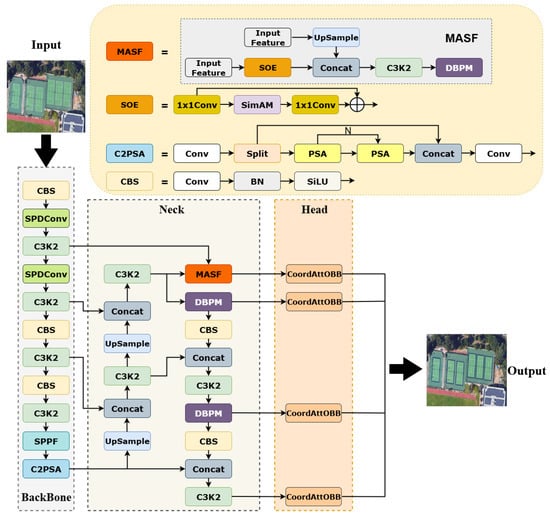
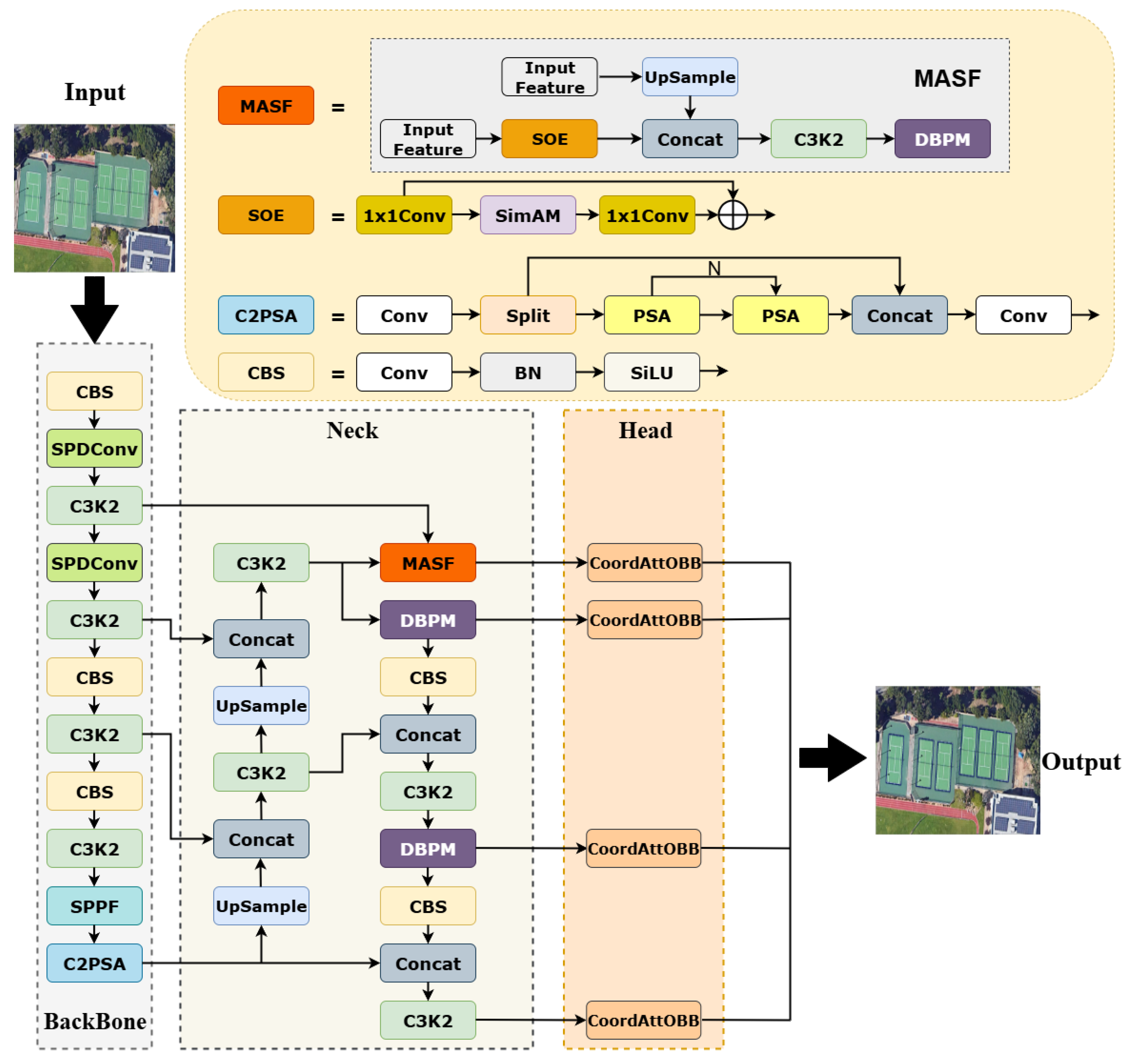
In this section, we elaborate on MDCA-YOLO in detail. First, the detection head is reconstructed by introducing an additional P2 prediction layer specifically for small-object detection; subsequently, SPDConv [34] is integrated into the backbone of YOLO11s to mitigate the loss of small objects during the downsampling process. To further enhance the detection capability of the model, we add two specifically designed modules to the neck: a Dual-Branch Perception Module, which utilizes a large receptive field and dual-branch hybrid attention to improve the long-range contextual awareness of the network and address the issue of insufficient feature representation of local convolutions in complex backgrounds; and Multi-Adaptive Selection Fusion, which is proposed to improve multi-scale feature fusion capabilities. Furthermore, an improved oriented detection head, CoordAttOBB, is utilized to ensure the model accurately detects targets across multiple scales. These innovations enable the network to better capture key feature information of objects while maintaining excellent accuracy in complex and cluttered backgrounds. Figure 1 illustrates our model structure.
Figure 1.
Overall structure of MDCA-YOLO.
2.2.2. Dual-Branch Perception Module
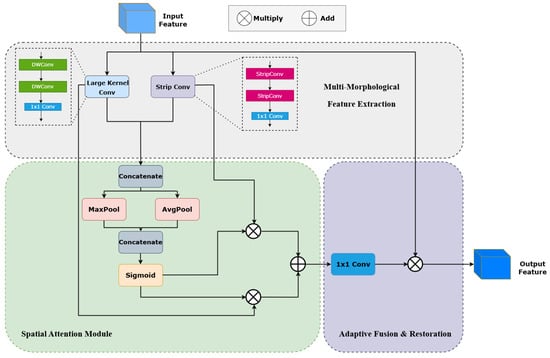
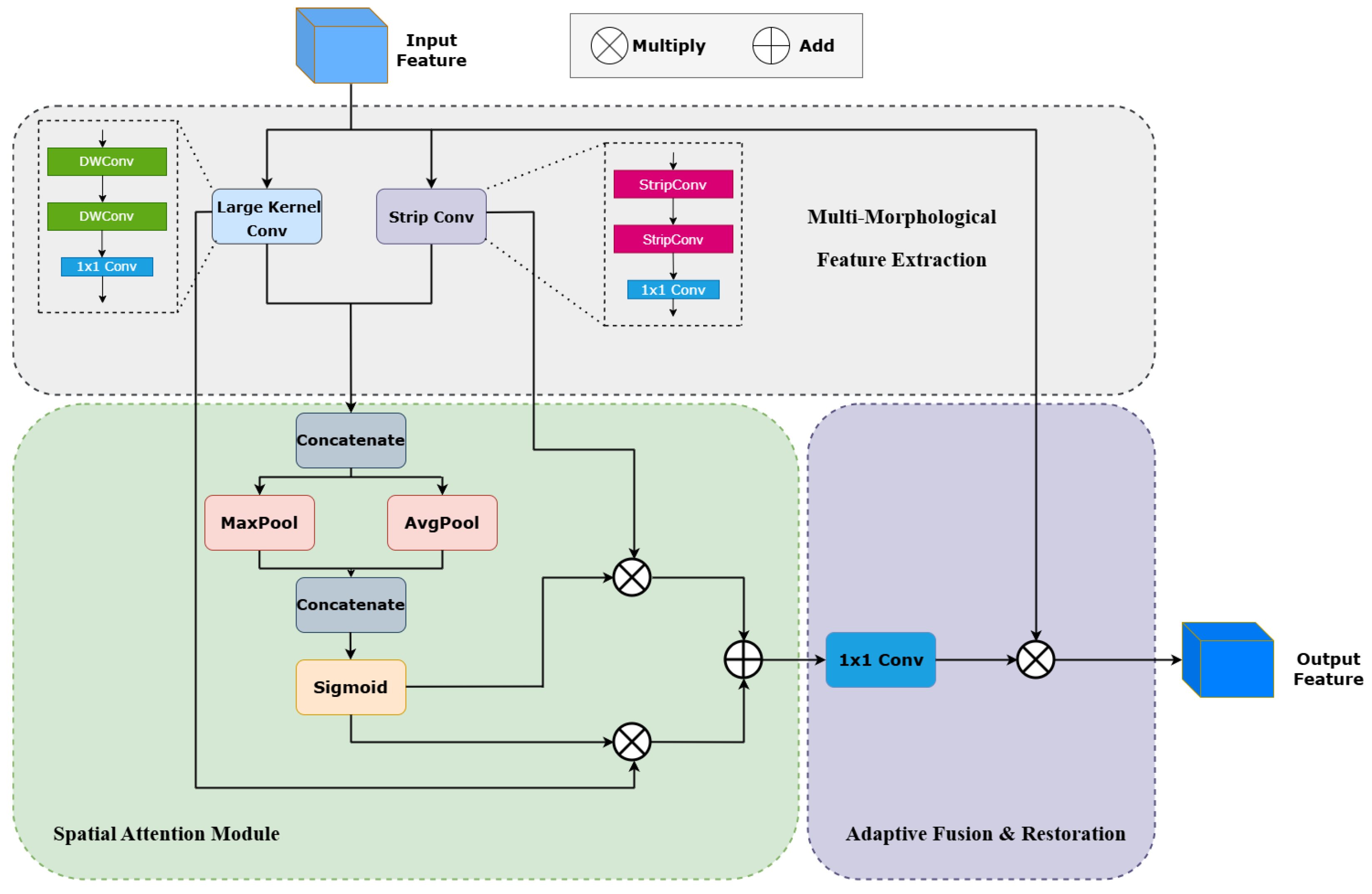
Facing the challenges of extreme scale variations and diverse aspect ratios in remote sensing imagery, traditional convolutions struggle to effectively capture complex global contextual information because of their limited receptive fields and fixed geometric shapes, often introducing irrelevant background noise when processing slender objects. For this purpose, a Dual-Branch Perception Module (DBPM) is proposed in this paper. This module leverages a parallel dual-branch structure to combine the advantages of large-kernel convolutions and StripConv, significantly enhancing the perception of complex features, and the specific structure of DBPM is illustrated in Figure 2. DBPM, through a dual-branch convolutional structure and an attention fusion mechanism, aims to enhance the model’s multi-scale perception and orientation-adaptation capabilities for oriented targets. Specifically, the input feature flow bifurcates into two parallel branches to capture diverse geometric contexts. The first branch employs large-kernel square convolutions to perceive isotropic global context, which is crucial for distinguishing small targets from complex backgrounds. The second branch adopts a strip convolution strategy, consisting of cascaded strip convolutions. From the perspective of geometric matching, this design extracts anisotropic features along specific axes, effectively avoiding background noise interference that standard square kernels introduce.
Figure 2.
Details of dual-branch perception module.
Let denote the input feature map. DBPM first decouples feature extraction into two parallel branches to capture diverse geometric contexts. The first branch employs large-kernel square convolutions to perceive isotropic global context, the second branch adopts a strip convolution strategy to capture anisotropic receptive fields for better feature extraction:
where and represent the features extracted from the square branch and the strip branch, respectively. To reduce computational overhead and promote feature interaction, convolutions project these extracted features onto a low-dimensional space, halving the number of channels:
Subsequently, a spatial selection mechanism adaptively fuses these multi-shape features. Specifically, the concatenation of projection features and enables the application of average pooling and max pooling operations to aggregate spatial statistics. A transformation function F subsequently remaps the channel number to N, and activates it through a Sigmoid function to generate fusion weights W:
Finally, the attention weights divide into and to re-weight the projection features. The fused features restore to the original channel dimension through convolution to generate the attention map A, and then element-wise multiplication with the original input yields the final output Y:
where ⊗ is utilized to denote element-wise multiplication. In remote sensing scenarios, targets like narrow roads, bridges, or slender ships possess significant geometric anisotropy. Traditional square receptive fields often incorporate excessive background noise, leading to impure feature extraction. The strip convolution decomposition mechanism in DBPM aggregates contextual features along the target’s principal axis, effectively matching physical shapes. This significantly enhances localization and boundary regression for slender, oriented targets while overcoming the limitations of square kernels. Additionally, DBPM establishes long-range spatial dependencies, embedding small targets within a global scene context. This enables the model to effectively suppress background clutter and focus on the target responses. By efficiently perceiving and enhancing multi-scale, anisotropic features at a lower computational cost, the model’s robustness in complex remote sensing scenarios is greatly improved.
2.2.3. Multi-Adaptive Selection Fusion
Feature fusion acts as a critical link in multi-scale object detection, aiming to combine high-level semantic abstractions with low-level spatial details. However, in remote sensing scenarios, simply concatenating features from different pyramid levels yields suboptimal results. The reason lies in the fact that low-level features originate from shallow networks, and they inherently contain substantial background noise and high-frequency interference. Direct concatenation operations indiscriminately propagate these noises into subsequent detection heads, causing the model to generate excessive false alarms and drown out target features.
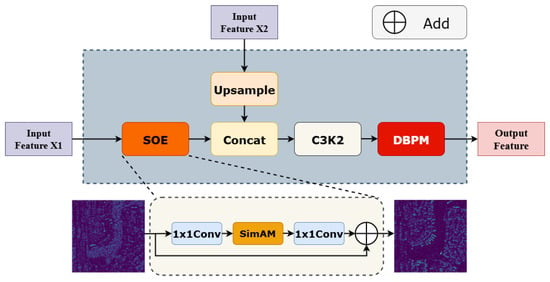
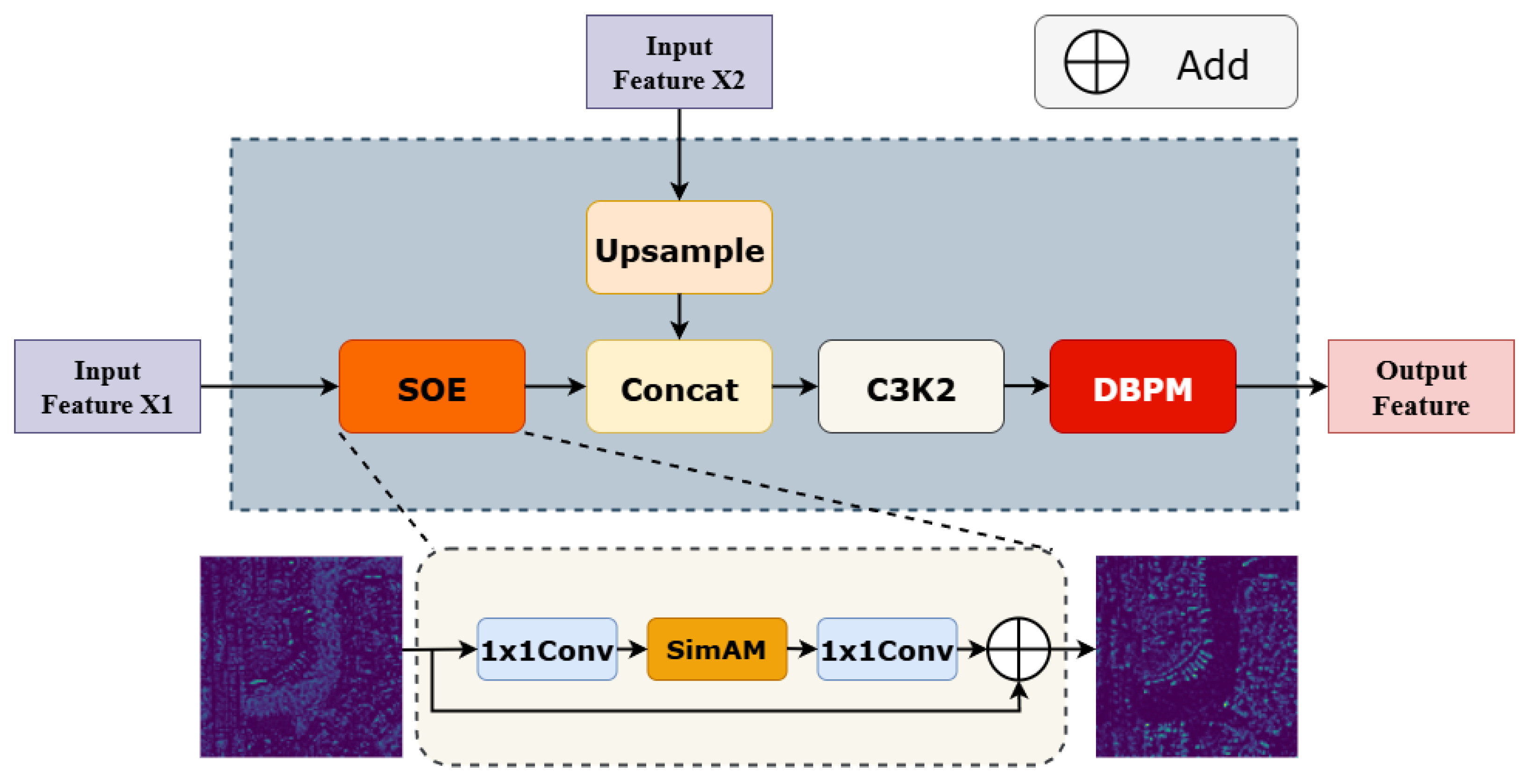
To alleviate this issue, existing methods typically employ feature enhancement modules or insert attention mechanisms prior to fusion to filter out noise. However, these approaches often incur a considerable computational burden. To resolve this dilemma, Multi-Adaptive Selection Fusion (MASF) is proposed. The SOE module within it is implemented as a feature enhancement strategy driven by a parameter-free energy function, and the structure of MASF is shown in Figure 3.
Figure 3.
Structure of MASF.
The workflow of MASF is described as follows: let represent deep semantic features and represent shallow detail features. Initially, an SOE module is designed to process . Within SOE, the core component SimAM [35] is integrated as a parameter-free attention mechanism that requires no additional weight parameters. Based on neuroscience theories, the importance of each neuron is estimated by minimizing an energy function. For a target neuron t in the input features, its energy is calculated using channel statistics as follows:
where and denote the mean and variance, respectively, and represents the regularization constant. Neurons with lower energy exhibit higher spatial heterogeneity and are therefore considered to contain more information, representing the target rather than the background. Subsequently, the attention weight W is derived through the Sigmoid activation of the inverse energy, and features are refined via a residual connection:
where ⊙ denotes element-wise multiplication. Subsequently, the deep semantic features are upsampled to match the spatial resolution of the shallow features and then fused via concatenation:
Finally, the fused features are sequentially processed by the C3K2 and DBPM modules to generate the final output:
MASF employs progressive feature fusion. Unlike parameterized mechanisms, including CAFM [36] and EMA [37] or channel-only designs like ECA [38], SimAM derives 3D spatial-channel attention weights via an energy function without learnable parameters. This zero-parameter design effectively suppresses background noise, prevents overfitting, and highlights tiny objects in cluttered remote sensing environments.
2.2.4. SPDConv
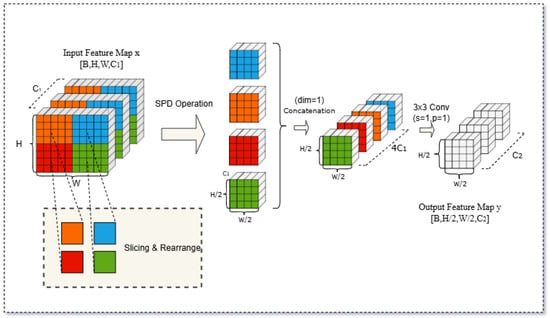
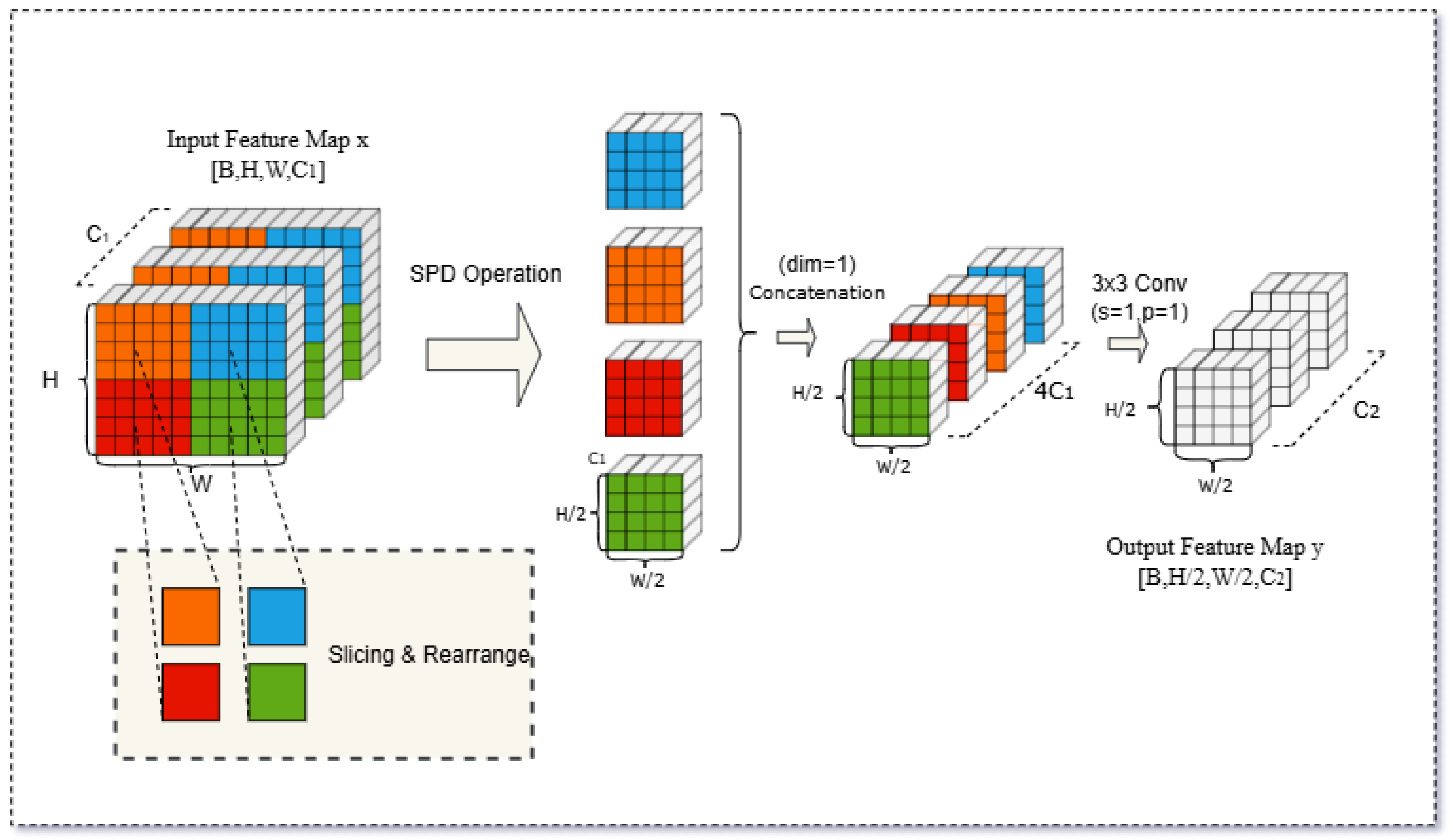
Feature preservation for minute objects represents a critical bottleneck in remote sensing detection. To overcome the severe information loss inherently caused by traditional lossy downsampling, we strategically incorporate SPDConv [34] into the shallow layers of the backbone. This ensures that the subsequent MASF module receives fully intact spatial details. As systematically illustrated in Figure 4, SPDConv entirely bypasses traditional pooling by executing a lossless space-to-depth transformation. It slices high-resolution spatial pixels and rearranges them directly into the channel dimension. Following this spatial concatenation, a 3 × 3 convolution is critically deployed as the core feature refiner. The 3 × 3 convolution aligns the concatenated channels with the target dimension and fuses the rearranged spatial semantics, thereby establishing a fundamentally lossless downsampling paradigm that maximizes the geometric integrity of minute targets.
Figure 4.
Details of SPDConv.
2.2.5. CoordAttOBB
Standard YOLO architectures relying on P3 through P5 feature maps inevitably lose the geometric details of minute targets smaller than 8 × 8 pixels during successive downsampling. To fundamentally resolve this spatial deficiency, we reconstruct the detection head by incorporating a high-resolution P2 prediction layer. By upsampling the neck features and concatenating them with shallow backbone representations, this P2 layer directly accesses uncorrupted spatial semantics. It provides the essential fine-grained boundaries required for precisely oriented object localization, thereby significantly boosting the detection accuracy for these extremely minute instances.
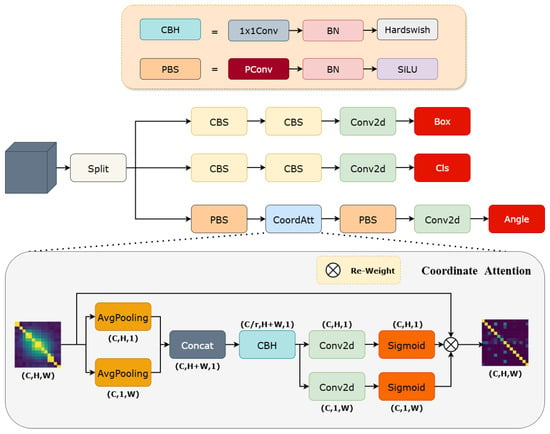
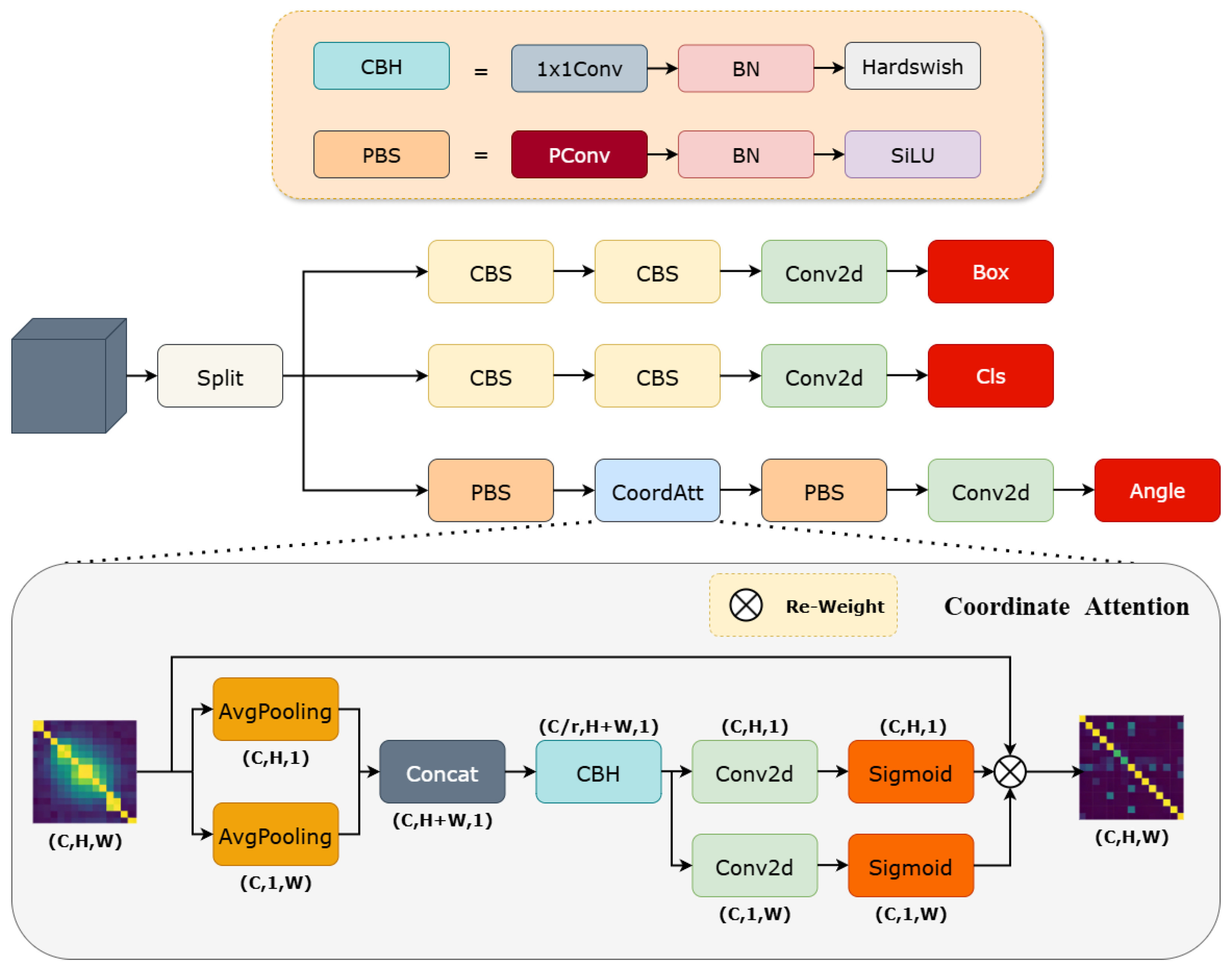
Beyond scaling, rotation estimation depends on discerning the spatial distribution of the long and short axes of an object. We therefore introduce the CoordAttOBB head, which embeds Coordinate Attention (CoordAtt) [39] and Partial Convolution (PConv) [40] into a specialized, lightweight angle branch. By conducting independent pooling along the height and width directions, Coordinate Attention captures long-range dependencies to refine directional sensitivity. To prevent feature interference, this mechanism is excluded from the classification and regression branches, serving solely as an orientation-sensitivity enhancer. This synergistic design effectively minimizes angular deviations while maintaining model compactness, as illustrated in Figure 5.
Figure 5.
Structure of CoordAttOBB.
Where the shape of is and the shape of is . is permuted to to facilitate subsequent concatenation. Subsequently, CoordAtt performs feature fusion and transformation: it concatenates the generated feature maps from both directions along the spatial dimension, compresses the channel count via the transformation function (PConv + BN), and processes the result through a Hardswish activation function to obtain the intermediate feature map:
For an input feature tensor , CoordAtt discards traditional global average pooling, which compresses positional information, and instead utilizes two 1D global pooling operations to aggregate features along the H (height) and W (width) directions, respectively. For the c-th channel, the vertical feature at height h and the horizontal feature at width w are calculated using the following formulas:
Subsequently, f is split along the spatial dimension back into two independent tensors, and , where the reduction ratio r is set to 32 in our experiments. The two split tensors are then projected back to C channels via convolution, and the Sigmoid function is applied to generate the final attention weights:
Ultimately, the attention weights from both directions are applied to the original input feature map X through multiplicative weighting:
where ⊙ denotes element-wise multiplication. CoordAtt overcomes the deficiency of positional information loss in global information aggregation, enabling the network to simultaneously capture cross-channel and direction-aware information. For rotated objects commonly found in remote sensing imagery, this sensitivity to coordinate axis information effectively assists the detection head in regressing angular parameters, thereby significantly enhancing the accuracy of oriented object detection. On this basis, to satisfy the model’s lightweight requirements, we further introduced PConv to reconstruct the feature extraction modules. By leveraging PConv to exploit channel redundancy, the model’s parameter count is successfully reduced. This synergistic design of high-precision attention and low-parameter convolution ensures that the model maintains exceptional inference efficiency while achieving precise oriented object detection.
2.3. Experimental Settings
2.3.1. Training Settings
In our experiments, we report the detection results of MDCA-YOLO on the DIOR-R and DOTAv1.0 datasets. To ensure fairness, all models were trained from scratch without the use of any pre-training strategies. All experiments were implemented using the PyTorch 2.5.1 framework with Python 3.12 on an Ubuntu 22.04 workstation equipped with two NVIDIA GeForce RTX 3090 GPUs (24 GB each) and accelerated by CUDA 12.4. The models were optimized using the SGD strategy with an initial learning rate of 0.01, a momentum of 0.937, and a weight decay of 0.0005, with a total batch size of 16 and a training duration of 200 epochs across all datasets. We adopted a size of 640 × 640 for the DOTAv1.0 dataset to balance training efficiency and detection accuracy, whereas a size of 800 × 800 was utilized for DIOR-R datasets to better capture fine-grained features of slender or complex targets. Table 1 lists the detailed hardware configurations.
Table 1.
Experimental hardware environment.
2.3.2. Evaluation Metrics
To comprehensively verify the detection performance and efficiency of the proposed MDCA-YOLO model, this experiment employs Precision (P), Recall (R), Average Precision (AP), and Mean Average Precision (mAP) as the primary accuracy metrics, while Parameters are used to evaluate model complexity. Precision measures the proportion of correctly predicted positive instances among all positive predictions, and Recall calculates the proportion of correctly identified positive instances from the ground truth, which are mathematically defined as
where TP, FP, and FN represent the number of True Positives, False Positives, and False Negatives, respectively. Based on the Precision–Recall (P-R) curve, Average Precision (AP) represents the area under the curve for a specific category:
To assess the overall performance across the entire dataset, Mean Average Precision (mAP) is calculated by averaging the AP values of all N categories using the formula:
Specifically, we report two key standards: mAP50, which denotes the mean average precision at a single Intersection over Union (IoU) threshold of 0.5, and mAP50:95, which averages the mAP values calculated at IoU thresholds ranging from 0.5 to 0.95 with a step size of 0.05; higher mAP values indicate superior detection accuracy and localization capability, particularly for the challenging oriented objects in remote sensing images.
3. Experimental Results and Analysis
3.1. Comparison with YOLO11s
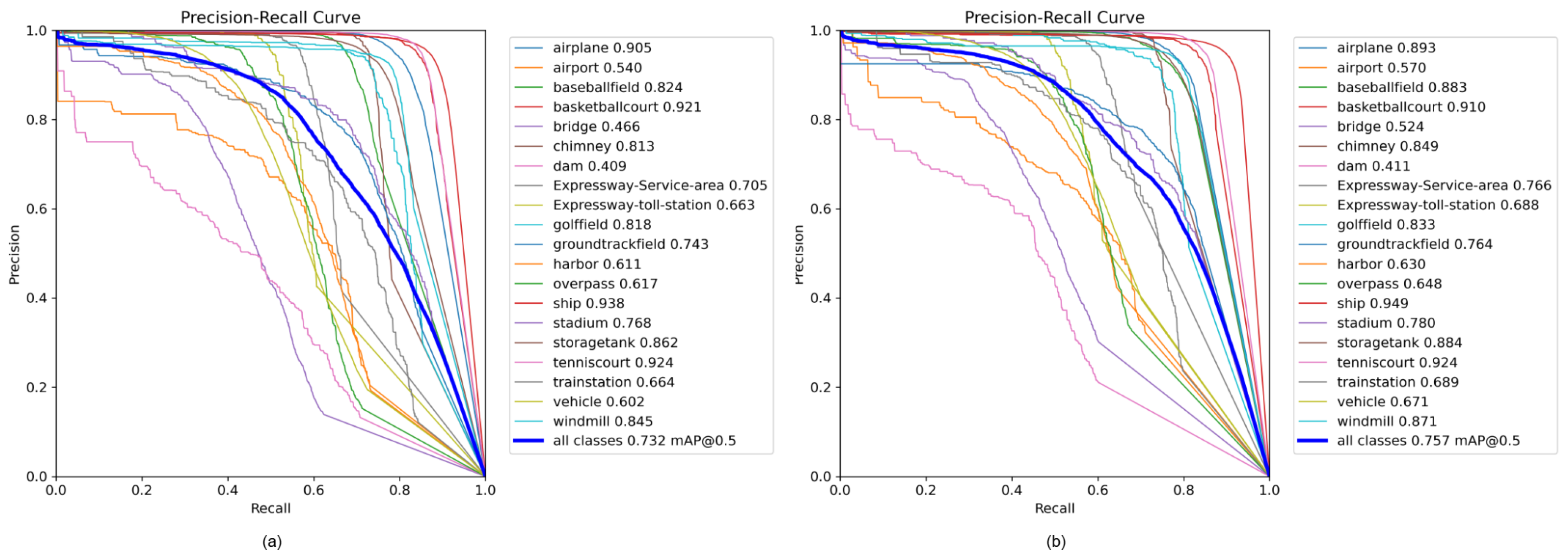
We first trained both YOLO11s and MDCA-YOLO on the DIOR-R dataset and conducted a detailed comparison of the experimental results to demonstrate the superiority of MDCA-YOLO in remote-sensing-oriented object detection. The specific results are presented in Table 2 and Table 3. Observations on the DIOR-R dataset indicate that precision improved from 0.824 to 0.835, suggesting a higher proportion of true positives among the predicted samples, which enhances the reliability of the results. The recall increased from 0.652 to 0.664, signifying that the model can identify more actual targets while reducing missed detections. Notably, mAP50 improved from 0.732 to 0.757, and mAP50:95 rose from 0.562 to 0.589, with specific results illustrated in Figure 6. This phenomenon demonstrates that MDCA-YOLO is not only more accurate in target classification but also exhibits stronger robustness in bounding box regression quality.
Table 2.
The DIOR-R dataset results of MDCA-YOLO and YOLO11s (C01: Airplane, C02: Airport, C03: Baseball Diamond, C04: Basketball Court, C05: Bridge, C06: Chimney, C07: Dam, C08: Expressway ServiceArea, C09: Expressway Toll Station, C10: Harbor).
Table 3.
The DIOR-R dataset results of MDCA-YOLO and YOLO11s (C11: Golf Field, C12: Ground Track Field, C13: Overpass, C14: Ship, C15: Stadium, C16: Storage Tank, C17: Tennis Court, C18: Train Station, C19: Vehicle, C20: Windmill).
Figure 6.
Comparison of mAP between YOLO11s and MDCA-YOLO: (a) YOLO11s; (b) MDCA-YOLO.
Compared to the baseline YOLO11s, MDCA-YOLO achieved a 2.1% increase in the mAP50 metric for the Ship category. More significantly, for the highly challenging Vehicle category—a representative small object class—accuracy leaped from 0.602 to 0.671. The breakthrough in this key metric strongly validates the model’s robustness in processing small and densely arranged targets.
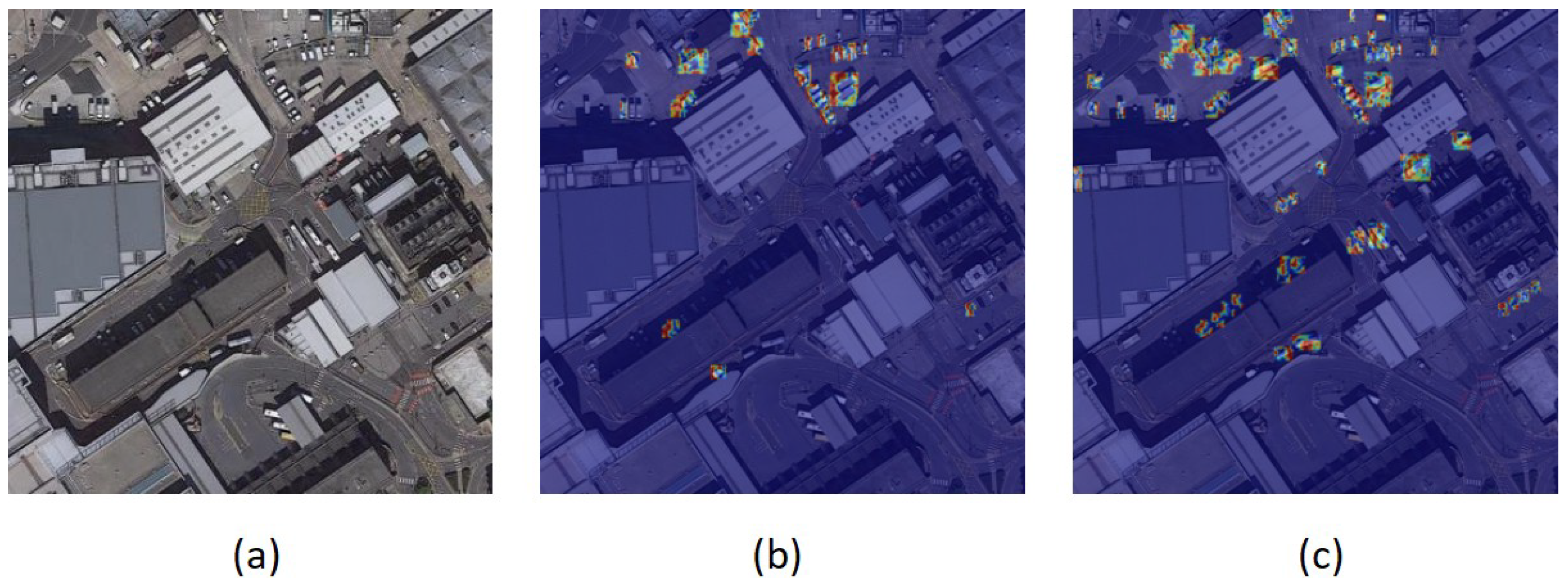
We provide a visual comparison of attention heatmaps for YOLO11s before and after incorporating the DBPM, as shown in Figure 7. It is observable that in complex remote sensing scenarios, the baseline model exhibits a relatively weak perception of small objects, with scattered feature response points that partly fall in non-target background areas. In contrast, the model with DBPM displays powerful feature focusing capabilities; even under interference from dense building clusters, the heatmap distribution precisely covers the small target entities. This indicates that DBPM significantly amplifies the feature gain of small targets, leading to more accurate detection and regression.
Figure 7.
Comparison of target attention heatmaps in remote sensing imagery: (a) original remote sensing image; (b) heatmap visualization results generated by the baseline YOLO11s model on target samples from the DIOR-R dataset; (c) heatmap effect after integrating the DBPM into the YOLO11s baseline model.
To further demonstrate the superiority of MDCA-YOLO in remote-sensing-oriented object detection, we also conducted training on the DOTAv1.0 dataset and performed a detailed comparison of the experimental results, as shown in Table 4 and Table 5. It can be observed that, compared to the YOLO11s baseline, MDCA-YOLO improves precision from 0.772 to 0.799, indicating a significant reduction in the false-positive rate. The recall increased from 0.686 to 0.702, while mAP50 and mAP50:95 were enhanced by 1.4% and 1.6%, respectively. Facing the dense, small objects widely present in the DOTA dataset, MDCA-YOLO effectively strengthens the feature representation capability for small targets and recovers edge targets that are typically missed by the baseline model.
Table 4.
The DOTAv1.0 dataset results of MDCA-YOLO and YOLO11s (C01: plane, C02: ship, C03:storage tank, C04:baseball diamond, C05:tennis court, C06: basketball court, C07: ground track field, C08:harbor, C09:bridge, C10:large vehicle).
Table 5.
The DOTAv1.0 dataset results of MDCA-YOLO and YOLO11s(C11:small vehicle, C12: helicopter, C13:roundabout, C14:soccer ball field, C15:swimming pool).
3.2. Ablation Study
This paper adopts YOLO11s as the baseline model with several improvements. To illustrate the impact of these improvements, ablation experiments were first conducted on the DIOR-R dataset, with detailed results in Table 6. Method A added a P2 detection head, though Recall fluctuated slightly, mAP50 increased from 0.732 to 0.737, and mAP50:95 improved by 0.9% with a minor increase in parameters. Method B(DBPM) integrates the DBPM module into Method A, with only 0.1 M additional parameters but comprehensive accuracy improvements: mAP50 up by 0.7%, mAP50:95 by 0.8%, and Recall restored to 65.4%. This proves that DBPM establishes a global receptive field via large-kernel and strip convolutions, boosting multi-scale and large-aspect-ratio target capture with low computational cost. As shown in Table 6, introducing the MASF module in Method C improves mAP50 by 0.9% to 75.3% and mAP50:95 by 0.5% with minimal parameter overhead. Furthermore, the attention mechanism ablation study in Table 7 validates this internal design. Unlike parameterized mechanisms, including CAFM and EMA, or channel-only designs like ECA, the embedded SimAM utilizes an energy function to derive 3D attention weights without adding any parameters itself. This optimal configuration effectively suppresses background noise and optimizes multi-scale feature fusion. Method D(SPDConv) introduces lossless downsampling; despite more parameters, Recall climbs from 65.9% to 66.3%, mAP50 reaches 75.6%, reducing fine-grained information loss. Method E(CoordAttOBB) reconstructs the detection head’s angle prediction branch using Coordinate Attention and PConv, pushing mAP50:95 to 58.9%.
Table 6.
Ablation experiment on the DIOR-R dataset.
Table 7.
Comparison of different attention mechanisms on the baseline model.
To investigate the internal structure of the DBPM, we conduct an ablation study in Table 8. Starting with a baseline that includes only the Spatial Attention Module (SAM), we progressively introduce Large Kernel Convolution (LKC) and Strip Convolution (SC). The SAM serves as the baseline for feature filtering. Adding LKC expands the receptive field, allowing for broader contextual information capture, which improves the mAP50 score with minimal parameter increase. Incorporating SC then captures elongated directional features of targets like ships and bridges, further boosting the mAP50:95 metric. The complete configuration achieves the highest mAP50 of 0.742 and mAP50:95 of 0.571, with only a 0.2 M parameter increase and 0.8 G FLOPs overhead. This indicates that our proposed architecture strikes a strong balance between performance and computational cost, offering robust semantic discrimination while remaining lightweight.
Table 8.
Ablation study on the internal components of the Dual Branch Perception Module.
To further verify the generalization validity of the designed modules across different remote sensing scenarios, we conducted parallel ablation experiments on the DOTAv1.0 dataset, with the results summarized in Table 9. Ultimately, compared to the baseline, the proposed MDCA-YOLO achieves improvements of 2.5% and 2.7% in mAP50 and mAP50:95 on the DIOR-R dataset, alongside respective increases of 1.4% and 1.6% on the DOTAv1.0 dataset.
Table 9.
Ablation experiment on the DOTAv1.0 dataset.
3.3. Comparative Results
We initially conducted comparative experiments on the DIOR-R dataset to comprehensively validate the architectural superiority of MDCA-YOLO. This was achieved by benchmarking MDCA-YOLO against several state-of-the-art models, including YOLOv8s, YOLOv8m, the latest YOLO12s, as well as SkySens and MTP. The specific quantitative comparison results are presented in Table 10. To facilitate an intuitive evaluation, we purposefully selected three highly representative remote sensing categories—ships, vehicles, and storage tanks—for in-depth analysis. In terms of overall performance metrics, MDCA-YOLO demonstrates clear superiority. Specifically, MDCA-YOLO achieved an exceptional average precision of 0.757. Notably, in the challenging and dense vehicle category, the precision of MDCA-YOLO increased to 0.671, significantly outpacing competing mainstream algorithms. This breakthrough improvement can be directly attributed to our meticulously designed Dual Branch Perception Module. By processing macroscopic global context and microscopic local details in parallel, this module greatly enhances the network’s ability to capture weak features. For minute targets with extremely low pixel proportions and dense configurations, such as vehicles, the Dual Branch Perception Module effectively prevents the loss of spatial information during the downsampling process in deep networks, thus significantly reducing the missed-detection rate.
Table 10.
Detection results of different models on the DIOR-R dataset. ‘ ’ indicates data not available. Bold numbers denote the best results. SH = Ship, VE = Vehicle, ST = Storage Tank.
Compared to the baseline YOLO11s model, MDCA-YOLO demonstrated a steady increase in average precision, clearly highlighting its advantage in feature extraction for small targets. Furthermore, even when compared to larger parameter architectures, such as SkySens and the MTP models, MDCA-YOLO achieved superior overall performance despite a significant reduction in parameter scale.
To further assess the generalization effectiveness of our model in more complex scenarios, we conducted additional comparative experiments on the DOTAv1.0 dataset, with the detailed results summarized in Table 11. On this benchmark, MDCA-YOLO continued to maintain a substantial competitive edge, achieving an impressive average precision of 0.781, surpassing advanced models such as LSKNet and YOLO12s. A detailed analysis of category-specific performances reveals that MDCA-YOLO achieved the best detection results across several highly challenging categories, including bridges, ships, swimming pools, and helicopters.
Table 11.
Detection results of different models on the DOTAv1.0 dataset. ‘’ indicates data not available. (Plane (PL), Baseball diamond (BD), Bridge (BR), Ground track field (GTF), Small vehicle (SV), Large vehicle (LV), Ship (SH), Tennis court (TC), Basketball court (BC), Storage tank (ST), Soccer-ball field (SBF), Roundabout (RA), Harbor (HA), Swimming pool (SP), and Helicopter (HC)).
’ indicates data not available. (Plane (PL), Baseball diamond (BD), Bridge (BR), Ground track field (GTF), Small vehicle (SV), Large vehicle (LV), Ship (SH), Tennis court (TC), Basketball court (BC), Storage tank (ST), Soccer-ball field (SBF), Roundabout (RA), Harbor (HA), Swimming pool (SP), and Helicopter (HC)).
This comprehensive performance leadership underscores the powerful synergy of our core components. The Multi Adaptive Selection Fusion mechanism intelligently allocates feature weights across scales, demonstrating exceptional background noise suppression and semantic purification for easily confused categories like bridges and swimming pools. Concurrently, for highly directional targets like ships and helicopters, the reconstructed CoordAttOBB head aggregates horizontal and vertical long-range dependencies. This maximizes spatial-axis sensitivity, enabling rotation-angle regression. These results definitively prove the superiority of our customized architecture in semantic discrimination and precise localization, especially under extreme scale variations and complex texture interference.
Finally, to comprehensively and objectively assess the real-time engineering deployment value of the proposed method, we conducted a multi-dimensional cross-comparison of the model complexity and inference efficiency of different detectors. The specific quantitative metrics are summarized in Table 12. MDCA-YOLO has 10.3 M parameters and 32.9 GFLOPs, which are slightly higher than those of the extremely lightweight baseline models, YOLO11s. However, compared to YOLOv8m and YOLO11m, MDCA-YOLO achieves a higher average precision of 0.781 with less than half of their parameter size and computational cost. This set of detailed quantitative data unequivocally demonstrates that the proposed MDCA-YOLO strikes the perfect balance between cutting-edge remote sensing detection accuracy and excellent practical deployment efficiency.
Table 12.
Comprehensive performance and efficiency comparison of different detectors (highest performance is highlighted in bold).
3.4. Visualization
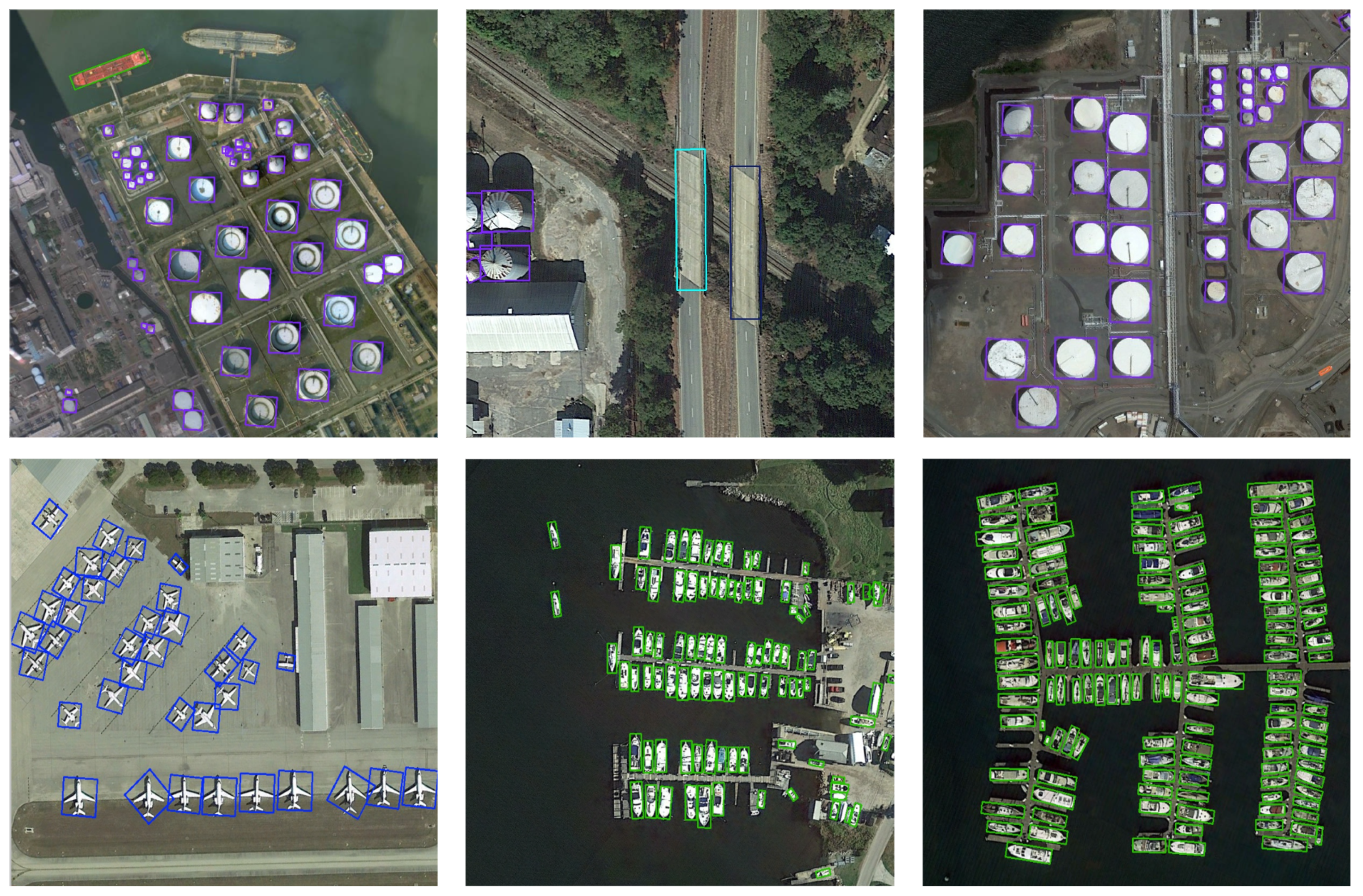
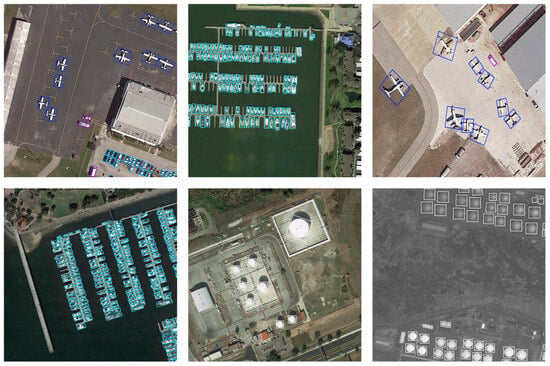
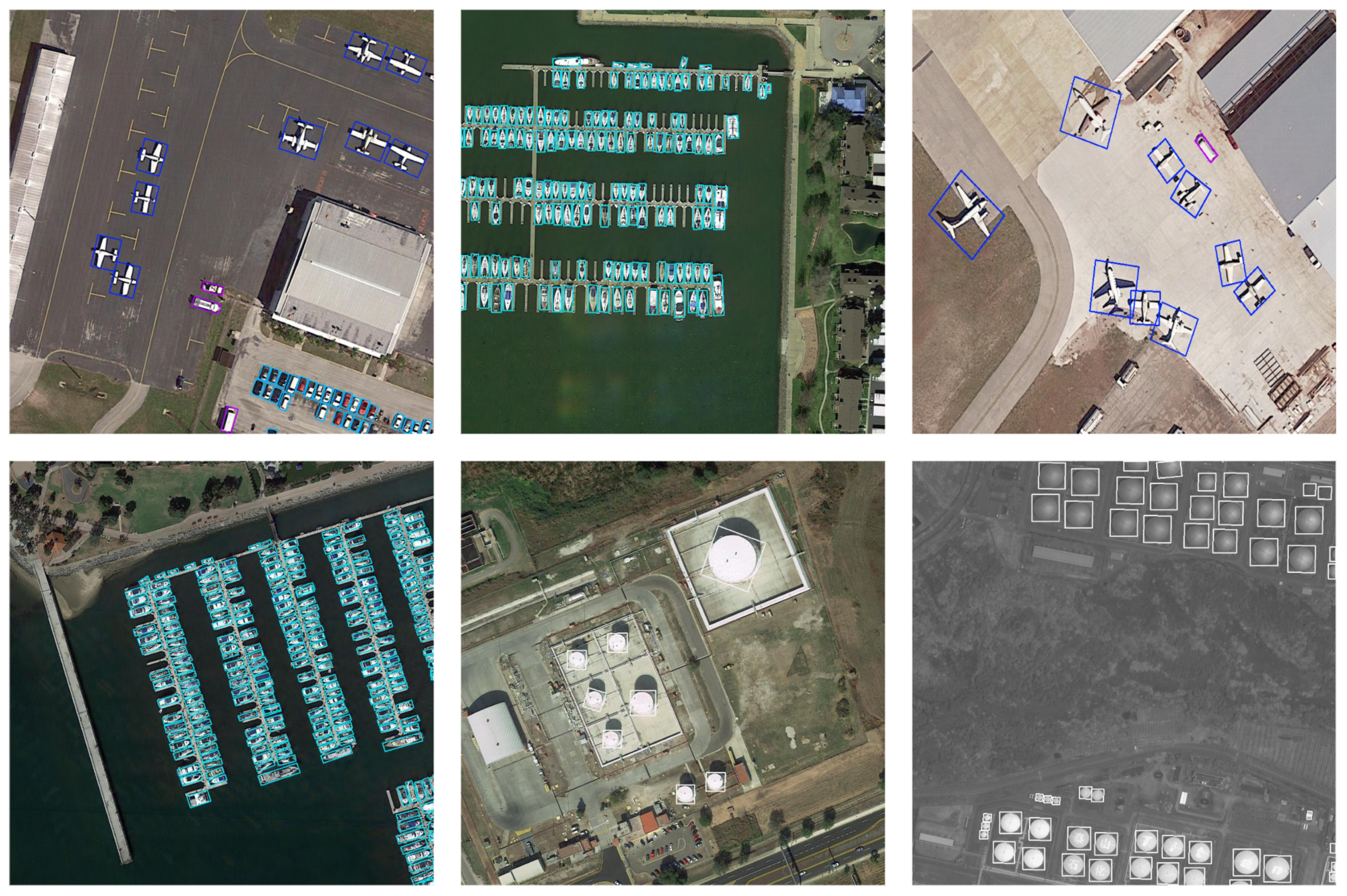
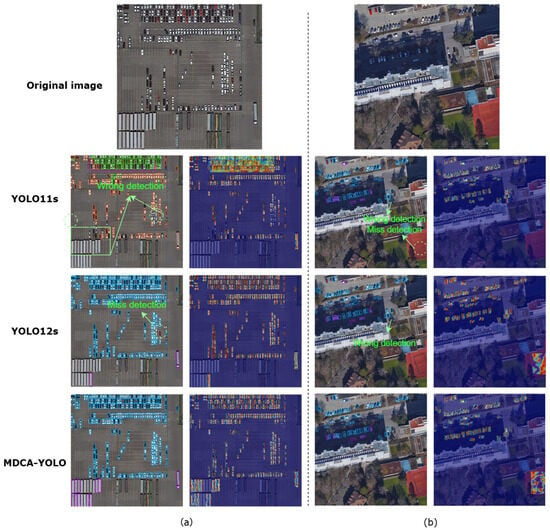
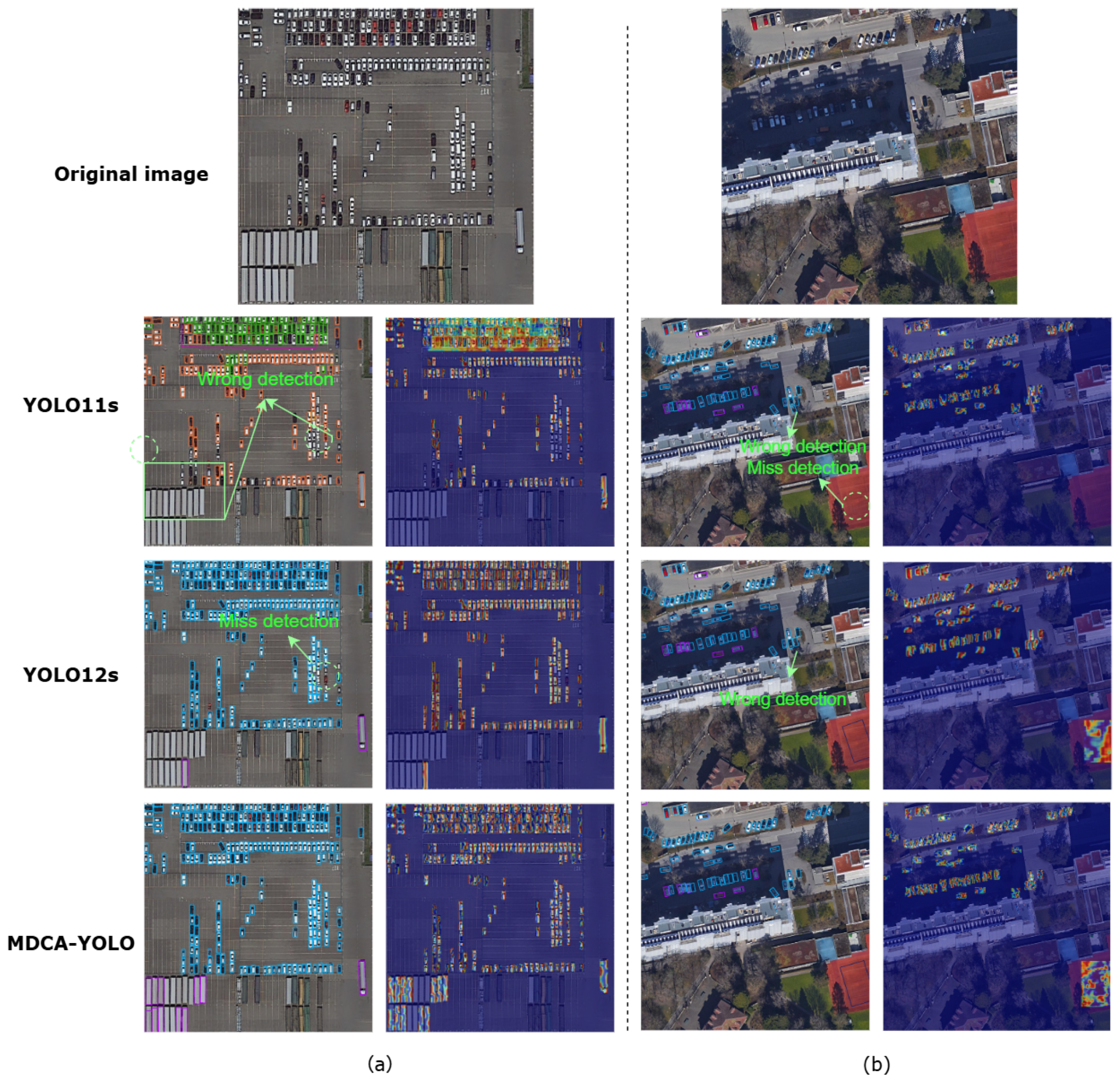
To qualitatively verify the quantitative evaluations, this section conducts a comprehensive visual analysis. Figure 8 presents the DIOR-R dataset results. Benefiting from the CoordAttOBB head, MDCA-YOLO accurately captures spatial axes to output highly compact oriented bounding boxes, successfully segregating densely arranged targets where traditional paradigms suffer from severe overlap. Furthermore, Figure 9 validates the generalization of our model on the DOTAv1.0 dataset, maintaining highly discriminative feature representations and superior detection accuracy under adverse illumination or low-contrast environments. Finally, Figure 10 compares predicted bounding boxes and deep feature heatmaps against YOLO11s and YOLO12s baselines, explicitly proving the interpretability and robustness of MDCA-YOLO under severe environmental conditions.
Figure 8.
Examples detection results of MDCA-YOLO on the DIOR-R dataset.
Figure 9.
Detection results of MDCA-YOLO on the DOTAv1.0 dataset.
Figure 10.
Comparison of detection results of different models on the DOTA dataset. (a) Dense regions of tiny objects; (b) low-light and shadow-occluded regions.
On the left side of Figure 10, in the extremely small and densely packed target regions, where the pixel proportion of the targets is very low, and the spatial crowding is severe, the baseline model YOLO11s suffers from significant feature confusion, leading to considerable false positives and missed detections. While YOLO12s alleviates some of the false detection issues, it still fails to avoid missing some of the tiny targets. In stark contrast, MDCA-YOLO exhibits zero missed detections, accurately capturing all the tiny vehicles. The adjacent feature heatmap clearly reveals the underlying physical mechanisms behind this performance leap. Unlike the dispersed and weak responses shown by the baseline models, MDCA-YOLO generates highly concentrated and intense activation peaks on these extremely small targets. This strong visual evidence directly demonstrates that our Dual Branch Perception Module effectively captures faint local features in the deeper layers of the network, preventing the loss of spatial information for small targets.
On the right side of Figure 10, which presents extreme scenes characterized by low light and severe shadow occlusion, the baseline models expose a fatal weakness in semantic discrimination. Both YOLO11s and YOLO12s mistakenly classify building shadows and complex background clutter as valid targets, leading to clear false positives. Additionally, they completely miss real targets that are obscured by shadows. In contrast, MDCA-YOLO demonstrates remarkable environmental robustness, effectively filtering out background noise and accurately bounding the real targets. The corresponding heatmap further confirms this superiority. MDCA-YOLO significantly suppresses activation responses in non-target areas and shadowed regions while maintaining a sharp semantic focus on the actual targets. This directly and convincingly validates our model’s outstanding ability in background noise suppression and feature purification under extreme environmental interference.
4. Discussion
The MDCA-YOLO model is introduced in this study to address critical remote sensing challenges, including expansive fields of view, intricate backgrounds, and high-density small-object clusters. Extensive experiments on the DIOR-R and DOTAv1.0 datasets demonstrate the robustness and generalization advantages of MDCA-YOLO in processing complex backgrounds and densely packed remote sensing scenarios. The Dual-Branch Perception Module (DBPM) establishes long-range contextual dependencies across broad backgrounds through the synergy of large-kernel and strip convolutions, enabling the model to focus precisely on the target itself rather than the surrounding background noise. Simultaneously, the MASF module plays a critical role in suppressing high-frequency background interference by employing adaptive feature filtering, it effectively inhibits background clutter and amplifies weak target signals during the fusion stage. Regarding angle regression, we reconstructed the detection head using Coordinate Attention and PConv, which strengthens spatial orientation encoding and significantly optimizes the accuracy of oriented bounding box regression. Compared to existing state-of-the-art methods, MDCA-YOLO achieves a superior performance balance, making it uniquely suited for the rigorous requirements of remote sensing object detection.
Despite achieving superior performance, MDCA-YOLO exhibits specific limitations in extreme remote sensing scenarios. In terms of ultra-small targets with minimal pixel occupancy, the network faces inherent feature vanishing risks during deep forward propagation. In ultra-dense target distributions, severe boundary coupling can occasionally cause post-processing algorithms to mistakenly suppress valid adjacent targets. Furthermore, when processing low-resolution imagery, the degradation of texture details impairs the orientation sensitivity of the detection head, thereby affecting angular regression accuracy. Additionally, these structural refinements introduce a marginal computational overhead increment compared to the baseline model. To address these deficiencies, our future research will focus on developing dynamic label assignment strategies for congested scenes and exploring super-resolution feature reconstruction modules. Simultaneously, we will investigate advanced model compression techniques, including knowledge distillation and lightweight feature extraction networks, to further enhance inference speed on embedded edge devices while maintaining exceptional detection accuracy.
5. Conclusions
This paper proposes MDCA-YOLO, an oriented object detection network specifically tailored for remote sensing imagery, designed to address the inherent challenges of target detection in complex backgrounds. The proposed DBPM significantly enhances the model’s ability to perceive multi-morphic targets by integrating isotropic and anisotropic receptive fields. Simultaneously, the MASF module effectively suppresses interference from complex background noise, while CoordAttOBB provides critical assistance in angle regression, thereby improving orientation accuracy. Experimental results on two large-scale remote sensing datasets, DIOR-R and DOTAv1.0, demonstrate that MDCA-YOLO comprehensively outperforms the YOLO11s baseline in detection precision, exhibiting superior robustness in scenarios involving dense small objects and complex backgrounds. Moving forward, future research will prioritize further lightweighting the model architecture to achieve efficient edge deployment. Specifically, we plan to employ advanced model compression techniques to deploy the algorithm directly on embedded devices of Unmanned Aerial Vehicles. This edge deployment will subsequently enable deep integration with practical dynamic remote-sensing monitoring scenarios, providing a highly responsive and real-time detection solution for tracking moving targets in continuous earth observation missions.
Author Contributions
Conceptualization, Q.W. and W.S.; methodology, W.S.; validation, W.S.; formal analysis, Q.W. and W.S.; writing—original draft, W.S.; writing—review and editing, Q.W. and W.S.; visualization, W.S.; supervision, Q.W. All authors have read and agreed to the published version of the manuscript.
Funding
This research is funded by Postgraduate Research & Practice Innovation Program of Jiangsu Province (SJCX25_0525).
Data Availability Statement
The original contributions presented in this study are included in the article. Further inquiries can be directed to the corresponding author. The data sources are accessible at: https://github.com/YUXMGD/DIOR-R-dataset and https://github.com/scozn/DOTAv1.0 (both accessed on 25 January 2026).
Conflicts of Interest
The authors declare no conflicts of interest.
References
- Wellmann, T.; Lausch, A.; Andersson, E.; Knapp, S.; Cortinovis, C.; Jache, J.; Scheuer, S.; Kremer, P.; Mascarenhas, A.; Kraemer, R.; et al. Remote sensing in urban planning: Contributions towards ecologically sound policies? Landsc. Urban Plan. 2020, 204, 103921. [Google Scholar] [CrossRef] [Scilit]
- Xia, G.S.; Bai, X.; Ding, J.; Zhu, Z.; Belongie, S.; Luo, J.; Datcu, M.; Pelillo, M.; Zhang, L. DOTA: A Large-scale Dataset for Object Detection in Aerial Images. In Proceedings of the IEEE Conference on Computer Vision and Pattern Recognition (CVPR), Salt Lake City, UT, USA, 18–22 June 2018; pp. 3974–3983. [Google Scholar]
- Li, K.; Wan, G.; Cheng, G.; Meng, L.; Han, J. Object detection in optical remote sensing images: A survey and a new benchmark. ISPRS J. Photogramm. Remote Sens. 2020, 159, 296–307. [Google Scholar] [CrossRef] [Scilit]
- Li, Z.; Liu, F.; Yang, W.; Peng, S.; Zhou, J. A survey of convolutional neural networks: Analysis, applications, and prospects. IEEE Trans. Neural Netw. Learn. Syst. 2021, 33, 6999–7019. [Google Scholar] [CrossRef] [Scilit] [PubMed]
- Shi, T.; Gong, J.; Hu, J.; Zhi, X.; Zhang, W.; Zhang, Y.; Zhang, P.; Bao, G. Feature-enhanced CenterNet for small object detection in remote sensing images. Remote Sens. 2022, 14, 5488. [Google Scholar] [CrossRef] [Scilit]
- Dosovitskiy, A.; Beyer, L.; Kolesnikov, A.; Weissenborn, D.; Zhai, X.; Unterthiner, T.; Dehghani, M.; Minderer, M.; Heigold, G.; Gelly, S.; et al. An image is worth 16 × 16 words: Transformers for image recognition at scale. arXiv 2020, arXiv:2010.11929. [Google Scholar]
- Zhu, Z.; Gao, Z.; Zhuang, J.; Huang, D.; Huang, G.; Wang, H.; Pei, J.; Zheng, J.; Liu, C. MSMT-RTDETR: A Multi-Scale Model for Detecting Maize Tassels in UAV Images with Complex Field Backgrounds. Agriculture 2025, 15, 1653. [Google Scholar] [CrossRef] [Scilit]
- Jing, Y.; Ren, Y.; Liu, Y.; Wang, D.; Yu, L. Automatic extraction of damaged houses by earthquake based on improved YOLOv5: A case study in Yangbi. Remote Sens. 2022, 14, 382. [Google Scholar] [CrossRef] [Scilit]
- Ding, J.; Xue, N.; Long, Y.; Xia, G.S.; Lu, Q. Learning RoI Transformer for Oriented Object Detection in Aerial Images. In Proceedings of the IEEE/CVF Conference on Computer Vision and Pattern Recognition (CVPR), Long Beach, CA, USA, 16–20 June 2019; pp. 2849–2858. [Google Scholar]
- Han, J.; Ding, J.; Li, J.; Xia, G.S. Align deep features for oriented object detection. IEEE Trans. Geosci. Remote Sens. 2021, 60, 5602511. [Google Scholar] [CrossRef] [Scilit]
- Dai, L.; Liu, H.; Tang, H.; Wu, Z.; Song, P. AO2-DETR: Arbitrary-Oriented Object Detection Transformer. IEEE Trans. Circuits Syst. Video Technol. 2023, 33, 2342–2356. [Google Scholar] [CrossRef] [Scilit]
- Girshick, R.; Donahue, J.; Darrell, T.; Malik, J. Rich feature hierarchies for accurate object detection and semantic segmentation. In Proceedings of the IEEE Conference on Computer Vision and Pattern Recognition (CVPR), Columbus, OH, USA, 23–28 June 2014; pp. 580–587. [Google Scholar]
- Girshick, R. Fast R-CNN. In Proceedings of the IEEE International Conference on Computer Vision (ICCV), Santiago, Chile, 7–13 December 2015; pp. 1440–1448. [Google Scholar]
- He, K.; Zhang, X.; Ren, S.; Sun, J. Spatial pyramid pooling in deep convolutional networks for visual recognition. IEEE Trans. Pattern Anal. Mach. Intell. 2015, 37, 1904–1916. [Google Scholar] [CrossRef] [Scilit]
- Cai, Z.; Vasconcelos, N. Cascade R-CNN: Delving into High Quality Object Detection. In Proceedings of the IEEE Conference on Computer Vision and Pattern Recognition (CVPR), Salt Lake City, UT, USA, 18–22 June 2018; pp. 6154–6162. [Google Scholar]
- Jian, L.; Pu, Z.; Zhu, L.; Yao, T.; Liang, X. SS R-CNN: Self-Supervised learning improving mask R-CNN for ship detection in remote sensing images. Remote Sens. 2022, 14, 4383. [Google Scholar] [CrossRef] [Scilit]
- Redmon, J.; Divvala, S.; Girshick, R.; Farhadi, A. You Only Look Once: Unified, Real-Time Object Detection. In Proceedings of the IEEE Conference on Computer Vision and Pattern Recognition (CVPR), Las Vegas, NV, USA, 26 June–1 July 2016; pp. 779–788. [Google Scholar]
- Liu, W.; Anguelov, D.; Erhan, D.; Szegedy, C.; Reed, S.; Fu, C.Y.; Berg, A.C. SSD: Single Shot MultiBox Detector. In Proceedings of the European Conference on Computer Vision (ECCV), Amsterdam, The Netherlands, 11–14 October 2016; pp. 21–37. [Google Scholar]
- Jocher, G.; Qiu, J.; Chaurasia, A. Ultralytics YOLO. Available online: https://docs.ultralytics.com/zh/models/yolov5/ (accessed on 10 January 2026).
- Wang, C.Y.; Liao, H.Y.M.; Wu, Y.H.; Chen, P.Y.; Hsieh, J.W.; Yeh, I.H. CSPNet: A New Backbone that can Enhance Learning Capability of CNN. In Proceedings of the IEEE/CVF Conference on Computer Vision and Pattern Recognition Workshops (CVPRW), Seattle, WA, USA, 14–19 June 2020; pp. 390–391. [Google Scholar]
- Huang, D.; Chen, Z.; Zhuang, J.; Song, G.; Huang, H.; Li, F.; Huang, G.; Liu, C. DRPU-YOLO11: A Multi-Scale Model for Detecting Rice Panicles in UAV Images with Complex Infield Background. Agriculture 2026, 16, 234. [Google Scholar] [CrossRef] [Scilit]
- Qi, G.; Zhang, Y.; Wang, K.; Mazur, N.; Liu, Y.; Malaviya, D. Small object detection method based on adaptive spatial parallel convolution and fast multi-scale fusion. Remote Sens. 2022, 14, 420. [Google Scholar] [CrossRef] [Scilit]
- Jocher, G.; Qiu, J.; Chaurasia, A. Ultralytics YOLO. Available online: https://docs.ultralytics.com/zh/models/yolov8/ (accessed on 10 January 2026).
- Jocher, G.; Qiu, J.; Chaurasia, A. Ultralytics YOLO. Available online: https://docs.ultralytics.com/zh/models/yolo11/ (accessed on 10 January 2026).
- Sun, L.; Dong, J.; Tang, J.; Pan, J. Spatially-adaptive feature modulation for efficient image super-resolution. In Proceedings of the IEEE/CVF International Conference on Computer Vision (ICCV), Paris, France, 2–6 October 2023; pp. 13190–13199. [Google Scholar]
- Yang, X.; Yan, J.; Feng, Z.; He, T. R3Det: Refined Single-Stage Detector with Feature Refinement for Rotating Object. In Proceedings of the AAAI Conference on Artificial Intelligence (AAAI), Virtually, 2–9 February 2021; pp. 3163–3171. [Google Scholar]
- Chaurasia, D.; Patro, B.D.K. Detection of objects in satellite and aerial imagery using channel and spatially attentive YOLO-CSL for surveillance. Image Vis. Comput. 2024, 147, 105070. [Google Scholar] [CrossRef] [Scilit]
- Li, Y.; Hou, Q.; Zheng, Z.; Cheng, M.M.; Yang, J.; Li, X. Large Selective Kernel Network for Remote Sensing Object Detection. In Proceedings of the IEEE/CVF International Conference on Computer Vision (ICCV), Paris, France, 2–6 October 2023; pp. 16794–16805. [Google Scholar]
- Liu, Z.; Chen, Y.; Gao, Y. Rotating-YOLO: A novel YOLO model for remote sensing rotating object detection. Image Vis. Comput. 2025, 154, 105397. [Google Scholar] [CrossRef] [Scilit]
- Liu, K.; Zou, J.; Zhang, W.; Li, Q.; Wang, Q. MSDP-Net: Multi-scale distribution perception network for rotating object detection in remote sensing. Pattern Recognit. 2025, 172, 112740. [Google Scholar] [CrossRef] [Scilit]
- Li, B.; Kang, Y.; Ding, Y.; Li, S.; Zhang, Z.; Ma, D. DAE-YOLO: Remote sensing small object detection method integrating YOLO and state space models. Remote Sens. 2026, 18, 109. [Google Scholar] [CrossRef] [Scilit]
- Liu, H.; Dong, H.; Shi, H.; Li, F. CCAI-YOLO: A high-precision synthetic aperture radar ship detection model based on YOLOv8n algorithm. Remote Sens. 2026, 18, 145. [Google Scholar] [CrossRef] [Scilit]
- Guan, B.; Tao, J.; Xu, L.; Tan, D.; Sun, P.; Liu, J.; Shang, Y.; Yu, Q. A DMD-Based Adaptive Modulation Method for High Dynamic Range Imaging in High-Glare Environments. arXiv 2026, arXiv:2602.12044. [Google Scholar]
- Sunkara, R.; Luo, T. No more strided convolutions or pooling: A new CNN building block for low-resolution images and small objects. In Proceedings of the Joint European Conference on Machine Learning and Knowledge Discovery in Databases (ECML PKDD), Grenoble, France, 19–23 September 2022; pp. 443–459. [Google Scholar]
- Yang, L.; Zhang, R.Y.; Li, L.; Xie, X. SimAM: A Simple, Parameter-Free Attention Module for Convolutional Neural Networks. In Proceedings of the International Conference on Machine Learning (ICML), Virtual, Online, 18–24 July 2021; pp. 11863–11874. [Google Scholar]
- Hu, S.; Gao, F.; Zhou, X.; Dong, J.; Du, Q. Hybrid Convolutional and Attention Network for Hyperspectral Image Denoising. IEEE Geosci. Remote Sens. Lett. 2024, 21, 5504005. [Google Scholar] [CrossRef] [Scilit]
- Ouyang, D.; He, S.; Zhan, J.; Guo, H.; Huang, Z.; Luo, M.L.; Zhang, G.-L. Efficient Multi-Scale Attention Module with Cross-Spatial Learning. In Proceedings of the IEEE International Conference on Acoustics, Speech and Signal Processing (ICASSP), Rhodes Island, Greece, 4–10 June 2023; pp. 1–5. [Google Scholar]
- Wang, Q.; Wu, B.; Zhu, P.; Li, P.; Zuo, W.; Hu, Q. ECA-Net: Efficient Channel Attention for Deep Convolutional Neural Networks. In Proceedings of the IEEE/CVF Conference on Computer Vision and Pattern Recognition (CVPR), Seattle, WA, USA, 14–19 June 2020; pp. 11531–11539. [Google Scholar]
- Hou, Q.; Zhou, D.; Feng, J. Coordinate Attention for Efficient Mobile Network Design. In Proceedings of the IEEE/CVF Conference on Computer Vision and Pattern Recognition (CVPR), Virtual, Online, 19–25 June 2021; pp. 13713–13722. [Google Scholar]
- Chen, J.; Kao, S.H.; He, H.; Zhuo, W.; Wen, S.; Lee, C.H.; Chan, S.H.G. Run, Don’t Walk: Chasing Higher FLOPS for Faster Neural Networks. In Proceedings of the IEEE/CVF Conference on Computer Vision and Pattern Recognition (CVPR), Vancouver, BC, Canada, 18–22 June 2023; pp. 12021–12031. [Google Scholar]
- Ren, S.; He, K.; Girshick, R.; Sun, J. Faster R-CNN: Towards Real-Time Object Detection with Region Proposal Networks. IEEE Trans. Pattern Anal. Mach. Intell. 2017, 39, 1137–1149. [Google Scholar] [CrossRef] [Scilit]
- Li, W.; Chen, Y.; Hu, K.; Zhu, J. Oriented RepPoints for Aerial Object Detection. In Proceedings of the IEEE/CVF Conference on Computer Vision and Pattern Recognition (CVPR), New Orleans, LA, USA, 19–24 June 2022; pp. 1829–1838. [Google Scholar]
- Guo, X.; Lao, J.; Dang, B.; Zhang, Y.; Yu, L.; Ru, L.; Zhong, L.; Huang, Z.; Wu, K.; Hu, D.; et al. Skysense: A Multi-Modal Remote Sensing Foundation Model Towards Universal Interpretation for Earth Observation Imagery. In Proceedings of the IEEE/CVF Conference on Computer Vision and Pattern Recognition (CVPR), Seattle, WA, USA, 17–21 June 2024; pp. 27672–27683. [Google Scholar]
- Jocher, G.; Qiu, J.; Chaurasia, A. Ultralytics YOLO. Available online: https://docs.ultralytics.com/zh/models/yolo12/ (accessed on 10 January 2026).
- Wang, D.; Zhang, J.; Xu, M.; Liu, L.; Wang, D.; Gao, E.; Han, C.; Guo, H.; Du, B.; Tao, D.; et al. MTP: Advancing remote sensing foundation model via multitask pretraining. IEEE J. Sel. Top. Appl. Earth Obs. Remote Sens. 2024, 17, 11632–11654. [Google Scholar] [CrossRef] [Scilit]
- Yang, X.; Yang, J.; Yan, J.; Zhang, Y.; Zhang, T.; Guo, Z.; Sun, X.; Fu, K. SCRDet: Towards More Robust Detection for Small, Cluttered and Rotated Objects. In Proceedings of the IEEE/CVF International Conference on Computer Vision (ICCV), Seoul, Republic of Korea, 27 October–2 November 2019; pp. 8232–8241. [Google Scholar]
- Yang, X.; Yan, J. Arbitrary-oriented object detection with circular smooth label. In Proceedings of the European Conference on Computer Vision (ECCV), Virtual, Online, 23–28 August 2020; pp. 677–694. [Google Scholar]
- Wang, J.; Yang, W.; Li, H.C.; Zhang, H.; Xia, G.S. Learning center probability map for detecting objects in aerial images. IEEE Trans. Geosci. Remote Sens. 2021, 59, 4307–4323. [Google Scholar] [CrossRef] [Scilit]
- Yang, X.; Yang, X.; Yang, J.; Ming, Q.; Wang, W.; Tian, Q.; Yan, J. Learning High-Precision Bounding Box for Rotated Object Detection via Kullback-Leibler Divergence. In Proceedings of the Advances in Neural Information Processing Systems (NeurIPS), Virtual, Online, 6–14 December 2021; pp. 18381–18394. [Google Scholar]

Disclaimer/Publisher’s Note: The statements, opinions and data contained in all publications are solely those of the individual author(s) and contributor(s) and not of MDPI and/or the editor(s). MDPI and/or the editor(s) disclaim responsibility for any injury to people or property resulting from any ideas, methods, instructions or products referred to in the content. |
© 2026 by the authors. Licensee MDPI, Basel, Switzerland. This article is an open access article distributed under the terms and conditions of the Creative Commons Attribution (CC BY) license.