Article

SBAS-InSAR-Based Spatiotemporal Characteristics, Driving Factors, and Land Use Conflict Detection of Land Subsidence: A Case Study of Huainan City

1
School of Environment and Energy Engineering, Anhui Jianzhu University, Hefei 230601, China
2
Institute of Remote Sensing and Geographic Information Systems, Anhui Jianzhu University, Hefei 230601, China
3
Anhui Provincial Engineering Research Center for Regional Environmental Health and Spatial Intelligent Perception, Hefei 230091, China
4
Anhui Provincial Key Laboratory of Environmental Pollution Control and Resource Reuse, Hefei 230022, China
*
Author to whom correspondence should be addressed.
Remote Sens. 2026, 18(5), 837; https://doi.org/10.3390/rs18050837
Submission received: 21 January 2026 / Revised: 27 February 2026 / Accepted: 6 March 2026 / Published: 9 March 2026

Highlights

What are the main findings?
  • We propose an integrated assessment framework combining SBAS-InSAR, GeoDetector, and spatial conflict detection for studying land subsidence evolution, driving mechanisms, and the response of land-use planning to subsidence risk.
  • We apply the proposed framework in Huainan and results demonstrate that land subsidence in Huainan was generally mild but pronounced in mining areas from 2017 to 2024 and mainly driven by soil type, annual rainfall, and mining activity, and land-use planning partially accounted for subsidence risk compared with current land use, though insufficient consideration remained in some areas.
What are the implication of the main finding?
  • This framework enables the identification of land subsidence risk zones, dominant driving factors, and conflict areas between land subsidence and land use planning.
  • The proposed framework provides solid scientific support for land subsidence risk management and spatial planning optimization, and has strong potential for application in other subsidence-prone regions.

Abstract

Land subsidence (LS) is a major global geo-environmental issue that profoundly affects the suitability and safety of land use planning (LUP). However, existing LUP systems generally neglect the dynamic evolution of LS and lack a systematic framework for assessing conflicts between land use and subsidence. To address this gap, this study develops an integrated evaluation framework that combines SBAS-InSAR, GeoDetector, and a spatial conflict detection model. A total of 166 Sentinel-1A images acquired from 2017 to 2024 were processed using SBAS-InSAR to derive the spatiotemporal characteristics of LS. GeoDetector was subsequently applied to identify the dominant driving factors and their interactions. A sensitivity classification scheme for current land use (CLU) and LUP types with respect to LS hazards was then developed, and a spatial conflict detection model was constructed to delineate conflict zones and quantify conflict intensity. Using Huainan City as a case study, the results show the following: (1) from 2017 to 2024, LS was generally characterized by slight or negligible subsidence, with severe subsidence mainly concentrated in coal mining areas; ongoing and recently suspended mines exhibited pronounced LS, whereas early-closed and unmined areas showed an overall uplift trend. (2) LS in Huainan was primarily driven by soil type, annual rainfall, and mining activities, and two-factor interactions generally exhibited enhancement effects. (3) Compared with CLU, LUP has, to some extent, incorporated LS risk considerations and implemented corresponding mitigation measures, although certain areas still insufficiently account for LS risks. (4) The proposed framework demonstrates strong rationality and applicability in LS monitoring, driving factor identification, and spatial conflict assessment, providing scientific support for LS risk management and land use spatial optimization.

1. Introduction

Land subsidence (LS), as a global environmental geological hazard, has become a critical factor threatening urban safety and sustainable development. With the acceleration of urbanization, LS has triggered a series of cascading effects, including infrastructure damage, ecological degradation, and intensified flood risks, resulting in increasingly severe consequences. Through global-scale analyses and projections, scholars have estimated that by 2040, nearly 19% of the world’s population will be directly exposed to LS threats [1]. Affected regions encompass countries such as Italy [2], Iran [3], the United States [4], Mexico [5], and China [6,7].
In recent years, Interferometric Synthetic Aperture Radar (InSAR) technology, with its advantages of high precision and wide spatial coverage, has made remarkable progress in LS monitoring. It has been widely applied to groundwater overexploitation [8], mining-induced collapse [9], and urban LS risk assessment [10], and has gradually developed into a mature monitoring approach. Currently, the interpretation of InSAR monitoring results tends to focus primarily on the description of spatiotemporal distribution patterns, while in-depth quantitative analysis of driving mechanisms remains insufficient. As an effective tool for quantifying the mechanisms of influencing factors, the geographical detector (GeoDetector 2018 version) offers distinct advantages, including multi-scale adaptability, no requirement for predefined spatial relationships, and the ability to measure nonlinear interactions. It has already been widely applied in fields such as meteorology [11], ecology [12], and socioeconomics [13]. At present, discussions regarding the primary driving factors of LS and their nonlinear interactions remain inadequate [14]. The application of GeoDetector in this specific region is still in its infancy and warrants further in-depth investigation.
In land use planning (LUP), the identification and assessment of LS are gradually becoming important components. In China, geological hazard risk assessment has already been incorporated into the land use evaluation system, and cities such as Yanchuan [15], Wuhan [16], and Taizhou [17] have integrated LS and related factors into their planning processes. However, these efforts largely rely on limited ground monitoring points, making it difficult to comprehensively capture the dynamic evolution and spatial variability of LS. Therefore, Zhang et al. [18] and Hamdani et al. [19] have proposed strengthening the application of InSAR in land use suitability evaluation, systematically introducing it into geological hazard risk assessments to improve monitoring methods, obtain large-scale and multi-temporal LS information, and integrate such considerations into planning.
LS, Current Land Use (CLU), and LUP exhibit close interactions. Human activities associated with CLU drive the formation and spatial differentiation of LS, while LS in turn constrains land safety and suitability. Meanwhile, LUP guides future land development patterns through spatial allocation and seeks to mitigate various risks. There remains a clear need to establish an integrated methodological framework to effectively assess the conflicts between CLU/LUP and LS. This involves two aspects: first, existing mismatches between CLU and LS risk that require detection and evaluation to inform land use adjustments; second, inadequacies in LUP that arise from technical and economic constraints, leading to incompatibility between LUP and LS risk, and necessitating post-evaluation revisions. Accordingly, such a framework should integrate InSAR-based monitoring and GIS spatial analysis to identify and quantify the extent and spatial patterns of conflicts between CLU/LUP and LS risk zones, thereby providing an operational and quantitative basis for land use optimization and LS risk management. At present, research addressing this integrated perspective remains limited and warrants in-depth exploration.
Currently, many resource-based and industrial cities in China face varying degrees of LS risk, including Huaibei [20], Xuzhou [21], and Datong [22], which are primarily coal-mining resource cities, as well as heavy industrial cities such as Tangshan [23] and Tianjin [24]. Huainan is a typical coal resource-based industrial city, where LS has been a prominent problem due to long-term coal mining and excessive groundwater extraction. Existing studies on LS in Huainan have primarily focused on local LS monitoring within mining areas [25] and analyses of the mechanisms of mining-induced LS [26], but quantitative investigations of the overall LS patterns, their spatiotemporal evolution, and the driving factors at the city scale remain limited. Given the similarities of Huainan to other resource-based industrial cities in terms of geographical environment, industrial structure, and urban development, examining its spatiotemporal LS characteristics, dominant driving factors, and their interactions, as well as quantitatively assessing the conflicts between CLU/LUP and LS, provide a useful reference for enhancing LS monitoring and LUP in similar cities.
Therefore, this study develops a comprehensive assessment framework for LS risk by integrating SBAS-InSAR technology, GeoDetector, and a spatial conflict detection model. Taking Huainan City as a case study, this research aims to explore the spatiotemporal evolution characteristics of LS, identify the dominant driving factors and their interactive effects, and evaluate the conflict intensity between CLU/LUP zones and LS-affected areas. The ultimate goal is to provide scientific support for regional LS risk management and the optimization of LUP.

2. Study Area

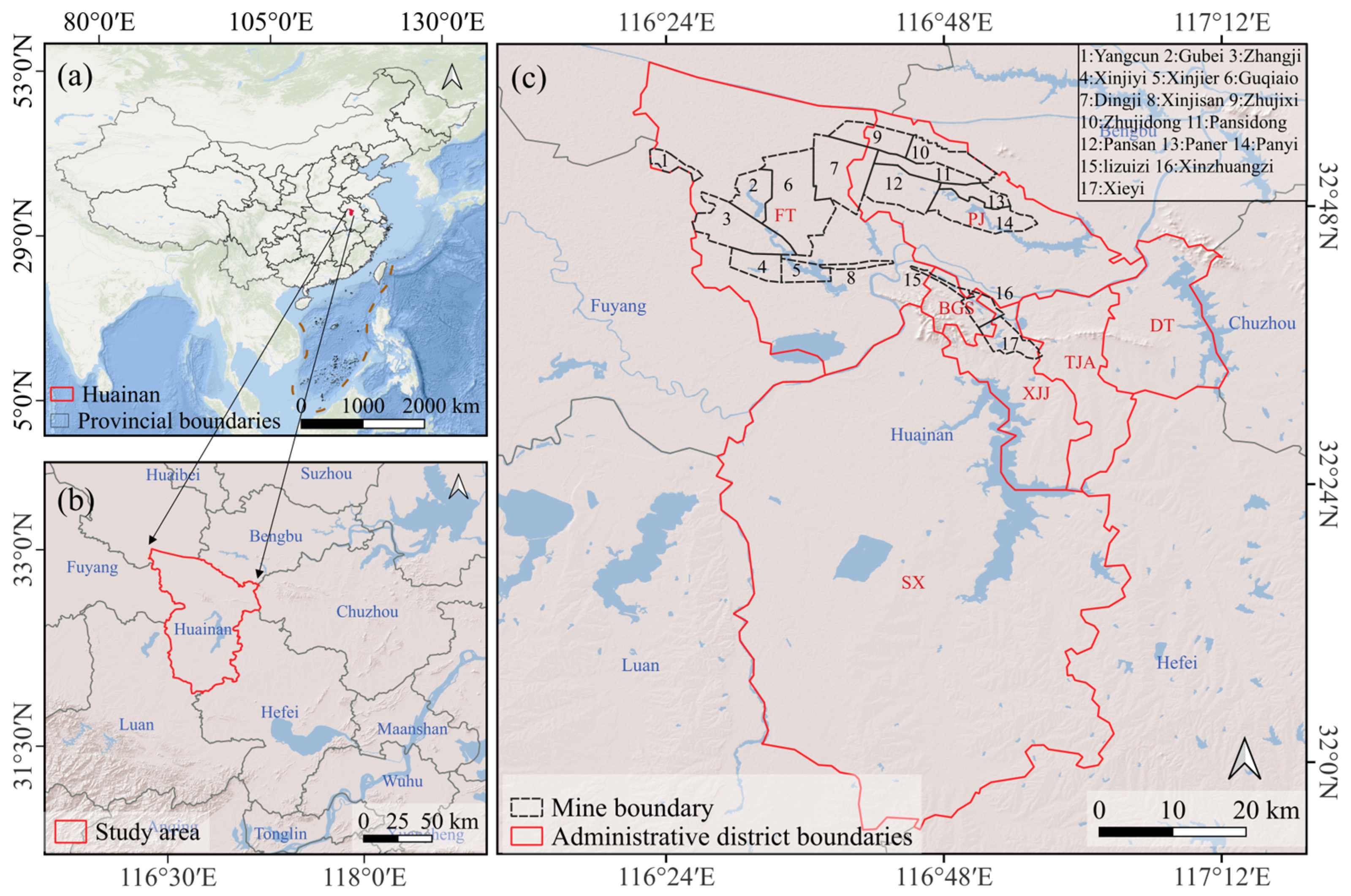
Huainan is located in the north-central part of Anhui Province, China, between 31°54′8″–33°00′26″N and 116°21′5″–117°12′30″E, with a total area of approximately 5533 km2 (Figure 1). It serves as a key node city in the urban agglomeration along the Huai River. As of 2023, Huainan administers five districts—Panji (PJ), Tianjia’an (TJA), Xiejiaji (XJJ), Datong (DT), and Bagongshan (BGS)—and two counties, namely Shou County (SX) and Fengtai County (FT), with a permanent population of about 3.016 million.
Huainan is located at the intersection of the middle reaches of the Huai River and the Huang–Huai–Hai Plain, and is situated along the southern margin of the North China Platform and within the transitional zone between the Qinling–Dabie orogenic belt and the North China Craton. The region is characterized by complex geological structures, widespread exposure of carbonate rocks, well-developed karst systems, and multiple phases of tectonic activity, which together have formed typical thrust structures and fault systems. As a representative resource-based industrial city, Huainan possesses abundant coal reserves (approximately 50 billion tons [27]), with densely distributed mines that have undergone long-term exploitation (see Table 1 for details). Coupled with the warm temperate semi-humid monsoon climate [28], characterized by concentrated precipitation and frequent groundwater fluctuations, these hydrological processes contribute to the persistent and cumulative nature of surface deformation risks. Consequently, geological hazards such as LS, karst collapse, and landslides occur frequently, driven by both natural and anthropogenic factors, making Huainan one of the most geologically sensitive and management-prioritized regions in Anhui Province.

3. Data and Methods

3.1. General Framework

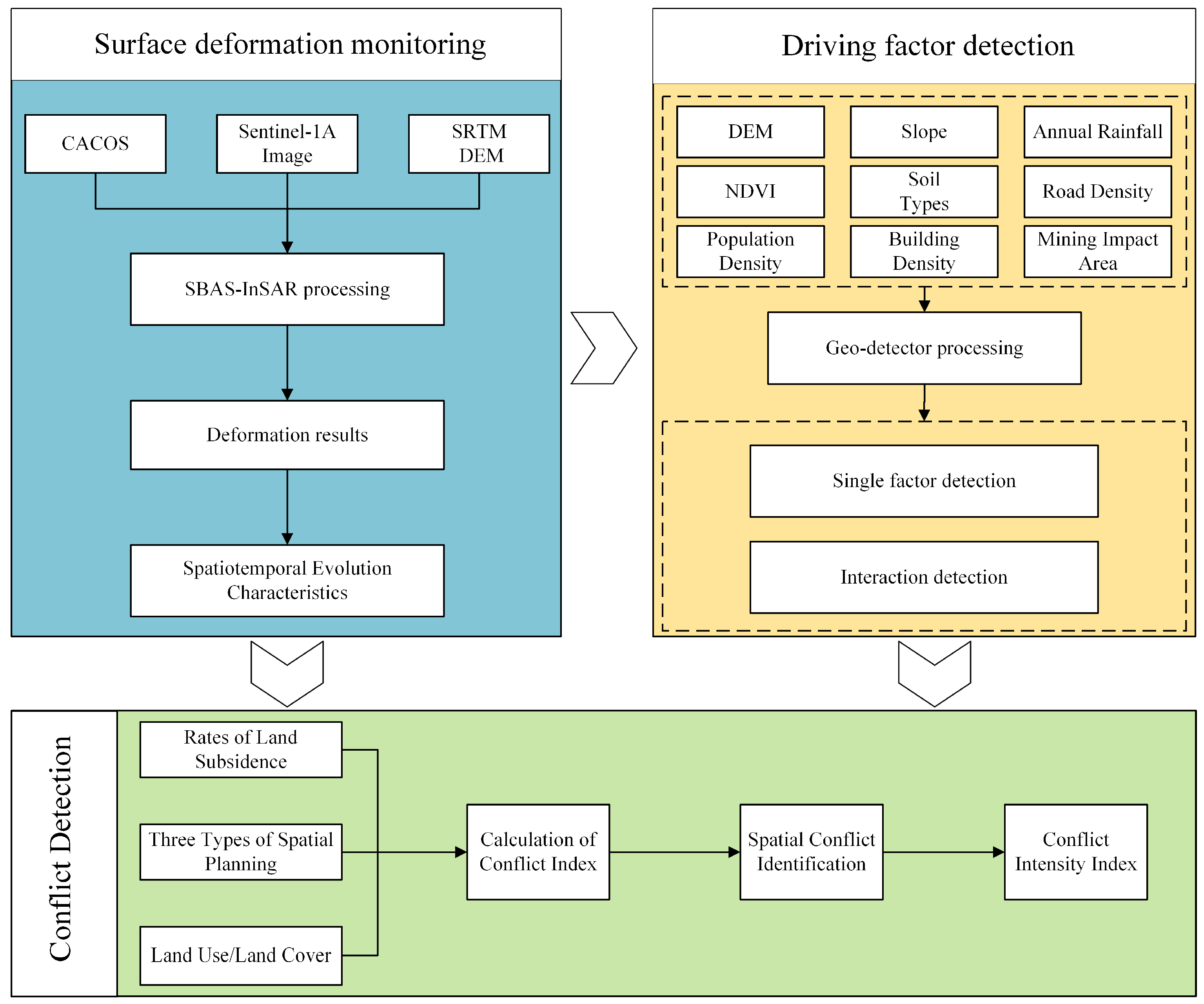
The integrated LS evaluation framework proposed in this study consists of three major components: LS monitoring, driving factor detection, and conflict detection. The specific workflow is as follows. First, SBAS-InSAR was employed to obtain time-series LS information for Huainan, enabling the analysis of its spatiotemporal evolution characteristics and distribution patterns. Second, GeoDetector was applied to identify the relative importance and interaction effects of natural and anthropogenic influencing factors, thereby revealing the key driving mechanisms of LS in Huainan. Finally, sensitivity levels of CLU/LUP zones to LS were classified, and a spatial conflict detection model was constructed to quantitatively identify conflict zones and assess conflict intensity. The overall technical framework is illustrated in Figure 2.

3.2. Data

The study utilized three categories of data: (1) radar remote sensing images and auxiliary processing data; (2) potential driving factor data of LS; and (3) CLU and LUP data. All spatial datasets used in this study were reprojected to the WGS84 coordinate system to ensure spatial consistency.

3.2.1. InSAR and Auxiliary Processing Data

A total of 166 ascending Sentinel-1A acquisitions acquired between May 2017 and May 2024 were selected to extract LS information in Huainan. To avoid additional uncertainties caused by differences in observation geometry and data sources, and to ensure data stability and temporal continuity, while maintaining free accessibility, only ascending Sentinel-1A data were used for SBAS-InSAR deformation inversion. To remove the topographic phase component in the interferograms, a 30 m resolution SRTM DEM was applied for topographic phase correction. In addition, to effectively mitigate the influence of atmospheric delay on interferometric results, GACOS atmospheric correction data [29] were employed. Detailed information on the datasets used in this study is provided in Table 2.

3.2.2. Potential Driving Factor Data for LS

Referring to previous studies on the driving factors of LS [30,31,32], the identification of potential influencing factors was carried out from two perspectives: natural conditions and anthropogenic factors. By reviewing frequently reported variables reported in existing literature, and considering the unique geographical characteristics of Huainan as well as data availability, nine representative potential driving factors were selected. The specific parameters and data sources of each factor are presented in Table 3.
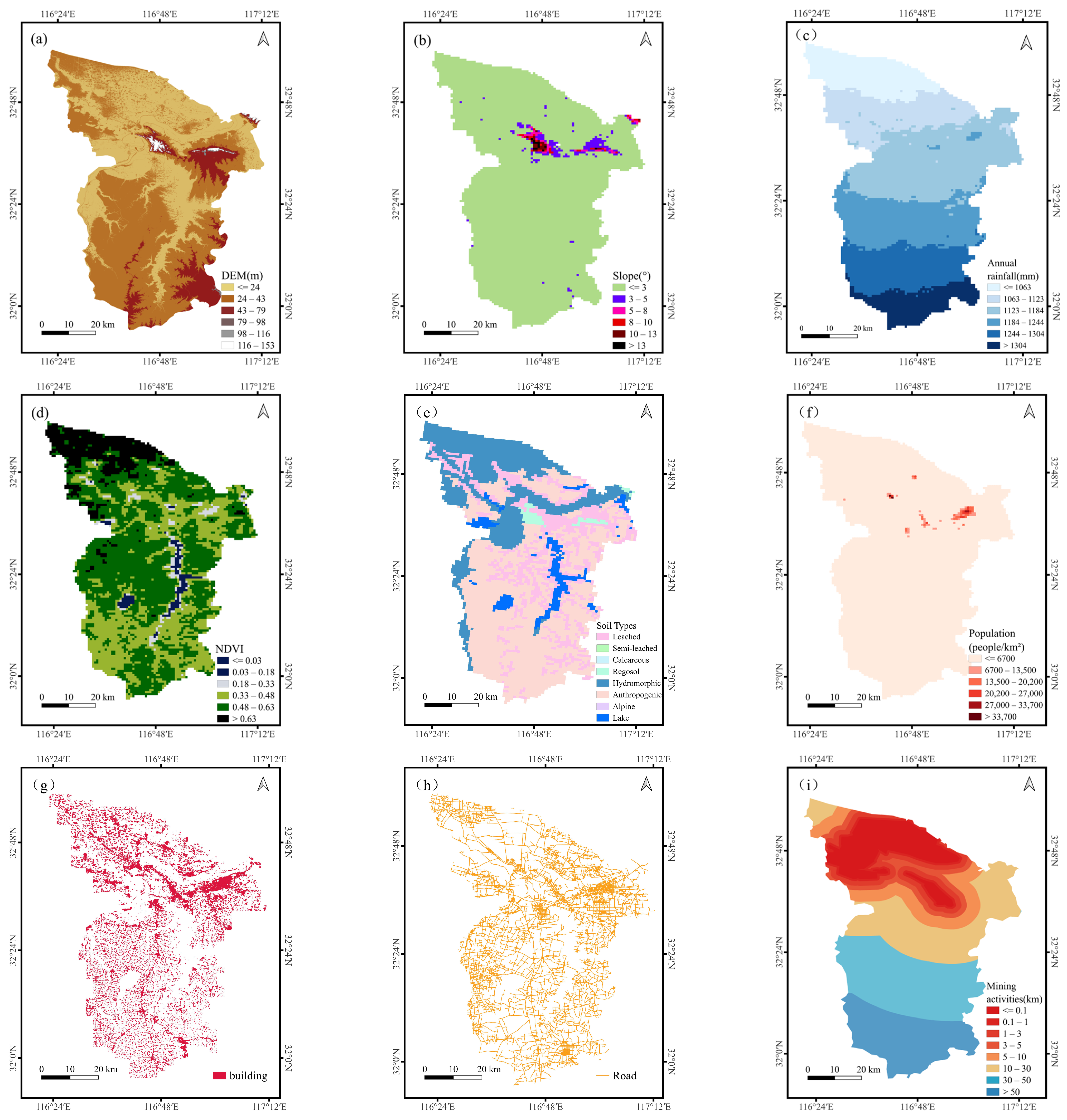
Annual rainfall was calculated based on the monthly precipitation data for 2020 shared by Peng et al. [33] on the National Tibetan Plateau Data Center. Population distribution was derived from 2020 population density data shared by Chen et al. [34] on the Figshare. Building distribution data (including building heights) [35] were taken from Zenodo database, while road distribution data were obtained from Open Street Map. Building volume and road length were statistically derived via spatial analysis. The mining activities were delineated by generating distance-based buffer zones around mine locations provided by the Huainan Municipal Bureau of Natural Resources and Planning. The potential driving factors of LS are illustrated in Figure 3.

3.2.3. CLU and LUP Data

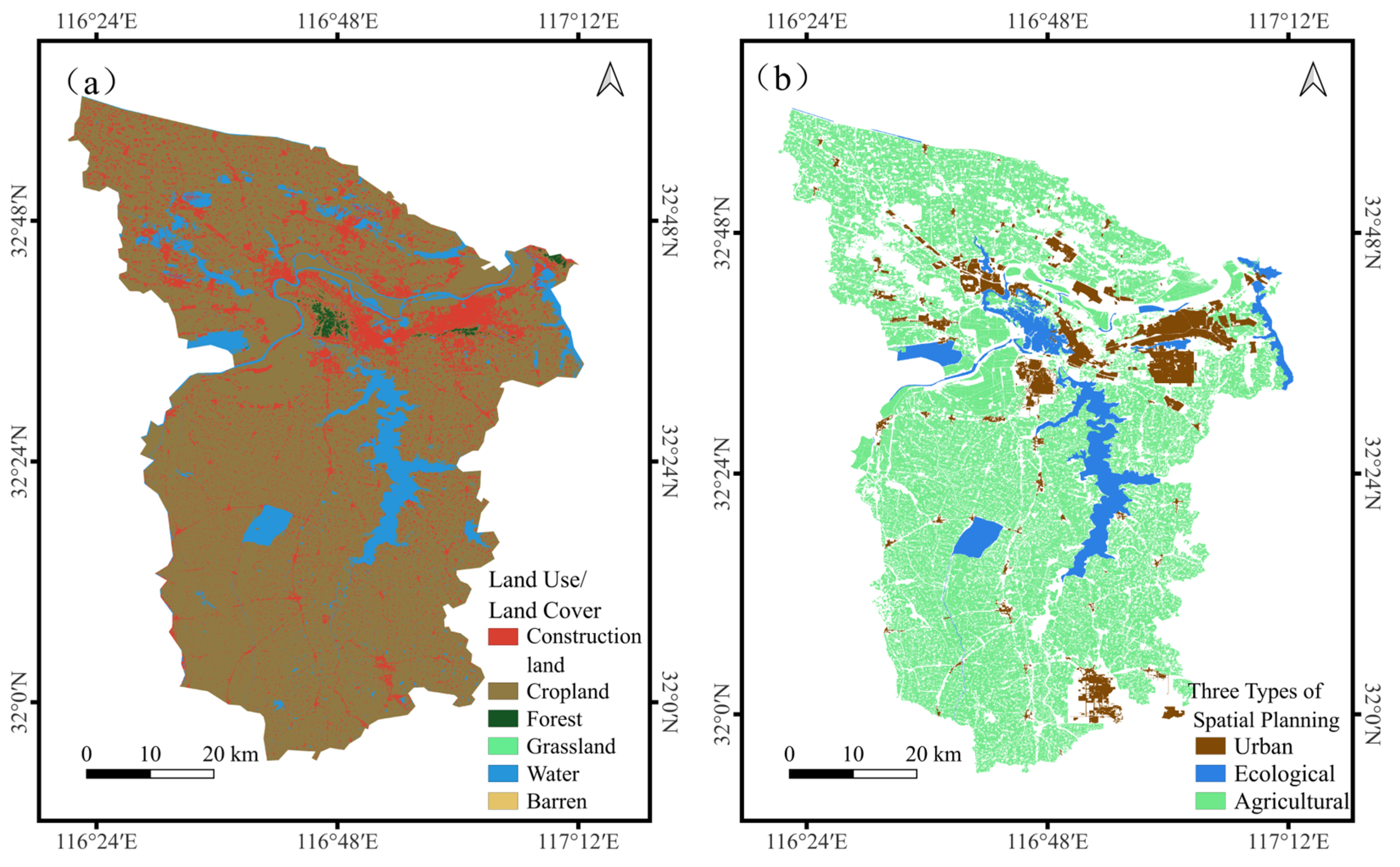
The CLU data were obtained from the 2020 land cover dataset with a spatial resolution of 30 m shared by Yang and Huang [36] on the Zenodo (https://zenodo.org/, accessed on 12 January 2026), which reflects the actual land use pattern of the study area (Figure 4a). The LUP data were derived from the Three Zones and Three Lines special planning outcomes of the Huainan Territorial Spatial Planning (2021–2035), including urban space, ecological space, and agricultural space (Figure 4b). To ensure spatial consistency between CLU/LUP and LS monitoring results, the LUP vector data were converted into raster format and resampled to 30 m resolution.

3.3. SBAS-InSAR Monitoring

The SBAS-InSAR technology, developed by Berardino et al. [37] in 2002, constructs interferometric pairs by setting spatiotemporal baseline thresholds, effectively mitigate decorrelation phenomena caused by long baselines in conventional InSAR. In this study, the SBAS-InSAR technique was employed to construct an optimized spatiotemporal baseline network, and a multiple-error correction strategy was adopted to achieve high-precision surface deformation monitoring in Huainan.
The processing workflow was implemented as follows: (1) the image acquired on 12 November 2020 was selected as the reference image, and the maximum temporal baseline was set to 120 days. The spatial (perpendicular) baseline threshold was determined based on the critical baseline, and 2% of the critical baseline was adopted as the maximum spatial baseline to control geometric decorrelation while ensuring network connectivity. A coherence threshold (γ ≥ 0.3) was further applied to exclude low-coherence interferometric pairs, resulting in an optimized spatiotemporal baseline network comprising 774 interferometric pairs, with temporal baselines ranging from 12 to 120 days and perpendicular baselines ranging from 1.27 to 110.06 m. (2) During the preprocessing stage, Sentinel-1 precise orbit data were used for orbit refinement and correction to reduce orbital errors. A 30 m resolution SRTM DEM was employed to simulate and remove the topographic phase, followed by image co-registration and geocoding. (3) In the interferogram generation and phase processing stage, Goldstein filtering was applied to enhance phase quality, and the minimum cost flow (MCF) algorithm was used for phase unwrapping. (4) Deformation inversion was performed based on the SBAS time-series model to derive the annual deformation rate and cumulative deformation series. (5) To mitigate the impact of atmospheric delay on time-series estimation, GACOS tropospheric delay products were applied for atmospheric correction, thereby improving the spatial continuity and temporal stability of the deformation results and achieving millimeter-level accuracy in LS monitoring.
A 30 m grid was selected as the analytical unit for LS monitoring, as this resolution enables precise capture of LS details in small-scale areas such as mining zones. To obtain a spatially continuous deformation field that supports period-based mapping, LS classification, and raster-based operations with CLU/LUP datasets, ordinary kriging interpolation [38] was applied to reconstruct locally missing pixels. This process ultimately generated LS distribution maps at a 30 m spatial resolution.

3.4. GeoDetector

GeoDetector is a spatial statistical method based on spatial stratified heterogeneity theory, which quantifies the spatial heterogeneity of geographical factors and their driving mechanisms to reveal the explanatory power of environmental variables for a target phenomenon [39]. In this study, the differentiation and factor detection module, and interaction detection module of GeoDetector were employed. The core indicator is the q -statistic, and the significance of the results was tested using p -values. The q -statistic is calculated as follows:
q = 1 h = 1 L N h σ h 2 N σ 2
In the equation, the q -statistic ranges from 0 to 1, with larger values indicating stronger explanatory power of variable X for the spatial variation of Y. L denotes the number of strata of the independent variable X; N h and σ h 2 represent the sample size of X and the variance of the dependent variable Y within the h -th stratum, respectively; and N and σ 2 denote the total sample size and the overall variance of Y for the entire dataset.
When using GeoDetector to analyze spatial differentiation, a p -value test is introduced to evaluate the significance of the explanatory power ( q -statistic) of an independent variable X on a dependent variable Y. A smaller p -value (e.g., p < 0.05) indicates a more significant explanatory effect of X on Y, suggesting lower likelihood that the result is due to random factors and thus higher statistical reliability. Interaction detection compares the dual-factor interaction term q (X1 ∩ X2) with the single-factor values q (X1) and q (X2) [40] to reveal spatial mechanisms of multi-factor synergies or inhibitions.
The procedure for analyzing potential influencing factors of LS using GeoDetector is as follows: First, the study area was divided into 1 km × 1 km grids in GIS [41], which served as the basic spatial analysis units, and spatial overlay and statistical extraction were performed to obtain the annual average LS rate and the average values of potential driving factors within each grid. Second, following established methodologies [42], each potential driving factors of LS were classified into five levels; soil type was not reclassified due to its inherent geological significance and was directly incorporated into the GeoDetector analysis. Finally, the GeoDetector model was applied to quantify the explanatory power of each driving factor on LS, thereby revealing spatial variations and regional differences in the influence of potential driving factors on LS.

3.5. Space Conflict Detection

To identify potential conflict risks between CLU/LUP and LS, this study applies coupling coordination theory and proposes a conflict detection method based on a sensitivity classification of CLU/LUP types with respect to LS hazards, hereafter referred to as the sensitivity index.

3.5.1. Sensitivity Index Construction

The sensitivity index is used to characterize the vulnerability or potential loss level of different CLU/LUP functional units under a given intensity of LS. The magnitude of the sensitivity index is determined based on three aspects: (1) damage consequences, referring to the potential scale of safety risks, economic losses, and social impacts caused by LS; (2) functional importance, reflecting the significance of core land functions (e.g., residential use, industrial production, municipal and public services, food production, and ecological regulation) in regional development and public safety, as well as their requirements for continuous operation; and (3) restoration difficulty, including the technical complexity, cost investment, and recovery period required after LS impacts, and whether irreversible damage or long-term hazards may occur. Based on these criteria, the sensitivity index was classified into five levels (Levels 1–5, Table 4), with higher levels indicating greater sensitivity of functional units to LS and higher potential losses.
According to Table 4, and by comprehensively considering the characteristics of functional attributes, restoration difficulty after damage, and potential loss consequences of different CLU/LUP zones in the study area, sensitivity index values were assigned to each CLU/LUP type. The results are presented in Table 5.

3.5.2. Conflict Detection Model

Referring to the coupling coordination model [42], a conflict detection model was constructed to calculate the Spatial Conflict Intensity Index ( S C I I ), thereby quantitatively assessing the conflict risks among CLU/LUP and LS. The specific calculation formula of the conflict index is as follows:
S C I I = C × T
C = 2 × f x · g x f x + g x
T = a f x + b g x ,   a + b = 1
where S C I I denotes the conflict index, ranging from 0 to 1. A lower S C I I value indicates stronger adaptability of land functions to LS and a lower conflict risk. C represents the coupling degree between CLU/LUP and LS, with values ranging from 0 to 1; a higher C value indicates a stronger association between the two systems. f x and g x denote the normalized LS level and the sensitivity index of each grid cell, respectively. T represents the comprehensive coordination index, while a and b are adjustment coefficients. Considering the equal importance of the two systems, both coefficients were set to 0.5 [43].
The formulas for normalization processing of LS levels and sensitivity index values are as follows:
S = S S m i n S m a x S m i n
In the equation, S represents the normalized value, ranging from 0 to 1; S denotes the original LS level or sensitivity index value; and S m i n and S m a x represent the minimum and maximum values of the corresponding variable, respectively.
The procedure for assessing the conflict degree among CLU/LUP and LS is as follows. First, a 30 m grid was adopted as the basic spatial analysis unit, and the LS results, CLU data, and LUP data were spatially aligned and overlaid to ensure comparability of all indicators at the same spatial scale. Second, the annual average LS rates derived from SBAS-InSAR were converted into LS levels according to Table 6, and the levels were then normalized using Equation (5) to serve as the LS representation variable f x in Equations (2)–(4). Third, based on the criteria defined in Table 5, sensitivity index values were assigned to each 30 m grid cell according to its corresponding CLU/LUP type, and these values were normalized using Equation (5) and substituted into Equations (2)–(4) as g x . Finally, the coupling degree ( C ), comprehensive coordination index ( T ), and S C I I were calculated separately for CLU/LUP, and spatial distribution maps were generated to conduct a quantitative assessment and spatial identification of the conflict intensity between CLU/LUP and LS.

4. Results

4.1. Monitoring and Analysis of LS in Huainan City

4.1.1. Analysis of LS Spatial Patterns

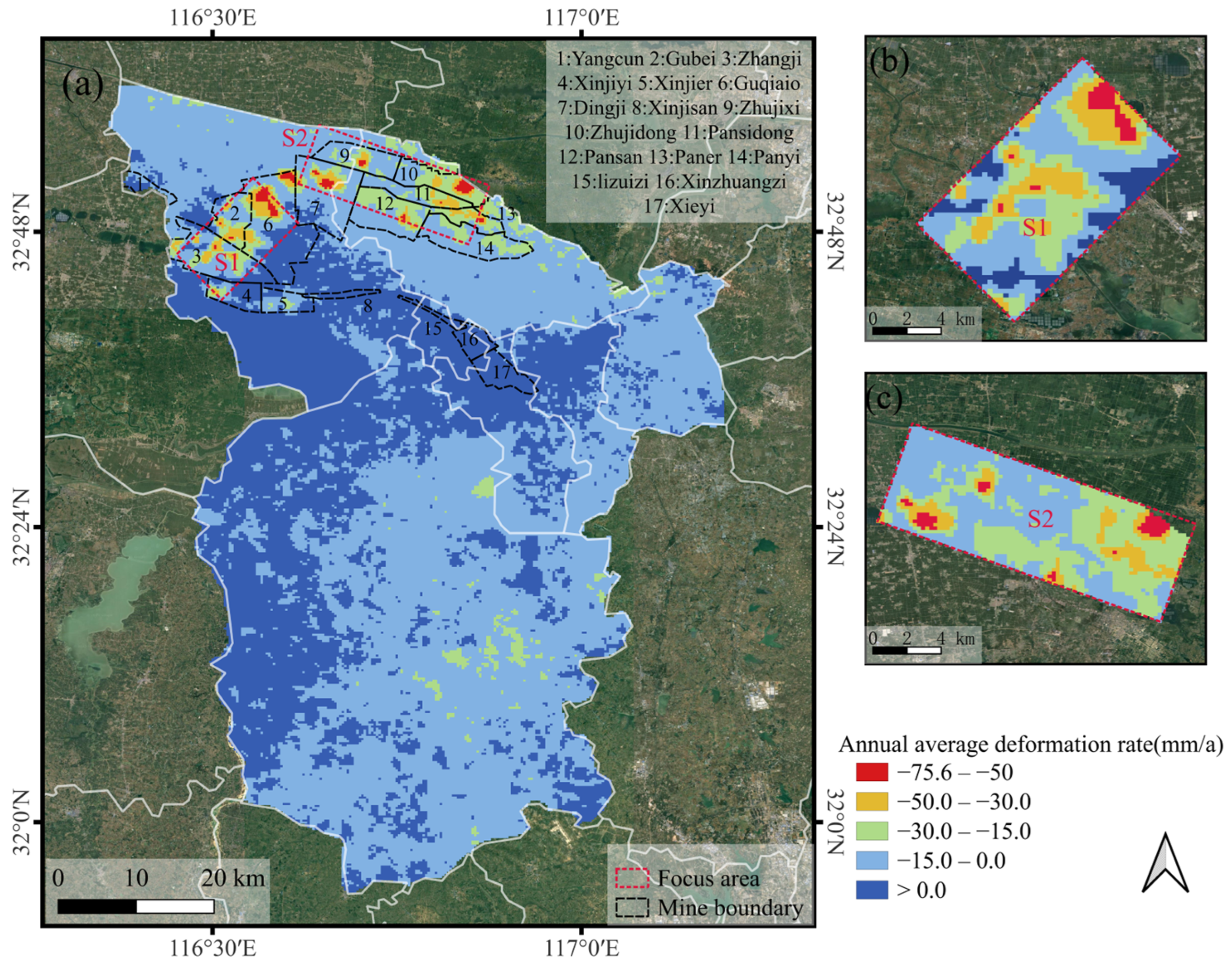
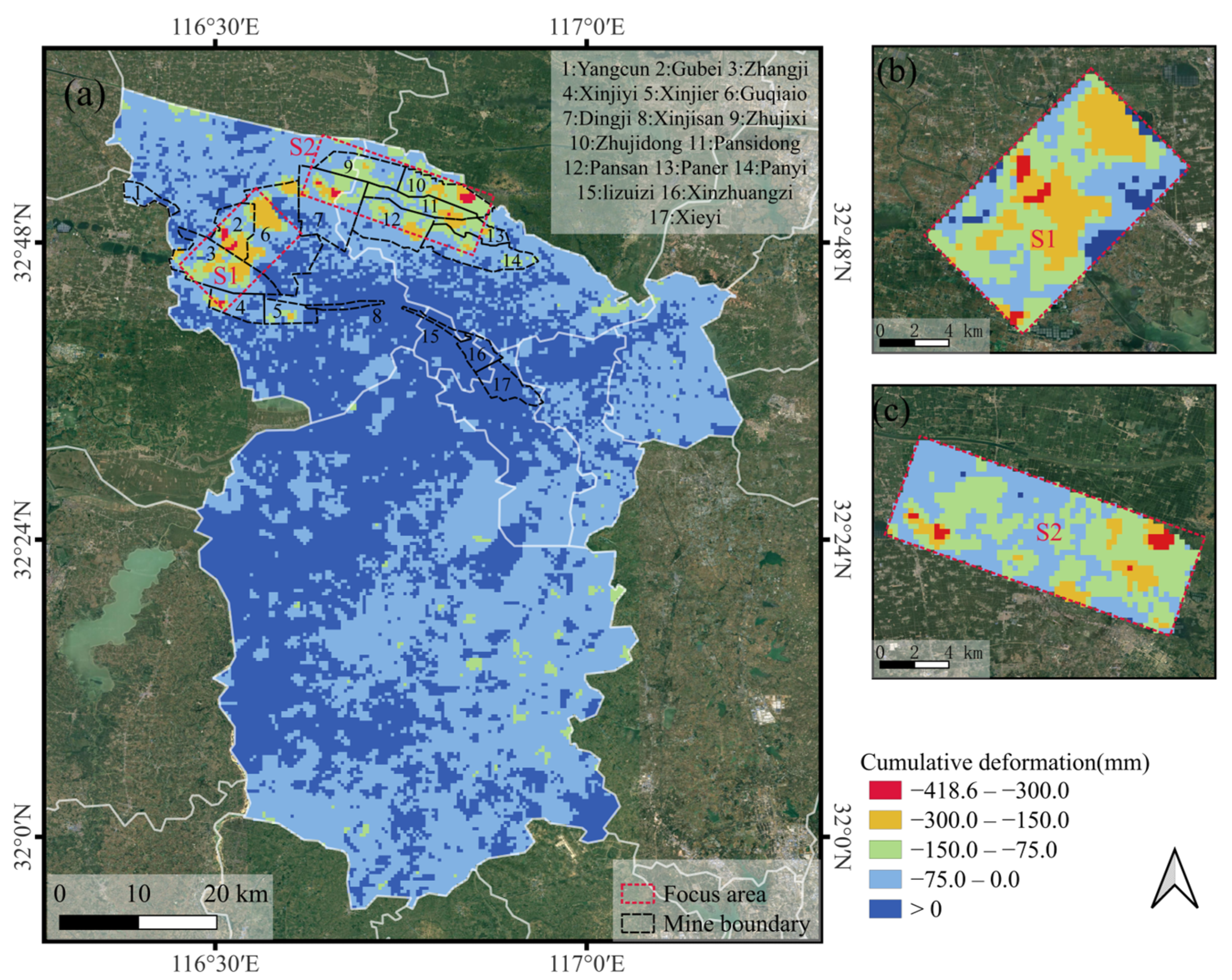
A total of 166 Sentinel-1 images covering Huainan from 2017 to 2024 were processed using the SBAS-InSAR technique to derive the annual average vertical deformation rate (Figure 5) and cumulative vertical deformation (Figure 6) associated with LS during this period. Based on the annual average vertical deformation rate and cumulative vertical deformation, LS levels were classified according to the grading criteria, and the area proportions of each LS grade from 2017 to 2024 were calculated (Table 6 and Table 7).
Between 2017 and 2024, Huainan City was generally dominated by slight or no subsidence, with severe subsidence occurring only in localized areas. As shown in Table 6, based on the annual average vertical deformation rate, the combined proportion of slight and no subsidence zones reached 94.60%, while the combined proportion of severe and extremely severe subsidence zones was less than 1.20%. Similarly, as shown in Table 7, based on cumulative vertical deformation, slight and no subsidence zones accounted for 94.84%, whereas severe and extremely severe subsidence zones accounted for only 1.36%.
From 2017 to 2024, LS in Huainan was mainly concentrated in coal mining areas, likely due to sustained mining activities. As shown in Figure 5 and Figure 6, although the annual average vertical deformation rate and cumulative vertical deformation differ in definition representation, their spatial patterns are highly consistent, with areas exhibiting higher subsidence rates generally corresponding to greater cumulative subsidence. LS in Huainan was primarily observed in two typical zones: S1, located at the boundary between Guqiao Town and Yuezhangji Town in central FT, and S2, situated at the boundary between Hetuan Town and Panji Town in northern PJ. Both areas represent major mining zones in Huainan, where continuous coal extraction has accelerated LS. The average annual vertical deformation rate in S1 was −16.73 mm/a, with an average cumulative subsidence of 102.21 mm, while in S2 the average annual vertical deformation rate reached −19.28 mm/a, with an average cumulative subsidence of 96.08 mm.
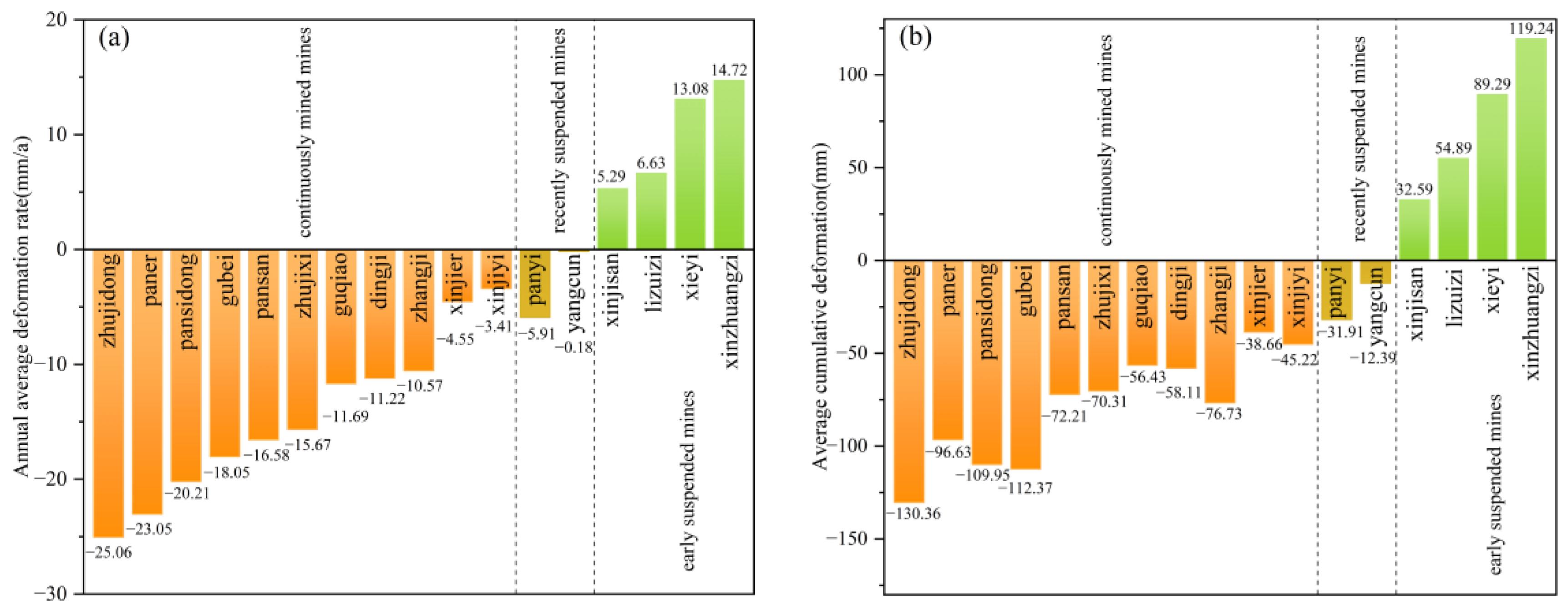
Further analysis combining Table 1 with Figure 5 and Figure 6 yielded the average annual vertical deformation rate and the average cumulative vertical deformation for each mining area in Huainan from 2017 to 2024 (Figure 7). During 2017–2024, continuously mined and recently suspended mines within the Huainan mining area generally exhibited LS, whereas early-closed and unmined mines showed an overall uplift trend. As shown in Figure 7, continuously mined and recently suspended mining areas remained in a subsiding state, and the Zhujidong Mine displaying the most pronounced deformation, with an average annual deformation rate of −25.06 mm/a and an average cumulative deformation of −130.36 mm. In contrast, early-closed and unmined mining areas generally displayed uplift, with average annual uplift rates exceeding 5 mm/a and average cumulative uplift of more than 32 mm. This uplift may be attributed to goaf compaction, structural recovery, and groundwater recharge following early closure or in the absence of mining activities.

4.1.2. Analysis of Temporal Evolution Characteristics of LS

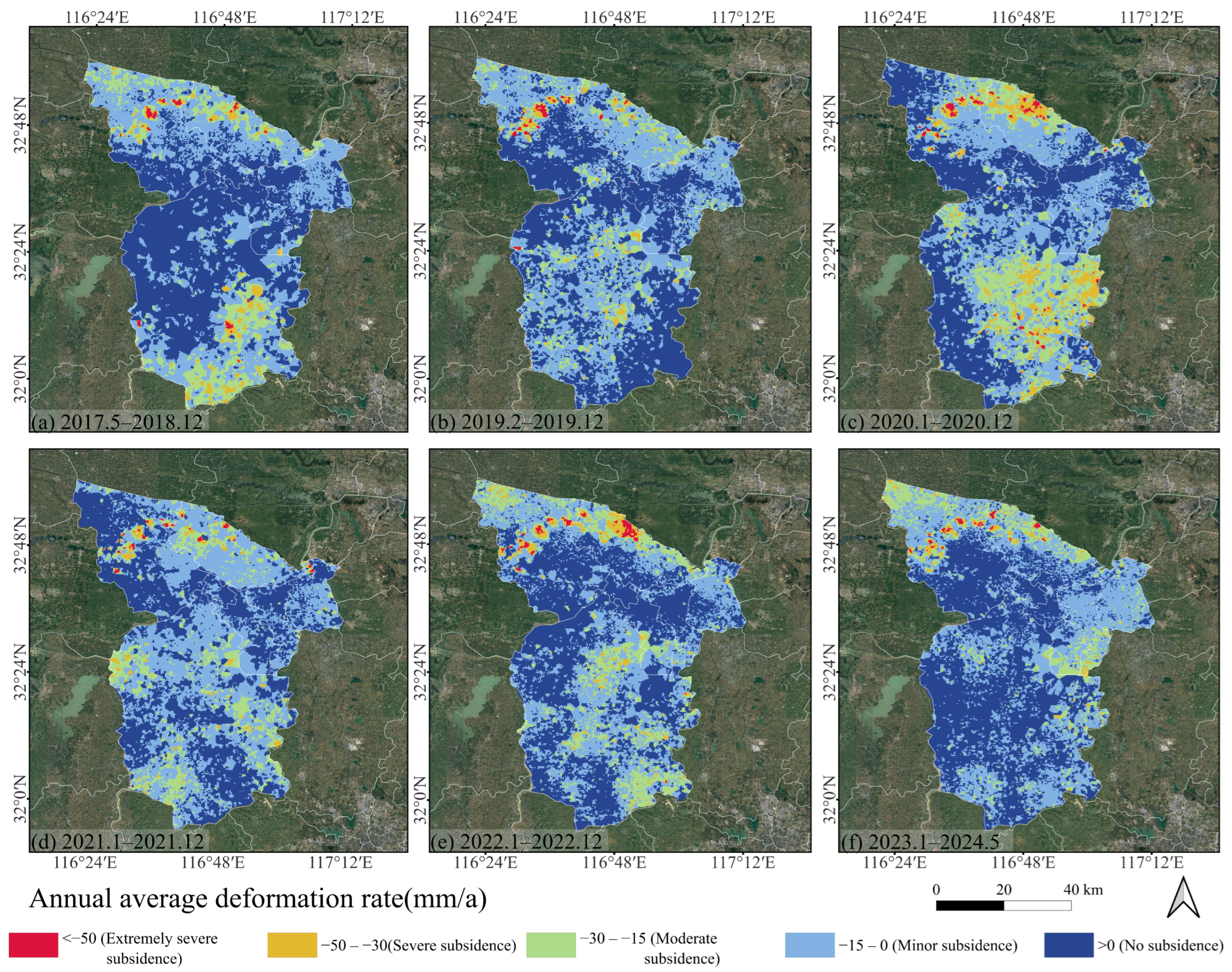
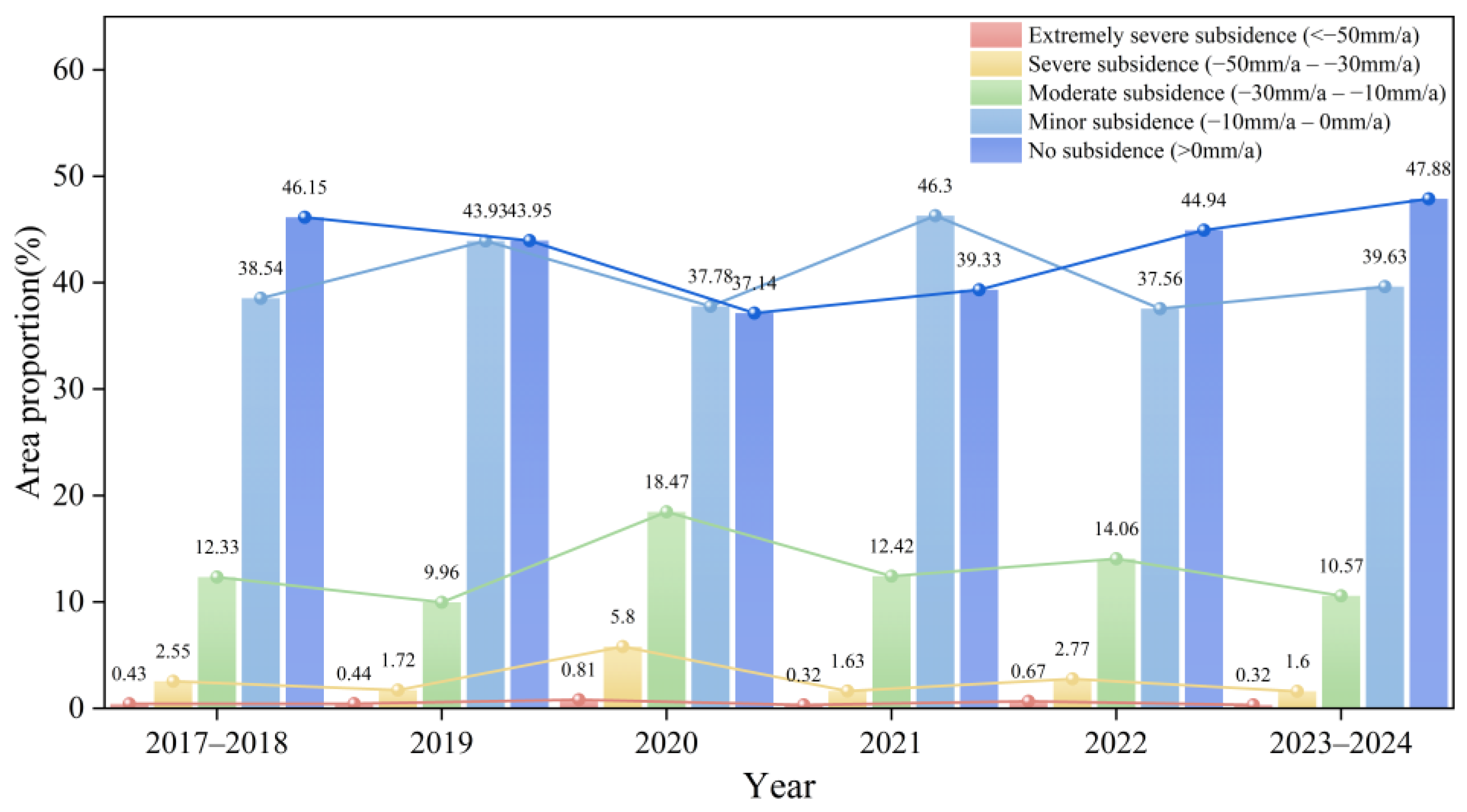
From 2017 to 2024, the spatial distributions of the annual average vertical deformation rate and the cumulative vertical deformation were highly consistent. Therefore, the annual average vertical deformation rate was selected as the indicator of LS intensity in the temporal evolution analysis. The annual average deformation rates for six periods were obtained (Figure 8), and the area proportions of different LS levels for each period were calculated according to the classification criteria in Table 6 (Figure 9).
As shown in Figure 9, from 2017 to 2024 the LS rate in the study area exhibited slight but stage-dependent fluctuations. Overall, the LS rate was lowest in 2019 and peaked in 2020, after which it gradually declined, returning to a level comparable to that of 2019 by 2023–2024. In 2020, the LS rate increased markedly compared with 2017–2018, with the proportions of areas classified as moderate, severe, and extremely severe subsidence reaching 18.47%, 5.80%, and 0.81%, representing increases of 8.51%, 4.08%, and 0.37%, respectively, relative to the previous period. From 2021 onward, the proportions of moderate, severe, and extremely severe subsidence areas gradually decreased. By 2023–2024, the proportion of areas experiencing moderate or higher subsidence (12.49%) had essentially returned to the 2019 level (12.12%), and no subsidence and slight subsidence once again became dominant. The surge in LS rate in 2020 may be associated with reduced groundwater resources caused by drought conditions in 2019 within the study area.

4.2. Analysis of Driving Factors for LS

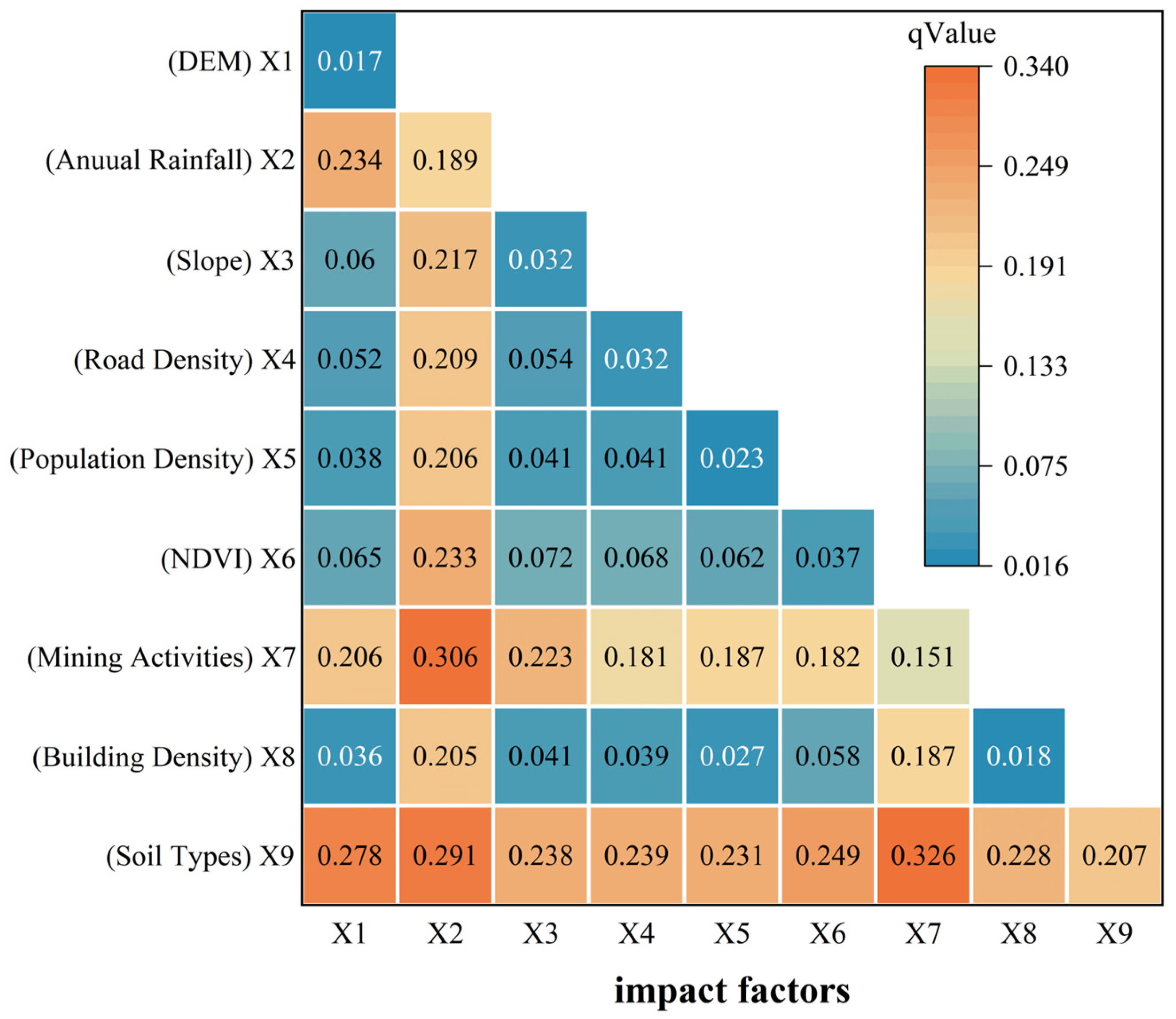
GeoDetector was employed to assess the explanatory power of nine potential influencing factors on LS in Huainan, yielding the results of factor detection (Table 8) and interaction detection (Figure 10). As shown in Table 8, the p -values of all nine factors are less than 0.05, indicating that each factor is statistically significant and has significant explanatory power for the spatial differentiation of LS.
Soil type, annual rainfall, and mining activities are identified as the dominant factors explaining the spatial differentiation of LS in Huainan, whereas NDVI, slope, road network density, population density, building density, and DEM exhibit relatively weaker effects. As shown in Table 8, the q -values of soil type, annual rainfall, and mining activities all exceed 0.15, indicating strong explanatory power and confirming their dominant roles. Specifically, low annual rainfall reduces groundwater recharge, thereby intensifying soil compaction induced by groundwater extraction; mining activities not only accelerate groundwater depletion but also disturb subsurface strata, further promoting LS; soil type influences the physical properties of the ground, which in turn affects LS susceptibility. In contrast, the q -values of NDVI, slope, road network density, population density, building density, and DEM are comparatively low, suggesting limited explanatory capacity. This may be attributed to the predominance of plains and low hills in the study area, relatively homogeneous vegetation cover, gentle terrain with minor slope variation, relatively even population distribution, and limited contrasts in urban-rural building and road network densities, all of which exert relatively weak control on LS.
The dual-factor interactions influencing LS in Huainan all show enhancement effects. In particular, the interactions between mining activities (X7) and soil type (X9), annual rainfall (X2) and mining activities (X7), as well as annual rainfall (X2) and soil type (X9), exert especially strong explanatory power for the spatial differentiation of LS. The enhancement effect indicates that the explanatory power of two factors acting jointly exceeds that of each factor individually, substantially strengthening their combined contribution. As shown in Figure 10, the interaction effects between any two factors are consistently greater than those of single factors. Among them, the interaction between mining activities (X7) and soil type (X9) has the strongest influence on LS, with a q-value of 0.326. This may be attributed to mining-induced disturbance of subsurface strata combined with the relatively weak bearing capacity of certain soils, which significantly reduces foundation stability and increases susceptibility to LS. The interaction q -values of annual rainfall (X2) with mining activities (X7), and annual rainfall (X2) with soil type (X9), both exceed 0.29. In areas with limited rainfall, insufficient groundwater recharge, coupled with mining disturbance or fragile soil structures, is more likely to induce strata damage and elevate the risk of LS.

4.3. Conflict Detection Between CLU/LUP and LS

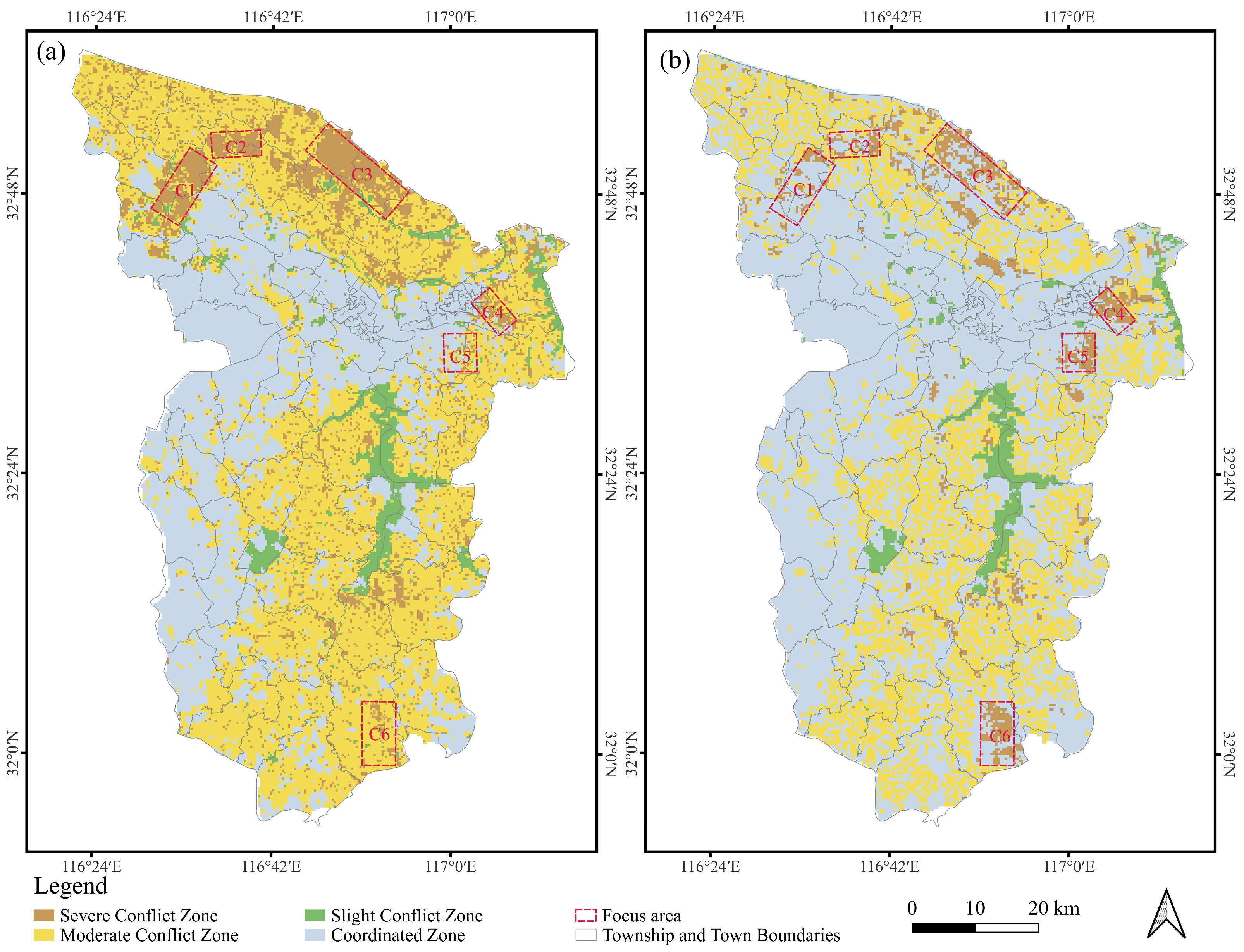
A spatial conflict detection method was applied to identify the conflict relationships between CLU areas and LS risk zones, as well as between LUP areas and LS risk zones, resulting in a spatial distribution map of the conflict index for the study area (Figure 11). To distinguish different levels of conflict intensity, with reference to previous studies [44], S C I I values were classified into four categories: coordinated zones ( S C I I = 0), mild conflict zones (0 < S C I I ≤ 0.5), moderate conflict zones (0.5 < S C I I ≤ 0.65), and severe conflict zones (0.65 < S C I I ≤ 1).
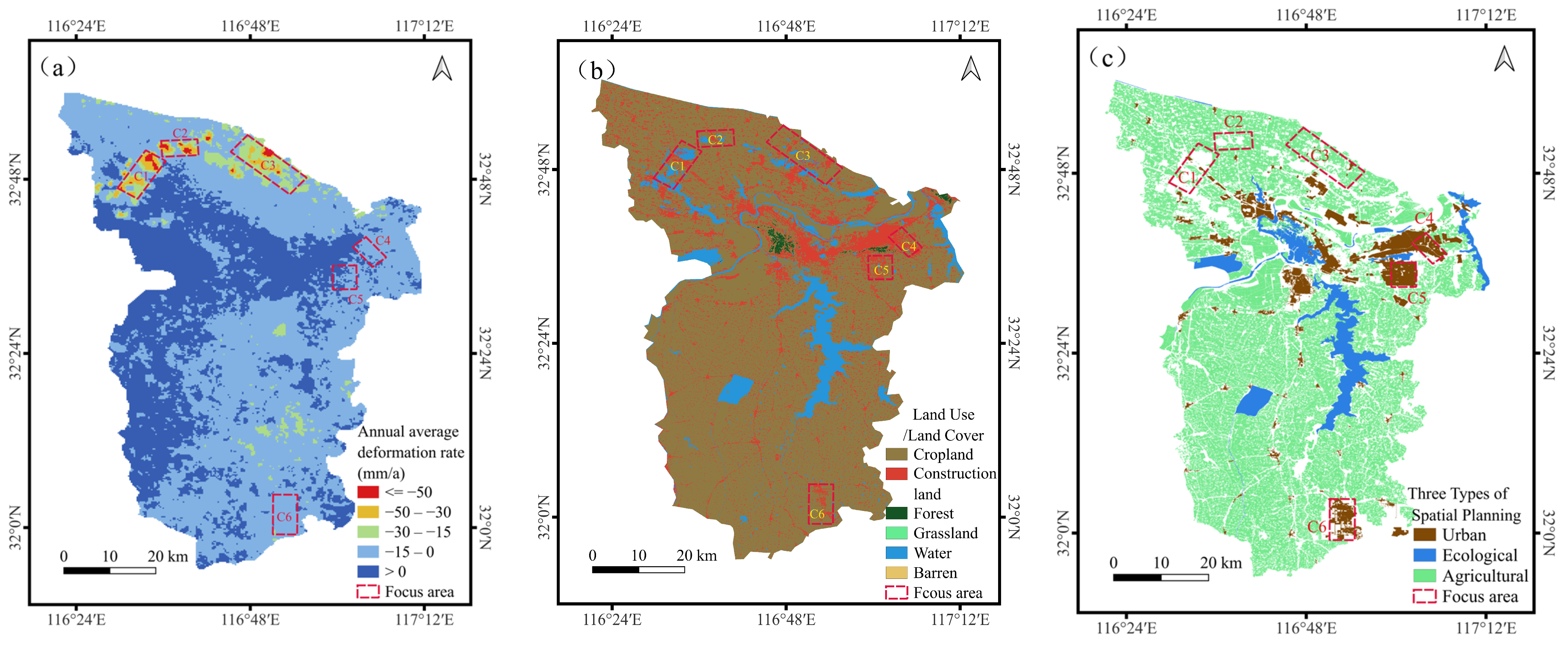
Based on the spatial conflict intensity between CLU/LUP and LS in the study area, six representative zones with the most significant conflicts (C1–C6 in Figure 11) were selected for detailed analysis. Their conflict characteristics were extracted (Figure 12) and analyzed in detail. Meanwhile, the overall S C I I between CLU/LUP and LS for the entire study area was calculated (Table 9). Furthermore, the areas of severe conflict between CLU/LUP and LS within C1–C6 were quantified (Table 10) to reveal the specific manifestations and differences in spatial conflicts across these typical regions.
The major conflicts between CLU and LS in Huainan are concentrated in areas where high-subsidence zones overlap with existing land use types such as construction land, cultivated land, and water bodies. As shown in Figure 11a, C1, C2, and C3 represent typical conflict areas between CLU and LS. According to the monitoring results in Figure 12a, these three areas are characterized by high subsidence rates, with annual average vertical deformation rates of −27.28 mm/a, −26.89 mm/a, and −22.27 mm/a, respectively. Figure 12b further indicates that C1, C2, and C3 are dominated by urban construction land, construction land, and water bodies, with some sections already developed into relatively dense residential areas or transportation infrastructure.
The principal conflicts between LUP and LS in Huainan are concentrated in areas where high-subsidence zones are designated as agricultural space, and in areas where low-subsidence zones are planned as urban space. As shown in Figure 11b, C3, C4, C5, and C6 are representative conflict areas between LUP and LS. According to the monitoring results in Figure 12a, C3 is classified as a high-subsidence zone, whereas C4 (annual average deformation rate of −1.57 mm/a), C5 (−0.40 mm/a), and C6 (−5.54 mm/a) are classified as low-subsidence zones. As illustrated in Figure 12c, C3 is designated as agricultural space in the LUP, with most areas being construction land; in contrast, C4, C5, and C6 are designated as urban space and have already been developed into residential areas or supporting road systems, indicating potential conflict.
Compared with CLU, LUP in Huainan has incorporated LS risk considerations to a certain extent and implemented corresponding mitigation measures, although some local areas still do not fully avoid such risks due to technical and other constraints. As shown in Table 9, relative to CLU, the overall conflict pattern between LUP and LS in the study area has been significantly optimized: the proportion of coordinated zones increased from 35.64% to 59.71%, while the proportions of moderate and severe conflict zones decreased from 47.88% and 11.60% to 31.78% and 5.11%, respectively. This indicates that LUP generally reflects a risk-avoidance and adaptation approach with respect to LS. Furthermore, Table 10 shows that in C1, C2, and C3, the proportion of severe conflict areas between LUP and LS decreased markedly compared with CLU, suggesting that planning adjustments in these zones have effectively mitigated LS-related risks. In contrast, in C4, C5, and C6, the proportion of severe conflict areas increased under LUP relative to CLU, implying that during the planning process, limitations in data accuracy, technical capacity, or related factors may have hindered the adequate identification and avoidance of LS risks, thereby posing potential geological safety risks.

5. Discussion

5.1. Rationality of the Methodological Framework

The integrated assessment framework developed in this study demonstrates sound rationality and practical potential in three aspects, namely LS monitoring, the identification of driving factors, and spatial conflict assessment:
(1)
In terms of LS monitoring, the SBAS-InSAR technique performed well in the study area, and the identified LS core zones are highly consistent with the findings of Zheng et al. [45], both are concentrated in areas with intensive mining activities, thereby supporting the spatial accuracy and reliability of the method in practical applications.
(2)
Regarding driving factor identification, the GeoDetector approach effectively reveals the dominant factors driving LS and their interaction effects. Although the major driving factors identified in this study differ from those reported by He et al. [46] in Bozhou and Xie et al. [47] in Fuyang, such differences are consistent with variations in regional geological settings and human activity characteristics, indicating the method’s high adaptability to local conditions.
(3)
The spatial conflict detection module, through the construction of a sensitivity index and a conflict detection model, successfully identifies the conflict relationships between CLU/LUP and LS risk in the study area; its methodological rationality is verified by the case analysis.

5.2. Applicability of the Methodological Framework

The proposed integrated evaluation framework demonstrates strong applicability and can be applied to LS monitoring and spatial planning management in different regions:
(1)
LS monitoring: This approach relies on Sentinel-1 SAR imagery, which offers high spatial resolution and free data access, providing long-term and large-scale deformation monitoring support for most regions.
(2)
Selection of driving factors: The choice of driving factors is flexible and can be tailored to the geographical environment, climatic conditions, and socio-economic characteristics of the study area. For instance, in coastal regions, factors such as tidal effects and groundwater salinity can be incorporated to more accurately identify the dominant factors.
(3)
The sensitivity classification and land use categorization system within the spatial conflict detection module exhibit strong flexibility and transferability. In regions with complex land cover patterns, CLU/LUP categories can be further refined, and the grading criteria of the sensitivity index can be adjusted accordingly to better reflect regional characteristics.

5.3. Limitations of the Methodological Framework

The proposed methodological framework still has certain limitations in practical applications:
(1)
Although the sensitivity index classification for LS was established based on land use functions and potential damage consequences, it inevitably involves a degree of expert judgment, which may influence the results of spatial conflict detection. Future research could incorporate more objective approaches to sensitivity index classification to further enhance methodological rigor.
(2)
The identification of spatial conflicts largely depends on the quality and spatial resolution of CLU/LUP data, which may introduce uncertainties. It is, therefore, necessary to evaluate whether such uncertainties fall within an acceptable level depending on the application objectives. Where appropriate, higher-precision land use and planning datasets may be incorporated to improve assessment accuracy.

5.4. LS Control and Planning Optimization in Huainan City

The study found that annual rainfall, mining activities, and soil type are the dominant driving factors of LS in Huainan. In response to LS risks and the conflicts between LUP and LS, the following measures are proposed:
(1)
Strengthen risk control in areas with high subsidence sensitivity. Priority should be given to densely distributed goaf zones such as Panji Mine and Xieqiao Mine, where mining scope and intensity should be strictly regulated through dynamic monitoring. In northern PJ and other areas characterized by low rainfall and insufficient groundwater recharge, mine dewatering should be strictly incorporated into annual management plans, and emergency recharge measures should be implemented based on groundwater level monitoring. In eastern Datong District and other areas with widely distributed unconsolidated soils, the construction of high-density building projects should be prohibited in zones where loose soil layers exceed 5 m in thickness; land use structure should be optimized and development intensity reduced to mitigate subsidence risk at the source.
(2)
Optimize the spatial layout of LUP. Spatial conflict detection results indicate that conflicts between LUP and LS are mainly concentrated in areas where high-subsidence zones (e.g., PJ) are designated as agricultural space and low-subsidence zones (e.g., SX) are designated as urban space. In light of the identified driving factors, high-subsidence areas, often associated with intensive mining, low rainfall, and unconsolidated soils, should be preferentially designated for ecological protection or low-intensity use. Although low-subsidence areas are relatively suitable for urban development, development density should also be appropriately reduced to minimize potential future subsidence risks.

6. Conclusions

This study developed an integrated assessment framework for LS by combining SBAS-InSAR, GeoDetector, and a spatial conflict detection model, and applied it to Huainan as a case study. First, SBAS-InSAR was employed to extract the spatiotemporal characteristics of LS in Huainan from 2017 to 2024. Subsequently, GeoDetector was used to identify the dominant drivers of LS and their interaction effects. Finally, based on a sensitivity index for CLU/LUP types with respect to LS hazards, a conflict detection model was constructed to identify conflict zones and evaluate conflict intensity. The results indicate the following:
(1)
From 2017 to 2024, LS in Huainan was dominated by slight or negligible subsidence, with severe subsidence mainly concentrated in coal mining areas. Actively mined and recently suspended mines exhibited more pronounced subsidence, whereas early-closed and unmined mining areas showed an overall uplift trend. During this period, the LS rate in the study area displayed stage-dependent fluctuations, with the lowest LS rate observed in 2019 and the highest in 2020. Thereafter, the LS rate gradually declined and returned to a level comparable to that of 2019. This pattern is likely associated with reduced groundwater resources caused by drought conditions in 2019.
(2)
LS in Huainan is mainly explained by soil type, annual rainfall, and mining activities, whereas factors such as population density exert relatively weaker effects. The dual-factor interactions generally exhibit enhancement effects, with particularly strong interactions observed among mining activities, annual rainfall, and soil type.
(3)
Compared with CLU, LUP in Huainan has, to some extent, incorporated LS risk considerations and implemented corresponding mitigation measures; however, in certain areas, constraints related to technical capacity, cost, and other factors have limited the full integration of LS risk into the planning process.
(4)
The integrated assessment framework developed in this study demonstrates sound rationality and strong applicability in LS monitoring, driving factor identification, and spatial conflict assessment, thereby providing a scientific reference for LS risk management and land use spatial optimization.
This study lacks leveling or GNSS data to validate the accuracy of InSAR-derived deformation results, and groundwater level data were not available. In addition, some driving factors exhibit temporal mismatches, with most datasets concentrated in 2020, which may lead to an underestimation of human activity impacts and limit the comprehensiveness of the driving factor analysis. Future research should strengthen collaboration with local authorities to address data gaps, improve the accuracy of InSAR monitoring, and refine the analysis of LS driving mechanisms. Furthermore, the incorporation of big data analytics and machine learning approaches could support more objective sensitivity index classification and further enhance the scientific robustness of the assessment results.


Author Contributions

Conceptualization, J.W. and H.X.; Methodology, Q.W., T.Z. and Y.X.; Formal analysis and Investigation, L.X., W.F., Y.S. and Z.L.; Writing—original draft preparation, J.W. and H.X.; Writing—review and editing, H.X., Q.W. and T.Z.; Funding acquisition, Q.W. and H.X.; Resources, Q.W. and H.X.; Supervision, H.X. All authors have read and agreed to the published version of the manuscript.

Funding

This work was supported by the Natural Science Research Project of Universities in Anhui Province (grant number 2022AH050232, KJ2020JD07), and the Research Fund of Anhui Jianzhu University (grant numbers 2021QDZ01 and 2020QDZ43).

Data Availability Statement

The original contributions presented in this study are included in the article. Further inquiries can be directed to the corresponding author.

Acknowledgments

We are grateful to the Huainan Municipal Bureau of Natural Resources and Planning for providing the three types of territorial space data and mine boundary data required for this study.

Conflicts of Interest

The authors declare no conflicts of interest.

References

  1. Herrera-García, G.; Ezquerro, P.; Tomás, R.; Béjar-Pizarro, M.; López-Vinielles, J.; Rossi, M.; Mateos, R.M.; Carreón-Freyre, D.; Lambert, J.; Teatini, P.; et al. Mapping the Global Threat of Land Subsidence. Science 2021, 371, 34–36. [Google Scholar] [CrossRef]
  2. Zuccarini, A.; Giacomelli, S.; Severi, P.; Berti, M. Long-Term Spatiotemporal Evolution of Land Subsidence in the Urban Area of Bologna, Italy. Bull. Eng. Geol. Environ. 2024, 83, 35. [Google Scholar] [CrossRef]
  3. Shahnazi, S.; Roushangar, K.; Khodaei, B.; Hashemi, H. Insights into the Interconnected Dynamics of Groundwater Drought and InSAR-Derived Subsidence in the Marand Plain, Northwestern Iran. Remote Sens. 2025, 17, 1173. [Google Scholar] [CrossRef]
  4. Ohenhen, L.O.; Zhai, G.; Lucy, J.; Werth, S.; Carlson, G.; Khorrami, M.; Onyike, F.; Sadhasivam, N.; Tiwari, A.; Ghobadi-Far, K.; et al. Land Subsidence Risk to Infrastructure in US Metropolises. Nat. Cities 2025, 2, 543–554. [Google Scholar] [CrossRef]
  5. Fernández-Torres, E.A.; Cabral-Cano, E.; Novelo-Casanova, D.A.; Solano-Rojas, D.; Havazli, E.; Salazar-Tlaczani, L. Risk Assessment of Land Subsidence and Associated Faulting in Mexico City Using InSAR. Nat. Hazards 2022, 112, 37–55. [Google Scholar] [CrossRef]
  6. Zhao, Y.; Zhou, L.; Wang, C.; Li, J.; Qin, J.; Sheng, H.; Huang, L.; Li, X. Analysis of the Spatial and Temporal Evolution of Land Subsidence in Wuhan, China from 2017 to 2021. Remote Sens. 2022, 14, 3142. [Google Scholar] [CrossRef]
  7. Liu, Y.; Liu, J.; Xia, X.; Bi, H.; Huang, H.; Ding, R.; Zhao, L. Land Subsidence of the Yellow River Delta in China Driven by River Sediment Compaction. Sci. Total Environ. 2021, 750, 142165. [Google Scholar] [CrossRef] [PubMed]
  8. Bui, L.K.; Le, P.V.V.; Dao, P.D.; Long, N.Q.; Pham, H.V.; Tran, H.H.; Xie, L. Recent Land Deformation Detected by Sentinel-1A InSAR Data (2016–2020) over Hanoi, Vietnam, and the Relationship with Groundwater Level Change. GIScience Remote Sens. 2021, 58, 161–179. [Google Scholar] [CrossRef]
  9. Wang, H.; Li, K.; Zhang, J.; Hong, L.; Chi, H. Monitoring and Analysis of Ground Surface Settlement in Mining Clusters by SBAS-InSAR Technology. Sensors 2022, 22, 3711. [Google Scholar] [CrossRef]
  10. Zhao, F. An Integrated Approach for Risk Assessment of Land Subsidence in Xi’an, China Using Optical and Radar Satellite Images. Eng. Geol. 2023, 314, 106983. [Google Scholar] [CrossRef]
  11. Zhou, M. How Urban Spatial Characteristics Impact Surface Urban Heat Island in Subtropical High-Density Cities Based on LCZs: A Case Study of Macau. Sustain. Cities Soc. 2024, 112, 105587. [Google Scholar] [CrossRef]
  12. Geng, Y.; Jiang, P.; Xu, X.; Yao, W.; Zhang, J. Spatio-Temporal Evolution and Influencing Factors of Coupling Coordination between New Urbanization and Ecological Environment in Shaanxi Province, China, (2010–2020), Based on Geodetector and GWR. Environ. Dev. Sustain. 2025, 1–32. [Google Scholar] [CrossRef]
  13. Yang, X.; Li, H.; Zhang, J.; Niu, S.; Miao, M. Urban Economic Resilience within the Yangtze River Delta Urban Agglomeration: Exploring Spatially Correlated Network and Spatial Heterogeneity. Sustain. Cities Soc. 2024, 103, 105270. [Google Scholar] [CrossRef]
  14. Tan, L.; Xie, Y.; Chen, C.; Bagan, H.; Yoshida, T. Urbanization and Land Subsidence: Multi-Decadal Investigation Combined SBAS-InSAR and Multi-Factors in Shanghai, China. Geocarto Int. 2024, 39, 2391056. [Google Scholar] [CrossRef]
  15. Zheng, X.; Miao, J.X.; Wang, D.; Yang, L.; Guo, J.J.; Sun, P.P.; Yue, D.X. Suitability Evaluation and Functional Zoning of Territorial Space Development in Counties with High Frequency of Geological Disasters in the Middle and Upper Reaches of the Yellow River: A Case Study of Yanchuan County, Shaanxi Province. Northwestern Geol. 2020, 53, 289–297. (In Chinese) [Google Scholar] [CrossRef]
  16. He, L.; Jiao, Y.; Zhang, Y.; Zheng, F.; Peng, H.; Ranjith, P.G. Innovative Geological–Geotechnical Zoning Framework for Urban Planning: Wuhan’s Experience. Geomech. Geophys. Geo-Energy Geo-Resour. 2024, 10, 176. [Google Scholar] [CrossRef]
  17. Zhao, Z.Y.; Wang, W.; Li, X.Q.; Huang, J.J.; Yu, J. Suitability Evaluation of Taizhou Territorial Space Development Based on Urban Geological Survey Results. Geol. Surv. China 2021, 8, 90–97. (In Chinese) [Google Scholar] [CrossRef]
  18. Zhang, Y.H.; Chen, J. Discussion on the Ground Subsidence Status in China and Its Impact on National Spatial Planning: A Case Study of Beijing. J. Spatio-Temporal Inf. 2023, 30, 465–473. (In Chinese) [Google Scholar] [CrossRef]
  19. Hamdani, R.S.; Hadi, S.P.; Rudiarto, I.; Purnaweni, H. Do We Care Enough? Revisiting Land Subsidence and Coastal Spatial Planning Policy in Semarang, Indonesia. E3S Web Conf. 2020, 202, 06005. [Google Scholar] [CrossRef]
  20. Li, Y.; Yang, K.; Zhang, J.; Hou, Z.; Wang, S.; Ding, X. Research on Time Series InSAR Monitoring Method for Multiple Types of Surface Deformation in Mining Area. Nat. Hazards 2022, 114, 2479–2508. [Google Scholar] [CrossRef]
  21. Liu, X.; Wang, Y.; Yan, S.; Shao, Y.; Zhou, H.; Li, Y. Ground Subsidence Characteristics Associated with Urbanization in East China Analyzed with a Sentinel-1A-Based InSAR Time Series Approach. Bull. Eng. Geol. Environ. 2019, 78, 4003–4015. [Google Scholar] [CrossRef]
  22. Hu, L.; Tang, X.; Tomás, R.; Li, T.; Zhang, X.; Li, Z.; Yao, J.; Lu, J. Monitoring Surface Deformation Dynamics in the Mining Subsidence Area Using LT-1 InSAR Interferometry: A Case Study of Datong, China. Int. J. Appl. Earth Obs. Geoinf. 2024, 131, 103936. [Google Scholar] [CrossRef]
  23. Bai, M.; Qi, Y.; Song, L.; Wang, Q.; Zhang, Z.; Tian, G. Research on Real-Time Monitoring and Early Warning of Tangshan Road Surface Subsidence Based on InSAR. Adv. Space Res. 2025, 75, 4408–4430. [Google Scholar] [CrossRef]
  24. Ha, D.; Zheng, G.; Loáiciga, H.A.; Guo, W.; Zhou, H.; Chai, J. Long-Term Groundwater Level Changes and Land Subsidence in Tianjin, China. Acta Geotech. 2021, 16, 1303–1314. [Google Scholar] [CrossRef]
  25. Jiang, C.; Wang, L.; Yu, X.; Chi, S.; Wei, T.; Wang, X. DPIM-Based InSAR Phase Unwrapping Model and a 3D Mining-Induced Surface Deformation Extracting Method: A Case of Huainan Mining Area. KSCE J. Civ. Eng. 2021, 25, 654–668. [Google Scholar] [CrossRef]
  26. Li, J.; Gao, F.; Lu, J. An Application of InSAR Time-Series Analysis for the Assessment of Mining-Induced Structural Damage in Panji Mine, China. Nat. Hazards 2019, 97, 243–258. [Google Scholar] [CrossRef]
  27. Yang, T.; Xu, G.; Zhang, H.; Cai, Y.; Li, H.; Zhang, J. Development Characteristics and Formation Patterns of Ordovician Breccia in the Huainan Coalfield. Sediment. Geol. 2024, 471, 106726. [Google Scholar] [CrossRef]
  28. Zhang, X.; Liu, Y.; Chen, X.; Long, L.; Su, Y.; Yu, X.; Zhang, H.; Chen, Y.; An, S. Analysis of Spatial and Temporal Changes of Vegetation Cover and Its Driving Forces in the Huainan Mining Area. Environ. Sci. Pollut. Res. 2022, 29, 60117–60132. [Google Scholar] [CrossRef]
  29. Yu, C.; Li, Z.; Penna, N.T.; Crippa, P. Generic Atmospheric Correction Model for Interferometric Synthetic Aperture Radar Observations. J. Geophys. Res. Solid Earth 2018, 123, 9202–9222. [Google Scholar] [CrossRef]
  30. Wu, Z.; Zhang, X.; Cai, J.; Kwan, M.-P.; Lin, H.; Ma, P. Understanding Spatially Nonstationary Effects of Natural and Human-Induced Factors on Land Subsidence Based on Multi-Temporal InSAR and Multi-Source Geospatial Data: A Case Study in the Guangdong-Hong Kong-Macao Greater Bay Area. Int. J. Digit. Earth 2023, 16, 4404–4427. [Google Scholar] [CrossRef]
  31. Cao, Q.; Zhang, Y.; Yang, L.; Chen, J.; Hou, C. Unveiling the Driving Factors of Urban Land Subsidence in Beijing, China. Sci. Total Environ. 2024, 916, 170134. [Google Scholar] [CrossRef]
  32. Yuan, Y.; Zhang, D.; Cui, J.; Zeng, T.; Zhang, G.; Zhou, W.; Wang, J.; Chen, F.; Guo, J.; Chen, Z.; et al. Land Subsidence Prediction in Zhengzhou’s Main Urban Area Using the GTWR and LSTM Models Combined with the Attention Mechanism. Sci. Total Environ. 2024, 907, 167482. [Google Scholar] [CrossRef]
  33. Peng, S.; Ding, Y.; Liu, W.; Li, Z. 1 Km Monthly Temperature and Precipitation Dataset for China from 1901 to 2017. Earth Syst. Sci. Data 2019, 11, 1931–1946. [Google Scholar] [CrossRef]
  34. Chen, Y.; Xu, C.; Ge, Y.; Zhang, X.; Zhou, Y. A 100 m Gridded Population Dataset of China’s Seventh Census Using Ensemble Learning and Big Geospatial Data. Earth Syst. Sci. Data 2024, 16, 3705–3718. [Google Scholar] [CrossRef]
  35. Che, Y.; Li, X.; Liu, X.; Wang, Y.; Liao, W.; Zheng, X.; Zhang, X.; Xu, X.; Shi, Q.; Zhu, J.; et al. 3D-GloBFP: The First Global Three-Dimensional Building Footprint Dataset. Earth Syst. Sci. Data 2024, 16, 5357–5374. [Google Scholar] [CrossRef]
  36. Yang, J.; Huang, X. The 30 m Annual Land Cover Dataset and Its Dynamics in China from 1990 to 2019. Earth Syst. Sci. Data 2021, 13, 3907–3925. [Google Scholar] [CrossRef]
  37. Berardino, P.; Fornaro, G.; Lanari, R.; Sansosti, E. A New Algorithm for Surface Deformation Monitoring Based on Small Baseline Differential SAR Interferograms. IEEE Trans. Geosci. Remote Sens. 2002, 40, 2375–2383. [Google Scholar] [CrossRef]
  38. Ikuemonisan, F.E.; Ozebo, V.C.; Olatinsu, O.B. Geostatistical Evaluation of Spatial Variability of Land Subsidence Rates in Lagos, Nigeria. Geod. Geodyn. 2020, 11, 316–327. [Google Scholar] [CrossRef]
  39. Wang, J.; Li, X.; Christakos, G.; Liao, Y.; Zhang, T.; Gu, X.; Zheng, X. Geographical Detectors-Based Health Risk Assessment and Its Application in the Neural Tube Defects Study of the Heshun Region, China. Int. J. Geogr. Inf. Sci. 2010, 24, 107–127. [Google Scholar] [CrossRef]
  40. Ding, Q.; Shao, Z.; Huang, X.; Altan, O.; Zhuang, Q.; Hu, B. Monitoring, Analyzing and Predicting Urban Surface Subsidence: A Case Study of Wuhan City, China. Int. J. Appl. Earth Obs. Geoinf. 2021, 102, 102422. [Google Scholar] [CrossRef]
  41. Huang, Z.; Huo, Z.; Wang, W.; Zhu, J.; Zhang, C.; Xi, R. Analysis of Driving Factors for Land Subsidence in Typical Cities of the North China Plain Based on Geodetector Technology. J. Groundw. Sci. Eng. 2025, 13, 74–89. [Google Scholar] [CrossRef]
  42. Li, Y.; Zhen, W.; Shi, D.; Tang, Y.; Xia, B. Coupling Coordination and Influencing Mechanism of Ecosystem Services Using Remote Sensing: A Case Study of Food Provision and Soil Conservation. Remote Sens. 2024, 16, 4598. [Google Scholar] [CrossRef]
  43. Zhang, Z.; Li, Y. Coupling Coordination and Spatiotemporal Dynamic Evolution between Urbanization and Geological Hazards–A Case Study from China. Sci. Total Environ. 2020, 728, 138825. [Google Scholar] [CrossRef]
  44. Liu, X.; Li, X.; Yang, J.; Fan, H.; Zhang, J.; Zhang, Y. How to Resolve the Conflicts of Urban Functional Space in Planning: A Perspective of Urban Moderate Boundary. Ecol. Indic. 2022, 144, 109495. [Google Scholar] [CrossRef]
  45. Zheng, M.N.; Deng, K.Z.; Guo, Q.B.; Zhao, R.; Qin, X. Monitoring and Law Analysis of Surface Secondary Subsidence of Closed Mines in Huainan Mining Area Based on InSAR. Geomat. Inf. Sci. Wuhan Univ. 2024, 49, 1356–1366. (In Chinese) [Google Scholar] [CrossRef]
  46. He, Q.; Liu, H.; Wei, L.; Zhang, Z. Analysis of the Driving Factors for Land Subsidence in the Northern Anhui Plain: A Case Study of Bozhou City. Water 2025, 17, 1854. [Google Scholar] [CrossRef]
  47. Xie, H.; Chen, Z.; Zhang, T.; Wu, Q.; Zhou, C.; Shu, Y.; Wu, J.; Chen, L. Spatial and Temporal Evolution Characteristics of Land Subsidence in Fuyang: Time Series InSAR Monitoring and Analysis of Impacting Factors. Earth Sci. Inform. 2025, 18, 271. [Google Scholar] [CrossRef]
Figure 1. Location map of the study area: (a) its position in China; (b) its position within Anhui Province; (c) administrative boundaries and distribution of mining areas in the study area.
Remotesensing 18 00837 g001
Figure 2. Technical workflow framework.
Remotesensing 18 00837 g002
Figure 3. Potential drivers of LS in Huainan City: (a) DEM; (b) slope; (c) annual rainfall; (d) NDVI; (e) soil type; (f) population distribution; (g) building distribution; (h) road distribution; (i) mining activities.
Remotesensing 18 00837 g003
Figure 4. Land use maps: (a) CLU; (b) LUP.
Remotesensing 18 00837 g004
Figure 5. Annual average vertical deformation rate of Huainan City from 2017 to 2024: (a) Huainan City; (b) typical subsidence area S1; (c) typical subsidence area S2.
Remotesensing 18 00837 g005
Figure 6. Cumulative vertical deformation of Huainan City from 2017 to 2024: (a) Huainan City; (b) typical subsidence area S1; (c) typical subsidence area S2.
Remotesensing 18 00837 g006
Figure 7. Average annual vertical deformation rate and average cumulative vertical deformation for each mining area in Huainan: (a) average annual deformation rate; (b) average cumulative deformation.
Remotesensing 18 00837 g007
Figure 8. Classification of annual average deformation rates during six periods in the study area.
Remotesensing 18 00837 g008
Figure 9. Proportion of area under different LS levels during six periods in the study area.
Remotesensing 18 00837 g009
Figure 10. Heatmap of factor interaction effects derived from GeoDetector.
Remotesensing 18 00837 g010
Figure 11. S C I I in Huainan: (a) spatial conflicts between CLU and LS; (b) spatial conflicts between LUP and LS.
Remotesensing 18 00837 g011
Figure 12. Distribution of typical conflict zones in Huainan City: (a) land deformation rate; (b) CLU; (c) LUP.
Remotesensing 18 00837 g012
Table 1. Summary of production status of major mines in the Huainan mining area (2018–2025).
CodeMine NameProduction StatusCodeMine NameProduction Status
1YangcunConventional mining ceased in 201810ZhujidongIn continuous production
2GubeiIn continuous production11PansidongIn continuous production
3ZhangjiIn continuous production12PansanIn continuous production
4XinjiyiIn continuous production13PanerIn continuous production
5XinjierIn continuous production14PanyiProduction ceased in 2018
6GuqiaoIn continuous production15LizuiziEarly mine, now closed
7DingjiIn continuous production16XinzhuangziEarly mine, now closed
8XinjisanNot yet put into production17XieyiEarly mine, now closed
9ZhujixiIn continuous production
Table 2. Detailed parameters of the data.
Data TypeParameterDescriptionSource
Sentinel-1ABandC-bandhttps://search.asf.alaska.edu/, accessed on 12 January 2026
Track DirectionAscending orbit
Number of Images166
Polarization ModeVV-polarization
Imaging ModeIW
TimespanMay 2017 to May 2024
Resolution5 m × 20 m
Data TypeSLC
SRTM DEMResolution30 mhttps://earthexplorer.usgs.gov/, accessed on 12 January 2026
GACOSTimespanMay 2017 to May 2024http://www.gacos.net/, accessed on 12 January 2026
Table 3. Potential driving factors of LS in the study area.
TypePotential Impact FactorTimeUnitData TypeResolutionSource
Natural conditionsDEM-mRaster30 mESA (https://www.esa.int/, accessed on 12 January 2026)
Slope-mRaster30 mESA (https://www.esa.int/, accessed on 12 January 2026)
Annual rainfall2020mmRaster1 kmNational Tibetan Plateau Data Center (https://data.tpdc.ac.cn/. accessed on 12 January 2026)
NDVI2020-Raster1 kmEarthdata (https://www.earthdata.nasa.gov/, accessed on 12 January 2026)
Soil type--Raster1 kmResource Environmental Science Data Platform (https://www.resdc.cn/, accessed on 12 January 2026)
Anthropogenic factorsPopulation distribution2020people/km2Raster100 mFigshare (https://figshare.com/, accessed on 12 January 2026)
Building distribution2020-Vector-Zenodo (https://zenodo.org/, accessed on 12 January 2026)
Road distribution2020-Vector-Open Street Map (https://www.openstreetmap.org/, accessed on 12 January 2026)
Mining activities (mine locations)-kmVector-Huainan City Natural Resources and Planning Bureau
Table 4. Criteria for determining the level of the sensitivity index.
LevelMeanClassification Criteria
5Extremely high sensitivityInvolves life safety or critical infrastructure/public services; functional interruption results in extremely severe consequences; high restoration cost, long recovery period, or potential irreversible damage.
4High sensitivitySupports important functional units; damage may cause substantial economic losses and operational disruptions; typically requires engineering-based restoration, but generally does not directly lead to mass casualties.
3Moderate sensitivityFunctions are disturbed but basic operation can be maintained; losses and impact scope are moderate; restoration can be achieved through routine maintenance or remediation measures, with moderate cost and recovery period.
2Low sensitivityFunctional importance are relatively low; damage causes minor and localized impacts; generally does not require specialized engineering restoration or only minimal maintenance, resulting in limited losses.
1Extremely low sensitivityPrimarily characterized by low-intensity use or natural conditions; damage consequences are negligible; essentially no restoration measures are required, with minimal or no economic loss.
Table 5. Sensitivity index values of LS for CLU/LUP types in the study area.
Specific TypeSensitivityCharacterization
CLU StatusConstruction land5Characterized by high-density assets and critical functions; LS may cause damage to buildings and underground pipelines, leading to severe consequences, high restoration costs, and potential risks to life and property.
Cropland3LS may disrupt land leveling and irrigation infrastructure, affecting drainage and potentially reducing crop yields; losses are moderate, and remediation is generally feasible.
Water2LS impacts mainly include minor shoreline changes, localized erosion–deposition, and soil loss; overall functional disturbance is limited, with relatively low restoration demand.
Forest2LS effects are generally weak, potentially causing localized root disturbance or habitat alteration; overall ecological functions can usually be maintained, with low restoration requirements.
Grasslands1A low-intensity land use type; LS impacts are typically minor and have limited influence on primary functions, requiring little or no specialized restoration.
Barren1Characterized by low functional demand and limited exposure; LS mainly manifests as slight surface undulations or displacement, with minimal consequences and typically no need for restoration.
LUP ZonesUrban space4Supports population and engineering infrastructure; LS may lead to municipal facility failures and safety hazards, resulting in substantial losses and requiring engineering-based restoration.
Agricultural space3Primarily used for agricultural production; LS may disrupt cultivation conditions and irrigation systems, posing risks of yield reduction, with moderate losses that can be mitigated through remediation.
Ecological space2Dominated by ecological functions; LS impacts are generally localized and gradual, potentially restricting vegetation growth or altering ecological processes, with relatively low overall risk.
Non-classified areas1Typically characterized by low development intensity or limited functional demand; LS impacts are usually minor, with negligible consequences.
Table 6. LS severity classification and area distribution (2017–2024).
LS SeverityLevelAnnual Vertical Deformation Rate (mm/a)
Deformation Rate (mm/a)Area Proportion
Extremely severe subsidence5−75.6 to −500.23%
Severe subsidence4−50 to −300.95%
Moderate subsidence3−30 to −154.22%
Minor subsidence2−15 to 058.80%
No subsidence10 to 41.835.80%
Total100%
Table 7. Cumulative vertical deformation classification and area distribution (2017–2024).
LS SeverityLevelCumulative Deformation (mm)
Deformation (mm)Area Proportion
Extremely severe subsidence5−418.6 to −3000.12%
Severe subsidence4−300 to −1501.24%
Moderate subsidence3−150 to −753.80%
Minor subsidence2−75 to 050.85%
No subsidence10 to 318.843.99%
Total100%
Table 8. Results of single-factor detection using GeoDetector.
Soil TypeAnnual RainfallMining ActivitiesNDVISlopeRoad DensityPopulation DensityBuilding DensityDEM
q 0.2070.190.1510.0370.0320.0320.0230.0180.017
p 0.0000.0000.0000.0000.0000.0000.0000.0000.000
Table 9. Statistics of S C I I between CLU/LUP and LS in the study area.
Conflict LevelCLU and LSLUP and LSChange in Area Proportion (%)
Area (km2)Proportion (%)Area (km2)Proportion (%)
Coordinated zone1971.9635.643303.7559.71−24.07
Slight conflict zone270.014.88188.123.401.48
Moderate conflict zone2649.247.881758.3931.7816.10
Severe conflict zone641.8311.60282.745.116.49
Total55331005533100
Table 10. Areas of severe conflicts between CLU/LUP and LS in regions C1–C6.
Typical Conflict ZoneAreas with Severe Conflict Between CLU and LSAreas with Severe Conflict Between LUP and LSChange in Area Proportion (%)
Area (km2)Proportion (%)Area (km2)Proportion (%)
C143.1274.0011.6420.0054.00
C216.0250.6011.2335.5015.10
C373.5278.6040.6643.5035.10
C410.6841.7015.8862.00−20.30
C55.4817.5016.1551.50−34.00
C69.5817.9025.4647.60−29.70
Disclaimer/Publisher’s Note: The statements, opinions and data contained in all publications are solely those of the individual author(s) and contributor(s) and not of MDPI and/or the editor(s). MDPI and/or the editor(s) disclaim responsibility for any injury to people or property resulting from any ideas, methods, instructions or products referred to in the content.