


Highlights
What are the main findings?
- We developed ResUCTransNet, a deep learning network that integrates residual learning with a channel transformer for InSAR phase unwrapping. In this model, we replace the conventional skip connections in Res_UNet with a channel Transformer composed of channel-wise cross fusion and cross-attention modules. This design mitigates semantic inconsistency between encoder and decoder features.
- ResUCTransNet maintains low model complexity and effectively reducing unwrapping errors. It also better preserves fringe continuity and terrain structural information.
What are the implications of the main findings?
- Channel-wise cross-scale attention is an effective alternative to skip connections in deep phase unwrapping networks. It alleviates feature mismatch between the encoder and decoder.
- The proposed method is more robust under dense fringes, low coherence, and strong noise. It provides reliable support for high-precision InSAR deformation monitoring and topographic inversion.
Abstract
Phase unwrapping in interferometric synthetic aperture radar (InSAR) aims to recover a continuous phase field from wrapped observations, which enable accurate topographic reconstruction and surface deformation measurements. With the recent advances in deep learning (DL), several DL-based unwrapping approaches have shown promising performance. However, deep learning networks suffer from inconsistent feature representations between encoder and decoder stages. This leads to incompatible skip connections that provide limited benefits and even degrade reconstruction quality. To overcome this limitation, we propose ResUCTransNet that integrates residual learning with transformer-based feature modeling. The network employs a multi-scale residual backbone derived from Res_UNet to extract stable deep features. Then, to replace conventional skip connections, a channel transformer (CTrans) module is introduced that composed of channel-wise cross fusion transformer (CCT) and channel-wise cross attention (CCA). This design effectively reduces the semantic gap in different network stages, which allows adaptive integration of local CNN features and global transformer representations. Experiments on the public InSAR-DLPU dataset demonstrate that ResUCTransNet effectively reduces model complexity and achieves substantial improvements over existing deep learning models and classical unwrapping algorithms. Specifically, the proposed method attains the best performance in terms of RMSE and SSIM (RMSE = 1.6247, SSIM = 0.7741). Compared with the second-best model, Res_Unet (RMSE = 2.8409, SSIM = 0.7733), ResUCTransNet achieves an approximately 42.8% reduction in RMSE while maintaining nearly identical structural similarity. The proposed method provides higher reconstruction accuracy and better structural fidelity, while maintaining strong robustness and generalization in complex terrain or severe noise conditions.
1. Introduction
Interferometric synthetic aperture radar (InSAR) has become an essential remote-sensing technique for deriving high-precision digital elevation models (DEMs) and monitoring subtle surface deformation over large spatial scales. It is particularly valuable for geological hazard assessment, volcanic activity monitoring, and urban infrastructure stability analysis due to its ability to operate independently of weather conditions and illumination variations [1,2,3]. However, the recorded interferometric phase is inherently wrapped into the interval , where discontinuities occur once the true phase difference exceeds . Phase unwrapping aims to recover these missing integer multiples of , converting the wrapped phase into a continuous absolute phase field. By reconstructing the correct 2 jumps, phase unwrapping ensures the accuracy and reliability of subsequent topographic mapping and deformation inversion.
Traditional phase unwrapping methods often rely on Itoh phase continuity condition [4]. Phase unwrapping algorithms can be broadly grouped into three families, including path-tracking methods, optimal-estimation methods, and minimum-norm methods. Path-tracking approaches, such as the branch-cut method proposed by Goldstein et al. [5] and various quality-guided techniques developed in subsequent studies [6,7], resolve phase discontinuities by constructing unwrapping paths according to pixel reliability. Optimal-estimation methods, represented by Costantini’s minimum-cost flow (MCF) framework [8], formulate phase unwrapping as a global optimization problem over residue pairs. Minimum-norm approaches, including the minimum-norm optimization method of Ghiglia et al. [9] and the least-squares formulations systematically summarized by Ghiglia and Pritt [3]. These methods recover the unwrapped surface by minimizing global phase inconsistencies in the L2 sense. The classical techniques perform well in regions with high coherence and smoothly varying phase. However, they are highly susceptible to noise, dense phase residues, and sharp terrain gradients. Such conditions often lead to error propagation, phase discontinuities, and fringe artifacts, ultimately degrading the accuracy of derived DEMs and surface deformation measurements [10].
In recent years, the rapid progress of deep learning has led researchers to explore data-driven models to address the phase unwrapping problem [11]. The existing deep learning-based approaches can be broadly divided into two categories. The end-to-end methods directly estimate the absolute phase from the wrapped input, including regression-based models such as DLPU [12], PhUN [13], Unwrap-Net [14], and Res_UNet [11], as well as segmentation-based frameworks such as PhaseNet [15] and BCNet [16]. The DL-assisted methods predict residue points or discontinuity boundaries instead of output the absolute phase directly. They integrate deep priors into traditional optimization pipelines to enhance robustness, such as DENet [17], MoDL-PU [18], PIPNet [19], and PGENet-LS [20]. These learning-based approaches have demonstrated strong robustness and generalization in challenging scenarios that involve complex fringes, severe noise, and low coherence.
Although U_Net and its variants have achieved promising performance in phase unwrapping tasks, their skip connections typically fuse encoder and decoder features at the same scale through simple concatenation. In the InSAR context, deep encoder features in U_Net and its variants (Res_UNet [11]) tend to capture global phase continuity, noise suppression patterns, and long-range gradient correlations. In contrast, shallow decoder features focus more on local fringe details and high-frequency gradient responses. Due to the significant differences in semantic abstraction levels and information emphasis between these two types of features, direct concatenation may lead to semantic mismatch during feature fusion. This issue becomes particularly pronounced in low-coherence or high-noise regions. Simple linear concatenation is insufficient to effectively bridge the semantic gap between global consistency modeling and local detail restoration.
Therefore, when extending the U_Net architecture, two key issues must be addressed: First, how may we select and organize encoder features at different hierarchical levels to achieve effective multi-scale information aggregation and enhance global contextual modeling. Second, how may we mitigate semantic discrepancies between features of different abstraction levels during feature fusion, rather than relying solely on straightforward concatenation. To tackle these challenges, various improvement strategies have been proposed in the field of medical image segmentation. One line of work replaces conventional skip connections with nested dense skip pathways. For example, UNet++ [21] introduces a series of densely connected convolutional layers to progressively reduce the semantic gap between encoder and decoder subnetworks, thereby improving feature fusion. This design overcomes the restrictive nature of the original U_Net, which only fuses feature maps at the same scale. Another approach enhances skip connections by introducing additional nonlinear transformations or refinement modules along the encoder pathway to strengthen feature representation. This partially alleviates the semantic gap problem [22]. Although these methods have achieved favorable performance, they still fail to sufficiently exploit information across all scales. Therefore, more effective skip connection mechanisms are required to better bridge the semantic discrepancy between encoder and decoder features [23,24].
Recent advances of transformer architectures in computer vision has provided new opportunities for addressing the challenges of InSAR phase unwrapping. The vision transformer (ViT) demonstrated the global modeling capability of self-attention for image classification tasks [25]. Then, numerous transformer-based medical image segmentation approaches have emerged. TransUNet [26] represents the first transformer framework for medical segmentation, and Swin-Unet [27] replaces convolutional blocks with swin transformer modules to construct a fully transformer-based u-shaped architecture. In parallel, the classic U_Net model and its enhanced variants (UNet++ [21], Attention U_Net [28], DenseUNet [29], and MultiResUNet [22]) have continually improved skip connections and multi-scale feature fusion. These developments provide valuable insights for mitigating the semantic gap between encoder and decoder representations, which is critical for robust and accurate phase unwrapping.
Medical image segmentation and InSAR phase unwrapping exhibit strong similarities in terms of noise interference, multi-scale feature dependency, and edge-detail preservation. This similarity stems from their high consistency at the problem-modeling level. Both tasks require the recovery of sparse, thin, and topologically constrained critical structures from gradient fields under severe noise conditions. Cell membranes or vascular boundaries in medical images share notable similarities with phase discontinuities and residues in interferograms in terms of geometric morphology, statistical distribution, and error propagation mechanisms. Previous studies have explicitly formulated phase residue detection and phase unwrapping as pixel-level classification or segmentation problems (e.g., Res_UNet [11], DLPU [12], PhUn [13], VURNet [30]). This provides a theoretical foundation for adopting deep learning architectures and attention mechanisms originally developed for medical image segmentation.
Recently, transformer has been introduced into phase unwrapping tasks across a wide range of applications, including fiber-optic sensing, digital holography, fringe projection, and InSAR. For example, Duan et al. proposed the PARFT network [31], Zhu et al. developed Hformer [32] for holographic phase recovery. In the context of InSAR, Liu et al. introduced PIPNet [19]. These studies collectively indicate the strong potential of transformers in phase unwrapping, and they provide the methodological foundation for incorporating a channel transformer (CTrans) in our work.
In the InSAR phase unwrapping task, critical semantic information is more strongly reflected in the phase gradients, noise suppression patterns, and global consistency features encoded across different feature channels, rather than in fixed spatially salient regions. Directly introducing attention mechanisms along the spatial dimension may amplify local noise responses, which is detrimental to modeling global phase consistency. Therefore, it is essential to explore how multi-scale channel-wise information fusion can be leveraged to effectively capture non-local semantic correlations. This approach can fully bridge the semantic gap between the encoder and decoder. To this end, this study proposes ResUCTransNet that integrates residual structures with transformer mechanisms. Built upon a multi-scale residual Res_UNet backbone, the network leverages multi-branch residual modules to extract robust deep features. More importantly, a CTrans module is introduced to replace traditional skip connections. Channel-wise cross fusion transformer (CCT) and channel-wise cross attention (CCA) enable effective multi-scale feature fusion and semantic alignment between encoder–decoder pathways. Through this design, ResUCTransNet combines the strong local representation capability of CNNs with the global contextual modeling strength of transformers. Therefore, it achieves enhanced robustness and generalization in challenging interferograms characterized by dense fringes, noise contamination, and low-coherence regions.
Zhou and Yu et al. [33]. introduced the InSAR-DLPU dataset, which provides the first large-scale public benchmark specifically designed for deep-learning-based phase unwrapping. Accordingly, this work conducts a comparison in the proposed method, multiple state-of-the-art deep learning approaches and representative classical algorithms on the publicly available InSAR-DLPU dataset. The experimental results demonstrate that ResUCTransNet effectively reduces model complexity. At the same time, it achieves significantly better performance than existing methods in terms of root mean square error (RMSE) and structural similarity index (SSIM). This confirms its superiority in both phase reconstruction accuracy and structural fidelity. The proposed model benefits from the joint design of residual learning, multi-branch feature extraction, and the CTrans module to exhibit notably enhanced robustness under complex terrain conditions and high-noise scenarios.
The remainder of this paper is organized as follows. Section 2 describes the principles and methodology, including the theoretical background, the overall architecture of ResUCTransNet, and its key modules. Section 3 presents experimental results based on simulated and real-world data, provides quantitative comparisons with mainstream methods, and reports ablation studies. Finally, Section 5 concludes the paper and discusses potential directions for future research.
2. Principles and Methods
In this section, we first introduce the principle of phase unwrapping. The structure of the ResUCTransNet is then described in detail.
2.1. The Principle of Phase Unwrapping
In InSAR interferometry, the corresponding pixels of the master and slave images can be expressed as , where and are the echo phases acquired by the radar during the two observations. By performing pixel-wise multiplication of the two images and taking the complex conjugate, the interferometric complex signal is obtained. The interferometric phase is then computed from the trigonometric form of the complex quantity. The phase is constrained to a wrapped form due to the principal value range of arctan satisfies .
If the true phase difference exceeds , the measured value will exhibit a discontinuity, which causes the phase field to become noncontinuous and unusable for terrain inversion or deformation analysis. Therefore, the main task of phase unwrapping is to recover the missing information and convert the wrapped phase into a continuous absolute phase [3]:
In this expression, k is an unknown integer. DL–based phase-unwrapping methods take a data-driven perspective and directly learn the nonlinear mapping between the wrapped phase and the absolute phase [12]. They no longer explicitly rely on traditional theories such as Itoh continuity or minimum-cost flow. The core idea can be summarized as follows: under a supervised learning framework, the deep learning model takes the wrapped phase as input and the unwrapped absolute phase as the supervisory label and learning the mapping relationship from a large number of paired samples. That is where denotes the trainable parameters of the network. The training objective can be written as:
where is the loss function. The DL-based PU methods usually use L2-norm (also known as mean squared error) [34] or L1-norm (also known as mean absolute error) [35] as whole or main components of the loss function.
2.2. ResUCTransNet
In this study, we propose ResUCTransNet, a deep learning framework designed for phase unwrapping in InSAR. By integrating residual learning with attention mechanisms, the network effectively addresses key challenges in complex interferograms, including dense phase fringes, noise interference, and spatial discontinuities.
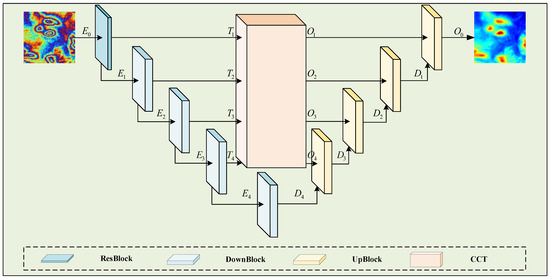
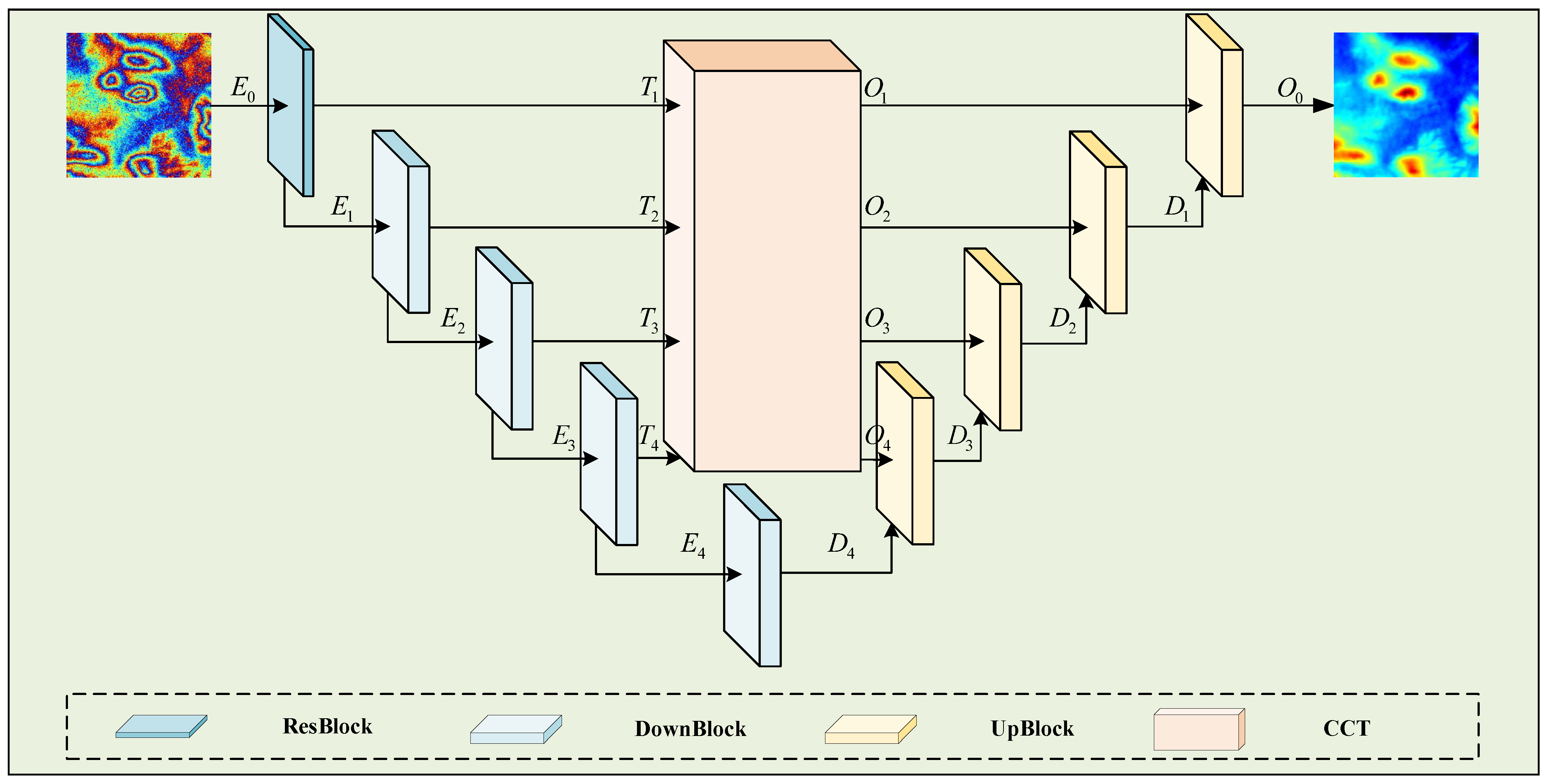
The overall network architecture consists of an encoder (for feature extraction and downsampling), a CTrans module (for enhanced skip connections), and a decoder (for feature restoration and upsampling), as illustrated in Figure 1. The main parameters of ResUCTransNet are shown in Table 1.
Figure 1.
Schematic diagram of ResUCTransNet network architecture.
Table 1.
Main Parameters of ResUCTransNet.
Assuming the size of each interferogram in the dataset is 256 × 256, the input first passes through an initial residual Inception block (ResBlock) in the encoder, where the multi-branch convolutional structure extracts rich local features. Subsequently, four consecutive downsampling blocks (DownBlock) progressively reduce the spatial resolution via MaxPooling (128 × 128, 64 × 64, 32 × 32, and 16 × 16), simultaneously strengthening the abstraction level and high-level semantic representation of the encoded features.
The multi-scale feature maps produced by the encoder are first processed through the CCT-based skip connections. The CCT module leverages a transformer-based architecture to perform channel-wise self-attention, which enables the model to capture global dependencies in different scales and channels. In addition, its skip-connection design further strengthens multi-level feature aggregation, which allows the decoder to more effectively exploit both deep semantic features and shallow spatial details. CCT facilitates collaborative learning of cross-scale channel interactions instead of relying on independent concatenation that offer an adaptive solution to bridge the potential semantic gaps between feature scales. Moreover, a CCA module is introduced to fuse the multi-scale encoder features with the decoder-stage features, aiming to alleviate the semantic inconsistency caused by differences in representation levels. These two cross-attention mechanisms are jointly referred to as CTrans, which establishes effective associations between the encoder and decoder by exploring multi-scale global contextual information. By replacing the conventional skip connections, CTrans mitigates the semantic gap between deep and shallow features and, consequently, enhances the overall performance of the network.
In the decoder, four attention-guided upsampling modules (UpBlock-attention) progressively recover the feature-map resolution (16 × 16 → 32 × 32 → 64 × 64 → 128 × 128 → 256 × 256). Each module combines an upsampling operation with a CCA mechanism. The enhanced skip-connection features from the CCT module are fused in each stage. This design improves spatial localization and strengthens attention to important regions.
Finally, a 1 × 1 convolution maps the decoder output to a single-channel 256 × 256 continuous absolute phase map, completing the phase-unwrapping prediction. In summary, ResUCTransNet integrates CNN-based local perception, the global channel-level attention of CCT, and skip-connection structures. This combination significantly enhances phase unwrapping performance for complex interferograms and provides strong applicability in real scenarios with rugged terrain and heavy noise interference.
2.2.1. DownBlock
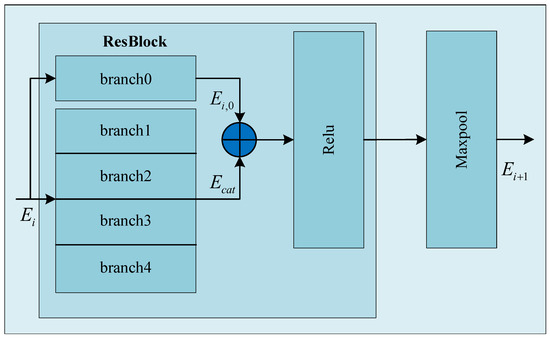
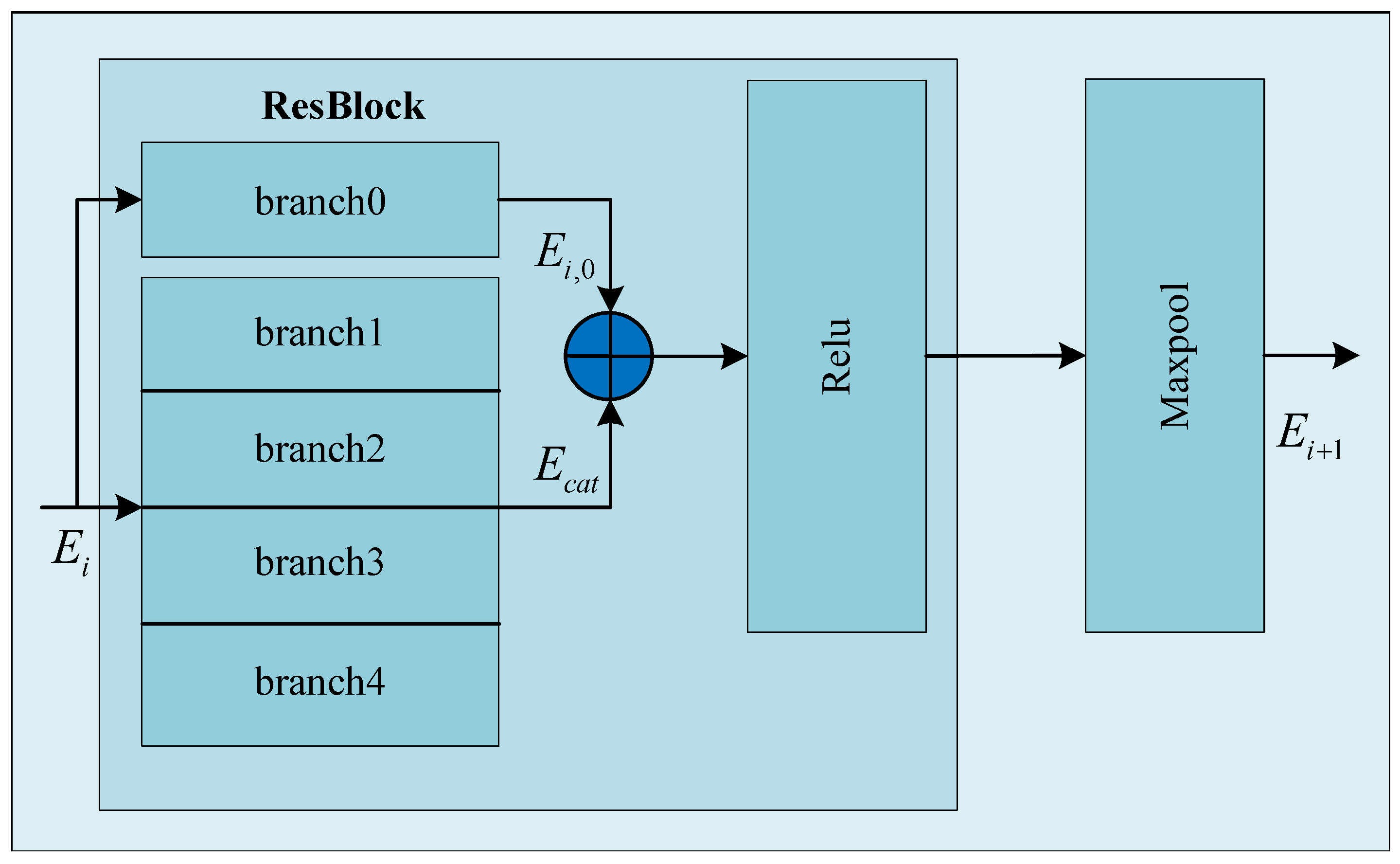
To better accommodate the pronounced local discontinuities, high-frequency disturbances, and multi-scale structural variations inherent in InSAR interferograms, the DownBlock is built upon a multi-scale residual backbone (Res_UNet), which enables the extraction of stable and high-quality deep feature representations. Res_UNet extends the standard U_Net by integrating a ResBlock that contains five parallel convolutional paths with different depths, as illustrated in Figure 2. Branch0: A 1 × 1 convolution that rapidly adjusts channel dimensionality and preserves global information flow. Branch1: A single 3 × 3 convolution for capturing fundamental texture features. Branch2: A two-layer cascade of 3 × 3 convolutions for modeling mid-scale structural cues. Branch3: A three-layer cascade of 3 × 3 convolutions to strengthen local semantic representation. Branch4: A four-layer deep convolutional pathway designed to construct features with a large receptive field. The outputs of 1–4 branches are concatenated along the channel dimension and fused with the residual projection from the Branch0 path to form the final multi-scale feature representation. Given an input feature map and output , the operation can be formulated as:
where denotes the leakyrelu activation function, and BN represents the batch normalization. The output is followed by a MaxPooling layer.
Figure 2.
Schematic diagram of DownBlock.
Through this operation, global contextual information and local structural details are effectively fused, thereby significantly enhancing the network’s ability to perceive and represent wrapped-phase discontinuities and boundary details.
2.2.2. CTrans Module
To address the semantic inconsistency between the encoder and decoder and to enhance cross-scale feature fusion, this study replaces the skip connections in Res_UNet with a CTrans module. CTrans consists of two key components, CCT for fusing multi-scale encoder features, and CCA for integrating decoder features with the enhanced CCT representation [36].
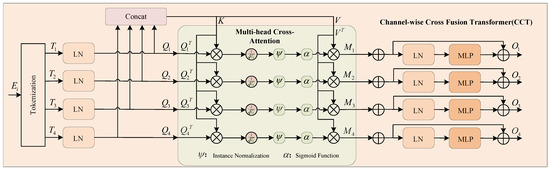
The CCT applies a cross-scale attention mechanism along the channel dimension to fuse multi-resolution features from different depths of the Res_UNet encoder. This extracts globally informative representations that are beneficial for phase unwrapping. The CCT structure includes three stages, multi-scale feature embedding, multi-head channel-wise cross-attention, and multi-layer perceptron (MLP), as illustrated in Figure 3.
Figure 3.
Schematic diagram of CCT.
Multi-scale feature embedding: Given the outputs of four skip-connection layers . The features are converted into sequences of flattened 2D patches with predefined patch sizes , respectively, to perform tokenization so that the patches correspond to the same spatial regions across all scales. Each channel is treated as an individual token, while the original channel dimensions are preserved. The tokens from the four layers, , are then concatenated to form the Key and Value:
which are subsequently used as inputs to the channel-wise cross-attention module.
Multi-head channel-wise cross-attention: Features at different scales are first processed by layer normalization (LN) and, subsequently, used as query vectors, whereas the concatenated features of all scales are used as the keys and values, expressed as follows:
Among them, the weight matrix has the dimension , where d denotes the size of the attention dimension. represents the sum of the channel sizes of the four skip-connection layers. The attention weights are normalized along the channel dimension using instance normalization [37] , followed by a softmax to yield the similarity matrix :
Based on this weight, the fused feature representation is: . Under the multi-head mechanism, the results of all attention heads are averaged:
where N is the number of heads.
MLP: The fused features are first normalized by LN, followed by further processing through a multi-layer perceptron (MLP) and a residual operator. The output is obtained as follows:
Among them, the output represents the fused features of the i-th layer.
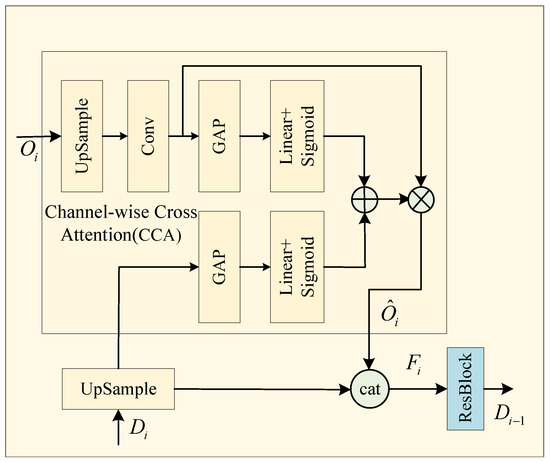
To further align the CCT outputs with the decoder unwrapped features Di, the CCA is introduced. The CCA module performs semantic mapping through a channel-selective mechanism and is used to fuse multi-scale features with the features in the decoder stage to address the issue of semantic-level inconsistency. As shown in Figure 4, for each group of feature maps , the feature maps are upsampled to double their height and width with unchanged channel dimensions via the upsample layer in PyTorch (Version: 1.8.1+cu111). A channel descriptor vector is extracted through global average pooling (GAP) . The pooled results are then fed into linear layers and fused with learned weights to generate the channel attention mask.
where denotes the linear transformation matrix, and represents the ReLU activation function. The attention mask is processed by a linear layer, activated via a sigmoid function, and then applied to , yielding the weighted features . These are then concatenated with the decoder features to form the final fused features.
where denotes the sigmoid function, and is the fused features are fed into the output head.
Figure 4.
Schematic diagram of CCA.
2.3. LOSS Function
The training samples is assumed that consist of wrapped absolute phase pairs, where is the input wrapped phase and is the corresponding absolute phase ground truth. The backbone network outputs , and each layer of the decoder produces K multiscale auxiliary predictions . Let denote the bilinear upsampling operator that resizes to the same spatial resolution as , . Let be the set of pixels, and be the total number of pixels.
To measure the discrepancy between the absolute phase map predicted by the neural network and the ground-truth phase map, the proposed method adopts the L1 loss function (Mean Absolute Error, MAE) as the primary supervised training loss. The L1 loss is robust and insensitive to outliers, which helps mitigate the adverse effects of local phase anomalies (such as residue points or local fringe breakages) on backpropagation. Meanwhile, MAE provides more stable gradients, which promotes the overall convergence of the unwrapping network. The mathematical formulation is as follows:
To enhance the “top-down” supervision of deep features for phase unwrapping, the proposed method applies smooth-L1 (also known as the Huber loss) to the auxiliary predictions at all scales and computes their weighted sum. For small residuals, the loss adopts quadratic penalization to encourage fine refinement. For large residuals, it degenerates into L1 to improve robustness against outliers. The pixel-wise Huber loss for a single scale is defined as:
where denotes the residues and denotes the branch points. is upsampled to full resolution and denote it as . Then, the average Smooth-L1 of the K-th auxiliary branch is:
Considering that the low-resolution branches contribute little to the final fine details and the necessity of stable gradients, a coarse-to-fine decreasing weight is adopted. The multi-scale auxiliary loss is written as:
The total objective function is combines the above main loss and auxiliary losses:
3. Results
3.1. Dataset
To support deep-learning research on InSAR phase unwrapping, this study adopts the public InSAR-DLPU dataset [33]. The dataset is based on the 30 m resolution Shuttle Radar Topography Mission (SRTM) digital elevation model (DEM) provided by NASA. It covers representative and topographically complex regions across China. We first extracted 3000 × 3000 pixel DEM tiles from the SRTM database. Tiles were retained only if they met two criteria: water coverage below 30% and average slopes exceeding 10°. These criteria were ensured sufficient terrain variability and fringe complexity. Then, 31 DEM patches of size 256 × 256 pixels were randomly cropped from each DEM tile, resulting in a dataset comprising a total of 31,000 DEM patches. Of these, 30,000 pairs were allocated for training and 1000 pairs for simulated testing. The selected DEM tiles were then converted into corresponding absolute topographic phase maps. During terrain phase generation, we introduced random height ambiguities ranging from 50 m to 80 m. This simulates varying interferometric baseline conditions. Height ambiguity represents the elevation difference corresponding to one phase cycle. It is related to system parameters including perpendicular baseline, slant range, and incidence angle. Different ambiguity values produce different fringe densities, thereby increasing the diversity of simulated interferograms.
To model atmospheric disturbances, we generated spatially correlated atmospheric phase components using Perlin noise. These components were added to the terrain phase to obtain absolute phase maps. The amplitude of the atmospheric phase was constrained below a predefined threshold. Atmospheric perturbations were included in 30% of the samples. Wrapped phase maps were generated by applying the modulo [, ] wrapping operator to the absolute phase maps.
Although inherent InSAR noise theoretically follows a hypergeometric distribution, we adopted Gaussian noise for efficiency and practicality. Gaussian noise was added to the wrapped phase maps with randomly selected signal-to-noise ratios (SNRs) ranging from −3 dB to 5 dB.
In addition, the dataset provides 100 pairs of real TanDEM-X single-pass interferograms and their corresponding absolute phase maps for testing purposes. The test area is located in Weinan, Shanxi Province, China. This region is characterized by significant terrain relief and mountainous landscapes. Conventional 2D phase unwrapping methods struggle in such areas [35]. The absolute phase reference for TanDEM-X data was generated using the SRTM DEM.
3.2. Performance Evaluation Indext
To comprehensively evaluate model performance in the InSAR phase unwrapping task, this paper conducts a multi-aspect assessment. The evaluation focuses on unwrapping accuracy, structural preservation capability, and model complexity and computational efficiency. Root mean square error (RMSE), structural similarity index (SSIM), number of model parameters (Parameters), and floating-point operations (FLOPs) are adopted as evaluation metrics. RMSE measures the numerical difference between the predicted values and the ground truth, and SSIM evaluates the quality of the unwrapping results from the perspective of image structure. The RMSE is calculated as follows:
where, N denotes the total number of pixels, and represent the predicted value and the ground truth, respectively. A smaller RMSE indicates a higher phase-unwrapping accuracy of the model.
Let x and y be the corresponding regions (e.g., a patch) of two images, the SSIM is computed as follows:
where x, y denotes local image patches from the predicted image and the ground truth image, respectively, denotes mean image intensity, denotes local image contrast (variance), denotes covariance between the predicted and ground truth images, used to measure structural similarity, denotes a stability term to avoid division by zero, typically defined as:
where is the dynamic range of pixel values, and are empirical constant.
The SSIM metric ranges from [0, 1], where a value closer to 1 indicates that the predicted image is more structurally similar to the ground truth and better aligns with human visual perception of image quality.
In addition, to evaluate the deployability and computational efficiency of the model in engineering applications, this study further introduces the number of model parameters (Parameters) and floating-point operations (FLOPs) as complexity metrics. Parameters denote the total number of learnable weights in the model and are used to measure storage overhead. FLOPs represent the number of floating-point operations required for a single forward inference, which reflects the computational complexity and inference efficiency of the model.
3.3. Results and Analysis
The network training is conducted with a NVIDIA RTX 4090 GPU. The training batch size is set to 32. The Adam optimizer is adopted, and the initial learning rate is set to . The learning rate is regulated by the CosineAnnealingWarmRestarts scheduler: the first restart interval is 10 epochs, the restart period remains constant, and the minimum learning rate is >. The InSAR-DLPU training set is used for training over a total of 100 epochs. To ensure the network’s generalization ability on unseen data and avoid overfitting, the model corresponding to the epoch with the lowest L1 loss on the validation set is selected as the final parameters.
3.3.1. Analysis of Unwrapping Results Based on Simulated Data
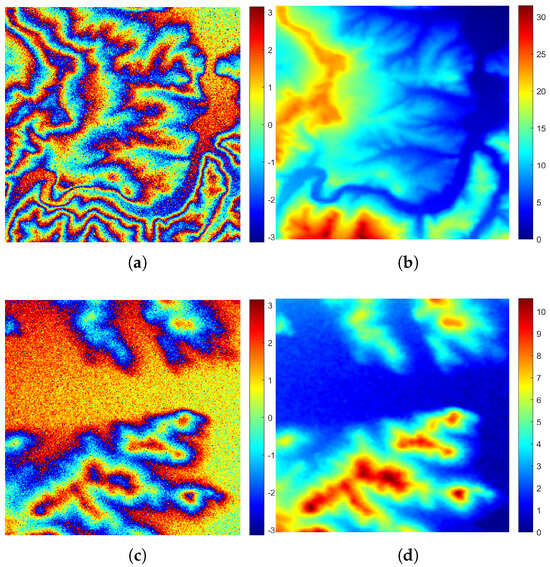
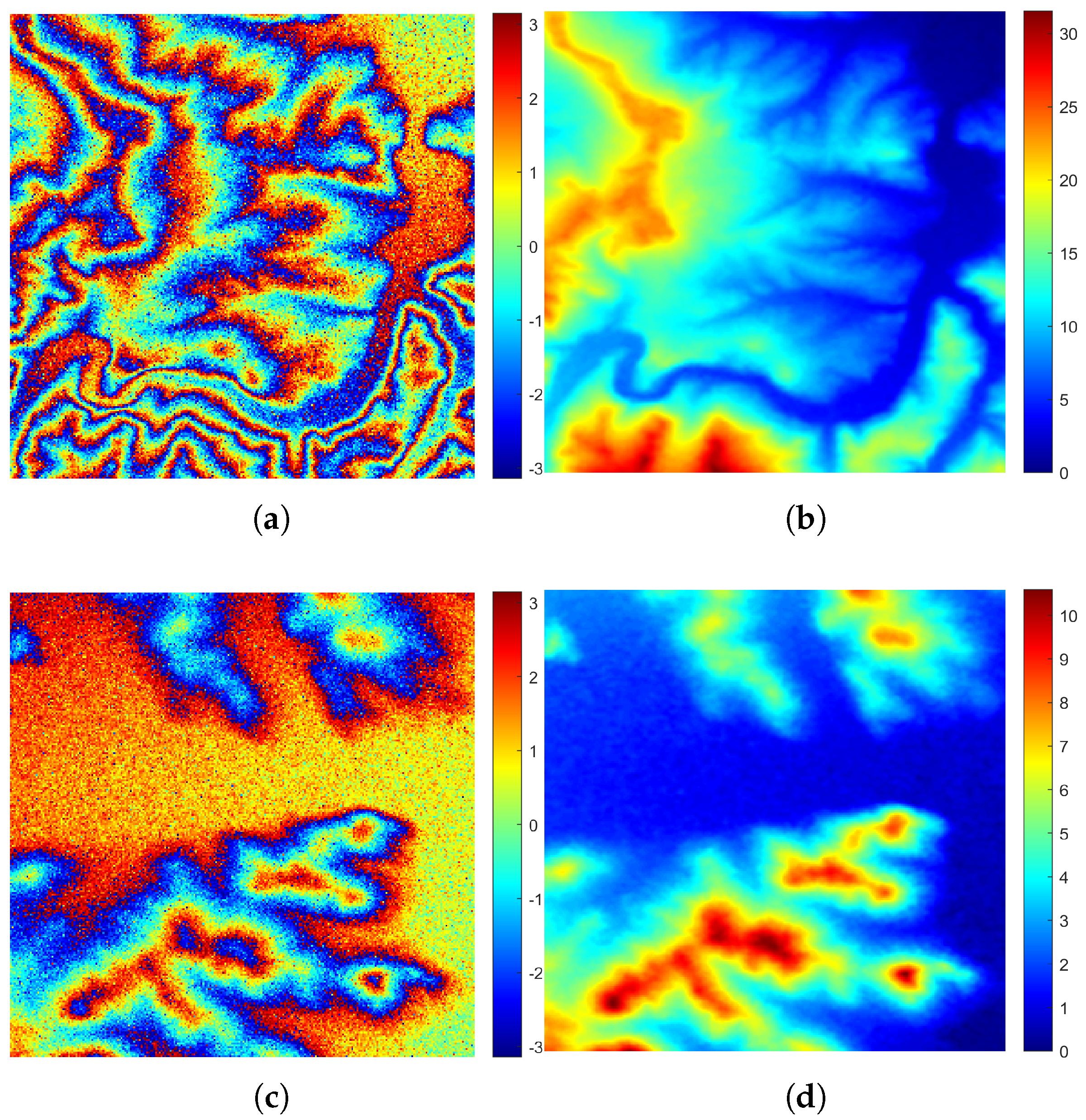
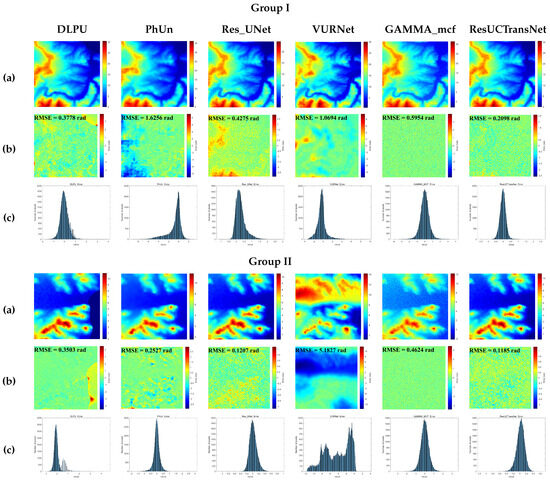
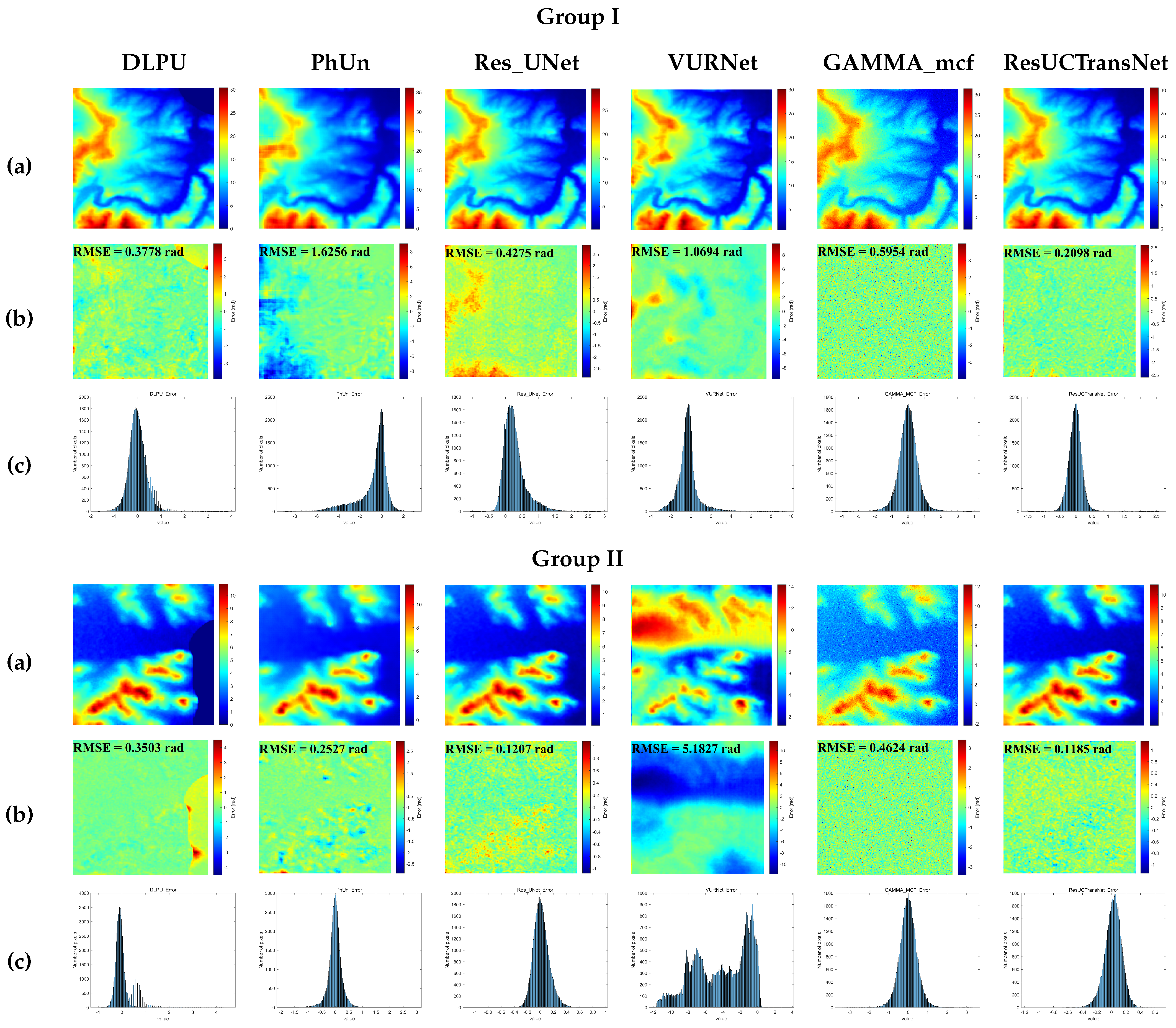
Figure 5 shows the wrapped phases and the corresponding unwrapped results for two scene groups. Figure 6 presents a comparison of multiple methods on simulated interferograms for scenes (I) and (II), including the unwrapped phase maps, error maps, and error-distribution histograms.
Figure 5.
Simulated data: I: (a) wrapped phase and (b) unwrapped phase. II: (c) wrapped phase and (d) unwrapped phase.
Figure 6.
Unwrapping results of simulation Interferogram. Group I and II: (a) Unwrapping results by different methods (b) Unwrapping errors by different methods (c) Error statistical histograms by different methods.
From the unwrapped results, ResUCTransNet produces a smoother and more structurally coherent phase surface, with fringe orientation and terrain morphology better preserved. In regions with complex textures and strong gradients, the boundaries are naturally connected, without large mis-layering or fringe tearing. In the corresponding error maps, ResUCTransNet exhibits errors that cluster closely around zero, with smaller extrema and a more spatially uniform distribution. Moreover, it produces significantly fewer localized high-error regions compared with the other methods. The RMSE values annotated in the figure also indicate a reduced overall error level. Furthermore, the error histograms show that ResUCTransNet has a sharper peak near zero and a much shorter tail. This indicates that it keeps most pixel errors small and effectively suppressing the heavy-tail behavior caused by local unwrapping failures. In both scenes (I) and (II), ResUCTransNet outperforms the compared methods in all three aspects—result maps, error maps, and statistical distributions. It preserves structural and boundary details and also achieves significantly converged overall errors. This is reflects the practical contribution of CCT and CCA to semantic alignment and noise suppression.
To comprehensively evaluate the overall performance of different phase unwrapping methods, this study conducted a systematic comparison of DLPU, PhUn, Res_Unet, VURNet, ResUCTransNet, and the traditional unwrapping algorithm GAMMA_mcf under the same test dataset and unified experimental settings. The evaluation metrics include RMSE, SSIM, model parameters, FLOPs, and inference speed. The comprehensive analysis was performed from three perspectives: accuracy, structure preservation capability, and computational complexity.
As shown in Table 2, ResUCTransNet achieved the most outstanding performance in quantitative accuracy metrics. It obtained the best results in both core indicators of RMSE and SSIM (RMSE = 1.6247, SSIM = 0.7741). Compared with the second-best Res_Unet (RMSE = 2.8409, SSIM = 0.7733), ResUCTransNet maintained nearly identical SSIM values with a difference of only 0.0008. However, it achieved a significant RMSE reduction of approximately 42.8%. This indicates that the model can effectively suppress phase error accumulation while maintaining structural similarity, thereby improving overall unwrapping accuracy. The results demonstrate that the integration of the residual Inception structure and channel transformer fusion mechanism enables better synergy between global dependency modeling and local detail recovery.
Table 2.
Comparison of Evaluation Metrics for Simulated Interferograms.
In terms of model complexity, ResUCTransNet has 15.801 M parameters and 15.449 G FLOPs. These values are significantly lower than those of Res_Unet (26.115 M 54.595 G) and VURNet (21.561 M 59.627 G). Compared with Res_Unet, the parameter size is reduced by approximately 39.5%, and the computational cost is decreased by about 71.7%. Compared with VURNet, the FLOPs are reduced by over 74%. Regarding inference speed, ResUCTransNet requires 45.09 ms per image. Although this is slightly slower than the lightweight models DLPU (12.61 ms) and PhUn (17.56 ms), it still maintains acceptable real-time inference performance while significantly improving accuracy. This demonstrates a favorable performance-complexity trade-off. Further comparison with other deep learning methods reveals several insights. Although DLPU has the smallest parameter size (1.825 M) and fastest inference speed, its RMSE is 2.4234 and SSIM is 0.7018. These values show a noticeable gap compared to ResUCTransNet, particularly in structure preservation capability. Despite having relatively low computational cost (FLOPs = 567.017 M), PhUn exhibits an RMSE of 4.6665 and SSIM of only 0.5410. This indicates its limited error control capability in complex terrain areas. Although VURNet incorporates a multi-scale feature fusion mechanism, its RMSE remains at 4.0525 with significantly increased computational overhead (FLOPs = 59.627 G). The performance improvement does not match its increased complexity.
Compared with the traditional GAMMA_mcf method (RMSE = 3.4456, SSIM = 0.4554), deep learning models overall demonstrate significant advantages in error control and structure preservation. This is primarily attributed to the end-to-end modeling capability of deep networks for nonlinear mapping relationships. They can better recover continuous phase structures in low-coherence areas and high-noise scenarios. Overall, ResUCTransNet achieves a more balanced performance among accuracy improvement, structural consistency preservation, and model complexity control. It demonstrates superior comprehensive performance.
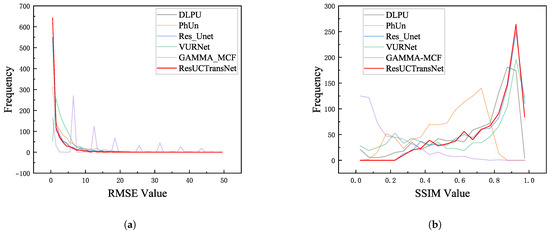
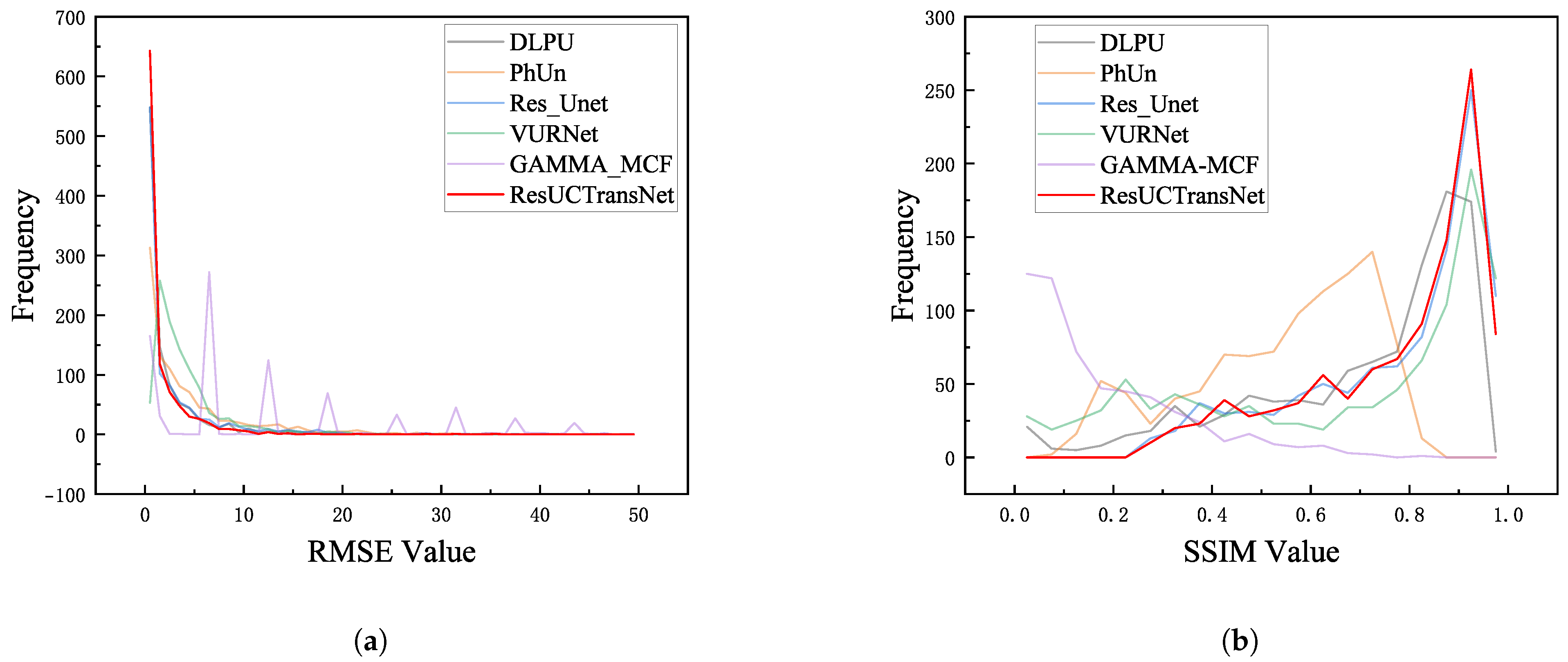
As illustrated in Figure 7, the further distributional analyses of the RMSE and SSIM metrics were conducted to examine the robustness of each method. In the RMSE distribution (Figure 7a), the results produced by ResUCTransNet are highly concentrated in the low-error interval (0–5). Its distribution peak is significantly higher than those of the competing approaches, and it exhibits almost no long-tail behavior in the high-error region. In contrast, other methods (e.g., PhUn and VURnet) show noticeable long tails, which indicates a greater likelihood of unwrapping failures under noise contamination or fringe discontinuities. This stability demonstrates that the proposed method maintains low unwrapping errors across most samples and effectively avoids localized failure cases. In the SSIM distribution (Figure 7b), ResUCTransNet’s results predominantly fall within the high-similarity range (0.8–1.0), with a sharp peak close to 260 and more concentrated than that of Res_Unet. DLPU and VURnet also exhibit some distribution in the high-similarity interval. However, their spread is noticeably broader. PhUn shifts toward the mid- to low-similarity region, which reflects insufficient global structural constraints. GAMMA_mcf shows an almost uniform distribution over the low-similarity range, which indicates the weakest performance. These observations confirm that the proposed method provides more stable preservation of fringe structural consistency compared with the other algorithms.
Figure 7.
Simulated Interferogram: (a) RMSE distribution of different methods. (b) SSIM distribution of different methods.
This performance advantage stems from the innovative architectural design of the model. The introduction of CTrans is the key factor driving the improvement. By incorporating CCT and CCA modules into the skip connections, ResUCTransNet effectively bridges the semantic gap between the encoder and decoder and enables deep fusion of low-level detailed features with high-level semantic representations. This mechanism ensures that the model preserves the local continuity of interferometric fringes and simultaneously capturing global structural integrity. The synergy between residual learning and attention mechanisms further enhances the model’s adaptability to complex interferograms. The residual modules strengthen feature propagation and prevent the loss of fine-grained details in deeper layers, whereas the multi-scale channel cross-attention mechanism emphasizes informative feature channels while suppressing noise-dominated ones. These designs substantially improve robustness under noisy conditions. This architectural strength explains why ResUCTransNet maintains a highly concentrated RMSE distribution and significantly reduces the occurrence of large-error samples.
Overall, the superior performance of ResUCTransNet comes from its ability to break the traditional trade-off in phase unwrapping. Conventional methods often face a dilemma: low error but poor structural fidelity, or good structure but high error. ResUCTransNet avoids this limitation and achieves both low reconstruction error and strong structural preservation. The residual learning scheme ensures stable deep feature propagation, the CCT module enables efficient multi-scale feature integration, and the CCA module further refines channel-wise dependencies. The synergy among these components equips ResUCTransNet with enhanced robustness and generalization capability when handling complex InSAR phase-unwrapping scenarios.
3.3.2. Analysis of Unwrapping Results Based on Real Data
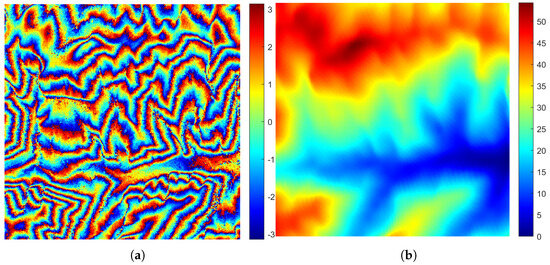
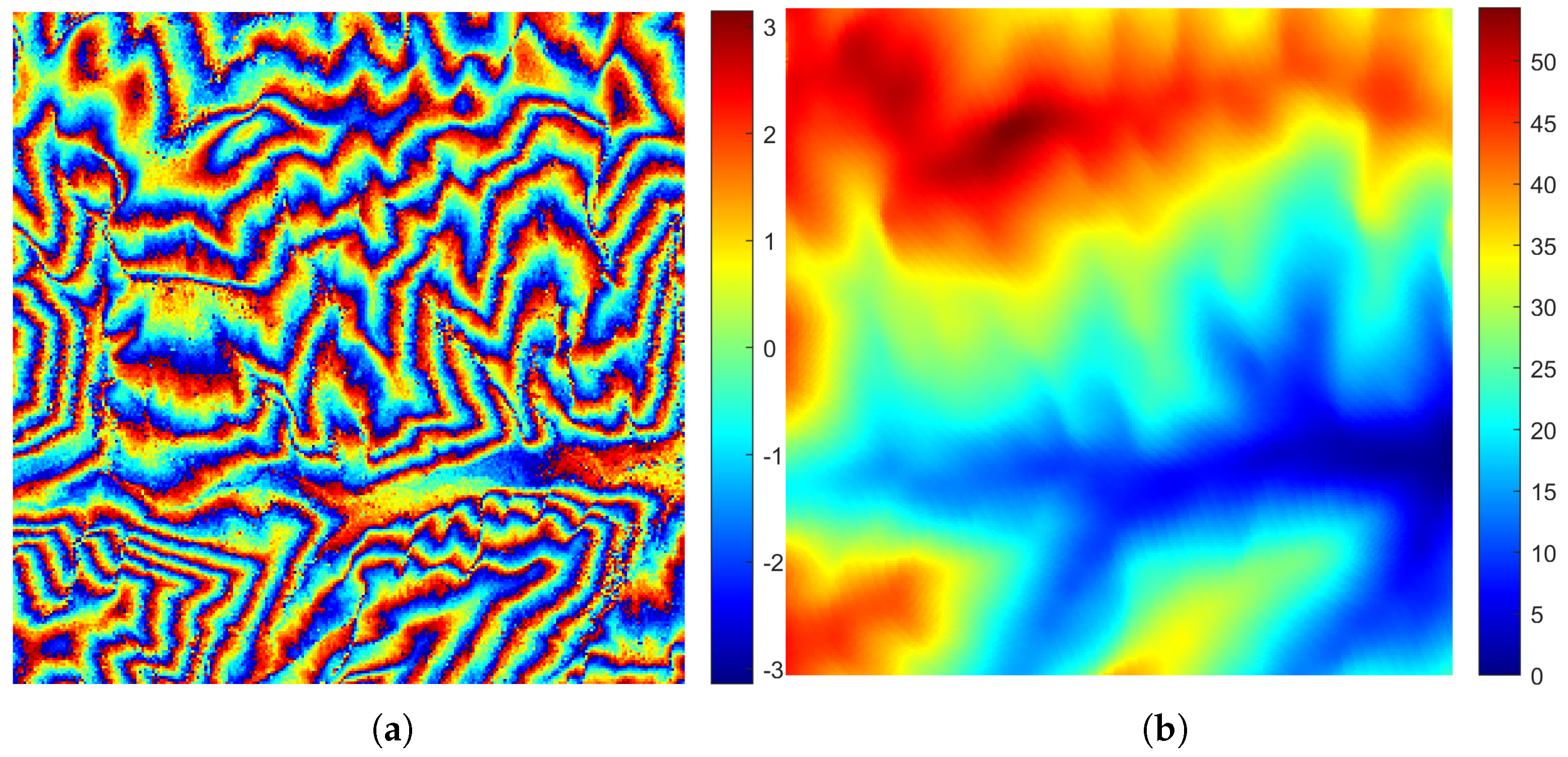
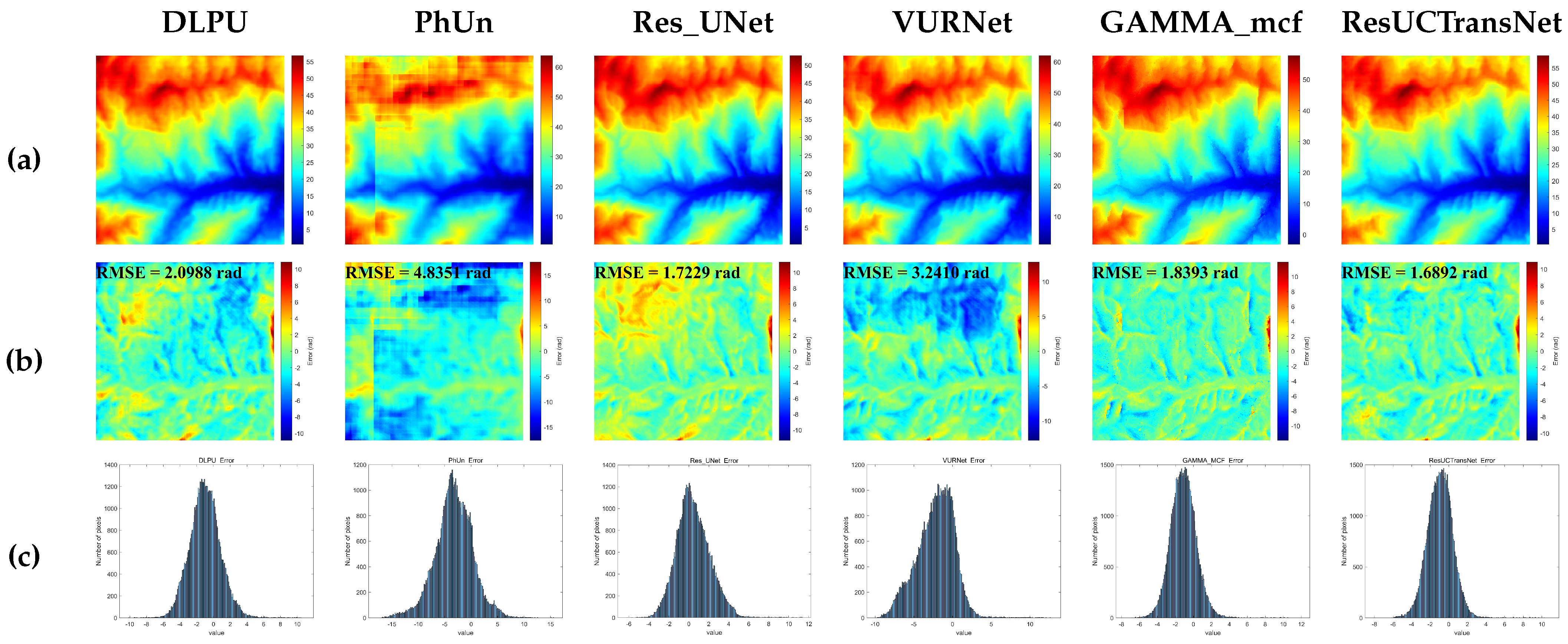
Figure 8 displays real TanDEM-X interferogram samples, for which the unwrapping results, error maps, and error histograms of multiple methods are illustrated in Figure 9. Overall, the performance of deep convolutional neural networks on real InSAR datasets shows a notable degradation compared to simulated datasets. This is attributed to insufficient generalization capability of the models. Real-world scenarios feature more complex terrain structures and atmospheric disturbances that are difficult to model accurately. Moreover, the noise exhibits stronger spatial correlation and non-ideal statistical characteristics. These factors make it challenging for networks to fully adapt to the distribution characteristics established during the training phase, which leads to performance degradation.
Figure 8.
Real data: (a) wrapped phase and (b) unwrapped phase.
Figure 9.
Unwrapping results of the real interferogram. (a) Unwrapping results by different methods. (b) Unwrapping errors by different methods. (c) Error statistics histogram of different methods.
From the perspective of overall visual quality and detail consistency. ResUCTransNet maintains better phase surface continuity and fringe pattern coherence in high-gradient regions such as ridges and valleys, as well as near low-coherence patches. In regions significantly affected by atmospheric phase delay and shadow/layover effects, the number of high-residual patches in its error maps is substantially lower than other methods. Correspondingly, the main peak of the error histogram is sharper and the tail distribution is more compact. This indicates that the errors of most pixels are concentrated near zero, and local unwrapping instabilities are effectively suppressed. These results demonstrate that the proposed method maintains good robustness and generalization capability in complex real-world scenarios, even in the presence of cross-domain distribution differences.
On real data (Table 3), ResUCTransNet achieves the lowest RMSE of 8.863, which represents a 3.36% reduction compared with the strongest baseline Res_Unet (9.171), and an 18.2% improvement relative to the “average of other method” (10.832). Its SSIM of 0.5846 is essentially on par with Res_Unet (0.5896, −0.85%), and outperforming DLPU, VURNet, PhUn, and GAMMA_mcf by 2.5%, 5.8%, 33.5%, and 38.8%, respectively. Overall, the proposed method simultaneously achieves lower error and higher structural fidelity on real scenes, consistent with the conclusions drawn from the simulated data.
Table 3.
RMSE and SSIM of the Real Interferogram.
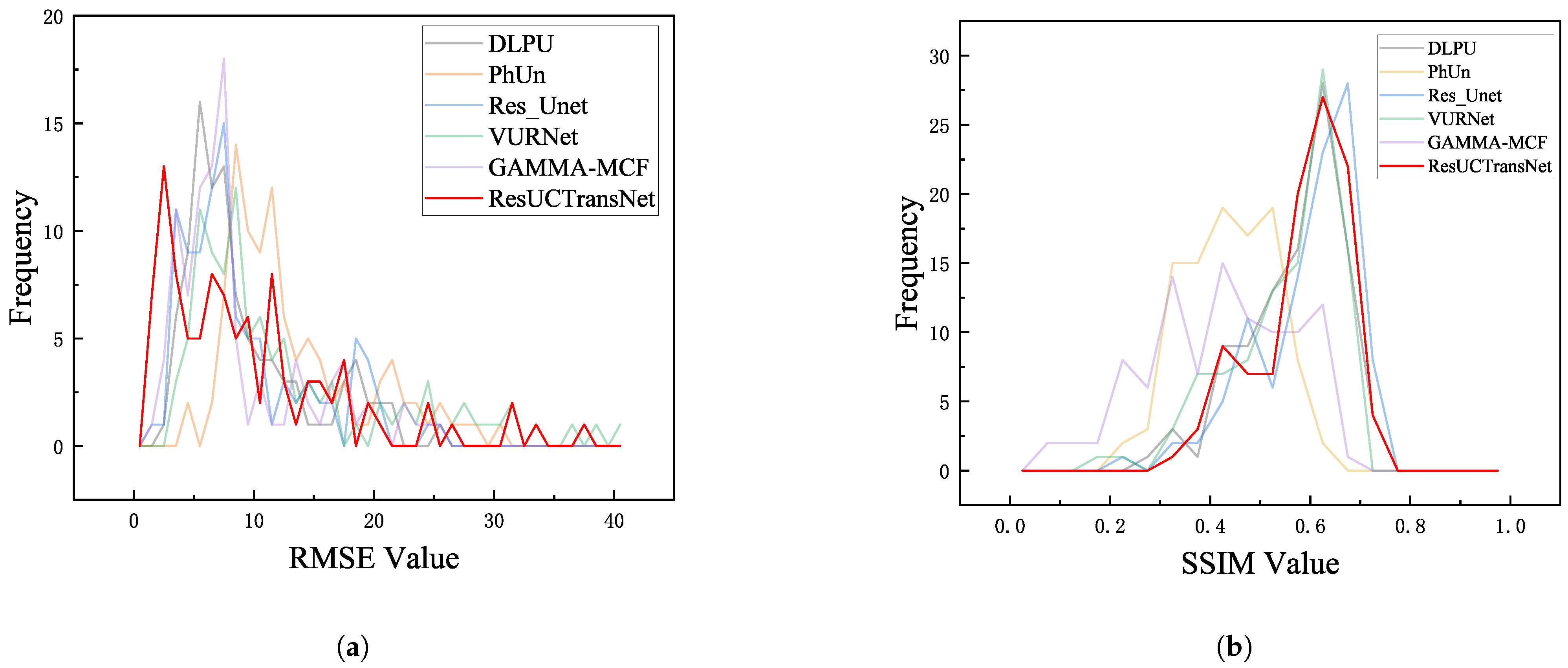
In the RMSE distribution (Figure 10a), the curve of ResUCTransNet is highly concentrated in the low-error range (0–5), with a peak substantially higher than those of the other methods and virtually no long-tail behavior in the high-error region. This indicates that the method maintains low unwrapping errors for the vast majority of samples, demonstrating superior stability. In the SSIM distribution (Figure 10b), the results of all methods fall within the range of 0.5–0.7. Among them, ResUCTransNet and DLPU exhibit more concentrated distributions, with peaks around 0.6, which suggests an advantage in structural preservation. Notably, the distribution of ResUCTransNet is smoother and more tightly clustered, which indicates that it better preserves the overall fringe structure under real-world data conditions and exhibits strong robustness.
Figure 10.
Read Interferogram: (a) RMSE distribution of different methods. (b) SSIM distribution of different methods.
The superior performance of ResUCTransNet can be attributed to two key architectural components, including CCT and CCA. The CCT module effectively bridges the semantic gap between the encoder and decoder through multi-scale cross-feature fusion. This enables the network to simultaneously preserve local details and maintain global consistency during phase unwrapping. The incorporation of residual connections further ensures smooth propagation of low-level features into deeper layers, which reduces the risk of localized large errors caused by information loss. The CCA module integrates multi-scale encoder features with decoder-stage representations, which allows the model to selectively enhance channel responses that contribute to structural preservation and suppressing noise-dominated or irrelevant channels. This selective channel emphasis ensures that the unwrapped results maintain high structural fidelity relative to the reference phase.
In summary, ResUCTransNet is not a simple combination of Res_UNet and transformer, it is a carefully engineered architecture in which the cross-channel fusion mechanism enables a complementary integration of their respective strengths. The experimental results validate the effectiveness of this design, demonstrating that the proposed method can better cope with complex fringe patterns and noise disturbances. This confirms the practical superiority of our approach for InSAR phase unwrapping tasks.
3.3.3. Ablation Experiment
Ablation experiments were conducted to verify the effectiveness of each key module in ResUCTransNet for InSAR phase unwrapping. The experiments systematically evaluated the contribution of individual components. Table 4 presents the quantitative results under different network configurations. These include RMSE, SSIM, and computational complexity (FLOPs).
Table 4.
Ablation Study of Key Components in ResUCTransNet.
As shown in Table 4, the complete ResUCTransNet model (+CCT+CCA+Auxiliary Loss) achieves the best overall performance on both datasets. On the simulated dataset, the RMSE decreases to 1.6247 and the SSIM reaches 0.7741. On the real dataset, the RMSE is reduced to 8.8630, which is the lowest among all configurations. These results demonstrate the effectiveness of integrating CCT, CCA, and auxiliary loss in a collaborative manner.
Compared with the baseline Res_UNet (RMSE 2.8409), introducing only the CCA module (+CCA) significantly reduces the RMSE to 1.9308 on simulated data. This configuration also drastically lowers the computational cost from 54.595 G to 11.825 G FLOPs. These findings indicate that cross-stage semantic alignment between encoder and decoder features plays a crucial role. It improves phase reconstruction accuracy while enhancing feature utilization efficiency. However, the SSIM shows a slight decrease. This suggests that semantic fusion alone is insufficient for fully preserving global structural consistency.
When only the CCT module is introduced (+CCT), the RMSE on simulated data is 1.9649. This represents an improvement compared to the baseline but is slightly inferior to the +CCA configuration. On real data, the RMSE increases to 10.9548. This indicates that cross-scale and cross-channel dependency modeling alone may not sufficiently stabilize feature learning in complex scenes. Global contextual modeling needs to be complemented by effective cross-stage feature alignment to fully exploit its potential.
When both CCT and CCA are jointly employed (+CCT+CCA), the performance improves further. The simulated RMSE decreases to 1.7303 and SSIM increases to 0.7740. The real-data RMSE is reduced to 9.8337. This demonstrates that combining cross-scale global modeling (CCT) with cross-stage semantic alignment (CCA) produces a synergistic effect on phase reconstruction. This leads to more balanced structural preservation and numerical accuracy.
After introducing the auxiliary loss, the performance is further enhanced. The simulated RMSE decreases from 1.7303 to 1.6247. The real-data RMSE drops significantly from 9.8337 to 8.8630. Although the improvement in SSIM is relatively modest, the consistent reduction in RMSE is notable. This indicates that the auxiliary loss provides effective multi-scale supervision during training. It helps stabilize optimization and improves the robustness and generalization ability of the network.
Overall, Table 4 demonstrates that the complete ResUCTransNet achieves the optimal trade-off. It balances phase unwrapping accuracy, structural preservation, and computational efficiency. Its FLOPs (15.449 G) are higher than those of the +CCA configuration. However, they are still substantially lower than the original Res_UNet (54.595 G). Therefore, the additional computational cost is reasonable and justified by the significant performance gains. These results clearly validate the necessity and effectiveness of three components: cross-scale dependency modeling (CCT), cross-stage semantic alignment (CCA), and auxiliary supervision in the InSAR phase unwrapping task.
4. Discussion
The proposed network achieves lower RMSE and more stable structural fidelity on both data. This includes simulated data and real TanDEM-X external validation. The error histograms exhibit a near-zero-centered distribution with a suppressed long tail. This indicates strong robustness against local unwrapping failures. Fringe continuity and boundary transitions are noticeably improved. There are significantly fewer discontinuities and tearing artifacts in high-gradient and low-coherence regions. These enhancements primarily stem from the introduced CCT and CCA modules. They strengthen cross-scale dependency modeling and cross-stage semantic alignment. This improves the model’s ability to interpret complex phase fringes and noise perturbations. Furthermore, the combination of L1 supervision in the main branch and multi-scale Smooth-L1 deep supervision provides stable gradient propagation. This ensures balanced optimization between numerical accuracy and structural preservation through a coarse-to-fine approach.
Compared with the deep-learning baseline Res_UNet, the proposed method achieves a substantial RMSE reduction. It maintains or slightly improves SSIM. This demonstrates better preservation of spatial relationships and phase continuity along complex terrain edges. Relative to traditional optimization-based unwrapping techniques, the method exhibits reduced dependence on manually designed quality maps and path-following strategies. It offers a more direct inference pipeline with improved engineering applicability and deployment flexibility.
Nevertheless, the model may still encounter challenges under extreme conditions. In ultra-dense fringe regions where phase gradients change rapidly within a few pixels, the local ambiguity of phase continuity increases significantly. Although cross-scale modeling enhances contextual understanding, extremely compressed fringes may exceed the network’s effective receptive field. This potentially leads to localized residual errors or minor over-smoothing. Similarly, in near-zero coherence areas, signal information is severely corrupted by noise. The network may rely excessively on contextual inference. While this behavior helps suppress abrupt discontinuities, it may also introduce structural hallucination or bias toward surrounding patterns.
These potential failure cases indicate that model performance remains influenced by the intrinsic information quality of SAR observations. Future improvements may involve incorporating explicit coherence-aware constraints. Uncertainty modeling mechanisms or physics-guided priors could further enhance robustness in extremely low-signal scenarios. Despite these limitations, the proposed framework demonstrates strong stability and generalization ability across diverse terrain conditions. This confirms its effectiveness for practical InSAR phase unwrapping applications.
5. Conclusions
The proposed ResUCTransNet is primarily trained on DEM-driven simulated samples. The amount of real interferometric data involved remains relatively limited. However, external validation results indicate that the method exhibits a certain degree of cross-domain robustness. In terms of computational complexity, the introduction of the CCT and CCA modules enhances the unwrapping performance. However, it inevitably increases the number of parameters and computational overhead. This still requires further optimization.
To address these limitations, several potential improvement directions are proposed. These cover multiple perspectives: model design, computation, data, constraints, and deployment. At the model level, hyper-light deep learning network [38] design strategies can be adopted. The model size can be compressed through structural pruning and low-rank decomposition. Standard convolutions can be replaced with Ghost convolutions and depthwise separable convolutions. Large-scale self-attention mechanisms can be substituted with lightweight attention modules. This significantly reduces computational complexity and parameter scale while maintaining unwrapping accuracy. Furthermore, a hyper-light deep learning network tailored for engineering deployment can be developed to achieve both high-precision unwrapping and fast inference, providing technical support for near-real-time deformation monitoring. For sudden deformation events such as mining subsidence, high-speed inference capability would enable rapid scanning of key areas and timely risk warnings, thereby improving monitoring responsiveness.
Regarding computational efficiency, mixed-precision training and inference can effectively shorten model runtime, while efficient sliding-window tiling strategies can improve data throughput and memory utilization. Gradient checkpointing and memory reuse mechanisms help support larger batch sizes during training. In addition, incorporating model parallelism and data parallelism strategies can alleviate memory bottlenecks when processing large-scale interferograms, providing hardware adaptation support for wide-swath data processing and near-real-time monitoring scenarios.
In terms of loss function design, the current regression framework achieves a relatively stable balance between numerical accuracy and structural fidelity. Future work may further expand the constraint dimensions of the loss function. This can be done by incorporating phase-topology consistency and residual-point constraints. These should be combined with total variation (TV) regularization or frequency–domain sparsity priors. This enhances structural preservation and reduces noise-induced step errors. Moreover, adaptive loss function design may be explored. Loss weights would be dynamically adjusted according to interferogram coherence and fringe density. This enables more refined adaptation across different scenarios and improves overall robustness.
From the perspective of data and scene adaptation, balanced learning strategies inspired by imbalanced detection tasks may be introduced. InSAR phase unwrapping exhibits distribution differences among several region types. These include high- and low-coherence regions, dense and sparse fringe areas, and flat and complex terrains. Weighted loss functions, adaptive resampling, and curriculum learning can be employed. These guide the model to focus more on low-coherence and complex fringe regions. This enhances robustness in challenging environments. In addition, a progressive processing strategy from global to local refinement can be incorporated. This constructs a “global coarse unwrapping–local fine correction” framework. By first enforcing structural consistency at the regional scale and subsequently performing pixel-level refinement, ambiguity propagation and noise accumulation can be effectively reduced.
Furthermore, data augmentation and real-data adaptation strategies may be strengthened. To address the limited availability of real interferometric data, interferogram generation methods based on physical imaging models can be developed. These simulate realistic scenarios with varying noise levels, deformation magnitudes, and fringe densities. This mitigates domain gaps between simulated and real data. Meanwhile, few-shot learning and self-supervised learning approaches may be explored. These improve model performance under limited labeled data conditions and reduce reliance on large-scale manual annotations.
Overall, the proposed ResUCTransNet integrates three key strategies: cross-scale semantic alignment, channel-selective enhancement, and multi-scale supervision. It effectively reduces unwrapping errors while preserving phase structural continuity. The method demonstrates strong engineering potential in several applications. These include mining subsidence monitoring, urban deformation analysis, and geohazard surveillance. Future research will focus on multiple directions: Conducting domain adaptation studies on large-scale real interferograms to enhance model adaptability to real-world scenarios; Advancing model compression and hyper-light network design to achieve both high precision and high speed. This supports rapid subsidence detection in wide-swath and near-real-time monitoring scenarios; Exploring multimodal inputs and time-series fusion techniques. Temporal correlation constraints should be incorporated to improve robustness under strong noise, large deformation, and extreme weather conditions, enhancing model interpretability by embedding physical constraints and visualizing feature learning processes. This improves credibility in scientific and engineering applications; Extending the method to different interferometric systems and diverse monitoring environments. Integration with 3D reconstruction and deformation inversion techniques should be explored to build a unified interferometric solution framework; Promoting engineering-oriented optimization of the algorithm by designing efficient parallel computing architectures and optimizing data processing pipelines. This improves large-scale interferogram processing efficiency.
Author Contributions
Author Contributions: Conceptualization, Y.C.; Formal analysis, Y.C. and Y.H.; Funding acquisition, Y.C., P.H. and W.T.; Investigation, Y.C. and Y.H.; Methodology, Y.C. and Y.H.; Project administration, Y.C., P.H., W.T., Z.W. and Y.Q.; Resources, Y.C. and Y.H.; Software, Y.H.; Supervision, Y.C., P.H., Z.W. and Y.Q.; Validation, Y.C. and Y.H.; Visualization, Y.H.; Writing—original draft, Y.H.; Writing—review and editing, Y.C., P.H. and W.T. All authors have read and agreed to the published version of the manuscript.
Funding
This research was funded by the National Natural Science Foundation of China under Project Nos. 52304173 and 52264009, the Natural Science Foundation of Inner Mongolia Autonomous Region under Project No. 2025MS06037, the Science and Technology Program of Inner Mongolia Autonomous Region under Project No. 2025KYPT0128, the Civil-Military Integration Project under Grant No. JMRHZX20240105, the Fundamental Research Program of Universities in Inner Mongolia Autonomous Region under Grant No. JY20240009, the Science and Technology Program of Inner Mongolia Autonomous Region under Project No. 2023YFHH0081, and the Natural Science Foundation of Inner Mongolia Autonomous Region under Project No. 2023LHMS06013.
Data Availability Statement
The original data presented in the study are openly available at [33].
Conflicts of Interest
The authors declare no conflicts of interest.
References
- Moreira, A.; Prats-Iraola, P.; Younis, M.; Krieger, G.; Hajnsek, I.; Papathanassiou, K.P. A Tutorial on Synthetic Aperture Radar. IEEE Geosci. Remote Sens. Mag. 2013, 1, 6–43. [Google Scholar] [CrossRef] [Scilit]
- Rosen, P.A.; Hensley, S.; Joughin, I.R.; Li, F.K.; Madsen, S.N.; Rodríguez, E.; Goldstein, R.M. Synthetic Aperture Radar Interferometry—Invited Paper. Proc. IEEE 2000, 88, 333–382. [Google Scholar] [CrossRef] [Scilit]
- Ghiglia, D.C.; Pritt, M.D. Two-Dimensional Phase Unwrapping: Theory, Algorithms, and Software; Wiley: Hoboken, NJ, USA, 1998. [Google Scholar]
- Itoh, K. Analysis of the Phase Unwrapping Algorithm. Appl. Opt. 1982, 21, 2470. [Google Scholar] [CrossRef] [Scilit]
- Goldstein, R.M.; Zebker, H.A.; Werner, C.L. Satellite Radar Interferometry: Two-Dimensional Phase Unwrapping. Radio Sci. 1988, 23, 713–720. [Google Scholar] [CrossRef] [Scilit]
- Flynn, T. Consistent 2-D Phase Unwrapping Guided by a Quality Map. In Proceedings of the IGARSS ’96. 1996 International Geoscience and Remote Sensing Symposium, Lincoln, NE, USA, 31 May 1996; Volume 4, pp. 2057–2059. [Google Scholar] [CrossRef] [Scilit]
- Zhao, M.; Huang, L.; Zhang, Q.; Su, X.; Asundi, A.; Kemao, Q. Quality-Guided Phase Unwrapping Technique: Comparison of Quality Maps and Guiding Strategies. Appl. Opt. 2011, 50, 6214–6224. [Google Scholar] [CrossRef] [Scilit]
- Costantini, M. A Novel Phase Unwrapping Method Based on Network Programming. IEEE Trans. Geosci. Remote Sens. 1998, 36, 813–821. [Google Scholar] [CrossRef] [Scilit]
- Ghiglia, D.C.; Romero, L.A. Minimum Lp-Norm Two-Dimensional Phase Unwrapping. J. Opt. Soc. Am. A 1996, 13, 1999–2013. [Google Scholar] [CrossRef] [Scilit]
- Yu, H.; Lan, Y.; Yuan, Z.; Xu, J.; Lee, H. Phase Unwrapping in InSAR A Review. IEEE Geosci. Remote Sens. Mag. 2019, 7, 40–58. [Google Scholar] [CrossRef] [Scilit]
- Wang, K.; Kemao, Q.; Di, J.; Zhao, J. Deep Learning Spatial Phase Unwrapping: A Comparative Review. Adv. Photonics Nexus 2022, 1, 014001. [Google Scholar] [CrossRef] [Scilit]
- Wang, K.; Li, Y.; Qian, K.; Di, J.; Zhao, J. One-Step Robust Deep Learning Phase Unwrapping. Opt. Express 2019, 27, 15100–15115. [Google Scholar] [CrossRef] [Scilit] [PubMed]
- Wu, Z.; Zhang, H.; Wang, Y.; Wang, T.; Wang, R. A Deep Learning Based Method for Local Subsidence Detection and Insar Phase Unwrapping: Application to Mining Deformation Monitoring. In Proceedings of the Igarss 2020—2020 IEEE International Geoscience and Remote Sensing Symposium, New York, NY, USA, 26 September–2 October 2020; pp. 20–23. [Google Scholar] [CrossRef] [Scilit]
- Yang, W.; He, Y.; Zhu, Q.; Zhang, L.; Jin, L. Unwrap-Net: A Deep Neural Network-Based InSAR Phase Unwrapping Method Assisted by Airborne LiDAR Data. ISPRS J. Photogramm. Remote Sens. 2024, 218, 510–529. [Google Scholar] [CrossRef] [Scilit]
- Spoorthi, G.E.; Gorthi, S.; Gorthi, R.K.S.S. PhaseNet: A Deep Convolutional Neural Network for Two-Dimensional Phase Unwrapping. IEEE Signal Process. Lett. 2019, 26, 54–58. [Google Scholar] [CrossRef] [Scilit]
- Zhou, L.; Yu, H.; Lan, Y.; Xing, M. Deep Learning-Based Branch-Cut Method for InSAR Two-Dimensional Phase Unwrapping. IEEE Trans. Geosci. Remote Sens. 2022, 60, 5209615. [Google Scholar] [CrossRef] [Scilit]
- Wu, Z.; Wang, T.; Wang, Y.; Wang, R.; Ge, D. Deep-Learning-Based Phase Discontinuity Prediction for 2-D Phase Unwrapping of SAR Interferograms. IEEE Trans. Geosci. Remote Sens. 2022, 60, 5216516. [Google Scholar] [CrossRef] [Scilit]
- Zhou, L.; Yu, H. MoDL-PU: Model-Based Deep Learning for InSAR Phase Unwrapping. IEEE Trans. Geosci. Remote Sens. 2025, 63, 5206711. [Google Scholar] [CrossRef] [Scilit]
- Liu, H.; Zheng, K.; Miao, C.; Liu, X.; Liu, X.; Li, L.; Zhang, Y.; Xiong, L. PIPNet: A Deep Convolutional Neural Network for Multibaseline InSAR Phase Unwrapping Based on Pure Integer Programming. IEEE J. Sel. Top. Appl. Earth Obs. Remote Sens. 2025, 18, 15495–15507. [Google Scholar] [CrossRef] [Scilit]
- Pu, L.; Zhang, X.; Zhou, Z.; Li, L.; Zhou, L.; Shi, J.; Wei, S. A Robust InSAR Phase Unwrapping Method via Phase Gradient Estimation Network. Remote Sens. 2021, 13, 4564. [Google Scholar] [CrossRef] [Scilit]
- Zhou, Z.; Rahman Siddiquee, M.M.; Tajbakhsh, N.; Liang, J. Unet++: A Nested u-Net Architecture for Medical Image Segmentation. In Deep Learning in Medical Image Analysis and Multimodal Learning for Clinical Decision Support; Lecture Notes in Computer Science; Springer: Berlin/Heidelberg, Germany, 2018; pp. 3–11. [Google Scholar] [CrossRef] [Scilit]
- Ibtehaz, N.; Rahman, M.S. MultiResUNet: Rethinking the U-Net Architecture for Multimodal Biomedical Image Segmentation. Neural Netw. 2020, 121, 74–87. [Google Scholar] [CrossRef] [Scilit]
- Ronneberger, O.; Fischer, P.; Brox, T. U-Net: Convolutional Networks for Biomedical Image Segmentation. In Medical Image Computing and Computer-Assisted Intervention MICCAI 2015; Navab, N., Hornegger, J., Wells, W.M., Frangi, A.F., Eds.; Springer: Cham, Switzerland, 2015; pp. 234–241. [Google Scholar] [CrossRef] [Scilit]
- Huang, G.; Liu, Z.; Van Der Maaten, L.; Weinberger, K.Q. Densely Connected Convolutional Networks. In Proceedings of the 2017 IEEE Conference on Computer Vision and Pattern Recognition (CVPR), Honolulu, HI, USA, 21–26 July 2017; pp. 2261–2269. [Google Scholar] [CrossRef] [Scilit]
- Dosovitskiy, A.; Beyer, L.; Kolesnikov, A.; Weissenborn, D.; Zhai, X.; Unterthiner, T.; Dehghani, M.; Minderer, M.; Heigold, G.; Gelly, S.; et al. An Image Is Worth 16x16 Words: Transformers for Image Recognition at Scale. arXiv 2021, arXiv:2010.11929. [Google Scholar] [CrossRef] [Scilit]
- Chen, J.; Mei, J.; Li, X.; Lu, Y.; Yu, Q.; Wei, Q.; Luo, X.; Xie, Y.; Adeli, E.; Wang, Y.; et al. TransUNet: Rethinking the U-Net Architecture Design for Medical Image Segmentation through the Lens of Transformers. Med. Image Anal. 2024, 97, 103280. [Google Scholar] [CrossRef] [Scilit]
- Cao, H.; Wang, Y.; Chen, J.; Jiang, D.; Zhang, X.; Tian, Q.; Wang, M. Swin-Unet: Unet-like Pure Transformer for Medical Image Segmentation. In Proceedings of the European Conference on Computer Vision, Tel Aviv, Israel, 23–27 October 2022; Lecture Notes in Computer Science; Springer: Cham, Switzerland, 2023; pp. 205–218. [Google Scholar] [CrossRef] [Scilit]
- Oktay, O.; Schlemper, J.; Le Folgoc, L.; Lee, M.; Heinrich, M.; Misawa, K.; Mori, K.; McDonagh, S.; Hammerla, N.Y.; Kainz, B.; et al. Attention U-Net: Learning Where to Look for the Pancreas. arXiv 2018, arXiv:1804.03999. [Google Scholar] [CrossRef] [Scilit]
- Li, X.; Chen, H.; Qi, X.; Dou, Q.; Fu, C.W.; Heng, P.A. H-DenseUNet: Hybrid Densely Connected UNet for Liver and Tumor Segmentation From CT Volumes. IEEE Trans. Med. Imaging 2018, 37, 2663–2674. [Google Scholar] [CrossRef] [Scilit]
- Qin, Y.; Wan, S.; Wan, Y.; Weng, J.; Liu, W.; Gong, Q. Direct and Accurate Phase Unwrapping with Deep Neural Network. Appl. Opt. 2020, 59, 7258–7267. [Google Scholar] [CrossRef] [Scilit]
- Duan, J.; Chen, J.; Li, H.; He, Z. A Transformer Network for Phase Unwrapping in Fiber-Optic Acoustic Sensors. J. Light. Technol. 2024, 42, 7010–7020. [Google Scholar] [CrossRef] [Scilit]
- Zhu, X.; Han, Z.; Yuan, M.; Guo, Q.; Wang, H. Hformer: Hybrid CNN-Transformer for Fringe Order Prediction in Phase Unwrapping of Fringe Projection. arXiv 2021, arXiv:2112.06759. [Google Scholar] [CrossRef] [Scilit]
- Zhou, L.; Yu, H. InSAR-DLPU: A Benchmark Dataset for Deep Learning-Based Synthetic Aperture Radar Interferometry Phase Unwrapping [Software and Data Sets]. IEEE Geosci. Remote Sens. Mag. 2024, 12, 118–124. [Google Scholar] [CrossRef] [Scilit]
- Wu, Z.; Wang, T.; Wang, Y.; Wang, R.; Ge, D. Deep Learning for the Detection and Phase Unwrapping of Mining-Induced Deformation in Large-Scale Interferograms. IEEE Trans. Geosci. Remote Sens. 2022, 60, 5216318. [Google Scholar] [CrossRef] [Scilit]
- Zhou, L.; Yu, H.; Pascazio, V.; Xing, M. PU-GAN: A One-Step 2-D InSAR Phase Unwrapping Based on Conditional Generative Adversarial Network. IEEE Trans. Geosci. Remote Sens. 2022, 60, 5221510. [Google Scholar] [CrossRef] [Scilit]
- Wang, H.; Cao, P.; Wang, J.; Zaiane, O.R. UCTransNet: Rethinking the Skip Connections in U-Net from a Channel-Wise Perspective with Transformer. In Proceedings of the 36th AAAI Conference on Artificial Intelligence, AAAI 2022, Virtual, 22 February–1 March 2022; Volume 36, pp. 2441–2449. [Google Scholar] [CrossRef] [Scilit]
- Ulyanov, D.; Vedaldi, A.; Lempitsky, V. Instance Normalization: The Missing Ingredient for Fast Stylization. arXiv 2017, arXiv:1607.08022. [Google Scholar] [CrossRef] [Scilit]
- Zhang, T.; Zhang, X.; Shi, J.; Wei, S. HyperLi-Net: A Hyper-Light Deep Learning Network for High-Accurate and High-Speed Ship Detection from Synthetic Aperture Radar Imagery. ISPRS J. Photogramm. Remote Sens. 2020, 167, 123–153. [Google Scholar] [CrossRef] [Scilit]

Disclaimer/Publisher’s Note: The statements, opinions and data contained in all publications are solely those of the individual author(s) and contributor(s) and not of MDPI and/or the editor(s). MDPI and/or the editor(s) disclaim responsibility for any injury to people or property resulting from any ideas, methods, instructions or products referred to in the content. |
© 2026 by the authors. Licensee MDPI, Basel, Switzerland. This article is an open access article distributed under the terms and conditions of the Creative Commons Attribution (CC BY) license.