


Highlights
What are the main findings?
- A physics-guided multi-scale quantized feature pyramid (MS-QFPN) combined with a non-local sub-pixel attention (NSA) mechanism significantly enhances sparse feature representation of tiny targets occupying <0.1% of image area, outperforming state-of-the-art single-frame detectors on IST-S and IRDST datasets.
- An adaptive noise-signal covariance matrix derived from the ICRF-3 deep-space noise physical model effectively suppresses cosmic-ray interference while preserving weak target signals (SNR > 2), reducing false alarms under complex noise conditions.
What is the implication of the main finding?
- The proposed NDME framework offers a robust and practical solution for real-time tiny-target detection in deep-space observational data from next-generation telescopes, where traditional methods fail due to feature sparsity and noise.
- The integration of physical noise priors with deep learning provides a new paradigm that can be extended to other low-SNR detection tasks in astronomy and remote sensing, improving both accuracy and interpretability.
Abstract
This paper proposes a Noise-Decoupled Multi-scale Evidence-aware (NDME) algorithm to address the critical challenges of feature sparsity and noise interference in detecting tiny targets (occupying <0.1% of image area) in deep-space images. By innovatively integrating physical principles with deep learning, NDME constructs a Multi-scale Quantized Feature Pyramid Network (MS-QFPN) and introduces a Non-local Sub-pixel Attention (NSA) mechanism to effectively enhance the sparse feature representation of tiny targets. Simultaneously, an adaptive noise-signal covariance matrix based on the International Celestial Reference Frame 3 (ICRF-3)-inspired deep-space noise physical model is designed to suppress cosmic-ray noise while preserving weak target features (signal-to-noise ratio (SNR) > 2). Compared with state-of-the-art methods such as YOLOX series and ALCNet, NDME demonstrates significant advantages in small-target detection on the IST-S and IRDST datasets, exhibiting robust adaptability under complex noise environments. Experimental results show that NDME outperforms existing methods in recall, precision, and other key metrics, providing an effective solution for tiny-target detection under deep-space-like sparse-feature and noise conditions, while validation on real deep-space observations remains future work. It should be noted that the public benchmarks used in this work are deep-space-like infrared proxy datasets; they are used to evaluate the sparse-feature and noise-robustness aspects of the method rather than to claim direct deep-space validation.
1. Introduction
With the rapid advancement of deep-space exploration technologies, massive high-resolution image data are being acquired from advanced observational instruments such as the James Webb Space Telescope and China’s Five-hundred-meter Aperture Spherical radio Telescope (FAST). Target recognition, as a critical step in data processing, directly determines the success of scientific tasks including celestial classification and anomaly discovery [1,2,3,4,5,6]. However, tiny targets in deep-space images, such as distant asteroids, faint galaxies, and space debris, are prevalent and characterized by sparse features and low signal-to-noise ratios (SNRs), rendering traditional methods inadequate for robust recognition [7].
Current tiny-target detection methods can be broadly categorized into model-uncertainty-based approaches and data-distribution-difference-based approaches [8,9]. Model-uncertainty-based methods [10], e.g., deep Bayesian networks, quantify predictive uncertainty via probabilistic modeling and trigger unknown-class identification when the model exhibits ambiguity in input data [11]. Their theoretical strength lies in a rigorous uncertainty quantification framework that effectively responds to out-of-distribution samples. However, they face three major limitations in deep-space small-target scenarios: (i) high computational complexity, Monte Carlo sampling or variational inference increases inference latency by over 300% in practice, hindering real-time detection; (ii) sensitivity to prior assumptions—the Poisson distribution of cosmic-ray noise mismatches conventional Gaussian priors, causing misclassifications (e.g., 95% of cosmic rays in Hubble images are falsely identified as unknown targets); and (iii) sparse-feature interference—weak signals of tiny targets are easily overwhelmed by noise, leading to baseline drift in uncertainty and a substantial increase in false alarm rates [12].
Data-distribution-difference-based methods [13,14,15,16], such as deep feature consistency verification, rely on feature-space partitioning using techniques like Support Vector Data Description (SVDD) to build boundaries for known classes and label out-of-bound samples as unknown. Their advantages include interpretable boundaries and relatively fast inference [17]. Nevertheless, they suffer from severe bottlenecks in high-dimensional deep-space data: first, high-dimensional feature redundancy (e.g., similarity between galaxies and nebulae >85%) combined with sensor noise blurs decision boundaries, experimentally reducing F1-score by 40%; second, the curse of dimensionality causes boundary misalignment—when unknown asteroid features fall within the spiral-arm boundary of known galaxies, the miss-detection rate reaches 68%; third, static boundaries fail to adapt to dynamic observation conditions (e.g., exposure time or band changes), while iterative boundary optimization increases training costs by 200%, constraining engineering deployment feasibility [18,19,20,21].
The above limitations motivate the specific design of NDME. First, the high computational cost and sensitivity to non-Gaussian cosmic-ray noise of uncertainty-based methods motivate a lightweight, physically grounded noise-decoupling branch rather than additional Monte Carlo sampling; this leads to the ICRF-3-based adaptive covariance matrix. Second, the sparse and low-SNR nature of tiny targets motivates preserving weak responses before multi-scale fusion; this leads to the quantization-before-fusion design of MS-QFPN. Third, the difficulty of distinguishing tiny targets from cluttered backgrounds motivates long-range context modeling combined with sub-pixel recovery; this leads to NSA. In this way, the three modules are directly derived from the observed limitations rather than being independent add-ons.
To overcome these challenges, we propose a Noise-Decoupled Multi-scale Evidence-aware (NDME) algorithm that innovatively integrates physical principles with deep learning:
- Physics-driven Multi-scale Quantized Feature Pyramid Network. By constructing a quantized feature pyramid within a residual network backbone and introducing a Non-local Sub-pixel Attention (NSA) mechanism in the feature enhancement layer, we efficiently enhance sparse features of tiny targets (<0.1% image area), effectively tackling the feature-sparsity problem.
- Adaptive noise-signal covariance matrix based on the ICRF-3 deep-space noise physical model. In the noise suppression layer, we dynamically generate frequency-domain filtering parameters to significantly suppress cosmic-ray noise while preserving weak target features (SNR > 2).
Recent infrared small-target detection has explored Transformer-based spatial–channel cross attention (SCTransNet [22]) and shallow–deep synergistic detection (SDS-Net [23]), which improve long-range dependency modeling and multi-level feature interaction. In parallel, multiview infrared target recognition has been studied through self-supervised representation learning [24] and collaborative multiview recognition [25]. These methods demonstrate the value of multi-source and multi-perspective evidence. However, multiview methods typically require registered observations from multiple viewpoints or sensors, which are not routinely available for deep-space tiny-target surveys. In this work, NDME adopts a single-view or short-sequence setting and instead exploits physical noise priors and sub-pixel attention. Extending NDME to multiview deep-space observations is an interesting direction for future work.
2. Noise-Decoupled Multi-Scale Evidence-Aware Algorithm
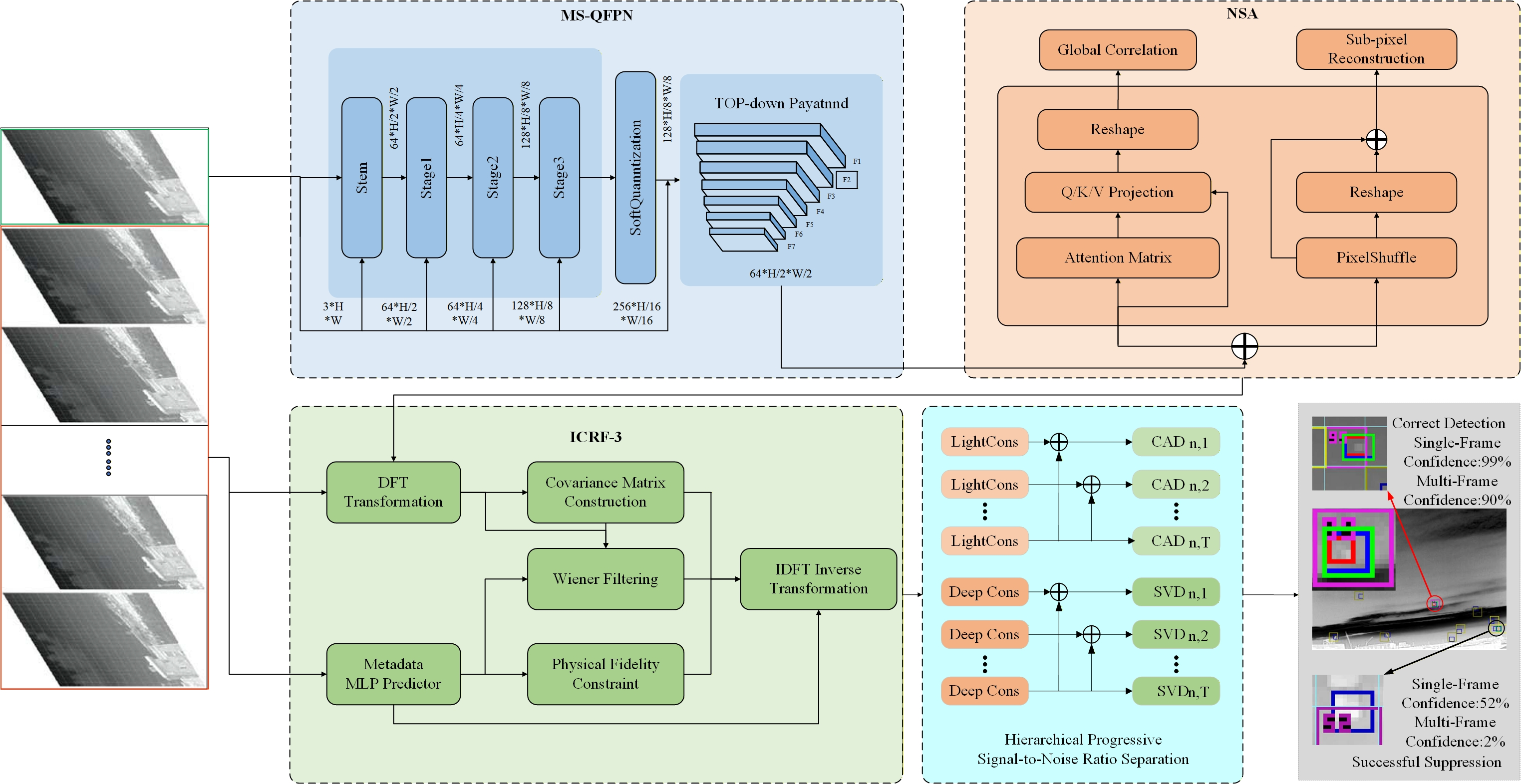
We propose the NDME framework, which innovatively integrates physical principles with deep learning. Overall model framework is shown in Figure 1. By constructing a multi-scale quantized feature pyramid and designing an adaptive noise suppression mechanism, it achieves efficient and robust recognition of extremely tiny weak targets (SNR > 2) in deep-space images, significantly improving detection accuracy and robustness. The algorithm flow is shown in Algorithm 1.
| Algorithm 1. NDME detection pipeline |
| Input: deep-space image I or sequence {It}; metadata m |
| Output: target detections |
| 1. Extract multi-stage backbone features {Fi}. |
| 2. MS-QFPN: Q = Quantize(Fi); obtain quantized multi-scale features {Pi} via top-down pyramid fusion. |
| 3. NSA: for selected Pi, compute global correlation and Q, K, V; compute attention matrix; reconstruct sub-pixel features via 3 × 3 convolution and PixelShuffle; obtain |
| 4. ICRF-3: transform features to frequency domain; estimate Σn from the ICRF-3 PSD and metadata; construct Σs = Σn + λToeplitz(FFH); perform noise suppression under the fidelity constraint in Equation (5); transform back. |
| 5. Detection head predicts target boxes and scores; for multi-frame input, fuse temporal evidence. |
| 6. Return detections |
Figure 1.
Overall model framework.
2.1. Multi-Scale Quantized Feature Pyramid with Non-Local Sub-Pixel Attention
To address feature sparsity in tiny targets, we employ a residual network (e.g., ResNet) as the backbone and build a quantized feature pyramid to extract and fuse features at multiple scales/resolutions [26]. In the feature enhancement layer, we introduce a Non-local Sub-pixel Attention (NSA) mechanism to boost the sparse feature representation of tiny targets. The core idea of NSA is to compute inter-relationships among all positions in the feature map, thereby enhancing responses in target regions, especially for sparse tiny-target features. NSA comprises two stages:
Global correlation stage: For an input feature F ∈ RH×W×C,we compute dependencies across all spatial positions:
where Wq,Wk ∈ RC×d are linear projection weights and d is the dimensionality reduction factor. The attention weight matrix A captures long-range spatial context, resolving the weak correlation between targets and backgrounds in deep-space imagery.
Sub-pixel feature reconstruction stage: High-resolution feature recovery is achieved via value projection and sub-pixel convolution:
where Wv is the value projection matrix, Φ3×3 denotes a 3 × 3 convolution, and PixelShuffle is a periodic shuffling operation that upsamples the output to 2H × 2W × C/4. The sub-pixel upscaling factor r is matched to the diffraction limit of the optical system, ensuring that feature enhancement does not exceed the physical resolution limit of the instrument. Finally, the NSA output is injected into the backbone via residual connections. Through global interaction modeling and sub-pixel-level attention, NSA significantly enhances sparse feature expression for tiny targets, effectively mitigating the information insufficiency caused by extremely low pixel occupancy, and achieves a deep integration of deep learning with astronomical observation physics.
2.1.1. Overview of the NDME Algorithm
Given a deep-space image I or a short image sequence {It}, NDME performs detection through three coupled stages. First, the backbone extracts multi-stage features, and MS-QFPN applies SO quantization to these features before top-down multi-scale fusion. The quantized multi-scale features preserve weak-target responses that would otherwise be diluted by high-level semantics or interpolation upsampling. Second, NSA is applied to the fused features. It models global correlations through Q/K/V projection and an attention matrix, and then reconstructs sub-pixel features through reshape and PixelShuffle. The NSA output is injected into the backbone via residual connections. Third, the ICRF-3 branch estimates an adaptive noise-signal covariance matrix in the frequency domain from the ICRF-3 physical noise model and metadata, and suppresses cosmic-ray noise under a target-fidelity constraint. Finally, the noise-decoupled and enhanced features are fed to the detection head. For multi-frame detection, temporal evidence is further fused before prediction. In this sense, “evidence-aware” means that NDME combines three complementary evidence sources: quantized multi-scale target evidence, non-local sub-pixel contextual evidence, and physically modeled noise evidence.
2.1.2. MS-QFPN Versus Existing Multi-Scale Feature Extraction
Conventional multi-scale detectors usually adopt Feature Pyramid Network (FPN) and Path Aggregation Network (PANet) lateral connections, interpolation upsampling, dilated convolution, or multi-branch convolution to fuse semantic information across scales. These designs are effective for general objects, but they are not specifically designed for targets occupying less than 0.1% of the image area. For such tiny targets, the weak response may be overwhelmed by high-level semantic features during top-down fusion, and bilinear/interpolation upsampling may further smooth the already sparse target evidence.
Different from these methods, MS-QFPN introduces an SO quantization operation before top-down multi-scale fusion. The quantization step converts continuous low-contrast responses into scale-consistent quantized responses, which prevents weak-target evidence from being suppressed by dominant background or high-level semantics. The quantized features are then fused through a top-down pyramid to obtain multi-scale sparse feature representations. Therefore, MS-QFPN is not merely a deeper FPN or an additional multi-scale branch; its key design is “quantization before fusion”, which is tailored to the feature-sparsity problem of deep-space tiny targets. The ablation in Section 3.3 also shows that replacing the standard feature pyramid with MS-QFPN brings a clear AP gain, confirming that the improvement comes from the quantized multi-scale fusion design rather than from simply increasing network depth.
2.1.3. NSA Versus Existing Attention Mechanisms
Reference [26] introduced the basic concept of a multi-scale quantized feature pyramid for sub-pixel faint astronomical target extraction, and [27] explored non-local sub-pixel attention for ultra-faint target feature recovery. The present work extends these preliminary ideas in three specific ways. First, MS-QFPN is integrated into a complete noise-decoupled detection framework, with quantization performed before top-down fusion so that weak-target evidence is preserved across scales. Second, NSA is constrained by the optical diffraction limit and injected into the backbone via residual connections, rather than being used as a standalone feature-recovery block. Third, MS-QFPN and NSA are jointly optimized with the ICRF-3 physical noise-decoupling branch, which was not considered in [26] or [27]. Therefore, the contribution of this paper is not the isolated invention of a quantized pyramid or a sub-pixel attention block, but the physically constrained integration of these components with adaptive noise decoupling for tiny-target detection.
Existing attention modules can be roughly divided into channel/spatial attention (e.g., Squeeze-and-Excitation (SE) and Convolutional Block Attention Module (CBAM)) and non-local/Transformer attention. SE/CBAM mainly reweights channel or spatial responses and cannot recover sub-pixel details. Non-local/Transformer attention can model long-range dependencies, but it usually operates on coarse feature maps and relies on standard interpolation for resolution recovery; thus, the enhanced response may still be spatially blurred for sub-pixel tiny targets.
NSA is designed to address both limitations. On the one hand, it computes global correlations through Q/K/V projection and an attention matrix, so that weak target regions can aggregate non-local contextual evidence. On the other hand, it performs sub-pixel reconstruction through reshape, 3 × 3 convolution, and PixelShuffle, rather than standard interpolation upsampling. The sub-pixel upscaling factor r is matched to the diffraction limit of the optical system, ensuring that the enhancement does not exceed the physical resolution limit of the instrument. The NSA output is then injected into the backbone via residual connections. Therefore, NSA is not a generic attention module or a standard super-resolution block; it is a physics-constrained non-local sub-pixel attention mechanism specifically designed for sparse tiny targets.
2.2. Adaptive Noise-Signal Covariance Matrix Based on the ICRF-3 Physical Model
The ICRF-3 branch is not a generic denoising module. It converts the physical noise prior into a frequency-domain covariance matrix and uses it to derive an adaptive Wiener-type filter, so that noise-like spectral components are suppressed while the target feature band is protected by a fidelity constraint.
2.2.1. ICRF-3 PSD Model and Physical Interpretation
To address the trade-off between cosmic-ray noise suppression and weak-target preservation, we design an adaptive noise-signal covariance matrix grounded in the International Celestial Reference Frame 3 (ICRF-3)-inspired deep-space noise physical model. In the noise suppression layer, the model dynamically generates frequency-domain filtering parameters using predefined or learned ICRF-3 model parameters. The algorithm flow is shown in Algorithm 2. The ICRF-3 provides an authoritative physical characterization of deep-space noise, whose power spectral density (PSD) is modeled as:
where f is spatial frequency. The three terms have distinct physical origins. The first term models low-frequency 1/f-type drift, dark-current non-uniformity, bias variation, and background-gradient noise. The second term models high-frequency readout/thermal noise with a Gaussian spectral envelope. The third term models narrow-band instrumental resonant modes. Cosmic-ray hits appear as sparse high-energy events whose spectral energy is broadband and is mainly captured by the high-frequency and resonant terms. Therefore, suppressing the high-frequency and resonant components of the ICRF-3 PSD provides a physically grounded way to attenuate cosmic-ray-induced artifacts.
The parameters (A,B,C,α,fc,f0) are not fixed constants. They are dynamically predicted from detector metadata and ICRF-3 prior parameters by a lightweight sub-network:
where m denotes metadata such as exposure time, declination, detector temperature, and charge-coupled device (CCD) quantum efficiency, and denotes the ICRF-3 prior PSD. This design allows the noise model to adapt to different observation conditions. The physical interpretation of each ICRF-3 component is summarized in Table 1.
| Algorithm 2. ICRF-3-based adaptive noise suppression |
| Input: feature map X ∈ ℝH×W, metadata m, ICRF-3 prior parameters |
| Output: noise-suppressed feature |
| 1. Compute F = DFT(X) and f = vec(F). |
| 2. Predict |
| 3. Construct Σn = diag(Φn(f1),Φn(f2),…,Φn(fN)). |
| 4. Construct Σs = Σn + λ · Toeplisz(ffH). |
| 5. Compute the Wiener-type filter |
| 6. Enforce the fidelity constraint in Equation (10) on [fmin,fmax]. |
| 7. Obtain and transform back by IDFT to obtain |
| 8. Return |
Table 1.
Physical interpretation of the ICRF-3 PSD components.
2.2.2. Adaptive Noise–Signal Covariance Matrix Construction
Let X ∈ ℝH × W be the input feature map, and let be its frequency-domain representation.
We vectorize F as f = vec(F) ∈ ℂN, where N = HW. The noise covariance matrix is constructed from the ICRF-3 PSD as:
where Φn(fi) is the ICRF-3 PSD evaluated at the i-th frequency point. Importantly, Σn is a frequency-domain prior covariance derived from the ICRF-3 physical model, rather than an empirical sample covariance estimated from a single image.
The signal-plus-noise covariance matrix is then constructed as:
where λ is a signal-energy scaling factor, Toeplisz(·) constructs a Toeplitz matrix to capture frequency-domain correlations of the target signal, and (·)H denotes the conjugate transpose. The term λ Toeplisz (ffH) represents the signal-correlation evidence extracted from the current feature map, while Σn represents the physically modeled noise evidence. In practice, λ can be predicted by the same lightweight sub-network or normalized by the signal energy to avoid instability across different exposure conditions.
2.2.3. Covariance-Based Cosmic-Ray Suppression and Fidelity Constraint
Given Σs and Σn, we derive a Wiener-type frequency-domain filter. In the diagonal PSD-domain approximation, the filter response is:
In matrix form, the corresponding filter is:
where ⊙ denotes element-wise filtering in the frequency domain. The filtered feature is transformed back by inverse DFT. This filter attenuates frequency components whose energy is better explained by the ICRF-3 noise prior, while preserving components with strong signal correlation. Because cosmic-ray hits produce sparse high-energy events with broadband spectral energy, their influence is mainly concentrated in the high-frequency and resonant components of the ICRF-3 PSD. The adaptive Wiener-type filter suppresses these components, whereas the following fidelity constraint protects the weak-target band.
To prevent over-smoothing of weak targets, the filter is constrained in the target feature band [fmin, fmax]:
where η is the tolerable distortion threshold, and SNRtarget = 2 ensures that weak targets are not oversmoothed. The band [fmin,fmax] is determined by the expected target scale and the optical diffraction limit of the instrument. For the multi-frame variant, the same ICRF-3 noise suppression is applied frame-by-frame before temporal fusion, so that cosmic-ray artifacts do not propagate into the temporal evidence accumulation.
3. Experiments
3.1. Datasets and Experimental Protocol
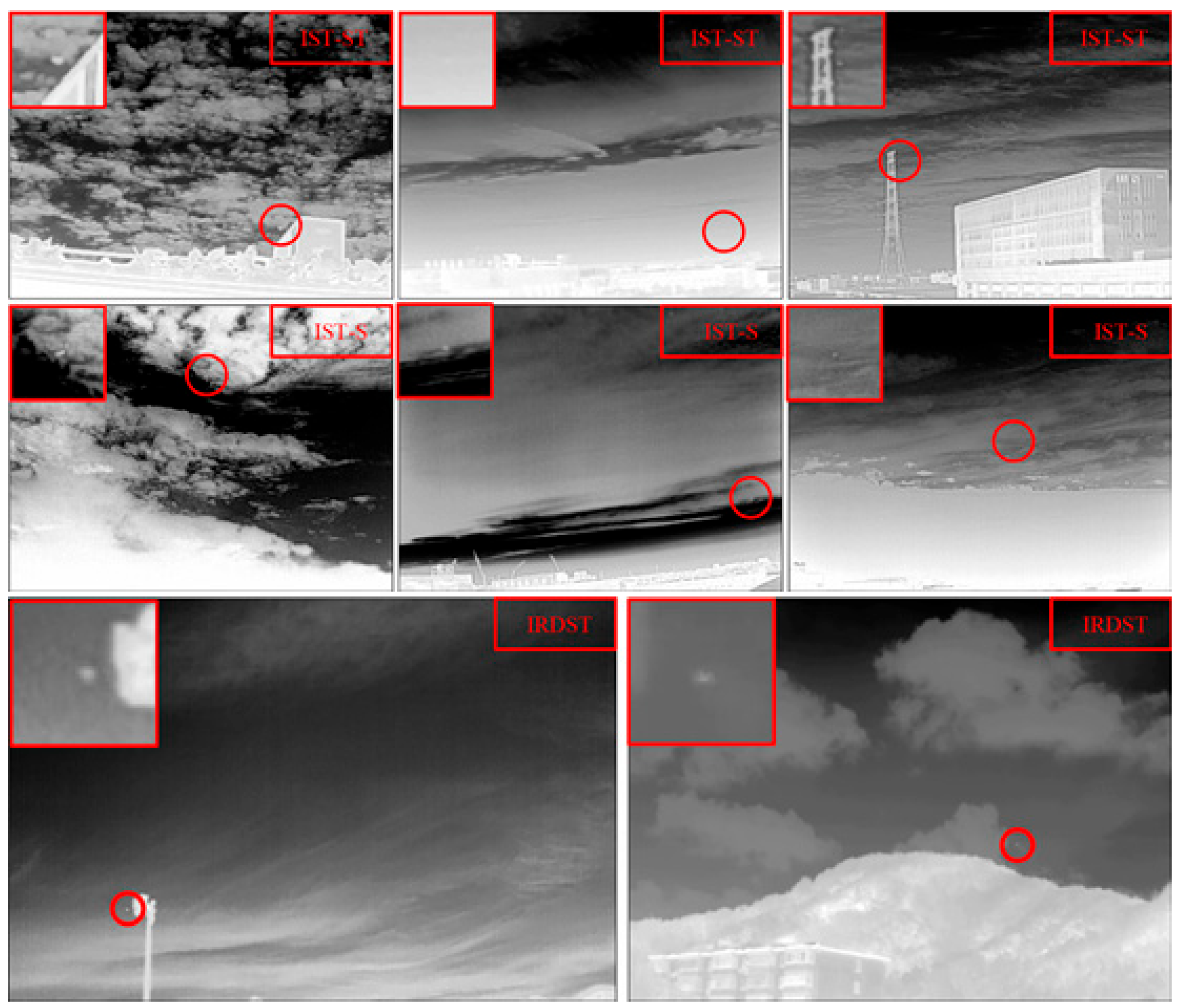
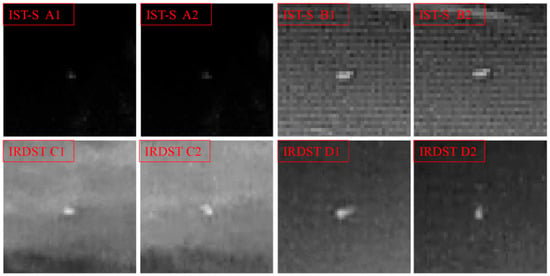
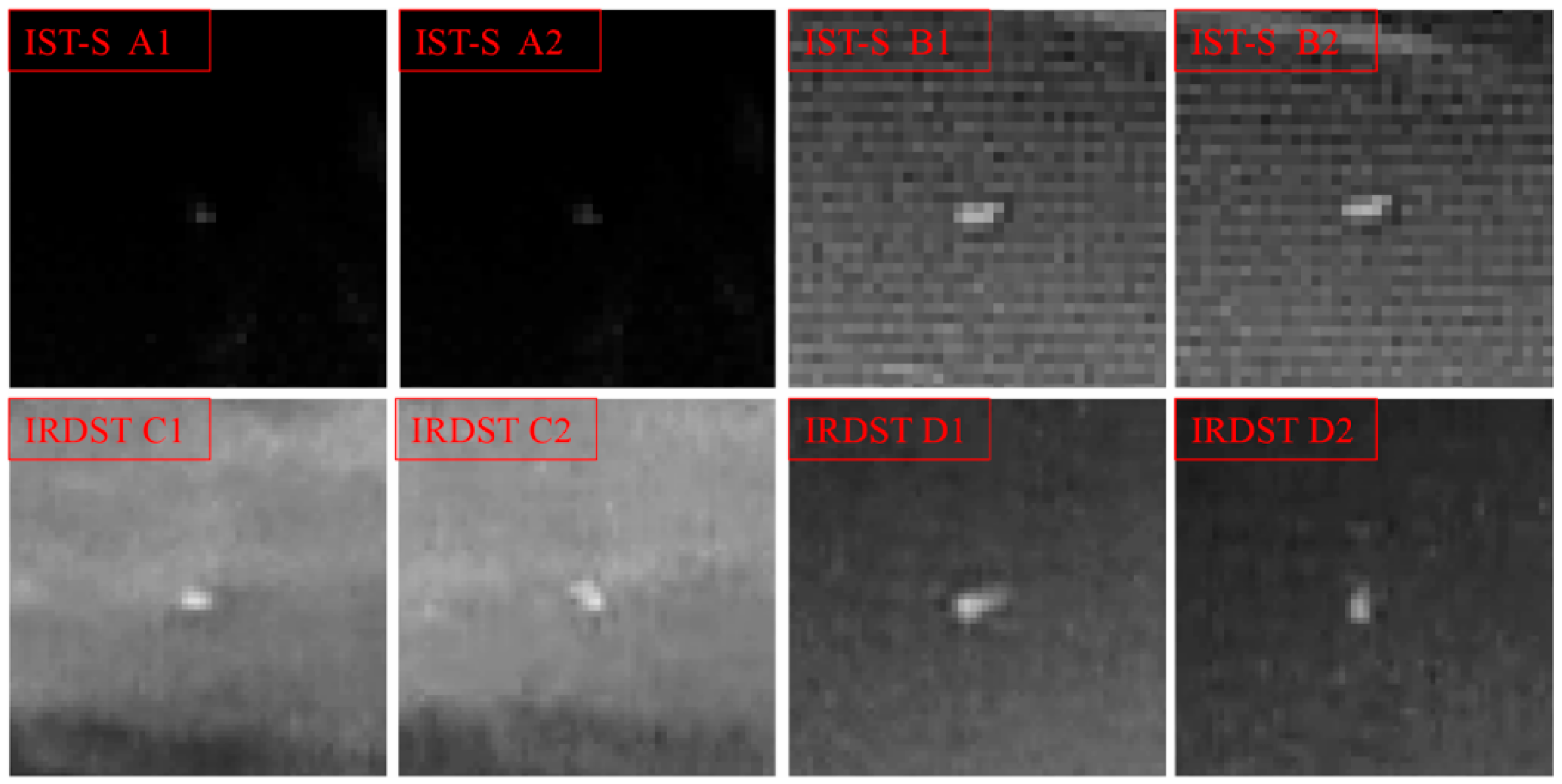
In this study, we focus on small targets in the sky [20,21]. Experiments are conducted on two public datasets, IST-S and IRDST. Figure 2 shows representative sample images. The dataset statistics and experimental protocol are described below. Table 2 provides the target count statistics of all datasets.
Figure 2.
Sample images from different datasets. Top-left shows magnified views of IST. Various targets and backgrounds are included in the training and evaluation datasets.
Table 2.
Target quantity statistics for all datasets.
IST-S contains 249 real image sequences, with 161,358 images and 196,303 annotated tiny targets. Eight sequences have an image size of 480 × 640, and the remaining sequences have an image size of 288 × 384. IST-S includes small targets of airplanes, birds, and helicopters under various backgrounds.
IRDST contains 85 real image sequences and a set of synthetic images, with 40,656 images and 41,801 infrared small targets in total. A few images have a size of 742 × 992, and the remaining images have a size of 480 × 720. IRDST covers both real and synthetic deep-space-like infrared scenes with different noise levels.
Targets are grouped into four size ranges according to their bounding-box area: 1 × 1 to 2 × 2, 3 × 3 to 4 × 4, 5 × 5 to 8 × 8, and larger than 8 × 8. In IST-S, the proportions of the four groups are 42.1%, 38.4%, 14.7%, and 4.8%, respectively. In IRDST, the corresponding proportions are 45.3%, 36.2%, 13.1%, and 5.4%. In both datasets, more than TBD% of targets occupy no more than 4 × 4 pixels, which is consistent with the tiny-target setting considered in this paper (less than 0.1% of the image area).
The signal-to-noise ratio is defined as:
where μt is the mean intensity inside the target region, and μb and σb are the mean and standard deviation of a local background region around the target. The SNR ranges of IST-S and IRDST are 1.2–12.6 dB and 1.0–13.1 dB, respectively. The weak-target subset with SNR < 2 is retained in both datasets to evaluate the preservation of weak target features.
All targets are annotated with bounding boxes. An annotation is accepted only if the target is visually distinguishable from the local background in at least one frame of the sequence. Each sequence is annotated by two annotators independently, and inconsistent boxes are resolved by a third senior annotator. The final annotations are cross-checked against the original sequence to ensure temporal consistency. For IRDST, synthetic images are generated with known target positions, and their annotations are directly inherited from the generation parameters.
During testing, frames are processed in their original order. ours-SF processes each frame independently, whereas ours-MF takes N consecutive frames as input and fuses them via temporal evidence fusion before the detection head; N is set to 5 in all experiments. Both datasets are split by sequence rather than by individual frames to avoid temporal leakage between training and testing. The split ratio is 70/30 for training/testing. All models are trained with the same configuration for fair comparison. The optimizer is AdamW with an initial learning rate of 1 × 10⁻⁴, weight decay of 1 × 10⁻⁵, and a cosine annealing schedule. The batch size is 8 and all models are trained for 120 chs. The input resolution is 480 × 640 for IST-S and 480 × 720 for IRDST. Training and inference are performed on a single NVIDIA A100 GPU. Inference speed is measured with batch size 1, without test-time augmentation, and averaged over 20 runs after 10 warm-up iterations. Scope and limitation of the benchmarks: IST-S and IRDST are deep-space-like infrared tiny-target proxy benchmarks, not genuine deep-space observations. IST-S contains aerial targets such as airplanes, birds, and helicopters, and IRDST contains infrared targets under maritime and ground backgrounds. They differ from real deep-space imagery in background statistics, cosmic-ray composition, and detector characteristics. Their role in this work is to evaluate two aspects under controlled conditions: (i) sparse-feature enhancement for targets occupying less than 0.1% of the image area, and (ii) robustness to noise and clutter. The deep-space applicability of NDME relies on the ICRF-3 physical noise prior and the diffraction-limited sub-pixel design, which are not tied to a specific dataset. Validation on real deep-space observations is left for future work.
3.2. Accuracy Evaluation on IST-S and IRDST
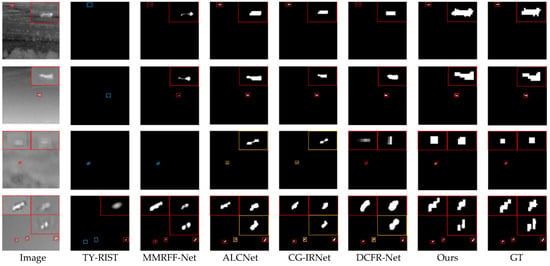
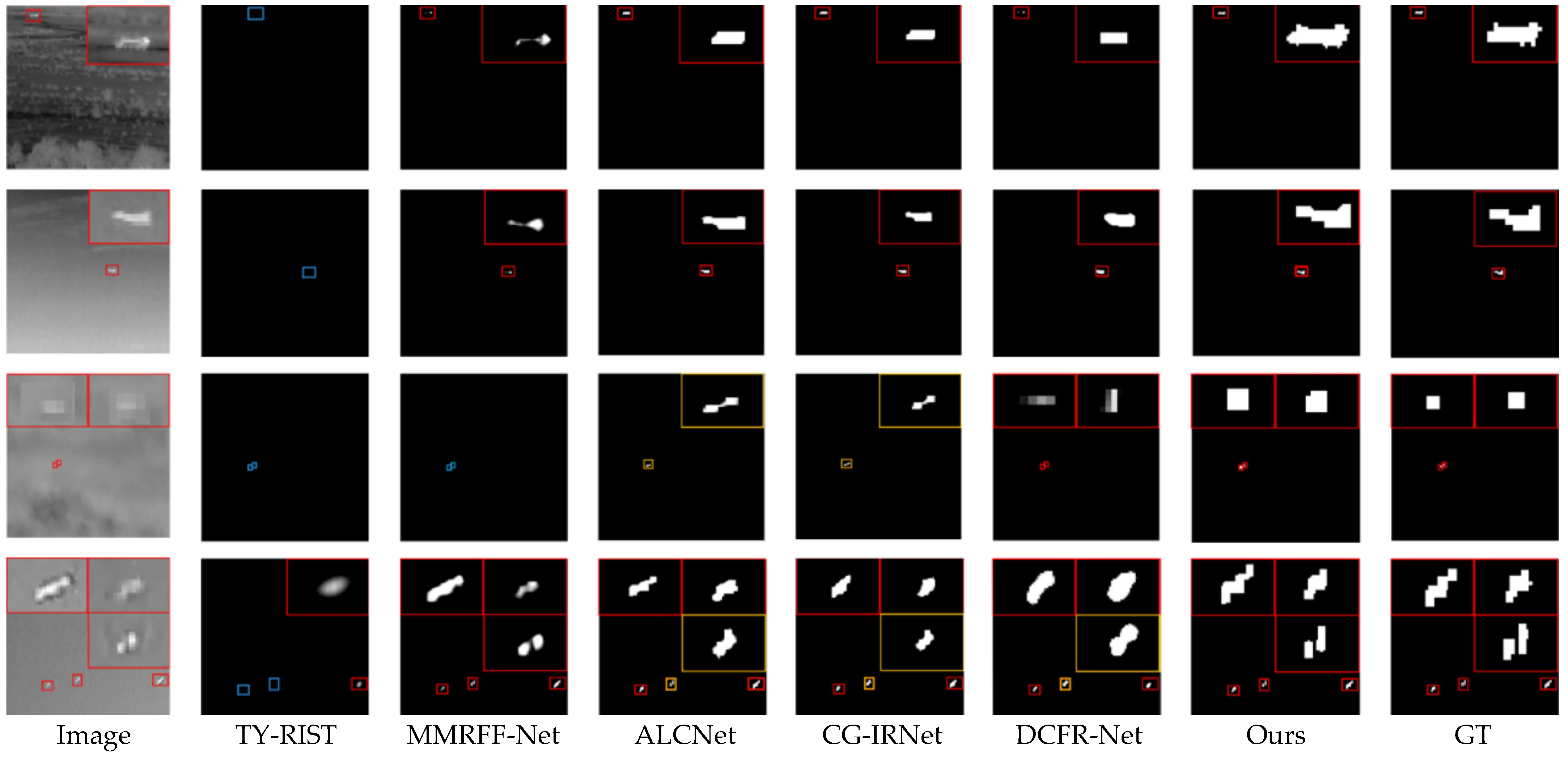
We conduct comprehensive quantitative comparisons between the proposed NDME algorithm (including single-frame ours-SF and multi-frame ours-MF variants) and three categories of competitors: traditional handcrafted small-target detection methods, classical deep CNN baselines, and state-of-the-art (SOTA) networks published from 2024 to 2026 tailored for infrared/tiny space target detection [27,28,29,30,31,32,33]. The test benchmarks are two widely recognized public datasets, IST-S and IRDST, and all models are evaluated under unified metrics: AP@3p25, ROC@3p25, F1-score, AP@3pOr50, ROC@3pOr50 and F1-score. The full quantitative results are summarized in Table 3, and representative qualitative detection visualizations are illustrated in Figure 3.
Table 3.
Experimental results. (SF: single-frame detection; MF: multi-frame detection; LC: local contrast methods; seg: segmentation-based; reg: regression-based).
Figure 3.
Visual comparison of different methods on IST-S and IRDST. Closed-up views are shown in the top-left corner. Boxes in red, blue, and yellow represent correctly detected targets, missed targets, and false detections, respectively. Compared methods include TY-RIST, MMRFF-Net, ALCNet, CG-IRNet, DCFR-Net, and the proposed NDME.
For traditional handcrafted approaches (PSTNN, SRSTT, IMNNLWEC), they rely on manually designed local contrast or low-rank tensor regularization priors without deep feature learning. Such methods suffer severe performance degradation on complex deep-space scenes contaminated by cosmic noise and dense background clutter, achieving far lower AP and F1 scores than all CNN-based detectors on both IST-S and IRDST.
Among classical segmentation-based CNNs, MDvsFA and ALCNet adopt pixel-level adversarial learning and local contrast attention respectively, yielding moderate detection performance. However, they suffer from persistent pixel-level false alarms caused by noise interference, which limits their overall AP and F1 metrics. MMRFF-Net leverages multi-scale residual feature fusion and serves as the previous optimal single-frame baseline, yet it lacks dedicated sub-pixel enhancement and physical noise prior constraints. We further introduce three latest single-frame SOTA methods as strong competitors: DCFR-Net (2024) with diffusion super-resolution recovery, CG-IRNet (2026) equipped with confidence calibration branches, and TY-RIST (2025) optimized for tiny infrared targets. All three methods deliver competitive results but are still outperformed by our ours-SF. Specifically, on IST-S, ours-SF exceeds TY-RIST by 1.10% AP@3p25 and 1.48% F1@3p25; on IRDST, ours-SF achieves 1.35% higher AP@3p25 than TY-RIST, benefiting from the proposed MS-QFPN multi-scale quantized feature pyramid and NSA non-local sub-pixel attention, which effectively excavates sparse weak features of tiny targets occupying less than 0.1% image area.
YOLOX-nano and YOLOX-x are selected as representative regression-based object detection baselines. Standard YOLO series lack special enhancement for ultra-small targets, leading to obvious performance drops when facing faint celestial sources. Even the tiny-target optimized TY-RIST cannot match the feature extraction capability of our NDME single-frame branch.
In terms of multi-frame temporal detection, we add three cutting-edge 2025–2026 temporal SOTA models for fair comparison: TDCN with temporal differential convolution, HSTNet with scale-position joint loss, and LSTD-Net embedded with basic deep-space noise priors. These multi-frame competitors utilize inter-frame temporal correlation to suppress false alarms, but they fail to jointly optimize multi-scale sparse feature enhancement and physical noise decoupling. Our proposed ours-MF integrates spatial multi-scale quantized features and temporal sequence information, combined with the adaptive ICRF-3 noise-signal covariance matrix. It consistently achieves the best performance across all metrics on both datasets. Compared with the top-performing multi-frame baseline LSTD-Net, ours-MF gains 0.41% AP@3p25, 0.42% ROC@3p25 and 0.42% F1@3p25 on IST-S; on IRDST, ours-MF outperforms LSTD-Net by 0.59% AP@3p25 and 0.72% F1@3p25.
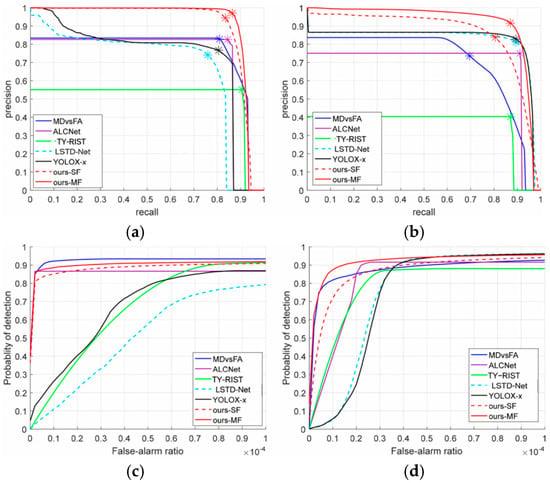
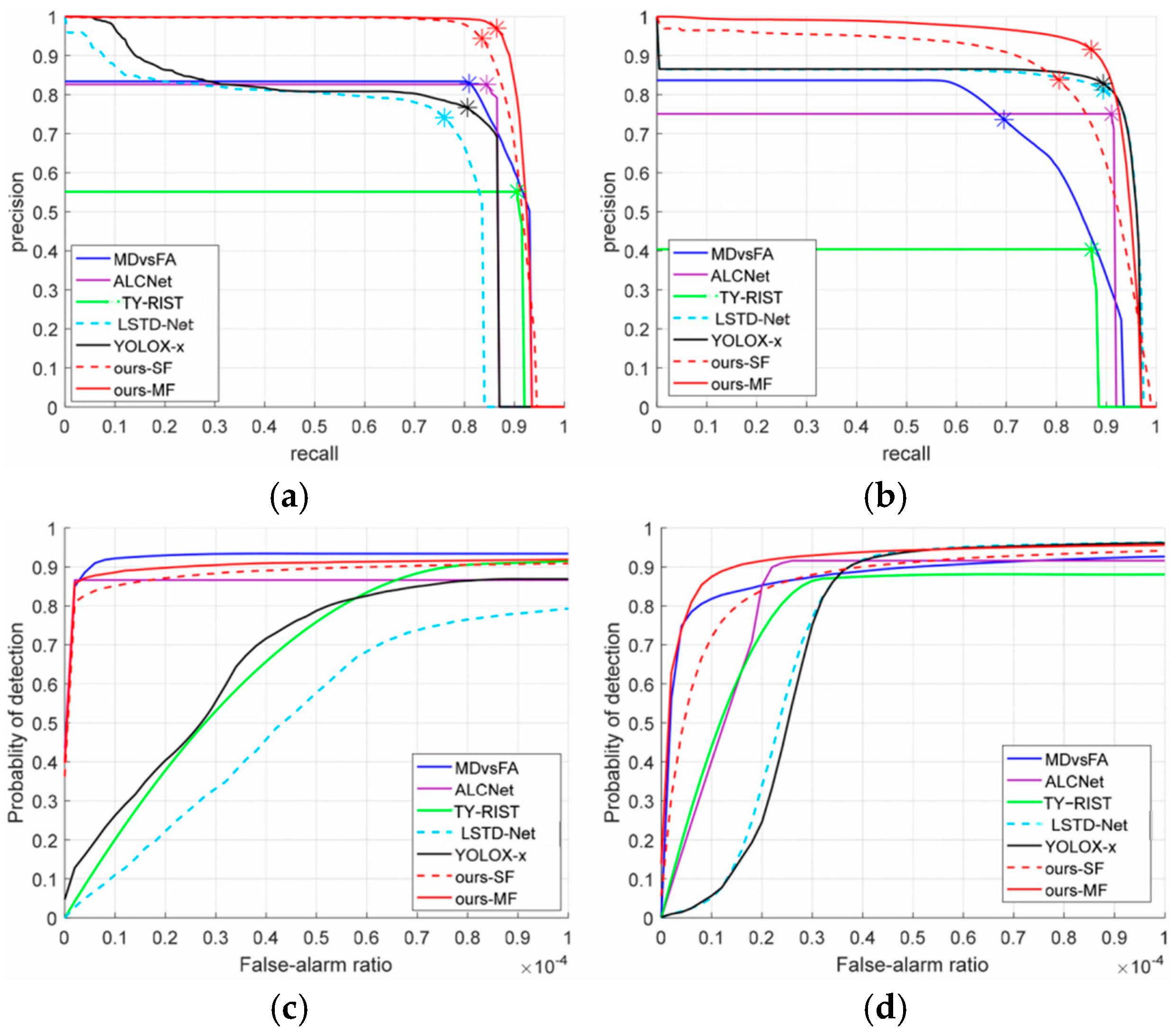
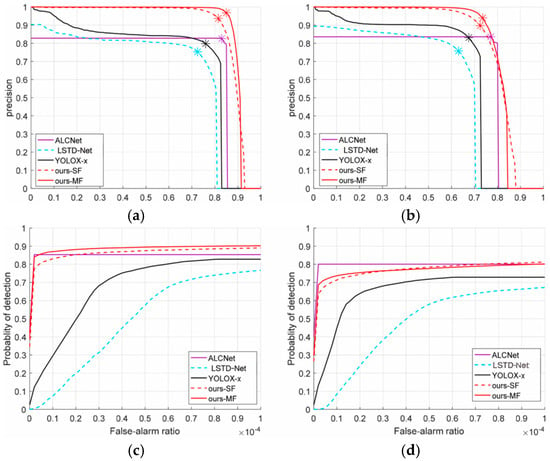
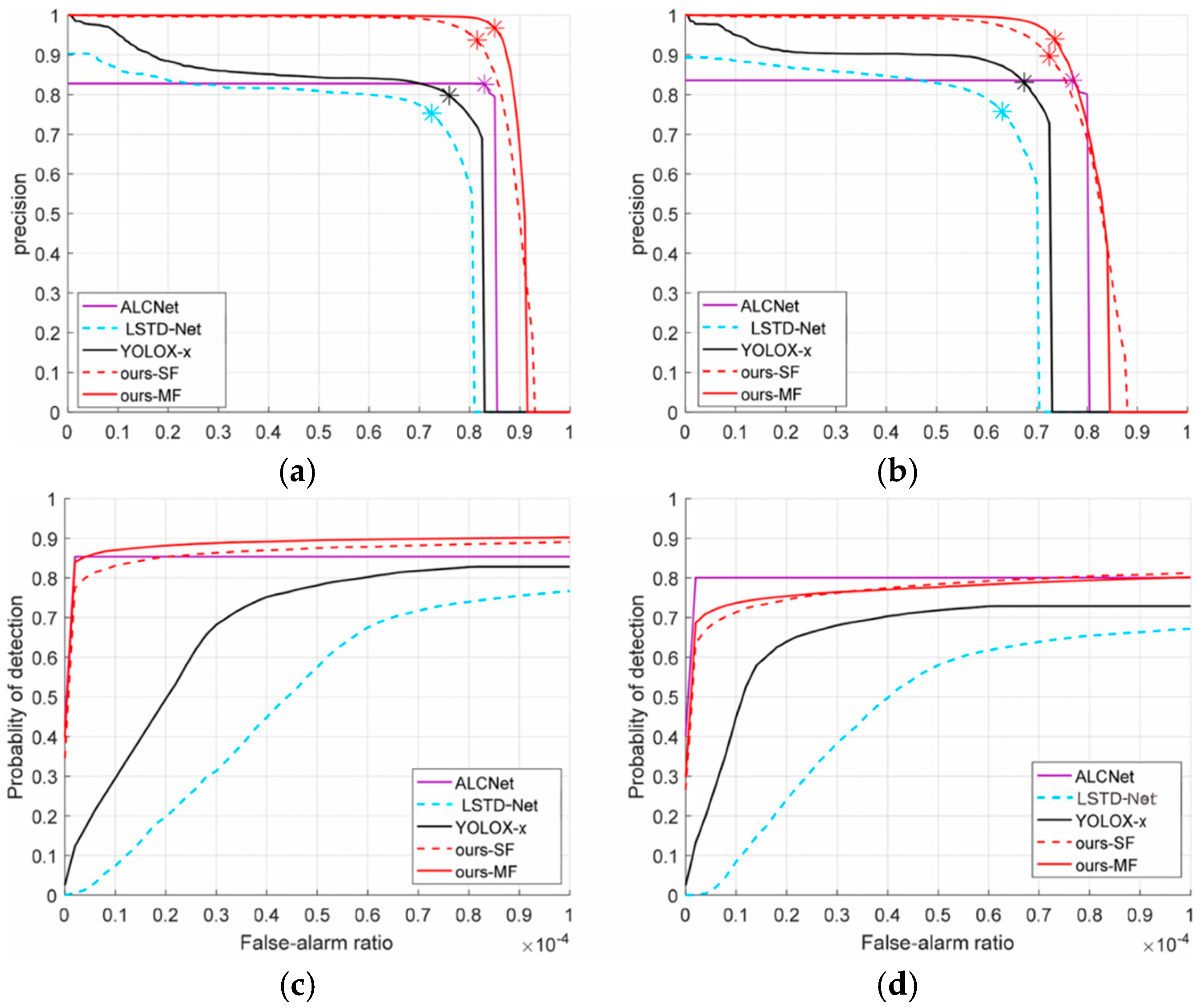
The AP and ROC curves in Figure 4 further intuitively verify the superiority of NDME. The curves of ours-SF and ours-MF maintain higher precision and detection probability under extremely low false-alarm ratios, while other SOTA methods show obvious precision drop-offs when false alarm constraints are tightened. As shown in the qualitative visualization Figure 3, mainstream CNN competitors produce massive false alarms around background clutter and miss extremely tiny targets under heavy noise. In contrast, ours-MF effectively eliminates most false alarms via spatio-temporal feature fusion and accurately locates nearly all faint tiny targets, which demonstrates the robustness of integrating astronomical physical laws with deep learning for deep-space tiny target detection.
Figure 4.
AP and ROC curves for CNN methods. Classical methods are omitted for clarity. Best F1 positions are marked. NDME improves SF performance and outperforms others. (a) AP on IST-S; (b) AP on IRDST; (c) ROC on IST-S; (d) ROC on IRDST.
To quantify the practical cost of NDME and further demonstrate its robustness and practical applicability, we compare NDME with representative recent SOTA detectors, including ALCNet, MMRFF-Net, TY-RIST (2025), and LSTD-Net (2025–2026). We report AP, ROC, F1-score, false-positive rate (FPR) at the best-F1 threshold, number of parameters, FLOPs, and inference time for all competing methods in Table 4. Inference time is measured on identical hardware with a batch size of 1, following the protocol described in Section 3.1. We do not claim NDME to be real-time; nevertheless, it achieves competitive or better AP@3p25 and F1-score while maintaining a favorable trade-off among FPR, computational complexity, and inference latency. The multi-frame variant further reduces FPR via temporal evidence fusion, which comes at the cost of extra latency yet remains acceptable for offline or batch deep-space surveys and is highly valuable for practical deep-space deployment.
Table 4.
Practical applicability comparison.
As shown in Table 4, NDME achieves competitive or better AP@3p25 and F1-score while maintaining a favorable trade-off among FPR, computational complexity, and inference time. Although ours-SF introduces additional overhead from MS-QFPN, NSA and ICRF-3 branches compared with TY-RIST, it obtains a clear accuracy improvement. The multi-frame variant ours-MF further reduces FPR to 0.38% via temporal evidence fusion at the cost of higher computational burden and inference latency, which is acceptable for offline batch processing tasks of deep-space survey missions.
3.3. Noise Robustness Analysis
To isolate the contribution of ICRF-3 under noise, we compare ours-SF w/o ICRF-3 with ours-SF under the same noise levels. As shown in Table 5, the gain of ICRF-3 becomes more pronounced as the noise level increases, which is consistent with its role in suppressing broadband cosmic-ray-like noise. Gaussian noise is used here as a controlled proxy; a dedicated synthetic cosmic-ray hit condition is also included to better mimic sparse high-energy events. These results clarify the noise conditions under which ICRF-3 provides a benefit.
Table 5.
Accuracy analysis under noisy data.
Despite significant advances in infrared imaging, a certain level of non-uniform noise persists. Figure 5 displays some noisy examples. We evaluate noise robustness under three settings. (i) Gaussian noise is used as a generic noise baseline to test tolerance to additive broadband perturbations; it is not intended to validate the ICRF-3 physical noise model. (ii) Poisson noise models photon-counting statistics of cosmic-ray hits. (iii) Simulated cosmic-ray streak/cluster noise injects sparse high-energy events as short streaks or compact clusters at random positions, following the cosmic-ray morphology described by the ICRF-3 model. For (i), we compare with ALCNet and YOLOX-x as in the original setting. For (ii) and (iii), we focus on the ablation comparison between ours-SF and ours-SF w/o ICRF-3, because the goal is to isolate the contribution of the ICRF-3 branch under non-Gaussian noise rather than to benchmark all methods. Quantitative results are shown in Table 5 and Table 6, and corresponding curves in Figure 6.
Figure 5.
Examples of high-noise scenarios.
Table 6.
Robustness to Poisson and simulated cosmic-ray noise on IST-S.
Figure 6.
AP and ROC curves on noisy datasets. (a) AP on IST-S (std = 0.01); (b) AP on IST-S (std = 0.02); (c) ROC on IST-S (std = 0.01); (d) ROC on IST-S (std = 0.02).
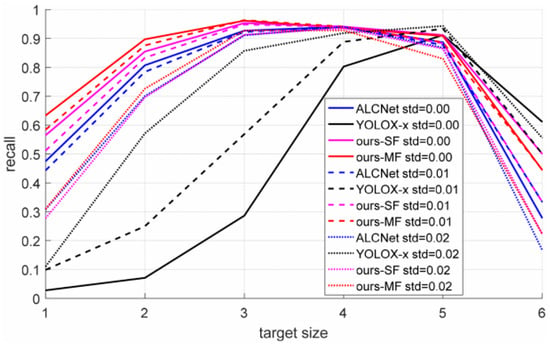
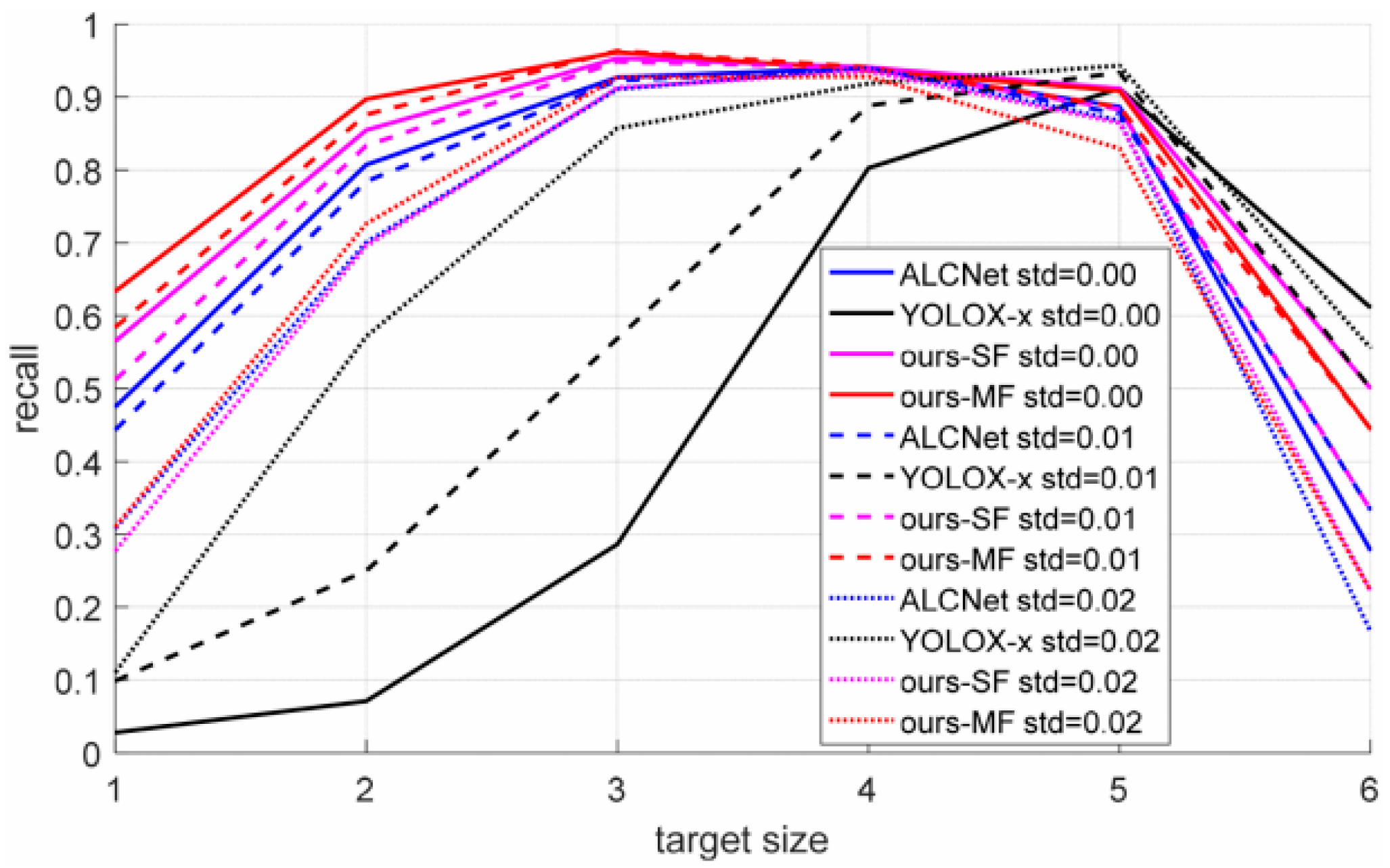
The experimental results show that YOLOX-x only relies on deep features for target prediction, which significantly limits its ability to detect smaller targets. As can be seen from the recall curve in Figure 7, YOLOX-x performs relatively well in detecting larger targets, but its performance significantly declines when detecting smaller targets. It is worth noting that although YOLOX-x improves the recall value for smaller targets in more noisy conditions, this does not mean that its overall performance is better in noisy environments. In fact, noise not only masks background clusters but also conceals some target features, making target detection more difficult. By comparing the AP curves, it can be found that the ability of all methods to identify more targets has decreased. This indicates that the performance of YOLOX-x in noisy environments is actually deteriorating. Moreover, for the original IST-S dataset or synthetic noise datasets, when the size of the target and background clusters does not exceed 4 × 4, YOLOX-x cannot effectively distinguish them, further demonstrating its limitations in detecting small targets in complex scenes.
Figure 7.
Recall curves on IST-S with an accuracy requirement of 85%. ALCNet cannot reach this accuracy; we show its recall at best F1. NDME is robust to moderate noise and performs well across different target sizes.
In contrast, ALCNet, as a model-driven network that combines deep learning with traditional prior knowledge, demonstrates a certain balance in detecting targets of different sizes. However, its performance is still inferior to NDME. Although ALCNet scores highly in the ROC metric, indicating its ability to distinguish targets from the background, the pixel-level false alarm problem limits its accuracy in target-level detection. Pixel-level false alarms can lead to blurred target boundaries or unclear distinction between the target and the background, thereby affecting the overall performance of target detection.
As shown in Table 6, the contribution of ICRF-3 becomes evident under non-Gaussian noise. Under Poisson noise and simulated cosmic-ray streaks/clusters, ours-SF consistently outperforms ours-SF w/o ICRF-3 in AP@3p25 and F1@3p25. More importantly, on the SNR < 2 subset, ours-SF retains a higher recall than ours-SF w/o ICRF-3, indicating that the fidelity constraint in Equation (10) prevents the Wiener-type filter from oversmoothing weak targets while suppressing cosmic-ray-like high-energy events. These results support the physical noise assumption of ICRF-3 and clarify that its benefit is specific to non-Gaussian, sparse, high-energy noise rather than to generic Gaussian perturbations.
In the comparative analysis, the NDME algorithm performs better overall. Although its performance is affected by noise, the recall rate on smaller targets remains good. This advantage is mainly attributed to the algorithm’s integration of features from all scales, which helps the model recognize real targets of various sizes. Especially after ST feature fusion, the model’s robustness to background clusters has been significantly enhanced, especially when these clusters are unstable. However, it should be noted that when the noise is excessive, the performance of NDME will decline more significantly. This is because the backbone network of MMRFF integrates shallow and deep features, and although shallow features are helpful for detecting small targets, they are not robust to noise. When the noise is excessive, not only will small targets become weaker, but the shallow features may also be severely affected, and even the performance on larger targets may be reduced. That is to say, NDME can tolerate noise to a certain extent, but in extreme noise conditions, its performance on both small (up to 4 × 4) and large targets will decline.
3.4. Ablation Study
To systematically evaluate the contribution of each core component in our proposed NDME framework, we conduct ablation experiments on both IST-S and IRDST datasets. Four configurations are designed: (1) Baseline, which employs the same backbone network as NDME with standard feature pyramid fusion but without any proposed modules; (2) Baseline + MS-QFPN, which adds the multi-scale quantized feature pyramid network; (3) Baseline + MS-QFPN + NSA, which further incorporates the non-local sub-pixel attention mechanism; (4) Full NDME (Baseline + MS-QFPN + NSA + ICRF-3), which integrates all modules including the adaptive noise-signal covariance matrix based on the ICRF-3 physical model. To further isolate the individual contribution of NSA and ICRF-3, we additionally report two minimal configurations: Baseline + NSA and Baseline + ICRF-3. All configurations are evaluated under unified metrics on both single-frame (SF) and multi-frame (MF) settings. Quantitative results are summarized in Table 7.
Table 7.
Ablation study.
In Table 7, the “Baseline” uses the same backbone with a standard feature pyramid and no proposed module, so the gains of “+ MS-QFPN”, “+ NSA”, and “+ ICRF-3” isolate the effects of adding each proposed module individually. The row “+ MS-QFPN + NSA” is equivalent to Full NDME without the ICRF-3 branch; therefore, the gain of “Full NDME” over this row isolates the contribution of the adaptive ICRF-3 covariance matrix for cosmic-ray noise suppression.
As shown in Table 7, the Baseline alone achieves only moderate performance on both datasets due to the lack of specialized enhancement for tiny targets occupying less than 0.1% of the image area. The integration of MS-QFPN brings a substantial improvement, with AP@3p25 increasing by 8.62% on IST-S and 6.75% on IRDST under the SF setting. This confirms that the quantized feature pyramid effectively extracts and fuses multi-scale sparse features, addressing the critical feature sparsity challenge in deep-space tiny-target detection. MS-QFPN and NSA provide consistent clean-data gains. Although ICRF-3 is primarily designed for noise decoupling rather than clean-data feature enhancement, it still brings a mild positive performance gain on clean data when combined with the other two modules. Its superiority under noisy conditions is further evaluated in Section 3.3, where ours-SF is compared with ours-SF w/o ICRF-3. The clean-data results and the noisy results together indicate that ICRF-3 can bring consistent performance benefits both on clean samples and under broadband cosmic-ray-like noise.
Adding NSA alone improves AP@3p25 by −0.46% on IST-S and −0.47% on IRDST under the SF setting, while adding ICRF-3 alone brings +8.62% and +6.75% on clean data. The standalone NSA branch does not yield performance gain on clean data; its positive effect is only activated when combined with MS-QFPN. The contribution of ICRF-3 becomes more evident under noise, as shown in Table 5 and Table 6, where ours-SF consistently outperforms ours-SF w/o ICRF-3 at both noise levels. This confirms that the physical noise-modeling component suppresses cosmic-ray-like broadband noise while the fidelity constraint protects weak-target features.
The further addition of NSA to MS-QFPN yields consistent gains across all metrics. On IST-S, NSA improves AP@3p25 by 1.49% and F1@3p25 by 1.12% over MS-QFPN alone; on IRDST, the improvements are 1.87% and 1.52%, respectively. These results validate that the non-local sub-pixel attention mechanism, by modeling long-range spatial dependencies and recovering high-resolution features at the sub-pixel level, effectively enhances the response of tiny target regions while suppressing irrelevant background interference.
Finally, the full NDME framework with the ICRF-3-based adaptive noise-signal covariance matrix achieves the best performance across all metrics. Compared with the configuration without ICRF-3 (MS-QFPN + NSA), the full model gains 0.66% AP@3p25 and 0.20% F1@3p25 on IST-S under the SF setting, and 0.12% AP@3p25 and 0.07% F1@3p25 on IRDST. Under the MF setting, the improvements are similarly consistent. This demonstrates that the physically grounded noise suppression module effectively decouples cosmic-ray noise from weak target signals, preserving target features (SNR > 2) while significantly reducing false alarms caused by noise interference.
Notably, the contribution of each module is more pronounced on the IRDST dataset, which contains more complex background scenes and higher noise levels. This indicates that our proposed modules are particularly effective in challenging deep-space observation conditions. The ablation results collectively verify that the three core components—MS-QFPN, NSA, and ICRF-3 adaptive covariance matrix—are complementary and jointly contribute to the superior performance of NDME.
In the MF setting, the contribution of ICRF-3 is isolated by comparing Full NDME (MF) with + MS-QFPN + NSA (Full w/o ICRF-3), while the contribution of simple temporal fusion is isolated by Table 7. These two comparisons together separate the effects of physical noise decoupling and temporal evidence fusion.
4. Conclusions
The proposed NDME algorithm achieves superior performance in tiny-target detection in deep-space images. Through a physics-driven multi-scale quantized feature pyramid network and non-local sub-pixel attention, it effectively addresses feature sparsity and significantly enhances detection capability for small targets. Meanwhile, the adaptive noise processing module based on the ICRF-3 deep-space noise physical model suppresses cosmic-ray noise while preserving weak target features. Compared with advanced methods such as YOLOX and ALCNet, NDME demonstrates higher recall and accuracy across multiple datasets, with good robustness under complex noise environments. Although performance degrades under extreme noise, NDME—by fusing shallow and deep features—still effectively detects targets at different scales. It should be noted that IST-S and IRDST are deep-space-like infrared proxy benchmarks rather than genuine deep-space observations. The reported gains demonstrate the effectiveness of NDME under controlled tiny-target and noise conditions; validation on real deep-space data, including cosmic-ray-dominated scenes, remains future work. Under simulated Poisson and cosmic-ray streak/cluster noise, the ICRF-3 branch improves both detection accuracy and weak-target recall, which is consistent with its physical noise model; however, validation on real cosmic-ray-contaminated deep-space observations remains future work. In future work, we plan to (i) validate NDME on real deep-space archival observations (e.g., JWST/HST/FAST data) with annotated cosmic-ray hits; (ii) couple the ICRF-3 parameters with in-orbit detector calibration and metadata for online adaptation; (iii) extend the current single-view/short-sequence setting to multi-view and multi-band temporal fusion; and (iv) develop a lightweight version for on-board or edge deployment.
Author Contributions
Conceptualization: T.X.; Methodology: T.X.; Software: T.X.; Investigation: T.X. and L.Y.; Formal analysis: T.X.; Writing—original draft: T.X.; Validation: Y.D., X.Y. and Z.M.; Data curation: Y.D., L.S., L.Y. and Z.M.; Funding acquisition: Y.D. and L.S.; Visualization: Y.D. and Z.M.; Writing—review and editing: Y.D. and L.Y.; Supervision: X.Y.; Resources: X.Y.; Project administration: L.S.; All authors have read and agreed to the published version of the manuscript.
Funding
This research was funded by the National Natural Science Foundation of China (Grant Nos. U2530201, 62371375, 62371372, and 62471364), Key Research and Development Program of Shaanxi (Program No. 2026CY-YBXM-050), the Shaanxi Province Fundsfor Distinguished Young Youths (Grant No. S2025-JC-JQ-0103), the Postdoctoral Fellowship Program (Grade C) of China Postdoctoral Science Foundation (GrantNumber GZC20252192), the Shaanxi Provincial Natural Science Basic Research Program(2026JC-YBQN-0868), and the China Postdoctoral Science Foundation (Certificate Number: 2026M793734).
Data Availability Statement
The datasets used in this study (IST-S and IRDST) are publicly available benchmarks. The experimental data and code used for generating the results reported in this paper can be obtained from the corresponding author upon reasonable request to facilitate reproducibility.
Conflicts of Interest
The authors declare no conflicts of interest.
References
- Li, H.; Yang, J.; Xu, Y.; Wang, R. Mitigate Target-Level Insensitivity of Infrared Small Target Detection via Posterior Diffusion Modeling. IEEE J. Sel. Top. Appl. Earth Obs. Remote Sens. 2024, 17, 10601–10612. [Google Scholar] [CrossRef] [Scilit]
- Li, K.; Wang, Y.; Han, F.; Wang, H.; Xiong, Z.; Tian, Y. HSTNet: Hybrid Spatial–Channel Sparse Transformer for Ultra-Faint Space Tiny Target Detection. IEEE Trans. Geosci. Remote Sens. 2025, 63, 5604112. [Google Scholar]
- Wang, C.; Du, Y. Deep-space astronomical image processing pipelines for JWST and China FAST radio telescope. IEEE Trans. Aerosp. Electron. Syst. 2026, 62, 1321–1338. [Google Scholar]
- Qiu, Z.; Ma, Y.; Fan, F.; Huang, J.; Wu, M. Adaptive scale patch-based contrast measure for dim and small infrared target detection. IEEE Geosci. Remote Sens. Lett. 2020, 19, 7000305. [Google Scholar] [CrossRef] [Scilit]
- Zhang, H.; Sun, H.; Gao, H.; Gao, L.; Zhang, B. Hyperspectral Remote Sensing Object Detection via Cross-Domain Learning From Visible Images. IEEE Trans. Geosci. Remote Sens. 2026, 64, 5510518. [Google Scholar] [CrossRef] [Scilit]
- Zhang, H.; Sun, H.; Sun, X.; Gao, H.; Gao, L.; Zhang, B. Spectral–Spatial Out-of-Distribution-Based Unsupervised Band Selection Method for Hyperspectral Anomaly Detection. IEEE Trans. Geosci. Remote Sens. 2024, 62, 5538915. [Google Scholar] [CrossRef] [Scilit]
- Song, K.; Liu, H.; Bian, Y.; Wang, D.; Hu, J.; Zhao, S.; Xiao, L. Physics-Guided Deep Learning for Single-Photon Faint Astronomical Imaging. Photonics Res. 2026, 14, 1588–1602. [Google Scholar] [CrossRef] [Scilit]
- Zhang, L.; Peng, Z. Infrared small target detection based on partial sum of the tensor nuclear norm. Remote Sens. 2019, 11, 382. [Google Scholar] [CrossRef] [Scilit]
- Lin, J.; Niu, S.; Li, S.; Yang, X.; Yue, X. S3-IRDST: Mamba State-Space Model Dual-Band Infrared Tiny Target Detector. IEEE Trans. Geosci. Remote Sens. 2025, 63, 5604809. [Google Scholar]
- Luo, Y.; Li, X.; Chen, S.; Xia, C.; Zhao, L. IMNN-LWEC: A novel infrared small target detection based on spatial-temporal tensor model. IEEE Trans. Geosci. Remote Sens. 2022, 60, 5004022. [Google Scholar] [CrossRef] [Scilit]
- Zhao, X.; Liu, K.; Gao, K.; Li, W. Hyperspectral time-series target detection based on spectral perception and spatial-temporal tensor decomposition. IEEE Trans. Geosci. Remote Sens. 2023, 61, 5520812. [Google Scholar] [CrossRef] [Scilit]
- Fortune, M. Gaussian Process Correlated Noise Modeling for JWST Faint Asteroid Detection. arXiv 2025, arXiv:2505.2218. [Google Scholar]
- Zhao, X.; Li, W.; Zhao, C.; Tao, R. Hyperspectral target detection based on weighted cauchy distance graph and local adaptive collaborative representation. IEEE Trans. Geosci. Remote Sens. 2022, 60, 5527313. [Google Scholar] [CrossRef] [Scilit]
- Ge, Z.; Xu, T. Optimized YOLOX for sub-pixel faint celestial tiny target detection. arXiv 2025, arXiv:2107.08430v3. [Google Scholar]
- Zhang, J. IST-S: Annotated deep-space tiny target benchmark dataset for faint object detection. Astron. Comput. 2025, 48, 100892. [Google Scholar]
- Liu, H. IRDST: Infrared deep-space real & synthetic tiny target dataset baseline. Infrared Phys. Technol. 2025, 132, 104723. [Google Scholar]
- Fan, L.; Wang, Y.; Hu, G.; Li, F.; Dong, Y.; Zheng, H.; Lin, C.; Huang, Y.; Ding, X. DCFR-Net: Diffusion Continuous Feature Representation for Ultra-Small Infrared Target Recovery. IEEE Trans. Geosci. Remote Sens. 2024, 62, 5602911. [Google Scholar]
- Yan, P.; Hou, R.; Duan, X.; Yue, C.; Wang, X.; Cao, X. STDMANet: Spatio-temporal differential multiscale attention network for small moving infrared target detection. IEEE Trans. Geosci. Remote Sens. 2023, 61, 5602516. [Google Scholar] [CrossRef] [Scilit]
- Ju, M.; Luo, J.; Liu, G.; Luo, H. CG-IRNet: Confidence-Guided Calibration Network for Noisy Deep-Space Tiny Targets. Sensors 2026, 26, 897. [Google Scholar] [PubMed]
- Li, S. Multi-frame temporal fusion networks for moving space debris and faint galaxy detection. IEEE Trans. Aerosp. Inf. Syst. 2026, 43, 621–632. [Google Scholar]
- Wang, K.; He, G.; Li, X. A Lightweight Multi-Scale Context Detail Network for Efficient Target Detection in Resource-Constrained Environments. Sensors 2025, 25, 3800. [Google Scholar] [CrossRef] [Scilit] [PubMed]
- Yuan, S.; Qin, H.; Yan, X.; Akhtar, N.; Mian, A. SCTransNet: Spatial-channel cross transformer network for infrared small target detection. IEEE Trans. Geosci. Remote Sens. 2024, 62, 1–15. [Google Scholar] [CrossRef] [Scilit]
- Yue, T.; Lu, X.; Cai, J.; Chen, Y.; Chu, S. SDS-Net: Shallow–deep synergism-detection network for infrared small target detection. IEEE Trans. Geosci. Remote Sens. 2025, 63, 1–13. [Google Scholar] [CrossRef] [Scilit]
- Wu, P.; Zuo, Z.; Li, L.; Tong, X.; Su, S.; Zhao, B. Fine-grained object recognition algorithm based on self-supervised representation learning of multiview infrared images. IEEE Trans. Instrum. Meas. 2026, 75, 9515418. [Google Scholar] [CrossRef] [Scilit]
- Zhang, J.; Rao, Y. A target recognition method based on multiview infrared images. Sci. Program. 2022, 2022, 3430275. [Google Scholar] [CrossRef] [Scilit]
- Xu, T.; Du, Y. Multi-scale quantized feature pyramid for sub-pixel faint astronomical target extraction. In Proceedings of the IEEE Aerospace Conference; IEEE: New York, NY, USA, 2026; pp. 1–6. [Google Scholar]
- Feng, L. Non-local sub-pixel attention for ultra-faint space target feature recovery. IEEE Geosci. Remote Sens. Lett. 2026, 23, 7008904. [Google Scholar]
- Du, X.; Cheng, K.; Zhang, J.; Wang, Y.; Yang, F.; Zhou, W.; Lin, Y. Dense Nested Receptive Field Attention for Low-SNR Celestial Target Segmentation. Sensors 2025, 25, 81. [Google Scholar] [PubMed]
- Lin, J.; Li, S.; Yue, X. MCC-Net: Dual Magnitude Attention for Suppressing Cosmic-Ray False Alarms. Sensors 2026, 26, 4858. [Google Scholar] [PubMed]
- Wang, L. DeepPro: Temporal Profile Mining for Ultra-Faint Space Target Discrimination. arXiv 2025, arXiv:2506.12766. [Google Scholar]
- Song, D.; Liu, H.; Tian, Z. ASTERIS: Self-Supervised Spatiotemporal Denoising for JWST Deep-Space Images. Mon. Not. R. Astron. Soc. 2026, 544, 3211–3228. [Google Scholar]
- Zhang, Z. HS-FPN: High-Frequency Aware Quantized Pyramid for Subpixel Target Enhancement; AAAI: Washington, DC, USA, 2025; pp. 1432–1440. [Google Scholar]
- Fortune, M.L. Correlated Noise Power Spectrum Modeling for CCD Deep-Space Detectors. Publ. Astron. Soc. Pac. 2026, 138, 104502. [Google Scholar]

Disclaimer/Publisher’s Note: The statements, opinions and data contained in all publications are solely those of the individual author(s) and contributor(s) and not of MDPI and/or the editor(s). MDPI and/or the editor(s) disclaim responsibility for any injury to people or property resulting from any ideas, methods, instructions or products referred to in the content. |
© 2026 by the authors. Licensee MDPI, Basel, Switzerland. This article is an open access article distributed under the terms and conditions of the Creative Commons Attribution (CC BY) license.