


Highlights
What are the main findings?
- This paper proposes an ONOA-YOLO detection network, which introduces a multi-oriented orthogonal nesting mechanism to enhance the multi-directional features of small objects and incorporates a large-kernel gated background suppression method to mitigate background interference while preserving small object features.
- The proposed method achieves superior performance across multiple small-object benchmark datasets. Specifically, compared with the baseline YOLOv10, several detection accuracy metrics improve by 1% or more on the SODA-A dataset, and by 1–3% on the SAR-ship dataset.
What are the implications of the main findings?
- The proposed method effectively improves the detection accuracy of small objects exhibiting significant orientation-variant features in the presence of complex background interference.
- This method provides a novel and feasible solution for real-time small object detection in remote sensing imagery, significantly enhancing the robustness of the detection model.
Abstract
Object detection in remote sensing imagery is a fundamental and crucial task within the remote sensing domain. However, small object detection in remote sensing images remains a challenge for SOTA methods. This is because small objects often have large aspect ratios, exhibit characteristic variations across different orientations, and are distributed within complex backgrounds. Current methods, which employ square convolutions, often retain excessive background information during feature extraction, leading to suboptimal detection performance. In this paper, an orthogonal-nesting orientation-aware small object detection network based on YOLOv10 is proposed to achieve small object detection in complex backgrounds. ONOA-YOLO employs an orthogonal-nesting module to enhance the features of small objects from multiple orientations, improving the sensitivity of the network to their intrinsic features. Additionally, it incorporates a background-suppression module based on large convolutional kernels. This module integrates the contextual information of small objects as guiding cues with other features, enabling the suppression of background interference while preserving the extracted small object features.
1. Introduction
Remote sensing object detection aims to locate and classify objects of interest in remote sensing images [1,2]. Recently, on-board object detection has garnered significant attention due to the demand for high real-time performance in tasks such as environmental monitoring [3,4], traffic supervision [5,6], and disaster control [7]. Given the limitations imposed by limited resources, on-board object detection requires the network to possess strong real-time capabilities.
Currently, deep learning-based methods dominate object detection [8,9]. The methods for remote sensing object detection based on deep learning can be roughly divided into two categories based on whether the network generates proposals [10,11]. The first type of method is a two-stage method that first produces high-quality proposals with a well-designed architecture; the detection heads then take regional features as input and perform subsequent localization and classification, respectively [12]. Many classic methods such as Faster-RCNN [13], CFINet [14], and MENet [15] follow this paradigm.
However, the two-stage method has a complex architecture and low efficiency [16]. Compared with two-stage methods, one-stage methods no longer generate proposals but instead directly perform bounding box regression and category confidence prediction [17]. This enables one-stage methods to demonstrate clear superiority in inference speed, making them well-suited for real-time applications. Well-known one-stage methods include S2A-Net [18], r3det [19], and the YOLO series [20,21]. Among these, the YOLO series stands out as a representative approach due to its real-time performance. Since being introduced in 2016, it has continuously been innovated and iterated upon, with consistent breakthroughs being achieved in both speed and accuracy. Recently, a frontier YOLOv10 [22] has gained widespread attention due to its efficient data processing and superior precision-efficiency balance strategy. From the outset of its design, it comprehensively optimized network components based on previous YOLO versions. Combined with its ingenious architecture and strategic design, it has become a standout real-time object detector.
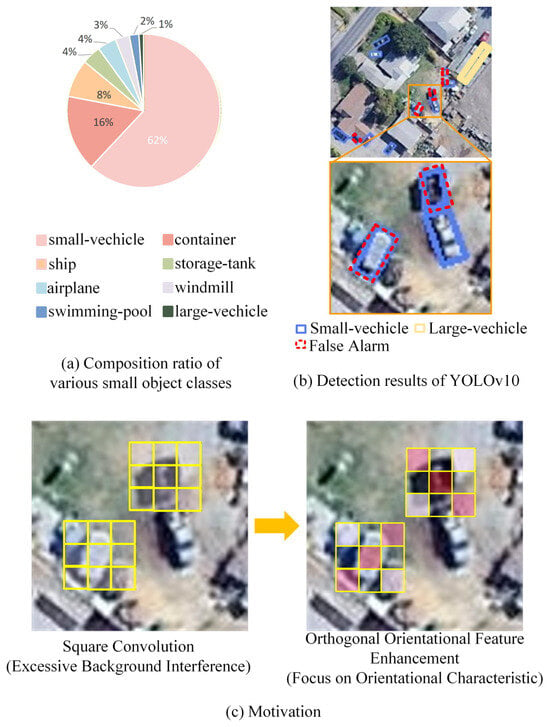
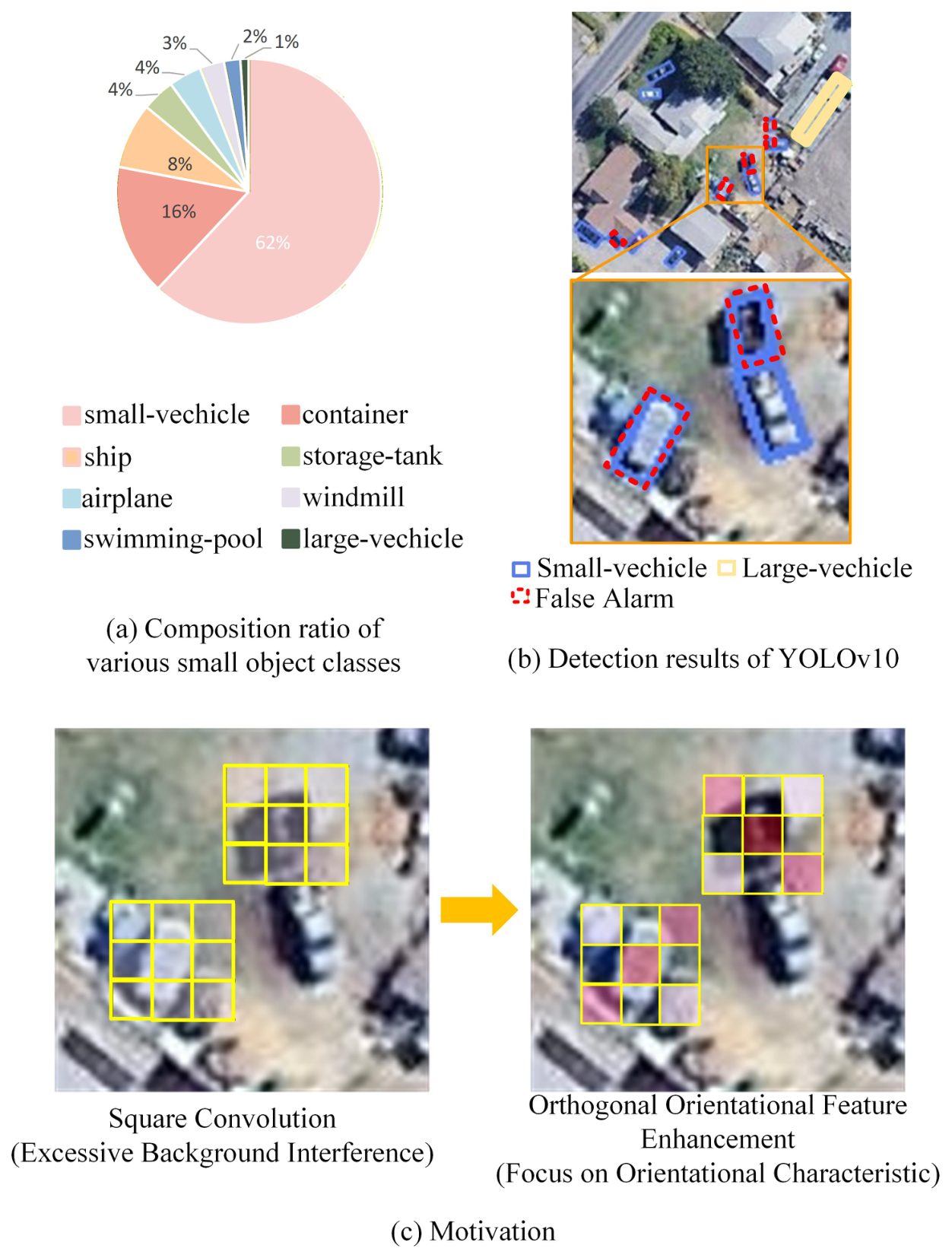
However, even for YOLOv10, small object detection in remote sensing images is still a big challenge. Small objects in remote sensing images usually refer to objects with a pixel area less than [23]. Small vehicles, containers, and ships are the key objects of focus among small objects [23]; they account for 86%, as shown in Figure 1a. The typical small target, such as the small vehicles shown in Figure 1b, has a large aspect ratio, which results in significant variations in its characteristics across different orientations. In this scene, YOLOv10 demonstrates unsatisfactory detection performance in small object detection, with frequent false alarms. The YOLOv10 network, composed of square convolutions, as shown in Figure 1c, adopts an undifferentiated approach to feature extraction across all orientations. This results in excessive background interference when capturing small targets with highly directional characteristic variations, ultimately leading to the network’s inability to accurately localize and classify small targets.
Figure 1.
Research motivation of this work. (a) Distribution of small object categories. (b) YOLOv10 is prone to false alarms when detecting small objects with diverse orientations. (c) ONFE is proposed to capture the orientational features of small objects.
To address the problem that conventional square convolution networks often struggle with small objects exhibiting high aspect ratios and diverse orientations, the Orthogonal Nested Feature Enhancement (ONFE) module is proposed. It uses parallel branches of multi-oriented strip convolutions to capture directional features, nested with orthogonal convolutions to ensure robust integration. By using dilated convolutions to establish environmental relationships, the module collaboratively strengthens small object features from multiple directions. To suppress background interference, the large-kernel gated background suppressor (LGBS) is proposed, comprising the context-guided background suppression (CGBS) and target-density gated feature preservation (TGFP) modules. Using large kernels for broad context, CGBS guides channel attention to filter out background clutter, while TGFP employs self-attention to prevent the loss of small target spatial details during downsampling. By integrating these modules into YOLOv10, ONOA-YOLO is proposed. This architecture achieves a balance between noise suppression and feature retention, significantly improving small object detection. The main contributions are as follows:
- To accurately perceive small objects with significant variability across different orientations in complex backgrounds, an ONOA-YOLO is proposed to enhance small object features from multiple orientations and suppress background interference. This network incorporates two modules, ONFE and LGBS. The ONFE contains multi-orientational strip convolutions to incorporate features of small objects, while LGBS employs the contextual information extracted by large convolutions to guide the suppression of redundant complex backgrounds.
- To enhance the network’s accurate perception of orientational variation characteristics of small objects, the ONFE module is proposed. It employs parallel branches with orthogonal nested strip convolutions to systematically extract and integrate the orientation-variant features of objects across varying orientations. Furthermore, dilated convolutions are incorporated to establish spatial correlations between the objects and the surrounding background. These approaches improve the feature representation of small objects across all orientations.
- To suppress background interference and preserve small object features during downsampling, the LGBS, which consists of two collaborative branches, CGBS and TGFP, is proposed. Contextual information derived from large convolutional kernels dictates the operational principle of both branches. The CGBS branch relies on this context to condition channel attention and suppress background interference. Simultaneously, the TGFP branch applies it to weight self-attention values, preserving the spatial features of small targets.
The rest of this article is organized as follows. Section 2 elaborates on the research status of remote sensing object detection, small object detection in remote sensing images, and orientation-aware object detection, which are highly relevant to this work. Section 3 presents the specific architecture and principles of the proposed ONOA-YOLO model. Section 4 introduces the datasets and experimental settings. Comparative experiments are conducted to verify the performance improvements and analyze the results, and the generalization ability of the model is evaluated on public datasets. Finally, Section 5 concludes this paper. The code will be available at https://github.com/lala0627/ONOA-YOLO, accessed on 26 July 2026.
2. Related Work
2.1. Object Detection in Remote Sensing Images
Object detection is a fundamental task in computer vision, aimed at identifying the categories and locations of objects within a given image [24]. It plays an important role in many applications. Currently, mainstream object detection methods can be broadly divided into two categories: two-stage detectors and one-stage detectors. Two-stage detectors first locate candidate regions in an image and then use a classifier to categorize each candidate region. These two-stage algorithms achieve higher accuracy, but their computational complexity is high, resulting in slower detection speeds. In contrast, one-stage detectors adopt an end-to-end approach, simultaneously performing localization and classification tasks within the same network, which significantly improves detection speed. Furthermore, dilated convolutions are included at the end of each branch to preserve small object features despite multiple convolutional operations. The YOLO series [20,21,25,26] is a typical one-stage detector that enables direct object detection. Specifically, YOLOv5 introduced adaptive anchor box calculation, enabling the model to automatically compute optimal anchor box values for different training datasets during each training session. YOLOv8 shifted to an anchor-free detection head and employed the task-aligned assigner for positive-negative sample assignment, further improving detection speed. YOLOv10 utilizes consistent dual assignment to eliminate the need for NMS, enhancing inference efficiency. Additionally, it comprehensively optimizes various components, significantly boosting overall object detection performance.
For optical imagery, recent advancements in YOLO-based methods primarily focus on enhancing feature extraction under complex background conditions. Specifically, IPS-YOLO [27] addresses the issue that pseudo-ground-truth labels cannot be continuously optimized during training through an iterative post-processing procedure. MROD-YOLO [28] improves target perception capabilities in cluttered environments via a global context attention mechanism. Meanwhile, SFBF-YOLO [29] mitigates the loss of fine-grained information through redundant layer pruning.
For SAR images, models primarily focus on perceiving targets amidst complex backgrounds and noise interference. Chen et al. [30] proposed a lightweight gradient feature subnetwork to address the insufficient utilization of gradient features in SAR images. PPDM-YOLO [31] designed an integrated noise-resistance enhancement module to solve the problem of complex background speckle noise interference in SAR ship target detection. YOLO-OSD [32] optimizes the network architecture to adapt to multi-resolution SAR images.
However, these methods often perform poorly in detecting small objects in remote sensing images, as small objects exhibit variable orientations and are distributed within complex backgrounds, making small object detection a significant challenge.
2.2. Small Object Detection in Remote Sensing Images
Small object detection is a significant challenge in remote sensing image object detection. Most existing methods aim to improve detection performance by refining network architectures and training strategies [33,34,35], while a few others enhance the accuracy of small object detection by modifying the convolution methods. Wang et al. [36] explored the intrinsic correlations between target and background pixels and constructed a coarse-to-fine interior attention-aware network to effectively suppress false alarms induced by complex backgrounds. Min et al. [37] devised a small-target-oriented spatial context attention module to fully capture spatial and channel context features for higher detection accuracy. Focusing on the insufficient utilization of scene context and tiny object features, Zhao et al. [1] leveraged scene semantic information to improve the feature discriminability of tiny targets. Xu et al. [38] proposed a dual attention architecture integrating an adaptive context fusion module and bilevel routing attention to strengthen the model’s discrimination capability for small objects. All the above methods enhance the feature representation of small targets via customized context modeling strategies. Apart from these approaches, several other studies improve the detection accuracy of small objects by optimizing convolution operators.
On the one hand, Lin et al. [39] introduced the Feature Pyramid Network (FPN) in 2017, enabling algorithms to recognize objects across scales by constructing multi-scale feature maps, which significantly improved the detection accuracy of small objects. Since then, many works have further refined the network architecture based on this. For example, Cao et al. [40] proposed a multi-branch and high-level semantic network (MHN) to address the issue of semantic inconsistency between different feature layers. Zhou et al. [41] introduced an adaptive online training sample mining strategy to guide the model in selectively choosing features suitable for classification or regression tasks. On the other hand, Han et al. [18] proposed S2A-Net, which uses an aligned convolution to adaptively align convolutional features based on anchor boxes. Qiao et al. [42] introduced an object detection framework, DetectoRS, which incorporates switchable atrous convolution at the micro-level, significantly improving detection performance.
However, current networks designed for small objects predominantly employ square convolutions, without considering the elongated shape characteristics of small objects. Therefore, an orientation-sensitive feature enhancement module is introduced, distinct from square convolutions, to further improve the detection accuracy of small objects in remote sensing images.
2.3. Orientation-Aware Object Detection
With the advancement of deep learning, object detection has evolved from conventional horizontal bounding box detection toward fine-grained orientation-aware perception [43]. In two-stage approaches, models typically perform precise orientation perception by generating Rotated RoIs and extracting corresponding features. The RoI-Transformer [44] proposed by Ding et al. learns rotation characteristics directly from horizontal RoIs via spatial transformation, thus inferring and generating oriented bounding boxes (OBBs). Li et al. [45] introduced the large kernel selection mechanism into remote sensing detection for the first time to build the LSKNet backbone, which significantly enhances orientation feature learning. In contrast, one-stage methods regress orientation parameters directly from dense anchors. Liu et al. [46] incorporated the Rotated Bounding Box Module and Refined Feature Layers based on YOLOX [47] to achieve accurate feature alignment with OBBs, which effectively improves the accuracy of orientation perception.
However, when dealing with strip-shaped small objects, conventional receptive fields or sampling regions in existing methods struggle to match the extremely large aspect ratios of such targets, making them prone to extraneous background interference. To address this issue, we propose an orthogonally nested direction-aware strip convolution that conforms to object shapes and enhances target features from different orientations. Unlike existing rotated bounding box methods that primarily rely on geometric regression and explicit angle prediction to achieve spatial alignment, the uniqueness of the ONFE module lies in its sophisticated orthogonal nesting design. It departs from the conventional reliance on coordinate transformation, instead constructing orthogonally symmetric convolutional structures at the feature extraction level. By internalizing orientation-awareness directly into the feature modeling process without imposing the additional computational burden of geometric regression, the module achieves more robust multi-directional representation in the feature space compared with traditional geometric regression approaches.
2.4. Lightweight YOLO-Based Remote Sensing
In recent years, lightweight remote sensing object detection algorithms based on the YOLO series have made significant progress in balancing detection accuracy with real-time inference, becoming a core solution for efficient deployment in edge vision systems. Regarding lightweight architectural design, AMFLW-YOLO [48] introduces depthwise separable convolutions and a coordinate attention mechanism, effectively reducing model parameters while enhancing the network’s sensitivity to target direction and positional information. Addressing the critical challenge of small object feature extraction in remote sensing scenarios, AUD-YOLO [49] innovatively employs a lightweight GEConv module to replace traditional standard convolutions, combined with dynamic upsampling operators, to significantly improve the capture efficiency of spatial details for tiny objects while streamlining the model architecture. Meanwhile, to achieve superior computational efficiency in resource-constrained environments, CSPPartial-YOLO [50] designs a Partial Hybrid Dilated Convolution (PHDC) module, which leverages partial convolution and dilated convolution to expand the receptive field while substantially alleviating the computational burden. Furthermore, tackling the specific challenges of low texture contrast and scarce texture in complex infrared remote sensing imagery, LIRS-YOLO [51] adopts an efficient GHGNetv2 as its backbone and integrates a Deformable Thermal-Contrast Spatial Attention (DTCSA) module, greatly improving the model’s feature discrimination capability in complex infrared backgrounds. These studies collectively establish a mainstream technical path of synergistically optimizing feature representation and computational efficiency through structured module design.
To overcome the perceptual limitations of conventional square convolutions in handling strip-shaped small objects, the proposed ONOA-YOLO introduces an orthogonal nesting design that enhances orientational feature representation without increasing geometric regression complexity, thus ensuring superior robustness in complex remote sensing scenarios.
3. ONOA-YOLO
3.1. Overview of the ONOA-YOLO
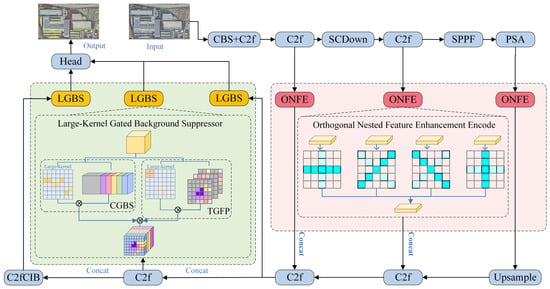
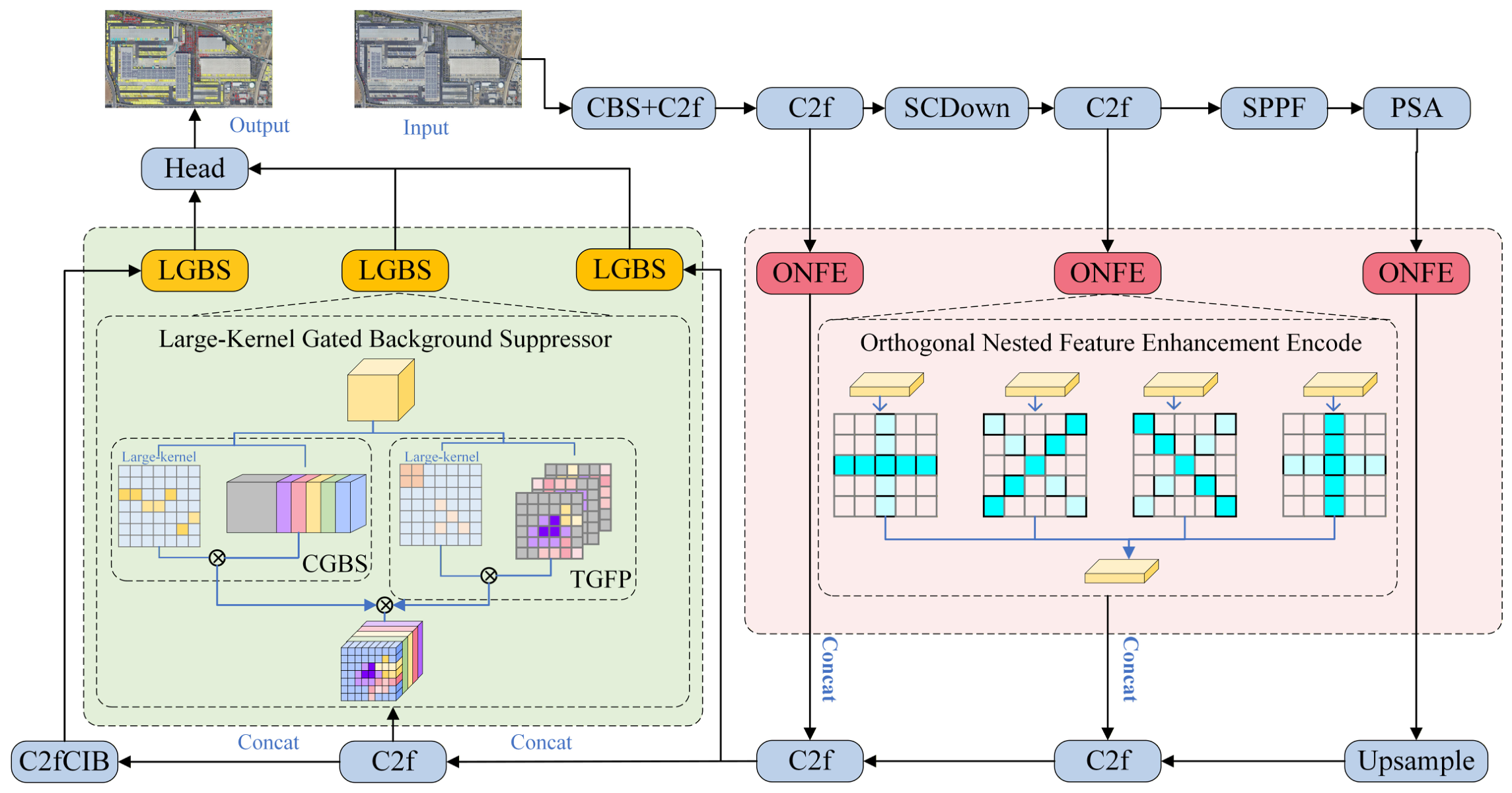
The architecture of the proposed ONOA-YOLO is shown in Figure 2. The aim of ONOA-YOLO is to accurately perceive small objects with significant variability across different orientations in complex backgrounds. To enhance the network’s accurate perception of orientational variation characteristics of small objects, an Orthogonal Nested Feature Enhancement (ONFE) module is proposed, which integrates the object variability characteristics perceived from multiple orientations to achieve the collaborative enhancement of small object features. Additionally, to achieve the effect of suppressing background interference while preserving the extracted small object features during downsampling, a Large-Kernel Gated Background Suppressor (LGBS) module is proposed. This module consists of two branches: CGBS and TGFP. Both modules employ large convolutional kernels to leverage their contextual extraction ability. By integrating spatial and channel features, they effectively suppress complex background interference, enabling foreground perception in complex backgrounds.
Figure 2.
Architecture of the proposed ONOA-YOLO. The aim of ONOA-YOLO is to enhance orientational feature perception for small objects in complex backgrounds. The input data is first fed into the backbone network for feature extraction. Then the features are processed by the ONFE to achieve multi-orientational feature enhancement. The enhanced features are then passed to LGBS, which performs background suppression while preserving the previously extracted object features. Finally, the processed features are delivered to generate the detection results.
In the ONOA-YOLO network, the ONFE and LGBS modules work in close collaboration to enhance small-object features while suppressing background interference. The ONFE module comprehensively captures the geometric variations of small targets across different directions using multi-directional strip convolutions, orthogonal nesting, and dilated convolutions, thereby compensating for the insufficient feature representation caused by limited pixel coverage through surrounding contextual information. Meanwhile, the LGBS module achieves background suppression and feature preservation guided by large-kernel context; it aggregates contextual cues via large convolutional kernels and integrates them into a channel attention mechanism to filter out complex background clutter while locking onto and protecting small-object features in the spatial dimension to prevent the loss of micro-targets during downsampling. This complementary mechanism effectively addresses the challenges of multi-directional variations in small targets and high false-alarm rates in complex backgrounds, endowing the model with both high accuracy and strong robustness in complex remote sensing scenarios.
The network uses YOLOv10 as the baseline. The inputs are fed into ONFE at three distinct scale levels during backbone processing, enabling multi-scale enhancement of features specifically for small objects. Subsequently, features from three distinct levels are again directed into LGBS at the neck stage, which integrates contextual information extracted by large kernels with channel-wise and spatial features to suppress complex background interference. Finally, the detection results are output through the detection head.
3.2. Orthogonal Nested Feature Enhancement (ONFE)
To enhance the network’s accurate perception of orientational variation characteristics of small objects, the orthogonal nested feature enhancement (ONFE) module is proposed. The ONFE includes convolution units with nested orthogonal orientations, which can perceive the variability features of small objects from different orientations and integrate them. Each parallel branch corresponding to a different orientation in this module passes through a dilated convolution to establish the connection between small objects and the background. Subsequently, these features are fused to achieve the collaborative enhancement of object features.
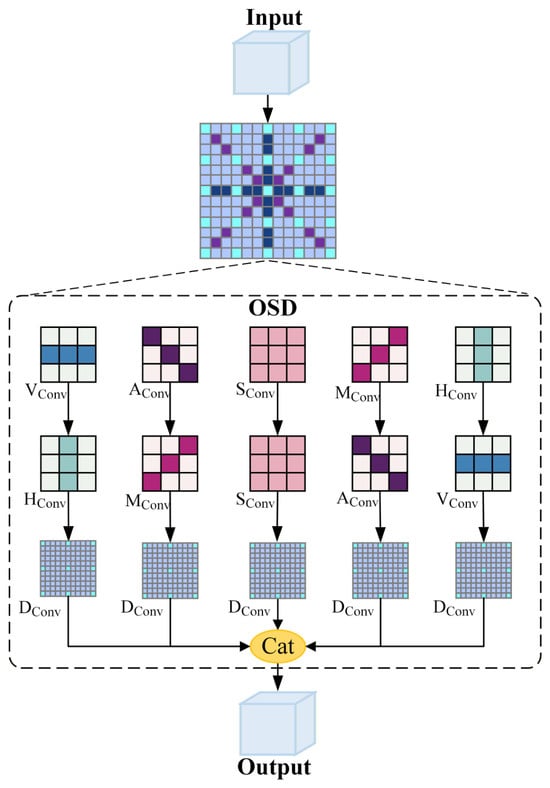
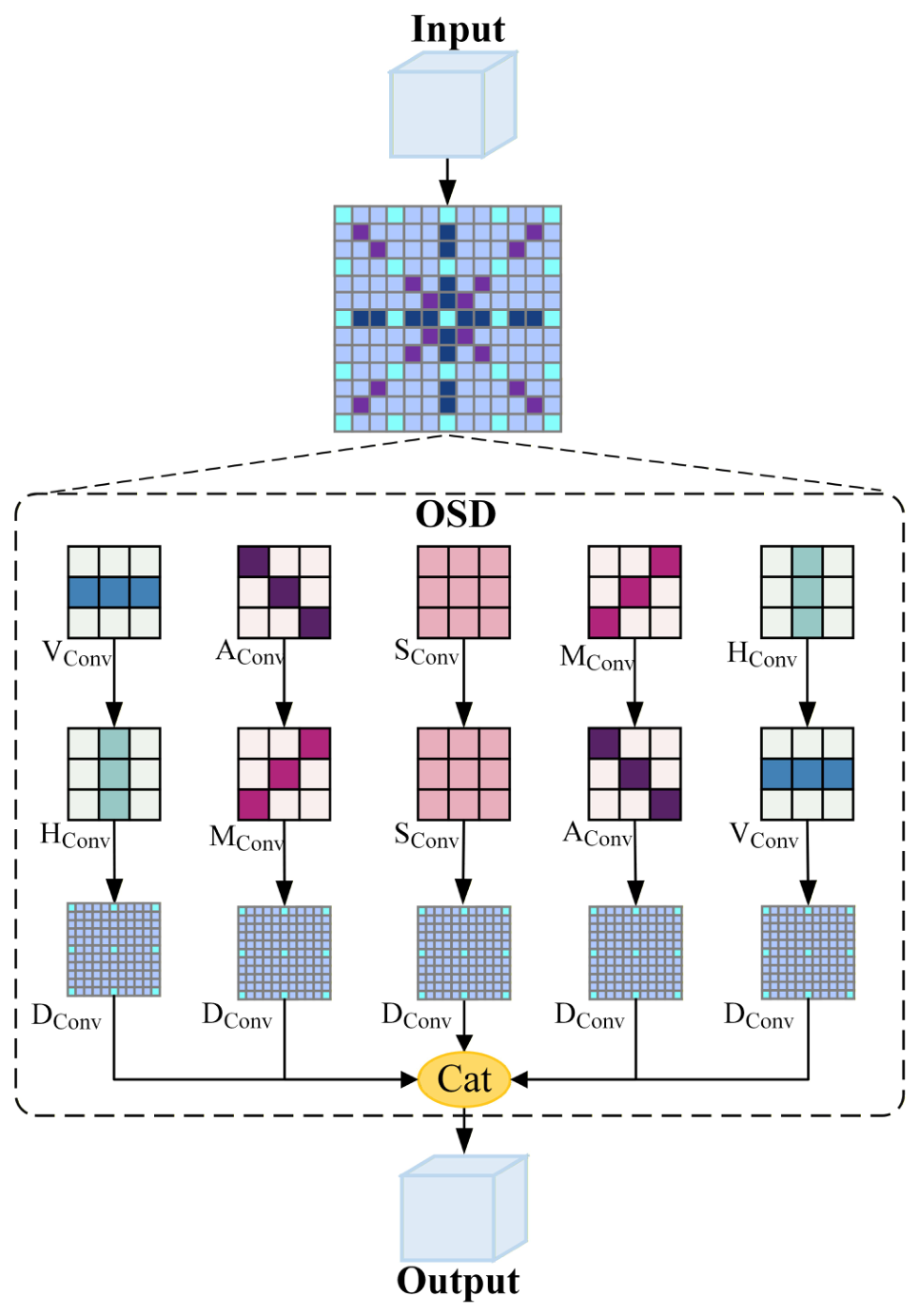
As shown in Figure 3, the core of ONFE is the Orientation-Sensitive Decoder (OSD). The input features are processed through five parallel branches. Each branch first employs a convolution for channel adjustment before subsequent operations. The first branch sequentially applies a convolution to enhance horizontal directional features, followed by a convolution to preserve vertical details. The mathematical expressions can be written as Equation (1):
Figure 3.
The core of ONFE is an orientation-sensitive decoder (OSD). The module is designed to enhance the network’s directional sensitivity to objects, enabling comprehensive feature extraction from multi-oriented objects.
Here, denotes the processed output from the first branch, represents the convolution in the horizontal direction, indicates the convolution in the vertical direction, and F stands for the input features. While maintaining sensitivity primarily to horizontal object features, this branch effectively combines vertical features to complement the horizontal representation. Overall, this branch primarily maintains sensitivity to horizontal object features while using vertical features as complementary enhancement. The second branch operates inversely to the first branch: features first pass through a convolution to enhance vertical directional details of small objects, followed by a convolution to preserve horizontal directional features. It can be written as Equation (2):
The third branch employs two convolutions to comprehensively enhance local details of small objects in all directions. It can be written as Equation (3):
Here, f denotes the standard convolutions. The fourth branch first transforms the input vectors into the left-to-right diagonal axis, then performs feature extraction using convolutions to enhance left-oriented object features. After completing these operations, the feature vectors are restored to their original state. The same process is then repeated by transforming vectors onto the right-to-left diagonal axis for convolution-based feature extraction to preserve right-oriented object features. This branch primarily enhances left-directional details while using right-directional features as auxiliary. It can be written as Equation (4):
The represents convolution along the main diagonal (top-left to bottom-right), while denotes convolution along the anti-diagonal (top-right to bottom-left). The fifth branch functions conversely to the fourth, mainly enhancing right-directional small object features, with left-directional features serving as complementary support. It can be written as Equation (5):
Finally, all branches incorporate a dilated convolution that leverages surrounding contextual information to further enhance feature extraction for small objects, compensating for their insufficient feature representation caused by limited pixel coverage. The outputs from all five branches are then fused to produce the final output of the ONFE, as formulated in Equation (6).
Through this module, the network achieves multi-orientational feature enhancement for small objects, effectively addressing the insensitivity of conventional square convolutions to the diverse orientations of small objects.
3.3. Large-Kernel Gated Background Suppressor (LGBS)
To achieve the effect of suppressing background interference while preserving the extracted small object features during downsampling, a large-kernel gated background suppressor (LGBS) is proposed. After the backbone completes feature extraction, the obtained feature maps still contain substantial background noise, which needs to be eliminated. However, downsampling operations tend to weaken features of tiny targets while suppressing backgrounds. For this reason, it is essential to preserve small object features simultaneously. This module employs large convolutional kernels to extract contextual information about objects, and combining contextual semantic information with environmental clues helps the network distinguish objects. Ships and vehicles share similar visual appearances and are hard to differentiate using isolated features. Once the surrounding area is recognized as a parking lot via context, the network correctly classifies the object as a vehicle. The contextual information is then integrated with spatial and channel information through two parallel branches of the module, thereby enabling the suppression of complex backgrounds.
The module architecture consists of two modules: the context-guided background suppression (CGBS) module and the target-density gated feature preservation (TGFP) module. In both modules, context information is leveraged in different ways to suppress background interference while preserving the features of extracted small targets. Specifically, within the CGBS module, context information guides the channel attention mechanism to filter and retain channels with dense targets while suppressing those heavily contaminated by background clutter. Meanwhile, in the TGFP module, context information directs the self-attention mechanism to focus on target feature regions, thereby ensuring the preservation of the extracted small-object features.
3.3.1. Context-Guided Background Suppression (CGBS)
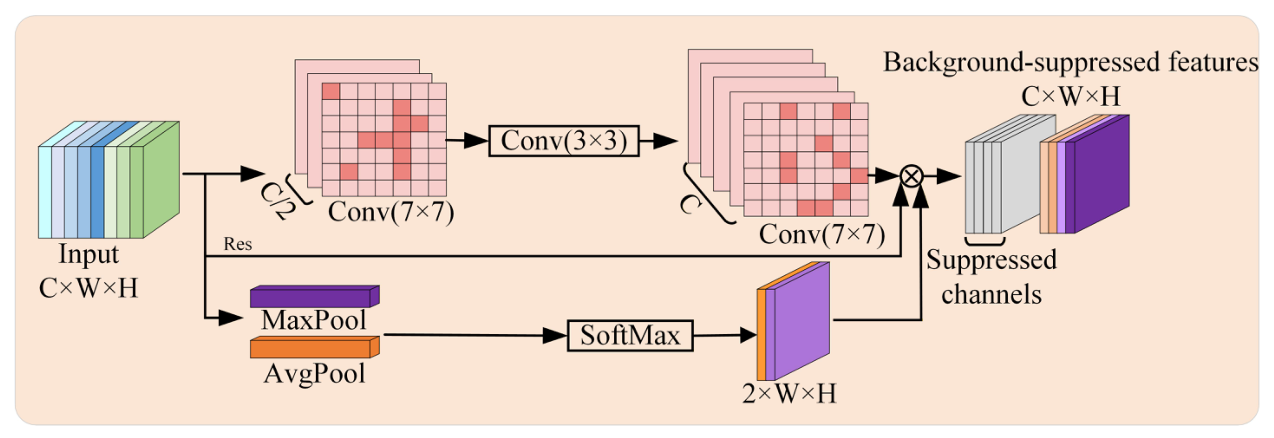
To suppress redundant background information, this module is proposed. It employs large convolutional kernels to extract contextual information of objects, which is then integrated into the channel attention branch to identify and suppress channels that encode excessive background interference.
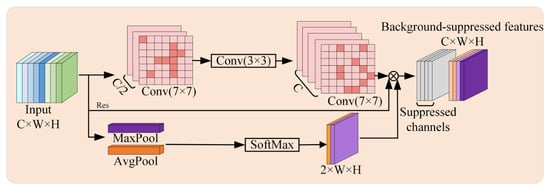
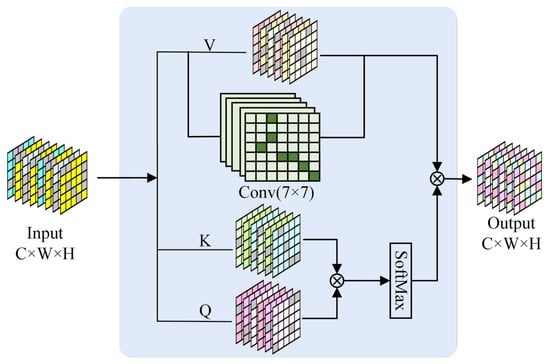
As shown in Figure 4, the CGBS module processes the feature maps through separate global pooling operations to condense them into two compact channel-wise vectors. In parallel, the features pass through large convolutional kernels implemented by sequential and convolutions to capture rich contextual information. The classic BottleneckC2f design from YOLOv8 is employed between large-kernel convolutions to perform feature transformation and integration. These extracted contextual cues leverage surrounding environmental information to significantly improve small object recognition. The module then intelligently combines these representations with the channel features, using the contextual guidance to enhance channels containing dense object features while suppressing those dominated by background information. This sophisticated mechanism effectively suppresses complex background interference through accurate channel-wise feature refinement, allowing the network to focus on critical object characteristics. The mathematical expressions for CGBS can be written as follows:
Figure 4.
The CGBS branch employs two large convolutional kernels to aggregate contextual information of objects and integrates it with channel features, thereby effectively suppressing complex backgrounds.
Here, FCGBS denotes the output features processed by the CGBS module, FLK represents the operation performed by the large kernel on the input features, FPool denotes the results obtained by applying different global pooling operations to the input features, GMP denotes Global Max Pooling, and GAP represents Global Average Pooling.
3.3.2. Target-Density Gated Feature Preservation (TGFP)
While suppressing background information, small-object features risk being suppressed along with the background during downsampling. To address this balance between background suppression and object preservation, TGFP is specifically proposed.
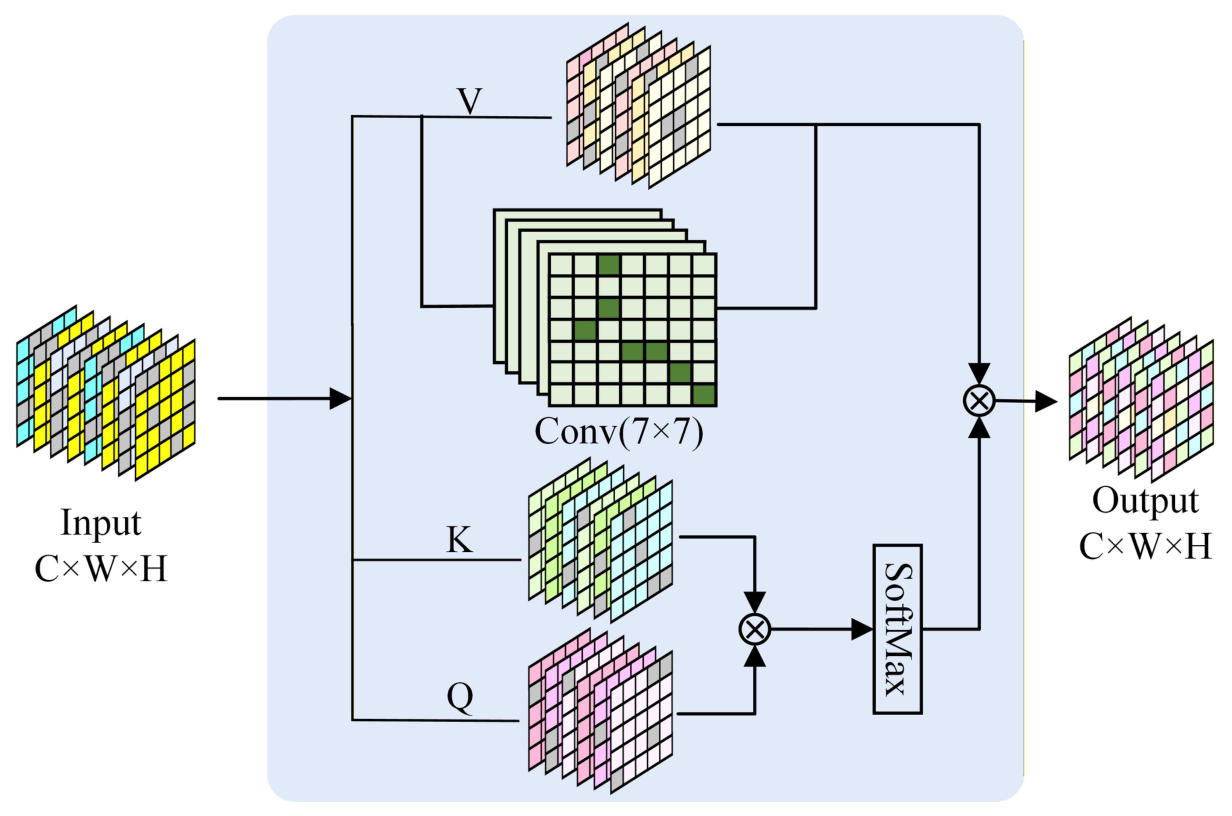
As shown in Figure 5, it employs a self-attention mechanism to capture global relationships and assign higher weights to object features. Concurrently, the input features pass through a large convolutional kernel formed by cascaded and convolutions, where the extracted contextual information actively assists the self-attention mechanism in preserving small object features. The mathematical expressions for TGFP can be written as follows:
Figure 5.
The TGFP branch combines the object’s contextual information with spatial features, enabling accurate background suppression while preserving object characteristics.
Finally, the outputs from both branches are combined, with the CGBS module effectively suppressing complex background interference while the TGFP module operates in parallel to preserve object information. The mathematical expression for TGFP can be written as follows:
Through this sophisticated architecture, the processed features achieve effective background suppression while maintaining object characteristics.
3.4. Loss Function
As shown in Equation (12), following relevant research [22], multi-task joint optimization is adopted in this paper to guide model training. The loss function consists of three components: complete intersection over union (CIoU) loss, distribution focal loss (DFL), and binary cross-entropy (BCE) loss. As presented in Equation (13), CIoU is used to measure the spatial overlap and geometric consistency between the predicted bounding box and the ground-truth bounding box. Based on intersection over union (IoU), it additionally takes into account the distance between the centers of the bounding boxes and the consistency of their width-to-height ratios, thus reflecting the matching degree of bounding boxes more comprehensively than the standard IoU. As shown in Equation (14), DFL is applied to optimize the refined localization of bounding boxes. It calculates the difference between the predicted distribution and the ground-truth distribution, and guides the model to predict the edge coordinates of the bounding box more accurately by focusing on the peak position of the distribution. The combination of CIoU and DFL forms a two-layer optimization mechanism, which jointly improves the regression accuracy of bounding boxes in object detection. This mechanism is especially suitable for localization requirements in complex scenarios such as small objects and multi-oriented objects. As shown in Equation (15), BCE is used to measure the class loss predicted by the model.
Among them, represents the sum of the squares of the distances between the center points of the ground truth box and the predicted box in the x and y directions; c denotes the length of the diagonal of the smallest rectangle that completely contains both the predicted bounding box and the ground truth box at the same time, is a balance coefficient, and is an indicator for measuring the difference in aspect ratio.
Among them, y is the true target coordinate, yi and yi+1 are two adjacent integers, and Si and Si+1 are the distribution values predicted by the model network, corresponding to the probabilities at positions yi and yi+1, respectively.
Among them, the ground-truth label of the sample is denoted by y, and the predicted probability of the model is denoted by ŷ.
4. Experiment and Results Analysis
4.1. Training Settings
The proposed ONOA-YOLO model was implemented with PyTorch 1.8 and trained on an NVIDIA A6000 graphics processing unit (GPU). Since the experimental methods encompass both YOLO-based and non-YOLO architectures, the experimental configurations established in prior studies [15,52,53] were followed for each category, respectively. For the YOLO-based architectures, the stochastic gradient descent (SGD) optimizer was used with an initial learning rate of 0.01, momentum 0.937, and weight decay 0.0005 to learn the parameters. The batch size during training was set to 4, and the number of epochs was set to 100. For non-YOLO architectures, all networks were integrated into the SODA-mmrotate framework for unified configuration. The SGD optimizer was used to train the proposed model. The initial learning rate was 0.0001, momentum was 0.9, and weight decay was 0.0001 to learn the parameters. The number of epochs was set to 12.
Additionally, there were slight differences in the implementation details for each dataset, considering the characteristics of each dataset. For the SODA-A dataset, the original images were cropped into patches with a gap of 150 pixels; these patches were resized to during training and testing as in the prior work [12]. For the SAR-ship dataset, the original images were cropped into patches with a gap of 150 pixels. These patches were resized to during training and testing.
4.2. Evaluation Index
To evaluate the proposed method, the evaluation metrics used in previous methods were adopted. AP, AP50, and AP75 were employed to assess the object detection accuracy of the model. For real-time performance, according to existing standards [54,55], a detection speed of ≥15 FPS meets the requirements. Specifically, AP measures the mean value of AP under IoU thresholds ranging from 0.5 to 0.95 at intervals of 0.05. AP50 and AP75 denote the AP values under IoU thresholds of 0.5 and 0.75, respectively. Additionally, to further evaluate the real-time performance of the model, parameters, FLOPs, and FPS were used as metrics. Considering the characteristics of each dataset, distinct evaluation metrics with subtle variations are employed.
For the SODA-A dataset, in addition to the metrics mentioned above, following the SODA-A benchmark, additional metrics including APeS (extremely small), APrS (relatively small), APgS (generally small), and APN (normal) are also incorporated. Specifically, AP represents the mean average precision calculated across IoU thresholds from 0.5 to 0.95 with 0.05 intervals; AP50 and AP75 denote the average precision at IoU thresholds of 0.5 and 0.75, respectively. AP is further categorized by object size: APeS with pixel areas [0, 144], APrS with pixel areas [144, 400], APgS with pixel areas [400, 1024], and APN with pixel areas [1024, 2000].
For the SAR-ship dataset, precision and recall are also introduced as evaluation metrics.
4.3. Experiment 1: SODA-A Dataset
4.3.1. Description of the SODA-A Dataset
The SODA-A dataset [12] is a challenging rotated optical small object detection dataset. The dataset consists of 2513 images and 872,069 annotated objects across nine categories, including airplane (AI), helicopter (HC), small-vehicle (SV), large-vehicle (LV), ship (SH), container (CO), storage tank (ST), swimming pool (SP), and windmill (WM). The image sizes range from pixels to pixels. The whole dataset is split into training, validation, and test sets, which comprise approximately 50%, 20%, and 30%, respectively.
4.3.2. Comparison with Advanced Methods on the SODA-A Dataset
On the SODA-A dataset, ONOA-YOLO was compared with state-of-the-art two-stage and one-stage detection networks: R-Faster-RCNN [13], RoI-Trans [44], CFINet [14] and MENet [15] are two-stage detectors; Gliding Vertex [56], r3det, S2A-Net [18], KFIoU [57], YOLOv5, YOLOv8, YOLOv11 [58], SCENet [59], LEGNet [60] and baseline YOLOv10 [22] are one-stage detectors. For object detection performance, the comparative experimental results of detection performance is presented in Table 1. The proposed ONOA-YOLO brings remarkable improvements compared with the advanced methods. ONOA-YOLO achieves state-of-the-art performance across all AP metrics. For detection capability, it achieves improvements of 0.69%, 0.35%, and 1.29% in AP, AP50, and AP75, demonstrating its superior localization and classification capabilities for objects of various scales in the SODA-A dataset. For small object detection metrics APeS, APrS, APgS, and APN, ONOA-YOLO outperforms the baseline by 0.40%, 0.80%, 0.94%, and 1.21%, respectively. This indicates that our method is not only effective for normal-sized objects but also excels in detecting small objects of varying sizes, proving its robustness in accurately detecting differently oriented small objects within complex backgrounds.
Table 1.
Detection performance (%) evaluation results on SODA-A. Bold values indicate the best performance, and ↑ denote performance improvements.
To verify the enhancement capability of the proposed method for small objects with large aspect ratios, comparative detection experiments for each category are carried out on the SODA-A dataset using the baseline and the proposed ONOA-YOLO, as shown in Table 2. Higher precision is attained by ONOA-YOLO across five categories. For elongated small objects, including small vehicles, ships, and containers, detection precision is boosted, with the most significant gain of 0.73% achieved for the ship class. It is validated that enhanced detection performance for elongated small objects can be obtained via the proposed method.
Table 2.
Class-specific improvement performance (%) on the SODA-A dataset. Bold values indicate the best performance.
The real-time performance of ONOA-YOLO is presented in Table 3. As shown in the table, it achieves a higher FPS than all two-stage methods. Although its FPS is slightly lower compared with some one-stage methods, it still satisfies real-time requirements. Moreover, compared with the baseline YOLOv10, its parameter and computational cost increase by less than double. This indicates that the proposed method improves the detection accuracy of small objects while maintaining real-time performance.
Table 3.
Real-time performance evaluation results on SODA-A. Bold indicates the best performance.
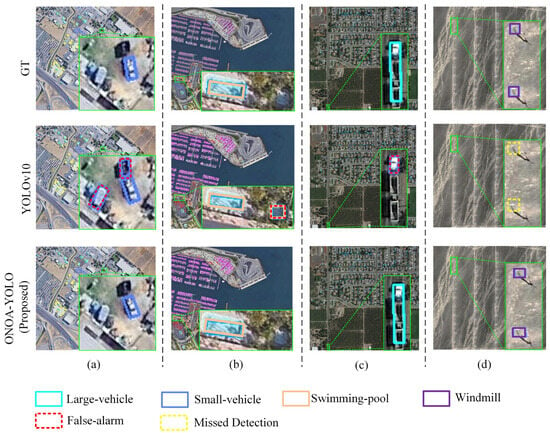
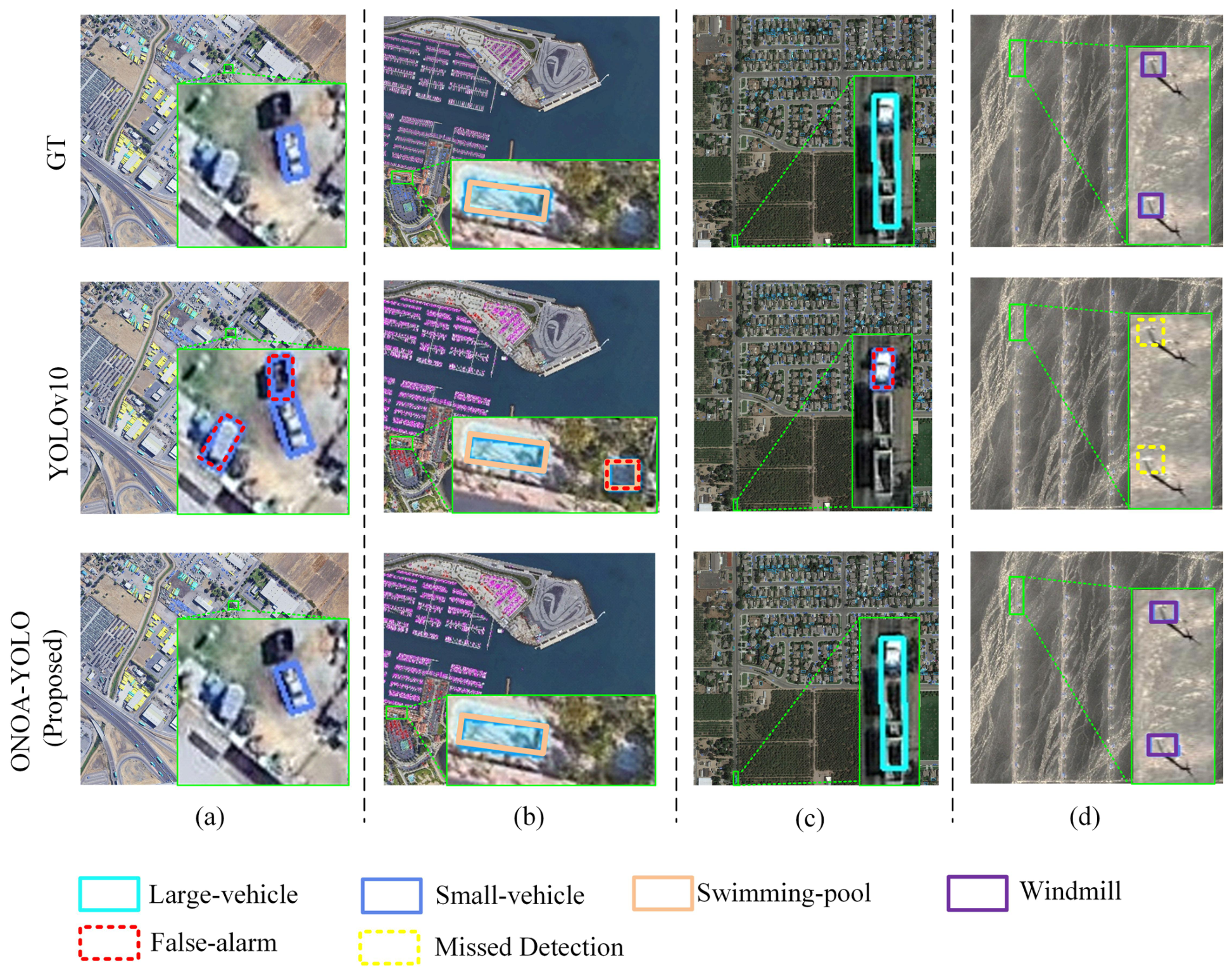
The visualization results are presented in Figure 6, which displays four sets of scenarios (a), (b), (c), and (d). For each scenario, the key regions are magnified and displayed on the right side of the image. The first row presents the ground truth, the second row shows the detection results of YOLOv10, and the third row demonstrates the results of ONOA-YOLO. By comparing the three images in each scenario, it is evident that the proposed method exhibits a clear advantage in detecting small, direction-sensitive objects within a complex background. The detailed analysis is presented as follows.
Figure 6.
Visualization results of ONOA-YOLO on SODA-A. The visualization demonstrates the detection performance comparison between our proposed method and YOLOv10 across four distinct scenarios (a–d). From top to bottom, the rows display the image ground truth, detection results of YOLOv10, and detection results of our ONOA-YOLO. Key regions of interest in each scenario are magnified and shown in the right-side insets for detailed visual comparison. Scenarios (a,b) demonstrate that ONOA-YOLO has the ability to suppress backgrounds similar to the targets, whereas scenarios (c,d) indicate that the network possesses a stronger perception capability for targets, enabling it to capture their fine-grained features.
Scenario (a) displays detection results in a parking lot scenario featuring numerous densely packed, elongated small vehicles oriented in various directions. Most small vehicles are white in color, making them visually similar to the ground. The ground truth reveals that the region of interest contains only variously oriented small vehicles and some ground structures. However, the detection results of YOLOv10 erroneously identified two large vehicles, which were actually false detections caused by merging multiple small cars together. In contrast, ONOA-YOLO correctly detected all small vehicles.
Scenario (d) demonstrates the opposite case: YOLOv10 erroneously identified only the tractor unit of a large vehicle with two trailers as a small vehicle, failing to detect both trailer sections. In comparison, our ONOA-YOLO effectively recognized the spatial connections among all three components and accurately identified the complete large-vehicle configuration. This result demonstrates that our proposed method effectively enhances small object features from multiple orientations and successfully integrates multi-orientational features for accurate object recognition.
Scenario (c) presents the detection results of swimming pools under tree shadows. YOLOv10 incorrectly identified tree-cast shadows as swimming pools merely because their color resembled that of adjacent pools. However, our proposed ONOA-YOLO accurately detected the actual swimming pools without producing any false alarms. The result clearly demonstrates that our method’s background suppression is highly effective while maintaining excellent object recognition performance in complex background conditions.
Scenario (d) involves windmill detection in mountainous areas. Due to the unique perspective of remote sensing imagery, the windmills appear almost as dots in the images, blending seamlessly with the mountain terrain. Only their shadows reveal their true shape, demanding the network’s ability to incorporate contextual information for accurate detection. While YOLOv10 completely failed to detect any windmills in this scenario, ONOA-YOLO achieved perfect detection. This clearly demonstrates how the large convolutional kernels in our network effectively leverage contextual information for object recognition.
4.3.3. Feature Visualization Results
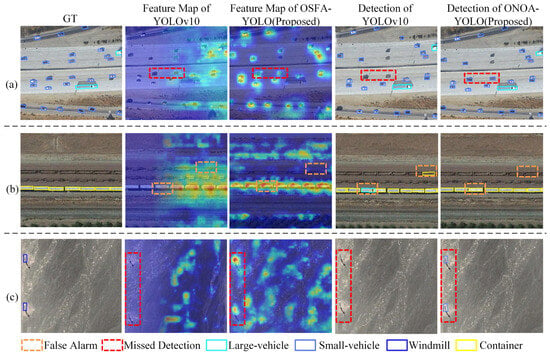
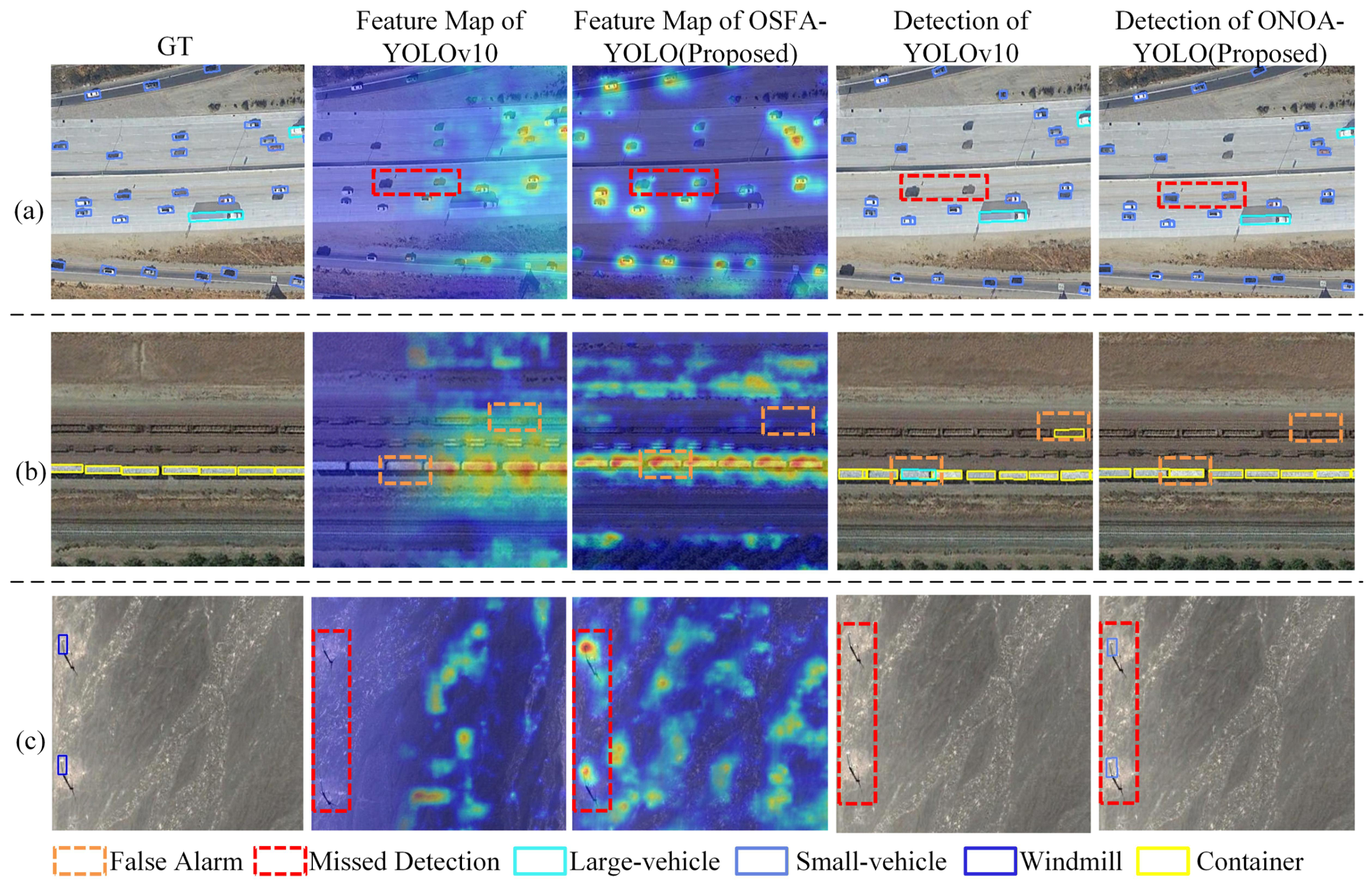
Figure 7 presents a comparative visualization of feature maps between YOLOv10 and ONOA-YOLO across three scenarios, with key regions highlighted by dashed bounding boxes in different colors. In all three scenarios, YOLOv10 fails to accurately focus on the objects in key areas, and in some cases even concentrates on background regions instead. This leads to missed detections, misclassifications, and false alarms in the detection results of YOLOv10. In contrast, the proposed ONOA-YOLO demonstrates effective attention to object regions while suppressing background interference, enabling accurate detection of small objects even in complex scenes. The following provides a detailed analysis of these three sets of feature maps.
Figure 7.
Visualization results of feature maps on SODA-A. From top to bottom: scenarios (a–c) compare ONOA-YOLO with YOLOv10. Left to right: (1) ground truth, (2–3) feature maps (YOLOv10/ONOA-YOLO), (4–5) detection results (YOLOv10/ONOA-YOLO). Scenarios (a,c) demonstrate that ONOA-YOLO is capable of focusing on small-object perception in complex backgrounds, while scenario (b) indicates that ONOA-YOLO can suppress backgrounds similar to the targets.
In scenario (a), YOLOv10 exhibits insufficient attention to the left half of the image, while in the right half where it does focus, its attention level to objects is nearly equivalent to that of background regions. This leads to missed detections of two small vehicles in the left portion. In contrast, ONOA-YOLO accurately localizes all objects in the image with minimal background attention, demonstrating significant concentration on foreground objects. These results indicate that our proposed network effectively enhances feature representation for small objects while successfully suppressing background interference. In scenario (b), YOLOv10 again demonstrates inadequate attention to the left image region. Furthermore, in its attended right region, the module allocates substantial attention to background areas between objects. These limitations lead to two distinct errors: misclassifying a container in the left image region as a large vehicle while simultaneously producing false positive detections in the right image region. In contrast, ONOA-YOLO maintains accurate object-focused attention with minimal background interference. The attention mechanism of the network exclusively concentrates on objects themselves, enabling accurate detection of objects that closely resemble their background. These results demonstrate that our network enhances object features through multi-orientational feature augmentation, integrating comprehensive visual characteristics for improved localization and classification. By strengthening object feature representation, the method reliably avoids both missed detections and false alarms, even when objects exhibit strong background similarity. In scenario (c), YOLOv10 completely fails to attend to the windmill objects while allocating all its attention to background regions, resulting in a total failure to detect any windmills. In contrast, ONOA-YOLO successfully focuses on the wind turbine objects and ultimately detects all objects correctly. The results demonstrate that our proposed network achieves effective integration of contextual information for object detection. By utilizing contextual cues including ground shadows and mountain features, the method enables accurate identification of windmills even in cases of severe deformation, where the objects may visually resemble simple poles.
4.4. Experiment 2: SAR-Ship Dataset
4.4.1. Dataset Description of the SAR-Ship Dataset
The SAR-ship dataset is a rotated Synthetic Aperture Radar (SAR) small ship detection dataset. The dataset includes a vast range of urban landscapes, containing a substantial amount of background information. It consists of 85,589 instances with sizes ranging from pixels to pixels. The whole dataset is split into training, validation, and test sets, which comprise approximately 50%, 25%, and 25%, respectively.
4.4.2. Comparison with Advanced Methods on the SAR-Ship Dataset
On the SAR-ship dataset, ONOA-YOLO was compared with state-of-the-art two-stage and one-stage detection networks: R-Faster-RCNN and RoI-Trans are two-stage detectors; Gliding Vertex, r3det [19], S2A-Net, Oriented_reppoint [61], YOLOv5, YOLOv11, and YOLOv10 are one-stage detectors. The comparative experimental results of detection performance versus real-time performance are presented in Table 4 and Table 5.
Table 4.
Detection performance (%) evaluation results on SAR-ship. Bold values indicate the best performance, and ↑ denote performance improvements.
Table 5.
Real-time performance evaluation results on SAR-ship. Bold values indicate the best performance.
In terms of object detection performance, the proposed ONOA-YOLO also brings remarkable improvements compared with the advanced methods on SAR-ship. ONOA-YOLO achieves remarkable performance across all AP metrics. It achieves 1.51%, 0.94% and 2.47% improvements in AP, AP50 and AP75, demonstrating that our proposed method consistently delivers outstanding performance on noisy SAR images across different thresholds. Regarding both precision and recall metrics, our method achieves improvements of 0.94% and 1.51% over the baseline, indicating its superior capability to accurately identify true objects while suppressing false positives from the background. In terms of real-time performance, the proposed method achieves 29.85 FPS, meeting the requirements for real-time remote sensing image detection. Compared with the baseline YOLOv10, it only increases the parameter count by 0.28M and computational cost by 3.75 GFLOPs, demonstrating that the proposed approach attains optimal detection performance while ensuring real-time capability.
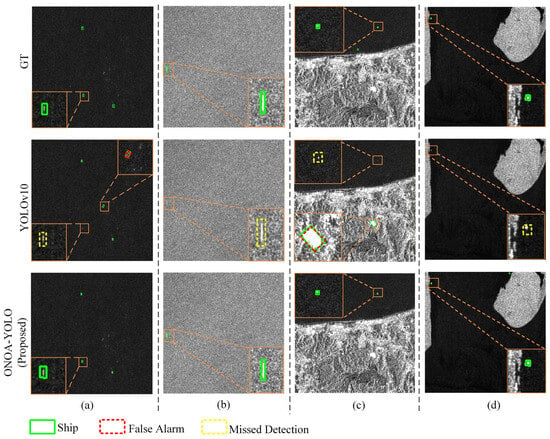
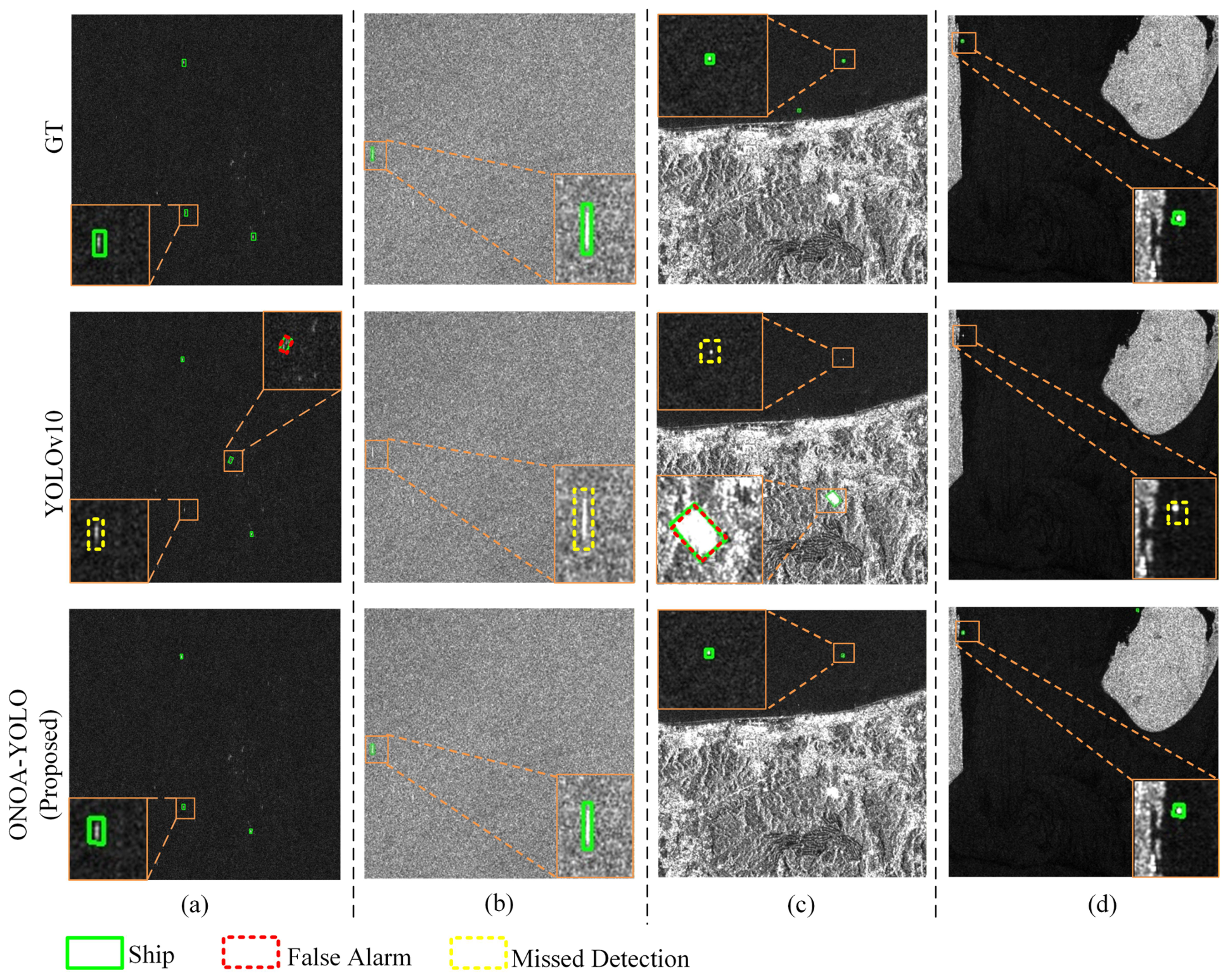
The visualization results are presented in Figure 8, which also displays four sets of scenarios (a), (b), (c), and (d). Comparative analysis between our proposed method and YOLOv10 demonstrates that our approach can reliably detect extremely small objects amidst background noise while effectively suppressing false positives from object-like background clutter. This capability stems from our network’s enhanced feature representation for small objects and sophisticated background suppression mechanism. The detailed analysis is presented as follows.
Figure 8.
Visualization results of SAR-ship. The visualization demonstrates the detection performance comparison between our proposed method and YOLOv10 across four distinct scenarios (a–d). From top to bottom, the rows display the image ground truth, detection results of YOLOv10, and detection results of our ONOA-YOLO. Key regions of interest in each scenario are magnified and shown in the right-side insets for detailed visual comparison. Scenarios (a,c) demonstrate that ONOA-YOLO has the ability to suppress backgrounds similar to the targets, whereas scenarios (b,d) indicate that ONOA-YOLO can accurately perceive targets within backgrounds similar to them.
Scenarios (a) and (d) demonstrate the detection performance for extremely small ship objects. In the key regions, the tiny object appears almost as a single pixel, surrounded by numerous noise points with similar shapes. While YOLOv10 completely missed the object by misclassifying it as background, our proposed ONOA-YOLO successfully detected the ship object. This significant improvement is attributed to the network’s enhanced feature extraction capability specifically designed for small objects.
In Scenario (b), although the ship object exhibits an elongated shape, it is completely submerged in heavy background noise. While YOLOv10 fails entirely to detect the object from the noisy environment, our proposed network effectively suppresses the background clutter and successfully identifies the ship object. This conclusively demonstrates the efficacy of our network’s object enhancement and background suppression mechanisms.
Scenario (c) demonstrates the network’s ability to suppress background regions that highly resemble target objects. In the key region marked at the bottom-left of the image, the background structure bears a striking similarity to actual ship objects. While YOLOv10 erroneously detected this background as an object, our network successfully distinguished objects from background interference, effectively avoiding false alarms. This achievement stems from the effect of our network’s object feature enhancement and background suppression mechanisms.
4.5. Ablation Experimental Results
To evaluate the contribution of each component in ONOA-YOLO, comprehensive ablation studies were conducted by progressively integrating the ONFE and LGBS modules into the baseline model on the SAR-ship dataset. Furthermore, separate ablation experiments were performed for the CGBS and TGFP modules within the LGBS to validate their individual effectiveness on the same dataset.
4.5.1. Effectiveness of ONFE
As shown in Table 6, adding ONFE can significantly improve all evaluation metrics, particularly in terms of AP and AP75, which increased by 1.23% and 1.94%, respectively. This confirms that the ONFE effectively enhances multi-orientational features of small objects, enabling the network to accurately identify and detect correct objects.
Table 6.
Ablation study of ONFE and LGBS on SAR-ship (%). Bold values indicate the best performance and ✓ indicates that the module is adopted.
4.5.2. Effectiveness of LGBS
For the LGBS, as shown in Table 6, it improves all evaluation metrics, particularly AP75, which shows a 1.64% increase. This verifies that LGBS effectively utilizes the contextual information extracted by large convolution kernels to suppress redundant backgrounds.
4.5.3. Effectiveness of Each Component of ONFE
The ONFE module consists of three important components: orientational convolutions, convolutions orthogonal to these directions, which are referred to as “nest”, and dilated convolutions at the end of each branch. As shown in Table 7, these components are all indispensable to the module. When all components are present, the network achieves the optimal detection accuracy. In particular, for AP75, the accuracy is improved by 3.79%.
Table 7.
Performance comparison with different configurations (%). Bold values indicate the best performance and ✓ indicates that the module is adopted.
4.5.4. Dilation Rate of ONFE
To validate the rationality of dilation rates in the final layer of branches within the ONFE module, three distinct dilation rates (d = 3, 5, 7) were designed. As shown in Table 8, regarding real-time performance, the model achieves the lowest parameter count and computational complexity when the dilation rate equals 5. Specifically, it reduces parameters by 0.82 M compared with d = 7, and decreases computational load by 0.9 G compared with other rates. In terms of detection accuracy, the d = 5 configuration demonstrates superior performance across all metrics, with the most significant improvement observed in AP75(%), showing 0.69% and 1.18% increases over d = 3 and d = 7, respectively. These results demonstrate that a dilation rate of 5 represents the optimal configuration, achieving the best balance between real-time performance and detection accuracy.
Table 8.
Ablation study of dilation rate of ONFE on SAR-ship (%). Bold values indicate the best performance.
4.5.5. Effectiveness of CGBS and TGFP of LGBS
As demonstrated in Table 9, adding CGBS significantly improves the AP and Recall metrics, with the Recall metric increasing by 0.5%. This demonstrates that the CGBS module enables the model to accurately focus on positive samples rather than the background, highlighting its ability to suppress background interference by combining contextual information with channel-wise features.
Table 9.
Ablation study of CGBS and TGFP on SAR-ship (%). Bold values indicate the best performance and ✓ indicates that the module is adopted.
For the TGFP, it significantly improves the AP50 metric while maintaining the performance of other metrics at their original levels. This indicates that the TGFP module effectively combines contextual information with spatial information, leveraging the relationships among global features to assign higher weights to object features. As a result, it ensures the removal of complex background interference while preserving the characteristics of small objects.
5. Conclusions
This paper proposes the ONFE module to enhance small object features from different orientations, thereby overcoming the insensitivity of conventional square convolutions to small object characteristics across different orientations. Additionally, we introduce an LGBS that leverages contextual information to assist in feature integration across other dimensions, enabling the suppression of complex backgrounds while preserving object features. These two modules are integrated into the YOLOv10 architecture to construct ONOA-YOLO, a real-time small object detection network for remote sensing imagery. The proposed network achieves outstanding detection results on both the SODA-A and SAR-ship datasets. On the SODA-A dataset, it improves all detection metrics while achieving a real-time processing speed of 25.40 FPS. The most notable improvements are observed in AP75 and APN, which increase by 1.29% and 1.21%, respectively. On SAR-ship, it improves all accuracy metrics with only a 0.28 M parameter increase, notably boosting AP and AP75 by 1.51% and 2.47%, respectively. This indicates that the proposed method improves the detection accuracy of small objects while maintaining real-time performance.
In future work, inspired by relevant research efforts [62,63], the task of small object detection in open-vocabulary scenarios will be explored [64], with the aim of achieving accurate detection of unknown small objects in open environments.
Author Contributions
Conceptualization, A.S., H.C., W.L., G.W. and J.W.; Methodology, A.S., H.C., W.L., G.W., X.G., Z.Z. and J.W.; Software, A.S., H.C. and J.W.; Validation, A.S.; Formal analysis, A.S., H.C., W.L., G.W., X.G., Z.Z., D.W. and J.W.; Investigation, A.S., H.C., W.L. and L.C.; Resources, H.C., W.L., L.C. and D.W.; Data curation, A.S.; Writing – original draft, A.S., W.L. and J.W.; Writing – review & editing, A.S., H.C., G.W., L.C., X.G., D.W. and J.W.; Visualization, A.S. and L.C.; Supervision, H.C., W.L., G.W., L.C., X.G., Z.Z. and J.W.; Funding acquisition, W.L. and J.W. All authors have read and agreed to the published version of the manuscript.
Funding
This research was funded by the National Natural Science Foundation for Young Scientists of China under Grant No. 62201059.
Data Availability Statement
The SODA-A datasets analyzed in this study are publicly available.
Conflicts of Interest
The authors declare no conflicts of interest.
References
- Zhao, Z.; Du, J.; Li, C.; Fang, X.; Xiao, Y.; Tang, J. Dense Tiny Object Detection: A Scene Context Guided Approach and a Unified Benchmark. IEEE Trans. Geosci. Remote Sens. 2024, 62, 5606913. [Google Scholar] [CrossRef] [Scilit]
- Zhang, D.; Lin, C.; Pan, Y. A lightweight small object detection network inspired by the visual area V2. Comput. Electr. Eng. 2025, 126, 110471. [Google Scholar] [CrossRef] [Scilit]
- Xie, Y.; Feng, D.; Chen, H.; Liu, Z.; Mao, W.; Zhu, J.; Hu, Y.; Baik, S.W. Damaged Building Detection From Post-Earthquake Remote Sensing Imagery Considering Heterogeneity Characteristics. IEEE Trans. Geosci. Remote Sens. 2022, 60, 4708417. [Google Scholar] [CrossRef] [Scilit]
- Lei, S.; Xiao, X.; Zhang, T.; Li, H.C.; Shi, Z.; Zhu, Q. Exploring Fine-Grained Image-Text Alignment for Referring Remote Sensing Image Segmentation. IEEE Trans. Geosci. Remote Sens. 2024, 63, 5604611. [Google Scholar] [CrossRef] [Scilit]
- Chen, Z.; Liang, Y.; Yu, Z.; Xu, K.; Ji, Q.; Zhang, X.; Zhang, Q.; Cui, Z.; He, Z.; Chang, R.; et al. TO–YOLOX: A pure CNN tiny object detection model for remote sensing images. Int. J. Digit. Earth 2023, 16, 3882–3904. [Google Scholar] [CrossRef] [Scilit]
- Jiang, J.; Lei, S.; Li, H.C.; Sun, Y. MLAgg-UNet: Advancing Medical Image Segmentation With Efficient Transformer and Mamba-Inspired Multi-Scale Sequence. IEEE J. Biomed. Health Inform. 2026, 30, 2340–2353. [Google Scholar] [CrossRef] [Scilit] [PubMed]
- Wang, C.; Zhao, D.; Qi, X.; Liu, Z.; Shi, Z. A Hierarchical Decoder Architecture for Multilevel Fine-Grained Disaster Detection. IEEE Trans. Geosci. Remote Sens. 2023, 61, 5607114. [Google Scholar] [CrossRef] [Scilit]
- Wang, J.; Zhong, Y.; Zhang, L. Contrastive Scene Change Representation Learning for High-Resolution Remote Sensing Scene Change Detection. IEEE Trans. Geosci. Remote Sens. 2024, 62, 5618118. [Google Scholar] [CrossRef] [Scilit]
- Wang, J.; Zhong, Y.; Zhang, L. Semantic Change Detection Based on Supervised Contrastive Learning for High-Resolution Remote Sensing Imagery. IEEE Trans. Geosci. Remote Sens. 2024, 62, 5649720. [Google Scholar] [CrossRef] [Scilit]
- Li, W.; Zhao, D.; Yuan, B.; Gao, Y.; Shi, Z. PETDet: Proposal Enhancement for Two-Stage Fine-Grained Object Detection. IEEE Trans. Geosci. Remote Sens. 2024, 62, 5602214. [Google Scholar] [CrossRef] [Scilit]
- Cheng, G.; Ding, Q.; Cai, B.; Dang, C.; Wang, Y.; Zuo, X.; Shao, Z. CSSDet: Small object detection via cross-scale feature enhancement on drone-view images. Int. J. Digit. Earth 2024, 17, 2414848. [Google Scholar] [CrossRef] [Scilit]
- Cheng, G.; Yuan, X.; Yao, X.; Yan, K.; Zeng, Q.; Xie, X.; Han, J. Towards Large-Scale Small Object Detection: Survey and Benchmarks. IEEE Trans. Pattern Anal. Mach. Intell. 2023, 45, 13467–13488. [Google Scholar] [CrossRef] [Scilit] [PubMed]
- Ren, S.; He, K.; Girshick, R.; Sun, J. Faster R-CNN: Towards Real-Time Object Detection with Region Proposal Networks. IEEE Trans. Pattern Anal. Mach. Intell. 2017, 39, 1137–1149. [Google Scholar] [CrossRef] [Scilit] [PubMed]
- Yuan, X.; Cheng, G.; Yan, K.; Zeng, Q.; Han, J. Small Object Detection via Coarse-to-fine Proposal Generation and Imitation Learning. In Proceedings of the 2023 IEEE/CVF International Conference on Computer Vision (ICCV); IEEE: New York, NY, USA, 2023; pp. 6294–6304. [Google Scholar] [CrossRef] [Scilit]
- Zhang, T.; Zhang, X.; Zhu, X.; Wang, G.; Han, X.; Tang, X.; Jiao, L. Multistage Enhancement Network for Tiny Object Detection in Remote Sensing Images. IEEE Trans. Geosci. Remote Sens. 2024, 62, 5611512. [Google Scholar] [CrossRef] [Scilit]
- Sun, G.; Hua, Y.; Hu, G.; Robertson, N. Efficient One-Stage Video Object Detection by Exploiting Temporal Consistency. In Proceedings of the Computer Vision—ECCV 2022; Avidan, S., Brostow, G., Cissé, M., Farinella, G.M., Hassner, T., Eds.; Springer Nature: Cham, Switzerland, 2022; pp. 1–16. [Google Scholar]
- Chen, C.; Zheng, Z.; Huang, Y.; Ding, X.; Yu, Y. I3Net: Implicit Instance-Invariant Network for Adapting One-Stage Object Detectors. In Proceedings of the 2021 IEEE/CVF Conference on Computer Vision and Pattern Recognition (CVPR); IEEE: New York, NY, USA, 2021; pp. 12571–12580. [Google Scholar] [CrossRef] [Scilit]
- Han, J.; Ding, J.; Li, J.; Xia, G.S. Align Deep Features for Oriented Object Detection. IEEE Trans. Geosci. Remote Sens. 2022, 60, 5602511. [Google Scholar] [CrossRef] [Scilit]
- Yang, X.; Yan, J.; Feng, Z.; He, T. R3det: Refined single-stage detector with feature refinement for rotating object. In Proceedings of the AAAI Conference on Artificial Intelligence; AAAI Press: Palo Alto, CA, USA, 2021; Volume 35, pp. 3163–3171. [Google Scholar]
- Redmon, J.; Divvala, S.; Girshick, R.; Farhadi, A. You only look once: Unified, real-time object detection. In Proceedings of the Proceedings of the IEEE Conference on Computer Vision and Pattern Recognition; IEEE: New York, NY, USA, 2016; pp. 779–788. [Google Scholar]
- Redmon, J.; Farhadi, A. YOLO9000: Better, faster, stronger. In Proceedings of the IEEE Conference on Computer Vision and Pattern Recognition; IEEE: New York, NY, USA, 2017; pp. 7263–7271. [Google Scholar]
- Wang, A.; Chen, H.; Liu, L.; Chen, K.; Lin, Z.; Han, J.; Ding, G. Yolov10: Real-time end-to-end object detection. Adv. Neural Inf. Process. Syst. 2024, 37, 107984–108011. [Google Scholar] [CrossRef] [Scilit]
- Yang, Y.; Zang, B.; Song, C.; Li, B.; Lang, Y.; Zhang, W.; Huo, P. Small Object Detection in Remote Sensing Images Based on Redundant Feature Removal and Progressive Regression. IEEE Trans. Geosci. Remote Sens. 2024, 62, 5629314. [Google Scholar] [CrossRef] [Scilit]
- Xiao, Y.; Xu, T.; Yu, X.; Fang, Y.; Li, J. A Lightweight Fusion Strategy With Enhanced Interlayer Feature Correlation for Small Object Detection. IEEE Trans. Geosci. Remote Sens. 2024, 62, 4708011. [Google Scholar] [CrossRef] [Scilit]
- Redmon, J.; Farhadi, A. Yolov3: An incremental improvement. arXiv 2018, arXiv:1804.02767. [Google Scholar]
- Bochkovskiy, A.; Wang, C.Y.; Liao, H.Y.M. Yolov4: Optimal speed and accuracy of object detection. arXiv 2020, arXiv:2004.10934. [Google Scholar]
- Qian, X.; Zhang, B.; He, Z.; Wang, W.; Yao, X.; Cheng, G. IPS-YOLO: Iterative Pseudo-Fully Supervised Training of YOLO for Weakly Supervised Object Detection in Remote Sensing Images. IEEE Trans. Geosci. Remote Sens. 2025, 63, 5630414. [Google Scholar] [CrossRef] [Scilit]
- Wang, S.; Yang, X.; Lu, R.; Zhang, D.; Xie, W.; Su, S.; Zhang, Z. MROD-YOLO: Multimodal Joint Representation for Small Object Detection in Remote Sensing Imagery via Multiscale Iterative Aggregation. IEEE Trans. Geosci. Remote Sens. 2025, 63, 4706314. [Google Scholar] [CrossRef] [Scilit]
- Hua, Q.; Xu, H.; Zhang, F.; Dong, C.; Lim, B.H.; Zhang, Y. SFBF-YOLO for Small Object Detection in UAV and Remote Sensing Images. IEEE Trans. Geosci. Remote Sens. 2026, 64, 5624215. [Google Scholar] [CrossRef] [Scilit]
- Chen, P.; Wang, Y.; Liu, H. Gradient-Guided Dual-Stream YOLO Combined With Graph Convolution for SAR Object Detection. IEEE J. Sel. Top. Appl. Earth Obs. Remote Sens. 2026, 19, 17514–17532. [Google Scholar] [CrossRef] [Scilit]
- He, H.; Hu, T.; Xu, S.; Xu, H.; Song, L.; Sun, Z. PPDM-YOLO: A Lightweight Algorithm for SAR Ship Image Target Detection in Complex Environments. IEEE J. Sel. Top. Appl. Earth Obs. Remote Sens. 2025, 18, 22690–22705. [Google Scholar] [CrossRef] [Scilit]
- Humayun, M.F.; Nasir, F.A.; Bhatti, F.A.; Tahir, M.; Khurshid, K. YOLO-OSD: Optimized Ship Detection and Localization in Multiresolution SAR Satellite Images Using a Hybrid Data-Model Centric Approach. IEEE J. Sel. Top. Appl. Earth Obs. Remote Sens. 2024, 17, 5345–5363. [Google Scholar] [CrossRef] [Scilit]
- Zhang, Y.; Lei, X.; Hu, Q.; Xu, C.; Yang, W.; Xia, G.S. Learning Cross-Modality High-Resolution Representation for Thermal Small-Object Detection. IEEE Trans. Geosci. Remote Sens. 2024, 62, 5404815. [Google Scholar] [CrossRef] [Scilit]
- Shen, C.; Qian, J.; Wang, C.; Yan, D.; Zhong, C. Dynamic Sensing and Correlation Loss Detector for Small Object Detection in Remote Sensing Images. IEEE Trans. Geosci. Remote Sens. 2024, 62, 5627212. [Google Scholar] [CrossRef] [Scilit]
- Duan, R.; Du, Q.; Tian, L.; Liu, H.; Huo, S. Focal Spotter: Small Object Detection via Inner- and Inter-Scale Feature Focalization. IEEE Trans. Geosci. Remote Sens. 2025, 63, 4704915. [Google Scholar] [CrossRef] [Scilit]
- Wang, K.; Du, S.; Liu, C.; Cao, Z. Interior Attention-Aware Network for Infrared Small Target Detection. IEEE Trans. Geosci. Remote Sens. 2022, 60, 5002013. [Google Scholar] [CrossRef] [Scilit]
- Min, L.; Fan, Z.; Lv, Q.; Reda, M.; Shen, L.; Wang, B. YOLO-DCTI: Small Object Detection in Remote Sensing Base on Contextual Transformer Enhancement. Remote Sens. 2023, 15, 3970. [Google Scholar] [CrossRef] [Scilit]
- Xu, Y.; Qi, Q.; He, W.; Zhang, G.; Chen, S.; Tu, B. GSINet: Gradual Semantic Interaction Network for Remote Sensing Object Detection Based on Dual Attention Mechanism. IEEE J. Sel. Top. Appl. Earth Obs. Remote Sens. 2025, 18, 11877–11891. [Google Scholar] [CrossRef] [Scilit]
- Lin, T.Y.; Dollár, P.; Girshick, R.; He, K.; Hariharan, B.; Belongie, S. Feature Pyramid Networks for Object Detection. In Proceedings of the 2017 IEEE Conference on Computer Vision and Pattern Recognition (CVPR); IEEE: New York, NY, USA, 2017; pp. 936–944. [Google Scholar] [CrossRef] [Scilit]
- Cao, J.; Pang, Y.; Zhao, S.; Li, X. High-Level Semantic Networks for Multi-Scale Object Detection. IEEE Trans. Circuits Syst. Video Technol. 2020, 30, 3372–3386. [Google Scholar] [CrossRef] [Scilit]
- Zhou, Z.; Zhu, Y. KLDet: Detecting Tiny Objects in Remote Sensing Images via Kullback–Leibler Divergence. IEEE Trans. Geosci. Remote Sens. 2024, 62, 4703316. [Google Scholar] [CrossRef] [Scilit]
- Qiao, S.; Chen, L.C.; Yuille, A. DetectoRS: Detecting Objects with Recursive Feature Pyramid and Switchable Atrous Convolution. In Proceedings of the 2021 IEEE/CVF Conference on Computer Vision and Pattern Recognition (CVPR); IEEE: New York, NY, USA, 2021; pp. 10208–10219. [Google Scholar] [CrossRef] [Scilit]
- Pu, Y.; Wang, Y.; Xia, Z.; Han, Y.; Wang, Y.; Gan, W.; Wang, Z.; Song, S.; Huang, G. Adaptive rotated convolution for rotated object detection. In Proceedings of the IEEE/CVF International Conference on Computer Vision; IEEE: New York, NY, USA, 2023; pp. 6589–6600. [Google Scholar]
- Ding, J.; Xue, N.; Long, Y.; Xia, G.S.; Lu, Q. Learning RoI Transformer for Oriented Object Detection in Aerial Images. In Proceedings of the 2019 IEEE/CVF Conference on Computer Vision and Pattern Recognition (CVPR); IEEE: New York, NY, USA, 2019; pp. 2844–2853. [Google Scholar] [CrossRef] [Scilit]
- Li, Y.; Hou, Q.; Zheng, Z.; Cheng, M.M.; Yang, J.; Li, X. Large selective kernel network for remote sensing object detection. In Proceedings of the IEEE/CVF International Conference on Computer Vision; IEEE: New York, NY, USA, 2023; pp. 16794–16805. [Google Scholar]
- Liu, F.; Chen, R.; Zhang, J.; Xing, K.; Liu, H.; Qin, J. R2YOLOX: A lightweight refined anchor-free rotated detector for object detection in aerial images. IEEE Trans. Geosci. Remote Sens. 2022, 60, 5632715. [Google Scholar] [CrossRef] [Scilit]
- Ge, Z.; Liu, S.; Wang, F.; Li, Z.; Sun, J. YOLOX: Exceeding YOLO Series in 2021. arXiv 2021, arXiv:2107.08430. [Google Scholar]
- Peng, G.; Yang, Z.; Wang, S.; Zhou, Y. AMFLW-YOLO: A lightweight network for remote sensing image detection based on attention mechanism and multiscale feature fusion. IEEE Trans. Geosci. Remote Sens. 2023, 61, 4600916. [Google Scholar] [CrossRef] [Scilit]
- Wang, X.; Wang, Y.; Bai, M.; Ma, Q. AUD-YOLO: A Lightweight Object Detection Algorithm Model Incorporating Dynamic Upsampling for Remote Sensing Images. IEEE Trans. Geosci. Remote Sens. 2025, 63, 2004809. [Google Scholar] [CrossRef] [Scilit]
- Xie, S.; Zhou, M.; Wang, C.; Huang, S. CSPPartial-YOLO: A lightweight YOLO-based method for typical objects detection in remote sensing images. IEEE J. Sel. Top. Appl. Earth Obs. Remote Sens. 2023, 17, 388–399. [Google Scholar] [CrossRef] [Scilit]
- Guan, J.; Yao, X.; Zhao, Q.; Wang, X.; Zheng, Y. LIRS-YOLO: A Lightweight YOLO-Based Method for Infrared Features and Small Object Detection. IEEE Trans. Geosci. Remote Sens. 2026, 64, 4703914. [Google Scholar] [CrossRef] [Scilit]
- Bai, A.; Chen, J.; Yang, W.; Men, Z.; Zhang, S.; Zeng, H.; Xu, W.; Cao, J. Leveraging Permuted Image Restoration for Improved Interpretation of Remote Sensing Images. IEEE Trans. Geosci. Remote Sens. 2024, 62, 5102815. [Google Scholar] [CrossRef] [Scilit]
- Zhang, Y.; Ye, M.; Zhu, G.; Liu, Y.; Guo, P.; Yan, J. FFCA-YOLO for Small Object Detection in Remote Sensing Images. IEEE Trans. Geosci. Remote Sens. 2024, 62, 5611215. [Google Scholar] [CrossRef] [Scilit]
- Pan, J.; Gu, Y.; Gao, G.; Wu, S. Real-Time Vehicle Detection in Satellite Videos: Transitioning From Large Scenes to Clusters. IEEE Trans. Geosci. Remote Sens. 2025, 63, 5628813. [Google Scholar] [CrossRef] [Scilit]
- Madabhushi, B.; Zhang, Z.; Alves, T.A.O.; Tessier, R.; Kundu, S. Efficient Onboard SAR Image Processing for Real- Time Ship Detection and Data Reduction. In Proceedings of the OCEANS 2024—Halifax; IEEE: New York, NY, USA, 2024; pp. 1–10. [Google Scholar] [CrossRef] [Scilit]
- Xu, Y.; Fu, M.; Wang, Q.; Wang, Y.; Chen, K.; Xia, G.S.; Bai, X. Gliding Vertex on the Horizontal Bounding Box for Multi-Oriented Object Detection. IEEE Trans. Pattern Anal. Mach. Intell. 2021, 43, 1452–1459. [Google Scholar] [CrossRef] [Scilit] [PubMed]
- Yang, X.; Zhou, Y.; Zhang, G.; Yang, J.; Wang, W.; Yan, J.; Zhang, X.; Tian, Q. The KFIoU loss for rotated object detection. arXiv 2022, arXiv:2201.12558. [Google Scholar]
- Khanam, R.; Hussain, M. Yolov11: An overview of the key architectural enhancements. arXiv 2024, arXiv:2410.17725. [Google Scholar]
- Wei, Z.; Zhang, T.; Sun, X.; Zhuang, L.; Wang, D.; Marinoni, A.; Gao, L. Similar Category Enhancement Network for Discrimination on Small Object Detection. IEEE Trans. Geosci. Remote Sens. 2025, 63, 5651718. [Google Scholar] [CrossRef] [Scilit]
- Lu, W.; Chen, S.B.; Li, H.D.; Shu, Q.L.; Ding, C.H.; Tang, J.; Luo, B. LEGNet: A lightweight edge-Gaussian network for low-quality remote sensing image object detection. In Proceedings of the IEEE/CVF International Conference on Computer Vision; IEEE: New York, NY, USA, 2025; pp. 2844–2853. [Google Scholar]
- Li, W.; Chen, Y.; Hu, K.; Zhu, J. Oriented reppoints for aerial object detection. In Proceedings of the IEEE/CVF Conference on Computer Vision and Pattern Recognition; IEEE: New York, NY, USA, 2022; pp. 1829–1838. [Google Scholar]
- Kuckreja, K.; Danish, M.S.; Naseer, M.; Das, A.; Khan, S.; Khan, F.S. Geochat: Grounded large vision-language model for remote sensing. In Proceedings of the IEEE/CVF Conference on Computer Vision and Pattern Recognition; IEEE: New York, NY, USA, 2024; pp. 27831–27840. [Google Scholar]
- Pan, J.; Liu, Y.; Fu, Y.; Ma, M.; Li, J.; Paudel, D.P.; Van Gool, L.; Huang, X. Locate anything on earth: Advancing open-vocabulary object detection for remote sensing community. In Proceedings of the AAAI Conference on Artificial Intelligence; AAAI Press: Washington, DC, USA, 2025; Volume 39, pp. 6281–6289. [Google Scholar]
- Cheng, T.; Song, L.; Ge, Y.; Liu, W.; Wang, X.; Shan, Y. YOLO-World: Real-Time Open-Vocabulary Object Detection. In Proceedings of the 2024 IEEE/CVF Conference on Computer Vision and Pattern Recognition (CVPR); IEEE: New York, NY, USA, 2024; pp. 16901–16911. [Google Scholar] [CrossRef] [Scilit]

Disclaimer/Publisher’s Note: The statements, opinions and data contained in all publications are solely those of the individual author(s) and contributor(s) and not of MDPI and/or the editor(s). MDPI and/or the editor(s) disclaim responsibility for any injury to people or property resulting from any ideas, methods, instructions or products referred to in the content. |
© 2026 by the authors. Licensee MDPI, Basel, Switzerland. This article is an open access article distributed under the terms and conditions of the Creative Commons Attribution (CC BY) license.