


Highlights
What are the main findings?
- We develop DWT-DETR, a frequency-decoupling and recalibration detector that incorporates DWT-FBM and DWT-FGF to enhance small-object representations in remote sensing images.
- Experimental results on AI-TOD, DIOR, and VisDrone demonstrate the effectiveness of DWT-DETR, achieving 30.8% AP, 79.4% mAP, and 32.6% AP, respectively.
What are the implications of the main findings?
- DWT-DETR demonstrates that explicit frequency-domain modeling is effective for remote sensing small object detection.
- DWT-DETR mitigates frequency aliasing between weak small-object details and complex backgrounds through frequency decoupling and recalibration.
Abstract
The rapid advancement of deep learning has significantly improved the performance of remote sensing object detection. However, detection performance for small objects remains unsatisfactory. In this paper, we identify frequency aliasing as a key challenge underlying small object detection performance degradation and propose DWT-DETR, a novel frequency decoupling and recalibration small object detector using discrete wavelet transform (DWT). The proposed DWT-DETR employs DWT to obtain explicit frequency-band representations and further models them according to the different requirements of feature encoding and multi-scale feature fusion. In the feature encoding stage, we design a frequency-band mixing module (DWT-FBM) to mitigate the degradation of high-frequency details of small objects in deeper layers. The DWT-FBM first employs Haar wavelets to decompose features into frequency sub-bands, then applies cross-frequency interaction and dynamic amplitude modulation to adaptively recalibrate the frequency information. Finally, the refined features are reconstructed via inverse wavelet transform. During feature fusion, we design a frequency-guided fusion module (DWT-FGF) to ensure spatial alignment and discrimination of the fused features. The DWT-FGF employs a dual-path mechanism that decouples shallow features into low-frequency and high-frequency sub-bands via wavelet decomposition. The low-frequency sub-band serves as a spatial reference to guide deep upsampling and reduce geometric deformation, while the high-frequency sub-bands are used to suppress background noise. Extensive experiments on AI-TOD, DIOR, and VisDrone datasets demonstrate the effectiveness of DWT-DETR, which achieves 30.8% AP, 79.4% mAP, and 32.6% AP, respectively.
1. Introduction
Remote sensing object detection (RSOD) aims to identify and locate objects of interest within given remote sensing images (RSIs), which is central to various applications [1,2,3]. In these scenarios, most objects of interest, such as vehicles, ships, and pedestrians, are inherently small. Consequently, small object detection is a critical yet challenging component of RSOD. Although modern object detectors have achieved strong performance on objects of regular scales, their detection accuracy degrades substantially as the object size decreases. For example, on the AI-TOD dataset, RT-DETR [4] achieves an APm of 37.4% for medium objects but only an APvt of 15.3% for very tiny objects. This performance gap underscores the need for small object detection in RSIs.
The difficulties in small object detection in RSIs primarily arise from three factors [5]. First, small objects occupy very few pixels, leaving limited discriminative cues for shapes, edges, and textures, leading to weak feature representations compared to regular-sized objects. Second, their feature representations are further hindered by complex backgrounds. Third, typical detector architectures [6,7,8] remain ill-suited for small object detection. Their backbones rely on progressive downsampling to expand receptive fields and extract semantic features, which obliterates the boundaries and textures of small objects in deep feature maps. Although feature pyramid networks (FPNs) [9] employ a top-down approach to mitigate this issue via multi-scale fusion, the bilinear interpolation upsampling and simple fusion operations process all frequency components equally, resulting in weak object signals being confused with background noise.
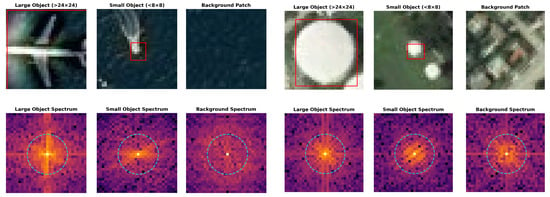
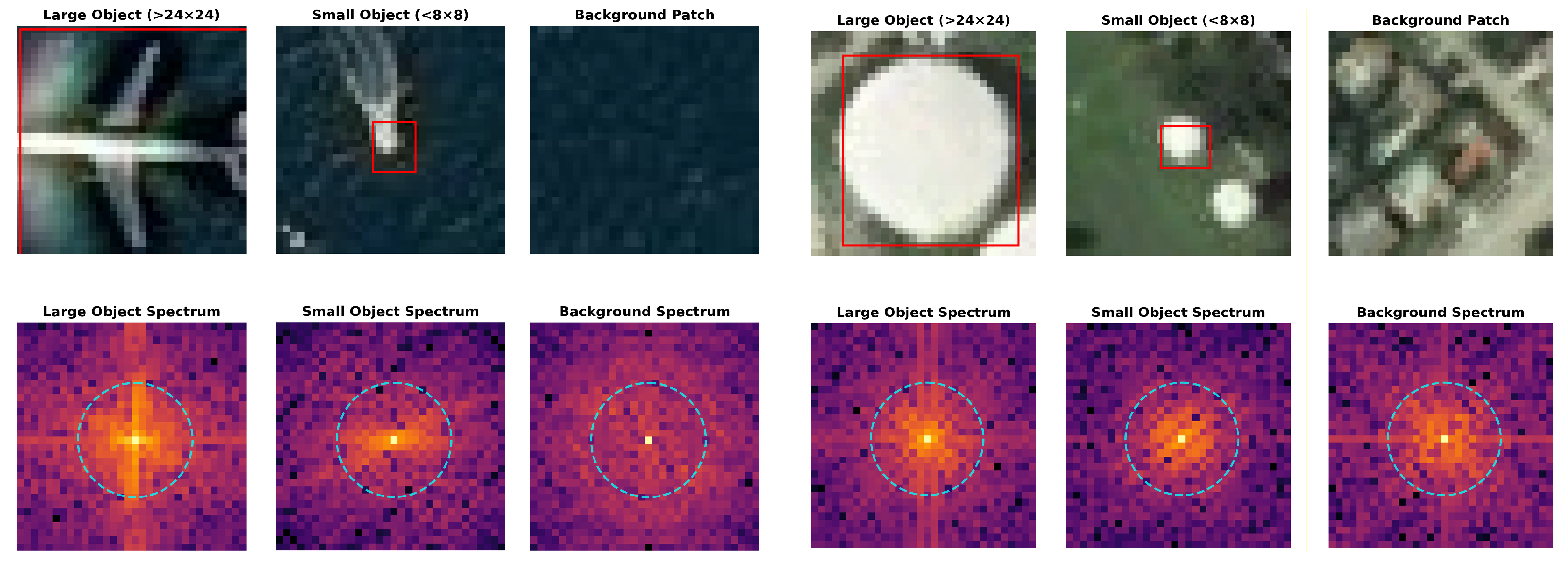
The aforementioned challenges share a common limitation: existing methods lack the ability to explicitly model the frequency components of features. To analyze frequency variations across object scales, we perform a dataset-level 2D FFT spectral analysis on object regions of different scales and their surrounding backgrounds in the AI-TOD trainval set. As shown in Table 1, both the 2D cosine similarity and spectral overlap (2D cosine similarity and spectral overlap measure the similarity and overlap, respectively, between the object and background high-frequency power distributions) between object and background high-frequency spectra consistently increase as the object scale decreases. Specifically, the 2D cosine similarity increases from 0.3989 for medium objects to 0.4356 for very tiny objects, while the spectral overlap shows the same trend. These results quantitatively show that the high-frequency spectral responses of smaller objects become increasingly similar to those of their surrounding backgrounds. Figure 1 further provides representative examples of this phenomenon by comparing large objects, small objects, and background regions within the same RSI. We observe that the large objects exhibit high structural robustness in the frequency domain, with clearly pronounced high-energy spectral lines extending beyond the cyan reference circle into the high-frequency region, indicating that large objects can still retain clear edge cues against complex backgrounds. In contrast, the object-related high-frequency structural responses of small objects become less distinguishable outside this region. Meanwhile, the high-frequency feature distribution of small objects outside the cyan reference circle is highly similar to the background spectrum, making object-related information more difficult to distinguish from background responses. The above quantitative statistics and visual comparison consistently show that the frequency aliasing between small objects and complex backgrounds becomes more pronounced as the object scale decreases. Conventional convolutions lack the selectivity to process specific frequency components in the spatial domain, making the high-frequency structural cues of small objects more susceptible to background interference. In contrast, the Discrete Wavelet Transform (DWT) possesses both frequency decomposition and spatial localization, providing an ideal tool for enhancing object frequency bands amidst background noise.
Table 1.
Dataset-level high-frequency spectral similarity between objects of different scales and their local backgrounds on the AI-TOD trainval set. Bold indicates the highest value.
Figure 1.
Spectral analysis of objects at different scales. Large objects retain distinct high-frequency structural cues, whereas the high-frequency responses of small objects become more similar to the background spectrum, resulting in stronger frequency-domain confusion (cyan circles indicate the half-Nyquist boundary). The red box indicates the target object.
Based on the above analysis, this paper proposes a frequency decoupling and recalibration small object detector (DWT-DETR), which establishes explicit frequency representations through DWT and further models them according to the different requirements of feature encoding and multi-scale feature fusion. The DWT-DETR mainly consists of a Frequency-Band Mixing (DWT-FBM) module and a Frequency-Guided Fusion (DWT-FGF) module. Specifically, the DWT-FBM module aims to mitigate the high-frequency information degradation in deep features. Given the backbone outputs, the DWT-FBM module employs the Haar wavelet transform to orthogonally decompose features into a low-frequency sub-band and three high-frequency sub-bands. A cross-band mixer then enables explicit information interaction across the frequency sub-bands to aggregate diverse frequency characteristics. Subsequently, a dynamic amplitude modulation module learns independent attention weights for each sub-band to selectively enhance critical components. Finally, the frequency domain features are reconstructed via the inverse discrete wavelet transform (IDWT) with a residual connection to maintain the original signals. This decomposition–interaction–gating–reconstruction pipeline achieves frequency-domain recalibration and enhances the high-frequency details of small objects. Meanwhile, the DWT-FGF module prevents high-frequency components of small objects from being overwhelmed during multi-scale fusion. The DWT-FGF module utilizes DWT to decouple lower-level features into low-frequency and high-frequency sub-bands. The low-frequency sub-band serves as a spatial coordinate reference to guide upsampling of deep features, reducing geometric distortion. Concurrently, the high-frequency sub-bands dynamically filter out background noise of the lower-level features. This dual-path mechanism improves spatial alignment and enhances high-frequency discriminative power for the fused features.
Our main contributions can be summarized as follows:
(1) We identify frequency aliasing as a key challenge in small object detection and propose DWT-DETR, which establishes explicit frequency representations and further models them according to the different requirements of feature encoding and multi-scale feature fusion.
(2) We propose the DWT-FBM module that employs interactive enhancement in the frequency domain to endow the feature encoding with frequency-aware capabilities, effectively preserving high-frequency details of small objects.
(3) We propose the DWT-FGF module to exploit complementary frequency cues as guidance for multi-scale feature fusion, improving spatial alignment and suppressing background interference in fused features.
The remainder of this paper is organized as follows. Section 2 surveys the relevant literature for our work. In Section 3, the proposed modules are thoroughly described. Section 4 presents comprehensive experimental evaluations on benchmark datasets. The conclusion of this work is presented in Section 5.
2. Related Work
2.1. Small Object Detection
Existing research on small object detection can be broadly categorized into several mainstream directions [10]. In this paper, we focus on the relevant content at the feature level, which mainly includes: (1) Discriminative Feature Learning, (2) Context Modelin, and (3) Multi-scale Feature Fusion.
2.1.1. Discriminative Feature Learning
The limited pixel resolution of small objects typically leads to weak feature responses, thereby hindering effective feature learning. To alleviate this problem, numerous methods employ discriminative feature learning to enrich feature representations. Specifically, Shi et al. [11] introduced a Multi-Scale Gaussian Attention mechanism to dynamically confine the receptive field to the distribution centers of small objects. Ju et al. [12] developed a Multi-Scale Large-Kernel Attention architecture employing strip convolutions to adaptively amplify small object features. Beyond these implicit attention-driven approaches, explicit guidance and supervision paradigms have been explored. Liu et al. [13] developed ESGTODNet, which injects explicit semantic priors into shallow layers to actively suppress background noise. Similarly, TBNet [14] enhances the discriminative representation of weak textures by incorporating explicit edge supervision to preserve boundary integrity. Furthermore, Song et al. [15] integrated a dual-stream boundary-aware fusion module to effectively sharpen the blurred contours of small objects.
2.1.2. Context Modeling
Due to the limited feature representations of small objects, researchers have increasingly focused on modeling context information to supplement object features. Liu et al. [16] proposed ORFENet, which aggregates contextual information through adaptive receptive fields. Li et al. [17] introduced an adaptive variable-range convolution that captures relevant context information based on object features. Recent advancements in transformers have proven effective for contextual modeling due to their robust long-range dependency capabilities. Therefore, Zhang et al. [18] developed an efficient attention mechanism that aggregates global context with linear computational complexity to enrich the representations of small objects. Li et al. [19] designed the local-to-global transformer-based (LGFormer) backbone for small object detection. LGFormer incorporates a local transformer block to establish neighborhood relationships and a global transformer block to capture long-range dependencies, collectively enhancing the accuracy of small object detection.
2.1.3. Multi-Scale Feature Fusion
In addition, multi-scale feature fusion serves as a critical approach for enhancing the performance of small object detection. Wu et al. [20] designed a feature alignment module to eliminate spatial misalignment among multi-scale features. Qu et al. [21] optimized the top-down propagation paths between different feature levels, enabling the model to learn discriminative information and perform accurate classification. Zhong et al. [22] integrated high-level semantic and fine-grained information through multi-scale edge-aware convolutions, which significantly improved the localization accuracy of small objects. CAF2ENet [23] employs regression-guided refocusing learning to explicitly optimize the alignment consistency of multi-scale features, effectively mitigating detection offsets caused by scale variations. Considering the background noise interference during multi-scale fusion, Liu et al. [24] proposed a DeNoising Feature Pyramid Network that utilizes the global modeling capabilities of Transformers to suppress irrelevant noise. Furthermore, a variety of approaches have incorporated feature reconstruction [25], adversarial training [26], and Gaussian distribution modeling [27] into the FPN to enhance feature representations for small objects.
While existing methods primarily focus on spatial-domain operations to enhance discriminative features for small objects, they mainly overlook the frequency-domain aliasing between small objects and background noise. By contrast, we explicitly integrate frequency-domain learning into feature encoding and feature fusion stages to improve small object detection performance.
2.2. Frequency Domain Learning in RSOD
Frequency-domain analysis has long been established as a foundational technique in traditional signal processing. In recent years, a series of studies have successfully integrated frequency-domain analysis into RSOD. Zhang et al. [28] introduced a Laplacian FPN that uses a trainable Laplacian operator to extract high-frequency information. Shi et al. [29] developed an FPN aware of both high-frequency and spatial features, which explicitly captures textural components to strengthen feature responses for small objects. Bai et al. [30] proposed an attention mechanism based on discrete wavelets that integrates time–frequency information to prioritize object regions over background clutter. Similarly, Guo et al. [31] employed wavelet convolution to focus precisely on object contours while preserving global context. VMC-DETR [32] further introduced frequency-domain heat conduction mechanisms inspired by physics to enhance high-frequency details through dynamic adjustments.
Recent studies have further extended frequency-domain learning from high-frequency enhancement toward spatial–frequency collaborative modeling. Zhao et al. [33] proposed AD3I-Net, which employs adaptive frequency selection and dual-domain feature interaction to integrate spatial and frequency representations. FANet [34] introduces multi-scale frequency feature enhancement and exploits high-frequency responses within RoI features to strengthen the contours and textures of tiny objects while suppressing background noise. CAEM-DETR [35] incorporates spatial- and frequency-domain analysis into multidomain fidelity fusion to recover critical high-frequency details of small aerial targets. SFD-Net [36] further combines wavelet-based down-sampling with a spatial–frequency adaptive neck to preserve high-frequency boundary information and enhance feature fusion.
These methods differ in the stages where frequency information is introduced and in how the resulting components are combined. In contrast, DWT-DETR explicitly uses cross-frequency interaction and adaptive frequency recalibration in feature encoding, and assigns different frequency-guidance roles during multi-scale fusion.
3. Proposed Method
3.1. Overall Architecture
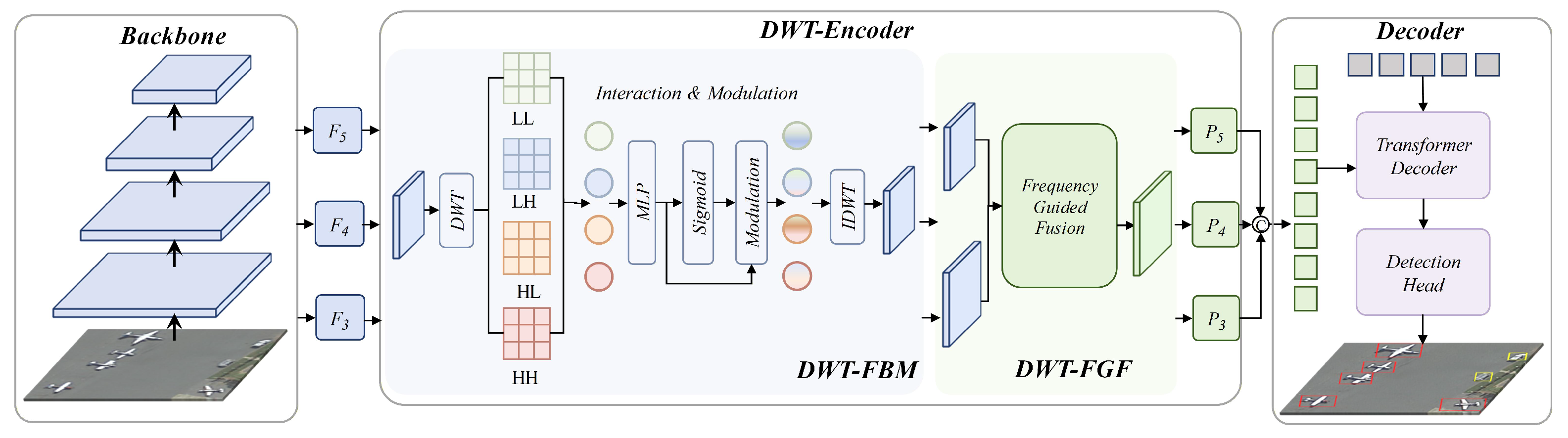
The overall architecture of DWT-DETR is shown in Figure 2. Following the DETR detection paradigm [4,8], DWT-DETR adopts an encoder–decoder architecture consisting of four components: a backbone network, a frequency-domain-aware neck network, a Transformer decoder, and a detection head.
Figure 2.
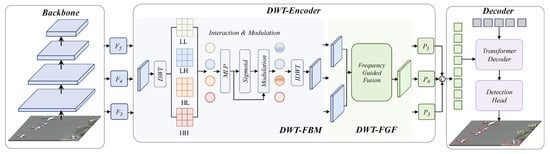
Overall framework of the proposed DWT-DETR, consisting of the DWT-based Frequency-Band Mixing (DWT-FBM) module and the Frequency-Guided Fusion (DWT-FGF) module for effective feature representation of small objects.
Given an input RSI, the ResNet-50 [37] backbone extracts multi-scale features . However, the series of downsampling operations in the backbone diminishes the feature responses of small objects in deep layers. Moreover, conventional FPN upsampling processes all frequencies uniformly, which tends to confound weak high-frequency signals with background noise. To address these limitations, we propose a DWT-Encoder that incorporates a DWT-FBM module and a DWT-FGF module. The DWT-FBM module operates across backbone feature levels to recover degraded high-frequency details through explicit frequency decomposition and interaction. Concurrently, the DWT-FGF module utilizes wavelet decomposition to decouple the fusion into a low-frequency-guided content-aware upsampling path and a high-frequency-guided background suppression path, thereby mitigating frequency aliasing. These frequency-enhanced multi-scale features from the DWT-Encoder are then fed into a Transformer decoder with Denoising Queries [38] for iterative bounding box refinement. Finally, the detection head generates classification scores and regression coordinates via a query-based approach.
3.2. DWT-Based Frequency-Band Mixing Module
The frequency analysis in Figure 1 shows that the energy of small objects is concentrated in low-frequency components, whereas their high-frequency structural features decay rapidly and are prone to mixing with the background. Standard convolutions operating in the spatial domain cannot explicitly separate and process frequency components. As a result, the fine high-frequency details of small objects tend to be overwhelmed by background noise in deep features. To address this limitation, we propose the DWT-FBM module to explicitly represent and adaptively model frequency information during feature encoding. The DWT-FBM module recalibrates the frequency components through decomposition, interaction, modulation, and reconstruction. Figure 2 illustrates its overall architecture.
3.2.1. Frequency Decomposition via Haar Wavelet Transform
The DWT-FBM module first transforms input features from the spatial domain to the frequency domain through explicit feature decoupling. While the FFT only provides global frequency statistics without spatial localization, the DWT decomposes features into frequency sub-bands while preserving spatial locality, which is particularly useful for enhancing small object features. Therefore, we use a single-level 2D Haar DWT to orthogonally decompose the input features into one low-frequency sub-band and three directional high-frequency sub-bands. Taking as an example, the decomposition is given by:
where denotes the first-level Haar wavelet transform. The sub-band is the low-frequency approximation that preserves global structure and spatial layout, while , , and are the three high-frequency detail sub-bands, capturing horizontal, vertical, and diagonal edge variations individually.
3.2.2. Cross-Frequency Interaction
The four sub-bands contain complementary information, and processing each one independently would lose the synergy across frequency bands. Moreover, since the frequency distribution of objects and backgrounds varies across images, we introduce a cross-frequency interaction mechanism.
First, we stack and reshape the four decomposed sub-bands along the frequency dimension to obtain . The Cross-Band Mixer then employs an MLP along the frequency axis to facilitate information interaction across sub-bands:
where and with expansion ratio . The band mixing allows global structural information from the low-frequency sub-band to guide the enhancement of high-frequency details, while edge responses from the high-frequency sub-bands in turn help the low-frequency sub-band better localize objects.
These enhanced features from the Cross-Band Mixer are reshaped back into four separate sub-bands (), each containing complementary information from the other frequency bands.
3.2.3. Dynamic Amplitude Modulation
Cross-band interaction enables each sub-band to aggregate complementary frequency information. However, spatial positions contribute unequally to small object detection. We thus design a Dynamic Amplitude Modulation mechanism to adaptively scale the response amplitude of each frequency component at each spatial position.
Specifically, for each sub-band (), we use a squeeze-and-expand convolution to generate a per-location amplitude modulation signal:
where is the channel-reduction convolution and is the channel-recovery convolution. The sub-bands are then modulated via element-wise multiplication:
3.2.4. Frequency Reconstruction
Finally, we reconstruct the four modulated sub-bands back to the spatial domain using inverse discrete wavelet transform (IDWT), and a residual connection further preserves the original input features:
By performing explicit frequency-domain decomposition, interaction, amplitude modulation, and reconstruction, the DWT-FBM module compensates for the limited frequency selectivity of standard convolutions. This module yields refined feature representations to support the subsequent DWT-FGF feature fusion stage.
3.3. Frequency-Guided Fusion Module
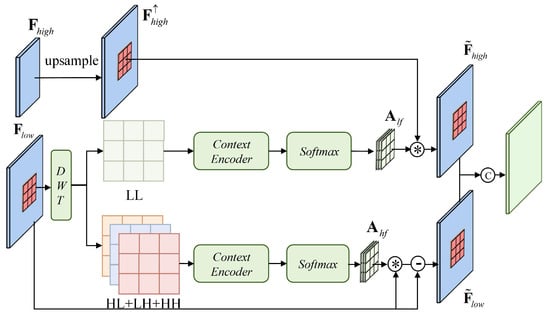
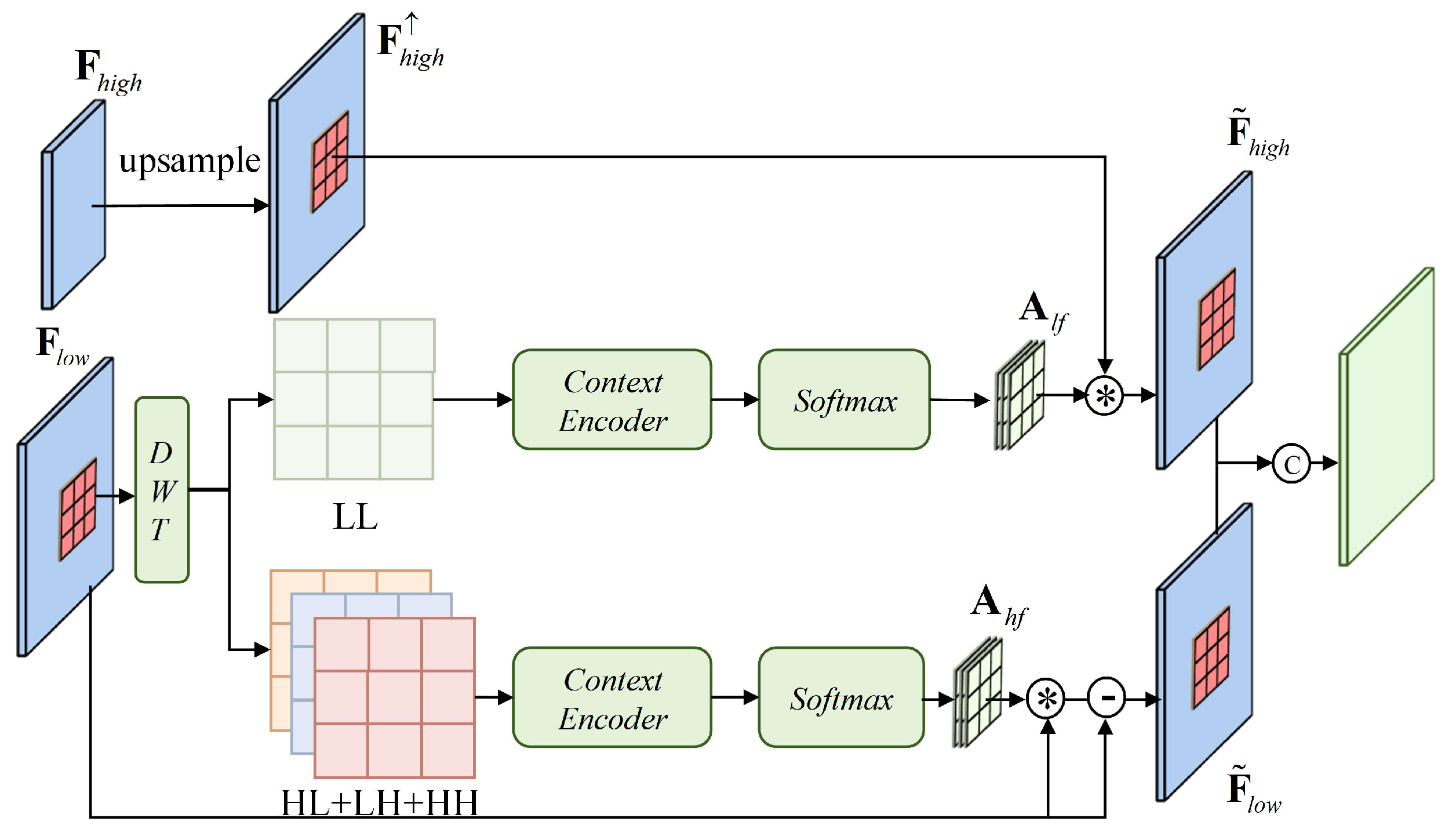
While DWT-FBM alleviates frequency degradation within individual layers, frequency aliasing still persists during feature fusion stages. On the one hand, the bilinear upsampling in conventional FPNs lacks semantic modeling capability. On the other hand, naive multi-level feature fusion operations easily overwhelm subtle high-frequency details of small objects with background noise. To resolve this issue, we propose the DWT-FGF module, which exploits complementary frequency cues to guide multi-scale feature fusion for spatial alignment and background suppression. The overall structure of the DWT-FGF module is illustrated in Figure 3. It contains two parallel branches for low-frequency-guided upsampling and high-frequency background suppression, respectively.
Figure 3.
Overall architecture of our proposed DWT-FGF module, containing two parallel branches for low-frequency-guided upsampling and high-frequency background suppression.
3.3.1. Low-Frequency Guided Content-Aware Upsampling
FPN upsampling rescales high-level features to match the spatial resolution of low-level features . As bilinear interpolation depends only on fixed spatial distances, ignoring semantic and structural cues, it often causes localization blur for small objects. We observe that the low-frequency approximation sub-band from DWT eliminates high-frequency noise while retaining holistic structural layouts, providing a reliable reference for precise spatial alignment. Accordingly, content-aware upsampling is used as the adaptive reconstruction mechanism, while the explicitly decomposed low-frequency component serves as frequency-derived structural guidance for generating the reconstruction weights.
To this end, the low-frequency-guided path first applies the Haar wavelet transform to decompose low-level features :
The low-frequency sub-band is projected to a low-dimensional space with to reduce computational overhead and produce compact structural representations. Then, a content encoder is applied to the reduced features to generate spatially adaptive upsampling kernels:
where denotes the kernel size and represents the upsampling factor. The output is reshaped via pixel shuffling and Softmax normalization to obtain attention weights , which indicate the contribution of each location to the reconstruction of the upsampled features.
Subsequently, spatial aggregation is applied to the upsampled high-level features for content-aware adaptive upsampling.
where stands for the local neighboring positions, and is obtained by upsampling high-level features with a factor of 2.
Unlike bilinear interpolation with fixed weights, this content-aware adaptive upsampling dynamically focuses on object boundaries to reduce blur and smooths noise in background regions, thereby reducing geometric distortion.
3.3.2. High-Frequency Guided Background Suppression
A further challenge in the fusion stage is that background noise in low-level layers may interfere with object features, as spectral analysis shows it is heavily aliased with the high-frequency components of small objects. The three directional high-frequency sub-bands (LH, HL and HH) from DWT capture multi-orientation texture patterns. These sub-bands exhibit regular directional structures distinct from the sparse, scattered patterns of small objects, which helps separate foreground objects from background regions.
Specifically, the high-frequency background suppression branch first merges the three high-frequency sub-bands into a unified representation:
Similarly to the low-frequency branch, undergoes channel compression and content encoding to generate high-frequency attention kernels:
where and represents the upsampling factor. We adopt a smaller kernel since high-frequency features contain drastic local variations, while larger kernels tend to bring in unrelated background noise. The output features are reshaped via pixel shuffling and Softmax normalization to yield .
We then apply these attention weights to the original low-level feature with neighborhood aggregation and derive a smoothed background estimate. Let represent the set of local neighboring positions. The aggregation procedure is formulated as:
Subsequently, we subtract the estimated background component from the original feature to produce a high-pass filtering effect:
3.3.3. Dual-Path Feature Aggregation
The outputs of the two frequency-guided paths carry complementary information. retains high-level semantic information and achieves precise spatial alignment under low-frequency guidance, whereas keeps fine local details while suppressing background noise via high-frequency gating. We concatenate these two feature maps along the channel dimension and fuse them using a CSPRepLayer [4]. After applying DWT-FGF fusion on the top-down pathway, we follow the bottom-up path aggregation network (PAN) design from RT-DETR to enrich multi-scale feature hierarchies, and finally obtain frequency-enhanced multi-scale features .
4. Experiments
4.1. Datasets
4.1.1. AI-TOD [39]
The AI-TOD dataset is a prominent benchmark for small object detection in RSIs. It provides 28,036 images with a total of 700,621 annotated instances. The average scale of these objects is merely 12.8 pixels, and over 85% of objects occupy an area smaller than 16 × 16 pixels. The official partition allocates 2/5, 1/10, and 1/2 of the data to training, validation, and test splits, respectively. In this paper, the training and validation sets are combined for model training, while the test set is employed for performance evaluation.
4.1.2. DIOR [2]
The DIOR dataset serves as another widely adopted benchmark, which also contains a large number of small objects. The dataset comprises 23,463 images with ground sampling distances varying from 0.5 m to 30 m. The standard split assigns 11,725 images for training and the rest for evaluation. In total, the dataset offers 192,472 horizontally annotated objects across 20 diverse object categories.
4.1.3. VisDrone [40]
The VisDrone dataset focuses on object detection in urban environments from a UAV perspective. It consists of 8629 images officially partitioned into training (6471), validation (548), and testing (1610) subsets, covering 10 common object categories. In our experiments, we use the training split for network optimization and report results on the validation split for performance evaluation.
4.2. Evaluation Metrics
Following the prior research in small object detection, the Average Precision (AP) is utilized as the primary evaluation metric. Specifically, the overall detection performance is measured by AP, AP50, and AP75 at different IoU thresholds. For the AI-TOD dataset, we further adopt the scale-specific metrics [39], i.e., APvt, APt, APs, and APm, for objects of varying scales: very tiny (area pixels), tiny (area ∈ (, ] pixels), small (area ∈ (, ] pixels), and medium (area ∈ (, ] pixels). For the VisDrone dataset [40], we adopt the official scale-specific evaluation metrics , , and , which correspond to objects with areas smaller than pixels, between and pixels, and larger than or equal to pixels, respectively.
4.3. Implementation Details
All experiments in this study are implemented in PyTorch 2.0.0 with CUDA 11.8 and conducted on a single NVIDIA GeForce RTX 4090 GPU (NVIDIA Corporation, Santa Clara, CA, USA) under Ubuntu 20.04.6 LTS. Our proposed method is trained for 36 epochs on all three datasets with a batch size of 4. We employ the AdamW optimizer with an initial learning rate of and a weight decay coefficient of . The top 900 encoder features are taken as the initial object queries. For AI-TOD and DIOR datasets, the input resolution is fixed at 800 × 800, while for the VisDrone dataset it is 1333 × 800.
4.4. Comparison with the State-of-the-Art
4.4.1. AI-TOD Dataset
Table 2 reports the comparison results on the AI-TOD dataset. In terms of the overall metric AP, our proposed DWT-DETR achieves the best performance of 30.8%. It surpasses the second-best detector Co-DINO [41] by 1.7% and the representative CNN-based detector FCDet [42] by 4.4%, confirming a clear improvement in small object detection performance. Prior CNN-based detectors have improved small object detection accuracy through discriminative feature learning and carefully designed metric-based methods. Our DWT-DETR surpasses these approaches by clear margins, outperforming RFLA [43], DNTR [24], and BCDet [44] by 7.9%, 6.6%, and 5.1%, respectively. Part of this performance gap over CNN-based detectors can be attributed to the DETR-based detectors with Hungarian matching, which provides more suitable supervision for small objects than traditional IoU-based assignment. More importantly, when compared with representative DETR-based detectors, DWT-DETR also shows clear gains. It outperforms Deformable-DETR [45], PSWP-DETR [22], and DINO [38] by 12.0%, 7.2%, and 4.2%, underscoring its effectiveness for small object detection. These comparisons suggest that the performance improvement is not solely attributable to the Hungarian matching paradigm and further support the effectiveness of the proposed frequency-domain design. Furthermore, the proposed DWT-DETR achieves an of 16.4% and an of 31.6%, the highest scores among all compared methods, further demonstrating the effectiveness of our approach for small object detection. Figure 4 visualizes the detection predictions of DWT-DETR on the AI-TOD dataset.
Table 2.
Comparison of detection performance on the AI-TOD dataset. The highest and second-highest values are highlighted in red and blue, respectively, with bold for emphasis.
Figure 4.
Qualitative detection results from our DWT-DETR on the AI-TOD dataset.
4.4.2. DIOR Dataset
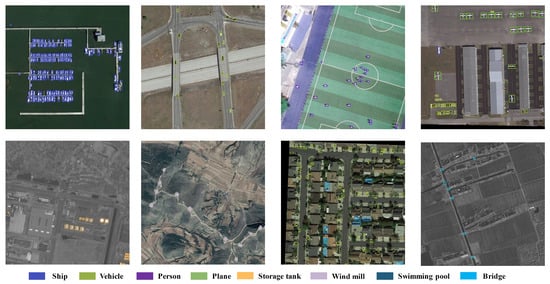
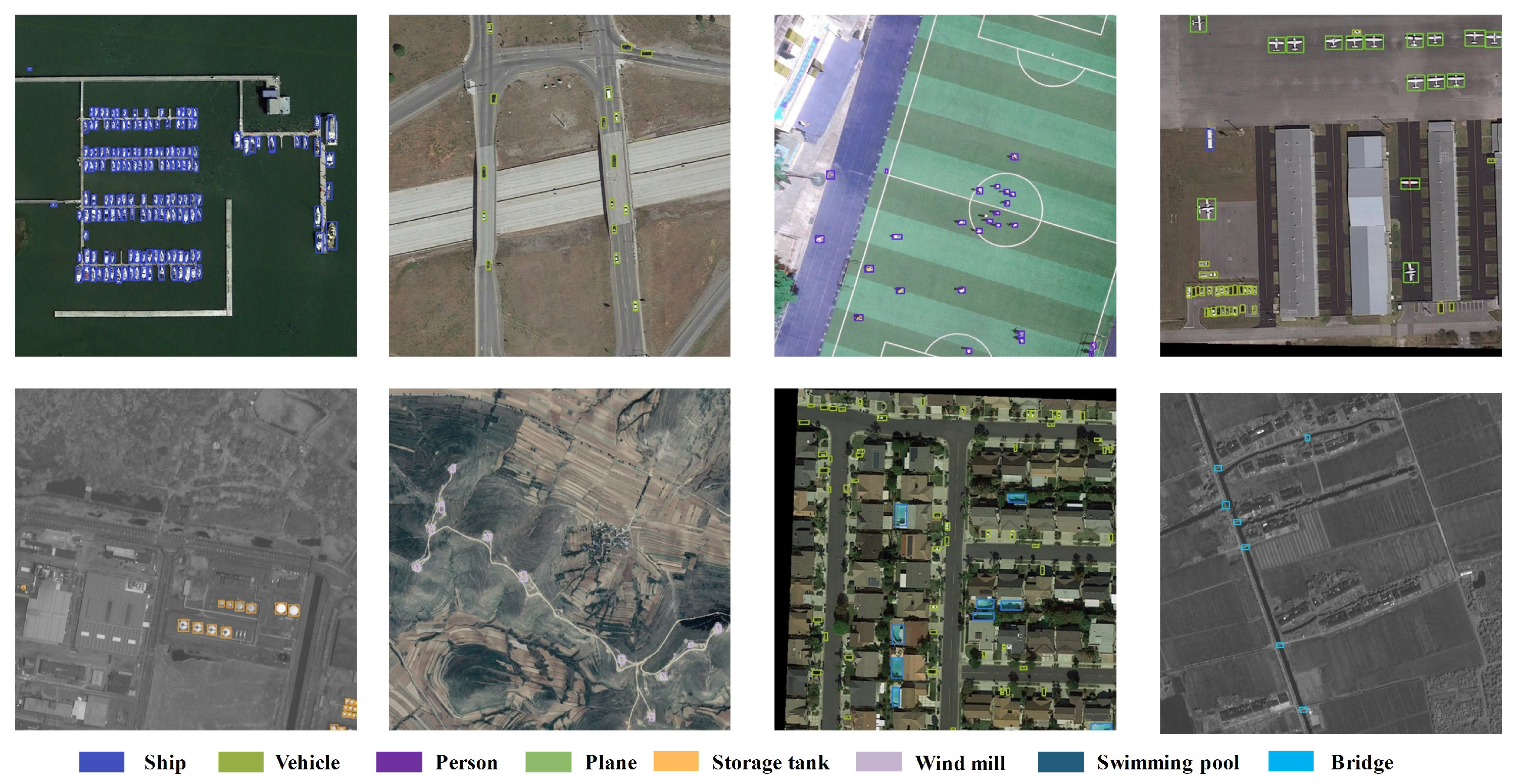
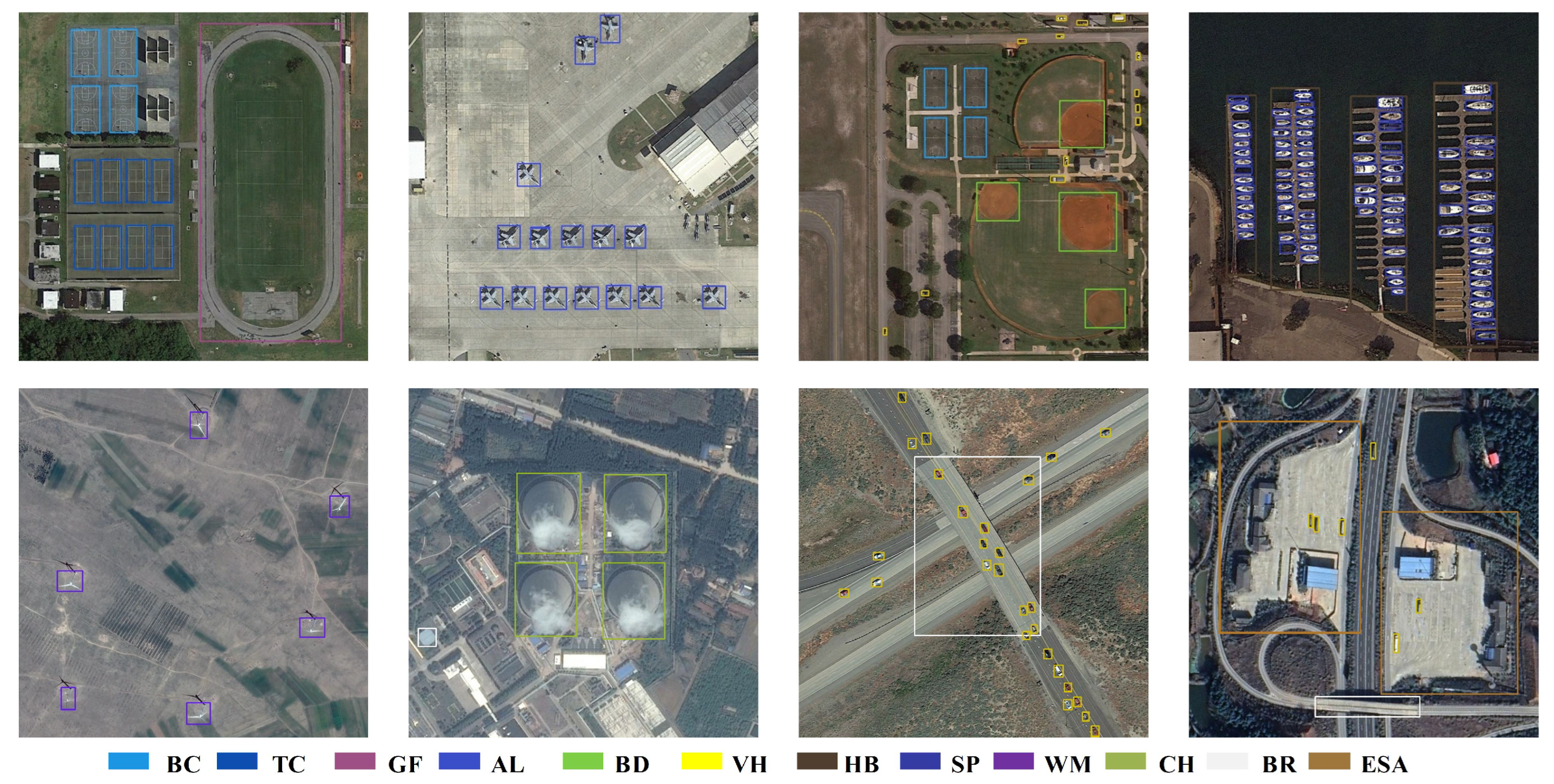
The comparison results on the DIOR dataset are presented in Table 3. The proposed DWT-DETR achieves the best mAP of 79.4%, outperforming the second-best method, BAFNet [15], by 1.3% and demonstrating superior detection performance compared with recent representative methods. Notably, DWT-DETR attains a high per-category performance of 90.3% for ship (SH), 82.6% for storage tank (ST), and 92.2% for windmill (WM), all of which are typically challenging due to their limited scale and poor visual appearance. The consistently strong performance across these categories highlights DWT-DETR’s effectiveness in small object detection. Furthermore, the qualitative results in Figure 5 also show that DWT-DETR maintains stable detection under varying object densities and background complexities.
Table 3.
Comparison of detection performance on the DIOR dataset. The highest and second-highest values are highlighted in red and blue, respectively, with bold for emphasis.
Figure 5.
Qualitative detection results from our DWT-DETR on the DIOR dataset.
4.4.3. VisDrone Dataset
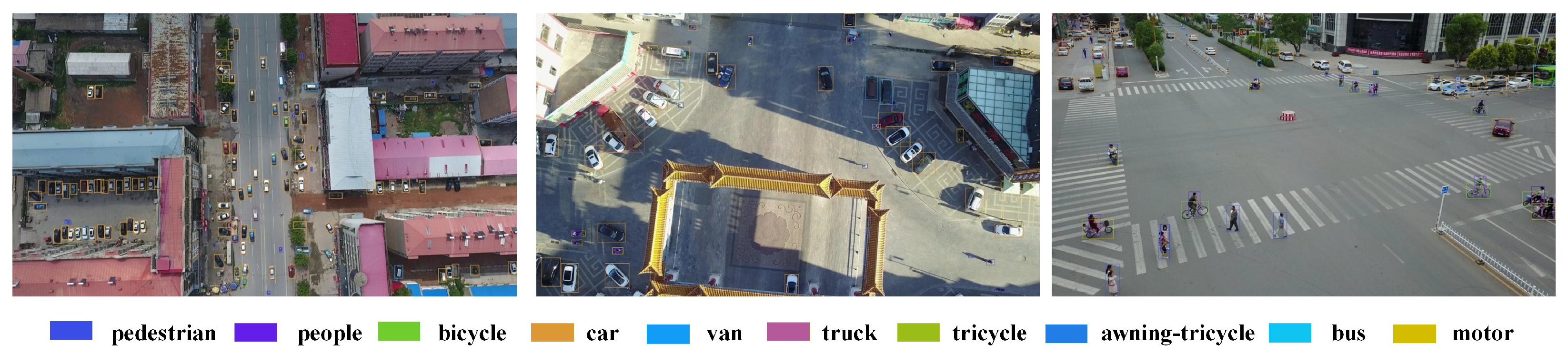
We further evaluate the proposed DWT-DETR on the VisDrone dataset, with the comparison results presented in Table 4. DWT-DETR achieves an AP of 32.6%, demonstrating competitive overall performance compared with existing methods. More importantly, it achieves the highest of 23.7%, outperforming the comparison methods by a margin of 0.7%. These results show that DWT-DETR maintains competitive performance on VisDrone and is particularly effective for small-object detection in dense scenes. Figure 6 demonstrates the detection results of our DWT-DETR on the VisDrone dataset.
Table 4.
Comparison of detection performance on the VisDrone dataset. The highest and second-highest values are highlighted in red and blue, respectively, with bold for emphasis.
Figure 6.
Qualitative detection results from our DWT-DETR on the VisDrone dataset.
4.5. Ablation Study
To quantify the effectiveness of each component in DWT-DETR, we perform ablation experiments using the AI-TOD dataset.
4.5.1. Effectiveness of Proposed Modules
Table 5 reports the ablation results for each proposed module. As shown in the first row, the baseline method achieves 28.4% AP in overall detection performance. When applying DWT-FBM to the baseline method, the AP, AP75, and AP50 metrics increase to 29.8%, 25.7%, and 58.0%, respectively. These performance improvements confirm the effectiveness of the DWT-FBM module in enhancing small object detection from a frequency-domain perspective. Then, when applying DWT-FGF alone to the baseline method, it yields 30.1% AP in overall detection performance, demonstrating a larger gain over DWT-FBM. Combining DWT-FBM and DWT-FGF yields our final DWT-DETR, and it achieves the best overall performance of 30.8% AP, confirming the complementarity of the proposed modules. Compared to the baseline method, DWT-DETR achieves performance gains of 1.1% and 2.3% on and , respectively.
Table 5.
Ablation analysis of individual components in DWT-DETR. Bold indicates the best result.
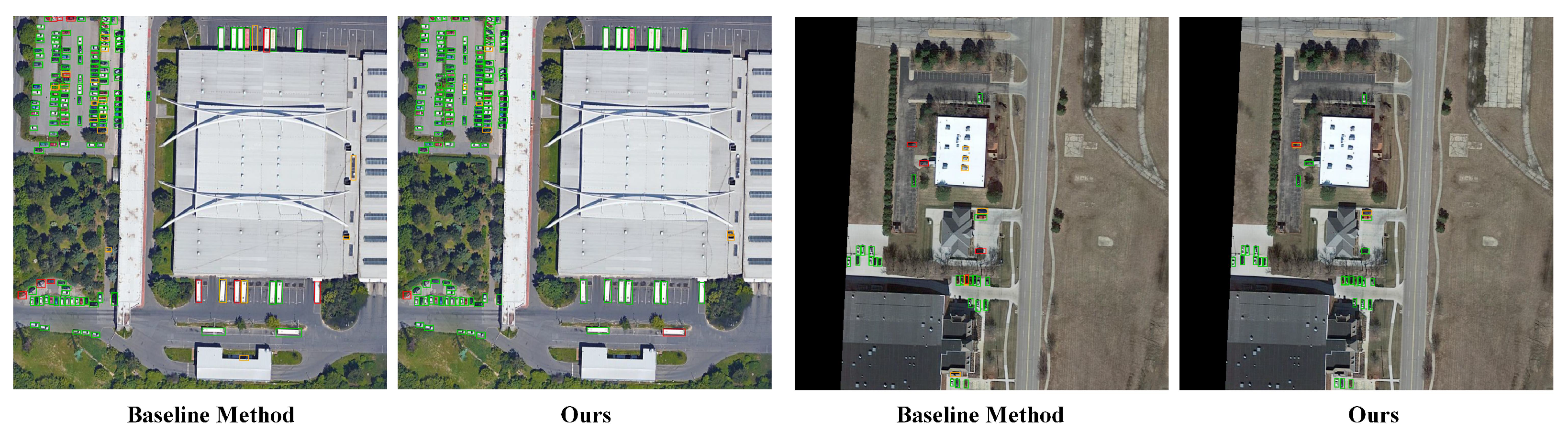
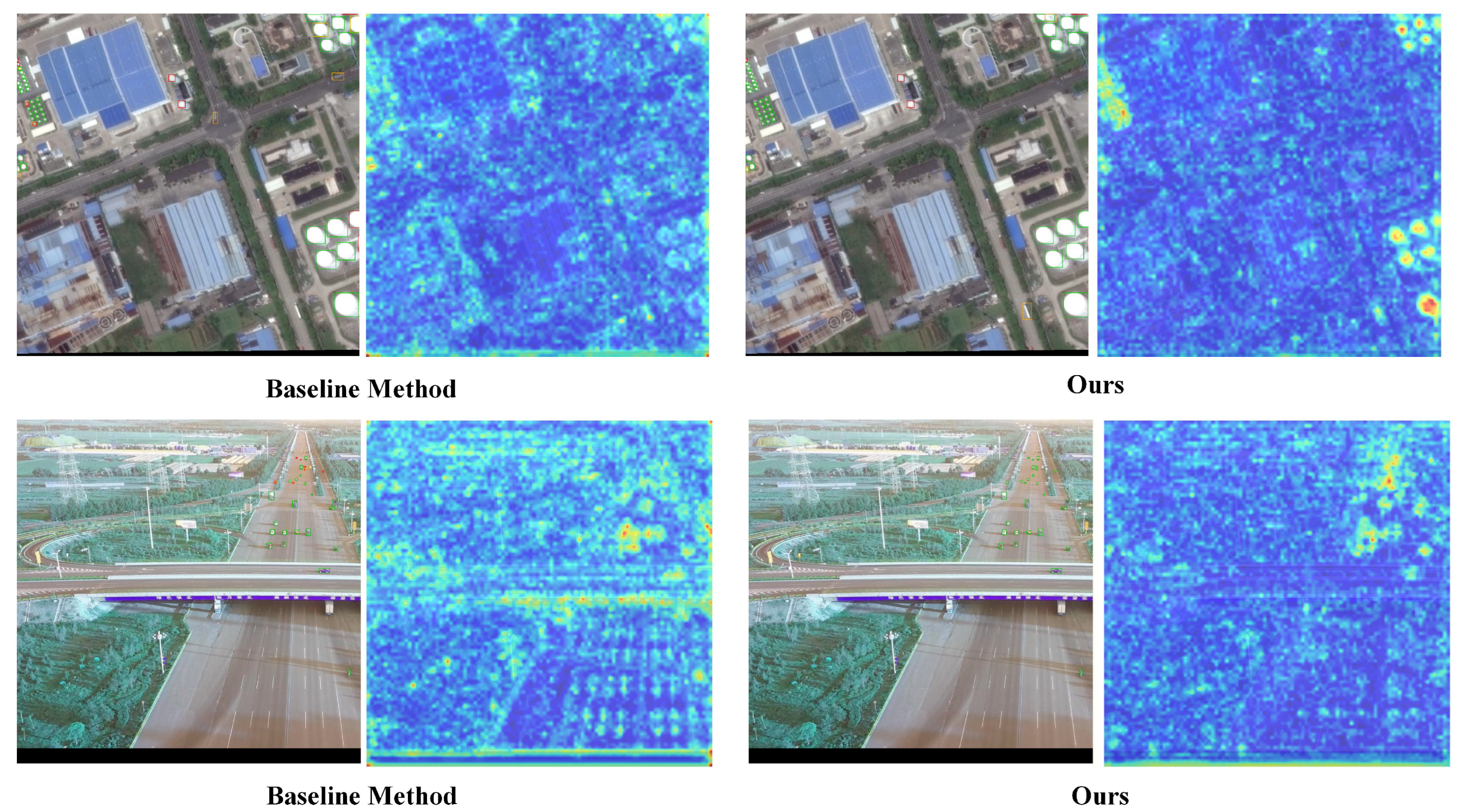
In addition to the quantitative results, we perform a qualitative analysis of the proposed method. As shown in Figure 7, the proposed DWT-DETR substantially reduces false negatives (missed objects) and false positives (incorrect objects) relative to the baseline method, enabling better detection performance of small objects. Additionally, we visualize the feature maps (Figure 8) to illustrate the internal behavior of the proposed approach. The baseline method produces scattered and weak activation responses around small objects. In contrast, our proposed method yields significantly stronger activations at boundaries and within textured regions of small objects, confirming that the DWT-Encoder module effectively preserves high-frequency structural details that are otherwise overwhelmed by background noise in the spatial-domain baseline.
Figure 7.
Visual comparison of our proposed DWT-DETR and baseline method. The green, red, and yellow boxes denote true positive, false negative, and false positive, respectively.
Figure 8.
Visualization of P3-level feature maps with and without the DWT-Encoder.
4.5.2. Analysis of DWT-FBM Module
Table 6 evaluates the effectiveness of the two key components of DWT-FBM. Cross-Frequency Interaction (CFI) brings a performance gain of 0.8% AP against the baseline method, where , , , and increase by 0.4%, 0.7%, 0.7% and 1.2%, respectively. In contrast, applying Dynamic Amplitude Modulation (DAM) to the baseline yields only a 0.3% AP improvement. This larger gain indicates that cross-frequency interaction contributes more substantially to the overall detection performance. As shown in the last row of Table 6, the full model achieves 29.8% AP, a total gain of 1.4% over the baseline method. Notably, when DAM is combined with CFI, its contribution becomes more pronounced than when used alone. This additive effect arises from our serial design in the DWT-FBM module, where cross-band interaction first supplies complementary context to each sub-band, enabling the subsequent modulation to be more discriminative.
Table 6.
Ablation studies of key components in DWT-FBM. Bold indicates the best result.
4.5.3. Analysis of DWT-FGF Module
Table 7 reports the individual contributions of the two parallel paths in the proposed DWT-FGF module. Adding only the high-frequency-guided background suppression (HF) path yields a 0.5% AP improvement, with gains observed across different object scales. This suggests that the HF path provides effective background suppression across scales. In contrast, introducing the low-frequency content-aware upsampling (LF) path brings a substantial improvement of 1.1% AP, with , , and increasing by 0.7%, 0.7%, and 1.1%, respectively. These improvements are consistent with the role of the LF path in reducing localization blur and improving spatial alignment during feature upsampling. Finally, combining both paths achieves the best performance of 30.1% AP, demonstrating that the two paths are complementary.
Table 7.
Ablation studies of two parallel paths in DWT-FGF. Bold indicates the best result.
4.5.4. Wavelet Configuration Sensitivity Analysis
Table 8 reports the sensitivity of DWT-DETR to different wavelet bases and decomposition levels. Haar-J1 achieves 30.8% AP, while db2-J1 obtains 30.6% AP with nearly identical computational cost and inference speed, indicating that the choice of wavelet basis has only a minor influence on detection performance. Increasing the decomposition depth to J2 and J3 does not provide further accuracy gains, with AP values of 30.6% and 30.3%, respectively, while reducing the inference speed from 35.7 FPS to 29.9 and 25.7 FPS. The additional latency mainly comes from the recursive wavelet decomposition and reconstruction operations. Therefore, we adopt Haar-J1 as the default configuration.
Table 8.
Sensitivity analysis of different wavelet bases and decomposition levels. Bold indicates the best result.
4.5.5. Model Complexity Analysis
Table 9 reports the computational complexity of different variants of DWT-DETR. DWT-FBM introduces only 0.4 M additional parameters and 2.5 G FLOPs, while maintaining an inference speed of 40.6 FPS. Its relatively small overhead mainly comes from the lightweight frequency interaction and recalibration operations. In comparison, DWT-FGF introduces 2.0 M additional parameters and 25.1 G FLOPs, with an inference speed of 37.8 FPS. The higher computational cost is mainly caused by the frequency-guided multi-scale feature fusion. When both modules are employed, DWT-DETR requires 45.2 M parameters and 137.9 G FLOPs, maintains 35.7 FPS, and improves AP from 28.4% to 30.8%.
Table 9.
Complexity analysis of individual components in DWT-DETR.
5. Disussion
The proposed DWT-DETR improves small-object detection by explicitly modeling frequency information during feature encoding and multi-scale feature fusion. Experiments on three benchmark datasets consistently demonstrate the effectiveness of the proposed method. However, the performance gains are accompanied by additional computational cost. Compared with the baseline method, DWT-DETR increases the computational complexity from 110.3 to 137.9 GFLOPs and reduces the inference speed from 42.3 to 35.7 FPS. Although the model maintains practical inference efficiency under the current experimental setting, the additional computational cost may limit its deployment on resource-constrained platforms. Future work will focus on lightweight frequency modeling and feature fusion to improve deployment efficiency while preserving detection performance.
In addition, DWT-DETR has an inherent limitation in recovering small-object information that has already been lost during feature extraction. The proposed frequency-domain modeling operates on features produced by the backbone and can enhance object-related information that remains in the feature maps. However, for tiny and very tiny objects, repeated downsampling may severely weaken or remove discriminative cues. Once such information is lost, subsequent frequency recalibration cannot effectively recover it. Future work will therefore investigate novel feature learning strategies that better preserve tiny-object information at earlier stages of feature extraction.
6. Conclusions
In this paper, we propose DWT-DETR to address frequency aliasing in small-object detection by explicitly modeling frequency information in both feature encoding and multi-scale feature fusion. In the feature encoding stage, we propose the DWT-FBM module, which performs frequency-domain recalibration through a decomposition–interaction–gating–reconstruction pipeline, thereby enhancing the high-frequency details of small objects. During feature fusion, DWT-FGF exploits complementary frequency cues to improve spatial alignment and suppress background interference in fused features. Extensive experiments on three benchmarks demonstrate the effectiveness of our proposed DWT-DETR.
Author Contributions
Conceptualization, H.H.; methodology, S.W., H.H., J.C. and J.Z.; software, W.L.; validation, S.W. and J.Z.; writing—original draft preparation, S.W., J.Z., W.L.; writing—review and editing, H.H. and J.C.; visualization, W.L. All authors have read and agreed to the published version of the manuscript.
Funding
This research was funded by the National Natural Science Foundation of China, grant number U22B2011.
Data Availability Statement
The AI-TOD, DIOR, and VisDrone datasets analyzed in this study are publicly available at https://github.com/Chasel-Tsui/mmdet-aitod (accessed on 1 October 2026), https://drive.google.com/drive/folders/1UdlgHk49iu6WpcJ5467iT-UqNPpx__CC (accessed on 1 October 2026), and https://github.com/VisDrone/VisDrone-Dataset (accessed on 1 October 2026).
Conflicts of Interest
The authors declare no conflicts of interest.
References
- Ding, J.; Xue, N.; Xia, G.; Bai, X.; Yang, W.; Yang, M.Y.; Belongie, S.J.; Luo, J.; Datcu, M.; Pelillo, M.; et al. Object Detection in Aerial Images: A Large-Scale Benchmark and Challenges. IEEE Trans. Pattern Anal. Mach. Intell. 2022, 44, 7778–7796. [Google Scholar] [CrossRef] [Scilit] [PubMed]
- Li, K.; Wan, G.; Cheng, G.; Meng, L.; Han, J. Object detection in optical remote sensing images: A survey and a new benchmark. ISPRS J. Photogramm. Remote Sens. 2020, 159, 296–307. [Google Scholar] [CrossRef] [Scilit]
- Li, Z.; Wang, Y.; Zhang, N.; Zhang, Y.; Zhao, Z.; Xu, D.; Ben, G.; Gao, Y. Deep Learning-Based Object Detection Techniques for Remote Sensing Images: A Survey. Remote Sens. 2022, 14, 2385. [Google Scholar] [CrossRef] [Scilit]
- Zhao, Y.; Lv, W.; Xu, S.; Wei, J.; Wang, G.; Dang, Q.; Liu, Y.; Chen, J. DETRs Beat YOLOs on Real-time Object Detection. In Proceedings of the IEEE/CVF Conference on Computer Vision and Pattern Recognition (CVPR); IEEE: Piscataway, NJ, USA, 2024; pp. 16965–16974. [Google Scholar]
- Cheng, G.; Yuan, X.; Yao, X.; Yan, K.; Zeng, Q.; Xie, X.; Han, J. Towards Large-Scale Small Object Detection: Survey and Benchmarks. IEEE Trans. Pattern Anal. Mach. Intell. 2023, 45, 13467–13488. [Google Scholar] [CrossRef] [Scilit] [PubMed]
- Ren, S.; He, K.; Girshick, R.B.; Sun, J. Faster R-CNN: Towards Real-Time Object Detection with Region Proposal Networks. In Proceedings of the Advances in Neural Information Processing Systems 28 (NIPS 2015); Curran Associates, Inc.: Red Hook, NY, USA, 2015; pp. 91–99. [Google Scholar]
- Lin, T.; Goyal, P.; Girshick, R.B.; He, K.; Dollár, P. Focal Loss for Dense Object Detection. In Proceedings of the IEEE International Conference on Computer Vision (ICCV); IEEE: Piscataway, NJ, USA, 2017; pp. 2999–3007. [Google Scholar]
- Carion, N.; Massa, F.; Synnaeve, G.; Usunier, N.; Kirillov, A.; Zagoruyko, S. End-to-end object detection with transformers. In Proceedings of the European Conference on Computer Vision (ECCV); Springer: Berlin/Heidelberg, Germany, 2020; pp. 213–229. [Google Scholar]
- Lin, T.; Dollár, P.; Girshick, R.B.; He, K.; Hariharan, B.; Belongie, S.J. Feature Pyramid Networks for Object Detection. In Proceedings of the IEEE Conference on Computer Vision and Pattern Recognition (CVPR); IEEE: Piscataway, NJ, USA, 2017; pp. 936–944. [Google Scholar]
- Zhang, X.; Zhang, T.; Wang, G.; Zhu, P.; Tang, X.; Jia, X.; Jiao, L. Remote Sensing Object Detection Meets Deep Learning: A metareview of challenges and advances. IEEE Geosci. Remote Sens. Mag. 2023, 11, 8–44. [Google Scholar] [CrossRef] [Scilit]
- Shi, S.; Fang, Q.; Xu, X.; Dong, D. Multiscale Gaussian Attention Mechanism for Tiny-Object Detection in Remote Sensing Images. IEEE Trans. Geosci. Remote Sens. 2025, 63, 5635216. [Google Scholar] [CrossRef] [Scilit]
- Ju, M.; Feng, Y.; Diao, W.; Liu, C. Addressing Dense Small-Object Detection in Remote Sensing: An Open-Vocabulary Object Detection Framework. Remote Sens. 2026, 18, 851. [Google Scholar] [CrossRef] [Scilit]
- Liu, D.; Zhang, J.; Qi, Y.; Wu, Y.; Zhang, Y. A Tiny Object Detection Method Based on Explicit Semantic Guidance for Remote Sensing Images. IEEE Geosci. Remote Sens. Lett. 2024, 21, 6005405. [Google Scholar] [CrossRef] [Scilit]
- Li, Z.; Wang, Y.; Xu, D.; Gao, Y.; Zhao, T. TBNet: A texture and boundary-aware network for small weak object detection in remote-sensing imagery. Pattern Recognit. 2025, 158, 110976. [Google Scholar] [CrossRef] [Scilit]
- Song, J.; Zhou, M.; Luo, J.; Pu, H.; Feng, Y.; Wei, X.; Jia, W. Boundary-aware feature fusion with dual-stream attention for remote sensing small object detection. IEEE Trans. Geosci. Remote Sens. 2024, 63, 5600213. [Google Scholar] [CrossRef] [Scilit]
- Liu, D.; Zhang, J.; Qi, Y.; Wu, Y.; Zhang, Y. Tiny Object Detection in Remote Sensing Images Based on Object Reconstruction and Multiple Receptive Field Adaptive Feature Enhancement. IEEE Trans. Geosci. Remote Sens. 2024, 62, 5616213. [Google Scholar] [CrossRef] [Scilit]
- Li, Z.; Wang, Y.; Zhang, Y.; Gao, Y.; Zhao, Z.; Feng, H.; Zhao, T. Context Feature Integration and Balanced Sampling Strategy for Small Weak Object Detection in Remote Sensing Imagery. IEEE Geosci. Remote Sens. Lett. 2024, 21, 6009105. [Google Scholar] [CrossRef] [Scilit]
- Zhang, T.; Zhang, X.; Zhu, X.; Wang, G.; Han, X.; Tang, X.; Jiao, L. Multistage Enhancement Network for Tiny Object Detection in Remote Sensing Images. IEEE Trans. Geosci. Remote Sens. 2024, 62, 5616213. [Google Scholar] [CrossRef] [Scilit]
- Li, Z.; Wang, Y.; Feng, H.; Chen, C.; Xu, D.; Zhao, T.; Gao, Y.; Zhao, Z. Local to global: A sparse transformer-based small object detector for remote sensing images. IEEE Trans. Geosci. Remote Sens. 2025, 63, 5606516. [Google Scholar] [CrossRef] [Scilit]
- Wu, J.; Pan, Z.; Lei, B.; Hu, Y. FSANet: Feature-and-Spatial-Aligned Network for Tiny Object Detection in Remote Sensing Images. IEEE Trans. Geosci. Remote Sens. 2022, 60, 5630717. [Google Scholar] [CrossRef] [Scilit]
- Qu, J.; Liu, T.; Tang, Z.; Duan, Y.; Yao, H.; Hu, J. Remote sensing small object detection network based on multi-scale feature extraction and information fusion. Remote Sens. 2025, 17, 913. [Google Scholar] [CrossRef] [Scilit]
- Zhong, X.; Zhan, J.; Xie, Y.; Zhang, L.; Zhou, G.; Liang, M.; Yang, K.; Guo, Z.; Li, L. Adaptive deformation-learning and multiscale-integrated network for remote sensing object detection. IEEE Trans. Geosci. Remote Sens. 2025, 63, 5611619. [Google Scholar] [CrossRef] [Scilit]
- Ge, L.; Wang, G.; Zhang, T.; Zhuang, Y.; Chen, H.; Dong, H.; Chen, L. Regression-Guided Refocusing Learning With Feature Alignment for Remote Sensing Tiny Object Detection. IEEE Trans. Geosci. Remote Sens. 2024, 62, 4408314. [Google Scholar] [CrossRef] [Scilit]
- Liu, H.I.; Tseng, Y.W.; Chang, K.C.; Wang, P.J.; Shuai, H.H.; Cheng, W.H. A DeNoising FPN With Transformer R-CNN for Tiny Object Detection. IEEE Trans. Geosci. Remote Sens. 2024, 62, 4704415. [Google Scholar] [CrossRef] [Scilit]
- Cao, B.; Yao, H.; Zhu, P.; Hu, Q. Visible and Clear: Finding Tiny Objects in Difference Map. In Proceedings of the European Conference on Computer Vision (ECCV); Springer: Berlin/Heidelberg, Germany, 2024. [Google Scholar]
- Sun, H.; Wang, R.; Li, Y.; Yang, L.; Lin, S.; Cao, X.; Zhang, B. SET: Spectral Enhancement for Tiny Object Detection. In Proceedings of the IEEE/CVF Conference on Computer Vision and Pattern Recognition (CVPR); IEEE: Piscataway, NJ, USA, 2025; pp. 4713–4723. [Google Scholar]
- Bian, J.; Feng, M.; Dong, W.; Wu, F.; Luo, J.; Wang, Y.; Shi, G. Feature Information Driven Position Gaussian Distribution Estimation for Tiny Object Detection. In Proceedings of the IEEE/CVF Conference on Computer Vision and Pattern Recognition (CVPR); IEEE: Piscataway, NJ, USA, 2025; pp. 30376–30386. [Google Scholar]
- Zhang, W.; Jiao, L.; Li, Y.; Huang, Z.; Wang, H. Laplacian Feature Pyramid Network for Object Detection in VHR Optical Remote Sensing Images. IEEE Trans. Geosci. Remote Sens. 2022, 60, 5604114. [Google Scholar] [CrossRef] [Scilit]
- Shi, Z.; Hu, J.; Ren, J.; Ye, H.; Yuan, X.; Ouyang, Y.; He, J.; Ji, B.; Guo, J. HS-FPN: High Frequency and Spatial Perception FPN for Tiny Object Detection. In Proceedings of the AAAI Conference on Artificial Intelligence; Walsh, T., Shah, J., Kolter, Z., Eds.; AAAI: Washington, DC, USA, 2025; pp. 6896–6904. [Google Scholar]
- Bai, J.; Ren, J.; Yang, Y.; Xiao, Z.; Yu, W.; Havyarimana, V.; Jiao, L. Object Detection in Large-Scale Remote-Sensing Images Based on Time-Frequency Analysis and Feature Optimization. IEEE Trans. Geosci. Remote Sens. 2022, 60, 5405316. [Google Scholar] [CrossRef] [Scilit]
- Guo, H.; Wu, Q.; Wang, Y. Auhf-detr: A lightweight transformer with spatial attention and wavelet convolution for embedded uav small object detection. Remote Sens. 2025, 17, 1920. [Google Scholar] [CrossRef] [Scilit]
- Ge, X.; Qi, L.; Yan, Q.; Sun, J.; Zhu, Y.; Zhang, Y. Enhancing Real-Time Aerial Image Object Detection with High-Frequency Feature Learning and Context-Aware Fusion. Remote Sens. 2025, 17, 1994. [Google Scholar] [CrossRef] [Scilit]
- Zhao, Y.; Yang, T.; Wang, S.; Su, H.; Sun, H. Adaptive Dual-Domain Dynamic Interactive Network for Oriented Object Detection in Remote Sensing Images. Remote Sens. 2025, 17, 950. [Google Scholar] [CrossRef] [Scilit]
- Wen, Z.; Li, P.; Liu, Y.; Chen, J.; Xiang, X.; Li, Y.; Wang, H.; Zhao, Y.; Zhou, G. FANet: Frequency-Aware Attention-Based Tiny-Object Detection in Remote Sensing Images. Remote Sens. 2025, 17, 4066. [Google Scholar] [CrossRef] [Scilit]
- Han, Z.; Xu, Y.; Li, J.; Plaza, J.; Plaza, A.; Wei, Z.; Wu, Z. CAEM-DETR: Small Aerial Target Detection via Contrastive Attention-Enhanced Multidomain Fidelity Fusion. IEEE Trans. Geosci. Remote Sens. 2025, 63, 5646614. [Google Scholar] [CrossRef] [Scilit]
- Zhao, Z.; Li, J.; Liu, P. A Spatial-Frequency Joint Decoupling Network for Dense Small-Object Detection. Remote Sens. 2026, 18, 1203. [Google Scholar] [CrossRef] [Scilit]
- He, K.; Zhang, X.; Ren, S.; Sun, J. Deep Residual Learning for Image Recognition. In Proceedings of the IEEE Conference on Computer Vision and Pattern Recognition (CVPR); IEEE: Piscataway, NJ, USA, 2016; pp. 770–778. [Google Scholar]
- Zhang, H.; Li, F.; Liu, S.; Zhang, L.; Su, H.; Zhu, J.; Ni, L.M.; Shum, H. DINO: DETR with Improved DeNoising Anchor Boxes for End-to-End Object Detection. In Proceedings of the International Conference on Learning Representations, Kigali, Rwanda, 1–5 May 2023; pp. 1–19. [Google Scholar]
- Wang, J.; Yang, W.; Guo, H.; Zhang, R.; Xia, G. Tiny Object Detection in Aerial Images. In Proceedings of the IEEE International Conference on Pattern Recognition (ICPR); IEEE: Piscataway, NJ, USA, 2020; pp. 3791–3798. [Google Scholar]
- Du, D.; Zhu, P.; Wen, L.; Bian, X.; Lin, H.; Hu, Q.; Peng, T.; Zheng, J.; Wang, X.; Zhang, Y.; et al. VisDrone-DET2019: The vision meets drone object detection in image challenge results. In Proceedings of the IEEE/CVF International Conference on Computer Vision Workshop (ICCVW); IEEE: Piscataway, NJ, USA, 2019; pp. 1–14. [Google Scholar]
- Zong, Z.; Song, G.; Liu, Y. Detrs with collaborative hybrid assignments training. In Proceedings of the IEEE/CVF International Conference on Computer Vision (ICCV); IEEE: Piscataway, NJ, USA, 2023; pp. 6748–6758. [Google Scholar]
- Li, Z.; Hu, X.; Qian, J.; Zhao, T.; Xu, D.; Wang, Y. Self-Supervised Feature Contrastive Learning for Small Weak Object Detection in Remote Sensing. Remote Sens. 2025, 17, 1438. [Google Scholar] [CrossRef] [Scilit]
- Xu, C.; Wang, J.; Yang, W.; Yu, H.; Yu, L.; Xia, G.S. RFLA: Gaussian receptive field based label assignment for tiny object detection. In Proceedings of the European Conference on Computer Vision (ECCV); Springer: Berlin/Heidelberg, Germany, 2022; pp. 526–543. [Google Scholar]
- Lin, S.; Zhong, L.; Chen, S.; Wang, D.H. Tiny Object Detection via Normalized Gaussian Label Assignment and Multi-Scale Hybrid Attention. Remote Sens. 2026, 18, 396. [Google Scholar] [CrossRef] [Scilit]
- Zhu, X.; Su, W.; Lu, L.; Li, B.; Wang, X.; Dai, J. Deformable detr: Deformable transformers for end-to-end object detection. In Proceedings of the International Conference on Learning Representations, Vienna, Austria, 3–7 May 2021; pp. 1–16. [Google Scholar]
- Xu, C.; Wang, J.; Yang, W.; Yu, H.; Yu, L.; Xia, G.S. Detecting tiny objects in aerial images: A normalized Wasserstein distance and a new benchmark. ISPRS J. Photogramm. Remote Sens. 2022, 190, 79–93. [Google Scholar] [CrossRef] [Scilit]
- Hu, X.; Ren, Z.; Bhatti, U.A.; Huang, M.; Wu, Y. DCEDet: Tiny Object Detection in Remote Sensing Images Based on Dual-Contrast Feature Enhancement and Dynamic Distance Measurement. Remote Sens. 2025, 17, 2876. [Google Scholar] [CrossRef] [Scilit]
- Huang, Y.; Liu, H.; Shuai, H.; Cheng, W. DQ-DETR: DETR with Dynamic Query for Tiny Object Detection. In Proceedings of the European Conference on Computer Vision (ECCV); Leonardis, A., Ricci, E., Roth, S., Russakovsky, O., Sattler, T., Varol, G., Eds.; Springer: Berlin/Heidelberg, Germany, 2024; Volume 15134, pp. 290–305. [Google Scholar]
- Zhou, Z.; Zhu, Y. KLDet: Detecting Tiny Objects in Remote Sensing Images via KullbackCLeibler Divergence. IEEE Trans. Geosci. Remote Sens. 2024, 62, 4703316. [Google Scholar] [CrossRef] [Scilit]
- Cheng, G.; He, M.; Hong, H.; Yao, X.; Qian, X.; Guo, L. Guiding Clean Features for Object Detection in Remote Sensing Images. IEEE Geosci. Remote Sens. Lett. 2022, 19, 8019205. [Google Scholar] [CrossRef] [Scilit]
- Liu, Y.; Li, Q.; Yuan, Y.; Du, Q.; Wang, Q. ABNet: Adaptive Balanced Network for Multiscale Object Detection in Remote Sensing Imagery. IEEE Trans. Geosci. Remote Sens. 2022, 60, 5614914. [Google Scholar] [CrossRef] [Scilit]
- Xu, G.; Song, T.; Sun, X.; Gao, C. TransMIN: Transformer-Guided Multi-Interaction Network for Remote Sensing Object Detection. IEEE Geosci. Remote Sens. Lett. 2023, 20, 6000505. [Google Scholar] [CrossRef] [Scilit]
- Zhang, C.; Lam, K.M.; Wang, Q. CoF-Net: A Progressive Coarse-to-Fine Framework for Object Detection in Remote-Sensing Imagery. IEEE Trans. Geosci. Remote Sens. 2023, 61, 5600617. [Google Scholar] [CrossRef] [Scilit]
- Zhang, Y.; Liu, T.; Yu, P.; Wang, S.; Tao, R. SFSANet: Multiscale Object Detection in Remote Sensing Image Based on Semantic Fusion and Scale Adaptability. IEEE Trans. Geosci. Remote Sens. 2024, 62, 4406410. [Google Scholar] [CrossRef] [Scilit]
- Fan, Z.; Wang, C.; Yu, Q.; Min, L.; Wang, S.; Wang, B. SO-DETR: Small Object Detection Transformer via State Space Duality Encoder and Multi-Group Rank Supervision. IEEE Trans. Geosci. Remote Sens. 2026, 64, 5630013. [Google Scholar] [CrossRef] [Scilit]
- Zhao, W.; Deng, X.; Gao, F.; Liu, C. Position-DETR: Step-by-Step Position-Guided Small Object Detection in Remote Sensing Images. IEEE Trans. Geosci. Remote Sens. 2025, 63, 5641214. [Google Scholar] [CrossRef] [Scilit]
- Wu, Z.; Qi, Z.; Zhao, H.; Dong, J.; Sun, X. MEF-DETR: Multi-scale edge-enhanced and feature-fused transformer for robust aerial small object detection. Neurocomputing 2026, 697, 134149. [Google Scholar] [CrossRef] [Scilit]

Disclaimer/Publisher’s Note: The statements, opinions and data contained in all publications are solely those of the individual author(s) and contributor(s) and not of MDPI and/or the editor(s). MDPI and/or the editor(s) disclaim responsibility for any injury to people or property resulting from any ideas, methods, instructions or products referred to in the content. |
© 2026 by the authors. Licensee MDPI, Basel, Switzerland. This article is an open access article distributed under the terms and conditions of the Creative Commons Attribution (CC BY) license.