


Abstract
UAV-based 3D object detection is important for remote-sensing applications such as autonomous inspection, search and rescue, aerial mapping, flight cooperation, and scene-level environmental understanding, where a detector must localize diverse objects in large and sparsely observed point clouds. Existing 3D object detectors provide a strong foundation, but most of them are developed around autonomous-driving scenarios and are not fully adapted to UAV scenes. Compared with road scenes, UAV point clouds usually cover larger areas, contain more diverse object categories, and include many small, sparse, and structurally varied targets. Many small targets therefore occupy only a few BEV cells and contain limited point returns; subsequent feature aggregation and downsampling can further smooth these sparse local responses, making object boundaries and center-related responses less distinguishable from the background. We propose CenterPoint-UAV, an end-to-end voxel-based detector that refines BEV features for UAV-based 3D object detection. CenterPoint-UAV introduces Context-Detail BEV Enhance (CDBE), which uses a Context Enhancement Branch (CEB) and a Detail Enhancement Branch (DEB) to produce complementary BEV feature maps and fuses them using Adaptive Residual Fusion (ARF). It then uses Cross-Level BEV Fusion (CLBF) to combine early BEV details with deep semantic features, followed by a Fine Center Head (FCH) for denser center prediction. Experiments on WiSAR3D, a large-scale real-world UAV point-cloud dataset for multi-category object detection, show that CenterPoint-UAV achieves state-of-the-art mAP among existing methods and maintains a low parameter budget, demonstrating its effectiveness for UAV-based 3D remote sensing.
1. Introduction
Remote sensing supports a broad range of intelligent scene interpretation tasks, including scene classification [1], semantic segmentation [2,3], change detection [4], anomaly detection [5], and object detection [6]. UAVs provide an efficient remote-sensing platform for observing large and complex environments from flexible viewpoints. Compared with ground platforms, UAVs can rapidly cover wide areas [7] and acquire 3D point clouds that preserve metric information about surface layout, object height, and spatial structure [8,9]. Based on such airborne point clouds, 3D object detection aims to predict object categories and accurate oriented 3D bounding boxes, including center location, size, and orientation. This capability is important for scene-level environmental understanding, autonomous inspection [10], search and rescue, aerial mapping, and multi-UAV cooperation [11], where downstream systems require reliable object-level information rather than only raw geometry.
Over the past decade, advances in deep learning and sensing technologies have driven rapid progress in general 3D point-cloud object detection, with many representative detectors developed and evaluated in autonomous-driving scenarios. However, UAV point clouds differ substantially from those collected in these scenarios in terms of sensing viewpoint, spatial coverage, point distribution, and object composition. In autonomous-driving scenarios, vehicle-mounted LiDAR typically observes the surrounding environment from a near-horizontal viewpoint, with objects distributed around the sensor. In contrast, UAV point clouds are captured from elevated viewpoints and often cover much wider areas, resulting in sparser and more non-uniform point support, stronger scale variation [12], and objects with more diverse spatial extents and local structures [13]. These differences make it challenging to directly apply existing general 3D object detectors to UAV point clouds.
Specifically, these UAV-specific characteristics pose three major challenges to learning effective BEV feature maps for accurate 3D object detection. First, the large spatial coverage of UAV scenes causes small objects to occupy only a few cells in the BEV representation. Consequently, a coarse center heatmap can introduce considerable center quantization error and make small objects difficult to localize accurately. Second, although deep BEV features provide strong semantic information, repeated feature extraction and downsampling may weaken early geometric details that are important for localizing small objects and distinguishing targets with diverse structures. Third, UAV scenes contain objects with widely varying spatial extents and local structures, requiring the BEV representation to capture broad contextual information while preserving fine-grained local details without disrupting geometry-sensitive box regression.
To address these challenges, we propose CenterPoint-UAV, a 3D object detector for UAV point clouds. Built on CenterPoint, the proposed network first refines the compressed BEV feature through Context-Detail BEV Enhance (CDBE), then integrates early geometry-sensitive information with deeper semantic features through Cross-Level BEV Fusion (CLBF), and finally employs the Fine Center Head (FCH) for fine-resolution center-heatmap prediction and box regression.
The main contributions of this work are summarized as follows:
- We propose CenterPoint-UAV, an end-to-end voxel-based detector tailored to UAV point clouds. It integrates context-detail BEV enhancement, cross-level feature fusion, and fine-resolution center prediction within a unified network and achieves a favorable accuracy–parameter trade-off.
- We design CDBE to construct and adaptively integrate complementary contextual and local-detail representations. Within CDBE, the Context Enhancement Branch (CEB) combines multi-range context aggregation with axis-oriented structural modeling to accommodate objects with different BEV extents. The Detail Enhancement Branch (DEB) asymmetrically reweights the low-frequency structural component while retaining and adaptively enhancing the original high-frequency residual. Adaptive Residual Fusion (ARF) further separates spatial context-detail mixing from channel-wise residual injection, enabling the fused enhancement to be introduced while preserving the original BEV feature.
- We jointly design CLBF and FCH as a cross-level refinement and fine-resolution prediction stage. CLBF aligns and fuses early geometry-sensitive information with deeper semantic features at a finer spatial resolution, after which FCH performs both center-heatmap prediction and box regression based on the resulting cross-level BEV feature. This coordinated design alleviates the loss of spatial details and center quantization caused by BEV downsampling.
- Experiments on the real-world WiSAR3D UAV point-cloud benchmark demonstrate that CenterPoint-UAV improves the CenterPoint baseline from 65.23% to 71.14% mAP and achieves consistent gains across small-, medium-, and large-object groups. With only 5.98 M parameters, it obtains the highest mAP among the compared methods, demonstrating a favorable balance between detection accuracy and model size.
The remainder of this paper is organized as follows. Section 2 reviews related work on 3D point-cloud object detection. Section 3 presents the overall architecture of CenterPoint-UAV and details the proposed CDBE, CLBF, and FCH modules. Section 4 describes the experimental setup and reports quantitative comparisons, ablation studies, and qualitative visualizations. Section 5 discusses the experimental findings, limitations of the proposed method, and future research directions. Finally, Section 6 concludes the paper.
2. Related Work
This section reviews general 3D point-cloud detection methods, UAV-based 3D point-cloud detection methods, and the datasets that support their development and evaluation.
2.1. General 3D Point-Cloud Object Detection Methods
The rapid development of general 3D point-cloud object detection has provided an important methodological foundation for UAV-based detection. Based on their point-cloud representations [14,15], existing methods can be broadly categorized as point-based, multi-view projection-based, and voxel- or pillar-based detectors. Point-based methods, including PointNet [16], PointNet++ [17], PointRCNN [18], and 3DSSD [19], directly learn features from raw or sampled points. Multi-view methods, such as MV3D [20], AVOD [21], and FVNet [22], project point clouds onto regular 2D planes for feature extraction and fusion. Voxel- and pillar-based methods, including VoxelNet [23], SECOND [24], PointPillars [25], ARS3Det [26], PVRCNN [27], and VoxelRCNN [28], organize irregular points into structured cells to support scalable feature learning. CenterPoint [29] further represents objects as center points on a BEV heatmap and regresses their 3D bounding boxes, providing the basic detection framework adopted in this work.
Recent research on 3D point-cloud detection has increasingly focused on efficient feature learning while maintaining strong feature representations. Sparse convolution and attention-based architectures have been explored to reduce the computational cost of large-scale point-cloud processing. SST [30] preserves high-resolution voxel features through a single-stride sparse Transformer design, which alleviates feature degradation caused by excessive downsampling and is beneficial for small-object detection. DSVT [31], VoxelNeXt [32], and HEDNet [33] further investigate efficient sparse feature encoding through dynamic voxel attention, fully sparse processing, and hierarchical representation learning, respectively. These studies demonstrate the recent trend toward lightweight and scalable point-cloud detectors that achieve a better balance between detection accuracy and computational efficiency.
Meanwhile, large-scale pre-training strategies have emerged as a promising direction for learning transferable point-cloud representations under limited annotation conditions. Point-BERT [34] and Point-MAE [35] introduce masked point modeling paradigms to learn generalizable geometric representations from large-scale unlabeled point clouds, while ULIP [36] explores unified representation learning across point clouds, images, and language. Although these approaches provide new possibilities for reducing annotation requirements and improving feature transferability, most existing efficient detectors and point-cloud foundation models were developed for ground-based autonomous-driving scenarios. Their direct application to UAV point clouds remains challenging due to differences in sensing viewpoints, point density, object scales, and scene structures.
In summary, general 3D object detection has progressed from basic point, projection, and voxel representations toward sparse processing, long-range feature modeling, and center-based prediction. These developments provide an important foundation for UAV-based detection, but UAV point clouds still present distinct challenges arising from sparse observations, wide spatial coverage, and large variations in object scale. CenterPoint-UAV builds on a voxel-based BEV detection framework with center-based prediction and adapts it to these UAV-specific conditions.
2.2. UAV-Based 3D Point-Cloud Object Detection Methods
Compared with general 3D object detection, UAV-based 3D point-cloud detection remains less extensively studied and has primarily been explored through application-specific perception systems. Representative applications include human detection using onboard 3D LiDAR [8], aerial LiDAR-based traffic monitoring [7], real-time power-line detection with DCPLD-Net [37], individual-tree detection with Tree-Net [38], LiDAR-based target tracking [39], and obstacle detection for UAV navigation [40,41]. These studies demonstrate the practical value of UAV point clouds in object localization, infrastructure inspection, environmental monitoring, tracking, and autonomous navigation. However, most are designed for specific object categories or application scenarios rather than general multi-category-oriented 3D object detection.
Recent UAV LiDAR perception systems [42,43] further investigate detection and tracking under aerial sensing conditions. Although both studies are highly relevant to UAV-based LiDAR perception, their methodological contributions mainly concern system-level detection and tracking rather than the development of newer trainable networks for multi-category-oriented 3D bounding-box detection. The real-time UAV perception system in [42] constructs a pipeline comprising point-cloud filtering, RANSAC-based ground removal, segmentation, clustering, VoxelNet-based detection, and target tracking. Its detection component is based on the original VoxelNet architecture, while the overall method integrates these processing components into a real-time UAV detection-and-tracking system. In contrast, ref. [43] adopts a different formulation based on multi-frame occupancy voxel mapping, background removal, clustering, point-cluster classification, and multi-target tracking to detect and localize flying targets from sequential LiDAR observations. Rather than predicting multi-category-oriented 3D bounding boxes in an end-to-end manner, this method is specifically designed for robust flying-object localization and state tracking. Therefore, although these studies provide important UAV LiDAR perception solutions, their methodological formulations and evaluation settings are not directly aligned with the trainable multi-category-oriented 3D detectors compared in this work.
In summary, existing UAV LiDAR studies can be broadly grouped into application-specific detectors and modular detection-and-tracking systems. Although they demonstrate the feasibility of aerial LiDAR perception, most do not directly address general multi-category-oriented 3D object detection under a unified evaluation protocol. CenterPoint-UAV focuses on this broader setting by adapting a trainable 3D detector to the representation and localization requirements of UAV point clouds.
2.3. Datasets for UAV-Based 3D Object Detection
Well-annotated datasets are essential to the development of 3D object detection because they support model training, standardized evaluation, and reproducible comparison. Large-scale autonomous-driving datasets have substantially promoted the development of ground-based 3D object detectors. Representative benchmarks include KITTI [44], nuScenes [45], Waymo [46], and Argoverse [47], which provide extensively annotated LiDAR data for model development and evaluation. However, these datasets are collected from ground vehicles and predominantly represent road environments and traffic-related objects. UAV point clouds exhibit different sensing characteristics, including elevated viewpoints, wider spatial coverage, greater object-scale variation, and more non-uniform point support.
The limited availability of large-scale annotated UAV point-cloud datasets has constrained systematic research on general UAV-based 3D object detection. WiSAR3D [48] addresses this limitation by providing a real-world aerial LiDAR dataset collected in off-road, natural wilderness environments for search-and-rescue applications. It comprises contiguous UAV LiDAR strips acquired along flight paths and provides oriented 3D bounding-box annotations for diverse natural-scene objects and indicators of human presence. It enables general-purpose detectors and UAV-oriented adaptations to be trained and evaluated using the same aerial point-cloud data and box-level evaluation protocol.
In summary, autonomous-driving datasets provide valuable resources and evaluation practices for general 3D detection, but their data distributions do not fully represent aerial sensing conditions. WiSAR3D complements these benchmarks by providing a unified experimental foundation for multi-category-oriented 3D object detection in the UAV domain and is used to train and evaluate CenterPoint-UAV in this work.
3. Method
3.1. Overview
To clarify the detection task and the end-to-end workflow of CenterPoint-UAV, this subsection first formulates the input–output mapping and then presents the overall network architecture and processing pipeline.
3.1.1. Problem Formulation
CenterPoint-UAV is an end-to-end voxel-based 3D object detector for UAV point clouds. Given an input point cloud , in which each point is represented as , the detector aims to identify multiple object categories and predict an oriented 3D bounding box for each object. Here, denotes the 3D coordinates of the i-th point, and denotes its point attribute. The output detection set is represented as , where denotes the predicted object category and denotes the corresponding oriented 3D bounding box, including its center location, dimensions, and heading angle.
3.1.2. Overall Architecture and Processing Pipeline
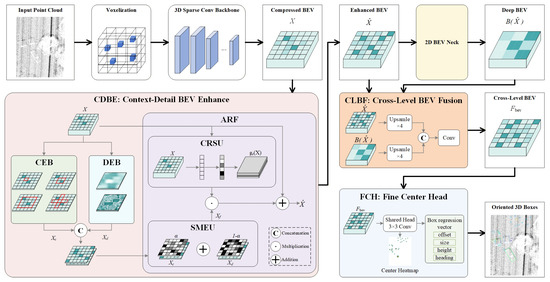
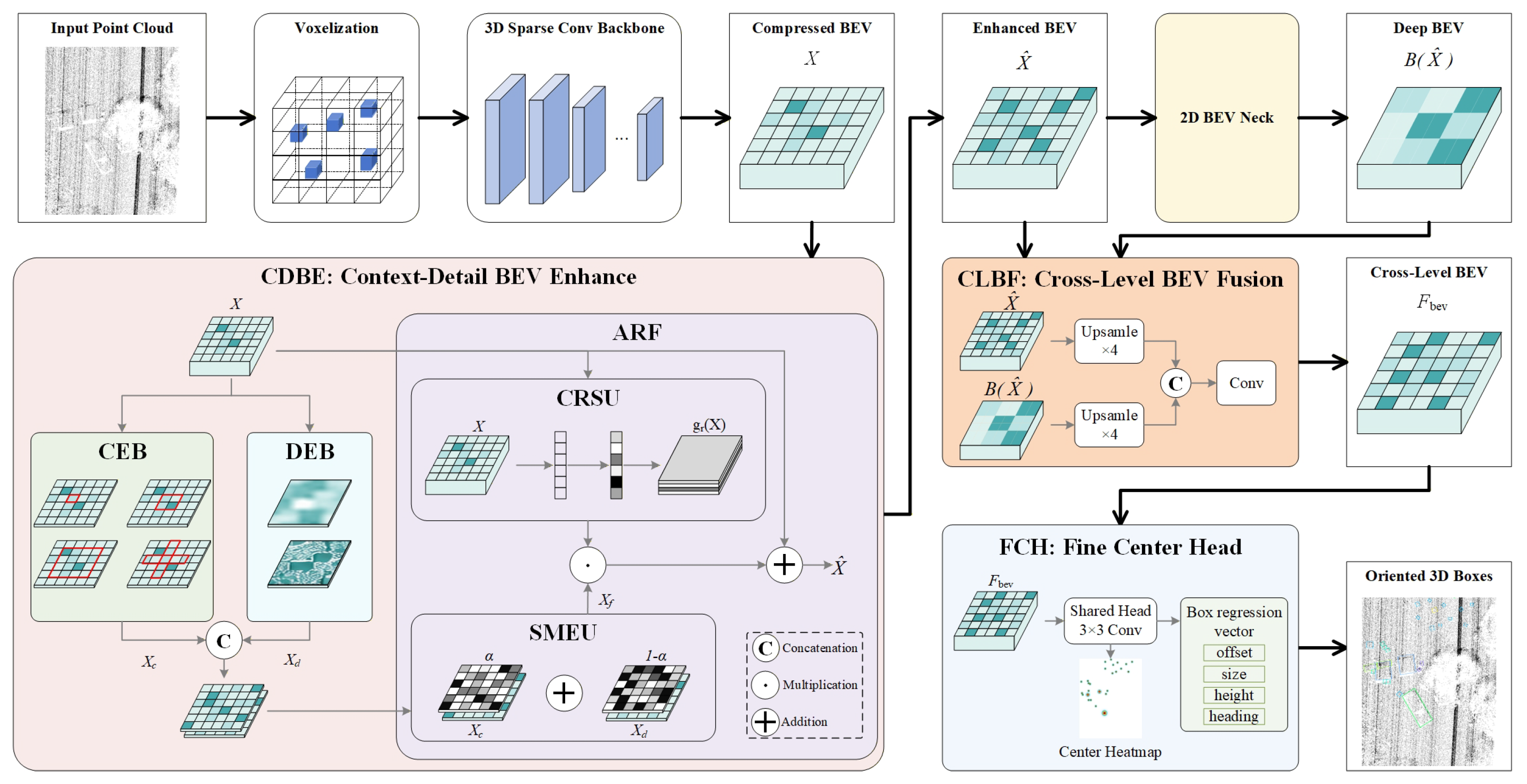
CenterPoint-UAV transforms a sparse UAV point cloud into a dense BEV representation and progressively refines it for center-based 3D object detection. Figure 1 illustrates the network architecture and feature connections, whereas Algorithm 1 summarizes the corresponding forward-processing pipeline.
| Algorithm 1 Overall Processing Pipeline of CenterPoint-UAV | ||
| Require: UAV point cloud | ||
| Ensure: 3D detection set | ||
| Main forward process | ||
| 1: | ||
| 2: | ||
| 3: | ||
| 4: | ||
| 5: | ||
| 6: | ||
| 7: | return | |
| 8: | function CDBE() | |
| 9: | in parallel do | |
| 10: | ▹ context-enhanced feature | |
| 11: | ▹ detail-enhanced feature | |
| 12: | end parallel | |
| 13: | ||
| 14: | return | |
| 15: | end function | |
| 16: | function CLBF() | |
| 17: | in parallel do | |
| 18: | ▹ early BEV feature | |
| 19: | ▹ deep semantic feature | |
| 20: | end parallel | |
| 21: | ||
| 22: | return | |
| 23: | end function | |
| 24: | function FCH() | |
| 25: | in parallel do | |
| 26: | ▹ center heatmap | |
| 27: | ▹ bounding-box parameters | |
| 28: | end parallel | |
| 29: | return | |
| 30: | end function | |
Figure 1.
Overall architecture of CenterPoint-UAV. The detector refines the compressed BEV representation with CDBE, fuses early and deep BEV evidence with CLBF, and performs dense center prediction with FCH.
As shown in Figure 1, points within the detection range are first partitioned into regular voxels, and the point attributes inside each non-empty voxel are encoded by mean voxel feature encoding.
The 3D sparse convolutional backbone extracts features from the sparse voxel tensor while compacting the vertical dimension, producing a compressed BEV feature map , where is the channel dimension.
The compressed BEV feature is enhanced by CDBE and then fed into the BEV neck. The BEV neck uses convolutional layers to extract deeper semantic features and transposed convolutions to recover the detection resolution. CLBF subsequently fuses the early BEV details with the deep semantic features. Finally, FCH performs dense prediction through a center-heatmap branch for object center classification and a regression branch for 3D bounding-box parameters, including center offset, height, size, and heading angle. The entire network performs multi-category 3D object detection in a single end-to-end forward pass.
The main modifications of CenterPoint-UAV focus on BEV feature enhancement, cross-level feature fusion, and fine-grained center prediction. CDBE refines the compressed BEV feature between the 3D sparse convolutional backbone and the BEV neck by combining multi-range contextual information with local detail cues. CLBF fuses early BEV features with deeper semantic features at the detection resolution to preserve fine geometric information. FCH performs center prediction on a finer BEV grid to reduce center quantization error for small objects. The following subsections describe these components in detail.
3.2. Context-Detail BEV Enhance (CDBE)
CDBE enhances the compressed BEV feature before it enters the BEV neck. In UAV scenes, sparse point distributions can make object responses difficult to distinguish from the background, so contextual aggregation is needed to improve object-background discrimination. At the same time, small objects, thin structures, and category-specific local shapes require detail-sensitive cues that may be weakened by deeper BEV processing. Therefore, CDBE uses CEB to produce a context-enhanced feature and DEB to produce a detail-enhanced feature, while ARF adaptively fuses the two features and injects the resulting enhancement into the original BEV representation. The two enhanced representations capture complementary information: contextual features provide broader spatial evidence for distinguishing sparse object responses from the surrounding background, whereas detail features preserve local variations that are important for object boundaries and small structures. Their combination therefore enables CDBE to jointly exploit broader contextual cues and fine local evidence rather than relying on either type of information alone.
3.2.1. Context Enhancement Branch (CEB)
CEB is designed to provide multi-range spatial support without reducing BEV resolution. A single local convolution can preserve nearby evidence, but UAV objects vary greatly in scale and may require wider scene context to separate valid object responses from background clutter. CEB therefore aggregates spatial evidence with several receptive-field ranges and an axis-oriented path.
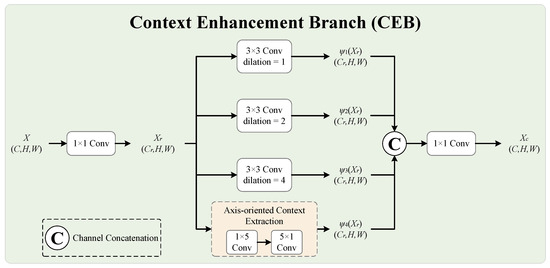
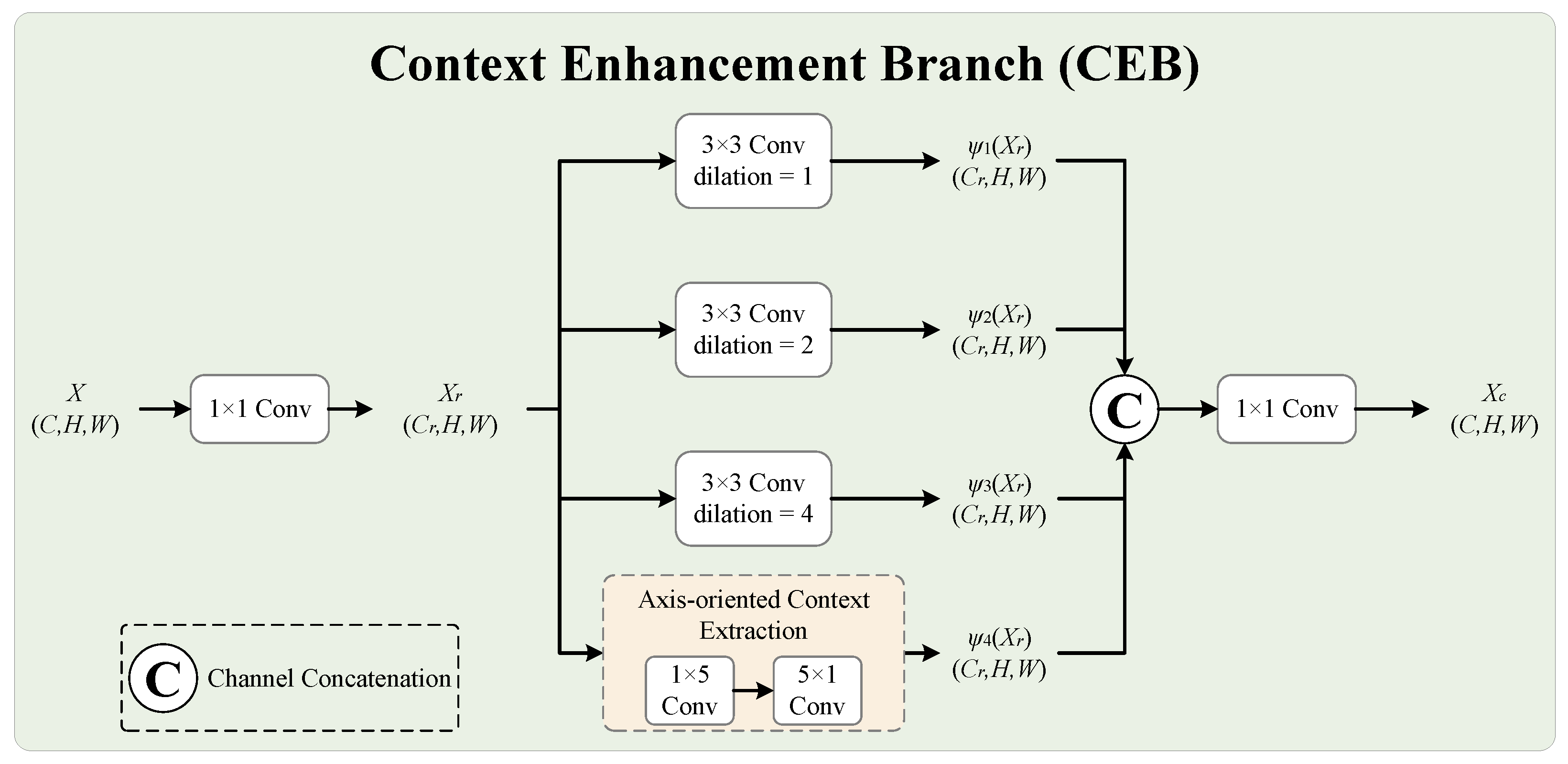
Figure 2 shows the structure of CEB. CEB first reduces the channel dimension of X from C to using a convolution followed by ReLU:
where and denotes the channel-reduction projection.
Figure 2.
Structure of the Context Enhancement Branch. CEB combines multi-range dilated branches and an axis-oriented branch to enrich spatial support while preserving the BEV resolution.
CEB then applies four parallel spatial operators to : three convolution branches with dilation rates 1, 2, and 4, denoted by , , and , respectively, and an axis-oriented branch implemented by sequential and convolutions. The dilated convolutions use stride 1 with paddings 1, 2, and 4, respectively, while the axis-oriented convolutions use paddings and . Each branch is followed by ReLU and produces a feature in .
The four branch outputs are concatenated along the channel dimension and fused by a convolution followed by ReLU, denoted by :
where and denotes channel concatenation.
The dilation rates of 1, 2, and 4 and the axis-oriented kernels were selected based on common differences in object size and aspect ratio within the UAV LiDAR sensing range. The dilation-1 branch captures local neighborhood information, the larger-dilation branches expand the receptive field to aggregate broader spatial context, and the axis-oriented branch models directional continuity with moderate computational cost. Together, these branches provide complementary spatial information at different receptive-field ranges. Therefore, CEB is able to strengthen contextual representation while preserving the BEV resolution.
3.2.2. Detail Enhancement Branch (DEB)
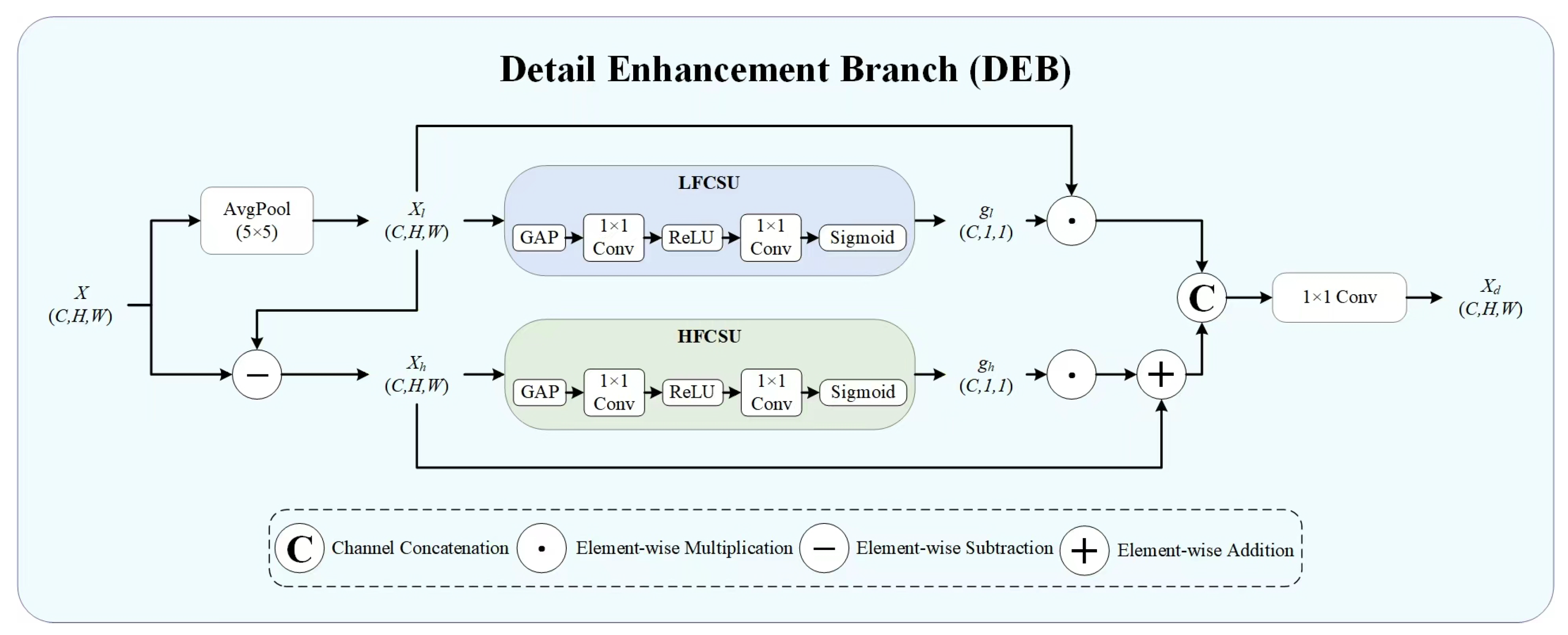
DEB is designed to enhance local BEV details that are important for small-object localization and fine structural representation. It explicitly separates the input feature into low- and high-frequency components, which provide complementary structural patterns and local variations, respectively.
Figure 3 shows the structure of DEB. DEB first extracts the low-frequency component from X using average pooling with stride 1 and padding 2, excluding padded values from averaging, and computes the high-frequency component as the residual:
where . The low-frequency component provides structural patterns, while the high-frequency component emphasizes local variations such as object boundaries and fine structures.
Figure 3.
Structure of the Detail Enhancement Branch. DEB separates the input feature into low- and high-frequency components, adaptively reweights them, and fuses the complementary information into a detail-enhanced feature.
Rather than directly concatenating the two components, DEB first generates channel-wise salience coefficients via two lightweight units: a Low-Frequency Channel Salience Unit (LFCSU) and a High-Frequency Channel Salience Unit (HFCSU). LFCSU infers low-frequency salience coefficients to adaptively reweight structural patterns, while HFCSU predicts high-frequency salience coefficients to modulate local variations in a residual manner without directly removing the original high-frequency responses. In each unit, Global Average Pooling (GAP) produces a descriptor, followed by two convolutions that reduce the channel dimension from C to and then restore it to C. ReLU is applied after the first convolution. Let and denote these convolutional transformations for the low- and high-frequency components, respectively. A Sigmoid activation is subsequently applied to produce the channel-wise salience coefficients:
where denotes the Sigmoid activation function. The resulting are broadcast over the spatial dimensions during reweighting.
The reweighted components are then concatenated into a -channel feature and projected back to C channels by a convolution followed by ReLU:
where ⊙ denotes element-wise multiplication, denotes the detail fusion projection, and is the detail-enhanced feature. The residual form preserves the original high-frequency component while allowing its informative responses to be adaptively strengthened.
Through frequency decomposition and adaptive channel-wise reweighting, DEB combines structural patterns with local variations before subsequent BEV processing.
3.2.3. Adaptive Residual Fusion (ARF)
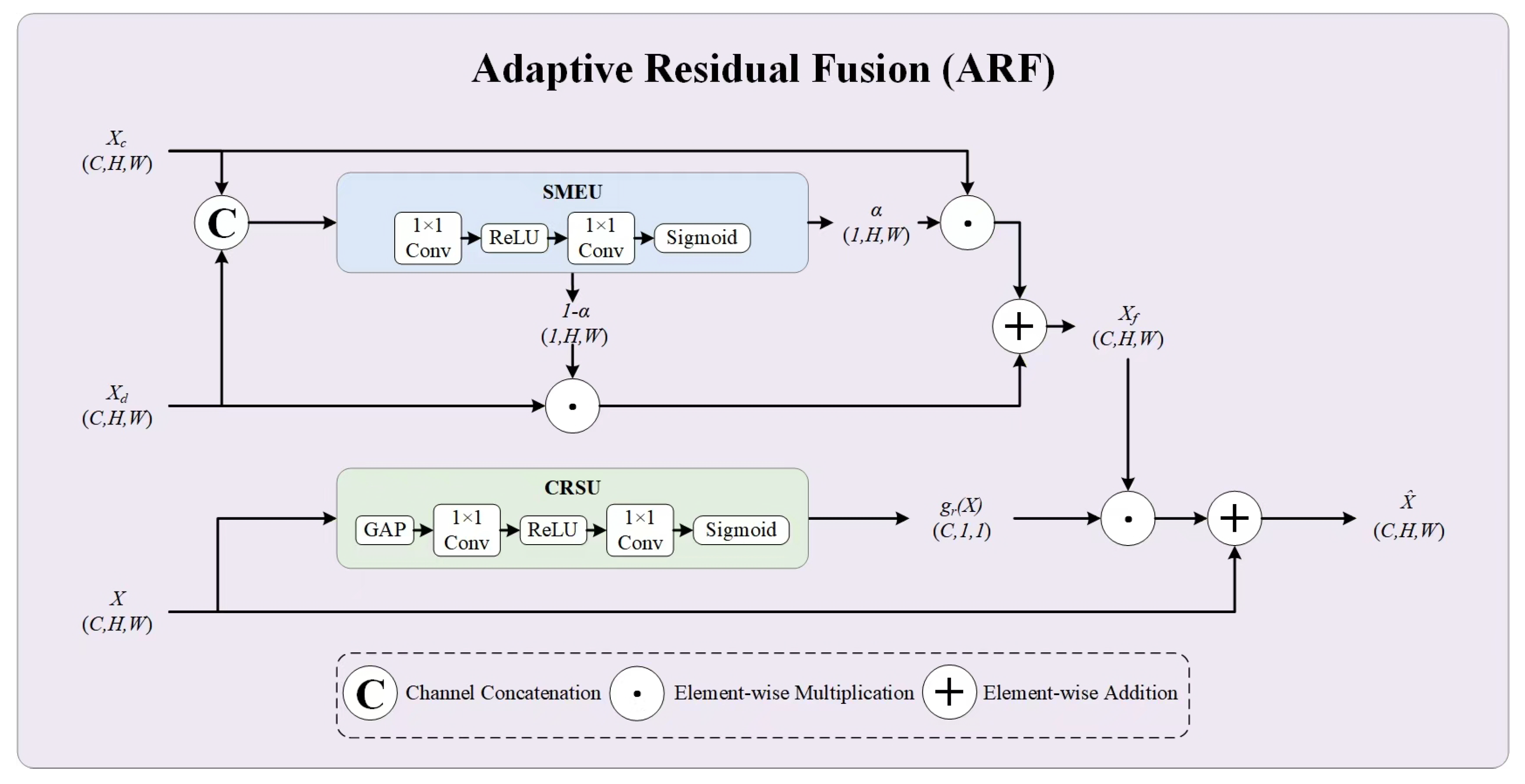
ARF is designed to adaptively integrate the context- and detail-enhanced features while preserving the original BEV representation. Since the relative contributions of contextual information and local details may vary across BEV locations, directly combining the two features with fixed weights may limit their complementarity. ARF therefore performs two stages of adaptive fusion: spatially adaptive context-detail mixing and channel-wise residual injection. The required adaptive coefficients for both stages are produced by two lightweight coefficient generation units: a Spatial Mixing Estimation Unit (SMEU) and a Channel Residual Salience Unit (CRSU).
Figure 4 shows the structure of ARF. ARF first predicts spatial mixing coefficients through SMEU. SMEU concatenates and into a -channel feature and applies two convolutions: the first reduces the channel dimension from to C and is followed by ReLU, while the second produces a single-channel logit map. Let denote this two-layer projection transformation. A Sigmoid activation is subsequently applied to constrain the spatial mixing coefficients to :
where is broadcast along the channel dimension during feature fusion.
Figure 4.
Structure of Adaptive Residual Fusion. ARF first performs spatially adaptive fusion of the context- and detail-enhanced features and then injects the fused enhancement into the original BEV feature through a channel-wise residual gate.
The context- and detail-enhanced features are then adaptively combined as
where denotes the fused enhancement feature. The spatial mixing coefficient adaptively balances contextual and detail information; in extremely sparse or object-less regions, it only reweights existing responses from and without introducing additional activations.
The fused enhancement is then injected into the original BEV feature through a residual path. CRSU applies GAP to X to obtain a descriptor, followed by two convolutions that reduce the channel dimension from C to and then restore it to C. ReLU is applied after the first convolution. Let denote this lightweight channel transformation. A Sigmoid activation is subsequently applied to generate the residual channel salience coefficients:
where is broadcast over the spatial dimensions when applied to .
The final refined BEV feature is formulated as
where is the output of CDBE.
The residual connection retains the original BEV feature, while the channel-wise salience signal generated by CRSU adaptively controls the contribution of the fused enhancement across feature channels. Through spatially adaptive mixing powered by SMEU and channel-wise residual injection powered by CRSU, ARF integrates the complementary context- and detail-enhanced features while retaining the original BEV representation.
3.3. Cross-Level BEV Fusion (CLBF)
CLBF is designed to combine fine-grained spatial information from the enhanced BEV feature with deeper semantic representations before center prediction. Further convolutional processing provides a larger receptive field and stronger semantic abstraction, while the original enhanced BEV feature retains higher-resolution spatial details. CLBF therefore fuses these complementary feature levels at the high-resolution detection scale.
Specifically, given , CLBF constructs an early path and a deep path. The early path directly upsamples , whereas the deep path first passes through the convolutional block of the BEV neck and then upsamples its output:
contains six convolutional layers with stride 1 and padding 1. The first layer maps the channel dimension from C to , while the remaining five layers maintain channels. Each layer is followed by BN and ReLU. and are implemented using transposed convolutions with stride 4, followed by BN and ReLU. Specifically, maps the early feature from C to channels, whereas preserves the channels produced by . The resulting features are aligned at the stride-2 detection resolution.
The two high-resolution features are concatenated into a C-channel feature and processed by a convolution with stride 1 and padding 1, followed by BN and ReLU. Denoting this fusion transformation by , the final BEV feature is obtained as:
where is used for dense prediction.
CLBF retains early spatial information through the direct path while obtaining deeper semantic representation through the convolutional path. By aligning the two feature levels at the same detection resolution, the final BEV feature combines complementary information from different processing depths.
3.4. Fine Center Head (FCH)
In a CenterPoint-style head, a continuous object center is assigned to a discrete heatmap cell, while the remaining sub-cell displacement is recovered by offset regression. FCH performs center-heatmap prediction and box regression on the stride-2 high-resolution feature produced by CLBF. Compared with the stride-4 prediction grid used in the original CenterPoint configuration, the finer grid reduces the physical distance between the ground-truth center and its assigned cell location, thereby reducing the residual displacement to be compensated by the offset branch without eliminating offset regression.
Given , the heatmap branch predicts a class-specific center confidence at each location. The is first processed by a shared convolution that reduces the channel dimension from C to , with stride 1 and padding 1, followed by BN and ReLU. The resulting shared feature is fed into one heatmap branch and four regression branches for center offset, center height, box dimensions, and rotation. Each branch applies a convolution that maintains channels, followed by BN and ReLU, and then a output convolution. Both convolutions use stride 1 and padding 1. The output channel numbers are 22, 2, 1, 3, and 2 for the heatmap, center offset, center height, dimensions, and rotation branches, respectively; no normalization or activation follows the output convolution.
Gaussian center targets are generated on the same prediction grid, and the heatmap is supervised using the CenterNet-style modified focal loss:
where u and v index the spatial coordinates of the heatmap, c indexes the object class, denotes the Gaussian heatmap target, denotes the sigmoid heatmap prediction, and N is the number of valid object centers. We set and .
Alongside the heatmap branch, the regression branch predicts the continuous attributes required to recover the corresponding 3D bounding box. At each valid center location, the regression target is
where denote the sub-cell center offsets, z is the vertical center coordinate, are the box dimensions, and r is the yaw angle. During decoding, a heatmap peak determines the discrete center location, while recover its remaining sub-cell displacement. The regression terms are optimized at valid center locations using the weighted L1 loss
where and denote the predicted and target values of the k-th regression component, respectively, and is its corresponding weight.
The heatmap and regression branches are jointly optimized through the final dense prediction loss
In our implementation, , , and all regression component weights are set to .
4. Results
4.1. Experimental Setup
4.1.1. Dataset
We evaluate CenterPoint-UAV on WiSAR3D [48], a large-scale, real-world UAV point-cloud benchmark for multi-category 3D object detection. WiSAR3D comprises contiguous point-cloud strips acquired by UAV-mounted multi-return LiDAR along flight paths in off-road, natural rural environments for wilderness search-and-rescue applications. The recorded scenes contain natural elements, including trees, bushes, and rocks, together with people and diverse human-made objects, and some targets are partially occluded by foliage. WiSAR3D contains aerial LiDAR scenes with 22 object categories and oriented 3D bounding-box annotations, and includes 1372 training strips with 34,835 boxes and 1261 validation strips with 33,107 boxes. The dataset includes small objects, people, long and narrow objects, common outdoor items, and large outdoor structures, covering a wide range of sizes, shapes, and object types for UAV-based 3D object detection.
4.1.2. Evaluation Metrics
Following the official WiSAR3D evaluation protocol, we report the nuScenes-style metrics, including mean average precision (mAP), nuScenes detection score (NDS), average translation error (ATE), average scale error (ASE), and average orientation error (AOE). AP, mAP, and NDS are reported on a percentage scale, whereas ATE is reported in meters, ASE is the dimensionless scale error defined as , and AOE is reported in radians. Higher mAP and NDS indicate better overall detection quality, while lower ATE, ASE, and AOE indicate better center localization, scale estimation, and orientation estimation.
4.1.3. Implementation Details
The proposed CenterPoint-UAV is implemented based on the OpenPCDet framework using PyTorch 1.9.0, Python 3.8 and CUDA 11.1. All experiments are conducted on a single NVIDIA A800 GPU with 80 GB memory. The model is trained for 80 epochs using the Adam optimizer with a OneCycle learning rate policy, where the initial learning rate, weight decay, momentum, and OneCycle parameters are set to 0.003, 0.01, 0.9, and , , , respectively. The batch size is set to 4, with a maximum gradient norm of 10. For the efficiency comparison, all reported FPS values are measured on the same GPU with a batch size of 1.
Training augmentation includes GT sampling, random x-axis flipping, random z-axis rotation within , and global scaling within . The point clouds are voxelized with a voxel size of m over the range m, with a maximum of 5 points per voxel and 900,000 voxels.
We compare CenterPoint-UAV with representative 3D object detectors, including CenterPoint [29], VoxelRCNN [28], PVRCNN [27], HEDNet [33], VoxelNeXt-2D [32], and VoxelNeXt-L [32], all of which follow the corresponding configurations provided by the official WiSAR3D benchmark. VoxelNeXt-2D denotes the relatively lightweight 2D sparse-convolution configuration, whereas VoxelNeXt-L denotes the larger-capacity 3D sparse-convolution configuration. For fair comparison, all methods use the same WiSAR3D split and evaluation protocol, and also adopt the same point-cloud range, voxel size, and data augmentation strategy described above. The CenterPoint baseline, the three strongest comparison methods (HEDNet, VoxelNeXt-2D, and VoxelNeXt-L), the proposed CenterPoint-UAV, and all ablation variants are each trained with three different random seeds, and their accuracy results are reported as the mean (±) standard deviation over these three runs.
4.2. Comparison with Existing Methods
As shown in Table 1, the proposed CenterPoint-UAV achieves the best overall detection performance among the compared methods, reaching an mAP of 71.14%. It also obtains the highest AP in 13 of the 22 object categories, including Vehicle, Chair, Small table, Big table, Barrel, Box, Drone case, Small bin, Ramp, Sitting person, Standing person, Cone, and Pipe. In particular, substantial advantages are observed for several compact or human-related categories. For example, CenterPoint-UAV achieves AP values of 46.48% for Sitting person, 56.87% for Standing person, and 33.90% for Cone, exceeding the corresponding results of the compared methods. These results indicate that the proposed BEV feature refinement is particularly effective for categories whose sparse observations and limited spatial extent make accurate representation and localization difficult.
Table 1.
Per-class AP and mAP comparison on the WiSAR3D validation set. AP and mAP values are reported in percent. The best result in each row is highlighted in bold.
Table 2 further compares overall detection performance, model complexity, computational cost, and inference throughput. CenterPoint-UAV achieves the highest mAP of % and NDS of %, while also obtaining the lowest ATE of m. Compared with the CenterPoint baseline, it improves mAP and NDS by % and %, respectively, while reducing ATE from to m.
Table 2.
Overall detection performance and efficiency comparison. Higher mAP and NDS and lower ATE, ASE, and AOE indicate better detection performance, while lower parameter count, checkpoint size, and FLOPs and higher FPS indicate better efficiency. The best results are highlighted in bold.
In terms of model complexity, CenterPoint-UAV contains 5.98 M parameters with a checkpoint size of 68.53 MB. The strongest comparison model, VoxelNeXt-L, which achieves the second-highest mAP of %, requires 33.42 M parameters, which is approximately 5.6 times as many parameters as CenterPoint-UAV. CenterPoint-UAV therefore achieves substantially higher detection accuracy while maintaining a relatively compact parameter budget.
The proposed feature-enhancement and fusion operations increase the computational cost from 347.60 G FLOPs for the CenterPoint baseline to 1392.17 G FLOPs for CenterPoint-UAV, mainly due to the additional BEV feature processing introduced by CDBE, CLBF, and FCH. Despite the increased theoretical computation, CenterPoint-UAV maintains an inference speed of 10.69 FPS. Moreover, it remains faster than VoxelNeXt-L (6.09 FPS) while achieving higher detection accuracy. This comparison suggests that FLOPs alone do not fully reflect the practical inference efficiency of different architectures, and CenterPoint-UAV maintains competitive runtime performance while benefiting from the proposed feature refinement.
4.3. Ablation Study
4.3.1. Effectiveness of the Main Components
We first evaluate the individual contributions of CDBE, CLBF, and FCH using CenterPoint as the common baseline. As summarized in Table 3, each module is independently introduced while the remaining settings are kept unchanged. CDBE achieves an mAP of % and improves all three localization-related error metrics, indicating that jointly enhancing contextual and detail information in the compressed BEV representation benefits detection and bounding-box estimation.
Table 3.
Ablation study of the principal modules of CenterPoint-UAV. CDBE: Context-Detail BEV Enhance; CLBF: Cross-Level BEV Fusion; FCH: Fine Center Head. The best results are highlighted in bold.
Among the individual modules, CLBF provides the largest mAP improvement, reaching %, together with an ATE of m. This result is consistent with its design of directly preserving early BEV spatial information while combining it with deeper semantic features at the detection resolution. FCH achieves % mAP and an ATE of m, showing that center prediction on a finer BEV grid contributes to more accurate center localization.
To further examine whether cross-level fusion provides additional benefit when the finer prediction head is already employed, we additionally evaluate the CLBF + FCH configuration. Under the same FCH setting, introducing CLBF changes the mAP from % to % and the NDS from % to %. This matched comparison indicates that the improvement is not solely attributable to increasing the prediction resolution; incorporating early spatial information and deeper semantic features through CLBF provides additional complementary information for the finer-resolution prediction head.
When CDBE, CLBF, and FCH are jointly incorporated, the complete CenterPoint-UAV achieves the best overall results, with % mAP, % NDS, and the lowest ATE of m. Together with the isolated and matched ablations above, these results show that the three modules are individually effective and provide complementary refinements at different stages of BEV processing: CDBE enhances contextual and detail cues before the BEV neck, CLBF integrates early and deep BEV features at the detection resolution, and FCH performs center prediction on the finer prediction grid. Detailed computational statistics of these ablation settings, including FLOPs, parameter counts, and measured inference speed, are provided in Table A3 of Appendix A.2.
4.3.2. Analysis of CDBE Components
The internal design of CDBE is further examined through controlled ablations in Table 4. Starting from the same CenterPoint baseline, CEB and DEB are independently introduced and reach mAP values of % and %, respectively. CEB aggregates spatial information over multiple receptive-field ranges and along the two BEV axes, whereas DEB combines low-frequency structural patterns with high-frequency local variations through adaptive channel-wise reweighting. Their independent improvements indicate that both branches provide useful but different forms of BEV feature enhancement.
Table 4.
Ablation study of the internal components of CDBE. CEB: Context Enhancement Branch; DEB: Detail Enhancement Branch; ARF: Adaptive Residual Fusion. The best results are highlighted in bold.
To further separate the effect of the fusion mechanism from those of the two enhancement branches, we perform a matched comparison in which CEB and DEB are kept unchanged while only the fusion strategy is varied. Combining CEB and DEB with fixed fusion increases mAP to % and NDS to %. Replacing the fixed fusion with the proposed ARF further increases mAP to % and achieves an ATE of m. Since these two variants use the same CEB and DEB branches and differ only in their fusion strategy, this matched comparison more directly isolates the contribution of ARF and confirms the benefit of adaptive fusion over fixed fusion. ARF therefore serves as a lightweight refinement of the complementary context and detail representations produced by CEB and DEB. Detailed computational statistics of the CDBE components are provided in Table A3 of Appendix A.2.
4.3.3. Instance-Level Size Evaluation
To further evaluate detection performance across objects of different physical sizes, we conduct an instance-level size evaluation in which each ground-truth object is independently grouped according to its BEV footprint , rather than assigning an entire semantic category to a single size group. Instances with , , and are defined as Small, Medium, and Large, respectively. The validation set contains 12,831 Small, 12,665 Medium, and 7611 Large instances. AP is evaluated separately for the Small, Medium, and Large instance groups.
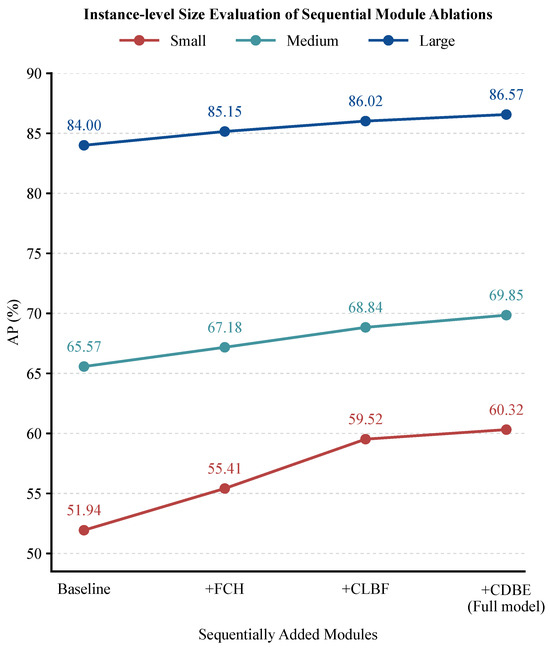
As shown in Figure 5, detection performance improves consistently as the proposed components are progressively incorporated. For Small instances, AP increases from % for CenterPoint to % after introducing FCH, further to % with the addition of CLBF, and finally to % for the complete CenterPoint-UAV. The complete model also achieves the best performance for Medium and Large instances, reaching % and %, respectively. Compared with the CenterPoint baseline, the corresponding improvements for Small, Medium, and Large instances are %, %, and %, respectively. The substantially larger gain for Small instances indicates that the proposed BEV refinement is particularly beneficial for objects with limited spatial extent, while the consistent improvements for Medium and Large instances show that its effectiveness is not restricted to small objects.
Figure 5.
Instance-level AP (%) for Small, Medium, and Large objects as FCH, CLBF, and CDBE are sequentially added to the CenterPoint baseline.
4.4. Feature Visualization
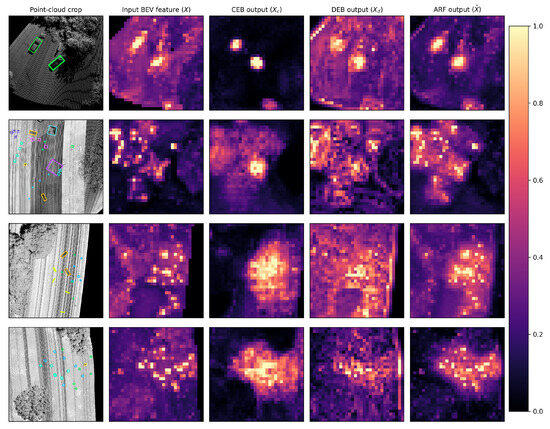
BEV feature visualization provides qualitative support for the CDBE. Figure 6 visualizes the feature enhancement procedure of CDBE through its multi-stage feature responses. From left to right, each row shows a point-cloud crop, the input BEV feature X, the CEB output , the DEB output , and the ARF output for an object from a different category and size group. Since these representations are multi-channel BEV features, we compute the mean absolute activation across channels at each spatial location to obtain two-dimensional response maps. All feature response maps are displayed using a shared color scale, enabling direct comparison of response magnitudes across branches and samples. CEB exhibits more concentrated contextual responses around object-related regions, whereas DEB retains richer local structural responses. After ARF fusion, the enhanced BEV feature combines the complementary response characteristics of the two branches while maintaining clear responses around the object regions. These qualitative observations are consistent with the intended roles of CEB, DEB, and ARF in the CDBE design.
Figure 6.
Representative object-level CDBE visualizations. From left to right, each row shows a point-cloud crop, the input BEV feature X, the CEB output , the DEB output , and the ARF output . The examples include objects from different categories and size groups. Each heat map represents the channel-mean absolute activation, and all feature response maps use a common color scale.
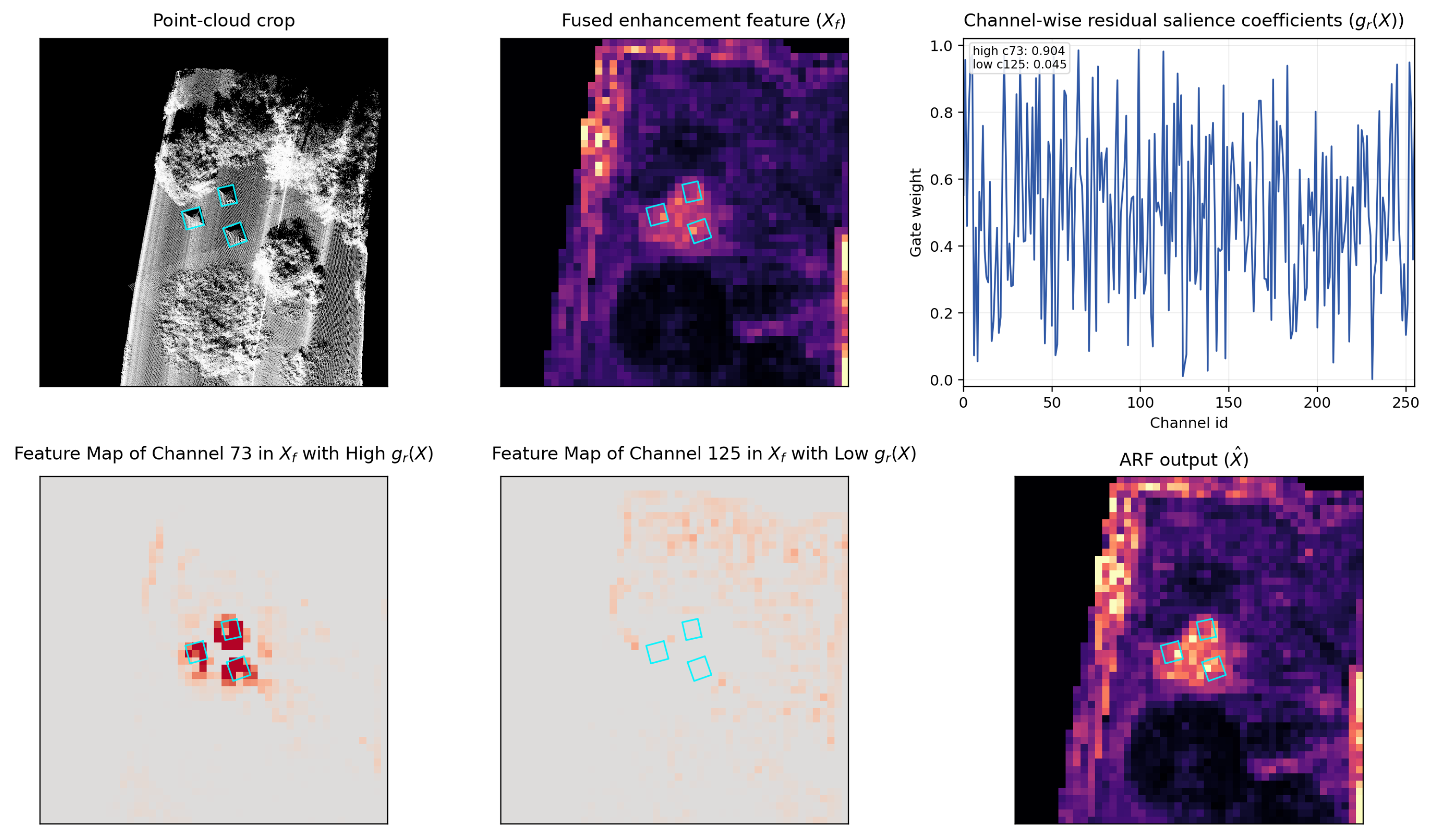
Figure 7 further visualizes ARF from a channel-wise perspective. The figure shows a point-cloud crop, the fused enhancement feature , the channel-wise residual salience coefficients , the feature map of Channel 73 in with a high value, the feature map of Channel 125 in with a low value, and the ARF output . Channel 73 exhibits a more distinct object-related response pattern, whereas Channel 125 contains less pronounced object-related evidence. Together with their corresponding values, this comparison illustrates how the learned channel-wise coefficients regulate the contribution of the fused enhancement before residual injection.
Figure 7.
ARF channel-wise residual salience visualization on a WiSAR3D validation frame. The panels show a point-cloud crop, the fused enhancement feature , the channel-wise residual salience coefficients , the feature maps of Channel 73 and Channel 125 in with high and low values, respectively, and the ARF output .
4.5. Detection Result Visualization
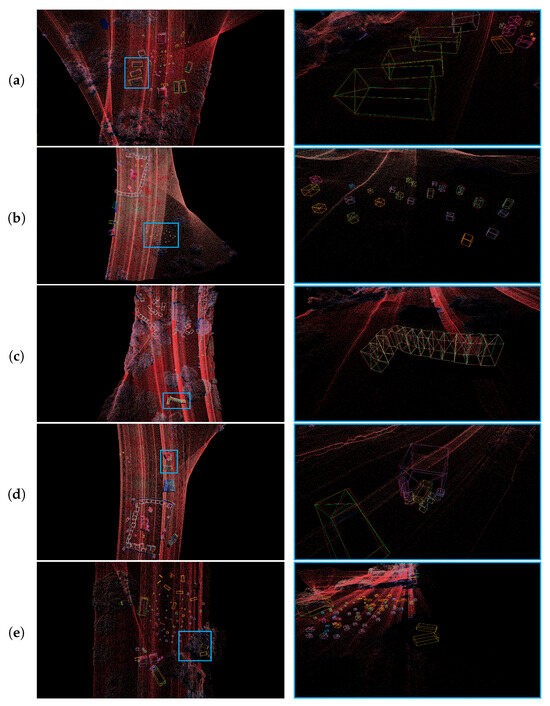
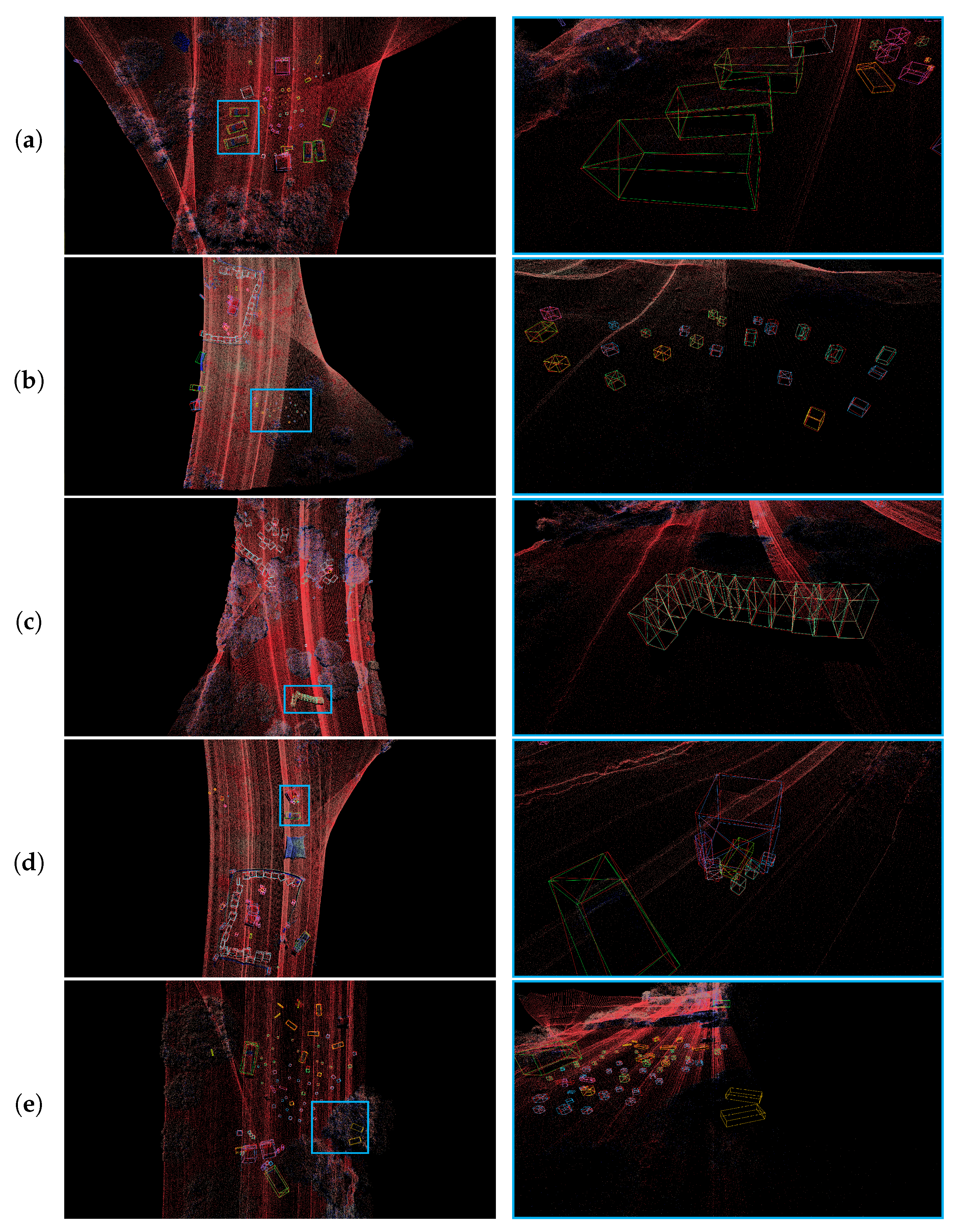
Figure 8 shows detection results on the WiSAR3D validation set. Each example contains a full UAV point-cloud strip and a zoomed-in view. Compared with ground-based LiDAR scans used for autonomous driving, UAV point-cloud strips cover larger areas. They also contain more object classes, a wider range of object sizes, and more occlusion. Because the UAV sensor looks down from above, it mainly captures the tops of objects. For example, the vehicles in (a) have clear roof shapes but little information from their sides. This differs from vehicle-mounted LiDAR, which usually captures more side structures.
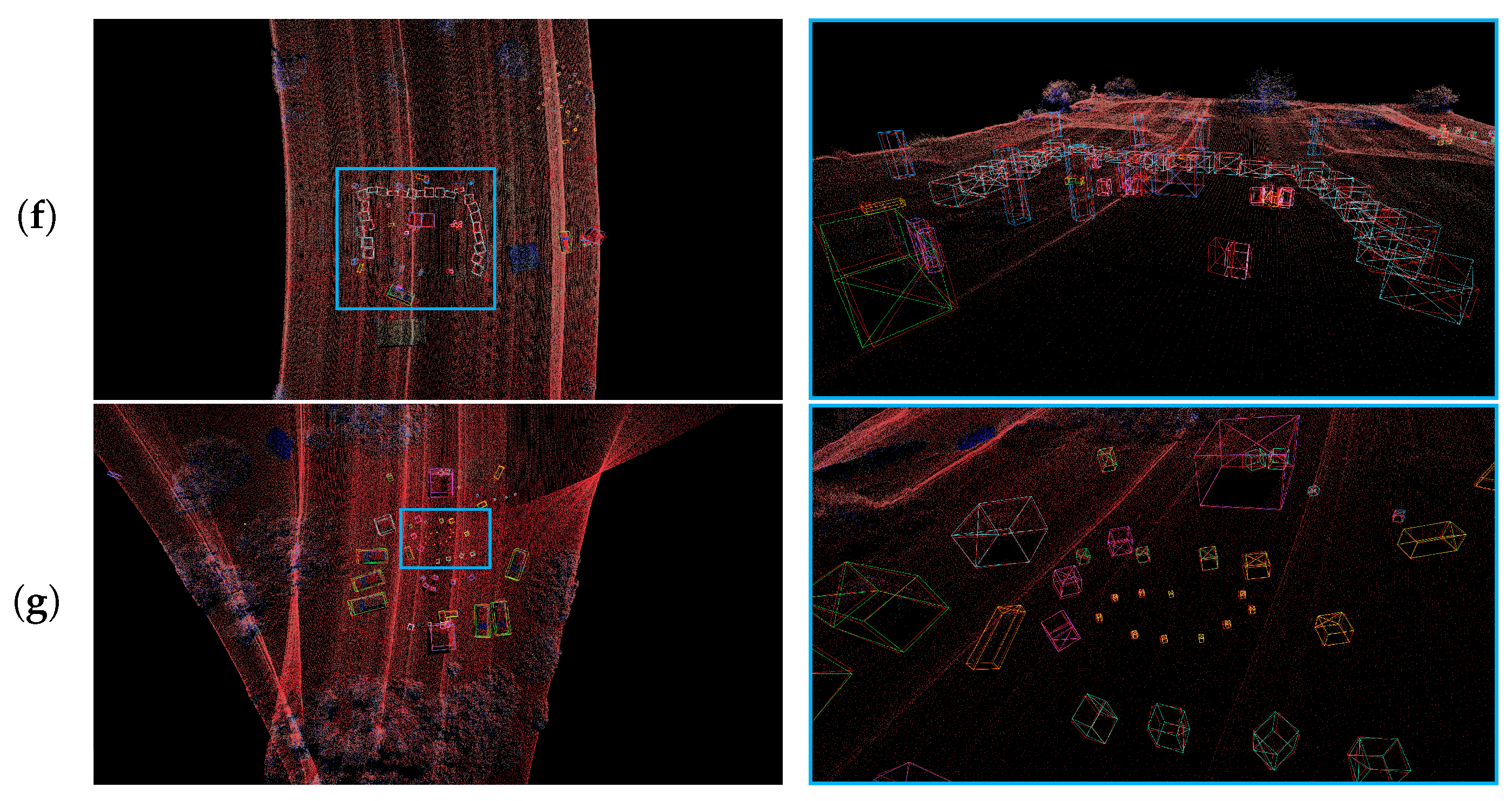
Figure 8.
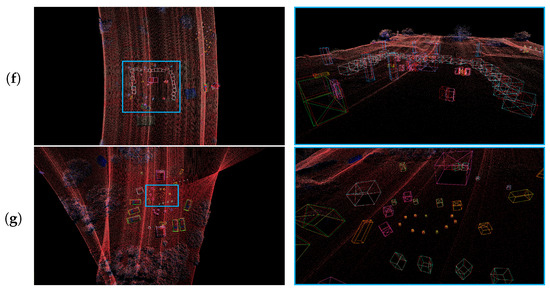
Detection results of CenterPoint-UAV on the WiSAR3D validation set. Each example, labeled (a–g), shows a full UAV point-cloud strip on the left and a zoomed-in view of the region marked by the blue rectangle on the right. Predicted bounding boxes for different object categories are shown in different colors, while ground-truth bounding boxes are shown in red. Examples (e–g) include representative failure cases.
The examples in (a)–(d) show successful detections. CenterPoint-UAV detects several object classes in the same scene. Its predicted boxes closely match the ground-truth boxes for large objects, small objects, and tightly packed objects. It also detects people seated beneath a tent and around a table, even when the objects partly block each other. These results show that CenterPoint-UAV can detect and localize multiple object classes in complex UAV scenes, providing useful object-level information for scene understanding.
The examples in (e)–(g) show several representative failure cases. These failures mainly occur for objects with very limited and sparse point returns. When an object is partly covered by a tree canopy, only a few valid points may remain. These points provide weak local geometric evidence. As a result, its feature response is difficult to distinguish from the surrounding background, which increases the risk of missed detection. Extremely small objects present a similar problem. Such objects occupy only a small spatial region, and only a few LiDAR points may fall on them. Even after feature refinement, the corresponding BEV region may still contain insufficient discriminative information. False-positive detections are also observed. They are mainly caused by background structures or local point patterns with object-like geometric properties. These structures may therefore be incorrectly classified as objects. This shows that local geometric similarity between foreground objects and background structures can still produce ambiguous feature responses. These failure patterns are also consistent with the lower AP values of several challenging classes in Table 1.
5. Discussion
5.1. Effectiveness of the Proposed Design
The experimental results show that improving BEV representation quality can effectively enhance UAV-based 3D object detection performance. UAV point clouds often exhibit sparse point distributions, large scene coverage, and object categories with diverse spatial structures, making effective feature representation particularly important. CenterPoint-UAV addresses these characteristics through complementary designs that perform fine-resolution center prediction, preserve and fuse early BEV details with deeper semantic features, and enhance the compressed BEV representation with contextual and local detail information. The ablation results in Table 3 show consistent improvements from the proposed modules, indicating that fine-resolution center prediction, cross-level BEV fusion, and context-detail BEV enhancement provide complementary contributions to the final detection performance.
The comparison with existing methods further demonstrates the effectiveness and favorable accuracy–parameter trade-off of the proposed design. CenterPoint-UAV achieves the highest mAP and NDS among the compared methods with 5.98 M parameters, showing that targeted refinement of BEV features can provide substantial detection gains while maintaining a relatively low parameter budget. The instance-level size evaluation, in which each ground-truth object is grouped according to its actual BEV footprint rather than assigning an entire semantic category to a fixed size group, further shows AP improvements of 8.38%, 4.28%, and 2.57% over CenterPoint for Small, Medium, and Large instances, respectively. The largest gain for Small instances indicates that the proposed BEV refinement is particularly beneficial for objects with limited spatial extent, while the gains across all three groups show that its effectiveness is not restricted to small objects. These results suggest that the proposed feature enhancement and fusion strategy is effective for UAV scenes containing objects with diverse physical sizes and spatial structures.
The feature visualizations provide qualitative evidence for the behavior of CDBE. CEB produces broader responses around object regions, whereas DEB emphasizes local variations and structural details. After ARF fusion, the resulting feature combines contextual and local detail information. The channel-wise visualization further shows that different enhanced feature channels receive different residual weights, illustrating the adaptive feature injection mechanism of ARF. Together with the quantitative results, these observations provide complementary evidence for the role of CDBE in BEV feature enhancement.
5.2. Limitations and Future Work
Despite the performance gains, several limitations remain. First, the current evaluation is limited to WiSAR3D, primarily because publicly available multi-category UAV LiDAR datasets with 3D object annotations remain scarce. Consequently, although the experiments demonstrate the effectiveness of CenterPoint-UAV under the evaluated setting, its generalization across different LiDAR sensors, flight altitudes, point densities, environmental conditions, and scene distributions has not yet been comprehensively validated. In future work, we plan to collect and annotate additional real-world UAV LiDAR data covering more diverse sensors, flight conditions, and scene types, and use these data to further evaluate the cross-scene and cross-sensor generalization capability of the proposed method. On this basis, domain adaptation and domain generalization strategies will also be investigated to improve robustness under distribution shifts.
Second, CenterPoint-UAV introduces additional computational overhead through multi-branch BEV refinement, cross-level feature fusion, and higher-resolution prediction. Although the overall model remains relatively compact, the increased computational cost may still constrain deployment on UAV platforms with limited onboard computing resources. Future work will therefore investigate lightweight BEV refinement, dynamic or selective feature processing, and model compression techniques to improve the trade-off between detection accuracy and computational efficiency, with particular attention to real-time onboard deployment.
Third, some challenging object categories, particularly those characterized by sparse LiDAR returns or ambiguous geometric structures, remain difficult to distinguish reliably. This suggests that the current shared feature representation may not fully capture the category-specific characteristics of objects under highly sparse observations. Future work will investigate category-aware and density-aware feature learning strategies to improve feature representation for sparsely observed objects and geometrically ambiguous categories.
6. Conclusions
This paper proposes CenterPoint-UAV, an end-to-end voxel-based detector for multi-category 3D object detection in UAV point clouds. CenterPoint-UAV integrates CDBE, CLBF, and FCH into a unified architecture to refine BEV representations, preserve multi-level spatial information, and improve fine-resolution center prediction.
Experiments on the WiSAR3D benchmark show that CenterPoint-UAV improves the mean mAP of the CenterPoint baseline from 65.23% to 71.14% and the mean NDS from 73.72% to 78.24%. It achieves the highest mAP and NDS among the compared methods with 5.98M parameters, demonstrating a favorable accuracy–parameter trade-off.
The ablation study confirms the complementary contributions of the proposed modules. Instance-level size evaluation further shows AP improvements of 8.38%, 4.28%, and 2.57% over CenterPoint for Small, Medium, and Large instances, respectively. The larger improvement for Small instances indicates that the proposed BEV refinement is particularly beneficial for objects with limited spatial extent, while the gains across all three groups demonstrate that its effectiveness is not restricted to small objects. Feature visualizations also provide qualitative support for the distinct contextual and local-detail response patterns that are produced by CEB and DEB, as well as the learned channel-wise regulation of residual feature injection in ARF.
Overall, the results demonstrate that targeted BEV feature enhancement, cross-level fusion, and fine-resolution center prediction can improve detection accuracy across objects of different sizes while maintaining a compact parameter budget. We hope this study provides useful insight for building accurate and efficient UAV point-cloud perception systems in remote-sensing applications.
Author Contributions
Conceptualization, Y.W. (Yutian Wu) and Q.L.; methodology, Y.W. (Yutian Wu), S.M. and S.L.; software, S.L. and S.M.; validation, S.M. and Y.W. (Yichen Wang); formal analysis, Y.W. (Yutian Wu) and S.M.; investigation, Y.W. (Yutian Wu) and S.M.; resources, S.L., H.O. and Q.L.; data curation, S.L. and S.M.; writing—original draft preparation, Y.W. (Yutian Wu); writing—review and editing, S.M., S.L., Y.W. (Yichen Wang), H.O. and Q.L.; visualization, Y.W. (Yichen Wang); supervision, H.O. and Q.L.; project administration, Q.L.; funding acquisition, Y.W. (Yutian Wu) and Q.L. All authors have read and agreed to the published version of the manuscript.
Funding
This work is supported by the National Natural Science Foundation of China (62301030).
Data Availability Statement
Data derived from public domain resources. The WiSAR3D dataset analyzed in this study is publicly available at https://github.com/oshrout/WiSAR3D (accessed on 1 May 2026). Further information about the dataset can be found at https://doi.org/10.1109/WACV61042.2026.00636.
Acknowledgments
During the preparation of this manuscript, the authors used ChatGPT (GPT-5.5, OpenAI) for English-language polishing, including grammar checking and proofreading. The authors have reviewed and edited the output and take full responsibility for the content of this publication.
Conflicts of Interest
The authors declare no conflicts of interest.
Appendix A. Supplementary Experimental Analyses
Appendix A.1. Statistical Comparison of Competitive Methods
To quantify the variability of competitive methods under a common experimental protocol, we retrain and evaluate HEDNet, CenterPoint, VoxelNeXt-2D, VoxelNeXt-L, and CenterPoint-UAV using three different random seeds. Table A1 and Table A2 report the resulting per-class and overall detection metrics, respectively, as mean ± standard deviation. These supplementary comparisons complement the main-text tables.
Table A1.
Per-class AP and mAP comparison among competitive methods on the WiSAR3D validation set. AP and mAP values are reported in percent. Results are reported as mean ± standard deviation over three runs with different random seeds. The best result in each row is highlighted in bold.
Table A2.
Overall detection-metric comparison among competitive methods on the WiSAR3D validation set. mAP and NDS are reported in percent; ATE, ASE, and AOE are reported in the units indicated in the table. Results are reported as mean ± standard deviation over three runs with different random seeds. The best result in each row is highlighted in bold.
Taken together, Table A1 and Table A3 demonstrate that the performance gains of CenterPoint-UAV remain consistent across different random seeds. It achieves the highest mAP and NDS and the lowest ATE, with standard deviations of only 0.06% for both mAP and NDS. Although VoxelNeXt-L and VoxelNeXt-2D obtain lower ASE and AOE, respectively, the repeated-run results confirm the stability of the improvements in overall detection accuracy and center localization.
Appendix A.2. Computational Complexity of Ablated Components
To provide a more detailed analysis of the computational overhead introduced by the proposed components, Table A3 reports the number of parameters, FLOPs per frame, and measured inference speed for the different ablation settings. A check mark indicates that the corresponding component is enabled. For the “Fixed fusion” setting, both CEB and DEB are retained, while their outputs are combined using fixed fusion instead of ARF.
Table A3.
Computational complexity of different ablation settings. A check mark indicates that the corresponding module is enabled. For the fixed-fusion setting, the outputs of CEB and DEB are combined using fixed fusion instead of ARF.
Table A3 further shows that the computational cost of the full model is primarily associated with FCH and CLBF rather than CDBE. FCH introduces the largest individual increase in FLOPs because dense prediction is performed on a stride-2 grid instead of the stride-4 grid used in the original CenterPoint configuration, resulting in substantially more spatial locations for the shared convolution and the heatmap and regression branches. CLBF also incurs noticeable computation because it employs a six-layer convolutional semantic path, two transposed-convolution upsampling paths, and high-resolution feature fusion at the scale. When FCH and CLBF are combined, the high-resolution feature constructed by CLBF is further processed by all dense prediction branches of FCH, causing their computational costs to compound and increasing the FLOPs to 1357.11 G/frame.
In comparison, adding CDBE to the FCH+CLBF configuration increases the FLOPs only from 1357.11 to 1392.17 G/frame and reduces the FPS from 11.20 to 10.69. Moreover, replacing fixed fusion with ARF introduces only 0.140 M additional parameters and 9.29 G/frame FLOPs, indicating that CDBE and its adaptive fusion mechanism introduce relatively limited additional computational overhead.
Despite the substantial increase in FLOPs introduced by FCH and CLBF, the corresponding reduction in FPS remains comparatively moderate, from 16.53 FPS for the baseline to 10.69 FPS for the full model. This is likely because most of the additional computation consists of regular dense convolutional operations, which exhibit high computational parallelism and are efficiently supported by modern GPU architectures and deep-learning libraries. Therefore, the increase in theoretical computational complexity does not translate proportionally into inference latency.
References
- Horváth, J. OATS-RS: Ontology-Aware Adaptive and Selective Zero-Shot Scene Classification for Remote Sensing. Remote Sens. 2026, 18, 2038. [Google Scholar] [CrossRef] [Scilit]
- Dai, M.; Xing, S.; Xu, Q.; Li, P.; Pan, J.; Wang, H. Cross-Domain Incremental Feature Learning for ALS Point Cloud Semantic Segmentation With Few Samples. IEEE Trans. Geosci. Remote Sens. 2025, 63, 5700814. [Google Scholar] [CrossRef] [Scilit]
- Dai, M.; Xing, S.; Xu, Q.; Li, P.; Pan, J.; Zhang, G.; Wang, H. Multiprototype Relational Network for Few-Shot ALS Point Cloud Semantic Segmentation by Transferring Knowledge From Photogrammetric Point Clouds. IEEE Trans. Geosci. Remote Sens. 2024, 62, 5702017. [Google Scholar] [CrossRef] [Scilit]
- Cheng, G.; Huang, Y.; Li, X.; Lyu, S.; Xu, Z.; Zhao, H.; Zhao, Q.; Xiang, S. Change Detection Methods for Remote Sensing in the Last Decade: A Comprehensive Review. Remote Sens. 2024, 16, 2355. [Google Scholar] [CrossRef] [Scilit]
- Huo, Y.; Wang, S.; Wang, C.; Zhang, M.; Wang, H. Dual-Stream Background Modeling Network with Anomaly Suppression for Hyperspectral Anomaly Detection. Int. J. Appl. Earth Obs. Geoinf. 2026, 148, 105233. [Google Scholar] [CrossRef] [Scilit]
- Gui, S.; Song, S.; Qin, R.; Tang, Y. Remote Sensing Object Detection in the Deep Learning Era—A Review. Remote Sens. 2024, 16, 327. [Google Scholar] [CrossRef] [Scilit]
- Cherif, B.; Ghazzai, H.; Alsharoa, A.; Besbes, H.; Massoud, Y. Aerial LiDAR-Based 3D Object Detection and Tracking for Traffic Monitoring. In Proceedings of the IEEE International Symposium on Circuits and Systems (ISCAS); IEEE: Monterey, CA, USA, 2023; pp. 1–5. [Google Scholar] [CrossRef] [Scilit]
- Hayton, J.N.C.; Barros, T.; Premebida, C.; Coombes, M.J.; Nunes, U.J. CNN-Based Human Detection Using a 3D LiDAR Onboard a UAV. In Proceedings of the IEEE International Conference on Autonomous Robot Systems and Competitions (ICARSC); IEEE: Ponta Delgada, Portugal, 2020; pp. 312–318. [Google Scholar] [CrossRef] [Scilit]
- Wang, H.; Peng, Y.; Liu, L.; Liang, J. Study on Target Detection and Tracking Method of UAV Based on LiDAR. In Proceedings of the Global Reliability and Prognostics and Health Management (PHM-Nanjing); IEEE: Nanjing, China, 2021; pp. 1–6. [Google Scholar] [CrossRef] [Scilit]
- Wu, J.; Chen, C.; Yan, Z.; Wu, S.; Wang, Z.; Li, L.; Fu, J.; Yang, B. UPKD: Unsupervised Pylon Keypoint Detection from 3D LiDAR Data for Autonomous UAV Power Inspection. Int. J. Appl. Earth Obs. Geoinf. 2024, 133, 104106. [Google Scholar] [CrossRef] [Scilit]
- Aposporis, P. Object Detection Methods for Improving UAV Autonomy and Remote Sensing Applications. In Proceedings of the IEEE/ACM International Conference on Advances in Social Networks Analysis and Mining (ASONAM); IEEE: The Hague, The Netherlands, 2020; pp. 845–853. [Google Scholar] [CrossRef] [Scilit]
- Shi, C.; Wang, H.; Fu, X.; Liu, P.; Ke, H. A Small Object Detection Transformer for UAV Remote Sensing Imagery via Multi-Scale Perception and Cross-Spatial-Frequency Domain Fusion. Remote Sens. 2026, 18, 1394. [Google Scholar] [CrossRef] [Scilit]
- Zhao, Z.; Li, J.; Liu, P. A Spatial-Frequency Joint Decoupling Network for Dense Small-Object Detection. Remote Sens. 2026, 18, 1203. [Google Scholar] [CrossRef] [Scilit]
- Guo, Y.; Wang, H.; Hu, Q.; Liu, H.; Liu, L.; Bennamoun, M. Deep Learning for 3D Point Clouds: A Survey. IEEE Trans. Pattern Anal. Mach. Intell. 2021, 43, 4338–4364. [Google Scholar] [CrossRef] [Scilit] [PubMed]
- Wu, Y.; Wang, Y.; Zhang, S.; Ogai, H. Deep 3D Object Detection Networks Using LiDAR Data: A Review. IEEE Sens. J. 2021, 21, 1152–1171. [Google Scholar] [CrossRef] [Scilit]
- Qi, C.R.; Su, H.; Mo, K.; Guibas, L.J. PointNet: Deep Learning on Point Sets for 3D Classification and Segmentation. In Proceedings of the IEEE Conference on Computer Vision and Pattern Recognition (CVPR); IEEE: Honolulu, HI, USA, 2017; pp. 652–660. [Google Scholar] [CrossRef] [Scilit]
- Qi, C.R.; Yi, L.; Su, H.; Guibas, L.J. PointNet++: Deep Hierarchical Feature Learning on Point Sets in a Metric Space. In Proceedings of the Advances in Neural Information Processing Systems (NIPS); Curran Associates Inc.: Red Hook, NY, USA, 2017; Volume 30, pp. 5099–5108. [Google Scholar]
- Shi, S.; Wang, X.; Li, H. PointRCNN: 3D Object Proposal Generation and Detection From Point Cloud. In Proceedings of the IEEE/CVF Conference on Computer Vision and Pattern Recognition (CVPR); IEEE: Long Beach, CA, USA, 2019; pp. 770–779. [Google Scholar] [CrossRef] [Scilit]
- Yang, Z.; Sun, Y.; Liu, S.; Jia, J. 3DSSD: Point-Based 3D Single Stage Object Detector. In Proceedings of the IEEE/CVF Conference on Computer Vision and Pattern Recognition (CVPR); IEEE: Seattle, WA, USA, 2020; pp. 11040–11048. [Google Scholar] [CrossRef] [Scilit]
- Chen, X.; Ma, H.; Wan, J.; Li, B.; Xia, T. Multi-View 3D Object Detection Network for Autonomous Driving. In Proceedings of the IEEE Conference on Computer Vision and Pattern Recognition (CVPR); IEEE: Honolulu, HI, USA, 2017; pp. 1907–1915. [Google Scholar]
- Ku, J.; Mozifian, M.; Lee, J.; Harakeh, A.; Waslander, S.L. Joint 3D Proposal Generation and Object Detection from View Aggregation. In Proceedings of the IEEE/RSJ International Conference on Intelligent Robots and Systems (IROS); IEEE: Madrid, Spain, 2018; pp. 1–8. [Google Scholar] [CrossRef] [Scilit]
- Zhou, J.; Tan, X.; Shao, Z.; Ma, L. FVNet: 3D Front-View Proposal Generation for Real-Time Object Detection from Point Clouds. In Proceedings of the 12th International Congress on Image and Signal Processing, BioMedical Engineering and Informatics (CISP-BMEI); IEEE: Suzhou, China, 2019; pp. 1–8. [Google Scholar] [CrossRef] [Scilit]
- Zhou, Y.; Tuzel, O. VoxelNet: End-to-End Learning for Point Cloud Based 3D Object Detection. In Proceedings of the IEEE Conference on Computer Vision and Pattern Recognition (CVPR); IEEE: Salt Lake City, UT, USA, 2018; pp. 4490–4499. [Google Scholar] [CrossRef] [Scilit]
- Yan, Y.; Mao, Y.; Li, B. SECOND: Sparsely Embedded Convolutional Detection. Sensors 2018, 18, 3337. [Google Scholar] [CrossRef] [Scilit] [PubMed]
- Lang, A.H.; Vora, S.; Caesar, H.; Zhou, L.; Yang, J.; Beijbom, O. PointPillars: Fast Encoders for Object Detection From Point Clouds. In Proceedings of the IEEE/CVF Conference on Computer Vision and Pattern Recognition (CVPR); IEEE: Long Beach, CA, USA, 2019; pp. 12697–12705. [Google Scholar] [CrossRef] [Scilit]
- Wu, Y.; Zhang, S.; Ogai, H.; Inujima, H.; Tateno, S. Realtime Single-Shot Refinement Neural Network With Adaptive Receptive Field for 3D Object Detection From LiDAR Point Cloud. IEEE Sens. J. 2021, 21, 24505–24519. [Google Scholar] [CrossRef] [Scilit]
- Shi, S.; Guo, C.; Jiang, L.; Wang, Z.; Shi, J.; Wang, X.; Li, H. PV-RCNN: Point-Voxel Feature Set Abstraction for 3D Object Detection. In Proceedings of the IEEE/CVF Conference on Computer Vision and Pattern Recognition (CVPR); IEEE: Seattle, WA, USA, 2020; pp. 10529–10538. [Google Scholar] [CrossRef] [Scilit]
- Deng, J.; Shi, S.; Li, P.; Zhou, W.; Zhang, Y.; Li, H. Voxel R-CNN: Towards High Performance Voxel-Based 3D Object Detection. Proc. AAAI Conf. Artif. Intell. 2021, 35, 1201–1209. [Google Scholar] [CrossRef] [Scilit]
- Yin, T.; Zhou, X.; Krähenbühl, P. Center-Based 3D Object Detection and Tracking. In Proceedings of the IEEE/CVF Conference on Computer Vision and Pattern Recognition (CVPR); IEEE: Nashville, TN, USA, 2021; pp. 11784–11793. [Google Scholar] [CrossRef] [Scilit]
- Fan, L.; Pang, Z.; Zhang, T.; Wang, Y.X.; Zhao, H.; Wang, F.; Wang, N.; Zhang, Z. Embracing Single Stride 3D Object Detector with Sparse Transformer. In Proceedings of the IEEE/CVF Conference on Computer Vision and Pattern Recognition (CVPR); IEEE: New Orleans, LA, USA, 2022; pp. 8458–8468. [Google Scholar] [CrossRef] [Scilit]
- Wang, H.; Shi, C.; Shi, S.; Lei, M.; Wang, S.; He, D.; Schiele, B.; Wang, L. DSVT: Dynamic Sparse Voxel Transformer with Rotated Sets. In Proceedings of the IEEE/CVF Conference on Computer Vision and Pattern Recognition (CVPR); IEEE: Vancouver, BC, Canada, 2023; pp. 13520–13529. [Google Scholar] [CrossRef] [Scilit]
- Chen, Y.; Liu, J.; Zhang, X.; Qi, X.; Jia, J. VoxelNeXt: Fully Sparse VoxelNet for 3D Object Detection and Tracking. In Proceedings of the IEEE/CVF Conference on Computer Vision and Pattern Recognition (CVPR); IEEE: Vancouver, BC, Canada, 2023; pp. 21674–21683. [Google Scholar] [CrossRef] [Scilit]
- Zhang, G.; Chen, J.; Gao, G.; Li, J.; Hu, X. HEDNet: A Hierarchical Encoder-Decoder Network for 3D Object Detection in Point Clouds. In Proceedings of the Advances in Neural Information Processing Systems; Curran Associates Inc.: Red Hook, NY, USA, 2023; Volume 36, pp. 53076–53089. [Google Scholar]
- Yu, X.; Tang, L.; Rao, Y.; Huang, T.; Zhou, J.; Lu, J. Point-BERT: Pre-Training 3D Point Cloud Transformers with Masked Point Modeling. In Proceedings of the IEEE/CVF Conference on Computer Vision and Pattern Recognition (CVPR); IEEE: New Orleans, LA, USA, 2022; pp. 19313–19322. [Google Scholar] [CrossRef] [Scilit]
- Pang, Y.; Wang, W.; Tay, F.E.H.; Liu, W.; Tian, Y.; Yuan, L. Masked Autoencoders for Point Cloud Self-Supervised Learning. In Proceedings of the European Conference on Computer Vision (ECCV); Springer: Tel Aviv, Israel, 2022; Volume 13662, pp. 604–621. [Google Scholar] [CrossRef] [Scilit]
- Xue, L.; Gao, M.; Xing, C.; Martín-Martín, R.; Wu, J.; Xiong, C.; Xu, R.; Niebles, J.C.; Savarese, S. ULIP: Learning a Unified Representation of Language, Images, and Point Clouds for 3D Understanding. In Proceedings of the IEEE/CVF Conference on Computer Vision and Pattern Recognition (CVPR); IEEE: Vancouver, BC, Canada, 2023; pp. 1179–1189. [Google Scholar] [CrossRef] [Scilit]
- Chen, C.; Jin, A.; Yang, B.; Ma, R.; Sun, S.; Wang, Z.; Zong, Z.; Zhang, F. DCPLD-Net: A Diffusion Coupled Convolution Neural Network for Real-Time Power Transmission Lines Detection from UAV-Borne LiDAR Data. Int. J. Appl. Earth Obs. Geoinf. 2022, 112, 102960. [Google Scholar] [CrossRef] [Scilit]
- Jarahizadeh, S.; Salehi, B. Tree-Net: A Novel Deep Learning Tree Detection Architecture Using UAV LiDAR Data. Remote Sens. Environ. 2026, 332, 115088. [Google Scholar] [CrossRef] [Scilit]
- Seidaliyeva, U.; Ilipbayeva, L.; Utebayeva, D.; Smailov, N.; Matson, E.T.; Tashtay, Y.; Turumbetov, M.; Sabibolda, A. LiDAR Technology for UAV Detection: From Fundamentals and Operational Principles to Advanced Detection and Classification Techniques. Sensors 2025, 25, 2757. [Google Scholar] [CrossRef] [Scilit] [PubMed]
- Zheng, L.; Zhang, P.; Tan, J.; Li, F. The Obstacle Detection Method of UAV Based on 2D LiDAR. IEEE Access 2019, 7, 163437–163448. [Google Scholar] [CrossRef] [Scilit]
- Moffatt, A.; Platt, E.; Mondragon, B.; Kwok, A.; Uryeu, D.; Bhandari, S. Obstacle Detection and Avoidance System for Small UAVs Using a LiDAR. In Proceedings of the International Conference on Unmanned Aircraft Systems (ICUAS); IEEE: Athens, Greece, 2020; pp. 633–640. [Google Scholar] [CrossRef] [Scilit]
- Nt, S.; Singh, C.H.; Pachamuthu, R. LiDAR-Based Real-Time Fast Object Detection and Tracking on UAV Using VoxelNet. In Proceedings of the 9th International Conference on Robotics and Automation Sciences (ICRAS); IEEE: Osaka, Japan, 2025; pp. 1–6. [Google Scholar] [CrossRef] [Scilit]
- Vrba, M.; Walter, V.; Pritzl, V.; Pliska, M.; Báča, T.; Spurný, V.; Heřt, D.; Saska, M. On Onboard LiDAR-Based Flying Object Detection. IEEE Trans. Robot. 2025, 41, 593–611. [Google Scholar] [CrossRef] [Scilit]
- Geiger, A.; Lenz, P.; Stiller, C.; Urtasun, R. Vision meets robotics: The KITTI dataset. Int. J. Robot. Res. 2013, 32, 1231–1237. [Google Scholar] [CrossRef] [Scilit]
- Caesar, H.; Bankiti, V.; Lang, A.H.; Vora, S.; Liong, V.E.; Xu, Q.; Krishnan, A.; Pan, Y.; Baldan, G.; Beijbom, O. nuScenes: A Multimodal Dataset for Autonomous Driving. In Proceedings of the IEEE/CVF Conference on Computer Vision and Pattern Recognition (CVPR); IEEE: Seattle, WA, USA, 2020; pp. 11621–11631. [Google Scholar] [CrossRef] [Scilit]
- Sun, P.; Kretzschmar, H.; Dotiwalla, X.; Chouard, A.; Patnaik, V.; Tsui, P.; Guo, J.; Zhou, Y.; Chai, Y.; Caine, B.; et al. Scalability in Perception for Autonomous Driving: Waymo Open Dataset. In Proceedings of the IEEE/CVF Conference on Computer Vision and Pattern Recognition (CVPR); IEEE: Seattle, WA, USA, 2020; pp. 2446–2454. [Google Scholar] [CrossRef] [Scilit]
- Chang, M.F.; Lambert, J.; Sangkloy, P.; Singh, J.; Bak, S.; Hartnett, A.; Wang, D.; Carr, P.; Lucey, S.; Ramanan, D.; et al. Argoverse: 3D Tracking and Forecasting With Rich Maps. In Proceedings of the IEEE/CVF Conference on Computer Vision and Pattern Recognition (CVPR); IEEE: Long Beach, CA, USA, 2019; pp. 8748–8757. [Google Scholar] [CrossRef] [Scilit]
- Shrout, O.; Nizan, O.; Ben-Shabat, Y.; Tal, A. WiSAR3D—Aerial LiDAR Dataset for 3D Object Detection. In Proceedings of the IEEE/CVF Winter Conference on Applications of Computer Vision (WACV); IEEE: Tucson, AZ, USA, 2026; pp. 6580–6589. [Google Scholar] [CrossRef] [Scilit]

Disclaimer/Publisher’s Note: The statements, opinions and data contained in all publications are solely those of the individual author(s) and contributor(s) and not of MDPI and/or the editor(s). MDPI and/or the editor(s) disclaim responsibility for any injury to people or property resulting from any ideas, methods, instructions or products referred to in the content. |
© 2026 by the authors. Licensee MDPI, Basel, Switzerland. This article is an open access article distributed under the terms and conditions of the Creative Commons Attribution (CC BY) license.