Article

ChangePixel: Pixel-Level Evidence-Grounded Disaster Change Narration via Single-Backbone Transfer


1
Faculty of Public Administration, Sichuan Agricultural University, Ya’an 625014, China
2
College of Artificial Intelligence, China University of Geosciences (Beijing), Beijing 100083, China
3
College of Science, Sichuan Agricultural University, Ya’an 625014, China
4
College of Information Engineering, Sichuan Agricultural University, Ya’an 625014, China
5
College of Resources, Sichuan Agricultural University, Chengdu 611130, China
*
Author to whom correspondence should be addressed.
Remote Sens. 2026, 18(15), 2480; https://doi.org/10.3390/rs18152480
Submission received: 31 May 2026 / Revised: 6 July 2026 / Accepted: 10 July 2026 / Published: 29 July 2026
(This article belongs to the Section AI Remote Sensing)

Highlights

What are the main findings?
  • ChangePixel upgrades remote sensing change captioning into pixel-level disaster change narration using a single grounding backbone.
  • BCTA, CRGP, and WAB produce mask–phrase evidence while preserving competitive caption quality without manual grounding labels.
What are the implications of the main findings?
  • Disaster change captions become more traceable by linking generated descriptions to explicit changed-region evidence.
  • Dedicated phrase-to-region benchmarks are needed to evaluate grounded remote sensing change narration.

Abstract

Remote sensing change captioning aims to describe disaster-related changes from bi-temporal imagery, yet existing methods typically produce image-level captions without explicit regional evidence, limiting interpretability and weakening the link between generated language and actual changed areas. We present ChangePixel, a single-backbone framework that upgrades remote sensing change captioning into pixel-level, evidence-grounded change narration without introducing new manual grounding labels. ChangePixel incorporates three lightweight modules: a Bi-Temporal Change-Aware Transfer Adapter (BCTA) that converts shared pre- and post-event visual features into change-aware grounding representations, a Change Region Grounding Planner (CRGP) that localizes a compact set of informative changed regions before narration begins, and a Weak Evidence Alignment Bridge (WAB) that converts released change captions into phrase-to-region weak supervision. Through this design, the model jointly produces a global change caption and region-level evidence in the form of pixel masks paired with corresponding local change phrases. Experiments on the Remote Sensing Change Caption (RSCC) dataset and LEVIR-CC demonstrate that ChangePixel provides caption quality (ROUGE 19.52/ST5-SCS 76.91 on RSCC; CIDEr-D 56.82 on LEVIR-CC under zero-shot transfer) that is competitive with general-purpose vision–language models (VLMs) while adding pixel-level spatial evidence to change narration; additionally, evidence localization is quantified on LEVIR-MCI through semantic change-mask metrics, reaching Change mIoU 33.8 (15.3 points higher than a non-learned pixel-difference floor of 18.5), whereas phrase-to-region alignment is assessed qualitatively pending a dedicated grounding benchmark. The proposed framework offers a practical path from coarse image-level captioning to evidence-grounded disaster understanding.

1. Introduction

Satellite imagery has become an indispensable resource for post-disaster damage assessment, providing timely bi-temporal observations of affected regions. While traditional change detection quantifies where surface conditions have shifted, disaster response increasingly demands understanding what has changed—a semantic-level interpretation that pixel-wise maps alone cannot deliver. Natural language offers a direct bridge between visual observations and actionable understanding, turning raw change signals into human-readable descriptions that support rapid situational awareness. Among approaches to this semantic understanding, change captioning has emerged as a natural task formulation.
Recent work on remote sensing change captioning has made substantial progress in generating natural-language descriptions from bi-temporal image pairs. The introduction of large-scale benchmarks, notably the Remote Sensing Change Caption (RSCC) dataset [1] with 62,351 disaster-scene pairs and LEVIR-CC [2] with over 10,000 urban-change pairs, has enabled systematic training and evaluation of captioning models in this domain. Specialized architectures [2,3] and large vision–language models [4,5] have further pushed caption quality on these benchmarks. However, these methods typically compress the entire image pair into a global sentence, producing plausible descriptions without explicit links to where changes occur. The resulting captions indicate what happened but provide no spatial evidence chain tracing each claim back to a specific image region. While the ability to describe changes is valuable, the absence of spatial evidence limits practical utility.
In disaster-critical scenarios, change descriptions must not only be accurate but also spatially grounded. Emergency responders need to know where damage has occurred, not just what happened [1]. A global caption that mentions “buildings collapsed near the riverbank” is useful only if the reader can trace this statement back to a specific image region, yet standard caption-only methods offer no explicit pixel-level evidence link. The generated language and the underlying spatial evidence remain disconnected, forcing downstream users to re-examine the full image pair to verify or locate each claimed change. This disconnect between generated language and spatial evidence limits both the trustworthiness and the practical utility of change captions in disaster-critical scenarios. Recent advances in pixel-level grounding and large-scale change caption data suggest a path forward.
On the grounding side, GeoPixel [6] demonstrates that a single vision–language model can perform pixel-level grounding on remote sensing imagery, producing segmentation masks aligned with natural-language references in a single forward pass. On the data side, RSCC [1] provides over 62,000 bi-temporal disaster image pairs with rich change captions that contain localized damage descriptions. However, existing methods do not combine these two capabilities under a single-backbone, no-new-grounding-label setting. GeoPixel operates on single images and has no temporal reasoning, while RSCC-trained captioning models primarily produce global sentences without region-level evidence. This combination reveals a clear opportunity for extending single-image pixel grounding into bi-temporal change narration without introducing a second backbone or new manual grounding labels. Building on this opportunity, we present ChangePixel.
ChangePixel is built on a single pretrained pixel-level grounding backbone and adapts it to bi-temporal inputs through three lightweight modules. Our design rests on the principle that pre-planning which regions deserve grounding before narration begins—rather than retrofitting evidence after generation—can produce more interpretable change understanding than directly generating a global description. Specifically, the Bi-Temporal Change-Aware Transfer Adapter (BCTA) injects change-aware features from paired temporal observations, the Change Region Grounding Planner (CRGP) identifies which regions deserve explicit grounding before narration begins, and the Weak Evidence Alignment Bridge (WAB) converts caption-only supervision into phrase-to-region weak labels without manual annotation. Together, these three modules are deliberately lightweight, thus avoiding the cost of full fine-tuning or an external region proposal network. Our main contributions are summarized as follows.
1.
We present ChangePixel, a single-backbone framework that upgrades remote sensing change captioning into pixel-level, evidence-grounded change narration and jointly produces a global change description together with region masks and corresponding local phrases without introducing new manual grounding labels.
2.
We introduce two lightweight mechanisms, BCTA and CRGP, which extend single-image grounding to bi-temporal change-aware grounding through bottleneck-gated temporal fusion and saliency-conditioned region planning, adding only a small number of new trainable parameters without requiring a second backbone.
3.
We design a weak evidence alignment scheme (WAB) that exploits two RSCC-specific properties—semantically rich localized captions and high-contrast disaster imagery—to construct phrase-to-region supervision without external learned models or manual annotation.
The contribution lies at the task level: ChangePixel establishes evidence-grounded narration as a new information-output interface in which each region mask and its phrase are tightly coupled through a shared query index, jointly encoding where and what changed in a single output that, to the best of our reviewed comparison, no prior change-narration method produces as part of its output. This is qualitatively different from a simple combination (a detector plus a captioner with outputs stitched post hoc) because WAB converts caption-only supervision into a region-level training signal without new annotations; this enabling mechanism makes the joint output trainable under the no-new-label constraint, which a post hoc stitching of independent models cannot achieve since neither component has learned the phrase-to-region association.

2. Related Work

2.1. Remote Sensing Change Captioning

A persistent tension in remote sensing change captioning is that description quality has improved steadily—through larger benchmarks, dedicated architectures, and multimodal LLMs—yet standard caption-quality baselines remain spatially opaque, providing no explicit pixel-level evidence of where changes occur. Hoxha et al. [7] introduced this paradigm to the remote sensing community through the Dubai-CCD dataset. Subsequently, LEVIR-CC [2], with 10,077 urban-change image pairs and five human-written descriptions per pair, significantly expanded the scale and catalyzed a series of dedicated architectures: RSICCformer, introduced with LEVIR-CC [2], uses a transformer-based encoder–decoder for change captioning, while Chg2Cap [3] introduces an attentive changes-to-captions network with hierarchical self-attention. More recently, multimodal large language models such as CCExpert [4] and TEOChat [5] have further advanced caption quality on these benchmarks. While each successive generation has raised caption-quality scores, these models share a structural ceiling that is rarely critiqued in their reports—all compress the bi-temporal pair into a single global sentence and expose no per-region evidence link, leaving description and spatial localization formally decoupled.
RSCC [1] pushes the field into the disaster domain at an unprecedented scale: 62,351 bi-temporal image pairs spanning earthquakes, floods, wildfires, and hurricanes. It establishes a standardized evaluation protocol (ROUGE, METEOR, BERTScore, ST5-SCS), and the RSCCM baseline proposed within the same work—a Qwen2.5-VL-7B model fine-tuned on RSCC—serves as a strong caption-only reference for the disaster domain. Multiple general-purpose VLMs have also been benchmarked on RSCC, indicating growing cross-community interest in disaster change captioning. Yet despite this scale and diversity, the available evidence remains uniformly caption-level. Across both dedicated and general models, no current RSCC report traces individual change phrases back to specific image regions, which is precisely the gap we target.
Recognizing this shared limitation across dedicated architectures and general VLMs, several recent works have begun incorporating region-level awareness into change captioning.

2.2. Region-Aware Change Captioning

Incorporating spatial awareness into change captioning is an active but unsettled problem: existing approaches each sacrifice either output granularity, annotation independence, or explicit region-level evidence in their final predictions. Three representative efforts, ChangeChat, SAM-guided semantic and motion-changed region mining (hereafter SAGE-CC), and BTCChat, each approach this goal from a different angle.
ChangeChat [8] constructs a multimodal instruction-tuning framework around ChangeChat-87k, which is derived from LEVIR-CC and LEVIR-MCI to support bi-temporal change conversations. It uses a vision–language architecture for paired-image instruction following and supports captioning, change quantification, and localization-style responses derived from dataset-specific instruction data. Its localization interface is not designed as phrase-aligned pixel-mask narration, and its supervision relies on localization-capable change-analysis data rather than caption-only supervision.
Wang et al. [9] use SAM-guided semantic and motion-changed region mining, together with matching and graph reasoning modules, to obtain region cues that improve caption generation on LEVIR-CC. Notably, the region information serves as an internal processing step; the final output remains a single image-level caption without explicit region-level evidence.
BTCChat [10], accepted at ICASSP 2026, introduces a Change Extraction module that captures bi-temporal differences within a VILA-family multimodal backbone and supports both caption generation and visual question answering. While the change extraction mechanism provides temporal awareness, the model does not produce pixel-level masks or phrase-level region descriptions as part of its output.
Compared with these works, ChangePixel narrows to a more specific and achievable setting: pixel-level, evidence-grounded narration under a single backbone without new manual annotations, where region-level evidence forms part of the final output rather than an internal processing step. The pixel-level grounding capability that ChangePixel builds upon originates from recent advances in remote sensing vision–language models.

2.3. Remote Sensing Grounded Vision–Language Models

Remote sensing vision–language models have progressed rapidly from scene-level classification toward pixel-level grounding, yet their interfaces generally do not provide the per-phrase pixel-grounded bi-temporal change narration studied here. SkySense [11], a billion-parameter foundation model presented at CVPR 2024, covers multiple sensors and tasks at the scene level, while EarthDial [12] extends multi-sensor Earth observation dialogues to support a broad task suite including change detection. Together, these efforts illustrate a clear trend from coarse scene-level interpretation toward finer-grained pixel-level understanding.
GeoPixel [6] advances this trend by bringing pixel-level grounding into remote sensing. It unifies a vision–language backbone with a SAM2-based mask decoder [13] so that, given a single remote sensing image and a natural-language query, the model jointly produces pixel-level masks and corresponding language descriptions. This design demonstrates that large multimodal models can achieve fine-grained pixel-language alignment in remote sensing scenes.
However, GeoPixel is designed for single-temporal image understanding, and the broader models above do not expose a per-phrase pixel-grounded interface for bi-temporal change narration. Our work builds on GeoPixel’s pixel grounding capability but extends single-image grounded understanding to bi-temporal grounded change narration. The paradigm of coupling localization with language generation has been more extensively explored in natural image understanding.

2.4. Natural Image Grounded Narration

Grounded narration—generating language tokens anchored to per-phrase segmentation masks—has been studied extensively in natural image understanding, but its reliance on densely annotated region-text pairs limits direct transfer to domains where such supervision is unavailable. Segment and Caption Anything [14] augments SAM [15] with a lightweight query mixer to simultaneously segment and describe arbitrary regions in an open-vocabulary setting. GLaMM [16] extends this idea to pixel-level grounded conversation generation, enabling multi-granularity region-language alignment within a single model. More recently, GroundingSuite [17] proposes a weakly supervised data framework for evaluating multi-granularity pixel grounding, broadening the scope of grounded narration benchmarks.
A consistent finding across these efforts is that region-level language supervision strengthens visual-semantic alignment beyond what image-level training alone can achieve. When the model is required to anchor each descriptive phrase to a specific spatial region, the resulting outputs become traceable—users can verify whether a generated description genuinely corresponds to the indicated area. This shift from opaque global captions to spatially grounded explanations has moved the grounded narration paradigm from an academic proof of concept toward practical deployment in natural image understanding.
However, these frameworks typically rely on densely annotated region-text pairs, which are costly to construct and unavailable for remote sensing change scenarios where only image-level captions exist. We borrow the grounded narration paradigm from natural scenes but replace dense manual region labels with a weakly supervised bridge tailored to disaster bi-temporal imagery. Having situated our work within these related areas, we now present the ChangePixel framework in detail.

3. Method

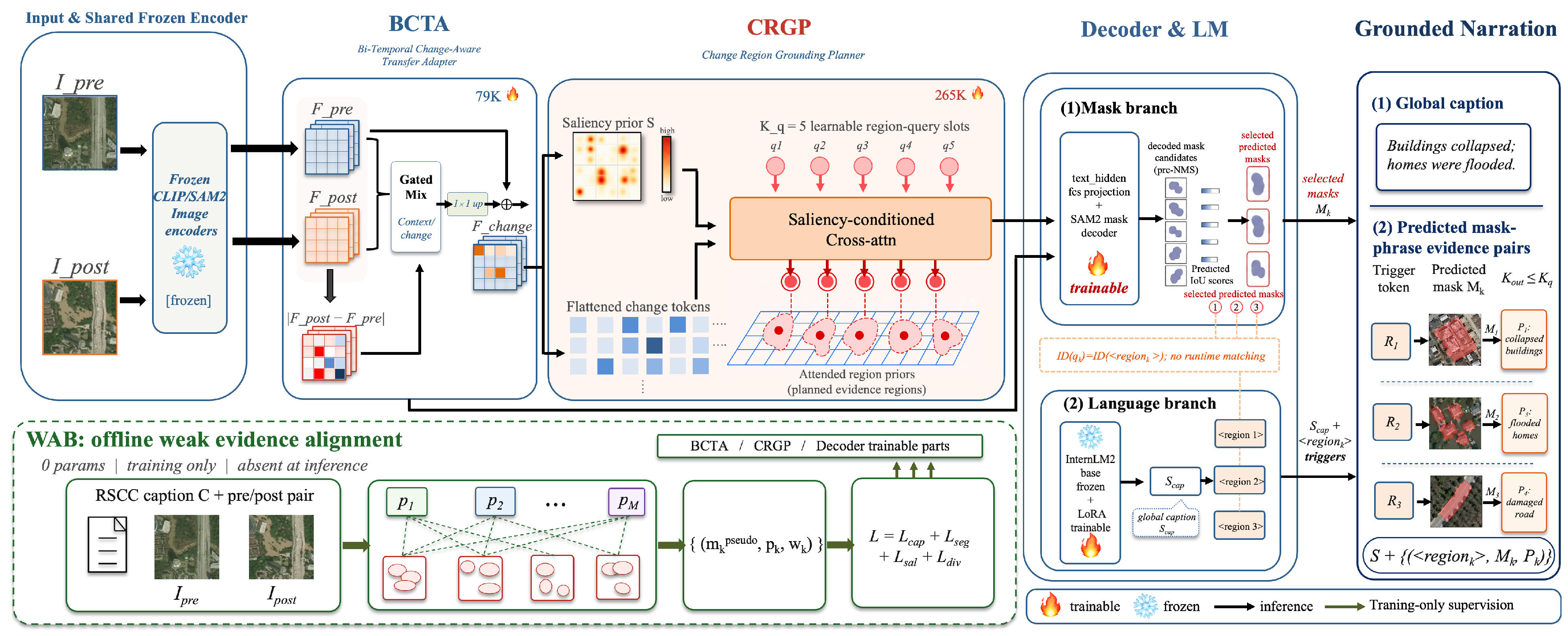
Bi-temporal grounded change narration requires the model to produce not only a complete global description but also pixel-level evidence that supports that description. To meet this requirement, ChangePixel is built on a frozen single-image grounding backbone and adapts it to bi-temporal inputs with only three lightweight modules, each addressing a specific capability gap. The backbone provides strong single-image grounding but has no temporal reasoning—BCTA injects change-aware features from the pre-event and post-event images. The resulting change-aware features enable narration but provide no spatial evidence plan—CRGP organizes the regions that should be explicitly grounded prior to caption generation. Finally, the region planner requires phrase-to-region supervision that does not exist in caption-only datasets—WAB converts released captions into weak region-level labels without new manual annotation. Through this design, ChangePixel turns change representation, region planning, and language generation into a single workflow. Figure 1 summarizes the overall pipeline; the backbone component budget is reported in Table 1, and the rest of this section introduces the task formulation, backbone, three modules, and joint training objective in order.

3.1. Problem Formulation

The task of grounded change narration is formalized as follows. Given a pre-event and post-event image pair ( I 1 , I 2 ) and a task prompt T, the model must jointly produce a global change caption S, K pixel-level changed-region masks { M k } , and K corresponding local change phrases { P k } , yielding a structured evidence chain that couples narrative, spatial evidence, and local explanation, compactly expressed as f θ : ( I 1 , I 2 , T ) ( S , { M k , P k } k = 1 K ) . Throughout this paper, the term evidence refers specifically to the pixel-level region masks paired with local change phrases—the spatial output that traces each narrative claim back to a concrete image region. Compared with the original single-image grounding interface of GeoPixel [6], this upgraded task must align one global description with multiple region-level explanations across time, recovering localized change evidence from a bi-temporal pair while training signals remain at the caption level and manual region labels are absent. We study this upgrade under a single pretrained grounding backbone, preserving the practical constraint that dense disaster-region annotation is prohibitively expensive.
The central design principle of ChangePixel is that pre-planning which regions deserve grounding ahead of narration produces more interpretable change understanding than directly generating a global description. Related grounded narration paradigms in natural imagery support this premise, showing that explicit region grounding improves interpretability and may also benefit generation quality [14,17]. To operationalize this hypothesis, ChangePixel introduces three lightweight modules that address complementary capability gaps: BCTA makes single-image features aware of bi-temporal change, CRGP plans which changed regions deserve explicit grounding before narration, and WAB constructs phrase-to-region supervision from existing captions without manual annotation. Unless otherwise noted, we use K q = 5 for the number of CRGP learnable queries (the query capacity), K pseudo for the per-sample number of WAB pseudo pairs used as training supervision, and  K out for the number of queries that survive NMS at inference (typically 3–5); when we write K without subscript, it refers to the nominal task-level output count K q , with  K pseudo K q and K out K q .

3.2. GeoPixel Backbone

ChangePixel is instantiated on top of GeoPixel [6], a pixel-level grounding vision–language model for remote sensing that combines a vision–language backbone, a text-to-mask projection layer, and a SAM2-based segmentation branch [13]. In our setting, the visual encoders remain frozen, LoRA [18] adapts the language backbone, and the inherited text-to-mask projection and mask decoder remain trainable alongside the new ChangePixel modules; Table 1 summarizes this split. The visual interface passed to the grounding branch consists of one image embedding of shape B × 256 × 64 × 64 together with two high-resolution features projected to 32 and 64 channels for mask refinement. Hereafter, we refer to the pretrained model simply as the backbone. Although the backbone already provides strong single-image pixel grounding, it still processes the two temporal observations independently, leaving temporal reasoning to be introduced by the method described next.

3.3. Bi-Temporal Change-Aware Transfer Adapter (BCTA)

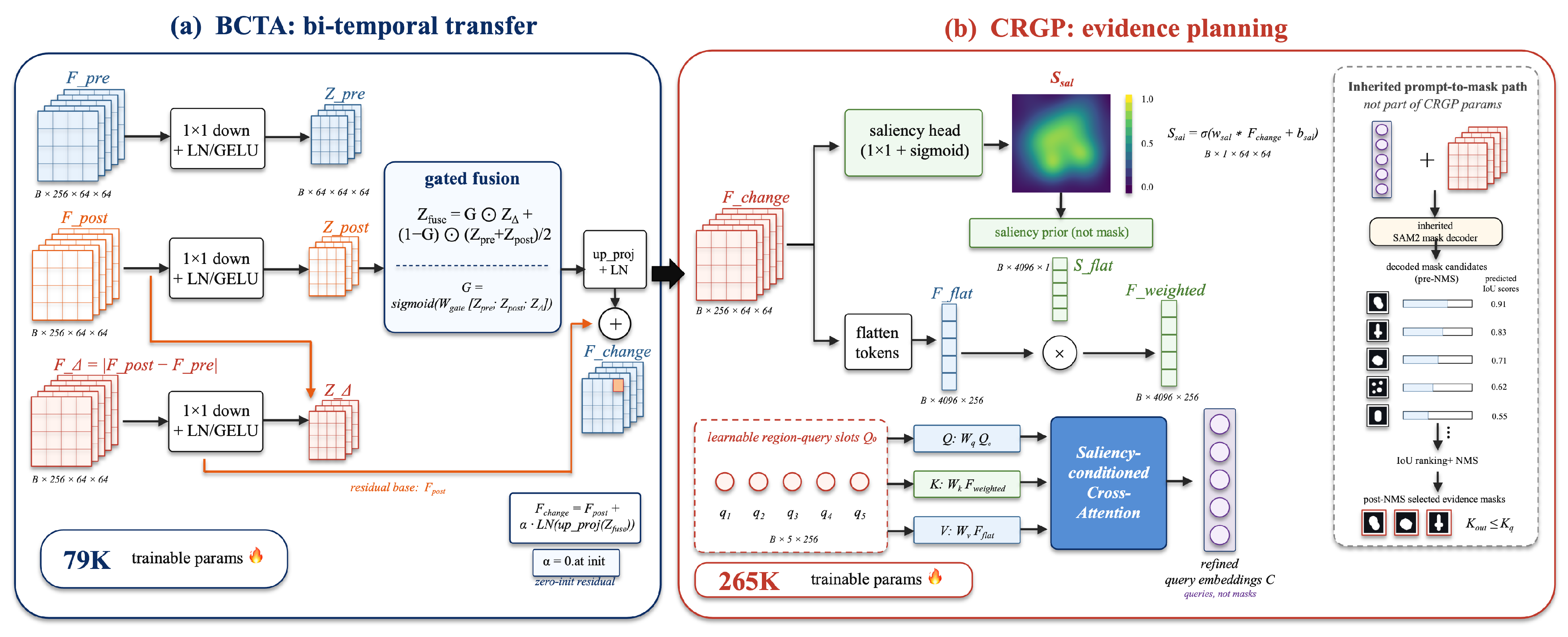
The backbone encodes the pre-event and post-event images independently, yielding spatially rich features for each snapshot but no direct representation of their temporal divergence. Yet for grounded change narration, the semantics of interest—damage, destruction, flooding—emerge precisely from the contrast between the two observations, not from either image alone. BCTA turns paired image embeddings into change-aware features through a lightweight bottleneck-gated fusion over the pre-event feature, the post-event feature, and their absolute difference. The design remains intentionally small ( d b = 64 ) and uses a zero-initialized residual so that training begins from the pretrained grounding prior and gradually learns to inject change evidence rather than disturbing it abruptly.
Formally, let F pre , F post R B × d s × H s × W s ( d s = 256 , H s = W s = 64 ) denote the encoder outputs for the two temporal images. BCTA first computes an absolute difference feature F Δ = | F post F pre | as an explicit change signal, then projects all three features into a shared bottleneck dimension d b = 64 through three independent 1 × 1 convolutions:
Z pre = GELU ( LN ( ϕ down ( F pre ) ) ) , Z post = GELU ( LN ( ψ down ( F post ) ) ) , Z Δ = GELU ( LN ( δ down ( F Δ ) ) ) .
The three independent projections in Equation (1) are used rather than shared weights because the three inputs carry distinct semantics: F pre and F post encode per-timepoint scene context, whereas F Δ encodes temporal change magnitude. A sigmoid gate then determines, at each spatial location, the mixing ratio between the change signal and the temporal context:
G = σ W gate [ Z pre ; Z post ; Z Δ ] , Z fuse = G Z Δ + ( 1 G ) Z pre + Z post 2
where the gate G in Equation (2) satisfies G 1 in strongly changed areas so that difference features dominate, while G 0 in unchanged areas so the output falls back to the temporal mean. The fused representation is then projected back to the original dimension and injected via a zero-initialized residual:
F change = F post + α · LN ( up _ proj ( Z fuse ) )
where the scalar α in Equation (3) is learnable and initialized to zero, guaranteeing that F change = F post at the start of training (identity mapping). For the high-resolution features used in mask refinement, we apply a parameter-free temporal average H change ( i ) = ( H pre ( i ) + H post ( i ) ) / 2 , since these features primarily encode boundary and texture details rather than semantic change, and the mask decoder’s internal cross-attention already fuses them with the change-aware F change . BCTA therefore initially preserves the pretrained grounding pathway while gradually enriching it with change-aware semantics. The entire module adds only 79 K parameters (0.001% of the backbone).

3.4. Change Region Grounding Planner (CRGP)

In the backbone’s inherited prompt-to-mask pathway [6], localization is coupled to generated grounding prompts rather than planned as an explicit pre-narration region set. For change narration, this order is brittle: without an explicit evidence plan, the model may over-commit to visually salient but irrelevant regions or overlook subtle yet consequential changes. CRGP serves as an evidence planner rather than a detector or proposal generator. Operating on the change-aware features produced by BCTA, it uses K q = 5 learnable queries to identify the regions most worth explaining before the caption unfolds, so that narration is conditioned on pre-organized evidence rather than retrofitted to it. Unlike SAGE-CC, which relies on SAM-guided changed region mining with separate matching and graph reasoning modules, CRGP keeps region planning inside the single-backbone pipeline and adopts a DETR-style learnable-query mechanism with only 265 K additional parameters [9,19]. CRGP realizes this idea through four lightweight steps. First, CRGP predicts a change saliency map
S sal = σ w sal F change + b sal R B × 1 × 64 × 64 ,
where the saliency map S sal in Equation (4) does not serve as the final mask, but instead provides a spatial prior indicating where region planning should focus. Second, CRGP introduces a fixed set of K q = 5 learnable queries Q 0 = { q 1 , , q K q } , q k R 256 , allowing different queries to gradually acquire stable attention patterns over different change types or locations. The complementarity among queries is encouraged through competitive specialization: the diversity loss provides a repulsive force preventing collapse, while saliency-conditioned cross-attention pulls each query toward informative regions, jointly encouraging queries to cover different subsets of the change evidence rather than redundantly cover the same area. The later loss-weight sensitivity analysis is consistent with this balance: over-weighting diversity scatters queries away from genuine changes and degrades performance, indicating the default weight keeps queries both dispersed and anchored to salient change regions. Third, to ground these queries in the current scene, F change is flattened into L = 4096 spatial tokens and combined with the saliency prior through
F flat = flatten ( F change ) , F weighted = F flat ( S sal ) flat ,
where Equation (5) weights spatial tokens by the saliency prior; this is followed by a single saliency-conditioned cross-attention layer:
C = LN Q 0 + CrossAttn ( W q Q 0 , W k F weighted , W v F flat ) R B × K q × 256 .
In Equation (6) saliency modulates only the keys, while the values retain the full semantic content of F change ; this encourages the model to look preferentially at changed regions without discarding the information needed to decide what has changed. The resulting refined queries are then handed to the backbone’s existing prompt-to-mask decoding path to produce one region mask and its IoU confidence score, after which inference keeps informative and non-redundant regions via IoU ranking followed by non-maximum suppression [20]. Figure 2 summarizes how BCTA and CRGP together convert paired observations into refined region-query embeddings, which are then decoded into candidate regions by the inherited prompt-to-mask path. Altogether, CRGP adds only 265,217 parameters while converting dense bi-temporal change features into a small set of interpretable region-query representations that can directly support phrase-level narration. With region planning in place, the remaining challenge is how to obtain the corresponding ( mask , phrase ) supervision without manual grounding labels, which motivates WAB.

3.5. Weak Evidence Alignment Bridge (WAB)

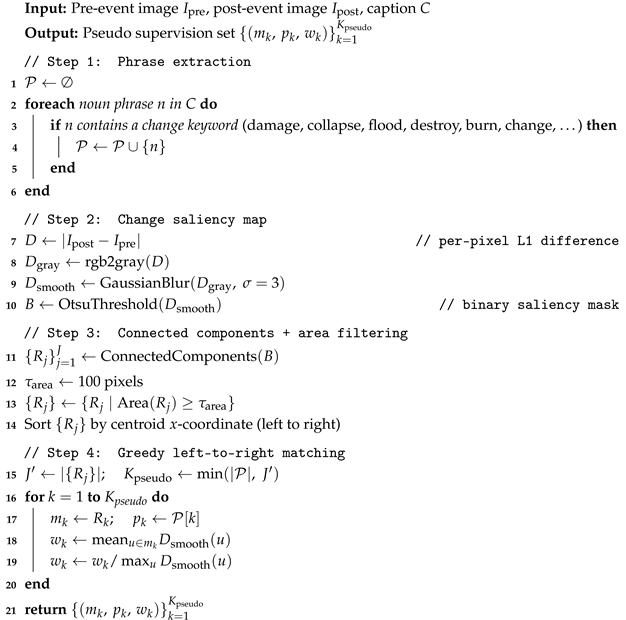
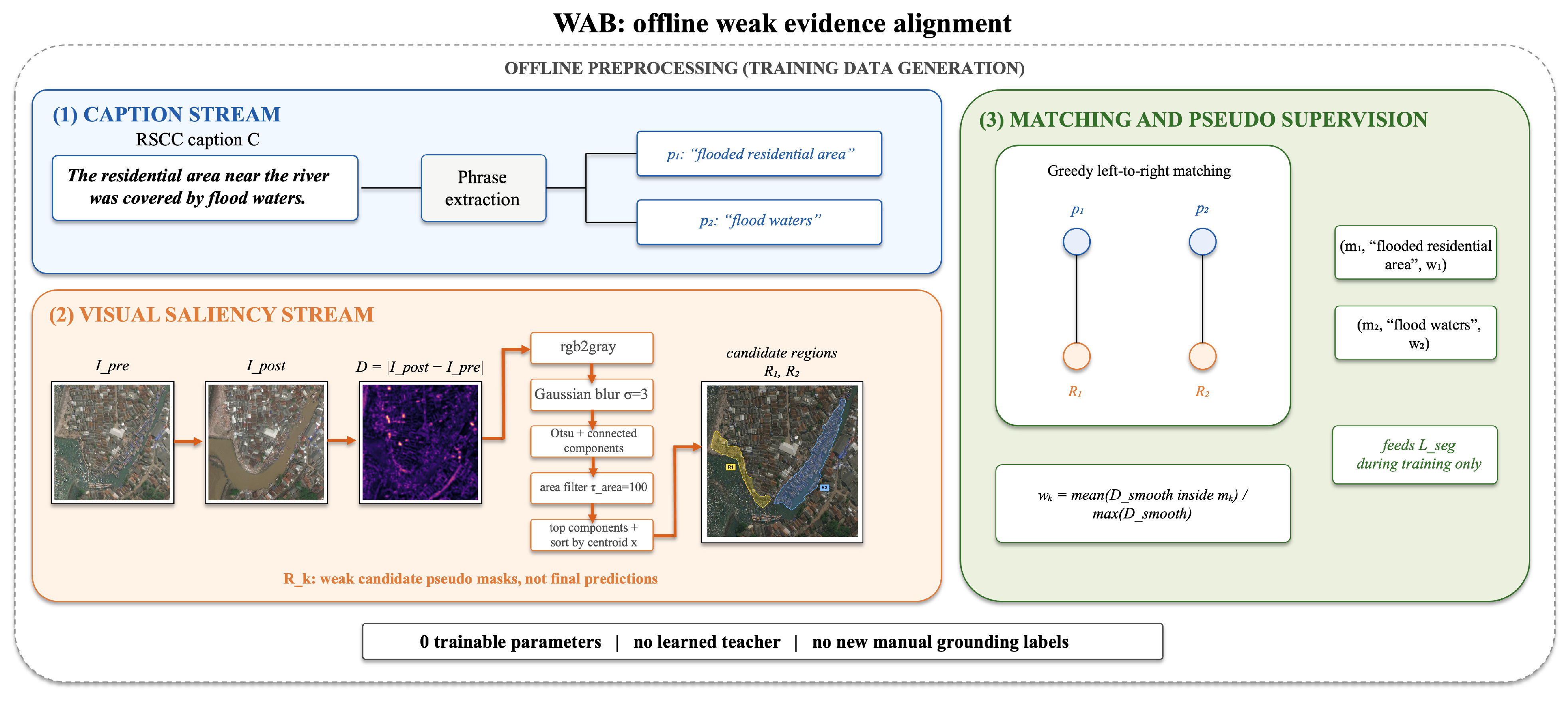
CRGP provides a mechanism for planning which regions deserve explanation, but training requires one more ingredient: knowing which local change phrase should align with which region. RSCC [1], however, provides only image-level change captions and contains no manual phrase-to-region grounding labels. Constructing manual phrase-to-region supervision for the RSCC corpus would be prohibitively expensive and would violate our no-new-label constraint. WAB addresses this by converting the local change descriptions already implicit in the caption into region-aligned training signals through an offline, zero-parameter rule-based pipeline applied to the RSCC training split. The goal is not to produce perfect pseudo labels but to establish a supervision interface that is usable, controllable, and interpretable under the available data regime. WAB deliberately avoids additional learned teachers or external mining models; although the resulting ( mask , phrase ) pairs are inevitably noisy, they remain adequate for training as long as their residual uncertainty is handled explicitly in the objective. In our setting, WAB is instantiated as a caption-to-region weak alignment pipeline over RSCC, converting image-level caption supervision into region-level training signals for grounded narration. The pipeline runs two non-learned streams in parallel and then matches their outputs.
Caption stream: For each bi-temporal sample, WAB extracts the local phrases that explicitly describe changes from the released caption, rather than using the whole sentence as supervision. These phrases typically refer to localized damage phenomena—collapsed buildings, flooded roads, damaged facilities—and therefore are closer to the region phrases that the model is expected to produce. Specifically, a noun phrase is retained as a change phrase if it contains any token from a disaster-domain keyword list (damage, collapse, flood, destroy, burn, change, …; the keyword list used in Algorithm 1), and the cases where the number of extracted phrases differs from the number of candidate regions are handled by K pseudo = min ( | P | , J ) with the boundary behavior detailed in Section 3.7.
Visual saliency stream: In parallel, WAB derives candidate change regions from the imagery. A coarse change saliency map is computed from the pixel-wise L1 difference between the pre-event and post-event images, converted to grayscale, and smoothed with a Gaussian filter ( σ = 3 ); an Otsu threshold [21] then binarizes the smoothed map, and connected-component extraction recovers candidate region masks. Small blobs whose area falls below τ area = 100 pixels are discarded to remove residual noise, and the remaining candidate regions are sorted from left to right by centroid x-coordinate—a canonical ordering consistent with how RSCC captions typically describe local changes. We treat σ and τ area as resolution-matched pre-processing defaults for the 504 × 504 image size rather than free hyperparameters (they are not learned or dev-tuned, and should be re-set per image resolution); the model-level hyperparameters ( K q , NMS threshold, loss weights) are studied via the sensitivity analyses in Section 4.6.
Greedy matching and confidence weighting: A simple greedy matcher aligns the change phrases, in caption order, with the remaining candidate regions; on RSCC, this left-to-right heuristic is often usable, because the released captions tend to mention the main local changes in roughly the order they appear. The number of pseudo pairs is set to K pseudo = min ( | P | , J ) : when fewer phrases than regions are available, unmatched candidate regions are ignored, and when fewer regions than phrases are available, unmatched phrases are skipped because no visual support is available. The pipeline outputs a set of pseudo ( mask , phrase , confidence ) triples, where the confidence w k [ 0 , 1 ] is the normalized mean smoothed-difference intensity inside each region (i.e. the region’s mean D smooth value divided by the global maximum) and is later used to down-weight unreliable pairs during training. WAB does not assume that these alignments are exact; rather, it exploits the fact that RSCC provides both semantically rich local change descriptions and visually salient disaster changes, which together offer a practical basis for zero-parameter weak supervision. Figure 3 summarizes this weak alignment process, and Algorithm 1 details the complete procedure. Once these pseudo pairs are constructed offline, training reduces to jointly optimizing caption generation and region grounding under a unified objective.
Algorithm 1: WAB: Weak Evidence Alignment Bridge
Remotesensing 18 02480 i001
The empirical quality of these pseudo pairs is reported separately in Section 4.5.3.

3.6. Training Objectives

With pseudo ( mask , phrase ) pairs constructed by WAB, training can be formulated as a single joint objective rather than two disconnected optimization problems for captioning and grounding:
L = λ cap L cap + λ seg L seg + λ sal L sal + λ div L div .
The first two terms in Equation (7) provide the primary learning signal, ensuring that the model learns both to describe the change faithfully and to anchor local phrases to spatial evidence. Caption generation remains supervised by the standard autoregressive cross-entropy loss
L cap = 1 T t = 1 T log p θ ( y t y < t , V pre , V post ) ,
which preserves the backbone’s original language modeling behavior while encouraging a complete and coherent global change description under bi-temporal visual conditioning. During training, the target token sequence y 1 : T is constructed by inserting the trigger token <region_k> immediately before the k-th WAB pseudo phrase p k (for k = 1 , , K pseudo , in caption order); this augmented caption reuses the same cross-entropy form as Equation (8) but embeds the phrase-to-query binding directly into the language signal, so that L cap supervises both the content of each local phrase and the query index at which it should be emitted. No separate phrase-alignment loss is required: the index binding is learned implicitly through the position of <region_k> in the target caption, and consumed at inference as described in Section 3.7. Region grounding, in turn, is trained from WAB’s pseudo masks using the same segmentation objective family as the backbone:
L seg = 1 K pseudo k = 1 K pseudo w k 2.0 · L BCE ( m ^ k , m k pseudo ) + 0.5 · L Dice ( m ^ k , m k pseudo ) ,
where m ^ k is the predicted mask logit (pre-sigmoid) for the k-th region query, m k pseudo is the corresponding pseudo mask, and  w k [ 0 , 1 ] is the pseudo-confidence supplied by WAB. The BCE term operates on raw logits for numerical stability, while the Dice term internally applies σ ( m ^ k ) to obtain probabilities. This confidence-aware weighting is important because the weak alignments are useful but imperfect: reliable pairs should shape the grounding behavior strongly, while noisier pairs should contribute more cautiously. Together, L cap and L seg form the main supervision path of ChangePixel, coupling language quality with region-level evidence learning under a shared objective. Two auxiliary terms further stabilize this learning process. First, the change saliency map in CRGP does not receive direct pixel-level supervision, so we use the union of WAB’s pseudo masks, downsampled to the saliency resolution, as a coarse target:
S sal pseudo = MaxPool 64 × 64 k = 1 K pseudo m k pseudo , L sal = L BCE ( S sal , S sal pseudo ) ,
where Equation (10) guides CRGP toward regions that are likely to contain change without requiring it to match precise boundaries. Unlike L seg , which operates on individual pseudo pairs and uses per-pair confidence w k , L sal targets the union of all pseudo masks and therefore does not require per-pair confidence weighting; the union target is inherently more robust as it only requires coarse spatial coverage rather than precise per-region alignment. Second, to prevent multiple region queries from collapsing onto the same high-response area, we introduce a diversity regularizer
L div = 2 K q ( K q 1 ) i < j IoU σ ( m ^ i ) , σ ( m ^ j ) ,
which penalizes overlap among predicted regions and encourages different queries to capture complementary evidence. Since both σ ( m ^ i ) and σ ( m ^ j ) are continuous outputs of the sigmoid function, gradients flow through the soft IoU computation, enabling end-to-end training of the diversity objective. We set λ cap = 1.0 , λ seg = 1.0 , λ sal = 0.5 , and  λ div = 0.1 : the first two remain the dominant supervision terms, L sal is down-weighted because it relies on coarse pseudo labels, and  L div is kept small so that it regularizes query behavior without overwhelming the main objectives. Together, these four terms balance global narration, region grounding, coarse saliency guidance, and non-redundant region allocation.

3.7. Implementation Summary

ChangePixel upgrades image-level change captioning into grounded change narration with only a minimal increase in trainable capacity. Beyond the components inherited from the backbone, the only newly introduced parameters come from BCTA and CRGP, as specified in Table 1; WAB, as an offline weak-supervision bridge, introduces no trainable parameters and does not participate in inference. At test time, the model first encodes the pre-event and post-event images, forms change-aware features through BCTA, and then uses CRGP to produce a small set of region queries. These queries are decoded into candidate change regions, which are filtered by IoU ranking and NMS to obtain a compact set of non-redundant spatial evidence. Conditioned on this region evidence, the language model generates a global change description autoregressively; when a grounding trigger token is emitted during generation, the corresponding region mask is produced by the mask decoder in parallel with the local phrase, so region evidence is interleaved with narration in a single decoding pass.
Query-Index Binding: The association between a region mask and its local phrase is established through a shared query index rather than runtime matching. CRGP produces K q = 5 refined queries { q k } k = 1 K q , each assigned a fixed index k, and { < region _ 1 > , , < region _ 5 > } are registered as reserved special tokens in the InternLM2 tokenizer with randomly initialized embeddings updated via L cap . After IoU ranking and NMS, the surviving subset of queries (typically 3–5) enters the decoding stage under their original indices, so a trigger such as <region_2> refers to query q 2 even if q 1 was suppressed. When the language model emits <region_k> for a surviving query q k , two parallel operations fire: (i) the mask decoder maps q k to a pixel-level region mask M k ; (ii) the language head continues generating tokens until the next trigger or end token, yielding the local phrase P k . Because both outputs derive from the same query index, no post hoc alignment is needed—the mask–phrase pairing is deterministic by construction. This deterministic indexing prevents runtime swaps between independently produced masks and phrases, but it does not by itself guarantee semantic correctness: a query trained from noisy pseudo pairs may still emit a phrase that is consistently wrong for its own mask. During training, WAB constructs K pseudo pseudo pairs per sample via greedy left-to-right matching (Algorithm 1); although K pseudo varies per sample and its matching is spatial rather than structural, the segmentation loss (Equation (9)) indexes pseudo pairs in the same positional order, so the training signal is compatible with CRGP’s fixed-index convention. When K pseudo < K q , only the first K pseudo queries receive grounding supervision through L seg while the remaining queries are still regularized by L div (Equation (11)); when K pseudo > K q , WAB retains only the first K q pairs in caption order.
The final output is composed of one global caption and up to K out surviving region-mask/phrase pairs. This output structure is evaluated later through complementary caption metrics, evidence metrics, and grounded narration examples, so the method is assessed along both descriptive quality and evidence quality rather than captioning alone.

4. Experiments

4.1. Datasets

To comprehensively assess ChangePixel along both descriptive quality and evidence quality, we construct a layered evaluation framework spanning three complementary datasets (Table 2). The first layer is the RSCC dataset [1], which contains 62,351 bi-temporal image pairs covering diverse natural disasters including floods, earthquakes, wildfires, and hurricanes. We adopt the officially released RSCC-Subset (988 pairs) as our primary evaluation set and use the remaining released RSCC pairs as the caption-learning source. An important caveat: the reference captions in RSCC-Subset are generated by strong vision–language models rather than manually annotated, so caption-quality metrics may reflect stylistic alignment with VLM-generated text rather than factual accuracy of change descriptions. The second layer is the LEVIR-CC dataset [2], comprising 10,077 bi-temporal urban-change image pairs, each accompanied by five human-written change descriptions. As the most widely adopted benchmark in remote sensing change captioning, LEVIR-CC serves as a cross-domain caption transfer probe in our setting: since ChangePixel is trained exclusively on RSCC, its performance on LEVIR-CC reflects generalization to unseen urban-change scenarios under zero-shot transfer. The third layer is LEVIR-MCI [22], built upon the same LEVIR image collection but augmented with three-class semantic change mask annotations (background, road, and building). This dataset enables quantitative evaluation of the spatial evidence produced by ChangePixel. We emphasize that the LEVIR-MCI masks represent semantic change detection labels rather than per-phrase grounding annotations; they are therefore used to assess evidence localization quality, not phrase-level alignment accuracy. Together, RSCC anchors disaster-domain caption evaluation, LEVIR-CC tests urban-domain caption transfer, and LEVIR-MCI adds quantitative evidence evaluation through semantic change masks, forming a complete assessment framework spanning from description to evidence and from disaster to urban domains.

4.2. Implementation Details

ChangePixel builds upon GeoPixel-7B [6], which employs InternLM2-7B as the language backbone and SAM2 [13] as the visual encoder and mask decoder. To adapt the pretrained model for bi-temporal grounded change narration while preserving its original capabilities, we inject LoRA adapters [18] into InternLM2 with rank r = 8 and scaling factor α = 16 . The LoRA configuration and initial weights are inherited from the pretrained GeoPixel checkpoint, preserving the backbone’s grounding capability as a starting point for bi-temporal adaptation. The higher learning rate for LoRA adapters compensates for their constrained parameter space, while pretrained projection layers and the mask decoder receive a lower rate to preserve learned representations. The following components are set as trainable: the LoRA weights (∼4.2 M parameters), the text-to-hidden projection layers (∼17.8 M), the SAM mask decoder (∼4.1 M), BCTA (79 K), and CRGP (265 K). All remaining parameters are frozen; Table 3 summarizes the parameter budget. Training uses the released RSCC pairs outside RSCC-Subset as the caption learning source, together with pseudo ( m a s k , p h r a s e , c o n f i d e n c e ) triples generated offline by WAB as evidence supervision signals. Evaluation is conducted on three benchmarks: RSCC-Subset (988 pairs) for the primary disaster-domain assessment, the LEVIR-CC test split, and the LEVIR-MCI test split for zero-shot evaluation. The model is never trained on any LEVIR data. At inference, we set the CRGP query capacity to K q = 5 (i.e., bare K = 5 in the notation of Section 3.1), selected via sensitivity analysis as the best trade-off between caption quality and evidence completeness; the resulting K q candidate masks are then filtered by IoU ranking and non-maximum suppression (NMS threshold = 0.5 ) down to the post-NMS surviving set K out (typically 3–5 regions) used as the final non-overlapping evidence. We optimize all trainable parameters with AdamW ( β 1 = 0.9 , β 2 = 0.999 , weight decay 0.01 ), using a two-group learning-rate scheme: LoRA adapters receive a peak rate of 2 × 10 4 while all other trainable modules (projection layers, mask decoder, BCTA, CRGP) share a peak rate of 2 × 10 5 . The schedule linearly warms up over the first 3% of training steps and then follows cosine decay to zero. Each temporal image is resized to 504 × 504 pixels. Training runs for 3 epochs on 4 × A100-80G GPUs with per-device batch size 2 and gradient accumulation over 8 steps (effective batch size 64) and under bf16 mixed precision. Random horizontal and vertical flips are applied as data augmentation. The full training completes in approximately 18 h.

4.3. Evaluation Metrics

We adopt dataset-specific metric protocols to respect each benchmark’s official evaluation standards as the nature of reference annotations differs across datasets. For RSCC, we follow the benchmark’s released evaluation suite [1] and report four caption-quality metrics: ROUGE [23] and METEOR [24] for lexical overlap, and BERTScore [25] and Sentence-T5 Semantic Cosine Similarity (ST5-SCS) [26] for semantic consistency. Since the RSCC references are model-generated rather than human-written, embedding-based metrics (BERTScore, ST5-SCS) provide a useful complement to n-gram statistics. We further note that this property is benchmark-level and affects all methods evaluated on RSCC equally; it does not assess factual correctness of change descriptions, and is discussed in detail in Section 5.4. We note that BERTScore exhibits near-ceiling saturation on RSCC (all methods fall within the narrow range 99.0–99.6), limiting its discriminative power; ST5-SCS provides a more informative semantic comparison on this benchmark. For LEVIR-CC, we follow the standard change captioning protocol [2] and report BLEU-4 [27], METEOR [24], ROUGE_L [23], and CIDEr-D [28]—the canonical metrics established by prior work on this benchmark, where references are human-written and CIDEr-D is the primary ranking metric. Evidence quality is evaluated on two complementary levels. On LEVIR-MCI [22], we compute Change mIoU (primary) and Binary Change F1 (supplementary) to measure how well the predicted change-region masks align with the three-class semantic change ground truth. For ChangePixel and its ablation variants, the union of all K predicted region masks is taken as the binary change prediction and compared against the union of non-background classes (road ∪ building) in the LEVIR-MCI ground truth. Change mIoU is then computed as the mean IoU over the background and changed classes after this binary conversion. For supervised binary change detection baselines that produce only a change/no-change mask, the positive prediction is compared against the same union and evaluated with the same binary mIoU protocol. On RSCC, where no pixel-level annotations exist, we report two auxiliary reference metrics: Pseudo-GT IoU (overlap between CRGP output masks and WAB pseudo-label masks) and PD-Overlap (overlap with pixel-difference maps). Pseudo-GT IoU measures overlap with the WAB pseudo-label reference; for WAB-supervised variants, it is an internal-consistency metric, while for variants not trained with WAB, it should be read only as a proxy reference overlap rather than absolute localization accuracy. PD-Overlap, by contrast, compares against raw pixel differences that are independent of WAB. Both metrics serve as proxy indicators and should be interpreted alongside the independent LEVIR-MCI evaluation. We therefore distinguish three levels of interpretation: Pseudo-GT IoU measures consistency with or overlap against the WAB pseudo-label reference, PD-Overlap measures agreement with raw pixel differences, and Change mIoU—computed against the independent three-class LEVIR-MCI ground truth on which the model was never trained—is the only metric here benchmarked against externally held-out annotations, and thus the primary indicator of localization accuracy. All four evidence-related metrics (Change mIoU, Binary F1, Pseudo-GT IoU, PD-Overlap), together with the deterministic Pixel-Diff baseline used as an evidence-quality floor, are reported jointly in the ablation study. Finally, region phrase quality is assessed qualitatively through the grounded narration examples in Figure 4 and Figure 5 rather than through a standalone automatic metric, and Change mIoU evaluates semantic change localization rather than per-phrase grounding accuracy—a distinction important for interpreting the evidence-evaluation results.
Putting these metric protocols together, we organize the results into three reporting tiers: primary disaster-domain caption results on RSCC-Subset, zero-shot cross-domain caption transfer on LEVIR-CC, and a structural ablation combining caption and evidence metrics. Caption-quality and evidence-quality results are reported in separate tables rather than conflated into a single ranking.

4.4. Baselines

We organize comparison methods into five groups according to their task awareness and training domain, reporting results in two separate caption tables (RSCC and LEVIR-CC) with a dedicated evidence analysis layer on LEVIR-MCI. Table 4 summarizes the group definitions and where each group appears across the result tables; the per-group descriptions below provide motivation and implementation details for each row.
(1)
Group A (general VLMs) contains Qwen2-VL-7B [29], InternVL3-8B [30], and Pixtral-12B [31], all evaluated under textual-prompt zero-shot inference on both RSCC and LEVIR-CC. These strong general-purpose baselines establish the caption quality achievable without any change-specific training.
(2)
Group A’ (specialized change captioning) covers CCExpert-7B [4] and TEOChat-7B [5], both trained on domain-specific change captioning datasets. While these models report strong caption quality within their training domains, they may exhibit substantial degradation when transferred to RSCC’s disaster imagery.
(3)
Group B (learned RSCC baseline) consists of RSCCM [1], a Qwen2.5-VL-7B model fine-tuned directly on RSCC. This model serves as a strong caption-only reference on the RSCC benchmark and appears only in the RSCC table; it produces no evidence output.
(4)
Group C/C’ groups direct competitors and classic methods. ChangeChat [8] is evaluated on RSCC under zero-shot transfer and on LEVIR-CC with its native training domain. RSICCformer [2], Chg2Cap [3], and Change-Agent [22] serve as established LEVIR-CC baselines. SAGE-CC [9] and BTCChat [10] are discussed qualitatively in the competitor comparison (Section 4.5.2) rather than included in the main tables because, as of our experiments, public code was unavailable for consistent reproduction.
(5)
Group D (structural ablation) comprises four variants: GeoPixel naive (LoRA-tuned backbone without BCTA, CRGP, or WAB), +BCTA, +BCTA+CRGP, and ChangePixel full. These variants isolate each module’s contribution. We additionally include a non-learned Pixel-Diff baseline (pixel-difference map → Otsu thresholding → connected-component analysis) as an evidence quality floor, providing a lower-bound reference for the evidence metrics.
(6)
Group E (supervised change detection references) covers FC-Siam-Diff [32] and BIT [33], both trained on LEVIR-CD with full pixel-level supervision. These domain-specific binary change detection methods provide supervised reference points: they produce accurate change masks but no captions, and their scores contextualize the evidence output of ChangePixel—a captioning system whose evidence maps are trained under weak supervision rather than full pixel-level labels. LEVIR-MCI evidence metrics apply only to methods that actually produce pixel-level masks; in the current design, this layer analyzes the Group D variants alongside Group E reference methods rather than every caption baseline. Caption tables carry explicit source tags (reported or ours); the ablation table specifies provenance in its caption. We do not compute direct score differences across different source types.
The RSCC table and the LEVIR-CC table intentionally include different model subsets to respect the structural constraints of each benchmark. Group A general VLMs use reported scores on RSCC because the RSCC benchmark paper [1] already includes their textual-prompt zero-shot results under a consistent protocol; on LEVIR-CC, comparable numbers under our zero-shot prompting protocol are not available, so the same VLMs are rerun (ours) to provide a consistent zero-shot probe. Group B (RSCCM) appears only in the RSCC table because its model weights are not publicly released, preventing LEVIR-CC evaluation. Group C’ in-domain LEVIR-CC references appear only in the LEVIR-CC table because, being trained on LEVIR-style data, they do not provide a meaningful disaster-domain reference for RSCC. Group E supervised detectors appear only in the evidence-metric layer because they produce no captions. Within each table, all rows compared on the same metric column share a consistent evaluation regime.

4.5. Results

This subsection reports the results of the proposed ChangePixel model. We first present the main caption- and evidence-quality results (Section 4.5.1), then a structural comparison with direct region-aware competitors (Section 4.5.2), and finally a qualitative analysis covering both the weak-supervision quality and the grounded narration outputs (Section 4.5.3).

4.5.1. Main Results on RSCC and LEVIR-CC

The ChangePixel model proposed in this study is evaluated against the five baseline groups defined in Section 4.4 on two caption benchmarks: the disaster-domain RSCC-Subset and the urban LEVIR-CC test split, the latter probing zero-shot cross-domain transfer. This subsection reports caption quality on both benchmarks, so that the comparison reflects how ChangePixel performs relative to general-purpose VLMs, specialized change captioning models, and the directly fine-tuned RSCC baseline. Table 5 presents the RSCC-Subset results. A striking pattern is the polarized domain-adaptation gap: specialized change captioning models trained on urban-change data (Group A’) suffer severe degradation on disaster imagery—CCExpert achieves only 8.84 ROUGE, less than half of a general-purpose VLM—suggesting that current specialized models may transfer poorly from urban-change training to disaster imagery. In contrast, general VLMs such as Pixtral (ROUGE 19.87, ST5-SCS 79.07) maintain strong zero-shot caption quality on disaster scenes owing to their broad pretraining knowledge, forming the strongest general-purpose reference in this table. On the caption dimension alone, RSCCM reaches the highest ROUGE and METEOR scores (22.37 and 33.81) through direct fine-tuning on RSCC, yet this advantage is confined to caption-only output—RSCCM produces no region-level evidence whatsoever. The Group D ablation reveals a progressive path from caption to evidence: starting from GeoPixel naive (ROUGE 17.23, no evidence capability), BCTA lifts caption quality to 18.41, CRGP activates evidence output for the first time (Pseudo-GT IoU 0.337), and WAB’s weak supervision further improves evidence quality to 0.518 while continuing to strengthen captioning to ROUGE 19.52. The resulting ChangePixel full reaches caption quality comparable to the strongest general VLM Pixtral, yet it is the only compared method that jointly produces pixel-level region masks and corresponding region phrases in its final output—a complementary interpretability dimension that conventional caption metrics do not capture and that we quantify separately through the later evidence analysis.
For transparency, we also ran ChangeChat [8] zero-shot on the 988 RSCC-Subset test pairs. It produced either an empty string or the single-token reply “change” on 842 samples (85.2%); on the remaining 146 samples, the output was a short template-like sentence that did not describe the depicted disaster scene. The resulting full-subset caption scores were ROUGE 0.87, METEOR 0.63, BERTScore 97.98, and ST5-SCS 14.21. We therefore exclude these degenerate RSCC scores from Table 5 because they are not a meaningful caption-quality signal, and retain ChangeChat only as an in-domain LEVIR-CC reference in Table 6 and as a direct structural competitor in Table 7. We attribute this degeneration to two compounding factors: ChangeChat is instruction-tuned on ChangeChat-87k, which derives from LEVIR-style urban-change data and is therefore out-of-distribution with respect to RSCC disaster imagery, and a prompt-interface mismatch (its change-conversation format differs from the captioning prompt used in our RSCC evaluation). This result should be read as a diagnostic outcome under unadapted zero-shot prompting, not as a definitive capability assessment; a fair capability comparison would require dedicated prompt adaptation that is beyond the scope of this paper. We accordingly use ChangeChat as an in-domain LEVIR-CC reference (Table 6) and a structural competitor (Table 7), not as an RSCC caption baseline—its relevant contrast with ChangePixel is that it does not produce pixel-level masks paired with per-region phrases, not its caption score on a benchmark outside its training domain. Table 6 reports results on LEVIR-CC. ChangePixel is never trained on LEVIR data, so this table measures cross-domain caption generalization rather than in-domain performance, and the in-domain rows (Group A’, C, C’) are listed only as contextual references—they are trained on LEVIR-style data and therefore not directly comparable to the zero-shot rows. Within the zero-shot block, ChangePixel full obtains the highest CIDEr-D (56.82) and BLEU-4 (34.56) among the untrained models, though all zero-shot models fall in the same low-CIDEr regime (Pixtral 51.74, InternVL3 46.18, Qwen2-VL 40.53). Group A general VLMs exhibit the same qualitative pattern of cross-domain degradation, suggesting at the metric level that the steep zero-shot deficit relative to in-domain methods is a shared domain gap among untrained models rather than an artifact specific to ChangePixel’s architecture. This score-level diagnosis does not replace a fine-grained human error taxonomy of cross-domain captions; instead, it bounds the claim we make from the available evidence. The per-module increment pattern largely mirrors that observed on RSCC: BCTA contributes the largest caption gain (CIDEr +6.47), while CRGP and WAB provide further improvements on most metrics, though BLEU-4 dips slightly at the CRGP step (31.25 → 30.87) before recovering with WAB, reflecting the same capacity trade-off noted for RSCC. We therefore avoid ranking zero-shot and in-domain rows as directly comparable methods; the in-domain rows are used only as contextual anchors for the scale of transfer difficulty. This table provides caption-level context for the quantitative evidence analysis on LEVIR-MCI that follows.
Across the two benchmarks, a consistent pattern of cross-domain fragility stands out: specialized change captioning models suffer steep degradation when evaluated outside their training domain—CCExpert drops to ROUGE 8.84 on RSCC disaster imagery despite reaching CIDEr 143.32 on LEVIR-CC, while ChangePixel’s zero-shot CIDEr of 56.82 on LEVIR-CC reflects the symmetric cost of training exclusively on disaster data. The degradation mechanisms differ (task specialization versus domain limitation), yet both indicate that no single caption model dominates across domains. On LEVIR-CC, the deficit is shared by every untrained model rather than specific to one architecture: the 16.29-point spread within the zero-shot block (40.53–56.82 CIDEr) is much smaller than the 86.50–102.79-point gap to the strongest in-domain row (143.32 CIDEr), suggesting a shared zero-shot domain gap at the metric level rather than an architecture-specific collapse. Within each domain, ChangePixel is not the strongest captioner: it trails the directly fine-tuned RSCCM on RSCC and falls well below in-domain methods on LEVIR-CC. Its distinguishing contribution lies in an output dimension that caption metrics cannot capture—pixel-level region masks paired with local change phrases, produced jointly in a single forward pass. Table 5 and Table 6 establish that the caption cost of this additional output is modest on the primary benchmark and predictable under domain shift; accordingly, ChangePixel’s reliable scope is in-domain RSCC captioning, while zero-shot deployment on LEVIR-CC or other change-detection-oriented domains is not recommended without fine-tuning. The remaining question is whether the produced evidence is actually useful. We address this through LEVIR-MCI evidence metrics in the ablation analysis and through qualitative grounded narration examples in Figure 4 and Figure 5.

4.5.2. Comparison with Direct Competitors

The purpose of this subsection is a structural-property comparison rather than a quantitative benchmark; quantitative comparison with ChangeChat appears in Table 6 for the in-domain LEVIR-CC setting and is discussed for RSCC in Section 4.5.1, while SAGE-CC and BTCChat lack publicly released code or pretrained weights at the time of our experiments, precluding consistent reproduction on our evaluation pipeline. Beyond the generic baselines discussed above, three recent methods explicitly target region-aware change captioning—ChangeChat [8], SAGE-CC [9], and BTCChat [10]—and as introduced in Section 2.2, they differ from ChangePixel primarily in output form and architectural strategy rather than in benchmark scores on the same evaluation set; Table 7 compares them along these structural dimensions.
ChangeChat produces localization-style responses alongside captions, but does not produce pixel-level masks paired with per-region change phrases. SAGE-CC uses SAM-guided changed region mining with separate matching and graph-reasoning modules to guide caption generation, yet region-level evidence remains an internal feature—the final output is caption-only, and the multi-component pipeline precludes a single-backbone architecture. BTCChat [10] captures bi-temporal differences via a Change Extraction module in a VILA-family multimodal backbone [34], but its output consists of captions and VQA answers without pixel-level masks or phrase-level regional evidence. The key distinction across these comparisons is not whether region awareness is utilized internally, but whether pixel-level regional evidence—masks paired with corresponding change phrases—is explicitly produced as part of the final output. Among the methods considered, ChangePixel is the only one in our comparison that satisfies this condition, jointly outputting a global caption, K region masks, and K region phrases in a single forward pass.

4.5.3. Qualitative Analysis

We assess output quality qualitatively from two complementary angles: first, the reliability of the WAB pseudo supervision that trains the evidence branch; second, grounded narration examples produced on RSCC test scenes.
(1)
Quality of WAB pseudo supervision.
To assess whether the greedy left-to-right heuristic produces usable alignments, and to characterize the portability of the WAB pipeline across domains, we manually inspected random samples from two datasets: 150 RSCC training image pairs (the disaster domain for which WAB is designed) and 150 LEVIR-CC image pairs (an urban domain, used here only as a portability probe). For LEVIR-CC, apart from using all available reference captions for phrase extraction, the visual stream and matching rule are unchanged; the additional dataset-specific configuration is that the change-keyword lexicon is extended with urban terms (build, remove, demolish, add, …) and applied only when processing LEVIR-CC, while RSCC processing always uses the original disaster-keyword lexicon unchanged. Supplying domain-appropriate vocabulary per dataset leaves the RSCC pseudo-labels (and hence the trained model) identical to the original run. Since LEVIR-CC provides five human-written captions per pair, we aggregate the phrases extracted from all five (with deduplication) before matching to the visual-saliency regions.
Two annotators from our group, both with a remote-sensing background, independently labeled each triple as correct (the phrase unambiguously describes the matched region), partial (the phrase describes a change in an adjacent or overlapping region), or wrong; disagreements were resolved by a third adjudicator. Table 8 reports the results. On RSCC, inter-annotator agreement before adjudication was Cohen’s κ = 0.71 (substantial agreement); after adjudication, 79% of triples were judged correct, 12% partial, and 9% wrong. Errors concentrate in scenes with dense, small change regions—typically closely packed urban structures after an earthquake—where multiple candidate regions compete for a single phrase, whereas scenes dominated by one or two spatially separated changes (e.g., a large flood zone beside intact terrain) are matched more reliably.
On LEVIR-CC, 88% of inspected triples are non-wrong (correct + partial), with inter-annotator agreement remaining substantial ( κ = 0.65 ). We interpret this as evidence that WAB can still provide a potentially useful coarse supervision signal in an urban domain, but not as evidence that all non-wrong pairs are exact phrase-level groundings: the 20% partial category describes adjacent or overlapping changes and is therefore more suitable for coarse spatial supervision than for strict phrase–region correctness. The correct rate drops 11 pp relative to RSCC. This pattern is consistent with weaker caption locality in LEVIR-CC and possible multi-year registration or seasonal artifacts, but this audit does not isolate their relative contributions; the fewer extracted triples per image (1.8 vs. 2.47) also reflects the looser phrase-to-region binding. Pixel-Diff nonetheless retains non-trivial change signal on LEVIR, reaching Change mIoU 18.5 on LEVIR-MCI. Together, these statistics indicate that WAB’s greedy strategy can provide a usable but noisy weak signal under partial domain transfer; the confidence weight w k in L seg further down-weights low-quality pairs at training time. We note that this LEVIR-CC audit characterizes the portability of the rule-based labeler and is complementary to, not a substitute for, the zero-shot LEVIR model evaluation in Table 6 and the later ablation study.
(2)
Grounded narration examples.
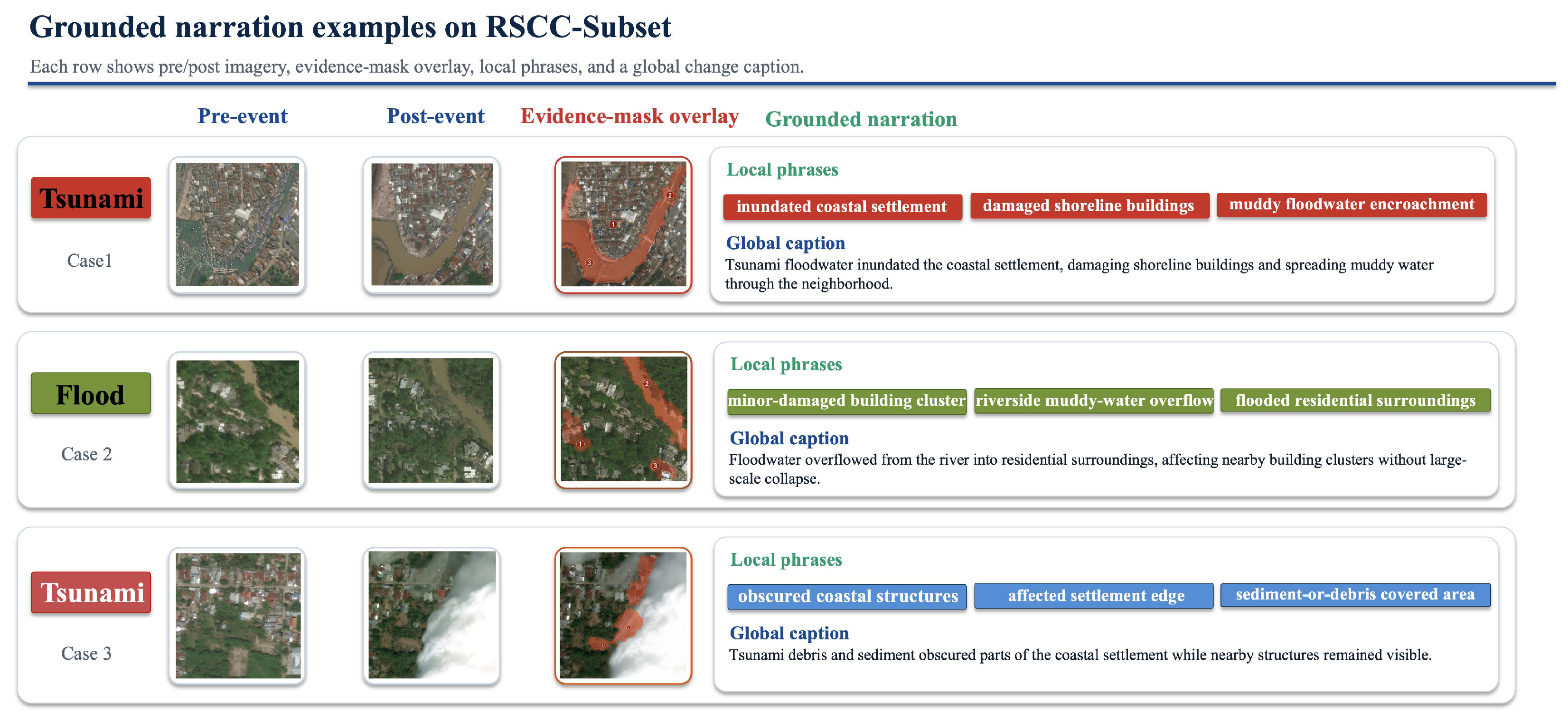
Figure 4 presents grounded narration examples on RSCC-Subset across tsunami- and flood-related disaster scenes. Each case displays the pre-event and post-event images, an evidence-mask overlay, the corresponding region phrases, and the global change caption. The figure illustrates how ChangePixel associates distinct local phrases with spatially coherent regions, forming an evidence chain that traces semantic components of the global caption back to concrete image areas.
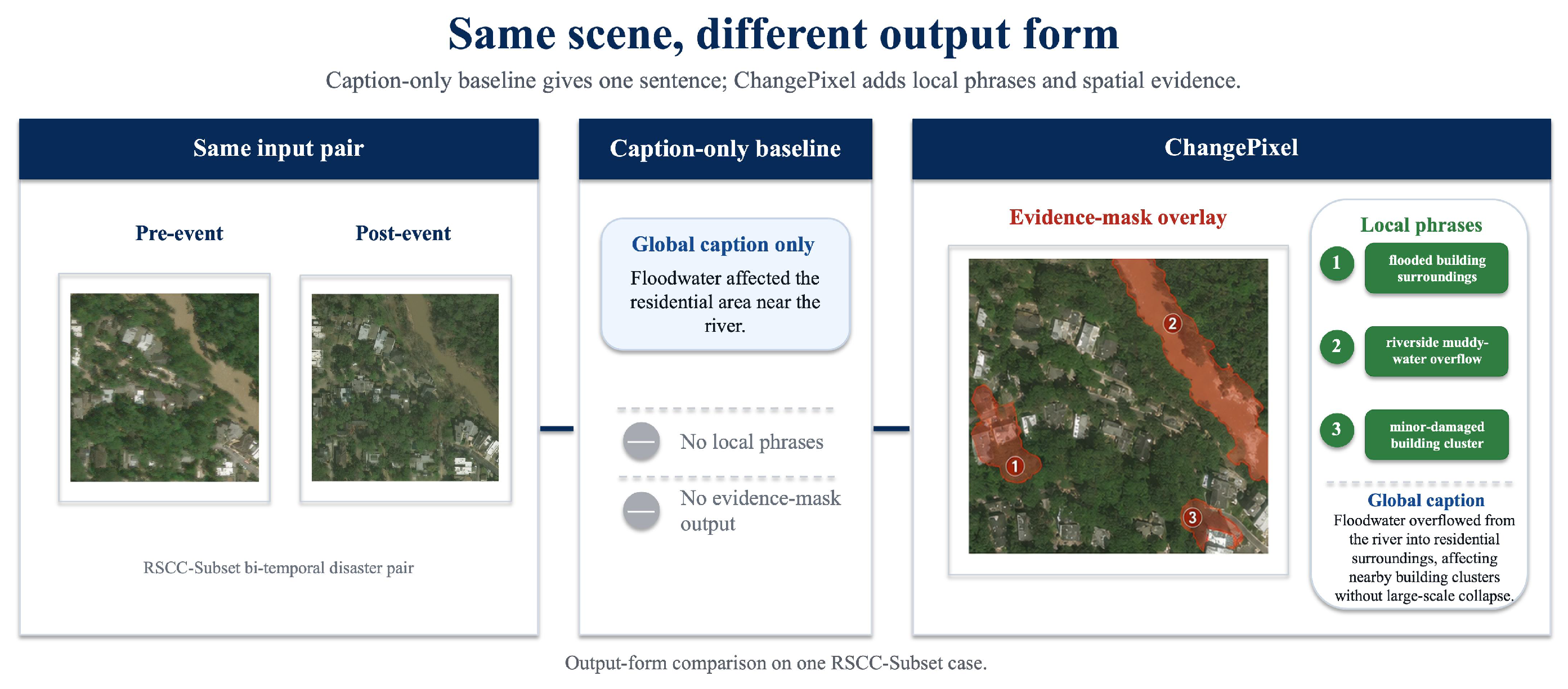
Figure 5 provides a side-by-side output-form comparison with caption-only baselines. For the same scene, the caption-only baseline card represents the output type of methods that produce a single global sentence, whereas ChangePixel, additionally, outputs region masks and paired phrases—spatial evidence that, among the caption-only baselines considered in this paper, none of them produces. The comparison highlights that even when caption texts are similar in content, explicit regional evidence can make the narration more interpretable for downstream inspection. We emphasize that the alignment between region phrases and masks is currently assessed through qualitative inspection, rather than an automatic metric, as no standardized per-phrase grounding benchmark exists for remote sensing change narration. This represents both a contribution direction—among the methods reviewed in this paper, ChangePixel is the only one in our comparison that jointly outputs region masks and corresponding local phrases for change narration—and a limitation that future work should address with dedicated evaluation protocols.
Beyond illustrative success cases, three recurring failure patterns emerge in qualitative inspection, complementing the WAB pseudo-pair audit described earlier in this subsection and aligning with the Limitations summary in Section 5. (1) Missed small change regions. Where pixel differences fall below the saliency threshold, CRGP’s saliency prior assigns near-zero weight and the surviving queries skip the region entirely; a representative case is a dense post-earthquake block where narrow damaged road segments or small roof collapses are present in the ground-truth change mask but receive no surviving query. (2) Over-segmentation of homogeneous areas. In scenes dominated by visually similar texture (e.g., uniform farmland or muddy floodwater), multiple queries collapse onto overlapping sub-regions of the same semantic patch even after NMS, inflating the number of masks without improving semantic coverage; a typical case is a broad floodwater region being split into several nearly redundant masks with similar phrases. (3) Phrase drift. Occasionally a region phrase describes a neighboring rather than the targeted region, a pattern related to the “partial” label class identified in the WAB training-label audit (Table 8); for example, in dense urban damage scenes, a phrase referring to a damaged building may be emitted for an adjacent road/building boundary mask. Consistent with that audit, correct alignments concentrate on spatially separated changes (e.g., a large flood zone beside intact terrain), while errors concentrate in dense urban after-earthquake scenes where multiple candidate regions compete for a single phrase.
To quantify these modes, we conducted a 200-image audit on a random subset of the LEVIR-MCI test split, with two annotators independently labeling each image (Cohen’s κ = 0.68 , substantial agreement; disagreements resolved by adjudication). Each failure mode was assessed with an explicit criterion: missed small regions—GT change components (road ∪ building, area below 0.5 % of the image) not covered by any predicted mask; over-segmentation—predicted change area exceeding GT change area by more than 1.5 × , or multiple predicted masks overlapping the same GT component after NMS; phrase drift—the emitted phrase describing an adjacent or overlapping region rather than the paired mask. Modes are not mutually exclusive. Table 9 reports image-level diagnostic frequencies and oracle Δ mIoU, not per-phrase grounding accuracy. Oracle Δ mIoU is computed by applying the minimal correction associated with each mode (injecting missed GT components; trimming over-segmented predictions to the GT boundary) and recomputing the same binary union-mask Change mIoU used in the ablation analysis; for phrase drift, the mask union is unchanged, so its effect on Change mIoU is approximately zero.
Missed small regions are both the most frequent mode (28%) and the most impactful (+2.8 oracle Δ mIoU). Over-segmentation (18%) has limited metric effect (+0.9) because redundant masks over the same changed area barely expand the union. Phrase drift (12%) occurs less frequently, but it is important because Change mIoU almost cannot detect it: the metric evaluates only the union of mask pixels, not whether the phrase matches the mask. This means the spatial metrics capture missed small regions and over-segmentation, but not phrase-level grounding errors—which require a dedicated phrase-grounding benchmark (Section 5). The combined oracle upper bound (+3.4) is well within the +21–28 paradigm gap to supervised detectors reported in the later ablation analysis, indicating that these failure modes explain a bounded share of residual error, not the dominant limitation.

4.6. Sensitivity Analysis

4.6.1. Sensitivity to the Number of Region Queries K

Table 10 examines the effect of the number of learnable region queries K in CRGP. No single K value dominates every column simultaneously, so K = 5 is selected as the trade-off optimum between caption quality, evidence coverage, and inference economy, rather than as a single-column best. The supporting evidence is as follows. With K = 3 , caption metrics are marginally higher (ROUGE 19.71, CIDEr-D 57.41) because fewer grounding targets allow the model to concentrate capacity on narration, but evidence coverage degrades by 3.6 Change mIoU points relative to K = 5 (Change mIoU 30.2 vs. 33.8 ) as three queries cannot cover all distinct change regions in complex disaster scenes. With K = 8 , evidence coverage rises only slightly (Pseudo-GT IoU 0.536 , Change mIoU 34.5 ), yet caption quality degrades (ROUGE 19.18 , CIDEr-D 55.37 ); the additional queries primarily produce redundant or low-confidence regions—qualitatively, the larger query pool yields more spatial overlaps rather than newly captured change areas, an effect consistent with the redundant-survivor pattern observed when relaxing the NMS threshold (Additional Sensitivity below). K = 5 thus achieves 99.1 % of the best ROUGE, 98.9 % of the best CIDEr-D, 96.6 % of the best Pseudo-GT IoU, and 97.9 % of the best Change mIoU—no other setting is within this band on all four metrics at once.

4.6.2. Sensitivity to Loss Weights

Table 11 examines how different loss-weight configurations affect both caption quality and evidence quality. Across all four settings, ROUGE stays within the narrow range 18.9–19.7 and Change mIoU within 29.6–34.7, indicating that the model is not overly sensitive to the exact weight selection. The Caption-heavy setting slightly improves ROUGE but substantially degrades evidence metrics, while the Evidence-heavy setting shows the reverse tendency. Assigning equal weights to all losses ( λ div = 1.0 ) over-regularizes region diversity, scattering masks and lowering both evidence and caption scores. The default configuration ( 1.0 , 1.0 , 0.5 , 0.1 ) achieves the best overall balance.

4.6.3. Additional Sensitivity Analyses

We examined two additional design choices. Replacing the simple average high-resolution fusion in BCTA with the same bottleneck-gated mechanism used for the main feature yields ROUGE 19.45/Change mIoU 34.1—virtually identical to the default (19.52/33.8) while adding ∼30 K parameters—indicating that gated fusion is unnecessary where features primarily encode boundary texture. We also varied the NMS threshold: lowering it from 0.5 to 0.3 reduces surviving regions from 3.8 to 2.5 and drops Change mIoU to 31.5; raising it to 0.7 retains 4.5 regions yet yields only 33.9, as extra survivors are mostly redundant overlaps. The default 0.5 best balances evidence recall and region distinctness.

4.7. Ablation Study

Table 12 combines the structural ablation across both benchmarks with LEVIR-MCI evidence metrics, enabling a joint analysis of each module’s contribution along two dimensions: caption quality and evidence quality. All Group D results are reported as mean ± standard deviation over three independent training runs with different random seeds; we note that this sample size provides limited statistical power, and we report variance primarily to demonstrate reproducibility rather than to support fine-grained significance claims. Pixel-Diff and supervised reference rows are deterministic and therefore reported without variance. Four progressive variants are evaluated alongside a non-learned Pixel-Diff baseline that serves as an evidence quality floor.
We stress at the outset that ChangePixel’s evidence maps are produced under weak supervision without pixel-level labels, so the supervised change-detection rows below (FC-Siam-Diff, BIT) serve only as reference anchors locating ChangePixel on the evidence-quality scale, not as targets for direct comparison. BCTA delivers the largest single-step caption gain on both benchmarks—ROUGE rises from 17.23 to 18.41 (+1.18) on RSCC and CIDEr from 42.18 to 48.65 (+6.47) on LEVIR-CC—indicating that bi-temporal change-aware feature fusion improves descriptive quality in our setting. However, this variant produces no evidence output. CRGP introduces a qualitative shift: it is the first variant that produces region masks, achieving Pseudo-GT IoU 0.337 on RSCC and Change mIoU 27.4 on LEVIR-MCI. This zero-to-nonzero jump in evidence output supports the role of the evidence planner as a dedicated component. On the caption side, ROUGE increases only marginally from 18.41 to 18.53 (+0.12), a difference well within the three-seed noise range (±0.27–0.29 std) and not interpretable as a significant improvement; CRGP’s primary contribution is activating the evidence dimension rather than improving captioning. The added region planning task also induces a minor trade-off on certain caption metrics (BERTScore drops from 99.28 to 99.24; BLEU-4 on LEVIR-CC decreases from 31.25 to 30.87), which is consistent with the model allocating part of its capacity to the new grounding objective. WAB improves both dimensions simultaneously: ROUGE increases from 18.53 to 19.52 (+0.99), Pseudo-GT IoU from 0.337 to 0.518 (+0.181), and Change mIoU from 27.4 to 33.8 (+6.4). Weak supervision from caption-derived pseudo-labels strengthens evidence quality substantially without any manual grounding annotations. As a reference floor, Pixel-Diff achieves a Change mIoU of only 18.5 on LEVIR-MCI while the learned evidence produced by ChangePixel reaches 33.8. Its relatively high PD-Overlap (0.681) indicates that pixel differences correlate with actual change regions, but lack the semantic selectivity that CRGP and WAB supply. This gap is consistent with WAB adding phrase-level semantic filtering and confidence weighting on top of raw pixel differences, and CRGP’s learnable queries generalize beyond the noisy training signal by attending selectively to high-confidence regions across the training set. At the other end of the spectrum, the supervised change detection baselines FC-Siam-Diff and BIT—trained on LEVIR-CD with full pixel-level annotations—achieve Change mIoU of 54.6 and 61.3, respectively. These scores are expectedly far above ChangePixel’s 33.8, as these methods are domain-specific detectors optimized for the LEVIR imagery distribution, whereas ChangePixel is a zero-shot captioning system trained exclusively on RSCC disaster imagery. We note that more recent supervised change detectors achieve even higher scores on LEVIR-CD; the two rows used here are representative published reference baselines rather than the strongest available detectors. The gap shows that ChangePixel’s evidence maps, produced under weak supervision without pixel-level labels, do not yet reach supervised change detection quality, but they represent an intentional output dimension rather than a post hoc addition. Importantly, the evidence layer spans a meaningful range: from the non-learned floor (18.5) through the captioning system’s learned evidence (33.8) to supervised references (61.3), indicating that the ablation variants occupy an interpretable segment of this scale. A clear functional division emerges across the ablation: BCTA primarily serves caption quality, CRGP activates the evidence dimension (lifting Change mIoU from no evidence output to 27.4 with a within-noise caption change of +0.12 ROUGE), and WAB strengthens evidence quality (the substantial gain from 27.4 to 33.8 comes from WAB, not CRGP). This division is not apparent from caption-only metrics and is revealed only by jointly reporting Change mIoU, Pseudo-GT IoU, and PD-Overlap alongside conventional caption scores. We further compare three phrase-to-region matching strategies inside WAB, which are measured by Pseudo-GT IoU on RSCC-Subset: greedy left-to-right (default) 0.518, Hungarian optimal assignment 0.531, and random matching 0.289. Hungarian matching yields only a marginal improvement (+0.013) over the greedy baseline, indicating that the caption-order assumption is largely consistent with the spatial layout of change regions in RSCC disaster imagery. Random matching, by contrast, degrades Pseudo-GT IoU by 0.229, suggesting that the matching is not purely random under this proxy metric. Given that greedy matching achieves 97.6% of the Hungarian reference while requiring no optimization solver, we retain it as the default strategy.

5. Discussion

ChangePixel demonstrates that a single pretrained grounding backbone can be extended from image-level change captioning to pixel-level grounded change narration with minimal additional parameters. This section examines why the model produces this combination of caption- and evidence-level outputs, two key implications of the result, and the current limitations.

5.1. Why ChangePixel Works

The ablation results reveal a clear functional decomposition across the three modules. BCTA primarily improves caption quality. Its change-aware feature fusion injects bi-temporal difference information into the SAM image embeddings, directly benefiting the captioning loss L cap , which is reflected in the largest per-module caption gains (+1.18 ROUGE on RSCC, +6.47 CIDEr on LEVIR-CC) with no evidence output. CRGP primarily improves evidence quality. It activates region-level output for the first time, producing masks that reach Pseudo-GT IoU 0.337 and Change mIoU 27.4, while contributing only a modest caption increment (+0.12 ROUGE), as CRGP’s role is spatial evidence planning rather than narration improvement. WAB operates on both dimensions simultaneously. By supplying phrase-to-region pseudo-labels derived from RSCC captions, it strengthens evidence alignment (Pseudo-GT IoU 0.337 → 0.518, Change mIoU 27.4 → 33.8) while also improving captioning (+0.99 ROUGE), likely because better phrase-region correspondence encourages more spatially grounded descriptions. Compared with the non-learned Pixel-Diff floor (Change mIoU 18.5) and supervised detection references (FC-Siam-Diff 54.6, BIT 61.3), the full model’s 33.8 occupies a meaningful intermediate position that substantially improves over simple pixel-difference thresholding while remaining below domain-specific detectors—consistent with evidence being produced under weak supervision rather than full pixel-level labels. Caption-quality improvements arise primarily from BCTA’s change-aware encoding, while evidence-quality improvements arise from the CRGP–WAB pipeline’s region planning and weak supervision—a decomposition that would remain invisible without the evidence metrics introduced in this evaluation.

5.2. Evidence as Output, Not Benchmark Claim

The region masks and local phrases produced by ChangePixel should be understood as an extension of the output dimensionality—making change narration spatially interpretable—rather than a claim of competitive performance on established grounding benchmarks. No standardized per-phrase grounding evaluation protocol currently exists for remote sensing change narration, so evidence quality is assessed through proxy metrics (Change mIoU on LEVIR-MCI, Pseudo-GT IoU on RSCC) and qualitative inspection. These proxies provide evidence that the produced masks are above a non-learned baseline (Change mIoU 33.8 vs. Pixel-Diff 18.5) and spatially coherent, but they do not constitute a strict grounding accuracy ranking. Specifically, Change mIoU measures whether the mask union covers the correct change areas but not whether each phrase correctly describes its paired mask; Pseudo-GT IoU measures overlap with the WAB pseudo-label reference (internal consistency for WAB-supervised variants, proxy reference overlap otherwise), not alignment with ground truth; and no current metric evaluates the phrase-to-region binding itself. The reported results therefore demonstrate that ChangePixel produces spatially meaningful evidence, but the accuracy of per-phrase grounding remains an open question that requires a dedicated benchmark. We therefore position ChangePixel’s contribution as demonstrating that grounded change narration is achievable under a single-backbone, no-new-label regime, leaving the development of dedicated grounding benchmarks for this task as an open direction.

5.3. Weak-Supervision Sufficiency

WAB’s zero-parameter pipeline works reasonably well on RSCC [1] because of two domain-specific properties. First, the released RSCC captions contain rich localized change descriptions (e.g., “flooded residential area,” “collapsed building”) that naturally correspond to spatial regions, making phrase extraction a reliable source of local semantics. Second, disaster imagery typically produces high-contrast pixel-difference maps—the Pixel-Diff baseline’s PD-Overlap of 0.681 suggests that simple intensity differences already correlate well with actual change locations. Together, these properties make greedy phrase-to-region matching a usable weak-supervision source for training. Weak supervision is trainable when the effective learning signal from correctly aligned pairs dominates the gradient corruption from noisy ones—a condition the ablation confirms: adding WAB (with 9% wrong labels and 12% partial pairs treated as noisy coarse supervision rather than exact phrase-level alignment) raises Change mIoU on independent ground truth from 27.4 to 33.8 (+6.4). We note that this 9% measures caption-level pseudo-label noise (whether the phrase incorrectly describes its matched region in the training label), not the inference-time binding error rate; the two are distinct quantities. Three design choices reinforce this dominance: the confidence weight w k attenuates noisy pairs before they enter the loss, the union-target saliency loss aggregates spatial evidence in a form inherently tolerant to per-pair misalignment, and the diversity regularizer prevents queries from amplifying noise by collapsing onto the same region. However, this strategy may be less effective for scenarios involving subtle or gradual changes (e.g., slow urbanization, seasonal vegetation shift), where neither the captions nor the pixel differences provide clear localized signals. Where both of these two properties weaken substantially (as in the slow-urbanization/seasonal-vegetation case above), the rule-based visual stream would likely need to be replaced by a learned region teacher or denser supervision; as the LEVIR-CC portability audit in Section 4.5.3 shows, when only one property weakens (e.g., caption locality on LEVIR-CC, while pixel-difference contrast remains informative), WAB remains potentially usable but noisier. Because BCTA and CRGP do not rely directly on the pixel-difference threshold, we expect their transfer bottleneck to be lower than WAB’s, but this remains to be validated on subtle-change benchmarks; extending the framework to subtle or gradual changes (urban expansion, land-cover transition) would primarily require replacing WAB’s rule-based visual stream with a learned region teacher.

5.4. RSCC Reference Quality

Because the RSCC reference captions are generated by vision–language models rather than human annotators, caption-quality metrics on this benchmark primarily measure stylistic alignment with VLM-produced text and do not directly assess the factual accuracy of change descriptions. This is a benchmark-level limitation that affects all methods evaluated on RSCC equally, including RSCCM [1] and CCExpert [4], and is therefore orthogonal to the architectural contributions of any individual model. We flag this property explicitly—complementing the note in Section 4.1—and recommend that future evaluations on RSCC incorporate human judgment of factual correctness alongside automated metrics.

5.5. Limitations

Several limitations should be noted. (1) ChangePixel is trained and primarily evaluated on a single disaster-domain benchmark (RSCC); cross-domain generalization is limited, as shown by the substantial zero-shot degradation on LEVIR-CC. (2) The RSCC reference captions are model-generated, limiting the reliability of caption-quality metrics (see the RSCC Reference Quality discussion above). (3) No manual region grounding annotations are used for training or evaluation; evidence quality relies on proxy metrics and qualitative validation. (4) Three recurring failure patterns are observed in qualitative inspection: missed small change regions where pixel differences are below the detection threshold, over-segmentation of homogeneous areas by multiple overlapping queries, and occasional phrase drift where a region phrase describes a neighboring rather than the targeted region. (5) The framework depends on a single pretrained backbone (GeoPixel-7B), and its effectiveness on other grounding backbones remains untested. (6) A side-by-side qualitative comparison of evidence maps across competing region-aware methods is not provided in this paper because the public releases of SAGE-CC and BTCChat lack code or pretrained weights at the time of our experiments, and ChangeChat’s RSCC outputs are degenerate (Section 4.5.1); a multi-model evidence-overlay comparison is therefore left to future work, ideally alongside dedicated supervised-detection visualizations.

6. Conclusions

Remote sensing change captioning provides valuable descriptions of what changed between bi-temporal observations, yet existing methods compress this information into image-level sentences without explicit spatial evidence. This paper presented ChangePixel, a framework that upgrades change captioning into grounded change narration and jointly produces a global caption, pixel-level region masks, and corresponding local change phrases under a single pretrained grounding backbone. Three lightweight mechanisms make this upgrade practical: BCTA injects bi-temporal change awareness into frozen visual features, CRGP plans which regions deserve explicit grounding before narration begins, and WAB converts caption-only supervision into phrase-to-region weak labels without manual annotation, adding only 344 K new parameters (26.4 M total trainable, 0.34% of the backbone). Experiments on RSCC and LEVIR-CC show that ChangePixel maintains caption quality competitive with general-purpose VLMs while producing spatial evidence that none of the caption-only baselines considered in this paper provides. We emphasize that quantitative validation of phrase-to-region alignment remains one of the major open challenges for grounded narration models: no existing benchmark directly measures whether each emitted phrase correctly describes its paired mask, and addressing this gap requires dedicated per-phrase grounding annotations on bi-temporal pairs. Future work should extend training to multiple disaster domains, develop such standardized per-phrase grounding evaluation protocols, and investigate backbone-agnostic module designs to broaden the applicability of grounded change narration.

Author Contributions

Conceptualization, Q.Z. and B.Y.; methodology, Q.Z. and B.Y.; software, Q.Z.; validation, Q.Z., X.W. and D.Q.; formal analysis, Q.Z.; investigation, Q.Z., X.W., D.Q. and T.L.; resources, B.Y., T.L. and X.L.; data curation, Q.Z., X.W. and D.Q.; writing—original draft preparation, Q.Z.; writing—review and editing, B.Y., T.L. and X.L.; visualization, Q.Z.; supervision, B.Y. and X.L.; project administration, B.Y. and X.L. All authors have read and agreed to the published version of the manuscript.

Funding

This work was supported by the National Natural Science Foundation of China (No.42401483).

Data Availability Statement

The datasets used in this study are publicly available from their original sources. The implementation code, the LoRA-adapted checkpoint, model configuration files, the WAB pseudo-label generation script, inference prompts, data split files, and evaluation scripts are not publicly available at this stage and will be released in a future update.

Conflicts of Interest

The authors declare no conflicts of interest.

Abbreviations

The following abbreviations are used in this manuscript:
BCTABi-Temporal Change-Aware Transfer Adapter
CRGPChange Region Grounding Planner
WABWeak Evidence Alignment Bridge
RSRemote Sensing
VLMVision–Language Model

References

  1. Chen, Z.; Wang, C.; Zhang, N.; Zhang, F. RSCC: A Large-Scale Remote Sensing Change Caption Dataset for Disaster Events. In Proceedings of the Advances in Neural Information Processing Systems (NeurIPS), Datasets and Benchmarks Track, San Diego, CA, USA, 2–7 December 2025. [Google Scholar]
  2. Liu, C.; Zhao, R.; Chen, H.; Zou, Z.; Shi, Z. Remote Sensing Image Change Captioning with Dual-Branch Transformers: A New Method and a Large-Scale Dataset. IEEE Trans. Geosci. Remote Sens. 2022, 60, 5633520. [Google Scholar] [CrossRef] [Scilit]
  3. Chang, S.; Ghamisi, P. Changes to Captions: An Attentive Network for Remote Sensing Change Captioning. IEEE Trans. Image Process. 2023, 32, 6047–6060. [Google Scholar] [CrossRef] [Scilit] [PubMed]
  4. Wang, Z.; Wang, M.; Xu, S.; Li, Y.; Zhang, B. CCExpert: Advancing MLLM Capability in Remote Sensing Change Captioning with Difference-Aware Integration and a Foundational Dataset. arXiv 2024, arXiv:2411.11360. [Google Scholar]
  5. Irvin, J.A.; Liu, E.R.; Chen, J.C.; Dormoy, I.; Kim, J.; Khanna, S.; Zheng, Z.; Ermon, S. TEOChat: A Large Vision-Language Assistant for Temporal Earth Observation Data. arXiv 2024, arXiv:2410.06234. [Google Scholar]
  6. Shabbir, A.; Zumri, M.; Bennamoun, M.; Khan, F.S.; Khan, S. GeoPixel: Pixel Grounding Large Multimodal Model in Remote Sensing. In Proceedings of the 42nd International Conference on Machine Learning, PMLR, Proceedings of Machine Learning Research, Vancouver, BC, Canada, 13–19 July 2025; Volume 267, pp. 54095–54111. [Google Scholar]
  7. Hoxha, G.; Chouaf, S.; Melgani, F.; Smara, Y. Change Captioning: A New Paradigm for Multitemporal Remote Sensing Image Analysis. IEEE Trans. Geosci. Remote Sens. 2022, 60, 5627414. [Google Scholar] [CrossRef] [Scilit]
  8. Deng, P.; Zhou, W.; Wu, H. ChangeChat: An Interactive Model for Remote Sensing Change Analysis via Multimodal Instruction Tuning. arXiv 2024, arXiv:2409.08582. [Google Scholar]
  9. Wang, F.; Wang, M.; Wang, X.; Wang, H.; Tang, J. SAM Guided Semantic and Motion Changed Region Mining for Remote Sensing Change Captioning. arXiv 2025, arXiv:2511.21420. [Google Scholar]
  10. Li, Y.; Xu, W.; Zhang, Y.; Wei, Z.; Peng, M. BTCChat: Advancing Remote Sensing Bi-temporal Change Captioning with Multimodal Large Language Model. In Proceedings of the IEEE International Conference on Acoustics, Speech and Signal Processing (ICASSP), Barcelona, Spain, 4–8 May 2026. [Google Scholar]
  11. Guo, X.; Lao, J.; Dang, B.; Zhang, Y.; Yu, L.; Ru, L.; Zhong, L.; Huang, Z.; Wu, K.; Hu, D.; et al. SkySense: A Multi-Modal Remote Sensing Foundation Model Towards Universal Interpretation for Earth Observation Imagery. In Proceedings of the IEEE/CVF Conference on Computer Vision and Pattern Recognition, Seattle, WA, USA, 17–21 June 2024. [Google Scholar]
  12. Soni, S.; Dudhane, A.; Debary, H.; Fiaz, M.; Munir, M.A.; Danish, M.S.; Fraccaro, P.; Watson, C.D.; Klein, L.J.; Khan, F.S.; et al. EarthDial: Turning Multi-sensory Earth Observations to Interactive Dialogues. In Proceedings of the IEEE/CVF Conference on Computer Vision and Pattern Recognition, Nashville, TN, USA, 11–15 June 2025; pp. 14303–14313. [Google Scholar]
  13. Ravi, N.; Gabeur, V.; Hu, Y.T.; Hu, R.; Ryali, C.; Ma, T.; Khedr, H.; Rädle, R.; Rolland, C.; Gustafson, L.; et al. SAM 2: Segment Anything in Images and Videos. In Proceedings of the International Conference on Learning Representations, Singapore, 24–28 April 2025. [Google Scholar]
  14. Huang, X.; Wang, J.; Tang, Y.; Zhang, Z.; Hu, H.; Lu, J.; Wang, L.; Liu, Z. Segment and Caption Anything. In Proceedings of the IEEE/CVF Conference on Computer Vision and Pattern Recognition, Seattle, WA, USA, 17–21 June 2024. [Google Scholar]
  15. Kirillov, A.; Mintun, E.; Ravi, N.; Mao, H.; Rolland, C.; Gustafson, L.; Xiao, T.; Whitehead, S.; Berg, A.C.; Lo, W.Y.; et al. Segment Anything. In Proceedings of the IEEE/CVF International Conference on Computer Vision, Paris, France, 2–6 October 2023; pp. 4015–4026. [Google Scholar]
  16. Rasheed, H.; Maaz, M.; Mullappilly, S.S.; Shaker, A.; Khan, S.; Cholakkal, H.; Anwer, R.M.; Xing, E.; Yang, M.H.; Khan, F.S. GLaMM: Pixel Grounding Large Multimodal Model. In Proceedings of the IEEE/CVF Conference on Computer Vision and Pattern Recognition, Seattle, WA, USA, 17–21 June 2024. [Google Scholar]
  17. Hu, R.; Zhu, L.; Zhang, Y.; Cheng, T.; Liu, L.; Liu, H.; Ran, L.; Chen, X.; Liu, W.; Wang, X. GroundingSuite: Measuring Complex Multi-Granular Pixel Grounding. In Proceedings of the IEEE/CVF International Conference on Computer Vision (ICCV), Honolulu, HI, USA, 19–23 October 2025; pp. 23105–23114. [Google Scholar]
  18. Hu, E.J.; Shen, Y.; Wallis, P.; Allen-Zhu, Z.; Li, Y.; Wang, S.; Wang, L.; Chen, W. LoRA: Low-Rank Adaptation of Large Language Models. In Proceedings of the ICLR, Virtual Event, 25–29 April 2022. [Google Scholar]
  19. Carion, N.; Massa, F.; Synnaeve, G.; Usunier, N.; Kirillov, A.; Zagoruyko, S. End-to-End Object Detection with Transformers. In Proceedings of the European Conference on Computer Vision, Glasgow, UK, 23–28 August 2020; pp. 213–229. [Google Scholar]
  20. Bodla, N.; Singh, B.; Chellappa, R.; Davis, L.S. Soft-NMS–Improving Object Detection with One Line of Code. In Proceedings of the IEEE International Conference on Computer Vision (ICCV), Venice, Italy, 22–29 October 2017; pp. 5562–5570. [Google Scholar]
  21. Otsu, N. A Threshold Selection Method from Gray-Level Histograms. IEEE Trans. Syst. Man. Cybern. 1979, 9, 62–66. [Google Scholar] [CrossRef] [Scilit]
  22. Liu, C.; Chen, K.; Zhang, H.; Qi, Z.; Zou, Z.; Shi, Z. Change-Agent: Toward Interactive Comprehensive Remote Sensing Change Interpretation and Analysis. IEEE Trans. Geosci. Remote Sens. 2024, 62, 5635616. [Google Scholar] [CrossRef] [Scilit]
  23. Lin, C.Y. ROUGE: A Package for Automatic Evaluation of Summaries. In Proceedings of the Text Summarization Branches Out: Proceedings of the ACL-04 Workshop, Barcelona, Spain, 25–26 July 2004; pp. 74–81. [Google Scholar]
  24. Banerjee, S.; Lavie, A. METEOR: An Automatic Metric for MT Evaluation with Improved Correlation with Human Judgments. In Proceedings of the ACL Workshop on Intrinsic and Extrinsic Evaluation Measures for MT And/or Summarization, Ann Arbor, MI, USA, 29 June 2005; pp. 65–72. [Google Scholar]
  25. Zhang, T.; Kishore, V.; Wu, F.; Weinberger, K.Q.; Artzi, Y. BERTScore: Evaluating Text Generation with BERT. In Proceedings of the International Conference on Learning Representations (ICLR), Addis Ababa, Ethiopia, 26–30 April 2020. [Google Scholar]
  26. Ni, J.; Ábrego, G.H.; Constant, N.; Ma, J.; Hall, K.B.; Cer, D.; Yang, Y. Sentence-T5: Scalable Sentence Encoders from Pre-trained Text-to-Text Models. In Proceedings of the Findings of the Association for Computational Linguistics (ACL Findings), Dublin, Ireland, 22–27 May 2022; pp. 1864–1874. [Google Scholar]
  27. Papineni, K.; Roukos, S.; Ward, T.; Zhu, W.J. BLEU: A Method for Automatic Evaluation of Machine Translation. In Proceedings of the 40th Annual Meeting of the Association for Computational Linguistics (ACL), Philadelphia, PA, USA, 7–12 July 2002; pp. 311–318. [Google Scholar]
  28. Vedantam, R.; Lawrence Zitnick, C.; Parikh, D. CIDEr: Consensus-based Image Description Evaluation. In Proceedings of the IEEE Conference on Computer Vision and Pattern Recognition (CVPR), Boston, MA, USA, 7–12 June 2015; pp. 4566–4575. [Google Scholar]
  29. Wang, P.; Bai, S.; Tan, S.; Wang, S.; Fan, Z.; Bai, J.; Chen, K.; Liu, X.; Wang, J.; Ge, W.; et al. Qwen2-VL: Enhancing Vision-Language Model’s Perception of the World at Any Resolution. arXiv 2024, arXiv:2409.12191. [Google Scholar]
  30. Zhu, J.; Chen, W.; Wang, Z.; Liu, S.; Ye, X.; Gu, L.; Duan, H.; Tian, H.; Su, W.; Shao, J.; et al. InternVL3: Exploring Advanced Training and Test-Time Recipes for Open-Source Multimodal Models. arXiv 2025, arXiv:2504.10479. [Google Scholar]
  31. Agrawal, P.; Antoniak, S.; Hanna, E.B.; Bout, B.; Chaplot, D.; Chudnovsky, J.; Costa, D.; Monicault, B.D.; Garg, S.; Gervet, T.; et al. Pixtral 12B. arXiv 2024, arXiv:2410.07073. [Google Scholar]
  32. Daudt, R.C.; Le Saux, B.; Boulch, A. Fully Convolutional Siamese Networks for Change Detection. In Proceedings of the 25th IEEE International Conference on Image Processing (ICIP), Athens, Greece, 7–10 October 2018; pp. 4063–4067. [Google Scholar]
  33. Chen, H.; Qi, Z.; Shi, Z. Remote Sensing Image Change Detection with Transformers. IEEE Trans. Geosci. Remote Sens. 2022, 60, 5607514. [Google Scholar] [CrossRef] [Scilit]
  34. Lin, J.; Yin, H.; Ping, W.; Molchanov, P.; Shoeybi, M.; Han, S. VILA: On Pre-training for Visual Language Models. In Proceedings of the IEEE/CVF Conference on Computer Vision and Pattern Recognition, Seattle, WA, USA, 17–21 June 2024; pp. 26689–26699. [Google Scholar]
Figure 1. Overall framework of ChangePixel. Given a pre-event and post-event image pair, shared frozen image encoders produce temporal features that BCTA converts into a change-aware representation. CRGP then plans a compact set of region-query slots before narration, and the inherited decoder and language model convert these queries into selected predicted masks and region-triggered phrases. WAB is an offline, zero-parameter, training-only bridge that turns released captions and pre/post pairs into weak mask–phrase supervision; it is absent at inference. The final grounded narration consists of a global caption S cap and predicted mask–phrase evidence pairs { ( region k , M k , P k ) } .
Remotesensing 18 02480 g001
Figure 2. Evidence planning with BCTA and CRGP. BCTA fuses pre-event, post-event, and difference features into change-aware visual features through a zero-initialized residual path. CRGP predicts a saliency prior, not a final mask, and uses it to refine a fixed set of learnable region-query embeddings. These refined queries are passed to the inherited prompt-to-mask decoding path to obtain pre-NMS candidate masks and post-NMS selected evidence masks. The inherited decoding path is reused from the backbone and is not counted as CRGP’s 265 K new parameters.
Remotesensing 18 02480 g002
Figure 3. Offline weak evidence alignment in WAB. Given an RSCC caption and a paired pre/post disaster image, WAB builds supervision through two non-learned streams: a caption stream that extracts change-bearing phrases and a visual saliency stream that derives candidate regions from the pre/post L1 difference using grayscale conversion, Gaussian smoothing, Otsu thresholding, connected components, area filtering, and left-to-right ordering. Greedy matching then produces pseudo ( mask , phrase , confidence ) triples that feed L seg during training only. These candidate pseudo masks are not final model predictions; WAB introduces no trainable parameters, learned teacher, or new manual grounding labels.
Remotesensing 18 02480 g003
Figure 4. Grounded narration examples on RSCC-Subset. Each row shows a disaster scene with pre-event and post-event images, an evidence-mask overlay, local change phrases, and a global change caption. The visualization illustrates the intended evidence chain of ChangePixel: local phrases describing inundated settlements, damaged shoreline structures, flooded surroundings, or sediment-covered areas are paired with spatial evidence, so the global caption is supported by localized regions rather than standing alone as an image-level sentence.
Remotesensing 18 02480 g004
Figure 5. Output-form comparison on one RSCC-Subset flood case. The caption-only baseline card represents the output type of caption-only baselines considered in this paper, a global description without region masks or local phrases. ChangePixel additionally provides spatial evidence masks and paired local change phrases, enabling the global narration to be inspected through localized evidence.
Remotesensing 18 02480 g005
Table 1. Backbone component training status. Modules above the mid-rule are inherited from GeoPixel; modules below are introduced by ChangePixel. K, M, and B denote thousand, million, and billion parameters, respectively.
ComponentParamsStatus
CLIP ViT encoder304 MFrozen
Vision projector34 MFrozen in our setting
InternLM2-7B7.0 BLoRA ( r = 8 , α = 16 )
SAM2 Hiera-L encoder214 MFrozen
text_hidden_fcs projection17.8 MTrainable
SAM2 mask decoder4.1 MTrainable
BCTA (new)79 KTrainable
CRGP (new)265 KTrainable
Table 2. Dataset statistics and evaluation roles. RSCC serves as the primary training and evaluation benchmark; LEVIR-CC and LEVIR-MCI are used only at test time under zero-shot transfer. An em dash indicates that the corresponding annotation type is unavailable.
DatasetDomainPairsCaption
Source
Mask
Labels
Evaluation Role
RSCC [1]Disaster62,351Model-gen.Nonetrain source; eval: 988 subset
LEVIR-CC [2]Urban10,077Human ×5NoneZero-shot caption transfer
LEVIR-MCI [22]Urban10,0773-classZero-shot evidence evaluation
Table 3. Training efficiency. Only ChangePixel-specific additions (BCTA, CRGP) introduce new parameters; the remaining trainable modules are inherited from the backbone. WAB runs offline and adds zero trainable parameters. A checkmark indicates that the component is trainable or newly introduced, as specified by the column heading; an em dash indicates no trainable or no new parameters.
ComponentParamsTrainableNew
InternLM2-7B LoRA ( r = 8 )4.2 M
text_hidden_fcs projection17.8 M
SAM2 mask decoder4.1 M
BCTA79 K
CRGP265 K
WAB (offline)0
Total trainable26.4 M
   of which new344 K
   % of full model (∼7.6B)new: 0.0045%; trainable: 0.34%
Table 4. Baseline group definitions and appearance across result tables. A and A’ share the general-vs.-specialized split; C and C’ differ in evaluation regime (zero-shot RSCC transfer vs. in-domain LEVIR-CC reference). Source: rep. = reported by original papers; ours = run by us. Evidence column indicates the type of region-level evidence produced.
GroupCategoryModelsSourceEvidenceAppears in
AGeneral VLMsQwen2-VL, InternVL3, Pixtralrep./oursRSCC and LEVIR-CC
A’Specialized change captioningCCExpert, TEOChatrep.RSCC and LEVIR-CC
BLearned RSCC baselineRSCCMrep.RSCC
CDirect competitor (zero-shot on RSCC)ChangeChatrep.internalLEVIR-CC and structural comparison
C’In-domain LEVIR-CC referencesRSICCformer, Chg2Cap, Change-Agentrep.LEVIR-CC
DStructural ablation (ours)GeoPixel naive, +BCTA, +BCTA+CRGP, ChangePixelours✓ (CRGP)RSCC, LEVIR-CC, and ablation
ESupervised CD referencesFC-Siam-Diff, BITrep.mask-onlyAblation
Table 5. Main results on RSCC-Subset (988 pairs). Caption metrics follow the RSCC benchmark protocol [1]. TP = textual-prompt zero-shot; VP = visual-prompt (with demonstration images). Source tags: reported = scores from original papers; ours = our implementations. Upward arrows indicate that higher values are better. Best ROUGE/METEOR/ST5-SCS scores in each group are bolded; BERTScore values are reported for completeness but not highlighted for ranking, as 99% near-ceiling saturation limits their discriminative power (Section 4.3). Evidence reference metrics are reported separately in the ablation study.
ModelGroupSourceROUGE ↑METEOR ↑BERTScoreST5-SCS ↑
Qwen2-VL-7B (TP)Areported19.0425.2099.0172.65
InternVL3-8B (TP)Areported19.8128.5199.5578.57
Pixtral-12B (TP)Areported19.8729.0199.5179.07
CCExpert-7B (VP)A’reported8.845.4199.2346.58
TEOChat-7B (TP)A’reported11.8110.2499.1261.73
RSCCM (VP)Breported22.3733.8178.87
GeoPixel naiveDours17.23 ± 0.3123.85 ± 0.4299.14 ± 0.0570.42 ± 0.61
+BCTADours18.41 ± 0.2726.17 ± 0.3599.28 ± 0.0373.56 ± 0.54
+BCTA+CRGPDours18.53 ± 0.2926.89 ± 0.4199.24 ± 0.0474.83 ± 0.46
ChangePixel fullDours19.52 ± 0.1928.34 ± 0.2699.42 ± 0.0276.91 ± 0.38
† BERTScore not reported in the RSCC benchmark paper [1]; model weights are not publicly released for reproduction. ChangeChat [8] is omitted from this table because its zero-shot RSCC output was degenerate (ROUGE < 1.0 on over 85% of samples, typically producing an empty string or the single-token reply “change”); the diagnostic evaluation is summarized in the following discussion paragraph. Reported uncertainties are sample standard deviations across three independent training runs (not standard errors).
Table 6. Zero-shot caption transfer results on the LEVIR-CC test split. ChangePixel and Group A models are never trained on LEVIR data; Group A’, C, and C’ scores are from models trained on LEVIR-style data and are therefore not directly comparable to the zero-shot rows. Upward arrows indicate that higher values are better. Best in-domain scores are underlined; best zero-shot scores are bolded. “—” indicates a metric that is not reported in the original publication.
ModelGroupSourceBLEU-4 ↑METEOR ↑ROUGE_L ↑CIDEr-D ↑
CCExpert-7BA’reported65.4941.8276.55143.32
RSICCformerC’reported62.7739.6174.12134.12
Chg2CapC’reported64.3940.0375.12136.61
ChangeChatCreported38.7374.01136.56
Qwen2-VL-7B (TP)Aours25.1422.8746.3140.53
InternVL3-8B (TP)Aours28.3724.6349.8546.18
Pixtral-12B (TP)Aours30.6225.1551.4251.74
GeoPixel naiveDours28.73 ± 0.5221.46 ± 0.3948.52 ± 0.6842.18 ± 1.14
+BCTADours31.25 ± 0.4623.18 ± 0.3051.37 ± 0.6148.65 ± 0.89
+BCTA+CRGPDours30.87 ± 0.5123.87 ± 0.4251.92 ± 0.5551.23 ± 0.96
ChangePixel fullDours34.56 ± 0.3325.41 ± 0.2854.78 ± 0.4256.82 ± 0.74
Table 7. Structural comparison of output form and design choices. All methods produce a global change caption. Caption-only reference methods (no region output by design). “Loc. Superv.” denotes dataset-specific localization supervision or localization-capable instruction data beyond caption-only supervision. ✓ = property satisfied; — = not satisfied.
MethodRegion
Output
Per-Region
Phrases
Single
Backbone
Loc.
Superv.
Training
Domain
ChangeChat [8]loc. responseLEVIR-CC
SAGE-CC [9]internalLEVIR-CC
BTCChat [10]LEVIR-CC
CCExpert  [4]LEVIR-CC
RSCCM  [1]RSCC
ChangePixel (ours)pixel maskRSCC
Table 8. WAB pseudo-label quality audit across domains. RSCC is the disaster domain on which WAB operates during training; LEVIR-CC is included as an urban portability probe only (the model is never trained on LEVIR data). “Usable” = correct + partial, where partial denotes adjacent or overlapping changes and should not be read as exact phrase-level grounding. For LEVIR-CC, phrases are aggregated from all five reference captions; the visual stream and matching rule are identical across both rows, and the only additional dataset-specific configuration is the urban keyword extension.
DatasetPairsTriplesTriples/img κ CorrectPartialWrongUsable
RSCC1503702.470.7179%12%9%91%
LEVIR-CC1502701.800.6568%20%12%88%
Table 9. Failure-mode audit on 200 LEVIR-MCI test images, assessed by two annotators (Cohen’s κ = 0.68 ). Frequencies count images in which the mode appears at least once (95% Wilson CI in brackets); modes are not mutually exclusive. Oracle Δ mIoU is computed by applying the minimal correction for each mode and recomputing binary union-mask Change mIoU on the audited subset.
Failure ModeFrequency (95% CI)Oracle Δ mIoUImplication
Missed small regions56/200 (28%, [22–35%])+2.8largest recoverable loss
Over-segmentation36/200 (18%, [13–24%])+0.9limited union effect
Phrase drift24/200 (12%, [8–17%])≈0invisible to mIoU
Any mode (non-additive)88/200 (44%, [37–51%])+3.4small vs. paradigm gap
Table 10. Sensitivity to the number of region queries K. ROUGE and Pseudo-GT IoU are on RSCC-Subset; Change mIoU is on LEVIR-MCI; CIDEr-D is on LEVIR-CC (zero-shot). Best score in each column is bolded; K = 5 (shaded) is the selected default.
Caption QualityEvidence Quality
K ROUGECIDEr-DPGT-IoUCh.mIoU
319.7157.410.46230.2
519.5256.820.51833.8
819.1855.370.53634.5
Table 11. Sensitivity to loss weights ( λ cap , λ seg , λ sal , λ div ) . ROUGE and Pseudo-GT IoU are on RSCC-Subset; Change mIoU is on LEVIR-MCI. Best in each column is bolded; the selected default is shaded.
λ cap λ seg λ sal λ div ROUGEPGT-IoUCh.mIoU
Caption-heavy2.00.50.250.0519.730.44829.6
Evidence-heavy0.52.01.00.218.910.54734.7
Equal1.01.01.01.019.140.50332.1
Default1.01.00.50.119.520.51833.8
Table 12. Component ablation across RSCC (caption metrics) and LEVIR-MCI (evidence metrics). Checkmarks indicate which modules are active; an em dash indicates that a module, output, or metric is not applicable or unavailable. Group D scores are mean ± std over 3 runs with different random seeds; the reported “±” values are sample standard deviations (not standard errors). RSCC caption metrics and evidence reference metrics (Pseudo-GT IoU, PD-Overlap) are evaluated on RSCC-Subset; LEVIR caption metrics are on the LEVIR-CC test split (zero-shot); Change mIoU and Binary F1 are on the LEVIR-MCI test split. Pixel-Diff is our deterministic non-learned baseline; supervised change detection rows (†) are reported reference methods trained on LEVIR-CD with full pixel-level supervision. BERTScore, Pseudo-GT IoU, and PD-Overlap are intentionally not bolded: BERTScore is near-saturated, Pseudo-GT IoU measures overlap with the WAB pseudo-label reference (internal consistency for WAB-supervised variants and proxy reference overlap for variants without WAB), and PD-Overlap is a diagnostic overlap with raw pixel differences rather than an external ranking metric (see Section 4.3). The Group D rows in this table are computed from the same training runs as those used in Table 5 and Table 6; the values are repeated here to facilitate joint reading of caption-quality and evidence-quality metrics across modules. The four evidence-related columns (PGT-IoU, PD-Ov., Ch.mIoU, Bin.F1) appear only in this table.
RSCC-SubsetRSCC EvidenceLEVIR-CCLEVIR-MCI Evidence
VariantBCTACRGPWABROUGEMETEORBERTSc.ST5-SCSPGT-IoUPD-Ov.CIDEr-DCh.mIoUBin.F1
GeoPixel naive 17.23 ± 0.3123.85 ± 0.4299.14 ± 0.0570.42 ± 0.6142.18 ± 1.14
+BCTA 18.41 ± 0.2726.17 ± 0.3599.28 ± 0.0373.56 ± 0.5448.65 ± 0.89
+BCTA+CRGP 18.53 ± 0.2926.89 ± 0.4199.24 ± 0.0474.83 ± 0.460.337 ± .0140.412 ± .01851.23 ± 0.9627.4 ± 0.70.398 ± .013
ChangePixel full19.52 ± 0.1928.34 ± 0.2699.42 ± 0.0276.91 ± 0.380.518 ± .0170.573 ± .01656.82 ± 0.7433.8 ± 0.50.487 ± .011
Pixel-Diff 0.2530.68118.50.350
FC-Siam-Diff 54.60.812
BIT 61.30.878
Disclaimer/Publisher’s Note: The statements, opinions and data contained in all publications are solely those of the individual author(s) and contributor(s) and not of MDPI and/or the editor(s). MDPI and/or the editor(s) disclaim responsibility for any injury to people or property resulting from any ideas, methods, instructions or products referred to in the content.