


Abstract
Freeman−Durden Decomposition (FDD) and Non-Negative Eigenvalue Decomposition (NNED) are among the most widely used incoherent polarimetric decomposition algorithms for analyzing fully Polarimetric Synthetic Aperture Radar (PolSAR) data, particularly FDD. However, with advancements in model-based incoherent polarimetric decomposition techniques, their original algorithms have certain aspects that can be modified to enhance their decomposition performance. These aspects include: FDD occasionally yielding negative power values and typically overestimating the power of the volume scattering component; the scattering mechanism of the remainder matrix in NNED being further interpretable; and the potential for improving its decomposition performance through specific modifications. Therefore, two improved incoherent polarimetric decomposition algorithms, Modified Freeman−Durden Decomposition (MFDD) and Deorientation Non-Negative Eigenvalue Decomposition (DNNED), are proposed in this study. For MFDD, deorientation is applied at the outset, and two additional steps are introduced to eliminate negative power values in the decomposition results. The DNNED algorithm also employs deorientation and enhances the interpretation of the scattering mechanism of the remainder matrix. DNNED identifies that the remainder matrix corresponds to a dihedral with a 45-degree orientation angle, thus classifying its power as double-bounce scattering. Decomposition performance tests have been conducted using two actual PolSAR images derived from E-SAR of Germany and GF-3 of China. Experimental results demonstrate that the performance of MFDD is superior to that of FDD, and the performance of DNNED is the best among the four aforementioned decomposition algorithms.
1. Introduction
Model-based incoherent polarimetric decomposition is a widely used technique for processing fully Polarimetric Synthetic Aperture Radar (PolSAR) data [1]. Researchers worldwide have proposed numerous incoherent polarimetric decomposition algorithms. Based on the number of components in the decomposition results, these incoherent polarimetric decomposition algorithms can be broadly categorized into three types: three-component decomposition algorithms, four-component decomposition algorithms, and n-component decomposition algorithms (where n represents an integer greater than 4, such as 6, 7, or 9). In the following section, we will introduce the main algorithms of each type. Since this study primarily focuses on three-component decomposition algorithms, the introductions to four-component and n-component decomposition algorithms will be concise.
For three-component decomposition, the first algorithm was proposed by Freeman and Durden in [2]. They modeled a polarimetric covariance matrix, under the assumption of reflection symmetry, as a combination of three components that correspond to volume scattering, double-bounce scattering, and surface scattering, respectively. Hereinafter, this algorithm will be referred to as the Freeman−Durden Decomposition (FDD) algorithm. During its extensive application, researchers have found that the FDD algorithm has two main issues: negative power values occasionally appear in its outputs, and the power of the volume scattering component is overestimated.
To mitigate the overestimation of volume scattering power, An et al. introduced deorientation (also known as orientation angle compensation) and proposed a new volume scattering model, which is an identity matrix with maximal polarimetric entropy [3]. Deorientation has been demonstrated to be an effective means of reducing the overestimation of volume scattering power.
Regarding the issue of negative power values, van Zyl et al. suggested estimating the volume scattering power based on the constraint of non-negative eigenvalues and proposed the Non-Negative Eigenvalue Decomposition (NNED) algorithm [4]. NNED is a systematic approach that ensures all extracted component powers are non-negative, and the algorithm is computationally efficient due to its analytical solutions derived under the assumption of reflection symmetry.
The three aforementioned decomposition algorithms are all derived under the assumption of reflection symmetry. Cui et al. extended NNED without assuming reflection symmetry and proposed Algorithm 2 in [5], which will be referred to hereinafter as the CUI algorithm. The CUI algorithm first derives the maximum volume scattering component based on a generalized eigendecomposition approach and then extracts the maximum double-bounce scattering or surface scattering component while taking the orientation angle rotation into account. An et al. modified the last two component extraction approaches of the CUI algorithm and proposed the Reflection Symmetry Decomposition (RSD) algorithm [6]. The RSD algorithm derives the last two components by incorporating both deorientation and helix angle compensation [7]. Maurya et al. proposed a three-component decomposition method integrating the θFP parameter and two unitary transformations [8]. Some scholars have further optimized three-component decomposition algorithms tailored for grasslands [9,10,11].
For four-component decomposition, the first algorithm was proposed by Yamaguchi et al. [12], which included helix scattering as the fourth component [13]. Deorientation was also introduced to mitigate the overestimation of volume scattering power in four-component decomposition [14]. The volume scattering model was extended by Sato et al. in [15]. A unitary transformation that makes T23 = 0 was adopted by Singh et al. in [16], and more unitary transformations were used by Bhattacharya in [17]. In [18], An et al. presented the helix-like scattering model and proposed the polarimetric symmetry decomposition algorithm, which is capable of completely decomposing most actual polarimetric coherency matrices into four components. Wang et al. extended the volume scattering model [19]. Dey et al. developed a four-component decomposition algorithm based on new parameters, including mFP and θFP [20]. Wang et al. extended four-component decomposition via unitary transformations [21].
For n-component decomposition, Chen et al. proposed a general decomposition framework, adding a residual component as the fifth component [22], and several five-component decomposition algorithms have been put forward by other researchers [23,24,25]. Singh et al. proposed six-component and seven-component scattering power decomposition algorithms that account for oriented dipole scattering, compound dipole scattering, and mixed dipole scattering [26,27]. Malik et al. proposed a nine-component scattering power decomposition algorithm in [28]. Zhuang et al. also proposed an incoherent polarimetric decomposition scheme aided by polarimetric interferometric coherence [29].
This study primarily focuses on three-component decomposition algorithms. We have observed that among the various three-component decomposition algorithms previously mentioned, the two fundamental algorithms, namely FDD and NNED, are the most widely applied, with FDD being particularly prevalent. However, many users who utilize these two algorithms for Earth observation applications, such as classification or detection, remain unaware that the double-bounce scattering and surface scattering powers generated by FDD occasionally yield negative values. This phenomenon should be completely avoided in practical applications. Furthermore, both fundamental algorithms exhibit some degree of overestimation of the volume scattering power, and this issue is more pronounced in FDD.
To address these issues, we conducted the research presented in this paper, as both fundamental algorithms have the potential to be improved with advancements in incoherent polarimetric decomposition techniques. We propose a modified Freeman−Durden Decomposition algorithm in Section 2 and a deorientation Non-Negative Eigenvalue Decomposition algorithm in Section 3. Experiments using real PolSAR data are presented in Section 4 to demonstrate the superior performance of these refined approaches compared to the original FDD and NNED algorithms. Finally, some conclusions and discussions are provided in Section 5.
We present the two improved algorithms in a single article because they are both incoherent polarimetric decomposition algorithms based on the assumption of reflection symmetry and are driven by the need for more comprehensive comparisons among them. We sincerely hope that this study will inspire practitioners to adopt these refined versions of the two fundamental decomposition algorithms in their future applications, thereby achieving enhanced decomposition performance.
2. Modified Freeman−Durden Decomposition
The original Freeman−Durden Decomposition (FDD), proposed in [2], suffers from the issue of overestimating volume scatter power, which is particularly evident in building areas. Furthermore, its decomposition results occasionally yield negative power values for both double-bounce scattering and surface scattering. These issues can adversely affect subsequent applications, such as classification and detection. Therefore, the original FDD algorithm is not recommended for direct use.
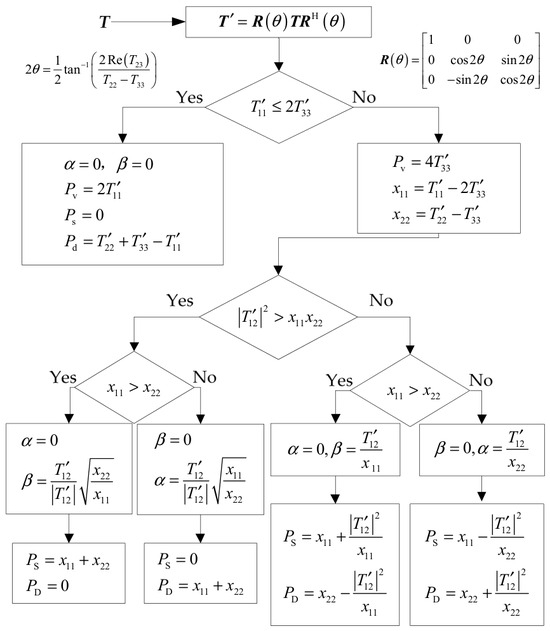
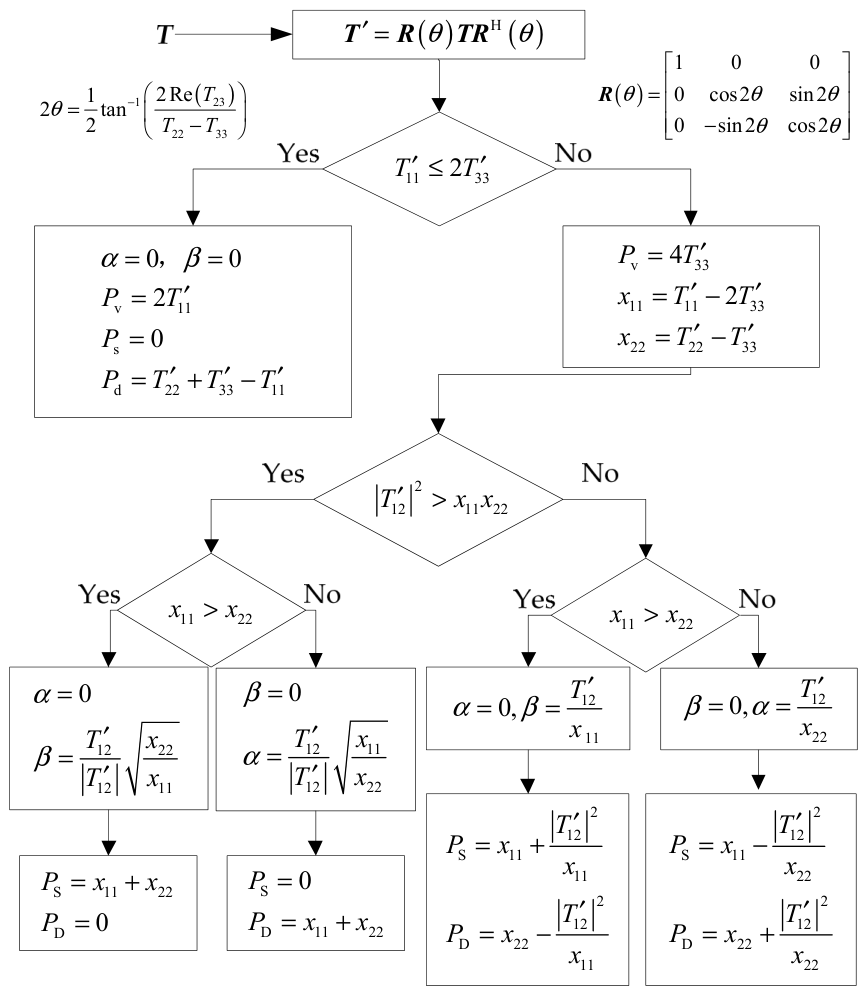
We suggest that certain improvements should be made when using FDD in practice, including applying deorientation (also known as orientation angle compensation [3,10]) at the very beginning to mitigate the overestimation of volume scattering power and implementing additional steps to eliminate negative power values in the decomposition results. This approach constitutes the Modified Freeman−Durden Decomposition (MFDD) algorithm proposed in this study. The entire decomposition flowchart of MFDD is presented in Figure 1, and its specific decomposition procedures are as follows.
Figure 1.
Decomposition flowchart of the proposed Modified Freeman − Durden Decomposition (MFDD) algorithm.
2.1. Deorientation
In a PolSAR image, the data for each pixel can be represented by a polarimetric coherency matrix T, which is a 3 × 3 non-negative definite Hermitian matrix, as follows.
where the superscript * denotes the complex conjugate.
The deorientation is applied to the input polarimetric coherency matrix T, and the resulting polarimetric coherency matrix is denoted as T′, i.e.,
where θ is the orientation angle, the superscript H denotes the conjugate transpose, denotes the element in the ith row and jth column of T′, and
The deorientation makes the real part of zero and ensures that is greater than or equal to .
Then, similar to FDD, we attempt to decompose the reflection symmetry part of T′ into three components as follows
where PV, PD, and PS denote the power values of the volume, double-bounce, and surface scattering components, respectively; TS, TD, and TV respectively represent the surface scattering model, the double-bounce scattering model, and the volume scattering model, which are defined as follows.
where TV, TD, and TS are polarimetric coherency matrices with a trace of 1; and β are two complex parameters.
As shown in (4), based on the reflection symmetry assumption, MFDD only uses the elements of , , and , which comprise five independent real-valued variables. This study primarily focuses on enhancing the decomposition procedure rather than improving the scattering models. Therefore, only the most basic scattering models employed by both FDD and NNED are adopted, as indicated in (5)–(7).
2.2. Volume Scattering Component Extraction
The power of the volume scattering component is determined by the lesser of and 2.
If is less than or equal to 2, we set
and the volume scattering component is subtracted as
After subtracting the volume scattering component, the T11 channel of the remaining matrix is zero. Since the T22 and T33 channels correspond to the scattering of dihedrals with orientation angles of zero degrees and 45 degrees, respectively, the power in the remaining matrix is entirely regarded as double-bounce scattering; therefore, we set
The above procedure is the first additional step implemented in MFDD to prevent negative power values in its decomposition results.
If is larger than 2, we set
and the volume scattering component is subtracted as
where TR denotes the remaining matrix, which is used for the subsequent extraction of the double-bounce and surface scattering components. This step is identical to that in the original FDD algorithm.
2.3. Extraction of Other Components
There are two cases for determining the surface and double-bounce scattering components based on a comparison of and x11x22.
The first case corresponds to > x11x22. In this case, to prevent negative power values, we assume that there is only one type of scattering mechanism in the remaining matrix TR. If x11 is greater than x22, the remaining matrix TR corresponds to surface scattering, and we set
Otherwise, the remaining matrix TR corresponds to double-bounce scattering, and we set
The above procedure is the second additional step implemented in MFDD to prevent negative power values in its outputs.
The second case corresponds to x11x22. In this case, the determination of double-bounce and surface scattering components is identical to that in the original FDD algorithm as follows. If x11 is larger than x22, surface scattering dominates in the remaining matrix TR, and we set
Otherwise, double-bounce scattering dominates in the remaining matrix TR, and we set
The contents presented above constitute the entire decomposition procedure of the proposed MFDD algorithm. The three fundamental scattering models used are identical to those employed by FDD. Deorientation is applied at the very beginning, and two additional steps are introduced to eliminate negative power values. The entire decomposition procedure of MFDD is highly computationally efficient.
3. Deorientation Non-Negative Eigenvalue Decomposition
The original Non-Negative Eigenvalue Decomposition (NNED) algorithm is a highly effective incoherent polarimetric decomposition algorithm based on the reflection symmetry assumption [4]. It completely eliminates negative power values from the decomposition results. The NNED algorithm was proposed in 2011. With the advancements in incoherent polarimetric decomposition techniques over the past decade, certain improvements can be made to the NNED algorithm to enhance its performance. For example, we suggest performing deorientation on the input polarimetric coherency matrix at the outset to alleviate the issue of overestimating volume scattering power. Furthermore, the scattering mechanism of the final remainder matrix can be further interpreted. Based on these improvements, we propose the Deorientation Non-Negative Eigenvalue Decomposition (DNNED) algorithm; its specific decomposition procedures are as follows.
3.1. Deorientation
At the outset, deorientation is applied to the input polarimetric coherency matrix T, and the resulting polarimetric coherency matrix is denoted as T′, i.e.,
where θ is the orientation angle, the superscript H denotes the conjugate transpose, denotes the ith row, jth column element of T′, and
The deorientation makes the real part of zero and ensures that is larger than or equal to .
Then, based on the assumption of reflection symmetry, we need to decompose the reflection symmetry part of T′ into three components as follows
where TS, TD, and TV denote the scattering models defined in (5)–(7); PS, PD, and PV represent the power values of the surface, double-bounce, and volume scattering components, respectively.
3.2. Volume Scattering Component Extraction
For the volume scattering component, the maximum possible power value of PV is the minimum eigenvalue of the following generalized eigendecomposition problem
Therefore, we only need to solve the corresponding cubic equation
where |·| denotes the matrix determinant. The solution to (21) is
It is evident that λ1 is always greater than or equal to λ2. Therefore, PV is determined by the smaller of λ2 and λ3, i.e.,
where min(·) denotes the selection of the smaller value.
After determining the value of PV, the volume scattering component is subtracted from the reflection symmetry part
where tij denotes the element in the remaining matrix.
3.3. Extraction of Other Components
Identical to the original NNED algorithm, eigenvalue decomposition is applied to the remaining matrix obtained from (24) to extract other components, which is represented by
The three eigenvalues are obtained by solving the following cubic equation, where |·| denotes the determinant of a matrix.
And the results are
The corresponding three eigenvectors are
where
The forms of a1U1U1H and a2U2U2H are consistent with the TS and TD models presented in (5) and (6). Van Zyl et al. demonstrated in [4] that the scattering mechanisms of a1U1U1H and a2U2U2H are different. Specifically, if one of them corresponds to surface scattering, the other corresponds to double-bounce scattering. Therefore, the approach to determining their scattering mechanisms can be simplified as follows.
Compare the absolute values of the first and second elements of U1. If > 1, then a1U1U1H corresponds to surface scattering, and a2U2U2H corresponds to double-bounce scattering. If , then a1U1U1H corresponds to double-bounce scattering, and a2U2U2H corresponds to surface scattering.
Actually, one of the three eigenvalues presented in (27) must be zero, and there are two cases based on the value selection of PV in (23). If , it is easy to check that t33 = 0, and correspondingly, a3 in (27) is equal to zero. If , a2 in (27) is equal to zero. Therefore, both NNED and DNNED remain three-component incoherent decomposition algorithms.
3.4. Modified Calculation of PS and PD
In the original NNED algorithm, the surface scattering power PS and the double-bounce scattering power PD are determined solely by the first two components on the right-hand side of (25), namely a1U1U1H and a2U2U2H, according to their respective scattering mechanisms. The last component a3U3U3H is regarded as a remainder matrix that includes additional cross-polarized power, which may represent terrain effects and rough surface scattering [4]. Its power is not included in either PS or PD.
However, in this study, we propose a different explanation for the scattering mechanism of the last component a3U3U3H, and a consequent modification to the determination of PS or PD has also been made.
We believe that the last component corresponds to double-bounce scattering. The reason is as follows. The form of the last component is
For a polarimetric coherency matrix, the t33 channel corresponds to the scattering of a dihedral at an orientation angle of ±45 degrees. By applying an orientation angle rotation of ±45 degrees to the last component, we can derive
It is evident that its form becomes consistent with the double-bounce scattering model TD shown in (6) with = 0. Namely, by taking the orientation angle rotation into account, the form of the last component is entirely consistent with the double-bounce scattering model. Therefore, we believe that the last component corresponds to double-bounce scattering. Consequently, we suggest that the calculation procedure for PD and PS of the original NNED should be modified as follows to include the power of the last component in PD.
In summary, there are two cases for calculating the final power values derived from the proposed DNNED algorithm. For the case of ,
If > 1,
Otherwise
For the case of ,
If > 1,
Otherwise
The first case remains the same as that in the original NNED algorithm. However, the second case differs from the original NNED algorithm in that the power of the last component is included in PD. With this modification, the following equation is obtained once again.
4. Experiments
Based on two actual PolSAR images, the MFDD and DNNED algorithms are compared with four other three-component incoherent polarimetric decomposition algorithms in this section to evaluate their performance. These four three-component incoherent polarimetric decomposition algorithms are: the original FDD algorithm from [2]; the original NNED algorithm presented in [4]; Algorithm 2 from [5], which is referred to as the CUI algorithm; and the decomposition algorithm proposed in [6], which is referred to as the RSD algorithm. The two actual PolSAR images used in the experiments are detailed below.
The first PolSAR image was collected by E-SAR, an airborne L-band system of the German Aerospace Center (DLR), over the Oberpfaffenhofen airport in Germany [30]. The image size is 1300 × 1200 pixels. The equivalent number of looks of the data was estimated using the ENL estimation algorithm proposed by Cui et al. [31] and the result was 23.6, indicating that the speckle noise had been well suppressed. Therefore, no averaging or filtering was applied. The image contains several types of terrestrial targets, including an airport, forested areas, soil ground areas, and building areas.
The second PolSAR image was captured on 5 May 2018, over Barnaul, Russia, by a space-borne C-band system mounted on China’s GF-3 satellite. A spatial multi-look processing technique, which combined 4 × 5 neighboring pixels, was applied to the single-look complex data. The ground resolution of the multi-look image was approximately 37.5 m. Since the speckle noise in the multi-look image remained high, the polarimetric speckle filter proposed by Chen et al. [32] was also applied. The final image has dimensions of 1474 × 1310 pixels and contains areas of buildings, ground, and forests.
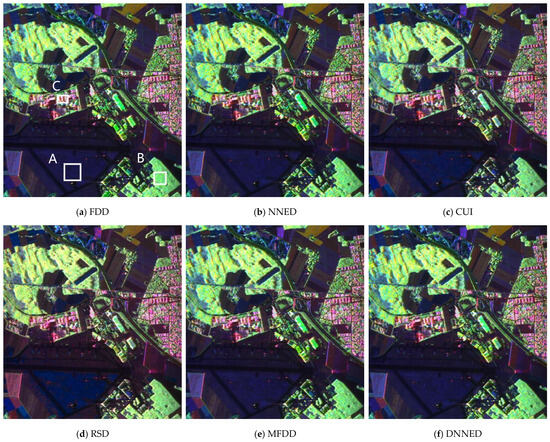
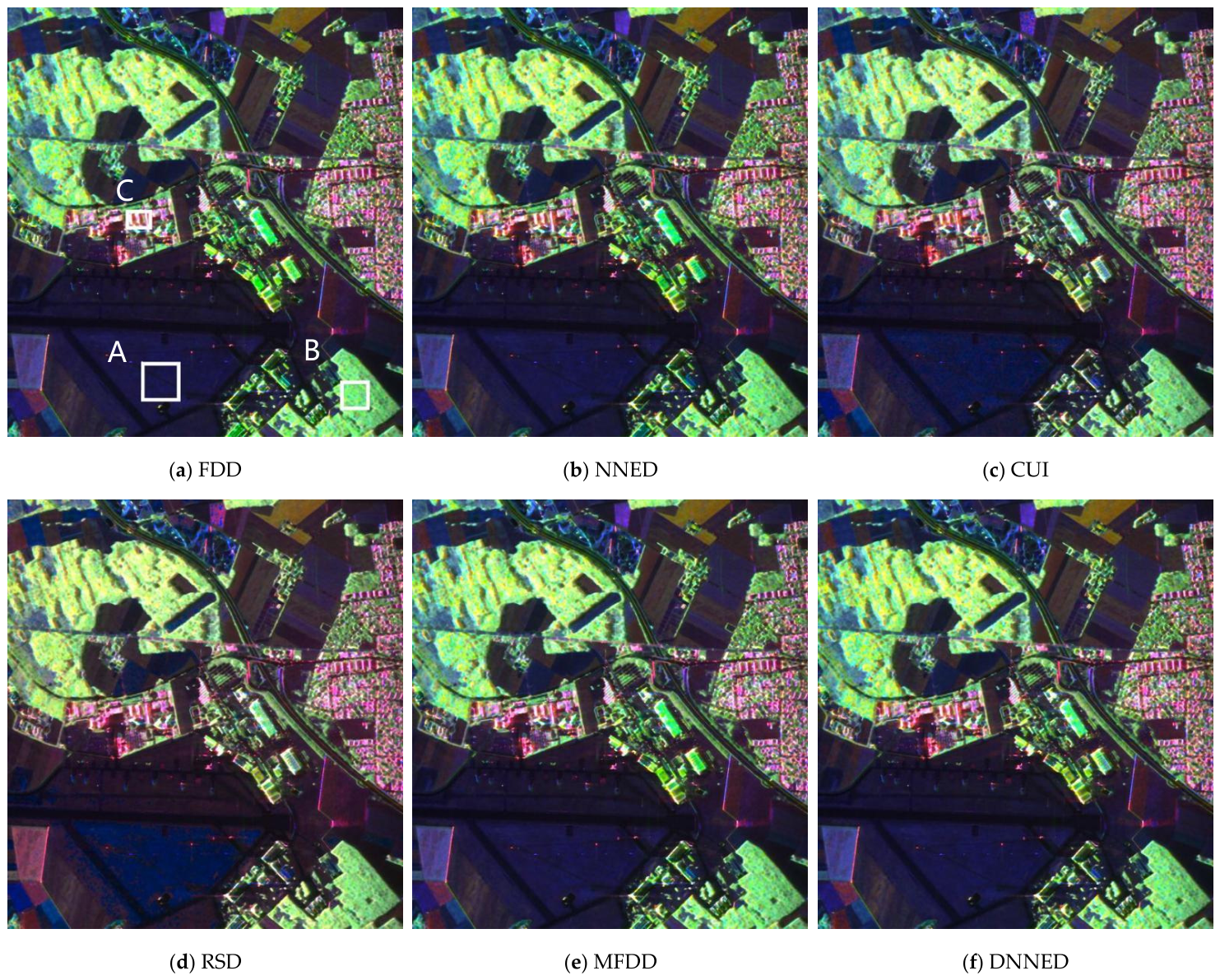
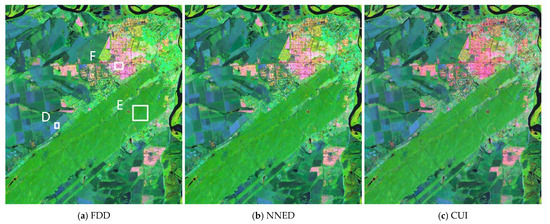
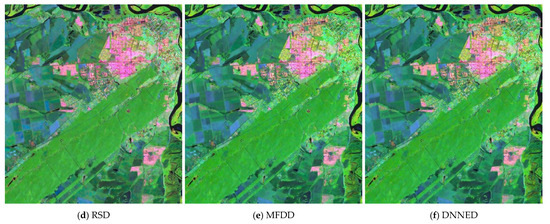
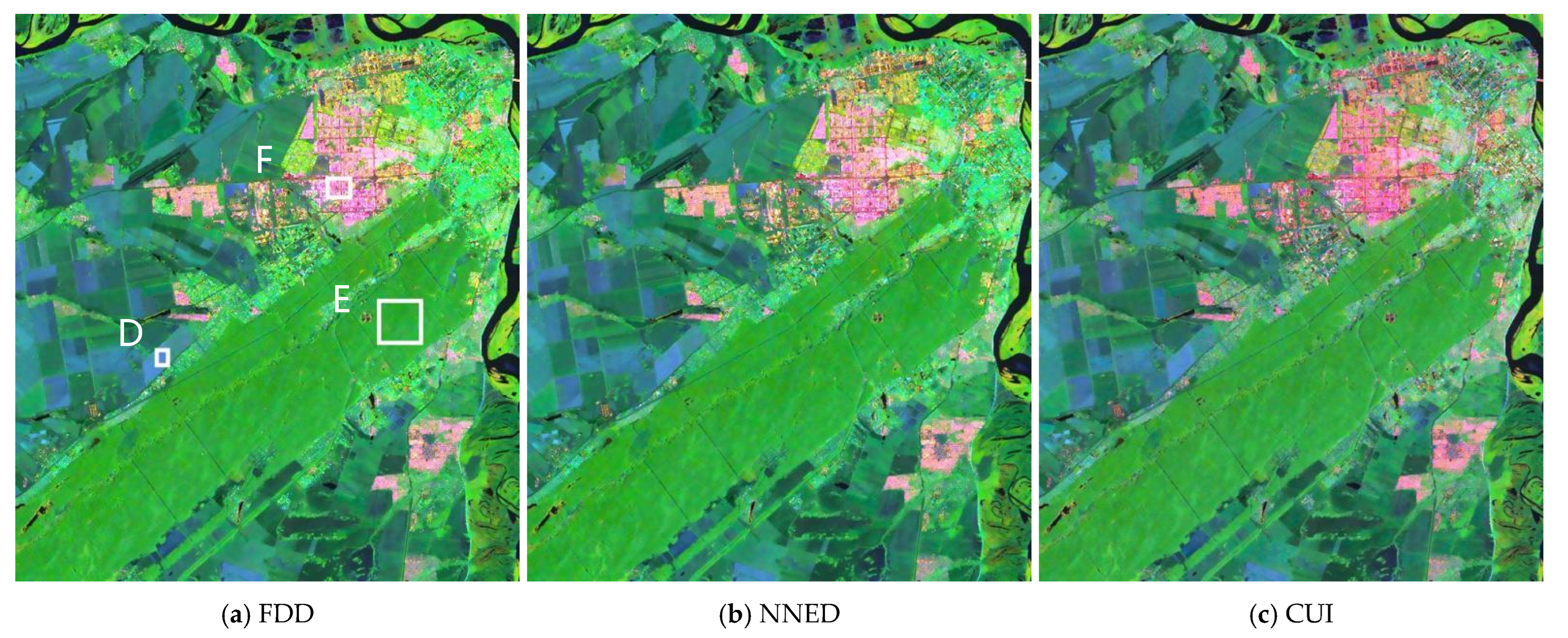
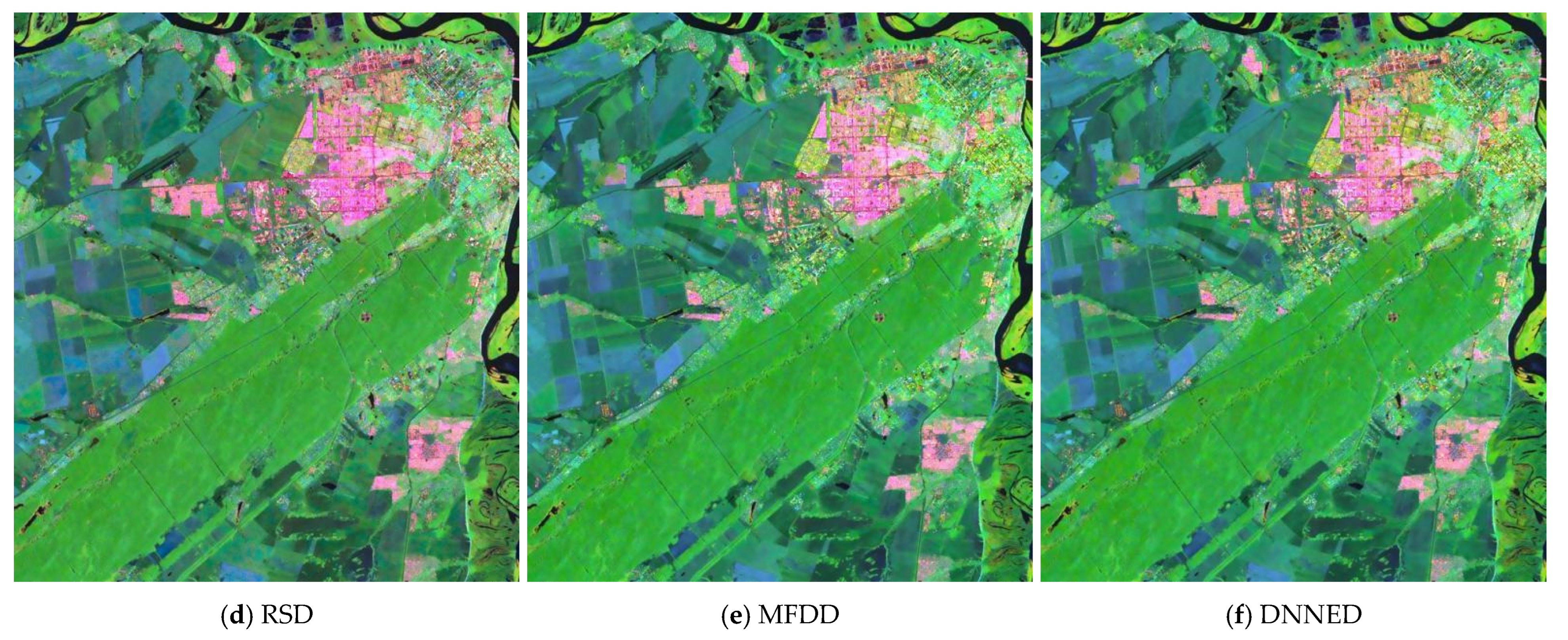
The experimental procedure comprises the following steps. First, pseudo-color images of the polarimetric decomposition results are highly suitable for visually interpreting scattering mechanisms. Based on the two actual fully polarimetric images, the pseudo-color images generated from the decomposition algorithms for comparison are shown in Figure 2 and Figure 3, respectively. The decomposed scattering amplitude values are color-coded: red represents PD, green represents PV, and blue represents PS.
Moreover, we selected six typical areas, indicated by six white rectangles, as shown in Figure 2a and Figure 3a, to quantitatively compare the six decomposition results. The average scattering power proportions of different components obtained from various algorithms are presented in Table 1 for each of these areas.
4.1. Analyses of Volume Scattering
As illustrated in Table 1, the power proportions of surface scattering, volume scattering, and double-bounce scattering are dominant in ground areas, forest areas, and building areas, respectively.
As shown in Table 1, among all algorithms, FDD exhibits the largest volume scattering power proportions for all areas. This phenomenon highlights the overestimation issue of volume scattering power for FDD. CUI and RSD have the smallest volume scattering power proportions among all algorithms. For CUI and RSD, their volume scattering power represents the maximum value that can be extracted from the input polarimetric coherency matrix; any increase beyond this value will lead to a negative eigenvalue in the remaining matrix.
For all areas, as shown in Table 1, the volume scattering power proportions of MFDD are lower than those of FDD, and the volume scattering power proportions of DNNED are lower than those of NNED. This demonstrates that adopting deorientation is an effective way to mitigate the overestimation issue of volume scattering power in incoherent polarimetric decomposition algorithms. The volume scattering power proportions of FDD, NNED, MFDD, and DNNED decrease sequentially, with DNNED yielding the best results among the four algorithms in terms of volume scattering power.
4.2. Analyses of MFDD
MFDD is an improved version of FDD; therefore, it is primarily compared with FDD. As shown in Table 1, for forest areas B and E, the volume scattering power proportions of MFDD are lower than those of FDD. Considering the overestimation of volume scattering power in FDD, the results of MFDD are superior for forest areas B and E. For ground areas A and D, where surface scattering is dominant, the surface scattering power proportions of MFDD are larger than those of FDD. Hence, the experimental results of MFDD are better. For building areas C and F, where double-bounce scattering is dominant, the double-bounce scattering power proportions of MFDD are also larger than those of FDD. Therefore, in summary, the decomposition performance of MFDD is superior to that of FDD.
By comparing MFDD with the other algorithms based on the experimental results presented in Table 1 and employing the same dominant scattering power proportion analysis approach described in the previous paragraph, we find that the decomposition performance of MFDD is comparable to that of NNED but inferior to that of DNNED, CUI, and RSD.
4.3. Analyses of DNNED
As shown in Table 1 and analyzed in Section 4.1, the volume scattering power proportions of FDD, NNED, MFDD, and DNNED decrease sequentially. Among the four algorithms, DNNED exhibits the best performance in terms of volume scattering. For ground areas A and D, the surface scattering power proportions of DNNED, which are 81.946% and 63.975% respectively, are greater than those of FDD, NNED, and MFDD. Therefore, the experimental results of DNNED are superior to those of FDD, NNED, and MFDD regarding surface scattering. Meanwhile, for building areas C and F, the double-bounce scattering power proportions of DNNED, which are 69.538% and 71.019% respectively, are also larger than those of FDD, NNED, and MFDD. In summary, the decomposition performance of DNNED is superior to that of FDD, NNED, and MFDD.
Compared to CUI and RSD, as shown in Table 1, the volume scattering power proportions of DNNED for forest areas B and E, which are 61.998% and 82.742% respectively, are larger than those of CUI and RSD, and the volume scattering power of CUI and RSD represents the maximum value that can be extracted from the input polarimetric coherency matrix. For ground area A, the surface scattering power proportion of DNNED, which is 81.946%, is lower than those of CUI and RSD. In contrast, for ground area D, the surface scattering power proportion of DNNED, which is 63.975%, is greater than those of CUI and RSD. For building area C, the double-bounce scattering power proportion of DNNED, which is 69.538%, is greater than those of RSD and CUI. However, for building area F, the double-bounce scattering power proportion of DNNED, which is 71.019%, is lower than those of CUI and RSD.
In summary, the decomposition performance of DNNED is comparable to that of CUI and RSD. In fact, as shown in Table 1, the differences in dominant scattering power proportions among these three algorithms are mostly less than one or two percentage points. This is precisely why their pseudo-color images appear very similar. RSD and DNNED have the largest surface scattering power proportions for ground areas A and D, respectively, while DNNED and CUI have the highest double-bounce scattering power proportions for building areas C and F, respectively. These values can be regarded as the best decomposition results for these specific areas.
4.4. Negative Power Values and Time Assumption
For the ESAR and GF-3 datasets used in the experiment, the number of pixels with PS and PD less than zero in the FDD and MFDD decomposition results, and the average value of negative power are statistically calculated as shown in Table 2.
Table 2.
Statistics table of the number and average value of negative power pixels.
As shown in Table 2, the FDD algorithm has many pixels with negative power results for both ESAR and GF-3, while MFDD, due to the improvement of the algorithm, has no pixels with negative power in its results. The experimental results verify the effectiveness of the MFDD algorithm in eliminating negative power.
We conducted statistics on the running times of various algorithms on the two experimental datasets. The results are shown in Table 3.
Table 3.
Time consumption of each algorithm.
As shown in Table 3, it can be observed that the computational time of MFDD is longer than that of FDD and is basically the same as that of NNED. However, the decomposition time of DNNED is longer than that of MFDD, but significantly shorter than those of the CUI and RSD algorithms.
4.5. Simulation Experiments
Simulation analyses of two typical targets are performed in this subsection for four algorithms, including FDD, NNED, MFDD, and DNNED, as detailed below.
First, we construct a target consisting of three classic scattering components as follows.
As shown in (39), the first component T1 corresponds to classic volume scattering with a total power value of 4; T2 in the second component represents dihedral scattering, so the second component is a typical double-bounce scattering component with a total power value of 5 and an orientation angle of π/4; and the third component T3 denotes sphere scattering, a typical surface scattering component with a power value of 2.
The T matrix defined in (39) is input into FDD, MFDD, NNED and DNNED algorithms, and the decomposition results are listed in Table 4.
Table 4.
Decomposition results of the simulated target given in (39).
As listed in Table 4, the large T33 of the simulated target leads to severe overestimation of volume scattering power for FDD, accompanied by negative values for both PS and PD. By contrast, MFDD yields decomposition results consistent with the true simulation settings. For NNED, the retrieved surface scattering power PS and volume scattering power PV are accurate, whereas its double-bounce scattering power PD is estimated as zero. In fact, NNED allocates all power from the second component (a total value of 5) into the remainder component; namely, NNED decomposes the entire double-bounce component into the remainder component. DNNED achieves decomposition results matching the true scattering composition, as it properly reassigns the power originally included in the remainder component to the double-bounce scattering power PD. The above simulation demonstrates the advantages brought by deorientation in MFDD and NNED.
Another simulation is implemented as follows. Herein, we construct a target consisting of three typical scattering components as shown in (40).
As shown in (40), the first component T1 corresponds to classic volume scattering with a total power of 4; T2 of the second component denotes dihedral scattering, so the second component is a typical double-bounce component with a total power of 1 and an orientation angle of π/4; and the third component T3 corresponds to surface scattering with a total power of 20. The T matrix specified in (40) is fed into the FDD, MFDD, NNED, and DNNED algorithms, and the corresponding results are summarized in Table 5.
Table 5.
Decomposition results of the simulated target given in (40).
As shown in Table 5, FDD overestimates PV and yields a negative value for PD. MFDD eliminates negative power values but still suffers from the overestimation of volume scattering. For NNED, the retrieved surface scattering power PS and volume scattering power PV are accurate, while the estimated double-bounce scattering power PD equals zero. In fact, NNED assigns all the power of the second component (total power = 1) to the remainder component, which deviates substantially from the preset truth of the simulation. By contrast, DNNED produces decomposition results consistent with the true scattering configuration and correctly reallocates the remainder component power into the double-bounce scattering power PD.
The above two simulation results demonstrate the superiority of MFDD over FDD and of DNNED relative to the other three algorithms, respectively.
4.6. Additional Experiments
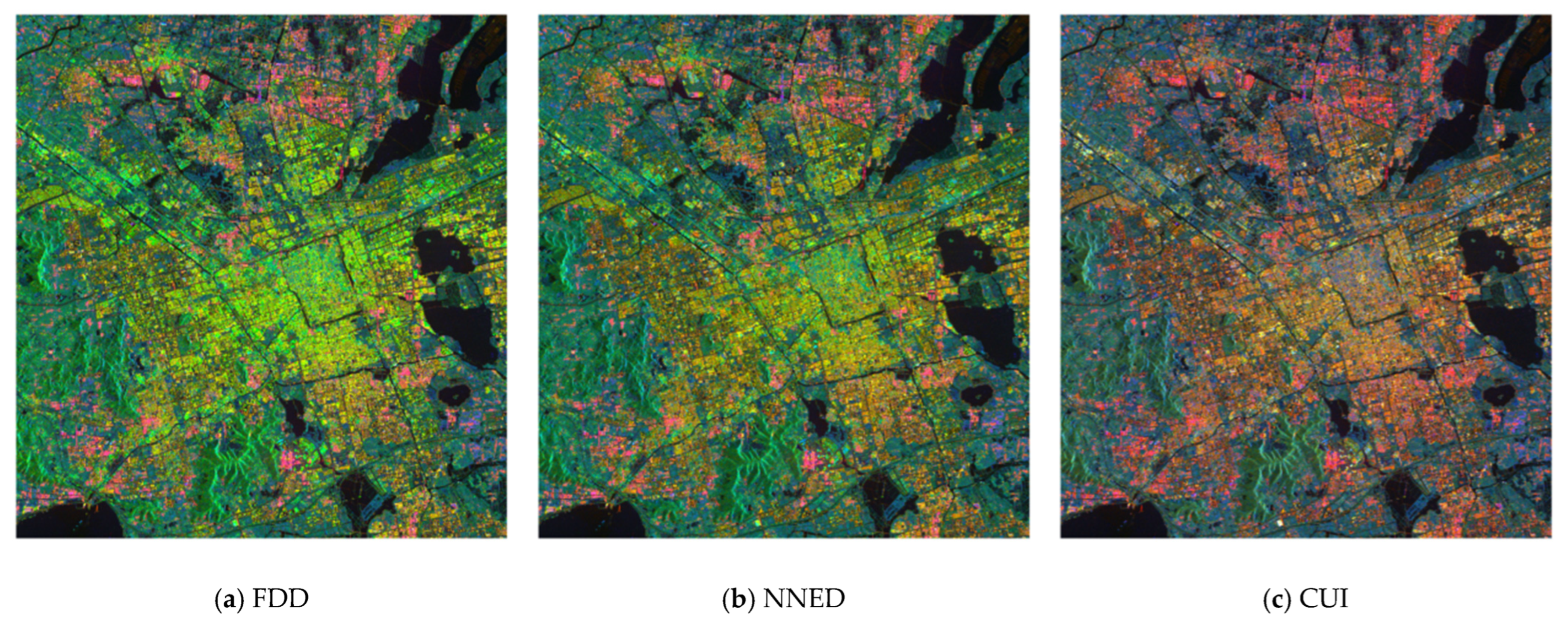
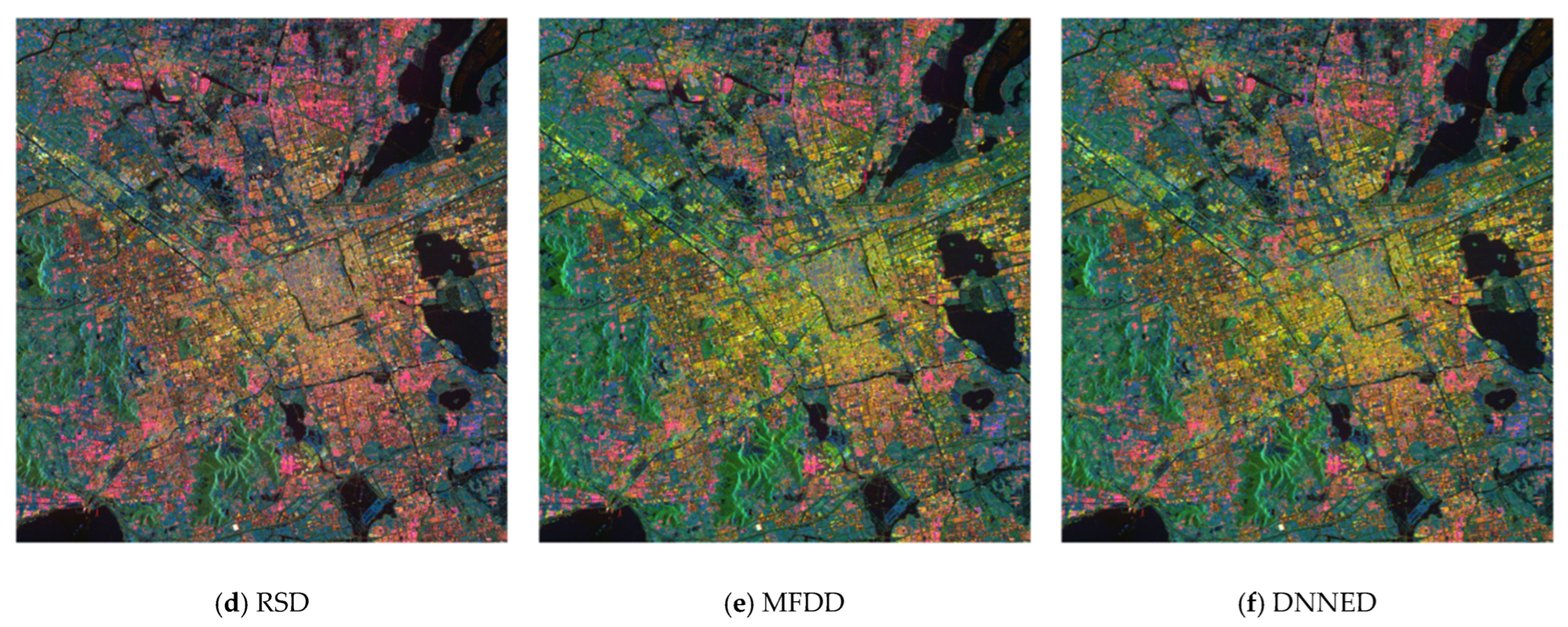
We also selected a real PolSAR image dominated by oriented buildings for experimental analysis. This dataset was acquired over the main urban area of Suzhou by the Radarsat-2 satellite on 11 March 2010. Five pixels along the slant range and eight pixels along the azimuth were averaged to form a single pixel for multi-look processing. With a total multi-look factor of 5 × 8 = 40, speckle filtering was not implemented.
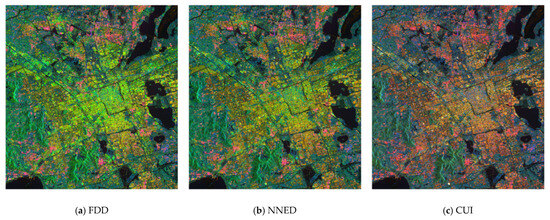
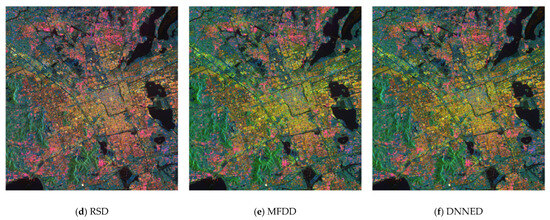
All six decomposition algorithms used in Section 4.1 were applied to the Radarsat-2 dataset, and the corresponding pseudo-color images are presented in Figure 4. The test site is predominantly covered by oriented man-made buildings, and the averaged scattering power proportions across the whole scene are presented in Table 6.
Figure 4.
Pseudo-color images obtained from the application of six decomposition algorithms to the Radarsat-2 image. All pixels within the image were selected for quantitative tests, and the results are presented in Table 6.
Table 6.
Mean proportions of different scattering power values derived using various algorithms. All pixels shown in Figure 4 were used in the experiments.
As illustrated in Figure 4, the central urban areas derived from FDD and NNED appear mostly green, which indicates that these two methods considerably overestimate the volume scattering power over oriented building regions. By contrast, MFDD and DNNED yield mainly yellow tones for the downtown area with reduced volume scattering power proportions and improved decomposition performance. CUI and RSD produce predominantly red hues over these areas and achieve the best overall decomposition performance.
As listed in Table 6, the decomposition result of FDD features the largest volume scattering proportion, indicating an obvious overestimation of volume scattering power. Benefiting from deorientation processing, MFDD yields an evidently reduced volume scattering proportion, which verifies that deorientation effectively alleviates the overestimated volume scattering over oriented building areas. Compared with NNED, DNNED further lowers the volume scattering proportion while markedly increasing the double-bounce scattering proportion, demonstrating the superior decomposition performance of DNNED for oriented building regions.
As also shown in Table 6, the two complete polarimetric decomposition algorithms, CUI and RSD, produce the minimum volume scattering proportions and relatively high double-bounce scattering proportions. This implies that the reflection symmetry assumption poorly matches the actual scattering signatures of oriented buildings, hence degrading the performance of reflection-symmetry-based decomposition algorithms, including FDD, NNED, MFDD and DNNED. Accordingly, when applying these four decomposition methods rooted in reflection symmetry, practitioners must carefully check the consistency between the real ground scattering characteristics and the reflection symmetry hypothesis.
From the perspective of physical interpretability, the scattering components in the decomposition results of FDD, NNED, MFDD, DNNED, and RSD are strictly consistent with the surface scattering model TS, the double scattering model TD, and the volume scattering model TV in form. However, the last component of the CUI algorithm is only a rank-1 polarimetric coherency matrix, which does not conform to the above scattering models.
Moreover, we have found that CUI and RSD require input data with a high equivalent number of looks; otherwise, the proportion of volume scattering power will be significantly underestimated. In contrast, the decomposition results of MFDD are not sensitive to the equivalent number of looks of PolSAR data, which means that even if the multi-look or filtering operations applied to PolSAR data are insufficient, MFDD will still yield relatively good results. The sensitivity of DNNED to the equivalent number of looks is higher than that of MFDD, but lower than the requirement of CUI and RSD for a high equivalent number of looks.
5. Conclusions
FDD and NNED are the two most widely used algorithms in incoherent polarimetric decomposition, particularly FDD. Unfortunately, it has been observed that both algorithms fail to fully unleash their potential performance in most practical applications, such as classification and detection. For instance, the output of FDD occasionally contains negative power values, which should be strictly avoided in all application scenarios. The performance of FDD and NNED can be enhanced by incorporating deorientation. Additionally, the scattering mechanism of the remainder matrix in NNED is essentially identical to that of a dihedral with a 45-degree orientation angle, which allows it to be classified as double-bounce scattering. To thoroughly emphasize these points to readers, we specifically present this article and propose the MFDD and DNNED algorithms. We sincerely hope that our work can guide researchers toward the correct and comprehensive application of these two fundamental algorithms.
MFDD proposed in this study is an improved version of FDD, incorporating both deorientation and two additional steps to avoid negative power values. MFDD can also be regarded as a modified version of the three-component decomposition algorithm proposed in [3]. The differences between these two algorithms are that MFDD adopts the classic volume scattering model instead of the identity-matrix-based volume scattering model used in [3], and some consequent modifications are also made based on the change in the volume scattering model. There are two reasons why MFDD adopts the classic volume scattering model instead of the identity-matrix-based version used in [3]. First, the classic model produces higher volume scattering proportions for forested areas, indicating its superior consistency with the actual scattering characteristics of forests. Second, all incoherent polarimetric decomposition algorithms in our experiments use the same volume scattering model; hence, MFDD follows this configuration. In this way, observed differences in experimental results mainly stem from algorithmic distinctions rather than the adoption of different volume scattering models. Experiments have demonstrated that the decomposition performance of MFDD is superior to that of FDD. Although FDD may be the most widely used incoherent polarimetric decomposition algorithm, we recommend that applications currently adopting FDD try replacing it with MFDD, which is likely to achieve better performance, as MFDD offers better decomposition performance and can prevent the occurrence of negative power values.
DNNED proposed in this study is an improved algorithm for NNED. It adopts deorientation at the outset and treats the scattering of the remainder matrix as double-bounce scattering. DNNED provides a better explanation for the scattering mechanism of the remainder matrix. We suggest that applications currently using NNED may consider switching to DNNED, as experiments have demonstrated that the decomposition performance of DNNED is superior to that of FDD, NNED, and MFDD. Within the experimental dataset of this study, DNNED shows favorable performance compared with other incoherent polarimetric decomposition approaches under the reflection symmetry assumption.
We present the two improved algorithms in a single article because they are both incoherent polarimetric decomposition algorithms based on the assumption of reflection symmetry, and we can thus conduct a detailed comparative analysis of them under the same experimental conditions.
It is noteworthy that, depending on whether the reflection symmetry assumption is adopted, three-component incoherent polarimetric decomposition algorithms can be classified into two categories. The first category includes FDD, NNED, MFDD, and DNNED, all of which are decomposition algorithms based on the assumption of reflection symmetry. Strictly speaking, these algorithms decompose only the reflection symmetry part of a polarimetric coherency matrix, rather than the polarimetric coherency matrix itself. The second category includes CUI and RSD, which do not adopt the assumption of reflection symmetry. They directly decompose the input polarimetric coherency matrix and are both complete incoherent polarimetric decomposition algorithms. We can fully reconstruct the input polarimetric coherency matrix from their decomposition results.
The volume scattering components of DNNED are larger than those of CUI and RSD. This is because DNNED extracts the maximum volume scattering component from the reflection symmetry part of a polarimetric coherency matrix, whereas CUI and RSD extract the maximum volume scattering component directly from the polarimetric coherency matrix itself. The T13 and T23 elements are both zero in the reflection symmetry part, which enables more volume scattering power to be extracted from the reflection symmetry part than from the original polarimetric coherency matrix.
If we aim to ensure that the matrix to be decomposed is the original polarimetric coherency matrix, CUI and RSD should be utilized. However, from the perspective of dominant scattering power proportions, the experimental results of DNNED are already quite similar to those of CUI and RSD. Therefore, DNNED also has very broad application prospects.
Directly setting the T13 and T23 elements to zero is just one method for obtaining a reflection symmetry part from a polarimetric coherency matrix. In [7], another method for obtaining a reflection symmetry part from a polarimetric coherency matrix was also proposed. In fact, more in-depth theoretical research is needed on the method of extracting the reflection symmetry part and its influences. This is one of the main directions of our future research efforts.
Author Contributions
Conceptualization, W.A.; methodology, W.A.; validation, G.C.; formal analysis, W.A.; investigation, W.A.; resources, Q.F.; data curation, G.C.; writing—original draft preparation, W.A.; writing—review and editing, Y.Z. and Q.F.; visualization, W.A.; supervision, Q.F.; project administration, Q.F.; funding acquisition, Y.Z. All authors have read and agreed to the published version of the manuscript.
Funding
This research was funded by the Beijing Key Laboratory of Advanced Optical Remote Sensing Technology Fund and the National Natural Science Foundation of China, grant number 42376180.
Data Availability Statement
The PolSAR data that support the findings of this study are openly available in “IEEE Dataport” at https://dx.doi.org/10.21227/ag1c-1q46.
Conflicts of Interest
The authors declare no conflicts of interest.
References
- Cloude, S.R.; Pottier, E. A review of target decomposition theorems in radar polarimetry. IEEE Trans. Geosci. Remote Sens. 1996, 34, 498–518. [Google Scholar] [CrossRef] [Scilit]
- Freeman, A.; Durden, S.L. A three-component scattering model for polarimetric SAR. IEEE Trans. Geosci. Remote Sens. 1998, 36, 963–973. [Google Scholar] [CrossRef] [Scilit]
- An, W.; Cui, Y.; Yang, J. Three-Component Model-Based Decomposition for Polarimetric SAR data. IEEE Trans. Geosci. Remote Sens. 2010, 48, 2732–2739. [Google Scholar]
- van Zyl, J.J.; Arii, M.; Kim, Y. Model-based decomposition of polarimetric SAR covariance matrices constrained for nonnegative eigenvalues. IEEE Trans. Geosci. Remote Sens. 2011, 49, 1104–1113. [Google Scholar] [CrossRef]
- Cui, Y.; Yamaguchi, Y.; Yang, J.; Kobayashi, H.; Park, S.; Singh, G. On Complete Model-Based Decomposition of Polarimetric SAR Coherency Matrix Data. IEEE Trans. Geosci. Remote Sens. 2013, 52, 1991–2001. [Google Scholar] [CrossRef] [Scilit]
- An, W.; Lin, M.; Yang, H. Modified Reflection Symmetry Decomposition and a New Polarimetric Product of GF-3. IEEE Geosci. Remote Sens. Lett. 2022, 19, 1–5. [Google Scholar] [CrossRef] [Scilit]
- An, W.; Lin, M. A Reflection Symmetry Approximation of Multi-look Polarimetric SAR Data and its Application to Freeman-Durden Decomposition. IEEE Trans. Geosci. Remote Sens. 2019, 57, 3649–3660. [Google Scholar]
- Maurya, H.; Bhattacharya, A.; Mishra, A.K.; Panigrahi, R.K. Hybrid Three-Component Scattering Power Characterization From Polarimetric SAR Data Isolating Dominant Scattering Mechanisms. IEEE Trans. Geosci. Remote Sens. 2022, 60, 4415315. [Google Scholar] [CrossRef] [Scilit]
- Huang, P.; Chen, Y.; Li, X.; Tan, W.; Chen, Y.; Yang, X.; Dong, Y.; Lv, X.; Li, B. A Two-Component Polarimetric Target Decomposition Algorithm with Grassland Application. Remote Sens. 2024, 16, 2832. [Google Scholar] [CrossRef] [Scilit]
- Liu, B.; Lv, X.; Li, X.; Yang, X.; Huang, P.; Tan, W.; Zhai, Y.; Chen, Y.; Xu, K. A Three-Component Polarimetric Target Decomposition Algorithm for Grasslands. IEEE J. Sel. Top. Appl. Earth Obs. Remote Sens. 2025, 18, 18209–18223. [Google Scholar] [CrossRef] [Scilit]
- Huang, P.; Li, B.; Li, X.; Tan, W.; Xu, W.; Chen, Y. An Adaptive Polarimetric Target Decomposition Algorithm Based on the Anisotropic Degree. Remote Sens. 2024, 16, 1015. [Google Scholar] [CrossRef] [Scilit]
- Yamaguchi, Y.; Moriyama, T.; Ishido, M.; Yamada, H. Four-component scattering model for polarimetric SAR image decomposition. IEEE Trans. Geosci. Remote Sens. 2005, 43, 1699–1706. [Google Scholar] [CrossRef] [Scilit]
- Yamaguchi, Y.; Yajima, Y.; Yamada, H. A four-component decomposition of POLSAR images based on the coherency matrix. IEEE Geosci. Remote Sens. Lett. 2006, 3, 292–296. [Google Scholar] [CrossRef] [Scilit]
- Yamaguchi, Y.; Sato, A.; Boerner, W.M.; Sato, R.; Yamada, H. Four-component scattering power decomposition with rotation of coherency matrix. IEEE Trans. Geosci. Remote Sens. 2011, 49, 2251–2258. [Google Scholar] [CrossRef] [Scilit]
- Sato, A.; Yamaguchi, Y.; Singh, G.; Park, S.-E. Four-component scattering power decomposition with extended volume scattering model. IEEE Geosci. Remote Sens. Lett. 2012, 9, 166–170. [Google Scholar] [CrossRef] [Scilit]
- Singh, G.; Yamaguchi, Y.; Park, S.-E. General Four-Component Scattering Power Decomposition With Unitary Transformation of Coherency Matrix. IEEE Trans. Geosci. Remote Sens. 2013, 51, 3014–3022. [Google Scholar] [CrossRef] [Scilit]
- Bhattacharya, A.; Singh, G.; Manickam, S.; Yamaguchi, Y. An Adaptive General Four-Component Scattering Power Decomposition with Unitary Transformation of Coherency Matrix (AG4U). IEEE Geosci. Remote Sens. Lett. 2015, 12, 2110–2114. [Google Scholar] [CrossRef] [Scilit]
- An, W.; Lin, M. An Incoherent Decomposition Algorithm Based on Polarimetric Symmetry for Multilook Polarimetric SAR Data. IEEE Trans. Geosci. Remote Sens. 2020, 58, 2383–2397. [Google Scholar]
- Wang, W.; Yu, C.; Wang, X.; Liu, X. A Modified Four-Component Decomposition Method With Refined Volume Scattering Models. IEEE J. Sel. Top. Appl. Earth Obs. Remote Sens. 2020, 13, 1946–1958. [Google Scholar] [CrossRef] [Scilit]
- Dey, S.; Bhattacharya, A.; Frery, A.C.; López-Martínez, C.; Rao, Y.S. A Model-Free Four Component Scattering Power Decomposition for Polarimetric SAR Data. IEEE J. Sel. Top. Appl. Earth Obs. Remote Sens. 2021, 14, 3887–3902. [Google Scholar] [CrossRef] [Scilit]
- Wang, T.; Suo, Z.; Ti, J.; Yan, B.; Xiang, H.; Xi, J. A Unitary Transformation Extension of PolSAR Four-Component Target Decomposition. Remote Sens. 2024, 16, 1067. [Google Scholar] [CrossRef] [Scilit]
- Chen, S.-W.; Wang, X.-S.; Xiao, S.-P.; Sato, M. General polarimetric model-based decomposition for coherency matrix. IEEE Trans. Geosci. Remote Sens. 2014, 52, 1843–1855. [Google Scholar] [CrossRef] [Scilit]
- Wang, Y.; Ge, D.; Liu, B.; Yu, W.; Wang, C. An Improved General Five-Component Scattering Power Decomposition Method. Remote Sens. 2025, 17, 2583. [Google Scholar] [CrossRef] [Scilit]
- Malik, R.; Singh, G.; Dikshit, O.; Yamaguchi, Y. General Five-Component Scattering Power Decomposition with Unitary Transformation (G5U) of Coherency Matrix. Remote Sens. 2023, 15, 1332. [Google Scholar] [CrossRef] [Scilit]
- Duan, Y.; Quan, S.; Fan, H.; Xu, Z.; Xiao, S. A Five-Component Decomposition Method with General Rotated Dihedral Scattering Model and Cross-Pol Power Assignment. Remote Sens. 2023, 15, 4512. [Google Scholar] [CrossRef] [Scilit]
- Singh, G.; Yamaguchi, Y. Model-Based Six-Component Scattering Matrix Power Decomposition. IEEE Trans. Geosci. Remote Sens. 2018, 56, 5687–5704. [Google Scholar] [CrossRef] [Scilit]
- Singh, G.; Malik, R.; Mohanty, S.; Rathore, V.S.; Yamada, K.; Umemura, M.; Yamaguchi, Y. Seven-Component Scattering Power Decomposition of POLSAR Coherency Matrix. IEEE Trans. Geosci. Remote Sens. 2019, 52, 8371–8382. [Google Scholar] [CrossRef] [Scilit]
- Malik, R.; Singh, G.; Dikshit, O.; Yamaguchi, Y. Model-Based Nine-Component Scattering Matrix Power Decomposition. IEEE Geosci. Remote Sens. Lett. 2024, 21, 1–5. [Google Scholar] [CrossRef] [Scilit]
- Zhuang, D.; Zhang, L.; Zou, B. Model-Based Polarimetric SAR Target Decomposition: A Scheme to Introduce Repeat-Pass PolInSAR Coherence. IEEE Trans. Geosci. Remote Sens. 2024, 62, 5212516. [Google Scholar] [CrossRef] [Scilit]
- PolSARpro Software. Available online: https://step.esa.int/main/toolboxes/polsarpro-v6-0-biomass-edition-toolbox/ (accessed on 9 January 2026).
- Cui, Y.; Zhou, G.; Yang, J.; Yamaguchi, Y. Unsupervised Estimation of the Equivalent Number of Looks in SAR Images. IEEE Geosci. Remote Sens. Lett. 2011, 8, 710–714. [Google Scholar] [CrossRef] [Scilit]
- Chen, J.; Chen, Y.; An, W.; Cui, Y.; Yang, J. Nonlocal Filtering for Polarimetric SAR Data: A Pretest Approach. IEEE Trans. Geosci. Remote Sens. 2011, 49, 1744–1754. [Google Scholar] [CrossRef] [Scilit]

Disclaimer/Publisher’s Note: The statements, opinions and data contained in all publications are solely those of the individual author(s) and contributor(s) and not of MDPI and/or the editor(s). MDPI and/or the editor(s) disclaim responsibility for any injury to people or property resulting from any ideas, methods, instructions or products referred to in the content. |
© 2026 by the authors. Licensee MDPI, Basel, Switzerland. This article is an open access article distributed under the terms and conditions of the Creative Commons Attribution (CC BY) license.