


Highlights
What are the main findings?
- Real-time misclassification during drone-based shark surveillance was substantial, with only 38% of sharks categorised as target species (i.e., bull, white, and tiger sharks) confirmed during post-flight verification.
- Most countermeasures were implemented due to the presence of other sharks (i.e., whaler species, grey nurse, hammerhead species, leopard, and wobbegong), with some instances also involving non-shark species (i.e., guitarfish and gamefish).
What are the implications of the main findings?
- Reliance on human-based real-time identification during drone monitoring may overestimate the true prevalence of bull, white, and tiger sharks, leading to countermeasures (e.g., water evacuations) for animals that pose little to no risk to humans.
- The integration of artificial intelligence and improved resources (e.g., larger, high-resolution screens) into drone-based shark surveillance could enhance decision-making and support more efficient allocation of beach resources.
Abstract
Drone-based shark surveillance has been implemented as a non-lethal mitigation method to minimise the risk of human–shark interactions along beaches of New South Wales (NSW), Australia. However, real-time misidentification remains problematic, often triggering unnecessary countermeasures due to marine animals that pose little to no risk to humans. We investigated shark misidentification in drone surveys by comparing real-time identification with post-flight verification across 900 flights. Post-flight analyses revealed false-positive detection rates of 53%, 79%, and 100% for bull (Carcharhinus leucas), white (Carcharodon carcharias), and tiger (Galeocerdo cuvier) sharks, respectively, which collectively are the ‘target’ sharks of mitigation measures in NSW. Of the 269 flights in which sharks were identified in real time as target sharks, 62% were confirmed post-flight as other sharks (i.e., whaler species, grey nurse, leopard, or wobbegong), sharks that could not be identified (unknown sharks), or non-shark species (i.e., guitarfish). Conversely, 25% of flights with target sharks identified post-flight were recorded in real time as ‘other’ or ‘unknown’ sharks. Overall, real-time classification overestimated the presence of target sharks, with an apparent prevalence approximately twice the true prevalence. Countermeasure activations based on real-time classification of target sharks were accurate in only 36% of instances. Non-shark species (i.e., guitarfish or gamefish) also triggered 39 countermeasures, including 28 water evacuations. Integrating artificial intelligence or other advances (e.g., higher-resolution video on larger screens) may enhance the effectiveness of drone-based surveillance by assisting pilots with real-time shark detection and identification.
1. Introduction
Unprovoked shark bites are recognised as a major human–wildlife conflict [1,2], with significant implications for beach management. Although rare, the frequency of unprovoked shark bites has increased in recent years, primarily due to a rising human population and greater participation in ocean-based activities [3,4]. White sharks (Carcharodon carcharias), bull sharks (Carcharhinus leucas), and tiger sharks (Galeocerdo cuvier) are the target species for shark mitigation in New South Wales (NSW), Australia, as they are involved in the majority of unprovoked shark bites worldwide [5,6,7]. However, these species are currently listed as either ‘Vulnerable’ or ‘Near Threatened’ by the International Union for Conservation of Nature, with declining global population trends [8,9,10], although only white sharks are currently listed as Vulnerable in NSW.
Lethal shark mitigation methods, such as shark nets and traditional drumlines, have previously been implemented to reduce shark populations and the chances of human–shark interactions, though their effectiveness in risk reduction remains disputed [11,12]. Traditional drumlines and shark nets also have high bycatch rates, which can negatively affect vulnerable shark populations, threatened marine fauna, and other non-target marine life [13,14]. Recently, non-lethal shark management strategies, such as Shark-Management-Alert-in-Real-Time (SMART) drumlines, tagged shark listening stations, and aerial surveillance programs, have received strong public support over lethal methods as they minimise harm to marine fauna [15,16,17].
Drones are increasingly used as a minimally invasive approach for monitoring shark presence off beaches during periods of high beachgoer activity [18,19], although social acceptance of their use varies [20]. Compared to crewed aircraft, drone-based surveillance is more efficient and cost-effective for sampling localised nearshore areas [21,22]. When a shark is observed, drone pilots are typically responsible for identifying the species in real time while continuing to monitor the animal’s movements. If a target species (i.e., white, bull, or tiger shark) is identified, the pilot may, depending on its proximity to people, broadcast warnings via the drone to alert nearby water users. Additional countermeasures, such as beach sirens or water evacuations, may be implemented, or a crewed vessel may be deployed to redirect the shark offshore. Shark sightings may also be communicated to the public via smart device applications [23]. While the main purpose of drone-based shark surveillance is to reduce the risk of human–shark interactions, it also permits the collection of high-quality data to investigate species-specific shark behaviour [24,25,26], movement patterns [27], and distribution [28,29]. Post-flight analysis enhances identification accuracy by allowing footage to be paused and replayed, thereby facilitating a more thorough assessment compared to real-time [22,30]. Long-term regional monitoring can also provide vital information for global population assessments, particularly for highly migratory shark species [4,31].
Despite the effectiveness of drone surveys, misidentification of marine species is recognised as a key challenge [32,33]. Inaccuracies in real-time shark identification have potential ecological, social, and economic consequences. Misidentifications can trigger unnecessary water evacuations for animals that pose little or no risk to people, reducing the efficiency of beach management operations and impacting the experience of beachgoers. Frequent water evacuations due to misidentified sightings may also distort public perception, potentially reducing support for management initiatives [11,34]. Beach closures can further negatively impact tourism and local businesses by disrupting water-based recreational activities and reducing visitor attendance in coastal communities [35,36,37]. In contrast, accurate species identification of sharks ensures the appropriate use of beach resources, enabling effective shark monitoring and risk management. It also enhances data quality, increasing confidence in population trends and relative abundance estimates, while supporting evidence-based management and conservation strategies [38,39,40]. Although the operational performance [41,42,43] and detection probability [22,44,45] of drone-based shark surveillance methods have been evaluated, information on the accuracy of real-time species identification and the implementation of associated countermeasures remains limited.
Here, we evaluated misidentification rates by comparing shark classifications made by professional shark-spotting drone pilots during flight with classifications confirmed through post-flight analysis of drone footage. Specifically, we assessed the accuracy of real-time species identification of target sharks (i.e., bull, white, and tiger) and compared the apparent prevalence of target sharks with true prevalence. We also investigated the influence of water conditions on real-time classification accuracy of target species and examined the implementation of countermeasures based on real-time identifications across different shark groups. Overall, our findings can be used to improve current shark surveillance programs by identifying the limitations of human-based real-time identification and exploring the potential integration of artificial intelligence as a decision-support tool for drone pilots.
2. Materials and Methods
2.1. Sampling Methodology
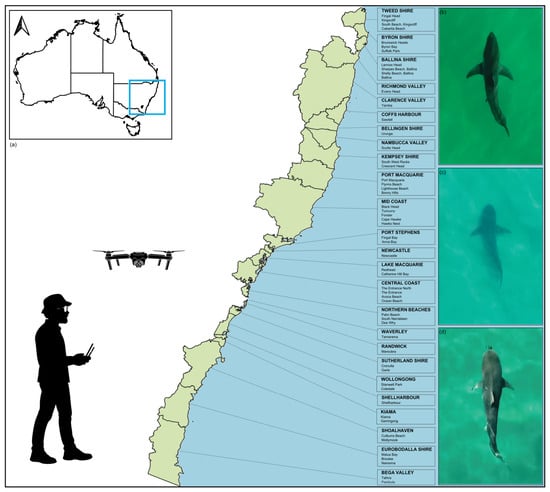
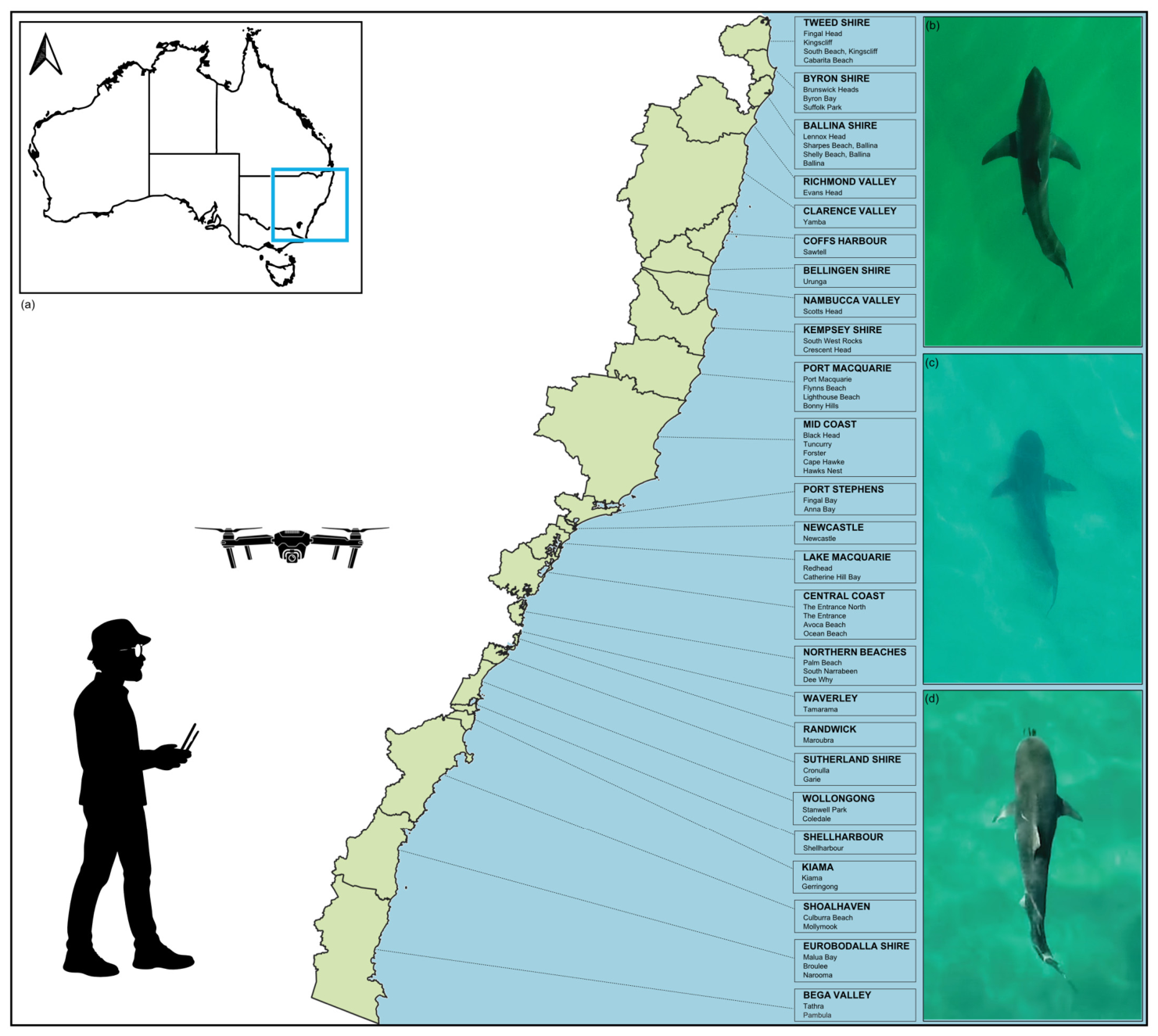
Drone-based surveys were carried out at wave-exposed ocean beaches along the east coast of Australia as part of the NSW Shark Management Program. Since 2017, this extensive drone surveillance program has completed >160,000 individual flights across 56 beach locations, from Fingal Head (−28.1966, 153.5675) to Pambula (−36.9414, 149.9098), NSW, Australia (Figure 1, Table S1).
Figure 1.
(a) Locations of drone-based shark surveillance undertaken along the New South Wales coastline, Australia. Examples of drone footage capturing target species: (b) white shark (Carcharodon carcharias), (c) bull shark (Carcharhinus leucas), and (d) tiger shark (Galeocerdo cuvier). Additional information for each beach location is provided in Supplementary Materials.
Surveys were conducted by multiple professionally trained shark-spotting drone pilots with varying levels of operational and field experience. Pilots used DJI Phantom 4 or DJI Mavic 2 quadcopter drones (<2 kg; DJI, Shenzhen, China) to monitor surf zones for sharks via high-quality live video feeds from the drone’s camera. Operational procedures for drone surveys and data collection were consistent across all beach locations. Flight missions typically occurred between 0900 and 1600 during suitable weather conditions (rain-free, light to moderate winds). Each flight surveyed up to 1 km of coastline, with a maximum duration of ~25 min. Drones were flown directly behind the back of the surf break at an altitude of 60 m, though they were sometimes lowered or a zoom lens was used to enable species identification of an animal that was detected. All flights were documented, including the location, date, and time, as well as whether any sharks were observed during the flight.
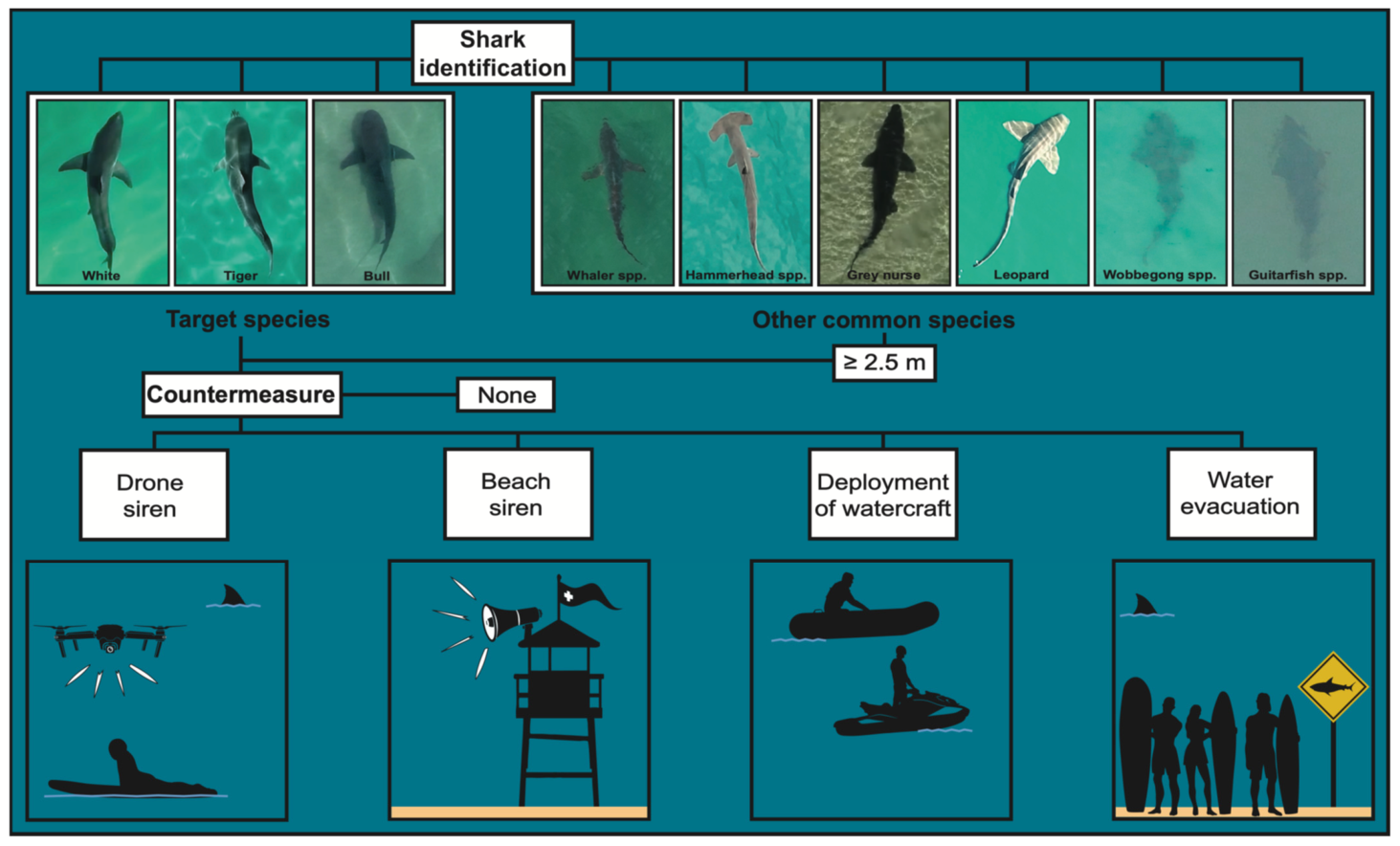
When a shark was detected, the drone pilot classified the animal in real time as either a ‘target species’ or ‘other shark’. This enables prompt decision-making regarding beach safety and the implementation of appropriate countermeasures based on perceived risk (Figure 2). Any shark classified as a target species was further identified to species level as a white, bull, or tiger shark. Species-level identification was not required for sharks classified as ‘other shark’. If identification was not possible due to poor water conditions, the shark’s swim depth, or the inability to classify with certainty, the animal was categorised as an ‘unknown shark’. Shark footage was recorded in FHD (1920 × 1080) or higher resolution for post-flight analysis.
Figure 2.
Workflow for real-time shark identification during drone-based surveillance, with optional beach countermeasures when a potential risk to beach water users is perceived.
Any countermeasures implemented to reduce human–shark interactions were also documented. These included activating a drone or beach siren, deploying a rescue watercraft or inflatable rescue boat, or evacuating the water (Figure 2). In some cases, more than one countermeasure was implemented. Instances where no countermeasure was used, or the countermeasure was unknown, were also documented.
2.2. Post-Flight Analysis
All recorded shark observations were collected and reviewed post-flight at single speed using VLC media player (ver. 3.0.21; https://www.videolan.org (accessed on 22 April 2026)) by shark scientists with over five and ten years of experience in shark identification, respectively. During post-flight review, the drone footage was paused, played back at a slower speed, or replayed to ensure the highest accuracy in species identification. Similar to real-time identification, sharks were classified as either a target species or ‘other shark’, while non-shark species were labelled as ‘non-shark’. Each individual was also identified to the lowest possible taxonomic level. The other shark category included grey nurse sharks (Carcharias taurus), hammerhead sharks (Sphyrna spp.), leopard sharks (Stegostoma tigrinum), whaler sharks (Carcharhinus spp.), and wobbegong sharks (Orectolobus spp.). Guitarfish (Rhinobatidae, Rhinidae) were often included in the other shark category during drone-based surveillance. Sharks unable to be identified (e.g., poor water conditions, animal’s swim depth, suboptimal drone positioning) were documented as ‘unknown shark’. Real-time identifications were then compared with post-flight identifications to determine misidentification rates (see Figure 3).
Countermeasure categories were combined and labelled as ‘sirens’ (drone and beach), ‘watercraft’ (rescue watercraft and inflatable rescue boat), ‘evacuation’ (water evacuation), or none (no countermeasure implemented). Countermeasures that were recorded as ‘unknown’ were removed from analysis. These categories were used to quantify the number of countermeasures implemented in response to drone-based detections, using post-flight species identification (see Figure 4).
Environmental conditions were recorded during post-flight review of footage to investigate how water conditions influence real-time species identification. Water clarity was rated from 1 to 5 (where ‘1’—very poor; ‘5’—very good), and sea state was categorised using the Beaufort scale (ranging from 0 to 4).
2.3. Statistical Analysis
Real-time and post-flight species identifications for each flight were cross-tabulated to quantify agreement between the methods based on each species (see Table 1; Figure 2). A confusion matrix was constructed to evaluate the accuracy of real-time classification of target species on a binary presence–absence basis, as verified by post-flight analysis. Detections of bull, white, and tiger sharks were combined into a single category labelled as ‘target species’, while unknown and other sharks, as well as guitarfish and gamefish, were combined and labelled ‘other’. Consistent with this framework, species-level misidentifications were not differentiated; for example, a bull shark misidentified as a white shark was still counted as correctly detecting a target species. Such discrepancies occurred in nine flights. Classifications confirmed during post-flight analysis were treated as the true results for each flight, while real-time classifications were treated as test results to form the confusion matrix (see Table 2).
The apparent prevalence of target sharks, based on real-time classifications, and the true presence, based on post-flight analysis, were calculated using the confusion matrix (see Table 2). Sensitivity, specificity, and positive predictive value were also derived. Sensitivity was defined as the proportion of flights with a target species identified as present in post-flight review (true positives) that were classified as present in real time. Specificity was defined as the proportion of flights in which a target species was classified as absent in post-flight review (true negatives) that were classified as absent in real time. Positive predictive value was defined as the proportion of flights with a target species detected in real time that were classified as positive by post-flight review, although noting that the low true prevalence of the target species was a limiting factor for this estimate (see Table 3). Binomial confidence intervals were calculated for all proportion estimates.
The influence of water conditions on the detection sensitivity and false positive rate (1—specificity) of target species was examined using logistic regression models. For the sensitivity analysis, flights in which target species were detected in post-flight (n = 135) were encoded as ‘1’ if the detection was also made in real time, and ‘0’ if it was missed. This binary response variable was then modelled as a function of water clarity and sea state using a Generalised Linear Model (GLM) with binomial distribution and random effects for location to allow for potential intra-site correlation and extra binomial variance. Statistical significance of the fixed effects was assessed by the change in deviance compared to the appropriate chi-squared distribution. The false-positive detection rate was analysed using a similar approach after encoding flights with no target species detected in post-flight review (n = 765) as ‘1’ if a target species was detected in real time and ‘0’ if no detection was recorded. The probability of each response for each factor, along with 95% confidence intervals, was estimated from the GLMs and the results presented graphically (see Figure 5). The data analyses were conducted in the R environment [46].
3. Results
Nine hundred shark identifications were made. Post-flight analysis revealed misidentification rates of 53% for bull sharks and 79% for white sharks (Table 1; Figure 3). Tiger sharks were misidentified 100% of the time, although they were reported in real time on only five occasions. In 148 instances, sharks identified in real time as target species were confirmed post-flight as other sharks, including whaler species (n = 135), grey nurse (n = 8), leopard (n = 3), and wobbegong (n = 2; Table 1). Conversely, in 34 instances, sharks identified in real time as other (n = 1), or unknown (n = 33) sharks were verified post-flight as bull (n = 28) or white (n = 6) sharks (Table 1).
Figure 3.
Real-time classifications (y-axis) compared with post-flight verification rates (x-axis), showing true-positive and misclassified positive detections of target sharks (white, bull, and tiger) and other sharks during drone-based surveillance. Note: While real-time identification may classify guitarfish as ‘other sharks’, post-flight analysis provided species-level identifications to distinguish sharks from non-shark groups.
Whaler sharks were observed most frequently (n = 361) and misidentified in real-time as white (n = 80), bull (n = 53), and tiger (n = 2) sharks (Table 1). Guitarfish were misidentified as white or bull sharks in five and nine instances, respectively, and gamefish were misidentified as unknown sharks on eight occasions.
Table 1.
Real-time shark identification during drone-based surveillance (columns) compared with identifications verified post-flight (rows). Real-time identifications aimed for species-level classification of target sharks (bull, tiger, or white) or categorisation as ‘other sharks’ for other species, or ‘unknown sharks’ if identification was not possible. For real-time detections, other and unknown categories have been grouped to reflect the primary focus on target species. Post-flight analysis provided species-level identifications for all detections, or ‘unknown shark’ when identification was not possible. Highlighted data indicate agreement between real-time and post-flight identification of target species.
Using a binary presence–absence framework, target sharks (bull, tiger, or white) were reported in real time during 269 of 900 drone flights. Of these, 168 were false positives (62%). There were also 34 false negatives (25%; Table 2). Apparent prevalence in real-time classifications was 30% of flights (95% CI: 27–33%), whereas post-flight analysis confirmed a true prevalence of 15% (95% CI: 13–18%; Table 3). Sensitivity and specificity of real-time classification were 75% (95% CI: 67–82%) and 78% (95% CI: 75–81%), respectively (Table 3).
Table 2.
Confusion matrix comparing real-time apparent presence and absence of target sharks (bull, tiger, and white) during drone-based surveillance with true presence and absence verified through post-flight analysis. Highlighted data indicate true positives and true negatives, where real-time and post-flight identifications agree.
Table 3.
Analysis of real-time drone-based classification of target sharks (bull, tiger, and white), showing apparent prevalence, true prevalence, sensitivity, specificity, and positive predictive value, with lower and upper confidence limits.
3.1. Countermeasures
Countermeasures were implemented on 275 occasions, comprising 195 water evacuations, 52 sirens, and 30 watercraft deployments. On two separate occasions, two countermeasures were implemented. In 264 instances, the countermeasure was documented as unknown.
Based on real-time identification of bull (n = 65), white (n = 61), and tiger (n = 4) sharks, 132 countermeasures were triggered across 130 occasions, including water evacuations (n = 103), sirens (n = 21), and watercraft deployments (n = 8; Figure 4). In instances where countermeasures were implemented based on real-time classification of target sharks, the classification was correct in 36% of cases, with species-level accuracy rates of 46%, 18%, and 0% for bull, white, and tiger sharks, respectively. Most countermeasures were implemented in response to other sharks, with whaler species accounting for the majority (n = 125), followed by grey nurse sharks (n = 18; Figure 4), while wobbegong sharks triggered the fewest (n = 4), three of which were water evacuations (Figure 4b). Additionally, 39 countermeasures were implemented for non-shark species, including guitarfish (n = 37) and gamefish (n = 2), comprising 28 water evacuations, eight sirens, and three watercraft deployments (Figure 4).
Figure 4.
Beach countermeasures implemented following drone-based real-time identification of sharks along coastal beaches: (a) total countermeasures, with breakdowns of (b) water evacuations, (c) sirens (beach and drone), and (d) watercraft deployments (inflatable rescue boat and rescue watercraft). Countermeasures are triggered in response to sharks (white, bull, other, or unknown), and non-sharks (guitarfish or gamefish), as verified through post-flight analysis. The ‘other shark’ category comprises grey nurse, hammerhead, leopard, whaler, and wobbegong species, with countermeasures implemented for each species as shown.
3.2. Factors Affecting Real-Time Misidentification Rates of Target Sharks
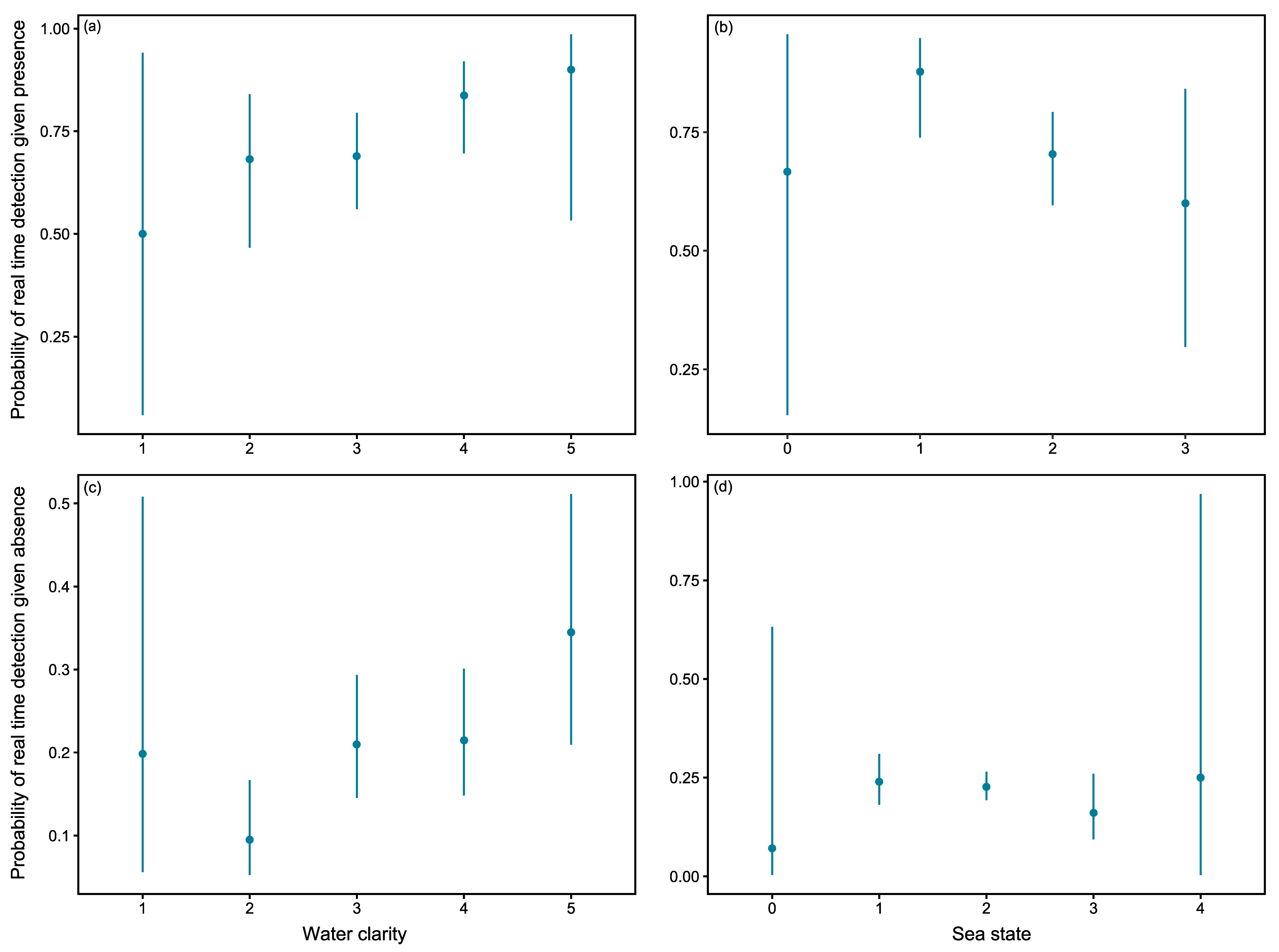
The probability of correctly classifying target species in real time was higher under clearer and calmer water conditions, although neither water clarity nor sea state had a statistically significant effect (p > 0.05; Figure 5a,b). In contrast, false-positive detections of target species increased significantly with increasing water clarity (p < 0.05; Figure 5c), while sea state had no significant effect (p > 0.05; Figure 5d).
Figure 5.
Estimated true positive and false positive detection probabilities for target species in response to water clarity (1—very poor; 5—very good (a,c)) and sea state (Beaufort Scale 0—4 (b,d)). Vertical bars represent 95% confidence intervals.
4. Discussion
Despite the demonstrated utility of drone-based surveillance for sharks in surf zones, misidentification rates were substantial. Of the flights in which target species were reported, only 38% were confirmed post-flight, while 62% were false positives. Real-time classification demonstrated moderate performance, with 75% sensitivity and 78% specificity. Overall, real-time classification reported an apparent prevalence twice that of the true prevalence of target sharks. These findings underscore the challenges of real-time species identification during drone-based surveillance, with implications for beach safety and resource management.
Real-time species-level misidentification rates for target sharks were also considerable, at 53%, 79%, and 100% for bull, white, and tiger sharks, respectively. In instances where countermeasures were triggered due to real-time classification of target sharks, classification was accurate in only 36% of cases overall. White and bull sharks are known to frequent surf zones along the NSW coastline [25,29,47] and are implicated in most unprovoked shark bites in this region [48]. This may contribute to higher misidentification rates during drone-based surveillance, as pilots are especially cautious given the potentially serious implications of shark bites, although this was not directly assessed. In contrast, tiger sharks were rarely reported in real time and were not confirmed during post-flight analysis, likely reflecting their distinctive colour pattern, tendency to remain further offshore, and relatively infrequent use of beaches [49,50,51,52], especially during daylight periods in which drones are used.
Whaler sharks were most frequently observed, and their presence resulted in the majority of countermeasure implementations. Misidentification of whaler species as bull sharks was likely due to morphological similarities, particularly in body shape, size, and colouration, which can complicate species-level identification during aerial surveillance [52,53,54]. Our findings are consistent with previous studies that have highlighted difficulties in distinguishing specific whaler species exclusively on physical observation [38,55]. Yet, these challenges do not fully explain the frequent misidentification of whaler sharks as white sharks. White sharks possess prominent morphological features, including a distinct pointed conical snout, strong lateral keels on the caudal peduncle, and a crescent-shaped caudal fin [56,57]. White sharks also exhibit thunniform locomotion, a swimming style characterised by lateral movement largely restricted to the caudal region and distinguishable from a top-down aerial perspective [58,59,60]. In practice, drones cannot always be positioned directly above the shark, and misidentification may be more likely when larger whaler species, such as bronze or dusky whalers, are viewed from oblique angles or at a distance.
Some unprovoked shark bites resulting in serious injury or fatality have documented the involvement of other larger shark species [7,48,61]. Beach countermeasures may therefore be triggered if a shark is ≥2.5 m and within proximity to water users [62]. This may partially explain the high frequency of countermeasures in response to other shark presence, such as grey nurse [63,64], hammerhead [65,66], and some whaler species (e.g., bronze or dusky whalers [67,68]), which can all exceed 2.5 m in length.
Reported shark sightings can deter participation in ocean-based activities [69,70], which is particularly problematic when the species involved pose little to no risk to humans. Frequent interventions in response to harmless species may also influence public perception about shark prevalence and create unnecessary fear among water users. Here, multiple countermeasures were activated due to the presence of some species, such as leopard sharks, which rarely cause unprovoked bites [71,72]. Guitarfish were also occasionally misidentified as target sharks (also see Kelaher et al. [22]), and gamefish were sometimes mistaken for sharks, prompting unnecessary interventions, including water evacuations. Guitarfish are shark-like batoids that are common in shallow, sandy habitats along the NSW coastline [73,74,75], typically remain near the seafloor [76,77], and have a pointed snout similar to white sharks, which can complicate identification during drone surveys. Mitchell et al. [42] reported similar inaccuracies in real-time identification during shark surveillance, although no water evacuations occurred as a result.
While high misidentification rates of other sharks as target sharks occurred, there were several instances in which target sharks were identified in real time as unknown or other sharks. This indicates that, despite a tendency for cautious decision-making, false negatives still occur, likely due to technological constraints (e.g., small screens used for identification) or environmental factors (e.g., suboptimal water conditions, sun glare, shark swim depth). Misclassification of target sharks in real time may have safety implications, as missed detections could potentially result in human–shark interactions depending on the shark’s proximity to water users. Nevertheless, numerous countermeasures, including water evacuations, were implemented, which may reflect management decisions under uncertainty or based on shark size estimations.
Drone-based shark detection and identification can be particularly challenging in adverse water conditions or when animals are deep in the water column [43,45]. Here, neither water clarity nor sea state significantly affected the probability of correctly classifying target species in real time, although accuracy was higher under clearer, calmer conditions. Fortuna et al. [78] and Butcher et al. [41] observed improved shark detectability, while Bigal et al. [79] reported higher species identification accuracy under similar conditions. Our results are likely due to flights conducted during light to moderate winds and surveying relatively shallow waters [80,81]. False positives for target sharks were, however, significantly more frequent in clearer water, which may reflect a precautionary tendency for pilots to assume the presence of target species, although the mechanism warrants further investigation.
This study evaluated real-time shark identification within current procedures used in drone-based shark surveillance programs. Accordingly, real-time classification was completed by multiple drone pilots with varying levels of operational experience using two different drone models. In addition, a binary classification framework was applied to focus primarily on target shark identification, enabling prompt decision-making when rapid risk assessment is required. Despite these factors, this research offers valuable insights into the challenges of real-time shark identification in drone-based surveillance programs.
The use of artificial intelligence (AI) for real-time identification could improve drone-based shark surveillance programs [82]. AI-based methods have demonstrated strong performance in identifying target sharks during trials [83,84]. Real-time detection models often rely on large, high-quality training datasets that include imagery collected across diverse habitats and under varied environmental conditions to achieve reliable performance in operational settings [83,85]. Challenges also remain when ocean conditions are poor or when the shark is in deeper water [84]. Zero-shot learning approaches show potential for automatically detecting sharks while reducing the need for task-specific training data [86,87,88]. These approaches may, however, require greater computational resources [88]. Ongoing advances in AI-based software are expected to increase detection accuracy and improve practical applications [89,90]. Additional technological improvements, such as larger, brighter monitors that display higher-resolution video, may also help reduce misidentification rates. Combining AI-based detection software with larger monitors, along with pilot experience and specialised training, will likely improve real-time identification, supporting informed decision-making and effective beach management.
5. Conclusions
Drone surveillance is an effective non-lethal mitigation method for monitoring shark presence in surf zones, although accuracy in real-time species identification of target sharks remains a key limitation. While shark bites are relatively infrequent, such incidents can result in severe physical and psychological trauma and, in some cases, fatalities [91,92,93]. It is therefore reasonable for drone pilots to take a cautious approach when sharks are observed in proximity to water users. Increasing species identification accuracy will assist in maintaining public confidence in drone-based programs [20]. Providing pilots with additional resources (e.g., further training, higher-quality video feeds) will likely improve shark identification in real time, resulting in more efficient allocation of beach resources. The development and implementation of AI-based video analysis software have the potential to support pilots during real-time identification, enhancing the accuracy and effectiveness of drone-based shark surveillance programs.
Supplementary Materials
The following supporting information can be downloaded at: https://www.mdpi.com/article/10.3390/rs18132132/s1, Table S1: Local Government areas, locations and co-ordinates for the New South Wales drone-based shark surveillance program from 2017–2025.
Author Contributions
Conceptualisation, K.I.M., B.P.K. and P.A.B.; Methodology, K.I.M., B.P.K. and P.A.B.; Validation, B.P.K. and P.A.B.; Formal Analysis, S.G.M.; Investigation, K.I.M. and P.A.B.; Resources, B.P.K. and P.A.B.; Data Curation, K.I.M.; Writing—Original Draft Preparation, K.I.M.; Writing—Review and Editing, K.I.M., B.P.K., P.A.B. and S.G.M.; Visualisation, K.I.M. and S.G.M.; Supervision, B.P.K. and P.A.B.; Project Administration, B.P.K. and P.A.B.; Funding Acquisition, B.P.K. and P.A.B. All authors have read and agreed to the published version of the manuscript.
Funding
This project was made possible through the NSW Shark Management Program and Southern Cross University. Analyses of data were further supported by a Seaworld Research and Rescue Foundation Inc. grant (SWR/5/2020) to B.P.K. and P.A.B.
Data Availability Statement
The data underlying this article cannot be shared publicly due to being obtained under contract from a government agency. The data will be shared on a reasonable request to the corresponding author.
Acknowledgments
We thank James Bassam, Mark Atkins, and the NSW Surf Life Saving drone pilots for their efforts in data collection, which made this research possible. We also thank A. Banda Marquez for her assistance with this project.
Conflicts of Interest
The authors declare no conflicts of interest.
References
- Dickman, A.J. Complexities of conflict: The importance of considering social factors for effectively resolving human-wildlife conflict. Anim. Conserv. 2010, 13, 458–466. [Google Scholar] [CrossRef] [Scilit]
- Nyhus, P.J. Human-wildlife conflict and coexistence. Annu. Rev. Environ. Resour. 2016, 41, 143–171. [Google Scholar] [CrossRef] [Scilit]
- Riley, M.; Meagher, P.; Huveneers, C.; Leto, J.; Peddemors, V.M.; Slip, D.; West, J.; Bradshaw, C.J.A. The Australian Shark-Incident Database for quantifying temporal and spatial patterns of shark-human conflict. Sci. Data 2022, 9, 378. [Google Scholar] [CrossRef] [Scilit] [PubMed]
- Midway, S.R.; Wagner, T.; Burgess, G.H. Trends in global shark attacks. PLoS ONE 2019, 14, e0211049. [Google Scholar] [CrossRef] [Scilit] [PubMed]
- Chapman, B.K.; McPhee, D. Global shark attack hotspots: Identifying underlying factors behind increased unprovoked shark bite incidence. Ocean. Coast. Manag. 2016, 133, 72–84. [Google Scholar] [CrossRef] [Scilit]
- McPhee, D. Unprovoked shark bites: Are they becoming more prevalent? Coast. Manag. 2014, 42, 478–492. [Google Scholar] [CrossRef] [Scilit]
- Florida Museum of Natural History. International Shark Attack Files. Available online: https://www.floridamuseum.ufl.edu/shark-attacks/ (accessed on 20 January 2026).
- Ferreira, L.C.; Simpfendorfer, C.A. Galeocerdo cuvier, Tiger Shark. The IUCN Red List of Threatened Species 2019: E.T39378A2913541In The IUCN Red List of Threatened Species; International Union for Conservation of Nature and Natural Resources: Gland, Switzerland, 2019; p. T39378A2913541. [Google Scholar]
- Rigby, C.L.; Espinoza, M.; Derrick, D.H.; Pacoureau, N.; Dicken, M.L. Carcharhinus leucas, Bull Shark. The IUCN Red List of Threatened Species: E.T39372A2910670In The IUCN Red List of Threatened Species; International Union for Conservation of Nature and Natural Resources: Gland, Switzerland, 2021; p. T39372A2910670. [Google Scholar]
- Rigby, C.L.; Barreto, R.; Carlson, J.; Fernando, D.; Fordham, S.; Francis, M.P.; Herman, K.; Jabado, R.W.; Jones, G.C.A.; Liu, K.M.; et al. Carcharodon carcharias, White Shark. In The IUCN Red List of Threatened Species; International Union for Conservation of Nature and Natural Resources: Gland, Switzerland, 2022; p. T3855A212629880. [Google Scholar] [CrossRef] [Scilit]
- Simpfendorfer, C.A.; Heupel, M.R.; Kendal, D. Complex human-shark conflicts confound conservation action. Front. Conserv. Sci. 2021, 2, 692767. [Google Scholar] [CrossRef] [Scilit]
- McPhee, D.P.; Blount, C.; Lincoln Smith, M.P.; Peddemors, V.M. A comparison of alternative systems to catch and kill for mitigating unprovoked shark bite on bathers or surfers at ocean beaches. Ocean. Coast. Manag. 2021, 201, 105492. [Google Scholar] [CrossRef] [Scilit]
- Cliff, G.; Dudley, S.F.J. Reducing the environmental impact of shark-control programs: A case study from KwaZulu-Natal, South Africa. Mar. Freshw. Res. 2011, 62, 700–709. [Google Scholar] [CrossRef] [Scilit]
- Dalton, S.; Peddemors, V.; Doak, C. Shark Meshing (Bather Protection) Program 2023/24 Annual Performance Report; New South Wales Department of Primary Industries and Regional Development: Orange, Australia, 2024. [Google Scholar]
- Simmons, P.; Mehmet, M.; Curley, B.; Ivory, N.; Callaghan, K.; Wolfenden, K.; Xie, G. A scenario study of the acceptability to ocean users of more and less invasive management after shark-human interactions. Mar. Policy 2021, 129, 104558. [Google Scholar] [CrossRef] [Scilit]
- Pepin-Neff, C.; Wynter, T. Shark bites and shark conservation: An analysis of human attitudes following shark bite incidents in two locations in Australia. Conserv. Lett. 2018, 11, e12407. [Google Scholar] [CrossRef] [Scilit]
- Martin, C.L.; Curley, B.; Wolfenden, K.; Green, M.; Moltschaniwskyj, N.A. The social dimension to the New South Wales Shark Management Strategy, 2015–2020, Australia: Lessons learned. Mar. Policy 2022, 141, 105079. [Google Scholar] [CrossRef] [Scilit]
- Butcher, P.A.; Colefax, A.P.; Gorkin, R.A.; Kajiura, S.M.; López, N.A.; Mourier, J.; Purcell, C.R.; Skomal, G.B.; Tucker, J.P.; Walsh, A.J.; et al. The drone revolution of shark science: A review. Drones 2021, 5, 8. [Google Scholar] [CrossRef] [Scilit]
- Provost, E.J.; Butcher, P.A.; Colefax, A.P.; Coleman, M.A.; Curley, B.G.; Kelaher, B.P. Using drones to quantify beach users across a range of environmental conditions. J. Coast. Conserv. 2019, 23, 633–642. [Google Scholar] [CrossRef] [Scilit]
- Stokes, D.; Apps, K.; Butcher, P.A.; Weiler, B.; Luke, H.; Colefax, A.P. Beach-user perceptions and attitudes towards drone surveillance as a shark-bite mitigation tool. Mar. Policy 2020, 120, 104127. [Google Scholar] [CrossRef] [Scilit]
- Colefax, A.P.; Butcher, P.A.; Kelaher, B.P. The potential for unmanned aerial vehicles (UAVs) to conduct marine fauna surveys in place of manned aircraft. ICES J. Mar. Sci. 2018, 75, 1–8. [Google Scholar] [CrossRef] [Scilit]
- Kelaher, B.P.; Peddemors, V.M.; Hoade, B.; Colefax, A.P.; Butcher, P.A. Comparison of sampling precision for nearshore marine wildlife using unmanned and manned aerial surveys. J. Unmanned. Veh. Syst. 2020, 8, 30–43. [Google Scholar] [CrossRef] [Scilit]
- Huveneers, C.; Blount, C.; Bradshaw, C.J.A.; Butcher, P.A.; Lincoln Smith, M.P.; Macbeth, W.G.; McPhee, D.P.; Moltschaniwskyj, N.; Peddemors, V.M.; Green, M. Shifts in the incidence of shark bites and efficacy of beach-focussed mitigation in Australia. Mar. Pollut. Bull. 2024, 198, 115855. [Google Scholar] [CrossRef] [Scilit] [PubMed]
- Monteforte, K.I.; Butcher, P.A.; Morris, S.G.; Tucker, J.P.; Griffin, K.J.; Kelaher, B.P. The influence of human and marine wildlife presence on white shark behaviour in nearshore areas. ICES J. Mar. Sci. 2024, 82, fsae146. [Google Scholar] [CrossRef] [Scilit]
- Colefax, A.P.; Kelaher, B.P.; Pagendam, D.E.; Butcher, P.A. Assessing white shark (Carcharodon carcharias) behavior along coastal beaches for conservation-focused shark mitigation. Front. Mar. Sci. 2020, 7, 268. [Google Scholar] [CrossRef] [Scilit]
- Tucker, J.P.; Colefax, A.P.; Santos, I.R.; Kelaher, B.P.; Pagendam, D.E.; Butcher, P.A. White shark behaviour altered by stranded whale carcasses: Insights from drones and implications for beach management. Ocean. Coast. Manag. 2021, 200, 105477. [Google Scholar] [CrossRef] [Scilit]
- Cross, M.; Mitchell, J.; Scott-Holland, T. High-resolution mapping of shark movements from drone footage at Queensland beaches improves risk assessment for beach safety. Mar. Policy 2025, 179, 106737. [Google Scholar] [CrossRef] [Scilit]
- Cross, M.C.; Mitchell, J.D.; Dudgeon, C.L.; Townsend, K.A.; Scott-Holland, T.B.; Holmes, B.J. Spatial and temporal variation of marine megafauna off coastal beaches of south-eastern Queensland, Australia. Mar. Freshw. Res. 2024, 75, MF24094. [Google Scholar] [CrossRef] [Scilit]
- Monteforte, K.I.P.; Butcher, P.A.; Morris, S.G.; Kelaher, B.P. The relative abundance and occurrence of sharks off ocean beaches of New South Wales, Australia. Biology 2022, 11, 1456. [Google Scholar] [CrossRef] [Scilit] [PubMed]
- Hodgson, A.J.; Kelly, N.; Peel, D. Drone images afford more detections of marine wildlife than real-time observers during simultaneous large-scale surveys. PeerJ. 2023, 11, e16186. [Google Scholar] [CrossRef] [Scilit] [PubMed]
- White, E.R. Minimum time required to detect population trends: The need for long-term monitoring programs. Bioscience 2019, 69, 40–46. [Google Scholar] [CrossRef] [Scilit]
- Davis, K.L.; Silverman, E.D.; Sussman, A.L.; Wilson, R.R.; Zipkin, E.F. Errors in aerial survey count data: Identifying pitfalls and solutions. Ecol. Evol. 2022, 12, e8733. [Google Scholar] [CrossRef] [Scilit] [PubMed]
- Brack, I.V.; Kindel, A.; Oliveira, L.F.B.; Scales, K. Detection errors in wildlife abundance estimates from Unmanned Aerial Systems (UAS) surveys: Synthesis, solutions, and challenges. Methods Ecol. Evol. 2018, 9, 1864–1873. [Google Scholar] [CrossRef] [Scilit]
- Simmons, P.; Mehmet, M.I. Shark management strategy policy considerations: Community preferences, reasoning and speculations. Mar. Policy 2018, 96, 111–119. [Google Scholar] [CrossRef] [Scilit]
- Ghermandi, A.; Nunes, P.A.L.D. A global map of coastal recreation values: Results from a spatially explicit meta-analysis. Ecol. Econ. 2013, 86, 1–15. [Google Scholar] [CrossRef] [Scilit]
- Börger, T.; Mmonwa, K.; Campbell, D. Hazardous human–wildlife encounters, risk attitudes, and the value of shark nets for coastal recreation. Am. J. Agric. Econ. 2024, 106, 925–945. [Google Scholar] [CrossRef] [Scilit]
- Dwight, R.H.; Catlin, S.N.; Fernandez, L.M. Amounts and distribution of recreational beach expenditures in southern California. Ocean. Coast. Manag. 2012, 59, 13–19. [Google Scholar] [CrossRef] [Scilit]
- Tillett, B.J.; Field, I.C.; Bradshaw, C.J.A.; Johnson, G.; Buckworth, R.C.; Meekan, M.G.; Ovenden, J.R. Accuracy of species identification by fisheries observers in a north Australian shark fishery. Fish. Res. 2012, 127–128, 109–115. [Google Scholar] [CrossRef] [Scilit]
- Johnston, A.; Thaxter, C.B.; Austin, G.E.; Cook, A.S.C.P.; Humphreys, E.M.; Still, D.A.; Mackay, A.; Irvine, R.; Webb, A.; Burton, N.H.K.; et al. Modelling the abundance and distribution of marine birds accounting for uncertain species identification. J. Appl. Ecol. 2015, 52, 150–160. [Google Scholar] [CrossRef] [Scilit]
- Austen, G.E.; Bindemann, M.; Griffiths, R.A.; Roberts, D.L. Species identification by experts and non-experts: Comparing images from field guides. Sci. Rep. 2016, 6, 33634. [Google Scholar] [CrossRef] [Scilit] [PubMed]
- Butcher, P.A.; Piddocke, T.P.; Colefax, A.P.; Hoade, B.; Peddemors, V.M.; Borg, L.; Cullis, B.R. Beach safety: Can drones provide a platform for sighting sharks? Wildl. Res. 2019, 46, 701–712. [Google Scholar] [CrossRef] [Scilit]
- Mitchell, J.D.; Scott-Holland, T.B.; Butcher, P.A. Factors affecting shark detection from drone patrols in Southeast Queensland, eastern Australia. Biology 2022, 11, 1552. [Google Scholar] [CrossRef] [Scilit] [PubMed]
- Curtis, T.H.; Scannell, B.J.; Metzger, G.; Cahill, B.V.; Paparo, C.; Galuardi, B.; Berkhout, M.; Zublionis, W.; Iudica, L.; Newton, A.; et al. Scratching the surface: Swimming depths of multiple shark species in New York coastal waters and implications for aerial monitoring. Mar. Coast. Fish. 2025, 17, vtaf010. [Google Scholar] [CrossRef] [Scilit]
- Colefax, A.P.; Butcher, P.A.; Pagendam, D.E.; Kelaher, B.P. Reliability of marine faunal detections in drone-based monitoring. Ocean. Coast. Manag. 2019, 174, 108–115. [Google Scholar] [CrossRef] [Scilit]
- Benavides, M.T.; Fodrie, J.F.; Johnston, D.W. Shark detection probability from aerial drone surveys within a temperate estuary. J. Unmanned. Veh. Syst. 2020, 8, 44–56. [Google Scholar] [CrossRef] [Scilit]
- R Core Team. R: A Language and Environment for Statistical Computing; R Foundation for Statistical Computing: Vienna, Austria, 2024. [Google Scholar]
- Bruce, B.D.; Stevens, J.D.; Malcolm, H. Movements and swimming behaviour of white sharks (Carcharodon carcharias) in Australian waters. Mar. Biol. 2006, 150, 161–172. [Google Scholar] [CrossRef] [Scilit]
- Meagher, P. Australian Shark Incident Database; Zenodo: Geneva, Switzerland, 2025. [Google Scholar] [CrossRef]
- McMillan, M.N.; Barnett, A.; Bierwagen, S.L.; Scott-Holland, T.B.; Udyawer, V.; Campbell, M.; Fitzpatrick, R.; Lubitz, N.; Miller, I.B.; Currey-Randall, L.M. Do some tiger sharks prefer beaches? Insights for shark management from a broad-scale comparative tracking study. Ocean. Coast. Manag. 2026, 271, 107963. [Google Scholar] [CrossRef] [Scilit]
- Holmes, B.J.; Pepperell, J.G.; Griffiths, S.P.; Jaine, F.R.A.; Tibbetts, I.R.; Bennett, M.B. Tiger shark (Galeocerdo cuvier) movement patterns and habitat use determined by satellite tagging in eastern Australian waters. Mar. Biol. 2014, 161, 2645–2658. [Google Scholar] [CrossRef] [Scilit]
- Guyomard, D.; Perry, C.; Tournoux, P.U.; Cliff, G.; Peddemors, V.; Jaquemet, S. An innovative fishing gear to enhance the release of non-target species in coastal shark-control programs: The SMART (Shark Management Alert in Real-Time) drumline. Fish. Res. 2019, 216, 6–17. [Google Scholar] [CrossRef] [Scilit]
- Ebert, D.A.; Dando, M.; Fowler, S. Sharks of the World: A Complete Guide; Princeton University Press: Princeton, NJ, USA, 2021; p. 624. [Google Scholar]
- Irschick, D.J.; Fu, A.; Lauder, G.; Wilga, C.; Kuo, C.-Y.; Hammerschlag, N. A comparative morphological analysis of body and fin shape for eight shark species. Biol. J. Linn. Soc. 2017, 122, 589–604. [Google Scholar] [CrossRef] [Scilit]
- Compagno, L.J.V. FAO Species Catalogue Vol. 4. Sharks of the World. An Annotated and Illustrated Catalogue of Shark Species Known to Date. Part 2. Carcharhiniformes; Food and Agriculture Organization of the United Nations: Rome, Italy, 1984; Volume 4. [Google Scholar]
- Smart, J.J.; Chin, A.; Baje, L.; Green, M.E.; Appleyard, S.A.; Tobin, A.J.; Simpfendorfer, C.A.; White, W.T. Effects of including misidentified sharks in life history analyses: A case study on the Grey Reef shark Carcharhinus amblyrhynchos from Papua New Guinea. PLoS ONE 2016, 11, e0153116. [Google Scholar] [CrossRef] [Scilit] [PubMed]
- Lingham-Soliar, T. Caudal fin in the white shark, Carcharodon carcharias (Lamnidae): A dynamic propeller for fast, efficient swimming. J. Morphol. 2005, 264, 233–252. [Google Scholar] [CrossRef] [Scilit] [PubMed]
- Last, P.R.; Stevens, J.D. Sharks and Rays of Australia, 2nd ed.; CSIRO Publishing: Collingwood, Australia, 2009; p. 644. [Google Scholar]
- Bernal, D.; Dickson, K.A.; Shadwick, R.E.; Graham, J.B. Review: Analysis of the evolutionary convergence for high performance swimming in lamnid sharks and tunas. Comp. Biochem. Physiol. Part A Mol. Integr. Physiol. 2001, 129, 695–726. [Google Scholar] [CrossRef] [Scilit] [PubMed]
- Donley, J.M.; Sepulveda, C.A.; Konstantinidis, P.; Gemballa, S.; Shadwick, R.E. Convergent evolution in mechanical design of lamnid sharks and tunas. Nature 2004, 429, 61–65. [Google Scholar] [CrossRef] [Scilit] [PubMed]
- Gemballa, S.; Konstantinidis, P.; Donley, J.M.; Sepulveda, C.; Shadwick, R.E. Evolution of high-performance swimming in sharks: Transformations of the musculotendinous system from subcarangiform to thunniform swimmers. J. Morphol. 2006, 267, 477–493. [Google Scholar] [CrossRef] [Scilit] [PubMed]
- Bradshaw, C.J.A.; Meagher, P.; Thiele, M.J.; Harcourt, R.G.; Huveneers, C. Predicting potential future reduction in shark bites on people. R. Soc. Open Sci. 2021, 8, 201197. [Google Scholar] [CrossRef] [Scilit] [PubMed]
- Surf Life Saving New South Wales. Public Safety Standard Operating Procedures; Surf Life Saving New South Wales: Central Coast, Australia, 2025. [Google Scholar]
- Pollard, D.A.; Lincoln Smith, M.P.; Smith, A.K. The biology and conservation status of the grey nurse shark (Carcharias taurus Rafinesque 1810) in New South Wales, Australia. Aquat. Conserv. 1996, 6, 1–20. [Google Scholar]
- Smith, K.R.; Scarpaci, C.; Louden, B.M.; Otway, N.M. Behaviour of aggregated grey nurse sharks Carcharias taurus off eastern Australia: Similarities and differences among life-history stages and sites. Endanger. Species Res. 2015, 27, 69–85. [Google Scholar] [CrossRef] [Scilit]
- Lopes da Silva Ferrette, B.; Coelho, R.; Peddemors, V.M.; Ovenden, J.R.; De Franco, B.A.; Oliveira, C.; Foresti, F.; Mendonça, F.F. Global phylogeography of the smooth hammerhead shark: Glacial refugia and historical migration patterns. Aquat. Conserv. 2021, 31, 2348–2368. [Google Scholar] [CrossRef] [Scilit]
- Raoult, V.; Broadhurst, M.K.; Peddemors, V.M.; Williamson, J.E.; Gaston, T.F. Resource use of great hammerhead sharks (Sphyrna mokarran) off eastern Australia. J. Fish. Biol. 2019, 95, 1430–1440. [Google Scholar] [CrossRef] [Scilit] [PubMed]
- Drew, M.; Rogers, P.; Huveneers, C. Slow life-history traits of a neritic predator, the bronze whaler (Carcharhinus brachyurus). Mar. Freshw. Res. 2017, 68, 461–472. [Google Scholar] [CrossRef] [Scilit]
- Huveneers, C.; Niella, Y.; Drew, M.; McAuley, R.; Butcher, P.; Peddemors, V.; Waltrick, D.; Dowling, C.; Mountford, S.; Keay, I.; et al. Continental-scale network reveals cross-jurisdictional movements of sympatric sharks with implications for assessment and management. Front. Mar. Sci. 2021, 8, 697175. [Google Scholar] [CrossRef] [Scilit]
- Boyle, A.; Le Busque, B. Sharing the waves: An exploration of surfer and shark interactions. Mar. Policy 2022, 145, 105260. [Google Scholar] [CrossRef] [Scilit]
- Manero, A.; Yusoff, A.; Lane, M.; Verreydt, K. A national assessment of the economic and wellbeing impacts of recreational surfing in Australia. Mar. Policy 2024, 167, 106267. [Google Scholar] [CrossRef] [Scilit]
- West, J.G. Changing patterns of shark attacks in Australian waters. Mar. Freshw. Res. 2011, 62, 744–754. [Google Scholar] [CrossRef] [Scilit]
- Clua, E.E.G.; Vignaud, T.; Wirsing, A.J. The Talion law “tooth for a tooth”: Self-defense as a motivation for shark bites on human aggressors. Front. Conserv. Sci. 2025, 6, 1562502. [Google Scholar] [CrossRef] [Scilit]
- White, J.; Heupel, M.; Simpfendorfer, C.; Tobin, A. Shark-like batoids in Pacific fisheries: Prevalence and conservation concerns. Endanger. Species Res. 2013, 19, 277–284. [Google Scholar] [CrossRef] [Scilit]
- Moore, A.B.M. Are guitarfishes the next sawfishes? Extinction risk and an urgent call for conservation action. Endanger. Species Res. 2017, 34, 75–88. [Google Scholar] [CrossRef] [Scilit]
- Kelaher, B.P.; Monteforte, K.I.; Morris, S.G.; Schlacher, T.A.; March, D.T.; Tucker, J.P.; Butcher, P.A. Drone-based assessment of marine megafauna off wave-exposed sandy beaches. Remote. Sens. 2023, 15, 4018. [Google Scholar] [CrossRef] [Scilit]
- Reis, M.; Figueira, W.F. Age, growth and reproductive biology of two endemic demersal bycatch elasmobranchs: Trygonorrhina fasciata and Dentiraja australis (Chondrichthyes: Rhinopristiformes, Rajiformes) from Eastern Australia. Zoologia 2020, 37, e49318. [Google Scholar] [CrossRef] [Scilit]
- Dulvy, N.K.; Fowler, S.L.; Musick, J.A.; Cavanagh, R.D.; Kyne, P.M.; Harrison, L.R.; Carlson, J.K.; Davidson, L.N.K.; Fordham, S.V.; Francis, M.P.; et al. Extinction risk and conservation of the world’s sharks and rays. eLife 2014, 2014, e00590. [Google Scholar] [CrossRef] [Scilit] [PubMed]
- Fortuna, J.; Ferreira, F.; Gomes, R.; Ferreira, S.; Sousa, J. Using low cost open source UAVs for marine wild life monitoring—Field report. IFAC Proc. Vol. 2013, 46, 291–295. [Google Scholar] [CrossRef] [Scilit]
- Bigal, E.; Galili, O.; van Rijn, I.; Rosso, M.; Cleguer, C.; Hodgson, A.; Scheinin, A.; Tchernov, D. Reduction of species identification errors in surveys of marine wildlife abundance utilising unoccupied aerial vehicles (UAVs). Remote. Sens. 2022, 14, 4118. [Google Scholar] [CrossRef] [Scilit]
- Hodgson, A.; Peel, D.; Kelly, N. Unmanned aerial vehicles for surveying marine fauna: Assessing detection probability. Ecol. Appl. 2017, 27, 1253–1267. [Google Scholar] [CrossRef] [Scilit] [PubMed]
- Kelaher, B.P.; Colefax, A.P.; Tagliafico, A.; Bishop, M.J.; Giles, A.; Butcher, P.A. Assessing variation in assemblages of large marine fauna off ocean beaches using drones. Mar. Freshw. Res. 2019, 71, 68–77. [Google Scholar] [CrossRef] [Scilit]
- Sharma, N.; Saqib, M.; Scully-Power, P.; Blumenstein, M. SharkSpotter: Shark detection with drones for human safety and environmental protection. In Humanity Driven AI: Productivity, Well-Being, Sustainability and Partnership; Chen, F., Zhou, J., Eds.; Springer International Publishing: Cham, Switzerland, 2022; pp. 223–237. [Google Scholar]
- Gorkin, R.; Adams, K.; Berryman, M.J.; Aubin, S.; Li, W.; Davis, A.R.; Barthelemy, J. Sharkeye: Real-time autonomous personal shark alerting via aerial surveillance. Drones 2020, 4, 18. [Google Scholar] [CrossRef] [Scilit]
- Purcell, C.R.; Walsh, A.J.; Colefax, A.P.; Butcher, P. Assessing the ability of deep learning techniques to perform real-time identification of shark species in live streaming video from drones. Front. Mar. Sci. 2022, 9, 981897. [Google Scholar] [CrossRef] [Scilit]
- Gray, P.C.; Bierlich, K.C.; Mantell, S.A.; Friedlaender, A.S.; Goldbogen, J.A.; Johnston, D.W.; Ye, H. Drones and convolutional neural networks facilitate automated and accurate cetacean species identification and photogrammetry. Methods Ecol. Evol. 2019, 10, 1490–1500. [Google Scholar] [CrossRef] [Scilit]
- Beviá-Ballesteros, I.; Jerez-Tallón, M.; Aranda-Garrido, N.; Saval-Calvo, M.; Abel-Abellán, I.; Fuster-Guilló, A. Zero-shot elasmobranch classification informed by domain prior knowledge. Mach. Learn. Knowl. Extr. 2025, 7, 146. [Google Scholar] [CrossRef] [Scilit]
- Pourpanah, F.; Abdar, M.; Luo, Y.; Zhou, X.; Wang, R.; Lim, C.P.; Wang, X.Z.; Wu, Q.M.J. A review of generalized zero-shot learning methods. IEEE Trans. Pattern Anal. Mach. Intell. 2023, 45, 4051–4070. [Google Scholar] [CrossRef] [Scilit] [PubMed]
- Lalgudi, C.K.; Leone, M.E.; Clark, J.V.; Madrigal-Mora, S.; Espinoza, M. Zero-shot shark tracking and biometrics from aerial imagery. Methods Ecol. Evol. 2025, 16, 2023–2035. [Google Scholar] [CrossRef] [Scilit]
- Ditria, E.M.; Buelow, C.A.; Gonzalez-Rivero, M.; Connolly, R.M. Artificial intelligence and automated monitoring for assisting conservation of marine ecosystems: A perspective. Front. Mar. Sci. 2022, 9, 918104. [Google Scholar] [CrossRef] [Scilit]
- Jenrette, J.; Liu, Z.Y.C.; Chimote, P.; Hastie, T.; Fox, E.; Ferretti, F. Shark detection and classification with machine learning. Ecol. Inform. 2022, 69, 101673. [Google Scholar] [CrossRef] [Scilit]
- Scala, V.A.; Hayashi, M.S.; Kaneshige, J.; Haut, E.R.; Ng, K.; Furuta, S. Shark-related injuries in Hawai’i treated at a level 1 trauma center. Trauma Surg. Acute Care Open 2020, 5, e000567. [Google Scholar] [CrossRef] [Scilit] [PubMed]
- Tucker, J.P.; Santos, I.R.; Kelaher, B.P.; Green, M.; Clark, G.F.; Butcher, P.A. Increased shark bite survivability revealed by two centuries of Australian records. Sci. Rep. 2022, 12, 14121. [Google Scholar] [CrossRef] [Scilit] [PubMed]
- Gosselin, C.; Maillaud, C.; Jourdel, F. Shark bites in New Caledonia: A retrospective study of 22 hospitalized cases and surgical management. Injury 2025, 56, 112775. [Google Scholar] [CrossRef] [Scilit] [PubMed]
Disclaimer/Publisher’s Note: The statements, opinions and data contained in all publications are solely those of the individual author(s) and contributor(s) and not of MDPI and/or the editor(s). MDPI and/or the editor(s) disclaim responsibility for any injury to people or property resulting from any ideas, methods, instructions or products referred to in the content. |
© 2026 by the authors. Licensee MDPI, Basel, Switzerland. This article is an open access article distributed under the terms and conditions of the Creative Commons Attribution (CC BY) license.