


Highlights
What are the main findings?
- A novel machine learning framework successfully reconstructs complete directional wave spectra by fusing quasi-linear SAR swell inversions with theoretical wind-sea knowledge.
- The proposed method effectively corrects severe distortions and recovers the high-frequency wave energy typically lost due to the SAR azimuth cut-off effect.
What are the implications of the main findings?
- The integrated approach significantly improves the accuracy of derived bulk wave parameters and completely eliminates the artifacts found in the standard SAR product.
- Combining the physics-based JONSWAP model with machine learning provides a robust solution to inherent SAR imaging limitations, offering a highly reliable tool for global ocean wave monitoring and forecasting.
Abstract
A synthetic aperture radar (SAR) provides vital global observations of ocean waves. However, the quasi-linear inversion algorithm routinely used for Sentinel-1 Level-2 Ocean Swell Wave (OSW) products suffers from inherent nonlinear imaging limitations. These include severe distortions and the inability to resolve wind-sea components under a strong azimuth cut-off effect. To address these challenges, this paper proposes a novel prior-knowledge-integrated machine learning framework to reconstruct complete and accurate directional wave spectra from Sentinel-1A SAR wave mode data. First, an extreme gradient boosting model is trained to accurately estimate wind-sea heights, which are then used to construct a theoretical JONSWAP prior spectrum. Subsequently, a U-Net architecture seamlessly integrates this physical prior knowledge with the official OSW swell spectra baseline. Independent validation demonstrates that the proposed framework significantly increases the spectral similarity against ERA5 reanalysis compared to the standard OSW. Furthermore, the derived parameters of total significant wave height, mean wave period, and mean wave direction exhibit remarkable improvements, with root mean square errors of 0.4026 m, 0.4342 s and 20.42°, respectively. The enhancement of SAR inferred two-dimensional wave spectra is also examined and discussed by three typical case studies. It is indicated that integrating physical wave knowledge with machine learning robustly mitigates the non-linear limitations of SAR imaging, providing highly reliable directional wave spectra for global ocean monitoring and forecasting.
1. Introduction
Understanding the sea state is crucial for climate dynamics and various ocean engineering applications at both global and regional scales. The fundamental concept and full representation for characterizing the ocean wave condition is the two-dimensional wave spectrum, which depicts the distribution of wave energy across different frequencies and directions. From the directional spectrum, all the integral wave parameters can be derived, including significant wave height (SWH), mean wave direction (MWD), and mean wave period (MWP). Conversely, these widely used bulk parameters alone are inadequate sea state descriptors, as they are unable to distinguish between wave systems from different origins under complex sea conditions [1].
Nowadays, spaceborne synthetic aperture radars (SARs), particularly those operating in WaVe mode (WV), are valuable remote sensing resources that provide two-dimensional spectral information [2]. Various inversion algorithms have been developed [3], since the breakthrough establishment of closed-form nonlinear spectral mapping of the ocean-to-SAR transform [4,5]. Many of these retrieval schemes rely on a first guess to minimize the difference between the theoretical and observed SAR spectra. These external priors, derived from numeric ocean wave models [4,6,7] or simultaneous scatterometer observations [8], are required to compensate for high-frequency information loss and/or to resolve 180° directional ambiguity.
In contrast, since the Envisat era, the European Space Agency (ESA) has implemented the quasi-linear inversion methodology [9,10] in the WV Level-2 processors of both Envisat ASAR [11] and the Sentinel-1 SAR [12]. This strategy enables the inversion of ambiguity-free ocean wave spectra without requiring any first guess prior from SAR cross spectra [10]. Following the launch of Sentinel-1A in 2014, global SAR WV acquisitions from ESA’s Copernicus SAR missions (Sentinel-1A/B/C/D) have routinely provided the Ocean Swell Wave (OSW) component in Level-2 OceaN (OCN) products, which are freely delivered to the end-users and widely utilized (e.g., [13,14]).
Many investigations have evaluated Sentinel-1 OSW products against in situ buoy observations, numerical hindcasts or reanalyses, and CFOSAT SWIM measurements (e.g., [15,16,17,18,19]), indicating that there is still room for refinement [20]. A major challenge is that the official OSW retrievals are primarily confined to the long swell regime. This arises from the longstanding problem in the SAR ocean imaging community known as the azimuth cut-off effect [3,21,22,23]. This destructive effect is caused by nonlinear velocity bunching (and associated Doppler misregistration) in the SAR imaging mechanism. Owing to this inherent limitation, spaceborne SAR essentially behaves as a low-pass filter, preventing a full description of wave spectra, and is particularly blind for shorter-scale wave systems (typically < ~150–200 m) under quasi-linear inversion. Specifically, under strong cut-off conditions, operational OSW products often suffer from distorted and/or incomplete two-dimensional spectra, along with entirely missing wind-sea signals (e.g., [24,25]).
Recently, several artificial-intelligence-based algorithms for predicting one- and two-dimensional wave spectra from SAR imagery have emerged (e.g., [26,27,28,29]). Some of these algorithms evolved from purely data-driven to incorporating physical constraints. In fact, the constrained high-frequency portion in the theoretically based OSW product is primarily associated with wind seas, which are forced by local winds and can be physically modeled [30,31]. In this study, we attempt to exploit this knowledge. By combining machine learning techniques with physical knowledge of wind-sea dynamics, we propose an integrated framework to directly reconstruct the complete wave spectra from strongly cut-off distorted Sentinel-1 OSW products.
The remainder of the paper is organized as follows. Following the Introduction, in Section 2, Sentinel-1A level-2 products and the ERA5 reanalysis are described. The prior-knowledge-integrated machine learning methodology is given in Section 3. In Section 4, we present the results of the statistical assessment for our enhanced SAR OSW, followed by the discussions in Section 5. The findings of this study are summarized in Section 6.
2. Descriptions of Datasets
The study is based on the spatio-temporal match-ups from Sentinel-1A and the European Centre for Medium-Range Weather Forecasts (ECMWF) ERA5 reanalysis, covering the entire 2024. The specific datasets utilized herein are detailed in the following.
2.1. Sentinel-1A Wave Mode Level-2 Data
Sentinel-1A, the first satellite for the ESA Copernicus mission, was launched on 3 April 2014, carrying the C-band (5.405 GHz) SAR. Working in the WV acquisition mode, SAR imagettes (20 × 20 km in coverage, 5 m pixel spacing) are acquired every 100 km at two alternating incidence (WV1: 23.5° and WV2: 36.5°) beams 200 km apart. The default polarization for this mode is single VV.
Level-1 single look complex (SLC) SAR imagette acquired in Sentinel-1A WV mode is routinely processed into Level-2 OCN products, which include the OSW component used in this study. Based on a quasi-linear algorithm [9], the non-linear contribution in the SAR cross-spectra is estimated and removed; furthermore, the cross-spectra technique is employed to remove 180° propagating ambiguity [10]. Finally, ocean wave spectra (stored as the variable “oswPolSpec” in the OSW product) in OSW are provided on a log-polar grid of 60 wavenumbers (0.0052–0.2094 rad/m) with 72 directional bins (at a 5° interval).
Several quality controls were applied to filter out the unreliable OSW spectra. (1) We selected data meeting specific normalized variance thresholds (i.e., and for WV1 and WV2 respectively) to ensure the homogeneity of Sentinel-1A SAR imagettes [32], which is favorable for SAR wave inversion. (2) We excluded data acquired at high latitudes (>65°) to prevent possible sea ice contamination. (3) We only used the spectra containing at least one “good” swell partition, as indicated by the “oswQualityFlagPartition” flag in the OSW product [12,33].
It should be noted that the OSW spectra are first converted from geographical polar coordinates (north-east) to Cartesian coordinates (SAR range-azimuth). Then they are transformed from a wavenumber-directional spectrum to a frequency-directional spectrum :
using the deep-water dispersion relationship , where represents the gravitational acceleration.
2.2. ECMWF ERA5 Reanalysis
The ERA5 is used as the reference in this study. ERA5 is ECMWF’s fifth generation of global climate reanalysis datasets, which are generated using the fully coupled atmosphere–wave model WAM [34]. Previous studies demonstrated high consistency between ERA5 reanalysis and buoy in situ in terms of total SWH [35], wind-sea wave height [36] and two-dimensional wave spectra [37] particularly in the open ocean.
However, as a model-based reanalysis product, ERA5 may contain systematic biases. In particular, previous validation studies have reported that ERA5 can underestimate significant wave height under extreme sea-state conditions [35]. Therefore, the model trained in this study may inherit ERA5-related biases. And this limitation is especially relevant for extreme wave conditions, where the absolute wave-energy magnitude may be underestimated if such underestimation is present in the training labels.
In this study, we use the hourly ERA5 frequency-directional wave spectra. For each of the 0.5° × 0.5° global grids, the ocean wave spectrum consists of 24 directional and 30 frequency (0.0345 to 0.5473 Hz) components.
Here, the coordinate conversion from geographical polar to SAR range-azimuth is also performed for ERA5 spectra using the Sentinel-1 heading angle. In addition, both OSW and ERA5 are bilinearly interpolated onto a new coordinate of 64 × 64 frequency-direction bins covering wavelengths from 5 m to 1200 m. As proved by a previous study [26], the statistical characteristics and distribution of the wave spectra basically remained consistent, although errors occurred in the coordinate conversion interpolation procedure.
2.3. Collocations and Filters
Matchups were initially established by collocating the wave spectra from Sentinel-1A SAR and ERA5 reanalysis within spatio-temporal windows of 0.25° and 0.5 h, respectively. Subsequently, the following filtering criteria were applied:
- Data points located less than 200 km offshore are rejected to minimize the uncertainties in the ERA5 reanalysis spectra caused by complex coastal refraction or diffraction.
- In order to emphasize conditions characterized by strong SAR azimuth cut-off distortions, we further restricted our dataset to points with wind speeds (U10) greater than 10 m/s and wind directions closely aligned with the SAR azimuth direction.
- Finally, to exclude the inconsistent SAR-ERA5 spectral matchups, we implemented a quality-control procedure based on SAR ocean wave imaging theory. We simulate SAR cross-spectra from collocated ERA5 spectra via the nonlinear SAR-Ocean wave mapping [4,10] (see details in Appendix A). Matchups exhibiting low similarity between the simulated and observed SAR cross-spectra were then rejected. Here the similarity score was quantified using the spectral pattern correlation coefficient defined by Brüning et al. [38]:
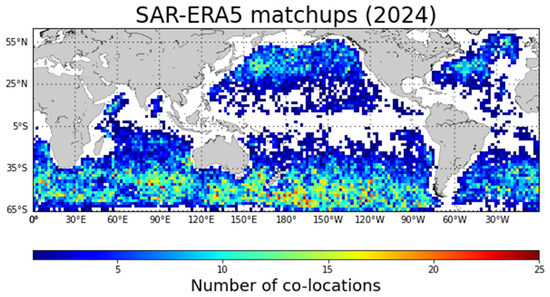
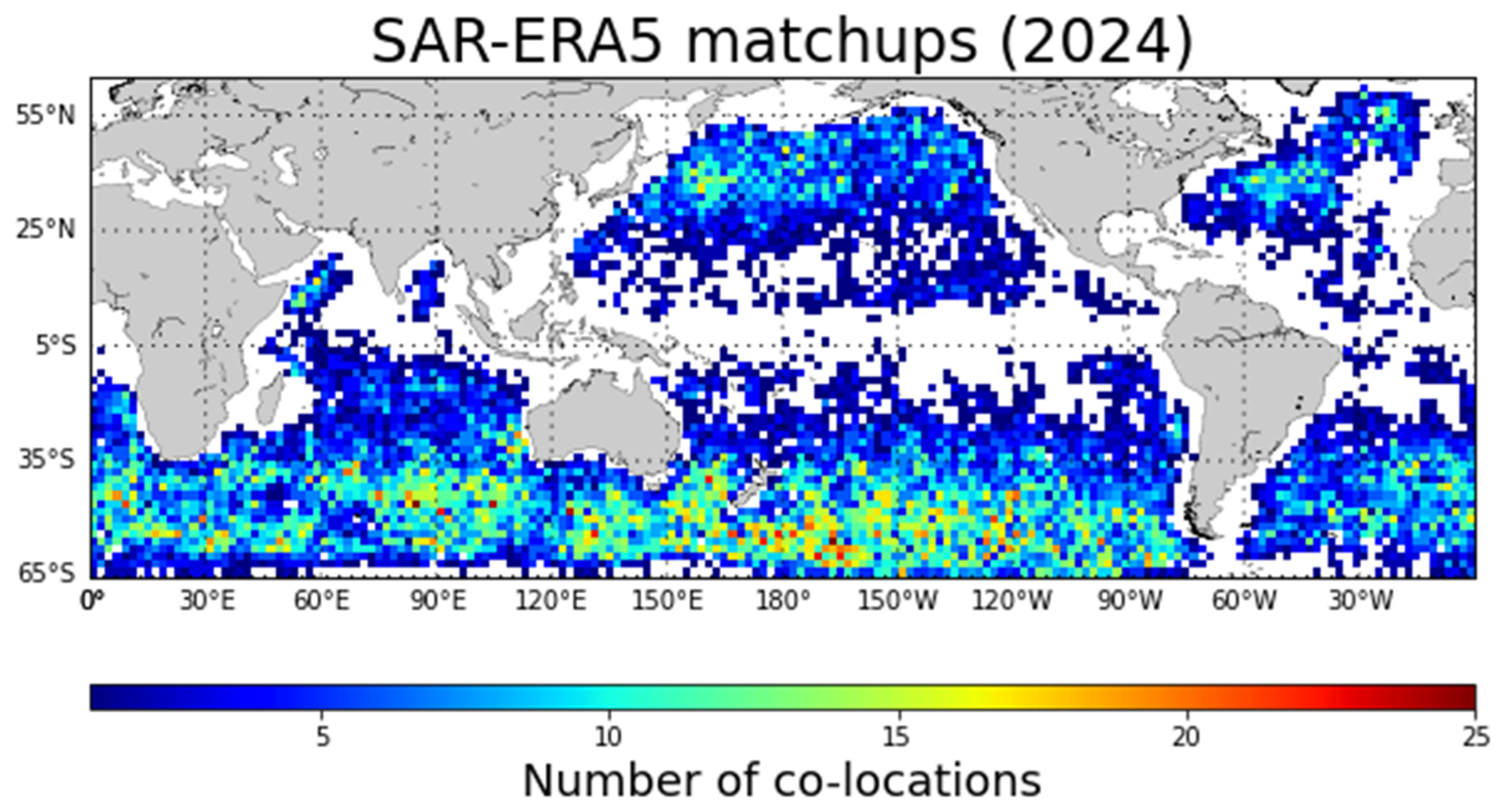
As a result of these criteria, approximately 30,000 matchup points were globally obtained for the year 2024. Figure 1 shows the geographical distribution of these matchups, highlighting more frequent SAR observations in high-latitude regions.
Figure 1.
Global distributions of Sentinel-1A SAR and ERA5 collocations. The spatial bin is 2° × 2° along the latitude and longitude, respectively.
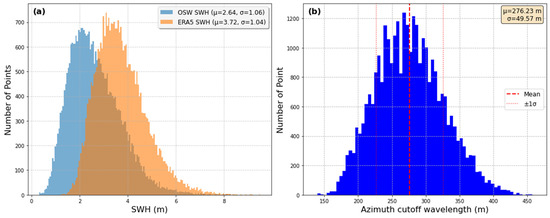
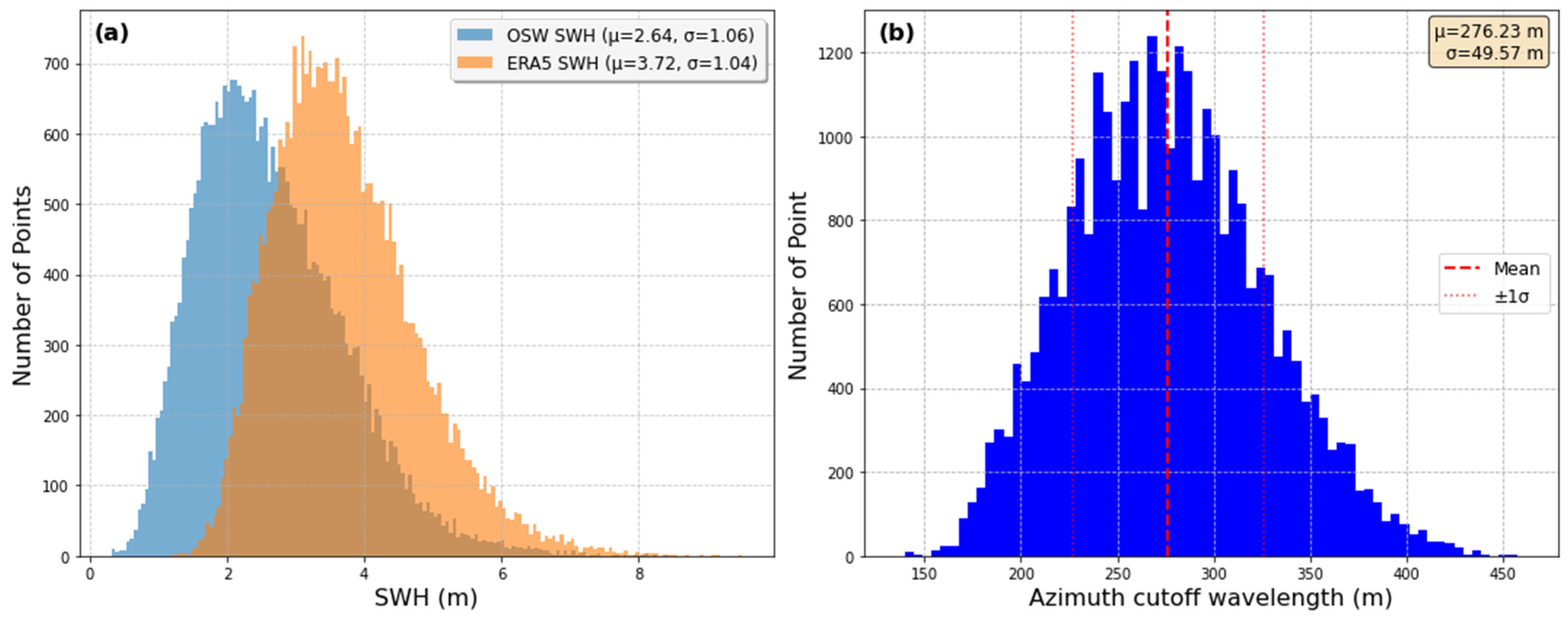
Figure 2a presents the statistical distributions of SWH from ERA5 (in red) and Sentinel-1A OSW (in blue). From these two SWH histograms, it is clear that the OSW products (mainly the swells) underestimate the SWH owing to the azimuth cut-off effect (see the distribution of azimuth cut-off wavelength in Figure 2b).
Figure 2.
Distributions of the collocated data set. (a) Histograms of SWH from Sentinel-1A SAR OSW product and ERA5 reanalysis in blue and red, respectively. (b) Histogram of the SAR azimuth cut-off wavelength.
The entire matchups are randomly shuffled and split into three groups on a Sentinel-1A cycle basis: training (15 cycles, 15,402 points), validation (6 cycles, 5362 points), and test (10 cycles, 10,090 points) set. This strategy was adopted to avoid temporal leakage between training and evaluation samples. In addition, the spatial distribution of the selected matchups is not geographically uniform, with more samples located in mid- and high-latitude regions, particularly the Southern Ocean. This distribution is partly associated with the focus of this study on strong SAR azimuth cut-off conditions, which occur more frequently under energetic wind and wave conditions. No geographic coordinates were used as input features in the machine learning models; nevertheless, the non-uniform spatial sampling remains a limitation when interpreting the geographic generalizability of the results.
3. Methodology
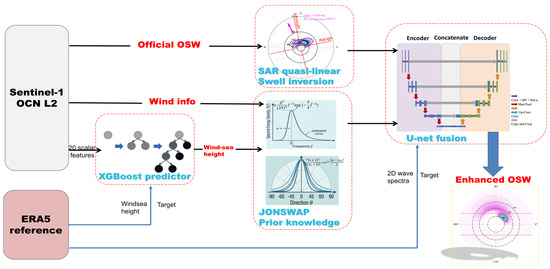
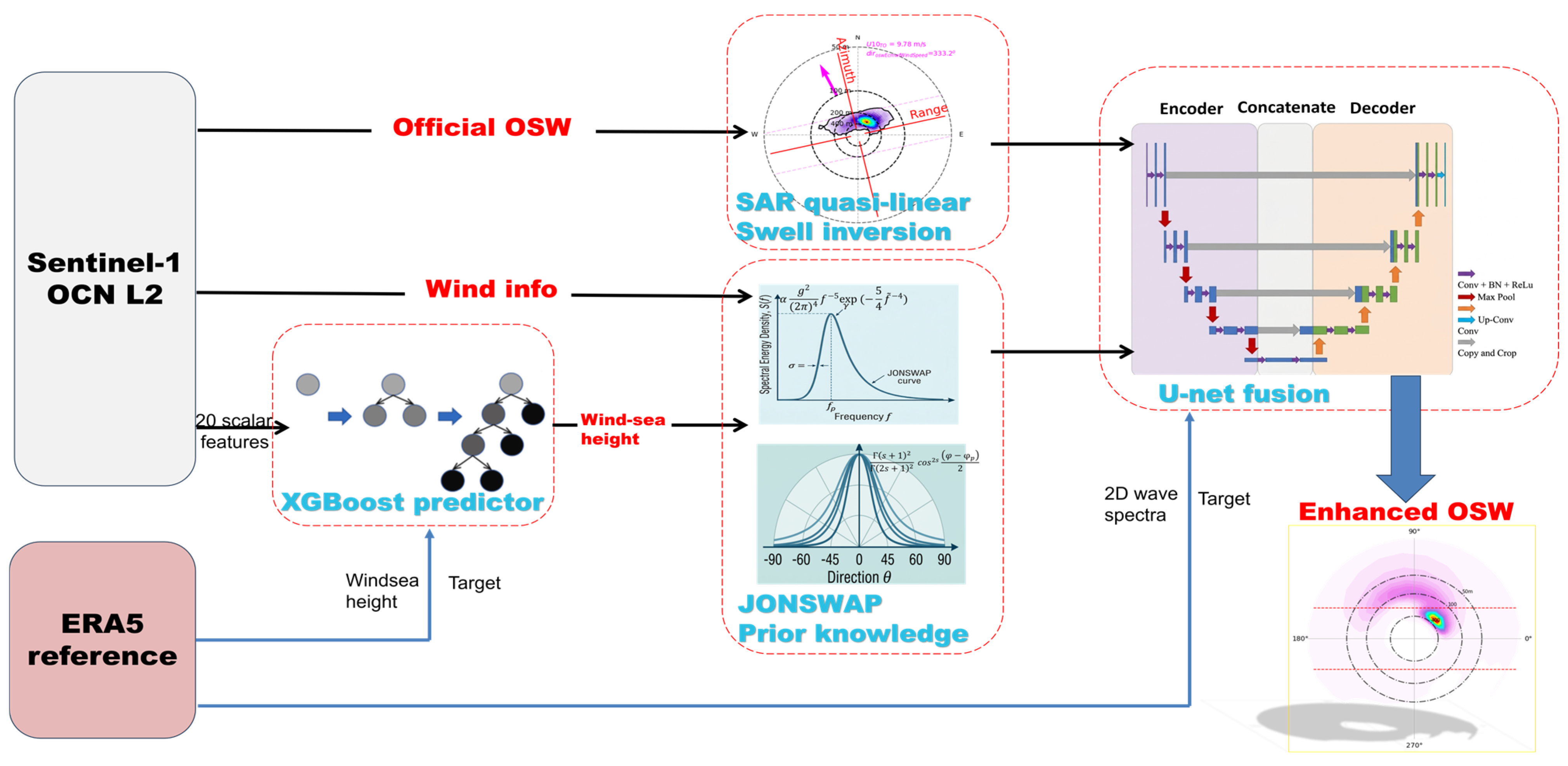
As illustrated in Figure 3, the proposed prior-knowledge-integrated machine learning framework for Sentinel-1A OSW enhancement consists of three main sequential components. First, a model based on eXtreme Gradient Boosting (XGBoost) is employed to accurately predict the wind-sea wave height using 20 observable features extracted from the SAR OCN data. Second, these wind-sea height estimates, alongside SAR-derived wind speed and direction, are utilized to construct a theoretical two-dimensional wind-sea spectrum prior based on the Joint North Sea Wave Project (JONSWAP) parametric model. Finally, a U-Net deep learning architecture takes the original SAR-inverted swell spectra and the knowledge-guided JONSWAP prior as dual-channel inputs. The U-Net effectively fuses these physical priors with the operational inversions to output the fully enhanced and complete directional ocean wave spectra.
Figure 3.
Schematic diagram of the prior-knowledge-integrated machine learning framework for Sentinel-1 OSW enhancement.
3.1. XGBoost-Based Wind-Sea Height Regressor
XGBoost is an advanced machine learning algorithm built upon the gradient boosting framework [39]. It introduces regularization terms and second-order derivatives to enhance performance. The regularization component effectively controls model complexity and prevents overfitting, while the use of second-order derivatives accelerates gradient convergence. Due to these improvements, XGBoost demonstrates excellent performance in both classification and regression tasks.
In this study, 20 observables are fed into the XGBoost model to predict the wind-sea wave height after training. These inputs include: the parameters of inc, cutoff, nrcs, cvar, skew, kurt, wspd_u, wspd_v, and nlwidth directly loaded from Sentinel-1 OCN files, and parameters from the C-band WAVE algorithm (CWAVE), and the Imaginary part of MeAn Cross-Spectra (IMACS). Note that all the CWAVE and IMACS family values are derived from the Sentinel-1 SAR cross-spectra (stored in OCN products as “oswCartSpecRe” and “oswCartSpecIm” for real and imaginary, respectively). For CWAVE, different spectral parameters could be extracted from the SAR spectrum (“oswCartSpecRe”) using a set of orthonormal functions from different directions in the wavenumber domain [40,41]. And the IMACS computes the average of the imaginary part of the cross-spectrum (“oswCartSpecIm”) over a certain wavenumber window, which is for short waves (range wavelength in between 15 m and 35 m) propagating close to the radar line-of-sight direction (azimuth wavelength larger than 600 m) [42,43]. All 20 SAR features are listed and briefly described in Table 1. Hyperparameters are tuned using the Bayesian optimization framework, and their final selections are reported in Table 2.
Table 1.
SAR features used to predict wind-sea wave heights.
Table 2.
Optimal hyperparameters for XGB wind-sea predictor.
3.2. JONSWAP-Based Wind-Sea Spectra Prior
We adopt the JONSWAP wave spectra model [30] to establish the physical prior knowledge of the wind-sea spectrum . The omni-directional spectrum can be expressed as follows:
where , and is the peak frequency, is the JONSWAP peak enhancement factor and is the JONSWAP spectral width, and represents a proportional constant used to scale the energy according to the wind-sea wave height :
The cosine-2s type directional spreading function used here is [31]
where and are the wave direction angle and the peak wave direction, denotes the gamma function, and the spread parameters following the experimental parameterization [30]:
And the value of .
The peak frequency could be deduced from the non-dimensional frequency () and nondimensional fetch [30]:
Based on the Equations (3)–(8), only inputs of , and are needed to construct the theoretical wind-sea directional spectra.
In this study, can be inferred using the XGBoost model, and and are approximated using the wind speed and direction inverted from Sentinel-1 included in the OCN file. The uncertainties in Sentinel-1 OCN-derived wind speed in this step can propagate into the constructed JONSWAP prior. In fact, the reliability of Sentinel-1 SAR-derived wind speed under strong wind conditions has been examined in our previous study. Chen et al. [44] found that the accuracy of Sentinel-1 wind speed estimates for U10 > 10 m/s is not significantly degraded compared with lower-wind regimes. This supports the use of Sentinel-1 OCN wind speed for constructing the wind-sea prior in the strong-wind cases considered here, although residual wind errors remain a potential source of uncertainty. Moreover, the JONSWAP spectrum is used as a soft physical prior input to the U-Net fusion module, not as the final retrieved spectrum. The network is trained to combine this prior with the original OSW spectrum and can partly adjust the final reconstruction when the prior is inconsistent with the reference target.
In this study, the purpose of the intermediate JONSWAP representation is to convert scalar and tabular SAR-derived information into a physically meaningful two-dimensional wind-sea spectral structure. The JONSWAP model provides a constrained spectral shape, including peak frequency, directional spreading, and energy scaling, which helps guide the U-Net toward a physically plausible reconstruction of the missing wind-sea component.
3.3. U-Net Fusion Module
As depicted in Figure 3, we adopt the widely used U-Net model [45,46] to fuse OSW and wind-sea prior in this study. This U-Net fusion model takes a two-channel input (2 × 64 × 64) comprising the original ESA SAR-inverted swell spectra and the constructed JONSWAP wind-sea prior spectra. The network outputs a single-channel 64 × 64 enhanced directional wave spectra. The adopted U-Net consists of four encoder levels, one bottleneck layer, and four corresponding decoder levels. Each encoder level contains two successive 3 × 3 convolutional layers, each followed by batch normalization and a ReLU activation function. A 2 × 2 max-pooling operation is then applied for down-sampling. The number of feature channels in the encoder path is 64, 128, 256, and 512, respectively, while the bottleneck layer uses 1024 channels. In the decoder path, the feature maps are progressively up-sampled and concatenated with the corresponding encoder features through skip connections. These skip connections allow the network to retain high-resolution spectral information while learning the global structure of the directional spectrum. After the final decoder block, a 1 × 1 convolution is used to map the 64-channel feature representation to a single-channel reconstructed spectrum. The total number of trainable parameters is approximately 7.7 million.
Model optimization is driven by an L1 loss function to minimize pixel-level discrepancies between the network predictions and the ERA5 directional spectra target. The L1 loss was selected instead of the L2/MSE loss because directional wave spectra are typically sparse and characterized by localized energetic peaks.
Model training was implemented using the PyTorch deep learning framework and executed on an NVIDIA GeForce RTX 4090 GPU sourced from NVIDIA Corporation (Santa Clara, CA, USA). The network was optimized using the Adam algorithm with a batch size of 64, and an early-stopping mechanism was employed to prevent overfitting.
4. Results
4.1. Wind-Sea Wave Heights Assessment
The performance of the machine learning model in predicting wind-sea wave heights is firstly evaluated against the ERA5 reanalysis using the independent test dataset.
Error metrics used in the assessment are bias, Root Mean Square Error (RMSE), the Scatter Index (SI), and correlation coefficient (CORR):
where denotes the ERA5 labels and represents the XGBoost model’s prediction.
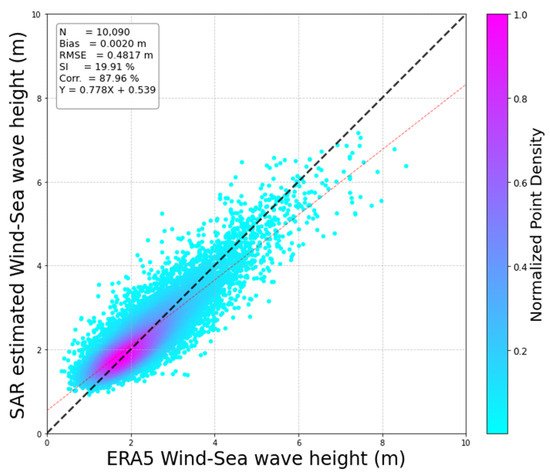
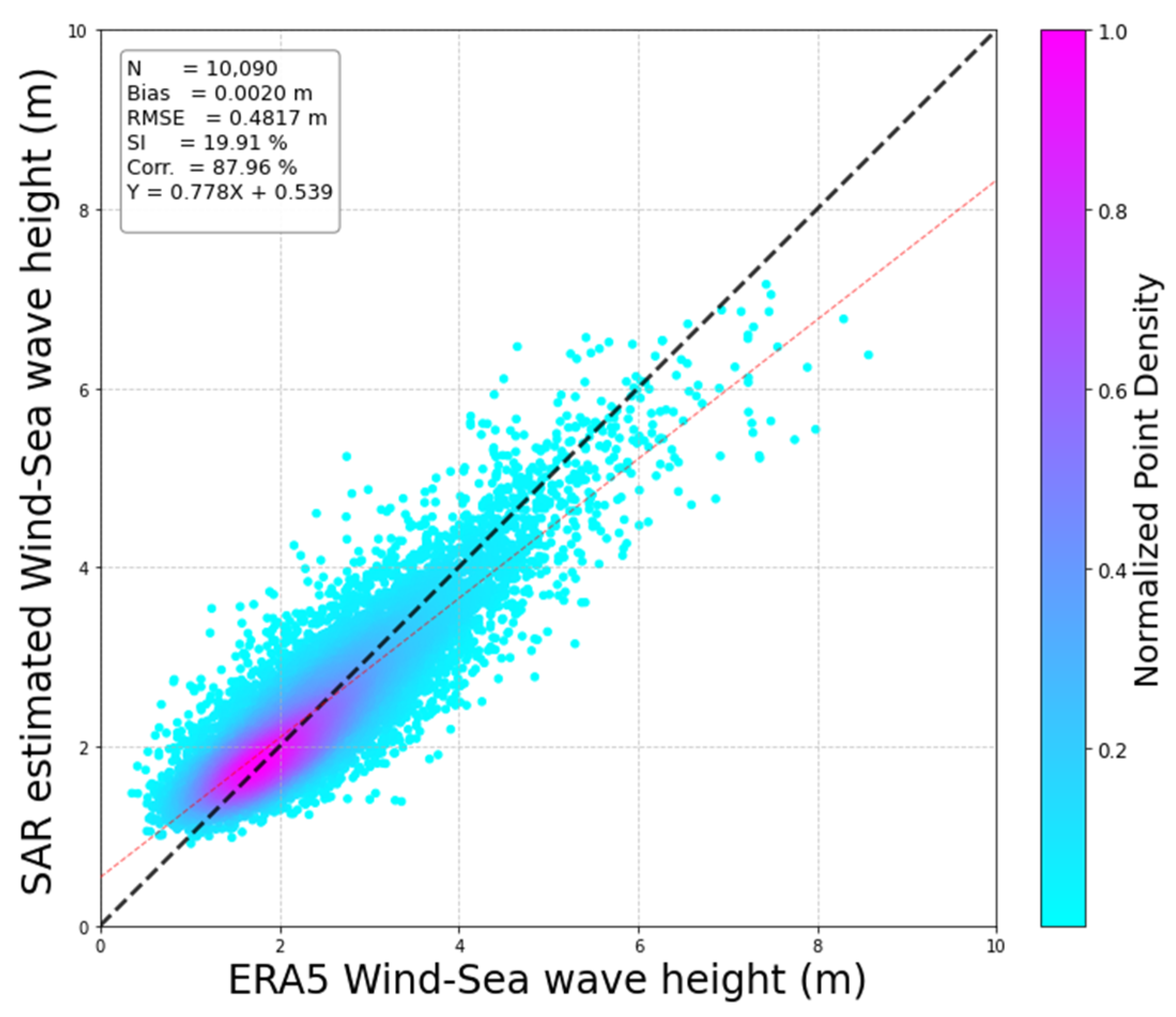
As shown in the scatterplot (Figure 4), the comparison shows a strong correlation (87.96%) between the model’s inferences and ERA5 data reanalysis, with an RMSE of 0.48 m, 19.91% SI and a negligible bias. It indicates that the XGBoost algorithm effectively captures the underlying complex relationship between the SAR-derived features and the wind-sea wave heights. Hence, it can be used as a robust estimator for the subsequent construction of theoretical wind-sea spectra.
Figure 4.
Scatterplot of XGBoost wind-sea wave height inference and ERA5 target in test dataset.
Recently, Pleskachevsky et al. [47] processed the complete Sentinel-1 SAR archive and reported SAR-derived wind-sea wave-height estimates with RMSEs from 0.44 m to 0.55 m (depending on the SAR beams) against the MFWAM model. Although this value cannot be compared directly with the present RMSE of 0.48 m because of differences in the reference dataset, matchup selection, quality control, and sea-state regime, the two values are close. This suggests that the accuracy of the XGBoost wind-sea height estimator used in this study is consistent with the performance level of recent Sentinel-1 SAR sea-state retrieval products.
Errors in the XGBoost-estimated wind-sea wave height can propagate into the constructed JONSWAP prior. For example, the slight overestimation at low wind-sea wave heights may produce a prior spectrum with excessive wind-sea energy for weak wind-sea cases. However, the JONSWAP spectrum is used here as a soft physical prior rather than as the final retrieval. The subsequent U-Net fusion module learns to combine the OSW spectrum and the JONSWAP prior and can partly correct or down-weight prior information that is inconsistent with the training target. Nevertheless, the accuracy of the XGBoost wind-sea height estimator remains an important factor controlling the quality of the prior.
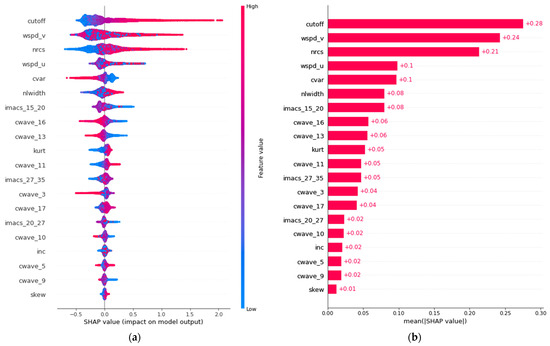
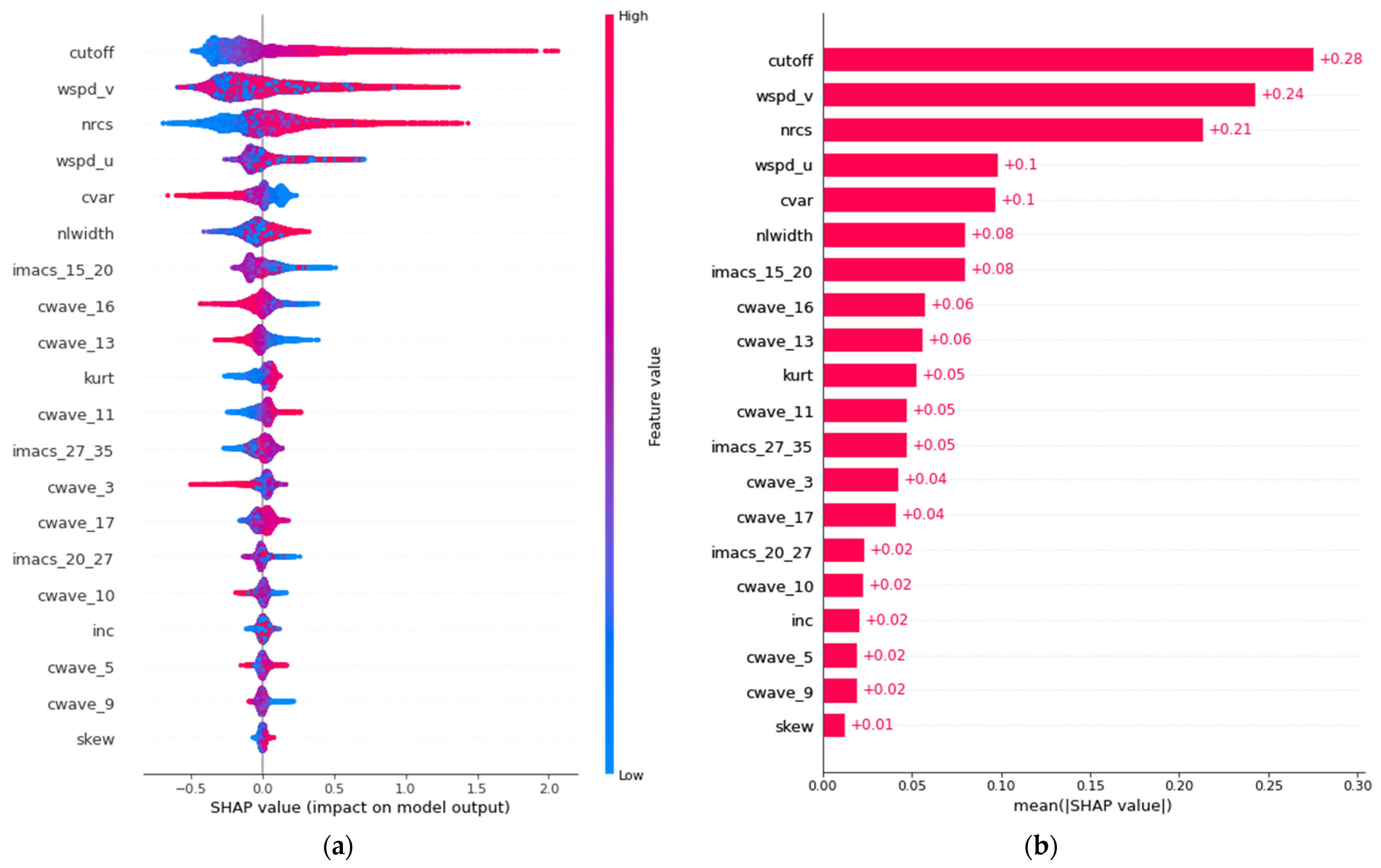
To further understand the decision-making process of the wind-sea height XGBoost predictor, a SHapley Additive exPlanations (SHAP) analysis was conducted to evaluate feature importance and interpretability. Figure 5a presents a SHAP summary map detailing how individual feature values positively or negatively drive the model’s predictions, revealing the complex, non-linear dependencies learned during training. Furthermore, the SHAP bar plot in Figure 5b ranks the 20 input SAR observables by their mean absolute SHAP values. This highlights the most critical SAR-derived features, which contribute to accurate wind-sea wave height estimation, including azimuthal cut-off wavelength, wind speed components, NRCS, and IMACS parameters for 15–20 m, and some CWAVE parameters (cwave_16, cwave_13, cwave_11, etc.). The dominance of the azimuth cut-off wavelength in the SHAP analysis is physically meaningful. In SAR ocean wave imaging, the azimuth cut-off is linked to wave-induced orbital velocities and nonlinear velocity bunching effects. Under energetic wind-sea conditions, stronger orbital motions generally lead to a longer azimuth cut-off wavelength and stronger suppression of short waves propagating close to the azimuth direction. Therefore, the cut-off wavelength can be regarded as a compact SAR-observable proxy for both the sea-state energy and the severity of the nonlinear SAR imaging distortion. Its high SHAP importance indicates that the XGBoost model relies strongly on this physically relevant indicator when estimating wind-sea wave height.
Figure 5.
SHAP explanation for the wind-sea wave height XGBoost model. (a) SHAP map illustrating how different feature values impact the model. (b) SHAP bar plot showing the mean absolute value of each feature.
4.2. Directional Spectra Statistical Assessment
Two metrics characterizing the degree of similarity between two spectra are adopted to diagnose the performance of enhanced OSW using the prior-knowledge-integrated approach against the ERA5 test dataset:
The spectral pattern correlation coefficient defined by Brüning et al. [38]
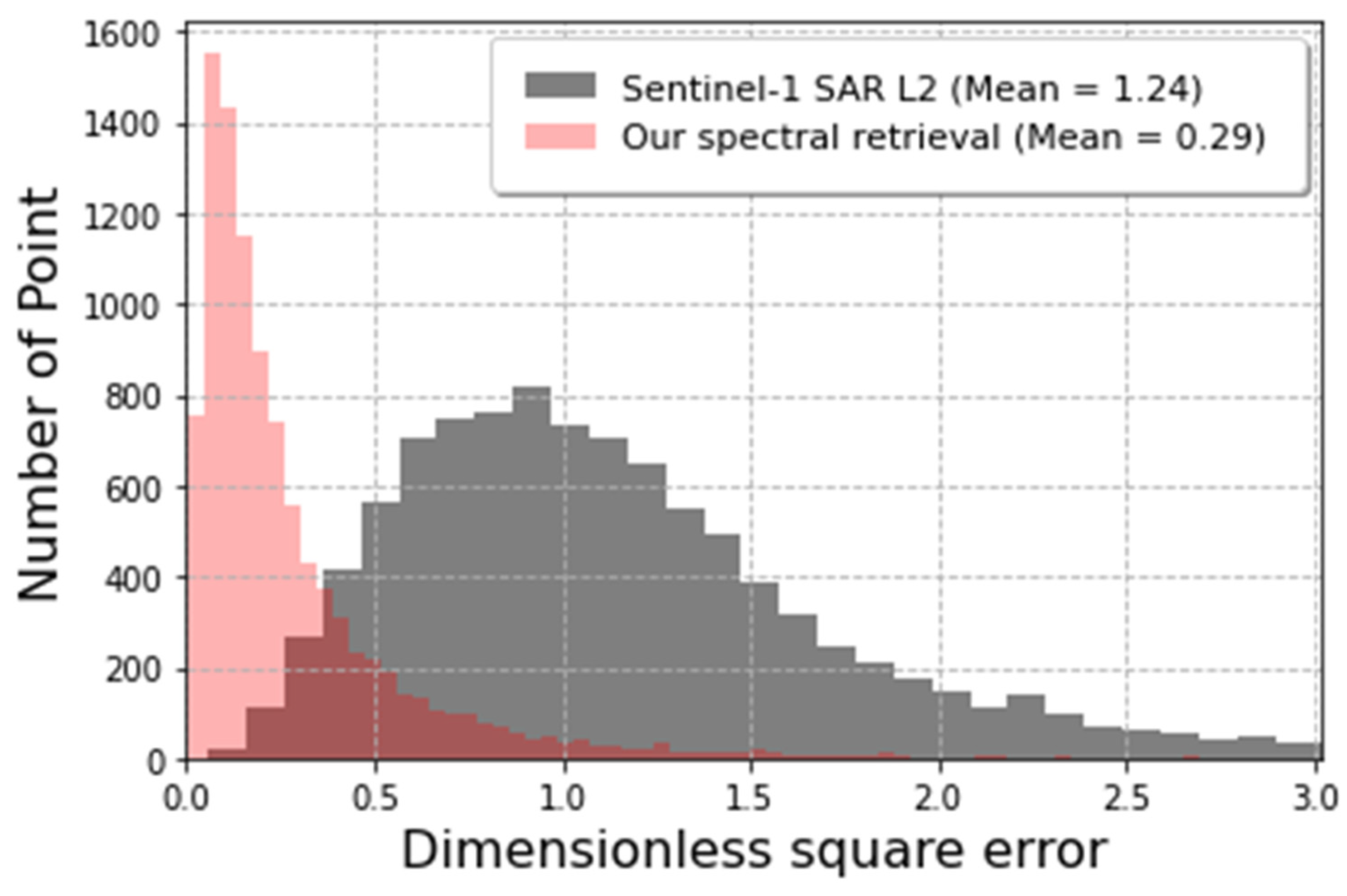
and the dimensionless spectral square error proposed by Hasselmann et al. [6]
where and are our enhanced results and the ERA5 target, respectively. Note that is close to 1 and is close to 0 if the two spectra are similar.
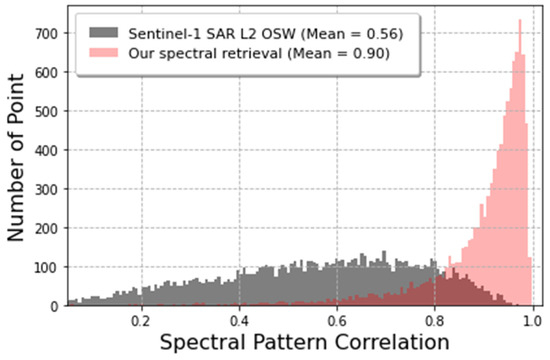
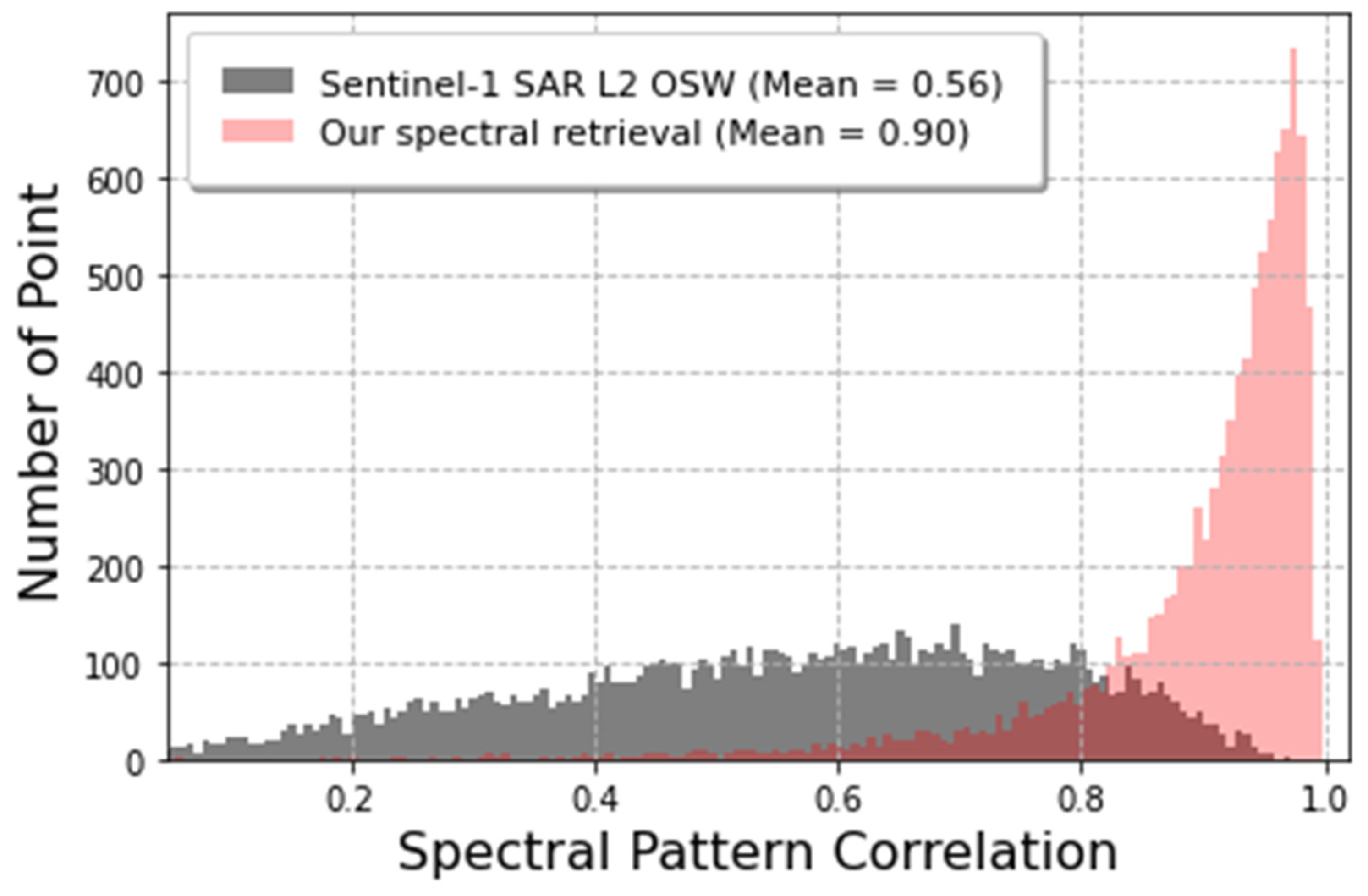
As shown in Figure 6, the statistical distribution of Brüning’s spectral pattern correlation coefficient demonstrates a clear improvement achieved by the prior-knowledge-integrated approach over the standard ESA Level-2 OSW products. The histogram for our proposed algorithm exhibits a pronounced shift toward higher correlation values (0.90 of by mean), with the majority of the distribution heavily concentrated near 1.0. This indicates a high degree of structural and morphological similarity between the enhanced OSW and the ERA5 reference spectra. In contrast, the ESA’s official OSW retrievals display a broader distribution with a notably lower mean correlation (0.56 of in average), suggesting that the quasi-linear-based retrieval process frequently struggles to fully capture the complex spectral shapes of the underlying sea state. The substantial increase in the frequency of high values confirm that integrating prior knowledge effectively corrects structural distortions inherent in original Sentinel-1 OSW products (mainly swell spectra within the cut-off regime).
Figure 6.
Histogram of Brüning’s spectral pattern correlation for SAR retrievals from ESA’s Level-2 OSW and our algorithm against ERA5 reanalysis.
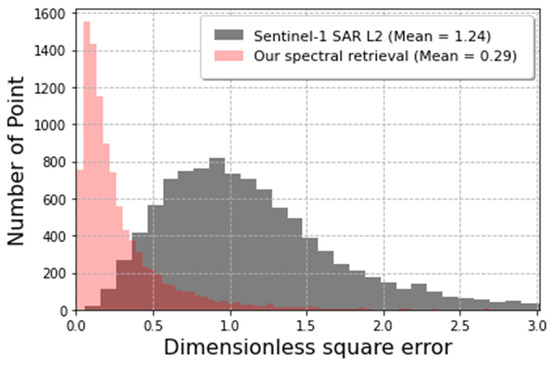
Also, from Figure 7, the histogram of Hasselmann’s dimensionless spectral square error further confirms the superior performance of our proposed enhanced approach. The error distribution for our SAR retrievals is significantly narrower and shifted toward zero compared to the baseline of OSW originally provided by ESA. While the standard ESA product yields a wider spread of error values, reflecting frequent discrepancies in spectral energy distribution and peak distortions, the prior-knowledge-integrated approach successfully mitigates these inaccuracies. The sharp peak near zero for our algorithm implies that the magnitude and directional spread of the wave energy are reconstructed with much higher accuracy relative to the ERA5 targets.
Figure 7.
Histogram of Hasselmann’s dimensionless square error for SAR retrievals from ESA’s Level-2 OSW and our algorithm against ERA5 reanalysis.
Ultimately, both statistical metrics consistently show that the proposed prior-knowledge-aided deep learning framework provides a more robust and accurate estimation of the full directional wave spectrum than conventional quasi-linear inversions.
4.3. Assessment of Bulk Parameters: Wave Heights, Periods and Directions
We further evaluate the commonly used integral parameters, total SWH , mean wave period , and mean wave direction , which could be computed directly from the spectra as follows
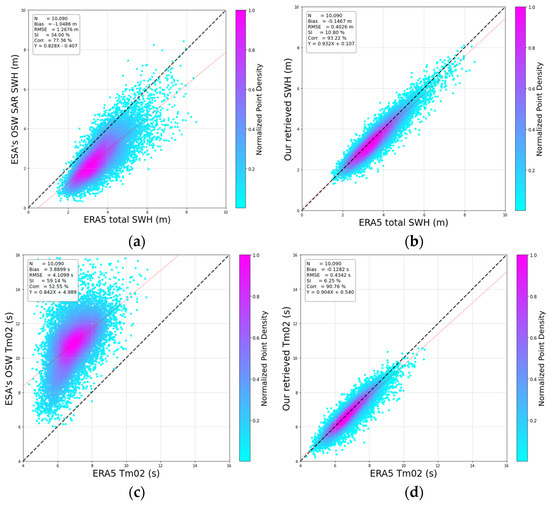
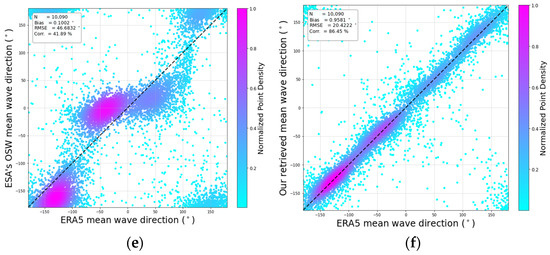
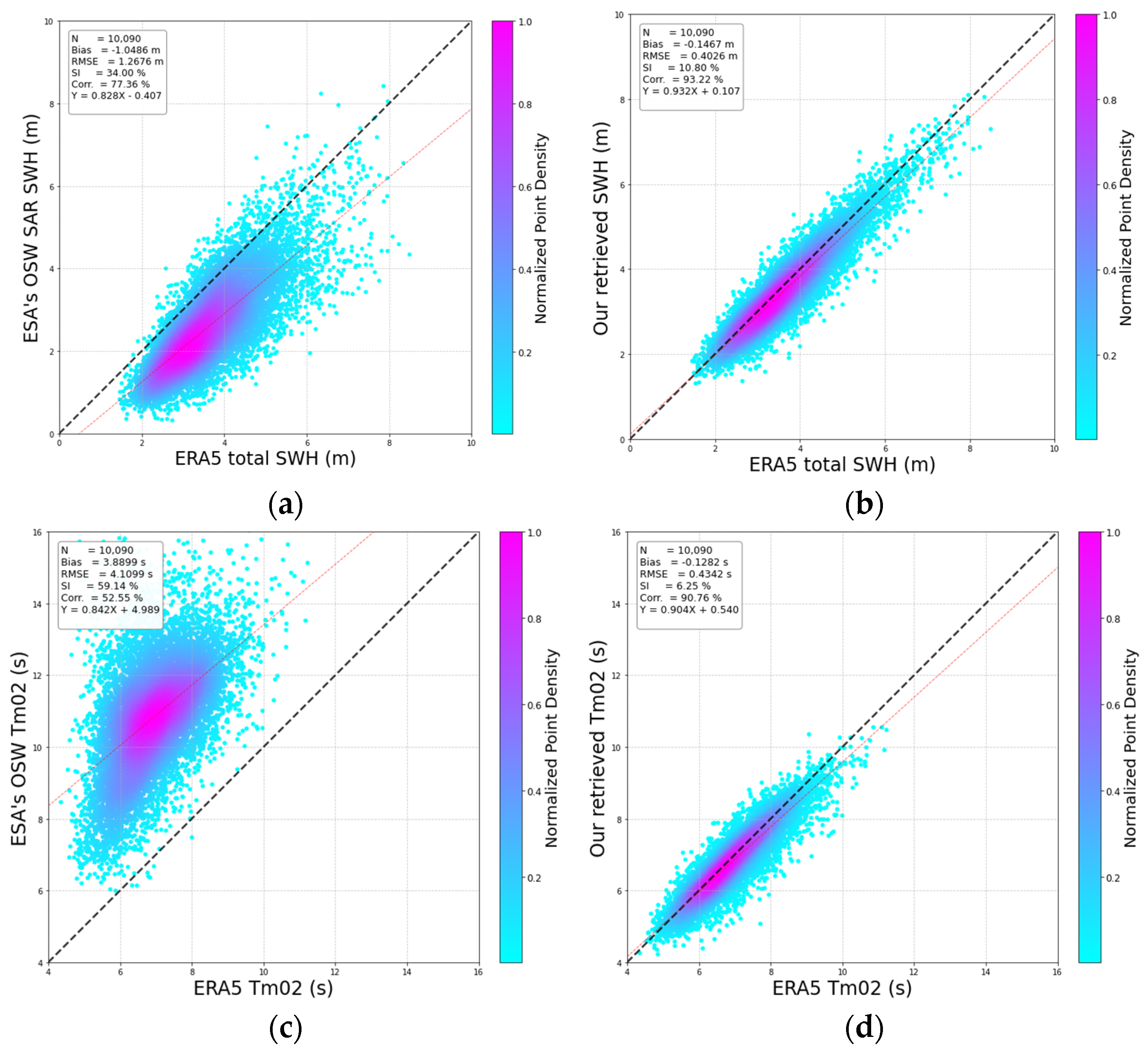
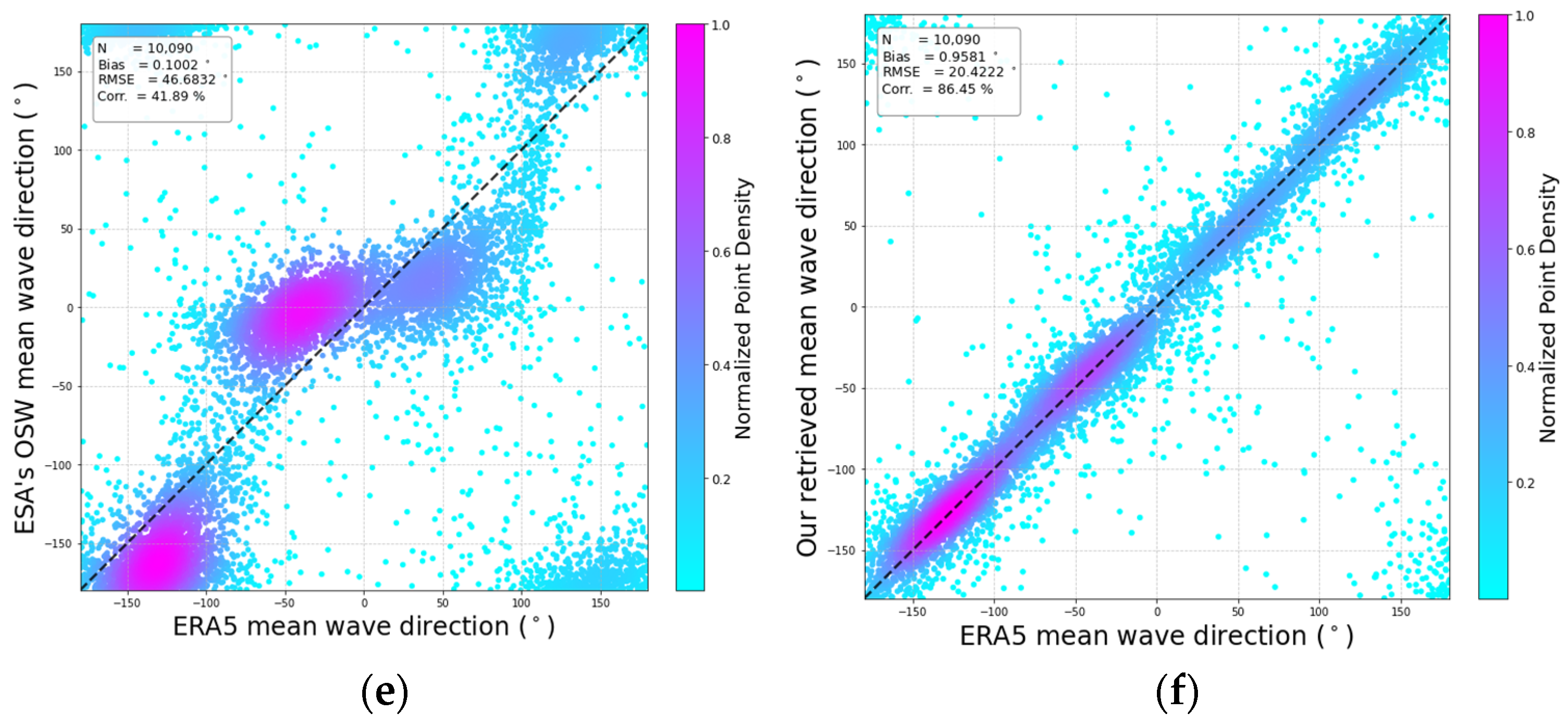
The validations of the standard ESA Level-2 OSW product in terms of , and are shown in the left column of Figure 8. As illustrated, the quasi-linear-based routine ESA algorithm tends to underestimate total SWH, mainly due to the loss of spectral information beyond the azimuth cut-off. For wave period, standard OSW exhibits considerable scatter (RMSE of 4.11 s) and a remarkable positive bias of 3.89 s, suggesting that the ESA inversion struggles to accurately account for the wind-sea components, thereby skewing toward longer swells. Most notably, the comparison in Figure 8e displays a problematic “two-cluster” signature. This pattern indicates that the standard OSW retrievals are often distorted, with directional estimates artificially collapsing toward the SAR range direction (near 0° or ±180°). This suggests that ESA’s operational inversions are insensitive to azimuth-traveling waves and tend to produce range-traveling artifacts, preventing them from resolving the true propagation direction in many cases.
Figure 8.
Scatter plots comparing bulk wave parameters. (a) Total SWH derived from ESA Level-2 OSW versus ERA5 spectra; (b) Total SWH derived from our enhanced spectra versus ERA5 spectra; (c) MWP derived from ESA Level-2 OSW versus ERA5 spectra; (d) MWP derived from our enhanced spectra versus ERA5 spectra; (e) MWD derived from ESA Level-2 OSW versus ERA5 spectra; (f) MWD derived from our enhanced spectra versus ERA5 spectra.
In contrast, the bulk wave parameters derived from our proposed method demonstrate a significantly improved consistency with the ERA5 benchmark as shown on the right of Figure 8. Quantitatively, the proposed framework achieves an RMSE of 0.4026 m for total SWH, 0.4342 s for mean wave period, and 20.42° for mean wave direction.
The comparison (Figure 8b) shows that the integration of prior knowledge effectively compensates for the missing spectral energy, pulling the underestimated samples back. Similarly, apparent bias reduction of is presented in Figure 8d, confirming that the enhanced spectra successfully reconstruct the high-frequency tail of the spectrum that is often lost in the standard OSW. The most striking improvement is observed in the directional domain. As illustrated in Figure 8f, our predictions align robustly with the ERA5 targets across the full directional regime, completely eliminating the artificial clustering along the range axis (Figure 8e).
This result confirms that our new framework provides far more enhanced spectral inferences, leading to a more accurate characterization of the bulk parameters and reminding us that our SWH retrievals may inherit ERA5 high-SWH underestimation. Future work should investigate bias correction using independent buoy measurements and/or altimetry references.
4.4. Comparison with an Existing Deep-Learning-Based Spectral Retrieval Method
To further evaluate the proposed prior-knowledge-integrated framework, we compared our method with an existing deep-learning-based directional wave spectral retrieval algorithm named SAR2WV proposed very recently [26]. Fortunately, Cao et al. [26] also trained and validated based on the ERA5 directional wave spectra although the period coverage is different (2018–2020 for [26] versus 2024 for ours). Table 3 lists the comparison between the two algorithms (both taking ERA5 as reference) as performed using the RMSEs of significant wave height, mean wave period, and mean wave direction, together with the mean dimensionless spectral square error.
Table 3.
Comparison against the deep-learning-based algorithm of SAR2WV [26].
Specifically, the proposed method achieves lower RMSEs for mean wave period and mean wave direction than the SAR2WV method of Cao et al. [26]. The mean dimensionless spectral square error is also reduced from 0.33 for SAR2WV to 0.29 for the proposed method. It is interesting that the RMSE in terms of SWH is slightly larger than SAR2WV (0.403 m versus 0.386 m). This is probably due to the fact that we focused on strong azimuth cut-off conditions which are more challenging than the general cases for Cao et al. [26].
5. Discussion
5.1. Case Studies
To further highlight the improvements of the proposed prior-knowledge-integrated algorithm over the standard ESA Level-2 OSW products, three representative case studies are selected and discussed in detail. These cases (for each, SAR cross-spectrum, original OSW, ERA5 reanalysis, and our enhanced OSW are presented) are specifically chosen to focus on common scenarios where traditional quasi-linear SAR wave retrievals typically face challenges: incomplete spectral recovery, severe distortion with non-physical artifacts, and complete failure to capture high-frequency wind waves.
- (1)
- Enhancement of an incomplete two-dimensional spectrum
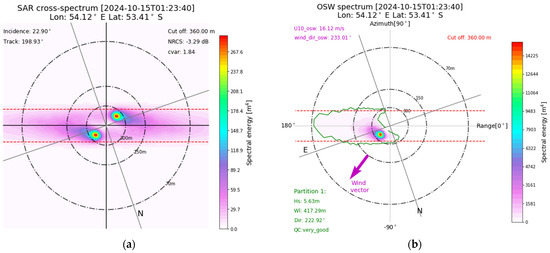
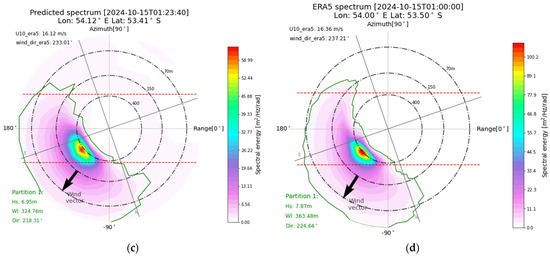
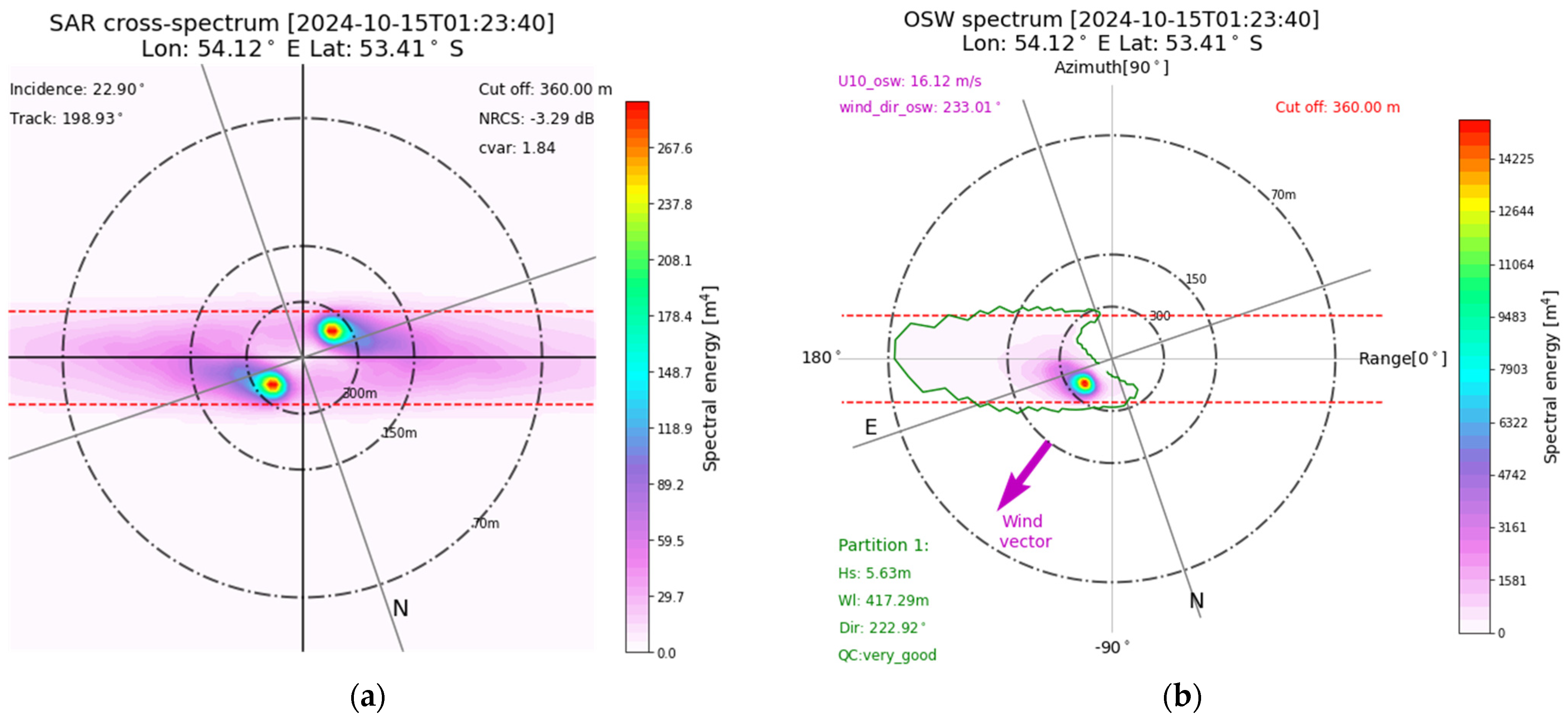
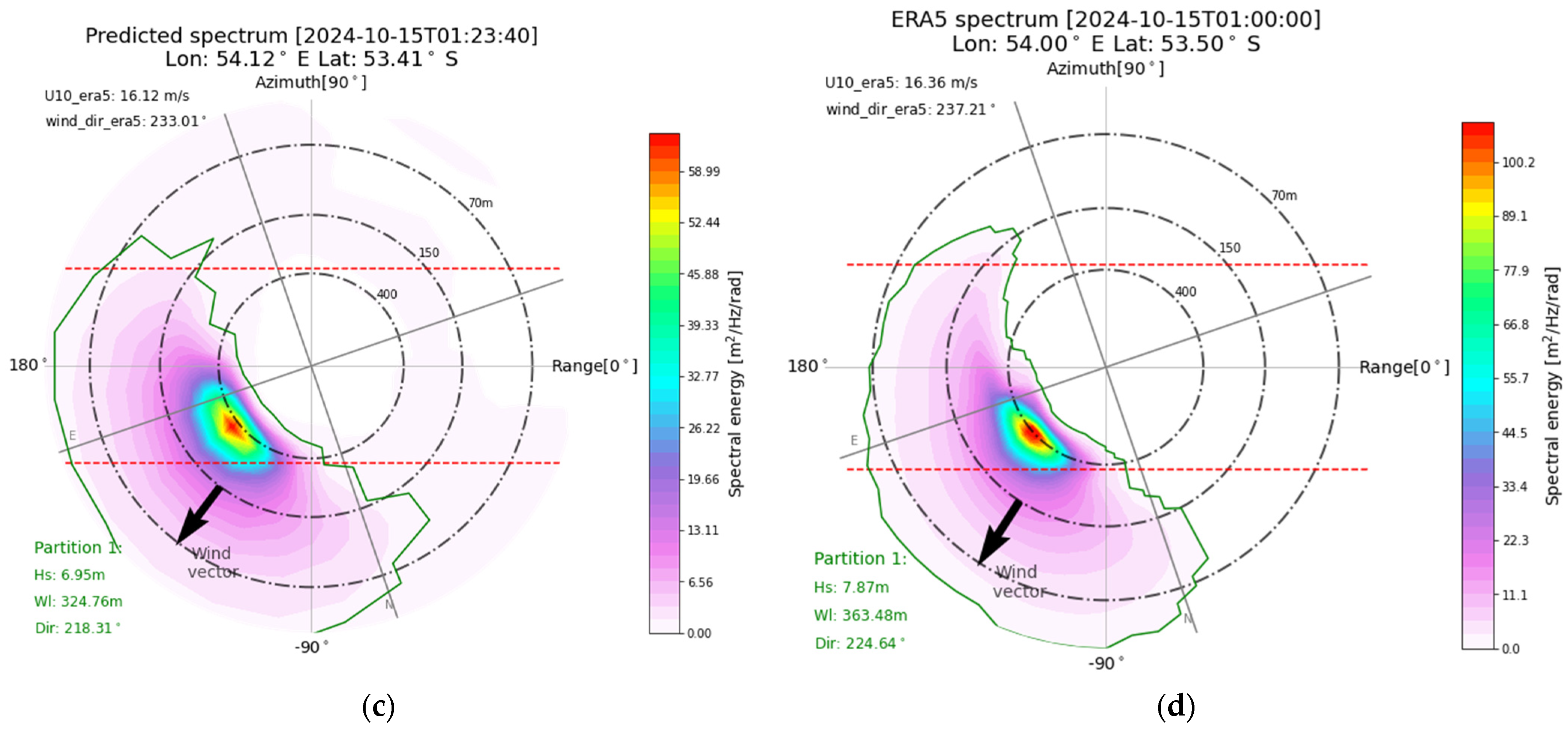
Figure 9 presents a Sentinel-1A SAR WV acquisition on 15 October 2024 at 54.12°E/53.41°S. In this case, the original ESA OSW product (Figure 9b) captures only a fragmented portion of the wave energy, struggling to fully resolve the spectral shape due to the inherent azimuth cut-off (360.0 m cut-off wavelength here). By integrating prior knowledge, the resulting enhanced 2D spectrum (as shown in Figure 9c) exhibits a well-defined, continuous energy two-dimensional distribution that closely matches the reference ERA5 spectrum (Figure 9d), demonstrating the model’s capability to robustly reconstruct incomplete directional spectra.
Figure 9.
Typical example at 01:23:40 UTC on 15 October 2024. (a) SAR cross-spectrum (real part) computed from the Sentinel-1A SAR wave mode SLC imagettes acquired on 01:23:40 UTC 15 October at 54.12°E/53.41°S, and (b) two-dimensional wave spectrum inverted from the SAR cross-spectrum and provided in the standard Level-2 OSW. (c) The enhanced ocean wave spectrum via our algorithm. (d) Ocean wave spectrum provided by ERA5 reanalysis at 01:00 (UTC) and at 54.0°E/53.5°S. The red horizontal dashed lines indicate the SAR azimuth cut-off wavenumber and dotted circles represent wavelengths of 70 m, 150 m and 400 m from outer to inner.
- (2)
- Enhancement of a severely distorted two-dimensional spectrum
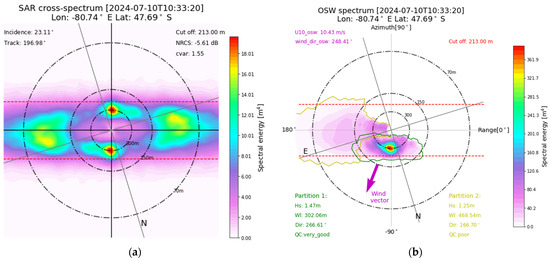
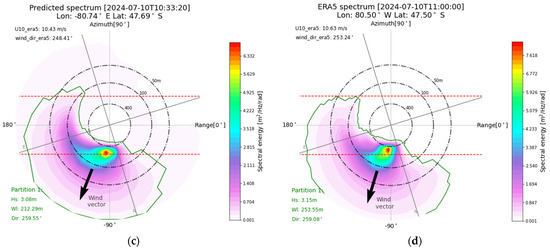
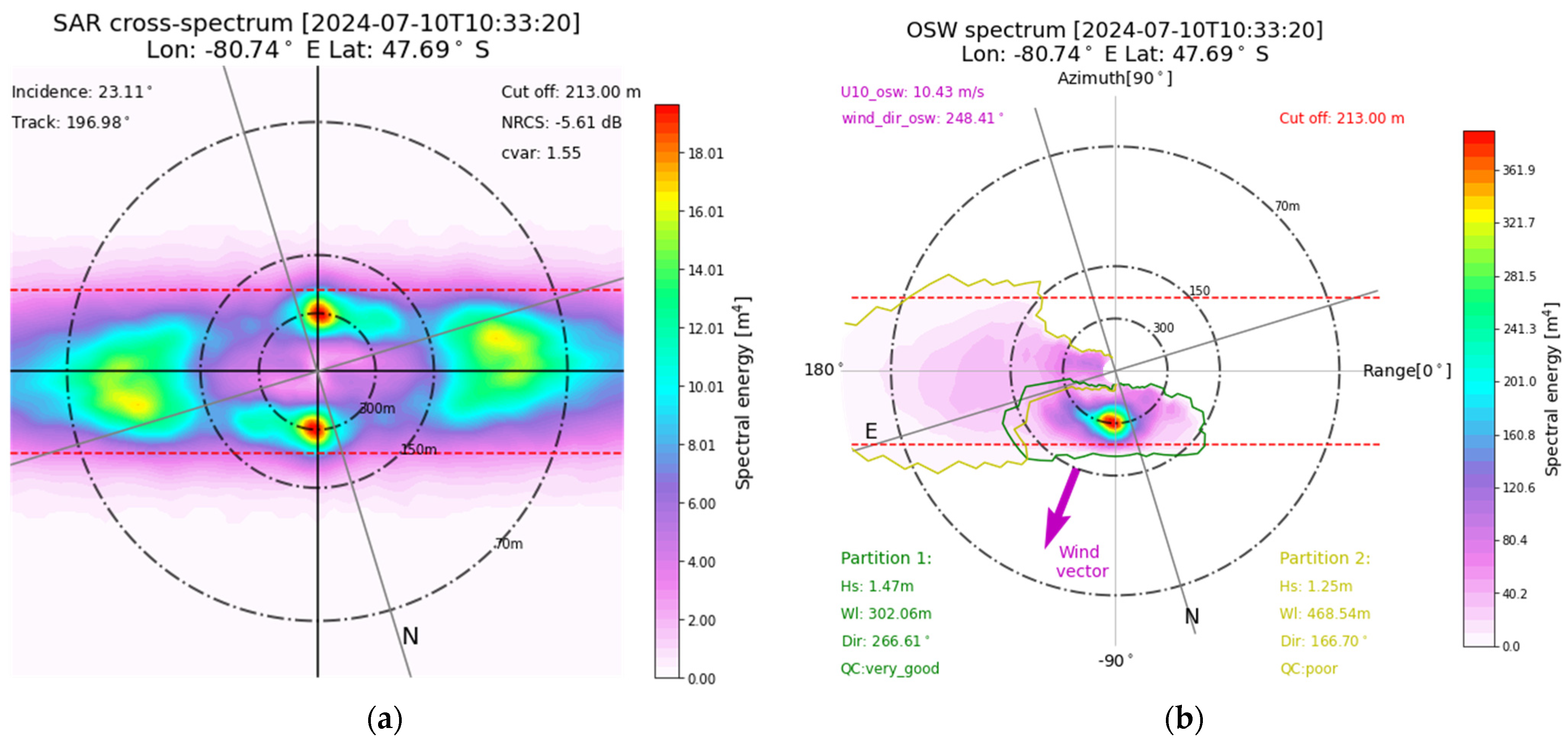
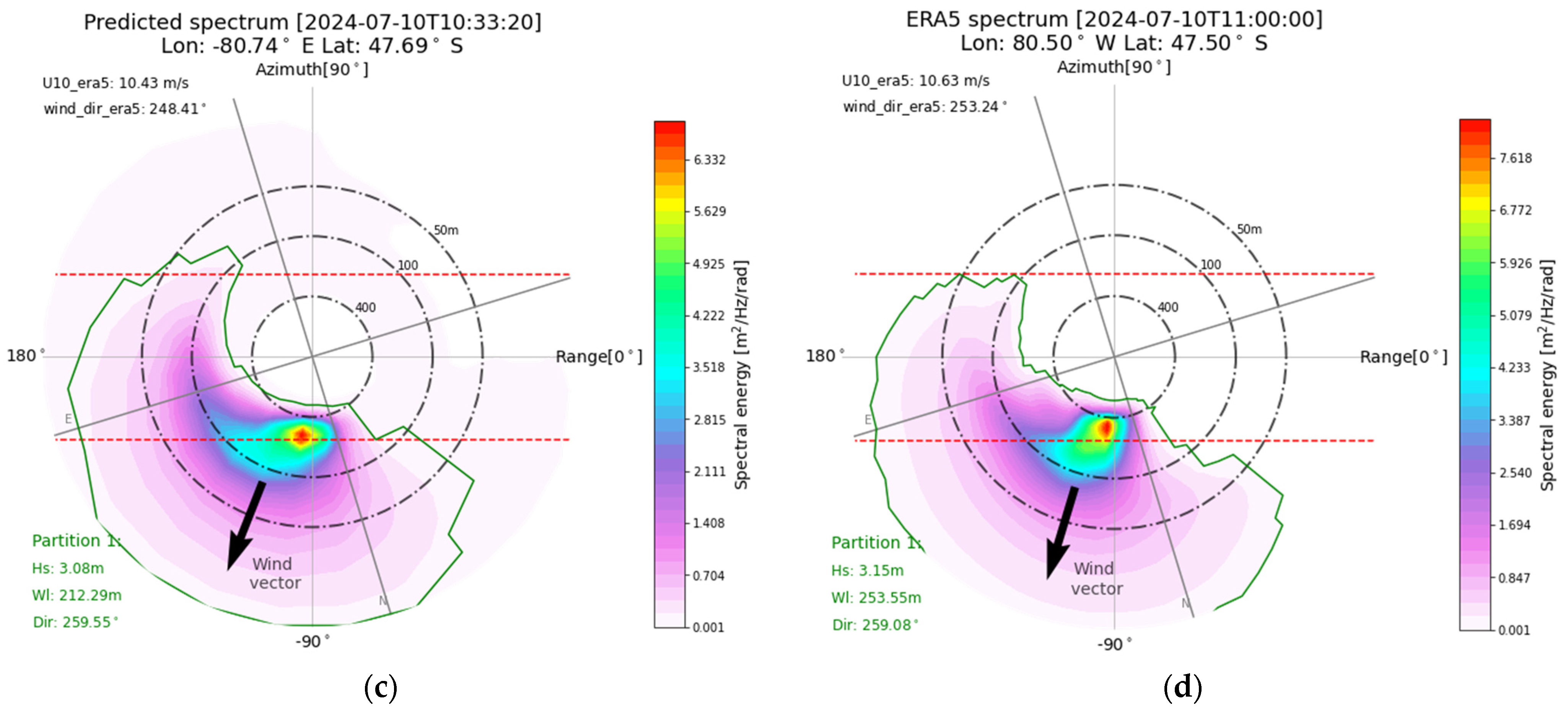
The second example (acquired on 10 July 2024 at 80.74°W/47.69°S, see Figure 10), evaluates the performance of the proposed method on a heavily distorted condition. The original ESA OSW retrieval (Figure 10b) notably exhibits artifacts aligned along the range direction (delineated by the yellow line). This misleads the following partitioning of wave signal and sea state parameter estimations in standard processing (two systems were erroneously split while only one partition from the ERA5 reference for this instance). Note that this non-physical noise already exists in the SAR cross-spectrum (Figure 10a), from which the OSW is inverted. However, as shown in Figure 10c our proposed framework effectively eliminates this range-directional artifact while simultaneously correcting the morphological distortions. Eventually it yields a clean, physically plausible representation of the wave field that aligns seamlessly with the ERA5 reference (Figure 10d).
Figure 10.
Typical example at 10:33:20 UTC on 10 July 2024. (a) SAR cross-spectrum (real part) computed from the Sentinel-1A SAR wave mode SLC imagettes acquired on 10:33:20 UTC 10 July at 80.74°W/47.69°S, and (b) two-dimensional wave spectrum inverted from the SAR cross-spectrum and provided in the standard Level-2 OSW. (c) The enhanced ocean wave spectrum via our algorithm. (d) Ocean wave spectrum provided by ERA5 reanalysis at 11:00 (UTC) and at 80.5°W/47.5°S. The red horizontal dashed lines indicate the SAR azimuth cut-off wavenumber and dotted circles represent wavelengths of 70 m, 150 m and 400 m from outer to inner.
- (3)
- Enhancement of a wind-sea missing two-dimensional spectrum
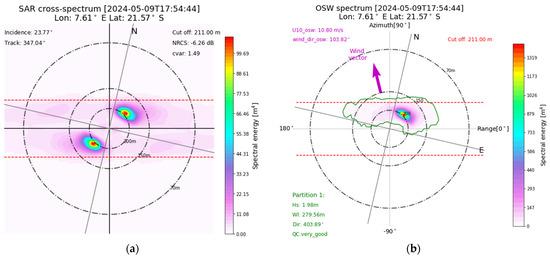
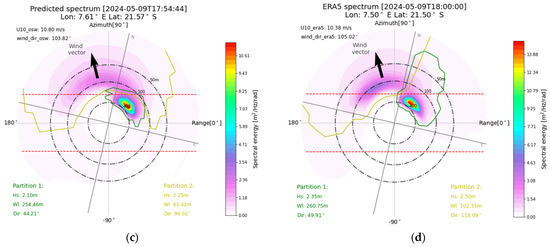
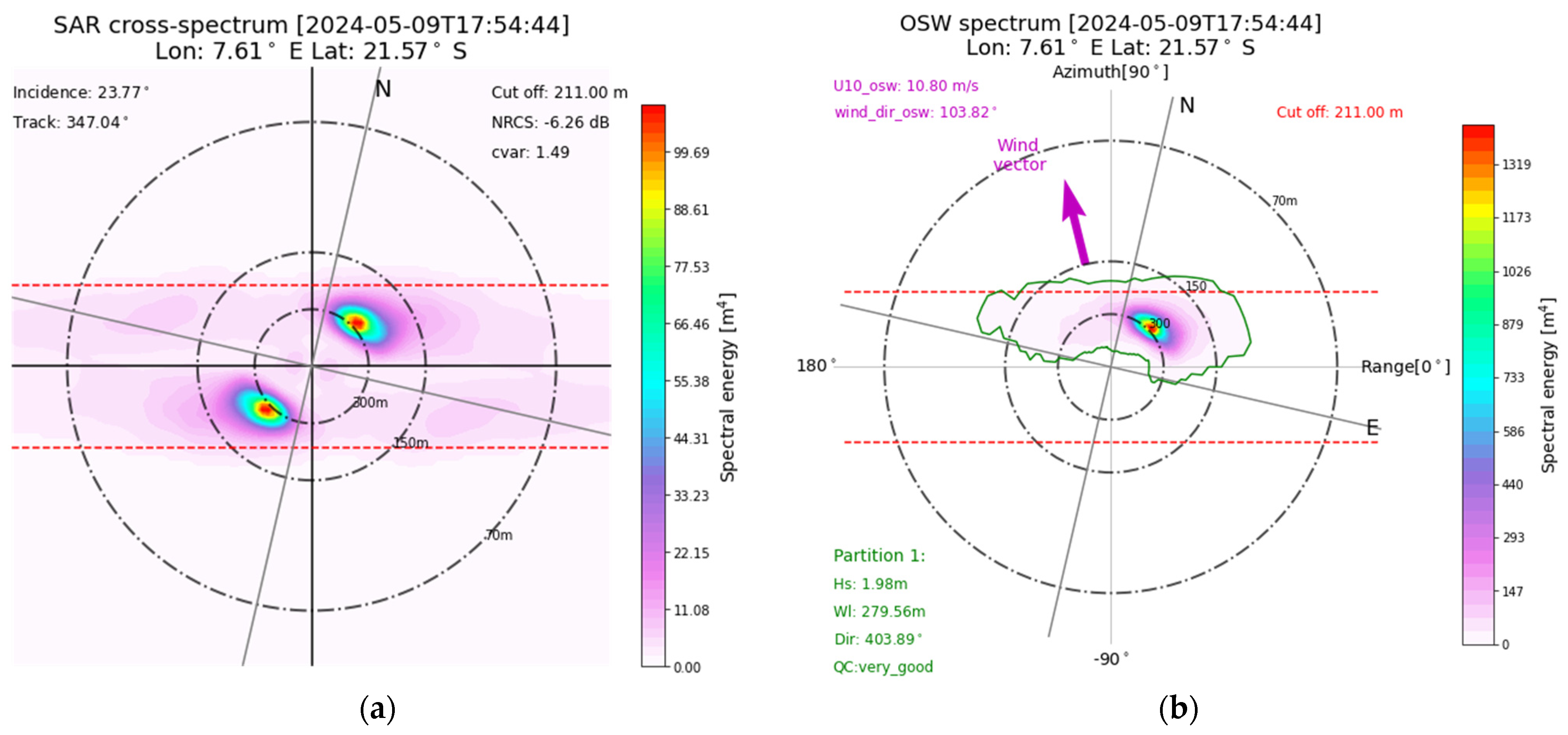
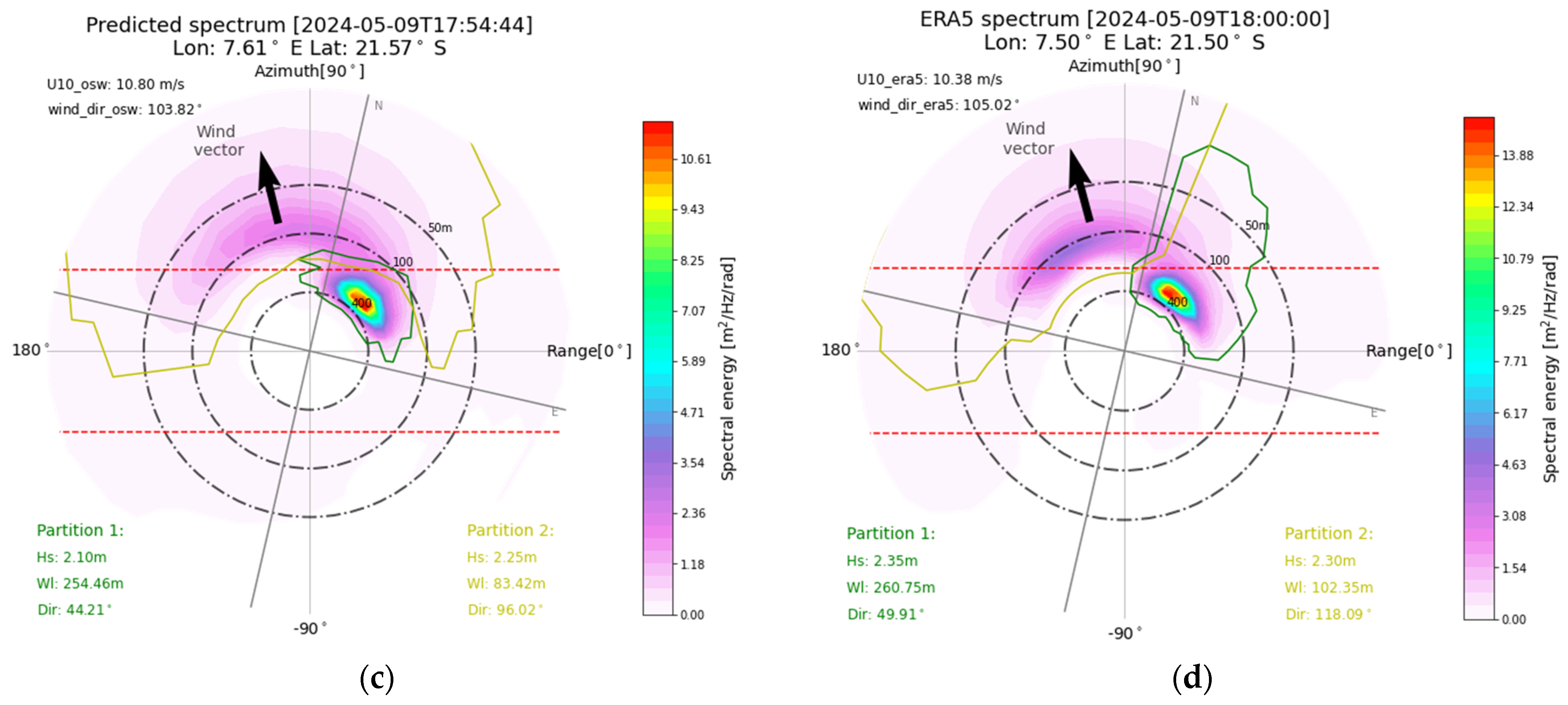
Figure 11 details the third case study, which addresses the frequent limitation of entirely missing wind-sea partitions in quasi-linear SAR wave retrievals. Because SAR imaging is generally less sensitive to shorter wind waves under the nonlinear mechanism, the ESA OSW product tends to be blind for some wind-sea components entirely (the system delineated by the yellow line in Figure 11c), capturing only swells (green delineated partition in Figure 11b). The proposed algorithm (Figure 11d), leveraging the integrated prior knowledge, demonstrates a remarkable ability to recover this missing high-frequency energy. The enhanced spectrum clearly resolves the secondary wind-sea peak alongside the primary swell, providing a comprehensive and accurate reconstruction of complex, mixed sea states that the standard ESA product fails to detect.
Figure 11.
Typical example at 17:54:44 UTC on 9 May 2024. (a) SAR cross-spectrum (real part) computed from the Sentinel-1A SAR wave mode SLC imagettes acquired on 17:54:44 UTC 9 May at 7.61°E/21.57°S, and (b) two-dimensional wave spectrum inverted from the SAR cross-spectrum and provided in the standard Level-2 OSW. (c) The enhanced ocean wave spectrum via our algorithm. (d) Ocean wave spectrum provided by ERA5 reanalysis at 18:00 (UTC) and at 7.5°E/21.5°S. The red horizontal dashed lines indicate the SAR azimuth cut-off wavenumber and dotted circles represent wavelengths of 70 m, 150 m and 400 m from outer to inner.
In summary, these three case studies provide clear evidence of the proposed algorithm’s robustness and superior performance. Whether dealing with incomplete spectra, severe range-directional artifacts, or undetected wind-sea partitions, the prior-knowledge-integrated approach consistently outperforms the operational ESA OSW baseline. In other words, the proposed method ensures a much more reliable, complete, and structurally accurate estimation of directional wave spectra across a variety of complex ocean conditions, demonstrating its effective mitigation of the inherent limitations of SAR wave imaging.
5.2. Influence of Spectral Partition Periods and Directions
Multiple wave partitions, including local wind-sea and swells from different origins, frequently coexist within a single spectrum. In this subsection, we further discuss the improvement of wave spectral decomposition based on the SAR retrievals.
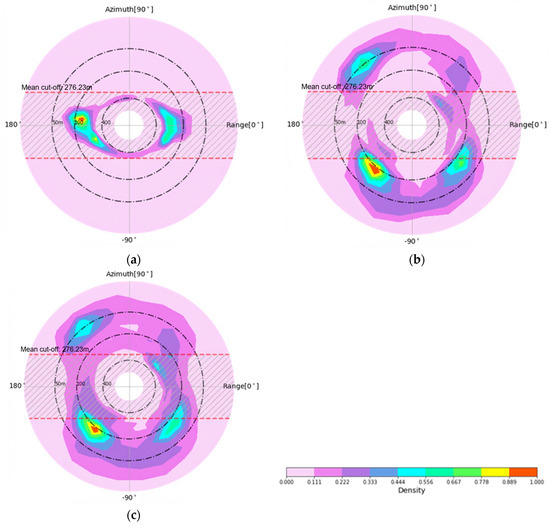
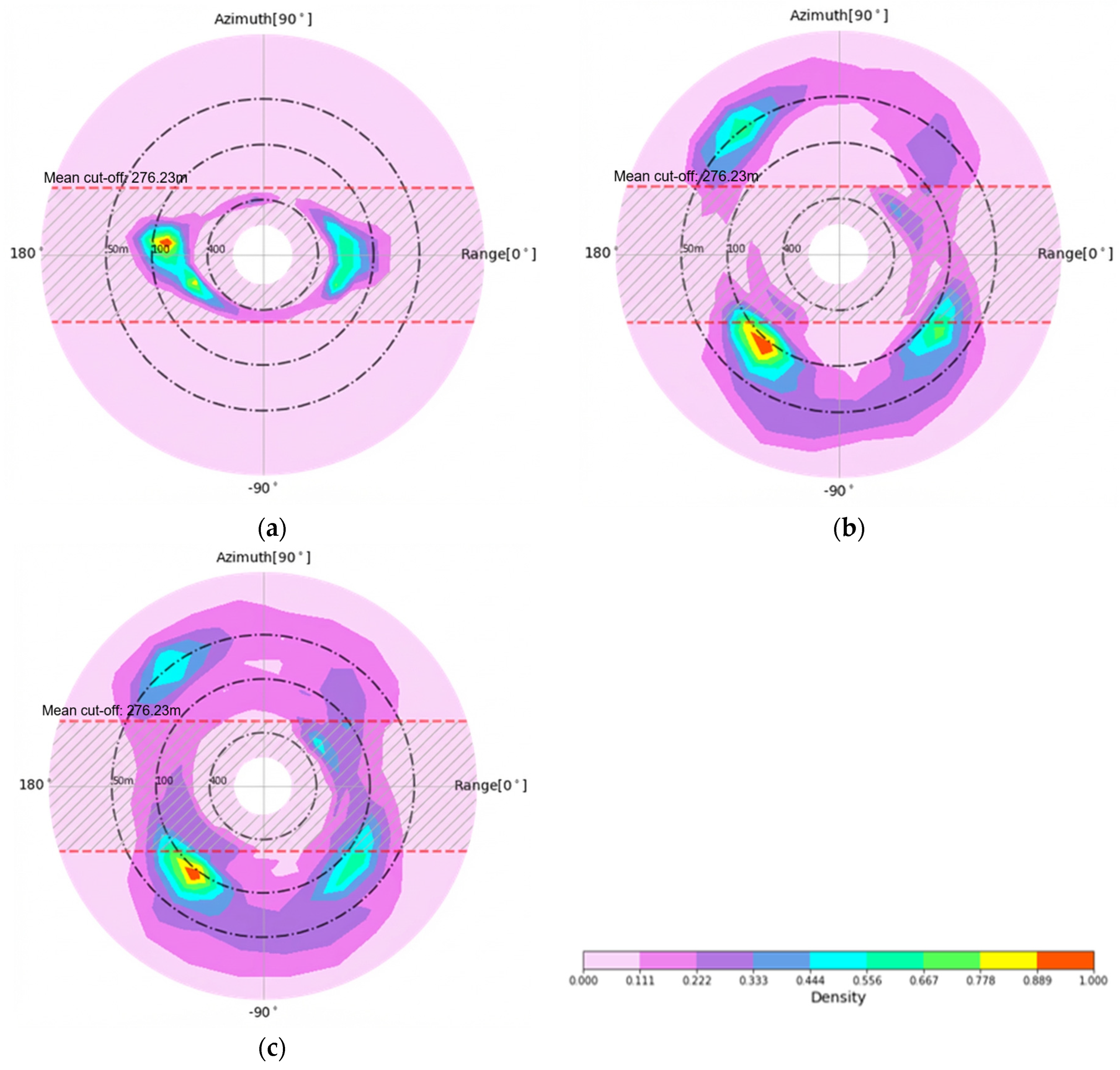
The two-dimensional wave spectra from the standard OSW, the ERA5 reference, and the enhanced spectra generated by our approach are delineated into distinct wave systems using a classical image segmentation scheme known as the watershed algorithm [48]. Subsequently, the integral parameters of wave period and direction are estimated for each wave partition according to the definitions in Equations (16) and (17). Finally, the distributions of these partitions from the original OSW, ERA5, and our enhanced results are presented in Figure 12, respectively, using a polar SAR range-azimuth coordinate system (where 0° and 90° represent range and azimuth directions).
Figure 12.
The polar histograms of partitioned wave period and direction from (a) Sentinel-1A Level-2 OSW, (b) our enhanced OSW and (c) ERA5 reference. The shading region between two red horizontal dashed lines indicates the low-pass filter defined by the average azimuth cut-off wavelength of 276.23 m. The dotted circles represent wavelengths of 50 m, 100 m and 400 m from outer to inner.
Figure 12a illustrates that the standard OSW provides only partial wave partition information. Its pattern is severely constrained by the azimuth cut-off effect indicated by the shaded region defined by the mean value of 276.23 m (see the histogram of cut-off wavelength in Figure 2b). This constraint leads to a substantially high-frequency blind zone for shorter wavelength wind seas. Additionally, some of the identified partitions are artificially clustered predominantly along the SAR range direction (refer to the typical case shown in Figure 10b). In contrast, our enhanced OSW generated via a prior-knowledge-integrated approach can successfully reconstruct the undetected high-frequency wave systems (see the signature outside the shaded region) and correct the structural distortions, as shown in Figure 12b. The resulting distribution is highly consistent with the polar histogram derived from the ERA5 reference (Figure 12c), encompassing a more physically realistic range of partitions in terms of wave periods and directions.
It is suggested that the proposed enhancement method not only improves the overall bulk spectral metrics but also yields highly reliable individual wave partitions in terms of wave period and direction, which is essential for advanced wave tracking and downstream operational forecasting applications via the so-called “Fireworks” technique (e.g., [49,50]).
A limitation of the present study is that ERA5 directional wave spectra are used both as the training target and as the primary evaluation reference. Although ERA5 provides globally consistent two-dimensional wave spectral information and has therefore been widely used in recent SAR wave spectrum retrieval studies, including deep-learning-based approaches such as Cao et al. [26], it remains a model-based reanalysis rather than an independent observation or ground truth. ERA5 wave spectra may contain biases and resolution-related uncertainties, especially in the representation of directional spectral shape and multi-modal sea states. Consequently, the present validation should be interpreted as an assessment of consistency with ERA5 on independent Sentinel-1A test samples. In this sense, the trained network learns an ERA5-consistent spectral representation. Independent validation against directional buoy spectra is required to further assess the generalizability of the proposed method.
6. Conclusions
In this paper, a novel prior-knowledge-integrated machine learning framework is proposed to enhance the official retrieval of OSW directional spectra from Sentinel-1A SAR data. To overcome the inherent limitation of the cut-off effect, our approach integrates machine learning techniques with theoretical wave models. Specifically, an XGBoost model was trained using 20 SAR-derived observables to accurately estimate wind-sea wave heights. This robust estimation subsequently drives the construction of a theoretical JONSWAP wind-sea prior spectrum. A U-Net fusion model is then employed to seamlessly integrate this prior knowledge with the original ESA SAR-inverted swell spectra.
A brief summary of the main findings and improvements is given in the following:
- Enhanced Spectral Reconstruction: Statistical assessments using Brüning’s spectral pattern correlation and Hasselmann’s dimensionless spectral square error demonstrate that the proposed method significantly outperforms standard ESA OSW products. The enhanced spectra exhibit a high degree of structural similarity to the ERA5 reference targets, effectively correcting the spectral distortions and energy loss commonly found within the cut-off regime.
- Improved Bulk Wave Parameters: The integration of prior knowledge reliably reconstructs the missing high-frequency tail of the wave spectrum. Consequently, the derived bulk parameters, including total SWH, MWP, and MWD, show marked improvements over the baseline OSW.
- Robustness in Complex Sea States: Detailed case studies confirm the algorithm’s capability to handle challenging scenarios, including incomplete two-dimensional spectra, heavily distorted spectra with non-physical range-directional artifacts, and mixed sea states where wind-sea components are entirely missed by standard inversions.
Overall, this study demonstrates that combining deep learning architectures with physical prior knowledge is a promising approach for mitigating some of the nonlinear limitations of SAR wave imaging, particularly under strong azimuth cut-off conditions. Based on the comparison with ERA5 reanalysis for the 2024 Sentinel-1A dataset, the proposed framework improves the reconstruction of directional wave spectra relative to the standard OSW product in terms of spectral similarity and derived bulk wave parameters.
However, the present assessment is limited by its reliance on ERA5 as the reference, and the non-uniform spatial sampling of Sentinel-1A wave mode observations (relatively dense coverage at higher latitudes). Since ERA5 wave spectra are model-based products with their own uncertainties and resolution limitations, especially for directional spectral structure, the present results should be interpreted as an ERA5-referenced evaluation rather than direct validation against the true ocean state. Therefore, while the results suggest potential for improving SAR-based directional wave spectral retrievals, further validation using independent observations from spectral buoys, and more geographically balanced samples is needed before broader operational generalization can be established. In future work, we plan to validate the enhanced framework against in situ buoy spectral measurements and extended multi-year Sentinel-1 observations to further evaluate its robustness across diverse sea states and ocean basins.
Author Contributions
Conceptualization, methodology, and writing—original draft preparation, H.W.; investigation, Y.C., X.H. and Y.F.; funding acquisition, J.Z.; validation and supervision, J.C.; validation and resources, J.Y. and B.C. All authors have read and agreed to the published version of the manuscript.
Funding
This research was funded by the National Key Research and Development Program of China under Grant 2021YFC2803304, and by the ESA-MOST China Dragon-6 Project under grant 95315.
Data Availability Statement
Data will be made available on request. This study utilized publicly available datasets. Sentinel-1A wave mode Level-2 products are publicly available at the Copernicus Open Access Hub https://dataspace.copernicus.eu/ (accessed on 10 March 2026). ERA5 ocean wave reanalysis is publicly available at https://cds.climate.copernicus.eu/ (accessed on 10 March 2026).
Acknowledgments
We would like to acknowledge the Copernicus Open Access Hub for making the Sentinel-1A wave mode Level-2 data freely available and the ECMWF for providing the ERA5 wave spectral reanalysis dataset.
Conflicts of Interest
The authors declare no conflicts of interest.
Abbreviations
The following abbreviations are used in this manuscript:
| CORR | Correlation Coefficient |
| CWAVE | C-band WAVE algorithm |
| ECMWF | European Centre for Medium-Range Weather Forecasts |
| ESA | European Space Agency |
| IMACS | Imaginary part of MeAn Cross-Spectra |
| JONSWAP | Joint North Sea Wave Project |
| MWD | Mean Wave Direction |
| MWP | Mean Wave Period |
| NRCS | Normalized Radar Cross Section |
| OCN | Level 2 OCeaN product |
| OSW | Ocean Swell Wave |
| RMSE | Root Mean Square Error |
| SAR | Synthetic Aperture Radar |
| SHAP | SHapley Additive exPlanations |
| SI | Scatter Index |
| SLC | Single Look Complex |
| SWH | Significant Wave Height |
| WV | Wave Mode |
| WV1 | Wave Mode 1 Beam |
| WV2 | Wave Mode 2 Beam |
| XGBoost | eXtreme Gradient Boosting |
Appendix A. Nonlinear SAR-Ocean Forward Mapping
The nonlinear mapping related 2-D wave spectrum and SAR cross-spectrum between two sub-looks separated by can be expressed by the following integral transform [10]:
where denotes the slant-range-to-velocity ratio of SAR platform.
Here, the auto- and cross-covariance functions of , and are
where and represent the modulation transfer function (MTF) for real aperture radar and velocity bunching, respectively. Detailed formula of these MTF could be found in [4].
References
- Portilla-Yandún, J. The global signature of ocean wave spectra. Geophys. Res. Lett. 2018, 45, 267–276. [Google Scholar] [CrossRef] [Scilit]
- Hauser, D.; Abdalla, S.; Ardhuin, F.; Bidlot, J.-R.; Bourassa, M.; Cotton, D.; Gommenginger, C.; Evers-King, H.; Johnsen, H.; Knaff, J.; et al. Satellite Remote Sensing of Surface Winds, Waves, and Currents: Where Are We Now? Surv. Geophys. 2023, 44, 1357–1446. [Google Scholar] [CrossRef] [Scilit]
- Hasselmann, K.; Chapron, B.; Aouf, L.; Ardhuin, F.; Collard, F.; Engen, G.; Hasselmann, S.; Heimbach, P.; Janssen, P.; Johnsen, H.; et al. The ERS SAR wave mode: A breakthrough in global ocean wave observations. In ERS Missions: 20 Years of Observing Earth, 1st ed.; Fletcher, K., Ed.; European Space Agency: Noordwijk, The Netherlands, 2013; pp. 165–198. [Google Scholar]
- Hasselmann, K.; Hasselmann, S. On the nonlinear mapping of an ocean wave spectrum into a synthetic aperture radar image spectrum. J. Geophys. Res. 1991, 96, 10713–10729. [Google Scholar] [CrossRef] [Scilit]
- Krogstad, H.E. A simple derivation of Hasselmann’s nonlinear ocean-to-synthetic aperture radar transform. J. Geophys. Res. 1992, 97, 2421–2425. [Google Scholar] [CrossRef] [Scilit]
- Hasselmann, S.; Brüning, C.; Hasselmann, K.; Heimbach, P. An improved algorithm for retrieval of ocean wave spectra from synthetic aperture radar image spectra. J. Geophys. Res. 1996, 101, 16615–16629. [Google Scholar] [CrossRef] [Scilit]
- Schulz-Stellenfleth, J.; Lehner, S.; Hoja, D. A parametric scheme for the retrieval of two-dimensional ocean wave spectra from synthetic aperture radar look cross spectra. J. Geophys. Res. 2005, 110, 297–314. [Google Scholar] [CrossRef] [Scilit]
- Mastenbroek, C.; de Valk, C.F. A semi-parametric algorithm to retrieve ocean wave spectra from synthetic aperture radar. J. Geophys. Res. 2000, 105, 3497–3516. [Google Scholar] [CrossRef] [Scilit]
- Chapron, B.; Johnsen, H.; Garello, R. Wave and wind retrieval from SAR images of the ocean. Ann. Telecommun. 2001, 56, 682–699. [Google Scholar] [CrossRef] [Scilit]
- Engen, G.; Johnsen, H. SAR-ocean wave inversion using image cross spectra. IEEE Trans. Geosci. Remote Sens. 1995, 33, 1047–1056. [Google Scholar] [CrossRef] [Scilit]
- Engen, G.; Johnsen, H.; HøgdaHogda, K.A.; Chapron, B.; Collard, F. Envisat ASAR Level 2 Wave Mode Product Algorithm Specification—Software Requirements Document (Version 2.2.9); ESA ESTEC Contract “Envisat ASAR Wind & Wave Measurements from Level 1 Product” Report; Norut IT: Tromsø, Norway, 2005. [Google Scholar]
- Johnsen, H.; Collard, F. Sentinel-1 Ocean Swell Wave Spectra (OSW) Algorithm Definition. Available online: https://sentiwiki.copernicus.eu/web/document-library#Library-S1-Documents (accessed on 10 March 2026).
- Sun, M.; Yang, Y.; Yin, X.; Du, J. Data assimilation of ocean surface waves using Sentinel-1 SAR during typhoon Malakas. Int. J. Appl. Earth Obs. Geoinf. 2018, 70, 35–42. [Google Scholar] [CrossRef] [Scilit]
- Wang, H.; Yang, J.; Chapron, B.; Zheng, G.; Liu, J.; Ren, L.; Zhu, J. Determining Errors in Directional Buoy-Derived Swell Heights via the Joint Analysis of Space-Borne Radars and WaveWatch III Simulations. IEEE Geosci. Remote Sens. Lett. 2022, 19, 1506405. [Google Scholar] [CrossRef] [Scilit]
- Sun, F.; Yang, J.; Cui, W. Accuracy Evaluation of Ocean Wave Spectra from Sentinel-1 SAR Based on Buoy Observations and ERA5 Data. Remote Sens. 2024, 16, 987. [Google Scholar] [CrossRef] [Scilit]
- Wang, X.; Husson, R.; Jiang, H.; Chen, G.; Gao, G. Evaluation on the capability of revealing ocean swells from sentinel-1A wave spectra measurements. J. Atmos. Ocean. Technol. 2020, 37, 1289–1304. [Google Scholar] [CrossRef] [Scilit]
- Khan, S.S.; Echevarria, E.R.; Hemer, M.A. Ocean Swell Comparisons Between Sentinel-1 and WAVEWATCH III Around Australia. J. Geophys. Res. 2021, 126, e2020JC016265. [Google Scholar] [CrossRef] [Scilit]
- Wang, H.; Mouche, A.; Husson, R.; Grouazel, A.; Chapron, B.; Yang, J. Assessment of ocean swell height observations from Sentinel-1A/B wave mode against buoy in situ and modeling hindcasts. Remote Sens. 2022, 14, 862. [Google Scholar] [CrossRef] [Scilit]
- Wang, H.; Mouche, A.; Husson, R.; Chapron, B.; Yang, J.; Liu, J.; Ren, L. Quantifying Uncertainties in the Partitioned Swell Heights Observed from CFOSAT SWIM and Sentinel-1 SAR via Triple Collocation. IEEE Trans. Geosci. Remote Sens. 2022, 60, 1506405. [Google Scholar] [CrossRef] [Scilit]
- Benchaabane, A.; Husson, R.; Pinheiro, M.; Hajduch, G. Developing a Quality Flag for SAR Ocean Wave Spectrum Partitioning with Machine Learning. Remote Sens. 2025, 17, 3191. [Google Scholar] [CrossRef] [Scilit]
- Hasselmann, K.; Raney, R.K.; Plant, W.J.; Alpers, W.; Shuchman, R.A.; Lyzenga, D.R.; Rufenach, C.L.; Tucker, M.J. Theory of synthetic aperture radar ocean imaging: A MARSEN view. J. Geophys. Res. 1985, 90, 4659–4686. [Google Scholar] [CrossRef] [Scilit]
- Kerbaol, V.; Chapron, B.; Vachon, P.W. Analysis of ERS-1/2 synthetic aperture radar wave mode imagettes. J. Geophys. Res. 1998, 103, 7833–7846. [Google Scholar] [CrossRef] [Scilit]
- Stopa, J.E.; Ardhuin, F.; Collard, F.; Chapron, B. Estimating wave orbital velocities through the azimuth cut-off from space borne satellites. J. Geophys. Res. 2015, 120, 7616–7634. [Google Scholar] [CrossRef] [Scilit]
- Jiang, H.; Mouche, A.; Wang, H.; Babanin, A.V.; Chapron, B.; Chen, G. Limitation of SAR quasi-linear inversion data on swell climate: An example of global crossing swells. Remote Sens. 2017, 9, 107. [Google Scholar] [CrossRef] [Scilit]
- Portilla-Yandun, J.; Valladares, C.; Violante-Carvalho, N. A hybrid physical-statistical algorithm for SAR wave spectra quality assessment. IEEE J. Sel. Top. Appl. Earth Obs. Remote Sens. 2019, 12, 3943–3948. [Google Scholar] [CrossRef] [Scilit]
- Cao, C.; Bao, L.; Gao, G.; Liu, G.; Zhang, X. A novel method for ocean wave spectra retrieval using deep learning from Sentinel-1 wave mode data. IEEE Trans. Geosci. Remote Sens. 2024, 62, 4204016. [Google Scholar] [CrossRef] [Scilit]
- Fang, Y.; Fan, C.; Cao, R.; Meng, J.; Zhang, J.; Yan, Q. A two-stage strategy for retrieving 2-D ocean wave spectra from Chinese Gaofen-3 SAR wave mode products. IEEE J. Sel. Top. Appl. Earth Obs. Remote Sens. 2024, 17, 10013–10031. [Google Scholar] [CrossRef] [Scilit]
- Wu, K.; Li, X.-M. Deep Learning for Retrieving Omni-Directional Ocean Wave Spectra from Spaceborne Synthetic Aperture Radar. Remote Sens. Environ. 2024, 314, 114386. [Google Scholar] [CrossRef] [Scilit]
- Hu, Y.; Shao, W.; Jiang, X.; Migliaccio, M. Machine Learning-Based Algorithm for 1-D Wave Spectrum Retrieval from SAR Imagery as Passing Oceanic Eddy. IEEE Trans. Geosci. Remote Sens. 2025, 63, 5224411. [Google Scholar] [CrossRef] [Scilit]
- Hasselmann, K.; Barnett, T.P.; Bouws, E.; Carlson, H.; Cartwright, D.E.; Enke, K.; Ewing, J.A.; Gienapp, H.; Hasselmann, D.E.; Kruseman, P.; et al. Measurements of Wind-Wave Growth and Swell Decay During the Joint North Sea Wave Project (JONSWAP); Deutches Hydrographisches Institut: Hamburg, Germany, 1973. [Google Scholar]
- Young, I.R. On the Measurement of Directional Wave Spectra. Appl. Ocean Res. 1994, 16, 283–294. [Google Scholar] [CrossRef] [Scilit]
- Stopa, J.E.; Mouche, A. Significant wave heights from Sentinel–1 SAR: Validation and applications. J. Geophys. Res. 2017, 122, 1827–1848. [Google Scholar] [CrossRef] [Scilit]
- Hajduch, G.; Bourbigot, M.; Johnsen, H.; Piantanida, R. Sentinel-1 Product Specification. Available online: https://sentiwiki.copernicus.eu/__attachments/1673968/S1-RS-MDA-52-7441%20-%20Sentinel-1%20Product%20Specification%202023%20-%203.14.1.pdf (accessed on 10 March 2026).
- Hersbach, H.; Bell, B.; Berrisford, P.; Hirahara, S.; Horányi, A.; Muñoz-Sabater, J.; Nicolas, J.; Peubey, C.; Radu, R.; Schepers, D.; et al. The ERA5 global reanalysis. Q. J. R. Meteorol. Soc. 2020, 146, 1999–2049. [Google Scholar] [CrossRef] [Scilit]
- Wang, J.; Wang, Y. Evaluation of the ERA5 significant wave height against NDBC buoy data from 1979 to 2019. Mar. Geod. 2022, 45, 151–165. [Google Scholar] [CrossRef] [Scilit]
- Sun, D.; Wang, Y.; Luo, F.; Luo, X. Wind Waves Inversion Based on Wind Speeds and Wind Wave Mean Periods. IEEE Trans. Geosci. Remote Sens. 2025, 63, 5217515. [Google Scholar] [CrossRef] [Scilit]
- Samiksha, S.V.; Harikrishnan, R.; Sudheesh, K.; Sanil Kumar, V. Evaluation of ERA5 Reanalysis Wave Spectra with Observations during Seasonal and Extreme Conditions along the West Coast of India. Ocean Eng. 2026, 351, 124374. [Google Scholar] [CrossRef] [Scilit]
- Brüning, C.; Hasselmann, K.; Hasselmann, S.; Lehner, S.; Gerling, T. First evaluation of ERS-1 synthetic aperture radar wave mode data. Glob. Atmos. Ocean Syst. 1994, 2, 61–98. [Google Scholar]
- Chen, T.Q.; Guestrin, C.; Assoc Comp, M. XGBoost: A scalable tree boosting system. In Proceedings of the 22nd ACM SIGKDD International Conference on Knowledge Discovery and Data Mining (KDD), San Francisco, CA, USA, 13–17 August 2016; pp. 785–794. [Google Scholar]
- Schulz-Stellenfleth, J.; Konig, T.; Lehner, S. An empirical approach for the retrieval of integral ocean wave parameters from synthetic aperture radar data. J. Geophys. Res. 2007, 112, 1–14. [Google Scholar] [CrossRef] [Scilit]
- Li, X.M.; Lehner, S.; Bruns, T. Ocean wave integral parameter measurements using Envisat ASAR wave mode data. IEEE Trans. Geosci. Remote Sens. 2011, 49, 155–174. [Google Scholar] [CrossRef] [Scilit]
- Li, H.; Chapron, B.; Mouche, A.; Stopa, J.E. A New Ocean SAR Cross-Spectral Parameter: Definition and Directional Property Using the Global Sentinel-1 Measurements. J. Geophys. Res. 2019, 124, 1566–1577. [Google Scholar] [CrossRef] [Scilit]
- Li, H.; Chapron, B.; Mouche, A.; Wang, C.; Lin, W.; He, Y. Ocean Surface Wind Wave Signatures in Single-Look Complex SAR Data. IEEE Trans. Geosci. Remote Sens. 2025, 63, 4203111. [Google Scholar] [CrossRef] [Scilit]
- Chen, Y.; Wang, H.; Zhu, J.; Sun, Y.; Zheng, G.; Yang, J. Intercomparison of Ocean Wind Products from European C-Band Radars: ASCAT and Sentinel-1. Remote Sens. Lett. 2025, 16, 1204–1215. [Google Scholar] [CrossRef] [Scilit]
- Miao, Q.; Yan, Q.; Qi, J.; Fan, C.; Meng, J.; Zhang, J. Fusion of multi-source wave spectra based on BU-NET. Int. J. Appl. Earth Obs. Geoinf. 2024, 134, 104195. [Google Scholar] [CrossRef] [Scilit]
- Wang, H.; Chen, Y.; Xu, Y.; Zhu, J.; Yang, J.; Lang, S.; Husson, R.; Chapron, B. Deep Learning Merge of 2-D Wave Spectra from Real and Synthetic Aperture Radars. IEEE Geosci. Remote Sens. Lett. 2025, 22, 1505505. [Google Scholar] [CrossRef] [Scilit]
- Pleskachevsky, A.; Tings, B.; Schnupfhagn, C.; Wiehle, S.; Jacobsen, S. First Processing of the Complete Sentinel-1 SAR Archive: 10 Years of Global Sea State. IEEE J. Sel. Top. Appl. Earth Obs. Remote Sens. 2026, 19, 10183–10200. [Google Scholar] [CrossRef] [Scilit]
- Portilla, J.; Ocampo-Torres, F.J.; Monbaliu, J. Spectral partitioning and identification of wind sea and swell. J. Atmos. Ocean. Technol. 2009, 26, 107–122. [Google Scholar] [CrossRef] [Scilit]
- Collard, F.; Ardhuin, F.; Chapron, B. Monitoring and analysis of ocean swell fields from space: New methods for routine observations. J. Geophys. Res. 2009, 114, C07023. [Google Scholar] [CrossRef] [Scilit]
- Wang, H.; Mouche, A.; Husson, R.; Chapron, B. Indian Ocean Crossing Swells: New Insights from “Fireworks” Perspective Using Envisat Advanced Synthetic Aperture Radar. Remote Sens. 2021, 13, 670. [Google Scholar] [CrossRef] [Scilit]

Disclaimer/Publisher’s Note: The statements, opinions and data contained in all publications are solely those of the individual author(s) and contributor(s) and not of MDPI and/or the editor(s). MDPI and/or the editor(s) disclaim responsibility for any injury to people or property resulting from any ideas, methods, instructions or products referred to in the content. |
© 2026 by the authors. Licensee MDPI, Basel, Switzerland. This article is an open access article distributed under the terms and conditions of the Creative Commons Attribution (CC BY) license.