


Highlights
What are the main findings?
- A Cross-modal Contrastive Hashing framework is proposed for efficient remote sensing image–text retrieval.
- Vision–language semantic representations are transferred into compact binary hash codes.
What are the implication of the main finding?
- A collaborative optimization strategy jointly constrains real-valued features and hash representations.
- The proposed method achieves competitive retrieval accuracy with substantial retrieval-speed and storage-efficiency gains.
Abstract
Cross-modal image–text retrieval enables searching and retrieving of semantically relevant data across heterogeneous modalities, acting as a pivotal technology for interpreting massive remote sensing (RS) data. Despite recent progress, most existing methods in remote sensing cross-modal image–text retrieval (RSCIR) rely on high-dimensional real-valued embeddings, which suffer from excessive storage overhead and slow retrieval speeds, severely limiting their scalability in real-world applications. Conversely, while hashing techniques offer efficiency, traditional methods often fail to preserve the fine-grained semantic consistency required for complex RS scenes, leading to significant performance degradation. To bridge this gap, this paper proposes a novel framework named ConHash (Cross-modal Contrastive Hashing), which transfers the discriminative power of pre-trained vision–language models into a compact binary Hamming space. Specifically, ConHash comprises three synergistic components: (1) a hash module designed to project continuous embeddings into a latent discrete space while reducing information loss; (2) a hash-aware contrastive constraint that enforces cross-modal alignment directly in the hash space; and (3) a collaborative hybrid optimization strategy that jointly constrains real-valued embeddings and hash representations. Extensive experiments on RSICD and RSITMD demonstrate that ConHash achieves a favorable balance between accuracy and efficiency. Using 512-bit hash codes with L1 quantization loss as the main configuration, ConHash achieves mR values of 21.69% and 35.79% on RSICD and RSITMD, respectively. It also provides up to 3.50× retrieval speedup and a 32× theoretical storage reduction compared with 512-dimensional float32 embeddings, making it suitable for scalable remote sensing retrieval applications.
1. Introduction
With the rapid development of Earth observation systems, an unprecedented volume of high-resolution remote sensing imagery is being continuously collected by satellite and airborne platforms [1,2,3]. Efficiently mining relevant information from these massive multimodal datasets has become an imperative requirement for various geoscience applications, including land-cover monitoring, disaster response, urban planning, and environmental analysis [4]. However, the exponential growth in both data volume and semantic complexity poses severe challenges to traditional retrieval paradigms, necessitating intelligent systems capable of understanding natural language queries.
Cross-modal remote sensing image–text retrieval (RSCIR) has emerged as a promising solution, enabling users to retrieve RS images using flexible natural language descriptions. The fundamental challenge of this task lies in bridging the substantial “semantic gap” between visually rich images and abstract textual descriptions while preserving fine-grained consistency. Recent advances in large-scale pre-trained vision–language models (VLMs) have revolutionized this field, significantly enhancing feature representation and alignment [5,6]. Nevertheless, these performance gains predominantly rely on high-dimensional continuous embeddings (e.g., float32 vectors). While accurate, such representations introduce prohibitive storage costs and high computational complexity for similarity measurements, making them ill-suited for large-scale, real-time retrieval scenarios.
From a practical perspective, scalability and efficiency are critical yet often overlooked aspects in the existing RSCIR literature. Most state-of-the-art (SOTA) approaches adopt end-to-end real-valued embedding frameworks, where image and text features are projected into a shared continuous latent space [7,8,9]. Although effective in capturing semantic nuances, these methods require exhaustive distance computations (e.g., Euclidean or Cosine) during the retrieval phase. As the scale of datasets continues to expand, this paradigm fails to meet the stringent requirements of real-time applications and resource-constrained environments regarding storage costs, computational load, and response latency.
Hashing-based retrieval offers a compelling direction to address these efficiency bottlenecks by transforming high-dimensional data into compact binary codes [10,11]. This allows for extremely fast similarity search via bitwise operations in the Hamming space. However, directly transplanting conventional cross-modal hashing methods to the remote sensing domain remains problematic. RS images exhibit unique characteristics—such as complex spatial patterns, large intra-class variability, and high inter-class similarity—which make it difficult for traditional hashing techniques to preserve the original semantic topology after quantization [11]. Furthermore, most existing cross-modal hashing approaches lack specific mechanisms to fully leverage the rich semantic knowledge embedded in modern pre-trained VLMs, often resulting in a significant accuracy drop compared to their real-valued counterparts.
Motivated by these observations, this paper proposes a novel Cross-modal Contrastive Hashing (ConHash) framework tailored for efficient RSCIR. The proposed approach aims to seamlessly integrate the merits of continuous representation learning with deep hashing. By designing a specialized collaborative optimization strategy, our method does not treat hashing in isolation. Instead, it utilizes high-dimensional real-valued features to supervise the manifold learning of the Hamming space. This “coarse-to-fine” alignment ensures that the rich semantic topology captured by pre-trained models is effectively distilled into compact binary codes. Consequently, a multi-objective loss—encompassing real-valued alignment, hash contrastive matching, and quantization regularization—is introduced to achieve a favorable trade-off between retrieval accuracy and efficiency.
The main contributions of this work are summarized as follows:
- We propose ConHash, a deep hashing framework for remote sensing image–text retrieval that transfers vision–language semantic representations into compact binary hash codes for scalable RSCIR.
- We design a hash-aware collaborative optimization strategy that jointly combines real-valued semantic alignment, hash-space contrastive learning, and quantization regularization. This strategy reduces semantic drift during binarization and preserves cross-modal consistency in the Hamming space.
Extensive experiments are then conducted to validate both retrieval accuracy and efficiency, including comparisons with real-valued baselines, an external hashing baseline, code-length ablation, and L1/L2 quantization-loss ablation.
2. Related Work
2.1. Remote Sensing Cross-Modal Image-Text Retrieval
Remote sensing image retrieval has traditionally focused on Content-Based Image Retrieval (CBIR), in which images are retrieved based on visual similarity to a query image by computing similarity functions on image features such as color, texture, and shape descriptors [12]. CBIR methods assume that visual similarity implies semantic relevance; however, they suffer from the well-known semantic gap between low-level visual features and high-level semantic concepts. Moreover, such methods are inherently unimodal and do not support flexible query modalities such as natural language descriptions.
To overcome these limitations and enable more intuitive retrieval interfaces, recent research has increasingly focused on cross-modal retrieval methods that aim to align heterogeneous data modalities within a shared semantic space. These approaches allow direct measurement of semantic similarity between images and textual queries, thereby alleviating the semantic gap across modalities [13]. A growing body of work has explored cross-modal retrieval in the remote sensing domain by learning joint representations or alignment mechanisms between image and text modalities. Early studies often adapt techniques originally developed for natural image–text retrieval, while tailoring them to the unique characteristics of remote sensing data, such as complex background structures and multi-scale object distributions. Beyond image–text retrieval, multimodal remote sensing representation learning has also been explored in related tasks such as LiDAR–photogrammetric point-cloud registration, where self-supervised networks are used to align heterogeneous 3D data sources [14]. Related multimodal remote sensing tasks have also been extended to visual grounding and referring image segmentation, where language-guided visual backbones and multimodal decoding mechanisms are used to localize or segment targets from natural-language expressions [15,16].
One representative category of cross-modal retrieval methods is caption-based approaches [17]. These methods typically adopt a two-stage pipeline, in which an image captioning model is first employed to generate textual descriptions for remote sensing images, followed by similarity matching between generated captions and textual queries. By leveraging textual representations, caption-based methods aim to enrich semantic understanding and mitigate image diversity. However, such approaches may suffer from information loss during the intermediate caption generation process and often struggle to capture fine-grained visual semantics [4].
Another dominant category is embedding-based methods, which directly project image and text data into a shared latent embedding space using joint learning frameworks. Similarity between modalities can then be measured using distance metrics in the shared space. For instance, TextRS employs a deep bidirectional triplet network to learn discriminative joint representations for matching textual descriptions with remote sensing images [10]. Embedding-based approaches have since become the mainstream paradigm for remote sensing cross-modal image–text retrieval.
To further address the complex visual characteristics of remote sensing data, subsequent studies have proposed more sophisticated architectures. An Asymmetric Multiscale Feature Matching Network (AMFMN) was introduced to dynamically model multi-scale visual information and mitigate redundant object interference in remote sensing images [18]. Other works incorporate both global and local information fusion mechanisms, jointly modeling holistic scene structures and localized salient regions to enhance retrieval performance [7].
Beyond architectural improvements, several studies integrate external semantic knowledge to enhance cross-modal alignment. Knowledge-aware retrieval methods leverage external knowledge graphs or semantic priors to enrich textual representations and reduce modality information asymmetry, leading to improved retrieval accuracy on benchmark datasets [13].
More recently, the emergence of large-scale VLMs and datasets has significantly advanced remote sensing cross-modal retrieval. Large-scale datasets such as RS5M, consisting of millions of image–text pairs, and foundation models adapted for remote sensing have demonstrated strong generalization ability and improved performance in tasks including zero-shot classification and image–text retrieval [19]. In addition, VIGEN500K provides a sustainable-expansion image–text aligned dataset for remote sensing, further enriching large-scale resources for multimodal learning [20]. These advances highlight a growing trend toward leveraging large-scale pre-training and fine-grained semantic modeling tailored to the characteristics of remote sensing data. Nevertheless, challenges remain in preserving semantic correspondence across modalities, modeling fine-grained multi-scale features, and achieving efficient retrieval at scale.
2.2. Hash Retrieval
To address the scalability challenges inherent in large-scale retrieval tasks, hashing-based methods have been widely studied in both computer vision and remote sensing communities. Hashing methods aim to learn compact binary representations that preserve semantic similarity while significantly reducing storage requirements and enabling fast similarity computation through efficient bitwise operations [10,11].
In the context of unimodal remote sensing image retrieval, hashing techniques map high-dimensional image descriptors into a low-dimensional Hamming space and perform retrieval based on Hamming distance [21]. This paradigm substantially reduces memory consumption and accelerates search, making it particularly suitable for large Earth observation archives containing millions of images.
Hashing has also been extended to the cross-modal retrieval setting, where the goal is to jointly encode heterogeneous modalities, such as images and text, into a unified binary space. Cross-modal hashing methods seek to preserve both intra-modal and inter-modal semantic relationships, allowing efficient retrieval across modalities. Depending on the availability of supervision, existing approaches can be broadly categorized into supervised, semi-supervised, and unsupervised methods. Representative deep cross-modal hashing methods have demonstrated that binary coding can preserve cross-modal similarity in general retrieval scenarios. However, many of these methods are designed for natural-image benchmarks or generic cross-modal settings, and their direct transfer to remote sensing image–text retrieval remains non-trivial.
In the remote sensing community, the development of hashing-based cross-modal retrieval has followed a related but still evolving path. Existing studies have explored image–sound retrieval, SAR–optical retrieval, multisensor remote sensing retrieval, and more recently contrastive cross-modal hashing formulations for remote sensing data. These studies consistently demonstrate the efficiency advantages of binary codes, but many of them focus on multisource sensor pairing or generic cross-modal protocols rather than natural-language-driven image–text retrieval. Consequently, directly preserving fine-grained semantics for RSCIR remains challenging after quantization.
In recent years, deep cross-modal hashing methods have gained increasing attention. These approaches leverage deep neural networks to learn modality-specific feature extractors and hash functions in an end-to-end manner. Contrastive hashing methods, in particular, optimize alignment objectives while enforcing binarization constraints, making them highly relevant to efficient large-scale retrieval. However, how to transfer the strong semantic structure of modern vision–language representations into a compact Hamming space remains insufficiently explored in the remote sensing image–text setting.
Despite their efficiency advantages, existing hashing-based cross-modal retrieval methods face notable challenges when applied to remote sensing data. Direct binarization of high-dimensional continuous embeddings often introduces severe quantization errors, leading to degraded retrieval performance. Moreover, most existing methods are not specifically designed to exploit the strong semantic representations provided by modern vision–language pre-trained models. As a result, effectively integrating contrastive learning and hash encoding to preserve cross-modal semantic consistency in remote sensing scenarios remains an open research problem.
3. Methodology
3.1. Overview of the Proposed Framework
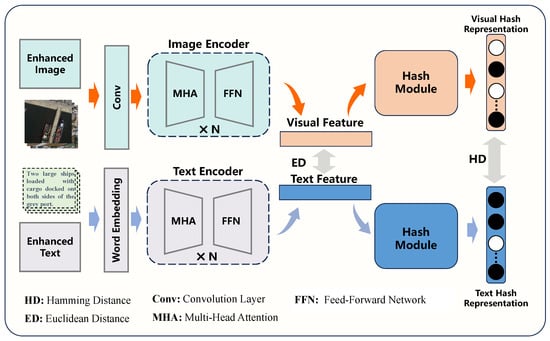
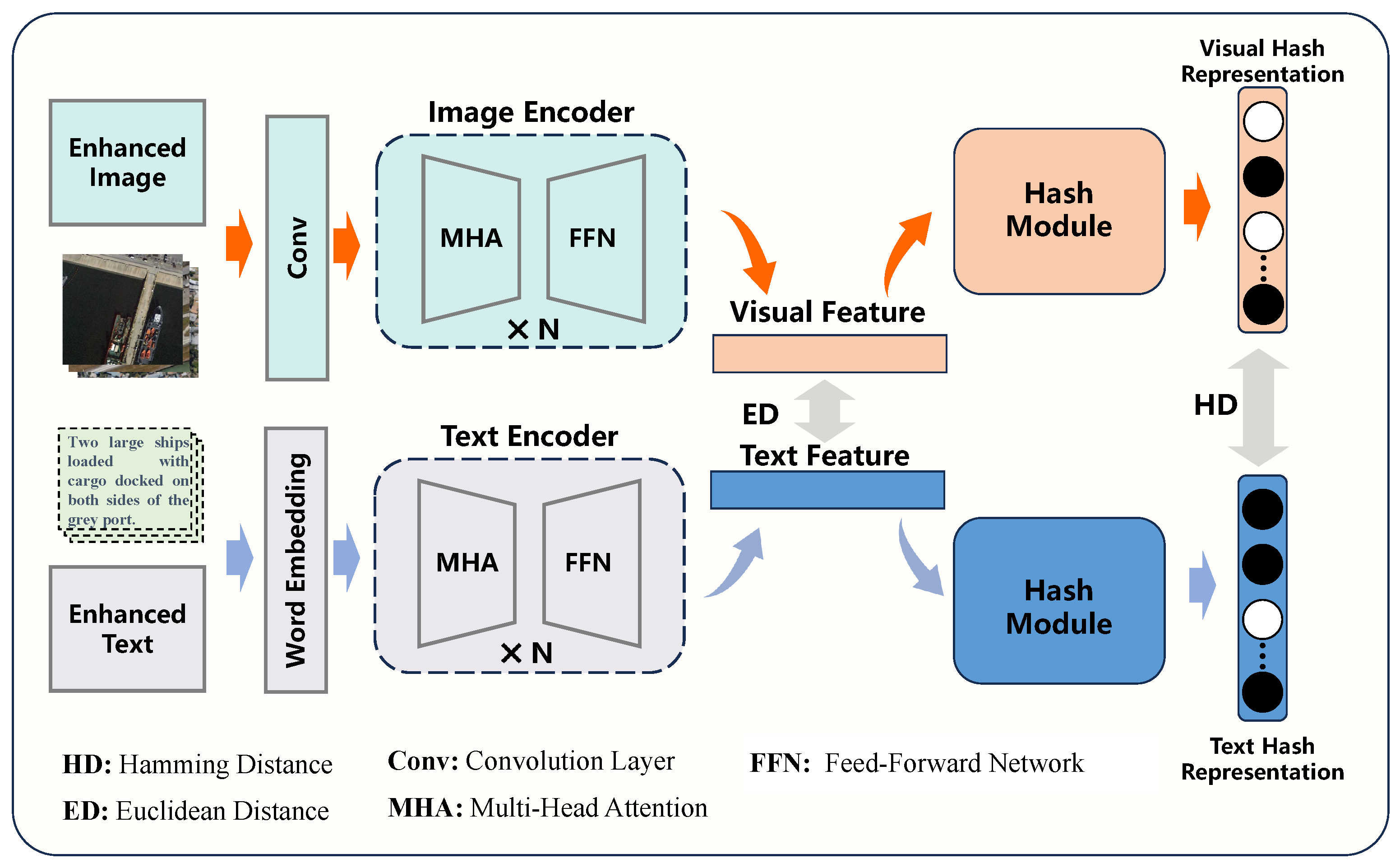
As illustrated in Figure 1, the proposed Cross-modal Contrastive Hashing (ConHash) framework adopts a dual-stream architecture designed to bridge the heterogeneity gap between remote sensing imagery and natural language descriptions. The complete processing pipeline consists of the following stages. (1) Input Preprocessing: Raw images undergo standard data augmentation (random rotation and horizontal flipping) to produce enhanced image inputs, while raw text is tokenized into word sequences. (2) Feature Extraction: A Vision Transformer (ViT) extracts high-level visual representations from images, and a Transformer-based text encoder captures semantic dependencies in text. (3) Hash Projection: Fully-connected layers with tanh activation project continuous features into compact hash embeddings. (4) Binarization: During inference, the sign function converts continuous hash codes to binary codes. (5) Similarity Computation: Hamming distance between binary codes enables efficient retrieval. The network is trained using a collaborative hybrid optimization strategy that jointly optimizes real-valued semantic alignment, hash-aware contrastive learning, and quantization regularization.
Figure 1.
The overall framework of the proposed ConHash model. The pipeline consists of: (1) input preprocessing, where “Enhanced Image” refers to images after standard data augmentation (random rotation and horizontal flipping), and “Enhanced Text” refers to tokenized word sequences; (2) feature encoders using ViT for images and Transformer for text; (3) hash modules that project features into a common Hamming space; and (4) binarization via sign function during inference. The network is optimized using a hybrid objective function incorporating contrastive alignment and quantization constraints. In the figure annotation, FFN denotes Feed-Forward Network.
Formally, let denote a multimodal dataset consisting of N image–text pairs. Here, represents the raw image input and denotes the corresponding textual description. The goal of ConHash is to learn two modality-specific hash functions, and , parameterized by and , respectively. These functions map the inputs into a K-bit common Hamming space, generating binary codes , such that the Hamming distance effectively reflects the semantic similarity between the modalities.
3.2. Multimodal Feature Extraction Module
To capture the intricate spatial patterns of remote sensing images and the semantic dependencies of text, we employ Transformer-based backbones for both modalities [22].
In cross-modal remote sensing retrieval, the input image I and text S are first processed through feature extraction techniques to obtain their corresponding features i and s. The extracted image and text features are then projected into a hashing space for similarity measurement.
3.2.1. Visual Representation
Next, we describe the visual and textual representation components in detail. Consistent with previous methods, we employ a Vision Transformer (ViT) architecture to perform initial extraction of remote sensing visual features [23]. Given an input remote sensing image , we first partition it into P fixed-size patches of resolution , where . Each patch is linearly embedded into a d-dimensional vector. Consistent with the ViT architecture, a learnable [CLS] token is prepended to the sequence of patch embeddings. Let denote the class token embedding and denote the patch embeddings. The encoding process through the l-th layer of the Transformer encoder is formulated as
where , , and represent Multi-Head Self-Attention, Multi-Layer Perceptron, and Layer Normalization, respectively. The final global visual representation is obtained from the output of the [CLS] token at the last layer.
3.2.2. Textual Representation
Similarly, for the corresponding text, we tokenize the sentence into a sequence of L words. Each token is mapped to a real-valued vector via an embedding matrix , where is the vocabulary size. Following the standard Transformer architecture [22], the text features are processed as:
The final textual representation is derived from the aggregated feature of the sequence.
3.3. Hash Encoding Module
The Hash Encoding Module serves as a bridge between the high-dimensional continuous feature space and the discrete Hamming space. It aims to compress the semantic features and into K-dimensional continuous embeddings and , which are subsequently binarized.
Structurally, this module consists of a series of fully connected layers (FC) designed to project the heterogeneous features into a shared latent space. Crucially, to approximate the discrete binary values and ensure differentiability during back-propagation, we employ the hyperbolic tangent (tanh) activation function at the final layer. The continuous hash codes are generated as follows:
where and are the weight matrices and bias vectors of the projection layers. During the inference phase, the final binary codes are obtained via the sign function and .
However, the relaxation from discrete to continuous space introduces quantization errors. To mitigate this discrepancy and encourage the continuous values to approach the discrete vertices of the hypercube , we impose a quantization loss. We formulate this constraint as
where denotes a vector of all ones, denotes the element-wise absolute value operation, and denotes the L1 norm (sum of absolute values). This formulation explicitly distinguishes the element-wise absolute value operation from the L1 norm operator. The term penalizes hash bits that drift towards zero (the center of the hypercube) and encourages them to saturate at .
Design Rationale for L1 Norm. We adopt the L1 norm rather than the L2 norm for the quantization loss for several reasons. First, the L1 norm provides stronger sparsity-inducing properties, encouraging hash bits to be exactly rather than merely close to these values. Second, the L1 norm is less sensitive to outliers, providing more stable gradients during training. Third, from an optimization perspective, the L1 norm creates a “sharp” penalty that pushes values toward the boundaries more aggressively than the L2 norm’s smoother penalty. Empirically, we found that the L1 norm leads to faster convergence and more saturated hash codes.
Training Stability Considerations. The tanh activation function exhibits gradient saturation when values approach , where the gradient approaches zero. To address this potential training instability, we employ several strategies. (1) Warm-up initialization: We initialize the hash projection layers with small weights to ensure that initial outputs are in the linear region of tanh (near zero), allowing gradients to flow effectively in early training. (2) Gradual quantization: The quantization loss weight is initially set to a small value and gradually increased, allowing the network to first learn meaningful representations before enforcing strict binarization. (3) Gradient clipping: We apply gradient clipping with a threshold of 1.0 to prevent gradient explosion during the early training stages. (4) Batch normalization: Layer normalization is applied before the hash projection to maintain stable activation distributions. These strategies collectively ensure stable training while achieving effective binarization.
3.4. Hash Contrastive Constraint
Unlike traditional contrastive learning methods, the hash contrastive approach introduces constraints within the hashing space, where multimodal features are mapped into binary hash codes for contrastive learning. The core advantage of this method lies in its ability not only to learn semantic alignment between image and text features but also to significantly enhance computational efficiency. Specifically, while conventional contrastive learning typically computes similarity between features in a continuous vector space, hash contrastive learning enforces constraints on feature representations within the hashing space. This ensures that semantically similar image–text features are encoded with more similar hash codes, enabling more efficient matching and retrieval.
In hash contrastive learning, semantic alignment of features is achieved by mapping image and text features from different modalities into a shared hashing space. In this space, both modalities share similar binary encodings that effectively reflect their semantic similarity.
To ensure semantic alignment across modalities, we introduce a Hash Contrastive Constraint. Unlike traditional methods that align features in the real-valued Euclidean space, our approach enforces alignment directly on the continuous hash codes . This ensures that the learned manifold structure is preserved after binarization.
We employ an InfoNCE-based contrastive loss to maximize the mutual information between matched image–text pairs while pushing apart unmatched pairs [5]. For a given anchor image hash code , its positive sample is the corresponding text code , and the negative samples are the text codes from other pairs within the same mini-batch. The similarity between two hash codes is measured using the cosine similarity, which serves as a differentiable proxy for the Hamming distance:
By minimizing the Hamming distance, hash contrastive learning further optimizes the matching accuracy between image and text features, ensuring that semantically related images and texts can be efficiently retrieved and accurately aligned during retrieval:
3.5. Overall Optimization Objective
While the ultimate goal is to generate binary codes, directly optimizing the network solely based on hashing objectives can be unstable due to the loss of information during quantization. To address this, we introduce a Real-valued Semantic Alignment constraint applied to the continuous feature representations and (extracted before the Hash Module).
This auxiliary constraint serves two critical purposes: (1) It ensures that the feature encoders capture the fine-grained semantic topology of the data in a high-dimensional continuous space, providing a robust foundation for the subsequent hashing layer; and (2) it acts as a regularization term that prevents the model from overfitting to the quantization artifacts.
We employ a symmetric cross-modal contrastive loss to align the real-valued features. Specifically, for an image feature , we maximize its similarity with the matched text feature while minimizing similarity with unmatched text features . The loss function is formulated as
where denotes the cosine similarity, and is the temperature parameter for the real-valued space. The total real-valued alignment loss includes both image-to-text and text-to-image directions:
The proposed ConHash framework adopts a collaborative hybrid optimization strategy. The total objective function is a weighted combination of the real-valued semantic alignment loss, the hash-aware contrastive loss, and the quantization regularization term
where and are hyper-parameters that balance the contribution of the hashing constraints.
In this formulation, guides the feature encoders to learn discriminative continuous representations, transfers this discriminative power into the Hamming space, and minimizes the binarization error. This multi-task learning paradigm ensures that the generated binary codes are both semantically accurate and storage-efficient. The detailed training procedure of the proposed ConHash framework is summarized in Algorithm 1.
| Algorithm 1 Training Procedure of the Proposed ConHash Framework |
| Require: Multimodal Dataset ; |
| Batch size B; Maximum iterations M; |
| Code length K; Hyper-parameters . |
| Ensure: Optimized network parameters and . |
|
4. Experiment
4.1. Datasets
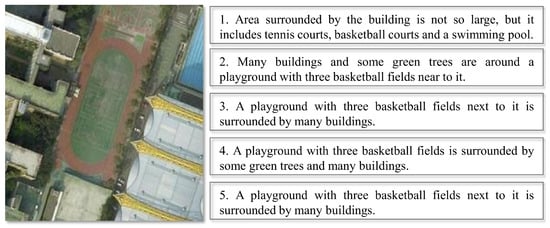
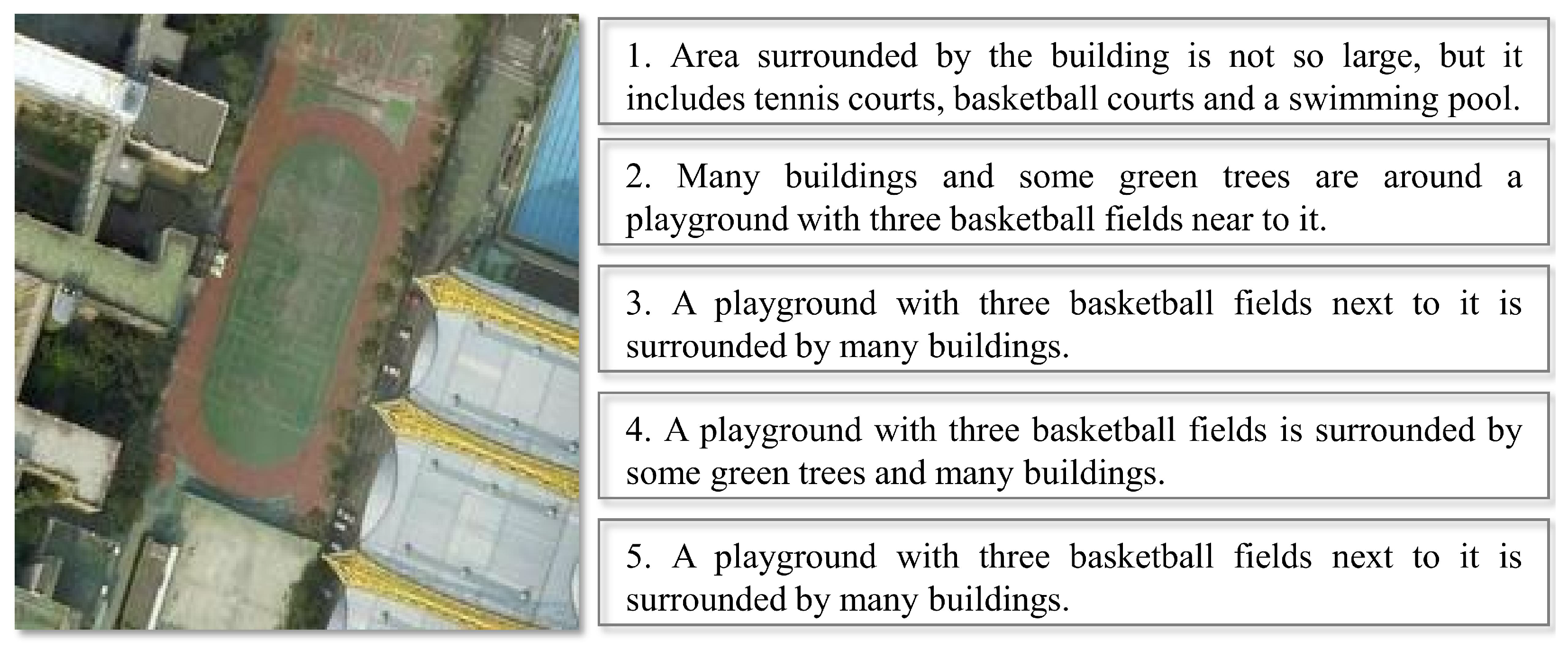
In this study, we conduct experiments on two widely used benchmark datasets for cross-modal remote sensing image–text retrieval, namely RSICD and RSITMD, as illustrated in Figure 2. Both datasets provide paired image–text annotations, where each remote sensing image is associated with up to five descriptive sentences, enabling comprehensive evaluation of image-to-text and text-to-image retrieval performance.
Figure 2.
An example from RSICD. Each image corresponds to five query texts.
The RSICD dataset contains 10,921 remote sensing images with a spatial resolution of , covering diverse land-use and land-cover scenes. Owing to its relatively large scale and rich semantic annotations, RSICD has become one of the most commonly adopted datasets for cross-modal remote sensing image–text retrieval. In contrast, the RSITMD dataset consists of 4743 images with a resolution of . Although smaller in scale, RSITMD provides more fine-grained and detailed textual descriptions, which pose greater challenges for precise semantic alignment between image and text modalities.
In addition to RSICD and RSITMD, other datasets such as UCM and Sydney are also available for cross-modal retrieval research. However, due to their limited sample sizes (2000 and 600 images, respectively), these datasets are less suitable for evaluating large-scale retrieval performance and were therefore not included in our experiments.
To ensure a fair comparison with existing methods, we followed the same data split protocol as Yuan et al. Specifically, each dataset was divided into training, validation, and test sets with a ratio of 80%/10%/10%, respectively. This split strategy has been widely adopted in prior work and allows for consistent evaluation of retrieval performance across different methods.
4.2. Evaluation Metrics
Following the standard evaluation protocol in remote sensing cross-modal image–text retrieval, we report Recall@K (R@K) and mean Recall (mR) as the primary metrics [4,18,24]. Recall@K measures the proportion of queries for which at least one relevant sample is retrieved within the top K results. In our experiments, we report R@1, R@5, and R@10 for both image-to-text (I2T) and text-to-image (T2I) retrieval. Mean Recall (mR) is computed as the average of the six recall values across the two retrieval directions and three ranking depths, providing a compact summary of overall retrieval performance.
4.3. Implementation Details
All experiments were conducted on a single NVIDIA A10 GPU. To ensure reproducibility and robustness, we fixed three different random seeds and reported the average performance over three independent runs. The preprocessing procedures and feature-space configurations were kept consistent with prior work to guarantee a fair comparison.
Specifically, all images from different datasets were resized to . Standard data augmentation techniques, including random rotation and horizontal flipping, were applied during training to enhance model generalization. The word embedding dimension was set to 300, while both image and text embedding dimensions were set to 512. The margin parameter in the alignment loss was set to 0.2. The temperature parameters were empirically set to 0.5 and 2.0.
We employed the AdamW optimizer to train the model for 50 epochs with a batch size of 256. The initial learning rate was set to and decayed by a factor of 0.1 every 20 epochs. A warm-up strategy was applied during the first 10 epochs to stabilize training and accelerate convergence.
Hash Code Length Selection. The main configuration of ConHash uses a code length of with L1 quantization loss. This setting is selected based on the empirical code-length ablation in Section 4.6, where achieves the best retrieval performance on both RSICD and RSITMD. Compared with a 512-dimensional float32 embedding requiring bits, a 512-bit binary code still provides a theoretical 32× storage reduction while preserving substantially more fine-grained semantic information than shorter codes.
4.4. Quantitative Retrieval Performance
The quantitative comparisons on the RSICD and RSITMD datasets are reported in Table 1 and Table 2, respectively. We compare ConHash with established real-valued RSCIR baselines, including VSE++, SCAN, CAMP, MTFN, and AMFMN. The main ConHash configuration uses 512-bit hash codes and L1 quantization loss.
Table 1.
Comparison of Cross-Modal Retrieval Performance on the RSICD Test Set. The best results are highlighted in bold.
Table 2.
Comparison of cross-modal retrieval performance on the RSITMD test set. The best results are highlighted in bold.
As shown in Table 1, ConHash achieves the best overall performance on the RSICD test set, reaching an of 21.69%. Compared with AMFMN, ConHash improves by 5.27 percentage points and improves all reported I2T and T2I recall metrics. This indicates that the proposed hash-aware contrastive learning strategy can preserve discriminative cross-modal semantics even after binarization.
The results on RSITMD in Table 2 further demonstrate the effectiveness of ConHash. ConHash achieves an of 35.79%, outperforming AMFMN by 6.07 percentage points. Although AMFMN remains slightly higher on T2I R@10, ConHash achieves stronger performance on the other five recall metrics, especially in I2T retrieval, where it reaches 17.26%, 40.49%, and 53.54% for R@1, R@5, and R@10, respectively.
Overall, the results show that ConHash does not merely trade accuracy for efficiency. Instead, the collaborative optimization of real-valued semantic alignment, hash-space contrastive learning, and quantization regularization enables compact binary codes to achieve strong retrieval accuracy while retaining the computational advantages of Hamming-space retrieval.
To address the lack of hashing-based comparisons, Table 3 further compares ConHash with UCCH-adapted, an external hashing baseline trained on the exported CLIP image/text features and evaluated under the same RSICD/RSITMD test split and R@K/ protocol. Under the same 512-bit setting, ConHash achieves higher on both datasets, suggesting that the proposed task-oriented hash contrastive optimization better preserves the fine-grained semantic structure required for RSCIR.
Table 3.
Comparison with an external hashing baseline under the same RSCIR protocol. All methods are evaluated using 512-bit hash codes. Bold values indicate the best performance in each column.
4.5. Retrieval Efficiency Analysis
In real-world Earth observation applications, the volume of remote sensing data is growing exponentially. Therefore, retrieval efficiency (inference speed) and storage cost are as critical as retrieval accuracy. We conducted a comprehensive evaluation to compare the computational efficiency of the proposed ConHash against representative real-valued baseline methods (VSE++, AMFMN, HVSA).
The efficiency experiments were conducted on a workstation equipped with an Intel(R) Xeon(R) Gold 6133 CPU @ 2.50 GHz and 64GB RAM. To ensure fair comparison, we measured the average search time required to retrieve relevant items from the entire test set for a given query. Each experiment was repeated five times to minimize system jitter, and the average duration is reported.
The quantitative time costs are presented in Table 4. As observed, traditional real-valued methods (e.g., VSE++ and AMFMN) require computationally intensive floating-point operations (FLOPs) to calculate Cosine or Euclidean distances between high-dimensional vectors (typically 512 or 1024 dimensions). In contrast, ConHash projects features into a compact binary Hamming space. Specifically, our method achieves up to a 68% improvement in retrieval efficiency (3.18× speedup on RSICD and 3.50× speedup on RSITMD), highlighting the advantage of compact binary representations and efficient Hamming distance computation. These results demonstrate that the proposed method is well suited for large-scale remote sensing retrieval scenarios where both accuracy and efficiency are critical.
Table 4.
Comparison of retrieval time cost on RSICD and RSITMD datasets (unit: seconds). The Speedup is calculated relative to the slowest baseline (AMFMN). Bold values indicate the shortest retrieval time and the highest speedup.
Beyond temporal efficiency, ConHash offers superior spatial efficiency. Real-valued methods typically store features as 32-bit floating-point vectors. For a 512-dimensional vector, a single image requires bits. In contrast, the main ConHash configuration represents each item using a 512-bit binary code. This results in a theoretical 32× storage reduction. Although this compression ratio is lower than that of very short codes such as 64 bits, the empirical results in Section 4.6 show that the 512-bit setting provides a better accuracy–efficiency balance for the evaluated RSCIR datasets.
4.6. Empirical Hash Code Length Analysis
To directly validate the influence of code length, we evaluate ConHash with different hash code lengths under the same L1 quantization loss. Table 5 reports the retrieval accuracy for , 64, 128, 256, and 512 on both RSICD and RSITMD.
Table 5.
Code Length Ablation of ConHash under L1 Quantization Loss. Bold values indicate the best performance in each dataset group.
The results show a clear performance trend. Very short codes, especially 32-bit and 64-bit codes, lead to substantial retrieval degradation because the compact Hamming space cannot preserve enough fine-grained cross-modal semantics. As the code length increases, retrieval performance improves consistently on both datasets. The 512-bit setting achieves the best on RSICD and RSITMD, reaching 21.69% and 35.79%, respectively. Therefore, we adopt as the main configuration in the revised manuscript.
From the efficiency perspective, 512-bit binary codes still provide a 32× theoretical storage reduction compared with 512-dimensional float32 features. This setting therefore preserves the practical storage and Hamming-distance advantages of hashing while avoiding the severe semantic loss observed with shorter codes.
4.7. Quantization Regularization Ablation
We further conduct an ablation study on the quantization regularization term at to support the choice of the L1 formulation in Section 3.3. As shown in Table 6, L1 consistently outperforms L2 on both datasets. It improves from 19.25% to 21.69% on RSICD and from 33.64% to 35.79% on RSITMD. These empirical results indicate that using the L1 norm for quantization regularization is more effective for encouraging discriminative and saturated hash codes in the proposed framework.
Table 6.
Ablation study of the quantization regularization term at . Bold values indicate the best performance in each dataset group.
4.8. Retrieval Cases Analysis
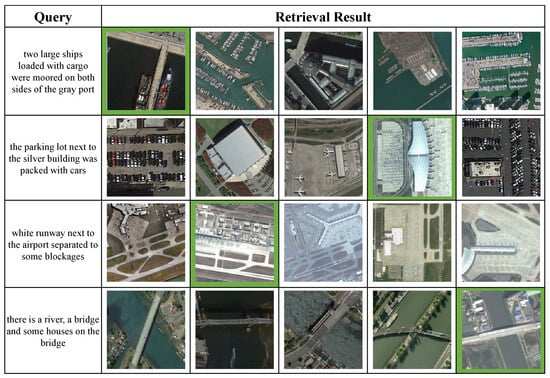
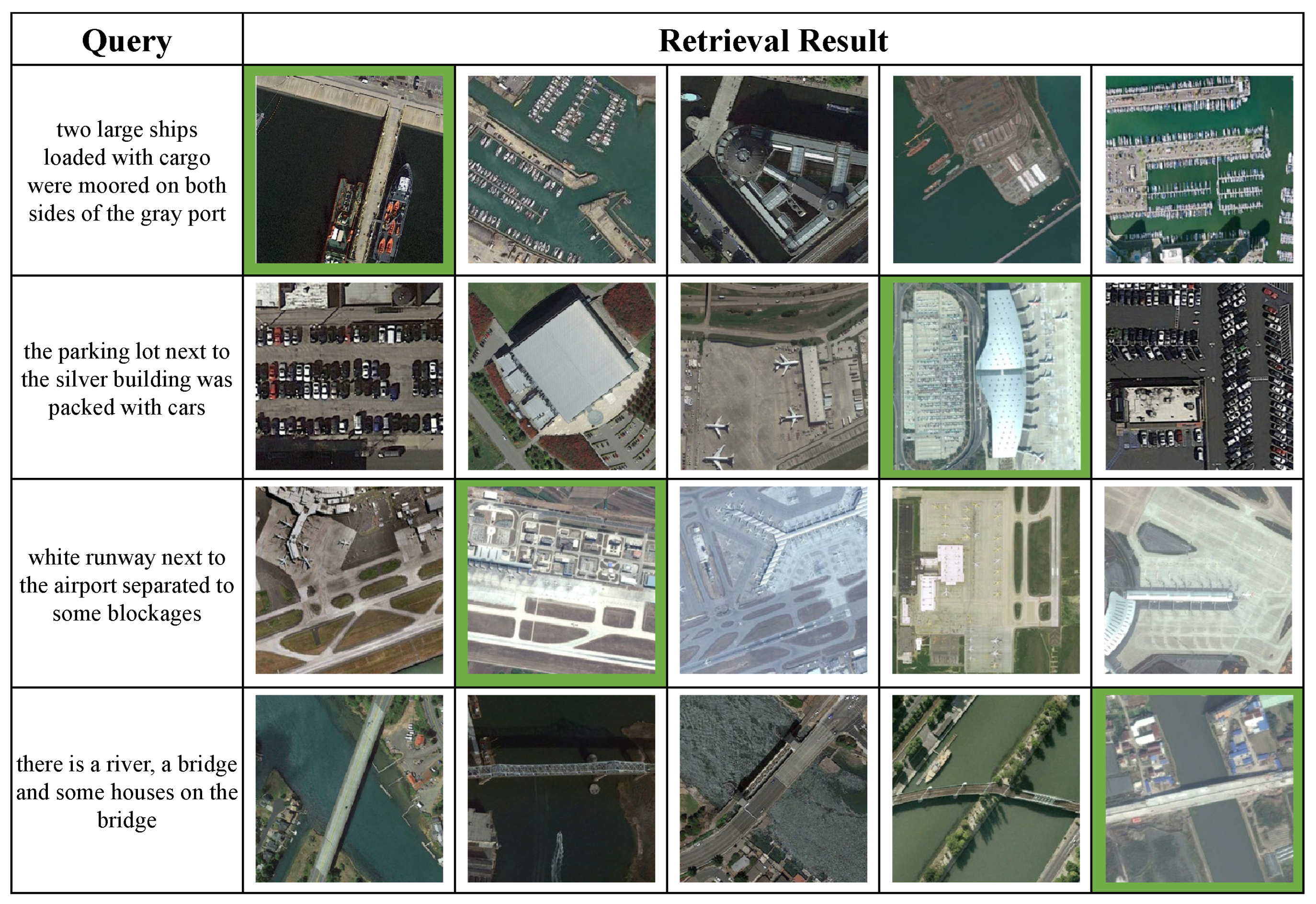
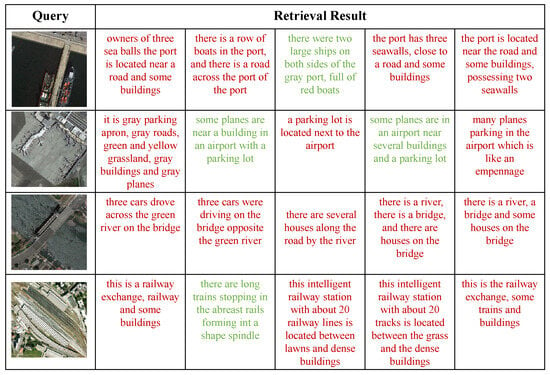
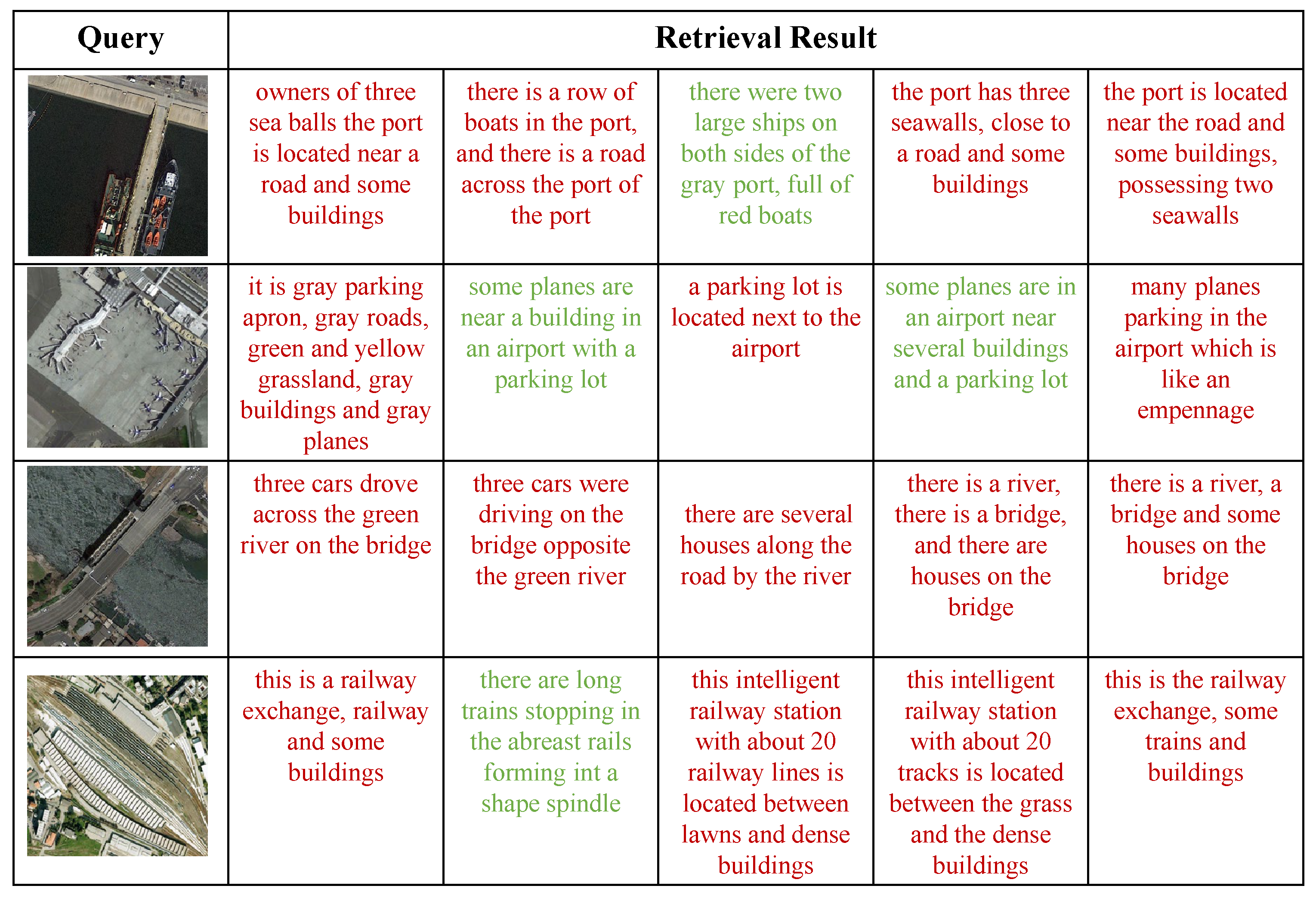
To provide a more intuitive understanding of the proposed method’s capabilities and limitations, we visualize the top-five retrieval results for both Text-to-Image (T2I) and Image-to-Text (I2T) tasks on the test set. Figure 3 and Figure 4 illustrate the qualitative results, where the ground-truth targets are highlighted in green, and mismatched but semantically relevant results are indicated in normal borders or red text.
Figure 3.
Qualitative visualization of Text-to-Image retrieval results. The query sentences are listed on the left, and the top-5 retrieved images are shown on the right. The ground-truth images are highlighted with green borders.
Figure 4.
Qualitative visualization of Image-to-Text retrieval results. The query images are shown on the left. The top-5 retrieved sentences are listed on the right, where the ground-truth captions are marked in green, and other retrieved captions are marked in red.
Figure 3 displays the T2I results using complex natural language queries. It can be observed that ConHash effectively captures fine-grained visual attributes and spatial relationships described in the text. For instance, in the first query (“two large ships loaded with cargo…”), the model successfully retrieves the exact ground-truth image at Rank-1. More importantly, the other top-ranked candidates also depict ports with similar structures and ship distributions, demonstrating that our method has learned a robust concept of “harbor scenes” within the Hamming space. Even in challenging cases where the ground truth is not ranked first (e.g., the fourth query describing “a river, a bridge”), the top-retrieved images all share high visual similarity with the description (bridges over water). This indicates that the “errors” are largely due to the high inter-class similarity inherent in remote sensing data, yet the semantic consistency remains preserved.
Figure 4 presents the I2T results. The retrieved sentences provide detailed descriptions of the query images. Take the fourth row (a railway scene) as an example. Although the ground-truth caption appears at Rank-2, the Rank-1 and Rank-3 sentences (“this is a railway exchange…” and “this intelligent railway station…”) accurately describe the visual content. This suggests that ConHash does not simply memorize labels but truly understands the semantic content of the image, mapping visually similar scenes to semantically clustered textual descriptions in the binary code space. Similarly, in the second row (airport scene), the retrieved texts correctly identify key elements such as “parking apron,” “planes,” and “buildings,” showing the model’s capability in object recognition and scene interpretation.
Failure Case Analysis. Despite the overall strong performance, ConHash exhibits certain limitations that warrant discussion. First, fine-grained distinction challenges: In cases where multiple images share similar global scene structures but differ in subtle details (e.g., number of ships, specific building types), the binary quantization may collapse these distinctions, leading to incorrect rankings. Second, complex spatial relationship modeling: Queries involving complex spatial relationships (e.g., “a building to the left of a river”) may not be fully captured in the compact binary representation, as the hash codes primarily encode global semantic information. Third, rare scene categories: For underrepresented scene types in the training data, the learned hash codes may not be sufficiently discriminative, resulting in lower retrieval accuracy. These limitations highlight the inherent trade-off between the compactness of binary representations and the preservation of fine-grained semantic details, pointing to potential directions for future improvement such as multi-level hashing or attention-guided bit allocation.
Overall, these qualitative results validate that the generated binary codes successfully encode rich semantic information. The proposed ConHash framework maintains high retrieval precision and ensures that the retrieved neighbors are semantically relevant, proving its effectiveness for real-world exploration of large-scale remote sensing archives.
5. Discussion
5.1. Comparison with Hashing-Based Methods
In response to the need for direct hashing-based comparison, we include UCCH-adapted as an external hashing baseline in Table 3. The comparison is conducted under the same RSCIR split and evaluation protocol, using 512-bit hash codes for both methods. The results show that ConHash achieves higher on both RSICD and RSITMD. This improvement suggests that simply applying a generic cross-modal hashing method to remote sensing image–text features is not sufficient; it is also necessary to explicitly preserve cross-modal semantic alignment during binarization.
The advantage of ConHash comes from coupling semantic alignment and hash-code learning in a task-oriented manner. By combining VLM-based continuous representations with a hash-aware contrastive objective, the proposed framework constrains both the real-valued embedding space and the Hamming space during training. This dual-space optimization reduces the semantic drift typically introduced by direct quantization and helps preserve the fine-grained scene semantics needed for RSCIR.
5.2. Core Contribution: Efficiency–Accuracy Balance
The primary contribution of this work lies not in pursuing isolated gains on a single recall metric, but in demonstrating that hashing-based retrieval can retain strong retrieval quality while providing substantial efficiency benefits. This has significant practical implications, (1) Large-scale deployment: The 32× theoretical storage reduction of 512-bit hash codes can reduce memory pressure for large remote sensing archives; (2) Real-time applications: The 3.18×–3.50× speedup makes interactive retrieval more feasible for time-sensitive applications such as disaster response; (3) Resource-constrained environments: The reduced computational requirements enable more practical deployment under limited resources. We believe this efficiency–accuracy balance represents a meaningful advancement for practical remote sensing retrieval systems.
5.3. Limitations and Future Work
Despite the promising results, several limitations remain: (1) the current framework uses a fixed hash code length, which may not be optimal for all query types; (2) the binary quantization inevitably loses some fine-grained semantic information; and (3) the framework has not been evaluated on extremely large-scale datasets (millions of images). Future work could explore adaptive bit-length mechanisms, hierarchical hashing structures, and large-scale evaluation to further advance the field.
6. Conclusions
In this paper, we proposed ConHash, a Cross-modal Contrastive Hashing framework tailored for large-scale and efficient remote sensing image–text retrieval. The main configuration of ConHash uses a code length of with L1 quantization loss. ConHash achieves strong retrieval accuracy on both RSICD and RSITMD while providing up to 3.50× retrieval speedup and a 32× theoretical storage reduction compared with 512-dimensional float32 embeddings. To overcome the inherent accuracy degradation in traditional hashing methods, we introduced a collaborative hybrid optimization strategy that synergizes real-valued semantic guidance with hash-aware contrastive learning. By aligning cross-modal features in both continuous and discrete spaces, ConHash effectively transfers the rich discriminative power of pre-trained vision–language models into a compact Hamming space, thereby minimizing the information loss typically associated with quantization.
Extensive experimental results on benchmark remote sensing datasets demonstrate that the proposed method achieves a favorable balance between retrieval accuracy and efficiency. Compared with existing embedding-based approaches, ConHash delivers competitive retrieval performance while significantly reducing storage requirements and accelerating retrieval speed through compact binary codes and efficient Hamming distance computation. These advantages make ConHash particularly suitable for large-scale remote sensing archives and resource-constrained or real-time application scenarios.
Moreover, the proposed framework is flexible and can be seamlessly integrated with modern vision–language pre-trained models, enabling effective utilization of rich semantic representations while maintaining scalable retrieval performance. This design provides a practical solution for deploying cross-modal retrieval systems in real-world remote sensing applications, where both semantic accuracy and computational efficiency are critical.
In future work, we plan to extend this framework to more challenging scenarios, such as zero-shot retrieval for unseen remote sensing categories and cross-sensor retrieval. Additionally, exploring adaptive bit-length mechanisms to dynamically balance efficiency and accuracy based on query complexity represents another promising direction for further investigation.
Author Contributions
Conceptualization, J.F. and D.Z.; methodology, software, formal analysis, investigation, data curation, visualization, and writing—original draft preparation, J.F.; validation, J.F. and D.Z.; writing—review and editing, J.F. and D.Z.; supervision, project administration, and funding acquisition, D.Z. All authors have read and agreed to the published version of the manuscript.
Funding
This research was funded partly by the Beijing Natural Science Foundation under Grant 4254108 and partly by the National Natural Science Foundation of China under Grant 62431020.
Data Availability Statement
The RSICD and RSITMD datasets analyzed in this study are publicly available. The data generated during the current study are available from the corresponding author upon reasonable request.
Conflicts of Interest
The authors declare no conflicts of interest.
Abbreviations
The following abbreviations are used in this manuscript:
| RS | Remote Sensing |
| RSCIR | Remote Sensing Cross-modal Image–Text Retrieval |
| ConHash | Cross-modal Contrastive Hashing |
| VLMs | Vision–Language Models |
| SOTA | state-of-the-art |
| CBIR | Content-Based Image Retrieval |
| T2I | Text-to-Image |
| I2T | Image-to-Text |
| FLOPs | floating-point operations |
| ViT | Vision Transformer |
References
- Ma, C.; Xia, W.; Chen, F.; Liu, J.; Dai, Q.; Jiang, L.; Duan, J.; Liu, W. A content-based remote sensing image change information retrieval model. ISPRS Int. J. Geo-Inf. 2017, 6, 310. [Google Scholar] [CrossRef] [Scilit]
- Lu, X.; Wang, B.; Zheng, X.; Li, X. Exploring models and data for remote sensing image caption generation. IEEE Trans. Geosci. Remote Sens. 2017, 56, 2183–2195. [Google Scholar] [CrossRef] [Scilit]
- Zhao, Y.; Zhang, M.; Yang, B.; Zhang, Z.; Kang, J.; Gong, J. LuoJiaHOG: A hierarchy oriented geo-aware image caption dataset for remote sensing image–text retrieval. ISPRS J. Photogramm. Remote Sens. 2025, 222, 130–151. [Google Scholar] [CrossRef] [Scilit]
- Al Rahhal, M.M.; Bazi, Y.; Alsharif, N.A.; Bashmal, L.; Alajlan, N.; Melgani, F. Multilanguage Transformer for Improved Text to Remote Sensing Image Retrieval. IEEE J. Sel. Top. Appl. Earth Obs. Remote Sens. 2022, 15, 9115–9126. [Google Scholar] [CrossRef] [Scilit]
- Radford, A.; Kim, J.W.; Hallacy, C.; Ramesh, A.; Goh, G.; Agarwal, S.; Sastry, G.; Askell, A.; Mishkin, P.; Clark, J.; et al. Learning transferable visual models from natural language supervision. In Proceedings of the International Conference on Machine Learning, Virtual, 18–24 July 2021; PMLR: Cambridge, MA, USA, 2021; pp. 8748–8763. [Google Scholar]
- Liu, F.; Chen, D.; Guan, Z.; Zhou, X.; Zhu, J.; Ye, Q.; Fu, L.; Zhou, J. Remoteclip: A vision language foundation model for remote sensing. IEEE Trans. Geosci. Remote Sens. 2024, 62, 5622216. [Google Scholar] [CrossRef] [Scilit]
- Yuan, Z.; Zhang, W.; Tian, C.; Mao, Y.; Zhou, R.; Wang, H.; Fu, K.; Sun, X. MCRN: A Multi-source Cross-modal Retrieval Network for remote sensing. Int. J. Appl. Earth Obs. Geoinf. 2022, 115, 103071. [Google Scholar] [CrossRef] [Scilit]
- Tang, X.; Wang, Y.; Ma, J.; Zhang, X.; Liu, F.; Jiao, L. Interacting-Enhancing Feature Transformer for Cross-modal Remote Sensing Image and Text Retrieval. IEEE Trans. Geosci. Remote Sens. 2023, 61, 5611715. [Google Scholar] [CrossRef] [Scilit]
- Chen, Y.; Huang, J.; Li, X.; Xiong, S.; Lu, X. Multiscale Salient Alignment Learning for Remote Sensing Image-Text Retrieval. IEEE Trans. Geosci. Remote Sens. 2023, 62, 4700413. [Google Scholar] [CrossRef] [Scilit]
- Han, K.; Wang, Y.; Chen, H.; Chen, X.; Guo, J.; Liu, Z.; Tang, Y.; Xiao, A.; Xu, C.; Xu, Y.; et al. A survey on vision transformer. IEEE Trans. Pattern Anal. Mach. Intell. 2022, 45, 87–110. [Google Scholar] [CrossRef] [Scilit]
- Xu, L.; Wang, L.; Zhang, J.; Ha, D.; Zhang, H. A Review of Cross-Modal Image–Text Retrieval in Remote Sensing. Remote Sens. 2025, 17, 3995. [Google Scholar] [CrossRef] [Scilit]
- Abdullah, T.; Bazi, Y.; Al Rahhal, M.M.; Mekhalfi, M.L.; Rangarajan, L.; Zuair, M. TextRS: Deep bidirectional triplet network for matching text to remote sensing images. Remote Sens. 2020, 12, 405. [Google Scholar] [CrossRef] [Scilit]
- Cheng, G.; Han, J.; Lu, X. Remote sensing image scene classification: Benchmark and state of the art. Proc. IEEE 2017, 105, 1865–1883. [Google Scholar] [CrossRef] [Scilit]
- Wang, C.; Gu, Y.; Li, X. LPRnet: A Self-Supervised Registration Network for LiDAR and Photogrammetric Point Clouds. IEEE Trans. Geosci. Remote Sens. 2025, 63, 4404012. [Google Scholar] [CrossRef] [Scilit]
- Li, C.; Zhang, W.; Bi, H.; Li, J.; Li, S.; Yu, H.; Sun, X.; Wang, H. Injecting Linguistic Into Visual Backbone: Query-Aware Multimodal Fusion Network for Remote Sensing Visual Grounding. IEEE Trans. Geosci. Remote Sens. 2024, 62, 1–14. [Google Scholar] [CrossRef] [Scilit]
- Li, C.; Zhang, W.; Bi, H.; Li, J.; Yan, Q.; Wang, C.; Wang, Z.; Sun, X.; Wang, H. MCASEN: Boosting Referring Remote Sensing Image Segmentation with Multimodal Semantic Guided Decoding and Recursive Multiscale Fusion. IEEE Trans. Geosci. Remote Sens. 2026, 64, 1–17. [Google Scholar] [CrossRef] [Scilit]
- Ferrod, R.; Di Caro, L.; Ienco, D. Towards a multimodal framework for remote sensing image change retrieval and captioning. In Proceedings of the International Conference on Discovery Science; Springer: Cham, Switzerland, 2024; pp. 231–245. [Google Scholar]
- Yuan, Z.; Zhang, W.; Fu, K.; Li, X.; Deng, C.; Wang, H.; Sun, X. Exploring a Fine-Grained Multiscale Method for Cross-Modal Remote Sensing Image Retrieval. IEEE Trans. Geosci. Remote Sens. 2021, 60, 4404119. [Google Scholar] [CrossRef] [Scilit]
- Zhang, Z.; Zhao, T.; Guo, Y.; Yin, J. Rs5m: A large scale vision-language dataset for remote sensing vision-language foundation model. arXiv 2023, arXiv:2306.11300. [Google Scholar]
- Tong, B.; Du, R.; Zhang, W.; Li, J.; Li, S.; Li, C.; Guo, Z.; Sun, X.; Xu, G. VIGEN500K: A Sustainable-Expansion Image–Text Aligned Dataset for Remote Sensing. In Proceedings of the IGARSS 2024–2024 IEEE International Geoscience and Remote Sensing Symposium, Athens, Greece, 7–12 July 2024; pp. 2941–2944. [Google Scholar]
- Han, L.; Paoletti, M.E.; Tao, X.; Wu, Z.; Haut, J.M.; Li, P.; Pastor-Vargas, R.; Plaza, A. Hash-based remote sensing image retrieval. IEEE Trans. Geosci. Remote Sens. 2024, 62, 4411123. [Google Scholar] [CrossRef] [Scilit]
- Vaswani, A.; Shazeer, N.; Parmar, N.; Uszkoreit, J.; Jones, L.; Gomez, A.N.; Kaiser, Ł.; Polosukhin, I. Attention is all you need. Adv. Neural Inf. Process. Syst. 2017, 30, 5998–6008. [Google Scholar]
- Dosovitskiy, A.; Beyer, L.; Kolesnikov, A.; Weissenborn, D.; Zhai, X.; Unterthiner, T.; Dehghani, M.; Minderer, M.; Heigold, G.; Gelly, S.; et al. An image is worth 16x16 words: Transformers for image recognition at scale. arXiv 2020, arXiv:2010.11929. [Google Scholar]
- Li, K.; Zhang, Y.; Li, K.; Li, Y.; Fu, Y. Image-text embedding learning via visual and textual semantic reasoning. IEEE Trans. Pattern Anal. Mach. Intell. 2022, 45, 641–656. [Google Scholar] [CrossRef] [Scilit] [PubMed]
- Faghri, F.; Fleet, D.J.; Kiros, J.R.; Fidler, S. Vse++: Improving visual-semantic embeddings with hard negatives. arXiv 2017, arXiv:1707.05612. [Google Scholar]
- Zhang, W.; Li, J.; Li, S.; Chen, J.; Zhang, W.; Gao, X.; Sun, X. Hypersphere-based remote sensing cross-modal text-image retrieval via curriculum learning. IEEE Trans. Geosci. Remote Sens. 2023, 61, 5621815. [Google Scholar] [CrossRef] [Scilit]

Disclaimer/Publisher’s Note: The statements, opinions and data contained in all publications are solely those of the individual author(s) and contributor(s) and not of MDPI and/or the editor(s). MDPI and/or the editor(s) disclaim responsibility for any injury to people or property resulting from any ideas, methods, instructions or products referred to in the content. |
© 2026 by the authors. Licensee MDPI, Basel, Switzerland. This article is an open access article distributed under the terms and conditions of the Creative Commons Attribution (CC BY) license.