


Highlights
What are the main findings?
- LMamba achieves state-of-the-art classification performance across three established public hyperspectral image (HSI) benchmarks.
- The Multi-scale Aggregation and Compression Block (MACB) and the Locally Guided 2D Scanning Mechanism exhibit a synergistic effect in mitigating spectral redundancy and preserving spatial structural integrity.
- The LMamba framework maintains superior computational efficiency relative to its high accuracy.
What is the implication of the main finding?
- It establishes a novel and efficient architectural paradigm for hyperspectral image classification.
- It underscores the critical necessity of preserving two-dimensional geometric priors within sequential state space models for visual tasks.
Abstract
Deep learning methods have significantly improved hyperspectral image (HSI) classification by exploiting hierarchical feature learning to integrate spatial and spectral information, thus significantly improving classification accuracy. Nevertheless, current deep learning approaches (such as CNNs, Transformers and Mamba) still face three major challenges: inadequate mitigation of spectral redundancy, high computational costs associated with global modeling, and the loss of two-dimensional spatial structure during sequential processing. To address these issues, we propose LMamba, a task-oriented hybrid framework that combines multi-scale convolutional filtering with local-context-conditioned state space modeling for hyperspectral image classification. Rather than introducing a fundamentally new SSM formulation, LMamba focuses on adapting the input-dependent parameter projection of Mamba to HSI data by injecting local 2D neighborhood context into the generation of selective SSM parameters. This design enables the state space module to better preserve spatial continuity while maintaining linear-complexity sequence modeling. The framework consists of two core components. First, the Multi-scale Aggregation and Compression Block (MACB) employs parallel grouped convolutions with varying kernel sizes to capture spatial features at multiple scales while simultaneously reducing spectral redundancy through channel compression. Second, the Locally Guided 2D Scanning Mechanism replaces conventional unidirectional 1D scanning with a context-aware 2D scanning strategy, thereby preserving structural continuity and enhancing feature representation by integrating local neighborhood spatial information into state transitions. Validation on three prominent HSI datasets demonstrates that LMamba consistently outperforms state-of-the-art methods based on CNNs, Transformers, and SSMs as measured by overall accuracy (OA), average accuracy (AA), and the Kappa coefficient. In summary, LMamba provides an efficient and accurate HSI classification framework under the considered benchmark settings, and its compact complexity and low-sample robustness suggest potential usefulness for practical HSI analysis.
1. Introduction
Hyperspectral imaging (HSI) technology captures hundreds of contiguous, narrow spectral bands across a scene, thereby generating a three-dimensional data cube that integrates extensive spectral signatures with spatial context. In an HSI dataset, each pixel records a high-resolution spectral response curve, which enables the precise differentiation of subtle variations among objects on the ground. This capability renders HSI indispensable for a variety of remote sensing applications, including urban land-cover mapping [1], environmental change detection, and precision agriculture [2].
HSI classification focuses on utilizing both spectral and spatial information to accurately assign semantic labels to image pixels. The HSI classification methods could be divided into two groups: conventional machine learning approaches and deep learning techniques. Early conventional methods mainly relied on spectral information, using algorithms such as Support Vector Machines (SVMs) [3,4], which separate spectral classes by K-Nearest Neighbor (KNN) [5,6] and Random Forests (RFs) [7]. However, these techniques often overlook spatial context, making it difficult to distinguish between classes that have similar spectral profiles yet different spatial distributions. Moreover, their shallow modeling approaches are not well-suited to capture the complex, nonlinear dependencies present in high-dimensional HSI data, particularly in challenging scenarios involving mixed pixels or heterogeneous land covers.
Deep learning has significantly advanced hyperspectral image (HSI) classification by enabling the end-to-end learning of layered spatial–spectral features [8,9]. For example, Lee et al. [10] developed a deep 2D-CNN framework that employs hierarchical convolutions to extract spatial features and capture local texture patterns, thereby improving classification accuracy. Moreover, 3D-CNNs were introduced, treating hyperspectral images as volumetric data to jointly consider spatial and spectral information. For example, HybridSN [11] utilizes 3D convolutions to extract integrated spatial–spectral features before applying 2D convolutions to refine spatial details. Despite these advancements, 3D-CNNs confront challenges such as exponential growth in parameters with increasing input dimensions, resulting in higher computational costs and an elevated risk of overfitting.
While CNNs excel at local feature extraction, they struggle with capturing global contextual relationships due to their limited receptive fields. To address this, Transformer-based approaches have been introduced, leveraging self-attention mechanisms to model long-range dependencies. For example, HiT [12] introduced a modeling framework that aligns spatial and spectral axes, blending local convolution filters with global self-attention to reduce computational load while effectively identifying long-range relationships. SpectralFormer [13] reformulated hyperspectral image classification by tokenizing spectral bands and applying multi-head attention to discern inter-band associations, thereby achieving leading results on benchmark datasets. Moreover, DCTN [14] presented a dual-branch convolutional transformer featuring an interactive self-attention mechanism that efficiently fuses spatial and spectral features. However, transformer-based methods exhibit quadratic computational complexity that limits their scalability for high-resolution hyperspectral images.
Recent advancements in hyperspectral image (HSI) classification have increasingly employed state space models (SSMs) like Mamba [15] due to their linear computational complexity when processing long sequences. Building on this, SpectralMamba [13] introduced modules for position state space (PSS) and global state space modeling (GSSM) to improve spectral sequence representation and reduce spectral drift across extended bands. Subsequently, 3DSS-Mamba [16] integrated spatial and spectral representations within a three-dimensional state space framework, thereby enhancing combined feature extraction. In addition, S2Mamba [17] further optimized the method by incorporating spatial–spectral scanning and hybrid gating techniques to achieve more effective feature fusion. However, despite their computational merits, Mamba-based methods are inherently limited by their one-dimensional, fixed-direction scanning approach, which tends to flatten the two-dimensional spatial structures. This simplification can disrupt local spatial correlations and compromise spatial–spectral integration, particularly in areas with high spatial continuity, such as agricultural fields or urban regions.
Despite these advances, current methods still suffer from: (1) spectral redundancy; (2) high computational cost of global modeling; and (3) loss of 2D structural information in sequential models. Although Mamba-based visual models provide efficient long-range modeling with linear complexity, their sequential computation usually requires a 2D feature map to be serialized into one or multiple 1D sequences. Bidirectional or cross-directional scanning can alleviate directional bias to some extent, but it still mainly changes the order of sequence traversal and does not explicitly condition the input-dependent SSM parameters on the local 2D HSI context. For hyperspectral scenes, where neighboring pixels often share material-level spectral consistency and boundary pixels may involve mixed spectral responses, such local spatial context is important for reliable state propagation.
To address these challenges, we propose LMamba, a hybrid framework that combines multi-scale convolutional filtering with locally guided state space modeling. Unlike previous Mamba adaptations for HSI that primarily focused on global sequence modeling, our LMamba introduces a locally guided 2D scanning mechanism that incorporates neighborhood context into state transitions, thereby preserving spatial integrity. Furthermore, our Multi-scale Aggregation and Compression Block (MACB) leverages grouped convolutions to simultaneously suppress spectral redundancy and capture multi-grained spatial features, a capability not explored in existing SSM-based HSI methods.
The contributions of this paper are summarized as follows:
- We propose LMamba, a lightweight hybrid HSI classification framework that combines multi-scale convolutional filtering with local-context-conditioned SSM modeling. The goal is not to replace the Mamba formulation but to adapt its input-dependent parameter projection to spatially coherent HSI data.
- We design MACB to extract multi-granularity local spatial–spectral features and reduce spectral redundancy through channel compression and lightweight parallel convolutional branches.
- We introduce a local-context-conditioned SSM parameter projection mechanism, where local 2D neighborhood information is used to guide the generation of B, C, and . This enables spatially aware state propagation while retaining the sequential efficiency of Mamba.
- We evaluate LMamba on three public HSI benchmarks and provide accuracy, complexity, ablation, and visualization analyses to demonstrate its accuracy–efficiency trade-off under the considered experimental settings.
2. Related Work
2.1. CNNs-Based Hyperspectral Image Classification Methods
Convolutional neural networks (CNNs) have become one of the basic methods in the study of hyperspectral image (HSI) classification due to their superior performance in modeling local spatial features. Conventional two-dimensional convolutional network structures [10,18,19,20] usually process spatial information and spectral information separately, which can capture local texture or spectral changes to a certain extent. Moreover, a three-dimensional convolutional neural network (3D-CNN) [3,21,21,22] was proposed to jointly model the spectral and spatial dimensions. This type of method obtains a comprehensive representation that combines spatial and spectral features by performing voxel convolution operations on a three-dimensional data cube. For example, the HybridSN [3] network combines 3D convolution to extract local spatial–spectral information and 2D convolution to further refine the spatial features, showing excellent classification results and strong generalization capabilities on multiple benchmark datasets.
In order to further enhance the modeling capability of the spectral dimension, researchers introduced recurrent neural networks [23] to mine the temporal dependency characteristics in band sequences. Hang et al. [24] constructed an RNN model based on a cascade structure to compress the redundancy between adjacent bands and enhance the feature representation capability. Mei et al. [25] proposed a fusion network architecture that uses CNN to extract spatial information and RNN to capture spectral continuity, thereby achieving collaborative learning of spatial–spectral information. This multi-module combination approach has brought significant improvements in both classification accuracy and feature integration capabilities.
In summary, while CNNs and their variants excel at extracting localized spatial–spectral features, they are inherently constrained by fixed receptive fields and limited global contextual awareness. Furthermore, RNN-integrated models often grapple with gradient instability over long sequences. These fundamental limitations hinder their ability to achieve efficient and robust spatial–spectral fusion, particularly in scenarios requiring long-range dependency modeling and multi-scale feature integration.
2.2. Transformers-Based Hyperspectral Image Classification Methods
In recent years, the Transformer architecture [2,26,27,28,29,30,31] has shown promising potential in the field of hyperspectral image (HSI) classification. Its core lies in the use of the self-attention mechanism to model global dependencies in spatial and spectral dimensions. Early studies such as the SSF model used CNN for local feature extraction and introduced Transformer to model spectral sequences, achieving significant improvements in classification accuracy on small-scale datasets. Subsequently, more advanced architectures were proposed to further improve this paradigm. Among them, Sun et al. [32] proposed to deconstruct HSI data into spectral and spatial tokens, perform intra-modal feature enhancement and then perform fusion operations. Mei et al. [33] proposed to introduce a grouped pixel embedding strategy to limit self-attention to the local spectral context, thereby effectively reducing computational redundancy. These models incorporate multiple structural innovations, which not only improve the modeling ability of local spectral features but also establish a better alignment relationship between deep semantic features and sample distribution, while improving the efficiency of cross-layer jump connections.
However, models such as CvT [31] only embed convolution operations as local processing units, without fully exploring the complementary advantages between CNN and Transformer. To this end, Yang et al. [12] deeply integrated CNN modules with the Transformer architecture and proposed a new HSI Transformer network. Zhou et al. [34] designed a dual-branch convolutional Transformer network, which constructs spatial branches and spectral branches to process two types of information respectively, and introduces a spatial–spectral fusion projection module and an efficient interactive self-attention mechanism to enhance feature extraction and fusion performance, achieving excellent classification results on multiple datasets.
Despite their prowess in capturing global contexts [35], Transformer-based models inevitably face a critical trade-off: the pursuit of superior accuracy through self-attention comes at the cost of quadratic computational complexity, which severely limits their applicability to large-scale HSI data. Although architectural innovations like convolutional embedding and grouped attention mitigate local feature degradation to some extent, the fundamental scalability issue remains unresolved, prompting the exploration of alternative global modeling paradigms with linear efficiency.
2.3. Mamba-Based Hyperspectral Image Classification Methods
As an emerging structured state space model (SSM), Mamba [15] has attracted widespread attention in the fields of natural language processing and computer vision due to its efficient long-distance dependency modeling capabilities. Unlike the Transformer that relies on the self-attention mechanism for feature modeling, Mamba achieves long-distance dependency modeling with linear complexity through implicit state representation and selective filtering mechanism, providing a new modeling paradigm for hyperspectral image (HSI) classification. In recent years, some studies have begun to explore the application potential of the Mamba architecture in HSI tasks. For example, Yao et al. [13] proposed the SpectralMamba model, which combines the PSS (position state space) and GSSM (global state space modeling) modules to enhance the sequence modeling capabilities in the state domain and correct the spectral information, respectively. Wang et al. [17] proposed the S2Mamba model, which first introduced the structured state space model Mamba into the hyperspectral classification task, and realized efficient feature fusion and discriminant modeling through spatial–spectral scanning and hybrid gating mechanism. He et al. [16] constructed a three-dimensional state space model, which can simultaneously model spatial and spectral information, improving feature representation capabilities while ensuring computational efficiency.
More recently, MambaHSI [36] and MambaHSI+ [37] have provided stronger Mamba-based baselines for HSI classification. MambaHSI models long-range spatial–spectral interactions by designing spatial Mamba and spectral Mamba blocks. MambaHSI+ further introduces multidirectional state propagation to improve spatial interaction modeling and computational efficiency. These works demonstrate that scanning direction, state propagation, and spatial–spectral organization are critical factors in Mamba-based HSI classification.
While Vision Mamba [38] introduces bidirectional scanning for spatial modeling in RGB images, it operates on a flattened sequence and does not explicitly incorporate local 2D contextual cues into the core state transition mechanism of the SSM. DS-Mamba [39] introduces depthwise spatial and spectral Mamba blocks to improve computational efficiency. CSSMamba [40] constructs clustering-guided spatial–spectral token sequences to obtain more adaptive sequence organization. GMambaHSI [41] further explores group-based visual state space modeling for HSI classification.
Despite these advances, most existing methods mainly focus on scan direction, spectral–spatial branch design, grouped sequence modeling, token organization, or lightweight implementation. The local 2D physical context of HSI data is still not sufficiently incorporated into the input-dependent parameter projection process of the selective SSM. This motivates LMamba. Instead of simply changing the scanning direction, LMamba uses the local spatial context to condition the generation of B, C, and . As a result, the SSM dynamics become aware of local material continuity and mixed-pixel transitions while preserving the linear modeling efficiency of Mamba.
This provides a local-context-conditioned extension to the standard Mamba parameter projection while retaining the linear sequential computation of the SSM. Instead of merely changing the scanning order, we actively modulate the state space model’s parameters at each position based on its local spatial neighborhood. This ensures that the model’s internal state dynamics are inherently aware of and guided by the underlying 2D geometry of the feature map, leading to more structurally coherent feature representations for HSI classification.
Several recent studies have focused on reducing the computational cost of Mamba-based HSI classification. HyperSMamba [42] aims to reduce computational complexity while maintaining classification performance through a lightweight hyperspectral spatial Mamba design. DualMamba [43] develops a lightweight dual-stream Mamba-convolution network to combine global Mamba modeling and local convolutional representation. In addition, lightweight scanning designs, such as spiral-scanning Mamba, further explore efficient sequence construction for HSI classification. These works indicate that lightweight SSM design has become an important direction in HSI classification.
Compared with these lightweight models, LMamba does not claim to be the computationally smallest SSM architecture. Instead, our focus is to improve spatially coherent state propagation by conditioning the selective SSM parameters on local 2D HSI context. Therefore, the contribution of LMamba lies in the balance between accuracy, local structural preservation, and moderate model complexity, rather than in achieving the absolute minimum number of parameters or FLOPs.
3. Preliminaries
State space models (SSMs) are widely used for modeling dynamic systems and sequential dependencies. Given a one-dimensional input sequence , a continuous-time SSM maps the input to an output through a latent state :
where , , , and denote the state transition, input mapping, state-to-output mapping, and direct mapping terms, respectively.
To implement the continuous system in neural networks, the SSM is discretized with a sampling interval . Under the zero-order hold assumption, the discrete recurrence can be written as
where and . Mamba further introduces input-dependent selective parameters, allowing the state space dynamics to adapt to the current token. This selective state space modeling provides linear-complexity long-range dependency modeling, which is attractive for hyperspectral image classification. However, when 2D HSI patches are serialized into sequences, the local spatial continuity may be weakened. This motivates the locally guided parameter projection introduced in this work.
4. Proposed Methodology
Unlike ordinary RGB images, HSI data contain contiguous narrow-band spectral responses that are closely related to the intrinsic material properties of ground objects. A pixel spectrum can be regarded as a material-dependent reflectance observation, and neighboring pixels from the same land-cover region often share similar endmember composition and abundance distribution. However, an isolated pixel spectrum may be ambiguous due to sensor noise, atmospheric disturbance, spectral similarity among classes, or mixed-pixel effects near object boundaries. Therefore, local spatial context provides a physically meaningful constraint for HSI classification: it helps determine whether the observed spectral response corresponds to a stable material signature, a boundary transition, or a mixed-pixel composition.
From the perspective of state space modeling, this physical prior motivates the proposed local-context-conditioned SSM parameter projection. Instead of generating , , and from an isolated token only, LMamba conditions these parameters on a locally enriched representation . In homogeneous regions, the local context encourages the state update to preserve and propagate consistent spectral–spatial evidence. Around boundaries or heterogeneous regions, the context-aware parameters allow the state transition to adapt to local material changes. Thus, the proposed local guidance is not merely a generic visual enhancement operation but is motivated by the spatial continuity and spectral-response consistency of HSI data.
4.1. Overview of LMamba
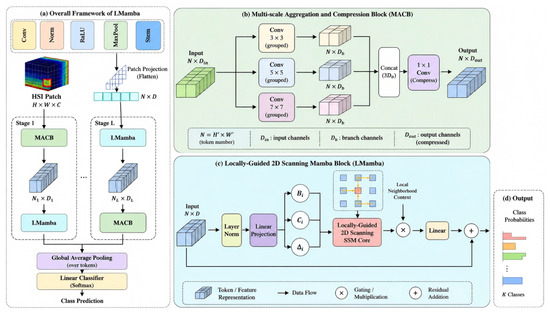
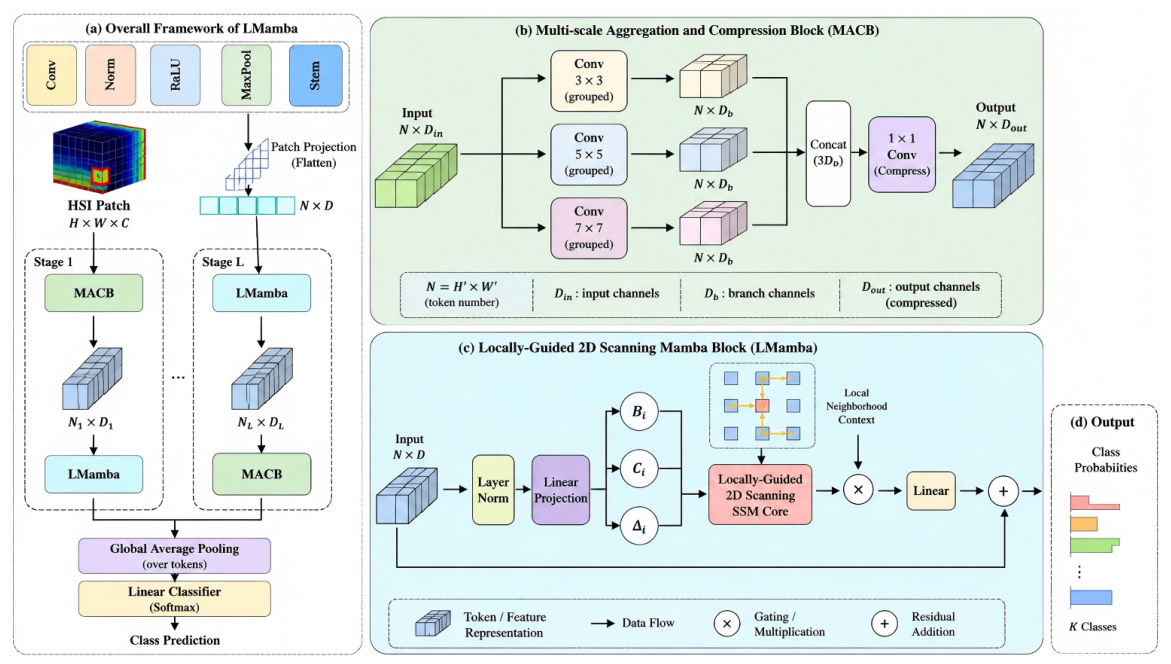
As shown in Figure 1, the proposed LMamba follows a hierarchical spatial–spectral feature learning pipeline for HSI classification. Given an input HSI patch , a shallow stem first projects the original spectral–spatial cube into a compact token representation. The network then alternates between the Multi-scale Aggregation and Compression Block (MACB) and the Locally Guided Mamba block. This design allows LMamba to combine convolutional local inductive bias with efficient state space sequence modeling.
Figure 1.
Overall architecture of LMamba. The framework couples MACB-based multi-scale spectral–spatial filtering with locally guided Mamba modeling. MACB compresses redundant spectral responses while capturing fine-to-coarse spatial cues, and the LMamba block injects local 2D context into SSM parameter generation for structure-aware state propagation. Global pooling and a linear classifier produce the final HSI classification result.
The MACB module is designed to capture multi-granularity local structures while reducing spectral redundancy. Specifically, the input feature is processed by three lightweight grouped convolutional branches with , , and kernels. These branches correspond to fine-scale, medium-scale, and coarse-scale spatial contexts. Their outputs are concatenated and compressed by a convolution, producing a compact multi-scale representation that is subsequently fed into the LMamba block.
The LMamba block is the core component for locally guided state space modeling. Unlike standard Mamba, which generates input-dependent SSM parameters from isolated serialized tokens, LMamba first incorporates the local 2D neighborhood context before SSM parameter projection. The local context is used to guide the generation of , , and , allowing the SSM transition to be conditioned on both the current token and its surrounding spatial structure. Therefore, the proposed block does not merely enhance the input feature, but injects local spatial priors into the state transition process. Finally, global average pooling and a linear classifier are applied to produce the HSI classification result.
4.2. Multi-Receptive Field Downsampling Module
To effectively capture the multi-scale spatial characteristics of ground objects in HSI (e.g., large agricultural fields vs. small vehicles) and to mitigate spectral redundancy early in the network, we designed the Multi-receptive Field Downsampling Module. This module employs grouped parallel convolutions with varying kernel sizes (, , ) to extract and aggregate features at multiple granularities simultaneously.
First, the input image is channel-compressed by a convolution, which is fed into three depth-separable convolutional branches of different size receptive fields. Each branch captures a spatial feature at a specific scale, then stitches the output of the three branches with the original feature and fuses the feature through a channel-by-channel convolution. The structure can be expressed as
4.3. Multi-Scale Aggregation and Compression Block
To effectively capture the heterogeneous spatial patterns in HSI scenes and suppress spectral redundancy at an early stage, we design the Multi-Scale Aggregation and Compression Block (MACB). The motivation for using multiple kernel sizes is that HSI land-cover categories usually exhibit different spatial extents. Fine structures and mixed-pixel boundaries require compact local filtering, while homogeneous agricultural fields, roads, roofs, and urban regions require a relatively larger local support to preserve region-level spatial continuity. Therefore, MACB adopts parallel convolutional branches with , , and kernels to encode fine-, middle-, and coarse-scale spatial contexts, respectively.
The use of the branch does not introduce a heavy computational burden because it is applied after channel compression and implemented as a lightweight depthwise/grouped convolution. Given an input feature map , we first use a convolution to obtain a compressed representation
where . Then, multi-scale features are extracted as
The final output is generated by concatenating the compressed feature and the multi-scale responses:
The additional cost of the multi-scale filtering is approximately proportional to
because the spatial branches are depthwise/grouped convolutions. Thus, the branch provides dense local context with a limited increase in computation. Although a dilated convolution can achieve a similar nominal receptive field with fewer sampled positions, it samples the neighborhood sparsely and may overlook continuous boundary and mixed-pixel evidence that is important for HSI classification. For this reason, we retain the dense branch in MACB, while considering dilated alternatives as a potential direction for further deployment-oriented compression.
4.4. Locally Guided Mamba Module
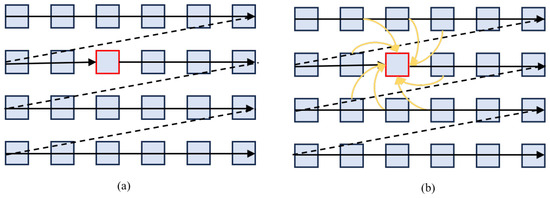
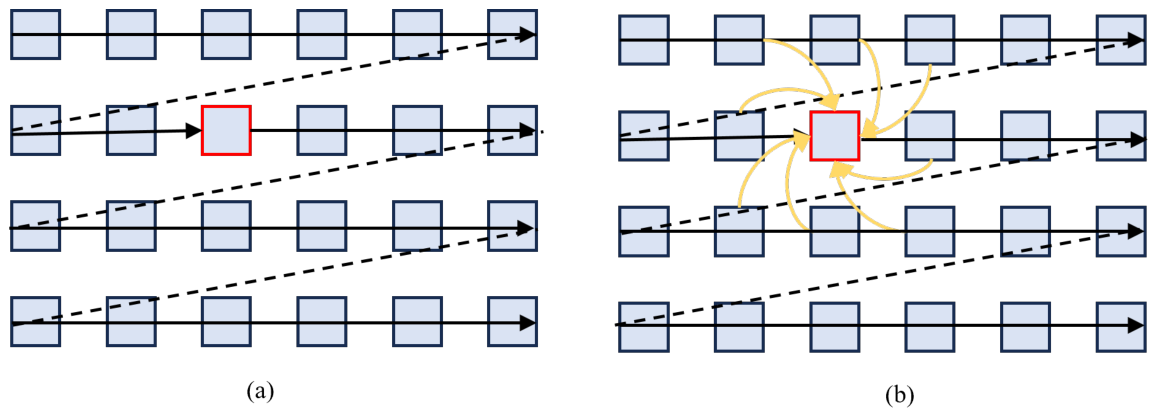
The standard Mamba module employs a unidirectional 1D scanning strategy to serialize the 2D input feature map. This process, while computationally efficient, inevitably disrupts the intrinsic spatial continuity of the image and leads to the loss of crucial neighborhood information. The limitation of this fixed scanning order is visually depicted in Figure 2a, which illustrates the attention pattern of a standard Mamba block. The attention is confined to a rigid, sequential path, failing to capture the rich 2D contextual relationships that are vital for accurate HSI classification.
Figure 2.
Comparison between the standard fixed-order scanning strategy and the proposed locally guided scanning strategy. (a) Standard Mamba serializes the 2D feature map along a fixed scanning direction, which may break local spatial continuity. (b) The proposed LMamba incorporates neighborhood context into the scanning and state-transition process, enabling each position to be updated with awareness of its local 2D structure.
To address this fundamental limitation, we propose a novel Locally Guided Scanning Mechanism. The core idea is to explicitly incorporate local 2D context into the state transition process, thereby guiding the model with spatial awareness. The advantage of our approach is conceptually demonstrated in Figure 2b. Compared to the fixed pattern in Figure 2a, our method generates a more flexible and spatially aware attention map, where the state update at each position is informed by its local neighborhood, resulting in features that better preserve structural integrity.
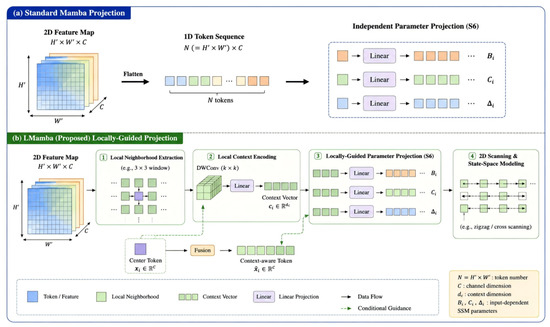
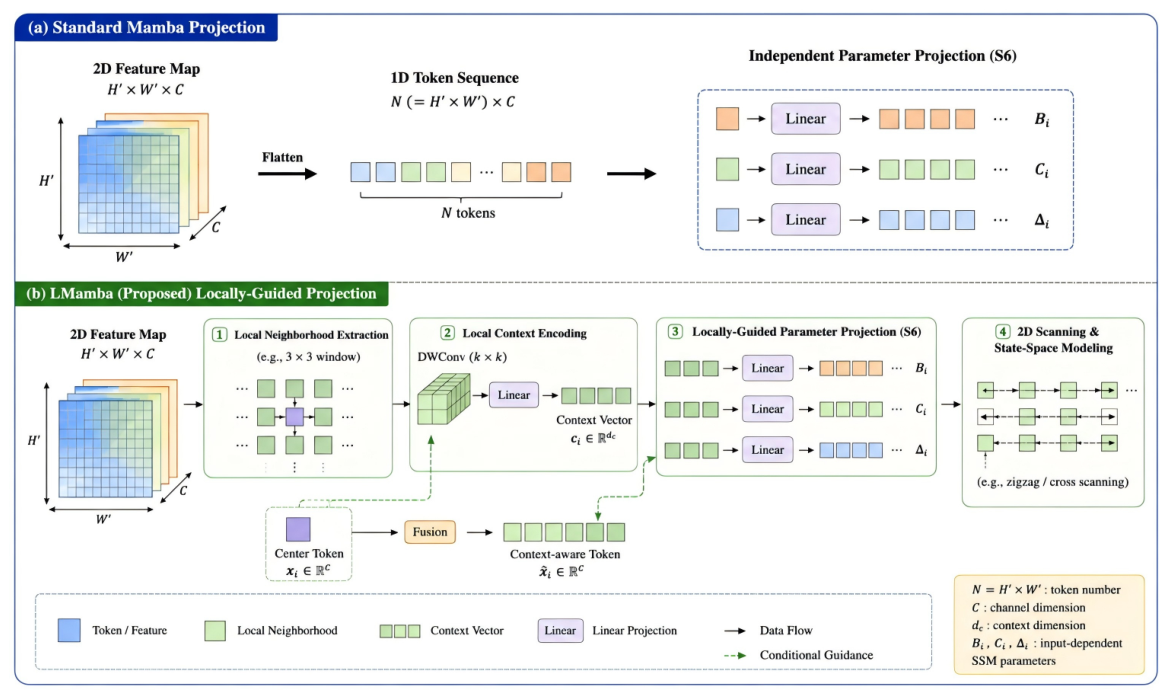
Specifically, for a given pixel at position in the 2D feature map , we first extract its local spatial context (as shown in Figure 3). Let denote the local patch of size centered at . A lightweight depthwise convolution (DWConv) followed by a linear projection is applied to this patch to generate a spatially aware context vector :
where and are learnable parameters.
Figure 3.
Step-by-step comparison between standard Mamba projection and the proposed locally guided projection. (a) Standard Mamba first flattens the 2D feature map into a 1D token sequence and then independently projects each token to generate the input-dependent SSM parameters. (b) LMamba first extracts the local neighborhood around each spatial position, uses DWConv and linear mapping to obtain a local context vector, fuses this context with the original token, and then performs S6 parameter projection. The highlighted stage indicates that local 2D context is integrated before the generation of B, C, and , rather than after sequence modeling.
This context vector is then fused with the original pixel feature vector through a gating mechanism to produce the guided input :
where denotes the concatenation operation, and , are learnable projection weights and bias.
Crucially, this guided input is then used as the input for the subsequent parameter projection steps in the S6 block. The system matrices , , and for position are now computed as
where denotes a linear layer.
It is worth emphasizing that the proposed locally guided projection is not simply a pre-processing feature enhancement step before Mamba. Instead, it modifies the input-dependent parameter projection process of the selective SSM. In the standard Mamba block, each serialized token is directly used to generate the input-dependent parameters, such as , , and . In contrast, LMamba first constructs a locally enriched token by injecting the 2D neighborhood context around position . The parameter projection of the S6 block is then performed on rather than on the isolated pixel feature . Therefore, the proposed design changes the conditioning source of the SSM parameters from a single token to a context-aware local representation:
where denotes the input-dependent projection functions in the selective state space block. This design allows the state transition at each serialized position to be guided by the original token and its local 2D spatial context simultaneously, thereby preserving the geometric prior of HSI feature maps during sequential modeling.
This means that the parameters governing the state transition at each step are no longer dependent solely on a single pixel , but on a context-enriched representation that encodes both the pixel’s own information and its local 2D spatial surroundings. The discrete state space model update for the guided scan is thus
where t indexes the serialized position corresponding to , and , . This mechanism ensures that the state propagation is intrinsically aware of and guided by the local 2D geometry of the feature map throughout the scanning process. The entire algorithm is summarized in Algorithm 1.
| Algorithm 1 Locally guided 2D scanning. |
| Require: Input feature map , depthwise convolution kernel , state matrices .
Ensure: Output feature map . 1: Initialize state 2: Flatten into a 1D sequence following the predefined scanning order (e.g., raster order). {Determines processing order.} 3: for each pixel in the sequence do 4: Extract local neighborhood patch from 5: Compute local context: {Apply depthwise convolution} 6: Fuse context with pixel value: {Equation (9)} 7: Update hidden state: {Equation (14)} 8: Compute output: 9: Assign to the corresponding position in 10: end for |
It should be emphasized that MACB and the locally guided SSM projection play different roles in LMamba. MACB acts as a front-end multi-scale convolutional filtering module, which enhances local spatial–spectral representations and suppresses spectral redundancy before sequence modeling. In contrast, the locally guided mechanism in Equations (6)–(11) is not simply another feature-enhancement operation. Its purpose is to use local 2D context to condition the input-dependent SSM parameters, including , , and .
This distinction explains why the dynamic parameter generation remains necessary even when the input feature has already been locally enhanced. If local context is only embedded into the input feature, the subsequent SSM projection still generates its parameters mainly from each serialized token. After flattening the 2D feature map, the spatial relationship among neighboring pixels can be weakened during recurrent sequence modeling. By constructing the context-aware token and using it to generate , , and , LMamba allows local neighborhood information to directly affect the input injection, state readout, and adaptive transition step of the SSM. Therefore, the proposed mechanism is complementary to MACB rather than redundant with it.
From the perspective of HSI classification, this design is also physically meaningful. In homogeneous land-cover regions, neighboring pixels usually share similar spectral responses and material compositions, and the locally conditioned SSM parameters help preserve stable spatial–spectral evidence. Near class boundaries or mixed-pixel regions, the local context provides cues about spatial heterogeneity, enabling the SSM transition to adapt to local material changes. Thus, the proposed local-context-conditioned parameter projection provides a more structured way to inject HSI spatial priors into Mamba than simply concatenating local CNN features with the input token.
5. Experimental Results and Analysis
To verify the effectiveness of the proposed method, we evaluated it on three representative HSI datasets, namely Indian Pines, Houston2013, and WHU-Hi-LongKou. The experimental design covers classification performance evaluation, parameter sensitivity analysis, and ablation experiments to fully verify the performance of the model under different conditions and the contribution of key modules.
5.1. Datasets
5.1.1. Indian Pines Dataset
The IndianPines dataset is a classic benchmark data widely used in the field of hyperspectral image classification. It was collected by the Airborne Visible/Infrared Imaging Spectrometer (AVIRIS) in the agricultural area of Northwest Indiana, USA in 1992. The dataset covers the spectral range of 0.4 to 2.5 microns, and after removing the bands interfered by water vapor absorption, 200 high-quality spectral channels are retained. The image has a spatial resolution of 20 m and a size of 145 × 145 pixels. It contains 10,249 pixels with ground object labels, covering 16 typical land cover types such as wheat and corn.
5.1.2. Houston2013 Dataset
The Houston2013 (H2) dataset is a widely used benchmark for urban hyperspectral image classification in the field of remote sensing. It was originally released by the IEEE GRSS in the 2013 Data Fusion Contest. The data were acquired using an airborne laser mapping (ALM) system equipped with a near-infrared laser (wavelength of approximately 2.5 μm). The data collection took place from 12:30 p.m. to 4:30 p.m. on 18 June 2013, at a flight altitude of about 500 m, covering urban areas in Houston, TX, USA. The acquired hyperspectral imagery has a spatial resolution of 949 × 1905 pixels, exhibiting typical urban surface structures and complexity. The dataset includes a total of 15,029 labeled samples across 15 representative land-cover categories, such as buildings, roads, grasslands, and water bodies. To facilitate model performance evaluation, a standard experimental protocol adopts 5% of the labeled data for training and the remaining 95% for testing.
5.1.3. WHU-Hi-LongKou Dataset
The WHL dataset is a high-spatial-resolution UAV remote sensing hyperspectral dataset designed for fine classification tasks in complex surface scenes. The dataset was collected by the Headwall Nano Hyperspec imaging sensor installed on the DJI Matrice600 Pro UAV. The sensor focal length is 8 mm, the flight altitude is about 500 m, and the image spatial resolution reaches 0.463 m/pixel. The size of the collected images is pixels, the spectral range covers 400–1000 nm, and contains a total of 270 continuous spectral channels with high spectral resolution. The dataset contains a total of 203,523 labeled pixels, covering nine typical types of surface features such as buildings, roads, farmland, and bare land, fully reflecting the diversity and heterogeneity of complex surface scenes. In order to evaluate the performance of the model under small samples and high generalization requirements, the WHL dataset adopts an extremely unbalanced training strategy: only 0.5% of the labeled samples are selected for training, and the remaining 99.5% of the samples are used for testing.
5.2. Experimental Setup
5.2.1. Implementation Details
To ensure the fairness and effectiveness of performance evaluation, the proposed LMamba model is implemented using the PyTorch-2.1 framework and deployed on an NVIDIA GeForce RTX 4090 GPU to accelerate the computation process. During the training phase, 100 non-overlapping patches of size pixels are randomly extracted from each hyperspectral image dataset as training samples, aiming to fully capture both spatial and spectral dimensions and to construct a representative input feature space.The model is trained for a total of 100 epochs using the Adam optimizer for parameter updates. The initial learning rate is set to , and the mini-batch size is fixed at 100 to maintain consistency across all experimental settings.
To comprehensively assess the classification performance, three commonly used evaluation metrics are adopted for quantitative analysis: overall accuracy (OA), which reflects the overall classification correctness; average accuracy (AA), which evaluates the recognition consistency across different land-cover classes; and the Kappa coefficient, which quantifies the agreement between predicted and true labels beyond chance level. We performed ten independent runs for each experiment and report the average results to ensure statistical reliability. Data augmentation techniques including random flipping and rotation were applied during training to enhance generalization.
5.2.2. Comparison with State-of-the-Art Backbone Methods
To demonstrate the effectiveness of the proposed LMamba, we compared ten hyperspectral classification methods. These competitors include CNNs (such as 2D CNN [10] and 3D CNN [21]), Transformers (such as ViT [44], Deep-ViT [34], HiT [12], SSFTT [32], GAHT [33] and DCTN [14]) and Mamba (such as MambaHSI [36] and 3DSS-Mamba [16]) architectures.
5.3. Results and Analysis
To validate the effectiveness of LMamba in addressing spectral redundancy and preserving 2D structural information, we compared its performance against ten state-of-the-art methods across three HSI datasets: Indian Pines, Houston2013, and WHU-Hi-LongKou. The evaluation indicators include OA, AA, and Kappa coefficient to comprehensively measure the performance of the model in different scenarios. The experimental results are reported in Table 1, Table 2 and Table 3, respectively; the best results are marked in bold to facilitate performance comparison and analysis.
Table 1.
Classification results of the Indian Pines dataset with 10% training samples.
Table 2.
Classification results of the Houston2013 dataset with 5% training samples.
Table 3.
Classification results of the WHU-Hi-LongKou dataset with 0.5% training samples.
According to the experimental results, it can be seen that the LMamba architecture has achieved the best classification performance on three representative and diverse datasets, which fully verifies its effectiveness and versatility in hyperspectral image classification tasks. Compared with traditional convolutional models, LMamba fully utilizes the expressive advantages of multi-scale filtering and the efficiency advantages of structured state space modeling, significantly improving classification accuracy. On the Houston2013 dataset, the overall accuracy (OA) of 2D CNN [10] and 3D CNN [21] is 89.91% and 80.18% respectively, while LMamba reaches 96.47%, which is 6.56% higher than 2D CNN and 16.29% higher than 3D CNN. This shows that LMamba has stronger generalization ability in modeling high-dimensional spatial–spectral features, especially in small-sample scenarios.
In the Transformer structure, models such as ViT [45] and Deep-ViT [34] rely on global self-attention to model long-distance dependencies, but their local perception is insufficient and their classification performance is limited. Improved methods such as HiT [12] and SSFTT [32] enhance local modeling by introducing convolution or feature alignment mechanisms, but there is still a trade-off between accuracy and efficiency. On the Houston2013 dataset, the OAs of HiT and SSFTT [32] are 90.29% and 93.71%, respectively, which are lower than LMamba, which leads by 6.18% and 2.76%, respectively. This shows that the local guidance and multi-scale convolution mechanism introduced by LMamba significantly enhances the fusion expression ability of spatial–spectral features while maintaining lightweight modeling.
For the structured state space modeling methods (such as MambaHSI [36] and 3DSS-Mamba [16]) that have received much attention recently, although they have outstanding performance in long-distance modeling efficiency, they still have the problem of limited structural expression. MambaHSI [36] uses one-way scanning and lacks the ability to model complete spatial structures; although 3DSS-Mamba [16] introduces 3D convolution, it is difficult to fully integrate multi-granularity spatial information due to the fixed convolution scale. LMamba guides the state propagation path through local 2D perception and combines multi-scale filtering to enhance the spatial–spectral fusion ability, which not only improves the expressiveness but also maintains the linear reasoning efficiency of SSM. Specifically, LMamba achieves 96.47% OA on Houston2013, significantly outperforming 2D-CNN by 6.56%, which we attribute to the multi-scale feature extraction capability of MACB and the structural awareness of the locally guided 2D scanning mechanism.
LMamba also shows consistent and robust performance advantages on two datasets with significantly different structural complexity, Indian Pines and WHU-Hi-LongKou. On Indian Pines, LMamba leads 3DSS-Mamba [16] (94.51%, 86.86%, 93.73%) with 95.18% OA, 89.74% AA, and 94.49% Kappa, respectively, and improves OA, AA, and Kappa by 0.69%, 2.88%, and 0.76%. On WHU-Hi-LongKou, LMamba also surpasses DCTN [14] and other advanced methods with 98.86% OA, 95.83% AA, and 98.51% Kappa, verifying its strong robustness and generalization ability in low-sample, heterogeneous distribution scenarios.
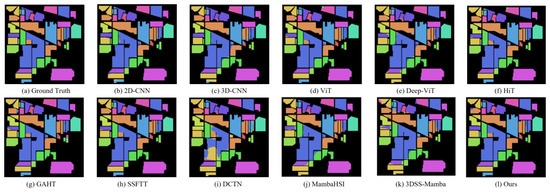
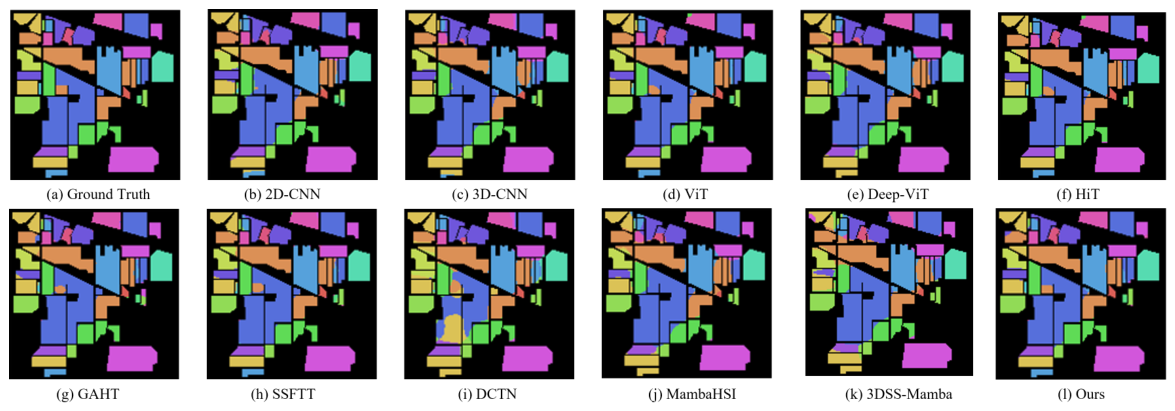
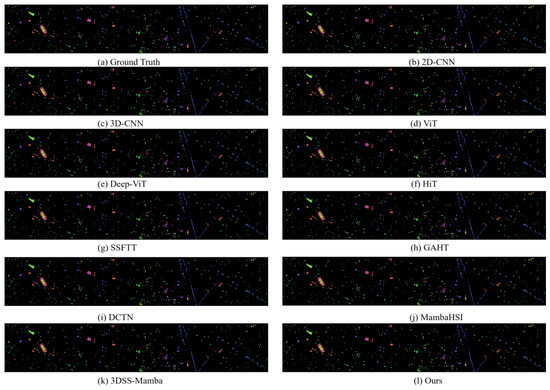
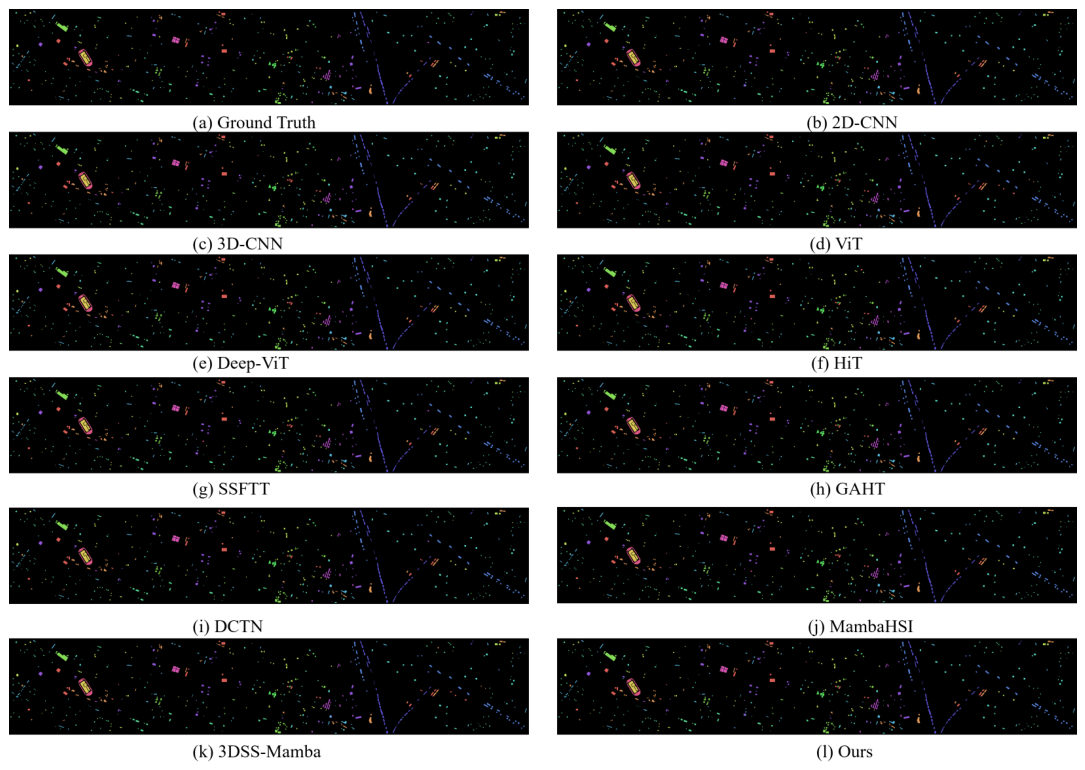
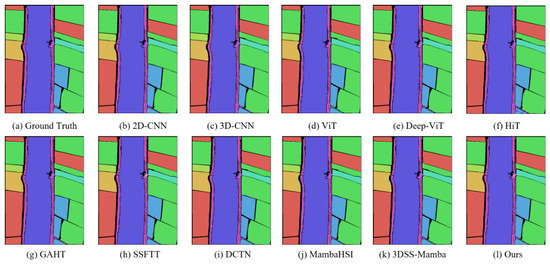
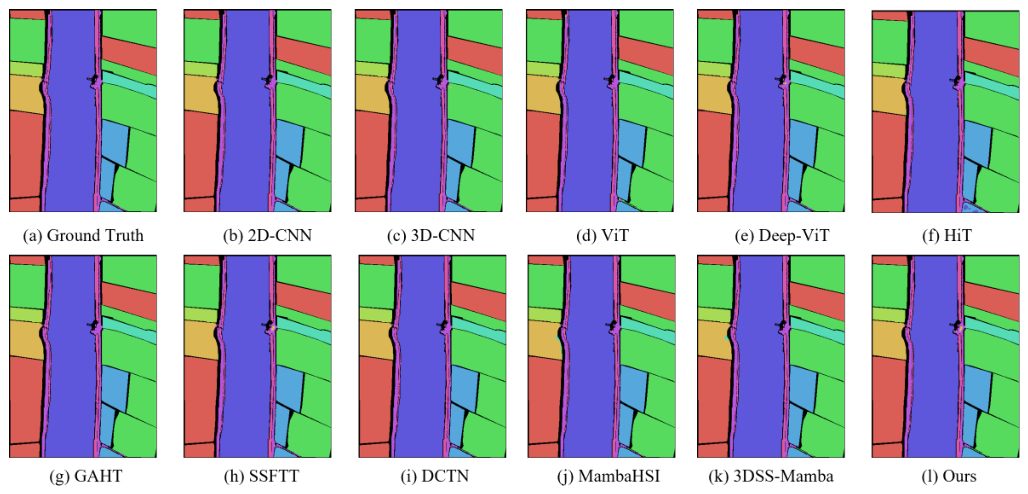
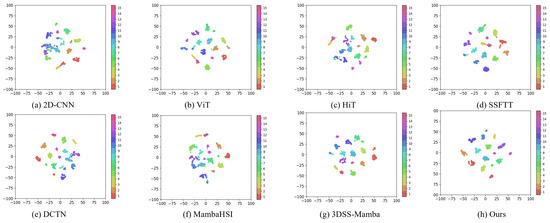
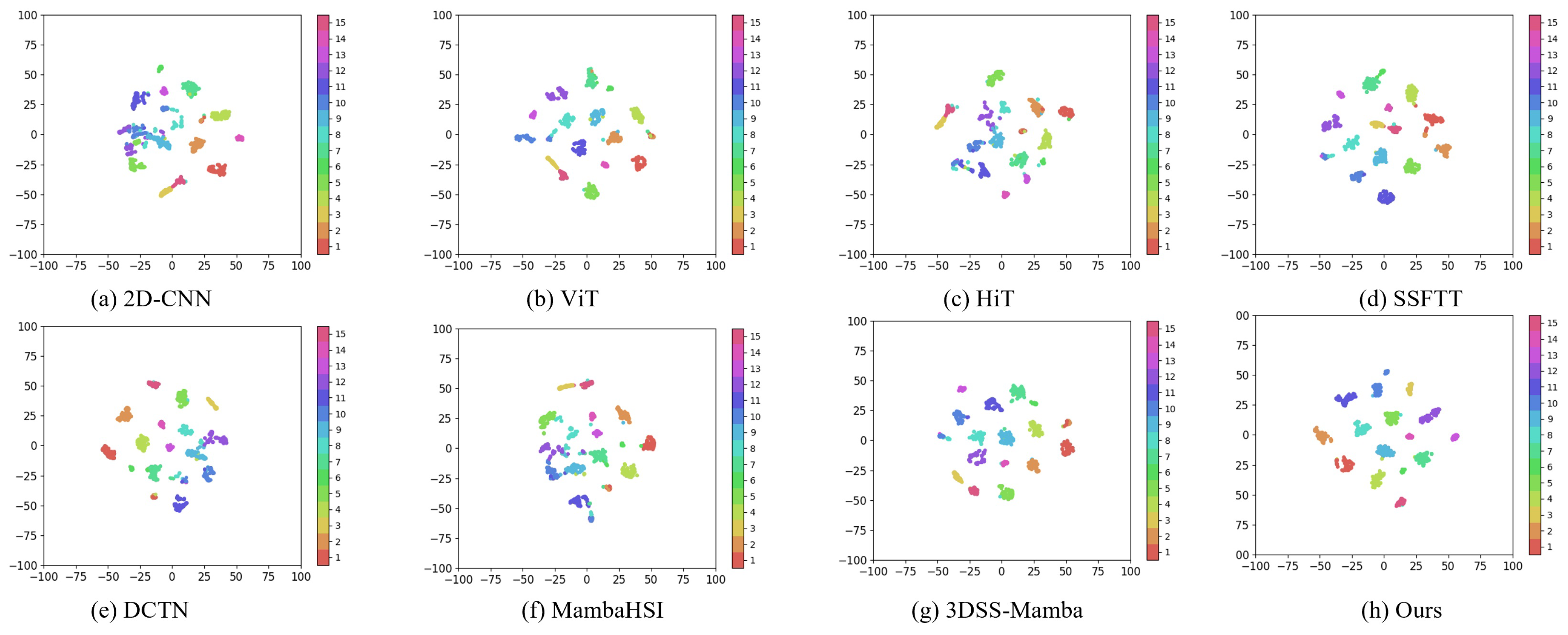
Visual comparisons in Figure 4, Figure 5 and Figure 6 demonstrate that LMamba produces classification maps with more distinct boundaries and enhanced spatial consistency. This observation further corroborates its capacity to preserve two-dimensional structural information, a key advantage compared to methods that are prone to noise or blurring due to one-dimensional scanning. The t-SNE visualization in Figure 7 reveals that features learned by LMamba exhibit more compact and separable clusters compared to other methods, indicating its superior capability in discriminative feature learning.
Figure 4.
Classification maps obtained using different methods on the Indian Pines dataset (with 10% training samples).
Figure 5.
Classification maps obtained using different methods on the Houston2013 dataset (with 5% training samples).
Figure 6.
Classification maps obtained using different methods on the WHU-Hi-LongKou dataset (with 0.5% training samples).
Figure 7.
t-SNE visualization of the learned features from the Houston 2013 hyperspectral dataset.
In summary, LMamba achieves a good balance between expressiveness, modeling efficiency, and computational cost in structural design, demonstrates strong adaptability and excellent performance in complex hyperspectral scenes, and provides a lightweight and effective framework for hyperspectral image classification that is lightweight, efficient, and robust.
5.4. Ablation Studies
5.4.1. Impact of Input Patch Size on Classification Performance
To validate the model’s ability to extract fine-grained spatial features without introducing noisy contexts, we ablate the input patch size from to . Results in Table 4 show that smaller patches (e.g., ) consistently achieve higher OA and Kappa, confirming that LMamba benefits from focused local feature extraction—aligning with our design objective to preserve structural integrity.
Table 4.
Ablation study of the input size.
5.4.2. Computational Efficiency and Model Complexity
To demonstrate the efficiency of LMamba, we compare its computational cost against CNN-, Transformer-, and SSM-based methods. As shown in Table 5, LMamba achieves the best accuracy (95.18% OA) with only 0.34M parameters and 0.14G FLOPs, which is significantly lower than DCTN (53.94M params) and even more efficient than MambaHSI while outperforming it by 0.93% in OA. This highlights LMamba’s unique advantage in balancing accuracy and efficiency for scalable HSI processing.
Table 5.
Comparison of computational complexity.
5.4.3. Effectiveness of Multi-Scale Convolutional Kernels
We ablate combinations of convolutional kernels (, , , ) to validate the necessity of multi-scale feature extraction in MACB. Th results in Table 6 show that using all four kernels yields the best performance (95.06% OA), outperforming any single or dual combinations. This confirms that multi-scale fusion is essential to capture heterogeneous spatial features in HSI data.
Table 6.
Ablation study of different convolution kernel combinations on Indian Pines. ✓ indicates the presence of the corresponding convolutional kernel in the ablation variant, while × indicates its absence. The bold values in the table footer represent the best performance among the ablated variants. The bold values in the table footer represent the best performance among the ablated variants.
5.4.4. Efficiency of the Locally Guided Scanning Strategy
Table 7 evaluates five scanning schemes under the same backbone and training protocol. The proposed locally guided scan does not rely on token-wise non-contiguous gather–scatter operations. Instead, it first injects local spatial cues on the original 2D feature map through lightweight depthwise convolution. The enhanced features are then serialized by contiguous reshape/permute operations. Thus, the recurrent SSM path remains simple and hardware-friendly.
Table 7.
Comparison of different scanning strategies on three HSI benchmarks. All results are reported as mean ± standard deviation over 10 independent runs. The best performance in each column is highlighted in bold, while the second-best is underlined.
The results show a clear accuracy–stability advantage on Indian Pines and Houston2013. The locally guided scan obtains the best OA and on both datasets, with OA on Indian Pines and OA on Houston2013. It also achieves the best AA on Indian Pines. These results indicate that local structural priors can make selective scanning more discriminative, especially in small-sample and spatially fragmented scenes.
On WHU-Hi-LongKou, 2D cross scanning and S2Mamba joint scanning achieve slightly higher scores. This is reasonable because large homogeneous agricultural scenes benefit from explicit directional aggregation. Nevertheless, the locally guided scan remains highly competitive, reaching OA and . Overall, the proposed strategy provides a compact and structure-aware scanning alternative. It improves spatial sensitivity without breaking the linear and contiguous SSM computation flow.
5.4.5. Generalization Under Varying Training Sample Sizes
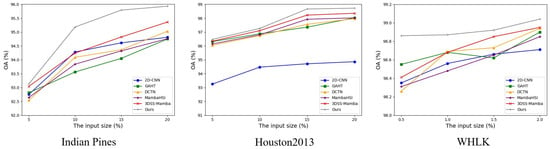
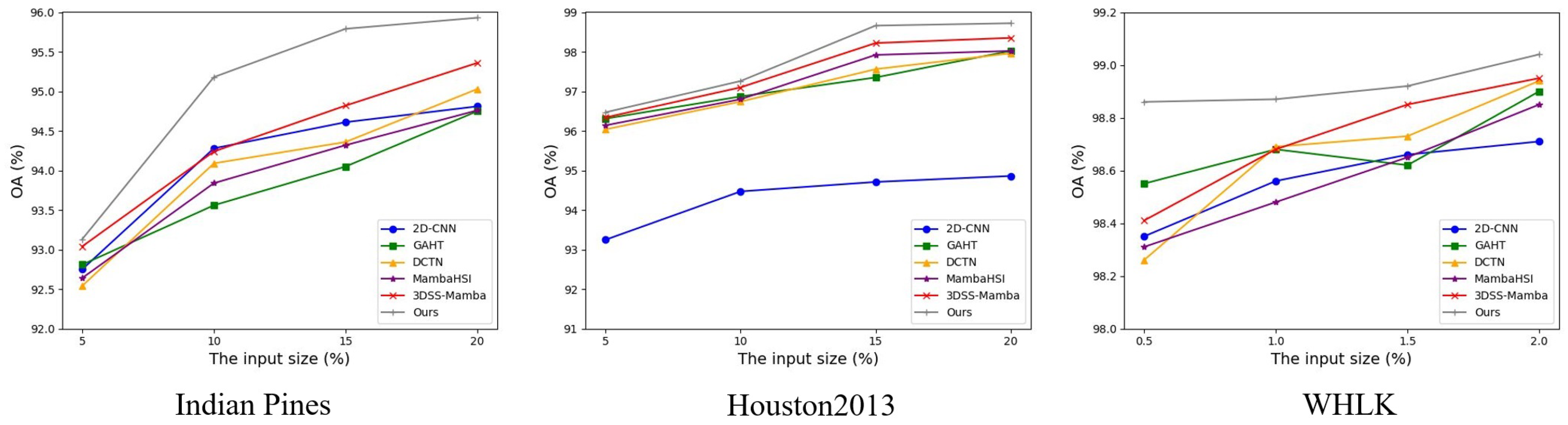
We evaluate LMamba’s robustness under limited training samples (0.5% to 10%). As shown in Figure 8, LMamba maintains high OA even with 0.5% samples, demonstrating strong generalization in low-data regimes. With the increase in sample size, the model’s ability to depict complex semantic structures is significantly improved, the misclassification phenomenon is greatly reduced, the classification boundaries are clearer, and the overall robustness and discrimination performance are significantly enhanced. The above results further verify that the proposed method has good adaptability and stability under both small and large sample conditions, demonstrating its potential and practical value for wide application in hyperspectral classification tasks.
Figure 8.
OA of different models with different percentages training samples on three datasets.
Beyond the quantitative improvements, we further analyze the different roles of MACB and the locally guided Mamba module under limited training samples. MACB mainly contributes a strong convolutional inductive bias. By using channel compression and multi-scale depthwise/grouped convolutions, it encourages the network to focus on locally smooth and spatially coherent structures, which is particularly beneficial when labeled HSI samples are scarce. This local prior helps reduce overfitting and stabilizes low-level spatial–spectral representation learning.
In comparison, the locally guided Mamba module contributes structured sequence modeling capability. Different from standard 1D Mamba scanning, it injects local 2D context into the SSM parameter projection, allowing state transitions to be conditioned on both the current token and its neighborhood. This design is especially useful for propagating discriminative information across spatially continuous regions and for improving boundary consistency. Therefore, MACB and locally guided Mamba play complementary roles: MACB provides reliable multi-scale local priors under small-sample conditions, while locally guided Mamba enhances long-range spatial–spectral dependency modeling with preserved 2D geometry. Their synergy explains why the full LMamba consistently performs well under varying training–sample ratios.
5.5. Discussion
The experimental results indicate that LMamba achieves a favorable balance between classification accuracy and computational complexity on three public benchmark datasets. However, we do not claim that these benchmark results alone fully demonstrate deployment-ready real-world applicability. Practical HSI applications may involve cross-sensor spectral shifts, atmospheric variation, unseen land-cover distributions, larger image sizes, and hardware constraints on airborne or edge platforms. Therefore, the current results should be interpreted as evidence of practical potential rather than complete deployment validation.
The MACB module effectively suppresses spectral redundancy and captures multi-grained spatial features through its parallel multi-kernel design. The Locally Guided 2D Scanning mechanism, our cornerstone innovation, provides a local-context-conditioned extension to the selective SSM parameter projection. This is corroborated by its superior accuracy over other scanning strategies and the production of classification maps with sharper spatial boundaries. The synergy between these components enables LMamba to achieve an exceptional balance between accuracy and efficiency. It attains state-of-the-art performance across all datasets while maintaining low computational complexity, making it ideal for large-scale HSI processing. Furthermore, LMamba exhibits strong robustness in low-sample regimes, underscoring its superior generalization capability for practical applications where labeled data is scarce.
In conclusion, LMamba represents a significant conceptual advancement by demonstrating how to effectively marry convolutional feature extraction with state space modeling while preserving the critical 2D geometry of HSI data.
6. Conclusions
This paper introduces LMamba, a hybrid architecture that integrates multi-scale convolutional feature extraction with locally guided state space modeling for efficient and accurate hyperspectral image classification. The proposed MACB alleviates spectral redundancy and captures multi-granularity local structures using lightweight parallel convolutional branches, while the locally guided mechanism injects neighborhood context into the SSM parameter projection process to preserve the inherent 2D geometry of HSI feature maps. Extensive experiments on three benchmark HSI datasets demonstrate that LMamba achieves a favorable balance between classification accuracy, model complexity, and inference efficiency.
Future research will extend LMamba to more complex HSI scenarios, such as multi-temporal analysis, change detection, and edge-computing deployment for real-time remote sensing applications.
Author Contributions
Conceptualization, X.Y. and Y.W.; methodology, X.Y.; writing, X.Y., Y.W. and S.L.; writing—review and editing, X.Y., S.L., H.T. and W.L.; visualization, X.Y. and J.T.; supervision, X.Y. and S.L.; funding acquisition, X.Y., S.L. and W.L. All authors have read and agreed to the published version of the manuscript.
Funding
This work was supported in part by National Natural Science Foundation of China (NSFC) Fund under Grant 62301174, 62203129 and 62462031, and Guangzhou basic and applied basic research topics under Grant 2024A04J2081 and Grant 2025A04J3375.
Data Availability Statement
Our code repository will be made privately available upon proper request to the corresponding author. The data that support the findings of this study were derived from the following resources available in the public domain: “https://ieee-dataport.org/documents/hyperspectral-remote-sensing-datasets-indian-pines-pavia-university-botswana-and-salinas”, accessed on 1 June 2024.
Conflicts of Interest
The authors declare no conflicts of interest.
References
- Liu, Y.; Zhang, Y. Hyperspectral Image Refined Plant Classification By Graph Based Composite Kernel. In Proceedings of the IGARSS 2018—2018 IEEE International Geoscience and Remote Sensing Symposium; IEEE: Valencia, Spain, 2018; pp. 7444–7447. [Google Scholar]
- Tan, Y.; Lu, L.; Bruzzone, L.; Guan, R.; Chang, Z.; Yang, C. Hyperspectral Band Selection for Lithologic Discrimination and Geological Mapping. IEEE J. Sel. Top. Appl. Earth Obs. Remote Sens. 2020, 13, 471–486. [Google Scholar] [CrossRef] [Scilit]
- Roy, S.K.; Krishna, G.; Dubey, S.R.; Chaudhuri, B.B. HybridSN: Exploring 3-D–2-D CNN Feature Hierarchy for Hyperspectral Image Classification. IEEE Geosci. Remote Sens. Lett. 2020, 17, 277–281. [Google Scholar] [CrossRef] [Scilit]
- Pasolli, E.; Melgani, F.; Tuia, D.; Pacifici, F.; Emery, W.J. SVM active learning approach for image classification using spatial information. IEEE Trans. Geosci. Remote Sens. 2013, 52, 2217–2233. [Google Scholar] [CrossRef] [Scilit]
- Ma, L.; Crawford, M.M.; Tian, J. Local Manifold Learning-Based k-Nearest-Neighbor for Hyperspectral Image Classification. IEEE Trans. Geosci. Remote Sens. 2010, 48, 4099–4109. [Google Scholar] [CrossRef] [Scilit]
- Song, W.; Li, S.; Kang, X.; Huang, K. Hyperspectral image classification based on KNN sparse representation. In Proceedings of the 2016 IEEE International Geoscience and Remote Sensing Symposium (IGARSS); IEEE: Beijing, China, 2016; pp. 2411–2414. [Google Scholar]
- Ham, J.; Chen, Y.; Crawford, M.M.; Ghosh, J. Investigation of the random forest framework for classification of hyperspectral data. IEEE Trans. Geosci. Remote Sens. 2005, 43, 492–501. [Google Scholar] [CrossRef] [Scilit]
- Zhang, Y.; Wang, X.; Jiang, X.; Zhang, L.; Du, B. Elastic Graph Fusion Subspace Clustering for Large Hyperspectral Image. IEEE Trans. Circuits Syst. Video Technol. 2025, 35, 6300–6312. [Google Scholar] [CrossRef] [Scilit]
- Zhang, Y.; Yan, S.; Jiang, X.; Zhang, L.; Cai, Z.; Li, J. Dual Graph Learning Affinity Propagation for Multimodal Remote Sensing Image Clustering. IEEE Trans. Geosci. Remote Sens. 2024, 62, 5521713. [Google Scholar] [CrossRef] [Scilit]
- Lee, H.; Kwon, H. Going Deeper With Contextual CNN for Hyperspectral Image Classification. IEEE Trans. Image Process. 2017, 26, 4843–4855. [Google Scholar] [CrossRef] [Scilit] [PubMed]
- Gong, H.; Li, Q.; Li, C.; Dai, H.; He, Z.; Wang, W.; Li, H.; Han, F.; Tuniyazi, A.; Mu, T. Multiscale Information Fusion for Hyperspectral Image Classification Based on Hybrid 2D-3D CNN. Remote Sens. 2021, 13, 2268. [Google Scholar] [CrossRef] [Scilit]
- Yang, X.; Cao, W.; Lu, Y.; Zhou, Y. Hyperspectral Image Transformer Classification Networks. IEEE Trans. Geosci. Remote Sens. 2022, 60, 5528715. [Google Scholar] [CrossRef] [Scilit]
- Yao, J.; Hong, D.; Li, C.; Chanussot, J. Spectralmamba: Efficient mamba for hyperspectral image classification. arXiv 2024, arXiv:2404.08489. [Google Scholar] [CrossRef] [Scilit]
- Zhou, Y.; Huang, X.; Yang, X.; Peng, J.; Ban, Y. DCTN: Dual-Branch Convolutional Transformer Network With Efficient Interactive Self-Attention for Hyperspectral Image Classification. IEEE Trans. Geosci. Remote Sens. 2024, 62, 5508616. [Google Scholar] [CrossRef] [Scilit]
- Gu, A.; Dao, T. Mamba: Linear-Time Sequence Modeling with Selective State Spaces. In First Conference on Language Modeling; COLM: Philadelphia, PA, USA, 2024. [Google Scholar]
- He, Y.; Tu, B.; Liu, B.; Li, J.; Plaza, A. 3DSS-Mamba: 3D-Spectral-Spatial Mamba for Hyperspectral Image Classification. IEEE Trans. Geosci. Remote Sens. 2024, 62, 5534216. [Google Scholar] [CrossRef] [Scilit]
- Wang, G.; Zhang, X.; Peng, Z.; Zhang, T.; Jiao, L. S2Mamba: A Spatial–Spectral State Space Model for Hyperspectral Image Classification. IEEE Trans. Geosci. Remote Sens. 2025, 63, 5511413. [Google Scholar] [CrossRef] [Scilit]
- Zhang, Y.; Yan, S.; Zhang, L.; Du, B. Fast Projected Fuzzy Clustering with Anchor Guidance for Multimodal Remote Sensing Imagery. IEEE Trans. Image Process. 2024, 33, 4640–4653. [Google Scholar] [CrossRef] [Scilit]
- Wang, Q.; Meng, Z.; Li, X. Locality Adaptive Discriminant Analysis for Spectral-Spatial Classification of Hyperspectral Images. IEEE Geosci. Remote Sens. Lett. 2017, 14, 2077–2081. [Google Scholar] [CrossRef] [Scilit]
- Zhao, C.; Zhu, W.; Feng, S. Superpixel Guided Deformable Convolution Network for Hyperspectral Image Classification. IEEE Trans. Image Process. 2022, 31, 3838–3851. [Google Scholar] [CrossRef] [Scilit]
- Li, Y.; Zhang, H.; Shen, Q. Spectral–Spatial Classification of Hyperspectral Imagery with 3D Convolutional Neural Network. Remote Sens. 2017, 9, 67. [Google Scholar]
- Qi, W.; Huang, C.; Wang, Y.; Zhang, X.; Sun, W.; Zhang, L. Global–local 3-D convolutional transformer network for hyperspectral image classification. IEEE Trans. Geosci. Remote Sens. 2023, 61, 5510820. [Google Scholar] [CrossRef] [Scilit]
- Schmidt, R.M. Recurrent Neural Networks (RNNs): A gentle Introduction and Overview. arXiv 2019, arXiv:1912.05911. [Google Scholar] [CrossRef] [Scilit]
- Hang, R.; Liu, Q.; Hong, D.; Ghamisi, P. Cascaded recurrent neural networks for hyperspectral image classification. IEEE Trans. Geosci. Remote Sens. 2019, 57, 5384–5394. [Google Scholar]
- Mei, X.; Pan, E.; Ma, Y.; Dai, X.; Huang, J.; Fan, F.; Du, Q.; Zheng, H.; Ma, J. Spectral-spatial attention networks for hyperspectral image classification. Remote Sens. 2019, 11, 963. [Google Scholar] [CrossRef] [Scilit]
- Yang, X.; Cao, W.; Tang, D.; Zhou, Y.; Lu, Y. ACTN: Adaptive Coupling Transformer Network for Hyperspectral Image Classification. IEEE Trans. Geosci. Remote Sens. 2025, 63, 5503115. [Google Scholar] [CrossRef] [Scilit]
- Xu, Y.; Du, B.; Zhang, L. Self-Attention Context Network: Addressing the Threat of Adversarial Attacks for Hyperspectral Image Classification. IEEE Trans. Image Process. 2021, 30, 8671–8685. [Google Scholar] [CrossRef] [Scilit]
- Hong, D.; Han, Z.; Yao, J.; Gao, L.; Zhang, B.; Plaza, A.; Chanussot, J. SpectralFormer: Rethinking Hyperspectral Image Classification With Transformers. IEEE Trans. Geosci. Remote Sens. 2022, 60, 5518615. [Google Scholar] [CrossRef] [Scilit]
- Ouyang, E.; Li, B.; Hu, W.; Zhang, G.; Zhao, L.; Wu, J. When Multigranularity Meets Spatial-Spectral Attention: A Hybrid Transformer for Hyperspectral Image Classification. IEEE Trans. Geosci. Remote Sens. 2023, 61, 4401118. [Google Scholar] [CrossRef] [Scilit]
- He, X.; Chen, Y.; Lin, Z. Spatial-Spectral Transformer for Hyperspectral Image Classification. Remote Sens. 2021, 13, 498. [Google Scholar] [CrossRef] [Scilit]
- Wu, H.; Xiao, B.; Codella, N.; Liu, M.; Dai, X.; Yuan, L.; Zhang, L. CvT: Introducing Convolutions to Vision Transformers. In Proceedings of the ICCV; IEEE: Piscataway, NJ, USA, 2021; pp. 22–31. [Google Scholar]
- Xu, Y.; Xie, Y.; Li, B.; Xie, C.; Zhang, Y.; Wang, A.; Zhu, L. Spatial-Spectral 1DSwin Transformer With Groupwise Feature Tokenization for Hyperspectral Image Classification. IEEE Trans. Geosci. Remote Sens. 2023, 61, 5516616. [Google Scholar] [CrossRef] [Scilit]
- Mei, S.; Song, C.; Ma, M.; Xu, F. Hyperspectral Image Classification Using Group-Aware Hierarchical Transformer. IEEE Trans. Geosci. Remote Sens. 2022, 60, 5539014. [Google Scholar] [CrossRef] [Scilit]
- Zhou, D.; Kang, B.; Jin, X.; Yang, L.; Lian, X.; Jiang, Z.; Hou, Q.; Feng, J. DeepViT: Towards Deeper Vision Transformer. arXiv 2021, arXiv:2103.11886. [Google Scholar]
- Tu, B.; Liao, X.; Li, Q.; Peng, Y.; Plaza, A. Local Semantic Feature Aggregation-Based Transformer for Hyperspectral Image Classification. IEEE Trans. Geosci. Remote Sens. 2022, 60, 5536115. [Google Scholar] [CrossRef] [Scilit]
- Li, Y.; Luo, Y.; Zhang, L.; Wang, Z.; Du, B. MambaHSI: Spatial–Spectral Mamba for Hyperspectral Image Classification. IEEE Trans. Geosci. Remote Sens. 2024, 62, 5524216. [Google Scholar] [CrossRef] [Scilit]
- Wang, Y.; Liu, L.; Xiao, J.; Yu, D.; Tao, Y.; Zhang, W. MambaHSI+: Multidirectional state propagation for efficient hyperspectral image classification. IEEE Trans. Geosci. Remote Sens. 2025, 63, 4411414. [Google Scholar] [CrossRef] [Scilit]
- Zhu, L.; Liao, B.; Zhang, Q.; Wang, X.; Liu, W.; Wang, X. Vision Mamba: Efficient Visual Representation Learning with Bidirectional State Space Model. In Proceedings of the ICML, Vienna, Austria, 21–27 July 2024. [Google Scholar]
- Wei, L.; Yang, H.; Yin, Y.; Qu, Z.; Zheng, H. DS-Mamba: Depthwise separable mamba for hyperspectral image classification. PLoS ONE 2026, 21, e0342343. [Google Scholar] [CrossRef] [Scilit]
- Dewis, Z.; Zhu, Y.; Xu, Z.; Heffring, M.; Taleghanidoozdoozan, S.; Ledingham, Q.; Xu, L.L. Clustering-Guided Spatial-Spectral Mamba for Hyperspectral Image Classification. arXiv 2026, arXiv:2601.16098. [Google Scholar]
- Gendy, G.; Al Marzouqi, H. GMambaHSI: Group-based visual state space model for hyperspectral image classification. Neurocomputing 2026, 685, 133661. [Google Scholar] [CrossRef] [Scilit]
- Sun, M.; Wang, L.; Jiang, S.; Cheng, S.; Tang, L. HyperSMamba: A Lightweight Mamba for Efficient Hyperspectral Image Classification. Remote Sens. 2025, 17, 2008. [Google Scholar] [CrossRef] [Scilit]
- Sheng, J.; Zhou, J.; Wang, J.; Ye, P.; Fan, J. DualMamba: A lightweight spectral–spatial mamba-convolution network for hyperspectral image classification. IEEE Trans. Geosci. Remote Sens. 2024, 63, 5501415. [Google Scholar] [CrossRef] [Scilit]
- Graham, B.; El-Nouby, A.; Touvron, H.; Stock, P.; Joulin, A.; Jégou, H.; Douze, M. Levit: A vision transformer in convnet’s clothing for faster inference. In Proceedings of the IEEE/CVF International Conference on Computer Vision; IEEE: Montreal, QC, Canada, 2021; pp. 12259–12269. [Google Scholar]
- Dosovitskiy, A.; Beyer, L.; Kolesnikov, A.; Weissenborn, D.; Zhai, X.; Unterthiner, T.; Dehghani, M.; Minderer, M.; Heigold, G.; Gelly, S.; et al. An Image is Worth 16x16 Words: Transformers for Image Recognition at Scale. In Proceedings of the International Conference on Learning Representations, Virtual Event, 3–7 May 2021. [Google Scholar]

Disclaimer/Publisher’s Note: The statements, opinions and data contained in all publications are solely those of the individual author(s) and contributor(s) and not of MDPI and/or the editor(s). MDPI and/or the editor(s) disclaim responsibility for any injury to people or property resulting from any ideas, methods, instructions or products referred to in the content. |
© 2026 by the authors. Licensee MDPI, Basel, Switzerland. This article is an open access article distributed under the terms and conditions of the Creative Commons Attribution (CC BY) license.