


Abstract
Being capable of high-resolution imaging and non-contact measurement, Ground Penetrating Radar (GPR) is a promising technology for the detection of unexploded ordnance (UXO). However, UXO detection is severely hindered by clutter, particularly in environments with significant surface roughness where conventional suppression methods prove ineffective. To address this, we propose a polarimetric GPR clutter suppression method based on an improved non-convex Tensor Robust Principal Component Analysis (TRPCA) framework. Specifically, a polarization-aware tensor construction scheme is designed by stacking the HH and VV channel data. This approach exploits the strong inter-channel correlation of clutter to enhance its low-rank property, while highlighting the distinct sparse signatures of targets derived from their polarimetric responses. To further optimize tensor decomposition, we introduce a non-convex Tensor Adjustable Logarithmic Norm (TALN) to overcome the estimation bias inherent in the conventional Tensor Nuclear Norm (TNN). Serving as a tighter surrogate for tensor rank, the proposed TALN regularizer improves the approximation accuracy of the low-rank component, thereby ensuring a clearer separation between clutter and targets. The resulting non-convex optimization problem is efficiently solved using Alternating Direction Method of Multipliers (ADMM). Numerical simulations and laboratory experiments demonstrate that the proposed method suppresses strong clutter stemming from rough-surface reflections more effectively than existing methods, achieving a Signal-to-Clutter Ratio (SCR) improvement of over 20 dB.
1. Introduction
As a lethal legacy of warfare, Unexploded Ordnance (UXO) causes thousands of casualties annually and severely impedes humanitarian operations, infrastructure reconstruction, and ecological recovery in post-conflict zones [1,2,3]. Ground Penetrating Radar (GPR) has emerged as a promising technology due to its high-resolution imaging, non-invasive and non-contact measurement capability [4,5]. Specifically, Polarimetric GPR (P-GPR) acquires the full scattering matrix, thereby capturing comprehensive polarimetric information sensitive to target orientation and shape. This capability enables P-GPR to effectively discriminate UXOs from subsurface debris, significantly enhancing detection accuracy and reliability [6,7,8]. However, P-GPR signals are typically dominated by strong clutter, primarily stemming from antenna coupling and ground reflections [9,10]. This problem is especially severe in shallow UXO burial scenarios, where weak target echoes are easily obscured, making target detection difficult. Hence, efficient clutter suppression is vital for reliable GPR-based UXO detection, especially in rough surface scenarios.
Existing clutter suppression methods can be broadly categorized into four main types: model-based methods, filtering methods, neural network-based methods, and subspace projection methods.
Model-based methods operate by establishing statistical models (such as wide-sense stationary random processes or linear prediction models) to identify target signals that significantly deviate from the background. While these methods provide solid mathematical interpretability, their performance degrades significantly when actual clutter characteristics deviate from predefined models in complex subsurface environments [11,12].
Filtering methods separate clutter from target responses by designing domain-specific filters. Although classical filtering methods such as time gating and mean subtraction are computationally simple and efficient, they depend heavily on precise prior knowledge (e.g., exact time windows) and are susceptible to target signal distortion [13,14].
Neural network-based methods have recently gained significant attention as a promising avenue [15,16,17]. Convolutional Autoencoders (CAEs), such as deep CAE (DCAE) [18], can effectively separate target responses using hierarchical features. However, their generalization ability may be constrained in complex practical measurement scenarios, accompanied by potential gradient instability. To preserve target details, U-Net variants like CR-Net [17] integrate residual blocks to enhance signal differentiation. Nevertheless, they rely heavily on large-scale, strictly paired training datasets, which are costly to acquire in practice. To overcome this data constraint, unsupervised Generative Adversarial Networks (GANs), such as the Disentanglement Representation GAN (DR-GAN) [19], have been proposed to eliminate the need for paired data. While highly adaptable to complex media, these neural network-based methods often lack explicit physical constraints, leading to potential interpretability issues and physical inconsistencies in the reconstructed signals.
Conventional subspace techniques achieve separation by assuming that clutter and target responses reside in distinct signal subspaces. Specifically, Principal Component Analysis (PCA) efficiently removes dominant background clutter, but it exhibits limited efficacy in handling non-stationary clutter induced by rough ground surfaces and is highly sensitive to strong noise or outliers [20]. Similarly, Independent Component Analysis (ICA) effectively distinguishes signal components based on higher-order statistical properties, yet its performance becomes unstable when the assumption of statistical independence between clutter and target signals is violated [21]. To overcome these vulnerabilities, Low-Rank and Sparse Decomposition (LRSD) has emerged as an advanced subspace projection paradigm [22,23]. As a typical realization of LRSD, Robust Principal Component Analysis (RPCA) partitions GPR data into a low-rank background component and a sparse target component, proving effective in anti-personnel mine (APM) detection [24].
However, conventional RPCA is inherently restricted to 2D matrices. When dealing with intrinsically multidimensional datasets such as P-GPR data or 3D GPR, applying traditional RPCA requires reshaping the data into a 2D format, which inevitably destroys its structural correlations. To address this limitation, Tensor Robust Principal Component Analysis (TRPCA) has emerged as a superior alternative [25,26,27]. By directly processing data in its original tensor format, TRPCA effectively preserves the multidimensional relationships within the GPR data. For instance, Song et al. constructed a tensor from sub-band GPR images and applied TRPCA to separate APM responses from surface clutter [27]. However, the standard convex Tensor Nuclear Norm (TNN) utilized in their work relies on a uniform soft-thresholding mechanism, which tends to cause over-shrinkage of singular values, leading to the attenuation of weak target signals. Zhou et al. further refined the framework by adopting a weighted tensor p-norm to enhance the precision of clutter suppression in complex environments [28]. Despite this improvement, their method constructs the tensor from a single 2D B-scan slice, which fails to exploit the inherent multidimensional information.
In this paper, we propose a novel P-GPR clutter suppression framework that integrates polarimetric diversity into an improved TRPCA model. Specifically, we construct a polarimetric tensor by stacking data matrices from different polarization channels (HH and VV). This construction exploits the physical contrast between clutter and target responses: surface clutter typically exhibits stable scattering characteristics [29], whereas linear targets (e.g., UXOs) demonstrate pronounced depolarization effects [30]. Subsequently, we utilize a non-convex TRPCA algorithm to decompose the tensor, separating the target components from the background. This decomposition highlights potential UXO signatures, providing candidate locations to facilitate subsequent detection. The primary contributions of this work are summarized as follows:
(1) We propose a tensor construction strategy that embeds polarimetric information into the tensor structure. This approach facilitates enhanced clutter–target separability by exploiting the inter-channel consistency of surface clutter to reinforce its low-rank representation, while simultaneously accentuating target sparsity arising from polarimetric discrepancies. To the best of our knowledge, this represents the first attempt to exploit polarimetric diversity within a tensor decomposition framework for GPR applications.
(2) Driven by the physical characteristics of GPR echoes, we improve an optimized TRPCA model incorporating a Tensor Adjustable Logarithmic Norm (TALN). Unlike conventional convex norms, TALN serves as a tighter surrogate for tensor rank, reducing estimation bias and preventing the over-shrinkage of weak target signals, thereby achieving more accurate separation of targets from clutter. An efficient solution based on the Alternating Direction Method of Multipliers (ADMM) is derived to solve the proposed non-convex optimization problem.
(3) To validate the proposed polarimetric clutter suppression method, numerical simulations and laboratory experiments were conducted using a polarimetric GPR system. Experimental results on measured data demonstrate that the proposed framework effectively improves the Signal-to-Clutter Ratio (SCR) for UXO detection.
The remainder of this paper is organized as follows. Section 2 introduces the necessary preliminaries of tensor algebra and the fundamental principles of TRPCA. Section 3 presents the proposed mathematical model and the polarimetric GPR clutter suppression methodology based on the TRPCA framework. Section 4 provides comprehensive simulation and experimental results to demonstrate the effectiveness and superiority of the proposed method. Finally, conclusions are drawn in Section 5.
2. Notation
This section introduces the notations used throughout the study and provides fundamental definitions and theorems in tensor algebra.
Third-order tensors, matrices, vectors, and scalars are denoted by boldface calligraphic letters , boldface uppercase letters , boldface lowercase letters , and lowercase letters , respectively. The element at position of a tensor is denoted as . For a third-order tensor , represents its Fast Fourier Transform (FFT) along the third dimension, calculated as ; the original tensor can be recovered via the inverse FFT: . The i-th frontal slices of and are denoted by and , respectively.
The inner product of two tensors and is defined as . Several norm definitions are employed: the -norm of is ; the infinity norm is ; and the Frobenius norm is . For a matrix , the nuclear norm is defined as the sum of its singular values, denoted by , where represents the i-th largest singular value of .
Definition 1
(Block Diagonal Matrix [31]). For , the block diagonal matrix is defined as
Definition 2
(Block Circulant Matrix [31]). For , the block circulant matrix is defined as
Definition 3
(fold and unfold operator). For , fold and unfold are defined as
Theorem 1
(Diagonalization [31]). For , the block circulant matrix of can be block diagonalized by the following equation:
where is the discrete Fourier transformation matrix, , are two identity matrices, and ⊗ is the Kronecker product.
Definition 4
(t-product [32]). For and , t-product is defined as a tensor with size
Using Theorem 1, the t-product can be transformed into a matrix multiplication in the Fourier domain .
Theorem 2
(T-SVD [32]). For , the tensor singular value decomposition (T-SVD) of is defined as
where is an f-diagonal tensor, and are two orthogonal tensors.
Definition 5
(Tensor Nuclear Norm (TNN) [31]). Given a tensor , the tensor average rank of is:
Principle of TRPCA
TRPCA represents a high-dimensional generalization of the classical RPCA. It is formulated to robustly recover low-rank tensor components from multidimensional observational data corrupted by sparse, high-amplitude interference. TRPCA preserves the inherent multidimensional structural integrity of the data through direct tensor algebraic operations. This preservation facilitates a more comprehensive exploitation of intrinsic global correlations, thereby yielding superior decomposition performance [31].
Mathematically, TRPCA aims to retrieve the low-rank component from an observed tensor contaminated by sparse components. Specifically, consider an observed tensor , which is modeled as the superposition of a low-rank component and a sparse component:
There are various definitions of tensor rank, which originate from different tensor decomposition paradigms. Under the framework of T-SVD, the tensor average rank is defined, where the frontal slices of the tensor are organized in a circulatory manner via a block circulant matrix. However, minimizing the tensor average rank is an NP-hard problem. To address this, the TNN is adopted as the convex relaxation of the tensor average rank. Consequently, the decomposition problem in Equation (9) can be addressed by solving the following convex optimization problem:
The optimization of the Augmented Lagrangian function can be efficiently addressed using the ADMM, which iteratively updates through the following sub-problems:
Specifically, can be updated via the Tensor Singular Value Thresholding (T-SVT) operator [31]:
where
here, denotes a real-valued tensor, and represents the positive part of t, i.e., .
The update for is obtained through the Soft-Thresholding operator [33]:
where the operator is defined as:
Target echoes are characterized as the sparse component in GPR measurement, while ground surface clutter is regarded as the low-rank component [27]. However, in practical UXO detection, the clutter becomes markedly more complex owing to the undulations of rough ground surfaces, which inevitably compromises the low-rank property of the clutter. To achieve a more precise separation of targets from clutter, it is imperative to develop a robust model specifically tailored for UXO detection in GPR scenarios.
3. Proposed Method
In this section, we propose an enhanced TRPCA framework specifically designed for clutter suppression in GPR-based UXO detection. The proposed improvements consist of two primary components: the development of a novel polarimetric tensor construction scheme and the refinement of the TRPCA mathematical model.
3.1. Polarimetric Tensor Construction
GPR detects subsurface UXO targets by emitting electromagnetic waves that penetrate the ground. The received echoes consist not only of target backscattering but also ground reflections and system-induced noise. Denoting the acquired radar data as X, the echo signal can be modeled as follows:
where , , and represent the clutter, target response, and noise, respectively.
Equation (18) can be utilized to separate the clutter and the signal via RPCA. However, the standard RPCA lacks robustness in scenarios featuring irregular air–ground interfaces. The strong scattering distortion caused by surface heterogeneity leads to a breakdown of the structural correlation in B-scans, resulting in a reduced low-rank property of the surface clutter. To enhance the low-rank and sparse characteristics of the data, Song et al. constructed image tensors by fusing spectral information through frequency division [27]. In their approach, low-frequency and high-frequency sub-images were stacked as frontal slices to form a tensor for TRPCA processing, which yielded promising results in APM detection. Nevertheless, we found that this frequency-division method fails to achieve the expected performance when surface fluctuations become severe (e.g., random fluctuations of 10 cm, corresponding to one full wavelength at a center frequency of 3 GHz). Moreover, due to the reduction in bandwidth inherent in spectral splitting, the spatial resolution of the sub-images decreases, which complicates subsequent target detection and identification tasks.
To address these limitations, we introduce P-GPR into the tensor-based clutter suppression framework. On the one hand, P-GPR has been widely utilized in UXO detection due to its superior target characterization capabilities. On the other hand, this allowing us to naturally exploit the intrinsic multidimensional structural information of GPR data. Specifically, we propose fusing the P-GPR data by stacking the focused images from the HH and VV channels as frontal slices to construct a third-order tensor (i.e., and ). Numerical studies demonstrate that at a near-zero incidence angle, the scattering coefficients of rough surfaces in the HH and VV channels are highly consistent [29]. Consequently, the surface clutter across these channels shares a dominant common subspace, yielding linear dependence along the polarimetric dimension. This allows us to enforce a stricter low-rank constraint on the background tensor compared to single-channel processing. Conversely, linear UXO targets exhibit significant depolarization effects in P-GPR [30], which preserving the sparse characteristics of the targets. The proposed tensor construction enhances the separation of sparse UXO targets’ responses from the low-rank clutter. In the 3D image tensor , spatial features are captured in the first two dimensions, while polarimetric information is embedded in the third dimension. Consequently, Equation (18) is extended into a tensor framework:
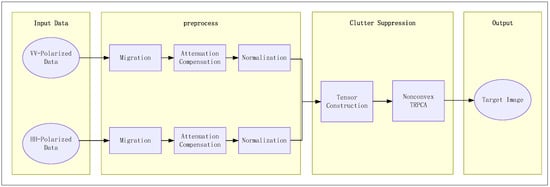
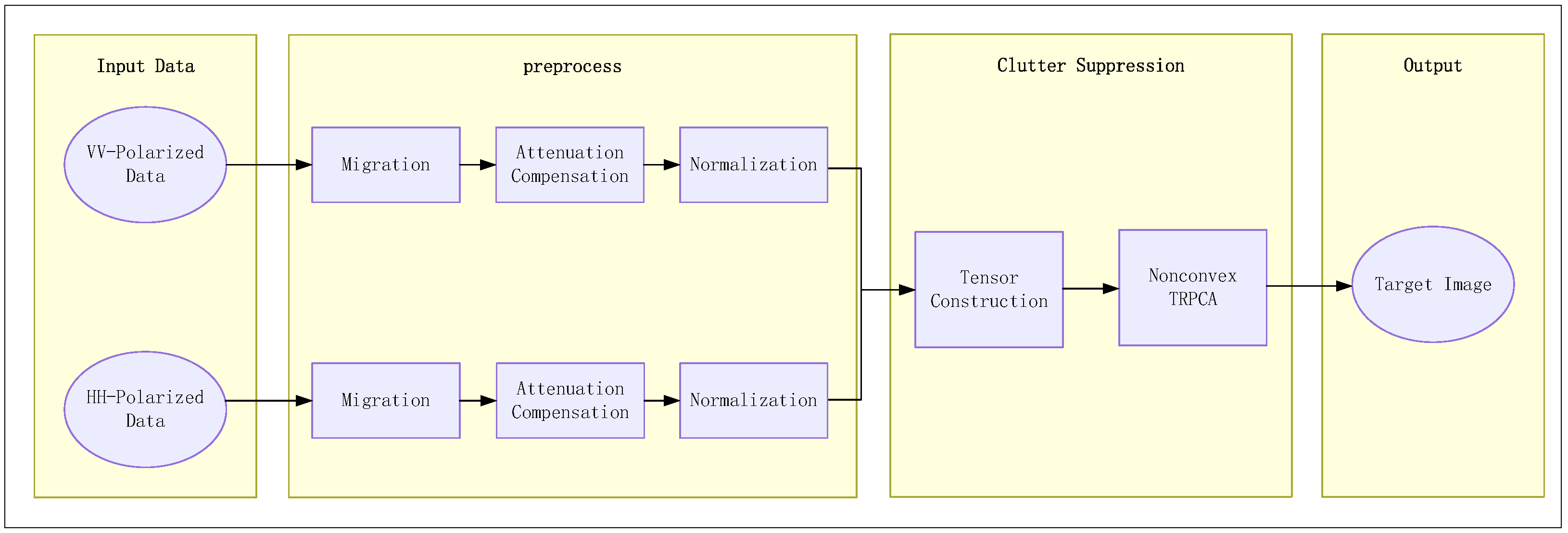
where , , , and denote the observed image tensor, the low-rank clutter tensor, the sparse target tensor, and the noise tensor, respectively. Under this formulation, the GPR clutter suppression is formulated as a TRPCA optimization problem, allowing for the effective separation of the sparse UXO targets from the low-rank background. The flow chart is shown in Figure 1.
Figure 1.
Flow chart of our method.
3.2. Improved Non-Convex TRPCA Model
In the TRPCA framework, the problem in (19) can be addressed via the ADMM to achieve the separation of clutter and targets by solving the following optimization:
As indicated by Equations (14) and (15), the conventional TRPCA method applies uniform shrinkage to all singular values using a constant threshold. However, the strong reflections from the air–ground interface dominate the data, manifesting as the largest singular values, whereas the much weaker UXO responses correspond to the smaller ones. Consequently, applying a uniform threshold presents an inherent trade-off: a threshold set high enough to effectively suppress strong clutter may attenuate the weak target response, whereas a lower threshold proves insufficient to mitigate clutter. Therefore, to achieve effective GPR clutter suppression, it is essential to treat singular values discriminatively—imposing heavier penalties on clutter-dominant singular values while preserving those associated with UXO targets.
To overcome these limitations, we introduce the Tensor Adjustable Logarithmic Norm (TALN) to refine the TRPCA framework:
Definition 6
(TALN [34]).
where is a non-convex function with adjustable positive parameter θ, and denotes the minimum dimension size of the frontal slices of tensor .
A key advantage of TALN over TNN lies in its ability to mitigate the estimation bias of large singular values. Mathematically, TALN employs an adaptive weight assignment mechanism where the penalty is inversely proportional to the singular value magnitude. In the context of GPR, large singular values correspond to the strong surface clutter, while smaller ones are often associated with target response and noise. By exerting less shrinkage on the dominant singular values, which capture the primary energy of the background, TALN ensures a faithful reconstruction of the low-rank clutter. This prevents the background from being over-penalized, thereby avoiding the leakage of clutter energy into the sparse component and significantly enhancing the separation of UXO targets.
Leveraging TALN, the optimization model in Equation (20) is reformulated as:
The constrained optimization problem in Equation (22) can be efficiently solved using ADMM. The corresponding Augmented Lagrangian function is defined as [33]:
where the individual penalty terms are:
We employ the ADMM to solve Equation (23) by iteratively updating the variables as follows:
where is defined as
First, the update for is obtained via the Weighted Tensor Singular Value Thresholding operator:
where is an f-diagonal tensor which the ith front slice is , is giving by [31]
The sparse component is updated using the Soft-Thresholding (Shrinkage) operator:
For the noise component , the closed-form solution is derived as:
The complete optimization procedure for the proposed TRPCA-based clutter suppression is summarized in Algorithm 1. Through this iterative process, the clutter and target response are separated into distinct subspaces.
| Algorithm 1 Algorithm of TALN-based TRPCA |
| Input: Image Tensor Output: Target image Tensor Initialize:
|
4. Experimental Results
To validate the proposed TALN-based TRPCA method for clutter suppression, numerical simulations and laboratory experiments are conducted using P-GPR system. In the numerical simulation, synthetic P-GPR data were generated using gprMax [35]. In the laboratory experiments, data were acquired from UXO detection trials in a controlled sandpit environment using a polarimetric GPR system. To quantitatively evaluate the performance of the clutter suppression methods, the SCR is employed as metric:
where denotes the intensity of the p-th pixel in the GPR image. and represent the total number of pixels in the target region and the clutter region , respectively. The target region is defined as a Region of Interest (ROI), which is specifically delineated to encapsulate the target area. The clutter region is defined as the remainder of the image excluding the target area.
4.1. Numerical Simulation
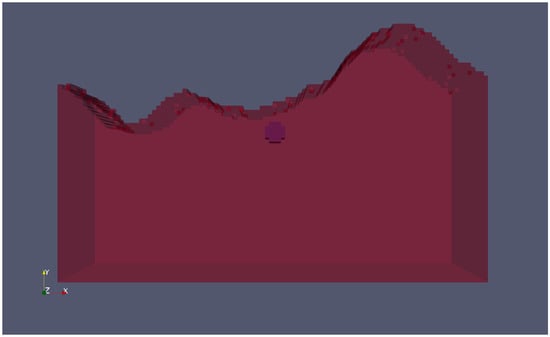
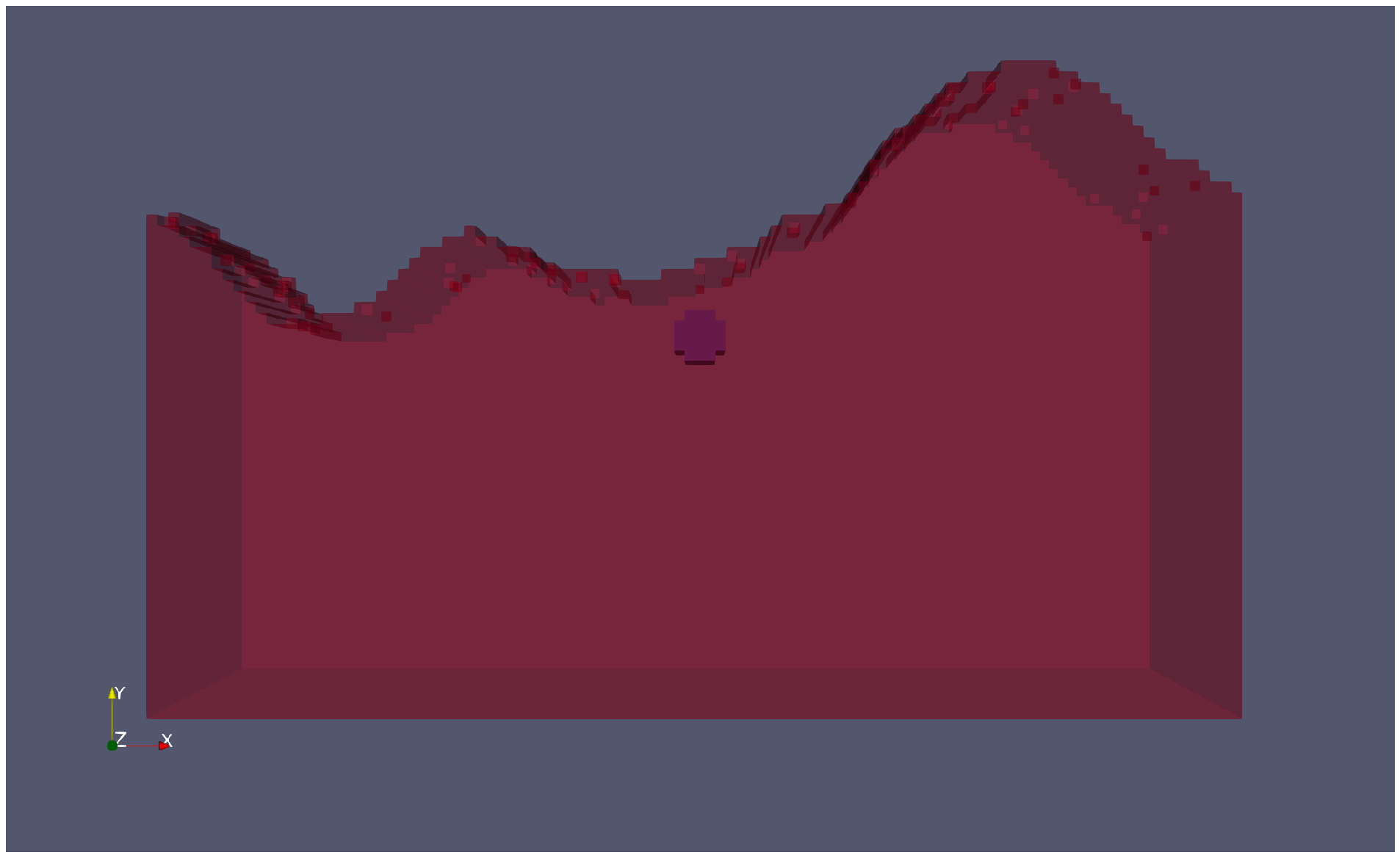
In this section, simulations are conducted using gprMax to obtain synthetic datasets. The simulation model, as illustrated in Figure 2, is structured as follows. First, a stochastic ground surface with a maximum peak-to-peak topographic variation of 25 cm is constructed, with the soil relative permittivity set to . Beneath the surface, a metallic cylinder (10 cm in length and 5 cm in diameter) is placed as the target. A monostatic GPR configuration is adopted, where the antenna is positioned 5 cm above the highest point of the ground. The survey line is oriented perpendicular to the central axis of the cylinder with a scanning step of 4 mm. Ultimately, a 3 GHz Ricker wavelet serves as the excitation source, and the total simulation time window was fixed at 30 ns. A total of 180 traces of HH and VV polarimetric data were synthesized.
Figure 2.
Simulation model.
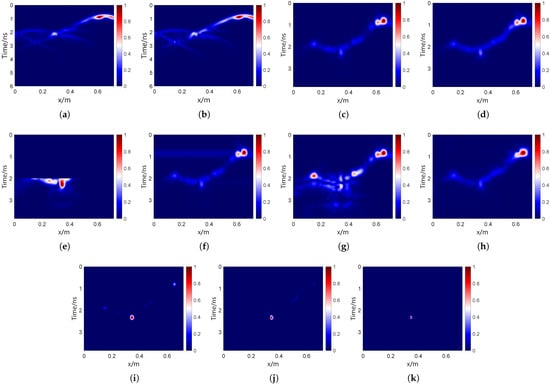
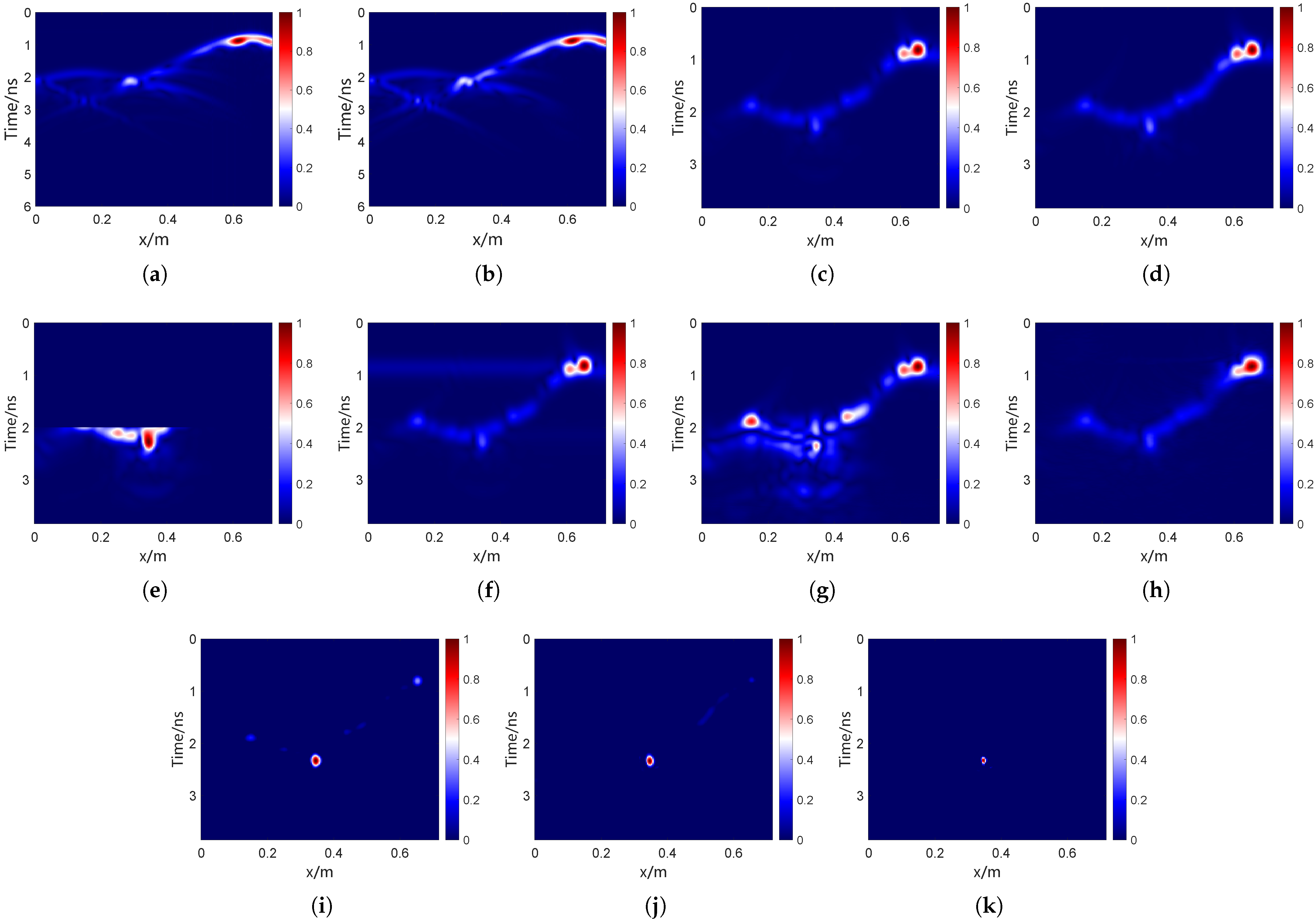
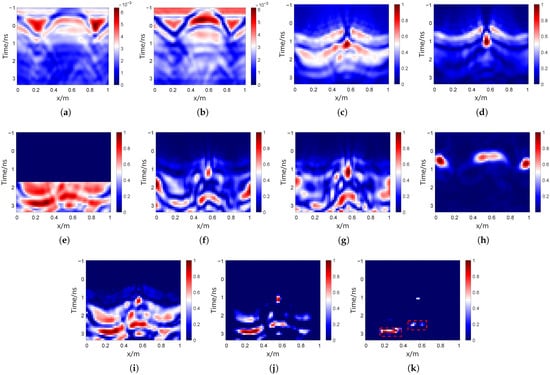
HH-polarized data are shown in Figure 3a, where target responses are masked by clutter. The situation is similar for VV-polarized data, shown in Figure 3b. Subsequently, these data were processed using migration algorithms [36], with the corresponding results displayed in Figure 3c,d. In the migrated images, the profiles of the fluctuating surface exhibit high structural similarity across polarization channels. These dual-channel images are then constructed into a tensor and decomposed via the proposed TRPCA method to extract the target tensor . To facilitate intuitive visual analysis, the recovered target tensor is summed along its channel dimension to yield a 2D representation, as shown in Figure 3k. Figure 3k indicate that the clutter is significantly suppressed, with target responses clearly highlighted. To quantify the performance enhancement, the SCR was calculated for both the migrated image (Figure 3c) and the processed image (Figure 3k). The SCR of the migrated image is 11.4 dB, while that of the image after clutter suppression reaches 50.0 dB, yielding an improvement of 38.6 dB.
Figure 3.
Comparison of clutter suppression results for simulation data: (a,b) HH- and VV-polarized raw data; (c,d) migrated results of (a,b); (e) time gating; (f) mean subtraction; (g) PCA; (h) CR-Net; (i) RPCA; (j) TNN-based TRPCA; and (k) the proposed method.
To demonstrate the superiority of the proposed method relative to mainstream clutter suppression methods, Figure 3e–g illustrate the results of three conventional methods: time gating, mean subtraction, and PCA, respectively. Because the responses of shallowly buried targets closely overlap with surface reflections, applying a time gate tends to indiscriminately truncate the target signals alongside the clutter, causing irreversible distortion (Figure 3e). Mean subtraction inherently assumes a spatially flat clutter distribution. Considering the complex surface conditions in the simulation, the spatially flat clutter distribution no longer holds, leading to suboptimal clutter removal (Figure 3f). PCA typically assumes that the GPR surface reflection energy is concentrated within the first principal component. However, the rough surface topography disperses the clutter energy across multiple principal components, leading to incomplete signal–clutter separation and residual clutter (Figure 3g).
Additionally, CR-Net [17] was applied as a neural network-based baseline for evaluation. However, the network yielded suboptimal results in our simulation (Figure 3h). Unlike the datasets used in [17] where targets are morphologically distinct from the background, our simulated surface roughness generates diffraction patterns that similar to the hyperbolic signatures of UXOs. Since CR-Net relies primarily on geometric feature learning, it fails to distinguish these clutter-induced hyperbolas from genuine target responses.
Figure 3i–k compare the clutter suppression performance of RPCA, TNN-based TRPCA, and our proposed method in the presence of severe surface roughness. RPCA performs poorly because the severe surface roughness disrupts the low-rank properties within individual channels, rendering 2D decomposition ineffective. TRPCA exploits tensor correlations to improve performance but still leaves residual clutter (Figure 3j). This is caused by the uniform shrinkage in the convex TNN, which over-penalizes the large singular values associated with strong clutter. As a result, the background clutter is not fully captured, resulting in artifacts within the sparse component. By adopting a non-convex regularizer, the proposed method mitigates the bias for large singular values, thereby ensuring that strong background clutter is confined within the low-rank component without contaminating the target image. As listed in Table 1, the proposed method outperforms other processing techniques, achieving a maximum SCR improvement compared to the TNN-Based method.
Table 1.
SCR comparison of different methods (dB).
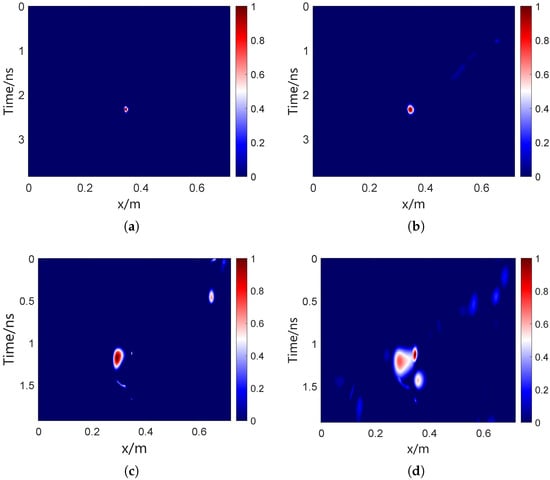
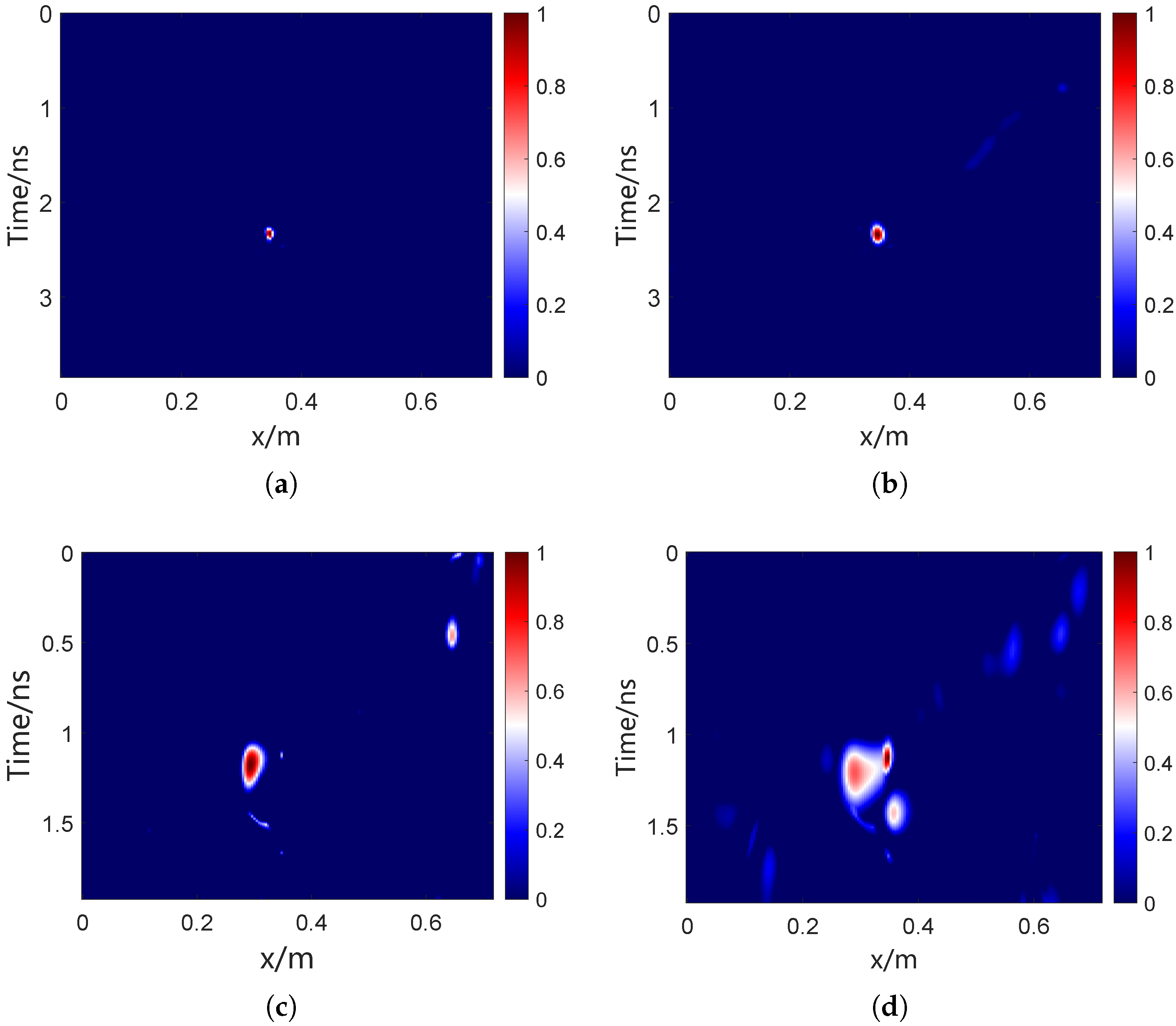
To evaluate the respective contributions of the proposed innovations, an ablation study was conducted using the simulated data. Four distinct processing architectures were designed for comparison: a polarimetric tensor combined with TALN-TRPCA (the proposed method, Figure 4a), a polarimetric tensor with TNN-TRPCA (Figure 4b), a sub-band tensor [27] with TALN-TRPCA (Figure 4c), and a sub-band tensor with TNN-TRPCA (Figure 4d).
Figure 4.
Ablation study results using simulation data: (a) Polarimetric tensor + TALN-TRPCA; (b) Polarimetric tensor + TNN-TRPCA; (c) Sub-band tensor + TALN-TRPCA; and (d) Sub-band tensor + TNN-TRPCA.
Regarding tensor construction, the sub-band splitting approach fails to maintain a low-rank structure over rough surfaces. As observed in Figure 4c,d, this limitation distorts the target morphology, causing the target response to elongate or split. Regarding the regularization strategies, the traditional TNN causes clutter energy to leak into the sparse component. In Figure 4b, this leakage manifests as a faint diagonal streak of residual clutter in the upper right quadrant. In Figure 4d, this artifact leakage is further exacerbated, scattering multiple distinct clutter spots across the upper right region. Quantitative analysis demonstrates that the proposed method (Figure 4a) achieves the highest SCR of 50.0 dB. In contrast, the architectures in Figure 4b, Figure 4c, and Figure 4d yield lower SCRs of 35.7 dB, 27.4 dB, and 19.6 dB, respectively.
The results of the ablation study demonstrate that both the polarimetric tensor construction and the non-convex TALN regularization are indispensable within the proposed framework.
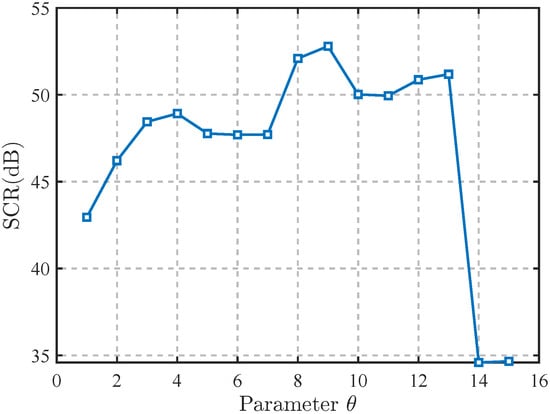
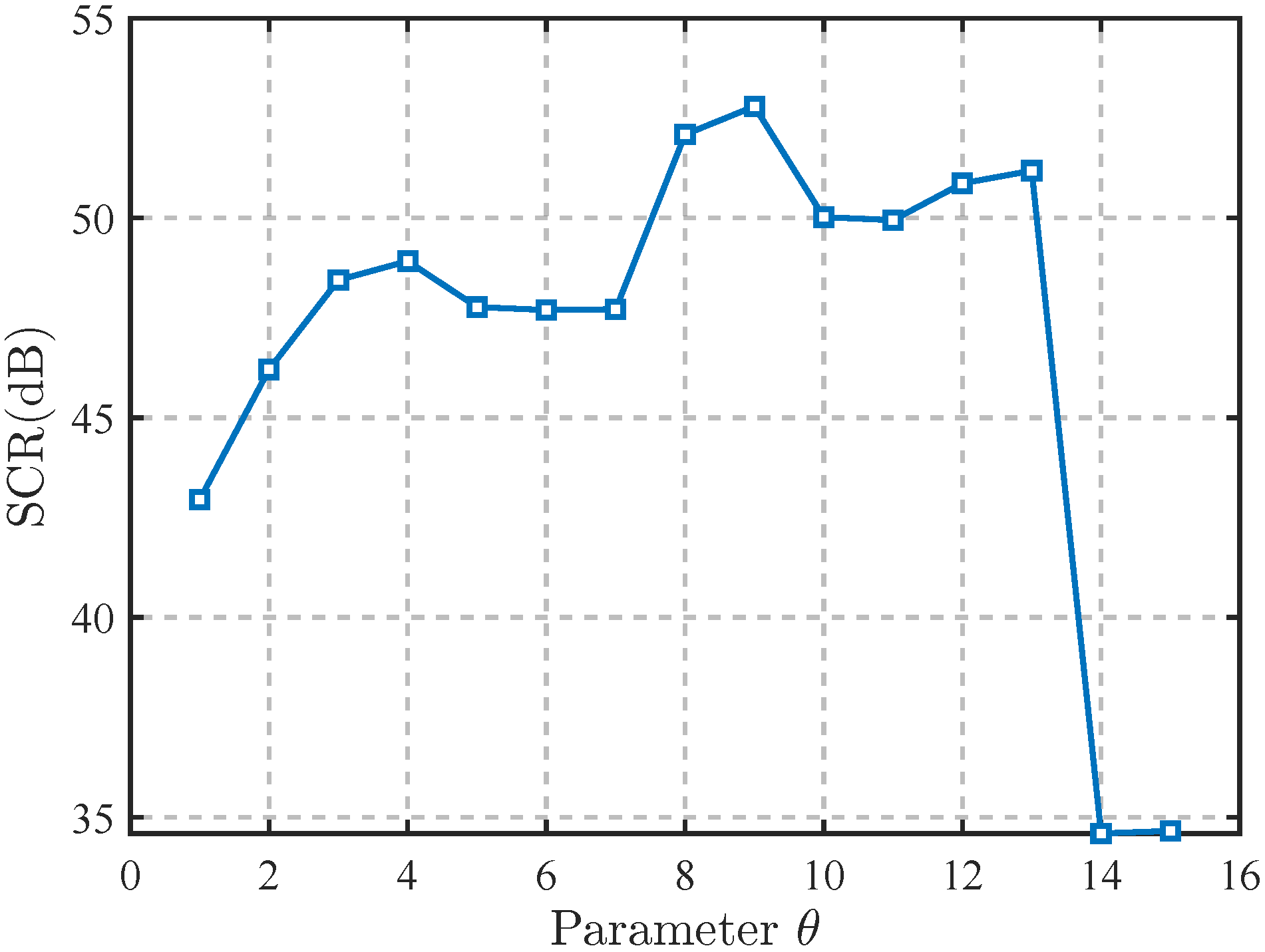
To evaluate the impact of the adjustable parameter in the TALN regularizer on clutter suppression performance, a sensitivity analysis was conducted using the simulation data. Since different data sets possess varying distributions of tensor singular values, it is challenging to predefine a theoretical initial value for the adjustable parameter . As is common practice in optimization methods based on non-convex regularization [34], we initially conducted a comprehensive search over a broad range to determine its optimal setting. Figure 5 illustrates the variation of the SCR as increases from 1 to 15. As observed, when , the non-convexity is weak, yielding a moderate SCR between 43 dB and 49 dB. As increases to the range of , the algorithm achieves its optimal separation performance, with the SCR stabilizing above 50 dB. Within this interval, the TALN effectively mitigates the over-shrinkage of dominant singular values, preventing clutter energy leakage. However, when , the SCR experiences a catastrophic drop to roughly 34.5 dB. This indicates that excessive non-convexity severely disrupts the low-rank and sparse decomposition process, causing the algorithm to fail. Consequently, setting within the range of is determined to be the most suitable choice for this specific scenario.
Figure 5.
Sensitivity analysis of the adjustable parameter in TALN on clutter suppression performance.
4.2. Laboratory Experiment
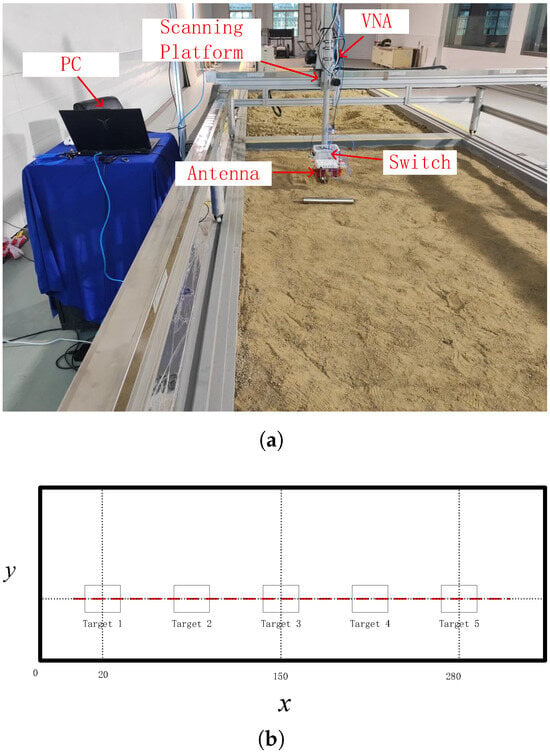
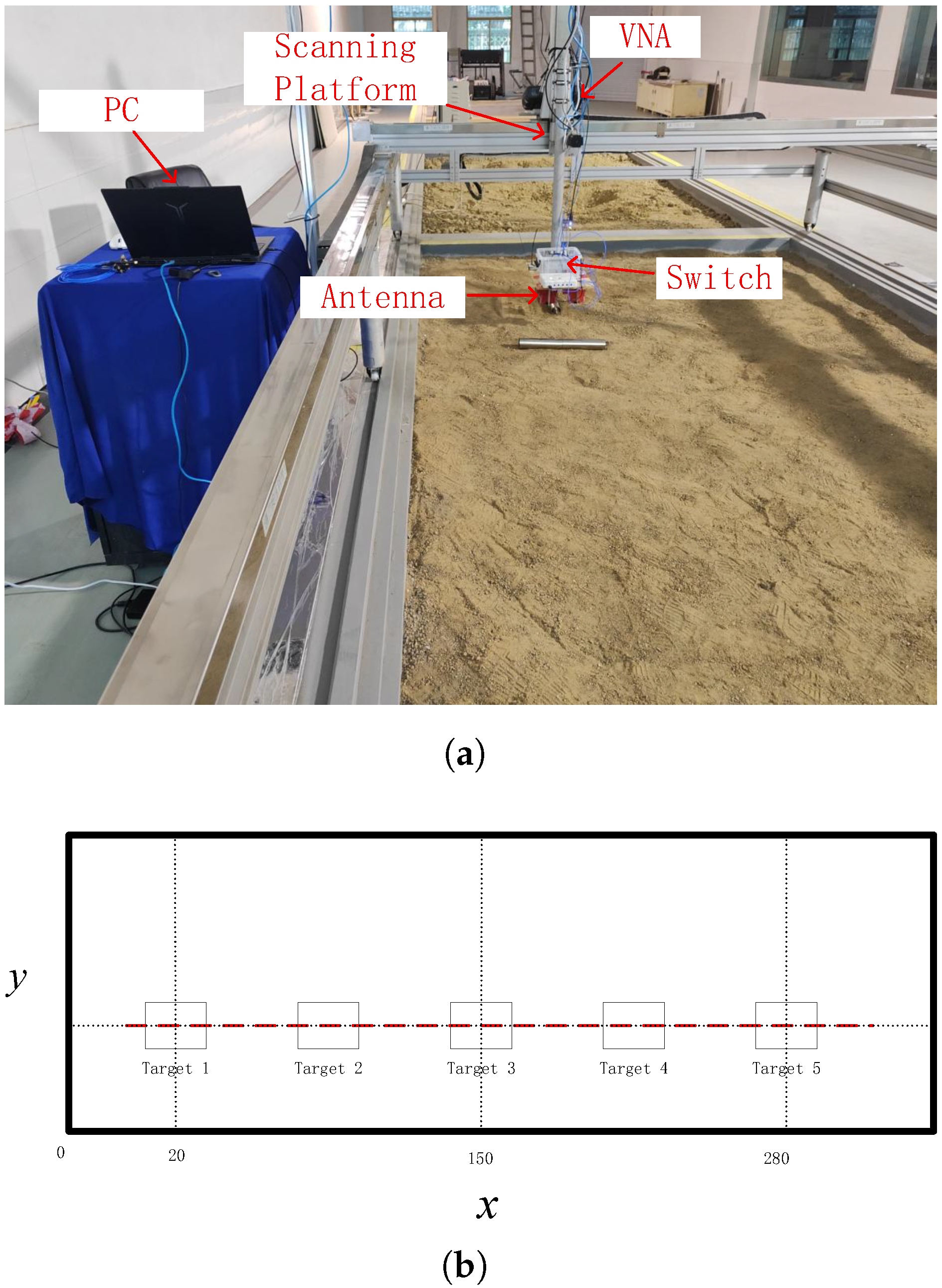
In this section, we verify the proposed method with measured data acquired from a polarimetric GPR system in a laboratory experimental environment. The radar system is shown in Figure 6a. A Vector Network Analyzer (VNA), Keysight N9925A(Keysight Technologies, Santa Rosa, CA, USA), served as the radar transceiver. Polarimetric data were collected using two pairs of cross-polarized Vivaldi antennas, with an electronic switch used to toggle between channels at each sampling position. The P-GPR system operates over an ultra-wideband frequency range from 1 to 6 GHz. The entire system was mounted on a 3D scanning platform.
Figure 6.
The scenario of the first experiment. (a) shows the polarimetric radar system and experiment field. (b) indicates the targets arrangement in the subspace.
The first experiment was conducted in an indoor sandpit, with the burial configuration illustrated in Figure 6b. To simulate realistic complex working scenarios, the sand surface was intentionally constructed without flattening, resulting in an undulating and irregular layout. A B-scan consisting of 226 traces was collected along the red dashed line with a spatial interval of 3 cm. Figure 7a,b illustrate the raw GPR profiles for the HH and VV polarizations, respectively.
Figure 7.
Results of the first experiment: (a,b) HH- and VV-polarized raw data; (c,d) migrated results of (a,b); (e) time gating; (f) mean subtraction; (g) PCA; (h) CR-Net; (i) RPCA; (j) TNN-based TRPCA; and (k) the proposed method.
Figure 7e–h present the clutter suppression results utilizing time gating, mean subtraction, PCA, and CR-Net, respectively. As in the simulations, these baseline methods fail to adequately mitigate ground clutter. The undulating surface generates complex, localized diffraction patterns that not only disrupt the spatial invariance required by traditional filters (like mean subtraction and PCA), but also create hyperbolic features that deceive the morphological feature-extraction process of CR-Net.
Figure 7i–k illustrate the results obtained via RPCA, TNN-based TRPCA, and the proposed method. In this scenario, all three methods based on low-rank and sparse decomposition exhibit commendable. Nevertheless, minor residual clutter persists in the results processed by RPCA and conventional TRPCA. The proposed method achieves superior suppression performance, delivering the most thorough clutter suppression with virtually no observable residuals.
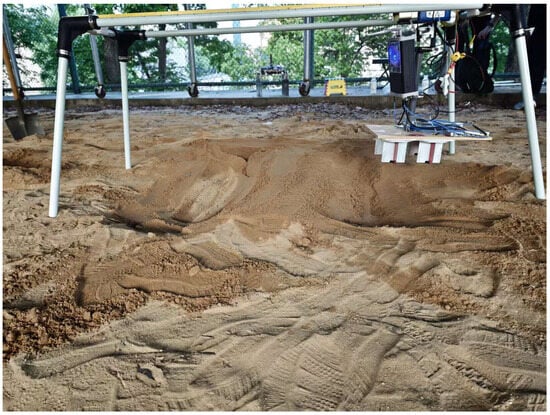
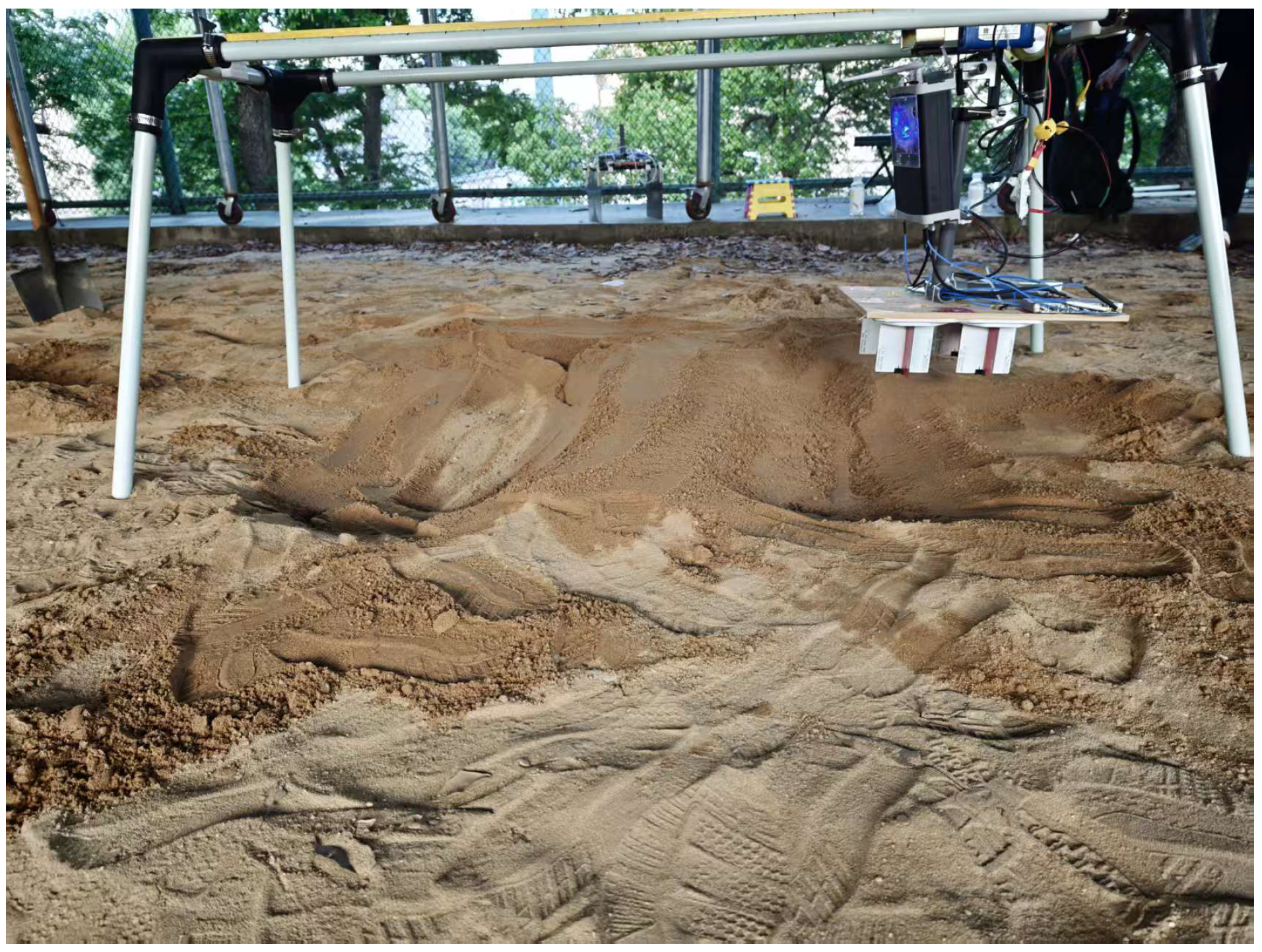
To further verify the practical robustness of the proposed algorithm in moderately complex experimental surroundings, we carried out an outdoor sandpit experiment. As shown in Figure 8, the sandpit surface was artificially shaped to present rough undulations. Unlike the previous experiment, this setup utilized heterogeneous sand with high water content as the background medium. The moisture significantly increased the relative permittivity and exacerbated the attenuation of electromagnetic waves, resulting in complex internal scattering interference. To simulate diversified target conditions for detection tests, we buried two representative targets: a metallic UXO and a landmine model with non-metallic case.
Figure 8.
The scenario of the second experiment.
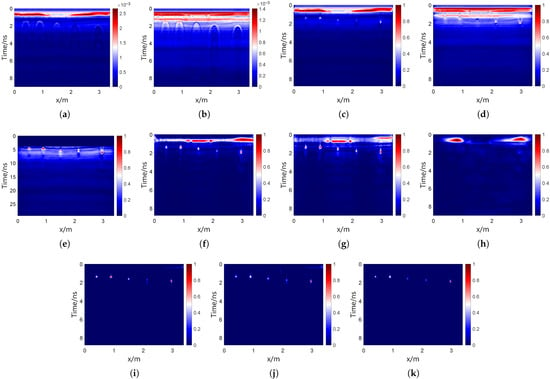
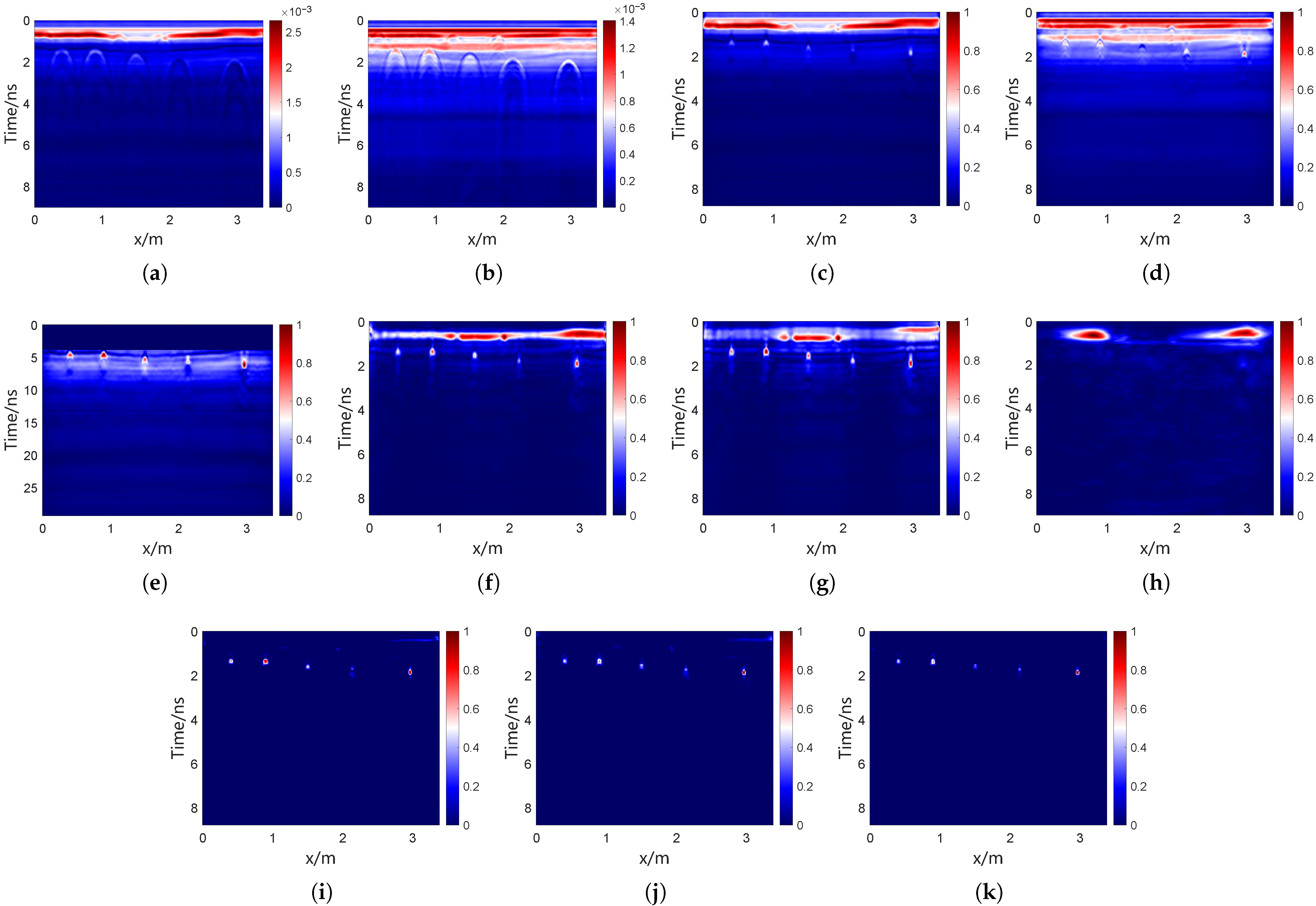
Figure 9a,b display the raw B-scan images for the HH and VV polarizations, respectively. In these raw profiles, strong and irregular surface echoes dominate the shallow subsurface, overwhelming the target signals. After migration processing, as shown in Figure 9c,d, the echo energy is focused to some extent. However, the clutter induced by the surface undulations also focuses into a high-intensity region in the center of the images. The target responses merge entirely with this localized clutter block, making target identification difficult.
Figure 9.
Results of the second experiment: (a,b) HH- and VV-polarized raw data; (c,d) migrated results of (a,b); (e) time gating; (f) mean subtraction; (g) PCA; (h) CR-Net; (i) RPCA; (j) TNN-based TRPCA; and (k) the proposed method.
Figure 9e–h illustrate the processing results of time gating, mean subtraction, PCA, and CR-Net, respectively. As observed in Figure 9e, time gating applies a direct horizontal truncation to remove shallow reflections; however, it leaves dense, high-intensity clutter blocks in the deeper region, where the target remains concealed. In Figure 9f,g, both mean subtraction and PCA leave widespread, high-amplitude residual clutter across the entire profile, failing to separate the target from the background interference. Finally, CR-Net (Figure 9h) incorrectly identifies segments of the undulating surface reflections as targets, producing multiple isolated, high-intensity clutters in the shallow region while missing the actual target response.
Figure 9i–k compare the results of RPCA, TNN-based TRPCA, and the proposed TALN-based TRPCA. As shown in Figure 9i, RPCA manages to extract the target responses but leaves multiple distinct residual clutter spots and artifacts scattered across the profile. TNN-based TRPCA (Figure 9j) suppresses the background more effectively, yet faint clutter streaks and spots remain visible, particularly around the targets and in the deeper regions. In contrast, the proposed TALN-based TRPCA method (Figure 9k) achieves the cleanest separation. It successfully isolates the sparse responses of both the metallic UXO and the landmine model, while the strong surface clutter is mostly suppressed, leaving only a small residual clutter region in the central area.
The quantitative evaluation results are presented in Table 1. In this experimental scenario, the proposed method achieves an SCR improvement of 21.6 dB. These results indicate that the combination of polarimetric tensor construction and the non-convex regularization strategy maintains robust clutter suppression performance under conditions involving heterogeneous media with high water content and different targets.
5. Conclusions
In this paper, a novel clutter suppression framework based on an improved TRPCA is proposed for polarimetric GPR. First, a multidimensional tensor construction scheme is explicitly designed to integrate polarimetric information, thereby exploiting the multi-way dependencies inherent in radar echoes. Furthermore, to address the physical reality that clutter occupies the dominant singular values, the conventional TNN substituted with the TALN. This substitution introduces discriminative shrinkage to singular values, thereby enhancing the separation of low-rank clutter and sparse targets. The formulated optimization problem is efficiently solved using the ADMM. Both numerical simulations and laboratory experiment and outdoor sandpit experiment results validate the feasibility of the proposed method. Overall, our method demonstrates better clutter suppression performance compared to conventional solutions.
This study primarily focuses on achieving robust clutter suppression, which serves as an essential preliminary screening stage for UXO detection. In this context, maximizing the SCR to mitigate false alarms is prioritized over high-fidelity contour reconstruction. Nevertheless, an inherent trade-off of this method is the potential attenuation of weak target signals, which may marginally degrade the morphological features of the targets. It is also noted that the performance of the proposed method declines to some extent when facing challenging conditions with multiple different targets and strongly heterogeneous soil backgrounds. To address these limitations in the next phase of our research, we intend to develop more sophisticated shrinkage functions and adaptive weighting strategies. By explicitly incorporating structural constraints and spatial priors into the optimization framework, we aim to achieve a finer balance between effectively isolating complex subsurface interference and rigorously preserving the morphological integrity of the targets. We will further enhance the robustness of the proposed method against heterogeneous soil noise and multi-target interference. Furthermore, more tests under realistic simulated conditions will be conducted to explore the performance boundary and applicable scope of the algorithm.
Author Contributions
Methodology, B.Z. and X.S.; validation, B.Z. and Z.H.; investigation, T.L.; resources, Z.H. and Y.F.; data curation, B.Z. and T.L.; writing—original draft preparation, B.Z.; writing—review and editing, X.S.; project administration, X.S., Z.H. and T.L. All authors have read and agreed to the published version of the manuscript.
Funding
This research received no external funding.
Data Availability Statement
The data presented in this study are available on request from the corresponding author. The data are not publicly available due to privacy.
Conflicts of Interest
The authors declare no conflicts of interest. The funders had no role in the design of the study; in the collection, analyses, or interpretation of data; in the writing of the manuscript; or in the decision to publish the results.
Abbreviations
The following abbreviations are used in this manuscript:
| GPR | Ground Penetrating Radar |
| UXO | Unexploded Ordnance |
| APM | Anti-personnel mine |
| P-GPR | Polarimetric Ground Penetrating Radar |
| SVD | Singular Value Decomposition |
| LRSD | Low-Rank and Sparse Decomposition |
| RPCA | Robust Principal Component Analysis |
| TRPCA | Tensor Robust Principal Component Analysis |
| T-SVD | Tensor Singular Value Decomposition |
| T-SVT | Tensor Singular Value Thresholding |
| TNN | Tensor Nuclear Norm |
| TALN | Tensor Adjustable Logarithmic Norm |
| ADMM | Alternating Direction Method of Multipliers |
| SCR | Signal-to-Clutter Ratio |
References
- Wang, S.; Zhang, J.; Li, Y.; Sun, K.; Mao, Z.; Wang, S. Advances in Magnetic Sensing Technologies for Small Target Detection: A Review. IEEE Sens. J. 2025, 26, 1465–1488. [Google Scholar] [CrossRef] [Scilit]
- International Campaign to Ban Landmines. Landmine Monitor 2023; Report by the Monitoring and Research Committee; ICBL-CMC: Geneva, Switzerland, 2023. [Google Scholar]
- Kolster, M.E.; Wigh, M.D.; Lima Simões da Silva, E.; Bjerg Vilhelmsen, T.; Døssing, A. High-Speed Magnetic Surveying for Unexploded Ordnance Using UAV Systems. Remote Sens. 2022, 14, 1134. [Google Scholar] [CrossRef] [Scilit]
- Sato, M. Emerging Trends in Radar: Ground Penetrating Radar for Landmine Detection. IEEE Aerosp. Electron. Syst. Mag. 2025, 40, 1–4. [Google Scholar] [CrossRef] [Scilit]
- Samadzadegan, F.; Qaderi, F.; Haghighi, T.L.; Toosi, A.; Mousavi, S.M. Unmanned Aerial Remote Sensing for Unexploded Ordnance Detection: Concepts, Methods, Current Status and Trends. Sens. Imaging 2025, 26, 137. [Google Scholar] [CrossRef] [Scilit]
- Chen, C.-C.; Higgins, M.B.; O’Neill, K.; Detsch, R. Ultrawide-Bandwidth Fully-Polarimetric Ground Penetrating Radar Classification of Subsurface Unexploded Ordnance. IEEE Trans. Geosci. Remote Sens. 2001, 39, 1221. [Google Scholar] [CrossRef] [Scilit]
- Youn, H.-S.; Evans, M.; Kobashigawa, J.; Iskander, M. Advanced classification of UXO using fully polarimetric GPR and frequency-polarization features. In Proceedings of the 2010 IEEE International Geoscience and Remote Sensing Symposium (IGARSS), Honolulu, HI, USA, 25–30 July 2010; pp. 3374–3377. [Google Scholar]
- Yu, Y.; Chen, C.-C. Automatic subsurface unexploded ordnance detection using a wideband full-polarization ground penetrating radar and entropy-based polarimetric signatures. J. Appl. Geophys. 2023, 209, 104913. [Google Scholar] [CrossRef] [Scilit]
- Kumar, B.S.; Sahoo, A.K.; Maiti, S. Removal of Clutter and Random Noise for GPR Images. In Proceedings of the 2021 IEEE 18th India Council International Conference (INDICON), Guwahati, India, 19–21 December 2021; pp. 1–6. [Google Scholar]
- Kumar, B.S.; Baraha, S.; Sahoo, A.K.; Maiti, S. Enhancing subsurface exploration: A comprehensive review of advanced clutter removal techniques for ground penetrating radar imaging. Measurement 2025, 239, 115432. [Google Scholar] [CrossRef] [Scilit]
- Lambot, S.; Slob, E.C.; van den Bosch, I. Modeling of ground-penetrating radar for accurate characterization of subsurface electric properties. IEEE Trans. Geosci. Remote Sens. 2004, 42, 2555–2568. [Google Scholar] [CrossRef] [Scilit]
- Pantoja, J.J.; Ruiz, E.F.; Vega, F.; Chaparro-Arce, D.; Kasmi, C. Clutter Removal of GPR Data using Complex Natural Resonance Extraction. In Proceedings of the 2021 United States National Committee of URSI National Radio Science Meeting (USNC-URSI NRSM), Boulder, CO, USA, 4–9 January 2021; pp. 27–28. [Google Scholar]
- Zoubir, A.M.; Chant, I.J.; Brown, C.L.; Barkat, B.; Abeynayake, C. Signal processing techniques for landmine detection using impulse ground penetrating radar. IEEE Sens. J. 2002, 2, 41–51. [Google Scholar] [CrossRef] [Scilit]
- Wu, S.; Wang, L.; Zeng, X.; Wang, F.; Liang, Z.; Ye, H. UAV-Mounted GPR for Object Detection Based on Cross-Correlation Background Subtraction Method. Remote Sens. 2022, 14, 5132. [Google Scholar] [CrossRef] [Scilit]
- Zhao, Y.; Chai, Z.; Xu, Z.; Hou, M.; Hu, J. Improved pix2pix Method for Clutter Removal From Complex Real Ground-Penetrating Radar Images. IEEE Sens. J. 2025, 25, 26767–26785. [Google Scholar] [CrossRef] [Scilit]
- Zhang, Y.; Diao, E.; Huston, D.; Xia, T. A Data-Efficient Deep Learning Method for Rough Surface Clutter Reduction in GPR Images. IEEE Trans. Geosci. Remote Sens. 2024, 62, 1–10. [Google Scholar] [CrossRef] [Scilit]
- Sun, H.-H.; Cheng, W.; Fan, Z. Learning to Remove Clutter in Real-World GPR Images Using Hybrid Data. IEEE Trans. Geosci. Remote Sens. 2022, 60, 1–14. [Google Scholar] [CrossRef] [Scilit]
- Temlioglu, E.; Erer, I. A Novel Convolutional Autoencoder-Based Clutter Removal Method for Buried Threat Detection in Ground-Penetrating Radar. IEEE Trans. Geosci. Remote Sens. 2022, 60, 1–13. [Google Scholar] [CrossRef] [Scilit]
- Lei, W.; Mao, L.; Pang, Z.; Ren, Q.; Wang, C.; Sui, H.; Xin, C. DR-GAN: An Unsupervised Learning Approach to Clutter Suppression for Ground Penetrating Radar. J. Electron. Inf. Technol. 2023, 45, 3776–3785. [Google Scholar]
- Chen, D.; Xiang, A.; Xiong, S.; Wang, L.; Guo, L. Direct Coupled Wave Removal for GPR Data Based on SVD in the Wavelet Domain. Radioengineering 2022, 4, 564–571. [Google Scholar] [CrossRef] [Scilit]
- Esmaili, K.; Chamaani, S. Defect Detection of Shallow Pipes by UWB Sensor. In Proceedings of the 28th Iranian Conference on Electrical Engineering (ICEE), Tabriz, Iran, 4–6 August 2020; pp. 844–848. [Google Scholar]
- Lang, S.; Li, J.; Li, S.; Zhao, B.; Qi, S. An Innovative Low-Rank Sparse Matrix Decomposition Clutter Suppression Method Based on Non-Convex Alternatives for Pseudo-Random-Coded Ground-Penetrating Radar. IEEE Trans. Geosci. Remote Sens. 2025, 63, 1–23. [Google Scholar] [CrossRef] [Scilit]
- Ye, F.; Zhang, R.; Liu, Z. Robust principal component analysis combined with top-hat transform for clutter suppression in GPR images. Remote Sens. Lett. 2025, 16, 66–76. [Google Scholar] [CrossRef] [Scilit]
- Song, X.; Xiang, D.; Zhou, K.; Su, Y. Improving RPCA-Based Clutter Suppression in GPR Detection of Antipersonnel Mines. IEEE Geosci. Remote Sens. Lett. 2017, 14, 1338–1342. [Google Scholar] [CrossRef] [Scilit]
- Yan, T.; Guo, Q. Tensor robust principal component analysis via dual lp quasi-norm sparse constraints. Digit. Signal Process. 2024, 150, 104520. [Google Scholar] [CrossRef] [Scilit]
- Lu, C.; Feng, J.; Chen, Y.; Liu, W.; Lin, Z.; Yan, S. Tensor Robust Principal Component Analysis: Exact Recovery of Corrupted Low-Rank Tensors via Convex Optimization. In Proceedings of the 2016 IEEE Conference on Computer Vision and Pattern Recognition (CVPR), Seattle, WA, USA, 27–30 June 2016; pp. 5249–5257. [Google Scholar]
- Song, X.; Liu, T.; Xiang, D.; Su, Y. GPR Antipersonnel Mine Detection Based on Tensor Robust Principal Analysis. Remote Sens. 2019, 11, 984. [Google Scholar] [CrossRef] [Scilit]
- Zhou, H.; Li, M.; Yang, Y.; Du, Y.; Pan, B. Ground penetrating radar clutter suppression based on the weighted tensor Schatten p-paradigm minimization of tensor principal components. Phys. Scr. 2024, 99, 105061. [Google Scholar] [CrossRef] [Scilit]
- Brogioni, M.; Pettinato, S.; Macelloni, G.; Paloscia, S.; Pampaloni, P.; Pierdicca, N.; Ticconi, F. Sensitivity of bistatic scattering to soil moisture and surface roughness of bare soils. Int. J. Remote Sens. 2010, 31, 4227–4255. [Google Scholar] [CrossRef] [Scilit]
- Liu, H.; Ding, F.; Li, J.; Meng, X.; Liu, C.; Fang, H. Improved Detection of Buried Elongated Targets by Dual-Polarization GPR. IEEE Geosci. Remote Sens. Lett. 2023, 20, 1–5. [Google Scholar] [CrossRef] [Scilit]
- Lu, C.; Feng, J.; Chen, Y.; Liu, W.; Lin, Z.; Yan, S. Tensor Robust Principal Component Analysis with a New Tensor Nuclear Norm. IEEE Trans. Pattern Anal. Mach. Intell. 2020, 42, 925–938. [Google Scholar] [CrossRef] [Scilit]
- Kilmer, M.E.; Martin, C.D. Factorization strategies for third-order tensors. Linear Algebra Appl. 2011, 435, 641–658. [Google Scholar] [CrossRef] [Scilit]
- Boyd, S.; Parikh, N.; Chu, E.; Peleato, B.; Eckstein, J. Distributed Optimization and Statistical Learning via the Alternating Direction Method of Multipliers. Found. Trends Mach. Learn. 2011, 3, 1–122. [Google Scholar] [CrossRef] [Scilit]
- Geng, X.; Guo, Q.; Hui, S.; Yang, M.; Zhang, C. Tensor robust PCA with nonconvex and nonlocal regularization. Comput. Vis. Image Underst. 2024, 243, 104007. [Google Scholar] [CrossRef] [Scilit]
- Warren, C.; Giannopoulos, A.; Giannakis, I. gprMax: Open source software to simulate electromagnetic wave propagation for Ground Penetrating Radar. Comput. Phys. Commun. 2016, 209, 163–170. [Google Scholar] [CrossRef] [Scilit]
- Zhou, L.; Su, Y. GPR Imaging With RM Algorithm in Layered Mediums. IEEE Geosci. Remote Sens. Lett. 2011, 8, 934–938. [Google Scholar] [CrossRef] [Scilit]

Disclaimer/Publisher’s Note: The statements, opinions and data contained in all publications are solely those of the individual author(s) and contributor(s) and not of MDPI and/or the editor(s). MDPI and/or the editor(s) disclaim responsibility for any injury to people or property resulting from any ideas, methods, instructions or products referred to in the content. |
© 2026 by the authors. Licensee MDPI, Basel, Switzerland. This article is an open access article distributed under the terms and conditions of the Creative Commons Attribution (CC BY) license.