Author Contributions
Conceptualization, J.C.B.A., L.B., P.R. and W.L.-C.; Methodology, J.C.B.A., O.F. and W.L.-C.; Software, J.C.B.A.; Validation, J.C.B.A. and P.R.; Formal analysis, J.C.B.A.; Investigation, J.C.B.A., J.V., O.F., L.B., P.R. and W.L.-C.; Resources, J.C.B.A., J.V., O.F., L.B., P.R. and W.L.-C.; Data curation, J.C.B.A. and J.V.; Writing—original draft, J.C.B.A.; Writing—review & editing, J.C.B.A., J.V., O.F., L.B., P.R. and W.L.-C.; Visualization, J.C.B.A.; Supervision, L.B., P.R. and W.L.-C.; Project administration, W.L.-C. All authors have read and agreed to the published version of the manuscript.
Figure 1.
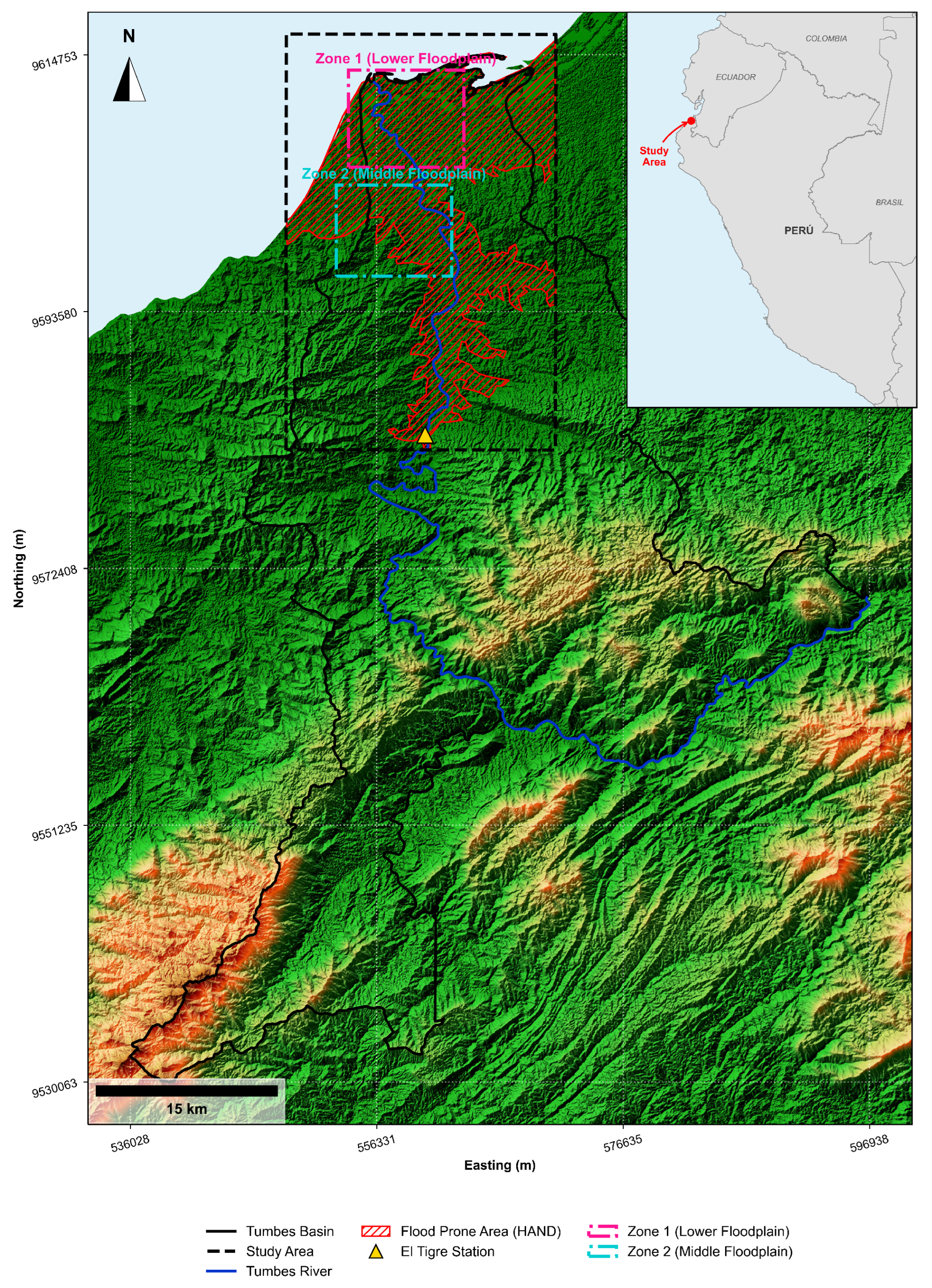
Location of the study area in the lower Tumbes River basin. The map illustrates the topography, the drainage network, and the El Tigre hydrometric station, highlighting the flood domain delineated by the HAND model to constrain the spatial SAR analysis. Additionally, the specific sub-regions corresponding to the lower (Zone 1) and middle (Zone 2) floodplains analyzed in this study are explicitly delineated.
Figure 1.
Location of the study area in the lower Tumbes River basin. The map illustrates the topography, the drainage network, and the El Tigre hydrometric station, highlighting the flood domain delineated by the HAND model to constrain the spatial SAR analysis. Additionally, the specific sub-regions corresponding to the lower (Zone 1) and middle (Zone 2) floodplains analyzed in this study are explicitly delineated.
Figure 2.
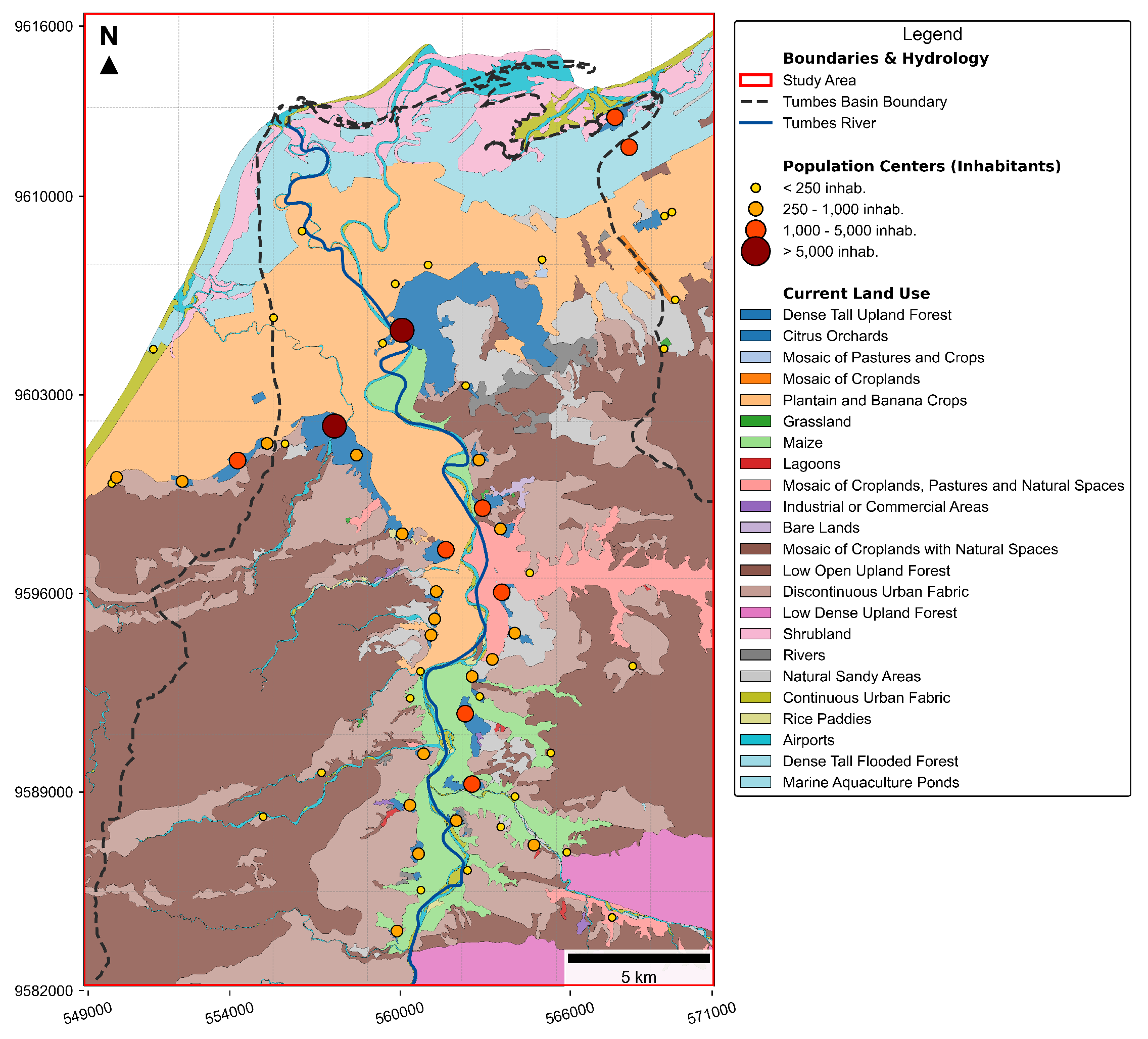
Spatial distribution of Land Use/Land Cover (LULC) and population settlements in the lower Tumbes River basin. The proximity of settlements and agricultural areas to the main channel highlights their high socio-economic vulnerability to floods, justifying the need for continuous SAR monitoring.
Figure 2.
Spatial distribution of Land Use/Land Cover (LULC) and population settlements in the lower Tumbes River basin. The proximity of settlements and agricultural areas to the main channel highlights their high socio-economic vulnerability to floods, justifying the need for continuous SAR monitoring.
Figure 3.
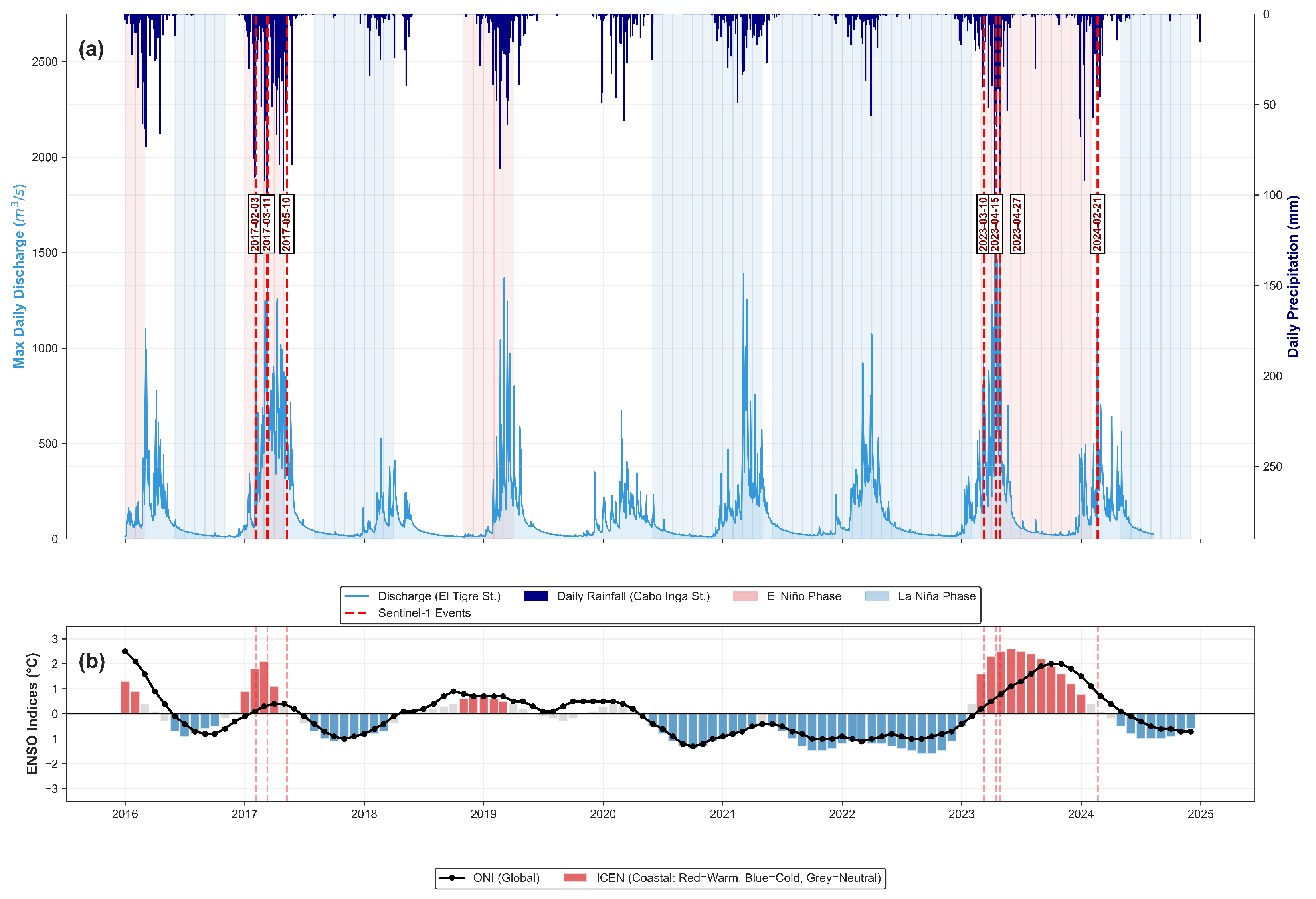
Hydroclimatic characterization and flood event selection in the Tumbes River basin (2016–2024). (a) The upper panel integrates daily maximum discharge at El Tigre (m3/s) and precipitation at Cabo Inga (mm), indicating ENFEN climatic phases (red for El Niño and blue for La Niña) and the seven Sentinel-1 acquisitions via vertical lines. (b) The lower panel contextualizes the climate dynamics through the ICEN and ONI indices, demonstrating the coupling between marine thermal anomalies and the hydrological response; in this panel, blue and red bars represent cold (La Niña) and warm (El Niño) coastal conditions, respectively, while grey bars indicate neutral periods.
Figure 3.
Hydroclimatic characterization and flood event selection in the Tumbes River basin (2016–2024). (a) The upper panel integrates daily maximum discharge at El Tigre (m3/s) and precipitation at Cabo Inga (mm), indicating ENFEN climatic phases (red for El Niño and blue for La Niña) and the seven Sentinel-1 acquisitions via vertical lines. (b) The lower panel contextualizes the climate dynamics through the ICEN and ONI indices, demonstrating the coupling between marine thermal anomalies and the hydrological response; in this panel, blue and red bars represent cold (La Niña) and warm (El Niño) coastal conditions, respectively, while grey bars indicate neutral periods.
Figure 4.
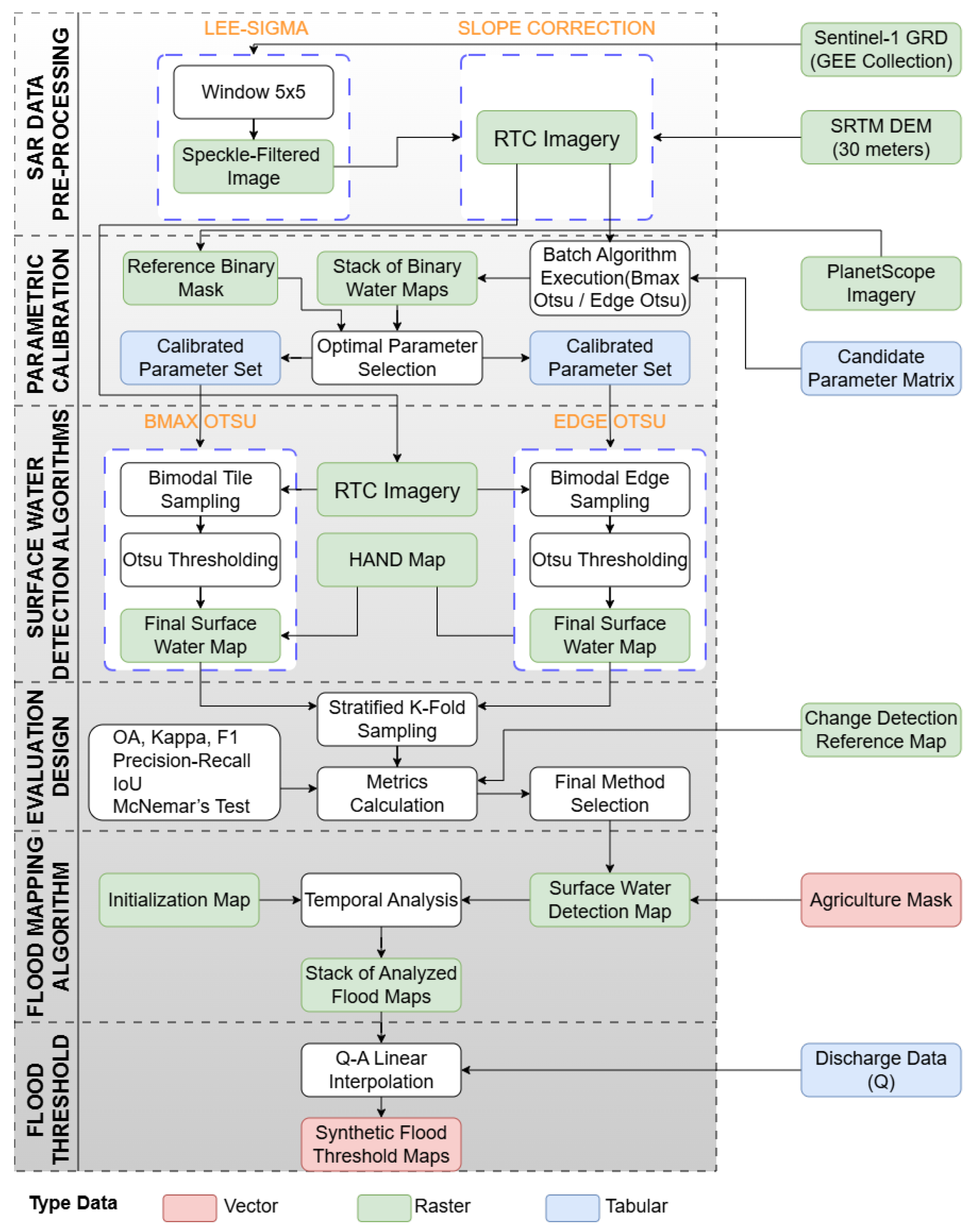
General flowchart of the proposed methodology. The workflow is divided into six main stages: SAR data pre-processing, parametric calibration, surface water detection algorithms (Bmax and Edge Otsu), evaluation design, flood mapping algorithm, and flood threshold determination.
Figure 4.
General flowchart of the proposed methodology. The workflow is divided into six main stages: SAR data pre-processing, parametric calibration, surface water detection algorithms (Bmax and Edge Otsu), evaluation design, flood mapping algorithm, and flood threshold determination.
Figure 5.
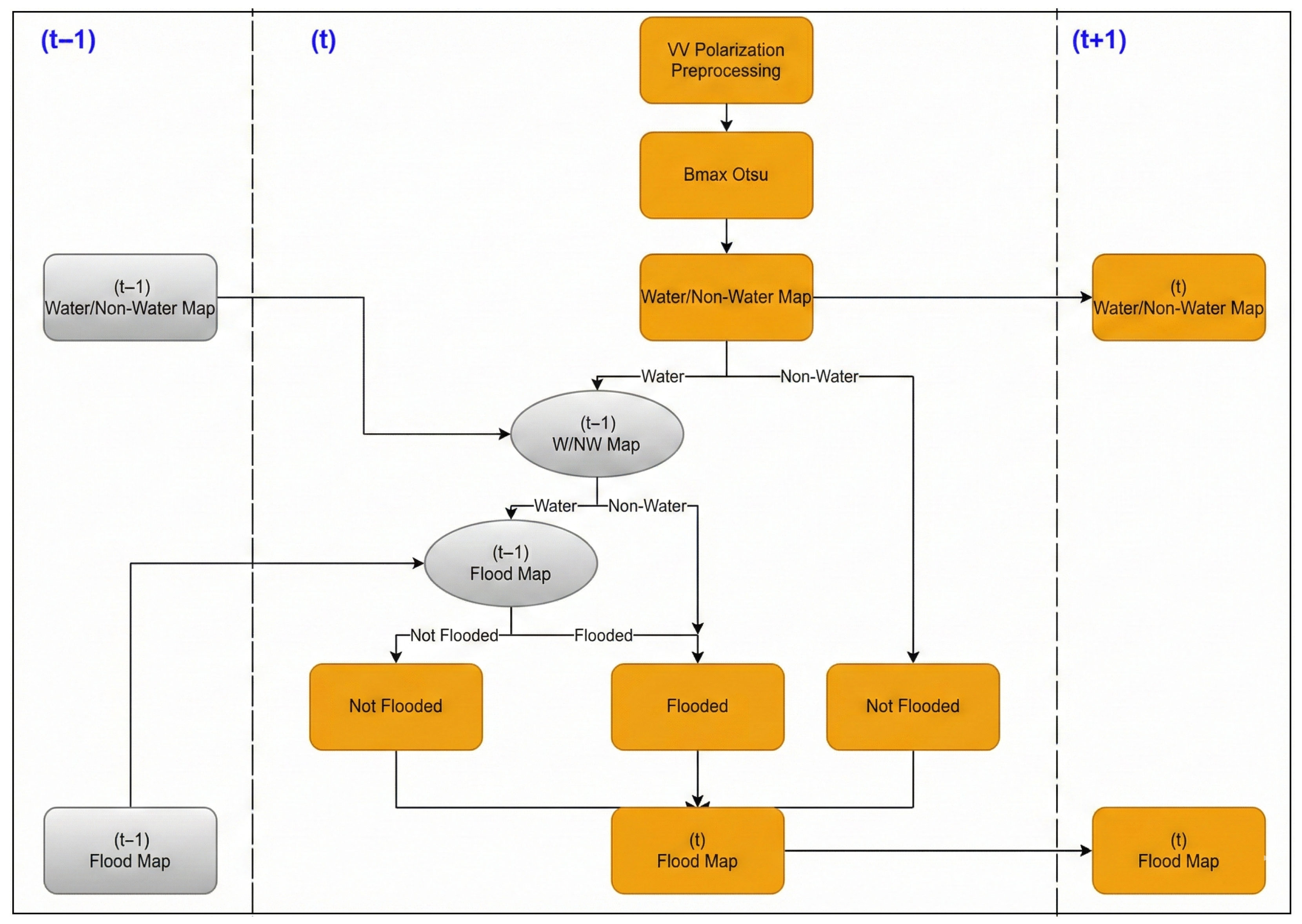
Flowchart of the flood monitoring algorithm based on the analysis of temporal dynamics of Sentinel-1 SAR imagery [
58].
Figure 5.
Flowchart of the flood monitoring algorithm based on the analysis of temporal dynamics of Sentinel-1 SAR imagery [
58].
Figure 6.
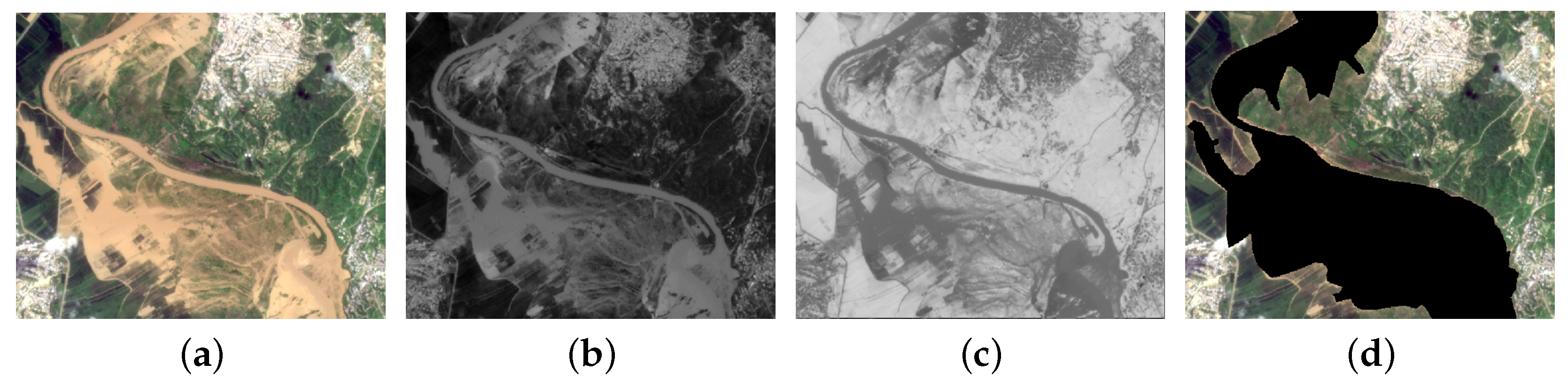
Reference ground-truth delineation process using PlanetScope imagery from 28 April 2023. (a) True-color (RGB) composite. (b) NDWI index for water identification. (c) NDVI index for vegetation masking. (d) Final spectrally-assisted vector delineation of the flooded area.
Figure 6.
Reference ground-truth delineation process using PlanetScope imagery from 28 April 2023. (a) True-color (RGB) composite. (b) NDWI index for water identification. (c) NDVI index for vegetation masking. (d) Final spectrally-assisted vector delineation of the flooded area.
Figure 7.
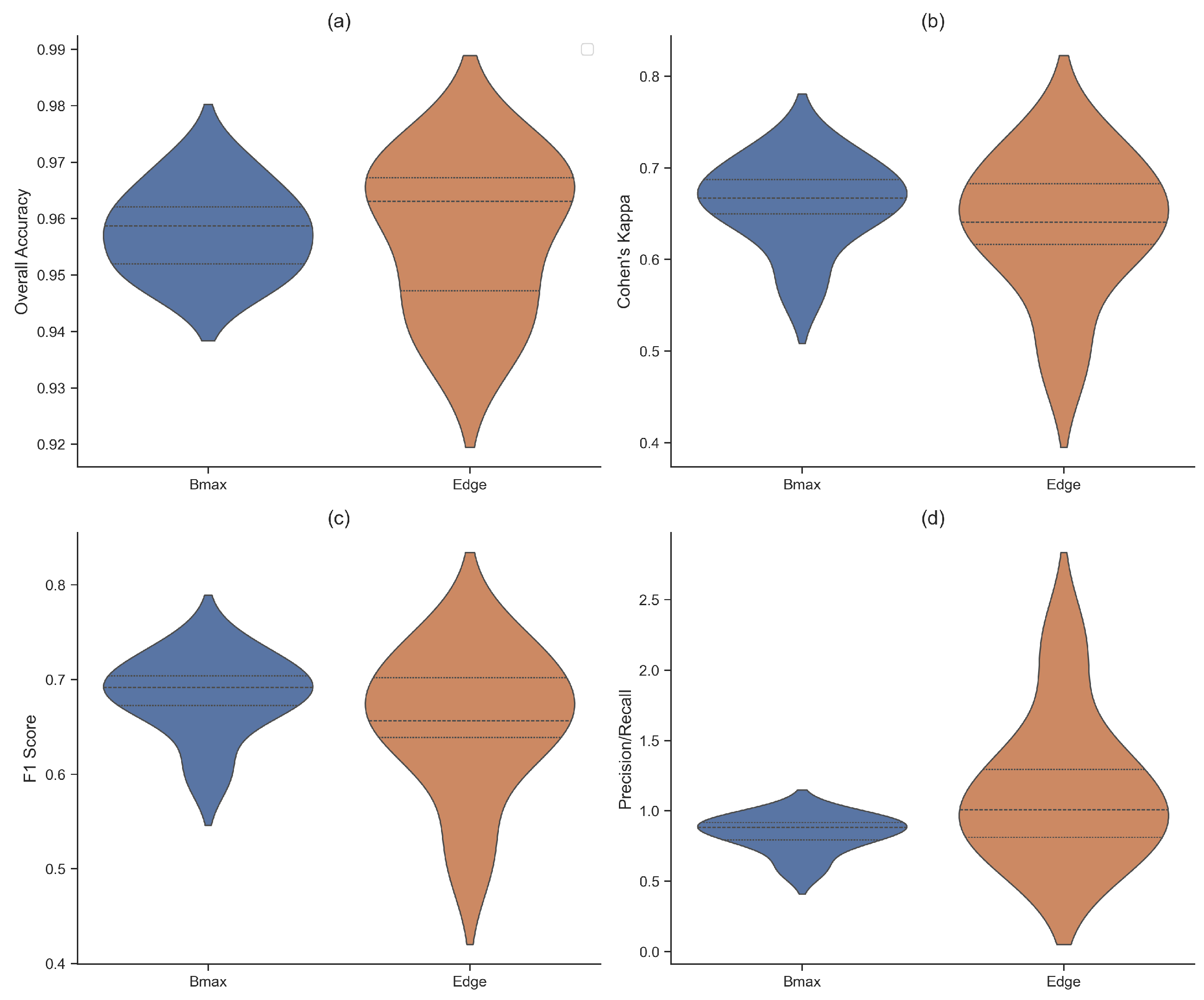
Accuracy assessment for both algorithms (Bmax Otsu and Edge Otsu), showing the distribution of (a) Overall Accuracy, (b) Cohen’s Kappa coefficient, (c) F1-Score, and (d) Precision/Recall ratio. Dashed lines within the violin plots indicate the quartiles (25th, 50th/median, and 75th percentiles). The more compact distributions (smaller dispersion) observed for Bmax Otsu indicate higher spatio-temporal stability and more consistent performance compared to Edge Otsu.
Figure 7.
Accuracy assessment for both algorithms (Bmax Otsu and Edge Otsu), showing the distribution of (a) Overall Accuracy, (b) Cohen’s Kappa coefficient, (c) F1-Score, and (d) Precision/Recall ratio. Dashed lines within the violin plots indicate the quartiles (25th, 50th/median, and 75th percentiles). The more compact distributions (smaller dispersion) observed for Bmax Otsu indicate higher spatio-temporal stability and more consistent performance compared to Edge Otsu.
Figure 8.
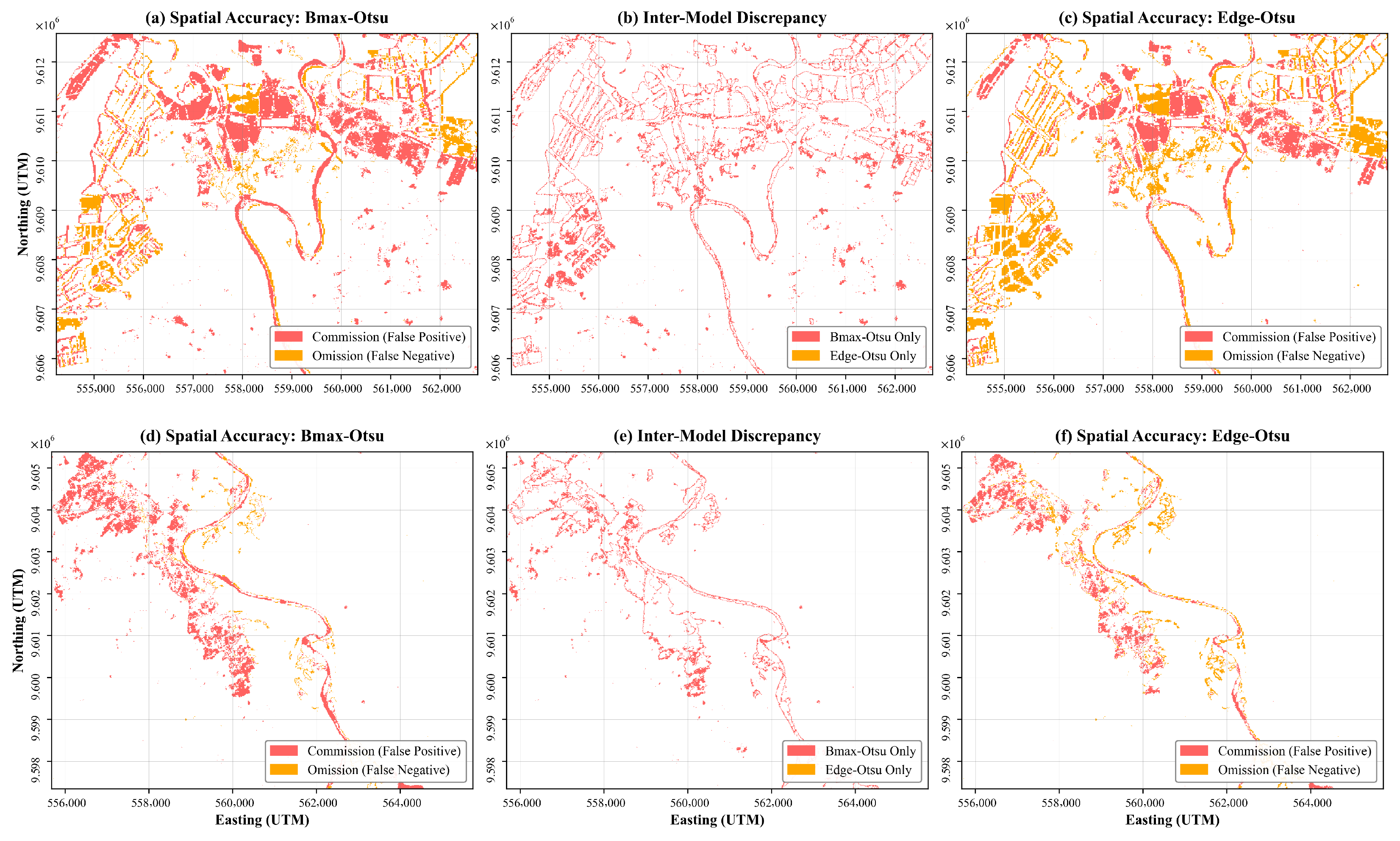
Spatial accuracy and inter-model discrepancy for the 15 April 2023 event. The top (a–c) and bottom (d–f) rows represent the lower and middle sections of the Tumbes floodplain, respectively. Columns 1 and 3 evaluate Bmax-Otsu and Edge-Otsu against the change detection benchmark, detailing commission (red) and omission (orange) errors. Column 2 highlights direct geometric discrepancies, showing areas detected exclusively by Bmax-Otsu (red) or Edge-Otsu (orange).
Figure 8.
Spatial accuracy and inter-model discrepancy for the 15 April 2023 event. The top (a–c) and bottom (d–f) rows represent the lower and middle sections of the Tumbes floodplain, respectively. Columns 1 and 3 evaluate Bmax-Otsu and Edge-Otsu against the change detection benchmark, detailing commission (red) and omission (orange) errors. Column 2 highlights direct geometric discrepancies, showing areas detected exclusively by Bmax-Otsu (red) or Edge-Otsu (orange).
Figure 9.
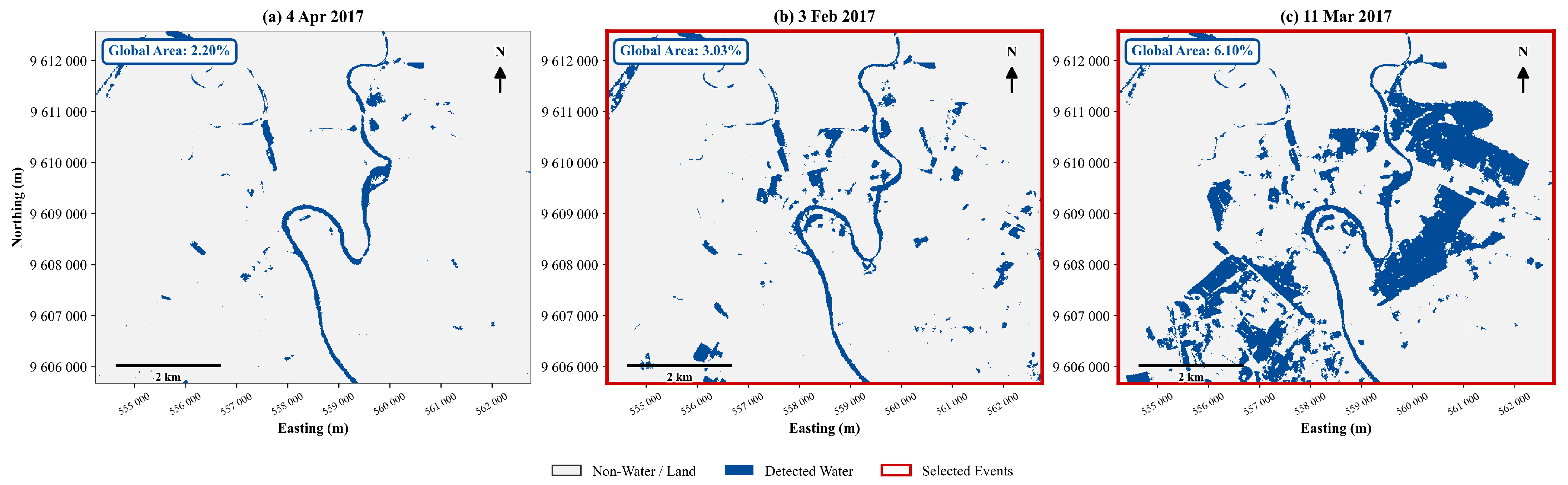
Spatiotemporal dynamics of surface water in the lower Tumbes floodplain (Zone 1) during the 2017 El Niño Costero. The panels illustrate the binary water/non-water classification derived from Sentinel-1 imagery, arranged in descending order based on the percentage of total water area: (a) 4 April 2017, (b) 3 February 2017, and (c) 11 March 2017. Selected events are highlighted with red borders.
Figure 9.
Spatiotemporal dynamics of surface water in the lower Tumbes floodplain (Zone 1) during the 2017 El Niño Costero. The panels illustrate the binary water/non-water classification derived from Sentinel-1 imagery, arranged in descending order based on the percentage of total water area: (a) 4 April 2017, (b) 3 February 2017, and (c) 11 March 2017. Selected events are highlighted with red borders.
Figure 10.
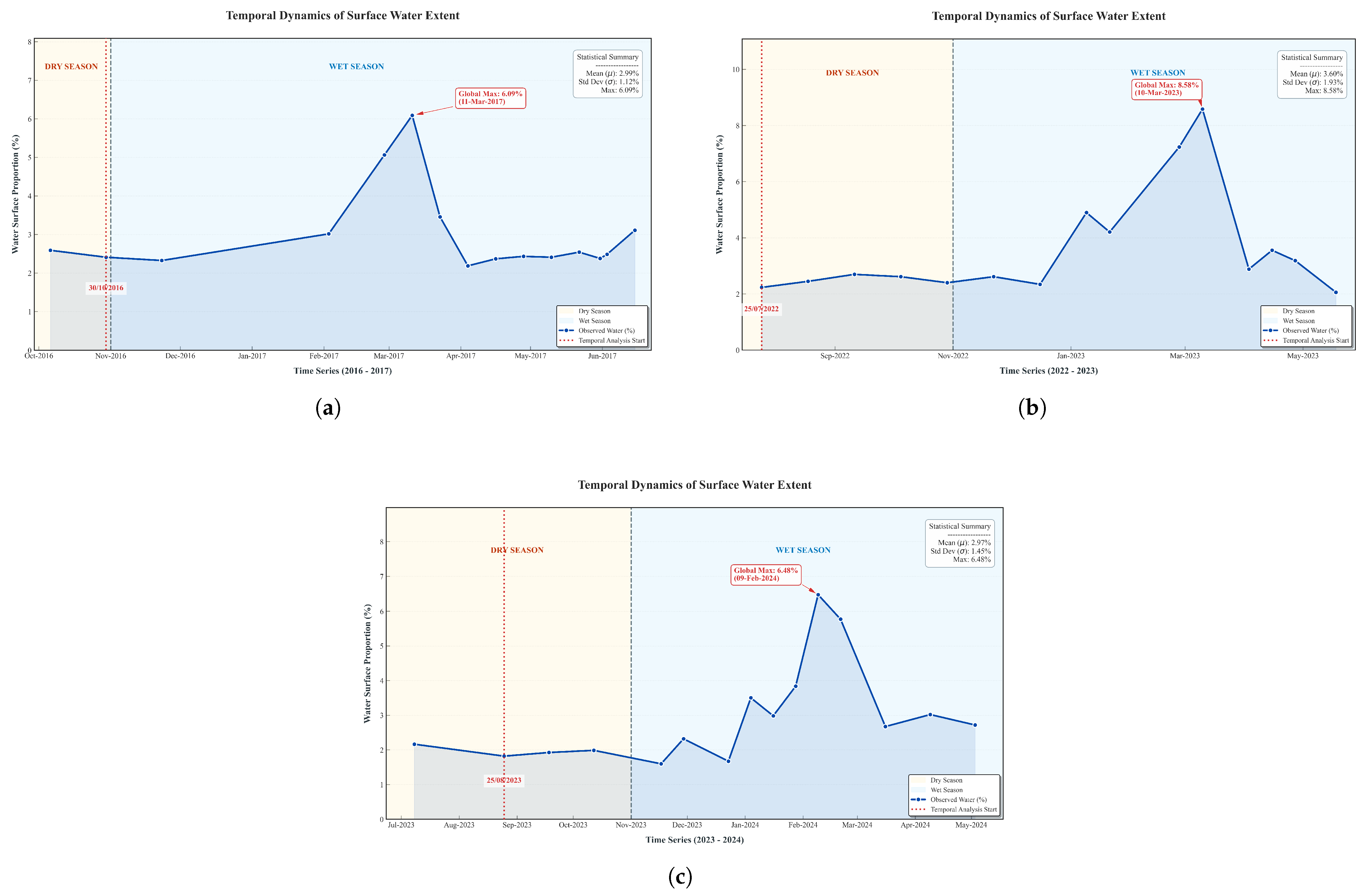
Temporal evolution of water pixel percentage used to determine the flood algorithm initialization time. (a) 2017 Events. (b) 2023 Events. (c) 2024 Events.
Figure 10.
Temporal evolution of water pixel percentage used to determine the flood algorithm initialization time. (a) 2017 Events. (b) 2023 Events. (c) 2024 Events.
Figure 11.
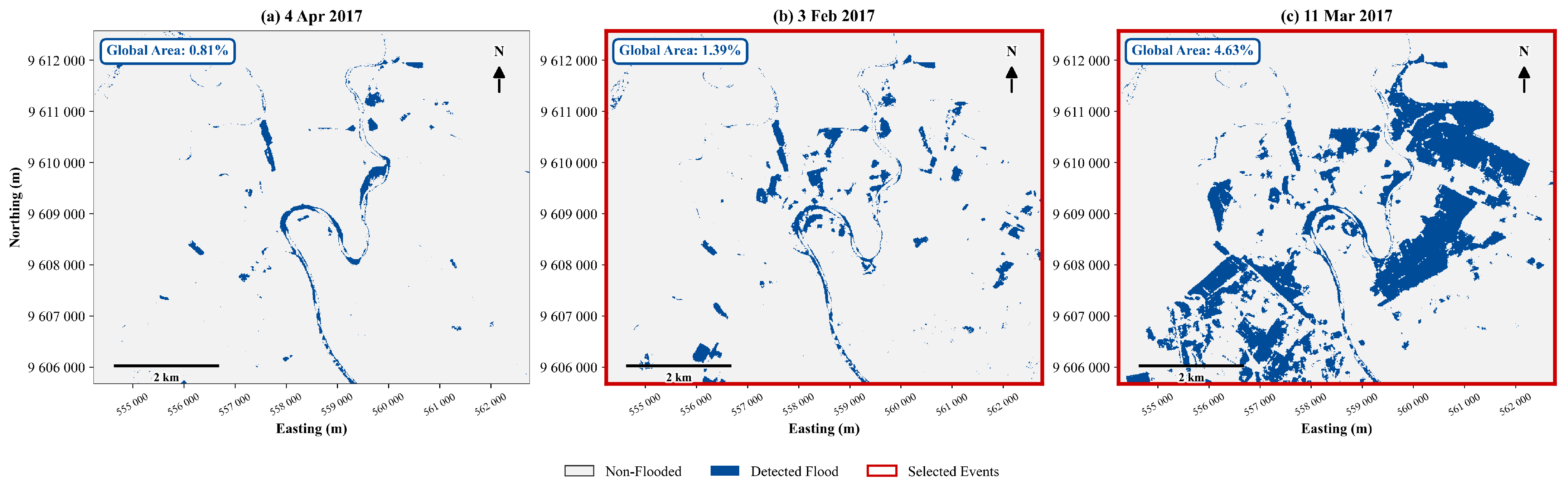
Spatiotemporal flood extent in the lower Tumbes floodplain (Zone 1) during the 2017 El Niño Costero. The panels depict the flood footprints isolated via the proposed temporal flood modeling, arranged in descending order based on the proportion of actively flooded area: (a) 4 April 2017, (b) 3 February 2017, and (c) 11 March 2017. Selected events are highlighted with red borders.
Figure 11.
Spatiotemporal flood extent in the lower Tumbes floodplain (Zone 1) during the 2017 El Niño Costero. The panels depict the flood footprints isolated via the proposed temporal flood modeling, arranged in descending order based on the proportion of actively flooded area: (a) 4 April 2017, (b) 3 February 2017, and (c) 11 March 2017. Selected events are highlighted with red borders.
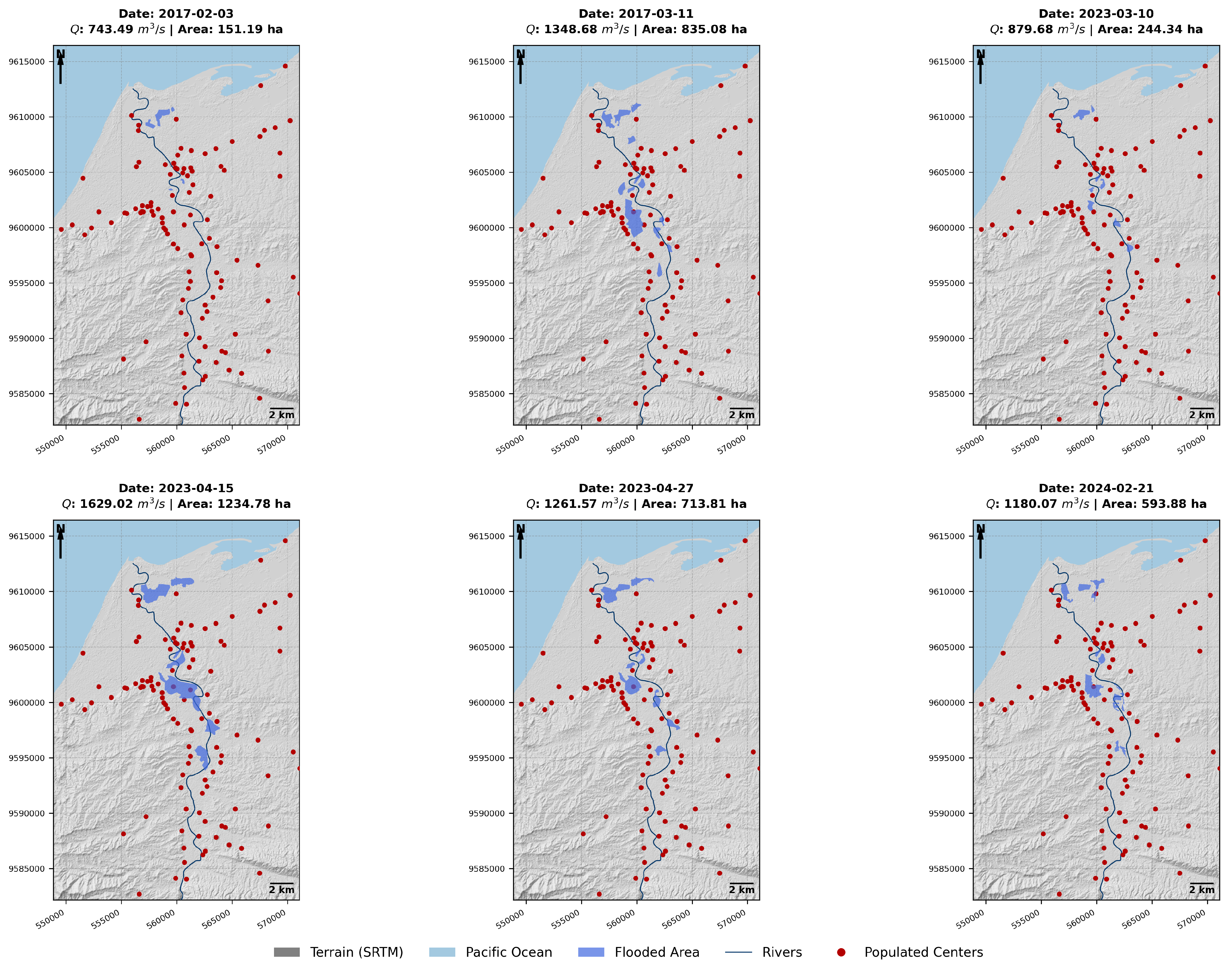
Figure 12.
Flood extent maps corresponding to all analyzed hydrological events.
Figure 12.
Flood extent maps corresponding to all analyzed hydrological events.
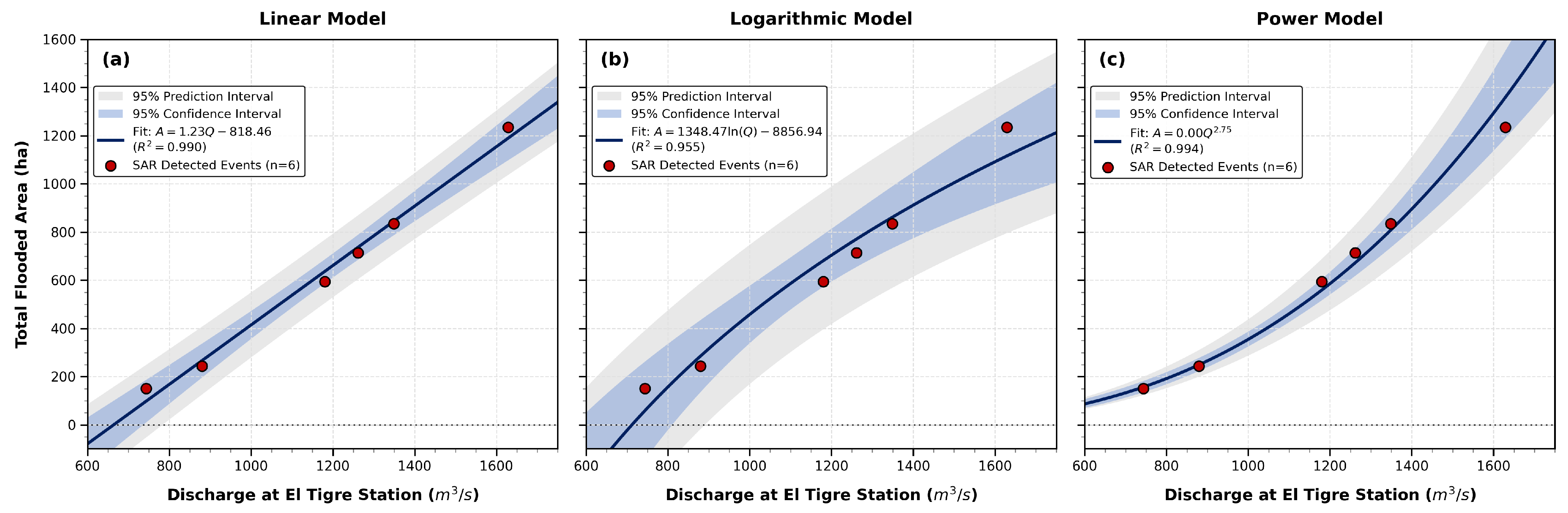
Figure 13.
Comparative analysis of hydrological impact models. The panels illustrate the (a) Linear, (b) Logarithmic, and (c) Power regression models correlating peak discharge at El Tigre station with the total flooded area. Each model displays the 95% confidence interval (blue band) and the 95% prediction interval (grey band) derived from the six SAR-detected events.
Figure 13.
Comparative analysis of hydrological impact models. The panels illustrate the (a) Linear, (b) Logarithmic, and (c) Power regression models correlating peak discharge at El Tigre station with the total flooded area. Each model displays the 95% confidence interval (blue band) and the 95% prediction interval (grey band) derived from the six SAR-detected events.
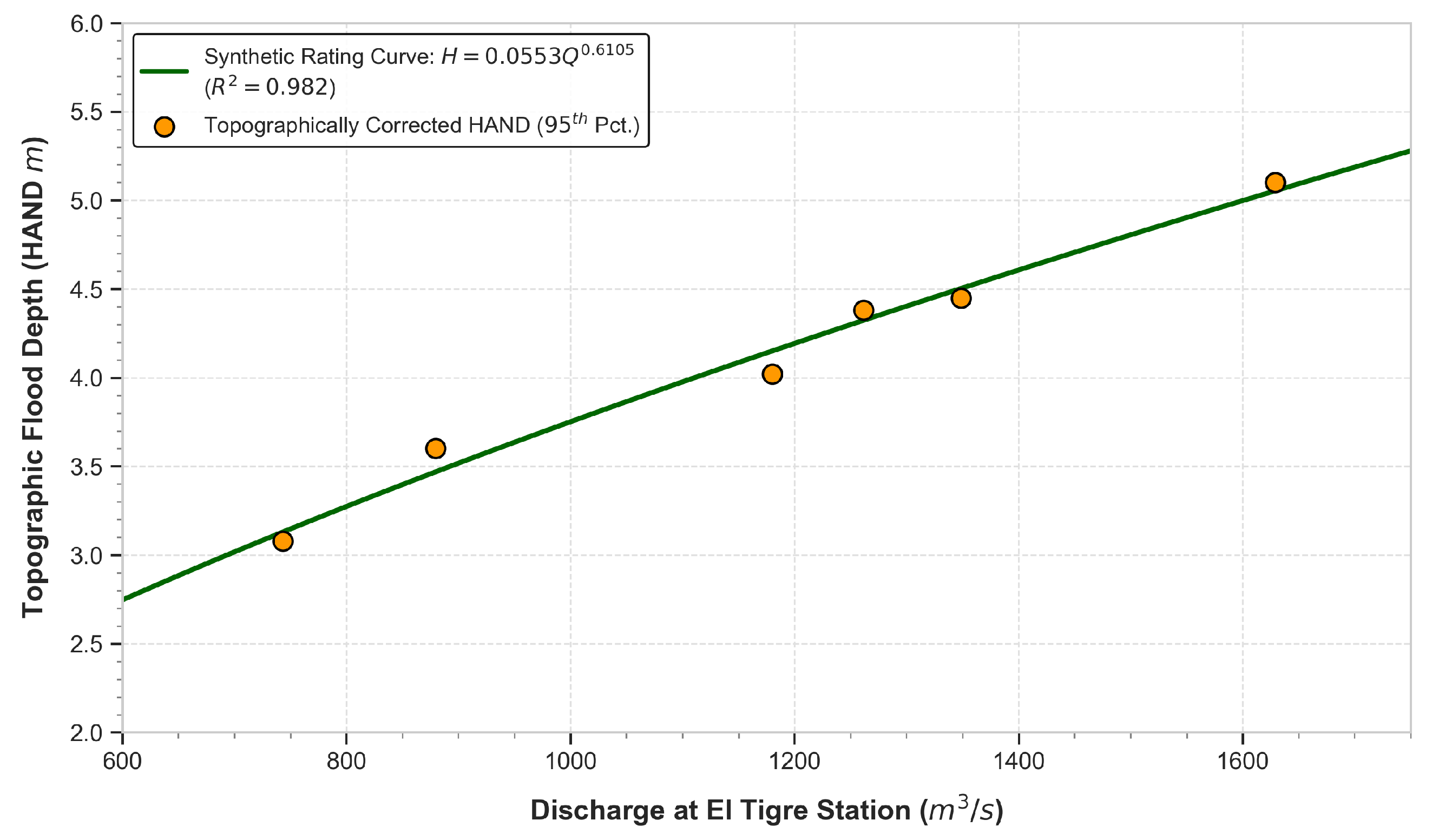
Figure 14.
Empirical relationship between the modeled discharge and the HAND topographic threshold (). The curve represents the fit of the power equation , which provides the altimetric limit of physical restriction used for the spatial refinement of the interpolated floodplains.
Figure 14.
Empirical relationship between the modeled discharge and the HAND topographic threshold (). The curve represents the fit of the power equation , which provides the altimetric limit of physical restriction used for the spatial refinement of the interpolated floodplains.
Figure 15.
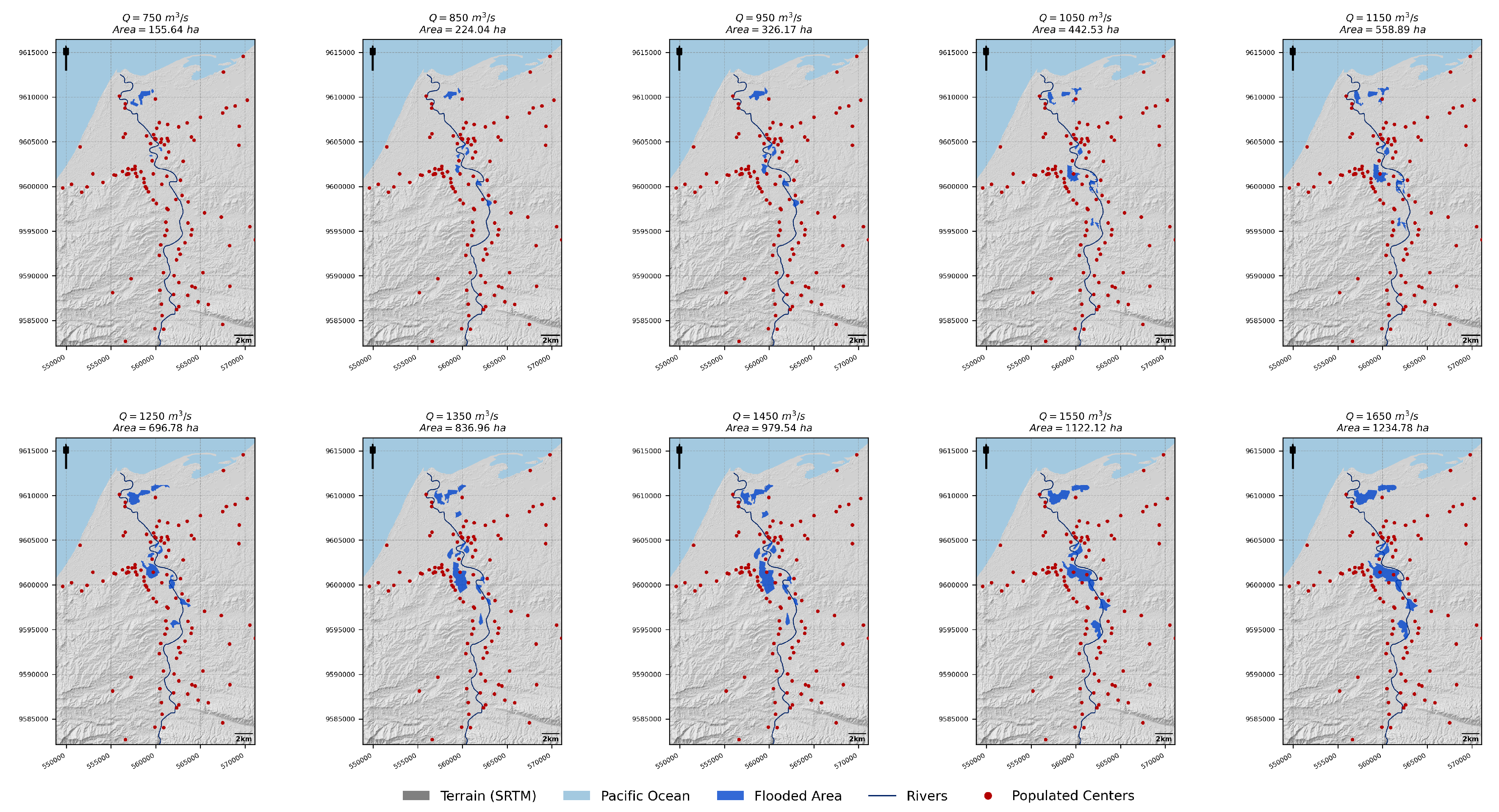
Spatio-temporal evolution of interpolated flood scenarios for discharges ranging from 750 to 1650 m3/s, visualized at intervals of 100 m3/s.
Figure 15.
Spatio-temporal evolution of interpolated flood scenarios for discharges ranging from 750 to 1650 m3/s, visualized at intervals of 100 m3/s.
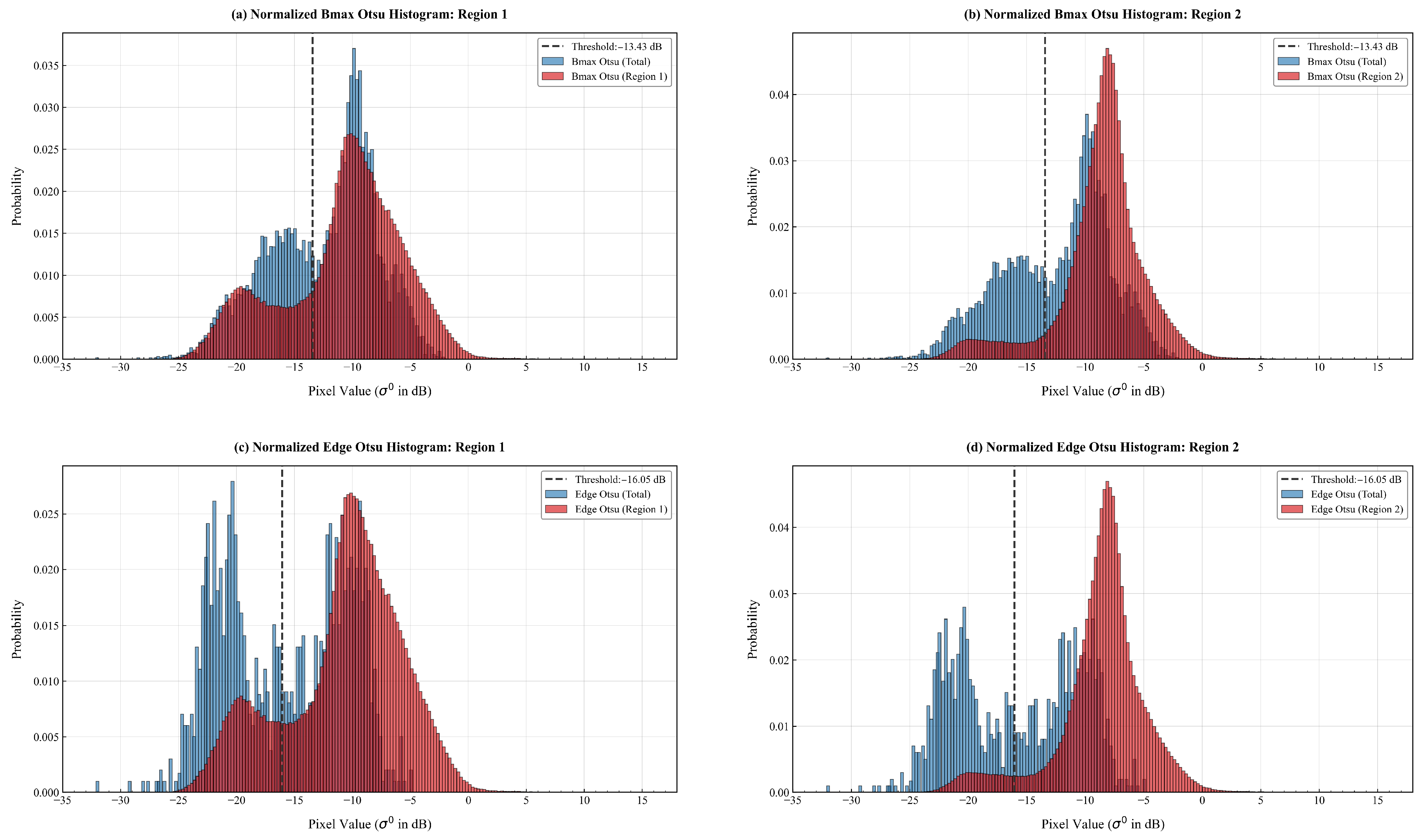
Figure 16.
Comparative backscatter histograms for the Total Area versus Zones 1 and 2, using Bmax Otsu and Edge Otsu for the 15 April 2023 event. (a) Comparison between Total Area Bmax and Zone 1. (b) Comparison between Total Area Bmax and Zone 2. (c) Comparison between Total Area Edge and Zone 1. (d) Comparison between Total Area Edge and Zone 2.
Figure 16.
Comparative backscatter histograms for the Total Area versus Zones 1 and 2, using Bmax Otsu and Edge Otsu for the 15 April 2023 event. (a) Comparison between Total Area Bmax and Zone 1. (b) Comparison between Total Area Bmax and Zone 2. (c) Comparison between Total Area Edge and Zone 1. (d) Comparison between Total Area Edge and Zone 2.
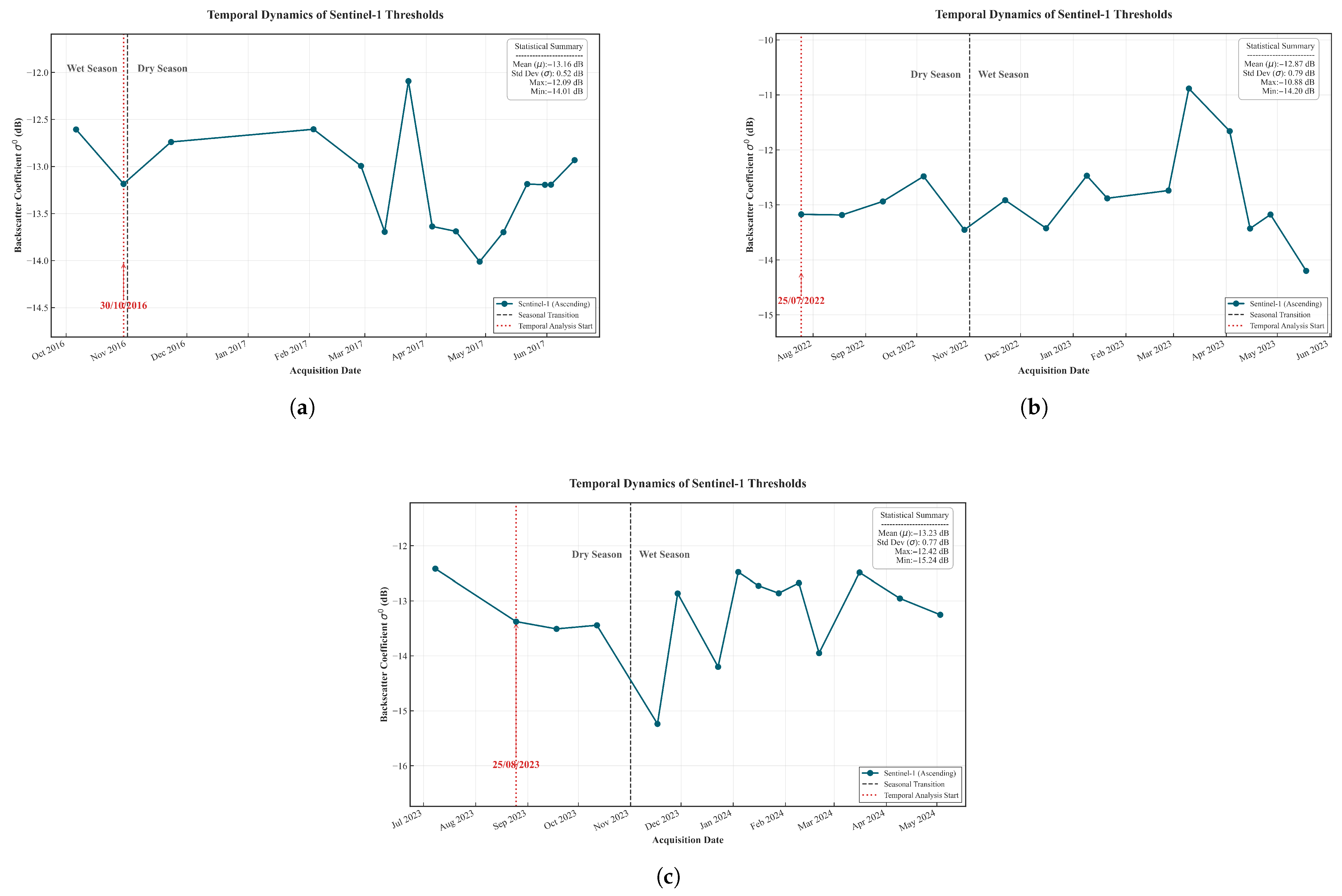
Figure 17.
Threshold time series derived from Sentinel-1 imagery. (a) 2017 Events. (b) 2023 Events. (c) 2024 Events.
Figure 17.
Threshold time series derived from Sentinel-1 imagery. (a) 2017 Events. (b) 2023 Events. (c) 2024 Events.
Table 1.
Technical specifications of the Sentinel-1 SAR imagery dataset used for the seven benchmark flood events. The table details the specific scene identifiers and acquisition parameters. All scenes belong to the Ascending orbit track.
Table 1.
Technical specifications of the Sentinel-1 SAR imagery dataset used for the seven benchmark flood events. The table details the specific scene identifiers and acquisition parameters. All scenes belong to the Ascending orbit track.
| Event | Date | Mission | Orbit | Time (UTC) | Sentinel-1 Scene ID |
|---|
| 1 | 3 February 2017 | S1B | Asc | 23:43:36 | S1B_IW_GRDH_1SDV_20170203T234336_...3420 |
| 2 | 11 March 2017 | S1B | Asc | 23:43:36 | S1B_IW_GRDH_1SDV_20170311T234336_...700C |
| 3 | 10 May 2017 | S1B | Asc | 23:43:38 | S1B_IW_GRDH_1SDV_20170510T234338_...6732 |
| 4 | 10 March 2023 | S1A | Asc | 23:44:41 | S1A_IW_GRDH_1SDV_20230310T234441_...C254 |
| 23:45:06 | S1A_IW_GRDH_1SDV_20230310T234506_...2111 |
| 5 | 15 April 2023 | S1A | Asc | 23:44:42 | S1A_IW_GRDH_1SDV_20230415T234442_...BEDA |
| 23:45:07 | S1A_IW_GRDH_1SDV_20230415T234507_...6A0B |
| 6 | 27 April 2023 | S1A | Asc | 23:44:42 | S1A_IW_GRDH_1SDV_20230427T234442_...1D0E |
| 23:45:07 | S1A_IW_GRDH_1SDV_20230427T234507_...114B |
| 7 | 21 February 2024 | S1A | Asc | 23:44:46 | S1A_IW_GRDH_1SDV_20240221T234446_...20CD |
| 23:45:11 | S1A_IW_GRDH_1SDV_20240221T234511_...69F6 |
Table 2.
Selected dates for temporal flood mapping analysis.
Table 2.
Selected dates for temporal flood mapping analysis.
| 2017 | 2023 | 2024 |
|---|
| Date | Stage | Date | Stage | Date | Stage |
|---|
| 6 October 2016 | | 25 July 2022 | Start | 8 July 2023 | |
| 30 October 2016 | Start | 18 August 2022 | | 25 August 2023 | Start |
| 23 November 2016 | | 11 September 2022 | | 18 September 2023 | |
| 3 February 2017 | Event 1 | 5 October 2022 | | 12 October 2023 | |
| 27 February 2017 | | 29 October 2022 | | 17 November 2023 | |
| 11 March 2017 | Event 2 | 22 November 2022 | | 29 November 2023 | |
| 23 March 2017 | | 16 December 2022 | | 23 December 2023 | |
| 4 April 2017 | | 9 January 2023 | | 4 January 2024 | |
| 16 April 2017 | | 21 January 2023 | | 16 January 2024 | |
| 28 April 2017 | | 26 February 2023 | | 28 January 2024 | |
| 10 May 2017 | Event 3 | 10 March 2023 | Event 4 | 9 February 2024 | |
| 22 May 2017 | | 3 April 2023 | | 21 February 2024 | Event 7 |
| 31 May 2017 | | 15 April 2023 | Event 5 | 16 March 2024 | |
| 3 June 2017 | | 27 April 2023 | Event 6 | 9 April 2024 | |
| 15 June 2017 | | 18 May 2023 | | 3 May 2024 | |
Table 3.
Hydrological characteristics of the selected benchmark flood events recorded at El Tigre station. The discharge values (Q) correspond to the representative hydraulic conditions for each event.
Table 3.
Hydrological characteristics of the selected benchmark flood events recorded at El Tigre station. The discharge values (Q) correspond to the representative hydraulic conditions for each event.
| Event ID | Date | Time (Local) | Discharge (m3/s) |
|---|
| E1 | 3 February 2017 | 18:43 | 743.49 |
| E2 | 11 March 2017 | 18:43 | 1348.68 |
| E3 | 10 May 2017 | 18:43 | 588.31 |
| E4 | 10 March 2023 | 18:44 | 879.68 |
| E5 | 15 April 2023 | 18:44 | 1629.02 |
| E6 | 27 April 2023 | 18:44 | 1261.57 |
| E7 | 21 February 2024 | 18:44 | 1180.07 |
Table 4.
Threshold values for Bmax Otsu and Edge Otsu algorithms across the analyzed events.
Table 4.
Threshold values for Bmax Otsu and Edge Otsu algorithms across the analyzed events.
| Event | Sentinel Scene | Orbit | Bmax (dB) | Edge (dB) |
|---|
| 1 | S1_20170203T234336_3420 | Ascending | −12.60 | −13.18 |
| 2 | S1_20170311T234336_700C | Ascending | −13.69 | −13.50 |
| 3 | S1_20170510T234338_6732 | Ascending | −13.70 | −14.03 |
| 4 | S1_20230310T234441_C254 | Ascending | −10.88 | −12.76 |
| | S1_20230310T234506_2111 | Ascending | −12.47 | −12.99 |
| 5 | S1_20230415T234442_BEDA | Ascending | −13.43 | −16.05 |
| | S1_20230415T234507_6A0B | Ascending | −14.42 | −16.96 |
| 6 | S1_20230427T234442_1D0E | Ascending | −13.18 | −15.49 |
| | S1_20230427T234507_114B | Ascending | −14.42 | −15.25 |
| 7 | S1_20240221T234446_20CD | Ascending | −13.95 | −17.82 |
| | S1_20240221T234511_69F6 | Ascending | −16.21 | −16.57 |
Table 5.
Statistical comparison between Bmax Otsu and Edge Otsu (Standard Deviations in parentheses).
Table 5.
Statistical comparison between Bmax Otsu and Edge Otsu (Standard Deviations in parentheses).
| Statistic | Bmax Otsu | Edge Otsu |
|---|
| Overall Accuracy | 0.958 (0.0076) | 0.957 (0.0133) |
| Cohen’s Kappa | 0.661 (0.0468) | 0.637 (0.0742) |
| F1-Score | 0.683 (0.0415) | 0.656 (0.0717) |
| Precision | 0.656 (0.0636) | 0.711 (0.0738) |
| Recall | 0.803 (0.0656) | 0.706 (0.1613) |
| Precision/Recall | 0.837 (0.1300) | 1.159 (0.4991) |
Table 6.
Intersection over Union (IoU) index comparison between Bmax Otsu and Edge Otsu models.
Table 6.
Intersection over Union (IoU) index comparison between Bmax Otsu and Edge Otsu models.
| | ZONE 1 | ZONE 2 | TOTAL AREA |
|---|
| | Bm/Det | Bm/Ed | Ed/Det | Bm/Det | Bm/Ed | Ed/Det | Bm/Det | Bm/Ed | Ed/Det |
|---|
| IoU | 0.455 | 0.779 | 0.427 | 0.352 | 0.692 | 0.351 | 0.456 | 0.780 | 0.450 |
Table 7.
Summary of socioeconomic impacts (affected population and flooded agricultural area) for the evaluated events at El Tigre station.
Table 7.
Summary of socioeconomic impacts (affected population and flooded agricultural area) for the evaluated events at El Tigre station.
| Peak Discharge (m3/s) [Date] | District | Affected Population (n) | Flooded Area (ha) |
|---|
| 743.49 [3 February 2017] | Corrales | 2 | 5.22 |
| | Tumbes | 155 | 145.97 |
| | Total | 157 | 151.19 |
| 879.67 [10 March 2023] | Corrales | 25 | 64.32 |
| | S. Jacinto | 2 | 7.45 |
| | San Juan | 19 | 45.26 |
| | Tumbes | 136 | 127.30 |
| | Total | 182 | 244.34 |
| 1180.07 [21 February 2024] | Corrales | 92 | 243.68 |
| | S. Jacinto | 8 | 52.88 |
| | San Juan | 18 | 42.75 |
| | Tumbes | 271 | 254.57 |
| | Total | 389 | 593.88 |
| 1261.57 [27 April 2023] | Corrales | 100 | 265.20 |
| | S. Jacinto | 9 | 54.61 |
| | San Juan | 33 | 81.89 |
| | Tumbes | 332 | 312.10 |
| | Total | 474 | 713.81 |
| 1348.68 [11 March 2017] | Corrales | 166 | 406.91 |
| | S. Jacinto | 8 | 51.85 |
| | San Juan | 17 | 40.87 |
| | Tumbes | 322 | 302.97 |
| | Total | 513 | 835.08 |
| 1629.02 [15 April 2023] | Corrales | 180 | 476.89 |
| | P. Hospital | 1 | 6.12 |
| | S. Jacinto | 25 | 169.69 |
| | San Juan | 46 | 114.32 |
| | Tumbes | 497 | 467.76 |
| | Total | 749 | 1234.78 |
Table 8.
Statistical comparison of the evaluated regression models for the Discharge-Area relationship. Fitted parameters, Adjusted coefficient of determination ( Adj), Root Mean Square Error (RMSE), Akaike Information Criterion (AIC), and Leave-One-Out Cross-Validation RMSE (RMSE LOOCV) are reported.
Table 8.
Statistical comparison of the evaluated regression models for the Discharge-Area relationship. Fitted parameters, Adjusted coefficient of determination ( Adj), Root Mean Square Error (RMSE), Akaike Information Criterion (AIC), and Leave-One-Out Cross-Validation RMSE (RMSE LOOCV) are reported.
| Model | Parameters () | Adjusted | RMSE | AIC | RMSE LOOCV |
|---|
| Linear | | | | | 67.89 |
| Logarithmic | | | | | |
| Power | | | | | |
Table 9.
Interpolated discharge values (Q), estimated affected population, and total flooded area.
Table 9.
Interpolated discharge values (Q), estimated affected population, and total flooded area.
| Q (m3/s) | Pop. (n) | Area (ha) | Q (m3/s) | Pop. (n) | Area (ha) | Q (m3/s) | Pop. (n) | Area (ha) |
|---|
| 750 | 163 | 155.64 | 1075 | 309 | 471.62 | 1400 | 557 | 908.25 |
| 775 | 180 | 172.74 | 1100 | 327 | 500.71 | 1425 | 579 | 943.89 |
| 800 | 198 | 189.84 | 1125 | 346 | 529.80 | 1450 | 601 | 979.54 |
| 825 | 153 | 206.94 | 1150 | 367 | 558.89 | 1475 | 623 | 1015.18 |
| 850 | 164 | 224.04 | 1175 | 384 | 587.98 | 1500 | 639 | 1050.83 |
| 875 | 178 | 241.14 | 1200 | 408 | 623.21 | 1525 | 661 | 1086.47 |
| 900 | 198 | 267.98 | 1225 | 438 | 660.00 | 1550 | 683 | 1122.12 |
| 925 | 220 | 297.08 | 1250 | 463 | 696.78 | 1575 | 703 | 1157.76 |
| 950 | 240 | 326.17 | 1275 | 486 | 732.51 | 1600 | 725 | 1193.40 |
| 975 | 261 | 355.26 | 1300 | 508 | 767.31 | 1625 | 745 | 1229.05 |
| 1000 | 282 | 384.35 | 1325 | 492 | 802.11 | 1650 | 749 | 1234.78 |
| 1025 | 304 | 413.44 | 1350 | 514 | 836.96 | | | |
| 1050 | 290 | 442.53 | 1375 | 536 | 872.61 | | | |
Table 10.
Comparison of affected population and agricultural areas between this study and the INDECI report (21 February 2024) [
78].
Table 10.
Comparison of affected population and agricultural areas between this study and the INDECI report (21 February 2024) [
78].
| District | Affected Population | Affected Agri. Areas (ha) |
|---|
| | This Study | INDECI | This Study | INDECI |
|---|
| Corrales | 92 | 57 | 243.68 | 200 |
| San Jacinto | 8 | 0 | 52.88 | 0 |
| S. J. de la Virgen | 18 | 0 | 42.75 | 0 |
| Tumbes | 271 | 233 | 254.57 | 405 |




 ,
,