


Highlights
What are the main findings?
- A novel diffusion-based and scale-adaptive framework, SiamDiff, is proposed for anti-UAV tracking.
- Three new modules—Learnable Mask Module, Frequency Channel Fusion Module, and Scale-Aware Diffusion Strategy—are introduced to improve the tracking accuracy of small UAV targets under complex backgrounds.
What is the implication of the main finding?
- SiamDiff significantly improves robustness and scalability in UAV tracking under complex real-world conditions.
- The proposed method achieves superior performance compared to state-of-the-art approaches on the Anti-UAV and Anti-UAV410 benchmarks.
Abstract
Unmanned aerial vehicle (UAV) tracking faces significant challenges due to small targets and background interference. Traditional anchor-based tracking algorithms require designing numerous proposals to capture such tiny targets, which entails unacceptable computational overhead. On the other hand, anchor-free tracking methods struggle to adapt to target scale variations, resulting in suboptimal tracking accuracy in anti-UAV tracking scenarios. To address these limitations, we pioneer the integration of diffusion models into visual tracking, proposing SiamDiff—a scale-adaptive anti-UAV framework. We reformulate the tracking task as a bounding box prediction problem, where a diffusion model is leveraged to generate scale-adaptive proposals. Furthermore, we propose a Learnable Mask Module (LMM) and a Frequency Channel Fusion Module (FCFM) to enhance discriminative feature extraction for small targets. Additionally, we design a Scale-Aware Diffusion Strategy (SADA) to boost robustness to scale variations. Experimental results on the Anti-UAV and Anti-UAV410 benchmarks demonstrate the effectiveness of our approach, achieving a State Accuracy (SA) of 71.90% and 67.03%, respectively, outperforming the baseline and other trackers. Moreover, our method shows superior adaptability to scale variations, confirming its robustness in complex anti-UAV tracking scenarios.
1. Introduction
With advancements in hardware and flight control technology, unmanned aerial vehicles (UAVs) have become increasingly integrated into various aspects of our daily life, with widespread applications in environmental monitoring, early warning systems, disaster relief, and beyond [1]. However, despite the substantial societal benefits brought by UAV proliferation, growing concerns regarding public safety and aviation security have emerged. Consequently, developing reliable anti-UAV tracking systems is of critical practical importance.
Anti-UAV tracking presents a unique set of challenges compared to conventional object tracking tasks: (1) Extremely Small Size: UAVs are significantly smaller than typical tracking targets. Captured by long-range imaging, they often occupy only a tiny fraction of the image, making accurate localization particularly difficult. (2) Infrared Background Interference: While infrared imaging is widely adopted for anti-UAV tracking due to its robustness under challenging conditions such as low illumination, haze, and nighttime scenarios, the absence of color information and small target size render UAVs highly susceptible to background clutter obscuration. (3) Severe Scale Variation: UAVs exhibit high maneuverability with unpredictable flight trajectories. Rapid movement along the depth axis induces drastic scale changes on the image plane, challenging the tracker’s ability to maintain accurate and consistent localization. These challenges necessitate anti-UAV tracking algorithms capable of suppressing background interference, precisely localizing small targets within large search regions, and robustly adapting to drastic scale variations.
Current tracking methods are broadly categorized into anchor-based and anchor-free paradigms. Anchor-based trackers typically rely on hand-crafted priors or Region Proposal Network (RPN) [2,3], with performance highly sensitive to factors such as the number, size, and aspect ratio of the proposed boxes. In UAV tracking scenarios, the inherently small target size leads to minimal occupied image area, posing challenges for proposal generation. Capturing such targets often requires generating a denser set of proposals, inevitably increasing computational overhead. In contrast, anchor-free trackers eliminate predefined anchors by formulating target localization as keypoint detection [4,5] or position regression problems [6,7]. For instance, SiamBAN [8] formulates visual tracking as a unified classification–regression problem and directly predicts the bounding box via a single fully convolutional network. TransT [9], meanwhile, leverages transformers for temporal modeling and treats tracking as a sequence prediction task to output bounding box coordinates. Although anchor-free trackers have achieved impressive performance on general tracking benchmarks, their effectiveness degrades notably in anti-UAV tracking scenarios. A major reason is that these methods implicitly rely on stable target scales and clear center responses to ensure reliable localization. However, UAVs in long-range imaging often exhibit weak textures, low signal-to-noise ratios, and ambiguous center cues, making accurate center-based localization challenging. In addition, UAVs frequently undergo rapid motion along the depth axis, causing drastic scale variations within only a few frames. Such abrupt and unstable scale changes further violate the scale-consistency assumption commonly adopted by anchor-free frameworks, leading to center drift and degraded tracking robustness.
To address the specific challenges of anti-UAV tracking, we propose SiamDiff, a diffusion-based, scale-adaptive tracking framework that directly predicts bounding box with enhanced robustness to scale variation. Inspired by DiffusionDet [10], we pioneer the integration of diffusion models into anti-UAV tracking. Concretely, we conceptualize a bounding box as an image with four pixels, and then analogize the location prediction task to image generation. During training, ground-truth bounding boxes are progressively corrupted by adding Gaussian noises over multiple timesteps until they degenerate into completely random noise boxes. A denoising network is then trained to remove the added noises from these corrupted boxes and reconstruct the original boxes. During inference, initial noisy bounding boxes sampled from a Gaussian distribution are iteratively refined by the trained denoising network into precise localizations.
In the diffusion framework, noise-initialized bounding boxes act as flexible, automatically generated anchors that require no manual design while enabling accurate prediction from only a sparse set of initial boxes. Unlike traditional approaches that depend on handcrafted anchors or scale-consistency assumptions, the diffusion process initializes bounding boxes from random noise and progressively refines them through a multi-step reverse denoising procedure. This generative refinement mechanism not only removes the limitations of manual anchor design but also offers stronger robustness to drastic scale variations. Moreover, the iterative refinement enables the model to gradually attend to weak-textured, small UAV targets, ensuring stable predictions even under low-SNR conditions.
SiamDiff employs a Siamese backbone [11] integrated with three key innovations for anti-UAV tracking. Firstly, we introduce a Learnable Mask Module (LMM) that adaptively generates an image mask to suppress background interference and enhance target focus. Secondly, we integrate a Frequency Channel Fusion Module (FCFM) in the prediction head, which enables efficient instance-level fusion of features from both the template and search branches, significantly improving small target localization. Thirdly, we design a Scale-Aware Diffusion Strategy (SADS) to specifically address UAV-specific minuscule size and scale variation challenges. DiffusionDet directly perturbs bounding boxes by adding Gaussian noise to both the center coordinates and absolute width/height values, which is suboptimal for capturing tiny-scale UAV targets occupying only a few pixels in the image. Unlike DiffusionDet, we predict the center coordinates and relative width/height variation as the target of the diffusion model. We therefore initialize diffusion with boxes sampled from a Gaussian distribution over relative dimension variations. This modification substantially improves tracking accuracy for small objects such as UAVs and scale adaptability.
We validate our method on the Anti-UAV and Anti-UAV410 benchmarks, where SiamDiff achieves a state accuracy (SA) of 71.90% and 67.03%, respectively, surpassing state-of-the-art (SOTA) approaches. Crucially, evaluations across varying target sizes demonstrate that our algorithm maintains robust tracking performance consistently, even at dramatically reduced scales, outperforming existing trackers. Furthermore, it demonstrates superior resilience to scale variation challenges, with performance gains exceeding 3.2% over the closest SOTA approach under severe scaling conditions.
In summary, our main contributions are as follows:
- We propose SiamDiff, a diffusion-based, scale-adaptive tracking framework for anti-UAV scenarios, achieving superior performance on the Anti-UAV and Anti-UAV410 benchmarks.
- We introduce a learnable mask module (LMM) and a frequency channel fusion module (FCFM), which enhance feature representation and significantly boost small-target tracking capability.
- We design a task-specific scale-aware diffusion strategy (SADS) that strengthens the perception of extremely small targets and robustness to scale variation.
2. Related Work
2.1. Anti-UAV Tracking
UAV-related tracking can be broadly divided into two types based on the tracking target: one involves tracking objects within the UAV’s aerial perspective, while the other focuses on tracking the UAV itself. Despite sharing similar names, these two tasks are fundamentally distinct.
In the task of object tracking from a UAV perspective, UAVs are employed for video acquisition, with the region of interest coming from the drone’s camera view. Notably, there are no specific constraints imposed on the target being tracked. In recent years, with the development of UAV technology, aerial tracking has been widely applied in fields such as agricultural protection, industrial inspection, and geographic surveying [12,13,14]. The Siamese network has been widely used in UAV aerial tracking due to its excellent performance in efficiency and accuracy. Cao et al. [15] proposed an attention-based Siamese network, SiamAPN++, which enhances feature representation capability through a constructed attention aggregation network, achieving a balance between robustness and real-time performance. Xing et al. [16] integrated the transformer with the Siamese network, proposing a novel framework named SiamTPN, which can aggregate semantic features across hierarchical levels and achieve real-time performance without compromising accuracy. A critical limitation of traditional Siamese trackers is their reliance on single-frame template updates, which neglects temporal context in video sequences. To address this, Yuan et al. [17] proposed MT-Track, a multi-step temporal modeling framework that dynamically fuses historical template features via cross-attention mechanisms, effectively balancing efficiency and precision in temporal modeling. In recent years, vision transformers (ViTs) have become a dominant backbone in tracking research, while their computational complexity hinders real-time performance in UAV aerial tracking. Xue et al. [18] tackled this challenge with SGLATrack, a similarity-guided layer-adaptive framework that selectively retains only the optimal feature layer for similarity matching, achieving efficient real-time UAV aerial tracking.
Anti-UAV tracking focuses on detecting and tracking UAVs themselves, aiming to mitigate potential security threats posed by unauthorized or malicious drone activities. Research on anti-UAV tracking using computer vision has gradually become an emerging research frontier in recent years. Jiang et al. [19] proposed the first large-scale anti-UAV tracking benchmark called Anti-UAV and proposed a dual-flow semantic consistency (DFSC) method. DFSC enhances the universal feature representation for UAV class targets by leveraging semantic information across video sequences while implementing instance-level feature calibration within the current sequence via Hadamard product operations. This approach achieves improved robustness and accuracy without introducing additional inference time. Zhao et al. [20] developed an integrated detection–tracking fusion strategy that activates the detection mechanism when confidence falls below a predefined threshold. This dynamic integration of the tracker’s localization capability and the detector’s high-precision characteristics substantially enhances tracking performance. Huang et al. [21] proposed a Siamese network named SiamDT, which employs a dual-semantic feature extraction mechanism to integrate foreground probability semantics with target matching semantics, improving the robustness of anti-UAV tracking in cluttered environments. Yu et al. [22] presented a transformer-based unified tracking framework called UTTracker, which incorporates a multiregion local tracking module for handling target appearance variations using temporal cues and a global detection module addressing frequent target disappearances.
2.2. Diffusion Model for Detection and Tracking
Diffusion models are likelihood-based generative models inspired by non-equilibrium thermodynamics [23]. Their core function is reconstructing data samples from randomly distributed noise through a denoising process. The diffusion process consists of two key steps: the forward process and the reverse process. In the forward process, Gaussian noise is incrementally added to the original image until it degenerates into pure random noise. The reverse process employs a trained network to predict the added noise, gradually reconstructing the original image from the noisy input. Initially successful in image generation, diffusion models have since expanded to diverse domains, including instance segmentation [24,25,26,27], audio processing [28,29,30,31], and video generation [32,33,34] (comprehensive surveys are provided in [35,36,37,38].).
Emerging studies have extended diffusion models to object detection and tracking. Pioneering work by Chen et al. [10] treated detection as a bounding box generation task, leveraging diffusion models to iteratively refine noisy boxes to predict target localizations—marking the first application of diffusion models to detection tasks. In the field of multi-object tracking (MOT), Lv et al. [39] proposed a diffusion-based real-time MOT framework, DiffuMOT. This approach models the motion distribution across the entire dataset and leverages historical motion information to generate future trajectories, enabling effective real-time tracking of nonlinear motion patterns. Luo et al. [40] introduced a method that adds noisy boxes to paired object boxes until they reach a random distribution, then generates cross-frame paired object boxes through a denoising diffusion process. This approach has demonstrated excellent performance on multiple MOT benchmarks. DiffusionTrack conceptualizes tracking as a point set-based diffusion process, which is the first attempt to apply diffusion models to single-object tracking (SOT) [41]. It comprises two main components: an encoder and a decoder. The encoder is designed for extracting target features, while the decoder refines target estimation stepwise through multiple diffusion layers. Each diffusion layer within the decoder generates a set of point sets, which iteratively focus on the target object via a reverse denoising process. However, DiffusionTrack struggles to effectively track small UAV targets, which may stem from the inherent limitations of representing tiny objects using point sets. To address this issue, we propose a scale-aware sampling strategy along with the feature enhancement module for anti-UAV tracking. These components enable our model to more accurately capture and track small targets even under challenging scenarios with complex background clutter.
3. Materials and Methods
3.1. Preliminaries
Anti-UAV: Consider a drone video sequence N and the initial bounding box coordinates of the target in the first frame, where denote the coordinates of the target’s top-left corner coordinates and w and h represent its width and height. The objective of anti-UAV technology is to achieve continuous and robust tracking of the target in subsequent frames by predicting the bounding box coordinates. Due to small targets, complex flight environments, and susceptibility to background clutter, the localization and tracking of UAVs remains a challenging problem to date.
Diffusion model: Diffusion models consist of two stages: the forward process and the reverse process. The forward process, also termed the diffusion process, progressively corrupts the original image by iteratively adding Gaussian noise until it degenerates into pure random noise. Governed by a predefined noise schedule, the forward process forms a fixed Markov chain with no learnable parameters. The diffusion process is defined as follows:
where and denote the original image and the t-step noised image, respectively. represents Gaussian noise, and , with being a hyperparameter that controls the noise level at step i.
The reverse process aims to reconstruct data samples from the noise. This is achieved by training a noise prediction network to estimate the noise added during the forward process. Starting from a random noise sample, the reverse process iteratively denoises the data over multiple steps, ultimately generating a pure image. The denoising process is formally defined as follows:
where represents the noise prediction network, .
3.2. Architecture
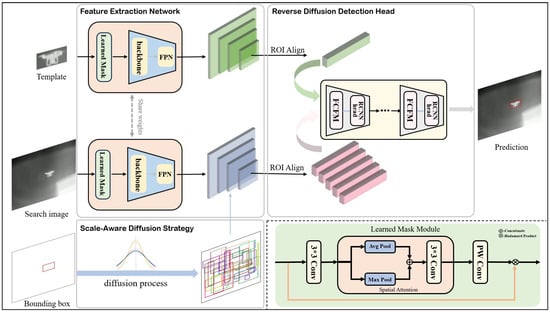
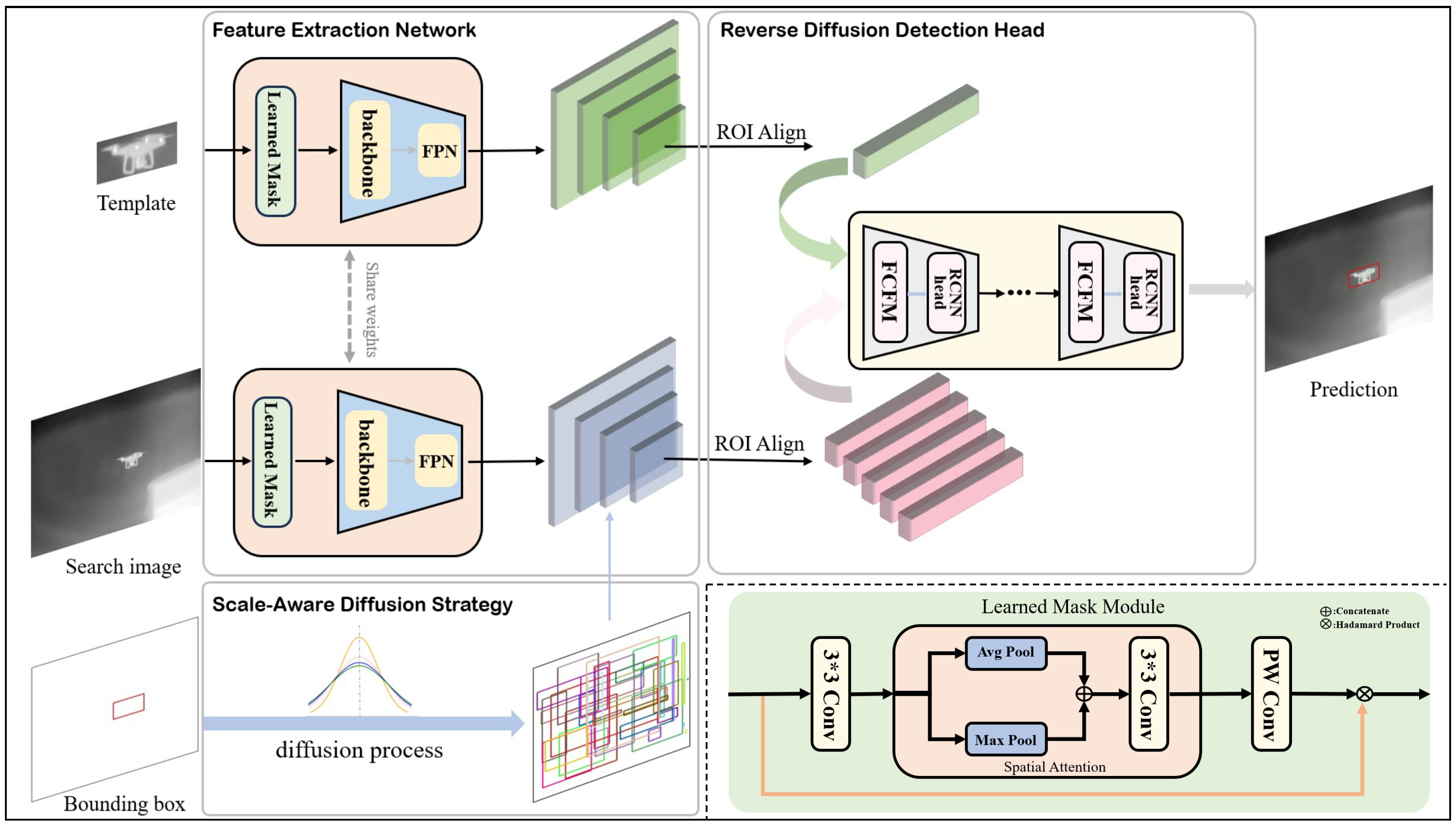
As shown in Figure 1, the overall framework of SiamDiff is inspired by the Siamese network, consisting of two primary branches: a template branch and a search branch. The template branch receives the target from the first frame of the video sequence, while the search branch processes the corresponding search region in subsequent frames. The framework comprises two main components: a feature extraction network for obtaining image features and a reverse diffusion prediction head for estimating the bounding box coordinates.
Figure 1.
Overall architecture of SiamDiff. The overall architecture of SiamDiff is a Siamese network, comprising a feature extraction network for image feature extraction and a reverse diffusion prediction head for bounding box prediction.
The overall pipeline of the SiamDiff is as follows: The input image is processed by the feature extraction network to obtain deep feature representations. Subsequently, the noisy boxes are generated by sampling from the Gaussian distribution. These generated noisy boxes are then employed to crop features from the feature map output using the feature extraction network. The resulting ROI features are fed into the inverse diffusion prediction head for estimating bounding box coordinates. Since the ROI is determined by the noisy box, this process can be viewed as an alternative proposal generation method similar to traditional Region Proposal Networks (RPNs), implemented through the forward process of a diffusion model. Unlike RPNs, this method introduces no learnable parameters, thereby simplifying the model architecture and reducing the overall parameter count. Moreover, by generating noisy boxes through stochastic perturbations centered on the target, this approach mitigates the uncertainty associated with manually designed candidate proposals. This design also improves the model’s adaptability to scale variations, offering notable advantages in tracking small-scale objects like UAVs.
3.2.1. Feature Extraction Network
The dual-branch feature extraction network employs shared parameters to extract deep features. This network primarily comprises three components: a Learned Mask Module (LMM), a backbone network, and a Feature Pyramid Network (FPN) [42]. The LMM is used to generate a mask for suppressing background interference, with the same channel dimensions as the input image. We leverage the convolutional neural network ResNet-50 [43] and the transformer-based architecture Swin Transformer [44] as the backbone, which have been widely adopted in visual tracking tasks. An FPN network is appended after the backbone to output multiscale feature maps, enhancing the model’s capability to handle potential scale variations.
3.2.2. Learned Mask Module
The Learnable Mask Module is a lightweight, plug-and-play component that can be seamlessly integrated into existing models. The structure of the LMM is illustrated in Figure 1. The module is designed with simplicity and efficiency, consisting of a series of convolutional layers. Initially, a 128-channel 3 × 3 convolutional layer is used to extract the initial feature representations from the input image. Subsequently, a spatial attention module is introduced to generate an initial spatial attention map. Point-wise convolution is employed to align the channel dimension of the attention map with that of the input image. Finally, the learned attention mask is applied to the input image via the Hadamard product. By processing the input image with the LMM, background interference can be effectively suppressed, and the discriminative features of small-scale targets are significantly enhanced.
3.2.3. Reverse Diffusion Prediction Head
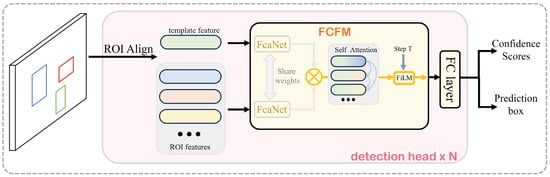
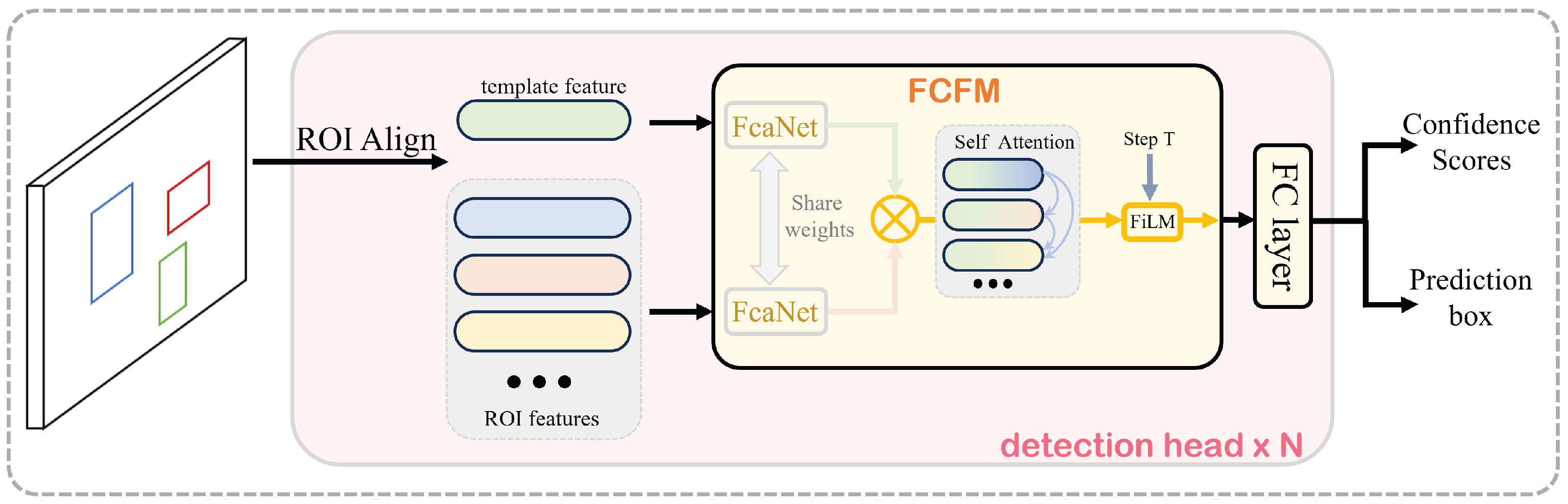
The reverse diffusion prediction head consists of multiple identical prediction heads cascaded in series, as shown in Figure 2. The features of candidate boxes are extracted from the search region features via the ROI Align operation. The ROI features, along with the template features, are then jointly fed into the frequency-domain channel fusion module (FCFM) for instance-level feature fusion. The fused features are subsequently processed by fully connected (FC) layers to generate the predicted bounding boxes. These predictions are iteratively refined by being passed to the subsequent heads, mirroring the progressive denoising process of the reverse diffusion process in diffusion models. Finally, fully connected layers produce the confidence scores and predicted box coordinates.
Figure 2.
Overall structure of reverse diffusion prediction head. The reverse diffusion prediction head is composed of multiple detection heads connected sequentially. Features from dual branches are effectively fused via frequency channel fusion module (FCFM) and then iteratively evaluated to output both confidence scores and predicted bounding box coordinates.
3.2.4. Frequency Channel Fusion Module
The structure of the frequency channel fusion module (FCFM) is illustrated in Figure 2. Specifically, the template features and ROI features are subjected to target feature enhancement through a weight-shared FcaNet firstly. FcaNet [45] is a method that utilizes the Discrete Cosine Transform (DCT) in the frequency domain to compress and refine channel information. Subsequently, the enhanced features are fused via the Hadamard product to integrate information from the dual branches. A self-attention mechanism is applied to enable interaction across instances, allowing each candidate bounding box to access information from others and enhancing contextual perception. Finally, the diffusion timestep T is incorporated into the features using feature-wise linear modulation (FiLM), following a common design for denoising networks adopted in diffusion models.
3.2.5. Scale-Aware Diffusion Strategy
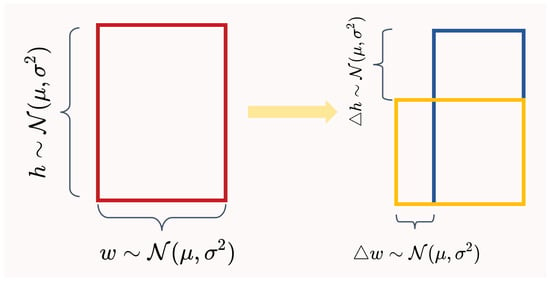
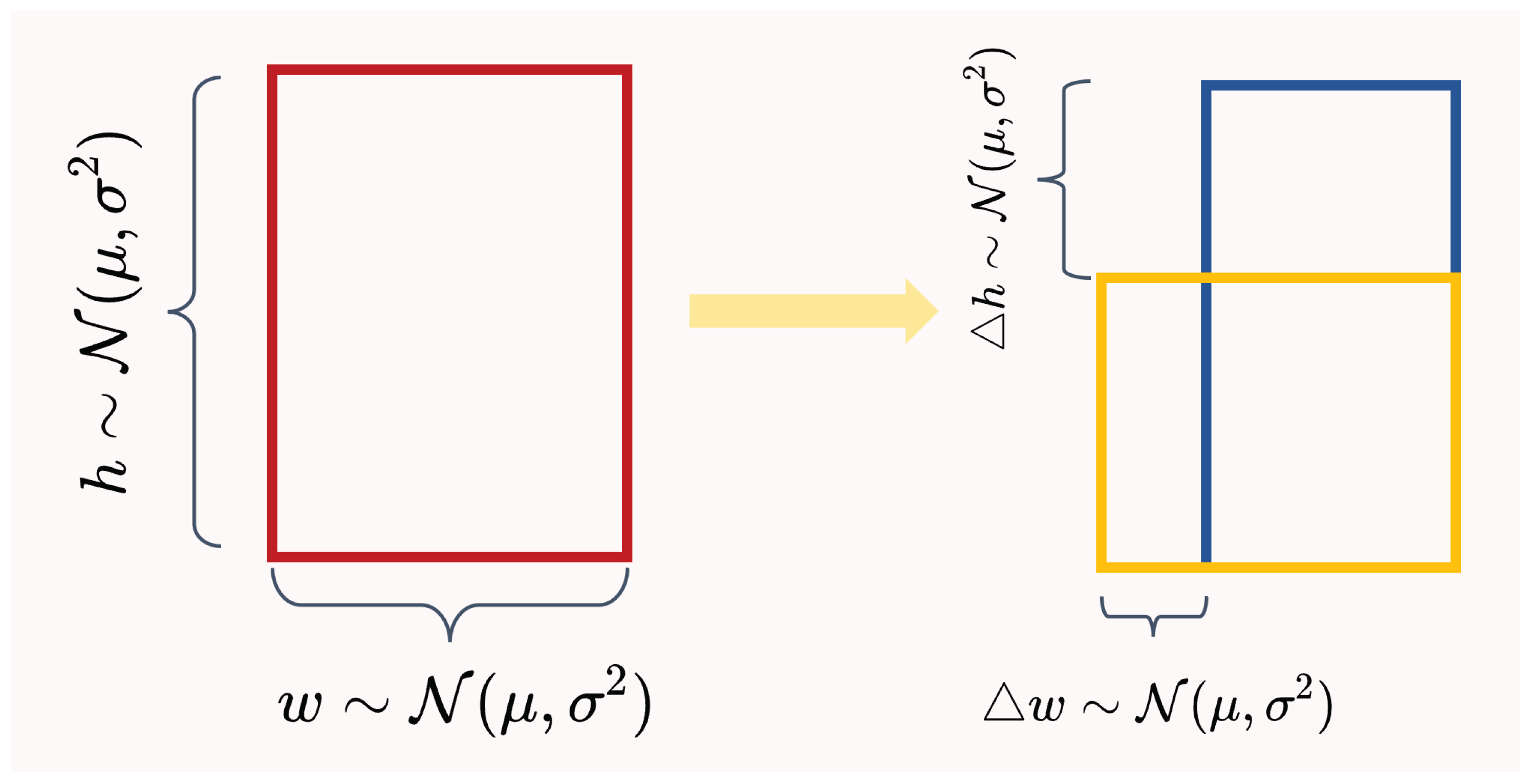
The forward process of the diffusion model progressively transforms the input into pure random noise by continuously adding noise. In our task, this process is formulated as sampling several noise boxes from a Gaussian distribution and incrementally adding them to the ground-truth (GT) box, simulating the target box distribution under noise interference. In DiffusionDet [10], the four normalized coordinates of the noise box all follow a Gaussian distribution. While this strategy is reasonable for common tracking scenarios, it is suboptimal for tiny targets such as UAVs, which typically occupy only a small portion of the image. Under this scheme, most sampled noise boxes are significantly larger than the target, leading to poor simulation of realistic target distributions. To address this limitation, we propose the Scale-Aware Diffusion Strategy (SADS). This strategy is straightforward: sample noisy boxes based on the principle that increments/decrements in width/height follow a Gaussian distribution, as illustrated in Figure 3. Consequently, the noise boxes generated by our method maintain scales consistent with the target. Moreover, since the scale variation follows a Gaussian distribution, the model naturally exhibits sensitivity to scale changes, improving its handling of target scale variations during tracking. Experimental results demonstrate that this strategy effectively improves the model’s tracking accuracy for UAVs. For further details, please refer to Section 4.
Figure 3.
Schematic of the Scale-Aware Diffusion Strategy (SADS). Traditional methods sample noisy boxes whose absolute width/height values follow a Gaussian distribution. Alternatively, our method adopts a scale-aware strategy, where relative width/height variations follow a Gaussian distribution. (The colors of the figure are for visual clarity only and have no specific meaning.).
3.3. Training
Anti-UAV tracking involves predicting the position and scale of the target, typically represented by four bounding box parameters: . During training, Gaussian noise is progressively added to the ground-truth bounding box (GTbox) until a randomly distributed noisy box is obtained. This process can be viewed as applying a series of random perturbations to the GTbox. The noisy box is then fed into the prediction network to obtain the predicted box coordinates. Notably, the objective of the prediction network during training is to learn how to predict the target noiseless bounding box from the noisy box, instead of predicting the noise, as in DDPM [23]. This design choice allows the head network to serve directly as the prediction module, simplifying the overall tracking framework by eliminating the need for an additional noise prediction network.
Most of training configurations follow those of DiffusionDet, with one key difference: the setting of the signal scaling factor. This factor directly affects the signal-to-noise ratio (SNR) during the diffusion process, which is critical to the performance of diffusion-based models [46]. Since UAVs are significantly smaller than typical tracking targets, they naturally exhibit a much lower SNR under identical conditions. Consequently, a larger signal scaling factor than that used in DiffusionDet is required to achieve optimal performance. Further details are discussed in Section 4.4.
3.4. Inference
During inference, the input noisy bounding box is obtained by sampling from a Gaussian distribution. The trained denoising model is then used to iteratively predict the target bounding box directly from this randomly sampled noisy box. Following this, the corresponding predicted noise is inferred in reverse using the mathematical formulation of the diffusion process, as expressed by the following equation:
Experimental results from DiffusionDet demonstrate that predictions obtained through iterative denoising yield greater accuracy than directly using the predicted-target bounding box as the final output. In this work, we employ the Denoising Diffusion Implicit Model (DDIM) [47] sampling algorithm as the iterative denoising strategy for our diffusion model. It derives the bounding box coordinates for the subsequent step based on both the predicted box at the current step and the predicted noise value, as defined in Equation (4) (implementation details follow [47]).
3.5. Loss Function
The loss function consists of two parts: classification loss and bounding box regression loss. The classification loss uses cross-entropy loss, and the bounding box regression loss adopts a combination of L1 loss and GIoU loss, as defined in Equation (5).
The weights for the loss components (, , and ) are set to 2.0, 2.0, and 5.0, respectively.
4. Results
4.1. Implementation Details
We adopt Swin-Base as the default feature extraction backbone and initialize it with ImageNet-21K pretrained weights. All other backbone hyperparameters follow the default Detectron2 configuration. For target localization, we employ a global search strategy, feeding both the search image and the template image into the network at their original resolutions (). Data augmentation strategies—including random cropping, horizontal flipping, and scaling—are applied independently to the two branches. We use the AdamW optimizer with an initial learning rate of and a weight decay of . The model is trained on two NVIDIA TITAN RTX GPUs (24 GB each), with a mini-batch size of four images and a total of 160 K iterations.
During inference, we adopt a fixed-template strategy, using the first frame of each video sequence as the template. All hyperparameters during inference remain consistent with those used in training.
- Datasets: We conducted experiments on the Anti-UAV and Anti-UAV410 datasets. Anti-UAV represents the first large-scale benchmark for UAV tracking [48]. It comprises 318 pairs of video sequences and 580,000 manually annotated bounding boxes. This dataset encompasses two lighting conditions (daytime and nighttime) and two spectral bands (infrared and visible). Moreover, it features a wide range of background scenes, including urban structures, clouds, and vegetation, providing a comprehensive and challenging testbed for drone detection and tracking tasks. Anti-UAV410 is a large thermal infrared Anti-UAV tracking benchmark released in 2023 [21]. It comprises 410 video sequences with over 400,000 frames, capturing diverse tracking environments, including forests, mountains, lakes, and urban areas. The dataset is partitioned into three subsets: a training set (200 video sequences), a validation set (90 video sequences), and a test set (120 video sequences). It contains more than 438,000 manually annotated bounding boxes and systematically annotates video sequences with six challenging attributes: out-of-view (OV), occlusion (oc), thermal crossover (TC), fast motion (FM), scale variation (SV), and dynamic background clutter (DBC). As the largest single-target UAV tracking dataset in the thermal infrared field, Anti-UAV410 serves as a critical benchmark for evaluating tracker robustness in tracking UAVs under cluttered and complex environments.
- Evaluation metrics: We evaluated tracker performance using the one-pass evaluation (OPE), a standard assessment paradigm in single-object tracking research. Three metrics were employed: success curve, precision curve, and state accuracy (SA). The success curve quantifies tracking reliability by measuring the accuracy of predicted bounding box localization and scale estimation. The success rate is defined as the percentage of video frames where the intersection-over-union (IoU) ratio between predicted and ground-truth bounding boxes exceeds predefined thresholds. We used the Area Under the Curve (AUC) of the success rate to measure the tracking accuracy of the tracker, with higher AUC values indicating superior tracking capability. The precision curve assesses spatial localization accuracy by computing the center position error between predicted and ground-truth values. Precision is calculated by determining the ratio of video frames where the distance between the center points of the ground-truth and predicted-target bounding boxes is less than a specific threshold (20 pixels). State accuracy (SA), a metric commonly used in anti-UAV tracking, evaluates the comprehensive performance of tracking algorithms by calculating the average overlap rate between predicted bounding boxes and ground-truth target bounding boxes in the video sequence [19].
4.2. Experiments on Anti-UAV410
4.2.1. Quantitative Comparisons
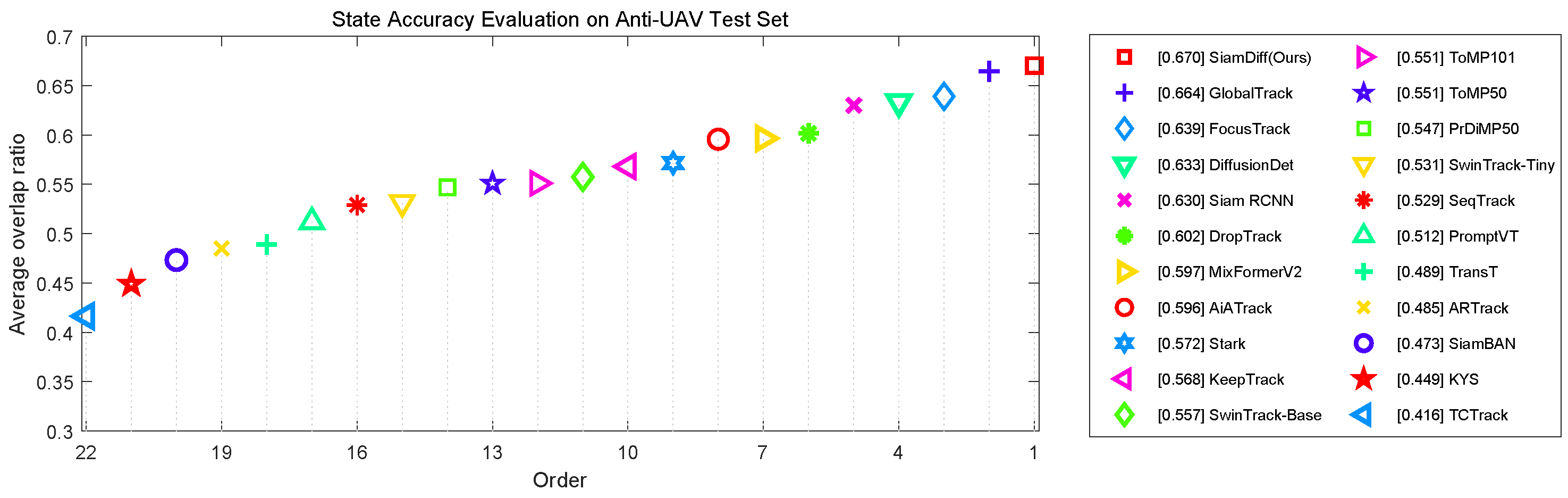
A quantitative evaluation of the proposed method was conducted using the one-pass evaluation (OPE) protocol, with comparisons made against 19 well-established trackers, including GlobalTrack [49], FocusTrack [50], DiffusionDet [10], Siam RCNN [3], DropTrack [51], MixFormerV2 [52], AiATrack [53], Stark [54], KeepTrack [55], SwinTrack [56], ToMp [57], PrDiMP [58], SeqTrack [59], PromptVT [60], TransT [9], ARTrack [61], SiamBAN [8], KYS [62], and TCTrack [63]. Figure 4 presents the performance comparison of SiamDiff with SOTA methods from the past five years on the Anti-UAV410 benchmark. All methods were retrained on the Anti-UAV410 training set using their default optimal configurations. As shown, our proposed method achieves the best performance, attaining a state accuracy (SA) score of 67.03%. Our method outperforms the second best, GlobalTrack, by 0.58%, and significantly outperforms other methods. This superior performance can be attributed to the powerful feature representation capability of the dual-branch architecture and the specified feature fusion model, combined with the exceptional adaptability of the Scale-Aware Diffusion Strategy for tracking small targets.
Figure 4.
Quantitative comparisons of different tracking algorithms on the Anti-UAV410 test set. State accuracy is used to rank different trackers. All algorithms were retrained on the Anti-UAV410 training set. Best viewed in color and zoom.
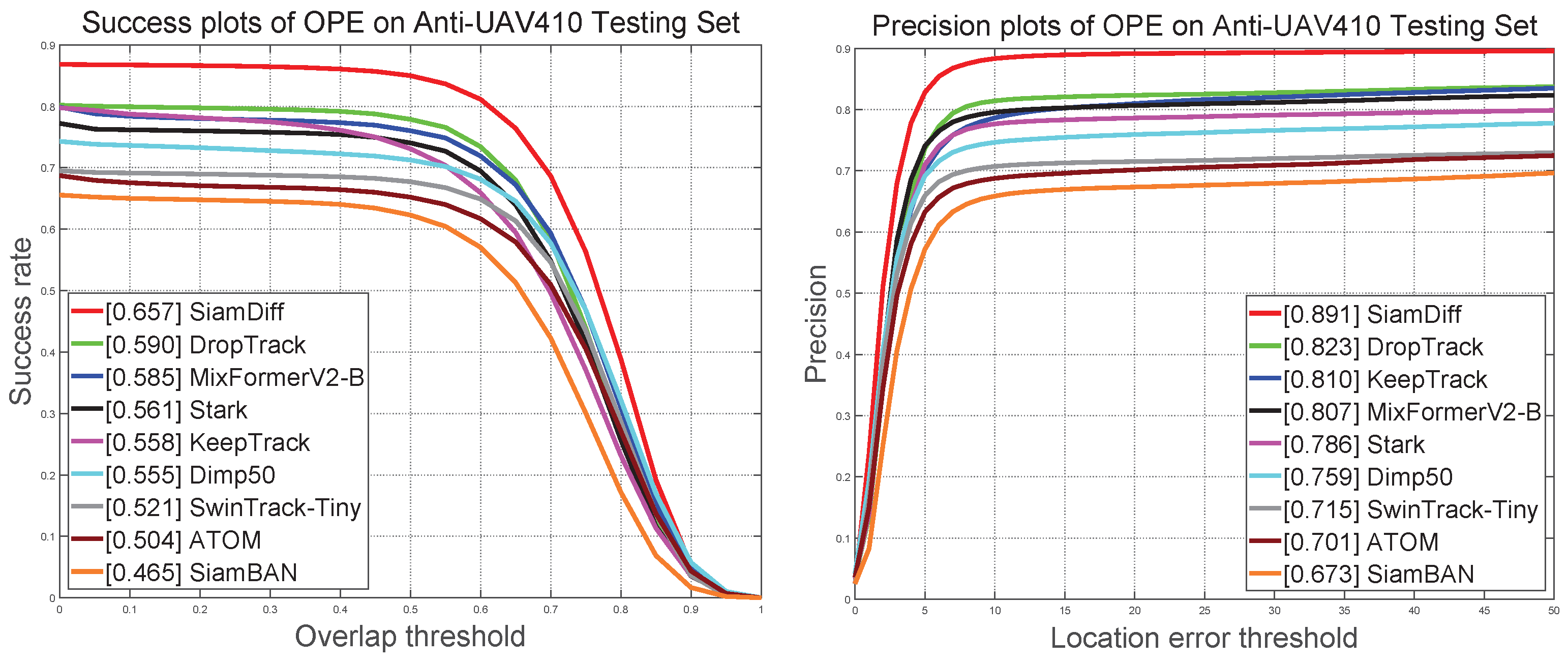
Figure 5 visualizes the success plot and precision plot of the trackers on the Anti-UAV410 testing set. Our method achieves the highest performance on both metrics, with a success rate of 0.657 and a precision of 0.891. Comparative experiments across multiple evaluation metrics demonstrate that our proposed method outperforms most existing trackers, underscoring its superior performance.
Figure 5.
Success (left) and precision plots (right) on the Anti-UAV410 testing set. Best viewed in color and zoom.
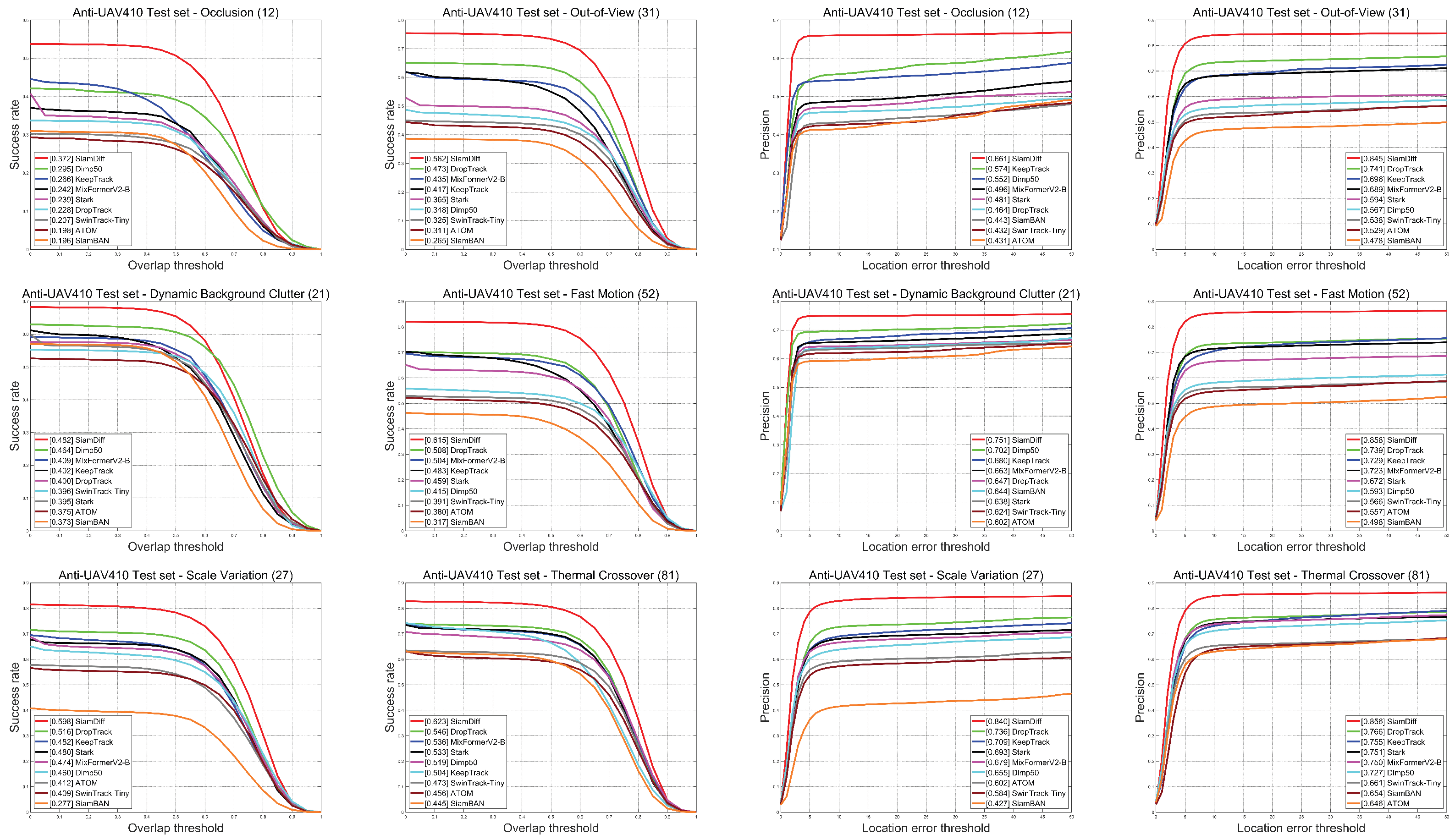
- Attribute-Based Analysis: We conducted a comparative analysis of the tracking performance across six attribute challenges within the Anti-UAV410 dataset: OC (occlusion), DBC (dynamic background clutter), SV (scale variation), OV (out-of-view), FM (fast motion), and TC (thermal crossover). Figure 6 presents the success plots and precision plots of the trackers for the pre-attribute challenge. The experimental results demonstrate that the proposed algorithm achieves remarkable performance in both success rate and precision across all attribute challenges, consistently outperforming the evaluated trackers.Figure 6. Attribute-based analysis on Anti-UAV410. Success plot (left) and precision plot (right) are shown for six challenging scenarios: OC (occlusion), DBC (dynamic background clutter), SV (scale variation), OV (out-of-view), FM (fast motion), and TC (thermal crossover). For optimal viewing experience, it is recommended to view the plots in color and zoom in.
4.2.2. Qualitative Comparisons
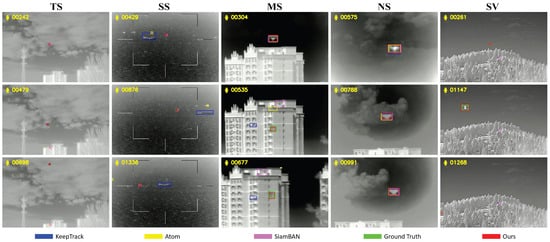
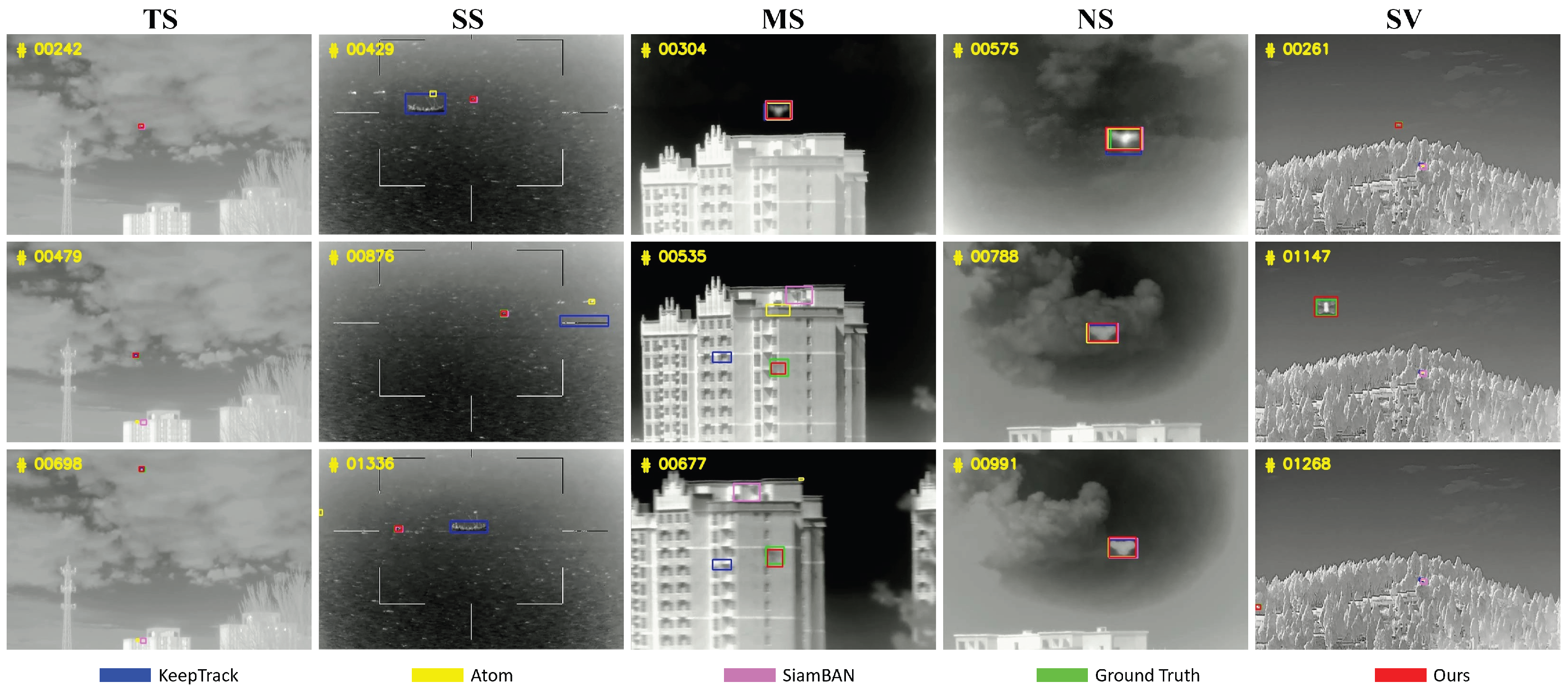
We visualized the performance of four trackers in tracking UAVs at different scales. The definition of the UAV scale follows [21]. As illustrated in Figure 7, all trackers achieve accurate tracking when the UAV scale is relatively large and free from complex background clutter. However, as the UAV scale decreases, our method maintains accurate and stable tracking, while other trackers either fail to track the target stably or misidentify background clutter as the target due to background interference. Additionally, we conducted further comparative experiments focusing on target scale variation. The results demonstrate that our proposed algorithm exhibits significantly superior adaptability to scale changes compared to the other trackers.
Figure 7.
Qualitative comparison. We selected varying-scale tracking sequences from the Anti-UAV410 dataset and visualized the results of four trackers. Comparisons are shown for four scales and one challenge: TS (tiny scale), SS (small scale), MS (medium scale), NS (normal scale), and SV (scale variation). Best viewed in color and zoom.
4.3. Experiments on Anti-UAV
Table 1 presents a performance comparison between the proposed method and SOTA methods from the past three years on the Anti-UAV benchmark, with experiments conducted under the infrared modality. As shown in the results, FocusTrack achieved a precision score of 90.90, surpassing SiamDiff. This advantage can be attributed to FocusTrack’s efficient restriction of the search region as a localization-based method. SiamDiff demonstrated comparable precision to FocusTrack, attaining a score of 90.44. Furthermore, SiamDiff significantly outperformed other algorithms in both the AUC and SA metrics, achieving scores of 71.94 and 71.90, respectively. Regarding inference speed, PromptVT achieved the optimal speed, reaching 59.73 FPS. However, it significantly lags behind other methods in terms of precision, AUC, and state accuracy (SA). DiffusionDet and SiamDiff, which both adopt diffusion-based frameworks, achieved comparable inference speeds of 8.86 FPS and 7.95 FPS, respectively. Overall, the results on the Anti-UAV benchmark demonstrate that SiamDiff achieves superior tracking accuracy and robustness compared with existing methods.
Table 1.
Comparisons of different tracking algorithms on the Anti-UAV testing set.
4.4. Ablation Study
Table 2 presents the ablation study evaluating the effectiveness of different components of the proposed tracking framework. The experimental findings demonstrate that employing the Swin Transformer as the backbone network significantly enhances tracking precision compared to the ResNet-50 backbone. This improvement is primarily attributed to the Swin Transformer’s superior feature representation capabilities, which are particularly beneficial for detecting UAVs that are typically small and easily obscured by background noise. The integration of a dual-branch architecture with a simple concatenation strategy for feature interaction substantially boosts tracking performance, resulting in gains of 2.88% and 1.96% when employing ResNet-50 and Swin Transformer as backbones, respectively. These results clearly validate the effectiveness of the Siamese network design for tracking tasks. Replacing the concatenation strategy for template-search branch feature interaction with the Frequency Channel Fusion Model (FCFM) further elevates tracking precision. Using the Swin Transformer backbone, this modification increases the state precision from 65.29% to 66.77%, representing an absolute improvement of 1.48%. Further incorporating the LMM module increased the precision to 64.40% (ResNet) and 66.87% (Swin Transformer). Finally, integrating the Scale-Aware Diffusion Strategy (SADS) achieved the optimal precision of 67.03%, surpassing the single-branch approach by 3.70%. Collectively, these ablation results comprehensively validate the effectiveness of the proposed components.
Table 2.
AblationExperiments on the effectiveness of different components on the Anti-UAV410 testing set.
- Signal scaling: The most significant distinction between anti-UAV tracking and conventional tracking tasks lies in the scale of the target. UAVs are substantially smaller than typical tracked objects. Furthermore, the vast majority of anti-UAV operations involve long-range imaging. These factors combine to create a substantial imbalance between the target scale and the background scale, resulting in the UAV target occupying less than 5% of the entire image. Low signal-to-noise ratio (SNR) poses a challenge for diffusion-based models, potentially degrading their tracking performance. To mitigate this issue, scaling the ground-truth bounding box (GT box) coordinates is necessary. A dedicated hyperparameter (signal scale) is introduced to control the degree to which the target box is enlarged. We conducted experiments to evaluate the impact of different signal scaling factors (signal scale = 1.0, 2.0, 3.0, 4.0) on tracking precision. As shown in Table 3, a signal scaling factor of 3.0 achieves the best performance, improving state accuracy (SA) by 0.79% compared with the original, unscaled bounding box coordinates. Notably, our results differ from those reported in DiffusionDet [10] (scale = 2.0). This discrepancy is likely due to the significantly smaller scale of the tracking targets in the Anti-UAV setting. Nonetheless, our findings reinforce a key insight from DiffusionDet: diffusion-based detection or tracking models generally perform better on targets that are easier to train and have a higher SNR.Table 3. Ablation Experiments with different signal scales on Anti-UAV410 testing set.
- Scale-aware diffusion strategy: In DiffusionDet, the distribution of proposal boxes is identical during training and inference, both following a Gaussian distribution. All proposals conform to a standard normal distribution after normalization. This strategy has proven effective in conventional object detection tasks. However, anti-UAV tracking presents unique challenges due to its extremely small scale. This characteristic may render this proposed distribution sampling strategy suboptimal. Motivated by this observation, we evaluated alternative sampling strategies for proposal generation. As shown in Table 4, our experiments reveal that most alternative distributions degrade tracking precision compared to the original Gaussian strategy. Notably, however, when proposals were sampled based on the aspect variation (i.e., the relative width/height variation follows a Gaussian distribution) rather than on the absolute values of width/height dimensions, the precision reached the highest performance of 67.03%. This optimal result is obtained under the condition that the signal scale is set to 3.0. This result suggests that the aspect variation-based sampling strategy may offer a more adaptive approach for diffusion-based trackers. In future work, we will conduct further research on this sampling strategy to validate its effectiveness under broader conditions.Table 4. Ablation experiments with different scale-aware diffusion strategies on the Anti-UAV410 testing set.
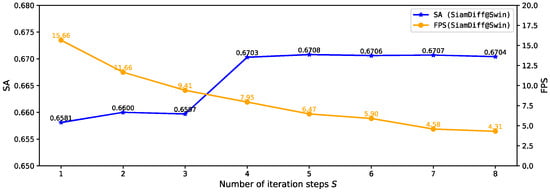
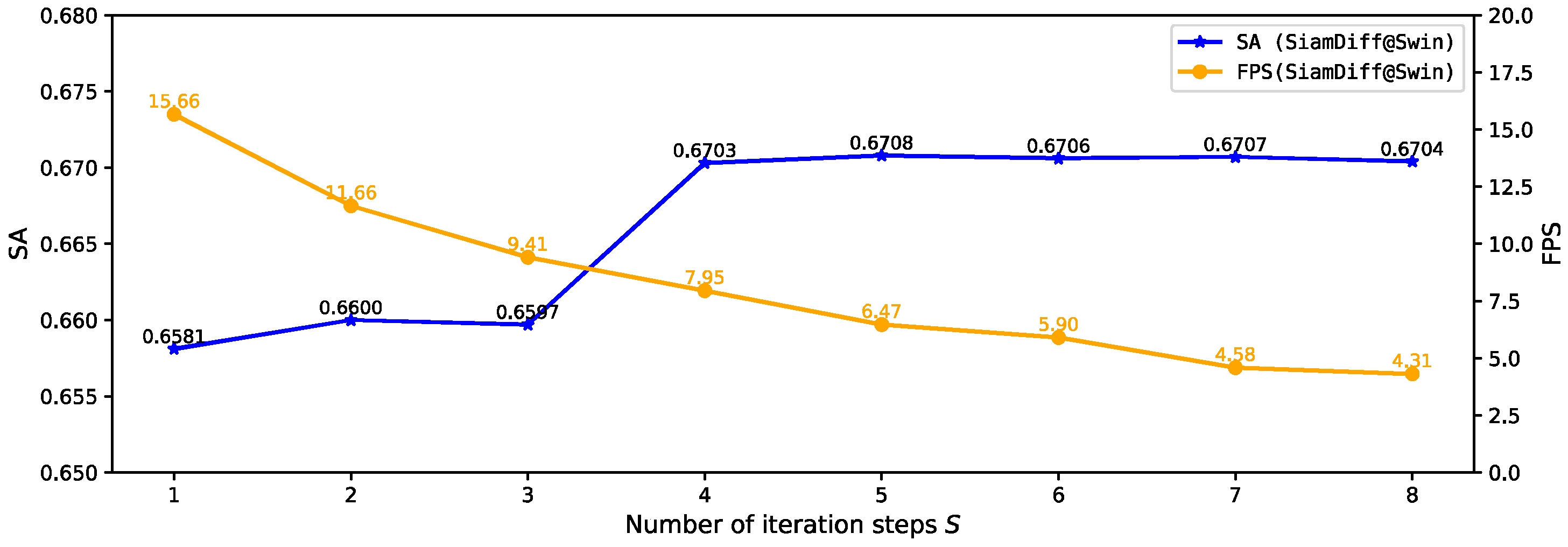
- Sensitivity analysis of denoising steps: The reverse process of diffusion models typically requires t iterative steps. To investigate the effect of different denoising steps on both performance and efficiency, we conducted a sensitivity analysis with varying iteration steps. As shown in Figure 8, the inference speed decreases as the number of steps increases, dropping from 15.66 FPS (1 step) to 4.31 FPS (8 steps). In contrast, the tracking accuracy initially improves and then saturates. Specifically, the state accuracy (SA) increases from 0.6581 (at one step) to 0.6703 (at four steps), after which no further noticeable gains are observed. Given that accuracy plateaus after four steps while speed continues to decline, we set in our final configuration to achieve a favorable trade-off between inference efficiency and tracking performance.Figure 8. Effect of denoising steps on tracking accuracy and inference speed. A sensitivity analysis of how varying the number of denoising steps influences model performance and speed. All evaluations were conducted using Swin Transformer as the backbone on the Anti-UAV410 testing set.
4.5. Feature Visualization of Learned Mask Module
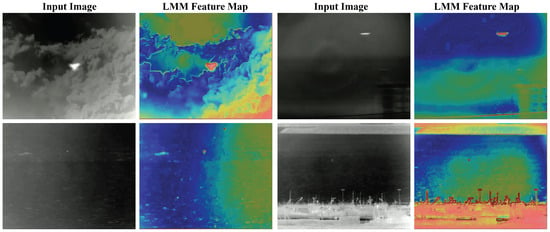
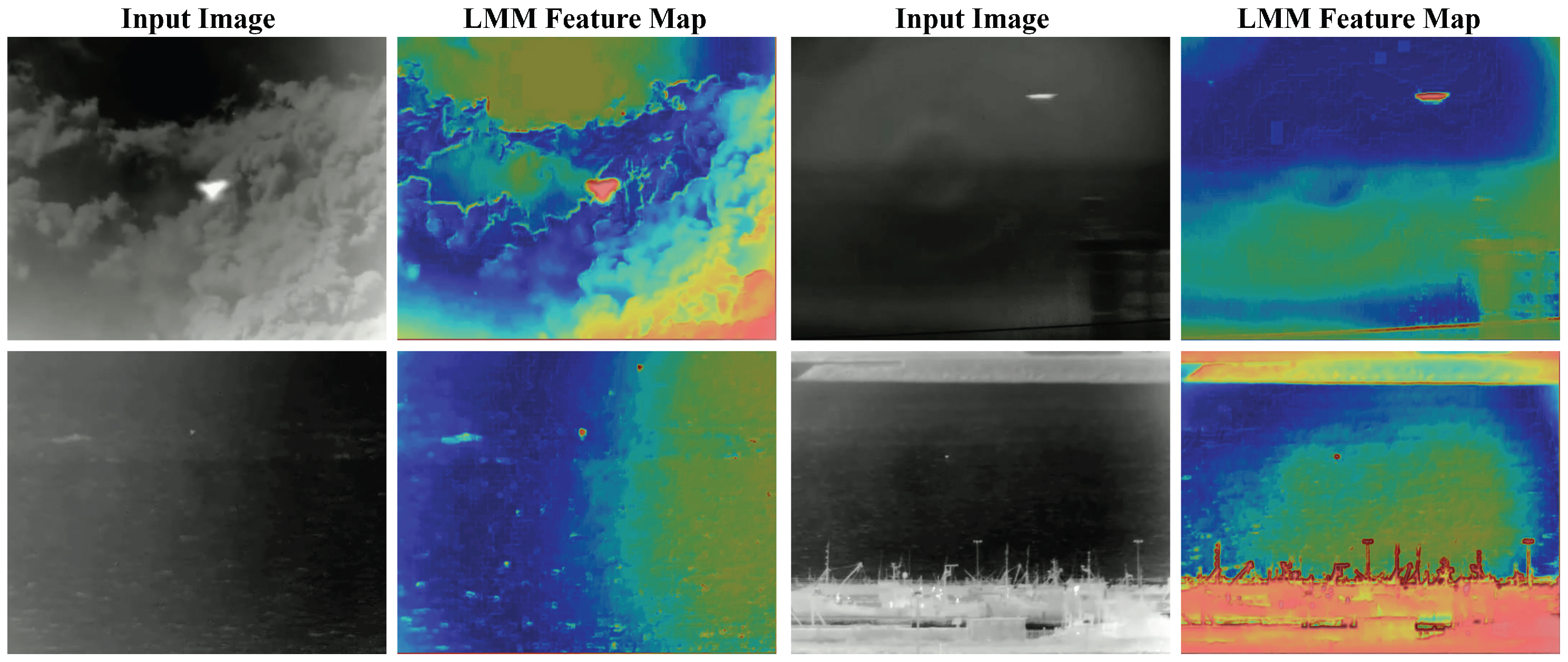
To further investigate how the LMM mitigates background interference and enhances target features, we visualize the feature learned by this module. As illustrated in Figure 9, the LMM primarily focuses on low-level structural cues, including edges, intensity transitions, and local texture contrasts. These responses effectively preserve the fundamental structural information of UAV targets while suppressing high-frequency noise that commonly exists in infrared backgrounds.
Figure 9.
Visualization of LMM feature responses on anti-UAV tracking samples. The learned LMM features focus on low-level structures, including edges, intensity variations, local gradients, and textural contrasts.
More specifically, the LMM enhances local texture discontinuities around the UAV, making the tiny target more distinguishable from cluttered surroundings. In scenarios containing other background structures with textures similar to the UAV, the LMM also enhances regions exhibiting comparable patterns. This behavior is consistent with the functional role of the LMM: serving as a lightweight pre-processing module that emphasizes low-level signal characteristics rather than high-level semantic distinctions. The enhanced feature maps generated by the LMM subsequently provide cleaner and more target-focused inputs to both the backbone and downstream components, thereby improving the overall feature quality and robustness of the proposed tracking framework.
4.6. Comparison Between SiamDiff and DiffusionDet
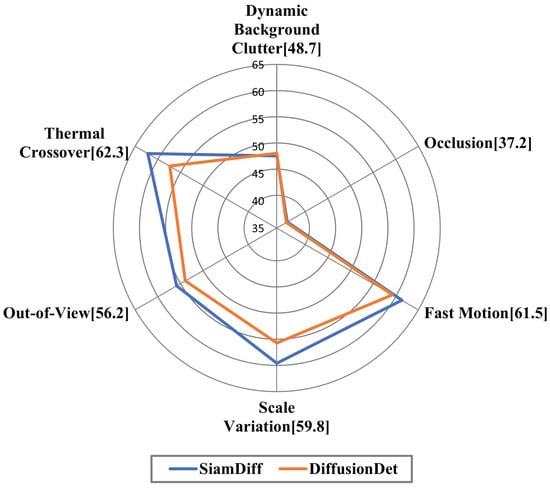
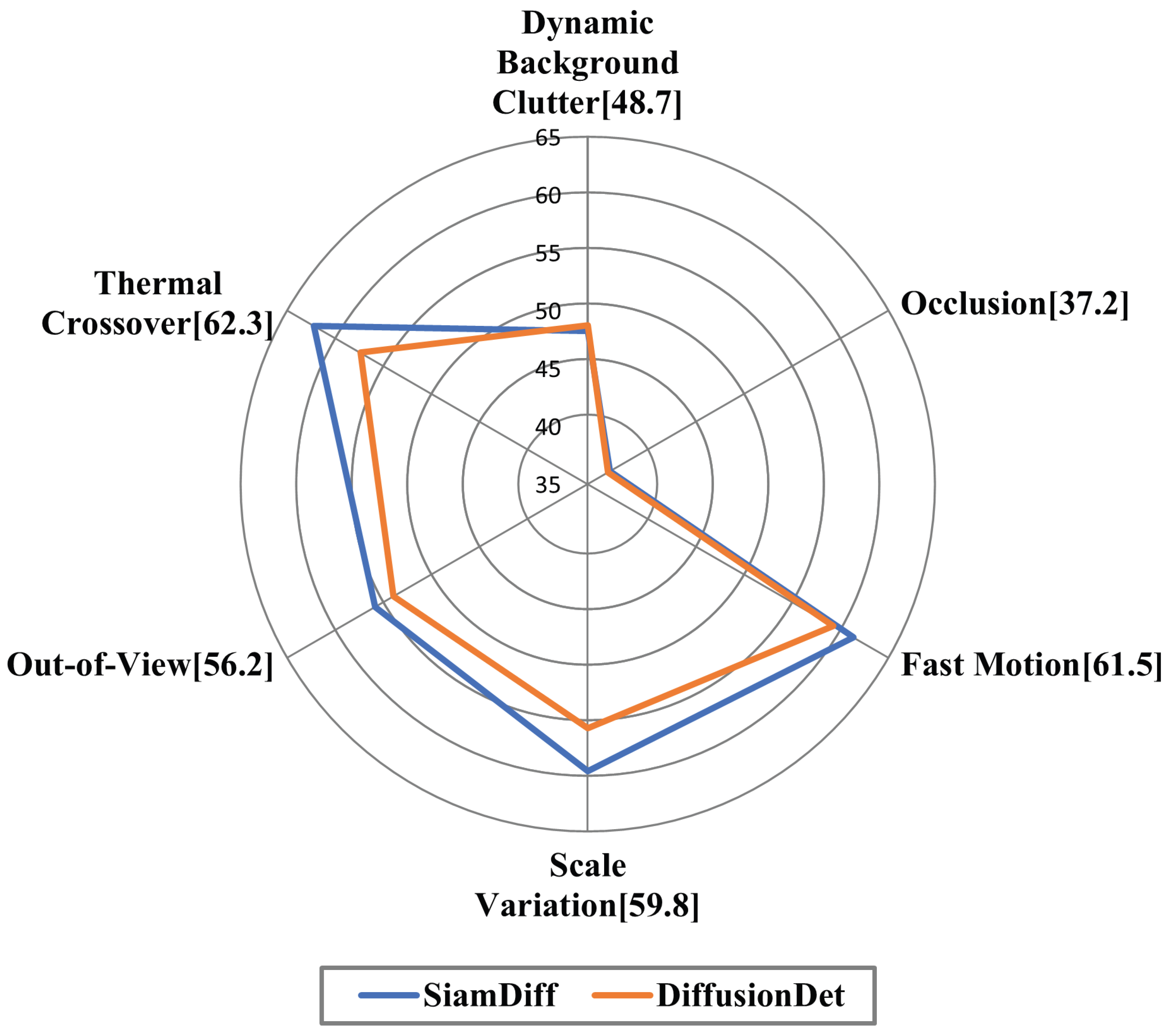
Although DiffusionDet was originally proposed for object detection rather than tracking, we include it as a baseline because SiamDiff builds on the same diffusion-based bounding box generation paradigm. To ensure a fair comparison, both DiffusionDet and SiamDiff were trained on the Anti-UAV and Anti-UAV410 datasets using the same Swin-Base backbone. Table 5 presents a performance comparison between SiamDiff and DiffusionDet on the Anti-UAV and Anti-UAV410 testing sets. The experimental results indicate that SiamDiff comprehensively outperforms DiffusionDet across all three metrics on both datasets. Furthermore, we conducted experiments specifically on the six tracking attributes of Anti-UAV410, as illustrated in Figure 10. The results demonstrate that SiamDiff achieves superior performance compared to DiffusionDet for four challenging attributes: thermal crossover, out-of-view, scale variation, and fast motion. Notably, the performance gains are particularly significant for the thermal crossover and scale variation attributes. This advantage can be attributed to three main factors: (1) The Learned Mask Module (LMM) enhances the model’s robustness against interference. (2) As a tracking framework, SiamDiff leverages richer contextual information and employs the Frequency Channel Fusion Module (FCFM) for efficient information fusion, which are key contributors to its leading performance. (3) Additionally, the Scale-Aware Diffusion Strategy (SADS) substantially improves the model’s scale adaptability, resulting in its enhanced capability for handling scale variation challenges.
Table 5.
Comparisons of SiamDiff and DiffusionDet on the Anti-UAV and Anti-UAV410 datasets.
Figure 10.
Attribute-based analysis between DiffusionDet and SiamDiff on the Anti-UAV410 testing set. AUC score is used to rank two trackers.
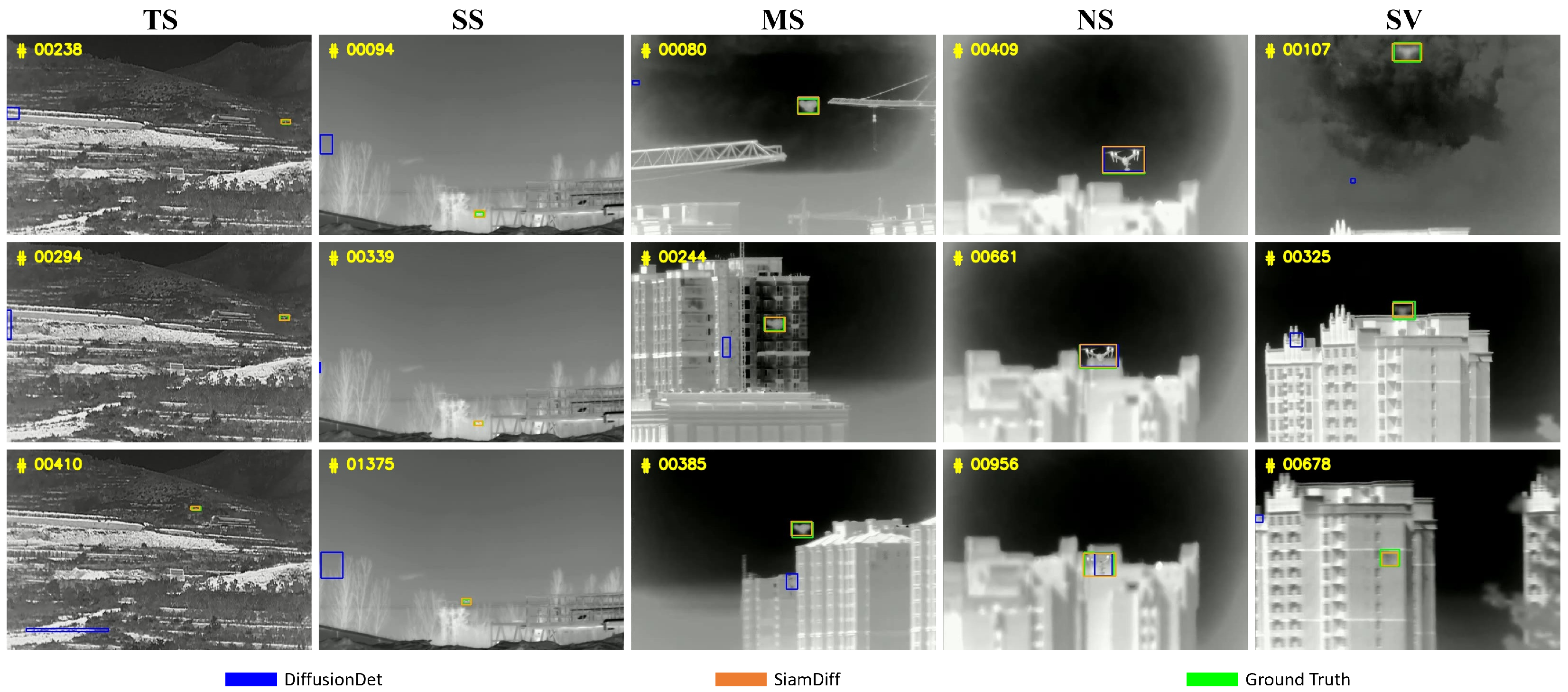
To further illustrate the scale adaptability of different models, we visualize the tracking performance of SiamDiff and DiffusionDet across UAVs of varying scales, as shown in Figure 11. The results reveal that DiffusionDet is capable of accurately localizing targets only when the UAV appears at relatively large scales and the background interference is minimal. Moreover, DiffusionDet sometimes predicts results that completely mismatch the target’s actual shape (e.g., TS#00410). In contrast, SiamDiff demonstrates robust performance across a wide range of target scales and remains effective in scenarios involving scale variations. These observations demonstrate the superior scale adaptability of our proposed method.
Figure 11.
Qualitative comparison between SiamDiff and DiffusionDet. We selected varying-scale tracking sequences from the Anti-UAV410 dataset and visualized the results. Comparisons are shown for four scales and one challenge: TS (tiny scale), SS (small scale), MS (medium scale), NS (normal scale) and SV (scale variation). Best viewed in color and zoom.
5. Discussion
Anti-UAV tracking remains extremely challenging due to tiny target sizes, severe background interference, and drastic scale variations. SiamDiff addresses these challenges by integrating a diffusion-based prediction generation mechanism with a Siamese architecture, enabling scale-adaptive box refinement and enhancing discriminative feature extraction. As demonstrated in Section 4, SiamDiff achieves superior performance on both the Anti-UAV and Anti-UAV410 benchmarks, achieving the highest SA score (0.6703) among 19 advanced trackers on Anti-UAV410 and outperforming existing methods across six challenging attributes.
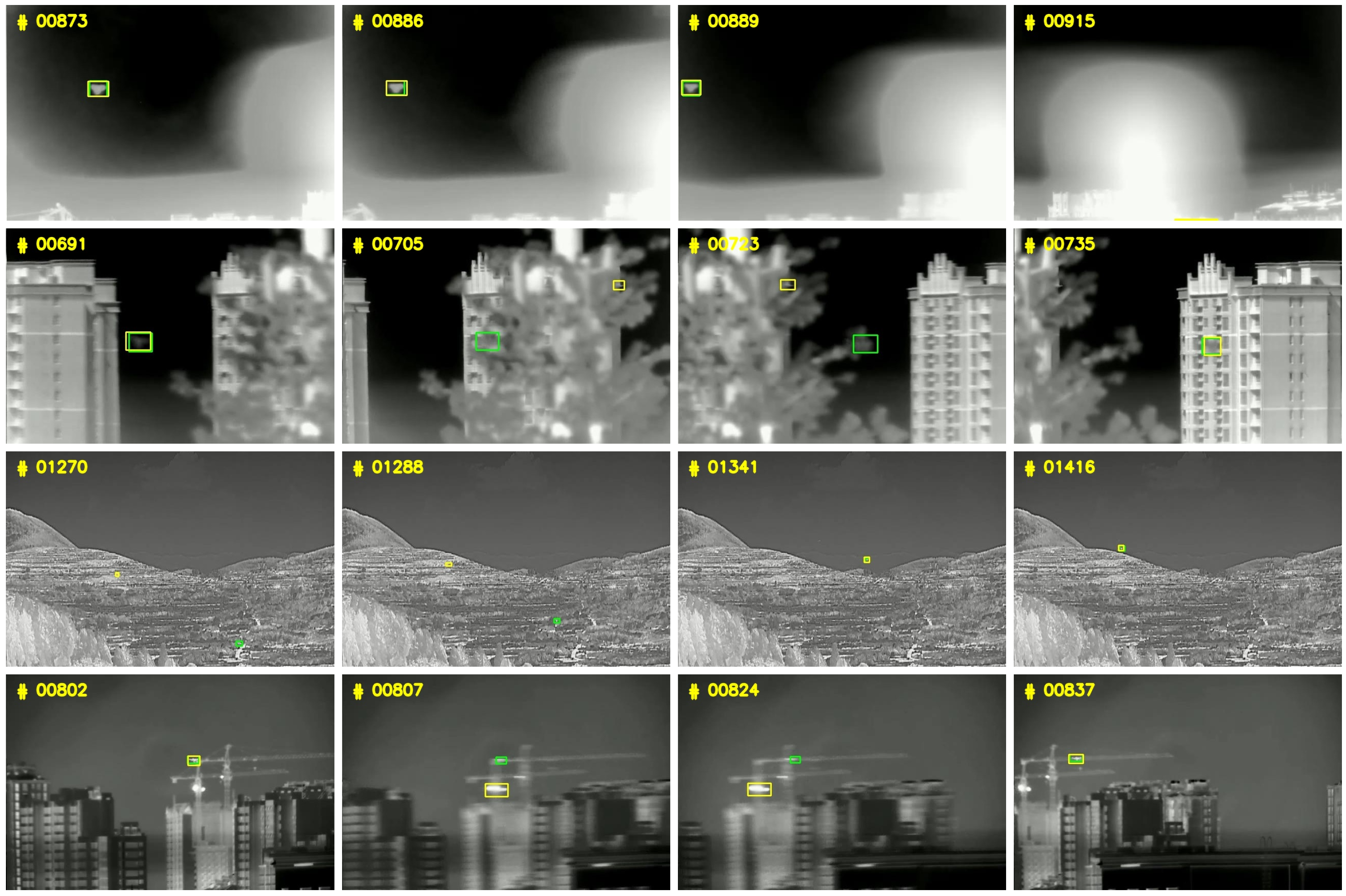
To further illustrate SiamDiff’s effectiveness across different target scales, we provide visualized tracking results in Figure 7 and Figure 11. Our tracker demonstrates stable accuracy and robustness across varying scale conditions. To offer a more balanced perspective, we additionally provide several representative failure cases that highlight scenarios where SiamDiff still struggles. As shown in Figure 12, these examples include out-of-view events, heavy occlusion by similar objects, complex background clutter, and motion blur caused by rapid camera movement. In such challenging scenarios, SiamDiff may continue predicting after the target disappears, drift to occluders, or be confused by clutter or ghosting artifacts. These results reveal the current limitations of our framework under extreme conditions.
Figure 12.
Visualization of failure cases in challenging tracking scenarios. Green boxes represent ground-truth annotations, while yellow boxes indicate the bounding boxes predicted by SiamDiff.
Although SiamDiff achieves impressive performance in terms of state accuracy (SA), integrating a diffusion model into the tracking pipeline introduces constraints on real-time performance. Table 1 presents a comparison of inference speed between SiamDiff and recent advanced trackers. SiamDiff achieves 7.95 FPS—slower than lightweight trackers, yet still within an acceptable range for anti-UAV application. More importantly, SiamDiff achieves a favorable balance between speed and accuracy. While its FPS is lower than that of fast trackers such as PromptVT (59.73 FPS), FocusTrack (30.03 FPS), and DropTrack (21.26 FPS), they achieve considerably lower tracking accuracy than ours (e.g., PromptVT SA: 50.97% vs. SiamDiff SA: 71.90%). SiamDiff provides substantial robustness gains under tiny-scale targets, low-SNR conditions, and heavy background clutter—conditions under which many fast trackers deteriorate significantly.
Overall, we firmly believe that incorporating generative models into the tracking domain is a promising direction. Recent exciting advancements in image generation—particularly the emergence of single-step (one-step) image inference techniques—have garnered significant attention and show great potential for accelerating generative processes. In future work, we aim to improve the inference efficiency by drawing on these developments, while also exploring explicit out-of-view handling, occlusion-aware mechanisms, and enhanced temporal modeling to further strengthen robustness in complex real-world environments.
6. Conclusions
In this work, we propose SiamDiff—a novel diffusion-based framework for scale-aware anti-UAV tracking. We construct a diffusion-based tracking pipeline by formulating the target tracking problem as a bounding box generation task. Extensive experiments validate significant performance gains over state-of-the-art methods. In future work, we plan to further develop the diffusion-based tracking framework by introducing concepts like flow matching. This approach has the potential to directly model the target’s state evolution as a continuous flow, offering a more elegant solution to improve tracking accuracy and stability.
Author Contributions
Conceptualization, H.Z. and B.H.; methodology, H.Z. and B.H.; software, H.Z.; investigation, Y.K. and J.W.; writing—original draft preparation, H.Z.; writing—review and editing, Y.K., J.W., L.J., C.X., Y.M. and B.H.; visualization, H.Z., Y.K., J.W. and L.J.; supervision, C.X., Y.M. and B.H.; project administration, B.H.; funding acquisition, B.H. All authors have read and agreed to the published version of the manuscript.
Funding
This research was funded by the National Natural Science Foundation of China, grant numbers No. 62306049, No. 92471207 and No. W2421089, the Natural Science Foundation of Chongqing Municipality, grant number No. CSTB2023NSCQ-MSX0665, and the Fundamental Research Funds for the Central Universities, grant number No. 2024CDJXY008.
Institutional Review Board Statement
Not applicable.
Informed Consent Statement
Not applicable.
Data Availability Statement
Owing to the continuation of related investigations, the underlying raw and processed data cannot be released publicly at this stage; access will be granted once the larger study reaches its conclusion.
Acknowledgments
The authors thank the Key Laboratory of Optoelectronic Technology and Systems of the Education Ministry of China for providing the experimental facilities and in-kind support used in this work. The authors declare no use of generative AI in this work.
Conflicts of Interest
The authors declare no conflicts of interest.
References
- Wu, X.; Li, W.; Hong, D.; Tao, R.; Du, Q. Deep Learning for Unmanned Aerial Vehicle-Based Object Detection and Tracking: A Survey. IEEE Geosci. Remote Sens. Mag. 2022, 10, 91–124. [Google Scholar] [CrossRef] [Scilit]
- Ren, S.; He, K.; Girshick, R.; Sun, J. Faster R-CNN: Towards Real-Time Object Detection with Region Proposal Networks. IEEE Trans. Pattern Anal. Mach. Intell. 2016, 39, 1137–1149. [Google Scholar] [CrossRef] [Scilit]
- Li, B.; Yan, J.; Wu, W.; Zhu, Z.; Hu, X. High Performance Visual Tracking with Siamese Region Proposal Network. In Proceedings of the IEEE Conference on Computer Vision and Pattern Recognition, Salt Lake City, UT, USA, 18–23 June 2018; IEEE: New York, NY, USA, 2018; pp. 8971–8980. [Google Scholar]
- Xu, Z.; Zhang, W.; Tan, X.; Yang, W.; Su, X.; Yuan, Y.; Zhang, H.; Wen, S.; Ding, E.; Huang, L. PointTrack++ for Effective Online Multi-Object Tracking and Segmentation. arXiv 2020, arXiv:2007.01549. [Google Scholar]
- Zhou, X.; Koltun, V.; Krähenbühl, P. Tracking Objects as Points. In European Conference on Computer Vision; Springer: Berlin/Heidelberg, Germany, 2020; pp. 474–490. [Google Scholar]
- Xu, Y.; Wang, Z.; Li, Z.; Yuan, Y.; Yu, G. SiamFC++: Towards Robust and Accurate Visual Tracking with Target Estimation Guidelines. Proc. AAAI Conf. Artif. Intell. 2020, 34, 12549–12556. [Google Scholar] [CrossRef] [Scilit]
- Guo, D.; Wang, J.; Cui, Y.; Wang, Z.; Chen, S. SiamCAR: Siamese Fully Convolutional Classification and Regression for Visual Tracking. In Proceedings of the IEEE/CVF Conference on Computer Vision and Pattern Recognition, Seattle, WA, USA, 13–19 June 2020; IEEE: New York, NY, USA, 2020; pp. 6269–6277. [Google Scholar]
- Chen, Z.; Zhong, B.; Li, G.; Zhang, S.; Ji, R.; Tang, Z.; Li, X. SiamBAN: Target-Aware Tracking with Siamese Box Adaptive Network. IEEE Trans. Pattern Anal. Mach. Intell. 2022, 45, 5158–5173. [Google Scholar] [CrossRef]
- Chen, X.; Yan, B.; Zhu, J.; Wang, D.; Yang, X.; Lu, H. Transformer Tracking. In Proceedings of the IEEE/CVF Conference on Computer Vision and Pattern Recognition, Nashville, TN, USA, 20–25 June 2021; IEEE: New York, NY, USA, 2021; pp. 8126–8135. [Google Scholar]
- Chen, S.; Sun, P.; Song, Y.; Luo, P. DiffusionDet: Diffusion Model for Object Detection. In Proceedings of the IEEE/CVF International Conference on Computer Vision, Paris, France, 4–6 October 2023; IEEE: New York, NY, USA, 2023; pp. 19830–19843. [Google Scholar]
- Bertinetto, L.; Valmadre, J.; Henriques, J.F.; Vedaldi, A.; Torr, P.H. Fully-Convolutional Siamese Networks for Object Tracking. In Computer Vision–ECCV 2016 Workshops; Springer: Berlin/Heidelberg, Germany, 2016; pp. 850–865. [Google Scholar]
- González-Jorge, H.; Martínez-Sánchez, J.; Bueno, M.; Arias, P. Unmanned Aerial Systems for Civil Applications: A Review. Drones 2017, 1, 2. [Google Scholar] [CrossRef] [Scilit]
- Nguyen, L.Q.; Dang, M.T.; Bui, L.K.; Ngoc, Q.B.; Tran, T.X. Application of Unmanned Aerial Vehicles for Surveying and Mapping in Mines: A Review. In International Conference on Geo-Spatial Technologies and Earth Resources; Springer International Publishing: Berlin/Heidelberg, Germany, 2022; pp. 1–22. [Google Scholar]
- Chen, B.; Maurer, J.; Gong, W. Applications of UAV in Landslide Research: A Review. Landslides 2025, 22, 3029–3048. [Google Scholar] [CrossRef] [Scilit]
- Cao, Z.; Fu, C.; Ye, J.; Li, B.; Li, Y. SiamAPN++: Siamese Attentional Aggregation Network for Real-Time UAV Tracking. In Proceedings of the 2021 IEEE/RSJ International Conference on Intelligent Robots and Systems (IROS), Prague, Czech Republic, 27 September–1 October 2021; IEEE: New York, NY, USA, 2021; pp. 3086–3092. [Google Scholar]
- Xing, D.; Evangeliou, N.; Tsoukalas, A.; Tzes, A. Siamese Transformer Pyramid Networks for Real-Time UAV Tracking. In Proceedings of the IEEE/CVF Winter Conference on Applications of Computer Vision, Waikoloa, HI, USA, 3–8 January 2020; IEEE: New York, NY, USA, 2022; pp. 2139–2148. [Google Scholar]
- Yuan, X.; Xu, T.; Liu, X.; Wang, Y.; Qin, H.; Fang, Y.; Li, J. Multi-Step Temporal Modeling for UAV Tracking. IEEE Trans. Circuits Syst. Video Technol. 2024, 34, 7216–7230. [Google Scholar] [CrossRef] [Scilit]
- Xue, C.; Zhong, B.; Liang, Q.; Zheng, Y.; Li, N.; Xue, Y.; Song, S. Similarity-Guided Layer-Adaptive Vision Transformer for UAV Tracking. arXiv 2025, arXiv:2503.06625. [Google Scholar]
- Jiang, N.; Wang, K.; Peng, X.; Yu, X.; Wang, Q.; Xing, J.; Li, G.; Zhao, J.; Guo, G.; Han, Z. Anti-UAV: A Large Multi-Modal Benchmark for UAV Tracking. arXiv 2021, arXiv:2101.08466. [Google Scholar]
- Zhao, J.; Zhang, J.; Li, D.; Wang, D. Vision-Based Anti-UAV Detection and Tracking. IEEE Trans. Intell. Transp. Syst. 2022, 23, 25323–25334. [Google Scholar] [CrossRef] [Scilit]
- Huang, B.; Li, J.; Chen, J.; Wang, G.; Zhao, J.; Xu, T. Anti-UAV410: A Thermal Infrared Benchmark and Customized Scheme for Tracking Drones in the Wild. IEEE Trans. Pattern Anal. Mach. Intell. 2023, 46, 2852–2865. [Google Scholar] [CrossRef] [Scilit]
- Yu, Q.; Ma, Y.; He, J.; Yang, D.; Zhang, T. A Unified Transformer Based Tracker for Anti-UAV Tracking. In Proceedings of the IEEE/CVF Conference on Computer Vision and Pattern Recognition, Vancouver, BC, Canada, 17–24 June 2023; IEEE: New York, NY, USA, 2023; pp. 3036–3046. [Google Scholar]
- Ho, J.; Jain, A.; Abbeel, P. Denoising Diffusion Probabilistic Models. Adv. Neural Inf. Process. Syst. 2020, 33, 6840–6851. [Google Scholar]
- Amit, T.; Shaharbany, T.; Nachmani, E.; Wolf, L. SegDiff: Image Segmentation with Diffusion Probabilistic Models. arXiv 2021, arXiv:2112.00390. [Google Scholar]
- Wolleb, J.; Sandkühler, R.; Bieder, F.; Valmaggia, P.; Cattin, P.C. Diffusion Models for Implicit Image Segmentation Ensembles. In International Conference on Medical Imaging with Deep Learning, Proceedings of Machine Learning Research; PMLR: Cambridge, MA, USA, 2022; pp. 1336–1348. [Google Scholar]
- Liu, D.; Li, Q.; Dinh, A.D.; Jiang, T.; Shah, M.; Xu, C. Diffusion Action Segmentation. In Proceedings of the IEEE/CVF International Conference on Computer Vision, Paris, France, 4–6 October 2023; IEEE: New York, NY, USA, 2023; pp. 10139–10149. [Google Scholar]
- Gu, Z.; Chen, H.; Xu, Z. DiffusionInst: Diffusion Model for Instance Segmentation. In Proceedings of the ICASSP 2024–2024 IEEE International Conference on Acoustics, Speech and Signal Processing (ICASSP), Seoul, Korea, 14–19 April 2024; IEEE: New York, NY, USA, 2024; pp. 2730–2734. [Google Scholar]
- Schneider, F. ArchiSound: Audio Generation with Diffusion. arXiv 2023, arXiv:2301.13267. [Google Scholar] [CrossRef] [Scilit]
- Liu, H.; Chen, Z.; Yuan, Y.; Mei, X.; Liu, X.; Mandic, D.; Wang, W.; Plumbley, M.D. AudioLDM: Text-to-Audio Generation with Latent Diffusion Models. arXiv 2023, arXiv:2301.12503. [Google Scholar]
- Huang, R.; Huang, J.; Yang, D.; Ren, Y.; Liu, L.; Li, M.; Ye, Z.; Liu, J.; Yin, X.; Zhao, Z. Make-an-Audio: Text-to-Audio Generation with Prompt-Enhanced Diffusion Models. In International Conference on Machine Learning, Proceedings of Machine Learning Research; PMLR: Cambridge, MA, USA, 2023; pp. 13916–13932. [Google Scholar]
- Lemercier, J.M.; Richter, J.; Welker, S.; Moliner, E.; Välimäki, V.; Gerkmann, T. Diffusion Models for Audio Restoration: A Review [Special Issue On Model-Based and Data-Driven Audio Signal Processing]. IEEE Signal Process. Mag. 2025, 41, 72–84. [Google Scholar] [CrossRef] [Scilit]
- Luo, Z.; Chen, D.; Zhang, Y.; Huang, Y.; Wang, L.; Shen, Y.; Zhao, D.; Zhou, J.; Tan, T. VideoFusion: Decomposed Diffusion Models for High-Quality Video Generation. arXiv 2023, arXiv:2303.08320. [Google Scholar]
- Ni, H.; Shi, C.; Li, K.; Huang, S.X.; Min, M.R. Conditional Image-to-Video Generation with Latent Flow Diffusion Models. In Proceedings of the IEEE/CVF Conference on Computer Vision and Pattern Recognition, Vancouver, BC, Canada, 17–24 June 2023; IEEE: New York, NY, USA, 2023; pp. 18444–18455. [Google Scholar]
- Bar-Tal, O.; Chefer, H.; Tov, O.; Herrmann, C.; Paiss, R.; Zada, S.; Ephrat, A.; Hur, J.; Liu, G.; Raj, A.; et al. Lumiere: A Space-Time Diffusion Model for Video Generation. In SIGGRAPH Asia 2024 Conference Papers; ACM: New York, NY, USA, 2024; pp. 1–11. [Google Scholar]
- Croitoru, F.A.; Hondru, V.; Ionescu, R.T.; Shah, M. Diffusion Models in Vision: A Survey. IEEE Trans. Pattern Anal. Mach. Intell. 2023, 45, 10850–10869. [Google Scholar] [CrossRef] [Scilit] [PubMed]
- Sun, W.; Tu, R.C.; Liao, J.; Tao, D. Diffusion Model-Based Video Editing: A Survey. arXiv 2024, arXiv:2407.07111. [Google Scholar]
- Xing, Z.; Feng, Q.; Chen, H.; Dai, Q.; Hu, H.; Xu, H.; Wu, Z.; Jiang, Y. A Survey on Video Diffusion Models. ACM Comput. Surv. 2024, 57, 1–42. [Google Scholar] [CrossRef] [Scilit]
- Melnik, A.; Ljubljanac, M.; Lu, C.; Yan, Q.; Ren, W.; Ritter, H. Video Diffusion Models: A Survey. arXiv 2024, arXiv:2405.03150. [Google Scholar] [CrossRef] [Scilit]
- Lv, W.; Huang, Y.; Zhang, N.; Lin, R.S.; Han, M.; Zeng, D. DiffMot: A Real-Time Diffusion-Based Multiple Object Tracker with Non-Linear Prediction. In Proceedings of the IEEE/CVF Conference on Computer Vision and Pattern Recognition, Seattle, WA, USA, 16–22 June 2024; IEEE: New York, NY, USA, 2024; pp. 19321–19330. [Google Scholar]
- Luo, R.; Song, Z.; Ma, L.; Wei, J.; Yang, W.; Yang, M. DiffusionTrack: Diffusion Model for Multi-Object Tracking. Proc. AAAI Conf. Artif. Intell. 2024, 38, 3991–3999. [Google Scholar] [CrossRef] [Scilit]
- Xie, F.; Wang, Z.; Ma, C. DiffusionTrack: Point Set Diffusion Model for Visual Object Tracking. In Proceedings of the IEEE/CVF Conference on Computer Vision and Pattern Recognition, Seattle, WA, USA, 16–22 June 2024; IEEE: New York, NY, USA, 2024; pp. 19113–19124. [Google Scholar]
- Lin, T.-Y.; Dollár, P.; Girshick, R.; He, K.; Hariharan, B.; Belongie, S. Feature Pyramid Networks for Object Detection. In Proceedings of the IEEE Conference on Computer Vision and Pattern Recognition, Honolulu, HI, USA, 21–26 July 2017; IEEE: New York, NY, USA, 2017; pp. 2117–2125. [Google Scholar]
- He, K.; Zhang, X.; Ren, S.; Sun, J. Deep Residual Learning for Image Recognition. In Proceedings of the IEEE Conference on Computer Vision and Pattern Recognition, Las Vegas, NV, USA, 27–30 June 2016; IEEE: New York, NY, USA, 2016; pp. 770–778. [Google Scholar]
- Liu, Z.; Lin, Y.; Cao, Y.; Hu, H.; Wei, Y.; Zhang, Z.; Lin, S.; Guo, B. Swin Transformer: Hierarchical Vision Transformer Using Shifted Windows. In Proceedings of the IEEE/CVF International Conference on Computer Vision, Montreal, QC, Canada, 11–17 October 2021; IEEE: New York, NY, USA, 2021; pp. 10012–10022. [Google Scholar]
- Qin, Z.; Zhang, P.; Wu, F.; Li, X. FcaNet: Frequency Channel Attention Networks. In Proceedings of the IEEE/CVF International Conference on Computer Vision, Montreal, QC, Canada, 11–17 October 2021; IEEE: New York, NY, USA, 2021; pp. 783–792. [Google Scholar]
- Chen, T. On the Importance of Noise Scheduling for Diffusion Models. arXiv 2023, arXiv:2301.10972. [Google Scholar] [CrossRef] [Scilit]
- Song, J.; Meng, C.; Ermon, S. Denoising Diffusion Implicit Models. arXiv 2020, arXiv:2010.02502. [Google Scholar]
- Jiang, N.; Zhang, H.; Liu, Y.; Gao, Y.; Liu, H.; Sun, Z.; Chen, X.; Li, Z.; Bai, X. Anti-UAV: A Large-Scale Benchmark for Vision-Based UAV Tracking. IEEE Trans. Multimed. 2023, 25, 486–500. [Google Scholar] [CrossRef] [Scilit]
- Huang, L.; Zhao, X.; Huang, K. GlobalTrack: A Simple and Strong Baseline for Long-Term Tracking. Proc. AAAI Conf. Artif. Intell. 2020, 34, 11037–11044. [Google Scholar] [CrossRef] [Scilit]
- Wang, Y.; Xu, T.; Li, J. FocusTrack: A Self-Adaptive Local Sampling Algorithm for Efficient Anti-UAV Tracking. IEEE Trans. Geosci. Remote Sens. 2025, 63, 5003214. [Google Scholar] [CrossRef] [Scilit]
- Wu, Q.; Yang, T.; Liu, Z.; Li, F.; Yang, M.-H. DropMAE: Masked Autoencoders with Spatial-Attention Dropout for Tracking Tasks. In Proceedings of the IEEE/CVF Conference on Computer Vision and Pattern Recognition, Vancouver, BC, Canada, 17–24 June 2023; IEEE: New York, NY, USA, 2023; pp. 14561–14571. [Google Scholar]
- Cui, Y.; Song, T.; Wu, G.; Wang, X. MixFormerV2: Efficient Fully Transformer Tracking. Adv. Neural Inf. Process. Syst. 2023, 36, 58736–58751. [Google Scholar]
- Gao, S.; Zhou, C.; Ma, C.; Wang, X. AiATrack: Attention in Attention for Transformer Visual Tracking. In European Conference on Computer Vision; Springer: Berlin/Heidelberg, Germany, 2022; pp. 146–164. [Google Scholar]
- Yan, B.; Peng, H.; Fu, J.; Wang, D.; Lu, H. Learning Spatio-Temporal Transformer for Visual Tracking. In Proceedings of the IEEE/CVF International Conference on Computer Vision, Montreal, QC, Canada, 11–17 October 2021; IEEE: New York, NY, USA, 2021; pp. 10448–10457. [Google Scholar]
- Mayer, C.; Danelljan, M.; Paudel, D.P.; Van Gool, L.; Timofte, R. Learning Target Candidate Association to Keep Track of What Not to Track. In Proceedings of the IEEE/CVF International Conference on Computer Vision, Montreal, QC, Canada, 11–17 October 2021; IEEE: New York, NY, USA, 2021; pp. 13444–13454. [Google Scholar]
- Lin, L.; Fan, H.; Zhang, Z.; Bao, J.; Dong, C.; Liu, W.; Zhou, X. SwinTrack: A Simple and Strong Baseline for Transformer Tracking. Adv. Neural Inf. Process. Syst. 2022, 35, 16743–16754. [Google Scholar]
- Mayer, C.; Danelljan, M.; Bhat, G.; Van Gool, L.; Timofte, R. Transforming Model Prediction for Tracking. In Proceedings of the IEEE/CVF Conference on Computer Vision and Pattern Recognition, New Orleans, LA, USA, 18–24 June 2022; IEEE: New York, NY, USA, 2022; pp. 8731–8740. [Google Scholar]
- Danelljan, M.; Van Gool, L.; Timofte, R. Probabilistic Regression for Visual Tracking. In Proceedings of the IEEE/CVF Conference on Computer Vision and Pattern Recognition, Seattle, WA, USA, 13–19 June 2020; IEEE: New York, NY, USA, 2020; pp. 7183–7192. [Google Scholar]
- Chen, X.; Peng, H.; Wang, D.; Lu, H.; Hu, H. SeqTrack: Sequence to Sequence Learning for Visual Object Tracking. In Proceedings of the IEEE/CVF Conference on Computer Vision and Pattern Recognition, Vancouver, BC, Canada, 17–24 June 2023; IEEE: New York, NY, USA, 2023; pp. 14572–14581. [Google Scholar]
- Zhang, M.; Zhang, Q.; Song, W.; Huang, D.; He, Q. PromptVT: Prompting for Efficient and Accurate Visual Tracking. IEEE Trans. Circuits Syst. Video Technol. 2024, 34, 7373–7385. [Google Scholar] [CrossRef] [Scilit]
- Wei, X.; Bai, Y.; Zheng, Y.; Shi, D.; Gong, Y. Autoregressive Visual Tracking. In Proceedings of the IEEE/CVF Conference on Computer Vision and Pattern Recognition, Vancouver, BC, Canada, 17–24 June 2023; IEEE: New York, NY, USA, 2023; pp. 9697–9706. [Google Scholar]
- Bhat, G.; Danelljan, M.; Van Gool, L.; Timofte, R. Know Your Surroundings: Exploiting Scene Information for Object Tracking. In European Conference on Computer Vision; Springer: Berlin/Heidelberg, Germany, 2020; pp. 205–221. [Google Scholar]
- Cao, Z.; Huang, Z.; Pan, L.; Chen, C.; Li, F.; Yang, M.-H. TCTrack: Temporal Contexts for Aerial Tracking. In Proceedings of the IEEE/CVF Conference on Computer Vision and Pattern Recognition, New Orleans, LA, USA, 18–24 June 2022; IEEE: New York, NY, USA, 2022; pp. 14798–14808. [Google Scholar]

Disclaimer/Publisher’s Note: The statements, opinions and data contained in all publications are solely those of the individual author(s) and contributor(s) and not of MDPI and/or the editor(s). MDPI and/or the editor(s) disclaim responsibility for any injury to people or property resulting from any ideas, methods, instructions or products referred to in the content. |
© 2025 by the authors. Licensee MDPI, Basel, Switzerland. This article is an open access article distributed under the terms and conditions of the Creative Commons Attribution (CC BY) license.