Article

An Efficient Graph Convolutional RVFL Network for Hyperspectral Image Classification

1
School of Artificial Intelligence, Hubei University, Wuhan 430062, China
2
Key Laboratory of Intelligent Sensing System and Security, Hubei University, Ministry of Education, Wuhan 430062, China
3
School of Information and Safety Engineering, Zhongnan University of Economics and Law, Wuhan 430073, China
4
School of Automation, China University of Geosciences, Wuhan 430074, China
5
Department of Land Surveying and Geo-Informatics, The Hong Kong Polytechnic University, Hong Kong, China
*
Author to whom correspondence should be addressed.
Remote Sens. 2024, 16(1), 37; https://doi.org/10.3390/rs16010037
Submission received: 8 October 2023 / Revised: 17 December 2023 / Accepted: 18 December 2023 / Published: 21 December 2023
(This article belongs to the Special Issue Advances in Deep Learning Approaches in Remote Sensing)

Abstract

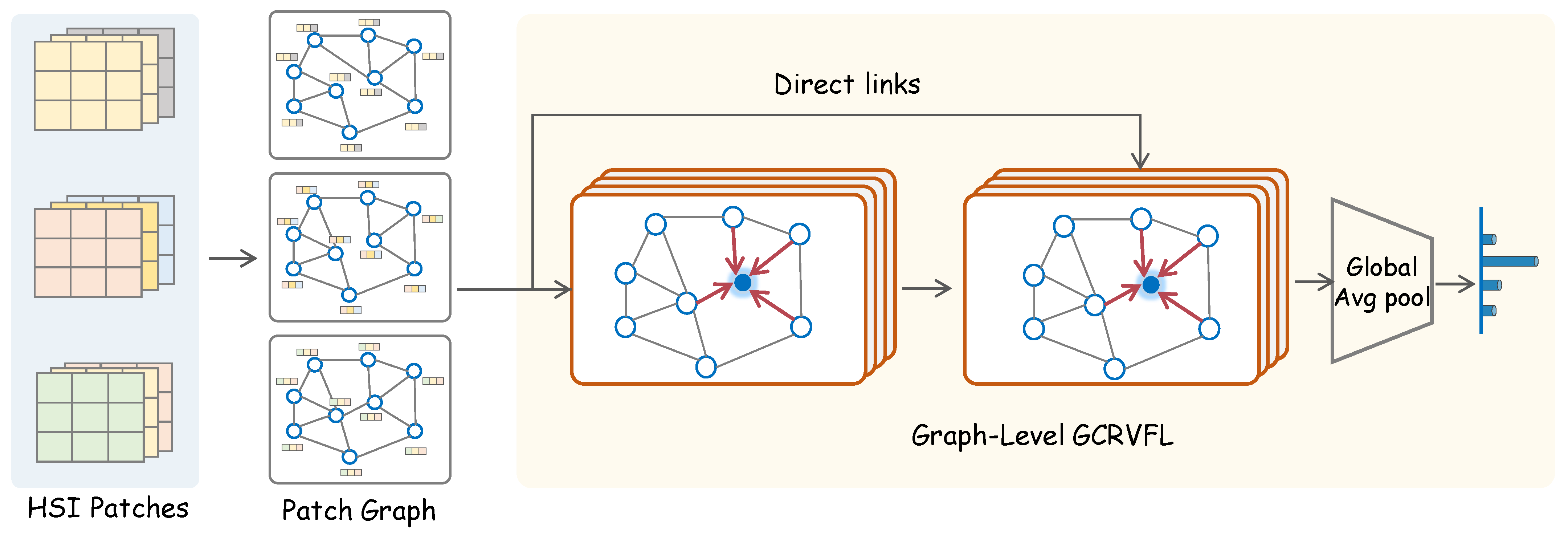
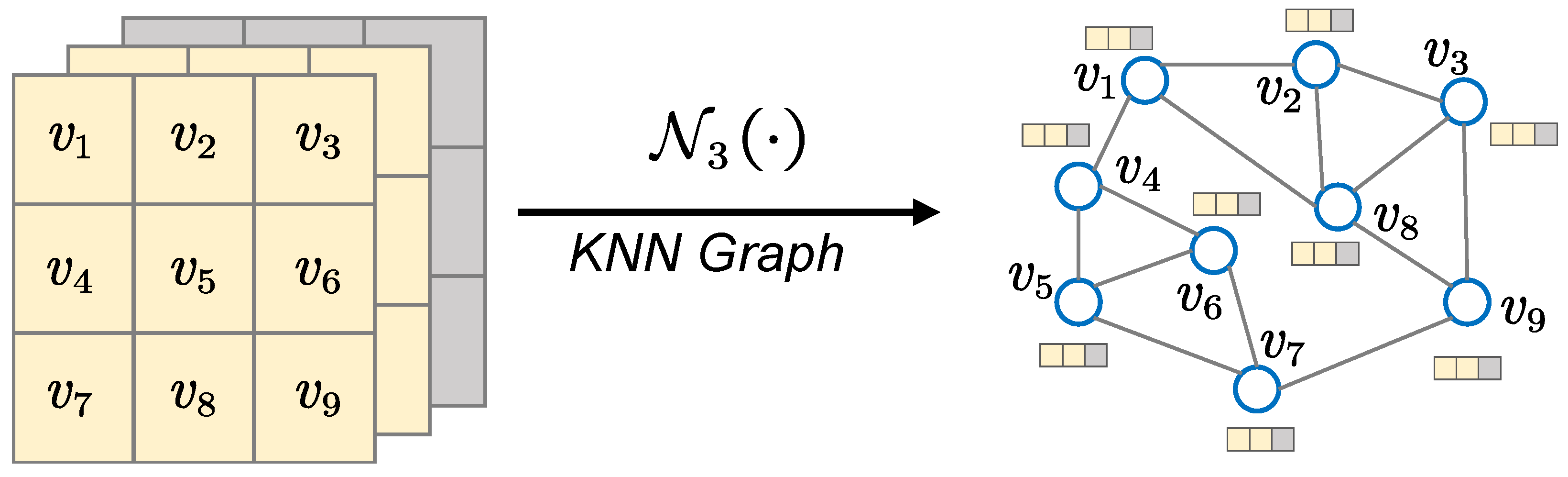
Graph convolutional networks (GCN) have emerged as a powerful alternative tool for analyzing hyperspectral images (HSIs). Despite their impressive performance, current works strive to make GCN more sophisticated through either elaborate architecture or fancy training tricks, making them prohibitive for HSI data in practice. In this paper, we present a Graph Convolutional RVFL Network (GCRVFL), a simple but efficient GCN for hyperspectral image classification. Specifically, we generalize the classic RVFL network into the graph domain by using graph convolution operations. This not only enables RVFL to handle graph-structured data, but also avoids iterative parameter adjustment by employing an efficient closed-form solution. Unlike previous works that perform HSI classification under a transductive framework, we regard HSI classification as a graph-level classification task, which makes GCRVFL scalable to large-scale HSI data. Extensive experiments on three benchmark data sets demonstrate that the proposed GCRVFL is able to achieve competitive results with fewer trainable parameters and adjustable hyperparameters and higher computational efficiency. In particular, we show that our approach is comparable to many existing approaches, including deep CNN models (e.g., ResNet and DenseNet) and popular GCN models (e.g., SGC and APPNP).
Keywords: graph convolutional network; graph-level classification; hyperspectral image; RVFL network graph convolutional network; graph-level classification; hyperspectral image; RVFL network