Article

Spatio-Temporal Patterns and Driving Factors of Vegetation Change in the Pan-Third Pole Region

1
Shaanxi Key Laboratory of Earth Surface System and Environmental Carrying Capacity, College of Urban and Environmental Sciences, Northwest University, Xi’an 710127, China
2
Key Laboratory of National Forestry Administration on Ecological Hydrology and Disaster Prevention in Arid Regions, Northwest University, Xi’an 710127, China
*
Author to whom correspondence should be addressed.
Remote Sens. 2022, 14(17), 4402; https://doi.org/10.3390/rs14174402
Submission received: 20 July 2022 / Revised: 28 August 2022 / Accepted: 30 August 2022 / Published: 4 September 2022
(This article belongs to the Special Issue Correlation between NDVI and Crop Production)

Abstract

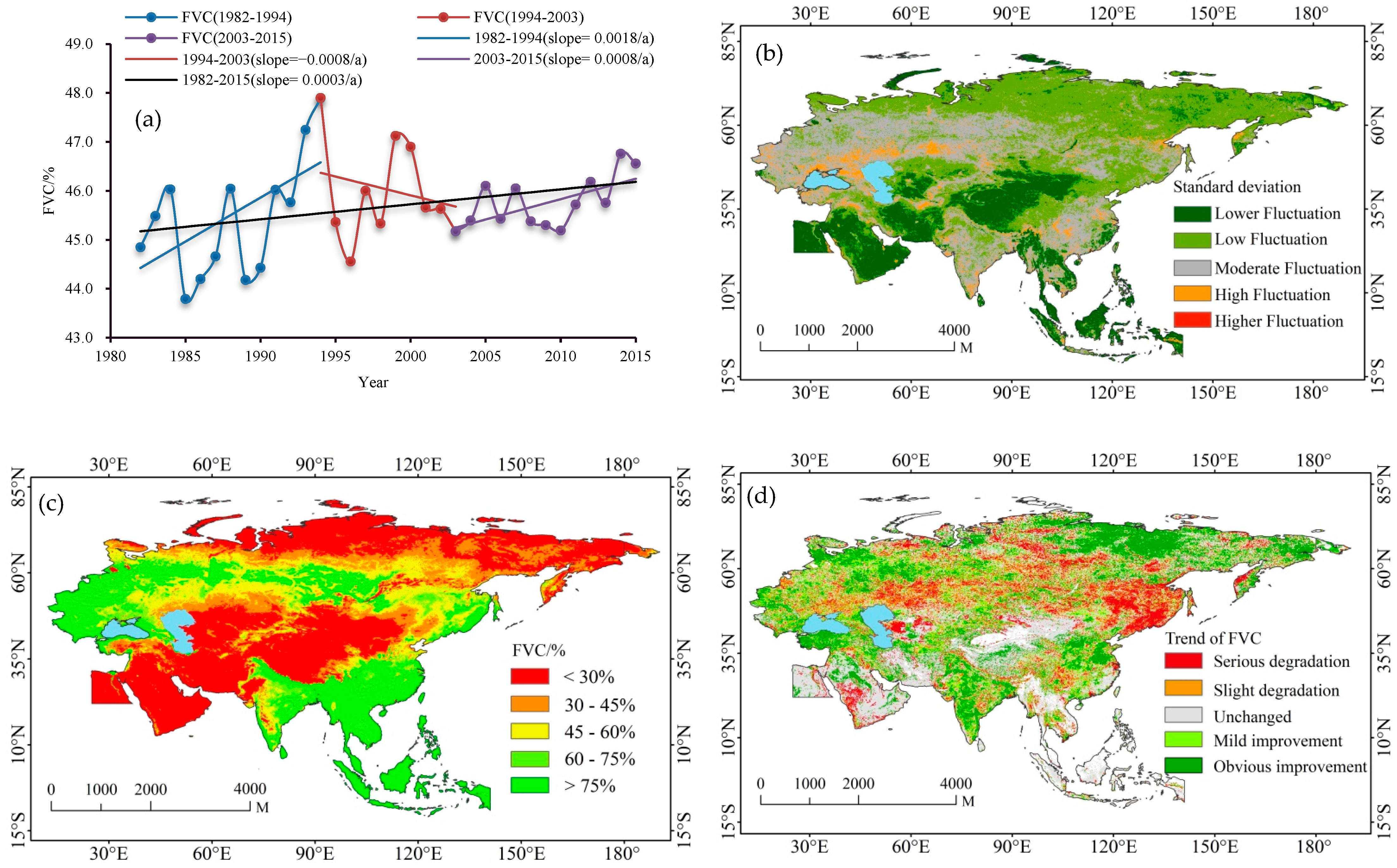
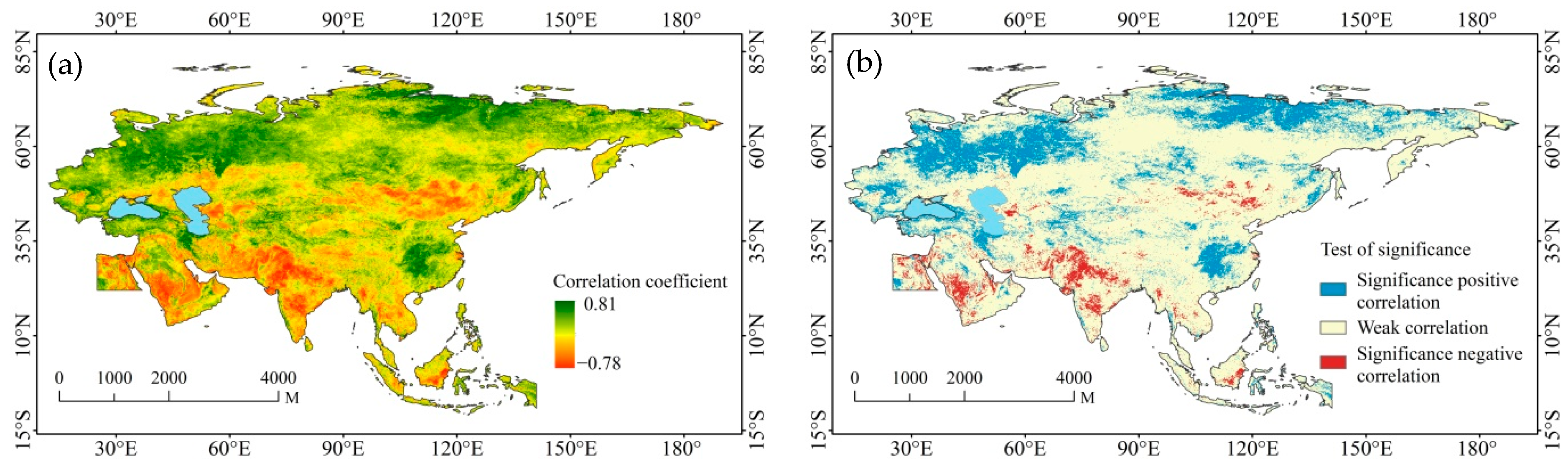
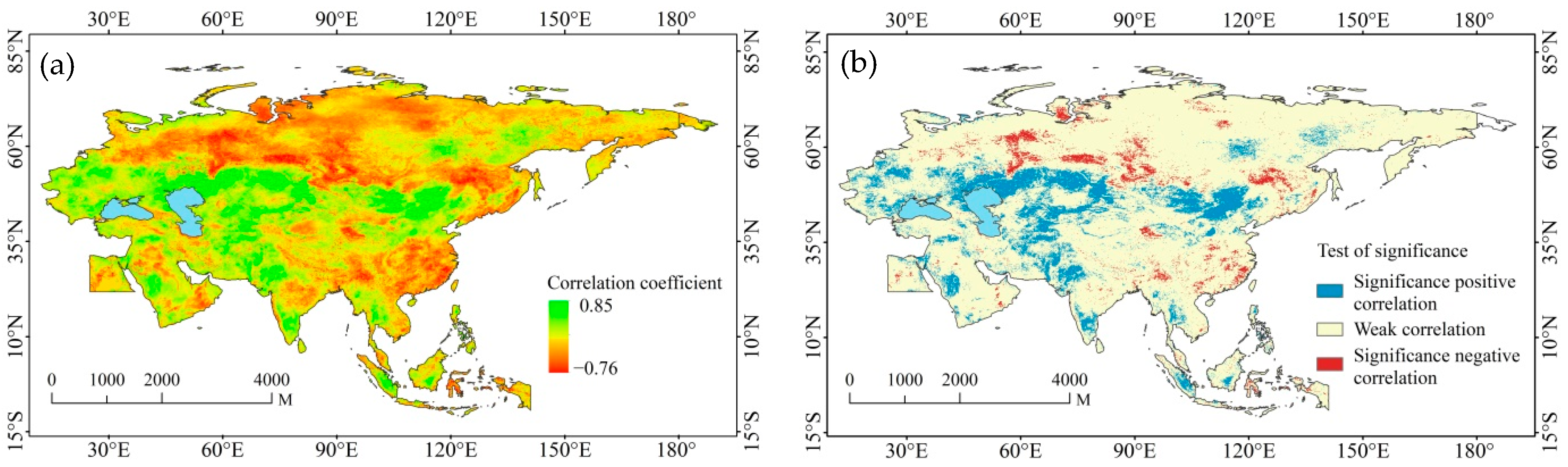
The Pan-Third Pole (PTP) region, one of the areas with the most intense global warming, has seen substantial changes in vegetation cover. Based on the GIMMS NDVI3g and meteorological dataset from 1982 to 2015, this study evaluated the spatio-temporal variation in fractional vegetation coverage (FVC) by using linear regression analysis, standard deviation, correlation coefficient, and multiple linear regression residuals to explore its response mechanism to climate change and human activities. The findings showed that: (1) the FVC was progressively improved, with a linear trend of 0.003•10a−1. (2) The largest proportion of the contribution to FVC change was found in the unchanged area (39.29%), followed by the obvious improvement (23.83%) and the mild improvement area (13.53%). (3) The impact of both climate change and human activities is dual in FVC changes, and human activities are increasing. (4) The FVC was positively correlated with temperature and precipitation, with a stronger correlation with temperature, and the climate trend was warm and humid. The findings of the study serve to understand the impacts of climate change and human activities on the dynamic changes in the FVC and provide a scientific foundation for ecological conservation and sustainable economic development in the PTP region.
Keywords: FVC; spatial-temporal vegetation patterns; climate change; human activities; Pan-Third Pole region FVC; spatial-temporal vegetation patterns; climate change; human activities; Pan-Third Pole region