


Abstract
This systematic literature review examines the growing relationship between resilience and sustainability within the built environment, specifically how climate change-induced hazards affect building and infrastructure performance requirements. To find conceptual similarities, differences, and complementarities between the two paradigms, the review integrates results from peer-reviewed research. The latest research indicates that even highly sustainable buildings may still be vulnerable to climate extremes, such as floods, heatwaves, earthquakes, and heavy rainfall, despite sustainability frameworks historically prioritizing reductions in environmental impacts, including carbon emissions, resource consumption, and waste. This review utilized the SPAR-4-SLR framework to analyze a total of 83 peer-reviewed publications. The findings suggest that resilience is concerned with a system’s ability to absorb, adjust, and recover from disruptions, whereas sustainability is mainly linked with long-term environmental impacts. Significantly, the literature shows a growing trend toward integrated S+R models, in which resilience parameters like structural robustness, redundancy, flexibility, and adaptive capacity are added to sustainability strategies. The review indicates that integrating comprehensive frameworks that equally handle environmental performance and hazard resistance is necessary to achieve climate-proof built environments. The paper contributes by identifying and integrating these two concepts, which improves the long-term sustainability of buildings and infrastructure while also ensuring long-term reliability.
1. Introduction
The construction industry is a major sector of any economy and has a significant impact on the environment. Buildings and construction account for 37% of global carbon emissions and 34% of energy use, highlighting the built environment as a significant driver of climate change [1].
Design decisions regarding material selection and climate strategies for urban use significantly impact environmental performance. At the same time, the built environment accounts for around 40% of energy consumption and acts as a major contributor to carbon emissions [2,3,4]. A study ref. [5] found that environmental impacts are created due to rapid urbanization, resource consumption, and construction practices.
Meanwhile, climate change is escalating hazards (heatwaves, droughts, storms, flooding) that threaten the built environment [5]. Natural disasters such as hurricanes, floods, earthquakes, and wildfires are occurring as a result of the faster progression of climate change due to the continuation of greenhouse gas emissions [4]. Frequent extreme events caused by climate change will lead to climate variations [6]. Climate change has had a great impact on the built environment, which makes resilience and sustainability act as the main concepts for achieving the Sustainable Development Goals (SDGs) ref. [7]. The authors [8] have stated that several studies have also highlighted that natural hazards and climate change are interconnected, as climate extreme events can result in disaster risk. The growth of carbon emissions and other greenhouse gases worsens the challenges of climate change and global warming [5,9].
Traditional hazard mitigation strategies support the built environment to become a part of the solution rather than increasing the risk. Such strategies include structurally retrofitting buildings and transportation networks against earthquakes, protecting roofs against volcanic ash falls, and proactively designing ground floors in flood-prone areas, along with climate change mitigation, and systems to adapt to extreme weather conditions like droughts and flash floods [10]. According to ref. [5], to eliminate the negative impact on both the climate and the natural environment, the concept of green buildings within the built environment was established throughout the design, construction, and operational stages. The author has mentioned that green buildings have effectively reduced energy consumption, CO2 emissions, and water management while maintaining the life cycle of materials in several projects [5]. Green building strategies and urban sustainability solutions have been integrated to address the impacts of climate change, population growth, rapid urbanization, and economic development [11]. The author has explained that the development of carbon-neutral buildings has increased to address the climate change impacts, whereas utilizing low-carbon emission sources helps to reduce energy consumption. Publication ref. [12] highlighted that the connections between resilience and environmental, economic, and social sustainability factors make it possible to find the best solutions for constructed systems and balance various demands.
Both sustainability and resilience are considered essential features in building design [13]. Resilience in this context refers to a system’s capacity to anticipate, absorb, accommodate, or recover from hazards while maintaining its essential functions. Sustainability typically refers to meeting present needs (economic, social, and environmental) without compromising the needs of future generations. Both concepts aim for durable, livable communities but originate from different perspectives. Understanding how they overlap and diverge is critical, as some researchers even describe their relationship in different ways [14]. The author ref. [15] has also emphasized that these two concepts can be integrated into the built environment. Moreover, some literature has treated resilience as a component of sustainability, while others have treated it the other way around, or as two separate concepts [16]. Furthermore, a combination of Disaster Risk Reduction (DRR) and Climate Change Adaptation (CCA) is essential for sustainable development worldwide [10].
Resilience and sustainability have been discussed more and more together in research on the built environment, but the link between the two ideas is still not clear. Some research considers resilience to be a part of sustainability, while other research sees sustainability as a long-term result of resilience, and some see them as separate but related ideas. Moreover, a significant portion of the current literature examines sustainability tools and resilience strategies in isolation, with less integration of their overlapping, different, and potentially common components within a comprehensive framework for buildings and infrastructure. This lack of conceptual agreement makes the built environment less safe, as buildings that are considered safe for the environment may still be at risk from natural and climate-related hazards. This study identifies this conflict as the resilience–sustainability paradox in the built environment. Buildings may meet sustainability criteria such as energy efficiency, carbon reduction, and resource conservation, yet they might remain vulnerable to natural and climate-related hazards if resilience is not built into their design, operation, and assessment frameworks. Therefore, there is a need for a systematic review to clarify the definitions, frameworks, indicators, interactions, and practical applications of resilience and sustainability in the built environment.
Defining Research Questions
This research aims to provide insights into the concepts of sustainability and resilience in the context of the built environment. Research questions (RQ1–RQ4) in Table 1 below were formulated to explore the aspects, frameworks, indicators, and definitions of the two concepts.
Table 1.
Research Questions.
Aligning with Table 1, Section 3.1 and Section 3.2 answer RQ1 by considering how the built environment literature defines resilience and sustainability. Section 3.1.1 and Section 3.2.1 discuss RQ2 by exploring the main frameworks, metrics, and indicators that are employed to make buildings and infrastructure more resilient and sustainable. In Section 3.3, we explore how resilience and sustainability have been used in real life to fulfill RQ3. Section 3.4 addresses how the two concepts are similar or different, and how they interact together to answer RQ4. Lastly, Section 4 and Section 5 bring the findings together using the suggested S+R conceptual transition model, providing separate recommendations for industry stakeholders.
2. Methodology
The study follows the SPAR-4-SLR to assemble, arrange, and assess the relevant research articles. Thorough examinations of the literature using the SPAR-4-SLR technique to compile, organize, and evaluate literature should be able to provide (1) innovative perspectives and (2) stimulating agendas to further knowledge in the review area [11].
Using a database search, Scopus, a search strategy was created to investigate these questions thoroughly. Considering its broad coverage and credibility, the Scopus database was chosen [17]. Researchers frequently use Scopus, which is acknowledged as a reliable academic resource [18].
Table 2 below illustrates the three stages in SPAR-4-SLR with respect to the study.
Table 2.
SPAR-4-SLR Framework.
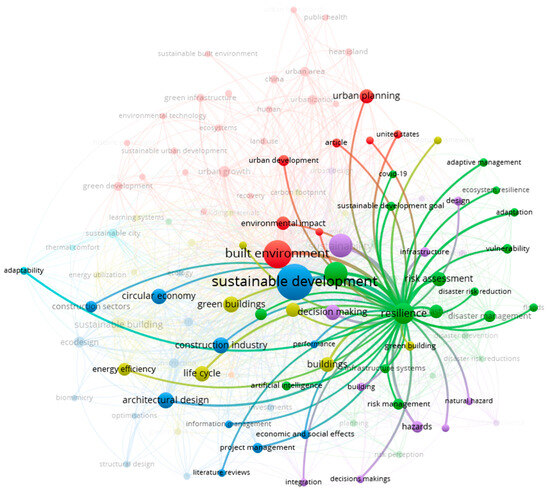
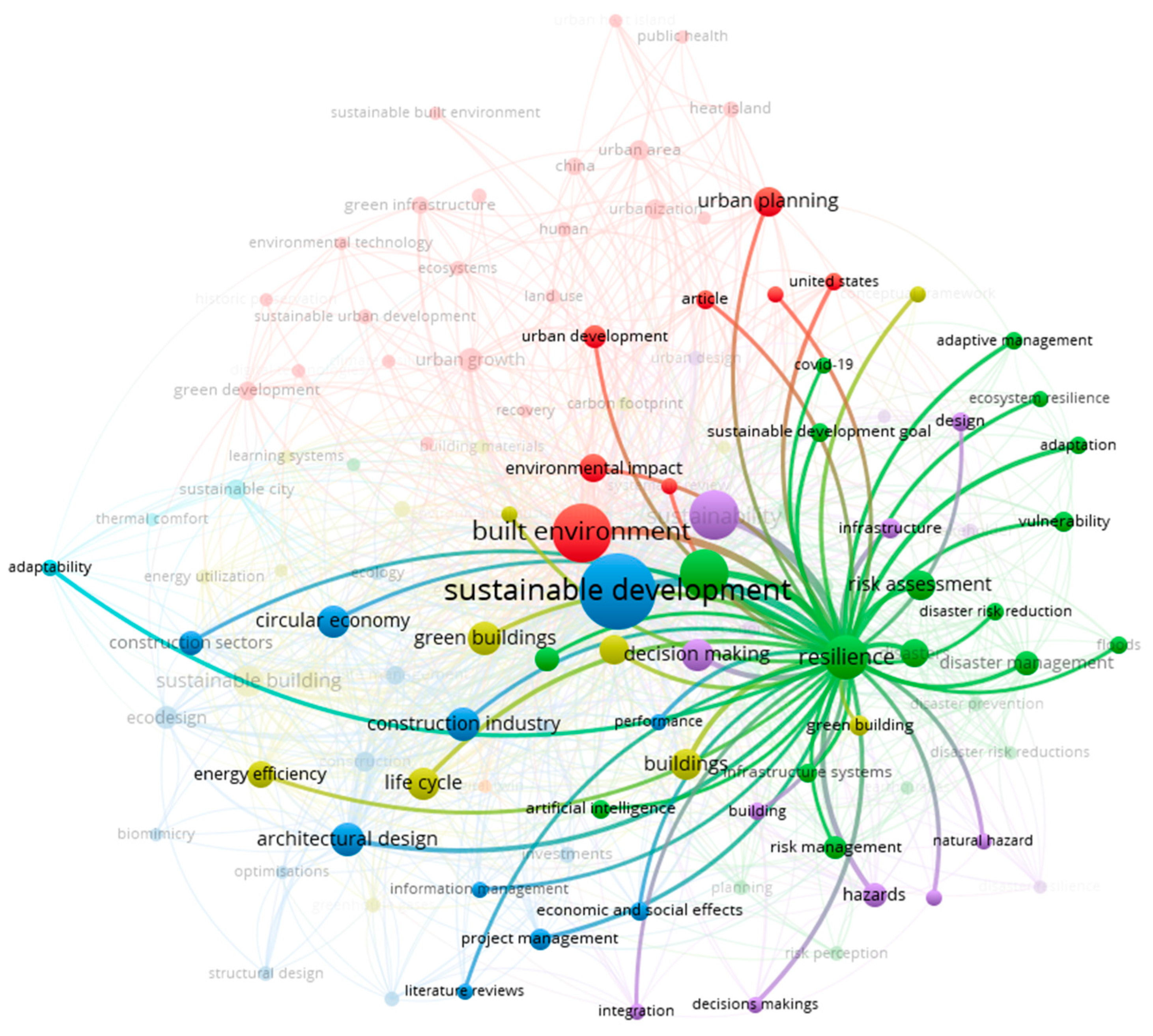
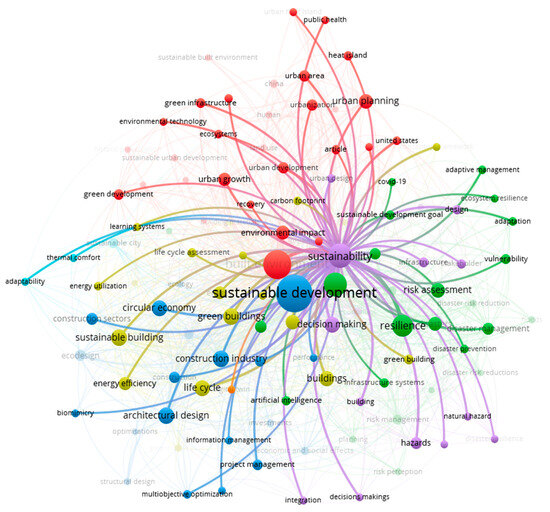
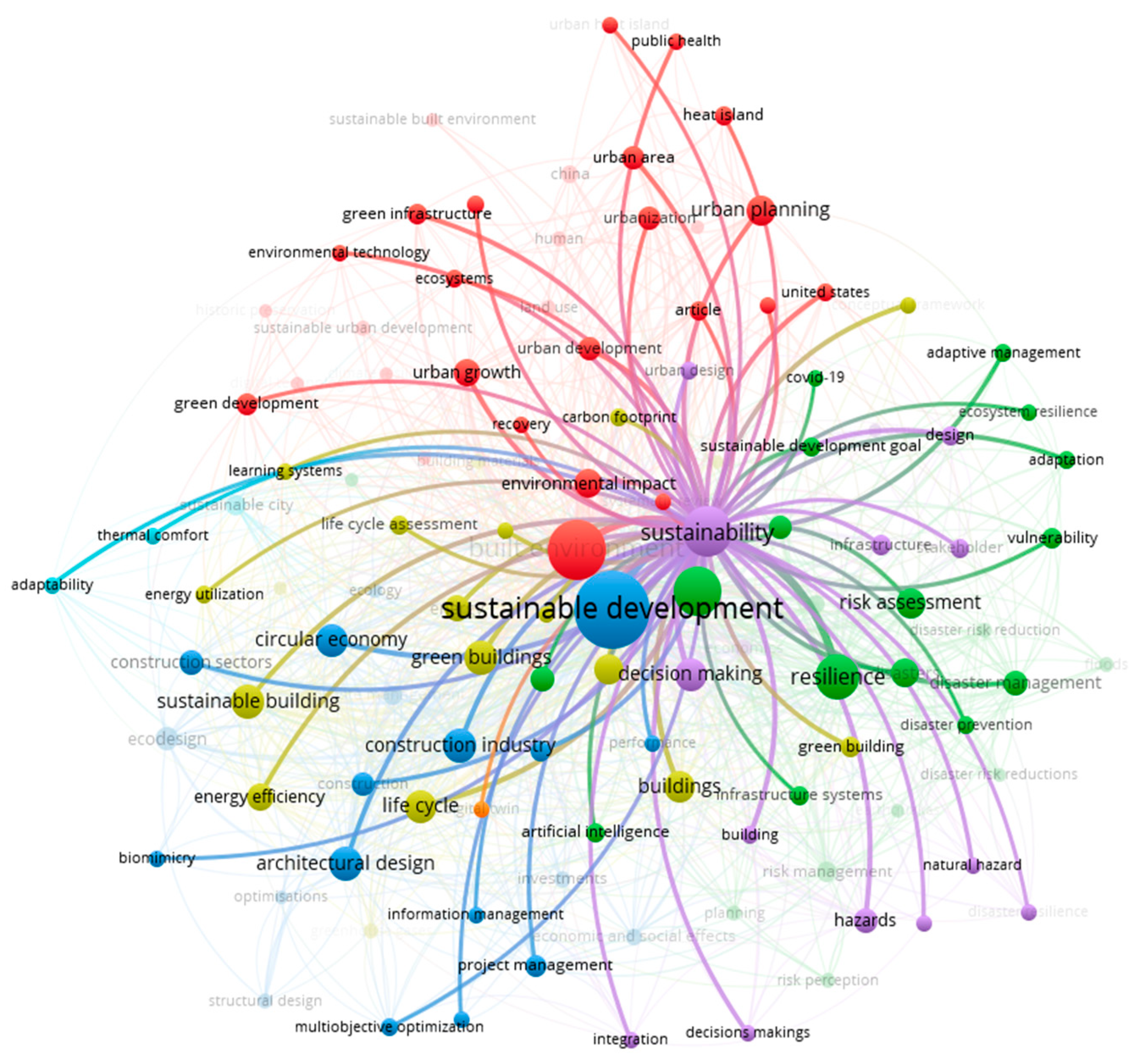
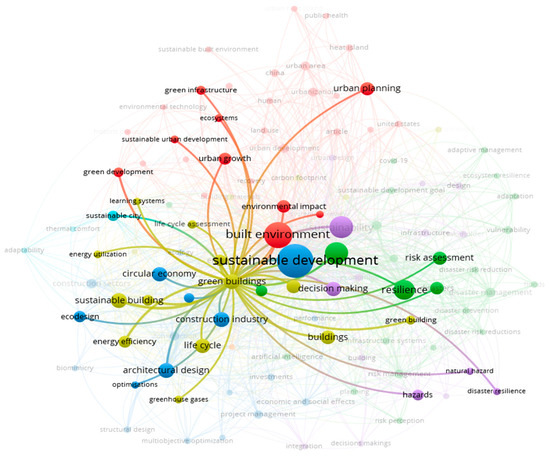
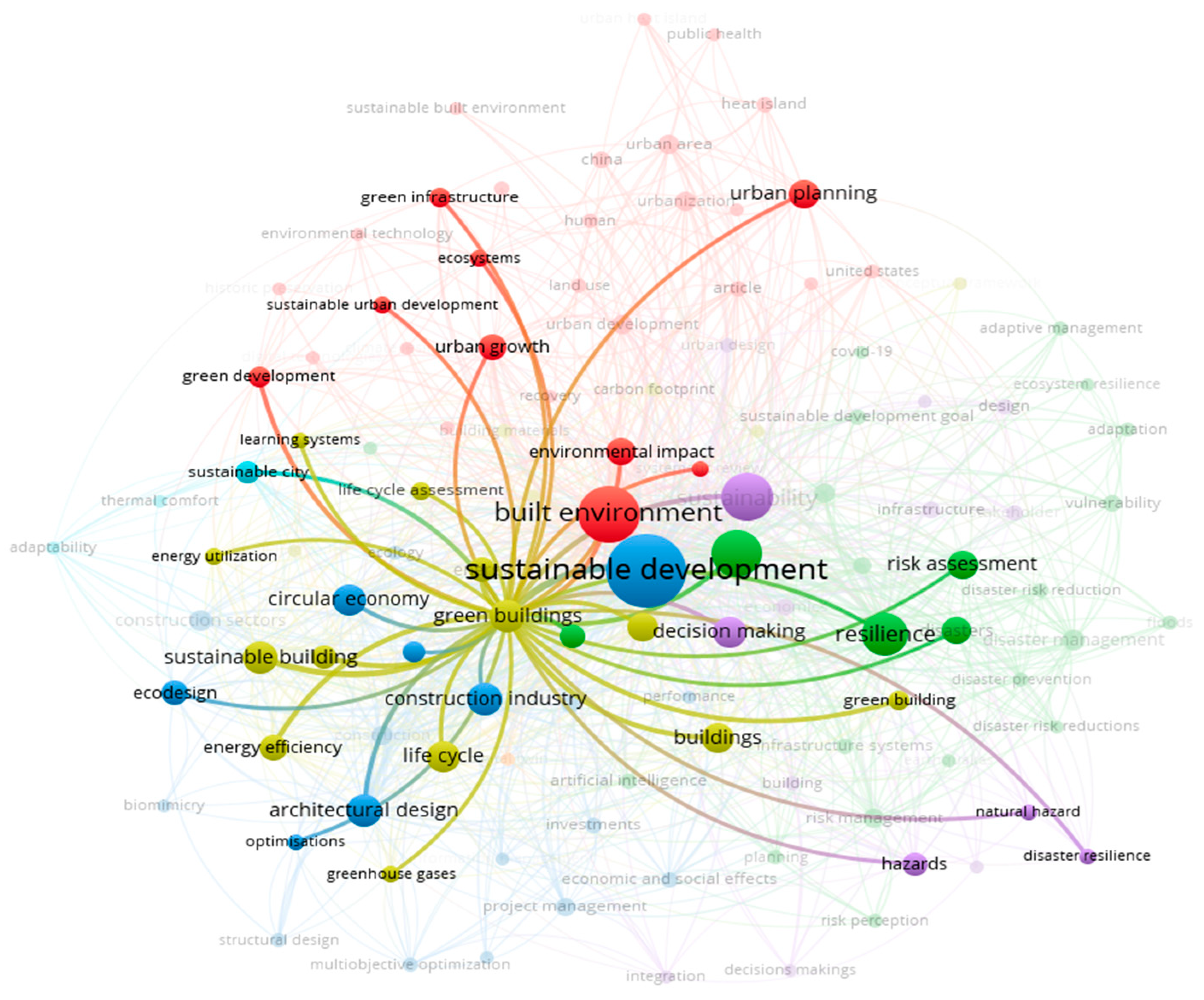
Keyword co-occurrence analysis was carried out to examine the relationships between the three major study areas, ‘Resilience’, ‘Sustainability’, and ‘Green buildings’. Network maps generated through bibliometric analysis are shown in Figure 1, Figure 2 and Figure 3. Nodes represent keywords, and links show how frequently they occur in the same publications. As shown in the Figures below, “sustainable development” was the most common and central term in all three networks, indicating that it served as an interconnected link between the three themes. Figure 1 highlights resilience connections, emphasizing the adaptability and long-term performance aspects of sustainability through strong relationships with infrastructure resilience, climate adaptation, and disaster risk reduction. The sustainability network shown in Figure 2 illustrates a broader relationship between urbanization, climate adaptation, and the circular economy, highlighting the interconnected nature of sustainability research. The technical and environmental focus of this field is reflected in Figure 3, where the keyword network for green buildings shows strong connections to terms such as energy efficiency, life-cycle assessment, and green materials. The three Figures show how research on resilience, sustainability, and green buildings relates to one another, with sustainable development as the key idea that connects all three fields.
Figure 1.
Keyword co-occurrence network for resilience.
Figure 2.
Keyword co-occurrence network for sustainability.
Figure 3.
Keyword co-occurrence network for green buildings.
Limitations
This review is subject to several limitations. The search was limited to English-language peer-reviewed journal articles and mainly utilized Scopus and ScienceDirect, possibly excluding relevant articles from alternative databases and grey literature. Also, current evidence regarding fully integrated S+R implementation varies across different scales and contexts. The relative focus on resilience and sustainability may differ by region based on climate risk, urbanization impact, regulatory maturity, economic capacity, and local hazard profiles.
3. Literature Review
3.1. Resilience in the Built Environment
3.1.1. Principle-Based Definitions
Thomas Tredgold brought up the term “resilient” to describe a kind of timber that would bend but not break under abrupt and heavy loads. The ability of a material to return to its original state after being affected by an external force is known as resilience [13]. The author has moreover mentioned that resilience is “an ecosystem’s capacity to absorb change generated by an event and retain its original status, function, shape, and relationship to other systems in the context of adaptive management of ecosystems. Researchers have defined resilience as a system’s capacity to adapt to extreme and unforeseen changes without transforming into an entirely novel system framework [20]. In disciplines such as ecology and systems theory, the concept of “resilience” initially defined the ability of a system to withstand shocks and return to equilibrium [21].
3.1.2. Functional and Adaptive Resilience in the Built Environment
Simultaneously, numerous definitions of resilience have been offered by earlier research in various academic domains; in ref. [22] resilience refers to the ability of a buildings and the systems that support their functions, such as the architectural, structural, mechanical, electrical, plumbing, security, communication, and information technology systems, as well as the connections to external infrastructure and services, to withstand disturbance. Publication ref. [23] defined it as a conceptual framework and a tool to achieve a sustainable built environment. At the same time, it can respond, recover, resist, repair, transform, preserve, balance, absorb, adapt, and maintain the urban built environment. The author ref. [24] believes that adaptability contributes to resilient built environments by enabling structures to respond to shocks and changing needs throughout their lifecycles. The concept of resilience has been applied to architectural and urban environments in recent decades to meet the demand for structures and urban areas that are resilient to a range of environmental and socioeconomic shocks [25,26]. In addition to structural stability, it is stated that architectural resilience now includes resource efficiency, adaptability, and sociocultural continuity. The concept of resilience has been addressed in different fields, including engineering, information technology, environmental science, social science, and disaster science, and is defined as the ability of a system to withstand and absorb internal and external disruptions, as well as the capacity for restructuring that facilitates quicker recovery after disasters [12]. The study ref. [27,28] described that resilience as the adaptive capacity of the premises to prepare, absorb, and recover. Similarly, ref. [21] has mentioned that resilience is broadly defined as the system’s ability to recover, absorb, and adapt to disturbances.
3.1.3. Resilience to Hazards, Climate, and Social-Technical Factors
However, resilience has emerged to address the challenges posed by climate change, urbanization, and socioeconomic instability [28,29]. In the literature, resilience is often addressed as structural stability by considering the conventional practices such as modular construction and reinforced composite systems that allow for the replacement of damaged parts rather than the demolishing the building [30]. In contrast, ref. [31] states that resilience covers multiple dimensions, including community well-being, ecosystem balance, and the capacity of the building to adapt and respond to environmental stresses.
Economic resilience could be achieved by life-cycle cost optimization and long-term industrial building performance by means of risk elimination and cost-cutting measures [32]. On the other hand, ref. [33] stated that with technological improvements, Artificial Intelligence (tracking, forecasting) enables supply chain resilience (adaptability, consistency), which is conceptualized through the Resource-Based View (RBV) and Complex Adaptive Systems (CAS). Study [34] stated that through user-building interactions and behaviors that improve adaptability and continuous operations in buildings, resilience is based on human and organizational factors. Furthermore, ref. [6] expressed that ecological systems initially defined the concept of resilience to explain the “persistence of the ecosystem against fluctuations”; nevertheless, in recent years, building retrofit, comfort, and health, microgrid power systems, and power grids, and many fields have broadly applied the concept. The author has mentioned that “energy resilience” in the built environment, consisting of buildings, infrastructure, and urban energy systems, is the unique and adaptive ability to predict, absorb, recover from, and react adaptively to changes in energy supply and demand while maintaining long-term functionality, efficiency, and equity. Several common themes, such as adaptive reuse and sustainability, climate adaptation, socio-ecological systems, and urban resilience, address a comprehensive approach to resilience in building design that takes into account both current structural requirements and broader social and environmental impacts [21].
To enable buildings and urban areas to withstand extreme weather events and promote a resilient community, resilience involves climate-adaptive design elements such as flood-resistant structures, thermal regulation, and natural disaster preparedness [35,36]. The author has explained that transportation networks, green infrastructure, and mixed-use zoning highlight interconnectivity within cities by illustrating urban resilience. According to ref. [7,37] a resilient built environment is a collection of structures that have gone through a variety of pre- and post-event measures to ensure that they can withstand and recover from a shock. Similarly, resilience in performance-based terms is a combination of hazard analysis, structural response, damage analysis, and loss analysis to convert conditions into functionality and repair requirements for buildings and infrastructure [28,37]. Furthermore, ref. [10] assessed that, given the significant expenses associated with restoring things to normal after a disaster, resilience-based planning and design initiatives that protect the built environment, and ensure the safety of people and economies have proven to be cost-effective methods. According to ref. [38], resilience, the ability of systems to deal with a hazardous event, trend, or disruption, could be addressed by incorporating more proactive design features, while adaptation involves actions that are taken after an incident. An “adaptable facility” can be easily adapted to meet those challenges, whereas a “resilient facility” is built for sustainability in the face of expected hazards [38]. The need for short-term adaptation should be minimized by mitigating the effects of climate-related hazards. Particularly, resilient built environments may assist in minimizing the losses after natural disasters, according to [7], a resilient built environment is a collection of buildings that have undergone a variety of pre- and post-event measures to ensure their ability to withstand and recover from a shock. Resilience in the context of the built environment describes the ability of a system to rapidly return to its original state of working in an undamaged layout [4]. Thereby, the author has connected resilience to structural resilience, stating that it is the ability of a system to “minimize the chances of a shock, to absorb such a shock when it occurs, and to recover promptly after the shock”. The author ref. [15] expressed that resilience indicators reflect necessity of coping with climate change or hazard events, and making sure that the infrastructure functions in an emergency.
Considering the overall reviewed literature, resilience is mainly aligned with the ability to absorb, adapt, recover, and maintain operations during disruptions. Robustness, redundancy, adaptability, recovery, and continuity are considered common terms that indicate that resilience extends beyond structural strength to system-level performance.
3.1.4. Resilience-Aligned Frameworks, Metrics, Indicators
The resilience-related frameworks, metrics, and indicators identified in the literature are summarized in Table 3.
Table 3.
Resilience Frameworks, Metrics, Indicators.
3.2. Sustainability in the Built Environment
3.2.1. Definitions Based on Preservation and Future Generations
The author [32] expressed that the concept of sustainability has over a hundred definitions as it has evolved over a hundred years. The author mentioned that sustainability is a comprehensive philosophical analysis of adaptive ecosystem management for an indefinite future. Publication [49] has defined “preserving something over time” and “multi-century preservation” as sustainability, whereas the concept has also been framed within the UN’s SDGs. According to the World Commission on Environment and Development (WCED), sustainability is “meeting the needs of the present generation without compromising the ability of future generations to fulfill their own needs” [13,21,33,47]. The author [29] similarly explained that sustainability primarily ensures meeting the needs of the current generation while also protecting natural resources and the built environment for future generations. Moreover, the author has defined sustainability as “protecting and maintaining natural and cultural resources for the future and mitigating change” [21].
3.2.2. Environmental, Social, and Economic Dimensions
Furthermore, the author has also emphasized that sustainability aims to enhance the quality of life and the condition of nature by creating a multidimensional system [27]. Simultaneously, ref. [50] stated that focusing on the economic, environmental, and social factors is a triple bottom line approach to sustainable built environment design. The author has emphasized that sustainability is a complex concept that has transformed into one of the major challenges facing the construction sector. The concept of sustainability involves enhancing people’s quality of life so that they can live in a healthy environment with better social, economic, and environmental circumstances [50]. Sustainability transformation in the construction sector worldwide has become a key requirement for providing a better built environment, which reduces environmental impact, preserves economic gains, and supports the community social needs [35]. The author emphasized that integrating key tenets of economy, environment, functionality, durability, health, and well-being into both new and existing buildings will improve the quality of life and also sustainability performance in buildings. Moreover, ref. [35] expressed that healthy lifestyles, resilient communities, and environmentally friendly consumption patterns are supportive of the multidimensional socio-technical aspect embraced by the concept of sustainable development. In the construction industry, sustainability means minimizing environmental effects, managing resources effectively, and fostering social equity and economic growth [3]. Study ref. [21] has explicitly stated that interpretations for the concept of sustainability are most commonly given in the environmental domain, where the describe it as “anything that ensures the well-being of societies and the environment” or else “an ethical concept that things should be better in the future than they are at present”.
3.2.3. Resource Efficiency and Life-Cycle Perspectives
In response to increasing demands and challenges caused by global issues, sustainability has changed and become recognized in various ways. Some researchers have also defined sustainability through six principles: (i) minimizing resource consumption, (ii) maximizing reuse, (iii) promoting renewable and recyclable resources, (iv) protecting the environment, (v) creating a healthy and non-toxic environment, and (vi) pursuing quality [33]. Design for Adaptability (DfA) strategies, such as management, economic, policy, design, technology, and social factors, are used to operationalize the sustainability and circularity goals [24]. The idea of sustainability provides a balance among nature, long-term lifestyles, and organizational practices, and also ensures the integration of innovative practices to support the built environment’s productivity, reduce GHG emissions, preserve biodiversity, and increase the quality of life for all [38]. Furthermore, a reduction in carbon, air, and waste pollution, which are considered environmental concerns, reflects exactly what is meant by sustainability [15].
In summary, long-term environmental responsibility, resource efficiency, life-cycle thinking, and social and economic well-being are linked to sustainability. Environmental protection, circularity, quality of life, and intergenerational responsibility are the main terms reflecting that sustainability is more focused on long-term goals.
3.2.4. Sustainability Aligned Frameworks, Metrics, Indicators
The literature identifies sustainability-related frameworks, metrics, and indicators that can be categorized into assessment tools, life-cycle frameworks, performance metrics, and strategy-oriented indicator areas. Table 4 below summarizes their main focus and application in buildings and infrastructure.
Table 4.
Sustainability frameworks, metrics, and indicators.
3.3. Practical Application of the Concepts of Sustainability and Resilience
Considering the literature discussed above, Table 5 shows how both sustainability and resilience concepts have been applied together in the built environment.
Table 5.
Practical application of the concepts.
Resilience and sustainability principles are becoming more useful in practice, yet challenges remain in applying them, as shown in the literature. High initial costs can make people less likely to invest in resilient retrofits, digital monitoring systems, and advanced material solutions, even though they are aware of the payoff in the long run. Furthermore, technical problems include not obtaining enough data, not being able to use digital tools together, and not being able to measure resilience in practical terms. Lastly, organizational barriers, such as unclear roles for stakeholders, a lack of professional expertise, and a focus on short-term investments, make it harder for the construction industry to adopt integrated sustainability and resilience approaches.
3.4. Interactions, Differences and Overlaps
The following Table 6 explains the intersections and differences between the two concepts.
Table 6.
Intersection and Differences in Resilience and Sustainability.
Table 7 below. Illustrates the overlaps between the concept of sustainability (S) and resilience (R) as per the searched research articles. S + R refers to sustainability-led research, which integrates resilience to improve the long-term robustness, performance, and adaptability of sustainable materials, systems, or designs. R + S, on the other hand, represents a resilience-led strategy that incorporates sustainability principles to ensure both resilient systems and infrastructures maintain social, economic, and environmental stability. Both viewpoints demonstrate that the two concepts are becoming increasingly overlapping, emphasizing that resilient systems must incorporate sustainability to survive in the long term, while sustainable solutions require resilience to withstand future stresses.
Table 7.
Overlaps in both concepts.
4. Discussion
Considering the definitions, indicators, and frameworks of both sustainability and resilience, many researchers have noted overlaps and similarities between them. A resilience–sustainability paradox arises when environmental efficiency is achieved without sufficient consideration of hazard resistance, adaptability, and recovery following disruptions.
Researchers have raised concerns about whether sustainability alone is a sufficient response in light of the current rate of climate change and frequent natural hazards. Publications [13,67] emphasized that green buildings should not only reduce their environmental impact but also be resilient to potential external stresses throughout their lifetimes. Therefore, researchers have also emphasized that integrating the parameters of these two concepts is essential for mitigating risks, adapting to shocks, and maintaining functionality. Study [49] stated that while addressing current sustainability and diversity issues will also increase resilience within societies, integrating the SDGs, DRR, and CCA measures into community-level initiatives seems both reasonable and essential. Publications [4,13,20] as examples of the integrated S+R approach in the literature have applied the DEMATEL-based integration of resilience indicators into sustainability assessment frameworks, alterations to green rating tools to include disaster resilience, and decision-support frameworks that connect sustainable and fire-resilient building design.
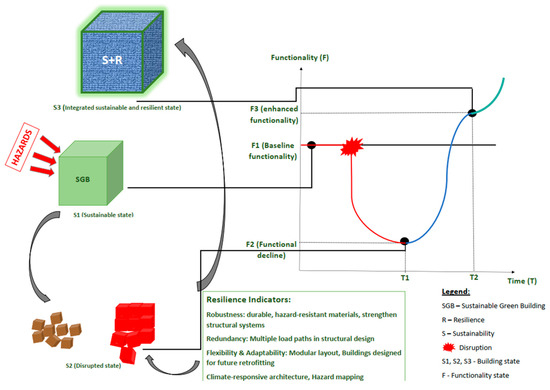
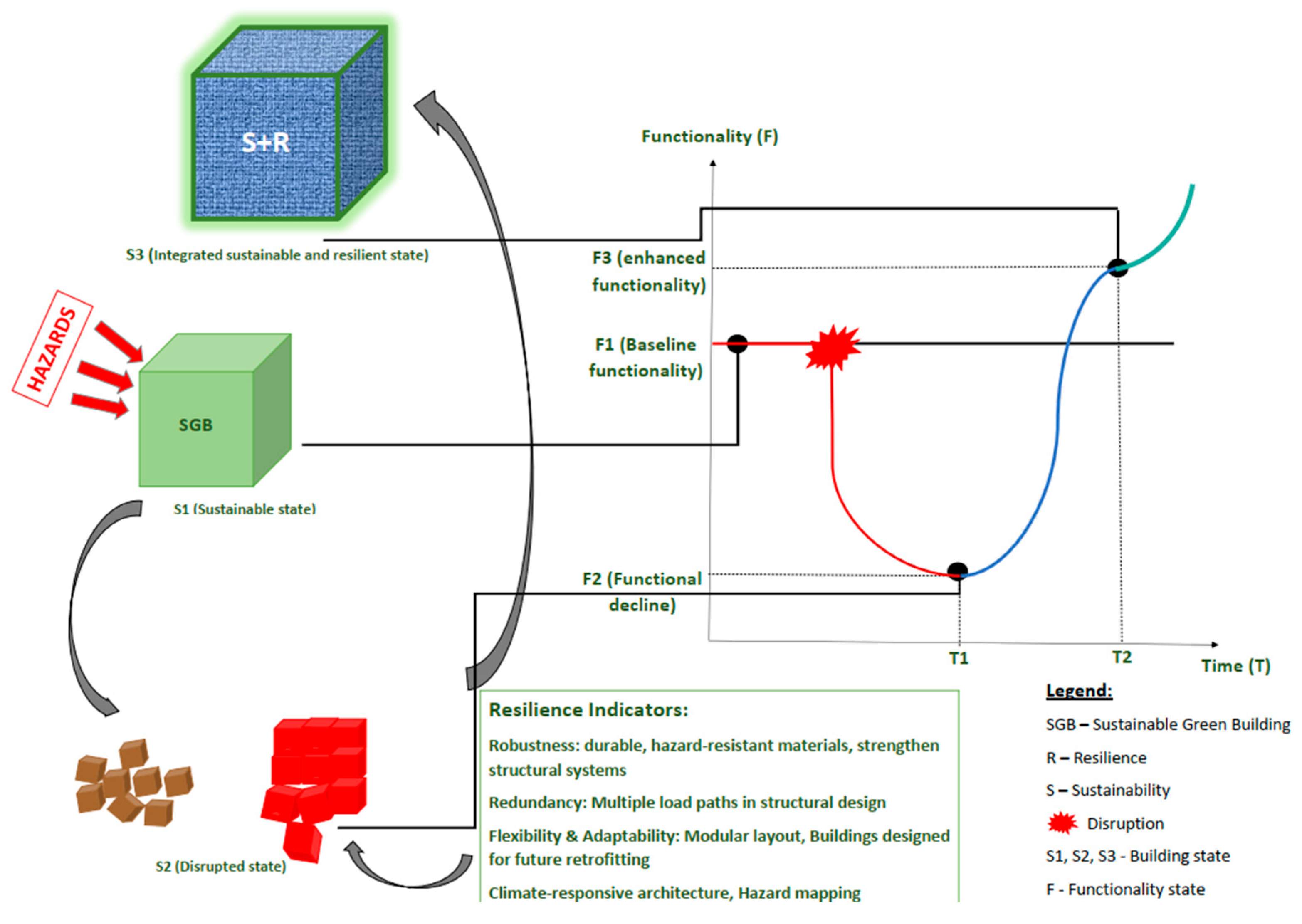
This discussion synthesizes the findings in relation to RQ1 to RQ4. The following Figure 4 illustrates that the built environment’s resilience is becoming increasingly important, necessitating a change in its design and construction.
Figure 4.
Conceptual transition of an SGB to a sustainable and resilient building (S+R), which illustrates how building states and functionality conditions are related during times of disruption and recovery.
Figure 4 conceptually demonstrates how resilience principles blend with sustainability to transform a Sustainable Green Building (SGB) into a Sustainable and Resilient (S+R) building. S1, S2, and S3 indicate the overall state of the building, while F1, F2, and F3 represent the functionality conditions before a disruption, during degradation, and after recovery. The legend explains the meaning of the labels used for the figure.
The building acts as an SGB at the first state (S1), with a focus on the environmental and energy performance of that respective building while keeping its functionality (FI). However, its functionality may significantly deteriorate (F2) in response to climate-induced and natural hazards like heatwaves, heavy rainfall, flooding, cyclones, wildfires, earthquakes, and landslides, resulting in an impact that puts the SGB into a failure state (S2). Over time, this disruption appears as a significant decrease in functionality, indicating the building’s vulnerability in the absence of resilience measures. The building may recover more quickly and efficiently by incorporating resilience strategies, such as redundancy through multiple structural load paths, flexibility and adaptability through modular and retrofit-ready designs, and robustness through long-lasting and hazard-resistant materials. As a result of these actions, the building eventually achieves an improved functionality state (F3) and becomes a fully integrated Sustainable and Resilient (S+R) building (S3), regaining and possibly improving its performance beyond pre-disruption levels. This figure highlights that resilience is a dynamic, time-dependent process that enhances sustainability by enabling buildings to minimize performance loss, absorb shocks, and adapt to potential hazards. This ensures long-term functionality and sustainability throughout the building life cycle. In practical terms, disruptions caused by climate and hazards can be evaluated based on building performance indicators like structural integrity, thermal comfort, indoor environmental quality, repair time, and operational downtime. For instance, floods can damage building parts and make it difficult to maintain operations, while earthquakes may cause buildings to be less stable and take longer to recover.
This study proposes the following individual definitions for resilience and sustainability based on the combined findings from the reviewed literature.
Sustainability in the built environment can be defined as “The ability of structures and infrastructure systems to provide long-term environmental, social, and economic value by minimizing resource consumption, lowering environmental impacts, and promoting human wellbeing throughout their life cycle without compromising the needs of future generations”. Whereas the Resilience in the built environment can be defined as “The ability of buildings and infrastructure systems to foresee, absorb, adapt to, and recover from internal and external disruptions such as climate induced or natural hazards while preserving critical functions, safety, and efficiency over the years”.
S+R is an integrated approach to the built environment that combines “resilience features and sustainability principles to make buildings and infrastructure not only environmentally efficient but also able to withstand, adapt to, and recover from disruptions caused by hazards and climate change”.
Table 8 below clarifies how the integrated S+R definition is interpreted in different built environment contexts.
Table 8.
Interpretation of the S+R definition in different built environment contexts.
Based on the definition above, five guiding principles may assist in performing S+R successfully in the built environment.
- First, both hazard and climate risks should be built into the design from the beginning.
- Second, the performance of a building must prioritize functionality as much as environmental efficiency.
- Modular systems, backup capacity, and retrofit-friendly design should make systems more adaptable, redundant, and recoverable.
- Consider how long the material will last, how easy it is to fix, and how resistant it is to hazards when selecting materials, rather than just embodied carbon and efficiency.
- Policies, procurement systems, and building assessment frameworks should utilize the same sustainability and resilience standards to make it easier for the construction industry to adopt them.
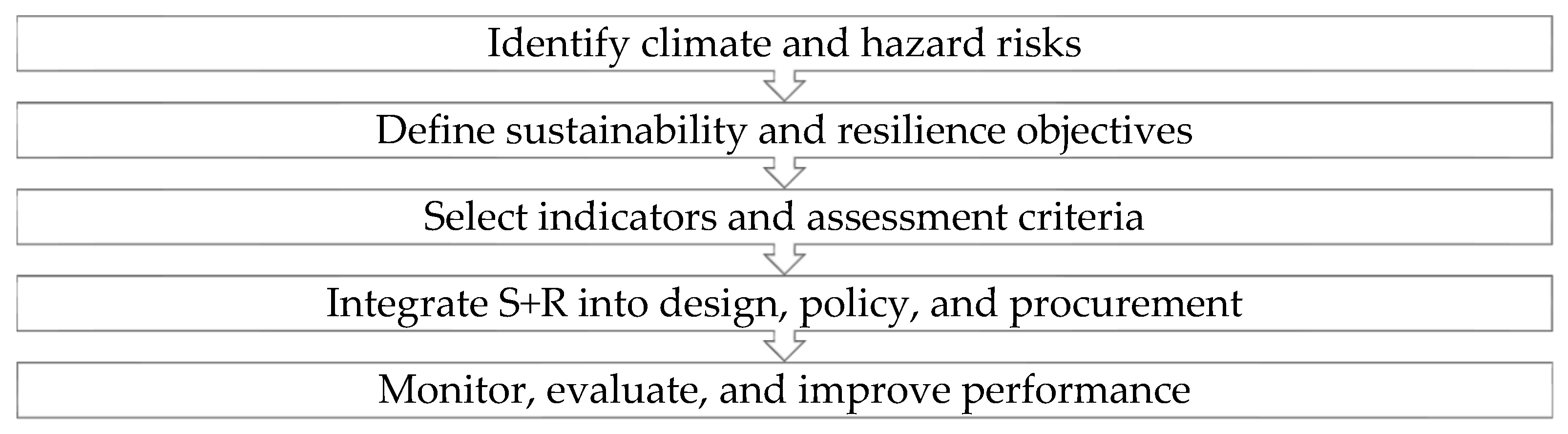
Simultaneously, Figure 5 illustrates the practical implementation of the integrated S+R approach. The flow chart outlines risk identification, selection of relevant indicators, decision-making, and continuous performance monitoring.
Figure 5.
Practical Implementation of the S+R approach.
While responding to RQ1, the above discussion denotes that resilience and sustainability are interconnected but separate concepts. Resilience is mostly about being able to handle, adjust to, and bounce back from issues, while sustainability is mainly about generating long-term value for the environment, society, and the economy. In response to RQ2, the literature defines a broad range of frameworks, metrics, and indicators employed to operationalize resilience and sustainability in buildings and infrastructure. The review shows that resilience and sustainability are utilized extensively together in real life by individuals through process-centered implementation, urban and infrastructure systems, digital practices, circular economy strategies, policy tools, and retrofit or post-disaster recovery measures in response to the RQ3. The results indicate that sustainability and resilience intersect in many areas; however, they remain conceptually unique. Sustainability is more about eliminating difficulties and planning for the long term, while resilience is more about being able to adapt, keep going, and recover during disruption, providing an answer to RQ4.
5. Conclusions
The review reveals that the actual integration of resilience (R) and sustainability (S) within the built environment remains inconsistent, despite being frequently discussed as complementary concepts. Sustainable buildings are not naturally resistant to the growing effects of climate change, even though they comply with environmental performance standards. The literature highlights that a significant gap exists in current practices that sustainability alone cannot ensure functionality, reliability, and durability under extreme events. Resilience parameters such as robustness, adaptability, redundancy, and rapid recoverability are introduced to maintain system performance both during and after disruptions. Resilience ensures short- and medium-term functionality during times of uncertainty, while sustainability promotes long-term aspects and responsibility for the environment. Buildings and infrastructure that are environmentally friendly, resilient to shocks, and future-proof can be achieved by combining the two paradigms (S+R). Therefore, the built environment presents a paradox: sustainability alone does not always guarantee resilience, even though the majority considers that both of these concepts ensure that buildings remain more durable.
The review found that in response to RQ1, resilience and sustainability are closely related yet separate concepts. Resilience focuses on adaptation and recovery, while sustainability focuses on long-term environmental, social, and economic benefits. In response to RQ2, the literature defined various frameworks, metrics, and indicators employed to implement these concepts within buildings and infrastructure. In response to RQ3, the study identified the development of practical integration in areas including design, governance, digital tools, circularity, and retrofit or recovery practices. In response to RQ4, the review defined that resilience and sustainability significantly overlap, but differ in time focus, implementation, and performance prioritization.
The review concludes that integrating resilience principles into the sustainability standards, policies, frameworks, construction practices, and material selection is essential to address the climate risks and ensure that the built environment remains safe and reliable throughout its life cycle. Existing building codes and sustainability rating systems usually address environmental performance and hazard resilience through different methods. This separation may make it difficult to reach decisions that take all factors into account, since energy, carbon, and resource indicators often receive priority over criteria related to resilience parameters. To achieve a more integrated S+R approach, sustainability assessment tools, resilience guidelines, and regulatory standards need to be more closely connected.
The results have also provided practical implications for the main stakeholders in construction, including governments and regulators, who should shift building codes, construction norms, and sustainability rating systems to include specific resilience standards along with environmental performance goals. While making investment decisions, developers should consider more than just short-term economic viability; they should also think about long-term functionality, recoverability, and risk exposure. Furthermore, designers should include resilience parameters in sustainable design plans from the very beginning. Facility managers and operators should ensure that sustainable buildings remain productive during times of disruption through post-occupancy monitoring.
Future research should focus on the development of standardized integrated metrics, the validation of S+R frameworks across building, infrastructure, and urban scales, and the assessment of the practical performance of S+R approaches through case-based studies. Similarly, sensitivity analysis could enhance future S+R research by identifying the resilience parameters that significantly influence sustainability outcomes, resulting in enhanced prioritization, framework improvement, and decision-making.
Funding
This research received no external funding.
Institutional Review Board Statement
Not applicable.
Informed Consent Statement
Not applicable.
Data Availability Statement
The original contributions presented in this study are included in the article. Further inquiries can be directed to the corresponding author.
Conflicts of Interest
The authors declare no conflict of interest.
Abbreviations
The following abbreviations are used in this manuscript:
| AI | Artificial Intelligence |
| BEES | Building for Environmental and Economic Sustainability |
| BIM | Building Information Modeling |
| BREEAM | Building Research Establishment Environmental Assessment Method |
| CAS | Complex Adaptive System |
| CCA | Climate Change Adaptation |
| DRR | Disaster Risk Reduction |
| DfA | Design for Adaptability |
| GBRS | Green Building Rating System |
| GHG | Green House Gas |
| LEED | Leadership in Energy and Environmental Design |
| LCA | Life-cycle Assessment |
| RBV | Resource-based View |
| SDGs | Sustainable Development Goals |
| USGBC | U.S Green Building Council |
| WCED | World Commission on Environment and Development |
References
- Jayawardana, J.; Sandanayake, M.; Kulatunga, A.K.; Jayasinghe, J.A.S.C.; Zhang, G.; Osadith, S.A.U. Evaluating the Circular Economy Potential of Modular Construction in Developing Economies—A Life Cycle Assessment. Sustainability 2023, 15, 16336. [Google Scholar] [CrossRef] [Scilit]
- Badarnah, L. Holistic Education for a Resilient Future: An Integrated Biomimetic Approach for Architectural Pedagogy. Biomimetics 2025, 10, 369. [Google Scholar] [CrossRef] [Scilit] [PubMed]
- Brandão, R.; Verissimo, L. Circular Economy Adoption in Construction: A Pathway to Sustainable Development and UN SDG 11 Achievement. In An Agenda for Sustainable Development Research; World Sustainability Series; Springer Nature Switzerland: Cham, Switzerland, 2024; Volume Part F3447, pp. 213–230. [Google Scholar]
- Di Bari, R.; Cucuzza, R.; Domaneschi, M.; Mitoulis, S.A. Enhancing Sustainability and Resilience Against Natural Hazard of the Built Environment—State of the Art and Development of a Novel Framework. Sustain. Dev. 2025, 33, 9398–9425. [Google Scholar] [CrossRef] [Scilit]
- Sapuan, N.M.; Haron, N.F.; Vija Kumaran, V.; Saudi, N.S.; Ridzuan, A.R. Green Building Best Practices in Achieving Energy and Environmental Sustainability. Environ. Manag. Sustain. Dev. 2022, 11, 74–92. [Google Scholar] [CrossRef] [Scilit]
- Wei, M.; Jiang, Z.; Pandey, P.; Liu, M.; Li, R.; O’Neill, Z.; Dong, B.; Hamdy, M. Energy Resilience in the Built Environment: A Comprehensive Review of Concepts, Metrics, and Strategies. Renew. Sustain. Energy Rev. 2025, 210, 115258. [Google Scholar] [CrossRef] [Scilit]
- Tanguay, X.; Amor, B. Assessing the Sustainability of a Resilient Built Environment: Research Challenges and Opportunities. J. Clean. Prod. 2024, 458, 142437. [Google Scholar] [CrossRef] [Scilit]
- Pal, I.; Ganni, S.V.S.A.B.; Baskota, A.; Kumar, J. Disaster and Climate Resilience for Sustainable Development: Initiatives and Lessons Learned; Springer: Berlin/Heidelberg, Germany, 2025; Volume 623 LNCE, pp. 1–13. [Google Scholar]
- Pujiati, A.; Yanto, H.; Dwi Handayani, B.; Ridzuan, A.R.; Borhan, H.; Shaari, M.S. The Detrimental Effects of Dirty Energy, Foreign Investment, and Corruption on Environmental Quality: New Evidence from Indonesia. Front. Environ. Sci. 2023, 10, 1074172. [Google Scholar] [CrossRef] [Scilit]
- Zuccaro, G.; Leone, M.F. Building Resilient Cities: A Simulation-Based Scenario Assessment Methodology for the Integration of DRR and CCA in a Multi-Scale Design Perspective. Procedia Eng. 2018, 212, 871–878. [Google Scholar] [CrossRef] [Scilit]
- Valencia, A.; Zhang, W.; Gu, L.; Chang, N.-B.; Wanielista, M.P. Synergies of Green Building Retrofit Strategies for Improving Sustainability and Resilience via a Building-Scale Food-Energy-Water Nexus. Resour. Conserv. Recycl. 2022, 176, 105939. [Google Scholar] [CrossRef] [Scilit]
- Sajjad, M.; Chan, J.C.L.; Chopra, S.S. Rethinking Disaster Resilience in High-Density Cities: Towards an Urban Resilience Knowledge System. Sustain. Cities Soc. 2021, 69, 102850. [Google Scholar] [CrossRef] [Scilit]
- Roostaie, S.; Nawari, N. The DEMATEL Approach for Integrating Resilience Indicators into Building Sustainability Assessment Frameworks. Build. Environ. 2022, 207, 108113. [Google Scholar] [CrossRef] [Scilit]
- Likitswat, F. Future Cities: New Generation’s Visions of Sustainability Concepts and Models. Future Cities Environ. 2019, 5, 1–8. [Google Scholar] [CrossRef] [Scilit]
- Marlow, E.C.; Chmutina, K.; Dainty, A. Interpreting Sustainability and Resilience in the Built Environment. Int. J. Disaster Resil. Built Environ. 2023, 14, 332–348. [Google Scholar] [CrossRef] [Scilit]
- Marchese, D.; Reynolds, E.; Bates, M.E.; Morgan, H.; Clark, S.S.; Linkov, I. Resilience and Sustainability: Similarities and Differences in Environmental Management Applications. Sci. Total Environ. 2018, 613–614, 1275–1283. [Google Scholar] [CrossRef] [Scilit] [PubMed]
- Sauer, P.C.; Seuring, S. How to Conduct Systematic Literature Reviews in Management Research: A Guide in 6 Steps and 14 Decisions. Rev. Manag. Sci. 2023, 17, 1899–1933. [Google Scholar] [CrossRef] [Scilit]
- Zhu, J.; Liu, W. A Tale of Two Databases: The Use of Web of Science and Scopus in Academic Papers. Scientometrics 2020, 123, 321–335. [Google Scholar] [CrossRef] [Scilit]
- Carrera-Rivera, A.; Ochoa, W.; Larrinaga, F.; Lasa, G. How-to Conduct a Systematic Literature Review: A Quick Guide for Computer Science Research. MethodsX 2022, 9, 101895. [Google Scholar] [CrossRef] [Scilit]
- Singh, V.K.; Singh, P.; Karmakar, M.; Leta, J.; Mayr, P. The Journal Coverage of Web of Science, Scopus and Dimensions: A Comparative Analysis. Scientometrics 2021, 126, 5113–5142. [Google Scholar] [CrossRef] [Scilit]
- Roostaie, S.; Nawari, N.; Kibert, C.J. Sustainability and Resilience: A Review of Definitions, Relationships, and Their Integration into a Combined Building Assessment Framework. Build. Environ. 2019, 154, 132–144. [Google Scholar] [CrossRef] [Scilit]
- Al-Zghoul, S.; Al-Homoud, M. GIS-Driven Spatial Planning for Resilient Communities: Walkability, Social Cohesion, and Green Infrastructure in Peri-Urban Jordan. Sustainability 2025, 17, 6637. [Google Scholar] [CrossRef] [Scilit]
- Abeysinghe, S.; de Zoysa, C.J.; Siriwardana, C.; Bandara, C.; Dissanayake, R. Integrating Disaster Resilience into Green Rating Systems—A Modification of the Sri Lankan Green Building Rating Tool. Smart Sustain. Built Environ. 2023, 12, 765–786. [Google Scholar] [CrossRef] [Scilit]
- Agyekum, K.; Kotei-Martin, J.N.; Pittri, H.; Gasue, R.; Sackey, K.N.Y.S. Strategies Enhancing the Implementation of Design for Adaptability in the Ghanaian Construction Indufactor Stry: An Exploratory and Confirmatory Analyses. Green Technol. Sustain. 2025, 4, 100268. [Google Scholar] [CrossRef] [Scilit]
- Mouhcine, B. Architectural Resilience for Sustainable Development: A Bibliometric Analysis. Sustain. Dev. 2025, 33, 4976–5000. [Google Scholar] [CrossRef] [Scilit]
- Murtagh, N.; Scott, L.; Fan, J. Sustainable and Resilient Construction: Current Status and Future Challenges. J. Clean. Prod. 2020, 268, 122264. [Google Scholar] [CrossRef] [Scilit]
- Li, J.; Yu, H.; Deng, X. A Systematic Review of the Evolution of the Concept of Resilience in the Construction Industry. Buildings 2024, 14, 2643. [Google Scholar] [CrossRef] [Scilit]
- Castaño-Rosa, R.; Pelsmakers, S.; Järventausta, H.; Poutanen, J.; Tähtinen, L.; Rashidfarokhi, A.; Toivonen, S. Resilience in the Built Environment: Key Characteristics for Solutions to Multiple Crises. Sustain. Cities Soc. 2022, 87, 104259. [Google Scholar] [CrossRef] [Scilit]
- Adeniyi, O.; Perera, S.; Ginige, K.; Feng, Y. Developing Maturity Levels for Flood Resilience of Businesses Using Built Environment Flood Resilience Capability Areas. Sustain. Cities Soc. 2019, 51, 101778. [Google Scholar] [CrossRef] [Scilit]
- Makvandi, M.; Li, W.; Li, Y.; Wu, H.; Khodabakhshi, Z.; Xu, X.; Yuan, P. Advancing Urban Resilience Amid Rapid Urbanization: An Integrated Interdisciplinary Approach for Tomorrow’s Climate-Adaptive Smart Cities—A Case Study of Wuhan, China. Smart Cities 2024, 7, 2110–2130. [Google Scholar] [CrossRef] [Scilit]
- Bühler, M.; Hollenbach, P.; Köhler, L.; Armstrong, R. Unlocking Resilience and Sustainability with Earth-Based Materials: A Principled Framework for Urban Transformation. Front. Built Environ. 2024, 10, 1385116. [Google Scholar] [CrossRef] [Scilit]
- Hosseini, M.; Miranda, F.; Lin, J.; Silva, C.T. CitySurfaces: City-Scale Semantic Segmentation of Sidewalk Materials. Sustain. Cities Soc. 2022, 79, 103630. [Google Scholar] [CrossRef] [Scilit]
- Abeygunawardana, P.G.C.M.; Dulshan Costa, M.D.; Hadiwattege, C. Towards Sustainable and Cost-Efficient Industrial Buildings in Sri Lanka: Framework Development and Critical Analysis of Sustainable Practices. In Proceedings of the 2023 Moratuwa Engineering Research Conference (MERCon); IEEE: Piscataway, NJ, USA, 2023; pp. 714–719. [Google Scholar]
- Al-Fannah, S.A.; Elgeddawy, M. Integrating AI and Sustainability into Supply Chain Resilience: A Conceptual Framework for Oman’s Engineering and Construction Industry Aligned with Oman Vision 2040. In Studies in Systems, Decision and Control; Springer: Berlin/Heidelberg, Germany, 2025; Volume 601, pp. 615–625. [Google Scholar]
- Goh, C.S. Unlocking Human Factors for More Resilient and Sustainable Built Environments: Human Centric Solutions; IOP Publishing: Bristol, UK, 2022; Volume 1101. [Google Scholar]
- Grum, B.; Kobal Grum, D. Urban Resilience and Sustainability in the Perspective of Global Consequences of COVID-19 Pandemic and War in Ukraine: A Systematic Review. Sustainability 2023, 15, 1459. [Google Scholar] [CrossRef] [Scilit]
- Sadikoglu, E.; Demirkesen, S.; Dal, O.; Şeker, O.; Nowak, P.; Toprak, S. Fostering Sustainability and Resilience in Engineering Education and Practice: Lessons Learnt from the 2023 Kahramanmaras Earthquakes. Sustainability 2025, 17, 1470. [Google Scholar] [CrossRef] [Scilit]
- Rezvani, S.M.; Falcão, M.J.; Komljenovic, D.; De Almeida, N.M. A Systematic Literature Review on Urban Resilience Enabled with Asset and Disaster Risk Management Approaches and GIS-Based Decision Support Tools. Appl. Sci. 2023, 13, 2223. [Google Scholar] [CrossRef] [Scilit]
- Pascariu, G.C.; Banica, A.; Nijkamp, P. A Meta-Overview and Bibliometric Analysis of Resilience in Spatial Planning—The Relevance of Place-Based Approaches. Appl. Spat. Anal. 2023, 16, 1097–1127. [Google Scholar] [CrossRef] [Scilit]
- Takva, Y.; Takva, Ç.; İlerisoy, Z.Y. Sustainable Adaptive Reuse Strategy Evaluation for Cultural Heritage Buildings. Int. J. Built Environ. Sustain. 2023, 10, 25–37. [Google Scholar] [CrossRef] [Scilit]
- Sádaba, J.; Luzarraga, A.; Lenzi, S. Designing for Climate Adaptation: A Case Study Integrating Nature-Based Solutions with Urban Infrastructure. Urban Sci. 2025, 9, 74. [Google Scholar] [CrossRef] [Scilit]
- Sheng, M.; Reiner, M.; Sun, K.; Hong, T. Assessing Thermal Resilience of an Assisted Living Facility during Heat Waves and Cold Snaps with Power Outages. Build. Environ. 2023, 230, 110001. [Google Scholar] [CrossRef] [Scilit]
- Sun, K.; Zhang, W.; Zeng, Z.; Levinson, R.; Wei, M.; Hong, T. Passive Cooling Designs to Improve Heat Resilience of Homes in Underserved and Vulnerable Communities. Energy Build. 2021, 252, 111383. [Google Scholar] [CrossRef] [Scilit]
- Dawodu, A.; Cheshmehzangi, A.; Sharifi, A.; Oladejo, J. Neighborhood Sustainability Assessment Tools: Research Trends and Forecast for the Built Environment. Sustain. Futures 2022, 4, 100064. [Google Scholar] [CrossRef] [Scilit]
- Sesana, M.M.; Dell’Oro, P. Sustainability and Resilience Assessment Methods: A Literature Review to Support the Decarbonization Target for the Construction Sector. Energies 2024, 17, 1440. [Google Scholar] [CrossRef] [Scilit]
- Zatta, E.; Condotta, M.; Revellini, R.; Tatano, V. Delivering Sustainability in the Italian N-E Built Environment and Construction Sector: A Conceptual Research Framework. Buildings 2023, 13, 2920. [Google Scholar] [CrossRef] [Scilit]
- Rajapaksha, S.H.; Rajapaksha, D.V.; Siriwardana, C. Understanding the Interdependency of Resilience Indicators in Green Building Assessment Tools in Sri Lanka: An Application of SWARA Method. In Proceedings of the 2022 Moratuwa Engineering Research Conference (MERCon), Moratuwa, Sri Lanka, 27–29 July 2022. [Google Scholar]
- Pasindu, D.; Rathnayaka, B.; Rajapaksha, D.; Siriwardana, C.; Rajapakse, L. Challenges in Integrating the Paris Agreement, Sustainable Development Goals, and Sendai Framework into Coastal Built Environments: A Review of Sri Lankan Context; Springer: Berlin/Heidelberg, Germany, 2025; pp. 43–64. [Google Scholar]
- Alzouby, A.M.; Jebril, E.W. Barriers to Applying the Eco-System Resilience Approach as a Tool to Achieve a Sustainable Built Environment in Amman, Jordan. Int. J. Sustain. Dev. Plan. 2022, 17, 1189–1195. [Google Scholar] [CrossRef] [Scilit]
- Ballesty, S. Quality of Life: Alignment of FM with the SDGs; IOP Publishing: Bristol, UK, 2023; Volume 1176. [Google Scholar]
- Akadiri, P.O.; Chinyio, E.A.; Olomolaiye, P.O. Design of A Sustainable Building: A Conceptual Framework for Implementing Sustainability in the Building Sector. Buildings 2012, 2, 126–152. [Google Scholar] [CrossRef] [Scilit]
- Roostaie, S.; Kouhirostami, M.; Sam, M.; Kibert, C.J. Resilience Coverage of Global Sustainability Assessment Frameworks: A Systematic Review. J. Green Build. 2021, 16, 23–53. [Google Scholar] [CrossRef] [Scilit]
- Anwar, G.A.; Dong, Y.; Khan, M.A. Long-Term Sustainability and Resilience Enhancement of Building Portfolios. Resilient Cities Struct. 2023, 2, 13–23. [Google Scholar] [CrossRef] [Scilit]
- Lopez Duarte, F.K. Circular Economy Assessment in Different Scales of the Built Environment Impacts and Sustainable Strategies. Sustain. Mediterr. Constr. 2021, 2021, 25–32. [Google Scholar]
- Othengrafen, F.; Ziehl, M.; Herrmann, S. Community Resilience: Transformative Capacity as Driver for Social Cohesion and Sustainable Development; Edward Elgar Publishing: Cheltenham, UK, 2024; pp. 19–33. [Google Scholar]
- Ficara, F.; Wheeler, M. A Paradigm Shift in Disaster Management: Incorporating a Human Rights-Based Approach to Disaster Risk Reduction. J. Emerg. Manag. 2023, 21, 557–576. [Google Scholar] [CrossRef] [Scilit] [PubMed]
- El-Maissi, A.M.; Argyroudis, S.A.; Kassem, M.M.; Mohamed Nazri, F. Integrated Seismic Vulnerability Assessment of Road Network in Complex Built Environment toward More Resilient Cities. Sustain. Cities Soc. 2023, 89, 104363. [Google Scholar] [CrossRef] [Scilit]
- Miguez, M.G.; Veról, A.P.; Battemarco, B.P.; Yamamoto, L.M.T.; de Brito, F.A.; Fernandez, F.F.; Merlo, M.L.; Queiroz Rego, A. A Framework to Support the Urbanization Process on Lowland Coastal Areas: Exploring the Case of Vargem Grande—Rio de Janeiro, Brazil. J. Clean. Prod. 2019, 231, 1281–1293. [Google Scholar] [CrossRef] [Scilit]
- Mushtaha, A.W.; Alaloul, W.S. Sustainability Factors Influencing Post-Disaster Reconstruction Projects: Critical Review and Bibliometric Analysis. Sustain. Futures 2025, 10, 100930. [Google Scholar] [CrossRef] [Scilit]
- Huang, X.; Yao, R.; Halios, C.H.; Kumar, P.; Li, B. Integrating Green Infrastructure, Design Scenarios, and Social-Ecological-Technological Systems for Thermal Resilience and Adaptation: Mechanisms and Approaches. Renew. Sustain. Energy Rev. 2025, 212, 115422. [Google Scholar] [CrossRef] [Scilit]
- Mistarihi, M.Z.; Kharseh, M.; Abo-Zahhad, E.M.; Alamara, K.; Elasy, M.; Aldhuhoori, K. Energy-Efficient Strategies for Net-Zero Buildings in the UAE: A Climate-Resilient Blueprint. Energy Convers. Manag. 2025, 28, 101215. [Google Scholar] [CrossRef] [Scilit]
- Flores Lara, J.C.; El-Fadel, M.; Rauf, A.; Khalfan, M.M.A. Insights and Innovations in Construction and Demolition Waste Management: Strategic Framework for Circular Market Development. Resour. Conserv. Recycl. Adv. 2025, 28, 200288. [Google Scholar] [CrossRef] [Scilit]
- Iyer-Raniga, U.; Huovila, P. Mapping Sustainability Indicators for Circular Built Environment in the Global South; IOP Publishing: Bristol, UK, 2022; Volume 1101. [Google Scholar]
- Bressane, A.; Fengler, F.H.; Medeiros, L.C.D.C.; Urban, R.C.; Negri, R.G. Enhancing Energy Sustainability of Building Projects through Nature-Based Solutions: A Fuzzy-Based Decision Support System. Nat.-Based Solut. 2024, 5, 100107. [Google Scholar] [CrossRef] [Scilit]
- Çiçek, A. A Novel Resilience-Oriented Energy Management Strategy for Hydrogen-Based Green Buildings. J. Clean. Prod. 2024, 470, 143297. [Google Scholar] [CrossRef] [Scilit]
- Elseknidy, M.; Al-Mhdawi, M.K.S.; Qazi, A.; Ojiako, U.; Mahammedi, C.; Rahimian, F.P. Developing a Sustainability-Driven Risk Management Framework for Green Building Projects: A Literature Review. J. Clean. Prod. 2025, 519, 145891. [Google Scholar] [CrossRef] [Scilit]
- Oyefusi, O.N.; Enegbuma, W.I.; Brown, A.; Olanrewaju, O.I. Development of a Novel Performance Evaluation Framework for Implementing Regenerative Practices in Construction. Environ. Impact Assess. Rev. 2024, 107, 107549. [Google Scholar] [CrossRef] [Scilit]
- Mirabella, N.; Allacker, K. The Assessment of Urban Environmental Impacts through the City Environmental Footprint: Methodological Framework and First Approach to the Built Environment. Procedia CIRP 2018, 69, 83–88. [Google Scholar] [CrossRef] [Scilit]
- Frantzich, H.; McNamee, M.; Kimblad, E.; Meacham, B. Decision Support Framework for Sustainable and Fire Resilient Buildings (SAFR-B). Fire Technol. 2025, 61, 213–246. [Google Scholar] [CrossRef] [Scilit]
- Dash, P.; Mishra, S.K. Sustainability, Innovation and Efficiency: Building a Resilient Future; Routledge: London, UK, 2024; pp. 18–23. [Google Scholar]
- Croitoru, C.; Calotă, R.; Lemian, D.; Civiero, P.; Aelenei, L. Building Retrofit Solutions in the Context of Energy Resilience and Urban Environment Regeneration. E3S Web Conf. 2025, 608, 01017. [Google Scholar] [CrossRef] [Scilit]
- Bernardini, G.; Lucesoli, M.; Quagliarini, E. Sustainable Planning of Seismic Emergency in Historic Centres through Semeiotic Tools: Comparison of Different Existing Methods through Real Case Studies. Sustain. Cities Soc. 2020, 52, 101834. [Google Scholar] [CrossRef] [Scilit]
- Sánchez-Silva, M.; Gardoni, P.; Val, D.V.; Yang, D.Y.; Frangopol, D.M.; Limongelli, M.P.; Honfi, D.; Acuña, N.; Straub, D. Moving toward Resilience and Sustainability in the Built Environment. Struct. Saf. 2025, 113, 102449. [Google Scholar] [CrossRef] [Scilit]
- Bi, C.; Wang, C.; Little, J.C. Integrated Assessment across Building and City Scales Using a System-of-Systems Framework. In Proceedings of the 16th Conference of the International Society of Indoor Air Quality and Climate: Creative and Smart Solutions for Better Built Environments, Indoor Air 2020, Seoul, Republic of Korea, 20–24 July 2020. [Google Scholar]
- Fatima, K. Sustainable and Resilient Architecture: Prioritizing Climate Change Adaptation. Civ. Eng. Arch. 2024, 12, 577–585. [Google Scholar] [CrossRef] [Scilit]
- Mackenbach, S.; Zeller, J.C.; Osebold, R. A Roadmap towards Circularity—Modular Construction as a Tool for Circular Economy in the Built Environment; IOP Publishing: Bristol, UK, 2020; Volume 588. [Google Scholar]
- Palliyaguru, R.; Nawarathna, A.; Jayalath, C. Untapped Potentials of Built Environment Professionals in National Disaster Resilience Action Plans in Sri Lanka. In Proceedings of the 8th World Construction Symposium, Colombo, Sri Lanka, 8–10 November 2019; pp. 588–597. [Google Scholar]
- Khalil, A.; Rathnasinghe, A.P.; Kulatunga, U. Challenges to the Implementation of Sustainable Construction Practices in Libya. Constr. Econ. Build. 2021, 21, 243–261. [Google Scholar] [CrossRef] [Scilit]
- Parzniewski, S.; Breen, K.; Ru, S.; Peters, K.; Neal, J.; Wu, H. Evolving Interconnections: Themes and Trends in Sustainable Built Environment Responses to the COVID-19 Pandemic. Int. J. Disaster Risk Sci. 2025, 16, 214–228. [Google Scholar] [CrossRef] [Scilit]
- Nüchter, V.; Abson, D.J.; Von Wehrden, H.; Engler, J.-O. The Concept of Resilience in Recent Sustainability Research. Sustainability 2021, 13, 2735. [Google Scholar] [CrossRef] [Scilit]
- Jeyasingh, J. Sustainable Building Performance: Towards a Greener India; Springer: Berlin/Heidelberg, Germany, 2025; p. 202. [Google Scholar]
- Ng, S.T.; Xu, F.J.; Yang, Y.; Lu, M.; Li, J. Necessities and Challenges to Strengthen the Regional Infrastructure Resilience within City Clusters. Procedia Eng. 2018, 212, 198–205. [Google Scholar] [CrossRef] [Scilit]

Disclaimer/Publisher’s Note: The statements, opinions and data contained in all publications are solely those of the individual author(s) and contributor(s) and not of MDPI and/or the editor(s). MDPI and/or the editor(s) disclaim responsibility for any injury to people or property resulting from any ideas, methods, instructions or products referred to in the content. |
© 2026 by the authors. Licensee MDPI, Basel, Switzerland. This article is an open access article distributed under the terms and conditions of the Creative Commons Attribution (CC BY) license.