


Abstract
As an evaluation framework that systematically assesses a company’s environmental performance, social responsibility, and corporate governance, as a critical measure for evaluating corporate sustainable development, ESG performance exhibits unique and distinctive features within agribusiness firms. This study develops and analyzes several hypotheses using mediation and moderation effect models to empirically investigate the processes and effects of ESG performance on accrual-based earnings management using a sample of Chinese A-share agriculture-related listed businesses from 2009 to 2024. The results show a strongly inverse relationship between accrual-based earnings management and ESG performance in companies involved in agriculture. Additionally, by easing financial limitations, ESG performance has inhibited efforts on earnings management. The inhibitory effect of ESG performance on earnings management is more pronounced among agribusinesses subject to intensive media coverage, but significantly weaker among those with strong internal control quality. In order to maximize ESG practices, control financial behavior, and develop pertinent regulatory laws, this research offers agriculture-related businesses both theoretical and practical insights.
1. Introduction
Society’s comprehension of sustainable development principles has deepened as the idea of global sustainable development continues to expand. More focus is being paid to externalities in business operations, including corporate social responsibility, environmental preservation, ethics, and morality. In the business and financial sectors, ESG, which stands for Environmental, Social, and Governance, is seen as the concrete expression of the idea of “sustainable development” [1]. Its main objective is to assess company sustainability using standards like internal governance, social responsibility, and environmental preservation. Its essence includes the pursuit of sustainable development as well as a useful manual and set of tools for putting sustainable practices into practice [2]. ESG performance has emerged as an important idea in corporate management and financial investment in recent years, and it is now a critical statistic for assessing a company’s overall worth [3].
As the “leading force” in agricultural economic development and as representatives of advanced productive forces in the agricultural development sector, agricultural enterprises are essential in connecting smallholder farmers with large markets and boosting the industry’s competitiveness. They have a major driving force behind the rural revitalization strategy’s advancement [4]. Agribusinesses’ ESG performance demonstrates unique traits. Ecosystem stability is directly impacted by agricultural production’s environmental performance, which has direct interactions with the natural environment. Protecting farmers’ interests and fostering societal peace are intimately related to agribusinesses’ social responsibility performance [5]. The operational management state of agribusinesses is efficiently assessed by ESG performance. Strong ESG performance gives these businesses a competitive edge when it comes to obtaining tax breaks, government subsidies, or listing requirements. Agribusinesses are hence highly motivated to manage their earnings. Strong ESG performance may “incentivize” businesses to engage in earnings manipulation, such as exaggerating profits or hiding losses, according to an academic study. Some businesses even use ESG as a “cover tool” for earnings management, resorting to “greenwashing” to conceal real financial problems [6,7]. Opportunities for profit manipulation and concrete incentives for earnings management are created by the special qualities of biological assets, such as agricultural inventory (such as lumber and animals), whose valuation depends on subjective assessments [8]. However, some academics disagree, contending that by improving shareholder scrutiny and decreasing information asymmetry, excellent corporate ESG performance might “inhibit” earnings management motivations [9]. Therefore, does ESG performance help or hinder earnings management for agribusinesses? In light of China’s rural rehabilitation policy and global sustainability, what impact does enhanced ESG performance have on agricultural earnings management practices? With important theoretical and practical ramifications, this study looks at agribusinesses from 2009 to 2024 to empirically analyze the effect of their ESG performance on earnings management.
2. Literature Review and Hypothesis Development
2.1. Literature Review
In the 18th century, socially conscious and ethical investing gave rise to the idea of ESG. Public environmental movements arose in Western nations during the 1960s and 1970s, promoting sustainable development principles and stressing the significance of environmental preservation and altering consumption patterns [10]. In 2004, the United Nations Global Compact released “The Stakeholder Wins,” which formally introduced the ESG concept for the first time. This report systematically outlined the rationale and pathways for financial institutions to integrate ESG factors into investment decisions and activities [11]. Subsequently, research on the economic impact of ESG has continuously expanded and evolved [12]. The literature on the economic impacts of strong ESG performance generally holds that: First, robust ESG performance mitigates information asymmetry between stakeholders and enterprises, enhances transparency, and provides more transparent and accurate financial information to external parties. This strengthens trust among stakeholders, transforming the resource advantages gained through trust into increased R&D investment and technological exploration capabilities, thereby boosting corporate innovation capacity [13]. Second, strong ESG performance alleviates financing constraints, thereby increasing employee innovation efficiency and risk-taking levels, ultimately boosting both the quantity and quality of corporate innovation outputs [14]. Third, strong corporate ESG performance can boost a company’s book value by reducing financing costs and easing financing constraints. It also enhances market value through pathways such as attracting market attention, improving operational efficiency, and lowering financial risks [15,16]. A strategic advantage for businesses, exceptional environmental, social, and governance performance successfully drives innovation capabilities and substantially increases corporate value.
The extant literature primarily explores the influence of ESG performance on corporate earnings management based on information asymmetry theory and agency theory. Most prior studies assume that ESG performance exerts a direct inhibitory effect on earnings management and suggest that sound ESG performance can constrain corporate earnings management through multiple pathways, such as enhancing information transparency, optimizing corporate governance, and reinforcing ethical constraints [17]. However, while these viewpoints are well supported by theoretical foundations, existing research has not fully and systematically investigated the complexity and multidimensionality of the mechanisms through which ESG affects earnings management.
Regarding the mechanism through which ESG performance influences corporate earnings management, scholars worldwide hold differing perspectives. Some researchers, grounded in stakeholder theory and long-term value creation theory, argue that companies with strong ESG performance often focus on long-term strategic planning. By optimizing environmental management, fulfilling social responsibilities, and improving corporate governance structures, they reduce information asymmetry and minimize short-term earnings management behaviors [18]. The core rationale is that ESG performance strengthens external supervision from stakeholders by boosting corporate information transparency and market reputation, which in turn weakens managers’ incentives to conduct opportunistic behaviors [19]. For instance, Xie et al. (2024) document that corporate ESG ratings can significantly reduce accrual earnings management by alleviating financial constraints and attracting institutional investors [20]. Nevertheless, although the mechanisms of improved transparency and strengthened supervision are theoretically valid, it remains uncertain whether firms can translate long-term value creation into practical governance effects. In practice, when confronted with intense short-term earnings pressure, enterprises may still manipulate earnings through alternative accounting approaches, impairing the governance efficiency of ESG.
However, some scholars hold a completely different view, arguing that strong ESG performance may incentivize earnings management. Firms might use ESG performance as a “fig leaf,” building a positive corporate image through proactive ESG disclosure to mask opportunistic behaviors like earnings management. Mohapatra (2025) contends that the greater the breadth and depth of corporate ESG disclosures, the stronger the potential inclination for management to engage in earnings manipulation, and managers can establish a favorable corporate image through ESG reports to disguise their opportunistic earnings management behaviors [6]. It follows that even if enterprises release positive ESG information, managers may cover up actual financial conditions through greenwashing—namely, misleading or exaggerating ESG disclosure—thereby distorting the decision-making judgments of investors and stakeholders [21]. Notably, several further studies indicate that ESG performance can constrain accrual earnings management to a certain degree but may drive firms to engage in more covert real earnings management [20]. This evidence confirms the substitution effect between different earnings management tactics. Specifically, reducing accrual earnings management via improved ESG performance cannot fundamentally eradicate earnings management activities; instead, it prompts enterprises to shift toward highly concealed real earnings management that is difficult for external regulators to detect.
Additionally, scholars have examined the factors influencing corporate earnings management from multiple internal and external perspectives. Within the internal environment, employee directors [22], board diversity [23], and internal control quality [24] all impact earnings management in listed companies. Notably, deficiencies in internal controls reduce accounting conservatism and increase the extent of earnings management [25,26]. Nevertheless, although extant literature has continuously expanded its scope of variable selection, it generally suffers from fragmented analysis. Most existing studies merely focus on the marginal effect of a single factor and lack systematic integration of interactive relationships and underlying logic among different influencing factors. Regarding the external environment, natural disasters [27], external uncertainty [28], and local government debt [29] all exert varying degrees of influence on corporate earnings management activities. Furthermore, external monitoring mechanisms such as media coverage and analyst following have been introduced as mediating or moderating variables in the relationship between ESG performance and earnings management. In terms of the underlying mechanisms, alleviating financial constraints, improving internal control quality, and strengthening external oversight are recognized as critical pathways to mitigate agency conflicts and reduce information asymmetry. All things considered, most of the current research on ESG performance concentrates on its economic effects and lacks a thorough examination of the intricate connection between corporate ESG performance and earnings management strategies, especially when it comes to environmental, social, and governance aspects. Although prior literature has established a preliminary theoretical framework for understanding how ESG performance affects earnings management, most research is confined to a single theoretical perspective and fails to elaborate on the underlying mechanisms through which ESG performance influences corporate earnings management via multiple pathways. Furthermore, existing studies have yielded inconsistent and contradictory conclusions regarding the correlation between ESG performance and earnings management. Notably, current empirical research predominantly centers on manufacturing and service sectors, with limited attention paid to agricultural and agriculture-related enterprises. As key practitioners of ESG in the agricultural sector, agricultural enterprises’ ESG performance attracts significant attention from governments, the public, and other stakeholders. Meanwhile, due to the unique attributes involved in the recognition and measurement of biological assets, agricultural enterprises possess greater discretionary space for earnings management. Therefore, examining the impact of ESG performance on earnings management in agribusinesses offers valuable insights into the unique value of ESG within the agricultural sector.
2.2. Hypothesis Development
Based on the dual logic of stakeholder theory and signaling theory, a company’s strong environmental, social, and governance (ESG) performance can exert a restraining effect on its accrual earnings management behavior through multiple pathways [30]. This primarily stems from the improvement of the information environment brought about by ESG practices. To maintain organizational legitimacy and address the demands of multiple stakeholders, firms with superior ESG performance tend to voluntarily enhance the comprehensiveness of information disclosure and strengthen the effectiveness of internal control [31]. Such institutional perfection greatly limits the discretionary room for accrual-based earnings management conducted through accounting rule flexibility, while increasing the expected costs of such behaviors, thereby directly restraining managers’ opportunistic motives for earnings manipulation. Meanwhile, the integration of ESG philosophy implies that enterprises adopt a strategic orientation prioritizing long-term value accumulation and sustainable development resilience, instead of engaging in short-term financial window dressing. Under this decision-making framework, management is more willing to avoid accrual-based earnings management activities that may temporarily smooth profit fluctuations but erode corporate reputational capital and undermine the foundation of long-term growth [32]. Furthermore, superior ESG performance itself acts as a valid market signal that reflects high corporate governance quality and low moral hazard. The reputational advantages and social recognition accumulated from such signaling, in turn, reduce firms’ incentive to polish financial statements through accounting manipulation in order to cater to external expectations [33]. For agribusinesses, their operational attributes are deeply intertwined with environmental protection, food safety, and rural social development. This creates a uniquely potent and pronounced inhibitory effect of ESG performance on their accrual-based earnings management. On one hand, the production and operational activities of agribusinesses are directly linked to ecological balance and safeguarding public welfare. Consequently, their ESG performance naturally attracts intense scrutiny and rigorous oversight from diverse stakeholders, including government regulators, consumers, farmers, and communities. On the other hand, this close scrutiny by stakeholders further amplifies the signaling effect of ESG performance, intensifying its restraining influence on accrual-based earnings management practices.
Based on the above theoretical inferences, this study focuses on exploring the specific impact of ESG performance on the earnings management behaviors of agricultural enterprises. Accordingly, this paper puts forward the following hypothesis, H1.
H1.
The ESG performance of agribusinesses is significantly negatively correlated with their level of accrual-based earnings.
Extant literature indicates that financing constraints act as a critical internal driver for firms to engage in accrual-based earnings management. When facing significant financing constraints, firms often possess strong incentives to manipulate accrual items to embellish financial statements. This is done to meet external financing eligibility requirements or secure more favorable financing terms, thereby conveying false profit levels and operational conditions to external parties. Conversely, when financing constraints are effectively alleviated, the urgency to secure external investment through accrual earnings management diminishes significantly, and the corresponding motivation for earnings management weakens [34]. Based on the core logic of information asymmetry theory and signaling theory, ESG performance serves as a crucial signal for companies to convey their governance quality and sustainable development potential. It communicates positive information to capital markets about the company’s high-quality internal governance and commitment to long-term value creation. This signaling process can significantly reduce information asymmetry between investors and companies, thereby decreasing decision uncertainty caused by information disadvantages among investors. This, in turn, lowers a company’s external financing costs and alleviates its financing pressure [35]. Furthermore, as responsible investment principles continue to gain widespread adoption and deepen their penetration within capital markets, an increasing number of institutional investors and social capital are adopting corporate ESG performance as a core evaluation dimension and screening criterion for investment decisions. Against this backdrop, companies demonstrating strong ESG performance are more readily recognized and allocated capital from such responsible investment sources. This effectively broadens corporate financing channels, providing crucial capital supply support to alleviate financing constraints [36].
For agribusinesses, the value fluctuations of biological assets are uncertain, and the related information disclosure mechanisms remain imperfect. Coupled with the highly operational nature of the impairment provision recognition process, these factors collectively exacerbate information asymmetry between enterprises and external investors. This information asymmetry further elevates corporate financing costs, thereby intensifying the financing constraints enterprises face in the market. Agricultural enterprises commonly encounter more pronounced financing constraints in capital markets, characterized by narrower financing channels and higher financing costs [37]. This feature renders the transmission mechanism—where ESG performance mitigates financing constraints and subsequently suppresses accrual earnings management—more practically necessary and significantly effective in agricultural enterprises.
Accordingly, this study further explores whether financing constraints act as a mediating mechanism through which ESG performance affects accrual-based earnings management of agricultural enterprises. Based on the above theoretical analysis, this paper proposes the following hypothesis, H2.
H2.
Financing constraints mediate the relationship between agricultural firms’ ESG performance and accrual-based earnings.
Internal control, as a core component of corporate governance mechanisms, can mitigate agency problems through two primary channels. First, a robust internal control system effectively constrains and monitors management’s decision-making, curbing moral hazard and thereby reducing conflicts of interest between owners and operators. Second, as the core governance framework for standardizing business processes and implementing incentive-constraint mechanisms, internal controls help align management’s interests with shareholder objectives. This drives the formulation of strategies aligned with the company’s long-term sustainable development direction and reduces opportunistic behavior [17]. Listed companies with higher internal control quality typically demonstrate greater willingness to disclose internal control attestation reports. Similarly, ESG ratings fundamentally serve as a signaling mechanism for companies to communicate with the market. Consequently, firms with superior internal control quality often exhibit higher levels of disclosure proactivity and transparency. Furthermore, the higher the quality of a company’s internal controls, the less room management has for earnings management [38].
According to institutional substitution theory and the law of diminishing marginal returns, in companies with high-quality internal controls, well-established systems and processes already constrain earnings management [39]. In such cases, the marginal governance utility of the regulatory and reputational oversight provided by ESG performance is relatively limited, thereby weakening ESG’s role in governance. In companies with low internal control quality, managers may exploit inadequate internal controls to engage in fraud, while a weak internal control environment can also foster earnings management behavior [25]. In the process of implementing ESG principles, firms can strengthen managerial self-regulation, effectively compensate for or substitute the deficiencies of formal institutional arrangements, and thereby improve corporate governance quality [40]. According to reputation capital theory and information asymmetry theory, firms enhance their ESG performance to signal a commitment to long-term value and ethical operations, thereby accumulating and maintaining reputation capital. Simultaneously, strong ESG performance serves as a high-quality signal that mitigates internal and external information asymmetry, presenting a more transparent information environment to the market. This reduces the necessity for transmitting distorted information through earnings management [9]. In firms with relatively weak internal control quality, management tends to enhance corporate ESG performance to secure market trust, thereby constraining earnings management practices.
Accordingly, this study aims to examine the moderating effect of internal control quality on the relationship between ESG performance and accrual-based earnings management among agricultural enterprises. Based on the foregoing theoretical analysis, this paper proposes the following hypothesis, H3.
H3.
In firms with high-quality internal controls, ESG performance has a relatively weak inhibitory effect on the management of accrued profits in agriculture-related enterprises.
As an external governance mechanism, media attention can amplify the reputational effects of corporate ESG performance through information dissemination and public supervision, thereby shaping corporate reputation and regulating managerial behavioral decisions [41]. When a company demonstrates strong ESG performance, high media attention widely disseminates this positive outcome, accumulating reputational capital for the firm and strengthening its motivation to maintain high-quality ESG performance. Consequently, management avoids short-term actions like earnings management that could damage reputation. Moreover, under intense media scrutiny, management decisions and actions face broader public oversight, increasing the risk of earnings management exposure and thereby curbing opportunistic tendencies [42]. Media attention also facilitates the dissemination of ESG information, enabling investors and other stakeholders to more effectively recognize a company’s ESG performance. This amplifies the tangible impact of ESG outcomes on corporate financing and operations.
According to stakeholder theory and reputation theory, media attention amplifies external oversight, increasing the visibility of corporate ESG performance and earnings management practices while raising the costs and risks of opportunistic behavior by management. The production and operation activities of agricultural enterprises are deeply intertwined with highly sensitive public issues such as food safety and environmental pollution, granting them inherent news value that attracts continuous media tracking and coverage. Under high media scrutiny, the reputational gains from strong ESG performance become more significant, motivating management to safeguard this reputation and avoid earnings management practices that could damage it. Therefore, in a high media attention environment, corporate ESG performance faces greater scrutiny and oversight from stakeholders. This leads management to place greater emphasis on the authenticity and sustainability of ESG practices [43], reducing the incentive to manipulate profits through earnings management.
Accordingly, this study aims to investigate the moderating effect of media attention on the relationship between ESG performance and accrual-based earnings management in agricultural enterprises. Based on the foregoing theoretical analysis, this paper proposes the following hypothesis, H4.
H4.
In firms with higher media attention, ESG performance exerts a stronger inhibitory effect on accrual earnings management in agriculture-related enterprises.
3. Research Design
3.1. Sample Selection and Data Sources
Domestic ESG evaluation systems primarily include institutions such as Huazheng Index, Bloomberg, and Green Finance. Among these, Huazheng ESG offers relatively comprehensive data coverage [36], prompting this study to adopt its composite ESG score as the metric for measuring the ESG performance of agribusiness enterprises. Since the China Securities ESG Ratings were first published in 2009, and in order to avoid potential distortions caused by the 2008 global financial crisis, as well as to account for data availability, this study sets the sample period from 2009 to 2024. Following the industry classification frameworks established by Guo Jie and Gu Liyue (2022) and Chen Yikun and Bu Danlu (2024) [44,45], the scope of “agriculture-related enterprises” encompasses “agriculture, forestry, animal husbandry, and fisheries” as well as manufacturing sectors closely tied to agriculture. Specifically, this includes “Processing of Agricultural and Sideline Products” “Food Manufacturing” “Beverage, Alcoholic Beverages, and Refined Tea Manufacturing” “Wood, Bamboo, Rattan, Palm, and Grass Processing Manufacturing Wood Processing and Manufacture of Wood, Bamboo, Rattan, Palm, and Grass Products” “Textiles” and “Leather, Fur, Feather, and Related Products and Footwear Manufacturing”
The Huazheng ESG rating data used in this study originates from the Wind database. Internal control level data is sourced from the Dibo Internal Control and Risk Management Database, media attention data from the CNRDS database, and all other variable data from the Guotai An database. During sample screening, companies classified as ST, *ST, and PT were excluded, along with observations exhibiting data anomalies. Additionally, all continuous variables underwent trimming at the 1% upper and lower levels, yielding a final valid sample of 2653 observations. Subsequent empirical analyses were conducted using Stata 18 software.
3.2. Variable Selection
The explanatory variable is ESG performance. This paper adopts the Huazheng ESG Score as the metric for corporate ESG performance. The Huazheng ESG evaluation system fully incorporates the core principles of international ESG frameworks while adapting to China’s disclosure practices and corporate characteristics. It assigns rated entities nine tiers of ratings: “C, CC, CCC, B, BB, BBB, A, AA, AAA.” Following the methodology of Fang Xianming and Hu Ding (2023) [14], corporate ESG ratings are assigned numerical values from 1 (lowest) to 9 (highest), with higher values indicating superior ESG performance.
In this study, accrual earnings management serves as the dependent variable. Its measurement follows the research paradigm of Dechow et al. (1995) [46], employing the modified Jones model. The specific model is as follows:
Among these, represents total accrued profit = operating profit—net cash flow from operating activities; Revenue Change (), representing the variation in revenue during year t relative to the previous year; Accounts Receivable Change (), indicating the fluctuation in accounts receivable during year t; Net fixed assets (), representing the net book value of fixed assets in year t; and total assets from the previous period (), i.e., total assets at the end of year t − 1. The calculation process is as follows: First, perform cross-sectional regression by industry and year using Formula (1) to obtain corresponding regression coefficient estimates. Subsequently, these coefficients are substituted into Formula (2) to calculate non-manipulable accruals (). Finally, Formula (3) is used to adjust manipulable accruals (), yielding the final earnings management metric. The larger the absolute value, the greater the extent of earnings management.
The mediating variable is the corporate financing constraint level (KZ). The KZ Index was developed by Kaplan and Zingales (1997) [47] and serves as a classic measure widely used in academia to quantify the degree of corporate financial constraints. Originally constructed using data from U.S.-listed manufacturing firms, the index is designed to overcome the limitations of relying on single financial indicators. By integrating multi-dimensional financial data, it enables a comprehensive assessment of the extent to which enterprises face financing difficulties.
Following the framework of Kaplan and Zingales (1997) [47] and drawing on the approaches developed by Wei et al. (2014) [48], we construct the KZ index according to the following steps.
First, for each year in the full sample, we classify observations based on the following five variables: net operating cash flow scaled by beginning-of-year total assets (), cash dividends scaled by beginning-of-year total assets (), cash holdings scaled by beginning-of-year total assets (), leverage ratio (), and Tobin’s Q (). Specifically, KZ1 equals 1 if is below the annual median, and 0 otherwise; KZ2 equals 1 if is below the annual median, and 0 otherwise; KZ3 equals 1 if is below the annual median, and 0 otherwise; KZ4 equals 1 if is above the annual median, and 0 otherwise; and KZ5 equals 1 if is above the annual median, and 0 otherwise.
Second, we calculate the preliminary KZ index as the sum of the five indicator variables: KZ = KZ1 + KZ2 + KZ3 + KZ4 + KZ5.
Third, we estimate Model (4) using ordered logistic regression, with the above-constructed KZ index as the dependent variable, to obtain the regression coefficients for each underlying variable.
Fourth, using the estimation results from the aforementioned regression model, we calculate the annual KZ index of financial constraints for each listed company. A larger KZ index indicates that the listed company faces a higher degree of financial constraints.
The moderating variables, internal control quality (IC) and media attention (Media), are measured as follows: Internal control quality is assessed using the Dibo Internal Control Index score plus 1, then taking its natural logarithm, as proposed by Li Ruijing and Dang Suteng (2022) [49]. Higher values indicate superior internal control quality. The media attention variable draws from studies by Xiao Zuoping (2021) and Lu Wenbin (2014) [50,51]. Given that online media’s credibility falls significantly short of print media, and online reports are largely reprints of print coverage, the number of print newspaper reports plus one, taken as the natural logarithm, serves as the metric for measuring media attention and exposure toward listed companies.
Referring to relevant studies [9,52], the specific control variables selected for this study include: company size (Size), debt-to-asset ratio (Lev), equity concentration (First), return on equity (ROE), cash holdings (Cashflow), growth capability (Growth), proportion of independent directors (IDR), book-to-market ratio (BM), occurrence of losses (Loss), and whether audited by one of the Big Four accounting firms (Big4). Additionally, this study incorporates industry and year fixed effects into the regression analysis.
3.3. Empirical Model
To mitigate the potential endogeneity concerns between ESG performance and corporate earnings management, this paper employs one-period lagged ESG performance as the explanatory variable and constructs Model (5) to examine the effect of ESG performance on earnings management. Controls denote the control variables, and the detailed definitions of all variables are presented in Table 1.
Table 1.
Variable definition table.
4. Empirical Results
4.1. Descriptive Statistics
See Table 2 for detailed descriptive statistics. The mean value of absda is 0.058, with a standard deviation of 0.058 and a maximum value of 0.313. This indicates that earnings management is prevalent among agriculture-related enterprises, with a small number of companies exhibiting notably high values for this metric, suggesting significant earnings management practices. The minimum value for ESG is 1, and the maximum is 6. This indicates that the lowest Huazheng ESG rating for agriculture-related enterprises is C, while the highest is BBB, suggesting that there are no agriculture-related listed companies in China with an ESG rating of A. The mean is 4.047, with ESG ratings ranging between B and BB, indicating that the overall level of ESG performance among agriculture-related enterprises is relatively low. The above results indicate that the overall ESG performance of listed companies in China’s agriculture sector is currently unsatisfactory. In terms of environmental protection, social responsibility fulfillment, and internal governance mechanisms, some enterprises still have significant room for improvement, and their overall capabilities require further systematic enhancement. Among these, “loss” and “big4” are dummy variables, with mean values of 0.158 and 0.0540. This indicates that the proportion of loss-making companies among agriculture-related enterprises is low, and most companies do not choose the Big Four accounting firms to conduct their audits. Regarding internal control and media attention, the proxy variable for newspaper media coverage has a mean of 3.380, a median of 3.296, and a standard deviation of 1.518. Most companies receive some media attention, a few receive close attention (maximum value 7.223), and some receive no media attention (minimum value 0), indicating uneven media coverage. The mean for ic was 6.327, the median was 6.501, the minimum was 0, the maximum was 6.732, and the standard deviation was 0.978. This indicates that the internal control levels of most enterprises are concentrated at high levels, with only a few enterprises exhibiting severe deficiencies in internal control; overall, the quality of internal control is relatively good. The observed values for kz range from −5.661 to 6.383, with a mean of 1.139, indicating that the sample firms generally face a certain degree of financing constraints, and that the level of constraints varies across firms. The statistical characteristics of the remaining control variables are generally consistent with the findings in the existing literature.
Table 2.
Descriptive statistics.
In addition, prior to conducting the regression analysis, this study performed VIF (variance inflation factor) tests and correlation tests on each variable. The results of the correlation analysis are shown in Table 3. In the correlation tests, the correlation coefficient between loss and cashflow was −0.685, the correlation coefficients between lev and growth, and between lev and kz, were −0.562 and 0.604. The absolute values of the correlation coefficients between the remaining variables were all less than 0.5. The maximum VIF value was 2.88, with a mean of 1.61, both of which were less than 10. This indicates that the correlations among the variables were at a low level, suggesting that the model constructed in this study does not suffer from severe multicollinearity issues.
Table 3.
Correlation analysis of the main variables.
4.2. Regression Results
To test Hypothesis H1 and examine the impact of ESG performance on earnings management in agriculture-related firms, this study conducts a regression analysis using ESG performance as the independent variable and absda as the dependent variable. Table 4 presents the results of the estimation based on Model (4). Specifically, the estimates in Column (1) control only for year and industry fixed effects, without including other control variables; the estimates in Column (2) control for year and industry fixed effects while incorporating additional control variables. Both Columns (1) and (2) control for time and industry fixed effects. As shown in the table, Column (1) indicates that, in the absence of control variables, the coefficient between corporate ESG performance and absda is −0.006, suggesting a significant negative correlation between the two. Column (2) further presents the results after incorporating a series of firm-level control variables. The corresponding coefficient of ESG performance is −0.031, and the significant negative relationship between ESG performance and absda remains valid. This suggests that the ESG performance of agribusinesses exerts a significant negative influence on their earnings management, thereby validating Hypothesis H1. This implies that strong ESG performance serves as a signaling mechanism: companies with better ESG performance are able to concentrate on long-term value generation and display greater transparency in information disclosure. This reduces earnings management practices by improving the company’s standing and awareness in the marketplace. The regression results for the remaining control variables are consistent with existing research.
Table 4.
Regression Results.
4.3. Robustness Checks
4.3.1. Alternatives to Independent and Dependent Variables
In the baseline regression discussed earlier, the modified Jones model was used as a measure of corporate earnings management. In this study, we replace the modified Jones model with the DD model proposed by Dechow and Dichev (2002) and the nonlinear model proposed by Ball and Shivakumar (2005) as measures of corporate earnings management [53,54]. Columns (1) and (2) in Table 5 present the test results for replacing the dependent variable. After replacing the earnings management indicator, the coefficients between ESG performance and earnings management of agriculture-related enterprises are −0.004 and −0.002, which are statistically significant at the 5% and 1% levels, respectively. At the same time, based on existing research [36], a three-tier ESG classification method was adopted, and the specific Huazheng ESG scores were divided by 100 to replace the explanatory variable (Hesg) for robustness testing. Columns (3) and (4) in Table 5 report the regression results following the replacement of the independent variable. The findings reveal that, among agriculture-related enterprises, the regression coefficients of ESG performance on earnings management are −0.006 and −0.071, which are statistically significant at the 5% and 1% levels, respectively. All robustness checks were conducted after substituting the variables controlled for time and industry fixed effects, and the regression results were consistent with those of the baseline regression.
Table 5.
Alternative variables and Excluding macroeconomic factors.
4.3.2. Excluding Macroeconomic Factors
To rule out the potential impacts of macroeconomic shocks—including China’s 2015 stock market crash and the COVID-19 pandemic over the 2020–2022 period—on the relationship between ESG and earnings management, this study excludes sample observations from these years and re-conducts the regression analysis.
The regression results are reported in the table. As shown in Column (5), the regression coefficient of ESG performance on earnings management for agricultural enterprises is −0.002, which is significantly negative at the 10% significance level. This suggests that after isolating the influence of macroeconomic factors on corporate economic behavior, the empirical findings are consistent with the baseline regression, thereby verifying the robustness of our main conclusions.
4.3.3. Endogenous Test
Bringing the dependent variable forward. To mitigate potential endogeneity issues, this study estimates ESG with a one-period lag in the baseline regression. In further robustness tests, to address potential self-selection issues, the absda variable was brought forward by one period in the model, and the independent variables were no longer lagged. Column (1) in Table 6 indicates that after adjusting the time dimension of the variables, the regression coefficient between ESG and absda is −0.003, which is statistically significant at the 5% level. This indicates that, even after accounting for endogeneity issues such as reverse causality, strong ESG performance by firms still significantly constrains their earnings management behavior.
Table 6.
Endogenous test.
Propensity Score Matching. To mitigate potential endogeneity issues, this study further employs propensity score matching for analysis. Following the research design of Pan Haiying et al. (2022) [55], the entire sample is divided into a treatment group and a control group using the mean ESG score of the sample firms as the cutoff. We selected all the aforementioned control variables and combined them with year and industry dummy variables as matching covariates, using the one-to-one nearest-neighbor matching method to pair the samples [17]. After matching, we conducted a regression analysis on the matched samples using weighted least squares. As shown in Column (2) of Table 6, the negative effect of ESG performance on earnings management remains significant, indicating that the findings from the previous study remain robust after controlling for sample selection bias.
4.4. Additional Tests
4.4.1. The Mediating Role of Financing Constraints
Existing research indicates that financing constraints are one of the key drivers of accrual-based earnings management [34]. When facing significant financing constraints, firms often have a strong incentive to manipulate accrual items in order to meet the eligibility requirements for external financing or secure more favorable financing terms. Based on this, we further analyze the underlying mechanism through which ESG performance influences earnings management—specifically, whether ESG performance affects earnings management via financing needs. This study constructs the following model to test Hypothesis H2 and employs a stepwise regression method to examine the impact of ESG on earnings management in agriculture-related firms and its underlying mechanism.
This study examines the potential transmission mechanism of financing constraints (KZ index) between ESG performance and earnings management by constructing the above mediation model. The specific steps are as follows: First, we test the effect of ESG performance on the mediating variable (financing constraints); subsequently, we include both ESG performance and the estimated value of financing constraints obtained from the first-stage regression into the regression model for earnings management. If the coefficient α1 of ESG in the baseline regression model (5) is significant, and both the coefficient α1 of ESG in model (6) and the coefficient α2 of financing constraints in model (7) pass the significance test, then it can be concluded that financing constraints play a significant mediating role in the relationship between the two.
Table 7 presents the results of the test for Hypothesis H2. Column (1) shows that ESG performance has a significant negative effect on earnings management; Column (2) indicates that ESG performance also exerts a significant inhibitory effect on financing constraints. Thus, it can be concluded that strong ESG performance not only directly constrains firms’ earnings management behavior but also helps alleviate the financing constraints they face. Furthermore, the results in Column (3) show that when both ESG performance and financing constraints are included simultaneously, the coefficient for financing constraints is significantly negative at the 1% level, and the coefficient for ESG performance remains significantly negative at the 5% level. These results indicate that financing constraints play a partial mediating role in the process by which ESG performance influences earnings management. That is, ESG performance not only directly suppresses earnings management but also indirectly reduces the extent of a firm’s earnings management by alleviating financing constraints. This result supports research hypothesis H2 of this study.
Table 7.
The Mediating Role of Financing Constraints.
4.4.2. The Moderating Role of Internal Controls
To examine the moderating effect of corporate internal control quality on the relationship between ESG performance and earnings management, this study constructs Model (8) for testing, analyzing the data by introducing the interaction term between ESG performance and internal control quality (ic): . The specific regression results are presented in Table 8, Equations (1) and (2). Here, ic is measured using the natural logarithm of the DIBO Internal Control Index score plus one; a higher value of ic indicates higher internal control quality.
Table 8.
The Moderating Role of Internal Controls and Media Attention.
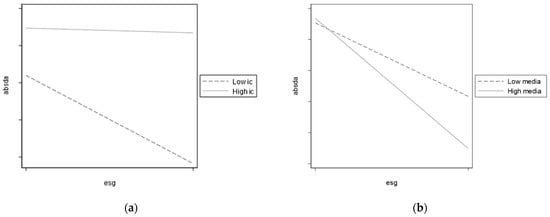
The regression results show that the coefficient for corporate ESG performance is −0.003, which is significant at the 5% level, indicating that improved ESG performance helps reduce the extent of earnings management. At the same time, the coefficient for the interaction term between ESG performance and internal control quality () is 0.003, and it passes the significance test. Figure 1a illustrates the moderating effect of internal control, with the low internal control group exhibiting a steeper slope. This figure demonstrates the moderating role of internal control quality in the relationship between ESG performance and earnings management. Specifically, among agricultural firms with weak internal control, the disciplinary effect of ESG on earnings management is more pronounced, indicating that ESG can act as a substitute governance mechanism to offset internal control deficiencies. In contrast, the inhibitory effect of ESG is relatively limited in firms with sound internal control. These results indicate that corporate internal controls play a moderating role in the process by which ESG performance influences earnings management and that the two exhibit a substitution relationship: as the quality of internal controls increases, the negative impact of ESG performance on earnings management is relatively weakened. This conclusion supports research hypothesis H3.
Figure 1.
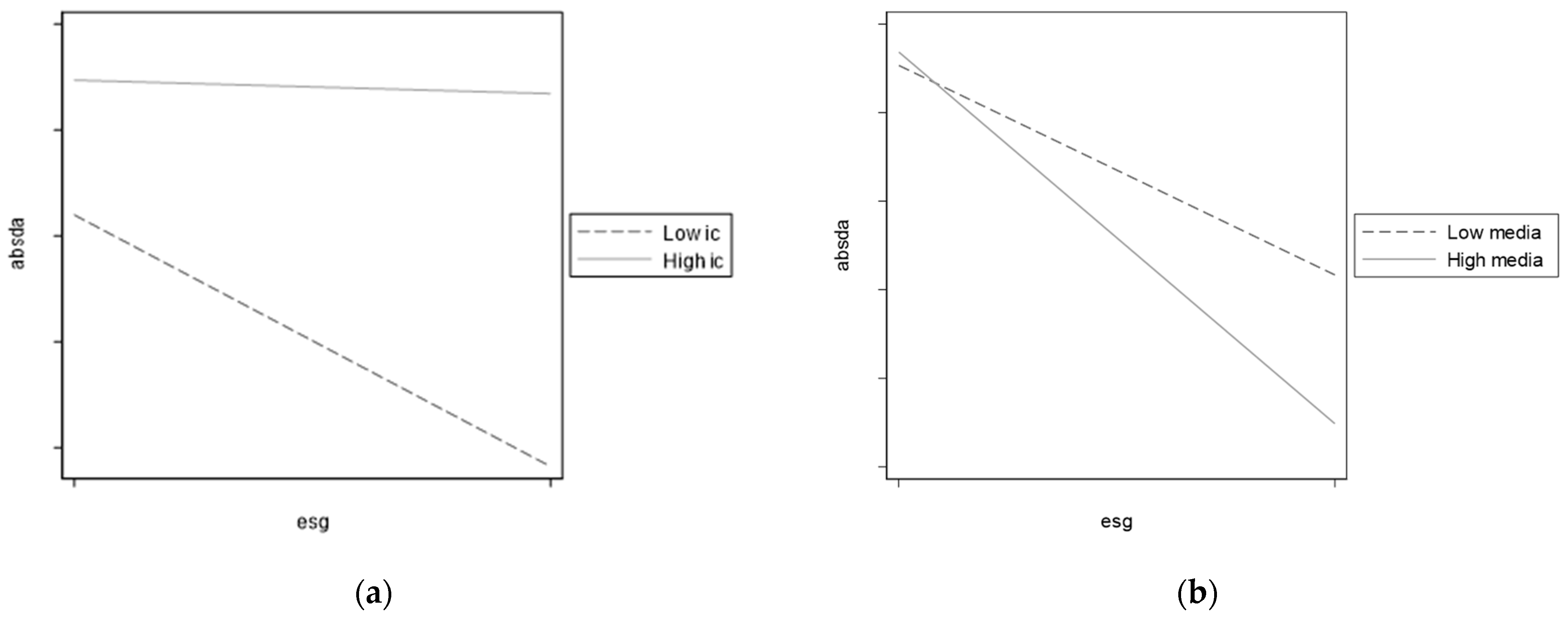
Modulation Effect. (a) the moderating role of internal controls; (b) the moderating role of media attention.
4.4.3. The Moderating Role of Media Attention
To examine the moderating effect of corporate media attention on the relationship between ESG performance and earnings management, this study constructs Model (9) for testing, incorporating the interaction term between ESG performance and media attention, , into the analysis. The specific results are shown in columns (3) and (4) of Table 8.
Based on the regression results reported in columns (3) and (4) of Table 8, the moderating effect of media attention on the relationship between ESG performance and earnings management is as follows: the estimated coefficient for ESG performance is −0.002 and is significant at the 5% level, further confirming the negative impact of ESG performance on earnings management. Meanwhile, the coefficient of the interaction term between ESG performance and media attention () is −0.001, which also passes the significance test. Figure 1b illustrates the moderating effect of media attention, with the slope being steeper in the high media attention group. This figure demonstrates the moderating role of media attention in the relationship between ESG performance and earnings management. Specifically, among agricultural firms with high media attention, the inhibitory effect of ESG performance on earnings management is more pronounced. This indicates that, as an effective external governance mechanism, the greater the intensity of public scrutiny exerted by media attention, the stronger the constraining effect of ESG performance on earnings management. This result indicates that media attention can amplify the constraining effect of ESG performance on earnings management; that is, the greater the intensity of external media oversight, the more pronounced the inhibitory effect of ESG performance on earnings management. The above findings support research hypothesis H4.
4.4.4. Whether Firms Hold Productive Biological Assets
Given the agricultural nature of the sample firms in this study, we conduct subsample tests based on whether firms hold productive biological assets, with the results presented in Table 9. Specifically, Column (1) reports firms with no net book value of productive biological assets recognized on the balance sheet, while Column (2) includes firms that disclose a net book value of productive biological assets. The empirical results show that ESG performance is significantly and negatively associated with earnings management in agricultural firms without net productive biological assets. By contrast, the effect of ESG performance on earnings management becomes insignificant for agricultural firms with net productive biological assets. These findings indicate that productive biological assets affect the governance role of ESG in constraining earnings management. The presence of productive biological assets changes the driving forces and implementation methods of corporate earnings management, making it difficult for ESG ratings to identify or restrict such earnings management activities.
Table 9.
Whether Firms Hold Productive Biological Assets.
Specifically, agricultural firms without productive biological assets have a relatively simple asset structure, similar to ordinary industrial and commercial enterprises. Their accrual earnings management mainly depends on conventional accounting items such as accounts receivable, inventory, and bad debt provisions, and the governance dimension of ESG can effectively constrain such routine earnings management practices. Conversely, agricultural firms holding productive biological assets are greatly affected by natural disasters, epidemics, and market cycle fluctuations. Such firms tend to engage in earnings management by adjusting the expected output, residual value, and impairment of biological assets. This kind of manipulation is highly technical and concealed, which makes it difficult to identify and constrain by the ESG evaluation system. Therefore, even if firms obtain high ESG scores, they still cannot significantly suppress their earnings management behaviors.
The above study indicates that ESG performance has a significant dampening effect on earnings management in agribusinesses, On the one hand, ESG performance can directly reduce the degree of corporate earnings management. On the other hand, it plays a partial mediating role by alleviating financial constraints, thereby curbing earnings management behaviors indirectly. Meanwhile, internal control and media attention present differentiated moderating effects on the above relationship. Internal control acts as a substitute for ESG performance, whereas media attention strengthens the disciplinary effect of ESG on earnings management. Further heterogeneity analysis suggests that the governance effect of ESG differs across enterprises with distinct asset structures, and it is only statistically significant for agricultural firms that do not hold productive biological assets. Overall, ESG influences the earnings management practices of agricultural enterprises through a compound mechanism integrating direct constraint, financial mitigation, and enhanced external supervision.
5. Conclusions
5.1. Theoretical Implications
This study empirically investigates how ESG performance affects accrual-based earnings management using a sample of agriculture-related listed companies on China’s A-share market from 2009 to 2024. It also investigates the moderating effects of internal control quality and media attention, as well as the mediating role of financing constraints. The following is a summary of the key findings:
First, after controlling for other variables as well as time and industry fixed effects, the ESG performance of agriculture-related firms is significantly negatively correlated with the extent of their accrual earnings management. This indicates that agriculture-related enterprises do not leverage sound ESG practices to cover up inflated profits or disguise real financial problems through greenwashing. On the contrary, superior ESG performance can curb corporate earnings management by enhancing information disclosure transparency, strengthening long-term value orientation, and accumulating reputational capital.
Second, financing constraints mediate the relationship between ESG performance and accrual earnings management. Superior ESG performance not only directly inhibits corporate earnings management behaviors but also alleviates financing constraints by reducing information asymmetry, optimizing risk expectations, and broadening financing channels, thereby reducing the incentives for earnings manipulation to meet financing needs.
Third, internal control quality plays a moderating role in the impact of ESG performance on earnings management. Compared with firms featuring high internal control quality, the inhibitory effect of ESG performance on accrual-based earnings management is significantly stronger in enterprises with poor internal control. This indicates that in well-governed firms with sound internal control, internal checks and balances and regulatory systems have imposed stringent constraints on managerial opportunistic behaviors and effectively restricted earnings management activities, which in turn weakens the marginal governance effect of ESG.
Fourth, media attention also exerts a moderating effect on the relationship between ESG performance and earnings management. In contexts with high media attention, the negative inhibitory effect of ESG performance on accrual-based earnings management becomes more pronounced. This demonstrates that external public supervision can strengthen the governance effect of ESG in restraining earnings manipulation. Under intense media scrutiny, the ESG implementation and financial disclosure of agriculture-related enterprises are subject to stricter external oversight. The violation costs and public opinion risks faced by managers who engage in earnings manipulation by leveraging information opacity increase significantly. Accordingly, corporate accounting practices are further standardized, which ultimately amplifies the inhibitory effect of ESG on earnings management.
5.2. Practical Implications
First, at the corporate level, agribusinesses should elevate ESG to a core strategic priority by integrating environmental (green production, biodiversity conservation), social (food safety, farmers’ interests protection), and governance (internal control refinement, enhanced disclosure) dimensions into long-term development plans to avoid tokenistic ESG practices.
Secondly, at the government level, regulatory authorities should formulate differentiated ESG disclosure standards tailored to the biological asset characteristics of agricultural enterprises to enhance transparency. Specific indicators should be established to assess the standardization of accounting treatments and the reasonableness of related estimates for biological assets, thereby improving the ESG system’s ability to identify asset-based earnings management practices. Third, at the market level, institutional investors should embed agribusiness ESG performance into core investment decision frameworks to advance responsible investment and incentivize substantive ESG improvement via capital allocation. Media reporting should be regulated to prioritize in-depth, substance-focused ESG investigations, avoiding irrational market expectations from sensationalized coverage.
5.3. Research Limitations
Although this paper has achieved certain findings in revealing the impact of ESG performance on earnings management among agriculture-related enterprises, it still has several inherent limitations. First, in analyzing the relationship between ESG performance and earnings management, this study fails to fully address potential reverse causality, nor does it systematically examine the specific influence of endogeneity on empirical results. Second, in the grouping test based on productive biological assets, only the binary distinction of whether enterprises hold productive biological assets is considered, while the detailed role of the net value of productive biological assets in affecting the association between ESG performance and earnings management is not further explored. Third, when discussing the mediating effect of financing constraints, the moderating roles of internal control and media attention are not integrated into the influencing mechanism framework. At the same time, the moderation effects are based on established research hypotheses, which limit the scope of the interpretation; the study does not fully explore the specific impacts of these moderation effects under the influence of other latent factors. Restricted by the article length, the above issues are not investigated in depth in this study. Future research can be further expanded and refined to fill these research gaps, optimize corporate ESG practices, and ultimately improve the sustainable development capability of enterprises.
Author Contributions
Conceptualization, L.H. and J.J.; formal analysis, J.J.; funding acquisition, L.H.; methodology, L.H. and J.J.; software, J.J.; validation, J.J.; writing—original draft, J.J.; writing—review and editing, L.H. and J.J. All authors have read and agreed to the published version of the manuscript.
Funding
This research was supported by the Ministry of Education of Humanities and Social Science Project “The Vulnerability, Resilience, and Production Coordination Mechanisms of China’s Agricultural Import Trade” (great number:25XJA790001), Shaanxi Provincial Natural Science Basic Research Plan “The Learning and Self-Selection Effects of Agricultural Enterprises’ Exports Against the Backdrop of a Widening Trade Deficit” (great number: 2025JC-YBMS-825).
Institutional Review Board Statement
Not applicable.
Informed Consent Statement
Not applicable.
Data Availability Statement
The raw data supporting the conclusions of this article will be made available by the authors on request.
Conflicts of Interest
The authors declare no conflict of interest.
References
- Liu, H.; Zhang, Z. The Impact of Managerial Myopia on Environmental, Social and Governance (ESG) Engagement: Evidence from Chinese Firms. Energy Econ. 2023, 122, 106705. [Google Scholar] [CrossRef] [Scilit]
- Yang, B.; Park, S.D. Under the ESG Dome of China. Sustainability 2024, 16, 6983. [Google Scholar] [CrossRef] [Scilit]
- Passas, I. The Evolution of ESG: From CSR to ESG 2.0. Encyclopedia 2024, 4, 1711–1720. [Google Scholar] [CrossRef] [Scilit]
- Zhu, X.; Shao, X.; Li, C.; Du, C. Exploring the Transmission Mechanism of Low-Carbon City Pilot Policies on Enhancing Agribusiness ESG Performance: An Empirical Study Using the PSM-DID Model. Carbon Balance Manag. 2025, 21, 21. [Google Scholar] [CrossRef] [Scilit]
- Cristea, M.; Noja, G.G.; Thalassinos, E.; Cîrciumaru, D.; Ponea, C.Ș.; Durău, C.C. Environmental, Social and Governance Credentials of Agricultural Companies—The Interplay with Company Size. Resources 2022, 11, 30. [Google Scholar] [CrossRef] [Scilit]
- Mohapatra, S.; Kumar, A.; Mohapatra, M.R.; Srivastava, V. Does CEO Duality Moderate Environmental, Social, and Governance Performance-Earnings Management Relationship? Evidence from Emerging Markets. Financ. Res. Lett. 2025, 73, 106616. [Google Scholar] [CrossRef] [Scilit]
- Almubarak, W.I.; Chebbi, K.; Ammer, M.A. Unveiling the Connection among ESG, Earnings Management, and Financial Distress: Insights from an Emerging Market. Sustainability 2023, 15, 12348. [Google Scholar] [CrossRef] [Scilit]
- Silva, R.; Nardi, P.; Ribeiro, M. Earnings Management and Valuation of Biological Assets. Braz. Bus. Rev. 2015, 12, 1–26. [Google Scholar] [CrossRef] [Scilit]
- Wu, K.; Kong, D.; Yang, W. Does Environmental, Social, and Governance Rating Affect Firms’ Real Earnings Management. Financ. Res. Lett. 2024, 67, 105764. [Google Scholar] [CrossRef] [Scilit]
- Li, T.-T.; Wang, K.; Sueyoshi, T.; Wang, D.D. ESG: Research Progress and Future Prospects. Sustainability 2021, 13, 11663. [Google Scholar] [CrossRef] [Scilit]
- Bu, M.; Liu, X.; Zhang, B.; Hazaea, S.A.; Fan, R.; Wang, Z. Governance of Corporate Greenwashing through ESG Assurance. Systems 2024, 12, 365. [Google Scholar] [CrossRef] [Scilit]
- Singh, A.K.; Zhang, Y. Anu Understanding the Evolution of Environment, Social and Governance Research: Novel Implications From Bibliometric and Network Analysis. Eval. Rev. 2023, 47, 350–386. [Google Scholar] [CrossRef] [Scilit]
- Broadstock, D.C.; Matousek, R.; Meyer, M.; Tzeremes, N.G. Does Corporate Social Responsibility Impact Firms’ Innovation Capacity? The Indirect Link between Environmental & Social Governance Implementation and Innovation Performance. J. Bus. Res. 2020, 119, 99–110. [Google Scholar] [CrossRef] [Scilit]
- Fang, X.; Hu, D. ESG Performance and Innovation of Enterprises: Evidence from A-Share Listed Companies. Econ. Res. J. 2023, 58, 91–106. (In Chinese) [Google Scholar]
- Li, Y.; Gong, M.; Zhang, X.-Y.; Koh, L. The Impact of Environmental, Social, and Governance Disclosure on Firm Value: The Role of CEO Power. Br. Account. Rev. 2018, 50, 60–75. [Google Scholar] [CrossRef] [Scilit]
- Yu, X.; Xiao, K. Does ESG Performance Affect Firm Value? Evidence from a New ESG-Scoring Approach for Chinese Enterprises. Sustainability 2022, 14, 16940. [Google Scholar] [CrossRef] [Scilit]
- Liu, Y.X.; Cao, Y.Q.; Li, B. ESG Performance and Its Impact on Earnings Management Behavior of Enterprises. Reform 2024, 37, 1–19. (In Chinese) [Google Scholar]
- Sun, W.; Chen, S.; Jiao, Y.; Feng, X. How Does ESG Constrain Corporate Earnings Management? Evidence from China. Financ. Res. Lett. 2024, 61, 104983. [Google Scholar] [CrossRef] [Scilit]
- Gao, Y.Y.; Huang, J.B. ESG Rating Performance and Real Earnings Management of Enterprises: Evidence from Chinese A-Share Listed Companies. J. Financ. Dev. Res. 2023, 42, 3–12. (In Chinese) [Google Scholar]
- Xie, B.S.; Xie, J.L.; Zhong, Q.Q. Corporate Earnings Quality under Soft Regulation of ESG Rating: Based on Information Effect and Governance Effect. Financ. Account. Mon. 2024, 45, 48–55. (In Chinese) [Google Scholar]
- Tsang, A.; Frost, T.; Cao, H. Environmental, Social, and Governance (ESG) Disclosure: A Literature Review. Br. Account. Rev. 2023, 55, 101149. [Google Scholar] [CrossRef] [Scilit]
- Gleason, C.A.; Kieback, S.; Thomsen, M.; Watrin, C. Monitoring or Payroll Maximization? What Happens When Workers Enter the Boardroom? Rev. Acc. Stud. 2021, 26, 1046–1087. [Google Scholar] [CrossRef] [Scilit]
- Kapoor, N.; Goel, S. The Moderating Effect of Institutional Ownership on the Impact of Board Independence and Gender Diversity on Earnings Quality in India: A Static and Dynamic Panel Regression Analysis. Appl. Econ. 2025, 57, 1655–1669. [Google Scholar] [CrossRef] [Scilit]
- He, Y.; Zhong, L. How Rookie CEOs Influence Earnings Management in Enterprises: An Analysis Based on the Perspective of Corporate Governance. Financ. Res. Lett. 2025, 73, 106599. [Google Scholar] [CrossRef] [Scilit]
- Goh, B.W.; Li, D. Internal Controls and Conditional Conservatism. Account. Rev. 2011, 86, 975–1005. [Google Scholar] [CrossRef] [Scilit]
- Ashbaugh-Skaife, H.; Collins, D.W.; Kinney, W.R.; LaFond, R. The Effect of SOX Internal Control Deficiencies and Their Remediation on Accrual Quality. Account. Rev. 2008, 83, 217–250. [Google Scholar] [CrossRef] [Scilit]
- Boubaker, S.; Gao, L.; Hoang, K.; Nguyen, C. Natural Disasters, Unnatural Earnings: How Do Climate Disasters Impact Earnings Management? Int. Rev. Financ. Anal. 2025, 102, 104043. [Google Scholar] [CrossRef] [Scilit]
- Shang, Y.; Chi, Y. Corporate Environmental Information Disclosure and Earnings Management in China: Ethical Behaviour or Opportunism Motivation? Sustainability 2023, 15, 8896. [Google Scholar] [CrossRef] [Scilit]
- Xie, H.; Xu, S.; Tong, Z. Local Government Debt and Earnings Management: Evidence from China. Int. J. Emerg. Mark. 2025, 20, 1415–1439. [Google Scholar] [CrossRef] [Scilit]
- Velte, P. The Bidirectional Relationship between ESG Performance and Earnings Management—Empirical Evidence from Germany. J. Glob. Responsib. 2019, 10, 322–338. [Google Scholar] [CrossRef] [Scilit]
- Broadstock, D.C.; Chan, K.; Cheng, L.T.W.; Wang, X. The Role of ESG Performance during Times of Financial Crisis: Evidence from COVID-19 in China. Financ. Res. Lett. 2021, 38, 101716. [Google Scholar] [CrossRef] [Scilit]
- Gavana, G.; Gottardo, P.; Moisello, A.M. Related Party Transactions and Earnings Management: The Moderating Effect of ESG Performance. Sustainability 2022, 14, 5823. [Google Scholar] [CrossRef] [Scilit]
- Vatis, S.E.; Drogalas, G.; Persakis, A.; Chytis, E. The Impact of ESG on Earnings Quality and Real Earnings Management: The Role of Firm Size. Sustainability 2025, 17, 5027. [Google Scholar] [CrossRef] [Scilit]
- Banerjee, P. Text-Based Multidimensional Financial Constraints and Earnings Management Behaviour. Aust. J. Manag. 2025, 50, 1215–1266. [Google Scholar] [CrossRef] [Scilit]
- Bai, X.; Han, J.; Ma, Y.; Zhang, W. ESG Performance, Institutional Investors’ Preference and Financing Constraints: Empirical Evidence from China. Borsa Istanb. Rev. 2022, 22, S157–S168. [Google Scholar] [CrossRef] [Scilit]
- Liao, Y.; Marquez, R.; Cheng, Z.; Li, Y. Can ESG Performance Sustainably Reduce Corporate Financing Constraints Based on Sustainability Value Proposition? Sustainability 2025, 17, 7758. [Google Scholar] [CrossRef] [Scilit]
- Zhang, X.L.; Zhao, L.H.; Fan, W.J.; Guo, Q.L. Do Biological Assets Increase the Degree of Corporate Financing Constraints? —An Analysis from the Perspective of Internal and External Supervision. Friends Account. 2020, 38, 12–18. (In Chinese) [Google Scholar]
- Zheng, Y.; Han, Y. Supervisory Board, Internal Control Quality, and Earnings Management. Financ. Res. Lett. 2025, 77, 107083. [Google Scholar] [CrossRef] [Scilit]
- He, F.; Yan, Y.L.; Wen, B.H. Mandatory Social Responsibility Disclosure and Corporate Real Earnings Management: “Practicing Steadily for Long-Term Progress” or “Deceiving Under False Pretenses”. Nankai Econ. Stud. 2024, 38, 138–158. (In Chinese) [Google Scholar]
- He, F.; Du, H.; Yu, B. Corporate ESG Performance and Manager Misconduct: Evidence from China. Int. Rev. Financ. Anal. 2022, 82, 102201. [Google Scholar] [CrossRef] [Scilit]
- Chai, S.; Cao, M.; Li, Q.; Ji, Q.; Liu, Z. Exploring the Nexus between ESG Disclosure and Corporate Sustainable Growth: Moderating Role of Media Attention. Financ. Res. Lett. 2023, 58, 104519. [Google Scholar] [CrossRef] [Scilit]
- Gunawan, J.M.; Rudiawarni, F.A.; Sulistiawan, D.; Kicia, M. How Media Visibility Affects Earnings Management: The Moderating Effects of Public Ownership. Int. J. Soc. Econ. 2026, 53, 121–135. [Google Scholar] [CrossRef] [Scilit]
- Cui, W.; Chen, X.; Xia, W.; Hu, Y. Influence of Media Attention on the Quality of Environmental, Social, and Governance Information Disclosure in Enterprises: An Adjustment Effect Based on the Shareholder Relationship Network. Sustainability 2023, 15, 13919. [Google Scholar] [CrossRef] [Scilit]
- Guo, J.; Gu, L.Y. Can Agricultural Supply Chain Finance Effectively Alleviate Corporate Financing Constraints? —An Empirical Study on Agriculture-Related Enterprises Participating in Targeted Poverty Alleviation. Oper. Res. Manag. Sci. 2022, 31, 112–118. (In Chinese) [Google Scholar]
- Chen, Y.K.; Bu, D.L. The Impact of Agricultural Information Infrastructure Construction on the Value of Agriculture-Related Enterprises: A Quasi-Natural Experiment Based on the “Broadband China” Strategy. J. Agrotech. Econ. 2024, 43, 126–144. (In Chinese) [Google Scholar]
- Dechow, P.M.; Sloan, R.G.; Sweeney, A.P. Detecting Earnings Management. Account. Rev. 1995, 70, 193–225. [Google Scholar] [CrossRef] [Scilit]
- Kaplan, S.N.; Zingales, L. Do Investment-Cash Flow Sensitivities Provide Useful Measures of Financing Constraints? Q. J. Econ. 1997, 112, 169–215. [Google Scholar] [CrossRef] [Scilit]
- Wei, Z.H.; Zeng, A.M.; Li, B. Financial Ecological Environment and Corporate Financing Constraints: An Empirical Study Based on Chinese Listed Companies. Account. Res. 2014, 35, 73–80. (In Chinese) [Google Scholar]
- Li, R.J.; Dang, S.T.; Li, B.X.; Yuan, R.L. CEO’s Information Technology Background and Internal Control Quality of Enterprises. Audit. Res. 2022, 38, 118–128. (In Chinese) [Google Scholar]
- Lu, W.B.; Guan, F.; Zhang, P.P.; Deng, Y.J. Media Exposure, Information Disclosure Environment and Cost of Equity Capital. Account. Res. 2014, 35, 66–71+96. (In Chinese) [Google Scholar]
- Xiao, Z.P.; Zhou, J.F. Corruption, Media Attention and Cost of Equity Capital. Secur. Mark. Her. 2021, 31, 36–47. (In Chinese) [Google Scholar]
- Li, G.; Cheng, Y. Impact of Environmental, Social, and Governance Rating Disagreement on Real Earnings Management in Chinese Listed Companies. Glob. Financ. J. 2024, 62, 101015. [Google Scholar] [CrossRef] [Scilit]
- Dechow, P.M.; Dichev, I.D. The Quality of Accruals and Earnings: The Role of Accrual Estimation Errors. Account. Rev. 2002, 77, 35–59. [Google Scholar] [CrossRef] [Scilit]
- Ball, R.; Shivakumar, L. The Role of Accruals in Asymmetrically Timely Gain and Loss Recognition. J. Account. Res. 2006, 44, 207–242. [Google Scholar] [CrossRef] [Scilit]
- Pan, H.Y.; Zhu, Y.D.; Xin, F. ESG Performance and Corporate Financialization—The Moderating Effect of Dual Internal and External Supervision. J. Nanjing Audit. Univ. 2022, 19, 60–69. (In Chinese) [Google Scholar]

Disclaimer/Publisher’s Note: The statements, opinions and data contained in all publications are solely those of the individual author(s) and contributor(s) and not of MDPI and/or the editor(s). MDPI and/or the editor(s) disclaim responsibility for any injury to people or property resulting from any ideas, methods, instructions or products referred to in the content. |
© 2026 by the authors. Licensee MDPI, Basel, Switzerland. This article is an open access article distributed under the terms and conditions of the Creative Commons Attribution (CC BY) license.