


Abstract
This study developed and validated a multidimensional instrument to assess teachers’ perceptions and attitudes toward the reuse of treated sewage effluent (TSE) in agriculture, a key sustainability strategy in water-scarce regions such as Qatar and the wider Gulf Cooperation Council (GCC). Using factor-analytic validation procedures on data from 444 teachers, the study confirms a robust five-factor model comprising Perceived Knowledge and Awareness, Attitudes, Pedagogy, Perceived Limitations, and Sources of Knowledge, demonstrating strong psychometric properties. Beyond validation, the findings provide insight into how educators understand and engage with wastewater reuse as an educational and sustainability issue. While teachers generally demonstrate sound conceptual understanding and positive attitudes toward sustainability, persistent concerns related to health risks, food quality, and cultural acceptability reveal a notable cognitive–behavioral gap. Although respondents express strong support for student-centered pedagogical approaches, including experiential learning and technology-enhanced instruction, implementation is often constrained by limited curricular guidance, time pressures, and insufficient professional development. These findings have important implications for sustainability education policy and teacher preparation in arid contexts pursuing water resilience strategies. Recommendations include integrating TSE-related content across disciplines, expanding experiential professional development opportunities, and strengthening curricular frameworks that support applied sustainability education. The validated instrument offers a transferable model for comparable regions globally, enabling cross-cultural research and evidence-based interventions in sustainability education.
1. Introduction
With the increasing demand on water, and the concomitant decrease in supply in many regions of the world, the focus on alternative water sources for agriculture (a major water-consuming sector) is rising. This is most pronounced in countries of the Gulf Cooperation Council (GCC), where, already, limited freshwater resources are undergoing inevitable depletion. One of the most technically and environmentally viable alternatives would be the reuse of treated sewage effluent (TSE) for irrigation [1,2,3,4,5]. Yet, its applicability is influenced not only by technological readiness but also by public perceptions, cultural norms, and trust in local water authorities [6]. Irrespective of the environmental and health compliance, people still have various concerns regarding TSE reuse in agriculture [7]. In fact, public perceptions are either:
- -
- Positive, meaning that people know about the benefits for the environment and the economy, like using less freshwater, being more sustainable, and assisting with food security [1];
- -
- Negative, often attributed to concerns regarding health risks, product quality, or cultural/religious objections [7]. While the first two can be mitigated through various awareness pathways, the latter is considered particularly sensitive, especially for food crop irrigation [6]. This kind of attitude is very difficult to change with mere scientific knowledge; and introducing it in the education system requires a delicate methodology that integrates ethical and cultural dimensions—requiring genuine dedication from the educator.
In this regard, the GCC region is a compelling site to investigate this topic given its very unique socio-economic setup taking Qatar as a study area. It is known for its high fossil gas resources, thus national wealth, arid climate and acute water scarcity. As part of its national sustainable development strategy, the government committed to make use of most of the produced TSE. Despite the remarkably high quality of TSE, citizens would rarely accept to buy agriculture products irrigated with TSE [8,9]. Among the main drivers of consumer’s rejection are personal opinions and perceived knowledge on hygienic and religious incompliance.
Building on recent strategic analyses of treated sewage effluent reuse in GCC contexts [10], the present study extends the policy-level discourse by introducing a psychometrically validated instrument to assess teachers’ readiness and pedagogical positioning toward TSE integration within sustainability education.
Perceived knowledge refers to how individuals describe their own understanding of the processes, risks, and benefits associated with TSE reuse. These beliefs have a huge impact on how people feel and what they plan to do [11]. People are more likely to accept the reuse of TSE in agriculture if they know that modern treatment systems can eliminate all possible sources of contamination [12]. In this context, environmental education is considered an efficient tool to provide people with the background they need to make good decisions about environmental problems [13].
Accordingly, teachers play a pivotal role in shaping environmental understanding and attitudes of the surrounding community and the behavior of future generations [14]. This is achieved through updated curricula that introduce the scientific and ethical dimensions of environmental protection and foster water conservation behavior. Thus, educating the teachers about the positive effects of TSE reuse is key, pushing them to update their methodology and spread the knowledge among their students. Indeed, it has been shown that when educators perceive themselves as knowledgeable and skilled in environmental topics, they are more likely to integrate these issues into their curricula [15,16]. However, school teachers often lack the background needed to teach topics related to TSE reuse, e.g., water quality, wastewater treatment, long-term impacts of TSE reuse, etc. [17]. This may be attributed to limited professional training, insufficient curricular resources, and misconceptions about the importance and necessity of TSE reuse.
From a pedagogical point of view, environmental education is best taught through student-centered methods that promote critical thinking through real-life hands-on analysis [18]. In the context of TSE reuse, teachers may recur to various student activities, such as field visits to treatment plants and TSE irrigation pilot farms or experimental projects on substituting water with TSE. But teachers are often faced with institutional challenges, such as insufficient time and resources, or incompatibility with curricula [19]. In this regard, professional development programs, curricular assistance, and collaboration networks can be helpful in overcoming those barriers [17].
Conceptually, the present study is informed by established models in environmental psychology that emphasize the role of knowledge, attitudes, and contextual factors in shaping pro-environmental behavior. Frameworks such as the Knowledge–Attitude–Behavior (KAB) model and the Theory of Planned Behavior highlight how individuals’ perceptions, beliefs, and perceived constraints interact to influence behavioral intentions. In educational contexts, these models underscore the importance of teachers’ perceived knowledge, attitudinal orientations, and pedagogical capacity as mediating factors between sustainability awareness and practice. By integrating these dimensions into a single measurement framework, the present study aligns with environmental psychology perspectives while extending them to the context of sustainability education and treated wastewater reuse.
Building on the global and regional literature on treated wastewater reuse, and the educational research examining teachers’ roles in sustainability learning, the following section highlights a critical psychometric gap in the existing body of work.
While many studies have explored public perceptions of TSE reuse, relatively few targeted educators’ knowledge and attitude and their teaching approach of this topic [20,21]. Specifically, psychometrically validated methodologies for the evaluation of teachers’ environmental education do not currently exist. Reported instruments focus on discrete variables, such as environmental views or sustainability awareness, while failing to integrate educational and contextual factors [22]. Accordingly, this study fills literature gaps by developing a multidimensional model addressing teachers perceptions and attitudes toward TSE reuse in agriculture. This is achieved following a thorough multi-stage methodology comprising expert validation, exploratory factor analysis (EFA), and confirmatory factor analysis (CFA). The research team developed and validated a questionnaire to assess teachers’ views on reuse of TSE for crop irrigation. The study focuses on five interrelated domains: attitudes, perceived knowledge/awareness, constraints, information sources, and pedagogical perspectives. Together, those domains describe teachers’ understanding and engagement. Exploratory and confirmatory factor analyses were performed to examine the instrument’s validity and reliability. The result is a psychometrically robust tool for future research and educational policy development. Theoretically, the developed tool may be used to understand the impact of teacher perspectives on societal acceptance of TSE reuse. Practically, the outcome of this study proved evidence and a validated framework to guide policymakers and curriculum designers in enhancing water education. Adopting Qatar as a study area accounts for the specific local educational and cultural contexts of GCC countries.
Despite growing research on public perceptions and technological feasibility of treated sewage effluent reuse, there remains a significant gap in sustainability education research. Specifically, no psychometrically validated instrument currently exists that systematically captures teachers’ perceptions of TSE reuse while integrating pedagogical practices, perceived knowledge, attitudinal orientations, and contextual constraints within a single multidimensional framework. Given the pivotal role of educators in shaping environmental literacy and future societal acceptance of sustainable water practices, this gap limits both empirical research and evidence-based educational policy development, particularly in arid regions such as the Gulf Cooperation Council.
Recent teacher-perception instrument validation studies have emphasized the importance of rigorous psychometric procedures integrating exploratory and confirmatory factor analyses, reliability assessment, and measurement invariance testing [23]. Such approaches highlight the necessity of establishing multidimensional construct validity while ensuring structural coherence across educational contexts. In alignment with these contemporary validation practices, the present study adopts a structured EFA–CFA framework to establish reliability, convergent validity, and discriminant validity of the proposed teacher-perception instrument.
Recent work by the present research team has similarly emphasized the importance of rigorous measurement frameworks when examining teacher-related constructs, including instructional innovation, leadership, and technology integration [24,25,26]. These studies reinforce the necessity of multidimensional validation approaches when operationalizing complex educational perceptions.
2. Materials and Methods
2.1. Questionnaire Development
The questionnaire development comprising three consecutive stages. Initially, the relevant domains were identified and the questionnaire components were determined. Following this, the researchers assessed inter-rater agreement (among six experts) to ensure the reliability of the instrument. Next, an exploratory factor analysis (EFA) was conducted to evaluate the content validity and examine the underlying constructs of the data. Finally, confirmatory factor analysis (CFA) was used to assess the internal consistency of the questionnaire.
- First Stage: This stage was initiated with a literature search using the keywords “perception of teachers” and “treated wastewater awareness”. The collected publications were reviewed for instruments related to perceptions and knowledge of teachers about the reuse of TSE in agriculture. Based on the collected observations, the following five main domains were identified: attitude (8 items), perceived knowledge and awareness (9 items), limitations (8 items), source of knowledge (8 items) and pedagogy views (18 items). The items were scored using a Likert scale: 1 = strongly disagree, 2 = disagree, 3 = neutral, 4 = agree, and 5 = strongly agree.
- Second Stage: At this stage, a panel of six experts was formed to review the questionnaire and rate each item on a Likert scale for clarity, relevance, and completeness. Expert evaluations were conducted independently, and experts were not informed of one another’s ratings during the content validation process to minimize potential bias. Each section’s inter-rater agreement was assessed quantitatively using Cohen’s Kappa statistic.
- Third Stage: This is the survey phase, during which the questionnaire was completed by a sample of 444 teachers. The exploratory factor analysis (EFA) was adopted for validating the questionnaire.
2.2. Sample Composition
A non-probabilistic convenience sampling strategy was employed in this study. Participants were recruited through schools, professional networks, and educational institutions across Qatar. Inclusion criteria required participants to be currently practicing teachers at the primary, preparatory, or secondary level. Exclusion criteria included non-teaching staff and questionnaires with substantial missing data. This approach was appropriate given the exploratory and instrument-development nature of the study and ensured access to a diverse and experienced teaching population within the national educational context.
The study sample comprised 444 teachers who completed the survey either electronically or on paper. The sample included 265 males (59.7%) and 179 females (40.3%). Of the total participants, 54.5% indicated their willingness to participate in an interview, and 55.0% reported having attended a relevant workshop.
- -
- Age: The participants represented a wide age range, with the largest groups aged 45 years (12.6%) and 50 years (8.3%). Most respondents were between 30 and 55 years old.
- -
- Education: The majority held an undergraduate degree (78.2%), while 14.2% had a master’s degree, 4.5% held a doctorate, 2.5% had a diploma, and 0.7% reported a high school education.
- -
- Nationality and Residency: About 11.5% of participants were Qatari and 88.5% were non-Qatari. Among non-Qatari teachers, the most common durations of residence in Qatar were 11 to 15 years (23.2%) and 16 to 20 years (22.1%), with 19.1% having lived in the country for more than 20 years.
- -
- Geographic Location: The majority of participants resided in the cities of Doha (39.0%) and Al Rayyan (25.2%), followed by Al Wakra (11.7%) and Umm Salal (9.9%). Smaller proportions were distributed across Al Khor, Al Daayen, Al-Shahaniya, and Al Shamal.
- -
- Water Cost: About 39.6% of respondents reported paying between 100 and 300 Qatari Riyal (QR) per month, and 27.3% reported spending between 301 and 600 QR. Notably, 16.4% indicated that they did not pay for municipal water.
- -
- Teaching Level and Area: About 37.2% of participants taught at the primary level, 35.6% at the secondary level, and 21.6% at the preparatory level. A small proportion taught special education or across multiple levels. The most common areas of specialization were science (38.3%), mathematics (12.8%), and English (11.9%), with additional representation from information technology, geography, social studies, Islamic studies, Arabic, and other fields.
- -
- Professional Experience: About 49.8% of teachers reported more than 17 years of total teaching experience, while 20.0% had 13 to 16 years of experience. With respect to years of teaching in Qatar, 24.5% had 9 to 12 years of experience, 21.6% had 13 to 16 years, and 20.0% had less than 5 years.
2.3. Data Analysis
Following and the approval of Qatar University Institutional Review Board (QU-IRB), data collection was initiated. The Kolmogorov–Smirnov and Shapiro–Wilk tests were used to check whether the data meets the requirement (of normal distribution) for further statistical analysis. The results showed that all variables had p-values above 0.05, suggesting there were no significant departures from normality.
- Exploratory factor analysis
The Exploratory Factor Analysis (EFA) was adopted to remove items with ambiguous and duplicate/related meanings—thus optimizing the efficiency of the questionnaire. Next, the principal component analysis (PCA) was used to determine the number of general domains with eigenvalues > 1. PCA was selected at this exploratory stage to efficiently reduce the item set and identify underlying dimensional structure, which is consistent with common practice in early-stage scale development prior to confirmatory modeling. Varimax rotation with Kaiser normalization was used for additional factor refinement. Items with rotated factor loadings < 0.50 or cross-loading were detected. Domain containing only one item were omitted so that all domains have at least two items. Although the initial extraction suggested a larger number of components, iterative item screening and theoretical interpretability criteria resulted in the retention of a final five-factor solution.
During the exploratory factor analysis, clear decision criteria were applied for item retention and deletion. Items with rotated factor loadings below 0.50 were removed from the scale. Cross-loadings were defined as items loading at or above 0.40 on more than one factor, and such items were excluded to ensure factorial clarity. Factors represented by a single retained item were omitted to preserve construct stability. In addition, items exhibiting conceptual redundancy or weak theoretical alignment with their intended construct were removed following expert review and interpretability assessment.
- Confirmatory Factor Analysis
Upon item reduction, Confirmatory Factor Analysis (CFA) was used to define with accuracy of the main domains. The model fit was assessed based on the covariance matrix of data, with maximum likelihood estimation. Several fit measures were used: chi-square goodness-of-fit test (χ2/df), root mean square error of approximation (RMSEA), goodness-of-fit index (GFI), adjusted goodness-of-fit index (AGFI), comparative fit index (CFI), and Tucker–Lewis index (TLI). Acceptable model fit thresholds were χ2/df ≤ 3.00 and RMSEA ≤ 0.08, according to recommended standards [27,28]. For GFI, AGFI, CFI, and TLI, a value around 0.90 indicated acceptable fit, and a value ≥ 0.90 indicated a strong fit [21].
Exploratory and confirmatory factor analyses were conducted on the same dataset, which is common in early-stage scale development studies with large samples, but this approach may inflate model fit indices and should be interpreted accordingly.
3. Results
3.1. Inter-Rater Agreement
Inter-rater agreement analysis among the experts group revealed a substantial agreement on all sections of the questionnaire—with Kappa values from 0.82 to 0.90 (Table 1): In the “Perceived Knowledge” section, the overall Kappa was 0.85, indicating strong agreement in ratings. The “Sources of Knowledge” section yielded an overall Kappa of 0.82, which was lower but still indicated significant agreement. The “Attitudes” section yielded an even higher overall Kappa of 0.86, indicating a strong consensus. For the “Limitations” section, the overall Kappa was 0.81, indicating reasonable consistency between expert ratings. Finally, the “Pedagogy” section yielded an overall Kappa of 0.88, indicating excellent agreement.
Table 1.
Cohen’s Kappa Results.
Table 1 presents the results of the inter-rater agreement analysis conducted among the panel of experts for each questionnaire domain. The Cohen’s Kappa values indicate substantial to excellent agreement across all sections, supporting the content validity and clarity of the instrument prior to large-scale administration.
3.2. Content Validity and Data Reduction
Scores on questionnaire items ranged from 2.31–3.84 (standard deviations = 0.62–0.94). Pearson’s product-moment correlation coefficients ranged 0.19–0.63 (p < 0.01). One item with a correlation value below 0.20 was retained due to its level of significance. Out of the initial 53 items, 10 were eliminated through exploratory factor analysis (EFA), resulting in a final set of 43 retained items. Initial extraction suggested a larger number of components with eigenvalues greater than one; however, following systematic item screening and theoretical evaluation, a final five-factor solution was retained. The Kaiser–Meyer–Olkin (KMO) measure of sampling adequacy was 0.925, indicating that the data were highly suitable for factor analysis [29]. The retained factor solution accounted for 71.96% of the total variance, reflecting a substantial proportion of explained variance and supporting the robustness of the latent constructs captured by the questionnaire. The level of variance is far above the minimum (40%) acceptable level for social science research, and it demonstrates that a high majority of response variability is well explained through factors captured. Such a high cumulative variance also demonstrates that not only is the questionnaire reliable but also valid as a measurement for perceptions on treated wastewater use, as well as a robust tool for future research on this subject [30].
Bartlett’s test for sphericity was also significant, with a value for chi-square as 14,823.978 (p < 0.001), confirming that data had a normal multivariate distribution. The correlation coefficients among items ranged from 0.3 to 0.8, with only four out of 43 correlations not being statistically significant. The analysis yielded distinct components, with various items having high factor loads (greater than 0.5) showing high correlation with corresponding constructs (Table 2).
Table 2.
Factor Loadings and Internal Consistency (Cronbach’s Alpha) for Constructs Related to TSE Reuse.
For instance, pedagogy-related items loaded highly, highlighting the significance of effective teaching practices for conveying knowledge about TSE reuse. Examples include “Q19.3” (0.834) and “Q19.6” (0.812), indicating the importance of providing educational materials and support for teachers on this subject. The items grouped within these components capture stable latent patterns and reflect distinct attitudes. For example, “Q16.3” (0.845) and “Q16.4” (0.853) loaded strongly on the knowledge and awareness component, underscoring the perceived risks and negative effects associated with reusing TSE. Similarly, “Q17.6” (0.907) and “Q17.7” (0.901) loaded highly on the perceived product quality factor, reflecting clear attitudes toward the quality of products irrigated with TSE. The factors extracted explained a substantial proportion of the variance in the data, with all eigenvalues exceeding 1, thereby supporting the validity of these constructs for assessing attitudes toward TSE reuse. The internal consistency of each construct was confirmed by Cronbach’s alpha coefficients greater than 0.70 (0.920), indicating a high degree of reliability and supporting the robustness of the instrument for data-driven inference.
Table 2 presents the exploratory factor analysis results, including factor loadings and internal consistency coefficients for the retained constructs related to teachers’ perceptions of TSE reuse. The results show strong item loadings on their respective factors and high Cronbach’s alpha values, indicating a clear factor structure and satisfactory internal reliability.
The results of the Exploratory Factor Analysis (EFA) revealed a distinct factor structure for constructs related to teachers’ perceptions and attitudes regarding TSE reuse (TSE). Examination of the factor loadings indicates strong associations between the survey items and their respective constructs. For example, items related to pedagogy (Q19.x, Q20.x) loaded strongly (>0.7) on the Pedagogy factor, suggesting that these items cohesively measure a common underlying construct of effective teaching strategies. Items related to the Knowledge and Awareness group show the importance of having good knowledge; for example, most Q16 components have a value around 0.8. The relatively low inter-item correlations within the Attitude domain suggest multidimensionality, indicating that teachers’ evaluations of TSE reuse encompass distinct dimensions, including perceived risks, perceived benefits, and moral or religious considerations. The relatively high Cronbach’s alpha values (>0.70) for all multi-item constructs indicates good internal consistency, suggesting that the items within each construct reliably measure the same underlying concept, with comparatively weaker internal consistency observed for the Attitude domain.
To complement the exploratory factor analysis and provide a model-based assessment of item–construct relationships, a confirmatory factor analysis (CFA) was conducted. Table 3 reports the standardized factor loadings obtained from the CFA, allowing direct evaluation of the strength of each observed indicator in representing its corresponding latent construct.
Table 3.
Standardized Factor Loadings for the Confirmatory Factor Analysis Model (n = 444).
As shown in Table 3, most standardized factor loadings exceeded the recommended threshold of 0.50, indicating satisfactory convergent validity for the majority of indicators. Items within the Perceived Knowledge and Awareness and Limitations domains exhibited particularly strong loadings, suggesting stable measurement of these constructs. Several Pedagogy items displayed moderate to high loadings, though a small number fell below conventional thresholds, contributing to localized variability at the item level rather than compromising overall construct validity. A limited number of indicators showed low or negative loadings, highlighting areas where item wording or construct alignment may require further refinement. Overall, the CFA results support the adequacy of the proposed measurement model while identifying specific dimensions for future scale improvement.
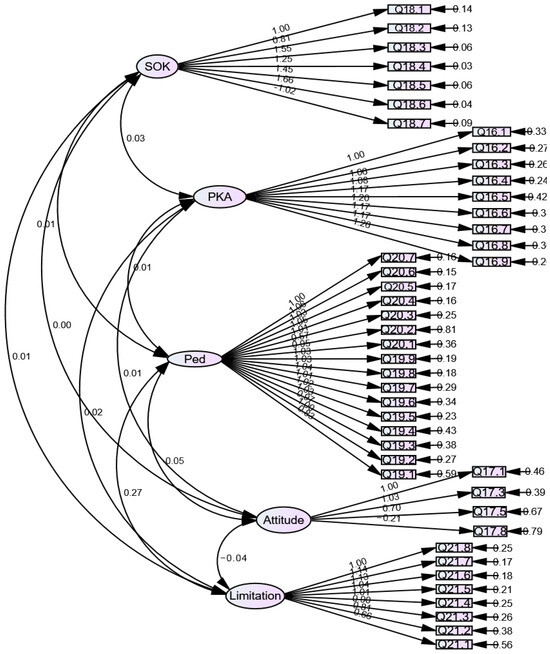
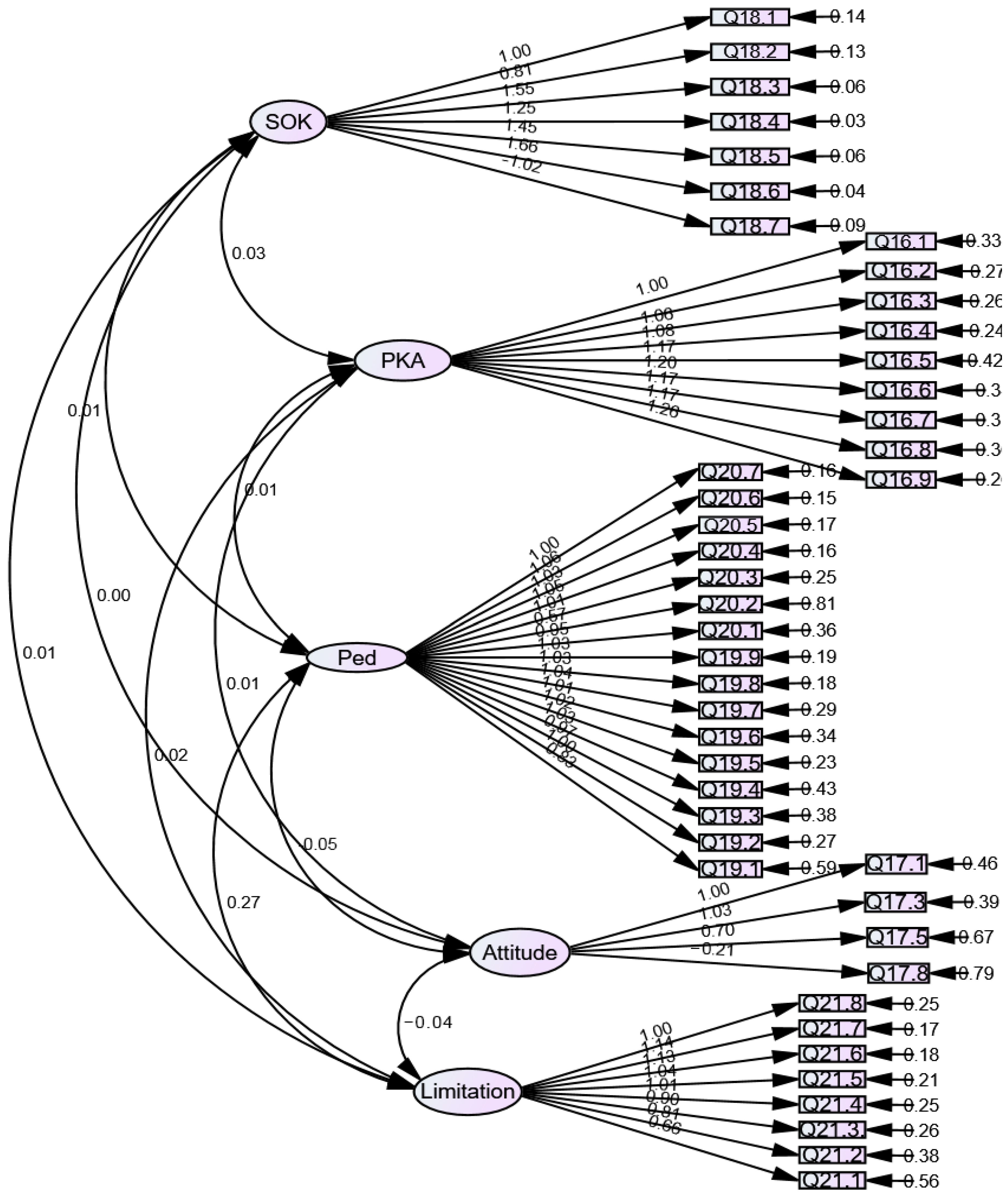
Figure 1 illustrates the correlated five-factor confirmatory factor analysis (CFA) model developed to validate the structure of teachers’ perceptions of treated sewage effluent (TSE) reuse. The model specifies five distinct but interrelated latent constructs Perceived Knowledge and Awareness, Attitudes, Pedagogy, Limitations, and Sources of Knowledge with standardized factor loadings indicating strong relationships between observed items and their respective constructs.
Figure 1.
Confirmatory factor analysis with the correlated model.
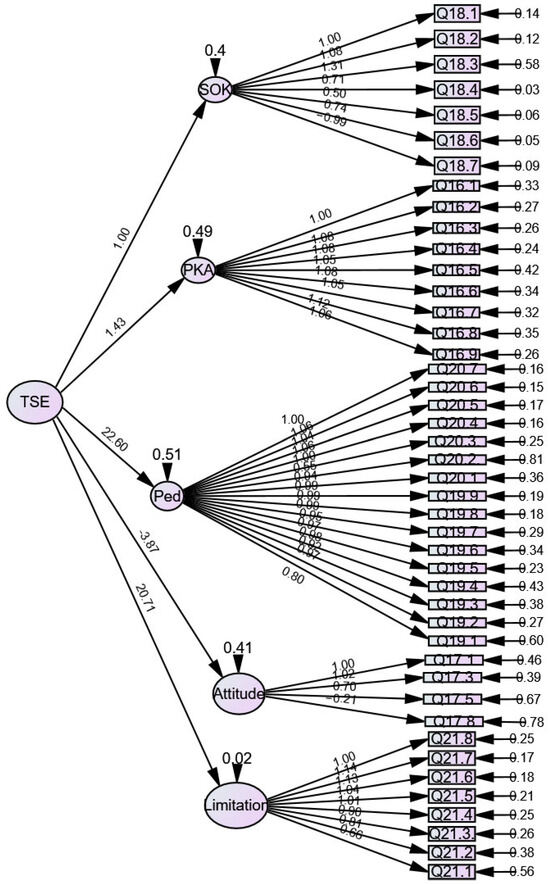
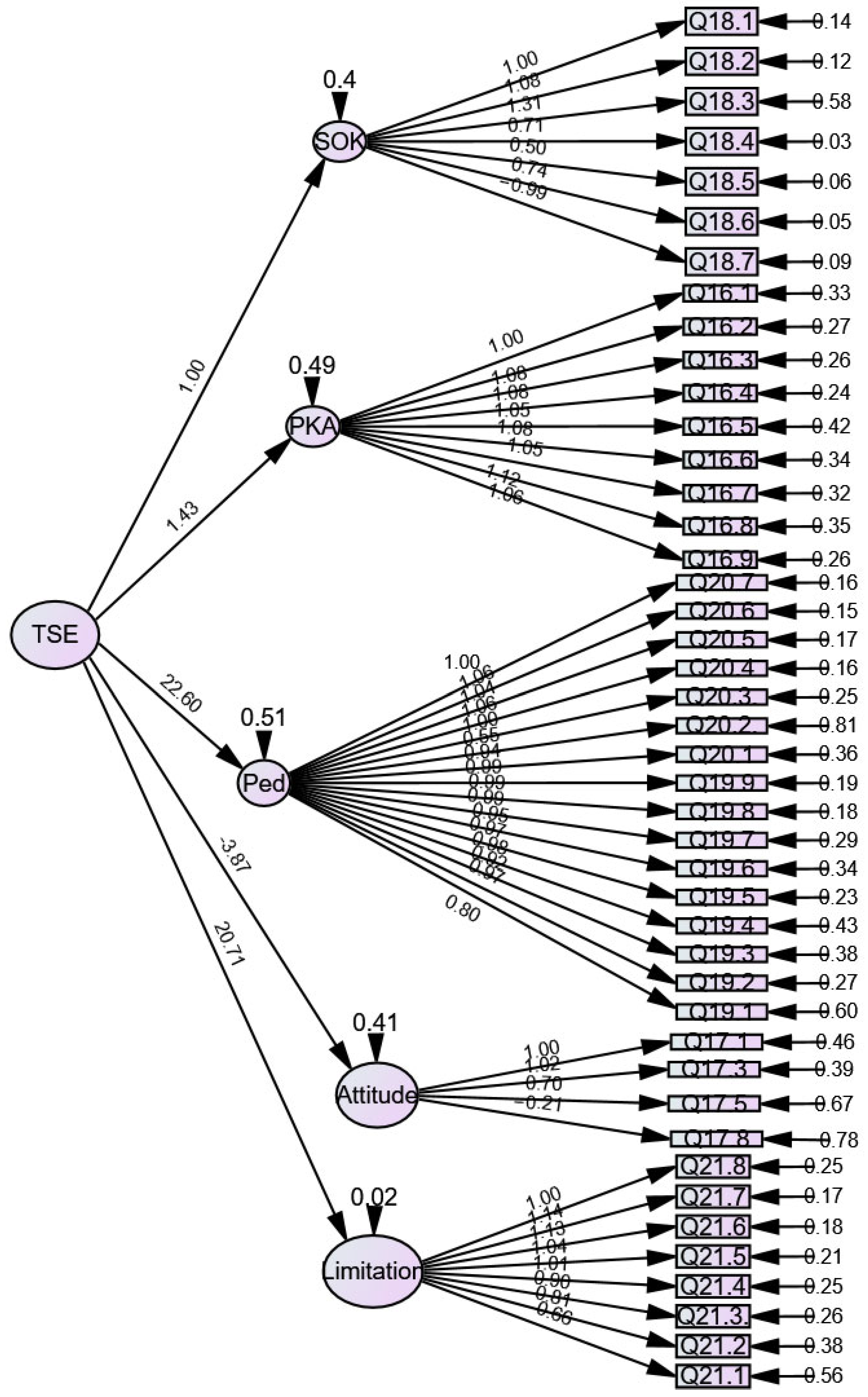
Figure 2 presents the hierarchical confirmatory factor analysis (CFA) model in which treated sewage effluent (TSE) reuse is conceptualized as a higher-order construct underlying five first-order latent dimensions: Perceived Knowledge and Awareness, Attitudes, Pedagogy, Limitations, and Sources of Knowledge. The model illustrates the standardized path coefficients from the higher-order TSE factor to each domain, highlighting the extent to which the overarching construct explains variance across the educational, attitudinal, and contextual components of teachers’ perceptions.
Figure 2.
Confirmatory factor analysis with a hierarchical model.
3.3. Correlated Factors Model
The correlated factors model (Figure 1) specified SOK, PKA, PED, Attitude, and LIM as distinct but correlated latent variables. Inter-factor correlations were generally low to moderate, ranging from −0.04 to 0.28. The strongest association was observed between PED and Attitude (r = 0.28), while the correlation between PED and LIM was slightly negative (r = −0.04), suggesting a potential inverse relationship between pedagogical emphasis and perceived limitations. The modest magnitude of these correlations indicates that the constructs operate largely independently, with limited shared variance. Accordingly, knowledge, pedagogical practices, attitudes, and perceived limitations represent related yet conceptually distinct dimensions in the context of TSE agricultural reuse.
Although a small number of indicators exhibited modest or negative standardized loadings, these items were carefully evaluated in relation to their conceptual relevance and contribution to construct coverage. Given the strong global model fit (RMSEA = 0.044; CFI = 0.921; TLI = 0.911), their retention was considered appropriate to preserve content validity within a multidimensional and context-sensitive instrument. Moreover, removal of these indicators did not produce meaningful improvement in global model fit indices, supporting their retention for conceptual completeness. Consistent with established structural equation modeling guidance, retention decisions were informed not solely by statistical thresholds but also by theoretical considerations of construct representation [30,31,32,33].
3.4. Hierarchical Model
In the hierarchical confirmatory factor analysis (Figure 2), TSE was specified as a second-order latent construct underlying five first-order dimensions: Sources of Knowledge (SOK), Perceived Knowledge and Awareness (PKA), Pedagogy (PED), Attitude, and Limitations (LIM). Within this hierarchical CFA framework, the paths from TSE to the first-order dimensions represent second-order factor loadings within a measurement model rather than causal or predictive effects. The reported coefficients reflect unstandardized estimates; interpretation therefore focuses on the variance explained (R2) in each first-order construct. Accordingly, the variance explained (R2) by TSE was moderate for SOK (0.40), PKA (0.49), PED (0.51), and Attitude (0.41), but minimal for LIM (0.02), indicating that while the higher-order TSE construct captures substantial shared variance across most educational and attitudinal domains, it explains very limited variance in perceived limitations.
This hierarchical structure suggests that TSE functions as a unifying higher-order construct capturing shared variance among teachers’ knowledge, pedagogical practices, and attitudes toward TSE reuse in agriculture. However, the observed differences across first-order dimensions may reflect scaling characteristics of the hierarchical measurement model or construct-specific complexities that warrant further investigation. To rigorously investigate the latent structure underlying teachers’ perceptions of TSE, a confirmatory factor analysis (CFA) was conducted on data collected from 444 educators, comparing the fit of the two competing theoretical models. The correlated five-factor model conceptualizes TSE as comprising five distinct yet interrelated dimensions, each operationalized by multiple observed indicators. This model yielded a chi-square statistic of 3181.996 (df = 892, p < 0.001). Although the chi-square test was statistically significant a common outcome in large samples and complex models, all factor loadings were robust and statistically significant, affirming strong convergent validity. The model demonstrated acceptable fit indices, with RMSEA = 0.044, CFI = 0.921, and TLI = 0.911. Collectively, these indices indicate a strong approximation of the data structure and support the structural adequacy of the multidimensional measurement model. Importantly, the satisfactory global fit suggests that localized variability in certain item loadings does not compromise the overall factorial integrity of the instrument. The hierarchical model posited a higher-order latent factor underlying the five first-order dimensions, representing a unifying TSE construct. This model produced a chi-square value of 3217.384 (df = 897, p < 0.001) and converged successfully, with most loadings remaining significant. Fit indices were comparable to the correlated model (RMSEA = 0.043, CFI = 0.911, TLI = 0.901), suggesting that the inclusion of a higher-order factor did not yield a meaningful improvement in model fit.
Table 4 presents the model fit indices for the correlated and hierarchical confirmatory factor analysis models. Both models demonstrate acceptable fit across multiple indices, with the correlated five-factor model showing a slightly better overall fit, supporting the multidimensional structure of the instrument.
Table 4.
Model Fit Indices for Correlated and Hierarchical Models.
Both models demonstrated statistically significant chi-square values, which is expected given the sample size and model complexity. However, fit indices including RMSEA, CFI, and TLI all met or exceeded conventional thresholds for acceptable fit, underscoring the adequacy of both models. The near-identical fit statistics indicate that the hierarchical model does not substantially improve upon the correlated model, implying that the five dimensions of TSE are best conceptualized as related but distinct constructs rather than reflections of a single overarching factor. This nuanced finding reinforces the multidimensionality of teachers’ perceptions of TSE and highlights the importance of modeling these constructs as interconnected yet discrete domains. Such an approach offers greater theoretical precision and practical utility for designing targeted interventions and advancing measurement validity in future research.
Modification indices were examined as part of the confirmatory factor analysis to evaluate potential areas of localized model misfit. However, no post hoc modifications were implemented. All suggested modifications involved correlating error terms across theoretically distinct items or constructs, which was not supported by the conceptual framework of the instrument. Consistent with best practices in scale validation, the final model was therefore retained without modification to preserve theoretical integrity and avoid overfitting.
3.5. Scale Validation Using λ, CR, and AVE
To further evaluate the reliability and convergent validity of the instrument, composite reliability (CR) and average variance extracted (AVE) were calculated for each latent construct using standardized factor loadings obtained from the confirmatory factor analysis. Composite reliability values exceeding 0.70 and AVE values above 0.50 are generally considered indicative of satisfactory internal consistency and convergent validity. It should be noted that composite reliability (CR) and average variance extracted (AVE) were calculated using standardized factor loadings derived from the final confirmatory factor analysis model. Earlier exploratory outputs were used during model refinement but have been fully superseded by the standardized CFA-based estimates reported here. All reliability and validity interpretations in the revised manuscript refer exclusively to these final validated values.
Table 5 presents the standardized factor loadings (λ), composite reliability (CR), and average variance extracted (AVE) for the five domains of the validated 43-item perceptions scale.
Table 5.
The 43-item five-factor perceptions of prospective teachers.
The Perceived Knowledge and Awareness domain demonstrated strong factor loadings ranging from 0.786 to 0.855, with excellent composite reliability (CR = 0.95) and an AVE of 0.68, indicating high internal consistency and strong convergent validity. Similarly, the Attitude domain exhibited robust loadings between 0.660 and 0.930, a CR of 0.94, and an AVE of 0.65, confirming reliable and valid measurement of teachers’ evaluative orientations toward TSE reuse.
The Pedagogy domain showed greater variability in loadings (0.481 to 0.879); however, it demonstrated very strong composite reliability (CR = 0.97) and acceptable convergent validity (AVE = 0.59), exceeding the recommended 0.50 threshold. These findings indicate that pedagogical practices related to sustainability education are measured coherently within the instrument.
The Limitations domain revealed satisfactory reliability (CR = 0.87) but a slightly lower AVE (0.46), falling marginally below the conventional 0.50 benchmark. Standardized loadings ranged from 0.459 to 0.787, indicating moderate variability in indicator strength. While composite reliability confirms internal consistency, the lower AVE suggests that future refinement may further strengthen shared construct variance.
The Sources of Knowledge domain demonstrated comparatively lower composite reliability (CR = 0.49) and average variance extracted (AVE = 0.23). This pattern reflects the heterogeneous and informational nature of the construct. Unlike perceptual or attitudinal domains, Sources of Knowledge represents diverse external channels (e.g., social media, textbooks, professional development, institutional campaigns) that are not expected to exhibit strong internal homogeneity. Consequently, lower convergent validity indices do not undermine its conceptual relevance but instead indicate that teachers rely on varied and partially independent informational pathways when forming their understanding of TSE reuse. Importantly, all five domains, including Sources of Knowledge, were systematically subjected to composite reliability and average variance extracted assessment to ensure methodological consistency across constructs.
Overall, the five domains demonstrated acceptable structural coherence within the multidimensional measurement model, with observed variability in convergent validity reflecting differences in construct nature rather than measurement deficiency.
3.6. Discriminant Validity
Discriminant validity was assessed using the Fornell–Larcker criterion, which requires that the square root of the average variance extracted (AVE) for each construct exceed its correlations with other latent variables. Using the final standardized CFA-based estimates, The square roots of the AVE values were 0.825 for Perceived Knowledge and Awareness, 0.806 for Attitude, 0.768 for Pedagogy, 0.678 for Limitations, and 0.480 for Sources of Knowledge. These values were substantially higher than the observed inter-factor correlations, which ranged from −0.04 to 0.28. Accordingly, the results confirm satisfactory discriminant validity, indicating that the constructs represent conceptually and empirically distinct dimensions of teachers’ perceptions of treated sewage effluent reuse.
4. Discussion
The primary objective of this study was to develop and validate a multidimensional instrument capable of reliably assessing teachers’ perceptions of treated sewage effluent (TSE) reuse in agriculture; therefore, the discussion focuses on interpreting the findings in relation to the psychometric performance, dimensional structure, and practical utility of the validated scale.
The present study contributes to the increasing body of research on environmental and sustainability education by creating and testing a psychometrically sound tool that measures teachers’ views on using TSE in farming systems. The results reveal that teachers’ opinions are nuanced and include five different but connected ideas: what they think they know and are aware of, their attitudes, their teaching methods, their limitations, and where they get their information. The instrument is dependable and conceptually coherent since it shows strong inter-rater reliability (Cohen’s κ = 0.81–0.90) and internal consistency (Cronbach’s α = 0.92). Collectively, these findings confirm that the study’s primary objective developing a valid and reliable multidimensional instrument to assess teachers’ perceptions of TSE reuse was successfully achieved.
4.1. Interpreting the Psychometric Structure
The exploratory factor analysis (EFA) revealed that the five-factor model explained 71.96% of total variance, a remarkably high value for social science instruments, demonstrating that most of the response variability was captured by the proposed domains. The Kaiser–Meyer–Olkin (KMO = 0.925) and Bartlett’s test of sphericity (p < 0.001) confirmed the adequacy and suitability of the data for factor analysis. Each construct demonstrated high factor loadings (>0.70 for most items), confirming strong convergent validity. Pedagogical indicators such as providing educational materials and linking lessons to global challenges displayed high loadings (0.78–0.83), showing that educators’ practical teaching strategies play a decisive role in mediating students’ understanding of TSE reuse.
Confirmatory factor analysis (CFA) further supported this multidimensional structure. Both the correlated and hierarchical models achieved acceptable and nearly identical model-fit indices (CFI ≥ 0.91, TLI ≥ 0.90, RMSEA ≤ 0.045), reinforcing the robustness of the factorial configuration. The correlated five-factor model slightly outperformed the hierarchical model, implying that while the constructs are connected through an overarching concept of TSE reuse, they remain distinct in how teachers conceptualize, teach, and perceive wastewater reuse. This finding echoes other psychometric studies in environmental education [15,16,17], which demonstrate that the sustainability beliefs and pedagogical approaches of teachers often operate as parallel rather than hierarchical domains. From a measurement perspective, this result supports the decision to model teachers’ perceptions of TSE reuse as related but distinct constructs, reinforcing the conceptual validity and interpretability of the instrument.
These findings have important psychometric consequences for the interpretation and application of the scale. Specifically, the clear separation of domains and the generally low inter-factor correlations indicate limited construct overlap, supporting the use of domain-level scores rather than reliance on a single composite measure. This dimensional structure allows researchers and practitioners to examine specific aspects of teachers’ perceptions such as pedagogical readiness, perceived knowledge, or attitudinal concerns independently. At the same time, the correlated nature of the factors reflects the interconnectedness of these dimensions within sustainability education contexts. Collectively, these characteristics enhance the scale’s theoretical precision and provide guidance for its appropriate use in future research and educational evaluation.
Unlike perceptual constructs, informational-source constructs often function as composite exposure indicators rather than reflective psychological traits. Therefore, lower internal homogeneity is theoretically consistent with the construct’s design and does not indicate measurement instability but structural diversity in information acquisition pathways.
4.2. Knowledge, Awareness, and Attitudinal Insights
The domain of perceived knowledge and awareness exhibited high composite reliability (CR = 0.95) and average variance extracted (AVE = 0.60), indicating both internal consistency and explanatory power. Items such as stages of water treatment processes and importance in preserving public health scored highly, suggesting that most teachers possess a sound conceptual understanding of wastewater treatment. However, cognitive awareness does not automatically translate into positive behavioral intent. Similar patterns have been observed in studies showing that awareness of environmental technologies does not necessarily lead to their acceptance [6,23,24,25]. This cognitive–behavioral gap may stem from contextual barriers, cultural reservations, or limited exposure to experiential learning opportunities that connect theory with practice.
Teachers’ attitudes toward treated wastewater reuse reflected a nuanced spectrum, balancing environmental optimism with residual health and cultural concerns. The Attitude domain displayed excellent internal consistency (CR = 0.93; AVE = 0.64), yet item-level analysis suggested the coexistence of both positive and negative orientations. Conceptually, the Attitude construct was intentionally modeled to capture multiple evaluative dimensions, including perceived risks (e.g., health and religious concerns), perceived benefits (e.g., sustainability and resource conservation), and perceived product quality. This multidimensional attitudinal framing aligns with environmental psychology frameworks, which recognize that acceptance of environmental technologies is rarely unidimensional and instead reflects a balance between perceived advantages, moral considerations, and perceived risks. Thus, the structure of the Attitude factor reflects the complex and context-sensitive nature of teachers’ evaluations of TSE reuse rather than a simple pro–anti orientation. Items addressing sustainability and resource conservation received strong agreement, which is consistent with global trends in environmental attitudes [3]; however, items concerning public health and religious considerations reflected cautious skepticism. These mixed attitudes are especially salient in the GCC context, where environmental behavior intersects with religious and cultural norms [7]. In the Islamic cultural context of Qatar and the wider GCC, perceptions of treated wastewater reuse are often shaped not only by scientific risk assessments but also by religious considerations related to purity, food safety, and ethical acceptability, which are reflected in teachers’ attitudinal responses. As shown by [5], public endorsement of TSE reuse in Arab societies remains contingent upon institutional trust and perceived moral legitimacy. Importantly, the coexistence of positive and cautious orientations captured within the Attitude domain demonstrates the instrument’s sensitivity in measuring nuanced and context-dependent perceptions rather than overly simplified acceptance or rejection patterns. Thus, the ambivalence captured in the attitude items underscores the need for pedagogical interventions that integrate scientific reasoning with ethical and cultural dialogue. Although religious factors were not modeled quantitatively as moderating variables in the present study, future research could explicitly examine the moderating role of religious beliefs on teachers’ attitudes toward TSE reuse using multi-group or interaction-based analytical approaches.
4.3. Pedagogical Dimensions and Educational Constraints
The pedagogy domain emerged as the most influential construct, explaining the largest proportion of variance (Cronbach’s α = 0.95; CR = 0.97). Teachers demonstrated strong alignment with items emphasizing hands-on learning, outdoor activities, cooperative projects, and the use of technology to enhance environmental understanding. These findings resonate with the best global practices in sustainability education, which advocate for experiential, inquiry-based, and community-embedded learning [18,19,31]. Although the AVE (0.59) exceeds the recommended 0.50 threshold, the variability in loadings suggests that the construct captures multiple pedagogical dimensions rather than a narrowly defined latent trait. Similar limitations have been identified in diverse educational settings [13,17], highlighting a systemic need for teacher-training programs that extend beyond theory to include authentic sustainability experiences.
The limitations domain further contextualizes these pedagogical challenges. While reliability was satisfactory (CR = 0.87), convergent validity for the Limitations domain was comparatively lower (AVE = 0.46), suggesting moderate shared variance among indicators while preserving acceptable internal consistency. Teachers emphasized the lack of clear curricular guidance and insufficient pre-service or in-service qualification programs on wastewater reuse. This mirrors global patterns identified by [16] and reinforced by [34], who argue that sustainability education often depends on individual initiative rather than cohesive national frameworks. In Qatar, where environmental education is central to Qatar National Vision 2023 (QNV 2030), this disconnection between policy ambition and classroom practice highlights the urgency of capacity-building programs that transform sustainability rhetoric into pedagogical action. The variability in loadings further suggests that the Pedagogy construct reflects a multidimensional domain encompassing instructional strategies, institutional support, and experiential learning practices, which together form an integrated but conceptually broad representation of sustainability-oriented teaching. The ability of the Pedagogy and Limitations domains to capture both teachers’ instructional intentions and the structural constraints they face further underscores the practical utility of the instrument for diagnosing implementation gaps in sustainability education. Although the Pedagogy construct was modeled as a single latent factor in the present analysis, the variability observed in standardized loadings and the very high composite reliability (CR = 0.97) suggest internal heterogeneity within the domain. Conceptually, pedagogical readiness may encompass at least two distinguishable components: instructional strategies (e.g., experiential learning, cooperative learning, technology integration) and structural or institutional supports (e.g., curriculum alignment, resource availability, professional development). Future research may formally test alternative measurement structures using bifactor modeling, allowing separation of a general pedagogical readiness factor from specific subdimensions, or second-order models in which distinct pedagogical components load onto a higher-order instructional construct. Such modeling approaches would clarify whether the observed variability reflects multidimensionality or hierarchical organization within sustainability-oriented teaching practices.
4.4. Theoretical and Practical Implications
Theoretically, the study affirms that teachers’ perceptions of TSE reuse are multidimensional and context-dependent, requiring integrated conceptual models that bridge environmental literacy, social cognition, and educational psychology. The validated five-factor model contributes a robust methodological tool and reinforces the argument that sustainability awareness must be understood as a synthesis of knowledge, attitudes, and pedagogical competence [1,26,30]. Thus, the instrument presented in this study provides a foundation for cross-cultural comparison, enabling researchers to analyze how cultural values, institutional trust, and national education policies shape environmental behavior.
Practically, several implications emerge for policymakers and curriculum designers. First, wastewater education should be embedded across subjects, including science, geography, and social studies, to promote interdisciplinary learning. Second, teacher-training programs must include experiential modules such as visits to wastewater treatment facilities, simulations, and community projects. These experiences can clarify TSE reuse and foster positive science-based attitudes. Third, public-school partnerships can bridge the gap between infrastructure and instruction by translating national sustainability goals into practical teaching resources. Such initiatives would align with Qatar’s National Strategy for Water Security 2030 [35] and the broader global agenda for environmental stewardship.
The policy relevance of this instrument is further strengthened through its alignment with established educational frameworks and standards. In the Qatari context, the scale supports the educational objectives of Qatar National Vision 2030 and the National Strategy for Water Security by providing an evidence-based tool to assess teacher readiness for sustainability-oriented instruction. At the international level, the instrument aligns with UNESCO’s Education for Sustainable Development (ESD) framework and directly supports Sustainable Development Goal 4 (quality education) and Goal 6 (clean water and sanitation) by enabling systematic evaluation of how sustainability and water-reuse concepts are integrated into educational practice. This alignment enhances the instrument’s applicability for curriculum development, teacher training, and policy-informed educational reform.
4.5. Regional and Global Relevance
Although this research centers on Qatar, its implications extend to other arid and semi-arid regions where water scarcity and cultural sensitivities intersect. In most GCC countries, similar socio-environmental dynamics challenge public acceptance of TSE reuse. The current findings complement recent works by [8,9], who observe that despite advanced wastewater infrastructure, social apprehension and limited environmental literacy hinder adoption.
Globally, TSE reuse underpins the circular economy and progress toward Sustainable Development Goals 6 and 4. The validation of this instrument provides a measurable link between education and sustainability, enabling evidence-based evaluation of environmental literacy outcomes. Such integration bridges the divide between research, education, and policy, reinforcing UNESCO’s (2023) call for a new social contract that positions education as a driver of ecological resilience and social transformation [34].
4.6. Limitations and Directions for Future Research
Despite methodological rigor, some limitations warrant attention. The sample, though large (n = 444), was limited to teachers in Qatar and may not capture some regional variations. Future studies should test the instrument across multiple languages and contexts to ensure measurement invariance. A further methodological limitation concerns the use of the same dataset for both exploratory factor analysis (EFA) and confirmatory factor analysis (CFA). Although this approach is common in early-stage scale development studies with sufficiently large samples, it may inflate model fit indices and limit the strength of construct validation. Therefore, future research should prioritize split-sample validation or independent cross-validation using an external dataset to further assess the stability, replicability, and generalizability of the measurement model across contexts. Although EFA and CFA confirmed validity, the lower AVE in the pedagogy domain suggests possible redundancy among items; future work could refine this subscale using item-response theory. Self-reported data may also introduce social-desirability bias—triangulation with classroom observation or interviews could enrich results.
Retaining indicators with moderate loadings preserves the construct’s theoretical comprehensiveness, ensuring representation of both structural and contextual constraints that may differentially influence implementation across educational settings.
5. Conclusions
From a measurement perspective, the main conclusions of this study concern the validity and structure of the proposed instrument. This study has developed and validated a robust, multidimensional instrument to assess teachers’ perceptions and attitudes toward the reuse of treated sewage effluent (TSE) in agriculture, which seems a critical water management strategy in arid regions such as Qatar and the broader GCC. The validated five-factor model, encompassing Perceived Knowledge and Awareness, Attitudes, Pedagogy, Limitations, and Sources of Knowledge, demonstrates strong psychometric properties, including high internal consistency, excellent inter-rater reliability, and sound construct validity, as confirmed through exploratory and confirmatory factor analyses. The tool not only fills a significant gap in the environmental education literature but also provides a reliable means to measure how educators understand, teach, and perceive wastewater reuse—an issue of growing importance in water-scarce nations.
From an educational perspective, the following conclusions relate to teachers’ perceptions, pedagogical practices, and implications for teaching and learning. The findings underscore that teachers’ perceptions are nuanced and multifaceted. While educators generally demonstrate sound conceptual knowledge of TSE processes and express positive attitudes toward sustainability and water conservation, persistent concerns related to health risks, product quality, and cultural or religious reservations highlight a notable cognitive–behavioral gap. Furthermore, although teachers value innovative, student-centered pedagogies such as experiential learning, technology integration, and community-based projects, structural and institutional barriers, including limited curricular guidance, time constraints, and insufficient professional development, often impede effective classroom implementation.
These insights carry important implications for educational policy, curriculum design, and teacher training, particularly in regions pursuing ambitious water sustainability goals, such as those outlined in Qatar National Vision 2030. To translate policy aspirations into pedagogical practice, it is recommended that TSE education be integrated across disciplines, that teacher training programs incorporate hands-on, context-rich experiences (e.g., site visits, pilot projects), and that supportive curricular resources and institutional frameworks be developed to empower educators as agents of environmental literacy.
While this study focused on Qatar, the validated instrument offers a transferable model for similar arid and water-stressed contexts globally, supporting cross-cultural comparisons and evidence-based interventions in sustainability education. Future research should aim to apply the tool in diverse regional settings, refine the pedagogy subscale using advanced psychometric methods, and complement survey data with qualitative insights from classroom observations and teacher interviews.
Ultimately, this work reaffirms the central role of teachers in fostering environmental stewardship and highlights the need for an education system that imparts knowledge and cultivates the attitudes, skills, and pedagogical confidence required to address complex socio-environmental challenges. By equipping educators with the understanding and tools to teach about TSE reuse thoughtfully and effectively, we can help build a more informed, engaged, and water-resilient society.
Author Contributions
Conceptualization, H.N. and N.M.; methodology, H.N.; software, H.N.; validation, H.N., S.G. and H.H.; formal analysis, H.N.; investigation, N.M.; resources, N.M.; data curation, H.H.; writing—original draft preparation, H.N. and N.M.; writing—review and editing, S.G.; visualization, H.H.; supervision, S.G.; project administration, H.N.; funding acquisition, N.M. All authors have read and agreed to the published version of the manuscript.
Funding
This research was funded by QNRF, grant number MME03-1101-210008.
Institutional Review Board Statement
The study was conducted in accordance with the Declaration of Helsinki, and approved by the Institutional Review Board of Qatar University (QU-IRB 040/2024-FBA).
Informed Consent Statement
Informed consent was obtained from all participants involved in the study.
Data Availability Statement
OSF repository, https://doi.org/10.17605/OSF.IO/VRWQ3.
Conflicts of Interest
The funders had no part in the study’s design, data collection, analysis, or interpretation, manuscript writing, or publication decision.
References
- Da Silva, C.P.; da Silva, N.S.R.; de Campos, S.X. Systematic review on the global strategies and regulatory frameworks for treated wastewater reuse. Total Environ. Eng. 2025, 4, 100036. [Google Scholar] [CrossRef] [Scilit]
- Obijianya, C.C.; Otuokere, I.E.; Agina, S.E.; Anozie, I. Agricultural irrigation using treated wastewater. Water 2025, 17, 2083. [Google Scholar] [CrossRef] [Scilit]
- Yalin, D.; Craddock, H.A.; Assouline, S.; Ben Mordechay, E.; Ben-Gal, A.; Bernstein, N.; Chaudhry, R.M.; Chefetz, B.; Fatta-Kassinos, D.; Gawlik, B.M.; et al. Mitigating risks and maximizing sustainability of treated wastewater reuse for irrigation. Water Res. X 2023, 21, 100203. [Google Scholar] [CrossRef] [Scilit] [PubMed]
- Abou-Shady, A.; Siddique, M.S.; Yu, W. A critical review of recent progress in global water reuse during 2019–2021 and perspectives to overcome future water crisis. Environments 2023, 10, 159. [Google Scholar] [CrossRef] [Scilit]
- Al-Saidi, M. From Acceptance Snapshots to the Social Acceptability Process: Structuring Knowledge on Attitudes Towards Water Reuse. Front. Environ. Sci. 2021, 9, 633841. [Google Scholar] [CrossRef] [Scilit]
- Tarawneh, A.; Assad, S.; Alkhalil, S.; Suleiman, A. Assessing acceptance of treated wastewater reuse in Jordan: A study of knowledge and preferences. Desalination Water Treat. 2024, 317, 100030. [Google Scholar] [CrossRef] [Scilit]
- Pathiranage, W.B.; Li, E.; Pasztor, K. Perception and acceptance towards water reuse in the Southeast United States: A public survey. Sci. Total Environ. 2024, 908, 168224. [Google Scholar] [CrossRef] [Scilit]
- Shomar, B.; Rovira, J. Human health risk assessment associated with the reuse of treated wastewater in arid areas. Environ. Pollut. 2024, 345, 123478. [Google Scholar] [CrossRef] [Scilit]
- Aloui, S.; Zghibi, A.; Mazzoni, A.; Elomri, A.; Triki, C. Groundwater resources in Qatar: A comprehensive review and informative recommendations for research, governance, and management in support of sustainability. J. Hydrol. Reg. Stud. 2023, 50, 101564. [Google Scholar] [CrossRef] [Scilit]
- Ghanimeh, S.; Hamdi, H.; Fares, N.; Mansour, N.; Pano, N.; Naccache, H. Strategy framework for treated sewage effluent reuse in agriculture: The case of a GCC country. Environ. Res. Commun. 2025, 7, 125013. [Google Scholar] [CrossRef] [Scilit]
- Dolnicar, S.; Hurlimann, A.; Nghiem, L.D. The effect of information on public acceptance—The case of water from alternative sources. J. Environ. Manag. 2010, 91, 1288–1293. [Google Scholar] [CrossRef] [Scilit]
- Fielding, K.S.; Dolnicar, S.; Schultz, T. Public acceptance of recycled water. Int. J. Water Resour. Dev. 2018, 35, 551–586. [Google Scholar] [CrossRef] [Scilit]
- Valderrama, D.A.; Garzón Velasco, M.D.; Alfonso Chaparro, L.P. Física, ambiente y educación ambiental; percepciones desde los docentes de ciencias naturales en formación. Rev. Perspect. 2024, 9, 89–100. [Google Scholar] [CrossRef] [Scilit]
- Zhdanov, S.P.; Akhmedova, M.G.; Sokolova, N.L.; Grishnova, E.E.; Efimushkina, S.V.; Smirnova, L.M. Exploring preservice science teachers’ attitudes toward environmental technologies. Eurasia J. Math. Sci. Technol. Educ. 2023, 19, em2219. [Google Scholar] [CrossRef] [Scilit] [PubMed]
- Borg, C.; Gericke, N.; Höglund, H.-O.; Bergman, E. Subject- and experience-bound differences in teachers’ conceptual understanding of sustainable development. Environ. Educ. Res. 2014, 20, 526–551. [Google Scholar] [CrossRef] [Scilit]
- Khazen, M.; Asli, S.; Basheer, A.; Hugerat, M. The Impact of a Sustainability Education Initiative on Pre-Service Teachers: Changes in Environmental Attitudes, Willingness to Act, and Ecological Footprint. Sustainability 2025, 17, 5621. [Google Scholar] [CrossRef] [Scilit]
- Manasia, L.; Ianoș, M.G.; Chicioreanu, T.D. Pre-service teacher preparedness for fostering education for sustainable development: An empirical analysis of central dimensions of teaching readiness. Sustainability 2020, 12, 166. [Google Scholar] [CrossRef] [Scilit]
- Sterling, S. Sustainable Education: Re-Visioning Learning and Change; Schumacher Briefing No. 6; Green Books: South Devon, UK, 2001. [Google Scholar]
- Mogensen, F.; Schnack, K. The action competence approach and the “new” discourses of education for sustainable development, competence and quality criteria. Environ. Educ. Res. 2010, 16, 59–74. [Google Scholar] [CrossRef] [Scilit]
- Alrikabi, H.T. The public’s attitude toward recycled water: A review. Wasit J. Eng. Sci. 2024, 12, 37–52. [Google Scholar] [CrossRef] [Scilit]
- Karachalios, I.; Plakitsi, K.; Hatzinikita, V.; Kalavrouziotis, I.; Gomatos, L.; Sakellariou, P. Secondary education teachers’ views on issues related to wastewater and solid waste management. Eur. J. Educ. Stud. 2023, 10, 209–226. [Google Scholar] [CrossRef] [Scilit]
- McCoach, D.B.; Gable, R.K.; Madura, J.P. Instrument Development in the Affective Domain: School and Corporate Applications, 3rd ed.; Springer: Berlin/Heidelberg, Germany, 2013. [Google Scholar] [CrossRef] [Scilit]
- Vaiopoulou, J.; Ntziachristou, A.; Antonopoulou, E.; Papagiannopoulou, T.; Stamovlasis, D.; Kalogiannakis, M. Teachers’ perceptions of educational apps use: Psychometric properties of a new instrument (PEAU-t), validation, and measurement invariance. Comput. Hum. Behav. Rep. 2023, 12, 100325. [Google Scholar] [CrossRef] [Scilit]
- Kline, R.B. Principles and Practice of Structural Equation Modeling, 4th ed.; Guilford Press: New York, NY, USA, 2016. [Google Scholar]
- Naccache, H.; Ghamrawi, N.; Shal, T.; Ghamrawi, N.A.R. The latent influence of teacher leadership: Alleviating teaching anxiety in the classroom. Manag. Educ. 2025, 08920206251343998. [Google Scholar] [CrossRef] [Scilit]
- Andriamanohiarisoamanana, F.J.; Shirai, T.; Yamashiro, T.; Yasui, S.; Iwasaki, M.; Ihara, I.; Nishida, T.; Tangtaweewipat, S.; Umetsu, K. Valorizing waste iron powder in biogas production: Hydrogen sulfide control and process performances. J. Environ. Manag. 2018, 208, 134–141. [Google Scholar] [CrossRef] [Scilit]
- Schumacker, R.E.; Lomax, R.G. A Beginner’s Guide to Structural Equation Modeling, 3rd ed.; Routledge/Taylor & Francis Group: Oxfordshire, UK, 2010. [Google Scholar]
- Tabachnick, B.G.; Fidell, L.S. Using Multivariate Statistics, 5th ed.; Allyn and Bacon: New York, NY, USA, 2007. [Google Scholar]
- Kaiser, H.F. A Second Generation Little Jiffy. Psychometrika 1970, 35, 401–415. [Google Scholar] [CrossRef] [Scilit]
- Kline, P. An Easy Guide to Factor Analysis; Routledge: London, UK, 1994. [Google Scholar]
- Dolnicar, S.; Hurlimann, A.; Grün, B. What affects public acceptance of recycled and desalinated water? Water Res. 2011, 45, 933–943. [Google Scholar] [CrossRef] [Scilit]
- Hair, J.F.; Babin, B.J.; Anderson, R.E.; Black, W.C. Multivariate Data Analysis, 8th ed.; Pearson Prentice: London, UK, 2019. [Google Scholar]
- Naccache, H.; Altae, M.; Barham, A. Enhancing mathematics achievement: A game-based learning intervention in Qatar. Educ. Process Int. J. 2025, 18, e2025481. [Google Scholar] [CrossRef] [Scilit]
- UNESCO. Global Education Monitoring Report 2023: Technology in Education—A Tool on Whose Terms? UNESCO: Paris, France, 2023. [Google Scholar]
- Ministry of Environment and Climate Change (MoECC). Environmental Information and Policies of the Ministry of Environment and Climate Change in Qatar; Government of Qatar: Doha, Qatar, 2023. [Google Scholar]

Disclaimer/Publisher’s Note: The statements, opinions and data contained in all publications are solely those of the individual author(s) and contributor(s) and not of MDPI and/or the editor(s). MDPI and/or the editor(s) disclaim responsibility for any injury to people or property resulting from any ideas, methods, instructions or products referred to in the content. |
© 2026 by the authors. Licensee MDPI, Basel, Switzerland. This article is an open access article distributed under the terms and conditions of the Creative Commons Attribution (CC BY) license.