


Abstract
This study examines the relationship between manufacturing-specific foreign direct investment (FDI) and manufacturing output in ASEAN-6 countries over the period 2012–2022. While existing empirical studies largely rely on aggregate FDI measures, such evidence may obscure sector-specific mechanisms through which foreign investment affects production capacity and industrial performance. Focusing on manufacturing-oriented FDI allows for a more direct assessment of how sector-targeted investment is associated with industrial resilience and value-added stability, which represent the economic dimension of sustainability considered in this study. Sustained industrial output performance is proxied by manufacturing value added (GDPm) and interpreted as the manufacturing sector’s ability to maintain and expand value added over time amid macroeconomic volatility and external shocks. Using a balanced panel dataset of six ASEAN economies (ASEAN-6) with 66 country-year observations and a fixed-effects specification selected through standard model-selection tests, the results indicate that manufacturing-specific FDI is positively and statistically significantly associated with manufacturing output at the panel-average level. Manufacturing contribution to GDP also exhibits a strong positive association, while exchange rate movements are negatively associated with manufacturing output. Inflation is positively associated with output during the study period and is interpreted as a context-specific co-movement rather than a normative implication for long-run sustainability. To provide additional insight into shock-period dynamics, the analysis compares pre-COVID (2012–2019) and COVID/post-COVID (2020–2022) sub-period estimates. The positive association between manufacturing-oriented FDI and output is more pronounced before the pandemic. It weakens during the pandemic and early recovery years, consistent with supply-chain disruptions and temporarily reduced absorption capacity. The findings highlight the importance of sector-specific FDI, industrial structure, and macroeconomic stability in supporting manufacturing resilience in ASEAN-6 economies.
1. Introduction
Sustainable industrial development has become a central objective for developing and emerging economies seeking long-term economic stability, structural transformation, and resilience to external shocks [1]. In this context, manufacturing plays a critical role in driving productivity growth, technological upgrading, and export capacity, while also supporting industrial resilience through deeper production linkages. Foreign direct investment (FDI), particularly when directed toward manufacturing activities, is widely regarded as a key mechanism for strengthening industrial performance by facilitating capital accumulation, technology transfer, managerial upgrading, and integration into global value chains. These channels are especially relevant for emerging economies, where domestic manufacturing systems often depend on external investment to expand production capacity and upgrade technological capabilities. However, the contribution of FDI to sustained manufacturing performance is not uniform and may depend on sectoral composition, industrial structure, and macroeconomic conditions, underscoring the importance of examining manufacturing-specific FDI rather than aggregate inflows [2,3].
The ASEAN-6 economies (Indonesia, Malaysia, Singapore, Thailand, Vietnam, and the Philippines) provide a particularly suitable laboratory for examining the relationship between manufacturing-specific FDI and sustained industrial output. While these countries are regionally integrated through trade and production networks, they exhibit substantial heterogeneity in industrial structure, investment regimes, and stages of manufacturing development. Singapore represents a highly advanced, technology-intensive manufacturing hub. In contrast, Vietnam and Indonesia have experienced rapid industrial expansion driven by manufacturing-oriented FDI, and the Philippines displays a more uneven pattern of industrial deepening. This combination of regional integration and structural diversity allows the analysis to assess whether the association between manufacturing-specific FDI and industrial resilience holds across heterogeneous economies exposed to similar global shocks. Consequently, ASEAN-6 offers a unique setting to examine how sector-specific foreign investment interacts with industrial structure and macroeconomic conditions in sustaining manufacturing value added. From a sustainability perspective, industrial resilience and value-added stability are closely aligned with Sustainable Development Goal (SDG) 9, which emphasizes inclusive and sustainable industrialization, productivity upgrading, and resilient infrastructure as foundations for long-term economic development [4].
In this study, economic sustainability is conceptualized as industrial resilience and value-added stability, referring to the manufacturing sector’s ability to maintain and expand value-added over time despite macroeconomic volatility and external shocks. Accordingly, sustained industrial output performance is proxied by manufacturing value added (GDPm). This framing does not directly capture environmental or social sustainability outcomes. Instead, it addresses the economic dimension of sustainability and treats broader sustainability pillars as important extensions for future research. Although a substantial body of literature has examined the relationship between foreign direct investment and economic growth, empirical evidence on the role of manufacturing-specific FDI in supporting sustainable industrial output remains inconclusive, particularly in the ASEAN context [5]. Moreover, key macroeconomic factors such as exchange rate stability and inflation, which are crucial for sustaining manufacturing performance and resilience, are often insufficiently integrated into empirical analyses [6,7]. The COVID-19 pandemic has further highlighted the need to assess the sustainability and robustness of manufacturing systems to external shocks. Yet, cross-country evidence on the pandemic’s structural implications for manufacturing output remains limited [8].
In recent years, global foreign direct investment flows have exhibited considerable volatility due to successive external shocks, including the COVID-19 pandemic, geopolitical tensions, and rising macroeconomic uncertainty [9,10]. These disruptions have underscored the vulnerability of international investment and industrial production systems, particularly in manufacturing-dependent economies [11]. From a sustainability perspective, stable and resilient investment flows are essential for maintaining long-term industrial performance and supporting sustainable economic development [12]. Despite global uncertainty, developing Asia has remained a major destination for foreign investment, reflecting the continued strategic importance of the region’s manufacturing base, expanding domestic markets, and integration into global value chains [9,13]. This resilience highlights the potential role of manufacturing-oriented FDI in sustaining industrial output amid heightened global instability [14].
Global investment flows have been volatile in recent years due to successive shocks, including the COVID-19 pandemic and periods of heightened macroeconomic uncertainty. This study operationalizes economic sustainability through the lens of industrial resilience and value-added stability, specifically the ability of the manufacturing sector to sustain and grow manufacturing value added (GDPm) over time in the presence of external shocks.
Within developing Asia, ASEAN has emerged as a key hub for manufacturing and foreign investment. The ASEAN-6 economies, Indonesia, Malaysia, Singapore, Thailand, Vietnam, and the Philippines, account for a large share of regional manufacturing output and inward FDI while exhibiting diverse stages of industrial development and different degrees of exposure to global value chains [15]. Manufacturing remains a central pillar of economic activity in these economies, contributing to employment creation, export capacity, and technological upgrading [16]. Understanding how manufacturing-specific FDI contributes to industrial output across ASEAN-6 countries is therefore essential for assessing the sustainability and resilience of their industrial development trajectories.
The COVID-19 pandemic has further underscored the need to assess the resilience of manufacturing systems to external shocks, yet cross-country evidence on their structural implications remains limited [16,17]. Although extensive research has examined the relationship between FDI and economic growth, evidence on the role of manufacturing-specific FDI in supporting sustained manufacturing output remains mixed, particularly in ASEAN. Many studies rely on aggregate FDI measures, focus on single-country settings, or omit key macroeconomic conditions that shape manufacturing performance. Exchange rate dynamics and inflation are especially relevant in open economies where manufacturing depends on imported intermediate inputs and where price conditions influence costs and demand. The COVID-19 period further underscores the importance of assessing whether relationships observed over longer horizons remain stable during exceptional shock episodes.
Manufacturing-specific FDI can differ from aggregate FDI because it is more directly connected to production capacity and input–output linkages in the host economy. In particular, the spillover literature emphasizes that productivity gains from FDI often operate through vertical channels, such as backward linkages between foreign affiliates and domestic suppliers, where foreign firms transmit requirements, know-how, and standards through buyer–supplier relationships. Evidence consistent with such mechanisms is documented in studies that highlight productivity spillovers arising from contacts with local suppliers rather than from within-industry competition alone. Because aggregate FDI pools heterogeneous investments across manufacturing, services, and resource sectors, the estimated “FDI effect” may mask sector-specific channels and yield average relationships that differ from those for manufacturing-focused inflows.
This study contributes by focusing on manufacturing-specific FDI rather than aggregate inflows, and by examining a heterogeneous yet regionally integrated set of ASEAN-6 economies within a unified panel framework. In addition, the analysis considers period-specific dynamics by comparing pre-COVID (2012 to 2019) and COVID/post-COVID (2020 to 2022) sub-periods. This provides complementary evidence on whether the panel-average relationships mask short-run heterogeneity during the pandemic and in the early recovery years.
The objective of this study is to estimate the association between manufacturing-oriented FDI and manufacturing output in ASEAN-6 countries from 2012 to 2022 while accounting for industrial structure and macroeconomic conditions, including exchange rate movements and inflation. A fixed effects specification is used to control for unobserved country-specific heterogeneity. The study also reports sub-period estimates to describe how relationships differ across the pre-pandemic, pandemic, and early-recovery years. The remainder of the paper is structured as follows. Section 2 reviews the relevant literature and develops the research hypotheses. Section 3 describes the data, variables, and empirical methodology. Section 4 presents and discusses the empirical results. Section 5 concludes with policy implications and directions for future research.
The study period 2012–2022 is selected to capture both the post-Global Financial Crisis recovery phase and subsequent global disruptions, including the COVID-19 shock and the early recovery years. This period allows for an assessment of manufacturing performance under both normal conditions and exceptional external shocks. This is consistent with evidence that global FDI experienced an uneven recovery after the crisis and that emerging economies, including those in Asia, faced heterogeneous post-crisis trajectories. In addition, we expand the ASEAN-6 justification by explaining that cross-country diversity within ASEAN-6 provides meaningful variation in industrial structure and external exposure, which helps assess whether the hypothesized relationships hold in a heterogeneous but regionally integrated setting.
This study contributes to the FDI-led growth and manufacturing-led development literature by refining the empirical focus from aggregate FDI to manufacturing-specific FDI, which is more directly connected to manufacturing capacity and production dynamics. It also highlights that the FDI–output association should be interpreted alongside industrial structure and macroeconomic conditions, within a fixed-effects framework that controls for persistent cross-country heterogeneity. In addition, by comparing pre-COVID, COVID/post-COVID sub-periods, the study provides evidence that panel-average relationships may not be stable under exceptional shocks, thereby adding a period-specific perspective to the interpretation of manufacturing FDI and manufacturing output performance.
2. Literature Review and Hypotheses Development
2.1. Manufacturing-Led Growth and Sustainable Industrial Development
The manufacturing-led growth hypothesis emphasizes manufacturing’s central role as a driver of long-term economic development, owing to higher productivity, economies of scale, and greater potential for technological progress than in other sectors. Manufacturing expansion generates cumulative growth effects through learning-by-doing, capital accumulation, and intersectoral linkages [18,19]. In the context of sustainability, manufacturing is increasingly viewed not only as a source of economic growth but also as a foundation for economic sustainability and industrial resilience, as it supports stable employment, export diversification, and productivity upgrading over time. Empirical studies indicate that economies with a strong manufacturing base tend to achieve more sustainable development trajectories and are better positioned to withstand external shocks [20]. Empirical studies often report that economies with a stronger manufacturing base tend to achieve more stable growth trajectories and greater resilience to external shocks.
Prior studies show that the growth effects of FDI depend critically on mediating factors such as productivity spillovers, human capital, and institutional conditions, rather than on FDI inflows alone. Consistent with this view, the present study adopts a reduced-form approach, focusing on the association between manufacturing-specific FDI and output while leaving the explicit identification of transmission mechanisms to future research [21,22]. Recent studies highlight that firm performance and foreign investment outcomes are highly conditional on structural and contextual factors, including environmental pressures, firm size, productivity, and country-specific characteristics. In particular, evidence suggests that both environmental conditions and enterprise-level performance metrics shape economic outcomes in a non-linear and heterogeneous manner across countries [23,24].
The recent literature emphasizes that the impact of foreign direct investment on industrial performance increasingly depends on the quality and composition of FDI, rather than on aggregate inflows alone. The concept of “quality FDI” highlights investments that contribute to technological upgrading, productivity growth, and deeper integration into production networks, particularly in manufacturing sectors. In the context of the post-pandemic restructuring of global value chains, manufacturing-oriented FDI has increasingly been associated with the adoption of Industry 4.0 technologies, digital manufacturing, and resilience-seeking investment strategies. International evidence shows that multinational enterprises are prioritizing locations with digital readiness, automation capabilities, and supportive policy frameworks, especially in emerging Asia and ASEAN economies [25,26]. These trends suggest that manufacturing-specific FDI linked to industrial digitization may play a critical role in sustaining manufacturing value added and enhancing industrial resilience, reinforcing the relevance of examining sector-specific FDI in the ASEAN-6 context [27].
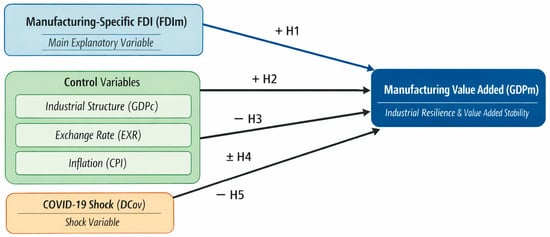
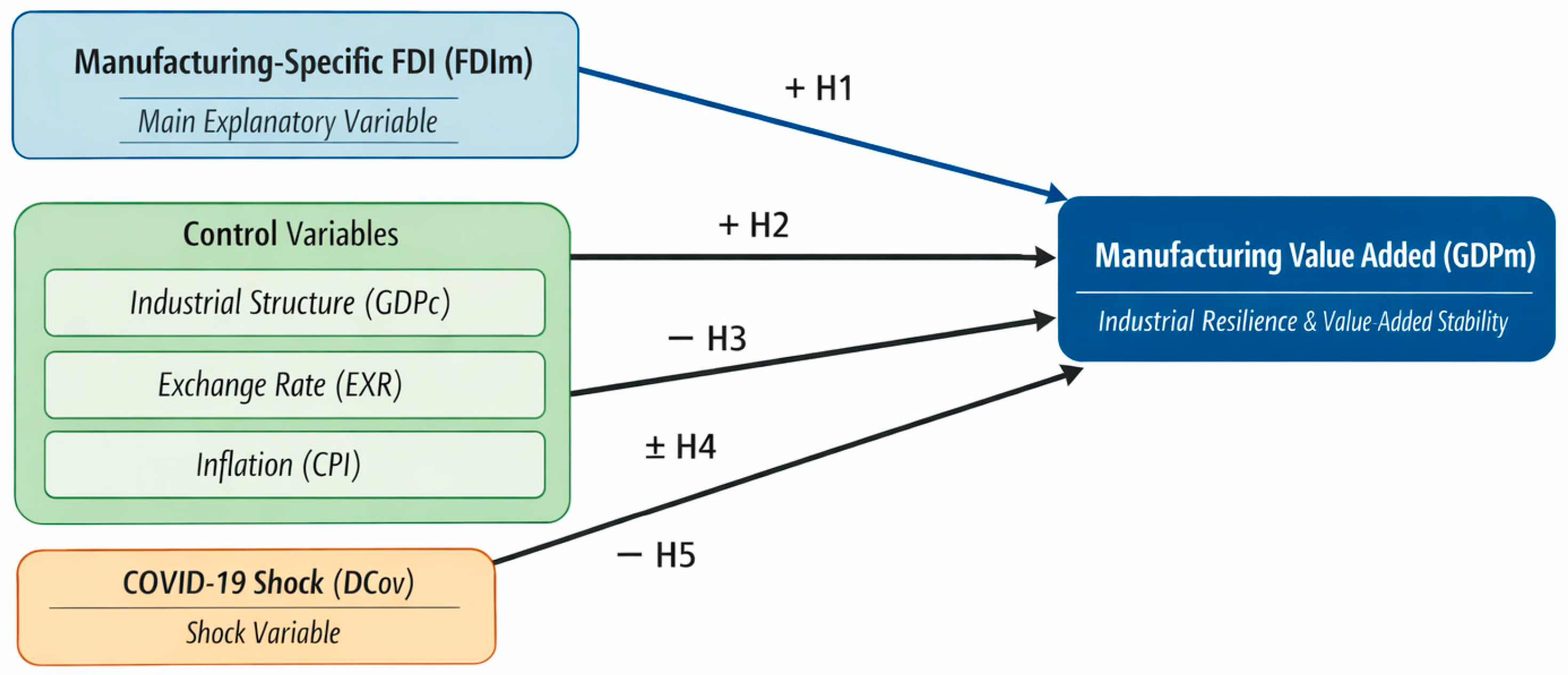
In this study, sustainability framing is limited to the economic dimension. Economic sustainability is understood as the manufacturing sector’s capacity to maintain value added over time amid macroeconomic volatility and external disturbances [28,29]. Consistent with this lens, manufacturing value added is used as the indicator of sustained industrial output performance. This operationalization does not directly measure environmental efficiency or social outcomes. Instead, it is intended to capture industrial resilience and value-added stability, which are central concerns for emerging economies pursuing industrial deepening and structural transformation. Future research can extend this framework by incorporating environmental intensity indicators, employment quality measures, or productivity persistence metrics to reflect additional sustainability pillars (Figure 1).
Figure 1.
Conceptual framework distinguishing the main explanatory variable (manufacturing-specific FDI), control variables (industrial structure and macroeconomic conditions), and the COVID-19 shock, with expected directional effects (+/−) and corresponding hypotheses (H1–H5) on manufacturing value added (GDPm).
Each linkage represents a hypothesized channel through which economic and macroeconomic factors influence sustained manufacturing output performance, providing the conceptual basis for hypotheses H1–H5. Based on this conceptual framework, the following hypotheses are proposed.
2.2. Manufacturing Foreign Direct Investment and Sustainable Industrial Output
Foreign direct investment plays a critical role in supporting sustainable industrial development, particularly when it is directed toward manufacturing. Manufacturing-oriented FDI provides host economies with access to physical capital, advanced technologies, managerial expertise, and international production networks. These channels enhance productivity and support industrial upgrading, thereby contributing to sustainable industrial output. FDI is more effective in promoting long-term development when it flows into technologically intensive sectors such as manufacturing [29,30]. From a sustainability perspective, sector-specific FDI generates stronger spillover effects and fosters industrial resilience by deepening domestic production capabilities.
Empirical evidence generally supports a positive relationship between manufacturing FDI and manufacturing performance, although the magnitude of the effect varies across countries depending on absorptive capacity and industrial structure [31,32]. In the ASEAN context, manufacturing FDI has been instrumental in integrating domestic industries into global value chains, supporting sustained industrial output. These channels provide an interpretative rationale for the expected association, but the empirical model does not directly test the underlying transmission mechanisms. Based on this discussion, the following hypothesis is proposed:
H1:
Manufacturing foreign direct investment has a positive and significant effect on sustainable industrial output in ASEAN-6 countries.
2.3. Manufacturing Contribution to GDP and Industrial Sustainability
Manufacturing contribution to GDP reflects the degree of industrialization and the extent of structural transformation within an economy. Structural change theory suggests that a higher manufacturing share indicates a transition from low-productivity activities to higher-value-added production, which is essential for sustaining long-term economic development [33]. From a sustainability standpoint, a strong manufacturing base enhances economic stability by diversifying production structures and strengthening domestic supply chains. Empirical studies show that countries with higher manufacturing intensity tend to experience more robust and sustainable industrial expansion [1]. In ASEAN economies, manufacturing contribution to GDP has been closely associated with export performance, technological upgrading, and industrial competitiveness. Therefore, the manufacturing sector’s contribution to GDP is expected to influence sustainable industrial output positively. The following hypothesis is formulated:
H2:
Manufacturing contribution to GDP has a positive and significant effect on sustainable industrial output in ASEAN-6 countries.
2.4. Exchange Rates, Inflation, and Sustainable Manufacturing Performance
Macroeconomic stability is a crucial determinant of sustained manufacturing performance. Exchange rate movements influence manufacturing output through export competitiveness and the cost of imported intermediate inputs [30,32]. In open and import-dependent manufacturing systems, exchange rate instability can raise input costs and increase uncertainty in production planning, thereby weakening manufacturing output performance. Inflation reflects domestic price conditions affecting costs and demand. Moderate inflation may coincide with demand expansion and higher capacity utilization, while high or volatile inflation can undermine investment and industrial stability.
Inflation reflects domestic price dynamics that shape both production costs and demand conditions faced by manufacturing firms. In emerging economies, moderate inflation may coincide with periods of economic expansion, demand recovery, and higher capacity utilization, particularly when driven by demand-side factors rather than cost-push shocks. In such contexts, rising prices can be associated with stronger output performance as firms respond to increased demand by expanding production. Moreover, during post-crisis or recovery phases, inflation may capture normalization of economic activity and improved market conditions rather than macroeconomic instability. Conversely, high or volatile inflation can undermine manufacturing performance by increasing uncertainty and eroding real returns. Given these offsetting channels, the expected relationship between inflation and sustained manufacturing output is theoretically ambiguous but likely to be statistically significant in emerging economies experiencing structural transformation and macroeconomic adjustment.
Based on these considerations, the following hypotheses are proposed:
H3:
Exchange rate movements have a negative and significant effect on sustainable industrial output in ASEAN-6 countries.
H4:
Inflation has a significant effect on sustainable industrial output in ASEAN-6 countries.
2.5. COVID-19 Pandemic and Industrial Resilience
The COVID-19 pandemic represents a major external shock that disrupted supply chains, investment flows, and manufacturing activity. Lockdowns, mobility restrictions, and input shortages are expected to reduce manufacturing output, especially in export-oriented sectors. The COVID-19 pandemic represents a systemic external shock that disrupted manufacturing activity not only through domestic lockdowns and labor constraints, but also through supply chain contagion within highly interconnected regional production networks. In ASEAN, where manufacturing systems are deeply embedded in cross-border value chains, disruptions originating in one economy can propagate rapidly to others via input shortages, logistics bottlenecks, and synchronized demand contractions. This contagion effect implies that even countries with relatively milder domestic restrictions may experience declines in manufacturing output as upstream and downstream linkages are affected. Empirical and survey-based evidence for ASEAN indicates that firms exposed to regional and global supply chains experienced significant reductions in production and transaction links during the pandemic, reflecting the transmission of shocks across borders rather than purely country-specific effects. The COVID-19 shock is expected to have a negative association with sustained manufacturing output at the panel-average level, particularly in economies reliant on imported intermediate inputs and export-oriented manufacturing [34].
Therefore, the following hypothesis is formulated:
H5:
The COVID-19 pandemic has a significant negative effect on sustainable industrial output in ASEAN-6 countries.
3. Research Methodology
3.1. Research Design
This study employs a quantitative research design, using panel data analysis, to examine the determinants of sustained manufacturing output in the ASEAN-6 countries. The empirical focus is the economic dimension of sustainability, defined as industrial resilience and value-added stability over time under macroeconomic volatility and external shocks. Accordingly, manufacturing value added is used as the indicator of sustained industrial output performance. The analysis covers six ASEAN economies, Indonesia, Malaysia, Singapore, Thailand, Vietnam, and the Philippines, over the period 2012 to 2022. This time span captures normal economic conditions as well as the COVID-19 shock period, allowing assessment of manufacturing output dynamics across different macroeconomic environments within a unified empirical framework.
The analysis covers the period 2012–2022. This time span is selected to ensure data consistency and cross-country comparability across the ASEAN-6 economies, while capturing both normal economic conditions and major external disruptions. In particular, the sample includes the pre-pandemic period, the COVID-19 shock, and the early recovery phase, allowing an assessment of manufacturing performance under exceptional stress. At the time of analysis, extending the sample beyond 2022 would introduce data gaps and comparability issues across countries and variables, especially for manufacturing-specific FDI. Accordingly, 2022 provides a natural and analytically meaningful endpoint for examining industrial resilience and value-added stability in the ASEAN-6 context.
3.2. Data Sources and Sample Selection
This study uses secondary data from internationally recognized and reliable sources to ensure consistency and cross-country comparability. Manufacturing output (GDPm) and manufacturing contribution to GDP (GDPc) are obtained from UNCTAD, while manufacturing-specific FDI inflows (FDIm) are obtained from ASEANStat. The exchange rate (EXR) and inflation, proxied by the consumer price index (CPI), are obtained from the World Bank. The final dataset forms a balanced panel comprising six ASEAN-6 countries observed over eleven years (2012–2022), yielding 66 country-year observations. The definitions, measurements, and data sources of all variables used in the empirical analysis are summarized in Table 1.
Table 1.
Variable definitions, measurement, and data sources.
3.3. Variable Definition and Measurement
The dependent variable in this study is sustained industrial output performance, proxied by manufacturing value added in constant prices and expressed in natural logarithms (lnGDPm). Manufacturing value added is used to capture the economic dimension of sustainability, defined as industrial resilience and value-added stability over time.
Manufacturing-specific foreign direct investment (lnFDIm) is the main explanatory variable and represents foreign investment inflows directed to the manufacturing sector. This measure is more closely linked to production capacity and input–output linkages than aggregate FDI inflows, which pool heterogeneous investments across sectors.
Manufacturing contribution to GDP (lnGDPc) is included to capture industrial structure and manufacturing depth. Because this share measure is mechanically related to manufacturing value added, its estimated association is interpreted with caution and treated as indicative of changes in industrial structure rather than as an independent causal driver. To address this concern, an alternative specification excluding lnGDPc is estimated as a robustness check.
Macroeconomic conditions are controlled for using the exchange rate (lnEXR) and the consumer price index (lnCPI). Exchange rate movements capture currency dynamics affecting manufacturing costs and competitiveness, while inflation reflects domestic price conditions influencing both production costs and demand.
A COVID-19 dummy variable (Dcov) is included to capture the pandemic shock period. All continuous variables are transformed into natural logarithms to reduce heteroscedasticity and facilitate elasticity-based interpretation. Detailed variable definitions, measurement, and data sources are summarized in Table 1.
3.4. Model Specification
Based on the theoretical framework and hypotheses, the empirical model specifies sustained industrial output performance as a function of manufacturing-specific FDI, industrial structure, and macroeconomic conditions, as well as the pandemic shock indicator. The panel regression model is specified as
where i denotes the country, t denotes time, and is the error term. The specification enables estimation of panel-average associations while controlling for unobserved heterogeneity across ASEAN-6 economies.
The baseline specification (Model A) includes manufacturing contribution to GDP (lnGDPc) to control for industrial structure and manufacturing depth. However, because lnGDPc is mechanically related to manufacturing value added, an alternative specification (Model B) is also estimated by excluding lnGDPc. This alternative specification serves as a robustness check to assess whether the estimated association between manufacturing-specific FDI and manufacturing output is sensitive to the inclusion of industrial structure controls.
3.5. Estimation Technique
The empirical procedure begins with descriptive statistics to summarize the distribution and variation of variables, followed by correlation analysis to identify potential multicollinearity. Panel regression is then estimated using the common effects model (CEM), fixed effects model (FEM), and random effects model (REM). The Chow test is applied to compare CEM and FEM, and the Hausman test is used to choose between FEM and REM.
Consistent with the model-selection results reported in the study, the fixed effects model is selected as the preferred specification to control for unobserved country-specific heterogeneity that may be correlated with the regressors. The model estimation is implemented using Eviews.
To complement the full-sample estimates and describe period-specific dynamics during the pandemic and early recovery years, additional sub-period estimates are also considered for 2012 to 2019 and 2020 to 2022. The estimation procedure follows standard panel data analysis, including descriptive analysis, model selection using the Chow and Hausman tests, and fixed-effects estimation. To support the baseline specification, additional diagnostic and robustness evidence, including multicollinearity checks, cross-sectional dependence tests, and residual serial-correlation diagnostics is reported in Appendix A (Table A1, Table A2, Table A3 and Table A4). To assess the robustness of the baseline fixed-effects estimates, the analysis also considers alternative specifications and diagnostic checks. In particular, an alternative fixed-effects model excluding the manufacturing contribution to GDP (Model B) is estimated to examine whether the main results are sensitive to the inclusion of industrial-structure controls. In addition, standard diagnostic tests are conducted to assess multicollinearity, cross-sectional dependence, and serial correlation. These robustness and diagnostic procedures are intended to support the validity of the fixed-effects framework and the interpretation of the results as panel-average associations, rather than to introduce alternative baseline models.
4. Results and Discussions
4.1. Descriptive Statistics
Table 2 reports descriptive statistics for the variables used in the balanced panel of ASEAN-6 countries over 2012 to 2022. The dependent variable is sustained industrial output performance, proxied by manufacturing value added in constant prices and expressed in natural logarithms (lnGDPm). The summary statistics indicate moderate dispersion in manufacturing output across countries and over time, reflecting differences in industrial scale and structural conditions within ASEAN-6 economies.
Table 2.
Descriptive statistics of the study variables (2012–2022).
Manufacturing value added (lnGDPm) shows moderate dispersion across countries and time, reflecting differences in industrial scale and structural conditions within the region. Manufacturing-specific FDI inflows (lnFDIm) exhibit substantial variability, consistent with heterogeneous investment attractiveness and differences in the scale of manufacturing inflows across ASEAN-6 economies. In contrast, the manufacturing share of GDP (lnGDPc) exhibits relatively lower variation, suggesting greater stability in industrial composition than in output levels.
Macroeconomic variables also show meaningful dispersion. Exchange rate values (lnEXR) vary widely across countries and years, indicating heterogeneity in currency dynamics that may affect import-dependent manufacturing systems. Inflation (lnCPI), proxied by the consumer price index, is comparatively stable, consistent with gradual price-level movements over the study period. Overall, these descriptive patterns motivate the inclusion of industrial structure and macroeconomic controls in the subsequent panel regressions, while also highlighting the heterogeneous context in which manufacturing-specific FDI operates across ASEAN-6 economies.
Table 3 presents the distribution of the COVID-19 dummy variable. The sample includes 48 observations in the pre-pandemic period (dummy = 0) and 18 in the pandemic period (dummy = 1). This distribution indicates that the pandemic period accounts for a smaller share of the dataset, which is relevant when interpreting pandemic related estimates because statistical power may be more limited within the shorter shock window.
Table 3.
Distribution of observations based on the COVID-19 pandemic dummy.
As shown in Table 4, 48 observations (72.7%) fall in the pre-pandemic period (dummy = 0) and 18 observations (27.3%) fall in the pandemic period (dummy = 1), indicating sufficient variation to test pandemic-period association within the panel framework.
Table 4.
Panel data model selection test results.
4.2. Panel Model Selection
Panel model selection tests reported in Table 4 indicate that the fixed-effects specification is preferred over pooled and random-effects alternatives.
The Chow test rejects the pooled model, and the Hausman test supports the fixed-effects estimator, implying that unobserved country-specific characteristics are correlated with the regressors. Accordingly, all baseline results are reported using a fixed-effects framework that controls for time-invariant heterogeneity across ASEAN-6 countries. To ensure the validity of the fixed-effects specification, additional diagnostic checks for multicollinearity, cross-sectional dependence, and serial correlation are reported in Appendix A.
4.3. Fixed Effects Regression Results
Table 5 reports both the baseline fixed-effects specification (Model A) and an alternative specification that excludes the manufacturing contribution to GDP (Model B), which serves as a robustness check to assess whether the estimated association between manufacturing-specific FDI and manufacturing output is sensitive to the inclusion of industrial-structure controls. Because the panel covers a relatively small number of countries over a period characterized by major global shocks, the interpretation of statistical significance is complemented by diagnostic and robustness evidence. In particular, Appendix A reports variance inflation factors, residual cross-sectional dependence tests, and panel serial correlation checks that motivate the use of robust inference in the main results.
Table 5.
Fixed-effects regression results for sustainable industrial output.
Table 5 reports the fixed-effects regression results for sustainable industrial output. The dependent variable is manufacturing value added (lnGDPm). All estimations are based on a balanced panel of 66 country-year observations using country fixed effects. Model A includes manufacturing contribution to GDP as an indicator of industrial structure, while Model B excludes this variable as a robustness check.
The fixed-effects models exhibit strong overall fit, with high explanatory power and joint significance of regressors. Diagnostic considerations, including serial-correlation and robustness checks, are discussed in Section 4.5, with supporting evidence reported in Appendix A, Table A1, Table A2, Table A3 and Table A4.
Table 5 reports both the baseline fixed-effects specification (Model A) and an alternative specification that excludes the manufacturing contribution to GDP (Model B), which serves as a robustness check to assess whether the estimated association between manufacturing-specific FDI and manufacturing output is sensitive to the inclusion of industrial-structure controls. Manufacturing-specific FDI (lnFDIm) is positively and statistically significantly associated with manufacturing output (lnGDPm) in the baseline model, with a coefficient of 0.0692 and a p-value of 0.0273, supporting H1. Manufacturing contribution to GDP (lnGDPc) also shows a positive and statistically significant association with manufacturing output, with a coefficient of 0.9433 and a p-value of 0.0056, supporting H2. Exchange rate movements (lnEXR) are negatively and significantly associated with manufacturing output, with a coefficient of −0.6827 and a p-value of 0.0409, supporting H3, which predicts a negative relationship between exchange rate movements and sustained industrial output performance.
Inflation, proxied by the consumer price index (lnCPI), is positively and statistically significantly associated with manufacturing output, with a coefficient of 1.2775 and a p-value of 0.0044, supporting H4. The COVID-19 dummy variable (Dcov) is not statistically significant in the fixed-effects estimation, with a coefficient of 0.0233 and a p-value of 0.6301; therefore, H5 is not supported in the full-sample fixed-effects model. Importantly, the coefficient on manufacturing-specific FDI remains positive in the alternative specification (Model B), indicating that the inclusion of manufacturing contribution to GDP does not drive the main association.
Overall model fit is strong. The fixed-effects model reports an R-squared of 0.9373 and an adjusted R-squared of 0.9259. The joint significance test indicates that the model is statistically significant, with an F-statistic p-value of 0.0000. The Durbin–Watson statistic is approximately 1.1249 and is reported in Table 5 as part of the model diagnostics. Taken together, the main fixed-effects estimates provide panel-average associations, while the diagnostic evidence reported in Appendix A supports a cautious and robust interpretation of these results.
To evaluate the internal validity of the fixed-effects estimates, several diagnostic checks were conducted. Variance Inflation Factors indicate no severe multicollinearity among regressors (see Table A1 and Table A2 in Appendix A). Residual cross-sectional dependence was assessed using the Pesaran CD test, which does not indicate significant residual dependence (see Table A3 in Appendix A). In addition, residual serial-correlation diagnostics suggest that inference should be interpreted cautiously, motivating the robust interpretation adopted in this study (see Table A4 in Appendix A).
4.4. Discussion: Interpretation of the Main Findings in Terms of Sustained Industrial Output Performance
This study adopts a reduced-form empirical approach that estimates the association between manufacturing-specific FDI and manufacturing output, rather than identifying or testing the specific transmission mechanisms through which FDI may affect output.
The fixed-effects estimates for the full sample period (2012–2022) indicate that manufacturing-oriented foreign direct investment (FDI) is positively and statistically significantly associated with manufacturing output across the ASEAN-6 countries. Within the scope of this study, the results are interpreted as associations in the economic sustainability dimension, defined as industrial resilience and value-added stability of manufacturing activity over time. This interpretation does not imply environmental or social sustainability outcomes, because the empirical model operationalizes output using manufacturing value added (GDPm).
The manufacturing contribution to GDP also shows a positive, statistically significant association with manufacturing output in the full-sample model. This result highlights the role of industrial depth and structural transformation in sustaining manufacturing activity. At the same time, manufacturing output and manufacturing share are structurally related, since the share measure is constructed from manufacturing value added and total GDP. The coefficient on manufacturing share is therefore interpreted cautiously as reflecting changes in industrial structure within countries over time rather than a purely mechanical scaling effect.
The positive association between manufacturing specific FDI and manufacturing output is consistent with evidence from ASEAN and other emerging economies emphasizing the importance of sector targeted investment for industrial performance. Recent studies focusing on ASEAN countries report that manufacturing oriented FDI contributes more directly to production capacity and value-added growth than aggregate FDI inflows, particularly in economies integrated into regional value chains. This finding aligns with post COVID evidence showing that foreign investment linked to manufacturing activities plays a key role in sustaining industrial output by supporting capital accumulation, technological upgrading, and participation in global production networks. In contrast to studies that rely on aggregate FDI measures and report mixed growth effects, the present results suggest that disaggregating FDI by sector provides clearer insights into industrial resilience in ASEAN 6 economies.
Exchange rate movements are significantly and negatively associated with manufacturing output in the full-sample estimation. This pattern is consistent with ASEAN manufacturing systems’ sensitivity to currency dynamics, particularly in open economies where imported intermediate inputs and export competitiveness are important drivers of manufacturing performance. From an economic sustainability perspective, exchange rate stability is an enabling condition for sustaining manufacturing output, because excessive volatility can increase input costs and uncertainty.
Inflation, proxied by the consumer price index, is positively and significantly associated with manufacturing output in the full-sample model. This relationship should be interpreted with caution. The positive coefficient is interpreted as a context-specific co-movement between price dynamics and manufacturing activity during the study period and may reflect a recovery-phase co-movement below potential inflation thresholds relevant to emerging economies. The model does not distinguish between demand-pull and cost-push inflation, nor does it test for non-linear or threshold effects. Therefore, the inflation result is not interpreted as a normative claim that inflation improves long-run industrial sustainability.
The COVID-19 dummy variable is not statistically significant in the full-sample fixed-effects model. This finding does not imply that the pandemic had no impact on manufacturing activity. Instead, it indicates that, after controlling for country-specific effects and macroeconomic variables, the pandemic period does not exhibit a uniform long-term association with manufacturing output at the panel-average level. Because the pandemic shock and early recovery may differ over time and across countries, additional evidence on period-specific dynamics and diagnostic considerations is presented in the next section. Within this framework, the results are interpreted as associations with industrial resilience and value-added stability, rather than as indicators of environmental or social sustainability.
The negative association between exchange rate movements and manufacturing output is also consistent with existing ASEAN focused studies highlighting the vulnerability of manufacturing systems to currency volatility in import dependent economies [35]. Exchange rate instability increases input costs and uncertainty, which can weaken manufacturing performance during periods of global stress. The positive coefficient on inflation contrasts with conventional sustainability expectations but is comparable to findings from recent ASEAN analyses that interpret inflation as a recovery phase co movement during periods of demand normalization following the COVID 19 shock [9,36]. Importantly, similar studies emphasize that such positive associations are context specific and do not imply that inflation enhances long run industrial sustainability. Finally, the lack of statistical significance of the COVID 19 dummy at the panel average level is consistent with evidence that pandemic impacts differed substantially across ASEAN countries, reflecting heterogeneous policy responses, fiscal support measures, and firm level adaptations within regional supply chains.
This interpretation connects directly to SDG 9.2, which emphasizes raising the industry’s share of GDP and promoting inclusive and sustainable industrialization, and to SDG 9.b, which emphasizes supporting domestic technology development and industrial diversification through innovation [4,37].
This study does not estimate non-linear or threshold inflation effects; therefore, the positive coefficient is interpreted as a period-specific co-movement rather than evidence that higher inflation promotes long-run industrial sustainability. Future research can test threshold or volatility channels as highlighted in recent post-2020 inflation discussions.
4.5. Period Specific Dynamics and Diagnostic Considerations
Given indications of serial correlation in the Durbin–Watson statistic, the results are interpreted with caution and as panel-average associations. Formal residual serial-correlation diagnostics are reported in Appendix A—Table A4, and these findings motivate the use of robust inference rather than altering the baseline fixed-effects specification.
This section provides robustness-oriented evidence by examining whether the main Fixed-effects relationships are stable across sub-periods and diagnostic specifications. The additional results are intended to contextualize the full-sample estimates rather than to replace the main model. While the baseline fixed-effects results provide evidence on the average relationship between manufacturing-oriented FDI and manufacturing output over 2012–2022, further insights can be obtained by examining period-specific dynamics and diagnostic evidence.
Formal diagnostic results corresponding to these considerations—including variance inflation factors and cross-sectional dependence tests—are reported in Table A1 and Table A2 in Appendix A (multicollinearity diagnostics) and Table A3 in Appendix A (Pesaran cross-sectional dependence test). These diagnostics are particularly relevant for the COVID-19 and early recovery years, where short-run relationships may differ from longer-term patterns and where the number of observations is more limited.
It is also important to acknowledge inference considerations in small macro panels. The full sample includes 66 observations, whereas the COVID and post-COVID sub-periods each include only 18 observations, which limits statistical power. Accordingly, the statistical significance of short sub-period estimates should be interpreted with caution.
Although an alternative specification excluding the manufacturing contribution to GDP variable (Model B) is reported as a robustness check, additional sensitivity analyses using alternative structural indicators remain a useful avenue for future research. All results reported in the main text are based on country fixed effects, while specifications incorporating year fixed effects are examined for robustness purposes only and are reported in the Table A3, Table A4 and Table A5 in Appendix A.
4.5.1. Pre-COVID Versus COVID and Post-COVID Estimates
To assess whether the estimated relationships differ across periods, the fixed-effects model is re-estimated separately for the pre-COVID period (2012–2019) and the COVID and post-COVID period (2020–2022). These sub-period estimates provide complementary evidence on the temporal stability of coefficients. However, the COVID and post-COVID subsample has a short time dimension, so results should be interpreted with caution.
In the pre-COVID period, manufacturing-oriented FDI is strongly and positively associated with manufacturing output, while exchange rate effects remain negative and statistically significant. These patterns are broadly consistent with the full-sample results and reinforce the relevance of sector-specific investment and macroeconomic conditions in normal economic years [38]. In contrast, during the COVID and post-COVID period, the coefficient on manufacturing-oriented FDI becomes statistically insignificant, and the signs and magnitudes of macroeconomic variables change. These shifts suggest that during exceptional disruption, short-run manufacturing performance may be influenced more by crisis-specific factors and policy responses than by longer-term investment dynamics.
Inflation remains statistically significant in the COVID and post-COVID sub-period, but this association likely reflects shock-related price and demand conditions rather than a stable long-run relationship. Supporting descriptive correlations for the pre-COVID and COVID/post-COVID subsamples are reported in Appendix A—Table A5a (Model A) and Table A5b (Model B). Overall, the sub-period analysis indicates that the full-sample fixed-effects estimates capture a panel-average relationship that may mask temporal heterogeneity during shock episodes.
4.5.2. Model Choice and Diagnostic Specifications
For completeness, estimates from alternative panel specifications are reported to illustrate sensitivity across estimators and to justify the preferred fixed effects model. Comparisons across pooled, fixed-effects, and random-effects estimators highlight that accounting for unobserved country-specific heterogeneity is important in the ASEAN-6 context, consistent with standard model selection tests.
In addition, a diagnostic specification is examined for the COVID and post-COVID periods using a first-difference transformation of inflation and heteroskedasticity-robust standard errors. This specification is motivated by the short time dimension and pronounced price dynamics during the pandemic and early recovery years. The change-in-variables transformation implies that the coefficients are not directly comparable to the main fixed-effects estimates. The output also reports that the estimated coefficient covariance matrix is of reduced rank, so the diagnostic results should be interpreted cautiously.
These additional estimates do not overturn the main findings. They contextualize the full-sample results by showing that relationships can differ across periods, estimators, and transformations, especially under exceptional shock conditions. Future work can strengthen inference by using dynamic panel approaches and alternative identification strategies to better address potential endogeneity, output persistence, and serial correlation. For descriptive completeness, the estimated country fixed effects (intercepts), which capture time-invariant heterogeneity across ASEAN-6 economies after controlling for observed regressors, are reported in Appendix B—Table A6. These results are presented for descriptive purposes only and do not affect the interpretation of the coefficient estimates discussed in the main text.
Although these checks provide complementary evidence, the study does not conduct an exhaustive sensitivity analysis across alternative variable definitions or model specifications, and this remains a limitation. Although an alternative specification excluding lnGDPc is reported (Model B), additional sensitivity checks using alternative structural indicators remain a useful avenue for future research. Future research should formally test for panel autocorrelation (e.g., the Wooldridge test) and apply inference robust to serial correlation (e.g., the Driscoll–Kraay test or clustered standard errors).
4.6. Policy Implications for Sustainable Industrial Development
Because the empirical model does not test causal mechanisms, the policy implications focus on identifying conditions under which manufacturing-oriented FDI is empirically associated with output performance, rather than prescribing specific intervention channels. The results should therefore be interpreted as conditional associations that can inform, but not substitute for, detailed policy design.
The positive association between manufacturing-specific FDI and manufacturing output in the full-sample fixed-effects model is consistent with regional evidence suggesting that sector-targeted investment is more closely linked to production capacity and industrial performance than aggregate inflows. At the ASEAN level, existing studies also highlight that the strength and stability of this association vary across countries and periods, particularly during episodes of macroeconomic stress. These patterns reinforce the relevance of focusing on manufacturing-sector-specific FDI and on period-specific dynamics rather than relying on average relationships derived from long samples alone which is consistent with recent empirical literature on ASEAN and other emerging economies showing that the effects of FDI and macroeconomic conditions on manufacturing performance are highly context- and shock-dependent [15].
First, the positive association between manufacturing-oriented FDI and manufacturing output suggests that the quality and sectoral composition of foreign investment matter. Policies that prioritize manufacturing-specific FDI, particularly investments that expand productive capacity, strengthen supplier linkages, and facilitate technological upgrading, may support more stable industrial performance. Such policies are more likely to be effective when complemented by measures that enhance absorptive capacity, including workforce skills development, supplier upgrading programs, and investment in productive infrastructure [39]. Second, the positive association between manufacturing’s contribution to GDP and manufacturing output underscores the importance of industrial deepening and structural upgrading. Policies that support domestic supply chains, promote technology adoption, and strengthen workforce capabilities can help sustain manufacturing activity and enhance economic resilience [40]. Given the structural relationship between manufacturing output and its share in GDP, the policy implication emphasizes the broader role of industrial structure rather than a mechanical scaling effect.
Third, the negative association between exchange-rate movements and manufacturing output highlights the importance of macroeconomic stability in open and trade-dependent manufacturing systems. Policies that limit excessive exchange-rate volatility through prudent macroeconomic management and trade-facilitation measures—can help reduce cost uncertainty for manufacturing firms that rely on imported intermediate inputs, thereby supporting continuity of industrial production.
Fourth, although inflation is positively associated with manufacturing output in the full-sample model, this relationship is context-specific and should not be taken as a recommendation to tolerate high inflation. The relevant policy implication is the importance of maintaining predictable, moderate price dynamics that support demand conditions and investment planning, while recognizing that long-run industrial sustainability ultimately depends on price stability rather than on short-term expansion.
Finally, the period-specific analysis indicates that relationships observed in the pre-COVID period weaken during the pandemic and early recovery years. This suggests that, under exceptional shocks, manufacturing performance may depend more on crisis-management capacity, supply-chain continuity, and policy responsiveness than on longer-term investment channels alone. Strengthening industrial resilience through supply-chain diversification, improved logistics reliability, and adaptive production capacity can therefore complement manufacturing-oriented FDI and macroeconomic policies in sustaining output during future disruptions.
Within the scope of this study, these implications are most closely aligned with SDG target 9.2, which emphasizes inclusive and sustainable industrialization and raising manufacturing’s contribution to GDP, and SDG target 9.b, which highlights the importance of domestic technological capability and industrial upgrading. The results inform the economic dimension of sustainable industrial development while recognizing that environmental and social outcomes require additional indicators and policy instruments beyond the present framework.
5. Conclusions and Policy Implications
5.1. Conclusions
This study examined the association between manufacturing-specific foreign direct investment (FDI) and manufacturing output in ASEAN-6 countries over the period 2012–2022, using a balanced panel and a fixed-effects framework. Sustained industrial output performance was assessed in the economic sustainability dimension, defined as industrial resilience and value-added stability, and proxied by manufacturing value added (GDPm). By focusing on manufacturing-oriented FDI rather than aggregate inflows, the analysis provides a sector-specific perspective on how foreign investment is associated with manufacturing performance in a heterogeneous yet regionally integrated setting.
The results indicate that manufacturing-specific FDI is positively and statistically significantly associated with manufacturing value added at the panel-average level. This finding is consistent with the view that sector-targeted investment is more directly linked to production capacity, technological upgrading, and integration into manufacturing value chains than aggregate FDI measures. Manufacturing contribution to GDP also exhibits a positive association with output, highlighting the role of industrial depth and structural transformation in sustaining manufacturing activity.
Exchange rate movements are negatively associated with manufacturing output, underscoring the importance of macroeconomic stability in open and import-dependent manufacturing systems. Inflation shows a positive and statistically significant association with manufacturing output during the study period; however, this result should be interpreted with caution as a context-specific co-movement during the recovery and normalization phases rather than as evidence that inflation enhances long-run industrial sustainability.
The COVID-19 dummy variable is not statistically significant in the full-sample fixed-effects estimation. This finding does not imply that the pandemic had no impact on manufacturing systems. Instead, it reflects a panel-average association within a static framework and annual data, which may mask heterogeneous country-level shocks, policy responses, and firm-level adaptations during the pandemic and early recovery years.
From a development perspective, the findings are most directly relevant to SDG target 9.2, which emphasizes inclusive and sustainable industrialization and raising manufacturing’s contribution to GDP, and SDG target 9.b, which highlights the importance of domestic technological capability and industrial upgrading. Within this scope, the study provides evidence on the economic sustainability dimension of industrial development, while recognizing that environmental and social sustainability outcomes fall outside the measurement framework adopted here.
5.2. Practical and Policy Implications
Given the associational nature of the results, the policy implications are framed cautiously. First, the positive association between manufacturing-specific FDI and manufacturing output suggests that the sectoral composition of FDI matters. ASEAN-6 governments may benefit from prioritizing investment that expands manufacturing capacity, strengthens domestic supplier linkages, and supports upgrading in technology-intensive activities, rather than focusing solely on aggregate inflow volumes. This finding is consistent with evidence from ASEAN and other emerging economies showing that manufacturing-oriented FDI is more directly linked to production capacity, technological upgrading, and participation in global value chains [8] than aggregate FDI inflows. Accordingly, ASEAN-6 governments may benefit from prioritizing investment that expands manufacturing capacity, strengthens domestic supplier linkages, and supports upgrading in technology-intensive activities, rather than focusing solely on aggregate inflow volumes [38,41].
Second, the negative association between exchange rate movements and manufacturing output highlights the role of macroeconomic stability in sustaining manufacturing performance. This pattern aligns with previous studies on open and import-dependent manufacturing systems in ASEAN, which emphasize that exchange-rate volatility increases input costs and planning uncertainty for firms relying on imported intermediate goods. Policies aimed at mitigating excessive exchange-rate volatility—through prudent macroeconomic management and trade-facilitation measures—can therefore help reduce cost uncertainty and support the continuity of manufacturing activity [42].
Third, while inflation is positively associated with manufacturing output in the empirical results, this relationship should not be interpreted as a policy recommendation to tolerate high inflation. Consistent with recent post-COVID studies on ASEAN economies, the positive inflation coefficient is better interpreted as a context-specific co-movement during recovery phases, when rising demand and capacity utilization coincide with temporary price pressures [43]. From a policy perspective, the relevant implication is the importance of maintaining predictable and moderate price dynamics that support demand conditions and investment planning, as long-run manufacturing resilience ultimately depends on price stability rather than on short-term inflationary expansion.
Finally, the weakening of relationships during the COVID-19 pandemic and the early recovery period underscores the importance of industrial resilience. Beyond attracting investment, governments can strengthen resilience by supporting supply-chain diversification, logistics reliability, and firm-level adaptive capacity. These measures complement manufacturing-oriented FDI policies and are aligned with SDG 9.2 and 9.b objectives related to resilient and upgraded industrial systems.
5.3. Limitations of the Study and Future Research
Several limitations should be acknowledged. First, the relatively small sample size (66 observations) limits statistical power, particularly in the COVID and post-COVID sub-period, which comprises only 18 observations. This constrains the ability to detect heterogeneous short-run effects and may contribute to the non-significance of the pandemic dummy in the full-sample model.
Second, the fixed-effects specification estimates panel-average associations and does not address potential endogeneity between manufacturing-specific FDI and manufacturing output, such as reverse causality or omitted absorptive capacity factors. Future research could employ dynamic panel models (e.g., system GMM) or external instruments to address causality and output persistence better.
Third, the analysis does not test for nonlinear or threshold effects, particularly with respect to inflation and exchange rate dynamics. Future studies could explicitly examine whether manufacturing performance responds differently under low- versus high-inflation regimes or under varying degrees of exchange-rate volatility.
Fourth, sustainability is operationalized exclusively in the economic dimension. Extending the framework to incorporate environmental intensity indicators (e.g., energy use or emissions per unit of manufacturing output), employment quality measures, or technological upgrading indicators would allow a more comprehensive assessment of sustainable industrialization consistent with the broader SDG agenda.
Finally, firm-level or sector-level data could help uncover the specific transmission channels—such as supplier linkages, technology transfer, and digital adoption—through which manufacturing-specific FDI contributes to industrial resilience in ASEAN economies.
Author Contributions
Literature review, A.R. and A.H.; conceptualization, A.R., M.S., B.K., and A.H.; methodology, A.R. and B.K.; data analysis, A.R. and M.S.; review—editing and writing, A.R.; supervision, M.S., B.K., and A.H.; Validation, M.S. All authors have read and agreed to the published version of the manuscript.
Funding
This research received no external funding.
Institutional Review Board Statement
Not applicable.
Informed Consent Statement
Not applicable.
Data Availability Statement
The original contributions presented in this study are included in the article. Further inquiries can be directed to the corresponding author.
Acknowledgments
The authors gratefully acknowledge the financial support for the publication charge provided by Universitas Padjadjaran (Unpad) through the Indonesian Endowment Fund for Education (LPDP), on behalf of the Indonesian Ministry of Higher Education, Science and Technology, and managed under the EQUITY Program (Contract No. 4303/B3/DT.03.08/2025 and 3927/UN6.RKT/HK.07.00/2025).
Conflicts of Interest
The authors declare no conflicts of interest.
Correction Statement
This article has been republished with a minor correction to the Acknowledgments. This change does not affect the scientific content of the article.
Appendix A. Diagnostic and Robustness Tables
Appendix A reports diagnostic and robustness evidence that supports the fixed-effects specification used in the main analysis. These results are intended to validate model assumptions and motivate the use of robust inference, rather than to introduce alternative baseline estimates.
Table A1.
Variance Inflation Factors (VIF)—Model A (Main Specification); Model A regressors: lnFDIm, lnGDPc, lnEXR, lnCPI, Dcov.
Table A2.
Variance Inflation Factors (VIF)—Model B (Robustness Specification, Excluding lnGDPc); Model B regressors: lnFDIm, lnEXR, lnCPI, Dcov.
Table A3.
Pesaran Cross-Sectional Dependence (CD) Test (Residuals). The Pesaran CD test is applied to the residuals of each fixed-effects model to assess whether cross-sectional dependence remains after controlling for country heterogeneity and covariates.
Table A4.
Panel Serial Correlation Check (Residual AR(1) Test). To complement Durbin–Watson diagnostics, a residual AR(1) check is reported for each model (testing whether residuals are correlated with their one-period lag within countries).
Table A5.
(a) Correlation Matrix: Model A (Main Specification); (ASEAN-6, 2012–2022; N = 66). (b) Correlation Matrix—Model B (Robustness Specification); (Excluding lnGDPc).
Appendix B. Country Fixed Effects (Descriptive Results)
Appendix B reports the estimated country fixed effects (intercepts) from the main fixed-effects framework, illustrating time-invariant heterogeneity across the ASEAN-6 economies. These intercepts capture baseline differences in manufacturing output performance after controlling for the model’s regressors and are reported for descriptive purposes only. These estimates are presented for descriptive purposes only and do not affect the interpretation of the main regression coefficients.
Table A6.
Country fixed effects (intercepts) for ASEAN-6 economies.
References
- Elimam, H.; Alattas, H. Foreign Direct Investment: A Strategic Approach towards Sustainable Economic Growth in Saudi Arabia. Cogent Econ. Financ. 2025, 13, 2492203. [Google Scholar] [CrossRef] [Scilit]
- Aitken, B.J.; Harrison, A.E. Do Domestic Firms Benefit from Direct Foreign Investment? Evidence from Venezuela. World Sci. Stud. Int. Econ. 2022, 81, 139–152. [Google Scholar] [CrossRef] [Scilit]
- Khanha, D.T.; Binhb, D.T. The Spillover Effect of FDI on Domestic Firms: The Case of Vietnam. Int. J. Bus. 2023, 28, 2–20. [Google Scholar] [CrossRef] [Scilit]
- Oliveira, C.; Santos, R. Examining the Role of Foreign Direct Investment (FDI) in Sustainable Development. Int. J. Econ. Commer. Manag. 2024, 1, 5–9. [Google Scholar]
- Nguyen, M.L.T.; Bui, T.N. Trade Openness and Economic Growth: A Study on Asean-6. Economies 2021, 9, 113. [Google Scholar] [CrossRef] [Scilit]
- Vrinceanu, G.; Popa (Badea), D.; Horobet, A.; Titan, E. FDI and Performance: An Investigation of EU Manufacturing Industries. KnE Soc. Sci. 2023, 2023, 16–29. [Google Scholar] [CrossRef] [Scilit]
- Gupta, K.; Chaudhury, S.; Bhattacharjya, S.; Bose, R. Inter-Linkage between FDI Outflow and Manufacturing Sector Growth in India: Role of Price and Other Selected Economic Factors. IIFT Int. Bus. Manag. Rev. J. 2023, 2023, 50–64. [Google Scholar]
- Bilbao-Ubillos, J.; Calvo-Clúa, R. The Results of the Policies to Attract Foreign Direct Investment in Latin American and the Caribbean: The Case for Dominican Republic. J. Glob. Compet. Governabil. 2022, 16, 49–69. [Google Scholar] [CrossRef] [Scilit]
- Behera, C.; Rath, B.N. Trade Openness, COVID-19 Shock, Foreign Direct Investment, Inflation and Output Volatility in Six ASEAN Member States; No. 503; Economic Research Institute for ASEAN and East Asia (ERIA): Jakarta, Indonesia, 2024; pp. 1–16. [Google Scholar]
- Koch, C.; Noureldin, D. How We Missed the Inflation Surge: An Anatomy of Post-2020 Inflation Forecast Errors. J. Forecast. 2024, 43, 852–870. [Google Scholar] [CrossRef] [Scilit]
- Azolibe, C.B. Does Foreign Direct Investment Influence Manufacturing Sector Growth in Middle East and North African Region? Int. Trade Polit. Dev. 2021, 5, 71–85. [Google Scholar] [CrossRef] [Scilit]
- Kastrati, A.; Vokshi, B. The Impact of Tax Rates on Attracting Foreign Direct Investment and Economic Growth: The Case of Kosovo. Qual.-Access Success 2023, 24, 354–360. [Google Scholar] [CrossRef] [Scilit]
- ASEAN. ASEAN Post-COVID Digital Policy Priorities How Do COVID-19 and Emerging Economic Drivers Change ASEAN Digital Policy Priorities? 2023. Available online: http://www.asean.org (accessed on 30 January 2026).
- Calderon, C.; Kubota, M. Exploring the Growth Effects of COVID-19 Across Developing Countries; No. December; World Bank Group: Washington, DC, USA, 2021; p. 28. [Google Scholar]
- Zuhroh, I.; Harpiyansa, H. Global Crisis and Economic Fundamentals: Its Impact on Foreign Direct Investment in ASEAN Countries. Ekuilibrium J. Ilm. Bid. Ilmu Ekon. 2022, 17, 91. [Google Scholar] [CrossRef] [Scilit]
- Budiono, S.; Purba, J.T. Factors of Foreign Direct Investment Flows to Indonesia in the Era of COVID-19. SSRN Electron. J. 2022, 9, e15429. [Google Scholar] [CrossRef] [Scilit]
- ERIA. The COVID-19 Pandemic: Impact on ASEAN Connectivity and Recovery Strategies Policy Insights; Economic Research Institute for ASEAN and East Asia (ERIA): Jakarta, Indonesia, 2022. [Google Scholar]
- Liu, Z.; Vu, T.L.; Phan, T.T.H.; Ngo, T.Q.; Anh, N.H.V.; Putra, A.R.S. Financial Inclusion and Green Economic Performance for Energy Efficiency Finance; Springer: New York, NY, USA, 2022; Volume 55. [Google Scholar] [CrossRef] [Scilit]
- Ahmed, R.; Iqbal, M.; Akhter, F. Export-Led Growth: Trade Policy Prospective of Pakistan. J. Soc. Sci. Humanit. 2023, 62, 61–74. [Google Scholar] [CrossRef] [Scilit]
- Kalemli-Ozcan, S. Emerging Market Capital Flows Under COVID: What to Expect Given What We Know; No. 2012; IMF Research: Washington, DC, USA, 2020; pp. 1–5. [Google Scholar]
- Tsaurai, K. Foreign Aid–Human Capital–Foreign Direct Investment in Upper-Middle-Income Economies. J. Risk Financ. Manag. 2025, 18, 252. [Google Scholar] [CrossRef] [Scilit]
- Yang, S.P. The Determinants and Growth Effects of Foreign Direct Investment: A Comparative Study. J. Risk Financ. Manag. 2024, 17, 541. [Google Scholar] [CrossRef] [Scilit]
- Gök, A.; Ashraf, A.; Jasinska, E. The Role of Carbon Emissions on Inward Foreign Direct Investment: A Nonlinear Dynamic Panel Data Analysis. Sustainability 2024, 16, 5550. [Google Scholar] [CrossRef] [Scilit]
- Stoenoiu, C.E.; Jäntschi, L. Sustainable Development of the Economy—A Case Study of the Impacts of the Size of Enterprises and Factors Affecting Performance. Sustainability 2024, 16, 5376. [Google Scholar] [CrossRef] [Scilit]
- UNCTAD. Development Prospects in a Fractured World: Global Disorder and Regional Responses; UNCTAD: Geneva, Switzerland, 2023. [Google Scholar]
- UNCTAD; ASEAN. ASEAN Investment Report 2024: ASEAN Economic Community 2025 and Foreign Direct Investment; ASEAN: Jakarta, Indonesia; UNCTAD: Geneva, Switzerland, 2024. [Google Scholar]
- The ASEAN Secretariat. ASEAN Key Figures 2023; The ASEAN Secretariat: Jakarta, Indonesia, 2023; Volume 6. [Google Scholar]
- Maxim, L.D. The Foreign Direct Investments in South-East Asia in the Context of the 1997 and 2007 Crises. Procedia-Soc. Behav. Sci. 2014, 109, 160–164. [Google Scholar] [CrossRef] [Scilit]
- Amoah, J.O.; Alagidede, I.P.; Sare, Y.A. Dynamic Effect of Foreign Direct Investment on Export Growth in Ghana: Does Financial Development Matter? Transnatl. Corp. Rev. 2025, 17, 200129. [Google Scholar] [CrossRef] [Scilit]
- Abor, J.Y.; Dwumfour, R.A.; Agbloyor, E.K.; Pan, L. Foreign Direct Investment and Inclusive Finance: Do Financial Markets and Quality of Institutions Matter? Empir. Econ. 2024, 67, 773–815. [Google Scholar] [CrossRef] [Scilit]
- Alfaro, L.; Chanda, A.; Kalemli-Ozcan, S.; Sayek, S. FDI and Economic Growth: The Role of Local Financial Markets. J. Int. Econ. 2004, 64, 89–112. [Google Scholar] [CrossRef] [Scilit]
- Danmola, R.A.; Olateju, A.O.; Aminu, A.W. The Impact of Foreign Direct Investment on the Nigeria Manufacturing Sector: A Time Series Analysis. Eur. Sci. J. 2017, 13, 521–556. [Google Scholar] [CrossRef] [Scilit]
- Pineli, A.; Narula, R. Industrial Policy Matters: The Co-Evolution of Economic Structure, Trade, and FDI in Brazil and Mexico, 2000–2015; Springer: Berlin/Heidelberg, Germany, 2023; Volume 50. [Google Scholar] [CrossRef] [Scilit]
- Rahman, Z.U.; Khan, W.; Abbas, M.; Gulzar, F.; Farooq, M.A. The Nexus Between Global Value Chains and Productivity Gains of ASEAN Countries. Environ. Dev. Sustain. 2025. [Google Scholar] [CrossRef] [Scilit]
- Nguyen, M.L.T.; Doan, T.T.T.; Bui, T.N. The Impact of Macroeconomic and Control of Corruption on Foreign Direct Investment Inflows. Pol. J. Manag. Stud. 2021, 24, 236–249. [Google Scholar] [CrossRef] [Scilit]
- Zhang, Q.; Huang, Y.; Bhuiyan, M.A. The Impact of the COVID-19 Pandemic on the Global Value Chain of the Manufacturing Industry. Sustainability 2021, 13, 12370. [Google Scholar] [CrossRef] [Scilit]
- Elder, M.; Ellis, G. ASEAN Countries’ Environmental Policies for the Sustainable Development Goals (SDGs). Environ. Dev. Sustain. 2023, 25, 10975–10993. [Google Scholar] [CrossRef] [Scilit] [PubMed]
- Perdana, M.A.A.; Setyadharma, A. Determinants of GDP Growth in Asean-5 Using Panel Method. Ecoplan 2022, 5, 64–71. [Google Scholar] [CrossRef] [Scilit]
- Mishra, P.; Kirti, D.; Liu, Y.; Strasky, J.; Martinez Peria, S. Tracking Economic and Financial Policies During COVID-19: An Announcement-Level Database. IMF Work. Pap. 2022, 2022, 1. [Google Scholar] [CrossRef] [Scilit]
- Aigbedo, H. Assessment of the Effect of Location and Financial Variables on Environmental Management Performance for Industrial Goods Supply Chains. J. Environ. Manag. 2019, 236, 254–268. [Google Scholar] [CrossRef] [Scilit]
- D’Aloia, F.; Gugler, P. Impact of COVID-19 on the Economic Growth of ASEAN Countries: Convergence or Divergence? Int. J. Glob. Bus. Compet. 2024, 19, 83–95. [Google Scholar] [CrossRef] [Scilit]
- Wongpit, P. Impact of FDI on the Manufacturing Export and Import in Thailand. Lao J. Econ. Bus. Manag. 2015, 5, 1–15. [Google Scholar]
- Jannah, A.N.; Khoirunurrofik. The Impact of COVID-19 Pandemic on Local Fiscal Revenue: Empirical Evidence from the Regions with Dominant Tertiary Sectors. Econ. Financ. Indones. 2022, 68, 87–101. [Google Scholar] [CrossRef] [Scilit]

Disclaimer/Publisher’s Note: The statements, opinions and data contained in all publications are solely those of the individual author(s) and contributor(s) and not of MDPI and/or the editor(s). MDPI and/or the editor(s) disclaim responsibility for any injury to people or property resulting from any ideas, methods, instructions or products referred to in the content. |
© 2026 by the authors. Licensee MDPI, Basel, Switzerland. This article is an open access article distributed under the terms and conditions of the Creative Commons Attribution (CC BY) license.