


Abstract
The purpose of this study was to examine the multivariate relationship between college students’ Big Five personality traits and their perceptions of generative artificial intelligence (AI). Guided by sustainable digital education and expectancy-value theory, this study investigated whether personality profiles were associated with students’ knowledge of AI, attainment value, intrinsic value, utility value, perceived cost, and intention to use AI. Using a cross-sectional survey design, data were collected from 375 students enrolled at a Southwestern doctoral-granting public university. Participants completed an adapted measure of generative AI perceptions and the Big Five Inventory, and canonical correlation analysis (CCA) was conducted to examine the multivariate relationship between the two variable sets. The results indicated that the full canonical model was statistically significant and that three interpretable canonical functions were retained. The first and strongest function showed that higher openness, agreeableness, and conscientiousness were associated primarily with greater AI knowledge and, to a lesser extent, with higher perceived cost. The second function indicated that higher neuroticism was associated with greater perceived cost and lower utility and attainment value. The third function showed that lower neuroticism, together with higher openness and conscientiousness, was associated with a stronger attainment value, greater intention to use AI, and lower perceived cost. Our findings suggest that students differ meaningfully in how they understand and value generative AI. These results have important implications for higher education because they highlight the potential value of differentiated, human-centered AI literacy efforts in supporting more equitable and responsible AI integration.
1. Introduction
Artificial intelligence (AI), especially generative AI and large language models, has rapidly moved from experimental novelty to an everyday academic tool in higher education. Students increasingly use generative AI to search for information, generate ideas, draft text, summarize content, and receive feedback. At the same time, the growing use of these tools has raised important pedagogical and ethical questions concerning bias, misinformation, academic integrity, overreliance, and the need for human oversight [1,2]. In such a context, the central question is no longer simply whether AI can be used in education, but under what psychological, pedagogical, and ethical conditions its use becomes educationally meaningful and sustainable. Aligned with the United Nations Sustainable Development Goal 4 (SDG 4), higher education is increasingly expected to advance inclusive and equitable quality education while promoting lifelong learning opportunities for all [3]. From this perspective, the integration of artificial intelligence in education should be considered not only in terms of technological innovation, but also in relation to access, inclusion, and the quality of student learning.
As such, sustainability in digital education extends beyond technological efficiency or short-term productivity gains; rather, it is about whether the innovation can be implemented in ways that are human-centered and ethically responsible so as to promote inclusion and support lasting growth in education. Recent research has emphasized that generative AI can support productivity and personalization in supporting learning, yet it largely depends on critical thinking, fact-checking, user AI literacy, and effective pedagogical guidance to ensure responsible usage of AI [1,2]. Thus, it is important for students to engage with AI critically, reflectively, and ethically to ensure their learning [4]. A growing body of research suggests that students do not approach AI tools in uniform ways. Some perceive generative AI as useful and intellectually stimulating, whereas others view it with anxiety and skepticism. Such a variation suggests that AI adoption and perception are shaped by more than just the technical features of the tools themselves. Stable individual differences, especially personality traits, may be associated with students’ perceptions towards generative AI, either as an opportunity, a threat, or a mix of both. Understanding these differences is important for sustainable digital education because broad institutional adoption of AI may remain uneven and potentially inequitable if educational systems fail to account for the psychological diversity of learners [5,6].
The Five-Factor Model of personality, also known as the Big Five, provides the framework for examining individual differences in personality. The five broad dimensions, openness to experience, conscientiousness, extraversion, agreeableness, and neuroticism, have long been associated with motivation, self-regulation, and technology-related behavior [5,6,7,8,9]. In addition to this personality taxonomy, motivation-oriented frameworks such as Expectancy-Value Theory (EVT) explain why students choose to engage with AI and what kinds of value they assign to it. EVT is particularly relevant because it explains engagement through beliefs about competence and task value, including attainment value, intrinsic value, utility value, and perceived cost [10]. In the context of generative AI, this framework allows researchers to move beyond simple acceptance or rejection of AI toward a more nuanced examination of how students understand AI, such as whether they enjoy using it, see it as useful and relevant to their identity or future, or whether they perceive it as cognitively demanding or emotionally taxing.
Although personality and AI-related topics have attracted much research attention, the literature remains fragmented in several ways. First, many studies focus on general attitudes toward AI rather than on specific perceptions of generative AI in educational contexts. Second, most studies examine isolated outcomes, such as intention, anxiety, or frequency of use, rather than broader profiles of beliefs towards AI tools. Third, dominant analytic approaches are often univariate or path-based, which are useful for testing specific predictions but are less effective for capturing the multivariate interplay between a personality profile and a perception profile. These limitations matter because students’ engagement with generative AI is unlikely to be explained by a single trait or a single belief in isolation.
The purpose of this study was to examine the multivariate relationship between students’ Big Five personality trait profiles and their multifaceted perceptions of generative AI. Specifically, the study focused on AI-related knowledge, attainment value, intrinsic value, utility value, perceived cost, and intention to use AI as interconnected educational perceptions rather than as separate outcomes. This approach is particularly relevant to sustainable digital education because responsible and equitable AI integration requires a more nuanced understanding of who is likely to perceive AI as beneficial, who is likely to perceive it as costly, and what kinds of support may be needed for different learners.
Accordingly, two research questions guided this study:
- Research Question 1 (RQ1): What multivariate relationship exists between students’ Big Five personality traits and their perceptions of generative AI?
- Research Question 2 (RQ2): Which personality traits and generative AI perception variables contribute most strongly to the interpretable canonical functions?
2. Literature Review
2.1. Sustainable Digital Education and Generative AI in Higher Education
Generative AI has introduced new possibilities for higher education, including rapid feedback, adaptive support, brainstorming assistance, language scaffolding, and individualized learning pathways. As such, there has been growing interest in incorporating AI tools for innovation in teaching and learning. However, sustainability-oriented scholarship has cautioned against defining educational progress solely in terms of automation, efficiency, or scale. Instead, sustainable digital education requires that AI needs to be aligned with long-term educational aims, including inclusion, quality, resilience, ethical responsibility, and the strengthening of human capability [11,12,13].
This broader framing is especially important for integrating generative AI to higher education. Unlike earlier educational technologies, generative AI operates at the level of cognition, language, authorship, and decision support. As a result, its use intersects with core educational concerns including critical thinking, academic integrity, autonomy, fairness, and epistemic trust [4,12]. Sustainable integration therefore requires more than access to the tool itself; it requires understanding how learners interpret and regulate that access. Students who perceive AI as useful and manageable may benefit from it, whereas those who perceive it as threatening, confusing, or ethically uncertain may either disengage or misuse it. Consequently, sustainable digital education depends on understanding the psychological conditions that promote educated AI engagement that is reflective and equitable.
Relatedly, rather than treating AI knowledge as simple familiarity with digital tools, AI literacy is considered the broad capacity to understand AI, use and apply it responsibly, evaluate its outputs critically, and recognize its ethical implications [14]. This perspective is especially relevant to generative AI in higher education because students’ willingness to use AI may be shaped not only by perceived usefulness, but also by whether they possess the conceptual understanding and ethical awareness that are needed to interpret AI-generated content responsibly. The present study examined students’ multifaceted perceptions of generative AI, well beyond the single focus of knowledge of AI. It is our hope that, by focusing on different aspects, including AI-related knowledge, attainment value, intrinsic value, utility value, perceived cost, and intention to use AI, this study can provide an important conceptual bridge between sustainable digital education and students’ perceptions of generative AI for responsible AI use [1,2,14].
2.2. Personality Traits Related to AI and Technology-Related Behavior
The Five-Factor Model remains one of the most widely used frameworks for understanding stable patterns of thought, feeling, and behavior [6]. In technology-related contexts, these traits are associated with how individuals respond to novelty, uncertainty, and adoption-related beliefs. Openness to experience, for example, has been linked to novelty seeking and exploratory tendencies, suggesting that more open individuals may be especially receptive to emerging technologies and cognitively stimulating tools [15]. Recent AI research likewise suggests that attitudes toward AI are not fully reducible to attitudes toward technology in general [5]. In particular, openness appears to be a consistent predictor of positive attitudes toward AI [16,17] than of general technology attitudes, indicating that AI may evoke a distinct intrinsic motivation and learning engagement [9] because of its novelty and perceived societal impact [18]. Meanwhile, conscientiousness was a positive predictor of technology acceptance [5] but was associated with goal-oriented AI use rather than exploratory use [7,8]. Extraversion tends to be related to social and interactive AI use contexts rather than in learning [16], whereas agreeableness appears to be more context-based in AI engagement [8,17]. In contrast, neuroticism may be the biggest challenge to AI adoption in educational settings [8,17].
Research shows personality traits shape how individuals perceive, evaluate, and engage with AI tools, suggesting the importance of dispositional differences in how individuals evaluate AI technologies [19,20]. Such trait-based tendencies do not determine human behaviors directly in a simple manner. Rather, they shape the way individuals interpret technology-related demands and opportunities. In educational settings, personality may therefore influence whether students see generative AI as empowering, distracting, risky, or professionally irrelevant. This makes personality a useful starting point for gaining a nuanced understanding of why AI integration may succeed for some students while remaining fragile or inequitable for others.
On general attitudes toward AI, personality traits were associated with different cognitive and affective orientations toward AI [21], such as fear towards AI use [22], with effect sizes varying across cultural contexts. These findings suggest that personality characteristics, despite being related to AI attitudes, do not interact with broader contextual factors. Recent studies suggest that personality may operate partly through more proximal affective processes, especially anxiety and perceived threat. Kaya et al. [23] found that AI anxiety and AI-related knowledge significantly predicted attitudes toward AI, indicating that dispositional traits may shape AI responses partly through emotional vulnerability and uncertainty sensitivity. Therefore, it is worth focusing on the perceived cost of AI as it may capture not only effort-related concerns, but also broader worries about complexity, misuse, and psychological discomfort.
With the rapid advancement of AI tools in the recent years, increasing research attention has been directed toward educational settings. Personality and acceptance-related factors predicted ChatGPT use, highlighting the importance of individual differences in the early adoption of generative AI tools [24]. Weng et al. [25] reported that openness, extraversion, and agreeableness significantly predicted self-regulated learning processes when students learned with ChatGPT, while conscientiousness predicted selected phases of self-regulation. These findings suggest that personality may shape not only attitudes toward AI but also the quality of learning processes that occur with AI for students.
Similarly, Arpaci et al. [26] found that openness, conscientiousness, and extraversion positively predicted the educational use of generative AI in higher education, whereas neuroticism showed a negative association. Ding et al. [17], working with design faculty in Chinese higher education, similarly showed that openness and agreeableness supported AI adoption intentions, while neuroticism functioned as a barrier. In pre-service teacher samples, Alagöz Hamzaj [27] found that openness, conscientiousness, and agreeableness were associated with higher generative AI acceptance. Such studies indicate that openness and conscientiousness tend to function as facilitators of AI engagement, whereas neuroticism more often aligns with concern, uncertainty, or resistance. Extraversion and agreeableness appear more context-dependent, sometimes contributing positively and sometimes showing weaker or indirect effects.
2.3. Expectancy-Value Theory and Technology Acceptance Model (TAM)
Expectancy-Value Theory offers a strong conceptual basis for examining those proximal perceptions. According to Wigfield and Eccles [10], task engagement is influenced by the expectation of success and by the value and cost associated with the task. Task value includes attainment value, intrinsic value, and utility value, while cost reflects the perceived drawbacks of engagement, such as effort, anxiety, or lost alternatives. EVT has been highly influential in educational psychology because it explains not only whether learners engage, but also why they do so. For the current study, students may view AI as useful for saving time or improving performance, which reflects utility value. They may enjoy interacting with it, which reflects intrinsic value. They may regard competence with AI as important for their identity or future career, which reflects attainment value. At the same time, they may perceive AI as costly because it introduces uncertainty, ethical concern, cognitive burden, or fear of dependence. Chan and Zhou [28] operationalized these dimensions in an EVT-based instrument for measuring student perceptions of generative AI, including knowledge, values, cost, and intention to use. Their work is especially relevant because it provides an educationally grounded model of AI perception rather than a purely technological one. For sustainability-oriented research that requires durable, equitable, and reflective AI adoption, educators must understand not only whether students use AI, but whether they perceive it as meaningful, manageable, and aligned with their learning goals. Students with low knowledge or high perceived cost may be disadvantaged even in settings where AI tools are widely available. Thus, EVT helps reveal the motivational structure underlying sustainable or unsustainable patterns of AI engagement.
On the other hand, the Technology Acceptance Model (TAM) helps us understand why students adopt digital tools in learning. The Technology Acceptance Model (TAM) has consistently emphasized instrumental beliefs such as perceived usefulness and perceived ease of use as predictors of behavioral intention [29]. More recent work extended TAM to AI-related contexts and, in some cases, combined it with personality-related or motivational perspectives [30,31,32]. Across their studies, perceived usefulness was found to be a strong predictor of technology-related intentions and attitudes. Whether the outcome of interest is adopting AI [30], using technology in teaching [31], or intending to learn AI [32], beliefs about the value and utility of the technology play a central role. Additionally, motivational and personality-related constructs were also significant predictors of positive attitudes toward AI use, suggesting the role of individual’s AI-related confidence and their sense of AI value.
2.4. Purpose of the Study
Although the literature linking personality and AI is expanding, much of it has focused on general attitudes toward AI, positive versus negative evaluations, or single outcomes such as intention, fear, or trust [19,20]. Comparatively, limited research has examined how personality traits relate to multiple, conceptually distinct perceptions of generative AI in educational settings. This gap matters because students may simultaneously perceive AI as useful, risky, motivating, and cognitively demanding. A multivariate design, specifically canonical correlation analysis (CCA), is therefore better suited to capturing the broader interplay linking a personality profile to a perception profile as it maximizes the shared variance between the variable sets and accounts for intercorrelations within each variable set [33]. Such a CCA approach can capture broader trait motivation patterns to reveal multiple independent dimensions of relationship between personality and AI perceptions [16]. The present study investigated the multivariate association between students’ Big Five personality traits and their perceptions of generative AI, including knowledge of AI, attainment value, intrinsic value, utility value, perceived cost, and intention to use AI. By doing so, we aim to advance theory by integrating personality and motivational perspectives into the study of generative AI and to offer insights relevant to sustainable digital education by identifying psychological patterns that may inform differentiated instruction, AI literacy support, and more human-centered AI implementation in higher education.
3. Method
3.1. Participants and Procedure
This study employed a cross-sectional survey design to examine the multivariate relationship between students’ Big Five personality traits and their perceptions of generative artificial intelligence (AI). The sample consisted of 375 students enrolled at a Southwestern doctoral-granting public university. Participants were recruited via the Sona system, a web-based research participant management platform. Data were collected using an online self-report questionnaire administered via Qualtrics from Fall 2025 to Spring 2026. Participation was voluntary, and respondents were informed that their answers would remain anonymous and would be used for research purposes only. Prior to participation, informed consent was obtained from all respondents. The study protocol was approved by East Texas A&M University Institutional Review Board approval # FY2026-11. In addition to the focal study variables, participants provided demographic information including gender, ethnicity, age, student classification, and major. These variables were collected for descriptive purposes and to characterize the sample.
3.2. Measures
3.2.1. Perceptions of Generative AI
Students’ perceptions of generative AI were assessed using an instrument adapted from Chan and Zhou’s [28] expectancy-value-based measure of student perceptions of generative AI. The instrument included 23 items. Item 1 assessed frequency of generative AI use, whereas Items 2 through 23 were rated on a five-point Likert-type scale ranging from 1 (strongly disagree) to 5 (strongly agree). The measure was organized into six analytic components used in the present study: knowledge of AI (Items 2–6), attainment value (Items 7–10), intrinsic value (Items 11–13), utility value (Items 14–17), perceived cost (Items 18–21), and intention to use AI (Items 22–23). Higher scores reflected greater endorsement of the corresponding construct, with higher cost scores indicating stronger perceived barriers or concerns related to AI use.
Representative items included “I understand generative AI technologies like ChatGPT can generate output that is factually inaccurate” (knowledge of AI), “Students must learn how to use generative AI technologies well for their career” (attainment value), “I believe generative AI technologies such as ChatGPT can help me save time” (utility value), and “I envision integrating generative AI technologies like ChatGPT into my teaching and learning practices in the future” (intention to use AI). The frequency item was retained for descriptive purposes but was not included in the canonical correlation analysis because it did not represent the same latent attitudinal structure as the six perception subscales. In the present sample, the overall scale demonstrated strong internal consistency (Cronbach’s α = 0.901). Cronbach’s alpha coefficients were 0.833 for knowledge of AI, 0.887 for attainment value, 0.866 for intrinsic value, 0.888 for utility value, 0.732 for perceived cost, and 0.858 for intention to use AI.
3.2.2. Big Five Personality Traits
Personality was measured using the 44-item Big Five Inventory (BFI) [34]. The BFI assesses five broad personality dimensions: extraversion, agreeableness, conscientiousness, neuroticism, and openness to experience. Items are rated on a five-point Likert-type scale ranging from 1 (disagree strongly) to 5 (agree strongly). The measure was organized into five analytic components used in the present study: extraversion (Items 1, 6R, 11, 16, 21R, 26, 31R, and 36), agreeableness (Items 2R, 7, 12R, 17, 22, 27R, 32, 37R, and 42), conscientiousness (Items 3, 8R, 13, 18R, 23R, 28, 33, 38, and 43R), neuroticism (Items 4, 9R, 14, 19, 24R, 29, 34R, and 39), and openness to experience (Items 5, 10, 15, 20, 25, 30, 35R, 40, 41R, and 44). Standard scoring procedures were followed, including reverse-coding of negatively keyed items before computing scale scores. Composite scores were then created for each of the five personality dimensions, with higher scores indicating greater standing on the corresponding trait.
Example items included “Is talkative” for extraversion, “Is helpful and unselfish with others” for agreeableness, “Does a thorough job” for conscientiousness, “Gets nervous easily” for neuroticism, and “Is original, comes up with new ideas” for openness. The BFI scoring key specifies the items contributing to each trait dimension and identifies reverse-scored items for each subscale. In the present sample, the overall BFI demonstrated acceptable internal consistency (Cronbach’s α = 0.710). Cronbach’s alpha coefficients were 0.754 for extraversion, 0.553 for agreeableness, 0.688 for conscientiousness, 0.698 for neuroticism, and 0.803 for openness.
3.3. Data Analysis
Data were analyzed using SPSS 29. Preliminary screening procedures were conducted prior to the main analysis to evaluate data quality and the suitability of the dataset for multivariate analysis. These procedures included inspection of missing data, descriptive statistics, and assumption checks relevant to canonical correlation analysis (CCA), including univariate normality, linearity, multicollinearity, and multivariate outliers. Pearson product-moment correlations were first examined to describe bivariate associations among the study variables. The use of canonical correlation analysis was also consistent with prior multivariate work showing that personality is related to profiles of technology acceptance beliefs rather than to isolated single outcomes [33].
The primary analysis was a canonical correlation analysis, conducted to examine the multivariate association between two variable sets: a predictor set consisting of the five Big Five personality traits (extraversion, agreeableness, conscientiousness, neuroticism, and openness), and a criterion set consisting of six AI perception variables (knowledge of AI, attainment value, intrinsic value, utility value, perceived cost, and intention to use AI). CCA was selected because it is well suited to research questions involving the simultaneous relationships between multiple variables in one set and multiple variables in another, thereby enabling a more integrated understanding of shared variance across constructs.
The significance of the full canonical model and successive canonical functions was evaluated using Wilks’ lambda. Interpretation of the canonical solution was based not only on statistical significance, but also on the magnitude of canonical correlations, shared variance for each function (Rc2), redundancy indices, and structure coefficients. Consistent with recommendations in the multivariate literature, structure coefficients were emphasized in interpretation because they are typically more stable than standardized canonical coefficients. In the present study, coefficients with absolute values of 0.30 or greater were treated as salient, although stronger weight was given to coefficients of 0.40 or above when identifying the most substantively meaningful contributors to each canonical function.
4. Results
4.1. Overall Canonical Model
CCA was conducted to examine the multivariate association between students’ Big Five personality traits (extraversion, agreeableness, conscientiousness, neuroticism, and openness) and their perceptions of artificial intelligence (AI), including knowledge of AI, attainment value, intrinsic value, utility value, perceived cost, and intention to use AI, among 375 students (Table 1). The full canonical model was statistically significant (Wilks’ Λ = 0.663, F(30, 1318) = 4.76, p < 0.001), indicating that the two variable sets were significantly related at the multivariate level. The first canonical correlation was 0.450, suggesting that the first pair of canonical variates shared a modest but meaningful amount of variance (Rc2 = 0.202). Overall, these findings indicate that students’ personality traits and their perceptions of AI were significantly associated.
Table 1.
Overall Canonical Correlation Model Tests and Canonical Correlations.
4.2. Interpretation of Retained Canonical Functions
Although five canonical functions were extracted, only the first three were retained for substantive interpretation. This decision was based on both statistical and practical criteria. Specifically, functions were retained when they were statistically significant, accounted for approximately 5% or more shared variance, and exhibited a conceptually interpretable pattern of salient structure coefficients across both variable sets. Functions 1–3 met these criteria (Rc2 = 0.202, 0.087, and 0.055, respectively). By contrast, Function 4 yielded a smaller effect size (Rc = 0.162, Rc2 = 0.026), only marginal statistical significance (p = 0.049), and limited practical explanatory power. In addition, Function 4 did not show a conceptually coherent pattern of salient loadings across the two variable sets. Accordingly, Functions 4 and 5 were not interpreted further.
Because the sign of a canonical function is arbitrary, the direction of the coefficients should not be interpreted substantively in itself. Thus, Function 1 is described below in substantive terms rather than in terms of its negative orientation. In other words, the negative loadings reported in Table 2 simply indicate the orientation of the extracted variate, not an inverse substantive relationship among the salient variables.
Table 2.
Structure Coefficients for Retained Canonical Functions.
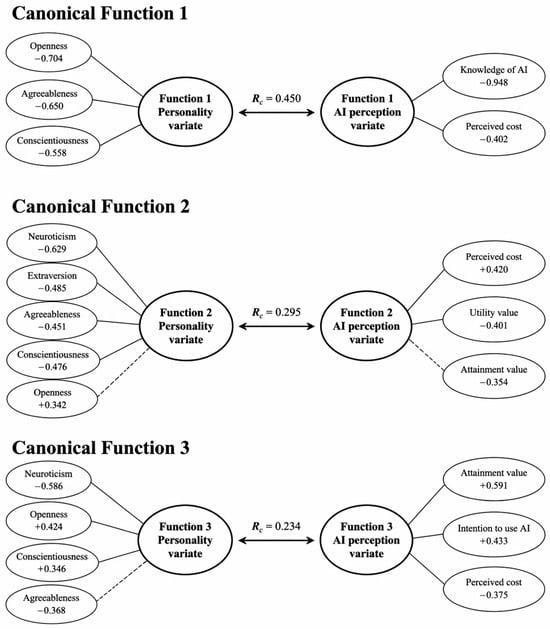
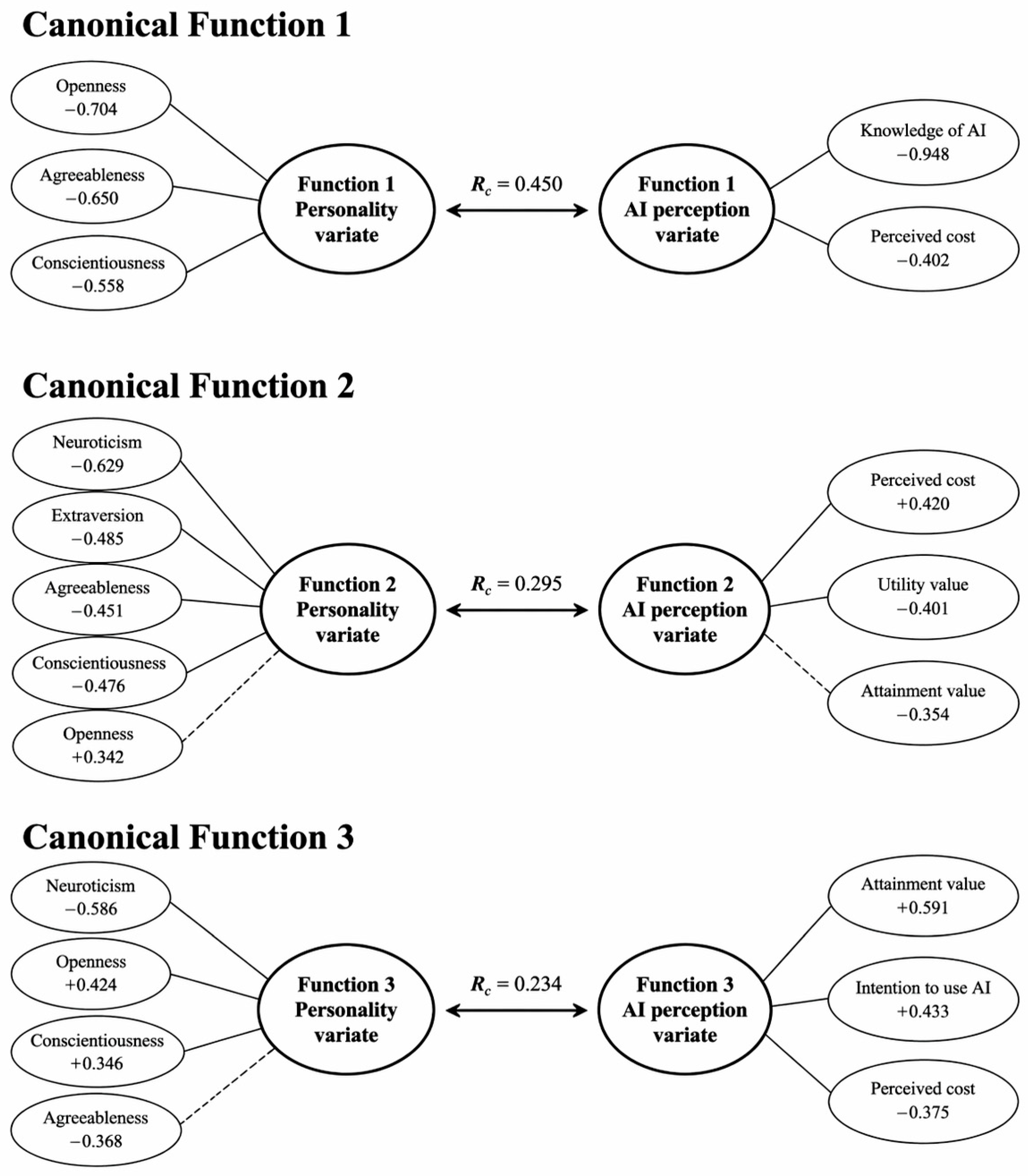
The first function was the strongest (Rc = 0.450, Rc2 = 0.202) and was defined primarily by openness (r_s = −0.704), agreeableness (r_s = −0.650), and conscientiousness (r_s = −0.558) on the personality side, and by knowledge of AI (r_s = −0.948) and, to a lesser extent, perceived cost (r_s = −0.402) on the AI perception side. Interpreted substantively, this function suggests that students who were more open, agreeable, and conscientious tended to report greater knowledge of AI and somewhat higher perceived cost.
The second function was weaker (Rc = 0.295, Rc2 = 0.087) and was characterized mainly by neuroticism (r_s = 0.629) on the personality side and by higher perceived cost (r_s = 0.420), a lower utility value (r_s = −0.401), and a lower attainment value (r_s = −0.354) on the AI perception side. This pattern indicates that students higher in neuroticism were more likely to perceive AI as costly and less useful or personally valuable.
The third function was modest in magnitude (Rc = 0.234, Rc2 = 0.055) and linked lower neuroticism (r_s = −0.586), higher openness (r_s = 0.424), and higher conscientiousness (r_s = 0.346) with a greater attainment value (r_s = 0.591), stronger intention to use AI (r_s = 0.433), and lower perceived cost (r_s = −0.375). This function suggests that students with a more adaptive personality profile tended to view AI as more valuable, report stronger intentions to use it, and perceive fewer costs. Notably, intrinsic value did not load saliently on any of the retained functions (r_s = 0.088, 0.080, and 0.177 for Functions 1–3, respectively), suggesting that enjoyment of AI use was largely independent of the broader multivariate personality–perception relationships identified in this sample. The variance extracted and redundancy indices further supported a cautious interpretation of the retained functions, especially Functions 2 and 3, which showed low cross-set redundancy values (Table 3).
Table 3.
Variance Extracted and Redundancy Indices for Retained Canonical Functions.
Taken together, the findings suggest that the relationship between personality and AI perceptions was represented primarily by a knowledge-centered first function, followed by smaller patterns involving perceived cost, value, and intention to use AI (Figure 1).
Figure 1.
Canonical functions linking personality traits and AI perception variables. Note. The figure displays the three retained canonical functions in the same orientation reported in Table 2. For Function 1, the displayed coefficients represent the negative pole of the function; because canonical function signs are arbitrary, reversing all signs would not change the substantive interpretation. Only variables with |loading| ≥ 0.30 are shown. Solid paths represent canonical loadings with absolute values of 0.40 or greater, whereas dashed paths represent loadings from 0.30 to 0.39. Values shown are structure coefficients.
5. Discussion
The present study examined the multivariate relationship between students’ Big Five personality traits and their perceptions of generative AI. The full canonical model was statistically significant, with the first canonical function accounting for the largest share of shared variance. Although the second and third functions were statistically significant and showed interpretable loading patterns, their very low redundancy values indicate that they explain only a minimal proportion of variance in the opposite set. Accordingly, these functions should be treated as tentative and interpreted primarily as exploratory patterns rather than as a basis for strong substantive or practical conclusions. Overall, the results suggest that personality traits are related not to a single AI-related outcome, but to broader profiles of AI knowledge, value perceptions, perceived cost, and intention to use. This supports the view that students’ engagement with generative AI is psychologically differentiated and should not be treated as a uniform process across learners [5,9,33].
The first canonical function, which accounted for the largest share of shared variance, was dominated on the AI perception side by knowledge of AI, with perceived cost contributing only secondarily. Thus, the strongest multivariate relationship identified in the study is best understood primarily as a link between a personality profile and students’ AI knowledge rather than as a broad perception profile spanning all six AI-related dimensions. This pattern suggests that students with a more adaptive personality profile tended to report greater understanding of generative AI. This finding is broadly consistent with prior work indicating that openness and conscientiousness are associated with more constructive engagement with new technologies and AI-related behaviors [5,21,24]. In the present context, the result is especially important because the knowledge dimension did not merely reflect familiarity, but also awareness of AI’s limitations, including the possibility of inaccurate outputs. This first function appears to represent not simple enthusiasm for AI, but a more informed and reflective orientation toward its use.
Agreeableness also deserves attention in this function. Although agreeableness is often discussed less prominently than openness or conscientiousness in technology adoption research, its strong loading suggests that students who are more cooperative, socially attuned, and norm-sensitive may be especially likely to engage with generative AI in reflective and responsible ways. In educational settings, such students may be more attentive to appropriate use, more receptive to instructional guidance, and more likely to interpret AI as a tool that supports rather than replaces learning. This interpretation is compatible with recent findings suggesting that agreeableness can align positively with educational AI acceptance, although its role may vary across contexts [17,27]. AI literacy is defined as competent AI engagement not only in terms of use, but also in terms of understanding, evaluation, and ethical awareness [14]. In educational settings, this distinction is important because the benefits of AI-supported learning, such as timely feedback and instructional support, depend on students’ ability to interpret AI outputs critically rather than passively accept them [2]. Accordingly, the first function may reflect not just openness to innovation, but a more informed and sustainable orientation toward AI use.
For sustainable digital education and for the broader goals associated with SDG 4, the objective is not only the rapid adoption of tools, but a responsible and human-centered integration that strengthens long-term educational quality, inclusion, and resilience [11,12,13,35,36]. From this perspective, students who combine high openness and conscientiousness with robust AI knowledge are better positioned to engage with generative AI critically rather than passively, ensuring that AI serves to enhance human capability and ethical academic practice. Meanwhile, the loading of perceived cost within the first function suggests that greater knowledge may also be accompanied by stronger awareness of potential drawbacks. Thus, informed engagement with AI may involve both competence and caution, which is consistent with recent calls for sustainable AI use grounded in ethical awareness and critical judgment [11,13].
The second canonical function was characterized mainly by higher neuroticism, along with higher perceived cost and lower utility and attainment value. This pattern suggests that students higher in neuroticism were more likely to perceive generative AI as burdensome and less likely to see it as useful or personally meaningful. This finding aligns with previous studies linking neuroticism to fear toward AI, anxiety-related resistance, and less favorable perceptions of intelligent technologies [21,22]. Relatedly, according to the expectancy-value theory, a higher perceived cost could weaken engagement, particularly when value beliefs are low [10]. Such reluctance toward generative AI may stem not only from the lack of exposure, but also from emotional vulnerability and uncertainty sensitivity. For students higher in neuroticism, AI may be perceived as unpredictable, risky, or cognitively demanding. Past research has suggested that AI anxiety dimensions significantly predicted attitudes toward AI, suggesting that perceived cost may reflect not only effort or inconvenience, but also broader emotional concerns related to uncertainty, configuration difficulty, and learning-related discomfort [23]. In this sense, the neuroticism–cost pattern observed in the present study may reflect a vulnerability profile in which emotionally sensitive students perceive AI as less manageable and less personally beneficial.
Although the second function was weaker, the negative loadings for extraversion and agreeableness add nuance to our understanding of the relationship between personality and AI perceptions. Lower extraversion may suggest that students who are less socially confident or less inclined toward active engagement may experience AI as less approachable or less rewarding. Likewise, lower agreeableness may indicate a less trusting or less cooperative orientation toward new educational tools, which could contribute to perceiving AI as more costly and less valuable. These interpretations should be treated cautiously, given the low redundancy of the function, but they suggest that resistance to AI may involve not only anxiety, but also broader interpersonal and engagement-related dispositions [21,25]. In real-world settings, sustainable implementation cannot rely on access alone. If institutions seek equitable and durable AI integration, they must also reduce ambiguity, clarify expectations for appropriate use, and provide guided opportunities for students to build confidence in AI-supported tasks. Such supports may be especially important for learners who perceive high psychological or ethical cost in using these technologies [13,28]. From an SDG 4 perspective, this function underscores the importance of quality education in AI-rich environments. They do not depend on tool availability only, but also on an effective supporting system to help the students whose dispositional profiles make participation more difficult.
The third canonical function linked lower neuroticism, higher openness, and higher conscientiousness with a stronger attainment value, greater intention to use AI, and lower perceived cost. Compared with the first function, which was centered more strongly on knowledge, the third function captured a more motivational profile. In this pattern, students with a more adaptive personality configuration were more likely to view AI as valuable, to intend future use, and to perceive fewer barriers. This interpretation is consistent with expectancy-value theory, especially the proposition that engagement is strengthened when a task is seen as important and manageable [10]. Past research showed that value-related perceptions of generative AI are positively associated with intention to use, whereas cost-related perceptions function as barriers [28]. The prominence of attainment value and intention in this function is also consistent with recent EVT-based research on AI learning. Wang et al. [32] showed that expectancy-value beliefs are closely linked to university students’ intentions to learn AI, suggesting that value perceptions are central to sustained engagement. More broadly, Ranellucci et al. [31] demonstrated that EVT and TAM each capture meaningful aspects of technology-related intentions in teacher education, reinforcing the idea that motivational and instrumental beliefs should be considered together when interpreting AI adoption patterns.
This third function also converges with recent empirical research on personality and AI. Studies have shown that openness and conscientiousness tend to support more favorable AI-related attitudes and educational uses, while neuroticism often functions as a negative predictor [17,25,26]. Moreover, Yurt [16], using canonical correlation analysis with AI use motives, similarly found that openness and conscientiousness aligned with more positive motivational patterns, whereas neuroticism was tied more closely to less adaptive profiles. At the same time, the low redundancy associated with this function indicates that it should be interpreted as a modest secondary pattern rather than as a strong explanatory root. Even so, this function is relevant to sustainable digital education because it suggests that long-term, self-directed engagement with AI may depend in part on whether students see AI as educationally worthwhile rather than merely available.
Taken together, the findings suggest that the relationship between personality and AI perceptions may be multidimensional; however, the strongest and clearest result in the present study was the first canonical function, which was primarily knowledge-centered. More specifically, this function was dominated by knowledge of AI, with perceived cost contributing only secondarily on the AI perception side. Thus, the most robust pattern identified here is better understood as a relationship between a personality profile and AI knowledge than as a broad perception profile spanning all six AI-related dimensions equally. The second and third functions may suggest additional patterns involving perceived cost, value, and intention to use AI; however, because their redundancy values were very low, these patterns should be interpreted cautiously and viewed as tentative rather than definitive. Accordingly, the strongest substantive emphasis should remain on the first canonical function. It is also notable that intrinsic value did not emerge as a salient contributor to any retained function. This may suggest that enjoyment of AI use is less strongly tied to broad personality profiles than are knowledge, cost, and attainment-related judgments, or that students’ early experiences with generative AI are shaped more by utility and concern than by stable enjoyment.
5.1. Practical Implications for Sustainable Digital Education
The findings have several implications for practice. Because the first and strongest canonical function was driven primarily by knowledge of AI, the clearest implication of the present study is that differentiated AI literacy support may be a useful direction for future practice and research. Implications involving perceived cost, value, and intention should be interpreted more cautiously, as those patterns emerged mainly in functions with limited redundancy. At the same time, these implications should be understood as tentative and hypothesis-generating rather than as direct justification for specific interventions, given the cross-sectional design, convenience sample, and single-institution context of the study. Most clearly, the findings suggest that AI integration in higher education may benefit from differentiated rather than uniform approaches, particularly in relation to students’ AI knowledge and readiness. Students vary not only in their willingness to use AI, but also in their knowledge of it, the value they attach to it, and the costs they perceive. As a result, institutions should avoid making an assumption that the same AI-related instruction or policy guidance will work equally well for all learners. Realistically, AI readiness assessment at the beginning of a course or a semester can identify students’ familiarity, confidence, and concerns. Such profiles can help educators to tailor course design and instructional practices accordingly. For example, students with limited AI knowledge may benefit from introductory courses to help them understand how AI works, while those with more AI knowledge can be better served with critical evaluation and ethical use of AI. The findings also suggest that AI readiness should not be equated with general digital readiness. Recent evidence indicates that the predictors of attitudes toward AI differ in meaningful ways from the predictors of attitudes toward technology in general, with openness appearing especially relevant for AI-specific attitudes [18]. This implies that institutions should avoid assuming that students who are broadly comfortable with technology will necessarily feel equally confident, trusting, or motivated when engaging with generative AI. From a sustainable digital education perspective, these findings suggest the value of differentiated forms of support, including AI literacy development, explicit ethical guidance, and structured opportunities for reflective use [1,2,14]. In relation to SDG 4, this means that quality education in AI-rich environments depends on equitable and meaningful participation, not simply on distributing access to digital tools.
Second, the results indicate that AI literacy should be framed as both technical and psychological support. For some students, especially those with more adaptive profiles characterized by openness and conscientiousness, structured opportunities for exploration may be sufficient. Educators can support these students by designing inquiry-based tasks that encourage exploration of AI tools alongside reflections on the outputs produced. For others, especially those who perceive high cost or uncertainty, support may need to focus more explicitly on ethical boundaries, risk awareness, guided practice, and confidence building. Strategies include creating small-group discussions around real-world AI misuse cases, providing transparent course policies on ethical AI use. Such a differentiated approach is essential for equitable AI engagement because it ensures that learners who are dispositionally prone to anxiety or uncertainty are not left behind in the digital transition. This strategy aligns with sustainability-oriented perspectives that emphasize inclusion, learner empowerment, and responsible long-term implementation rather than rapid adoption for its own sake [11,12]. More broadly, it suggests that SDG 4 in the context of generative AI should be interpreted not only as access to innovation, but as support for responsible participation across diverse learner profiles.
Third, the findings reinforce the importance of treating generative AI as an educational tool that must remain aligned with human judgment and pedagogical goals. Students who understand AI’s benefits but also recognize its limitations may be better positioned to use it in ways that support, rather than replace, critical thinking and self-regulated learning. Educators can design assignments that require students to critically evaluate AI-generated content, for example, by comparing the AI- generated research question against their initial research objectives, or by identifying potential biases and misinformation. Institutions should also equip faculty and staff with frameworks for embedding AI tools into existing curricula. This human-centered orientation is central to sustainable digital education and is particularly relevant as higher education institutions continue to formalize policies and practices around generative AI [13]. In sustainability terms, responsible AI integration should contribute to educational quality, inclusion, and learner agency rather than merely to efficiency or automation.
5.2. Limitations and Future Research
Several limitations should be noted. First, this study used a cross-sectional self-report design, which limits causal inference and may be influenced by common-method bias. Second, although the first three canonical functions were statistically significant and conceptually interpretable, the redundancy indices for the second and third functions were notably low (ranging from 0.7% to 2.0%). This indicates that while these functions identify meaningful psychological patterns, their ability to explain large proportions of variance in the opposite variable set is limited, and these specific patterns should therefore be interpreted with caution. Consequently, these secondary profiles should be viewed as suggestive rather than definitive until future research with larger, more diverse samples can determine their stability. Third, the sample was drawn from a single context, which may limit the generalizability of the findings across disciplines, institutions, or cultural settings. Institutions differ greatly in their structures, available resources, pedagogical practices, and demographics; thus, the present study results may not be generalized to all settings. Future research drawing on samples from varied institutional contexts would help determine whether the findings reported here reflect broader applicability. Fourth, all study variables were measured through self-report. As a result, students’ reported knowledge of AI, perceived value, and intention to use AI may not fully correspond to their actual use, behavioral engagement, or demonstrated competence. Future studies would benefit from incorporating behavioral indicators, usage data, performance-based assessments, or observational measures to better capture how AI-related perceptions translate into practice. Fifth, although the study was framed in relation to sustainable digital education and SDG 4, the variables included in the present analysis did not directly operationalize broader sustainability-related dimensions such as equity, inclusion, governance, privacy, or institutional resilience.
Future research could extend this work in several ways. Longitudinal studies could examine whether personality predicts changes in AI perceptions over time or whether sustained experience with generative AI reshapes those perceptions. Researchers might also investigate potential mediators, such as AI literacy, trust, self-efficacy, or prior use experience, to clarify the mechanisms linking personality traits with AI-related beliefs. In addition, future studies could compare students across disciplinary fields or institutional settings to determine whether the present multivariate patterns are stable or context dependent. Future research would also benefit from incorporating measures that more directly capture responsible and sustainable AI implementation, including issues of access equity, trust, governance, privacy, and institutional support. Studies that incorporate behavioral or performance-based indicators of AI use would be especially valuable for testing whether self-reported knowledge, value, and intention correspond to actual AI-supported learning practices. Such work would contribute to a more precise understanding of how to support equitable and sustainable AI integration in higher education.
6. Conclusions
This study showed that students’ Big Five personality traits were significantly related to their perceptions of generative AI at the multivariate level. The retained canonical functions suggested three interpretable patterns: a knowledge-centered profile associated with openness, agreeableness, and conscientiousness; a cost-sensitive profile associated primarily with neuroticism; and a value-and-intention profile associated with openness, conscientiousness, and lower neuroticism. These findings indicate that students’ responses to generative AI are not uniform, but instead reflect distinct constellations of dispositional and motivational characteristics.
Our study contributes to the literature by integrating personality theory and expectancy-value theory in the context of generative AI, while offering insights relevant to sustainable digital education. It also demonstrates the value of a multivariate approach for understanding how personality traits align with multiple AI-related perceptions simultaneously. Most importantly, the results suggest that discussions of AI integration in higher education may benefit from moving beyond access-based strategies toward more user-centered approaches that account for differences in AI knowledge, perceived value, perceived cost, and readiness for responsible use. In this sense, this study is relevant to the goals of sustainable digital innovation and to SDG 4 by suggesting that quality education in AI-rich environments may depend not only on access to emerging technologies, but also on preparing diverse learners to engage with them critically, ethically, and effectively.
Author Contributions
Conceptualization, M.J. and Q.W.; Methodology, M.J., S.T. and Q.W.; Validation, M.J. and S.T.; Formal analysis, M.J. and S.T.; Investigation, M.J., S.T. and Q.W.; Data curation, Q.W.; Writing—original draft, M.J. and S.T.; Writing—review & editing, M.J., S.T. and Q.W.; Supervision, M.J. All authors have read and agreed to the published version of the manuscript.
Funding
This research received no external funding.
Institutional Review Board Statement
The study was approved by the Institutional Review Board of East Texas A&M University Institutional Review Board, approve number: FY2026-11; approve date: 15 October 2025.
Informed Consent Statement
Informed consent was obtained from all subjects involved in the study.
Data Availability Statement
The data presented in this study are available on request from the corresponding author due to privacy or ethical restrictions.
Conflicts of Interest
The authors declare no conflict of interest.
References
- Dwivedi, Y.K.; Kshetri, N.; Hughes, L.; Slade, E.L.; Jeyaraj, A.; Kar, A.K.; Baabdullah, A.M.; Koohang, A.; Raghavan, V.; Ahuja, M.; et al. Opinion paper: “So what if ChatGPT wrote it?” Multidisciplinary perspectives on opportunities, challenges and implications of generative conversational AI for research, practice and policy. Int. J. Inf. Manag. 2023, 71, 102642. [Google Scholar] [CrossRef] [Scilit]
- Kasneci, E.; Sessler, K.; Küchemann, S.; Bannert, M.; Dementieva, D.; Fischer, F.; Gasser, U.; Groh, G.; Günnemann, S.; Hüllermeier, E.; et al. ChatGPT for good? On opportunities and challenges of large language models for education. Learn. Individ. Differ. 2023, 103, 102274. [Google Scholar] [CrossRef] [Scilit]
- United Nations. Transforming Our World: The 2030 Agenda for Sustainable Development; A/RES/70/1; United Nations: New York, NY, USA, 2015. Available online: https://undocs.org/en/A/RES/70/1 (accessed on 29 March 2026).
- Lo, C.K.; Hew, K.F.; Jong, M.S.Y. The influence of ChatGPT on student engagement: A systematic review and future research agenda. Comput. Educ. 2024, 219, 105100. [Google Scholar] [CrossRef] [Scilit]
- Devaraj, S.; Easley, R.F.; Crant, J.M. How does personality matter? Relating the five-factor model to technology acceptance and use. Inf. Syst. Res. 2008, 19, 93–105. [Google Scholar] [CrossRef] [Scilit]
- McCrae, R.R.; Costa, P.T., Jr. A five-factor theory of personality. In Handbook of Personality: Theory and Research, 2nd ed.; Pervin, L.A., John, O.P., Eds.; Guilford Press: New York, NY, USA, 1999; pp. 139–153. [Google Scholar]
- Ding, N.; Chen, M.; Hu, L. Examining the impact of big five personality traits on generation Z designers’ subscription to paid AI drawing tools using SEM and FsQCA. Sci. Rep. 2025, 15, 17587. [Google Scholar] [CrossRef] [Scilit]
- Joshi, A.; Das, S.; Sekar, S. How big five personality traits affect information and communication technology use: A meta-analysis. Australas. J. Inf. Syst. 2023, 27. [Google Scholar] [CrossRef] [Scilit]
- Mammadov, S. The big five personality traits and academic performance: A meta-analysis. J. Personal. 2022, 90, 222–255. [Google Scholar] [CrossRef] [Scilit]
- Wigfield, A.; Eccles, J.S. Expectancy-value theory of achievement motivation. Contemp. Educ. Psychol. 2000, 25, 68–81. [Google Scholar] [CrossRef] [Scilit]
- Küçükuncular, A.; Ertugan, A. Teaching in the AI era: Sustainable digital education through ethical integration and teacher empowerment. Sustainability 2025, 17, 7405. [Google Scholar] [CrossRef] [Scilit]
- Lee, Y.; Lee, S.-S. Exploring the conceptual model and instructional design principles of intelligent problem-solving learning. Sustainability 2025, 17, 7682. [Google Scholar] [CrossRef] [Scilit]
- Nguyen, A.; Ngo, H.N.; Hong, Y.; Dang, B.; Nguyen, B.-P.T. Ethical principles for artificial intelligence in education. Educ. Inf. Technol. 2023, 28, 4221–4241. [Google Scholar] [CrossRef] [Scilit] [PubMed]
- Ng, D.T.K.; Leung, J.K.L.; Chu, S.K.W.; Qiao, M.S. Conceptualizing AI literacy: An exploratory review. Comput. Educ. Artif. Intell. 2021, 2, 100041. [Google Scholar] [CrossRef] [Scilit]
- Gocłowska, M.A.; Ritter, S.M.; Elliot, A.J.; Baas, M. Novelty seeking is linked to openness and extraversion, and can lead to greater creative performance. J. Personal. 2019, 87, 252–266. [Google Scholar] [CrossRef] [Scilit]
- Yurt, E. The interplay between Five-Factor personality traits and AI use motives in Turkish pre-service teachers: A canonical correlation analysis. Curr. Psychol. 2025, 44, 13756–13773. [Google Scholar] [CrossRef] [Scilit]
- Ding, N.; Chen, M.; Hu, L. The impact of personality traits and AI literacy on the adoption intentions of AI among design faculty in Chinese higher education. Acta Psychol. 2025, 260, 105709. [Google Scholar] [CrossRef] [Scilit]
- Grassini, S.; Thorp, S.O.; Ree, A.S.; Sevic, A.; Cipriani, E. Distinct predictors of positive attitudes toward artificial intelligence and general technology: Big five traits, gender, and age. Behav. Inf. Technol. 2025; advance online publication. [CrossRef] [Scilit]
- Schepman, A.; Rodway, P. The General Attitudes towards Artificial Intelligence Scale (GAAIS): Confirmatory validation and associations with personality, corporate distrust, and general trust. Int. J. Hum. Comput. Interact. 2023, 39, 2724–2741. [Google Scholar] [CrossRef] [Scilit]
- Stein, J.-P.; Messingschlager, T.; Gnambs, T.; Hutmacher, F.; Appel, M. Attitudes towards AI: Measurement and associations with personality. Sci. Rep. 2024, 14, 2909. [Google Scholar] [CrossRef] [Scilit]
- Park, J.; Woo, S.E. Who likes artificial intelligence? Personality predictors of attitudes toward artificial intelligence. J. Psychol. 2022, 156, 68–94. [Google Scholar] [CrossRef] [Scilit]
- Sindermann, C.; Yang, H.; Elhai, J.D.; Yang, S.; Quan, L.; Montag, C. Acceptance and fear of artificial intelligence: Associations with personality in a German and a Chinese sample. Discov. Psychol. 2022, 2, 8. [Google Scholar] [CrossRef] [Scilit]
- Kaya, F.; Aydin, F.; Schepman, A.; Rodway, P.; Yetisensoy, O.; Demir Kaya, M. The roles of personality traits, AI anxiety, and demographic factors in attitudes toward artificial intelligence. Int. J. Hum. Comput. Interact. 2024, 40, 497–514. [Google Scholar] [CrossRef] [Scilit]
- de Winter, J.; Dodou, D.; Eisma, Y.B. Personality and acceptance as predictors of ChatGPT use. Discov. Psychol. 2024, 4, 57. [Google Scholar] [CrossRef] [Scilit]
- Weng, X.; Xia, Q.; Ahmad, Z.; Chiu, T.K.F. Personality traits for self-regulated learning with generative artificial intelligence: The case of ChatGPT. Comput. Educ. Artif. Intell. 2024, 7, 100315. [Google Scholar] [CrossRef] [Scilit]
- Arpaci, I.; Kuşci, I.; Gibreel, O. The role of personality traits in predicting educational use of generative AI in higher education. Sci. Rep. 2025, 15, 30440. [Google Scholar] [CrossRef] [Scilit]
- Alagöz Hamzaj, Y. Generative AI acceptance among future educators: Personality and behavioral insights. Educ. Inf. Technol. 2025, 30, 23165–23188. [Google Scholar] [CrossRef] [Scilit]
- Chan, C.K.Y.; Zhou, W. An expectancy value theory (EVT) based instrument for measuring student perceptions of generative AI. Smart Learn. Environ. 2023, 10, 64. [Google Scholar] [CrossRef] [Scilit]
- Davis, F.D. Perceived usefulness, perceived ease of use, and user acceptance of information technology. MIS Q. 1989, 13, 319–340. [Google Scholar] [CrossRef] [Scilit]
- Ibrahim, F.; Münscher, J.-C.; Daseking, M.; Telle, N.-T. The technology acceptance model and adopter type analysis in the context of artificial intelligence. Front. Artif. Intell. 2025, 7, 1496518. [Google Scholar] [CrossRef] [Scilit]
- Ranellucci, J.; Rosenberg, J.M.; Poitras, E.G. Exploring pre-service teachers’ use of technology: The technology acceptance model and expectancy–value theory. J. Comput. Assist. Learn. 2020, 36, 810–824. [Google Scholar] [CrossRef] [Scilit]
- Wang, F.; King, R.B.; Chai, C.S.; Zhou, Y. University students’ intentions to learn artificial intelligence: The roles of supportive environments and expectancy–value beliefs. Int. J. Educ. Technol. High. Educ. 2023, 20, 51. [Google Scholar] [CrossRef] [Scilit]
- Manolika, M.; Kotsakis, R.; Matsiola, M.; Kalliris, G. Direct and indirect associations of personality with audiovisual technology acceptance through general self-efficacy. Psychol. Rep. 2022, 125, 1165–1185. [Google Scholar] [CrossRef] [Scilit]
- John, O.P.; Srivastava, S. The Big Five trait taxonomy: History, measurement, and theoretical perspectives. In Handbook of Personality: Theory and Research, 2nd ed.; Pervin, L.A., John, O.P., Eds.; Guilford Press: New York, NY, USA, 1999; pp. 102–138. [Google Scholar]
- Kamińska, A.M. A strategic framework for responsible GenAI adoption: Balancing sustainability and institutional risks in academic libraries. J. Acad. Librariansh. 2026, 52, 103218. [Google Scholar] [CrossRef] [Scilit]
- Michalak, R.; Tzoc, E.; Lewis, J.D. Practical Considerations for Adopting Generative AI Tools in Academic Libraries. J. Libr. Adm. 2025, 65, 596–615. [Google Scholar] [CrossRef] [Scilit]

Disclaimer/Publisher’s Note: The statements, opinions and data contained in all publications are solely those of the individual author(s) and contributor(s) and not of MDPI and/or the editor(s). MDPI and/or the editor(s) disclaim responsibility for any injury to people or property resulting from any ideas, methods, instructions or products referred to in the content. |
© 2026 by the authors. Licensee MDPI, Basel, Switzerland. This article is an open access article distributed under the terms and conditions of the Creative Commons Attribution (CC BY) license.