


Abstract
This study examined a maker-based approach to sustainable digital education in physical education (PE) through a laser-shooting program implemented over a three-year period (2022–2024). While prior studies have largely focused on short-term maker-based PE interventions, less is known about how such practices are refined, stabilized, and diffused across school contexts over time. Using a qualitative case study design, data were collected from lesson plans, instructional artifacts, implementation records, field notes, and semi-structured interviews with five PE teachers, and analyzed using inductive thematic analysis. The findings suggest that, according to teachers’ accounts and classroom documentation, the program was perceived to reduce barriers to participation, diversify student roles, and improve instructional feasibility in indoor PE settings. Over time, the program evolved into a stable and adaptable instructional approach aligned with sustainable digital education, integrating physical computing into embodied learning environments. Diffusion occurred through teacher agency within informal professional networks and institutional training contexts. These findings highlight the potential of maker-based PE as a sustainable digital education approach that may support context-responsive participation, instructional adaptability, and professionally scalable innovation in school PE, with possible relevance for inclusive physical education contexts.
1. Introduction
School physical education (PE) is increasingly conducted under environmental and institutional constraints that limit students’ opportunities for meaningful participation. Environmental conditions such as fine dust, heatwaves, and extreme cold have contributed to a growing number of indoor PE classes in many regions. In addition, spatial limitations within school facilities often restrict the range of activities that can be implemented during lessons. Under such conditions, PE classes may rely on a narrower set of activities, which can reduce opportunities for student engagement and sustained participation. These circumstances may particularly disadvantage students who feel less confident in traditional sport-centered activities, potentially widening participation gaps within PE classes. As the impacts of climate change continue to intensify, schools are increasingly required to provide instructional approaches that maintain meaningful participation while adapting to environmental constraints [1]. In this context, there is a growing need to explore alternative instructional approaches that support active participation and sustained engagement under constrained instructional conditions.
One approach that has recently attracted attention in response to these challenges is maker education. Maker education emphasizes learner autonomy, creativity, and collaborative problem-solving through iterative processes of designing, making, and improving artifacts [2,3]. Within maker-oriented learning environments, students actively explore problems and construct solutions through hands-on experimentation, which can enhance engagement and motivation [4]. However, in many school contexts, maker education has often been implemented as short-term or product-oriented activities, raising concerns about curricular alignment and sustained instructional integration, and its application has been concentrated primarily within STEM or STEAM subjects, with relatively few studies examining its integration into physically active subjects such as PE [5,6,7,8,9].
PE offers a distinctive context for extending the potential of maker education by combining physical engagement with hands-on design processes. Activities using simple physical computing tools may integrate embodied participation with cognitive and creative processes. When students design and construct the tools used in class and subsequently apply them in game-based activities, PE can offer multiple roles and participation pathways, thereby supporting more inclusive forms of engagement.
Such approaches may help sustain participation even under indoor instructional constraints while supporting collaborative learning experiences. In this respect, maker-based PE can be understood not only as a pedagogical innovation but also as a form of sustainable digital education. In the present study, sustainable digital education refers to a digitally mediated instructional practice that can be maintained, adapted, and shared over time within authentic educational constraints. This concept is reflected in three interrelated aspects emphasized in this study: pedagogical sustainability, demonstrated through the repeated refinement and stabilization of the program across three years; contextual sustainability, reflected in its responsiveness to environmental and spatial constraints such as indoor PE conditions; and professional sustainability, reflected in teacher-led sharing, redesign, and diffusion through informal and institutional professional networks. This conceptualization aligns with theoretical discussions of sustainable educational innovation and teacher agency, which emphasize long-term adaptability, contextual responsiveness, and practice-based scalability [10,11,12].
However, empirical research examining how maker-based PE programs are implemented and developed through sustained classroom practice remains limited [4,13]. Despite growing interest in digitally mediated pedagogy, limited research has explicitly examined how such practices become sustainable through repeated enactment, contextual adaptation, and teacher-led diffusion in PE settings [10,12].
Existing studies have often focused on short-term interventions or exploratory applications, providing relatively little insight into how such instructional innovations evolve through repeated implementation in authentic school contexts. In particular, there is a lack of research examining how maker-based PE programs are refined through ongoing classroom experience and how such practices extend beyond individual classrooms into broader school settings.
Building on prior research on maker-based physical education, a laser shooting program integrating physical engagement with digital making was implemented in school PE contexts and iteratively refined through sustained classroom practice [9]. Over a three-year period (2022–2024), teachers applied the program across diverse school contexts while adapting instructional strategies based on practical classroom experiences. While previous studies have examined the educational potential and participation effects of maker-based PE activities [9,13], the present study focuses on how the program evolved through longitudinal implementation, iterative refinement, and diffusion across school contexts through teacher-led adaptation.
Accordingly, the purpose of this study is to examine how a maker-based laser shooting program in PE was implemented, refined, and diffused across school contexts over a three-year period. Rather than focusing on the technical performance of equipment, this study conceptualizes the program as a classroom-based instructional innovation and analyzes how it was enacted, improved, and expanded within authentic environments.
To provide a clearer analytical focus, the study was guided by two explicit research questions corresponding to the core processes of implementation/refinement and diffusion identified in the study design.
The research questions guiding this study are as follows:
- How was the maker-based PE program implemented and refined in school contexts?
- How did the program diffuse across school contexts?
2. Research Design and Methods
2.1. Research Design
This study employed a qualitative case study design to examine the implementation, refinement, and diffusion of a maker-based laser shooting program in physical education. The program constituted the primary case, while multiple implementation contexts—including the originating school and other schools where teachers adopted the program—were examined as multiple implementation contexts. This design enabled an in-depth investigation of how the program was enacted, modified, and stabilized within authentic school settings, as well as how it diffused across contexts as a form of sustainable digital education integrating physical computing into instructional practice.
The case focused on a program developed through prior research and implemented as part of regular physical education practice over three academic years (2022–2024) in a middle school. These activities were conducted as routine instructional practice and were not initially designed as human subject research. The originating school provided a longitudinal context for examining iterative refinement across different grade levels.
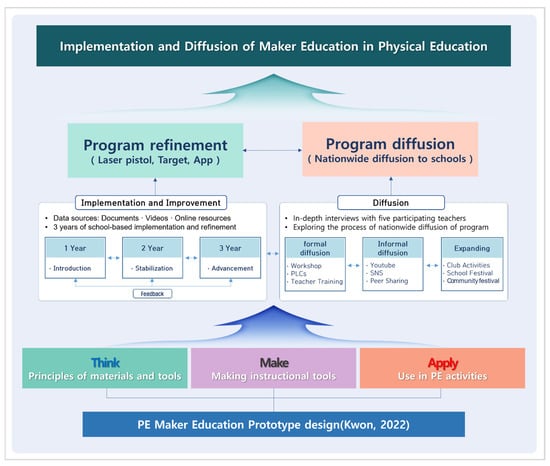
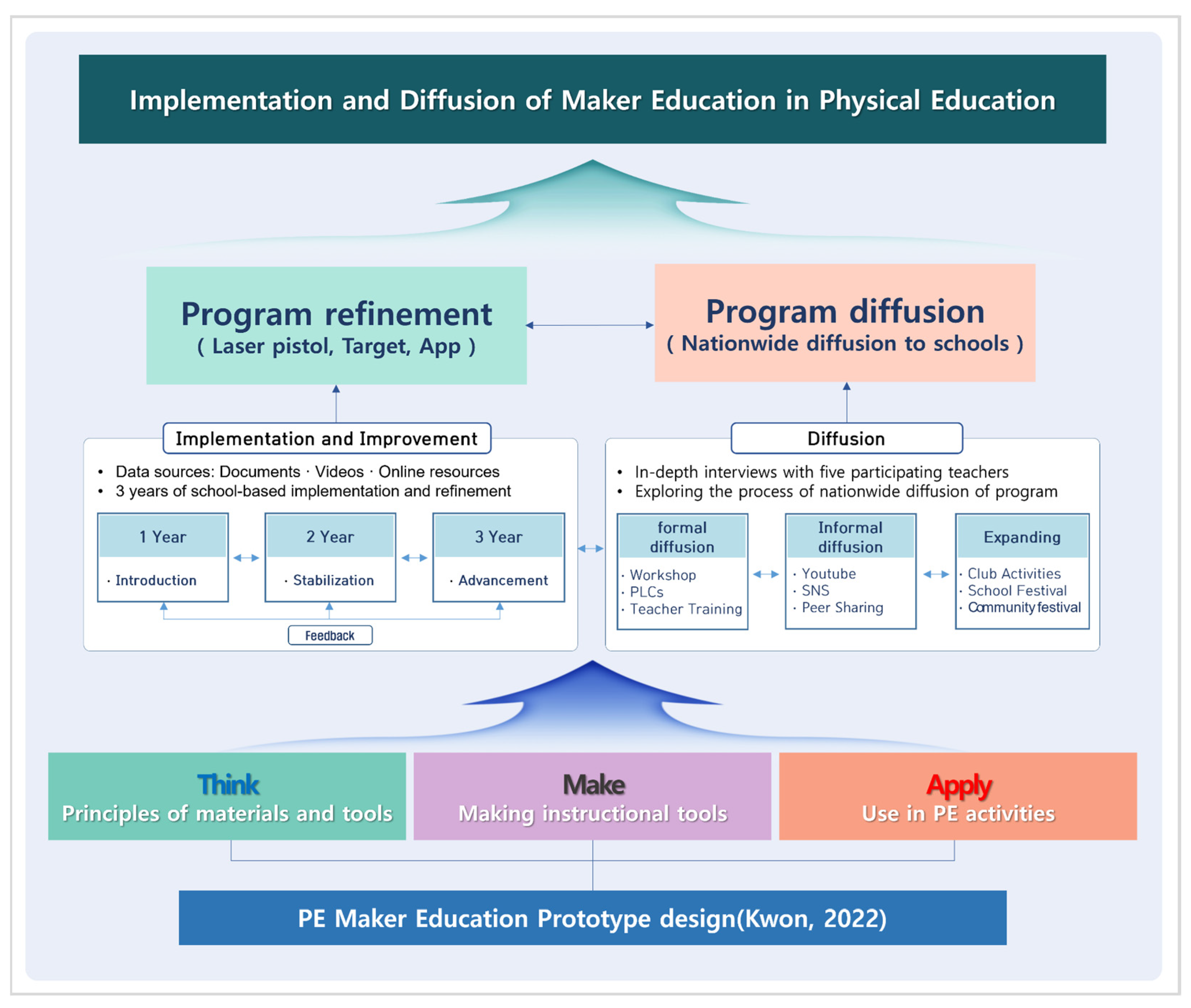
The present study was formally initiated in 2025 following IRB approval and consisted of two interconnected analytical components, as illustrated in Figure 1. First, a retrospective longitudinal analysis of program implementation and iterative refinement within the originating school was conducted using instructional materials. Second, semi-structured interviews were conducted with five physical education teachers who implemented the program in their own school contexts, providing insight into program adaptation and diffusion across educational environments. These two components were analytically linked to examine how the program evolved over time and how it extended across school contexts through teacher-led adaptation.
Figure 1.
Two-component qualitative research design linking longitudinal implementation/refinement analysis and teacher interview-based diffusion analysis [9].
2.2. Program Framework: The Think–Make–Apply (TMA) Model
The maker-based laser shooting program examined in this study was implemented using the Think–Make–Apply (TMA) instructional model, which was adapted for the physical education context from the Think–Make–Share–Improve (TMSI) maker learning framework proposed by Martinez and Stager [3]. In the present study, the final Apply phase was specifically emphasized to align the maker process with movement-centered participation and embodied gameplay in PE.
In the Think phase, students explored gameplay problems, movement tasks, and design ideas related to the lesson goals. In the Make phase, they constructed or modified physical computing tools and gameplay equipment, such as sensor-based targets and laser-shooting devices. In the Apply phase, these self-created tools were integrated into movement-centered gameplay and performance tasks within PE lessons.
This instructional framework served as the pedagogical structure through which the program was iteratively refined across implementation cycles and later adapted by participating teachers in other school contexts.
2.3. Participants
The primary case involved the researcher’s own middle school physical education classes, in which the laser shooting–based maker program was implemented and refined across three instructional cycles. The researcher is a middle school physical education teacher with eighteen years of professional teaching experience. Each cycle was documented through lesson plans, observation notes, student artifacts, reflective memos, and photographs. These materials constituted the core dataset for analyzing how the program evolved as a form of sustainable digital education within authentic classroom settings.
Over the three-year implementation period, the program was conducted in regular physical education classes involving two classes per year, with approximately 25 students in each class. In total, approximately 150 students participated in the program across the three instructional cycles. Students participated as part of routine instruction and were not considered research participants. The program was implemented as part of regular physical education lessons rather than as a separate experimental or extracurricular activity, reflecting authentic school teaching contexts.
To examine diffusion beyond the originating context, five physical education teachers from middle and high schools were purposively selected. These teachers voluntarily adopted and implemented the program in their own school settings to different extents. Their experiences provided insights into contextual adaptation, lesson redesign, instructional challenges, and the processes through which teaching practices were shared and disseminated within their professional networks.
All teacher interview participants were informed of the study’s aims and procedures prior to participation. Written informed consent was obtained, participation was voluntary, and all data were anonymized and managed in accordance with established ethical research guidelines. To minimize potential bias, multiple data sources and triangulation procedures were employed during analysis.
2.4. Data Collection
Data were collected from two primary sources. The first consisted of longitudinal implementation records from the originating case, and the second consisted of semi-structured interviews with participating teachers.
Implementation records were compiled over a three-year period and included lesson plans, instructional materials, technical materials (e.g., circuit diagrams and source code), worksheets, observation notes, photographs that did not include identifiable student information, and reflective memos. These materials provided a longitudinal account of instructional evolution in response to classroom constraints, observed patterns of participation, and instructional challenges. The documentation allowed for close examination of how instructional structures were modified and how classroom practices were progressively refined. These records provided contextual insights into classroom-level patterns of student participation and engagement during the lessons.
For the first analytical stage, the longitudinal instructional documents were reviewed with attention to changes in tool design complexity, participation role structure, lesson feasibility under indoor PE constraints, and evidence of iterative instructional refinement across implementation cycles. During the initial coding process, these materials were examined for recurring indicators such as simplification of physical computing components, diversification of student roles, modifications to gameplay rules, and teacher-generated adaptations that reflected evolving classroom needs. These analytic indicators supported the identification of developmental differences across the three-year implementation process.
Semi-structured interviews were conducted with five physical education teachers who had implemented the program in their own schools. Interviews lasted between sixty and ninety minutes and were conducted either face-to-face or online. All interviews were audio-recorded with participants’ consent and transcribed verbatim. Interview questions focused on teachers’ experiences of program implementation, strategies of lesson adaptation and redesign, perceived student engagement, and processes of sharing and dissemination within their professional networks. All interview data were anonymized prior to analysis.
Students were not directly included as research participants. However, during the interviews, teachers frequently described students’ reactions, classroom interactions, and informal conversations that occurred during the lessons. These accounts provided indirect but contextually rich insights into students’ engagement, participation patterns, and learning experiences in PE during the program. No individual student data were collected for research purposes. References to students emerged only through teachers’ reflections and descriptions of classroom experiences during interviews.
2.5. Data Analysis
Data were analyzed using inductive thematic analysis following the recursive phases outlined by Braun and Clarke [14]. Constant comparative procedures were employed throughout the analysis to refine emerging categories. Throughout the analysis, data segments were continually compared within and across sources to identify recurring patterns related to implementation, refinement, and diffusion processes, consistent with the constant comparative method proposed in grounded theory research [15].
Initial codes were generated inductively through repeated close reading of lesson documents, observation notes, reflective memos, and interview transcripts. Meaningful data segments related to instructional adjustment, participation structures, technological refinement, and diffusion practices were first labeled at a descriptive level. These initial codes were then constantly compared across data sources and grouped into more focused categories based on conceptual similarity. Through iterative comparison and recursive review, broader themes were developed that captured recurring patterns in program implementation, refinement, and diffusion across contexts.
To enhance credibility and analytic rigor, the researcher employed reflective journaling, data triangulation across documentation and interviews, and peer debriefing.
Peer debriefing involved two rounds of analytic discussion with scholars in sport pedagogy and experienced secondary PE teachers, during which the researcher presented preliminary coding structures, theme boundaries, and representative excerpts. These discussions were used to challenge interpretive assumptions, refine category distinctions, and strengthen the analytic coherence of the final thematic structure.
The overall coding framework, including two aggregate themes with corresponding sub-themes and representative concepts, is summarized in Table 1.
Table 1.
Overview of the Coding Framework and Emergent Themes.
2.6. Researcher Positionality and Reflexivity
The researcher held multiple roles, including program development, classroom implementation, dissemination, and research. The program was progressively refined through repeated classroom enactment in the researcher’s own teaching context. Since 2021, the researcher has also shared instructional materials and conducted teacher training sessions, contributing to the program’s broader dissemination.
Given these multiple roles, the researcher acknowledged their potential influence on data interpretation and engaged in continuous reflexive practice throughout the study. Reflective journals were maintained during both implementation and analysis, and iterative analytic discussions were conducted with peer reviewers to critically examine emerging interpretations. Reflexivity was treated as an ongoing analytic process intended to ensure transparency, credibility, and methodological integrity. These measures were intended to minimize potential bias and strengthen analytic rigor.
2.7. Ethical Considerations
This study was conducted in accordance with institutional ethical guidelines for research involving human participants. Prior to data collection, all participants were provided with detailed information regarding the study’s purpose, procedures, data management, and the voluntary nature of participation.
Written informed consent was obtained from all participants prior to their involvement in the research. With participants’ permission, interviews were audio-recorded to ensure the accuracy of the collected data. All personal identifiers were removed during the transcription process, and the data were stored securely and used exclusively for research purposes. No identifiable data were collected from students, and all student-related information was derived indirectly from teachers’ accounts. These procedures ensured the protection of participants’ rights, privacy, and confidentiality.
3. Results
3.1. Implementation and Refinement of the PE Maker Education Program
The PE maker education program was implemented and progressively refined within authentic school contexts. Over a three-year period, repeated enactment of the program led to iterative improvements in three key areas: instructional feasibility, participation equity, and instructional integration between making activities and embodied physical engagement.
3.1.1. Initial Implementation and Structural Alignment
The program was implemented as an eight-session instructional sequence structured around the Think–Make–Apply (TMA) phases. The Think phase focused on orientation and problem exploration, the Make phase involved constructing and testing learning artifacts, and the Apply phase integrated student-created artifacts into structured physical activities.
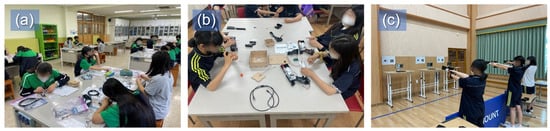
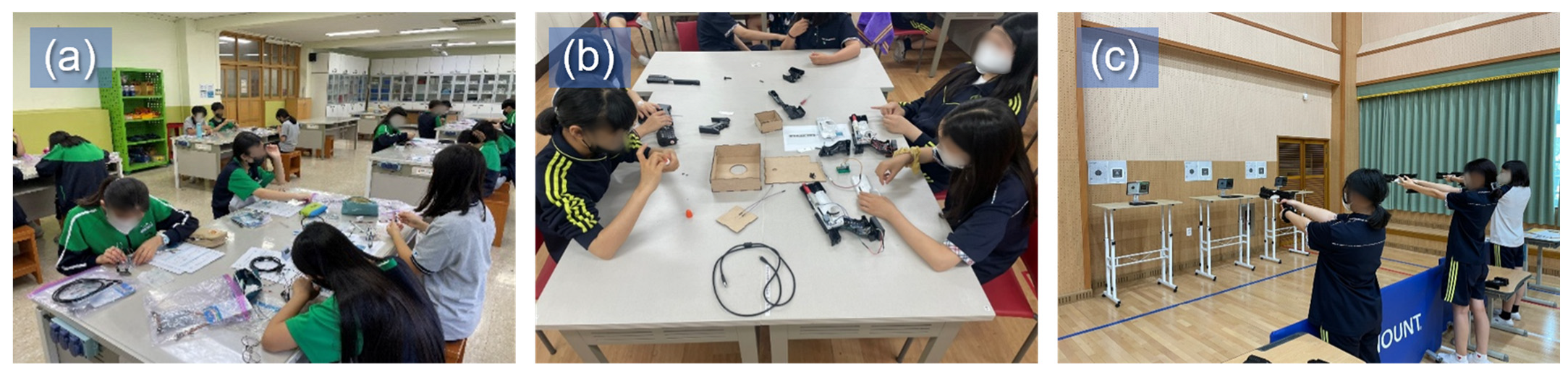
As outlined in Table 2, the program consisted of eight sessions organized into three phases: Think (Lesson 1), Make (Lessons 2–4), and Apply (Lessons 5–8). After acquiring basic technical skills, students created digital artifacts using Arduino, sensors, and 3D printers, and subsequently applied these artifacts in physical activities. This structure provided a consistent instructional framework that enabled repeated implementation and reflection across instructional cycles. Representative classroom scenes from the Think–Make–Apply phases of the program implementation are shown in Figure 2.
Table 2.
Core Activities by Phase in the PE Maker Program.
Figure 2.
Classroom scenes illustrating the Think–Make–Apply phases of the PE maker education program. (a) Think phase—students explore basic concepts of physical computing and the operating principles of the tools used in the program. (b) Make phase—students construct and test learning artifacts using Arduino and sensor modules. (c) Apply phase—students participate in physical activities using the artifacts they created.
During the first year of implementation, classroom observations revealed a recurring mismatch between planned pacing and actual classroom time use. Making tasks frequently required more time than anticipated due to troubleshooting processes and uneven progress among student groups. As a result, the time available for sustained participation in PE during the Apply phase was sometimes reduced.
In several lessons, groups that completed construction earlier transitioned into movement-based tasks while other groups continued working to resolve technical problems in their circuits or code. This situation produced variation in students’ opportunities for participation and disrupted the rhythm of whole-class engagement.
A further issue concerned the alignment between artifact production and the embodied goals of physical education. Although making activities generated novelty and engagement, some students initially perceived construction as an independent technical task rather than preparation for movement-based participation. This separation was particularly evident when the Apply phase began with limited time for repeated attempts, tactical adjustments, or reflection on how design decisions influenced performance during physical activities.
Subsequent iterations therefore focused on strengthening the structural alignment between making tasks and physical engagement. The sequencing of activities was clarified so that each making task directly supported a specific movement-based activity in the Apply phase. Transitions between phases were also reorganized to protect time for sustained participation in PE. Through these adjustments, the TMA structure gradually functioned as an effective pacing and integration framework that supported embodied learning priorities while retaining the cognitive and creative benefits of maker-based activities.
3.1.2. Iterative Refinement Across Three Years
Analysis of the three-year implementation revealed a pattern of refinement across three interrelated dimensions: instructional feasibility, participation equity, and learner agency. These dimensions evolved interactively rather than independently. Improvements in feasibility created conditions for broader participation, and strengthened participation structures enabled expanded expressions of learner agency during both making and activity phases.
First, refinement strengthened instructional feasibility. During the first year, lessons were occasionally disrupted by operational difficulties and uneven completion of making tasks. Such interruptions fragmented participation and reduced opportunities for active participation. To address this issue, instructional procedures were simplified and technical complexity was reduced. By the second year, these adjustments improved lesson continuity and increased completion rates for construction tasks. As operational interruptions decreased, more consistent patterns of student engagement were observed during movement-based Apply activities.
Second, participation structures were redesigned to address inequities in technical competence. Early observations indicated that students with prior technical experience tended to dominate construction tasks, while others assumed peripheral roles. To address this issue, explicit role assignments and rotational responsibilities were introduced so that participation could be distributed across construction, testing, rule management, scoring, and physical performance tasks.
“At first, a few students handled all the technical parts, and others simply watched. After we introduced role rotation, even quieter students began participating more actively, especially during the game phase.”(Classroom observation notes)
These adjustments reduced passive participation and redistributed responsibility within groups. Teachers documented increased involvement from students who had previously been hesitant in sport-centered lessons, particularly when students could first participate through roles such as managing scoring systems, supporting team strategy, or organizing activity routines before shifting toward direct participation in movement-based activities.
Third, refinement expanded opportunities for learner agency. By the third year, operational stability allowed greater attention to student ownership and creativity. Students were given flexibility in modifying game formats, adjusting rules, and refining artifact features to better align with their group strategies and learning goals.
In one observed case, a student who initially hesitated to participate in competitive movement tasks proposed a team-based scoring variation that emphasized collaboration rather than speed. After this modification was implemented, the student appeared to participate more actively in movement-based activities, which suggested increased engagement and participation within the classroom context.
Over the three years, the program evolved through a progression of feasibility stabilization, participation restructuring, and agency expansion. Throughout this process, refinement consistently prioritized active participation in PE as the central instructional focus, rather than allowing technical production to dominate class time. Table 3 summarizes the key implementation issues identified during each year and the corresponding improvement strategies and outcomes that emerged during the refinement process.
Table 3.
Implementation Issues and Improvement Strategies Across the Three-Year Program.
3.1.3. Stabilization of Classroom Implementation
Through repeated enactment and adjustment, the program gradually stabilized as a workable instructional model within typical school constraints. Stabilization refers to the stage at which lessons could proceed with minimal disruption while preserving active participation in PE, collaborative engagement, and coherent integration between making activities and physical participation.
Evidence of stabilization included fewer whole-class interruptions, more predictable pacing across student groups, and smoother transitions from construction to movement-based application. As operational demands decreased, the teacher’s role shifted from troubleshooting technical issues toward facilitating collaborative learning processes.
During earlier iterations, teacher attention was often absorbed by resolving operational breakdowns across groups, which limited opportunities to observe participation patterns and guide collaborative learning. After refinement, classroom time could be allocated more consistently to supporting group coordination, encouraging repeated participation in Apply activities, and prompting reflection on strategic decisions and design choices.
Stabilization also became visible in students’ responses to challenge and failure. As classroom routines became more reliable, students were increasingly willing to attempt tasks repeatedly, adjust strategies, and re-enter activities after errors. Immediate feedback embedded within activity structures supported repeated participation and sustained engagement.
Importantly, stabilization did not lead to rigid standardization. The program retained flexibility, allowing teachers to adjust activity formats, rules, and complexity levels according to their classroom contexts. This balance between structural consistency and contextual adaptability enabled the program to function as a transferable instructional framework rather than a fixed technical product.
Taken together, the findings indicate that the program’s implementation and refinement involved continuous instructional adjustment within authentic classroom environments. Over three years, the program developed into an integrated PE instructional model that improved feasibility, strengthened equitable participation, and expanded learner agency while maintaining active participation in PE as the core of the learning experience.
3.2. Diffusion of the PE Maker Education Program Across School Contexts
3.2.1. Diffusion Initiated by Instructional Needs and Teacher Agency
The diffusion of the laser-shooting-based PE Maker Education program was initiated by teachers’ recognition of persistent instructional constraints in everyday school contexts. Across cases, teachers described a recurring sense of limitation in conventional PE lessons, including repetitive sport-centered units, insufficient indoor alternatives when outdoor activities were restricted, and participation gaps among students who felt uncomfortable in competitive sport settings. These constraints were not presented as temporary inconveniences but as structural conditions that shaped teachers’ willingness to search for alternative lesson formats.
Teachers noted that the laser-shooting program was perceived as an immediately workable response to these conditions because it offered a structured indoor activity format and introduced an alternative structure of participation that did not rely exclusively on strength, speed, or athletic confidence. Several teachers emphasized that the lesson created a space where attention, regulation, and repeated trial were central to success, thereby allowing students who were typically quiet or hesitant in sport-centered activities to engage without the fear of public failure.
“Students had already experienced many traditional sports activities, so they wanted something new. Laser shooting was novel and exciting, and even students who lacked confidence in physical activities could participate comfortably.”(Teacher A)
This perception shaped not only student engagement but also teachers’ motivation to adopt the program. Participants repeatedly framed adoption as a pedagogical choice rather than a technology-driven one. For example, teachers described that they were not seeking “a maker program” in the abstract; instead, they were seeking an instructional structure that could change lesson atmosphere, reduce passive participation, and provide predictable indoor routines that could be enacted under constrained conditions.
“I wasn’t originally looking for a ‘maker program.’ I was looking for a way to change the energy of my class. This lesson offered a different structure that allowed students to focus, collaborate, and move.”(Teacher C)
Teachers also described that the presence of immediate feedback and visible outcomes (for example, scoring and target responses) contributed to participation by making progress observable. Importantly, teachers reported that this feedback did not intensify athletic hierarchy in the same way that traditional performance comparisons sometimes did. Rather, because students could try repeatedly and improve, feedback supported a climate of iterative participation.
In several classrooms, teachers observed that students who typically positioned themselves as “spectators” during sport games initially participated through peripheral yet meaningful roles such as managing scoring routines, supporting team organization, or suggesting rule adjustments. These entry roles enabled hesitant students to remain socially and cognitively involved and, in some cases, to later transition into direct performance participation. Teachers interpreted this shift as a meaningful expansion of participation pathways in PE, which became a central reason to share the program with colleagues.
Overall, diffusion began through teacher agency and instructional problem-solving. Teachers adopted the program because it addressed lived classroom needs, and this alignment with practical constraints formed the foundation for the program’s broader diffusion across school contexts.
3.2.2. Horizontal Circulation Through Informal Professional Networks
Following initial adoption, diffusion expanded primarily through informal teacher networks that operated through online platforms. Teachers described how short lesson videos, implementation tips, and classroom management strategies circulated through YouTube, messaging platforms, and teacher community chat rooms. These spaces functioned not as one-way channels of dissemination but as interactive environments where teachers exchanged practice-based solutions and collectively reduced uncertainty.
A key feature of this stage was that diffusion occurred through modification rather than replication. Teachers did not treat shared materials as fixed scripts. Instead, they downloaded example resources, implemented them, identified mismatches with their school conditions, and redistributed revised versions. This created a pattern of horizontal circulation in which the program spread through peer-to-peer adaptation and iterative improvement.
“When I saw the lesson video on YouTube and social media, I immediately thought, ‘This is exactly what I’ve been looking for.”(Teacher D)
Teachers highlighted that informal networks played a critical role in reducing perceived risk. For many teachers, the primary barrier was not a lack of interest but uncertainty regarding feasibility. Observing that other teachers had attempted the lesson and openly discussed challenges helped normalize trial-and-error processes. This vicarious experience was consistently described as a key source of motivation.
“I learned a lot from the SNS chat room. Seeing other teachers’ attempts motivated me to try it myself. Even just observing was valuable, and practical advice from experienced teachers was especially helpful.”(Teacher A)
The network also supported rapid troubleshooting. Teachers described sending questions during preparation or after lessons and receiving immediate responses about common failures and practical adjustments. These exchanges reduced the sense of working alone and accelerated local adaptation.
“After trying the lesson once, I realized the sensor setting wasn’t suitable in my classroom. I adjusted it and shared the updated setting in the group chat. Other teachers tested it and gave feedback.”(Teacher D)
Importantly, the knowledge being exchanged was not limited to “how to build” but extended to “how to teach”. Teachers discussed how to structure group work, how to allocate time between making and participation in PE, and how to keep students engaged when progress differed across groups. In this way, diffusion became a pedagogical conversation rather than a technical transfer.
In several instances, teachers contributed resources that enabled further adaptation by others. For example, some teachers redesigned durable casings for student handling or reorganized lesson flows to fit shorter class periods. Once shared, these resources were modified again by other teachers to align with their contexts. These examples indicate that the program evolved through collective adaptation within the teacher community.
Through these informal exchanges, the program became framed as accessible and feasible within ordinary school constraints. These findings indicate that horizontal circulation through informal teacher networks functioned as a key mechanism enabling the program’s broader diffusion across school contexts.
3.2.3. Hybrid Institutionalization and Expansion of the Implementation Ecosystem
As the number of adopters increased, diffusion began to intersect with more formal professional development structures. Teachers reported that local education offices, teacher learning communities, and research groups incorporated the program into workshops and hands-on training sessions. This shift did not replace informal diffusion but added an institutional layer that provided structured entry points for teachers who were hesitant to begin through online materials alone.
Teachers described that hands-on training was particularly influential in transforming uncertainty into confidence. Unlike viewing a video, assembling and operating the lesson resources within a workshop setting allowed teachers to understand underlying principles and to feel capable of making adjustments independently.
“At first, the content felt unfamiliar and difficult, but once I tried it myself, I realized the principles were simpler than I expected. Now I feel confident enough to guide other teachers.”(Teacher B)
A notable pattern in this phase was role transition. Teachers who initially joined as learners later acted as facilitators, supporting colleagues in their schools or communities. This shift from adopter to disseminator indicates that diffusion involved leadership development within teacher networks, not merely the spread of materials.
At the same time, implementation expanded beyond the regular curriculum into extracurricular and public contexts. Teachers integrated the program into creative experiential activities, free-semester clubs, school festivals, and community events. These expansions often occurred because teachers perceived the program as flexible and modular, allowing them to reconfigure it for different time frames and participant groups.
Teachers reported that students’ roles also took on new forms in these expanded contexts. In some school festivals, students operated experience booths and explained how the activity worked to visitors. Teachers interpreted these moments as indicators of ownership and pride, particularly for students who were not typically positioned as “good at sports”.
“We completed the equipment during club sessions and ran an experiential booth at the school festival. Students appeared to show high levels of engagement and pride, as described by the teacher while explaining their creations to visitors.”(Teacher D)
In community-linked events, teachers reported that students acted not only as participants but also as facilitators who guided others through the activity. This role shift broadened the educational meaning of participation in PE, as students practiced communication, organization, and collaborative responsibility alongside movement-based engagement.
In several cases, teachers also shared revised design resources (e.g., 3D printing files for target casings and equipment components) within teacher communities. These resources were further modified by other teachers to improve durability, simplify assembly, or adapt the equipment to different classroom conditions. Through this iterative exchange, technical resources and instructional practices co-evolved across participating schools.
Across these examples, diffusion increasingly operated within a hybrid ecosystem. Informal networks continued to support rapid sharing and troubleshooting, while institutional programs offered structured onboarding and legitimacy. Meanwhile, expansion into extracurricular spaces increased the program’s visibility and reinforced its sustainability as a shared practice within teacher communities.
Overall, the findings indicate that diffusion evolved from informal teacher-driven sharing toward a hybrid ecosystem that combined peer networks with institutional support structures. As teachers gained confidence through hands-on experience, they increasingly assumed facilitator roles, contributing to the program’s spread and adaptation across diverse contexts. The expansion of implementation into extracurricular and community settings further enhanced the program’s visibility and sustainability, demonstrating how diffusion was sustained and expanded through interconnected social and organizational mechanisms.
4. Discussion
4.1. Repositioning Physical Education for Inclusive Participation in Indoor Learning Environments
This study examined how a laser-shooting-based maker education program was implemented, refined, and diffused in school physical education (PE) contexts. The findings indicate that maker-based PE can function as a viable pedagogical alternative for sustaining meaningful participation in PE in indoor or environmentally constrained learning contexts. Increasingly, PE teachers encounter limited access to outdoor spaces due to climate-related disruptions, air quality concerns, and scheduling restrictions, which reduce opportunities for varied participation experiences. These structural constraints intersect with longstanding concerns that sport-dominant curricula may marginalize students who perceive themselves as less skilled or less confident in traditional team sports [16,17]. Within this context, identifying instructional models that preserve embodied participation while expanding entry points for diverse learners has become an important task in contemporary PE.
The present program demonstrates that digital fabrication and physical computing, when embedded within a movement-centered framework such as the Think–Make–Apply (TMA) model, do not necessarily diminish participation in PE. Rather, they can support participation by structuring repeated motor execution, concentration, and feedback-driven practice. Laser shooting activities required fine motor coordination, postural stability, and sustained attention, which are important elements of motor learning and self-regulated performance [18]. While the activity does not emphasize high-intensity aerobic exercise, it supports meaningful embodied learning consistent with broader conceptions of physical education that emphasize the integration of physical, cognitive, and affective learning processes [19,20].
Physical education has increasingly been conceptualized as a holistic educational domain that extends beyond physical exertion to include cognitive engagement, reflection, and social interaction [16,21]. Recent work on meaningful physical education further emphasizes that students’ experiences of challenge, social interaction, and personal relevance are critical for fostering meaningful participation in PE [22]. From this perspective, maker-based PE activities can support balanced learning across psychomotor, cognitive, and affective domains by integrating bodily performance with problem-solving, collaboration, and iterative design processes.
Teachers reported changes in participation patterns among students who had previously shown avoidance or passive engagement in competitive team sports. According to teachers’ observations, the quieter and precision-oriented nature of laser shooting appeared to reduce the psychological pressure often associated with overt athletic comparison while maintaining challenge through repeated attempts and structured scoring systems. This pattern aligns with Ennis [16]’s discussion of inclusive instructional environments that accommodate diverse learner profiles by reducing performance-based anxiety. Such activity structures may create alternative participation pathways for students who feel less confident in traditional sport settings. Because these interpretations were derived from teacher observations rather than direct student-reported data, these findings should be understood as perceived pedagogical possibilities rather than demonstrated student-level outcomes.
Recent research similarly suggests that diversifying pedagogical models and activity formats in physical education can broaden participation opportunities and support students with varied competence profiles [23,24]. By legitimizing different forms of competence and engagement, diversified instructional approaches can help reduce performance anxiety and encourage sustained participation among a wider range of learners [17]. In this sense, maker-based PE should not be understood as replacing conventional sport activities but rather as expanding the repertoire of meaningful participation experiences available within physical education.
In addition to its relevance for general physical education, the present findings suggest that maker-based PE programs hold potential for application in adapted physical education and inclusive PE contexts. The structure of the laser shooting activity, which emphasizes precision, self-paced repetition, and immediate feedback, may reduce performance anxiety often experienced by students with disabilities in competitive sport settings. In particular, the integration of diverse participation roles such as equipment design, rule management, scoring, and strategy planning provides multiple entry points that align with the principles of Universal Design for Learning (UDL) and inclusive pedagogy [25].
From an adapted physical education perspective, such task structures may support students with varying motor abilities, including those with limited mobility or coordination difficulties, by allowing meaningful engagement without requiring high levels of physical strength or speed. Furthermore, in inclusive PE environments where students with and without disabilities participate together, the maker-based approach may contribute to reducing hierarchical performance comparisons by shifting the focus from athletic dominance to collaborative problem-solving and iterative improvement.
Therefore, rather than positioning maker-based PE solely as a technological innovation, it can be conceptualized as a pedagogical approach that supports equitable participation and expands instructional possibilities in inclusive and adapted physical education settings.
4.2. Iterative Design as a Mechanism for Balancing Technical Engagement and Participation in PE
A central issue that emerged during implementation was the balance between technical fabrication time and time allocated for participation in PE. Early cycles revealed that complex circuit assembly and debugging reduced opportunities for active participation during gameplay, raising concerns regarding the pedagogical legitimacy of the lesson within PE. These tensions mirror critiques in the maker education literature, which caution that technological novelty can overshadow learning objectives when projects become overly complex or product-focused [6,26]. In physical education contexts, this risk is particularly salient because the subject has historically been defined through visible bodily engagement and movement-based participation [21].
Through iterative refinement across three years, technical components were progressively simplified and stabilized. Modular circuit designs, the integration of NeoPixel components, and scaffolded coding examples significantly reduced troubleshooting time and cognitive overload during the Make phase. As a result, the Apply phase increasingly emphasized movement-centered gameplay that required repeated bodily execution and sustained participation. This shift demonstrates that iterative design can function not only as a technical improvement process but also as a pedagogical balancing mechanism that helps align technological engagement with the embodied goals of physical education.
Similar observations have been reported in recent research on technology-integrated PE, which suggests that the educational value of digital tools depends largely on how they are pedagogically structured within movement-centered learning environments [24,27]. When technological tasks are simplified and clearly connected to physical performance, they can support rather than disrupt participation in PE lessons, while preserving opportunities for sustained participation in PE.
Such recalibration also resonates with principles of constructionist learning theory, which emphasize learning through designing, building, and testing meaningful artifacts [26,28]. Importantly, the present findings suggest that maker-based learning in PE becomes pedagogically legitimate when technological creativity remains clearly aligned with movement-centered learning goals. Rather than positioning digital fabrication as an additive component, the program integrated making activities as preparatory steps that directly enabled embodied gameplay.
In this respect, the TMA model functioned as a mediating instructional framework that maintained coherence between technological creativity and bodily participation. By structuring lessons so that making activities culminated in movement-based application, the model ensured that technical engagement and physical performance operated in mutually reinforcing ways rather than in competition. This finding highlights the importance of pedagogically guided technological integration when incorporating digital fabrication and physical computing into PE contexts.
4.3. Teacher Agency and the Formation of a Distributed Innovation Ecosystem in PE
Beyond classroom implementation, the diffusion of the program was driven primarily by teacher agency rather than top-down mandates. Teachers voluntarily adapted lesson sequences, modified circuit configurations, redesigned 3D-printed components, and integrated the program into extracurricular contexts such as clubs and school festivals. This pattern corresponds with ecological perspectives on teacher agency, which conceptualize agency as emerging from the interplay between individual capacity, professional culture, and structural opportunities [10]. In the present study, agency was expressed through ongoing experimentation, collaborative redesign, and peer-supported knowledge sharing within everyday teaching contexts.
These findings also resonate with research emphasizing teacher-led innovation in educational change. Rather than simply implementing externally designed programs, teachers frequently reinterpret and redesign innovations in ways that fit their local classroom environments [11,12]. In this study, teachers actively modified technological components, adapted lesson structures, and shared revised resources with colleagues, illustrating how instructional innovation can emerge through distributed professional practices.
Informal networks, including social media groups and video-sharing platforms, played a crucial role in lowering barriers to entry and facilitating distributed problem-solving. These platforms enabled teachers to exchange implementation tips, troubleshoot technical issues, and share redesigned resources such as modified code and revised design resources (e.g., 3D printing models). Over time, these informal exchanges intersected with formal professional development programs and teacher learning communities, gradually forming a hybrid implementation ecosystem. Research on professional learning communities suggests that sustained instructional change is more likely when teachers collaboratively produce instructional resources, share practical artifacts, and participate voluntarily in professional learning networks [29,30].
From an educational perspective, such ecosystems are significant because sustained innovation in PE requires more than isolated pilot programs. When teachers internalize design expertise and develop a sense of instructional ownership, innovative practices are more likely to persist and evolve across different school contexts. The accessible nature of the maker-based laser system further supported scalability by reducing reliance on specialized equipment and enabling teachers to locally adapt and reproduce the instructional approach.
Thus, diffusion in this study should not be understood merely as the replication of a predefined instructional model. Rather, it reflects the emergence of a distributed innovation ecosystem in which teachers collectively redesigned and extended the program through collaborative experimentation. Taken together, the findings suggest that sustainable innovation in physical education emerges not from the adoption of predefined technologies but from teacher-led redesign processes supported by distributed professional networks [29,30]. Through this process, the program became a shared instructional resource that expanded access to innovative participation experiences in PE across schools, contributing to the wider adoption of practices that support sustained participation in PE across diverse school contexts.
4.4. Expanding Physical Education in Digitally Mediated Environments for Participation
This study provides empirically grounded insights into how maker-based innovation in physical education can emerge through teacher-led redesign and peer-supported diffusion within everyday school contexts. Within this broader perspective, the integration of physical computing into PE invites reconsideration of the subject’s educational scope in digitally mediated environments. Learners today navigate environments increasingly shaped by digital technologies, yet physical education often remains comparatively insulated from these realities [31,32,33]. By enabling students to design, fabricate, and apply technological tools within embodied gameplay, the program bridged digital literacy and participation in PE within a coherent instructional model.
Through this process, students engaged in iterative problem-solving, collaborative design, and public demonstration of self-created artifacts. Systematic reviews of hybrid physical–digital learning approaches confirm that such approaches can promote developmentally relevant behaviors, including problem-solving and engagement in PE, when designed to require active embodied participation [34]. Such experiences align with broader educational frameworks that emphasize creativity, collaboration, and adaptive problem-solving as essential competencies for contemporary societies [35]. Recent research has also highlighted the growing relevance of integrating digital technologies within movement-centered learning environments in physical education, particularly when such technologies are instructionally aligned with embodied participation [27]. Unlike many STEM-oriented maker initiatives that prioritize abstract design tasks, however, the present program situated digital creation within embodied participation in PE. This hybridization strengthened the connection between technological creativity and bodily learning while expanding the instructional repertoire of physical education without abandoning its embodied foundations.
Furthermore, when students presented their creations during school festivals and community events, teachers reported that students appeared to take on more active roles as creators and facilitators rather than passive participants. These teacher-reported observations primarily indicate shifts in participation roles and classroom engagement patterns within the learning environment.
From a broader interpretive perspective, such shifts may also have implications for how students perceive their roles and identities in PE. Identity formation has been recognized as an important factor influencing young people’s sustained engagement in PE [16,17]. In addition, research on student engagement in physical education suggests that learning environments positioning students as active contributors may support the development of stronger participation identities and continued engagement in PE [33]. Experiences that position learners as capable contributors may therefore be associated with immediate classroom participation and, more broadly, with orientations toward participation in PE and self-efficacy.
In this sense, maker-based PE can contribute to expanding the scope of the subject by integrating technological creativity, collaborative design, and embodied participation within a single learning framework. Rather than positioning digital technologies as external additions to physical education, the findings suggest that digitally mediated activities can be meaningfully integrated into PE when they remain anchored in movement-based learning experiences, thereby supporting sustained participation in PE. Beyond these classroom-level interpretations, the broader conceptual implications of the study relate to how sustainability in digitally mediated PE should be theoretically understood.
Theoretically, this study extends the concept of sustainable digital education by showing that sustainability in digitally mediated PE does not arise merely from the use of digital tools. Rather, it emerges when instructional practices are pedagogically sustainable, contextually responsive, and professionally sustained through teacher-led redesign. This suggests that sustainability should be understood as a property of the instructional ecosystem surrounding the technology rather than an inherent property of the technology itself.
5. Conclusions
This study examined how a maker-based laser-shooting program in physical education (PE) was implemented, refined, and diffused across school contexts over a three-year period. Using a qualitative case study design, the findings suggest that the program gradually evolved from an exploratory instructional approach into a more stable and adaptable model through repeated classroom enactment and ongoing teacher-led adjustments.
The results suggest that maker-based PE can offer a practical way to sustain student participation under constrained conditions, particularly in indoor learning environments. By structuring lessons through the Think–Make–Apply (TMA) framework, the program connected physical computing activities with movement-centered participation. Within this structure, students were able to engage not only as performers but also as designers, collaborators, and problem-solvers. Based on teachers’ observations and classroom documentation, these expanded roles appeared to create additional entry points for participation, especially for students who were less engaged in traditional sport-based activities.
Another key finding concerns the role of iterative refinement in aligning technological activities with the goals of physical education. Over time, the program was adjusted to reduce technical complexity, improve lesson flow, and protect time for embodied participation. This process suggests that the sustainability of digitally mediated PE practices depends less on the technology itself and more on how it is pedagogically structured and continuously adapted within real classroom conditions.
The study also highlights the importance of teacher agency in the diffusion of instructional innovation. Rather than spreading through formal mandates, the program expanded through teacher-driven adaptation, peer sharing, and informal professional networks, later supported by institutional training opportunities. This pattern indicates that sustainable innovation in PE may emerge through a combination of local experimentation, collaborative redesign, and practice-based knowledge exchange.
Overall, these findings help clarify how maker-based approaches can function as a form of sustainable digital education in PE—one that is pedagogically grounded, contextually responsive, and supported through professional collaboration over time.
5.1. Limitations of the Study
Several limitations should be considered when interpreting the findings of this study. First, this research was conducted as a qualitative case study focusing on a specific instructional program within a limited number of school contexts. As such, the findings are intended to provide analytic insights rather than statistically generalizable conclusions.
Second, much of the data was derived from teachers’ reflections, interviews, and implementation records. Although multiple data sources and peer debriefing were used to enhance credibility, the possibility of positive reporting bias cannot be entirely excluded. In particular, interpretations related to student participation and engagement are based on teacher-reported observations rather than direct student data.
Third, the program was implemented with flexibility across different school settings, reflecting teachers’ autonomy in adapting instructional practices. While this flexibility strengthens ecological validity, it also makes it difficult to isolate the specific effects of individual program components.
Finally, the study was conducted within the Korean educational context, which may shape both implementation and diffusion processes. Therefore, caution is needed when considering the transferability of the findings to other educational systems.
5.2. Future Research Directions
Future research could build on the present findings by incorporating direct student perspectives, including interviews, reflective accounts, and quantitative measures of participation, motivation, and learning outcomes. Such approaches would provide a more comprehensive understanding of how maker-based PE is experienced by learners.
In addition, comparative studies across different educational and cultural contexts would be valuable for examining how such programs can be adapted and sustained under varying conditions. Longitudinal and mixed-method designs may further help to explore how participation patterns, engagement, and learning trajectories develop over time.
There is also a need for further research on the application of maker-based PE in inclusive and adapted education settings, particularly for students with diverse physical and learning needs, to better understand its potential for supporting equitable participation.
5.3. Recommendations
Based on the findings of this study, several practical implications can be suggested. First, maker-based PE programs should be designed to maintain a clear balance between technical activities and embodied physical participation. Ensuring that making activities directly support movement-based learning is critical for preserving the pedagogical integrity of physical education.
Second, accessible instructional resources and structured teacher training opportunities are important for supporting broader implementation. In particular, hands-on experiences with physical computing tools may help reduce uncertainty and build teacher confidence.
Third, both informal and institutional teacher networks should be supported, as they play a central role in enabling the sharing, adaptation, and refinement of instructional practices. Encouraging collaborative knowledge exchange can contribute to the long-term sustainability of innovation.
Finally, at the curriculum level, consideration should be given to how digitally mediated activities can be meaningfully integrated into PE in ways that expand participation opportunities while remaining aligned with the subject’s core educational goals.
Author Contributions
Conceptualization, Y.K. and J.P.; methodology, Y.K. and J.P.; formal analysis, Y.K.; investigation, Y.K.; writing—original draft preparation, Y.K.; writing—review and editing, Y.K. and J.P.; visualization, Y.K.; supervision, J.P. All authors have read and agreed to the published version of the manuscript.
Funding
This research received no external funding.
Institutional Review Board Statement
This study was conducted in accordance with the Declaration of Helsinki and approved by the Institutional Review Board of Dong-A University (IRB approval code: 2-1040709-AB-N-01-202505-HR-035-03; approval date: 29 June 2025).
Informed Consent Statement
Written informed consent was obtained from all participants involved in the study.
Data Availability Statement
The data presented in this study are not publicly available due to privacy and ethical restrictions. The data are available from the author upon reasonable request and with permission from the Institutional Review Board.
Conflicts of Interest
The authors declare no conflicts of interest.
References
- IPCC. Climate Change 2022: Impacts, Adaptation and Vulnerability; Cambridge University Press: Cambridge, UK, 2022. [Google Scholar] [CrossRef] [Scilit]
- Halverson, E.R.; Sheridan, K. The maker movement in education. Harv. Educ. Rev. 2014, 84, 495–514. [Google Scholar] [CrossRef] [Scilit]
- Martinez, S.L.; Stager, G. Invent to Learn: Making, Tinkering, and Engineering in the Classroom; Constructing Modern Knowledge Press: Torrance, CA, USA, 2013. [Google Scholar]
- Cotnam-Kappel, M.; Cattani-Nardelli, A.; Neisary, S.; Labelle, P.R. The design and implementation of maker projects in elementary schools: A scoping review. Can. J. Learn. Technol. 2023, 49, 1–31. [Google Scholar] [CrossRef] [Scilit]
- Blikstein, P. Maker movement in education: History and prospects. In The Handbook of Technology Education; de Vries, M.J., Ed.; Springer: Cham, Switzerland, 2018; pp. 419–437. [Google Scholar]
- Godhe, A.-L.; Lilja, P.; Selwyn, N. Making sense of making: Critical issues in the integration of maker education into schools. Technol. Pedagog. Educ. 2019, 28, 317–328. [Google Scholar] [CrossRef] [Scilit]
- Kangas, M.; Siklander, P.; Randolph, J.; Ruokamo, H. Teachers’ engagement and students’ satisfaction with a playful learning environment. Teach. Teach. Educ. 2017, 63, 274–284. [Google Scholar] [CrossRef] [Scilit]
- Tan, M. When makerspaces meet school: Negotiating tensions between instruction and construction. J. Sci. Educ. Technol. 2019, 28, 75–89. [Google Scholar] [CrossRef] [Scilit]
- Kwon, Y.-C. Development and Effects of a Maker Education Program in Physical Education. Ph.D. Thesis, Pusan National University, Busan, Republic of Korea, 2022. [Google Scholar]
- Priestley, M.; Biesta, G.; Robinson, S. Teacher Agency: An Ecological Approach; Bloomsbury: London, UK, 2015. [Google Scholar]
- Penuel, W.R.; Fishman, B.J.; Cheng, B.H.; Sabelli, N. Organizing research and development at the intersection of learning, implementation, and design. Educ. Res. 2011, 40, 331–337. [Google Scholar] [CrossRef] [Scilit]
- Goodyear, V.A.; Casey, A. Innovation with change: Developing a community of practice to help teachers move beyond the ‘honeymoon’ of pedagogical renovation. Phys. Educ. Sport Pedagog. 2015, 20, 186–203. [Google Scholar] [CrossRef] [Scilit]
- Kwon, Y.; Kim, D.; Kang, M.; Cho, G. Expanding participation in inclusive physical education: A maker-based approach for sport-marginalized students. Children 2025, 12, 1681. [Google Scholar] [CrossRef] [Scilit]
- Braun, V.; Clarke, V. Using thematic analysis in psychology. Qual. Res. Psychol. 2006, 3, 77–101. [Google Scholar] [CrossRef] [Scilit]
- Glaser, B.G.; Strauss, A.L. The Discovery of Grounded Theory: Strategies for Qualitative Research; Aldine: Chicago, IL, USA, 1967. [Google Scholar]
- Ennis, C.D. Educating students for a lifetime of physical activity: Enhancing mindfulness, motivation, and meaning. Res. Q. Exerc. Sport 2017, 88, 241–250. [Google Scholar] [CrossRef] [Scilit]
- Kirk, D. Physical Education Futures; Routledge: London, UK, 2010. [Google Scholar] [CrossRef] [Scilit]
- Schmidt, R.A.; Lee, T.D. Motor Control and Learning: A Behavioral Emphasis, 5th ed.; Human Kinetics: Champaign, IL, USA, 2011. [Google Scholar]
- Edwards, L.C.; Bryant, A.S.; Keegan, R.J.; Morgan, K.; Jones, A.M. Definitions, foundations and associations of physical literacy: A systematic review. Sports Med. 2017, 47, 113–126. [Google Scholar] [CrossRef] [Scilit] [PubMed]
- Whitehead, M. Physical Literacy: Philosophical Considerations in Relation to Developing a Sense of Self, Universality and Steadfastness. Sport Ethic Philos. 2007, 1, 281–298. [Google Scholar] [CrossRef] [Scilit]
- Casey, A.; Goodyear, V.A.; Armour, K.M. Rethinking the relationship between pedagogy, technology and learning in health and physical education. Sport Educ. Soc. 2017, 22, 288–304. [Google Scholar] [CrossRef] [Scilit]
- Ní Chróinín, D.; Fletcher, T.; O’Sullivan, M. Pedagogical principles of learning to teach meaningful physical education. Phys. Educ. Sport Pedagog. 2018, 23, 219–232. [Google Scholar] [CrossRef] [Scilit]
- Casey, A.; MacPhail, A. Adopting a models-based approach to teaching physical education. Phys. Educ. Sport Pedagog. 2018, 23, 294–310. [Google Scholar] [CrossRef] [Scilit]
- Casey, A.; Kirk, D. Models-Based Practice in Physical Education; Routledge: London, UK, 2021. [Google Scholar] [CrossRef] [Scilit]
- Blikstein, P. Digital fabrication and ‘making’ in education: The democratization of invention. In FabLabs: Of Machines, Makers and Inventors; Walter-Herrmann, J., Büching, C., Eds.; Transcript: Bielefeld, Germany, 2013; pp. 203–222. [Google Scholar]
- Goodyear, V.A.; Kerner, C.; Quennerstedt, M. Young people’s uses of wearable healthy lifestyle technologies: Surveillance, self-surveillance and resistance. Sport Educ. Soc. 2019, 24, 212–225. [Google Scholar] [CrossRef] [Scilit]
- Papert, S. Mindstorms: Children, Computers, and Powerful Ideas; Basic Books: New York, NY, USA, 1980. [Google Scholar]
- Meyer, A.; Rose, D.H.; Gordon, D. Universal Design for Learning: Theory and Practice; CAST Professional Publishing: Wakefield, MA, USA, 2014. [Google Scholar] [CrossRef] [Scilit]
- Parker, M.; Patton, K.; Gonçalves, L.; Luguetti, C.; Lee, O. Learning communities and physical education professional development: A scoping review. Eur. Phys. Educ. Rev. 2022, 28, 500–518. [Google Scholar] [CrossRef] [Scilit]
- Vescio, V.; Ross, D.; Adams, A. A review of research on the impact of professional learning communities on teaching practice and student learning. Teach. Teach. Educ. 2008, 24, 80–91. [Google Scholar] [CrossRef] [Scilit]
- Bevan, B. The promise and the promises of making in science education. Stud. Sci. Educ. 2017, 53, 75–103. [Google Scholar] [CrossRef] [Scilit]
- Selwyn, N. Education and Technology: Key Issues and Debates, 3rd ed.; Bloomsbury Academic: London, UK, 2021. [Google Scholar] [CrossRef] [Scilit]
- Martín-Rodríguez, E.; Madrigal-Cerezo, M.A. Technology-enhanced pedagogy in physical education: Bridging engagement, learning, and lifelong activity. Educ. Sci. 2025, 15, 409. [Google Scholar] [CrossRef] [Scilit]
- Torres, P.E.; Ulrich, P.I.N.; Cucuiat, V.; Cukurova, M.; Fercovic De la Presa, M.; Luckin, R.; Carr, A.; Dylan, T.; Durrant, A.C.; Lawson, S.; et al. A systematic review of physical-digital play technology and developmentally relevant child behaviour. Int. J. Child-Comput. Interact. 2021, 30, 100323. [Google Scholar] [CrossRef] [Scilit]
- OECD. The Future of Education and Skills: Education 2030; OECD: Paris, France, 2018; Available online: https://www.oecd.org/content/dam/oecd/en/publications/reports/2018/06/the-future-of-education-and-skills_5424dd26/54ac7020-en.pdf (accessed on 8 March 2026).

Disclaimer/Publisher’s Note: The statements, opinions and data contained in all publications are solely those of the individual author(s) and contributor(s) and not of MDPI and/or the editor(s). MDPI and/or the editor(s) disclaim responsibility for any injury to people or property resulting from any ideas, methods, instructions or products referred to in the content. |
© 2026 by the authors. Licensee MDPI, Basel, Switzerland. This article is an open access article distributed under the terms and conditions of the Creative Commons Attribution (CC BY) license.