


Abstract
Enhancing the ESG performance of manufacturing enterprises represents a critical pathway for promoting high-quality economic development and achieving sustainable development goals. Leveraging the establishment of National New-Generation Artificial Intelligence Innovation and Development Pilot Zones as a quasi-natural experiment, this study examined A-share listed manufacturing enterprises on the Shanghai and Shenzhen Stock Exchanges from 2010 to 2023, employing a multi-period difference-in-differences model to systematically evaluate the policy’s impact on enterprise ESG performance and its underlying mechanisms. The empirical results demonstrate that the Artificial Intelligence Innovation and Development Pilot Zone policy exerts a significant positive effect on manufacturing enterprises’ ESG performance, with the robustness of this conclusion validated through parallel trends tests, placebo tests, and multiple robustness checks. A mechanism analysis revealed that the policy primarily enhances manufacturing enterprises’ ESG performance through two transmission channels: intensifying the R&D expenditure intensity and strengthening environmental compliance pressures. Furthermore, the enterprise resource allocation and operational efficiencies significantly moderate the policy effect, amplifying the enabling effect of the policy on ESG performance. A heterogeneity analysis indicates that, from the perspectives of enterprise ownership and responsibility orientation, the policy demonstrates more pronounced enabling effects on non-state-owned enterprises and non-high-pollution enterprises; from the perspectives of technological endowment and factor structure, the policy effects are more evident among high-tech enterprises, non-capital-intensive enterprises, and non-labor-intensive enterprises. This study elucidates the multi-dimensional transmission mechanisms through which the Artificial Intelligence Innovation and Development Pilot Zone policy empowers ESG development in manufacturing enterprises, providing theoretical foundations and practical guidance for refining artificial intelligence policy frameworks and promoting manufacturing enterprise sustainable development. The research findings also contribute empirical evidence from emerging economies to comparative research on global AI governance.
1. Introduction
The comprehensive green transformation of economic and social development serves as a critical underpinning for high-quality development and represents an imperative for constructing a modern pattern of harmonious coexistence between humanity and nature [1]. The Chinese government is actively promoting the transformation of economic and social development toward a green and low-carbon trajectory while emphasizing the coordinated transformation of digitalization and greening [2]. It is committed to fostering the deep integration of digitalization, intelligence, and greening in economic and social development to fully leverage the enabling effect of digital technologies on sustainable development. Against the backdrop of the digital economy profoundly empowering industrial development, the enterprise, as a key micro-level entity linking green production practices with sustainable development goals, plays a crucial role. Whether the enterprise can effectively rely on policy dividends related to artificial intelligence to achieve efficient improvements in ESG performance will directly affect the upgrading of economic development quality and the realization of ecological civilization goals [3].
In recent years, with the coordinated advancement of artificial intelligence infrastructure and green development policies, enterprise ESG practices have ushered in new opportunities. In 2019, the National New-Generation Artificial Intelligence Innovation and Development Pilot Zone (hereinafter referred to as the Artificial Intelligence Innovation and Development Pilot Zone) was officially launched [4], focusing on activating enterprise innovation momentum through artificial intelligence technologies. This initiative aims to support enterprises in achieving breakthroughs in production process optimization, energy management upgrading, and the fulfillment of social responsibilities, thereby cultivating market entities with digital resilience and green competitiveness. Existing policy explorations surrounding the Artificial Intelligence Innovation and Development Pilot Zone have not yet been sufficiently extended to the dimension of ESG performance evaluation for manufacturing enterprises. As the “ballast” of national economic development [5], manufacturing enterprises play a crucial role, where their ESG performance not only affects their own sustainable development but also exerts far-reaching influence on the construction of industrial chain ecosystems and the transmission of green market value due to their characteristics in demonstration effects, resource aggregation, and information disclosure. This study took listed manufacturing enterprises as the research object and examined the relationship between the Artificial Intelligence Innovation and Development Pilot Zone policy and enterprise ESG performance from multiple dimensions. By deeply mining and analyzing ESG rating data of listed enterprises and data on the implementation of the Pilot Zone policy, this study conducted an empirical analysis of the relationship between the policy and ESG performance, as well as its impact pathways. It provides theoretical support for sustainable industrial development, facilitates a scientific understanding of the evolutionary patterns and development directions of ESG practices in the industry, and provides empirical evidence and policy references for the formulation, optimization, and adjustment of relevant policies. Moreover, it contributes empirical evidence and theoretical insights from the world’s largest manufacturing base to global research on “AI for Sustainability”.
Enterprise ESG performance aims to incorporate environmental sustainability, social responsibility fulfillment, and corporate governance optimization into the core framework of enterprise strategic management [6]. By reducing carbon emissions, promoting the efficient use of resources, safeguarding stakeholder rights, and improving governance structures, it facilitates the synergistic creation of economic and social value. Amid increasingly severe challenges related to climate change and social governance requirements, the international community is accelerating the advancement of sustainable development practices by improving ESG rating systems, strengthening information disclosure requirements, and promoting responsible investment, thereby fostering a low-carbon and inclusive economic system. Previous studies found that enterprise ESG performance, as an important pathway to achieving sustainable development, is influenced by multiple factors. These include policy-level initiatives, such as the Green Finance Reform and Innovation Pilot Zones [7,8]; environmental regulatory measures, such as the reform of environmental protection fees into taxes [9,10] and carbon emissions trading schemes [11]; and digital empowerment factors, such as digital technology innovation [12,13] and enterprise digital transformation [14,15]. In the artificial intelligence era, national artificial intelligence policies have gradually become a core element of regional development strategies and an important driving force for enterprises to pursue excellence in ESG performance. The previous literature has explored the impact of artificial intelligence technology applications on enterprise environmental performance [16,17], operational efficiency [18], and social responsibility [19]. However, it has paid limited attention to the effects of national artificial intelligence policies on enterprise ESG performance, particularly lacking in-depth examination of manufacturing enterprises. Even fewer studies have conducted systematic empirical analyses based on quasi-natural experiments and multiple transmission mechanisms. Meanwhile, the promulgation of artificial intelligence policies is not equivalent to the autonomous application of artificial intelligence technologies by enterprises. The former represents government-led institutional arrangements and resource allocation, whereas the latter reflects enterprise-level technology adoption and capability development. However, most previous studies did not distinguish between policy promulgation and enterprise technology application. They typically equate policy effects with technological effects, or use one to measure the other, focusing on the overall role of digital transformation while failing to identify the net effect of policy promulgation. Based on the above, this study attempted to explore the following questions: (1) Can the construction of National New-Generation Artificial Intelligence Innovation and Development Pilot Zones promote the improvement of manufacturing enterprises’ ESG performance? (2) What are the underlying mechanisms through which this policy affects manufacturing enterprises’ ESG performance? (3) Does the impact of this policy on manufacturing enterprises’ ESG performance exhibit heterogeneity?
The marginal contributions of this paper are as follows: First, regarding the research perspective, this study breaks through the existing literature’s focus on the unidirectional relationship or single mechanism between artificial intelligence policies and ESG performance. It systematically reveals that the Artificial Intelligence Innovation and Development Pilot Zone policy affects manufacturing enterprises’ ESG performance through the mediating pathways of R&D expenditure intensity and environmental compliance pressure while also clarifying the moderating effects of resource allocation efficiency and operational efficiency. This fills the research gap regarding the mechanisms through which artificial intelligence policies drive ESG development in manufacturing enterprises. More importantly, policy promulgation does not necessarily equate to technology adoption. This paper theorizes the cognitive, resource, and capability gaps between policy intent and enterprise AI technology practices, identifying the R&D expenditure intensity and environmental compliance pressure as dual mechanisms for gap-closing. It thus provides a transferable analytical framework for understanding the micro-logic of policy dividend dissipation and transformation in emerging economies. Second, regarding the research methodology, this study adopted a multi-period difference-in-differences model to construct a quasi-natural experiment framework, which effectively identifies the causal effect of policy promulgation and overcomes endogeneity issues, thereby providing a rigorous econometric foundation for evaluating the microeconomic consequences of the Artificial Intelligence Innovation and Development Pilot Zone policy. Third, regarding the research depth, this study conducted analyses from the dual perspectives of underlying mechanisms and contextual conditions using micro-level data of Chinese listed manufacturing enterprises from 2010 to 2023. On the one hand, it clarifies the mediating effects of R&D expenditure intensity and environmental compliance pressure, as well as the moderating effects of resource allocation and operational efficiencies, thereby multidimensionally elucidating the internal logic of policy empowerment. On the other hand, it examined the heterogeneous effects across dimensions of enterprise attributes, responsibility orientation, technological endowment, and factor structure—including ownership type, pollution intensity, technological intensity, asset intensity, and labor intensity. This refines the differentiated characteristics of the ESG effects of the Artificial Intelligence Innovation and Development Pilot Zone policy under different scenarios and provides deeper empirical evidence for understanding its heterogeneous impacts. Finally, regarding the practical guidance value, by distinguishing heterogeneous effects across enterprise characteristics, this study not only provides precise references for manufacturing enterprises to formulate differentiated ESG strategies and artificial intelligence application strategies but also offers empirical evidence for policymakers to optimize the layout of pilot zones and the policy mix of green technology support. It thus helps resolve the coordination dilemma between artificial intelligence policies and ESG practices.
The organizational structure of the rest of this paper is as follows: Following the literature review, theoretical analysis is conducted to develop the research hypotheses. Subsequently, the sample selection, data sources, variable definitions, and model construction are elaborated in detail. Next, the regression results are analyzed, and robustness and heterogeneity tests are performed on the models employed in this study. Finally, the research conclusions are summarized and policy recommendations are proposed.
2. Literature Review
2.1. Manufacturing Enterprises and ESG
The concept of enterprise ESG has gradually evolved alongside the global sustainable development concept and responsible investment practices. At the end of the 20th century, global emphasis began to be placed on corporate social responsibility [20]. In 1997, the United Nations Environment Programme first introduced the basic ESG framework. In 2004, the United Nations Global Compact officially proposed the term ESG, laying the theoretical foundation for ESG investment [21]. Thereafter, enterprise ESG practices gradually became an important component of global corporate governance. In China, the ESG concept is closely linked to high-quality development and the construction of an ecological civilization. In 2016, seven ministries and commissions jointly issued the Guiding Opinions on Building a Green Financial System, which, for the first time, explicitly incorporated ESG-related requirements at the national level, providing a policy foundation for enterprise ESG practices. In 2018, the China Securities Regulatory Commission revised the Corporate Governance Guidelines for Listed Companies, explicitly requiring listed companies to disclose environmental information and the fulfillment of social responsibilities, marking the official inclusion of ESG in the regulatory framework for Chinese listed companies. In 2022, the State-owned Assets Supervision and Administration Commission of the State Council issued the Work Plan for Improving the Quality of Central State-Owned Enterprises’ Listed Companies, further promoting the construction of ESG systems in state-owned enterprises. This represents one of the earlier official documents systematically deploying enterprise ESG work.
Early studies primarily focused on the impact of ESG performance on enterprise financial performance [22,23]. This stage of research predominantly employed traditional regression analysis methods, concentrating on assessing the relationship between the ESG rating and stock returns [24], as well as enterprise value [25], thereby establishing the classic research paradigm linking ESG performance to financial performance. As research progressed, scholars began to pay attention to the diverse drivers of ESG performance. Discussions generally considered two dimensions: external institutional pressures and internal resource capabilities. The research perspectives mainly included systematic studies that identified all factors and empirical studies that emphasized single factors or multiple specific factors. During this phase, research methods became more diverse, with case studies, textual analysis, machine learning, and other approaches being widely applied. Particular attention was given to the driving effects of environmental regulations [26,27], green finance policies [28], and digital transformation [29] on ESG performance. With the rapid development of artificial intelligence technology, the influence of intelligent policies on enterprise ESG performance has emerged as a research hotspot. Research at this stage extensively had adopted emerging methodologies, such as difference-in-differences models, regression discontinuity designs, and structural equation modeling, to identify the causal effects of artificial intelligence technology applications [30] and policy pilots [31] on enterprise environmental performance, fulfillment of social responsibilities, and governance optimization.
2.2. The Artificial Intelligence Innovation and Development Pilot Zone Policy
The Artificial Intelligence Innovation and Development Pilot Zone is a regional artificial intelligence innovation pilot led by the Ministry of Science and Technology of the People’s Republic of China. It aims to promote the deep integration of artificial intelligence with the economy and society through technology demonstration, policy experimentation, and social experimentation, thereby forming replicable and scalable development experiences. The initiative is strategically deployed in key national regions, including the Beijing–Tianjin–Hebei region, the Yangtze River Economic Belt, the Guangdong–Hong Kong–Macao Greater Bay Area, and the integrated development of the Yangtze River Delta. This policy represents a comprehensive reform initiative through which the state leverages local industrial foundations and innovation resources to promote artificial intelligence technology research and development, industrial agglomeration, and scenario-based applications via institutional innovation, resource allocation preferences, and policy support. It serves as an important vehicle for China’s artificial intelligence strategy and a critical node in the regional innovation system. Chinese local governments have articulated the strategic significance of this policy from three perspectives. First, at the technological innovation level, the construction of Artificial Intelligence Innovation and Development Pilot Zones drives breakthroughs in core artificial intelligence technologies; promotes collaborative innovation in algorithms, computing power, and data; and accelerates the development of new-quality productive forces. Second, at the industrial empowerment level, the construction of Artificial Intelligence Innovation and Development Pilot Zones promotes the deep integration of artificial intelligence with the real economy, enhancing the intelligentization level of manufacturing and total factor productivity. Third, at the sustainable development level, the construction of Artificial Intelligence Innovation and Development Pilot Zones improves enterprises’ environmental compliance capabilities and social responsibility fulfillment through intelligent monitoring, precision governance, and green optimization. Chinese local governments attach great importance to the practical exploration of pilot zone construction. This proactive policy-level layout echoes and interacts with the continuous academic research in this field. From the perspective of comparative global governance, China’s pilot-to-diffusion model provides a referable institutional pathway for emerging economies to balance technological innovation incentives and sustainable development goals under regulatory and resource constraints. Compared with the EU’s risk-tiered regulation and the US’s sectoral fragmented governance, the Chinese experience offers empirical evidence and theoretical insights for differentiated policy design pathways within the research agenda of “AI for Sustainability”.
Research on the Artificial Intelligence Innovation and Development Pilot Zone policy can be broadly categorized into three stages. Early research primarily focused on policy design and conceptual definition, with scholars concentrating on the functional positioning, selection criteria, and construction pathways of pilot zones, thereby laying the groundwork for subsequent policy evaluation. Subsequently, with the expansion of pilot zones and the rapid development of the digital economy, research priorities shifted toward the microeconomic effects of the policy. Some studies based on data from listed companies systematically examined the impact of the Artificial Intelligence Innovation and Development Pilot Zone policy on enterprise innovation output [32], production efficiency [33], and digital transformation [34]; research methods during this stage were predominantly empirical analyses with relatively weak theoretical construction, and most studies focused on economic performance dimensions while paying insufficient attention to non-financial performance, such as ESG performance. In recent years, research horizons have continued to expand, with studies beginning to focus on the spatial economic effects and sustainable development impacts of the policy. Some scholars have started to examine the effects of pilot zone policies on regional carbon emissions [35], energy efficiency [36], and green technology innovation [37,38]; other studies have focused on institutional environment differences in policy evaluation, exploring the moderating effects of local government implementation capacity and enterprise heterogeneity on policy effectiveness. Research has exhibited a trend toward interdisciplinary integration, with methodologies placing greater emphasis on causal identification strategies and applying new technologies, such as machine learning, but systematic evaluation of the policy’s ESG effects remains inadequate.
2.3. Literature Summary and Research Gaps Addressed by This Study
The literature provides a certain foundation in the fields of enterprise ESG performance and artificial intelligence policy. Regarding enterprise ESG performance, relevant studies predominantly focused on the optimization of ESG rating methodologies and the examination of the ESG–financial performance relationship while identifying partial influencing factors. In the field of artificial intelligence policy, research primarily verified its effects on economic development, technological innovation, and environmental performance. However, previous research exhibits deficiencies. First, the theoretical system and research framework need to be improved; previous studies lacked an integrated theoretical framework that systematically connects artificial intelligence policy with ESG performance. Second, causal identification and policy evaluation are insufficient; previous studies predominantly employed correlation analysis or traditional regression methods, which struggle to effectively address endogeneity issues in policy pilots, and the identification of net effects of pilot zone policies lacks precision. Moreover, the static analytical frameworks failed to capture the dynamic effects and long-term impacts of policy implementation. Third, the mechanism depth and contextual analysis are inadequate; previous research primarily focused on the direct effects of policies, with insufficient empirical examination of mediating mechanisms, such as the R&D expenditure intensity and environmental compliance pressure. There was also a lack of in-depth exploration of moderating effects, such as the resource allocation and operational efficiencies, with limited attention to the differentiated characteristics of policy effects across scenarios involving different enterprise attributes, technological endowments, and factor structures.
This study addressed the aforementioned research gaps and holds clear academic value. The research further examined the pathways through which the Artificial Intelligence Innovation and Development Pilot Zone policy affects manufacturing enterprises’ ESG performance, supplementing the analysis of mediating mechanisms in the relationship between artificial intelligence policy and ESG performance. Simultaneously, it attended to moderating effects and heterogeneity comparative analysis, with a focus on the moderating roles of resource allocation efficiency and operational efficiency, as well as heterogeneous impacts across ownership type, pollution intensity, technology orientation, asset intensity, and labor intensity, thereby enriching the understanding of interactions between multiple factors. Methodologically, this study employed a multi-period difference-in-differences model to construct a quasi-natural experiment, effectively identifying the causal effects of the policy and overcoming endogeneity issues, thereby providing rigorous econometric evidence for evaluating the ESG effects of national-level artificial intelligence policies.
3. Theoretical Analysis and Research Hypotheses
3.1. Direct and Indirect Impact Analysis
A manufacturing enterprise’s ESG activities aim to coordinate environmental, social, and governance aspects; improve the industrial development quality; and build a responsible and sustainable modern industrial system. The Artificial Intelligence Innovation and Development Pilot Zone policy, as a pioneering institutional arrangement promoting the deep integration of artificial intelligence technology innovation and industry, provides comprehensive empowerment for the ESG upgrading of manufacturing enterprises. The policy implementation can not only accelerate the scenario-based application of artificial intelligence technologies in manufacturing enterprise ESG management but also assist manufacturing enterprises in high-quality ESG construction from multiple dimensions.
Institutional theory provides the core theoretical underpinning for understanding the direct impact of the Artificial Intelligence Innovation and Development Pilot Zone policy. Institutional theory emphasizes that the institutional environment shapes organizational behavior through regulatory, normative, and cognitive pressures [39]; government-led policy pilots, as important institutional arrangements, can effectively guide enterprises’ strategic orientation and resource allocation. The Artificial Intelligence Innovation and Development Pilot Zone policy constructs a robust framework of institutional incentives and constraints through top-level design. At the regulatory level, policy-supporting measures, such as green finance support, intelligent transformation subsidies, and upgraded environmental protection standards, directly alter the cost–benefit structure of manufacturing enterprise ESG investment [40]; at the normative level, industry benchmarks and best practices formed through pilot zone construction promote manufacturing enterprises to improve ESG performance through imitation mechanisms [41]; at the cognitive level, policy advocacy and capacity-building activities reshape enterprise management’s understanding of the importance of sustainable development, internalizing ESG concepts as core elements of enterprise strategy. Therefore, the institutional effects of the pilot zone policy can directly drive manufacturing enterprises to increase ESG investment, improve ESG governance systems, and enhance the quality of ESG information disclosure, forming a direct pathway from institutional pressure to enterprise response.
Stakeholder theory further reinforces the theoretical logic of the policy’s direct impact. This theory posits that an enterprise’s survival and development depend on its ability to effectively respond to the demands of diverse stakeholders, including shareholders, employees, customers, communities, and governments [42]. The Artificial Intelligence Innovation and Development Pilot Zone policy significantly enhances the level of attention and expectations that stakeholders place on enterprise ESG performance by strengthening government regulatory requirements, elevating public environmental awareness, and guiding investor preferences, thereby forming a direct pathway from stakeholder pressure to enterprise strategy. Under the pilot zone policy framework, the government improves the ability to identify environmental violations and the intensity of penalties through intelligent regulatory means, communities and the public gain stronger access to environmental information and supervisory capabilities through digital platforms, and institutional investors incorporate the ESG rating into their investment decision-making frameworks. Facing structurally enhanced stakeholder pressure, manufacturing enterprises have stronger motivation to maintain legitimacy, obtain resource support, and enhance market competitiveness by improving their environmental performance, fulfilling social responsibilities, and optimizing governance structures [43].
In this study, institutional theory and stakeholder theory correspond to two distinct but interrelated logical pathways. The former emphasizes that the policy, as an exogenous institutional supply, directly shapes enterprises’ ESG response behaviors through regulatory, normative, and cognitive pressures. The latter emphasizes that changes in the expectations and monitoring intensity of external stakeholders following policy implementation further drive manufacturing enterprises to adjust their ESG strategies by affecting the enterprise’s reputation, financing, and access to market resources. Based on the above analysis, this study proposed the following hypothesis:
Hypothesis 1.
The Artificial Intelligence Innovation and Development Pilot Zone policy can significantly improve manufacturing enterprises’ ESG performance.
The Artificial Intelligence Innovation and Development Pilot Zone policy not only directly affects manufacturing enterprises’ ESG performance but also indirectly exerts effects through multiple mediating pathways.
Resource-based theory posits that enterprise competitive advantages stem from resources and capabilities that are valuable, rare, difficult to imitate, and irreplaceable [44]. The Artificial Intelligence Innovation and Development Pilot Zone policy significantly reduces the costs and risks of manufacturing enterprise R&D investment through special fund support, tax incentives, and the construction of industry–university–research collaboration platforms, thereby incentivizing enterprises to increase R&D expenditure intensity. This mechanism reflects the logic of regulatory pressure in institutional theory. Through the institutional design of resource supply and incentive mechanisms, the policy directly alters the cost–benefit structure of enterprise R&D activities, guiding enterprises to allocate more resources toward innovation activities. In this pathway, enterprises act as passive responders to the institutional environment, making rational decisions to increase R&D investment based on the formal institutional incentives provided by the policy. The enhancement of R&D expenditure intensity has dual ESG effects: on the one hand, higher R&D investment drives manufacturing enterprises to develop green technologies, clean production processes, and circular economy solutions, directly improving environmental performance; on the other hand, the extension of R&D investment into areas such as employee training, occupational health and safety, and product safety promotes social responsibility fulfillment and human capital accumulation [45]. Furthermore, the standardized management of R&D activities itself promotes the optimization of corporate governance structures.
The “weak version” of the Porter Hypothesis posits that well-designed environmental regulations can stimulate enterprise innovation to cope with compliance requirements [46]. The Artificial Intelligence Innovation and Development Pilot Zone policy treats intelligent environmental regulation as an important construction component. Through the deployment of IoT monitoring devices, big data analysis, and artificial intelligence early warning systems, it significantly enhances the precision and real-time capabilities of environmental regulation. This mechanism reflects the external supervision logic of stakeholder theory. Under the empowerment of the policy, stakeholders such as the government, the public, and investors gain stronger capabilities for environmental information access and supervision, thereby forming stronger reputational and market constraints on enterprises. In this pathway, enterprises act as active responders to stakeholder pressure, facing potential pressure formed by stakeholders through reputational threats and market penalties. This pressure is not merely a cost burden but is also transformed into a driving force for enterprise ESG improvement: facing higher violation risks and stricter disclosure requirements, enterprises are compelled to increase their investment in environmental protection facilities, optimize energy management processes, and improve environmental management system certifications, thereby enhancing their environmental dimension performance; meanwhile, the strengthening of environmental compliance drives enterprises to improve environmental information disclosure, establish environmental risk governance frameworks, and promote governance dimension optimization.
Based on the above analysis, this study proposed the following hypotheses:
Hypotheses 2a and 2b.
The Artificial Intelligence Innovation and Development Pilot Zone policy indirectly promotes manufacturing enterprises’ ESG performance by enhancing enterprise R&D expenditure intensity (2a) and strengthening enterprise environmental compliance pressure (2b).
3.2. Moderating Mechanism Analysis
Under the theoretical framework of dynamic resource allocation, enterprise ESG performance is essentially the result of the interaction between institutional incentives and enterprise capabilities [47]. The Artificial Intelligence Innovation and Development Pilot Zone policy provides external institutional opportunities for enterprise ESG development, but the degree to which policy effects are realized depends on enterprises’ internal resource allocation capabilities and operational efficiency. Enterprise resource allocation efficiency and operational efficiency serve as key organizational capability variables that can significantly moderate the strength of policy effects [48].
Resource allocation efficiency reflects an enterprise’s ability to optimize the allocation of limited resources between different uses to achieve maximum output benefits. A high resource allocation efficiency means that enterprises can rapidly identify policy opportunities and precisely direct financial, human, and technological resources toward ESG-related areas, avoiding resource misallocation and waste [49]. Under the background of the Artificial Intelligence Innovation and Development Pilot Zone policy, manufacturing enterprises with high resource allocation efficiency can more effectively utilize R&D subsidies, green credit, and intelligent transformation funds provided by the policy, converting policy dividends into substantive ESG investment; meanwhile, such manufacturing enterprises possess stronger cross-departmental coordination capabilities, enabling them to break down barriers between ESG management and core business operations, achieving the organic integration of environmental objectives, social responsibilities, and commercial value.
Operational efficiency reflects the comprehensive operational capability of enterprises to transform inputs into outputs, encompassing multiple dimensions such as production efficiency, cost control, and quality management [50,51]. Manufacturing enterprises with a high operational efficiency typically possess more sophisticated process management systems, stronger data analysis capabilities, and faster response speeds. These capabilities hold special value in the artificial intelligence policy environment: (1) efficient production and operations provide sufficient financial cushioning for ESG investment, enabling manufacturing enterprises to bear the costs of ESG improvement without affecting short-term performance; (2) efficient enterprises are better at utilizing artificial intelligence technologies to optimize production processes, reduce energy consumption and emissions, and convert policy-driven technology empowerment into quantifiable improvements in environmental performance; and (3) improvements in operational efficiency also help manufacturing enterprises meet stricter social responsibility standards, such as on-time delivery, product quality, and supply chain transparency.
Based on the above analysis, this study proposed the following hypotheses:
Hypothesis 3a.
Enterprise resource allocation efficiency can strengthen the positive impact of the Artificial Intelligence Innovation and Development Pilot Zone policy on manufacturing enterprises’ ESG performance.
Hypothesis 3b.
Enterprise operational efficiency can strengthen the positive impact of the Artificial Intelligence Innovation and Development Pilot Zone policy on manufacturing enterprises’ ESG performance.
Based on the above, this study constructed a theoretical analytical framework that integrates multiple perspectives of institution, resource, and capability (Figure 1) to systematically explain the mechanism through which the Artificial Intelligence Innovation and Development Pilot Zone policy affects manufacturing enterprises’ ESG performance. The core logic of this framework lies in the following: institutional and stakeholder theories jointly reveal how the policy, as an exogenous institutional shock, drives manufacturing enterprises’ ESG responses through legitimacy pressure and multi-stakeholder networks (H1). The resource-based view further identifies R&D expenditure intensity as a key resource transformation mechanism (H2a), converting policy incentives into substantive innovation capabilities. The Porter Hypothesis clarifies how environmental compliance pressure forms a second pathway through the innovation compensation effect (H2b), achieving the synergistic improvement of compliance and performance. More critically, dynamic resource allocation theory introduces resource allocation efficiency and operational efficiency as moderating variables (H3a, H3b), revealing how enterprises’ heterogeneous capability endowments strengthen the effectiveness of the above mechanisms. The theories form a progressive integrated structure of institutional pressure triggering, dual-path resource transformation, and dynamic capability moderation, jointly explaining the core issue of how the policy drives manufacturing enterprises’ ESG performance improvement under differentiated capability conditions through the dual pathways of innovation input and environmental compliance.
Figure 1.
Integrated theoretical framework. Note: This framework synthesizes institutional theory, stakeholder theory, resource-based view, Porter hypothesis, and resource dynamic allocation theory. Solid lines denote direct and mediation effects; dashed box indicates moderating mechanisms. H1: Direct effect; H2a/H2b: Mediation paths; H3a/H3b: Moderation effects. The arrows represent the proposed influence paths among the variables, and the “+” symbol indicates a positive moderating effect.
4. Study Design
4.1. Sample Selection and Data Sources
This study took A-share listed enterprises on the Shanghai and Shenzhen stock exchanges from 2010 to 2023 as the research sample. This study excluded non-manufacturing and financial institution listed enterprises, ST and *ST enterprises, single-observation samples, samples registered in the Cayman Islands, and samples with missing variable data from the analysis. Winsorization at the 1% level was applied to partial variables, which yielded 18,699 observations. The main explanatory variable was the list of National New-Generation Artificial Intelligence Innovation and Development Pilot Zones, sourced from the Ministry of Science and Technology of the People’s Republic of China. Enterprise-level data were sourced from the WIND and CSMAR databases, while city-level data were sourced from the City Statistical Yearbooks of respective cities. Data processing and regression analysis were conducted using Stata 18.
4.2. Variable Definition and Description
4.2.1. Dependent Variable
The dependent variable was the ESG rating of manufacturing enterprises (ESG). This evaluation system comprises three dimensions: environmental, social, and corporate governance [52,53], encompassing an enterprise’s environmental impact, societal responsibilities, and internal governance practices. These dimensions are used by enterprises to regulate and supervise their own behavior, as well as serve as a basis for investors to assess the sustainability of the enterprises or assets they have invested in. The Huazheng ESG rating is used for measurement. The Huazheng ESG rating draws upon international mainstream methodologies and practical experience, incorporates the core essence of international ESG frameworks, and integrates China’s national conditions and capital market characteristics to construct the Huazheng ESG rating system, providing rating results for securities issuers such as A-shares and Hong Kong stocks to the market.
However, integrating international mainstream methodologies with China’s national conditions may also introduce certain potential biases. First, a transparency bias: Huazheng does not disclose the underlying disaggregated indicator data, only releasing aggregated scores of tertiary indicators, making it difficult for external researchers to fully replicate its rating process. Second, a correlation bias: the average correlation coefficient between Huazheng’s ESG ratings and those of other rating agencies is low, suggesting that its ratings possess a certain degree of “institution specificity”, which may reflect unique preferences in the weighting of issues. Third, a predictive bias: Huazheng’s ratings have weak predictive power for enterprises’ future earnings and risks, focusing more on portraying enterprises’ current compliance and governance status rather than forward-looking risk and return performance [54]. Nevertheless, the Huazheng ESG rating is currently the most comprehensive and longest-spanning public ESG rating system covering A-share listed enterprises. Its advantages in methodological rigor and local contextual adaptability highly match the policy evaluation context of this study. Therefore, this study adopted the Huazheng ESG rating as the core measure of ESG. To address potential measurement biases arising from this choice, robustness tests were conducted and discussions of limitations are presented throughout the paper.
4.2.2. Independent Variable
The independent variable is the National New-Generation Artificial Intelligence Innovation and Development Pilot Zone policy (DID), as represented by the interaction term between the enterprise dummy variable Treat and the time dummy variable Post. The enterprise dummy variable Treat was assigned as follows: enterprises matched with cities implementing the Artificial Intelligence Innovation and Development Pilot Zone policy were assigned a value of 1 and served as the treatment group; all other enterprises were assigned a value of 0 and served as the control group. The time dummy variable Post was assigned as follows: the first year of implementation of the Artificial Intelligence Innovation and Development Pilot Zone policy and all subsequent years were assigned a value of 1, while all other years were assigned a value of 0.
4.2.3. Mediating Variables
The mediating variables selected in this study included the R&D expenditure intensity (RD) and environmental compliance pressure (EIDK), with specific measurements as follows:
The R&D expenditure intensity (RD) was measured using the logarithm of the enterprise R&D investment amount. This indicator intuitively reflects the scale of resource input and intensity of innovation willingness in technological innovation. Compared with absolute value indicators, logarithmic transformation can effectively alleviate heteroscedasticity issues and enhance the robustness of regression results among the variables. Higher values of R&D expenditure intensity indicate a stronger investment in technological innovation by enterprises and a greater emphasis on long-term technological accumulation and innovation-driven development.
The environmental compliance pressure (EIDK) was measured using the natural logarithm of the Environmental Information Disclosure Quality Index (EDI) score. This index can systematically characterize the environmental compliance constraints and information disclosure responsibility pressures faced by enterprises. Drawing on the research approach of Kong et al., this study relied on the environmental research database in the CSMAR database and constructed an evaluation system based on five dimensions—namely, environmental management disclosure, environmental certification disclosure, environmental information disclosure carriers, environmental liability disclosure, and environmental performance and governance disclosure—selecting a total of 25 specific indicators. For non-monetized information, a value of 2 was assigned if any item was disclosed, and 0 if not disclosed; for monetized information, a value of 2 was assigned if quantitative and qualitative descriptions existed, 1 if only a qualitative description existed, and 0 if no description was provided. Finally, the scores of the 25 indicators were summed and logarithmically transformed to obtain the environmental compliance pressure variable. Higher values of this variable indicate more comprehensive and standardized environmental information disclosure by enterprises, and stronger external environmental compliance constraints and internal governance pressures [55].
4.2.4. Moderating Variables
The moderating variables used in this study included enterprise resource allocation efficiency (Ineff) and enterprise operational efficiency (EFF), with specific measurement methods as follows:
The enterprise resource allocation efficiency (Ineff) is the core manifestation of enterprises’ ability to optimize factor allocation, enhance investment efficiency, and create value. The degree of its rational allocation directly affects the long-term development quality of enterprises [56]. Drawing on the research approach of Ni and Wang [57], this study adopted the Richardson expected investment model for the calculations. Specifically, by taking the current period’s new investment expenditure as the dependent variable and the enterprise size, asset–liability ratio, Tobin’s Q, operating cash flow, previous period’s investment level, and enterprise age as the independent variables, the expected investment fitted value was obtained through panel regression. The absolute value of the residual between the actual and expected investments represents the degree of resource allocation inefficiency. Higher values indicate a greater deviation between over-investment or under-investment, more severe misallocation of resources between different projects and operational segments, and lower resource allocation efficiency.
The enterprise operational efficiency (EFF) is an intuitive reflection of an enterprise’s internal management level and degree of operational intensification. Efficient management and operations can reduce costs and enhance profit margins. Drawing on the approach of Huang et al. [58], this study used the management expense ratio (management expenses divided by operating income) as the measurement indicator. Management expenses encompass compensation for management personnel, office expenses, and operational management expenditures. Their amount relative to the operating income can effectively characterize the internal governance efficiency and cost control capabilities. Smaller values of this indicator suggest more streamlined management processes and less resource waste, indicating a higher operational efficiency. Conversely, higher management expense ratios represent internal management redundancy and elevated operating costs, indicating a lower operational efficiency.
4.2.5. Other Control Variables
Drawing on existing studies [59,60], this research incorporated the following control variables: (1) total assets (TA), as measured by the logarithm of the sum of all asset items, reflects the impact of enterprise scale on ESG investment capacity; (2) Tobin’s Q (TBQ), as measured by the ratio of enterprise market value to total assets, controls for the impact of market value on enterprises’ motivation to improve ESG; (3) asset–liability ratio (LEV), as measured by the ratio of total liabilities to total assets, controls for the impact of enterprise financial status on funds available for ESG improvement; (4) return on total assets (ROA), as measured by the ratio of net profit to total assets, reflects the impact of enterprise profitability on ESG investment willingness; (5) enterprise age (age), as measured by the current year minus the year of enterprise establishment, controls for the impact of enterprise maturity on ESG practice accumulation; (6) growth capacity (Growth), as measured by the growth rate of total assets, which is calculated as (total assets at end of current period—total assets at end of previous period)/total assets at end of previous period, controls for the impact of enterprise development stage on the strategic priority of ESG improvement; (7) enterprise financing constraints (SA), as measured by the SA index, reflects the impact of external financing capacity on enterprise ESG improvement; (8) proportion of independent directors (INDR), as measured by the ratio of the number of independent directors to board size, reflects the impact of governance structure on supervision of enterprise ESG rating improvement; (9) duality (DUAL), which is assigned a value of 1 if the chairman and general manager are the same person and 0 otherwise, reflects the impact of power concentration on enterprise ESG improvement.
Table 1 presents the definitions of variables selected for this study.
Table 1.
Definitions and Measurement of Main Variables.
4.3. Models Construction
4.3.1. Benchmark Regression Model
To test Hypothesis 1, the following regression model is constructed:
In the above equation, i denotes enterprise, t denotes year. The dependent variable is the ESG rating, denoted by ESG. The independent variable is the National New-Generation Artificial Intelligence Innovation and Development Pilot Zone policy, denoted by DID. represents relevant control variables. denotes enterprise fixed effects, denotes time effects, and is the random error term.
4.3.2. Mediating Effect Model
To examine Hypotheses 2a and 2b, this study constructs a mediating effect model based on the benchmark model:
represents the mediating variable, with RD denoting R&D expenditure intensity and EIDK denoting environmental compliance pressure. Other variables are consistent with Equation (1).
4.3.3. Moderating Effect Model
To test Hypotheses 3a and 3b, the following model is constructed:
represents the moderating variable, specifically including resource allocation efficiency and operational efficiency, denoted by Ineff and EFF, respectively. Other variables are consistent with Equation (1).
5. Empirical Results and Analysis
5.1. Benchmark Regression Results
Table 2 presents the benchmark regression results of the Artificial Intelligence Innovation and Development Pilot Zone policy on manufacturing enterprises’ ESG rating. Columns (1) and (2) report the regression models without and with Control Variables, respectively. The regression coefficients for the core independent variable DID are 0.806 *** (t = 6.700) and 0.787 *** (t = 6.627), both significantly positive at the 1% significance level.
Table 2.
Benchmark regression results.
This indicates that regardless of whether enterprise characteristic-level Control Variables are introduced, the implementation of the Artificial Intelligence Innovation and Development Pilot Zone policy significantly promotes the improvement of manufacturing enterprises’ ESG rating, validating the core Hypothesis 1 of this study. The underlying logic can be summarized as follows: on the one hand, the pilot zone policy releases clear policy signals and demonstration effects, guiding enterprises to proactively adjust their development strategies and incorporate ESG practices into long-term development objectives; on the other hand, the pilot zones facilitate enterprises’ green governance, fulfillment of social responsibilities, and other ESG-related activities through technological innovation support, resource allocation preferences, and institutional safeguards, lowering the threshold for manufacturing enterprise ESG investment and effectively stimulating manufacturing enterprises’ motivation to improve ESG performance [61].
In conclusion, the pilot zone policy promotes the improvement of manufacturing enterprise ESG performance, providing solid empirical support for the effectiveness of the policy.
5.2. Parallel Trend Test
The construction of a multi-period difference-in-differences model should satisfy the parallel trend assumption, which requires verifying that prior to policy implementation, there are no significant differences in the trend changes of relevant variables between the treatment group (cities implementing the Artificial Intelligence Innovation and Development Pilot Zone policy) and the control group (cities not implementing the Artificial Intelligence Innovation and Development Pilot Zone policy). Otherwise, the multi-period DID method may misestimate the policy effects. Therefore, this study conducts a parallel trend test using the year prior to policy implementation as the base period. Figure 2 presents the trend changes in ESG rating of manufacturing enterprises between the treatment group and the control group before and after policy implementation. As shown in the figure, at various time points prior to policy implementation (pre_4 to pre_2), the ESG coefficients between the treatment group and the control group fluctuate around 0, and the confidence intervals all contain 0, indicating that the difference in trend changes between the two groups is not significant, thereby satisfying the parallel trend assumption. After policy implementation (las_1 and thereafter), the ESG rating of manufacturing enterprises undergo significant changes, and the gap expands progressively over time, indicating that the policy exerts a continuous promoting effect on manufacturing enterprises’ ESG rating after implementation, with long-term impacts.
Figure 2.
Parallel trend test.
5.3. Parallel Trend Test
To further verify the robustness of the benchmark regression results, this study adopts the permutation test method by randomly assigning the treatment variable at the enterprise and year levels to exclude the interference of potentially unobservable factors in the model on the estimation results. Specifically, policy pilot cities and the timing of policy shocks are randomly assigned, and the above random sampling and regression process are repeated 500 times to enhance the reliability and statistical power of the placebo test. The test results are shown in Figure 3. In Figure 3, the horizontal axis represents the regression coefficients obtained after randomly setting policy shocks, and the vertical axis represents the kernel density distribution of the corresponding coefficients. From the distribution characteristics, the policy coefficients of the Artificial Intelligence Innovation and Development Pilot Zone obtained from random simulation are mostly concentrated near the value of 0, and the overall distribution is symmetric, indicating that under random policy scenarios, this policy shock does not have a systematic significant impact on manufacturing enterprise ESG performance. In sharp contrast to this, the real policy estimation coefficient (0.787) from the benchmark regression in this study is clearly located in the tail region of the random distribution, significantly deviating from the central interval of the placebo distribution. The above results indicate that the policy effects identified by the benchmark regression are not driven by random disturbances, model specification bias, or chance factors, thereby strongly corroborating that the Artificial Intelligence Innovation and Development Pilot Zone policy has a significant and robust positive impact on manufacturing enterprise ESG rating.
Figure 3.
Placebo Test. Note: The curve shows the kernel density of coefficients from 500 random assignments. The vertical dashed line indicates the true benchmark coefficient (0.787).
5.4. Robustness Tests
5.4.1. Propensity Score Matching
To alleviate the interference of sample selection bias on benchmark regression results, this study employs Propensity Score Matching (PSM) for robustness testing. Specifically, this study constructs matched samples based on enterprises’ basic characteristic variables and adopts a 1:3 nearest neighbor matching method. Table 3 reports the regression results after propensity score matching. The results show that after propensity score matching, the DID coefficients for models (1) and (2) are 0.738 and 0.750, respectively, both significant at the 1% significance level, indicating that after controlling for sample selection bias, the Artificial Intelligence Innovation and Development Pilot Zone policy still has a significant promoting effect on manufacturing enterprises’ ESG, further validating the robustness of benchmark regression results and the reliability of policy effects.
Table 3.
Propensity score matching results.
5.4.2. Replacing the Dependent Variable with E-Score
To further verify the robustness of benchmark regression conclusions, this study replaces the core Dependent Variable from the comprehensive ESG rating to the Environmental dimension (E) rating, separately testing the policy’s impact on enterprise environmental performance. The results are shown in Column (1) of Table 4. The regression results show that the coefficient of the core independent variable DID not only maintains statistical significance at the 1% level, but the value also increases compared to the benchmark regression, indicating that the Artificial Intelligence Innovation and Development Pilot Zone policy has a more pronounced positive impact on the environmental dimension of enterprises, further corroborating the reliability of benchmark regression conclusions.
Table 4.
Robustness Tests.
5.4.3. Excluding Interference from Other Policies
During the sample observation period, China simultaneously implemented two related policies: the National Big Data Comprehensive Pilot Zone and the Artificial Intelligence Innovation Application Pilot Zone, which may have superposition effects on manufacturing enterprise ESG performance, thereby interfering with the identification of core policy effects. To address this, this study controls for the effects of these two concurrent policies in the model, with results shown in Columns (2) and (3) of Table 4. After controlling for the National Big Data Comprehensive Pilot Zone policy, the DID coefficient slightly decreases but remains significant at the 1% level; after controlling for the Artificial Intelligence Innovation Application Pilot Zone policy, the significance and direction of the core independent variable show no substantial changes. The results indicate that after excluding the confounding effects of concurrent policies, the core conclusions of this study remain valid, suggesting that benchmark regression results are not driven by other policy shocks.
5.4.4. Adding Province and Industry Fixed Effects
Considering that different provinces and industries have systematic differences in policy support intensity and ESG regulatory requirements, this study further incorporates province fixed effects and industry fixed effects on the basis of original fixed effects to absorb unobservable heterogeneity at the regional and industry levels. The regression results in Column (4) of Table 4 show that the coefficient and significance level of the core independent variable DID are highly consistent with the benchmark regression, with no obvious fluctuations, indicating that characteristic differences at the province and industry levels do not substantially interfere with the identification of policy effects, further strengthening the robustness of the conclusions.
5.4.5. Excluding COVID-19 Impact
The COVID-19 pandemic in 2020 caused significant negative impacts on enterprise production, operations, and ESG investment, potentially weakening policy implementation effects. To exclude the interference of this extreme external event, this study removes 2020 samples and re-conducts the regression. The results in Column (5) of Table 4 show that the coefficient of the core independent variable DID significantly increases compared to the benchmark regression, indicating that external shocks during the pandemic period indeed weakened the actual effects of the policy. After excluding COVID-19 interference, the positive impact of the policy on manufacturing enterprise ESG becomes more prominent, once again validating the robustness and reliability of benchmark regression conclusions.
5.4.6. Controlling for Enterprise AI Technology Application Level
To distinguish the driving effects of policy intent and enterprise AI technology practices on ESG performance, this paper adds enterprise AI technology application level as a control variable in the benchmark model. Referring to existing studies [62], this paper measures enterprise AI technology application level (AIInvestTotal) as the logarithm of total enterprise AI investment, where total AI investment is the sum of enterprise AI software assets and AI hardware assets. This variable comprehensively reflects enterprises’ actual resource input and technology application capabilities in the AI field.
The regression results are shown in Column (6) of Table 4. After controlling for AIInvestTotal, the coefficient of the core independent variable DID is 0.786, remaining significantly positive at the 1% level, which is almost entirely consistent with the benchmark regression results. Meanwhile, the coefficient of AIInvestTotal is 0.056, significant at the 10% level (t = 1.746). The above results indicate that the promoting effect of the Artificial Intelligence Innovation and Development Pilot Zone policy on manufacturing enterprises’ ESG performance is not driven by enterprises’ spontaneous AI technology investment; rather, the policy itself has an independent institutional effect. Even after stripping out the influence of enterprises’ own AI technology application levels, the policy still significantly promotes manufacturing enterprise ESG performance. Therefore, the core conclusion of this paper is robust.
6. Further Analysis
6.1. Mediation Effect Analysis
6.1.1. Mediation Effect Analysis on R&D Expenditure Intensity
This study employs enterprise R&D expenditure intensity (RD) as the mediating variable to examine the transmission mechanism between the Artificial Intelligence Innovation and Development Pilot Zone policy and manufacturing enterprises’ ESG rating. The analysis results are shown in Table 5.
Table 5.
Mediation Effect Test (R&D Expenditure Intensity).
In Column (1), the coefficient for the core independent variable DID is 0.787 *** (t = 6.63, p < 0.01), significantly positive at the 1% level, validating Hypothesis 1 that the Artificial Intelligence Innovation and Development Pilot Zone policy can significantly improve manufacturing enterprises’ ESG rating, indicating a direct effect between the two. In Column (2), the coefficient of DID on the mediating variable RD is −0.023 (t = −1.26). Although it does not reach traditional significance levels, the direction is negative. Combined with subsequent mechanism test results, the study further adopts more rigorous statistical methods to verify the mediating path. In Column (3), the coefficient of DID is 0.791 *** (t = 6.66, p < 0.01), remaining significantly positive at the 1% level and slightly higher than in Column (1); meanwhile, the coefficient of the mediating variable RD is 0.184 *** (t = 3.56, p < 0.01), significantly positive at the 1% level, indicating that R&D expenditure intensity itself has a significant positive promoting effect on manufacturing enterprises’ ESG rating. Following the mediation effect testing procedure proposed by Wen and Ye (2014) [63], when at least one of the sequential tests (i.e., testing coefficients a and b) is not significant, the Bootstrap method should be used to directly test the significance of the product of coefficients (a × b). In this study, since the path from the independent variable to the mediating variable in the main model is not significant, this procedure is followed. The Bootstrap method is adopted to test the indirect effect, and the Sobel test is also employed to more accurately identify the mediating mechanism.
The test results show that the Sobel test, Goodman-1 test, and Goodman-2 test all yield results of 0.203 *** (z = 11.465/11.473, p < 0.01), significant at the 1% level, directly supporting the existence of the mediating effect. The Bootstrap method test results also indicate that the confidence interval for the indirect effect is [0.168, 0.238], and the confidence interval for the direct effect is [0.561, 0.893]; neither contains 0, indicating that both the indirect effect and the direct effect are significantly present. Among them, the indirect effect coefficient is 0.203 ***, the direct effect coefficient is 0.727 ***, the total effect coefficient is 0.930 ***, and the proportion of the mediating effect to the total effect is 21.8%.
Meanwhile, the regression coefficient of DID on RD does not reach conventional significance levels. Considering that R&D expenditure intensity, as an indicator of enterprise innovation input, exhibits relatively small annual fluctuations, with most of its variation originating from cross-sectional differences across enterprises, year fixed effects may absorb part of the variation in RD that is related to the policy. To address this, this paper conducts a sensitivity analysis by excluding year fixed effects. The results in Column (4) of Table 5 show that after excluding year fixed effects, the coefficient of DID on RD becomes −0.030 (p = 0.084), which is significant at the 10% level. This indicates that a certain association exists between the policy and R&D expenditure, and this association primarily manifests in the cross-sectional dimension, being partially attenuated under the more stringent fixed effects specification.
In summary, although the preliminary regression coefficient of DID on RD does not reach traditional significance levels, the results of the Sobel test and Bootstrap test are both highly significant, and the confidence intervals do not contain 0, possessing stronger statistical persuasiveness. Based on the evidence from the benchmark regression and sensitivity analysis, it can be concluded that the Artificial Intelligence Innovation and Development Pilot Zone policy not only directly improves manufacturing enterprises’ ESG rating (validating Hypothesis 1), but also indirectly promotes ESG performance through the mediating path of enhancing enterprise R&D expenditure intensity (validating Hypothesis 2a), with R&D expenditure intensity playing a partial mediating role in the policy transmission.
6.1.2. Mediation Effect Analysis on Environmental Compliance Pressure
The results of the mediation effect analysis on environmental compliance pressure (EDIK) are shown in Table 6. In Column (1), the coefficient for the core independent variable DID is 0.787 *** (t = 6.63, p < 0.01), significantly positive at the 1% level, validating Hypothesis 1.
Table 6.
Mediation Effect Test (Environmental Compliance Pressure).
In Column (2), the coefficient of DID on the mediating variable EDIK is −0.017 (t = −0.94), which does not reach traditional significance levels. Combined with subsequent mechanism test results, the study further adopts more rigorous statistical methods to verify the mediating path. In Column (3), the coefficient of DID is 0.797 *** (t = 6.73, p < 0.01), remaining significantly positive at the 1% level; meanwhile, the coefficient of the mediating variable EDIK is 0.573 *** (t = 11.19, p < 0.01), significantly positive at the 1% level, indicating that environmental compliance pressure itself has a significant positive promoting effect on manufacturing enterprises’ ESG rating.
Similar to the above, to more accurately identify the mediating mechanism, this study employs the Sobel test and the Bootstrap method for verification. Similar to the RD mediation test, the test results support the existence of the mediating effect and further confirm the statistical significance of both the indirect effect and the direct effect. Among them, the proportion of the mediating effect to the total effect is 20.9%.
Similarly, considering that EDIK is primarily constructed based on the quality of enterprise environmental information disclosure, its annual fluctuations are relatively small, and its variation may originate more from cross-sectional differences across enterprises. Year fixed effects may absorb part of the variation in EDIK that is related to the policy. To address this, this paper conducts a sensitivity analysis by excluding year fixed effects. Column (4) of Table 6 shows that after excluding year fixed effects, the coefficient of DID on EDIK becomes −0.036 (p = 0.037), which is significant at the 5% level. This indicates that a certain association exists between the policy and environmental compliance pressure, but this association primarily manifests in the cross-sectional dimension, being partially attenuated under the more stringent fixed effects specification.
In summary, although the preliminary regression coefficient of DID on EDIK does not reach traditional significance levels, the results of the Sobel test and Bootstrap test are both highly significant, and the confidence intervals do not contain 0, possessing stronger statistical persuasiveness. Based on the evidence from the benchmark regression and sensitivity analysis, it can be concluded that the Artificial Intelligence Innovation and Development Pilot Zone policy not only directly improves manufacturing enterprises’ ESG rating (validating Hypothesis 1), but also indirectly promotes ESG performance through the mediating path of enhancing enterprise environmental compliance pressure (validating Hypothesis 2b), with environmental compliance pressure playing a partial mediating role in the policy transmission.
6.2. Moderating Effect Analysis
6.2.1. Moderating Effect Analysis on Enterprise Resource Allocation Efficiency
To further identify the impact of the Artificial Intelligence Innovation and Development Pilot Zone policy on manufacturing enterprises’ ESG, this study selects enterprise resource allocation efficiency as the moderating variable for moderating effect analysis. The results are shown in Table 7.
Table 7.
Moderating Effect Analysis (Enterprise Resource Allocation Efficiency).
In Table 7, the coefficient of the core independent variable DID on manufacturing enterprise ESG rating is 0.525 *** (t = 3.23, p < 0.01), significantly positive at the 1% level. This is consistent with the benchmark regression conclusion, validating the direct promoting effect of the Artificial Intelligence Innovation and Development Pilot Zone policy on manufacturing enterprise ESG rating. The coefficient of the moderating variable lneff on ESG is −2.204 *** (t = −4.85, p < 0.01), significantly negative at the 1% level. Combined with the definition of lneff—that is, the higher the degree of over-investment, the larger the absolute value of lneff, and the lower the resource allocation efficiency—this indicates that enterprises with lower resource allocation manufacturing efficiency have worse ESG performance, which aligns with theoretical expectations.
The coefficient of the interaction term c.DID#c.lneff is 2.421 ** (t = 2.24, p < 0.05), significantly positive at the 5% level and consistent with the direction of the DID coefficient. This indicates that enterprise resource allocation efficiency plays a significant positive moderating role between the Artificial Intelligence Innovation and Development Pilot Zone policy and manufacturing enterprise ESG rating. The higher the lneff value—that is, the lower the enterprise resource allocation efficiency and the more severe the over-investment—the stronger the positive moderating effect of the interaction term, further amplifying the promoting effect of the policy on manufacturing enterprise ESG rating. This means that the Artificial Intelligence Innovation and Development Pilot Zone policy exerts obvious supporting and corrective effects on manufacturing enterprises with lower resource allocation efficiency, effectively remedying their resource misallocation deficiencies and promoting improvements in manufacturing enterprise ESG performance [63].
In summary, enterprise resource allocation efficiency has a significant positive moderating effect in the process of the Artificial Intelligence Innovation and Development Pilot Zone policy affecting manufacturing enterprises’ ESG ratings, and Hypothesis 3a is validated.
6.2.2. Moderating Effect Analysis on Enterprise Operational Efficiency
This study further selects enterprise operational efficiency (EFF) as the moderating variable to examine its moderating role in policy transmission. The results are shown in Table 8.
Table 8.
Moderating Effect Analysis (Enterprise Operational Efficiency).
In Table 8, the coefficient of the core independent variable DID on manufacturing enterprises’ ESG rating is 0.459 ** (t = 2.17, p < 0.05), significantly positive at the 5% level. This is consistent with the benchmark regression conclusion, validating the positive promoting effect of the Artificial Intelligence Innovation and Development Pilot Zone policy on manufacturing enterprise ESG rating. The coefficient of the moderating variable EFF on ESG is 0.436 *** (t = 2.78, p < 0.01), significantly positive at the 1% level. Combined with the definition of EFF—that is, the higher the management expense ratio, the larger the EFF value, representing lower operational efficiency—this result indicates that enterprises with relatively weaker operational efficiency but greater room for efficiency improvement exhibit more prominent ESG performance. This may stem from the fact that inefficient enterprises, under policy guidance, tend to be more inclined to release transformation signals and obtain resource support through ESG investment.
The coefficient of the interaction term c.DID#c.EFF is 0.547 ** (t = 1.98, p < 0.05), significantly positive at the 5% level and consistent with the direction of the DID coefficient. This indicates that enterprise operational efficiency plays a significant positive moderating role between the Artificial Intelligence Innovation and Development Pilot Zone policy and manufacturing enterprises’ ESG rating. The higher the EFF value—that is, the lower the enterprise operational efficiency and the higher the management expense ratio—the stronger the positive moderating effect of the interaction term, and the promoting effect of the policy on manufacturing enterprise ESG rating is further amplified. This suggests that the Artificial Intelligence Innovation and Development Pilot Zone policy exerts obvious enabling and optimization effects on enterprises with greater room for marginal improvement, helping them improve operational mechanisms, optimize resource allocation, and thereby promote ESG performance improvements. The conclusion of this paper does not suggest that the policy guides enterprises to choose inefficient operational strategies. Rather, it reveals that the Artificial Intelligence Innovation and Development Pilot Zone policy exhibits a more significant marginal enabling effect in such enterprises. The reason is that enterprises with low operational efficiency face stronger pressure for efficiency improvement on the one hand, and possess greater “institutional room for improvement” in terms of organizational adjustment, institutional restructuring, and technology adoption on the other hand. This finding also uncovers an important mechanism underlying the heterogeneous effects of the policy. That is, the Artificial Intelligence Innovation and Development Pilot Zone policy does not merely “nice-to-have” by reinforcing the existing advantages of efficient enterprises; instead, it is “must-have” by enabling inefficient enterprises, compelling them to optimize management and restructure resources through ESG construction, ultimately enabling catch-up and leapfrog improvement in manufacturing enterprise ESG performance.
In summary, manufacturing enterprise operational efficiency has a significant positive moderating effect in the process of the Artificial Intelligence Innovation and Development Pilot Zone policy affecting enterprise ESG rating, and Hypothesis 3b is further validated.
6.3. Heterogeneity Analysis
6.3.1. Enterprise Attributes and Responsibility Orientation
This study examines the heterogeneous effects of the Artificial Intelligence Innovation and Development Pilot Zone policy on manufacturing enterprises’ ESG ratings from the perspectives of enterprise ownership type and environmental responsibility constraints. The results are shown in Table 9.
Table 9.
Heterogeneity Analysis (Enterprise Attributes and Responsibility Orientation).
First, we examine ownership type heterogeneity. In the SOE (state-owned enterprise) subsample, the coefficient of the core independent variable DID is 0.306 (t = 1.455), failing to pass the statistical significance test; whereas in the non-SOE subsample, the DID coefficient is 1.012 *** (t = 6.887), significantly positive at the 1% level. This result indicates that the promoting effect of the Artificial Intelligence Innovation and Development Pilot Zone policy on ESG ratings is more significant and robust in non-state-owned enterprises, while no obvious policy effect is demonstrated in state-owned enterprises. The possible reason is that SOEs themselves already bear stronger social responsibilities and compliance requirements, with better baseline ESG performance, leaving limited marginal improvement space for policy shocks; non-SOEs, on the other hand, possess greater flexibility in market competition and can leverage the technological empowerment and resource support from the pilot zone policy to more proactively advance ESG practices to release transformation signals and obtain competitive advantages.
Second, we examine environmental responsibility constraint heterogeneity. In the high-pollution enterprise subsample, the DID coefficient is 0.565 ** (t = 1.971), significantly positive at the 5% level; in the non-high-pollution enterprise subsample, the DID coefficient is 0.588 *** (t = 4.451), significantly positive at the 1% level. Both coefficients are significantly positive, indicating that regardless of enterprise pollution intensity, the Artificial Intelligence Innovation and Development Pilot Zone policy can effectively promote ESG rating improvements. Further comparison reveals that the non-high-pollution enterprise group shows stronger coefficient significance, possibly because high-pollution enterprises face stricter environmental regulations and higher ESG transformation costs, resulting in longer implementation cycles for policy empowerment; non-high-pollution enterprises have better ESG foundations and can more rapidly convert the technological dividends brought by the policy into ESG performance improvements, thus demonstrating the more prominent statistical significance of policy effects.
In summary, from the perspectives of enterprise attributes and responsibility orientation, non-state-owned enterprises and non-high-pollution enterprises respond more positively to the Artificial Intelligence Innovation and Development Pilot Zone policy, and the policy’s promoting effect on ESG ratings is more significant for these two types of manufacturing enterprises, reflecting the differentiated transmission effects of the policy under different responsibility orientations and environmental constraints.
6.3.2. Technological and Innovation Capabilities
Focusing on differences in enterprise technological endowments, this study examines the heterogeneous effects of the Artificial Intelligence Innovation and Development Pilot Zone policy on ESG empowerment for manufacturing enterprises with different technological levels. The results are shown in Table 10.
Table 10.
Heterogeneity Analysis (Technological and Innovation Capabilities).
In the high-technology enterprise subsample, the coefficient of the core independent variable DID is 0.777 *** (t = 5.863), significantly positive at the 1% level; in the non-high-technology enterprise subsample, the DID coefficient is 0.594 ** (t = 2.168), significantly positive at the 5% level. Both coefficients are significantly positive, indicating that regardless of technological level, the pilot zone policy can effectively promote enterprise ESG rating improvements.
Further comparison reveals that the DID coefficient for the high-technology enterprise subsample is larger and statistically more significant, indicating that the policy’s empowering effect on ESG performance is more prominent for high-technology enterprises. This may stem from the following: high-technology enterprises themselves possess stronger technological innovation and digital application capabilities, enabling them to more efficiently access the artificial intelligence technology resources provided by the pilot zone policy and convert technological dividends into ESG practices such as green production and digital governance; whereas non-high-technology enterprises, limited by technological reserves and transformation capabilities, have relatively weaker implementation speed and conversion efficiency of policy empowerment, resulting in slightly inferior magnitude and significance of policy effects.
In summary, technological and innovation capabilities play an important heterogeneous role in policy transmission. High-technology enterprises respond more positively to the Artificial Intelligence Innovation and Development Pilot Zone policy, and the policy’s promoting effect on their ESG ratings is more significant, reflecting the amplifying effect of technological endowments on policy empowerment effects.
6.3.3. Production Factor Structure
Starting from the factor input structure, this study examines the differences in policy transmission pathways under different production modes. The results are shown in Table 11.
Table 11.
Heterogeneity Analysis (Production Factor Structure).
First, we examine asset intensity heterogeneity. In the asset-intensive enterprise subsample, the DID coefficient is 0.834 ** (t = 2.353), significantly positive at the 5% level; in the non-asset-intensive enterprise subsample, the DID coefficient is 0.620 *** (t = 4.899), significantly positive at the 1% level. Both groups show significant positive effects, but the statistical significance is stronger for non-asset-intensive enterprises. This result indicates that both types of enterprises can benefit from the policy, but non-asset-intensive enterprises are more responsive to the policy. Due to their heavy-asset nature, asset-intensive enterprises involve large-scale investments such as equipment upgrades and process improvements for ESG transformation, resulting in longer implementation cycles for policy empowerment; whereas non-asset-intensive enterprises are more flexible in transformation and can more quickly convert the technological and resource advantages brought by the policy into ESG performance improvements, thus demonstrating more prominent policy effect significance.
Second, we examine labor intensity heterogeneity. In the labor-intensive enterprise subsample, the DID coefficient is 0.554 ** (t = 2.042), significantly positive at the 5% level; in the non-labor-intensive enterprise subsample, the DID coefficient is 0.802 *** (t = 6.043), significantly positive at the 1% level. It can be seen that the policy effect is stronger for non-labor-intensive enterprises. The possible reason is that non-labor-intensive enterprises rely more on technology and capital investment, which is highly compatible with the technology empowerment direction of the Artificial Intelligence Innovation and Development Pilot Zone, enabling them to more efficiently convert policy dividends into improvements in production efficiency and ESG governance levels; whereas the ESG improvements of labor-intensive enterprises are more concentrated in dimensions such as employee rights and social responsibilities, where the policy’s direct empowerment is relatively limited, resulting in slightly weaker effect magnitude and significance.
In summary, production factor structure exhibits significant heterogeneity in policy transmission. Non-asset-intensive and non-labor-intensive enterprises respond more positively to the policy, and the policy’s promoting effect on their ESG ratings is more significant, reflecting the differentiated role of factor input structure in the process of policy empowering ESG.
7. Conclusions and Policy Implications
7.1. Conclusions
This study selects A-share listed companies on the Shanghai and Shenzhen stock exchanges from 2010 to 2023 as the sample and employs a multi-period difference-in-differences model. The findings are as follows: First, the Artificial Intelligence Innovation and Development Pilot Zone policy exerts a significant promoting effect on manufacturing enterprises’ ESG performance, and this effect has passed dual verification through the parallel trend test and the placebo test, confirming that it is not an accidental phenomenon but rather a policy-driven systematic transformation. Moreover, this result remains significant under multiple robustness tests. Second, from the perspective of mechanisms, the Artificial Intelligence Innovation and Development Pilot Zone policy can improve manufacturing enterprises’ ESG performance by enhancing R&D expenditure intensity and environmental compliance pressure. Third, enterprise resource allocation efficiency and operational efficiency have significant positive moderating effects on policy impact. Finally, policy effects exhibit obvious heterogeneous characteristics. From the perspectives of ownership type and environmental responsibility constraints, the policy’s empowering effects are more significant for non-state-owned and non-high-pollution manufacturing enterprises. From the perspectives of technological and innovation capabilities and production factor structure, high-technology, non-asset-intensive, and non-labor-intensive enterprises are more significantly affected by the policy. The above conclusions indicate that the Artificial Intelligence Innovation and Development Pilot Zone policy effectively improves manufacturing enterprises’ ESG performance through multi-dimensional linkages. This study provides theoretical foundations and practical guidance for improving the Artificial Intelligence Innovation and Development Pilot Zone policy system and enhancing enterprise ESG performance. However, the generalizability of the findings of this study should be treated with caution. As a pillar industry of the national economy, manufacturing is characterized by capital intensity, technological intensity, and long industrial chains. Both the ESG construction needs and the application scenarios of artificial intelligence technologies in this industry exhibit specific characteristics. Compared with the service or agricultural sectors, manufacturing enterprises face more rigid environmental compliance pressures, possess a more mature technological foundation for intelligent transformation, and may experience more significant marginal effects of policy incentives. Therefore, when extending the conclusions of this study, which are based on a manufacturing sample, to other industries, full consideration should be given to industry heterogeneity. Future research can conduct comparative studies across more industry contexts to test and expand the generalizability and boundary conditions of the Artificial Intelligence Innovation and Development Pilot Zone policy in promoting enterprise ESG performance across a broader range of sectors.
7.2. Policy Implications
Construct a differentiated policy incentive and precision support system oriented toward manufacturing. The government should implement tiered and categorized fiscal incentives and financial support policies tailored to the characteristics of manufacturing sub-sectors and process flow differences. For instance, it is necessary to include sub-sectors with special processes such as traditional ethnic handicrafts in the scope of differentiated support, leveraging digitalization and intelligent technology to empower craft heritage and green upgrading, and promoting the deep integration of special craftsmanship with modern manufacturing and ESG concepts. It is recommended to establish a special fund for artificial intelligence-driven ESG transformation in manufacturing. For technology-intensive manufacturing such as electronic information and high-end equipment, priority should be given to supporting the construction of artificial intelligence-based precision manufacturing and quality traceability systems, enhancing environmental performance transparency throughout the product life cycle. For high-energy-consumption process manufacturing such as chemicals, steel, and building materials, subsidy levels should be linked to reductions in energy consumption per unit of output and carbon emission intensity, supporting the deployment of intelligent energy consumption monitoring and process optimization systems. For non-state-owned manufacturing enterprises, given their stronger financing constraints and technological barriers, portfolio support should be provided, including equipment purchase subsidies, interest-subsidized loans for intelligent transformation, and tax super-deductions. For state-owned manufacturing enterprises, rigid constraints on ESG performance evaluation should be strengthened, incorporating the application of artificial intelligence technologies and the effectiveness of green factory creation into the performance assessments of responsible executives. Furthermore, relying on pilot zones to establish manufacturing digital transformation promotion centers, providing small and medium-sized manufacturing enterprises with lightweight, low-cost, and rapidly deployable intelligent solutions, while simultaneously providing lightweight digital empowerment services for small and micro enterprises with special processes such as ethnic handicrafts, lowering their technology adoption thresholds.
Strengthen the intelligent regulatory framework and environmental compliance pressure transmission mechanism for manufacturing. To fully leverage the mediating effect of environmental compliance pressure, the government should promote the deep integration of artificial intelligence and environmental regulatory systems, targeting the pollution emission characteristics of manufacturing. In key industries within pilot zones, comprehensively deploy IoT-based online pollution source monitoring systems and machine learning-based emission anomaly warning models to achieve real-time sensing and precise traceability of pollution factors such as particulate matter, sulfur dioxide, and nitrogen oxides. Establish a dynamic environmental credit evaluation and tiered classification supervision mechanism for manufacturing enterprises, linking ESG rating results to green credit quotas, preferential electricity pricing for environmental compliance, and exemptions from peak-shaving production, thereby enhancing the market binding force of compliance pressure. In terms of regulatory strategies, implement flexible regulation through benchmarking incentives and voluntary commitments for light-pollution manufacturing such as food and beverage and textiles and apparel, encouraging the construction of green supply chains and zero-carbon factories. For sectors such as traditional ethnic handicrafts, adopt inclusive and prudent flexible regulation, focusing on guidance for environmentally friendly processes and empowerment for green production, balancing cultural heritage with environmental compliance. For high-pollution manufacturing such as non-ferrous metals, papermaking, and printing and dyeing, maintain rigid constraints through baseline control and process supervision, mandating the installation of intelligent pollution control facilities and connection to government regulatory platforms. Through the gradient design of intelligent regulation, guide different manufacturing enterprises to form differentiated green transformation pathways.
Optimize the pathways for manufacturing enterprise capability cultivation and resource allocation efficiency improvement. To strengthen the moderating effects of resource allocation efficiency and operational efficiency, the government should focus on removing institutional barriers that cause resource misallocation and capability deficiencies in manufacturing enterprises. At the resource allocation level, promote the establishment of a cross-departmental integration mechanism for special funds supporting high-quality manufacturing development, coordinating major science and technology projects, industrial transformation and upgrading funds, and energy conservation and emission reduction subsidy funds, with priority support for the integrated innovation of artificial intelligence and green technologies in manufacturing enterprises. Simultaneously, improve the intellectual property trading and pledge financing system for manufacturing, reducing the acquisition and transformation costs of green process patents for enterprises. At the operational level, relying on pilot zones to establish smart manufacturing demonstration factories and industrial internet green manufacturing platforms, guide manufacturing enterprises to use digital twin technologies to optimize production processes and reduce energy and material consumption, reinvesting efficiency gains into clean production transformation and occupational health protection for employees. For asset-intensive manufacturing such as equipment manufacturing and marine engineering, focus on promoting high-end equipment sharing manufacturing and production capacity collaboration to improve equipment utilization rates and asset turnover efficiency. For labor-intensive manufacturing such as textiles and apparel and electronics assembly, implement a transformation pathway that combines machine replacement of labor with upgrading of labor skills, reducing labor intensity through intelligent production line transformation while strengthening vocational skills training for industrial workers, ensuring employment quality and social stability during the transformation process.
Improve the policy adaptation and dynamic adjustment mechanisms for manufacturing heterogeneity characteristics. Based on the heterogeneous characteristics identified in this study, policy design should fully consider differences in ownership attributes, technological and innovation capabilities, and factor structure of manufacturing enterprises. In the technological dimension, for high-technology manufacturing such as new energy vehicles and biomedicine, support the development of frontier technologies integrating artificial intelligence with green processes, breaking through technological bottlenecks in low-carbon materials and circular manufacturing. For traditional manufacturing such as textiles and apparel and furniture manufacturing, focus on promoting mature intelligent manufacturing equipment and energy management systems, reducing the uncertainty and trial-and-error costs of their digital transformation. Special attention should be given to differentiated and adapted support for enterprises with special processes such as ethnic handicrafts, helping them combine traditional craftsmanship with green production and digital empowerment to achieve win–win outcomes in heritage preservation and transformation. In the factor dimension, for capital-technology dual-intensive manufacturing such as chip manufacturing and aerospace, guide them to improve resource allocation efficiency through industrial chain coordination and supply chain localization. For labor-intensive manufacturing such as food processing and packaging and printing, explore flexible production models of human–machine collaboration, ensuring employee working conditions and occupational safety while improving production efficiency. Establish a dynamic monitoring and evaluation system for ESG improvement in manufacturing by sub-sector, regularly tracking the depth of artificial intelligence application and green transformation trajectories of different sub-sectors, timely adjusting the combination and intensity of policy instruments to ensure precise targeted allocation of policy resources to the critical links of manufacturing transformation and upgrading.
7.3. Lack of Research and Prospects
This study has the following limitations, which provide directions for future research expansion. First, in terms of research scope, this study focuses solely on manufacturing enterprises, without covering other industries such as the service industry and agriculture. The industry universality of the conclusions remains to be further verified. Future research could expand to cover all industries for comparative analysis. Second, the sample of this study is mainly drawn from listed enterprises, failing to cover non-listed enterprises, small and medium-sized enterprises, and foreign-funded enterprises. This limits the external validity and comprehensiveness of the policy evaluation conclusions to a certain extent. Future research can incorporate a wider range of enterprise types by combining enterprise surveys or multi-source databases, in order to test the applicability and robustness of the findings of this study across enterprises with different ownership types and sizes. Third, in terms of mechanism analysis, this study only verifies the mediating effects of R&D expenditure intensity and environmental compliance pressure, without deeply disentangling the interaction effects among various mechanisms. Future research could further explore the synergistic impact pathways of multiple mechanisms. Fourth, in terms of policy effect analysis, this study does not examine the spatial spillover effects of the Artificial Intelligence Innovation and Development Pilot Zone policy or its synergistic effects with other related policies. Future research could supplement this research perspective by incorporating spatial econometric methods. Furthermore, this paper only adopts the Huazheng ESG rating as the core measurement indicator. Although Huazheng has relative advantages in the scientificity of its indicator system, future research should introduce ESG indicators from multiple rating agencies for cross-comparison and robustness tests to further enhance the comparability and robustness of the conclusions across different rating systems.
Author Contributions
Conceptualization, L.C. and J.D.; data curation, Z.L.; formal analysis, Y.C., Z.L., L.C. and J.D.; investigation, Y.C. and Z.L.; methodology, Y.C. and Z.L.; project administration, L.C. and J.D.; resources, Y.C., Z.L., L.C. and J.D.; supervision, L.C. and J.D.; validation, Y.C., Z.L., L.C. and J.D.; visualization, Z.L.; writing—original draft, Y.C. and Z.L.; writing—review and editing, Y.C., Z.L., L.C. and J.D.; Y.C. and Z.L. are co-first authors. L.C. and J.D. are co-corresponding authors. All authors have read and agreed to the published version of the manuscript.
Funding
This research received no external funding.
Institutional Review Board Statement
Not applicable.
Informed Consent Statement
Not applicable.
Data Availability Statement
The datasets generated and/or analyzed during the current study are available in the CSMAR repository and WIND repository, and can be obtained at https://data.csmar.com (accessed on 9 January 2026); https://www.wind.com.cn (accessed on 9 January 2026).
Conflicts of Interest
The authors declare no competing interests.
References
- Li, Q.; Chen, H.; Sharma, S.; Singh, R.; Abbas, M. Optimization countermeasures for high-quality development of green economy driven by environmental regulations, carbon emission reductions, and efficiency enhancements. Stoch. Environ. Res. Risk Assess. 2024, 38, 4169–4191. [Google Scholar] [CrossRef] [Scilit]
- She, Q.; Qian, J.; He, L. Research on the relationship of coupling coordination between digitalization and green development. Sci. Rep. 2024, 14, 19569. [Google Scholar] [CrossRef] [Scilit] [PubMed]
- Işık, C.; Ongan, S.; Islam, H.; Balsalobre-Lorente, D.; Sharif, A. ECON-ESG factors on energy efficiency: Fostering sustainable development in ECON-growth-paradox countries. Gondwana Res. 2024, 135, 103–115. [Google Scholar] [CrossRef] [Scilit]
- Notice of the Ministry of Science and Technology on Issuing the Guidelines for the Construction of National New Generation Artificial Intelligence Innovation and Development Pilot Zones. Available online: http://kjt.shandong.gov.cn/art/2019/9/6/art_13361_7116539.html (accessed on 10 March 2026).
- Han, X.; Zhang, J. Business model innovation paths of manufacturing oriented towards green development in digital economy. Int. J. Environ. Res. Public Health 2022, 19, 16454. [Google Scholar] [CrossRef] [Scilit] [PubMed]
- Li, L. Integrating ESG Principles into Corporate Strategic Management: Implementation Pathways and Performance Evaluation Systems. Leadersh. Organ. Insights 2025, 1, 7–11. [Google Scholar] [CrossRef] [Scilit]
- Sun, Y.; Wang, D. Green finance and ESG performance of enterprises: Evidence from green finance reform and innovation pilot zone. Appl. Econ. 2025, 57, 11204–11218. [Google Scholar] [CrossRef] [Scilit]
- Chen, Z.; Hu, L.; He, X.; Liu, Z.; Chen, D.; Wang, W. Green financial reform and corporate ESG performance in China: Empirical evidence from the green financial reform and innovation pilot zone. Int. J. Environ. Res. Public Health 2022, 19, 14981. [Google Scholar] [CrossRef] [Scilit]
- Guo, X.; Li, M.; Liu, Q.; Mao, Z. Impact and Mechanism Analysis of Environmental Protection Fee and Tax Reform on the ESG Performance of Heavy Polluting Enterprises. Sustainability 2024, 16, 10800. [Google Scholar] [CrossRef] [Scilit]
- Li, J.; Li, S. Environmental protection tax, corporate ESG performance, and green technological innovation. Front. Environ. Sci. 2022, 10, 982132. [Google Scholar] [CrossRef] [Scilit]
- Zhang, Y.; Zhang, Y.; Sun, Z. The impact of carbon emission trading policy on enterprise ESG performance: Evidence from China. Sustainability 2023, 15, 8279. [Google Scholar] [CrossRef] [Scilit]
- Wang, Z.; Tang, P. Substantive digital innovation or symbolic digital innovation: Which type of digital innovation is more conducive to corporate ESG performance? Int. Rev. Econ. Financ. 2024, 93, 1212–1228. [Google Scholar] [CrossRef] [Scilit]
- Wang, L.; Yang, H. Digital technology innovation and corporate ESG performance: Evidence from China. Econ. Change Restruct. 2024, 57, 207. [Google Scholar] [CrossRef] [Scilit]
- Liu, Z.; Chen, Z.; Hu, L. Can enterprise digital transformation improve ESG performance? Manag. Decis. Econ. 2024, 45, 5088–5103. [Google Scholar] [CrossRef] [Scilit]
- Cai, C.; Tu, Y.; Li, Z. Enterprise digital transformation and ESG performance. Financ. Res. Lett. 2023, 58, 104692. [Google Scholar] [CrossRef] [Scilit]
- Shang, Y.; Zhou, S.; Zhuang, D.; Żywiołek, J.; Dincer, H. The impact of artificial intelligence application on enterprise environmental performance: Evidence from microenterprises. Gondwana Res. 2024, 131, 181–195. [Google Scholar] [CrossRef] [Scilit]
- Wang, A.; Luo, K.; Nie, Y. Can artificial intelligence improve enterprise environmental performance: Evidence from China. J. Environ. Manag. 2024, 370, 123079. [Google Scholar] [CrossRef] [Scilit]
- Elapanda, S.; Rao, U.A.; Kumar, E.S. Application of artificial intelligence in improving operational efficiency in telecom industry. Int. J. Emerg. Technol. 2020, 11, 65–69. [Google Scholar]
- Perko, I. The Effects of Artificial Intelligence (AI) on Social Responsibility: Analysing Interaction. In Bases for an Innovative Sustainable Socially Responsible Society Volume II: Selected Sustainability Viewpoints; Mulej, M., Hrast, A., Štrukelj, T., Likar, B., Šarotar Žižek, S., Eds.; Palgrave Macmillan: Cham, Switzerland, 2026; pp. 101–115. [Google Scholar] [CrossRef] [Scilit]
- Carroll, A.B. The pyramid of corporate social responsibility: Toward the moral management of organizational stakeholders. Bus. Horiz. 1991, 34, 39–48. [Google Scholar] [CrossRef] [Scilit]
- Tavanti, M. Global Sustainability Reporting Initiatives: Integrated Pathways for Economic, Environmental, Social, and Governance Organizational Performance. In Corporate Social Performance: Paradoxes, Pitfalls and Pathways to the Better World; Stachowicz-Stanusch, A., Ed.; Emerald Publishing Limited: Leeds, UK, 2015. [Google Scholar]
- Velte, P. Does ESG performance have an impact on financial performance? Evidence from Germany. J. Glob. Responsib. 2017, 8, 169–178. [Google Scholar] [CrossRef] [Scilit]
- Chen, S.; Song, Y.; Gao, P. Environmental, social, and governance (ESG) performance and financial outcomes: Analyzing the impact of ESG on financial performance. J. Environ. Manag. 2023, 345, 118829. [Google Scholar] [CrossRef] [Scilit]
- La Torre, M.; Mango, F.; Cafaro, A.; Leo, S. Does the ESG index affect stock return? Evidence from the Eurostoxx50. Sustainability 2020, 12, 6387. [Google Scholar] [CrossRef] [Scilit]
- Qian, S. The effect of ESG on enterprise value under the dual carbon goals: From the perspectives of financing constraints and green innovation. Int. Rev. Econ. Financ. 2024, 93, 318–331. [Google Scholar] [CrossRef] [Scilit]
- Lu, S.; Cheng, B. Does environmental regulation affect firms’ ESG performance? Evidence from China. Manag. Decis. Econ. 2023, 44, 2004–2009. [Google Scholar] [CrossRef] [Scilit]
- Wang, F.; Sun, Z. Does the environmental regulation intensity and ESG performance have a substitution effect on the impact of enterprise green innovation: Evidence from China. Int. J. Environ. Res. Public Health 2022, 19, 8558. [Google Scholar] [CrossRef] [Scilit] [PubMed]
- Li, W.; Hu, H.; Hong, Z. Green finance policy, ESG rating, and cost of debt—Evidence from China. Int. Rev. Financ. Anal. 2024, 92, 103051. [Google Scholar] [CrossRef] [Scilit]
- Wang, S.; Esperança, J.P. Can digital transformation improve market and ESG performance? Evidence from Chinese SMEs. J. Clean. Prod. 2023, 419, 137980. [Google Scholar] [CrossRef] [Scilit]
- Dou, J.; Chen, D.; Zhang, Y. Towards energy transition: Accessing the significance of artificial intelligence in ESG performance. Energy Econ. 2025, 146, 108515. [Google Scholar] [CrossRef] [Scilit]
- Liu, Y.; Shen, X. Navigating ESG in the Artificial Intelligence Era: Evidence from AI Pilot Zones in China. Int. Stud. Econ. 2026. [Google Scholar] [CrossRef] [Scilit]
- Meng, S.; Jianxin, L. Policy Empowerment of AI Innovation and Development Pilot Zones on Enterprise Innovation Effectiveness: The Driving Mechanism and Spillover Effect. Sci. Technol. Prog. Policy 2026, 1–14. [Google Scholar]
- Han, S.; Sun, X.; Zhong, S. Applications of artificial intelligence and urban innovation performance: A quasi-natural experiment based on the pilot zones for the innovative application of artificial intelligence. PLoS ONE 2025, 20, e0329729. [Google Scholar] [CrossRef] [Scilit]
- Yuan, C.; Liu, J.; Fan, Y. Exploring the dynamics of urban digital intelligent transformation: Sustainable development through the National AI innovation pilot zone. Environ. Dev. Sustain. 2025, 1–36. [Google Scholar] [CrossRef] [Scilit]
- Wang, L.; Zhao, Z.; Xu, X.; Wang, X.; Wang, Y. How Does the Construction of New Generation of National AI Innovative Development Pilot Zones Affect Carbon Emissions Intensity? Empirical Evidence from China. Sustainability 2025, 17, 6858. [Google Scholar] [CrossRef] [Scilit]
- Lin, B.Q.; Yang, Y.X. Building efficiency: How the national AI innovation pilot zones enhance green energy utilization? Evidence from China. J. Environ. Manag. 2025, 387, 125945. [Google Scholar] [CrossRef] [Scilit] [PubMed]
- Cao, Y.; Bai, H. Artificial intelligence innovation development pilot zone and enterprise green innovation: Evidence from China. Environ. Dev. Sustain. 2026, 1–28. [Google Scholar] [CrossRef] [Scilit]
- Mijit, R.; Hu, Q.; Xu, J.; Ma, G. Greening through AI? The impact of artificial intelligence innovation and development pilot zones on green innovation in China. Energy Econ. 2025, 146, 108507. [Google Scholar] [CrossRef] [Scilit]
- Chu, Z.; Xu, J.; Lai, F.; Collins, B.J. Institutional theory and environmental pressures: The moderating effect of market uncertainty on innovation and firm performance. IEEE Trans. Eng. Manag. 2018, 65, 392–403. [Google Scholar] [CrossRef] [Scilit]
- Ding, H.; Wang, Z. The influence of institutional pressures on environmental, social, and governance responsibility fulfillment: Insights from Chinese listed firms. Sustainability 2025, 17, 3982. [Google Scholar] [CrossRef] [Scilit]
- Lee, M.J.; Kim, Y.; Roh, T.; Lee, M. Multinational enterprises’ ESG strategy against institutional pressures in emerging markets: The moderating effect of digitalization capability. Bus. Strategy Environ. 2025, 34, 10373–10394. [Google Scholar] [CrossRef] [Scilit]
- Freeman, R.E. Strategic Management: A Stakeholder Approach; Cambridge University Press: Cambridge, UK, 2010. [Google Scholar] [CrossRef] [Scilit]
- Awa, H.O.; Etim, W.; Ogbonda, E. Stakeholders, stakeholder theory and corporate social responsibility (CSR). Int. J. Corp. Soc. Responsib. 2024, 9, 11. [Google Scholar] [CrossRef] [Scilit]
- Barney, J. Firm resources and sustained competitive advantage. J. Manag. 1991, 17, 99–120. [Google Scholar] [CrossRef] [Scilit]
- Hitt, M.A.; Bierman, L.; Shimizu, K.; Kochhar, R. Direct and moderating effects of human capital on strategy and performance in professional service firms: A resource-based perspective. Acad. Manag. J. 2001, 44, 13–28. [Google Scholar] [CrossRef] [Scilit] [PubMed]
- Porter, M.E.; Linde, C.V.D. Toward a new conception of the environment-competitiveness relationship. J. Econ. Perspect. 1995, 9, 97–118. [Google Scholar] [CrossRef] [Scilit]
- Teece, D.J.; Pisano, G.; Shuen, A. Dynamic capabilities and strategic management. Strateg. Manag. J. 1997, 18, 509–533. [Google Scholar] [CrossRef] [Scilit]
- Sirmon, D.G.; Hitt, M.A.; Ireland, R.D.; Gilbert, B.A. Resource orchestration to create competitive advantage: Breadth, depth, and life cycle effects. J. Manag. 2011, 37, 1390–1412. [Google Scholar] [CrossRef] [Scilit]
- Koopmans, T.C. Efficient allocation of resources. Econom. J. Econom. Soc. 1951, 19, 455–465. [Google Scholar] [CrossRef] [Scilit]
- Trojanowska, J.; Kolinski, A.; Galusik, D.; Varela, M.L.; Machado, J. A methodology of improvement of manufacturing productivity through increasing operational efficiency of the production process. In Advances in Manufacturing; Springer: Cham, Switzerland, 2017. [Google Scholar] [CrossRef] [Scilit]
- Lee, C.Y.; Johnson, A.L. Operational efficiency. In Handbook of Industrial and Systems Engineering, 2nd ed.; Badiru, A.B., Ed.; CRC Press: Boca Raton, FL, USA, 2013; pp. 17–44. [Google Scholar]
- Bergman, M.S.; Deckelbaum, A.J.; Karp, B.S. Who Cares Wins: Connecting Financial Markets to a Changing World; World Bank Group: Washington, DC, USA, 2004. [Google Scholar]
- Shanghai State-Owned Listed Companies Environmental, Social and Governance (ESG) Blue Book. 2024. Available online: https://www.gzw.sh.gov.cn/cmsres/1f/1f8d67730d864c09a335623693295b6b/c71a436b626a21e4e3a0dc5819b7ede6.pdf (accessed on 10 March 2026).
- Sun, J.X.; Tan, W.J.; Guo, F. Re-evaluation of mainstream ESG ratings in China. J. Financ. Econ. 2024, 50, 4–18+78. [Google Scholar] [CrossRef]
- Kong, D.; Wei, Y.; Ji, M. The impact of environmental protection fee-to-tax policy on the green information disclosure of enterprises. Secur. Mark. Her. 2021, 8, 2–14. [Google Scholar]
- Richardson, S. Over-investment of free cash flow. Rev. Account. Stud. 2006, 11, 159–189. [Google Scholar] [CrossRef] [Scilit]
- Ni, T.T.; Wang, Y.T. Regional Administrative Integration, Factor Marketization and Enterprise Resource Allocation Efficiency. J. Quant. Technol. Econ. 2022, 39, 136–156. [Google Scholar]
- Huang, B.; Li, H.; Jiang, P.; Lei, J. Strategic alliance, factor flow and firm total factor productivity growth. J. Manag. World 2022, 38, 195–212. [Google Scholar]
- Zhou, X.; Li, G.; Wang, Q.; Li, Y.; Zhou, D. Artificial intelligence, corporate information governance and ESG performance: Quasi-experimental evidence from China. Int. Rev. Financ. Anal. 2025, 102, 104087. [Google Scholar] [CrossRef] [Scilit]
- Zhang, C.; Yang, J. Artificial intelligence and corporate ESG performance. Int. Rev. Econ. Financ. 2024, 96, 103713. [Google Scholar] [CrossRef] [Scilit]
- Li, J.; Wang, Y.; Liang, S.; Zhou, P.; Zhang, A. Does the National Big Data comprehensive experimental zone pilot policy effectively promote the ESG performance of firms? Evidence from listed firms in China. Manag. Decis. Econ. 2025, 46, 3106–3122. [Google Scholar] [CrossRef] [Scilit]
- Li, G.; Bai, Y.P. How does artificial intelligence application affect manufacturing enterprise innovation performance? Collect. Essays Financ. Econ. 2024, 102–112. [Google Scholar] [CrossRef]
- Wen, Z.L.; Ye, B.J. Mediation effect analysis: Methods and model development. Adv. Psychol. Sci. 2014, 22, 731–745. [Google Scholar] [CrossRef] [Scilit]
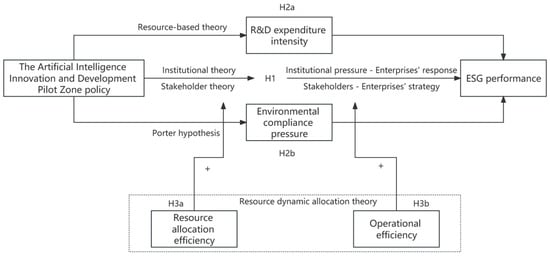
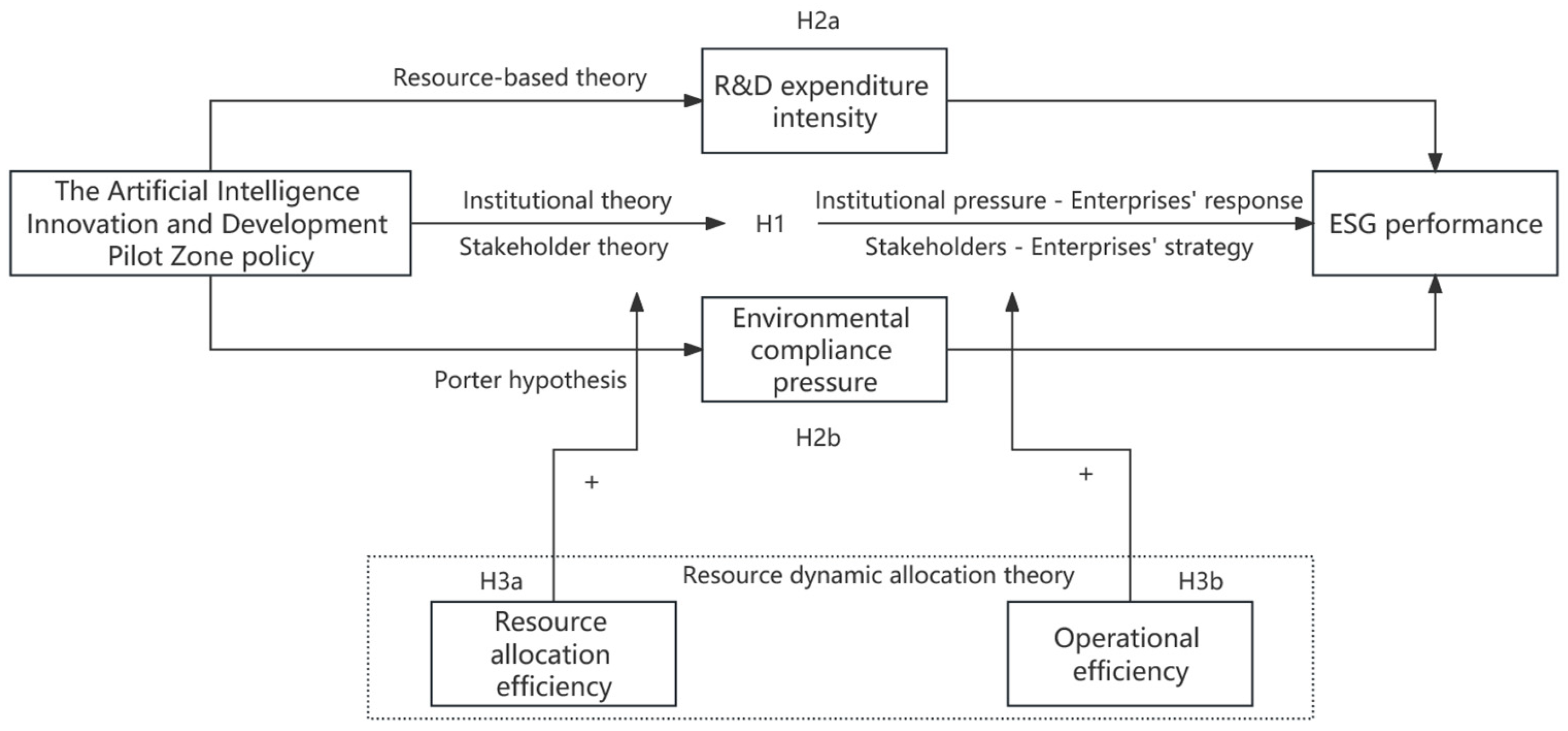
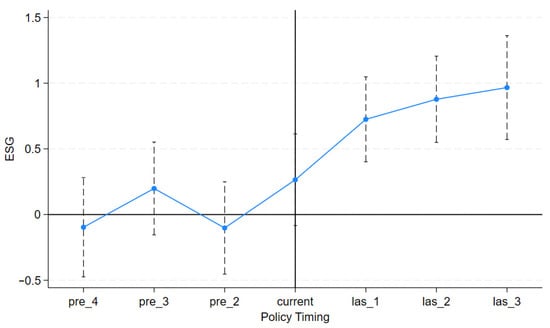
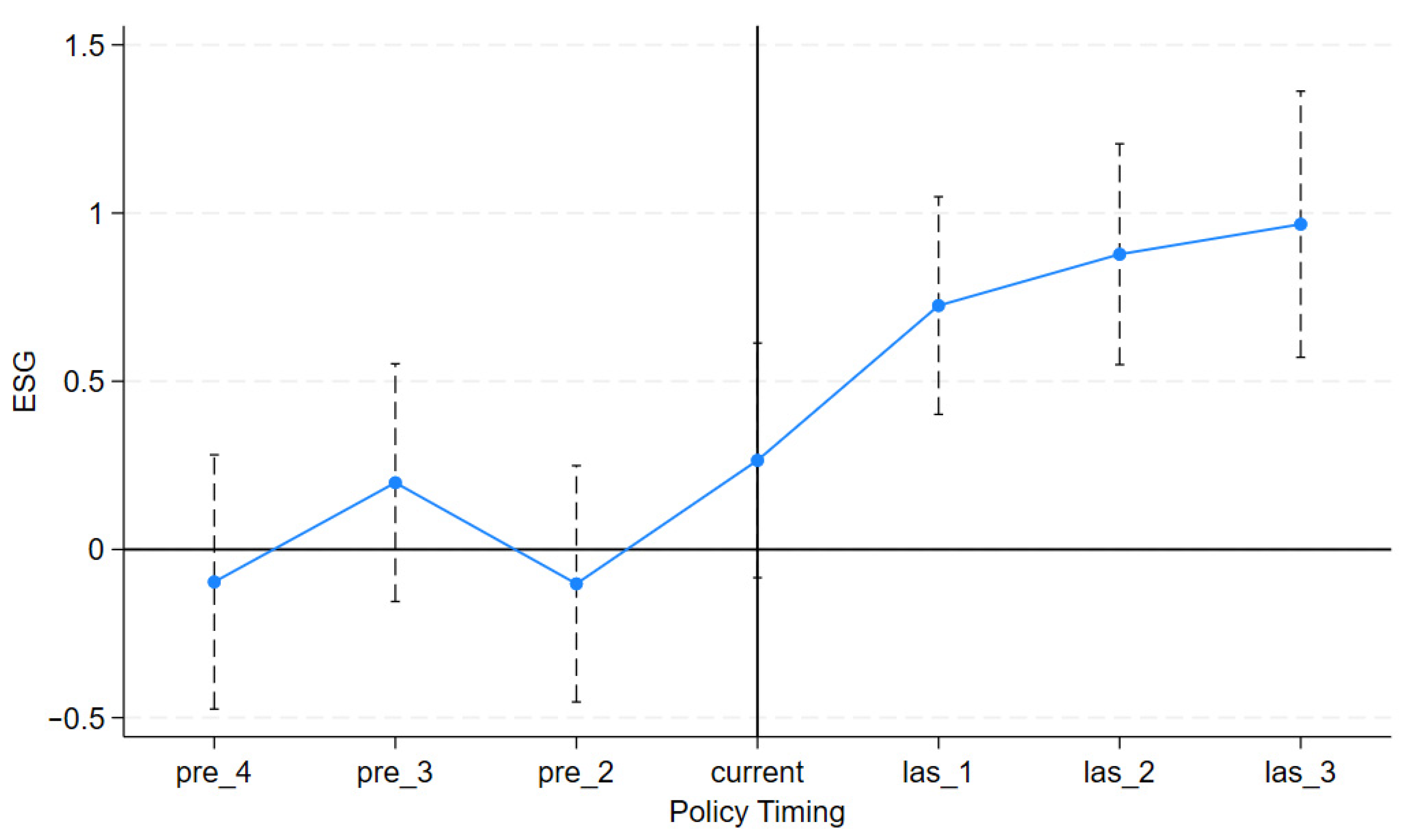
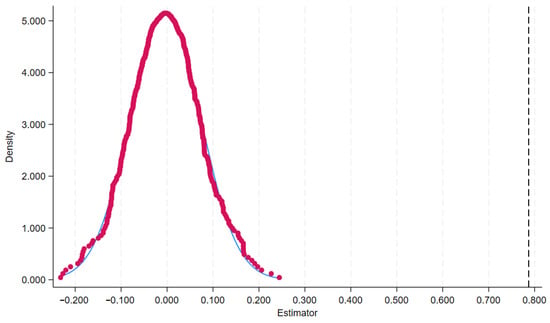
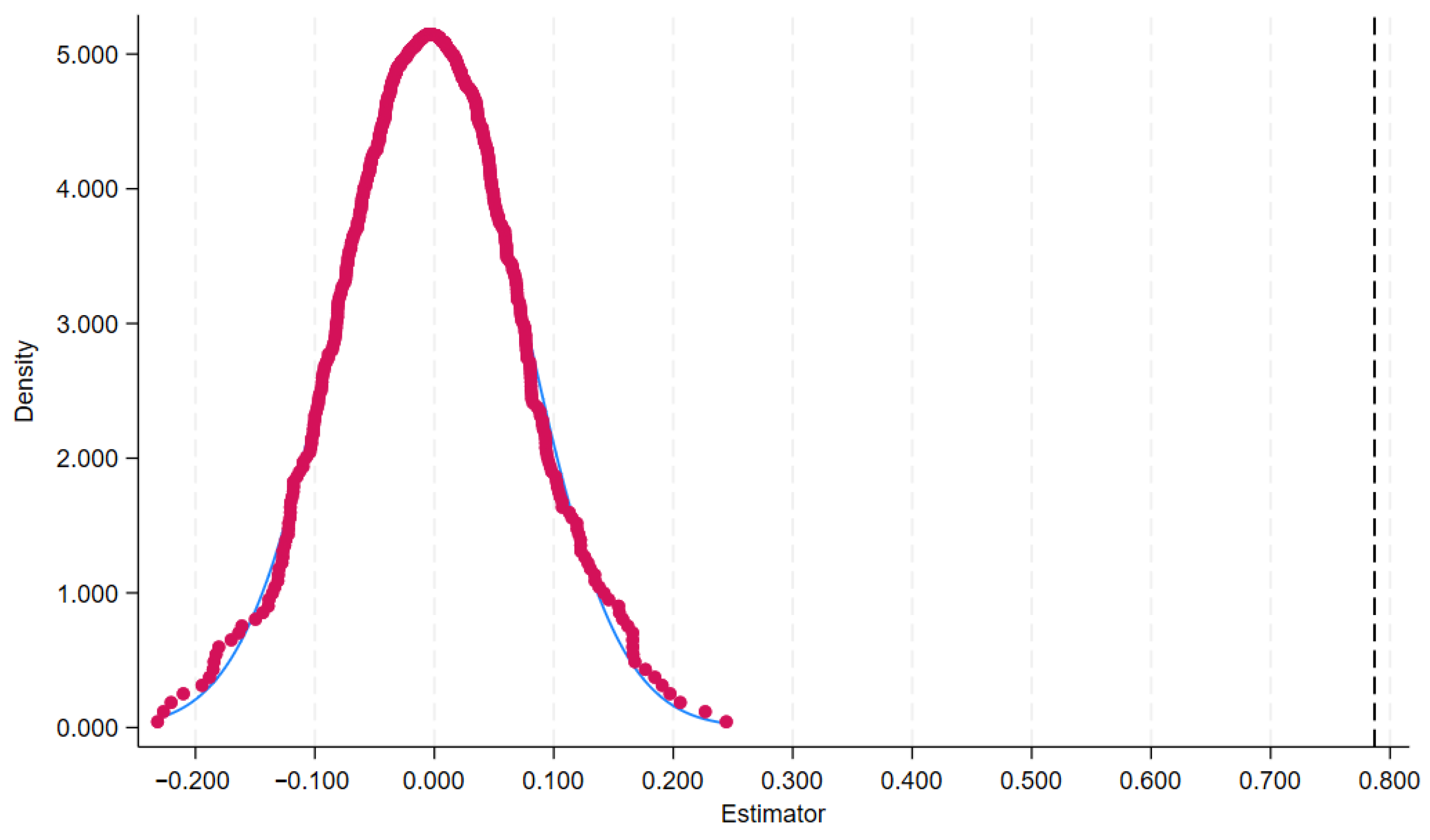

Disclaimer/Publisher’s Note: The statements, opinions and data contained in all publications are solely those of the individual author(s) and contributor(s) and not of MDPI and/or the editor(s). MDPI and/or the editor(s) disclaim responsibility for any injury to people or property resulting from any ideas, methods, instructions or products referred to in the content. |
© 2026 by the authors. Licensee MDPI, Basel, Switzerland. This article is an open access article distributed under the terms and conditions of the Creative Commons Attribution (CC BY) license.