


Abstract
Aligned with Sustainable Development Goal 4, the efficient and sustainable allocation of educational resources is essential for improving the quality of higher education. This study investigates the paradox between resource investment and the operational efficiency of Chinese key universities and explores pathways for sustainable resource allocation in higher education. Employing a two-stage Data Envelopment Analysis (DEA) and Bootstrap truncated regression, we evaluated the operational efficiency of 60 universities directly affiliated with the Ministry of Education of China from 2004 to 2023 and further analyzed factors influencing efficiency. The results show that greater resource concentration does not necessarily improve operational efficiency and may generate diminishing returns in resource use. Efficiency differences across university groups also vary with model specification and output composition, especially in research performance and doctoral education. Further analysis shows that faculty structure optimization, high-quality postgraduate education, and stable teaching teams are pivotal factors in enhancing universities’ sustainable operational efficiency. These findings highlight the importance of governance reform and performance-oriented resource allocation in supporting the sustainable development of higher education systems and the achievement of the Sustainable Development Goals.
1. Introduction
In the context of global sustainable development, the competition for knowledge, technology, innovation, and talent has become increasingly fierce, and high-quality talents have become the core driving force for scientific and technological progress, economic transformation, and social sustainable development [1]. Sustainable Development Goal 4 states that optimizing and sustainably allocating educational resources is an important means of promoting high-quality higher education globally. As the main base for talent cultivation and knowledge innovation, higher education institutions undertake irreplaceable responsibilities in promoting sustainable economic and social development, enhancing national comprehensive competitiveness, and fulfilling the sustainable development goals [2,3]. Economic growth is highly dependent on human capital accumulation, and higher education is the primary driver of human capital formation, making the investment in and efficient utilization of higher education resources a key concern for governments worldwide [4,5]. Efficient allocation and utilization of higher education resources can enhance knowledge production, innovation capacity, and institutional governance, thereby supporting broader sustainability transitions. Therefore, examining the efficiency of resource allocation in higher education institutions provides important insights into how national education systems can contribute to the achievement of the SDGs.
Against the background of limited public financial resources, all public service sectors are facing fierce competition for resource allocation, and higher education funding is constantly constrained by fiscal pressures [6,7]. Governments and the public are increasingly demanding “value for money” from educational inputs, emphasizing the need to maximize output benefits with limited resources [8,9]. Therefore, scientifically evaluating the operational efficiency of HEIs, clarifying the relationship between resource input and output performance, and exploring sustainable resource allocation have become important theoretical and practical issues to promote the high-quality and sustainable development of higher education. From the perspective of sustainable governance, improving the efficiency of higher education institutions is essential for ensuring that limited educational resources generate long-term social, economic, and educational benefits.
Since the late 20th century, a global upsurge of building world-class universities has emerged, represented by Germany’s Excellence Initiative, France’s IDEX Plan, Japan’s COE Plan, and South Korea’s World Class University Program [10,11]. These initiatives generally adopt a centralized resource allocation model, concentrating national resources to support a small number of top universities, aiming to enhance the international competitiveness of higher education. China has also successively launched a series of key university construction projects, including the “211 Project”, “985 Project”, and later the “Double First-Class” Initiative, which have formed a distinct hierarchical resource allocation pattern in China’s higher education system [12,13]. Top-tier key universities have obtained a large share of educational resources, while ordinary HEIs are facing shortages of funds and talent, leading to a widening gap in school-running conditions and development potential among universities.
Although centralized resource allocation has promoted the rapid development of top universities in China, it has also triggered reflections on the sustainability and efficiency of higher education resource allocation systems: Does massive resource investment necessarily improve the operational efficiency of universities? Is the current hierarchical resource allocation model conducive to the sustainable development of the entire higher education system? Existing studies have made important contributions to the evaluation of university efficiency in China, but three limitations remain. First, much of the literature focuses on static or single-stage efficiency measurement and pays less attention to the long-term sustainability of resource use. Second, current research generally treats resource input as a positive determinant of performance, while insufficiently examining the possibility that excessive resource concentration may generate diminishing returns or even inefficiency. In other words, the potential “resource abundance paradox” in key universities has not been adequately tested. Third, although efficiency differences across universities are widely documented, the institutional conditions that shape sustainable operational efficiency remain underexplored. As a consequence, existing findings provide limited guidance for policy design on how to improve both efficiency and sustainability in higher education governance.
To fill these research gaps, this study used 60 universities directly affiliated with the Ministry of Education of China from 2004 to 2023 as the research sample, divided them into Project 985 universities and non-Project 985 Project 211 universities for comparative analysis, and employed a two-stage DEA method with Bootstrap correction to evaluate their operational efficiency. Furthermore, we adopted truncated regression to identify the key factors affecting efficiency performance. This study addresses two research questions: (1) RQ1: Does greater resource investment necessarily lead to higher operational efficiency in Chinese key universities? (2) RQ2: What institutional factors influence the sustainable operational efficiency of universities? These two questions guide the empirical analysis of this study. Section 4 addresses RQ1 by examining whether greater resource endowment is associated with higher operational efficiency under different output specifications and across different groups of key universities. Section 5 addresses RQ2 by using second-stage truncated regression to identify the institutional factors associated with efficiency differences.
The marginal contributions of this study are as follows: First, it reveals the resource-abundance paradox of Chinese key universities from a sustainable development perspective, clarifying that excessive resource concentration is not conducive to improving resource utilization efficiency. Second, it combines Bootstrap correction to improve the accuracy of efficiency measurement, enhancing the robustness of empirical results. Third, it explores the mechanisms that influence university sustainable operational efficiency and puts forward targeted policy suggestions to optimize the sustainable allocation and governance of higher education resources. These contributions improve the understanding of how higher education resource allocation relates to the achievement of the Sustainable Development Goals, particularly SDG 4 (Quality Education) and SDG 9 (Industry, Innovation and Infrastructure).
2. Background of Sustainability Challenges in China’s Higher Education Resource Allocation
Since the reform and opening up, China’s economy has achieved sustained and rapid growth, providing solid financial support for the expansion and quality improvement of higher education. China’s higher education has realized a historic transformation from elite education to popularization, with the gross enrollment rate rising from 10.5% in 1999 to 57.8% in 2021, and the number of students in higher education ranking first in the world [14]. While this rapid expansion has significantly enhanced the accessibility of higher education, enhanced the equal opportunities for everyone to enjoy education, and strengthened national human capital accumulation, it has also generated increasing pressure on the sustainable allocation and efficient utilization of educational resources. The scale expansion of higher education has laid a foundation for the accumulation of national human capital, but ensuring that limited educational resources are allocated efficiently and sustainably has become a critical challenge for higher education governance in many countries.
China’s higher education system is characterized by strong state control over resource allocation, with fiscal appropriations remaining the primary source of funding for university operation and development [15]. In 2016, China’s total investment in higher education exceeded one trillion yuan for the first time, reaching 1.3999 trillion yuan in 2020, and fiscal education expenditure accounted for more than 60% of the total education expenditure of ordinary colleges and universities [16]. The rapid growth of public investment has provided significant financial support for university development, but it has also raised concerns about the efficiency and sustainability of resource use within the higher education system. According to the government’s reports, the distribution of educational resources is highly uneven: the “211 Project” and “985 Project” universities, accounting for less than 15% of the national HEIs, have obtained more than 70% of the national higher education research funding, while the remaining thousands of ordinary universities can only share a small amount of resources [17]. Such a highly centralized resource allocation pattern has intensified structural disparities among universities and raised questions about whether the excessive concentration of resources may weaken overall system efficiency. This centralized allocation model has widened the development gap between key universities and ordinary universities and also led to the problem of low resource utilization efficiency in some top key universities, which is not conducive to the sustainable and coordinated development of the entire higher education system. To solve this problem, the Chinese government launched the “Double First-Class” Initiative in 2016, which marked a new stage of world-class university construction in China, emphasizing dynamic adjustment and competitive allocation, but has not fundamentally changed the hierarchical resource allocation pattern of higher education [18]. Although these policies aim to enhance the international competitiveness of Chinese universities, the long-term sustainability of a highly concentrated resource allocation model remains an important issue for both policymakers and scholars.
In the context of fiscal constraints and the pursuit of sustainable development, the long-term sustainability of higher education systems increasingly depends on whether educational resources are allocated and utilized efficiently and in balance. Inefficient or excessively concentrated resource allocation may not only weaken institutional performance, but also undermine the sustainable governance of the higher education system as a whole. Therefore, it is particularly urgent to reconsider rigid resource allocation structures, improve the efficiency of resource utilization, and establish a more balanced and sustainable resource allocation mechanism. A key theoretical question emerging from this context is whether increasing resource investment necessarily leads to higher operational efficiency, or whether excessive resource concentration may generate diminishing returns in resource utilization. This study focuses on the operational efficiency of key universities in this context, aiming to empirically examine the relationship between resource allocation and efficiency performance and provide a reference for resolving the contradiction between resource supply and demand and promoting the sustainable development of higher education.
3. Methodology and Data
3.1. A Two-Stage Method
Current research on the efficiency of educational resource allocation generally adopts two main methodological approaches: parametric and non-parametric methods. The parametric approach is most commonly represented by Stochastic Frontier Analysis (SFA), which requires the specification of a functional form for the production process and allows inefficiency to be distinguished from random error. In contrast, the non-parametric approach is mainly represented by Data Envelopment Analysis (DEA), which does not require a pre-specified production function and is particularly suitable for evaluating organizations characterized by multiple inputs and multiple outputs. DEA models were chosen here because they are more common for measuring technical efficiency as they can be applied to multi-input and multi-output variables [19]. Technical efficiency is the effectiveness with which a given set of inputs is used to produce an output [20]. From an output-oriented perspective, this means getting the most production (output) from the available resources (inputs). Here, we only present the basic concept of DEA, because a detailed explanation can be found elsewhere [21,22]. However, DEA has long been criticized for lacking in statistical power and being deterministic, which can be sensitive to the number of inputs and outputs and the number of DMUs. With the important development of DEA methodology, Efron (1979) proposed the Bootstrap method to resample the original samples, which is attractive in analyzing the sensitivity of efficiency and productivity results to sampling changes and can significantly improve the effectiveness of estimation [23]. The bootstrap technique developed by Simar and Wilson [24,25] allows the 95% confidence interval for each DMU’s efficiency score to be estimated, which can be used to assess the statistical significance of HEIs’ efficiency scores.
To this end, two-stage DEA is used to measure relative technical efficiency, which can be used to evaluate the performance of an organization by comparing it with best practices [26,27]. Compared with other studies that directly apply the DEA model, we used the Bootstrap method to study the sensitivity of the efficiency score and obtain the partial correction efficiency estimate [24]. In a second stage, these previously estimated efficiency scores were regressed against a set of external variables using a truncated regression analysis [28]. Multiple combinations of input and output indicators were taken to deal with the sensitivity of the DEA model test [29]. Consequently, different inputs and outputs were tested in four models of DEA analyses [30].
Below, in an output-oriented framework and under the assumption of VRS, the model is utilized in the empirical part of the analysis. The notation used closely follows that of Simar and Wilson [31].
The process of production of a given decision-making unit (DMU) is constrained by the production set of physically possible points (x, y):
where x indicates a vector of N inputs, and y a vector of M outputs. The output set Y(x) is defined as:
The boundary of is the locus of optimal production (production frontier), and in the case of the output-oriented model, is defined as:
The measure of efficiency is found by maximizing the achievable output for a given level of the inputs:
Banker et al. (1984) [32] developed a DEA estimator allowing for variable returns to scale (VRS) with linear programming.
According to the traditional definition, efficiency scores must be between 0 and 1. However, we parameterized the efficiency scores. The estimated efficiency scores would have a lower bound value of one, which means that the HEI is technically efficient. The higher the value of the score, the lower the technical efficiency of the institution.
The second step of empirical analysis, a bootstrap procedure, was employed to obtain biased-corrected β-coefficients to overcome the problems arising from the serial correlation of previously estimated scores and a possible correlation of the error term (εi) with environment variables (Zi). We have also provided evidence about the potential determinants (Zi) of previously estimated deviation-corrected efficiency scores (DEAi) where the regression is expressed as:
where is a statistical noise with distribution restricted by ≥ 1 − α − Ziβ. In addition, the error term is related to , and the input and output are also related to . We used MAXDEA software (https://maxdea.com, accessed on 14 March 2026) to perform Bootstrap on the efficiency score in the first stage to obtain the deviation-corrected score, and then used the Bootstrap truncated regression method to regress the potential covariate in STATA 18.
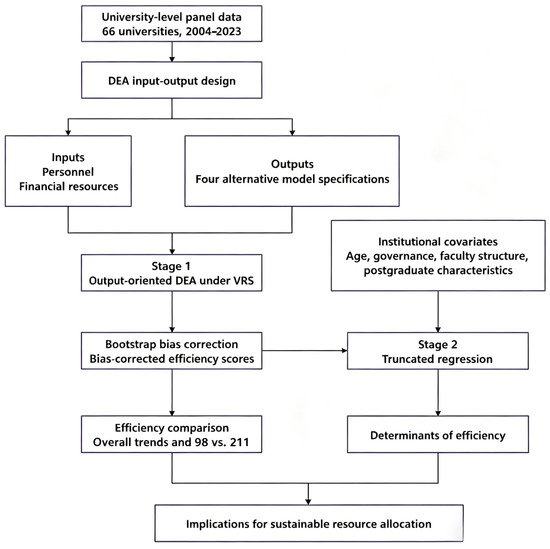
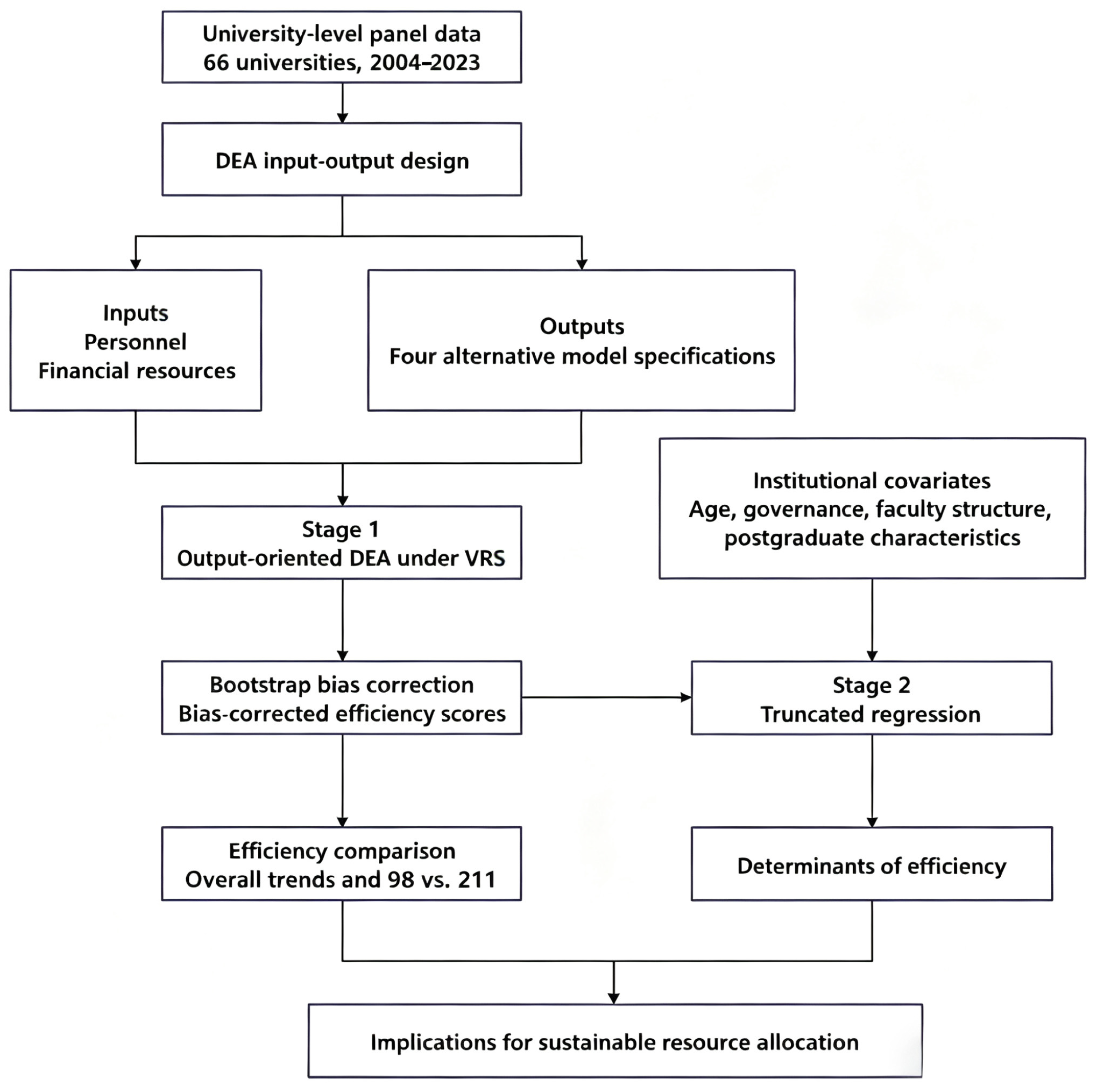
To improve the transparency of the empirical design, it is useful to summarize the full analytical procedure in a visual form. As shown in Figure 1, the study proceeds in two stages. In the first stage, DEA is used to estimate university efficiency under alternative output specifications, followed by Bootstrap correction to obtain bias-corrected efficiency scores. In the second stage, these corrected scores are regressed on institutional characteristics in order to identify the factors associated with efficiency differences. The figure also clarifies how the sample, variable specification, and multi-model design are connected within the overall framework. The following subsection then describes the data sources, sample composition, and input–output variables in greater detail.
Figure 1.
Structure of the two-stage empirical framework.
3.2. Empirical Settings and Data Analysis
The data used in this study were from the Compilation of Basic Statistics of Universities Directly under the Ministry of Education (CBSU), which has established an extensive dataset containing comparable university-level statistics. National statistics offices gathered data from each specific university and then harmonized the appropriate data according to the agreed-upon definitions of indicators. Moreover, the SCI database in the Web of Science, National Social Science Fund Project (NSSF), and National Natural Science Foundation (NNSF) database of China were also used. The use of university-level data is particularly important for the present study. Existing research on higher education resource allocation efficiency in China often relies on provincial or regional data, focusing on the relationship between aggregate educational inputs and outputs across areas. However, universities are the basic operational units of higher education systems and the primary sites where policy objectives are translated into concrete teaching, research, and organizational practices. A university-level perspective therefore allows the mechanisms linking resource inputs to performance outcomes to be observed more directly and interpreted more precisely. This improves both the explanatory power of efficiency analysis and the policy relevance of the results.
To conduct an efficiency analysis, it is necessary to define the inputs and outputs that reflect the university production process. Although the choice of adequate proxies for inputs and outputs is still highly debated, and no unique solutions have been definitively suggested, the selected indicators should remain consistent with both the production logic of universities and the objective of the study. In this study, universities were considered as organizations using financial, material, and human resources as inputs to produce human capital. Table 1 provides an overall summary of the descriptive statistics of the input and output variables that were used for analyses. The summary statistics also revealed substantial differences across projects. It can be seen that HEIs with different construction projects have significant differences in human resources, financial resources, and other aspects. Overall, 985 Project HEIs have more resources than 211 Project HEIs.
Table 1.
Key statistics on HEIs, time period 2004–2023.
The input indicators of universities are generally divided into three categories: human resources, financial resources, and material resources. Among them, financial resources (Revenue) and human resources (People) are the core and decisive input factors—material resources are not only derived from financial investment, but also their effective utilization relies on human resources. For this reason, this paper selected revenue and people as the core input indicators, which can accurately reflect the key content of university resource input and ensure the scientificity of the subsequent efficiency measurement. As inputs, we considered the total number of people (People) that included faculty, other researchers, and technical and administrative staff. Moreover, input also included detailed information on the financial resources of each university, which allowed us to compute the total financial resources available (Revenue).
The output variables varied across models in order to reflect the multidimensional nature of university performance. This design choice is theoretically necessary because universities do not produce a single homogeneous output. Instead, they pursue multiple missions, including talent cultivation, knowledge production, innovation transfer, and advanced research training. A single output specification may therefore capture only part of the university performance and may bias the measurement of efficiency toward one particular institutional function. For this reason, the study estimated four alternative output specifications. The purpose was not to search selectively for preferred results, but to test whether the main findings remain robust when different dimensions of university output are emphasized. The use of multiple models is particularly important in DEA because efficiency estimates are sensitive to the definition of inputs and outputs. Table 2 displays a variety of input–output index combination models that we applied to test the sensitivity and robustness of the results to selected indicators.
Table 2.
Different models.
Model 1 is the benchmark specification and captures the two core functions of universities: teaching and research. Teaching output is measured by the number of graduates, including undergraduate and postgraduate students. This variable reflects the direct educational outcome of university training activities. Research output is measured by two indicators: the total number of research publications (Publications) retrieved by various universities on the Web of Science website, and monographs and scientific & technological works (Papers) on CBSU. The combination of these indicators allows the model to capture both internationally visible research output and other officially recognized academic achievements.
Model 2 extends the benchmark model by incorporating research quality and competitive research capacity. Specifically, Category Normalized Citation Impact is used to measure the quality and academic influence of research output. Compared with simple publication counts, this indicator better captures the impact dimension of scientific production. In addition, project funding shares from the National Social Science Fund and the National Natural Science Foundation were included to reflect universities’ competitiveness in securing externally evaluated research support. This model is intended to address the possibility that universities with similar research quantity may differ substantially in research quality and academic influence.
Model 3 introduces patents granted and consulting reports in order to capture universities’ social service and knowledge transfer functions. Since universities sell their services to government and industry, their income can be used to estimate the value of the output they produce. However, such income is more likely to be considered as an investment in the research process [33]. Therefore, we used the number of patents granted and the number of consulting reports (Patents & Cons) as a proxy for the social service capacity in Model 3.
Model 4 adds the number of doctoral degrees awarded as an additional output indicator. Doctoral education occupies a special position in the Chinese higher education system because it is closely linked to advanced research training, academic prestige, and innovation capacity. Compared with undergraduate and master’s students, doctoral students are more deeply involved in research activities and academic collaboration, and doctoral training is more directly connected to the universities’ research missions. The number of doctoral degrees awarded therefore captures an important dimension of high-level talent cultivation and research-oriented educational output. Thus, we used them as additional output variables in Model 4.
The four-model design serves both substantive and methodological purposes. Substantively, it reflects the multidimensional nature of university performance, which cannot be adequately captured by a single output specification. Methodologically, it allows us to test the sensitivity of DEA results to alternative output definitions. Consistent findings across models strengthen the robustness of the results, whereas differences across models reveal how efficiency comparisons depend on the dimension of performance being emphasized, such as research quality, social service, or doctoral training. Thus, the multiple-model strategy is an integral part of the research design rather than merely a technical robustness check.
4. Empirical Results and Analysis
4.1. Overall Analysis
Table 3 demonstrates a performance improvement for all HEI activities given existing input resources. Because we used output orientation, inefficient universities must increase their output (DEA score − 1) ×100% to reach the frontier level. The average value of unbiased technical efficiency was 1.243 from 2004 to 2023. Based on the existing input resources, HEIs could produce 24.3% more outputs if they were technically efficient. To shed light on the causes of variations in efficiency, TE was decomposed into pure technical efficiency (PTE) and scale efficiency (SE), that is, TE = PTE × SE. During the study period, the size of students and faculty at Chinese universities grew rapidly. The results clearly show that the scale efficiency of China’s key universities is higher than their pure technical efficiency, indicating that expanding the educational scale is the main way to improve technical efficiency. This is consistent with the reality that the Chinese government mainly promotes university development by investing a large number of resources to improve school conditions under the “211 Project” and “985 Project”.
Table 3.
Summary of efficiency scores in Model 1.
Before the expansion of enrollment, the scale and resources of these universities were already under considerable pressure. The nationwide enrollment expansion initiated in 1999 further intensified this strain on existing educational resources. During 2000 to 2010, to ease the resource shortages caused by rapidly growing student numbers, nearly half of the universities directly administered by the central government began constructing new campuses and expanding infrastructure on a large scale. However, because much of this expansion was financed through bank loans, the completion of new campus projects, combined with the impact of the 2008 global financial crisis, further increased the debt burden of universities. This in turn constrained subsequent investment in infrastructure and scale expansion. As a result, from 2006 to 2009, the contribution of scale efficiency to the overall technical efficiency of key universities showed a downward trend. After 2010, with the central government launching debt reduction initiatives for universities and gradually increasing per-student funding from 2011 onward, the financial conditions of key universities began to improve. Correspondingly, from 2010 to 2013, the role of scale efficiency in supporting efficiency improvement became stronger. After 2013, scale efficiency remained relatively stable overall, fluctuating only slightly, while technical efficiency and pure technical efficiency continued to decline mildly before showing a modest recovery in the later years. From 2017 to 2023, the three efficiency indicators generally exhibited a stable pattern, suggesting that the resource allocation system of key universities had gradually moved from rapid expansion to a more balanced and mature stage of adjustment.
4.2. Efficiency Comparison and Analysis Results
Since the purpose of this study was not to rank individual universities, Table 4 reports only the average efficiency scores of the Project 211 and Project 985 universities under the four model specifications. The results suggest that, overall, 985 Project HEIs exhibited slightly higher average efficiency scores than 211 Project HEIs across the four models. This pattern is particularly visible in most years after 2008, when the efficiency scores of 985 Project universities were generally comparable to, and in many cases higher than, those of 211 Project universities. However, this difference should not be interpreted simply as the result of greater resource endowment. Rather, it reflects deeper structural differences between the two groups of institutions. Compared with Project 211 universities, Project 985 universities are generally more research-intensive, have stronger doctoral training capacity, possess more advanced academic infrastructure, and benefit from a higher concentration of senior academic staff and stronger reputational advantages. These structural characteristics affect how universities transform financial and human resources into outputs. In particular, institutions with more developed research systems and doctoral education platforms are better positioned to generate research publications, high-level academic outputs, and doctoral degrees, all of which are important dimensions of university performance in the present analysis. In contrast, Project 211 universities are more heterogeneous in mission, capacity, and organizational profile, and their output structure may be less closely aligned with research-oriented efficiency measures.
Table 4.
Summary of unbiased efficiency scores.
This interpretation is further supported by the results across model specifications. When doctoral education is incorporated into the output set, the relative efficiency advantage of Project 985 universities becomes more apparent. This suggests that structural differences in postgraduate education and research orientation are important drivers of efficiency variation between the two groups. In other words, the observed efficiency gap is not merely a function of resource volume, but also of how institutional structures shape the conversion of inputs into outputs. Universities with stronger doctoral programs and research capacity are more likely to perform well when efficiency is evaluated in terms of advanced knowledge production and high-level talent cultivation. Overall, the results indicate that the efficiency gap between the two groups is not simply a matter of resource abundance, but also reflects differences in how educational resources are transformed into teaching and research outputs.
These findings are particularly important when considered alongside the actual development of Chinese higher education in recent years, In terms of social reputation, research performance, and international visibility, especially as reflected in major global university rankings, the government’s phased objective of building world-class universities has been broadly achieved. At the same time, both 985 Project HEIs and 211 Project HEIs continue to exhibit noticeable within-group heterogeneity. Although the annual average efficiency scores have become more stable in recent years, universities in both groups still differ in their relative technical efficiency and in their ability to transform educational resources into outputs [34,35]. Under the traditional performance appraisal model, Chinese higher education authorities tend to rely on relatively visible university and disciplinary rankings when evaluating the outcomes of first-class university construction. However, such rankings may conceal important underlying problems related to resource utilization and operational efficiency. Our findings suggest that strong social reputation or international visibility does not necessarily coincide with the most efficient use of educational resources. Institution-level evidence shows that several universities outside the top tier of international rankings nevertheless achieve relatively strong technical efficiency performance. This contrast indicates that ranking performance and efficiency performance do not always move together. In practice, governments often concentrate funding on institutions with strong reputational advantages and perceived development potential at the top of university rankings [36,37]. Our results suggest that this approach should be complemented by greater attention to how effectively universities transform educational resources into teaching and research outputs. This raises an important question regarding the sustainability of higher education resource allocation: whether greater resource investment necessarily leads to higher institutional efficiency.
These findings suggest that greater resource investment does not automatically lead to proportionately higher efficiency. While resource-rich universities may achieve stronger outputs in some dimensions, sustained improvements in performance also depend on governance quality, output structure, and the effective transformation of inputs into teaching and research outcomes. This may mean that more productive institutions do not receive more state funding, while most less efficient universities do. In this context, it is especially hitting the functioning of public research universities. In particular, the redirection of resource allocation within the higher education system is difficult due to the bureaucratic nature of educational institutions and the rigidity of resource allocation. It is important to note that there is an urgent need to come up with a plan for resource investment upgrades due to a low proportion of high-efficiency university budgets. Thus, government departments should place greater policy emphasis on improving the effectiveness of resource utilization across different tiers of institutions, rather than relying solely on the hierarchical concentration of funding. A more balanced and performance-oriented allocation framework may help improve the overall sustainability of higher education spending.
5. Exploring the Determinants of Efficiency
5.1. Empirical Specification
From a policy point of view, it is interesting to examine the determinants of the low efficiency of HEIs, which helps to answer the question of what can be done to improve it. In order to test the impact of potential external factors on HEIs, we conducted the following estimation:
where i refers to a single HEI, and t denotes the time period. The dependent variables are bias-corrected DEA scores, which are regressed on potential covariates. Xi,t is a matrix of potential determinants of efficiency scores (DEAi,t) and εi,t is an error term. Vt represents the time dummy variable. The author adds individual institutional effects Xi. The selection of external environment variables is discussed below.
The choice of independent variables was driven mainly by our general interest in factors that might determine the efficiency of HEIs and data availability. The regional location of a university may be an important determinant of its performance. Thus, we used a location proxy, expressed in terms of GDP per capita (GDP) of the region where the institution is located. Next, the variable Found was used to test the relationship between the establishment year of the sample institution and efficiency. While older HEIs may be more efficient for their experience and reputation, younger institutions may also be more efficient because of more flexible internal management and organizational structures. Then, set Medical school ownership (Medical) as a dummy variable (“1” for Medical school and “0” for none).
In addition, we examined the relationship between the quality and structure of staff members and the efficiency scores. This allowed us to examine whether a higher share of professors (Professor) and a higher proportion of full-time faculty members with doctorates (Doctor faculty) within the academic body were associated with higher efficiency at a given university. Also, the proportion of administrative staff (Staff) was used to consider the influence imposed by the executive power of HEIs.
Then, we used the percentage of new faculty (Flowinto rate) in HEIs every year to measure the impact of faculty renewal. The ratio of graduate students to full-time faculty (Graduate ratio) and the ratio of doctoral students to full-time faculty (Doctor ratio) were used to test whether the student–teacher ratio structure in colleges and universities had an impact on the efficiency of running schools. In addition, we added the time effect and the dummy variable of whether it was a 985 university or not into all models. Before estimating the second-stage Bootstrap truncated regression, we examined potential multicollinearity among the explanatory variables. The results suggested that multicollinearity was not a serious concern, as the pairwise correlations were all below 0.70 and the variance inflation factors (VIFs) ranged from 1.18 to 3.42, well below the conventional threshold of 10.
5.2. Results of the Benchmark Model
First of all, under the common frontier, the DEA unbiased efficiency value obtained in the first-stage benchmark model 1 was used to estimate the regression. Table 5 shows the regression results of the benchmark models under the two frontier assumptions. Since the values of the efficiency scores are greater than or equal to one, positive/negative regression coefficients would mean that, due to the rise of the independent variables, inefficiency increases/decreases.
Table 5.
Determinants of efficiency scores (truncated regression) in model 1.
In China, a university with a long history and rich experience in running a school may have a team of experienced and excellent teachers to conduct teaching and research activities and may have a good social reputation to recruit more excellent students. Greater opportunities to obtain more resources for teaching and research from the government or other institutions, a better campus atmosphere within the university, and a more scientific way of allocating resources may have a positive impact on school efficiency. However, in the research results, the coefficient of founding time (Found) was not significant, indicating that universities with strong historical heritage are not necessarily efficient in running schools. Young universities may rely on their more flexible management and organizational structure to have greater efficiency advantages. Meanwhile, the correlation coefficients of whether a HEI has Medical schools (Medical)and the proportion of administrative staff (Staff) were not statistically significant, so these are not determinants of the efficiency of HEIs.
The influence coefficients of Professors, Doctor faculty, and the Graduate ratio had a negative sign and were statistically significant. The proportion of highly educated teachers in a university had a positive impact on efficiency. The more professionals with a high level of human capital in a university, the more likely it is to provide continuous and high-quality services. Therefore, in order to improve the teaching effect and the level of subject construction, it is necessary to optimize the structure of college teachers, accelerate the recruitment of high-level teachers, and build a high-quality talent team. Graduate education is an important part of the teaching and research function in colleges and universities. It has a positive impact on the efficiency of running, improving the ratio of graduate students to full-time teachers in universities, and increasing the number of graduate students.
We further found that the GDP, Flowinto rate, and Doctor ratio decreased the efficiency value, with positive and significant coefficients. In our selected samples, the key HEIs were mainly concentrated in the developed provinces and big cities. In fact, although the economic development level was significantly positive in each model, the coefficient was very small, and the influence degree could be ignored. Therefore, it is difficult to draw a definite conclusion that more prosperous regions have a lower efficiency of universities. The development and retention of internal members are the core factors for the survival of an organization. With the increasing competition among HEIs, the recruitment of high-level talent from other universities has become a means for more and more HEIs to obtain resources and achieve professional development in their disciplines. Teachers who join other HEIs not only take away their skills and experience, but also take away their own hidden resource investment into HEIs. However, results show that the higher the proportion of new full-time teachers per year, the lower the efficiency of running. Therefore, it is necessary to ensure the stability of the teaching team and implement a long-term stable talent team construction plan. In addition, the higher the ratio of doctoral students to full-time teachers, the lower the efficiency. Therefore, HEIs must control the annual enrollment of doctoral students by teachers with a doctor’s qualification, to ensure the quality of doctoral education.
5.3. Sensitivity Analysis
Empirical studies have largely dealt with this by performing DEA on a variety of specifications to check the sensitivity of results. Different versions of the DEA model (model 2, model 3, and model 4) were used. The correlations between different models were statistically significant (see Table 6) and relatively high (ranging from 0.8 to 1.0), indicating that the average efficiency score results had strong robustness. Different frontier assumptions were not the main determinants of our analysis results, but they will have an impact on the efficiency score estimation results of individual universities. Then, different versions of the DEA model (see Table 7) were used to take efficiency values as dependent variables. We found that our results remained qualitatively robust to these variations in the model specifications. In general, most of the previous findings were still confirmed, such as the regional level of economic development (GDP), the proportion of Doctor faculties with doctoral degrees, the Flowinto rate of new full-time teachers every year, and the Graduate ratio were all statistically significant. Thirdly, we performed Bootstrap 500 and 1000 times, respectively, in the second step, but the changes in the number of times did not have a great impact on the research results.
Table 6.
Correlations between different DEA models.
Table 7.
Determinants of efficiency scores (truncated regression) in different models.
6. Discussion
For modern countries, the construction and development of higher education is a continuous and in-depth process. Improved public sector efficiency is seen to reduce the fiscal burden and enhance service delivery. Therefore, measuring the efficiency of higher education institutions is not only a matter of institutional performance, but also an important issue for the sustainable governance of national higher education systems. This study examined whether concentrated resource investment improves university performance and supports the sustainable development of higher education. In relation to RQ1,the findings show that the relationship between resource endowment and efficiency is not linear; greater resource endowment does not automatically translate into higher operational efficiency. This result can be interpreted through the lens of resource management theory. Resources do not create value by themselves; their effects depend on how effectively they are allocated, coordinated, and transformed into outputs. In higher education, this means that financial support and staffing advantages can improve performance only when they are matched with effective governance, strategic planning, and internal management capacity. This helps explain why some universities with fewer resources may still achieve relatively high efficiency, whereas some resource-rich institutions do not convert their advantages into proportionally better outcomes.
The findings also speak directly to the ongoing debate on selective funding and excellence-oriented policies. Like many countries, China has relied on concentrated investment to strengthen top universities and improve international competitiveness. This strategy has clearly supported the expansion of research capacity in elite institutions, but the present results suggest that status-based concentration alone is not enough to ensure the efficient use of public resources. When funding is strongly linked to institutional labels and historical hierarchy, the system may reinforce path dependence and widen resource disparities without generating commensurate efficiency gains. In this sense, the Chinese case illustrates a broader tension between excellence-oriented investment and system-wide sustainability. Thus, the answer to RQ1 is that concentrated investment may enhance institutional capacity, but it does not necessarily improve efficiency unless resources are effectively governed and strategically used.
This has important implications for reforming the university funding system in China. First, the results suggest that funding allocation should move further away from identity-based support and toward a more transparent and performance-informed system. Universities should not receive additional advantages simply because of their historical inclusion in elite policy categories; rather, funding should be more closely linked to how effectively institutions use resources to generate teaching, research, and training outcomes. This does not imply abandoning support for top universities, but it does imply that continued support should be accompanied by clearer evaluation criteria, periodic review, and stronger accountability for results.
Second, the findings support a more differentiated funding structure. The analysis shows that university performance is multidimensional and that efficiency depends partly on how outputs are defined. This means that a single allocation logic is unlikely to serve all institutions equally well. Research-intensive universities, teaching-oriented universities, and regionally important institutions perform different functions and therefore require different funding expectations. A sustainable funding system should combine stable basic funding, which protects institutional continuity, with competitive and performance-based components tailored to institutional missions. Such a design would help avoid the inefficiencies created when all universities are pushed toward the same elite model regardless of their actual strengths and development roles.
Third, the strong influence of doctoral education on efficiency estimates has direct relevance for funding reform. In China, doctoral programs are often treated as symbols of institutional status and academic prestige, but the results of this study suggest that doctoral education should be funded not only as a marker of hierarchy, but as a strategic activity requiring quality assurance and capacity alignment. Future funding reform should therefore pay more attention to the quality, supervision conditions, and research environment of doctoral training rather than encouraging expansion for its own sake. Linking postgraduate funding more closely to training quality and research capacity would better support long-term knowledge production and sustainable academic development.
Fourth, the significance of management flexibility in the second-stage analysis is directly relevant to RQ2, which concerns the factors that explain efficiency differences across universities. The results suggest that funding reform should not focus only on allocation at the governmental level; institutional-level governance also matters. Greater flexibility in the internal use of public funds, accompanied by stronger transparency and accountability, may help universities adjust their spending more efficiently across staffing, teaching, and research priorities. In this sense, reform of the funding system should be accompanied by the reform of budgeting and governance mechanisms within universities, so that institutions have both the incentives and the capacity to improve performance. More broadly, the answer to RQ2 is that efficiency differences are shaped not only by the amount of resources universities receive, but also by institutional characteristics and governance conditions that affect how those resources are used.
A further implication concerns the balance between efficiency and equity in the national higher education system. Excessive concentration of resources in a small group of elite universities may improve visibility at the top, but it may also reduce development opportunities for capable mid-tier and emerging institutions. Over time, this can weaken system-wide resilience and lock universities into rigid status hierarchies. A more sustainable funding system would therefore provide greater developmental space for non-elite institutions through competitive channels, targeted support for capability building, and clearer opportunities for upward mobility. Such reforms would not only improve fairness, but could also raise the overall efficiency by enabling more institutions to transform resources into meaningful outputs.
Although this study focused on China, its implications extend beyond the national context. Many higher education systems face similar tensions among excellence, efficiency, equity, and fiscal constraint. Improving the efficiency of higher education institutions is not only a national policy issue, but also an important component of global efforts to achieve sustainable development. The present findings suggest that the sustainability of higher education depends less on the sheer scale of public investment than on whether funding systems are transparent, mission-sensitive, and capable of rewarding effective resource use while preserving opportunities for institutional development across the system. Overall, the study provides a clear response to the two research questions: with regard to RQ1, concentrated resource investment does not automatically improve university efficiency; with regard to RQ2, efficiency differences are closely related to institutional governance, output structure, and the ways in which resources are managed and deployed.
7. Conclusions
This study examined the operational efficiency of key universities in China by analyzing the relationship between resource inputs and institutional performance from 2004 to 2023. Using a two-stage DEA framework, the research evaluated the efficiency of 60 universities associated with the 985 and 211 Projects and further explored the factors influencing variations in efficiency. The purpose of this study was not only to assess the effectiveness of government investment in higher education, but also to consider whether the existing resource allocation pattern contributes to the sustainable development of the higher education system. More specifically, the study addressed two research questions: whether concentrated resource investment improves university efficiency, and which institutional factors explain variations in efficiency across Chinese key universities.
The empirical results revealed several important findings. First, there is significant heterogeneity in efficiency performance among Chinese key universities. The results show that greater resource input does not necessarily lead to higher operational efficiency. In some cases, universities with relatively fewer resources demonstrated higher efficiency levels, suggesting that effective resource management and institutional governance play a more critical role than the scale of investment alone. This provides a direct answer to RQ1: concentrated resource investment does not automatically improve university efficiency. Second, the inclusion of doctoral education indicators significantly affects the efficiency outcomes, highlighting the importance of the structure and quality of postgraduate education in evaluating university performance. Third, institutional characteristics such as university age and internal management flexibility also influence efficiency levels, indicating that organizational governance and management capacity are important determinants of university performance. These findings provide an answer to RQ2 by showing that efficiency differences are associated not only with resource endowment, but also with institutional characteristics and governance conditions.
These findings have important policy implications for the sustainable governance of higher education. If public investment is to generate long-term value, funding mechanisms should place greater emphasis on efficiency, transparency, and accountability rather than relying mainly on hierarchical concentration. At the same time, policymakers should adopt a more balanced allocation approach that supports not only elite universities, but also mid-tier and emerging institutions with strong development potential. In addition, because doctoral education significantly affects the efficiency performance, greater attention should be paid to the quality and structure of postgraduate training, as well as to its alignment with institutional research capacity. More broadly, sustainable higher education development requires a shift from resource expansion alone toward better governance, stronger organizational capacity, and more effective use of existing resources.
This study also has several limitations. DEA measures relative rather than absolute efficiency, and the results remain conditional on the selected input–output structure, although multiple model specifications were used to improve robustness. In addition, the second-stage analysis identified associations between institutional characteristics and efficiency outcomes, but did not establish strict causal relationships. Future research could extend the sample to a wider range of institutions, compare alternative efficiency estimation methods, and further examine the causal mechanisms linking resource allocation and sustainable university development.
Overall, this study contributes to the literature in three respects. It provides long-term university-level evidence on efficiency differences among Chinese key universities, shows that resource concentration does not automatically improve efficiency, and links efficiency analysis to the broader issue of sustainable resource governance in higher education. In doing so, it highlights that the sustainability of higher education depends not simply on how much governments invest, but on how effectively resources are allocated, governed, and converted into educational and research outcomes. Taken together, the study shows that the answer to RQ1 is negative in a simple linear sense, while the answer to RQ2 lies in the importance of governance capacity, institutional characteristics, and the effective management of resources.
Author Contributions
Conceptualization, J.Z. and X.L.; methodology, X.L. and H.W.; software, H.W.; validation, H.W. and Y.G.; formal analysis, H.W.; investigation, H.W. and Y.G.; resources, J.Z. and P.Z.; data curation, H.W.; writing—original draft preparation, X.L., H.W., Y.G., J.Z. and P.Z.; writing—review and editing, X.L., H.W., Y.G., J.Z. and P.Z.; visualization, H.W.; supervision, J.Z. and P.Z.; project administration, J.Z.; funding acquisition, J.Z. All authors have read and agreed to the published version of the manuscript.
Funding
This research was funded by the Guangdong Provincial Department of Education (2024GX1K650).
Institutional Review Board Statement
Not applicable.
Informed Consent Statement
Not applicable.
Data Availability Statement
The raw data supporting the conclusions of this article will be made available by the authors on request.
Conflicts of Interest
The authors declare no conflicts of interest.
References
- Collings, D.G.; Mellahi, K.; Cascio, W.F. Global talent management and performance in multinational enterprises: A multilevel perspective. J. Manag. 2019, 45, 540–566. [Google Scholar] [CrossRef] [Scilit]
- Berchin, I.I.; de Aguiar Dutra, A.R.; Guerra, J.B.S.O.A. How do higher education institutions promote sustainable development? A literature review. Sustain. Dev. 2021, 29, 1204–1222. [Google Scholar] [CrossRef] [Scilit]
- Sibbel, A. Pathways towards sustainability through higher education. Int. J. Sustain. High. Educ. 2009, 10, 68–82. [Google Scholar] [CrossRef] [Scilit]
- Cinnirella, F.; Streb, J. The role of human capital and innovation in economic development: Evidence from post-Malthusian Prussia. J. Econ. Growth 2017, 22, 193–227. [Google Scholar] [CrossRef] [Scilit]
- Turner, C.; Tamura, R.; Mulholland, S.E. How important are human capital, physical capital and total factor productivity for determining state economic growth in the United States, 1840–2000? J. Econ. Growth 2013, 18, 319–371. [Google Scholar] [CrossRef] [Scilit]
- Cubi-Molla, P.; Buxton, M.; Devlin, N. Allocating public spending efficiently: Is there a need for a better mechanism to inform decisions in the UK and elsewhere? Appl. Health Econ. Health Policy 2021, 19, 635–644. [Google Scholar] [CrossRef] [Scilit]
- Rauscher, E. Does money matter more in the country? Education funding reductions and achievement in Kansas, 2010–2018. AERA Open 2020, 6, 1–38. [Google Scholar] [CrossRef] [Scilit] [PubMed]
- Johnes, J.; Portela, M.; Thanassoulis, E. Efficiency in education. J. Oper. Res. Soc. 2017, 68, 331–338. [Google Scholar] [CrossRef] [Scilit]
- Webber, D.A. Are college costs worth it? How ability, major, and debt affect the returns to schooling. Econ. Educ. Rev. 2016, 53, 296–310. [Google Scholar] [CrossRef] [Scilit]
- Byun, K.; Jon, J.E.; Kim, D. Quest for building world-class universities in South Korea: Outcomes and consequences. High. Educ. 2013, 65, 645–659. [Google Scholar] [CrossRef] [Scilit]
- Salmi, J. The Challenge of Establishing World-Class Universities; World Bank: Washington, DC, USA, 2009. [Google Scholar]
- Song, J. Creating world-class universities in China: Strategies and impacts at a renowned research university. High. Educ. 2018, 75, 729–742. [Google Scholar] [CrossRef] [Scilit]
- Zha, Q. Equality and equity in Chinese higher education in the post-massification era: An analysis based on Chinese scholarly literature. China Q. 2020, 244, 1056–1077. [Google Scholar] [CrossRef] [Scilit]
- Li, J.; Xue, E. The policy analysis of creating world-class universities in China. In Creating World-Class Universities in China: Exploring Education Policy in a Globalized World; Li, J., Xue, E., Eds.; Springer: Singapore, 2021; pp. 1–33. [Google Scholar]
- Liu, S.; Chen, X.; Wang, E.; Wang, X. Diversifying funding sources for public higher education in China during massification. Educ. Change 2020, 24, 1–26. [Google Scholar] [CrossRef] [Scilit]
- Tang, Y. Government spending on local higher education institutions (LHEIs) in China: Analysing the determinants of general appropriations and their contributions. Stud. High. Educ. 2022, 47, 423–436. [Google Scholar] [CrossRef] [Scilit]
- Zong, X.; Zhang, W. Establishing world-class universities in China: Deploying a quasi-experimental design to evaluate the net effects of Project 985. Stud. High. Educ. 2019, 44, 417–431. [Google Scholar] [CrossRef] [Scilit]
- Zhang, Z. Evaluating China’s Double First-Class Project from the perspective of economics. High. Educ. Policy 2022, 35, 234–254. [Google Scholar] [CrossRef] [Scilit]
- Cooper, W.W.; Seiford, L.M.; Zhu, J. Data envelopment analysis: History, models, and interpretations. In Handbook on Data Envelopment Analysis, 2nd ed.; Cooper, W.W., Seiford, L.M., Zhu, J., Eds.; Springer: New York, NY, USA, 2011; Volume 164, pp. 1–39. [Google Scholar]
- Farrell, M.J. The measurement of productive efficiency. J. R. Stat. Soc. Ser. A 1957, 120, 253–281. [Google Scholar] [CrossRef] [Scilit]
- Coelli, T.J.; Rao, D.S.P.; O’Donnell, J.C.; Battese, G.E. Data envelopment analysis. In An Introduction to Efficiency and Productivity Analysis, 2nd ed.; Springer: New York, NY, USA, 2005; pp. 161–181. [Google Scholar]
- Samoilenko, S. Overview on data envelopment analysis. In Advances in Research Methods for Information Systems Research; Osei-Bryson, K.M., Ngwenyama, O., Eds.; Springer: New York, NY, USA, 2014; Volume 34, pp. 139–150. [Google Scholar]
- Efron, B. Bootstrap methods: Another look at the jackknife. Ann. Stat. 1979, 7, 1–26. [Google Scholar] [CrossRef] [Scilit]
- Simar, L.; Wilson, P.W. Sensitivity analysis of efficiency scores: How to bootstrap in nonparametric frontier models. Manag. Sci. 1998, 44, 49–61. [Google Scholar] [CrossRef] [Scilit]
- Simar, L.; Wilson, P.W. Estimating and bootstrapping malmquist indices. Eur. J. Oper. Res. 1999, 115, 459–471. [Google Scholar] [CrossRef] [Scilit]
- Mardani, A.; Zavadskas, E.K.; Streimikiene, D.; Jusoh, A.; Khoshnoudi, M. A comprehensive review of data envelopment analysis (DEA) approach in energy efficiency. Renew. Sustain. Energy Rev. 2017, 70, 1298–1322. [Google Scholar] [CrossRef] [Scilit]
- Wolszczak-Derlacz, J.; Parteka, A. Efficiency of European public higher education institutions: A two-stage multicountry approach. Scientometrics 2011, 89, 887–917. [Google Scholar] [CrossRef] [Scilit]
- Salas-Velasco, M. Measuring and explaining the production efficiency of Spanish universities using a non-parametric approach and a bootstrapped-truncated regression. Scientometrics 2020, 122, 825–846. [Google Scholar] [CrossRef] [Scilit]
- Hughes, A.; Yaisawarng, S. Sensitivity and dimensionality tests of DEA efficiency scores. Eur. J. Oper. Res. 2004, 154, 410–422. [Google Scholar] [CrossRef] [Scilit]
- Agasisti, T.; Pérez-Esparrells, C. Comparing efficiency in a cross-country perspective: The case of Italian and Spanish state universities. High. Educ. 2010, 59, 85–103. [Google Scholar] [CrossRef] [Scilit]
- Simar, L.; Wilson, P.W. Estimation and inference in two-stage, semi-parametric models of production processes. J. Econom. 2007, 136, 31–64. [Google Scholar] [CrossRef] [Scilit]
- Banker, R.D.; Charnes, A.; Cooper, W.W. Some models for estimating technical and scale inefficiencies in data envelopment analysis. Manag. Sci. 1984, 30, 1078–1092. [Google Scholar] [CrossRef] [Scilit]
- Johnes, G.; Johnes, J. Measuring the research performance of UK economics departments: An application of data envelopment analysis. Oxf. Econ. Pap. 1993, 45, 332–347. [Google Scholar] [CrossRef] [Scilit]
- Ding, T.; Zhang, Y.; Zhang, D.; Li, F. Performance evaluation of Chinese research universities: A parallel interactive network DEA approach with shared and fixed sum inputs. Socio-Econ. Plan. Sci. 2023, 87, 101582. [Google Scholar] [CrossRef] [Scilit]
- Wu, J.; Zhang, G.; Zhu, Q.; Zhou, Z. An efficiency analysis of higher education institutions in China from a regional perspective considering the external environmental impact. Scientometrics 2020, 122, 57–70. [Google Scholar] [CrossRef] [Scilit]
- Goglio, V. One size fits all? A different perspective on university rankings. J. High. Educ. Policy Manag. 2016, 38, 212–226. [Google Scholar] [CrossRef] [Scilit]
- Kehm, B.M. Global university rankings–impacts and unintended side effects. Eur. J. Educ. 2014, 49, 102–112. [Google Scholar] [CrossRef] [Scilit]

Disclaimer/Publisher’s Note: The statements, opinions and data contained in all publications are solely those of the individual author(s) and contributor(s) and not of MDPI and/or the editor(s). MDPI and/or the editor(s) disclaim responsibility for any injury to people or property resulting from any ideas, methods, instructions or products referred to in the content. |
© 2026 by the authors. Licensee MDPI, Basel, Switzerland. This article is an open access article distributed under the terms and conditions of the Creative Commons Attribution (CC BY) license.