


Abstract
Small-scale inland fisheries in the Amazon are critical for food security, yet their sustainability is increasingly threatened by overexploitation and environmental degradation. In data-limited contexts such as the northern Ecuadorian Amazon, the absence of continuous monitoring constrains the development of adaptive management strategies. This study develops an integrated socio-ecological baseline to support the establishment of fisheries agreements in five Indigenous communities of the Napo and Aguarico rivers. Through a participatory monitoring approach, we generated reproductive parameters (gonadosomatic index, fecundity, size at first maturity), population structure metrics, and length–weight relationships for key subsistence species across three hydrological phases. Reproductive investment exhibited marked seasonality, with peak gonadosomatic indices during rising waters in most species, identifying a critical period for protection. Life-history strategies ranged from high-fecundity periodic strategists to low-fecundity equilibrium species, implying differentiated vulnerability to harvesting. Community perceptions prioritized large migratory catfish and floodplain habitats, aligning with biological indicators of vulnerability. High performance in technical training demonstrated the feasibility of long-term local monitoring systems. By linking biological indicators with local ecological knowledge, this study proposes a pathway from baseline assessment to adaptive co-management. The framework presented here provides a transferable model for strengthening sustainability, governance, and food security in tropical small-scale fisheries facing persistent data limitations.
1. Introduction
Small-scale inland fisheries are fundamental to food security, livelihoods, and cultural continuity across tropical river basins, particularly in the Amazon, the world’s most biodiverse freshwater system [1]. Despite their socio-ecological importance, these fisheries remain chronically under-monitored and poorly integrated into formal governance frameworks, especially in remote regions where hydrological variability, environmental degradation, and extractive pressures intensify uncertainty [2]. In data-limited contexts, the absence of reliable biological baselines and continuous monitoring constrains the development of adaptive management strategies capable of balancing conservation and subsistence needs [3,4]. As a result, strengthening sustainability in Amazonian fisheries requires integrative approaches that combine life-history indicators, population assessments, and local ecological knowledge within participatory governance frameworks.
Indigenous and mestizo communities depend heavily on subsistence fishing and, in some cases, on small-scale commercial fishing [5]. Wild fisheries are one of the main sources of animal protein and income for Kichwa and Shuar communities and are essential for food security. Even in contexts where aquaculture has been promoted, pressure on wild populations has not been reduced [6]. However, in many Amazonian areas, fish availability varies significantly with the hydrological cycle. During the high-water phase, catch rates have fallen by up to 73%, and food insecurity has increased significantly, to the point where a third of households reduce their meals and up to a sixth go days without eating [7].
The informal trade of Amazonian fish in Ecuador and much of the Amazonian region has created a persistent gap in fisheries statistics, hindering an accurate assessment of the true state of exploited populations. Since the 1990s, numerous studies have documented a progressive decline in Amazonian fish populations, particularly those species with the highest economic and nutritional value [3,4]. This decline is associated with multiple anthopogenic pressures, including deforestation, urban expansion, and increases fishing intensive [3,4]. In parallel, reductions in available biomass, decreases in average catch sizes, and an increasing dominance of juvenile individuals in fisheries are consistent with patterns of overexploitation reported in tropical river systems. These structural changes reflect sustained extraction that exceeds the renewal capacity of the populations, exacerbated by the lack of continuous monitoring systems, which are often obsolete or inaccurate due to technical and financial limitations. This information gap critically limits the ability to design adaptive management strategies at the local level. In this context, the local knowledge of fishers emerges as a cost-effective and, in most cases, reliable source of information on migrations, reproduction, and abundance patterns, providing operational hypotheses that complement conventional science and strengthen fisheries management in scenarios with high uncertainty and data scarcity [8].
International experiences show that participatory monitoring programs can empower local stakeholders, strengthen their capacities, and generate fundamental biological data, such as sizes at maturity or spawning seasons, which are critical for designing adaptive management rules [9]. Additionally, community monitoring programs have demonstrated their potential to foster participatory management and conservation regimes [10,11]. In Brazil, community fishing agreements have shown that, although their implementation may involve costs for households, mainly the time spent on meetings, patrols, and lake monitoring, in the long term, they generate tangible benefits at the household level, such as savings on fishing and the strengthening of resource sustainability [12]. In the northern Amazon of Ecuador, there are also relevant community experiences that demonstrate the local capacity to generate and sustain conservation processes. The Cofán community of Zábalo has maintained a successful Podocnemis turtle management program for more than two decades, achieving increased hatching success and hatchling survival rates [13]. Similarly, the Zancudococha community has promoted wildlife monitoring initiatives, including large mammals, where the presence of apex predators such as jaguar has as an indicator of ecosystem conservation status [14]. This background reinforces the feasibility of establishing community-based fishing agreements in the region.
In this effort to generate key information for management, the study of length–weight relationships (LWR) has emerged as a key tool for assessing the status of fish populations, as it allows for the estimation of biomass from length measurements, an aspect that is especially useful in community monitoring programs where weighing equipment is not always available. Recent research in the Putumayo River basin has provided unprecedented data for Amazonian species of commercial and nutritional importance, including large migratory catfish such as Brachyplatystoma juruense, B. vaillantii, B. platinemun, and B. tigrimum, constituting a valuable reference for fisheries management in the region [15]. Similarly, regional studies in other Neotropical basins have shown that allometric growth patterns reflect environmental and reproductive patterns, consolidating LWRs as useful indicators for adaptive management and the conservation of fish populations. Furthermore, research in the upper Caura River basin demonstrates that reproductive parameters such as the gonadosomatic index (GSI) and the mean size at sexual maturity (L50) are essential for establishing reproductive closures and defining minimum catch sizes, as they allow for the identification of periods of greatest reproductive investment and the size at which 50% of individuals reach sexual maturity [16]. Together, these tools strengthen the design of adaptive management measures in community contexts, contributing to the sustainability of Amazonian fisheries.
Building on this socio-ecological framework, this study develops an integrated baseline to inform the establishment of community fisheries agreements in the northern Ecuadorian Amazon. We combine population structure analyses and reproductive indicators of key subsistence species with participatory monitoring processes and fishers’ ecological knowledge. By linking biological evidence with community perceptions and training outcomes, this research proposes an effective pathway from scientific baseline assessment to community-based co-management, contributing to long-term fisheries sustainability and regional food security.
2. Materials and Methods
2.1. Study Area
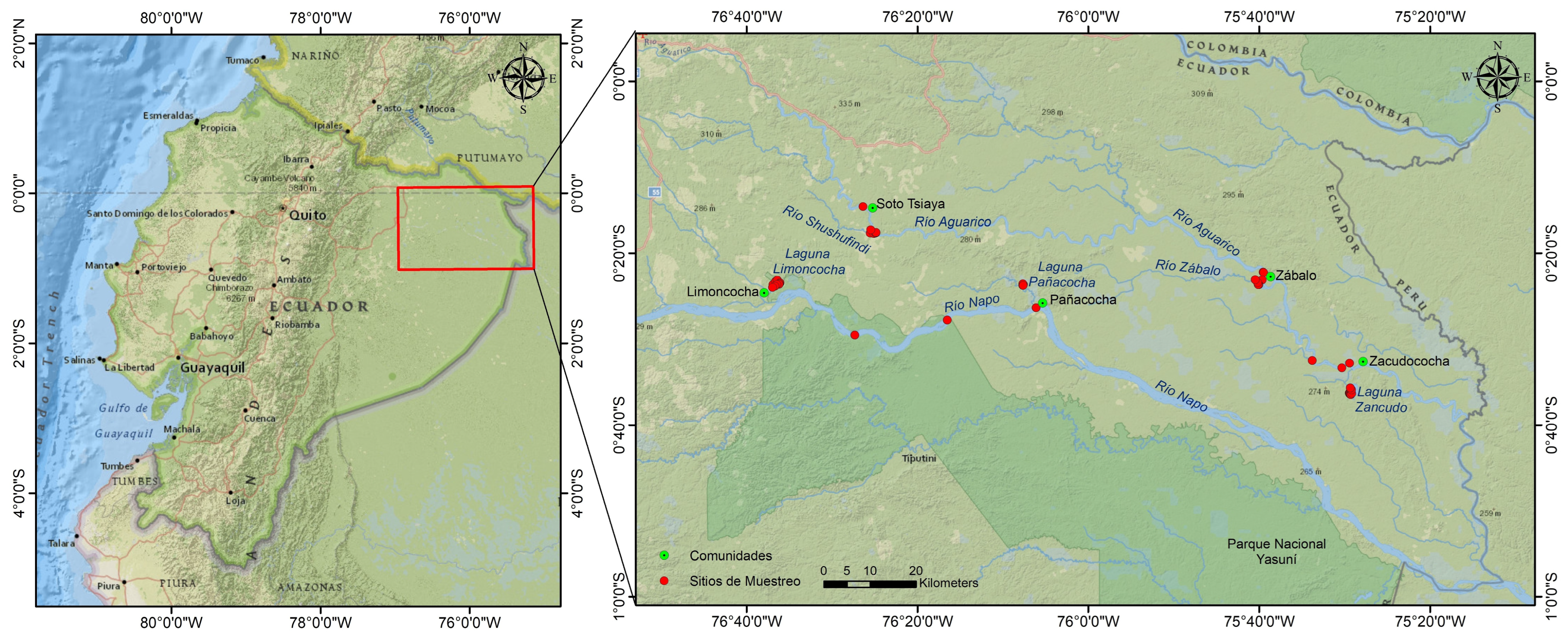
The study was carried out in the northern Amazon of Ecuador, in the basins of the Napo and Aguarico rivers, two of the main tributaries of the Amazon basin (Figure 1). In the Napo River, the Kichwa communities of Limoncocha and Pañacocha participated, both with a strong dependence on subsistence fishing. Limoncocha, located within oil block 15, faces degradation of water quality due to oil exploitation activities. Pañacocha, a community to which there is only river access, combines subsistence and commercial fishing with agricultural activities.
Figure 1.
Location of the participating communities and the sampled water bodies in the basins of the Napo and Aguarico rivers, northern Amazon of Ecuador.
In the Aguarico River, work was carried out with the Siona de Soto Tsiaya, Kicwa de Zancudococha and Cofán de Zábalo communities. Soto Tsiaya, due to its proximity to oil palm plantations and oil blocks, presents great environmental pressure; however, they have also developed community tourism initiatives such as SIONA-TOUR, which seek to articulate cultural and environmental conservation with sustainable economic alternatives [17]. Zancudococha combines subsistence fishing, ecotourism activities and agriculture of coffee, corn and especially cocoa, its main source of income. In this community, its high organizational capacity and adaptation to cultural and environmental changes stands out, which has allowed it to sustain its subsistence activities and strengthen community processes in the Aguarico basin [18]. Sustainable ecotourism and agriculture practices are also developed in the community of Zábalo, highlighted by its recognized track record in the management of Podocnemis turtles, as well as by an adaptive management system that, for more than two decades, has managed to keep wildlife populations stable and growing [19]. In Aguarico, both Zábalo and Zancudococha have a greater community organization and a comprehensive vision of natural resource management. Sototsiaya and Zábalo spend fewer hours fishing (between 11 and 15) while Pañacocha and Limoncocha spend more hours (27 to 29), while Zancudococha spends 23 h per month on average. On the other hand, Zábalo and Zancudococha have already established some management measures, such as the prohibition of fishing in Zancudococha and the establishment of family quotas [20].
The fishing sites were defined jointly with the communities, prioritizing the bodies of water of greatest importance for their food security. In all the rivers sampled, the sinners delimited stretches of approximately 5 km in length per body of water, which represent the areas effectively used for subsistence fishing. In the Napo basin, the community of Pañacocha selected a section of the Napo River and the Pañacocha lagoon, while in Limoncocha, only its eponymous lagoon was sampled. In the Aguarico River, the Soto Tsiaya community included the Shushufindi River and the Aguarico River, downstream of the community; in Zábalo, fishing was conducted in the Zabalo River and a section of the Aguarico River; and in Zancudococha within the Zancudo lagoon and a section of the Aguarico.
2.2. Specimen Sampling and Collection Design
The sampling was carried out under a participatory approach with the communities. In each locality, the fishermen defined the collection sites based on their cultural and food importance, which ensured the inclusion of the most relevant water bodies for community food security. The fishing journeys were carried out jointly with the communities during three hydrological phases: rising waters (Feb–Mar), high waters (Jul–Aug), and falling waters (Sep–Oct), which were selected based on the fishers’ ecological knowledge of the fish reproductive cycles and activities [20]. Catches were made using choke nets (2.5 to 8 inch meshes), castnets, and hooks of different sizes (n° 1–7), in fishing journeys of approximately 48 h per fishing site. Fish collection was conducted with fish permit MAATE-ARSFC-2024-0411.
Standard length and total weight were recorded for each specimen. The gonads were extracted in the field, and their state of maturity was determined, according to the classification proposed by [21], and confirmed with the local fishermen. Subsequently, the gonads were weighed with a precision balance (0.01 g), preserved in 10% formaldehyde for subsequent analysis of fertility and oocyte size in the laboratory.
2.3. Reproductive Parameters
To characterize the reproductive dynamics of the fish species, sex proportions and sexual maturity stages were plotted by hydrological phases, and Chi2 tests were then performed to evaluate differences between sex proportions and among sexual maturity stages. In the laboratory, oocyte counts and fertility estimates were performed from subsamples of preserved gonads. The gonadosomatic index (GIS) was calculated as an indicator of sexual maturity and reproductive energy investment [21], and maturity sizes (L50) were estimated using binomial logistic models based on 999 iterations implemented in the sizeMat package V.1.1.2 in R [22]. These parameters allowed the identification of reproductive periods and the establishment of references for minimum catch sizes, respectively. Fecundity estimates were limited to species with sufficient sample size and availability of individuals in appropriate reproductive stages, ensuring the robustness of the analyses.
2.4. Population Structure and Length-to-Weight Relationships
To characterize the structure of the populations of the species of fishing interest, size frequency histograms were constructed by hydrological phase, and linear regression models were adjusted to estimate length–weight relationships (coefficients a and b), to infer isometric or allometric growth patterns [23,24]. These relationships allow the assessment of the body condition, energy allocation and vulnerability of species to fishing pressure and environmental conditions [23]. In addition, population parameters derived from size distributions and length-to-weight relationships have been widely used to identify species with reduced fecundity or high susceptibility to overfishing, particularly in tropical river systems [21,25].
In order to examine whether different fishing pressures have effects on the structure of fish stocks, the average sizes for those species distributed in more than two bodies of water, and with sample sizes greater than 10 individuals, were compared, using Dunn’s post hoc tests, implemented with the R [26] with the FSA package V.0.10.1 [27]. Additionally, total fish biomasses between water bodies were compared using a Kruskal–Wallis test, widely used to contrast differences in abundances and biomasses when the data do not meet normal assumptions [28].
2.5. Participatory Surveys and Workshops
In order to complement ecological information and strengthen community participation, perception surveys were applied to fishermen in the five communities under study. These surveys collected information on fishers’ perception of the priority species to be monitored, the priority water bodies, the ideal duration of monitoring programs, the missing information to improve management, and the activities that should be integrated into the monitoring (File S1). Participation was voluntary and anonymous, with informed consent, and the responses were analyzed qualitatively.
As an integral part of the participatory approach, community fisheries monitoring workshops were developed in the Aguarico River basin, integrating the communities of Soto Tsiaya, Zábalo and Zancudococha. Another workshop was held in the Napo River basin; integrating the Pañacocha and Limoncocha communities. In these workshops, participants practiced species identification, recording of sizes and weights, determination of sex and maturity status, and filling out standardized forms (File S2). Performance was evaluated using a rubric that qualified criteria such as taxonomic identification, accuracy in the recording of localities, accuracy of sizes and weights, reproductive classification and completeness of records (File S3).
The information generated in the surveys and workshops was integrated with the reproductive and population analyses collected to develop management recommendations and support the construction of community fisheries agreements in the study basins.
Finally, Grok 4 was used to prepare the graphical abstract.
3. Results
3.1. Reproductive Parameters
3.1.1. Sex Proportions and States of Sexual Maturity, and Gonadosomatic Index
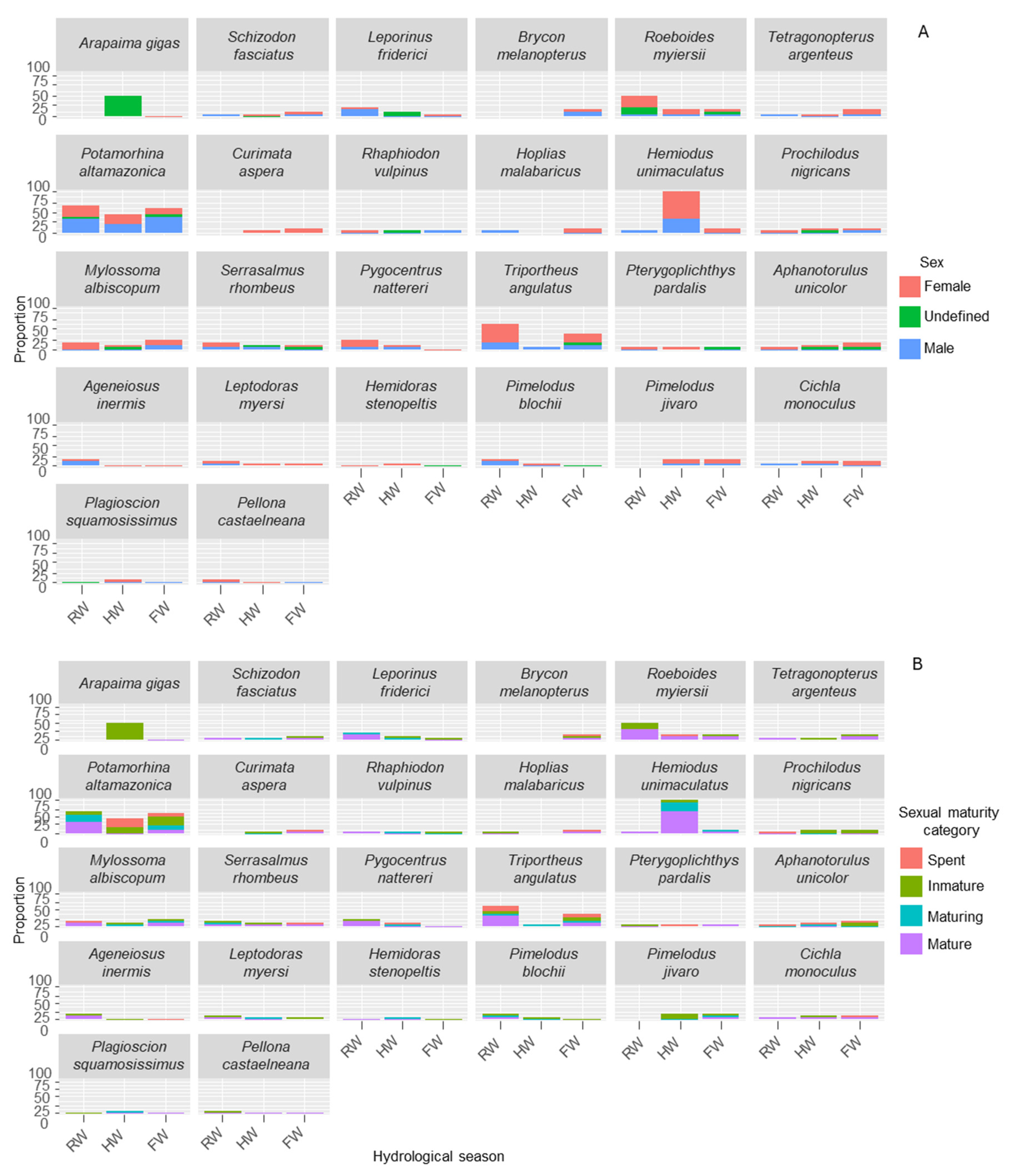
A total 29 of species were analyzed in the five communities. Sex proportions varied between species (X2 = 252.28, p ˂ 0.01) and hydrological phases (X2 = 21.79, p ˂ 0.001). During rising waters, Characiformes such as Schizodon fasciatus, Brycon melanopterus and Hemiodus unimaculatus presented balanced proportions of males and females. However, for Ageneiosus inermis, H. unimaculatus, Leporinus friderici, Leptodoras myersi, and Schizodon fasciatus, females were dominant in high water and in low water (Figure 2A). In general, the populations of Pimelodus blochii and Tegragonopterus argenteus showed a dominance of males. The population of Plagioscion squamosissimus showed a total dominance of undefined during rising waters, very similar proportions of males and females in high waters, and a dominance of females in falling waters. In Loricariidae (Pterygoplichthys pardalis and Leptodoras myersi) a low proportion of males was recorded.
Figure 2.
Proportions of (A) sexes and (B) maturity states for 26 species of sustenance fisheries in the northern Amazon during three hydrological phases.
The highest proportion of sexually mature individuals was observed during the rising water phase (Figure 2B). This was supported by the Chi2 test, which indicated a significant dependence relationship between the state of maturity and the hydrological phase (X2 = 170.96, p ˂ 0.001). However, no differences were observed between the proportions of maturity states between species for the entire study period (X2 = 891.33, p = 0.95). IGS values were estimated for 18 species. Fourteen species showed peaks during rising waters, four during high waters, and seven during retreat (Table 1).
Table 1.
Average gonadosomatic indices per hydrological phase for 18 fish species.
3.1.2. Fertility and Egg Size
Fertility and oocyte diameters were estimated for 50 species of subsistence and commercial importance revealing substantial interspecific variability (Table 2). Maximum fecundity values were recorded in Hemiodus unimaculatus (877,276 oocytes) and Pseudoplatystoma punctifer (>1,000,000 oocytes), while species within the family Loricariidae exhibited markedly lower fecundity (47–36,938 oocytes) combined with large oocytes sizes (0.53–1.98 mm). This contrast reflects divergent reproductive strategies among taxa, with high-fecundity species characterized by the production of numerous small oocytes, and low-fecundity species investing in fewer, large oocytes. These patterns suggest differences in reproductive investment and potential vulnerability to fishing pressure across species.
Table 2.
Average fecundity and oocyte diameter of 50 species from subsistence fisheries in the northern Amazon of Ecuador.
3.1.3. Average Length of Sexual Maturity (L50)
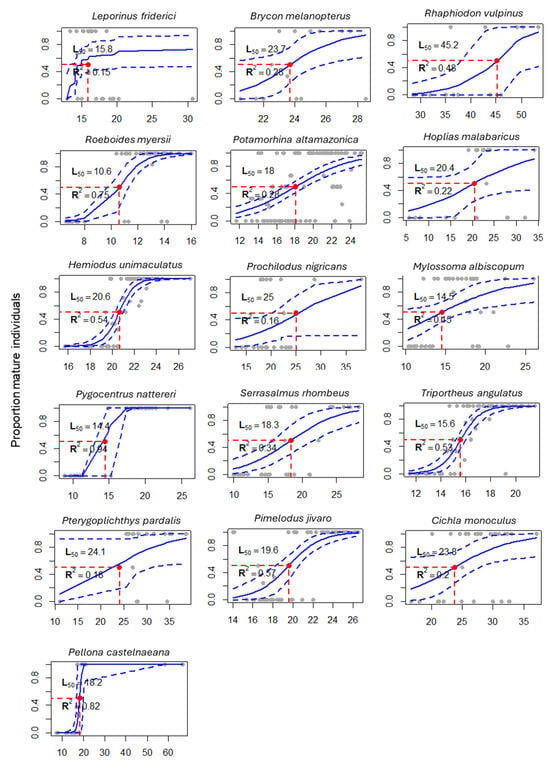
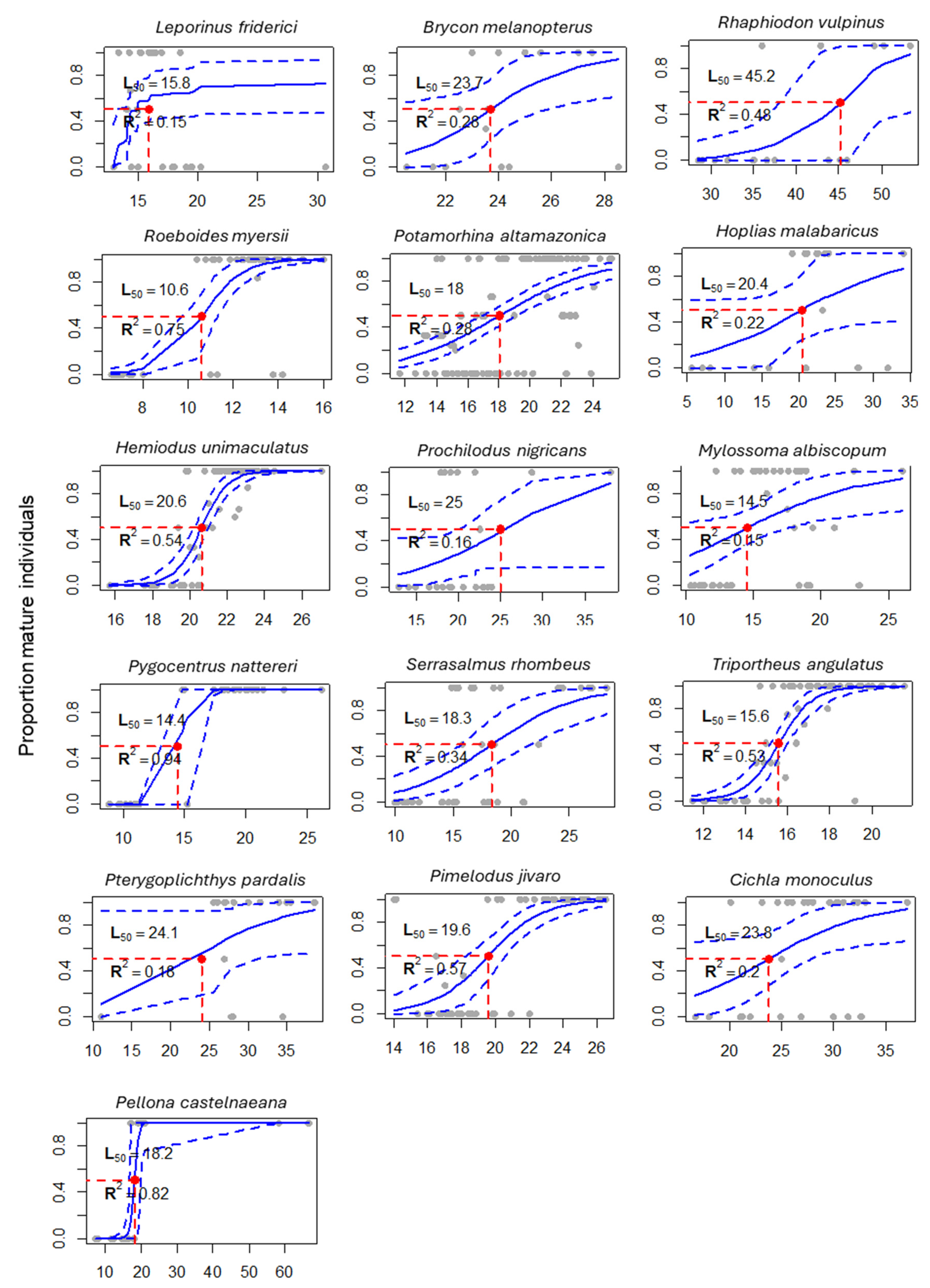
Mean maturity sizes (L50) were calculated for 16 species with N ≥ 15 (Figure 3). The models showed different adjustments, which was attributed to very different size distributions for some species such as Potamorhina altamazonica or Leporinus friderici, which were dominated by individuals at the upper and lower ends of the standard lengths. Prochilodus nigricans presented an L50 of 25 cm, while Mylossoma albiscopum reached 14.5 cm.
Figure 3.
Logistic and L50 model curves of 16 subsistence fisheries species. The red dashed lines and dot signal the position of the L50 value. The blue solid lines indicates the models’ curves, and the blue dashed lines represent the confidence intervals at 95%.
3.2. Population Structure
3.2.1. Size Distributions and Total Biomasses
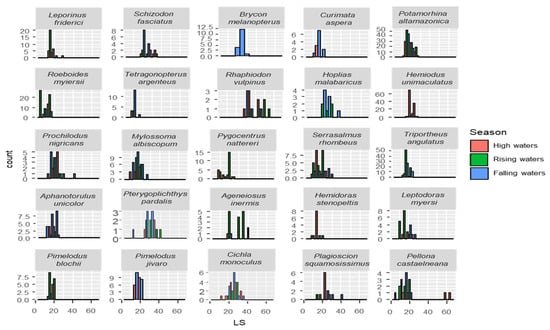
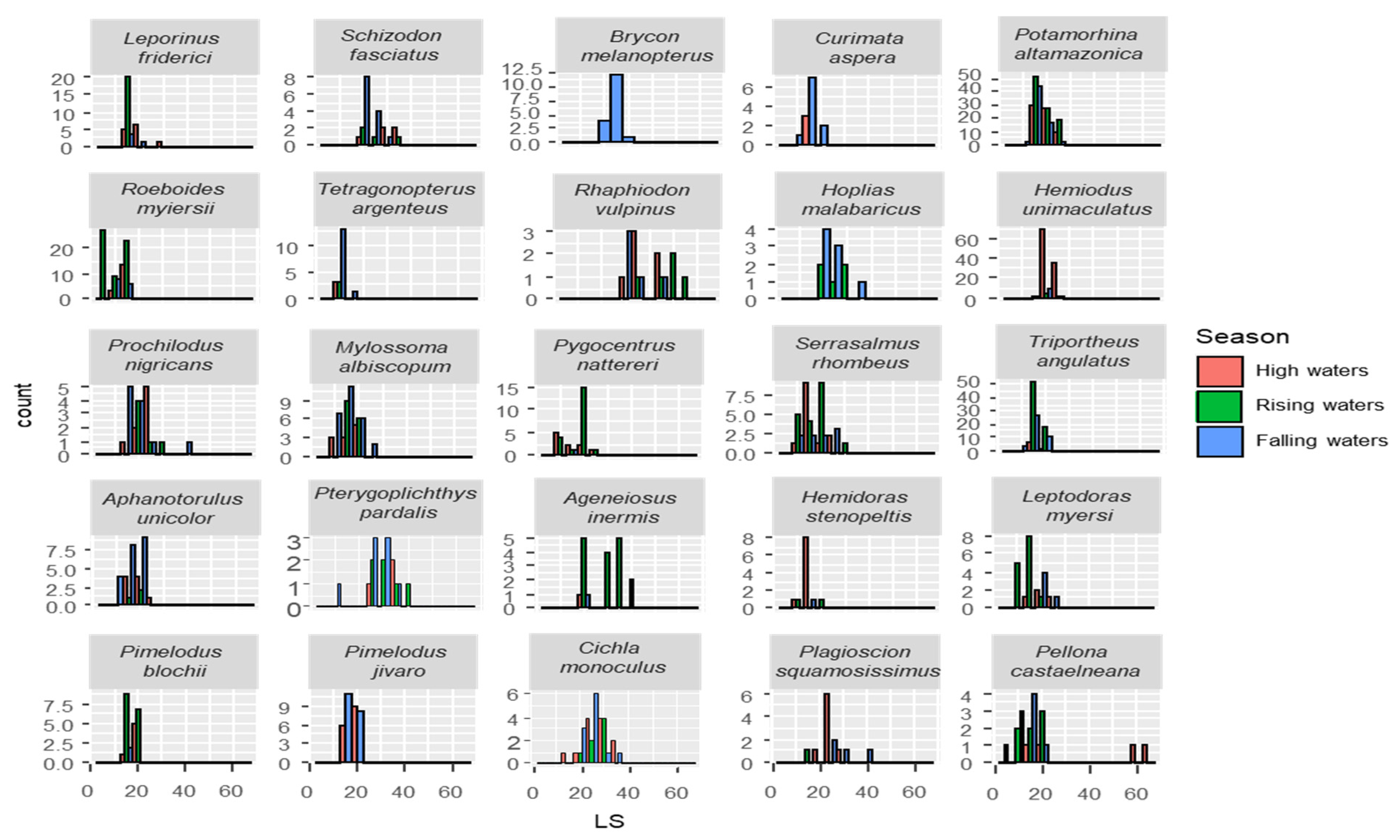
Size distributions showed definite patterns between species and varied consistently between hydrological phases (Figure 4). Among Characiformes, Curimata aspera, Mylossoma albiscopum, Prochilodus nigricans and Serrasalmus rhombeus presented unimodal and bimodal distributions according to the species and the phase of the hydrological cycle. In M. albiscopum, the highest frequencies of larger individuals were concentrated during falling waters, while in rising and high waters, intermediate size classes predominated. S. rhombeus presented a relatively stable bimodal distribution, with recurrent peaks between 12–14 cm and 18–20 cm, although the relative frequency of large individuals was higher during falling waters.
Figure 4.
Histograms of sizes of 23 species of subsistence fisheries. The colors indicate the frequencies by size class for each hydrological phase.
In Prochilodus nigricans, the highest frequencies were concentrated between 10 and 25 cm standard length, with a higher proportion of larger individuals observed during high waters. In Potamorhina altamazonica, the distribution was dominated by small sizes in all phases, with a slight expansion towards larger classes during falling waters. In Loricariidae, Aphanotorulus unicolor showed a predominance of small sizes, although larger size classes were recorded more frequently during high water and retreat.
In Siluriformes, Pimelodus blochii and P. jivaro showed biased distributions towards larger classes, particularly during water withdrawal. Hypophthalmus edentatus was captured exclusively in large classes (>40 cm), with no evident variation between phases. Cichla monoculus showed a strong dominance of individuals between 20 and 30 cm, with a higher frequency of the upper classes during high waters. In Arapaima spp., most of the records corresponded to sizes less than 50 cm, with two large individuals during falling waters.
Comparisons with Dunn’s tests between hydrological phases detected significant differences between the sizes for Leporinus friderici between rising waters and high waters (Z = 3.2, p = 0.004), as well as for Roeboides myiersi (Z = −3.39, p = 0.002). In the case of P. altamazonica, marginally significant differences were detected between rising and falling waters (Z = 2.19, p = 0.056) and between high waters and falling waters (Z = 2.28, p = 0.067). For P. blochii, significant differences were found in the sizes between high water and falling waters (Z = 2.61, p = 0.03), while the differences were marginally significant between rising waters and falling waters (Z = −2.04, p = 0.08). Marginally significant differences were observed between ascent and high water (Z = −2.002, p = 0.09), and between high waters and falling waters (Z = 2.14, p = 0.098).
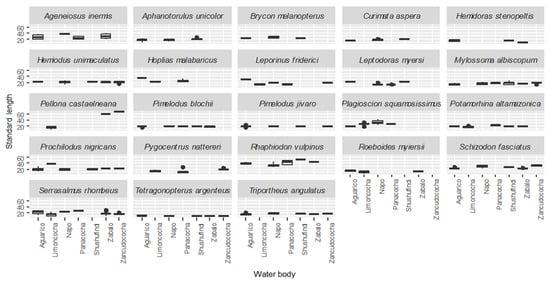
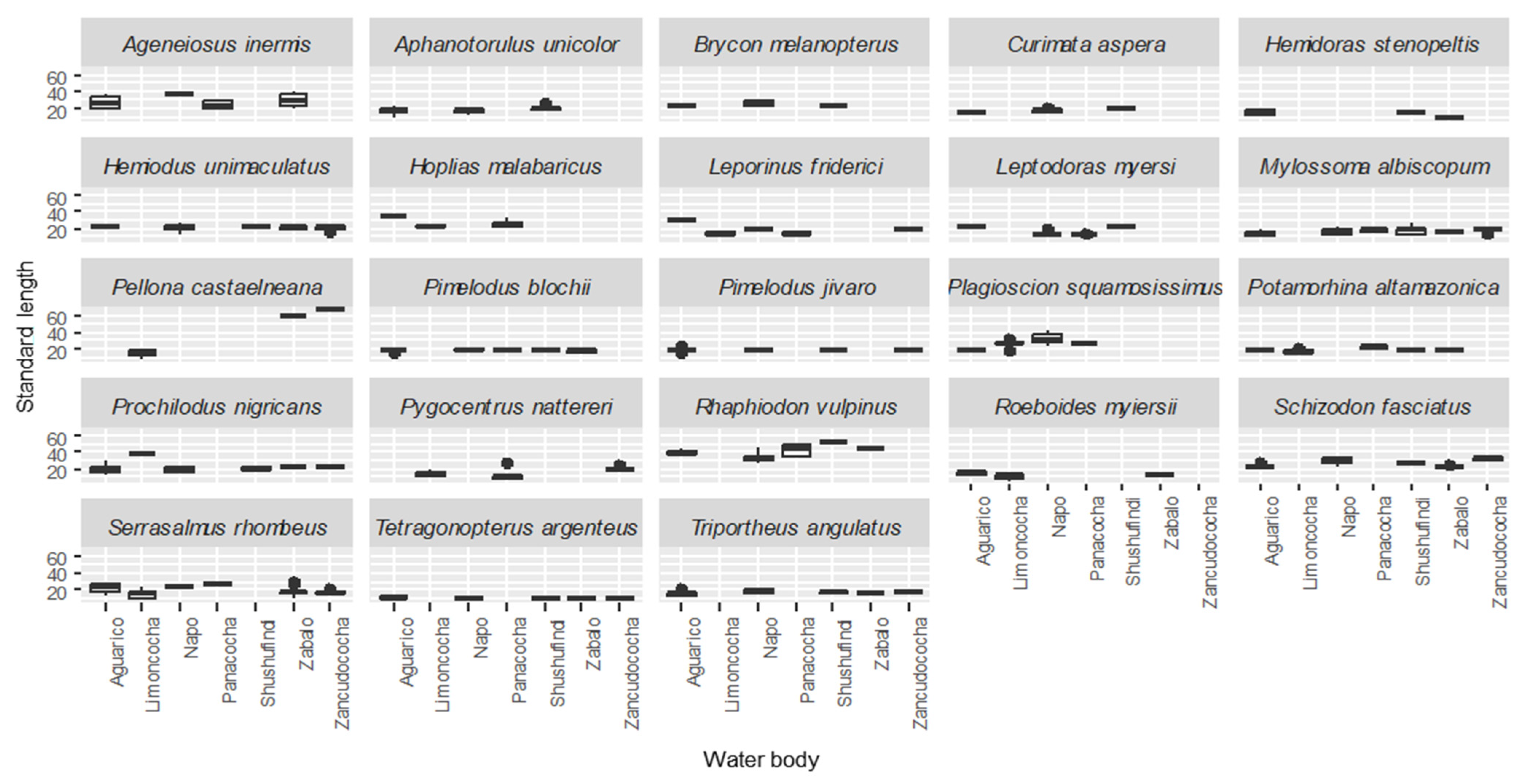
No significant differences were found in catch sizes between water bodies for Ageneiosus inermis, Brycon melanopterus; Curimata aspera, Hemidoras stenopeltis, Hemiodus unimaculatus, Hoplias malabaricus, Pimelodus blochii, P. jivaro, Plagioscion squamosissimus, Prochilodus nigricans or Serrasalmus rhombeus. For nine species, significant differences were detected in size distributions among some water bodies (Table 3). In general, the Zancudococha and Pañacocha lagoons and the Aguarico River tended to concentrate a higher proportion of larger individuals compared to the other water bodies, particularly during the high and falling waters (Figure 5). On the other hand, no significant differences were found in total fish biomasses between water bodies (Kruskal–Wallis test X2 = 20, df, p = 0.46).
Table 3.
Dunn’s test results for comparison of species sizes between bodies of water.
Figure 5.
Size boxplots per body of water for 23 species of subsistence fisheries. Black lines indicate the intervals and dots represent outliers.
3.2.2. Length-to-Weight Ratios (LWR)
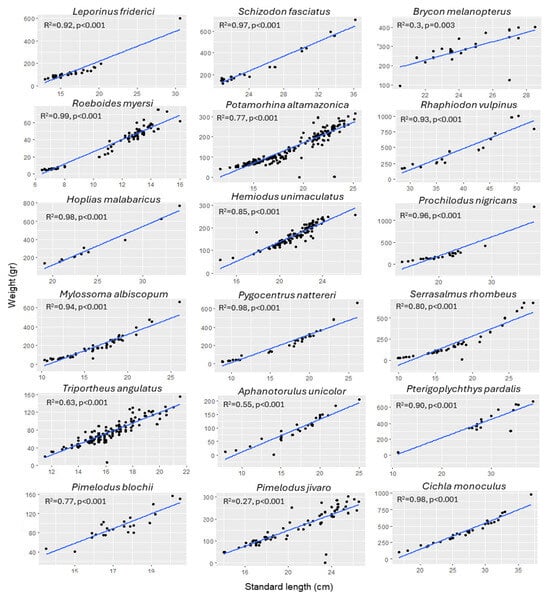
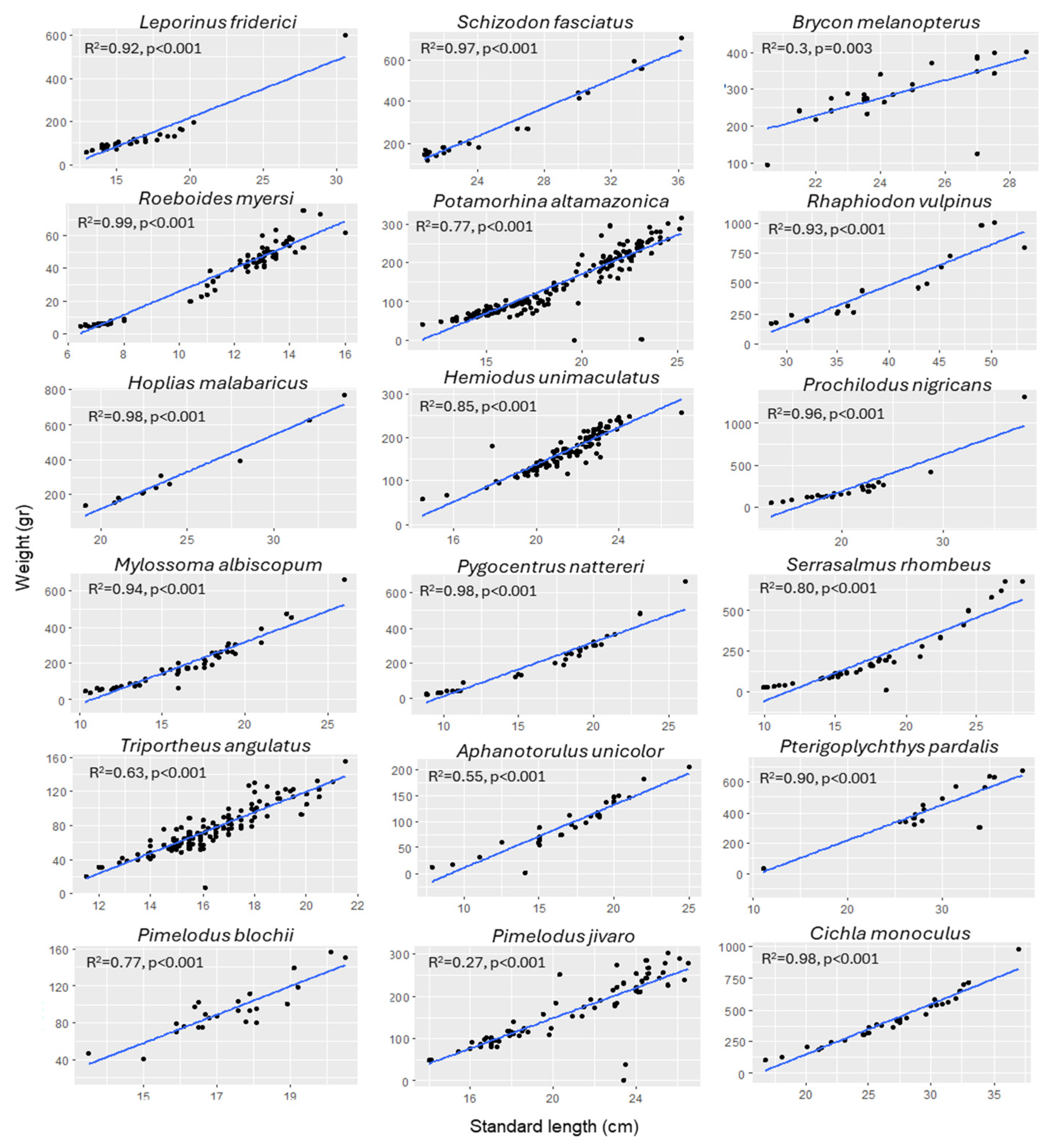
LWR models were generated for 19 species. In general, the height-to-weight ratios showed an adequate linear fit, with R2 values greater than 0.5 for most species (Figure 6). In Characiformes, all species presented consistent adjustments, except Brycon melanopterus, whose R2 decreased due to two outliers. Triportheus angulatus showed a similar pattern, but with better fit. However, for several species, greater dispersion is observed in the upper sizes, which suggest little representativeness of large specimens.
Figure 6.
Scatter plots of the height-to-weight ratios of 18 subsistence fisheries species. Black dots represent the fish specimens and blue lines are the regression lines of the models.
In Serrasalmidae (Mylosssoma albiscopum, Pygocentrus nattereri, Serrasalmus rhombeus), the models showed high R2 values, despite some outliers in plus sizes. In Siluriformes, Pimelodus jivaro presented reduced R2 with outliers; the rest of the species presented acceptable adjustments. Cichla monoculus showed the best fit of the set (R2 = 0.98). No models were generated for Arapaima sp. nor Pellona castelnaeana due to the absence of intermediate sizes. The coefficients a and b of the 19 species (Table 4) showed variation between 2.17 (Pimelodus jivaro) and 3.42 (Roeboides myersi) reflecting differences in growth patterns between species.
Table 4.
Coefficients a and b of the size–weight relationship of 19 species of fish from the sustenance fisheries of the northern Amazon of Ecuador.
Based on this information, recommendations were made by species on the following aspects: closed seasons, minimum catch sizes, and recommended fishing gear. These proposed community fisheries management measures are summarized (Table 5).
Table 5.
Proposed community fisheries management measures for priority species in the northern Ecuadorian Amazon. ♂; males; ♀: females.
3.3. Learning Performance of Fishers During Community Monitoring and Local Ecological Knowledge
3.3.1. Learning in Training and Workshops
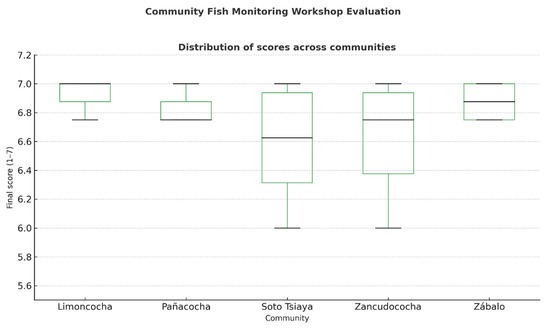
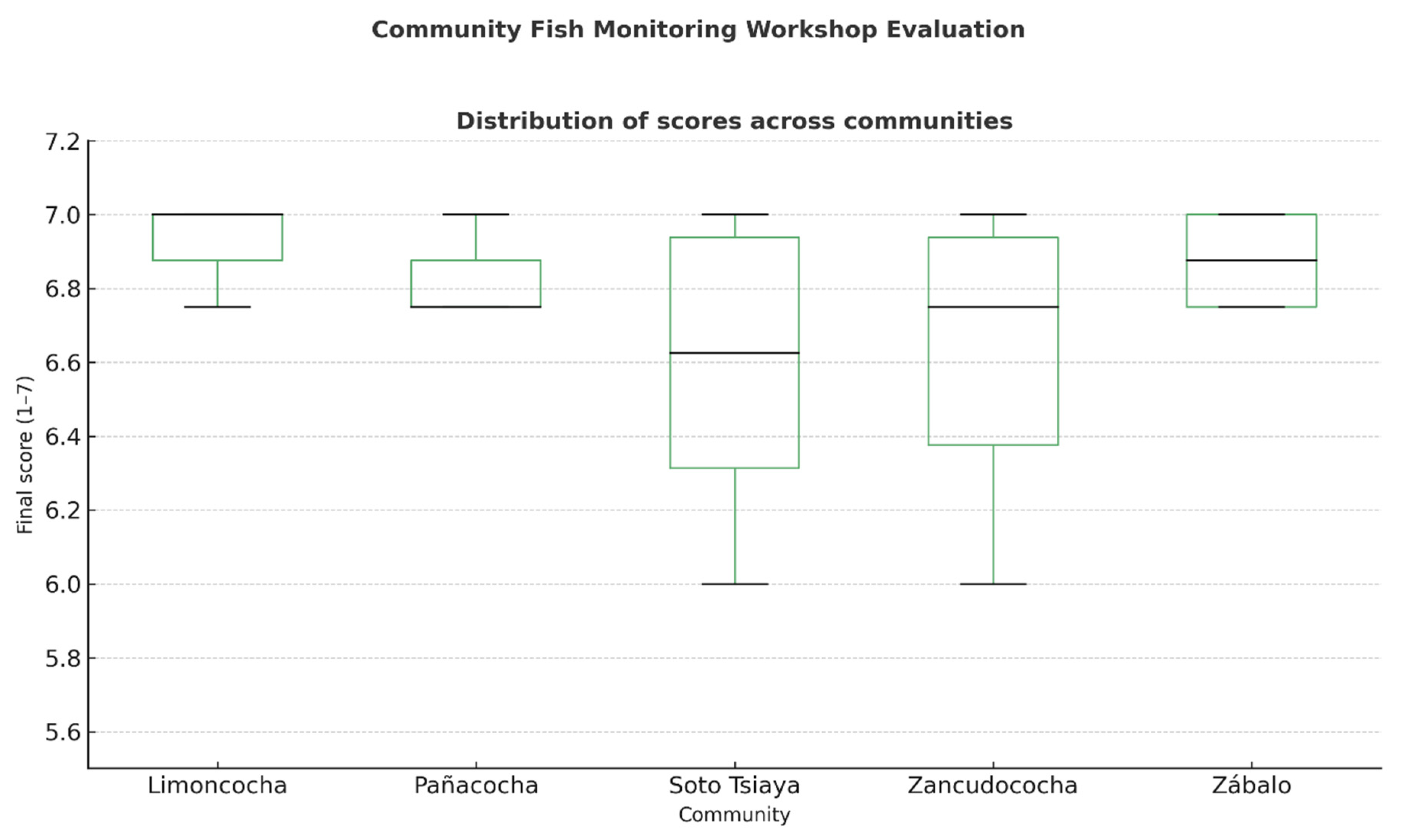
A total of 27 community monitors participated in the workshop (Limoncocha n = 7; Pañacocha n = 4; Soto Tsiaya n = 6; Zábalo n = 4; Zancudococha n = 6). The overall performance of this workshop was high, with final evaluations ranging from 6.0 to 7.0 with averages above 6.5 in all communities (Figure 7). The highest scores were recorded by participants from Limoncocha (6.93 ± 0.12) and Zábalo (6.88 ± 0.14), reflecting an excellent understanding of species identification procedures, size and weight records, and correct filling out of registration forms. The participants of Pañacocha also obtained excellent grades (6.83 ± 0.14), although with a smaller number of participants. The Soto Tsiaya (6.58 ± 0.41) and Zancudococha (6.63 ± 0.41) communities showed a greater dispersion of the ratings, mainly attributed to differences in the accuracy of taxonomic identification and the estimation of gonadal maturity status. This greater dispersion is expected during early training stages and reflects differences in the acquisition of technical skills among participants. Even so, the overall performance was consistently high, evidencing the appropriation of fisheries monitoring techniques and the effectiveness of the participatory teaching-learning approach.
Figure 7.
Distribution of the final grades of the fisheries monitoring training workshop among communities, showing the variability in the performance of the participants during the community fisheries monitoring workshop.
3.3.2. Community Perceptions of Fisheries Monitoring and Local Ecological Knowledge
In order to complement the technical evaluation of the workshop, a perception survey was applied to the community monitors participating in the process (n = 25). The survey allowed the identification of local criteria on priority species, relevant habitats, ideal duration of monitoring, information gaps, and complementary activities that communities consider necessary to strengthen fisheries monitoring programs described below.
The responses pointed to a clear general agreement on the importance of large migratory catfish for subsistence fisheries and their decreasing abundances, particularly lechero (Brachyplatystoma platynema), pintadillo (Pseudoplatystoma punctifer), and bagre guacamayo (Phractocephalus hemiolopterus), mentioned by nine of 25 participants (36%). Likewise, the bocachico (Prochilodus nigricans) was identified by six of 25 participants (24%) as a declining species, and the paiche (Arapaima sp.) was identified as a priority by six Kichwa participants (24%), either because of its vulnerability, related to its low fecundities, or because of its rapid population expansion in some communities. In the Cofán community of Zábalo, the tucunare (Cichla monoculus) was mentioned by four participants as a locally extinct or severely reduced species. In relation to the priority waterbodies for monitoring, the Aguarico River was identified by five participants (20%) encompassing the three nationalities as the most critical system for fishing and fish reproduction. The main lagoons (Limoncocha, Pañacocha, and Zancudococha) were mentioned by 5 Kichwa participants (20%), while the streams and creeks that feed these systems were highlighted by 5 out of 25 (20%) for their role as a refuge for juvenile fish. Siona participants tended to prioritize monitoring in relation to the impacts of oil fields.
The social and ecological relevance assigned to these spaces was reflected in statements by fishermen such as:
“Greater monitoring is needed in the Aguarico River, which is very polluted”(Fisher 003—Zancudococha)
“We need to have talks in the communities and the oil companies about how to conserve and not pollute”(Fisher 019—Limoncocha)
“We need awareness campaigns in the communities and socialization of the data obtained”(Fisher 020—Limoncocha)
A large majority of participants, independently of their nationality (18 out of 25; approximately 72%), agreed that fisheries monitoring should be maintained permanently for a long period of time (5–10 years), considering that hydrological cycles and fluctuations in abundance require long-term observations. The other participants (7 of 25; 28%) suggested a minimum duration of 1 to 3 years, prioritizing short-term outcomes.
Among the main needs expressed are the provision of basic equipment (scales, flashlights, field notebooks, boots, and raincoats), which was mentioned by 12 participants (48%), while the incorporation of instruments to monitor water quality and environmental conditions was indicated by 9 (36%). Likewise, the need to improve field logistics (transport, fuel, and food) was mentioned by 11 participants (44%), highlighting the importance of ensuring safe and sustained conditions for data collection.
4. Discussion
4.1. Hydrological Structuring of Population and Reproductive Dynamics
The population and reproductive parameters documented here reveal a hydrologically structured system in which life-history traits, growth patterns, and reproductive timing are tightly synchronized with the Amazonian flood pulse. The marked reproductive seasonality evidenced by the proportions of sexes, maturity stages, and the peaks of the gonadosomatic index (GIS) in 18 species during the rise in waters confirms that this period defines the dominant reproductive pulse of the system. This pattern is consistent with the flood pulse model, according to which rising water levels expand available habitat and improve juvenile larval survival [35,36]. In species of high fishing importance, such as Prochilodus nigricans, Brycon melanopterus, Hemiodus unimaculatus, and Pseudoplatystoma punctifer, the coincidence between high proportions of mature individuals and maximum IGS values during water rise justifies the implementation of temporary reproductive closures, as proposed in Table 5.
The estimated first maturity sizes (L50) constitute a first reference to define minimum catch sizes in Ecuador. When compared with values reported in neighboring basins, a remarkable regional agreement is observed. P. nigricans and H unimaculatus have L50 similar to those reported for the Colombian Putumayo, the Brazilian Amazon, and the Peruvian Ucayali [37,38,39], suggesting that the biological patterns detected reflect watershed-scale processes. However, for several species, logistic models showed low coefficients of determination (R2), evidencing a limited fit mainly due to reduced sample sizes and incomplete coverage of size classes. Consequently, L50 estimates should be considered preliminary and used as an initial baseline that should be refined through continuous sampling and a greater representation of mature individuals, which is feasible within the community monitoring scheme in the medium term, in order to update the preliminary minimum capture sizes proposed in Table 5.
The wide variability observed in fecundity and oocyte size reflects the coexistence of contrasting strategies, according to the theoretical framework of Winemiller and Rose [39,40] and Winemiller and Taphorn [25,39]. Species such as Potamorhina altamazonica, P. nigricans, and Hemiodus unimaculatus correspond to periodic strategies (r2), with high fecundity, small oocytes, and reproduction synchronized with the hydrological pulse, which allows them to exploit favorable environmental windows. In contrast, opportunistic species (r1), such as Roeboides myersii, have intermediate fecundities and can reproduce more than once a year, facilitating rapid recolonization of disturbed environments. Finally, the Loricariidae (Panagolus dentex, Loricariichthys sp., Aphanotorulus unicolor) and Arapaima sp. represent K-type strategies, with extremely low fecundities, large oocytes, and, in many cases, parental care, which increases early survival, but makes them highly vulnerable to overfishing [36,41]. This functional structuring implies that management rules must explicitly differentiate between ecological groups to avoid irreversible population collapses.
The length-to-weight ratios (LWR) obtained constitute the first set of biometric parameters for multiple species in the Ecuadorian Amazon and allow the evaluation of isometric and allometric growth patterns. Several species showed b coefficients close to 3 (isometric growth), while others presented positive or negative allometry, reflecting differences in body condition, energy allocation, and possibly fishing pressure. Comparisons with studies from the Colombian Putumayo [15] and the Brazilian Amazon [42,43] indicate that variations in the coefficients a and b may reveal changes in the size structure and nutritional status of populations, associated with both environmental factors and exploitation. In this sense, the parameters generated here make it possible to assess future trends and facilitate assessments at the cross-border level. Collectively, these biological baselines not only clarify the ecological functioning of key subsistence species but also provide the empirical foundation necessary for hydrologically informed and strategy-sensitive fisheries management in the northern Amazon. Overall, these findings show that hydrological dynamics shape the population structure and reproductive patterns across water bodies.
4.2. Fishing Pressure and Local Management as Drivers of Population Structure
The differences in size distributions between waterbodies, with larger individuals concentrated in the Aguarico River and the Zancudococha Lagoon, are consistent with spatial gradients of fishing pressure documented across the Amazon. Regional studies demonstrate that increased accessibility and commercial exploitation are associated with progressive reductions in mean size and truncated population structures [44,45]. Although environmental factors such as habitat connectivity and productivity may also influence size structure, the observed contrasts align with differences in local fishing intensity and community-level restrictions. In the Napo basin, the contrast between Pañacocha and Limoncocha, and in the Aguarico between Zancudococha and more accessible sectors, suggests that community-imposed limits on commercial fishing may be functioning as effective broodstock refuges. Similar ecological outcomes have been documented in Brazilian várzea systems under community-based fishing agreements [46]. This analysis facilitated the identification of those communities where the management of each species should be prioritized (Table 5). These findings indicate that localized governance arrangements can generate measurable population-level effects, supporting the role of community-based management as a viable pathway toward sustainability in data-limited tropical fisheries.
4.3. Integrating Fisher’s Ecological Knowledge with Biological Indicators
From a socio-ecological perspective, the convergence between biological evidence and fishers’ ecological knowledge (FEK) strengthens the legitimacy and practical relevance of proposed management measures. The prioritization by communities of large migratory catfish and key water bodies such as the Aguarico River aligns with quantitative findings showing high fecundity, migratory behavior, and increased vulnerability of these species to overexploitation. This correspondence suggests that local ecological knowledge reflects long-term experiential observations of population dynamics and seasonal reproductive pulses [47].
Importantly, the alignment between perceived reproductive seasons and peaks in gonadosomatic indices reinforces confidence in temporally adaptive management measures, including seasonal closures [20]. While scientific monitoring provides standardized metrics, FEK contributes fine-scale spatial and temporal insights that are often inaccessible through short-term sampling campaigns. The integration of both knowledge systems, therefore, reduces uncertainty in data-limited contexts and enhances the social legitimacy of regulatory decisions for the management of poor-data fisheries in the tropics [48].
Regional experiences in Brazil, Peru, and Colombia demonstrate that community fisheries agreements supported by participatory monitoring can increase fish size, biomass, and catch stability, generating ecological resilience alongside improved livelihoods [9,49]. In this sense, the convergence observed here is not merely descriptive but represents a critical precondition for adaptive co-management, where shared understanding of ecological processes facilitates collective action and compliance.
Although a strong convergence was observed between fishers ‘ecological knowledge and biological indicators, potential discrepancies may arise due to differences in temporal and spatial scales. Fishers’ knowledge reflects long-term cumulative observations, whereas biological data represent specific sampling periods. Cross-validation can be achieved through iterative monitoring processes in which local knowledge informs sampling design and biological data refine and validate local observations, strengthening adaptative management in data-limited systems.
4.4. Participatory Monitoring as a Mechanism for Adaptive Governance
Participatory monitoring in this study functioned not only as a tool for data collection but as a process of institutional capacity building. The progressive improvement observed in fishers’ technical skills, including species identification, biometric measurements, and data recording, in combination with their interest and ideas for fisheries monitoring, demonstrates the feasibility of decentralized monitoring systems in remote Amazonian contexts. Such capacity development reduces dependency on external researchers and enhances the long-term continuity of ecological assessments. Despite these strengths, participatory monitoring programs may be subject to potential measurement errors and observer biases, particularly in early implementation stages. These biases can arise from differences in taxonomic identification, estimation of gonadal maturity, or variability in measurement precision among participants. However, such limitations can be effectively reduced through standardized training, the use of unified data collection protocols, initial technical supervision, and periodic cross-validation of records. In this study, the overall high performance observed among community monitors suggests that these potential biases can by progressively minimized through practice, feedback, and continuous capacity-building. Therefore, data quality in community-based monitoring should be understood as a dynamic process that improves over time rather than a fixed limitation. However, certain aspects, such as long-term funding, conflicts among communities and ethnicities, should be considered in the design of participatory monitoring [50].
Beyond technical training, participatory processes facilitated collective reflection on seasonal dynamics, vulnerable species, and the need for spatial or temporal restrictions. This shared analytical space is central to adaptive governance, as it promotes transparency, co-production of knowledge, and increases compliance with locally agreed regulations [51]. In data-limited fisheries, where formal enforcement is often weak as a result of limited financial resources and logistic restrictions [52], social legitimacy and community engagement become decisive factors for sustainability. By strengthening local monitoring capacity and aligning biological indicators with community perceptions, the process documented here contributes to the institutional conditions necessary for adaptive co-management [53]. The documented convergence between biological indicators and fishers’ knowledge, together with demonstrated improvements in technical skills, demonstrates that participatory monitoring enhances the institutional conditions necessary for adaptive fisheries governance.
4.5. From Baseline Assessment to Community Fisheries Agreements: A Replicable Model
By integrating reproductive indicators, population structure metrics, biometric parameters, and fishers’ ecological knowledge, this study translates ecological evidence into operational guidance for community fisheries governance. The proposed closures, minimum catch sizes, and spatial zoning measures outlined in Table 5 represent an initial step toward formalized community fisheries agreements grounded in biological thresholds and locally validated priorities. This approach bridges the gap between scientific assessment and institutional decision-making, providing a structured pathway from baseline characterization to rule implementation.
Although some reproductive parameters, including L50 estimates for certain species, remain preliminary due to limited sample sizes and restricted temporal coverage, these constraints are inherent to data-limited tropical fisheries. Rather than undermining the framework, they highlight the importance of continued participatory monitoring to progressively refine biological benchmarks and adjust management measures. The institutionalization of community-based monitoring thus transforms static baseline recommendations into a dynamic and adaptive governance system. Environmental drivers such as water quality, habitat connectivity, and forest cover change were not directly assessed in this study but represent key factors influencing fish population dynamics. Incorporating these variables into future research will be essential to better understand ecological processes, particularly in relation to spatial data, including water quality metrics and landscape-level indicators, would strengthen the interpretation of population patterns and enhance the development of more robust adaptative management strategies.
In this sense, the framework presented here moves beyond descriptive assessment and offers a replicable socio-ecological model for small-scale inland fisheries, where biological uncertainty and limited state capacity often constrain formal regulation. By coupling scientific baselines with local knowledge and capacity building, this model contributes to long-term fisheries sustainability and the strengthening of food security in the Amazon basin.
5. Conclusions
This study establishes the first integrated socio-ecological baseline for inland fisheries in the northern Ecuadorian Amazon, combining reproductive parameters, population structure, length–weight relationships, and fishers’ ecological knowledge. The documented reproductive synchrony during rising waters, the marked heterogeneity in life-history strategies, and the spatial structuring of sizes and biomass support the hypothesis that Amazonian fisheries are shaped by the interaction between hydrological dynamics and fishing intensity. These findings confirm that biologically critical periods and areas can be identified through integrated ecological assessment.
The results provide a technical foundation for adaptive community-based management, including seasonal reproductive closures, minimum catch sizes, and the protection of key habitats such as lagoons and tributaries of the Aguarico River. The convergence between biological indicators and locally identified priorities demonstrates that fishers’ ecological knowledge is not only compatible with fisheries science but essential for decision-making in data-limited systems. Furthermore, the implementation of participatory monitoring supports the hypothesis that capacity building and knowledge co-production strengthen the institutional conditions necessary for adaptive fisheries governance. Although some reproductive estimates, particularly L50 values, remain preliminary due to sample size constraints, the established monitoring framework offers a scalable mechanism to refine benchmarks over time. Rather than limiting interpretation, these constraints underscore the importance of continuous community-based data collection as a foundation for dynamic rule adjustment. In this sense, the approach presented here moves beyond descriptive assessment and proposes an operational pathway from biological baseline to community fisheries agreements, contributing simultaneously to biodiversity conservation and food security in tropical river systems.
Amazonian fish stocks face multiple and interacting threats, including habitat degradation driven by hydrological alteration, connectivity loss, and deforestation; pollution associated with mining, oil extraction, and wastewater discharge, linked to heavy metal contamination in several species [54]; overexploitation; and the expansion of introduced species such as Oreochromis spp. These pressures increase the urgency of implementing locally grounded and ecologically informed management strategies. Although Ecuador has established regulatory instruments such as the 2003 Fisheries and Aquaculture Management Plan, the 2018 National Fisheries Resources Plan, and the 2020 Organic Law for the Development of Aquaculture and Fisheries, these frameworks have historically focused on marine-coastal fisheries, with limited attention to inland systems. Effective regulation of Amazonian freshwater fisheries, therefore, requires incorporating the LEK of Indigenous and riparian communities and aligning national policy with locally validated management practices. By bridging scientific evidence, participatory monitoring, and community priorities, this study contributes a replicable socio-ecological model capable of informing both local agreements and broader policy reform for sustainable Amazonian fisheries.
Supplementary Materials
The following supporting information can be downloaded at: https://www.mdpi.com/article/10.3390/su18094180/s1, File S1: Perception Survey on Fisheries Monitoring Needs; File S2: Fishery Data Collection Worksheet; File S3: Community Fisheries Monitoring Course—Napo and Aguarico Rivers: evaluation of community fisheries monitoring practice.
Author Contributions
Conceptualization, G.E., F.S.-O. and R.Y.; methodology, F.S.-O., J.V.-R. and D.G.-C.; analysis, G.E.; investigation, F.S.-O. and G.E.; resources, R.Y.; data curation, G.E.; writing—original draft preparation, F.S.-O.; writing—review and editing, G.E. and T.G.; visualization, G.E.; supervision, G.E.; project administration, G.E.; funding acquisition, G.E.; Validation: T.G. All authors have read and agreed to the published version of the manuscript.
Funding
This research was funded by WWF through the grant EC19110, and by Universidad de Las Américas with the grant 515.C.XIV.24.
Institutional Review Board Statement
This study was carefully reviewed and exempted from ethical approval by the Research Ethics Committee on Human Beings of Universidad de Las Américas (CEISH—UDLA), code 2025-OBS-001, approved on 28 March 2025, due to its non-invasive nature and because the information gathered is not related to any aspect of the health or private life of those involved. Written consent was requested from the fishers before they filled out the questionnaire. Fishes were manipulated and collected following the laws by Ecuador and the Ministry of Environment, with the fishing permit MAATE-ARSFC-2024-0411.
Informed Consent Statement
Informed consent was obtained from all fishers involved in the study.
Data Availability Statement
The raw data supporting the conclusions of this article will be made available by the authors upon request, after authorization from Universidad de Las Américas and World Wildlife Fund Ecuador.
Acknowledgments
The authors thank WWF and UDLA for providing the funds for this research, and for their collaboration with the logistics of the field trips. We thank Francisco Cuesta and blanca Ríos-Touma for their inputs during the early stages of this research. Thanks to the communities of Limoncocha, Pañacocha, Soto Tsiaya, Zábalo and Zancudococha, their fishers, and their presidents, for their collaboration with the fishing journeys and for their hospitality. During the preparation of this manuscript, the authors used Chat GPT 5.2 for the purposes of checking spelling and grammar, and Grok 4 was used to prepare the graphical abstract. The authors have reviewed and edited the output and take full responsibility for the content of this publication.
Conflicts of Interest
The authors declare no conflicts of interest.
Abbreviations
The following abbreviations are used in this manuscript:
| FEK | Fishers’ Ecological Knowledge |
| GIS | Gonadosomatic Index |
| LWR | Length–Weight Relationships |
References
- Oberdorff, T.; Dias, M.S.; Jézéquel, C.; Albert, J.S.; Arantes, C.C.; Bigorne, R.; Carvajal-Valleros, F.M.; De Wever, A.; Frederico, R.G.; Hidalgo, M.; et al. Unexpected Fish Diversity Gradients in the Amazon Basin. Sci. Adv. 2024, 5, eaav8681. [Google Scholar] [CrossRef] [Scilit] [PubMed]
- Rivera-Parra, J.L.; Beate, B.; Diaz, X. Artisanal and Small Gold Mining and Petroleum Production as Potential Sources of Heavy Metal Contamination in Ecuador: A Call to Action. Int. J. Environ. Res. Public Health 2021, 18, 2794. [Google Scholar] [CrossRef] [Scilit] [PubMed]
- Capitani, L.; Angelini, R.; Keppeler, F.W.; Hallwass, G.; Azevedo, R.; Silvano, M. Food Web Modeling Indicates the Potential Impacts of Increasing Deforestation and Fishing Pressure in the Tapajós River, Brazilian Amazon. Reg. Environ. Change 2021, 21, 42. [Google Scholar] [CrossRef] [Scilit]
- Reis, R.E.; Albert, J.S.; Di Dario, F.; Mincarone, M.M.M.; Petry, P.L.; Rocha, L.R. Fish Biodiversity and Conservation in South America. J. Fish Biol. 2016, 89, 12–47. [Google Scholar] [CrossRef] [Scilit]
- Baigún, C.; Valbo-Jorgensen, J. (Eds.) La Situación y Tendencia de las Pesquerías Continentales de América Latina y el Caribe; FAO Documento Técnico de Pesca y Acuicultura 677; FAO: Rome, Italy, 2023; pp. 229–238. [Google Scholar]
- Vasco, C.; Sirén, A. Determinants of Wild Fish Consumption in Indigenous Communities in the Ecuadorian Amazon. Soc. Nat. Resour. 2019, 32, 21–33. [Google Scholar] [CrossRef] [Scilit]
- Tregidgo, D.; Barlow, J.; Pompeu, P.S.; Parry, L. Tough Fishing and Severe Seasonal Food Insecurity in Amazonian Flooded Forests. People Nat. 2020, 2, 468–482. [Google Scholar] [CrossRef] [Scilit]
- McGrath, D.; Castello, L. Integrating Fishers’ Ecological Knowledge and the Ecosystem Based Management of Tropical Inland Fisheries: An Amazon Case Study. In Fishers’ Knowledge and the Ecosystem Approach to Fisheries: Applications, Experiences and Lessons in Latin America; FAO Fisheries and Aquaculture Technical Paper 591; FAO: Rome, Italy, 2015; p. 127. [Google Scholar]
- Schemmel, E.; Friedlander, A. Participatory Fishery Monitoring Is Successful for Understanding the Reproductive Biology Needed for Local Fisheries Management. Environ. Biol. Fishes 2017, 100, 171–185. [Google Scholar] [CrossRef] [Scilit]
- Benchimol, M.; von Mühlen, E.M.; Venticinque, E.M. Lessons from a Community-Based Program to Monitor Forest Vertebrates in the Brazilian Amazon. Environ. Manag. 2017, 60, 476–483. [Google Scholar] [CrossRef] [Scilit]
- Campos-Silva, J.V.; Peres, C.A. Community-Based Management Induces Rapid Recovery of a High-Value Tropical Freshwater Fishery. Sci. Rep. 2016, 6, 34745. [Google Scholar] [CrossRef] [Scilit]
- Arantes, C.C.; Castello, L.; Basurto, X.; Angeli, N.; Sene-Haper, A.; McGrath, D.G. Institutional Effects on Ecological Outcomes of Community-Based Management of Fisheries in the Amazon. Ambio 2022, 51, 678–690. [Google Scholar] [CrossRef] [Scilit]
- Varela, S.; Vela-Torres, M.; Borman, F.; Yánez-Muñoz, M.; Borman, R.; Yunda, R.; Yiyoguaje, H.; Criollo, V.; Machoa, V.; Yiyoguaje, L. Assessment of A Community Management Program of River Turtles (Podocnemididae: Podocnemis) in Zábalo, Ecuadorian Amazon. Rev. Latinoam. Herpetol. 2023, 6, e633–e681. [Google Scholar] [CrossRef] [Scilit]
- Mena, J.L.; Yagui, H.; Tejeda, V.; Cabrera, J.; Pacheco-Esquivel, J.; Rivero, J.; Pastor, P. Abundance of Jaguars and Occupancy of Medium- and Large-Sized Vertebrates in a Transboundary Conservation Landscape in the Northwestern Amazon. Glob. Ecol. Conserv. 2020, 23, e01079. [Google Scholar] [CrossRef] [Scilit]
- Bonilla-Castillo, C.A.; Agudelo Córdoba, E. The Length–Weight Relationship in Food Fish Species from the Upper Putumayo River Basin, Colombia. J. Appl. Ichthyol. 2025, 2025, 3116845. [Google Scholar] [CrossRef] [Scilit]
- Echevarría, G.; González, N.; Mass, F. Aspectos Reproductivos de la Comunidad de Peces de la Cuenca Alta del río Caura, Venezuela. Ciencia 2011, 19, 25. [Google Scholar]
- Wesche, R.; Drumm, A. Defending Our Rainforest: A Guide to Community Based Ecotourism in the Ecuadorian Amazon; Island Press: Washington, DC, USA, 1999. [Google Scholar]
- Madrid Tamayo, A.C. Percepciones Locales Sobre Los Cambios Culturales en las Actividades de Subsistencia: Estudio de Caso en la Comunidad Kichwa de Zancudo Cocha. Master’s Thesis, Facultad Latinoamericana de Ciencias Sociales Sede Ecuador Programa de Estudios Socio Ambientales, Quito, Ecuador, 2010. [Google Scholar]
- Esbach, M.S.; Lu, F.; Silva, N.L.; Quenama, F.B. Conservation and Care: Cofán Lessons for Stewarding Abundance in Amazonia. Hum. Ecol. 2024, 52, 837–850. [Google Scholar] [CrossRef] [Scilit]
- Echevarría, G.; Yunda, R.; Sánchez, F.; Ríos-Touma, B.; Cuesta, F. Local Ecological Knowledge, Fishing Practices, and Perceived Threats among Kichwa, Cofán, and Siona Fishers in the Ecuadorian Amazon. Ethnobiol. Conserv. 2026, 15. [Google Scholar] [CrossRef] [Scilit]
- Vazzoler, A. Biologia da Reprodução de Peixes Teleósteos: Teoria e Prática; EDUEM: Maringá, Brazil, 1996; p. 169. [Google Scholar]
- Torrejon-Magallanes, J. sizeMat: An R Package to Estimate Size at Sexual Maturity; R Foundation for Statistical Computing: Vienna, Austria, 2020. [Google Scholar]
- Froese, R. Cube Law, Condition Factor and Weight–Length Relationships: History, Meta-analysis and Recommendations. J. Appl. Ichthyol. 2006, 22, 241–253. [Google Scholar] [CrossRef] [Scilit]
- Ricker, W.; Smith, H. A Revised Interpretation of the History of the Skeena River Sockeye Salmon (Oncorhynchus nerka). J. Fish. Board Can. 1975, 32, 1369–1381. [Google Scholar] [CrossRef] [Scilit]
- Winemiller, K.O.; Taphorn, D.C. La Evolución de Las Estrategias de Vida en Los Peces de Los Llanos Occidentales de Venezuela. Biollania 1989, 6, 77–122. [Google Scholar]
- R Development Core Team. R: A Language and Environment for Statistical Computing; R Foundation for Statistical Computing: Vienna, Austria, 2025; p. 1. [Google Scholar]
- Ogle, D.; Doll, J.C.; Powell Wheeler, A.; Dinno, A. FSA: Simple Fisheries Stock Assessment Methods, Package ‘Fsa’, version 0.10.1; CRAN: Vienna, Austria, 2017; pp. 1–206. [Google Scholar]
- Legendre, P.; Legendre, L. Numerical Ecology, 2nd ed.; Elsevier: Amsterdam, The Netherlands, 1998; p. 870. [Google Scholar]
- Zapata, L.A.; Usma, J.S. (Eds.) Guía de Las Especies Migratorias de la Biodiversidad en Colombia; Ministerio de Ambiente y Desarrollo Sostenible, WWF-Colombia: Bogotá, Colombia, 2013; p. 486. ISBN 978-958-8353-42-5. [Google Scholar]
- Hauser, M.; Doria, C.R.; Melo, L.R.; Santos, A.R.; Ayala, D.M.; Nogueira, L.D.; Amadio, S.; Fabré, N.; Torrente-Vilara, G.; García-Vásquez, Á. Age and Growth of the Amazonian Migratory Catfish Brachyplatystoma rousseauxii in the Madeira River Basin before the Construction of Dams. Neotrop. Ichthyol. 2018, 16, e170130. [Google Scholar] [CrossRef] [Scilit]
- Bonilla-Castillo, C.A.; Vasquez, A.G.; Córdoba, E.A.; Hurtado, G.G.; Vargas, G.; Duponchelle, F. Life History Trait Variations and Population Dynamics of Calophysus macropterus (Siluriformes: Pimelodidae) in Two River Systems of the Colombian and Peruvian Amazon. Neotrop. Ichthyol. 2022, 20, e210082. [Google Scholar] [CrossRef] [Scilit]
- Freitas, T.M.d.S.; Montag, L.F.d.A. Population and Reproductive Parameters of the Red-Tailed Catfish, Phractocephalus hemioliopterus (Pimelodidae: Siluriformes), from the Xingu River, Brazil. Neotrop. Ichthyol. 2019, 17, e190015. [Google Scholar] [CrossRef] [Scilit]
- Armas, M.; Ortega, H.; García-Vasquez, A.; García-Dávila, C.; Vargas, G.; Nuñez, J.; Renno, J.-F.; Duponchelle, F. Age Validation and Contrasted Growth Performances of Pseudoplatystoma punctifer (Siluriformes: Pimelodidae) in Two River Systems of the Western Amazon. Neotrop. Ichthyol. 2022, 20, e210099. [Google Scholar] [CrossRef] [Scilit]
- Froese, R.; Pauly, D. (Eds.) FishBase. World Wide Web Electronic Publication, 2025. Available online: https://www.fishbase.org (accessed on 5 November 2025).
- Duarte, C.; Antão, L.H.; Magurran, A.E.; de Deus, C.P. Shifts in Fish Community Composition and Structure Linked to Seasonality in a Tropical River. Freshw. Biol. 2022, 67, 1789–1800. [Google Scholar] [CrossRef] [Scilit]
- Zeug, S.C.; Winemiller, K.O. Ecological Correlates of Fish Reproductive Activity in Floodplain Rivers: A Life-History-Based Approach. Can. J. Fish. Aquat. Sci. 2007, 64, 1291–1301. [Google Scholar] [CrossRef] [Scilit]
- Bonilla-Castillo, C.A.; Córdoba, E.A.; Gómez, G.L.; Duponchelle, F. Population Dynamics of Prochilodus nigricans (Characiformes: Prochilodontidae) in the Putumayo River. Neotrop. Ichthyol. 2018, 16, e170139. [Google Scholar] [CrossRef] [Scilit]
- Camargo, M.; Junior, W.A.M. Aspectos da biologia reprodutiva de seis espécies de peixes de importäncia commercial do mèdio rio Xingu-bases para manejo. Uakari 2007, 3, 64–77. Available online: https://mamiraua.org.br/wp-content/uploads/2025/11/Aspectos-da-Biologia-Reprodutiva-de-Seis-Especies-de-Peixes-de-Importancia-Comercial-do-Medio-Rio-Xingu-%E2%80%93-Bases-para-seu-Manejo.pdf (accessed on 10 April 2026). [CrossRef] [Scilit]
- Gómez, S.F.; Quijandría, J.C.R.; Ramírez, L.E.S.; FFlores, J.O.Z. Características Biológicas y Poblacionales Del “Boquichico” Prochilodus Nigricans en Río Ucayali—Perú (2008–2013). Rev. Investig. Cienc. Tecnol. Desarro. 2022, 7. Available online: https://revistas.upeu.edu.pe/index.php/ri_ctd/article/view/1688 (accessed on 10 April 2026). [CrossRef] [Scilit]
- Winemiller, K.O.; Rose, K.A. Patterns of Life-History Diversification in North American Fishes: Implications for Population Regulation Patterns of Life-History Diversification in North American Fishes: Implications for Population Regulation. Can. J. Fish. Aquat. Sci. 1992, 49, 2196–2218. [Google Scholar] [CrossRef] [Scilit]
- Winemiller, K.O. Life History Strategies, Population Regulation, and Implications for Fisheries Management. Can. J. Fish. Aquat. Sci. 2005, 62, 872–885. [Google Scholar] [CrossRef] [Scilit]
- Oliveira, M.S.B.; Silva, L.M.A.; Prestes, L.; Tavares-Dias, M. Length-Weight Relationship and Condition Factor for Twelve Fish Species from the Igarapé Fortaleza Basin, a Small Tributary of the Amazonas River Estuary. Acta Amaz. 2020, 50, 8–11. [Google Scholar] [CrossRef] [Scilit]
- Santos, M.Q.d.C.; Lemos, J.R.G.; Pereira, C.N.; Nascimento, R.B.; Aride, P.H.R.; de Oliveira, A.T. Length-Weight Relationships and Condition Factor of Five Ornamental Fish Species of the Middle of the Negro River Basin, Amazon, Brazil. An. Acad. Bras. Cienc. 2025, 97, e20241516. [Google Scholar] [CrossRef] [Scilit] [PubMed]
- Castello, L.; Mcgrath, D.G.; Beck, P.S.A. Resource Sustainability in Small-Scale Fisheries in the Lower Amazon Floodplains. Fish. Res. 2011, 110, 356–364. [Google Scholar] [CrossRef] [Scilit]
- Oviedo, A.F.P.; Bursztyn, M. Community-based Monitoring of Small-scale Fisheries with Digital Devices in Brazilian Amazon. Fish. Manag. Ecol. 2017, 24, 320–329. [Google Scholar] [CrossRef] [Scilit]
- De Almeida, O.T.; Lorenzen, K.; Mcgrath, D.G. Fishing Agreements in the Lower Amazon: For Gain and Restraint. Fish. Manag. Ecol. 2009, 16, 61–67. [Google Scholar] [CrossRef] [Scilit]
- Pereyra, P.E.R.; Hallwass, G.; Poesch, M.; Silvano, R.A.M. ‘Taking Fishers’ Knowledge to the Lab’: An Interdisciplinary Approach to Understand Fish Trophic Relationships in the Brazilian Amazon. Front. Ecol. Evol. 2021, 9, 723026. [Google Scholar] [CrossRef] [Scilit]
- Silvano, R.A.M.; Hallwass, G. Participatory Research with Fishers to Improve Knowledge on Small-Scale Fisheries in Tropical Rivers. Sustainability 2020, 12, 4487. [Google Scholar] [CrossRef] [Scilit]
- McGrath, D.G.; Cardoso, A.; Almeida, O.T. Evolución de Un Sistema de Comanejo de Pesquerías en la Llanura Inundable de la Baja Amazonia. In El Manejo de las Pesquerías en los Ríos Tropicales de Sudamérica; Pinedo, D., Soria, C., Eds.; Mayol Ediciones S. A., Centro Internacional de Investigaciones para el Desarrollo (IDRC), Instituto del Bien Común, Perú: Bogotá, Colombia, 2008; pp. 355–380. [Google Scholar]
- Dias, A.C.E.; Cinti, A.; Parma, A.M.; Seixas, C.S. Participatory Monitoring of Small-Scale Coastal Fisheries in South America: Use of Fishers’ Knowledge and Factors Affecting Participation. Rev. Fish Biol. Fish. 2020, 30, 313–333. [Google Scholar] [CrossRef] [Scilit]
- Sobreiro, T.S.; Freitas, C.E.C.; Prado, K.L.; Nascimento, F.A.; Vicentini, R.; Moraes, A.M. An Evaluation of Fishery Co-Management Experience in an Amazonian Black-Water River (Unini River, Amazon, Brazil). Environ. Dev. Sustain. 2010, 12, 1013–1024. [Google Scholar] [CrossRef] [Scilit]
- Castello, L.; Mcgrath, D.G.; Arantes, C.C.; de Almeida, O.T. Accounting for Heterogeneity in Small-Scale Fisheries Management: The Amazon Case. Mar. Policy 2013, 38, 557–565. [Google Scholar] [CrossRef] [Scilit]
- Gammage, T.; Gurney, G.G.; Diedrich, A.; Dudayev, R. Equity Through Co-Management in Small-Scale Fisheries—A Review. Fish Fish. 2025, 26, 425–443. [Google Scholar] [CrossRef] [Scilit]
- Echevarría, G.; Lujan, N.K.; Montoya, J.; Granda-Albuja, M.G.; Valdiviezo-Rivera, J.; Sánchez, F.; Cuesta, F.; Ríos-Touma, B. Abiotic and Biotic Factors Influencing Heavy Metals Pollution in Fisheries of the Western Amazon. Sci. Total Environ. 2024, 908, 168506. [Google Scholar] [CrossRef] [Scilit]

Disclaimer/Publisher’s Note: The statements, opinions and data contained in all publications are solely those of the individual author(s) and contributor(s) and not of MDPI and/or the editor(s). MDPI and/or the editor(s) disclaim responsibility for any injury to people or property resulting from any ideas, methods, instructions or products referred to in the content. |
© 2026 by the authors. Licensee MDPI, Basel, Switzerland. This article is an open access article distributed under the terms and conditions of the Creative Commons Attribution (CC BY) license.