


Abstract
Student dropout represents a significant challenge for the sustainability of higher education systems, particularly in regional public contexts where academic trajectories are heavily shaped by socioeconomic conditions. While prior research typically examines whether students consider leaving, less attention has been given to how they prioritize the factors that may lead to dropout. This study analyzes students’ perceived factors associated with dropout intention at a regional campus of the Universidad Nacional de Colombia using survey data from 287 valid constant-sum responses. The empirical approach combines descriptive statistics, compositional analysis, and means clustering on centered log-ratio coordinates. On average, students assigned the greatest weight to socioeconomic factors (42.4 points), followed by personal (32.9) and academic factors (24.6), a pattern reinforced by the compositional center (51.1%, 31.6%, and 17.3%, respectively). Students living in rented housing placed greater emphasis on socioeconomic constraints, while differences across other characteristics were modest. Cluster analysis identified one dominant mixed profile (81.2% of the sample) and several smaller edge profiles, none primarily defined by academic factors alone. These findings indicate that enrolled students perceive potential dropout as a multidimensional set of pressures rather than a single dominant cause, highlighting the need for integrated financial, psychosocial, pedagogical, and academic support strategies to strengthen educational sustainability.
1. Introduction
Student retention has become a central concern for higher education systems seeking to balance expanded access with long-term sustainability. Ensuring that students not only enter university but also remain and complete their studies is essential for equity, efficient use of public resources, and broader social development. In this context, the key question is no longer limited to access, but extends to whether students can persist under the academic, social, and economic conditions they face [1,2].
A substantial body of research has focused on dropout intention, as it often precedes formal withdrawal and provides a critical window for early intervention [3,4]. However, knowing that students are considering leaving does not fully explain how they interpret that possibility. Students may be responding to rising living costs, unstable housing, family responsibilities, emotional strain, or weak program fit, often at the same time. When institutions lack insight into how enrolled students rank these perceived pressures, support efforts may fail to address the most salient needs [5].
This issue is particularly relevant in unequal higher education systems, where persistence depends on more than academic performance. Family background, income constraints, employment demands, care responsibilities, and mental health all shape students’ ability to remain enrolled [6,7,8]. These pressures are often more visible in regional settings, where students may need to relocate, commute long distances, or depend on limited household support. Evidence from Latin America, including Colombia, highlights how socioeconomic conditions, territorial inequalities, and institutional factors interact to influence student attrition [9,10].
Understanding how students perceive and prioritize these factors is therefore essential for strengthening the sustainability of higher education systems [11]. If enrolled students perceive potential withdrawal as shaped by a combination of academic, personal, and socioeconomic conditions, isolated interventions are unlikely to match the structure of the problem. More integrated approaches are therefore needed to support diverse student populations and reduce structural barriers to persistence [12].
This study examines how undergraduate students at the Universidad Nacional de Colombia—La Paz Campus allocate relative importance to broad categories of factors associated with dropout intention. The survey asked students to distribute 100 points across personal, socioeconomic, and academic factors. Unlike checklist-based approaches, this constant-sum design requires respondents to make explicit trade-offs, providing a clearer picture of how different pressures are prioritized [13]. The study focuses on perceived reasons among currently enrolled students; it does not observe actual withdrawal behavior or estimate causal effects on future dropout.
The literature reviewed above points to three linked gaps. First, prior research has more often measured whether dropout intention is present than how students prioritize competing reasons for potentially leaving. Second, the relative weight of personal, socioeconomic, and academic pressures remains underexplored in regional public universities. Third, it is still unclear whether students’ allocations cluster into a small number of recurring profiles. To address these gaps, the analysis is organized around three research questions—RQ1: Which broad factor categories receive the greatest weight overall? RQ2: How do these allocations vary across selected student characteristics? RQ3: Do distinct profiles emerge from students’ responses? By combining compositional analysis with cluster-based profiling, this study offers empirical evidence from a regional public university context, clarifies how students rank perceived reasons for leaving, and contributes to the design of more effective and sustainable retention strategies.
2. Conceptual Background and Analytical Framework
Understanding student dropout as a sustainability challenge requires integrating insights from persistence research, inequality studies, and student-centered approaches. Rather than treating dropout as a single outcome, the recent literature emphasizes how multiple academic, personal, and socioeconomic conditions interact over time. This section distinguishes three related but non-equivalent levels of analysis: dropout intention as an expressed possibility of leaving, perceived dropout factors as the reasons students themselves prioritize, and actual dropout behavior as observed withdrawal. Against this background, the review below focuses on four strands of research that inform the study: how dropout intention relates to students’ own interpretations of leaving, how structural inequalities shape the viability of study, how well-being and academic experiences intersect, and how compositional and profile-based methods can better capture how students prioritize competing pressures.
2.1. From Dropout Intention to Perceived Dropout Factors
Recent work on student persistence increasingly treats leaving university as a process rather than a single event. Studies of disengagement describe gradual shifts in belonging, academic fatigue, perceived efficacy, and fit with institutional routines [2,14]. At the same time, research on dropout intention has reframed it as a meaningful signal of vulnerability rather than a loose attitudinal measure [15]. What remains less developed is how students themselves prioritize the factors that make leaving feel likely. The present study addresses this second level—perceived reasons associated with dropout intention—rather than actual withdrawal behavior.
This distinction matters because the same intention can reflect very different situations. One student may consider leaving because the program feels misaligned, another because living costs have become difficult to manage, and another because emotional strain or family responsibilities are overwhelming. Although all may report dropout intention, they point to different forms of support. Models that relate intention to multiple correlates are informative, but they do not always show which pressures students see as most important when several are present at once.
Existing research also suggests that students rarely attribute the possibility of leaving to a single cause. Studies in different contexts show that dropout intention is linked to overlapping combinations of burnout, engagement, well-being, and institutional support [16,17]. Work on early-stage students similarly shows that thoughts of leaving often emerge where academic disengagement, low well-being, and doubts about preparation intersect [18,19]. Asking students to rank factors makes it possible to capture not only the presence of multiple pressures, but also how they are ordered.
A student-centered perspective reinforces this approach. Recent work calls for closer attention to how students interpret their own trajectories and decisions [2]. From this viewpoint, asking students to allocate a fixed number of points across possible reasons is not simply a survey design choice, but a way to capture how they organize meaning around the possibility of leaving. Even so, the resulting compositions should be read as structured perceptions, not as validated predictors of actual dropout.
2.2. Socioeconomic Inequality and the Viability of Study
One of the most consistent findings in the retention literature is that persistence is shaped by unequal access to resources. Socioeconomic conditions influence not only entry into higher education, but also the ability to remain enrolled once unexpected pressures arise [20,21,22]. Everyday costs such as transport, food, internet access, study materials, and housing can become ongoing sources of instability, particularly for students with limited financial support.
First-generation students often face additional challenges related to navigating institutional expectations and accessing support [23]. Lower familiarity with university processes and uncertainty about help-seeking can affect how these students experience academic demands [8,24]. At the same time, recent research emphasizes that these differences are not fixed disadvantages. Peer networks, mentoring, and targeted support can reshape how students engage with the institution [25,26,27].
Housing and family support play a central role in this context. Living away from home or in rented accommodation often increases financial pressure and reliance on stable income [28,29]. Emotional and organizational support from family can also shape whether difficulties are manageable or become overwhelming [30,31]. These dynamics are often more visible in regional campuses, where students may face longer travel times, fewer local resources, and greater dependence on household conditions.
2.3. Well-Being, Academic Experience, and Layered Vulnerability
Material constraints do not fully explain dropout risk. A growing body of research links dropout intention to burnout, anxiety, depressive symptoms, and reduced well-being [32,33,34]. In higher education, these experiences often reflect the interaction between academic demands, available support, and uncertainty about future outcomes [35,36].
Academic satisfaction also plays an important role, although its effects are not straightforward. Students who feel disconnected from their program or unsupported in their learning environment are more likely to question whether continuing is worthwhile [19,37]. However, students may still value their academic program while facing strong external pressures or emotional strain. Satisfaction alone does not capture the full set of conditions shaping persistence [38].
Belonging and social integration connect these dimensions. Students who feel part of their academic community are more likely to remain engaged, while weak belonging is often associated with stronger thoughts of leaving [17,39]. Support mechanisms, including peer interaction and help-seeking opportunities, can influence whether challenges are seen as manageable or as reasons to withdraw [25,40]. Post-pandemic research highlights how these pressures often accumulate, combining academic disruption, mental health concerns, and uncertainty about future returns to education [41,42].
2.4. Compositional Approaches and Student Profiles
Methodological choices influence how dropout is studied. Many surveys ask whether students have considered leaving or whether specific difficulties are important, while useful, these approaches do not require respondents to prioritize among competing factors. As a result, multiple issues can be rated as important without indicating which ones carry greater weight. Constant-sum measures address this limitation by requiring respondents to allocate a fixed total across categories. This produces compositional data, where the relative importance of each part is meaningful only in relation to the others [43]. Compositional data analysis, including log-ratio transformations and geometric summaries, provides tools to analyze such data while preserving their relative structure.
Average compositions, however, may conceal important differences across students. Person-centered approaches can reveal whether students facing similar overall levels of pressure organize those pressures in different ways [26,36,44]. In the context of dropout, this is relevant because students may differ not only in how much pressure they face, but in how that pressure is distributed across domains.
This study combines both perspectives. The constant-sum measure captures how students prioritize broad categories of factors associated with dropout intention, while cluster analysis identifies whether these compositions form distinct profiles. Together, these approaches provide a more detailed view of how students perceive the conditions shaping their likelihood of leaving university, contributing to the design of more effective and sustainable retention strategies.
3. Materials and Methods
This section describes the study setting, the dataset, the main variables, and the analytical approach used to examine how students prioritize factors associated with dropout intention. The goal is to provide sufficient detail for replication while keeping the analysis transparent and easy to follow.
3.1. Institutional Context
The Universidad Nacional de Colombia—La Paz Campus is a regional public campus located in the department of Cesar. Unlike the university’s larger metropolitan campuses, La Paz operates in a setting where access to higher education is closely linked to mobility across municipalities, local labor opportunities, family resources, and housing conditions. Rather than being unusual, this context reflects conditions that are common in many regional systems but are often less visible in studies focused on large urban institutions.
The respondent pool reflects this regional setting. Students were enrolled in six undergraduate programs: mechatronics engineering, statistics, biology, geography, biological engineering, and cultural management and communication. Valledupar was the most frequently reported municipality of origin, followed by La Paz and nearby municipalities. In this context, the ability to remain enrolled may depend as much on transport, rental arrangements, and household support as on academic factors.
3.2. Dataset Description
The original survey collected 333 undergraduate responses during the 2025 academic year [45]. For the constant-sum task, the raw survey field dropout_factor_scores stored the three point allocations entered by each student. The analytic sample used in this article includes the 287 responses that could be parsed into personal, socioeconomic, and academic allocations and that summed exactly to 100 points. The remaining responses are retained in the publicly available dataset [46], but they were not used in the compositional analyses because the constant-sum requirement was not met. Thus, 287 valid compositions (86.2% of all survey responses) form the basis of the descriptive, compositional, and clustering results reported here.
The respondent-facing constant-sum item was documented in the survey repository in Spanish and is reproduced here in English for transparency: “If you were to leave your program, distribute a score from 0 to 100 among personal, socioeconomic, and academic factors”. The survey was administered in Spanish. Appendix A reproduces this English translation and summarizes how the three domains are interpreted in the present analysis.
The analytic sample was relatively young and socially concentrated. The mean age was 21.3 years (SD = 2.4). Men represented 64.8% of respondents and women 35.2%. First-generation students accounted for 46.3%, and 37.6% reported living in rented housing rather than in family or their own housing. The average socioeconomic stratum was 1.63 on Colombia’s six-point scale (median = 1; IQR = 1–2). Program satisfaction averaged 3.79 on a five-point scale (median = 4). Overall, these characteristics indicate a predominantly lower-income student population with limited internal socioeconomic variation.
3.3. Key Variables
The central variable is a three-part composition derived from the parsed version of the raw item dropout_factor_scores. This field stores each student’s 0–100 allocation across the three domains before parsing. Each valid observation therefore contains three point allocations—personal, socioeconomic, and academic—that sum to 100. For descriptive purposes, the analysis also includes a highest-weighted factor classification, where each case is labeled according to the domain receiving the largest allocation (personal, socioeconomic, academic, or mixed/tied). This classification is used as a simple summary and does not replace the compositional analysis.
Subgroup comparisons are based on three sets of covariates. The first is first-generation status, defined as a student’s self-report that they were the first in their family to attend university. This definition refers to family educational trajectory only and does not imply any age-based criterion; age was recorded separately and is reported descriptively for the analytic sample. The second set captures material conditions through housing type and socioeconomic stratum. Housing type distinguishes rented accommodation from family or own housing, and socioeconomic stratum follows Colombia’s official classification system. The third set reflects academic experience, measured through overall program satisfaction.
3.4. Analytical Strategy
The empirical strategy consists of three components: descriptive analysis, compositional analysis, and profile analysis. The descriptive stage summarizes the 0–100 allocations using means, standard deviations, medians, interquartile ranges, and kernel density plots.
These summary statistics and their corresponding distributions are presented in Section 4.1. This stage addresses the first research question by identifying which factor domains receive the greatest weight on average and how much variation exists across students.
The compositional stage treats the allocations as relative shares. To handle zero values, multiplicative replacement with a small constant ( = 0.01 points) is applied before calculating the geometric mean composition and centered log-ratio (CLR) coordinates. The CLR transformation expresses each part as the logarithm of its ratio to the geometric mean of the full composition, converting closed compositional data into unconstrained coordinates while preserving relative information. The geometric mean composition is reported as the compositional center because it better reflects relative structure in closed data than the arithmetic mean [13,43]. Subgroup comparisons use the original shares and nonparametric tests, including Mann–Whitney tests for two-group comparisons and Kruskal–Wallis tests for variables with more than two categories.
The profile stage applies means clustering to the CLR-transformed data. Solutions from two to six clusters were evaluated using within-cluster sum of squares, average silhouette width, and interpretability, while the elbow criterion suggested diminishing gains after four clusters, silhouette values increased from 0.699 at to 0.833 at . The six-cluster solution was therefore selected, as it provided clearer separation while preserving a dominant mixed profile alongside smaller, more distinct profiles. A robustness check using hierarchical clustering produced consistent groupings, with 286 of the 287 cases assigned to comparable profiles after label alignment.
The profile stage applies means clustering to the CLR-transformed data. Candidate solutions from two to six clusters were evaluated using within-cluster sum of squares, average silhouette width, agreement with hierarchical clustering, and substantive interpretability. The final choice is reported in Section 4. Importantly, all 287 valid compositions were included in the final means solution. The statement that 286 of 287 cases were assigned to comparable profiles refers only to the robustness comparison with hierarchical clustering after label alignment: one case remained discordant across methods, but it was not excluded from the analysis.
Two considerations guide interpretation. First, because the data are compositional, an increase in one domain necessarily implies a decrease in another. Second, the survey presented personal, socioeconomic, and academic as broad respondent-facing categories rather than as separate multi-item scales; the detailed structure and validation of these categories are documented in the associated data descriptor [45]. For interpretive clarity, the present article treats personal factors as encompassing issues such as emotional strain, family responsibilities, or other personal circumstances; socioeconomic factors as encompassing housing, transport, income, or employment-related constraints; and academic factors as encompassing workload, teaching practices, academic support, performance, or perceived program fit. These examples are illustrative rather than exhaustive. Appendix A summarizes this interpretive framework and provides the English translation of the key item.
4. Results
This section presents the empirical findings in four steps. It first describes which broad factor domains students gave the greatest weight to in the point-allocation task. It then examines the compositional structure of those allocations and how they vary across selected student characteristics. Next, it identifies cluster-based profiles of perceived dropout factors. Finally, it assesses whether those profiles are associated with social or academic conditions in the respondent pool.
4.1. Most Salient Perceived Factor Domains
The first research question asked which broad factor domains students saw as the most important reasons for leaving university. The descriptive results point clearly to socioeconomic pressure. On average, students allocated 42.4 points out of 100 to socioeconomic factors, compared with 32.9 points to personal factors and 24.6 points to academic factors. Table 1 shows the same pattern using the highest-weighted domain classification: socioeconomic factors were the largest domain for 38.7% of respondents, personal factors for 36.2%, academic factors for 12.9%, and tied or mixed maxima for 12.2%.
Table 1.
Highest-weighted factor domain in the point-allocation task.
This does not mean that academic issues were unimportant. The median allocation for academic factors was 30 points, and some students assigned as many as 90 points to that domain. The pattern is more specific than that: academic factors were less likely to be treated as the main explanation than socioeconomic or personal factors.
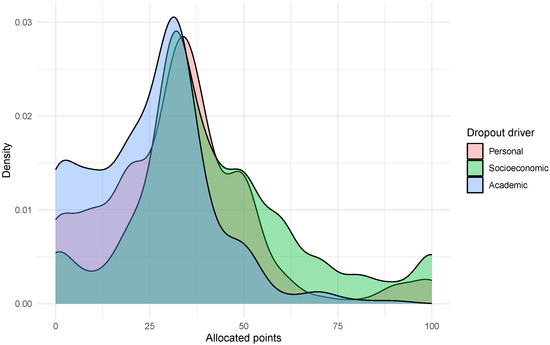
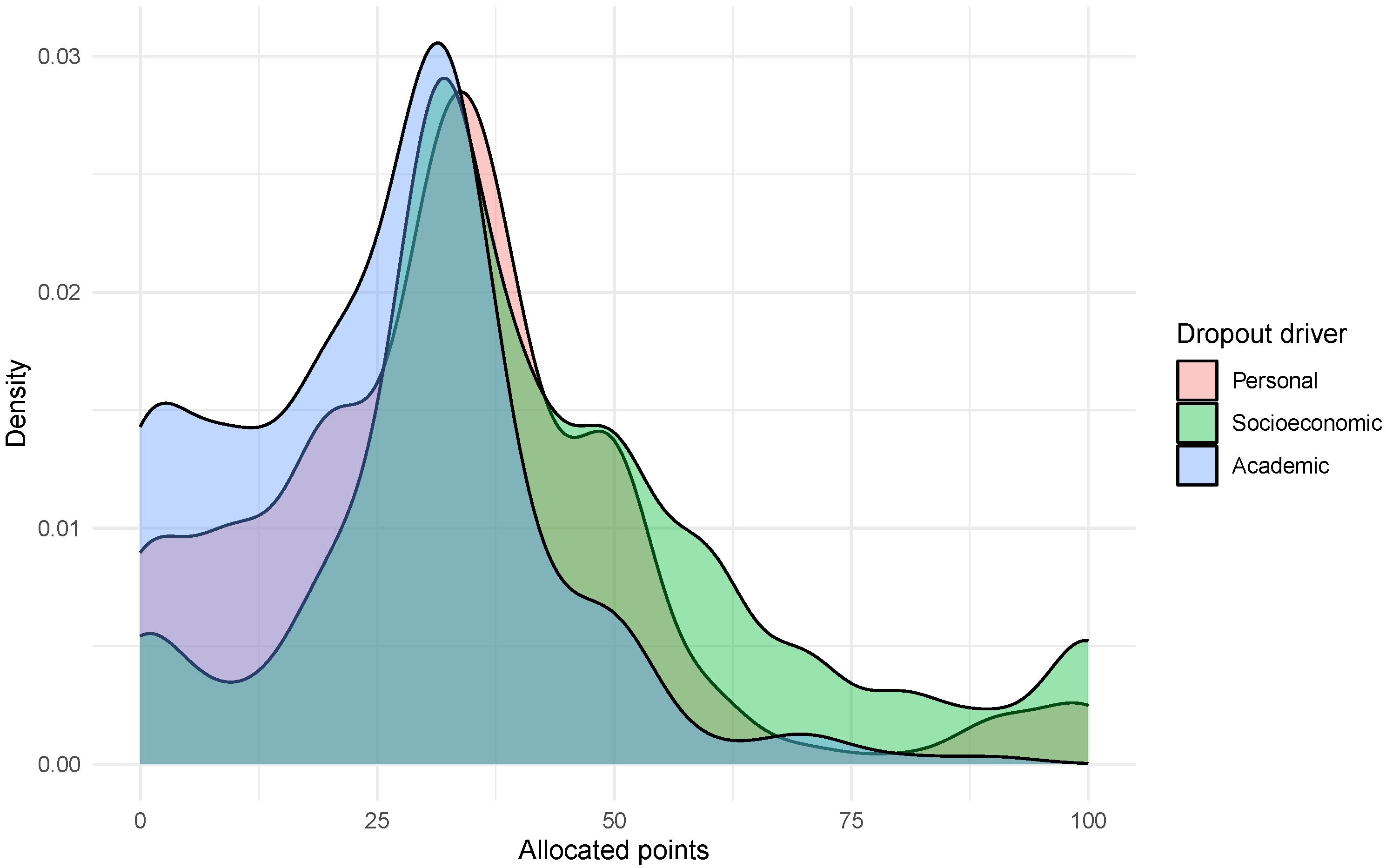
Figure 1 shows this pattern visually. The distribution for socioeconomic factors is shifted to the right, with substantial density between 40 and 60 points. Personal allocations are also widely dispersed, but their center is lower. Academic allocations are more concentrated at the lower end of the scale and thin out more quickly at higher values. At the same time, the broad spread of all three curves suggests that respondents used the point-allocation task to make meaningful distinctions rather than relying on a routine or uniform response.
Figure 1.
Kernel density of point allocations across factor domains.
4.2. Compositional Center and Subgroup Variation
Because the three allocations sum to 100, the arithmetic means should be interpreted alongside the compositional center. Table 2 reports both. The center of the composition lies at 51.1% socioeconomic, 31.6% personal, and 17.3% academic. In other words, once the relative structure of the data is taken into account, socioeconomic factors occupy an even more central position and academic factors an even smaller one.
Table 2.
Summary of point allocations and compositional center.
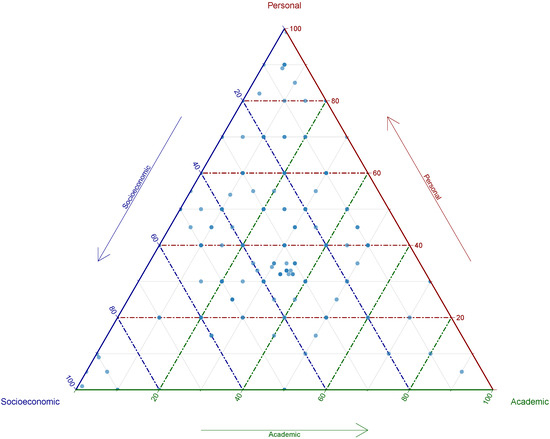
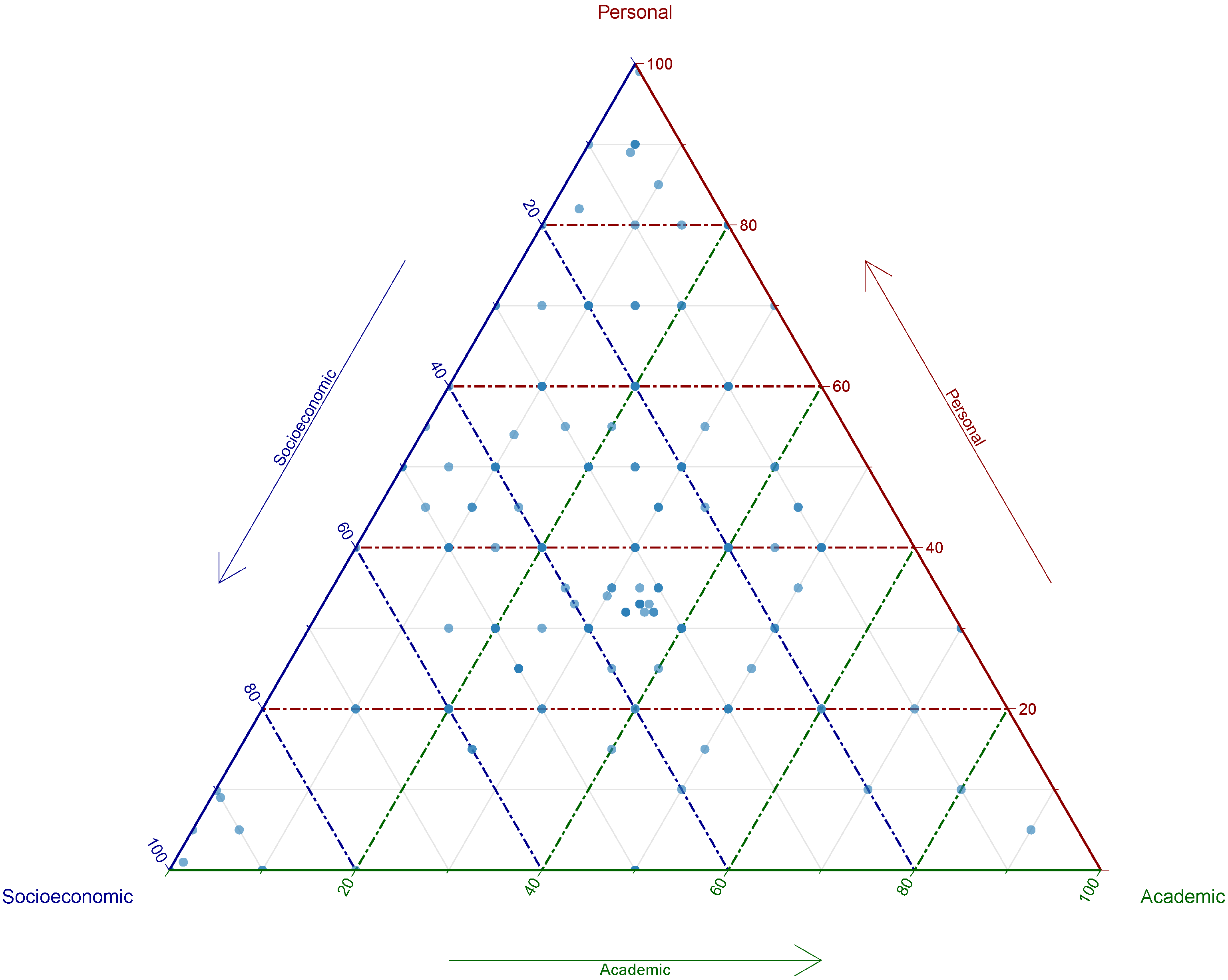
Figure 2 supports this interpretation. Most observations lie in the interior of the simplex rather than near the vertices, suggesting that many students view the possibility of leaving as shaped by more than one type of pressure. Even so, the cloud leans visibly toward the socioeconomic side of the triangle, and the compositional center is located away from the academic corner. This pattern of interior concentration with a socioeconomic pull helps us to anticipate the profile structure described below.
Figure 2.
Ternary distribution of perceived dropout factors.
Subgroup differences qualify the overall pattern, but they do not change it. First-generation students assigned slightly more weight to socioeconomic factors than continuing-generation students (43.7% versus 41.3%) and slightly less to personal factors (32.0% versus 33.7%), but none of these differences reached conventional levels of statistical significance. Housing conditions showed the clearest contrast. Students living in rented housing allocated 45.8% of their average composition to socioeconomic factors, compared with 40.4% among those living in family or own housing. Their average personal share was correspondingly lower, at 30.9% versus 34.1%. Mann–Whitney tests indicated small but statistically detectable differences for the personal and socioeconomic shares ( and , respectively), whereas the academic share did not differ significantly.
Program satisfaction followed a different pattern than a strictly academic reading of dropout might suggest. Students reporting the highest level of program satisfaction still assigned, on average, 44.3% of their composition to socioeconomic factors. The corresponding value among the lowest-satisfaction group was 48.1%, but the distribution across the five satisfaction categories was not monotonic and did not reach statistical significance. Socioeconomic stratum also showed no clear gradient, which likely reflects the narrow social range of the sample, since most respondents were concentrated in strata 1 and 2.
4.3. Cluster Profiles of Perceived Dropout Factors
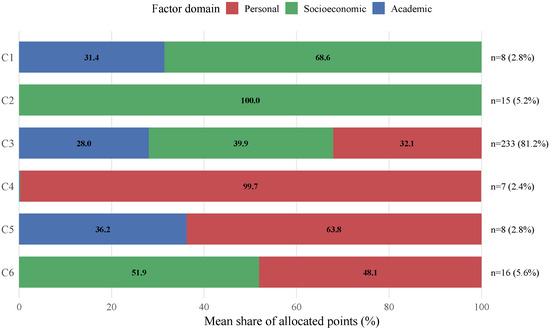
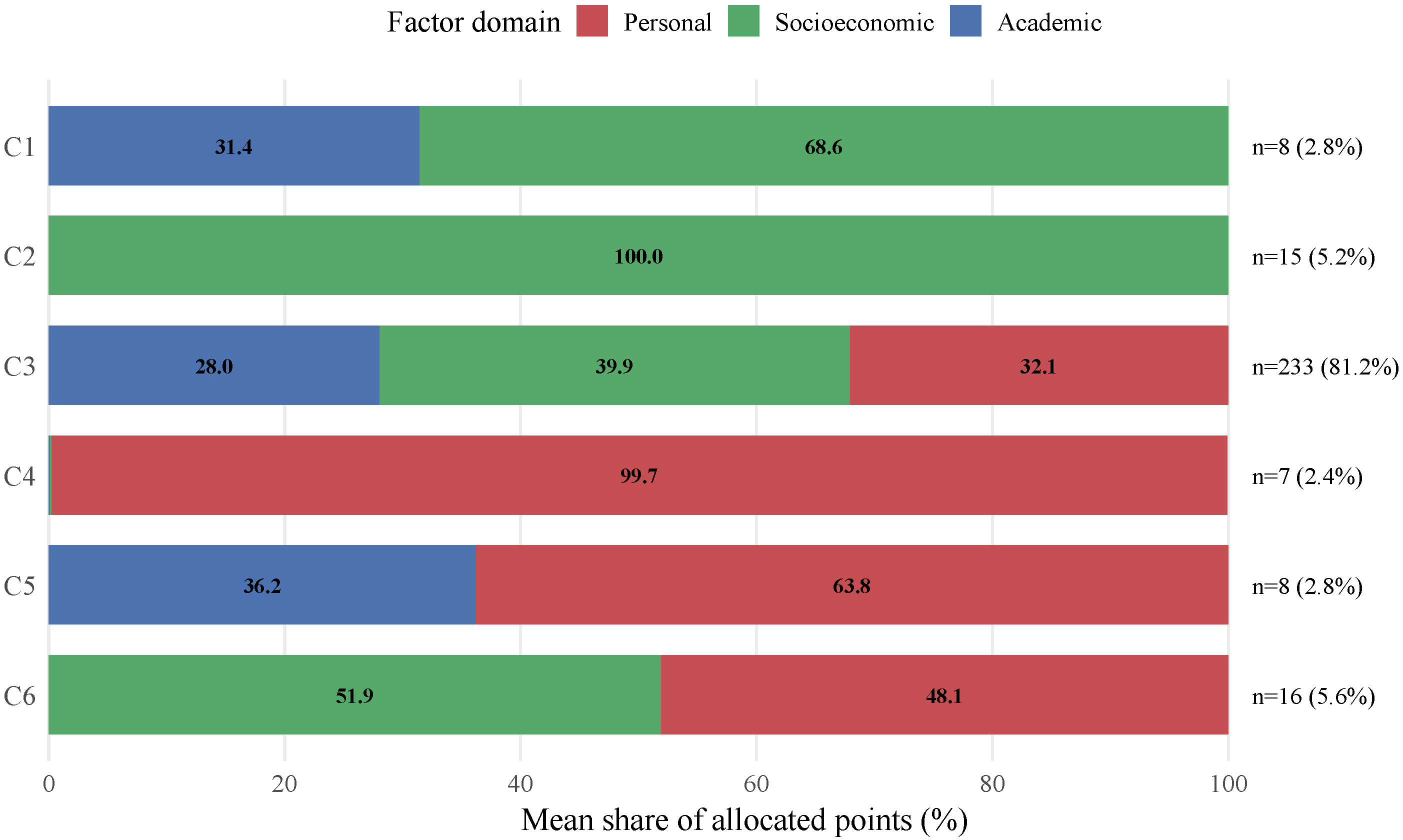
The profile analysis adds a person-centered perspective to the aggregate results. Candidate partitions were compared using elbow and silhouette diagnostics together with interpretability. The elbow criterion suggested diminishing gains after four clusters, but average silhouette width improved from 0.699 at to 0.833 at . We therefore retained the six-cluster solution, not because the sample contains six equally prominent student types, but because this partition preserves the dominant interior profile while separating several substantively interpretable edge patterns that would be collapsed in simpler solutions. These smaller clusters are interpreted cautiously as descriptive edge cases rather than fixed social groups. The clearest result remains the overwhelming size of one profile: the mixed multi-source pressure cluster included 233 of the 287 valid cases, or 81.2% of the sample.
Students in this dominant profile allocated, on average, 32.1 points to personal factors, 39.9 to socioeconomic factors, and 28.0 to academic factors. The profile is not perfectly balanced, but it is clearly multi-causal. Students in this group did not frame leaving university around a single reason. Instead, they distributed weight across all three domains, while still giving somewhat more emphasis to socioeconomic factors.
The remaining profiles are small, but they help clarify the structure of the data. Cluster 2 is a purely socioeconomic profile, assigning all 100 points to socioeconomic factors. Cluster 1 combines socioeconomic and academic pressure with no personal allocation. Cluster 4 is essentially a purely personal profile, while Cluster 5 combines personal and academic factors with no socioeconomic weight. Cluster 6 divides its weight between personal and socioeconomic factors and assigns virtually nothing to academic factors. Notably, no purely academic profile emerged.
Taken together, these findings point to a structure defined by a large interior majority and a limited set of edge profiles. The smaller profiles lie near the vertices or edges of the simplex and represent students who interpret the possibility of leaving through one dominant domain or one dominant pair of domains. Most students, however, fall in the interior and view possible withdrawal through several pressures at once. Figure 3 summarizes these profiles by showing both the within-profile percentage shares and the size of each cluster.
Figure 3.
Cluster profiles of perceived dropout factors. Note: C1 = socioeconomic–academic strain; C2 = pure socioeconomic pressure; C3 = mixed multi-source pressure; C4 = pure personal pressure; C5 = personal–academic strain; C6 = personal–socioeconomic pressure.
4.4. Do Cluster Profiles Differ Across Social and Academic Conditions?
The final part of the analysis examines whether the identified profiles are associated with observable student characteristics. Table 3 shows little evidence of strong separation across clusters. Cluster membership did not differ significantly by first-generation status (), housing type (), socioeconomic stratum (), or program satisfaction ().
Table 3.
Student characteristics by cluster profile.
At first glance, these results may appear inconsistent with the subgroup differences reported earlier, particularly those related to housing. However, the two sets of findings address different questions. The subgroup analysis captures gradual shifts in how students allocate weight across factor domains. In contrast, the cluster analysis tests whether those shifts are large enough to produce clearly differentiated groups. In this sample, variation exists, but it does not translate into sharply bounded social profiles. For example, students living in rented housing assigned somewhat greater importance to socioeconomic factors, yet they were not concentrated in a distinct cluster.
The use of nonparametric tests is important for interpreting these results. Several of the variables analyzed, such as program satisfaction, are measured on Likert-type scales, which are ordinal rather than continuous. In this context, assumptions of normality and equal variances are difficult to justify [47]. The Kruskal–Wallis test is therefore more appropriate, as it compares distributions based on rank rather than relying on mean differences. Similarly, categorical variables such as housing type and first-generation status are evaluated using chi-square tests. These choices ensure that the statistical comparisons remain consistent with the measurement properties of the data.
Some descriptive contrasts remain informative, even if they are not statistically significant. The socioeconomic–academic profile includes the highest proportion of students living in rented housing (75.0%). The personal–academic profile shows the lowest median level of program satisfaction. The purely socioeconomic profile has a slightly higher median socioeconomic stratum than the mixed cluster, although the number of cases is small. These patterns help contextualize the profiles but should be interpreted with caution.
Overall, the results point to a campus-wide pattern rather than to sharply segmented groups. Material and personal pressures shape how many students think about leaving, but these pressures are distributed across the student population instead of being confined to a specific subgroup. Within this campus, the evidence therefore supports a broad structural reading of perceived risk more than a narrowly segmented one.
5. Discussion
Three findings stand out. First, among enrolled students at this regional public campus, socioeconomic factors received the greatest relative weight when respondents were asked to distribute perceived reasons for potentially leaving university. This pattern appears consistently across descriptive statistics, compositional summaries, and the highest-weighted-domain classification. Second, most students did not focus on a single cause. The dominant profile reflects a mix of academic, personal, and socioeconomic pressures, although material conditions tended to receive the largest share. Third, among the characteristics examined, housing conditions showed a clearer association with how students prioritized these perceived factors than first-generation status, socioeconomic stratum, or program satisfaction.
These results add nuance to the existing literature on student persistence. Prior research has documented strong links between dropout intention and variables such as engagement, burnout, well-being, and academic satisfaction [16,34]. The present findings do not challenge those relationships. Instead, they suggest that students often interpret academic strain within a broader set of material and personal pressures. In other words, academic difficulties are rarely viewed in isolation, but as part of a wider context that shapes whether continuing is feasible [38].
The Colombian regional context helps to explain this pattern. Studies on higher education in Latin America have consistently highlighted the role of economic constraints, territorial inequality, and institutional conditions in shaping student trajectories [9,48]. What this study adds is evidence on how students prioritize these pressures when forced to make trade-offs. In this sample, socioeconomic conditions did not simply matter; they were given the greatest relative importance when students allocated limited attention across competing factors [10].
The role of housing deserves particular attention, but it should be interpreted cautiously. Living in rented accommodation is a direct and ongoing expense, often linked to financial uncertainty and reduced flexibility. In this study, housing conditions were more closely associated with how students weighted potential reasons for leaving than first-generation status [49]. At the same time, the observed subgroup differences were modest and did not translate into statistically significant cluster-level separation. Rather than establishing a causal pathway, the result suggests that immediate living conditions may be a practical indicator of day-to-day material strain in this setting. This interpretation aligns with research showing that persistence depends on the feasibility of studying under conditions of stable housing, food access, and manageable transport [28,29].
From a methodological perspective, this study highlights the value of treating constant-sum responses as compositional data. The compositional center clarified the overall structure of responses, while clustering based on log-ratio transformations revealed a dominant mixed profile alongside smaller edge profiles. The absence of a purely academic profile is especially informative. Academic factors were present across the sample, but students rarely isolated them as the sole or dominant explanation for potentially leaving. This does not imply that academic issues are unimportant; rather, it indicates that students usually interpret them within a broader combination of material and personal pressures [1].
From a sustainability perspective, these findings point to a structural rather than a segmented problem. The pressures associated with dropout intention are distributed across the student population and are not confined to a clearly defined subgroup. For that reason, this article supports a systemic reading of sustainability in which financial, psychosocial, pedagogical, and academic supports should be designed as complementary components of retention policy rather than as isolated responses.
5.1. Implications for Higher Education Policy and Practice
The findings suggest several implications for policy and practice in higher education systems seeking to improve sustainability. First, dropout should not be framed primarily as an academic remediation issue, while academic support remains important, students in this study rarely identified academic factors as their main concern. Financial aid, food programs, transport support, and housing stability should therefore be treated as central components of retention policy rather than as peripheral services [20]. Because the present evidence concerns perceived pressures rather than tested interventions, these implications should be read as plausible institutional responses rather than as causal prescriptions.
Second, adaptive pedagogical models may be especially relevant in regional campuses where some students combine study with work, long commutes, or higher daily maintenance costs. Flexible scheduling, reduced face-to-face rigidity, and alternancy-type pedagogical arrangements are plausible responses to the socioeconomic pressures identified here [5]. The housing-related differences reported in this study do not prove that such models will reduce dropout, but they do suggest that lowering the recurring cost of attendance is a reasonable institutional line of action.
Third, the dominance of the mixed multi-source pressure profile suggests that personal and academic strain should not be treated as separable service categories. One plausible response would be to strengthen psychosocial support laboratories or counseling spaces that can also function as supervised practicum units for programs such as psychology, medicine, and nursing. Such spaces could connect screening, counseling, referral, and territorial outreach while remaining fully aligned with the limited causal scope of the present findings.
Fourth, early-alert systems should extend beyond academic indicators. Many students who consider leaving may still be performing adequately but face growing material or personal strain. Incorporating short, recurring assessments of financial stress, housing conditions, workload, and well-being can help institutions identify risks earlier and respond more effectively [4,5].
Fifth, the importance of housing highlights the need for territorially sensitive support. Regional campuses often draw students from multiple municipalities, making transport, accommodation, and local infrastructure part of the educational experience. Strengthening support systems around these dimensions can reduce barriers to persistence and improve continuity across semesters [48]. In the same territorial logic, university entrepreneurship initiatives and partnerships with local employers may help mediate economic vulnerability and support professional insertion in the La Paz area. In a socially concentrated sample such as this one, such measures should complement rather than replace direct financial support.
Sixth, the distribution of pressures across the student population suggests that a combination of targeted and universal interventions may be more effective than narrow risk targeting. First-generation students may benefit from programs that support navigation of institutional processes and encourage help-seeking [24,27]. At the same time, broader access to financial, psychosocial, pedagogical, and academic support can address risks that are widely shared rather than concentrated in specific groups.
5.2. Limitations
This study has several limitations that should be considered when interpreting the findings. First, the data are cross-sectional and based on currently enrolled students, so the analysis cannot determine whether the perceived factors identified here translate into actual withdrawal over time. The study also does not include a comparison group of students who had already dropped out. For that reason, the results should be interpreted as evidence about perceived reasons associated with dropout intention, not as validated predictors of actual dropout behavior. Longitudinal research would be useful for examining how these perceptions change and whether they are associated with subsequent persistence outcomes.
Second, this study is based on a single institutional context. Although the La Paz campus offers a valuable setting for understanding regional dynamics in higher education, the results should not be generalized uncritically to other institutional or national contexts. In addition, the analysis relies on self-reported perceptions rather than observed withdrawal behavior. This is appropriate for examining how students interpret the possibility of leaving, but it does not allow direct identification of causal mechanisms. The exclusion of responses that did not sum exactly to 100 points may also have affected the final analytic sample, particularly if students who found the task more difficult differed from those who completed it correctly.
Finally, the constant-sum design groups a wide range of experiences into three broad domains. This is analytically useful because it makes prioritization visible, but it also reduces the level of detail within each category. For the same reason, the cluster solution is best understood as a descriptive representation of patterns in this sample rather than as evidence of fixed student types. Taken together, these limitations do not diminish the contribution of the study, but they do define the scope within which its findings should be interpreted.
6. Conclusions
This study demonstrates the value of examining how students prioritize the factors that could lead them to withdraw among undergraduates at the Universidad Nacional de Colombia—La Paz Campus. The study addressed three research questions—RQ1: Which broad factor categories receive the greatest weight overall? RQ2: How do these allocations vary across selected student characteristics? RQ3: Do distinct profiles emerge from students’ responses? Regarding RQ1, socioeconomic factors received the greatest weight overall in the constant-sum task, followed by personal and then academic factors. This ordering was stable across descriptive statistics and the compositional center, indicating that students’ responses reflect a structured perception of potential withdrawal pressures rather than a random allocation of points.
Regarding RQ2, subgroup variation was limited, although students living in rented housing assigned somewhat greater weight to socioeconomic factors than those living in family or own housing. Differences across first-generation status, socioeconomic stratum, and program satisfaction were comparatively modest. These patterns suggest that material conditions matter, but not in a way that produces sharply segmented student groups. Regarding RQ3, the profile analysis identified one dominant mixed multi-source pressure profile and several smaller edge profiles. No purely academic profile emerged. Most students therefore interpreted the possibility of leaving as the result of overlapping pressures rather than a single dominant cause.
Taken together, these answers indicate that this article contributes evidence about perceived reasons associated with dropout intention among enrolled students, not about observed dropout behavior itself. The sustainability argument of the paper therefore lies in showing that institutional responses should be systemic rather than fragmented. In regional public universities, retention strategies are more likely to align with students’ reported pressures when financial support, psychosocial care, adaptive pedagogical arrangements, and academic assistance are articulated as a single institutional commitment.
Author Contributions
Conceptualization, E.M.L.-L., O.E.B.-C. and C.D.C.Á.; methodology, E.M.L.-L.; formal analysis, O.E.B.-C.; data curation, O.E.B.-C.; writing—original draft, O.E.B.-C. and E.M.L.-L.; writing—review and editing, C.D.C.Á.; visualization, E.M.L.-L. and C.D.C.Á.; supervision, O.E.B.-C. and C.D.C.Á. All authors have read and agreed to the published version of the manuscript.
Funding
This research received no external funding.
Institutional Review Board Statement
Ethical review and approval were waived for this study due to the study was based on an anonymous survey administered to university students. No personal identifying information was collected. The data were processed in accordance with Colombia’s Personal Data Protection Act [50].
Informed Consent Statement
Informed consent for participation was obtained from all subjects involved in the study.
Data Availability Statement
The original data presented in the study are openly available in Survey Dataset on Student Retention at the National University of Colombia, La Paz Campus (2025) at https://doi.org/10.17632/kxgrpy8sfp.1.
Acknowledgments
This study was developed within the research project “Analysis of the Determinants of Student Retention during Initial Academic Cycles at the Universidad Nacional de Colombia, La Paz Campus” (Project Code: 61939), registered in the research system of the Universidad Nacional de Colombia and linked to the author’s academic workload. During the preparation of this manuscript, the author used ChatGPT (version 5.2) for language editing and stylistic refinement. The author reviewed and edited all outputs and takes full responsibility for the content of this publication.
Conflicts of Interest
The authors declare no conflicts of interest.
Appendix A. Key Constant-Sum Item and Domain Interpretation
For transparency, this Appendix reproduces the English translation of the key constant-sum item and clarifies how the three broad domains are interpreted in the article. The survey itself was administered in Spanish.
Table A1.
Key survey item and interpretive notes.
Appendix B. Conceptual Analytical Workflow
Because the attached materials do not include a fully documented executable script, the Appendix below replaces the previous pseudo-code with a conceptual analytical workflow. The goal is to make the sequence of operations explicit without overstating reproducibility beyond the materials currently archived in the public dataset.
Table A2.
Conceptual workflow used in the analysis.
References
- Hadjar, A.; Haas, C.; Gewinner, I. Refining the Spady–Tinto approach: The roles of individual characteristics and institutional support in students’ higher education dropout intentions in Luxembourg. Eur. J. High. Educ. 2023, 13, 409–428. [Google Scholar] [CrossRef] [Scilit]
- Tinto, V. Student persistence through a different lens. J. Coll. Stud. Retent. Res. Theory Pract. 2025, 26, 959–969. [Google Scholar] [CrossRef] [Scilit]
- Findeisen, S.; Brodsky, A.; Michaelis, C.; Schimmelpenningh, B.; Seifried, J. Dropout intention: A valid predictor of actual dropout? Empir. Res. Vocat. Educ. Train. 2024, 16, 10. [Google Scholar] [CrossRef] [Scilit]
- López-Angulo, Y.; Sáez-Delgado, F.; Mella-Norambuena, J.; Bernardo, A.B.; Díaz-Mujica, A. Predictive model of the dropout intention of Chilean university students. Front. Psychol. 2023, 13, 893894. [Google Scholar] [CrossRef] [Scilit]
- Gonzalez, B.; Mendes, T.P.; Pinto, R.; Correia, S.V.; Albuquerque, S.; Paulino, P. Predictors of higher education dropout intention in the post-pandemic era: The mediating role of academic exhaustion. PLoS ONE 2025, 20, e0327643. [Google Scholar] [CrossRef] [Scilit]
- Mulvogue, J.; Ryan, C.; Hunt, S.; Cross, M.; Cleary, M. Promoting positive outcomes in higher education: Supporting undergraduate student mental health and well-being. Issues Ment. Health Nurs. 2023, 44, 673–677. [Google Scholar] [CrossRef] [Scilit]
- Phillips, L.T.; Stephens, N.M.; Townsend, S.S.; Goudeau, S. Access is not enough: Cultural mismatch persists in limiting first-generation students’ opportunities for achievement throughout college. J. Personal. Soc. Psychol. 2020, 119, 1112–1131. [Google Scholar] [CrossRef] [Scilit] [PubMed]
- Smith, D.; McLellan, R. Mental health problems in first-generation university students: A scoping review. Rev. Educ. 2023, 11, e3418. [Google Scholar] [CrossRef] [Scilit]
- Segovia-García, N.; Said-Hung, E.; García-Aguilera, F.J. Abandono en la educación superior virtual colombiana: Factores de riesgo para grupos vulnerables. Rev. Colomb. Educ. 2024, 90, 259–282. [Google Scholar] [CrossRef] [Scilit]
- Guzmán Rincón, A. Dropout in rural higher education in virtual modality: A neural network approach. Cogent Educ. 2025, 12, 2493445. [Google Scholar] [CrossRef] [Scilit]
- Douwes, R.; Metselaar, J.; Pijnenborg, G.H.; Boonstra, N. Well-being of students in higher education: The importance of a student perspective. Cogent Educ. 2023, 10, 2190697. [Google Scholar] [CrossRef] [Scilit]
- Garcés-Delgado, Y.; Fernández-Esteban, M.I.; Álvarez-Pérez, P.R.; Conde-Vélez, S. The process of adaptation to higher education studies and its relation to academic dropout. Eur. J. Educ. 2024, 59, e12650. [Google Scholar] [CrossRef] [Scilit]
- Alenazi, A. A review of compositional data analysis and recent advances. Commun. Stat.—Theory Methods 2023, 52, 5535–5567. [Google Scholar] [CrossRef] [Scilit]
- Bäulke, L.; Grunschel, C.; Dresel, M. Student dropout at university: A phase-orientated view on quitting studies and changing majors. Eur. J. Psychol. Educ. 2022, 37, 853–876. [Google Scholar] [CrossRef] [Scilit]
- Muñoz-Inostroza, K.; López-Angulo, Y.; Sáez-Delgado, F.; Pinto-Vigueras, J.; Melo-Moreno, P.; Bernardo, A.B. Measuring dropout intention in college students: A systematic literature review. J. High. Educ. Theory Pract. 2024, 24, 20. [Google Scholar] [CrossRef] [Scilit]
- Marôco, J.; Assunção, H.; Harju-Luukkainen, H.; Lin, S.-W.; Sit, P.-S.; Cheung, K.-C.; Maloa, B.; Ilic, I.S.; Smith, T.J.; Campos, J.A.D.B. Predictors of academic efficacy and dropout intention in university students: Can engagement suppress burnout? PLoS ONE 2020, 15, e0239816. [Google Scholar] [CrossRef] [Scilit]
- Berríos-Riquelme, J.; Maluenda-Albornoz, J.; Zamorano-Veragua, M.; Pulido-Iparraguirre, C.; Castillo-Rozas, G. Integración social, bienestar subjetivo e intención de abandono: Un modelo predictivo en la educación superior. Univ. Psychol. 2025, 24, 1–16. [Google Scholar] [CrossRef] [Scilit]
- Passeggia, R.; Testa, I.; Esposito, G.; Picione, R.D.L.; Ragozini, G.; Freda, M.F. Examining the relation between first-year university students’ intention to drop out and academic engagement: The role of motivation, subjective well-being and retrospective judgements of school experience. Innov. High. Educ. 2023, 48, 837–859. [Google Scholar] [CrossRef] [Scilit]
- López-Angulo, Y.; Cobo-Rendón, R.; Sáez-Delgado, F.; Mella-Norambuena, J.; Pérez-Villalobos, M.V.; Díaz-Mujica, A. Cognitive motivational variables and dropout intention as precursors of university dropout. Front. Educ. 2024, 9, 1416183. [Google Scholar] [CrossRef] [Scilit]
- Herbaut, E. Overcoming failure in higher education: Social inequalities and compensatory advantage in dropout patterns. Acta Sociol. 2020, 64, 383–402. [Google Scholar] [CrossRef] [Scilit]
- Barsegyan, V.; Maas, I. First-generation students’ educational outcomes: The role of parental educational, cultural, and economic capital—A 9-years panel study. Res. Soc. Stratif. Mobil. 2024, 93, 100939. [Google Scholar] [CrossRef] [Scilit]
- Tompsett, J.; Knoester, C. Family socioeconomic status and college attendance: A consideration of individual-level and school-level pathways. PLoS ONE 2023, 18, e0284188. [Google Scholar] [CrossRef] [Scilit]
- López, M.J.; Santelices, M.V.; Taveras, C.M. Academic performance and adjustment of first-generation students to higher education: A systematic review. Cogent Educ. 2023, 10, 2209484. [Google Scholar] [CrossRef] [Scilit]
- Weisen, S.; Do, T.; Peczuh, M.C.; Hufnagle, A.S.; Maruyama, G. How are first-generation students doing throughout their college years? An examination of academic success, retention, and completion rates. Anal. Soc. Issues Public Policy 2024, 24, 1274–1287. [Google Scholar] [CrossRef] [Scilit]
- Pavlovic, Z.; Jeno, L.M. Facilitating academic and social integration among first year university students: Is peer mentoring necessary or an additive measure? Mentor. Tutoring Partnersh. Learn. 2024, 32, 29–48. [Google Scholar] [CrossRef] [Scilit]
- Verdín, D. Unmasking the impact of first-generation college students’ psychological capital: A person-centered approach. J. First-Gener. Stud. Success 2025, 5, 140–163. [Google Scholar] [CrossRef] [Scilit]
- Azpeitia, J.; Meza, Y.; Ruvalcaba, S.A.; Bacio, G.A. It’s easy to feel alone, but when you have community, it makes college a lot easier: First-generation students’ academic and psychosocial adjustment over the first year of college. J. Adolesc. Res. 2025, 40, 598–635. [Google Scholar] [CrossRef] [Scilit]
- Thompson, M.; Pawson, C.; Evans, B. Navigating entry into higher education: The transition to independent learning and living. J. Furth. High. Educ. 2021, 45, 1398–1410. [Google Scholar] [CrossRef] [Scilit]
- Pedler, M.L.; Willis, R.; Nieuwoudt, J.E. A sense of belonging at university: Student retention, motivation and enjoyment. J. Furth. High. Educ. 2022, 46, 397–408. [Google Scholar] [CrossRef] [Scilit]
- Sosu, E.M.; Pheunpha, P. Trajectory of university dropout: Investigating the cumulative effect of academic vulnerability and proximity to family support. Front. Educ. 2019, 4, 6. [Google Scholar] [CrossRef] [Scilit]
- Samuel, R.; Burger, K. Negative life events, self-efficacy, and social support: Risk and protective factors for school dropout intentions and dropout. J. Educ. Psychol. 2020, 112, 973–986. [Google Scholar] [CrossRef] [Scilit]
- Madigan, D.J.; Curran, T. Does burnout affect academic achievement? A meta-analysis of over 100,000 students. Educ. Psychol. Rev. 2021, 33, 387–405. [Google Scholar] [CrossRef] [Scilit]
- Li, W.; Zhao, Z.; Chen, D.; Peng, Y.; Lu, Z. Prevalence and associated factors of depression and anxiety symptoms among college students: A systematic review and meta-analysis. J. Child Psychol. Psychiatry 2022, 63, 1222–1230. [Google Scholar] [CrossRef] [Scilit] [PubMed]
- Calcatin, S.; Sinval, J.; Lucas, L.; Marôco, J.; Gonçalves Ferreira, A.; Oliveira, P. Burnout and dropout intention in medical students: The protective role of academic engagement. BMC Med. Educ. 2022, 22, 83. [Google Scholar] [CrossRef] [Scilit]
- Salmela-Aro, K.; Upadyaya, K.; Ronkainen, I.; Hietajärvi, L. Study burnout and engagement during COVID-19 among university students: The role of demands, resources, and psychological needs. J. Happiness Stud. 2022, 23, 2685–2702. [Google Scholar] [CrossRef] [Scilit]
- Turhan, D.; Schnettler, T.; Scheunemann, A.; Gadosey, C.K.; Kegel, L.S.; Bäulke, L.; Thies, D.O.; Thomas, L.; Buhlmann, U.; Dresel, M.; et al. University students’ profiles of burnout symptoms amid the COVID-19 pandemic in Germany and their relation to concurrent study behavior and experiences. Int. J. Educ. Res. 2022, 116, 102081. [Google Scholar] [CrossRef] [Scilit]
- Kapasia, N.; Paul, P.; Roy, A.; Das, P.; Ghosh, T.; Chouhan, P. Perceived academic satisfaction level, psychological stress and academic risk among Indian students amidst COVID-19 pandemic. Heliyon 2022, 8, e09440. [Google Scholar] [CrossRef] [Scilit]
- Cobo-Rendón, R.; Hojman, V.; García-Álvarez, D.; Cobo Rendon, R. Academic emotions, college adjustment, and dropout intention in university students. Front. Educ. 2023, 8, 1303765. [Google Scholar] [CrossRef] [Scilit]
- Mtshweni, B.V. First-generation distance learning students: Can the perceptions of social support and sense of belonging influence academic persistence? Asian Assoc. Open Univ. J. 2024, 19, 153–169. [Google Scholar] [CrossRef] [Scilit]
- Parnes, M.F.; Kanchewa, S.S.; Marks, A.K.; Schwartz, S.E. Closing the college achievement gap: Impacts and processes of a help-seeking intervention. J. Appl. Dev. Psychol. 2020, 67, 101121. [Google Scholar] [CrossRef] [Scilit]
- Maluenda-Albornoz, J.; Infante-Villagrán, V.; Galve-González, C.; Flores-Oyarzo, G.; Berríos-Riquelme, J. Early and dynamic socio-academic variables related to dropout intention: A predictive model made during the pandemic. Sustainability 2022, 14, 831. [Google Scholar] [CrossRef] [Scilit]
- Martínez-Líbano, J.; Yeomans-Cabrera, M.-M. Post-pandemic psychosocial variables affecting academic dropout in a sample of Chilean higher-education students. Front. Educ. 2023, 8, 1293259. [Google Scholar] [CrossRef] [Scilit]
- Cruz-Sandoval, M.; Roca, E.; Ortego, M.I. Compositional data analysis approach in the measurement of social-spatial segregation: Towards a sustainable and inclusive city. Sustainability 2020, 12, 4293. [Google Scholar] [CrossRef] [Scilit]
- Ferguson, S.L.; Moore, G.E.W.; Hull, D.M. Finding latent groups in observed data: A primer on latent profile analysis in Mplus for applied researchers. Int. J. Behav. Dev. 2020, 44, 458–468. [Google Scholar] [CrossRef] [Scilit]
- López-López, E.M.; Bru-Cordero, O.E.; Correa-Álvarez, C.D. A survey dataset on student retention in higher education: A Colombian public university case. Data 2026, 11, 75. [Google Scholar] [CrossRef] [Scilit]
- Correa, C. Survey Dataset on Student Retention at the National University of Colombia, La Paz Campus (2025). Mendeley Data. 2026, V1. Available online: https://data.mendeley.com/datasets/kxgrpy8sfp/1 (accessed on 10 March 2026).
- Correa-Álvarez, C.D.; Rojas-Mora, J.M.; Zumaqué-Ballesteros, A.E.; Bru-Cordero, O.E. Simulation study on the power and sensitivity of sixteen normality tests under different non-normality scenarios. TecnoLógicas 2025, 28, e3293. [Google Scholar] [CrossRef] [Scilit]
- Arias, A.; Linares-Vásquez, M.; Héndez-Puerto, N.R. Undergraduate dropout in Colombia: A systematic literature review of causes and solutions. J. Latinos Educ. 2024, 23, 612–627. [Google Scholar] [CrossRef] [Scilit]
- Chang, J.; Wang, S.-W.; Mancini, C.; McGrath-Mahrer, B.; Orama de Jesus, S. The complexity of cultural mismatch in higher education: Norms affecting first-generation college students’ coping and help-seeking behaviors. Cult. Divers. Ethn. Minor. Psychol. 2020, 26, 280–294. [Google Scholar] [CrossRef] [Scilit]
- Ley 1581 de 2012. Por la Cual se Dictan Disposiciones Generales para la Protección de Datos Personales. Congreso de Colombia. Diario Oficial No. 48.587, 17 de Octubre de 2012. Available online: https://www.alcaldiabogota.gov.co/sisjur/normas/Norma1.jsp?i=49981 (accessed on 18 December 2025).

Disclaimer/Publisher’s Note: The statements, opinions and data contained in all publications are solely those of the individual author(s) and contributor(s) and not of MDPI and/or the editor(s). MDPI and/or the editor(s) disclaim responsibility for any injury to people or property resulting from any ideas, methods, instructions or products referred to in the content. |
© 2026 by the authors. Licensee MDPI, Basel, Switzerland. This article is an open access article distributed under the terms and conditions of the Creative Commons Attribution (CC BY) license.