1. Introduction
Instructor clarity constitutes one of the fundamental pillars of effective teaching. It encompasses the teacher’s ability to express ideas precisely, simplify complex concepts, provide relevant examples, and offer clear instructions [
1]. In this regard, instructor clarity is recognized as an essential component of instructional communication, as the ability to teach clearly so that students understand the course content is fundamental to teaching [
2]. Likewise, instructor clarity represents one of the most influential behaviors affecting student learning; therefore, teachers’ positive communicative behaviors play an indispensable role in achieving students’ academic and affective goals [
3]. In this sense, instructor clarity satisfies students’ relational, rhetorical, and emotional needs [
4], promoting an environment in which positive emotions facilitate approach behaviors toward learning [
5].
Various studies on instructional communication have determined that instructor clarity influences students’ interest by making information more organized and understandable and by fostering students’ connection with the content and the learning situation [
6,
7,
8]. Student interest, conceived as an emotion linked to activation, orientation, and motivation to explore [
9], plays a decisive role in decision-making regarding attention and academic preferences [
10]. Student interest can be triggered by situational conditions such as teachers’ behaviors [
11], among which instructor clarity stands out. As Titsworth indicates [
12], through verbal and nonverbal strategies—such as clear transitions, explanatory summaries, or the use of visual materials—teachers can organize information, make it more understandable, and consequently activate students’ interest. To understand how students’ perceptions of instructor clarity influence their learning process, the Rhetorical/Relational Goal Theory provides a relevant conceptual framework, as it allows for the analysis of how these perceptions influence students’ learning outcomes [
13].
2. Literature Review
2.1. Rhetorical/Relational Goal Theory
The main premise of the Rhetorical/Relational Goal Theory is that teachers and students have a variety of rhetorical and relational goals they seek to achieve in the classroom [
5]. Therefore, each classroom centers on the needs/goals of both students and teachers, who have relational needs—such as being appreciated and accepted—and rhetorical needs, such as completing a task and obtaining a particular grade [
14]. Specifically, Rhetorical/Relational Goal Theory proposes the following six propositions [
15]:
Proposition 1. Students have both relational and academic needs, and they vary in terms of the value they assign to each need.
Proposition 2. Teachers have both rhetorical and relational goals and differ in the emphasis they place on each goal.
Proposition 3. Effective teaching results from teachers establishing appropriate rhetorical and relational goals and using suitable communication strategies to achieve them.
Proposition 4. Students whose relational and academic needs are satisfied feel more motivated to learn, less disconnected, and more fulfilled.
Proposition 5. Teachers’ goals, and how they achieve them, differ according to grade level and context.
Proposition 6. Students’ relational and academic needs vary across different stages of development, and the ways in which these needs are satisfied differ across developmental stages and contexts.
According to Xie and Ali Derakhshan [
16], by employing different rhetorical and relational communication behaviors, teachers can create an appropriate classroom climate that enhances students’ learning. In addition, teachers’ rhetorical and relational behaviors serve different purposes [
14]. Consequently, if teachers have rhetorical and relational goals and use effective communication behaviors to simultaneously achieve their own objectives and satisfy students’ needs, academic outcomes improve [
4]. In this regard, teachers may employ, on the one hand, rhetorical communication behaviors such as clarity to promote effective teaching and influence students’ beliefs, attitudes, and behaviors in the classroom [
17]. On the other hand, teachers may apply relational communication behaviors such as nonverbal immediacy to foster the development of a professional relationship and connection with students [
18]. Therefore, teachers should use, in any learning context, a combination of rhetorical and relational behaviors to achieve favorable outcomes for students, among which instructor clarity stands out [
19].
Despite the apparent theoretical complementarity between rhetorical and relational goals, the literature reveals certain tensions that have not been fully resolved. While the central premise suggests a linear synergy between both dimensions, some critical perspectives warn that a disproportionate emphasis on relational needs (such as the pursuit of acceptance or immediacy) may conflict with rhetorical demands, potentially diluting academic rigor. Furthermore, there is an inconsistency regarding how these goals are balanced across disciplinary contexts; although both are assumed to be necessary, previous studies do not clarify whether certain relational behaviors may mask deficiencies in instructional clarity or whether an excessive emphasis on rhetorical structuring could limit student autonomy and emotional engagement, particularly among more advanced learners.
2.2. Instructor Clarity
Instructor clarity is a fundamental concept within educational communication, representing a set of teacher behaviors that contribute to the fidelity of instructional messages conveyed in the classroom [
20]. Specifically, instructor clarity refers to students’ perceptions of the teacher’s use of verbal and nonverbal communication cues to deliver instruction more transparently and to facilitate students’ understanding and learning of the content addressed in the course [
3]. In this way, teachers who teach with clarity are characterized as effective communicators, enabling students to understand and learn the course content more easily [
14].
Various behaviors are associated with instructor clarity, such as reiterating key points, reviewing and previewing material, emphasizing core concepts, providing examples, and reformulating ideas [
1,
21]. Likewise, offering brief summaries at the end of each class or before moving on to new chapters or topics, using graphics, employing visual resources such as diagrams and slides that complement verbal instruction, and incorporating interactive questioning techniques contribute to greater instructor clarity [
22]. Finally, speaking fluently at an appropriate pace and encouraging students to ask questions and check their understanding are practices that promote greater instructor clarity [
12].
Instructor clarity also represents a significant indicator of teaching effectiveness, being considered one of the key characteristics of effective teachers and an essential precursor of students’ academic success [
23]. In this regard, the meta-analysis conducted by Titsworth et al. [
24] determined the positive impact of instructor clarity on both affective and cognitive learning. Similarly, various studies have found that instructor clarity influences different variables associated with students’ learning processes, such as engagement [
25]; empowerment [
13]; willingness to attend class [
26] and to communicate with the teacher [
22]; motivation [
7,
27]; and student satisfaction [
28].
Although the literature largely agrees on the benefits of instructor clarity, a critical synthesis of existing findings reveals inconsistencies regarding its boundary conditions and potential unintended effects. On the one hand, classical studies assume that greater clarity consistently facilitates learning; on the other, more recent research on self-regulated learning suggests that an overreliance on externally structured instruction may, paradoxically, discourage deep cognitive effort and reduce tolerance for ambiguity among more advanced students. This theoretical tension highlights that the impact of clarity is not uniform, but varies depending on students’ level of experience and the complexity of the task, an aspect that previous unidirectional models tend to overlook.
2.3. Academic Satisfaction
Academic satisfaction can be defined as a cognitive component of psychological well-being that refers to the evaluations students make when comparing their personal aspirations with the achievements they have attained in their academic lives [
29]. According to Insunza et al. [
30], academic satisfaction consists of the student’s subjective evaluation of the various outcomes and experiences related to their learning process.
Academic satisfaction is a dynamic process that is influenced by the way students perceive and understand their learning environment [
31]. In this regard, previous studies indicate that several variables associated with teachers’ classroom behaviors—such as autonomy support [
32], teacher credibility [
33,
34], and instructor clarity [
28,
35]—positively influence students’ academic satisfaction.
Likewise, academic satisfaction affects other variables related to students’ learning processes, having a positive effect on engagement [
36] and academic motivation [
33]. Finally, previous research has found that academic satisfaction exerts a mediating effect in the relationship between the perception of autonomy support and the intention to persist in university studies [
37]; between the motivational climate established by the teacher and students’ academic engagement [
38]; and between teacher credibility and students’ academic motivation [
33].
2.4. State Motivation
State motivation is defined as a transient and context-specific motivational orientation experienced by a student in relation to a particular learning context [
39]. Unlike trait motivation, state motivation is not stable; rather, it is highly influenced by the situation and may vary over time [
40]. According to Brophy [
41], a student’s state motivation exists when engagement in a particular activity is guided by the intention to acquire the knowledge or master the skill that the activity is designed to teach.
Furthermore, teachers’ classroom behaviors directly influence students’ state motivation toward a specific subject [
42]. In this regard, several previous studies have found that teacher credibility [
33,
43], teacher self-disclosure [
44], teacher confirmation [
45], and instructor clarity [
12] affect students’ state motivation.
In addition, it is important to note that state motivation is positively related to both affective and cognitive learning [
40,
46] and to students’ academic engagement [
38]. Finally, state motivation also plays a mediating role, as it mediates the relationship between teacher immediacy and students’ cognitive learning [
47], between teacher credibility and students’ academic satisfaction [
48], and between autonomy support and students’ academic satisfaction [
32].
2.5. Student Interest
Hidi and Renninger [
49] define interest as the result of the interaction between the individual and the environment, referring both to a psychological state and to a person’s cognitive and affective motivation to engage with that content of interest over time. In the academic context, student interest involves a psychological state that includes affective and cognitive processes that play a relevant role in students’ learning processes [
50]. In this regard, Mazer [
6] highlights that student interest involves both emotional and cognitive functioning and therefore distinguishes two specific types of student interest: (1) emotional interest, which refers to students’ affective response and occurs when they feel attracted to a content area, and (2) cognitive interest, which involves students’ cognitive response and occurs when they feel attracted to a content area because they possess a clear structural understanding of the content. Therefore, when students show interest, they perceive a content area as important, actively engage with the topic, and feel knowledgeable about the subject matter [
51].
Mazer [
7] also indicates that instructor clarity is a predictor of both emotional and cognitive interest. Thus, teachers who present learning content in an organized manner, provide explanatory summaries, focus on relevant topics, and are clear in their explanations enhance their students’ academic interest [
8]. Likewise, other variables associated with teachers’ communicative behaviors that positively influence student interest include immediacy [
6,
7], teacher self-disclosure [
52], and teacher facilitation of discussion [
21].
3. Objectives and Hypotheses
A joint examination of the roles of academic satisfaction, state motivation, and interest reveals fragmentation in the empirical literature. Previous studies have tended to analyze these variables in isolation or through bidirectional pairings, leading to inconsistencies regarding the temporal and causal hierarchy of these affective and cognitive mechanisms. For instance, while some studies posit that motivation precedes satisfaction, others suggest the opposite directionality, reflecting an unresolved debate as to whether subjective well-being (satisfaction) acts as a prerequisite for transient activation (state motivation), or vice versa. This lack of methodological and theoretical consensus underscores the need for more complex mediational models, such as the one proposed in this study, which allow these tensions to be disentangled by integrating multiple simultaneous pathways within a single predictive framework.
Although the influence of instructor clarity on students’ learning outcomes has been documented, the way in which it operates through specific variables such as academic satisfaction and state motivation remains scarcely explored. Research has tended to analyze direct effects, but less is known about the intermediate mechanisms through which clarity influences student interest. Moreover, research in instructional communication has been mainly concentrated in Anglo-Saxon contexts [
53]. Therefore, as Goldman et al. [
45] suggest, it is necessary to examine the extent to which teaching practices identified as effective in certain countries can be transferred to other cultural environments. In this regard, it is noteworthy that no studies conducted in the Spanish university context have been found that analyze, through multivariate models, the impact of instructor clarity on students’ interest, nor studies that examine the mediating role of academic satisfaction and state motivation in this relationship. Likewise, integrated mediational models based on the Rhetorical/Relational Goal Theory have not been analyzed in the Spanish university context. Therefore, this absence of research highlights the need to advance the understanding of the intermediate mechanisms through which instructor clarity influences student interest, thereby justifying the relevance of the present study.
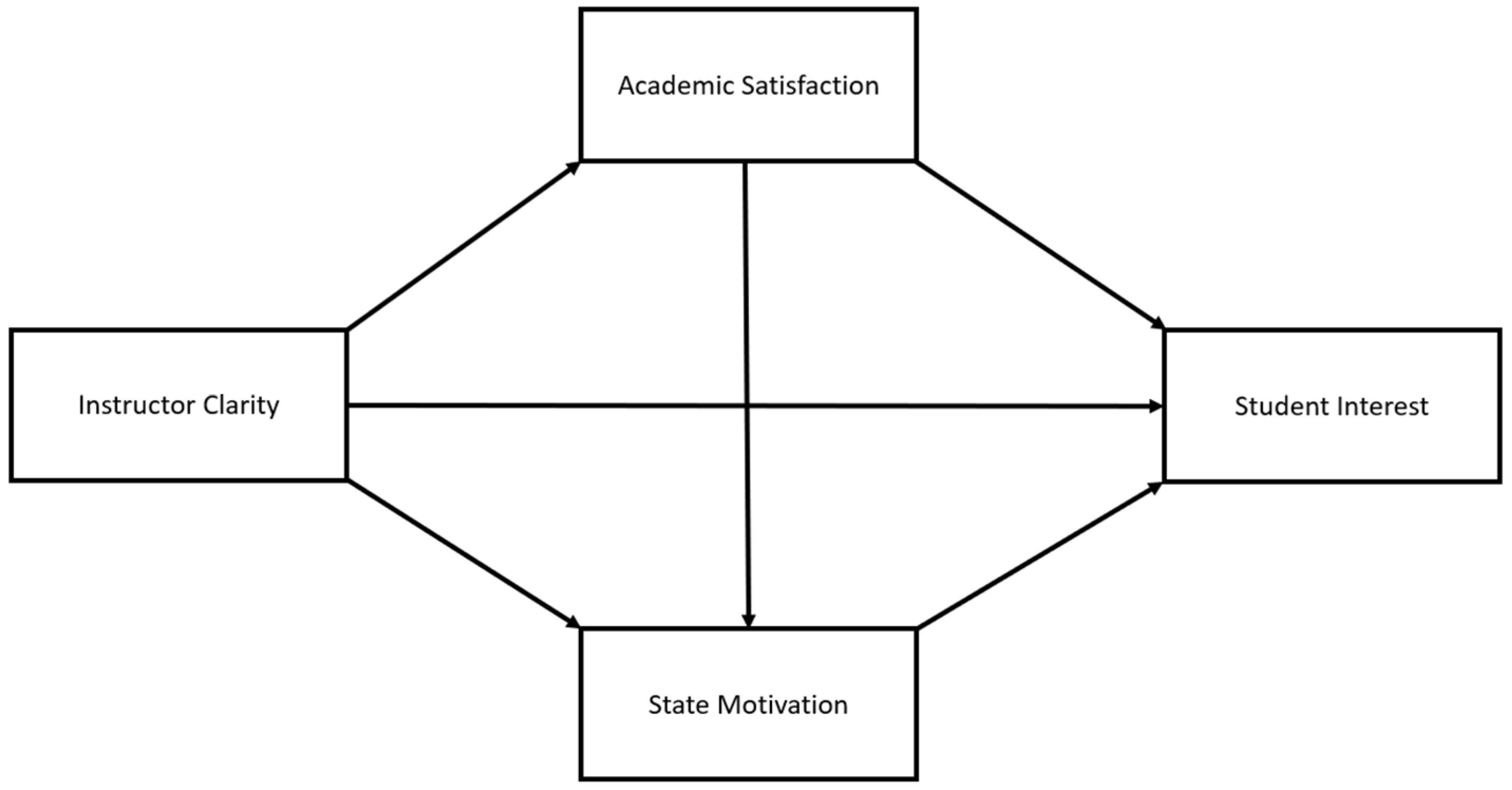
Therefore, the objective of this research is, on the one hand, to analyze the direct effect of instructor clarity on student interest, in order to determine whether clear, structured, and comprehensible teaching practices constitute a factor capable of enhancing students’ interest in class. On the other hand, another objective is to examine the mediating role of students’ academic satisfaction and state motivation in this relationship, with the aim of identifying intermediate processes that help explain more complex pathways of influence. From this perspective, instructor clarity, as a rhetorical behavior, should satisfy academic and relational needs, generating positive affective states such as satisfaction and state motivation that, in turn, facilitate student interest (
Figure 1). Overall, this approach makes it possible to offer an integrated explanatory model, provide novel empirical evidence in the Spanish university context, and contribute useful and relevant information to guide teaching interventions based on effective pedagogical practices.
To address the proposed objectives, ten research hypotheses were formulated based on the theoretical framework and previous empirical evidence.
Previous research has consistently shown that instructor clarity enhances students’ perceptions of their learning experience, contributing to higher levels of academic satisfaction [
28]. Clear instructional communication reduces ambiguity and facilitates understanding, which positively influences students’ evaluation of the educational environment [
23].
H1. Instructor clarity is positively related to students’ academic satisfaction.
Instructor clarity has also been identified as a key factor influencing students’ motivational processes, as it helps structure learning tasks and promotes a sense of competence and control. When instruction is clear and well-organized, students are more likely to experience higher levels of situational motivation [
7,
27].
H2. Instructor clarity is positively related to students’ state motivation.
Empirical evidence further suggests that instructor clarity fosters students’ interest by making content more accessible and engaging, facilitating both emotional and cognitive involvement in learning [
7,
8].
H3. Instructor clarity is positively related to students’ interest.
Studies have shown that students who perceive their academic experience as satisfying are more likely to develop higher levels of motivation, as satisfaction reinforces feelings of competence and engagement [
33].
H4. Academic satisfaction is positively related to students’ state motivation.
In addition, academic satisfaction has been linked to greater student engagement and interest, as positive learning experiences enhance enjoyment and curiosity toward the subject [
36].
H5. Academic satisfaction is positively related to students’ interest.
Prior research indicates that state motivation plays a crucial role in fostering students’ interest, as motivated students tend to show higher levels of curiosity, enjoyment, and cognitive involvement [
40,
46].
H6. State motivation is positively related to students’ interest.
Given that instructor clarity enhances students’ satisfaction and that satisfaction is positively related to interest, it is reasonable to expect a mediating effect. Previous studies have highlighted the role of satisfaction as a key mechanism linking instructional practices with affective outcomes [
33,
37,
38].
H7. Academic satisfaction mediates the relationship between instructor clarity and students’ interest.
Similarly, instructor clarity contributes to more satisfying learning experiences, which in turn foster higher levels of motivation, suggesting that academic satisfaction may function as an intermediate mechanism between instructional clarity and students’ motivational states [
33].
H8. Academic satisfaction mediates the relationship between instructor clarity and students’ state motivation.
Research has also shown that instructional behaviors influence students’ motivation, which subsequently affects their level of interest. Thus, state motivation is expected to act as a mediating variable between instructor clarity and student interest [
32,
47,
48].
H9. State motivation mediates the relationship between instructor clarity and students’ interest.
Finally, since academic satisfaction enhances students’ motivational states and motivation is positively associated with interest, state motivation is likely to mediate the relationship between satisfaction and interest [
32,
47].
H10. State motivation mediates the relationship between academic satisfaction and students’ interest.
4. Materials and Methods
4.1. Design
The methodology applied in this study included explanatory research, which identifies relationships among data to explain a specific phenomenon, and confirmatory research, which collects data to test previously established hypotheses. In addition, a quantitative approach was adopted using a cross-sectional ex-post facto research design through survey methods to describe the variables under study.
4.2. Participants
Participants were selected through a non-probabilistic convenience sampling method, based on the availability of groups and the voluntary participation of students. A total of 258 students from the University of Extremadura participated in the study. They were enrolled in the Bachelor’s Degree in Early Childhood Education (71.7%) and the Bachelor’s Degree in Primary Education (28.3%) during the 2024–2025 academic year. The mean age of the participants was 19.99 (SD = 2.70). Of the participants, 211 were female and 47 were male, representing 81.8% and 18.2% of the sample, respectively. Regarding academic year, 62.4% were first-year students and 37.6% were second-year students.
4.3. Instruments
The Teacher Clarity Short Inventory in its version adapted for the Spanish university population was used [
54]. It is an instrument with a bifactorial structure composed of 10 items distributed across the subscales Content Clarity, which includes 6 items (e.g., The professor clearly defines the main concepts), and Communication Clarity, which includes 4 items (e.g., The professor’s answers to students’ questions are not clear). Participants were asked to indicate their perception of instructor clarity using a Likert-type response scale ranging from 1 (Strongly disagree) to 5 (Strongly agree). The instrument has demonstrated adequate internal consistency, with Cronbach’s alpha values of 0.80 for the Communication Clarity dimension and 0.94 for the Content Clarity dimension [
54].
The Academic Satisfaction Scale [
55] was administered to analyze university students’ satisfaction in relation to a specific class. This instrument has a unifactorial structure with 7 items (e.g., I feel comfortable with the learning environment created in this course). Students indicated their level of academic satisfaction with the class using a Likert-type scale ranging from 1 (Strongly disagree) to 7 (Strongly agree). The scale has demonstrated adequate internal consistency, with a composite reliability value of 0.92 for the unidimensional structure [
55].
To assess students’ state motivation, the Spanish version of the State Motivation Scale adapted for Spanish university students was used [
56]. This instrument is a semantic differential scale with a unifactorial structure composed of 12 bipolar adjectives (e.g., Interested–Uninterested). Students indicated their level of state motivation in relation to the class by selecting values from 1 to 7, considering that the closer the number is to the adjective, the greater the certainty in evaluating their feelings toward the class. The scale has demonstrated adequate internal consistency, with a Cronbach’s alpha value of 0.96 for the unidimensional solution [
56].
The Spanish version of the Student Interest Scale for University Students [
57] was used to assess students’ interest in relation to a specific class. This instrument has a bifactorial structure consisting of 16 items distributed across the dimensions of Cognitive Interest, which includes 7 items (e.g., I can recall the content of this class), and Emotional Interest, which includes 9 items (e.g., The experience in this class is very positive). Students reported their level of interest in the class using a Likert-type response scale ranging from 1 (Strongly disagree) to 5 (Strongly agree). The instrument has demonstrated adequate internal consistency, with Cronbach’s alpha values of 0.91 for the Cognitive Interest dimension and 0.95 for the Emotional Interest dimension [
57].
4.4. Procedure
Data collection was carried out during the second semester of the 2024–2025 academic year at the University of Extremadura. In the first phase, faculty members from the Faculty of Education and Psychology at the University of Extremadura were contacted in order to request their collaboration and access to class groups from the Bachelor’s Degree in Early Childhood Education and the Bachelor’s Degree in Primary Education. Specifically, all students present in the classroom at the time of data collection were invited to participate. Before administering the instruments, students were informed about the general objectives of the research, the voluntary nature of their participation, and the guarantee of anonymity and confidentiality in the handling of the data. In addition, all participants signed an informed consent form in accordance with current regulations on personal data protection.
The instruments were administered during regular class hours and within the ordinary classroom setting, ensuring a controlled environment for all participants. To minimize potential bias, the instructor responsible for the course left the classroom while the instruments were being completed. The administration was supervised by the research team, who provided standardized instructions to all participants and clarified any doubts without interfering with their responses. Participants completed the questionnaires individually and were instructed to respond honestly based on their perceptions of the specific course. No incentives were offered for participation, and students were informed that their responses would have no impact on their academic evaluation. The instruments were administered in paper-and-pencil format and were completed in an estimated time of approximately 20–25 min. Finally, the collected data were subsequently entered into a database for processing and statistical analysis.
4.5. Data Analysis
To analyze the relationships among instructor clarity, academic satisfaction, state motivation, and students’ interest, the Partial Least Squares Structural Equation Modeling (PLS-SEM) technique was applied. In this approach, both the measurement model and the structural model are evaluated [
58], using the statistical software SmartPLS 4. PLS-SEM was selected as the analytical technique mainly because it does not impose distributional assumptions on the data [
59] and should be used when the purpose of the study—such as in the present research—is to explain and predict endogenous constructs [
60]. In addition, PLS-SEM is also appropriate for analyzing complex models involving multiple mediating relationships [
60], such as the one proposed in this study. Furthermore, PLS-SEM is particularly suitable for exploratory and predictive research contexts, where the primary objective is to maximize the explained variance of key constructs [
61]. This aligns with the aim of the present study, which seeks to understand the mechanisms through which instructor clarity influences students’ interest.
To analyze the measurement model, the following indicators were examined: (1) standardized loadings above 0.60 to assess the reliability of the indicators of each construct [
61]; (2) internal consistency values greater than 0.70 for both Cronbach’s alpha (α) and composite reliability (CR) [
62]; and (3) values above 0.50 for the average variance extracted (AVE) to establish the convergent validity of the model [
63]. Additionally, to confirm the discriminant validity of the model, the values obtained through the Fornell–Larcker criterion for each construct had to be higher than those of the other variables [
62], and the Heterotrait–Monotrait ratio (HTMT) had to produce values below 0.90 [
64].
For the evaluation of the structural model, a bootstrapping technique with 10,000 samples was performed to determine direct and indirect effects [
65]. To establish the type of mediation effect of both students’ academic satisfaction and state motivation, the guidelines proposed by Nitzl et al. [
66] were followed, which distinguish between indirect-only, competitive, and complementary mediation. In addition, the coefficient of determination (
R2) was measured to determine the explanatory power of the model, with values around 0.75, 0.50, and 0.25 considered substantial, moderate, and weak, respectively [
59]. Furthermore, the predictive capability of the model regarding students’ interest as the target endogenous construct was assessed. First, the predictive power of the model was analyzed using the PLSpredict procedure. To determine whether the model exhibited satisfactory predictive performance,
Q2 values had to be greater than 0, and to establish the level of predictive power, the root mean squared error of the PLS model (RMSE-PLS) had to be lower than that obtained by the linear regression model (RMSE-LM) [
67]. Finally, the predictive validity of the model was evaluated using the cross-validated predictive ability test (CVPAT). CVPAT allows the performance of the PLS-SEM model to be compared with two benchmark models: the indicator average (IA) and the linear model (LM), the latter being more conservative [
68].
5. Results
5.1. Measurement Model
Table 1 shows that the items of the different constructs present standardized loadings greater than 0.60; the values of Cronbach’s alpha (α) and composite reliability (CR) are above 0.70; and the values of average variance extracted (AVE) exceed the threshold of 0.50. Therefore, these results suggest that each indicator shares a significant proportion of variance with its latent construct, adequately reflecting the underlying theoretical concept; that all constructs demonstrate appropriate internal consistency; and, finally, that the constructs explain, on average, more than 50% of the variance of their indicators, thus confirming the convergent validity of the model.
Table 2 shows that the values of the Fornell–Larcker criterion for each construct are higher than the correlations with the remaining variables, and that the Heterotrait–Monotrait ratio (HTMT) presents values below the 0.90 threshold. Overall, both criteria provide strong evidence that the constructs in the model represent conceptually distinct dimensions, thereby supporting the discriminant validity of the model. It means, although some constructs included in the model belong to the same affective–motivational domain and may appear conceptually related, they represent distinct dimensions supported by both theoretical definitions and empirical discriminant validity criteria.
5.2. Structural Model
First, the Variance Inflation Factor (VIF) values among the constructs of the model were calculated to identify potential collinearity problems. Diamantopoulos and Siguaw [
69] indicate that VIF values should be below 3.3. In this study, satisfactory values were obtained, which are detailed as follows: instructor clarity vs. academic satisfaction (VIF = 1.000); instructor clarity vs. state motivation (VIF = 1.182); instructor clarity vs. student interest (VIF = 1.387); academic satisfaction vs. state motivation (VIF = 1.182); academic satisfaction vs. student interest (VIF = 1.264); and state motivation vs. student interest (VIF = 1.388).
Table 3 shows that instructor clarity is positively related to academic satisfaction (β = 0.393;
p < 0.01), to state motivation (β = 0.384;
p < 0.01), and to students’ interest (β = 0.143;
p < 0.05); therefore, H1, H2, and H3 are supported. In terms of effect size, the relationships between instructor clarity and both academic satisfaction and state motivation can be considered moderate, whereas its direct effect on students’ interest is comparatively weaker. Likewise, academic satisfaction is positively related to state motivation (β = 0.242;
p < 0.01) and to students’ interest (β = 0.306;
p < 0.01), thus confirming H4 and H5. These results indicate a moderate effect on interest and a weaker-to-moderate effect on state motivation. Similarly, state motivation is positively related to students’ interest (β = 0.415;
p < 0.01), supporting H6. Among all direct relationships, this represents the strongest effect in the model, suggesting that state motivation is the most influential predictor of students’ interest.
Regarding the mediation hypotheses, on the one hand, academic satisfaction mediates the relationship between instructor clarity and students’ interest (β = 0.120; p < 0.01) and between instructor clarity and students’ state motivation (β = 0.095; p < 0.01), thus supporting H7 and H8. On the other hand, state motivation mediates the relationship between instructor clarity and students’ interest (β = 0.159; p < 0.01) and between academic satisfaction and students’ interest (β = 0.101; p < 0.05), confirming H9 and H10. These indirect effects can be considered small to moderate in magnitude, indicating that the influence of instructor clarity on students’ interest is partially transmitted through these mediating variables. These findings highlight the central role of academic satisfaction and state motivation as key explanatory mechanisms through which instructor clarity influences students’ interest, reinforcing the proposed theoretical model. It is noteworthy that the mediation effects are complementary in all cases, since both direct and indirect effects are significant and point in the same direction. This pattern suggests that instructor clarity exerts its influence on student interest both directly and indirectly through sequential affective–motivational processes, underscoring the importance of considering these mediating variables when examining instructional communication effects.
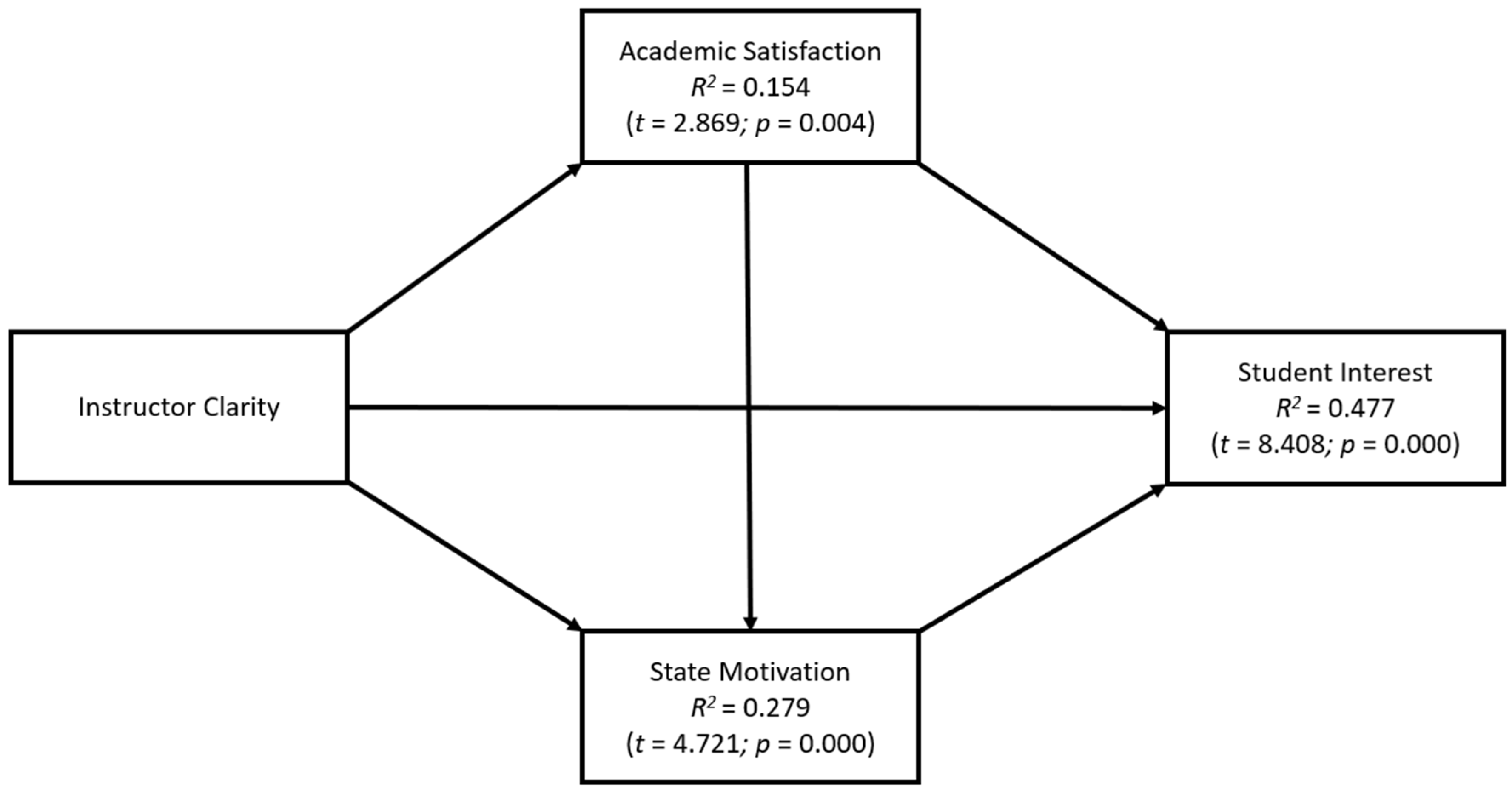
Regarding the coefficient of determination, the research model shows weak explanatory power for academic satisfaction; moderate explanatory power for state motivation and moderate explanatory power for students’ interest (
Figure 2).
Regarding the predictive capability of the model,
Table 4 indicates that the construct of students’ interest, including its dimensions and indicators, presents
Q2 values greater than 0, and all RMSE-PLS values are lower than those generated by RMSE-LM. These results indicate that the model has high predictive power with respect to students’ interest.
Finally,
Table 5 shows, on the one hand, that the PLS-SEM model presents a significantly lower average loss than the IA predictive benchmark, indicating a lower prediction error, and, on the other hand, that it also shows a significantly lower average loss than the LM predictive benchmark. Therefore, it can be concluded that the research model has high predictive validity with respect to students’ interest, as it outperforms both the IA and LM benchmark models.
6. Discussion
The objectives of this research were to analyze the direct effect of instructor clarity on students’ interest and to examine the mediating effects of students’ academic satisfaction and state motivation in the relationship between instructor clarity and students’ interest. Overall, the results obtained contribute to a deeper understanding of the mechanisms through which teacher communication translates into affective and motivational outcomes in higher education, thereby helping to fill a relevant gap identified in the existing scientific literature within the Spanish context. More specifically, the findings directly address the research gap identified in the introduction by providing empirical evidence from the Spanish higher education context—an underrepresented setting in instructional communication research—and by testing an integrated mediational model that simultaneously incorporates academic satisfaction and state motivation. In doing so, the study not only extends previous research predominantly conducted in Anglo-Saxon contexts but also clarifies the underlying mechanisms through which instructor clarity influences student interest, offering a more comprehensive and context-sensitive explanation of these relationships.
Regarding H1, H2, and H3, the results indicate that instructor clarity is positively related to academic satisfaction, state motivation, and students’ interest, in line with previous research that has highlighted its impact on variables such as engagement [
25], empowerment [
13], motivation [
7,
27], and academic satisfaction [
28]. These findings suggest that clarity does not function solely as a cognitive facilitator of learning but also as a mechanism that structures the academic experience. Clear teaching reduces situational ambiguity, organizes relevant information, and decreases unnecessary cognitive load, thereby generating an environment perceived as more predictable and manageable. This context fosters a positive evaluation of the educational experience (satisfaction), activates temporary motivational dispositions toward the task (state motivation), and ultimately facilitates the development of interest. As noted by Derakhshan et al. [
23], instructor clarity constitutes an essential component of effective interpersonal communication because it satisfies the rhetorical goals of the classroom while strengthening the teacher–student relationship, creating a climate of trust that transcends different cultures and educational contexts. However, the comparatively weaker direct effect of instructor clarity on students’ interest suggests that its influence is not primarily direct, but rather operates through more complex affective–motivational pathways. This finding challenges simplified assumptions that clarity alone is sufficient to generate student interest and highlights the need to consider intermediate psychological mechanisms. At the same time, alternative explanations should be considered. For instance, it is possible that students who are already more motivated or engaged may perceive instruction as clearer, suggesting a potential reverse or reciprocal relationship. Additionally, contextual factors such as course difficulty or instructor style may condition how clarity is perceived and how strongly it impacts student outcomes.
Regarding H4 and H5, the findings indicate that academic satisfaction is positively related to state motivation and students’ interest, supporting previous studies that link satisfaction with higher levels of engagement [
36] and motivation [
33]. These results suggest that when students perceive their educational experience as rewarding and aligned with their expectations, they tend to experience greater state motivation, as they feel more competent and in control of the learning process. This satisfaction also promotes the emergence of greater interest in the subject, since a satisfying academic environment increases enjoyment, curiosity, and the willingness to engage more deeply with the content. In line with Santillán-García et al. [
70], academic satisfaction can be understood as a driving force that promotes persistence and performance, functioning as a link between the communicative experience and subsequent affective outcomes. Nevertheless, the directionality of these relationships should be interpreted with caution, as previous literature has reported inconsistencies regarding whether satisfaction precedes motivation or vice versa. In this sense, the present findings contribute to this debate but do not fully resolve it, reinforcing the need for longitudinal approaches to clarify causal ordering. Moreover, it cannot be ruled out that both academic satisfaction and state motivation are influenced by unobserved third variables, such as prior academic achievement or students’ intrinsic interest in the subject, which could partially account for the relationships observed.
Regarding H6, the results show that state motivation is positively related to students’ interest, consistent with studies highlighting the positive impact of state motivation on affective and cognitive learning [
40,
46] as well as on students’ academic engagement [
38]. These findings imply that when students feel motivated, their curiosity and enjoyment toward the content or task increase. Thus, state motivation is not only a transient affective outcome but also a relevant driver of the cognitive and emotional interest that students display toward learning. Importantly, the strength of this relationship suggests that state motivation may play a more central role than other variables in shaping student interest, positioning it as a key leverage point for instructional interventions. As noted by Froment et al. [
56], the relevance of state motivation in students’ learning processes is fundamental, as it acts as the engine that drives effort, persistence, and the direction of behavior toward specific academic goals. However, this strong association should be interpreted cautiously, as high levels of state motivation may not always translate into sustained or deep learning, particularly if such motivation is driven by short-term or situational factors rather than more stable forms of engagement.
Regarding H7 and H8, the findings highlight that academic satisfaction has a mediating effect in the relationship between instructor clarity and both students’ interest and state motivation, in line with previous research [
33,
37,
38]. These results imply that part of the positive effect of instructor clarity on these variables does not occur directly but rather through the increase in academic satisfaction experienced by students. Therefore, greater academic satisfaction, generated by higher levels of instructor clarity, becomes a mechanism that enhances both state motivation and interest in the subject. This pattern reinforces the idea that students’ subjective evaluation of their learning experience plays a pivotal role in translating instructional practices into motivational outcomes, suggesting that cognitive clarity alone is insufficient without a positive affective appraisal. As stated by Soria-Barreto et al. [
71], academic satisfaction is not an end in itself but rather a linking variable that allows teachers’ communicative behaviors to be transformed into positive learning outcomes for students. Nevertheless, it is also plausible that academic satisfaction operates not only as a mediator but as a parallel outcome of effective teaching, which would imply a more complex, non-linear relationship between these variables than the one tested in the present model.
Finally, regarding H9 and H10, the results indicate that state motivation has a mediating effect in the relationship between instructor clarity and students’ interest, as well as between academic satisfaction and students’ interest, supporting previous research on its mediational role [
32,
47,
48]. These findings suggest that a significant part of the impact that teaching clarity and students’ satisfaction exert on their interest in the subject operates through the level of state motivation. In other words, when teaching is clear and the academic experience is perceived as satisfying, students tend to feel more motivated, which indirectly increases their interest in the course content. The prominence of this mediating pathway further supports a process-oriented view of learning, in which motivation acts as a critical mechanism linking instructional inputs with affective outcomes, rather than being merely a byproduct of them. As highlighted by Katt and Condly [
72], state motivation plays a crucial role as a mediating link between the way a teacher communicates and academic success, transforming teachers’ communicative competence into positive learning outcomes. At the same time, alternative interpretations may suggest that motivation functions as a concurrent rather than strictly mediating variable, particularly in dynamic classroom environments where affective and cognitive processes evolve simultaneously.
Beyond the interpretation of each individual hypothesis, the findings of this study also allow the overall logic of the proposed model to be understood in an integrated manner. Specifically, the results suggest that instructor clarity operates as a foundational communicative behavior that structures students’ academic experiences and indirectly promotes their interest through a chain of affective–motivational processes. When instruction is perceived as clear, organized, and cognitively accessible, students are more likely to experience higher levels of academic satisfaction. This positive appraisal of the learning experience contributes to the emergence of state motivation, which in turn facilitates the development of both emotional and cognitive interest in the course. From this perspective, the model highlights that instructor clarity does not influence student interest solely through direct instructional effects but rather through a sequential mechanism in which satisfaction and motivation act as key psychological pathways. Consequently, the results reinforce the idea that effective instructional communication shapes students’ learning experiences not only at the cognitive level but also through affective and motivational processes that sustain engagement with academic content. In this sense, the proposed model contributes to the instructional communication literature by empirically demonstrating how teacher clarity can influence students’ interest through a sequential affective–motivational pathway, highlighting the central role of satisfaction and state motivation as mechanisms that translate instructional practices into meaningful learning experiences. However, the proposed sequential pathway should not be interpreted as the only possible configuration. Other models—such as reciprocal or parallel relationships between satisfaction, motivation, and interest—may also provide plausible explanations, highlighting the need for future research to test alternative structural specifications.
The findings of the present study can be explained through the Rhetorical/Relational Goal Theory, as they demonstrate that students’ perceptions of instructor clarity contribute to the satisfaction of both their academic and relational needs. This process translates into improvements in several learning outcomes, particularly academic satisfaction, state motivation, and interest. From the perspective of this theory, it can be inferred that when teachers implement effective interpersonal communication behaviors—such as clear instructional explanations—the likelihood that students will experience a wide range of positive learning outcomes increases [
16]. In this regard, the explicit definition of rhetorical and relational goals, together with the appropriate use of verbal and nonverbal communicative behaviors aimed at simultaneously achieving teaching objectives and addressing students’ needs, contributes to reducing unfavorable academic outcomes and fostering more positive learning experiences [
15]. In summary, within the framework of the Rhetorical/Relational Goal Theory, instructor clarity constitutes a strategic tool that satisfies teachers’ rhetorical goals while addressing students’ relational and academic needs, resulting in students who are more satisfied, motivated, and interested in their own learning process. Nonetheless, this interpretation should be considered within the limits of the study design, as the cross-sectional nature of the data does not allow for definitive conclusions regarding causal directionality, and alternative theoretical frameworks could also account for the observed relationships. In this regard, fostering clear instructional communication may also contribute to the development of more sustainable learning environments in higher education, as it supports students’ psychological engagement and promotes learning experiences that are meaningful, motivating, and conducive to long-term academic persistence.
7. Implications of the Study
On the one hand, the present study proposes and examines an explanatory model in which instructor clarity predicts students’ interest through academic satisfaction and state motivation, thus incorporating a detailed analysis of the psychological mechanisms through which this teaching behavior influences the affective–motivational experiences of university students. In this regard, instructor clarity emerges not merely as a communicative skill but as a regulatory mechanism of the academic experience, capable of cognitively structuring the learning environment, reducing ambiguity, and fostering positive psychological states that sustain interest. Furthermore, the use of the PLS-SEM technique made it possible to go beyond a purely explanatory analysis and provide evidence of the predictive capability of the model, thereby strengthening its potential usefulness in real higher education contexts. From this perspective, the findings contribute to expanding the theoretical understanding of key processes in teacher communication and to consolidating methodological approaches oriented toward prediction and practical applicability.
On the other hand, because the study was conducted in a cultural context different from the one that predominates in the literature of the field, it contributes to increasing the empirical and geographical diversity of research in this area, responding to previous calls to examine the transferability of effective teaching practices beyond the Anglo-Saxon context. Likewise, the results reinforce instructor clarity as a strategic competence rather than a merely technical one. Since clarity directly influences academic satisfaction, state motivation, and interest, improving the structural organization of classes, the explicit articulation of objectives, and the coherence of explanations should become a priority focus in teacher training programs. Incorporating specific modules on communicative clarity into teachers’ professional development would not only optimize the immediate understanding of content but would also contribute to generating academic experiences perceived as coherent and meaningful. Moreover, at the institutional level, the findings suggest the need to design teacher evaluation systems that do not merely measure clarity as a formal attribute but also analyze how it translates into motivating, satisfying, and sustainable experiences for students. In this sense, instructor clarity can be conceived as a key resource for motivational sustainability in higher education, as it contributes to affective regulation, academic well-being, and the consolidation of interest as a state that promotes persistence and deep learning. Consequently, promoting instructor clarity may represent a valuable pedagogical strategy for fostering more sustainable learning environments in higher education, as it supports students’ psychological engagement, strengthens their motivation, and encourages long-term involvement in the learning process.
8. Limitations and Future Research
Despite the results obtained, this study presents several limitations that help delimit its scope and identify strategic directions for future research. First, the sample is limited to students from two degree programs in the field of Education Sciences at a Spanish university, which may restrict the generalizability of the results to other disciplinary and cultural contexts. Therefore, future research should include degree programs from other fields of knowledge, such as engineering or health sciences, in order to examine the stability of the model in academic environments characterized by different pedagogical cultures and curricular structures. In addition, the use of convenience sampling may introduce selection bias and limit the representativeness of the sample. Future research should employ probabilistic sampling techniques to enhance external validity. Along these lines, it should also be noted that the sample was composed mainly of women. A greater participation of male students would have allowed for additional analyses; therefore, future studies should incorporate more balanced samples that enable the exploration of differential effects by sex and the examination of potential moderating patterns in the relationship between instructor clarity, satisfaction, motivation, and interest.
Furthermore, the cross-sectional design of the study does not allow for the establishment of causal dependencies among the constructs analyzed. For this reason, future studies could replicate this research using a longitudinal design that would allow for the establishment of more robust causal relationships. Additionally, the omission of potentially relevant variables—such as students’ prior ability, course characteristics, or broader teaching style dimensions—may introduce bias and limit the explanatory scope of the model. Future research should incorporate these variables into more comprehensive models in order to better capture the complexity of the learning process and improve the explanatory and predictive power of the proposed relationships. The moderate R2 values suggest that student interest is influenced by multiple factors beyond those included in the model, which is consistent with the complexity of learning processes in higher education. Future research should incorporate additional relevant variables into the model in order to improve its explanatory power and provide a more comprehensive understanding of the factors that shape students’ interest in academic contexts. Likewise, from a theoretical perspective, future research could expand the model by incorporating additional variables associated with the learning process, such as self-regulated learning strategies. Similarly, future studies are encouraged to explore the impact of other variables related to teachers’ communicative behaviors—such as immediacy, confirmation, credibility, or humor—on university students’ interest. Moreover, it is recommended that future research incorporate moderating variables such as age, sex or academic year. Finally, future research could also examine the role of instructor clarity in technology-mediated learning environments, such as online or hybrid classrooms, where clear instructional communication may be particularly important for maintaining students’ engagement and motivation. Examining these effects would help to better understand under which conditions instructor clarity becomes more influential and would contribute to designing more context-sensitive pedagogical interventions.
9. Conclusions
Taken together, the findings of this study provide an integrated perspective on how instructor clarity operates as a central mechanism in shaping students’ affective and motivational experiences, moving beyond isolated relationships to reveal a coherent process through which instructional communication influences learning outcomes.
First, the findings show that instructor clarity is positively related to academic satisfaction, state motivation, and students’ interest. These findings suggest that clear and structured teacher communication not only facilitates the understanding of course content but also contributes to generating more positive perceptions of the academic experience and activating favorable motivational dispositions toward learning. Second, the study confirms that academic satisfaction and state motivation act as mediating mechanisms in the relationship between instructor clarity and students’ interest. In this sense, the impact of instructor clarity on interest does not occur solely in a direct manner but also through psychological processes associated with the positive evaluation of the educational experience and the increase in students’ situational motivation. Within the specific context of this study, these results indicate that instructor clarity may represent a relevant factor in shaping positive learning experiences in higher education.
Beyond confirming the relationships identified in this study, the proposed model provides comprehensive empirical support for the core propositions of the Rhetorical/Relational Goals Theory. Specifically, our results indicate how instructor clarity functions as a communicative strategy (Proposition 3) that, by simultaneously satisfying students’ academic expectations, generates a chain effect on state motivation and interest in learning (Proposition 4). Furthermore, by testing this model within the Spanish higher education context and with future education professionals, the study demonstrates the generalizability of Propositions 5 and 6, thereby addressing the existing gap in the literature regarding the cross-cultural transferability of instructional communication dynamics. Overall, the validation of this multiple mediation model empirically confirms that when instructors prioritize their rhetorical goals through clarity (Proposition 2), they simultaneously satisfy students’ academic and relational needs (Proposition 1). In sum, this study demonstrates that student interest is not a static trait but rather the dynamic outcome of teaching practices that strategically integrate communicative and pedagogical goals, as proposed by the Rhetorical/Relational Goals Theory.
Finally, in line with the strategic framework of the United Nations, the findings of this study are closely aligned with Sustainable Development Goal (SDG) 4, which focuses on quality education (specifically Target 4.3, aimed at ensuring equal access to affordable and quality technical and higher education). The results demonstrate that instructor clarity is not merely an isolated communicative skill, but a key pedagogical strategy for promoting more effective, inclusive, and student-centered teaching–learning processes. By showing that the structure and transparency of instructional discourse act as fundamental antecedents of academic satisfaction and state motivation, instructor clarity is established as a strategic resource for educational sustainability. This approach contributes to the creation of more accessible learning environments and to the reduction in cognitive and emotional barriers, both of which are essential for ensuring successful and equitable academic trajectories. However, these implications should be interpreted with caution, as they are derived from a single-sample study based on a convenience sampling approach and a cross-sectional design, which may limit the generalizability of the findings to other contexts. Consequently, the findings reinforce the need to integrate instructional clarity as a core competence in university teacher training and evaluation programs, while recognizing that further research is needed to confirm their applicability across diverse educational settings and populations.
Overall, this study advances the field by offering a theoretically grounded and empirically validated explanation of how instructional communication processes operate in an underexplored context, providing a more comprehensive understanding of the dynamic interplay between clarity, satisfaction, motivation, and interest, and highlighting their potential relevance for the design of more effective and sustainable higher education practices.
From a broader sustainability perspective, the study highlights that improving instructional clarity is not only a matter of pedagogical effectiveness but also a strategic pathway for fostering equitable access to meaningful learning experiences, supporting student well-being, and promoting long-term academic engagement. In this sense, instructor clarity can be understood as a micro-level pedagogical mechanism that contributes to the macro-level goals of sustainable education systems, reinforcing the role of higher education in advancing the principles of quality, inclusion, and lifelong learning embedded in SDG 4.