


Abstract
Governance is often treated as a slow-moving background condition in energy transition research, even though institutional reform and implementation capacity shape outcomes over long horizons. This study adopts a time–frequency perspective to examine how institutional quality aligns with energy-system and carbon-efficiency transition dynamics using multivariate wavelet coherence. Unlike mean-based regression approaches, the multivariate design allows assessment of whether governance aligns with carbon efficiency through three distinct systems—external integration, energy transition with resource rents, and governance coherence—using carbon intensity of GDP (CIGDP) as a common anchor. Using annual data for a comparative sample of GCC economies and non-GCC emerging economies over the period 1996–2022, we examine the evolution of coherence among governance indicators, energy use, renewable energy consumption, external economic exposure, and carbon efficiency, with emissions-related measures explicitly incorporated into the wavelet systems. Environmental implications are therefore interpreted only for systems that directly include carbon-efficiency indicators. The results indicate that institutional quality is most strongly associated with transition dynamics at low frequencies, pointing to persistent long-run alignment rather than short-run adjustment. Across GCC economies, low-frequency coherence is stronger and more continuous, while medium-term weakening appears as time-specific episodes that do not disrupt the underlying long-run structure. In non-GCC emerging economies, long-run coherence remains evident but is less continuous, and medium-horizon fragmentation is more frequent and more prolonged. At high frequencies, coherence is generally weak across countries, suggesting that short-run variation appears more closely associated with external shocks and market conditions than with structural or institutional alignment. Overall, the findings position institutional quality as a stabilising and conditioning factor in energy and carbon-efficiency transitions, operating primarily through long-run coherence and resilience. Systematic differences across governance regimes reflect variation in the continuity and stability of alignment across time horizons, rather than differences in the relevance of governance itself.
1. Introduction
Energy transitions in resource-dependent and emerging economies are shaped not only by technological change and investment, but also by the institutional environments within which energy systems operate. While renewable energy deployment is widely promoted as a central instrument for improving environmental performance and reducing carbon intensity, its effectiveness depends critically on governance structures that sustain policy credibility, enforce regulations, and ensure long-term implementation. Institutions influence how energy and environmental policies are designed, sequenced, and coordinated over time. Nevertheless, in much of the empirical literature, their role is still treated as largely static rather than dynamic.
A growing body of research examines the links between renewable energy, environmental outcomes, and institutional quality. Most existing studies rely on regression-based frameworks that estimate average short-run or long-run effects, implicitly assuming that governance influences operate uniformly over time. In addition, evidence on governance and emissions is often derived from average relationships or isolated variable pairings. This makes it difficult to identify whether institutional alignment operates through external economic integration, energy-transition mechanisms, or internal governance coherence, and at which horizons these mechanisms matter most for carbon efficiency. As a result, mean-based estimates may obscure important temporal heterogeneity in the relationship between institutions, energy use, and carbon-efficiency outcomes.
These concerns are especially salient in oil-exporting Gulf economies and large emerging countries, where energy transitions occur alongside structural reforms, exposure to commodity-price volatility, and evolving institutional capacity. In these contexts, renewable energy expansion and environmental policy implementation often progress unevenly, interacting with fiscal dependence on hydrocarbons, shifting policy priorities, and administrative constraints. Consequently, the relationship between institutional quality, energy use, renewable energy deployment, and carbon efficiency is unlikely to be constant over time. Instead, it may differ across short-, medium-, and long-run horizons. Understanding when institutional influence matters most is, therefore, central to assessing the durability and credibility of energy-transition strategies.
To address this issue, this study adopts a time–frequency perspective using multivariate wavelet coherence analysis. Unlike panel regression, ARDL, or Granger causality approaches that estimate average effects, impose predefined lag structures, or assess pairwise predictive direction, wavelet methods allow examination of relationships between variables jointly in the time and frequency domains, decomposing alignment across a continuous range of horizons and identifying both persistent long-run coherence and time-specific episodes of misalignment. This framework is particularly well-suited to studying institutional dynamics, as it avoids constant-parameter assumptions and allows the strength and timing of governance alignment to vary across adjustment horizons. The multivariate setting further enables the joint examination of institutional, energy-system, and carbon-efficiency dimensions within an integrated analytical structure, moving beyond the pairwise associations that dominate existing empirical work.
Using annual data for the period 1996–2022, this study examines how institutional quality aligns with energy-system dynamics across a comparative sample of oil-exporting Gulf Cooperation Council (GCC) economies and large non-GCC emerging economies. The analysis emphasises the timing, persistence, and stability of coherence between governance indicators, energy use, and renewable energy consumption. In wavelet systems that explicitly incorporate environmental performance, the carbon intensity of GDP is used as a measure of carbon efficiency. This allows the analysis to assess how institutional alignment and energy-system restructuring relate to emissions efficiency over time.
Particular attention is given to periods of strengthening or weakening coherence, including a recurring adjustment phase observed during the mid-2010s across several countries. This phase does not indicate a breakdown of institutional influence. Instead, the wavelet evidence suggests temporary medium-term misalignment during periods in which energy reforms, technological adoption, or external shocks progressed more rapidly than institutional adaptation. In many cases, long-run coherence is subsequently restored, highlighting the role of institutional persistence and policy continuity rather than short-run responsiveness. The comparative framework further reveals differences in the speed and stability of realignment between centralised Gulf economies and more heterogeneous emerging-market systems.
Against this background, the study addresses four research questions. First, does coherence between institutional quality and energy-system variables remain stable over time, or does it vary across short-, medium-, and long-run horizons? Second, at what time scales is institutional quality most strongly aligned with energy use, renewable deployment, and carbon efficiency? Third, do GCC economies exhibit more persistent long-run coherence and faster re-alignment following external shocks compared to non-GCC emerging economies? Fourth, do GCC and non-GCC economies differ in the stability and persistence of coherence across short, medium, and long horizons, particularly during periods of medium-term weakening such as the mid-2010s? By applying a multivariate wavelet coherence framework, this study contributes methodologically by capturing horizon-specific institutional dynamics that are obscured in mean-based models. Substantively, it provides comparative evidence on how institutional persistence and governance quality are associated with the long-run stability of energy and carbon-efficiency transitions. From a policy perspective, the findings suggest that durable environmental and energy outcomes depend less on rapid policy shifts and more on governance systems capable of maintaining alignment, absorbing shocks, and supporting sustained structural change over extended horizons.
2. Literature Review
2.1. Renewable Energy, Environmental Outcomes, and Structural Context
A substantial body of literature examines the relationship between renewable energy deployment and environmental performance. Across a wide range of country settings, renewable energy adoption is generally associated with lower carbon emissions and improved environmental indicators, reflecting the displacement of fossil fuels and efficiency gains in energy systems [1,2,3]. Empirical findings, however, are far from uniform, particularly in resource-dependent and emerging economies. Several studies show that the environmental benefits of renewable energy can be weak, delayed, or uneven, especially in the early stages of adoption, when renewable energy shares remain relatively low [4,5].
This heterogeneity is especially pronounced in oil-exporting Gulf economies, where energy systems are deeply embedded in hydrocarbon-based production structures. In these contexts, the limited historical contribution of renewable energy implies that short-term environmental effects are often muted, even when renewable deployment accelerates [5]. More broadly, economic structure plays a central role in shaping environmental outcomes. Industrial sectors such as manufacturing, petrochemicals, and energy-intensive processing are inherently carbon-intensive, and their dominance in oil-exporting and emerging economies contributes to persistently high emissions profiles [6,7,8]. As a result, changes in renewable energy deployment interact with underlying production structures, generating heterogeneous, time-dependent environmental responses.
Beyond energy mix and industrial structure, globalisation-related forces further shape the energy–environment nexus. The roles of foreign direct investment (FDI) and trade openness remain theoretically and empirically ambiguous. The Pollution Haven Hypothesis suggests that weak environmental regulation may attract polluting activities, increasing emissions [9,10].In contrast, the Pollution Halo hypothesis emphasises technology transfer and managerial improvements associated with foreign investment [11,12]. Trade openness may similarly reinforce carbon-intensive export structures through composition effects, or support cleaner production through technique effects and knowledge diffusion [13,14]. In practice, the net environmental outcome of these forces depends critically on the institutional and regulatory capacity of host economies to manage structural change.
Taken together, this literature suggests that renewable energy does not operate in isolation. Its environmental effectiveness is shaped by economic structure, exposure to global markets, and the broader policy environment. These interacting forces are unlikely to influence environmental outcomes uniformly over time, generating heterogeneous dynamics across countries and adjustment horizons and motivating analytical approaches capable of capturing both long-run alignment and transitional dynamics.
2.2. Institutional Quality and the Dynamics of Energy Transitions
Institutional quality has long been recognised as a key determinant of sustainable development and environmental performance. From a theoretical standpoint, Ecological Modernisation Theory argues that environmental challenges can be addressed through institutional reform and technological innovation that progressively “ecologize” economic systems [15]. Similarly, the Porter Hypothesis proposes that well-designed environmental regulations can stimulate innovation and efficiency, allowing environmental protection and economic performance to reinforce one another rather than conflict [16]. Both perspectives emphasise that institutional capacity is a prerequisite for translating technological change into sustained environmental gains.
Empirical evidence largely supports this view. Strong governance is associated with improved environmental outcomes through its role in policy design, regulatory enforcement, public investment management, and service delivery [17,18]. A growing number of studies find that higher government effectiveness and regulatory quality are linked to lower emissions and improved energy efficiency across diverse country contexts [1,19,20]. Control of corruption also plays an important role by supporting consistent enforcement and limiting the diversion of public resources allocated to clean energy [21,22].Within the energy sector, institutional quality is particularly important for enabling the deployment and integration of renewable energy. Effective governance underpins grid integration of variable renewable sources, coordination with independent power producers, and the maintenance of policy credibility over long investment horizons [23,24]. In the absence of stable regulatory frameworks and administrative capacity, even economies with abundant renewable resources may struggle to translate potential into sustained environmental improvements.
Crucially, institutional influences on energy transitions are inherently dynamic. Governance reforms evolve gradually, and their effects on policy implementation and market behaviour often materialise over extended periods. This temporal dimension is particularly evident in oil-exporting Gulf economies, where centralised governance structures may support long-run policy alignment, and in non-Gulf emerging economies, where institutional heterogeneity and implementation frictions can generate more uneven adjustment paths. Institutional quality is therefore best understood as a conditioning factor shaping the persistence, stability, and timing of the energy–environment relationship rather than as a static determinant with uniform effects. Recent empirical studies employing causal econometric approaches have strengthened the evidence on the governance–emissions nexus while also highlighting the limitations of these methods for capturing temporal dynamics. Using cross-sectionally augmented ARDL (CS-ARDL) and panel causality tests, [25] find that regulatory quality and globalisation are associated with reduced CO2 emissions in a sample of highly polluting countries, with bidirectional causality identified between emissions and governance indicators. Similarly, [26] apply CS-ARDL with Driscoll–Kraay standard errors to MENA countries and report that the rule of law, political stability, and corruption control are significantly associated with lower emissions in both the short and long run. In the context of environmental policy evaluation, [27] employ a two-step system GMM estimator alongside panel quantile regression to examine the effect of environmental policy stringency on renewable energy consumption in OECD countries, finding that both market-based and non-market-based policies promote clean energy adoption. These causal approaches provide valuable evidence on the direction and magnitude of governance–emissions relationships under specific identifying assumptions. However, they estimate average effects over the sample period or across predefined quantiles and cannot reveal whether institutional alignment strengthens, weakens, or shifts across different time horizons [28]. nor can they identify specific periods of misalignment or adjustment. The wavelet coherence framework adopted in the present study is therefore positioned as complementary to causal identification: while causal methods establish directional associations, wavelet analysis reveals the temporal structure and horizon-dependence of governance–carbon alignment that mean-based and quantile estimators do not capture.
2.3. Contribution of a Time–Frequency Perspective
Wavelet-based methods provide a useful framework for examining relationships that evolve over time and across frequencies. Recent studies increasingly apply wavelet-based techniques to environmental governance questions, showing that institutional and environmental variables often exhibit scale-dependent relationships that vary across time horizons [28]. Similarly, global analyses of energy–carbon interactions demonstrate that relationships between economic activity, energy systems, and emissions differ across short-, medium-, and long-run frequencies, reinforcing the value of time–frequency approaches in sustainability research [29]. Unlike regression-based approaches that focus on average effects, wavelet coherence techniques distinguish between short-term co-movements, medium-term adjustments, and persistent long-run alignment. This makes them particularly well-suited to the analysis of institutional variables, which are slow-moving by nature and whose relevance may not be evident in contemporaneous dynamics [28,30].
Recent applications in energy and environmental economics show that policy, institutional quality, and energy variables often exhibit scale-dependent relationships that vary across countries and development contexts [29,31,32]. These findings indicate that approaches focused solely on average effects may overlook important information about timing, persistence, and adjustment. A time–frequency perspective, therefore, offers a complementary lens for examining how governance interacts with energy systems under conditions of structural change, reform, and external shocks.
To clarify the specific contribution of the wavelet approach adopted in this study, it is useful to contrast it explicitly with conventional econometric methods commonly applied in the governance–energy–emissions literature. Panel regression models, including fixed-effects and random-effects specifications, estimate average relationships across countries and over the full sample period. While useful for identifying broad associations, they impose constant-parameter assumptions and cannot reveal whether governance–carbon alignment strengthens, weakens, or shifts across different time horizons. Autoregressive distributed lag (ARDL) and error-correction models distinguish between short-run and long-run effects, but they do so within a predefined two-regime structure and cannot capture medium-term adjustment dynamics or identify specific periods of misalignment. Granger causality tests assess predictive direction between variable pairs but are restricted to the time domain, cannot decompose relationships across frequencies, and do not accommodate multivariate joint alignment. In contrast, the multivariate wavelet coherence framework employed here offers three distinct analytical advantages. First, it decomposes relationships across a continuous range of frequencies, revealing that governance–carbon alignment operates primarily at long horizons—a finding that would be averaged out in regression-based estimates. Second, it identifies time-specific episodes of coherence weakening, such as the mid-2010s transitional phase, which would not be detectable in models that assume parameter stability or rely on full-sample averages. Third, the multivariate design allows simultaneous assessment of alignment between carbon efficiency and an entire block of related variables, rather than relying on pairwise associations. These properties make the wavelet approach particularly suited to the analysis of slow-moving institutional variables, whose influence on energy and carbon-efficiency transitions unfolds gradually and may not be evident in contemporaneous or short-horizon dynamics.
2.4. Theoretical Synthesis and Contribution of the Study
Despite growing interest in renewable energy and institutional quality, several gaps remain in the literature. First, most existing studies rely on static or mean-based estimators that cannot distinguish whether institutional influences operate immediately, gradually, or episodically over time. Second, comparative evidence on how governance–energy relationships differ between resource-dependent Gulf economies and non-GCC emerging economies remains limited, particularly from a dynamic perspective. Third, relatively little is known about how periods of rapid reform, technological change, or market disruption affect the alignment between institutions and energy systems across different time horizons.
This study addresses these gaps by applying a multivariate wavelet coherence framework to examine how institutional quality aligns with energy transition dynamics across short-, medium-, and long-run horizons. Rather than testing for average effects, the analysis emphasises the persistence, timing, and stability of governance–energy linkages. In doing so, it identifies a recurrent mid-2010s adjustment phase across both GCC and non-GCC economies, characterised by temporary medium-term misalignment followed by the restoration of long-run coherence. This pattern suggests that energy transitions may advance more rapidly than institutional adaptation during periods of accelerated reform or technological change, while durable alignment is maintained where governance structures remain persistent.
Importantly, the three analytical dimensions examined in this study are not independent mechanisms but interconnected layers of a single transition process. External economic integration (System 1) establishes the demand-side and capital-flow conditions under which domestic energy systems operate: trade exposure and foreign investment are associated with the scale, composition, and technological orientation of economic activity, thereby providing the structural context for carbon-efficiency outcomes. The energy-transition and resource-dependence system (System 2) captures the supply-side structural dynamics through which energy use, renewable penetration, and hydrocarbon rents interact with carbon efficiency over time. Together, these two dimensions define the economic and energy-system environment within which institutional quality operates. Governance coherence (System 3) represents the conditioning layer that is associated with the persistence and stability of alignment across both external and energy-system dimensions. Institutional quality does not act in isolation; rather, it is associated with variation in how external shocks interact with energy systems and with whether structural adjustments coincide with durable carbon-efficiency improvements or remain fragmented and temporary. The three systems are therefore conceptualised as nested layers: external conditions set the structural context, energy-system dynamics reflect the adjustment process, and governance quality conditions the long-run stability and resilience of the overall alignment.
By documenting these timing-specific dynamics, the study reframes the role of institutions in energy transitions as a stabilising and conditioning force rather than a source of immediate adjustment. The comparative design further indicates that cross-country differences reflect variation in the speed and stability of institutional re-alignment, rather than the presence or absence of institutional influence itself. Overall, the time–frequency perspective provides a more nuanced understanding of how governance is associated with the durability and resilience of energy transition processes across heterogeneous institutional settings.
3. Data and Variables
3.1. Data Sources and Coverage
This study employs annual data from 1996–2022, consistent with the availability of governance indicators and the temporal span required for multivariate wavelet coherence analysis. Data are obtained from the World Bank’s World Development Indicators (WDIs) and the Worldwide Governance Indicators (WGIs).
All variables correspond exactly to those used in the multivariate wavelet coherence systems displayed in the graphical results and interpreted in the Results and Discussion sections.
The sample is divided into two groups: oil-exporting Gulf Cooperation Council (GCC) economies and non-GCC emerging economies (China, India, Russia, Brazil, and South Africa). This structure enables a comparative assessment of institutional persistence, energy system adjustment, and carbon-efficiency dynamics under different governance and development settings.
The selection of non-GCC emerging economies is not intended to provide a statistically representative global benchmark. Rather, these countries are included to illustrate heterogeneous institutional and energy-system contexts outside the Gulf region under conditions of large-scale energy use, structural transformation, and consistent data availability over a sufficiently long-time span. The comparison is therefore conceptual rather than strictly empirical, focusing on differences in institutional persistence and adjustment dynamics rather than on balanced sample symmetry. This design enables a regime-based contrast in governance–energy coherence while limiting inference beyond the countries examined.
The non-GCC emerging economies included in this study—Brazil, Russia, India, China, and South Africa (BRICS)—were selected based on four criteria. First, these economies represent the world’s largest emerging market blocs, collectively accounting for a substantial share of global GDP, energy consumption, and carbon emissions, making their carbon intensity dynamics of direct relevance to global climate policy. Second, the BRICS grouping provides meaningful structural heterogeneity across energy systems, institutional frameworks, and trade integration patterns—ranging from China’s coal-dominated manufacturing economy to Brazil’s hydropower-based energy matrix—enabling systematic cross-country comparison with GCC economies across all three variable groups. Third, all five economies have undergone significant and well-documented structural transformations in trade openness, energy policy, and governance quality over the sample period (1996–2022), making them appropriate candidates for time–frequency coherence analysis. Fourth, data availability and consistency across all variables and the full sample period was confirmed for all five economies from the World Bank WDI database, ensuring methodological comparability across the full panel.
This sample design carries several limitations. First, the BRICS grouping, while analytically convenient, is not a homogeneous economic bloc, and the grouping may obscure important within-group heterogeneity in carbon intensity determinants. Second, other systemically important emerging economies—such as Indonesia, Mexico, Turkey, and Nigeria—were not included in the analysis, which limits the generalisability of the cross-country comparison beyond the specific economies examined. Third, the bilateral GCC versus non-GCC comparison framework implicitly treats GCC economies as a homogeneous reference group, whereas significant heterogeneity exists within the GCC itself—as evidenced by the divergent MWC patterns observed across Saudi Arabia, Qatar, UAE, Oman, Kuwait, and Bahrain. These limitations are acknowledged as directions for future research that could extend the comparative framework to a broader and more diverse sample of emerging and developing economies.
3.2. Variable Definitions and Measurement
Carbon-Efficiency Anchor Variable
Carbon intensity of GDP (CIGDP) is employed as the core environmental efficiency measure and serves as the anchoring variable in all wavelet systems. CIGDP measures kilograms of carbon dioxide emissions per unit of real output expressed in purchasing power parity terms. Unlike emissions levels, it captures the carbon efficiency of economic production, making it well-suited for assessing structural decarbonization alongside energy-system transformation rather than short-run fluctuations in emissions.
External Economic Exposure Variables
Exports of goods and services as a percentage of GDP (EXP) capture trade exposure and dependence on external demand. In contrast, foreign direct investment net inflows as a percentage of GDP (FDI) reflect international capital inflows and integration into global production networks. These variables are analysed jointly with CIGDP to examine whether carbon efficiency evolves in tandem with external economic integration across different time horizons.
Energy use (EU), measured as kilograms of oil equivalent per capita, reflects aggregate energy dependence rather than energy or carbon efficiency. Renewable energy consumption (REC), measured as a percentage of total final energy consumption, reflects the penetration of non-fossil energy sources and progress in energy transition initiatives. Oil rents as a percentage of GDP (OR) capture hydrocarbon dependence and resource-rent exposure, which can shape both energy-system structure and long-run carbon-efficiency outcomes.
For Bahrain, REC is excluded from the energy-system block due to data limitations. Accordingly, the second wavelet system for Bahrain includes only CIGDP, EU, and OR.
Governance variables
Institutional quality is captured using governance estimates from the Worldwide Governance Indicators. Control of Corruption (CC) reflects the extent to which public power is exercised for private gain and the effectiveness of institutional constraints on rent-seeking. Government Effectiveness (GE) reflects the quality of public services, the implementation of policies, and administrative capacity. Regulatory Quality (RQ) captures the government’s ability to formulate and implement sound policies that support private-sector development.
All governance indicators are treated as slow-moving structural features whose influence is expected to materialise primarily at medium and long-time horizons, rather than through short-run adjustments.
3.3. Data Treatment and Preprocessing
Wavelet analysis focuses on time-varying co-movement and does not require pre-testing for stationarity or differencing, as with mean-based time-series estimators. All series are therefore used in levels to preserve the low-frequency dynamics central to institutional persistence and long-run adjustment.
Missing values were encountered exclusively in the UAE dataset, where years with incomplete records were excluded from the analysis. For all remaining countries in the sample, the dataset was complete with no missing observations across the full sample period (1996–2022), as all variables were sourced from the World Bank World Development Indicators (WDIs) database.
To ensure appropriate scaling and reduce potential heteroscedasticity, selected strictly positive variables—namely energy use (EU), foreign direct investment (FDI), exports of goods and services (EXP), and oil rents (OR)—were transformed into their natural logarithmic form. This transformation facilitates elasticity-based interpretation and mitigates skewness in the data. For variables containing zero or negative values, a constant shift was applied prior to transformation (e.g., ln(x + 1)), ensuring the validity of the transformation while preserving the relative structure of the data. In contrast, carbon intensity (CI), renewable energy consumption (REC), and governance indicators (GE, RQ, and CC) were retained in their original form due to their bounded nature and the presence of potential zero or negative values, for which logarithmic transformation would be inappropriate. This selective standardisation approach does not alter timing, persistence, or phase relationships, which are central to time–frequency analysis. The specific transformation applied to each variable is summarised in Table 1.
Table 1.
Variable definitions, data sources, and transformations.
Given that the analytical framework employed in this study is Multivariate Wavelet Coherence (MWC), formal outlier removal was not applied as a preprocessing step. The MWC framework decomposes time series across multiple frequency bands simultaneously, which inherently isolates extreme observations to specific time–frequency regions without distorting the coherence structure across the remaining domains. Consequently, outliers—particularly those associated with known economic shocks such as the 2008 global financial crisis and the 2020 COVID-19 pandemic—are naturally accommodated within the wavelet decomposition and contribute meaningfully to the identification of decoupling zones and coherence regime shifts reported in the empirical results.
4. Methodology
4.1. Analytical Framework
To examine how governance aligns with energy-system evolution and carbon efficiency over time, this study adopts a multivariate wavelet coherence (MWC) framework. Unlike conventional regression approaches that estimate average effects, wavelet methods evaluate relationships jointly in the time and frequency domains, allowing the strength of alignment to vary across horizons. Institutional indicators evolve gradually and are therefore expected to align with carbon-efficiency dynamics primarily over longer horizons, with potential temporary weakening at medium horizons during periods of rapid reform, commodity shocks, or accelerated technological change.
4.2. Multivariate Wavelet Coherence Design
Multivariate wavelet coherence assesses joint time–frequency alignment between an anchor variable and a set of related variables. In this study, carbon intensity of GDP (CIGDP) serves as the anchor variable in all systems, reflecting the focus on carbon-efficiency transitions. For each country, three multivariate wavelet systems are estimated and reported in a fixed and consistent order, matching the graphical presentation.
where
denotes the squared multivariate wavelet coherence at scale s and time , is the wavelet transform of the anchor variable (CIGDP); is the wavelet transform of the multivariate block , is a smoothing operator in both time and scale; and (.)* denotes the complex conjugate. MWC captures time–frequency association and alignment and does not identify causal direction.
System 1 External integration and carbon efficiency
CIGDP with exports (EXP) and foreign direct investment (FDI)
System 2 Energy transition, energy dependence, and resource rents
CIGDP with energy use (EU), renewable energy consumption (REC), and oil rents (OR)
For Bahrain only, REC is excluded, and the system includes CIGDP, EU, and OR
System 3 Governance coherence and carbon efficiency
CIGDP with government effectiveness (GE), regulatory quality (RQ), and control of corruption (CC)
Coherence values range from 0 to 1, where higher values indicate stronger alignment between CIGDP and the multivariate block at a given time scale.
Each wavelet system is designed to address specific research questions. System 1 (CIGDP–EXP–FDI) examines whether carbon efficiency aligns with external economic integration across time horizons, directly addressing RQ1 and RQ2 from the perspective of trade and capital-flow exposure. System 2 (CIGDP–EU–REC–OR) captures the energy-transition and resource-dependence dimension of carbon-efficiency dynamics, also addressing RQ1 and RQ2 by assessing at which frequencies energy-system restructuring aligns with carbon efficiency. System 3 (CIGDP–GE–RQ–CC) directly addresses RQ2 by evaluating whether governance quality is persistently aligned with carbon efficiency and provides the institutional dimension central to interpreting regime-level differences. Together, the three systems enable the comparative assessment required by RQ3 and RQ4, as coherence stability and the duration of medium-term misalignment can be compared across GCC and non-GCC economies within each system and across all three dimensions simultaneously.
4.3. Wavelet Specification and Implementation Details
The Morlet wavelet is employed for its balanced time–frequency localisation and widespread use in applied macroeconomic and energy research. Boundary effects are addressed using the cone of influence, and interpretations are restricted to regions outside this boundary. To maintain consistent reporting and avoid visual overload, the main text presents for each country one coherence plot per system.
The MWC analysis was implemented in MATLAB (version R2025a) using the dedicated MWC function developed by [33], which applies the Morlet wavelet with a central frequency parameter ω0 = 6 and a sampling interval of dt = 1, consistent with the annual frequency of the data. The frequency axis is presented on a Log2(Period) scale covering short-to-long-run horizons. Boundary effects are addressed through the Cone of Influence (COI), overlaid on all figures as a white dashed line, with all interpretations strictly restricted to regions inside the COI. Statistical significance is assessed via Monte Carlo simulations at the 5% level, with significance contours superimposed as bold black lines. Additional coherence level contours at 0.60, 0.70, and 0.80 are overlaid to facilitate cross-country visual comparison. All figures are rendered using the jet colormap with 100 contour levels to ensure high-resolution visualisation of coherence gradients across the full time–frequency plane.
5. Results
5.1. System-Level Coherence Patterns Across Time Horizons
Before presenting the results, a guide to reading the wavelet coherence figures is provided. In each figure, the horizontal axis represents time (1996–2022) and the vertical axis represents frequency on a Log2(Period) scale, with lower frequencies (longer periods) at the top and higher frequencies (shorter periods) at the bottom. The colour scale ranges from blue (low coherence, weak alignment) to red (high coherence, strong alignment). The Cone of Influence (COI) is overlaid as a white dashed line; coherence estimates outside the COI may be affected by boundary effects and should be interpreted with caution. Bold black contour lines denote regions where coherence is statistically significant at the 5% level based on Monte Carlo simulations. Additional coherence contours at 0.60, 0.70, and 0.80 are overlaid to facilitate cross-country comparison. Each wavelet coherence figure is interpreted following a consistent three-stage reading protocol. Stage 1—Overall coherence field: the dominant colour coverage across the full time–frequency plane is described first, establishing the baseline coherence regime for each variable group. Stage 2—Key decoupling zones: all statistically significant low-coherence regions (falling below the 0.60 threshold and outside the 5% significance contour) are explicitly identified by their temporal location, frequency band, and approximate coherence minimum. Stage 3—Coherence recovery episodes: all post-shock or post-reform coherence recoveries are explicitly dated and linked to identifiable structural, policy, or geopolitical events.
The following key periods are explicitly highlighted across all country panels: the 1997–1998 period, identified as a short-run coherence disruption phase linked to the Asian financial crisis and the Russian sovereign default; the 2003–2008 commodity boom, highlighted as a phase of progressive coherence strengthening across energy structure panels in hydrocarbon-dependent economies; the 2008–2010 global financial crisis, identified as the most pervasive multi-frequency decoupling phase across the majority of country panels; the mid-2010s period (2013–2016), discussed as a critical coherence transition phase driven by the 2014 oil price collapse, escalating geopolitical pressures, and the 2015 Paris Agreement—identified as the most consequential coherence regime shift in the sample; and the 2020–2022 COVID-19 period, identified as a secondary decoupling episode at short-run frequencies. Vertical reference lines at 1998, 2008, 2014, and 2020 are included on all wavelet coherence figures to enable readers to directly locate these regime shifts.
Across the full sample of GCC and non-GCC emerging economies, multivariate wavelet coherence reveals a structured and consistent time–frequency pattern in the alignment between carbon efficiency, external integration, energy-system structure, and governance quality over the period 1996–2022. In all systems, carbon intensity of GDP (CIGDP) serves as the anchoring variable, allowing coherence to be interpreted in terms of carbon-efficiency dynamics rather than emissions levels.
At low frequencies corresponding to long-run horizons, coherence is persistently strong across all three wavelet systems. In the external-integration system (CIGDP–EXP–FDI), high coherence indicates sustained long-run alignment between carbon efficiency and trade and capital-flow exposure. In the energy-transition system (CIGDP–EU–REC–OR), strong low-frequency coherence reflects gradual structural coupling between energy dependence, renewable penetration, resource rents, and carbon efficiency. In the governance system (CIGDP–GE–RQ–CC), high coherence at long horizons indicates persistent alignment between institutional quality and carbon-efficiency outcomes. Across countries, these low-frequency coherence bands remain continuous over time, indicating that carbon efficiency evolves primarily through slow-moving structural and institutional processes.
At medium-term horizons, coherence exhibits greater variability across all systems. Intermittent weakening appears in frequency bands corresponding to adjustment periods of approximately three to six years. These disruptions are observed in the external-integration system during periods of changing trade and investment conditions, in the energy-transition system during phases of rapid energy restructuring or commodity-price volatility, and in the governance system during periods characterised by temporary misalignment between institutional conditions and concurrent economic or energy-system change. Importantly, medium-term coherence weakening is time-specific and does not persist across the full sample period.
A recurrent feature across systems is the concentration of medium-term coherence weakening during the mid-2010s. Across multiple countries, coherence declines or becomes intermittent in this period before re-emerging at lower frequencies. This pattern appears simultaneously in the external-integration, energy-transition, and governance systems, indicating a broad transitional stress phase affecting trade exposure, energy structure, and institutional alignment with carbon efficiency.
At high frequencies corresponding to short-run horizons, coherence is generally weak and unstable across all systems. Short-term co-movement between CIGDP and external, energy, or governance variables is limited, with fragmented or absent coherence dominating these frequency bands. This indicates that short-run fluctuations in carbon efficiency appear primarily associated with transitory shocks and market conditions rather than with structural or institutional alignment.
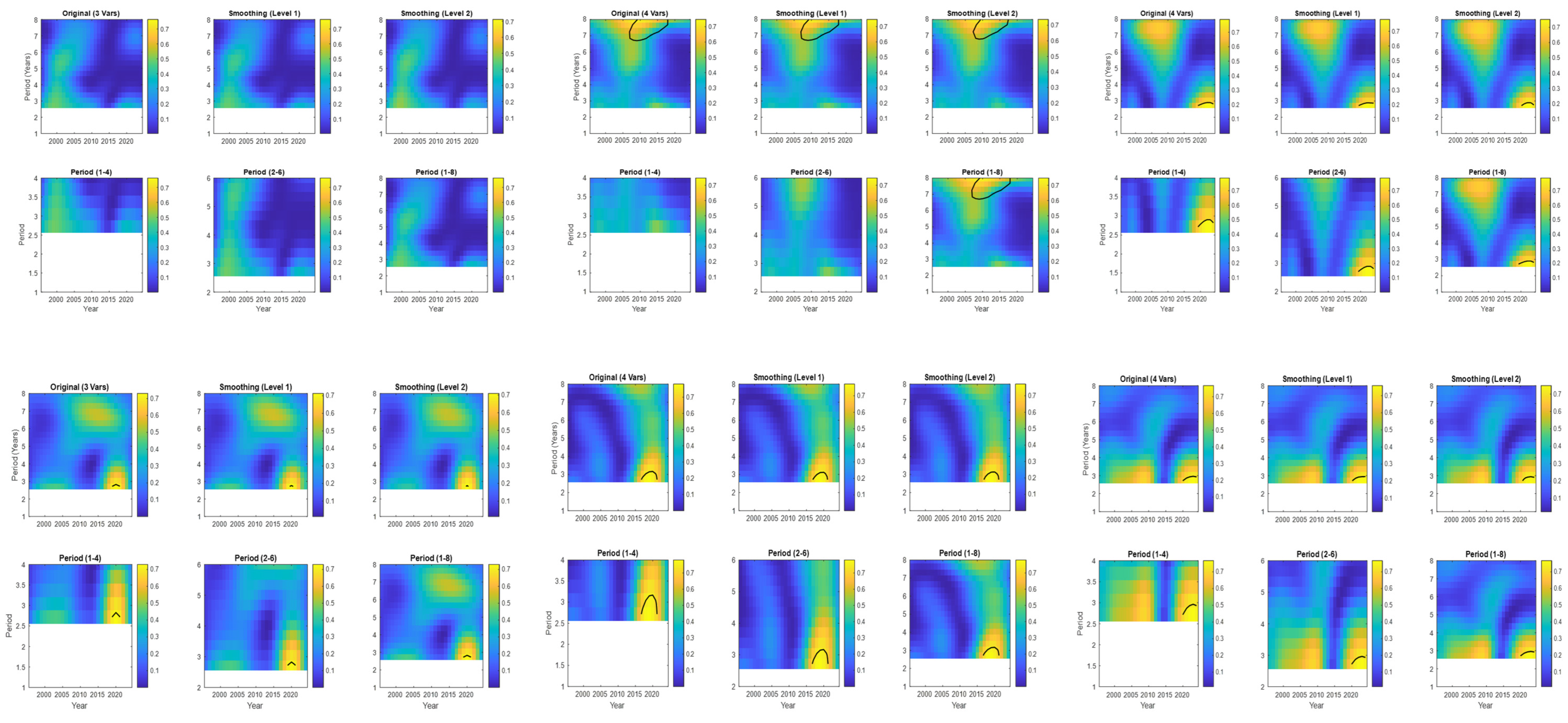
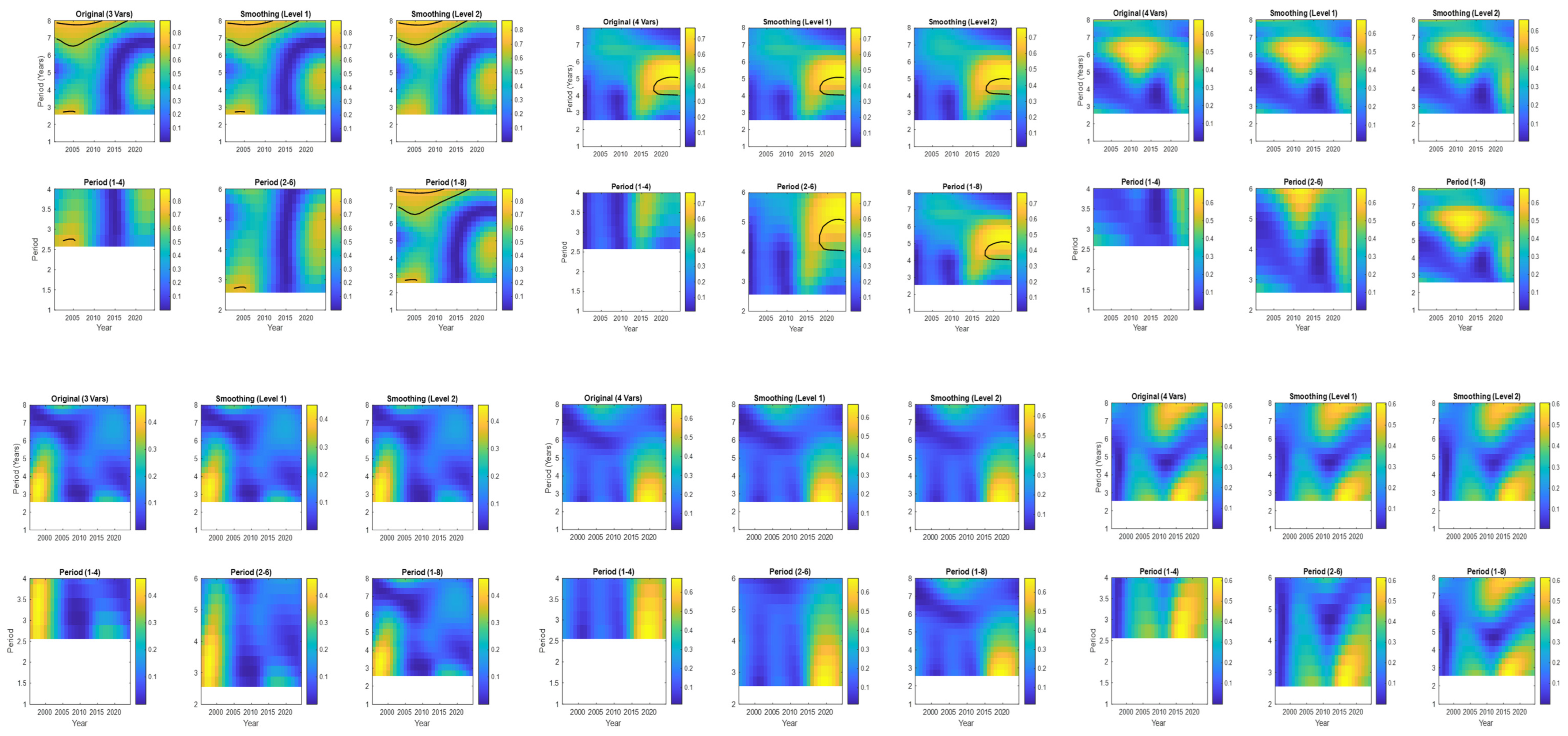
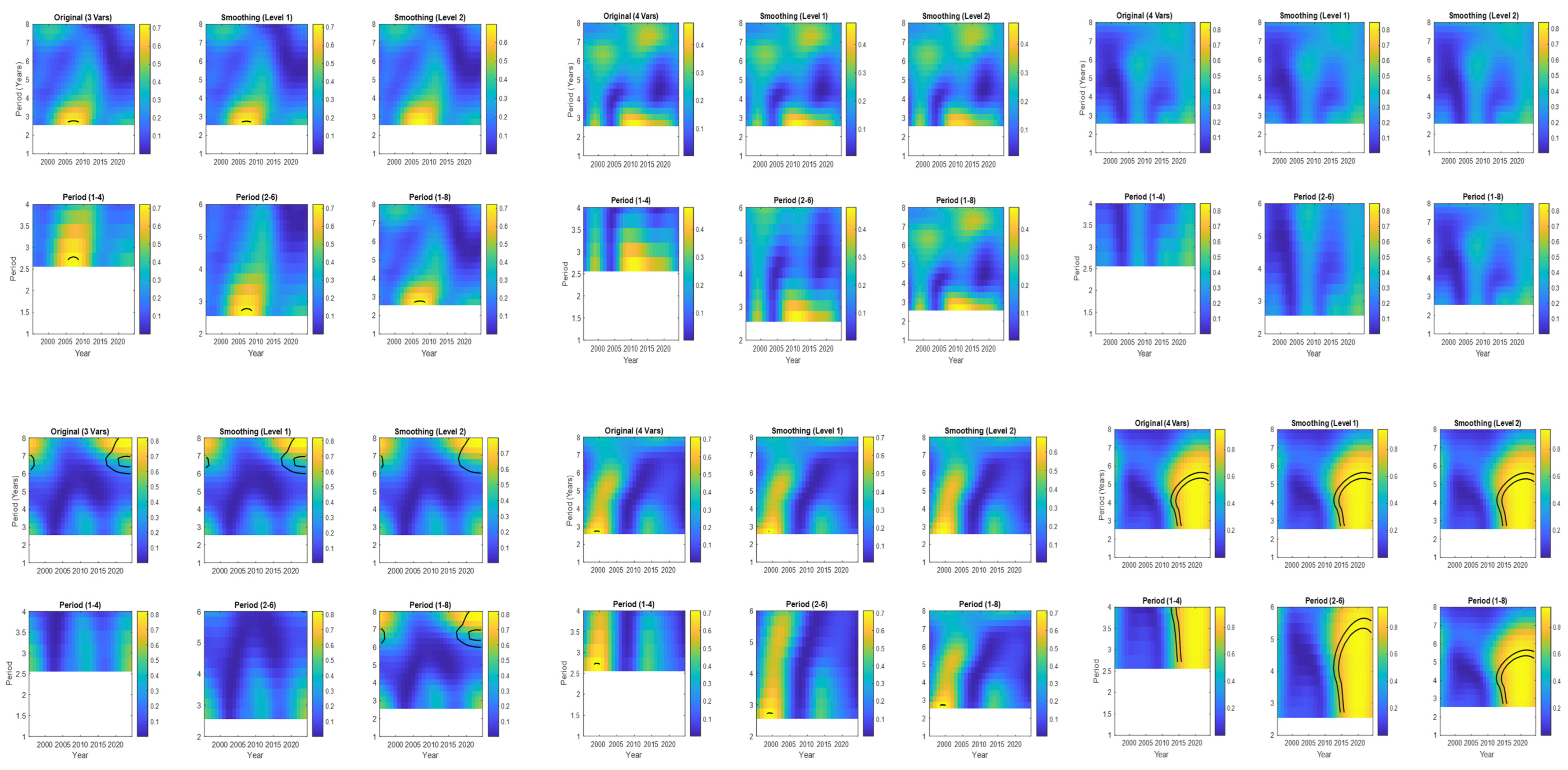
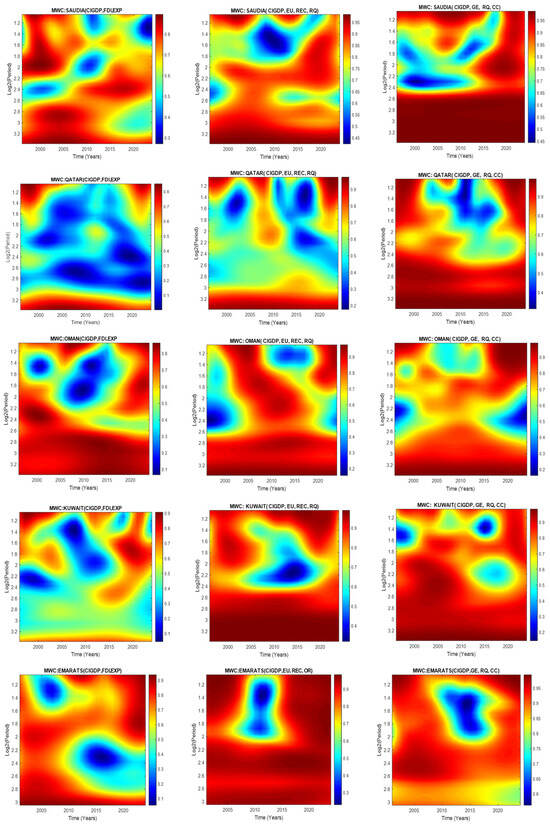
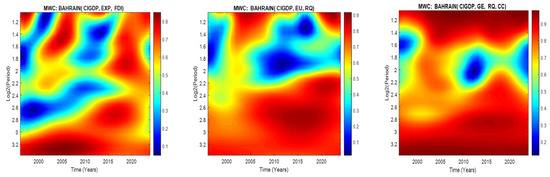
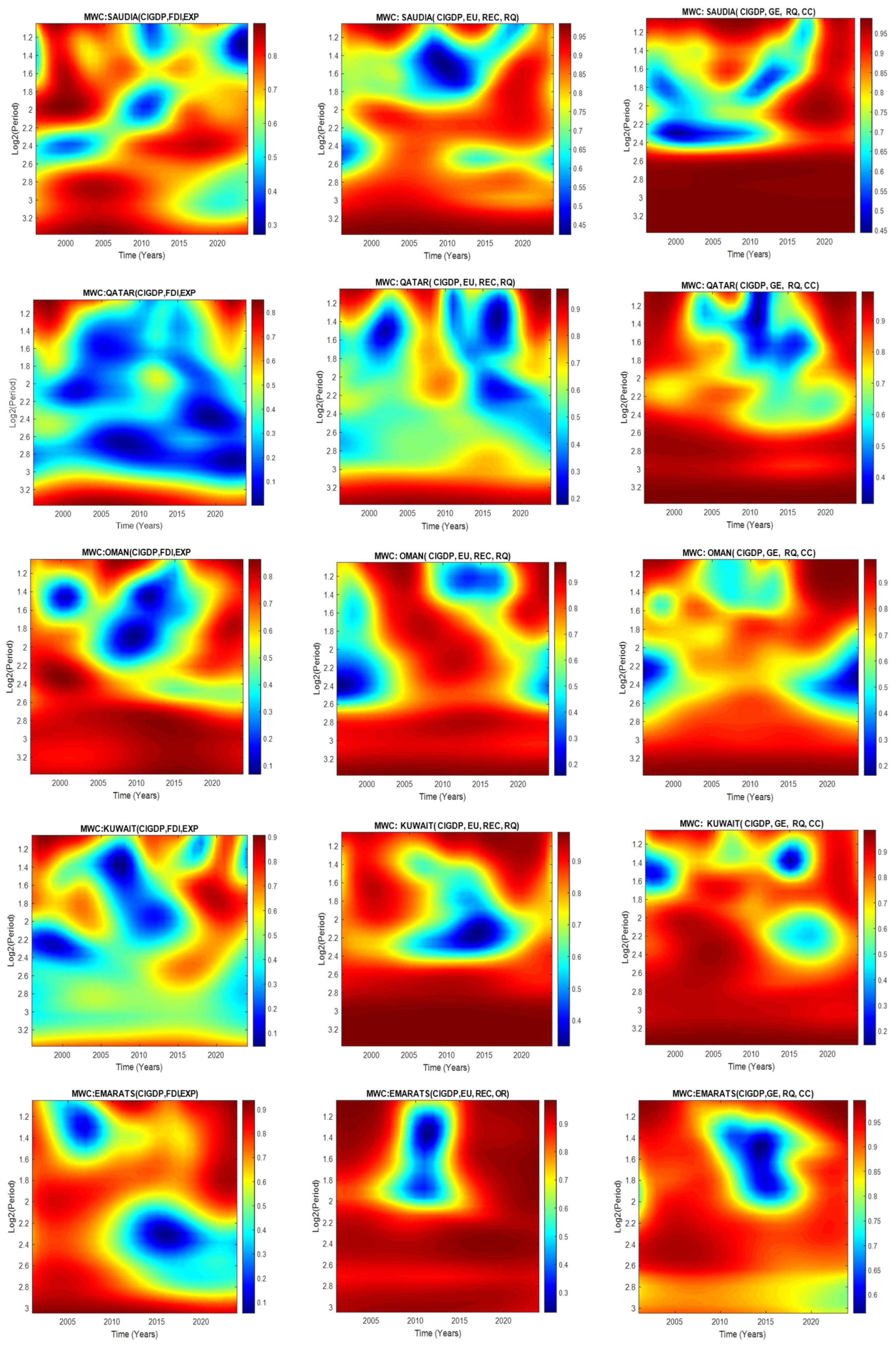
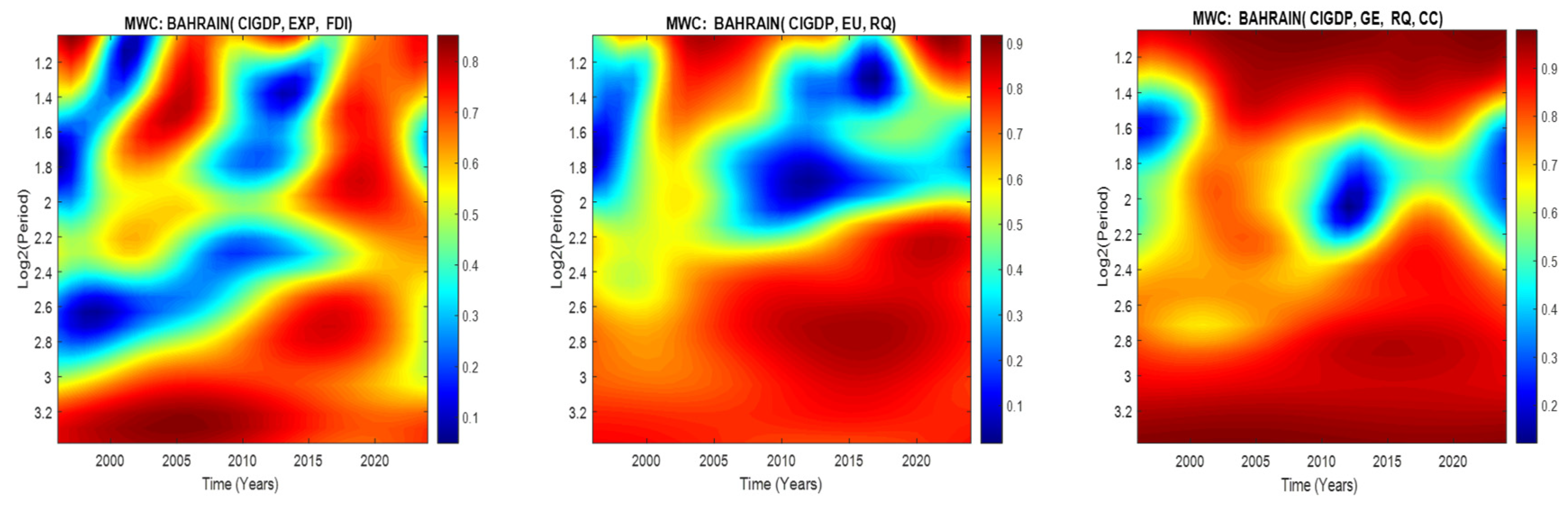
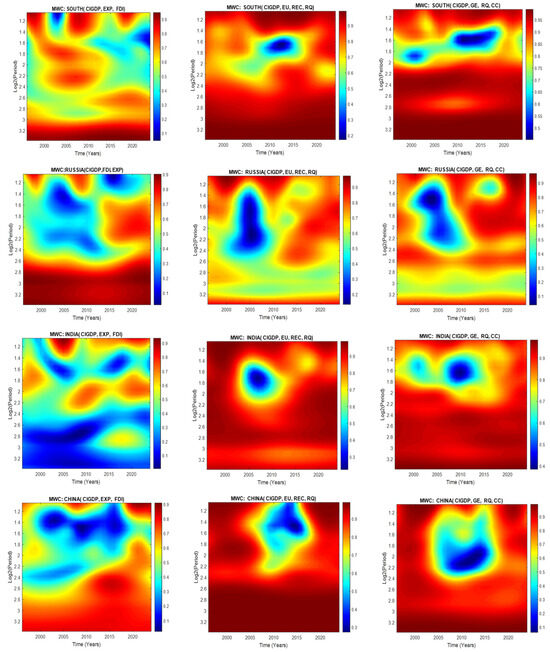
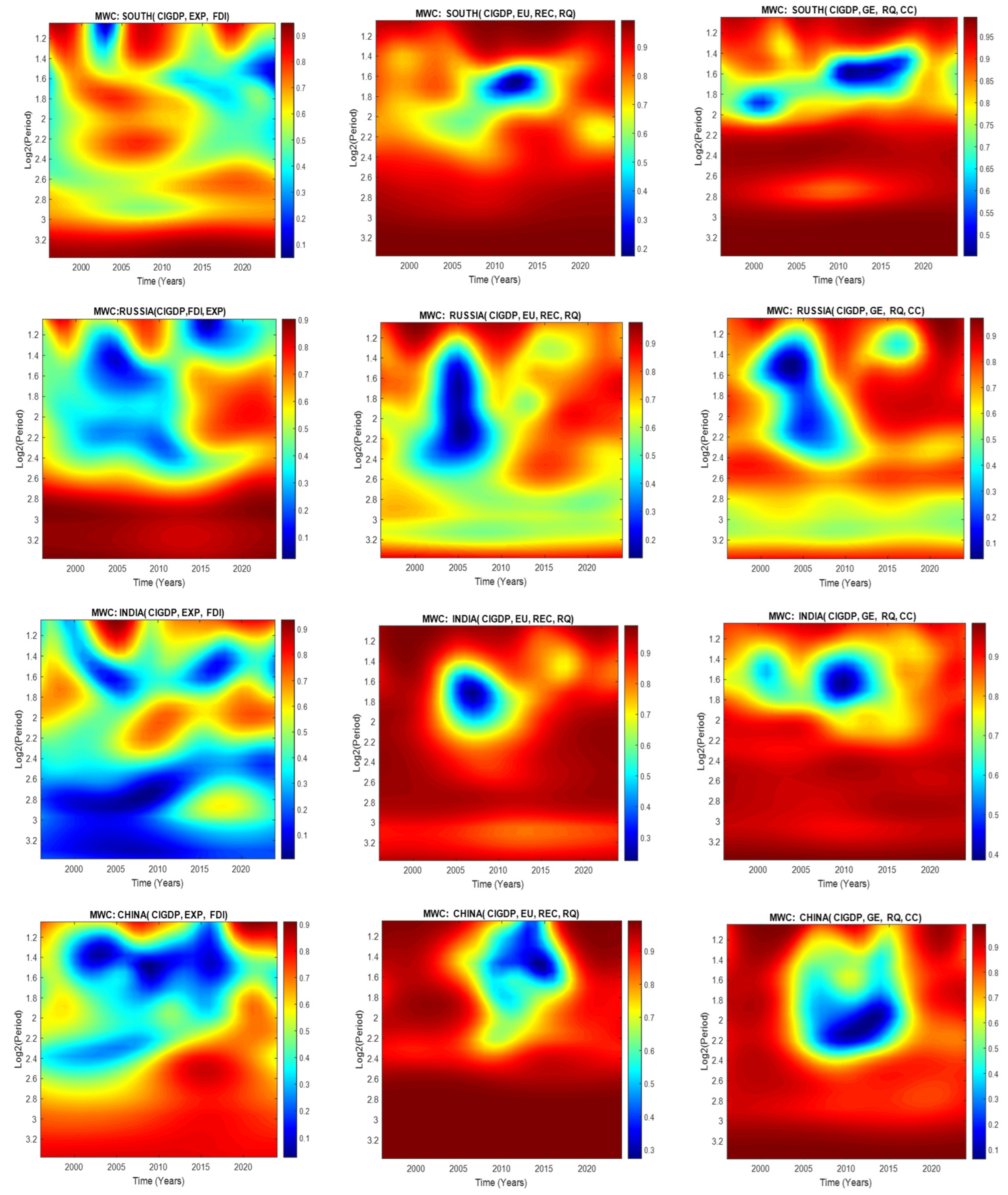
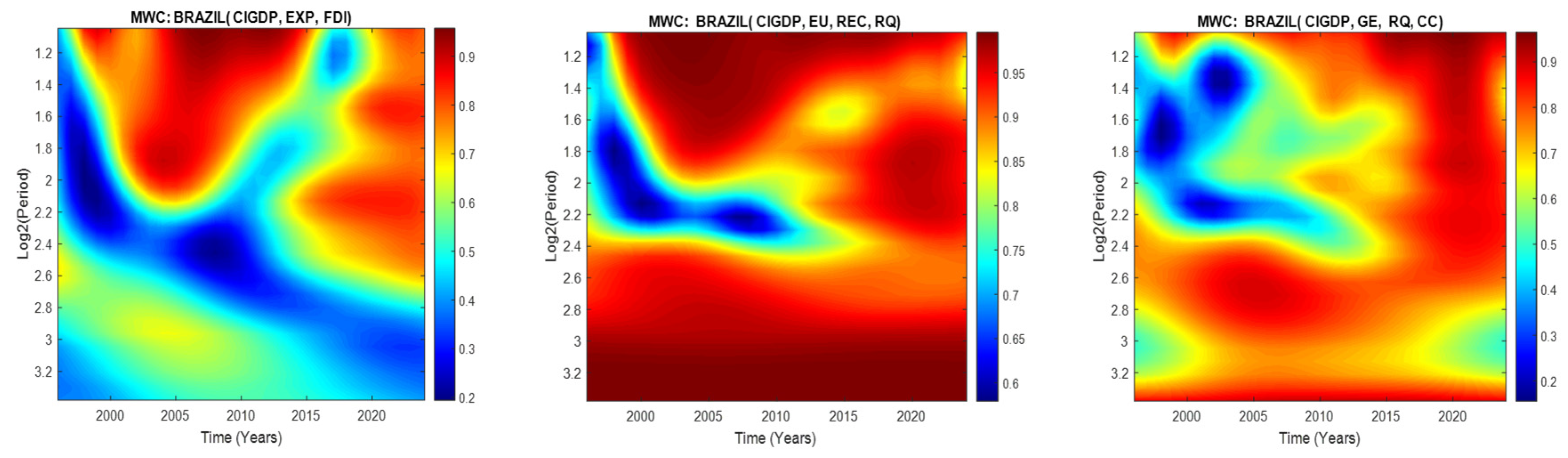
Overall, the system-level results indicate a hierarchical adjustment structure: persistent low-frequency coherence at long horizons, temporary and time-specific misalignment at medium horizons, and weak alignment at short horizons across all variable systems (Figure 1 and Figure 2).
Figure 1.
Multivariate wavelet coherence systems for GCC economies.
Figure 2.
Multivariate wavelet coherence systems for non-GCC emerging economies.
5.2. Regime-Level Differences: GCC Versus Non-GCC Emerging Economies
While the overall time–frequency structure is broadly shared across the full sample, clear regime-level differences emerge between GCC economies and non-GCC emerging economies in the continuity, stability, and duration of coherence across horizons.
GCC Economies
Across GCC economies, low-frequency coherence between carbon intensity of GDP (CIGDP) and all three variable systems is strong and continuous throughout the sample period. In the external-integration system, sustained low-frequency coherence indicates stable long-run alignment between carbon efficiency and export- and investment-oriented economic structures. In the energy-transition system, coherence reflects persistent coupling between energy use, renewable penetration, resource rents, and carbon efficiency. In the governance system, continuous low-frequency coherence indicates durable alignment between institutional quality and long-run carbon-efficiency outcomes.
At medium-term horizons, coherence weakens during specific periods, most notably in the mid-2010s. These episodes are brief and remain confined to intermediate frequencies, without disrupting the continuity of low-frequency coherence. Following these periods, strong alignment reappears at longer horizons across all systems, indicating a relatively rapid restoration of long-run coherence after transitional stress.
Overall, GCC economies exhibit a regime characterised by high institutional persistence, stable long-run coherence, and relatively short-lived medium-term misalignment across external, energy, and governance dimensions.
Non-GCC Emerging Economies
Non-GCC emerging economies exhibit more heterogeneous, less stable coherence structures. Although low-frequency coherence between CIGDP and the three systems is observable in most cases, it is less continuous and more frequently interrupted than in GCC economies.
Medium-term horizons exhibit more frequent and prolonged coherence weakening, particularly in the energy-transition and governance systems. In several countries, medium-term misalignment persists across extended periods, indicating slower re-alignment between carbon efficiency, energy-system restructuring, and institutional conditions.
In these economies, strong coherence tends to emerge more clearly over longer horizons, while medium-term dynamics remain fragmented over longer periods. This pattern reflects greater adjustment frictions and less stable institutional anchoring during periods of rapid structural change.
Comparative Summary
The primary regime-level distinction lies in the continuity of long-run coherence and the duration of medium-term misalignment. GCC economies exhibit more stable, continuous low-frequency alignment, with shorter transitional disruptions. In contrast, non-GCC emerging economies experience more fragmented medium-term dynamics before long-run coherence becomes firmly established.
5.3. Country-Specific Adjustment Patterns
Country-level wavelet results reveal meaningful heterogeneity within regimes, while preserving a common hierarchical structure across time horizons.
Within the GCC, Saudi Arabia and the United Arab Emirates exhibit strong and continuous low-frequency coherence across all three systems, with medium-term coherence weakening confined to earlier periods and becoming less pronounced over time. Qatar and Kuwait display similarly strong long-run coherence, although with more intermittent medium-term disruption, particularly in the external-integration and energy-transition systems. Oman and Bahrain show greater medium-horizon fragmentation, especially in the energy-transition system linking resource rents and carbon efficiency, while still maintaining visible low-frequency coherence.
Among non-GCC emerging economies, China exhibits robust low-frequency coherence across all systems alongside pronounced and recurrent medium-term weakening, indicating strong long-run alignment combined with more frequent transitional disruption. India exhibits weaker, less continuous low-frequency coherence, with repeated medium-term fragmentation across systems. Russia and South Africa exhibit more episodic coherence structures, characterised by less stable long-run alignment and frequent medium-term disruptions across the external, energy, and governance dimensions.
Brazil stands out for its strong, continuous low-frequency coherence across all systems, indicating persistent long-run alignment among carbon efficiency, energy use, and economic structure. Medium-term coherence weakening appears intermittently during periods of intensified structural adjustment, while short-run coherence remains limited and fragmented, consistent with the dominance of transitory shocks.
Across all countries, long-run coherence dominates adjustment dynamics, medium-term misalignment appears as a time-specific transitional feature, and short-run coherence remains weak and fragmented.
5.4. Sensitivity and Robustness
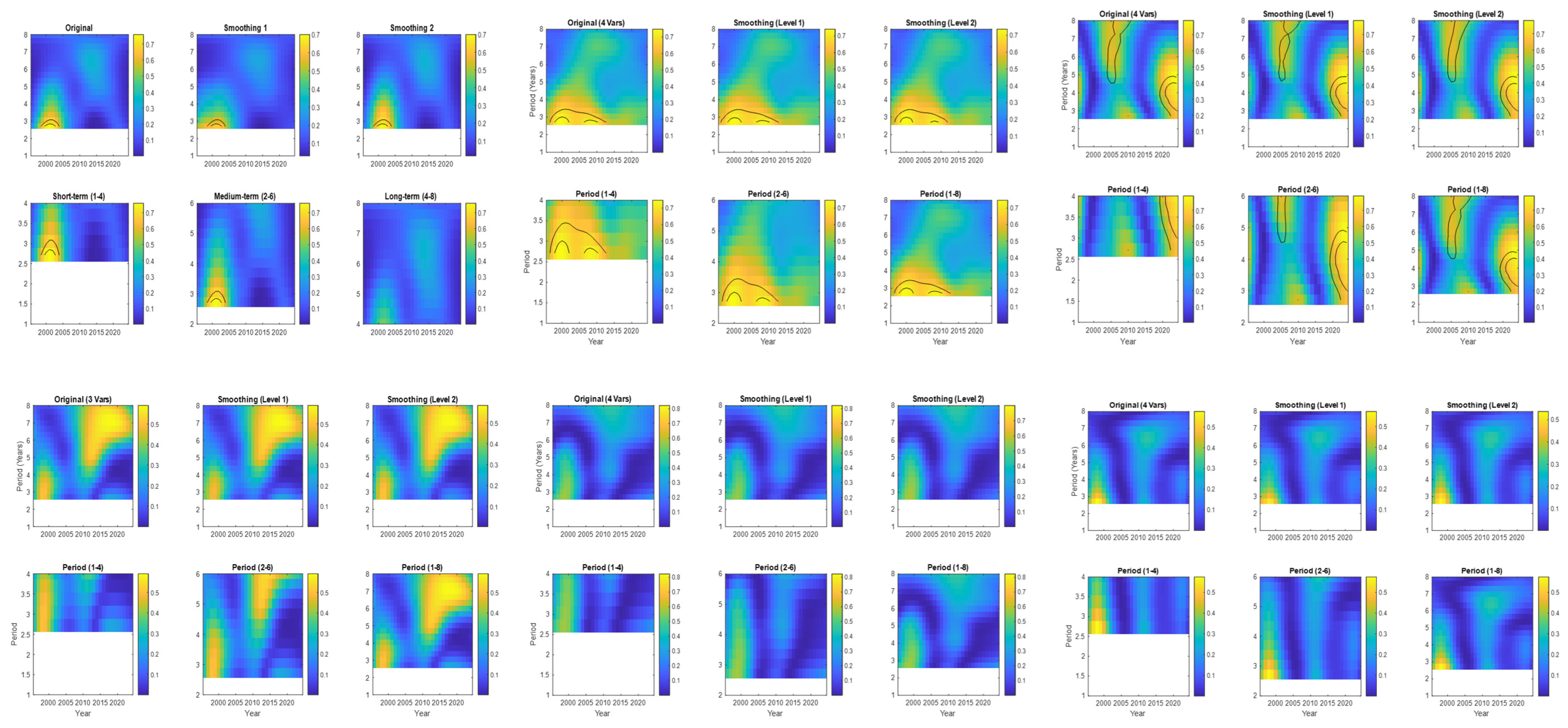
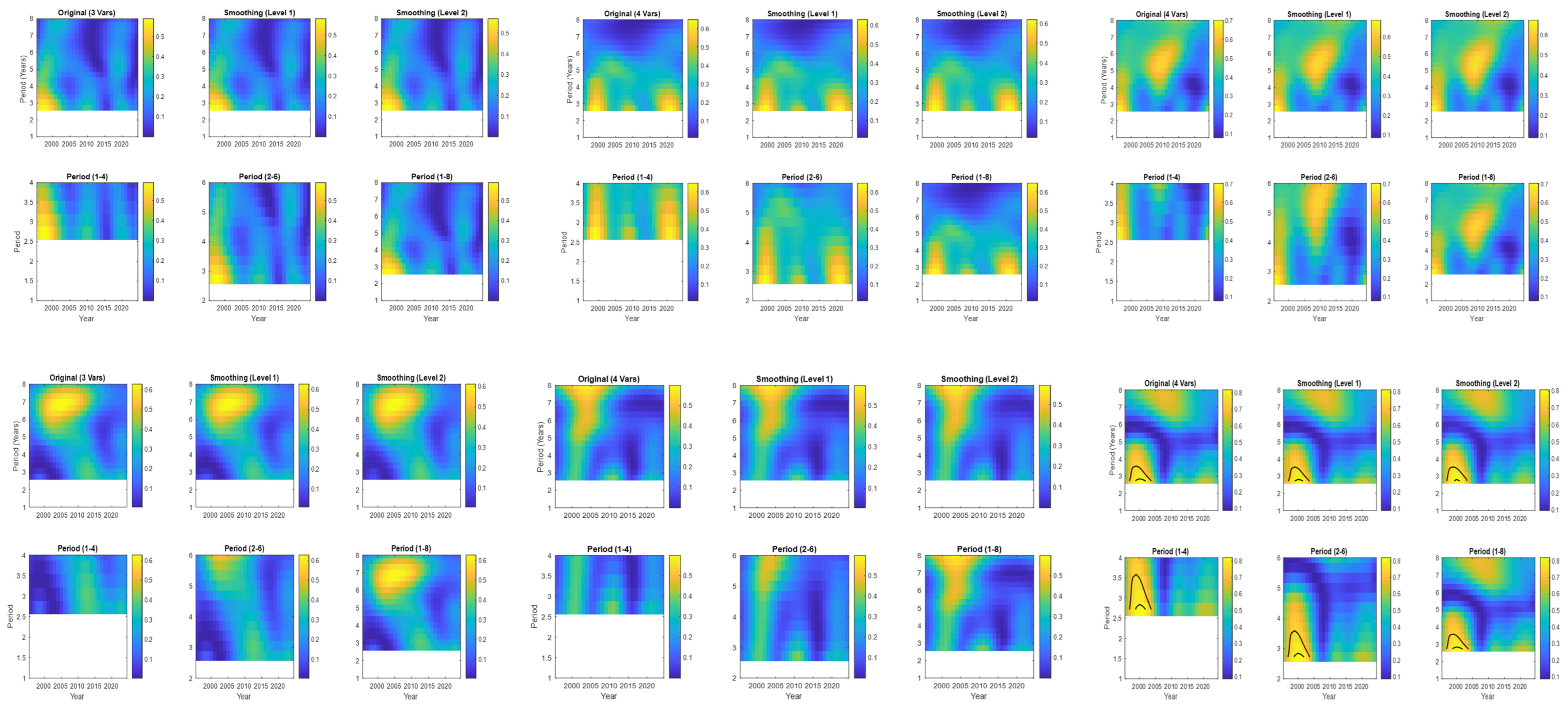
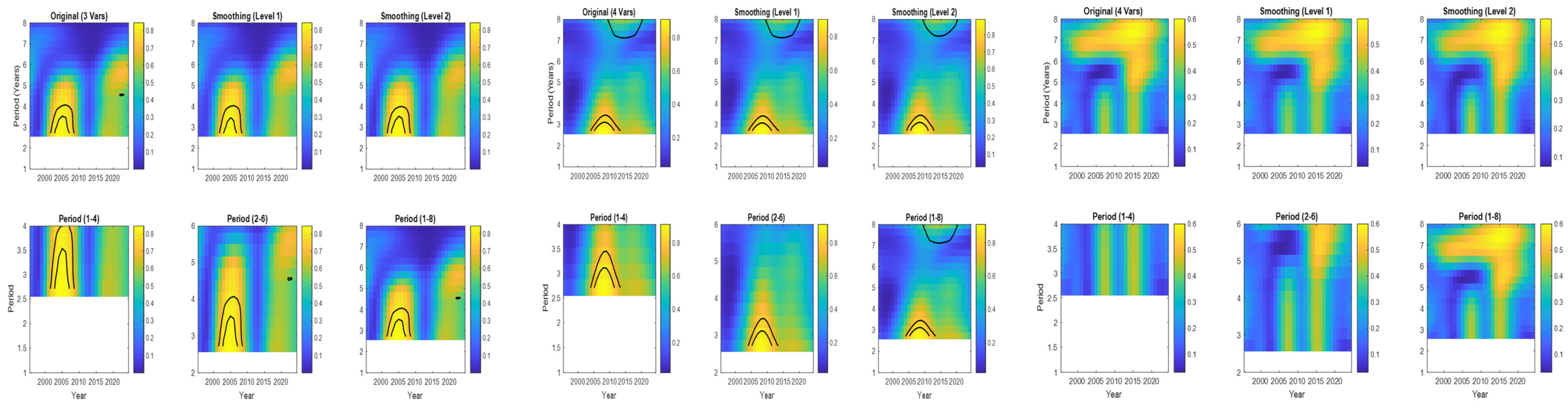
To assess the stability of the multivariate wavelet coherence results, three complementary robustness checks were conducted. First, a smoothing sensitivity analysis compared the original unsmoothed coherence surface against two alternative smoothed versions—one applying a moving average smoother (window = 3) along the time dimension and another along the scale dimension—to confirm that the reported coherence patterns are not sensitive to smoothing specifications. Second, a frequency sub-band analysis examined the coherence surface separately across three frequency windows: short-run (1–4 years), medium-run (2–6 years), and long-run (1–8 years), to ensure that the identified decoupling zones and coherence recovery episodes are stable across different frequency decompositions. Third, all input series were linearly detrended prior to estimation, and interpretation was strictly restricted to regions inside the Cone of Influence (COI) to eliminate boundary-effect distortions.
Across all robustness checks, the substantive coherence patterns reported in the preceding sections—including the identified decoupling zones, their temporal locations, and the post-reform coherence recoveries—remain consistent and stable. The hierarchical adjustment structure characterised by persistent low-frequency coherence, time-specific medium-term weakening, and weak high-frequency alignment is preserved under all alternative specifications. These results confirm the reliability of the MWC findings and support the robustness of the main conclusions. Additional figures illustrating the robustness results are provided in Figure A1 (Appendix A).
6. Discussion
This study provides a time–frequency interpretation of how governance aligns with energy-system dynamics and carbon efficiency across different economies. By anchoring the analysis on the carbon intensity of GDP and explicitly distinguishing between short-, medium-, and long-run horizons, the results demonstrate that institutional alignment with energy and carbon-efficiency outcomes varies across time scales rather than remaining constant.
6.1. Long-Run Institutional Anchoring
Across all wavelet systems, the most consistent pattern is the presence of strong and persistent coherence at low frequencies. This indicates that governance quality is closely aligned with carbon efficiency over extended horizons, reflecting a gradual, stable co-movement among economic structure, energy-system configuration, and institutional conditions.
Low-frequency coherence is consistently observed in systems linking carbon intensity to external integration, energy-transition variables, resource rents, and governance indicators. This suggests that institutional conditions are associated with carbon efficiency mainly through long-run structural alignment rather than short-run policy intervention or cyclical adjustment.
Importantly, this long-run anchoring pattern is observed across both GCC and non-GCC economies. While countries differ in adjustment paths and stability, persistent low-frequency coherence indicates that governance–carbon alignment is a common feature across diverse institutional settings.
6.2. Medium-Term Adjustment and the Mid-2010s
A recurring feature across countries and systems is the temporary weakening of coherence at medium-term horizons, particularly during the mid-2010s. These episodes are concentrated in frequency bands corresponding to adjustment periods of roughly three to six years and appear simultaneously across external-integration, energy-transition, and governance systems.
This medium-term weakening does not signal a breakdown of institutional alignment. Instead, it reflects a transitional phase of stress in which coherence becomes less stable for brief periods. The continued presence of strong low-frequency coherence alongside medium-term fragmentation suggests that long-run alignment remains intact despite temporary disruption.
6.3. Regime Differences in Coherence Stability
Although long-run coherence is present across all economies, differences emerge in the continuity and stability of alignment across governance regimes. GCC economies exhibit more continuous low-frequency coherence and shorter-lived episodes of medium-term weakening. In these settings, governance–carbon alignment remains relatively stable across time horizons.
In contrast, non-GCC emerging economies exhibit greater fragmentation in medium-term coherence. While low-frequency alignment remains observable, interruptions at medium horizons are more frequent and last longer. These patterns point to greater variability in adjustment dynamics rather than the absence of long-run alignment.
6.4. Governance and Carbon Efficiency
Using the carbon intensity of GDP as the anchoring variable provides insight into how governance–carbon alignment relates to environmental efficiency. Coherence between governance indicators and carbon intensity is most clearly expressed at long horizons, indicating that carbon efficiency evolves alongside sustained institutional and energy-system alignment.
Short-run fluctuations and medium-term variation in energy systems do not translate into immediate changes in carbon efficiency. Instead, efficiency improvements are associated with persistent co-movement over extended periods, consistent with the gradual nature of structural and institutional change.
This perspective helps clarify why empirical evidence on governance and emissions often appears mixed. Institutional quality is not typically associated with immediate changes in environmental outcomes; rather, it conditions the long-run trajectory of carbon efficiency through sustained alignment with structural and energy-system change.
6.5. Interpretation of Coherence and Directionality
The results in this section should be read with care, given the properties of multivariate wavelet coherence. Coherence captures time-varying alignment and co-movement across frequency bands, but it does not identify causal direction or isolate marginal effects. The observed low-frequency coherence between governance indicators and carbon intensity of GDP should therefore be interpreted as long-run co-evolution rather than directional influence. Reverse relationships, joint determination, or the role of common slow-moving structural factors—such as economic transformation, energy-market integration, or technological diffusion—cannot be ruled out.
Interpreting persistent low-frequency coherence as institutional anchoring is thus not a causal claim. It is based on the stability and continuity of alignment observed over extended horizons. Unlike coincidental structural convergence, the coherence documented here is visible across multiple systems and is only temporarily disrupted at medium horizons. This pattern points to a conditioning role of governance rather than episodic correlation. It is also consistent with the slow-moving nature of institutional indicators and with the idea that governance is associated with the durability and resilience of energy and carbon-efficiency transitions over time, rather than with short-run fluctuations.
Other long-run mechanisms may also contribute to the observed low-frequency coherence between carbon efficiency and energy-system variables. Structural economic transformation—such as changes in production structure, industrial upgrading, or energy intensity—can generate persistent co-movement even in the absence of institutional reform. Greater integration into global energy markets may transmit shared price signals, investment cycles, and technology standards across countries, leading to long-horizon synchronisation. Technological diffusion in energy generation, efficiency improvements, and emissions control can further support convergence in carbon efficiency. The results should therefore be read as showing that governance conditions the stability and persistence of long-run alignment among these processes, rather than acting as the sole or dominant driver.
Reading the three systems together reveals a coherent pattern of cross-system interaction. External shocks—transmitted through trade exposure and capital flows (System 1)—propagate into domestic energy-system structures, altering the pace and composition of energy use, renewable deployment, and resource-rent dependence (System 2). The wavelet evidence shows that when such shocks coincide with medium-term misalignment in the external-integration system, similar disruptions tend to appear in the energy-transition system during the same period, indicating that external and energy-system adjustment processes are structurally linked rather than independent. Governance coherence (System 3) is associated with variation in the duration and severity of these disruptions. In economies where institutional alignment with carbon efficiency is strong and continuous at low frequencies, medium-term misalignment across all three systems tends to be shorter-lived and more quickly resolved. In contrast, where governance coherence is less stable, medium-term fragmentation in the external and energy-system dimensions persists longer. This cross-system pattern supports the interpretation that governance does not operate as a separate influence on carbon efficiency but rather conditions how external and energy-system dynamics interact over time. The nested structure of the three systems—external conditions shaping the structural environment, energy-system dynamics reflecting the adjustment process, and governance quality conditioning the stability of alignment—is therefore not merely an analytical convenience but reflects an empirically observable pattern in the wavelet results.
6.6. Implications for Energy Transition Design
Taken together, the findings suggest that effective energy and carbon-efficiency transitions depend mainly on institutional persistence and governance stability rather than short-run policy responsiveness. The time–frequency evidence shows that governance–carbon alignment is strongest at long horizons, while short- and medium-term dynamics are characterised by temporary misalignment and adjustment noise.
From a policy perspective, this implies that energy-transition success should not be judged on short-run emissions outcomes or annual policy cycles. Improvements in carbon efficiency emerge gradually through sustained alignment between governance frameworks, energy-system restructuring, and economic structure. Rapid regulatory changes, frequent policy redesign, or reactive interventions during adjustment phases may create volatility without strengthening long-run transition outcomes.
What matters for long-run transition outcomes is not avoiding disruption but maintaining credibility and restoring alignment over longer horizons.
The comparison between GCC and non-GCC emerging economies highlights the role of institutional resilience. GCC economies exhibit greater long-run coherence and shorter-lived medium-term misalignments, suggesting that stable governance structures and centralised policy coordination help absorb shocks without undermining carbon-efficiency trajectories. In contrast, more prolonged medium-term fragmentation in non-GCC emerging economies points to the importance of strengthening administrative capacity, regulatory enforcement, and inter-agency coordination rather than expanding the number of policy instruments.
These findings translate into several concrete policy recommendations. For GCC economies, the evidence of strong and continuous long-run coherence suggests that existing institutional frameworks provide a durable basis for carbon-efficiency improvements. Policymakers in these economies should embed long-term carbon-efficiency targets within national strategic frameworks—such as Saudi Vision 2030, the UAE Energy Strategy 2050, or Qatar National Vision 2030—rather than relying on stand-alone energy or climate policies that may be subject to short-term revision. During periods of medium-term coherence weakening, such as those observed in the mid-2010s, governments should resist the impulse to introduce frequent policy redesigns and instead maintain regulatory stability to allow long-run alignment to re-emerge. For non-GCC emerging economies, where medium-term fragmentation is more prolonged, the priority should be to strengthen the institutional mechanisms that support policy continuity across political cycles. This includes investing in inter-ministerial coordination bodies for energy and climate policy, building independent regulatory capacity for energy-sector oversight, and establishing transparent long-term policy commitment devices such as legislated emissions reduction pathways or binding renewable energy targets. Administrative capacity for regulatory enforcement deserves particular attention, as the wavelet evidence suggests that weak enforcement is associated with longer episodes of misalignment between governance and carbon-efficiency outcomes. More broadly, for international climate finance and development assistance, the findings imply that governance capacity-building should be prioritised alongside technology transfer and renewable energy investment. Programmes that strengthen regulatory quality, anti-corruption frameworks, and public investment management are likely to support more durable carbon-efficiency gains than those focused narrowly on short-term emissions targets or project-level renewable energy deployment.
Overall, the results indicate that energy-transition design should prioritise institutional durability, regulatory coherence, and long-term policy credibility. Carbon-efficiency gains are not associated with rapid intervention, but with governance systems that sustain alignment across extended periods of reform, volatility, and technological change. The time–frequency perspective adopted in this study helps explain why similar energy strategies can lead to different outcomes across institutional contexts. It reinforces the central role of governance resilience in shaping durable energy and carbon-efficiency transitions.
7. Conclusions
This study examined how institutional quality aligns with energy-system dynamics and carbon efficiency across different time horizons using a multivariate wavelet coherence framework. By adopting a time–frequency perspective, the analysis moved beyond average long-run relationships and traced how coherence among governance, energy use, renewable energy consumption, and the carbon intensity of GDP evolves in GCC and non-GCC emerging economies for the period 1996–2022.
The results show that governance–energy–carbon relationships are inherently time-dependent. Across countries and wavelet systems, coherence between governance indicators and energy–carbon outcomes is strongest and most persistent at low frequencies, indicating sustained long-run alignment rather than short-run synchronisation. At high frequencies, coherence is generally weak and unstable, suggesting that short-run fluctuations in energy use, renewable deployment, and carbon efficiency are largely decoupled from institutional conditions.
A recurring feature of the analysis is the presence of temporary medium-term coherence weakening, most notably during the mid-2010s. These episodes coincide with periods of rapid energy-system change, reform acceleration, and external shocks. Importantly, such disruptions do not undermine long-run coherence. From a time–frequency perspective, medium-term misalignment reflects transitional adjustment rather than institutional breakdown, as long-run alignment remains intact across extended horizons.
Comparative evidence reveals systematic differences across governance regimes. GCC economies exhibit more continuous low-frequency coherence and shorter-lived medium-term disruptions. In contrast, non-GCC emerging economies display more fragmented medium-term dynamics before long-run alignment becomes firmly established. These differences reflect variation in institutional resilience and adjustment capacity rather than differences in the relevance of governance for energy and carbon-efficiency dynamics.
The use of GDP carbon intensity as the anchoring variable provides additional insight into the environmental dimension of energy transitions. Coherence between governance indicators, energy-system variables, and carbon efficiency emerges predominantly at long horizons, indicating that improvements in carbon efficiency evolve gradually alongside sustained institutional and structural alignment. Short-run policy shifts or annual energy fluctuations do not translate directly into changes in carbon intensity; instead, efficiency gains accumulate over time through persistent co-movement among governance frameworks, energy systems, and economic structure.
Overall, the findings support the interpretation of institutional quality as a stabilising and conditioning factor in energy and carbon-efficiency transitions. Temporary misalignment is a normal feature of transition dynamics, particularly during periods of accelerated reform or external shocks. Long-run transition stability depends not on the absence of disruption, but on the capacity of governance systems to sustain alignment and coherence across extended periods of structural change.
Several limitations should be acknowledged. First, multivariate wavelet coherence captures time-varying alignment and co-movement across frequency bands but does not establish causal direction or isolate marginal effects. The results should therefore be interpreted as documenting co-evolution and conditional association rather than directional influence. Second, the sample of non-GCC emerging economies (China, India, Russia, Brazil, and South Africa) is illustrative rather than statistically representative. While these countries offer meaningful institutional and structural contrasts with GCC economies, the findings should not be generalised beyond the countries examined. Third, the study period (1996–2022) is constrained by the availability of Worldwide Governance Indicators. A longer time series would strengthen inference on very-low-frequency dynamics and allow more robust assessment of institutional persistence over extended horizons. Fourth, the analysis does not decompose lead–lag relationships or partial coherence effects among individual variables within each system. Future research could extend the framework using wavelet-based Granger causality or partial wavelet coherence to assess directional dynamics and isolate the contribution of individual governance dimensions. Fifth, while the study identifies periods of medium-term misalignment, it does not formally link these episodes to specific external events or policy changes. Integrating event-based analysis with the wavelet framework could provide richer contextual interpretation of coherence dynamics.
Author Contributions
Conceptualization, N.A.A. and A.B.B.; methodology, A.B.B. and N.A.A.; software, A.B.B.; validation, N.A.A. and A.B.B.; formal analysis, N.A.A.; investigation, N.A.A. and A.B.B.; resources, N.A.A.; data curation, N.A.A.; writing—original draft preparation, N.A.A.; writing—review and editing, N.A.A. and A.B.B.; visualization A.B.B.; supervision, N.A.A.; project administration, N.A.A.; funding acquisition, N.A.A. All authors have read and agreed to the published version of the manuscript.
Funding
This research was funded by the Deanship of Scientific Research, Vice Presidency for Graduate Studies and Scientific Research, King Faisal University, Saudi Arabia [Grant No. KFU261838].
Institutional Review Board Statement
Not applicable.
Informed Consent Statement
Not applicable.
Data Availability Statement
The data presented in this study are openly available from the World Bank’s World Development Indicators and Worldwide Governance Indicators databases. [World Bank DataBank] [https://databank.worldbank.org/].
Conflicts of Interest
The authors declare no conflict of interest.
Appendix A. Sensitivity and Robustness Check Results
Figure A1.
Robustness checks: multivariate wavelet coherence results under alternative specifications. The panels present results from three complementary checks: smoothing sensitivity, comparing the original unsmoothed coherence surface against moving average smoothers (window = 3) in the time and scale dimensions; frequency sub-band analysis across short-run (1–4 years), medium-run (2–6 years), and long-run (1–8 years) windows; and linear detrending with interpretation restricted to regions inside the Cone of Influence (COI). Across all checks, the substantive coherence patterns remain consistent with the main results reported in Section 5.1, Section 5.2 and Section 5.3.
References
- Bhattacharya, M.; Paramati, S.R.; Ozturk, I.; Bhattacharya, S. The effect of renewable energy consumption on economic growth: Evidence from top 38 countries. Appl. Energy 2017, 162, 733–741. [Google Scholar] [CrossRef] [Scilit]
- Dong, K.; Sun, R.; Hochman, G. Do natural gas and renewable energy consumption lead to less CO2 emission? Empirical evidence from a panel of BRICS countries. Energy 2018, 141, 1466–1478. [Google Scholar] [CrossRef] [Scilit]
- Sharif, A.; Baris-Tuzemen, O.; Uzuner, G.; Ozturk, I.; Sinha, A. Revisiting the role of renewable and non-renewable energy consumption on Turkey’s ecological footprint: Evidence from Quantile ARDL approach. Sustain. Cities Soc. 2020, 57, 102138. [Google Scholar] [CrossRef] [Scilit]
- Al-Mulali, U.; Weng-Wai, C.; Sheau-Ting, L.; Mohammed, A.H. Investigating the environmental Kuznets curve (EKC) hypothesis by utilizing the ecological footprint as an indicator of environmental degradation. Ecol. Indic. 2015, 48, 315–323. [Google Scholar] [CrossRef] [Scilit]
- Mrabet, Z.; AlSamara, M.; Jarallah, S.H. The impact of economic development on environmental degradation in Qatar. Environ. Ecol. Stat. 2019, 24, 7–38. [Google Scholar] [CrossRef] [Scilit]
- Zhang, Y.-J.; Da, Y.-B. The decomposition of energy-related carbon emission and its decoupling with economic growth in China. Renew. Sustain. Energy Rev. 2015, 41, 1255–1266. [Google Scholar] [CrossRef] [Scilit]
- Alkhathlan, K.; Javid, M. Carbon emissions and oil consumption in Saudi Arabia. Renew. Sustain. Energy Rev. 2015, 48, 105–111. [Google Scholar] [CrossRef] [Scilit]
- Al-Mulali, U.; Ozturk, I. The investigation of environmental Kuznets curve hypothesis in the advanced economies: The role of energy prices. Renew. Sustain. Energy Rev. 2016, 54, 1622–1631. [Google Scholar] [CrossRef] [Scilit]
- Cole, M.A.; Elliott, R.J. Determining the trade–environment composition effect: The role of capital, labor and environmental regulations. J. Environ. Econ. Manag. 2003, 46, 363–383. [Google Scholar] [CrossRef] [Scilit]
- Alkathery, M.A.; Chaudhuri, K.; Nasir, M.A. Dependence between the GCC energy equities, global clean energy and emission markets: Evidence from wavelet analysis. Energy Econ. 2023, 121, 106659. [Google Scholar] [CrossRef] [Scilit]
- Alharthi, M.; Hassan, M.S.; Huang, J.; Mahmood, H.; Arshad, H. Institutional quality and environmental sustainability nexus: Fresh evidence of most polluted countries in a CS–ARDL framework. Nat. Resour. Forum 2025, 49, 2048–2066. [Google Scholar] [CrossRef] [Scilit]
- Farooq, U.; Gang, F.; Shahzad, F. The role of governance in the environmental Kuznets curve: Evidence from G7 countries. J. Environ. Manag. 2022, 302, 113948. [Google Scholar]
- Hassan, M.; Kouzez, M.; Lee, J.-Y.; Msolli, B.; Rjiba, H. Does increasing environmental policy stringency enhance renewable energy consumption in OECD countries? Energy Econ. 2024, 129, 107198. [Google Scholar] [CrossRef] [Scilit]
- Lau, L.S.; Ng, C.F.; Cheah, S.P.; Choong, C.K. The role of governance in the environmental Kuznets curve: A revisit of the literature. J. Clean. Prod. 2019, 240, 118245. [Google Scholar]
- Leitão, N.C. Corruption and environmental pollution: The case of Europe. Econ. Sociol. 2020, 13, 130–142. [Google Scholar]
- Levinson, A.; Taylor, M.S. Unmasking the pollution haven effect. Int. Econ. Rev. 2008, 49, 223–254. [Google Scholar] [CrossRef] [Scilit]
- Managi, S.; Hibiki, A.; Tsurumi, T. Does trade openness improve environmental quality? J. Environ. Econ. Manag. 2009, 58, 346–363. [Google Scholar] [CrossRef] [Scilit]
- Mol, A.P.; Spaargaren, G. Ecological modernisation theory in debate: A review. Environ. Politics 2000, 9, 17–49. [Google Scholar] [CrossRef] [Scilit]
- Nham, N.T.H.; Ha, L.T. A wavelet analysis of connectedness between economic globalization, nonrenewable, and renewable energy consumption, and CO2 emissions in Vietnam. Sustain. Energy Technol. Assess. 2023, 57, 103227. [Google Scholar] [CrossRef] [Scilit]
- Omri, A.; Hadj, T.B. Foreign investment and air pollution: Do good governance and technological innovation matter? Environ. Res. 2020, 185, 109469. [Google Scholar] [CrossRef] [Scilit]
- Pfeiffer, B.; Mulder, P.; de Groot, H.L. The impact of renewable energy on industrial innovation: Evidence from China. Energy Policy 2016, 98, 121–132. [Google Scholar]
- Polzin, F.; Egli, F.; Steffen, B.; Schmidt, T.S. How do policies mobilize private finance for renewable energy?—A systematic review with an investor perspective. Appl. Energy 2019, 236, 1249–1268. [Google Scholar] [CrossRef] [Scilit]
- Porter, M.E.; van der Linde, C. Toward a new conception of the environment–competitiveness relationship. J. Econ. Perspect. 1995, 9, 97–118. [Google Scholar] [CrossRef] [Scilit]
- Sarkodie, S.A.; Adams, S. Renewable energy, nuclear energy, and environmental pollution: Accounting for political institutional quality in South Africa. Sci. Total. Environ. 2018, 643, 1590–1601. [Google Scholar] [CrossRef] [Scilit] [PubMed]
- Shahbaz, M.; Hye, Q.M.A.; Tiwari, A.K.; Leitão, N.C. Economic growth, energy consumption, financial development, international trade and CO2 emissions in Indonesia. Renew. Sustain. Energy Rev. 2013, 25, 109–121. [Google Scholar] [CrossRef] [Scilit]
- Welsch, H. Corruption, growth, and the environment: A cross-country analysis. Environ. Dev. Econ. 2004, 9, 663–693. [Google Scholar] [CrossRef] [Scilit]
- Xu, D.; Hussain, J. Globalization, institutions, and environmental quality in Middle East and North African countries. Environ. Sci. Pollut. Res. 2023, 30, 68951–68968. [Google Scholar] [CrossRef] [Scilit] [PubMed]
- Zhao, J.; Zhao, Z.; Zhang, H. The impact of growth, energy and financial development on environmental pollution in China: New evidence from a spatial econometric analysis. Energy Econ. 2021, 93, 104506. [Google Scholar] [CrossRef] [Scilit]
- Zugravu-Soilita, N. How does Foreign Direct Investment Affect Pollution? Toward a Better Understanding of the Direct and Conditional Effects. Environ. Resour. Econ. 2017, 66, 293–338. [Google Scholar] [CrossRef] [Scilit]
- Aguiar-Conraria, L.; Soares, M.J. The continuous wavelet transform: Moving beyond uni-and bivariate analysis. J. Econ. Surv. 2014, 28, 344–375. [Google Scholar] [CrossRef] [Scilit]
- Alfalih, A.A.; Hadj, T.B. Striking a balance between environmental regulations, clean innovation, and clean energy supply in emerging G20 countries: Evidence from novel wavelet coherence and panel threshold approaches. Sustain. Energy Technol. Assess. 2025, 83, 104653. [Google Scholar] [CrossRef] [Scilit]
- Wu, R.; Zeng, H.; Yan, J.; Işık, C. Introducing the environmental governance policy uncertainty (EGPU) for China. J. Environ. Manag. 2025, 386, 125748. [Google Scholar] [CrossRef] [Scilit] [PubMed]
- Caldera, Y.; Ranthilake, T.; Gunawardana, H.; Senevirathna, D.; Jayathilaka, R.; Rathnayake, N.; Peter, S. Understanding the interplay of GDP, renewable, and non-renewable energy on carbon emissions: Global wavelet coherence and Granger causality analysis. PLoS ONE 2024, 19, e0308780. [Google Scholar] [CrossRef] [Scilit] [PubMed]

Disclaimer/Publisher’s Note: The statements, opinions and data contained in all publications are solely those of the individual author(s) and contributor(s) and not of MDPI and/or the editor(s). MDPI and/or the editor(s) disclaim responsibility for any injury to people or property resulting from any ideas, methods, instructions or products referred to in the content. |
© 2026 by the authors. Licensee MDPI, Basel, Switzerland. This article is an open access article distributed under the terms and conditions of the Creative Commons Attribution (CC BY) license.