


Abstract
Entrepreneurship education has been promoted as a pathway for strengthening entrepreneurial orientation among university students; however, uncertainty remains regarding the mechanisms through which it influences entrepreneurial intention, particularly in emerging economies. This study examines whether entrepreneurship education influences the entrepreneurial intention of university students in Honduras indirectly through entrepreneurial self-efficacy and entrepreneurial motivation. A quantitative, cross-sectional, and explanatory study was conducted with a sample of 431 university students. Data were collected using a structured 56-item questionnaire with a seven-point Likert scale. The analysis was carried out through confirmatory factor analysis and structural equation modeling using the WLSMV estimator. The results show that entrepreneurship education positively influences all dimensions of entrepreneurial self-efficacy and entrepreneurial motivation included in the model. Personal attitude emerged as the strongest predictor of entrepreneurial intention, followed by subjective norms and specific dimensions of self-efficacy related to business planning and management and entrepreneurial leadership. In contrast, the innovation and problem-solving dimension did not show a significant direct effect on entrepreneurial intention, while perceived behavioral control showed a marginal effect. The parsimonious model explained 75.9% of the variance in entrepreneurial intention. Overall, the findings suggest that entrepreneurship education exerts its influence primarily through indirect pathways by strengthening capability beliefs and motivational appraisals that are proximal to action.
1. Introduction
Entrepreneurship education (EE) has become one of the main strategies through which universities seek to strengthen entrepreneurship-oriented competencies, attitudes, and dispositions among their students [1,2,3,4]. However, although the literature generally recognizes that EE may positively influence entrepreneurial intention (EI), the evidence remains less conclusive regarding how that influence occurs. In fact, some studies have focused on the direct effects between entrepreneurship education and entrepreneurial intention, whereas others have favored explanations centered on entrepreneurial self-efficacy or on motivational variables derived from the Theory of Planned Behavior (TPB), although in a rather separate manner [5,6,7,8,9]. Consequently, a relevant analytical limitation persists: less is still known about the proximal psychological mechanisms through which educational experience is translated into entrepreneurial intention [1,2,3,4,10,11,12].
This limitation is especially important in emerging economies, where university students face institutional constraints, unequal access to resources, weaknesses in support ecosystems, and higher levels of occupational uncertainty [13,14,15,16]. In contexts of this kind, EE is unlikely to operate as a uniform stimulus. Rather, its effect may depend on whether it succeeds in strengthening students’ entrepreneurial capability beliefs and in reshaping their motivational evaluations of entrepreneurship as a desirable and viable career option. From this perspective, models that privilege only direct effects or a single mediator still offer an incomplete explanation of the link between EE and EI.
Therefore, the gap addressed by this study can be formulated more precisely as follows: although the literature has documented positive relationships among entrepreneurship education, entrepreneurial self-efficacy, entrepreneurial motivation, and entrepreneurial intention, studies that simultaneously integrate these explanatory pathways within a single analytical framework remain relatively less frequent, particularly in underexplored university settings within emerging economies. In this sense, the present study does not claim that self-efficacy or motivation has been ignored by prior research; rather, it argues that the joint explanation of both mechanisms as indirect pathways between entrepreneurship education and entrepreneurial intention remains insufficiently developed [6,7,8,17,18].
Based on this premise, this study proposes an integrative framework in which entrepreneurship education influences entrepreneurial intention through two proximal psychological mechanisms: entrepreneurial self-efficacy and entrepreneurial motivation. In this study, entrepreneurial motivation is operationalized through dimensions associated with the TPB, specifically personal attitude, subjective norms, and perceived behavioral control. In this way, the contribution of the study is threefold. First, it refines the theoretical explanation of the EE–EI relationship by jointly modeling a capability-belief pathway and a motivational appraisal pathway. Second, it provides empirical evidence from Honduras, a university context underrepresented in the international entrepreneurship education literature. Third, it helps clarify whether the influence of EE on EI is more consistently understood as an indirect process mediated by specific psychological mechanisms.
In line with this approach, the research question is formulated as follows:
Through which psychological mechanisms does entrepreneurship education influence the entrepreneurial intention of university students in Honduras?
Accordingly, the objective of this study is to examine whether entrepreneurship education influences the entrepreneurial intention of university students in Honduras indirectly through entrepreneurial self-efficacy and entrepreneurial motivation.
2. Literature Review
2.1. Integrating the Theory of Planned Behavior and Social Cognitive Theory
The present study is grounded in the complementarity between the Theory of Planned Behavior (TPB) and Social Cognitive Theory (SCT). The TPB explains entrepreneurial intention in terms of motivational appraisals that are proximal to action, specifically personal attitude toward entrepreneurship, subjective norms, and perceived behavioral control [19,20,21]. SCT, in turn, emphasizes the role of self-efficacy as a central belief regarding an individual’s ability to organize and execute actions aimed at achieving a desired outcome [22,23]. Considered separately, both perspectives capture relevant but partial dimensions of the process through which entrepreneurship education may shape entrepreneurial intention. When integrated, they provide a more comprehensive explanation of how educational experience is transformed into entrepreneurial disposition.
The value of this integration lies in the fact that both theories illuminate distinct yet complementary processes. The TPB captures the motivational appraisal of entrepreneurship: whether it is perceived as desirable, socially supported, and behaviorally feasible. SCT captures the capability belief: whether the individual considers that he or she possesses the personal skills and resources needed to perform entrepreneurial tasks successfully. Entrepreneurship education may influence both pathways. Through courses, mentoring, experiential learning, contact with entrepreneurial role models, and institutional support, EE may strengthen both perceived capability and the evaluation of entrepreneurship as a feasible and attractive career alternative [24,25,26,27,28,29,30,31]. From this perspective, integrating TPB and SCT improves the explanatory precision of the study because it connects educational experience not only to entrepreneurial intention itself, but also to the cognitive and motivational mechanisms that precede it.
One aspect that deserves greater emphasis within this integrative framework is the pedagogical form through which entrepreneurship education activates these mechanisms. Recent evidence suggests that the influence of EE depends not only on curricular content, but also on the type of experiences it provides. In particular, approaches based on experiential learning, interaction with the external environment, incubation, problem solving, creativity, leadership, and mentoring tend to strengthen entrepreneurial attitudes, self-confidence, and perceived entrepreneurial feasibility more clearly [28,29,30,31]. This body of literature complements the TPB–SCT logic underlying the present study, as it helps explain why certain educational experiences may exert a stronger influence than others on entrepreneurial self-efficacy and motivation.
2.2. Entrepreneurial Self-Efficacy and Perceived Behavioral Control
One of the most conceptually delicate issues in this literature is the relationship between entrepreneurial self-efficacy and perceived behavioral control (PBC). Although both constructs are related, they are not equivalent. Ajzen explicitly notes that PBC and self-efficacy may partially overlap, yet they represent distinguishable dimensions: self-efficacy refers more narrowly to confidence in one’s own ability to perform a behavior, whereas PBC also incorporates a broader evaluation of the controllability of behavior in light of contextual conditions, constraints, and opportunities [20]. In entrepreneurial terms, a student may feel capable of leading a project, solving problems, or managing a potential business and still perceive entrepreneurship as difficult because of financial, regulatory, or institutional barriers. Conversely, a student may consider entrepreneurship generally feasible while not feeling adequately prepared to carry out the tasks required to create a business successfully.
For this reason, the present study treats entrepreneurial self-efficacy and PBC as complementary rather than redundant constructs. Entrepreneurial self-efficacy is modeled as a capability belief grounded in SCT and linked to perceived competence in managing entrepreneurial tasks. PBC, by contrast, remains within the motivational architecture derived from the TPB, together with personal attitude and subjective norms. This distinction is consistent with the literature that conceptualizes entrepreneurial self-efficacy as a task-oriented personal confidence mechanism, whereas PBC captures a broader judgment regarding the feasibility of acting within a given context [9,20,23,32,33,34]. Therefore, modeling both constructs within the same framework does not duplicate the explanation; rather, it makes it more precise.
2.3. Entrepreneurship Education and Entrepreneurial Self-Efficacy
Entrepreneurship education consists not only of the transmission of technical knowledge, but also of a formative process through which students acquire mastery experiences, vicarious learning, feedback, and action-oriented practice, all of which strengthen entrepreneurial self-efficacy [3,22,24,26,35,36]. Previous studies show that EE can increase students’ confidence in performing entrepreneurial tasks when it combines formal instruction with experiential activities, mentoring, and exposure to real entrepreneurial contexts [5,25]. In turn, entrepreneurial self-efficacy is systematically associated with higher levels of entrepreneurial intention because it reinforces the perception that starting a business is an attainable goal [9,23,32].
In addition, some studies suggest that this relationship may become particularly relevant in contexts characterized by economic and institutional constraints, where strengthening self-efficacy is especially important for students to perceive entrepreneurship as a viable pathway. In this regard, evidence from entrepreneurship education programs in low-resource settings shows that training can increase not only entrepreneurial knowledge, but also financial confidence and perceived personal agency [37]. This observation is relevant to the Honduran case, insofar as it allows entrepreneurial self-efficacy to be understood as a mechanism that is particularly sensitive to context. Consequently, the following hypothesis is proposed:
H1.
Entrepreneurship education positively influences entrepreneurial self-efficacy.
2.4. Entrepreneurship Education and Entrepreneurial Motivation
The second indirect pathway proposed in this study is the motivational one. Here, entrepreneurial motivation is understood as the set of appraisals that are proximal to action through which students judge entrepreneurship as desirable, socially supported, and behaviorally manageable. Operationally, this pathway is expressed through personal attitude, subjective norms, and perceived behavioral control. Prior evidence suggests that entrepreneurship education can strengthen these appraisals by exposing students to entrepreneurial role models, active learning experiences, university support, and environments in which entrepreneurship is presented as a feasible career option [1,6,27,38]. In addition, recent studies show that entrepreneurial motivation is positively associated with entrepreneurial intention and that this relationship is especially relevant in university contexts in emerging economies [7,14,17]. Accordingly, the following hypothesis is proposed:
H2.
Entrepreneurship education positively influences entrepreneurial motivation.
2.5. Entrepreneurial Self-Efficacy, Entrepreneurial Motivation, and Entrepreneurial Intention
Within the integrated TPB–SCT framework, entrepreneurial intention is explained through two proximal mechanisms. First, entrepreneurial self-efficacy should positively influence intention because individuals who believe they possess the capabilities required to engage in entrepreneurship are more likely to perceive business creation as a realistic and attainable option [5,23,32]. Second, entrepreneurial motivation should positively influence intention because a favorable evaluation of entrepreneurship, perceived social support, and a greater sense of control increase the willingness to engage in entrepreneurial action [14,20,38,39]. Based on this logic, the model retained in this study assumes that the influence of entrepreneurship education on entrepreneurial intention is transmitted indirectly through entrepreneurial self-efficacy and entrepreneurial motivation.
However, the literature is not unanimous regarding whether entrepreneurship education should be understood solely as an indirect antecedent of entrepreneurial intention. Some studies conducted in developing countries find positive direct effects of EE on intention, whereas others report direct relationships accompanied by indirect pathways through motivation, passion, university support, or related variables [40,41,42,43]. This evidence does not invalidate the mediational logic of the present study, but it does suggest that the relative strength of direct and indirect effects may vary depending on the institutional context, the type of training received, and the support resources available to students.
H3.
Entrepreneurial self-efficacy positively influences entrepreneurial intention.
H4.
Entrepreneurial motivation positively influences entrepreneurial intention.
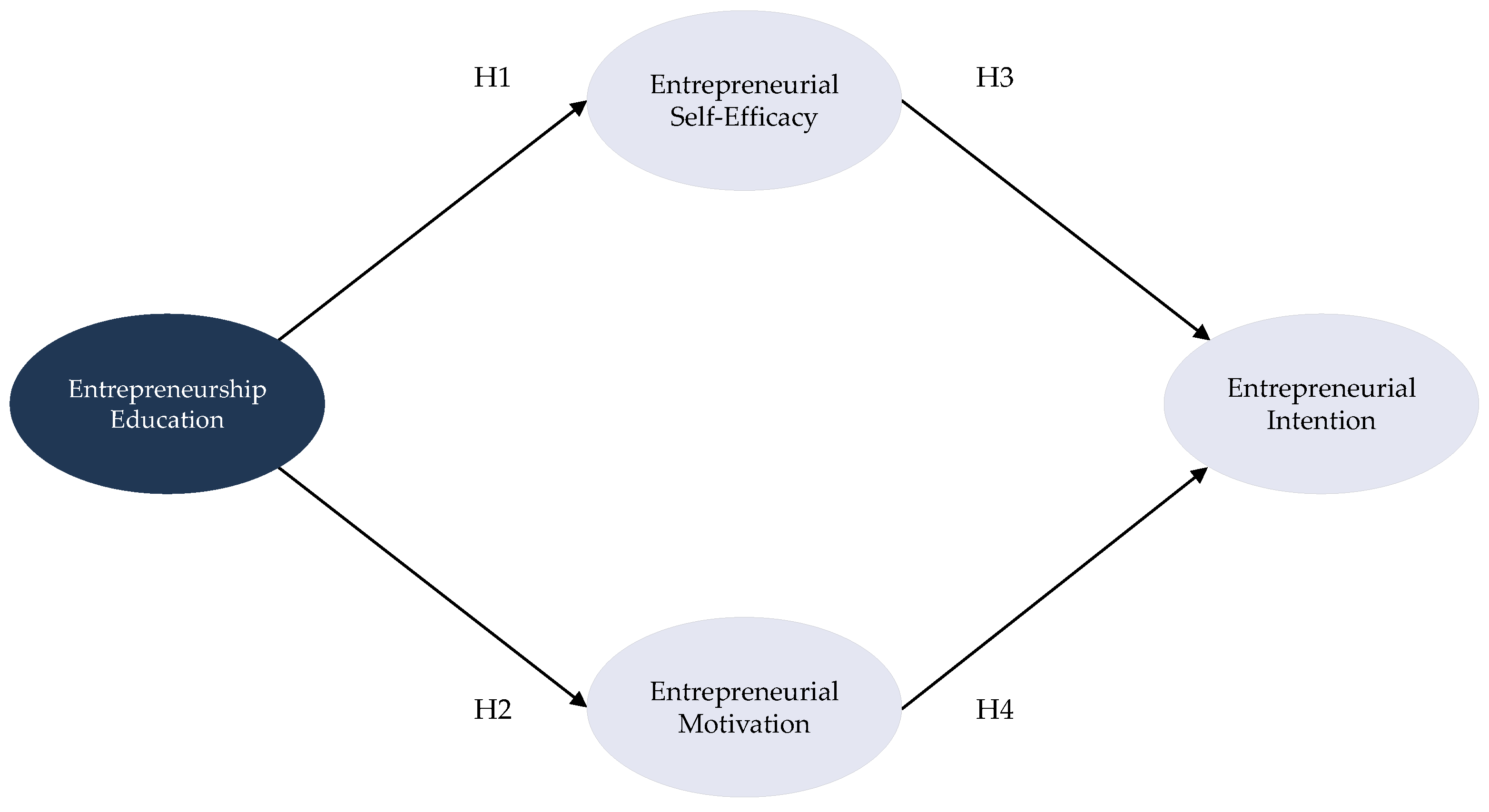
Figure 1 presents the parsimonious conceptual model adopted in this study. In line with the final analytical specification, the model does not posit a direct path between entrepreneurship education and entrepreneurial intention, but instead assumes that such influence is transmitted indirectly through entrepreneurial self-efficacy and entrepreneurial motivation.
Figure 1.
Conceptual Model of Entrepreneurial Intention.
3. Materials and Methods
3.1. Study Design, Participants, and Procedure
A quantitative, cross-sectional, and explanatory study was conducted based on a structured survey administered to undergraduate university students. A non-probability convenience sampling strategy was used, as the questionnaire was disseminated through faculty members and students via virtual classrooms and group chats of student associations. Consequently, no closed sampling frame of contacts was available, and it was not possible to calculate a formal response rate.
The instrument was administered between 19 June and 5 August 2025. The final analytical sample consisted of 431 university students. The inclusion criteria were: (i) being actively enrolled in an undergraduate program at the time of survey administration and (ii) completing the questionnaire validly for inclusion in the analysis.
3.2. Ethical Considerations
Participation in the study was voluntary and anonymous. The questionnaire was distributed through virtual means, and before participants began responding, a brief explanation was provided regarding the academic purpose of the study, the non-mandatory nature of participation, and the confidential treatment of the information. In this context, the decision to complete the questionnaire was considered implicit consent to participate in the study.
No personally identifiable information was collected, and the instrument addressed academic perceptions and evaluations without intervention, experimental manipulation, or exposure to risks exceeding those of everyday life. Given these characteristics and the observational nature of the study, formal approval by an ethics committee was not sought.
3.3. Instrument and Scales
Data were collected using a structured questionnaire administered entirely in Spanish. No translation or back-translation procedures were applied, as the instrument was originally designed in Spanish for use in the study context. All items were answered on a seven-point Likert scale, where 1 = “strongly disagree” and 7 = “strongly agree”.
The final structure of the instrument used in the confirmatory analysis consisted of 56 items distributed across four latent constructs: entrepreneurship education (EE), entrepreneurial self-efficacy (AE), entrepreneurial motivation (ME), and entrepreneurial intention (IE).
Entrepreneurship education was modeled as a second-order construct reflected by three first-order dimensions: theoretical knowledge (CT; 6 items), entrepreneurial skills development (DH; 6 items), and institutional support and educational environment (AI; 6 items). Entrepreneurial self-efficacy was specified through three dimensions: self-efficacy in business planning and management (AG; 6 items), self-efficacy in innovation and problem solving (AR; 6 items), and self-efficacy in entrepreneurial interaction and leadership (AL; 6 items). Entrepreneurial motivation was operationalized through three dimensions derived from the Theory of Planned Behavior: personal attitude (AP; 5 items), subjective norms (NS; 3 items), and perceived behavioral control (CC; 6 items). Finally, entrepreneurial intention was measured with 6 items.
Table 1 summarizes the constructs, dimensions, number of items, and representative examples. The full wording of the items is provided in the appendix for purposes of transparency and reproducibility.
Table 1.
Summary of the measurement instrument by construct and dimension.
3.4. Pilot Study
Before the final administration, the instrument was subjected to a pilot study with a sample of 40 students using the same items planned for the final version of the questionnaire. The purpose of the pilot study was to assess the initial internal consistency of the scales and to explore their preliminary factorial behavior. To this end, reliability coefficients were calculated, including Cronbach’s alpha and other complementary indicators, and an exploratory factor analysis was conducted as an input for the subsequent confirmatory specification.
Given the small size of the pilot sample, the exploratory factorial indicators were interpreted cautiously and were used primarily as a guide for constructing the measurement model in the main sample. The numerical results of the pilot study are presented in Appendix A, Table A1 and Table A2. In particular, the preliminary evidence suggested that entrepreneurship education had a multidimensional structure, which is why it was modeled in the main sample as a second-order construct reflected by CT, DH, and AI.
3.5. Data Preparation
Given the ordinal nature of the items, the analysis was based on polychoric correlation matrices and the WLSMV estimator, which is appropriate for ordinal indicators. Prior to estimating the factorial and structural models, data completeness, response category variability, and the presence of atypical response patterns were examined. No transformations were applied to the variables.
3.6. Analytical Strategy
The analytical strategy was developed in four complementary stages.
In the first stage, the internal consistency of the dimensions was assessed using complementary reliability coefficients, including Cronbach’s alpha, Guttman-6, the mean inter-item correlation, and, when appropriate, additional indices derived from factorial models. This stage made it possible to verify the initial internal homogeneity of the dimensions included in the study.
In the second stage, the measurement structure was examined through confirmatory factor analysis (CFA). At this level, convergent validity was assessed based on standardized factor loadings, composite reliability (CR), and average variance extracted (AVE). Likewise, discriminant validity was examined using the Fornell–Larcker criterion and the HTMT index. Entrepreneurship education was treated as a hierarchical second-order construct, whereas entrepreneurial self-efficacy and entrepreneurial motivation were assessed through their respective first-order dimensions. Model fit quality was evaluated using a combination of global indices, including , CFI, TLI, RMSEA with a 90% confidence interval, and SRMR.
In the third stage, a structural equation model (SEM) was specified to test the relationship among entrepreneurship education, entrepreneurial self-efficacy, entrepreneurial motivation, and entrepreneurial intention. A broader specification was first estimated in order to test the direct path between entrepreneurship education and entrepreneurial intention. Subsequently, based on parsimony and the empirical behavior of the model, a parsimonious specification was retained in which the influence of entrepreneurship education on entrepreneurial intention is transmitted indirectly through entrepreneurial self-efficacy and entrepreneurial motivation.
In the fourth stage, direct and indirect effects, standardized paths, and the explained variance () of the endogenous constructs were interpreted. The comparison between models was based on the joint behavior of fit indices, theoretical coherence, and the interpretability of the final solution.
3.7. Criteria for Interpreting Model Fit
As guideline rather than absolute criteria, CFI and TLI values equal to or greater than 0.90 (preferably above 0.95), RMSEA equal to or lower than 0.08 (preferably below 0.06), SRMR equal to or lower than 0.08, and standardized loadings around or above 0.50 were considered acceptable, while some cases above 0.40 were admitted when theoretically justified. In all cases, model fit was interpreted jointly, avoiding decisions based on a single index.
3.8. Considerations Regarding Common Method Bias
Because all variables were collected through a single self-administered questionnaire, the risk of common method bias was taken into account in the study design. As procedural mitigation measures, participation was voluntary, responses were anonymous, and no personally identifiable information was collected. In addition, the constructs were operationalized through differentiated dimensions and subsequently assessed through measurement models that made it possible to test their factorial structure. Nevertheless, because the information comes from a single source and a single point in time, this risk cannot be completely ruled out and should be considered when interpreting the findings.
3.9. Software
All analyses were conducted in R version 4.5.1 [44]. Data import and preparation were performed using packages from the tidyverse version 2.0.0 ecosystem [45] and readxl version 1.4.5 [45]. Reliability analyses relied on psych version 2.5.6 [46]; confirmatory factor analysis and structural equation modeling were estimated using lavaan version 0.6-19 [47]; and semTools version 0.5-7 [48], semPlot version 1.1.6 [49], and semptools version 0.3.2 [50] were used to support psychometric utilities, model comparison, and diagram visualization. Tables in LaTeX format were generated using kableExtra version 1.4.0 [51].
4. Results
4.1. Sample Profile and Preliminary Data Adequacy
The final analytical sample consisted of 431 university students. Of the total, 65.9% were women and 34.1% were men. Likewise, 54.1% reported having received some type of entrepreneurship-related training, whereas 45.9% indicated that they had not. Most participants came from the National Autonomous University of Honduras (89.8%), and the average age was 25.24 years (), ranging from 18 to 45 years.
Before estimating the measurement and structural models, the factorial adequacy of the item blocks was assessed using the Kaiser–Meyer–Olkin (KMO) index and Bartlett’s test of sphericity. The results showed high KMO values for all constructs (, , , and ), together with statistically significant Bartlett’s tests in all cases (), thereby confirming the suitability of factorial analysis.
As a preliminary analysis, the exploratory evidence supported a three-factor structure for entrepreneurial motivation, entrepreneurship education, and entrepreneurial self-efficacy. In the case of entrepreneurial intention, although parallel analysis suggested a two-factor structure, the unidimensional solution explained a very high proportion of variance and subsequently showed high confirmatory loadings; therefore, the unidimensional specification was retained for theoretical and empirical reasons.
4.2. Evaluation of the Measurement Model
Table 2 presents the fit of the retained measurement models. Overall, the evaluation of the measurement block yielded mixed results. On the one hand, SRMR remained within acceptable ranges for the four retained constructs (between 0.023 and 0.056), and CFI and TLI values were moderately satisfactory for entrepreneurship education and entrepreneurial motivation. On the other hand, RMSEA remained above conventional cutoff points, especially for entrepreneurial self-efficacy and entrepreneurial intention. Accordingly, the quality of the measurement model was assessed jointly, considering not only global fit indices, but also the strength of standardized loadings and indicators of reliability and convergent validity.
Table 2.
Fit of the retained measurement models.
Table 3 summarizes the reliability and convergent validity of the retained dimensions. Alpha coefficients ranged from 0.884 to 0.972, composite reliability (CR) from 0.932 to 0.984, and average variance extracted (AVE) from 0.749 to 0.910. Taken together, these results indicate high internal consistency and adequate convergence across dimensions. In particular, the three dimensions of entrepreneurial self-efficacy and the three dimensions of entrepreneurship education showed high and statistically significant standardized loadings, while the second-order structure of entrepreneurship education was supported by high loadings of its first-order factors on the general factor (, , ).
Table 3.
Reliability and convergent validity of the retained dimensions.
In summary, although the global fit indices at the construct level were more demanding than expected, the joint evidence from factor loadings, composite reliability, and average variance extracted supported the use of a multidimensional measurement model for entrepreneurship education, entrepreneurial self-efficacy, and entrepreneurial motivation.
4.3. Structural Model (SEM)
The structural specification was built on the basis of the validated measurement model. At this level, entrepreneurship education (EE) was modeled as a second-order latent construct reflected by its three first-order dimensions: theoretical knowledge (CT), entrepreneurial skills development (DH), and institutional support and educational environment (AI). In turn, entrepreneurial self-efficacy and entrepreneurial motivation were incorporated into the model through their corresponding dimensions, whereas entrepreneurial intention was specified as the outcome variable.
In order to assess the empirical and theoretical plausibility of different structural configurations, two recommended models were estimated: a full model, which included an additional path between entrepreneurship education and entrepreneurial intention, and a parsimonious model, in which the influence of entrepreneurship education on entrepreneurial intention was transmitted exclusively through the specified mediating mechanisms. The comparison between both models was based on their global fit indices, theoretical parsimony, and the interpretability of the final solution.
As shown in Table 4, both models exhibited satisfactory global fit; however, the parsimonious solution showed virtually identical and even slightly superior fit in some indicators (, , , ). On the basis of theoretical parsimony and greater interpretability, this latter model was retained as the main specification.
Table 4.
Global fit indices of the recommended structural models.
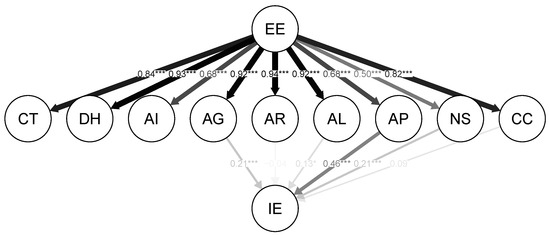
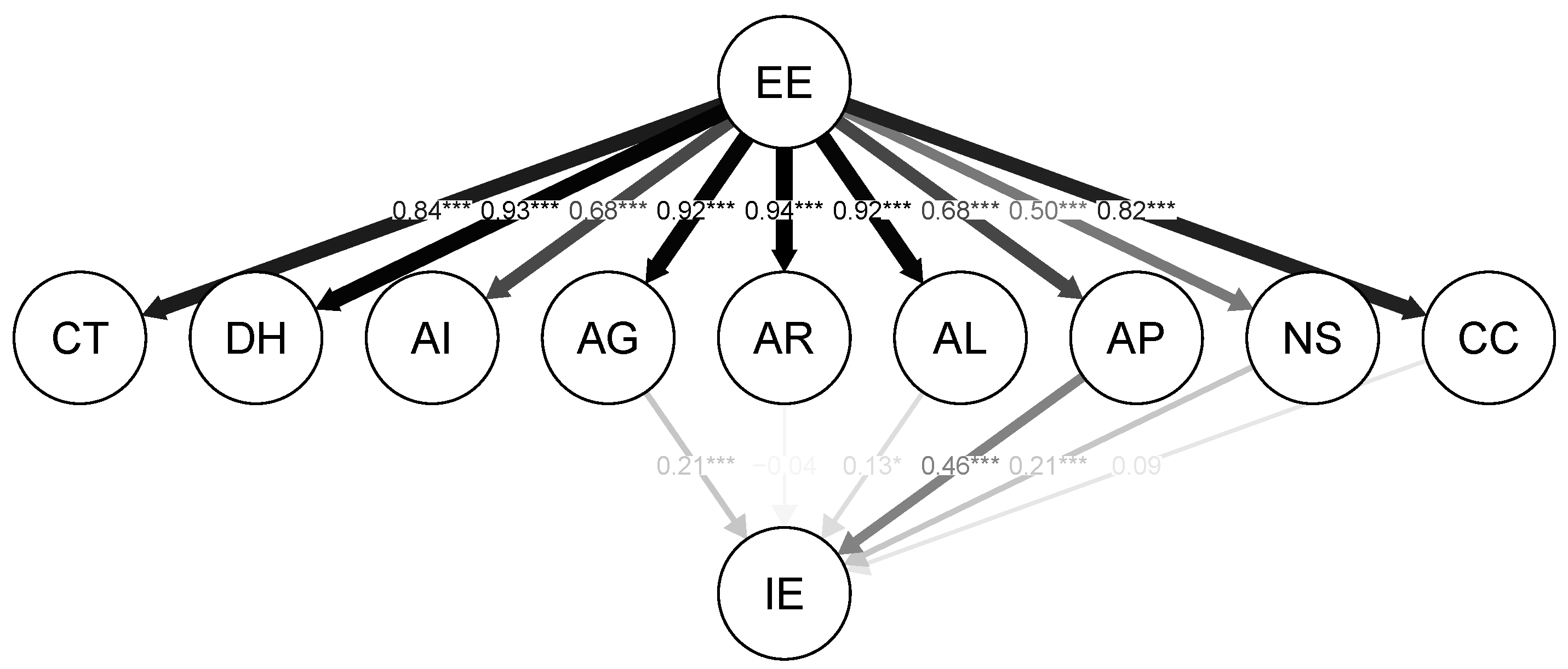
Figure 2 presents the retained parsimonious structural model at the latent-variable level. For readability purposes, the main figure omits the observed indicators and focuses on the structural relationships among constructs and their dimensions. Figures with greater measurement detail are presented in Appendix B.2.
Figure 2.
Retained parsimonious structural model (latent variables only). Standardized coefficients are shown. * ; ** ; *** .
Table 5 presents the standardized paths of the parsimonious model. The results show that entrepreneurship education exerted a positive and statistically significant effect on all mediating dimensions. Within entrepreneurial self-efficacy, the effects were particularly high for planning and business management (, ), innovation and problem solving (, ), and entrepreneurial interaction and leadership (, ). Within entrepreneurial motivation, entrepreneurship education also showed positive effects on personal attitude (, ), subjective norms (, ), and perceived behavioral control (, ).
Table 5.
Standardized structural paths of the retained parsimonious model.
With regard to the prediction of entrepreneurial intention, the evidence indicates a differentiated pattern across mediators. Personal attitude showed the strongest positive effect on intention (, ), followed by subjective norms (, ), self-efficacy in planning and business management (, ), and self-efficacy in entrepreneurial interaction and leadership (, ). In contrast, self-efficacy in innovation and problem solving did not show a statistically significant effect on intention (, ), whereas perceived behavioral control showed a positive but marginal effect (, ).
This pattern suggests that entrepreneurship education does not operate as a uniform stimulus on entrepreneurial intention, but rather through differentiated psychological mechanisms. In particular, the evidence indicates that the motivational pathway, especially through personal attitude, and some specific dimensions of self-efficacy play a more decisive role than others in the formation of entrepreneurial intention. This finding is consistent with recent research showing that entrepreneurship education in university contexts in emerging economies tends to exert its influence on intention predominantly through indirect pathways, via cognitive and motivational factors that are proximal to action [5,7,16,17,32,43].
4.4. Indirect Effects and Explained Variance
Table 6 and Table 7 summarize the indirect effects estimated for the parsimonious model. The results show that the influence of entrepreneurship education on entrepreneurial intention was positive and statistically significant through several indirect pathways. Among these, the strongest mediating routes were via personal attitude (, ), subjective norms (, ), self-efficacy in planning and business management (, ), and self-efficacy in entrepreneurial interaction and leadership (, ). The mediation pathway through innovation and problem solving was not significant, whereas the pathway through perceived behavioral control was marginal ().
Table 6.
Indirect effects of the retained parsimonious structural model.
Table 7.
Explained variance of the endogenous constructs in the retained parsimonious model.
When the indirect effects were aggregated, the total pathway mediated by entrepreneurial self-efficacy was positive and significant (, ), as was the total pathway mediated by entrepreneurial motivation (, ). The total indirect effect of entrepreneurship education on entrepreneurial intention was also positive and statistically significant (, ). Taken together, these results support the idea that the relationship between entrepreneurship education and entrepreneurial intention is better understood as a process of multiple mediation than as a simple direct effect.
Finally, the variance explained by the parsimonious model was high across several dimensions. Entrepreneurship education explained a substantial proportion of the variability in entrepreneurial self-efficacy (, , ) and a moderate to high proportion in entrepreneurial motivation (, , ). Of particular relevance, the model explained 75.9% of the variance in entrepreneurial intention (). This result suggests that, in the context under study, entrepreneurship education may contribute substantially to the development of sustainable entrepreneurial capabilities and dispositions among university students, not so much through a direct linear effect, but rather through the strengthening of capability beliefs and motivational appraisals that favor the intention to undertake entrepreneurial action.
5. Discussion
The results of this study indicate that entrepreneurship education does not operate as a linear and immediate stimulus on entrepreneurial intention, but rather as an indirect process mediated by proximal psychological mechanisms. In the retained parsimonious specification, entrepreneurship education showed a positive influence on the dimensions of entrepreneurial self-efficacy and on the motivational components derived from the Theory of Planned Behavior, whereas the formation of entrepreneurial intention depended mainly on the beliefs and evaluations that are closest to action. In interpretive terms, this suggests that educational experience does not automatically translate into the intention to undertake entrepreneurial action; rather, it must first be transformed into confidence to act and into a more favorable, socially supported, and feasible evaluation of entrepreneurship as a career option.
This finding is theoretically relevant because it supports a process-based reading of the link between entrepreneurship education and entrepreneurial intention. Instead of assuming that educational exposure directly generates an entrepreneurial disposition, the results suggest that education acts through intermediate mechanisms that reshape how students perceive their capabilities and evaluate entrepreneurship. This interpretation is consistent with the complementarity between the Theory of Planned Behavior and Social Cognitive Theory. From the former, intention depends on personal attitude, subjective norms, and perceived behavioral control; from the latter, self-efficacy constitutes a central belief in one’s ability to act. Taken together, both perspectives make it possible to understand that entrepreneurship education is more effective when it not only transmits knowledge, but also simultaneously strengthens perceived competence and the motivational appraisal of entrepreneurship as a viable career path [20,22,23].
The evidence obtained also allows for a more specific interpretation of the mediating mechanisms. Within the motivational block, personal attitude emerged as the strongest predictor of entrepreneurial intention, while subjective norms also showed a relevant positive effect. By contrast, perceived behavioral control showed a weaker and marginal effect. This pattern is consistent with recent studies showing that attitude toward entrepreneurship may constitute a central mediating pathway between entrepreneurship education and intention, even when other TPB dimensions display more heterogeneous behavior [16,38]. Likewise, the fact that subjective norms were not the dominant pathway is compatible with prior evidence reporting a changing or less stable role of this component across different university contexts [16].
In the case of entrepreneurial self-efficacy, the results likewise show a differentiated structure. Self-efficacy associated with planning and business management, as well as that related to entrepreneurial interaction and leadership, contributed positively to intention. In contrast, the dimension linked to innovation and problem solving did not show a significant direct effect on final intention. This difference suggests that not all capability beliefs carry the same weight when students evaluate the possibility of becoming entrepreneurs. In line with the comparative literature on entrepreneurship education and self-efficacy, education appears to strengthen more clearly the capabilities that students perceive as directly transferable to the creation and sustainability of a business, especially those related to opportunity identification, planning, and resource mobilization [5,9,32]. Substantively, this reinforces the idea that entrepreneurship education produces stronger results when it converts perceived skills into concrete operational capabilities.
These findings engage productively with previous studies, but they also reveal some differences. They are consistent with research showing that entrepreneurship education does not always exert a robust direct effect on intention, but rather tends to operate through intermediate cognitive and motivational factors. Ref. [5] shows that entrepreneurship education can influence intention indirectly through specific self-efficacy dimensions and that these effects vary across countries. Similarly, ref. [16] reports that educational support for entrepreneurship strengthens TPB components that subsequently mediate the relationship with intention. Along the same lines, ref. [38] finds that attitude mediates the relationship between educational variables and intention, while university support strengthens that association. To this can be added the evidence of [18], who show in a comparative study between China and Mexico that entrepreneurship-oriented university education, self-confidence, and perceptions of self-employment influence entrepreneurial intention and that external structural support significantly moderates this relationship. Taken together, these antecedents reinforce the interpretation of entrepreneurship education as an indirect enabler whose effect also depends on the support conditions available to the student.
However, differences with other studies are also evident. Some studies have found that entrepreneurship education may maintain direct effects while simultaneously operating through motivation, entrepreneurial passion, or the business environment [7,42,43]. By contrast, in the present study, the most interpretable specification was the parsimonious one. This suggests that, in the Honduran context, the training received appears to need to be processed first through capability beliefs and motivational evaluations before being reflected in entrepreneurial intention. This difference is important because it indicates that the relative weight of mediation versus direct effects may depend on the institutional environment, the type of training received, and the degree of complementary support available to students.
The Honduran context helps explain this pattern. The new contextual evidence incorporated into this study shows that university entrepreneurship in Honduras is not starting from zero, but neither can it be described as a fully articulated ecosystem. On the one hand, there are concrete institutional antecedents within the National Autonomous University of Honduras. The Entrepreneurship Center (CEM), created in 2001, has developed a five-level methodology integrated into certain degree programs, extracurricular programs, creativity circles, and university–society–industry linkages aimed at fostering entrepreneurship and innovation. On the other hand, recent studies on UNAH-Campus Comayagua show that university incubators require a more cohesive institutional policy and a more integrated network among academic, financial, and territorial actors in order to operate effectively [52,53]. In this sense, the findings of the present study are consistent with the idea that entrepreneurship education alone is not sufficient: its impact depends on its insertion into broader support structures.
This interpretation is also consistent with trends observed in Latin America. Ref. [54] shows that, among Latin American university students, decisions regarding self-employment and entrepreneurship are influenced by both psychological factors and contextual conditions, suggesting that entrepreneurial intention cannot be interpreted independently of regional constraints and opportunities. Likewise, ref. [55], in a comparison between Chile and Ecuador, finds that the intention to create new technology-based businesses depends on an interplay of personal attributes and elements of the university context, reinforcing the idea that the educational environment does not operate in isolation. Complementarily, ref. [56] points out that Latin American universities have increasingly incorporated creativity, innovation, and entrepreneurship into graduate profiles, albeit with different levels of depth and institutional articulation. Taken together, this regional evidence supports the interpretation that, in Honduras, entrepreneurship education should be understood not only as the transmission of content, but also as part of a broader university strategy for activating capabilities, motivations, and contextual support.
This interpretation is also consistent with the labor-market context of Latin America and Honduras. Regional evidence shows that informality affects young people more strongly and that, although education significantly reduces the probability of entering informal employment, it does not by itself eliminate structural labor-market barriers [57]. Likewise, regional evidence on entrepreneurship promotion policies suggests that, in developing economies, the most effective interventions combine “soft” components (training, advising, and mentoring) with “hard” components (access to financing and technical support) and that one-size-fits-all policies tend to be less effective than those designed for specific groups and contexts [58]. In light of these antecedents, the results of the present study may be interpreted as evidence that strengthening entrepreneurial intention in Honduras requires more than courses: it requires an institutional arrangement that articulates training, support, structural backing, and real implementation opportunities.
5.1. Theoretical Implications
From a theoretical standpoint, the study provides evidence in favor of a more refined interpretation of the link between entrepreneurship education and entrepreneurial intention. Rather than merely confirming that education “works,” the results indicate that its influence is mediated by specific capability beliefs and motivational appraisals. This contributes to qualifying the literature that has treated the EE–EI relationship as a direct or overly aggregated link, and it aligns with studies that have emphasized the importance of modeling intermediate mechanisms, especially self-efficacy and attitude, to understand how intention is formed among university students [5,23,38,43].
Likewise, the evidence supports the usefulness of integrating the Theory of Planned Behavior and Social Cognitive Theory within a single analytical framework. This integration makes it possible to distinguish between motivational appraisals that are proximal to action and capability beliefs that are more performance-oriented, showing that both pathways contribute nonredundant information to the explanation of entrepreneurial intention. In this sense, the study not only provides evidence from an underexplored context, but also helps clarify how entrepreneurship education influences intention through differentiated mechanisms rather than through a single uniform pathway.
5.2. Practical Implications
From a practical perspective, the findings suggest at least four lines of action for Honduran higher education institutions. First, entrepreneurship courses should be redesigned under principles of active, action-oriented learning. This implies incorporating real problem solving, business model design, idea validation, simulations, community-linked projects, and interdisciplinary work. Recent literature has shown that entrepreneurship training has a stronger impact when it integrates active learning, exposure to real environments, and reflective practice experiences [1,30,31]. In addition, regional evidence suggests that this pedagogical shift is consistent with a broader trend among Latin American universities to incorporate creativity, innovation, and entrepreneurship as strategic training components [56].
Second, the results underscore the importance of mentoring and support. If part of the effect of entrepreneurship education operates through self-efficacy, then students need more than conceptual content: they require feedback, role models, interaction with entrepreneurs, observation of successful trajectories, and opportunities to rehearse competencies in protected environments. The experience of the CEM at UNAH itself suggests that gradual support and connection with practice can be institutionally structured, although still unevenly across degree programs and university spaces [53]. In this regard, expanding mentoring beyond isolated initiatives could strengthen entrepreneurial capability perceptions more broadly. The evidence from [18] converges on this point by showing that external structural support strengthens the relationship between self-confidence and entrepreneurial intention.
Third, the findings suggest the need to strengthen the university entrepreneurship support ecosystem. If education influences intention through motivation and perceptions of capability, then isolated courses may be insufficient if they are not connected to incubators, advisory services, networks, institutional support, and mechanisms linking students with the productive environment. The literature on university accelerators has warned that the integration between training and institutional support may be either substantive or merely symbolic [2]. In the Honduran case, this warning is especially relevant: the existence of centers, hubs, or programs does not in itself guarantee effective articulation if these are not sustainably integrated with teaching, mentoring, incubation, and external engagement.
Fourth, the results suggest the need to integrate more explicitly competencies related to planning, leadership, opportunity validation, and uncertainty management, given that these dimensions appear to be more closely linked to the formation of intention than more abstract capabilities. In sum, the results suggest that making active learning prevail over purely theoretical instruction is not just a general pedagogical recommendation, but an empirically grounded consequence of the model identified in this study.
5.3. Implications for Sustainability (SDGs)
The findings are linked to the sustainability agenda by showing how university entrepreneurship education can enhance competencies aligned with the Sustainable Development Goals (SDGs). In particular, they relate to SDG 4 (Quality Education) by strengthening capabilities and efficacy beliefs; to SDG 8 (Decent Work and Economic Growth) by fostering the disposition to create productive initiatives; and to SDG 9 (Industry, Innovation and Infrastructure) by promoting skills and institutional support associated with innovation and the development of projects with potential socioeconomic impact.
5.4. Limitations and Future Research
This study has limitations that should be taken into account when interpreting its findings. First, the cross-sectional design prevents strict causal inferences among the variables analyzed. Although the estimated model provides consistent evidence of an indirect mediation structure, the temporal ordering of effects cannot be directly observed. Consequently, future research could incorporate longitudinal designs that make it possible to examine the evolution of entrepreneurial intention following sustained exposure to educational experiences, mentoring, and institutional support.
Second, the sample was obtained through non-probability convenience sampling and is limited to the Honduran context. While this constitutes a strength in terms of evidence from an underexplored setting, it also limits the generalizability of the results to other national or institutional contexts. Comparative studies across Central American or Latin American countries could help identify how the effects of entrepreneurship education vary as a function of institutional, cultural, and economic differences.
Third, the information came from a single source and a single point in time, which means that common method bias cannot be completely ruled out. Although the study adopted procedural measures to mitigate this risk and used measurement models that allowed the factorial differentiation of the constructs to be assessed, future research could complement the evidence with multimethod designs, staged assessments, or additional data sources.
Finally, future research could expand the model by incorporating complementary moderators and mediators, such as gender, prior exposure to entrepreneurship, socioeconomic status, entrepreneurial emotions, resilience, risk perception, or the sustainability of entrepreneurial intention. It would also be valuable to explore in greater detail the role of incubators, university hubs, structured mentoring, and institutional support programs as conditions that enhance or constrain the translation of entrepreneurship education into entrepreneurial intention and effective entrepreneurial behavior.
6. Conclusions
This study provides evidence that entrepreneurship education influences the entrepreneurial intention of university students in Honduras primarily through indirect psychological mechanisms rather than through a direct and immediate effect. In the retained parsimonious specification, entrepreneurship education strengthened both entrepreneurial self-efficacy and entrepreneurial motivation, which, in turn, were positively associated with higher levels of entrepreneurial intention. In this sense, the results support an interpretation according to which educational experiences do not automatically translate into an entrepreneurial disposition; rather, they must first strengthen capability beliefs and motivational appraisals that are more proximal to action.
The findings also show that these mediating processes do not operate uniformly. Within the motivational block, personal attitude emerged as the strongest predictor of entrepreneurial intention, followed by subjective norms, whereas perceived behavioral control showed a weaker and marginal effect. In the case of entrepreneurial self-efficacy, the dimensions associated with planning and business management and with entrepreneurial interaction and leadership contributed positively to intention, whereas the dimension related to innovation and problem solving did not show a significant direct effect. This pattern suggests that entrepreneurship education appears to be more effective when it strengthens the capabilities and evaluations that students perceive as being more closely linked to the creation and sustainability of an entrepreneurial venture.
From a theoretical standpoint, the study supports the usefulness of integrating the Theory of Planned Behavior and Social Cognitive Theory to explain how entrepreneurship education is translated into entrepreneurial intention. Rather than assuming a direct relationship between training and intention, the evidence supports a process-based explanation in which educational exposure first modifies perceived competence and the motivational appraisal of entrepreneurship. In this regard, the study contributes evidence from a Honduran university context, extending the discussion on entrepreneurship education beyond the settings most frequently examined in the international literature.
From a practical perspective, the results suggest that university entrepreneurship training should not be limited to the transmission of conceptual content. Its potential appears to increase when it is articulated with active methodologies, mentoring, institutional support, and opportunities for students to develop planning, leadership, opportunity validation, and uncertainty management skills in applied contexts. Consequently, strengthening incubators, support programs, and linkages between universities and the productive environment may help entrepreneurship education exert a more consistent effect on the development of entrepreneurial dispositions among university students.
In summary, this study concludes that entrepreneurship education matters not so much because it directly generates entrepreneurial intention, but because it contributes to creating the cognitive and motivational conditions that make such intention more likely to emerge. Although the results should be interpreted with caution due to the study’s cross-sectional design and contextual delimitation, they provide a consistent empirical basis for understanding entrepreneurship education as an indirect and structured pathway through which universities can strengthen the entrepreneurial disposition of their students.
Author Contributions
Conceptualization, J.M.-L., O.Á. and H.O.; methodology, J.M.-L., O.Á. and H.O.; software, H.O.; validation, H.O.; formal analysis, J.M.-L. and H.O.; data curation, H.O.; writing—original draft preparation, J.M.-L. and H.O.; writing—review and editing, J.M.-L., O.Á. and H.O.; visualization, H.O.; supervision, J.M.-L.; project administration, J.M.-L. and H.O.; funding acquisition, J.M.-L., O.Á. and H.O. All authors have read and agreed to the published version of the manuscript.
Funding
This research received no external funding. The APC was funded by the Autónoma de Honduras, under grant number PI-1144-DICIHT.
Institutional Review Board Statement
The study was conducted in accordance with the Declaration of Helsinki. Ethical review and approval were waived in accordance with institutional requirements because the research consisted of an anonymous, minimal-risk survey of adult participants and no personally identifiable information was collected.
Informed Consent Statement
Informed consent was obtained from all participants involved in the study. Participation was voluntary, responses were anonymous, and participants could choose not to complete the instrument without penalty. No personally identifiable information was collected.
Data Availability Statement
The data and materials supporting the findings of this study are publicly available in the GitHub repository Henry-Osorto/Entrepreneurship_Education. The repository includes the anonymized dataset used for the analyses, the codebook, the construct framework with dimensions, measurement items, and sources, the questionnaire in both English and Spanish, and the R scripts required to reproduce the statistical analyses. The repository is available at https://github.com/Henry-Osorto/Entrepreneurship_Education (accessed on 25 March 2026).
Acknowledgments
We acknowledge and thank the students who participated in the survey. During the preparation of this manuscript, the authors used a generative AI tool (ChatGPT, OpenAI GPT-5.2 and GPT-5.4 Thinking) to support  text editing and the organization of auxiliary R code. The authors reviewed and edited the AI-generated output and take full responsibility for the final content of this publication.
Conflicts of Interest
The authors declare no conflicts of interest. The Universidad Nacional Autónoma de Honduras funded the article processing charge (APC) but had no role in the study design; data collection, analysis, or interpretation; manuscript writing; or the decision to publish the results.
Appendix A. Pilot Study Results
An exploratory factor analysis (EFA) was conducted using maximum likelihood estimation, together with the estimation of internal consistency coefficients: Cronbach’s alpha (), total omega (), and hierarchical omega (). Unidimensionality was assessed through the fit of a one-factor model, considering the RMSEA and TLI indices, as well as the variance explained by the first factor (). The coefficient made it possible to examine the proportion of variance that can be attributed to a common general factor.
The EFA results and reliability indices are summarized in Table A1 and Table A2. In the case of the Entrepreneurial Intention variable, alpha was high () and the average inter-item correlation was also high (), reflecting high internal consistency. However, this variable was not included in subsequent factor analyses because of its dependent nature.
Table A1.
Preliminary internal consistency of the scales in the pilot study ().
With respect to Entrepreneurial Motivation, although alpha was adequate (), the factorial indicators suggested limited fit under a unidimensional model: RMSEA = 0.138, TLI = 0.420, with 23.9% of explained variance. Therefore, its interpretation through subdimensions (IS) is recommended.
In the case of Entrepreneurship Education, the factorial indices indicated poor fit (RMSEA = 0.215, TLI = 0.296), despite showing good levels of internal consistency (, , ). The explained variance was 32.8%, which also suggests a multidimensional structure. Consequently, this variable was evaluated through its subdimensions (theoretical knowledge, skills development, and institutional support), all with values between 0.77 and 0.82.
The Entrepreneurial Self-Efficacy variable showed good psychometric indicators: 43.2% explained variance, RMSEA = 0.219, TLI = 0.404, and high reliability coefficients (, , ). Although the fit indices are not satisfactory, the high common variance and hierarchical coefficients justify the use of both a composite score and an analysis by subdimensions.
Table A2.
Exploratory indicators of dimensionality and reliability by scale in the pilot study ().
Appendix B. Supplementary Figures of the Measurement and Structural Models
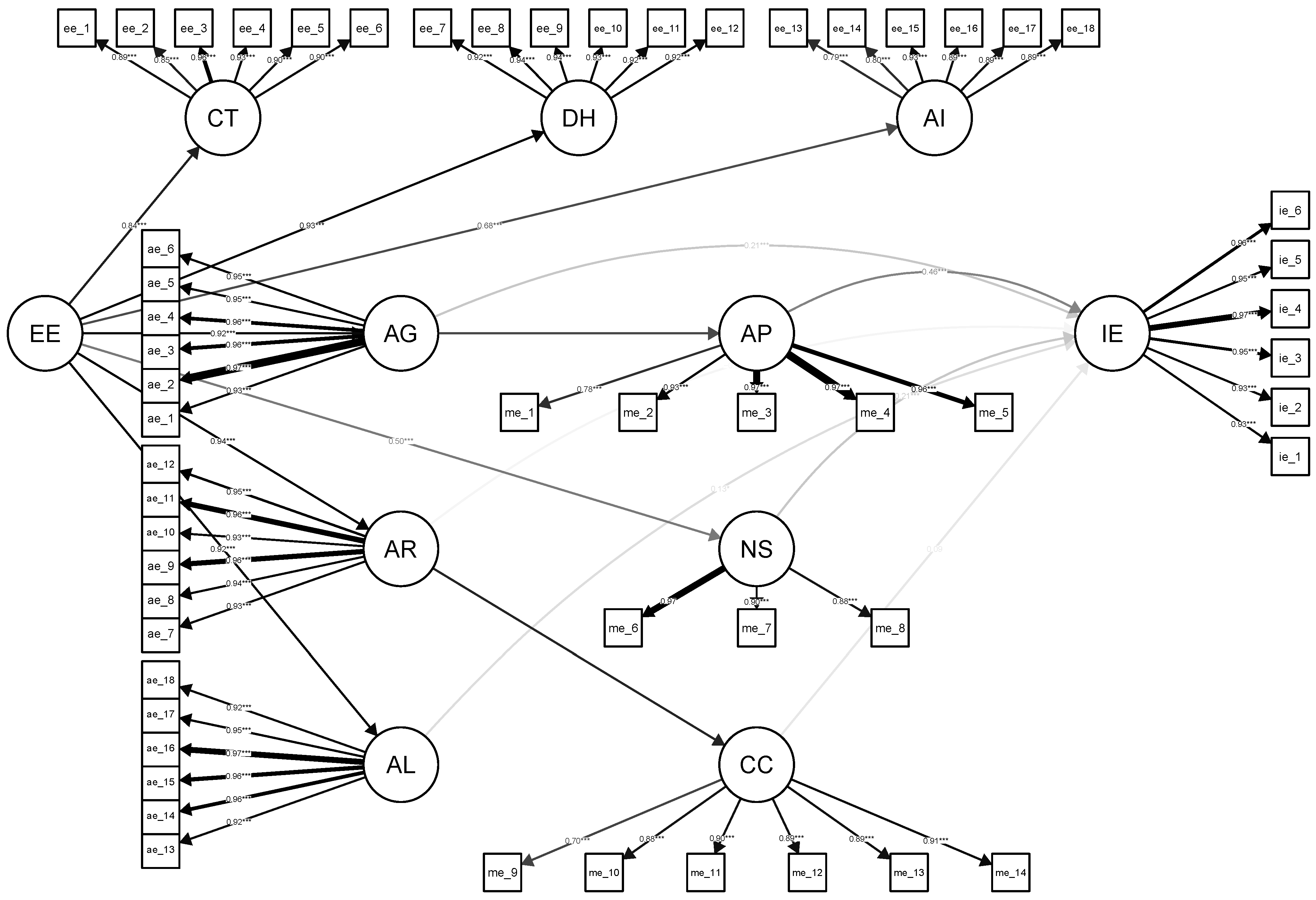
This appendix brings together the supplementary figures used to document in greater detail the measurement structure and the complete architecture of the estimated model. Whereas the figure included in the main body of the article presents only the retained parsimonious structural model at the latent-variable level, the figures in this appendix provide additional information on the hierarchical structure of entrepreneurship education and on the full configuration of the model with observed indicators.
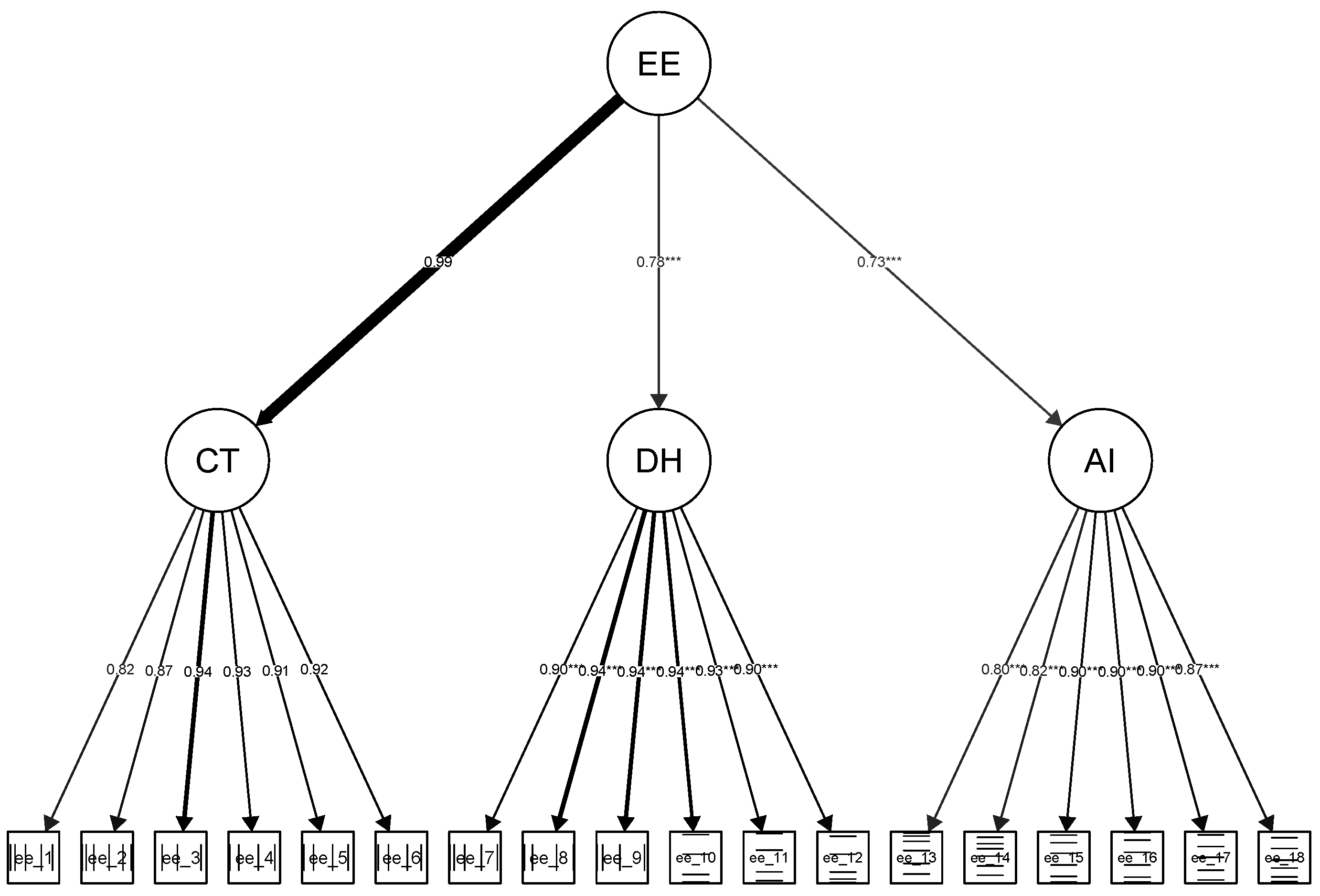
Appendix B.1. Second-Order Measurement Model for Entrepreneurship Education
Figure A1 presents the second-order measurement model for entrepreneurship education (EE). In this specification, EE is defined as a second-order latent construct reflected by three first-order dimensions: theoretical knowledge (CT), entrepreneurial skills development (DH), and institutional support and educational environment (AI). The figure shows the estimated standardized loadings and their statistical significance. This representation complements the evidence reported in the main text regarding the hierarchical structure of entrepreneurship education.
Figure A1.
Measurement model of entrepreneurship education. Standardized coefficients are shown. * ; ** ; *** .
Appendix B.2. Full Structural Model with Observed Indicators
Figure A2 presents the full version of the retained parsimonious structural model, including the observed indicators associated with each latent dimension. Unlike the main figure in the manuscript, this representation simultaneously incorporates the measurement structure and the structural component of the model, and is therefore provided exclusively as supplementary visual support. The loadings, standardized coefficients, and significance levels should be interpreted together with the tables in the main body of the article and in Appendix A.
Figure A2.
Retained parsimonious structural model with observed indicators. Standardized coefficients are shown. * ; ** ; *** .
References
- Adeel, S.; Daniel, A.D.; Botelho, A. The effect of entrepreneurship education on the determinants of entrepreneurial behaviour among higher education students: A multi-group analysis. J. Innov. Knowl. 2023, 8, 100324. [Google Scholar] [CrossRef] [Scilit]
- Maritz, A.; Nguyen, Q.A.; Shrivastava, A.; Ivanov, S. University accelerators and entrepreneurship education in Australia: Substantive and symbolic motives. Educ. Train. 2023, 65, 654–673. [Google Scholar] [CrossRef] [Scilit]
- Mozahem, N.A.; Adlouni, R.O. Using Entrepreneurial Self-Efficacy as an Indirect Measure of Entrepreneurial Education. Int. J. Manag. Educ. 2021, 19, 100385. [Google Scholar] [CrossRef] [Scilit]
- Barba-Sánchez, V.; Atienza-Sahuquillo, C. Entrepreneurial intention among engineering students: The role of entrepreneurship education. Eur. Res. Manag. Bus. Econ. 2018, 24, 53–61. [Google Scholar] [CrossRef] [Scilit]
- Nowiński, W.; Haddoud, M.Y.; Lančarič, D.; Egerová, D.; Czeglédi, C. The impact of entrepreneurship education, entrepreneurial self-efficacy and gender on entrepreneurial intentions of university students in the Visegrad countries. Stud. High. Educ. 2019, 44, 361–379. [Google Scholar] [CrossRef] [Scilit]
- Sun, J.; Shi, J.; Zhang, J. From entrepreneurship education to entrepreneurial intention: Mindset, motivation, and prior exposure. Front. Psychol. 2023, 14, 954118. [Google Scholar] [CrossRef] [Scilit]
- Anwar, I.; Ahmad, A.; Saleem, I.; Yasin, N. Role of entrepreneurship education, passion and motivation in augmenting Omani students’ entrepreneurial intention: A stimulus-organism-response approach. Int. J. Manag. Educ. 2023, 21, 100842. [Google Scholar] [CrossRef] [Scilit]
- Otache, I.; Edopkolor, J.E.; Kadiri, U. A serial mediation model of the relationship between entrepreneurial education, orientation, motivation and intentions. Int. J. Manag. Educ. 2022, 20, 100645. [Google Scholar] [CrossRef] [Scilit]
- Wang, X.H.; You, X.; Wang, H.P.; Wang, B.; Lai, W.Y.; Su, N. The Effect of Entrepreneurship Education on Entrepreneurial Intention: Mediation of Entrepreneurial Self-Efficacy and Moderating Model of Psychological Capital. Sustainability 2023, 15, 2562. [Google Scholar] [CrossRef] [Scilit]
- Schwarz, E.J.; Wdowiak, M.A.; Almer-Jarz, D.A.; Breitenecker, R.J. The effects of attitudes and perceived environment conditions on students’ entrepreneurial intent. Educ. Train. 2009, 51, 272–291. [Google Scholar] [CrossRef] [Scilit]
- Cui, J.; Bell, R. Behavioural entrepreneurial mindset: How entrepreneurial education activity impacts entrepreneurial intention and behaviour. Int. J. Manag. Educ. 2022, 20, 100639. [Google Scholar] [CrossRef] [Scilit]
- Kreiterling, C. Digital innovation and entrepreneurship: A review of challenges in competitive markets. J. Innov. Entrep. 2023, 12, 49. [Google Scholar] [CrossRef] [Scilit]
- Looi, K.H. Contextual Motivations for Undergraduates’ Entrepreneurial Intentions in Emerging Asian Economies. J. Entrep. 2020, 29, 53–87. [Google Scholar] [CrossRef] [Scilit]
- Karan, A.; Singh, M.; Rana, N.P. Does entrepreneurial motivation influence entrepreneurial intention? Exploring the moderating role of perceived supportive institutional environment on Indian university students. Int. Entrep. Manag. J. 2024, 20, 215–229. [Google Scholar] [CrossRef] [Scilit]
- Shahriar, M.S.; Hassan, M.S.; Islam, M.A.; Sobhani, F.A.; Islam, M.T. Entrepreneurial intention among university students of a developing economy: The mediating role of access to finance and entrepreneurship program. Cogent Bus. Manag. 2024, 11, 2322021. [Google Scholar] [CrossRef] [Scilit]
- Talukder, S.C.; Lakner, Z.; Temesi, Á. Interplay of Influencing Factors Shaping Entrepreneurial Intention: Evidence from Bangladesh. Adm. Sci. 2024, 14, 136. [Google Scholar] [CrossRef] [Scilit]
- Dana, L.P.; Tajpour, M.; Salamzadeh, A.; Hosseini, E.; Zolfaghari, M. The Impact of Entrepreneurial Education on Technology-Based Enterprises Development: The Mediating Role of Motivation. Adm. Sci. 2021, 11, 105. [Google Scholar] [CrossRef] [Scilit]
- Kara, A.; Spillan, J.E.; Mintu-Wimsatt, A.; Zhang, L. The Role of Higher Education in Developing Entrepreneurship: A Two-Country Study. Lat. Am. Bus. Rev. 2023, 24, 59–80. [Google Scholar] [CrossRef] [Scilit]
- Hill, R.J.; Fishbein, M.; Ajzen, I. Belief, Attitude, Intention and Behavior: An Introduction to Theory and Research. Contemp. Sociol. 1977, 6, 244. [Google Scholar] [CrossRef] [Scilit]
- Ajzen, I. The theory of planned behavior: Frequently asked questions. Hum. Behav. Emerg. Technol. 2020, 2, 314–324. [Google Scholar] [CrossRef] [Scilit]
- Liñán, F.; Fayolle, A. A systematic literature review on entrepreneurial intentions: Citation, thematic analyses, and research agenda. Int. Entrep. Manag. J. 2015, 11, 907–933. [Google Scholar] [CrossRef] [Scilit]
- Bandura, A. Self–Efficacy. In The Corsini Encyclopedia of Psychology; Weiner, I.B., Craighead, W.E., Eds.; Wiley: Hoboken, NJ, USA, 2010; pp. 1–3. [Google Scholar] [CrossRef] [Scilit]
- Newman, A.; Obschonka, M.; Schwarz, S.; Cohen, M.; Nielsen, I. Entrepreneurial self-efficacy: A systematic review of the literature on its theoretical foundations, measurement, antecedents, and outcomes, and an agenda for future research. J. Vocat. Behav. 2019, 110, 403–419. [Google Scholar] [CrossRef] [Scilit]
- Elliott, C.; Mavriplis, C.; Anis, H. An entrepreneurship education and peer mentoring program for women in STEM: Mentors’ experiences and perceptions of entrepreneurial self-efficacy and intent. Int. Entrep. Manag. J. 2020, 16, 43–67. [Google Scholar] [CrossRef] [Scilit]
- Boldureanu, G.; Ionescu, A.M.; Bercu, A.M.; Bedrule-Grigoruță, M.V.; Boldureanu, D. Entrepreneurship Education through Successful Entrepreneurial Models in Higher Education Institutions. Sustainability 2020, 12, 1267. [Google Scholar] [CrossRef] [Scilit]
- Yeh, C.H.; Lin, H.H.; Wang, Y.M.; Wang, Y.S.; Lo, C.W. Investigating the relationships between entrepreneurial education and self-efficacy and performance in the context of internet entrepreneurship. Int. J. Manag. Educ. 2021, 19, 100565. [Google Scholar] [CrossRef] [Scilit]
- Bazan, C. Effect of the University’s Environment and Support System on Subjective Social Norms as Precursor of the Entrepreneurial Intention of Students. Sage Open 2022, 12, 1–20. [Google Scholar] [CrossRef] [Scilit]
- Ghafar, A. Convergence between 21st Century Skills and Entrepreneurship Education in Higher Education Institutes. Int. J. High. Educ. 2019, 9, 218. [Google Scholar] [CrossRef] [Scilit]
- Shekhar, P.; Huang-Saad, A. Examining engineering students’ participation in entrepreneurship education programs: Implications for practice. Int. J. Stem Educ. 2021, 8, 40. [Google Scholar] [CrossRef] [Scilit]
- Naqvi, S.; Matriano, M.T.D.G.; Alimi, J.T. Student and faculty perceptions on an entrepreneurship course: An exploratory study from Oman. J. Sci. Technol. Policy Manag. 2023, 14, 885–911. [Google Scholar] [CrossRef] [Scilit]
- Shahin, M.; Ilic, O.; Gonsalvez, C.; Whittle, J. The impact of a STEM-based entrepreneurship program on the entrepreneurial intention of secondary school female students. Int. Entrep. Manag. J. 2021, 17, 1867–1898. [Google Scholar] [CrossRef] [Scilit]
- Uzkurt, C.; Ekmekcioglu, E.B.; Ceyhan, S.; Pampal, A.S. Entrepreneurial self-efficacy as a mediator in the entrepreneurial education-entrepreneurial intention nexus: The moderating role of government-based support and financial concerns. Entrep. Educ. 2025, 8, 131–156. [Google Scholar] [CrossRef] [Scilit]
- Alvarez-Risco, A.; Mlodzianowska, S.; García-Ibarra, V.; Rosen, M.A.; Del-Aguila-Arcentales, S. Factors Affecting Green Entrepreneurship Intentions in Business University Students in COVID-19 Pandemic Times: Case of Ecuador. Sustainability 2021, 13, 6447. [Google Scholar] [CrossRef] [Scilit]
- Valencia-Arias, A.; Rodríguez Correa, P.A.; Cárdenas-Ruiz, J.A.; Gómez-Molina, S. Factores que influyen en la intención emprendedora de estudiantes de psicología de la modalidad virtual. Retos 2022, 12, 5–24. [Google Scholar] [CrossRef] [Scilit]
- Li, Y.; Cao, K.; Jenatabadi, H.S. Effect of entrepreneurial education and creativity on entrepreneurial intention in college students: Mediating entrepreneurial inspiration, mindset, and self-efficiency. Front. Psychol. 2023, 14, 1240910. [Google Scholar] [CrossRef] [Scilit] [PubMed]
- António Porfírio, J.; Augusto Felício, J.; Carrilho, T.; Jardim, J. Promoting entrepreneurial intentions from adolescence: The influence of entrepreneurial culture and education. J. Bus. Res. 2023, 156, 113521. [Google Scholar] [CrossRef] [Scilit]
- Tingey, L.; Larzelere, F.; Goklish, N.; Rosenstock, S.; Mayo-Wilson, L.J.; Pablo, E.; Goklish, W.; Grass, R.; Sprengeler, F.; Parker, S.; et al. Entrepreneurial, Economic, and Social Well-Being Outcomes from an RCT of a Youth Entrepreneurship Education Intervention among Native American Adolescents. Int. J. Environ. Res. Public Health 2020, 17, 2383. [Google Scholar] [CrossRef] [Scilit]
- Anjum, T.; Amoozegar, A.; Farrukh, M.; Heidler, P. Entrepreneurial intentions among business students: The mediating role of attitude and the moderating role of university support. Educ. Train. 2023, 65, 587–606. [Google Scholar] [CrossRef] [Scilit]
- Liguori, E.; Winkler, C.; Vanevenhoven, J.; Winkel, D.; James, M. Entrepreneurship as a career choice: Intentions, attitudes, and outcome expectations. J. Small Bus. Entrep. 2020, 32, 311–331. [Google Scholar] [CrossRef] [Scilit]
- Ramadani, V.; Rahman, M.M.; Salamzadeh, A.; Rahaman, M.S.; Abazi-Alili, H. Entrepreneurship Education and Graduates’ Entrepreneurial Intentions: Does Gender Matter? A Multi-Group Analysis using AMOS. Technol. Forecast. Soc. Chang. 2022, 180, 121693. [Google Scholar] [CrossRef] [Scilit]
- Nguyen, Q.D.; Nguyen, H.T. Entrepreneurship education and entrepreneurial intention: The mediating role of entrepreneurial capacity. Int. J. Manag. Educ. 2023, 21, 100730. [Google Scholar] [CrossRef] [Scilit]
- Chahal, J.; Shoukat, M.H.; Ayoubi, R. How entrepreneurial environment and education influence university students’ entrepreneurial intentions: The mediating role of entrepreneurial motivation. High. Educ. Ski. Work.-Based Learn. 2024, 14, 591–609. [Google Scholar] [CrossRef] [Scilit]
- Hassan, A.; Anwar, I.; Saleem, I.; Islam, K.B.; Hussain, S.A. Individual entrepreneurial orientation, entrepreneurship education and entrepreneurial intention: The mediating role of entrepreneurial motivations. Ind. High. Educ. 2021, 35, 403–418. [Google Scholar] [CrossRef] [Scilit]
- R Core Team. R: A Language and Environment for Statistical Computing; R Foundation for Statistical Computing: Vienna, Austria, 2025. [Google Scholar]
- Wickham, H.; Averick, M.; Bryan, J.; Chang, W.; McGowan, L.; François, R.; Grolemund, G.; Hayes, A.; Henry, L.; Hester, J.; et al. Welcome to the Tidyverse. J. Open Source Softw. 2019, 4, 1686. [Google Scholar] [CrossRef] [Scilit]
- William Revelle. psych: Procedures for Psychological, Psychometric, and Personality Research, R package version 2.5.6; Northwestern University: Evanston, IL, USA, 2025. [Google Scholar]
- Rosseel, Y. lavaan: An R Package for Structural Equation Modeling. J. Stat. Softw. 2012, 48. [Google Scholar] [CrossRef] [Scilit]
- Jorgensen, T.D.; Pornprasertmanit, S.; Schoemann, A.M.; Rosseel, Y. semTools: Useful Tools for Structural Equation Modeling, R package version 0.5-7; CRAN: Vienna, Austria, 2025. [Google Scholar]
- Epskamp, S. semPlot: Path Diagrams and Visual Analysis of Various SEM Packages’ Output, R package version 1.1.6; CRAN: Vienna, Austria, 2022. [Google Scholar] [CrossRef] [Scilit]
- Cheung, S.F.; Lai, M.H.C. semptools: Customizing Structural Equation Modelling Plots, R package version 0.3.2; CRAN: Vienna, Austria, 2025. [Google Scholar] [CrossRef] [Scilit]
- Zhu, H. kableExtra: Construct Complex Table with ’kable’ and Pipe Syntax, R package version 1.4.0; CRAN: Vienna, Austria, 2024. [Google Scholar] [CrossRef] [Scilit]
- Enamorado Maldonado, C.A. Institutional policy for managing a startup incubator at UNAH-Campus Comayagua: Proposal from the ARS. Región Científica 2025, 4, 2. [Google Scholar] [CrossRef] [Scilit]
- Universidad Nacional Autónoma de Honduras. CEM: Centro de Emprendedores, 2017. Available online: https://emprende.unah.edu.hn/c-e-m/ (accessed on 25 March 2026).
- Hernández-Sánchez, B.R.; Cardella, G.M.; Sánchez-García, J.C. Psychological Factors that Lessen the Impact of COVID-19 on the Self-Employment Intention of Business Administration and Economics’ Students from Latin America. Int. J. Environ. Res. Public Health 2020, 17, 5293. [Google Scholar] [CrossRef] [Scilit]
- Barrera-Verdugo, G.; Cadena-Echverría, J.; Villarroel-Villarroel, A.; Contreras-Fuenzalida, M. Influence of students’ personality, gender, income and age on their intentions to create new information technology and telecommunications ventures. PLoS ONE 2023, 18, e0284488. [Google Scholar] [CrossRef] [Scilit]
- Sánchez-Garcés, J.; Moreno-Leyva, N.R.; Marténez Soto, L.; Chambi-Rodriguez, A.D.; Tapara-Yanarico, D.M.; Silva-Vargas, D.K.; Avila-George, H. Competency analysis based on accounting career anchors using clustering techniques. PLoS ONE 2023, 18, e0279989. [Google Scholar] [CrossRef] [Scilit]
- Pineda, R.; Albornoz, S.; Aravena, C.; Gálvez, T. Empleo Informal en América Latina: Grupos Más Propensos; CEPAL: Santiago de Chile, Chile, 2024. [Google Scholar]
- Campos, N.; Jiménez Calderón, M.I.; Sardán, S.; Serrate, L.; Urquidi, M. Do Entrepreneurship Policies Drive Job Creation?: A Look at the Evidence; Inter-American Development Bank: Washington, DC, USA, 2025. [Google Scholar] [CrossRef] [Scilit]

Disclaimer/Publisher’s Note: The statements, opinions and data contained in all publications are solely those of the individual author(s) and contributor(s) and not of MDPI and/or the editor(s). MDPI and/or the editor(s) disclaim responsibility for any injury to people or property resulting from any ideas, methods, instructions or products referred to in the content. |
© 2026 by the authors. Licensee MDPI, Basel, Switzerland. This article is an open access article distributed under the terms and conditions of the Creative Commons Attribution (CC BY) license.