


Abstract
This study focuses on an integrated conceptual framework for smart municipal waste management that combines Pay-as-you-throw (PAYT) with digital technologies emerging from the Internet of Things (IoT), Artificial Intelligence, and blockchain. In the literature, a key limitation has long been recognised: the fragmented implementation of technological solutions and economic instruments in waste management systems. This model is proposed as a multi-layer architecture that integrates user identification, real-time data collection, predictive optimisation, and automated tariff calculation. The framework is expected to reduce mixed-waste volumes and improve operational efficiency while ensuring traceability and transparency in waste management. The framework also provides a practical basis for implementing circular economy principles and advancing climate and urban sustainability goals by linking user behaviour to cost allocation and data-driven monitoring. The findings highlight that measurable environmental benefits depend on the structural integration of behavioural incentives, real-time monitoring, and transparent data governance. The framework demonstrates how PAYT-based incentives, combined with digital monitoring, can reduce mixed waste volumes and associated emissions.
Keywords:
smart waste management; Pay-as-you-throw; IoT; AI; Web 3.0; SDG 11; SDG 13; smart containers; conceptual framework 1. Introduction
Municipal waste generation is increasing at a pace that reflects the growing imbalance between economic development and environmental sustainability. According to the Global Waste Management Outlook 2024 report published by the United Nations Environment Programme (UNEP), global waste volumes are expected to rise from 2.3 billion tonnes in 2023 to 3.8 billion tons by 2050 [1]. This trend is not only a quantitative concern but also has significant implications for environmental quality and the economic costs of waste management. This trend reflects structural drivers such as urbanisation, population growth, and unsustainable consumption patterns, which continue to place increasing pressure on waste management systems [2].
Beyond increasing volumes, inefficient waste management also leads to resource loss and methane emissions from landfills [3,4,5,6]. Under this logic, the Pay-as-you-throw (PAYT) system is perhaps the most relevant tool to operationalise the “polluter pays” principle. PAYT systems are designed to link the costs of waste management to the volume of mixed waste generated, thereby creating economic incentives for waste reduction and improved separate collection, as reflected in European best practice guidelines [7]. Despite demonstrating its strength across different settings, the effective application of PAYT is largely under-supported by technological infrastructure that is only partially in place to facilitate accurate measurement, traceability, and real-time monitoring.
Meanwhile, technological advances in IoT, AI, blockchain, and related areas have created new opportunities to develop data-driven, more transparent waste management systems [8]. However, existing approaches tend to address these elements separately, without integrating them into a coherent operational model. This kind of fragmentation now constitutes a considerable gap in research and practice. The literature extensively examines individual technologies or the use of policy instruments. However, relatively few still exist that combine regulatory principles, economic mechanisms and digital infrastructures into a single, unified framework that can enable both efficiency and accountability.
To this end, the present study proposes an integrated conceptual–operational framework for smart municipal waste management, designed to support the PAYT mechanism by leveraging emerging digital technologies. The paper is positioned as a conceptual research article, as it develops a novel integrative framework grounded in existing literature rather than conducting a systematic review.
Building on prior research, the study identifies key technological, economic, and regulatory components and integrates them into a coherent operational model. In this context, the literature serves as a foundation for conceptual development, enabling the alignment of legal principles, economic incentives, and technological solutions within a unified architecture.
Rather than simply adding new technologies to existing systems, the proposed model reconfigures the operational logic of waste management by linking individual responsibility, real-time data processing, and verifiable record-keeping. By integrating user identification, waste quantification, and automated tariffing within a traceable environment, the framework supports a more transparent and efficient implementation of the “polluter pays” principle.
From a practical perspective, the framework is designed to be adaptable to diverse local contexts and to support public authorities in improving waste-collection performance. Its relevance lies in its capacity to generate tangible outcomes, particularly in reducing mixed waste volumes and optimising operational costs. In this regard, the study provides an operational model that can support future empirical validation and pilot implementation.
What differentiates the present study from much of the existing literature is not the isolated discussion of IoT, AI, blockchain, or PAYT as separate tools, but their integration into a single operational architecture. Existing studies generally focus either on technological optimisation or on economic instruments taken independently. By contrast, this paper proposes a framework that integrates technological infrastructure, tariff logic, and governance mechanisms into a single coherent system. Unlike existing studies that focus on isolated technological applications, this framework establishes a direct operational link between user behaviour, tariff calculation, and data governance.
2. Materials and Methods
The research is grounded in a structured literature review that focuses on the role of emerging digital technologies—namely, the Internet of Things (IoT), Artificial Intelligence (AI), and Web 3.0—in municipal waste management systems, with particular attention to their potential integration into the Pay-as-you-throw (PAYT) mechanism. The approach follows structured principles of literature analysis, drawing on established review methodologies such as the PRISMA framework [9].
The identification of relevant scientific sources was carried out using the Web of Science and Scopus databases, selected for their academic relevance and indexing standards. The search process was based on a combination of keywords reflecting both the technological dimension (“Internet of Things”, “IoT”, “Artificial Intelligence”, “AI”, “blockchain”, “smart contracts”, “Web 3.0”) and the waste management domain (“waste management”, “municipal solid waste”, “recycling”, “circular economy”, “PAYT”, “pay as you throw”). To ensure consistency and reproducibility, Boolean operators were used to structure advanced search queries adapted to each database (Table 1), in line with common practices in systematic literature reviews [10].
Table 1.
Literature Review Search Strategy Table.
The literature review was organised around several thematic clusters, corresponding to the main components of the proposed framework: IoT applications in waste management, AI-based optimisation systems, blockchain-enabled traceability and governance, Web 3.0 models of decentralised management, PAYT-based economic instruments, and integrated smart waste systems. This clustering enabled a systematic mapping of existing research and facilitated the identification of functional complementarities between technologies.
The methodological approach followed three successive stages. The first stage consisted of identifying and selecting studies based on their scientific relevance, recency, and applicability to municipal waste management. The second stage involved a qualitative content analysis to extract the functional roles, advantages, and limitations of each technology in the waste management process. The third stage focused on integrating these findings into a coherent conceptual framework that correlates the PAYT mechanism with the analysed digital technologies within a unified operational logic. To ensure transparency, the selection of sources was guided by relevance to the research objective, recency of publication, and methodological clarity. Priority was given to peer-reviewed journal articles indexed in WoS and Scopus that explicitly address the intersection between digital technologies and waste management systems.
The research adopts a qualitative, conceptual methodology based on the synthesis and comparative analysis of the selected literature. It does not include empirical testing or quantitative validation. Instead, its objective is to develop a structured theoretical model to support future implementation, testing, and policy adaptation in real-world contexts.
To support the search and structuring process, generative AI tools were used in a limited, supportive manner to optimise database queries, refine keyword combinations, and improve the clarity of visual elements. These tools were also employed to support translation, ensuring terminological consistency across sources. All outputs generated with AI assistance were critically reviewed, verified, and adapted by the author to ensure methodological rigour, accuracy, and full alignment with academic standards.
As a conceptual study, the objective is not empirical validation but the development of an integrated operational framework to support future testing and policy implementation.
3. Research Utility
The relevance of this study derives from its focus on the practical and systemic implications of integrating IoT, AI, and Web 3.0 technologies into municipal waste management. In the context of the ever-increasing generation of waste, these technologies offer concrete opportunities to improve operational efficiency, enhance traceability, and support data-driven decision-making through real-time information.
At the same time, the research advances an integrated conceptual framework for smart waste collection, with a particular focus on residential environments such as apartment buildings or housing complexes. The proposed model outlines a functional architecture that enables controlled access to collection points, monitors disposal frequency, and associates each waste deposit with a digitally identified user. Although the framework is not empirically implemented, it provides a structured basis that can support pilot projects and inform local public policies.
The framework’s relevance is also reflected in its contribution to climate action, urban sustainability, and international sustainable development objectives [11,12,13]. In particular, SDG 13 (“Climate Action”) calls for urgent measures to reduce greenhouse gas emissions, integrate climate considerations into policy frameworks, and strengthen institutional capacity [13]. In this context, waste management represents a direct intervention point, as the sector contributes significantly to global emissions, particularly through methane generated in landfills. Methane (CH4) has a considerably higher short-term global warming potential than carbon dioxide, which amplifies the climate impact of inefficient waste management practices. According to IPCC assessments, methane emissions from the waste sector represent a significant share of global anthropogenic CH4 emissions [11].
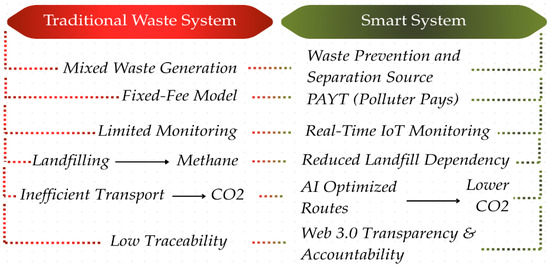
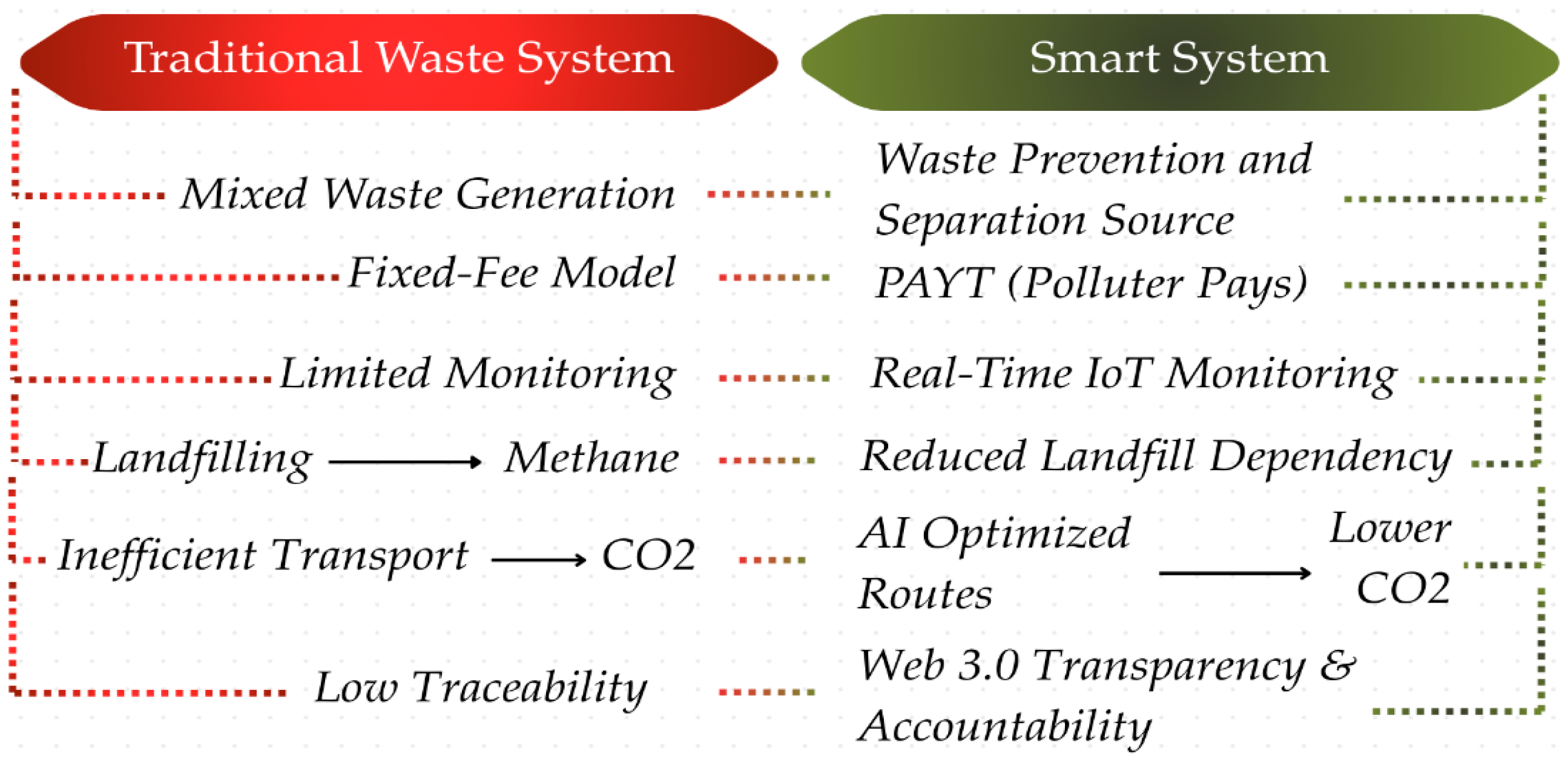
By contrast, a system based on the PAYT principle and supported by digital technologies—such as IoT-enabled smart containers, AI-driven predictive analysis, and blockchain-based traceability—redefines the operational logic of waste management. Prevention and source separation reduce the volume of waste sent to landfill, while route optimisation and real-time monitoring help lower fuel consumption and CO2 emissions (Figure 1). These mechanisms reposition waste management not only as a technical service, but as an active component of climate policy implementation.
Figure 1.
The graphic suggests that traditional waste systems, based on mixed collection and landfill dependency, structurally generate high CH4 and CO2 emissions and remain misaligned with climate objectives. By contrast, the PAYT-based digital model reframes waste governance through prevention, monitoring, and data-driven accountability, indicating that effective climate action depends on both technological and institutional transformation (figure designed by the authors).
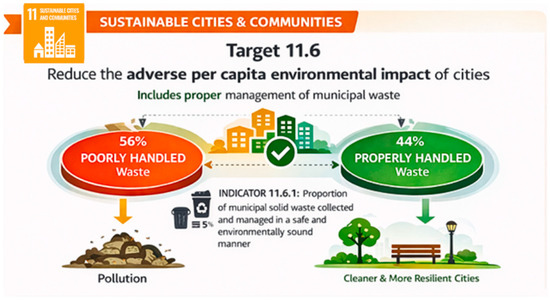
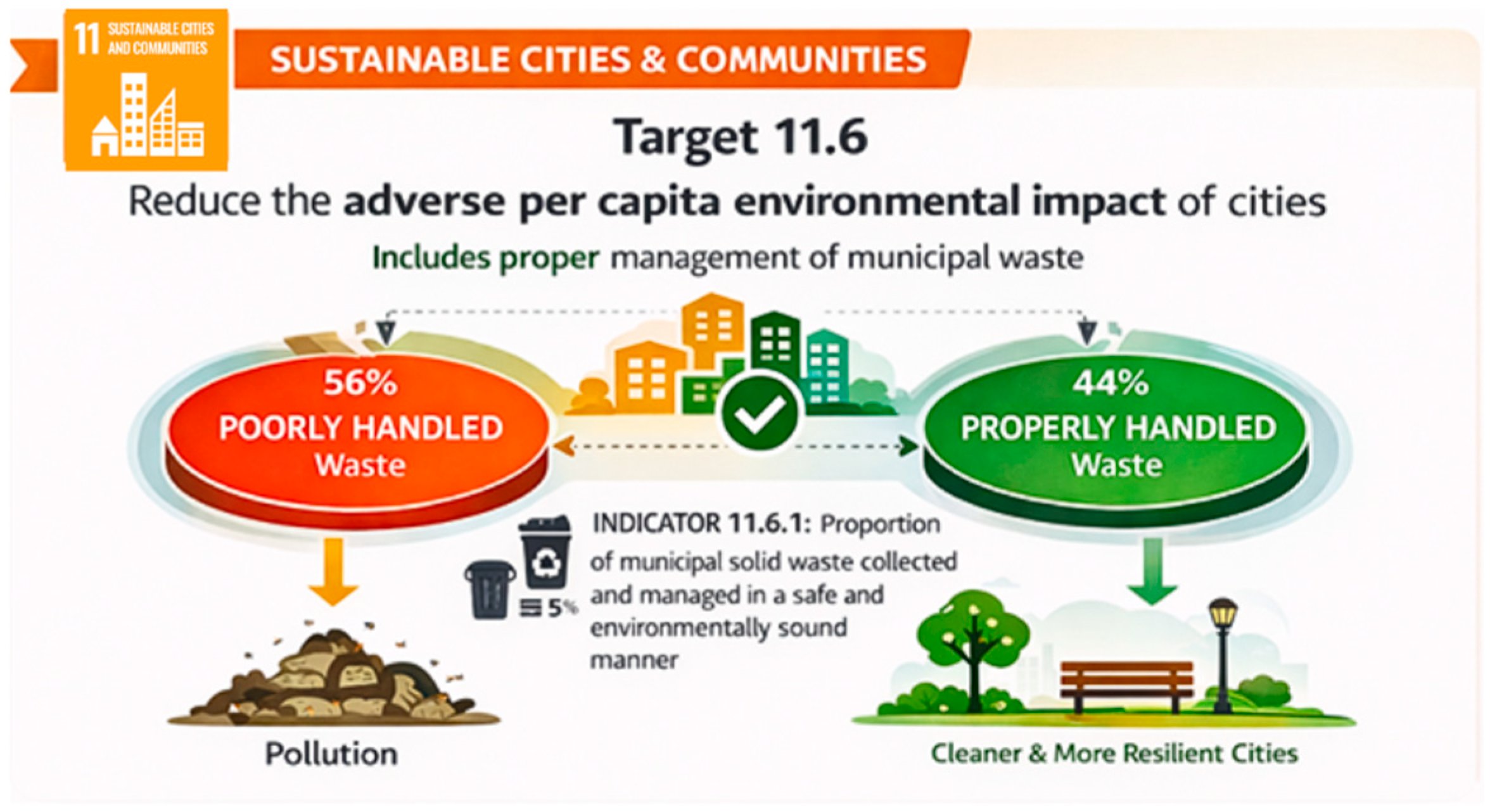
The relationship between sustainable urban development and waste management is further illustrated in Figure 2, which highlights the connection between SDG 11 and Target 11.6 [12].
Figure 2.
The graphical representation illustrates the connection between SDG 11 and Target 11.6, highlighting the role of waste management in reducing urban environmental impact [12], adapted by the authors using ChatGPT (OpenAI, GPT-4, 2025).
A sustainable city cannot be defined solely by infrastructure or mobility, but also by its capacity to manage waste efficiently. Ineffective waste systems lead to pollution, degradation of public spaces, and inefficient resource use, all of which directly affect urban sustainability [14].
By encouraging waste prevention and source separation, reducing mixed waste, and optimising collection processes, the proposed framework contributes to increasing the proportion of properly managed waste and improving overall environmental quality at the urban level. At the same time, it supports a transition toward more transparent and data-driven governance, enabling public authorities to manage waste services more proactively and efficiently.
Beyond operational improvements, the framework contributes to strengthening the institutional dimension of urban sustainability. Integrating circular economy principles with digital infrastructure supports more reliable public services, cleaner urban environments, and more resilient city systems—core elements of SDG 11.
4. Analytical Review of Enabling Technologies for Smart Waste Management
This section does not aim to provide a descriptive literature review, but to identify the key technological and economic components that underpin the proposed framework. The analysis focuses on the functional roles and limitations of existing approaches, highlighting the fragmentation that the present study seeks to address through integration.
4.1. IoT and Its Impact on the Waste Management System
The role of IoT in waste management systems becomes increasingly relevant in the broader context of digital transformation. Al-Fuqaha et al. [15] underline that IoT functions as an enabling technology that improves operational efficiency in public service systems. From a complementary perspective, Billah et al. [16] show that IoT enables real-time data collection and supports the optimisation of smart waste management systems. In this context, the Internet of Things enables real-time data collection and exchange, reducing the need for constant human intervention and supporting more responsive resource allocation [17]. In waste management, IoT applications focus on monitoring and operational optimisation, which fall within its scope. Ahmed et al. [18] highlight the role of IoT-based architectures in enabling real-time data collection, monitoring, and operational optimisation in municipal waste management systems. Maturi et al. [19] show, more specifically, how smart dustbins equipped with sensors can support real-time fill-level monitoring and more efficient route planning.
In this context, IoT acts as the data acquisition layer, generating the information required for further analysis and decision-making. Recent studies highlighted the greater incorporation of IoT and AI with smart waste management systems. Within these frameworks, IoT devices provide continuous data streams that can be processed to optimise logistics, reduce operational costs, and lower environmental impact [20].
For instance, UAV-based systems combined with deep learning can be used to identify and classify waste in locations where regular observation is difficult (e.g., river ecosystems) [21]. Meanwhile, IoT supports improved coordination between waste management systems and informal actors. Digital platforms that connect households and waste collectors illustrate how technology can improve organisational coordination, data accuracy, and facilitate the integration of informal waste pickers into formal waste management systems, as highlighted in the literature [22].
Despite this progress, the available literature suggests that most IoT-based solutions have been introduced as standalone technological applications. And their application within economic instruments and legal frameworks is poor, inhibiting their potential to effect change in the system. This limitation suggests that integrated modes of connecting technological infrastructure with governance and economic tools are necessary.
Taken together, IoT technologies play a critical role in enabling real-time data acquisition and operational visibility in waste management systems. However, their application remains largely limited to isolated monitoring functions, without effective integration into economic or governance mechanisms. This fragmentation reduces their overall systemic impact and highlights the need for integrated models that can connect data collection with decision-making and cost allocation processes.
4.2. Artificial Intelligence and Its Impact on Waste Management Systems
Artificial intelligence and its impact on waste management systems. According to Russell and Norvig [23], artificial intelligence comprises computational models capable of processing large volumes of data and identifying patterns relevant to decision-making. Yigitcanlar et al. [24] further highlight that AI systems can support reasoning and adaptive learning, enhancing complex systems’ capacity to respond to dynamic conditions. Artificial intelligence consists of algorithms designed to process data, identify patterns, and support decision-making processes that would otherwise require significant human intervention. Newer developments in artificial intelligence have further extended the capabilities of AI-based systems, particularly in data processing, automation, and user interaction [25]. But in the field of waste disposal, AI is highly relevant, mainly for process optimisation, rather than as a substitute for human real-world decision-making.
The most relevant role of AI in this context is to optimise waste collection. Machine learning algorithms use available data, including real-time and historical data, to determine the most effective collection routes based on container fill levels. Fang et al. [26] highlight that artificial intelligence can enhance operational efficiency across the entire waste management chain. Anagnostopoulos et al. [27] show that IoT-based smart waste management systems can optimise collection processes and reduce unnecessary transportation.
Another important contribution of artificial intelligence is the automation of waste sorting processes. Recent research on AI-driven and vision-based waste sorting systems demonstrates that automated technologies can significantly improve classification accuracy and sorting efficiency [28]. In particular, machine learning and computer vision models enable the accurate identification and automated separation of recyclable materials, thereby reducing one of the main limitations of manual sorting and improving sorting performance [29]. AI is also heavily involved in predictive planning. Huang et al. [30] demonstrate that predictive models based on historical time-series data can improve the accuracy of waste generation forecasting and support better resource planning. AI-based computer vision systems can detect and monitor illegal waste dumping, supporting more effective environmental monitoring and intervention [26].
Artificial intelligence significantly improves operational efficiency in waste management systems by automating repetitive tasks and optimising logistics. In particular, route optimisation and data-driven scheduling approaches allow for more efficient collection processes, reducing unnecessary transportation, operational costs, and associated carbon emissions [26,31].
Beyond system optimisation, artificial intelligence can also support practical waste management operations. Ahmed et al. [32] show that deep learning-based visual recognition systems can accurately identify and classify waste materials, supporting more efficient sorting processes. Emmatty and Panicker [33] highlight that ergonomic and operational interventions can reduce physical strain during manual waste sorting tasks. From a broader perspective, recent studies emphasise that integrating artificial intelligence into waste management systems improves accuracy, operational efficiency, and overall system performance [34]. Artificial intelligence plays an increasingly important role in environmental monitoring and sustainable resource management [35].
However, despite the benefits, some issues have also been raised in the literature. The use of AI raises significant issues concerning transparency, fairness, and responsibility. Training data can be biased, and as a result, they can perpetuate bias, leading to inappropriate or unfair outcomes if not handled properly [36]. At the bottom, AI facilitates the shift from reactive waste management responses to proactive, data-intensive planning. Even now, existing applications are confined to specific stages of the waste management process. This partial implementation promotes fragmentation and limits the systemic effects of AI application—underlining the need for new approaches that not only link AI to other technologies but also economic and regulatory frameworks.
Overall, artificial intelligence enhances the efficiency and adaptability of waste management systems by enabling predictive optimisation, automated sorting, and data-driven decision-making. However, current applications are often confined to specific operational stages and do not fully interact with economic incentives or regulatory frameworks. This limitation reinforces the need for integrated approaches that combine AI capabilities with broader system-level coordination.
4.3. Blockchain and Its Impact on the Waste Management System
With IoT and artificial intelligence, blockchain technology offers a new paradigm for managing data in a decentralised, transparent way, independent of third parties [37,38]. In the broader framework of Web 3.0, blockchain underpins the shift from centralised control to distributed systems, in which information is verified and circulated among multiple entities without a single authority [39,40].
Functionally speaking, blockchain is a distributed ledger technology in which transactions are recorded in a secure, immutable, and decentralised manner [41]. Blockchain ensures data immutability and traceability, as changes to recorded data would affect the integrity of the entire chain [42]. This structure enhances trust, transparency, and reliability in data management processes while also addressing cybersecurity and data protection issues in decentralised systems [43,44]. These features are especially useful in the waste management field, where the core issue is the lack of reliable traceability across the entire lifecycle of materials. Blockchain fills this gap by providing a transparent, verifiable record of collection, transport, and recycling processes [42], enabling the traceability of waste flows from generation to reintegration into the economic cycle [45]. From this perspective, the literature highlights several practical applications of blockchain in waste management systems, including digital platforms that enhance transparency, traceability, and operational efficiency [46]. Moreover, they promote more predictable data collection and validation. The blockchain is also increasingly integrated into the circular supply chains. Liu et al. [47] show that digital capabilities can reinforce circular supply chains by improving visibility over material flows. Nobre and Tavares [48] highlight the role of digital technologies in supporting the transition towards circular economy models, particularly through data integration and system optimisation. This broader pattern is also reflected in review studies showing that digital technologies, including blockchain, support circular product and supply-chain management, although implementation remains uneven across sectors [49]. This opportunity is further amplified when blockchain is integrated with IoT and AI systems, enabling real-time data generation, analysis, and secure storage within a unified architecture [50]. This is especially true for combined scenarios where IoT devices generate real-time data, and the AI process analyses this data on the blockchain in real time while keeping it secure, verifiable, and tamper-proof.
This allows the closer control of waste volumes, collection activity and compliance with statutory requirements [50,51]. Smart contracts represent a core component of this framework, enabling the automated execution of predefined rules once specific conditions are met [52]. These are digital protocols that automatically execute and enforce predefined rules when specific conditions are met. For waste management, they are used to verify collection events, compute tariffs, and provide incentives based on the amount and type of waste produced. They are also highly applicable to such automated, decentralised systems due to their compatibility with IoT-generated data [52,53].
The main limitation of blockchain applications in waste management is that adoption remains in its early stages, often limited to experimental or small-scale implementations [53], largely due to technical complexity, regulatory uncertainty, and the absence of standardised frameworks [48]. Consequently, large-scale adoption remains limited. These factors ultimately make blockchain a powerful tool for improving transparency, traceability, and accountability in waste management systems, beyond the traditional scope of this literature. Its true impact, however, hinges on its integration with other forms of digital technology and its alignment with economic and regulatory systems. Nowhere is this more obvious than in the concept of coherent, integrated frameworks rather than isolated technological solutions.
In this context, blockchain technology offers significant potential for improving transparency, traceability, and trust in waste management systems. Nevertheless, its implementation remains limited due to technical complexity, regulatory uncertainty, and the lack of standardised frameworks. As a result, its full potential can only be realised when integrated with other digital technologies and aligned with economic and governance mechanisms.
4.4. Pay-as-You-Throw (PAYT)
Pay-as-you-throw (PAYT). The Pay-as-you-throw (PAYT) system illustrates the payment of households according to the waste they produce, as a practical “polluter pays” application of the principle at the local level [54]. In contrast to conventional systems based on fixed costs or property taxes, PAYT incorporates a variable-cost structure that makes waste generation an inherent component of the financial obligation, thereby internalising the environmental burden of disposal [55]. PAYT can be interpreted as an economic corrective, analogous to a Pigouvian tax, because it directly addresses the waste-disposal inefficiency that arises from lower disposal costs. In so doing, the system assigns a cost to waste generation, thereby rewarding behavioural change towards waste reduction and more cautious separation at source [56].
In practice, PAYT systems are realised through several operational models: weight-, volume-, or frequency-based charging mechanisms. Weight-based systems rely on smart containers equipped with RFID identification and weighing technology, providing accurate measurement of each user’s waste output [57]. These strategies offer high levels of precision and justice, as costs are directly proportional to the waste generated. A recent example, the UrbanWINS project, showed how digital infrastructure can facilitate real-time monitoring of disposal activities to generate behavioural data, which can be utilised to guide and inform users [58].
Instead, volume-based systems use standard containers or prepaid bags, providing a relatively simple and readily available alternative, especially in towns with low technical capacity. Nevertheless, this simplicity can be achieved at the expense of accuracy, since volume is not always a reliable indicator of a material’s composition or density [59,60]. Consequently, trade-offs among accuracy, cost, and administrative feasibility continue to guide PAYT systems. At the European level, PAYT, underpinned by Directive 2008/98/EC, establishes a hierarchy of waste and emphasises prevention over disposal, in accordance with Article 4 of the Waste Framework Directive [61].
PAYT, as an economic and legal tool in the regulatory environment, translates abstractions such as prevention and responsibility into operational practices. Notwithstanding this shared legal basis, PAYT coverage differs significantly between Member States. In Germany, for example, PAYT schemes are incorporated into local rule frameworks that include fixed and variable fees and stringent responsibilities for waste segregation [62]. In Italy, however, the system is less uniform, with reliance on local efforts and pilot projects (often supplemented by regional regulations). RFID-based surveillance in cities, including Trento and Treviso, to enable precise tracking and billing has been implemented, but uptake has been patchy. However, the effectiveness of PAYT systems has been empirically verified. In Belgium, waste generation declined by about 9.1 per cent after 10 years of application [63].
Also, evidence from Italy’s municipalities shows substantial reductions in residual waste, but a higher fraction of separately collected waste consists of organic waste and paper [56]. Better sorting rates also contribute to tangible reductions not only in environmental impacts but also in household waste management costs, with positive effects on waste-handling costs [55].
However, there are numerous obstacles to PAYT systems, both economic and institutional, with the broader technological context influencing their implementation. An effective implementation of the law requires clear rules, consistent enforcement, and public involvement. Moreover, digital technologies, including IoT-based monitoring systems, play an increasingly important role in digital transformation, helping ensure accuracy, transparency, and trustworthiness.
Taken together, PAYT represents one of the most effective mechanisms for translating individual behaviour into measurable environmental outcomes. However, its implementation is often constrained by a lack of accurate monitoring, reliable data, and user accountability. These limitations underscore the importance of integrating PAYT with digital technologies to ensure precise measurement, transparency, and efficient system management.
5. Towards an Integrated Operational Framework for Smart Waste Management Systems
Building on the structural fragmentation identified in the previous section—where technological solutions, economic instruments, and governance mechanisms operate in isolation—this section proposes an integrated framework designed to align these components within a coherent operational system for smart municipal waste management.
Recent technological developments make it possible to rethink waste management systems as integrated, data-driven structures rather than fragmented and reactive ones, as also highlighted in recent studies on smart waste systems and digital governance [16]. But these solutions, by nature, are typically applied to individual technologies, often disconnected from a systemic manner that connects operational activities, economic processes, and regulatory policies. In this regard, this chapter aims to construct a unified conceptual framework for smart municipal waste management, based on the integrated application of IoT, Artificial Intelligence, and blockchain technologies into a Pay-as-you-throw (PAYT) system.
This model can be applied not only to technological improvements but also to building a working system that links waste generation to user responsibility and allocates costs within an overall operational logic. The framework is based on the principles of waste prevention and reduction, support for reuse and recycling, traceability and transparency in operations, operational efficiency, and fairness in cost-sharing. Such principles coincide with the waste hierarchy currently proposed at the European level and with the broader objectives of the circular economy, as reflected in European policy frameworks [14,63].
The integration of technological infrastructure with economic incentives and regulatory logic helps overcome the deficiencies identified in the literature, particularly the fragmentation of technological solutions and their limited integration with economic and regulatory instruments [16,50]. In this view, the framework offers an organised foundation for constructing a smart collection system that can provide infrastructure for efficient urban governance and for environmental protection.
5.1. Architecture
We have established a multi-layer system that forms the basis of the proposal to integrate technological, operational, and governance aspects into a coherent framework. Every layer plays a distinct role, but the interaction of these layers can guarantee overall efficiency, fairness, and traceability in waste management processes.
The first layer—User Access & Identification—creates the link between the waste generator and the act of disposal. It is here that users become identifiable when waste is disposed of, a fundamental condition for implementing “polluter pays.” Depending on the local context, identification can be done either through a digital application generating unique QR codes for each disposal event or through access cards associated with residential units. This allows each disposal action to be linked to a single user or household while ensuring that data protection through pseudonymization remains effective.
The second layer—IoT Infrastructure—converts the physical waste-disposal action into a measurable, verifiable digital event. This layer includes containers equipped with sensors that detect waste quantity, fill level, and disposal frequency. Rather than relying on the complex technical configurations many systems use today, this layer ensures data is collected accurately and transmitted securely. In cases where connectivity is poor, the system tends to operate on the condition that local data can be stored and synchronisation is delayed, so that it remains operational. In situations of temporary network interruption, the system may operate according to an offline-first logic. Disposal events can be stored locally with timestamps and subsequently synchronised once connectivity is restored. To preserve data integrity, each event may be hashed at the moment of registration and later matched with the blockchain record after synchronisation. This mechanism supports continuity of operation while maintaining trust in tariff calculation and event traceability under the “polluter pays” principle.
The third level—AI Processing and Optimisation—generates actionable information from raw data. The system can detect, by analysing data patterns generated by the waste, optimise the collection route, and observe deviations in behaviour, for example, abnormal disposal habits. The function of this layer is not complete automation, but sound judgment. Including predictive functions promotes operational efficiency and better planning for waste disposal services.
The fourth layer—Blockchain and Smart Contracts—delivers the framework for governance and trust. Rather than relying on central control, this layer ensures that all required events—for example, waste deposits, quantities, and costs—are encoded securely and irreversibly. Smart contracts automate the administration of PAYT tariffs, tying waste management costs directly to user behaviour. At the same time, this layer also makes clear whether things are done properly by public authorities or other stakeholders. The interaction between these layers sets the originality of the proposed structure in stone.
This model is distinct from traditional approaches that have usually seen technological solutions as independent entities, consolidating identification, measurement, analysis, and oversight into operational units. This helps the system transition from a modular strategy to an integrated system that integrates user behaviour, data processing, and economic obligations. From an operational standpoint, the architecture is scalable and responsive. It can be rolled out gradually according to the technological capacities of local administrations, adapted to different urban settings and contexts. Most importantly, the model supports a shift from reactive to more proactive, data-driven waste management, in line with the principles of the circular economy.
Through this mechanism, the blockchain layer not only reinforces trust and procedural equity but also operationalises the “polluter pays” principle by ensuring a transparent, verifiable, and tamper-resistant record of each disposal event within a decentralised digital governance framework.
To better illustrate the transformation introduced by the proposed framework, Table 2 summarises the shift from traditional waste management logic to the integrated, data-driven model proposed in this study.
Table 2.
Transformation of operational logic in waste management systems.
5.2. Sustainability Analysis
The significance of the proposed framework lies in its ability to deliver quantifiable impacts across both environmental and operational perspectives. Rather than treating waste management solely as a logistical process, the model proposes a framework in which user behaviour, data processing, and cost allocation are directly correlated.
One of its most important effects is reducing mixed waste, which in turn indirectly reduces greenhouse gas emissions. In old systems, when no distinction is made at the source, and only mixed waste is collected, a significant proportion of recyclable and biodegradable materials is also discarded in landfills. This results in the production of methane (CH4), a greenhouse gas whose short-term effect is actually much more significant than that of carbon dioxide. This effect is well documented in climate literature, which identifies landfilled biodegradable waste as a major source of methane emissions in the waste sector [11].
The PAYT system addresses this situation by promptly sending a monetary signal. When users are charged by the proportion of mixed waste generated, disposal behaviour becomes more selective. Households are motivated to separate recyclable and biodegradable fractions to reduce costs. Since then, less waste has been left behind at landfills, meaning less trash is being dumped into landfills as a result of behavioural change, reducing methane emissions from decomposition. The causal mechanism is relatively clear. When households pay in proportion to the amount of mixed waste they generate, they are encouraged to separate recyclable and biodegradable fractions more carefully. As the quantity of residual waste decreases, less material is sent to landfill. This directly reduces the conditions that generate methane emissions from decomposition. At the same time, improved source separation increases recovery rates, reduces contamination, and streamlines collection logistics, thereby indirectly reducing CO2 emissions.
These expected effects are consistent with empirical evidence from existing PAYT implementations. For instance, studies conducted in European contexts such as Belgium and Italy report measurable reductions in residual waste and increases in separate collection rates following the introduction of PAYT systems. Building on these findings, the integration of real-time monitoring technologies and precise tariff calculation mechanisms within the proposed framework is expected to further enhance these outcomes by strengthening behavioural feedback and improving individual-level accountability. This suggests that the proposed framework does not operate in isolation, but extends and amplifies already validated policy mechanisms through digital integration.
By adopting IoT and AI technologies, their coupling strengthens the results. Based on online observations, there are ways to manage waste containers more efficiently and avoid overflow or unnecessary transport. AI-based route optimisation reduces fuel use and associated CO2 emissions simultaneously. This system generates ecological gains through waste reduction and more efficient logistics.
At the operational level, the framework enables cost optimisation. Traditional waste collection systems depend on set schedules regardless of demand. By contrast, data collection driven by a system adjusts how frequently and in what context it is collected to match actual conditions, lessening the effects of operational inefficiencies. Moreover, proper data facilitates more efficient development and resource allocation at the municipal level.
Another dimension that needs to be highlighted is transparency and accountability. The framework associates all disposal acts with a user’s digital identity and stores relevant data securely to minimise the risk of billing inaccuracies, thereby engendering trust in the PAYT system. This is important for public acceptance and can sometimes be a limiting factor in the effective application of such systems.
The model also addresses several structural limitations of conventional waste management systems, including the lack of traceability, limited individual accountability, and insufficient real-time performance monitoring. By integrating technological infrastructure with economic incentives, the framework establishes the conditions for a more coherent and efficient operational process. In this context, the proposed framework can be understood as a reconfiguration of the operational logic of waste management systems. Traditional systems are predominantly reactive, based on fixed collection schedules, limited traceability, and weak links between individual behaviour and cost allocation. By contrast, the proposed model introduces a proactive, data-driven logic in which waste generation is continuously monitored, directly associated with user identity, and translated into dynamic economic signals. This transformation shifts waste management from a volume-based service model to a behaviour-responsive system in which accountability, efficiency, and environmental performance are structurally integrated. As such, the contribution of the framework lies not merely in the addition of digital tools but in the systemic alignment of behaviour, data, and cost allocation within an integrated governance model.
From a practical perspective, the framework could be implemented gradually through a phased municipal pilot. In a first phase, local authorities could introduce controlled-access collection points in selected residential areas, using user identification and basic IoT monitoring. In a second phase, predictive analytics could be added to optimise collection frequency and routes. In a third phase, blockchain-based recording and automated tariffing could be introduced to strengthen transparency and trust in the PAYT mechanism. Such a phased approach would reduce implementation risks, allow institutional adaptation, and provide measurable data on feasibility, cost, and user acceptance.
However, the application of such a model is not without its difficulties. Initial costs of digital infrastructure construction, the need for technical expertise, regulatory adaptations, and user acceptance may all affect the practicality of adoption. Such considerations need to be taken into account in the development of pilot projects and policymaking. In particular, the scalability of such systems depends on local authorities’ ability to balance initial infrastructure costs with long-term efficiency gains, and to adapt existing regulatory frameworks to support data-driven and automated tariffing mechanisms.
The proposed model aligns with the shift from reactive to proactive waste management. It does contribute to reducing waste assessment costs, not only by increasing efficiency but also by reorganising the interface among users, national-level authorities, and waste management practices. Sustainability, in this respect, is not seen as a metaphorical ideal or a theoretical concept, but as a direct effect of concrete, measurable mechanisms embedded in the system.
Taken together, these results suggest that the effectiveness of smart waste management systems does not depend solely on technological innovation, but on the structural integration of technology, economic incentives, and governance mechanisms. These findings indicate that municipalities implementing such integrated systems could achieve measurable reductions in landfill dependency, improved cost-efficiency of collection services, and enhanced transparency in tariff allocation.
The proposed framework demonstrates the potential to generate measurable reductions in residual waste volumes, improve recycling rates, and reduce greenhouse gas emissions through both behavioural change and operational optimisation.
The key novelty of the proposed framework lies in the functional integration of behavioural incentives (PAYT), real-time data acquisition (IoT), predictive optimisation (AI), and decentralised governance mechanisms (blockchain) within a unified operational architecture.
5.3. Limitations and Implementation Challenges
Despite its potential, the proposed framework is subject to several limitations that may affect its large-scale implementation. First, the deployment of IoT infrastructure, including smart containers and sensor networks, requires significant initial investment, which may represent a barrier for municipalities with limited financial resources. Second, the system depends on a certain level of digital infrastructure and technological maturity, including stable connectivity and data management capacity, which may not be uniformly available across regions. Third, the successful implementation of PAYT-based digital systems relies on public acceptance and behavioural adaptation, as resistance to monitoring or changes in tariff structures may limit effectiveness. Finally, the framework remains conceptual and has not yet been empirically validated through pilot implementation or real-world testing. These limitations highlight the need for future empirical research and gradual, context-sensitive deployment strategies.
From a policy perspective, the proposed framework provides a structured basis for the gradual implementation of PAYT-based smart waste management systems at the municipal level. Local authorities could operationalise this model through phased deployment strategies, starting with pilot projects in high-density residential areas and progressively extending the system based on performance indicators. The integration of real-time monitoring and automated tariffing can support evidence-based decision-making, enabling municipalities to optimise collection routes, adjust tariff structures, and improve service efficiency. Moreover, the framework can inform regulatory design by linking environmental objectives to measurable behavioural incentives, thereby facilitating the transition from traditional waste-collection systems to data-driven, circular-economy-oriented governance models.
6. Conclusions
This study develops an integrated conceptual framework demonstrating that the advancement in urban sustainability depends not on isolated technological solutions, but on their structured integration within a coherent operational architecture. The analysis shows that, although IoT, artificial intelligence, and blockchain technologies are increasingly applied in the waste management sector, their implementation remains fragmented, limiting their systemic impact and operational efficiency.
The main contribution of this research is the proposal of a unified model that integrates user identification, real-time data collection, predictive optimisation, and automated PAYT-based tariff calculation into a single system. By linking individual behaviour to cost allocation, the framework supports a transition from reactive waste management practices to a proactive, data-driven model grounded in accountability and aligned with circular economy principles.
From a functional perspective, the proposed model reconfigures waste management processes by enhancing transparency, traceability, and operational control. This integration enables measurable improvements in waste reduction, resource efficiency, and emission mitigation, positioning waste management as an active component of smart urban governance and contributing to the achievement of Sustainable Development Goals 11 and 13.
However, the framework remains conceptual and requires empirical validation. Its large-scale implementation depends on public authorities’ ability to balance initial infrastructure costs with long-term efficiency gains, as well as on user acceptance of monitoring and tariff mechanisms. Future research should therefore focus on pilot implementations to assess technical feasibility, economic viability, and social acceptance, supporting the transition from a theoretical model to a scalable solution for sustainable urban waste management.
Author Contributions
Conceptualisation: A.N.D., D.-M.V., A.M. and D.B. Methodology: A.N.D., D.-M.V., A.M. and D.B. Software: D.B. Validation: A.N.D., D.-M.V., A.M. and D.B. formal analysis: A.M. and D.B. investigation: A.N.D. and D.-M.V. resources: A.N.D., A.M. and D.B. data curation: D.B. writing—original draft preparation: A.N.D. and A.M. writing—review and editing: A.N.D. visualization: D.-M.V. supervision: D.-M.V. project administration: A.N.D. funding acquisition: A.N.D., D.-M.V., A.M. and D.B. All authors have read and agreed to the published version of the manuscript.
Funding
This research received no external funding.
Institutional Review Board Statement
Not applicable.
Informed Consent Statement
Not applicable.
Data Availability Statement
The original contributions presented in this study are included in the article material. Further inquiries can be directed to the corresponding author.
Acknowledgments
During the preparation of this manuscript, the authors used ChatGPT (OpenAI, 2025) to support language editing, text structuring, conceptual clarification, and the generation of graphical elements (Figure 2). All generated content was critically reviewed, verified, and edited by the authors, who take full responsibility for the final content of this publication.
Conflicts of Interest
The authors declare no conflict of interest.
Abbreviations
| UN | United Nations |
| SDG | Sustainable Development Goal |
| PAYT | Pay-as-you-throw |
| IoT | Internet of Things |
| AI | Artificial Intelligence |
| IPCC | Intergovernmental Panel on Climate Change |
| WSN | Wireless Sensor Networks |
| GPS | Global Positioning System |
| GSM | Global System for Mobile Communications |
| LCD | Liquid Crystal Display |
| LED | Light-Emitting Diode |
| UAV | Uncrewed Aerial Vehicles |
| ICT | Information and Communication Technology |
| PoW | Proof of Work |
| PoS | Proof of Stake |
| RFID | Radio Frequency Identification |
| dApp | Decentralized Applications |
| TPM | Trusted Platform Module |
| HSM | Hardware Security Module |
References
- United Nations Environment Programme (UNEP); International Solid Waste Association (ISWA). Global Waste Management Outlook 2024: Beyond an Age of Waste—Turning Rubbish into a Resource; UNEP: Nairobi, Kenya, 2024. [Google Scholar] [CrossRef] [Scilit]
- Kaur, H.; Kaur, P. Factors Determining Household Waste Segregation Behaviour: An Indian Case Study. Int. J. Exp. Res. Rev. 2024, 41, 83–95. [Google Scholar] [CrossRef] [Scilit]
- Oo, P.Z.; Prapaspongsa, T.; Strezov, V.; Huda, N.; Oshita, K.; Takaoka, M.; Ren, J.; Halog, A.; Gheewala, S.H. The Role of Global Waste Management and Circular Economy towards Carbon Neutrality. Sustain. Prod. Consum. 2024, 52, 498–510. [Google Scholar] [CrossRef] [Scilit]
- Zaman, A.U. A comprehensive study of the environmental and economic benefits of resource recovery from global waste management systems. J. Clean. Prod. 2016, 124, 41–50. [Google Scholar] [CrossRef] [Scilit]
- Magrini, C.; D’Addato, F.; Bonoli, A. Municipal solid waste prevention: A review of market-based instruments in six European Union countries. Waste Manag. Res. 2020, 38, 3–22. [Google Scholar] [CrossRef] [Scilit] [PubMed]
- European Commission. Circular Economy Action Plan. For a Cleaner and More Competitive Europe; European Commission: Brussels, Belgium, 2020; Available online: https://eur-lex.europa.eu/legal-content/EN/TXT/?uri=CELEX:52020DC0098 (accessed on 1 March 2025).
- European Commission; Joint Research Centre. Best Environmental Management Practice for the Waste Management Sector: Learning from Frontrunners; Publications Office of the European Union: Luxembourg, 2018. [Google Scholar] [CrossRef]
- Ahmad, R.W.; Salah, K.; Jayaraman, R.; Yaqoob, I.; Omar, M. Blockchain for Waste Management in Smart Cities: A Survey. IEEE Access 2021, 9, 131520–131541. [Google Scholar] [CrossRef] [Scilit]
- Page, M.J.; McKenzie, J.E.; Bossuyt, P.M.; Boutron, I.; Hoffmann, T.C.; Mulrow, C.D.; Shamseer, L.; Tetzlaff, J.M.; Akl, E.A.; Brennan, S.E.; et al. The PRISMA 2020 Statement: An Updated Guideline for Reporting Systematic Reviews. BMJ 2021, 372, n71. [Google Scholar] [CrossRef] [Scilit]
- Snyder, H. Literature Review as a Research Methodology: An Overview and Guidelines. J. Bus. Res. 2019, 104, 333–339. [Google Scholar] [CrossRef] [Scilit]
- Intergovernmental Panel on Climate Change (IPCC). Climate Change 2021: The Physical Science Basis; Cambridge University Press: Cambridge, UK, 2021. [Google Scholar] [CrossRef] [Scilit]
- United Nations. Sustainable Development Goal 11: Make Cities and Human Settlements Inclusive, Safe, Resilient and Sustainable. Available online: https://sdgs.un.org/goals/goal11 (accessed on 1 March 2025).
- United Nations. Transforming Our World: The 2030 Agenda for Sustainable Development; United Nations: New York, NY, USA, 2015; Available online: https://sdgs.un.org/2030agenda (accessed on 1 March 2025).
- Ferronato, N.; Torretta, V. Waste Mismanagement in Developing Countries: A Review of Global Issues. Int. J. Environ. Res. Public Health 2019, 16, 1060. [Google Scholar] [CrossRef] [Scilit]
- Al-Fuqaha, A.; Guizani, M.; Mohammadi, M.; Aledhari, M.; Ayyash, M. Internet of Things: A Survey on Enabling Technologies, Protocols, and Applications. IEEE Commun. Surv. Tutor. 2015, 17, 2347–2376. [Google Scholar] [CrossRef] [Scilit]
- Billah, M.; Sultana, A.; Rahaman, M. A Real-Time Classified and Optimised Smart Waste Management System Based on IoT. In Proceedings of the International Conference on Electrical, Computer and Communication Engineering (ECCE), Chittagong, Bangladesh, 13–15 February 2025; pp. 1–6. [Google Scholar] [CrossRef] [Scilit]
- Atzori, L.; Iera, A.; Morabito, G. The Internet of Things: A Survey. Comput. Netw. 2010, 54, 2787–2805. [Google Scholar] [CrossRef] [Scilit]
- Ahmed, K.; Dubey, M.K.; Kumar, A.; Dubey, S. Artificial Intelligence and IoT Driven System Architecture for Municipality Waste Management in Smart Cities: A Review. Meas. Sens. 2024, 36, 101395. [Google Scholar] [CrossRef] [Scilit]
- Maturi, S.; Dhanikonda, S.; Giddaluru, S. Smart Dustbins: Real-Time Monitoring and Optimisation for Waste Management in Smart Cities Using IoT Devices. Eng. Technol. Appl. Sci. Res. 2025, 15, 19246–19252. [Google Scholar] [CrossRef] [Scilit]
- Lakhouit, A. Revolutionising Municipal Solid Waste Management Using Artificial Intelligence and the Internet of Things: A Review of Smart Solutions for Waste Collection, Sorting and Recycling. Results Eng. 2025, 25, 104018. [Google Scholar] [CrossRef] [Scilit]
- Maharjan, N.; Miyazaki, H.; Pati, B.; Dailey, M.; Shrestha, S.; Nakamura, T. Plastic Waste Detection in Rivers Using UAV Sensor Data and Deep Learning. Remote Sens. 2022, 14, 3049. [Google Scholar] [CrossRef] [Scilit]
- Dias, S.M. Waste Pickers and Cities. Environ. Urban. 2016, 28, 375–390. [Google Scholar] [CrossRef] [Scilit]
- Russell, S.; Norvig, P. Artificial Intelligence: A Modern Approach, 4th ed.; Pearson: Harlow, UK, 2021. [Google Scholar]
- Yigitcanlar, T.; Desouza, K.C.; Butler, L.; Roozkhosh, F. Contributions and Risks of Artificial Intelligence (AI) in Building Smarter Cities: Insights from a Systematic Review. Energies 2020, 13, 1473. [Google Scholar] [CrossRef] [Scilit]
- Dwivedi, Y.K.; Hughes, L.; Ismagilova, E.; Aarts, G.; Coombs, C.; Crick, T.; Duan, Y.; Dwivedi, R.; Edwards, J.; Eirug, A.; et al. Artificial Intelligence (AI): Multidisciplinary Perspectives on Emerging Challenges, Opportunities, and Agenda for Research. Int. J. Inf. Manag. 2021, 57, 101994. [Google Scholar] [CrossRef] [Scilit]
- Fang, B.; Yu, J.; Chen, Z.; Osman, A.I.; Farghali, M.; Ihara, I.; Hamza, E.H.; Rooney, D.W.; Yap, P.-S. Artificial intelligence for waste management in smart cities: A review. Environ. Chem. Lett. 2023, 21, 1959–1989. [Google Scholar] [CrossRef] [Scilit]
- Anagnostopoulos, T.; Zaslavsky, A.; Kolomvatsos, K.; Medvedev, A.; Amirian, P.; Morley, J.; Hadjieftymiades, S. Challenges and Opportunities of Waste Management in IoT-Enabled Smart Cities: A Survey. IEEE Trans. Sustain. Comput. 2020, 5, 275–289. [Google Scholar] [CrossRef] [Scilit]
- Mohammed, M.A.; Abdulhasan, M.J.; Kumar, N.M.; Abdulkareem, K.H.; Mostafa, S.A.; Maashi, M.S.; Khalid, L.S.; Abdulaali, H.S.; Chopra, S.S. Automated Waste-Sorting and Recycling Classification Using Artificial Neural Network and Feature Fusion: A Digital Technology-Based Circular Economy Vision for Smart Cities. Multimed. Tools Appl. 2023, 82, 39617–39632. [Google Scholar] [CrossRef] [Scilit]
- Koskinopoulou, M.; Raptopoulos, F.; Papadopoulos, G.; Mavrakis, N.; Maniadakis, M. Robotic Waste Sorting Technology: Toward a Vision-Based Categorisation System for the Industrial Robotic Separation of Recyclable Waste. IEEE Robot. Autom. Mag. 2021, 28, 50–60. [Google Scholar] [CrossRef] [Scilit]
- Huang, L.; Cai, T.; Zhu, Y.; Zhu, Y.; Wang, W.; Sun, K. LSTM-Based Forecasting for Urban Construction Waste Generation. Sustainability 2020, 12, 8555. [Google Scholar] [CrossRef] [Scilit]
- Hannan, M.A.; Begum, R.A.; Al-Shetwi, A.Q.; Ker, P.J.; Al Mamun, M.A.; Hussain, A.; Basri, H.; Mahlia, T.M.I. Waste Collection Route Optimisation Model for Linking Cost Saving and Emission Reduction to Achieve Sustainable Development Goals. Sustain. Cities Soc. 2020, 62, 102393. [Google Scholar] [CrossRef] [Scilit]
- Ahmed, M.; Alotaibi, R.; Al-Qahtani, R.; Al-Qahtani, R.; Al-Hetela, S.; Al-Matar, K.; Al-Saqer, N.; Rahman, A.; Saraireh, L.; Youldash, M.; et al. Deep Learning Approach to Recyclable Products Classification: Towards Sustainable Waste Management. Sustainability 2023, 15, 11138. [Google Scholar] [CrossRef] [Scilit]
- Emmatty, F.; Panicker, V. Workplace-Based Assessment and Intervention Design for Waste Sorting Tasks in a Developing Country. Sādhanā 2022, 47, 40. [Google Scholar] [CrossRef] [Scilit]
- Seyyedi, S.R.; Kowsari, E.; Gheibi, M.; Chinnappan, A.; Ramakrishna, S. A Comprehensive Review Integration of Digitalisation and Circular Economy in Waste Management by Adopting Artificial Intelligence Approaches: Towards a Simulation Model. J. Clean. Prod. 2024, 460, 142584. [Google Scholar] [CrossRef] [Scilit]
- Wani, A.; Rahayu, F.; Amor, B.; Quadir, M.; Murianingrum, M.; Parnidi, P.; Ayub, A.; Supriyadi, S.; Sakiroh, S.; Saefudin, S.; et al. Environmental Resilience through Artificial Intelligence: Innovations in Monitoring and Management. Environ. Sci. Pollut. Res. 2024, 31, 18379–18395. [Google Scholar] [CrossRef] [Scilit]
- Mehrabi, N.; Morstatter, F.; Saxena, N.; Lerman, K.; Galstyan, A. A Survey on Bias and Fairness in Machine Learning. ACM Comput. Surv. 2021, 54, 115. [Google Scholar] [CrossRef] [Scilit]
- Nakamoto, S. Bitcoin: A Peer-to-Peer Electronic Cash System. 2008. Available online: https://bitcoin.org/bitcoin.pdf (accessed on 1 March 2025).
- Zheng, Z.; Xie, S.; Dai, H.; Chen, X.; Wang, H. Blockchain Challenges and Opportunities: A Survey. Int. J. Web Grid Serv. 2018, 14, 352–375. [Google Scholar] [CrossRef] [Scilit]
- Voshmgir, S. Token Economy: How Blockchain and Smart Contracts Revolutionise the Economy; BlockchainHub: Berlin, Germany, 2019. [Google Scholar]
- Swan, M. Blockchain: Blueprint for a New Economy; O’Reilly Media: Sebastopol, CA, USA, 2015. [Google Scholar]
- Yaga, D.; Mell, P.; Roby, N.; Scarfone, K. Blockchain Technology Overview; National Institute of Standards and Technology (NIST): Gaithersburg, MD, USA, 2018.
- Casino, F.; Dasaklis, T.K.; Patsakis, C. A Systematic Literature Review of Blockchain-Based Applications. Telemat. Inform. 2019, 36, 55–81. [Google Scholar] [CrossRef] [Scilit]
- Kshetri, N. Blockchain’s Roles in Strengthening Cybersecurity and Protecting Privacy. Telecommun. Policy 2017, 41, 1027–1038. [Google Scholar] [CrossRef] [Scilit]
- Xu, X.; Weber, I.; Staples, M. Architecture for Blockchain Applications; Springer International Publishing: Cham, Switzerland, 2019. [Google Scholar]
- Saberi, S.; Kouhizadeh, M.; Sarkis, J.; Shen, L. Blockchain Technology and Its Relationships to Sustainable Supply Chain Management. Int. J. Prod. Res. 2019, 57, 2117–2135. [Google Scholar] [CrossRef] [Scilit]
- Jiang, P.; Zhang, L.; You, S.; Van Fan, Y.; Tan, R.; Klemeš, J.J.; You, F. Blockchain Technology Applications in Waste Management: Overview, Challenges and Opportunities. J. Clean. Prod. 2023, 421, 139466. [Google Scholar] [CrossRef] [Scilit]
- Liu, L.; Song, W.; Liu, Y. Leveraging Digital Capabilities toward a Circular Economy: Reinforcing Sustainable Supply Chain Management with Industry 4.0 Technologies. Comput. Ind. Eng. 2023, 178, 109113. [Google Scholar] [CrossRef] [Scilit]
- Nobre, G.C.; Tavares, E. Scientific Literature Analysis on Big Data and Internet of Things Applications on Circular Economy: A Bibliometric Study. Scientometrics 2017, 111, 463–492. [Google Scholar] [CrossRef] [Scilit]
- Rusch, M.; Schöggl, J.-P.; Baumgartner, R.J. Application of Digital Technologies for Sustainable Product Management in a Circular Economy: A Review. Bus. Strategy Environ. 2023, 32, 1159–1174. [Google Scholar] [CrossRef] [Scilit]
- Reyna, A.; Martín, C.; Chen, J.; Soler, E.; Díaz, M. On Blockchain and Its Integration with IoT. Future Gener. Comput. Syst. 2018, 88, 173–190. [Google Scholar] [CrossRef] [Scilit]
- Upadhyay, N. Demystifying blockchain: A critical analysis of challenges, applications and opportunities. Int. J. Inf. Manag. 2020, 54, 102120. [Google Scholar] [CrossRef] [Scilit]
- Christidis, K.; Devetsikiotis, M. Blockchains and Smart Contracts for the Internet of Things. IEEE Access 2016, 4, 2292–2303. [Google Scholar] [CrossRef] [Scilit]
- Dorri, A.; Kanhere, S.S.; Jurdak, R. Blockchain in Internet of Things: Challenges and Solutions. arXiv 2016, arXiv:1608.05187. [Google Scholar] [CrossRef] [Scilit]
- Romano, G.; Masserini, L. Pay-As-You-Throw Tariff and Sustainable Urban Waste Management: An Empirical Analysis of Relevant Effects. J. Environ. Manag. 2023, 347, 119211. [Google Scholar] [CrossRef] [Scilit]
- Ukkonen, A.; Sahimaa, O. Weight-Based Pay-As-You-Throw Pricing Model: Encouraging Sorting in Households through Waste Fees. Waste Manag. 2021, 135, 372–380. [Google Scholar] [CrossRef] [Scilit]
- Brown, Z.; Johnstone, N. Better the Devil You Throw: Experience and Support for Pay-As-You-Throw Waste Charges. Environ. Sci. Policy 2014, 38, 132–142. [Google Scholar] [CrossRef] [Scilit]
- Hannan, M.A.; Arebey, M.; Begum, R.A.; Basri, H. Radio Frequency Identification (RFID) and Communication Technologies for Solid Waste Bin and Truck Monitoring System. Waste Manag. 2011, 31, 2406–2413. [Google Scholar] [CrossRef] [Scilit]
- European Commission. UrbanWINS—Urban Metabolism Accounts for Building Waste Management Innovative Networks and Strategies (Horizon 2020 Project No. 690047). Available online: https://cordis.europa.eu/project/id/690047 (accessed on 1 March 2025).
- Skumatz, L.A.; Freeman, D.J. Pay-as-You-Throw (PAYT) in the U.S.: 2006 Update and Analysis; Skumatz Economic Research Associates (SERA): Superior, CO, USA, 2006. [Google Scholar]
- Dijkgraaf, E.; Gradus, R.H.J.M. Cost Savings in Unit-Based Pricing of Household Waste: The Case of The Netherlands. Resour. Energy Econ. 2004, 26, 353–371. [Google Scholar] [CrossRef] [Scilit]
- European Parliament; Council of the European Union. Directive 2008/98/EC on Waste and Repealing Certain Directives. 2008. Available online: https://eur-lex.europa.eu/legal-content/EN/TXT/?uri=CELEX:32008L0098 (accessed on 1 March 2025).
- Bilitewski, B.; Härdtle, G.; Marek, K. Waste Management; Springer: Berlin, Germany, 1997. [Google Scholar]
- Dijkgraaf, E.; Gradus, R. Environmental Activism and Dynamics of Unit-Based Pricing Systems. Resour. Energy Econ. 2009, 31, 13–23. [Google Scholar] [CrossRef] [Scilit]

Disclaimer/Publisher’s Note: The statements, opinions and data contained in all publications are solely those of the individual author(s) and contributor(s) and not of MDPI and/or the editor(s). MDPI and/or the editor(s) disclaim responsibility for any injury to people or property resulting from any ideas, methods, instructions or products referred to in the content. |
© 2026 by the authors. Licensee MDPI, Basel, Switzerland. This article is an open access article distributed under the terms and conditions of the Creative Commons Attribution (CC BY) license.