


Abstract
This study investigates the interplay between university students’ motivational beliefs and their regulatory strategies when facing challenging academic tasks. Drawing on the Expectancy–Value–Cost (EVC) model, the research characterizes distinct motivational profiles based on perceived self-efficacy, task value, and perceived cost. A quantitative study was conducted with a sample of 1184 Chilean university students across various disciplines, including Engineering, Health Sciences, and Social Sciences. Participants identified a recent challenging task and completed a battery of validated instruments, including the Brief Regulation of Motivation Scale (BroMS) and scales for perceived cost, self-efficacy, and task value. Using Machine Learning techniques, specifically the Fuzzy C-Means (FCM) algorithm, the analysis identified four distinct student profiles (Agentic Mindset, Alienated Mindset, Paralyzed Mindset, Growth Mindset). These clusters were evaluated based on statistical indices (R2, AIC, BIC, and Silhouette) and theoretical coherence. Subsequent ANOVA and post hoc analyses (Holm correction) revealed significant differences among these profiles in their reported levels of motivational regulation and willpower. The findings suggest that students with high self-efficacy and task value combined with manageable perceived costs employ more effective motivational regulation strategies. Conversely, profiles characterized by high perceived cost and low self-efficacy show diminished regulatory capacity. This research contributes to understanding how personal and task-related perceptions interact to shape volitional control in demanding academic environments, offering insights for targeted interventions to support academic persistence and success.
1. Introduction
Motivation is a key predictor of persistence, learning, and talent development among university students [1]. Educational activities that enhance motivation by actively engaging students in their learning process have a positive impact on academic engagement and student achievement [2,3]. Moreover, higher academic performance and strong motivational levels are associated with better adjustment to university life [4,5,6] and well-being among students [7].
The Expectancy–Value–Cost (EVC) model posits that optimal motivational states emerge when students (a) expect to successfully master a task (expectancy of success), (b) perceive the task as valuable (subjective task value), and (c) perceive minimal or manageable negative consequences associated with task engagement (perceived cost) [8].
Empirical evidence indicates that, on average, university students experience a decline in motivation over time, associated with reduced expectations of success, diminished subjective value, and/or increased perceptions of cost [9,10]. More recent findings suggest that these factors also predict academic satisfaction and approaches to studying [11]. Additionally, motivational regulation training programs have been shown to improve both the appropriateness and quality of motivational regulation strategy use [12]. Across an academic semester, students with higher autonomous motivation tend to employ motivational regulation strategies more frequently, using them as contingent resources when their motivation declines [13].
Motivational regulation is a particularly valuable process due to its close connection with individuals’ capacity to exert deliberate control over the energy and direction that motivation provides in pursuit of their goals. In general, the use of self-regulated learning strategies increases students’ autonomy and sense of self-efficacy [14], enabling them to more clearly identify challenges and implement strategies to address them, thereby achieving greater effectiveness [15]. Specifically, research on motivational regulation has demonstrated its association with key academic processes such as self-efficacy, the establishment of achievement goals, reductions in procrastination, and lower levels of academic underperformance [16,17].
From a theoretical perspective, motivational regulation functions as an adaptive mechanism underlying the actions students take to initiate, sustain, or supplement their willingness to begin and successfully complete academic tasks and goals [18]. Empirical evidence indicates that students employ different types of motivational regulation strategies. Some engage in value regulation, which involves efforts to assign utility or importance to academic content and activities. Others rely on performance goal regulation, aimed at encouraging accurate task completion and the attainment of high grades. Students also use self-consequating strategies, consisting of self-imposed rewards contingent upon goal attainment. Additionally, some students engage in environmental structuring, a form of contextual control that reduces distractions during academic activities. Regulation of situational interest involves transforming academic tasks into more enjoyable activities. Finally, some students regulate mastery goals by focusing their efforts on improving understanding and maximizing learning [19].
Recent research has shown that intrinsic motivational regulation strategies have a direct and positive impact on students’ self-regulation and motivation, and an indirect effect on academic performance. Among these strategies are mastery goals, which foster deep learning and persistence. Likewise, value regulation strategies, used to assign utility or importance to academic content, function as a bridge between tasks and personal meaning—an aspect that is crucial for sustaining long-term engagement. Efficacy-enhancement strategies allow students to set achievable short-term goals that directly strengthen self-efficacy, thereby enhancing performance and self-regulation, both of which are essential for maintaining motivation in long-term tasks [20].
Conversely, strategies aimed at developing extrinsic motivation tend to be more frequently employed by students, as they are more accessible and yield more immediate results [21]. Self-consequating, performance avoidance, and situational interest strategies focus on rewards, fear of failure, and momentary attractiveness, respectively. Although these strategies may appear less adaptive, they can nevertheless be useful for initiating unappealing tasks or making routine activities more manageable. When combined with intrinsic strategies, they may contribute positively to the learning process [20].
Furthermore, a recent study report that all motivational regulation strategies—except approach performance goals—are positively associated with a deep learning approach, characterized by curiosity, critical analysis, and intrinsic motivation. In contrast, approach and avoidance performance goals are associated with a surface learning approach, marked by competitiveness, the pursuit of peer recognition, or the avoidance of failure rather than genuine understanding of the content. Finally, the strategic learning approach, characterized by organization and time management, is positively related to all strategies except performance avoidance, which is primarily employed to prevent performing worse than others [22].
Another study conducted in a workplace context found that, although overall levels of motivational regulation and volition show strong predictive power for engagement, a selective effectiveness effect emerges: only strategies that enhance task value and purpose significantly impact engagement. In contrast, extrinsic or environmentally focused strategies, such as reinforcement, social pressure, and environmental control, were found to be ineffective, as they did not show statistically significant associations with engagement in the studied group. These findings add nuance to the understanding of the utility of specific strategies and highlight the importance of considering the characteristics of the target population [23].
Motivational regulation becomes particularly important when students are required to engage in challenging tasks. These include academic activities such as projects, problem-solving tasks, oral defenses, debates and presentations, case studies, among others, which are typically linked to formal assessment and are often perceived as difficult or complex to address successfully [24].
This type of task prompts students to exert greater cognitive and motivational effort, engaging in more complex reasoning processes, reflection, and more sustained effort in their completion, thereby actively involving them in the teaching–learning process [25,26]. When instructional designs are conducive to learning, they have been shown to positively influence students’ knowledge structures by fostering the interconnection of ideas, thus promoting the development of more complex forms of understanding [27].
Despite these advantages, it is important to note that challenging tasks require a high level of self-regulation from students to persist over time and sustain the motivation necessary to complete long-term activities [28]. Due to their inherent complexity and level of challenge, the effort and workload demanded by such tasks may lead students to feel overwhelmed by academic demands. This perception of academic overload can result in exhaustion, reduced motivation, and difficulties with concentration [24]. For example, challenges related to time management have been observed, as these tasks require greater dedication and adherence to stricter deadlines [29].
Successfully engaging in challenging tasks requires students to develop their capacity to regulate their own motivation. As previously described, challenging tasks often demand persistent effort and may involve activities that are, at times, inherently demotivating. Within this framework, research has examined task-related perceptions that may influence how students approach such tasks with higher levels of motivation [30] and improved performance [31]. Far less attention has been devoted to understanding how perceptions of oneself and of the task interact to shape the regulatory effort students exert and their success in maintaining elevated motivational states when confronting these demands. This issue is particularly relevant, given that greater perseverance has been observed to positively affect motivation through enhanced self-regulation and higher performance goals, thereby reducing performance-avoidance goals (i.e., the tendency to avoid appearing incompetent). In addition, students with high motivation experience a decrease in performance-approach goals (i.e., the desire to demonstrate superiority), which helps to reduce anxiety and distractions within the educational process. [32].
The relationship between perceptions of task value, perceived cost, and individuals’ perceived capacity to cope with academic tasks has been widely examined. A recent study showed that students with high expectations of success—namely, high perceived self-efficacy—also report higher perceptions of the value of academic activities, which in turn supports stronger academic performance by modulating the perceived cost of demanding tasks. Conversely, high perceived cost may lead to task disengagement, similarly to low expectations of success and low perceived value [33].
Motivational regulation self-efficacy refers to individuals’ beliefs about their ability to effectively regulate their own motivation [11]. Individuals with higher self-efficacy in motivational regulation (MRSE) are expected to believe that they have the ability to deliberately influence their motivational states. In this regard, one study showed that higher MRSE is associated with more frequent use of motivational regulation strategies and greater effort among college students [34]. Subsequently, it was found that MRSE predicts both a higher frequency of motivational regulation and greater satisfaction with academic studies [30]. Furthermore, MRSE has been identified as a strong predictor of effective motivational regulation [35,36].
Subjective task value refers to the perceived importance of a task based on its personal relevance and/or its utility value for the individual [37]. It has been found that motivational regulation is perceived as particularly difficult when task value is low, even before engagement in a learning activity has begun [38]. Moreover, higher personal task significance has been shown to promote greater use of motivational regulation strategies [39]. Differences have also been observed between task types and the specific motivational regulation strategies deployed to address them [39].
Perceived task cost reflects anticipated negative consequences associated with task engagement, such as effort expenditure, psychological burden, and opportunity costs [40]. Overall, perceived cost has been identified as a negative predictor of university students’ academic performance [41,42,43], as well as their experienced motivation [44]. Its association has also been documented in relation to academic engagement among school-aged students [45]. Additionally, cost-related indicators (e.g., task difficulty) have been shown to negatively relate to both task expectancy and subjective task value [8].
Taken together, these findings underscore the importance of addressing students’ expectations, perceived value, and perceived costs of academic tasks in order to foster high levels of academic engagement and performance [46]. Identifying student profiles based on these dimensions may provide valuable insights for the design of targeted interventions aimed at supporting academic success and professional development [47].
As noted previously, research examining the relationship between expectancy, value, and perceived cost in relation to motivational control remains limited, particularly in the context of challenging academic tasks. This gap is noteworthy given that students’ approaches to challenging tasks may play a critical role in shaping their intentions, volitional control, and persistence in regulating motivation. Existing studies indicate that these factors predict overall motivational regulation [9,11,48]. However, prior research has largely operationalized EVC components in relation to broader academic outcomes (e.g., success in a major) or within school-based contexts, rather than focusing specifically on engagement with challenging academic tasks [48]. Moreover, no studies to date have identified differentiated profiles of university students based on the interaction of expectancy, value, and perceived cost in relation to challenging tasks. This gap is further pronounced in Spanish-speaking contexts, where empirical research on this phenomenon remains scarce, limiting the examination of potential cultural differences.
Beyond its immediate implications for task engagement, student motivation is increasingly recognized as a key component of educational sustainability. From a psychological perspective, sustainability in education depends not only on access or instructional quality, but also on students’ capacity to sustain motivation, effort, and engagement across demanding academic trajectories. Within the expectancy–value–cost framework, motivational processes are inherently dynamic and cumulative, shaping students’ persistence and well-being over time. Understanding how distinct motivational profiles emerge and function in higher education contexts is therefore essential for identifying patterns that may either support or undermine sustainable educational pathways.
For these reasons, the present study aimed to characterize student profiles based on perceived self-efficacy, perceived cost, and perceived value in relation to challenging academic tasks, and to examine their implications for the deployment of motivational self-regulation strategies.
2. Methodology
2.1. Design and Participants
A quantitative, descriptive study was conducted using machine learning techniques and between-group difference analyses within a cross-sectional time frame. A quota sampling strategy was employed, considering four disciplinary areas from which representative numbers of participants were obtained in accordance with their real proportions across selected academic programs (Table 1). The final sample comprised 1184 university students, of whom 53.5% identified as men, 44.4% as women, and 2.1% preferred not to report their gender.
Table 1.
Distribution of Students for degree.
2.2. Instrument
Four instruments were used in the present study, all of which provide evidence of validity and reliability for the assessment of university students. To respond to these instruments, participants were asked to recall a recent academic task that they perceived as particularly challenging and to clearly identify it. Based on this task, students were then instructed to complete the battery of instruments described in detail below.
- Brief Regulation of Motivation Scale (BroMS; [11]).The version adapted for the Chilean population was employed [23]. This scale consists of 12 items designed to assess general beliefs about motivational regulation when engaging in academic tasks. Responses are recorded on a Likert-type scale ranging from 1 (strongly disagree) to 5 (strongly agree). In the original study, the instrument demonstrated good model fit (χ2(53) = 90.24, p < 0.001, CFI = 0.99, TLI = 0.990, NNFI = 0.99, RMSEA = 0.054, NFI = 0.97) for a two-factor structure: Motivational Regulation (MR) (e.g., “If I stop working before finishing a task, I have strategies to continue studying”) and Willpower (WP) (e.g., “If a task is difficult, I find a way to continue and complete the work”). Additionally, excellent internal consistency was observed (α = 0.901).
- Short Scale of College Students’ Perceptions of Cost [44].This 19-item scale was specifically designed to assess four dimensions of perceived cost: (1) Task-related effort made 5 items (e.g., “This class requires too much of my time”); (2) Task-unrelated effort made 4 items (e.g., “I have so many other commitments that I cannot put all the necessary effort into this class”); (3) Loss of valued alternatives made 4 items (e.g., “This class requires me to give up many activities I value”); and (4) Psychological cost made 6 items (e.g., “This class is very exhausting”). Responses are provided on a Likert-type scale ranging from 1 (strongly disagree) to 6 (strongly agree). In the original validation study, the instrument showed adequate fit for the four-factor structure (CFI = 0.98, TLI = 0.98, RMSEA = 0.05), with factor loadings greater than 0.76 for items on their respective factors and satisfactory reliability (α = 0.87).
- Perceived Academic Self-Efficacy Scale (EAPESA).The version adapted for the Chilean university population was used [49]. This scale consists of a single factor comprising 10 items developed to assess students’ beliefs about their ability to successfully cope with academic tasks (e.g., “I consider myself sufficiently capable of successfully facing any academic task”). Responses are recorded on a Likert-type scale ranging from 1 (very rarely) to 5 (very frequently). The validation study reported good fit indices for the confirmatory model (χ2/df = 2.00, p < 0.001, CFI = 0.97, IFI = 0.97, TLI = 0.96, RMSEA = 0.058, RMR = 0.039) and adequate internal consistency (α = 0.87).
- Task Value Perception Scale [50].This instrument was designed to assess students’ perceptions of task value. The scale comprises six factors: (a) Intrinsic value, (b) Mastery value, (c) Self-image value, (d) Utility value, (e) Commitment value, and (f) Agency value. The validation study reported good fit indices for the confirmatory factor model (CFI = 0.98, TLI = 0.98, RMSEA = 0.066), with factor loadings greater than 0.43 for items on their respective factors, as well as excellent reliability for the six-factor model with a second-order factor (α = 0.95; Ω = 0.953).
2.3. Procedure and Analysis
Participant recruitment was conducted through the heads of the selected academic programs, following prior authorization from the corresponding university authorities. Data collection took place in regular classroom settings, using the beginning of a scheduled class period to administer the instruments. Before completing the questionnaires, participants reviewed and signed an informed consent form that complied with all ethical standards required for research in the human sciences. Subsequently, participants accessed the digital questionnaire via a QR code and completed the survey online. No incentives were offered for participation. Data were collected during the year 2025. This research was conducted within the framework of the ANID project, funded by grant FONDECYT Iniciación No. 11250061 ‘Estimación de un modelo predictivo para la regulación motivacional a partir de la expectativa, costo y valor en universitarios/as chilenos/as’, which was authorized by the Ethics, Bioethics and Biosafety Committee of the university in question (Code: CEBB No. 3036-2025).
Given that the variables were measured using different scales, all values were first standardized to z-scores to ensure comparability across variables.
Given
- Z is standardized value.
- X is original value.
- μ is mean.
- σ is standard deviation.
Analyses aimed at identifying potential clusters among participants were conducted using Machine Learning techniques. Specifically, the Fuzzy C-Means (FCM) algorithm was employed, as it is particularly well suited for psychological phenomena due to its ability to model gradual membership rather than rigid categorical assignment. This characteristic allows for the representation of diffuseness and continuity in psychological constructs, capturing the complexity of data patterns more effectively and enabling a more nuanced and accurate interpretation of participant profiles. Given
- N: Number of data points.
- C: Number of clusters.
- uik: Fuzzy membership degree of data point xi in cluster k, ranging from 0 to 1. This value represents the degree to which xi belongs to cluster k.
- m: Fuzziness parameter (m = 2).
- xi: The i-th data point.
- vk: The centroid of cluster k.
- ∥xi − vk∥2: Squared Euclidean distance between data point xi and centroid vₖ.
Prior to the clustering analyses, a diagnostic multivariate outlier screening was conducted to reduce potential centroid distortion and artificial cluster overlap. Mahalanobis distance was computed based on the variables included in the clustering solution, and a conservative χ2 threshold corresponding to p < 0.01 was applied using SPSS v.22. This procedure identified a small proportion of borderline multivariate cases (1.44%), which were excluded exclusively for the clustering step, resulting in a final analytical sample of n = 1167. Importantly, no extreme multivariate outliers were detected under stricter criterion (p < 0.001), indicating that the data structure was not driven by strange observations. Fuzzy C-Means clustering was estimated across multiple candidate solutions to determine the optimal number of motivational profiles. Models specifying three, four, five, and six clusters were systematically evaluated using a consistent parameterization, including a fuzziness parameter of m = 1.6 to balance profile differentiation and theoretical realism, a maximum of 500 iterations to ensure convergence, and a fixed random seed to guarantee replicability. Model adequacy was assessed using silhouette coefficients to evaluate cluster separation, explained variance (R2) to capture within-solution explanatory power, and information criteria (AIC and BIC) to account for model complexity. The final solution was selected based on a joint consideration of statistical performance, solution stability, and theoretical interpretability, with the four-cluster model representing the most parsimonious and conceptually coherent balance among these criteria. Moderate silhouette coefficients were expected considering motivational data characterized by continuous and overlapping psychological constructs.
To assess the potential impact of common method bias, a Harman’s single-factor test was conducted using an exploratory factor analysis at the construct level, including self-efficacy, value, cost, and motivational regulation. The analysis was performed using principal axis factoring without rotation, allowing the number of factors to be determined by eigenvalues greater than one. Results indicated that the first unrotated factor accounted for 32.3% of the total variance, well below the threshold typically associated with problematic common method variance. Moreover, the factor structure was not unidimensional: motivational regulation and value loaded strongly on the first factor, whereas perceived cost loaded primarily on a second factor with an eigenvalue exceeding one. This pattern suggests that no single latent factor dominated the covariance structure, providing evidence that common method bias is unlikely to substantially influence the observed relationships among the study variables.
To examine whether the identified motivational profiles were influenced by task-related contextual differences, academic discipline was used as a proxy for variability in academic task demands. A contingency table analysis was conducted crossing cluster membership with four broad disciplinary areas (Earth sciences, Health sciences, STEM, and Social Sciences). Results indicated no significant association between cluster membership and academic discipline, χ2(9) = 12.31, p = 0.196, with a negligible effect size (Cramer’s V = 0.059). These findings suggest that the motivational profiles emerged consistently across disciplinary contexts and are unlikely to reflect discipline- or task-specific artifacts.
Subsequently, an analysis of variance (ANOVA) was conducted to examine differences among the identified behavioral profiles as a function of participants’ levels of experienced motivational regulation. In addition to assessing statistical significance and effect size using η2, post hoc analyses were performed to determine between-group differences using the Holm correction method, which is particularly recommended for its greater rigor and effectiveness in controlling Type I error.
3. Results
3.1. Cluster Analysis
Four potential clusters were tested based on theoretical considerations, with particular emphasis on the explanatory capacity of the resulting clusters, inter-cluster distinctiveness, and intra-cluster cohesion. The final cluster solution yielded the following participant distributions: Cluster 1 (n = 288), Cluster 2 (n = 248), Cluster 3 (n = 263), and Cluster 4 (n = 385). The statistical indices employed and the results obtained to technically evaluate the different cluster solutions are presented in Table 2.
Table 2.
Comparative fit indices for the 4 models.
To assess the robustness of the identified motivational profiles, a split-sample validation procedure was conducted (Table 3). The filtered dataset (N = 1167) was randomly divided into two independent subsamples of comparable size, and identical Fuzzy C-Means models were estimated in each subsample using the same parameterization (k = 4, m = 1.6, 500 iterations, fixed random seed). The resulting solutions showed highly consistent clustering structures across subsamples. Silhouette values were comparable (Sample A = 0.24; Sample B = 0.22), as were the proportions of variance explained (R2 = 0.49 and R2 = 0.45, respectively). In addition, all four profiles emerged in both subsamples with similar relative sizes and comparable within-cluster heterogeneity. Taken together, these results indicate that the four-cluster solution is stable across random subsamples and that the observed overlap among profiles reflects substantive continuity in motivational appraisals rather than sampling noise or model instability.
Table 3.
Comparative fit indices by sample.
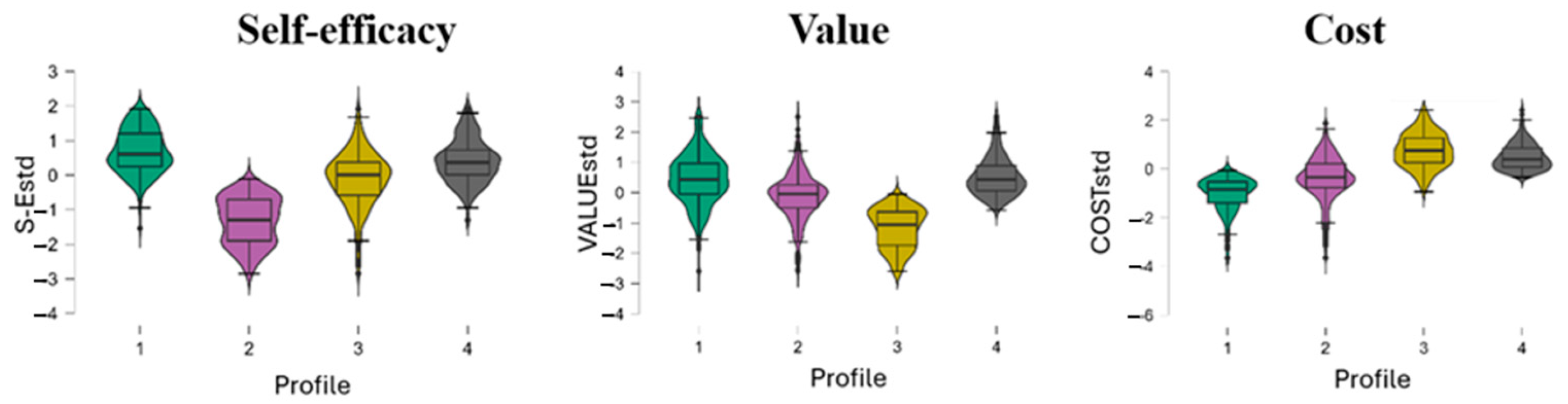
Figure 1 illustrates the disparities among the distinct clusters identified through the analysis. Significant variations are observed in the distributions of each variable across the detected profiles (clusters), where the distributions exhibit clear differentiation according to the variables examined.
Figure 1.
Comparison intra-cluster by variable.
As illustrated in Table 4, the model characterized the various clusters based on the interplay of self-efficacy, task value, and perceived cost as follows:
Table 4.
Means by variable and cluster profile.
- 1.
- Agentic Mindset: Characterized by high levels of self-efficacy and task value, coupled with a minimal perception of cost.
- 2.
- Alienated Mindset: Defined by significantly low self-efficacy and perceived cost, along with a low valuation of the task.
- 3.
- Paralyzed Mindset: Marked by low self-efficacy in conjunction with very high perceived cost and negligible task value.
- 4.
- Growth Mindset: Distinguished by high levels of self-efficacy, task value, and perceived cost.
Subsequently, an ANOVA analysis was used to evaluate differences between the observed clusters based on their performance in Motivational Regulation. Results showed a statistically significant effect of cluster membership [F(2, 1181) = 66.17, p < 0.001]. As shown in Table 3, the ANOVA analysis revealed statistically significant differences between the clusters, with a moderate effect size. Statistically significant differences were observed in all post hoc comparisons between the four different clusters (Table 5).
Table 5.
Post Hoc Comparisons—Profile.
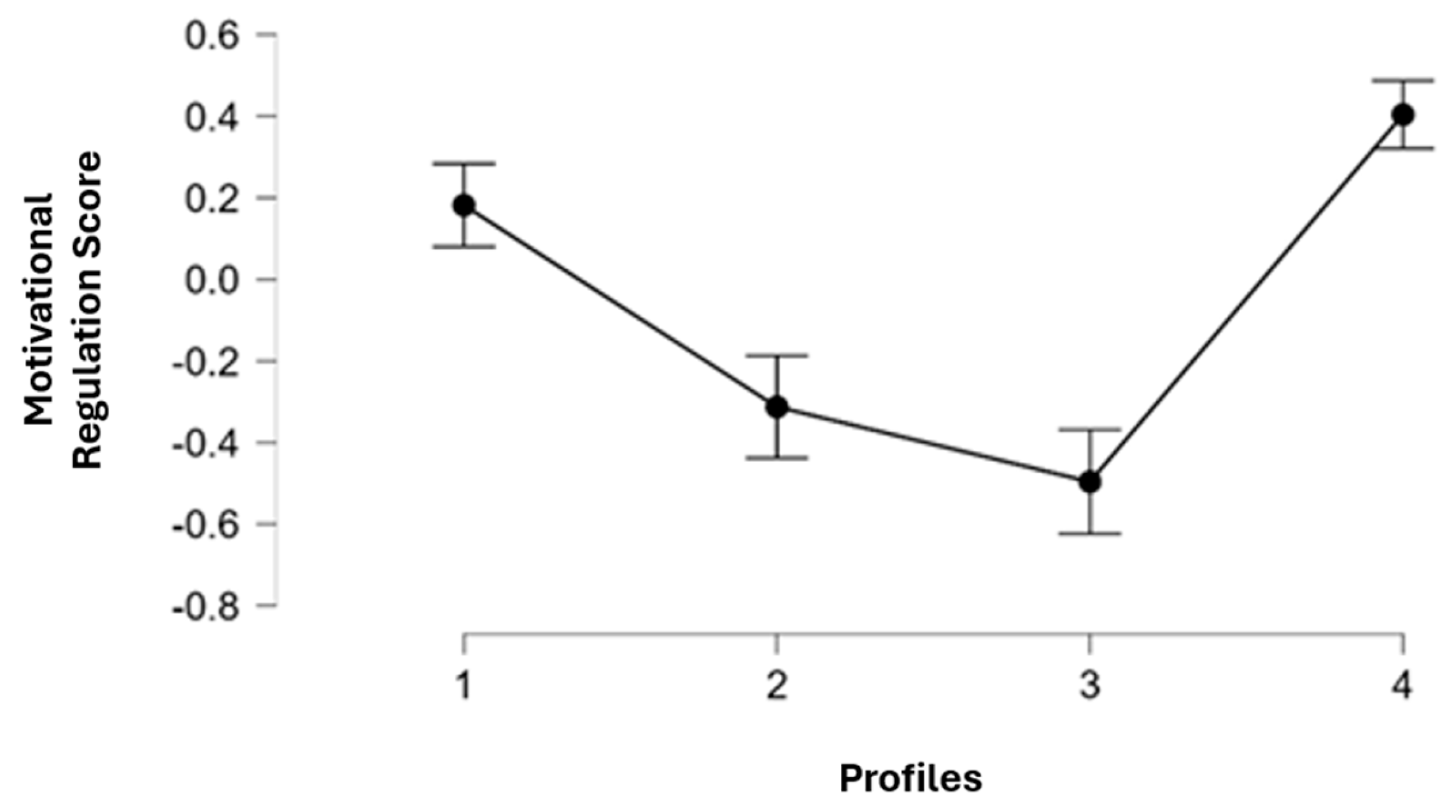
The profile chart (Figure 2) shows that the highest performance in Motivational Regulation was observed in profile 1, followed by 3 and 4, with the worst performance in the case of profile 2.
Figure 2.
Mean values on Motivational Regulation by profile.
3.2. Discussion and Conclusions
Cluster analysis allowed the identification of four distinct motivational profiles based on the interaction between self-efficacy, perceived value, and perceived cost in relation to challenging academic tasks: agentic mindset, alienated mindset, paralyzed mindset, and growth mindset. The emergence of these profiles confirms the multidimensional nature of the Expectancy–Value–Cost model [28], demonstrating that combinations of success expectations, subjective value, and perceived cost generate complex motivational configurations. In particular, the agent profile—characterized by high self-efficacy and value along with low perceived cost—represents a more adaptive motivational pattern within the context examined and is associated with higher levels of motivational regulation. In contrast, the paralyzed profile—with low self-efficacy and value but high perceived cost—illustrates a scenario of motivational vulnerability that may be associated with lower persistence when facing demanding tasks, consistent with the findings regarding the negative effect of cost on academic performance [41,42].
The Paralyzed Mindset profile warrants particular attention, as it is characterized by elevated perceived cost alongside markedly low task value and self-efficacy. At first glance, the coexistence of high cost and low value may appear counterintuitive; however, this pattern is theoretically consistent with expectancy–value–cost theory. As articulated in the EVC framework, cost is not merely an additive component of motivation but can actively undermine task value when anticipated effort, stress, or emotional burden become salient [28]. For students within this profile, disengaging from task value may reflect a form of motivational disengagement that could serve a protective function when tasks are perceived as overwhelming, reducing psychological investment in activities perceived as overwhelming or unmanageable. In this sense, low value may not reflect indifference, but rather a protective mechanism that emerges in response to anticipated cost. This interpretation helps explain why Paralyzed students differ qualitatively from Alienated students: while both groups report low value, the former do so in the context of heightened cost and constrained motivational resources, resulting in motivational inhibition rather than outright disengagement.
Beyond their descriptive value, these motivational profiles have important implications for educational sustainability. The identified motivational profiles offer important insights into students’ capacity to sustain engagement over time in demanding educational contexts. Expectancy–value–cost theory emphasizes that motivation is not only a determinant of immediate task engagement, but also a key driver of long-term persistence and well-being [28]. In this regard, profiles characterized by high value and manageable perceived cost (Agentic and Growth) reflect motivational configurations that are more likely to support sustained academic engagement. In contrast, profiles marked by elevated cost and diminished value signal motivational vulnerability, which may place students at greater risk of reduced persistence in challenging learning environments.
The Paralyzed Mindset profile is particularly relevant for understanding educational sustainability, as it reflects a pattern in which anticipated cost constrains motivational resources despite the absence of overt disengagement. Rather than lacking interest or valuing education less, students within this profile appear to experience motivational overload, where sustained exposure to high perceived demands undermines their capacity to maintain engagement over time. Within the EVC framework, such configurations may undermine sustained engagement over time and could be relevant for understanding processes related to academic persistence and attrition [28]. From this perspective, sustainability in education is not only threatened by low value or low expectancy alone, but also by chronic perceptions of cost that inhibit students’ ability to sustain effort and commitment across academic trajectories.
Significant differences among these profiles in levels of motivational regulation reveal the close relationship between self-efficacy beliefs, value perceptions, and the capacity to sustain motivational effort. Students with agentic and growth mindsets exhibited the highest scores in motivational regulation, aligning with previous findings [31,34,35], who indicated that self-efficacy for regulating motivation predicts more frequent and effective use of self-regulatory strategies. Moreover, these results extend other findings [43], demonstrating that, in the face of challenging tasks, motivational regulation is activated as an adaptive response to perceived effort and difficulty. Thus, the present study contributes to understanding how combined perceptions of self-efficacy, value, and cost define differentiated self-regulation styles, extending evidence beyond school or traditional task previously explored contexts [29,30].
When contrasting these results with previous studies focused on traditional tasks, important differences emerge regarding the role of task value. In less challenging contexts, self-efficacy typically acts as a central predictor of motivational regulation [11]; however, in this study, challenging tasks demanded a more balanced interaction between expectancy, value, and cost. Consequently, subjective value appeared to play an important role in the relationship between self-efficacy and motivational regulation between competence perception and regulatory effort, consistent with [38,39], who observed that personal significance and task utility promote the activation of motivational regulation strategies. This finding reinforces the notion that challenging tasks mobilize more complex cognitive and affective processes [19,21], and that persistence in such tasks depends both on perceived capability and recognition of their relevance and purpose.
The deployment of intrinsic strategies is associated with higher levels of motivation, potentially supporting persistence and engagement in students. These strategies appear to be primarily used by the agentic profile, resulting in deep and sustained learning [16]. In contrast, the alienated profile defined by low self-efficacy and values shows an absence of these strategies, leading to superficial learning, intrinsic strategies act as a bridge between tasks and personal value, supporting the maintenance of motivation; moreover, when used in conjunction with extrinsic strategies, they facilitate the mobilization of resources for engagement in the learning process, strengthening both commitment and self-efficacy [14].
Another relevant contribution of the study relates to the cultural dimension of the identified profiles. Unlike research conducted in Anglophone contexts [45,47], the results obtained in the Chilean university population show that perceived cost is not always associated with a direct reduction in value or self-efficacy. In particular, the growth mindset profile—which combines high levels of cost, value, and self-efficacy— may reflect context-specific interpretations of academic effort, where sustained demands are not necessarily perceived as incompatible with motivation. This tendency may reflect cultural differences in the valuation of sustained effort and perseverance, consistent with regarding how educational practices and university demands influence the way students approach highly demanding tasks [18].
Finally, the findings have relevant theoretical and practical implications. Conceptually, they confirm the validity of the Expectancy–Value–Cost model [28] for describing self-regulated motivational processes in highly complex contexts, providing empirical evidence that integrates the perception of cost as a central element in explaining sustained effort. In applied terms, the identification of differentiated motivational profiles offers a basis for designing pedagogical strategies that address the specific combinations of self-efficacy, value, and cost presented by students. Interventions aimed at strengthening value perception and reducing perceived costs such as those proposed by [32] could enhance self-regulation and persistence in challenging tasks, promoting more autonomous and deep learning. Overall, the results expand the understanding of university motivational regulation and highlight the importance of considering cultural and contextual particularities in the study of academic motivation.
This study has several limitations that should be considered. First, the cross-sectional design captures motivational profiles at a single point in time and therefore does not allow for examining their development or stability across academic trajectories. Second, the use of self-report measures may be influenced by subjective perceptions or response tendencies, although validated instruments were employed. Finally, while the sample size was large, participants were drawn from a limited number of Chilean higher education institutions, which may limit the generalizability of the findings to other institutional or cultural contexts.
The findings of this study offer several directions for future research and practical applications in higher education. From a research perspective, the identified motivational profiles provide a useful framework for examining how combinations of self-efficacy, task value, and perceived cost evolve over time and relate to academic outcomes such as persistence, performance, and well-being. Longitudinal studies could further explore the stability of these profiles and their sensitivity to instructional or contextual changes. From an applied standpoint, the results highlight the value of designing targeted pedagogical interventions that address specific motivational configurations, particularly those characterized by high perceived cost or low self-efficacy. Interventions aimed at enhancing task value, supporting students’ perceptions of competence, and managing perceived academic demands may contribute to more sustainable patterns of engagement and motivational regulation in demanding learning contexts.
Author Contributions
Conceptualization, J.M.-A.; Methodology, J.M.-A. and J.D.-R.; Formal analysis, J.M.-A. and J.D.-R.; Investigation, J.M.-A. and F.M.-V.; Resources, J.M.-A.; Writing—original draft, J.M.-A., M.Z.-V. and F.M.-V.; Project administration, J.M.-A.; Funding acquisition, J.M.-A. All authors have read and agreed to the published version of the manuscript.
Funding
This article was developed within the framework of the ANID Project, FONDECYT Initiation No. 11250061 “Estimation of a predictive model for motivational regulation based on expectation, cost and value in Chilean university students”. Also, this research obtained funding from the Universidad de Tarapacá. Project: “Fortalecimiento de Grupos de Investigación”; Grant ID No. 6758-25.
Institutional Review Board Statement
The study was conducted in accordance with the Declaration of Helsinki and approved by the Ethics, Bioethics and Biosafety Committee of the University of Concepción (CEBB 3036-2025; 29 April 2025).
Informed Consent Statement
Informed consent was obtained from all subjects involved in the study.
Data Availability Statement
The data presented in this study are openly available in [https://doi.org/10.5281/zenodo.18079173].
Conflicts of Interest
The authors declare no conflicts of interest.
References
- Perez, T.; Robinson, K.A.; Priniski, S.J.; Lee, Y.-K.; Totonchi, D.A.; Linnenbrink-Garcia, L. Patterns, predictors, and outcomes of situated expectancy-value profiles in an introductory chemistry course. Ann. N. Y. Acad. Sci. 2023, 1526, 73–83. [Google Scholar] [CrossRef] [Scilit] [PubMed]
- Gavín-Chocano, Ó.; García-Martínez, I.; Pérez-Navío, E.; de la Rosa, A.L. Learner Engagement, academic motivation and learning strategies of university students. Educ. XX1 2024, 27, 57–79. [Google Scholar] [CrossRef] [Scilit]
- Merino Tejedor, E. Motivación y compromiso académico: Modelo teórico y aplicaciones educativas. Rev. INFAD Psicol. 2024, 1, 61–68. [Google Scholar] [CrossRef] [Scilit]
- Vlachopanou, P.; Maska, L.; Kalamaras, D.; Nasika, F. Academic motivation, procrastination, and adjustment: Exploring their impact on student profiles and academic performance. PLoS ONE 2025, 20, e0335913. [Google Scholar] [CrossRef] [Scilit]
- Maluenda Albornoz, J.; Varas Contreras, M.; Riffo-Ferrada, M.; Díaz-Mujica, A. Predictores socio-académicos del Study Engagement en estudiantes de primer año de ingeniería. Estud. Pedag. 2021, 47, 235–250. [Google Scholar] [CrossRef] [Scilit]
- Maluenda-Albornoz, J.; Berríos-Riquelme, J.; Zamorano-Veragua, M.; Bernardo, A.B. A predictive model for subjective well-being based on social support, sense of belonging and academic uncertainty in a Chilean university context. Rev. Latinoam. Psicol. 2024, 56, 260–270. [Google Scholar] [CrossRef] [Scilit]
- Berríos-Riquelme, J.; Maluenda-Albornoz, J.; Zamorano-Veragua, M.; Pulido-Iparraguirre, C.; Castillo-Rozas, G. Social Integration, Subjective Well-being, and Dropout Intention: A Predictive Model in Higher Education. Univ. Psychol. 2025, 24, 2. [Google Scholar] [CrossRef] [Scilit]
- Barron, K.E.; Hulleman, C.S. The expectancy-value-cost model of motivation. In International Encyclopedia of the Social and Behavioral Sciences, 2nd ed.; Wright, J.D., Ed.; Elsevier: Amsterdam, The Netherlands, 2015; pp. 503–509. [Google Scholar] [CrossRef] [Scilit]
- Kosovich, J.J.; Flake, J.K.; Hulleman, C.S. Short-term motivation trajectories: A parallel process model of expectancy-value. Contemp. Educ. Psychol. 2017, 49, 130–139. [Google Scholar] [CrossRef] [Scilit]
- Robinson, K.A.; Lee, Y.-k.; Bovee, E.A.; Perez, T.; Walton, S.P.; Briedis, D.; Linnenbrink-Garcia, L. Motivation in transition: Development and roles of expectancy, task values, and costs in early college engineering. J. Educ. Psychol. 2019, 111, 1081–1102. [Google Scholar] [CrossRef] [Scilit]
- Kryshko, O.; Fleischer, J.; Grunschel, C.; Leutner, D. University students’ self-efficacy for motivational regulation, use of motivational regulation strategies, and satisfaction with academic studies: Exploring between-person and within-person associations. J. Educ. Psychol. 2023, 115, 571–588. [Google Scholar] [CrossRef] [Scilit]
- Steuer, G.; Eckerlein, N.; Dresel, M. Fostering University Students’ Motivational Regulation: Evidence from Two Consecutive Quasi-Experimental Training Studies. J. Exp. Educ. 2026, 94, 120–142. [Google Scholar] [CrossRef] [Scilit]
- Garn, A.C.; Morin, A.J.S. University students’ use of motivational regulation during one semester. Learn. Instr. 2021, 74, 101436. [Google Scholar] [CrossRef] [Scilit]
- Oportus-Torres, R.; Contreras-Soto, Y.; Sanhueza-Campos, C.; Maluenda-Albornoz, J.; Pérez-Villalobos, C.; Quintanilla-Espinoza, A. Self-regulated learning and engagement through emergency remote teaching in EFL undergraduate students. Front. Educ. 2024, 9, 1416507. [Google Scholar] [CrossRef] [Scilit]
- Hadwin, A.F.; Davis, S.K.; Bakhtiar, A.; Winne, P.H. Academic challenges as opportunities to learn to self-regulate learning. In Problem Solving for Teaching and Learning: A Festschrift for Emeritus Professor Mike Lawson, 1st ed.; Askell-Williams, H., Orrell, J., Eds.; Routledge/Taylor & Francis Group: Abingdon, UK, 2019; pp. 34–47. [Google Scholar] [CrossRef] [Scilit]
- Grunschel, C.; Schwinger, M.; Steinmayr, R.; Fries, S. Effects of using motivational regulation strategies on students’ academic procrastination, academic performance, and well-being. Learn. Individ. Differ. 2016, 49, 162–170. [Google Scholar] [CrossRef] [Scilit]
- Kim, Y.-E.; Brady, A.C.; Wolters, C.A. Development and validation of the brief regulation of motivation scale. Learn. Individ. Differ. 2018, 67, 259–265. [Google Scholar] [CrossRef] [Scilit]
- Wolters, C.A. Regulation of Motivation: Evaluating an Underemphasized Aspect of Self-Regulated. Learn. Educ. Psychol. 2003, 38, 189–205. [Google Scholar] [CrossRef] [Scilit]
- Wolters, C.A.; Benzon, M.B. Assessing and Predicting College Students’ Use of Strategies for the Self-Regulation of Motivation. J. Exp. Educ. 2013, 81, 199–221. [Google Scholar] [CrossRef] [Scilit]
- Fong, C.J.; Altan, S.; Gonzales, C.; Kirmizi, M.; Adelugba, S.F.; Kim, Y.-E. Stay motivated and carry on: A meta-analytic investigation of motivational regulation strategies and academic achievement, motivation, and self-regulation correlates. J. Educ. Psychol. 2024, 116, 997–1018. [Google Scholar] [CrossRef] [Scilit]
- Villar, E.; Mayo, M.E.; Martínez-López, Z.; Tinajero, C. What are the principal and most effective strategies for motivational self-regulation? A systematic review and meta-analyses. Learn. Individ. Differ. 2024, 113, 102480. [Google Scholar] [CrossRef] [Scilit]
- Freiberg-Hoffmann, A.; Motta, F.A.; Tisocco, F.; Sánchez-Rosas, J. Análisis de las propiedades psicométricas del Cuestionario de Estrategias de Autorregulación Motivacional. Cienc. Psicol. 2025, 19, e-4188. [Google Scholar] [CrossRef] [Scilit]
- Maluenda-Albornoz, J.; Berríos-Riquelme, J.; Fuica-Almonte, P.; Zamorano-Veragua, M. Do The Motivational Regulation Predict Work Engagement? A Study on Chilean Entrepreneurs. Interciencia 2025, 50, 414–421. [Google Scholar]
- Alias, N.F.; Razak, R.A. Meeting the Demands of Higher Education: Examining Teaching and Learning Practices and Academic Challenges. Asian J. Univ. Educ. 2023, 19, 796–811. [Google Scholar] [CrossRef] [Scilit]
- Kang, H. Preservice Teachers’ Learning to Plan Intellectually Challenging Tasks. J. Teach. Educ. 2017, 68, 55–68. [Google Scholar] [CrossRef] [Scilit]
- Kang, H.; Windschitl, M.; Stroupe, D.; Thompson, J. Designing, launching, and implementing high quality learning opportunities for students that advance scientific thinking. J. Res. Sci. Teach. 2016, 53, 1316–1340. [Google Scholar] [CrossRef] [Scilit]
- Nawani, J.; Rixius, J.; Neuhaus, B.J. Influence of using challenging tasks in biology classrooms on students’ cognitive knowledge structure: An empirical video study. Int. J. Sci. Educ. 2016, 38, 1882–1903. [Google Scholar] [CrossRef] [Scilit]
- Hirt, C.N.; Karlen, Y.; Suter, F.; Maag Merki, K. Types of social help-seeking strategies in different and across specific task stages of a real, challenging long-term task and their role in academic achievement. Frontline Learn. Res. 2020, 8, 74–111. [Google Scholar] [CrossRef] [Scilit]
- Dias, A.C.G.; Carlotto, R.C.; Oliveira, C.T.d.; Teixeira, M.A.P. Dificuldades percebidas na transição para a universidade. Rev. Bras. Orientaç. Prof. 2019, 20, 19–30. [Google Scholar] [CrossRef] [Scilit]
- Lohbeck, A.; Moschner, B. Motivational regulation strategies, academic self-concept, and cognitive learning strategies of university students: Does academic self-concept play an interactive role? Eur. J. Psychol. Educ. 2022, 37, 1217–1236. [Google Scholar] [CrossRef] [Scilit]
- Rosenzweig, E.Q.; Wigfield, A.; Hulleman, C.S. More useful or not so bad? Examining the effects of utility value and cost reduction interventions in college physics. J. Educ. Psychol. 2020, 112, 166–182. [Google Scholar] [CrossRef] [Scilit]
- Karlen, Y.; Suter, F.; Hirt, C.; Maag Merki, K. The role of implicit theories in students’ grit, achievement goals, intrinsic and extrinsic motivation, and achievement in the context of a long-term challenging task. Learn. Individ. Differ. 2019, 74, 101757. [Google Scholar] [CrossRef] [Scilit]
- Benden, D.K.; Lauermann, F. Searching for short-term motivational alignment and spillover effects: A random intercept cross-lagged analysis of students’ expectancies and task values in math-intensive study programs. Contemp. Educ. Psychol. 2023, 73, 102166. [Google Scholar] [CrossRef] [Scilit]
- Trautner, M.; Schwinger, M. Integrating the concepts self-efficacy and motivation regulation: How do self-efficacy beliefs for motivation regulation influence self-regulatory success? Learn. Individ. Differ. 2020, 80, 101890. [Google Scholar] [CrossRef] [Scilit]
- Kryshko, O.; Fleischer, J.; Grunschel, C.; Leutner, D. Self-efficacy for motivational regulation and satisfaction with academic studies in STEM undergraduates: The mediating role of study motivation. Learn. Individ. Differ. 2022, 93, 102096. [Google Scholar] [CrossRef] [Scilit]
- Trautner, M.; Schwinger, M. How are incremental theories about studying motivation related to effective motivation regulation? Learn. Individ. Differ. 2022, 100, 102232. [Google Scholar] [CrossRef] [Scilit]
- Wolters, C.A. Self-regulated learning and college students’ regulation of motivation. J. Educ. Psychol. 1998, 90, 224–235. [Google Scholar] [CrossRef]
- Engelschalk, T.; Steuer, G.; Dresel, M. Effectiveness of motivational regulation: Dependence on specific motivational problems. Learn. Individ. Differ. 2016, 52, 72–78. [Google Scholar] [CrossRef] [Scilit]
- Eckerlein, N.; Steuer, G.; Dresel, M. Fostering competences for motivational regulation in higher education: A training study. In Proceedings of the American Educational Research Association (AERA) Annual Meeting, New York, NY, USA, 13–17 April 2018; Available online: https://www.researchgate.net/publication/349966570_Fostering_Competences_for_Motivational_Regulation_in_Higher_Education_A_Training_Study (accessed on 20 December 2025).
- Flake, J.K.; Barron, K.E.; Hulleman, C.; McCoach, B.D.; Welsh, M.E. Measuring cost: The forgotten component of expectancy-value theory. Contemp. Educ. Psychol. 2015, 41, 232–244. [Google Scholar] [CrossRef] [Scilit]
- Lee, H.; Yu, S.L.; Kim, M.; Koenka, A.C. Concern or comfort with social comparisons matter in undergraduate physics courses: Joint consideration of situated expectancy-value theory, mindsets, and gender. Contemp. Educ. Psychol. 2021, 67, 102023. [Google Scholar] [CrossRef] [Scilit]
- Totonchi, D.A.; Tibbetts, Y.; Williams, C.L.; Francis, M.K.; DeCoster, J.; Lee, G.A.; Hull, J.W.; Hulleman, C.S. The cost of being first: Belonging uncertainty predicts math motivation and achievement for first-generation, but not continuing-generation, students. Learn. Individ. Differ. 2023, 107, 102365. [Google Scholar] [CrossRef] [Scilit]
- Jiang, Y.; Rosenzweig, E.Q. Using cost to improve predictions of adolescent students’ future choice intentions, avoidance intentions, and course grades in mathematics and English. Learn. Individ. Differ. 2021, 86, 101978. [Google Scholar] [CrossRef] [Scilit]
- Beymer, P.N.; Ferland, M.; Flake, J.K. Validity evidence for a short scale of college students’ perceptions of cost. Curr. Psychol. 2022, 41, 7937–7956. [Google Scholar] [CrossRef] [Scilit]
- Salmela-Aro, K.; Upadyaya, K.; Cumsille, P.; Lavonen, J.; Avalos, B.; Eccles, J. Momentary task-values and expectations predict engagement in science among Finnish and Chilean secondary school students. Int. J. Psychol. 2021, 56, 415–424. [Google Scholar] [CrossRef] [Scilit]
- Kim, Y.-e.; Yu, S.L.; Koenka, A.C.; Lee, H.; Heckler, A.F. Can Self-Efficacy and Task Values Buffer Perceived Costs? Exploring Introductory- and Upper-Level Physics Courses. J. Exp. Educ. 2022, 90, 839–861. [Google Scholar] [CrossRef] [Scilit]
- Vinni-Laakso, J.; Upadyaya, K.; Salmela-Aro, K. Associations between adolescent students’ multiple domain task value-cost profiles and STEM aspirations. Front. Psychol. 2022, 13, 951309. [Google Scholar] [CrossRef] [Scilit]
- Kosovich, J.J.; Hulleman, C.S.; Barron, K.E.; Getty, S. A Practical Measure of Student Motivation: Establishing Validity Evidence for the Expectancy-Value-Cost Scale in Middle School. J. Early Adolesc. 2015, 35, 790–816. [Google Scholar] [CrossRef] [Scilit]
- Del Valle, M.; Díaz, A.; Pérez, M.V.; Vergara, J. Análisis Factorial Confirmatorio Escala Autoeficacia Percibida en Situaciones Académicas (EAPESA) en Universitarios Chilenos. Rev. Iberoam. Diagn. Y Eval. Psicol. 2018, 4, 97–106. [Google Scholar] [CrossRef] [Scilit]
- Maluenda-Albornoz, J.; Moraga-Villablanca, F. Una nueva propuesta para medir el valor de la tarea en estudiantes universitarios. Rev. Iberoam. Diagn. y Eval. Psicol. 2026, in press. [Google Scholar]

Disclaimer/Publisher’s Note: The statements, opinions and data contained in all publications are solely those of the individual author(s) and contributor(s) and not of MDPI and/or the editor(s). MDPI and/or the editor(s) disclaim responsibility for any injury to people or property resulting from any ideas, methods, instructions or products referred to in the content. |
© 2026 by the authors. Licensee MDPI, Basel, Switzerland. This article is an open access article distributed under the terms and conditions of the Creative Commons Attribution (CC BY) license.