


Abstract
This study examines how green organizational practices influence employees’ pro-environmental behaviors. It further investigates the roles of environmental awareness and green advocacy in Moroccan organizations. A quantitative cross-sectional study was conducted with the employees working in various organizations in Morocco. Data were analyzed using SmartPLS 4 and IBM SPSS Statistics version 23 to assess relationships among green leadership, CSR, and employee behaviors. The findings indicate that green transformational leadership, CSR-e, and green empowerment significantly influence employee pro-environmental behavior. Environmental awareness also significantly mediated the effects of CSR and green leadership on employee sustainability actions. Organizations can adopt targeted incentives and educational initiatives to foster environmental awareness and green advocacy. Consequently, a more sustainable workplace culture can be established. In addition, this study provides empirical evidence regarding the effectiveness of green workplace practices in Morocco. The study provides insights into leadership and CSR strategies to enhance employees’ sustainability efforts.
1. Introduction
Over the last few years, climate change mitigation and global warming have emerged as critical challenges for countries worldwide [1]. Moreover, fossil fuel-dependent countries like Morocco are immensely vulnerable to the harmful effects of climate change [2]. Carbon dioxide emissions from fossil fuels in Morocco also increased rapidly from 2010 to 2022 [3]. In this context, the substantial role of employees’ green behavior in the corporate sector is vital [4,5]. Despite the growing literature on employees’ pro-environmental behavior (PREB) [6,7,8], more research is required to investigate the determinants of PREB among employees.
In addition to the geographical imbalance in available studies [9], several theoretical and empirical gaps need to be addressed. First, the existing research has explored the concepts of green HRM, CSR, green transformational leadership, or empowerment separately [8,9,10], but there is little research that has explored such green practices in organizations simultaneously in a cohesive framework to comprehend their joint impacts on PREB. Second, the processes through which organizational green programs are translated into employee behavior remain underdeveloped, specifically the concomitant analysis of cognitive (environmental awareness) and social (employee green advocacy) routes. Third, empirical results on the direct impacts of certain green practices, particularly GHRM, on PREB are incongruent, suggesting the need to investigate indirect mechanisms and boundary conditions more rigorously. Sealing these gaps in theory and evidence can help develop a more detailed picture of how green organizational practices influence employee sustainability behavior, beyond contextual considerations.
The focus on green organizational practices considering emerging markets, especially in North African countries, has become significant because these markets operate within certain environmental, economic, and political contingencies [11]. The recent review by [9] shows that although PEB has become a major international research area, studies remain heavily concentrated in developed countries. The review emphasizes the need for more context-specific investigations, particularly in underrepresented regions. Positioning this study in Morocco, therefore, addresses a clear geographical gap while contributing new evidence on how organizational green practices shape employee behavior in emerging markets.
This study aims to determine the impact of green organizational practices (including “green human resource management” (HRM), “green transformational leadership” (GTL), CSR-e, and green empowerment (GE) on pro-environmental behavior, mediated by environmental awareness and employee green advocacy.
Environmental awareness (EA) and employee green advocacy (EGA) are conceptualized as theoretically distinct yet complementary mediating variables in current research. Environmental awareness is a cognitive process by which employees internalize green knowledge and values [12], and employee green advocacy is a social diffusion process that involves peer influence and pro-environmental communication [13,14]. Whereas awareness might inform individual decision-making, advocacy is interpersonal and collective. Hence, the role of mediators is considered parallel rather than sequential because awareness does not always lead to advocacy, and each mediates through various psychological and social mechanisms.
Therefore, the impact of green HRM on employees’ PREB has emerged from organizations’ green movements to boost their environmental performance [10,15,16] established a direct relationship between green HRM and PREB. In addition, the GTL has been selected for its potential to promote green practices within an organization [17,18]. Furthermore, GE represents a psychological state that influences employees’ perceptions of the organization’s environmental initiatives. It encourages employees to reciprocate and boost the organization’s environmental performance [19]. Finally, employee-perceived environmental corporate social responsibility (CSR-e) has been selected as a green organizational practice because employees’ perceptions of their organization’s environmental responsibility can encourage reciprocal pro-environmental behavior in the workplace [20].
The present study is unique in its investigation of the mediating effect of EA in the Moroccan context. In addition, this study’s focus on the mediating role of EA is significant, as [10] previously reported that employees with environmental knowledge are better equipped to exhibit pro-environmental behavior. Moreover, this study seeks to fill the research gap highlighted by [21] to examine the impact of green HRM on PREB and by [8] to investigate the impact of CSR-e on PREB. In addition, this study focuses on Morocco, a country in which imported fossil fuels meet 90 percent of energy demand [22]. This makes the research a valuable contribution to PREB literature.
The theoretical basis of the study is Social Exchange Theory (SET), which posits that employees will reciprocate with positive attitudes and behaviors. When organizations invest in green leadership, CSR initiatives, empowerment, and environmentally oriented HR practices, employees might infer that the organization is committed to sustainability, and they will respond by increasing pro-environmental behavior. Even though other theoretical perspectives exist, which also seem quite insightful in explaining environmental behavior, SET is nevertheless most applicable to the reciprocal exchange mechanism, which links organizational green investments to employee behavioral reactions. Using SET in the context of environmental management, this paper takes the theory a step further toward an environmental reciprocity approach that highlights exchanges between organizations and employees in sustainability.
2. Literature Review and Hypothesis Development
2.1. Social Exchange Theory
The key theoretical perspective that can explain why organizational green practices can trigger pro-environmental behavior among employees is Social Exchange Theory (SET). Social Exchange Theory was originally developed in classical sociological works by [23,24,25], who conceptualized exchange as a system of reciprocal benefits and obligations shaping individual behavior within social structures. In its original form, SET describes social behavior as an exchange process in which people can offer valuable benefits and, in return, receive supportive attitudes and discretionary behaviors. The original development of this logic goes back to the classical works of [26,27], and was later systematized by [28]. In an organizational context, the types of resources exchanged do not just include financial rewards; they also include socioemotional resources such as trust, empowerment, recognition, support, and meaningful participation.
Green organizational practices can be explained within the framework of the given research as a form of organizational investment that indicates care, commitment, and environmental responsibility. In a situation where employees feel supported by the organization’s sustainability when CSR-e, green empowerment, green transformational leadership, and green HRM are considered realities, they tend to feel compelled to give back through actions that promote environmental objectives. This reciprocity is particularly relevant to pro-environmental behavior, since it is discretionary and may go beyond what is required in the job. This logic is supported by recent empirical studies. Indicatively, ref. [29] discovered that perceived CSR fosters the pro-environmental behavior of employees in terms of environmental consciousness and environmental commitment. Similarly, ref. [30] demonstrated that a green work climate promotes eco-initiatives by employees due to meaningfulness with an explicit reference to a social exchange view. Even more recent research also relates SET to green leadership and green HR systems by finding that green transformational leadership and green HRM promote the green behavior of employees via supportive psychological and organizational processes.
Although other theories, including Social Identity Theory, the Ability–Motivation–Opportunity (AMO) framework, and Norm Activation Theory, can contribute supplementary information, SET was the main framework used in this research, as it is the only one that can elucidate the reciprocity process between organizational environmental investments and voluntary green responses by employees. Stated differently, the current model presupposes that employees perceive green organizational practices as payoffs and support, and, in turn, respond by adopting pro-environmental behavior. To better situate the study within the current literature, Table 1 summarizes recent studies on employee green behavior and associated green organizational practices based on SET.
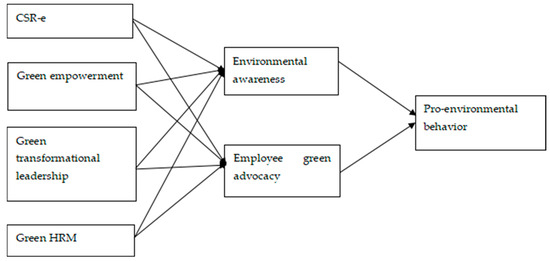
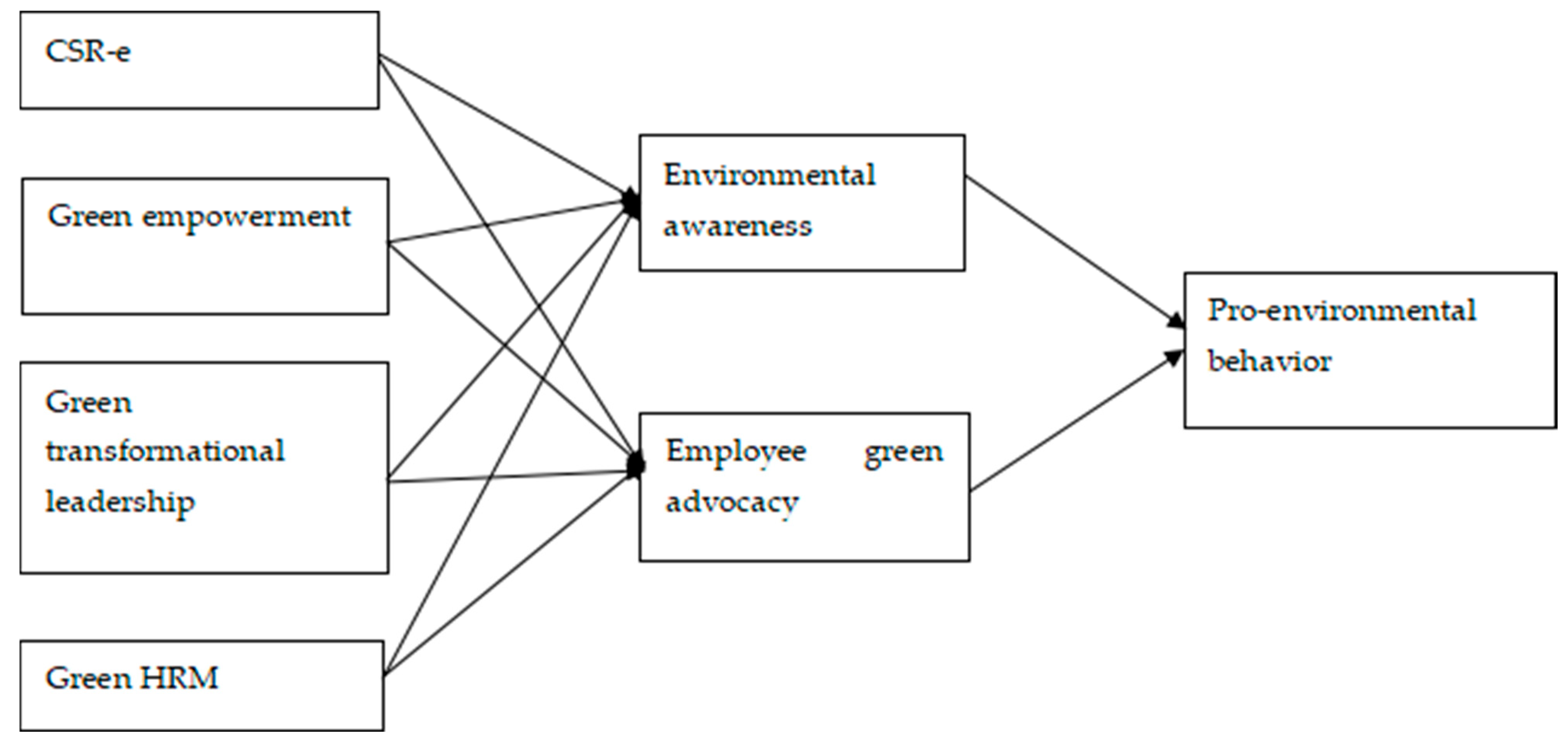
This study is well-grounded in Social Exchange Theory (SET), which states that employees reciprocate favorable organizational behaviors with positivity. When employees view CSR initiatives, green leadership, empowerment, or green HRM as corporate investments in sustainability, they are more inclined to repay them by supporting pro-environmental conduct [31]. Every green practice conveys the organization’s commitment, which employees reciprocate by contributing to environmentally friendly initiatives, making SET relatable by aligning green practices with sustainable employee conduct. The proposed research model is presented in Figure 1.
Figure 1.
Research Model. Source: Author’s own creation.
Table 1.
Summary of Studies.
2.2. Green Organizational Practices and Employee Pro-Environmental Behavior
Consequently, many recent studies have shown that green organizational practices, including GHRM, Green Transformational Leadership, and Corporate Social Responsibility, were significant in determining employee pro-environmental behavior in Morocco [35,36,37]. Morocco is an emerging market and is a net importer of fossil fuels; thus, it faces major environmental risks. There is a need to encourage organizations to adopt sustainable practices [38]. Green recruitment, training, and performance appraisal are significant to the development of GHRM as they help ensure that employees change their behavior to align with personal and corporate environmental goals [16,39,40].
In the current research, the conceptualization of Corporate Social Responsibility toward the environment (CSR-e) was defined as employees’ perceptions of their organization’s environmental responsibility policies, values, and actions [41]. This definition is narrower than general CSR. Whereas the general CSR touches on the firm’s overall economic, legal, ethical, and philanthropic roles in its interactions with various stakeholder groups, the CSR-e in this study encompassed only the environmental aspect of CSR as perceived and experienced by employees at the workplace [42]. Thus, it is an individual, and not an organizational-level of analysis: the research does not measure objective firm-level CSR performance but rather the employees’ perceptions of their organization’s environmental responsibility [42]. This conceptualization of perception is theoretically sound, as employees’ pro-environmental behavior is more likely to be influenced by what they observe, experience, and perceive to be committed to the organizational environment than by abstract corporate disclosures or external claims of corporate social responsibility. When workers realize that their firm is sincerely interested in becoming environmentally responsible, they are likely to respond with discretionary workplace actions that enhance sustainability, which aligns with Social Exchange Theory [27]. In line with this, previous studies also indicate that perceived CSR among employees enhances a positive workplace attitude and environmentally friendly conduct. Thus, this study takes CSR-e as a perceptual construct on an employee level that represents the environmental responsibility that the organization communicates and is perceived by the employees.
H1.
Employee-perceived environmental corporate social responsibility has a positive impact on employee pro-environmental behavior.
2.3. Green Empowerment (GE) and Employee Pro-Environmental Behavior
Studies on green organizational behavior have been able to provide evidence that employee empowerment plays a significant role in the nature of green attitudes and behaviors at the workplace [33]. Green empowerment is the degree of feeling authorized, competent, and certain to engage in environmental decisions and take environmentally responsible behaviors by employees. In light of Social Exchange Theory, employees are likely to respond to such a gesture by providing autonomy, trust, and support to achieve sustainability goals through discretionary pro-environmental behavior [43,44]. Such a relationship can be enhanced by both psychological and proactive processes, as empowered employees are more likely to internalize the values of the surrounding environment and translate them into tangible behaviors in the workplace [45]. Specifically, empowerment enables employees to increase their green-crafting practices and other self-directed actions that advance environmental objectives. Though the empowerment concept is increasingly gaining visibility in the green management literature, little understanding exists of how employees transform the empowerment into pro-environmental behavior, particularly in the new economies, where contextual evidence is still limited [46]. Thus, the current research focuses on investigating how green empowerment influences employees’ pro-environmental behavior. Based on the discussion above, the hypothesis is the following:
H2.
Green empowerment has a positive impact on employee pro-environmental behavior.
2.4. Green Transformational Leadership (GTL) and Employee Pro-Environmental Behavior
PEBs are any quantifiable responsible environmental behavior that help businesses become ecologically sustainable or that employees are willing to carry out to help the environment. Pro-environmental behaviors (PEBs) are typically uncompensated actions taken by employees to improve the organization’s efficiency and well-being [33]. The effectiveness of many firm-level environmental programs depends on the PEBs of employees [33,47]. In addition, PEBs are thought of as major players in corporate environmental performance because they safeguard the environment while simultaneously improving the organization’s financial performance and the happiness of its employees [10]. Although the relationship between transformational leadership and environmental behavior has been identified, in practice, little empirical research has been conducted that separates the effects of the green leadership styles in particular. Moreover, little research has been conducted on the interaction of this leadership with the culture of organizations, or mediators such as environmental awareness, which this research focuses on. From the above review of studies, the following hypothesis is proposed:
H3.
Green transformational leadership has a positive impact on employee pro-environmental behavior.
2.5. Green Human Resource Management (GHRM) and Employee Pro-Environmental Behavior
Green human resource management (GHRM) assists in implementing sustainable workplaces by incorporating environmental objectives into recruitment, training, performance appraisal, rewards, and employee participation. Such practices lead employees to develop positive attitudes toward the environment and to pursue eco-friendly actions in their everyday work [48,49]. In this way, GHRM assists companies in aligning their human resources systems with the overall sustainability goal and enhancing environmental responsibility in the workplace. Recent research has indicated that GHRM correlates with employee green attitude, pro-environmental behavior, and broader organizational sustainability performance in a positive manner. This implies that GHRM is a significant and well-developed tool for enhancing environmental responsibility within organizations. Moreover, recent empirical studies show that the impact of GHRM is not only direct but also mediated by internal and contextual processes. As an example, GHRM enhances employees’ eco-awareness by fostering affective commitment, green mindfulness, and green knowledge sharing [34,50]. Other studies have also associated GHRM with green innovation, green strategy, and green commitment. Despite the fact that the interaction between GHRM and employee pro-environmental behavior is well-established, its role in relation to other green organizational behaviors still warrants a closer look in terms of an integrated picture. Therefore, the hypothesis is as follows:
H4.
Green human resource management has a positive impact on employee pro-environmental behavior.
2.6. Mediating Role of Employee Green Advocacy
To encourage employees to participate in pro-environmental behaviors, it is believed that their awareness of environmental concerns is a crucial boundary condition [51]. For many, environmental consciousness stems from the belief that the state of the natural world is mostly attributable to human activity. Environmental awareness mediates the relationship between CSR perception and eco-friendly actions. According to [52], an individual’s environmental consciousness can be defined as the extent to which their values and beliefs shape their perceptions of and efforts to protect the natural environment. Workers who are environmentally concerned are willing to go to great lengths to stop environmental degradation and other environmental issues in their tracks [53]. Employees’ concern for the environment is directly related to their level of environmental awareness [54]. Few studies have examined the relationship between environmental influences and employee green advocacy, despite its centrality to individual agency [14,54,55]. Employee green advocacy (EGA) entails the exchange of information between employees for adopting green behavior [14]. The study by [56] uncovered that pro-environmental self-identity explains [33] the favorable association between green advocacy and compulsory green behavior among employees. Global reviews highlight a growing focus on social-interaction mechanisms, such as peer influence, communication, and advocacy, in shaping workplace PEB [19]. Meta-analytic evidence also shows that interpersonal pro-environmental communication strengthens employees’ adoption of sustainable behaviors [57]. As a result, Employee Green Advocacy is recognized as an essential social mediator that explains how green organizational practices diffuse through employee networks.
Hence, the following hypotheses can be proposed:
H5.
Employee green advocacy mediates the relationship between employee-perceived environmental corporate social responsibility and employee pro-environmental behavior.
H6.
Employee green advocacy mediates the relationship between green empowerment and employee pro-environmental behavior.
H7.
Employee green advocacy mediates the relationship between green transformational leadership and employee pro-environmental behavior.
H8.
Employee green advocacy mediates the relationship between green human resource management and employee pro-environmental behavior.
2.7. Mediating Role of Environmental Awareness (EA)
The connection between employees’ environmental knowledge and awareness and their voluntary PEB has been the subject of conflicting conclusions and a dearth of studies.
Recent studies by Li and Li (2025) [34] increasingly frame variables such as environmental awareness, green mindfulness, and psychological empowerment as internal psychological pathways through which organizational green practices shape employee pro-environmental behavior. An environmentally conscious person is aware of their influence on the environment and is willing to alter their conduct to have a smaller influence [58]. Encouraging a culture of environmental responsibility in the workplace and raising employees’ ecological knowledge are two outcomes of adopting environmentally conscious business principles and developing a mindset that emphasizes sustainability [59]. Interestingly, there is a causal relationship between a company’s green image and consumer behavioral intentions; this relationship is influenced by consumer environmental consciousness [58,60].
Besides Social Exchange Theory, the mediating effect of environmental awareness in the study should also be backed by the concept of complementary cognitive theories, namely the Theory of Planned Behavior (TPB) and the Value-Belief-Norm (VBN) [27,61] VBN theory argues that pro-environmental behavior is acquired through a cognitive-moral chain in which environmental values and beliefs make people more aware of the environment and its impacts, enhance their sense of responsibility, and trigger individual norms that promote environmentally responsible behavior. In that respect, it is not only knowledge that makes environmental awareness, but it is also a cognitive stimulus that helps the employees to identify the environmental impact of their actions and internalize the necessity to act responsibly [62]. Similarly, TPB describes how pro-environmental behavior can be influenced by awareness, as it affects employees’ environmental attitudes, perceived social expectations, and perceived behavioral control, which, in turn, enhance behavioral intention.
Recent integrative research has revealed that VBN and TPB are complementary models, in which awareness-related beliefs, personal norms, attitudes, and perceived behavioral control combine to predict pro-environmental intention and behavior [63]. Thus, the concept of environmental awareness in the current research is theoretically situated as an internal cognitive process that converts the idea of green organizational practices into enhanced employee pro-environmental behavior. When the Moroccan context is considered, in which more organizations are increasingly embracing CSR-e, green empowerment, and green transformational leadership, among other green sustainability practices, it is particularly essential to enhance employees’ environmental awareness to translate organizational initiatives into reality on the ground.
Hence, it can be proposed that:
H9.
Environmental awareness mediates the relationship between employee-perceived environmental corporate social responsibility and employee pro-environmental behavior.
H10.
Environmental awareness mediates the relationship between green empowerment and employee pro-environmental behavior.
H11.
Environmental awareness mediates the relationship between green transformational leadership and employee pro-environmental behavior.
H12.
Environmental awareness mediates the relationship between green human resource management and employee pro-environmental behavior.
3. Methods
3.1. Research Design
For this study, a “positivist philosophy” and “deductive approach” were applied to evaluate the impact of green organizational practices on pro-environmental behavior, mediated by environmental awareness and employee green advocacy. As a result, the primary quantitative methodology was applied, integrating a cross-sectional time horizon.
The cross-sectional design is appropriate for examining theoretically grounded associations and testing mediation relationships within a structural equation modeling framework. However, consistent with methodological best practices, the mediation results in this study are interpreted as statistical rather than strictly causal effects. The limitations section acknowledges the implications of the cross-sectional design for causal inference.
3.2. Participants and Data Collection Procedure
This quantitative cross-sectional research sought to obtain a sample frame of employees working in diverse organizations in Morocco. The researchers’ meetings with the general managers and safety in-charges of these organizations indicated that they had adopted diverse strategies and green HRM policies. Moreover, the researcher scheduled in-person meetings to inform participants of the study’s general purpose and implications. Furthermore, the researcher emphasized the confidentiality of the participants while distributing questionnaires.
More specifically, organizations were first categorized by manufacturing sub-sector to ensure proportional representation. Within each selected organization, employees were invited to participate voluntarily, and responses were collected anonymously. Although participation was voluntary, stratification ensured representation across major manufacturing segments.
This study used stratified random sampling to ensure a systematic method for selecting respondents [64,65]. For this study, the strata were defined by industry type, including energy, service, and manufacturing sectors. The sampling frame included the managers and employees from these companies. These participants were selected based on voluntary participation and the green policies implemented by these companies. Moreover, the sample size for each stratum was determined based on the workforce size in that sector. For each stratum, the companies were randomly selected, and the “random sampling” method was used for the selection of participants from these companies.
In addition to temporal separation, respondents were assured of anonymity and confidentiality, and they were informed that there were no right or wrong answers. These procedural remedies were implemented to further reduce the likelihood of common method bias. Ethical approval for the study was obtained prior to data collection, and informed consent was secured from all participants.
Surveys were conducted over three months, as many participants were willing to provide information during the set time. To minimize independence in their responses, participants were informed of the study and its aims, assured of anonymity, and urged to complete the questionnaires independently, without consulting others. To avoid interrupting work, questionnaires were administered during working hours; most participants either completed the questionnaires personally or sent them by email. The sample consisted of managers and employees working in organizations based in Morocco. The data collected from participants were analyzed using SmartPLS 4 and IBM SPSS Statistics version 23. The sample size (100+) was recommended to obtain generalizable results for the entire population in the case of PLS-SEM [65]. To select the sample for the present study, the 10-times rule recommended in the PLS-SEM literature [65] was used, and the total number of items (45) was multiplied by 10 (450). However, to make up for the non-respondents and missing values, a total of 600 questionnaires were distributed, out of which 570 responses were retained after data structuring and screening.
3.3. Measurement of Variables
All constructions in the present study were measured using scales developed in previous studies, as shown in Table 2. For this purpose, “a 5-point Likert scale” was used. The researcher focused on measuring green HRM practices and included green training measures to evaluate GHRM. The scale was based on studies by [66,67] who adapted it from [68].
The scale adopted from [69,70,71] was used to measure pro-environmental behavior and consisted of 16 items. Furthermore, six items from the scale developed by [72] were adopted to measure green empowerment. The questionnaire was reviewed to ensure contextual appropriateness for Moroccan respondents. Where necessary, minor wording adjustments were made to enhance clarity without altering the original meaning of the items.
CSR-e was measured as an employee-level perception-based construct reflecting the respondents’ perceptions of their organization’s environmental corporate social responsibility. The scale comprised three items adapted from [20], and it captures how employees perceive the environmental responsibility demonstrated by their organization rather than objective firm-level CSR performance. Six items were adopted to measure green transformational leadership based on the original scale of [73], which was later modified by [17] to make it suitable for the field of green HRM. Moreover, three items from [13] were adopted to measure green employee advocacy. Finally, environmental awareness was measured through a five-item scale for environmental knowledge used by [12].
Table 2.
Measures.
3.4. Data Analysis Technique
IBM SPSS Statistics version 23 was used to conduct descriptive statistics and other tests. However, the “Smart Partial Least Squares” (Smart-PLS) 4 software was used for testing the formulated hypotheses. This software was primarily used to analyze the associations among the latent variables in this study. A similar study by [20] also used SmartPLS to assess the impact of green practices on pro-environmental behavior. This also supported the implication of this analytical technique for current research.
PLS-SEM is particularly suitable for prediction-oriented research and theory extension, especially when models include multiple mediators and higher levels of complexity. It is also robust to deviations from normality and appropriate for exploratory extensions of established theories, making it suitable for the present study.
4. Data Analysis
4.1. Respondent Characteristics
The study’s demographic profile of respondents in Table 3 reveals useful information about the subjects when considering the role of ecological organizational policies in employees’ green behavior. The gender distribution indicates a balanced representation, with male respondents leading at 52.5% and female respondents trailing at 47.5%. Adult respondents aged 31 to 50 provided the most diverse answers, with the 41 to 50 age group (34.0%) the largest, followed by the 31 to 40 age group (28.4%). The distribution displays that a good number of employees had held their jobs longer (the middle section), with professionals at mid-career levels.
Table 3.
Demographics of the respondents.
The variations in respondents’ tenure mean that most people had been working for 2 to 8 years. It is even more amazing that 42.8% (244 out of the 570) had been doing the job for two to five years, while 34.2% (195 out of 570) of the participants worked between five and eight years, and 9.3% of the participants had a work experience of more than 8 years. This distribution implies that the bulk of the sample consists of those with one to five years of work experience or more than eight years of experience.
4.2. Descriptive Analysis
The total number of observations for this study was 570. The maximum value for all variables was 5, while the minimum value was 1, except for GTL (minimum value 2.17). Descriptive statistics in Table 4 indicate overall positive responses across all variables, with mean scores ranging from 3.38 to 4.33 on a 5-point scale. Green Transformational Leadership (GTL) exhibited the highest mean (4.33), reflecting strong impressions of green leadership, whereas Employee Green Advocacy (EGA) had the lowest mean (3.38), reflecting average peer-driven green efforts. Most variables had modest negative skewness and a positive tendency of agreement with all skewness and kurtosis values within acceptable parameters, suggesting that the distribution was normal. The standard deviations indicate moderate variability, with GTL more consistent and CSR-e views more varied. Overall, the data can be used to proceed with the analysis.
Table 4.
Descriptive statistics.
4.3. Factor Analysis
Rotated component analysis was performed, and exploratory factor analysis was conducted to assess the quality of the gathered data with respect to the parent variable. The values were compared against a benchmark of 0.7, and any cross-loading issues were investigated. Furthermore, the value for each item exceeded 0.7, indicating good factor loadings. These results are presented in Table 5. Given the extremely high loadings observed for certain constructs (e.g., CSR-e and PREB), additional multicollinearity diagnostics were conducted to ensure that redundancy or common method inflation was not artificially inflating the loadings.
Table 5.
Loadings.
4.4. Construct Validity
Construct validity was assessed through convergent and discriminant validity. Convergent validity tests for the replicability of the results and tests were conducted to measure whether similar findings were achieved on repetition of testing [75]. Convergent validity was assessed using two measures: composite reliability (CR) and average variance extracted [76]. Table 6 reports that Cronbach’s alpha (α) was also reported as a measure of the reliability of the constructs. The threshold for α was 0.7, and all seven constructions had α values above 0.7, indicating that all variables included in the study were dependable. However, the threshold value for Average Variance Extracted (AVE) was 0.5. The value of AVE for each variable was found to be greater than 0.5. The table also indicates that the AVE and CR values for all variables were above the thresholds of 0.5 and 0.7. These findings ensured the validity of each construct.
Table 6.
Reliability statistics.
To further address potential concerns regarding multicollinearity and common method inflation, full collinearity variance inflation factor (VIF) values were examined. As presented in Table 7, all VIF values ranged from 1.147 to 1.701, which were substantially below the conservative threshold of 3.3. These findings indicate that multicollinearity is not a concern and that the high reliability values observed for certain constructs reflect scale homogeneity rather than redundancy.
Table 7.
Full collinearity VIF values.
4.5. Discriminant Validity
Table 8 reports the discriminant validity, measured using the “Heterotrait–Monotrait Ratio” (HTMT) criterion. It is based on the multitrait-multimethod matrix and compares the average of the heterotrait–monotrait correlations to the geometric mean of the average correlations. The criterion suggests that the values of correlation among variables should be less than 0.85 or 0.9 to establish discriminant validity. It is evident from the table that the correlations among all factors were below 0.85 and 0.9, indicating discriminant validity.
Table 8.
Correlation analysis (measuring discriminant validity).
4.6. Common Method Bias (CMB) Test
The Common Method Bias (CMB) was assessed using Harman’s single-factor test. The results show that the first unrotated factor accounted for 49% of the total variance, which was not above the commonly accepted threshold of 50%. These findings suggest that common method bias is unlikely to substantially distort the results, particularly when considered alongside the full collinearity VIF diagnostics. In addition to Harman’s single-factor test, full collinearity VIF values were examined as a more robust statistical remedy. As all VIF values were below 3.3 (Table 7), the likelihood of common method variance substantially biasing the results was minimal.
The Fornell–Larcker criterion results in Table 9 confirm that discriminant validity was established for all constructs in the model. For each variable, the square root of the Average Variance Extracted (AVE) was greater than its correlations with all other constructs in the corresponding row and column. For example, the square root of AVE for PREB was 0.960, which was higher than its correlation with any other construct, such as CSR-e (0.703) or EW (0.485). This pattern holds for all constructs, including CSR-e (0.994), GHRM (0.931), GE (0.916), and so on. These results support the discriminant validity of the measurement model, confirming that each construct measures a unique concept.
Table 9.
Fornell–Larcker (F&L).
4.7. Model Fitness Test
The model fitness values for the estimated and saturated models were compared using several fit indices in Table 10. “Standardized Root Mean Square Residual (SRMR)” assesses the difference between the assumed [77] matrices and the observed matrices. The acceptable fit value was less than 0.08, signifying that both models were well-fitted to the data. It should be noted that the acceptable fit was determined by the “Normed Fit Index (NFI)”, which was set at 0.8 or higher [78]. Therefore, for this model, the NFI was 0.814, and the SRMR was 0.03. These values support the fitness of the current model for further testing.
Table 10.
Model fitness.
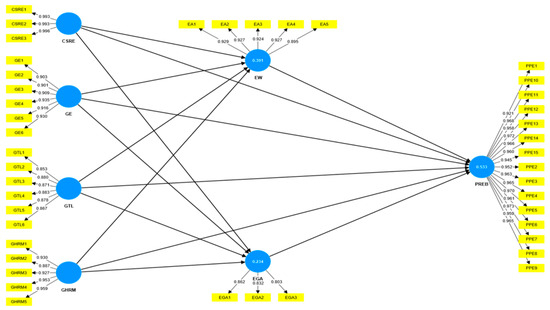
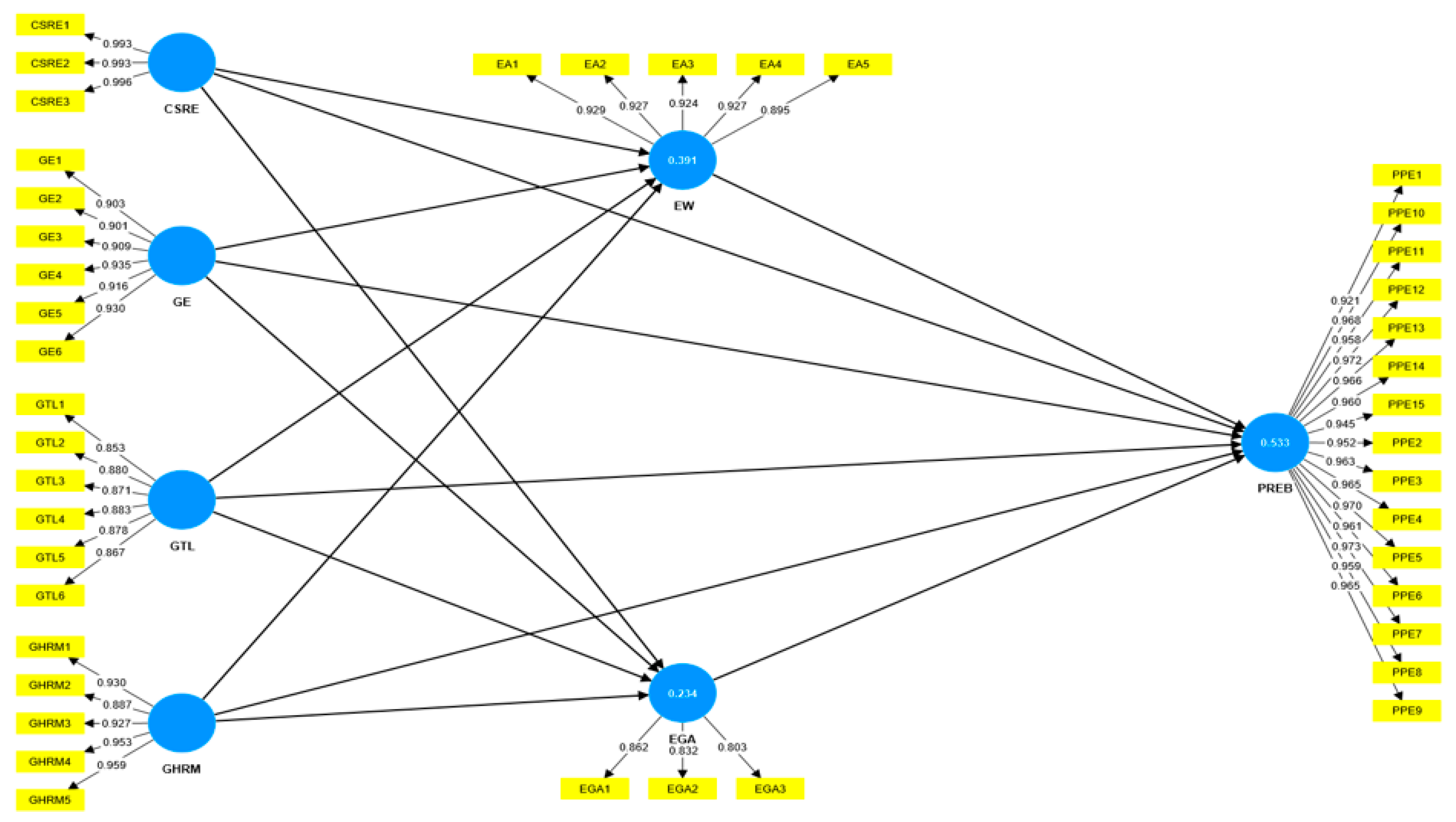
Figure 2 shows the measurement model for this study, indicating the individual loadings for each item. This model shows that CSR-e, GTL, GHRM, and GE significantly impacted PREB. At the same time, EW and EGA were found to mediate significantly.
Figure 2.
Measurement model; Source: Author’s own creation.
4.8. Coefficient of Determination (R2 Values), Effect Size, and Predictive Relevance
R-square values reported in Table 11 indicate the variance explained by each dependent construct in the model. The findings indicate that the independent variables and mediators explained 53.3% of the variance in Pro-Environmental Behavior (PREB), suggesting a good model fit for predicting employees’ environmental practices. Furthermore, the predictors of Environmental Awareness (EW) and Employee Green Advocacy (EGA) explained 39.1% and 23.4% of the variance in EW, respectively. These values indicate that the model performs well in explaining the observed phenomena, particularly PREB, and that it well describes the determination of the mediating and outcome variables by the impact of green organizational practices.
Table 11.
Coefficient of determination (R2 values).
Beyond statistical significance, effect sizes (f2) were calculated to assess the substantive impact of each predictor on endogenous constructs. As shown in Table 12, CSR-e demonstrated a large effect size on PREB (f2 = 0.400), indicating substantial practical influence. In contrast, GHRM showed a negligible direct effect on PREB (f2 = 0.001), supporting the interpretation that its influence operates primarily through indirect mechanisms. Green empowerment and green transformational leadership exhibited small but meaningful effect sizes.
Table 12.
Effect sizes (f2).
Predictive relevance was further assessed using Q2 predict values. As presented in Table 13, Q2 values for EGA (0.221), EW (0.379), and PREB (0.512) were all greater than zero, indicating satisfactory predictive capability of the structural model. Notably, PREB demonstrated strong predictive relevance, reinforcing the robustness of the proposed framework.
Table 13.
Predictive relevance (Q2 predict).
4.9. The Hypotheses Testing Results
Hypothesis testing revealed several important relationships among green organizational practices, mediators, and PREB. The findings in Table 14 show that CSR-e had a strong positive correlation with PREB (O = 0.564, p < 0.001, T = 11.902), indicating that corporate social responsibility initiatives go a long way toward encouraging employees’ sustainable actions. This adds credence to Social Exchange Theory (SET), as employees are rewarded for organizational CSR investment; the returns are pro-environmental. Likewise, Green Empowerment (GE) positively influenced PREB (O = 0.127, p = 0.001, T = 3.238), indicating that employees require a nudge to adopt sustainable practices. Importantly, when practical significance was considered alongside statistical significance, CSR-e emerged as the most influential predictor of PREB, followed by green empowerment, while green transformational leadership played a supportive but comparatively smaller role.
Table 14.
The hypotheses testing.
After mediation analysis, it was revealed that the presence of EW increased the CSR effect on PREB through CSR-e (O = 0.039, p = 0.007) and GHRM (O = 0.049, p = 0.005). This further emphasizes that environmentally aware employees are always abreast of green initiatives, hence the need for knowledge building. However, the direct relationship between GHRM and PREB was non-significant (p = 0.455); therefore, we recommend mediators such as EW to fill the gap. Other mediators, including Employee Green Advocacy (EGA), exhibited only a minor impact (e.g., CSRE → EGA → PREB, p = 0.694); this indicates that there may be externally rationalizing variables that affect EGA. Additional robustness analyses including demographic control variables (gender, age, and tenure) did not materially alter the magnitude or significance of the structural path coefficients, confirming the stability of the model.
5. Discussion
This paper investigated how green organizational practices (such as CSR-e, green empowerment (GE), green transformational leadership (GTL), and green human resource management (GHRM) impact the pro-environmental behavior (PEB) of employees through the mediating variables of Environmental Awareness (EA) and Employee Green Advocacy (EGA). The results validate several important relationships in line with past literature and theoretical predictions based upon Social Exchange Theory (SET). CSR-e showed a very positive effect on PEB, and this supports the results by [31], who indicated that where employees feel that their organizations are socially responsible, they will respond positively via some discretionary activities like environmentally friendly strategies. Recent investigations by [79] also support this finding, with findings showing that CSR leads to a green organizational climate, which leads to sustainable workplace behavior.
Another notable finding of the study is that GE has a substantial impact on PEB, in line with [45], who states that employees should be empowered to engage in environmental programs. Likewise, GTL was positively related to PEB: however, although this relationship was statistically significant, its coefficient was relatively small, indicating a weaker practical effect compared with CSR-e and green empowerment, consistent with the observation of [17,18], who indicated that environmentally centered leadership encourages employees to be sustainable by exemplifying good green choices. Interestingly, the direct relationship between GHRM and PEB was observed to be statistically insignificant, which echoed the findings by [10], who also implied that the effectiveness of GHRM could be conditional on the existence of mediating variables such as environmental awareness or organizational climate.
This non-significant direct effect is not inconsistent with the more recent GHRM literature, which increasingly shows that GHRM often influences employee pro-environmental behavior through indirect pathways such as affective commitment, green mindfulness, knowledge sharing, green innovation, and environmental commitment rather than through a strong standalone direct effect [50].
This means that although GHRM can inculcate environmental values into HR practices, they can be indirect and need supportive mechanisms. It is also important to distinguish between statistical significance and practical significance when interpreting the direct effects. Although green transformational leadership was statistically significant, its path coefficient was relatively small (β = 0.070) compared with employee-perceived environmental corporate social responsibility (β = 0.564) and green empowerment (β = 0.127). This means that while green transformational leadership does contribute to employee pro-environmental behavior, its standalone practical impact is comparatively limited in this model. In contrast, CSR-e demonstrated the strongest practical influence and appeared to be the most consequential managerial lever for shaping employee pro-environmental behavior, while green empowerment showed a smaller but still meaningful effect. Accordingly, the findings suggest a clear managerial prioritization: organizations should first strengthen employee-perceived environmental CSR; second, invest in green empowerment mechanisms that enhance employee autonomy and capability to act sustainably; and third, use green transformational leadership as a supportive reinforcing mechanism rather than the primary driver of employee pro-environmental behavior. In other words, leadership remains relevant, but its practical value appears to lie more in signaling, reinforcement, and alignment than in producing the largest direct behavioral change on its own.
The mediation of EA and EGA was partially confirmed. EA significantly mediated the relationships among CSR-e, GHRM, and PEB, indicating that environmental knowledge should be enhanced to translate organizational practices into employee behavior. This is consistent with [12], who reported that environmental concern with awareness even improves environmentally responsible decision-making. Conversely, EGA demonstrated rather weak mediating effects, which suggests that advocacy, as a positive attribute, might not be sufficient to promote its effect without other enabling factors, such as organizational culture or peer support. Although future research may examine employee green advocacy as a moderator or contextual amplifier, it was retained as a mediator in the present study to remain theoretically consistent with the social diffusion mechanism underlying the proposed framework.
These results confirm [14], who state that green advocacy might depend on leadership integrity and the open-minded organizational climate intensively. Critically, EA and EGA were conceptualized as individual mediators and not connected. Theoretically, this was based on the separation between the knowledge-driven (EA) and strengths-based external influence (EGA) pathways. However, although both play a role in driving sustainability, they do so via distinct psychological processes, as explained by [12,54]. Thus, the direct relationship between them was not conceptually appropriate to test in the current research.
The model had significant explanatory power, and the R2 values indicated that the predictors explained 53.3%, 39.1%, and 23.4% of the variance in PEB, EA, and EGA, respectively. All validity tests, such as discriminant validity through Fornell–Larcker and HTMT analysis, passed, and the model was not subject to any common method bias issues, as confirmed by the Harman single-factor test.
6. Conclusions
In conclusion, the integration of PREB has become crucial for diverse organizations to achieve a competitive advantage. In this regard, the implication of CSR initiatives and other green practices has become crucial. GE and GTL are considered to have a significant impact on pro-environmental behavior and green human resources strategies, such as green training and development and green discipline management. The results also showed that environmental performance is much improved when staff members act in an eco-conscious manner. The role of GHRM is also inevitable in this process as it encourages the employees to develop and implement effective green skills and practices. Also, by encouraging environmentally conscious actions and green intellectual capital, green HRM practices can boost environmental performance in a roundabout way. Moreover, environmental awareness and environmental green advocacy also help in initiating green organizational practices, which lead to the promotion of PREB. In the field of environmental management, this study is rare in its effort to combine green HRM practices with pro-environmental actions.
7. Implications
7.1. Practical Implications
The implication of this study for organizations is very useful in terms of prescribing strategies that seek to increase PEBs among workers. First, the application of GHRM policies, including green incorporation in recruitment, training, development, and performance management systems, would help the organization toward the achievement of its sustainable objectives [60,80]. Moreover, CSR can be used to ensure organizational goals and goals for the environment are well-aligned with the beliefs of the employees to promote working in mutual best interests [81,82]. From a prioritization perspective, the results indicate that employee-perceived environmental CSR should be treated as the primary intervention area, followed by green empowerment, whereas green transformational leadership should be used as a complementary mechanism that reinforces rather than substitutes for stronger organizational environmental policies and employee support systems.
7.2. Theoretical Implications
The application of Social Exchange Theory (SET) in this study extends its traditional scope beyond transactional or relational exchanges by demonstrating that employees also reciprocate environmental support [83]. The study is also informed by complementary cognitive perspectives, particularly Value-Belief-Norm theory and the Theory of Planned Behavior, which help explain how environmental awareness translates organizational green signals into internal beliefs, norms, intentions, and ultimately, pro-environmental behavior. When organizations invest in green leadership, CSR-e, or empowerment, employees interpret these as pro-social and pro-environmental commitments, which they reciprocate through stronger pro-environmental behavior. This moves SET toward a broader “environmental reciprocity” framework, where sustainability-oriented exchanges shape workplace behavior. Compared with other theoretical lenses, such as Social Identity Theory, which explains behavior through group membership, or the Attitude-Behavior-Context (ABC) theory, which highlights contextual moderators, SET more explicitly captures the exchange-based motivational mechanism underlying employee responses to green initiatives. Furthermore, integrating Environmental Awareness and Employee Green Advocacy as mediators introduces new cognitive and social pathways that link organizational practices to PEB. These pathways expand green management theory by explaining how and why employees internalize and activate sustainability behaviors beyond direct organizational influence.
8. Limitations and Future Insights
The research yielded some significant findings, but its limitations must be acknowledged. Since the research only examined the impact of CSR-e and other green initiatives on PREB within the context of diverse organizations in Morocco, it limits the overall scope of the study. At the same time, no moderator was included in this study, which can impact its overall efficiency. Moreover, cross-sectional data make it difficult to establish what factors impact the most due to time constraints [84]. The primary quantitative method was used for this study, which cannot always account for the complexities of the connections being studied [85].
Therefore, in future research, other geographical regions in Southeast Asia and Europe can be considered for testing the proposed model. In addition, different moderators related to PREB, such as environmental knowledge, personal values, and social norms, can also be included in future research. A longitudinal investigation may provide a more complete picture of relationships over an extended period [86]. Additionally, a mixed-method approach can also be used for a better understanding of the role of different green initiatives and GHRM in influencing PREB.
Author Contributions
Conceptualization, S.H.; methodology, S.H. and E.X.; data curation, S.H.; formal analysis, S.H.; writing—original draft preparation, S.H.; writing—review and editing, S.H. and E.X.; supervision, E.X. All authors have read and agreed to the published version of the manuscript.
Funding
This research received no external funding.
Institutional Review Board Statement
The ethical application for this research was reviewed and approved by the Academic Committee of Beijing Institute of Technology (BIT), China, in September 2024, in accordance with institutional ethical regulations and the Declaration of Helsinki.
Informed Consent Statement
Informed consent was obtained from all subjects involved in the study.
Data Availability Statement
The data are available from the corresponding author upon reasonable request.
Conflicts of Interest
The authors declare no conflicts of interest.
References
- Cadez, S.; Czerny, A.; Letmathe, P. Stakeholder pressures and corporate climate change mitigation strategies. Bus. Strategy Environ. 2019, 28, 1–14. [Google Scholar] [CrossRef] [Scilit]
- Azzeddine, B.B.; Hossaini, F.; Savard, L. Greenhouse gas emissions and economic growth in Morocco: A decoupling analysis. J. Clean. Prod. 2024, 450, 141857. [Google Scholar] [CrossRef] [Scilit]
- Statista Carbon Dioxide Emissions from Fossil Fuel Consumption in Morocco 2010–2022. Available online: https://www.statista.com/statistics/1237910/co2-emissions-from-fossil-fuel-combustion-in-morocco/#:~:text=In%202022%2C%2067.1%20million%20metric,and%20coal%20consumed%20by%20combustion (accessed on 16 November 2025).
- Li, C.; Aziz, F.; Asim, S.; Shahzad, A.; Khan, A. Employee green behavior: A study on the impact of corporate social responsibility (CSR) on employee green behavior, green culture: The moderating role of green innovation. Environ. Sci. Pollut. Res. 2023, 30, 105489–105503. [Google Scholar] [CrossRef] [Scilit] [PubMed]
- Khan, A.; Li, C.; Shahzad, M.; Sampene, A.K. Green effectual orientations to shape environmental performance through green innovation and environmental management initiatives under the influence of CSR commitment. Environ. Sci. Pollut. Res. 2023, 30, 2205–2217. [Google Scholar] [CrossRef] [Scilit]
- Budzanowska-Drzewiecka, M.; Tutko, M. The impact of individual motivation on employee voluntary pro-environmental behaviours: The motivation towards the environment of Polish employees. Manag. Environ. Qual. Int. J. 2021, 32, 929–948. [Google Scholar] [CrossRef] [Scilit]
- Mouro, C.; Lomba, V.; Duarte, A.P. Pro-environmental Behaviours at work: The interactive role of norms and attitudinal ambivalence. Sustainability 2021, 13, 12003. [Google Scholar] [CrossRef] [Scilit]
- Niazi, U.I.; Nisar, Q.A.; Nasir, N.; Naz, S.; Haider, S.; Khan, W. Green HRM, green innovation and environmental performance: The role of green transformational leadership and green corporate social responsibility. Environ. Sci. Pollut. Res. 2023, 30, 45353–45368. [Google Scholar] [CrossRef] [Scilit]
- Farrukh, M.; Raza, A.; Mansoor, A.; Khan, M.S.; Lee, J.W.C. Trends and patterns in pro-environmental behaviour research: A bibliometric review and research agenda. Benchmark. Int. J. 2023, 30, 681–696. [Google Scholar] [CrossRef] [Scilit]
- Saeed, B.B.; Afsar, B.; Hafeez, S.; Khan, I.; Tahir, M.; Afridi, M.A. Promoting employee’s proenvironmental behavior through green human resource management practices. Corp. Soc. Responsib. Environ. Manag. 2019, 26, 424–438. [Google Scholar] [CrossRef] [Scilit]
- Asiri, N.; Khan, T.; Kend, M. Environmental management accounting in the Middle East and North Africa region: Significance of resource slack and coercive isomorphism. J. Clean. Prod. 2020, 267, 121870. [Google Scholar] [CrossRef] [Scilit]
- Zhang, W.; Xu, R.; Jiang, Y.; Zhang, W. How environmental knowledge management promotes employee green behavior: An empirical study. Int. J. Environ. Res. Public Health 2021, 18, 4738. [Google Scholar] [CrossRef] [Scilit] [PubMed]
- Kim, A.; Kim, Y.; Han, K.; Jackson, S.E.; Ployhart, R.E. Multilevel influences on voluntary workplace green behavior: Individual differences, leader behavior, and coworker advocacy. J. Manag. 2017, 43, 1335–1358. [Google Scholar] [CrossRef] [Scilit]
- Crucke, S.; Servaes, M.; Kluijtmans, T.; Mertens, S.; Schollaert, E. Linking environmentally-specific transformational leadership and employees’ green advocacy: The influence of leadership integrity. Corp. Soc. Responsib. Environ. Manag. 2022, 29, 406–420. [Google Scholar] [CrossRef] [Scilit]
- Ojo, A.O.; Tan, C.N.-L.; Alias, M. Linking green HRM practices to environmental performance through pro-environment behaviour in the information technology sector. Soc. Responsib. J. 2022, 18, 1–18. [Google Scholar] [CrossRef] [Scilit]
- Yusoff, Y.M.; Nejati, M.; Kee, D.M.H.; Amran, A. Linking green human resource management practices to environmental performance in hotel industry. Glob. Bus. Rev. 2020, 21, 663–680. [Google Scholar] [CrossRef] [Scilit]
- Huang, S.Y.; Ting, C.-W.; Li, M.-W. The effects of green transformational leadership on adoption of environmentally proactive strategies: The mediating role of green engagement. Sustainability 2021, 13, 3366. [Google Scholar] [CrossRef] [Scilit]
- Li, W.; Bhutto, T.A.; Xuhui, W.; Maitlo, Q.; Zafar, A.U.; Bhutto, N.A. Unlocking employees’ green creativity: The effects of green transformational leadership, green intrinsic, and extrinsic motivation. J. Clean. Prod. 2020, 255, 120229. [Google Scholar] [CrossRef] [Scilit]
- Kularathne, H. Does green employee empowerment mediate the relationship between green HRM and environmental performance. Asian J. Soc. Sci. Manag. Technol. 2020, 2, 173–180. [Google Scholar]
- Murtaza, S.A.; Mahmood, A.; Saleem, S.; Ahmad, N.; Sharif, M.S.; Molnár, E. Proposing stewardship theory as an alternate to explain the relationship between CSR and Employees’ pro-environmental behavior. Sustainability 2021, 13, 8558. [Google Scholar] [CrossRef] [Scilit]
- Shah, S.H.A.; Cheema, S.; Al-Ghazali, B.M.; Ali, M.; Rafiq, N. Perceived corporate social responsibility and pro-environmental behaviors: The role of organizational identification and coworker pro-environmental advocacy. Corp. Soc. Responsib. Environ. Manag. 2021, 28, 366–377. [Google Scholar] [CrossRef] [Scilit]
- Benbba, R.; Barhdadi, M.; Ficarella, A.; Manente, G.; Romano, M.P.; El Hachemi, N.; Barhdadi, A.; Al-Salaymeh, A.; Outzourhit, A. Solar energy resource and power generation in Morocco: Current situation, potential, and future perspective. Resources 2024, 13, 140. [Google Scholar] [CrossRef] [Scilit]
- Blau, P. Exchange and Power in Social Life; Routledge: Abingdon-on-Thames, UK, 2017. [Google Scholar]
- Emerson, R.M. Social Exchange Theory. Annu. Rev. Sociol. 1976, 2, 335–362. [Google Scholar] [CrossRef] [Scilit]
- Homans, G.C. Social behavior as exchange. Am. J. Sociol. 1958, 63, 597–606. [Google Scholar] [CrossRef] [Scilit]
- Asare Obeng, H.; Sarwar, A.; Arhinful, R.; Mensah, L. Translating sustainability into customer-perceived value: A social exchange theory perspective on pro-environmental work behavior in ghana’s hospitality sector. Tour. Hosp. 2025, 6, 229. [Google Scholar] [CrossRef] [Scilit]
- Rajâa, O.; Mekkaoui, A. Revealing the impact of social exchange theory on financial performance: A systematic review of the mediating role of human resource performance. Cogent Bus. Manag. 2025, 12, 2475983. [Google Scholar] [CrossRef] [Scilit]
- Seraj, A.H.; Hasanein, A.M.; Al-Romeedy, B.S.; Taha, E.H. How Talent Management Drives Sustainability in Hospitality Enterprises: The Mediating Role of Green Knowledge Sharing and Employee Voice. Tour. Hosp. 2025, 6, 176. [Google Scholar] [CrossRef] [Scilit]
- Shah, S.H.A.; Al-Ghazali, B.M.; Bhatti, S.; Aman, N.; Fahlevi, M.; Aljuaid, M.; Hasan, F. The impact of Perceived CSR on employees’ pro-environmental behaviors: The mediating effects of environmental consciousness and environmental commitment. Sustainability 2023, 15, 4350. [Google Scholar] [CrossRef] [Scilit]
- Salinas Garcia, D.L. The Role of Green Management Style in Fostering Employee Green Behaviours: A Social Exchange Perspective in a Multinational Operating in Mexico; National College of Ireland: Dublin, Ireland, 2025. [Google Scholar]
- Afsar, B.; Bibi, A.; Umrani, W.A. Strategic HRM and environmental performance: The role of corporate environmental policies and employees’ eco-initiatives. Eur. J. Int. Manag. 2023, 19, 158–176. [Google Scholar] [CrossRef] [Scilit]
- Gusmerotti, N.M.; Todaro, N.M.; Tosi, D.; Testa, F. Green work climate, work meaningfulness and supervisor environmental priority: A social exchange perspective on employees’ eco-initiatives. J. Clean. Prod. 2023, 415, 137889. [Google Scholar] [CrossRef] [Scilit]
- Ansari, N.Y.; Farrukh, M.; Raza, A. Green human resource management and employees pro-environmental behaviours: Examining the underlying mechanism. Corp. Soc. Responsib. Environ. Manag. 2021, 28, 229–238. [Google Scholar] [CrossRef] [Scilit]
- Li, Y.; Li, Y. Enhancing pro-environmental behavior through green HRM: Mediating roles of green mindfulness and knowledge sharing for sustainable outcomes. Sustainability 2025, 17, 2411. [Google Scholar] [CrossRef] [Scilit]
- Taleb, M.; Pheniqi, Y. Linking green human capital, green transformational leadership, green dynamic capabilities, and green innovation: A moderation model. J. Syst. Manag. Sci. 2023, 13, 102–127. [Google Scholar] [CrossRef] [Scilit]
- Tabrizi, R.S.; Karatepe, O.M.; Rezapouraghdam, H.; Rescalvo-Martin, E.; Enea, C. Green human resource management, job embeddedness and their effects on restaurant employees’ green voice behaviors. Int. J. Contemp. Hosp. Manag. 2023, 35, 3453–3480. [Google Scholar] [CrossRef] [Scilit]
- Taheri Hosseinkhani, N. Sustainable and Resilient Supply Chain Strategies in the Post-COVID Era. 2025. Available online: https://ssrn.com/abstract=5448394 (accessed on 16 November 2025).
- Ourhalouch, M.; Ed-Dafali, S.; Mohiuddin, M.; Derj, A.; Bami, A. Green Pioneers in Emerging Markets: Morocco’s Strategic Integration of Green Finance and Entrepreneurship for Sustainable Development; IntechOpen: London, UK, 2024. [Google Scholar]
- Kuo, Y.-K.; Khan, T.I.; Islam, S.U.; Abdullah, F.Z.; Pradana, M.; Kaewsaeng-On, R. Impact of green HRM practices on environmental performance: The mediating role of green innovation. Front. Psychol. 2022, 13, 916723. [Google Scholar] [CrossRef] [Scilit]
- Nisar, Q.A.; Haider, S.; Ali, F.; Jamshed, S.; Ryu, K.; Gill, S.S. Green human resource management practices and environmental performance in Malaysian green hotels: The role of green intellectual capital and pro-environmental behavior. J. Clean. Prod. 2021, 311, 127504. [Google Scholar] [CrossRef] [Scilit]
- Latapí Agudelo, M.A.; Jóhannsdóttir, L.; Davídsdóttir, B. A literature review of the history and evolution of corporate social responsibility. Int. J. Corp. Soc. Responsib. 2019, 4, 1. [Google Scholar] [CrossRef] [Scilit]
- Mahmood, F.; Saleem, M.; Qadeer, F.; Ariza-Montes, A.; Han, H. Employees’ reactions to CSR perception and disclosure in the presence of multilevel contingencies. Cross Cult. Strateg. Manag. 2023, 30, 5–36. [Google Scholar] [CrossRef] [Scilit]
- Meneganzin, A.; Pievani, T.; Caserini, S. Anthropogenic climate change as a monumental niche construction process: Background and philosophical aspects. Biol. Philos. 2020, 35, 38. [Google Scholar] [CrossRef] [Scilit]
- Dawson, T.; Hambly, J.; Lees, W.; Miller, S. Proposed Policy Guidelines for Managing heritage at risk based on public engagement and communicating climate change. Hist. Environ. Policy Pract. 2021, 12, 375–394. [Google Scholar] [CrossRef] [Scilit]
- Fatoki, O. Green transformational leadership and employee pro-environmental behavior: The role of green thinking and green psychological climate. Int. J. Manag. Sustain. 2023, 12, 13–25. [Google Scholar] [CrossRef] [Scilit]
- Shaukat, H.S.; Ong, T.S.; Cheok, M.Y.; Bashir, S.; Zafar, H. The impact of green human resource management on employee empowerment and pro-environmental behaviour in Pakistan’s manufacturing industry. J. Environ. Assess. Policy Manag. 2023, 25, 2350015. [Google Scholar] [CrossRef] [Scilit]
- Lyu, M.; Chen, Y.; Chen, S. Prevention or ex-post forcing? The impact of dual environmental regulation on corporate environmental behavior. Heliyon 2024, 10, e30850. [Google Scholar] [CrossRef] [Scilit] [PubMed]
- Ahmad, N.; Ullah, Z.; Arshad, M.Z.; waqas Kamran, H.; Scholz, M.; Han, H. Relationship between corporate social responsibility at the micro-level and environmental performance: The mediating role of employee pro-environmental behavior and the moderating role of gender. Sustain. Prod. Consum. 2021, 27, 1138–1148. [Google Scholar] [CrossRef] [Scilit]
- Usman, M.; Rofcanin, Y.; Ali, M.; Ogbonnaya, C.; Babalola, M.T. Toward a more sustainable environment: Understanding why and when green training promotes employees’ eco-friendly behaviors outside of work. Hum. Resour. Manag. 2023, 62, 355–371. [Google Scholar] [CrossRef] [Scilit]
- Gomes, D.R.; Ribeiro, N.; Gomes, G.; Ortega, E.; Semedo, A. Green HRM’s effect on employees’ eco-friendly behavior and green performance: A study in the Portuguese tourism sector. Sustainability 2024, 16, 10005. [Google Scholar] [CrossRef] [Scilit]
- Paillé, P. Employees and pro-environmental behaviors: Obstacles, constraints, and barriers. In Greening the Workplace: Theories, Methods, and Research; Palgrave Pivot, Springer: Cham, Switzerland, 2020; pp. 91–112. [Google Scholar]
- Pongsophon, P. Cultivating Environmental Consciousness. Sci. Educ. 2025, 34, 2589–2616. [Google Scholar] [CrossRef] [Scilit]
- Raza, A.; Farrukh, M.; Iqbal, M.K.; Farhan, M.; Wu, Y. Corporate social responsibility and employees’ voluntary pro-environmental behavior: The role of organizational pride and employee engagement. Corp. Soc. Responsib. Environ. Manag. 2021, 28, 1104–1116. [Google Scholar] [CrossRef] [Scilit]
- Afsar, B.; Umrani, W.A. Corporate social responsibility and pro-environmental behavior at workplace: The role of moral reflectiveness, coworker advocacy, and environmental commitment. Corp. Soc. Responsib. Environ. Manag. 2020, 27, 109–125. [Google Scholar] [CrossRef] [Scilit]
- Cheng, Y.; Liu, H.; Yuan, Y.; Zhang, Z.; Zhao, J. What makes employees green advocates? Exploring the effects of green human resource management. Int. J. Environ. Res. Public Health 2022, 19, 1807. [Google Scholar] [CrossRef] [Scilit]
- Zhang, S.; Ren, S.; Tang, G. From passive to active: The positive spillover of required employee green behavior on green advocacy. J. Bus. Ethics 2024, 192, 57–76. [Google Scholar] [CrossRef] [Scilit]
- Katz, I.M.; Rauvola, R.S.; Rudolph, C.W.; Zacher, H. Employee green behavior: A meta-analysis. Corp. Soc. Responsib. Environ. Manag. 2022, 29, 1146–1157. [Google Scholar] [CrossRef] [Scilit]
- Soomro, B.A.; Elhag, G.M.; Bhatti, M.K.; Abdelwahed, N.A.A.; Shah, N. Developing environmental performance through sustainable practices, environmental CSR and behavioural intentions: An online approach during the COVID-19 pandemic. Soc. Responsib. J. 2024, 20, 59–80. [Google Scholar] [CrossRef] [Scilit]
- Aftab, J.; Abid, N.; Sarwar, H.; Veneziani, M. Environmental ethics, green innovation, and sustainable performance: Exploring the role of environmental leadership and environmental strategy. J. Clean. Prod. 2022, 378, 134639. [Google Scholar] [CrossRef] [Scilit]
- Malik, S.Y.; Hayat Mughal, Y.; Azam, T.; Cao, Y.; Wan, Z.; Zhu, H.; Thurasamy, R. Corporate social responsibility, green human resources management, and sustainable performance: Is organizational citizenship behavior towards environment the missing link? Sustainability 2021, 13, 1044. [Google Scholar] [CrossRef] [Scilit]
- Batool, N.; Wani, M.D.; Shah, S.A.; Dada, Z.A. Theory of planned behavior and value-belief norm theory as antecedents of pro-environmental behaviour: Evidence from the local community. J. Hum. Behav. Soc. Environ. 2024, 34, 693–709. [Google Scholar] [CrossRef] [Scilit]
- Jouontso, W.F.C.; Francis, W. Environmental Awareness in the Workplace: A Study of Employees’ Environmental Knowledge, Perception and Behaviour from an Individual and Organisational Perspective. Ph.D Thesis, University of Abertay, Dundee, UK, 2013. [Google Scholar]
- Fait, A.M.A. Linking environmental knowledge, concern, and behavior to green product preferences through perceived value: Evidence from Saudi Arabia. J. Cult. Anal. Soc. Change 2025, 10, 746–765. [Google Scholar] [CrossRef]
- Howell, C.R.; Su, W.; Nassel, A.F.; Agne, A.A.; Cherrington, A.L. Area based stratified random sampling using geospatial technology in a community-based survey. BMC Public Health 2020, 20, 1678. [Google Scholar] [CrossRef] [Scilit]
- Zickar, M.J.; Keith, M.G. Innovations in sampling: Improving the appropriateness and quality of samples in organizational research. Annu. Rev. Organ. Psychol. Organ. Behav. 2023, 10, 315–337. [Google Scholar] [CrossRef] [Scilit]
- Jabbour, C.J.C.; Jugend, D.; de Sousa Jabbour, A.B.L.; Gunasekaran, A.; Latan, H. Green product development and performance of Brazilian firms: Measuring the role of human and technical aspects. J. Clean. Prod. 2015, 87, 442–451. [Google Scholar] [CrossRef] [Scilit]
- Daily, B.F.; Bishop, J.W.; Massoud, J.A. The role of training and empowerment in environmental performance: A study of the Mexican maquiladora industry. Int. J. Oper. Prod. Manag. 2012, 32, 631–647. [Google Scholar] [CrossRef] [Scilit]
- Pham, N.T.; Tučková, Z.; Jabbour, C.J.C. Greening the hospitality industry: How do green human resource management practices influence organizational citizenship behavior in hotels? A mixed-methods study. Tour. Manag. 2019, 72, 386–399. [Google Scholar] [CrossRef] [Scilit]
- Kaiser, F.G.; Oerke, B.; Bogner, F.X. Behavior-based environmental attitude: Development of an instrument for adolescents. J. Environ. Psychol. 2007, 27, 242–251. [Google Scholar] [CrossRef] [Scilit]
- Robertson, J.L.; Barling, J. Greening organizations through leaders’ influence on employees’ pro-environmental behaviors. J. Organ. Behav. 2013, 34, 176–194. [Google Scholar] [CrossRef] [Scilit]
- Kim, S.-H.; Kim, M.; Han, H.-S.; Holland, S. The determinants of hospitality employees’ pro-environmental behaviors: The moderating role of generational differences. Int. J. Hosp. Manag. 2016, 52, 56–67. [Google Scholar] [CrossRef] [Scilit]
- Jabbour, C.J.C.; Santos, F.C.A.; Nagano, M.S. Contributions of HRM throughout the stages of environmental management: Methodological triangulation applied to companies in Brazil. Int. J. Hum. Resour. Manag. 2010, 21, 1049–1089. [Google Scholar] [CrossRef] [Scilit]
- Chen, Y.-S.; Chang, C.-H. The determinants of green product development performance: Green dynamic capabilities, green transformational leadership, and green creativity. J. Bus. Ethics 2013, 116, 107–119. [Google Scholar] [CrossRef] [Scilit]
- Molnár, E.; Mahmood, A.; Ahmad, N.; Ikram, A.; Murtaza, S.A. The interplay between corporate social responsibility at employee level, ethical leadership, quality of work life and employee pro-environmental behavior: The case of healthcare organizations. Int. J. Environ. Res. Public Health 2021, 18, 4521. [Google Scholar] [CrossRef] [Scilit]
- Fabrigar, L.R.; Wegener, D.T.; Petty, R.E. A validity-based framework for understanding replication in psychology. Personal. Soc. Psychol. Rev. 2020, 24, 316–344. [Google Scholar] [CrossRef] [Scilit]
- Cheung, G.W.; Cooper-Thomas, H.D.; Lau, R.S.; Wang, L.C. Reporting reliability, convergent and discriminant validity with structural equation modeling: A review and best-practice recommendations. Asia Pac. J. Manag. 2024, 41, 745–783. [Google Scholar] [CrossRef] [Scilit]
- Kumar, A.P.; Omprakash, A.; Mani, P.K.C.; Swaminathan, N.; Maheshkumar, K.; Maruthy, K.; Sathiyasekaran, B.; Vijayaraghavan, P.; Padmavathi, R. Validation of internal structure of self-directed learning readiness scale among Indian medical students using factor analysis and the structural equation modelling approach. BMC Med. Educ. 2021, 21, 614. [Google Scholar] [CrossRef] [Scilit]
- Rahbar, A.; Nasiripour, A.A.; Mahmoodi, M.M. Structural equation modeling to explore the relationship between organizational culture dimensions and implementation of knowledge management in teaching hospitals. Health Scope 2020, 9, e96868. [Google Scholar] [CrossRef] [Scilit]
- Kanwal, S.; Al Mamun, A.; Wu, M.; Bhatti, S.M.; Ali, M.H. Corporate social responsibility: A Driver for green organizational climate and workplace pro-environmental behavior. Heliyon 2024, 10, e38987. [Google Scholar] [CrossRef] [Scilit]
- Amjad, F.; Abbas, W.; Zia-Ur-Rehman, M.; Baig, S.A.; Hashim, M.; Khan, A.; Rehman, H.-u. Effect of green human resource management practices on organizational sustainability: The mediating role of environmental and employee performance. Environ. Sci. Pollut. Res. 2021, 28, 28191–28206. [Google Scholar] [CrossRef] [Scilit]
- Carlini, J.; Grace, D. The corporate social responsibility (CSR) internal branding model: Aligning employees’ CSR awareness, knowledge, and experience to deliver positive employee performance outcomes. J. Mark. Manag. 2021, 37, 732–760. [Google Scholar] [CrossRef] [Scilit]
- Fallah Shayan, N.; Mohabbati-Kalejahi, N.; Alavi, S.; Zahed, M.A. Sustainable development goals (SDGs) as a framework for corporate social responsibility (CSR). Sustainability 2022, 14, 1222. [Google Scholar] [CrossRef] [Scilit]
- Ng, S.-L. From supporting to practising leave no trace: An explanation from the theory of reasoned action and the social exchange theory. Curr. Issues Tour. 2024, 27, 2308–2324. [Google Scholar] [CrossRef] [Scilit]
- Taris, T.W.; Kessler, S.R.; Kelloway, E.K. Strategies Addressing the Limitations of Cross-Sectional Designs in Occupational Health Psychology: What They Are Good for (And What Not); Taylor & Francis: Abingdon, UK, 2021; Volume 35, pp. 1–5. [Google Scholar]
- Bryman, A. Social Research Methods; Oxford University Press: Oxford, UK, 2016. [Google Scholar]
- Schulsinger, F.; Mednick, S.A.; Knop, J. Longitudinal Research: Methods and Uses in Behavioral Science; Springer Science & Business Media: Berlin/Heidelberg, Germany, 2012. [Google Scholar]

Disclaimer/Publisher’s Note: The statements, opinions and data contained in all publications are solely those of the individual author(s) and contributor(s) and not of MDPI and/or the editor(s). MDPI and/or the editor(s) disclaim responsibility for any injury to people or property resulting from any ideas, methods, instructions or products referred to in the content. |
© 2026 by the authors. Licensee MDPI, Basel, Switzerland. This article is an open access article distributed under the terms and conditions of the Creative Commons Attribution (CC BY) license.