


Abstract
Generative Artificial Intelligence (GenAI) has rapidly spread worldwide, driving structural changes and redefining approaches to knowledge. This trend has introduced significant challenges, particularly within higher education, where its adoption and acceptance are crucial for pedagogical transformation. However, the increasing integration of GenAI also raises pressing questions related to sustainability, encompassing both its environmental impact (e.g., energy consumption and carbon footprint of AI models) and social and ethical implications (e.g., responsible use, equity, and digital inclusion). This study investigates the factors influencing the adoption and acceptance of GenAI among higher education students, considering these sustainability dimensions. Using an adapted version of the UTAUT2 (Unified Theory of Acceptance and Use of Technology) model, the research analysed data from 229 students, collected in 2025, employing the Partial Least Squares method. By integrating the sustainability perspective, this work seeks to offer an understanding of the challenges and opportunities that GenAI presents for a more equitable and ecologically conscious educational future. The study demonstrates that habit and performance expectancy are the primary drivers of GenAI adoption among students, suggesting that its integration into higher education should prioritize functional value and ethical habit-building over social or hedonic factors.
1. Introduction
Generative Artificial Intelligence (GenAI) marks a significant milestone in the evolution of artificial intelligence technologies, embodying humanity’s persistent endeavour to “surpass their own limits, creating systems that reproduce intelligent behaviour in an artificial way” [1]. The integration of GenAI into educational contexts is an inevitable progression, driven by both technological advancement and societal transformation [2].
The public release of ChatGPT in November 2022 was a turning point in the accessibility and widespread use of generative AI technologies. These tools were rapidly adopted by students and educators, sparking extensive debate regarding their potential benefits and risks in educational settings [3,4]. On one hand, Ref. [5] acknowledges that GenAI “can improve the learning process and experience for students” (p. 73, [5]) through enhanced access to information, personalized learning pathways, and adaptive content generation. On the other hand, the rapid expansion of these technologies raises important concerns regarding their reliability, ethical implications, and long-term impact on educational practices [4,6].
This tension between potential and uncertainty underscores the need for systematic empirical investigation, particularly as institutions navigate varied responses, from outright prohibition to exploring potential benefits [7]. GenAI represents a novel, emergent, and potentially transformative technology characterized by its creative and generative capacities. However, current implementations are merely initial stages of a technological trajectory with profound and not yet fully understood implications for educational systems [8]. Its application in education raises far-reaching questions concerning pedagogy, epistemology, assessment, and the fundamental purposes of education itself [9]. The interaction between GenAI and education extends beyond mere classroom application to encompass AI literacy education and preparation for Human–AI collaboration in future workplaces and societies [10,11]. Crucially, the introduction of AI into educational contexts also raises critical questions about pedagogy, equitable access, ethical considerations, social justice, and environmental sustainability [5]. Consequently, these multifaceted challenges compel a continuous re-evaluation of the core principles and pedagogical practices within the context of artificial intelligence, requiring what [12] describes as a curriculum theory-informed approach to generative AI integration in educational settings.
2. Theoretical Background
The pedagogical advantages of integrating GenAI into educational practice are substantial and multifaceted, contributing to the sustainability of effective learning environments. Reference [5] posits that GenAI technologies, “together with other forms of AI, can enhance the learning process and experience for students due to their ability to access and generate information” (p. 73, [5]). Specific opportunities include personalized learning support, immediate feedback, scaffolding for complex tasks, language learning assistance, creative ideation support, and accessibility enhancements for students with diverse learning needs [6,13,14]. Concrete applications such as chatbots for real-time assistance, automated exercise generation, realistic simulations, translation of educational content, and support for research and data analysis can significantly enhance learning experiences [15,16]. Furthermore, GenAI can serve as a cognitive tool that augments human intelligence rather than replacing it, supporting metacognitive development, critical thinking, and problem-solving skills when appropriately integrated into pedagogical frameworks [17,18]. The potential for GenAI to democratize access to high-quality educational resources and personalized tutoring represents a significant opportunity for addressing educational inequities, particularly in under-resourced contexts while simultaneously improving administrative efficiency and strategic decision-making at institutional levels [5]. These advancements can foster a more inclusive and resilient educational system.
Despite these potential benefits, GenAI remains an emerging technology with significant limitations and risks that require careful consideration for its long-term sustainability. As an evolving technological domain, substantial knowledge gaps persist regarding optimal implementation, long-term effects, and context-specific effectiveness [4,18]. Critical challenges include the production of errors and factual inaccuracies, algorithmic biases embedded in training data and model architectures, so-called “hallucinations” where models generate plausible but entirely fabricated information (including fake references), and profound ethical, moral, and legal questions surrounding data privacy, intellectual property, academic integrity, and equitable access [4,19,20,21,22,23].
Additional concerns for sustainable integration include the potential for over-reliance on AI systems, which may undermine critical thinking and independent learning skills. The environmental costs associated with training and operating large language models also pose a significant challenge, as does the risk of exacerbating existing educational inequalities through differential access to technology and digital literacy. Furthermore, there is a clear need for significant teacher professional development to effectively integrate GenAI into pedagogical practice [24]. The challenge of detecting AI-generated content in academic work has proven particularly difficult, with research demonstrating that both teachers and students struggle to differentiate between essays generated by ChatGPT and those written by high school students, while detection tools show limited effectiveness [24,25].
The ethical implications of GenAI in education must be examined from multiple perspectives—students, faculty, and institutions, to ensure a sustainable and responsible framework [9]. For students, GenAI use does not exempt them from academic responsibilities or institutional rules; misuse, especially when prohibited, constitutes a violation of academic integrity [24]. Students must develop critical thinking skills to evaluate GenAI-generated information, as these tools can produce inaccurate content or fabricate sources. Over-reliance can hinder the development of essential skills like expression, comprehension, and analysis, potentially leading to a decline in self-satisfaction and independent work [22]. For faculty members, GenAI presents ethical and pedagogical challenges, including potentially increasing the digital divide based on access and competence, and altering the role of instructors from facilitators to mere supervisors [26]. Faculty must critically engage with GenAI, adapt to it, and use it to add value to the learning experience while maintaining an ethical commitment to their profession, promoting awareness of GenAI’s limitations, and emphasizing verification of generated content [27]. At the institutional level, higher education organizations can leverage GenAI to improve administrative efficiency, strategic decision-making, and personalized learning experiences. However, implementing GenAI introduces ethical challenges related to security, data privacy, and the need for comprehensive training for the entire university community [24]. Institutions must establish clear policies, academic integrity codes, and protocols for GenAI use, along with safeguards and cybersecurity measures to protect student and faculty data [24]. A critical ethical challenge for institutions involves addressing bias and discrimination in GenAI’s automated decision-making processes, especially in areas like student selection or performance evaluation [24]. These measures are vital for fostering a sustainable and trustworthy educational ecosystem.
The regulatory landscape surrounding AI in education is evolving rapidly, with multiple international frameworks providing guidance for ethical implementation and long-term sustainability. UNESCO has provided comprehensive guidelines and recommendations for AI ethics in education, emphasizing skills development, gender equality, transparency, and academic integrity (2019, 2021, 2023). The Organization for Economic Cooperation and Development (OECD) has similarly issued recommendations on artificial intelligence governance (2022, 2024, 2026), while the European Union has developed the EU Artificial Intelligence Act and ethical guidelines specifically addressing the use of AI and data in teaching and learning (2022 and 2023). These frameworks emphasize the necessity of transparency, accountability, human oversight, and protection of fundamental rights in the deployment of AI systems in educational contexts. Effective integration of GenAI into learning processes should be encouraged rather than resisted or prohibited, fostering ethical, responsible, and reliable use through a regulatory framework addressing data privacy, security, algorithmic transparency, and responsibility, along with multidisciplinary collaboration to analyze ethical challenges [24]. Universities should focus on designing tasks that promote critical thinking and creativity, explore collaborative work, and provide continuous feedback on GenAI use, recognizing that the technology presents both unprecedented opportunities and significant risks that must be carefully managed [28]. This proactive approach is essential for the sustainable and responsible adoption of GenAI.
Research Question
Based on these premises and identified gaps in the existing literature, this study investigates the factors shaping the acceptance and integration of Generative Artificial Intelligence in academic contexts among higher education students in Portugal. This research seeks to contribute empirical evidence to inform educational policy, pedagogical practice, and future research directions. Specifically, this investigation addresses critical questions regarding the factors influencing GenAI acceptance among students, current patterns of use in academic contexts, student perceptions of benefits and challenges, and potential variations across demographic and educational variables. Understanding these dynamics is essential for developing responsible, effective, and equitable approaches to GenAI integration in higher education that maximize pedagogical benefits while mitigating potential risks and challenges, thereby contributing to the sustainable development of educational practices.
3. Methodology
To investigate the determinants of GenAI adoption and use, a comprehensive review of the literature was carried out to identify the theoretical model best suited to measuring technology acceptance.
The theoretical landscape of technology acceptance and use has been shaped by decades of scholarly inquiry, producing a diverse array of models with analogous objectives. The most prominent among these include the Technology Acceptance Model (TAM), the Theory of Planned Behaviour (TPB), the Motivational Model (MM), the Model of PC Utilization (MPCU), Innovation Diffusion Theory (IDT), and Social Cognitive Theory (SCT), as summarised in Table 1.
Table 1.
Models and Theories of Technology Acceptance.
These theoretical models collectively informed the development of the Unified Theory of Acceptance and Use of Technology (UTAUT) and its subsequent extension, the UTAUT2 model. Reference [29] synthesised the constructs and associated theoretical foundations deemed most effective in capturing the key determinants of technology acceptance and use “(…) both in organizational and non-organizational contexts” [28]. Given its theoretical comprehensiveness and empirical robustness, the UTAUT2 model was adopted as the theoretical framework for the present study.
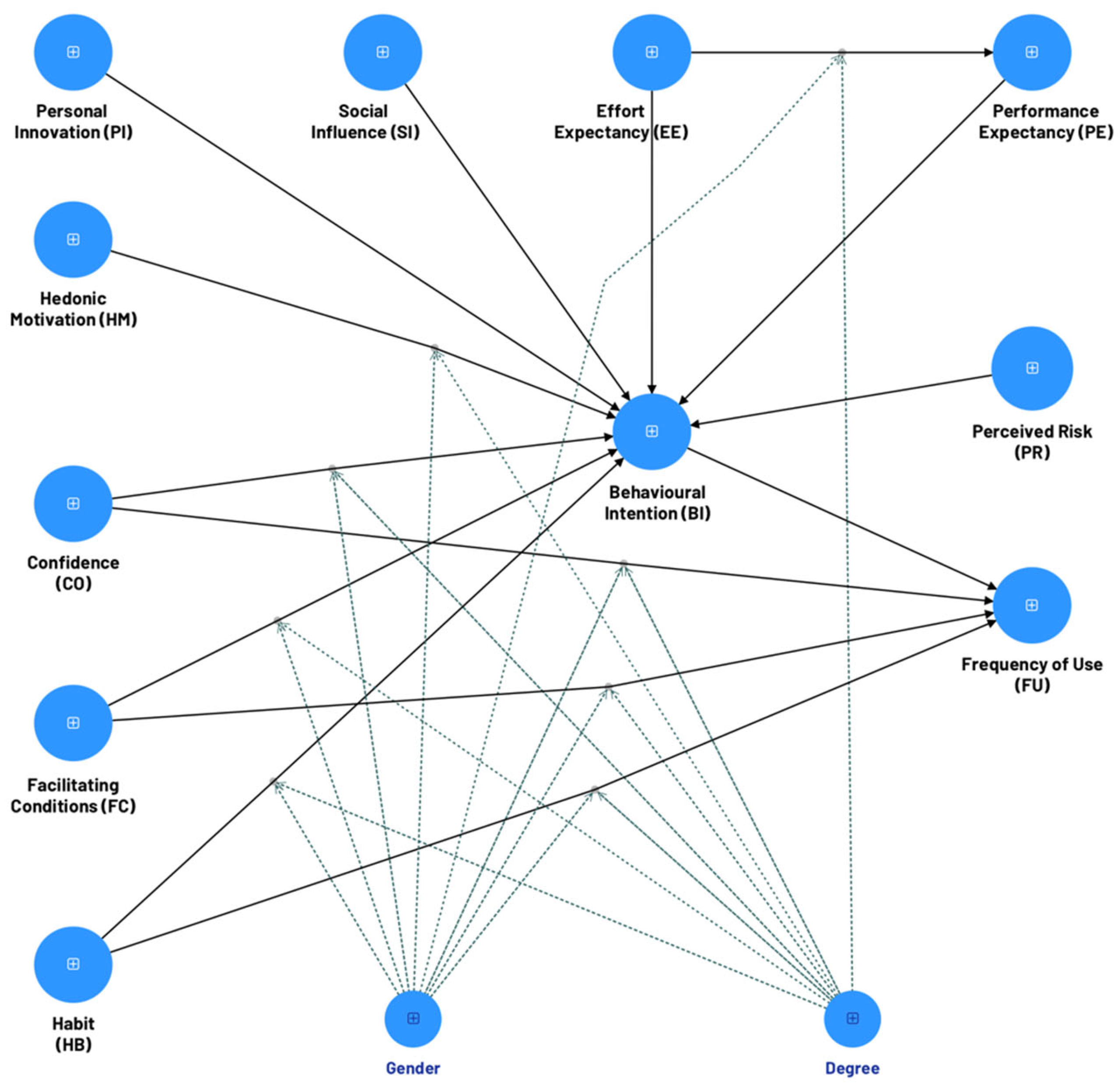
In this study, we considered all constructs of the UTAUT2 model except for Price Value, as many Generative AI technologies offer free versions. In addition to the UTAUT2 constructs, three new constructs were incorporated: Personal Innovation, Confidence, and Perceived Risk. These factors specifically address the unique characteristics and challenges associated with this emerging technology. The incorporation of these constructs facilitates a richer and more thorough examination of the attitudes and behavioural patterns exhibited by users toward an innovation that simultaneously generates enthusiasm and concern within the contemporary educational context. Accordingly, the following constructs were incorporated into the analysis: Performance Expectancy (PE), Effort Expectancy (EE), Social Influence (SI), Facilitating Conditions (FC), Hedonic Motivation (HM), Habit (HB), Personal Innovation (PI), Confidence (CO), and Perceived Risk (PR). The aim was to identify the impact of these factors on the constructs Behavioural Intention (BI) and Frequency of Use (FU).
- Performance Expectancy (PE) considers the extent to which an individual believes he can improve their performance by using a given technology.
- Effort Expectancy (EE) is defined as the degree of ease associated with the use of a given technology, reflecting the level of cognitive and physical effort required by the individual to interact with the technology.
- Social Influence (SI) refers to the degree to which an individual perceives that significant others believe they should use a given technology. This construct constitutes a key determinant of Behavioural Intention, as individuals’ adoption decisions are shaped, in part, by their perception of how technology use will be evaluated by those around them [29].
- Facilitating Conditions (FC) are defined as the degree to which an individual believes that an organisational and technical infrastructure exists to support the use of a given technology. Such support is expected to assist in resolving difficulties that may arise during use, thereby reducing barriers to adoption.
- Hedonic Motivation (HM) refers to the intrinsic enjoyment or pleasure derived from the use of a technology “(…) the fun or pleasure derived from using a technology, and it has been shown to play an important role in determining technology acceptance and use (…)” [28].
- Habit (HB) is defined as the degree to which individuals tend to engage in automatic behaviour when interacting with a given technology. This automaticity is directly associated with the prior learning and accumulated experience that individuals have developed through repeated use of the technology.
- Personal Innovation (PI) is conceptualised as “an individual’s willingness and ability to adopt and use new technology in their daily life” [30]. As proposed by the same author, this construct represents a significant theoretical addition to the UTAUT2 model, broadly defined as the propensity to embrace emerging technologies while simultaneously demonstrating a sense of comfort and confidence in their use.
- Confidence (CO) is understood as “the users’ belief that the use of technology is reliable and trustworthy” [31]. In the context of the present study, this construct pertains specifically to users’ confidence in the outputs generated by technology tools, encompassing their perceived credibility. Critically, such confidence should not be unconditional; rather, it ought to be measured, informed, and critically evaluated.
- Perceived Risk (PR) encompasses concerns related to security, awareness of the potential harms and limitations associated with a given technology, data protection and privacy, ethical considerations, as well as the propagation of misinformation and algorithmic biases. These concerns are further compounded by the risk of overreliance on technology outputs, which may undermine critical thinking and creative capacity. Such challenges are sufficiently pervasive to have engendered widespread feelings of distrust, apprehension, and discomfort towards a given technology, both within and beyond educational settings. More broadly, this construct captures an individual’s appraisal of the potential risks and uncertainties inherent in the use of a given technology. According to [32], “the adoption and rejection of technology are significantly influenced by users’ perceptions of risk” (p. 12, [32]).
- Behavioural Intention (BI) refers to the “(…) likelihood or subjective intention of an individual to use a particular technology in the future” [28].
- Frequency of Use (FU) is defined as the regularity with which an individual engages with a particular technology, capturing the recurrence of technology-related interactions over a given period.
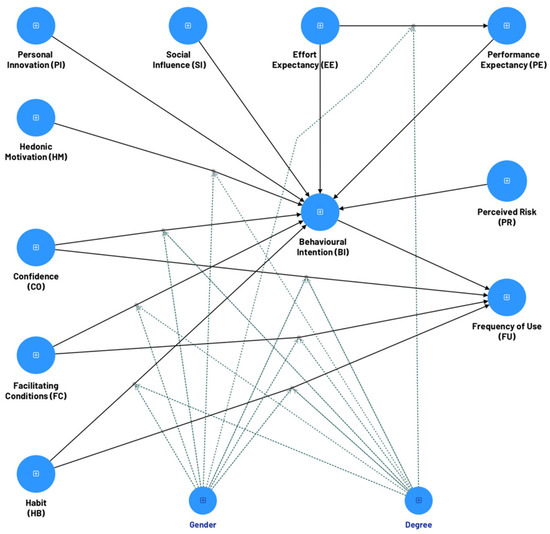
Across all constructs, the concept of technology was operationally adapted to refer specifically to Generative Artificial Intelligence. Figure 1 illustrates the model created for the study, as well as the relationships between the different constructs with Behavioural Intention and Frequency of Use.
Figure 1.
Proposed structural model of students’ acceptance and use of GenAI.
For this purpose, Table 2 outlines the 14 hypotheses examined in this study.
Table 2.
Hypotheses.
Two moderating variables were additionally incorporated into the model: Gender and Degree level (Academic degree attended by students).
For this study, 47 items were initially considered, aiming to identify the factors that contribute to the adoption and frequency of use of Generative AI by Higher Education students. However, three of the items showed weak strength in relation to their respective constructs (Outer Loadings), with values below 0.50, and were therefore eliminated from the analysis. Thus, 44 items were considered for analysis of the model. The response method for each item used a 7-point Likert scale, varying from “strongly disagree” to “strongly agree.” The measurement of Frequency of Use considered the following 7-point scale: “Never”; “Once a month”; “Several times a month”; “Once a week”; “Several times a week”; “Once a day”; “Several times a day”.
Table 3 reports the items used to measure each construct.
Table 3.
Measurement scale and factor loadings.
All constructs satisfied the established criteria for reliability and validity, and discriminant validity was confirmed across the measurement model [33,34]. Nevertheless, the item HB2 presents an outer loading slightly below the recommended threshold (0.7). However, in line with PLS-SEM guidelines [33,34], one indicator with a lower outer loading was retained, as the construct demonstrated adequate composite reliability (ρc > 0.70) and convergent validity (AVE > 0.50), while preserving consistency with the original UTAUT2 measurement model [28]. Thus, the item was retained in the study.
Participants
The questionnaire was developed using the EU Survey platform and distributed via email to higher education students at the University of Lisbon. Data were collected between January and May 2025, with a total of 229 students participating in the study. Table 4 presents the sample profile. The sample was predominantly female (73.8%), with participants mainly enrolled in degree (34.9%) and master’s programmes (31.4%). The age distribution was primarily concentrated in the 18–25 (39.7%) and 40–59 (37.6%) year groups.
Table 4.
Sample profile.
4. Results
4.1. Measurement Model Analysis
The psychometric properties of the measurement instrument were evaluated for all constructs, excluding Frequency of Use, as single-item constructs exclude the application of standard reliability and validity analyses. To determine the statistical significance of the PLS-SEM results, bootstrapping with 5000 resamples was conducted in SmartPLS 4 software (Version 4.1.1.7) to assess the significance of the structural paths. The results of the reliability analysis conducted for each construct are presented in Table 5.
Table 5.
Construct reliability and validity.
Following the criterion established by [35], Cronbach’s alpha values above 0.70 are indicative of acceptable internal consistency, thereby confirming the reliability of the measurement instrument. As reported in Table 5, Cronbach’s alpha coefficients for all constructs exceed 0.820, with the majority of values approaching or surpassing 0.90, thus indicating a high to excellent level of internal consistency reliability across the measurement instrument. Composite reliability (pC) is commonly used to assess reliability, and as suggested by [36], the obtained values between 0.86 and 0.96 indicate acceptable to good levels of reliability of the questionnaire. The results of the reliability coefficient (pA) essentially demonstrate the degree of internal consistency of the latent constructs and are considered one of the most precise and consistent estimators in PLS-SEM. As can be observed, the values are above 0.86, indicating good reliability [36].
Average Variance Extracted (AVE) is used to assess the convergent validity of constructs in Structural Equation Modelling (SEM) by indicating the extent to which a construct explains the variance of its indicators. Consequently, it confirms that the indicators adequately represent the constructs and supports the robustness of the model’s analyses.
Convergent validity is established when the AVE exceeds the threshold of 0.50 [36,37], indicating that the construct explains more than 50% of the variance in its indicators. An examination of the AVE values for each construct (Table 5) shows that all values are above 0.619, suggesting that the constructs explain at least 61.9% of the variance of their respective indicators.
Discriminant validity was further evaluated using the Fornell-Larcker criterion and the Heterotrait-Monotrait ratio (HTMT). According to [34,36], discriminant validity is established when the square root of the AVE for each construct exceeds its correlations with all other constructs (i.e., the diagonal values in bold must be greater than all off-diagonal values in the corresponding row and column). As presented in Table 6, this condition is satisfied.
Table 6.
Fornell–Larcker Criterion—Correlation Matrix Between Constructs.
According to reference [38], the Heterotrait-Monotrait ratio of correlations (HTMT) is an alternative and more accurate metric for assessing discriminant validity in structural equation modelling (SEM). Discriminant validity reflects the degree to which a construct is empirically distinct from other constructs in the model. An HTMT value of up to 0.90 indicates adequate discriminant validity, particularly when the constructs are conceptually similar, whereas a more conservative threshold of 0.85 is recommended for conceptually distinct constructs and is acceptable, suggesting adequate discriminant validity.
Although two HTMT values marginally exceeded the conservative threshold of 0.85 (HTMT = 0.876; 0.865) (Table 7), they were below the recommended upper limit of 0.90 and involved conceptually related constructs within the same theoretical framework. Therefore, discriminant validity can be considered acceptable.
Table 7.
Discriminant validity of the model: Heterotrait-Monotrait (HTMT) ratios.
The foregoing analysis demonstrates that the measurement model satisfies the established criteria for both convergent and discriminant validity, thereby confirming the structural integrity of the instrument and the reliability of subsequent statistical inferences. Given that all psychometric conditions were met across the constructs examined, it can be concluded that these constructs are appropriate for estimating their respective effects on Behavioural Intention and Frequency of Use of GenAI.
4.2. Structural Model Analysis
Partial Least Squares Structural Equation Modelling (PLS-SEM) offers visual representations that characterize hypotheses and the relationships among constructs [36]. In these diagrams, constructs—latent variables—are typically represented as circles. The relationships between constructs are represented by unidirectional arrows, indicating predictive relationships or, when supported by strong theoretical justification, causal relationships. To estimate the model, we used the PLS-SEM algorithm with the path weighting scheme through the SmartPLS4 software (Version 4.1.1.7), running 5000 bootstrap samples to determine the statistical significance of the PLS-SEM results.
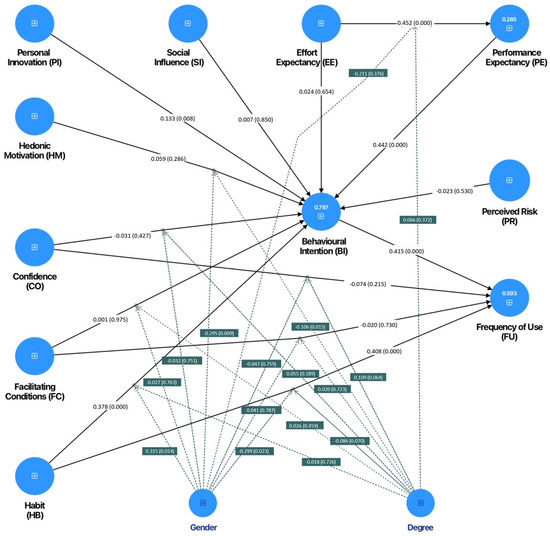
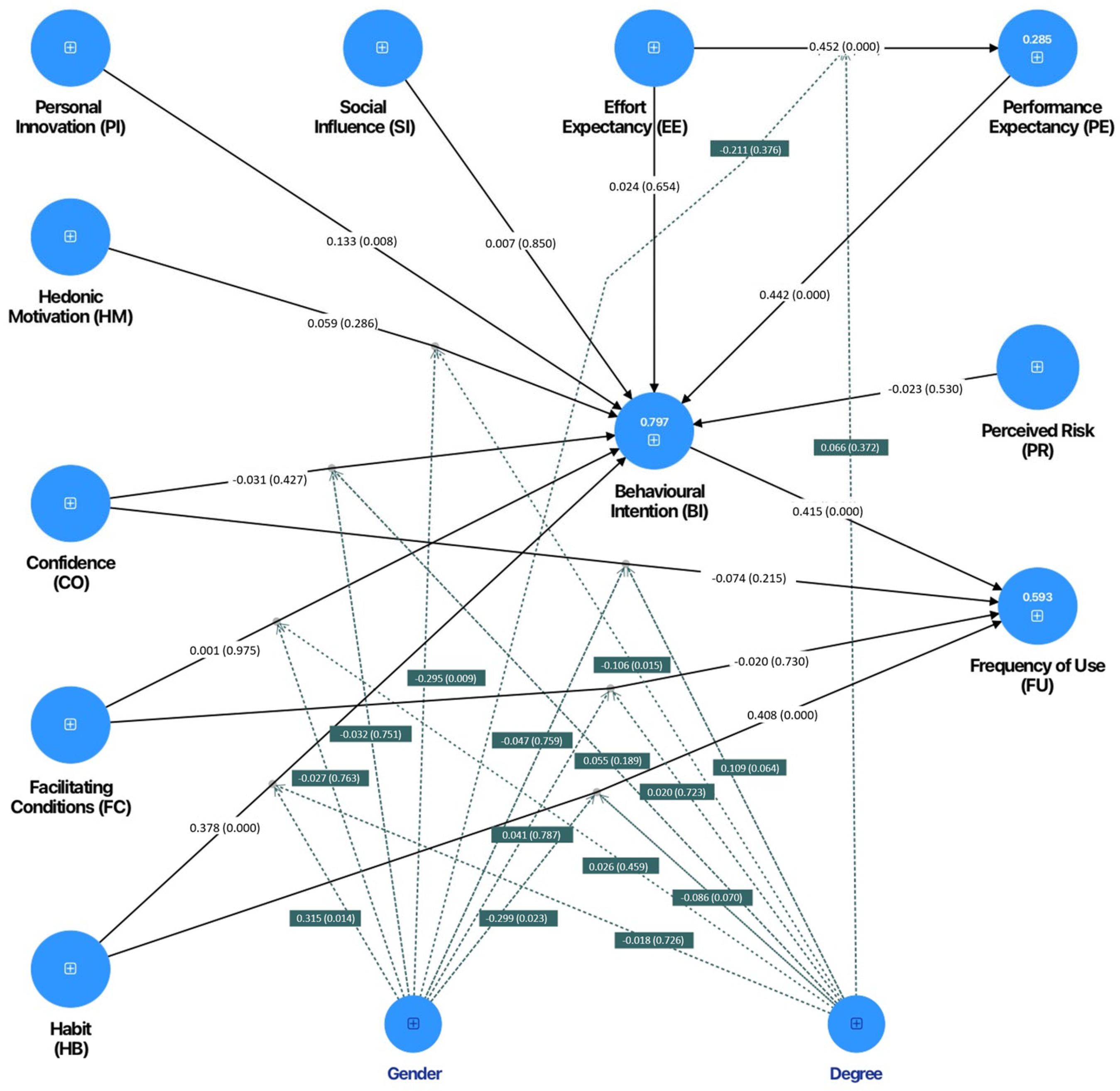
The coefficient of determination (R2) is used to assess the explanatory power of the model for each endogenous construct. Ranging between 0 and 1, higher R2 values indicate greater explanatory power. According to [39], R2 values of 0.25, 0.50, and 0.75 indicate weak, moderate, and substantial levels of explanatory power, respectively. Figure 2 reflects the PLS-SEM model, showing the structural relationships between constructs and the corresponding R2 values for the endogenous constructs—Behavioural Intention and Frequency of Use.
Figure 2.
Results of the GenAI acceptance and utilisation model.
As showed, 29% of the variance in Performance Expectancy can be explained by Effort Expectancy, 80% of the variance in Behavioural Intention of use GenAI can be explained by the other constructs, and 59% of Frequency of Use can be explained by Behavioural Intention, Confidence, Facilitating Conditions and Habit.
According to [38], the f2 statistic is used to assess the effect size of an exogenous construct on an endogenous construct. Values of approximately 0.35, 0.15, and 0.02 indicate large, medium, and small effect sizes, respectively, while f2 values below 0.02 suggest the absence of a meaningful effect. Table 8 presents the effect sizes for the hypotheses supported in this study. The strength and direction of the relationships between the constructs are reported in Table 8 under the Path Coefficient (β) column. Path coefficients approaching +1 indicate strong positive relationships, whereby increases in one construct are associated with increases in the other, whereas coefficients approaching −1 indicate strong negative relationships, whereby increases in one construct are associated with decreases in the other. A path coefficient close to zero indicates the absence of a meaningful relationship between constructs. The significance and relevance of the hypothesized relationships were assessed using path coefficients (β), the obtained p-values, and effect sizes (f2), in accordance with the recommendations of [38]. Hypotheses were considered supported when p < 0.05, and effect size magnitudes were interpreted based on f2 values (small ≥ 0.02; medium ≥ 0.15; large ≥ 0.35).
Table 8.
Path coefficients and significance test results.
The results confirm the following hypotheses:
H6: The relationship between Habit and Behavioural Intention was statistically significant (β = 0.378; p < 0.000) and exhibited a large effect size (f2 = 0.477). This result indicates that habit is one of the main determinants of behavioural intention, explaining a substantial portion of the variance in BI. This evidence is consistent with UTAUT2, in which habit plays a central role in the adoption and continued use of technologies.
H7: The hypothesis linking Habit to Frequency of Use was supported (β = 0.408; p < 0.000), with a medium effect size (f2 = 0.138). This result suggests that previously internalized and automated behaviours directly influence the actual use of the technology, reinforcing the role of habit not only in intention but also in real behaviour.
H10: the relationship between Performance Expectancy and Behavioural Intention was highly significant (β = 0.442; p < 0.000) and exhibited a large effect size (f2 = 0.417). Performance Expectancy emerges as a key predictor of behavioural intention, indicating that perceived usefulness and performance gains associated with the technology are decisive for adoption intention.
H11: the hypothesis establishing the relationship between Personal Innovativeness and Behavioural Intention was supported (β = 0.133; p = 0.008), although with a small effect size (f2 = 0.030). Despite being statistically significant, Personal Innovativeness makes a limited contribution to explaining behavioural intention, suggesting a complementary role relative to stronger predictors such as habit and performance expectancy.
H13: the relationship between Effort Expectancy and Performance Expectancy was statistically significant (β = 0.452; p < 0.000) and showed a medium effect size (f2 = 0.291). This result indicates that perceived ease of use positively influences perceived usefulness of the technology, reinforcing an indirect effect of Effort Expectancy on Behavioural Intention, mediated by Performance Expectancy.
H14: the hypothesis linking Behavioural Intention and Frequency of Use was supported (β = 0.415; p < 0.000), with a small-to-medium effect size (f2 = 0.068). This finding confirms the classical relationship between intention and behaviour, demonstrating that behavioural intention translates into actual use, although part of the variance in frequency of use is directly explained by habit.
The remaining hypotheses (H1, H2, H3, H4, H5, H8, H9, and H12) did not reach statistical significance (p ≥ 0.05) and exhibited trivial or negligible effect sizes (f2 < 0.02). This pattern is consistent with previous UTAUT2-based studies and with the recommendations of [38], which emphasize that a lack of statistical significance does not invalidate the theoretical relevance of the constructs, particularly in models with multiple predictors.
The results demonstrate that Habit and Performance Expectancy are the primary determinants of Behavioural Intention, playing a decisive role in explaining the adoption and continued use of the technology. Frequency of Use is explained both by Behavioural Intention and by the direct effect of Habit, indicating that previously established behaviours are critical in translating intention into actual usage. Effort Expectancy also exerts a relevant indirect impact by strengthening Performance Expectancy, suggesting that perceived ease of use structurally contributes to users’ evaluation of the technology’s functional value. In contrast, the remaining constructs show residual or statistically non-significant contributions in this specific context, indicating that their explanatory role is secondary relative to the model’s dominant predictors. The proposed model further incorporates the moderating effects of Gender and Degree level, as reported in Table 9. These moderating effects were examined using interaction path coefficients, p-values, and effect sizes (f2), with statistical significance established at p < 0.05.
Table 9.
Moderating effects.
The sample comprised 169 female participants, 57 male participants, and 3 participants who identified as another gender category. Due to the very small size of the latter group, which does not allow reliable estimation in multi-group comparisons, these cases were excluded from the gender-based moderation analysis. However, they were retained in the overall sample for the remaining analyses. Overall, Degree level did not exhibit significant moderating effects across most relationships in the model. Interactions involving Degree level with Confidence, Effort Expectancy, Facilitating Conditions, and Habit failed to reach statistical significance (p ≥ 0.05). The only exception was the interaction between Degree level and Hedonic Motivation in Behavioural Intention, which was statistically significant (β = −0.106; p = 0.015) with a small effect size (f2 = 0.032). The negative coefficient indicates that the influence of hedonic motivation on behavioural intention decreases as Degree level increases, suggesting that individuals with higher academic qualifications rely less on hedonic drivers when forming their intention to use the Generative AI.
Gender demonstrated several statistically significant moderating effects, although all were of small magnitude. The interaction of Gender and Habit in Behavioural Intention was significant (β = 0.315; p = 0.014; f2 = 0.112), indicating that the effect of habit on behavioural intention varies by gender. Similarly, the interaction between Gender and Habit in Frequency of Use reached statistical significance (β = −0.299; p = 0.023; f2 = −0.144), suggesting differences based on gender in how habitual behaviour translates into actual usage of Generative AI. In addition, the interaction between Gender and Hedonic Motivation in Behavioural Intention was significant (β = −0.295; p = 0.009; f2 = 0.110), implying that the contribution of hedonic motivation to behavioural intention differs across genders. The remaining Gender interactions were not statistically significant and displayed negligible effect sizes, indicating the absence of meaningful moderation in those relationships.
5. Conclusions
This study investigated the determinants of the acceptance and use of Generative Artificial Intelligence technologies by a sample of higher education students in Portugal, drawing on the extended Unified Theory of Acceptance and Use of Technology (UTAUT2) model. The results, obtained through Partial Least Squares Structural Equation Modelling (PLS-SEM), reveal a model with robust explanatory power, particularly regarding Behavioural Intention, and provide a detailed account of the adoption dynamics of this emerging technology in the educational context.
The main findings indicate that Habit and Performance Expectancy are the strongest and most significant predictors of Behavioural Intention to use GenAI. This result suggests that students’ decision to adopt GenAI is primarily driven by their perception of usefulness and productivity gains in their studies, as well as by usage behaviours that have become automatic and embedded in their routines. The prominence of Habit, with a large effect on both Behavioural Intention and a medium effect on Frequency of Use, underscores that, beyond a purely rational decision based on utility, the use of GenAI is rapidly becoming an entrenched behaviour among students.
Personal Innovation also demonstrated a positive and significant influence on Behavioural Intention, albeit with a smaller effect. This indicates that students’ individual predisposition to experiment with new technologies contributes to their intention to use GenAI, though less decisively than utility and habit factors. Additionally, Effort Expectancy revealed a relevant indirect impact by positively influencing Performance Expectancy. This result is aligned with theory, suggesting that the perceived ease of use of GenAI leads students to consider it more useful, thereby indirectly reinforcing their intention to use it.
Contrary to the conventional UTAUT2 model, constructs such as Social Influence, Hedonic Motivation, Facilitating Conditions, Confidence, and Perceived Risk did not show a direct and significant impact on Behavioural Intention. The non-significance of Social Influence may suggest that the decision to use GenAI is more of an individual and pragmatic choice than one motivated by social pressure from peers or authority figures in the university context under analysis. Similarly, the absence of an effect from Hedonic Motivation may indicate that, although students may find the technology enjoyable, the “fun” factor is not a primary driver of their intention to use it for academic purposes, which is dominated by performance considerations. The lack of significance of Facilitating Conditions on intention may be explained by the high accessibility of these tools, which require only a device with an internet connection, something ubiquitous in the university environment, making formal support less critical for usage intention.
This study contributes, first, by confirming the robustness of Habit and Performance Expectancy as the pillars of GenAI usage intention, explaining a substantial portion of the variance. This reinforces the need to consider Habit as a central, rather than peripheral, variable in modelling the adoption of technologies that rapidly become integrated into daily routines. The non-significance of several traditional UTAUT2 constructs (such as Social Influence and Hedonic Motivation) in their direct impact on intention, within this specific context, raises important questions about the universal applicability of the model without contextual adaptation. It suggests that, for highly pragmatic and easily accessible technologies such as GenAI, utilitarian predictors and automated behaviour may override social and hedonic factors.
The investigation of the moderating effects of Gender and Degree level offers a more granular analysis. The results indicate that the impact of Habit and Hedonic Motivation on usage intention varies across genders and that the relevance of hedonic motivation decreases as the academic level advances. These findings, although of small magnitude, enrich the theoretical model by demonstrating that demographic and academic characteristics remain relevant, even if subtle, moderators in the age of AI.
Also, the research consistently highlights Habit and Performance Expectancy as the most influential factors shaping students’ intention to use and actual frequency of GenAI engagement. The significant role of Habit suggests that GenAI is rapidly becoming an ingrained component of students’ academic routines. From a sustainability perspective, this presents a dual challenge and opportunity. While habitual and effective use can undoubtedly enhance productivity and optimize learning, contributing to a more efficient use of intellectual and digital resources, the formation of such habits demands careful oversight. It is crucial to ensure these habits are long-term, sustainable, and align with broader pedagogical and environmental goals. An uncritical or excessive reliance on GenAI risks undermining the development of fundamental skills, such as critical thinking and independent problem-solving, which is ultimately unsustainable for comprehensive student development.
Performance Expectancy, reflecting students’ perception of GenAI’s usefulness and its capacity to deliver productivity gains, stands out as a primary motivator for adoption. For truly sustainable integration, higher education institutions must strategically emphasize and maximize the practical value of GenAI, clearly demonstrating its potential to genuinely improve learning outcomes. This extends beyond mere curricular inclusion to encompass continuous training on the effective and responsible application of the technology. The perceived ease of use, captured by Effort Expectancy, indirectly reinforces students’ intention to use GenAI by positively influencing their Performance Expectancy. While this ease facilitates adoption, it must be balanced with an awareness of the broader environmental footprint of digital technologies, particularly the energy demands associated with large-scale GenAI processing. Consequently, the efficient management of digital and energy resources emerges as an indispensable element of sustainable technology integration.
Furthermore, Personal Innovativeness, though a less dominant factor, contributes positively to students’ intention to adopt GenAI. This individual predisposition towards experimenting with new technologies can be cultivated to encourage beneficial exploration, provided it is guided by a framework of conscious and ethical engagement, thereby preventing the uncritical embrace of emerging tools.
From a sustainable integration perspective of GenAI in higher education, institutions should adopt a long-term strategic approach that balances technological innovation with pedagogical quality, ethical responsibility, and efficient resource management. Sustainable integration implies not only promoting the effective use of GenAI to enhance learning outcomes, but also ensuring that its adoption supports inclusive access, academic integrity, and the responsible use of digital resources.
On the other hand, the ethical dimension is central to the responsible integration of GenAI. The pronounced influence of Performance Expectancy and Habit raises significant concerns regarding academic integrity. If students primarily view GenAI as a means to achieve rapid performance enhancements and integrate its use into their routines without critical reflection, there is a tangible risk of fostering dependence. Such dependence could compromise originality, diminish the sense of authorship, and impede the cultivation of essential cognitive abilities. Therefore, institutions are tasked with establishing clear guidelines and cultivating a culture that champions the ethical and responsible use of GenAI, unequivocally positioning the technology as a supportive tool rather than a substitute for rigorous critical thought and original academic endeavor.
Interestingly, constructs such as Social Influence and Hedonic Motivation did not emerge as direct drivers of GenAI adoption in this context. This suggests that students’ decisions regarding GenAI use are more individual and pragmatic, rather than being swayed by peer pressure or the inherent enjoyment of the tool. While this individualistic adoption might seem advantageous, it could inadvertently complicate the establishment of collective ethical norms and the effective monitoring of potential misuse. The muted role of Hedonic Motivation implies that, within an academic setting, the perceived utility of GenAI outweighs its being seen as a “fun” factor, further emphasizing the need to address the ethical dimensions of performance and productivity.
The results of this study provide valuable guidance for higher education. Given that Performance Expectancy is a crucial driver, universities should focus on demonstrating and maximizing the practical value of GenAI as a tool to support learning. This can be achieved through the curricular integration of the technology and by offering training on how to use it effectively and ethically to enhance productivity, research, and the understanding of complex concepts. Since Habit is equally determinant, institutions should create an environment that normalizes and encourages the regular and constructive use of these tools, transforming occasional use into a productive academic habit. Regarding moderating effects, the results suggest that a “one-size-fits-all” approach may not be the most effective. Institutional policies should consider developing differentiated forms of support or communication that consider the distinct motivations of students at different academic levels. The strong impact of Performance Expectancy and the mediating role of Effort Expectancy send a clear signal that tools should not only be easy to use but, above all, should demonstrate clear and unequivocal functional value for the academic context.
Based on these findings, several institutional recommendations can be established. First, given the strong role of Performance Expectancy and Habit, higher education institutions should establish clear institutional policies on GenAI use, accompanied by explicit learning outcomes centered on AI literacy. Since students primarily use GenAI for its perceived utility and as an ingrained routine, educators should design assignments that assume GenAI as a tool but mandate the critical evaluation of its outputs, ensuring that the technology enhances rather than replaces cognitive processes. The long-term sustainability depends on ensuring that students develop critical, reflective, and autonomous learning practices alongside technological use. Furthermore, because Social Influence was found to be non-significant, suggesting that adoption is a pragmatic and individual choice, institutions should focus on monitoring habitual use patterns to mitigate over-reliance and ensure that the formation of these habits remains aligned with academic integrity and long-term skill development.
Higher education institutions have a crucial role in supporting students through training, clear guidelines, and pedagogical strategies. Such support promotes the development of essential cognitive skills and responsible digital behaviours. By encouraging informed and critical engagement with GenAI, universities can contribute to a more sustainable educational ecosystem, where technological innovation enhances learning outcomes while preserving academic integrity, human agency, and the responsible use of this emerging technology.
Limitations and Future Research
Despite the insights provided, this study has limitations that should be acknowledged. The findings are subject to sampling limitations, and the cross-sectional nature of the data precludes making causal inferences about how habits form and evolve over time. Additionally, some UTAUT2 constructs, such as Price Value, were excluded from the model given the widespread availability of free GenAI versions during the study period. Future research should employ longitudinal designs to track the trajectory of habit formation and its impact on learning outcomes. Cross-country comparisons would also be valuable to determine the cultural generalizability of these results. Moreover, future models could incorporate more explicit sustainability or environmental awareness constructs to address the ecological footprint of AI. Finally, qualitative work is recommended to complement these quantitative findings, providing a deeper understanding of the nuances behind student motivations and the specific ways in which GenAI is integrated into their academic lives.
Author Contributions
A.P., N.D., C.R. and B.A. worked on conceptualization, methodology, software, validation, formal analysis, investigation, resources, data curation, writing—original draft preparation, writing—review and editing. All authors have read and agreed to the published version of the manuscript.
Funding
This work was supported by National Funds through FCT-Portuguese Foundation for Science and Technology, I.P., under the scope of UIDEF—Unidade de Investigação e Desenvolvimento em Educação e Formação, UID/04107/2025, https://doi.org/10.54499/UID/04107/2025.
Institutional Review Board Statement
The study was conducted in accordance with the Declaration of Helsinki and approved by the Ethics Committee of the Institute of Education of the University of Lisbon (approval no. 230-Idok, 15 January 2024).
Informed Consent Statement
Informed consent was obtained from all subjects involved in the study.
Data Availability Statement
Due to privacy and ethical restrictions, the data presented in this study are available on request from the corresponding author.
Conflicts of Interest
The authors declare no conflicts of interest.
Abbreviations
The following abbreviations are used in this manuscript:
| GenAI | Generative Artificial Intelligence |
| PLS-SEM | Partial Least Squares Structural Equation Modelling |
| UTAUT | Unified Theory of Acceptance and Use of Technology |
References
- Oliveira, A. Inteligência Artificial; Fundação Francisco Manuel dos Santos: Lisboa, Portugal, 2019. [Google Scholar]
- Zawacki-Richter, O.; Marín, V.I.; Bond, M.; Gouverneur, F. Systematic review of research on artificial intelligence applications in higher education—Where are the educators? Int. J. Educ. Technol. High. Educ. 2019, 16, 39. [Google Scholar] [CrossRef] [Scilit]
- Rudolph, J.; Tan, S.; Tan, S. ChatGPT: Bullshit spewer or the end of traditional assessments in higher education? J. Appl. Learn. Teach. 2023, 6, 342–363. [Google Scholar] [CrossRef] [Scilit]
- Su, J.; Yang, W. Unlocking the power of ChatGPT: A framework for applying generative AI in education. ECNU Rev. Educ. 2023, 6, 355–366. [Google Scholar] [CrossRef] [Scilit]
- UNESCO. Guidance for Generative AI in Education and Research; UNESCO Publishing: Paris, France, 2023; Available online: https://unesdoc.unesco.org/ark:/48223/pf0000386693 (accessed on 15 November 2025).
- Kasneci, E.; Seßler, K.; Küchemann, S.; Bannert, M.; Dementieva, D.; Fischer, F.; Gasser, U.; Groh, G.; Günnemann, S.; Hüllermeier, E.; et al. ChatGPT for Good? On Opportunities and Challenges of Large Language Models for Education. Learn. Individ. Differ. 2023, 103, 102274. [Google Scholar] [CrossRef] [Scilit]
- Ahmad, N.; Murugesan, S.; Kshetri, N. Generative Artificial Intelligence and the Education Sector. Computer 2023, 56, 72–76. [Google Scholar] [CrossRef] [Scilit]
- Holmes, W.; Bialik, M.; Fadel, C. Artificial Intelligence in Education: Promises and Implications for Teaching and Learning; Center for Curriculum Redesign: Boston, MA, USA, 2019. [Google Scholar]
- Flores-Vivar, J.M.; García-Peñalvo, F.J. Reflexiones sobre la ética, potencialidades y retos de la Inteligencia Artificial en el marco de la Educación de Calidad (ODS4). Comunicar 2023, 31, 37–47. [Google Scholar] [CrossRef] [Scilit]
- Long, D.; Magerko, B. What is AI literacy? Competencies and design considerations. In Proceedings of the 2020 CHI Conference on Human Factors in Computing Systems; Association for Computing Machinery: New York, NY, USA, 2020; pp. 1–16. [Google Scholar] [CrossRef] [Scilit]
- Fui-Hoon Nah, F.; Zheng, R.; Cai, J.; Siau, K.; Chen, L. Generative AI and ChatGPT: Applications, challenges, and AI-human collaboration. J. Inf. Technol. Case Appl. Res. 2023, 25, 277–304. [Google Scholar] [CrossRef] [Scilit]
- Healy, M. Using Curriculum Theory to Inform Approaches to Generative AI in Schools. SSRN 2023. [Google Scholar] [CrossRef] [Scilit]
- Baidoo-Anu, D.; Ansah, L.O. Education in the era of generative artificial intelligence (AI): Understanding the potential benefits of ChatGPT in promoting teaching and learning. J. AI 2023, 7, 52–62. [Google Scholar] [CrossRef] [Scilit]
- Baskara, F.R.; Mukarto, F.X. Exploring the Implications of ChatGPT for Language Learning in Higher Education. Indones. J. Engl. Lang. Teach. Appl. Linguist. 2023, 7, 343–358. [Google Scholar] [CrossRef] [Scilit]
- García-Brustenga, G.; Fuertes-Alpiste, M.; Molas-Castells, N. Briefing Paper: Los Chatbots en Educación; eLearn Center, Universitat Oberta de Catalunya: Barcelona, Spain, 2018. [Google Scholar] [CrossRef] [Scilit]
- Gallent Torres, C. L’utilisation de l’ΙA Générative dans le cadre de l’enseignement du FLE: Aspects pratiques et considérations éthiques. In Inteligencia Artificial, ¿amiga o Enemiga? Colección Ciencias Sociales em abierto; Peter Lang: Lausanne, Switzerland, 2024. [Google Scholar]
- Luckin, R.; Holmes, W.; Griffiths, M.; Forcier, L.B. Intelligence Unleashed: An Argument for AI in Education; Pearson Education: London, UK, 2016. [Google Scholar]
- Farrokhnia, M.; Banihashem, S.K.; Noroozi, O.; Wals, A. A SWOT analysis of ChatGPT: Implications for educational practice and research. Innov. Educ. Teach. Int. 2023, 61, 460–474. [Google Scholar] [CrossRef] [Scilit]
- Adiguzel, T.; Kaya, M.H.; Cansu, F.K. Revolutionizing education with AI: Exploring the transformative potential of ChatGPT. Contemp. Educ. Technol. 2023, 15, ep429. [Google Scholar] [CrossRef] [Scilit] [PubMed]
- Bozkurt, A.; Xiao, J.; Lambert, S.; Pazurek, A.; Crompton, H.; Koseoglu, S.; Farrow, R.; Bond, M.; Nerantzi, C.; Honeychurch, S.; et al. Speculative futures on ChatGPT and generative artificial intelligence (AI): A collective reflection from the educational landscape. Asian J. Distance Educ. 2023, 18, 53–130. [Google Scholar]
- Dergaa, I.; Chamari, K.; Zmijewski, P.; Ben Saad, H. From human writing to artificial intelligence generated text: Examining the prospects and potential threats of ChatGPT in academic writing. Biol. Sport 2023, 40, 615–622. [Google Scholar] [CrossRef] [Scilit]
- Sullivan, M.; Kelly, A.; McLaughlan, P. ChatGPT in higher education: Considerations for academic integrity and student learning. J. Appl. Learn. Teach. 2023, 6, 31–40. [Google Scholar] [CrossRef] [Scilit]
- Tlili, A.; Shehata, B.; Adarkwah, M.A.; Bozkurt, A.; Hickey, D.T.; Huang, R.; Agyemang, B. What if the devil is my guardian angel: ChatGPT as a case study of using chatbots in education. Smart Learn. Environ. 2023, 10, 15. [Google Scholar] [CrossRef] [Scilit]
- Gallent-Torres, C.; Zapata-González, A.; Ortego-Hernando, J.L. The impact of Generative Artificial Intelligence in higher education: A focus on ethics and academic integrity. RELIEVE 2023, 29, M5. [Google Scholar] [CrossRef] [Scilit]
- Waltzer, T.; Cox, R.L.; Heyman, G.D. Testing the ability of teachers and students to differentiate between essays generated by ChatGPT and High School Students. Hum. Behav. Emerg. Technol. 2023, 2023, 1923981. [Google Scholar] [CrossRef] [Scilit]
- Sun, G.H.; Hoelscher, S. The ChatGPT Storm and What Faculty Can Do. Nurse Educ. 2023, 48, 119–124. [Google Scholar] [CrossRef] [Scilit]
- Chan, C.K.Y. A comprehensive AI policy education framework for university teaching and learning. Int. J. Educ. Technol. High. Educ. 2023, 20, 38. [Google Scholar] [CrossRef] [Scilit]
- Venkatesh, V.; Thong, J.; Xu, X. Consumer acceptance and use of information technology: Extending the unified theory of acceptance and use of technology. MIS Q. 2012, 36, 157–178. [Google Scholar] [CrossRef] [Scilit]
- Zhu, Y.; Yang, F. ChatGPT/AIGC and Educational Innovation: Opportunities, Challenges, and the Future. J. East China Norm. Univ. (Educ. Sci.) 2023, 41, 1–14. [Google Scholar]
- Venkatesh, V.; Morris, M.; Davis, G.; Davis, F. User acceptance of information technology: Toward a unified view. MIS Q. 2003, 27, 425–478. [Google Scholar] [CrossRef] [Scilit]
- Strzelecki, A. To use or not to use ChatGPT in higher education? A study of students’ acceptance and use of technology. Interact. Learn. Environ. 2023, 32, 5142–5155. [Google Scholar] [CrossRef] [Scilit]
- Al-Azawei, A.; Alowayr, A. Predicting the intention to use and hedonic motivation for mobile learning: A comparative study in two Middle Eastern countries. Technol. Soc. 2020, 62, 101325. [Google Scholar] [CrossRef] [Scilit]
- Fornell, C.; Larcker, D. Evaluating Structural Equation Models with Unobservable Variables and Measurement Error. J. Mark. Res. 1981, 18, 39–50. [Google Scholar] [CrossRef] [Scilit]
- Hair, J.; Sarstedt, M.; Hopkins, L.; Kuppelwieser, V. Partial least squares structural equation modeling (PLS-SEM): An emerging tool for business research. Eur. Bus. Rev. 2014, 26, 106–121. [Google Scholar] [CrossRef] [Scilit]
- Henseler, J.; Ringle, C.; Sinkovics, R. The use of Partial Least Squares Path Modeling in International Marketing. In New Challenges to International Marketing; Advances in International Marketing; Emerald Group Publishing Limited: Bingley, UK, 2009; Volume 20, pp. 277–319. [Google Scholar]
- Hair, J.; Hult, T.; Ringle, C.; Sarstedt, M.; Danks, N.; Ray, S. Partial Least Squares Structural Equation Modeling (PLS-SEM) using R. In Classroom Companion: Business; Springer International Publishing: Cham, Switzerland, 2021. [Google Scholar] [CrossRef] [Scilit]
- Henseler, J.; Ringle, C.; Sarstedt, M. A New Criterion for Assessing Discriminant Validity in Variance-based Structural Equation Modeling. J. Acad. Mark. Sci. 2015, 43, 115–135. [Google Scholar] [CrossRef] [Scilit]
- Sarstedt, M.; Ringle, C.M.; Hair, J.F. Partial least squares structural equation modeling. In Handbook of Market Research; Springer: Cham, Switzerland, 2022; pp. 587–632. [Google Scholar] [CrossRef] [Scilit]
- George, D.; Mallery, P. SPSS for Windows Step by Step: A Simple Guide and Reference, 4th ed.; Pearson Higher Education: London, UK, 2003. [Google Scholar]

Disclaimer/Publisher’s Note: The statements, opinions and data contained in all publications are solely those of the individual author(s) and contributor(s) and not of MDPI and/or the editor(s). MDPI and/or the editor(s) disclaim responsibility for any injury to people or property resulting from any ideas, methods, instructions or products referred to in the content. |
© 2026 by the authors. Licensee MDPI, Basel, Switzerland. This article is an open access article distributed under the terms and conditions of the Creative Commons Attribution (CC BY) license.