


Abstract
The rapid industrialization envisioned in Saudi Arabia’s Vision 2030 requires that new small and medium-sized enterprise (SME) factories be digitally capable from inception. This article proposes a policy framework that establishes a minimum Industry 4.0 maturity threshold as a condition for licensing new SME manufacturing facilities. Building upon international best practices and Saudi Arabia’s specific context, the article specifies minimum technical and organizational requirements across three dimensions: process, technology, and organization. Core elements include basic automation, industrial connectivity, vertical and horizontal integration, data-driven decision-making, workforce digital literacy, and leadership commitment to transformation. The rationale centers on cost efficiency, global competitiveness, and alignment with national goals. Recognizing common barriers such as limited skills, high upfront costs, and cybersecurity risks, the article outlines mitigation strategies including government incentives, public–private partnerships, and regulatory support. The framework is conceptual in nature and intended to inform pilot implementation and subsequent empirical evaluation. Establishing clear digital standards at the factory design stage can support more sustainable and scalable growth for Saudi SMEs while strengthening their readiness for participation in global Industry 4.0 ecosystems.
1. Introduction
Saudi Arabia’s Vision 2030 aims to diversify the economy and drive technological advancement, positioning the Kingdom as a global industrial hub [1]. A key driver of this transformation is the small and medium-sized enterprise (SME) sector, which accounts for nearly 90% of activity in the industrial and mining sectors and is expected to increase its contribution to GDP from 20% to 35% by 2030 [1,2]. Globally, SMEs account for approximately 70% of employment and GDP [3,4]. Despite their economic importance, a growing body of empirical evidence indicates that SMEs consistently lag large enterprises in digital adoption and digital maturity [5]. This gap is widely attributed to structural constraints, including limited financial resources, lack of digital competencies and technical expertise, organizational risk aversion, and dependence on outdated legacy systems [6]. In manufacturing environments, these barriers are particularly pronounced because digital transformation often requires capital-intensive investment in new technologies and complex, disruptive integration with existing legacy infrastructure [7,8].
Recent studies increasingly highlight that retrofitting existing factories to meet Industry 4.0 requirements imposes significant economic and operational burdens, including infrastructure incompatibility, production downtime, and constrained scalability [9,10,11,12]. In contrast, integrating digital capabilities during the design and construction of greenfield facilities offers substantially greater flexibility in process configuration, technology selection, and modular expansion [12,13]. Early-stage digital integration enables optimized layout planning, seamless connectivity, and scalable automation architectures that are difficult, or economically prohibitive, to achieve post-construction [13,14]. Despite these recognized advantages, most digital transformation efforts documented in the literature remain reactive, focusing on incremental upgrades to operational factories rather than proactive digital readiness embedded at inception [9,10,11,13].
In Saudi Arabia, the number of factories rose from 7206 in 2016 to over 11,500 by the end of 2023, a 60% increase fueled by the momentum of Vision 2030 [15]. The National Industrial Strategy envisions further expansion to 36,000 factories by 2035, including 4000 fully automated facilities [16]. Despite these ambitions, many newly licensed SME factories still begin operations with minimal automation, limited connectivity, and heavy reliance on manual processes [17]. All these factors undermine productivity and limit long-term scalability [18].
While the policy literature addresses barriers to SME digital transformation and extensively analyzes voluntary adoption, incentives, and retrofit pathways, existing scholarship has not systematically examined the use of quantified digital maturity thresholds as a mandatory licensing condition for new greenfield SME factories. As a result, the design-stage institutionalization of minimum digital readiness remains underexplored. This article bridges that gap by translating SIRI Band 2 into an enforceable licensing baseline tailored to the Saudi industrial context.
To situate this intervention within the broader Industry 4.0 literature, a variety of digital maturity and readiness frameworks have been developed to assess the technological and organizational preparedness of manufacturing firms [19]. Among them, for example, is the Acatech Industrie 4.0 Maturity Index [20], the IMPULS/German I4.0 readiness model [21], and various consultancy and academic multi-level frameworks assessing strategy, technology, processes, and people. As noted in [22], however, systematic reviews confirm no single, universally adopted standard. In this landscape, the Smart Industry Readiness Index (SIRI), originally developed by Singapore’s EDB and now managed by INCIT, stands out for its factory-level focus across three balanced pillars: Process, Technology, and Organization, rather than enterprise- or IT-centric diagnosis [23]. SIRI employs a neutral, standardized toolkit with certified assessors and a growing global benchmarking database, making it suitable not only for individual manufacturers but also for governments and industry associations to survey sectors and structure support programs, unlike many theoretical or vendor-specific models [24].
This article addresses the following primary policy question: What minimum digital maturity threshold should be mandated at the factory licensing stage to ensure scalable Industry 4.0 readiness for newly established SME manufacturing facilities in Saudi Arabia? A supporting analytical question follows: How can an existing Industry 4.0 maturity framework be translated into enforceable regulatory criteria suitable for licensing rather than voluntary benchmarking?
This article makes four contributions. First, it reconceptualizes digital maturity as a form of industrial infrastructure to be embedded at the licensing stage rather than treated as a voluntary firm-level capability. Second, it reinterprets the Smart Industry Readiness Index (SIRI) as a regulatory instrument, translating its maturity bands into enforceable policy criteria. Third, it defines an operational Band 2 baseline across process, technology, and organizational dimensions, specifying minimum requirements for new SME factories. Fourth, it proposes an implementation architecture that integrates regulatory enforcement with financial and institutional support mechanisms.
To address gaps in SME digital adoption, we propose that all newly licensed SME factories in Saudi Arabia be required to meet a minimum SIRI Band 2 digital maturity level, denoting foundational digital readiness [23]. Within the SIRI Assessment Matrix, Band 2 corresponds to the first level at which all dimensions move beyond paper-based, ad hoc or siloed computerization to consistently digital, visible and interoperable processes, enabling stable and repeatable information flows across shop floor, enterprise and facility layers. At and above this band, SMEs can systematically capture and visualize production data, maintain reliable digital records, and integrate core systems sufficiently to support essential regulatory and operational functions such as traceability, incident investigation, product recall, cybersecurity and environmental or energy reporting, whereas bands below this threshold lack the necessary integration and visibility for such uses. This role of Band 2 as a “digital/visible” inflection point is consistent with other Industry 4.0 maturity frameworks, where the second stage typically marks the transition from isolated computerization to integrated digital visibility. Reviews of Industry 4.0 readiness models tailored to SMEs indicate that the primary challenge is achieving a robust baseline of digital visibility and basic integration, especially in infrastructure, data and organizational capabilities [25,26,27,28], rather than reaching fully automated or autonomous states of maturity, making Band 2 a conceptually grounded and proportionate minimum for meaningful digital readiness. INCIT’s global SIRI data reveal that the current average maturity band for SMEs is around 0.9, indicating that most SMEs remain at early-stage maturity levels without systematic digital visibility or interoperability [23]. In this context, targeting Band 2 represents a proportionate step-up from the current SME maturity average while ensuring that firms reach a level where digital data are consistently captured, shared, and usable for core operational and compliance functions. It establishes meaningful digital readiness without imposing the resource intensity associated with higher maturity bands.
This study presents a policy-design framework grounded in maturity model analysis and existing empirical evidence on SME digitalization. It does not develop a new maturity model, nor does it empirically evaluate downstream firm performance. Rather, it specifies and justifies a normative regulatory baseline intended for pilot implementation and subsequent evaluation.
This policy intervention is informed by empirical evidence indicating that embedding digital standards during greenfield factory design can provide greater integration flexibility and lower long-term adjustment costs compared to post-construction retrofitting. Greenfield projects inherently enable optimized process design, facilitate integration of advanced technologies, and support modular scalability for future growth, all advantages constrained or eliminated in costly retrofit scenarios [28]. Furthermore, early-stage digital integration avoids costly infrastructure modifications, operational disruptions, and the diminished performance flexibility characteristic of retrofitted systems. By anchoring this requirement to the SIRI framework, an internationally validated tool already piloted across 1000+ manufacturers in 30 countries and deployed in Saudi Arabia’s modernization programs, the policy leverages institutional credibility while creating a standardized measurement baseline aligned with Vision 2030 objectives [23].
The remainder of this article develops the analytical justification for the Band 2 threshold, specifies minimum requirements across SIRI dimensions, examines implementation challenges grounded in the SME adoption literature, and proposes enabling mechanisms for regulatory deployment. The objective is to provide policymakers with a structured and operational blueprint for embedding digital readiness at the factory design stage.
2. Analytical Framework and Policy Rationale
This article uses a policy design approach to specify a minimum digital-readiness threshold for newly licensed SME factories in Saudi Arabia. Positioned within design science, it proposes a prescriptive licensing baseline grounded in established Industry 4.0 maturity frameworks and peer-reviewed evidence on SME digitalization and implementation barriers. The Smart Industry Readiness Index (SIRI) provides the main organizing structure for translating this evidence into assessable minimum requirements across process, technology, and organization. The contribution is a defensible rationale and actionable blueprint for regulatory adoption rather than causal estimation or hypothesis testing. Evaluation of downstream outcomes is therefore outside this paper’s scope and is deferred to future studies once the policy is piloted.
2.1. Rationale for Selecting SIRI as the Baseline Framework
Multiple Industry 4.0 maturity and readiness frameworks have been proposed to guide manufacturing digital transformation across firms and sectors [19]. In a licensing context, framework choice has material implications because models differ in conceptual orientation, granularity, and suitability for independent assessment. Licensing decisions must be consistent and contestable; therefore, the baseline instrument must provide explicit maturity thresholds, stable scoring criteria, and applicability across heterogeneous SME environments.
The Reference Architectural Model for Industry 4.0 (RAMI 4.0) provides a comprehensive reference architecture mapping assets across layers, lifecycle stages, and hierarchy levels [21]. However, it is primarily used as a system-structuring model rather than as a banded maturity instrument and does not directly define enforceable readiness thresholds. The IMPULS Industry 4.0 Readiness model offers an SME-oriented diagnostic tool with dimension-based scoring bands intended for self-assessment and benchmarking [21]. While effective for internal awareness and progress tracking, its design emphasizes voluntary evaluation rather than formal compliance verification. Similarly, OECD digital transformation indicator frameworks operate at national or sectoral levels, supporting macro-level benchmarking rather than factory-level licensing enforcement [29,30].
By contrast, the Smart Industry Readiness Index (SIRI) is a manufacturing-focused maturity framework structured around defined dimensions spanning process, technology, and organization, each organized into progressive capability bands [23]. Its banded architecture enables policymakers to define a minimum threshold without prescribing specific technologies, while its scoring structure supports structured third-party evaluation. Developed within a governmental economic development context and operationalized through formal assessment procedures, SIRI combines technical granularity with regulatory auditability [23]. These characteristics make it well suited as the foundation for a mandatory baseline digital-maturity requirement for licensing.
2.2. Justification for SIRI Band 2 as the Minimum Threshold
Once SIRI is adopted as the structuring framework, the central policy question becomes the appropriate minimum maturity level for licensing. The selection of Band 2 reflects a calibrated balance between foundational digital capability and regulatory feasibility.
Band 1 generally corresponds to early-stage or limited digitalization within individual dimensions. At this level, digital tools may be present, but integration across process, technology, and organizational domains remains minimal or inconsistent [23]. Practices are often reactive rather than systematically embedded in operational routines. As a licensing baseline, Band 1 would risk permitting factories to launch with partial or siloed digital structures, insufficient to ensure interoperability, traceability, or coordinated decision-making across functions.
Band 3, by contrast, reflects a transition toward coordinated enterprise-wide integration and more structured optimization across multiple dimensions [23]. While desirable as a medium-term target, achieving this level at the point of factory establishment would require broader system alignment, deeper process integration, and more extensive workforce enablement across all 16 SIRI dimensions. Mandating Band 3 at licensing would likely increase capital coordination requirements, integration scope, and time-to-launch, potentially creating barriers to entry for resource-constrained SMEs.
Band 2 represents the lowest maturity level at which digital capability becomes structured and repeatable across the three SIRI building blocks. It requires basic integration, standardized digital workflows, and foundational governance without mandating advanced optimization or full-scale automation. In regulatory terms, Band 2 establishes a feasibility–impact equilibrium: sufficiently robust to prevent structural digital deficits at inception, yet attainable within the practical constraints of new SME factory development. Setting Band 2 as the minimum threshold embeds systemic digital readiness while preserving entrepreneurial viability.
2.3. The Case for Minimum Digital Readiness
Industry 4.0 technologies enable near-real-time monitoring, optimized operations, and more efficient resource utilization, driving productivity, agility, and sustainability [17,31]. However, small and medium-sized enterprises (SMEs) typically lag larger firms in adopting these capabilities as many continue to operate with legacy machinery and manual processes—constraints that limit both efficiency and competitiveness [17].
Barriers including limited capital, outdated equipment, and insufficient digital skills further compound the challenge. For instance, retrofitting older machines to collect and transmit data is prohibitively expensive, often requiring either significant technical upgrades or full equipment replacement [32]. In the absence of enforceable standards, many newly established SME factories risk commencing operations with minimal automation or limited connectivity. Invariably, this “locks in” inefficiencies from day one [33]. Addressing these barriers early, particularly at the factory design stage, can significantly mitigate long-term technological and financial challenges.
2.4. Design-Stage Integration Avoids Costly Retrofitting
Building digital capabilities into a factory at the design stage is far more cost-effective than retrofitting [34]. Retrofitting brownfield factories often involves complex integration challenges and high expenditures, especially for SMEs without the technical resources to manage such transformations [28]. In contrast, integrating foundational technologies, such as programmable logic controllers (PLCs), enterprise systems, and basic data connectivity, during initial construction can significantly reduce long-term costs and complexity. As demonstrated by Singapore’s successful implementation [23], an objective framework will ensure these foundational technologies are addressed systematically.
2.5. The SIRI Framework as a Policy Tool
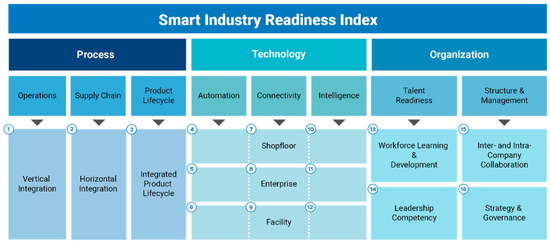
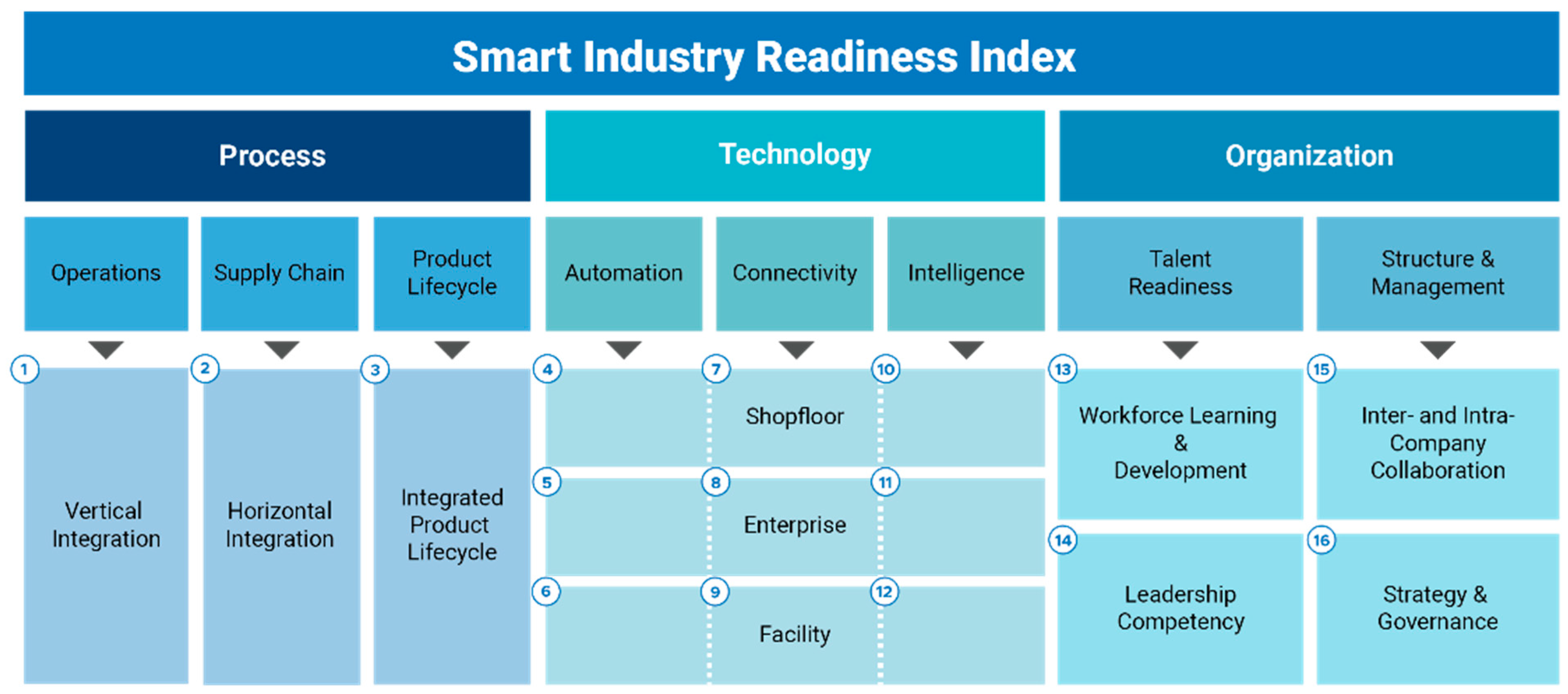
Having established SIRI as the most suitable regulatory framework, this section translates its structure into licensing criteria. For regulatory purposes, SIRI’s three building blocks, i.e., process, technology, and organization, serve as the organizing domains against which minimum requirements are specified. Each of the 16 dimensions is assessed using progressive maturity bands from 0 to 5, enabling clear threshold definition and auditability. A visual breakdown of SIRI is provided in Figure 1.
Figure 1.
Sixteen dimensions for SIRI assessment [23].
A Band 2 rating signifies that a factory has foundational digital systems and practices in place across all critical areas.
For example, a Band 2 SME factory would typically:
- Deploy PLCs and basic sensors on production equipment.
- Establish a simple but functional network infrastructure.
- Operate core business functions (inventory, sales, procurement) through an enterprise resource planning (ERP) system; and
- Begin structured workforce training in digital tools and data-driven workflows.
By requiring a minimum of Band 2 across all 16 SIRI dimensions, policymakers can ensure that every newly licensed SME factory has a minimum viable digital foundation. To capitalize on this opportunity, regulatory bodies should require Band 2 compliance as prerequisite for all new factory licenses, guiding SMEs toward digital maturity from the outset.
Although Band 2 does not guarantee global competitiveness, it offers a clear starting point from which factories can scale. Policymakers, SME owners, and industry partners must collaborate to encourage and support progression toward Bands 3 and 4 in future reassessments, driving continuous improvement aligned with business growth and technology advancements.
2.6. Accelerating Integration and ROI
Baseline digital maturity not only reduces long-term integration costs but also enables faster adoption of advanced technologies like predictive maintenance, collaborative robotics, or AI-based decision support. Studies indicate that firms with higher initial digital readiness realize faster returns on smart manufacturing investments [35]. In Saudi Arabia’s rapidly evolving industrial ecosystem, Band 2 readiness positions SMEs to participate effectively in regional and global supply chains [36]. This readiness directly supports national development strategies, as outlined in the next section.
2.7. Alignment with Vision 2030 Objectives
Mandating baseline digital maturity aligns directly with Saudi Arabia’s Vision 2030, which emphasizes innovation, productivity, and economic diversification. SMEs are central to this vision, both as job creators and as engines of industrial resilience. Ensuring that new factories launch with core digital capabilities advances several national goals simultaneously: workforce upskilling, technology adoption, and sustainability.
Furthermore, codifying a minimum SIRI Band 2 standard [23] in licensing regulations sends a strong signal to private investors and vendors. Regulators, industry leaders, and investors should consider institutionalizing this requirement to reduce uncertainty, create predictable expectations, and ensure that new factories are designed to evolve with the digital economy.
3. Proposed Minimum Requirements
The requirements specified in this section define minimum capability thresholds consistent with SIRI Band 2 maturity. They are not intended to prescribe specific vendors, architectures, or optimization strategies, but to establish a foundational level of digital readiness at the licensing stage. These baselines are scalable and designed to support progressive advancement toward higher maturity bands.
To operationalize this threshold for newly licensed SME factories, the section specifies minimum standards structured around the three pillars of the Smart Industry Readiness Index (SIRI): process, technology, and organization. Each pillar is articulated through selected dimensions reflecting Band 2 capability expectations. The objective is to ensure that new factories launch with a coherent and enforceable digital foundation that remains adaptable as firms evolve.
3.1. Process Requirements
Vertical Integration: New SME factories must implement digitally managed production workflow from the outset. This includes digital preparation and timely accessibility of work instructions, production schedules, and job orders on the shop floor. Operators should access and interact with this information through connected systems—such as ERP or MES platforms—using terminals, tablets, or other interfaces. The system must support two-way communication, allowing operators to receive digital work orders and submit status updates upon task completion. Basic training in the use of these tools is mandatory for all shopfloor personnel. Collectively, these elements enable a structured, paperless flow of operational data from planning to execution.
Horizontal Integration: New factories should also be designed to support structured digital collaboration with external stakeholders, including suppliers, customers, and logistics providers. Informal communication methods (e.g., phone calls or email) must be replaced by standardized digital tools, with the ERP system as the central hub for data exchange. Through the ERP, the factory must be capable of sending and receiving forecasts, purchase orders, delivery schedules, and inventory updates in a consistent and traceable format. Internally, key departments such as sales, procurement, and production planning must be integrated into the ERP’s workflow to ensure coordination. These requirements establish digital continuity across the value chain, enhancing visibility and responsiveness from day one.
Integrated Product Lifecycle: New SME factories must ensure that product designs, formulations, and quality control (QC) records are fully digitized, centrally stored, and accessible through integrated systems. CAD drawings, process sheets, and product specifications should be maintained in structured digital formats and retrievable via the ERP or a linked product lifecycle management (PLM) tool. QC data—such as inspection results and certificates of analysis—must be recorded electronically and linked to specific production batches. The ERP system must also support basic integration across design, production, and quality functions, so that changes in specifications are automatically reflected across all related documentation. This closed-loop digital workflow strengthens traceability, enforces version control, and enables timely corrective actions, forming the foundation of a lifecycle-oriented, quality-assured production environment.
3.2. Automation
Automation is a foundational requirement for establishing baseline digital operations. New SME factories must deploy automation-ready infrastructure across shop floor processes, enterprise workflows, and facility systems. While full integration with intelligent platforms may evolve over time, initial deployment must ensure interoperability, data traceability, and reduced reliance on manual input.
Shop Floor Automation: Production equipment must be Industry 4.0-ready—emphasizing automation capability, modular design, and future upgradability. Core manufacturing operations (e.g., molding, machining, assembly) should use machines with integrated control systems such as programmable logic controllers (PLCs) to ensure consistent and automated operation. All equipment must support basic digital interfacing for data exchange with ERP or MES platforms, even if full integration is deferred. Priority should be given to machinery with modular components and support for standard communication protocols (e.g., OPC UA, MQTT), enabling future expansion without wholesale replacement and allowing the factory to advance toward higher levels of automation over time.
Enterprise Automation: All factories must implement an ERP system as the central platform for managing core business functions, including procurement, inventory, sales, and finance [37]. These workflows must be digitally executed within the ERP environment, eliminating the use of paper forms, ad hoc emails, and standalone spreadsheets. Activities such as purchase requisitions, stock updates, and sales order processing must be conducted and tracked entirely through the ERP system. Consistent, cross-departmental use of the ERP enables timely business visibility, reduces administrative overhead, and improves operational accuracy through integrated decision-making.
Facility Automation: Supporting systems—such as HVAC, lighting, compressed air, and fire safety—must also be selected for automation compatibility and scalability. Equipment should support programmable control, sensor-driven triggers, and remote monitoring. Automated operation based on time schedules, occupancy, or environmental inputs must be possible from the outset. While a full building management system (BMS) is not required at Band 2, all facility technologies must be capable of integration into centralized dashboards or basic energy management platforms. This approach allows SMEs to incrementally enhance facility automation in line with evolving operational and sustainability goals.
3.3. Connectivity and Cybersecurity
Reliable, secure, and interoperable connectivity is a foundational requirement for Band 2 readiness. New SME factories must establish a digital infrastructure that enables stable machine-to-system communication, near-real-time monitoring, and secure data exchange across operational and enterprise domains. The emphasis at this stage is not on advanced automation, but on building a scalable backbone to support current visibility needs and future digital upgrades.
A hybrid connectivity architecture combining wired and wireless networking should be established to support both fixed and mobile factory assets. Infrastructure choices should prioritize reliability, interoperability, and scalability, without precluding future technological upgrades.
To enable interoperability, equipment should support widely adopted industrial communication standards to enable interoperability across systems, e.g., OPC UA and MQTT. The connectivity layer must facilitate IT/OT convergence by ensuring seamless data exchange between shopfloor systems and enterprise applications (e.g., ERP, MES, inventory tracking). Cloud and edge computing may be combined to support responsive data handling and basic analytics.
Expanding connectivity must be matched by equally robust protection of digital assets. Every step toward remote access or system integration introduces new attack surfaces that, if unprotected, can disrupt operations or compromise sensitive information. Cybersecurity risks are not limited to data theft—they can impact physical operations through machine failures or safety incidents. As threat actors increasingly target small and mid-sized manufacturers, cybersecurity should be treated as an integral component of operational risk management rather than as a discretionary overhead.
At Band 2, each SME factory must implement foundational protections, including firewalls, end-to-end encryption, and role-based access controls (RBAC). These measures serve as the first line of defense for networked systems and internal controls. In addition, basic network monitoring is essential. Even without advanced AI-based tools, SMEs should deploy anomaly detection to identify unauthorized access attempts or unusual traffic patterns—such as those indicative of malware, insider threats, or data exfiltration. Early detection reduces risk exposure and enhances operational continuity.
Together, these connectivity and security provisions ensure that SME factories achieve near-real-time operational visibility, enable structured data exchange, and guard against digital risks, forming a robust foundation for Industry 4.0 progression.
To bridge the gap between policy and implementation, Table 1 summarizes minimum infrastructure and integration requirements across four operational domains: shop floor, enterprise systems, facility operations, and general digital safeguards. It also provides illustrative examples of how these requirements can be implemented in practice using commercially available technologies and frameworks. The goal is to offer actionable guidance for SME planners, system integrators, and regulatory assessors. The implementation pathways presented are non-exhaustive; equivalent technical solutions that satisfy interoperability, security, and scalability principles are equally acceptable for compliance.
Table 1.
Category-based infrastructure requirements and implementation examples for SIRI Band 2 readiness.
3.4. Data and Intelligence
At Band 2, data utilization supports human-in-the-loop decision-making through structured monitoring, basic diagnostics, and visualized insights. Full AI-driven autonomy is not required at this stage; instead, SME factories should implement foundational systems that collect, organize, and present operational data to improve performance visibility and enable timely managerial decisions.
Key areas of application include efficiency monitoring, early fault detection, and data-informed maintenance. Factories should track metrics such as machine uptime, defect rates, energy consumption, and unplanned downtime through sensors integrated into shop floor systems. Operationally relevant dashboards and standardized reporting formats must be adopted to surface actionable trends without requiring advanced technical expertise. Tools may include commercial or open-source solutions that support visual analytics and alerting.
To ensure data interoperability and traceability, factories should adopt lightweight structuring practices aligned with ISA-95 standards [38], using standardized formats for production logs, downtime records, and quality data, to enable consistent reporting across systems. Historical trend analysis should also be supported to facilitate manual forecasting and continuous improvement.
Crucially, data capability also depends on workforce readiness. Operators and technicians must be trained to interpret dashboards, identify anomalies, and adjust processes based on timely signals. Management teams should leverage operational data to inform planning, allocate resource effectively, and drive performance optimization. Cross-functional collaboration between IT, OT, and production staff is essential to embed data fluency into daily decision-making processes.
By integrating structured data practices, visualization tools, and workforce training, Band 2 SME factories can build a scalable intelligence layer that supports responsive decision-making today while laying the foundation for advanced analytics and automation in future maturity stages.
3.5. Organizational Capabilities
Organizational readiness is essential for operationalizing digital infrastructure. SME factories must ensure that leadership, workforce, and collaborative structures are aligned with Band 2 expectations. This involves formal training programs, clear accountability for transformation, and embedded mechanisms for cross-functional coordination and governance.
Workforce development: During the design and setup phase, factories must establish a structured workforce training plan tailored to operational roles. Employees should be prepared to use digital tools, follow standardized procedures, and contribute to continuous improvement efforts. Training programs must include defined learning outcomes, documented participation records, and mechanisms for competency tracking (e.g., certificates, digital logs). These programs should be updated regularly and embedded in factory routines—not treated as one-time activities. Preparing staff early ensures that operations launch with a digitally fluent workforce.
Leadership engagement: Management personnel must be equipped to guide digital transformation from inception. This includes attending structured briefings or training sessions on Industry 4.0 concepts and implementation strategies. Leaders are responsible for setting digital priorities, monitoring progress, and aligning operational targets with transformation goals. Their active involvement signals commitment and ensures that digital readiness is not siloed within technical teams.
Internal and external collaboration: Factories must define processes for internal departmental coordination as well as engagement with external stakeholders. Internally, this includes establishing communication channels between production, maintenance, and quality teams, supported by digital tools for information exchange. Externally, the factory must adopt structured digital interfaces (e.g., supplier/customer portals, standardized reporting formats) for exchanging orders, forecasts, and quality data. Collaboration mechanisms should be in place prior to production to guarantee consistent communication and traceability throughout the value chain.
Digital strategy and governance: Each factory must develop a documented digital transformation strategy aligned to its scale and capabilities. This plan should outline clear objectives, timelines, and responsibilities across key areas—such as ERP deployment, shop floor automation, workforce enablement, and data connectivity. Governance mechanisms, such as quarterly performance reviews or digital readiness checkpoints, should be established to monitor implementation. Early integration of strategy and oversight ensures that digital transformation is intentional, progressive, and responsive to operational needs.
3.6. Feasibility and Proportionality Considerations
The minimum requirements outlined above are intended to establish foundational digital capability rather than advanced automation or optimization. Band 2 maturity does not require fully autonomous production systems, artificial intelligence deployment, or large-scale capital-intensive infrastructure. Instead, it focuses on structured digital workflows, basic interoperability, and operational visibility. This distinction is critical to maintaining proportionality for newly established SMEs.
Cost sensitivity is a defining characteristic of the SME sector. For this reason, the proposed baseline emphasizes modularity and scalability. Many of the required capabilities—such as ERP-based workflow management, basic sensor deployment, secure networking infrastructure, and structured training programs—can be implemented incrementally and expanded over time. The objective is not to mandate high-end technological sophistication at inception but to prevent structural digital deficits that would later necessitate costly retrofitting.
Administrative burden is also minimized by aligning requirements with systems that most SMEs must adopt regardless of regulatory intervention. For example, inventory tracking, financial reporting, procurement management, and safety monitoring are already essential operational functions. Embedding digital execution within these functions leverages existing managerial processes rather than creating parallel compliance structures.
Sectoral heterogeneity must likewise be acknowledged. The depth of automation appropriate for a food processing facility differs from that of a precision machining workshop. The Band 2 baseline therefore defines capability thresholds rather than prescriptive configurations. Regulatory assessment should focus on demonstrable digital functionality—such as traceable production records, interoperable data exchange, and secure connectivity—rather than specific equipment brands or architectural designs.
Finally, the feasibility of this approach is strengthened by its timing. Integrating foundational digital systems at the design stage of greenfield factories avoids many of the integration challenges associated with retrofitting legacy environments. By establishing digital readiness at inception, SMEs can reduce future transition costs while preserving flexibility to advance toward higher maturity bands as market conditions and organizational capabilities evolve.
Taken together, these considerations position the Band 2 threshold as a calibrated intervention: sufficiently robust to ensure meaningful digital readiness yet proportionate to the operational and financial realities of new SME factory development.
4. Key Challenges and Mitigation Strategies
Implementing mandatory Industry 4.0 standards will present real obstacles for many SMEs. Anticipating these challenges—and pairing mandates with targeted support—is essential for policy success. Below, we outline the five most pressing barriers and propose concrete mitigation strategies.
4.1. Challenge 1: Skilled Talent Scarcity
Many SMEs struggle to recruit and retain employees with specialized expertise in implementing and managing Industry 4.0 technologies [39], including knowledge in automation, data analytics, and industrial networking.
Mitigation strategies:
- Targeted training programs: Governments and industry stakeholders should invest in dedicated training initiatives for digital manufacturing and IT skills [40].
- Public–private partnerships: Collaborations between SMEs and vocational institutions will create a reliable talent pipeline [41].
- International knowledge transfer: Foreign experts can be engaged on a short-term basis to train local teams, accelerating internal capacity building [42].
- Upskilling existing staff: Internal training programs and certifications offer a cost-effective way to close skill gaps [43].
- Shared expertise models: SMEs can jointly hire external trainers or outsource specialized IT tasks, accessing high-level expertise without full-time hire cost [44].
4.2. Challenge 2: Upfront Investment Costs
The substantial upfront investment needed to adopt digital technologies continues to be a major barrier. Many SMEs, operating on thin margins, cannot easily finance automation hardware, software, or systems integration [39].
Mitigation strategies:
- Financial incentives: Governments can offer grants, tax credits, or subsidized loans tied to Industry 4.0 compliance [40].
- Starter kits and assessments: Public–private partnerships can deliver subsidized digital assessments or bundled technology kits tailored to SME needs [45].
- Modular implementation: SMEs can adopt scalable solutions that begin with core functions and expand gradually, reducing financial burden while preserving flexibility [46].
4.3. Challenge 3: Legacy Equipment and Integration
To reduce costs, many SMEs acquire used machinery from international markets. But these legacy systems often lack the interface needed for digital communication, complicating integration with new systems [33].
Mitigation strategies:
- Minimum standards for new machinery: Policies should mandate that all newly acquired equipment—whether new or used—meets basic Industry 4.0 readiness criteria, including digital I/O interfaces [41].
- Retrofit kits: SMEs can digitize legacy assets using retrofit kits that incorporate sensors and communication gateways [47].
- Vendor and technology guidance: Industry associations can maintain approved lists of compatible retrofit tools and vendor-certified solutions to minimize uncertainty [33].
4.4. Challenge 4: Cybersecurity and Data Privacy
As SMEs expand their digital footprint, they face growing vulnerability to cyberattacks. Many lack in-house expertise to implement robust cybersecurity systems [48].
Mitigation strategies:
- Basic cyber hygiene measures: SMEs should adopt secure network configurations, firewalls, encrypted communication, and employee training on cybersecurity practices [49].
- Simplified guidelines: Government agencies can issue SME-specific cybersecurity guidelines modeled on global frameworks such as NIST or ENISA [50,51].
- Mandatory audits and certifications: Security audits or compliance certifications can help SMEs identify vulnerabilities and ensure adherence to minimum protection standards [52].
4.5. Challenge 5: Cultural Resistance
Cultural resistance can significantly impede digital transformation as many SME owners and employees remain rooted in traditional practices, distrustful of new digital systems [42].
Mitigation strategies:
- Leadership development: Structured programs should equip SME leaders with transformation management tools while emphasizing strategic benefits of digitalization.
- Licensing requirements: Requiring digital leadership training as part of the business licensing process can ensure that owners are prepared to lead change [53].
Summary: These five challenges—talent scarcity, financial constraints, legacy infrastructure, cybersecurity gaps, and cultural resistance—can undermine even the most well-designed policy. However, by incorporating thoughtful mitigation strategies into policy design, Saudi Arabia can greatly facilitate Industry 4.0 readiness for its SME sector.
5. Implementation Approach
Enforcing the proposed minimum Industry 4.0 standards for newly licensed SME factories in Saudi Arabia requires a coordinated strategy combining regulatory mandates, enabling incentives, and structured engagement with industry partners. Similar policy-driven digitalization initiatives have been discussed in the literature as mechanisms for accelerating SME technology adoption through coordinated regulatory incentives, institutional support programs, and public–private collaboration frameworks [4,23,29]. This section outlines how compliance with SIRI Band 2 digital maturity can be institutionalized through a blend of policy levers and performance management tools.
5.1. Regulatory Enforcement
One key step is to embed digital readiness requirements directly into the factory licensing process. Regulators could require applicants to submit a digital readiness plan demonstrating how the proposed facility will achieve SIRI Band 2 maturity upon launch. This could involve an independent assessment, akin to how building code compliance is currently verified. To encourage compliance without delaying operations, conditional licenses could be issued with the expectation that identified deficiencies be resolved within a defined timeframe. Clear, measurable indicators—such as workflow digitization coverage, machine connectivity levels, ERP utilization across core functions, workforce digital training coverage, and documented cybersecurity controls—should guide inspections and reassessments. Codifying these expectations clearly signals that digital capability is now a baseline infrastructure requirement, on par with other foundational regulatory requirements.
For administrative clarity, compliance verification should be conducted by nationally accredited SIRI-certified assessors or by a designated digital-readiness unit within the licensing authority, operating under standardized scoring guidelines. A hybrid model combining third-party assessment with regulatory validation may provide both technical credibility and procedural accountability. Clear assignment of assessment responsibility is essential to ensure consistency, contestability, and transparency in licensing decisions.
When full Band 2 compliance is not demonstrated at the time of inspection, a structured remediation pathway should apply. Initial deficiencies may result in a conditional license, a documented corrective action plan, and a defined compliance window. Follow-up verification should occur within a specified timeframe. Persistent non-compliance may trigger graduated responses, including suspension of expansion permits, restrictions on public incentives, or, in severe cases, revocation of the operating license. A transparent escalation pathway maintains enforcement credibility while allowing reasonable flexibility during early implementation phases.
5.2. Financial and Non-Financial Incentives
To offset the upfront cost of compliance, the government can offer a mix of financial and non-financial incentives, potentially including tax credits for eligible technology investments, grants for digital infrastructure, and subsidized loans for SMEs committed to meeting the standards. Pilot programs could also offer low-cost or pro bono consultations to help SMEs develop implementation roadmaps. Non-financial support such as fast-tracked licensing approvals or public recognition for compliant factories can further boost adoption. Importantly, these incentives should be phased: generous in the initial rollout years, then gradually replaced by expectations of self-sustaining digital maturity.
5.3. Role of Industry Associations and Technology Providers
Effective implementation depends on coordinated partnerships with private-sector actors. Trade associations can play a key role by organizing awareness sessions, developing best-practice templates, and negotiating group discounts on certified equipment and software. Meanwhile, technology vendors could collaborate with the government to offer turnkey ‘starter’ solutions—such as pre-configured ERP bundles or modular automation kits—tailored to SME use cases. A national certification scheme for Industry 4.0 consultants would ensure SMEs have access to high-quality, vendor-neutral guidance throughout their transition.
5.4. Periodic Assessment and Continuous Improvement
Digital transformation should not be treated as a one-time compliance exercise. After achieving the Band 2 minimum, SMEs should be supported and incentivized to progress further. Periodic reassessments of digital maturity—potentially tied to export certification, financing, or quality audits—can keep factories on an upward trajectory.
Reassessment should be structured around high-level indicators aligned with SIRI dimensions, including workflow digitization coverage, integration depth across operational layers, training completion rates, cybersecurity posture, and documented use of operational data for decision-making. Government agencies can publish anonymized annual benchmarking reports to surface common challenges and adjust support policies accordingly. Over time, subject to sector readiness and policy evaluation, the minimum threshold may be progressively adjusted; today’s licensing standard (Band 2) could evolve into a best-practice target (Band 3) in selected areas. Embedding this learning cycle supports long-term resilience, adaptability, and global competitiveness within Saudi Arabia’s SME sector.
6. A Digital Readiness Package for SMEs
To operationalize the proposed Industry 4.0 standards and support SME compliance at the factory design stage, this section outlines a government-subsidized digital readiness package tailored to the needs of new manufacturing entrants in Saudi Arabia.
Designed for factory owners, supervisors, and technical leads, the package provides structured consultancy and training support across the three core pillars of digital transformation: organization, process, and technology. Each component is mapped to specific SIRI dimensions, aligning directly with the national maturity framework.
The objective is simple: reduce retrofit costs, accelerate implementation, and make digital readiness both achievable and practical for small and medium-sized manufacturers from day one.
Key Components of the Package
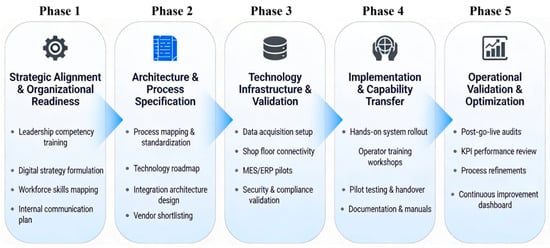
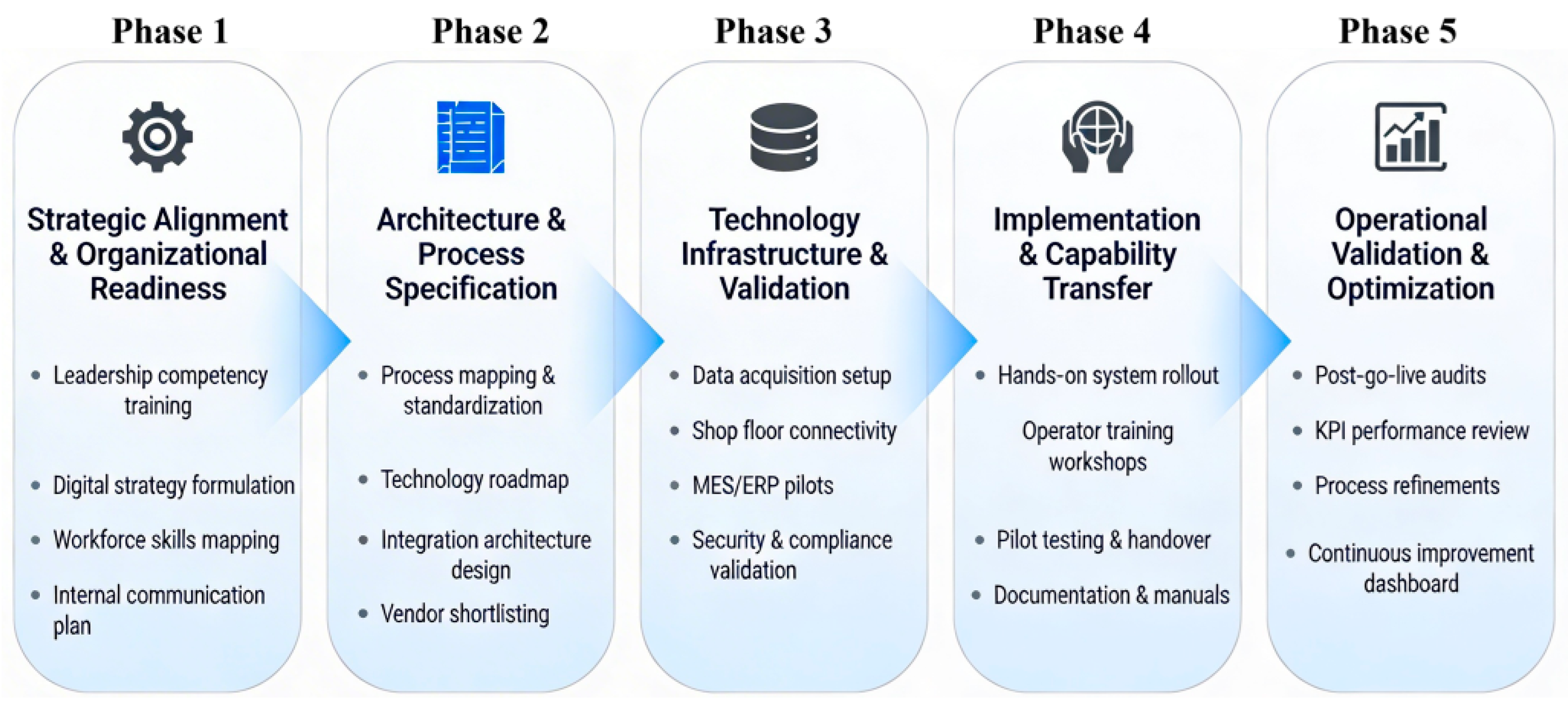
Below are the components of the package and phases of implementation, which are also illustrated in Figure 2.
Figure 2.
Consultancy Package implementation phases.
Phase 1: Strategic Alignment and Organizational Readiness
- Leadership Competency Training (Dimension 14): Workshops will deliver curated content on Industry 4.0 trends, change leadership, and real-world transformation case studies.
- Digital Strategy Formulation Support (Dimension 16): Consultants will guide factory teams in preparing a documented digital transformation strategy, complete with vision statements, KPIs, and governance templates. Leadership endorsement is required.
- Workforce Planning and Skills Mapping (Dimension 13): Teams will be guided on defining job roles according to operational requirements and technology use. Support includes developing competency matrices, identifying skills gaps, and aligning roles with available training pathways.
- Internal Communication Structures (Dimension 15): Practical tools will help formalize reporting lines, feedback loops, and cross-department coordination. Templates for internal bulletins, shift handover protocols, and digital communication channels will be provided.
Phase 2: Process Architecture & System Specification
- Process Definition and SOP Standardization (Dimensions 1–3): Support will include mapping production, supply chain, and development workflows. Consultants will assist in drafting SOPs that support partial digital execution and define Band 2 compliance in daily operations.
- IT System Selection Guidance: SMEs will be assisted in evaluating and selecting scalable systems appropriate to their size and complexity—such as ERP, MES, and SCM platforms. Selection criteria will emphasize modularity, integration readiness, cost-effectiveness, and training availability. Comparative checklists will be provided to simplify vendor decisions.
Phase 3: Technology Architecture & Infrastructure
- SMEs will receive structured support to identify and prioritize automation opportunities, particularly for repetitive or error-prone tasks. A practical automation-level selection tool, developed as a structured decision-support worksheet, guides this process through multi-criteria scoring, vendor evaluation, and cost–benefit analysis. Candidate shop-floor tasks are rated on a standardized 1–5 scale based on operational frequency, cost impact, safety, and task complexity, producing an aggregate priority score that highlights those with the highest automation potential. For top-ranked tasks, the tool facilitates a systematic assessment of available solutions (manual, semi-automated, or robotic) across technical compatibility, scalability, reliability, integration readiness, and lifecycle support. Simplified ROI and payback analyses compare vendor-specific investment costs with projected annual savings, providing evidence-based recommendations and phased adoption roadmaps.
- Connectivity Blueprint Development (Dimensions 7 & 8): Assistance will be provided to establish foundational IT/OT connectivity. Support includes guidance on SCADA-to-ERP interface and vendor-neutral selection of routers, sensors, and gateways supporting OPC UA or MQTT protocols.
- Shop Floor Intelligence Setup (Dimension 10): SMEs will be advised on deploying sensors and dashboards to capture near-real-time production data. Guidance includes defining KPIs (e.g., uptime, scrap rates), selecting OEE tools, and using data for shop floor optimization.
- Enterprise Intelligence Planning (Dimension 11): Practical recommendations will address the aggregation and visualization of business metrics, including procurement, labor, and sales performance. Entry-level BI platforms (e.g., Power BI, Tableau Public) and ERP integrations will be suggested.
- Facility Intelligence and Sustainability Tools (Dimension 12): SMEs will receive support in deploying energy and environment monitors, including the tracking of machine-level energy usage, detection of anomalies (e.g., HVAC overuse), and selection of scalable energy management systems (EMS).
Phase 4: Implementation and Capability Transfer
- Hands-on execution of Phases 1–3 deliverables, including system rollouts, customized operator training, and knowledge transfer workshops. Consultants facilitate pilot testing, vendor coordination, and documentation handover, empowering SME teams with operational manuals, troubleshooting guides, and self-sustaining maintenance protocols to ensure long-term independence.
Phase 5: Operational Validation and Optimization
- Post-go-live audits to validate system performance against SIRI Band 2 KPIs (e.g., OEE, uptime, integration readiness). Iterative process refinements, root-cause analysis of deviations, and targeted optimizations, supported by data-driven dashboards, enable continuous improvement and full compliance sustainment.
To assist SME stakeholders in translating these components into actionable steps, Table 2 below consolidates key digital functions and tools aligned with Band 2 requirements. Each item is mapped to relevant SIRI dimensions, establishing a clear reference point for implementation and compliance.
Table 2.
Key digital functions supporting SIRI Band 2 compliance in SME factories.
7. Conclusions
Embedding foundational Industry 4.0 capabilities in newly licensed SME factories is increasingly critical to Saudi Arabia’s industrial competitiveness, productivity, and long-term economic resilience. Introducing a minimum SIRI Band 2 maturity threshold at the licensing stage establishes a shared digital baseline featuring automation-ready infrastructure, interoperable systems, connected processes, and a digitally capable workforce. By integrating digital readiness at the design stage rather than treating transformation as a retrofit, the proposed framework aims to reduce long-term integration costs and enable scalable growth through structured regulatory oversight and targeted support mechanisms.
This study advances a conceptual policy-design framework rather than reporting primary empirical validation. The proposed Band 2 licensing baseline has not yet been tested through pilot implementation, and no formal cost–benefit modeling has been conducted to quantify compliance costs or long-term productivity gains. Moreover, while grounded in internationally recognized maturity models, the framework is tailored to Saudi Arabia’s institutional and industrial context and may require adaptation in other regulatory environments.
Future research should evaluate pilot implementations using longitudinal or quasi-experimental designs, conduct formal cost–benefit analysis, and explore sector-specific adaptations across manufacturing domains. Comparative cross-country analysis may further clarify how maturity-based licensing frameworks operate under different institutional conditions, while evolving manufacturing paradigms may warrant gradual alignment with sustainability, resilience, and human-centric principles associated with emerging Industry 5.0 concepts [54].
Author Contributions
Conceptualization, K.H.A. and A.-E.M.T.; methodology, K.H.A.; investigation, K.H.A.; formal analysis, K.H.A.; resources, K.H.A. and A.-E.M.T.; data curation, K.H.A. and A.-E.M.T.; visualization, K.H.A.; writing—original draft preparation, K.H.A. and A.-E.M.T.; writing—review and editing, K.H.A. and A.-E.M.T. All authors have read and agreed to the published version of the manuscript.
Funding
This research received no external funding. The Article Processing Charge (APC) was funded by Alfaisal University.
Institutional Review Board Statement
Not applicable.
Informed Consent Statement
Not applicable.
Data Availability Statement
The data presented in this study are derived from publicly available sources cited in the manuscript, including reports, frameworks, and the relevant literature.
Acknowledgments
The authors acknowledge the support of Alfaisal University.
Conflicts of Interest
The authors declare no conflicts of interest.
References
- Vision 2030. Overview. Available online: https://www.vision2030.gov.sa/en/overview (accessed on 18 March 2026).
- Saudi Press Agency. Industry Minister: SMEs Account for 90% of the Industrial Sector. 16 September 2024. Available online: https://www.spa.gov.sa/en/N2172081 (accessed on 18 March 2026).
- World Economic Forum. Small Business, Big Problem. 2022. Available online: https://www.weforum.org/press/2022/12/small-business-big-problem-new-report-says-67-of-smes-worldwide-are-fighting-for-survival/ (accessed on 18 March 2026).
- OECD. OECD SME and Entrepreneurship Outlook 2021; OECD Publishing: Paris, France, 2021. [Google Scholar]
- Faiz, F.; Le, V.; Masli, E.K. Determinants of digital technology adoption in innovative SMEs. J. Innov. Knowl. 2024, 9, 100610. [Google Scholar] [CrossRef] [Scilit]
- Kallmuenzer, A.; Mikhaylov, A.; Chelaru, M.; Czakon, W. Adoption and performance outcome of digitalization in small and medium-sized enterprises. Rev. Manag. Sci. 2025, 19, 2011–2038. [Google Scholar] [CrossRef] [Scilit]
- Zhao, W.; Chen, H.; Bulis, A. How are Industry 4.0 technologies transforming a sustainable society across industries? Digit. Transform. Soc. 2025, 4, 363–380. [Google Scholar] [CrossRef] [Scilit]
- Holmes, N.; Katavich, L.; Xu, X. Retrofitting legacy systems for industry 4.0 via OPC UA and distributed control. Manuf. Lett. 2025, 44, 1337–1348. [Google Scholar] [CrossRef] [Scilit]
- Ruppert, T.; Darányi, A.; Medvegy, T.; Csereklei, D.; Abonyi, J. Demonstration laboratory of industry 4.0 retrofitting and operator 4.0 solutions: Education towards industry 5.0. Sensors 2022, 23, 283. [Google Scholar] [CrossRef] [Scilit]
- García, Á.; Bregon, A.; Martínez-Prieto, M.A. A non-intrusive Industry 4.0 retrofitting approach for collaborative maintenance in traditional manufacturing. Comput. Ind. Eng. 2022, 164, 107896. [Google Scholar] [CrossRef] [Scilit]
- Di Carlo, F.; Mazzuto, G.; Bevilacqua, M.; Ciarapica, F.E. Retrofitting a process plant in an industry 4.0 perspective for improving safety and maintenance performance. Sustainability 2021, 13, 646. [Google Scholar] [CrossRef] [Scilit]
- Tran, T.A.; Ruppert, T.; Eigner, G.; Abonyi, J. Retrofitting-based development of brownfield industry 4.0 and industry 5.0 solutions. IEEE Access 2022, 10, 64348–64374. [Google Scholar] [CrossRef] [Scilit]
- Anumbe, N.; Saidy, C.; Harik, R. A primer on the factories of the future. Sensors 2022, 22, 5834. [Google Scholar] [CrossRef] [Scilit]
- Petschnigg, C.; Spitzner, M.; Weitzendorf, L.; Pilz, J. From a point cloud to a simulation model—Bayesian segmentation and entropy based uncertainty estimation for 3D modelling. Entropy 2021, 23, 301. [Google Scholar] [CrossRef] [Scilit]
- Arab News. Saudi Arabia Sees 60% Surge in Number of Factories Since Launch of Vision 2030. Arab News, 17 October 2023. Available online: https://www.arabnews.com/node/2569152/business-economy (accessed on 18 March 2026).
- Arab News. Saudi Arabia to Build 36,000 Factories by 2035 in Bid to Become Global Industrial Hub. Arab News, 21 December 2023. Available online: https://www.arabnews.com/node/2596285/amp (accessed on 18 March 2026).
- Masood, T.; Sonntag, P. Industry 4.0: Adoption challenges and benefits for SMEs. Comput. Ind. 2020, 121, 103261. [Google Scholar] [CrossRef] [Scilit]
- World Bank Group. Industry 4.0 Readiness in Developing Countries; World Bank: Washington, DC, USA, 2021. [Google Scholar]
- Basile, V.; Tregua, M.; Giacalone, M. A three-level view of readiness models: Statistical and managerial insights on industry 4.0. Technol. Soc. 2024, 77, 102528. [Google Scholar] [CrossRef] [Scilit]
- ZVEI–German Electrical and Electronic Manufacturers’ Association. Reference Architectural Model Industrie 4.0 (RAMI 4.0); Status Report; ZVEI–German Electrical and Electronic Manufacturers’ Association: Frankfurt, Germany, 2015. [Google Scholar]
- IMPULS–VDMA, Industrie 4.0 Readiness, 2015. Available online: https://www.industrie40-readiness.de/ (accessed on 18 March 2026).
- Ünlü, H.; Demirörs, O.; Garousi, V. Readiness and maturity models for Industry 4.0: A systematic literature review. J. Softw. Evol. Process 2024, 36, e2641. [Google Scholar] [CrossRef] [Scilit]
- International Centre for Industrial Transformation (INCIT). The Global Smart Industry Readiness Index (SIRI) Initiative: Manufacturing Transformation Insight Report 2025; INCIT: Singapore, 2025; Available online: https://assets.incit.org/large-documents/manual/The_global_smart_industry_readiness_index_initiative_2025-manual.pdf (accessed on 28 February 2026).
- Lin, W.D.; Low, M.Y.H.; Chong, Y.T.; Teo, C.L. Application of SIRI for industry 4.0 maturity assessment and analysis. In Proceedings of the 2019 IEEE International Conference on Industrial Engineering and Engineering Management (IEEM), Bangkok, Thailand, 15–18 December 2019; IEEE: Piscataway, NJ, USA, 2019; pp. 1450–1454. [Google Scholar]
- Hizam-Hanafiah, M.; Soomro, M.A.; Abdullah, N.L. Industry 4.0 readiness models: A systematic literature review of model dimensions. Information 2020, 11, 364. [Google Scholar] [CrossRef] [Scilit]
- Chonsawat, N.; Sopadang, A. Defining SMEs’ 4.0 readiness indicators. Appl. Sci. 2020, 10, 8998. [Google Scholar] [CrossRef] [Scilit]
- Amaral, A.; Peças, P. A framework for assessing manufacturing SMEs Industry 4.0 maturity. Appl. Sci. 2021, 11, 6127. [Google Scholar] [CrossRef] [Scilit]
- Alqoud, A.; Schaefer, D.; Milisavljevic-Syed, J. Industry 4.0: A systematic review of legacy manufacturing system digital retrofitting. Manuf. Rev. 2022, 9, 32. [Google Scholar] [CrossRef] [Scilit]
- OECD. Going Digital: The Integrated Policy Framework; OECD Publishing: Paris, France, 2020. [Google Scholar]
- OECD. The OECD Going Digital Measurement Roadmap; OECD Publishing: Paris, France, 2022. [Google Scholar]
- KOBOLD USA. How Industry 4.0 Enhances Productivity and Quality. Available online: https://koboldusa.com/articles/industry-news/how-industry-4-enhances-productivity-and-quality/ (accessed on 18 March 2026).
- Zambetti, M.; Khan, M.A.; Pinto, R.; Wuest, T. Enabling servitization by retrofitting legacy equipment. Procedia Manuf. 2020, 48, 1047–1053. [Google Scholar] [CrossRef] [Scilit]
- Givehchi, O.; Landsdorf, K.; Simoens, P.; Colombo, A.W. Interoperability for industrial cyber-physical systems: An approach for legacy systems. IEEE Trans. Ind. Inform. 2017, 13, 3370–3378. [Google Scholar] [CrossRef] [Scilit]
- PwC. Digital Factory Transformation Survey 2022; PwC: London, UK, 2022. [Google Scholar]
- Hokmabadi, H.; Rezvani, S.M.H.S.; de Matos, C.A. Business resilience for small and medium enterprises and startups by digital transformation. Systems 2024, 12, 220. [Google Scholar] [CrossRef] [Scilit]
- Tripathi, A.; Singh, A. SMEs awareness and preparation for digital transformation. Sustainability 2024, 16, 3831. [Google Scholar] [CrossRef] [Scilit]
- Gessa, A.; Jiménez, A.; Sancha, P. Exploring ERP systems adoption in challenging times: Insights of SMEs stories. Technol. Forecast. Soc. Change 2023, 195, 122804. [Google Scholar] [CrossRef] [Scilit]
- ANSI/ISA-95.00.01-2025 (IEC 62264-1 Mod); Enterprise-Control System Integration—Part 1: Models and Terminology. International Society of Automation: Research Triangle Park, NC, USA, 2025.
- Alkhodair, M.; Alkhudhayr, H. Harnessing Industry 4.0 for SMEs: Advancing smart manufacturing and logistics for sustainable supply chains. Sustainability 2025, 17, 813. [Google Scholar] [CrossRef] [Scilit]
- Kumar, S.P.; Raut, R.D.; Aktas, E.; Narkhede, B.; Gedam, V. Barriers to adoption of Industry 4.0 and sustainability. Int. J. Prod. Res. 2022, 60, 1–17. [Google Scholar]
- Singh, R.; SinghGaur, T.; Yadav, V.; Siddh, M.M. Modeling mitigation strategies for Industry 4.0 adoption. In Proceedings of the 15th International Conference on Computing Communication and Networking Technologies (ICCCNT), Kamand, India, 24–28 June 2024; pp. 1–6. [Google Scholar]
- Omrani, N.; Rejeb, N.; Maalaoui, A.; Dabić, M.; Kraus, S. Drivers of digital transformation in SMEs. IEEE Trans. Eng. Manag. 2022, 71, 5030–5043. [Google Scholar] [CrossRef] [Scilit]
- Krismajayanti, N.P.A.; Darma, G.; Mahyuni, L.P.; Martini, I.A.O. Drivers, barriers and key success of digital transformation on SMEs. J. Account. Strateg. Finance 2024, 7, 158–180. [Google Scholar] [CrossRef] [Scilit]
- Buraiki, A.A.; Khan, F.R. Finance and technology: Key challenges faced by small and medium enterprises (SMEs) in Oman. Int. J. Manag. Innov. Entrep. Res. 2018, 4, 2395–7662. [Google Scholar] [CrossRef] [Scilit]
- Fanelli, R.M. Barriers to adopting new technologies within rural small and medium enterprises (SMEs). Soc. Sci. 2021, 10, 430. [Google Scholar] [CrossRef] [Scilit]
- Johnson, E.; Lande, O.B.S.; Adeleke, G.S.; Amajuoyi, C.P.; Simpson, B.D. Developing scalable data solutions for SMEs. Int. J. Manag. Entrep. Res. 2024, 6, 1910–1935. [Google Scholar] [CrossRef] [Scilit]
- Trstenjak, M.; Opetuk, T.; Cajner, H.; Tošanović, N. Process planning in Industry 4.0. Sustainability 2020, 12, 5878. [Google Scholar] [CrossRef] [Scilit]
- Alahmari, A.; Duncan, B. Cybersecurity risk management in small and medium-sized enterprises: A systematic review of recent evidence. In Proceedings of the 2020 International Conference on Cyber Situational Awareness, Data Analytics and Assessment (CyberSA), Dublin, Ireland, 15–19 June 2020; pp. 1–5. [Google Scholar]
- Erdogan, G.; Halvorsrud, R.; Boletsis, C.; Tverdal, S.; Pickering, J.B. Cybersecurity awareness and capacities of SMEs. In Proceedings of the 9th International Conference on Information Systems Security and Privacy (ICISSP), Lisbon, Portugal, 22–24 February 2023; SciTePress: Setúbal, Portugal, 2023; pp. 296–304. [Google Scholar]
- Alharbi, F.D.; Alsulami, M.H.; Al-Solami, A.; Al-Otaibi, Y.; Al-Osimi, M.; Al-Qanor, F.; Al-Otaibi, K. The impact of cybersecurity practices on cyberattack damage: The perspective of small enterprises in Saudi Arabia. Sensors 2021, 21, 6901. [Google Scholar] [CrossRef] [Scilit] [PubMed]
- European Union Agency for Cybersecurity (ENISA). Good Practices for Security of Internet of Things in the Context of Smart Manufacturing; ENISA: Athens, Greece, 2020. [Google Scholar]
- Bamidele, L.; Benjamin, L.B.; Adegbola, A.; Amajuoyi, P.; Adegbola, M.D.; Adeusi, K.B. Digital transformation in SMEs: Identifying cybersecurity risks and developing effective mitigation strategies. Glob. J. Eng. Technol. Adv. 2024, 19, 84–95. [Google Scholar] [CrossRef] [Scilit]
- Casalino, N.; Żuchowski, I.; Labrinos, N.; Nieto, Á.L.M.; Martín, J.A. Digital strategies and organizational performances of SMEs in the age of Coronavirus. SSRN 2019, 8, 347–380. [Google Scholar]
- Sariisik, G.; Demir, S. Industry 5.0: A human-centric paradigm for sustainable and resilient industrial transformation. J. Soc. Perspect. Stud. 2025, 2, 50–66. [Google Scholar]

Disclaimer/Publisher’s Note: The statements, opinions and data contained in all publications are solely those of the individual author(s) and contributor(s) and not of MDPI and/or the editor(s). MDPI and/or the editor(s) disclaim responsibility for any injury to people or property resulting from any ideas, methods, instructions or products referred to in the content. |
© 2026 by the authors. Licensee MDPI, Basel, Switzerland. This article is an open access article distributed under the terms and conditions of the Creative Commons Attribution (CC BY) license.