


Abstract
In the past five years, China has continuously strengthened its policy support for the development of new-type agricultural business entities. However, the implementation of these policies has faced various complexities, and the specific effectiveness of such support remains unclear. Additionally, many aspects of rural support policies need improvement. This study, based on survey data from 1349 rural households in Shandong Province, a major agricultural region in China, employs Pareto analysis and a multinomial ordered Probit model to examine the effectiveness and influencing factors of policies supporting new-type agricultural business entities. The results show the following: (1) the overall satisfaction of farmers with the support policies falls between “neutral” and “relatively satisfied,” with a mean score of 3.69; (2) factors such as the ease of obtaining financial support, the amount of government subsidies, policy awareness, evaluations of tax policies, and land use regulations have a positive influence on satisfaction with the support policies. Based on these findings, we recommend innovating fiscal and tax subsidy mechanisms and strengthening the dissemination and publicity of agricultural support policies to ensure their effective and orderly implementation. Additionally, it is essential to improve land use regulation policies and rural property rights trading mechanisms to promote the rational allocation of resources, enhance policy-oriented agricultural insurance to fully harness its income-enhancing effects for agricultural producers, thereby ensuring the long-term stability and sustainable development of the policy support system for new-type agricultural business entities.
1. Introduction
With the transformation of agricultural production in China, new-type agricultural business entities characterized by scale and intensification have developed rapidly. These entities have improved agricultural productivity and contributed to the supply-side structural reform and modernization of China’s agriculture [1,2]. The development of new-type agricultural business entities has become an important response to the transformation of China’s agricultural sector. Their growth requires targeted support through a range of agricultural policies. This policy orientation is closely related to the government’s increasing focus on the “three rural issues,” namely agriculture, rural areas, and farmers. In May 2017, the General Office of the State Council issued the Opinions on Accelerating the Construction of a Policy System to Foster New-Type Agricultural Business Entities, aiming to establish a comprehensive policy support system for these entities. The policy seeks to guide agricultural operators to expand their operational scale, enhance agricultural competitiveness and sustainability, and promote the supply-side structural reform of agriculture in China. Subsequently, several policy documents were introduced, including the Guidelines for Implementing the Family Farm Cultivation Plan and the High-Quality Development Plan for New-Type Agricultural Business Entities and Service Entities (2020–2022), which further accelerated the development of these entities. More recently, local governments have continued to refine relevant policies. For example, in 2025 the Heilongjiang Provincial Government issued the Implementation Opinions on Accelerating the Construction of a Policy System to Foster New-Type Agricultural Business Entities, further clarifying the policy direction and support measures for their development.
The High-Quality Development Plan for New-Type Agricultural Business Entities and Service Entities (2020–2022) (Document No. Nong Zheng Gai Fa [2020] No. 2) specifies that new-type agricultural business entities include family farms, farmers’ cooperatives, and agricultural socialized service organizations. These entities are generally characterized by relatively large operational scales, intensive and mechanized production, specialized management by skilled operators, strong market orientation, and an emphasis on sustainability and demonstration effects for smallholder farmers.
According to recent Chinese policy frameworks, including the Central Document No. 1 and guidelines issued by the Ministry of Agriculture and Rural Affairs, subsidy allocation follows clear eligibility criteria that vary by subsidy type and region. In general, applicants must meet requirements such as formal registration, minimum operational scale, normal operating status, compliance with green production standards, and approval through county-level agricultural authorities.
These institutional arrangements provide the policy context for analyzing how agricultural subsidies influence the development of new-type agricultural business entities. Policy documents, including the 2022 Notice on Implementing the Action Plan for Upgrading New-Type Agricultural Business Entities, consistently identify family farms, farmers’ cooperatives, leading agricultural enterprises, and agricultural service organizations as the core components of these entities. These policies emphasize their characteristics of scale, specialization, intensification, and market orientation, as well as their role in supporting and guiding smallholder farmers.
In 2020, the central government allocated 2.3 billion yuan to cultivate and develop high-quality farmers, who have become the backbone of new-type agricultural business entities and remain active in agricultural production and operations. Furthermore, during the 13th Five-Year Plan period, a comprehensive agricultural risk protection mechanism was established, providing agricultural risk protection for 802 million households, amounting to 12.2 trillion yuan. As of June 2022, policy-based agricultural credit guarantee institutions had accumulated a guarantee amount of 558.6 billion yuan, as documented by the National Agricultural Credit Guarantee Alliance Ltd. The national agricultural credit guarantee system, established to address the issues of difficulty in financing and the high cost of financing in the agricultural sector, has effectively played the role of a financial amplifier [3,4], easing the financing needs of new-type agricultural business entities. A series of support policies aimed at fostering new-type agricultural business entities have been progressively implemented, enabling various agricultural business entities to become the cornerstone of modern agricultural development.
Although China has achieved significant progress in cultivating new-type agricultural business entities, a series of issues, such as insufficient and unbalanced development, still persist [5]. Support policies such as fiscal, taxation, finance, and land use services are also insufficiently specific, and the capacity of local grassroots departments to provide guidance and services needs to be improved. The reasons for this are twofold: On one hand, the inherent vulnerability of agriculture and the underdeveloped rural environment have not been fundamentally transformed, resulting in the suboptimal effectiveness of policy support. On the other hand, the policy support system under the goal of fostering new-type agricultural business entities is still incomplete, and there is insufficient attention to the actual needs and development trends of these entities. As a result, many policies lack systematization and targeting, which objectively affects the realization of expected outcomes. Therefore, there is an urgent need to reform the current agricultural support policies by improving the policy framework, clarifying key areas, and strengthening the supporting mechanisms. This will facilitate the effective alignment and positive interaction between agricultural support policies and the cultivation and development of new-type agricultural business entities [6], thereby better promoting their growth and advancing the high-quality development of modern agriculture in China.
With the continuous strengthening of agricultural support policies in China, it is increasingly important to evaluate whether these policies effectively promote the sustainable development of new-type agricultural business entities. Existing studies have largely focused on macro-level policy performance, while limited attention has been paid to farmers’ subjective evaluations and the micro-level mechanisms shaping policy effectiveness. Based on survey data from 1349 rural households and employing Pareto analysis and a multinomial ordered Probit model, this study provides micro-level empirical evidence on the effectiveness and determinants of policy satisfaction.
By examining policy implementation from the perspective of farmers, this research contributes to improving fiscal and taxation mechanisms, enhancing policy awareness, optimizing land use regulation, and strengthening institutional governance. Such efforts are essential for promoting efficient resource allocation, increasing income stability, and ensuring the long-term resilience and sustainable development of the modern agricultural support system.
In the context of policy support for new-type agricultural business entities in China, it is crucial to investigate the effectiveness and influencing factors of such support. This study aims to address several key research questions: First, to what extent does policy support for new-type agricultural business entities enhance farmer satisfaction? Second, what factors significantly influence farmers’ satisfaction with policy support? Lastly, in what ways do current rural support policies need improvement to enhance the sustainable development of new-type agricultural business entities? By answering these questions, this research seeks to provide valuable insights for policymakers, thereby promoting the sustainable development of new-type agricultural business entities.
2. Theoretical Framework and Hypotheses Development
2.1. Literature Review
Many scholars have pointed out that although the overall development of new-type agricultural business entities in China is currently on a positive trajectory, they are still in the early stages of development, and their role as leaders and models has yet to be fully realized [7]. Domestic scholars often evaluate the support policies for new-type agricultural business entities from a single perspective. In terms of agricultural subsidy policies, they have long been regarded as important tools for increasing farmers’ income and ensuring food security. However, the effectiveness of these policies during implementation often lacks focus and efficacy. This is primarily due to the fact that most agricultural support funds have been allocated to traditional farmers and rural infrastructure construction, with insufficient special funding support and tax incentives [8,9]; Similarly, the current agricultural fiscal subsidy policies also face significant structural imbalances between supply and demand [10]. In terms of mechanization support policies, as agricultural mechanization progresses to more advanced stages, these policies face issues such as insufficient and unbalanced development [11]. In addition, issues related to agricultural facility land use are also constraints limiting the scaled development of agricultural business entities [12]. Field investigations reveal that, in practice, there are issues such as deviations in policy implementation goals, gaps between policy standards and actual needs, and a lack of accountability in grassroots supervision [13].
With the continuous increase in agricultural support efforts and the improvement of the support system, some scholars have begun to explore the cultivation and support of new-type agricultural business entities from the perspective of policy coordination and implementation. For example, Tan Wei took the Two Major Plains of Heilongjiang Province, a typical demonstration area for the development of modern agriculture in China, as a case study to discuss the crucial role of coordinating financial and fiscal policies in providing effective financial support to new-type agricultural business entities. This coordination has played a key role in driving agricultural quality improvement, increasing efficiency, and boosting farmers’ income [14]. Meng Junjie and others, through field investigations, found that agricultural credit guarantee policies have become the most urgent need for new-type agricultural business entities in terms of fiscal support policies, while tax reduction policies are at the bottom of the priority list [15]. Wu Zhiqiang believes that although new-type agricultural business entities still have many shortcomings and deficiencies at this stage, these are merely external manifestations of immaturity. It is necessary to adopt multiple measures, such as expanding the scale of operations, standardizing land transfers, and strengthening financial support, to promote their effective development [16]. Previous studies indicate that, from the perspective of policy impact on new-type agricultural business entities, factors such as fiscal funds, land transfers, and talent recruitment play a key role in the cultivation of these entities [17]. Based on NVivo software 14, Lin Bing examines financial support policies for new agricultural business entities from 2013 to 2023. The study finds that although China’s credit support system has taken shape, policy instruments remain weak and improperly applied [18]. Wang Xiaoqi integrates the theories of technological diffusion and policy instruments to systematically analyze the driving mechanisms and practical challenges of cultivated land quality protection behaviors among new agricultural business entities in Liaoning Province [19]. Peng Qingxiu finds that financing for new agricultural business entities in Henan Province is constrained by credit risks such as information asymmetry, low managerial capacity of agricultural enterprises, and an underdeveloped agricultural credit system. These institutional factors fundamentally limit their access to financial support [20]. Liu Gang analyzes the gaps between agricultural business entities’ financing needs and financial institutions’ service supply, providing policy recommendations to strengthen agricultural financial support and interdepartmental coordination [21]. In addition, many scholars have discussed the existing support policies for the cultivation of new-type agricultural business entities from different research perspectives and have proposed a series of practical policy recommendations. While external institutional interventions are a common practice in developed countries for fostering new-type agricultural business entities, for instance, the OECD regularly publishes the Agricultural Policy Monitoring and Evaluation Report, which analyzes the trends and support measures of agricultural policies in its member countries. The report highlights that many developed countries promote the scaling up and modernization of agricultural business entities through policies such as fiscal subsidies, tax incentives, and credit support. The key issue currently faced by China is how to implement targeted preferential policies for different business entities and agricultural industries in order to enhance the overall effectiveness of support [22]. In this regard, during the policy implementation process, corresponding support measures should be applied to different agricultural industries and production stages [7]. At the same time, efforts should be made to strengthen and ensure the steady and effective implementation of policy support and subsidy measures [17]. Finally, any policy inevitably undergoes a process of evolution and self-improvement. In the development of modern agriculture, it is also crucial to break through institutional mismatches at the policy level and achieve effective alignment and positive interaction between supply and demand [23].
The new fiscal policy for supporting agriculture, which effectively connects agricultural production activities with financial institutions, aligns with China’s historical transition from a traditional smallholder economy to modern agriculture [24]. Policy-oriented agricultural guarantees embed government credit into agricultural financing relationships, requiring a balance between policy objectives and sustainability during implementation [25]. This mechanism must operate with both market-oriented management and policy-oriented positioning [26], which necessitates the design of a rational and effective system of checks and balances to ensure that any potential distortions remain within controllable limits [27]. Developing differentiated agricultural credit policies and reducing financial exclusion are key to advancing agricultural guarantee systems [28]. Previous studies employed Data Envelopment Analysis (DEA) to conduct empirical studies on the allocation efficiency of policy-oriented agricultural credit guarantee funds [29,30,31].
Overall, Chinese scholars generally approach the study of support policies for the cultivation of new-type agricultural business entities from various research perspectives, yielding substantial results. However, evaluating the effectiveness of these support policies should consider multiple factors, such as fiscal funds, agricultural insurance, and agricultural land policies, rather than solely assessing the entire support system from a single policy perspective. Research on multi-dimensional policy evaluation still requires further investigation. Furthermore, most studies primarily rely on qualitative analysis, often lacking theoretical credibility. Therefore, this paper aims to comprehensively evaluate the effectiveness of the support policies for new-type agricultural business entities from the perspective of farmers’ satisfaction with policy implementation. It will also attempt to analyze the influencing factors, with the goal of improving the agricultural support policy system and fostering the development of moderately scaled agricultural business entities.
2.2. Theoretical Framework
The theory of asymmetric information was proposed by G. Akerlof in the 1970s [32]. It emphasizes that sellers possess more information about the products than buyers, allowing the more informed party to exploit this advantage for profit. In the credit market, borrowers have a better understanding of their financial status and risks than lenders, leading to adverse selection and moral hazard, which affect the financing capabilities of new-type agricultural business entities. High-risk borrowers tend to seek loans, while low-risk borrowers are pushed out of the market, resulting in financial institutions raising interest rates, further exacerbating financing difficulties. This theory provides an important perspective for analyzing credit demand issues.
2.3. Research Hypotheses
Building on established theoretical and empirical research on policy evaluation and stakeholder behavior, which emphasizes the role of structural, institutional, and individual determinants in shaping evaluation outcomes, the following hypotheses are proposed:
H1:
Policy-related factors significantly influence the evaluation of cultivation and support policies for new agricultural business entities.
H2:
Economic and institutional factors significantly affect policy evaluation.
H3:
Individual characteristics significantly impact policy evaluation.
These hypotheses are theoretically grounded in the existing literature, which suggests that policy design, institutional context, and individual attributes systematically influence stakeholders’ ordered evaluations.
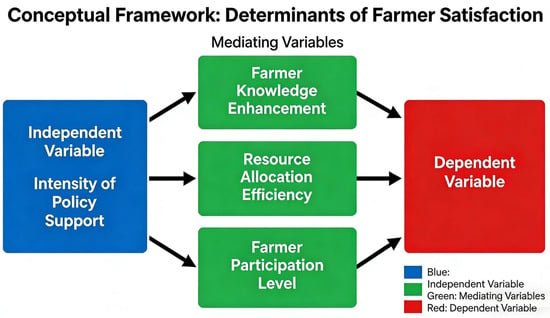
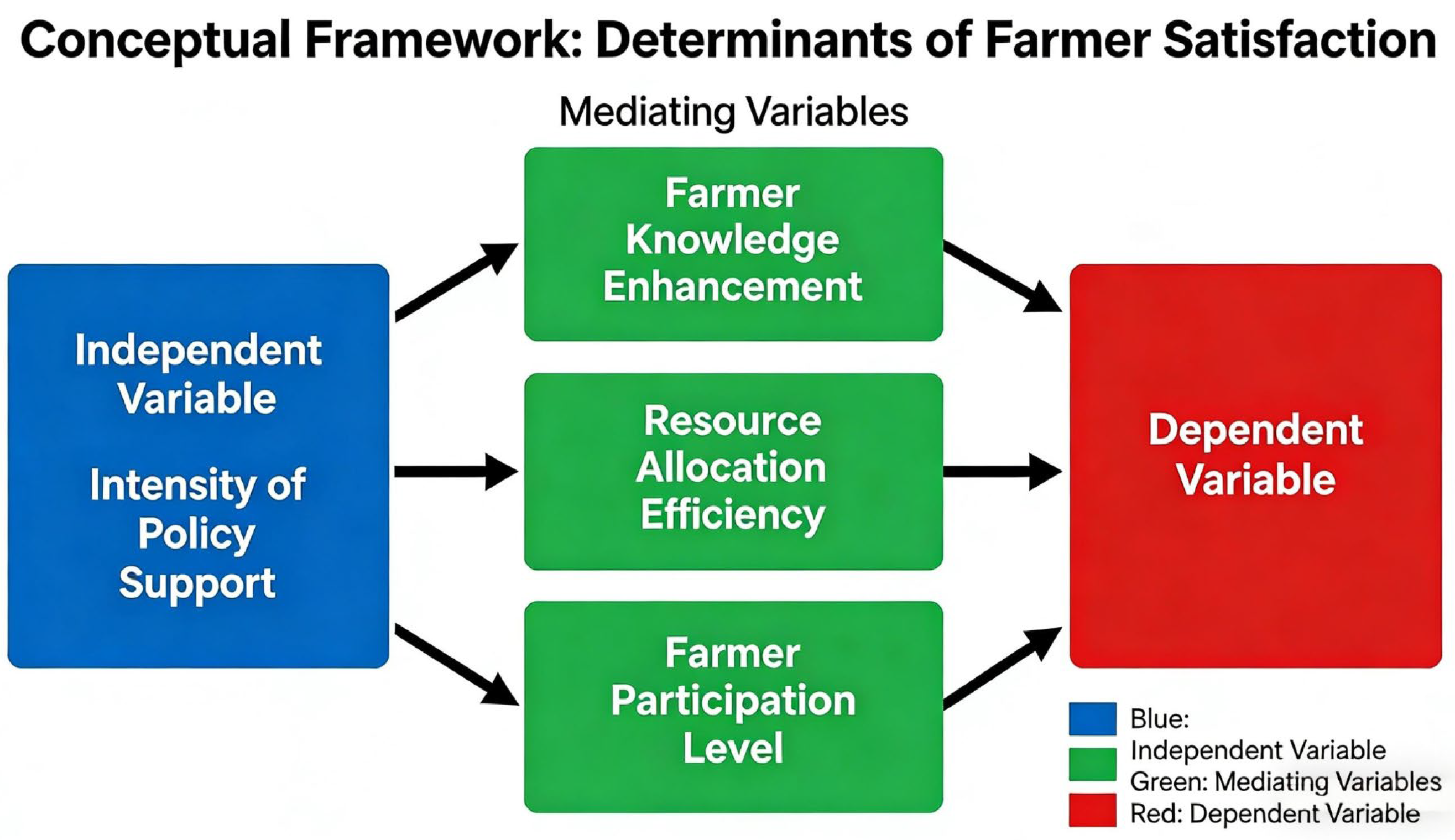
The relationships among these factors are conceptualized in Figure 1, which illustrates how policy support intensity influences farmer satisfaction through three mediating mechanisms: farmer knowledge enhancement, resource allocation efficiency, and farmer participation level.
Figure 1.
Visual diagram of connections between variables.
Figure 1 illustrates how policy support intensity influences farmer satisfaction through three mediating mechanisms:
Farmer Knowledge Enhancement
Increased policy support enhances farmers’ understanding of policies, leading to higher trust and acceptance, which in turn boosts satisfaction.
Resource Allocation Efficiency
Effective allocation of resources, driven by strong policy support, ensures that farmers receive the necessary materials and support, improving overall satisfaction.
Farmer Participation Level
Strong policy support encourages farmer participation in policy processes, fostering a sense of belonging and fairness, which enhances satisfaction.
3. Data Sources and Research Methodology
3.1. Data Sources
Shandong Province, a representative agricultural province in China, has advanced the sustainable development of new agricultural management entities through a series of supportive policies. These new agricultural entities have become the leaders and backbone of modern agricultural development in this major agricultural province. As of 2022, the number of farmer cooperatives in Shandong accounted for 11% of the national total, and various service entities represented 15% of the national share. Additionally, 151 Shandong-based agricultural enterprises were listed among the top 500 agricultural enterprises in China, ranking first nationwide. Shandong has taken the lead in the construction and development of new agricultural management entities in China, making it a highly relevant and meaningful research sample.
A random survey was conducted across 1525 new agricultural management entities in 130 counties and cities in the province. Furthermore, data from third-party platforms such as database Qichacha were used for cross-verification to ensure the authenticity and validity of the information. A total of 1382 survey responses were collected, of which 1349 valid responses remained after excluding extreme values and incomplete data, resulting in a response rate of 97.6%. Additional statistical data were obtained from the Ministry of Agriculture and Rural Affairs of China, the Shandong Provincial Department of Agriculture and Rural Affairs, and internal materials from the National Agricultural Credit Guarantee Alliance Co., Ltd. The data sources are comprehensive, reliable, and authoritative.
3.2. Research Methodology
This study aims to evaluate the implementation effects of policies supporting the cultivation and development of new agricultural management entities from the perspective of farmers. The survey responses consist of discrete data with an inherent ranking issue, categorized into five options: Very Satisfied, Somewhat Satisfied, Neutral, Somewhat Dissatisfied, and Very Dissatisfied. Therefore, this study adopts the methodology proposed previously [33]. The ordered Probit model employed in this study to analyze the satisfaction of family farms with financial institutions is specified as follows:
The dependent variable in this study is an ordered multi-category discrete variable. Since discrete values as the dependent variable may lead to issues of heteroscedasticity and inconsistency, it is necessary to introduce an unobservable latent variable and establish a continuous functional relationship between it and the explanatory variables, as follows:
This equation is the latent regression equation of the ordered multinomial Probit model. represents the parameter variables to be estimated, represents the independent random variables that follow a normal distribution. Let represent the threshold values that divide the unknown satisfaction outcomes of agricultural management entities with respect to the support policies. Since the dependent variable in this study has five options, there are four threshold values, denoted as . The actual observed value corresponds to the latent variable as follows:
3.3. Variable Setup
3.3.1. Dependent Variable
This study selects farmers’ satisfaction with the support policies for the cultivation and development of new agricultural management entities as the dependent variable to measure the implementation effect of the policies. A Likert scale is used to assign values to farmers’ satisfaction, with the following five levels: Very Dissatisfied = 1; Somewhat Dissatisfied = 2; Neutral = 3; Somewhat Satisfied = 4; and Very Satisfied = 5.
3.3.2. Independent Variables
The evaluation of the implementation effect of the support policies for new agricultural management entities is influenced by various factors, both subjective and objective. Considering the series of support measures for new agricultural management entities introduced by Shandong Province, and based on relevant studies [34,35], as well as issues related to data collection, 13 explanatory variables are ultimately selected. The specific definitions of these explanatory variables are shown in Table 1.
Table 1.
Variable definitions and descriptive statistics.
- (1)
- Selection of Control Variables
The control variables selected in this study mainly consist of respondents’ individual characteristics, including gender, age, education level, and political affiliation. These variables are included to control for the potential influence of individual heterogeneity on the evaluation of the support policy for cultivating new agricultural business entities, thereby improving the robustness of the model estimation. Previous research suggests that demographic characteristics may affect individuals’ access to information, level of policy understanding, and institutional trust, which in turn influence their policy perception and evaluation. Specifically, age and education level may shape respondents’ ability to comprehend policy content and their approaches to assessment, while political affiliation may affect their degree of interaction with grassroots governance institutions and their level of institutional identification. Therefore, these variables are incorporated into the model as control variables to reduce the interference of individual differences in policy evaluation.
- (2)
- Selection of Explanatory Variables
The selection of explanatory variables in this study is primarily based on two aspects: farmers’ cognitive characteristics and the objective environment.
First, farmers’ cognitive characteristics include six variables: perceived difficulty in obtaining financial support, evaluation of policy implementation, awareness of policies, evaluation of tax policies, evaluation of policy-based agricultural insurance, and the rationality of land use regulation policies. Long-standing theoretical and practical evidence suggests that finance, as an effective financial supply for supporting agricultural and rural economic development, plays a critical role in cultivating and developing new agricultural management entities. Therefore, the ability to effectively obtain financial support for agricultural policies directly reflects the impact of the implementation of these support policies. Additionally, grassroots township governments, being on the front lines of agricultural support, directly influence the awareness of policies among agricultural entities through the promotion and transparency of policy implementation. Furthermore, tax policies, by reducing burdens and promoting appropriate scale operations for agricultural entities, play a significant role in driving development. Policy-based agricultural insurance, as an important tool to support agriculture, provides a safety-net function in agricultural production activities. The rational and effective implementation of such policies affects the comprehensive evaluation of the support policies by agricultural management entities. Finally, the development of modern agriculture has led to a variety of agricultural production behaviors, and the rigidity of land use regulations based on the red line of arable land directly affects the development demands of agricultural entities, which in turn influences their satisfaction with the support policies.
Therefore, it is hypothesized that the perceived difficulty in obtaining financial support, policy awareness, evaluation of tax policies, evaluation of policy-based agricultural insurance, and the rationality of land use regulation policies will have a positive impact on the evaluation of support policies for new agricultural management entities. However, due to the inverse relationship between variable definitions and policy satisfaction levels, policy implementation status will have a negative impact on the evaluation.
Second, the objective environment includes three variables: profit-and-loss status, government subsidy amount, and whether a rural property rights trading center has been established. First, the annual profit-and-loss status may partially reflect the management capabilities of agricultural entities, but it is also influenced by production processes, institutional arrangements, and broader external conditions. Some entities may attribute their profit-and-loss situation to the implementation of policies, especially under current economic pressures. The imprecision or rigidity of policy implementation can impact normal operations, indirectly affecting their evaluation of the support policies. Second, with the innovation and transformation of agricultural support methods, government subsidies have begun to flow into the agricultural and rural sectors through various channels. This inevitably causes differences in the subsidy amounts provided to agricultural entities based on different criteria, influencing farmers’ perception and evaluation of the subsidy policies. Lastly, with the ongoing reform of rural collective property rights, rural property rights trading centers have become key platforms for promoting the rational allocation of rural resources. The establishment and improvement of these trading platforms will facilitate transaction activities for agricultural management entities, thus becoming an influencing factor in the evaluation of support policies.
Therefore, it is hypothesized that the profit-and-loss status, government subsidy amount, and the establishment of rural property rights trading centers will have a positive impact on the evaluation of support policies for new agricultural management entities.
4. Empirical Results and Analysis
The satisfaction of farmers with the support policies for the cultivation and development of new agricultural management entities is analyzed, followed by an exploration of the main reasons for dissatisfaction. Second, a multinomial ordered Probit model is constructed for regression to analyze the mechanisms through which various influencing factors affect policy satisfaction. Finally, the marginal contribution values of each significant influencing factor are calculated to assess the degree of impact on policy satisfaction.
4.1. Analysis of Policy Support Satisfaction for New Agricultural Management Entities
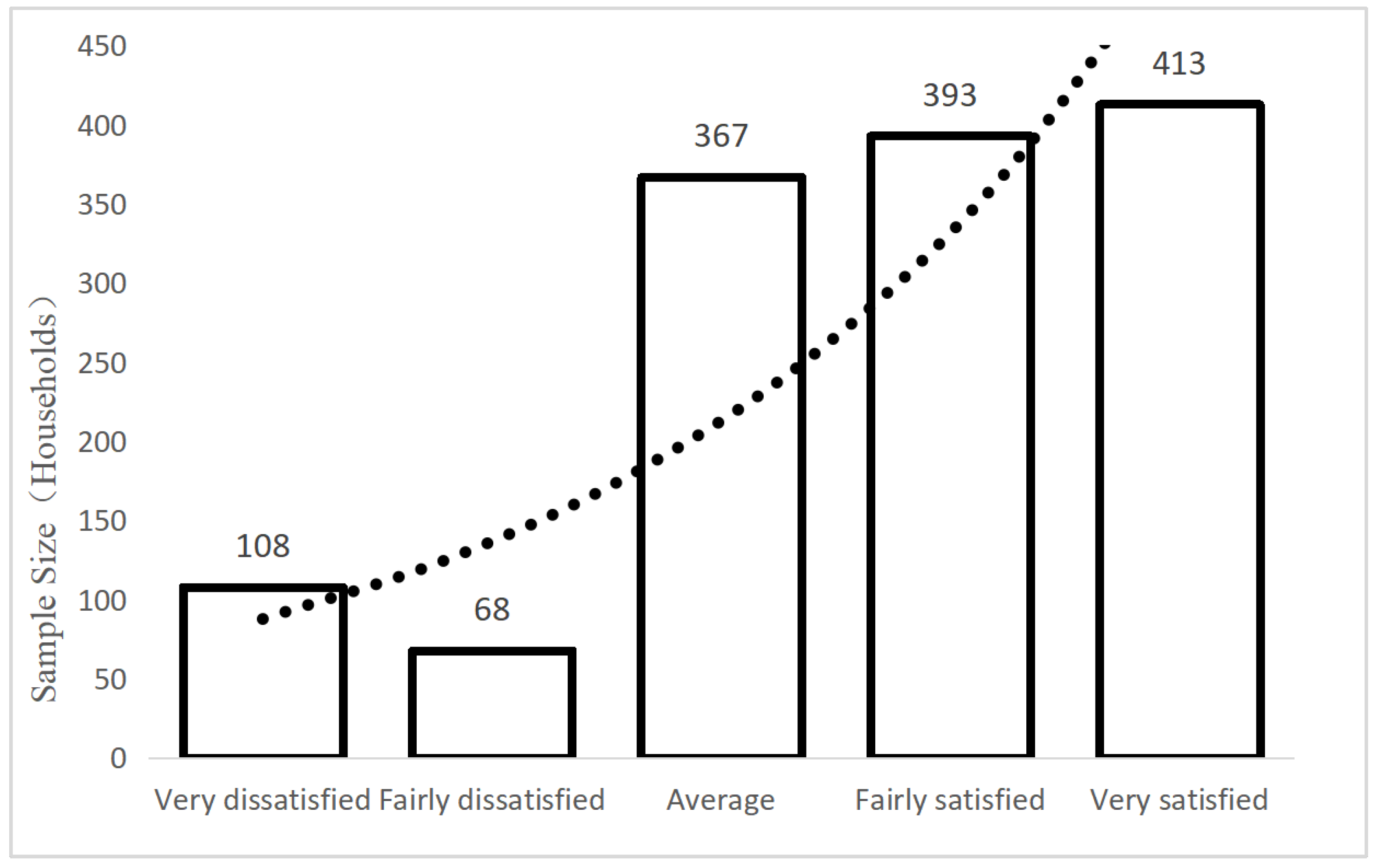
As shown in Appendix A, the overall satisfaction of all 1349 surveyed farmers with the support policies for new agricultural management entities lies between “Neutral” and “Somewhat Satisfied,” with a mean score of 3.69 (on a 5-point scale where 5 = Very Satisfied). Specifically, 30.62% and 29.13% of respondents expressed “Very Satisfied” and “Somewhat Satisfied” attitudes, respectively, while 27.21% reported a “Neutral” attitude. Only 5.04% and 8.01% expressed “Somewhat Dissatisfied” and “Very Dissatisfied” attitudes, respectively.
To further evaluate the practical significance of policy implementation on farmers’ satisfaction and address potential limitations of p-values alone, we conducted an effect size analysis using Cohen’s d. Focusing on the key construct of overall policy satisfaction (comparing Satisfied vs. Dissatisfied/Neutral groups), the effect size was 0.65, indicating a medium-to-large practical impact. This suggests that policy support not only achieves statistical significance but also generates meaningful real-world improvements in farmer satisfaction. Detailed derivations, including the calculation of Cohen’s d, are provided in Appendix A. These findings provide important empirical evidence for policymakers and offer insights for future research on enhancing policy effectiveness.
Detailed derivations are provided in Appendix A.
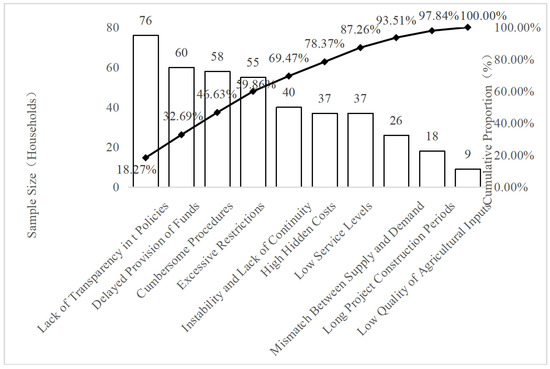
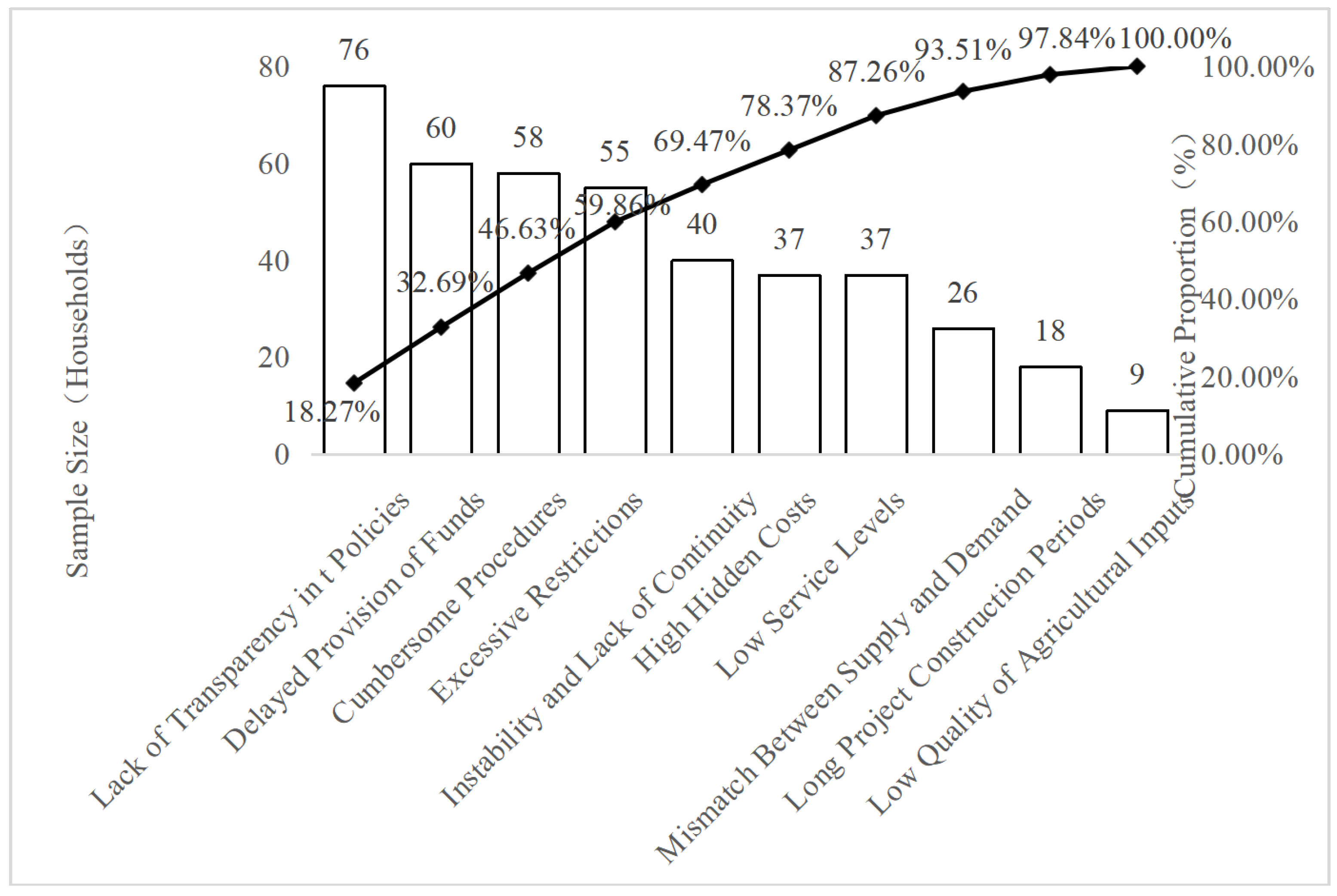
Next, this study uses the Pareto analysis method to identify primary and secondary factors, ranking the number of dissatisfied attitudes caused by each identified reason to determine the main causes of dissatisfaction. As shown in Figure 2, among the 176 farmers who expressed Very Dissatisfied and Somewhat Dissatisfied attitudes, the cumulative frequencies of issues such as government support policies being non-transparent, delayed funding, complicated procedures for obtaining support, excessive restrictions on the use of funds, lack of stability and continuity of measures, and high hidden costs were all within 80% and are categorized as primary causes. On the other hand, issues such as low service levels, a mismatch between supply and demand for support measures, long project construction periods, and poor agricultural input quality had cumulative frequencies between 80% and 100% and are considered secondary causes.
Figure 2.
Pareto analysis of the reasons for farmers’ dissatisfaction.
From this, it is clear that the effective implementation of the support policies for new agricultural management entities must be aligned with farmers’ economic interests, fully addressing the needs and demands of agricultural management entities. It is essential to improve the transparency, accessibility, and sustainability of policy implementation. Furthermore, according to the Heinrich Principle, secondary influencing factors should also be considered during policy implementation. Comprehensive supporting policies should be integrated to ensure effective policy coordination, genuinely supporting and nurturing the development of new agricultural management entities and advancing agricultural modernization.
4.2. Multicollinearity Test
Before performing the ordered Probit regression analysis, multicollinearity among the independent variables was assessed using the variance inflation factor (VIF). As a rule of thumb, VIF values of 10 or higher [36] indicate serious multicollinearity that may bias estimates and inflate standard errors [37]. Some methodological sources recommend a more conservative threshold, such as VIF > 5 warranting caution [38,39]. The results are shown in Table 2, with all VIF values ranging from 1.03 to 1.42 (maximum 1.42), well below common thresholds, confirming that there are no substantial multicollinearity issues.
Table 2.
Results of the multicollinearity test.
The test results are shown in Table 2, which demonstrate that there is no multicollinearity issue among the independent variables.
4.3. Analysis of Factors Influencing Farmers’ Satisfaction with Policy Implementation
After passing the multicollinearity test, the ordered Probit regression was performed using Stata 15.1. Table 3 shows the estimated results of the factors influencing farmers’ satisfaction with the implementation of support policies. Model 1 includes all variables in the regression equation, while Model 2 excludes insignificant variables and includes only the remaining variables in the regression equation. The results indicate that the Prob > chi2 for both models is 0.00, suggesting that the overall fit of the models is good. As shown in the table, at the 5% significance level, the difficulty in obtaining financial support, government subsidy amount, policy implementation status, policy awareness, evaluation of tax policies, evaluation of policy-based agricultural insurance, rural property rights trading centers, and land use regulation policies all passed the significance test. However, gender, age, education level, political affiliation, and profit-and-loss status did not pass the significance test. Additionally, the regression coefficient for policy implementation status is negative, which is due to the variable’s definition being in contrast to the policy satisfaction levels; this does not contradict the logical reasoning. The regression coefficients for the other significant variables are positive, indicating a significant positive impact on satisfaction with the support policies, which aligns with the expected effects.
Table 3.
Estimation results of factors influencing satisfaction with policies supporting new-type agricultural business entities.
The difficulty in obtaining financial support and government subsidy amount passed the 1% significance test in both Model 1 and Model 2, and the regression coefficients are consistent with the expected direction, aligning with the hypotheses. This suggests that, under the current production and management environment, new agricultural management entities are highly dependent on government financial subsidies, and the ease of obtaining financial support and the actual amount of government subsidies directly influence farmers’ satisfaction with the support policies. The vulnerability of agriculture determines that its development cannot do without government financial subsidies. As a crucial external source of funding, subsidies provided in forms such as agricultural support protection subsidies (formerly the three-item subsidy), agricultural machinery subsidies, rewards and compensation, and government purchases optimize the efficiency of the allocation of financial support, benefiting agricultural production quality and income enhancement while also playing a key role in promoting technological reforms in agriculture.
Policy implementation status passed the 1% significance test in both Model 1 and Model 2, and the regression coefficients are consistent with the expected direction, supporting the hypothesis. This indicates that the grassroots government plays a critical role in the implementation of support policies for new agricultural management entities. First, township governments serve as an intermediary platform connecting new agricultural management entities with higher-level governments and are important actors in policy implementation. They play a significant role in policy publicity and interpretation, and their service capabilities directly influence agricultural entities’ evaluations of policy implementation.
Policy awareness has a significant positive impact on satisfaction with agricultural support policies, aligning with the expected hypothesis. The effective implementation of support policies requires not only good policy publicity but also ensuring that agricultural entities have a thorough understanding of the policies. Timely and effective publicity and a transparent system will encourage active participation and rational evaluation of the policies by agricultural entities.
Tax policy evaluation is significantly positively correlated with satisfaction with support policies, as expected. Implementing tax incentives for new agricultural management entities can not only reduce their tax burden and enhance their ability to resist agricultural production risks but also fully leverage the guiding role of the policy. This has a significant impact on adjusting the development methods of agricultural production and expanding the scale of agricultural operations. However, in practice, the complexity of tax incentive procedures, lack of transparency, and farmers’ lack of understanding of these policies have resulted in the failure to fully implement tax incentives, thus hindering the expected function and effectiveness of agricultural support policies.
The evaluation of policy-based agricultural insurance passed the 5% significance test in both Model 1 and Model 2, with a positive regression coefficient, which is consistent with the expected hypothesis. As an important tool for agricultural support, policy-based agricultural insurance primarily provides agricultural risk management services, compensating for losses after disasters. It plays an essential role in safeguarding agricultural development and increasing farmers’ income. Especially in recent years, with the global COVID-19 pandemic and extreme weather events, the dual risks faced by agricultural production have intensified, and the compensatory and protective functions of agricultural insurance have become increasingly prominent.
The rural property rights trading center passed the 5% significance test in both Model 1 and Model 2, and the result is in the expected direction, consistent with the hypothesis. Advancing rural property rights trading is an inevitable requirement for deepening rural property rights system reform. It not only facilitates the effective allocation of rural resources but also has significant implications for revitalizing rural investment and financing mechanisms, as well as increasing farmers’ property income. Therefore, whether a comprehensive and effective rural property rights trading system is in place also significantly impacts agricultural entities’ satisfaction with agricultural support policies.
Land use regulation policies have a significant positive impact on farmers’ satisfaction with support policies, which aligns with the expected hypothesis. The development and evolution of modern agriculture have led to the intertwining of agricultural and non-agricultural land uses. Land use regulation policies impact land use efficiency and the effective acquisition of benefits for new agricultural management entities. Whether these policies can flexibly and effectively meet the legitimate development demands of agricultural entities during implementation is a crucial factor influencing the effectiveness of the support policies.
Other variables did not pass the significance level test. Among them, gender, age, education level, and profit-and-loss status are consistent with the expected direction of influence and align with the original hypotheses. However, political affiliation, a characteristic variable of the management entities, does not align with the expected direction, possibly because political affiliation affects the understanding of policy cognition. Individuals with different political affiliations may have a deeper perspective on the issues at hand, and the negative correlation may also suggest that the current support policies for the cultivation and development of new agricultural management entities have not yet gained full recognition and support from agricultural entities.
Although Table 3 reports the estimated coefficients of the ordered Probit model, these coefficients reflect effects on the latent satisfaction variable rather than directly on the probability of each satisfaction level. Therefore, we further interpret the results based on marginal effects across outcome categories (Y = 1–5).
The marginal effects indicate that positive coefficients (e.g., X6, X7, X9–X13) shift the probability mass from lower satisfaction categories toward higher ones, increasing the likelihood of respondents reporting higher satisfaction while reducing the probability of lower satisfaction levels. Conversely, the negative coefficient of X8 shifts probability toward lower satisfaction categories. Hence, opposite signs across different outcome levels are expected and reflect the redistribution mechanism inherent in ordered response models.
Overall, improvements in financial support, policy implementation, policy awareness, tax incentives, agricultural insurance, rural property rights trading mechanisms, and land use regulation policies increase the probability of higher satisfaction evaluations. In contrast, adverse conditions captured by X8 are associated with a greater likelihood of lower satisfaction responses. These findings provide a more nuanced understanding of how different policy instruments affect the distribution of satisfaction levels.
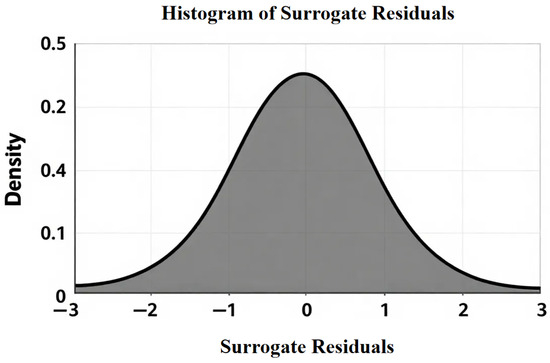
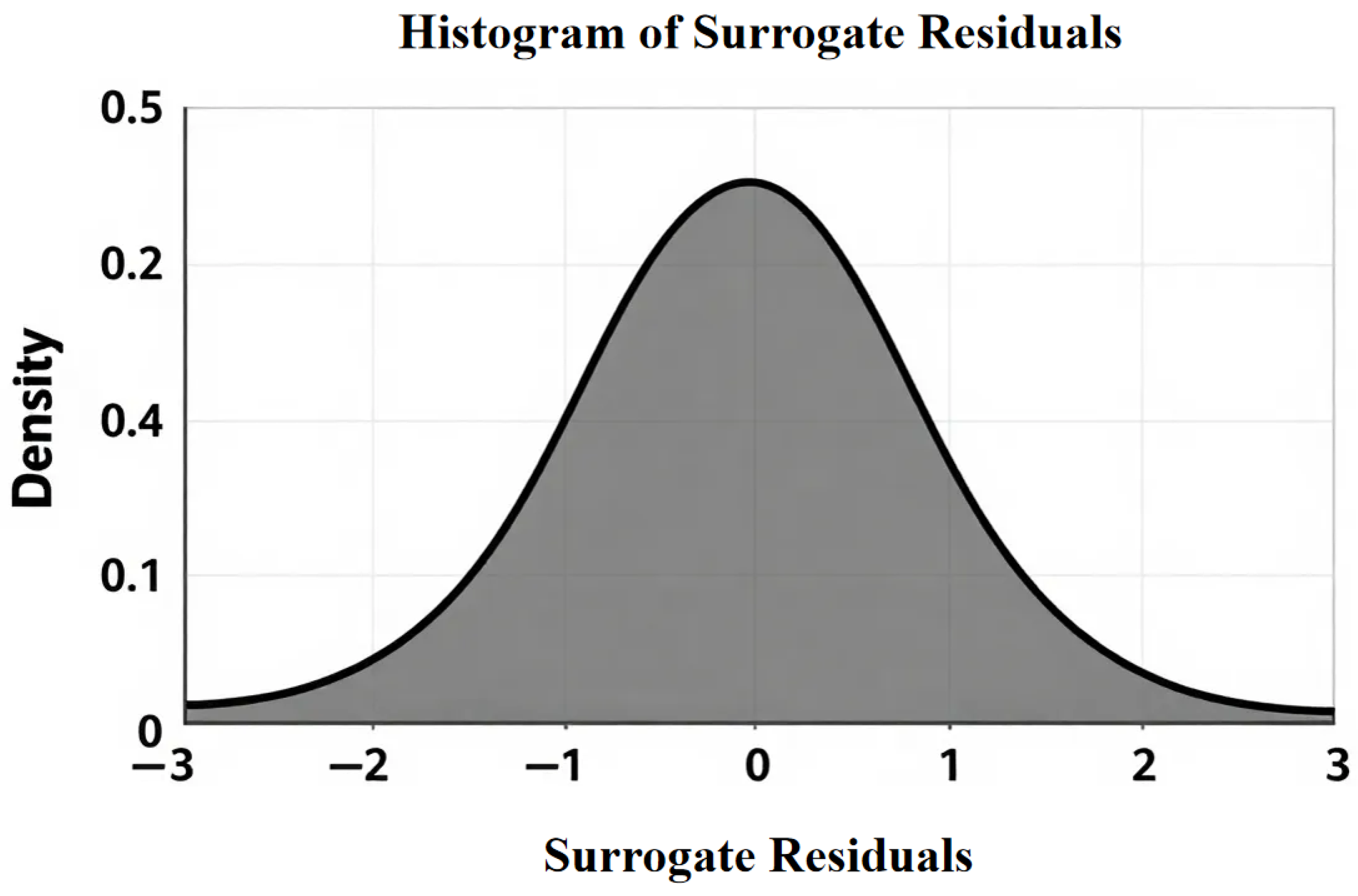
Due to the assumption of the ordered Probit model that the latent error terms follow a standard normal distribution, this study employs surrogate residuals for diagnostic analysis of the error distribution to validate this assumption. As shown in Figure 3, the histogram of the surrogate residuals exhibits a relatively symmetrical bell-shaped distribution, with the center approaching zero. Additionally, the overlaid normal density curve fits well with the histogram, indicating that the residual distribution broadly conforms to the characteristics of normality, thereby supporting the validity of the model specification.
Figure 3.
Distribution error graph.
4.4. Analysis of Marginal Contribution Values of Variables
Given the specificity of the ordered Probit model, the regression coefficients can only explain the direction of the influence of the independent variables on the dependent variable but cannot fully measure the extent of each variable’s impact on policy implementation satisfaction. To further understand the degree of influence of each variable, the marginal contribution values of each variable need to be calculated. The dependent variable selected in this study has five values: Y = 1, Y = 2, Y = 3, Y = 4, and Y = 5. The marginal contribution values for each case are calculated, as shown in Table 4. Although the marginal contribution values of each variable differ across different cases, the ranking of the marginal contribution values is consistent with the significance levels. This study uses Y = 5 as an example, specifically the case where new agricultural management entities select Very Satisfied.
Table 4.
Marginal contribution values of significant variables.
According to the content in Table 4, when Y = 5, in Model 2 (which excludes insignificant variables), the p-values for the marginal contribution values of all variables are less than 10%, meaning they all pass the significance test at the 10% level. Among the explanatory variables that have a significant impact, land use regulation policies have the greatest influence, while policy-based agricultural insurance has the least. Under the condition of holding other influencing factors constant, the rationalization of land use regulation policies will increase the probability of farmers selecting Very Satisfied by 9%, while for each unit increase in the evaluation of policy-based agricultural insurance, the probability of farmers selecting Very Satisfied will increase by 1.6%.
Furthermore, the marginal contribution rates for the other significant factors influencing satisfaction with policy implementation, ranked from high to low, are as follows: policy awareness, difficulty in obtaining financial support, policy implementation status, tax policy evaluation, rural property rights trading centers, and government subsidy amount. Under the condition of holding other influencing factors constant, for each level increase in policy awareness, the probability of farmers selecting Very Satisfied increases by 8.5%; for each level increase in the difficulty of obtaining financial support, the probability of selecting Very Satisfied increases by 7.8%; for each level increase in policy implementation evaluation, the probability of selecting Very Satisfied decreases by 5.7%; for each level increase in satisfaction with tax policy, the probability of selecting Very Satisfied increases by 2.8%; the presence of a rural property rights trading center increases the probability of selecting Very Satisfied by 2.8%; and for each unit increase in government subsidy amount, the probability of selecting Very Satisfied increases by 2.5%.
The marginal contribution value analysis for when Y = 1, Y = 2, Y = 3, and Y = 4 follows the same pattern and is not repeated here.
5. Discussion
The positive effect of subsidy amount has been observed in specific studies conducted in China, where targeted fiscal subsidies have been shown to improve farm performance and producer satisfaction [40]. This finding aligns with international studies demonstrating that well-designed agricultural insurance programs significantly improve risk management and farmers’ welfare perceptions [41,42]. Research indicates that developed land and property rights markets in China facilitate resource allocation and increase satisfaction among commercial farmers [43]. Evidence from studies conducted in China further supports that flexible and reasonable land use regulations promote efficient land use and higher operator satisfaction [44].
This study finds that farmers’ overall satisfaction with support policies for new agricultural management entities in China is moderately positive; however, dissatisfaction still exists. The main problems relate to policy transparency, funding delays, complicated procedures, and unstable implementation. This indicates that the quality of implementation is as important as financial support itself. The results indicate that satisfaction is mainly influenced by policy and institutional factors rather than individual characteristics. Specifically, land use regulation policies, policy awareness, access to financial support, policy implementation status, tax policies, rural property rights trading centers, subsidy amounts, and agricultural insurance all significantly affect satisfaction. Among these, land use regulation and policy awareness have the strongest effects.
The findings of this study confirm most of the proposed hypotheses while providing nuanced insights into their mechanisms. H1 (policy-related factors) is strongly supported: policy awareness, tax policy evaluation, agricultural insurance, and land use regulation rationality exert significant positive effects on satisfaction, consistent with the expected mechanisms derived from credit rationing theory and institutional economics—namely, reduced information asymmetry, improved resource allocation efficiency, and enhanced perceived fairness and participation. H2 (economic and institutional factors) is also validated, as ease of financial support and subsidy amount positively influence satisfaction, aligning with the theoretical prediction that alleviating supply-side credit rationing enhances perceived policy benefits. In contrast, H3 (individual characteristics) is not supported, as gender, age, education, and political affiliation show no significant effects, suggesting that structural and institutional factors dominate satisfaction formation among new-type agricultural business entities in China.
Compared to existing mechanisms in China, the current policy framework has achieved moderate success in delivering financial support and institutional incentives, yet persistent dissatisfaction stems from implementation gaps—such as policy opacity, funding delays, procedural complexity, and instability—which deviate from the theoretical ideal of transparent, stable, and participatory policy delivery. These gaps amplify information asymmetry and perceived risk, undermining the expected mechanisms of trust-building and resource efficiency.
To bridge this gap, several policy insights emerge: First, beyond increasing subsidy amounts, greater emphasis should be placed on improving implementation quality through enhanced transparency (e.g., digital platforms for policy disclosure), streamlined procedures, and stable multi-year commitments. Second, strengthening grassroots capacity and farmer participation in policy design and monitoring could better align supply-side mechanisms with demand-side expectations, reducing moral hazard perceptions. Third, integrating land use flexibility with rural property rights trading could further optimize resource allocation, as evidenced by the strong marginal effect of land regulation. Finally, expanding policy-based insurance coverage and tailoring it to local risk profiles would reinforce risk management mechanisms and long-term welfare perceptions. These targeted improvements, grounded in the confirmed theoretical pathways, are likely to yield higher satisfaction and more sustainable development of new-type agricultural business entities than simply scaling up fiscal inputs.
6. Limitations
Despite these contributions, several limitations should be acknowledged. First, the study relies on cross-sectional survey data collected from a single province (Shandong), which may limit the generalizability of findings to other regions with different economic, institutional, or agro-ecological conditions. Second, the assessment of policy effectiveness is based primarily on subjective satisfaction measures, which could introduce perception bias and fail to capture objective long-term outcomes. Third, the sample, while sizable (n = 1349), may not fully represent the diversity of all new-type agricultural business entities, potentially leading to selection bias. Fourth, the use of self-reported data raises concerns about reliability, as responses may be influenced by social desirability or recall bias. Finally, the analysis does not examine potential interaction effects among policy measures (e.g., subsidies and land regulations), which could offer deeper insights into their combined impacts.
Future research should address these limitations by employing longitudinal or panel data to track dynamic changes over time, expanding the geographical scope to multiple provinces for comparative analysis, incorporating objective performance indicators (e.g., income growth, productivity), and exploring interaction effects among policy instruments through advanced econometric methods. Such efforts would contribute to a more comprehensive understanding of policy support effectiveness for new-type agricultural business entities.
7. Conclusions and Policy Recommendations
The overall satisfaction of the surveyed entities regarding the policies for supporting and cultivating new agricultural business entities in China falls between “Neutral” and “Somewhat Satisfied,” with a mean score of 3.69 (where Very Satisfied equals 5). Farmers expressed dissatisfaction mainly due to the lack of transparency, complex procedures, discontinuity of policies, and insufficient financial support. Specific factors, such as the difficulty in obtaining financial support, the levels of government subsidies, awareness of policies, evaluations of tax policies and agricultural insurance, and the effectiveness of rural property transaction centers and land use control policies, positively impact satisfaction with the support policies. Conversely, the implementation quality of these policies negatively affects overall satisfaction. Profit-and-loss status has no significant effect on policy satisfaction.
This finding may stem from the concentration of support policies primarily at the stage of production inputs, making their effects challenging to translate into operating profits in the short-term. Moreover, most sampled entities are at break-even or only marginally profitable, leading to insufficient variability in satisfaction levels. Farmers, as the primary beneficiaries and implementers of the support policies, play a crucial role in the formulation, implementation, and evaluation processes. Their assessments of policy execution and satisfaction largely determine whether the policy objectives can be effectively achieved. However, due to the subjective nature of these evaluations, the validity of policy implementation assessments remains to be determined. Consequently, evaluations of the support measures for cultivating new agricultural business entities may differ based on specific local conditions and perspectives, highlighting the need for a comprehensive evaluation system that requires further research and discussion. Our findings align with previous studies emphasizing the importance of fiscal subsidies and credit-related support in fostering new agricultural business entities. The positive roles of tax policies and agricultural insurance are consistent with Lin Bing’s assertion that while China’s support system has taken shape, the practical effectiveness of policy instruments remains limited [18]. However, unlike some research suggesting that operating performance reflects policy effectiveness [17], we find no significant effect of profit-and-loss status, likely due to the difficulty in translating policy benefits into short-term profits. This study thus provides a multi-dimensional empirical evaluation from the perspective of farmer satisfaction.
7.1. Optimizing Land Use Control Policies to Support Coordinated Rural Industry Development
On the premise of safeguarding cultivated land and ecological security, land management policies should be made more flexible and targeted to better accommodate the diversified development needs of rural industries. On the one hand, land transfer services should be standardized and made more transparent by relying on a unified county–township platform to improve procedures for information disclosure, price assessment, standardized contract templates, registration/filing management, and dispute resolution, thereby reducing transaction costs and uncertainty. On the other hand, the economic compensation and incentive mechanisms under land use conversion and regulatory constraints should be improved by clarifying eligible recipients, calculation methods, and disbursement timelines, so as to appropriately share compliance costs and operating losses, mitigate the welfare losses imposed on new agricultural business entities by land use controls, and ultimately promote the sustainable use of farmland resources and the integrated advancement of rural industrial revitalization.
7.2. Innovating Fiscal and Tax Support Mechanisms to Enhance Policy Precision and Sustainability
Given that the marginal effect analysis indicates financial support has a relatively large impact on policy satisfaction, fiscal and financial instruments should be optimized around “cost reduction, greater targeting, and stronger transparency”. This can be achieved by rationally adjusting the scale and structure of subsidies, directing more funds toward lowering financing costs and strengthening key production links, while exploring performance-linked and award-based support to improve efficiency. In addition, a transparent end-to-end process for application, review, disbursement, and oversight should be established by clarifying eligibility criteria, calculation methods, and payment timelines to enhance universality and fairness. Meanwhile, more actionable financial measures—such as tiered loan interest subsidies by entity type or project category and improved government-backed guarantees and risk-sharing mechanisms—should be proposed to ease financing constraints. Furthermore, subsidy allocation rules between contract holders and operating entities should be standardized to ensure that subsidies are accurately delivered to the actual producers and operators.
7.3. Enhancing Policy Promotion and Execution Capacity to Improve Response Efficiency
Improve the policy transmission mechanism from top-level design to local implementation, and strengthen training and capacity building for grassroots execution personnel. Utilize diverse channels for policy promotion to increase the awareness and application of support policies among new agricultural business entities. Optimize policy implementation methods and enhance the quality and execution ability of grassroots policy implementers. Establish accountability and feedback mechanisms for policy implementation to increase transparency and public participation.
7.4. Improving the Agricultural Insurance System to Strengthen Risk Management and Industry Resilience
Expand the coverage of policy-based agricultural insurance, improving differentiated premiums and subsidy standards based on different industry types, production stages, and product characteristics to provide targeted protection. Implement differentiated premiums and subsidies for agricultural business entities, different production and sales stages, and varying agricultural product types. Utilize insurance mechanisms to incentivize the application of green production technologies, enhancing the ability of agricultural business entities to cope with climate and market risks and supporting the transition to low-carbon and sustainable agriculture.
7.5. Building a Standardized Rural Property Rights Trading Platform to Promote Efficient Policy System
Accelerate the construction of the rural property rights trading market, improving information release, transaction certification, and rights protection mechanisms, while promoting the digitalization and standardization of grassroots platforms. By enhancing the transparency of trading information and optimizing the operational mechanisms of resource trading platforms, promote the rational allocation and maximization of rural resources, fostering the healthy development of the property rights trading market. Simultaneously, enhance the transparency of factor flows, improve allocation efficiency, stimulate the potential of rural resources, and provide stable, sustainable support for new agricultural business entities.
Author Contributions
Conceptualization, X.F. and G.M.; formal analysis, investigation, and methodology, supervision, G.M.; writing—original draft preparation, writing—review and editing, G.M. and X.F. All authors have read and agreed to the published version of the manuscript.
Funding
This research received no external funding.
Institutional Review Board Statement
This study is an anonymous, non-interventional social science questionnaire survey that does not involve medical experiments, human biological samples, vulnerable populations, or the collection of sensitive personal information. In accordance with national research ethics regulations and the guidelines of our university/institution, this type of low-risk, non-invasive social survey is exempt from formal ethics committee review and approval. The institutional authority has confirmed that no ethics review is required for this research.
Informed Consent Statement
All participants provided voluntary informed consent, and data were collected and processed in fully anonymized form.
Data Availability Statement
The data presented in this study are available upon request from the authors.
Acknowledgments
The authors would like to express their sincere gratitude to the school organization and the research team for their dedicated efforts and hard work throughout this study.
Conflicts of Interest
The authors declare no conflicts of interest.
Appendix A
Figure A1.
Farmers’ satisfaction evaluation of the implementation of support policies for new agricultural management entities.
References
- Wang, D.; Bian, Z. Evaluation of Agricultural Supply-Side Structural Reform Capacity and Its Income Increase Effect: Based on the Perspective of New Structural Economics. J. Southwest Minzu Univ. (Humanit. Soc. Sci. Ed.) 2020, 41, 122–132. [Google Scholar]
- Xu, S.; Yu, G. Scale Operation and Cultivation of New Agricultural Business Entities: A Research Review. Xinjiang Agric. Reclam. Econ. 2016, 8, 54–59+92. [Google Scholar]
- Xu, P. The Financing Guarantee Collaborative Mechanism and Effects of Agricultural Business Entities: Exploration and Practice of the Agricultural Guarantee System in Zhejiang Province. Issues Agric. Econ. 2021, 10, 113–126. [Google Scholar]
- Li, Y.; Meng, G. Analysis of the Factors Affecting the Accessibility of Agricultural Financing Guarantees. Reg. Financ. Res. 2021, 10, 88–92. [Google Scholar]
- Bai, L. Research on the Cultivation of New Agricultural Business Entities Based on the Economic Transformation and Upgrading of Rural Areas. North Rice 2021, 51, 60–64. [Google Scholar]
- Lei, M.; Yu, S. Comprehensive Rural Revitalization: Policy Orientation and Practice. Soc. Sci. Sch. 2021, 4, 31–41. [Google Scholar]
- Chen, X. Promoting Key Support and Effectively Enhancing the Development and Driving Capacity of New Agricultural Business Entities. Agric. Econ. Issues 2020, 3, 4–7. [Google Scholar]
- Wang, G.; Yang, Y.; Wang, Y. Cultivation of New Agricultural Business Entities: Strategic Review, Logical Identification, and Institutional Guarantee. J. Southwest Minzu Univ. (Humanit. Soc. Sci. Ed.) 2014, 35, 203–208. [Google Scholar]
- Sui, D.; Lin, L. Construction of Fiscal Agricultural Support Performance Evaluation System Based on the VAR Model. Lingnan J. 2010, 5, 79–83. [Google Scholar]
- Wei, Z. Study on Fiscal and Tax Policy Support for the Cultivation of New Agricultural Business Entities in the New Era. Agric. Econ. 2021, 9, 105–107. [Google Scholar]
- Xu, F.; Chu, W.; Cheng, S.; He, L. Study on the Construction of Agricultural Mechanization Support Policy System: Based on the Three-Dimensional Framework Model. Agric. Mech. Res. 2022, 44, 7–11. [Google Scholar]
- Kong, X.; Zhou, Z. New Agricultural Business Entity Development Must Break Through Institutional Barriers. Hebei Acad. J. 2020, 40, 110–117. [Google Scholar]
- Wang, X.; Ning, A. Research on Facility Land for New Agricultural Business Entities under Rural Revitalization. Agric. Econ. 2021, 10, 87–89. [Google Scholar]
- Tan, W. Practice and Reflection on Financial Support for New Agricultural Business Entities: Based on Research in Heilongjiang Province. Financ. Dev. Rev. 2018, 12, 66–71. [Google Scholar]
- Meng, J.; Li, K.; Du, T.; Wang, J. Priority Sequence and Influencing Factors of Fiscal Policy Demand for New Agricultural Business Entities: A Case Study of Henan Province. China Agric. Resour. Reg. 2022, 34, 1–9. [Google Scholar]
- Wu, Z. Path Research on the Cultivation of New Agricultural Business Entities under the Background of Rural Revitalization: A Case Study of J City in the Central Region. J. Shandong Agric. Eng. Univ. 2022, 39, 1–7. [Google Scholar]
- Chen, Y. Research on the Policy Influencing Factors of New Agricultural Business Entities Cultivation in Hebei Province. Ph.D. Thesis, Wuhan Light Industry University, Wuhan, China, 2021. [Google Scholar]
- Lin, B. Study on Financial Support Policies for New Agricultural Business Entities. Rural. Econ. Sci. Technol. 2024, 35, 221–223. [Google Scholar]
- Wang, X. Study on the Driving Factors and Incentive Policies of Cultivated Land Quality Protection Behavior of New Agricultural Business Entities. Agric. Sci. Technol. Equip. 2025, 1, 122–123. [Google Scholar]
- Peng, Q.X. Study on the Pathways to Alleviate the Financing Difficulties of New Agricultural Business Entities in Henan Province. J. Xuchang Univ. 2024, 43, 130–133. [Google Scholar]
- Liu, G. Exploring the Approaches to Address the Financing Difficulties of New Agricultural Business Entities in Shizuishan City. Agric. Sci. Commun. 2025, 2, 32–35. [Google Scholar]
- Tu, H.; Chen, L. Formation of New Agricultural Business Entities and Innovation of Support Policies. Zhongzhou Acad. J. 2017, 5, 42–47. [Google Scholar]
- Liu, Y. Research on the Reform of Fiscal Support Policies for New Agricultural Business Entities. J. Agric. For. Econ. Manag. 2016, 15, 375–380. [Google Scholar]
- Luo, B. Smallholder Farming, Functional Transformation, and Strategic Choice: A Discussion on the “Third Path” of the Integration of Small Farmers and Modern Agriculture. Agric. Econ. Issues 2020, 1, 29–47. [Google Scholar]
- Feng, L.; Zhu, Y. Research on the Operation Mechanism of Agricultural Policy Guarantees under Dual Goal Conflicts: Based on the Practice of New Agricultural Credit Guarantees in Shandong. Rural Financ. Res. 2021, 1, 46–53. [Google Scholar]
- Wang, H.G. Preliminary Study on the Guaranteed Products of the Policy-Based Agricultural Credit Guarantee System: Products of “Core Enterprises + Factories + Bases”, Referred to as “1 + N + X”. Heilongjiang Sci. 2018, 9, 26–27. [Google Scholar]
- Xu, L.; Chen, D. Why Has the Guarantee Mechanism for Agricultural Credit Guarantee Agencies “Deformed” in Supporting Agriculture?—A Perspective of Incomplete Information Dynamic Game with Evidence from L Banner in Inner Mongolia. Inn. Mong. Soc. Sci. (Chin. Ed.) 2017, 38, 125–131. [Google Scholar]
- Hu, J.; Luo, J. Agricultural Credit Guarantee Loans and Household Income: Suppression or Promotion? Agric. Technol. Econ. 2022, 3, 1–15. [Google Scholar]
- Jiang, X.; Guo, Y. Research on the Efficiency of Policy-Based Agricultural Guarantee Fund Allocation in Gansu Province: Empirical Analysis Based on DEA Model. Gansu Financ. 2021, 8, 30–33. [Google Scholar]
- Aparicio, J.; Pastor, J.T.; Zofío, J.L. A systematic literature review of data envelopment analysis in agriculture. Ann. Oper. Res. 2023, 331, 3–39. [Google Scholar] [CrossRef] [Scilit]
- Hoang, V.-N.; Alauddin, M. Input-orientated data envelopment analysis framework for measuring and decomposing economic, environmental and ecological efficiency: An application to OECD agriculture. Environ. Resour. Econ. 2012, 51, 431–452. [Google Scholar] [CrossRef] [Scilit]
- Akerlof, G.A. The Market for “Lemons”: Quality Uncertainty and the Market Mechanism. Q. J. Econ. 1970, 84, 488–500. [Google Scholar] [CrossRef] [Scilit]
- Huang, X. Research on the Influencing Factors, Performance Evaluation, and Policy Innovation of New Agricultural Business Entity Development. Ph.D. Thesis, South-Central University for Nationalities, Wuhan, China, 2019. [Google Scholar]
- Jia, Q. Research on the Agricultural Policy Guarantee System Based on the Cultivation of New Agricultural Business Entities: A Case Study of Liaoning Province. Agric. Econ. 2020, 3, 12–14. [Google Scholar]
- Jiang, L.; Wang, D. Performance Evaluation of Financial and Fiscal Services for New Agricultural Business Entities. J. Southwest Univ. (Soc. Sci. Ed.) 2017, 43, 54–64. [Google Scholar]
- Li, M.; Chen, S. Analysis of Family Farms’ Satisfaction with Financial Support from Financial Institutions: Based on a Survey of 411 Family Farms in Shandong Province. Shandong Agric. Sci. 2017, 49, 161–167. [Google Scholar]
- Kutner, M.H.; Nachtsheim, C.J.; Neter, J.; Li, W. Applied Linear Statistical Models, 5th ed.; McGraw-Hill/Irwin: New York, NY, USA, 2005. [Google Scholar]
- James, G.; Witten, D.; Hastie, T.; Tibshirani, R. An Introduction to Statistical Learning: With Applications in R; Springer Texts in Statistics; Springer: New York, NY, USA, 2013. [Google Scholar] [CrossRef] [Scilit]
- Zuur, A.F.; Ieno, E.N.; Elphick, C.S. A protocol for data exploration to avoid common statistical problems. Methods Ecol. Evol. 2010, 1, 3–14. [Google Scholar] [CrossRef] [Scilit]
- Zhang, Y.; Yan, Y. Factors Affecting Farmers’ Adoption of IPM Technology: Empirical Study Based on Survey Data from Rice Farmers in Heilongjiang Province. Northeast Agric. Univ. J. (Soc. Sci. Ed.) 2021, 19, 57–68. [Google Scholar]
- Abay, K.A.; Koru, B.; Chamberlin, J.; Berhane, G. Does rainfall variability explain low uptake of agricultural credit? Evidence from Ethiopia. Agric. Econ. 2022, 53, 191–207. [Google Scholar] [CrossRef] [Scilit]
- Gautam, M.; Ahmed, M. Too small to be beautiful? The farm size and productivity relationship in Bangladesh. Food Policy 2019, 84, 101805. [Google Scholar] [CrossRef] [Scilit]
- Cole, S.; Giné, X.; Tobacman, J.; Topalova, P.; Townsend, R.; Vickery, J. Barriers to household risk management: Evidence from India. Am. Econ. J. Appl. Econ. 2013, 5, 104–135. [Google Scholar] [CrossRef] [Scilit]
- Deininger, K.; Jin, S.; Liu, Y.; Singh, S.K. Can labor market imperfections explain changes in the inverse farm size-productivity relationship? Evidence from rural India. World Dev. 2017, 99, 335–349. [Google Scholar] [CrossRef] [Scilit]

Disclaimer/Publisher’s Note: The statements, opinions and data contained in all publications are solely those of the individual author(s) and contributor(s) and not of MDPI and/or the editor(s). MDPI and/or the editor(s) disclaim responsibility for any injury to people or property resulting from any ideas, methods, instructions or products referred to in the content. |
© 2026 by the authors. Licensee MDPI, Basel, Switzerland. This article is an open access article distributed under the terms and conditions of the Creative Commons Attribution (CC BY) license.