


Abstract
Digital transformation is a core strategic choice for enterprises to build sustained competitive advantages, which constitutes a critical driver for advancing corporate sustainable development, and how to effectively help enterprises realize digital transformation is a hot and difficult issue discussed in academia and industry. The important impact of common ownership on micro-enterprise behavior may become an important grip for enterprise digital transformation. Using a sample of Chinese A-share listed companies from 2007 to 2021, this study measures firms’ level of digital transformation by the ratio of year-end digital transformation-related intangible assets disclosed in the notes to financial statements to total intangible assets. We find that common ownership has a positive impact on corporate digital transformation, and the conclusion still holds after a series of endogeneity and robustness tests. The results of the mechanism test indicate that common ownership promotes corporate digital transformation by leveraging institutional synergies and supervisory governance effects. Further discussion reveals that the positive impact of common ownership on enterprise digital transformation is more significant in samples with faster economic growth and state-owned enterprises. This study provides new theoretical support and empirical evidence for the role of common ownership in promoting sustainable development of enterprises.
1. Introduction
In the ongoing wave of technological revolution, the digital economy acts as a critical interface for the transformation of traditional industries and the principal driving force behind the development of a modernized economic system. The Chinese economy has shifted from the stage of high-speed growth to the stage of high-quality development, and digital transformation has become an inevitable requirement for high-quality development of the economy, which has challenged the traditional business model of enterprises at the micro level [1]. Although many enterprises have a strong willingness to promote digital transformation, the results are not significant [2], as they suffer from the “cold start” predicament of digital transformation. For traditional enterprises, digital transformation faces challenges in technology, resources, capabilities, organization, culture, and management [3,4,5]. Based on previous studies, most of the existing literature focuses on firm organizational characteristics [6,7], executive characteristics [8,9,10], and other internal characteristics and external characteristics such as government policies [11,12] and competitive pressures to explore the drivers of firms’ digital transformation [13]. Less consideration has been given to the impact of firms’ equity characteristics on digital transformation, especially exploring the governance effects on them from the perspective of equity linkage networks.
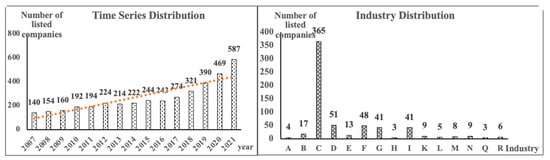
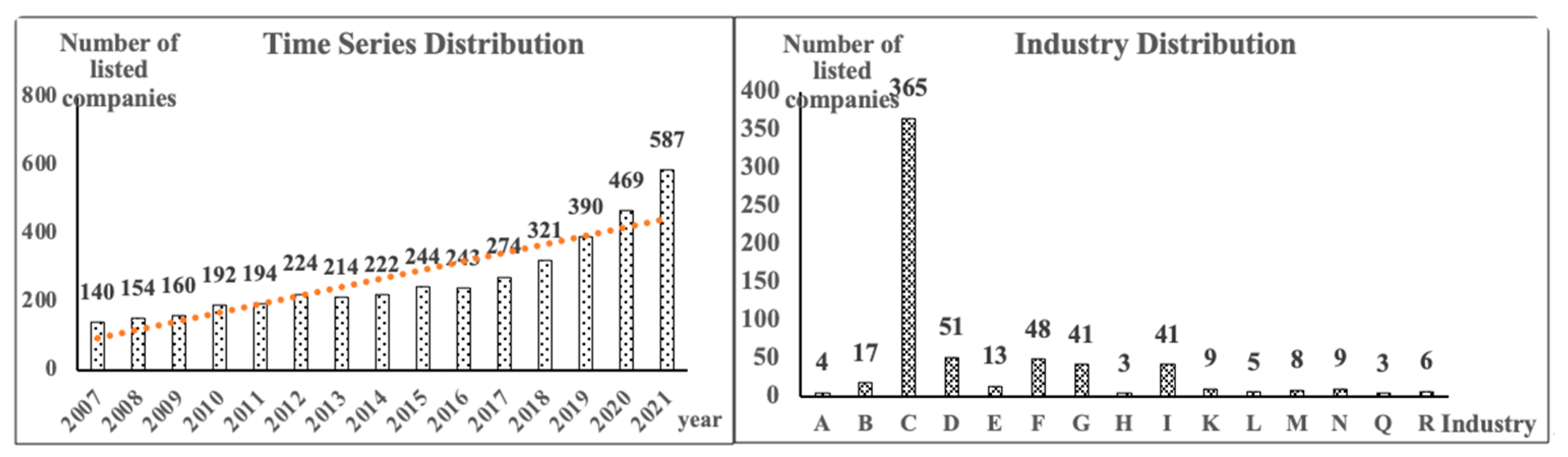
Common ownership is an equity linkage formed by institutional investors holding shares of multiple listed companies in the same industry [14,15], which has become common in capital markets [16]. We collected and organized data on listed companies with common ownership in China from the CSMAR database from 2007 to 2021 and found that the number of subjects with common ownership increased year by year, with an average annual increase of 22.81% (as shown in Figure 1). Compared with the social network established based on personal characteristics such as executives and independent directors, common ownership, as a key node of equity linkage among firms in the same industry, assumes an important information transmission role [17], and its portfolio returns are highly correlated with the economic interests of the firms, which have strong motivation and ability to participate in corporate decision-making [18,19]. As highlighted in the literature, common ownership facilitates stable strategic cooperation among co-owned firms [18,20]. This cooperative framework, in turn, is suggested to improve the transparency of firms’ financial disclosures within the interconnected ownership network [14,21,22]. Common ownership mitigates firms’ exposure to the risk of leakage of proprietary information and trade secrets [23]. Driven by the twin forces of information networking and data resource intensity in today’s globalized economy, many enterprises are compelled to undertake digital transformation. Reconfiguring traditional organizational and production frameworks through such transformation has therefore become an imperative for corporate renewal and upgrading. A central question in the study of enterprise digital transformation is the role of common ownership. It remains to be examined whether common ownership, through its access to diversified and heterogeneous information, can function as a productive factor and positively influence this process. Therefore, integrating the distinct attributes of common ownership into the theoretical framework of enterprise digitalization is essential for explaining its impact and uncovering the specific pathways and mechanisms at work.
Figure 1.
Growth trend of enterprises with common ownership (note: see China Securities Regulatory Commission for Industry Distribution “Guidelines for Industry Classification of listed companies 2012”). Note: The dashed line represents the linear trend of the number of listed companies over time.
Unlike existing research on common ownership based on the background of developed capital markets, this paper explores whether common ownership affects the digital transformation of enterprises from the realistic scenario of Chinese digital economy shifting to a new stage of deepening application, standardized development, and inclusive sharing. This paper examines enterprise digital transformation through two key mechanisms embedded in common ownership: institutional collaboration and supervisory governance. The analysis aims to clarify their roles and uncover potential causal pathways linking common ownership to digital transformation outcomes. This has certain theoretical value and practical significance for digital transformation.
Combined with the actual situation of Chinese capital market, this paper theoretically analyzes the impact of common ownership on enterprise digital transformation and, based on the data of Chinese A-share listed companies from 2007 to 2021, explores the relationship between common ownership and enterprise digital transformation. The empirical results show that common ownership can promote enterprise digital transformation. Further mechanism analysis shows that common ownership promotes the digital transformation of enterprises by making full use of the effects of institutional synergy and supervision and governance. At the same time, the effect of institutional synergy and supervision and governance of common ownership is more obvious in the samples of rapid economic growth and state-owned enterprises.
This study may have the following contributions: (1) A new perspective for the research of enterprise digital transformation is provided. It breaks through the limitations of the existing research to explore the single or multiple major shareholders of a single enterprise in isolation, starting from the connection network established by the common owners among the enterprises in the same industry within the portfolio. The empirical results can provide evidence for the positive role of common ownership as a factor of production and enrich the research results in the field of economic consequences of common ownership. (2) Based on the research framework of “benchmark analysis mechanism analysis extended discussion”, this paper performs analysis from the two dimensions of the institutional synergy effect and the supervision and governance effect, to open the “black box” of the relationship between common ownership and enterprise digital transformation. In addition, based on the characteristics of differentiation at the macro level and organizational level, this paper tests the impact of cyclical changes in the macro economy and the nature of corporate equity, to expand the research on the boundary mechanism. (3) It has certain policy significance. We should correctly understand and grasp the characteristics and behavior laws of capital, and support and guide the standardized and healthy development of capital. Our research shows that common ownership can play a positive role as a factor of production in the process of enterprise digital transformation. Although there are controversies about the characteristics and behavior laws of common ownership in academia, the government should play a good regulatory role, guide common ownership to play a positive role, and create value for accelerating digital development and building a digital country.
The following is how the remaining sections are arranged. Section 2 discusses the theoretical analysis and research hypotheses. Section 3 presents the research design. Section 4 reports the empirical results and conducts mechanism testing and analysis. Section 5 concludes the findings and implications.
2. Theoretical Analysis and Research Hypothesis
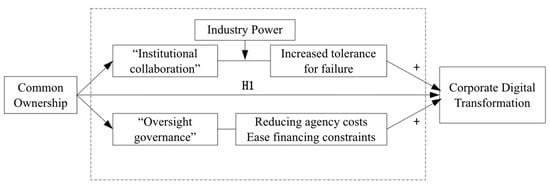
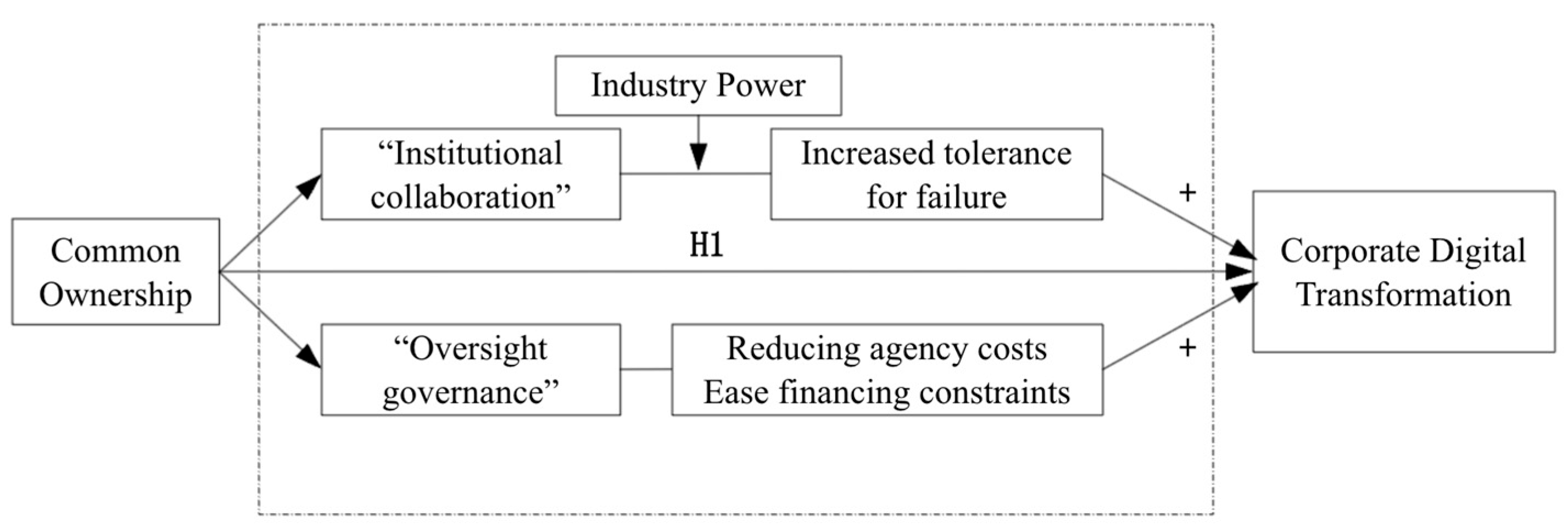
The digital transformation of enterprises, characterized by high investment and long cycles, is an important driving force for enterprises to maintain a long-term competitive advantage and promote sustainable economic development [6]. However, digital transformation is constrained by transformation power and transformation ability, fearing the risks that may be brought by high-risk digital transformation [24], and lacking the technical support and talent accumulation of digital transformation [25,26]. Common ownership is formed by one institution investing in multiple enterprises in the same industry. Its investment goal is to maximize the value of the investment portfolio [27], which has a strong motivation to coordinate and govern the enterprises it holds. As shown in Figure 2 specifically.
Figure 2.
Mechanism analysis of common ownership affecting corporate digital transformation. Note: Symbols “+” represent positive effects.
2.1. Motivation of Enterprise Digital Transformation
From the perspective of the background of the times, the digital transformation of enterprises is the cutting-edge transformation mode in the new era, which is in line with the current development trend of the digital economy and maintains high consistency with the construction blueprint of “digital country” and “smart society”. The digital transformation of enterprises is easily favored by the market in the era of high-quality development of the digital economy, because enterprises tend to release positive signals to the outside world by means of annual report information disclosure and actual production technology transformation investment, and market investors tend to have high expectations for enterprises that are in line with national policies and guidelines and economic practice guidance, which can improve the efficiency of enterprise knowledge and information search [25].
From the perspective of production and operation, enterprises will accumulate a large amount of data and information of technology, capital, and talents in the process of operation, which implies the law of enterprise development. Before the digital transformation, the use of this information can only remain in the original inefficient mode and precipitate inside the enterprise system. The digital transformation of enterprises can not only greatly improve the information processing ability and enhance the financial operation efficiency with the help of their own digital technology but also enable enterprises to reach the maximum capital use efficiency boundary under the constraint of limited financial resources [28]. It can also drive the concentration of technology, capital, and talent to areas with higher utilization efficiency and correct the mismatch of resources [29,30,31,32]. Strengthening enterprise digital ability is conducive to reducing the probability of mistakes in the business decision-making process of the company, improving the business efficiency of the enterprise [33].
Based on the above, the paper proposes the following hypothesis:
H1.
Common ownership can promote the digital transformation of enterprises.
2.2. The Effect of Institution Cooperation
Common ownership plays a key role as the nodes associated with the flow of information and resources among peer enterprises in the portfolio. They can promote the digital transformation of enterprises by making full use of the advantages of information and resources. Firstly, in the production and operation of enterprises, common ownership can bring rich and diverse heterogeneous information to enterprises [14,34], quickly accumulate specific information and knowledge resources among enterprises in the same industry [21], and cultivate a large-scale collaborative development information network [35,36]. Common ownership can promote enterprise digitalization through two primary channels. First, it helps mitigate informational deficits faced by management. By leveraging accumulated industry expertise, common owners provide portfolio firms with leading-edge industry insights [37], help identify pitfalls in digital initiatives, and increase tolerance for trial and error—thus alleviating managerial apprehension and creating a governance environment conducive to digital experimentation. Second, common ownership fosters cooperative alignment among peer firms within the portfolio. It coordinates interest conflicts during collaboration [38], strengthens tactical alliances, and builds inter-firm trust. This trust reduces transaction risks and information asymmetry, encouraging proprietary knowledge sharing. Moreover, common owners with greater industry influence have stronger incentives to promote the exchange of digital technologies across their holdings.
Based on the above analysis, the following hypothesis is proposed:
H2.
Common ownership can promote the digital transformation of enterprises by exerting the effect of institution cooperation.
2.3. The Effect of Supervision and Governance
Firstly, common owners possess significant advantages in information access, managerial expertise, and knowledge of industrial policies. This advantage enables them to exert strong supervisory and managerial functions in corporate governance [39]. A salient agency conflict arises in the context of digital transformation: while shareholders may view it as a strategic opportunity, executives—concerned about the personal career risks and performance-linked compensation associated with its uncertainty—might make decisions that deviate from value maximization. Herein, common owners can leverage their ownership position to actively perform a monitoring role [40]. Their supervisory actions may include exerting stronger influence on shareholder-sponsored governance proposals [41], voting against initiatives that reflect managerial–shareholder divergence [15], or even replacing underperforming managers [42]. Secondly, the common owners can also cause the management to play an active role through the exit mechanism [43]. To avoid forced turnover, management has incentives to align with shareholder interests and advance digital transformation. In addition to managerial incentives, digitalization efforts are often constrained by financing. Significant information asymmetry in the digital investment process exacerbates external financing difficulties. Here, common owners can play a critical role. The information, knowledge, strategic resources, and social capital they possess directly influence digital transformation decisions [21]. Furthermore, as professional institutional investors, their investment acts as a signal of quality, attracting attention from bank lenders and trade creditors, thereby alleviating financing constraints.
Based on the above analysis, the following hypothesis is proposed:
H3.
Common ownership can promote the digital transformation of enterprises by exerting the effect of supervision and governance.
3. Research Design
3.1. Data Sections and Sample Scope
This study utilizes data from Chinese A-share listed companies over the years 2007–2021 as its primary sample. The data source of the dependent variable is the CSMAR database, the source of the independent variable is manual collection from the CSMAR database at the quarterly level, and other data are from the CSMAR database. Additional firm-level financial data are collected from the CSMAR database. The following observations are excluded from the sample: (1) firms in the financial industry, (2) ST and PT companies, (3) delisted firms, and (4) firms with gearing ratios greater than 100%. Continuous variables are winsorized at the 1% and 99% percentiles to reduce the effect of outliers. The final sample is subsequently compiled, yielding 3650 listed firms and 30,805 firm-year observations over the sample period. All analyses are implemented in Stata 16.
3.2. Modeling Definition of Variables
To verify the relationship between common ownership and the corporate digital transformation of listed companies, the following multiple regression model (1) is constructed:
where is regarded as corporate digital transformation, is regarded as common ownership in listed companies, is the intercept term, and are the corresponding estimation coefficients. are industry fixed effects in listed companies, are period fixed effects, and is the random perturbation term. Although is bounded between 0 and 1, OLS is appropriate for estimating the conditional mean relationship and delivers an easily interpretable average marginal effect, especially in a fixed-effects framework.
3.2.1. Dependent Variable
Based on the definition of corporate digital transformation (DCG), this paper measures the level of corporate digitalization using the proportion of year-end intangible asset items related to digital transformation disclosed in the notes to the financial statements of listed companies to the total intangible assets. Specifically, intangible asset line items that contain keywords associated with digital transformation technologies—such as “software,” “network,” “client,” “management system,” “smart platform,” and related patents—are classified as “digital technology intangible assets.” All such assets for the same firm in the same year are then aggregated, and their share in that year’s total intangible assets is calculated to construct a proxy variable for the degree of corporate digital transformation. To ensure the accuracy of the screening process, the identified line items are manually reviewed and verified.
3.2.2. Independent Variable
Following the methodology established in the prior literature [14,15], this study constructs common ownership measures for listed companies along the following three first-level indicators: common ownership (Coz1), association degree of common ownership (Coz2), shareholding ratio of common ownership (Coz3).
- (1)
- Common ownership (Coz1):
Coz1 equals 1 if the firm has at least one common owner each year, and 0 otherwise. A common owner is defined as an institutional investor that simultaneously holds at least 5% of shares in two or more listed companies within the same industry.
- (2)
- Association degree of common ownership (Coz2):
Coz2 measures the number of common owners that co-hold the firm’s shares. It is calculated as the natural logarithm of one plus the count of such common owners each year.
- (3)
- Shareholding ratio of common ownership (Coz3):
Coz3 represents the total shareholding proportion of all common owners in the firm during the year.
In the empirical implementation, these variables are first constructed using quarterly data. If a firm is held by at least one common owner in any quarter of a year, it is treated as having common ownership in that year. Annual measures are then obtained by averaging the corresponding quarterly values.
3.2.3. Control Variables
Given the complexity of the factors underlying corporate digital transformation, and following established research practices, this study introduces a set of control variables: enterprise size (Size), enterprise years (Age), asset liability ratio (Lev), operating cash flow (Cf), fixed assets ratio (Ppe), chairman and general manager are unified (Dual), and ownership concentration (Top). Table 1 provides relevant explanations and the calculation method for this indicator.
Table 1.
Variable definitions.
3.3. Descriptive Statistics
The descriptive statistics for the key variables are summarized in Table 2. For the digital transformation measure (DCG), the mean value is 0.0915 with a median of 0.0104, indicating a right-skewed distribution. The standard deviation of 0.2195 and the maximum value of 1 reflect significant dispersion, implying considerable variation in the extent of digitalization across firms. In terms of common ownership (Coz1), the variable shows a mean of 0.1189 and a standard deviation of 0.3237, with values spanning the full range from 0 to 1. This points to substantial heterogeneity in the presence and degree of common ownership among the sampled companies.
Table 2.
Results of descriptive statistics.
4. Empirical Results and Analyses
4.1. Regression Analysis
Table 3 reports the baseline regression results examining how common ownership influences corporate digital transformation. While including year-industry fixed effects, the coefficients for Coz1, Coz2, and Coz3 are 0.017, 0.024, and 0.062 in columns (1) to (3), respectively, with all coefficients being statistically significant at the 1% level. These findings indicate that common ownership carries substantial efficacy in enhancing corporate digital transformation, confirming Hl.
Table 3.
Benchmark regression results of common ownership on corporate digital transformation.
4.2. Endogeneity Test and Robustness Analysis
4.2.1. Endogeneity Test
It is important to acknowledge a potential endogeneity concern: the relationship may be subject to reverse causality, as a firm’s level of digital transformation could itself affect its common ownership structure. The information advantage of common ownership may help them find companies with better digital transformation. Therefore, listed companies with better digital transformation attract common ownership, rather than common ownership promoting the digital transformation of enterprises. To assess the robustness of our conclusions, this study conducts a series of robustness checks using the following approaches.
- (1)
- Instrumental variable 2SLS
Since information related to explanatory variables may be included in the residual term due to missing variables, we employed explanatory variables with a lag of one period (Coz_it-1) as an instrumental variable, and two-stage least squares (2SLS) and the Gaussian mixture model (GMM) were used for analysis. Columns (1)–(6) in Table 4 present the regression results using the instrumental variable (IV) approach; the results demonstrate that common ownership (Coz) improves corporate digital transformation (DCG), providing empirical support for the core conclusions of this study.
Table 4.
Endogeneity test (a).
- (2)
- Heckman two-stage model
Due to the investment preferences of co-owners in terms of operational capacity, profitability, and other aspects, the improvement of enterprise digitalization may be incomplete, caused by common ownership and influenced by certain common characteristics of listed companies. To eliminate regression bias caused by sample self-selection, the Heckman two-stage model is used for testing in this paper.
In the first stage, the Probit regression model is constructed to examine whether the characteristic variables of the previous listed company will affect their common ownership (Coz1). The specific model is as follows:
where represents the dummy variable and indicates whether the company has common ownership, represents the residual error, represents the control variables with a lag of one period in model (1), considering that the co-owner of the company will make investment decisions based on the information already disclosed by the previous period, and finally, the Inverse Mills Ratio (IMR) is estimated.
In the second stage, IMR is used as a control variable in model 1 to overcome the potential interference of selective bias on the basic conclusions in this paper. According to the regression results, IMR and DCG have statistical significance, indicating that there is a distribution bias in the sample explanatory variables. It is necessary to test the impact of sample self-selection on the conclusions of this article. After adding the variable of IMR, the regression coefficients of variables Coz2 and Coz3 are significantly positive at the 1% significance level in Table 5, which is consistent with the basic regression results. It indicates that the conclusion of this study still holds true after controlling for selection bias and eliminating endogeneity issues to a certain extent.
Table 5.
Endogeneity test (b).
- (3)
- Propensity Score Matching (PSM)
To alleviate the error caused by sample construction, Propensity Score Matching (PSM) for endogeneity testing is further used. The main approach includes using listed companies with common owners (Coz1 = 1) as the treatment group, using control variables from benchmark regression as matching variables, and using one-to-one nearest neighbor matching to find a control group with similar features for the treatment group. The PSM test results showed that the average treatment effect of the variable DCG is 0.01, significant at the 1% level of significance. This indicates that listed companies with common owners have an average digitalization level 0.01 higher than other listed companies without common owners but with similar characteristics. On this basis, regression tests were conducted on the treatment group and the matched control group samples. The results reported in Table 5 demonstrate that the Coz coefficients continue to be statistically significant at the 1% level with a positive sign, thereby corroborating the conclusion drawn from the baseline regression.
4.2.2. Robustness Analysis
- (1)
- Alternative measurement of common ownership
Based on existing research results, we will use institutional investors who hold no less than 5% of the shares of two or more listed companies in the same industry. This article lowers the threshold for shareholding to 3% and raises it to 10% and recalculates two new explanatory variables (TCoz and HCoz). The results in columns (1)–(6) of Table 6 show that the coefficients are significant at the 1% level, confirming the reliability of the findings.
Table 6.
Robustness test (a).
- (2)
- Subsample regression
To assess the sensitivity and stability of the key conclusions, the analysis is repeated on several temporal subsamples delineated by different year intervals. Considering the development of enterprise digital transformation in recent years, and to avoid the influence of other factors on the measurement of enterprise digital indicators, samples from 2017 and before are selected for testing. The results are shown in columns (7)–(9) of Table 6. As the coefficient of the explanatory variable remains positive and significant at the 1% level, it confirms the robustness of our primary findings against this alternative specification.
- (3)
- Lagged independent variable
Due to certain characteristics of the company in the past that may affect its digitalization, the impact on the company may arise in the following year when the co-owners hold shares in the listed company. Therefore, this study uses a lagged variable of shared ownership (Lag Coz) to replace Coz for robustness testing. As shown in columns (1) to (3) of Table 7, the regression coefficient of the lagged variable (Lag Coz) of shared ownership is significantly positive at the 1% significance level, consistent with the baseline results, indicating the robustness of the research conclusions.
Table 7.
Robustness test (b).
4.3. Mechanism Testing and Analysis
After the endogenous test and robustness test, it is still shown that the common ownership can promote the digital transformation of enterprises. According to the theoretical analysis in the second part, common ownership promotes the digital transformation of enterprises by exerting the institutional cooperative effect and the supervision and governance effect.
4.3.1. Institution Cooperation
The analysis in the second chapter shows that, considering the goal of maximizing the overall value of the company, common ownership will actively participate in the governance of listed companies and make use of the institutional synergy effect to alleviate vicious competition among enterprises in the same industry. And based on the rich and diverse heterogeneous information of common ownership, it directly or indirectly strengthens the confidence of executives in the decision-making of enterprise digital transformation and improves the tolerance of failure. To verify the conjecture, we consider the institutional synergy effect from the following two aspects.
- (1)
- Mandatory change of senior management
Enterprise digital transformation is vital to the future development of enterprises. Compared with other business decisions, enterprise digital transformation needs a higher degree of failure tolerance. With their own advantages, common ownership can effectively identify the key factors underlying failures in enterprise digital transformation and alleviate the professional anxiety of senior executives by improving the tolerance for digital failure, thereby enhancing the motivation of senior executives for enterprise digital decision-making and ultimately promoting enterprise digitization. To this end, this paper constructs a regression model between the forced change of executives and the company’s operating performance to test the relationship between common ownership and enterprise digitalization. The specific model is as follows:
where represents the mandatory change of senior management. According to the types of dismissal—resignation, job transfer, individual or other resignation—in the dynamics of senior executives disclosed by listed companies, it is classified as a mandatory change of senior executives. Set the virtual variable = 1; otherwise, = 0. represents the business performance, measured by the growth rate of business income in this paper. represents the interaction term between the variable of common ownership () and .
- (2)
- Industry scale of common ownership
The effect of common ownership on institutional synergy among enterprises in the same industry to a certain extent depends on its size in the same industry. From the previous theoretical analysis, common owners can bring rich and diverse heterogeneous information to enterprises, and the quality and quantity of information depend on the size of the common owners’ peers in the portfolio. If the size of the peers is larger, the quality and quantity of information can be guaranteed, which can promote resource sharing and effective collaboration, and enhance the confidence and motivation of the executives of the enterprises they hold to make digital transformation decisions. In this paper, we constructed the scale index of common ownership in the same industry (), calculated the number of listed companies in the same industry held by all co-owners of each company quarterly, added 1 to the annual average to take the natural logarithm, and replaced the in Model (1).
Table 8 reports the estimation results of Equation (3), which are designed to examine the underlying mechanism by which common ownership facilitates enterprise digital transformation. In columns (1)–(3) of Table 8, the coefficients of interaction terms () are significant at the 1% level. The results support the enhanced institution cooperative effect [44]. Moving to column (4), the coefficient of is significant at the 1% level, which suggests that the higher level of same-industry scale exhibits a positive association with the enhancement effect on corporate digital transformation [43].
Table 8.
Mechanism analysis: the effect of institution cooperation.
4.3.2. Supervision and Governance
In the previous theoretical analysis, common ownership can play the role of supervision and governance by virtue of its advantages in information access, management experience, and industrial policies, effectively alleviating the agency problem, and stimulating the motivation of executives to make digital transformation decisions. Therefore, this paper will analyze the effect of supervision and governance from two aspects: reducing agency costs and alleviating external financing constraints.
- (1)
- Reducing agency costs
Considering the avoidance of professional risks, executives’ motivation to promote the digital transformation of enterprises is insufficient, but shareholders will be willing to promote the digital transformation of enterprises for long-term development, and shareholders and management will have agency problems. The common ownership can effectively alleviate the agency problem between shareholders and senior executives by taking advantage of the information resources to play the role of supervision and governance, thus promoting the digital transformation of enterprises. The specific model is as follows:
where represents the agency costs between shareholders and executives, measured by total asset turnover (operating income/total assets). As the turnover rate of total assets is a reverse indicator, the higher the value, the lower the agency cost.
Table 9 reports our empirical results using Equations (4) and (5) to test whether the mechanism of common ownership can promote the digital transformation of enterprises. Columns (1)–(3) of Table 9 show that passed the mediation effect test, and the coefficients of are significant at the 1% level. This shows that common ownership reduces the agency cost, and agency cost plays a partial intermediary role between common ownership and enterprise digitalization. It proves that common ownership can effectively reduce agency cost and promote the digital transformation of enterprises by playing the role of supervision and governance [37].
Table 9.
Mechanism analysis: supervision and governance effect (1).
- (2)
- Alleviating external financing constraints
Common ownership can play the role of supervision and governance through virtue of its resource advantages. It can promote the exchange and sharing of information resources among enterprises in the same industry, promote market resources to enterprises, and create more low-cost financing channels and cooperation opportunities for enterprises to ease the external financing constraints of enterprises and promote the digital transformation of enterprises. We construct a Digital Input-Cash flow sensitivity model to test the financing constraints of common ownership and enterprise.
where represents the enterprise digital investment, represents the internal free cash flow, and the coefficient indicates the impact of common ownership on the financing constraints of digital investment. Table 10 reports our empirical results using Equation (6) to test the mechanism by which common ownership can promote the digital transformation of enterprises. In columns (1)–(3) of Table 10, variables and are significantly positively correlated, while the coefficients of interaction terms () are significantly negative at the 1% level. It shows that common ownership can alleviate the constraints of enterprise digital financing and promote enterprise digitization [39].
Table 10.
Mechanism analysis: supervision and governance effect (2).
- (3)
- The moderating role of property rights
Although common ownership can play the role of institutional coordination and supervision and governance, improve the tolerance of enterprises’ digital failure, coordinate the vicious competition among enterprises in the same industry, enhance the confidence of executives in making digital decisions, reduce agency costs, ease financing constraints, and promote enterprise digitization, will the promotion effect differ due to the nature of property rights? The basic economic system implemented in China is that public ownership is the main body, with the economy of various forms of ownership developing together. Therefore, there are many state-owned enterprises and private enterprises in the capital market. With the increasing influence of non-state-owned shareholders on state-owned enterprises, the institutional synergy effect and supervision and governance effect of common ownership can play a significant role.
In this paper, we use the dummy variable of property rights nature () for grouping regression. When the enterprise is a state enterprise, the value of the variable () is 1; otherwise, it is 0. Column (2) of Table 11 reports that the coefficient of is significantly positive in state enterprises. However, the coefficient of variable () fails to pass the significance test in private enterprises. Collectively, the evidence supports the conclusion that the impact of common ownership on fostering digital transformation varies systematically across ownership types, with a more substantial effect observed in state-owned enterprises [44].
Table 11.
Further analyses.
5. Conclusions
The emerging “Entity enterprise and Digital economy” model in the capital market has become the internal driving force for high-quality economic development. As common ownership becomes more active in the capital market, academia and industry have shown great interest in its effects. In the context of China’s vigorous development of the digital economy, from the perspective of corporate common ownership, it is found that common ownership can promote the digital transformation of enterprises by making full use of the effects of institutional coordination and supervision and governance. The main contents of this paper include: (1) Common ownership plays the positive role of capital as a factor of production, realizes the digital transformation of enterprises through the dual role of institutional coordination and supervision and governance, and plays the dual role of resource provider and effective supervisor in the capital market. After a series of endogenous and robustness tests, the regression results are still significant. (2) Common ownership can play an institutional synergy effect by improving the management’s tolerance of digital transformation failure, and the forces in the same industry have strengthened this mechanism. It can also play the role of supervision and governance by reducing agency costs and financing constraints and promote the digital transformation of enterprises. (3) The effect of common ownership on the institutional synergy and supervision and governance of enterprise digitalization is more obvious in the samples of rapid economic growth and state-owned enterprises.
The findings of this study yield several important implications: (1) They help to objectively understand the advantages of common ownership in the digital transformation of enterprises. Our results show that common ownership can not only alleviate vicious competition in the industry but also mitigate agency conflicts within enterprises. Listed companies should recognize the positive role of common ownership in coordinating corporate behavior and improving corporate governance mechanisms, actively introduce common ownership effectively, fully use their own advantages, and achieve the strategic goal of enterprise digital transformation. (2) Common ownership should actively play the role of institutional coordination and supervision and governance. Our findings support the positive role of common ownership. In the context of economic globalization, listed companies will face more competitive pressure from enterprises in developed markets. The information resources and other advantages of common ownership should play a role in helping listed companies improve their core competitiveness and provide impetus for high-quality economic development. (3) As a special informal system, common ownership can make up for the absence of a formal system to a certain extent, promote enterprises to comply with the development trend of the digital economy, and deal with the “cold start” dilemma of digital transformation. Therefore, government regulators can optimize the capital market environment and create a good investment atmosphere for common ownership, but at the same time, they should prevent the disorderly expansion of capital and maintain market equity. Although common ownership can play a positive role in the capital market, government departments should still be vigilant against the pressure of common ownership rights on shareholding enterprises with their ownership advantages, which will damage the fair market competition environment. Therefore, government departments should attach equal importance to both regulation and development and create a good environment for the development of the capital market.
In future research, the depth and breadth of this study will be enhanced, for instance, using other methods to measure enterprises’ digital transformation, which leverages machine learning and large language models (LLMs), exploring the possible influence at the firm level. In addition, the authors considered exploring other factors that influence digital transformation and should be further considered as a vital mechanism path for the effects of common ownership on enterprise digital transformation.
Author Contributions
Conceptualization, X.Z. and P.C.; methodology, P.C.; software, P.C.; validation, X.Z. and P.C.; formal analysis, X.Z.; investigation, P.C.; resources, X.Z.; data curation, X.Z.; writing—original draft preparation, P.C.; writing—review and editing, X.Z.; visualization, X.Z.; supervision, X.Z.; project administration, X.Z.; funding acquisition, P.C. All authors have read and agreed to the published version of the manuscript.
Funding
This research was funded by the Philosophy and Social Science Planning Annual Project of Henan Province (Grant/Award Number: 2023CJJ138) and General Project of National Social Science Fund (Grant/Award Number: 23BJY177).
Institutional Review Board Statement
Not applicable.
Informed Consent Statement
Not applicable.
Data Availability Statement
The original data presented in the study are openly available in CSMAR at https://data.csmar.com/ (accessed on 1 January 2025).
Acknowledgments
The APC was funded by Xiao Zhang.
Conflicts of Interest
The authors declare no conflicts of interest.
References
- George, G.; Schillebeeckx, S.J. Digital transformation, sustainability, and purpose in the multinational enterprise. J. World Bus. 2022, 57, 101326. [Google Scholar] [CrossRef] [Scilit]
- Wu, L.; Hitt, L.; Lou, B. Data analytics, innovation, and firm productivity. Manag. Sci. 2020, 66, 2017–2039. [Google Scholar] [CrossRef] [Scilit]
- Ferreira, J.J.; Fernandes, C.I.; Ferreira, F.A. To be or not to be digital, that is the question: Firm innovation and performance. J. Bus. Res. 2019, 101, 583–590. [Google Scholar] [CrossRef] [Scilit]
- Gobble, M.M. Digital strategy and digital transformation. Res.-Technol. Manag. 2018, 61, 66–71. [Google Scholar] [CrossRef] [Scilit]
- Andriole, S.J. Five myths about digital transformation. MIT Sloan Manag. Rev. 2018, 58, 20–22. [Google Scholar]
- Matarazzo, M.; Penco, L.; Profumo, G.; Quaglia, R. Digital transformation and customer value creation in Made in Italy SMEs: A dynamic capabilities perspective. J. Bus. Res. 2021, 123, 642–656. [Google Scholar] [CrossRef] [Scilit]
- Leonardi, P.M.; Treem, J.W. Behavioral visibility: A new paradigm for organization studies in the age of digitization, digitalization, and datafication. Organ. Stud. 2020, 41, 1601–1625. [Google Scholar] [CrossRef] [Scilit]
- Hess, T.; Matt, C.; Benlian, A.; Wiesböck, F. Options for formulating a digital transformation strategy. MIS Q. Exec. 2016, 15, 6. [Google Scholar]
- Marabelli, M.; Galliers, R.D. A reflection on information systems strategizing: The role of power and everyday practices. Inf. Syst. J. 2017, 27, 347–366. [Google Scholar] [CrossRef] [Scilit]
- Firk, S.; Hanelt, A.; Oehmichen, J.; Wolff, M. Chief digital officers: An analysis of the presence of a centralized digital transformation role. J. Manag. Stud. 2021, 58, 1800–1831. [Google Scholar] [CrossRef] [Scilit]
- Chen, Y.; Li, Q.; Ng, J.; Wang, C. Corporate financing of investment opportunities in a world of institutional cross-ownership. J. Corp. Financ. 2021, 69, 102041. [Google Scholar] [CrossRef] [Scilit]
- Wang, S.; Li, X.; Li, Z.; Ye, Y. The effects of government support on enterprises’ digital transformation: Evidence from China. Manag. Decis. Econ. 2023, 44, 2520–2539. [Google Scholar] [CrossRef] [Scilit]
- Müller, J.M.; Kiel, D.; Voigt, K.I. What drives the implementation of Industry 4.0? The role of opportunities and challenges in the context of sustainability. Sustainability 2018, 10, 247. [Google Scholar] [CrossRef] [Scilit]
- He, J.; Huang, J. Product market competition in a world of cross-ownership: Evidence from institutional block holdings. Rev. Financ. Stud. 2017, 30, 2674–2718. [Google Scholar] [CrossRef] [Scilit]
- Chen, Y.; Li, Q.; Ng, J. Institutional cross-ownership and corporate financing of investment opportunities. Econ. Bus. 2018, 1–28. Available online: https://www.semanticscholar.org/paper/Institutional-Cross-Ownership-and-Corporate-of-Chen/a72bd28b01796bff661393f16a6adbd4242eb253 (accessed on 6 January 2026). [CrossRef] [Scilit]
- Chen, C.L.; Lin, Y.C.; Chen, W.H.; Chao, C.F.; Pandia, H. Role of government to enhance digital transformation in small service business. Sustainability 2021, 13, 1028. [Google Scholar] [CrossRef] [Scilit]
- Lewellen, K.; Lowry, M. Does common ownership really increase firm coordination? J. Financ. Econ. 2021, 141, 322–344. [Google Scholar] [CrossRef] [Scilit]
- Azar, J.; Schmalz, M.C.; Tecu, I. Anticompetitive effects of common ownership. J. Financ. 2018, 73, 1513–1565. [Google Scholar] [CrossRef] [Scilit]
- Galeotti, A.; Ghiglino, C. Cross-ownership and portfolio choice. J. Econ. Theory 2021, 192, 105194. [Google Scholar] [CrossRef] [Scilit]
- Xian, C. Common ownership along the supply chain and supplier innovations. Pac.-Basin Financ. J. 2024, 87, 102478. [Google Scholar]
- He, J.J.; Huang, J.; Zhao, S. Internalizing governance externalities: The role of institutional cross-ownership. J. Financ. Econ. 2019, 134, 400–418. [Google Scholar] [CrossRef] [Scilit]
- Pawliczek, A.; Skinner, A.N. Common ownership and voluntary disclosure. Corp. Gov. Discl. 2018. [Google Scholar] [CrossRef] [Scilit]
- Antón, M.; Ederer, F.; Giné, M.; Schmalz, M. Common ownership, competition, and top management incentives. J. Political Econ. 2023, 131, 1294–1355. [Google Scholar] [CrossRef] [Scilit]
- Chanias, S.; Myers, M.D.; Hess, T. Digital transformation strategy making in pre-digital organizations: The case of a financial services provider. J. Strateg. Inf. Syst. 2019, 28, 17–33. [Google Scholar] [CrossRef] [Scilit]
- Swaminathan, A.; Meffert, J. Digital @ Scale: The Playbook You Need to Transform Your Company; John Wiley & Sons: Hoboken, NJ, USA, 2017. [Google Scholar]
- Vial, G. Understanding digital transformation: A review and a research agenda. In Managing Digital Transformation; Routledge: Abingdon, UK, 2021; pp. 13–66. [Google Scholar]
- Hansen, R.G.; Lott, J.R. Externalities and corporate objectives in a world with diversified shareholder/consumers. J. Financ. Quant. Anal. 1996, 31, 43–68. [Google Scholar] [CrossRef] [Scilit]
- Leong, C.M.L.; Pan, S.L.; Ractham, P.; Kaewkitipong, L. ICT-enabled community empowerment in crisis response: Social media in Thailand flooding 2011. J. Assoc. Inf. Syst. 2015, 16, 174–212. [Google Scholar] [CrossRef] [Scilit]
- Nwankpa, J.K.; Roumani, Y. IT capability and digital transformation: A firm performance perspective. In Proceedings of the Thirty Seventh International Conference on Information Systems, Dublin, Ireland, 11–14 December 2016. [Google Scholar]
- Lyytinen, K.; Yoo, Y.; Boland, R.J., Jr. Digital product innovation within four classes of innovation networks. Inf. Syst. J. 2016, 26, 47–75. [Google Scholar] [CrossRef] [Scilit]
- Zhong, R.I. Transparency and firm innovation. J. Account. Econ. 2018, 66, 67–93. [Google Scholar] [CrossRef] [Scilit]
- Ritter, T.; Pedersen, C.L. Digitization capability and the digitalization of business models in business-to-business firms: Past, present, and future. Ind. Mark. Manag. 2020, 86, 180–190. [Google Scholar] [CrossRef] [Scilit]
- Peng, Y.; Tao, C. Can digital transformation promote enterprise performance? —From the perspective of public policy and innovation. J. Innov. Knowl. 2022, 7, 100198. [Google Scholar] [CrossRef] [Scilit]
- Kacperczyk, M.; Sialm, C.; Zheng, L. On the industry concentration of actively managed equity mutual funds. J. Financ. 2005, 60, 1983–2011. [Google Scholar] [CrossRef] [Scilit]
- Lin, Z.; Yang, H.; Arya, B. Alliance partners and firm performance: Resource complementarity and status association. Strateg. Manag. J. 2009, 30, 921–940. [Google Scholar] [CrossRef] [Scilit]
- Ramalingegowda, S.; Utke, S.; Yu, Y. Common institutional ownership and earnings management. Contemp. Account. Res. 2021, 38, 208–241. [Google Scholar] [CrossRef] [Scilit]
- Park, J.; Sani, J.; Shroff, N.; White, H. Disclosure incentives when competing firms have common ownership. J. Account. Econ. 2019, 67, 387–415. [Google Scholar] [CrossRef] [Scilit]
- Bar-Isaac, H.; Shapiro, J. Block holder voting. J. Financ. Econ. 2020, 136, 695–717. [Google Scholar] [CrossRef] [Scilit]
- Albuquerque, R.; Fos, V.; Schroth, E. Value creation in shareholder activism. J. Financ. Econ. 2022, 145, 153–178. [Google Scholar] [CrossRef] [Scilit]
- Edmans, A.; Levit, D.; Reilly, D. Governance under common ownership. Rev. Financ. Stud. 2019, 32, 2673–2719. [Google Scholar] [CrossRef] [Scilit]
- Kang, J.K.; Luo, J.; Na, H.S. Are institutional investors with multiple block holdings effective monitors? J. Financ. Econ. 2018, 128, 576–602. [Google Scholar] [CrossRef] [Scilit]
- Hope, O.K.; Wu, H.; Zhao, W. Block holder exit threats in the presence of private benefits of control. Rev. Account. Stud. 2017, 22, 873–902. [Google Scholar]
- Zhai, J.; Zhao, Z.L.; Guo, W.H.; Yao, B.W.; Li, X.Y. Governance or collusion? How institutional co-ownership and digital transformation reshape corporate maturity mismatch in investment and financing. Int. Rev. Financ. Anal. 2025, 106, 104512. [Google Scholar] [CrossRef] [Scilit]
- Yu, Y.; Chen, H.; Xu, N. Data governance, financial environmental regulation, and enterprise digital transformation. Financ. Res. Lett. 2026, 89, 109274. [Google Scholar] [CrossRef] [Scilit]

Disclaimer/Publisher’s Note: The statements, opinions and data contained in all publications are solely those of the individual author(s) and contributor(s) and not of MDPI and/or the editor(s). MDPI and/or the editor(s) disclaim responsibility for any injury to people or property resulting from any ideas, methods, instructions or products referred to in the content. |
© 2026 by the authors. Licensee MDPI, Basel, Switzerland. This article is an open access article distributed under the terms and conditions of the Creative Commons Attribution (CC BY) license.