Article

Evaluating Campus Open Spaces Through the Campus Open Space Index (COSI)—A Case Study of IIT Roorkee and IIT Delhi, India


1
Department of Architecture and Interior Design, College of Engineering, University of Bahrain, Sakhir 32038, Bahrain
2
Department of Civil and Environmental Engineering, College of Engineering, King Faisal University, Al-Ahsa 31982, Saudi Arabia
*
Authors to whom correspondence should be addressed.
Sustainability 2026, 18(6), 2914; https://doi.org/10.3390/su18062914
Submission received: 17 February 2026 / Revised: 8 March 2026 / Accepted: 13 March 2026 / Published: 16 March 2026

Abstract

Public Open Spaces (POSs) on university campuses play a vital role in promoting student well-being, fostering social interaction, and enhancing academic engagement. Yet, in Indian technical institutions, these spaces are often underutilized due to poor design integration, lack of thermal comfort, and minimal user-centered planning. This study applies the Campus Open Space Index (COSI) to assess the functionality, inclusivity, and experiential quality of POSs at two premier Indian institutions, IIT Delhi and IIT Roorkee. COSI evaluates campus POSs across five dimensions: Physical Planning, Engagement, Need Perception & Behavior, Thermal Comfort, and Management. Through a mixed-methods approach involving surveys (n = 522), field observations, and spatial mapping, six open spaces from each campus were analyzed. The aspect-wise COSI results indicate that IIT Delhi performs better in Management (75.84%) and Thermal Comfort (60.56%), while IIT Roorkee performs better in Engagement (71.68%); both campuses show deficits in universal accessibility and climate responsiveness. The study reveals that POS effectiveness depends not only on spatial layout but also on user behavior, comfort, and perceived safety. COSI provides a replicable and scalable assessment model that supports data-driven decision-making for campus planners and administrators. This research advocates for participatory, student-centric planning approaches to transform campus POSs into more inclusive, responsive, and sustainable environments aligned with educational and social goals.

1. Introduction

1.1. Background

Public Open Spaces (POSs) are essential parts of university campuses, serving far more than just transitional or decorative roles. They play a crucial part in the academic life and well-being of students, offering spaces for relaxation, informal learning, community building, and engagement with the environment, what some might call “the third places” of campus life [1,2,3]. These outdoor public spaces act as pressure valves in an otherwise intense academic atmosphere. They support a wide range of active and passive uses that directly influence the emotional and physical health of students [4]. In the past ten years, there has been a noticeable shift in global higher education toward planning that is centered on students. Universities in countries like the UK, USA, and Australia have increasingly adopted spatial strategies that are inclusive, user-friendly, and ecologically sensitive [5,6,7]. This trend underscores a deeper appreciation for the physical campus as a potent medium for achieving institutional aims, enhancing student life, and fostering well-rounded development [8]. Emerging evaluative tools, such as Public Open Space Indices (POSIs) and spatial behavior analytics are now being employed to make data-driven refinements to public open space (POS) design. Comparable campus-based evaluative approaches have also been reported in European contexts, where subjective environmental assessment frameworks are used to strengthen the evidence base for campus sustainability interventions (e.g., comfort, usability, and navigation-related factors) [9]. However, these kinds of mechanisms are largely absent in the Indian context [10,11,12].

1.2. State of the Art and Research Gap

India has 23 Indian Institutes of Technology (IITs) and a higher-education system comprising over one thousand universities, yet campus POS research, particularly on the student experience, is scant [13]. The urban open space literature in India largely ignores campuses, focusing instead on metropolitan parks and other “green areas” [14,15]. This oversight is unfortunate because campus open spaces are crucial to educational outcomes. By some measures, they are even more important than classrooms. Open spaces can enhance learning by providing venues for social interaction and physical activity. They also mediate the informal atmosphere that is essential to a university’s functioning [11,16]. To fill these gaps, this research compares the campus open spaces (COSs) of two prominent Indian technical universities, IIT Delhi and IIT Roorkee. The choice of these campuses is deliberate: they are in different climatic zones, have different spatial morphologies, and represent different eras of academic planning. These differences offer a rich context for understanding how POS design affects their use as sites for informal social interaction among students.
Despite a growing body of campus POS research on restorative benefits, walkability/legibility, and outdoor thermal comfort, there remains a practical gap in India in the use of a single, perception-based, replicable index that (i) integrates physical planning, engagement, user needs/perceptions, thermal comfort, and management; and (ii) supports cross-campus benchmarking across distinct climatic and planning conditions. This study addresses that gap by operationalizing the Campus Open Space Index (COSI) as a structured evaluation tool tailored to Indian technical university campuses.

1.3. Aim of the Study and Research Contributions

This paper explores how student-friendly campus open spaces function on two different university campuses aiming to propose the globally relevant insights that can be applied within the campus settings. It assesses how effectively they perform across the five COSI aspects—Physical Planning, Engagement, Need–Perception–Behaviour, Thermal Comfort, and Management, with particular attention to inclusivity, perceived safety, and climate responsiveness. This study applies the COSI framework and uses mixed-methods data consisting of surveys, mapping, and field observations. The aim is to propose planning principles that can be adapted for both Indian and Technical Universities worldwide. specifically, aligns with the Sustainable Development Goals (SDGs), specifically SDG 4 (Ensure inclusive and equitable quality education) and SDG 11 (Make cities and human settlements inclusive, safe, resilient, and sustainable).
The main goal of this research is to assess how campus public open spaces enhance student life at two leading Indian technical institutions, IIT Delhi and IIT Roorkee, using the Campus Open Space Index (COSI) framework. In alignment with this goal, the study has four specific objectives:
  • To operationalize COSI as a perception-based assessment tool capturing physical, social, thermal, and managerial qualities of campus open spaces.
  • To compare the performance of open spaces at IIT Delhi and IIT Roorkee across five COSI aspects: Physical Planning, Engagement, Need–Perception–Behaviour, Thermal Comfort, and Management.
  • To identify strengths, deficits, and patterns in how students use and experience these spaces, focusing on inclusivity, accessibility, and climate responsiveness.
  • To develop design and management principles for data-driven improvements in campus open spaces at Indian technical universities and similar global institutions.
The scope of the study is limited to six major public open spaces on each campus, selected due to their centrality, usage, and diversity of functions. The evaluation concentrates on users’ perceptions, self-reported experiences, and observed behaviors in these spaces. While the primary focus is on student users, some faculty and staff perspectives are also represented in the dataset. This study has a few limitations. It covers only two IIT campuses, so the findings are illustrative rather than representative of all Indian universities. Data were collected in July–August 2025 and rely mainly on self-administered surveys, which can be season- and perception-biased. The focus is on campus-wide open spaces, not detailed design elements, suggesting that future longitudinal and multi-campus work is needed to deepen and broaden these insights.

2. Literature Study

The term “Public Open Spaces” consists of three key terms. According to the Oxford Dictionary, the term ‘public’ relates to something associated with the general population within a society or community. This community is made up of individuals of diverse backgrounds and statuses [2,17]. Madanipour [18] suggests that ‘public’ pertains to anything connected to the general populace and represents shared and accessible societal spaces. The word ‘open’ connotes an environment that is natural and free from obstructions, with conditions that allow for an unimpeded sky [6]. The term ‘space’ fundamentally describes a tangible, three-dimensional realm that can be physically accessed [3,18]. In the main, scholars conceptualize public spaces as large, open areas [5,7] into which any person can enter and in which any person can move about freely [19,20].

2.1. Public Open Spaces (POSs) in the University Campuses

University campuses’ public open spaces are vital social and academic centers, promoting interaction, learning, and well-being. Their design and accessibility profoundly affect how students behave and perceive these essential environments. They are far from being just ornamental; rather, they are crucial to the physical, mental, social, and educational health of the campus community [2,3,21]. International research has established a clear link between the quality of green spaces and stress reduction [7]. In line with Kaplan’s Attention Restoration Theory [22], nature offers an ideal setting for academic fatigue recovery, a significant benefit that should not be underestimated [23]. The presence of greenery is associated with positive effects on cognitive functioning, emotional regulation, and overall mental health [5]. How effective these spaces are at achieving their functions depends on both “hard” environmental factors, such as layout, vegetation, and connectivity, and “soft” user attributes, including behavior, culture, and psychology [21]. These aspects highlight that the tangible and social environments of campus POSs have a major impact on students’ ease, engagement, and overall safety. Public Open Spaces (POSs) also serve an important aesthetic function, boosting campus identity and outdoor “classroom” opportunities in fields such as ecology and architecture. Yet despite the global acknowledgment of these values, research on Indian campuses has been scant. Most studies look at the benefits of POS systems at an urban scale. Those who do examine the campus context rarely consider students’ emotional and functional experiences.

2.2. Theoretical Frameworks: Biophilia and Attention Restoration

The psychological worth of POSs can be understood through two major environmental behavior theories: the Biophilia Hypothesis and Attention Restoration Theory (ART). The Biophilia Hypothesis, developed by Wilson [24] suggests an innate human affinity for nature. ART, proposed by Kaplan & Kaplan [25] posits that natural environments can restore the cognitive capacities of individuals whose mental energy has been drained by tasks requiring intense, focused attention. This is particularly applicable to university students who face substantial academic demands. Empirical studies have validated that campus green spaces significantly reduce mental fatigue and enhance attentional functioning [26]. In campus settings, students show a clear preference for green, shaded, and vegetatively rich places of outdoor study (POSs). Research conducted at multiple universities indicates that these types of environments are not only preferred by students but also enhance their emotional well-being. Biophilic design is posited to improve even the cognitive functioning of its occupants. The authors believe that this is particularly relevant when considering spaces on college campuses because such areas are integral to the identities of students. Considering these considerations, it is argued that planning for POSs must go beyond mere functionality and incorporate “affective and restorative” values.

2.3. Current Research Themes in Campus Open Spaces

Current research on Public Open Spaces (POSs) at university campuses highlights several interconnected themes. The foremost of these are outdoor thermal comfort, spatial perceptions, the restorative advantages of nature, and how all these elements affect the behavior and engagement of students in POSs. Taken together, they show how the intersection of physical design, environmental conditions, and various psychological factors influences the way students use and perceive POSs on their campuses Table 1 shows the research themes in recent Campus POS studies.
In addition, wayfinding and spatial legibility are increasingly recognized as determinants of campus POS use, because navigation ease interacts with perceived safety, engagement, and the willingness to explore open spaces beyond habitual routes.
Several aspects and variables were identified based on the above research trends and studies, which are relevant to Public Open Spaces (POSs) in Campus Design. These aspects and variables are mentioned in Table 2.

2.4. Campus Open Space Index (COSI)

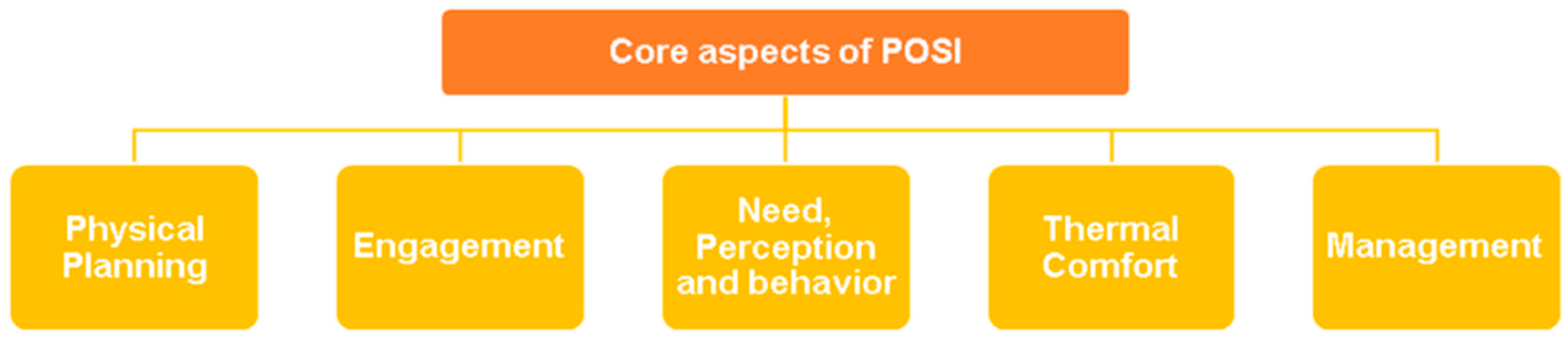
The Campus Open Space Index (COSI) brings together expertise from urban planning, environmental psychology, and landscape architecture to evaluate the open spaces of campuses. It is grounded in the principles of social inclusion, environmental sustainability, and aesthetics. The COSI framework enables assessments that emphasize user experience and spatial quality while being attentive to the context of campus environments. COSI is informed by urban planning along three main dimensions: the social, economic, and environmental aspects of campus development. These dimensions shape the creation of an inclusive, sustainable campus environment [94]. Urban design complements this approach by addressing the functional, aesthetic, and user-centric parameters that determine a space’s usability [1,95]. Theoretical frameworks by Carr et al. and Gehl emphasize the significance of optional and social activities for enlivening spaces. Mehta [17] provides criteria for accessibility, comfort, and sensory richness that are relevant to understanding how well a space supports such activities. Theory argues that a public space should be accessible and open, well thought out and designed to foster meaningful activities, give a sense of safety, and provide physical and mental comfort. A good public space is convenient; it should give users the sense that they are in control of the situation, with pathways and signage that make navigation simple and direct. Finally, a public space worth emulating should delight the senses–sight, sound, smell, even taste, and touch. Figure 1 shows these five dimensions of a public place. Based on the literature and research stated above, these 5 aspects of the Campus open space were formulated.
Physical Planning: The essence of physical planning is to bring together the space’s functionality, beauty, and environmental quality. In a university campus, this translates into a setting that not just looks good but also performs well in all intended capacities, including being an engaging outdoor classroom. Green spaces and open areas contribute significantly to academic performance and overall well-being of students [96,97,98]. The basic elements of landscape architecture, spatial organization, integration with nature, and transitions between indoor and outdoor environments are vital to achieving these effects [2].
Engagement: User interaction with space is at the heart of engagement. Both active and passive activities define how people use a place, and successful public open spaces (POSs) bind users to the space over time. They encourage not just initial forays but also repeated visits; they foster emotional connections that make users “own” the space [3,99]. A POS must be flexible in its layout and programming to achieve walkability, sociability, and inclusive participation [1,2].
Need, Perception and Behavior: Grasping what students need and how they perceive things is essential when developing environments that support academic and social purposes. How students act in Campus Public Spaces is determined by their physical setup, the social situation, and psychological makeup. A good sense of space leads to less stress, more inclusivity, and greater overall contentment with educational experiences [50,100,101].
Thermal Comfort: The usability of an outdoor space is highly influenced by thermal comfort. Research focused on humans highlights the importance of several environmental variables, temperature, humidity, wind, and solar exposure, that affect comfort levels. Although these studies frequently use “standard” conditions (e.g., a certain temperature range), comfort is a highly subjective state that varies among individuals. Thus, it is more appropriate to consider the “thermal acceptability” of an outdoor space when discussing its potential for human use [28,50].
Management: Effective space management ensures safety, cleanliness, and functionality. Strategies include natural surveillance, regulations, and community stewardship. Well-managed spaces foster trust, reduce vandalism, and enhance user satisfaction [2,5]. Respect for shared use and user responsibility is key for inclusive and harmonious POS environments [5,102].
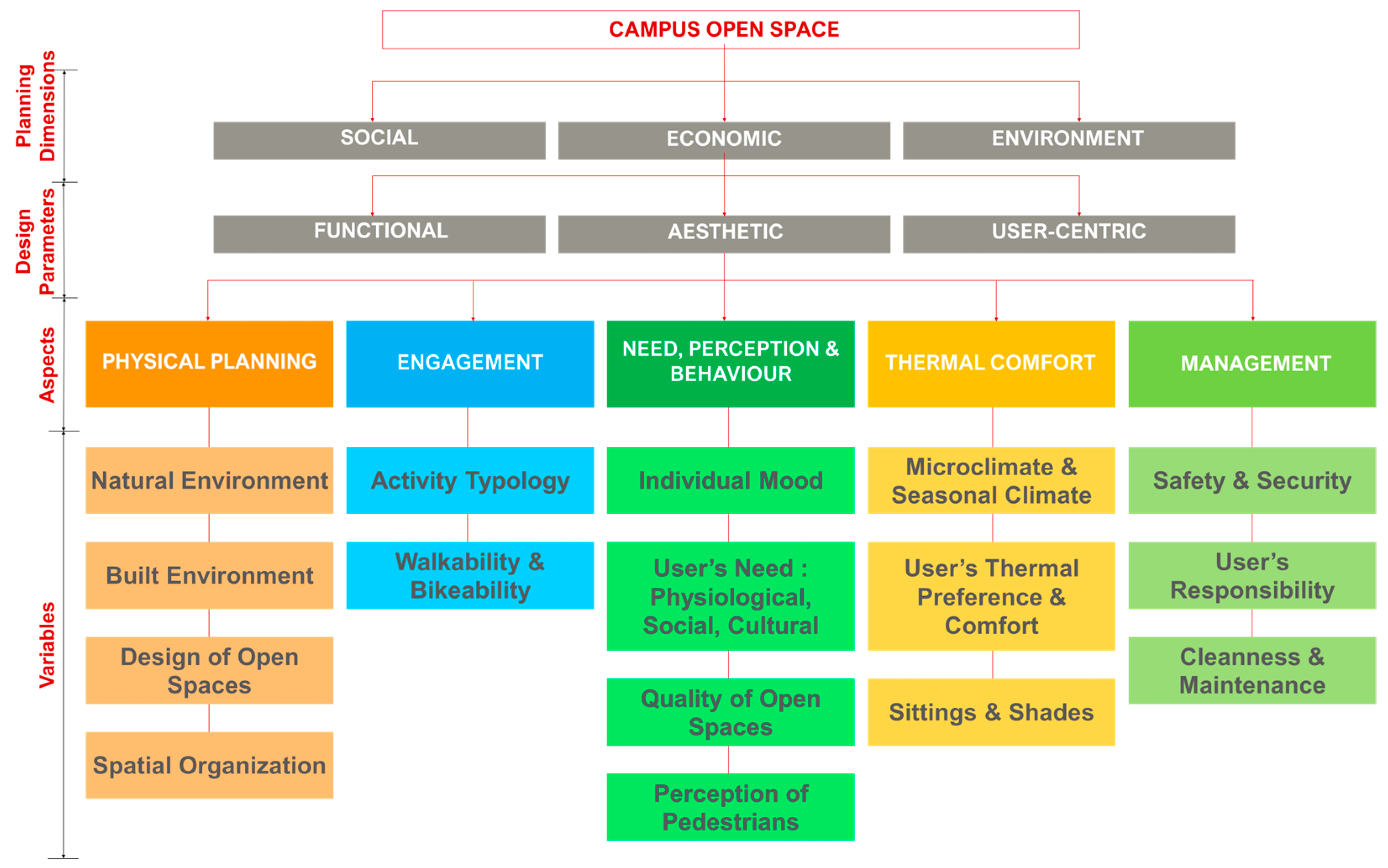
The five interrelated aspects work together towards improving the personality and performance of public open spaces (POS). The intention is to make them inclusive, user-friendly, efficient, attractive, and sustainable Figure 2 shows the evaluation framework (COSI) in which dimensions, parameters, aspects, and variables are applied to assess POS.

3. Materials and Methods

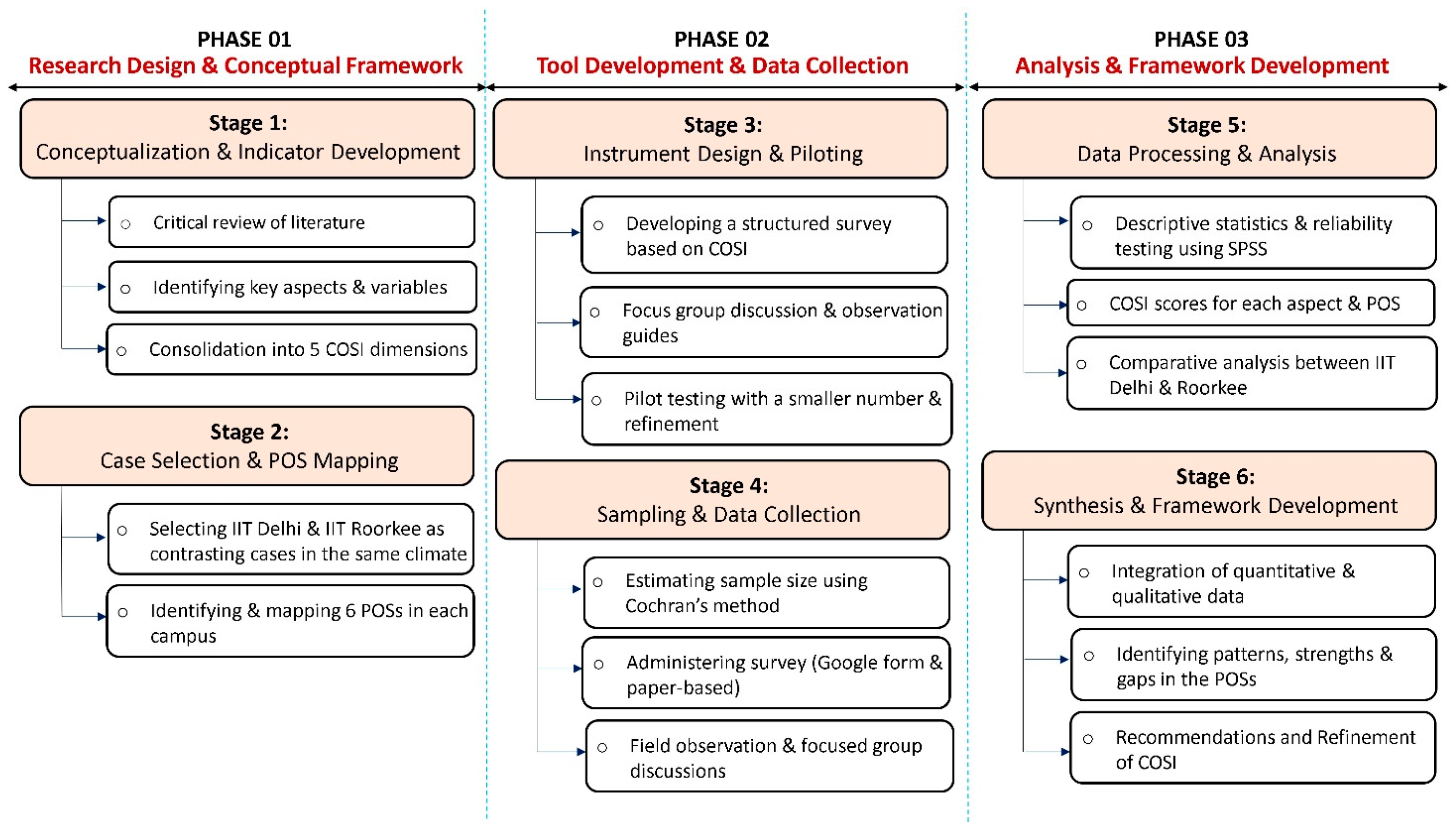
The methodology unfolds in three distinct phases. The initial phase pinpoints the planning dimensions and design parameters, which are essential for forming the basis of the Campus Open Space Index (COSI). In the second phase, we identify the study area, and the public open spaces contained within it. The final phase involves data collection. To clarify how these objectives were translated into empirical work, the research design was organized into a sequence of stages linking theory, data collection, and analysis. Figure 3 presents the overall methodology adopted in the study.

3.1. Indicator Framework

The research employed the Campus Open Space Index (COSI), a thorough framework developed to assess the performance of campus open spaces. For this study, COSI was adapted into a perception-based and quantifiable tool to evaluate six designated open spaces at IIT Delhi and IIT Roorkee. The researchers assessed these spaces for physical planning, engagement, user needs and perceptions, thermal comfort, and management. In this study, the environmental assessment is explicitly focused on outdoor conditions in campus open spaces (e.g., perceived thermal comfort, shade, wind and humidity in the outdoor setting) and does not evaluate indoor environmental quality (IEQ).
COSI measurement items were derived through literature-based identification of variables (Table 2) and grouped into five aspects: (1) Physical Planning; (2) Engagement; (3) Need, Perception & Behaviour; (4) Thermal Comfort; and (5) Management. Each aspect is operationalized by a set of questionnaire items (Appendix C), where higher values consistently indicate better perceived performance. Each space received an aspect score across five COSI aspects. To interpret these scores, the researchers devised a ranking system with five levels: poor (below 50%), fair (50–59%), average (60–69%), good (70–79%), and excellent (80–100%). This straightforward but effective system allows for easy comparison between the two campuses and among their evaluated spaces.

3.2. Selection of the Study Area

Selecting IIT Roorkee and IIT Delhi as case studies was a deliberate choice to examine different institutional types in the context of planning public open spaces at Indian technical university campuses. These two institutions present an interesting contrast in terms of their history, planning approaches, and spatial arrangements, making them suitable for assessing student experiences across different campus forms. IIT Roorkee, which was established in 1847, has a campus that has evolved organically. It offers open spaces that have developed informally around academic and residential buildings, with traditional campus growth patterns that lack central planning principles. This historic spatial form provides a valuable opportunity to study how the past influences current use, accessibility, and student perceptions of public open spaces. The campus features prominent open spaces like the James Thomson lawn, the Vigyan Kunj canteen forecourt, and the LBS sports ground. These have naturally become social and recreational hubs in the institution. IIT Delhi, in contrast, is a symbol of modernist campus planning in post-independence India. It was designed with an evident zoning scheme, circulation networks that are easy to navigate, and public spaces that are allocated. It takes a “structured” approach to campus design with planned places like Nalanda Ground, Mittal Sports Complex, and the food plaza near the Lecture Hall Complex that serve both formal and informal student interactions. Its spatial arrangement guarantees visual connectivity, accessibility, and multifunctionality—essential attributes of contemporary urban design and public space planning. Moreover, both campuses are located in climatically different zones—Roorkee, in the sub-Himalayan belt, has a more temperate climate, while Delhi is in a semi-arid region. This gives us an added insight into how microclimates affect user interaction with open spaces. The dual case approach not only boosts the representativeness of the research but also allows for findings to be applied across similarly diverse university settings, both within India and beyond.

3.3. Data Collection

A mixed-methods research design captured the perceptions of students and faculty through both qualitative and quantitative techniques. Usage patterns and spatial behavior were observed during fieldwork, while user insights were gathered through structured questionnaires. These insights pertained to comfort, engagement, thermal response, and activity preferences. The assessment was guided by the Campus Open Space Index (COSI) framework. Diverse user groups from the IIT Delhi and IIT Roorkee campuses were surveyed, ensuring representation across gender, age, and academic levels.
The primary tools for data collection were Self-administered surveys, focus group discussions, and observations. A self-administered questionnaire survey is a widely used quantitative method that captures users’ perceptions of public open spaces (POS). Researchers employ this tool to understand the aesthetic and functional qualities of POS from the direct viewpoint of their users. Participants are left to express their perceptions and opinions in a free manner. Several researchers, including Mehta [17], Zamanifard et al. [102] and Askari et al. [103] have effectively applied this approach to grasp user viewpoints, underscoring its relevance and potency for similar research contexts. As a quantitative method, observation was employed to analyze both active and passive user behaviors in space, as well as the facilities and services available there. Researchers such as Whyte [104] and Gehl [2] have used observation to study public open spaces (POS). Their work serves as an important precedent for understanding key characteristics of these spaces. Two surveys were carried out with students. The first one asked them to identify their preferred open spaces on campus. The second one sought to understand their activities and behaviors within those spaces. Both surveys employed a 5-point Likert scale (1–5). For items measuring importance or agreement, anchors were defined as 1 = Not important/Strongly disagree and 5 = Very important/Strongly agree; for satisfaction-related items (including thermal comfort), anchors were defined as 1 = Very dissatisfied/Very uncomfortable and 5 = Very satisfied/Very comfortable. The scale construction and use follow the general principles for subjective judgement scales outlined in ISO 10551:2019 [105] (subjective scales for assessing physical environments), adapted here for a campus POS context. The collection of observational data was systematic and methodical. It recorded foot traffic, user behavior, and usage trends at different times of the day and week. The questionnaire survey and observations were conducted multiple times across several days and weeks. For the final result, only the mean score was used. Each aspect of COSI had a different number of measurement items, so we converted the individual aspect scores and overall mean score (sum of all five aspect scores) into percentages to ensure consistent results. Furthermore, we developed a simple ranking system for percentage scores: below 50% is labelled as ‘Poor,’ 50% to 59% as ‘Fair,’ 60% to 69% as ‘Average,’ 70% to 79% as ‘Good,’ and 80% to 100% as ‘Excellent’. Since the entry and exit of users at the entrances of the POSs could not be tracked, a different method was used to determine foot traffic. Weekly footfall was counted at these locations. Then, using the Cochran Method, Sample size calculations were performed. These determinations have a 95% confidence level and a 5% margin of error. At the main entrance of each public open space, a researcher approached users to explain the study’s purpose and invite them to participate in our survey. Interested individuals were given the questionnaire. Participation was completely voluntary, and no incentives were offered to participants. This approach has been recommended by other researchers who have conducted similar studies.
For each campus, item-level responses were aggregated using the mean score (SPSS v25). Aspect scores were computed as the sum of mean item scores within each aspect. Because aspects contain different numbers of items, aspect scores were normalized to a percentage of the maximum possible score for that aspect, enabling consistent cross-aspect comparison:
Aspect Percentage = (Σ mean item scores ÷ (k × 5)) × 100,
where k is the number of items in the aspect.
The overall COSI score is computed as the arithmetic mean of the five aspect percentages, giving equal weight to each aspect.
The determined sample sizes were 295 for IIT Roorkee and 227 for IIT Delhi, with a total of 522 samples. Data collection took place in July and August of 2025 using both Google Forms and paper questionnaires. To ensure a representative sample, participants were observed over two weeks. The primary data were analyzed using the Statistical Package for the Social Sciences (SPSS, version 25). Descriptive statistics were used to summarize the data, specifically calculating means, standard deviations, and percentages. Cronbach’s reliability test was employed to ensure the scale’s reliability. The scalable and adaptable methodology can be applied to various global and cultural contexts. The COSI framework focuses on user perception and real-world observation, making it ideal for assessing international campus settings. These often differ from domestic campuses in ways that are critical to student well-being, such as social inclusiveness, aesthetic quality, or climate adaptability. By combining standardized metrics with localized variables, any institution can create a powerful tool for evaluating not just the performance of their spaces today but also the likely performance of those spaces after they have undergone future design changes.

4. Case Studies

This study examines two IITs, Roorkee and Delhi, representing both historical and modern educational settings. Established before independence, IIT Roorkee evolved organically, reflecting a spontaneous development pattern, while post-independence IIT Delhi was meticulously planned with structured layouts emphasizing functionality and aesthetics. Despite their contrasting designs, both campuses share a ‘Composite’ climatic zone, making them ideal for a comparative study on campus planning and design evolution. The POSs chosen for this study represent a diverse range of functions, including Natural Retreats, Sports & Activity Zones, Food & Social Hubs, and Academic-Adjacent Open Spaces. The two campuses have different planning histories, one modernist (IIT Delhi), the other colonial (IIT Roorkee), which make them perfect subjects for a comparative evaluation using the POSI framework.

4.1. IIT Delhi

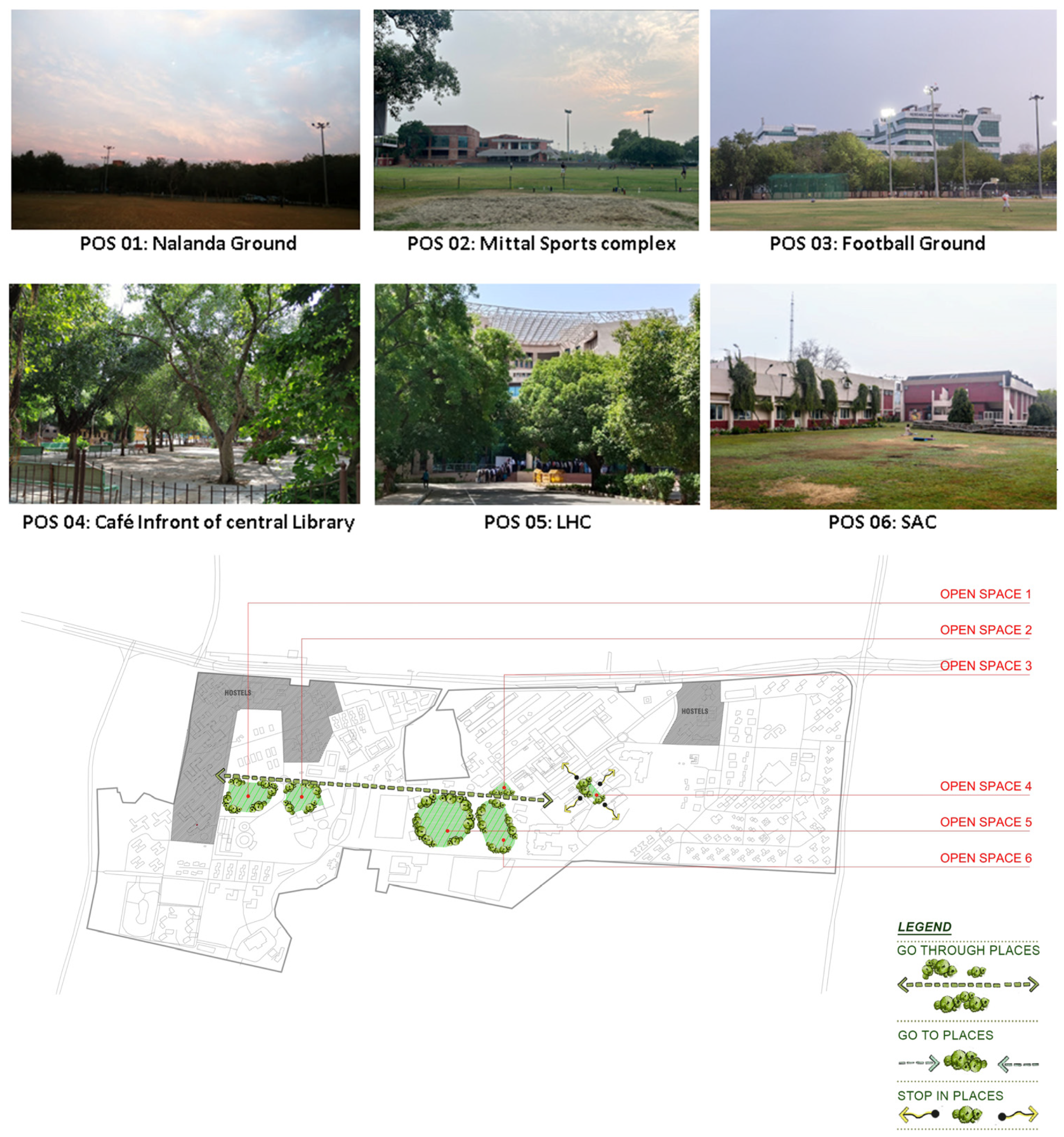
In the heart of India’s capital, IIT Delhi occupies an urban campus layout that spreads over about 325 acres. Its compact planning typology enhances the walkability and spatial legibility of the campus, with academic, residential, and recreational zones arranged nearby. The campus is well integrated with Delhi’s metro network and enjoys high accessibility from iconic heritage sites like the Qutab Minar. Despite its urban density, the campus has several functional open spaces that act as vital community areas. The climate is classified as composite, experiencing hot summers and cold winters. The composite climate affects thermal comfort on the campus and influences vegetation strategies. Deliberate microclimatic planning is necessary for shaded infrastructure and achieve a comfortable outdoor environment throughout the year. The 6 Public Open Spaces (POSs) (Figure 4) selected for the study are Nalanda Ground, Mittal Sports Complex, Football Ground, Library Café Courtyard, Central Plaza and Hostel Greens.
The Nalanda Ground (POS 01), located near the Student Activity Centre (SAC), is a multipurpose field for sports and events that is currently under improvement. The Mittal Sports Complex (POS 02) serves as the indoor courts and social spaces and acts as a nucleus of athletics and culture. The Football Ground (POS 03) is a training and competition venue symbolizing athletic rigor. The café adjacent to the Central Library (POS 4) blends food service with an academic atmosphere. Informal gathering nodes are created in front of the Lecture Hall Complex (POS 05) by kiosks such as CCD and Amul. Finally, POS 06, located outside the SAC, features essential retail that adds to the campus’s liveliness. There are stationery shops and a salon that serve the everyday needs of people on campus.

4.2. IIT Roorkee

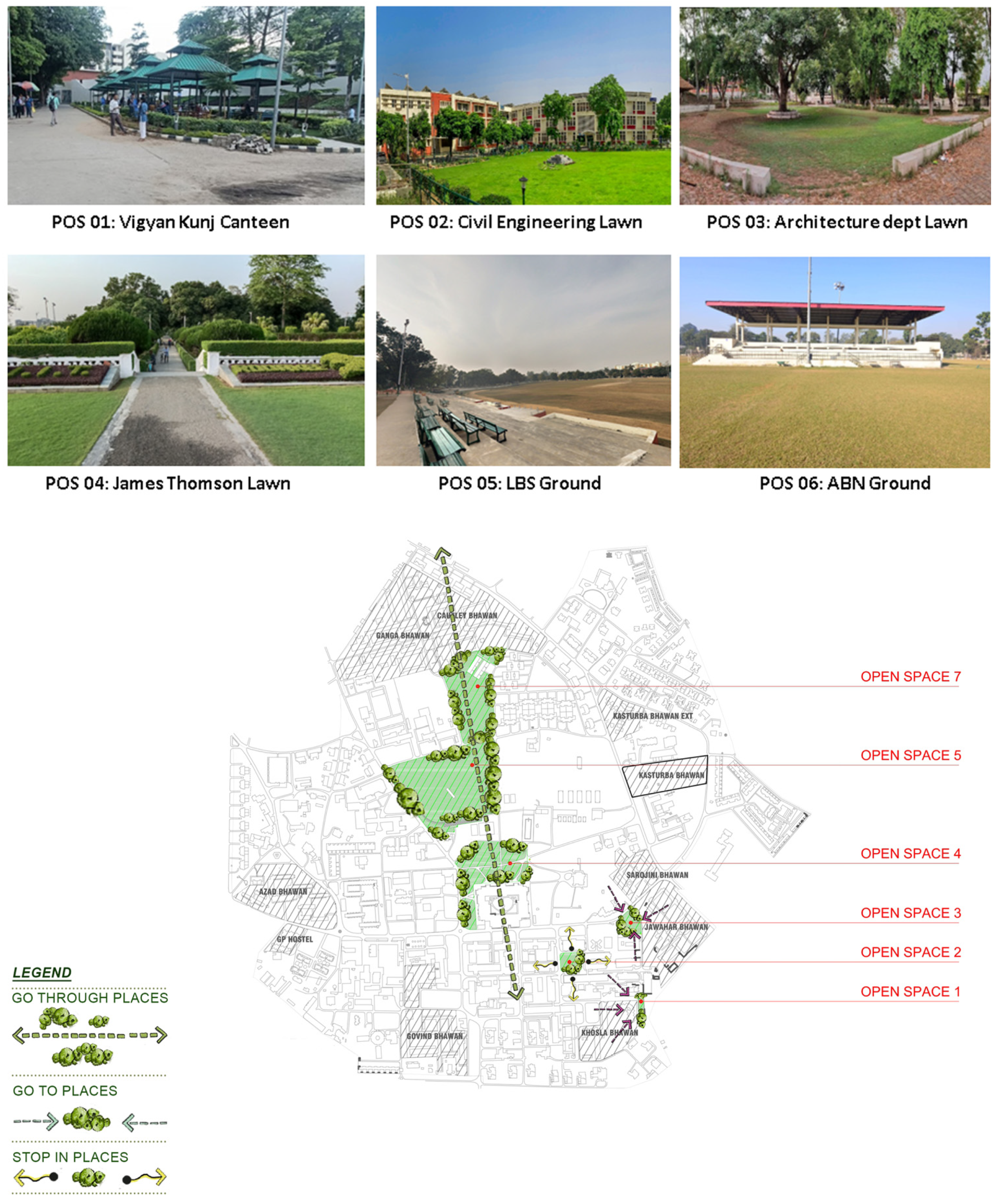
IIT Roorkee, in contrast, has a long and storied history. It was established as Thomason College back in 1847, making it one of the oldest engineering institutions in India. The campus reflects a semi-urban character with an organic layout, abundant green lawns, and buildings from the colonial era spread across 365 acres. This distinct sub-Himalayan climate, which is similar to the Composite climate in Delhi, influences spatial use patterns and vegetation types around the campus. Recreational nodes like the James Thomson lawn and LBS sports ground provide expansive public open spaces that promote social engagement and even visual continuity between academic and residential areas. The campus is characterized by visual openness, seasonal flora, and slow-paced pedestrian movement. The 6 Public Open Spaces (POSs) (Figure 5) selected for the study are James Thomson Lawn, Vigyan Kunj Canteen, Architecture Lawn, LBS Ground, Saharanpur Courtyard and Hostel Cluster Greens.
IIT Roorkee, with its semi-urban setting, has a campus that offers plentiful green spaces, true to the historic character of its planning. The lawn around the James Thomson Building (POS 01) is an architecturally significant gathering area and a central part of the campus near the Mahatma Gandhi Library. The Vigyan Kunj Canteen (POS 02) is nestled among key academic blocks and provides shaded seating that is conducive to socializing. The Architecture Department Lawn (POS 03) is among the largest departmental greens and is positioned along a main thoroughfare, making it both visible and accessible. The LBS Ground (POS 04) acts as the primary sports venue and hosts major events on campus. The Civil Engineering Lawn, known as POS 05, is a quieter yet well-trodden space because of its central location within the department. IIT Roorkee’s outdoor spaces, such as POS 06, embody the institute’s lush and expansive spatial structure. Each reflects a commitment to functional greenery and unhindered student access.

5. Findings and Discussion

5.1. Respondent Characteristics and POSs Visitation

A total of 522 completed questionnaires were collected from IIT Delhi and IIT Roorkee. The response rate was higher among male participants at IIT Roorkee (70.4%) and among female participants at IIT Delhi (52.3%). Most of the respondents were enrolled in bachelor’s programs 55.8% at IIT Roorkee and 48.1% at IIT Delhi. A notable percentage of master’s degree holders participated from IIT Delhi (34.7%) compared to 28.2% at IIT Roorkee. PhD respondents constituted 17.2% at IIT Delhi and a smaller proportion of 9.5% at IIT Roorkee. In terms of age distribution, a majority of respondents from IIT Roorkee (74.6%) and IIT Delhi (68.3%) were under 24 years of age. The 25–34 age bracket represented 21.9% at IIT Roorkee and 28.5% at IIT Delhi. These insights suggest that the study predominantly engaged with a younger, academically active population, with IIT Delhi demonstrating a slightly more diverse academic cohort. This demographic landscape is central to interpreting how different age and education groups perceive and use campus open spaces. Detailed respondent characteristics are outlined in Table 3.

5.2. Campus Open Space Index [COSI] Score

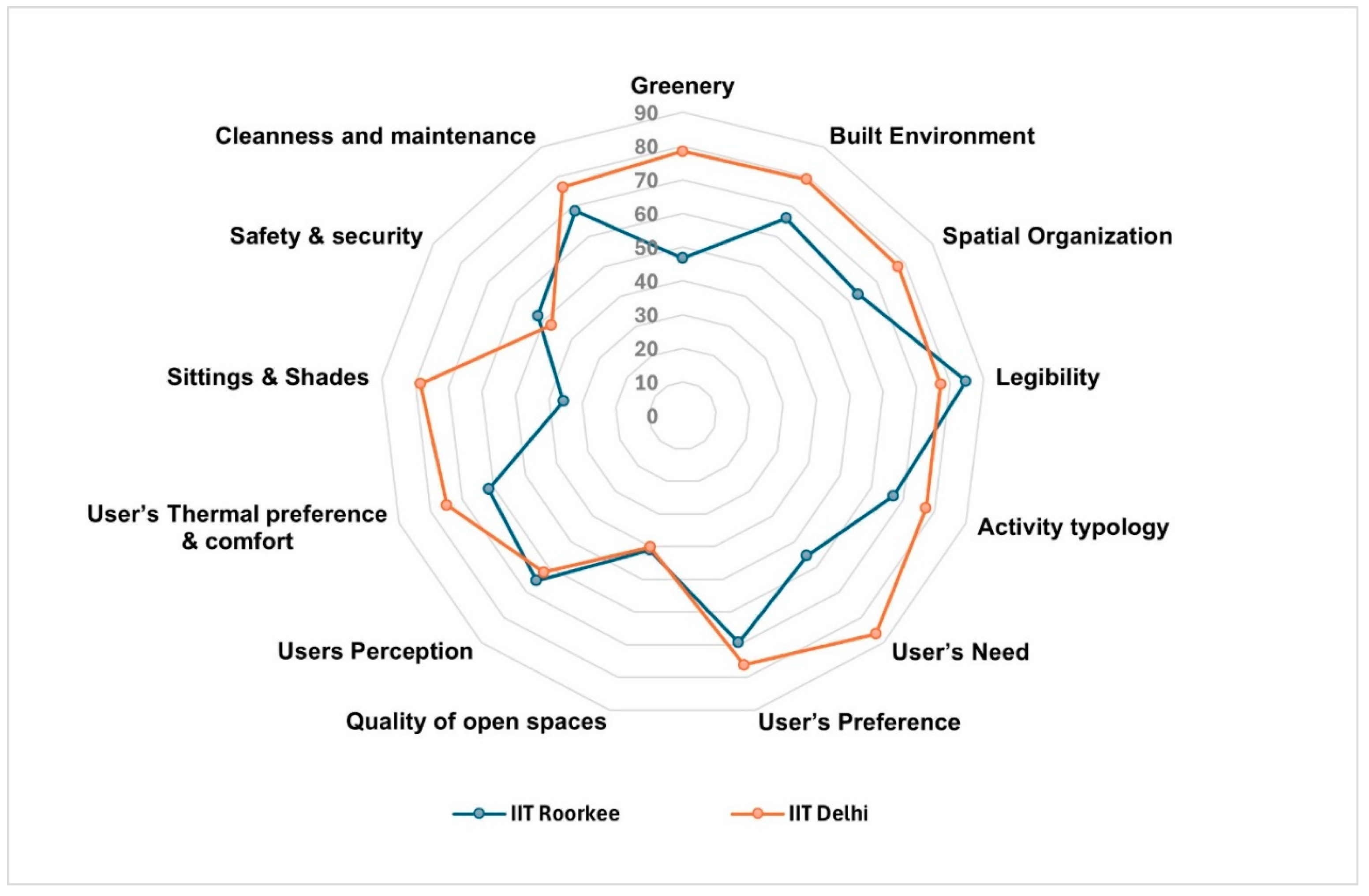
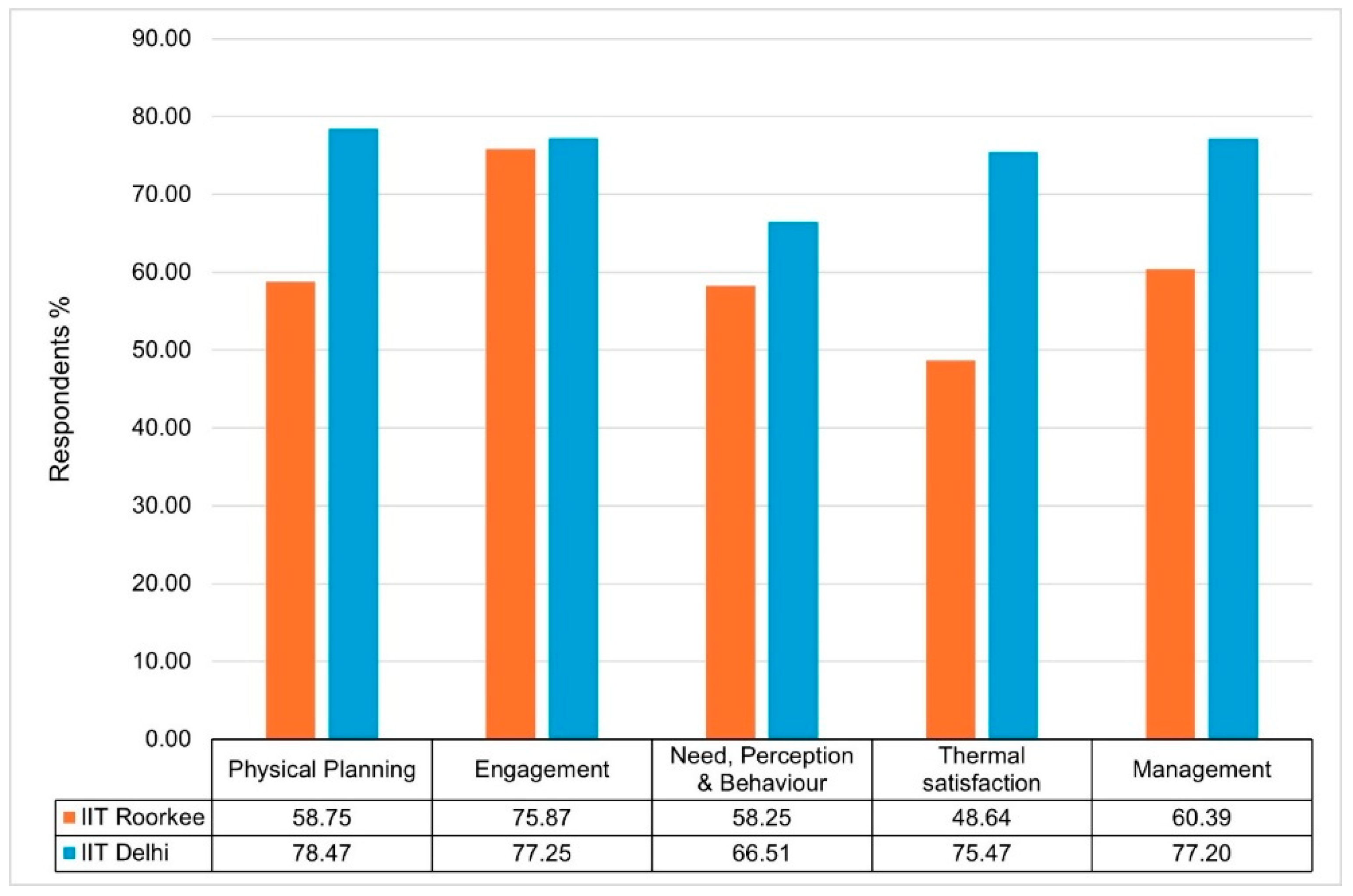
The comparative evaluation (Figure 6) of Campus Open Space Index (COSI) scores between IIT Delhi and IIT Roorkee provides a multidimensional perspective on how each institution’s public open spaces (POSs) function in practice. As illustrated in Figure 7, IIT Delhi scored marginally higher in Physical Planning (66.37%) compared to IIT Roorkee (64.22%), suggesting a slightly better spatial configuration and physical layout that supports accessibility and way finding. However, IIT Roorkee performed better in Engagement, scoring 71.68% over IIT Delhi’s 68.44%, indicating a stronger sense of social cohesion, communal use, and vibrancy in its open spaces. In the Need, Perception & Behavior category, both institutions had comparable results IIT Delhi at 63.91% and IIT Roorkee at 62.78%, implying a parallel level of satisfaction and behavioral alignment with open space usage. Especially, Thermal Satisfaction was higher at IIT Delhi (60.56%) than IIT Roorkee (57.43%), which may be attributed to the presence of shaded walkways and green cover that mitigate Delhi’s dry heat. When it came to Management, IIT Delhi also scored higher (75.84%) than IIT Roorkee (68.71%), pointing to better maintenance practices, safety measures, and the overall upkeep of campus open space infrastructure. In terms of Physical planning, IIT Delhi demonstrated stronger performance in Spatial Organization, Cleanliness, and Green Infrastructure, whereas IIT Roorkee had more favorable ratings in Activity Diversity, Social Engagement, and Accessibility. In the Safety and Comfort category, both campuses scored closely, although IIT Roorkee’s open spaces offer more social security during the time of high pedestrian activity. Analysis shows that although IIT Delhi’s open spaces offer better-maintained spaces, IIT Roorkee provides more vibrant and socially engaging environment.
Overall, the results suggest that while both IIT Roorkee and IIT Delhi have strengths in different areas, there is a need for targeted improvements to enhance user satisfaction and overall quality of public open spaces. Figure 6 indicates the aspect-wise COSI scores received by both COSs. Additionally, the detailed comparative evaluation of the two campuses across the selected indicators is summarized in Table 4, while the complete COSI scores are provided in Table A1 in Appendix A.

5.3. Gender-Segmented Perception Analysis

A gender-segmented analysis was conducted to examine potential differences in perception of campus open spaces between male and female respondents. At IIT Roorkee, female respondents reported slightly higher overall perception scores (Mean = 6.17) compared with male respondents (Mean = 6.10). In contrast, at IIT Delhi, male respondents reported marginally higher scores (Mean = 3.67) than female respondents (Mean = 3.60). However, the differences across gender groups were relatively small, suggesting that perceptions of campus open spaces remain broadly consistent across male and female students. These findings indicate that while gender-based variations exist, the overall user experience of campus open spaces is largely shared among different demographic groups. Nevertheless, subtle differences may reflect variations in perceived comfort, safety, and spatial usability, highlighting the importance of inclusive planning approaches in campus design (Table 5).

5.4. Discussion

The findings included a statistical analysis of data collected through a self-administered questionnaire survey and observation. According to several researchers, a well-designed and inclusive POS on university campuses is not just a recreational space; it encourages experience sharing, fosters a sense of belonging, provides students with areas for informal learning, fosters experience-sharing spaces, and contributes to social cohesion. Similar observations have been pointed out by Holland et al. [106], Moulay et al. [107] and Jennings [108]. In the aspect of Physical Planning, both IIT Delhi and IIT Roorkee performed below the 70% mark. Respondents from IIT Delhi appreciated the axial connectivity and interspersion of green pockets throughout the academic and residential zones. However, barriers to universal accessibility were a shared issue. Much like IIT Kharagpur and IIT Bombay, features like ramps, tactile paving, or inclusive signage were limited or absent. This raise concerns noted by scholars such as Wolfgang and Ostroff on the neglect of universal design in supposedly progressive institutions.
In the aspect of Engagement, within the campus environment, students prefer a space where they can not only relax but also connect with their friends and others, move around freely, or simply sit quietly and observe things. The study found that the students’ engagement with the POS is very strong due to the mixture of active and passive activities, from casual hangouts to sports, from sitting in a group with friends under the tree to chatting over snacks. IIT Roorkee emerged as particularly effective. Students identified the areas around Rajiv Bhawan lawns, the Lecture Hall Complex, and the front plaza near the central canteen as popular gathering spots. Their popularity stems from shaded seating, adjacent to academic buildings, and proximity to food kiosks. On the other hand, IIT Delhi’s Student Activity Centre (SAC) and the Ridge area were frequently used but lacked diversity in spatial planning. Respondents mentioned the need for more interactive features such as outdoor games, informal amphitheaters, and mobile snack vendors. The lack of ‘vibrant edges and poorly connected food zones was a common critique, echoing Carr et al. [1] and Carmona’s [5] observations on the vitality of social anchors in POS design.
When it comes to students’ needs, perception, and behavior, Campus open spaces are not just about greenery or benches—they are where campus life happens between the academic hours. The study highlights that there is a noticeable gap between what they need and what is provided. For instance, students at IIT Roorkee expressed that while the central lawns were visually appealing, they were not equipped for longer use due to a lack of shade, seating, and evening lighting. IIT Delhi, despite offering shaded nodes and integrated furniture, received mixed reviews regarding the usability of spaces post-sunset due to security concerns and low footfall. Importantly, students tend to adapt and continue using POSs like SAC Café or Roorkee’s Rajiv Bhawan lawns when these spaces align with their social routines, regardless of microclimatic discomfort.
Thermal Comfort remains a serious concern for both campuses. Thermal comfort is strongly mediated by the outdoor radiative environment (solar exposure/mean radiant temperature), which makes shade and sky exposure critical design levers in campus settings. Field studies show that tree canopy and built shading can substantially improve perceived comfort and reduce thermal stress, primarily by moderating radiant heat load rather than air temperature alone. In campus-like pedestrian environments, shade type (tree vs. canopy), the continuity of shaded walking routes, and the availability of shaded seating/shelter directly influence whether users remain in a space or shift to alternative routes/places [85].
In the present case studies, the comparatively higher thermal satisfaction at IIT Delhi is consistent with the reported presence of shaded walkways, canopy trees, and shaded seating near high-activity nodes, while more exposed lawns in IIT Roorkee can reduce comfort during hot and monsoon periods. Design implications therefore shift from generic “more greenery” to specific microclimate-responsive interventions: continuous shade networks (tree rows/pergolas), shaded seating clusters near food/social hubs, and rain-sheltered edges that retain usability during monsoons [109].
Finally, outdoor comfort is also shaped by psychological adaptation factors such as expectations, perceived control, and the “choice” to move into shade or sun, reinforcing the need to design campuses with multiple microclimatic options (sun–shade mosaic) rather than a single uniform condition [90].
Management was one of the strongest differentiators. IIT Delhi’s higher score (75.84%) reflected regular maintenance cycles, signage for medical/emergency assistance, and visibly better cleanliness in high-use areas. Students felt confident using even peripheral spaces, such as the walking trail, during early mornings or late evenings. By contrast, IIT Roorkee lagged in maintaining peripheral areas, where irregular lighting, insufficient signage, and visible litter reduced perceived safety and comfort. Suggestions from participants included enhanced surveillance, increased night-time visibility, and the installation of digital information boards displaying safety resources.
The findings from this study highlight that while IIT Delhi and IIT Roorkee each possess unique strengths in their availability of open spaces, both campuses face common organizational and planning limitations that hinder the optimal use of these areas. This underscores the urgent need for inclusive and participatory planning approaches that involve students as key stakeholders. As illustrated in Figure 8, the Campus Open Space Index (COSI) application offers a practical, user-centered framework for guiding campus management decisions. By aligning spatial interventions with actual student needs and behaviors, COSI can support the transformation of campus open spaces into more inclusive, responsive, and high-quality environments across university settings. The Campus Open Space Index (COSI) provides clear evidence that open spaces on campuses need to be more than just visually appealing. They should cater to the local climate, support a variety of activities, and provide comfort that encourages people to linger.
As summarized in Figure 8, a few important lessons can be learned from the findings. One is about the importance of location: POSs near academic buildings see increased use and have the potential to amplify informal learning. Another is about design for climate: In composite climates like those of Delhi and Roorkee, it is crucial to provide shade, wind, and vegetation in outdoor spaces. Yet another is about programming: Spaces should accommodate both active and passive uses if they are going to serve all members of the campus community. Finally, there is an important inference about safety: Cleanliness, lighting, and visible security go a long way toward enhancing trust and usability. User Centric Planning: when students can tailor spaces to their needs, engagement and even learning outcomes improve. Informal seating arrangements, for instance, allow for varied postures that can enhance comfort and even boost concentration. Snack kiosks in strategic locations make it easy for students to grab a quick bite when they are on the run, or to satisfy a more leisurely appetite during a long study session. Quiet pockets scattered throughout a building let introverts and deep thinkers find the solitude they need to thrive. Aesthetic Functional Balance: A visually rich environment is not necessarily a good one if it is also cluttered, confusing, or just plain uncomfortable. A campus should be both beautiful and navigable; students should be able to move through it with ease and confidence. That is as true here in the U.S. as it is anywhere else in the world.

6. Limitation

Despite the contributions of the proposed framework, several limitations should be acknowledged.
First, the COSI framework relies primarily on subjective perception data collected through user surveys. While perception-based evaluation is essential for understanding user experience in public spaces, it does not fully capture objective environmental conditions such as temperature, humidity, wind speed, lighting levels, or noise exposure. Future research could integrate environmental monitoring data to complement the perception-based assessment.
Second, the framework has been applied in a cross-sectional evaluation of existing campus spaces. A more comprehensive validation of the index would require longitudinal studies where campus spaces are re-evaluated after design interventions or renovation projects. Such post-implementation assessments would allow researchers to examine how spatial improvements influence user perception and overall COSI performance.
Third, the present study focuses on two Indian technical university campuses. Although the framework is designed to be scalable and transferable, additional case studies across different climatic and cultural contexts would strengthen its generalizability.

7. Conclusions

Public Open Spaces (POSs) are central to how students inhabit and experience university campuses. They shape opportunities for informal learning, social connection, and emotional restoration as much as they provide circulation routes and visual relief. In this study, the Campus Open Space Index (COSI) framework was used to evaluate 12 open spaces at IIT Delhi and IIT Roorkee, confirming that these spaces significantly influence student well-being and campus engagement. COSI results reveal distinct performance patterns: IIT Delhi outperformed IIT Roorkee in Physical Planning (spatial layout/connectivity) and Management (maintenance and safety, with scores of 75.8% and 68.7%, respectively), whereas IIT Roorkee scored higher in student Engagement (stronger social activation). However, both campuses share deficiencies in thermal comfort (open spaces often unusable during extreme heat or monsoons), universal accessibility (lack of inclusive design), and functional diversity of uses. Qualitative feedback indicates that students gravitate toward shaded, amenity-rich areas (e.g., central lawns and student centres) despite suboptimal comfort or security.
From a practical perspective, the proposed Campus Open Space Index (COSI) offers a decision-support tool for campus planners, university administrators, and landscape designers. By systematically evaluating spatial planning, environmental comfort, and user engagement, the framework can assist institutions in identifying underperforming spaces and prioritising design interventions that improve usability, inclusivity, and climate responsiveness within campus environments.
These findings underscore the need for participatory, climate-responsive design interventions to improve the inclusivity and year-round usability of campus open spaces. The COSI framework proved to be an effective and transferable tool for holistic assessment, bridging quantitative metrics with user perceptions to guide student-centred improvements. Though limited to two campuses, this approach is broadly applicable. Future research should include post-occupancy evaluations and cross-cultural studies to further explore how design, climate, and cultural context influence open-space use and student experience.

Author Contributions

Conceptualization, N.A.; Methodology, N.A.; Software, N.A.; Formal analysis, N.A.; Writing—original draft, N.A.; Writing—review & editing, N.A. and M.A.; Visualization, N.A.; Supervision, M.A.; Funding acquisition, M.A. All authors have read and agreed to the published version of the manuscript.

Funding

This work was supported by the Deanship of Scientific Research, Vice Presidency for Graduate Studies and Scientific Research, King Faisal University, Saudi Arabia [Grant No. KFU250694].

Institutional Review Board Statement

Ethical review and approval were waived for this study by the guidelines of the Indian Council of Medical Research (ICMR) National Ethical Guidelines (2017). Ethics committee approval is not mandatory for minimal-risk, non-clinical, perception-based surveys that do not involve biological sampling, vulnerable populations, or sensitive personal data. The study adhered to the principles of the Declaration of Helsinki (1975, revised 2013). This study involved an anonymous questionnaire survey among adult university students regarding perceptions of campus open spaces. No personal identifiers were collected, and participation was entirely voluntary.

Informed Consent Statement

Informed consent for participation was obtained from all subjects involved in the study.

Data Availability Statement

The original contributions presented in this study are included in the article. Further inquiries can be directed to the corresponding author(s).

Conflicts of Interest

The authors declare no conflicts of interest and the funders had no role in the design of the study; in the collection, analyses, or interpretation of data; in the writing of the manuscript; or in the decision to publish the results.

Appendix A

Table A1. Summary of all the open spaces.
IIT Roorkee
POS 01: Vigyan KunjPOS 02: Civil Eng LawnPOS 03: Architecture
Department Lawn
POS 04: James Thomson LawnPOS 05: LBS GroundPOS 06: ABN Ground
Spatial
configuration
Clustered gathering spaces along an axial pathOpen area with low level of enclosureOpen area with low level of enclosureOpen area with low level of enclosureOpen area with low level of enclosureOpen area with low level of enclosure
AccessVigyan Kunj road, Khosla Bhawan, Geomatics department,NC Nigam MargArchitecture & planning departmentJames Thomson building, Mahatma Gandhi libraryThomson RoadMAC Road
Surrounding
buildings and
services
Khosla bhawan, Geomatics department, Civil engineering departmentCivil engineering department, Water resource departmentArchitecture & planning department, Jawahar BhawanJames Thomson building, Mahatma Gandhi library, Department of managementBasketball court, Saraswati Mandir ground, HydrologySaraswati Kunj, MAC and Hydrology department
Shaded/Not shadedYesNoNoNoNoNo
Green coverYesYesYesYesYesNo
SeatingYesYesYesNoYesNo
IIT Delhi
POS 01: Lake Side AreaPOS 02: Backside of GymkhanaPOS 03: New TikkaPOS 04: Front side of Nalanda BlockPOS 05: Adda ArenaPOS 06: Tata Sports ground
Spatial
configuration
Open area with low level of enclosureOpen area with low level of enclosureCluster gathering space along with the main RoadOpen area with low level of enclosureOpen area with low level of enclosureOpen area with low level of enclosure
AccessNalini R. S. AvenueScholars AvenueIIT Main RoadArdesher Dalal AveIIT Main RoadArdesher Dalal Ave
Surrounding buildings and servicesGymkhana Park, Technology club, Swimming poolGymkhana Park, Lake, Swimming poolTata Sports ground, Institution of EngineersNalanda BlockMother Teresa and CSE departmentCSE Department, Kalidas Auditorium
Shaded/Not shadedPartiallyNoYesNoPartiallyNo
Green coverYesNoNoYesYesYes
SeatingYesYesYesNoYesNo

Appendix B

Table A2. Campus Open Space Index (COSI) score received by POSs.
NoVariableNoMeasuring Item IIT Roorkee (n = 295)IIT Delhi (n = 227)
Maximum ScoreMean ScoreStandard DeviationMean ScoreStandard Deviation
Aspect—1 Physical Planning
1Greenery1How are the green covers in the open areas?52.340.623.920.77
2Built Environment2What physical features in this place do you consider attractive?53.311.223.961.12
3Spatial Organization3Does the availability of ramps and tactile flooring provide convenience to users with physical disabilities? (Universal design for all)53.171.153.890.67
Total Measuring Items 3158.81 11.77
Index Score (Percentage) 58.75 78.47
Ranking Fair Good
Aspect—2 Engagement
4Legibility4How easily are you able to find your way around the campus and locate the open spaces?54.240.863.860.84
5Activity typology5Does space encourage a variety of activities, including active, passive, and others?53.701.023.990.71
6For what purpose do you use this open space?53.141.143.741.01
7Does the space have the versatility to adapt to the changing needs of users?52.951.223.860.73
Total Measuring Items 42014.03 15.45
Index Score (Percentage) 70.15 77.25
Ranking Good Good
Aspect—3 Need, Perception & Behaviour
6User’s Need8How important is the use of open spaces for you?52.780.494.330.78
7User’s Preference9How often do you visit or spend time in the open spaces on campus?53.413.403.830.92
10How long do you usually stay in this place?51.190.453.790.90
8Quality of open spaces11How well is the space connected to other areas with walkways?52.050.852.010.96
9Users Perception12When you are in this place, how crowded do you find it to be?51.830.612.310.83
13Rate the open spaces in the campus as per your preference.53.291.294.110.81
14When do you feel most unsatisfied in the open space?51.280.582.901.46
Total Measuring Items 73515.83 23.28
Index Score (Percentage) 45.23 66.51
Ranking Poor Average
Aspect—4 Thermal satisfaction
10User’s Thermal preference & comfort15In warm/hot (All climatic zones) weather, how would you describe the temperatures in the open space?51.780.673.830.89
16In cool/cold weather, how would you describe the temperatures in the open space?52.140.623.851.01
17In Rainy Days also how would you describe the temperature, wind, humidity in the open space?51.970.673.651.08
18What would you describe as the source of this discomfort?53.531.523.970.99
19How satisfied are you with the temperature, wind, and humidity in the open space in which you spend the most time?52.180.623.420.81
11Sittings & Shades20How are the open spaces shaded during different seasons?51.790.673.920.76
Total Measuring Items 63013.38 22.64
Index Score (Percentage) 44.60 75.47
Ranking Poor Good
Aspect—5 Management
12Safety & security:21Are the open spaces well lit? (Artificial/day light?)52.640.473.920.81
22Are the open spaces safe during off times?52.580.523.830.84
13Cleanness and maintenance23Are the POSs clean, neat, and well-maintained?53.430.893.830.66
Total Measuring Items 3158.65 11.58
Index Score (Percentage) 57.65 77.20
Ranking Fair Good
Below 50%—Poor 50% to 59%—Fair 60% to 69% Average 70% to 79%—Good 80% to 100%—Excellent

Appendix C

Q No.QuestionPOS’sOption 1Option 2Option 3Option 4Option 5
Q1Faculty
Q2GenderMaleFemalePrefer not to say
Q3How are the green covers in the open areas?POS 1; POS 2; POS 3; POS 4; POS 5; POS 6Completely coveredWell coveredModerately coveredPoorly coveredNot covered at all
Q4What physical features in this place do you consider attractive?POS 1; POS 2; POS 3; POS 4; POS 5; POS 6LandscapeSeatingShading & rain
shelter
Surrounding building facilitiesOthers
Q5Does the availability of ramps and tactile flooring provide convenience to users with physical disabilities (Universal Design for All)?POS 1; POS 2; POS 3; POS 4; POS 5; POS 6Strongly AgreeAgreeNeutralDisagreeStrongly Disagree
Q6How easily are you able to find your way around the campus and locate the open spaces?POS 1; POS 2; POS 3; POS 4; POS 5; POS 6Very EasilyEasilyModeratelyDifficultVery Difficult
Q7Does the space encourage a variety of activities (active, passive, and others)?POS 1; POS 2; POS 3; POS 4; POS 5; POS 6Strongly AgreeAgreeNeutralDisagreeStrongly Disagree
Q8For what purpose do you use this open space?POS 1; POS 2; POS 3; POS 4; POS 5; POS 6PlayLeisureSocializeWork or group workOthers
Q9Does the space have the versatility to adapt to changing needs of users?POS 1; POS 2; POS 3; POS 4; POS 5; POS 6Strongly AgreeAgreeNeutralDisagreeStrongly Disagree
Q10How often do you visit or spend time in these open spaces on campus?POS 1; POS 2; POS 3; POS 4; POS 5; POS 6Very FrequentlyFrequentlySometimesRarelyNever
Q11How long do you usually stay in each of these places?POS 1; POS 2; POS 3; POS 4; POS 5; POS 6Less than 30 min30 min–1 h1–2 h2–4 hMore than 4 h
Q12When you are in these places, how crowded do you find them to be?POS 1; POS 2; POS 3; POS 4; POS 5; POS 6Extremely crowdedVery crowdedModerately crowdedSlightly crowdedNot at all crowded
Q13How well is each space connected to other areas with walkways?POS 1; POS 2; POS 3; POS 4; POS 5; POS 6Very Well ConnectedWell ConnectedModerately ConnectedPoorly ConnectedVery Poorly Connected
Q14In warm/hot weather, how would you describe the temperature in each open space?POS 1; POS 2; POS 3; POS 4; POS 5; POS 6Very ComfortableComfortableNeutralSlightly UncomfortableNot Comfortable
Q15In cool/cold weather, how would you describe the temperature in each open space?POS 1; POS 2; POS 3; POS 4; POS 5; POS 6Very ComfortableComfortableNeutralSlightly UncomfortableNot Comfortable
Q16In rainy weather, how would you describe your comfort level (temperature, wind, humidity) in each open space?POS 1; POS 2; POS 3; POS 4; POS 5; POS 6Very ComfortableComfortableNeutralSlightly UncomfortableNot Comfortable
Q17What would you describe as the main source of discomfort in each open space?POS 1; POS 2; POS 3; POS 4; POS 5; POS 6Hot temperatureCold temperatureHumidityPrecipitationWind
Q18How are the open spaces shaded during different seasons?POS 1; POS 2; POS 3; POS 4; POS 5; POS 6Very Well ShadedWell ShadedModerately ShadedPoorly ShadedNot at all Shaded
Q19How comfortable are you with the temperature, wind and humidity in each open space where you spend time?POS 1; POS 2; POS 3; POS 4; POS 5; POS 6Very ComfortableComfortableNeutralSlightly UncomfortableNot Comfortable
Q20Are these open spaces safe during off times?POS 1; POS 2; POS 3; POS 4; POS 5; POS 6Very SafeSafeNeutralUnsafeVery Unsafe
Q21Are these open spaces clean, neat, and well-maintained?POS 1; POS 2; POS 3; POS 4; POS 5; POS 6Strongly AgreeAgreeNeutralDisagreeStrongly Disagree
Q22Are these open spaces well lit (artificial/daylight)?POS 1; POS 2; POS 3; POS 4; POS 5; POS 6Very Well LitWell LitModerately LitDarkVery Dark
Q23How important is the use of each open space for you?POS 1; POS 2; POS 3; POS 4; POS 5; POS 6Extremely ImportantVery ImportantNeutralImportantNot Important
Q24How satisfied are you with each open space based on your overall experience with its physical planning aspects?POS 1; POS 2; POS 3; POS 4; POS 5; POS 6Very SatisfiedSatisfiedNeutralDissatisfiedVery Dissatisfied

References

  1. Carr, S.; Francis, M.; Rivlin, L.G.; Stone, A.M. Public Space; Cambridge University Press: Cambridge, UK, 1991. [Google Scholar]
  2. Gehl, J. Life Between Buildings: Using Public Space; Island Press: Washington, DC, USA, 2011. [Google Scholar]
  3. Woolley, H. Urban Open Spaces, 1st ed.; Taylor & Francis: London, UK, 2003; ISBN 9781135802295. [Google Scholar] [CrossRef]
  4. Ji, H.; Ding, W. Mapping urban public spaces based on the Nolli map method. Front. Archit. Res. 2021, 10, 540–554. [Google Scholar] [CrossRef]
  5. Carmona, M. Principles for public space design, planning to do better. Urban Des. Int. 2019, 24, 47–59. [Google Scholar] [CrossRef]
  6. Koohsari, M.J.; Karakiewicz, J.A.; Kaczynski, A.T. Public Open Space and Walking. Environ. Behav. 2013, 45, 706–736. [Google Scholar] [CrossRef]
  7. Jafri, M.S.; Rajaullah, M. Evaluating the Urban Green Spaces: Benefits and Issues. Int. J. Eng. Res. 2018, 7, 269. [Google Scholar] [CrossRef]
  8. Daniel, R.; Kenney, R.D.G.K. Mission and Place: Strengthening Learning and Community Through Campus Design; American Council on Education and Praeger Publishers: Washington, DC, USA, 2005. [Google Scholar]
  9. Attaianese, E.; d’Ambrosio Alfano, F.; Palella, B.; Pepe, D.; Vanacore, R. An Integrated Methodology of Subjective Investigation for a Sustainable Indoor Built Environment. The Case Study of a University Campus in Italy. Atmosphere 2021, 12, 1272. [Google Scholar] [CrossRef]
  10. Abid, N.; Haque, M. Campus Commons: Analysis of IIT Patna’s Public open Spaces. Qubahan Acad. J. 2024, 4, 373–392. [Google Scholar] [CrossRef]
  11. Abid, N.; Haque, M. Exploring And Assessing User Perception and Preferences for Open Spaces in a University Campus: A Case Study of IIT Roorkee, India. New Des. Ideas 2024, 8, 412–432. [Google Scholar] [CrossRef]
  12. Abid, N.; Sareen, S.; Haque, M. Smart cities and public space: The role of smart technologies in enhancing public spaces. IET Conf. Proc. 2025, 2024, 244–249. [Google Scholar] [CrossRef]
  13. Sabharwal, N.S. College Readiness and Student Success in Higher Education in India: An Inclusive Agenda; National Institute of Educational Planning and Administration: New Delhi, India, 2024. [Google Scholar]
  14. Nagendra, H.; Nagendran, S.; Paul, S.; Pareeth, S. Graying, greening and fragmentation in the rapidly expanding Indian city of Bangalore. Landsc. Urban Plan. 2012, 105, 400–406. [Google Scholar] [CrossRef]
  15. Ahirrao, P.; Khan, S. Assessing Public Open Spaces: A Case of City Nagpur, India. Sustainability 2021, 13, 4997. [Google Scholar] [CrossRef]
  16. Abid, N.; Haque, M. Beyond buildings: Analysis of public open spaces at IIT Kharagpur Campus, India. SN Soc. Sci. 2026, 6, 44. [Google Scholar] [CrossRef]
  17. Mehta, V. Evaluating Public Space. J. Urban Des. 2014, 19, 53–88. [Google Scholar] [CrossRef]
  18. Madanipour, A. Why are the design and development of public spaces significant for cities? Environ. Plann. B Plann. Des. 1999, 26, 879–891. [Google Scholar] [CrossRef]
  19. Addas, A.; Maghrabi, A. Social Evaluation of Public Open Space Services and Their Impact on Well-Being: A Micro-Scale Assessment from a Coastal University. Sustainability 2021, 13, 4372. [Google Scholar] [CrossRef]
  20. Mygind, L.; Bentsen, P.; Badland, H.; Edwards, N.; Hooper, P.; Villanueva, K. Public open space desktop auditing tool—Establishing appropriateness for use in Australian regional and urban settings. Urban For. Urban Green. 2016, 20, 65–70. [Google Scholar] [CrossRef]
  21. Jacobs, J. The Death and Life of Great American Cities; Random House: New York, NY, USA, 1961. [Google Scholar]
  22. Matsuoka, R.H.; Kaplan, R. People needs in the urban landscape: Analysis of Landscape And Urban Planning contributions. Landsc. Urban Plan. 2008, 84, 7–19. [Google Scholar] [CrossRef]
  23. Sun, N.; Liu, W.; Zheng, Z. Campus outdoor environment, learning engagement, and the mental health of college students during the COVID-19 pandemic: From the perspective of students in different grades. Front. Public Health 2023, 11, 1143635. [Google Scholar] [CrossRef]
  24. Edward, O. Wilson Biophilia: The Human Bond with Other Species; Harvard University Press: Cambridge, MA, USA, 1984. [Google Scholar]
  25. Kaplan, R.; Kaplan, S. The Experience of Nature: A Psychological Perspective, 1st ed.; Cambridge University Press: New York, NY, USA, 1989. [Google Scholar]
  26. Berman, M.G.; Jonides, J.; Kaplan, S. The Cognitive Benefits of Interacting With Nature. Psychol. Sci. 2008, 19, 1207–1212. [Google Scholar] [CrossRef] [PubMed]
  27. Yin, J.; Zheng, Y.; Wu, R.; Tan, J.; Ye, D.; Wang, W. An analysis of influential factors on outdoor thermal comfort in summer. Int. J. Biometeorol. 2012, 56, 941–948. [Google Scholar] [CrossRef] [PubMed]
  28. Shooshtarian, S.; Ridley, I. The effect of individual and social environments on the users thermal perceptions of educational urban precincts. Sustain. Cities Soc. 2016, 26, 119–133. [Google Scholar] [CrossRef]
  29. Wang, Y.; de Groot, R.; Bakker, F.; Wörtche, H.; Leemans, R. Thermal comfort in urban green spaces: A survey on a Dutch university campus. Int. J. Biometeorol. 2017, 61, 87–101. [Google Scholar] [CrossRef]
  30. Canan, F.; Golasi, I.; Falasca, S.; Salata, F. Outdoor thermal perception and comfort conditions in the Köppen-Geiger climate category BSk. One-year field survey and measurement campaign in Konya, Turkey. Sci. Total Environ. 2020, 738, 140295. [Google Scholar] [CrossRef] [PubMed]
  31. McFarland, A.L.; Waliczek, T.M.; Zajicek, J.M. The Relationship Between Student Use of Campus Green Spaces and Perceptions of Quality of Life. Horttechnology 2008, 18, 232–238. [Google Scholar] [CrossRef]
  32. Sun, G.; Haining, R.; Lin, H.; Oreskovic, N.M.; He, J. Comparing the perception with the reality of walking in a hilly environment: An accessibility method applied to a University campus in Hong Kong. Geospat. Health 2015, 10, 340. [Google Scholar] [CrossRef] [PubMed]
  33. Göçer, Ö.; Göçer, K.; Başol, A.M.; Kıraç, M.F.; Özbil, A.; Bakovic, M.; Siddiqui, F.P.; Özcan, B. Introduction of a spatio-temporal mapping based POE method for outdoor spaces: Suburban university campus as a case study. Build. Environ. 2018, 145, 125–139. [Google Scholar] [CrossRef]
  34. Ryan, D.J.; Hill, K.M. Public perceptions on the role of wayfinding in the promotion of recreational walking routes in greenspace—Cross-sectional survey. Wellbeing Space Soc. 2022, 3, 100111. [Google Scholar] [CrossRef]
  35. Lynch, K. The Image of the City; The MIT Press: Cambridge, MA, USA, 1960. [Google Scholar]
  36. Arthur, P.; Passini, R. Wayfinding: People, Signs, and Architecture; McGraw-Hill Book Company: New York, NY, USA, 1992. [Google Scholar]
  37. Shafique, A.; Jiwane, A.; Abid, N.; Sareen, S.; Haque, M. Silent language of social equality: Signage in smart cities. In Future Smart Cities; Elsevier: Amsterdam, The Netherlands, 2026; pp. 73–93. [Google Scholar] [CrossRef]
  38. Hipp, J.A.; Gulwadi, G.B.; Alves, S.; Sequeira, S. The Relationship Between Perceived Greenness and Perceived Restorativeness of University Campuses and Student-Reported Quality of Life. Environ. Behav. 2016, 48, 1292–1308. [Google Scholar] [CrossRef]
  39. van den Bogerd, N.; Dijkstra, S.C.; Seidell, J.C.; Maas, J. Greenery in the university environment: Students’ preferences and perceived restoration likelihood. PLoS ONE 2018, 13, e0192429. [Google Scholar] [CrossRef]
  40. Grahn, P.; Stigsdotter, U.K. The relation between perceived sensory dimensions of urban green space and stress restoration. Landsc. Urban Plan. 2010, 94, 264–275. [Google Scholar] [CrossRef]
  41. Debener, S.; Minow, F.; Emkes, R.; Gandras, K.; de Vos, M. How about taking a low-cost, small, and wireless EEG for a walk? Psychophysiology 2012, 49, 1617–1621. [Google Scholar] [CrossRef]
  42. Lee, J.; Shepley, M.M. College Campuses and Student Walkability: Assessing the Impact of Smartphone Use on Student Perception and Evaluation of Urban Campus Routes. Sustainability 2020, 12, 9986. [Google Scholar] [CrossRef]
  43. Kellstedt, D.K.; Spengler, J.O.; Maddock, J.E. Comparing Perceived and Objective Measures of Bikeability on a University Campus: A Case Study. Sage Open 2021, 11, 21582440211018685. [Google Scholar] [CrossRef]
  44. Iftikhar, H.; Shah, P.; Luximon, Y. Human wayfinding behaviour and metrics in complex environments: A systematic literature review. Archit. Sci. Rev. 2020, 64, 1–12. [Google Scholar] [CrossRef]
  45. Beyer, K.M.M.; Kaltenbach, A.; Szabo, A.; Bogar, S.; Javier Nieto, F.; Malecki, K.M. Exposure to neighborhood green space and mental health: Evidence from the survey of the health of wisconsin. Int. J. Environ. Res. Public Health 2014, 11, 3453–3472. [Google Scholar] [CrossRef] [PubMed]
  46. Gascon, M.; Mas, M.T.; Martínez, D.; Dadvand, P.; Forns, J.; Plasència, A.; Nieuwenhuijsen, M.J. Mental health benefits of long-term exposure to residential green and blue spaces: A systematic review. Int. J. Environ. Res. Public Health 2015, 12, 4354–4379. [Google Scholar] [CrossRef]
  47. Lu, M.; Fu, J. Attention Restoration Space on a University Campus: Exploring Restorative Campus Design Based on Environmental Preferences of Students. Int. J. Environ. Res. Public Health 2019, 16, 2629. [Google Scholar] [CrossRef]
  48. Malekinezhad, F.; Courtney, P.; bin Lamit, H.; Vigani, M. Investigating the Mental Health Impacts of University Campus Green Space Through Perceived Sensory Dimensions and the Mediation Effects of Perceived Restorativeness on Restoration Experience. Front. Public Health 2020, 8, 578241. [Google Scholar] [CrossRef]
  49. Scholl, K.G.; Betrabet Gulwadi, G. Recognizing Campus Landscapes as Learning Spaces. J. Learn. Spaces 2015, 4, 53–60. [Google Scholar]
  50. Wang, R.; Jiang, W.; Lu, T. Landscape characteristics of university campus in relation to aesthetic quality and recreational preference. Urban For. Urban Green. 2021, 66, 127389. [Google Scholar] [CrossRef]
  51. Xie, X.; Li, Y.; Wang, R.; Gou, Z. Park Recreation Intention and Satisfaction of Blue-Collar Workers Based on the ACSI Model: A Case Study of Anning Industrial Park in Yunnan. Land 2023, 12, 798. [Google Scholar] [CrossRef]
  52. Francis, J.; Giles-Corti, B.; Wood, L.; Knuiman, M. Creating sense of community: The role of public space. J. Environ. Psychol. 2012, 32, 401–409. [Google Scholar] [CrossRef]
  53. Li, X.; Ni, G.; Dewancker, B. Improving the attractiveness and accessibility of campus green space for developing a sustainable university environment. Environ. Sci. Pollut. Res. 2019, 26, 33399–33415. [Google Scholar] [CrossRef]
  54. Hami, A.; Abdi, B. Students’ landscaping preferences for open spaces for their campus environment. Indoor Built Environ. 2021, 30, 87–98. [Google Scholar] [CrossRef]
  55. Sung, H.; Lee, S. Residential built environment and walking activity: Empirical evidence of Jane Jacobs’ urban vitality. Transp. Res. D Transp. Environ. 2015, 41, 318–329. [Google Scholar] [CrossRef]
  56. Lau, S.S.Y.; Gou, Z.; Liu, Y. Healthy campus by open space design: Approaches and guidelines. Front. Archit. Res. 2014, 3, 452–467. [Google Scholar] [CrossRef]
  57. Farag, A.A.; Badawi, S.R.; Doheim, R.M. Assessment of user happiness in campus open spaces. J. Public Space 2019, 4, 45–64. [Google Scholar] [CrossRef]
  58. Jogdande, A.; Bandyopadhyay, A. Identifying and Assessing Uses of Public Parks: A Systematic Literature Review. Civ. Eng. Archit. 2022, 10, 1142–1151. [Google Scholar] [CrossRef]
  59. Muqueeth, S. Parks: A vital community condition. Parks Steward. Forum 2021, 37, 106–117. [Google Scholar] [CrossRef]
  60. Peker, E.; Ataöv, A. Exploring the ways in which campus open space design influences students’ learning experiences. Landsc. Res. 2020, 45, 310–326. [Google Scholar] [CrossRef]
  61. Abdelaal, M.S.; Dohim, R.; Abdelaal, D. A Framework for assessing the efficiency of outdoor spaces within University Campus: A Case Study of Effat University, Jeddah. In Proceedings of the 1st Memaryat International Conference, Jeddah, Saudi Arabia, 18–20 April 2017; Egypt Effat University: Jeddah, Saudi Arabia, 2017. [Google Scholar]
  62. Alnusairat, S.; Ayyad, Y.; Al-Shatnawi, Z. Towards meaningful university space: Perceptions of the quality of open spaces for students. Buildings 2021, 11, 556. [Google Scholar] [CrossRef]
  63. Özkan, D.G.; Alpak, E.M.; Var, M. Design and construction process in campus open spaces: A case study of Karadeniz Technical University. Urban Des. Int. 2017, 22, 236–252. [Google Scholar] [CrossRef]
  64. Tao, Y.; Lau, S.S.Y.; Gou, Z.; Zhang, J.; Tablada, A. An investigation of semi-outdoor learning spaces in the tropics: Spatial settings, thermal environments and user perceptions. Indoor Built Environ. 2019, 28, 1368–1382. [Google Scholar] [CrossRef]
  65. Alhusban, A.A.; Alhusban, S.A.; Al-Betawi, Y.N. The degree of the Hashemite university students’ desires, needs, and satisfaction with their campus urban design. J. Place Manag. Dev. 2019, 12, 408–448. [Google Scholar] [CrossRef]
  66. Li, Y.; Guo, F.; Yao, M.; Wang, C.; Yan, W. The Role of Subjective Task Value in Service-Learning Engagement among Chinese College Students. Front. Psychol. 2016, 7, 954. [Google Scholar] [CrossRef]
  67. Ibrahim, N.; Fadzil, N.H. Informal Setting for Learning on Campus: Usage and Preference. Procedia Soc. Behav. Sci. 2013, 105, 344–351. [Google Scholar] [CrossRef]
  68. Afrooz, A.; White, D.; Parolin, B. Effects of active and passive exploration of the built environment on memory during wayfinding. Appl. Geogr. 2018, 101, 68–74. [Google Scholar] [CrossRef]
  69. Middleton, J. Sense and the city: Exploring the embodied geographies of urban walking. Soc. Cult. Geogr. 2010, 11, 575–596. [Google Scholar] [CrossRef]
  70. Shang, H.; Lin, M.; Zheng, Y. The Perception Reshaping Strategy of Campus Public Space. In Proceedings of the International Conference on Applied Human Factors and Ergonomics; Advances in Intelligent Systems and Computing, Washington, DC, USA, 24–28 July 2019; Springer: Cham, Switzerland, 2019; pp. 381–391. [Google Scholar] [CrossRef]
  71. Mavros, P.; Austwick, M.Z.; Smith, A.H. Geo-EEG: Towards the Use of EEG in the Study of Urban Behaviour. Appl. Spat. Anal. Policy 2016, 9, 191–212. [Google Scholar] [CrossRef]
  72. Loder, A.K.F.; Schwerdtfeger, A.R.; Van Poppel, M.N.M. Perceived greenness at home and at university are independently associated with mental health. BMC Public Health 2020, 20, 802. [Google Scholar] [CrossRef]
  73. Beckı, B.; Taskan, G.; Bogenç, Ç. The effect of courtyard designs on young people, which have been made according to different functional preferences: Bartın university (Turkey). J. Food Agric. Environ. 2013, 11, 1804–1813. [Google Scholar]
  74. Bahriny, F.; Bell, S. Traditional versus Modern? Perceptions and Preferences of Urban Park Users in Iran. Sustainability 2021, 13, 2036. [Google Scholar] [CrossRef]
  75. Alwah, A.A.Q.; Li, W.; Alwah, M.A.Q.; Shahrah, S. Developing a quantitative tool to measure the extent to which public spaces meet user needs. Urban For. Urban Green. 2021, 62, 127152. [Google Scholar] [CrossRef]
  76. Mcfarland, A.L.; Waliczek, T.M.; Zajicek, J.M. Graduate Student Use of Campus Green Spaces and the Impact on Their Perceptions of Quality of Life. Horttechnology 2010, 20, 127152. [Google Scholar] [CrossRef]
  77. Akhir, M.N.; Sakip, S.R.M.; Abbas, M.Y.; Othman, N. A Taste of Spatial Character: Quality outdoor space in campus landscape leisure setting. Environ.-Behav. Proc. J. 2017, 2, 65. [Google Scholar] [CrossRef]
  78. Gao, T.; Zhang, T.; Zhu, L.; Gao, Y.; Qiu, L. Exploring Psychophysiological restoration and individual preference in the different Environments based on Virtual Reality. Int. J. Environ. Res. Public Health 2019, 16, 3102. [Google Scholar] [CrossRef] [PubMed]
  79. Hanan, H. Open Space as Meaningful Place for Students in ITB Campus. Procedia Soc. Behav. Sci. 2013, 85, 308–317. [Google Scholar] [CrossRef]
  80. Meeder, M.; Aebi, T.; Weidmann, U. The influence of slope on walking activity and the pedestrian modal share. Transp. Res. Procedia 2017, 27, 141–147. [Google Scholar] [CrossRef]
  81. Sabrin, S.; Karimi, M.; Nazari, R.; Pratt, J.; Bryk, J. Effects of Different Urban-Vegetation Morphology on the Canopy-level Thermal Comfort and the Cooling Benefits of Shade Trees: Case-study in Philadelphia. Sustain. Cities Soc. 2021, 66, 102684. [Google Scholar] [CrossRef]
  82. Tudorie, C.A.-M.; Vallés-Planells, M.; Gielen, E.; Arroyo, R.; Galiana, F. Towards a Greener University: Perceptions of Landscape Services in Campus Open Space. Sustainability 2020, 12, 6047. [Google Scholar] [CrossRef]
  83. Liu, Q.; Zhang, Y.; Lin, Y.; You, D.; Zhang, W.; Huang, Q.; van den Bosch, C.C.K.; Lan, S. The relationship between self-rated naturalness of university green space and students’ restoration and health. Urban For. Urban Green. 2018, 34, 259–268. [Google Scholar] [CrossRef]
  84. Aruninta, A.; Kurazumi, Y.; Fukagawa, K.; Ishii, J. The Integration of Human Thermal Comfort in an Outdoor Campus Landscape in a Tropical Climate. Int. J. GEOMATE 2018, 14, 26–32. [Google Scholar] [CrossRef]
  85. Iyer-Raniga, U.; Ridley, I.; Crawford, R.H.; Stephan, A.; Shooshtarian, S.; Raniga, U.-I.; Andamon, M.M. Thermal perceptions and microclimates of educational urban precincts in two different seasons in Melbourne. In Proceedings of the Living and Learning: Research for a Better Built Environment: 49th International Conference of the Architectural Science Association, Melbourne, Australia, 2–4 December 2015; Crawford, R.H., Stephan, A., Eds.; The Architectural Science Association and The University of Melbourne: Melbourne, Australia, 2015; pp. 1194–1202. [Google Scholar]
  86. Zacharias, J.; Stathopoulos, T.; Wu, H. Spatial Behavior in San Francisco’s Plazas. Environ. Behav. 2004, 36, 638–658. [Google Scholar] [CrossRef]
  87. Huang, T.; Niu, J.; Mak, C.M.; Lin, Z. Comparisons of Respondent Thermal Perceptions in Underneath-elevated-building (UEB) Areas and Direct-radiated (DR) Areas. Procedia Eng. 2017, 205, 4165–4171. [Google Scholar] [CrossRef]
  88. Chen, L.; Ng, E. Outdoor thermal comfort and outdoor activities: A review of research in the past decade. Cities 2012, 29, 118–125. [Google Scholar] [CrossRef]
  89. Manavvi, S.; Rajasekar, E. Evaluating outdoor thermal comfort in urban open spaces in a humid subtropical climate: Chandigarh, India. Build. Environ. 2022, 209, 108659. [Google Scholar] [CrossRef]
  90. Nikolopoulou, M.; Baker, N.; Steemers, K. Thermal comfort in outdoor urban spaces: Understanding the human parameter. Sol. Energy 2001, 70, 227–235. [Google Scholar] [CrossRef]
  91. Peng, Y.; Peng, Z.; Feng, T.; Zhong, C.; Wang, W. Assessing Comfort in Urban Public Spaces: A Structural Equation Model Involving Environmental Attitude and Perception. Int. J. Environ. Res. Public Health 2021, 18, 1287. [Google Scholar] [CrossRef]
  92. Soares, R.; Corvacho, H.; Alves, F. Summer Thermal Conditions in Outdoor Public Spaces: A Case Study in a Mediterranean Climate. Sustainability 2021, 13, 5348. [Google Scholar] [CrossRef]
  93. Cherfaoui, D.; Djelal, N. Assessing the flexibility of public squares the case of Grande Poste square in Algiers. Cities 2019, 93, 164–176. [Google Scholar] [CrossRef]
  94. Serag El Din, H.; Shalaby, A.; Farouh, H.E.; Elariane, S.A. Principles of urban quality of life for a neighborhood. HBRC J. 2013, 9, 86–92. [Google Scholar] [CrossRef]
  95. Carmona, M. Contemporary Public Space, Part Two: Classification. J. Urban Des. 2010, 15, 157–173. [Google Scholar] [CrossRef]
  96. Lloyd, C.; Payne, J. Full of sound and fury, signifying nothing. Work Employ. Soc. 2009, 23, 617–634. [Google Scholar] [CrossRef]
  97. Hajrasouliha, A. Campus score: Measuring university campus qualities. Landsc. Urban Plan. 2017, 158, 166–176. [Google Scholar] [CrossRef]
  98. Matsuoka, R.H. Student performance and high school landscapes: Examining the links. Landsc. Urban Plan. 2010, 97, 273–282. [Google Scholar] [CrossRef]
  99. Ujang, N. Place Attachment and Continuity of Urban Place Identity. Procedia Soc. Behav. Sci. 2012, 49, 156–167. [Google Scholar] [CrossRef]
  100. Shanka, T.; Taylor, R. Assessment of university campus café service: The students’ perceptions. Asia Pac. J. Tour. Res. 2005, 10, 329–340. [Google Scholar] [CrossRef]
  101. Li, D.; Sullivan, W.C. Impact of views to school landscapes on recovery from stress and mental fatigue. Landsc. Urban Plan. 2016, 148, 149–158. [Google Scholar] [CrossRef]
  102. Zamanifard, H.; Alizadeh, T.; Bosman, C.; Coiacetto, E. Measuring experiential qualities of urban public spaces: Users’ perspective. J. Urban Des. 2019, 24, 340–364. [Google Scholar] [CrossRef]
  103. Askari, A.H.; Soltani, S. Determinants of a successful public open space: The case of Dataran Merdeka in the city centre of Kuala Lumpur, Malaysia. Landsc. Res. 2019, 44, 162–173. [Google Scholar] [CrossRef]
  104. Whyte, W.H. The Social Life of Small Urban Spaces; Project for Public Place: Washington, DC, USA, 1980. [Google Scholar]
  105. ISO 10551:2019; Ergonomics of the Physical Environment - Subjective Judgement Scales for Assessing Physical Environments. International Organization for Standardization (ISO): Geneva, Switzerland, 2019.
  106. Holland, C.; Clark, A.; Katz, J.; Peace, S. Social Interactions in Urban Public Places; Policy Press: Bristol, UK, 2007. [Google Scholar]
  107. Moulay, A.; Ujang, N.; Said, I. Legibility of neighborhood parks as a predicator for enhanced social interaction towards social sustainability. Cities 2017, 61, 58–64. [Google Scholar] [CrossRef]
  108. Jennings, V.; Bamkole, O. The Relationship between Social Cohesion and Urban Green Space: An Avenue for Health Promotion. Int. J. Environ. Res. Public Health 2019, 16, 452. [Google Scholar] [CrossRef] [PubMed]
  109. Lin, T.-P.; Matzarakis, A.; Hwang, R.-L. Shading effect on long-term outdoor thermal comfort. Build. Environ. 2010, 45, 213–221. [Google Scholar] [CrossRef]
Figure 1. The core aspect of the campus open space Index (COSI), (Illustration: Author).
Sustainability 18 02914 g001
Figure 2. Campus public open space index (COSI) considered for the study (Illustration: Author).
Sustainability 18 02914 g002
Figure 3. Research methodology adopted in the study (Illustration: Author).
Sustainability 18 02914 g003
Figure 4. Selected Public Open Spaces (POS) and Campus Map of IIT Delhi (Source: Author).
Sustainability 18 02914 g004
Figure 5. Selected Public Open Spaces (POS) and Campus Map of IIT Roorkee (Source: Author).
Sustainability 18 02914 g005
Figure 6. Comparative radar diagram showing all variables’ scores (Illustration: Author).
Sustainability 18 02914 g006
Figure 7. COSI score received by aspects Percentage. (Illustration: Author).
Sustainability 18 02914 g007
Figure 8. Proposed framework for designing Campus Open Spaces (Illustration: Author).
Sustainability 18 02914 g008
Table 1. Summary of Key Research Themes in Campus POS Studies.
Research ThemeKey Focus AreasProponents
Outdoor Thermal ComfortEffect of microclimate on thermal perception; factors such as air temperature, humidity, shading, clothing, and seasonality.[27,28,29,30]
Spatial Perception of Campus POSGIS, space syntax, and surveys used to assess accessibility, quality, and usage frequency; topography and landscape features matter.[11,31,32,33]
Wayfinding and spatial legibilityEnvironmental legibility, signage/landmarks, cognitive mapping, and route confidence in complex campus settings; influence on perceived safety and willingness to explore.[34,35,36,37]
Health and Restoration BenefitsLink between greenery and mental restoration; influence of sensory dimensions and preferred natural settings.[31,38,39,40]
Users’ Behavioral PerceptionsWalking, sitting, biking, and learning behaviors shaped by spatial quality, wayfinding ease, and emotional engagement.[41,42,43,44]
Table 2. Aspect, Variables, and Studies.
AspectVariablesStudies
Physical PlanningNatural Environment, Greenery, vegetation, campus landscape with natural elements, green elements, [22,31,39,40,45,46,47,48,49,50,51,52,53,54]
Built environment[33,51,55,56]
Design of open space[10,38,48,57,58,59,60]
Spatial Organization[57,61,62,63,64]
Spatial setting[64,65]
EngagementActivity typology[41,53,60,66,67]
Legibility[44,68]
Walkability, Bikability[42,43,44,69,70,71]
User experience/needs, perception, and
behavior
Individual Mood[27,56,72,73]
User’s Need: Psychological, Social, Cultural[5,11,31,63,65,74,75,76]
User’s Preference: Informal social gathering, Friendship, usage during leisure time, character, and spatial landscape[39,54,65,75,77,78]
Quality of open spaces[58,74,77,79]
Perception of Pedestrians[23,38,39,44,47,48,70,71,72,80,81,82,83]
Thermal comfortMicroclimate & Seasonal Climate[27,30,84,85,86,87]
Thermal conditions, Preference & comfort of open space[12,81,85,88,89,90,91,92]
Sittings & Shades[33,53,66,87]
ManagementSafety & security: creating security, physiological safety[16,21,93]
Table 3. Profile of respondents.
DomainsProfileIIT RoorkeeIIT Delhi
(n = 295)(n = 227)
No. of RespondentsPercent (%)No. of RespondentsPercent (%)
GenderMale17760.0014162.11
Female11840.008637.89
Bachelors17760.0014865.20
Educational levelMasters9030.514720.70
PhD289.493214.10
Age<2419064.4116673.13
25–349833.225524.23
35–4472.3762.64
45–5400.0000.00
55–6000.0000.00
>6000.0000.00
Table 4. Comparative Analysis.
Indicator CategoryBetter Performing CampusRemarks
Physical InfrastructureIIT DelhiSlightly better spatial planning, built environment integration, and walkability.
User EngagementIIT RoorkeeStronger student presence in interactive zones; higher preference for group and informal use.
User Perception & NeedsComparableBoth campuses show alignment with student needs but have underutilized areas needing attention.
Thermal ComfortIIT DelhiPerforms marginally better due to denser shade cover and shaded seating integration.
Space ManagementIIT RoorkeeHigher scores for cleanliness, maintenance, and sense of safety in peripheral spaces.
Spatial Qualities
(Radar)
MixedIIT Delhi shows stronger performance in greenery and legibility; Roorkee excels in activity typology and user comfort.
Table 5. Gender-segmented perception scores across campuses.
CampusGenderMean Perception Score
IIT RoorkeeMale6.10
Female6.17
IIT DelhiMale3.67
Female3.60
Disclaimer/Publisher’s Note: The statements, opinions and data contained in all publications are solely those of the individual author(s) and contributor(s) and not of MDPI and/or the editor(s). MDPI and/or the editor(s) disclaim responsibility for any injury to people or property resulting from any ideas, methods, instructions or products referred to in the content.