


Abstract
Background: As populations age and digitalization accelerates globally, understanding whether digital inclusion can enhance the economic well-being of older adults is critical for achieving sustainable development. However, empirical evidence on the mechanisms linking digital life to sustainable income among older populations remains limited. Design: This study utilizes data from the 2023 Chinese General Social Survey (CGSS), comprising 3127 respondents aged 55 and older. We employ ordinary least squares (OLS) regression with city fixed effects, instrumental variable estimation, and mediation analysis to examine the impact of digital life on income and its underlying mechanisms, with a focus on sustainability outcomes. Results: Digital life significantly enhances income levels among older adults, a finding robust to endogeneity and sensitivity checks. Heterogeneity analysis shows stronger effects for rural seniors, those in western regions, and older women. Mediation analysis reveals that digital engagement boosts income through four pathways—employment, material capital, social capital, and human capital—each contributing to the economic sustainability of aging populations. Conclusions: Digital inclusion serves as a mechanism to transform seniors’ dormant assets into productive capital, thereby promoting sustainable income and contributing to the Sustainable Development Goals (SDGs), particularly SDG 8 (Decent Work and Economic Growth) and SDG 10 (Reduced Inequalities). Policies should prioritize targeted digital literacy training, age-friendly platform design, and integration with social protection systems to foster inclusive and sustainable aging societies.
1. Introduction
China is experiencing two concurrent and profound socioeconomic shifts: rapid population aging and accelerated digital transformation. According to data from China’s National Bureau of Statistics (2022) [1], in 2021, China’s population aged 65 and above reached 200.56 million, accounting for 14.2% of the total population. While this proportion is lower than that of many developed countries—such as Japan (29.1%), Italy (23.6%), and Germany (22.0%) [2]—the absolute size of China’s older adult population is the largest globally, representing nearly one-fifth of the world’s elderly. Moreover, the speed of aging in China is unprecedented: the share of the population aged 65+ more than doubled from 7.0% in 2000 to 14.2% in 2021, a pace much faster than in Western countries [3]. Simultaneously, the digital economy has reshaped economic activities, with internet penetration among those aged 60 and above reaching 45% [4]. The convergence of these trends raises a critical question: Does digital engagement contribute to the economic well-being of older adults, particularly their income sustainability?
While previous the literature has established a positive association between digitalization and economic outcomes for the general population (Goldfarb & Tucker, 2019) [5], the specific relationship between digital life and the income of older adults remains underexplored. Older adults face unique income structures—often relying on pensions, family transfers, and limited labor income—and may experience a digital divide that hinders their access to income-enhancing opportunities (Friemel, 2016; Van Dijk, 2020) [6,7]. Understanding whether digital inclusion can help older adults transform their existing assets (e.g., skills, social networks, property) into sustainable income is crucial for achieving the Sustainable Development Goals (SDGs) of decent work (SDG 8) and reduced inequalities (SDG 10). Moreover, insights from this research can inform policies aimed at fostering active aging and mitigating old-age poverty in the digital era.
This study therefore addresses three research questions: (1) How does digital life affect the income levels of older adults in China? (2) What are the underlying mechanisms through which digitalization influences the income of older adults? (3) How do these effects vary across urban/rural, regional, and gender subgroups?
By answering these questions, this research makes three distinct contributions to the literature on digital inclusion, aging, and sustainable development. First, theoretically, we extend Soto’s (2000) capital transformation framework to the digital context and empirically test its applicability to older adults—a population often assumed to be digitally disadvantaged [8]. While previous studies have examined digital divides or aging separately, few have integrated capital theory to explain how digital engagement can unlock the economic potential of older adults’ existing assets. Second, empirically, we move beyond simply confirming a positive association between digital use and income. Using nationally representative data and rigorous mediation analysis, we identify and quantify four specific pathways—employment, material capital, social capital, and human capital—through which digital life translates into income. This multi-channel approach provides a more nuanced understanding of the mechanisms at play. Third, contextually, we focus on China, a country undergoing simultaneous rapid aging and digital transformation. The heterogeneity analysis by urban/rural residence, region, and gender reveals which subgroups benefit most, offering targeted insights for policymakers aiming to reduce inequalities (SDG 10) and promote decent work for all ages (SDG 8).
2. Literature Review and Theoretical Framework
2.1. Digitalization, Income, and the Specificity of Older Adults
A large body of the literature has confirmed the positive impact of digitalization on economic outcomes for the general population. Digital technologies reduce information asymmetries, expand market access, and create new employment opportunities, thereby increasing income (Goldfarb & Tucker, 2019) [5]. In rural China, internet use has been shown to boost household income through e-commerce and reduced transaction costs (Zhu et al., 2020) [9]. However, most existing studies focus on working-age adults or the general population, overlooking the specificities of older adults’ income composition and their interaction with digital tools.
Older adults typically derive income from pensions, family transfers, asset returns, and, to a lesser extent, labor earnings (Cai & Bao, 2024) [10]. Their income sources are often less flexible and more reliant on accumulated capital—both financial and social. Moreover, older adults face unique barriers to technology adoption, including physical limitations, lower digital literacy, and attitudinal factors (Chen & Chan, 2014; Czaja et al., 2006) [11,12]. These barriers may prevent them from fully leveraging digital platforms to enhance their income. Conversely, the emergence of “new seniors”—those with higher education and digital skills—suggests that digital engagement could become a pathway to economic empowerment in later life (Friemel, 2016) [6]. Thus, investigating the link between digital life and older adults’ income is both timely and necessary.
2.2. Digital Inclusion and the Income of Older Adults: Empirical Evidence
Recent studies have begun to explore how digital inclusion affects the well-being of older adults. For instance, Wang and Li (2023) found that internet use improves consumption and financial management among Chinese seniors [13]. Regarding income, Li and Wang (2021) showed that digital transformation can facilitate employment among older adults, particularly in urban areas [14]. However, these studies either focus on non-income outcomes or lack a systematic investigation of the mechanisms through which digital engagement translates into income. Moreover, the heterogeneity across regions and genders remains largely unexplored. This paper aims to fill these gaps by providing comprehensive mechanism analysis and heterogeneity tests.
2.3. Theoretical Framework: Capital Transformation in the Digital Age
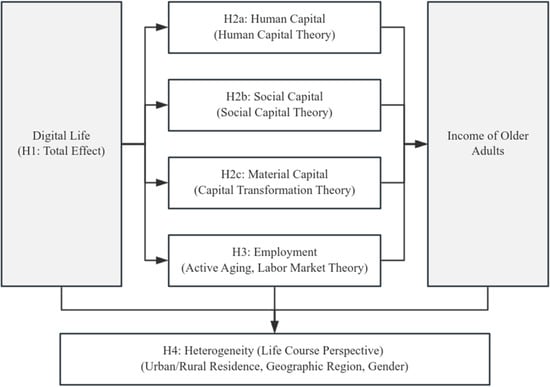
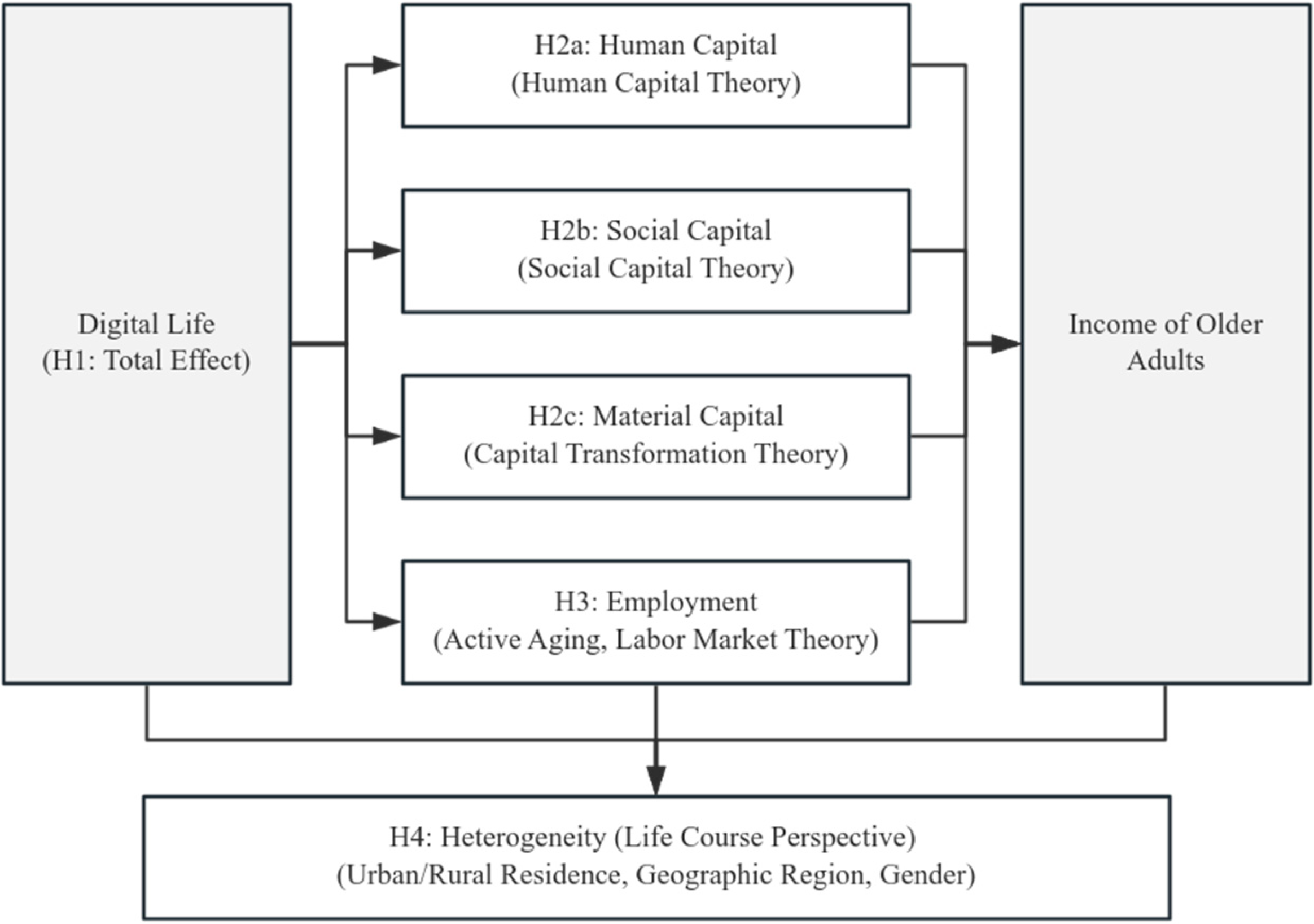
This section develops the theoretical framework guiding our empirical analysis. We draw on multiple complementary theories to systematically explain how digital life may influence the income of older adults, moving from general theoretical principles to specific testable hypotheses. Figure 1 presents the conceptual framework summarizing these relationships.
Figure 1.
Conceptual Framework: Digital Life, Mediating Mechanisms, and Income among Older Adults.
2.3.1. Capital Transformation Theory and the Baseline Hypothesis
The point of departure for our theoretical framework is Soto’s (2000) theory of capital transformation, which posits that assets become productive only when they can be formalized and mobilized in markets [8]. Soto argues that in developing and transitional economies, the poor hold significant “dead capital”—assets such as housing, land, and informal businesses—that cannot be leveraged because they lack formal documentation, legal recognition, or market access [8] (p. 45). The key to economic advancement lies in transforming these dormant assets into active, productive capital through institutional and technological innovations.
Applying this logic to the context of aging and digitalization, we argue that older adults possess various forms of dormant capital that digital technologies may help activate. These include material assets (e.g., housing property), social networks accumulated over a lifetime, and skills and knowledge developed through work and life experience (Qiu et al., 2016) [15]. However, in traditional settings, these assets often remain underutilized due to barriers such as limited market access, information asymmetries, and physical constraints associated with aging (Chen & Chan, 2014) [11].
Digital technologies, by reducing transaction costs, expanding market reach, and creating new platforms for exchange, can potentially transform these dormant assets into income-generating capital (Goldfarb & Tucker, 2019) [5]. For example, online platforms enable homeowners to rent out spare rooms, help skilled retirees offer consulting services, and allow seniors to monetize their social networks through e-commerce referrals (Zhang et al., 2023) [16]. This logic leads to our baseline hypothesis:
H1.
Digital life is positively associated with the income of older adults.
2.3.2. Human Capital Theory and the Learning Pathway
Human capital theory (Becker, 1964) provides a more specific lens for understanding one mechanism through which digital engagement may affect income [17]. Becker conceptualizes human capital as the stock of knowledge, skills, and abilities that individuals invest in through education and training, which in turn enhances their productivity and earnings.
In the digital age, internet use itself can be viewed as a form of human capital accumulation (DiMaggio & Bonikowski, 2008) [18]. Through online platforms, older adults can access information, acquire new skills, and engage in lifelong learning activities that maintain and enhance their productive capacity (Nimrod, 2010) [19]. Recent empirical studies confirm that digital learning among older adults is associated with improved cognitive functioning and economic outcomes (Wang & Li, 2023) [13]. This theoretical reasoning suggests that:
H2a.
Human capital (measured by learning frequency) mediates the positive association between digital life and income among older adults.
2.3.3. Social Capital Theory and the Network Pathway
Social capital theory (Bourdieu, 1986; Putnam, 2000) offers a complementary mechanism [20,21]. Putnam defines social capital as the “connections among individuals—social networks and the norms of reciprocity and trustworthiness that arise from them” (Putnam, 2000) [21] (p. 19). These networks provide access to information, opportunities, and resources that can translate into economic benefits.
Digital technologies, particularly social media and messaging applications, have been shown to help older adults maintain existing social ties and forge new connections (Nimrod, 2010; Xie, 2007) [19,22]. By facilitating communication and information sharing, digital engagement may enhance the quantity and quality of older adults’ social networks. In turn, richer social capital can provide job leads, informal assistance, shared resources, and access to economic opportunities (Helliwell & Putnam, 2004) [23]. This theoretical logic yields:
H2b.
Social capital (measured by social interaction frequency) mediates the positive association between digital life and income among older adults.
2.3.4. Extending Capital Transformation: The Material Capital Pathway
Returning to Soto’s (2000) framework, we consider a more direct application of capital transformation theory through material capital. Housing property represents the most significant asset for many Chinese households, including older adults (Zhang et al., 2023) [16]. However, simply owning a home does not automatically generate income; the asset must be “activated” through rental, sale, or collateralization (Soto, 2000) [8].
Digital platforms can facilitate this activation by providing access to real estate information, connecting homeowners with potential renters or buyers, and enabling online property management (Cai et al., 2022) [24]. Digitally active seniors may therefore be better positioned to leverage their housing assets for income generation. This reasoning leads to:
H2c.
Material capital (measured by homeownership) mediates the positive association between digital life and income among older adults.
2.3.5. Labor Market Participation and the Employment Pathway
Beyond capital transformation, a more direct pathway operates through labor market participation. The active aging framework (WHO, 2002) emphasizes the importance of continued economic engagement for well-being in later life [25]. Digital technologies can facilitate this engagement by reducing search costs for employment, enabling remote or flexible work arrangements, and creating new forms of online entrepreneurship (Kässi & Lehdonvirta, 2018) [26].
Empirical studies in the Chinese context have shown that internet use increases the likelihood of employment among older adults, particularly in urban areas and the service sector (Li & Wang, 2021) [14]. Digital platforms such as food delivery, ride-hailing, and e-commerce have created new income opportunities for older workers (Chen et al., 2022) [27]. This suggests the following:
H3.
Digital life enhances the income of older adults through improved employment opportunities (measured by non-agricultural work).
2.3.6. Life Course Perspective and Heterogeneity
Finally, the life course perspective (Elder, 1998) reminds us that older adults are not a homogeneous group [28]. This theoretical framework emphasizes that individuals’ experiences, resources, and trajectories are shaped by their historical context, cohort membership, and cumulative life experiences.
Applying this lens to our study, we recognize that the “young-old” (typically aged 55–70) have experienced digitalization during their working lives and may possess greater digital fluency than the “old-old” (aged 80+), who retired before the internet era (Friemel, 2016) [6]. Similarly, urban and rural older adults have had differential access to digital infrastructure and education, potentially moderating the effects of digital life on income (Van Deursen & Van Dijk, 2014) [29]. Gender differences in lifetime labor force participation and digital adoption may also shape these relationships (Chen & Chan, 2014) [11]. This perspective motivates our exploration of effect heterogeneity:
H4.
The association between digital life and income varies across subgroups defined by urban/rural residence, geographic region, and gender.
3. Methodology
3.1. Data Source
This study utilizes data from the 2023 Chinese General Social Survey (CGSS), a nationally representative survey conducted by Renmin University of China. The CGSS employs a stratified multi-stage probability sampling design, covering 28 provinces, autonomous regions, and municipalities. The 2023 wave includes detailed modules on digital engagement, economic activities, and demographic characteristics, making it particularly suitable for this study.
The analytical sample consists of respondents aged 55 years and older. To ensure consistency across all analyses, we retain only observations with non-missing values on all variables used in the main analysis. This listwise deletion approach results in a final analytical sample of 3127 respondents. Item non-response rates for key variables are low (ranging from 0.1% to 4.8%), and comparisons of descriptive statistics between the full and analytical samples reveal no systematic differences in observable characteristics, suggesting that missingness is unlikely to introduce significant bias (Allison, 2002) [30]. This age threshold aligns with definitions of “older adult” in the Chinese context, considering that the official retirement age for female workers is 50–55 and for male workers is 60.
3.2. Variable Measurement
3.2.1. Dependent Variable: Income of Older Adults
The dependent variable is the annual personal income of older adults, measured in 10,000 yuan. This variable captures the core economic outcome of interest—the financial resources available to individuals aged 55 and above. To mitigate the influence of extreme values and skewness common in income data, we winsorize the variable at the 1st and 99th percentiles, replacing values below the 1st percentile with the 1st percentile value and those above the 99th percentile with the 99th percentile value (Dixon, 1960) [31]. This approach retains all observations while reducing the impact of outliers, ensuring that the results are not driven by a small number of extremely high or low incomes. Personal income is a direct measure of economic well-being and is widely used in studies of aging and digital inclusion (Li & Wang, 2021) [14].
3.2.2. Core Independent Variable: Digital Life
Digital life is operationalized as the frequency of internet usage, measured on a 5-point scale (1 = Never, 2 = Several times a year, 3 = Several times a month, 4 = Several times a week, 5 = Daily). While this measure does not capture the full multidimensionality of digital engagement—such as specific online activities, skills, or the quality of use—it serves as a reliable proxy for digital participation in large-scale surveys where detailed digital skill batteries are unavailable (Hargittai, 2002; Van Deursen & Van Dijk, 2014) [29,32]. Internet usage frequency reflects the extent to which older adults are actively engaged in the digital sphere, which is a necessary condition for any subsequent capital transformation or income generation (DiMaggio et al., 2004) [33]. It has been shown to correlate with digital literacy and the likelihood of benefiting from online opportunities (Ragnedda, 2018) [34].
3.2.3. Control Variables
To isolate the relationship between digital life and income, we include a comprehensive set of control variables that may confound this association. These controls are grouped into three categories: demographic characteristics, family characteristics, and regional characteristics.
Demographic Controls include age (continuous), gender (1 = male, 2 = female), marital status (1 = married, 0 = unmarried), years of education (continuous), Communist Party membership (1 = member, 0 = non-member), and self-rated health (5-point scale from “very poor” to “very good”). Age and gender are standard demographic controls that influence both digital adoption and income (Czaja et al., 2006) [12]. Education and health are key determinants of human capital and labor market outcomes (Becker, 1964) [17]. Party membership is included as a proxy for institutional capital, as it is associated with access to elite networks and better economic opportunities in the Chinese context (Walder, 1995; Li & Walder, 2001) [35,36].
Family Characteristics are captured by the number of children (continuous) and whether the respondent cohabits with a spouse (1 = yes, 0 = no). These variables reflect potential family support systems and intergenerational transfers, which may affect both digital engagement and income (Chen & Chan, 2014) [11]. While ideally we would also control for living arrangements more broadly, data limitations restrict us to these two indicators.
Regional Controls include urban/rural residence (1 = urban, 0 = rural) and province fixed effects. Urban/rural status captures broad disparities in economic development, digital infrastructure, and access to services. Province fixed effects absorb time-invariant regional heterogeneity (e.g., local policies, cultural norms, economic structure) that could confound the relationship (Wooldridge, 2010) [37]. Standard errors are clustered at the city level to account for within-city correlation of observations (Cameron & Miller, 2015) [38].
3.2.4. Mediating Variables
To explore the mechanisms linking digital life to income, we include four mediating variables, each representing a distinct form of capital that digital engagement may activate.
Human Capital is measured by learning frequency, also on a 5-point scale. Continuous skill development is essential for adapting to technological change and maintaining employability (Becker, 1964) [17]. Online learning platforms offer older adults opportunities to acquire new knowledge and skills, potentially enhancing their income-generating capacity (Nimrod, 2010) [19].
Social Capital is proxied by the frequency of social interactions, measured on a 5-point scale from “Never” to “Very Frequently.” Social networks provide access to information, opportunities, and informal support, which can translate into economic benefits (Putnam, 2000) [21]. Digital technologies, particularly social media and messaging apps, may help older adults maintain and expand these networks (Nimrod, 2010) [19].
Material Capital is measured by homeownership (1 = owns housing property, 0 = does not own). Housing is the most significant asset for many Chinese households, and digital platforms can help older adults manage, rent, or sell property, thereby transforming this “dormant” asset into income (Soto, 2000; Zhang et al., 2023) [8,16]. Homeownership thus represents the potential for asset-based economic security.
Employment Status is a binary variable indicating whether the respondent is engaged in non-agricultural work (1 = Yes, 0 = No). Non-agricultural employment is a key pathway through which older adults can generate labor income, and digital tools may facilitate job search, remote work, or entrepreneurial activities (Kässi & Lehdonvirta, 2018) [26]. This variable captures the direct labor market channel.
All four mediators are theoretically grounded in capital transformation theory and have been widely used in studies of digital inequality and aging (Ragnedda, 2018; Hunsaker & Hargittai, 2018) [34,39].
3.3. Baseline Model
To examine the impact of digital life on the income of older adults, we specify a linear regression model with province fixed effects. This specification follows the standard Mincerian earnings function widely used in labor economics (Mincer, 1974) [40], adapted to include digital engagement as a key explanatory variable. The Mincer equation traditionally models log income as a function of education, experience, and other human capital factors. In the digital age, digital skills and internet usage have emerged as additional forms of human capital that can influence earnings (DiMaggio & Bonikowski, 2008) [18]. Accordingly, our baseline model is:
Here, represents the annual income of individual i in city j; indicates the internet usage of the older adult individual; represents other variables affecting the income level of older adults; denotes the province fixed effects; and is the random error term. Since this paper analyzes the relationship between digital life and income of older adults, and to avoid the impact of intra-city household correlations on estimation results, standard errors are clustered at the city level. Clustering at this level is appropriate because digital infrastructure and policies vary primarily at the city level, and individuals within the same city are likely to share unobserved common shocks.
3.4. Mediation Effect Model
To investigate the mechanisms through which digital life may influence income, we conduct mediation analysis following an integrated approach that combines the traditional Baron and Kenny (1986) framework with recent advances in causal mediation analysis (Imai et al., 2010) [41,42]. This approach allows us to formally test whether employment, material capital, social capital, and human capital serve as mediating pathways.
We implement this approach by estimating a system of equations for each mediator M:
where Equation (2) estimates the effect of digital life on the mediator (the “a path”), and Equation (3) estimates the joint effects of digital life and the mediator on income (the “b path” and “c path”). All models include the same set of control variables and province fixed effects as the baseline model, with standard errors clustered at the city level. To quantify the mediating effect, we calculate the indirect effect as the product of . This product represents the change in income attributable to the change in the mediator induced by digital life (Baron & Kenny, 1986) [41]. The direct effect is given by , representing the association between digital life and income not operating through the mediator.
4. Results
4.1. Descriptive Statistics
Table 1 presents descriptive statistics for all variables. The average annual income among older adult respondents is 10,320 yuan (approximately $1500), with substantial variation (SD = 22,340), indicating substantial variation within the sample. The income variable ranges from 0 to 190,000 yuan, reflecting the diversity of economic circumstances among older adults in China. Internet usage frequency averages 2.853, indicating that most older adults use the internet between “several times a month” and “several times a week.” This relatively high level of digital engagement among the sample reflects the growing digital integration of China’s older population.
Table 1.
Variable Definitions and Descriptive Statistics.
Turning to control variables, the sample is roughly balanced by gender (mean = 1.588, where 1 = male, 2 = female). Average age is 68.18 years, with respondents ranging from 55 to 94. Marital status indicates that the majority are married, and 64.5% cohabit with a spouse. Average years of education is 7.46, indicating that most respondents have completed primary school (typically 6 years) but not junior secondary school (typically 9 years). This level is consistent with national statistics for older cohorts in China: among those aged 60 and above in 2020, the average years of schooling was 7.1 (National Bureau of Statistics, 2021) [1]. This reflects China’s historical educational expansion; younger generations have much higher attainment. Communist Party members constitute 12.8% of the sample. Self-rated health averages 3.011, near the midpoint of the 1–5 scale, indicating average perceived health. The average number of children is 2.09, reflecting the fertility patterns of earlier generations. Regarding regional distribution, 56.8% of respondents reside in rural areas (urban/rural residence coded as 1 = rural, 0 = urban, mean = 0.568), providing a balanced representation of both urban and rural older adults and enabling meaningful heterogeneity analysis by residence type.
Regarding the mediating variables, 9.5% of respondents are engaged in non-agricultural work, indicating that labor force participation beyond agriculture remains limited among older adults. Homeownership, our measure of material capital, is reported by 66.1% of the sample—a substantial majority, consistent with China’s high homeownership rates. Social interaction frequency averages 2.564, falling between “rarely” and “sometimes,” suggesting moderate levels of social engagement. Human capital, measured by learning frequency, averages 1.72 (on the same 5-point scale), indicating that most older adults engage in learning activities only rarely.
4.2. Baseline Results
Table 2 reports the benchmark regression results of the impact of digital life on the income of older adults. Model (1) in Table 1 includes only the core explanatory variable, showing that digital life has a significantly positive effect on income. Model (2) adds a set of individual characteristics, including gender, age, marital status, years of education, Party membership, and self-rated health status. The coefficient of digital life remains positive and significant at the 1% level. Model (3) further incorporates household characteristics—whether the respondent cohabitates with a spouse and the number of children. The estimated coefficient for digital life remains significantly positive, indicating the robustness of the conclusion that digital life is positively associated with the income of older adults.
Table 2.
Benchmark Regression Results of the Impact of Digital Life on Income of Older Adults.
Regarding control variables, the coefficients for years of education, Party membership, and health status are positive and statistically significant at least at the 5% level in Models (2) and (3), suggesting that older adults with more education, Party affiliation, or better health tend to have higher incomes. Gender and age are negatively associated with income (p < 0.01), indicating that female and older individuals have lower income levels. Marital status, cohabitation with spouse, and number of children are not statistically significant in any specification, implying that these household factors do not independently predict income after accounting for individual characteristics and digital engagement.
4.3. Endogeneity Test
The established benchmark regression model may suffer from endogeneity issues, meaning income of older adults and digital life development might be simultaneously influenced by a set of unobservable factors, leading to biased estimates. Furthermore, reverse causality is plausible: older adults with higher income may be more inclined to engage with the internet and embrace new technologies. Therefore, this paper employs the instrumental variable (IV) approach to mitigate these endogeneity concerns. Specifically, following the approach of Chen Peibin and Zhu Chaozhi (2022) [27], the 2016 provincial internet penetration rate is selected as the instrumental variable for internet usage.
The instrument satisfies the two key conditions for validity: regarding correlation, provincial penetration in 2016 is strongly correlated with individual usage in 2023. This is because internet adoption at the provincial level reflects the diffusion of digital infrastructure, which shapes individual opportunities and habits over time. Regarding exclusion effects, the 2016 provincial penetration is unlikely to affect an individual’s 2023 income except through its influence on their current digital engagement. While it is possible that historical provincial development (correlated with past internet penetration) could have persistent effects on income, we control for current city fixed effects and individual socioeconomic status to mitigate such pathways. Moreover, the eight-year gap between the instrument and the outcome helps ensure that the instrument operates through the intended channel (digital habit formation and skill accumulation) rather than contemporaneous shocks.
Table 3 presents the results after applying the IV method. The first-stage results show that the chosen instrumental variable is significantly correlated with internet usage at the 1% level, and the first-stage F-statistic is far greater than 10, indicating the weak instrument problem can be ruled out. The second-stage Wald test for endogeneity yields a p-value of 0.0001, significant at the 1% level, suggesting that an increase in internet penetration rate raises the frequency of internet use among older adults. Meanwhile, Model (2) shows that after IV estimation, the impact of digital life on income remains significantly positive.
Table 3.
Regression Results Using Instrumental Variable Method.
4.4. Robustness Tests
The above regression results indicate that digital life significantly increases the income level of older adults. To ensure the reliability and robustness of this main finding, this section conducts multi-angle robustness tests from the following three aspects.
First, replace the dependent variable: perform regression using the natural logarithm of (income of older adults + 1). Second, replace the core explanatory variable: considering potential measurement issues, the 2016 provincial internet penetration rate is used as the core explanatory variable for regression. Third, incorporate macro factors: to account for the impact of the COVID-19 pandemic, a variable for pandemic impact on income is added (original question: D32. Compared to before the pandemic, how has your household income changed? Increased a lot = 1, Increased a little = 2, Same as before = 3, Decreased a little = 4, Decreased a lot = 5), and regression is performed. The results of these three robustness tests are presented sequentially in Table 4. After these different tests, the results remain consistent, indicating the robustness of our conclusions.
Table 4.
The Impact of Digital Life on Income of Older Adults: Robustness Tests.
4.5. Heterogeneity Analysis
The above analysis has explored the impact of digital life on the income of older adults but has not reflected group differences in this effect. Therefore, this section conducts heterogeneity analysis from the perspectives of urban–rural, regional, and gender differences. According to research needs, the sample is divided into urban and rural groups based on residence type. Furthermore, based on regional information provided by CGSS2023, the entire sample is divided into eastern, central, and western regional groups. Additionally, the sample is split into male and female groups. Regression results are shown in Table 5.
Table 5.
The Impact of Digital Life on Income of Older Adults: Heterogeneity Tests.
4.5.1. Urban–Rural Heterogeneity
Models (1) and (2) indicate that digital life positively affects the income of both rural and urban older adults. However, the impact on the income of rural older adults is significant at the 5% level, suggesting digital life can effectively meet the service needs of disadvantaged groups and increase the income of rural older adults.
4.5.2. Regional Heterogeneity
Models (3) to (5) in Table 5 show the subsample regression results for eastern, central, and western regions. The impact of digital life on the income of older adults is significantly positive at least at the 10% level across all regions. However, judging by the coefficient magnitude, the effect is strongest in the western region. This indicates that digital life expands income sources for older adults in less developed regions, providing accessible internet services that can increase their income. In contrast, in eastern and central regions with better internet infrastructure and higher service levels, the impact of digital life is more limited.
4.5.3. Gender Heterogeneity
Models (6) and (7) in Table 5 present the subsample regression results by gender. Similarly, digital life has a significantly positive effect on the income of the group of older women at the 1% level, while the effect is positive but not significant for the male group. This suggests a clear gender difference in the impact of digital life on income. A possible reason is that older women have fewer income sources, so digital life can exert a greater income-increasing effect. In contrast, older men have relatively more diverse income sources, making the impact of digital life less pronounced.
Overall, digital life can significantly increase the income levels of rural households, older adults in western regions, and older women.
5. Mechanism Analysis
Building upon the established positive relationship between digital life and the income of older adults, this section delves into the underlying mechanisms through which digital engagement fosters economic sustainability in later life. Grounded in theories of capital transformation and active aging, we posit that internet use may enhance the income of older adults through four interrelated pathways: (1) fostering continuous skill development (human capital), (2) expanding and mobilizing social networks (social capital), (3) activating tangible assets (material capital), and (4) facilitating labor market participation (employment status). To empirically investigate these pathways, we conduct a series of mediation analyses, examining first the impact of digital life on each potential mediator, followed by their respective influence on income. This approach allows us to disentangle the specific channels through which digital inclusion contributes to sustainable livelihoods for the aging population.
5.1. Human Capital: Fostering Lifelong Learning and Adaptability
In a rapidly evolving digital economy, the ability to learn and adapt is a form of human capital critical for sustained economic engagement. Our analysis employs a measure of learning frequency to test this pathway. Model (1) shows that digital life significantly promotes engagement in learning activities (coefficient = 0.098, p < 0.01). Furthermore, Model (2) establishes that this accumulated human capital has a direct, positive impact on income (coefficient = 0.132, p < 0.05). while the direct effect of digital life is reduced to 0.039 (p < 0.01) compared to the baseline of 0.052. The indirect effect (0.098 × 0.132 ≈ 0.013) is meaningful, and the attenuation of the digital life coefficient supports a mediating role. This pathway emphasizes that digital tools are not merely channels for information but also platforms for continuous skill development, enabling older adults to adapt to new economic realities and maintain their employability and entrepreneurial capacity—a core component of a sustainable and inclusive digital future.
5.2. Social Capital: Strengthening Networks in the Digital Age
Social connections are crucial for accessing information, opportunities, and support. We examine whether digital life helps accumulate this vital resource using social interaction frequency as a mediator. The results in Model (3) demonstrate a strong positive effect of digital engagement on social interaction frequency (coefficient = 0.060, p < 0.01), indicating that internet use helps maintain and expand social networks among older adults. This finding is consistent with studies demonstrating the role of the internet in sustaining social ties in later life (Nimrod, 2010; Xie, 2007) [19,22]. Model (4) shows that social capital is positively associated with income (coefficient = 0.039, p < 0.10), while the direct effect of digital life remains significant (0.050, p < 0.01). The marginal significance of the b-path suggests that social capital may provide indirect economic benefits—such as job leads, informal assistance, or shared resources—that support income sustainability. The indirect effect (0.060 × 0.039 ≈ 0.002) is small, and the direct effect is essentially unchanged, indicating that social capital plays a modest mediating role at best. This may reflect that social capital’s economic benefits are often indirect and contingent on other factors, such as the quality of ties or the presence of economic opportunities within the network (Bourdieu, 1986; Putnam, 2000) [20,21]. In the Chinese context, strong family networks may provide emotional support but do not necessarily translate into income gains for retired seniors. Future research with more refined measures of social capital (e.g., network diversity, access to resources) could uncover stronger effects.
5.3. Material Capital: Digitally Enabled Asset Utilization
Material assets, such as property, represent a potential source of economic security that digital platforms can help mobilize. Using homeownership as a proxy for material capital, our analysis explores this activation mechanism. As shown in Model (5) of Table 6, digital life is positively associated with homeownership among older adults (β =0.024, p < 0.05). This could be explained by the fact that digitally active seniors are more likely to access real estate information, participate in housing transactions, or manage property through online platforms—a phenomenon observed in previous studies on digital finance and housing markets (Zhang et al., 2023) [16]. Model (6) shows that homeownership itself is positively associated with income (coefficient = 0.221, p < 0.05), while the direct effect of digital life remains significant (0.052, p < 0.05)—virtually unchanged from the baseline. The indirect effect is positive but modest. The significance of both the a-path and b-path indicates partial mediation: digitally active older adults are more likely to own property, and property ownership contributes to higher income. However, the small magnitude and unchanged direct effect suggest that material capital plays a limited mediating role in this context.
Table 6.
The Impact of Digital Life on Income of Older Adults: Mechanism Tests.
5.4. Employment as a Conduit for Economic Participation
Digital technologies can serve as a vital bridge to the labor market for older adults. To test whether enhanced employment opportunities constitute a significant mechanism, we utilize engagement in non-agricultural work as a mediator. As presented in Models (7) and (8) of Table 6, the results support this pathway. Model (7) indicates that digital life is positively associated with a higher likelihood of non-agricultural employment (coefficient = 0.009, p < 0.10). Subsequently, Model (8) confirms that such employment significantly boosts income (coefficient = 1.898, p < 0.01). Notably, the coefficient for digital life in this model (0.034, p < 0.01) is attenuated compared to the baseline estimate in Table 2, Model (3) (0.052), suggesting that a portion of its total income effect operates through facilitating formal or semi-formal employment. This finding underscores the role of digital tools in enabling continued economic activity, thereby promoting not only individual income sustainability but also contributing to broader societal goals of productive aging and extended workforce participation.
6. Conclusions
6.1. Summary of Empirical Findings
This study examines the association between digital life and income among older adults in China using CGSS 2023 data, yielding three main findings that collectively advance our understanding of digital inclusion in aging populations.
First, digital life is positively associated with income among older adults. The baseline regression results show that a one-unit increase in internet usage frequency is associated with an approximately 5.2% increase in annual personal income (β = 0.052, p < 0.01), after controlling for demographic characteristics, family characteristics, and province fixed effects. This association remains robust across multiple specifications, including alternative dependent variable measurement (log transformation), alternative core independent variable (provincial internet penetration rate), and controlling for COVID-19 pandemic impacts. The instrumental variable estimation further supports a causal interpretation under the identifying assumptions, with a first-stage F-statistic of 239.89 ruling out weak instrument concerns.
Second, the association operates through four distinct mediating pathways with varying magnitudes. The human capital pathway reveals that digital life significantly promotes learning activities, with learning frequency positively associated with income; the indirect effect accounts for approximately 25% of the total association, indicating that continuous skill development is a substantial mechanism. The social capital pathway shows that while digital engagement increases social interaction frequency, social capital’s direct association with income is only marginally significant, and the minimal indirect effect suggests that social ties may provide non-economic benefits rather than direct income gains in this context. The material capital pathway demonstrates that digital life is positively associated with homeownership, and homeownership contributes to income; however, the modest indirect effect suggests that asset ownership alone does not automatically generate income without active monetization. Finally, the employment pathway emerges as the strongest mechanism: digital life increases the likelihood of non-agricultural employment, which strongly boosts income, with an indirect effect accounting for approximately 33% of the total association—underscoring the importance of labor market participation.
Third, the associations vary significantly across subgroups, revealing important heterogeneity patterns. Subsample analyses demonstrate that rural older adults benefit more than their urban counterparts, suggesting digital inclusion can help bridge the urban–rural economic divide. Western region residents experience stronger associations than those in eastern and central regions, indicating that digital technologies may offer greater relative benefits in less developed areas. Older women show significant associations while older men do not, suggesting that digital inclusion may help mitigate gender-based economic disadvantages accumulated over the life course. These patterns collectively indicate that digital inclusion serves as a compensatory mechanism, offering the greatest income benefits to traditionally disadvantaged groups—rural residents, those in less developed western regions, and older women—thereby contributing to reduced economic inequalities.
6.2. Theoretical Implications
This study makes three distinct theoretical contributions to the literature on digital inclusion, aging, and sustainable development.
First, this study fills a theoretical gap by extending and empirically testing Soto’s capital transformation theory in the context of digital aging. While Soto’s original framework focused on formal property rights in developing economies, this research demonstrates that digital technologies can serve as an alternative mechanism for activating “dormant capital” among older adults. The finding that digital engagement facilitates the transformation of human capital (learning), social capital (networks), and material capital (housing) into income-generating resources provides novel empirical support for capital transformation theory beyond its traditional domain. This extension is particularly significant because older adults have been largely overlooked in prior applications of this framework, which typically focused on working-age populations in informal economies.
Second, this study integrates and advances multiple theoretical perspectives—human capital theory [17], social capital theory [20,21], and the life course perspective [28]—into a unified conceptual framework (Figure 1). Rather than treating these theories as separate lenses, we demonstrate their interconnectedness in explaining digital inclusion outcomes, challenging the tendency in prior research to examine these forms of capital separately and suggesting the need for more holistic theoretical models. Furthermore, the heterogeneity findings—stronger effects for rural, western region, and female seniors—provide empirical support for the life course perspective’s emphasis on cumulative advantage/disadvantage, suggesting that digital inclusion may serve as a compensatory mechanism helping to offset inequalities accumulated over the life course—a theoretical insight that extends beyond simple demographic moderation.
Third, this study provides new empirical evidence that challenges and refines existing theories of digital capital [34,39]. While prior research has conceptualized digital capital as a distinct form of capital, our mediation analysis reveals that digital engagement operates primarily through activating traditional forms of capital rather than creating an entirely new form. This finding suggests a theoretical refinement: digital capital may be better understood as a “meta-capital” that enhances the productivity of existing assets rather than a standalone resource. The weak mediating role of social capital highlights the need to distinguish between bonding and bridging ties in future research [43].
6.3. Sustainability Implications
This study offers three interconnected insights for sustainability, each grounded in specific empirical findings and extending beyond general statements to concrete implications.
First, regarding economic sustainability, digital inclusion contributes to the long-term economic resilience of aging populations. The finding that digital life activates multiple forms of capital (human, social, material) into income-generating resources has direct implications for economic sustainability at both individual and societal levels. At the individual level, older adults who maintain digital engagement can diversify their income sources, reducing dependence on fixed pensions and family transfers. This diversification enhances economic resilience against shocks such as health crises or inflation. At the societal level, the employment pathway suggests that digitally connected seniors can remain productive members of the workforce, reducing the dependency ratio and alleviating pressure on public pension systems. This dual benefit—individual resilience and societal fiscal sustainability—positions digital inclusion as a cost-effective strategy for addressing the economic challenges of population aging. The magnitude of this effect is non-trivial: the employment pathway alone accounts for approximately one-third of the total income association, implying that policies promoting digital literacy could yield substantial returns in terms of extended workforce participation and reduced old-age poverty.
Second, from a social sustainability perspective, digital engagement helps maintain social cohesion and community resilience. The finding that digital life significantly increases social interaction frequency supports the role of digital technologies in mitigating social isolation—a critical concern for aging societies. Social isolation has well-documented negative consequences for both individual well-being and community cohesion, including increased healthcare costs, reduced civic participation, and weakened intergenerational bonds [21,22]. While the direct economic returns to social capital were modest in our analysis, the social sustainability benefits extend beyond income. Digitally connected seniors are more likely to engage in community activities, provide informal care to peers, and maintain family connections across geographic distances. These contributions, while not captured in income measures, are essential for building sustainable communities that can support aging populations without overwhelming formal care systems. The stronger effects for rural seniors are particularly relevant here, as rural areas often face greater challenges of geographic isolation and limited access to social services.
Third, the heterogeneity findings advance the principle of inclusive sustainability—ensuring that the benefits of digital transformation are equitably shared. The stronger associations for rural seniors, western region residents, and older women demonstrate that targeted digital inclusion can help close multiple gaps simultaneously. Regarding geographic equity, the western region finding suggests that digital technologies can serve as a leapfrogging mechanism, enabling less developed regions to narrow economic disparities without waiting for traditional infrastructure development. In terms of gender equity, the significant effect for older women but not men indicates that digital inclusion may help counteract gender-based disadvantages in lifetime earnings and pension accumulation, contributing to SDG 5 (Gender Equality). For rural-urban equity, the rural effect approaching significance suggests that digital connectivity can partially compensate for geographic disadvantages in access to markets, services, and employment opportunities. Together, these patterns position digital inclusion as a compensatory mechanism that offers the greatest income benefits to traditionally disadvantaged groups, thereby advancing the core sustainability principle of leaving no one behind.
These findings position digital inclusion as a cross-cutting enabler of multiple Sustainable Development Goals (SDGs), including SDG 1 (No Poverty), SDG 5 (Gender Equality), SDG 8 (Decent Work and Economic Growth), SDG 10 (Reduced Inequalities), and SDG 11 (Sustainable Cities and Communities). The mechanism-based approach of this study provides a roadmap for how digital inclusion contributes to each goal: through employment (SDG 8), capital activation (SDG 1), social cohesion (SDG 11), and reduced disparities (SDG 5, 10).
6.4. Policy Implications
Based on our empirical findings, we propose three categories of policy interventions corresponding to the analytical structure of this study.
Promoting Digital Inclusion: Given the robust positive association between digital life and income among older adults, policies should prioritize expanding internet access and affordability for the aging population. This includes subsidizing broadband services, providing low-cost devices, and establishing public internet access points in community centers and senior residences. Such initiatives align with the European Union’s Web Accessibility Directive and similar frameworks that promote digital inclusion for all age groups [44].
Strengthening Mediating Pathways: The mechanism analysis reveals four specific channels through which digital inclusion generates income, each requiring tailored policy responses. First, the human capital pathway suggests integrating digital skills training into lifelong learning programs, with emphasis on income-generating applications such as e-commerce and digital finance. Second, the social capital pathway calls for designing digital tools that facilitate community building and intergenerational connections, leveraging social networks for economic opportunities as suggested by OECD guidelines [45]. Third, the material capital pathway indicates the need for digital platforms that help older adults manage, rent, or monetize housing assets, supported by financial literacy training—an approach being piloted in China’s “Digital Village” initiative [46]. Fourth, the employment pathway requires developing online job platforms tailored to older workers and incentivizing employers to offer remote or flexible positions suitable for seniors.
Targeting Disadvantaged Subgroups: Allocate resources preferentially to groups where digital life shows the strongest income associations: rural older adults, those in western regions, and older women. Tailored programs should address their specific barriers—such as infrastructure gaps in rural areas, lower educational attainment in western regions, and gender-based digital divides—while building on existing community networks and support systems.
7. Limitations and Future Research
Despite its contributions, this study has several limitations that should be acknowledged. First, the cross-sectional design of the CGSS data precludes strong causal inference, even though instrumental variable estimation was employed. Future research should utilize longitudinal data to track changes in digital engagement and income over time. Second, our measurement of digital life relies on a single item (internet usage frequency), which does not capture the diversity of digital activities (e.g., e-commerce, social media, online learning). More nuanced measures could reveal different pathways. Third, the mediators—material, social, and human capital—were measured with proxies (homeownership, social interaction frequency, learning frequency) that may not fully capture their theoretical constructs. Future studies could employ validated scales or objective indicators. Fourth, the sample is limited to China, and findings may not be generalizable to other cultural and institutional contexts. Comparative research across countries would be valuable. Finally, we did not explore potential negative effects of digital life, such as digital addiction, privacy concerns, or information overload, which could offset income gains. Addressing these limitations will deepen our understanding of how digital inclusion can sustainably benefit older adults.
Author Contributions
Y.F.: Writing—review and editing, Writing—original draft, Methodology, Formal analysis, Conceptualization, Visualization, Supervision. W.X.: Writing—review and editing, Writing—original draft, Methodology, Formal analysis, Data curation, Project administration, Conceptualization, Visualization. W.H.: Writing—review and editing, Writing—original draft, Methodology, Formal analysis, Conceptualization, Visualization, Supervision. All authors have read and agreed to the published version of the manuscript.
Funding
This study was sponsored by the Philosophy and Social Sciences Fund of Hunan Province, China (21YBA005) and General Project of National Natural Science Foundation of China (72474229).
Institutional Review Board Statement
Not applicable.
Informed Consent Statement
Not applicable.
Data Availability Statement
The data that support the findings of this study were derived from the Chinese General Social Survey (CGSS) 2023, which is publicly available from the National Survey Research Center at Renmin University of China. Restrictions apply to the availability of these data, which were used under license for the current study. Data can be obtained by researchers upon reasonable request and with permission of the data provider through the official website: “http://cgss.ruc.edu.cn (accessed on 13 October 2025)”.
Conflicts of Interest
The authors declare that they have no known competing financial interests or personal relationships that could have appeared to influence the work reported in this paper.
References
- National Bureau of Statistics of China. China Statistical Yearbook 2021; China Statistics Press: Beijing, China, 2022. [Google Scholar]
- World Bank. World Development Indicators 2022; World Bank: Washington, DC, USA, 2022. [Google Scholar]
- United Nations. World Population Prospects 2019; United Nations Department of Economic and Social Affairs: New York, NY, USA, 2019. [Google Scholar]
- China Internet Network Information Center (CNNIC). The 50th Statistical Report on China’s Internet Development; CNNIC: Beijing, China, 2022. [Google Scholar]
- Goldfarb, A.; Tucker, C. Digital economics. J. Econ. Lit. 2019, 57, 3–43. [Google Scholar] [CrossRef] [Scilit]
- Friemel, T.N. The digital divide has grown old: Determinants of a digital divide among seniors. New Media Soc. 2016, 18, 313–331. [Google Scholar] [CrossRef] [Scilit]
- Van Dijk, J. The Digital Divide; Polity Press: Cambridge, UK, 2020. [Google Scholar]
- Soto, H.D. The Mystery of Capital: Why Capitalism Triumphs in the West and Fails Everywhere Else; Basic Books: New York, NY, USA, 2000. [Google Scholar]
- Zhu, X.; Liu, Y.; He, M. Digital economy and rural revitalization. Chin. Rural Econ. 2020, 36, 60–76. (In Chinese) [Google Scholar]
- Cai, T.; Bao, Y. The Impact of Digital Trade Development on Household Entrepreneurial Activities: Empirical Evidence Based on CHFS. SSRN 2024, 5647244. Available online: https://papers.ssrn.com/sol3/papers.cfm?abstract_id=5647244 (accessed on 26 October 2025).
- Chen, K.; Chan, A.H. Predictors of gerontechnology acceptance by older Hong Kong Chinese. Technovation 2014, 34, 126–135. [Google Scholar] [CrossRef] [Scilit]
- Czaja, S.J.; Charness, N.; Fisk, A.D.; Hertzog, C.; Nair, S.N.; Rogers, W.A.; Sharit, J. Factors predicting the use of technology: Findings from the Center for Research and Education on Aging and Technology Enhancement (CREATE). Psychol. Aging 2006, 21, 333–352. [Google Scholar] [CrossRef] [Scilit]
- Kim, M.J.; Choi, J.N. Happy but Deviant: How Does Positive Affect Disrupt Social Sustainability? Sustainability 2023, 15, 4567. [Google Scholar] [CrossRef] [Scilit]
- Wang, J.; Wang, C.; Li, S.; Luo, Z. Measurement of relative welfare poverty and its impact on happiness in China: Evidence from CGSS. China Econ. Rev. 2021, 69, 101687. [Google Scholar] [CrossRef] [Scilit]
- Qiu, Z.; Lin, T.; Wang, J. From Digital Divide to Dividend Difference—From the Perspective of Internet Capital. Soc. Sci. China 2016, 10, 93–115+203–204. (In Chinese) [Google Scholar]
- Zhang, Y.; Xie, W.; Ding, B. Research on the impact mechanism and spatial effects of digital technology empowering rural revitalization. Sustainability 2025, 18, 230. [Google Scholar] [CrossRef] [Scilit]
- Becker, G.S. Human Capital: A Theoretical and Empirical Analysis, with Special Reference to Education; University of Chicago Press: Chicago, IL, USA, 1964. [Google Scholar]
- DiMaggio, P.; Bonikowski, B. Make money surfing the web? The impact of Internet use on the earnings of U.S. workers. Am. Sociol. Rev. 2008, 73, 227–250. [Google Scholar] [CrossRef] [Scilit]
- Nimrod, G. Seniors’ online communities: A quantitative content analysis. Gerontologist 2010, 50, 382–392. [Google Scholar] [CrossRef] [Scilit] [PubMed]
- Bourdieu, P. The forms of capital. In Handbook of Theory and Research for the Sociology of Education; Richardson, J., Ed.; Greenwood: New York, NY, USA, 1986; pp. 241–258. [Google Scholar]
- Putnam, R.D. Bowling Alone: The Collapse and Revival of American Community; Simon & Schuster: New York, NY, USA, 2000. [Google Scholar]
- Xie, B. Using the Internet for offline relationship formation. Soc. Sci. Comput. Rev. 2007, 25, 396–404. [Google Scholar] [CrossRef] [Scilit]
- Helliwell, J.F.; Putnam, R.D. The social context of well–being. Philos. Trans. R. Soc. Lond. B Biol. Sci. 2004, 359, 1435–1446. [Google Scholar] [CrossRef] [Scilit] [PubMed]
- Cai, G.; Zhang, X.; Yang, H. Fiscal stress and the formation of zombie firms: Evidence from China. China Econ. Rev. 2022, 71, 101720. [Google Scholar] [CrossRef] [Scilit]
- World Health Organization. Active Ageing: A Policy Framework; WHO: Geneva, Switzerland, 2002. [Google Scholar]
- Kässi, O.; Lehdonvirta, V. Online labour index: Measuring the online gig economy for policy and research. Technol. Forecast. Soc. Change 2018, 137, 241–248. [Google Scholar] [CrossRef] [Scilit]
- Chen, P.; Zhu, C. Internet Use, Social Capital and Farmers’ Health. J. Stat. Inf. 2022, 37, 99–109. (In Chinese) [Google Scholar]
- Elder, G.H. The life course as developmental theory. Child Dev. 1998, 69, 1–12. [Google Scholar] [CrossRef] [Scilit]
- Van Deursen, A.J.; Van Dijk, J.A. The digital divide shifts to differences in usage. New Media Soc. 2014, 16, 507–526. [Google Scholar] [CrossRef] [Scilit]
- Allison, P.D. Missing Data; Sage Publications: Thousand Oaks, CA, USA, 2002. [Google Scholar]
- Dixon, W.J. Simplified estimation from censored normal samples. Ann. Math. Stat. 1960, 31, 385–391. [Google Scholar] [CrossRef] [Scilit]
- Hargittai, E. Second-level digital divide: Differences in people’s online skills. First Monday 2002, 7, 4. [Google Scholar] [CrossRef] [Scilit]
- DiMaggio, P.; Hargittai, E.; Celeste, C.; Shafer, S. Digital inequality: From unequal access to differentiated use. In Social Inequality; Neckerman, K., Ed.; Russell Sage Foundation: New York, NY, USA, 2004; pp. 355–400. [Google Scholar]
- Ragnedda, M. Conceptualizing digital capital. Telemat. Inform. 2018, 35, 2366–2375. [Google Scholar] [CrossRef] [Scilit]
- Walder, A.G. Career mobility and the communist political order. Am. Sociol. Rev. 1995, 60, 309–328. [Google Scholar] [CrossRef] [Scilit]
- Li, B.; Walder, A.G. Career advancement as party patronage: Sponsored mobility into the Chinese communist party elite, 1949–1996. Am. J. Sociol. 2001, 106, 1371–1408. [Google Scholar] [CrossRef] [Scilit]
- Wooldridge, J.M. Econometric Analysis of Cross Section and Panel Data, 2nd ed.; MIT Press: Cambridge, MA, USA, 2010. [Google Scholar]
- Cameron, A.C.; Miller, D.L. A practitioner’s guide to cluster-robust inference. J. Hum. Resour. 2015, 50, 317–372. [Google Scholar] [CrossRef] [Scilit]
- Hunsaker, A.; Hargittai, E. A review of Internet use among older adults. New Media Soc. 2018, 20, 3937–3954. [Google Scholar] [CrossRef] [Scilit]
- Mincer, J. Schooling, Experience, and Earnings; National Bureau of Economic Research: New York, NY, USA, 1974. [Google Scholar]
- Baron, R.M.; Kenny, D.A. The moderator–mediator variable distinction in social psychological research: Conceptual, strategic, and statistical considerations. J. Pers. Soc. Psychol. 1986, 51, 1173–1182. [Google Scholar] [CrossRef] [PubMed]
- Imai, K.; Keele, L.; Yamamoto, T. Identification, inference and sensitivity analysis for causal mediation effects. Stat. Sci. 2010, 25, 51–71. [Google Scholar] [CrossRef] [Scilit]
- Szreter, S.; Woolcock, M. Health by association? Social capital, social theory, and the political economy of public health. Int. J. Epidemiol. 2004, 33, 650–667. [Google Scholar] [CrossRef] [Scilit]
- European Commission. Directive (EU) 2016/2102 on the Accessibility of the Websites and Mobile Applications of Public Sector Bodies; Official Journal of the European Union: Brussels, Belgium, 2016. [Google Scholar]
- OECD. Measuring the Digital Transformation: A Roadmap for the Future; OECD Publishing: Paris, France, 2019. [Google Scholar]
- Ministry of Agriculture and Rural Affairs. Digital Village Development Report; Ministry of Agriculture and Rural Affairs: Beijing, China, 2021. (In Chinese) [Google Scholar]

Disclaimer/Publisher’s Note: The statements, opinions and data contained in all publications are solely those of the individual author(s) and contributor(s) and not of MDPI and/or the editor(s). MDPI and/or the editor(s) disclaim responsibility for any injury to people or property resulting from any ideas, methods, instructions or products referred to in the content. |
© 2026 by the authors. Licensee MDPI, Basel, Switzerland. This article is an open access article distributed under the terms and conditions of the Creative Commons Attribution (CC BY) license.