


Abstract
The transition toward Circular Economy (CE) models has become a central challenge for organizations seeking to enhance sustainability performance and long-term value creation. While existing research has extensively examined technological, regulatory, and operational drivers of CE adoption, limited attention has been paid to the internal organizational orientations that enable firms to implement circular practices in a coherent and sustained manner. Addressing this gap, this study examines the role of Sustainable Marketing Orientation (SMO) as an organizational driver of CE adoption. Drawing on survey data collected from 368 micro-, small-, and medium-sized enterprises operating in environmentally relevant sectors in an emerging economy context, the study employs Partial Least Squares Structural Equation Modeling (PLS-SEM) to test a hierarchical model in which SMO is conceptualized as a multidimensional organizational orientation composed of ethical capabilities, social commitment, and strategic integration. The results demonstrate that SMO significantly and positively influences CE adoption, explaining 41.5% of the variance. Among the dimensions of SMO, social commitment and strategic integration emerge as particularly influential in supporting circular economy practices. The findings contribute to the literature by empirically validating SMO as a higher-order organizational orientation and by identifying it as a key antecedent of CE adoption. Beyond theoretical contributions, the study offers practical insights for managers and policymakers, highlighting the importance of integrating sustainability into organizational strategy, stakeholder relationships, and performance measurement systems to facilitate circular economy transitions. Overall, the results position sustainable marketing orientation as a critical organizational mechanism supporting systemic sustainability and socio-economic transitions.
1. Introduction
Rethinking business models by integrating economic objectives with social and environmental responsibilities has become necessary in the current context, as traditional approaches are no longer sufficient to address challenges such as climate change, resource scarcity, and the growing expectations of stakeholders. In this regard, sustainability has become a strategic priority for organizations [1]. Recent research in business strategy emphasizes that sustainability must be holistically incorporated within organizational strategy, enabling firms to enhance their resilience, adapt to complex environments, and generate long-term value by aligning environmental, social, and economic dimensions [2]. This value creation extends beyond financial performance to include social and environmental benefits that strengthen organizational legitimacy and stakeholder relationships, thereby contributing to sustainable competitiveness [3].
The circular economy involves strategic decisions that affect organizational structure, innovation, and long-term value creation, as it is conceived as a strategic approach aimed at transforming traditional business models through the reduction in resource consumption, the extension of product life cycles, and the regeneration of natural systems [2]. The value generated by the circular economy is not limited to economic performance; it also encompasses social and environmental benefits that reinforce sustainable competitiveness by improving resource-use efficiency, reducing costs, and strengthening organizational legitimacy in the eyes of stakeholders [4]. However, the transition toward a circular economy requires profound organizational changes, including the redefinition of internal processes, strategic alignment, and the development of organizational capabilities, which makes a clear and coherent internal orientation toward sustainability essential [5].
Recent marketing literature suggests that sustainable marketing has moved beyond its initial conception as a set of communicational or tactical activities, progressively incorporating environmental and social considerations into firms’ value propositions. Nevertheless, several studies caution that such strategies continue to be implemented in a fragmented manner and are often disconnected from deeper organizational transformations, which limits their effective contribution to corporate sustainability and may undermine stakeholder trust and the credibility of sustainability initiatives [1]. In contrast, when sustainable marketing is strategically embedded within the organization, it can influence decision-making processes, foster innovation, and enhance the coordination of internal activities, thereby facilitating the implementation of coherent organizational changes aligned with sustainability objectives [2]. In this regard, Sustainable Marketing Orientation (SMO) is understood as a strategic organizational orientation that integrates sustainability into organizational culture, management systems, and decision-making processes, enabling firms to develop internal capabilities that support sustainable value creation and the implementation of strategies consistent with sustainability principles [6].
Conceptually, this study draws on strategic orientation theory and capability-based perspectives, which view organizational orientations as higher-order capabilities that shape firm behavior and performance outcomes [7]. From a dynamic capabilities standpoint, such orientations allow firms to reconfigure resources, coordinate stakeholder relationships and adapt strategic processes in response to sustainability pressures. Framing SMO as an organizational capability, therefore, provides a coherent theoretical lens to examine how internal orientations facilitate systemic transitions toward circular economy practices.
Despite the growing interest in corporate sustainability and the Circular Economy (CE), much of the existing literature has approached these topics from partial perspectives, often focusing on specific practices or isolated outcomes, without sufficiently examining the organizational mechanisms that consistently drive the adoption of circular economy activities [2,4]. In particular, there is a need to better understand how internal strategic orientations related to marketing contribute to translating sustainability principles into concrete organizational practices. Given that marketing represents one of the most widespread and transversal functions within organizations, examining its role as a sustainability-oriented strategic orientation constitutes a relevant and feasible pathway for enhancing the adoption of circular economy practices. However, empirical evidence remains limited regarding how a Sustainable Marketing Orientation, understood as an organizational approach integrated in strategy, culture, and internal processes, influences firms’ transition toward more circular models [8]. In this context, the objective of this study is to analyze the relationship between SMO and CE, conceptualizing SMO as a multidimensional strategic orientation and empirically assessing its influence on the adoption of circular economy practices.
2. Literature Review
2.1. Sustainable Marketing Orientation (SMO)
Sustainable marketing activities have evolved beyond traditional approaches associated exclusively with corporate social responsibility, progressively incorporating a shared value logic in which environmental and social actions are directly linked to the firm’s value proposition. From this perspective, companies do not merely communicate sustainability commitments; rather, they integrate sustainability principles into product and service design, customer experience, and the management of relationships with diverse stakeholder groups [2]. As a result, corporate sustainability strategies tend to be articulated transversally across operations and communication, avoiding fragmented or isolated initiatives.
In this context, a clearly defined sustainable strategic orientation enables the alignment of environmental, social, and economic objectives, thereby strengthening organizational coherence and reducing the dispersion of sustainability-related initiatives [2]. SMO allows marketing to function as an organizational mechanism that coordinates long-term sustainable value creation, rather than being confined to tactical or purely communicational efforts, by institutionalizing sustainability into organizational culture, strategy, and decision-making processes [6].
When conceived as a strategic orientation, sustainable marketing represents a key element for articulating economic, social, and environmental value creation. Recent studies indicate that sustainability-oriented firms are better positioned to generate value that goes beyond financial performance, as they strengthen organizational legitimacy, stakeholder relationships, and their capacity to adapt to complex and dynamic environments [1].
2.1.1. Strategic Integration and Sustainable Marketing Orientation (H1)
When sustainability is explicitly included in corporate strategy and management systems, strategic orientations tend to become more firmly established within the organization [2]. In particular, the integration of marketing into the firm’s overall strategy promotes coherence in the implementation of organizational objectives by coordinating decisions related to product design, communication, and the management of stakeholder relationships, thereby reinforcing marketing’s strategic role within the organization [9].
Recent studies indicate that organizational coherence is achieved when decision-making processes, resource allocation, and marketing practices are aligned with sustainability objectives. In this regard, the strategic integration of sustainability contributes to reducing the gap between organizational discourse and actual marketing practices, fostering the development of a more consistent SMO [1].
Based on the above arguments, the following hypothesis is proposed:
H1.
Sustainable Marketing Orientation is significantly reflected by Strategic Integration.
2.1.2. Social Commitment and Sustainable Marketing Orientation (H2)
Social commitment constitutes a central element in the development of a sustainable marketing orientation, as it enables organizations to understand stakeholder expectations and to guide strategic decision-making toward long-term shared value creation. From this perspective, sustainability-oriented approaches are built upon enduring relationships with multiple stakeholder groups, reinforcing the relational and strategic nature of sustainable marketing [8].
Moreover, social commitment strengthens organizational legitimacy by aligning corporate actions with social and normative expectations, reducing resistance to change and fostering coherence between stated values and actual organizational practices [3]. In this context, sustainable marketing orientations rely on firms’ ability to integrate social considerations into their value propositions and into the management of relationships with customers, employees, and other relevant stakeholders, thereby consolidating a long-term orientation toward sustainability [1].
Accordingly, the following hypothesis is formulated:
H2.
Sustainable Marketing Orientation is significantly reflected by Social Commitment.
2.1.3. Ethical Capabilities and Sustainable Marketing Orientation (H3)
The existence of organizational capabilities that enable the integration of ethical principles into management systems and decision-making processes constitutes a fundamental element for the development of sustainable orientations, as these orientations cannot be sustained solely through declared values or isolated strategic decisions [6]. From a capability-based perspective, such ethical capacities function as embedded organizational mechanisms that allow firms to systematically align governance structures, strategic decisions and operational routines with sustainability objectives [7]. In this regard, the literature highlights those organizational capabilities related to ethics, learning and responsible innovation that facilitate firms’ adaptation to regulatory and social pressures and support the development of strategic orientations that integrate sustainability across different functional areas, including marketing, thereby enabling the consistent implementation of sustainable practices [5].
Moreover, business ethics strengthen coherence between corporate values and operational practices, which is essential for sustainable marketing to be perceived as authentic and credible by stakeholders. In contrast, the absence of such capabilities increases the risk of internal inconsistencies and practices associated with greenwashing [10], a phenomenon that arises when organizations’ declared environmental or social commitments are not supported by consistent organizational practices, creating a gap between discourse and action that can undermine stakeholder trust and organizational legitimacy [11].
In light of the preceding discussion, we advance the following hypothesis:
H3.
Sustainable Marketing Orientation is significantly reflected by Ethical Capabilities.
2.2. Sustainable Marketing Orientation and Circular Economy (H4)
The effective adoption of the circular economy depends on firms’ ability to integrate circular principles into their strategy and value creation logic, which entails strategic coherence, organizational redesign, and alignment across different functional areas [12]. From this perspective, a circular economy–based business model adopts a systemic approach aimed at redefining production and consumption processes, promoting resource-use efficiency, extending product life cycles, and fostering sustainable value creation [13].
The literature further indicates that the systematic implementation of environmental and sustainability practices within organizations is driven by internal strategic orientations that guide decision-making and resource allocation [14]. In this context, marketing—when conceived as a transversal strategic orientation—articulates the firm’s value proposition and facilitates the configuration of organizational changes, including those associated with sustainability and circularity [15].
Moreover, value creation within the circular economy is closely related to an organization’s capacity to coordinate multiple activities, actors, and internal processes across the value chain, thereby supporting the consolidation of sustainability strategies over the long term [4]. When marketing adopts a sustainability-oriented approach, it can directly influence decisions related to processes, products, and business models, facilitating the adoption of practices consistent with sustainability principles [16]. In line with this view, empirical studies show that marketing strategies play a fundamental role in the adoption of circular economy practices by connecting circular value propositions with the market and enabling their implementation in real organizational contexts, highlighting that value proposition design and market strategies are critical elements for the effective implementation of circular business models [17,18].
On this basis, the following hypothesis is:
H4.
Sustainable Marketing Orientation significantly influences Circular Economy.
3. Materials and Methods
3.1. Research Design
This study follows a quantitative, cross-sectional research design with an explanatory purpose, aimed at examining the relationships between SMO and CE within organizational contexts. A survey-based approach was employed to collect primary data, allowing for the empirical testing of the proposed theoretical model and the assessment of relationships between latent constructs. This design is appropriate for analyzing complex organizational phenomena and for identifying structural relationships among multidimensional variables.
Given the multidimensional nature of the constructs and the explanatory focus of the study, Partial Least Squares Structural Equation Modeling (PLS-SEM) was selected as the data analysis technique.
3.2. Sample and Data Collection
The empirical analysis is based on data collected from micro-, small-, and medium-sized enterprises (MSMEs) operating in the central region of Mexico. The population was defined using the most recent National Statistical Directory of Economic Units (DENUE) provided by the National Institute of Statistics and Geography [19]. Firms were selected from economic sectors with a significant environmental impact, including manufacturing, wholesale trade, and accommodation and food and beverage services. Table 1 presents the stratified distribution of the sample across the selected economic sectors.
Table 1.
Stratified distribution of the sample by economic sector.
The selected sectors are structurally involved in resource-intensive activities, production systems and consumption-related waste streams, positioning them at the core of circular economy transitions. Manufacturing activities are widely recognized as central to circular transformation processes, as they directly shape product design, material efficiency and industrial waste management practices [20]. Wholesale trade occupies a pivotal position within supply networks, influencing distribution systems, packaging flows and reverse logistics structures that determine the feasibility of closing material loops and implementing circular business models [21].
Accommodation and food and beverage services are similarly associated with significant resource use and waste generation, particularly in water, energy and organic waste streams, which are identified as priority domains for circular transition in global material flow assessments [22,23]. From a systemic circular economy perspective, these sectors constitute high-leverage domains where organizational orientations toward sustainability directly influence material efficiency, operational redesign and value chain coordination. The empirical context thus reflects sectors in which circular economy dynamics are economically significant and strategically relevant.
The geographic focus on the central region of Mexico situates the study within an emerging economy context characterized by institutional constraints, resource limitations and evolving regulatory pressures associated with sustainability transitions. From an institutional perspective, such contexts provide analytically relevant environments for examining how organizational orientations shape sustainability adoption under structural constraints [24,25]. Rather than limiting the study’s contribution, the emerging economy setting enhances its theoretical relevance by highlighting the role of internal strategic orientations in contexts where external support mechanisms and formalized circular economy infrastructures remain developing. The findings, therefore, offer analytical transferability to comparable institutional environments facing similar structural and sustainability-related challenges.
According to the sampling frame, the population comprised 8526 firms, distributed as follows: manufacturing industry (5823 firms; 68.29%), wholesale trade (2298 firms; 26.96%), and accommodation and food & beverage services (405 firms; 4.75%). The final sample was stratified into 182 firms from manufacturing (49.45% of the sample), 100 firms from wholesale trade (27.17%), and 86 firms from accommodation and food & beverage services (23.36%), yielding a total of 368 observations. This sector-based stratification enabled the study to capture organizational evidence across distinct business contexts relevant to circular economy adoption.
3.3. Measurement of Constructs
The data collection instrument was designed to measure the constructs included in the research model using previously validated measurement scales. SMO was operationalized as a multidimensional construct comprising three dimensions: strategic integration, social commitment and ethical capabilities. This construct was measured using the scale proposed and validated by Lučić [26], which consists of 15 items assessed using a five-point Likert scale ranging from 1 = strongly disagree to 5 = strongly agree.
CE was measured using the multidimensional scale developed by [27], which conceptualizes CE through four dimensions: internal processes and operations, organizational changes and strategies, enablers of circular economy adoption and barriers to adoption. This scale comprises 27 items, also measured using a five-point Likert scale.
All measurement scales were adapted to the context of the study while preserving their original conceptual meaning. The complete list of measurement items included in the questionnaire is provided in Appendix A.
3.4. Data Analysis Technique
Partial Least Squares Structural Equation Modeling (PLS-SEM) was employed to analyze the data, given its suitability for testing complex hierarchical models and for explaining variance in endogenous constructs. This technique is particularly appropriate for studies involving multidimensional constructs and predictive research objectives. The analysis was conducted in two stages: first, the assessment of the measurement model to evaluate reliability and validity, and second, the evaluation of the structural model to test the proposed hypotheses.
3.5. Common Method Bias Assessment
Given that the data were collected through a single-respondent survey design, potential common method bias (CMB) was addressed both procedurally and statistically. Procedurally, several remedies were implemented following established guidelines [28]. Participation was voluntary and anonymous; no sensitive or identifying information was collected, respondents were informed that there were no right or wrong answers, and questionnaire items were structured to minimize evaluation apprehension and reduce implicit response patterns.
Statistically, common method bias was assessed using the full collinearity variance inflation factor (VIF) approach proposed by Kock [29]. According to this criterion, VIF values below 3.3 indicate that common method bias is unlikely to threaten model validity. In the present study, all inner model VIF values were equal to 1, remaining well below the conservative threshold. These results suggest that common method bias does not pose a significant concern in the analysis.
4. Results
4.1. Measurement Model
The measurement model was first assessed to evaluate the reliability and convergent validity of the constructs included in the research model. Internal consistency reliability was examined using Cronbach’s alpha and composite reliability (CR), while convergent validity was assessed through the average variance extracted (AVE).
As reported in Table 2, all dimensions exhibit Cronbach’s alpha and composite reliability values above the recommended threshold of 0.70, indicating satisfactory internal consistency reliability. Although some AVE values for Circular Economy dimensions fall slightly below the recommended threshold of 0.50 [30], convergent validity may still be considered acceptable when composite reliability exceeds 0.70 [31]. In hierarchical and multidimensional models, lower AVE values can reflect broader conceptual coverage rather than measurement inadequacy. Nevertheless, the results reflect the complexity of modeling higher-order and multidimensional constructs in PLS-SEM frameworks and should be interpreted within the theoretical scope of the study.
Table 2.
Reliability and convergent validity of the measurement model.
Discriminant validity was assessed at the dimension level using the heterotrait–monotrait ratio (HTMT) criterion. The results presented in Table 3 indicate that HTMT values between conceptually distinct constructs are within acceptable thresholds, supporting discriminant validity. As expected in reflective–reflective hierarchical component models, higher HTMT values are observed between higher-order constructs and their corresponding lower-order dimensions, which reflects the hierarchical structure of the model rather than a lack of discriminant validity.
Table 3.
Discriminant validity (HTMT) at the dimension level.
Overall, the assessment of the measurement model confirms that the constructs demonstrate adequate reliability and validity, allowing for the evaluation of the structural model.
4.2. Structural Model Results
The structural model was evaluated using a bootstrapping procedure with 5000 subsamples to test the proposed hypotheses. Path coefficients (β), t-values, and p-values were examined to assess the significance of the relationships between constructs. The results of the structural model assessment are presented in Table 4.
Table 4.
The results of the structural model.
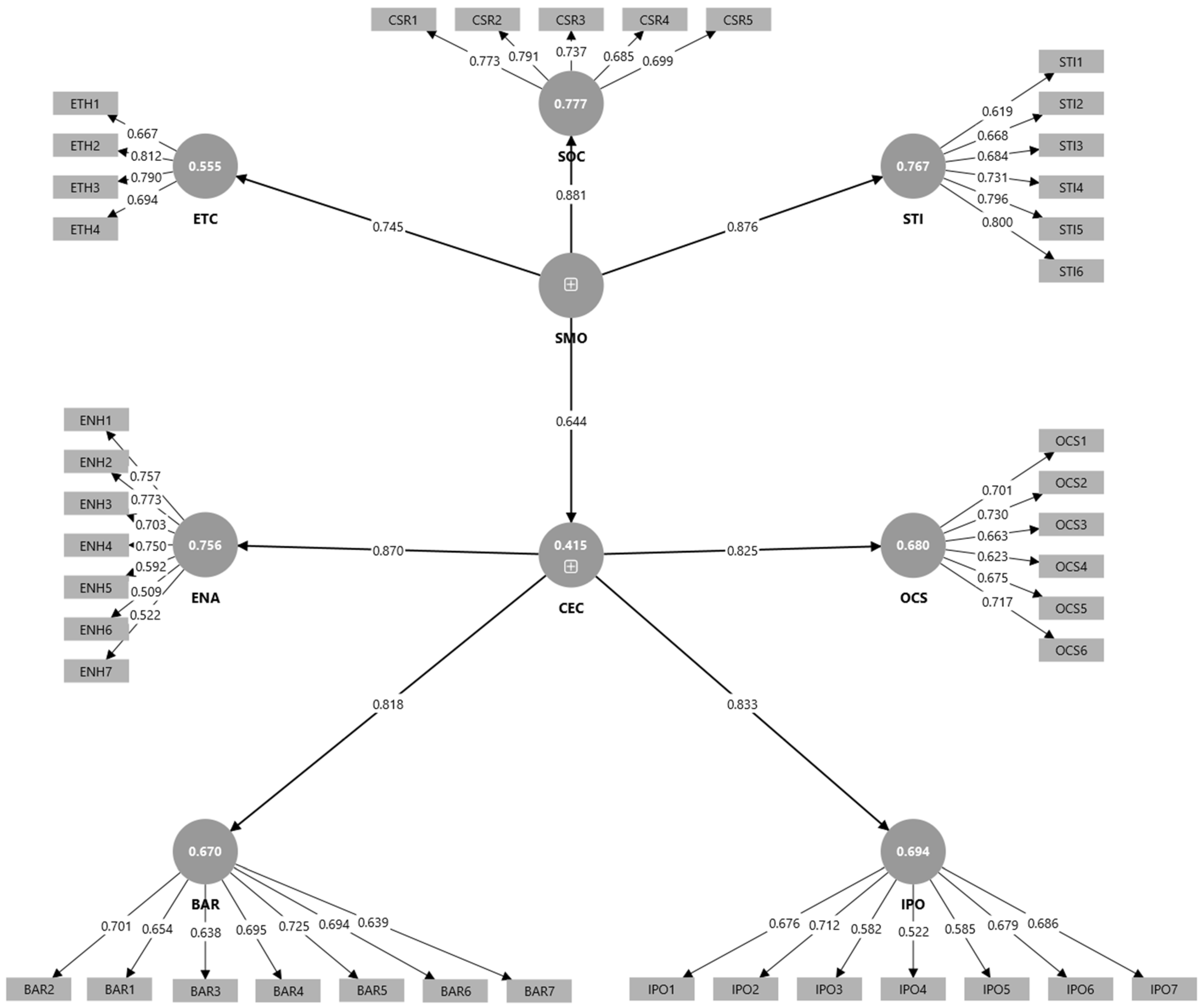
The findings indicate that SMO has a positive and statistically significant effect on its three dimensions—ethical capabilities, social commitment, and strategic integration—supporting H1, H2, and H3, respectively. These results confirm the proposed hierarchical structure of SMO as a multidimensional construct grounded in strategic, social, and ethical organizational dimensions.
In addition, SMO exerts a positive and statistically significant influence on CE practices (β = 0.644, p < 0.001), providing support for H4. The model explains a substantial proportion of the variance in CE adoption (R2 = 0.415), demonstrating the explanatory power of the proposed framework.
Beyond statistical significance, the practical magnitude of the structural relationship was assessed through the effect size (f2). The effect size of SMO on CE was 0.710, which exceeds the threshold for a large effect according to Cohen’s [32] criteria. This indicates that SMO exerts not only a statistically significant but also a substantively strong influence on CE adoption.
Overall, the structural model demonstrates solid explanatory capacity and provides empirical support for the proposed relationships between SMO and CE practices. The findings highlight the central role of SMO in fostering the adoption of circular economy practices within organizations and provide a robust foundation for the subsequent discussion of theoretical and practical implications.
4.3. Path Model
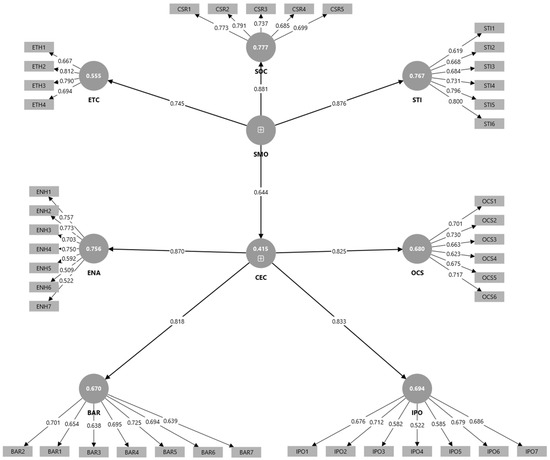
Figure 1 presents the final structural model, illustrating the standardized path coefficients and the strength of the relationships among the constructs included in the analysis. The visual representation confirms the hierarchical structure of SMO, as its three dimensions—ethical capabilities, social commitment, and strategic integration—exhibit strong and statistically significant loadings on the higher-order construct. This finding supports the conceptualization of SMO as a multidimensional organizational orientation grounded in ethical, social, and strategic practices.
Figure 1.
Path Model. Source: SmartPLS Path Model results.
Furthermore, the path model visually highlights the positive and significant relationship between SMO and CE practices. The magnitude of the path coefficient from SMO to CE reinforces the role of sustainable marketing as an organizational mechanism that facilitates the adoption of circular economy principles. The explained variance of the endogenous construct indicates that SMO accounts for a substantial proportion of circular economy adoption within the analyzed firms, confirming the robustness and explanatory power of the proposed model.
Overall, the visual representation of the path model supports the previously reported statistical results and confirms the internal coherence of the proposed research framework.
5. Discussion
5.1. Interpretation of Key Findings
The first key finding of this study is the substantial explanatory power of SMO on the adoption of CE practices. The results show that this effect is primarily driven by the dimensions of Social Commitment and Strategic Integration, highlighting the relevance of embedding sustainability-oriented decisions across the organization and its stakeholder network.
The stronger effects of Social Commitment suggest that CE adoption is closely linked to how firms engage with key stakeholders, including suppliers, shareholders, and employees, and to the extent to which sustainability expectations are integrated into organizational relationships. Similarly, the significant role of Strategic Integration indicates that circular practices are more likely to emerge when sustainability is institutionalized in corporate strategy, organizational culture, and performance measurement systems that incorporate financial, environmental, and social indicators.
These findings support the notion that the transition toward circular models is not driven solely by isolated ethical capabilities, but rather by the strategic and relational integration of sustainability principles within the organization. From a value creation perspective, this result is consistent with the arguments proposed by Goyal et al. [4], who emphasize that CE adoption is closely associated with organizational orientations that enable long-term value creation. In this sense, the results confirm that a sustainability-oriented marketing approach can act as a key organizational driver of circularity in processes and resource use.
5.2. Sustainable Marketing Orientation as a Driver of Circular Economy
Beyond the internal interpretation of SMO, the results of this study contribute to the broader literature on the CE by shedding light on the organizational mechanisms that enable its adoption. While prior research has extensively conceptualized the circular economy as a systemic transformation of production and consumption models, the organizational conditions that facilitate such transformation remain underexplored. In this context, the findings suggest that the adoption of CE practices is not solely driven by technological innovation or external regulatory pressures, but also by internal strategic orientations that align market logic, stakeholder engagement, and organizational processes.
The literature further emphasizes that the successful transition toward a CE model depends on the systematic integration of its components, rather than on the implementation of isolated initiatives. As argued by Urbinati et al. [12], CE adoption requires a redesign of the business model, coherence across functional areas, and alignment between strategy and operations. From an organizational perspective, this implies a deep transformation of internal processes and operations, as well as cultural changes that embed circularity principles throughout the organization, from top management to employees across all functional areas.
In addition, the effectiveness of CE implementation is influenced by firms’ ability to respond to internal and external pressures, including managerial commitment, compliance with environmental regulations, and market and competitive demands related to sustainability performance. At the same time, the literature recognizes the presence of structural barriers that may hinder this transition, such as limited knowledge, financial constraints, insufficient investment in employee training, rigid organizational processes, and the lack of adequate decision-making support based on circular economy indicators. Together, these elements reinforce the view of the circular economy as a complex and systemic organizational transformation rather than a set of discrete environmental practices.
Despite the growing consensus that the circular economy represents a systemic organizational transformation, the literature has devoted limited attention to the internal strategic orientations that enable firms to coordinate the diverse elements required for its implementation. In this regard, the findings of this study suggest that SMO operates as a key organizational mechanism that helps integrate strategy, internal processes, and stakeholder relationships in support of circular economy adoption. By aligning value propositions with sustainability principles and fostering coherence between market expectations and organizational practices, SMO facilitates the translation of circular economy concepts into concrete and coordinated actions. This perspective positions sustainable marketing not merely as a functional activity, but as a higher-order organizational capability that supports CE implementation and contributes to broader socio-economic sustainability transitions.
5.3. Theoretical Contributions
This study contributes to the sustainable marketing literature by conceptualizing and empirically validating SMO as a hierarchical and multidimensional organizational orientation. In contrast to prevailing approaches that examine sustainable marketing primarily at a functional, tactical, or market level, the findings of this study demonstrate that SMO is anchored in three fundamental organizational dimensions: ethical capabilities, social commitment, and the strategic integration of sustainability within the organization. This empirical evidence advances the understanding of sustainable marketing as a strategic orientation deeply ingrained in organizational culture, management systems, and decision-making processes, aligning with recent calls for a more organizational and strategic perspective on sustainability-oriented marketing [6,16].
Second, the study contributes to the circular economy literature by identifying SMO as an internal organizational antecedent that facilitates the adoption of circular economy practices. While prior research has emphasized technological innovation, institutional pressures, and environmental regulations as key drivers of circular economy implementation, this study addresses an important theoretical gap by showing that the transition toward circular models also depends on internal strategic orientations that enable organizational coherence. In this sense, the findings complement existing conceptualizations of the circular economy as a systemic and value-oriented model, while providing empirical insight into the organizational mechanisms that support its effective implementation [12,13].
Finally, a central contribution of this study lies in its interdisciplinary approach and the integration of marketing, circular economy, and sustainability within a single empirical model. By demonstrating how an organizational orientation such as SMO coherently connects the market, the organization, and society, the study moves beyond viewing the circular economy as a purely environmental phenomenon. Instead, it situates circular economy adoption within a broader socio-economic, organizational, and value creation logic, reinforcing perspectives that frame circular economy practices as part of systemic sustainability transitions and long-term value creation processes [4].
6. Conclusions
The findings of this study indicate that the adoption of CE does not depend exclusively on operational practices focused on reusing, recycling, or recovering resources. Rather, CE adoption also reflects how organizations think, make decisions, and relate to their stakeholders, which is shaped by their strategic orientation, organizational culture, and marketing management. In this sense, the study demonstrates that CE should be understood as an organizational and relational strategy, rather than as a set of isolated environmental practices.
From a practical perspective, the results suggest that decision makers seeking to advance CE should focus on both internal operations and organizational change processes. In terms of internal processes and operations, organizations are encouraged to implement environmental management systems; pursue energy and water efficiency; integrate practices such as reuse, repair, and recycling into production and operational processes; and leverage digitalization and teleworking to improve resource efficiency. At the same time, CE adoption requires organizational and strategic changes, including the explicit incorporation of CE principles into formal documents, the promotion of leadership aligned with sustainability values, continuous internal training, and organization-wide communication and awareness regarding environmental impact. These actions are particularly relevant for mitigating common barriers to CE adoption, such as limited knowledge, financial constraints, rigid processes, and insufficient decision-support systems.
The study further confirms that CE adoption should be managed as a relational strategy, strongly supported by SMO, particularly through its Social Commitment and Strategic Integration dimensions. The results highlight the importance of measuring financial, social, and environmental performance, embedding sustainability into corporate values, aligning internal incentives with sustainability objectives, systematically measuring customer satisfaction, and continuously monitoring the environmental and social impacts of products and services. These practices enable organizations to integrate CE principles more effectively by aligning internal decisions with stakeholder expectations.
Overall, the findings suggest that CE adoption becomes more viable when sustainability is integrated into organizational strategy rather than treated as a collection of isolated initiatives. By integrating sustainability into strategic decision-making, performance measurement systems, organizational culture, and customer experience management, firms can move toward CE models that generate long-term value. This inside–out approach supports not only environmental performance, but also sustained business competitiveness and positive impact on the broader socio-economic context.
Despite its contributions, this study presents several avenues for future research. First, longitudinal designs would allow for stronger causal inference and provide insights into the dynamic evolution of SMO and CE adoption over time. Second, cross-country comparative studies could examine how different institutional environments moderate the relationship between SMO and CE, particularly across developed and emerging economies. Third, future research may explore potential mediating and moderating mechanisms, such as organizational learning, innovation capability or stakeholder pressure, to better understand the internal processes through which SMO facilitates circular transformation. Finally, mixed-method approaches combining quantitative modeling with qualitative inquiry could deepen understanding of how strategic orientations are operationalized in practice within diverse organizational contexts.
Author Contributions
Data curation, M.E.R.M.; Formal analysis, M.E.R.M.; Investigation, A.A.D.D.; Methodology, A.A.D.D.; Project administration, A.A.D.D.; Resources, A.A.D.D. and M.E.R.M.; Software, M.E.R.M.; Validation, G.P.-C.; Visualization, G.P.-C.; Writing—original draft, A.A.D.D.; Writing—review & editing, G.P.-C. and M.E.R.M. All authors have read and agreed to the published version of the manuscript.
Funding
This research received no external funding.
Institutional Review Board Statement
This study was waived for ethical review as it was based on an anonymous survey involving adult participants, did not collect personal or sensitive data, and involved voluntary participation with informed consent, in accordance with established ethical guidelines for social science research.
Informed Consent Statement
Informed consent for participation was obtained from all subjects involved in the study.
Data Availability Statement
The data presented in this study are available from the corresponding author upon reasonable request. The data are not publicly available due to confidentiality restrictions involving participating firms.
Conflicts of Interest
The authors declare no conflicts of interest.
Appendix A. Measurement Items
Table A1.
Sustainable Marketing (SM) Measurement Items.
Table A2.
Circular Economy (CE) Measurement Items.
References
- Kim, Y.M.; Bendle, N.T.; Hulland, J.; Pfarrer, M.D. Corporate sustainability research in marketing: Mapping progress and broadening our perspective. J. Acad. Mark. Sci. 2024, 52, 1495–1512. [Google Scholar] [CrossRef] [Scilit]
- Engert, S.; Rauter, R.; Baumgartner, R.J. Exploring the integration of corporate sustainability into strategic management: A literature review. J. Clean. Prod. 2016, 112, 2833–2850. [Google Scholar] [CrossRef] [Scilit]
- Sehgal, V.; Garg, N.; Singh, J. Impact of sustainability reporting and performance on organizational legitimacy. Int. J. Syst. Assur. Eng. Manag. 2022, 14, 143–153. [Google Scholar] [CrossRef] [Scilit]
- Goyal, S.; Garg, D.; Luthra, S. Analyzing critical success factors to adopt sustainable consumption and production linked with circular economy. Environ. Dev. Sustain. 2022, 24, 5195–5224. [Google Scholar] [CrossRef] [Scilit]
- Khan, S.A.R.; Yu, Z.; Golpira, H.; Sharif, A.; Mardani, A. A state-of-the-art review and meta-analysis on sustainable supply chain management: Future research directions. J. Clean. Prod. 2021, 278, 123357. [Google Scholar] [CrossRef] [Scilit]
- Madhavaram, S.; Nirjar, A. Capability development for sustainable marketing: A theoretical framework. AMS Rev. 2025, 15, 157–190. [Google Scholar] [CrossRef] [Scilit]
- Teece, D.J. Explicating dynamic capabilities: The nature and microfoundations of sustainable enterprise performance. Strateg. Manag. J. 2007, 28, 1319–1350. [Google Scholar] [CrossRef] [Scilit]
- Kumar, V.; Rahman, Z.; Kazmi, A.A.; Goyal, P. Evolution of sustainability as marketing strategy: Beginning of new era. Procedia Soc. Behav. Sci. 2012, 37, 482–489. [Google Scholar] [CrossRef] [Scilit]
- Grewal, D.; Hulland, J.; Kopalle, P.K.; Karahanna, E. The future of technology and marketing: A multidisciplinary perspective. J. Acad. Mark. Sci. 2020, 48, 1–8. [Google Scholar] [CrossRef] [Scilit]
- Hahn, T.; Figge, F.; Aragón-Correa, J.A.; Sharma, S. Advancing research on corporate sustainability: Off to pastures new or back to the roots? Bus. Soc. 2017, 56, 155–185. [Google Scholar] [CrossRef] [Scilit]
- Freitas Netto, S.V.; Sobral, M.F.; Ribeiro, A.R.B.; de Luz Soares, G.R. Concepts and forms of greenwashing: A systematic review. Environ. Sci. Eur. 2020, 32, 19. [Google Scholar] [CrossRef] [Scilit]
- Urbinati, A.; Chiaroni, D.; Chiesa, V. Towards a new taxonomy of circular economy business models. J. Clean. Prod. 2017, 168, 487–498. [Google Scholar] [CrossRef] [Scilit]
- Prieto-Sandoval, V.; Jaca, C.; Ormazabal, M.; Martínez-Jurado, P.J. Towards a consensus on the circular economy. J. Clean. Prod. 2018, 179, 605–615. [Google Scholar] [CrossRef] [Scilit]
- Nenonen, S.; Storbacka, K.; Sklyar, A.; Frow, P.; Payne, A. Value propositions as market-shaping devices: A qualitative comparative analysis. Ind. Mark. Manag. 2020, 87, 276–290. [Google Scholar] [CrossRef] [Scilit]
- Ranta, V.; Aarikka-Stenroos, L.; Mäkinen, S.J. Creating value in the circular economy: A structured multiple-case analysis. J. Clean. Prod. 2018, 201, 988–1000. [Google Scholar] [CrossRef] [Scilit]
- Geissdoerfer, M.; Pieroni, M.P.; Pigosso, D.C.A.; Soufani, K. Circular business models: A review. J. Clean. Prod. 2020, 277, 123741. [Google Scholar] [CrossRef] [Scilit]
- European Commission. A New Circular Economy Action Plan for a Cleaner and More Competitive Europe; European Commission: Brussels, Belgium, 2020. [Google Scholar]
- OECD. Towards a Circular Economy: A Policy Perspective; OECD Publishing: Paris, France, 2021. [Google Scholar]
- OECD. Global Material Resources Outlook 2060; OECD Publishing: Paris, France, 2022. [Google Scholar]
- INEGI. Directorio Estadístico Nacional de Unidades Económicas (DENUE); Instituto Nacional de Estadística y Geografía: Mexico City, Mexico, 2021. [Google Scholar]
- González-Benito, Ó.; González-Benito, J.; Muñoz-Gallego, P.A. Role of entrepreneurship and market orientation in firms’ success. Eur. J. Mark. 2009, 43, 500–522. [Google Scholar] [CrossRef] [Scilit]
- Camacho-Otero, J.; Boks, C.; Pettersen, I.N. Consumption in the circular economy: A literature review. Sustainability 2018, 10, 2758. [Google Scholar] [CrossRef] [Scilit]
- Reim, W.; Åström, J.; Eriksson, O. Implementation of artificial intelligence (AI): A roadmap for business model innovation. AI 2020, 1, 180–191. [Google Scholar] [CrossRef] [Scilit]
- Lučić, A. Measuring sustainable marketing orientation—Scale development process. Sustainability 2020, 12, 1734. [Google Scholar] [CrossRef] [Scilit]
- Klein, N.; Ramos, T.B.; Deutz, P. Advancing the circular economy in public sector organisations: Employees’ perspectives on practices. Circ. Econ. Sustain. 2022, 2, 759–781. [Google Scholar] [CrossRef] [Scilit]
- Geels, F.W. The multi-level perspective on sustainability transitions: Responses to seven criticisms. Environ. Innov. Soc. Transit. 2011, 1, 24–40. [Google Scholar] [CrossRef] [Scilit]
- Scott, W.R. Institutions and Organizations, 4th ed.; Sage Publications: Thousand Oaks, CA, USA, 2014. [Google Scholar]
- Podsakoff, P.M.; MacKenzie, S.B.; Lee, J.Y.; Podsakoff, N.P. Common method biases in behavioral research: A critical review of the literature and recommended remedies. J. Appl. Psychol. 2003, 88, 879–903. [Google Scholar] [CrossRef] [Scilit]
- Kock, N. Common method bias in PLS-SEM: A full collinearity assessment approach. Int. J. e-Collab. 2015, 11, 1–10. [Google Scholar] [CrossRef] [Scilit]
- Fornell, C.; Larcker, D.F. Evaluating structural equation models with unobservable variables and measurement error. J. Mark. Res. 1981, 18, 39–50. [Google Scholar] [CrossRef] [Scilit]
- Hair, J.F.; Hult, G.T.M.; Ringle, C.M.; Sarstedt, M. A Primer on Partial Least Squares Structural Equation Modeling (PLS-SEM), 3rd ed.; Sage Publications: Thousand Oaks, CA, USA, 2022. [Google Scholar]
- Cohen, J. Statistical Power Analysis for the Behavioral Sciences, 2nd ed.; Lawrence Erlbaum Associates: Hillsdale, NJ, USA, 1988. [Google Scholar]

Disclaimer/Publisher’s Note: The statements, opinions and data contained in all publications are solely those of the individual author(s) and contributor(s) and not of MDPI and/or the editor(s). MDPI and/or the editor(s) disclaim responsibility for any injury to people or property resulting from any ideas, methods, instructions or products referred to in the content. |
© 2026 by the authors. Licensee MDPI, Basel, Switzerland. This article is an open access article distributed under the terms and conditions of the Creative Commons Attribution (CC BY) license.